Mitochondrial Stress Orchestrates Tumor Immune Evasion and Immunotherapy Resistance


Highlights
- Mitochondrial stress functions as a regulatory axis influencing tumor immune evasion and immunotherapy resistance.
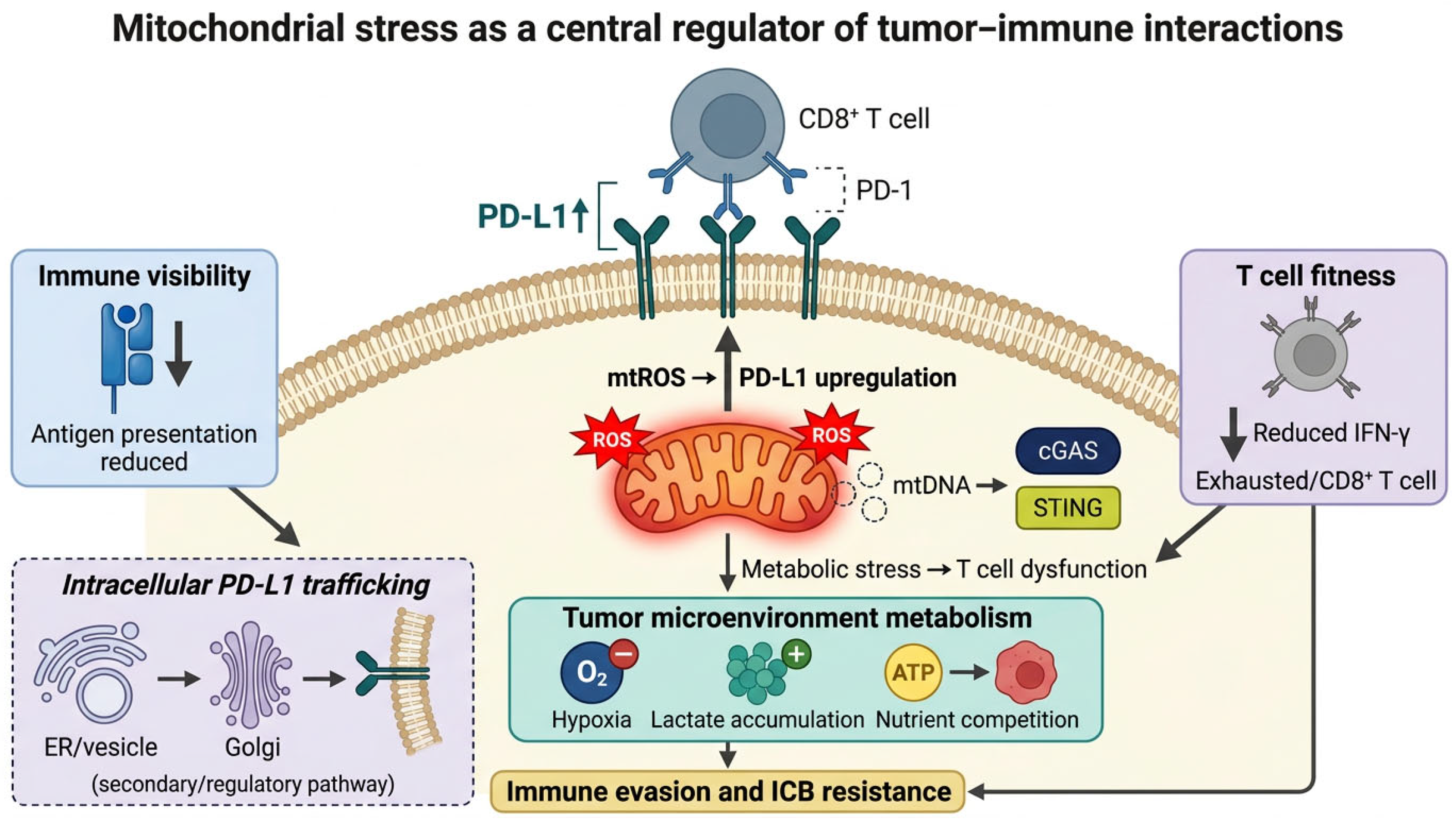
- Immune visibility, immune cell fitness, and tumor microenvironment metabolism define three interconnected dimensions of mitochondrial control.
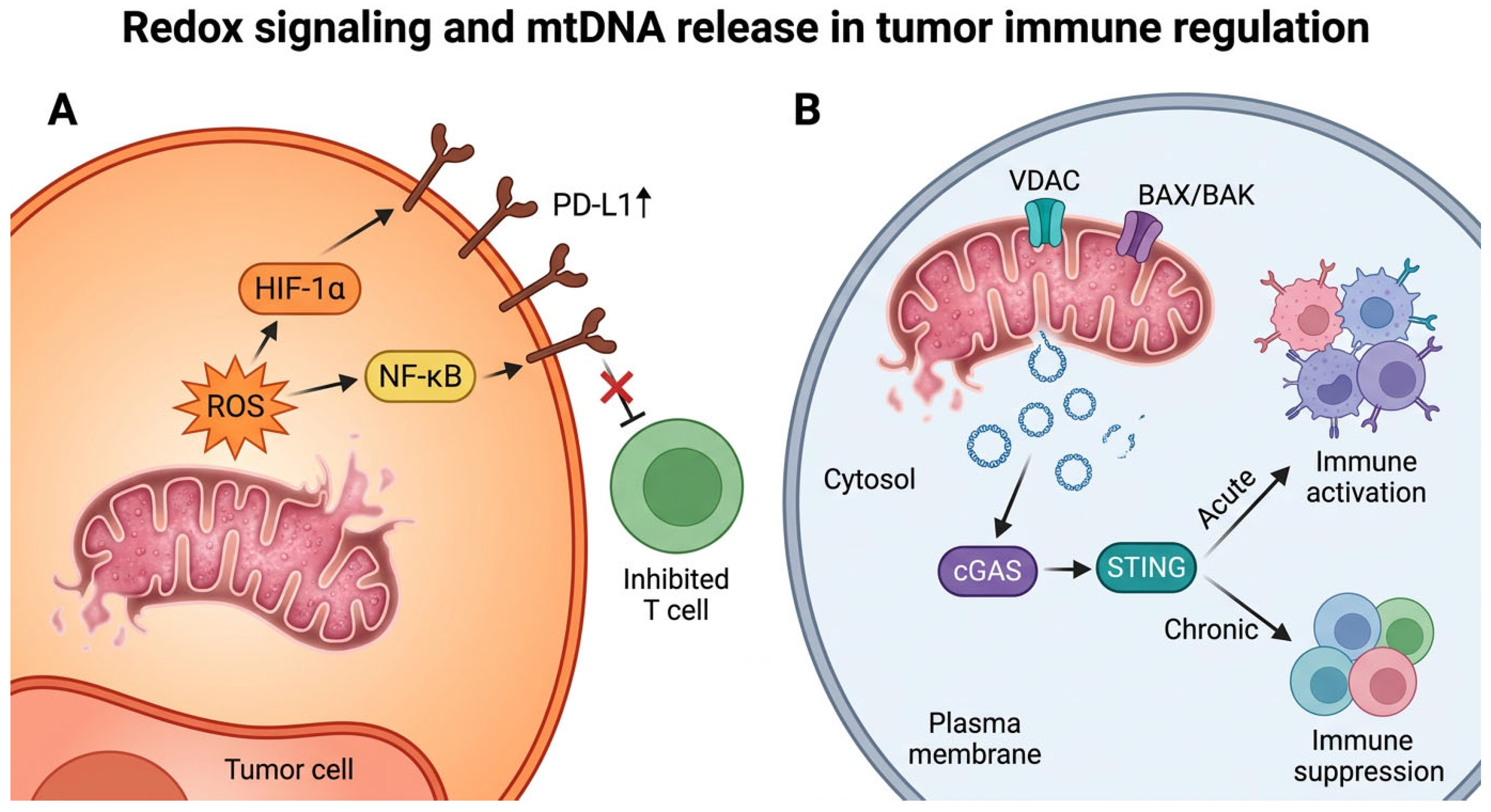
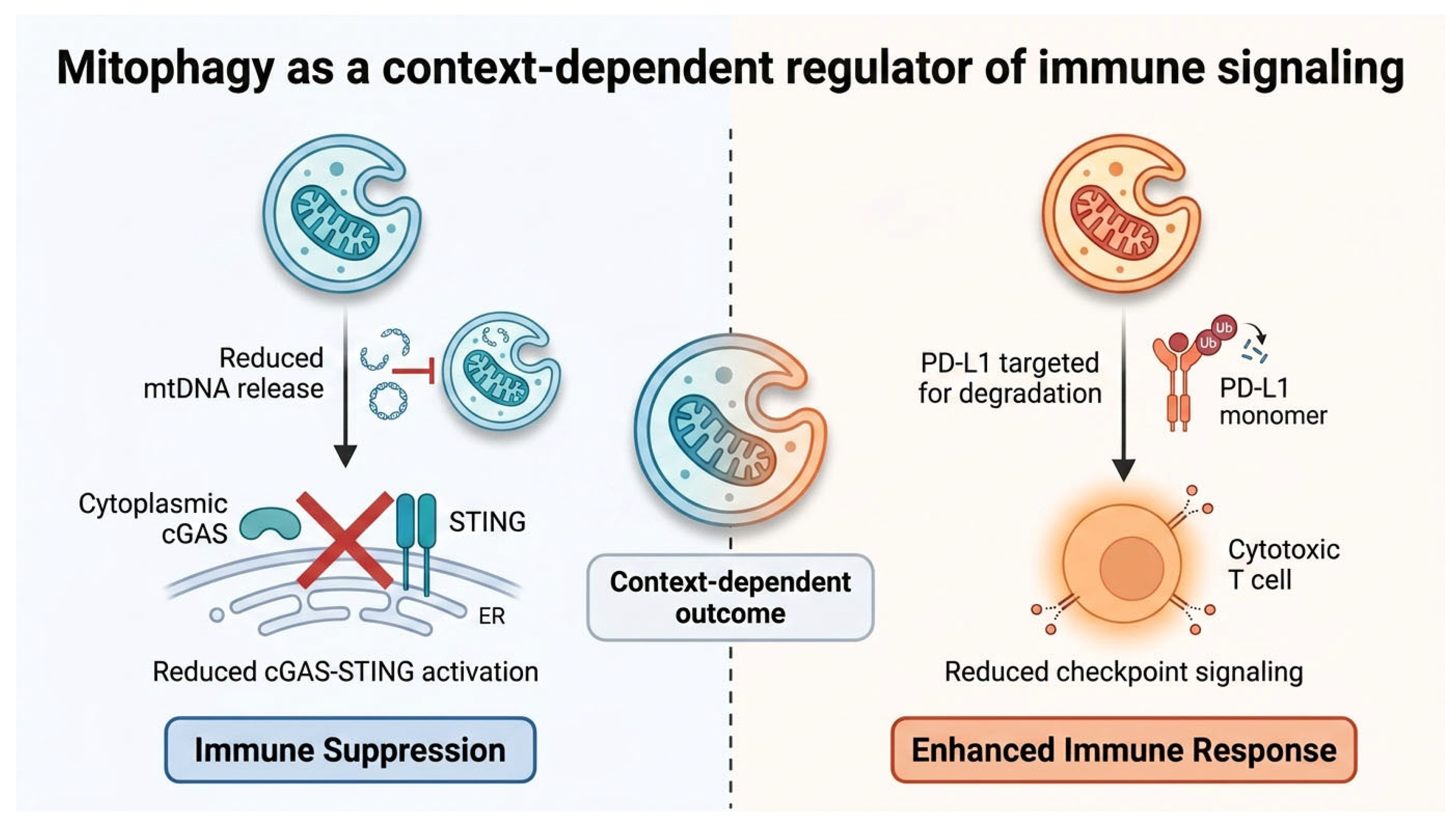
- mtROS, mtDNA–cGAS–STING signaling, and mitophagy integrate metabolic and immune pathways in a context-dependent manner.
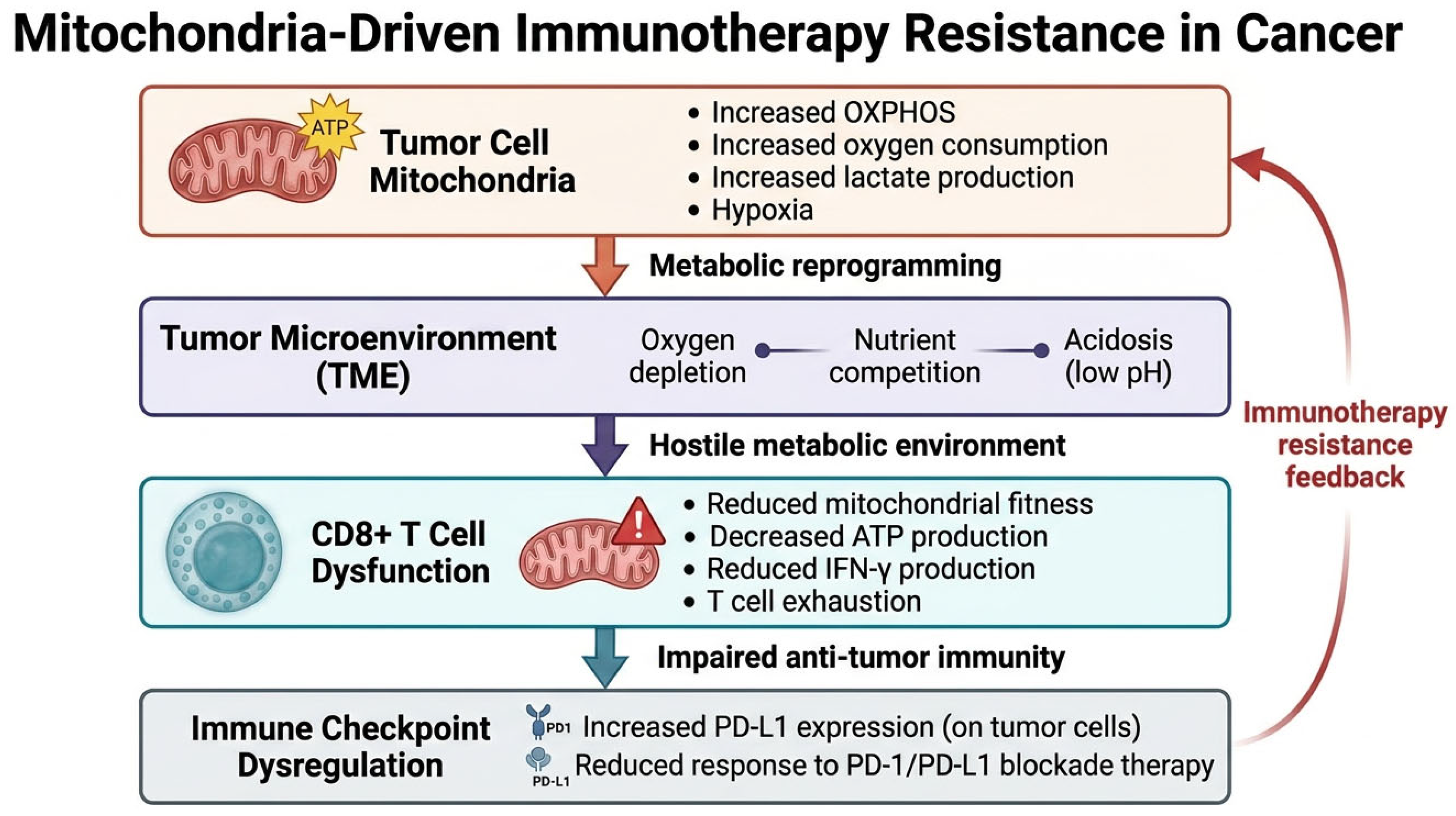
- Metabolic competition represents a major constraint on immune checkpoint blockade efficacy in metabolically active tumors.
- Targeting mitochondrial pathways provides a mechanistically grounded strategy to reprogram immunotherapy-resistant tumor phenotypes.
Abstract
1. Introduction
2. Mitochondrial Stress as an Immune Signaling Hub
2.1. mtROS and Redox Signaling Axis
2.2. mtDNA Release and Mitochondrial DAMP Biology
2.3. Metabolic Reprogramming and Metabolic Competition (OXPHOS–TCA–Glycolysis)
3. Translational Implications: Mitochondria and Immunotherapy Resistance
3.1. Mitochondria in Checkpoint Resistance
3.2. Metabolic Resistance and Checkpoint Protein Biology
3.3. Mitochondria-Based Biomarkers and Combination Strategies
4. Mitochondria in Tumor Immune Evasion
4.1. Suppression of Antigen Presentation (MHC-I/IFN-γ Axis)
4.2. Immune Cell Dysfunction (TIL Mitochondrial Fitness and Dynamics)
4.3. TME Remodeling and Organelle Transfer
5. Mitophagy and Immune Modulation
5.1. Mitophagy as a Regulator of mtDNA–cGAS–STING Signaling
5.2. Inflammatory Signaling Controls Mitophagy: The TNF Axis
5.3. Mitophagy and Immune Checkpoint Regulation: PD-L1 Proteostasis
5.4. Mitophagy Defects and Tumor Immune Escape
5.5. Reliability Considerations in Mitophagy–STING Literature
5.6. Mechanistic Summary
6. Experimental Models to Study Mitochondrial–Immune Interactions
6.1. Role and Limitations of 2D Culture Systems
6.2. 3D Spheroid Models: Capturing Gradient Biology
6.3. Patient-Derived Organoids: Genetic and Structural Fidelity
6.4. Organoid–Immune Co-Culture Systems
6.5. Mitochondria-Focused Readouts Linking Mechanism to Immune Function
6.6. Integration with In Vivo Models
7. Future Directions
7.1. Quantifying Acute vs. Chronic mtDNA–STING Signaling
7.2. Integrating Mitochondrial Metabolism with Tumor Visibility
7.3. Patient-Specific 3D Platforms and Multi-Omic Perturbation
7.4. Standardization and Translational Integration
8. Conclusions
Author Contributions
Funding
Institutional Review Board Statement
Informed Consent Statement
Data Availability Statement
Conflicts of Interest
Abbreviations
| TME | Tumor microenvironment |
| ICB | Immune checkpoint blockade |
| mtROS | Mitochondrial reactive oxygen species |
| mtDNA | Mitochondrial DNA |
| cGAS | Cyclic GMP-AMP synthase |
| STING | Stimulator of interferon genes |
| OXPHOS | Oxidative phosphorylation |
| TCA | Tricarboxylic acid cycle |
| PD-1 | Programmed cell death protein 1 |
| PD-L1 | Programmed death-ligand 1 |
| IFN-γ | Interferon gamma |
| TILs | Tumor-infiltrating lymphocytes |
| MHC-I | Major histocompatibility complex class I |
| PERK | Protein kinase RNA-like endoplasmic reticulum kinase |
| UPR | Unfolded protein response |
| MDSCs | Myeloid-derived suppressor cells |
| FAO | Fatty acid oxidation |
| CD8 | Cluster of Differentiation 8 |
References
- Ikeda, H.; Kawase, K.; Nishi, T.; Watanabe, T.; Takenaga, K.; Inozume, T.; Ishino, T.; Aki, S.; Lin, J.; Kawashima, S.; et al. Immune evasion through mitochondrial transfer in the tumour microenvironment. Nature 2025, 638, 225–236, Erratum in Nature 2025, 644, E33. https://doi.org/10.1038/s41586-025-09408-x. [Google Scholar] [CrossRef]
- Mangalhara, K.C.; Varanasi, S.K.; Johnson, M.A.; Burns, M.J.; Rojas, G.R.; Esparza Moltó, P.B.; Sainz, A.G.; Tadepalle, N.; Abbott, K.L.; Mendiratta, G.; et al. Manipulating mitochondrial electron flow enhances tumor immunogenicity. Science 2023, 381, 1316–1323. [Google Scholar] [CrossRef]
- Klein, K.; He, K.; Younes, A.I.; Barsoumian, H.B.; Chen, D.; Ozgen, T.; Mosaffa, S.; Patel, R.R.; Gu, M.; Novaes, J.; et al. Role of Mitochondria in Cancer Immune Evasion and Potential Therapeutic Approaches. Front. Immunol. 2020, 11, 573326. [Google Scholar] [CrossRef] [PubMed]
- Kumar, A.; Chamoto, K.; Chowdhury, P.S.; Honjo, T. Tumors attenuating the mitochondrial activity in T cells escape from PD-1 blockade therapy. eLife 2020, 9, e52330. [Google Scholar] [CrossRef] [PubMed]
- Thommen, D.S.; Schumacher, T.N. T Cell Dysfunction in Cancer. Cancer Cell 2018, 33, 547–562. [Google Scholar] [CrossRef]
- McLane, L.M.; Abdel-Hakeem, M.S.; Wherry, E.J. CD8 T Cell Exhaustion During Chronic Viral Infection and Cancer. Annu. Rev. Immunol. 2019, 37, 457–495. [Google Scholar] [CrossRef]
- Arner, E.N.; Rathmell, J.C. Metabolic Programming and Immune Suppression in the Tumor Microenvironment. Cancer Cell 2023, 41, 421–433. [Google Scholar] [CrossRef]
- DePeaux, K.; Delgoffe, G.M. Metabolic barriers to cancer immunotherapy. Nat. Rev. Immunol. 2021, 21, 785–797. [Google Scholar] [CrossRef] [PubMed]
- Chang, C.-H.; Qiu, J.; O’Sullivan, D.; Buck, M.D.; Noguchi, T.; Curtis, J.D.; Chen, Q.; Gindin, M.; Gubin, M.M.; van der Windt, G.J.W.; et al. Metabolic Competition in the Tumor Microenvironment Is a Driver of Cancer Progression. Cell 2015, 162, 1229–1241. [Google Scholar] [CrossRef]
- Ho, P.-C.; Bihuniak, J.D.; Macintyre, A.N.; Staron, M.; Liu, X.; Amezquita, R.; Tsui, Y.-C.; Cui, G.; Micevic, G.; Perales, J.C.; et al. Phosphoenolpyruvate Is a Metabolic Checkpoint of Anti-tumor T Cell Responses. Cell 2015, 162, 1217–1228. [Google Scholar] [CrossRef]
- Patsoukis, N.; Bardhan, K.; Chatterjee, P.; Sari, D.; Liu, B.; Bell, L.N.; Karoly, E.D.; Freeman, G.J.; Petkova, V.; Seth, P.; et al. PD-1 alters T-cell metabolic reprogramming by inhibiting glycolysis and promoting lipolysis and fatty acid oxidation. Nat. Commun. 2015, 6, 6692. [Google Scholar] [CrossRef]
- Kuo, C.-L.; Lin, Y.-C.; Lo, Y.K.; Lu, Y.-Z.; Babuharisankar, A.P.; Lien, H.-W.; Chou, H.-Y.; Lee, A.Y.-L. The mitochondrial stress signaling tunes immunity from a view of systemic tumor microenvironment and ecosystem. iScience 2024, 27, 110710. [Google Scholar] [CrossRef]
- Scharping, N.E.; Menk, A.V.; Moreci, R.S.; Whetstone, R.D.; Dadey, R.E.; Watkins, S.C.; Ferris, R.L.; Delgoffe, G.M. The Tumor Microenvironment Represses T Cell Mitochondrial Biogenesis to Drive Intratumoral T Cell Metabolic Insufficiency and Dysfunction. Immunity 2016, 45, 374–388, Erratum in Immunity 2016, 45, 701–703. https://doi.org/10.1016/j.immuni.2016.08.009. [Google Scholar] [CrossRef]
- Scharping, N.E.; Rivadeneira, D.B.; Menk, A.V.; Vignali, P.D.A.; Ford, B.R.; Rittenhouse, N.L.; Peralta, R.; Wang, Y.; Wang, Y.; DePeaux, K.; et al. Mitochondrial stress induced by continuous stimulation under hypoxia rapidly drives T cell exhaustion. Nat. Immunol. 2021, 22, 205–215. [Google Scholar] [CrossRef]
- Wu, H.; Zhao, X.; Hochrein, S.M.; Eckstein, M.; Gubert, G.F.; Knöpper, K.; Mansilla, A.M.; Öner, A.; Doucet-Ladevèze, R.; Schmitz, W.; et al. Mitochondrial dysfunction promotes the transition of precursor to terminally exhausted T cells through HIF-1α-mediated glycolytic reprogramming. Nat. Commun. 2023, 14, 6858. [Google Scholar] [CrossRef] [PubMed]
- Pandey, S.; Anang, V.; Schumacher, M.M. Mitochondria driven innate immune signaling and inflammation in cancer growth, immune evasion, and therapeutic resistance. Int. Rev. Cell Mol. Biol. 2024, 386, 223–247. [Google Scholar] [CrossRef]
- Newman, L.E.; Shadel, G.S. Mitochondrial DNA Release in Innate Immune Signaling. Annu. Rev. Biochem. 2023, 92, 299–332. [Google Scholar] [CrossRef]
- Kuo, C.-L.; Babuharisankar, A.P.; Lin, Y.-C.; Lien, H.-W.; Lo, Y.K.; Chou, H.-Y.; Tangeda, V.; Cheng, L.-C.; Cheng, A.N.; Lee, A.Y.-L. Mitochondrial oxidative stress in the tumor microenvironment and cancer immunoescape: Foe or friend? J. Biomed. Sci. 2022, 29, 74. [Google Scholar] [CrossRef]
- Aloraini, G.S. Mitochondrial DNA release and cGAS-STING activation: Emerging insights into anti-tumor immunity. Pathol. Res. Pract. 2025, 273, 156158. [Google Scholar] [CrossRef] [PubMed]
- Huang, N.; Liu, Z.; Lei, H.; Liu, X. The roles of the mtDNA-cGAS-STING axis in tumor immunity: From immune activation to immune evasion. Front. Immunol. 2026, 16, 1739559. [Google Scholar] [CrossRef] [PubMed]
- Bailey, C.M.; Liu, Y.; Liu, M.; Du, X.; Devenport, M.; Zheng, P.; Liu, Y.; Wang, Y. Targeting HIF-1α abrogates PD-L1-mediated immune evasion in tumor microenvironment but promotes tolerance in normal tissues. J. Clin. Investig. 2022, 132, e150846. [Google Scholar] [CrossRef]
- Noman, M.Z.; Desantis, G.; Janji, B.; Hasmim, M.; Karray, S.; Dessen, P.; Bronte, V.; Chouaib, S. PD-L1 is a novel direct target of HIF-1α, and its blockade under hypoxia enhanced MDSC-mediated T cell activation. J. Exp. Med. 2014, 211, 781–790. [Google Scholar] [CrossRef] [PubMed]
- Bailly, C. Regulation of PD-L1 expression on cancer cells with ROS-modulating drugs. Life Sci. 2020, 246, 117403. [Google Scholar] [CrossRef] [PubMed]
- Antonangeli, F.; Natalini, A.; Garassino, M.C.; Sica, A.; Santoni, A.; Di Rosa, F. Regulation of PD-L1 Expression by NF-κB in Cancer. Front. Immunol. 2020, 11, 584626. [Google Scholar] [CrossRef]
- Lim, S.-O.; Li, C.-W.; Xia, W.; Cha, J.-H.; Chan, L.-C.; Wu, Y.; Chang, S.-S.; Lin, W.-C.; Hsu, J.-M.; Hsu, Y.-H.; et al. Deubiquitination and Stabilization of PD-L1 by CSN5. Cancer Cell 2016, 30, 925–939. [Google Scholar] [CrossRef] [PubMed]
- Kim, J.; Gupta, R.; Blanco, L.P.; Yang, S.; Shteinfer-Kuzmine, A.; Wang, K.; Zhu, J.; Yoon, H.E.; Wang, X.; Kerkhofs, M.; et al. VDAC oligomers form mitochondrial pores to release mtDNA fragments and promote lupus-like disease. Science 2019, 366, 1531–1536. [Google Scholar] [CrossRef]
- West, A.P.; Khoury-Hanold, W.; Staron, M.; Tal, M.C.; Pineda, C.M.; Lang, S.M.; Bestwick, M.; Duguay, B.A.; Raimundo, N.; MacDuff, D.A.; et al. Mitochondrial DNA stress primes the antiviral innate immune response. Nature 2015, 520, 553–557. [Google Scholar] [CrossRef]
- McArthur, K.; Whitehead, L.W.; Heddleston, J.M.; Li, L.; Padman, B.S.; Oorschot, V.; Geoghegan, N.D.; Chappaz, S.; Davidson, S.; San Chin, H.; et al. BAK/BAX macropores facilitate mitochondrial herniation and mtDNA efflux during apoptosis. Science 2018, 359, eaao6047. [Google Scholar] [CrossRef]
- Lai, P.; Liu, L.; Bancaro, N.; Troiani, M.; Calì, B.; Li, Y.; Chen, J.; Singh, P.K.; Arzola, R.A.; Attanasio, G.; et al. Mitochondrial DNA released by senescent tumor cells enhances PMN-MDSC-driven immunosuppression through the cGAS-STING pathway. Immunity 2025, 58, 811–825.e7. [Google Scholar] [CrossRef]
- Bakhoum, S.F.; Ngo, B.; Laughney, A.M.; Cavallo, J.-A.; Murphy, C.J.; Ly, P.; Shah, P.; Sriram, R.K.; Watkins, T.B.K.; Taunk, N.K.; et al. Chromosomal instability drives metastasis through a cytosolic DNA response. Nature 2018, 553, 467–472. [Google Scholar] [CrossRef]
- Kim, J.; Kim, H.-S.; Chung, J.H. Molecular mechanisms of mitochondrial DNA release and activation of the cGAS-STING pathway. Exp. Mol. Med. 2023, 55, 510–519. [Google Scholar] [CrossRef]
- Jiang, M.; Chen, P.; Wang, L.; Li, W.; Chen, B.; Liu, Y.; Wang, H.; Zhao, S.; Ye, L.; He, Y.; et al. cGAS-STING, an important pathway in cancer immunotherapy. J. Hematol. Oncol. 2020, 13, 81. [Google Scholar] [CrossRef]
- Huang, Z.; Zhu, J.; Zhou, Y.L.; Shi, J. The cGAS-STING pathway: A dual regulator of immune response in cancer and therapeutic implications. J. Transl. Med. 2025, 23, 766. [Google Scholar] [CrossRef] [PubMed]
- Kwon, J.; Bakhoum, S.F. The cytosolic DNA-sensing cGAS-STING pathway in cancer. Cancer Discov. 2020, 10, 26–39. [Google Scholar] [CrossRef]
- Berger, G.; Knelson, E.H.; Jimenez-Macias, J.L.; Nowicki, M.O.; Han, S.; Panagioti, E.; Lizotte, P.H.; Adu-Berchie, K.; Stafford, A.; Dimitrakakis, N.; et al. STING activation promotes robust immune response and NK cell-mediated tumor regression in glioblastoma models. Proc. Natl. Acad. Sci. USA 2022, 119, e2111003119. [Google Scholar] [CrossRef]
- Najjar, Y.G.; Menk, A.V.; Sander, C.; Rao, U.; Karunamurthy, A.; Bhatia, R.; Zhai, S.; Kirkwood, J.M.; Delgoffe, G.M. Tumor cell oxidative metabolism as a barrier to PD-1 blockade immunotherapy in melanoma. JCI Insight 2019, 4, e124989. [Google Scholar] [CrossRef] [PubMed]
- Liu, N.; Yan, M.; Tao, Q.; Wu, J.; Chen, J.; Chen, X.; Peng, C. Inhibition of TCA cycle improves the anti-PD-1 immunotherapy efficacy in melanoma cells via ATF3-mediated PD-L1 expression and glycolysis. J. Immunother. Cancer 2023, 11, e007146. [Google Scholar] [CrossRef] [PubMed]
- Hopfner, K.-P.; Hornung, V. Molecular mechanisms and cellular functions of cGAS-STING signalling. Nat. Rev. Mol. Cell Biol. 2020, 21, 501–521. [Google Scholar] [CrossRef]
- Ablasser, A.; Chen, Z.J. cGAS in action: Expanding roles in immunity and inflammation. Science 2019, 363, eaat8657. [Google Scholar] [CrossRef]
- Elia, I.; Rowe, J.H.; Johnson, S.; Joshi, S.; Notarangelo, G.; Kurmi, K.; Weiss, S.; Freeman, G.J.; Sharpe, A.H.; Haigis, M.C. Tumor cells dictate anti-tumor immune responses by altering pyruvate utilization and succinate signaling in CD8+ T cells. Cell Metab. 2022, 34, 1137–1150.e6. [Google Scholar] [CrossRef]
- Li, Z.; Zheng, W.; Liu, Y.; Cao, R.; Wei, J.; Jia, H. Bridging innate and adaptive tumor immunity: cGAS–STING pathway activation to potentiate immune checkpoint blockade. J. Exp. Clin. Cancer Res. 2025, 44, 303. [Google Scholar] [CrossRef]
- Li, C.-W.; Lim, S.-O.; Xia, W.; Lee, H.-H.; Chan, L.-C.; Kuo, C.-W.; Khoo, K.-H.; Chang, S.-S.; Cha, J.-H.; Kim, T.; et al. Glycosylation and stabilization of programmed death ligand-1 suppresses T-cell activity. Nat. Commun. 2016, 7, 12632. [Google Scholar] [CrossRef]
- Finisguerra, V.; Dvorakova, T.; Formenti, M.; Van Meerbeeck, P.; Mignion, L.; Gallez, B.; Van den Eynde, B.J. Metformin improves cancer immunotherapy by directly rescuing tumor-infiltrating CD8 T lymphocytes from hypoxia-induced immunosuppression. J. Immunother. Cancer 2023, 11, e005719. [Google Scholar] [CrossRef]
- Scharping, N.E.; Menk, A.V.; Whetstone, R.D.; Zeng, X.; Delgoffe, G.M. Efficacy of PD-1 blockade is potentiated by metformin-induced reduction of tumor hypoxia. Cancer Immunol. Res. 2017, 5, 9–16. [Google Scholar] [CrossRef]
- Yu, Y.-R.; Imrichova, H.; Wang, H.; Chao, T.; Xiao, Z.; Gao, M.; Rincon-Restrepo, M.; Franco, F.; Genolet, R.; Cheng, W.-C.; et al. Disturbed mitochondrial dynamics in CD8+ TILs reinforce T cell exhaustion. Nat. Immunol. 2020, 21, 1540–1551. [Google Scholar] [CrossRef]
- Liang, L.; Zong, Y.; Huang, J.; Chen, Y.; Xu, N.; Yan, P.; Song, H.; Wu, M. Lactylation stabilizes PD-L1 to promote tumor immune evasion and cell growth. Cell Death Dis. 2026, 17, 335. [Google Scholar] [CrossRef] [PubMed]
- Yao, H.; Lan, J.; Li, C.; Shi, H.; Brosseau, J.-P.; Wang, H.; Lu, H.; Fang, C.; Zhang, Y.; Liang, L.; et al. Inhibiting PD-L1 palmitoylation enhances T-cell immune responses against tumours. Nat. Biomed. Eng. 2019, 3, 306–317, Erratum in Nat. Biomed. Eng. 2019, 3, 414. https://doi.org/10.1038/s41551-019-0402-7. [Google Scholar] [CrossRef] [PubMed]
- Oh, W.; Kim, A.M.J.; Dhawan, D.; Knapp, D.W.; Lim, S.-O. Lactic acid inhibits the interaction between PD-L1 protein and PD-L1 antibody in the PD-1/PD-L1 blockade therapy-resistant tumor. Mol. Ther. 2025, 33, 723–733. [Google Scholar] [CrossRef] [PubMed]
- Chowdhury, P.S.; Chamoto, K.; Kumar, A.; Honjo, T. PPAR-Induced Fatty Acid Oxidation in T Cells Increases the Number of Tumor-Reactive CD8+ T Cells and Facilitates Anti–PD-1 Therapy. Cancer Immunol. Res. 2018, 6, 1375–1387. [Google Scholar] [CrossRef]
- Xie, X.-Q.; Yang, Y.; Wang, Q.; Liu, H.-F.; Fang, X.-Y.; Li, C.-L.; Jiang, Y.-Z.; Wang, S.; Zhao, H.-Y.; Miao, J.-Y.; et al. Targeting ATAD3A-PINK1-mitophagy axis overcomes chemoimmunotherapy resistance by redirecting PD-L1 to mitochondria. Cell Res. 2023, 33, 215–228. [Google Scholar] [CrossRef]
- Estephan, H.; Tailor, A.; Parker, R.; Kreamer, M.; Papandreou, I.; Campo, L.; Easton, A.; Moon, E.J.; Denko, N.C.; Ternette, N.; et al. Hypoxia promotes tumor immune evasion by suppressing MHC-I expression and antigen presentation. EMBO J. 2025, 44, 903–922. [Google Scholar] [CrossRef] [PubMed]
- Kiritsy, M.C.; McCann, K.; Mott, D.; Holland, S.M.; Behar, S.M.; Sassetti, C.M.; Olive, A.J. Mitochondrial respiration contributes to the interferon gamma response in antigen-presenting cells. eLife 2021, 10, e65109. [Google Scholar] [CrossRef] [PubMed]
- Simula, L.; Antonucci, Y.; Scarpelli, G.; Cancila, V.; Colamatteo, A.; Manni, S.; De Angelis, B.; Quintarelli, C.; Procaccini, C.; Matarese, G.; et al. PD-1-induced T cell exhaustion is controlled by a Drp1-dependent mechanism. Mol. Oncol. 2022, 16, 188–205. [Google Scholar] [CrossRef]
- Terasaki, A.; Bhatnagar, K.; Weiner, A.T.; Tan, Y.; Szeifert, V.; Huang, H.-L.; Wiggers, L.; Rodrigues, V.; Rada, C.C.; Shankar, V.; et al. Mitochondrial transfer from immune to tumor cells enables lymph node metastasis. Cell Metab. 2026, 38, 388–398.e7. [Google Scholar] [CrossRef]
- Siska, P.J.; Beckermann, K.E.; Mason, F.M.; Andrejeva, G.; Greenplate, A.R.; Sendor, A.B.; Chiang, Y.-C.J.; Corona, A.L.; Gemta, L.F.; Vincent, B.G.; et al. Mitochondrial dysregulation and glycolytic insufficiency functionally impair CD8 T cells infiltrating human renal cell carcinoma. JCI Insight 2017, 2, e93411. [Google Scholar] [CrossRef]
- Ogando, J.; Sáez, M.E.; Santos, J.; Nuevo-Tapioles, C.; Gut, M.; Esteve-Codina, A.; Heath, S.; González-Pérez, A.; Cuezva, J.M.; Lacalle, R.A.; et al. PD-1 signaling affects cristae morphology and leads to mitochondrial dysfunction in human CD8+ T lymphocytes. J. Immunother. Cancer 2019, 7, 151. [Google Scholar] [CrossRef]
- Zhang, H.; Yu, X.; Ye, J.; Li, H.; Hu, J.; Tan, Y.; Fang, Y.; Akbay, E.; Yu, F.; Weng, C.; et al. Systematic investigation of mitochondrial transfer between cancer cells and T cells at single-cell resolution. Cancer Cell 2023, 41, 1788–1802.e10. [Google Scholar] [CrossRef]
- Chen, P.; Liu, G.; Yin, J.; Sun, L.; Wang, X.; Wang, B.; Gong, Q.; Luo, K. Therapeutic Promise of Mitophagy in Cancer: Advancing from Small-Molecule Regulation to Nanotechnology-Enhanced Targeting Therapy. Theranostics 2026, 16, 4308–4335. [Google Scholar] [CrossRef]
- Onishi, M.; Yamano, K.; Sato, M.; Matsuda, N.; Okamoto, K. Molecular mechanisms and physiological functions of mitophagy. EMBO J. 2021, 40, e104705. [Google Scholar] [CrossRef]
- Pickles, S.; Vigié, P.; Youle, R.J. Mitophagy and Quality Control Mechanisms in Mitochondrial Maintenance. Curr. Biol. 2018, 28, R170–R185. [Google Scholar] [CrossRef] [PubMed]
- Sun, N.; Youle, R.J.; Finkel, T. The Mitochondrial Basis of Aging. Mol. Cell 2016, 61, 654–666. [Google Scholar] [CrossRef]
- Fang, E.F.; Hou, Y.; Palikaras, K.; Adriaanse, B.A.; Kerr, J.S.; Yang, B.; Lautrup, S.; Hasan-Olive, M.M.; Caponio, D.; Dan, X.; et al. Mitophagy inhibits amyloid-β and tau pathology and reverses cognitive deficits in models of Alzheimer’s disease. Nat. Neurosci. 2019, 22, 401–412. [Google Scholar] [CrossRef]
- Guilbaud, E.; Sarosiek, K.A.; Galluzzi, L. Inflammation and mitophagy are mitochondrial checkpoints to aging. Nat. Commun. 2024, 15, 3375. [Google Scholar] [CrossRef]
- Dabravolski, S.A.; Nikiforov, N.G.; Zhuravlev, A.D.; Orekhov, N.A.; Grechko, A.V.; Orekhov, A.N. Role of the mtDNA Mutations and Mitophagy in Inflammaging. Int. J. Mol. Sci. 2022, 23, 1323. [Google Scholar] [CrossRef]
- Ryu, D.; Mouchiroud, L.; Andreux, P.A.; Katsyuba, E.; Moullan, N.; Nicolet-Dit-Félix, A.A.; Williams, E.G.; Jha, P.; Lo Sasso, G.; Huzard, D.; et al. Urolithin A induces mitophagy and prolongs lifespan in C. elegans and increases muscle function in rodents. Nat. Med. 2016, 22, 879–888. [Google Scholar] [CrossRef] [PubMed]
- Zhong, W.; Rao, Z.; Xu, J.; Sun, Y.; Hu, H.; Wang, P.; Xia, Y.; Pan, X.; Tang, W.; Chen, Z.; et al. Defective mitophagy in aged macrophages promotes mitochondrial DNA cytosolic leakage to activate STING signaling during liver sterile inflammation. Aging Cell 2022, 21, e13622. [Google Scholar] [CrossRef] [PubMed]
- Willemsen, J.; Neuhoff, M.-T.; Hoyler, T.; Noir, E.; Tessier, C.; Sarret, S.; Thorsen, T.N.; Littlewood-Evans, A.; Zhang, J.; Hasan, M.; et al. TNF leads to mtDNA release and cGAS/STING-dependent interferon responses that support inflammatory arthritis. Cell Rep. 2021, 37, 109977. [Google Scholar] [CrossRef]
- Marchi, S.; Guilbaud, E.; Tait, S.W.G.; Yamazaki, T.; Galluzzi, L. Mitochondrial control of inflammation. Nat. Rev. Immunol. 2023, 23, 159–173. [Google Scholar] [CrossRef]
- Jiménez-Loygorri, J.I.; Villarejo-Zori, B.; Viedma-Poyatos, Á.; Zapata-Muñoz, J.; Benítez-Fernández, R.; Frutos-Lisón, M.D.; Tomás-Barberán, F.A.; Espín, J.C.; Area-Gómez, E.; Gomez-Duran, A.; et al. Mitophagy curtails cytosolic mtDNA-dependent activation of cGAS/STING inflammation during aging. Nat. Commun. 2024, 15, 830, Erratum in Nat. Commun. 2024, 15, 1504. https://doi.org/10.1038/s41467-024-46010-7. [Google Scholar] [CrossRef]
- de Zhu, W.; Rao, J.; Zhang, L.H.; Xue, K.M.; Li, L.; Li, J.J.; Chen, Q.Z.; Fu, R. OMA1 competitively binds to HSPA9 to promote mitophagy and activate the cGAS–STING pathway to mediate GBM immune escape. J. Immunother. Cancer 2024, 12, e008718, Erratum in J. Immunother. Cancer 2024, 12, e008718corr1. https://doi.org/10.1136/jitc-2023-008718corr1. [Google Scholar] [CrossRef] [PubMed]
- Perales-Linares, R.; Leli, N.M.; Mohei, H.; Beghi, S.; Rivera, O.D.; Kostopoulos, N.; Giglio, A.; George, S.S.; Uribe-Herranz, M.; Costabile, F.; et al. Parkin Deficiency Suppresses Antigen Presentation to Promote Tumor Immune Evasion and Immunotherapy Resistance. Cancer Res. 2023, 83, 3562–3576. [Google Scholar] [CrossRef]
- Bernardini, J.P.; Lazarou, M.; Dewson, G. Parkin and mitophagy in cancer. Oncogene 2017, 36, 1315–1327. [Google Scholar] [CrossRef]
- Levine, B.; Mizushima, N.; Virgin, H.W. Autophagy in immunity and inflammation. Nature 2011, 469, 323–335. [Google Scholar] [CrossRef]
- Zanoni, M.; Cortesi, M.; Zamagni, A.; Arienti, C.; Pignatta, S.; Tesei, A. Modeling neoplastic disease with spheroids and organoids. J. Hematol. Oncol. 2020, 13, 97. [Google Scholar] [CrossRef]
- Han, S.J.; Kwon, S.; Kim, K.S. Challenges of applying multicellular tumor spheroids in preclinical phase. Cancer Cell Int. 2021, 21, 152. [Google Scholar] [CrossRef] [PubMed]
- Riffle, S.; Hegde, R.S. Modeling tumor cell adaptations to hypoxia in multicellular tumor spheroids. J. Exp. Clin. Cancer Res. 2017, 36, 102. [Google Scholar] [CrossRef] [PubMed]
- Yıldırım, B.; Archibong-Omon, A.A.; Bilir, A. Ultrastructural evaluation of lithium-induced autophagic and mitochondrial stress in 3D endometrial and neuroblastoma spheroids. Sci. Rep. 2025, 15, 37652. [Google Scholar] [CrossRef]
- Yuki, K.; Cheng, N.; Nakano, M.; Kuo, C.J. Organoid Models of Tumor Immunology. Trends Immunol. 2020, 41, 652–664. [Google Scholar] [CrossRef] [PubMed]
- Cattaneo, C.M.; Dijkstra, K.K.; Fanchi, L.F.; Kelderman, S.; Kaing, S.; van Rooij, N.; van den Brink, S.; Schumacher, T.N.; Voest, E.E. Tumor organoid-T-cell coculture systems. Nat. Protoc. 2020, 15, 15–39. [Google Scholar] [CrossRef]
- Neal, J.T.; Li, X.; Zhu, J.; Giangarra, V.; Grzeskowiak, C.L.; Ju, J.; Liu, I.H.; Chiou, S.-H.; Salahudeen, A.A.; Smith, A.R.; et al. Organoid Modeling of the Tumor Immune Microenvironment. Cell 2018, 175, 1972–1988.e16. [Google Scholar] [CrossRef]
- Dijkstra, K.K.; Cattaneo, C.M.; Weeber, F.; Chalabi, M.; van de Haar, J.; Fanchi, L.F.; Slagter, M.; van der Velden, D.L.; Kaing, S.; Kelderman, S.; et al. Generation of Tumor-Reactive T Cells by Co-culture of Peripheral Blood Lymphocytes and Tumor Organoids. Cell 2018, 174, 1586–1598.e12. [Google Scholar] [CrossRef] [PubMed]
- Ludikhuize, M.C.; Meerlo, M.; Burgering, B.M.T.; Rodríguez Colman, M.J. Protocol to profile the bioenergetics of organoids using Seahorse. STAR Protoc. 2021, 2, 100386. [Google Scholar] [CrossRef]
- Cheng, X.; Wang, Y.; Johnson, B.; You, M. Mitochondria-targeted strategies in tumor immunity. Front. Immunol. 2025, 16, 1646138. [Google Scholar] [CrossRef]
- Cheng, A.N.; Cheng, L.-C.; Kuo, C.-L.; Lo, Y.K.; Chou, H.-Y.; Chen, C.-H.; Wang, Y.-H.; Chuang, T.-H.; Cheng, S.-J.; Lee, A.Y.-L. Mitochondrial Lon-induced mtDNA leakage contributes to PD-L1-mediated immunoescape via STING-IFN signaling and extracellular vesicles. J. Immunother. Cancer 2020, 8, e001372. [Google Scholar] [CrossRef] [PubMed]
- Ott, P.A.; Bang, Y.-J.; Piha-Paul, S.A.; Razak, A.R.A.; Bennouna, J.; Soria, J.-C.; Rugo, H.S.; Cohen, R.B.; O’Neil, B.H.; Mehnert, J.M.; et al. T-Cell-Inflamed Gene-Expression Profile, Programmed Death Ligand 1 Expression, and Tumor Mutational Burden Predict Efficacy in Patients Treated With Pembrolizumab Across 20 Cancers: KEYNOTE-028. J. Clin. Oncol. 2019, 37, 318–327. [Google Scholar] [CrossRef] [PubMed]
- Watterson, A.; Picco, G.; Veninga, V.; Samarakoon, Y.; Cattaneo, C.M.; Vieira, S.F.; Karakoc, E.; Bhosle, S.; Battaglia, T.W.; Consonni, S.; et al. CRISPR screens in the context of immune selection identify CHD1 and MAP3K7 as mediators of cancer immunotherapy resistance. Cell Rep. Med. 2026, 7, 102565. [Google Scholar] [CrossRef]
- Lo, Y.-H.; Horn, H.T.; Huang, M.-F.; Yu, W.-C.; Young, C.-M.; Liu, Q.; Tomaske, M.; Towers, M.; Dominguez, A.; Bassik, M.C.; et al. Large-scale CRISPR screening in primary human 3D gastric organoids enables comprehensive dissection of gene-drug interactions. Nat. Commun. 2025, 16, 7566. [Google Scholar] [CrossRef]
- Mukhare, R.; Gandhi, K.A.; Kadam, A.; Raja, A.; Singh, A.; Madhav, M.; Chaubal, R.; Pandey, S.; Gupta, S. Integration of Organoids with CRISPR Screens: A Narrative Review. Biol. Cell 2025, 117, e70006. [Google Scholar] [CrossRef]
- Ghosh, M.; Gauger, M.; Marcu, A.; Nelde, A.; Denk, M.; Schuster, H.; Rammensee, H.-G.; Stevanović, S. Guidance Document: Validation of a High-Performance Liquid Chromatography-Tandem Mass Spectrometry Immunopeptidomics Assay for the Identification of HLA Class I Ligands Suitable for Pharmaceutical Therapies. Mol. Cell. Proteom. 2020, 19, 432–443. [Google Scholar] [CrossRef]





| Axis | Model/Approach | Mechanistic Insight | Immune Outcome | Therapeutic Implication | Reference |
|---|---|---|---|---|---|
| Hypoxia–PD-L1 | Tumor-bearing mice; MDSCs; hypoxia | HIF-1α directly regulates PD-L1 transcription under hypoxia | Suppression of T cell activation | Rationale for HIF/PD-L1 targeting combinations | [22] |
| HIF targeting | In vivo TME models | HIF-1α targeting reduces PD-L1-mediated immune evasion | Restoration of anti-tumor immunity | Combination potential with ICB | [21] |
| mtDNA release (VDAC) | Cell-based assays; pore formation | VDAC oligomers enable mtDNA fragment release into cytosol | Activation of type I IFN signaling | Targeting mtDNA–STING dynamics | [26] |
| Apoptotic mtDNA release | Apoptosis models; caspase inhibition | BAX/BAK macropores facilitate mtDNA efflux | cGAS–STING activation and IFN response | Immunogenic cell death modulation | [28] |
| mtDNA stress signaling | TFAM deficiency; innate immune assays | mtDNA stress activates ISG programs | Enhanced innate immune signaling | Controlled DAMP-based activation strategies | [27] |
| Senescence–mtDNA | Therapy-induced senescence; PMN-MDSC | Extracellular mtDNA activates cGAS–STING–NF-κB in myeloid cells | Increased immunosuppression | Targeting senescence-associated mtDNA signaling | [29] |
| OXPHOS barrier | Melanoma; patient + murine models | High oxygen consumption limits T cell function | Increased T cell exhaustion | OXPHOS targeting + ICB combinations | [36] |
| Lactate suppression | Metabolic tracing; CD8 assays | Lactate alters pyruvate flux and succinate signaling | Reduced CD8+ cytotoxicity | Targeting lactate metabolism | [40] |
| TCA targeting | Melanoma; PDHA1/OGDH inhibition | TCA disruption modulates PD-L1 via ATF3 | Enhanced response to anti-PD-1 | Metabolic + ICB combination strategies | [37] |
| Target | Mechanism | Example Approach | Main Cell Type Affected | Evidence Level | Biomarker(s) | Key Limitation/Risk | Reference |
|---|---|---|---|---|---|---|---|
| OXPHOS | Reduces tumor oxygen consumption | Metformin + anti-PD-1 | Tumor cells/T cells | Primarily preclinical with emerging clinical evidence | Tumor hypoxia (HIF-1α), oxygen consumption rate (OCR) | Systemic metabolic effects and context-dependent effects on immune cells | [36,43,44] |
| mtDNA–cGAS–STING | Context-dependent activation of innate immune signaling | STING pathway modulation | Tumor cells/APCs/myeloid cells | Preclinical | Cytosolic mtDNA, p-STING, p-TBK1, IFN-stimulated genes (ISGs) | Chronic STING activation may promote immunosuppression and inflammatory toxicity | [19,20] |
| Mitophagy | Modulates PD-L1 turnover and mitochondrial immune signaling | PINK1/ATAD3A axis | Tumor cells | Preclinical | PINK1/Parkin levels, LC3-II, PD-L1 subcellular localization | Strong context- and cell-type dependency of mitophagy responses | [49] |
| Lactate metabolism | May improve T cell function in the TME | MCT inhibition | Tumor cells/CD8+ T cells | Preclinical | Lactate levels, MCT1 expression, extracellular acidification rate (ECAR) | Metabolic compensation pathways may reduce therapeutic efficacy | [40,48] |
| T cell mitochondrial fitness | Enhances T cell metabolic capacity | NAD+ supplementation | T cells | Emerging preclinical evidence | Mitochondrial mass, membrane potential (ΔΨm), PGC-1α expression | Limited clinical validation and durability data | [45] |
Disclaimer/Publisher’s Note: The statements, opinions and data contained in all publications are solely those of the individual author(s) and contributor(s) and not of MDPI and/or the editor(s). MDPI and/or the editor(s) disclaim responsibility for any injury to people or property resulting from any ideas, methods, instructions or products referred to in the content. |
© 2026 by the authors. Licensee MDPI, Basel, Switzerland. This article is an open access article distributed under the terms and conditions of the Creative Commons Attribution (CC BY) license.
Share and Cite
Bilir, A.; Yıldırım, B.; Karalök, M.H. Mitochondrial Stress Orchestrates Tumor Immune Evasion and Immunotherapy Resistance. Cells 2026, 15, 890. https://doi.org/10.3390/cells15100890
Bilir A, Yıldırım B, Karalök MH. Mitochondrial Stress Orchestrates Tumor Immune Evasion and Immunotherapy Resistance. Cells. 2026; 15(10):890. https://doi.org/10.3390/cells15100890
Chicago/Turabian StyleBilir, Ayhan, Berna Yıldırım, and Mete Hakan Karalök. 2026. "Mitochondrial Stress Orchestrates Tumor Immune Evasion and Immunotherapy Resistance" Cells 15, no. 10: 890. https://doi.org/10.3390/cells15100890
APA StyleBilir, A., Yıldırım, B., & Karalök, M. H. (2026). Mitochondrial Stress Orchestrates Tumor Immune Evasion and Immunotherapy Resistance. Cells, 15(10), 890. https://doi.org/10.3390/cells15100890