Article

Incomplete Recovery of Zebrafish Retina Following Cryoinjury
by
Denisa Džulová
1,
Dylan Lawless
2,
Gaëtan G. Pinton
1,
Nicole A. Renner
1 and
Daniel F. Schorderet
1,2,3,*
1
Institute for Research in Ophthalmology, 1950 Sion, Switzerland
2
Global Health Institute, School of Life Sciences, École Polytechnique Fédérale de Lausanne, 1015 Lausanne, Switzerland
3
Faculty of Biology and Medicine, University of Lausanne, 1015 Lausanne, Switzerland
*
Author to whom correspondence should be addressed.
Cells 2022, 11(8), 1373; https://doi.org/10.3390/cells11081373
Submission received: 13 February 2022 / Revised: 11 April 2022 / Accepted: 12 April 2022 / Published: 18 April 2022
(This article belongs to the Special Issue Neurogenesis and Regeneration in Teleost Central Nervous System)

Abstract

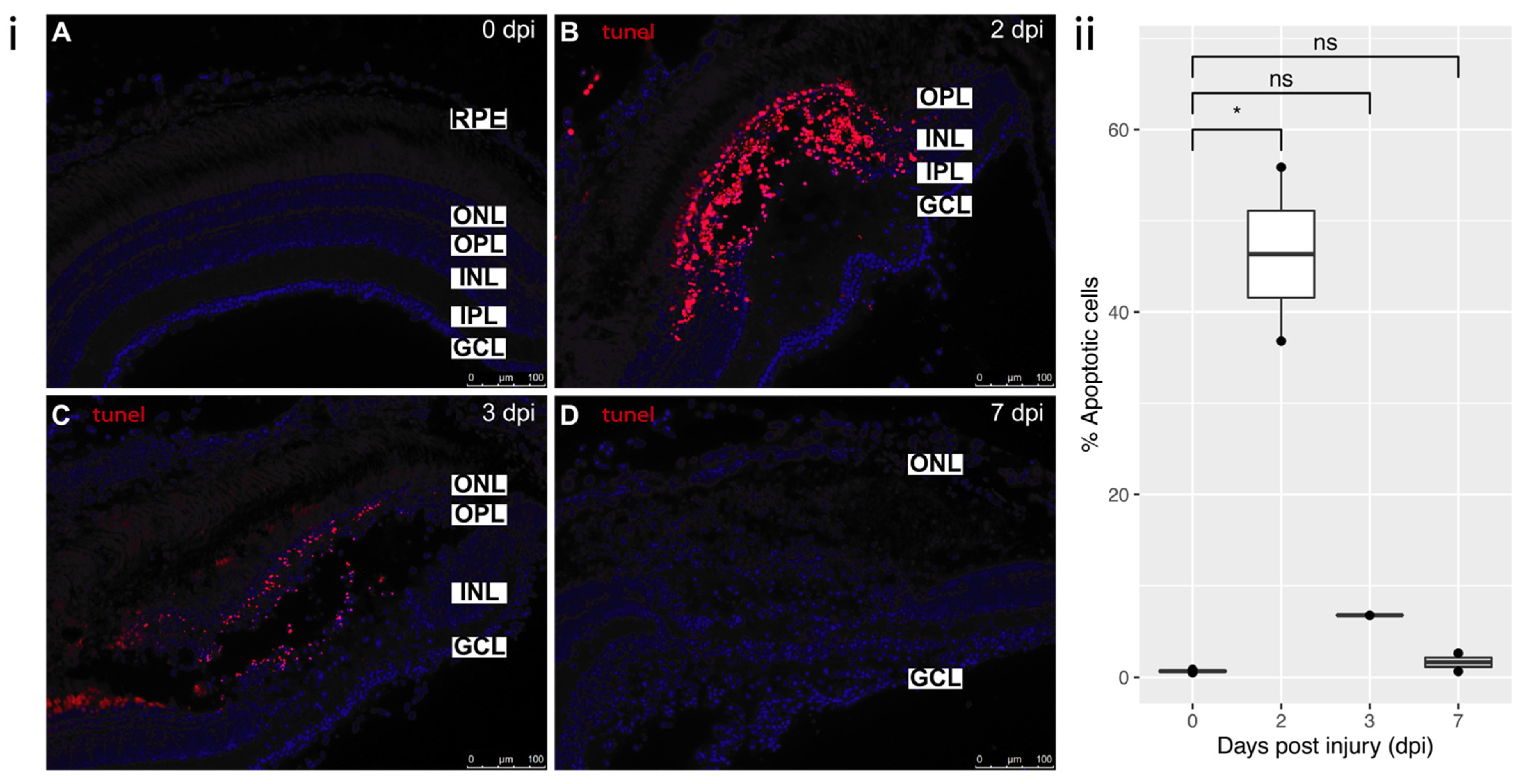
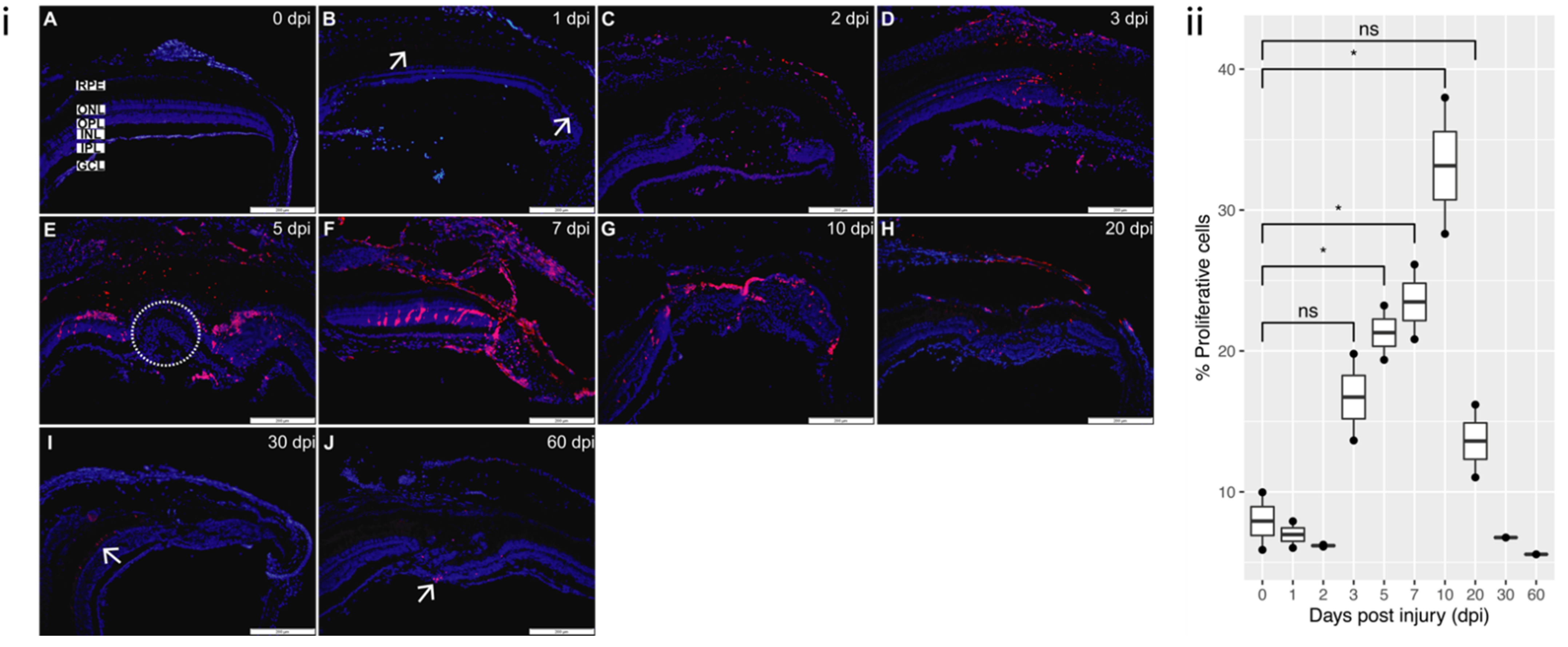
Zebrafish show an extraordinary potential for regeneration in several organs from fins to central nervous system. Most impressively, the outcome of an injury results in a near perfect regeneration and a full functional recovery. Indeed, among the various injury paradigms previously tested in the field of zebrafish retina regeneration, a perfect layered structure is observed after one month of recovery in most of the reported cases. In this study, we applied cryoinjury to the zebrafish eye. We show that retina exposed to this treatment for one second undergoes an acute damage affecting all retinal cell types, followed by a phase of limited tissue remodeling and regrowth. Surprisingly, zebrafish developed a persistent retinal dysplasia observable through 300 days post-injury. There is no indication of fibrosis during the regeneration period, contrary to the regeneration process after cryoinjury to the zebrafish cardiac ventricle. RNA sequencing analysis of injured retinas at different time points has uncovered enriched processes and a number of potential candidate genes. By means of this simple, time and cost-effective technique, we propose a zebrafish injury model that displays a unique inability to completely recover following focal retinal damage; an outcome that is unreported to our knowledge. Furthermore, RNA sequencing proved to be useful in identifying pathways, which may play a crucial role not only in the regeneration of the retina, but in the first initial step of regeneration, degeneration. We propose that this model may prove useful in comparative and translational studies to examine critical pathways for successful regeneration.
Keywords: retina; zebrafish; cryoinjury; regeneration retina; zebrafish; cryoinjury; regeneration