


Review

Chaperone-Mediated Autophagy in Neurodegenerative Diseases: Molecular Mechanisms and Pharmacological Opportunities

State Key Laboratory of Quality Research in Chinese Medicine, Institute of Chinese Medical Sciences, University of Macau, Macau SAR 999078, China
*
Author to whom correspondence should be addressed.
Cells 2022, 11(14), 2250; https://doi.org/10.3390/cells11142250
Submission received: 21 June 2022 / Revised: 12 July 2022 / Accepted: 15 July 2022 / Published: 20 July 2022
(This article belongs to the Special Issue Pharmacological Modulation of Autophagy)

Abstract

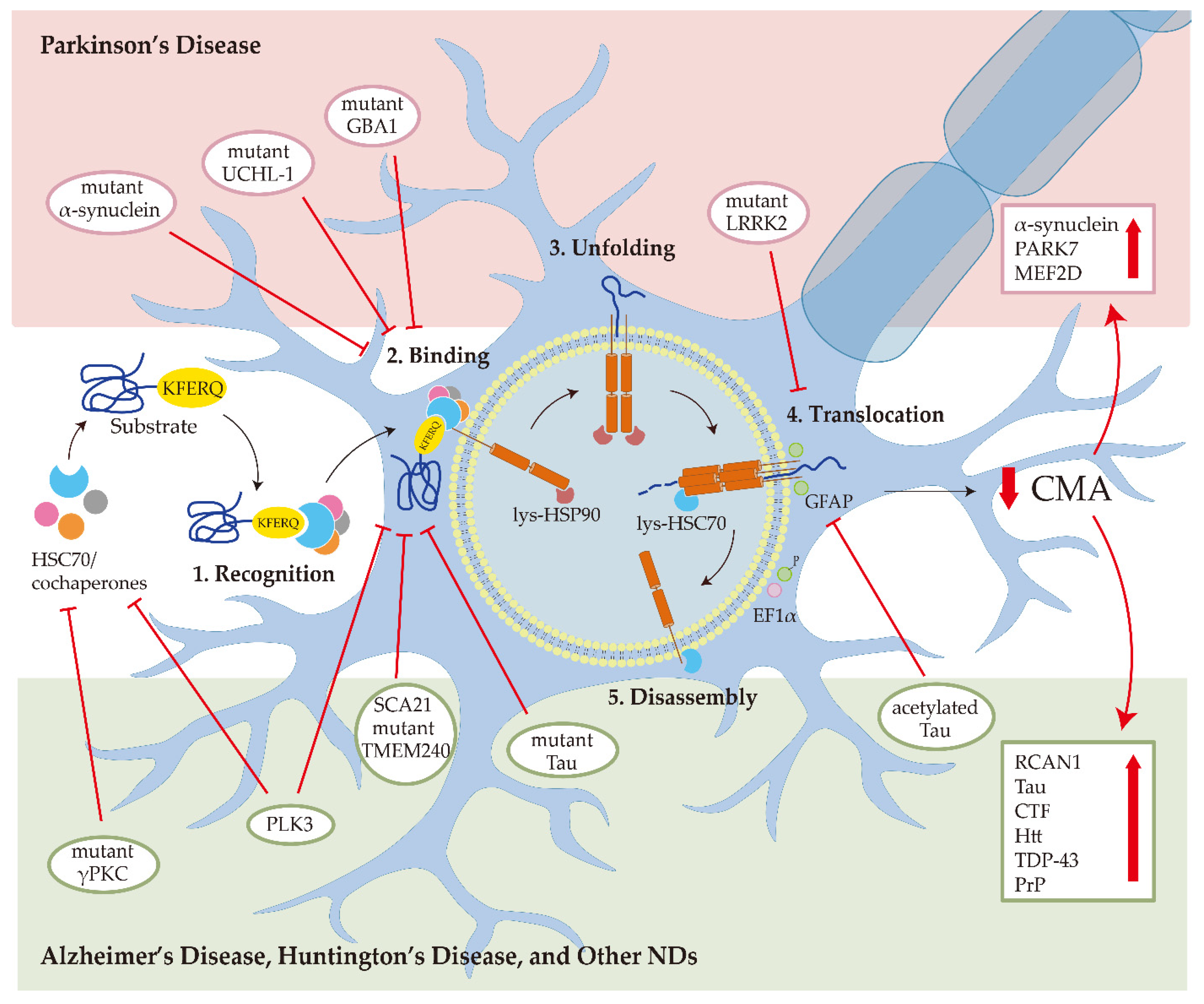
Chaperone-mediated autophagy (CMA) is a protein degradation mechanism through lysosomes. By targeting the KFERQ motif of the substrate, CMA is responsible for the degradation of about 30% of cytosolic proteins, including a series of proteins associated with neurodegenerative diseases (NDs). The fact that decreased activity of CMA is observed in NDs, and ND-associated mutant proteins, including alpha-synuclein and Tau, directly impair CMA activity reveals a possible vicious cycle of CMA impairment and pathogenic protein accumulation in ND development. Given the intrinsic connection between CMA dysfunction and ND, enhancement of CMA has been regarded as a strategy to counteract ND. Indeed, genetic and pharmacological approaches to modulate CMA have been shown to promote the degradation of ND-associated proteins and alleviate ND phenotypes in multiple ND models. This review summarizes the current knowledge on the mechanism of CMA with a focus on its relationship with NDs and discusses the therapeutic potential of CMA modulation for ND.
Keywords: chaperone-mediated autophagy; autophagy; LAMP2A; HSC70; α-synuclein; neurodegenerative disease; Parkinson’s disease; Alzheimer’s disease; Huntington’s disease; small molecule chaperone-mediated autophagy; autophagy; LAMP2A; HSC70; α-synuclein; neurodegenerative disease; Parkinson’s disease; Alzheimer’s disease; Huntington’s disease; small molecule

