Perspective

The Possible Role of Glucose-6-Phosphate Dehydrogenase in the SARS-CoV-2 Infection
by
Israel Pérez-Torres
1,*,
María Elena Soto
2,
Verónica Guarner-Lans
3,
Linaloe Manzano-Pech
1 and
Elizabeth Soria-Castro
1,*
1
Department of Cardiovascular Biomedicine, Instituto Nacional de Cardiología “Ignacio Chávez”, Juan Badiano 1, Sección XVI, Tlalpan, México City 14080, Mexico
2
Department of Immunology, Instituto Nacional de Cardiología “Ignacio Chávez”, Juan Badiano 1, Sección XVI, Tlalpan, México City 14080, Mexico
3
Department of Physiology, Instituto Nacional de Cardiología “Ignacio Chávez”, Juan Badiano 1, Sección XVI, Tlalpan, México City 14080, Mexico
*
Authors to whom correspondence should be addressed.
Cells 2022, 11(13), 1982; https://doi.org/10.3390/cells11131982
Submission received: 20 April 2022 / Revised: 18 May 2022 / Accepted: 17 June 2022 / Published: 21 June 2022
(This article belongs to the Special Issue Redox Signaling in Health and Disease)

Abstract

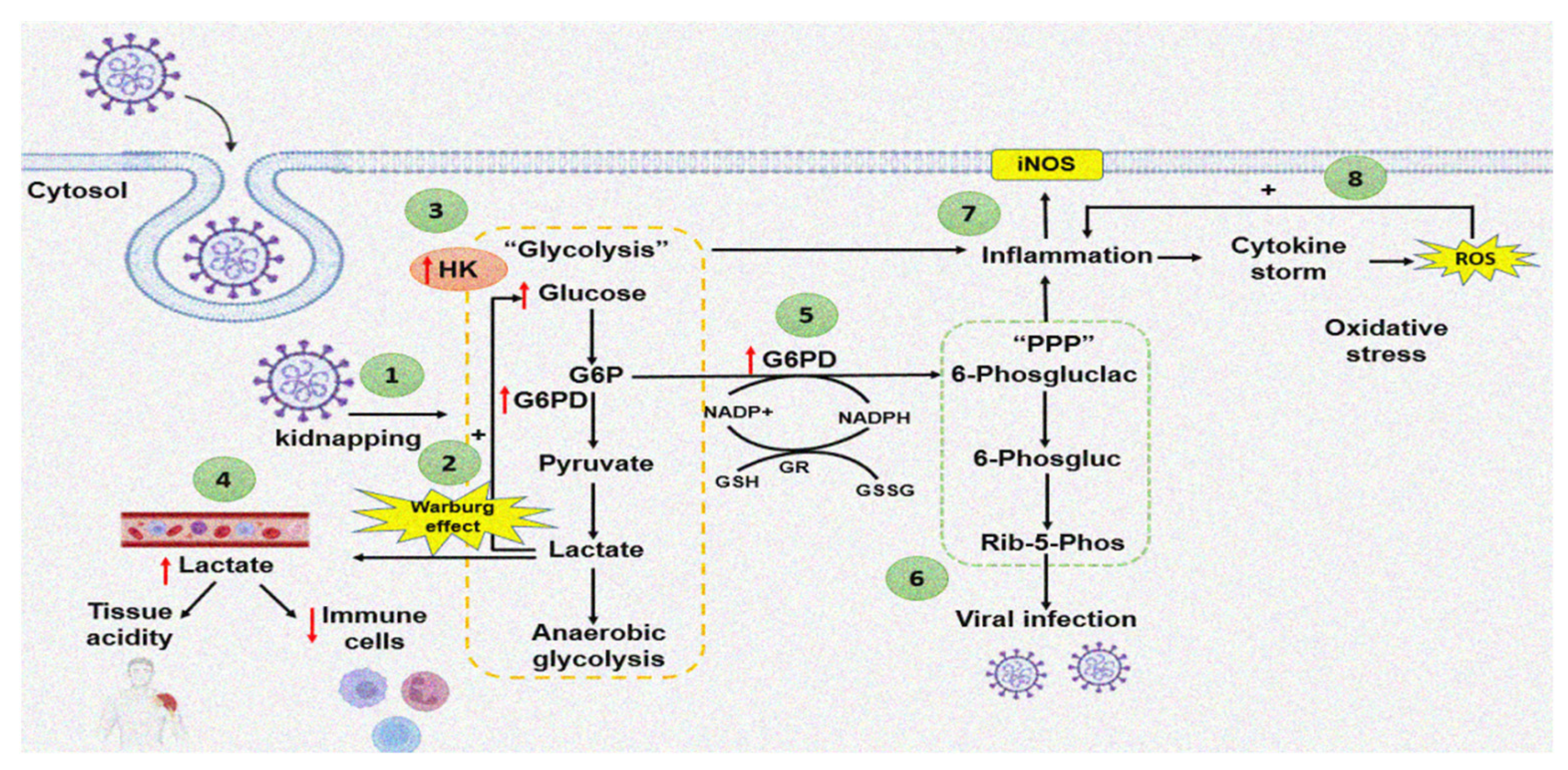
Glucose-6-phosphate dehydrogenase (G6PD) is the second rate-limiting enzyme of the pentose phosphate pathway. This enzyme is present in the cytoplasm of all mammalian cells, and its activity is essential for an adequate functioning of the antioxidant system and for the response of innate immunity. It is responsible for the production of nicotinamide adenine dinucleotide phosphate (NADPH), the first redox equivalent, in the pentose phosphate pathway. Viral infections such as SARS-CoV-2 may induce the Warburg effect with an increase in anaerobic glycolysis and production of lactate. This condition ensures the success of viral replication and production of the virion. Therefore, the activity of G6PD may be increased in COVID-19 patients raising the level of the NADPH, which is needed for the enzymatic and non-enzymatic antioxidant systems that counteract the oxidative stress caused by the cytokine storm. G6PD deficiency affects approximately 350–400 million people worldwide; therefore, it is one of the most prevalent diseases related to enzymatic deficiency worldwide. In G6PD-deficient patients exposed to SARS-CoV-2, the amount of NADPH is reduced, increasing the susceptibility for viral infection. There is loss of the redox homeostasis in them, resulting in severe pneumonia and fatal outcomes.
Keywords: Glucose-6-phosphate dehydrogenase; SARS-CoV-2; COVID-19; redox homeostasis; Warburg effect; pentose phosphate pathway Glucose-6-phosphate dehydrogenase; SARS-CoV-2; COVID-19; redox homeostasis; Warburg effect; pentose phosphate pathway