The Elusive Boreal Forest Thaumarchaeota


VTT Technical Research Centre of Finland, P.O. Box 1000, Espoo FIN-02044 VTT, Finland
Agronomy 2016, 6(2), 36; https://doi.org/10.3390/agronomy6020036
Submission received: 4 April 2016
/
Revised: 6 June 2016
/
Accepted: 8 June 2016
/
Published: 15 June 2016
(This article belongs to the Special Issue Interactions between Plant Rhizosphere and Soil Organisms)
Abstract
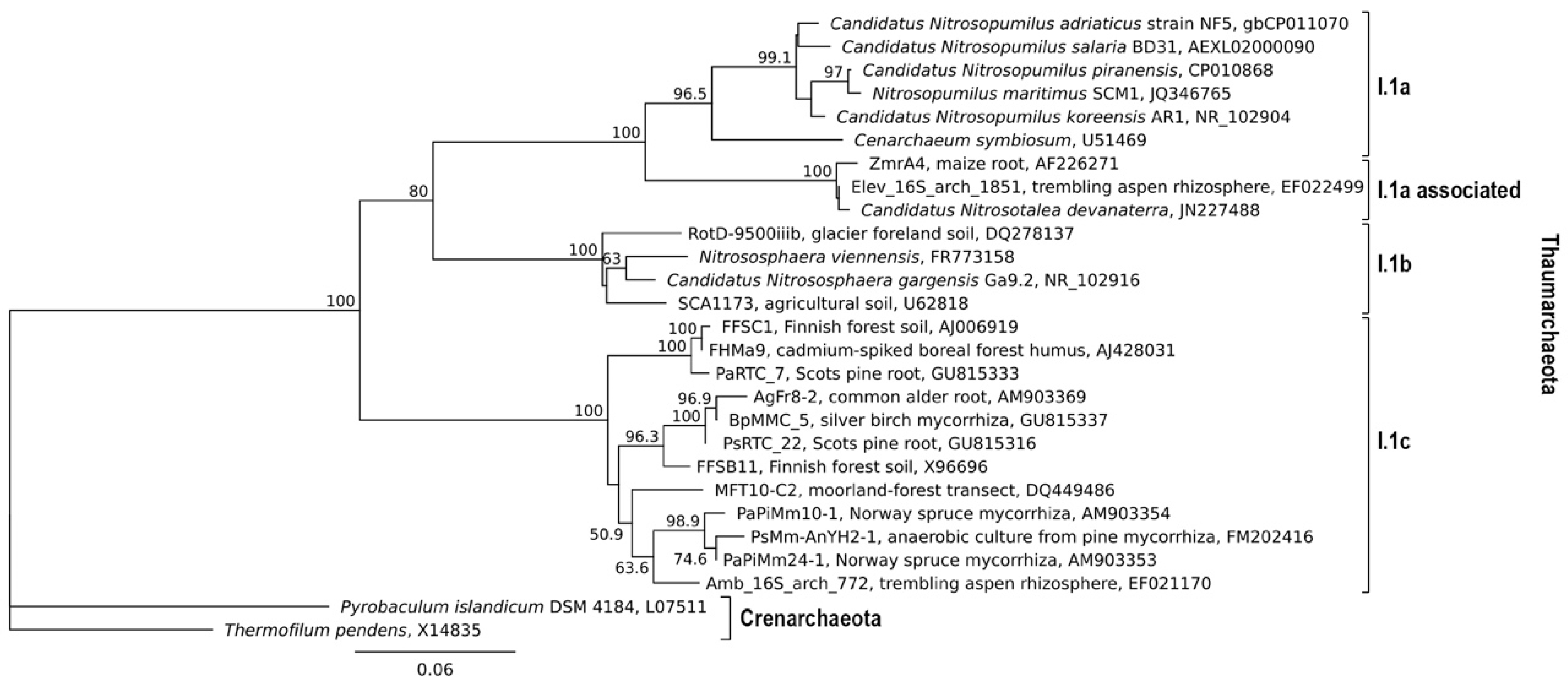
In recent years, Archaea have, with increasing frequency, been found to colonize both agricultural and forest soils in temperate and boreal regions. The as yet uncultured group I.1c of the Thaumarchaeota has been of special interest. These Archaea are widely distributed in mature vegetated acidic soils, but little has been revealed of their physiological and biological characteristics. The I.1c Thaumarchaeota have been recognized as a microbial group influenced by plant roots and mycorrhizal fungi, but appear to have distinct features from their more common soil dwelling counterparts, such as the Nitrosotalea or Nitrososphaera. They appear to be highly dependent on soil pH, thriving in undisturbed vegetated soils with a pH of 5 or below. Research indicate that these Archaea require organic carbon and nitrogen sources for growth and that they may live both aerobically and anaerobically. Nevertheless, pure cultures of these microorganisms have not yet been obtained. This review will focus on what is known to date about the uncultured group I.1c Thaumarchaeota formerly known as the “Finnish Forest Soil” (FFS) Archaea.
Share and Cite
MDPI and ACS Style
Bomberg, M. The Elusive Boreal Forest Thaumarchaeota. Agronomy 2016, 6, 36. https://doi.org/10.3390/agronomy6020036
AMA Style
Bomberg M. The Elusive Boreal Forest Thaumarchaeota. Agronomy. 2016; 6(2):36. https://doi.org/10.3390/agronomy6020036
Chicago/Turabian StyleBomberg, Malin. 2016. "The Elusive Boreal Forest Thaumarchaeota" Agronomy 6, no. 2: 36. https://doi.org/10.3390/agronomy6020036
APA StyleBomberg, M. (2016). The Elusive Boreal Forest Thaumarchaeota. Agronomy, 6(2), 36. https://doi.org/10.3390/agronomy6020036
Note that from the first issue of 2016, this journal uses article numbers instead of page numbers. See further details here.