Article

Biochemical Signatures Linked to Rice Blast Severity Under Acibenzolar-S-Methyl, Jasmonic Acid and Combined Treatments in Upland Rice

by
Eugenio Miranda Sperandio
1,
Helson Mario Martins do Vale
1,*,
Marcio Vinícius de Carvalho Barros Cortes
2 and
Marta Cristina Corsi de Filippi
2,*
1
University of Brasilia, Institute of Biological Sciences, Brasília 70910-900, DF, Brazil
2
Embrapa Rice and Beans, Santo Antônio de Goiás 75375-000, GO, Brazil
*
Authors to whom correspondence should be addressed.
Agronomy 2026, 16(8), 839; https://doi.org/10.3390/agronomy16080839
Submission received: 27 February 2026 / Revised: 30 March 2026 / Accepted: 13 April 2026 / Published: 21 April 2026
(This article belongs to the Section Agricultural Biosystem and Biological Engineering)

Abstract

Acibenzolar-S-methyl (ASM), a salicylic acid (SA) analog, and jasmonic acid (JA) are chemical inducers of plant defenses, yet crosstalk between SA- and JA-associated pathways may result in antagonistic outcomes. Here, we assessed how ASM and JA, applied alone or in combination, are associated with rice blast severity and defense-related responses in an upland rice cultivar. Plants of rice (Oryza sativa L., cv. Primavera) were treated with JA, ASM or JA + ASM and subsequently challenged with Magnaporthe oryzae. ASM treatment was associated with reduced leaf blast severity (LBS), whereas JA treatment was associated with increased LBS. Antagonistic outcomes were observed in the combined treatment: LBS in JA + ASM plants was higher than in ASM-treated plants but lower than in JA-treated plants. Lipoxygenase (LOX) activity was induced by JA and positively correlated with LBS, indicating that higher LOX activity aligned with greater susceptibility under the tested conditions. In contrast, ASM-treated plants showed higher peroxidase (POX) activity, which was associated with lower LBS. Disease outcomes were also linked to secondary defense metabolism and phenylpropanoid-related components, including phenylalanine ammonia-lyase (PAL), salicylic acid (SA) and phenolic compounds (PC). Overall, these results provide an integrated biochemical profile of how ASM, JA and their combination are associated with contrasting blast outcomes in upland rice, consistent with antagonistic interactions between JA- and SA-associated defense responses. These findings may inform the use of defense inducers and the interpretation of defense markers in upland rice systems where blast management is a major constraint.

1. Introduction

Rice blast, caused by the fungus Magnaporthe oryzae B.C. Couch (syn. Pyricularia oryzae Cavara), is one of the most destructive diseases of rice and a major threat to global food security. Yield losses in susceptible cultivars may range from 10 to 30% and under severe epidemic conditions losses may be much greater. Magnaporthe oryzae can infect several aerial organs of the rice plant, including leaves, nodes, panicles, and grains. Leaf blast is characterized by spindle-shaped lesions with gray to whitish centers and brown margins, which may coalesce under favorable conditions and lead to extensive necrosis. When the pathogen infects the neck node of the panicle, it disrupts the transport of water and assimilates to developing grains, resulting in poor grain filling, sterility, and significant yield losses [1]. Disease management relies mainly on resistant cultivars and chemical pesticides. However, the emergence of virulent races that overcome host resistance [2] and isolates resistant to synthetic fungicides [3] challenges the durability and effectiveness of current control strategies.
An alternative or complementary approach is to activate or potentiate latent plant defense mechanisms using inducing agents. In this context, hormone-regulated signaling networks play central roles in shaping immune responses. Induced immunity, compared with conventional pesticide-based control, has been proposed as a safer and potentially more durable strategy, and several synthetic molecules have been explored for crop protection through defense activation [4]. Such approaches may be particularly relevant for upland (non-flooded) rice production systems, where the expansion of rice cultivation is constrained by limited availability of suitable non-inundated areas and blast is a recurrent constraint.
Salicylic acid (SA) is a phenolic hormone derived from phenylalanine or chorismate and participates in diverse metabolic processes [5]. Increased SA accumulation is associated with systemic acquired resistance (SAR) and is typically more effective against biotrophic pathogens. SA-associated defenses include activation of pathogenesis-related (PR) genes, accumulation of PR proteins, production of reactive oxygen species, and synthesis of phytoalexins [6,7]. Exogenous application of SA and SA analogs, such as acibenzolar-S-methyl (ASM), can induce resistance against M. oryzae and a range of phytopathogens [4,8,9,10,11].
Jasmonic acid (JA) and its derivatives are major regulators of plant defense. These compounds are synthesized through the octadecanoid pathway, in which lipoxygenase (LOX; EC 1.13.11.12) catalyzes an early step in the oxidation of polyunsaturated fatty acids, contributing to oxylipin and jasmonate biosynthesis. Because of this central role, LOX activity is commonly used as a biochemical indicator of JA pathway activation in plant–pathogen interactions. Jasmonates are lipid-derived signals synthesized from linolenic and α-linolenic acids and participate in defense as well as other metabolic processes [12,13]. Elevated JA levels are associated with induced systemic resistance (ISR) and activation of JA-responsive genes, which may enhance the activity of defense-related enzymes (e.g., peroxidases, β-1,3-glucanase, chitinases, phenylalanine ammonia-lyase, and polyphenol oxidase) and influence reactive oxygen species dynamics [14,15].
Plants tailor defense responses to pathogen lifestyles. Programmed cell death at infection sites can restrict biotrophic pathogens that depend on living tissue, whereas necrotrophs can benefit from host cell death during colonization. Accordingly, SA-associated resistance is often more effective against biotrophs, whereas JA and/or ethylene (ET) signaling commonly contributes to defense against herbivory and necrotrophic colonization strategies [16,17].
Beyond their individual roles, defense hormones interact through regulatory crosstalk. SA–JA crosstalk frequently manifests as reciprocal antagonism, and its outcome can be adaptive depending on the biotic and abiotic context. Pathogens, including M. oryzae, may exploit these interactions as part of their virulence strategies by perturbing hormone signaling to favor infection [7,18,19].
Although SA–JA antagonism is well documented, relatively few studies have specifically examined how an SA-mimicking inducer such as ASM interacts with JA induction in plants challenged by M. oryzae. Relevant work includes studies discussing hormone signaling crosstalk in rice blast pathosystems and antagonistic interactions between ASM-associated and JA-associated responses in other host–pathogen systems [9,11]. The objective of this study was to ascertain whether there is antagonism between JA-induced and ASM-induced pathways in upland rice and to assess their effects on the development of leaf blast. To this end, we applied the two compounds alone or in combination and compared blast severity and defense-related biochemical responses in rice plants challenged with M. oryzae.

2. Materials and Methods

The BRS Primavera cultivar was selected for the tests because it is frequently utilized in plant breeding programs due to its superior grain quality and its susceptibility to the majority of pathotypes of M. oryzae observed in upland rice fields. Rice seeds were sterilized using two different solutions: 70% alcohol for one minute and 1% sodium hypochlorite for 3 min. The seeds were cultivated in plastic trays measuring 15 × 30 × 10 cm, which contained a total of 3 kg of fertilized soil [5 g of 5–30–15 NPK mix + 1 g of Zn and 1 g of (NH4)2SO4]. The experiment involved the utilization of three trays for each treatment. Each tray contained eight lines, with each line comprising ten plants, resulting in a total of 80 plants per tray. The plants were cultivated under controlled greenhouse conditions, with temperature maintained at 28 °C, relative humidity set at 60%, and a photoperiod of 12 h of light.
The experiment followed a completely randomized design with four treatments (ASM, JA, JA + ASM, and H2O) arranged in three independent trays per treatment (n = 3 trays), which were considered biological replicates. Each tray comprised eight rows of ten plants (80 plants per tray). For biochemical assays, leaf tissue was sampled from 10 plants per tray at each sampling point (i.e., 30 plants per treatment and sampling point), and samples from each tray were processed independently to preserve biological replication. For disease assessment, plants were evaluated within each tray and tray means were used for statistical comparisons.

2.1. Chemical Application and Inoculation with Pathogen

At the V3 growth stage (17 days after emergence, DAE), plants were sprayed with 10 mL of solution per tray using a hand sprayer, ensuring uniform coverage of the leaf surface. Treatments were acibenzolar-S-methyl (ASM, 0.5 mM) (Syngenta Crop Protection AG, Basel, Switzerland), jasmonic acid (JA, 0.25 mM) (Sigma-Aldrich, St. Louis, MO, USA), the combination JA (0.25 mM) + ASM (0.5 mM), and distilled water (H2O). Pathogen inoculation was performed 48 h after chemical application (2 days post-induction, DPI), corresponding to 19 DAE. The compatible M. oryzae isolate (designated as 10.900) to the cultivar Primavera was obtained from the Microorganism Multifunction Collection of Embrapa Rice and Beans.
The fungus was first multiplied in PDA (potato-dextrose-agar, Difco®) and subsequently transferred into Petri dishes containing oat medium (w/v: 2% oatmeal, Quaker Oats Co., Chicago, IL, USA; 1.5% dextrose, and 1.5% agar, Sigma-Aldrich, St. Louis, MO, USA). The plates were then incubated under continuous light at 28 °C for colony growth. Following a 10-day incubation period, the aerial mycelium of the cultivated colony was extracted using a sterilized glass rod [19]. Subsequently, the plates were maintained in a growth chamber at 28 °C for 48 h. The conidia were collected using a paint brush and sterilized water, and a hemocytometer was employed to adjust the concentration to 3 × 10⁵ conidia mL−1 [20].
The conidial suspension (20 mL) was applied to the rice leaves of the ASM, JA, ASM + JA, and (H2O) treatment plants at 19 DAE (i.e., two days post-induction (DPI) with chemical treatments). The plants were cultivated in a greenhouse setting (28 °C and 60% relative humidity). After inoculation, plants were maintained in a humid chamber at 28 °C and 90% relative humidity for seven days to favor infection and symptom development. Leaf blast severity (LBS) was assessed seven days post-inoculation using the standard Notteghem scale [21], which ranges from 0 to 82% of affected leaf area. This scale was specifically developed for rice blast assessment and is widely used in blast research. Its upper limit reflects the practical maximum category before complete tissue collapse, beyond which further discrimination of diseased leaf area is unreliable.

2.2. Defense Enzymes, Total Phenolic Compounds, and Salicylic Acid

In the experimental design, plants inoculated with M. oryzae only served as the inoculated control, whereas H2O-sprayed plants served as negative controls. Samples were collected at 1, 2, 3, 5, 7, and 9 days post-induction (DPI). At each sampling point, leaves from 10 plants were collected per tray (three trays per treatment), immediately frozen in liquid nitrogen, transported in insulated containers, and stored at −20 °C until analysis. For biochemical determinations, each tray constituted one biological replicate (n = 3) for each treatment × sampling point.

2.2.1. Protein Extraction

Leaf samples were macerated in liquid nitrogen within a buffer solution comprising 10 mM of Tris, 150 mM of NaCl, 2 mM of EDTA (Thermo Fisher Scientific, Waltham, MA, USA), 2 mM of DTT, 1 mM of PMSF, 10 µg/mL of leupeptin, and 10 µg/mL of aprotinin (Sigma-Aldrich, St. Louis, MO, USA). The total soluble proteins present in the crude extract were subsequently measured in accordance with the Bradford (Sigma-Aldrich, St. Louis, MO, USA) method [22]. The activity of GLU, LOX, and POX was expressed in µmol min−1 mg−1 protein, while the activity of PAL was expressed in nmol min−1 mg−1 protein.

2.2.2. β-1,3-Glucanase (EC 3.2.1.39) (GLU)

The GLU activity of the leaf samples was assessed by measuring the rate of reduced sugar production with laminarin (Sigma-Aldrich, St. Louis, MO, USA) as the substrate [23].

2.2.3. Lipoxygenase (EC:1.13.11.12) (LOX)

The LOX activity was determined according to Axelrod et al. [24] by the formation of oxidation products from linoleic acid (Sigma-Aldrich, St. Louis, MO, USA), which was used as the substrate.

2.2.4. Peroxidases (EC 1.11.1.7) (POX)

The POX activity of the leaf samples was assessed by measuring the rate of 2,2-azino-bis (3-ethylbenzothiazoline-6-sulfonic acid) (Sigma-Aldrich, St. Louis, MO, USA) oxidation using its colorimetric property [25].

2.2.5. Phenylalanine Ammonia-Lyase (EC 4.3.1.24) (PAL)

The phenylalanine ammonia-lyase (EC 4.3.1.24; PAL) activity of the leaf samples was evaluated by measuring the rate of cinnamic acid production, as previously described [26].

2.2.6. Phenolic Compounds (PC)

The total phenolic compounds (TPC) in the leaf samples were measured according to the method outlined by Dicko et al. [27]. Rice leaves (300 mg) were subjected to a series of treatments. First, they were frozen in liquid nitrogen. Then, they were macerated. Next, they were solubilized in 1500 µL of a methanol/water mixture (2:1). Finally, they were subjected to ultrasound (Branson Ultrasonics, Danbury, CT, USA) for 30 min. Subsequent to TPC extraction, a filtration procedure was conducted, and 120 µL of the filtrate was homogenized with 220 µL of Folin–Ciocalteu (Sigma-Aldrich, St. Louis, MO, USA) reagent. The mixture was then incubated for 5 min. Following the incubation period, 300 µL of Na2CO3 (Sigma-Aldrich, St. Louis, MO, USA) (20% w/w) and 600 µL of distilled water were added to the solution. The mixture was then analyzed using a spectrophotometer (600 S, Femto Indústria e Comércio de Instrumentos, São Paulo, SP, Brazil) at a wavelength of 720 nm. The TPC content was measured in mg g−1 of fresh weight (FW), with gallic acid serving as the reference standard.

2.2.7. Salicylic Acid (SA)

Salicylic acid levels in the leaf samples were measured using 200 mg of fresh leaf tissue that was harvested from each treatment. The leaves were macerated and subsequently transferred to microcentrifuge tubes (2 mL) (Eppendorf, Hamburg, Germany). A quantity of 1 mL of methanol (90%) was added to each tube and thoroughly stirred for one minute. The samples were subjected to centrifugation at 5000 rpm for 10 min. Thereafter, the samples were transferred to a 15 mL Falcon tube (Kasvi, São José dos Pinhais, PR, Brazil). The following reagents were added to each tube: 1 mL of methanol, 2 mL of trichloroacetic acid (5%, Merck KGaA, Darmstadt, Germany), and 2 mL of a mixture of ethyl acetate, cyclopentane, and isopropanol (50:50:1, Sigma-Aldrich, St. Louis, MO, USA). The samples were subjected to a one-minute shaking period, after which the upper layer was transferred to another tube for lyophilization (Labconco, Kansas City, MO, USA). Each tube received 200 µL of a methanol solution (23%) prepared in acetate buffer (pH 5.0, 20 mM). The solution was then filtered using a 0.45-µm pore-size filter (MilliporeSigma, Burlington, MA, USA). The quantification of SA was carried out using high-performance liquid chromatography (Flexar, PerkinElmer, Shelton, CT, USA) with a 4.8 min retention time [28] and was measured in ng g−1 (FW).

2.3. Statistical Analysis

Univariate analyses: Leaf blast severity (LBS), enzyme activities (β-1,3-glucanase (GLU), phenylalanine ammonia-lyase (PAL), lipoxygenase (LOX), and peroxidase (POX)), total phenolic compounds (PC), and salicylic acid (SA) were analyzed by one-way analysis of variance (ANOVA). For biochemical variables, each tray was treated as one biological replicate (n = 3) at each sampling point, and treatment effects were tested within each sampling time. For LBS, tray means were used as replicates. When the ANOVA indicated significance (p < 0.05), means were compared using Tukey’s HSD test (p < 0.05).
Multivariate analyses: Principal component analysis (PCA) was performed to explore multivariate relationships among biochemical variables, sampling time, and leaf blast severity across treatments. The analysis included 60 observations and eight active variables: days post induction (DPI), β-1,3-glucanase (GLU), phenylalanine ammonia-lyase (PAL), lipoxygenase (LOX), peroxidase (POX), phenolic compounds (PC), salicylic acid (SA), and leaf blast severity (LBS). Variables were standardized prior to analysis. Sampling adequacy was assessed using the Kaiser–Meyer–Olkin (KMO) test, and the correlation structure was evaluated by Bartlett’s test of sphericity. Principal components were retained according to the Kaiser criterion (eigenvalues > 1), supported by scree plot inspection and cumulative explained variance. Analyses were conducted in R (version 4.5.2) using the FactoMineR package (version 2.13).

3. Results

3.1. Leaf Blast Severity Assessment

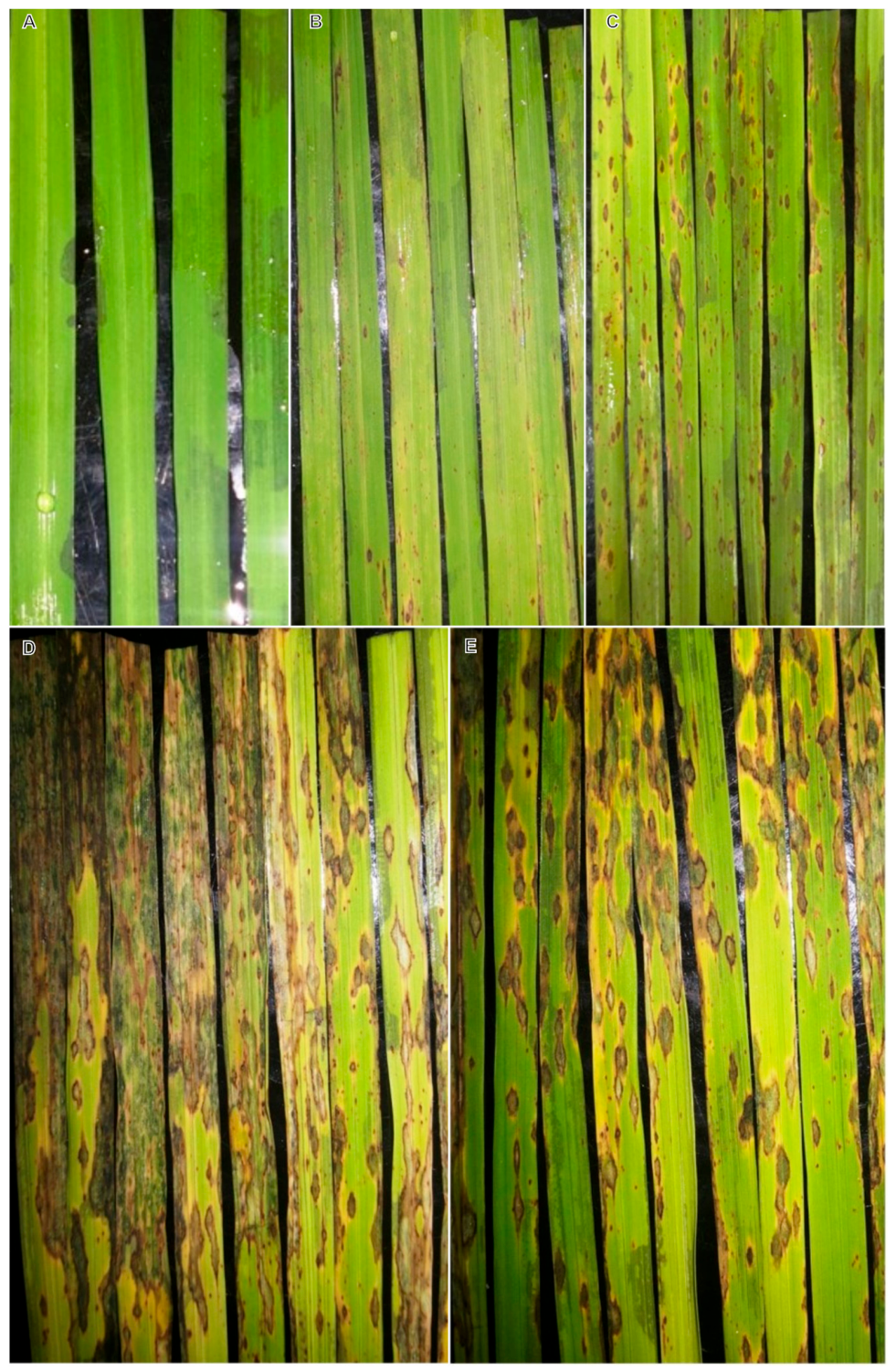
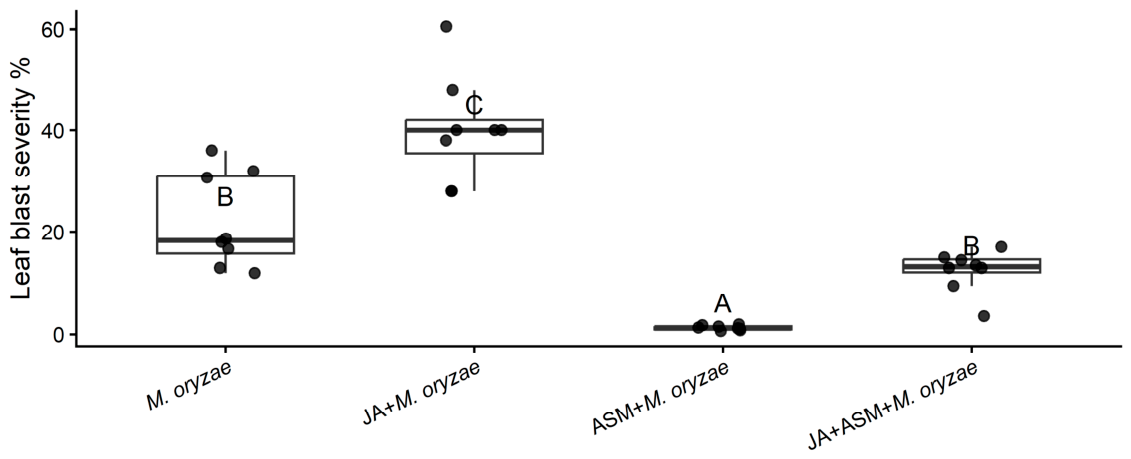
In ASM-pretreated plants challenged with M. oryzae, no sporulating lesions were observed; instead, HR-like brown flecks developed (Figure 1B). In contrast, JA + ASM-pretreated plants showed sporulating lesions (Figure 1C) and significantly higher leaf blast severity than ASM alone (Figure 2). ASM pretreatment resulted in the lowest severity (group A), whereas JA resulted in the highest severity (group C). Disease severity in JA + ASM-pretreated plants did not differ from the inoculated control (both group B) (Figure 2). Extensive lesion coalescence and frequent plant death were observed under JA (Figure 1D,E).

3.2. Enzyme Activities Related to Plant Defense and Quantification of Phenolic Compounds and Salicylic Acid Levels

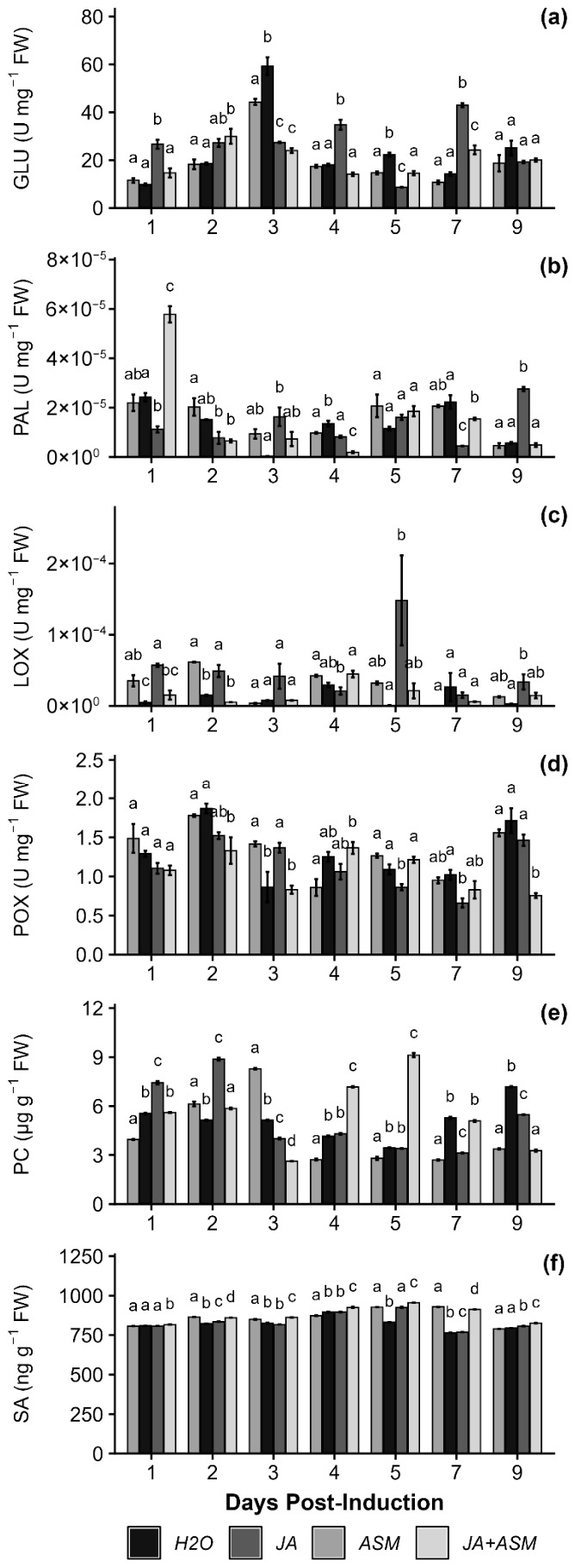
In general, defense-related enzymes and metabolites varied among treatments. GLU activity increased during the first two days after induction (1–2 DPI) in all treatments and was higher in induced plants than in the H2O control (Figure 3). At 1 DPI, GLU was highest under JA, followed by JA + ASM and ASM; at 2 DPI, only JA and JA + ASM differed from the control. PAL showed a modest response: JA + ASM was the only treatment higher than the control, and the highest PAL values at later induction sampling were observed under ASM (Figure 3).
LOX activity increased at 1 DPI in all treatments relative to the control but remained highest in JA-treated plants overall; ASM showed the LOX maximum at 2 DPI, followed by a return of the highest LOX under JA at 3 DPI (Figure 3). POX activity was highest under ASM at 1–2 DPI, while JA also increased POX relative to the control (Figure 3). Total phenolics (PC) were highest under JA at 1–2 DPI (and all treatments differed from the control at 2 DPI), whereas ASM showed the highest PC at 3 DPI. SA increased markedly in ASM-containing treatments (ASM and JA + ASM), with the highest SA under JA + ASM at 1 DPI, under ASM at 2 DPI, and under JA + ASM at 3 DPI (Figure 3).
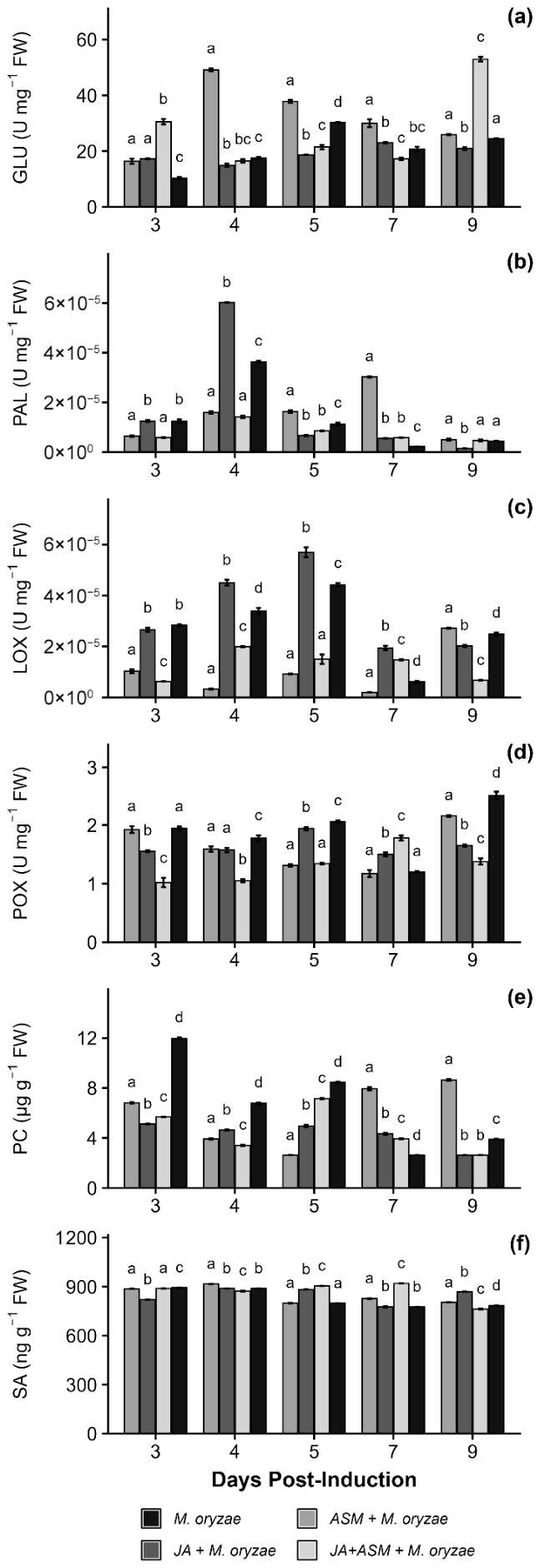
Plants were inoculated with M. oryzae at 2 DPI; therefore, 3 DPI corresponds to 1 day after inoculation (DAI), and subsequent sampling points reflect the post-challenge response (Figure 4). After inoculation, GLU activity was higher in induced plants than in the inoculated control, with the highest values observed in JA + ASM at 3 DPI (1 DAI) and in ASM at 4 DPI, and ASM remaining among the highest treatments thereafter. PAL increased early after inoculation (3–4 DPI) across treatments, with clearer treatment separation only at later sampling, when ASM tended to show higher activity. LOX was consistently highest in JA-treated plants, increasing from 3 to 5 DPI and declining at later time points (Figure 4).
POX activity showed a more complex pattern across treatments and sampling points. At the first post-inoculation samplings (3–5 DPI), ASM-treated plants tended to show elevated POX activity relative to baseline, consistent with early priming of oxidative defenses. However, the inoculated control also displayed comparable or higher POX activity at several time points, including Day 9 DPI, when control POX activity exceeded that of all induced treatments (Figure 4). JA and JA + ASM-treated plants showed increased POX at intermediate time points (notably Day 7 DPI), but this elevation was not sustained at the latest sampling. These patterns indicate that POX induction reflects both priming-associated defense activation and disease progression-driven oxidative stress and should therefore be interpreted with caution as a marker of resistance alone. Phenolic compounds tended to decline over time in most treatments, but ASM showed a late increase, peaking at 9 DPI. After inoculation, SA responses were strongest in ASM-containing treatments at early time points, while JA and JA + ASM showed higher SA at specific later samplings (Figure 4).

3.3. Correlation Analysis of Variables Related to Induced Resistance in Rice Plants for Control of Leaf Blast

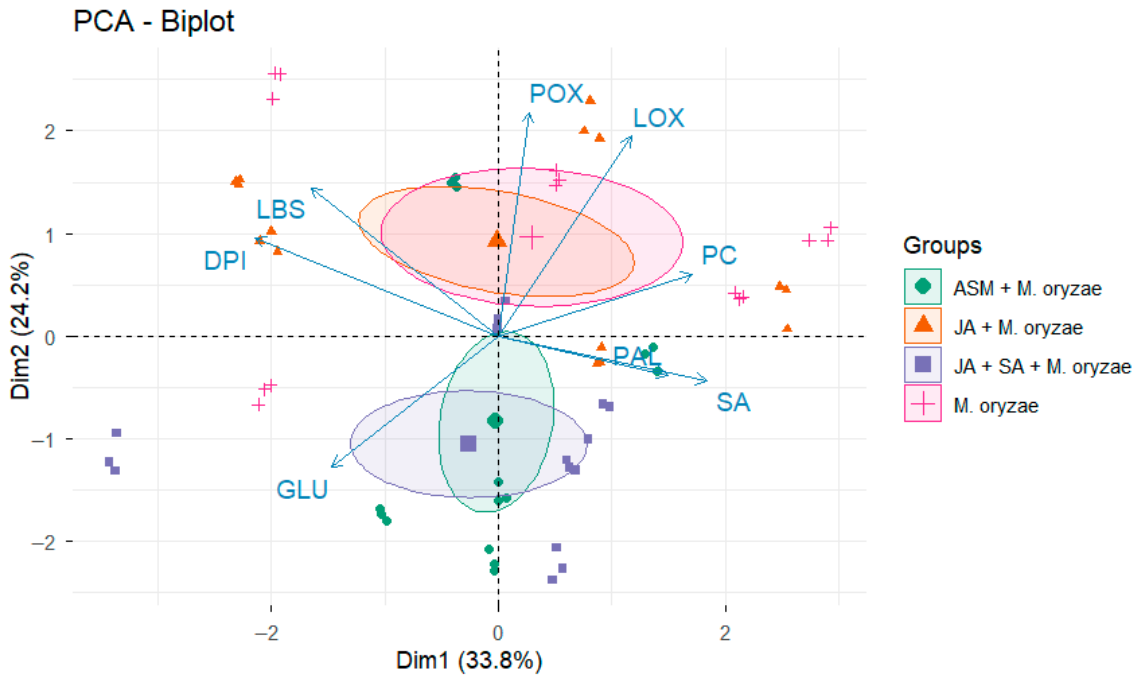
PCA was considered suitable for exploratory interpretation based on the overall KMO value of 0.554 and the significant result of Bartlett’s test of sphericity (χ2 = 160.68, df = 28, p < 0.001), indicating that the correlation matrix was appropriate for dimension reduction. Three principal components were retained, with eigenvalues greater than 1, together explaining 71.10% of the total variance.
PC1 explained 33.81% of the total variance and was mainly associated with days post induction (DPI), salicylic acid (SA), phenolic compounds (PC), leaf blast severity (LBS), PAL, and GLU. PC2 explained 24.21% of the variance and was primarily associated with POX, LOX, LBS, and GLU. PC3 explained 13.08% of the variance and was mainly influenced by PC, LBS, PAL, and POX.
The PCA biplot revealed temporal and treatment-related structuring among observations. Samples from JA + M. oryzae, JA + ASM + M. oryzae, ASM + M. oryzae, and M. oryzae were distributed across the ordination space according to their multivariate biochemical profiles and disease severity. Variable vectors indicated that SA, PC, and PAL were associated with one region of the ordination, whereas POX and LOX contributed more strongly to another, reflecting distinct biochemical response patterns among treatments and sampling points. The scree plot and detailed PCA diagnostics are provided in the Supplementary Materials (Figure S1; Tables S1–S6).
Overall, the PCA supported the same biological interpretation observed in the univariate analyses: ASM was associated with a defense-related biochemical profile and lower blast severity, whereas JA was associated with higher LOX activity and greater disease severity. The distribution of samples across components also reflected temporal variation among sampling points, indicating that the induced biochemical responses were dynamic over the course of the experiment.

4. Discussion

In this study, JA and ASM produced contrasting disease outcomes in the Oryza sativaM. oryzae interaction, and these phenotypic contrasts were paralleled by distinct biochemical profiles that can be interpreted as treatment-associated signatures. ASM-associated blast suppression was characterized by elevated SA levels, higher GLU and POX activities at early post-inoculation samplings, and HR-like responses without sporulation. In contrast, JA-associated susceptibility was characterized by sustained LOX induction, combined with lower GLU activity and extensive lesion coalescence. These patterns were consistent with the multivariate structure of the data, which supported the separation of treatments according to disease outcome and associated biochemical responses. JA increased leaf blast severity, exceeding the inoculated control and frequently leading to extensive lesion coalescence (Figure 1D,E). By contrast, ASM applied 48 h before inoculation suppressed disease and induced brown flecks consistent with an HR-like response, without sporulation (Figure 1B). The combined treatment (JA + ASM) increased severity relative to ASM alone and did not differ from the inoculated control (Figure 2), supporting antagonistic outcomes between JA- and ASM/SA-associated responses under the present experimental conditions.
The LBS pattern is consistent with crosstalk between JA- and SA-associated defenses. Antagonism between JA and SA is well documented and can be associated with increased susceptibility in pathosystems that include a biotrophic phase [7,18,19]. Given that M. oryzae is hemibiotrophic and initiates infection biotrophically [1], SA-associated defenses are often linked to restriction of the initial colonization phase, whereas strong JA signaling has been reported to compromise SA-associated defenses in comparable contexts [12,16,18]. In our dataset, GLU increased in induced plants prior to inoculation, and after inoculation, GLU was more consistently enhanced in ASM-containing treatments, which also showed lower blast severity (Figure 3 and Figure 4). Similar increases in GLU and other defense responses following ASM treatment have been reported previously [29,30,31].
PAL responses differed between treatments and infection status. Before inoculation, ASM tended to promote higher PAL activity, consistent with reports that ASM can increase PAL expression [32]. After inoculation, PAL increased at the first post-inoculation samplings across treatments but showed limited and inconsistent separation among treatments (Figure 4), suggesting that PAL was not a strong discriminator of resistance under these conditions, even though jasmonates can induce PAL activity [33,34]. In contrast, LOX activity was consistently highest in JA-treated plants both before and after inoculation (Figure 3 and Figure 4), in line with LOX functioning within JA/oxylipin signaling [35].
The sustained LOX induction under JA is consistent with positive feedback in JA-related signaling; methyl jasmonate can activate LOX-related genes in other systems [36]. By comparison, ASM showed only transient effects on LOX prior to inoculation and did not maintain higher LOX activity after inoculation relative to the other challenged treatments (Figure 4). Because pathogens can manipulate host hormone networks, interactions among JA, SA and ethylene may further influence the final outcome in this pathosystem [14].
POX activity also varied across sampling points. Before inoculation, ASM promoted higher POX activity than the control, consistent with priming of oxidative responses. After inoculation, ASM showed higher POX at the first post-inoculation sampling(s) (Figure 4), which may contribute to ROS-associated defenses and HR-like symptoms (Figure 1B) [11]. However, because POX can also increase under high disease pressure, it likely reflects both induced defense and infection-driven stress rather than resistance alone.
PC responses were elicitor-dependent and influenced by pathogen challenge. Before inoculation, JA tended to increase PC relative to the control, whereas JA + ASM did not consistently enhance PC compared with single treatments (Figure 3). After inoculation, PC was often higher in the inoculated control at the first post-inoculation samplings, while ASM showed a later increase (Figure 4), suggesting that PC accumulation reflects both defense activation and disease progression. Similar elicitor-dependent PC responses have been reported in other pathosystems [37], supporting the idea that PC alone is not a consistent predictor of resistance.
SA levels differed markedly among treatments and sampling windows. Before inoculation, SA increased most strongly in ASM-containing treatments (ASM and JA + ASM) (Figure 3). After inoculation, ASM maintained higher SA at the first post-inoculation samplings relative to the inoculated control, whereas JA and JA + ASM showed more variable patterns at later sampling points (Figure 4). Although ASM-induced resistance can occur without measurable SA accumulation in some species [38,39], the SA dynamics observed here support SA-associated priming as a key component of ASM-mediated blast suppression in rice.
PCA summarized the dataset effectively, with the first three components explaining 71.10% of the total variance (Figure 5 and Figure S1). The multivariate analysis was consistent with the univariate results, separating ASM-treated samples from JA-treated samples along the main ordination axes. In particular, ASM was associated with lower blast severity, whereas JA was more closely associated with LOX and higher disease severity. This integrative pattern reinforces the interpretation that induced resistance in this pathosystem involves coordinated biochemical adjustments rather than isolated changes in single defense markers. LOX enzymes catalyze the oxygenation of polyunsaturated fatty acids and are key enzymes in oxylipin/JA biosynthesis [40].
The correlation structure supports the interpretation of treatment-associated patterns across sampling points. Higher LOX activity aligned with higher blast severity, consistent with reports that strong JA signaling can favor colonization in pathosystems with a biotrophic phase by repressing SA-associated defenses [6,11,15,17]. Similarly, previous work has linked higher SA levels with lower severity, whereas higher LOX activity aligns with more severe symptoms [41].
A negative association between leaf blast severity (LBS) and β-1,3-glucanase activity (GLU) was observed in the correlation analysis (Table 1). Although correlations do not establish causality, the co-variation between higher GLU activity and lower LBS is consistent with a contribution of PR-associated β-1,3-glucanases to blast restriction. In our experiments, after pathogen challenge, ASM-containing treatments—particularly ASM—tended to exhibit higher GLU activity together with reduced LBS (Figure 4). Mechanistically, β-1,3-glucanases hydrolyze β-1,3-glucan polymers, which are major components of fungal cell walls, potentially impairing pathogen development in plant tissues [42,43]. Similar relationships between GLU activity and blast suppression have been reported previously [43,44,45,46].
Together, these results indicate that JA treatment was associated with increased blast severity under the present experimental conditions, plausibly reflecting antagonism against SA-associated defenses in a pathosystem with a biotrophic phase. At the same time, this outcome is unlikely to depend on SA suppression alone, since other pathways (including ethylene-related signaling) may also contribute to the net effect of JA on blast progression [9,12,18].
Although ASM-treated plants combined low LBS with high POX, POX was also elevated in the inoculated control and in JA-treated plants with high disease severity, suggesting that POX can reflect both priming and pathogen-driven stress. Peroxidase activity may be activated by abiotic inducers such as ASM [11] as well as by pathogen attack [6].
The distribution of variables across the retained components also indicated that temporal variation contributed to the multivariate structure of the dataset. This result is consistent with the observed dynamics of SA, PC, POX, and other defense-related variables across sampling points, reinforcing the importance of interpreting induced resistance as a time-dependent and integrated physiological process.
ROS-associated responses can promote HR-like cell death and influence phenolic metabolism. Phenolic accumulation can contribute to lignification, activation of phenylpropanoid-related defenses, and phytoalexin production [47], consistent with HR-like symptoms observed under ASM (Figure 1B). The contrasting distribution of PAL and PC across the retained PCA axes (Table 1) is also consistent with PAL activity acting upstream in the pathway, followed by accumulation of phenolic products across sampling points.
Overall, ASM effectively suppressed blast and activated SA-associated responses, whereas JA was associated with increased disease severity under the present experimental conditions. Evidence of crosstalk was observed in the combined treatment (JA + ASM): blast severity was significantly higher than under ASM alone and did not differ from the inoculated control, supporting antagonistic interactions between JA- and SA-associated pathways. ASM-associated protection coincided with higher GLU and POX activities and increased SA levels at post-inoculation sampling points, whereas JA strongly stimulated LOX activity, which aligned with higher blast severity.
Notably, several time-resolved studies of the Oryza sativaM. oryzae interaction indicate that major defense reprogramming can be captured within the first day after inoculation, and 24 h post-inoculation (hpi) is frequently used as an informative sampling point for comparing defense activation across treatments [19,46]. In this context, our enzyme and metabolite profiles are interpreted as treatment-associated patterns across sampling points rather than as definitive evidence for stage-specific causal mechanisms. From a practical standpoint, ASM has potential for blast management, but combining inducers that engage antagonistic hormonal networks requires careful consideration of application regime, including dose and interval [47]. Future work should test whether alternative application regimes under field-relevant conditions preserve ASM-associated protection while minimizing JA-related countereffects observed in combined treatments.

5. Conclusions

This study demonstrates that ASM and JA exert contrasting effects on leaf blast severity in upland rice and that their combination leads to intermediate or antagonistic outcomes depending on the response considered. ASM pretreatment was associated with reduced blast severity and with a biochemical profile marked by increased SA accumulation, higher GLU activity, and early increases in POX activity. In contrast, JA pretreatment was associated with increased blast severity and higher LOX activity. The combined treatment reduced the protective effect observed with ASM alone, supporting antagonistic interactions between JA- and SA/ASM-associated defense responses under the conditions tested. Overall, the univariate and multivariate analyses support the existence of treatment-associated biochemical signatures linked to blast severity and contribute to the mechanistic understanding of inducer-mediated defense modulation in upland rice.

Supplementary Materials

The following supporting information can be downloaded at: https://www.mdpi.com/article/10.3390/agronomy16080839/s1. Supplementary Figure S1. Scree plot of the principal component analysis (PCA) based on eight standardized active variables (DPI, GLU, PAL, LOX, POX, PC, SA, and LBS). Bars indicate the percentage of variance explained by each principal component. The dashed red line marks the retention threshold equivalent to an eigenvalue of 1. Supplementary Table S1. PCA diagnostics and component-retention criteria. Supplementary Table S2. Individual KMO values for the active variables included in the PCA. Supplementary Table S3. Eigenvalues and variance explained by the principal components. Supplementary Table S4. Squared cosine values of the active variables on the first three principal components. Supplementary Table S5. Contribution of the active variables to the first three principal components. Supplementary Table S6. Individual sample scores on the first three principal components.

Author Contributions

Conceptualization, M.C.C.d.F. and H.M.M.d.V.; methodology, E.M.S. and M.V.d.C.B.C.; software, E.M.S.; validation, E.M.S. and M.V.d.C.B.C.; formal analysis, E.M.S.; investigation, E.M.S.; resources, M.C.C.d.F. and H.M.M.d.V.; data curation, E.M.S. and M.V.d.C.B.C.; writing—original draft preparation, E.M.S.; writing—review and editing, M.C.C.d.F. and H.M.M.d.V.; visualization, M.C.C.d.F. and H.M.M.d.V.; supervision, M.C.C.d.F. and H.M.M.d.V.; project administration, M.C.C.d.F. and H.M.M.d.V.; funding acquisition, M.C.C.d.F. and H.M.M.d.V. All authors have read and agreed to the published version of the manuscript.

Funding

This research was funded by Fundação de Apoio à Pesquisa do Distrito Federal—FAPDF (project number: 0193.000926/2015) and by National Council for Scientific and Technological Development—Brazil (CNPq)-CNPq (project number: 305815/2024-5). Eugenio Miranda Sperandio was supported by the Coordenacão de Aperfeicoamento de Pessoal de Nivel Superior—Brazil (CAPES)—finance code 001. We would like to thank the Postgraduate Program in Phytopathology at the University of Brasília. The University of Brasília—UnB (Edital n° 001/2026 DPI/BCE/UnB process number 23106.008757/2026-14) for financial support for the publication fee.

Institutional Review Board Statement

Not applicable.

Informed Consent Statement

Not applicable.

Data Availability Statement

The original contributions presented in this study are included in the article/Supplementary Materials. Further inquiries can be directed to the corresponding authors.

Conflicts of Interest

Authors Marcio Vinícius de Carvalho Barros Cortes and Marta Cristina Corsi de Filippi were employed by the company Embrapa Rice and Beans. The remaining authors declare that the research was conducted in the absence of any commercial or financial relationships that could be construed as a potential conflict of interest.

Abbreviations

The following abbreviations are used in this manuscript:
ASMAcibenzolar-S-methyl
JAJasmonic acid
LBSLeaf blast severity
PCPhenolic compounds
GLUβ-1,3 glucanase
PALPhenylalanine ammonia-lyase
LOXLipoxygenase
PODPeroxidase
PRPPathogenesis-related proteins
ETEthylene
ROSReactive oxygen species

References

  1. Dean, R.; Van Kan, J.A.L.; Pretorius, Z.A.; Hammond-Kosack, K.E.; Di Pietro, A.; Spanu, P.D.; Rudd, J.J.; Dickman, M.; Kahmann, R.; Ellis, J.; et al. The Top 10 Fungal Pathogens in Molecular Plant Pathology. Mol. Plant Pathol. 2012, 13, 414–430. [Google Scholar] [CrossRef] [PubMed]
  2. Kim, K.T.; Ko, J.; Song, H.; Choi, G.; Kim, H.; Jeon, J.; Cheong, K.; Kang, S.; Lee, Y.H. Evolution of the Genes Encoding Effector Candidates Within Multiple Pathotypes of Magnaporthe oryzae. Front. Microbiol. 2019, 10, 2575. [Google Scholar] [CrossRef] [PubMed]
  3. Kunova, A.; Pizzatti, C.; Cortesi, P. Impact of Tricyclazole and Azoxystrobin on Growth, Sporulation and Secondary Infection of the Rice Blast Fungus, Magnaporthe oryzae. Pest Manag. Sci. 2013, 69, 278–284. [Google Scholar] [CrossRef] [PubMed]
  4. Sakata, N.S.; Ishiga, T.; Taniguchi, S.; Ishiga, Y. Acibenzolar-S-methyl Activates Stomatal-Based Defense Systemically in Japanese Radish. Front. Plant Sci. 2020, 11, 565745. [Google Scholar] [CrossRef]
  5. Vlot, A.C.; Dempsey, D.A.; Klessig, D.F. Salicylic Acid, a Multifaceted Hormone to Combat Disease. Annu. Rev. Phytopathol. 2009, 47, 177–206. [Google Scholar] [CrossRef]
  6. Camejo, D.; Guzmán-Cedeño, A.; Moreno, A. Reactive Oxygen Species, Essential Molecules, during Plant–Pathogen Interactions. Plant Physiol. Biochem. 2016, 103, 10–23. [Google Scholar] [CrossRef]
  7. Thaler, J.S.; Humphrey, P.T.; Whiteman, N.K. Evolution of Jasmonate and Salicylate Signal Crosstalk. Trends Plant Sci. 2012, 17, 260–270. [Google Scholar] [CrossRef]
  8. Bénéjam, J.; Ravon, E.; Gaucher, M.; Brisset, M.N.; Durel, C.E.; Perchepied, L. Acibenzolar-S-methyl and Resistance Quantitative Trait Loci Complement Each Other to Control Apple Scab and Fire Blight. Plant Dis. 2021, 105, 1702–1710. [Google Scholar] [CrossRef]
  9. De Vleesschauwer, D.; Gheysen, G.; Höfte, M. Hormone Defense Networking in Rice: Tales from a Different World. Trends Plant Sci. 2013, 18, 555–565. [Google Scholar] [CrossRef]
  10. Guo, Y.; Li, X.; Li, C.; Jinyue, R.; Xu, H.; Ge, Y. Acibenzolar-S-methyl Activates Phenylpropanoid Pathway to Enhance Resistance against Alternaria alternata in Pear Fruit. J. Sci. Food Agric. 2023, 103, 829–836. [Google Scholar] [CrossRef]
  11. Liu, C.; Ruan, Y.; Lin, Z.; Wei, R.; Peng, Q.; Guan, C.; Ishii, H. Antagonism between Acibenzolar-S-methyl-Induced Systemic Acquired Resistance and Jasmonic Acid-Induced Systemic Acquired Susceptibility to Colletotrichum orbiculare Infection in Cucumber. Physiol. Mol. Plant Pathol. 2008, 72, 141–145. [Google Scholar] [CrossRef]
  12. Berens, M.L.; Berry, H.M.; Mine, A.; Argueso, C.T.; Tsuda, K. Evolution of Hormone Signaling Networks in Plant Defense. Annu. Rev. Phytopathol. 2017, 55, 401–425. [Google Scholar] [CrossRef]
  13. Conrath, U.; Beckers, G.J.M.; Flors, V.; García-Agustín, P.; Jakab, G.; Mauch, F.; Newman, M.A.; Pieterse, C.M.J.; Poinssot, B.; Pozo, M.J.; et al. Priming for Enhanced Defense Responses: Concepts, Mechanisms and Prospects. Mol. Plant Microbe Interact. 2006, 19, 1062–1071. [Google Scholar] [CrossRef]
  14. Pieterse, C.M.J.; Leon-Reyes, A.; Van der Ent, S.; Van Wees, S.C.M. Networking by Small-Molecule Hormones in Plant Immunity. Nat. Chem. Biol. 2009, 5, 308–316. [Google Scholar] [CrossRef] [PubMed]
  15. Yu, Y.; Gui, Y.; Li, Z.; Jiang, C.; Guo, J.; Niu, D. Induced Systemic Resistance for Improving Plant Immunity by Beneficial Microbes. Plants 2022, 11, 386. [Google Scholar] [CrossRef] [PubMed]
  16. Glazebrook, J. Contrasting Mechanisms of Defense against Biotrophic and Necrotrophic Pathogens. Annu. Rev. Phytopathol. 2005, 43, 205–227. [Google Scholar] [CrossRef] [PubMed]
  17. Spoel, S.H.; Dong, X. Making Sense of Hormone Crosstalk during Plant Immune Responses. Cell Host Microbe 2008, 3, 347–351. [Google Scholar] [CrossRef]
  18. Robert-Seilaniantz, A.; Grant, M.; Jones, J.D.G. Hormone Crosstalk in Plant Disease and Defense: More than Just Jasmonate–Salicylate Antagonism. Annu. Rev. Phytopathol. 2011, 49, 317–343. [Google Scholar] [CrossRef]
  19. Sperandio, E.M.; Alves, T.M.; Vale, H.M.M.; Gonçalves, L.A.; Silva, E.C.E.; Filippi, M.C.C. Signaling Defense Responses of Upland Rice to Avirulent and Virulent Strains of Magnaporthe oryzae. J. Plant Physiol. 2020, 253, 153271. [Google Scholar] [CrossRef] [PubMed]
  20. Filippi, M.C.; Prabhu, A.S. Phenotypic Virulence Analysis of Pyricularia grisea Isolates from Brazilian Upland Rice Cultivars. Pesq. Agropec. Bras. 2001, 36, 27–35. [Google Scholar] [CrossRef]
  21. Notteghem, J.L. Cooperative Experiment on Horizontal Resistance to Rice Blast. In Blast and Upland Rice: Report and Recommendations from the Meeting for International Collaboration in Upland Rice Improvement; International Rice Research Institute: Manila, Philippines, 1981; pp. 43–51. [Google Scholar]
  22. Bradford, M. A Rapid and Sensitive Method for the Quantification of Microgram Quantities of Protein Utilizing the Principle of Protein–Dye Binding. Anal. Biochem. 1976, 72, 248–254. [Google Scholar] [CrossRef] [PubMed]
  23. Pan, S.Q.; Ye, X.S.; Kuc, J. Association of a β-1,3-Glucanase Activity and Isoform Pattern with Systemic Resistance to Blue Mold in Tobacco Induced by Stem Injection with Peronospora tabacina or Leaf Inoculation with Tobacco Mosaic Virus. Physiol. Mol. Plant Pathol. 1991, 39, 25–39. [Google Scholar] [CrossRef]
  24. Axelrod, B.C.; Cheesbrough, T.M.; Laakso, S.L. Lipoxygenase from Soybean. Methods Enzymol. 1981, 71, 441–451. [Google Scholar] [CrossRef]
  25. Keesey, J. Biochemical Information; Boehringer Mannheim Biochemicals: Indianapolis, IN, USA, 1987. [Google Scholar]
  26. Côrtes, M.V.C.B.; Viana, H.F.; Silva, F.R.; Silva-Lobo, V.L.; Silva, G.B.; Prabhu, A.S.; Filippi, M.C.C. Quantificação da Atividade Enzimática de Proteínas Relacionadas à Patogênese no Patossistema Oryza sativa/Magnaporthe oryzae; Embrapa Arroz e Feijão: Londrina, Brazil, 2008. [Google Scholar]
  27. Dicko, M.H.; Hilhorst, R.; Gruppen, H.; Traore, A.S.; Laane, C.; van Berkel, W.J.H.; Voragen, A.G.J. Comparison of Content in Phenolic Compounds, Polyphenoloxidase, and Peroxidase in Grains of Fifty Sorghum Varieties from Burkina Faso. J. Agric. Food Chem. 2002, 50, 3780–3788. [Google Scholar] [CrossRef] [PubMed]
  28. Meher, H.C.; Gajbhite, V.T.; Singh, G.A. Liquid Chromatography Method for Determination of Selected Amino Acids, Coenzymes, Growth Regulators, and Vitamins from Cicer arietinum and Solanum lycopersicum. J. AOAC Int. 2012, 95, 1142–1152. [Google Scholar] [CrossRef] [PubMed]
  29. Niki, T.; Mitsuhara, I.; Seo, S.; Ohtsuba, N.; Ohashi, Y. Antagonistic Effect of Salicylic Acid and Jasmonic Acid on the Expression of Pathogenesis-Related (PR) Protein Genes in Wounded Mature Tobacco Leaves. Plant Cell Physiol. 1998, 39, 500–507. [Google Scholar] [CrossRef]
  30. Fidantsef, A.L.; Stout, M.J.; Thaler, J.S.; Duffey, S.S.; Bostock, R.M. Signal Interactions in Pathogen and Insect Attack: Expression of Lipoxygenase, Proteinase Inhibitor II, and Pathogenesis-Related Protein P4 in Tomato. Physiol. Mol. Plant Pathol. 1999, 54, 97–114. [Google Scholar] [CrossRef]
  31. Cools, H.J.; Ishii, H. Pre-Treatment of Cucumber Plants with Acibenzolar-S-methyl Systemically Primes a Phenylalanine Ammonia Lyase Gene (PAL1) for Enhanced Expression upon Attack with a Pathogenic Fungus. Physiol. Mol. Plant Pathol. 2002, 61, 273–280. [Google Scholar] [CrossRef]
  32. Sharan, M.; Taguchi, G.; Gonda, K.; Jouke, T.; Shimosaka, M.; Hayashida, N.; Okazaki, M. Effects of Methyl Jasmonate and Elicitor on Activation of Phenylalanine Ammonia-Lyase and Accumulation of Scopoletin and Scopolin in Tobacco Cell Cultures. Plant Sci. 1998, 132, 13–19. [Google Scholar] [CrossRef]
  33. Lahari, Z.; van Boerdonk, S.; Omoboye, O.O.; Höfte, M.; Gershenzon, J.; Gheysen, G. Strigolactone Deficiency Induces Jasmonate and Sugar Accumulation Enhancing Rice Defense against the Blast Fungus Pyricularia oryzae. New Phytol. 2024, 241, 827–844. [Google Scholar] [CrossRef]
  34. Liu, Z.; Zhang, S.; Sun, N.; Liu, H.; Zhao, Y.; Liang, Y.; Zhang, L.; Han, Y. Functional Diversity of Jasmonates in Rice. Rice 2015, 8, 5. [Google Scholar] [CrossRef]
  35. Kim, E.S.; Choi, E.; Kim, Y.; Cho, K.; Lee, A.; Shim, J.; Rakwal, R.; Han, O. Dual Positional Specificity and Expression of Non-Traditional Lipoxygenase Induced by Wounding and Methyl Jasmonate in Maize Seedlings. Plant Mol. Biol. 2003, 52, 1203–1213. [Google Scholar] [CrossRef]
  36. Kouakou, T.H.; Gogbeu, D.G.L.; Kouadio, S.O.K.; Merillon, J.M.; Richard, T.; Cluzet, S. Methyl Jasmonate Induces Phenylphenalenone Accumulation, Resulting in Black Leaf Streak Disease Resistance in Banana (Musa acuminata cv. Grand Nain). J. Agric. Food Chem. 2025, 73, 4648–4658. [Google Scholar] [CrossRef]
  37. Friedrich, L.; Lawton, K.; Ruess, W.; Masner, P.; Specker, N.; Rella, M.G.; Meier, B.; Dincher, S.; Staub, T.; Uknes, S.; et al. A Benzothiadiazole Derivative Induces Systemic Acquired Resistance in Tobacco. Plant J. 1996, 10, 61–70. [Google Scholar] [CrossRef]
  38. Orober, M.; Siegrist, J.; Buchenauer, B.; Staub, T. Mechanism of Phosphate-Induced Disease Resistance in Cucumber. Eur. J. Plant Pathol. 2002, 108, 345–353. [Google Scholar] [CrossRef]
  39. Wang, R.; Shen, W.B.; Liu, L.L.; Jiang, L.; Liu, Y.Q.; Su, N.; Wan, J. A Novel Lipoxygenase Gene from Developing Rice Seeds Confers Dual Position Specificity and Responds to Wounding and Insect Attack. Plant Mol. Biol. 2008, 66, 401–414. [Google Scholar] [CrossRef] [PubMed]
  40. Sperandio, E.M.; Vale, H.M.M.; Souza Reis, M.; Côrtes, M.V.C.B.; Lanna, A.C.; Filippi, M.C.C. Evaluation of Rhizobacteria in Upland Rice in Brazil: Growth Promotion and Interaction of Induced Defense Responses against Leaf Blast (Magnaporthe oryzae). Acta Physiol. Plant. 2017, 39, 259. [Google Scholar] [CrossRef]
  41. Ferreira, R.B.; Monteiro, S.; Freitas, R.; Santos, C.N.; Chen, Z.; Batista, L.M.; Borges, A.; Teixeira, A.R. The Role of Plant Defense Proteins in Fungal Pathogenesis. Mol. Plant Pathol. 2007, 8, 677–700. [Google Scholar] [CrossRef]
  42. Bezerra, G.A.; Arriel Elias, M.T.; Costa, N.B.; Filippi, M.C.C. The Role of Phanerochaete australis in Enhancing Defense Activity against Magnaporthe oryzae in Upland Rice. Mycologia 2024, 116, 558–576. [Google Scholar] [CrossRef]
  43. Filippi, M.C.C.; Silva, G.B.; Prabhu, A.S. Indução de Resistência à Brusone em Folhas de Arroz por Isolado Avirulento de Magnaporthe oryzae. Fitopatol. Bras. 2007, 32, 387–392. [Google Scholar] [CrossRef]
  44. Filippi, M.C.C.; Silva, G.B.; Silva-Lobo, V.L.; Côrtes, M.V.C.B.; Moraes, A.J.G.; Prabhu, A.S. Leaf Blast (Magnaporthe oryzae) Suppression and Growth Promotion by Rhizobacteria on Aerobic Rice in Brazil. Biol. Control 2011, 58, 160–166. [Google Scholar] [CrossRef]
  45. Misra, N.; Misra, R.; Mariam, A.; Yusuf, K.; Yusuf, L. Salicylic Acid Alters Antioxidant and Phenolics Metabolism in Catharanthus roseus Grown under Salinity Stress. Afr. J. Tradit. Complement. Altern. Med. 2014, 11, 118–125. [Google Scholar] [CrossRef] [PubMed]
  46. Tian, D.; Chen, Z.; Lin, Y.; Chen, Z.; Bui, K.T.; Wang, Z.; Wang, F. Weighted Gene Co-Expression Network Coupled with a Critical-Time-Point Analysis during Pathogenesis for Predicting the Molecular Mechanism Underlying Blast Resistance in Rice. Rice 2020, 13, 81. [Google Scholar] [CrossRef]
  47. Liu, Z.; Zhu, B.; Deng, C.; Duan, G.; Li, J.; Fan, G. Jasmonic Acid and Salicylic Acid Crosstalk Mediates Asymmetric Interactions between Aphis gossypii and Lema decempunctata in Lycium barbarum. Insects 2025, 16, 876. [Google Scholar] [CrossRef] [PubMed]
Figure 1. Leaf blast symptoms on rice leaves under the indicated treatments, 7 days after inoculation. (A) H2O (mock control; untreated and non-inoculated), (B) ASM + M. oryzae showing HR-like brown flecks without sporulation, (C) JA + ASM + M. oryzae showing sporulating lesions, (D) JA + M. oryzae showing extensive lesion coalescence, and (E) inoculated control (M. oryzae).
Agronomy 16 00839 g001
Figure 2. Leaf blast severity (%) in rice plants inoculated with M. oryzae and pretreated with JA, ASM, or JA + ASM. Boxplots show the median (line), interquartile range (box), and whiskers (1.5× IQR); points represent biological replicates (tray means; n = 3 trays per treatment). Different letters indicate significant differences among treatments (one-way ANOVA followed by Tukey’s HSD test, p < 0.05).
Agronomy 16 00839 g002
Figure 3. Defense-related enzyme activities and metabolites in rice before pathogen challenge (chemical induction only). (a) β-1,3-glucanase (GLU); (b) phenylalanine ammonia-lyase (PAL); (c) lipoxygenase (LOX); (d) peroxidase (POX); (e) total phenolic compounds (PC); and (f) salicylic acid (SA). Variables were quantified at 1–9 days post-induction (DPI) in plants treated with H2O, JA, ASM, or JA + ASM. Bars represent mean ± SE (n = 3 trays per treatment). Different letters indicate significant differences among treatments within each time point (Tukey’s HSD, p < 0.05).
Agronomy 16 00839 g003
Figure 4. Defense-related enzyme activities and metabolites in rice after M. oryzae challenge: (a) β-1,3-glucanase (GLU); (b) phenylalanine ammonia-lyase (PAL); (c) lipoxygenase (LOX); (d) peroxidases (POX); (e) total phenolic compounds (PC); and (f) salicylic acid (SA). Plants were inoculated at 2 DPI; thus, 3 DPI corresponds to 1 day after inoculation (DAI). Variables were quantified at the indicated sampling points in the inoculated control (M. oryzae only) and in plants pretreated with JA, ASM, or JA + ASM prior to inoculation. Bars represent mean ± SE (n = 3 trays per treatment). Different letters indicate significant differences among treatments within each time point (Tukey’s HSD, p < 0.05).
Agronomy 16 00839 g004
Figure 5. PCA biplot of rice samples treated with JA, ASM, or JA + ASM and challenged with M. oryzae, based on eight standardized active variables (DPI, GLU, PAL, LOX, POX, PC, SA, and LBS). PC1 and PC2 explained 33.81% and 24.21% of the total variance, respectively. Points represent biological replicates, colored by treatment, and ellipses indicate group dispersion. Variable vectors indicate the direction and strength of association of each variable with the ordination axes.
Agronomy 16 00839 g005
Table 1. Loadings of the active variables on the first three principal components in the PCA of rice responses to JA, ASM, and JA + ASM treatments challenged with M. oryzae.
VariablesPC1PC2PC3
Leaf blast severity−0.6160.540−0.435
Days post induction−0.7990.3570.066
β-1,3-Glucanase−0.548−0.4770.315
Peroxidase0.1010.8150.357
Phenylalanine ammonia-lyase0.556−0.141−0.394
Lipoxygenase0.4380.727−0.218
Phenolic compounds0.6370.2260.611
Salicylic acid0.685−0.162−0.225
Explained variance33.81%24.21%13.08%
Cumulative variance33.81%58.02%71.10%
Disclaimer/Publisher’s Note: The statements, opinions and data contained in all publications are solely those of the individual author(s) and contributor(s) and not of MDPI and/or the editor(s). MDPI and/or the editor(s) disclaim responsibility for any injury to people or property resulting from any ideas, methods, instructions or products referred to in the content.