Article

Initial Soil Organic Carbon Level Governs Contrasting Carbon Responses to Fresh-Straw Input in Long-Term Straw-Returned Soils

State Key Laboratory of Nutrient Use and Management, College of Resources and Environmental Sciences, China Agricultural University, Beijing 100193, China
*
Author to whom correspondence should be addressed.
Agronomy 2026, 16(8), 838; https://doi.org/10.3390/agronomy16080838
Submission received: 12 March 2026 / Revised: 5 April 2026 / Accepted: 14 April 2026 / Published: 21 April 2026
(This article belongs to the Section Soil and Plant Nutrition)

Abstract

Soil organic carbon (SOC) responses to straw return are strongly influenced by active carbon dynamics and extracellular enzyme responses, yet how these processes vary with initial SOC status and long-term straw-return history remains unclear. To address this question, we conducted a controlled incubation experiment using soils from long-term straw removal (CK) and straw return (SR) plots at two sites with contrasting SOC levels: a carbon-poor fluvo-aquic soil in Quzhou (QZ) and a carbon-rich black soil in Gongzhuling (GZL). Three fresh-straw input levels were imposed, and CO2 release, SOC, labile C and N pools, extracellular enzyme activities, and ecoenzymatic stoichiometry were determined. Fresh-straw input markedly stimulated carbon mineralization in both soils, but SOC responses differed substantially. In QZ, SOC increased 12.1–15.7% at day 7 (vs. T0) and remained 6.7–12.1% above the control at day 90 under the long-term straw-return background. In contrast, GZL showed only minor early SOC responses, and doubled straw input reduced SOC 4.9–9.5% at day 90 despite a stronger dissolved organic carbon (DOC) pulse and greater cumulative CO2 release. Enzyme responses also differed between soils: higher straw input in QZ enhanced β-cellobiohydrolase (CBH), β-xylosidase (BX), and especially L-leucine aminopeptidase (LAP), accompanied by lower ecoenzymatic C:P and higher vector angle, whereas GZL showed later activation of CBH, BX, and NAG with only slight changes in vector angle. Overall, our results indicate that initial SOC status and long-term straw-return history jointly regulate whether fresh-straw input promotes net SOC accumulation or enhanced mineralization.

1. Introduction

Soil organic carbon (SOC) is a fundamental indicator of soil quality and a major regulator of nutrient cycling, aggregate stability, and long-term agricultural productivity [1,2]. Crop straw return has therefore been widely promoted as a management practice to increase carbon input and improve soil function in cropland systems [3,4]. Meta-analyses and long-term field studies consistently show that straw incorporation generally increases SOC stocks and, in many cases, crop yields across cropland systems [5,6]. For example, in a meta-analysis of long-term upland experiments in North China, SOC stock under the NPK plus straw treatment increased by 31%, compared with 16% under mineral NPK alone [3]. However, the extent and persistence of SOC gains are strongly influenced by climate, soil type, cropping system, and residue-management practices, indicating that straw return does not operate through a uniform pathway across agroecosystems [3,7]. Therefore, a mechanistic understanding of how straw return regulates SOC dynamics under contrasting environmental and management conditions remains an important research need.
Beyond total SOC, straw return also alters active carbon fractions such as dissolved organic carbon (DOC) and microbial biomass carbon (MBC), which are more responsive to management change and often react rapidly to fresh residue inputs [8,9]. These active pools are functionally important because they represent immediately available substrates for microbial metabolism and early products of residue transformation [10,11]. In a 15-year field experiment, straw incorporation increased DOC by 60.1% and 64.3% under two representative incorporation modes, highlighting the sensitivity of labile carbon to residue return [12]. Increased labile carbon can stimulate microbial growth and carbon use efficiency, but under some conditions it may also accelerate decomposition of pre-existing SOC, producing contrasting outcomes for carbon sequestration and carbon loss [13,14]. In addition, long-term straw input can modify soil physicochemical properties, including aggregate stability and pH, which further interact with active carbon pools and microbial activity to shape carbon turnover [11]. Yet it remains unclear how responses of active carbon pools vary with long-term residue-management legacy and how such variation influences the balance between SOC short-term SOC accumulation and mineralization.
Soil microorganisms are the direct agents linking fresh-straw input to carbon transformation, and extracellular enzymes provide a sensitive functional window into this process. Straw return usually increases the activity of carbon-degrading enzymes as well as enzymes involved in nitrogen and phosphorus acquisition, reflecting enhanced substrate turnover and altered microbial resource investment [9,15]. For instance, in a long-term straw-incorporation experiment, LAP activity increased by 119.0% and 127.4% in wheat- and maize-season soils, respectively, indicating that residue return can substantially strengthen enzyme-mediated nutrient acquisition [12]. At the same time, long-term straw-return practices can reshape microbial biomass, community composition, and functional potential, thereby modifying the way soils process newly added residues [16,17]. To interpret these functional shifts more explicitly, ecoenzymatic stoichiometry and vector analysis have been proposed as useful approaches for identifying microbial resource-acquisition strategies and relative nutrient limitation under changing substrate conditions [18,19]. However, few studies have examined enzyme stoichiometry together with SOC dynamics and microbial biomass across gradients of fresh-straw input superimposed on contrasting long-term residue-management legacies, which limits our ability to connect functional indicators with biogeochemical outcomes.
In addition to carbon pools and enzyme activity, nitrogen availability is also likely to play a decisive role in determining how soils respond to fresh-straw input. Straw-derived carbon frequently intensifies microbial demand for available nitrogen, while long-term residue management can alter baseline nitrogen supply, microbial immobilization capacity, and the coupling between carbon and nitrogen turnover [13]. This is important because changes in active nitrogen pools may regulate whether fresh straw stimulates microbial assimilation, accelerates SOC mineralization, or shifts microbial investment among the carbon-, nitrogen-, and phosphorus-acquiring functions [16,20]. Studies have shown that straw return, combined with different nutrient regimes, can modify microbial biomass turnover, phosphorus availability, and nutrient limitation status, suggesting that long-term management history may condition microbial responses to a new straw pulse in more than one dimension [16,17]. Consequently, an unresolved issue is whether long-term straw-return history changes only the intensity of microbial and biochemical responses to fresh-straw input, or whether it also changes the direction of carbon–nitrogen coupling during soil carbon turnover.
Therefore, to address these knowledge gaps, we conducted a controlled incubation experiment using soils collected from long-term straw removal and long-term straw return treatments at two sites differing markedly in initial SOC status. The soils were subjected to three fresh straw-input levels, namely no straw input, conventional straw input, and doubled straw input. We simultaneously measured CO2 release, SOC, labile carbon and nitrogen fractions, extracellular enzyme activities, and ecoenzymatic stoichiometry. This design enabled us to compare how fresh-straw input affected SOC responses, carbon mineralization, and biochemical adjustment patterns under different initial SOC status and long-term straw-return history. We hypothesized that soils with contrasting initial SOC status would differ not only in the magnitude of carbon mineralization and enzyme responses to fresh-straw input, but also in whether fresh-straw input was associated with net SOC accumulation or with enhanced carbon loss.

2. Materials and Methods

2.1. Site Description and Experimental Design

This study relied on two long-term experimental sites located in contrasting agroecological regions of China. One site was in Quzhou (QZ) on the North China Plain (36°53′ N, 115°12′ E), where the trial was initiated in 2007. The area experiences a semi-humid continental monsoon climate, with a mean annual temperature of 13.4 °C and annual precipitation of 539 mm. The soil at this site is a calcareous fluvo-aquic soil with a clay loam texture. In the 0–20 cm topsoil, the initial values were pH 8.58, total N 0.8 g kg−1, and SOC 7.05 g kg−1. The other site was located in Gongzhuling (GZL), Northeast China (43°29′ N, 124°48′ E), where the experiment began in 2011. Relative to QZ, this site has a cooler climate, with a mean annual temperature of 5.6 °C, while annual precipitation is similar at 540 mm. The soil is classified as black soil and also has a clay loam texture. Initial measurements for the 0–20 cm layer showed a pH of 6.2, total N of 1.56 g kg−1, and SOC of 15.1 g kg−1.
At both experimental sites, four replicate plots were assigned to one of two residue management regimes: straw removal (CK) or straw return (SR). Site-specific management practices followed the local cropping systems. At QZ, crop residues from a winter wheat–summer maize rotation were incorporated annually into the soil by deep plowing, providing an average carbon input of 5.83 t ha−1 yr−1. At GZL, under a single spring-maize system, maize straw was chopped after harvest, left on the soil surface as mulch, and followed by no-till seeding, resulting in an average carbon input of 4.12 t ha−1 yr−1. Fertilizer applications followed local agronomic recommendations: at the QZ site, 360 kg N, 160 kg P2O5, and 160 kg K2O ha−1 yr−1 were applied; the corresponding rates at the GZL site were 200 kg N, 90 kg P2O5, and 75 kg K2O ha−1 yr−1.

2.2. Soil Sampling and Preparation

This study was conducted using soils collected from long-term experimental sites at QZ and GZL. Two straw-management treatments were selected for sampling: straw removal (CK) and straw return (SR). In June 2024, the 0–20 cm topsoil layer was collected from each plot. Soil samples were taken from five randomly selected points within each plot, then pooled, homogenized, air-dried, gently crushed by hand along natural planes of weakness, and passed through a 2 mm sieve. All visible gravel, debris, roots, and plant residues were carefully removed.

2.3. Incubation Experiment

A laboratory incubation experiment was conducted under constant temperature conditions with six treatments. Before incubation, soil water-holding capacity (WHC) was determined gravimetrically, and all soils were pre-incubated for 7 days at 25 °C in the dark, with soil moisture adjusted to 65% of WHC. After pre-incubation, soil equivalent to 300 g dry weight was placed into 500 mL glass incubation bottles. The experiment included two main soil sources, namely straw removal (CK) and straw return (SR), and three straw-input levels: no straw addition (T0), conventional straw addition (T1), and doubled straw addition (T2). Accordingly, the six treatments were CK-T0, CK-T1, CK-T2, SR-T0, SR-T1, and SR-T2. The conventional straw addition rate was 10 g kg−1 soil.
Wheat straw was added immediately after pre-incubation. The same wheat-straw source was used for all incubation treatments to minimize variation in residue quality among treatments and between soils. The added straw contained 40.2% total C and 0.48% total N, with a C:N ratio of 83.8. During incubation, soil moisture was maintained at 65% WHC by periodic gravimetric adjustment every four days. Destructive sampling was performed on days 7 and 90, with four independent replicate incubation bottles analyzed for each treatment at each sampling date. After visible straw residues were carefully removed, each soil sample was divided into two subsamples: one was stored at 4 °C for subsequent analyses, and the other was air-dried and sieved for further determination.
Headspace gas was sampled on days 1, 3, 5, 7, 14, 30, 60 and 90 during incubation. At each sampling time, 20 mL of headspace gas was collected from each incubation bottle using a plastic syringe and transferred into a pre-evacuated 12 mL gas chromatography autosampler vial. The CO2 concentration was determined using an Agilent 7890A gas chromatograph equipped with a flame ionization detector (Agilent Technologies, Santa Clara, CA, USA).
C O 2   e f f l u x = c × 12 × V 0 22.4 × m × 273 273 + 25
where c = μL CO2 mL−1 head-space, V0 = jar head-space volume (L), and m = oven-dry soil mass (kg).

2.4. Sample Analysis

Soil organic carbon (SOC) was measured by potassium dichromate oxidation after wet digestion [21], whereas the total nitrogen (TN) was determined using the Kjeldahl procedure [22]. Mineral nitrogen was extracted with 0.01 M CaCl2 and quantified with a continuous-flow analyzer (SKALAR SAN++® Compact, Skalar, Breda, The Netherlands). Olsen-P was obtained with 0.5 M NaHCO3 and measured colorimetrically [23], while available K was extracted with 1 M NH4OAc and analyzed by flame photometry [24]. Soil pH was determined using a glass electrode. Dissolved organic nitrogen (DON) and dissolved organic carbon (DOC) were measured in 0.5 M K2SO4 extracts using an AA3 continuous-flow analyzer (Seal Analytical, Norderstedt, Germany) and a TOC-VWP analyzer (Shimadzu, Kyoto, Japan), respectively. Microbial biomass carbon (MBC) and microbial biomass nitrogen (MBN) were estimated by chloroform fumigation–extraction.
The activities of enzymes involved in carbon acquisition [β-glucosidase (BG), β-xylosidase (BX), and β-cellobiohydrolase (CBH)], nitrogen acquisition [β-1,4-N-acetylglucosaminidase (NAG) and L-leucine aminopeptidase (LAP)], and phosphorus acquisition [acid phosphomonoesterase (AP)] were measured fluorometrically in 96-well microplates following German, Weintraub, Grandy, Lauber, Rinkes and Allison [25]. The fluorogenic substrates used were 4-Methylumbelliferyl β-D-glucopyranoside (CAS No. 18997-57-4) for BG, 4-Methylumbelliferyl-β-D-xylopyranoside (CAS No. 6734-33-4) for BX, 4-Methylumbelliferyl β-D-cellobioside (CAS No. 72626-61-0) for CBH, 4-Methylumbelliferyl N-acetyl-β-D-glucosaminide (CAS No. 37067-30-4) for NAG, L-Leucine-7-amido-4-methylcoumarin hydrochloride (CAS No. 62480-44-8) for LAP, and 4-Methylumbelliferyl Phosphate (4-MUP, CAS No. 3368-04-5) for AP. Fluorescence was quantified using 4-Methylumbelliferone (4-MU, CAS No. 90-33-5) and 7-Amino-4-methylcoumarin (AMC, CAS No. 26093-31-2) as reference standards.
Enzymatic activity vector lengths and angles were calculated based on untransformed proportional activities [19]. Vector length, indicating relative C vs. nutrient limitation, was computed as the square root of the sum of x2 and y2. Vector angle, reflecting the relative P vs. N limitation, was calculated as the arctangent of the line from the plot origin to the point (x, y).
x = ( B G + C B H + B X ) / ( B G + C B H + B X + A P )
y = ( B G + C B H + B X ) / ( B G + C B H + B X + N A G + L A P )
V e c t o r   l e n g t h = ( x 2 + y 2 )
V e c t o r   a n g l e = D e g r e s s   ( A T A N 2 ( x , y ) )
Specifically, vector angles greater than 45° are generally interpreted as indicating relatively greater P acquisition relative to N, while angles less than 45° suggest relatively greater N acquisition relative to P.

2.5. Data and Statistical Analysis

Data were analyzed using SPSS Statistics 22.0 (IBM, Armonk, NY, USA). Differences among treatments were evaluated by analysis of variance (ANOVA), followed by Tukey’s honestly significant difference (HSD) post hoc test p < 0.05. Prior to ANOVA, data were tested for normality using the Shapiro–Wilk test and for homogeneity of variances using Levene’s test. When necessary, data were log-transformed to meet these assumptions. Pearson correlation analysis was further performed to examine the relationships among soil C and N pools, enzyme activities, and ecoenzymatic vector indices under fresh-straw input. All figures were prepared using Origin 2023.

3. Result

3.1. Long-Term Straw-Return History Modulated CO2 Release Dynamics After Fresh-Straw Input

CO2 emission rates in both QZ and GZL soils increased rapidly during the early incubation stage and then gradually declined with incubation time (Figure 1a,b). Straw addition significantly enhanced both the CO2 emission rate and the cumulative CO2 release at both sites, with an overall trend of T2 > T1 > T0 under both CK and SR backgrounds. By day 90, cumulative CO2 release in QZ increased by 739% and 842% in T1, and by 1199% and 1303.7% in T2 under CK and SR, respectively, relative to T0. In GZL, the corresponding increases were 739.7% and 763.8% in T1, and 1337.6% and 1358.6% in T2 (Figure 1c,d). Overall, straw input markedly promoted soil carbon mineralization, and the stimulation was stronger in GZL than in QZ.

3.2. Long-Term Straw-Return History Altered SOC Responses to Fresh-Straw Input

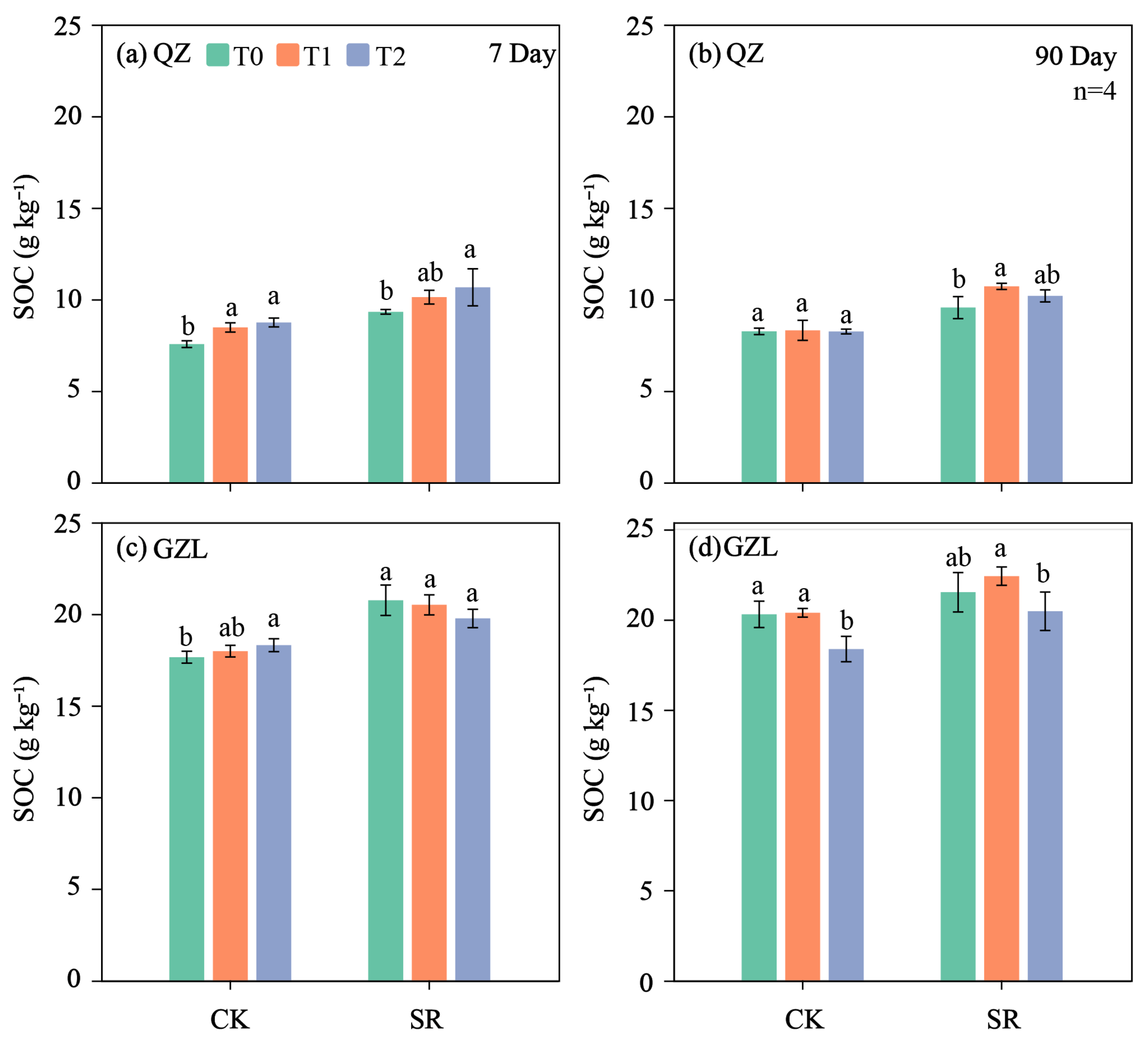
Straw input affected SOC differently between the two soils and between soils with long-term straw removal and long-term straw return, as indicated by a significant main effect of straw input and a significant Site × Input interaction at both sampling times (day 7: Input, F(2,36) = 5.63, p = 0.007; Site × Input, F(2,36) = 8.46, p < 0.001; day 90: Input, F(2,36) = 13.70, p < 0.001; Site × Input, F(2,36) = 10.84, p < 0.001) (Figure 2). The incubation experiment showed that, in QZ soil, SOC increased markedly at 7 d under both the conventional and doubled straw-input levels, with increases of 12.1–15.7% in soils under long-term straw removal and 8.6–14.4% in soils under long-term straw return. At 90 d, this positive response remained evident mainly in soils under long-term straw return, where SOC was still 6.7–12.1% higher than that in the corresponding T0 treatment (Figure 2a,b). In contrast, SOC in GZL soil was much less responsive to straw input, showing only slight changes at 7 d, while doubled straw input even caused a decline of 4.9–9.5% at 90 d (Figure 2c,d). Overall, SOC in QZ soil was more sensitive to straw input than that in GZL soil (Supplementary Tables S2 and S3).
Consistent with the SOC response, the basic soil physicochemical properties also differed between the two soils after fresh-straw input (Table S1). Long-term straw return generally maintained higher TN and AP in both soils, whereas fresh straw addition markedly increased AK, with the strongest response under T2; meanwhile, soil pH remained relatively stable in QZ but declined slightly in GZL.

3.3. Straw Input Enhanced Labile Carbon Pools and MBC

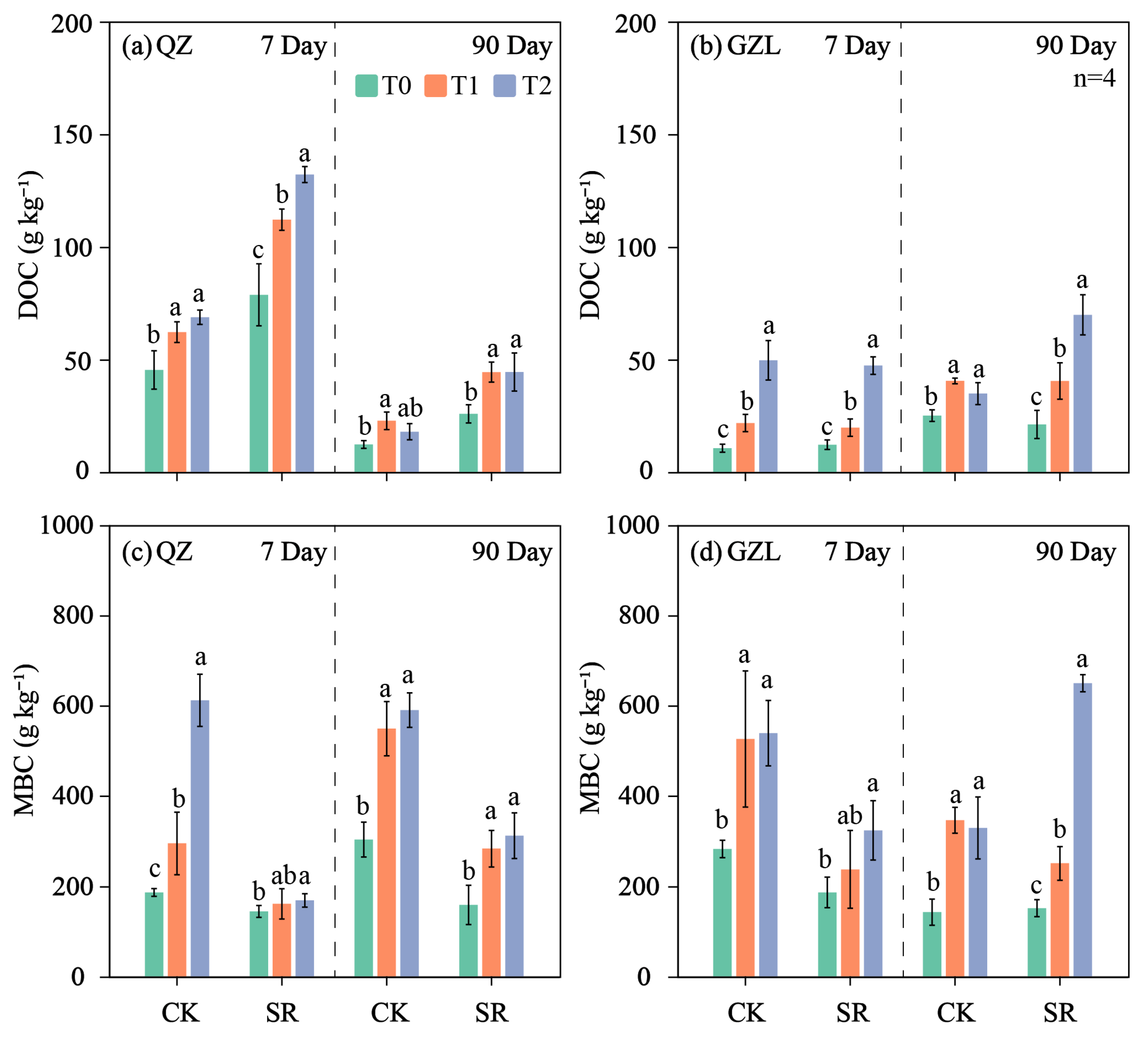
Straw input markedly increased DOC in both soils, although the magnitude of the response depended on soil origin, input level, and incubation stage. as supported by a significant main effect of straw input at both sampling times (day 7: F(2,36) = 150.07, p < 0.001; day 90: F(2,36) = 63.40, p < 0.001) and a significant Site × Input interaction (day 7: F(2,36) = 7.96, p = 0.001; day 90: F(2,36) = 11.39, p < 0.001). In QZ, DOC in soils from long-term straw-removed and straw-returned plots increased by 37.0–51.7% and 42.4–67.9%, respectively, at 7 d, and remained 46.1–85.8% and 71.6–71.8% higher at 90 d. In GZL, the DOC response was more pronounced, reaching 105.7–369.3% and 62.8–290.1% at 7 d, and remaining at 39.0–61.5% and 91.3–230.5% at 90 d (Figure 3a,b; Supplementary Tables S2 and S3).
MBC was likewise significantly enhanced by straw input, with a significant main effect of straw input at both day 7 (F(2,36) = 41.80, p < 0.001) and day 90 (F(2,36) = 181.85, p < 0.001), while the response became more differentiated between soils at 90 d, as indicated by a significant Site × Input interaction (F(2,36) = 15.34, p < 0.001). In QZ, MBC in soils from long-term straw-removed and straw-returned plots increased by 58.1–228.7% and 11.6–16.9% at 7 d, and by 81.3–94.9% and 78.2–96.2% at 90 d, respectively. In GZL, the corresponding increases were 86.6–91.2% and 27.3–73.4% at 7 d, and 130.4–142.4% and 65.3–329.3% at 90 d, indicating a stronger late-stage microbial response (Figure 3c,d; Supplementary Tables S2 and S3).

3.4. Straw Input Reshaped Nitrogen Availability and MBN

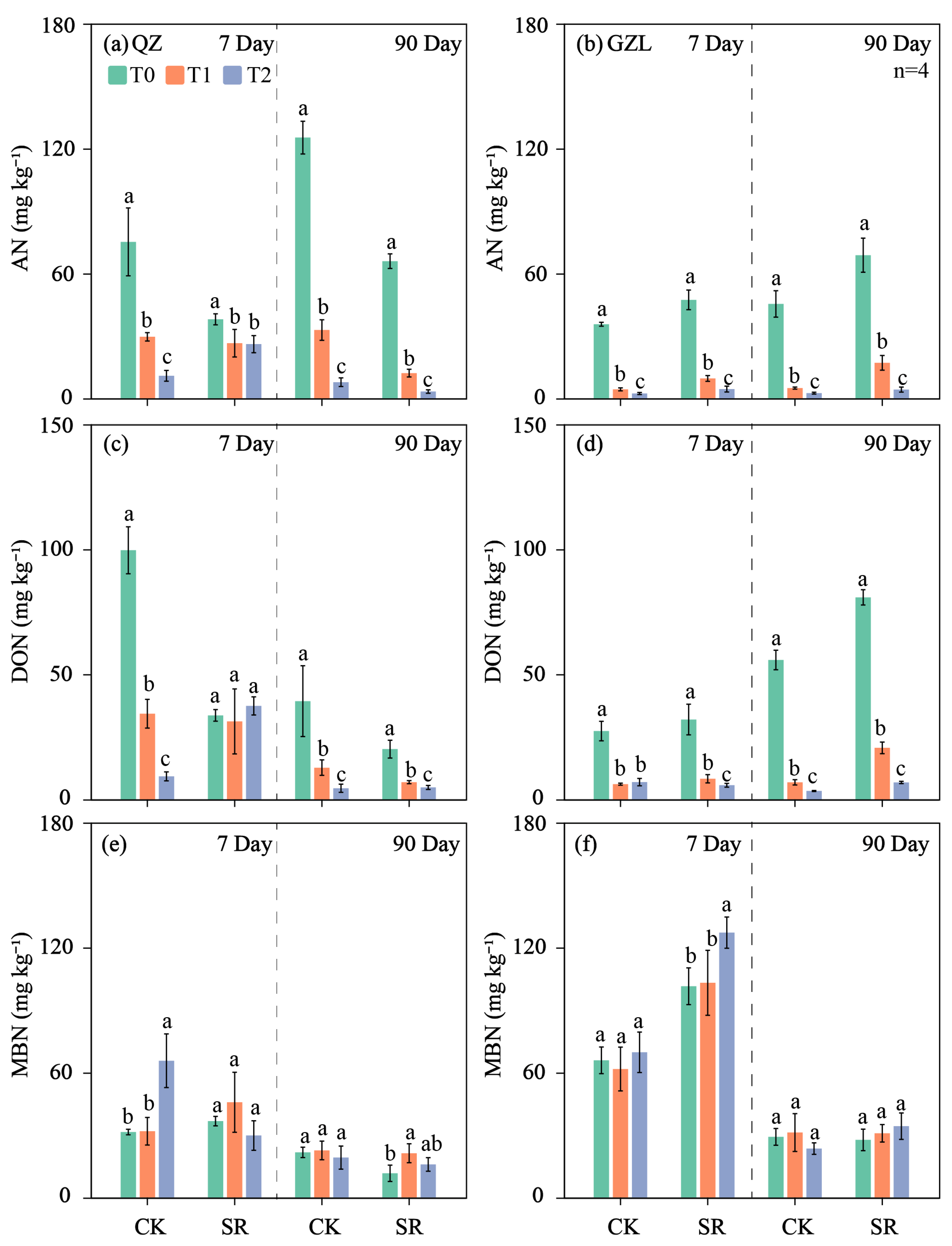
Straw input markedly reduced AN in both soils, although the magnitude of decline varied with soil type, straw-return history, input level, and incubation stage, as indicated by a highly significant main effect of straw input at both sampling times (day 7: F(2,36) = 214.27, p < 0.001; day 90: F(2,36) = 1242.11, p < 0.001) and a significant Site × Treatment × Input interaction (day 7: F(2,36) = 32.05, p < 0.001; day 90: F(2,36) = 79.33, p < 0.001). In QZ, AN decreased by 60.6–85.5% and 30.2–31.4% at 7 d under CK and SR, respectively, and by 73.8–93.8% and 81.5–95.0% at 90 d. In GZL, the corresponding decreases reached 87.8–93.3% and 79.7–90.5% at 7 d, and 89.1–94.4% and 75.1–93.8% at 90 d, indicating stronger depletion under doubled input and prolonged incubation (Figure 4a,b; Supplementary Tables S2 and S3).
Dissolved organic nitrogen (DON) also declined substantially after straw input, but its response pattern differed between soils and straw-return histories, with a significant main effect of straw input at both day 7 (F(2,36) = 166.18, p < 0.001) and day 90 (F(2,36) = 418.18, p < 0.001), as well as a significant Site × Input interaction at both sampling times (day 7: F(2,36) = 13.09, p < 0.001; day 90: F(2,36) = 82.97, p < 0.001). In QZ, DON decreased by 65.7–90.7% under CK and by only 7.2–11.3% under SR at 7 d, whereas reductions at 90 d reached 67.7–88.6% and 65.5–76.0%, respectively. In GZL, DON declined consistently across all treatments, with reductions of 74.6–77.6% and 74.1–82.2% at 7 d, and 87.7–93.9% and 74.6–91.6% at 90 d under CK and SR, respectively (Figure 4c,d; Supplementary Tables S2 and S3).
Unlike AN and DON, MBN generally increased after straw input, although the response varied with soil type, straw-return history, and incubation stage, with a significant main effect of input at 7 d (F(2,36) = 10.53, p < 0.001) but not at 90 d (F(2,36) = 2.91, p = 0.068). In QZ, MBN increased by 108.8% under CK-T2 and by 24.6% under SR-T1 at 7 d, while at 90 d it increased by 82.6% and 36.6% under SR-T1 and SR-T2, respectively. In GZL, MBN showed modest changes at 7 d, ranging from −6.3% to 25.3%, but increased by 7.1–11.3% under T1 and by 23.7% under SR-T2 at 90 d (Figure 4e,f; Supplementary Tables S2 and S3).

3.5. Straw Input Stimulated Extracellular Enzyme Activities

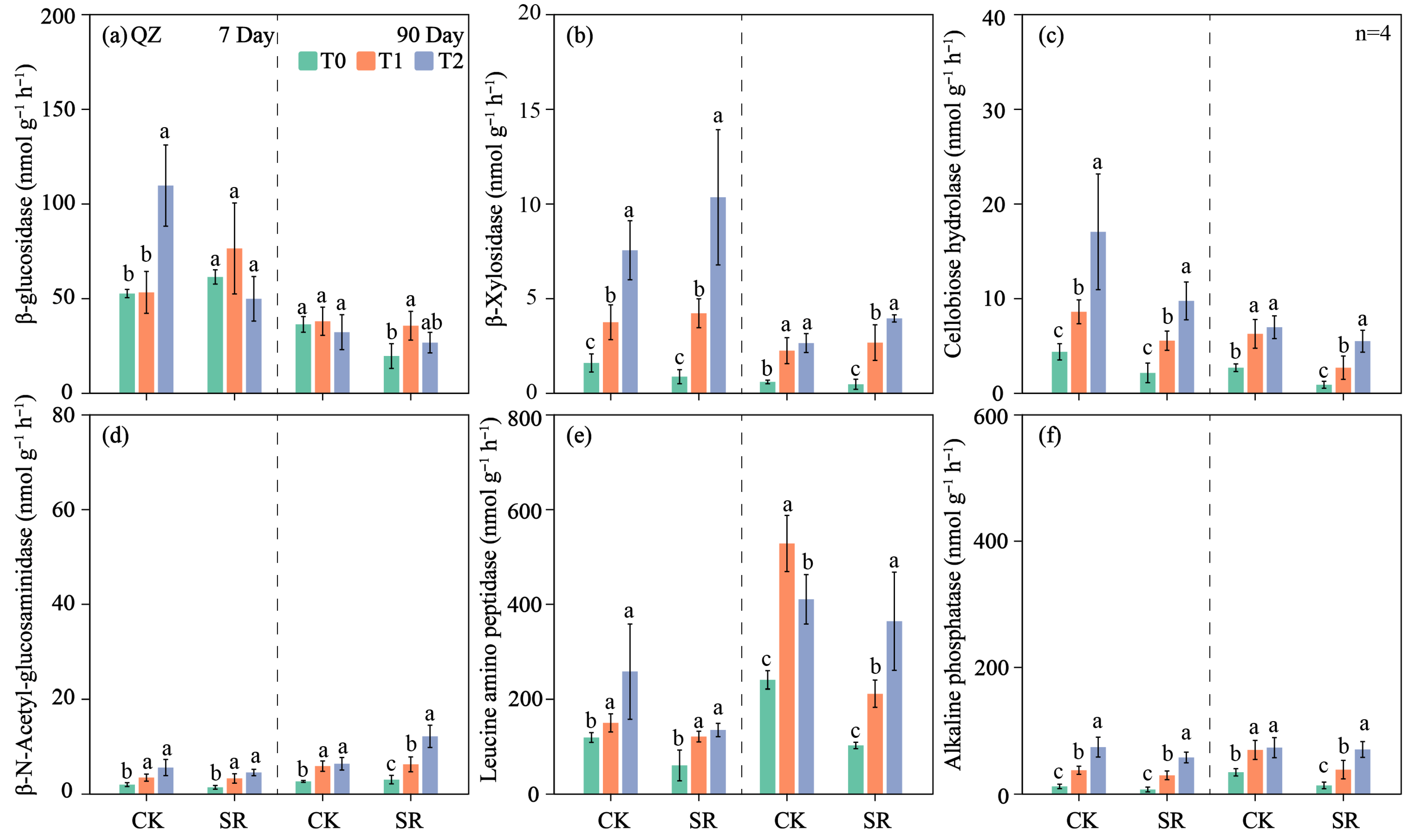
In QZ, straw input induced a broad and persistent stimulation of extracellular enzyme activities, with the strongest responses occurring in enzymes associated with cellulose degradation and P acquisition. At 7 d, CBH, BX, and AP increased most markedly, by 136.5–1114.7%, 97.7–361.9%, and 229.6–797.2%, respectively, whereas BG, NAG, and LAP showed comparatively moderate but still positive increases. These patterns were consistent with significant main effects of straw input on CBH, BX, and AP at 7 d (CBH: F(2,36) = 57.05, p < 0.001; BX: F(2,36) = 33.70, p < 0.001; AP: F(2,36) = 30.98, p < 0.001). This stimulatory effect remained evident at 90 d, when CBH, BX, and AP were still elevated by 287.0–772.2%, 134.9–541.2%, and 105.4–446.3%, respectively (Figure 5a–f), and the main effect of straw input remained significant for these enzymes (CBH: F(2,36) = 55.32, p < 0.001; BX: F(2,36) = 53.45, p < 0.001; AP: F(2,36) = 4.07, p = 0.025). Overall, the enzymatic response in QZ was characterized by a strong activation of C-degrading and P-acquiring functions, with the doubled straw input generally producing the greatest effect (Supplementary Tables S2 and S3).
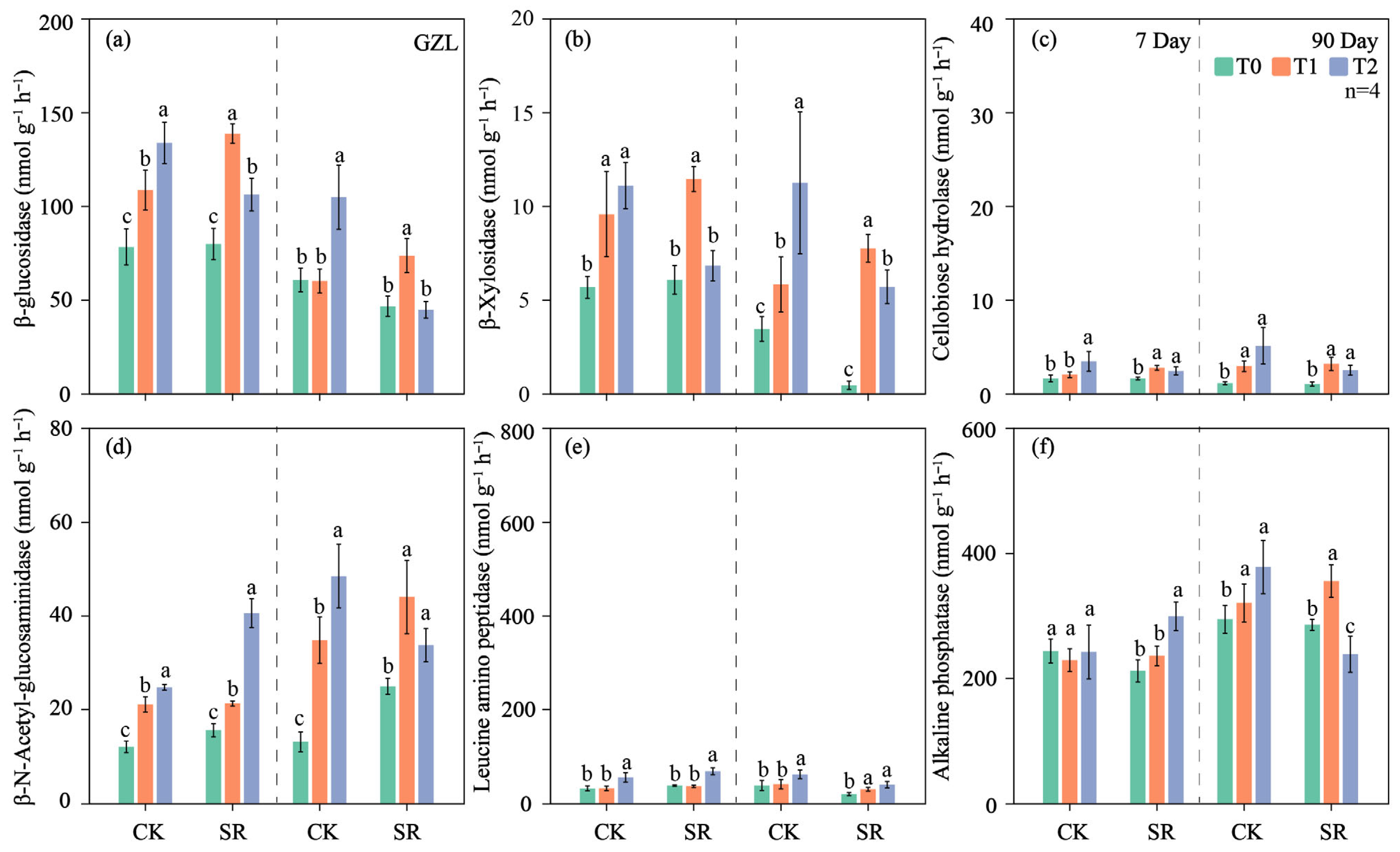
In GZL, extracellular enzyme responses to straw input were more differentiated and stage-dependent than those in QZ. During the early incubation stage, most enzymes increased only moderately, with BG, CBH, BX, and NAG showing increases of 12.4–159.9%, whereas LAP and AP responded weakly or inconsistently. By 90 d, however, the response became more focused on specific functional groups: CBH, BX, and NAG increased sharply by 69.3–1717.6%, 151.3–369.8%, and 35.4–269.3%, respectively (Figure 6a–f), while BG and AP remained comparatively variable. This later-stage pattern was consistent with significant main effects of straw input on CBH, BX, and NAG at 90 d (CBH: F(2,36) = 55.32, p < 0.001; BX: F(2,36) = 53.45, p < 0.001; NAG: F(2,36) = 68.01, p < 0.001). These results indicate that GZL did not exhibit a uniformly enhanced enzymatic response, but rather a later and more function-specific activation, particularly in enzymes involved in cellulose decomposition and N acquisition (Supplementary Tables S2 and S3).

3.6. Ecoenzymatic Stoichiometry and Vector Indices Shifted Under Fresh-Straw Input

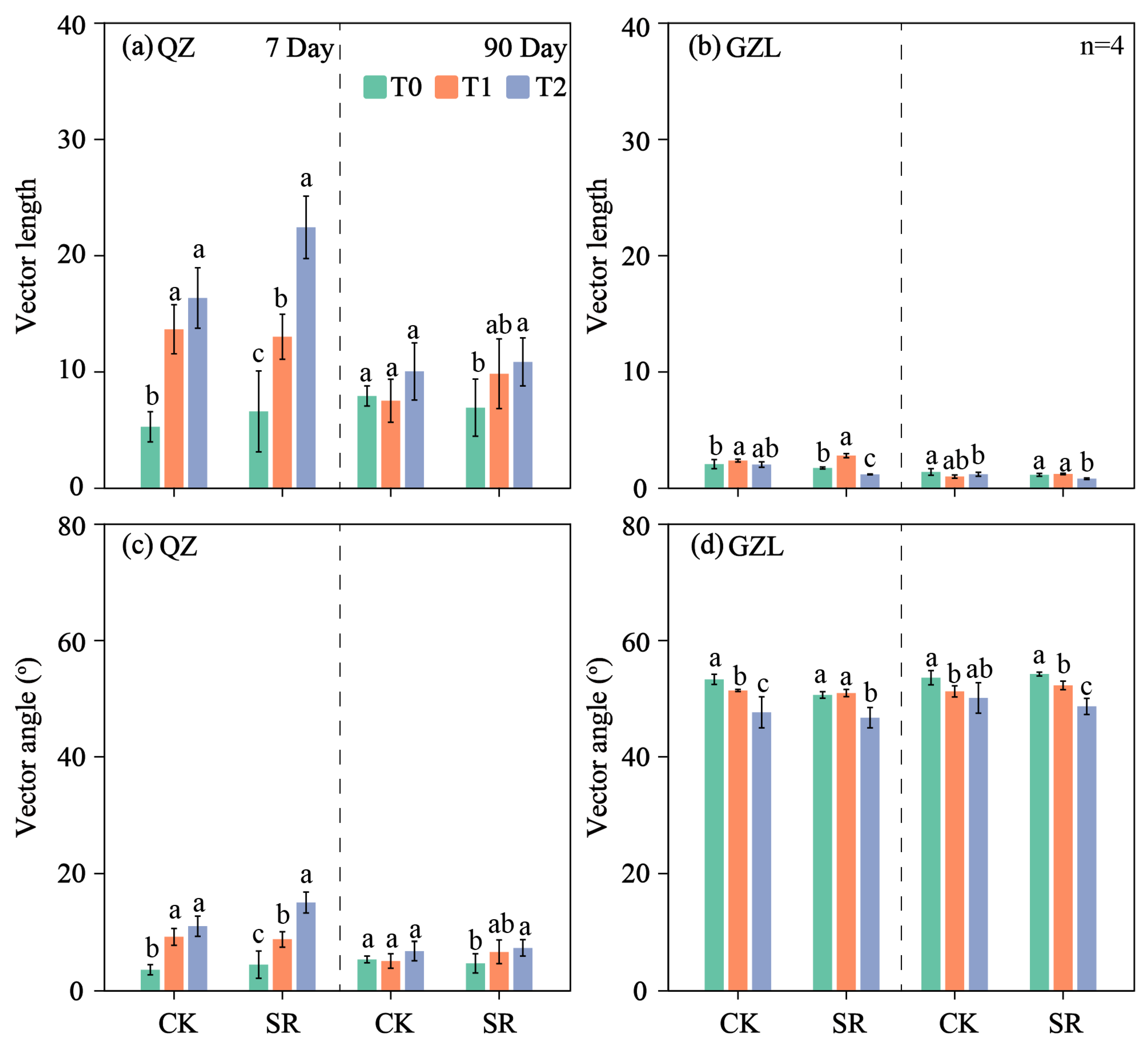
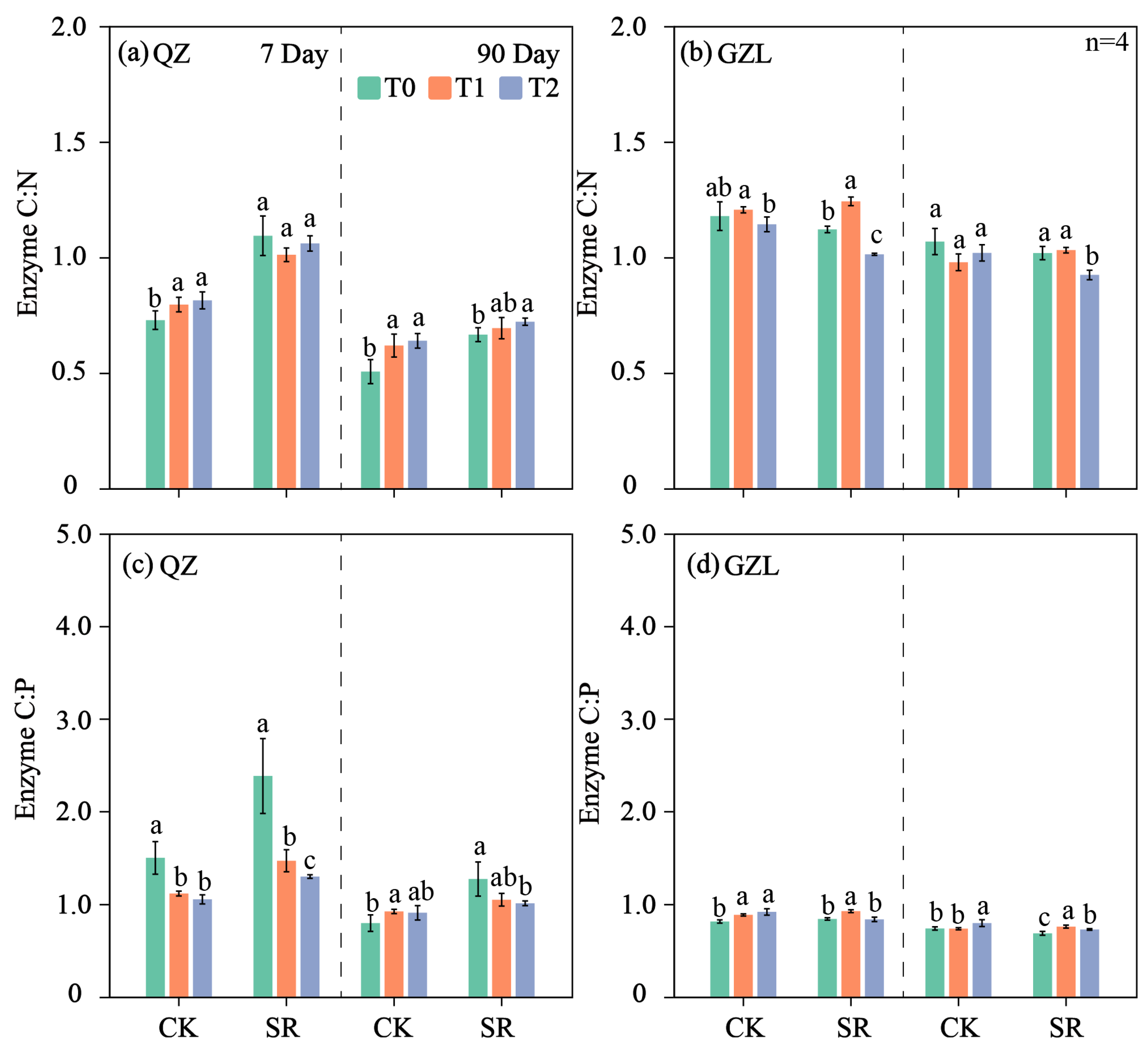
In QZ, straw input induced a pronounced shift in ecoenzymatic stoichiometry, particularly at 7 d (Figure 7). as reflected by significant responses of the C:P ratio, vector length, and vector angle to straw input (day 7: C:P, F(2,36) = 52.35, p < 0.001; vector length, F(2,36) = 44.69, p < 0.001; vector angle, F(2,36) = 96.42, p < 0.001). Under CK, the C:N ratio increased by 9.2–11.7% at 7 d and by 22.4–26.4% at 90 d, whereas under SR it declined by 2.9–7.4% at 7 d but increased by 4.4–8.6% at 90 d (Figure 7a). In contrast, the C:P ratio decreased by 25.7–53.0% at 7 d and remained 17.6–20.6% lower under SR at 90 d (Figure 7c), accompanied by a 32.3–51.1% decline in the N:P ratio (Figure S1; Supplementary Tables S2 and S3). Meanwhile, vector length declined by 50.8–77.0%, whereas vector angle increased by 98.1–242.0%, suggesting a marked shift in ecoenzymatic allocation patterns (Figure 8a,c; Supplementary Tables S2 and S3), this pattern remained evident at 90 d, when straw input still significantly affected C:P ratio (F(2,36) = 11.98, p < 0.001), vector length (F(2,36) = 10.24, p < 0.001), and vector angle (F(2,36) = 10.88, p < 0.001).
In GZL, ecoenzymatic stoichiometry showed a more moderate but more differentiated response to straw input than in QZ (Figure 7). The C:N ratio varied only within −9.8% to 10.6% at 7 d and −9.3% to 1.2% at 90 d (Figure 7b). By contrast, the C:P ratio increased under most treatments, by 8.9–12.9% under CK and by 10.4% under SR-T1 at 7 d, and remained 6.0–10.5% higher than the corresponding T0 at 90 d except for CK-T1 (Figure 7d), consistent with a significant main effect of straw input on C:P ratio at both day 7 (F(2,36) = 26.66, p < 0.001) and day 90 (F(2,36) = 6.83, p = 0.003). This trend was accompanied by increases of 6.4–16.4% in the N:P ratio at 7 d and 8.8–17.0% under most treatments at 90 d (Figure S1; Supplementary Tables S2 and S3). Vector length increased by 15.3% under CK-T1 and by 63.2% under SR-T1 at 7 d, but generally declined by 14.3–30.7% at 90 d, while vector angle decreased by 3.6–10.3% (Figure 8b,d). In line with this stage-dependent pattern, straw input significantly affected vector length at day 7 (F(2,36) = 8.57, p < 0.001) and vector angle at both day 7 (F(2,36) = 4.57, p = 0.017) and day 90 (F(2,36) = 8.51, p < 0.001).

3.7. Correlation Analysis of Soil Biochemical Variables Under Fresh-Straw Input

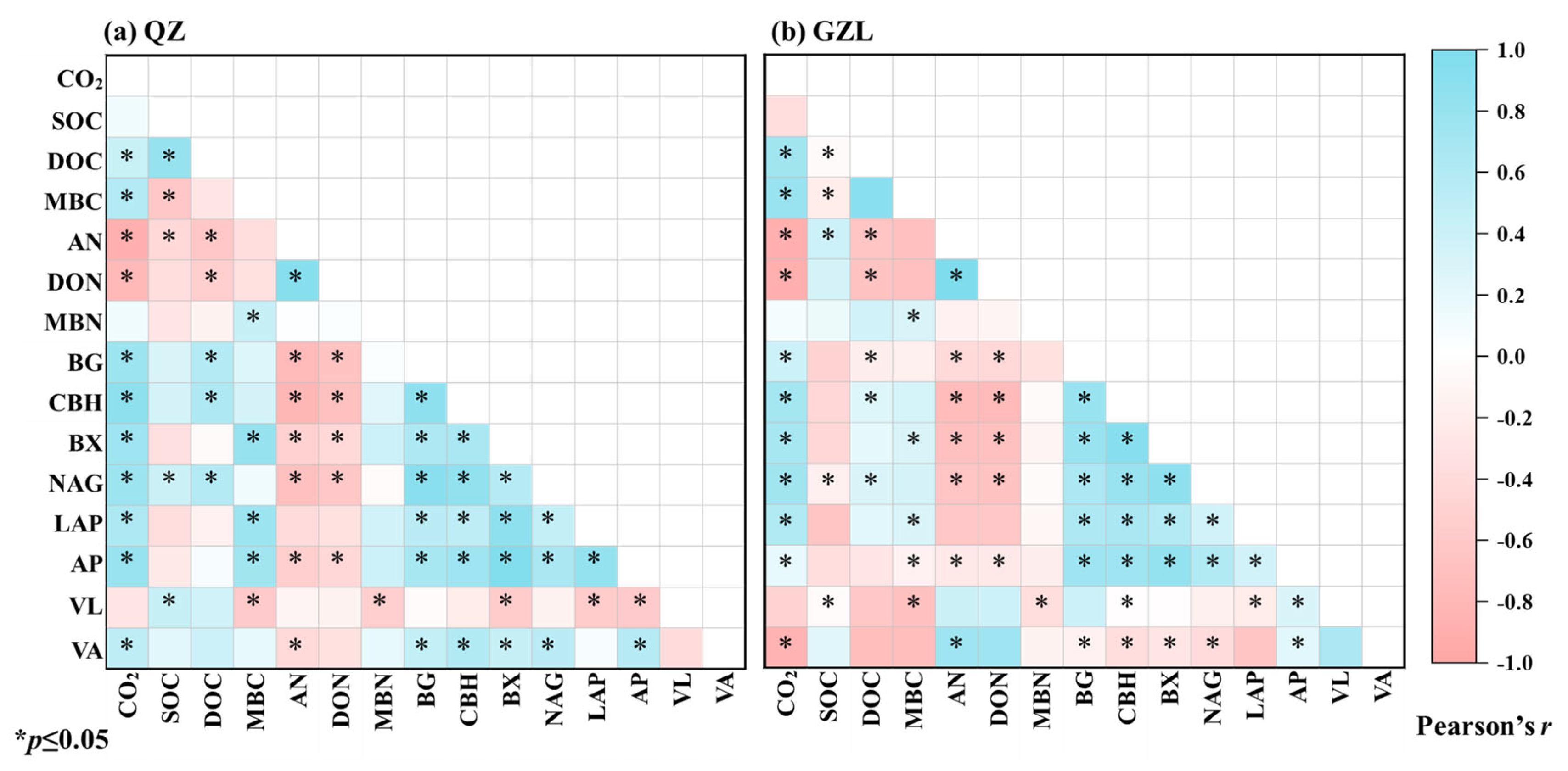
Pearson correlation analysis integrated the relationships among soil C and N pools, enzyme activities, and ecoenzymatic indices under fresh-straw input (Figure 9). In both QZ and GZL soils, cumulative CO2 release was positively correlated with DOC, MBC, and most enzyme activities, but negatively correlated with AN, DON, and vector angle. DOC and MBC were strongly positively correlated, whereas both were negatively correlated with AN and DON. By contrast, SOC showed generally weak or negative correlations with DOC, MBC, and enzyme activities, but relatively weak positive correlations with AN, DON, and vector angle. Overall, the correlation analysis suggests that fresh-straw input mainly strengthened the coupling among labile C accumulation, enzyme activation, and carbon mineralization, whereas short-term SOC changes were less directly associated with these biochemical responses.

4. Discussion

4.1. Initial SOC Status and Long-Term Straw-Return History Jointly Regulated SOC Responses to Fresh-Straw Input

SOC responses to fresh-straw input were not determined by input amount alone, but reflected differences between the two long-term soil systems under controlled incubation conditions. These differences included initial SOC status and straw-return history, but should not be interpreted as effects of SOC status alone [26,27]. Previous studies have shown that soils with a larger carbon saturation deficit generally exhibit stronger SOC accumulation responses to external C inputs because they still possess greater capacity retain newly incorporated carbon [28]. More broadly, the SOC response of exogenous organic inputs in agricultural soils is strongly dependent on soil background conditions and management practices [5,29]. This pattern is also consistent with current views that the fate of newly added carbon depends not only on input amount, but also on its subsequent transformation, physicochemical protection, and stabilization within different soil organic matter pools [10,30,31,32,33].
Our results were broadly consistent with these views. In the present incubation, the C-poor QZ soil showed clear positive SOC responses after straw addition, especially under the long-term straw-return treatment, whereas the C-rich GZL soil showed only limited SOC increases at low input and even SOC decline under doubled straw input. In QZ, SOC increased by 12.1–15.7% on day 7 and remained 6.7–12.1% higher than the corresponding control on day 90 under the long-term straw-return background, whereas in GZL the doubled-straw treatment reduced SOC by 4.9–9.5% on day 90. These results indicate that the same fresh-straw input can lead to contrasting SOC outcomes in soils with different long-term backgrounds, and that these contrasts cannot be attributed to SOC status alone.
Fresh substrate input may also stimulate the turnover of native organic carbon, suggesting a potential priming effect [34]. Mechanistically, the addition of high-C:N straw may stimulate microbial growth, extracellular enzyme production, and competition for available nitrogen, thereby enhancing carbon mineralization while accelerating nitrogen depletion. However, because isotopic tracing or carbon-source partitioning was not performed in this study, the origin of the carbon losses could not be definitively distinguished between native SOC and added straw C. In addition, strong biochemical responses to exogenous inputs may redirect added straw-C toward rapid decomposition rather than short-term net SOC gain [35,36], and both the quantity and quality of crop residues can regulate soil organic matter decomposition [13]. In the present study, cumulative CO2 release increased significantly in both soils after straw addition, but the increase was consistently greater in GZL under high-input conditions. Under the doubled-straw treatment, cumulative CO2 release in GZL increased by 1337–1358% by day 90, compared with 1199–1303% in QZ. Therefore, the key difference between the two soils was not whether they responded to fresh-straw input, but whether that response could be translated into measurable SOC gain.

4.2. Divergent Microbial Resource-Acquisition Strategies Determined Whether Fresh-Straw C Was Buffered into SOC or Dissipated Through Rapid Turnover

The reason why the two soils displayed contrasting SOC dynamics after straw addition cannot be explained solely by differences in decomposition rate. More fundamentally, it reflects the fact that microbial communities adopted different resource-allocation strategies. The input of exogenous straw disrupted the pre-existing balance among carbon, nitrogen, and phosphorus acquisition, and the two soils differed markedly in their ability to buffer that imbalance. Microbial carbon-use efficiency is strongly regulated by elemental stoichiometry, such that the same carbon input may lead either to microbial growth and short-term carbon retention or to respiratory metabolism and carbon loss under different nutrient-balance conditions [37]. This interpretation is also supported by stoichiometric syntheses of microbial carbon-use efficiency [38].
In most studies involving the addition of external carbon, an increase in dissolved organic carbon is usually interpreted as evidence of enhanced substrate availability. However, DOC alone cannot indicate whether that carbon has actually entered the stable SOC pool. When resources are in a state of stoichiometric imbalance, microorganisms respond by adjusting nitrogen-use efficiency to cope with resource disequilibrium [39]. The formation of persistent SOC depends on microbial assimilation and the production of microbial-derived organic matter rather than on substrate release itself [40,41], and the large contribution of microbial necromass to soil organic matter formation has since been quantified more explicitly [42]. Our results strongly support this interpretation. After straw addition, DOC and MBC increased significantly in both soils, but the DOC pulse was much stronger in GZL. Under the long-term straw-return background, DOC in GZL increased by 105.7–369.3% on day 7 and still by 91.3–230.5% on day 90. Meanwhile, available nitrogen declined by 79.7–90.5% on day 7 and remained 75.1–93.8% lower on day 90. Taken together, this pattern indicates rapid substrate activation accompanied by marked nutrient withdrawal, rather than efficient retention of newly added carbon.
Comparison with recent related studies helps further clarify this mechanism. The ecological benefits of straw return are maximized only when nutrient imbalance is effectively buffered; otherwise, microbial metabolic limitation constrains SOC accumulation [43]. Long-term straw mulching can alleviate microbial nutrient limitation, but that effect depends strongly on soil nutrient background [44]. Under combined straw return and fertilization, nutrient limitation still exerts strong control over SOC accumulation [45], and straw-nutrient interactions can jointly reshape microbial processes and soil multifunctionality [46]. In QZ, straw addition increased dissolved organic carbon and microbial biomass carbon, yet SOC still showed a measurable positive response, suggesting that fresh-straw input was still associated with measurable SOC accumulation under this soil background. In GZL, however, the stronger DOC pulse was accompanied by a sharper decline in the active nitrogen pool and weaker net SOC formation. This contrast does not merely indicate a stronger biochemical response in GZL; rather, it shows that the same fresh-straw input was accompanied by a more pronounced stoichiometric imbalance in this soil.
The enzyme activities and vector analysis further reveal the mechanistic basis of this divergence. Extracellular enzyme stoichiometry can reflect the relative nutrient demand of microorganisms [47], and these patterns were subsequently linked more explicitly to strategies of organic C, N, and P acquisition [18]. Vector analysis has since been used to distinguish shifts in microbial carbon limitation from changes in the direction of nitrogen versus phosphorus acquisition [19]. In the present study, the straw-input gradient from T1 to T2 did not produce a uniform enhancement of all enzyme activities. In QZ, higher straw input was accompanied by stronger responses of CBH, BX, and AP, along with a lower ecoenzymatic C:P ratio and a marked increase in vector angle. Taken together, these patterns suggest a shift toward relatively greater P-acquisition investment under straw addition. This pattern suggests relatively greater microbial investment in P-acquiring enzymes under straw addition. By contrast, in GZL, the later-stage response was concentrated more narrowly on CBH, BX, and NAG, whereas vector angle declined only slightly. This pattern is more consistent with a strategy in which newly added substrate is processed mainly through continued decomposition and nutrient foraging, rather than being effectively integrated into microbial assimilation through a broadly coordinated acquisition mechanism. Therefore, long-term straw-return history altered not only the magnitude of enzyme and stoichiometric responses, but also their relationship with SOC outcomes: one soil remained capable of integrating additional straw into a nutrient-buffered assimilation pathway, whereas the other was more easily driven toward rapid turnover under stoichiometric stress.
From a practical perspective, the present results suggest that residue inputs should not be increased uniformly across soils with contrasting long-term backgrounds. Instead, straw addition rates should be optimized according to soil properties and residue-management history. In soils showing strong nutrient withdrawal after straw input, particularly under high-C residue addition, better coordination between carbon input and nutrient supply may be necessary to improve SOC retention and avoid excessive carbon loss. In this context, balancing straw return with appropriate nutrient management, especially nitrogen and potentially phosphorus supplementation, may help enhance the effectiveness of residue return in agricultural soils.
This study has several limitations that should be acknowledged. First, the results were obtained under controlled incubation conditions and therefore may not fully reflect the complexity of field environments, including plant–soil interactions, soil structure, and fluctuations in temperature and moisture. Second, no N fertilizer was included in this experiment, although straw return in agricultural systems is often accompanied by fertilization, which may alter microbial activity and nutrient constraints. Third, the 90-day incubation mainly captured short-term SOC responses and early biochemical processes rather than long-term SOC stabilization and sequestration under field management. In addition, the statistical analysis in this study was mainly based on ANOVA and correlation analysis. Although these methods were sufficient to evaluate treatment effects and the principal pairwise relationships among variables, more integrative approaches, such as multivariate analysis or structural equation modeling, may provide a more comprehensive understanding of the complex interactions among carbon, nitrogen, enzyme activities, and ecoenzymatic stoichiometric indices. Therefore, future studies combining longer-term field experiments with more integrative statistical frameworks are needed to further verify the mechanisms observed in this study.

5. Conclusions

Initial SOC status and long-term straw-return history jointly regulated SOC responses to fresh-straw input. Straw addition stimulated CO2 release, labile C pools, enzyme activities, and ecoenzymatic stoichiometric shifts in both soils, but a positive short-term SOC response was sustained mainly in the C-poor soil, whereas the C-rich soil showed stronger mineralization and SOC decline under doubled input. In the C-poor soil, fresh-straw input was associated with enhanced CBH, BX, and especially AP activities, together with lower ecoenzymatic C:P and higher vector angle, suggesting relatively greater P-acquisition responses under straw addition. In contrast, the C-rich soil showed a stronger DOC pulse, sharper depletion of active N pools, later activation of CBH, BX, and NAG, and only slight changes in vector angle, suggesting that fresh-straw input was associated more closely with continued decomposition than with net SOC accumulation. These results demonstrate that the effect of fresh-straw input on SOC is context-dependent and reflects differences in long-term soil background, including initial SOC status and straw-return history.

Supplementary Materials

The following supporting information can be downloaded at https://www.mdpi.com/article/10.3390/agronomy16080838/s1. Table S1. Responses of soil physicochemical properties to fresh straw addition at 7 and 90 days under long-term straw return; Table S2. Three-way ANOVA results for soil physicochemical properties, enzyme activities, and ecoenzymatic stoichiometric indices measured at 7 days of incubation; Table S3. Three-way ANOVA results for soil physicochemical properties, enzyme activities, and ecoenzymatic stoichiometric indices measured at 90 days of incubation; Figure S1. Responses of ecoenzymatic N:P ratios to fresh straw addition at 7 and 90 days under long-term straw return.

Author Contributions

Y.L.: Writing—review and editing, Writing—original draft, Visualization, Validation, Software, Investigation, Formal analysis, Data curation, Conceptualization. X.Z.: Data curation, Visualization, Formal analysis. J.L.: Data curation, Visualization, Formal analysis. P.N.: Writing—review and editing, Investigation, Supervision, Conceptualization, Project administration. All authors have read and agreed to the published version of the manuscript.

Funding

This research was funded by the Agricultural Science and Technology Major Project, and the National Key Research and Development Program of China (Grant number 2023YFD1901502).

Data Availability Statement

All data are contained within the article.

Conflicts of Interest

The authors declare that they have no known competing financial interests or personal relationships that could have appeared to influence the work reported in this paper.

References

  1. Lal, R. Soil carbon sequestration impacts on global climate change and food security. Science 2004, 304, 1623–1627. [Google Scholar] [CrossRef]
  2. Schimel, J.P.; Schaeffer, S.M. Microbial control over carbon cycling in soil. Front. Microbiol. 2012, 3, 348. [Google Scholar] [CrossRef] [PubMed]
  3. Tian, X.; Wei, G.; Shi, J.; Liang, Z.; Xu, M.; Berhane, M. Effects of long-term straw return on soil organic carbon storage and sequestration rate in North China upland crops: A meta-analysis. Glob. Change Biol. 2020, 26, 2686–2701. [Google Scholar]
  4. Wang, Q.; Liu, X.; Li, J.; Yang, X.; Guo, Z. Straw application and soil organic carbon change: A meta-analysis. Soil Water Res. 2021, 16, 112–120. [Google Scholar] [CrossRef]
  5. Han, X.; Xu, C.; Dungait, J.A.J.; Bol, R.; Wang, X.; Wu, W.; Meng, F. Straw incorporation increases crop yield and soil organic carbon sequestration but varies under different natural conditions and farming practices in China: A system analysis. Biogeosciences 2018, 15, 1933–1946. [Google Scholar] [CrossRef]
  6. Zhang, Y.X.; Yang, Q.L.; Feng, H.; Chen, J.; Li, Y. Meta-analysis shows the effects of straw return on soil organic carbon and total nitrogen in cropland. J. Chin. Eco-Agric. 2026, 34, 344–356. [Google Scholar]
  7. Ninkuu, V.; Liu, Z.; Qin, A.; Xie, Y.; Song, X.; Sun, X. Impact of straw returning on soil ecology and crop yield: A review. Heliyon 2025, 11, e41651. [Google Scholar] [CrossRef]
  8. Zhang, X.; Ren, X.; Cai, L. Effects of Different Straw Incorporation Amounts on Soil Organic Carbon, Microbial Biomass, and Enzyme Activities in Dry-Crop Farmland. Sustainability 2024, 16, 10588. [Google Scholar] [CrossRef]
  9. Huang, W.; Wu, J.F.; Pan, X.H.; Tan, X.M.; Zeng, Y.J.; Shi, Q.H.; Liu, T.J.; Zeng, Y.H. Effects of long-term straw return on soil organic carbon fractions and enzyme activities in a double-cropped rice paddy in South China. J. Integr. Agric. 2021, 20, 236–247. [Google Scholar] [CrossRef]
  10. Cotrufo, M.F.; Wallenstein, M.D.; Boot, C.M.; Denef, K.; Paul, E. The Microbial Efficiency-Matrix Stabilization (MEMS) framework integrates plant litter decomposition with soil organic matter stabilization: Do labile plant inputs form stable soil organic matter? Glob. Change Biol. 2013, 19, 988–995. [Google Scholar] [CrossRef]
  11. Chen, Q.; Liu, Z.; Zhou, J.; Xu, X.; Zhu, Y. Long-term straw mulching with nitrogen fertilization increases nutrient and microbial determinants of soil quality in a maize-wheat rotation on China’s Loess Plateau. Sci. Total Environ. 2021, 775, 145930. [Google Scholar] [CrossRef]
  12. Chen, X.; Tang, Z.; Weng, Y.; Cai, H.; Wu, Y.; Zheng, B.; Li, J. Effects of 15-year straw incorporation on soil carbon composition and microbial community under wheat-maize rotation system in the Huang-Huai-Hai Plain. BMC Plant Biol. 2025, 25, 522. [Google Scholar] [CrossRef] [PubMed]
  13. Shahbaz, M.; Kuzyakov, Y.; Sanaullah, M.; Heitkamp, F.; Zelenev, V.; Kumar, A.; Blagodatskaya, E. Microbial decomposition of soil organic matter is mediated by quality and quantity of crop residues: Mechanisms and thresholds. Biol. Fertil. Soils 2017, 53, 287–301. [Google Scholar] [CrossRef]
  14. Yu, X.; Wang, L.; Wang, Q.; Zhou, G.; Sun, H.; Guggenberger, G.; Li, Y.; Yakov, K.; Luo, Y.; Fu, Y. Faster soil organic carbon turnover in MAOM versus POM: Straw input causes larger microbial driven soil organic carbon decomposition but higher straw accumulation in MAOM. Soil Tillage Res. 2025, 251, 106549. [Google Scholar] [CrossRef]
  15. Yang, L.; Muhammad, I.; Chi, Y.X.; Wang, D.; Zhou, X.B. Straw Return and Nitrogen Fertilization to Maize Regulate Soil Properties, Microbial Community, and Enzyme Activities Under a Dual Cropping System. Front. Microbiol. 2022, 13, 823963. [Google Scholar] [CrossRef] [PubMed]
  16. Wang, K.; Ren, T.; Yan, J.; Zhu, D.; Liao, S.; Zhang, Y.; Lu, Z.; Cong, R.; Li, X.; Lu, J. Straw returning mediates soil microbial biomass carbon and phosphorus turnover to enhance soil phosphorus availability in a rice-oilseed rape rotation with different soil phosphorus levels. Agric. Ecosyst. Environ. 2022, 335, 108017. [Google Scholar] [CrossRef]
  17. Yang, X.; He, P.; Zhang, Z.; You, M.; Wu, X.; Li, L.J. Straw return, rather than warming, alleviates microbial phosphorus limitation in a cultivated Mollisol. Appl. Soil Ecol. 2023, 186, 104821. [Google Scholar] [CrossRef]
  18. Sinsabaugh, R.L.; Hill, B.H.; Follstad Shah, J.J. Ecoenzymatic stoichiometry of microbial organic nutrient acquisition in soil and sediment. Nature 2009, 462, 795–798. [Google Scholar] [CrossRef]
  19. Moorhead, D.L.; Sinsabaugh, R.L.; Hill, B.H.; Weintraub, M.N. Vector analysis of ecoenzyme activities reveal constraints on coupled C, N and P dynamics. Soil Biol. Biochem. 2016, 93, 1–7. [Google Scholar] [CrossRef]
  20. Ren, X.; Cai, L.; Wu, J.; Ahmad, M.K.; Haider, F.U. Dynamics of Soil Organic Carbon Mineralization Under Straw Addition: Evidence from a Controlled Incubation Experiment. Agronomy 2025, 15, 2642. [Google Scholar] [CrossRef]
  21. Kalembasa, S.; Jenkinson, D.S. Comparative study of titrimetric and gravimetric methods for determination of organic carbon in soil. J. Sci. Food Agric. 1973, 24, 1085–1090. [Google Scholar] [CrossRef]
  22. Mulvaney, R.L. Nitrogen—Inorganic Forms. In Methods of Soil Analysis: Part 3 Chemical Methods; Sparks, D.L., Ed.; SSSA Book Series 5.3; Soil Science Society of America: Madison, WI, USA, 1996; pp. 1123–1184. [Google Scholar]
  23. Olsen, S.R.; Sommers, L.E. Phosphorus. In Methods of Soil Analysis. Part 2. Chemical and Microbiological Properties; Page, A.L., Miller, R.H., Keeney, D.R., Eds.; American Society of Agronomy: Madison, WI, USA, 1982; pp. 403–430. [Google Scholar]
  24. Hosseinpur, A.R.; Samavati, M. Evaluation of chemical extractants for the determination of available potassium. Commun. Soil Sci. Plant Anal. 2008, 39, 1559–1570. [Google Scholar] [CrossRef]
  25. German, D.P.; Weintraub, M.N.; Grandy, A.S.; Lauber, C.L.; Rinkes, Z.L.; Allison, S.D. Optimization of hydrolytic and oxidative enzyme methods for ecosystem studies. Soil Biol. Biochem. 2011, 43, 1387–1397. [Google Scholar] [CrossRef]
  26. Six, J.; Conant, R.T.; Paul, E.A.; Paustian, K. Stabilization mechanisms of soil organic matter: Implications for C-saturation of soils. Plant Soil. 2002, 241, 155–176. [Google Scholar] [CrossRef]
  27. Schmidt, M.W.I.; Torn, M.S.; Abiven, S.; Dittmar, T.; Guggenberger, G.; Janssens, I.A.; Kleber, M.; Kögel-Knabner, I.; Lehmann, J.; Manning, D.A.C.; et al. Persistence of soil organic matter as an ecosystem property. Nature 2011, 478, 49–56. [Google Scholar] [CrossRef]
  28. Castellano, M.J.; Mueller, K.E.; Olk, D.C.; Sawyer, J.E.; Six, J. Integrating plant litter quality, soil organic matter stabilization, and the carbon saturation concept. Glob. Change Biol. 2015, 21, 3200–3209. [Google Scholar] [CrossRef] [PubMed]
  29. Poeplau, C.; Don, A. Carbon sequestration in agricultural soils via cultivation of cover crops—A meta-analysis. Agric. Ecosyst. Environ. 2015, 200, 33–41. [Google Scholar] [CrossRef]
  30. Lavallee, J.M.; Soong, J.L.; Cotrufo, M.F. Conceptualizing soil organic matter into particulate and mineral-associated forms to address global change in the 21st century. Glob. Change Biol. 2020, 26, 261–273. [Google Scholar] [CrossRef]
  31. Rodrigues, L.A.T.; Giacomini, S.J.; Dieckow, J.; Cherubin, M.R.; Ottonelli, A.S.; Bayer, C. Carbon saturation deficit and litter quality drive the stabilization of litter-derived C in mineral-associated organic matter in long-term no-till soil. Catena 2022, 219, 106590. [Google Scholar] [CrossRef]
  32. Lehmann, J.; Kleber, M. The contentious nature of soil organic matter. Nature 2015, 528, 60–68. [Google Scholar] [CrossRef]
  33. Haddix, M.L.; Paul, E.A.; Cotrufo, M.F. Dual, differential isotope labeling shows the preferential movement of labile plant constituents into mineral-bonded soil organic matter. Glob. Change Biol. 2016, 22, 2301–2312. [Google Scholar] [CrossRef]
  34. Kuzyakov, Y.; Friedel, J.K.; Stahr, K. Review of mechanisms and quantification of priming effects. Soil Biol. Biochem. 2000, 32, 1485–1498. [Google Scholar] [CrossRef]
  35. Fontaine, S.; Mariotti, A.; Abbadie, L. The priming effect of organic matter: A question of microbial competition? Soil Biol. Biochem. 2003, 35, 837–843. [Google Scholar] [CrossRef]
  36. Kuzyakov, Y. Priming effects: Interactions between living and dead organic matter. Soil Biol. Biochem. 2010, 42, 1363–1371. [Google Scholar] [CrossRef]
  37. Manzoni, S.; Taylor, P.; Richter, A.; Porporato, A.; Ågren, G.I. Environmental and stoichiometric controls on microbial carbon-use efficiency in soils. New Phytol. 2012, 196, 79–91. [Google Scholar] [CrossRef]
  38. Sinsabaugh, R.L.; Turner, B.L.; Talbot, J.M.; Waring, B.G.; Powers, J.S.; Kuske, C.R.; Moorhead, D.L.; Follstad Shah, J.J. Stoichiometry of microbial carbon use efficiency in soils. Ecol. Monogr. 2016, 86, 172–189. [Google Scholar] [CrossRef]
  39. Mooshammer, M.; Wanek, W.; Hämmerle, I.; Fuchslueger, L.; Hofhansl, F.; Knoltsch, A.; Schnecker, J.; Takriti, M.; Watzka, M.; Wild, B.; et al. Adjustment of microbial nitrogen use efficiency to carbon:nitrogen imbalances regulates soil nitrogen cycling. Nat. Commun. 2014, 5, 3694. [Google Scholar] [CrossRef] [PubMed]
  40. Kallenbach, C.M.; Frey, S.D.; Grandy, A.S. Direct evidence for microbial-derived soil organic matter formation and its ecophysiological controls. Nat. Commun. 2016, 7, 13630. [Google Scholar] [CrossRef] [PubMed]
  41. Liang, C.; Schimel, J.P.; Jastrow, J.D. The importance of anabolism in microbial control over soil carbon storage. Nat. Microbiol. 2017, 2, 17105. [Google Scholar] [CrossRef]
  42. Liang, C.; Amelung, W.; Lehmann, J.; Kästner, M. Quantitative assessment of microbial necromass contribution to soil organic matter. Glob. Change Biol. 2019, 25, 3578–3590. [Google Scholar] [CrossRef]
  43. Li, S.; Cui, Y.; Xia, Z.; Zhang, X.; Zhou, C.; An, S.; Zhu, M.; Gao, Y.; Yu, W.; Ma, Q. Microbial nutrient limitations limit carbon sequestration but promote nitrogen and phosphorus cycling: A case study in an agroecosystem with long-term straw return. Sci. Total Environ. 2023, 870, 161865. [Google Scholar] [CrossRef] [PubMed]
  44. Li, Y.; Zhang, X.; Li, M.; Liu, J.; Zhang, K.; Li, Z. Long-term straw mulching alleviates microbial nutrient limitations and increases carbon-use efficiency within aggregates. Soil Use Manag. 2024, 40, e13058. [Google Scholar] [CrossRef]
  45. Mo, F.; Yang, D.; Wang, X.; Crowther, T.W.; Vinay, N.; Luo, Z.; Yu, K.; Sun, S.; Zhang, F.; Xiong, Y.; et al. Nutrient limitation of soil organic carbon stocks under straw return. Soil Biol. Biochem. 2024, 192, 109360. [Google Scholar] [CrossRef]
  46. Duan, Y.; Cao, M.; Zhong, W.; Wang, Y.; Ni, Z.; Zhang, M.; Li, J.; Li, Y.; Meng, X.; Wu, L. Moderate N fertilizer reduction with straw return modulates cropland functions and microbial traits in a meadow soil. Soil 2024, 10, 779–794. [Google Scholar] [CrossRef]
  47. Sinsabaugh, R.L.; Lauber, C.L.; Weintraub, M.N.; Ahmed, B.; Allison, S.D.; Crenshaw, C.; Contosta, A.R.; Cusack, D.; Frey, S.; Gallo, M.E.; et al. Stoichiometry of soil enzyme activity at global scale. Ecol. Lett. 2008, 11, 1252–1264. [Google Scholar] [CrossRef]
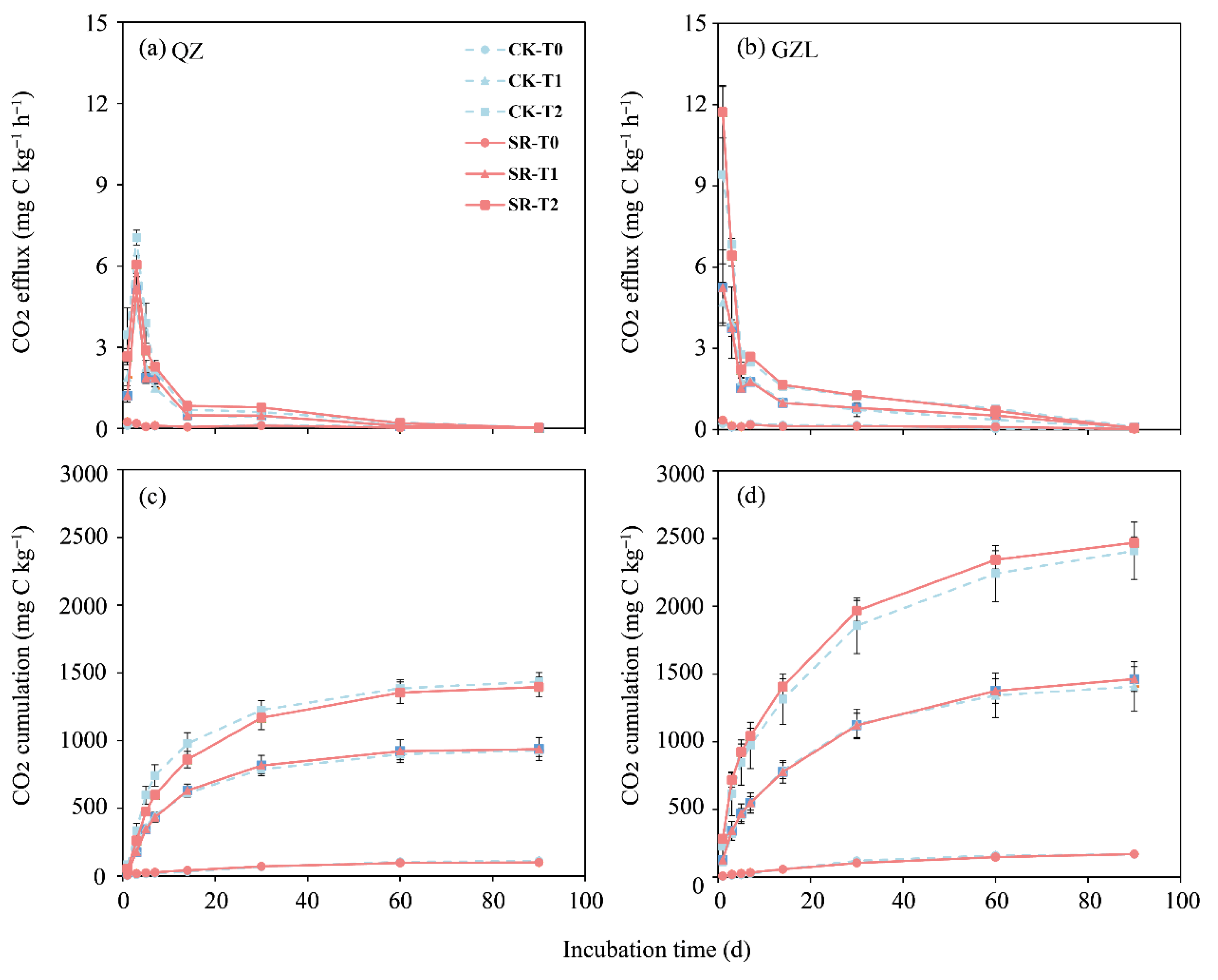
Figure 1. Responses of instantaneous CO2 efflux (a,b) and cumulative CO2 release (c,d) to fresh-straw addition in QZ and GZL soils under long-term straw return. QZ and GZL denote Quzhou and Gongzhuling, respectively.
Agronomy 16 00838 g001
Figure 2. Responses of SOC to fresh-straw addition at 7 and 90 days in QZ and GZL soils under long-term straw return. QZ and GZL denote Quzhou and Gongzhuling, respectively. (a) SOC in QZ soil at 7 days; (b) SOC in QZ soil at 90 days; (c) SOC in GZL soil at 7 days; (d) SOC in GZL soil at 90 days. CK and SR indicate the long-term residue-management treatments, and T0, T1, and T2 represent different levels of fresh straw addition. Error bars represent standard error of the mean (n = 4). Different lowercase letters indicate significant differences at p < 0.05; the same lowercase letters indicate no significant difference.
Agronomy 16 00838 g002
Figure 3. Responses of DOC and MBC to fresh straw addition at 7 and 90 days in QZ and GZL soils under long-term straw return. QZ and GZL denote Quzhou and Gongzhuling, respectively. (a) DOC in QZ soil at 7 and 90 days; (b) DOC in GZL soil at 7 and 90 days; (c) MBC in QZ soil at 7 and 90 days; (d) MBC in GZL soil at 7 and 90 days. CK and SR indicate the long-term residue-management treatments, and T0, T1, and T2 represent different levels of fresh straw addition. Error bars represent standard error of the mean (n = 4). Different lowercase letters indicate significant differences at p < 0.05; the same lowercase letters indicate no significant difference.
Agronomy 16 00838 g003
Figure 4. Responses of AN, DON, and MBN to fresh straw addition at 7 and 90 days in QZ and GZL soils under long-term straw return. QZ and GZL denote Quzhou and Gongzhuling, respectively. (a) AN in QZ soil at 7 and 90 days; (b) AN in GZL soil at 7 and 90 days; (c) DON in QZ soil at 7 and 90 days; (d) DON in GZL soil at 7 and 90 days; (e) MBN in QZ soil at 7 and 90 days; (f) MBN in GZL soil at 7 and 90 days. CK and SR indicate the long-term residue-management treatments, and T0, T1, and T2 represent different levels of fresh straw addition. Error bars represent standard error of the mean (n = 4). Different lowercase letters indicate significant differences at p < 0.05; the same lowercase letters indicate no significant difference.
Agronomy 16 00838 g004
Figure 5. Responses of enzyme activities to fresh straw addition at 7 and 90 days in QZ soils under long-term straw return. QZ and GZL denote Quzhou and Gongzhuling, respectively. (a) β-glucosidase activity; (b) β-xylosidase activity; (c) cellobiose hydrolase activity; (d) β-N-acetyl-glucosaminidase activity; (e) leucine amino peptidase activity; and (f) alkaline phosphatase activity. CK and SR indicate the long-term residue-management treatments, and T0, T1, and T2 represent different levels of fresh straw addition. Error bars represent standard error of the mean (n = 4). Different lowercase letters indicate significant differences at p < 0.05; the same lowercase letters indicate no significant difference.
Agronomy 16 00838 g005
Figure 6. Responses of enzyme activities to fresh straw addition at 7 and 90 days in GZL soils under long-term straw return. QZ and GZL denote Quzhou and Gongzhuling, respectively. (a) β-glucosidase activity; (b) β-xylosidase activity; (c) cellobiose hydrolase activity; (d) β-N-acetyl-glucosaminidase activity; (e) leucine amino peptidase activity; and (f) alkaline phosphatase activity. CK and SR indicate the long-term residue-management treatments, and T0, T1, and T2 represent different levels of fresh straw addition. Error bars represent standard error of the mean (n = 4). Different lowercase letters indicate significant differences at p < 0.05; the same lowercase letters indicate no significant difference.
Agronomy 16 00838 g006
Figure 7. Responses of ecoenzymatic C:N and C:P ratios to fresh straw addition at 7 and 90 days in QZ and GZL soils under long-term straw return. QZ and GZL denote Quzhou and Gongzhuling, respectively. (a) Ecoenzymatic C:N ratio in QZ soil at 7 and 90 days; (b) ecoenzymatic C:N ratio in GZL soil at 7 and 90 days; (c) ecoenzymatic C:P ratio in QZ soil at 7 and 90 days; and (d) ecoenzymatic C:P ratio in GZL soil at 7 and 90 days. CK and SR indicate the long-term residue-management treatments, and T0, T1, and T2 represent different levels of fresh straw addition. Error bars represent standard error of the mean (n = 4). Different lowercase letters indicate significant differences at p < 0.05; the same lowercase letters indicate no significant difference.
Agronomy 16 00838 g007
Figure 8. Responses of ecoenzymatic vector length and vector angle to fresh straw addition at 7 and 90 days in QZ and GZL soils under long-term straw return. QZ and GZL denote Quzhou and Gongzhuling, respectively. (a) Ecoenzymatic vector length in QZ soil at 7 and 90 days; (b) ecoenzymatic vector length in GZL soil at 7 and 90 days; (c) ecoenzymatic vector angle in QZ soil at 7 and 90 days; and (d) ecoenzymatic vector angle in GZL soil at 7 and 90 days. CK and SR indicate the long-term residue-management treatments, and T0, T1, and T2 represent different levels of fresh straw addition. Error bars represent standard error of the mean (n = 4). Different lowercase letters indicate significant differences at p < 0.05; the same lowercase letters indicate no significant difference.
Agronomy 16 00838 g008
Figure 9. Pearson correlation heatmaps of soil carbon, nitrogen, enzyme activities, and ecoenzymatic vector indices in (a) QZ and (b) GZL soils under long-term straw return. CK and SR indicate the long-term residue-management treatments, and T0, T1, and T2 represent different levels of fresh straw addition. Pearson correlation coefficients ranged from −0.89 to 0.98. Asterisks indicate significant correlations at p < 0.05. QZ and GZL denote Quzhou and Gongzhuling, respectively. CO2, carbon dioxide emission; SOC, soil organic carbon; DOC, dissolved organic carbon; MBC, microbial biomass carbon; AN, inorganic nitrogen; DON, dissolved organic nitrogen; MBN, microbial biomass nitrogen; BG, β-glucosidase; CBH, β-cellobiohydrolase; BX, β-xylosidase; NAG, β-1,4-N-acetylglucosaminidase; LAP, L-leucine aminopeptidase; AP, acid phosphatase; VL, vector length; and VA, vector angle.
Agronomy 16 00838 g009
Disclaimer/Publisher’s Note: The statements, opinions and data contained in all publications are solely those of the individual author(s) and contributor(s) and not of MDPI and/or the editor(s). MDPI and/or the editor(s) disclaim responsibility for any injury to people or property resulting from any ideas, methods, instructions or products referred to in the content.