Article

Genotype-by-Environment Interaction and Stability Analysis for Four Functional Compounds in Tea Chrysanthemums: A Three-Year Study


State Key Laboratory of Crop Genetics & Germplasm Enhancement and Utilization, College of Horticulture, Nanjing Agricultural University, Nanjing 211800, China
*
Author to whom correspondence should be addressed.
These authors contributed equally to this work.
Agronomy 2026, 16(8), 817; https://doi.org/10.3390/agronomy16080817
Submission received: 8 March 2026 / Revised: 9 April 2026 / Accepted: 14 April 2026 / Published: 16 April 2026
(This article belongs to the Section Horticultural and Floricultural Crops)

Abstract

Chrysanthemum contains numerous active compounds, including flavonoids and phenolic acids, with its dried capitula widely used for tea and medicinal applications. The content of functional compounds is readily influenced by environmental factors, and the use of varieties with high-level and stable bioactive compounds is essential for sustainable cultivation. However, a key challenge is identifying genotypes that consistently perform well for functional-component traits in contemporary breeding activities. This study aimed to evaluate the performance and stability of functional components in tea chrysanthemums across multiple years. Total flavonoids, chlorogenic acid, luteoloside, and isochlorogenic acid A were investigated in 24 tea chrysanthemum accessions across three growing years of 2018, 2021, and 2022. The additive main effects and multiplicative interaction (AMMI) model analysis revealed significant genotype (G), environment (E), and genotype-by-environment interaction (GEI) effects for all functional traits across three growing years. The GEI accounted for 63.58% to 80.82% of the variation across the four components in the AMMI model. Based on the AMMI stability value (ASV) parameter, the tea chrysanthemums showing the most stable concentrations of total flavonoids, chlorogenic acid, luteoloside, and isochlorogenic acid A were identified. Based on phenotypic values and stability results, Suju-6, Hongxinju, Wangongju, and Baixiaoxiangju performed relatively well across the functional components investigated, making them promising candidates for future breeding and promotion programs. These findings provide valuable insights into the genetic basis of functional elements in tea chrysanthemum and will contribute to further genetic improvement.

1. Introduction

Chrysanthemum (Chrysanthemum morifolium Ramat.) is a renowned ornamental plant native to China, with a cultivation history of more than 3000 years. It displays a substantial decorative effect and serves as an edible and medicinal herb, thereby dramatically boosting the commercial benefits of the flower industry chain [1,2]. Chrysanthemum flowers have many functional compounds, i.e., flavonoids, organic acids, etc. These ingredients function in heat-clearing, detoxification, liver protection, and vision improvement, while modern research supports their antiviral, antitumor, antioxidant, immunomodulatory, and cardiovascular benefits [3,4]. Due to their health-promoting properties, dried capitula harvested at the optimal flowering stage are widely used in traditional Chinese medicine formulas and as a flower tea in daily life [5,6]. According to the Chinese Pharmacopeia [7], chrysanthemum must contain minimum levels of chlorogenic acid (≥0.2%), luteoloside (≥0.08%), and isochlorogenic acid A (≥0.7%). Enhancing bioactive compounds is therefore a key goal for the functional chrysanthemum industry.
Despite their functional and commercial importance, the inheritance pattern of chrysanthemum active compounds is scarcely explored thus far. Recently, Ning [1] identified genetic variation in major active compounds in an F1 segregating population and screened for elite hybrids with superior levels of these compounds for breeding. Zhang [6] identified the excellent alleles and candidate genes responsible for the major active compounds. These findings demonstrated that the functional compounds, as secondary metabolites, are complex quantitative traits with moderate heritabilities in chrysanthemums, mainly determined by polygenes and also affected by environmental factors, i.e., soil fertility, inorganic elements, and climatic conditions. The most widely cultivated tea chrysanthemum varieties in China include Chuju, Boju, Gongju, Huaiju, and Hangju, which differ in appearance, aroma, and chemical composition due to genetic and environmental factors [8]. However, current production still relies heavily on classic varieties, which suffer from limited high-quality germplasm, inconsistent quality, and insufficient focus on functional components [1]. Moreover, morphological and chemical traits, influenced by secondary metabolites, vary with genetic, physiological, and ecological factors, leading to variability even within the same variety [9]. Current research on tea chrysanthemum functional components primarily focuses on comparative analyses among classic varieties [8,10] or on new cultivar development [11], with limited attention to varietal stability. Stability refers to a genotype’s ability to perform consistently across a wide range of environments [12]. In agricultural production, assessing varietal stability is a crucial step prior to introducing new varieties. Genotype-by-environment interaction (GEI), the differential response of genotypes to varying environments, is inevitable and significantly influences stability [13]. The additive main effects and multiplicative interaction (AMMI) model, which accounts for GEI, facilitates accurate cultivar recommendation for target environments [14] and has been successfully applied to evaluate stability in many crops such as barley [15], faba bean [16], grain sorghum [17], maize [18] and wheat [19]. This provides an important reference for assessing the genetic stability of bioactive compounds in tea chrysanthemums across environments.
In this study, we examined the contents of total flavonoids, chlorogenic acid, luteoloside, and isochlorogenic acid A in 24 tea chrysanthemum varieties and elite hybrids over three years: 2018, 2021, and 2022. The AMMI model was employed to analyze GEI effects on functional quality, aiming to estimate tea chrysanthemums with high quality and greater stability across multiple years. The findings are significant for understanding the genetic basis of functional elements in tea chrysanthemums and for further genetic improvement.

2. Materials and Methods

2.1. Plant Materials and Field Trial Design

Twenty-four tea chrysanthemums, including eighteen varieties and six elite hybrids (Table 1), were obtained at the Chrysanthemum Germplasm Resource Preserving Center of Nanjing Agricultural University (Nanjing, China). In 2018, 2021, and 2022, the tea chrysanthemums were cultivated at Hushu experiment bases (119.12° N, 31.80° E), Nanjing, Jiangsu Province, P.R. China. The annual average temperature is 17.0 °C, 17.6 °C, and 17.6 °C; the annual precipitation is 1267.1 mm, 1267.1 mm, and 819.8 mm; the annual sunshine duration is 2035.6 h, 1955.6 h, and 2138.6 h, respectively. Field trials were conducted using a completely randomized block design with three replications. In each replication, the 24 accessions were randomly assigned to individual plots, with 40 cm between plots, and both plant and row spacing were set at 30 cm. Field management followed conventional practices. Field trials were conducted with a randomized block design, and field management followed conventional practices. In autumn, the capitula at approximately 70% flowering were randomly harvested for each accession. According to Ning et al. [1], the gathered capitula were first dried at 37 °C for 30 h in an automatic oven with a circulating hot-air system, then at 60 °C for a further 5 h until completely dry; after natural cooling, the dried flowers were ground into powder using a tissue grinder, passed through a 20-mesh sieve, and stored in sealed containers in a well-ventilated area at room temperature for subsequent analysis.

2.2. Assay of Functional Compounds

In this study, four functional compounds, including total flavonoids, chlorogenic acid, luteoloside, and isochlorogenic acid A, were determined for three years. Each accession is measured three times.

2.2.1. Total Flavonoids

A 0.1 g sample of accurately weighed capitula powder was extracted with 70% aqueous ethanol (v/v) by ultrasonication at 60 °C for 30 min. Extracts were analyzed using the Al(NO3)3-NaNO2 spectrophotometric method. Absorbance at 510 nm was measured with a multifunctional microplate reader. A standard curve was generated using rutin as the reference standard at concentrations of 0, 50, 100, 150, 200, and 250 μg∙mL−1. A linear regression equation was established by plotting absorbance against concentration. Total flavonoid content was calculated as:
Content of total flavonoids = (C × V2 × V0)/(V1 × M)
where C is the concentration from the regression equation (μg∙mL−1), M is the sample mass (0.1 g), V0 is the test extract volume (10 mL), V1 is the initial sample volume (1 mL), and V2 is the diluted volume (10 mL).

2.2.2. Chlorogenic Acid, Luteoloside, and Isochlorogenic Acid A

According to the Chinese Pharmacopeia [7], the contents of chlorogenic acid, luteoloside, and isochlorogenic acid were simultaneously determined using a Ultra-Performance Liquid Chromatography (UPLC) system (Thermo, Waltham, MA, USA). Briefly, 0.1 g of the capitula powder was extracted with 70% HPLC-grade methanol by ultrasonication at 60 °C for 30 min.
Chromatographic separation was performed on an ACQUITY UPLC HSS T3 (Waters, Milford, MA, USA) column (10 × 2.1 mm, 1.8 μm). The mobile phase consisted of acetonitrile (A) and 1% formic acid aqueous solution (B) with gradient elution: 0–2.0 min (10–18% A), 2.0–6.0 min (18–35% A), 6.0–6.1 min (35–10% A), and 6.1–8.0 min (10% A). The flow rate was 0.3 mL∙min−1, column temperature was 40 °C, detection wavelength was 348 nm, and injection volume was 2 μL. Standard calibration curves were established for each analyte. Concentration gradients of the reference solution standards for the three components were: chlorogenic acid (0.4, 0.8, 2, 4, 20, 40 μg∙mL−1), luteoloside (0.4, 0.8, 2, 4, 20, 40 μg∙mL−1), and isochlorogenic acid A (0.21, 0.42, 4.2, 8.4, 42, 84 μg∙mL−1). Linear regression equations were generated by plotting peak areas against concentrations. The content (%) of the three compounds was calculated as:
Content = (C × V1 × N)/M
where C is the concentration from the linear regression equation, V1 is the extraction volume (1 mL), N is the number of times of dilution, and M is the sample mass (0.1 g).

2.3. AMMI Model

The genotype-by-environment interaction (GEI) for the four functional compounds was analyzed using the AMMI model to assess cultivar stability. The model was implemented with the agricolae package in R, yielding the AMMI stability value (ASV) for each accession. Lower ASVs indicate greater phenotypic stability. The average AMMI stability value (AASV) was calculated as per Scavo [20]—genotypes with ASV values lower than AASV were classified as relatively stable. Visualization was performed using ggplot2 to generate AMMI biplots.
The AMMI model structure [21]:
Y i j = μ + g i + e j + n = 1 N λ n γ i n δ j n + ρ i j
where Yij is the trait value of genotype i under environment j; μ is the grand mean of the trait; g i is the main effect of genotype i; ej is the main effect of environment j; λ n is the eigenvalue of the n-th interaction principal component axis (IPCA); γ i n and δ j n are the eigenvector scores of genotype i and j on the n-th IPCA; and ρ i j is residua. The ASV formula [22]:
A S V = S S P C 1 S S P C 2 ( P C 1 ) 2 + ( P C 2 ) 2
where SS denotes the sum of squares, and PC1 and PC2 are the scores of the first and second principal components.

2.4. Data Statistics

Descriptive statistical analysis was conducted using SPSS Statistics 21.0 to obtain mean, range, kurtosis, and skewness. Duncan’s new multiple-range test was employed for multiple comparisons. R v4.5.2 software packages were used to generate standard curves and boxplots, as well as to calculate p-values.

3. Results

3.1. Establishment of the Standard Curve

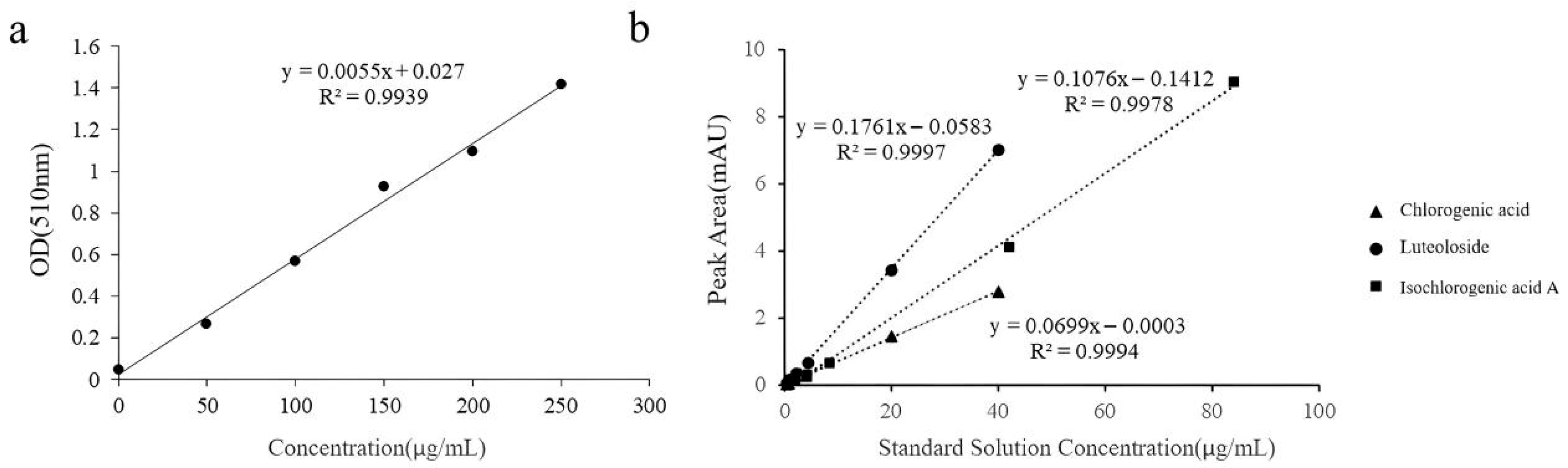
The standard curve for total flavonoids (Figure 1a) yielded a linear regression equation of y = 0.0055x + 0.027 (R2 = 0.9939), indicating excellent linearity within 0–250 μg∙mL−1. Chromatographic analysis for the three phenolic compounds also showed high linearity: chlorogenic acid: y = 0.0699x − 0.0003 (R2 = 0.9994, 0.4–40 μg∙mL−1); luteoloside: y = 0.1761x − 0.0583 (R2 = 0.9997, 0.4–40 μg∙mL−1); isochlorogenic acid A: y = 0.1076x − 0.1412 (R2 = 0.9978, 0.84–84 μg∙mL−1) (Figure 1b). All R2 values exceeded 0.997.

3.2. Phenotypic Variation in Functional Components

The variation in the contents of the four components across 24 accessions over three years is presented in Table 2. The coefficients of variation (CV) over the three years ranged from 34.58% to 90.75%. Based on three-year averages, the CVs ranked as: luteoloside (76%) > isochlorogenic acid A (59.5%) > chlorogenic acid (57.5%) > total flavonoids (41.31%), indicating considerable variation.
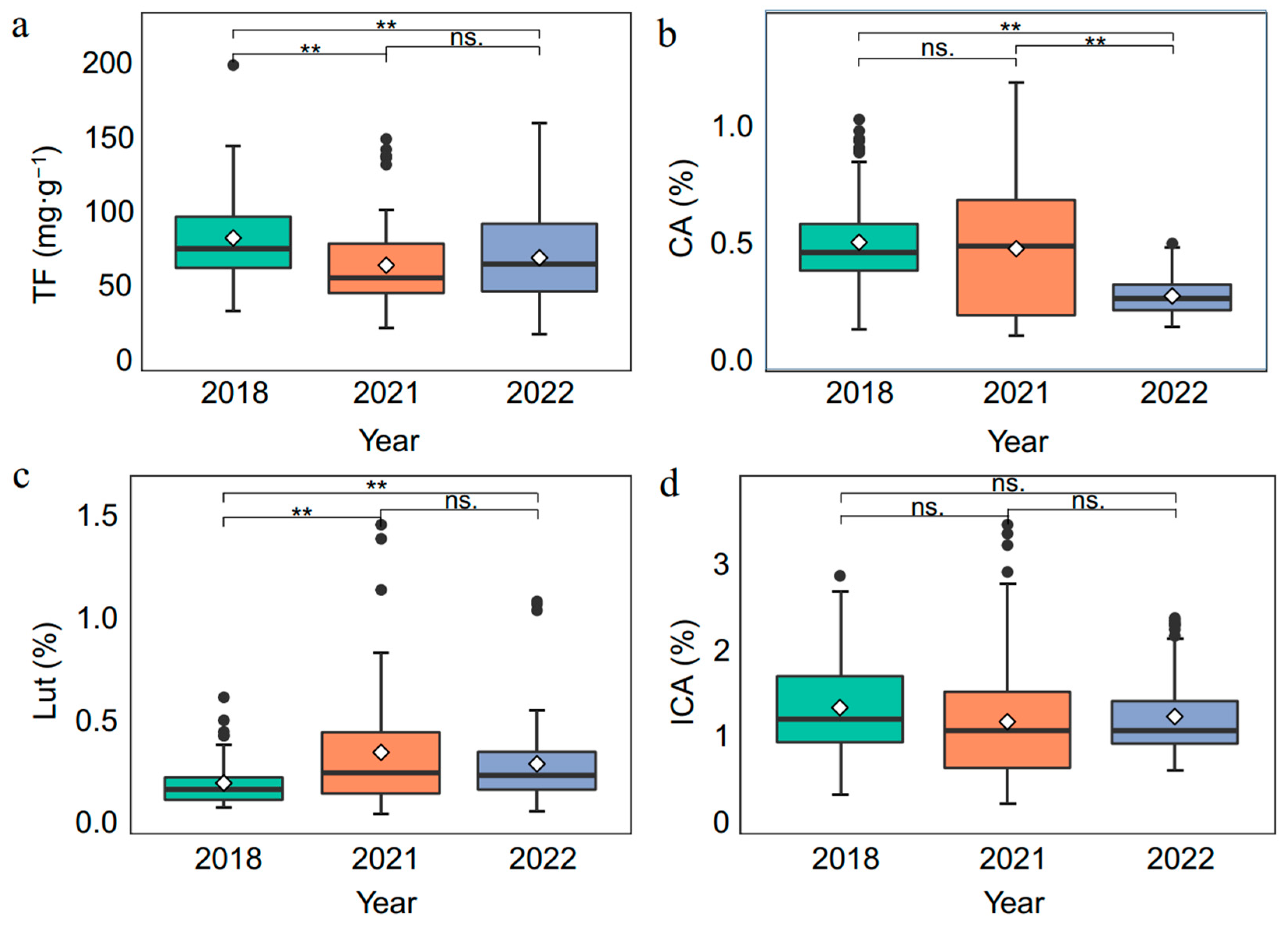
The average content of total flavonoids was 68.33 mg·g−1. The average contents of chlorogenic acid, luteoloside, and isochlorogenic acid A were 0.40%, 0.25%, and 1.19%, respectively. Significant yearly differences were observed for three components (Figure 2): total flavonoids were significantly higher in 2018 (78.91 mg·g−1) than in 2021 (60.51 mg·g−1) and 2022 (65.56 mg·g−1); chlorogenic acid was higher in 2018 (0.48%) and 2021 (0.46%) than in 2022 (0.25%); luteoloside was higher in 2021 (0.32%) and 2022 (0.27%) than in 2018 (0.17%). In contrast, isochlorogenic acid A content showed no significant differences among the three years (1.28%, 1.11%, 1.18%). In addition, there is a clear trend indicating no significant differences between 2021 and 2022 for most components, except for chlorogenic acid. Descriptive statistics alone cannot elucidate genotype-by-environment interaction (GEI). Therefore, further analysis was conducted to investigate the main effects of genotype (G), environment (E), and their interaction (GEI) on functional qualities.

3.3. AMMI Model Analysis

The additive main effects and multiplicative interaction (AMMI) model was employed to dissect the contributions of genotype (G), environment (E), and genotype-by-environment interaction (GEI) to the variation in functional components. Analysis of variance (ANOVA) results showed that the genotype sum of squares (SS) accounted for 43.60%, 34.69%, 69.17%, and 59.03% of the total variation for total flavonoids, chlorogenic acid, luteoloside, and isochlorogenic acid A, respectively (Table 3). Environmental SS was lowest for isochlorogenic acid A (1.26%), followed by total flavonoids (6.14%) and luteoloside (7.28%), and highest for chlorogenic acid (18.49%). The GEI exceeded 20% for all traits, ranging from 20.35% (luteoloside) to 40.68% (chlorogenic acid). For each trait, the percentage contributions are ranked as: genotype > GEI > environment.
Although genotype had the predominant influence, GEI also played a substantial role in the four functional components. As shown in Table 3, GEI was significant (p < 0.01) for all investigated traits. The considerable contribution of the first interaction principal component axis (IPCA1) confirmed the suitability of the AMMI model. IPCA1 contributed significantly (p < 0.01) and explained 63.58%, 77.66%, 69.10%, and 80.82% of the GEI for total flavonoids, chlorogenic acid, luteoloside, and isochlorogenic acid A, respectively, indicating high explanatory power.

3.4. Stability Analysis and Selection of High-Quality Tea Chrysanthemums

Based on the AMMI model, the AMMI stability value (ASV) was used to evaluate stability for each trait (Table 4). For total flavonoids, GC1-5 had the lowest ASV (0.9), indicating the most stable content, followed by Jiuyueju, Sheyang Dabaiju, Xiaohuangju, and Hangbaiju. For chlorogenic acid, Fubaiju showed the lowest ASV (0.12), followed by Zaohua-1, CH1-44, GH1-3, and Suju-6. For luteoloside, Sheyang Dabaiju ranked first (ASV = 0.10), followed by Chuju, GH1-3, GH1-8, and Suju-6. For isochlorogenic acid A, GH1-3 was the most stable (ASV = 0.15), followed by GH1-8, Baixiaoxiangju, Zaohua-1, and Xiuning Dabaihua.
Based on mean performance (Table 4), the top five genotypes for each functional component were identified. The top five for total flavonoids were Huangju (116.65 mg·g−1), Hangbaiju (112.83 mg·g−1), Suju-6 (100.44 mg·g−1), Dayanghua (89.26 mg·g−1), and Jinsihuangju (87.62 mg·g−1). Huangju (0.70%), Fubaiju (0.66%), Hongxinju (0.55%), Huangxiangli (0.54%), and Suju-6 (0.52%) ranked in the top five for chlorogenic acid. For luteoloside, Huangju (0.95%), Hangbaiju (0.46%), Suju-6 (0.43%), Jinsihuangju (0.41%), and Jinju-3 (0.38%) were the top five accessions. For isochlorogenic acid A, Chuju (2.34%), Huangju (2.27%), Suju-6 (1.93%), Jiuyueju (1.64%), and Wangongju (1.43%) performed better. Overall, Huangju, Suju-6, Hangbaiju, and Fubaiju showed high average contents across years.
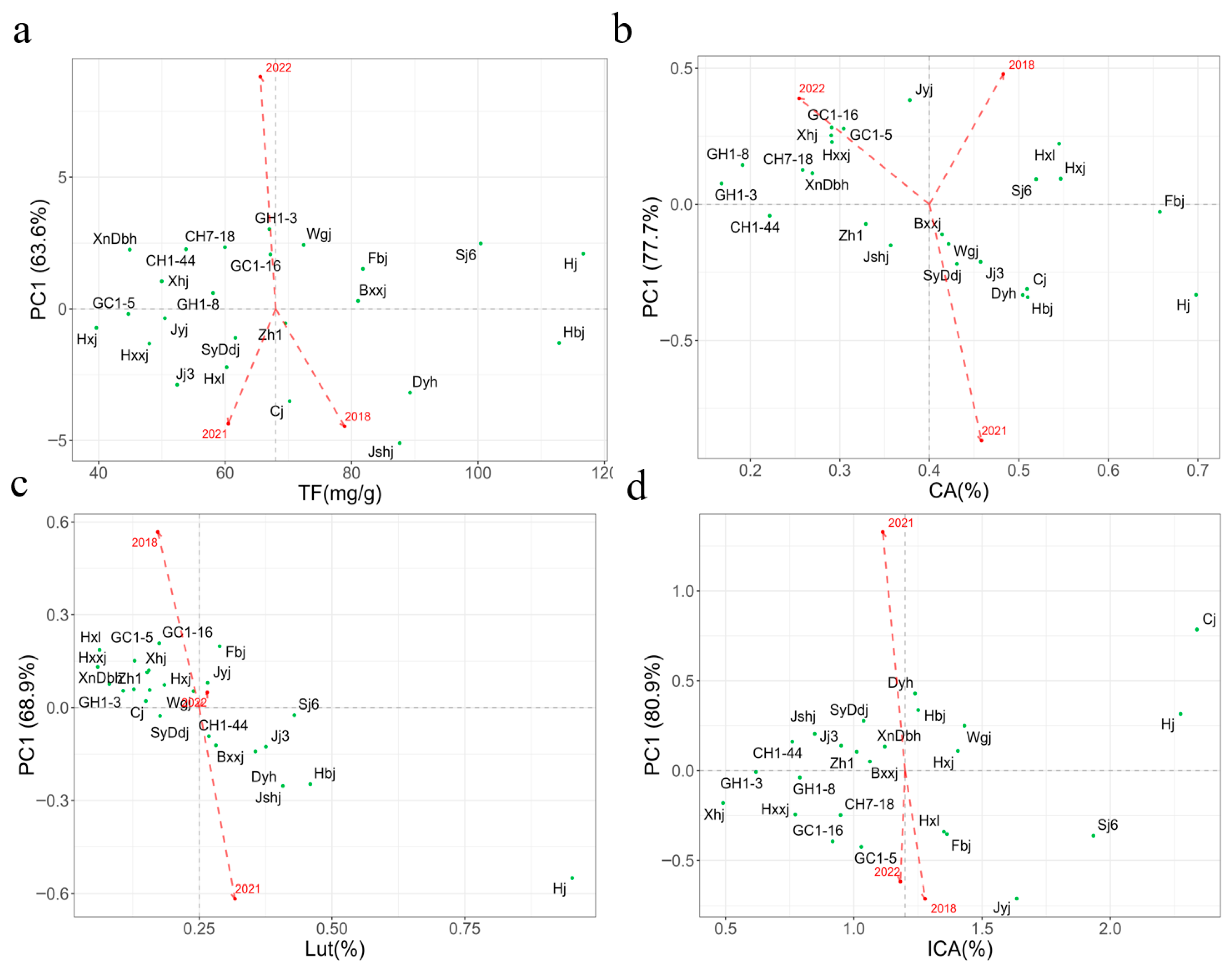
Accessions with ASV < AASV and content > overall average were considered as stable and high-quality. AMMI biplots (Figure 3) visualized average content (x-axis) against GEI-PC1 (y-axis). A higher x-coordinate indicates higher content; a y-coordinate closer to zero indicates smaller ASV and greater stability. Hangbaiju and Baixiaoxiangju performed well for total flavonoids; Fubaiju, Suju-6, and Hongxinju for chlorogenic acid; Suju-6, CH1-44, and Baixiaoxiangju for luteoloside; Hongxinju and Wangongju for isochlorogenic acid A. No genotype exceeded the average across all four components. However, Suju-6, Hongxinju, Wangongju, and Baixiaoxiangju demonstrated favorable overall performance, with only isolated indicators falling short.

4. Discussion

Quality evaluation of tea chrysanthemums involves external indicators (e.g., yield, morphology) and internal indicators (e.g., functional components, aroma, sensory properties) [23]. Few studies have examined the genetic stability of chrysanthemum functional quality traits. Total flavonoids, chlorogenic acid, luteoloside, and isochlorogenic acid A are the most essential functional compounds of chrysanthemum and are crucial for health-promoting and disease-preventive effects [24]. Our present study quantified the four functional components in 24 tea chrysanthemum accessions across three years. It revealed wide variation and significant year-to-year differences, highlighting the need to investigate stability.
Plant phenotypic traits are influenced by genotype, environment, and their interaction [25,26]. In chrysanthemum, the accumulation of functional components is susceptible to external factors, such as soil conditions [27]. Hangbaiju from different origins showed varying levels of compounds [10]. Significant compositional variation among chrysanthemum genotypes leads to divergent pharmacological efficacies [8,28]. In the current work, ANOVA within the AMMI model revealed significant effects of genotype, environment, and GEI across all four functional components, indicating substantial variation in mean performance among genotypes across multiple years. The difference in the core climate factors, i.e., annual mean temperature, precipitation, and sunshine duration across 2018, 2021, and 2022, jointly exerted significant regulatory effects on the accumulation of functional components in tea chrysanthemums. In 2018, with suitable annual mean temperature, abundant precipitation, and moderate sunshine duration, the accumulation of total flavonoids and chlorogenic acid was promoted, resulting in the highest contents among the three years. In 2022, the annual mean temperature was similar to that in 2021, but annual precipitation was significantly lower, and sunshine duration was the highest. Drought stress markedly inhibited the accumulation of chlorogenic acid, leading to a sharp decline in its content, whereas strong light promoted the synthesis of luteoloside, resulting in a significantly higher content than in 2018. The higher luteoloside content in 2021 and 2022 indicated that it was more adapted to relatively high temperatures and strong light. Isochlorogenic acid A showed no significant differences across the three years, suggesting it was less affected by annual climatic fluctuations and exhibited high genetic stability. The insignificant differences in most components between 2021 and 2022 were consistent with similar temperatures but with varying precipitation and sunshine duration. These findings underscore that functional quality performance is not solely determined by genetics but is substantially modulated by the growing environment. The variance analysis results demonstrated that genotypic and GEI effects were the primary sources of variation, while the environmental effect alone contributed the least. This highlights the critical need to account for GEI when evaluating genotype performance. As emphasized by Van Eeuwijk et al. [29], significant interaction for quantitative traits can constrain the selection of superior genotypes and limit the utility of subsequent analyses. While this study confirms the predominant role of GEI, precisely delineating its complex influence on functional components in tea chrysanthemum remains challenging and warrants targeted future investigation.
The ideal tea chrysanthemum genotype should possess both high functional-component traits and stable performance across diverse environments. However, as noted by Kuang et al. [30], genotype-by-environment interaction in multi-environment trials complicates analysis and interpretation, reducing the efficiency of identifying stable genotypes. Various statistical methods have been developed to evaluate genotype stability and adaptability. Among these, the AMMI model is one of the most widely applied approaches [15], which combines analysis of variance and principal component analysis with fixed effects [31]. Its value lies in addressing the complexity of GEI, enabling researchers to better understand and interpret genotype performance across diverse environments [32]. The concept of stability is agronomically relevant only when coupled with satisfactory mean performance [33]. In AMMI analysis, stability can be quantified using ASV, with genotypes having lower ASVs considered more stable. For instance, Scavo et al. [20] successfully used ASV in combination with mean performance to select stable, high-yielding potato varieties for traits such as dry matter and total phenolics. An AMMI biplot visualizes yield potential and stability, serving as a key tool for evaluating significant multiplicative GEI for agronomic traits [34].
In practice, AMMI model analysis advocates selecting genotypes that exhibit not only minimal variability (high stability) but also desirable mean performance, ensuring both reliability and high quality. In this study, the ASV and the mean functional-component content across all tested materials were used as selection thresholds to identify relatively stable cultivars with high functional-component content. The AMMI biplot results indicated that Suju-6, Hongxinju, Wangongju, and Baixiaoxiangju were ideal candidates, a finding corroborated by their ASVs. Among these, Suju-6 showed relatively lower stability for total flavonoids and isochlorogenic acid A, while Hongxinju had room for improvement in the content of total flavonoids and luteoloside. Wangongju was slightly less stable for total flavonoids, and Baixiaoxiangju could be enhanced for isochlorogenic acid A content. Additionally, Huangju and Fubaiju were notable for their high functional-component content across the three years, although their stability was comparatively lower. Therefore, the ASV and the AMMI biplots may serve as valuable tools for assessing the genetic stability of tea chrysanthemums. Further research should integrate more genotypes across multiple locations and employ additional mathematical methods to dissect GEI effects and ultimately identify genetically stable tea chrysanthemum cultivars with high quality and yield.

5. Conclusions

This study found substantial phenotypic variation in total flavonoids (TF), chlorogenic acid (CA), luteoloside (Lut), and isochlorogenic acid A (ICA) across 24 tea chrysanthemum accessions over three years. Variance and AMMI model analyses identified genotypic (G) and genotype-by-environment interaction (GEI) effects as the primary sources of this variation. Based on the integration of AMMI stability value (ASV) and mean content analysis, the optimal genotypes for each functional trait (i.e., Huangju for TF, CA, and Lut, and Chuju for ICA) and the genotypes (i.e., Suju-6, Hongxinju, Wangongju, and Baixiaoxiangju) exhibiting relatively high stability and content for most functional components were identified, making them promising candidates for future breeding and promotion programs.

Author Contributions

Conceptualization, F.Z.; methodology, X.N. and X.Z.; software, Y.S. and X.N.; validation, Y.S. and X.N.; formal analysis, Y.S., X.N. and D.W.; investigation, Y.S., X.N., D.W. and X.Z.; resources, Z.G. and W.F.; data curation, Y.S. and X.N.; writing—original draft preparation, Y.S. and X.N.; writing—review and editing, F.Z.; visualization, Y.S. and X.N.; supervision, F.Z. and W.F.; project administration, F.Z.; funding acquisition, F.Z. All authors have read and agreed to the published version of the manuscript.

Funding

This work was financially supported by the Fundamental Research Funds for the Central Universities (PY2026002), and a project funded by the Priority Academic Program Development of Jiangsu Higher Education Institutions.

Data Availability Statement

The original contributions presented in this study are included in the article. Further inquiries can be directed to the corresponding author(s).

Acknowledgments

We thank Yuehua Ma (Central Laboratory of the College of Horticulture, Nanjing Agricultural University) for assistance with the Thermo Ultra-Performance Liquid Chromatography (UPLC) system.

Conflicts of Interest

All authors have no conflicts of interest and have approved publication.

Abbreviations

The following abbreviations are used in this manuscript:
AMMIThe additive main effects and multiplicative interaction
ASVAMMI stability value
AASVAverage AMMI stability value
CAClorogenic acid
CVCoefficients of variation
EEnvironment
G Genotype
GEIGenotype-by-environment interaction
ICAIsochlorogenic acid A
LutLuteoloside
TFTotal flavonoids

References

  1. Ning, X.; Wang, Q.; Zhang, X.; Zhang, M.; Su, J.; Wang, H.; Guan, Z.; Fang, W.; Chen, F.; Zhang, F. Heredity of active compounds and selection of elite hybrids in a segregating F1 population of tea chrysanthemum. Sci. Hortic. 2022, 305, 111366. [Google Scholar] [CrossRef]
  2. Fu, M.; Liu, C.; Chen, J.; Guo, F.; Wu, C. Metabolomics profiles and health-promoting functions of tea chrysanthemum using comparative analysis and network pharmacology. Food Biosci. 2025, 72, 107420. [Google Scholar] [CrossRef]
  3. Peng, A.; Lin, L.; Zhao, M.; Sun, B. Classification of edible chrysanthemums based on phenolic profiles and mechanisms underlying the protective effects of characteristic phenolics on oxidatively damaged erythrocyte. Food Res. Int. 2019, 123, 64–74. [Google Scholar] [CrossRef]
  4. Liu, Y.; Lu, C.; Zhou, J.; Zhou, F.; Gui, A.; Chu, H.; Shao, Q. Chrysanthemum morifolium as a traditional herb: A review of historical development, classification, phytochemistry, pharmacology and application. J. Ethnopharmacol. 2024, 330, 118198. [Google Scholar] [CrossRef]
  5. Yang, C.; Du, B.; Yang, Y.; Wang, E.; Chang, H.; Ma, C.; Zhan, Z. Herbal textual research on Chrysanthemi Flos in famous classical formulas. Chin. J. Exp. Tradit. Med. Formulae 2023, 24, 42–61. [Google Scholar]
  6. Zhang, X.; Ning, X.; He, Y.; Su, J.; Wen, S.; Lu, Z.; Sun, W.; Wang, H.; Guan, Z.; Fang, W.; et al. GWAS reveals the genetic basis and genomic regions underlying four active compounds in chrysanthemum. Hortic. Plant J. 2025, 11, 2211–2224. [Google Scholar] [CrossRef]
  7. Chinese Pharmacopoeia Committee. Pharmacopoeia of the People’s Republic of China; Chinese Medical Science and Technology Press: Beijing, China, 2015; Volume 1. [Google Scholar]
  8. Nie, J.; Xiao, L.; Zheng, L.; Du, Z.; Liu, D.; Zhou, J.; Xiang, J.; Hou, J.; Wang, X.; Fang, J. An integration of UPLC-DAD/ESI-Q-TOF MS, GC–MS, and PCA analysis for quality evaluation and identification of cultivars of Chrysanthemi Flos (Juhua). Phytomedicine 2019, 59, 152803. [Google Scholar] [CrossRef]
  9. Chen, S.; Liu, J.; Dong, G.; Zhang, X.; Liu, Y.; Sun, W.; Liu, A. Flavonoids and caffeoylquinic acids in Chrysanthemum morifolium Ramat flowers: A potentially rich source of bioactive compounds. Food Chem. 2021, 344, 128733. [Google Scholar] [CrossRef]
  10. Long, W.; Bai, X.; Wang, S.; Chen, H.; Yin, X.-L.; Gu, H.-W.; Yang, J.; Fu, H. UHPLC-QTOF-MS-based untargeted metabolomics and mineral element analysis insight into the geographical differences of Chrysanthemum morifolium Ramat cv. “Hangbaiju” from different origins. Food Res. Int. 2023, 163, 112186. [Google Scholar] [CrossRef]
  11. Feng, X.; Fang, W.; Chen, F.; Guan, Z.; Jiang, J. The breeding of Chrysanthemum morifolium for tea and medicine. J. Chin. Med. Mater. 2017, 40, 258–263. [Google Scholar]
  12. Cravero, V.; Martin, E.; Anido, F.L.; Cointry, E. Stability through years in a non-balanced trial of globe artichoke varietal types. Sci. Hortic. 2010, 126, 73–79. [Google Scholar] [CrossRef]
  13. Aswidinnoor, H.; Listiyanto, R.; Rahim, S.; Holidin; Setiyowati, H.; Nindita, A.; Ritonga, A.W.; Marwiyah, S.; Suwarno, W.B. Stability analysis, agronomic performance, and grain quality of elite new plant type rice lines (Oryza sativa L.) Developed for tropical lowland ecosystem. Front. Sustain. Food Syst. 2023, 7, 1147611. [Google Scholar] [CrossRef]
  14. Gauch, H.G.; Piepho, H.; Annicchiarico, P. Statistical analysis of yield trials by AMMI and GGE: Further considerations. Crop Sci. 2008, 48, 866–889. [Google Scholar] [CrossRef]
  15. Ahakpaz, F.; Abdi, H.; Neyestani, E.; Hesami, A.; Mohammadi, B.; Mahmoudi, K.N.; Abedi-Asl, G.; Noshabadi, M.R.J.; Ahakpaz, F.; Alipour, H. Genotype-by-environment interaction analysis for grain yield of barley genotypes under dryland conditions and the role of monthly rainfall. Agric. Water Manag. 2021, 245, 106665. [Google Scholar] [CrossRef]
  16. Mohammadi, S.; Purves, R.W.; Paliocha, M.; Uhlen, A.K.; Zanotto, S. Multi-environment field trials indicate strong genetic control of seed polyphenol accumulation in Faba bean. Euphytica 2025, 221, 47. [Google Scholar] [CrossRef]
  17. Wang, R.; Wang, H.; Huang, S.; Zhao, Y.; Chen, E.; Li, F.; Qin, L.; Yang, Y.; Guan, Y.; Liu, B.; et al. Assessment of yield performances for grain sorghum varieties by AMMI and GGE biplot analyses. Front. Plant Sci. 2023, 14, 1261323. [Google Scholar] [CrossRef]
  18. Da Silva, E.V.P.; Davide, L.M.C.; Gianlup, C.; De Oliveira, W.J.S.; De Oliveira, L.A.; Da Silva, A.Q.; Da Silva, C.P.; Mendes, C.T.E.; Khan, S. Assessing the stability and adaptability of maize hybrid yield with the Bayesian AMMI model. Euphytica 2025, 221, 43. [Google Scholar] [CrossRef]
  19. Menzir, A.; Firew, Y.; Kassaye, M.; Mequanint, G. Yield performance and stability of durum wheat varieties in northwestern Ethiopia. BMC Plant Biol. 2025, 25, 1710. [Google Scholar] [CrossRef]
  20. Scavo, A.; Mauromicale, G.; Ierna, A. Genotype × environment interactions of potato tuber quality characteristics by AMMI and GGE biplot analysis. Sci. Hortic. 2023, 310, 111750. [Google Scholar] [CrossRef]
  21. Sabaghnia, N.; Sabaghpour, S.H.; Dehghani, H. The use of an AMMI model and its parameters to analyze yield stability in multi-environment trials. J. Agric. Sci. 2008, 146, 571–581. [Google Scholar] [CrossRef]
  22. Purchase, J.L.; Hatting, H.; Van Deventer, C.S. Genotype × environment interaction of winter wheat (Triticum aestivum L.) In South Africa: II. Stability analysis of yield performance. South Afr. J. Plant Soil 2000, 17, 101–107. [Google Scholar] [CrossRef]
  23. Ning, X.; Su, J.; Zhang, X.; Wang, H.; Guan, Z.; Fang, W.; Chen, F.; Zhao, S.; Zhang, F. Evaluation of volatile compounds in tea chrysanthemum cultivars and elite hybrids. Sci. Hortic. 2023, 320, 112218. [Google Scholar] [CrossRef]
  24. Yuan, H.; Jiang, S.; Liu, Y.; Daniyal, M.; Jian, Y.; Peng, C.; Shen, J.; Liu, S.; Wang, W. The flower head of Chrysanthemum morifolium Ramat. (Juhua): A paradigm of flowers serving as chinese dietary herbal medicine. J. Ethnopharmacol. 2020, 261, 113043. [Google Scholar] [CrossRef]
  25. Liu, G.; Feng, H.; Fan, J.; Liu, Y.; Wang, N.; Li, C.; Song, S.; Zhou, Q.; Zhao, L.; Sun, X.; et al. Genetic diversity analysis of pepper (Capsicum annuum L.) Germplasm resources based on the phenotypic traits. Hortic. Adv. 2025, 3, 27. [Google Scholar] [CrossRef]
  26. Lu, Z.; Su, J.; Xiang, Y.; Zhang, X.; Wen, S.; Geng, Z.; Jiang, J.; Guan, Z.; Fang, W.; Chen, F.; et al. Integrative linkage mapping, GWAS, and RNA-Seq analysis unravel the genetic architecture and candidate genes for drought tolerance in Chrysanthemum interspecific F1 progeny. Hortic. Res. 2025, 12, uhaf169. [Google Scholar] [CrossRef]
  27. Zhang, H.; Chen, R.; Xian, X. Research progress of functional chrysanthemum in China. Chin. Agric. Sci. Bull. 2022, 38, 38–46. [Google Scholar]
  28. He, J.; Zhang, Q.; Ma, C.; Giancaspro, G.I.; Bi, K.; Li, Q. An effective workflow for differentiating the same genus herbs of chrysanthemum morifolium flower and chrysanthemum indicum flower. Front. Pharmacol. 2021, 12, 575726. [Google Scholar] [CrossRef]
  29. Van Eeuwijk, F.A.; Bustos-Korts, D.V.; Malosetti, M. What should students in plant breeding know about the statistical aspects of genotype × environment interactions? Crop Sci. 2016, 56, 2119–2140. [Google Scholar] [CrossRef]
  30. Kuang, H.; García-Peña, M.; Araújo, L.B.D.; Santos Dias, C.T.D. Statistical analysis of yield trials by AMMI analysis of genotype × environment interaction. Biom. Lett. 2014, 51, 89–102. [Google Scholar] [CrossRef]
  31. Gauch, H.G. Model selection and validation for yield trials with interaction. Biometrics 1988, 44, 705. [Google Scholar] [CrossRef]
  32. Daemo, B.B.; Ashango, Z. Application of AMMI and GGE biplot for genotype by environment interaction and yield stability analysis in potato genotypes grown in Dawuro zone, Ethiopia. J. Agric. Food Res. 2024, 18, 101287. [Google Scholar] [CrossRef]
  33. Bilate Daemo, B.; Belew Yohannes, D.; Mulualem Beyene, T.; Gebreselassie Abtew, W. AMMI and GGE biplot analyses for mega environment identification and selection of some high-yielding cassava genotypes for multiple environments. Int. J. Agron. 2023, 2023, 6759698. [Google Scholar] [CrossRef]
  34. Esan, V.I.; Oke, G.O.; Ogunbode, T.O.; Obisesan, I.A. AMMI and GGE biplot analyses of Bambara groundnut [Vigna subterranea (L.) Verdc.] for agronomic performances under three environmental conditions. Front. Plant Sci. 2023, 13, 997429. [Google Scholar] [CrossRef] [PubMed]
Figure 1. Standard curves of (a) total flavonoids and (b) chlorogenic acid, luteoloside, and isochlorogenic acid A.
Agronomy 16 00817 g001
Figure 2. Boxplots showing the variation in four functional components across three years. (a) Total flavonoids (TF), (b) chlorogenic acid (CA), (c) luteoloside (Lut), and (d) isochlorogenic acid A (ICA). ** indicate significant differences at 0.01 level; ns indicates no significance at 0.05 level.
Agronomy 16 00817 g002
Figure 3. AMMI biplots for (a) total flavonoids, (b) chlorogenic acid, (c) luteoloside, and (d) isochlorogenic acid A of the 24 tea chrysanthemum accessions. The x-axis represents mean content, and the y-axis represents the first interaction principal component (IPCA1) score. Accessions closer to the horizontal line (x = 0) are more stable.
Agronomy 16 00817 g003
Table 1. Basic information on the 24 tea chrysanthemums used in this study.
AccessionAbbreviationGermplasm TypeFlower TypeFlower Color
CH1-44CH1-44Elite hybridSingleYellow
CH7-18CH7-18Elite hybridSemi-doubleWhite
GC1-5GC1-5Elite hybridDoubleWhite
GC1-16GC1-16Elite hybridDoubleWhite
GH1-3GH1-3Elite hybridDoubleYellow
GH1-8GH1-8Elite hybridDoubleYellow
Suju-6Sj6VarietyIncurveWhite
HuangjuHjVariety PomponYellow
JinsihuangjuJshjVarietyDoubleYellow
ChujuCjVarietyDoubleWhite
HangbaijuHbjVarietyFull-doubleWhite
DanyanghuaDyhVarietySemi-doubleWhite
FubaijuFbjVarietyFull-doubleWhite
WangongjuWgjVarietyFull-doubleYellow
HongxinjuHxjVarietyFull-doubleWhite
HuangxiangliHxlVarietyDoubleYellow
Jinju-3Jj3VarietyFull-doubleYellow
JiuyuejuJyjVarietySemi-doubleWhite
Sheyang DabaijuSyDbjVarietyFull-doubleWhite
XiaohuangjuXhjVarietySingleYellow
Xiuning DabaihuaXnDbhVarietyDoubleWhite
Zaohua-1Zh1VarietySingleWhite
HuangxiaoxiangjuHxxjVarietyAnemoneYellow
BaixiaoxiangjuBxxjVarietyAnemoneWhite
Table 2. Descriptive statistics of functional compounds in tea chrysanthemums across three years.
TraitYearMean ± SDCV (%)RangeKurtSkew
Total flavone (TF, mg∙g−1)201878.91 ± 31.3539.7329.61~195.461.471.00
202160.51 ± 30.7250.7618.18~145.640.871.07
202265.56 ± 29.6145.1714.06~156.39−0.050.60
Average68.33 ± 28.2341.3119.82~132.29−0.700.47
Chlorogenic acid (CA, %)20180.48 ± 0.2143.440.11~1.010.120.78
20210.46 ± 0.364.850.08~1.17−1.050.34
20220.25 ± 0.0934.580.12~0.480.020.80
Average0.40 ± 0.2357.500.10~1.050.020.87
Luteoloside (Lut, %)20180.17 ± 0.1165.480.05~0.592.091.44
20210.32 ± 0.2990.750.02~1.444.682.00
20220.27 ± 0.2179.160.03~1.065.912.17
Average0.25 ± 0.1976.000.05~1.036.462.25
Isochlorogenic acid A (ICA, %)20181.28 ± 0.5744.260.27~2.82−0.130.56
20211.11 ± 0.7365.940.16~3.421.951.33
20221.18 ± 0.4841.050.55~2.330.181.05
Average1.19 ± 0.4759.500.46~2.450.701.04
Table 3. AMMI model analysis of the four functional compounds in tea chrysanthemums.
TraitItemDfSSProportion of SSF Value
TF (mg∙g−1)Treatment71169,770.1
Genotype(G)2392,44143.60%13.69 **
Environment(E)213,012.256.14%22.17 **
G × E 4664,316.830.33%4.76 **
IPCA12440,894.2963.58% a1.60 **
Error14442,263.4
Total215212,033.5
CA (%)Treatment7111.43
Genotype(G)234.2334.69%35.38 **
Environment(E)22.2518.49%216.85 **
G × E 464.9640.68%20.75 **
IPCA1243.8577.66% a3.19 **
Error1440.75
Total21512.18
Lut (%)Treatment7110.37
Genotype(G)237.4169.17%135.04 **
Environment(E)20.787.28%163.37 **
G × E 462.1820.35%19.86 **
IPCA1241.5169.10% a2.05 **
Error1440.34
Total21510.72
ICA (%)Treatment7173.52
Genotype(G)2346.4159.03%56.89 **
Environment(E)20.991.26%14.01 **
G × E 4626.1133.21%16.00 **
IPCA12421.180.82% a3.86 **
Error1445.11
Total21578.62
Note: AMMI, additive main effects and multiplicative interaction; G, genotype; E, environment; G × E indicates genotype × year interaction; IPCA1, first interaction principal component axis; Df, degrees of freedom; SS, sum of squares. a represents the proportion of SS of IPCA1 relative to SS of G × E; ** indicates a significant difference at the level of p < 0.01.
Table 4. The AMMI stability value (ASV) and content level of four functional components in 24 tea chrysanthemum accessions.
AccessionsTF (mg∙g−1)CA (%)Lut (%)ICA (%)
ASVContentASVContentASVContentASVContent
CH1-444.6153.810.300.220.260.270.810.76
CH7-184.1059.970.450.260.140.131.050.95
GC1-50.9044.700.970.300.330.131.811.03
GC1-163.6267.161.000.290.490.181.670.92
GH1-35.7767.000.310.170.130.110.150.62
GH1-82.8358.090.520.190.130.160.200.79
Suju-64.66100.440.370.520.140.431.531.93
Huangju3.91116.651.150.701.250.951.352.27
Jinsihuangju9.2387.620.530.360.570.410.870.85
Chuju6.1770.211.080.510.110.153.312.34
Hangbaiju2.28112.831.180.510.620.461.441.25
Dayanghua5.6989.261.170.500.450.361.841.24
Fubaiju3.9681.800.120.660.450.291.491.36
Wangongju4.4772.420.510.420.160.241.051.43
Hongxinju2.5939.640.550.550.170.190.671.41
Huangxiangli4.3160.250.840.540.430.061.461.35
Jinju-35.1252.420.740.460.330.380.690.95
Jiuyueju1.0650.471.330.380.330.273.001.64
Sheyang Dabaiju2.1161.620.770.430.100.181.181.04
Xiaohuangju2.2749.970.880.290.310.160.770.49
Xiuning Dabaihua3.9344.910.410.270.170.080.601.12
Zaohua-15.3069.560.260.330.260.150.441.01
Huangxiaoxiangju2.3048.020.820.290.300.061.080.77
Baixiaoxiangju2.5481.030.390.410.280.280.221.06
AASV/Average3.9168.330.690.400.330.251.201.29
Note: TF, total flavonoids; CA, chlorogenic acid; Lut, luteoloside; ICA, isochlorogenic acid A. Bold values in the ASV columns indicate ASV < AASV (favorable stability). Bold values in the Content columns indicate content > overall average (high content).
Disclaimer/Publisher’s Note: The statements, opinions and data contained in all publications are solely those of the individual author(s) and contributor(s) and not of MDPI and/or the editor(s). MDPI and/or the editor(s) disclaim responsibility for any injury to people or property resulting from any ideas, methods, instructions or products referred to in the content.