Article

Divergent Effects of Biochar Versus Straw Application on Soil Moisture and Temperature Dynamics During Maize Growth


1
National Biochar Institute, Agronomy College, Shenyang Agricultural University, Shenyang 110866, China
2
Key Laboratory of Biochar and Soil Improvement, Ministry of Agriculture and Rural Affairs, Shenyang 110866, China
3
Agronomy College, Inner Mongolia Agricultural University, Hohhot 010019, China
4
Institute of Plant Nutrition and Environmental Resources, Liaoning Academy of Agricultural Sciences, Shenyang 110161, China
*
Authors to whom correspondence should be addressed.
Agronomy 2026, 16(8), 805; https://doi.org/10.3390/agronomy16080805
Submission received: 7 March 2026 / Revised: 27 March 2026 / Accepted: 10 April 2026 / Published: 14 April 2026

Abstract

The Changbai Mountain–Liaodong region is a crucial component of the global black soil belt in Northeast China and a significant national grain production base. However, like many high-latitude agricultural regions worldwide, it faces persistent challenges during the spring sowing period, including low soil temperatures and excessive moisture. Therefore, developing region-specific, effective methods of reducing soil moisture and increasing temperature while improving soil fertility is essential for improving agricultural productivity. To this aim, a field experiment was conducted with two factors: a main plot subjected to ridge tillage (RT) and flat tillage (FT) and subplots with biochar (BC) and straw (ST) amendments. A subplot with no amendment (CK) was used as a control. During maize growth, the daily soil temperature and moisture were monitored, and the soil water evaporation rates and physical structure, as well as the maize yield performance, were evaluated. The results showed that biochar and straw application significantly decreased the soil monthly water content by 1.69–2.22% (p < 0.05) in the surface soil layer (0–15 cm) from May to June, with a more pronounced effect under RT. In contrast, biochar application increased soil moisture and water storage from July to September, indicating that the influence of biochar on soil moisture depends on time and field aging processes. Biochar amendment raised the soil maximum temperature by 0.32–0.79 °C in the top 0–15 cm layer, while straw incorporation decreased the minimum soil temperature by 0.11–0.52 °C. The increase in soil temperature was primarily due to the biochar’s darker color, which facilitated solar radiation absorption, while the decrease in soil temperature was caused by the “Wind Leakage Effect” induced by the large particle size of the straw. Biochar and straw incorporation effectively enhanced maize dry matter accumulation by an average of 15.8% and 8.2%, respectively, and grain yield by 13.0% and 7.8%, respectively. Correlation analysis indicates that these increments are primarily due to enhanced soil moisture and available N content during the middle to late stages of maize growth. Therefore, the integration of straw and biochar with high-ridge cultivation is an effective strategy for excessive moisture reduction and warming in spring soil and it also contributes positively to maize yield.

1. Introduction

The black soil region of Northeast China is one of the most important black soil belts in the world, renowned for its high organic matter content and fertility [1]. Globally, black soils are critical resources for sustainable food production and climate regulation, yet they face increasing pressures from intensive cultivation and environmental change [2]. The Changbai Mountain–Liaodong region is a vital part of the black soil region in China, spanning an area of 6.4635 million hectares, accounting for 18.04% of the total cultivated land in the Northeast Black Soil Region [3]. Compared with the Songnen and Sanjiang plains, the soils in this region are characterized by lower organic matter and higher sand contents, resulting in poorer fertility and texture [3,4]. In addition to the inherent soil nutrient and structural issues, this region faces further challenges due to its high latitude and long winters. The climatic conditions result in a low soil temperature and slow moisture dissipation during spring, problems that directly impede the operation of agricultural machinery and delay field preparation. This further postpones sowing, thereby shortening the crop growth period and ultimately diminishing crop yield [3].
Biochar and straw application are widely recognized as an effective approach to soil amelioration. From a sustainability perspective, these amendments contribute to circular agriculture by recycling agricultural residues while also enhancing soil carbon sequestration and mitigating greenhouse gas emissions [5,6]. Research has indicated that both amendments positively influence soil structure, organic matter, and nutrient content. By enhancing nutrient transformation and retention, biochar and straw amendment contribute to improving soil fertility preservation and reducing nutrient loss risks in these regions [7,8]. These functions are directly linked to key ecosystem services, including nutrient cycling, water purification, and soil formation. However, research on their effects on soil moisture and temperature is still relatively limited, and the existing findings are not always consistent [9,10]. It is generally recognized that straw mulching can increase soil moisture content and temperature [11,12] and prolong the duration of peak soil moisture content after rainfall. In contrast, incorporating straw via plowing or rotary tillage has been shown to significantly reduce soil moisture content [13,14]. For example, Xing et al. reported that while rotary tillage, deep plowing, and mulching all increased soil moisture, their effectiveness decreased in the order of mulching > deep plowing > rotary tillage [15]. This is primarily because direct straw incorporation increases soil macro-porosity, thereby enhancing air circulation and capillary water movement, which intensifies surface evaporation and ultimately reduces soil moisture content [12,16]. Thus, it is evident that different straw incorporation methods exert differing effects on soil moisture. Among these methods, straw incorporation by rotary tillage is an effective measure of reducing soil water content.
Furthermore, straw incorporation plays a modulating role in soil temperature [17]. For instance, Wang et al. [18] reported that no tillage combined with straw mulching reduced the diurnal temperature variation by 1.3 °C and increased surface soil temperature [11]. Similarly, practices such as straw plowing or incorporation via rotary tillage have been shown to raise topsoil temperature [13]. A plausible explanation is that the incorporated dry straw residue creates an insulating barrier, thereby moderating the exchange of heat between the soil and the atmosphere [14]. In contrast, other research indicates that deep plowing, rotary tillage, and mulching can lower temperatures at a 5 cm depth [9,19]. Akhtar et al. [20] also noted that despite increased soil moisture, wheat straw mulching decreased the soil temperature in Northwest China. Thus, the overall effect of straw on soil temperature depends on the method of straw application and the type of soil being amended. These contrasting findings underscore the need for context-specific management strategies that align with regional sustainability goals and the provisioning of soil-based ecosystem services.
Biochar is characterized by a rich pore structure and a large specific surface area. These properties create capillary pores for water storage, reduce soil aeration pores, and facilitate water infiltration into the pores; therefore, it is generally recognized that biochar application can enhance soil’s water retention capacity and increase its moisture content [21,22,23]. For example, using both soil column and field experiments, Feng et al. [24] demonstrated that incorporating straw-derived biochar reduced soil evaporation and increased soil moisture content. Similarly, Fu et al. [16] found that biochar application enhanced water content in the 0–45 cm soil layer, effectively raising the soil’s temperature and reducing temperature fluctuations during the freeze–thaw period. Furthermore, biochar can regulate soil thermal dynamics by altering key determinants of heat flux. The primary mechanism is attributed to the dark-colored solid particles of biochar, which darken the soil surface. This enhances the absorption of solar radiation and reduces both thermal conductivity and surface albedo; collectively, these changes lead to an increase in soil temperature [25,26]. As a material with low thermal conductivity, biochar also acts as a thermal insulator in soil, reducing its heat transfer efficiency and thereby minimizing heat loss to preserve temperature [27]. Empirical evidence further indicates that biochar attenuates both the range and variability of soil temperature fluctuations in freeze–thaw periods [16,19].
In summary, the effects of biochar and straw incorporation on soil moisture and temperature are highly contingent upon the environmental context and their specific modes of application. Understanding this context dependency is crucial for designing sustainable soil management practices that optimize multiple ecosystem services. Considering that soil hydrothermal requirements vary across different regions and crop growth stages, the priority in high-latitude mountainous areas like the Changbai Mountain–Liaodong region is to increase the soil temperature and lower its moisture in spring. To achieve this, a combination method of incorporating straw and biochar via rotary tillage paired with high-ridge tillage was implemented to examine these amendments’ effects on soil moisture and temperature, as well to elucidate underlying mechanisms from the perspective of soil structure. The hypothesis of this study is that (1) incorporating biochar and straw via rotary tillage, combined with high-ridge tillage, can promote soil evaporation and reduce soil moisture and (2) incorporation of both biochar and straw can increase soil temperature, but biochar functions primarily by darkening the soil surface to enhance solar absorption, whereas straw acts via a “blanket effect” that reduces heat loss. The findings of this study are expected to provide practical guidance for using biochar and straw to reduce soil moisture and increase soil temperature in spring and to offer valuable suggestions for improving farmland productivity. More broadly, this study contributes to global sustainable soil management by showing how region-specific strategies can address local agronomic constraints while enhancing soil ecosystem services.

2. Materials and Methods

2.1. Study Site Description

The field experiment was conducted in 2025 at a site located in Shiwen Town, Fushun County, Liaoning, China (N 123.92, E 41.69). The study site is characterized by a typical continental monsoon climate, a mean annual temperature of 7.8 °C, a frost-free period of about 145 days, and a mean annual precipitation of 823 mm. In this region, the rainy season coincides with the summer heat period, typically occurring in July and August. The annual precipitation and temperature data during the experiment (in 2025) are shown in Figure S1.
The soil type is brown earth with a loamy clay texture, containing 48% sand, 32% clay and 20% loam. The basic physicochemical properties of the topsoil are as follows: bulk density: 1.42 g cm−3; pH: 5.7; organic matter: 14.13 g kg−1; total nitrogen: 0.911 g kg−1; total phosphorus: 1.517 g kg−1; total potassium: 24.52 g kg−1; available nitrogen: 75.54 mg kg−1; available phosphorus: 63.65 mg kg−1; available potassium: 125.02 mg kg−1.

2.2. Experimental Design

The experiment employed a split-plot design with three replicates. Two tillage methods were assigned as the main plot factor: ridge tillage (RT) and flat tillage (FT). The subplots consisted of three soil amendment treatments: biochar (BC), straw (ST), and no amendment as the control (CK). The main plot covered an area of 210 m2 (10 × 21 m), while the subplots measured 35 m2 (5 × 7 m). Straw and biochar were incorporated during soil preparation in spring. Straw was applied at a rate of 7.5 t ha−1, with maize residues mechanically crushed into 2–3 cm pieces and mixed into the topsoil (0–15 cm) using rotary tillage. Biochar was similarly incorporated into the 0–15 cm layer at a rate of 20 t ha−1. For the ridge tillage (RT) treatment, the ridge height was 20 cm with a space of 57 cm. The biochar used in this experiment was obtained from maize stover by pyrolysis in a vertical kiln at 500–600 °C for 2 h. The basic properties of the biochar were as follows: pH 9.5; total C: 645 g kg−1; total N: 12.7 g kg−1; total P: 7.78 g kg−1; available N: 38.8 mg kg−1.
Spring maize (Jinboshi 740) was used for the experiment, with sowing on 11 May and harvesting on 28 September 2025. The planting density of maize stands was 58,000 plants per hectare, with a row spacing of 57 cm. All treatments received the same amount of compound fertilizer, including 195 kg ha−1 N, 90 kg ha−1 P2O5 and 90 kg ha−1 K2O, which was applied as a basal fertilizer with no additional fertilization during the growing season. The fertilizer was incorporated into the soil simultaneously with seeding using a planter.

2.3. Sampling and Analysis

2.3.1. Soil Moisture and Temperature Monitoring

The soil volumetric water content and temperature during maize growth were monitored in three layers (0–5 cm, 5–10 cm and 10–15 cm) using an automatic monitoring device (LB-TRSQ-3, Hangzhou, China). The measurement ranges were 0–100% and −30 °C to 70 °C for soil moisture and temperature, with a resolution of 1% and 0.1 °C. The moisture measurements were taken at 1 h intervals, while the soil maximum and minimum temperatures were recorded at 2:00 pm and 4:00 am each day. Data were uploaded to a cloud platform (www.0531yun.com), and the stored data were downloaded to a PC at one-month intervals. The monthly average data were calculated as the means of the daily measurements.
During the V3 stage (seedling stage), V12 stage (flare opening stage), R3 stage (milking stage), and R6 stage (maturity stage), soil was collected at depths of 0–20 cm and 20–40 cm immediately after the undisturbed soil was retrieved. The samples were placed into aluminum boxes, and the gravimetric soil moisture content and soil bulk density (BD) of each layer was determined after oven-drying. The soil water storage in the 0–20 cm and 20–40 cm layers was then calculated using the following formula:
Soil   Water   Storage   ( mm ) :   S W S i = 10 h i y i w i
where SWSi is the soil water storage at the “i” layer (mm), hi is the soil depth (cm), yi is the soil BD at the “i” layer (g cm−3), and wi is the gravimetric soil moisture content at the “i” layer (%).

2.3.2. Soil Evaporation Rate

The soil evaporation rate (E: mm d−1) was measured after sowing, since soil evaporation peaks during this period and measurements are not feasible from late June to September, which coincides with the rainy season in the experimental area. Specifically, during the measurement, an inner cylinder with a diameter of 10 cm was vertically pressed into the soil at a distance of 10 cm from the surface to extract an undisturbed soil core (while pressing, the top 0.5 cm was kept above the ground to prevent soil from falling into the evaporimeter). After sealing the bottom with tape, it was placed into an outer cylinder and secured in the inter-row space. The evaporimeter was weighed daily at 16:00 using an electronic balance. The weight difference over two days represented the daily soil evaporation. The undisturbed soil inside the evaporimeter was replaced every three days (and immediately after rainfall). The daily soil evaporation rate was calculated based on the weight difference between two consecutive measurements and the bottom area of the small-scale evaporimeter. For each plot, four sampling points were randomly selected for monitoring.
E = Δ m S
where E is the evaporation rate (mm d−1); Δm = weight difference in the soil in the cylinder (kg d−1); S = area of the cylinder (m2).

2.3.3. Determination of Soil Physical Properties

The soil physical properties were determined according to the National Agricultural Technology Extension Service Center’s guidelines [28]. Soil bulk density (BD) was determined using the cutting ring method. Undisturbed soil samples were collected from the 0–20 cm and 20–40 cm layers in each plot after maize harvest using cutting rings, and BD was calculated accordingly.
B D = m v
where BD is soil bulk density (g cm−3); m = mass of over-dried soil in the cutting ring (g); V is the volume of cutting ring (100 cm3).
Soil pore size distribution, including total porosity, capillary porosity, and non-capillary porosity, was calculated.
Soil   Total   Porosity   ( cm 3 cm 3 ) :   T P = 1 ρ b ρ s
where ρs is the soil particle density, determined using the pycnometer method, and ρb is the soil bulk density.
Soil   Capillary   Porosity   ( % ) :   P 2 = W H C × ρ b
where WHC is the field capacity (%), determined by the Wilcox method, and ρb is the soil bulk density.
Soil   Non-capillary   Porosity   ( % ) :   P 3 = T P P 2

2.3.4. Determination of Soil Nutrient Contents

As the soil in this region is not deficient in potassium or phosphorus, nitrogen is the primary factor limiting crop yield. Therefore, our analysis focused on measuring nitrogen availability. The soil available N (NH4+-N, NO3-N) concentration was determined at the V3, V12, R3, and R6 stages. Surface (0–20 cm) and subsurface (20–40 cm) soil was sampled from each plot with five points. After being evenly mixed, the fresh soil was immediately transported to the laboratory, extracted with 40 mL of 2 mol L−1 KCl at 120 rpm for 0.5 h, and quantified via the Berthelot reaction using a continuous-flow analyzer (SEAL AA3, Jena, Germany).
After the maize harvest, soil samples collected from the surface (0–20 cm) layer were air-dried and passed through a 2 mm sieve. Soil total C and N contents were determined using an elemental analyzer (Elementar MacroCube, Langenselbold, Germany).

2.3.5. Maize Dry Matter Accumulation and Yield

At the V3, V12, R3, and R6 stages, three representative maize plants were collected from each plot to determine the dry matter accumulation. Oven-dried plant samples were separated into three parts (with the exception of V3 stage), stem sheath, leaf, and panicle, and weighed.
At the mature stage, maize plants were manually harvested from two designated 5.0 m2 areas in each plot. After threshing and air-drying, the grain moisture content was determined using a grain moisture tester (PM-8188-A, Kett, Tokyo, Japan), and the grain yield was calculated at a standard 14% moisture.

2.4. Data Processing and Statistical Analysis

Statistical analyses were performed using IBM SPSS 21 (IBM Corporation, New York, NY, USA). The homogeneity of variance was first tested using Levene’s test, followed by a two-way ANOVA to examine the significant effects of tillage practice (flat vs. ridge tillage) (T) and soil amendment (biochar, straw, and no amendment) (A), as well as their interaction. An LSD post hoc test was conducted to test the difference between treatments under the same tillage method. A Pearson correlation analysis was conducted using IBM SPSS 21 to assess the relationships between soil properties, moisture, and maize yield.

3. Results

3.1. Effects of Different Treatments on Soil Moisture

3.1.1. Temporal Variation in Soil Moisture

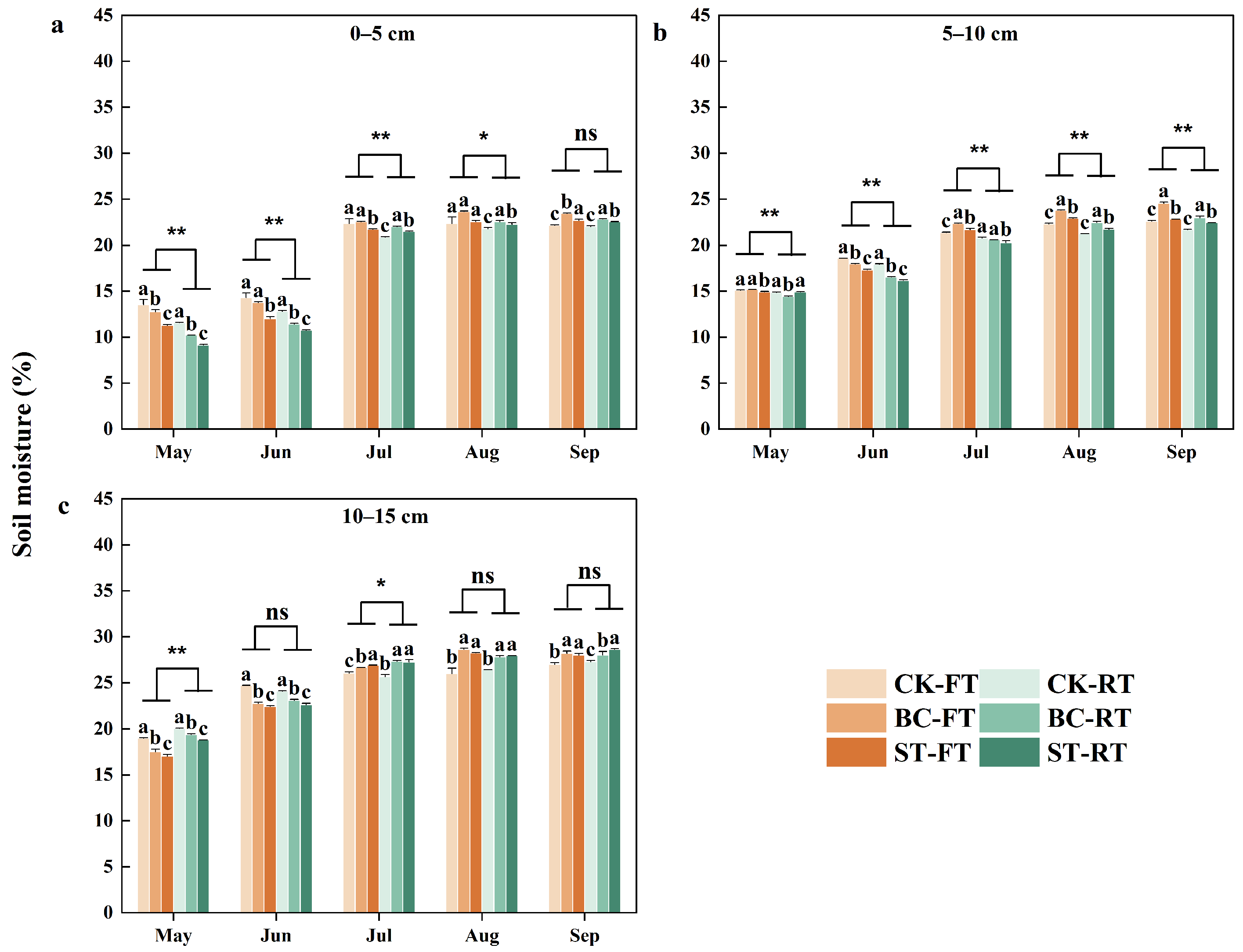
Generally, the soil volumetric water content during May to June was lower than during July to September (Figure S2). The average soil moisture in the 0–10 cm layer ranged from 18.6% during May–June compared to approximately 24.23% in July–September. This can be primarily attributed to the rapid soil moisture loss caused by tillage disturbances; as indicated in Figure S2, rotary tillage decreased soil moisture from 27.75% to 14.33% within seven days. The lower precipitation during spring also resulted in significantly lower soil moisture levels than during the rainy season from July to August (Figure S1). With increasing soil depth, the soil moisture increased gradually, reaching 25.17% in the 10–15 cm layer from an average of 20.08% in the 0–5 cm soil layer.
The monthly soil moisture was averaged and is shown in Figure 1. Under FT, the average soil moisture (0–5 cm) in May was 12.75% and 11.26% for the biochar and straw incorporation treatments, respectively, which are 1.36 and 2.47 percentage points lower than in the CK. Under RT, the corresponding values were 1.38 and 3.19 percentage points lower than in the CK. The effects of biochar and straw incorporation on soil moisture at 5–10 cm and 10–15 cm depths followed a consistent but attenuated pattern compared to the surface soil. From July to September, soil moisture in the 0–10 cm layer was consistently lower under RT relative to FT, while the effects of biochar and straw in the 10–15 cm layer were insignificant.
Compared to FT, RT significantly reduced soil moisture in the 0–15 cm layer. For example, in May, the average soil moisture in the 0–5 cm layer under CK-FT was 1.97 percentage points higher than under CK-RT. Furthermore, biochar and straw incorporation exhibited a synergistic effect with ridge tillage in further reducing topsoil moisture. Specifically, the moisture under CK-FT was 13.55%, whereas the average values under BC-RT and ST-RT were reduced to 10.20% and 9.11%, respectively.
Over time from July to September, the soil moisture increased gradually, and the biochar treatment increased the average soil moisture content by 1.45–2.62 percentage points over the control in the 0–15 cm layer in August. Similarly, the soil with straw incorporated also exhibited higher moisture levels than the control during the period from August to September.

3.1.2. Soil Water Storage

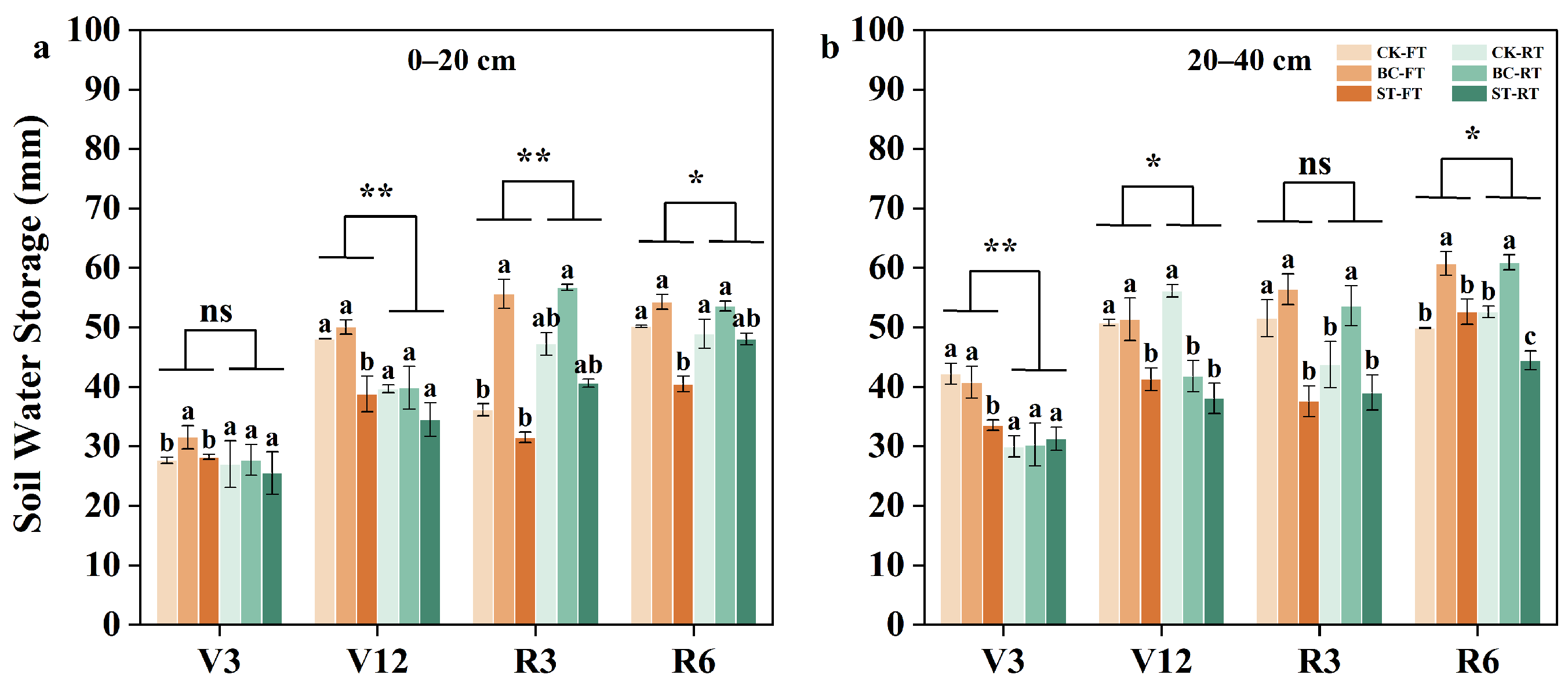
The soil water storage was measured at different maize growth stages (Figure 2). Compared to FT, RT reduced soil water storage at a depth of 0–40 cm in the V3 and V12 stages. For instance, in V3, the average soil water storage at a depth of 20–40 cm under RT was 30.50 mm, which is significantly lower than the 38.83 mm in PT. At the V12 stage, a significant difference was detected in the 0–20 cm layer (with average 45.63 mm for FT vs. 39.77 mm for RT). Meanwhile, biochar (BC) and straw (ST) incorporation further lowered the soil water storage, resulting in an overall trend of CK > BC > ST. For instance, in V12, soil water storage in the 0–20 cm layer under ST-RT was 34.47 mm, which was 29.54% lower than under CK-FT (48.92 mm).
During R3 and R6, owing to the enhanced soil moisture, the biochar treatment facilitated significantly higher water storage under RT in the 0–20 cm soil layer, with values of 56.70 mm (R3) and 53.57 mm (R6), which markedly exceeded the corresponding control values of 47.20 mm and 48.91 mm, respectively. Water storage following the ST treatment was lower than that under the biochar treatment. There was an insignificant difference with the CK at the 0–20 cm layer, though water storage was significantly lower than in the CK-FT soil by 13.54 mm at 20–40 cm in the R3 stage.

3.1.3. Soil Evaporation

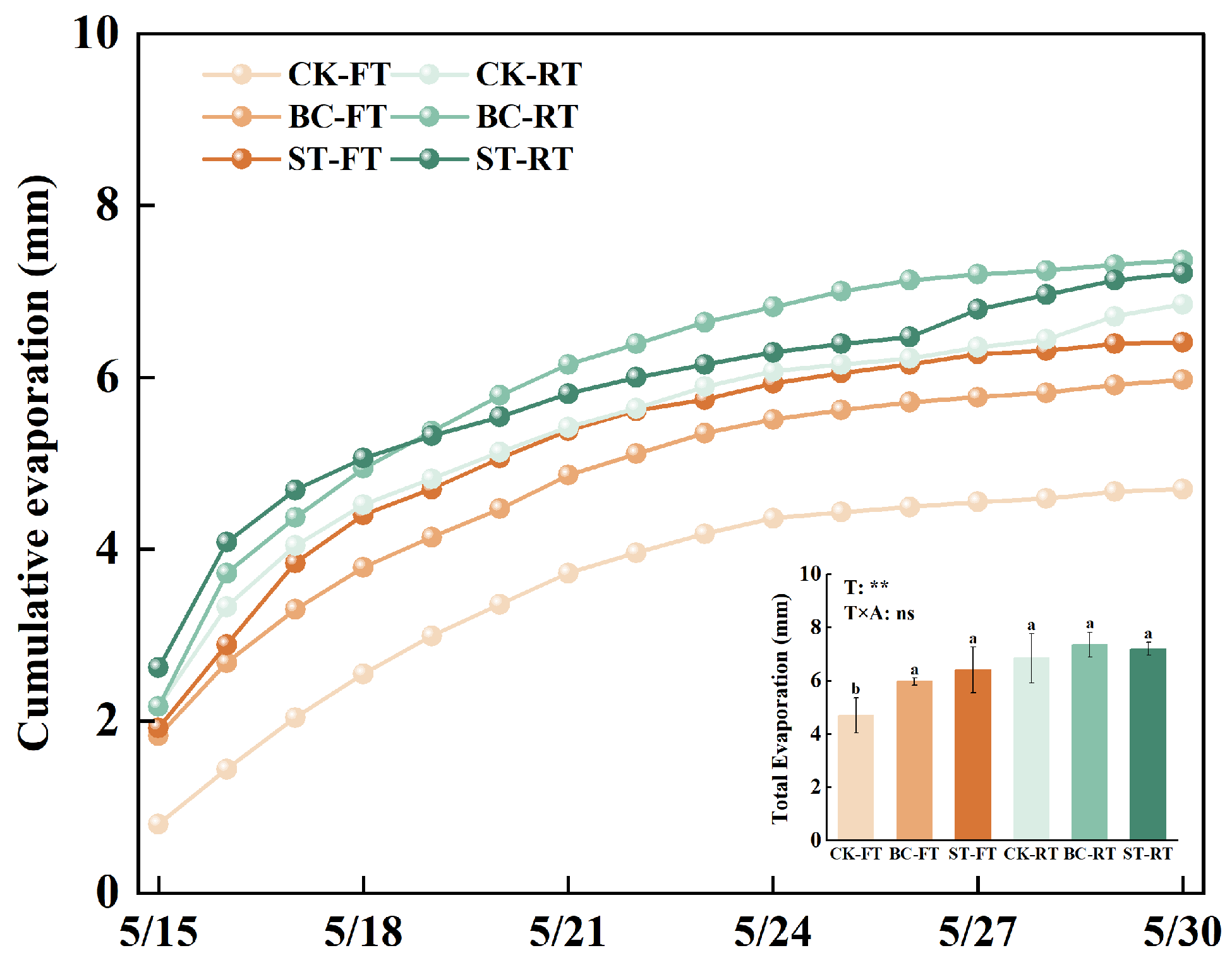
From 15 to 30 May, we measured the soil evaporation rates (Figure 3). The results showed that the ridge tillage (RT) treatment significantly accelerated soil evaporation. For instance, from 15 to 22 May, the cumulative evaporation of the CK-RT soil was 8.03 mm, which is 38.93% higher than the 5.73 mm of evaporation of the CK-FT soil.
No significant difference in cumulative soil evaporation was detected within treatments under RT; however, under flat tillage, the cumulative soil evaporation followed a trend of ST > BC > CK. The straw treatment significantly increased soil porosity, resulting in the highest cumulative evaporation over the period, reaching 8.01 mm, which is an increase of 39.79% compared to the control.

3.1.4. Temporal Changes in Soil Temperature

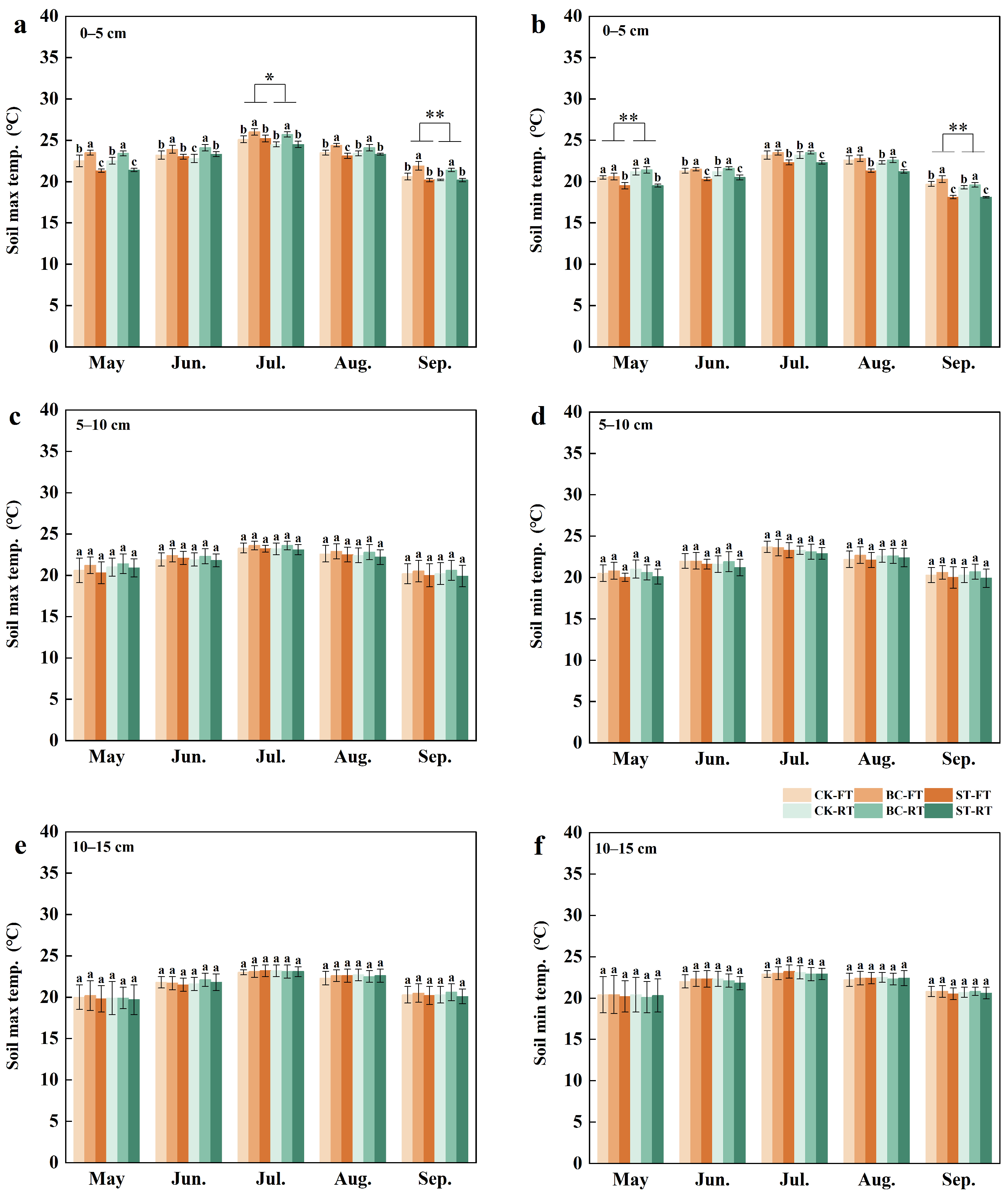
The dynamic of the maximum and minimum soil temperatures is illustrated in Figures S3 and S4, and the monthly average soil temperatures are shown in Figure 4. From May to September, the average maximum temperatures in the 0–5 cm layer were 22.67 °C, 23.31 °C, 25.47 °C, 23.6 °C, and 21.5 °C, while average minimum temperatures were 20.4 °C, 21.2 °C, 23.2 °C, 22.26 °C, and 21.3 °C, respectively. Soil temperatures declined with increasing soil depth: the average maximum temperatures in the 10–15 cm layer across the same months were 19.85 °C, 21.62 °C, 23.21 °C, 22.35 °C, and 21.43 °C.
The analysis of mean soil temperature revealed that the influence of biochar and straw incorporation was primarily evident in May (Figure 4). Biochar applied with ridge tillage (BC-RT) raised the maximum surface soil (0–5 cm) temperature by 0.32 °C relative to the CK-RT and by 0.79 °C under flat tillage (CK-PT), while showing no significant impact on the soil minimum temperature. The temperature-enhancing effect of biochar was no longer significant from July to September. In contrast, straw incorporation under RT lowered the minimum surface soil temperature by 0.11 °C in May and by 0.52 °C in June compared to the control.

3.2. Effect of Different Treatments on Nutrient Content

3.2.1. Soil Total C and Total N

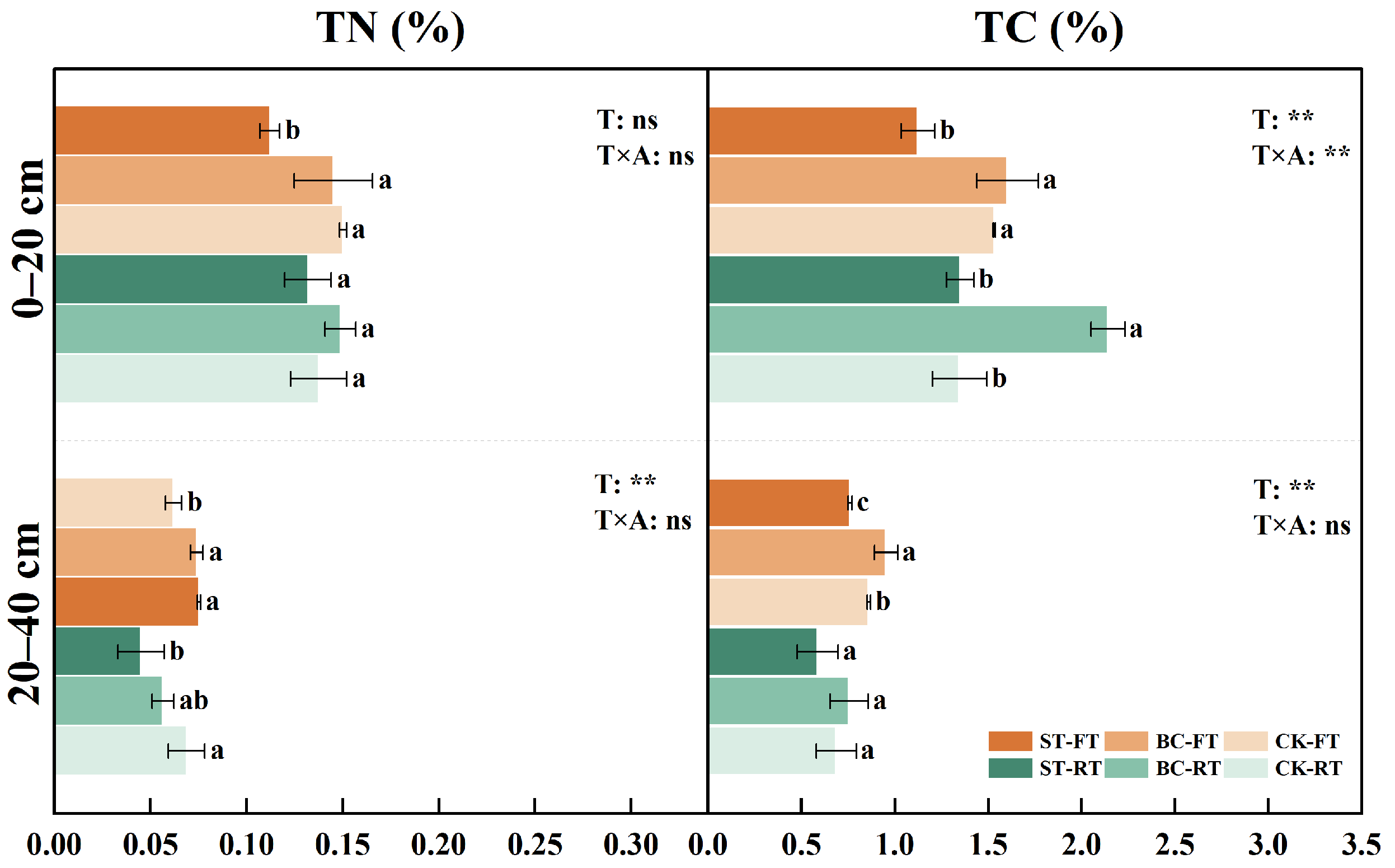
Generally, the soil total carbon (TC) and total nitrogen (TN) contents were higher in the 0–20 cm layer than in the 20–40 cm layer (Figure 5). Biochar incorporation increased TC in both soil layers. Specifically, in the 0–20 cm layer, biochar increased the TC content by 58.89% under RT and by 10.59% in the 20–40 cm layer under FT.
The results show that biochar did not affect the TN content, while the straw amendment generally decreased the soil TN content. Specifically, under FT, the TN in the ST soils was 0.11% and 0.06% in the 0–20 and 20–40 cm layers, respectively, values that are 0.038 and 0.013 percentage points lower than that of the corresponding controls.

3.2.2. Soil NH4+-N and NO3-N Content

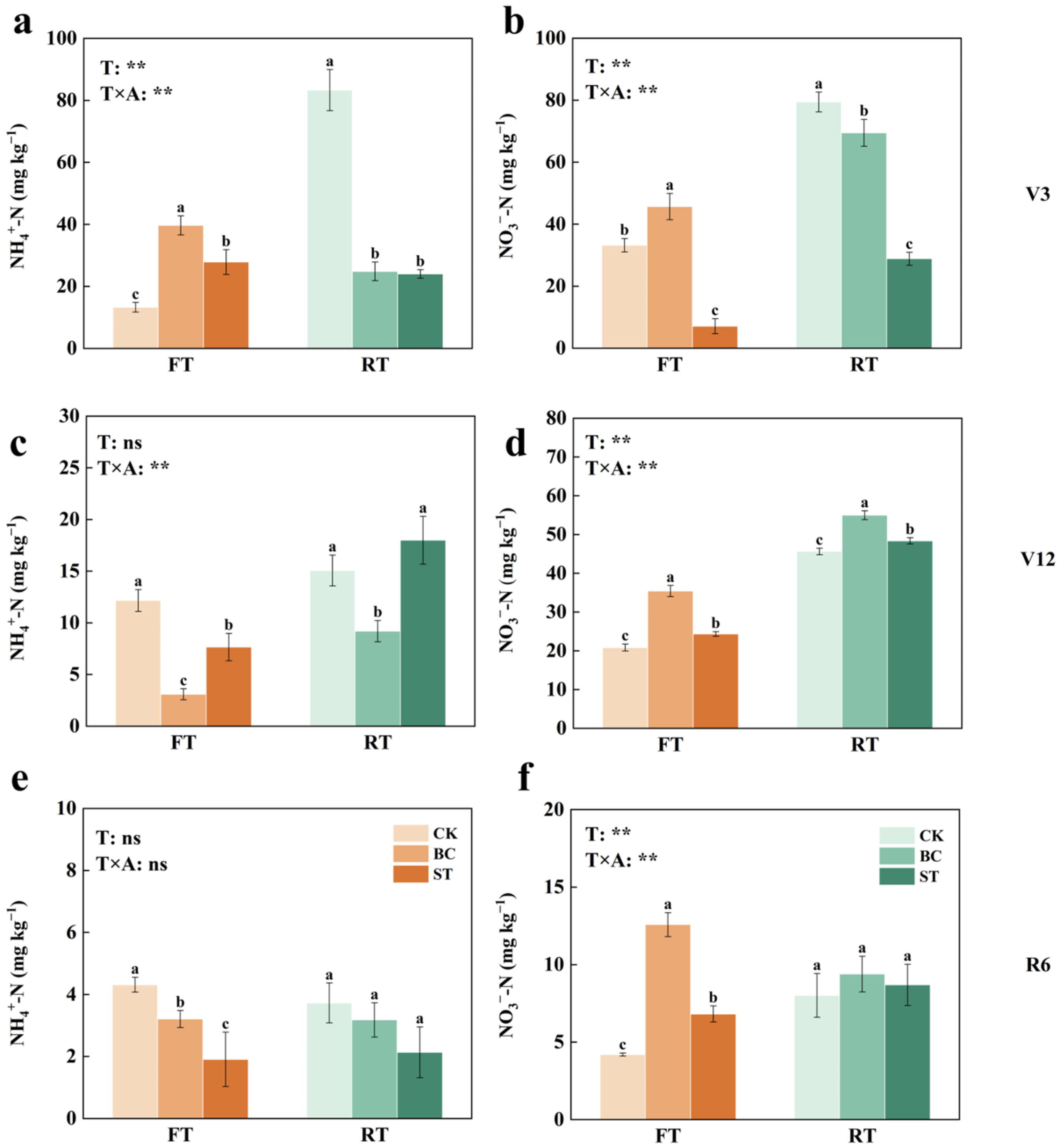
Soil NH4+-N and NO3-N concentrations were measured at the V3, V12, and R6 stages of maize growth (Figure 6). Biochar and straw application had varying effects on NH4+-N and NO3-N contents under FT at the V3 stage; however, under RT, both amendments generally reduced the inorganic N content by up to 70.11% compared to the CK.
As maize growth progressed, the soil inorganic N content gradually declined. At the R6 stage, under the FT system, biochar and straw application decreased the soil NH4+-N content by 25.66% and 55.82%, respectively, compared to the control. In contrast, under the same treatment, the soil NO3-N content increased substantially by approximately two-fold in the biochar-treated soil and by 62.54% in the straw-treated soil relative to the CK.

3.3. The Impact of Different Treatments on Soil Bulk Density and Porosity Distribution

3.3.1. Soil Bulk Density

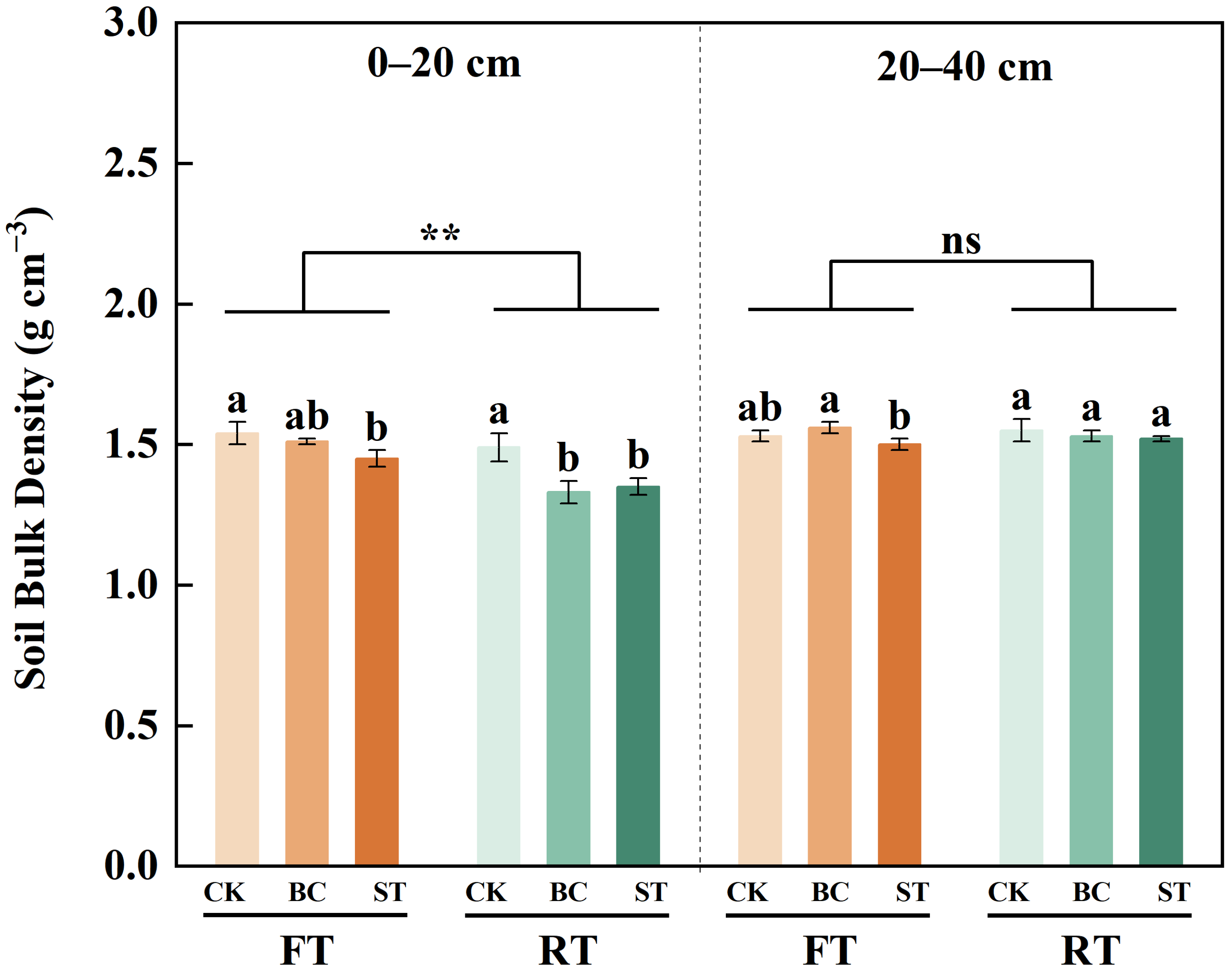
In the 0–20 cm soil layer, the average soil bulk density (BD) under the FT system was 1.50 g cm−3, which is significantly higher than the 1.39 g cm−3 recorded under RT (Figure 7). In contrast, no significant differences were observed in the 20–40 cm layer.
Within each tillage system, the BC and ST treatments reduced the soil BD by 2.06–5.51% (under FT) and 9.56–10.54% (under RT) in the 0–20 cm soil compared to their corresponding controls. However, in the 20–40 cm layer, no significant differences were observed among the treatments.

3.3.2. Soil Porosity Distribution

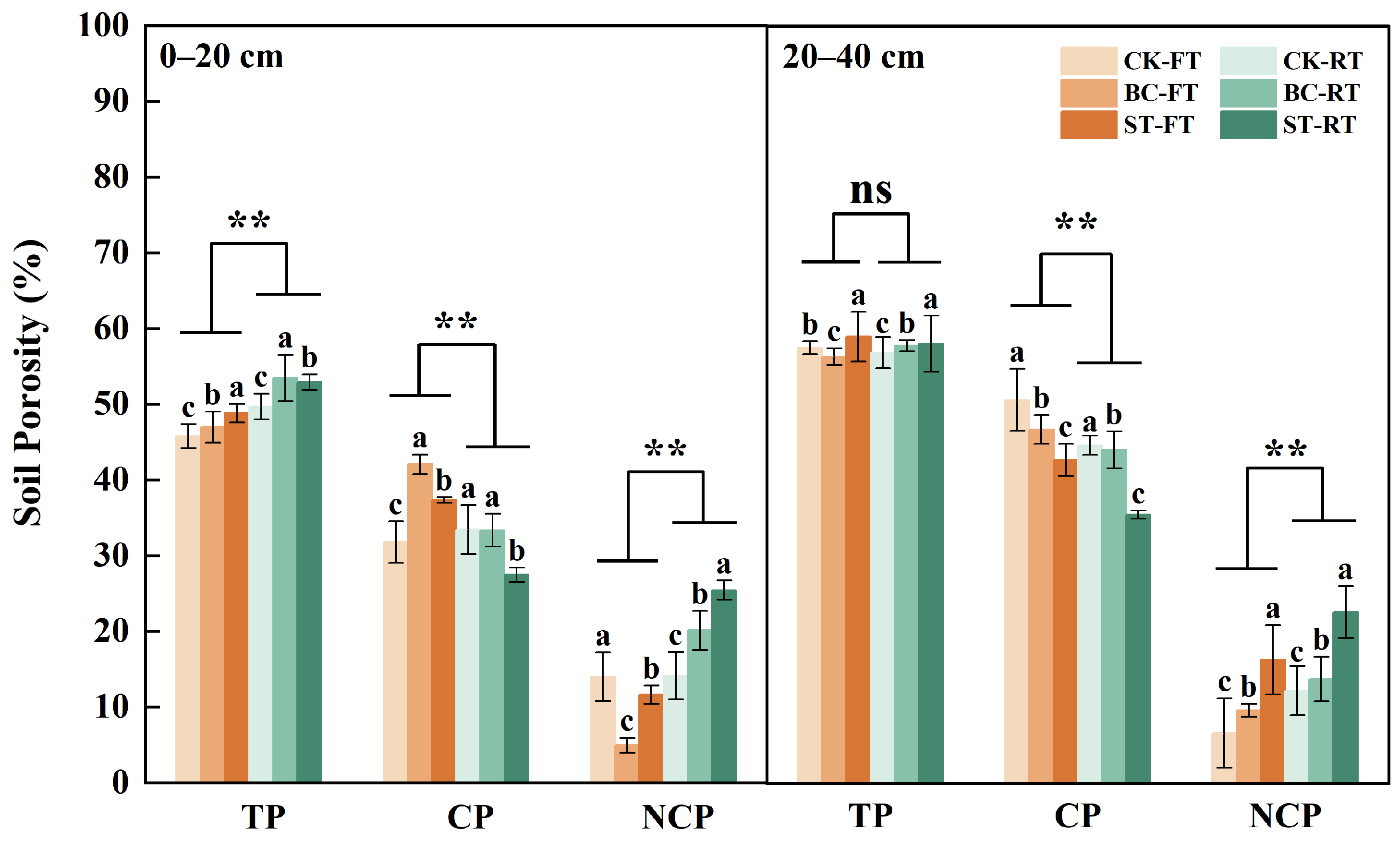
Differences in soil porosity were primarily observed in the 0–20 cm layer (Figure 8). Ridge tillage (RT) contained average total porosity (TP) of 51.29%, which is 4.06 percentage points higher than the FT. This increment was mainly due to the non-capillary porosity (NCP), which resulted in decreased capillary porosity (CP).
Under FT, biochar application significantly (p < 0.05) increased the CP from 33.12% in the CK to 42.03%. In contrast, under the RT system, straw incorporation resulted in an 11.30 percentage point increase in non-capillary porosity (NCP) alongside a 5.93 percentage point reduction in capillary porosity (CP). In the 20–40 cm soil layer, although the difference in total porosity (TP) between the two systems was not significant, RT resulted in an average decrease of 4.24 percentage points in CP and an average increase of 4.28 percentage points in NCP compared to FT.

3.4. Effects of Different Treatments on Maize Dry Matter Accumulation and Maize Yield

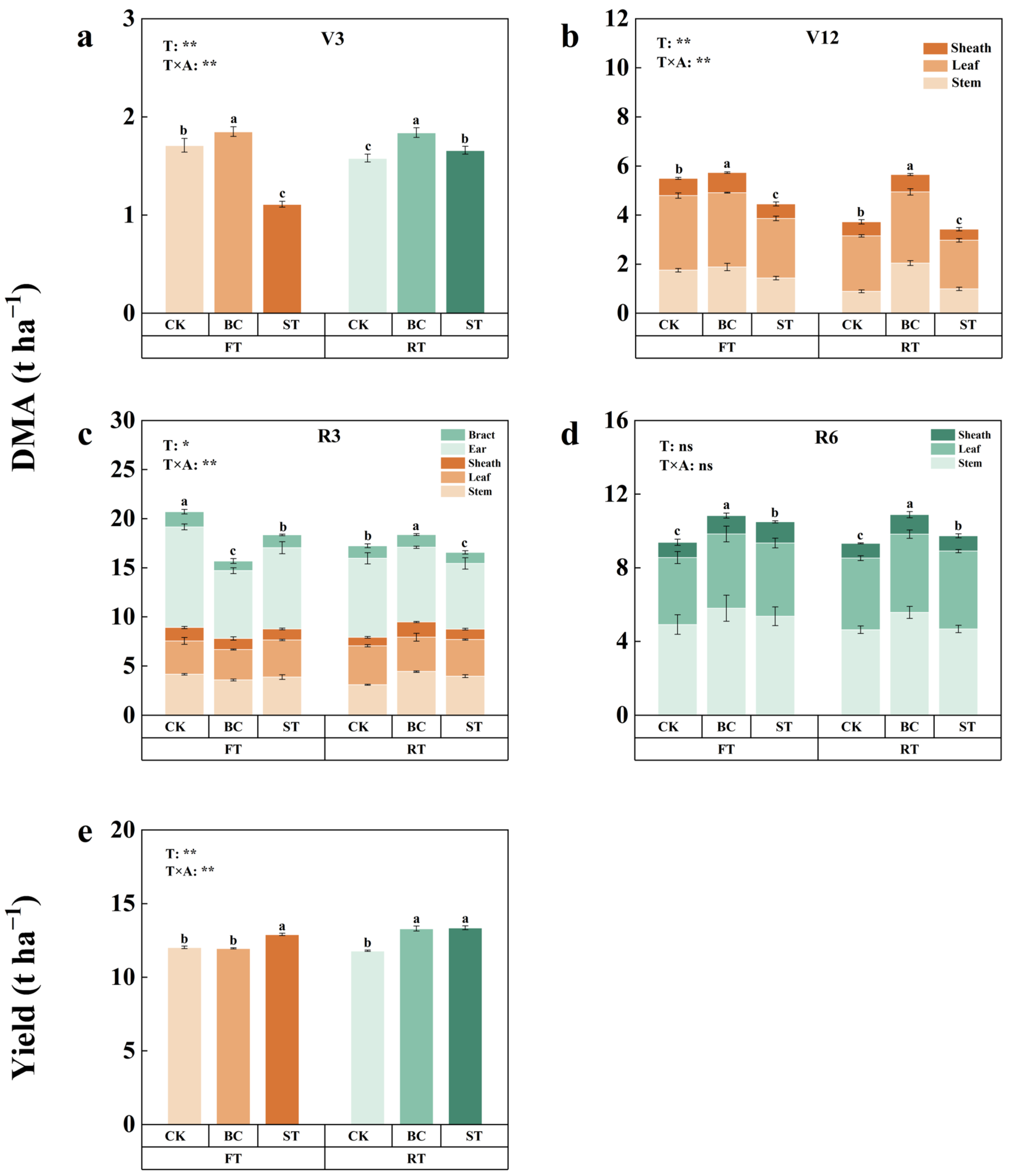
From the V3 to V12 stages, biochar application consistently enhanced maize dry matter accumulation under both the FT and RT systems (Figure 9a–d). For example, at the V12 stage, the total dry matter under RT increased from 3.72 t ha−1 in the control (CK-RT) to 5.66 t ha−1 following the biochar treatment (BC-RT), representing a 52.13% increase. At the R6 stage, biochar application increased dry matter accumulation by 15.46% under FT and 16.15% under RT compared to their respective controls. Similarly, straw incorporation contributed to greater dry matter accumulation at R6, with increases of 11.94% under FT and 4.50% under RT relative to CK.
As shown in Figure 9e, maize yields under RT were 13.31 t ha−1 following the biochar treatment and 13.36 t ha−1 following the straw treatment, representing increases of 12.80% and 13.22%, respectively, compared to the control (CK: 11.79 t ha−1). Under the FT system, however, biochar application did not significantly affect maize yield, whereas straw incorporation led to a significant increase of 7.80% (p < 0.05).

4. Discussion

4.1. Effects of Straw and Biochar Application on Soil Moisture

Soil moisture regulation is a critical ecosystem service that underpins agricultural productivity and resilience to climate variability [29]. The seasonal variation in soil moisture is a direct result of the complex interaction of precipitation, soil water storage capacity, and crop water consumption [30]. Tillage operations alter soil pore networks and structure, thereby modifying thermal conductivity and enhancing water evaporation by providing channels for rainwater percolation and air pockets for vapor movement [14,31]. Indeed, in this study, we found that soil moisture was reduced from 27.75% in undisturbed topsoil to 14.33% within seven days after rotary tillage (Figure S2). Simultaneously, we found that high-ridge tillage (RT) can effectively reduce the topsoil moisture content by 1.38 to 2.48 percentage points during the May to June period relative to flat tillage (FT). This is primarily because ridging increases the soil surface area and loosens the soil structure, thereby enhancing the evaporation rate after land preparation.
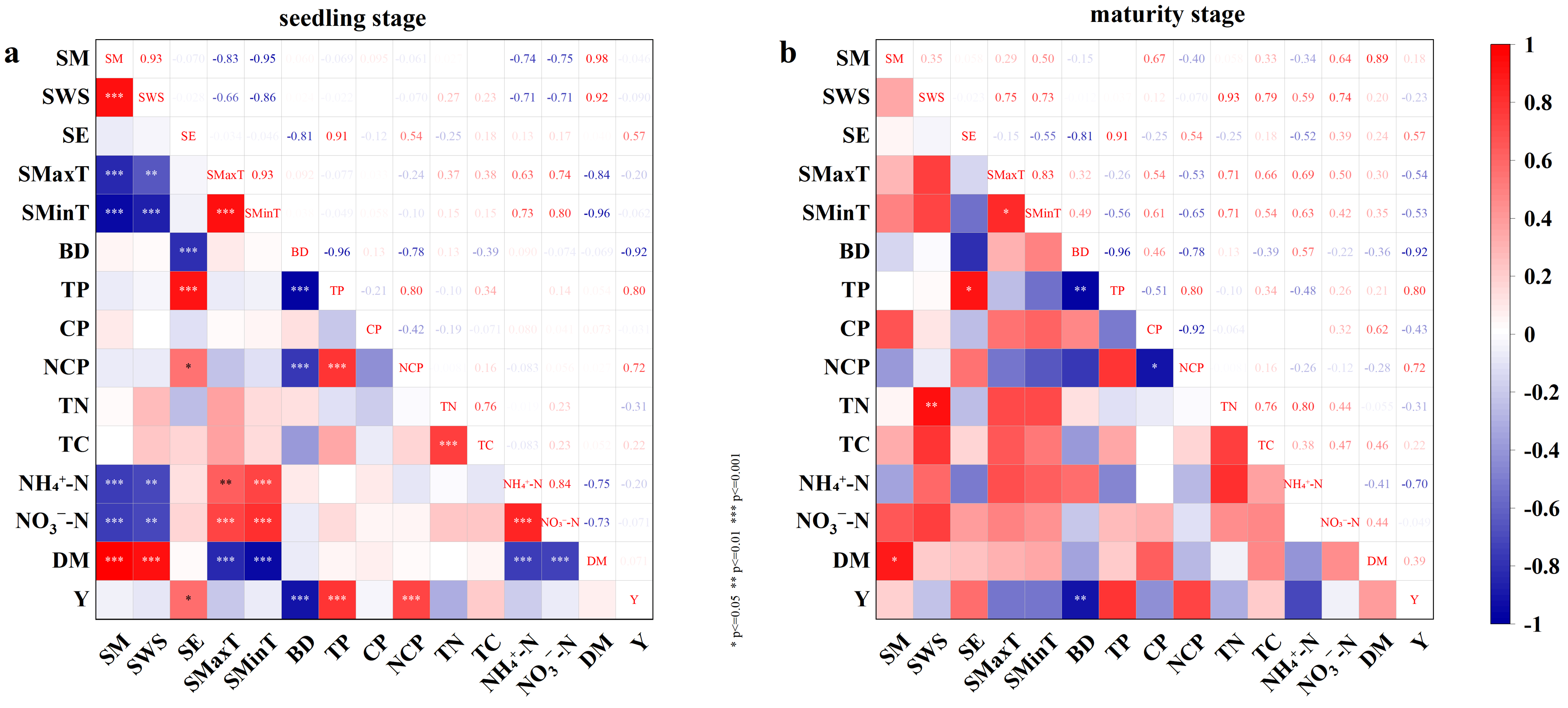
Regarding the effects of straw and biochar incorporation, we found that they decreased the average soil moisture by 3.35–4.44 percentage points from May to June (Figure 1) and showed a synergistic positive effect under high-ridge tillage (RT). The correlation analysis (Figure 10) indicated that the effect was primarily due to the disturbed soil structure and increased soil porosity (Figure 8); the increased soil porosity then enhanced soil aeration and promoted rapid water evaporation, ultimately decreasing the soil moisture content. Other researchers have indicated that the macropores in surface soil are significantly increased by tillage and straw incorporation. These pores act as both rainwater pathways and evaporation sites; consequently, the large straw pieces improve soil ventilation [12,23]. Combined with the prevalent spring winds in the study region, straw amendment accelerates moisture loss during this period. This result is consistent with the findings that rotary tillage combined with straw incorporation promoted moisture evaporation in the breeding to seedling stages [14], while other straw incorporation methods, such as straw mulching, were found to increase soil moisture effectively [15,32,33]. Therefore, in areas susceptible to spring drought, especially in areas where the wind is strong and water is easily lost in spring, combining no tillage with straw mulching is an effective means of conserving soil moisture and reducing soil erosion [34]. In contrast, for soils in the study area and similar farmland in high-latitude mountainous zones, where reducing excess moisture is necessary, tillage operations prove advantageous for decreasing moisture. This reflects the principle that sustainable soil management must be context-specific, with practices tailored to local agroecological conditions rather than a one-size-fits-all approach [35].
In addition, influencing soil moisture by altering the soil structure, in ST treatment, the decreased soil moisture content can be attributed to the low decomposition rate of fresh straw shortly after its incorporation. During this period, fresh maize straw possesses an undecomposed epidermis that is rich in hydrophobic wax. This property reduces the soil’s water retention capacity [36,37].
It is well-established that biochar, owing to its small particle size and highly porous structure, possesses a strong water-absorbing capacity, thereby enhancing soil moisture upon field application [21,38,39]. The effect of biochar on soil moisture is not uniform but varies significantly with its properties [22,40]. A key property is surface polarity, which depends on feedstock and production temperature and dictates water adsorption. Consequently, non-polar biochars generally demonstrate a greater water absorption capacity, while polar biochars tend to be more hydrophobic [41,42]. Moreover, the biochar’s effect on the soil’s water retention capacity also depends on soil texture and degradation level and biochar application rate [43,44]. For example, Xing et al. [15] demonstrated that the effectiveness of biochar in enhancing soil water retention varies depending on the soil type. While its application to clay soils with a high organic matter content can effectively enhance water retention, its effect on improving the moisture content in degraded soils is limited. The experimental soil in this study was less fertile and had a lower SOM content and a high sand content, which may partly explain why the application of biochar did not significantly increase soil moisture during this period. The biochar incorporation rate also affects soil evaporation and water content, as former studies indicated that the addition of high biochar amounts (>20 t ha−1) may increase total and non-capillary porosity, intensify soil evaporation, and reduce soil water retention; in contrast, moderate biochar application can increase soil moisture [22,40].
Although the biochar and straw amendments promoted soil evaporation and reduced soil moisture during the sowing–seedling stage (from May to July), the biochar treatment significantly enhanced the soil moisture by an average of 3.5–4.8 percentage points from July to September and increased soil water storage in the 0–20 cm layer by 20.13% and 9.53% relative to CK-RT (Figure 2). These findings demonstrate that under field conditions, the soil water retention performance of biochar changes significantly depending on tillage method and time. According to soil structure analysis, the increase in soil moisture facilitated by biochar during the later stages of maize growth is mainly due to biochar’s ability to markedly enhance the soil’s capillary porosity (Figure 8), thereby facilitating greater water storage. This result is in line with that of Fei et al. [44], who also found that biochar increased the porosity of soils with pore diameters of 0.3–75 μm, increasing soil water retention capacity. This discrepancy in influence on soil moisture between the sowing–seedling stage and mature stage could be attributed to time: during the mature stage, biochar undergoes a natural aging process, affected by external factors such as high temperatures and rainfall, which restructure the biochar’s physical form [45], modifying surface functional groups and polarity and thereby increasing its ability to retain water. Aller et al. [46] also found that fresh biochar did not have the same effect on soil water retention as an equivalent application of aged biochar.
Although straw application did not have an equivalent effect of improving soil moisture compared to biochar during later stages of maize growth, it still increased the soil moisture content by 0.53–2.75 percentage points. This phenomenon probably stems from the fundamental alteration in the properties of the straw. Specifically, the cessation of soil disturbance, coupled with increased precipitation and temperature from July to September, compacts the straw within the soil, leading to reduced porosity and enhanced water retention capacity [10]. The concurrent rise in soil temperature and moisture stimulates microbial growth, accelerating straw decomposition [15,47]. This process degrades the straw’s waxy coating, thereby reducing its hydrophobicity and increasing its water absorption ability [48]. The resulting debris and organic products (e.g., cellulose and hemicellulose) further contribute to the soil’s water retention capacity [49,50]. However, due to the larger particle size of straw, the enhancement of soil porosity was mostly of the non-capillary form (Figure 8). It is generally accepted that large pores in the soil can lead to rapid movement of water and chemical substances without proper interaction with the soil, potentially causing water loss [19]; consequently, the increase in soil moisture was less pronounced than that achieved with biochar [12,45,51].
This study demonstrated the temporal dynamics of how straw and biochar affect soil moisture, showing that a single measurement of their water retention effects is insufficient—a finding that reinforces the superiority of field-based research. These dynamics also highlight the importance of considering soil water regulation as a temporally variable ecosystem service, the delivery of which depends on the interplay between amendment properties, aging processes, and crop developmental stages [52]. In summary, in study regions that require the removal of excessive moisture during spring, we recommend applying these amendments by rotary and high-ridge tilling. From a global perspective, this region-specific strategy offers a reference for other high-latitude agricultural zones facing similar trade-offs between spring waterlogging and seasonal drought.

4.2. Effects of Straw and Biochar Application on Soil Temperature

Soil temperature during spring sowing governs both the speed of seed emergence and the quality of seedlings, thereby playing a decisive role in yield formation. Our results indicate that biochar incorporation can raise the topsoil’s maximum daily temperature by an average of 0.32 °C to 0.79 °C in May and June, thus increasing the accumulative temperature by 19.2–40.7 °C. This is consistent with Gao [53], who also found that biochar increased the soil surface temperature in a seasonally frozen region. Similar findings from boreal and temperate regions suggest that biochar’s warming effect has broad applicability for mitigating low-temperature constraints in early growing seasons [45]. We concluded that this positive effect is mainly achieved by the darker color of biochar, which facilitates the absorption of solar radiation and increased soil temperature [26,54]. This explanation is supported by the observation that biochar application did not elevate the minimum soil temperature, which was recorded at night, in the absence of solar radiation (Figure 4). Additionally, even when the biochar was applied at 15 cm, the temperature only increased in the surface layer of the soil, proving that biochar facilitates the absorption of solar radiation in the soil surface, contributing to an increase in soil temperature during the day. In this study, biochar was applied at 20 t ha−1 and significantly darkened the surface soil compared to the control, which enhanced solar absorption early in the growing season. This also explains why the temperature-raising effect was negligible in the later growth stages, as the maize canopy blocked sunlight.
Unlike biochar, straw incorporation decreased the daily soil minimum temperature by approximately 0.52 °C in May. The result is consistent with meta-analyses by Jiang et al. [33] and Li et al. [9], who also found that straw incorporation decreased soil temperature in northeast China. Although the literature indicates that straw incorporation can raise soil temperature [18], likely due to the “Mulching Effect”, this also depends on the straw application method, such as surface mulching or covering and smashing and direct plowing [55]. In summary, the balance between insulating and ventilating effects depends on residue placement and incorporation method.
The rotary application method in this study likely decreased soil temperature because the larger straw particle mixed uniformly with the soil, increasing soil ventilation and thereby enhancing air permeability. This condition is often referred to as the “Wind Leakage Effect”, which reduces the soil’s ability to retain heat. In combination with the low ambient temperature at night in the study area [9], it resulted in a lower minimum temperature in the straw-amended soil. The correlation analysis (Figure 10) revealed a negative correlation (insignificant) between the non-capillary porosity from straw incorporation and the reduction in soil temperature, thus confirming the effect. The contrasting thermal effects of biochar and straw underscore the need for integrated amendment strategies that optimize multiple soil ecosystem services simultaneously, including temperature regulation, water management, and carbon sequestration [5].

4.3. The Relationship Between Soil Structure, Soil Hydrothermal Characteristics, and Maize Dry Matter Accumulation

The ultimate goal of soil management is to enhance the capacity of agroecosystems to deliver provisioning services (e.g., crop yield), while maintaining regulating services (e.g., nutrient cycling, water regulation) in the long term [56]. Our results show that straw and biochar incorporation significantly increased maize straw dry matter accumulation by about 11.94–16.15% under high-ridge tillage (RT) and consequently improved maize yield by about 12.80–13.20% relative to CK (Figure 9). As shown in Figure 10, a significant positive correlation between soil water retention at the mature stage and maize yield was observed (p < 0.001). This indicates that the greater dry matter accumulation following the biochar and straw treatments was attributed to the increased soil water content during the mid-to-late growth stages, which coincides with the period of high water demand in maize. As the lifeblood of agriculture, soil moisture content is a decisive factor supporting crop growth and development. When the effective water content of the plant increases to a certain extent, it plays a positive role in the growth and development of the plant [23,57,58]. Therefore, the sufficient soil water supply in the biochar- and straw-amended soil facilitated maize growth and promoted yield. This yield improvement, achieved through enhanced water availability during critical growth windows, exemplifies how managing soil physical properties can improve food security without relying on additional irrigation inputs [56].
Soil moisture also plays a critical role in regulating the transport and availability of soil nutrients [59,60]. Correlation analysis (Figure 10b) revealed that soil NO3-N content at the mature stage was significantly positively correlated with soil moisture, maize yield, and dry matter accumulation. This suggests that the observed increase in the NO3-N concentration may result from the dual effect of biochar in enhancing soil water retention while reducing the vertical migration of NO3-N [61], which subsequently contributed to maize dry matter accumulation. Therefore, the positive effect of biochar on soil nitrogen retention should not be attributed solely to direct mechanisms—such as adsorption via cation exchange capacity (CEC) and pore structure [5,62]—but also its indirect effects mediated by improved soil moisture retention [12,21].

5. Conclusions

Incorporation of biochar and straw through rotary tillage effectively reduced soil moisture in the spring following land preparation, thereby achieving the intended goal of “soil moisture reduction” when combined with high-ridge tillage. During the summer to autumn period, however, these amendments enhanced soil water retention, aligning with the high water demand of maize during its peak growing season, subsequently promoting maize growth, dry matter accumulation, and yield. The contrasting effects on soil water retention between the early and late stages suggest that the influence of biochar and straw on soil moisture changes significantly over time, depending on the extent of their interaction with the soil. Consistent with our hypothesis, biochar incorporation increased the maximum surface soil temperature before the spring maize canopy fully covered the ground, possibly because the darker color enhanced the absorption of solar radiation. However, the incorporation of straw with large particle sizes by rotary tillage may result in soil ventilation, thereby reducing the minimum soil temperature, which is inconsistent with our hypothesis. We acknowledge that this study was conducted in a single region with specific climatic and edaphic conditions, which may limit the generalizability of our findings. Future field experiments should be conducted to assess the benefits of straw and biochar return in regulating soil moisture dynamics across a broader range of environmental conditions, including different soil types and climatic zones. These findings support the development of sustainable agricultural practices that improve soil health, moisture availability, and crop productivity in regions facing low soil temperatures and excess moisture challenges.

Supplementary Materials

The following supporting information can be downloaded at https://www.mdpi.com/article/10.3390/agronomy16080805/s1; Figure S1: Annual precipitation and temperature during field experiment; Figure S2: Temporal variations in soil water content across different soil layers (a: 0–5, b: 5–10, and c: 10–15 cm); Figure S3: Dynamic changes in soil maximum temperature at 0–15 cm soil depth; Figure S4: Dynamic changes in soil minimum temperature at 0–15 cm soil depth.

Author Contributions

Conceptualization: Z.L. and Y.J.; writing—original draft: Y.Z. (Yuanyang Zhang), Y.Z. (Yi Zhang) and Z.L.; writing—reviewing and editing: Z.L., Y.Z. (Yi Zhang) and Q.G.; funding acquisition: Z.L. and Y.J.; investigation: Y.Z. (Yuanyang Zhang), X.D. and N.Y.; visualization: X.D., N.Y. and Q.G. All authors have read and agreed to the published version of the manuscript.

Funding

This work was supported by the National Key R & D Program of China (2024YFD1501503); the Natural Science Foundation of Liaoning Province (2025-YQ-09).

Data Availability Statement

The original contributions presented in this study are included in the article/Supplementary Materials. Further inquiries can be directed to the corresponding authors.

Acknowledgments

During the preparation of this manuscript, the authors used DeepSeek V3.2 for text editing, including grammar, structure, and spelling. The authors have reviewed and edited the output and take full responsibility for the content of this publication.

Conflicts of Interest

The authors have no competing interests to declare.

References

  1. Han, X.; Li, N. Research progress of black soil in Northeast China. Sci. Geogr. Sin. 2018, 38, 1032–1041. [Google Scholar] [CrossRef]
  2. Li, R.; Hu, W.; Jia, Z.; Liu, H.; Zhang, C.; Huang, B.; Yang, S.; Zhao, Y.; Zhao, Y.; Shukla, M.K.; et al. Soil degradation: A global threat to sustainable use of black soils. Pedosphere 2025, 35, 264–279. [Google Scholar] [CrossRef]
  3. Xu, Y.; Pei, J.; Li, S.; Zou, H.; Wang, J.; Zhang, J. Main characteristics and utilization countermeasures for black soils in different regions of Northeast China. Chin. J. Soil Sci. 2023, 54, 495–504. [Google Scholar] [CrossRef]
  4. Wang, J.; Xu, X.; Pei, J.; Li, S. Current situations of black soil quality and facing opportunities and challenges in northeast China. Chin. J. Soil Sci. 2021, 52, 695–701. [Google Scholar] [CrossRef]
  5. Wang, K.; Xu, J.; Zhu, L.; Qian, Y.; Zhang, J.; Chen, P.; Liao, L.; Fan, J. Recycling Agricultural Residues as Straw and Hydrochar for Improved Soil Carbon Management Under Contrasting Irrigation Conditions. Agronomy 2025, 15, 2686. [Google Scholar] [CrossRef]
  6. Patel, M.R.; Panwar, N.L. Biochar from agricultural crop residues: Environmental, production, and life cycle assessment overview. Resour. Conserv. Recycl. Adv. 2023, 19, 200173. [Google Scholar] [CrossRef]
  7. Xie, N.; Fan, Y.; Duan, N.; Yang, L.; Radosevich, M.; Zhang, Y.; Wang, Y.; Wang, J.; Liang, X. Interactive effects of straw and biochar amendments on soil organic carbon stabilization and bacterial community dynamics. Biol. Fertil. Soils 2025, 61, 1423–1437. [Google Scholar] [CrossRef]
  8. Liu, Z.; He, T.; Cao, T.; Yang, T.; Meng, J.; Chen, W. Effects of biochar application on nitrogen leaching, ammonia volatilization and nitrogen use efficiency in two distinct soils. J. Soil Sci. Plant Nutr. 2017, 17, 515–528. [Google Scholar] [CrossRef]
  9. Li, R.; Luo, Y.; Sui, P.; Zheng, H.; Ming, B.; Li, S.; Wang, H.; Zheng, J. Short-term effect of different returning methods of maize straw on the temperature of black soil plough layer. Chin. J. Appl. Ecol. 2023, 34, 2693–2702. [Google Scholar] [CrossRef]
  10. Wang, N.; Zhang, T. Soil pore structure and its research methods: A review. Soil Water Res. 2024, 19, 1–24. [Google Scholar] [CrossRef]
  11. Yang, Q.; Gao, S.; Zhang, H.; Xu, J. Effects of straw mulching on soil, moisture and temperature. Chin. Agric. Sci. Bull. 2024, 40, 80–85. [Google Scholar] [CrossRef]
  12. Wang, J.; Sun, C.; Zhang, Y.; Xiao, J.; Ma, Y.; Jiang, J.; Jiang, Z.; Zhang, L. Straw return rearranges soil pore structure improving soil moisture memory in a maize field experiment under rainfed conditions. Agric. Water Manag. 2024, 306, 109164. [Google Scholar] [CrossRef]
  13. Liu, Y. The Effect of Straw Mulching and Tillage on Soil Water Heating Conditions and Soybean Products. Master’s Thesis, Northeast Agricultural University, Harbin, China, 2018. [Google Scholar] [CrossRef]
  14. Zhang, X.; Li, L.; Zhang, G.; Jiu, A.; Chen, C.; Zhou, J.; Li, F.-M. Straw burial increased wheat yield by decreasing soil moisture levels in a lower Yangtze River field. Field Crops Res. 2025, 331, 110006. [Google Scholar] [CrossRef]
  15. Xing, S.; Zhang, G.; Zhang, N.; Zhang, Y.; Zhang, Y. Effects of straw returning methods on seasonal variation in soil moisture and water storage in Mollisols with different degradation degrees. Agric. Water Manag. 2025, 319, 109796. [Google Scholar] [CrossRef]
  16. Fu, Q.; Chen, X.; Li, T.; Hou, R. Effects of biochar and straw on transport of water, heat and salt in freeze-thawed soil in farmland. Trans. Chin. Soc. Agric. Mach. 2025, 56, 501–511. [Google Scholar] [CrossRef]
  17. He Peng Li, L.; Dai, S.; Guo, X.; Nie, M.; Yang, X.; Kuzyakov, Y. Straw addition and low soil moisture decreased temperature sensitivity and activation energy of soil organic matter. Geoderma 2024, 442, 116802. [Google Scholar] [CrossRef]
  18. Wang, F.; Zhou, R.; Gao, J.; Wang, Z.; Cheng, Z.; Hao, Q.; Zhang, R.; Wang, Z. Effects of straw returning methods on soil water and heat and seeding growth and yield of spring maize in eastern region of Inner Mongolia. Crops 2024, 40, 223–231. Available online: http://zwzz.chinacrops.org/EN/10.16035/j.issn.1001-7283.2024.04.029 (accessed on 15 September 2023).
  19. Zhang, Y.; Wang, J.; Feng, Y. The effects of biochar addition on soil physicochemical properties: A review. Catena 2021, 202, 105284. [Google Scholar] [CrossRef]
  20. Akhtar, K.; Wang, W.; Khan, A.; Ren, G.; Afridi, M.Z.; Feng, Y.; Yang, G. Wheat straw mulching offset soil moisture deficient for improving physiological and growth performance of summer sown soybean. Agric. Water Manag. 2019, 211, 16–25. [Google Scholar] [CrossRef]
  21. Li, S.; Zhang, Y.; Yan, W.; Shangguan, Z. Effect of biochar application method on nitrogen leaching and hydraulic conductivity in a silty clay soil. Soil Till. Res. 2018, 183, 100–108. [Google Scholar] [CrossRef]
  22. Liang, J.; Li, Y.; Si, B.; Wang, Y.; Chen, X.; Wang, X.; Chen, H.; Wang, H.; Zhang, F.; Bai, Y.; et al. Optimizing biochar application to improve soil physical and hydraulic properties in saline-alkali soils. Sci. Total Environ. 2021, 771, 144802. [Google Scholar] [CrossRef] [PubMed]
  23. Razzaghi, F.; Obour, P.B.; Arthur, E. Does biochar improve soil water retention? A systematic review and meta-analysis. Geoderma 2020, 361, 114055. [Google Scholar] [CrossRef]
  24. Feng, W.; Wang, T.; Yang, F.; Cen, R.; Liao, H.; Qu, Z. Effects of biochar on soil evaporation and moisture content and the associated mechanisms. Environ. Sci. Eur. 2023, 35, 66. [Google Scholar] [CrossRef]
  25. Usowicz, B.; Lipiec, J.; Łukowski, M.; Marczewski, W.; Usowicz, J. The effect of biochar application on thermal properties and albedo of loess soil under grassland and fallow. Soil Tillage Res. 2016, 164, 45–51. [Google Scholar] [CrossRef]
  26. Bozzi, E.; Genesio, L.; Toscano, P.; Pieri, M.; Miglietta, F. Mimicking biochar-albedo feedback in complex Mediterranean agricultural landscapes. Environ. Res. Lett. 2015, 10, 084014. [Google Scholar] [CrossRef]
  27. Zheng, J.; Sun, Q.; Shi, C.; Su, Z.; Wang, C. The Effect of Soil Mixed with Biochar on Brackish Water Evaporation Characteristics. J. Soil Water Conser. 2023, 37, 294–303. [Google Scholar] [CrossRef]
  28. National Agricultural Technology Extension Service Center. Specification for Soil Analysis Techniques; China Agricultural Press: Beijing, China, 2006. [Google Scholar]
  29. Hao, Y.; Mao, J.; Bachmann, C.M.; Hoffman, F.M.; Koren, G.; Chen, H.; Tian, H.; Liu, J.; Tao, J.; Tang, J.; et al. Soil moisture controls over carbon sequestration and greenhouse gas emissions: A review. npj Clim. Atmos. Sci. 2025, 8, 16. [Google Scholar] [CrossRef]
  30. Yang, Y.; Ding, J.; Zhang, Y.; Wu, J.; Zhang, J.; Pan, X.; Gao, C.; Wang, Y.; He, F. Effects of tillage and mulching measures on soil moisture and temperature, photosynthetic characteristics and yield of winter wheat. Agric. Water Manag. 2018, 201, 299–308. [Google Scholar] [CrossRef]
  31. Licht, M.A.; Al-Kaisi, M. Strip-tillage effect on seedbed soil temperature and other soil physical properties. Soil Tillage Res. 2005, 80, 233–249. [Google Scholar] [CrossRef]
  32. Pittelkow, C.M.; Liang, X.; Linquist, B.A.; van Groenigen, K.J.; Lee, J.; Lundy, M.E.; van Gestel, N.; Six, J.; Venterea, R.T.; van Kessel, C. Productivity limits and potentials of the principles of conservation agriculture. Nature 2015, 517, 365–368. [Google Scholar] [CrossRef]
  33. Jiang, F.; Qian, Y.; Guo, Z.; Gao, L.; Zhang, Z.; Cao, Z.; Guo, J.; Liu, F.; Peng, X. Evaluating the regional suitability of conservation tillage and deep tillage based on crop yield in the black soil of Northeast China: A meta-analysis. Acta. Pedol. Sin. 2022, 59, 935–952. Available online: http://pedologica.issas.ac.cn/trxben/article/abstract/trxb202202220070 (accessed on 27 March 2026).
  34. Skaalsveen, K.; Ingram, J.; Clarke, L.E. The effect of no-till farming on the soil functions of water purification and retention in north-western Europe: A literature review. Soil Tillage Res. 2019, 189, 98–109. [Google Scholar] [CrossRef]
  35. Dhanalakshmi, T.D.; Rajichellam, J. Sustainable Soil Management—Principles and Importance. In Soil and Land Use Change; Sustainable Landscape Planning and Natural Resources Management; Parray, J.A., Ed.; Springer: Cham, Switzerland, 2025. [Google Scholar] [CrossRef]
  36. Bogunović, I.; Hrelja, I.; Kisić, I.; Dugan, I.; Krevh, V.; Defterdarović, J.; Filipović, V.; Filipović, L.; Pereira, P. Straw Mulch Effect on Soil and Water Loss in Different Growth Phases of Maize Sown on Stagnosols in Croatia. Land 2023, 12, 765. [Google Scholar] [CrossRef]
  37. Wang, X.; Yang, Z.; Liu, X.; Huang, G.; Xiao, W.; Han, L. The composition characteristics of different crop straw types and their multivariate analysis and comparison. Waste Manag. 2020, 110, 87–97. [Google Scholar] [CrossRef] [PubMed]
  38. Rani, R.; Garg, N. Role of Biochar in Modulating Soil Properties, Plant Productivity and Abiotic Stresses: A Review. J. Soil Sci. Plant Nutr. 2025, 25, 3285–3305. [Google Scholar] [CrossRef]
  39. Zhang, J.; Chen, Q.; You, C. Biochar effect on water evaporation and hydraulic conductivity in sandy soil. Pedosphere 2016, 26, 265–272. [Google Scholar] [CrossRef]
  40. Singh, H.; Northup, B.K.; Rice, C.W.; Prasad, P.V.V. Biochar applications influence soil physical and chemical properties, microbial diversity, and crop productivity: A meta-analysis. Biochar 2022, 4, 8. [Google Scholar] [CrossRef]
  41. Adhikari, S.; Mahmud, M.P.; Nguyen, M.D.; Timms, W. Evaluating fundamental biochar properties in relation to water holding capacity. Chemosphere 2023, 328, 138620. [Google Scholar] [CrossRef]
  42. Huang, H.; Reddy, N.G.; Huang, X.; Chen, P.; Wang, P.; Zhang, Y.; Huang, Y.; Lin, P.; Garg, A. Effects of pyrolysis temperature, feedstock type and compaction on water retention of biochar amended soil. Sci. Rep. 2021, 11, 7419. [Google Scholar] [CrossRef]
  43. Ajayi, A.E.; Holthusen, D.; Horn, R. Changes in microstructural behaviour and hydraulic functions of biochar amended soils. Soil Tillage Res. 2016, 155, 166–175. [Google Scholar] [CrossRef]
  44. Fei, Y.; Liu, Z.; Yi, J.; She, D.; Qiu, W.; Jiang, L.; Liu, M.; Li, S.; Nie, H.; Li, Q.; et al. Biochar application enhances soil water storage in wet periods but intensifies drought conditions during dry periods in red soils. Soil Tillage Res. 2026, 256, 106902. [Google Scholar] [CrossRef]
  45. Gong, Y.; Gao, Z.; Fu, Q.; Li, J.; Li, T.; Hou, R. Promoting soybean emergence and growth in seasonally frozen soil regions: The regulatory role of biochars on water-soil environment during freeze-thaw cycles. Soil Tillage Res. 2026, 257, 106930. [Google Scholar] [CrossRef]
  46. Aller, D.; Rathke, S.; Laird, D.; Cruse, R.; Hatfield, J. Impacts of fresh and aged biochars on plant available water and water use efficiency. Geoderma 2017, 307, 114–121. [Google Scholar] [CrossRef]
  47. Singh, N.; Kumar, S.; Udawatta, R.P.; Anderson, S.H.; de Jonge, L.W.; Katuwal, S. Grassland conversion to croplands impacted soil pore parameters measured via X-ray computed tomography. Soil Sc. Soc. Am. J. 2021, 85, 73–84. [Google Scholar] [CrossRef]
  48. Zhu, P.; Zhang, G.; Wang, H.; Zhang, B.; Liu, Y. Soil moisture variations in response to precipitation properties and plant communities on steep gully slope on the Loess Plateau. Agric. Water Manag. 2021, 256, 107086. [Google Scholar] [CrossRef]
  49. Saglam, M.; Sintim, H.Y.; Bary, A.I.; Miles, C.A.; Ghimire, S.; Inglis, D.A.; Flury, M. Modeling the effect of biodegradable paper and plastic mulch on soil moisture dynamics. Agric. Water Manag. 2017, 193, 240–250. [Google Scholar] [CrossRef]
  50. Saxton, K.E.; Rawls, W.J. Soil water characteristic estimates by texture and organic matter for hydrologic solutions. Soil Sci. Soc. Am. J. 2006, 70, 1569–1578. [Google Scholar] [CrossRef]
  51. Blanco-Canqui, H. Biochar and soil physical properties. Soil Sci. Soc. Am. J. 2017, 81, 687–711. [Google Scholar] [CrossRef]
  52. Panda, S. Soil and Water Conservation for Sustainable Resources and Ecosystem Resilience. In The Palgrave Encyclopedia of Sustainable Resources and Ecosystem Resilience; Brears, R., Ed.; Palgrave Macmillan: Cham, Switzerland, 2025. [Google Scholar] [CrossRef]
  53. Gao, Y. Study on the Regulatory Mechanism of Biochar on Soil Water-Heat, Carbon, and Nitrogen Processes in Seasonal Frozen Soil Regions. Doctoral Dissertation, Northeast Agricultural University, Harbin, China, 2021. [Google Scholar] [CrossRef]
  54. Zhang, Q.; Wang, Y.; Wu, Y.; Wang, X.; Du, Z.; Liu, X.; Song, J. Effects of biochar amendment on soil thermal conductivity, reflectance, and temperature. Soil Sci. Soc. Am. J. 2013, 77, 1478–1487. [Google Scholar] [CrossRef]
  55. Chen, J.; Zhang, Y.; Chen, J.; Cheng, F.; Zhang, H. Characteristics of soil temperature and its response to air temperature under different tillage systems—Characteristics of soil temperature and thermal properties. Sci. Agric. Sin. 2009, 42, 2747–2753. [Google Scholar] [CrossRef]
  56. Kabato, W.; Hailegnaw, N.; Mutum, L.; Molnar, Z. Managing soil health for climate resilience and crop productivity in a changing environment. Sci. Total Environ. 2025, 1000, 180460. [Google Scholar] [CrossRef]
  57. Lesk, C.; Anderson, W.; Rigden, A.; Coast, O.; Jagermeyr, J.; McDermid, S.; Davis, K.F.; Konar, M. Compound heat and moisture extreme impacts on global crop yields under climate change. Nat. Rev. Earth Environ. 2022, 3, 872–889. [Google Scholar] [CrossRef]
  58. Li, Q.; Li, H.; Fu, Q.; Li, T.; Liu, D.; Hou, R.; Cui, S.; Ji, Y.; Cai, Y. Effects of different biochar application methods on soybean growth indicator variability in a seasonally frozen soil area. Catena 2020, 185, 104307. [Google Scholar] [CrossRef]
  59. Geng, S.; Li, L.; Miao, Y.; Zhang, D.; Yang, Q.; Wang, Y. Responses of soil aggregation and aggregate-associated nitrogen to straw return in China: Evidence from a meta-analysis and a pot experiment. Land Degrad. Dev. 2024, 35, 3593–3605. [Google Scholar] [CrossRef]
  60. Siedt, M.; Schäffer, A.; Smith, K.E.; Nabel, M.; Roß-Nickoll, M.; Van Dongen, J.T. Comparing straw, compost, and biochar regarding their suitability as agricultural soil amendments to affect soil structure, nutrient leaching, microbial communities, and the fate of pesticides. Sci. Total Environ. 2021, 751, 141607. [Google Scholar] [CrossRef]
  61. Grafmüller, J.; Schmidt, H.P.; Kray, D.; Bucheli, T.D.; Mäurer, H.; Möllmer, J.; Peisert, H.; Hagemann, N. Biochar acidification increased sorption and reduced leaching of nitrate. J. Environ. Manag. 2025, 393, 127224. [Google Scholar] [CrossRef] [PubMed]
  62. Yao, Y.; Gao, B.; Zhang, M.; Inyang, M.; Zimmerman, A.R. Effect of biochar amendment on sorption and leaching of nitrate, ammonium, and phosphate in a sandy soil. Chemosphere 2012, 89, 1467–1471. [Google Scholar] [CrossRef]
Figure 1. Average soil volumetric moisture from May to September. (a) 0–5 cm soil; (b) 5–10 cm soil; (c) 10–15 cm soil. CK, BC, and ST denote no amendment, biochar amendment, and straw amendment, respectively; FT and RT denote flat tillage and ridge tillage, respectively. Different lowercase letters indicate significant differences among treatments under the same tillage method. A two-way ANOVA was used to examine the significance of tillage factor (T), amendment factor (A), and their interaction. *: p ≤ 0.05; **: p ≤ 0.01. ns: insignificant.
Agronomy 16 00805 g001
Figure 2. The impact of different treatments on soil water storage at different maize growth stages (V3: third leaf; V12: flare opening; R3: milking; R6: maturity); (a) 0–20 cm soil; (b) 20–40 cm soil; CK, BC, and ST denote no amendment, biochar amendment, and straw amendment, respectively; FT and RT denote flat tillage and ridge tillage, respectively. Error bars represent mean ± SE; different lowercase letters indicate significant differences among treatments under the same tillage method; a two-way ANOVA was used to examine the significance of the tillage factor (T), amendment factor (A), and their interaction. *: p ≤ 0.05; **: p ≤ 0.01. ns: insignificant.
Agronomy 16 00805 g002
Figure 3. Dynamics and cumulative soil evaporation from 15 to 30 May under different treatments. CK, BC, and ST denote no amendment, biochar, and straw, respectively; FT and RT denote flat tillage and ridge tillage, respectively. Error bars represent mean ± SE; different lowercase letters indicate significant differences among treatments under same tillage method. A two way-ANOVA was used to examine the significance of the tillage factor (T) and the amendment factor (A), and their interaction. **: p ≤ 0.01. ns: insignificant.
Agronomy 16 00805 g003
Figure 4. Average soil temperature from May to September. (a,c,e): average maximum temperature in 0–5, 5–10 and 10–15 cm soil; (b,d,f): average minimum temperature in 0–5, 5–10 and 10–15 cm soil, respectively. Error bars represent the mean ± SE; CK, BC, and ST denote no amendment, biochar amendment, and straw amendment, respectively; FT and RT denote flat tillage and ridge tillage, respectively. Different lowercase letters indicate significant differences among treatments under same tillage method. A two way-ANOVA was used to examine the significance of the tillage factor (T) and the amendment factor (A), and their interaction. *: p ≤ 0.05; **: p ≤ 0.01. ns: insignificant.
Agronomy 16 00805 g004
Figure 5. Soil total C and N content at the mature maize stage. Error bars represent the mean ± SE; CK, BC, and ST denote no amendment, biochar amendment, and straw amendment, respectively; FT and RT denote flat tillage and ridge tillage, respectively. Different lowercase letters indicate significant differences among treatments under the same tillage method. A two way-ANOVA was used to examine the significance of the tillage factor (T) and the amendment factor (A), and their interaction. **: p ≤ 0.01. ns: insignificant.
Agronomy 16 00805 g005
Figure 6. Soil NH4+-N and NO3-N contents. (a,c,e): soil NH4+-N content at the V3, V12 and R6 stages of maize growth, respectively; (b,d,f): soil NO3-N at the V3, V12, R6 stages of maize growth, respectively. Error bars represent mean ± SE; CK, BC, and ST denote no amendment, biochar amendment, and straw amendment, respectively; FT and RT denote flat tillage and ridge tillage, respectively. Different lowercase letters indicate significant differences among treatments under same tillage method. A two way-ANOVA was used to examine the significance of the tillage factor (T) and the amendment factor (A), and their interaction. **: p ≤ 0.01. ns: insignificant.
Agronomy 16 00805 g006
Figure 7. Soil bulk density at maize maturity stage. Error bars represent mean ± SE; CK, BC, and ST denote no amendment, biochar amendment, and straw amendment, respectively; FT and RT denote flat tillage and ridge tillage, respectively. Different lowercase letters indicate significant differences among treatments under the same tillage method. A two way-ANOVA was used to examine the significance of the tillage factor (T) and the amendment factor (A), and their interaction.; **: p ≤ 0.01. ns: insignificant.
Agronomy 16 00805 g007
Figure 8. Distribution of soil pores in each treatment at the mature maize stage. Error bars represent mean ± SE; CK, BC, and ST denote no amendment, biochar amendment, and straw amendment, respectively; FT and RT denote flat tillage and ridge tillage, respectively. TP: total porosity; CP: capillary porosity; NCP: Non-capillary porosity; different lowercase letters indicate significant differences among treatments under the same tillage method. A two way-ANOVA was used to examine the significance of the tillage factor (T) and the amendment factor (A), and their interaction. **: p ≤ 0.01. ns: insignificant.
Agronomy 16 00805 g008
Figure 9. Effects of different treatments on maize dry matter accumulation; (a): third leaf stage; (b): flare opening stage, (c): milking stage; (d): maturity stage and (e): yield; error bars represent mean ± SE; CK, BC, and ST denote no amendment, biochar amendment, and straw amendment, respectively; FT and RT denote flat tillage and ridge tillage, respectively. Different lowercase letters indicate significant differences among treatments under same tillage method. A two way-ANOVA was used to examine the significance of the tillage factor (T) and the amendment factor (A), and their interaction. *: p ≤ 0.05; **: p ≤ 0.01. ns: insignificant.
Agronomy 16 00805 g009
Figure 10. Correlations of soil moisture content, temperature, soil structure and nutrient content in the seedling stage (a) and mature stage (b). SM: soil moisture; SWS: soil water storage; SE: soil evaporation; SMaxT: soil maximum temperature; SMinT: soil minimum temperature; BD: bulk density; TP: total porosity; CP: capillary porosity; NCP: non-capillary porosity; TN: soil total N; TC: soil total C; DM: maize dry matter; Y: yield. Significant correlations are highlighted with asterisks. * p < 0.05; ** p < 0.01. *** p < 0.001.
Agronomy 16 00805 g010
Disclaimer/Publisher’s Note: The statements, opinions and data contained in all publications are solely those of the individual author(s) and contributor(s) and not of MDPI and/or the editor(s). MDPI and/or the editor(s) disclaim responsibility for any injury to people or property resulting from any ideas, methods, instructions or products referred to in the content.