Article

Spatiotemporal Variability and Dominant Driving Factors of Soil Moisture in the Yellow River Basin from 1982 to 2024


1
School of Soil and Water Conservation, Jiangxi University of Water Resources and Electric Power, Nanchang 330099, China
2
Poyang Lake Basin Water Resources Efficient Utilization Observation and Research Station, Ministry of Water Resources, Nanchang 330099, China
3
College of Urban & Rural Construction, Hebei Agricultural University, Baoding 071001, China
*
Author to whom correspondence should be addressed.
Agronomy 2026, 16(8), 791; https://doi.org/10.3390/agronomy16080791
Submission received: 8 March 2026 / Revised: 9 April 2026 / Accepted: 10 April 2026 / Published: 12 April 2026
(This article belongs to the Section Water Use and Irrigation)

Abstract

Soil moisture (SM) is a pivotal state variable of the terrestrial hydrosphere, modulating energy partitioning, agricultural productivity and extreme-event propagation. This study analyzes 43 years (1982–2024) of data to assess soil moisture (SM) dynamics in the Yellow River Basin (YRB). Results indicate a statistically significant basin-wide SM decline across weekly, monthly, and annual scales, with grid-scale slopes ranging from −2.26 × 10⁻⁴ to 8.32 × 10⁻⁵ m3 m−3 month−1. Spatially, non-farm areas retain higher SM than cultivated lands, with a distinct upstream-to-downstream variability pattern. While alpine headwaters show moistening, pervasive drying characterizes mid- and lower-catchments. Critically, transitional landscapes are approaching tipping points, risking shifts into persistently wetter or drier stable states where minor perturbations could lock ecosystems into new conditions. This underscores the urgent need for targeted climate-adaptation interventions. Generalized additive modeling identifies surface net solar radiation, soil temperature, and vapor pressure deficit as dominant drivers across multiple temporal scales. Their respective contributions, averaged across the basin, accounted for 29.4%, 25.3%, and 23.0% of the explained variance. Additionally, actual evapotranspiration emerged as a significant driver on the weekly scale, particularly within the center of the basin. These findings enhance process-based understanding of SM variability and provide a scientific foundation for adaptive water-resource management in the YRB.

1. Introduction

Soil moisture is a critical terrestrial variable that plays a central role in regulating the Earth’s energy balance, hydrological cycle, and ecological stability [1,2]. As a key interface component between land and atmosphere, it modulates essential hydrological and biogeochemical processes, including evapotranspiration, groundwater recharge, and carbon sequestration [3]. Moreover, soil moisture significantly influences the partitioning of net radiation into sensible and latent heat fluxes [1]. Crucially, vegetation growth is directly dependent on the availability of soil water and nutrients, making soil moisture a limiting factor for ecosystem productivity. The Yellow River Basin (YRB), a vital agricultural region that supports approximately 12% of China’s population [4], exemplifies an area where soil moisture dynamics carry profound ecological and socioeconomic implications [5]. In recent decades, the basin has experienced increasing water stress, driven by intensified climate variability and mounting anthropogenic pressures [5]. Nevertheless, accurately quantifying the spatiotemporal variability of soil moisture and identifying its dominant controlling factors across the YRB—a region spanning diverse climatic zones from alpine permafrost on the Qinghai–Tibet Plateau to arid farmlands on the Loess Plateau—remains a significant methodological challenge.
Building on the recognition that soil-moisture (SM) heterogeneity is a first-order control on basin-scale water, energy, and carbon budgets, recent scholarship has shifted from descriptive mapping to mechanistic attribution of SM variability. A rapidly expanding body of work now disentangles the relative contributions of eco-hydrological factors and anthropogenic forcings to SM dynamics [6,7]. Such attribution is prerequisite for reliable projection of land–atmosphere feedback and for early warning of hydro-climatic extremes, particularly in data-scarce yet water-stressed basins such as the YRB. Early insights were derived almost exclusively from in situ observational networks [8,9,10]. While ground-based sensors deliver high-accuracy point measurements, their spatial footprint shows orders of magnitude smaller than the characteristic length scales of SM variability, and station records are frequently fragmented by instrument failures or protocol changes. Consequently, regional syntheses based on in situ data suffer from severe sampling bias and limited temporal continuity. Polar-orbiting microwave missions (e.g., SMAP, ESA CCI) partially remedy the coverage gap, but their signals are restricted to the top ~5 cm of the soil column and are compromised by vegetation opacity and radio-frequency interference, rendering them inadequate for capturing root-zone moisture that governs transpiration and drought stress.
To circumvent these observational constraints, the community has increasingly gravitated toward land-surface reanalyses that fuse sparse observations with physically based models through advanced data-assimilation frameworks. Among these, ERA5-Land—an enhanced, 0.1° × 0.1° resolution extension of the fifth-generation ECMWF reanalysis—provides temporally continuous, vertically resolved SM estimates that are consistent with atmospheric forcing fields. Recent applications illustrate the added value of such products for hydro-climatic diagnostics. Li et al. [5], analyzing ERA5-Land SM over the YRB drylands, revealed a pronounced intensification and lengthening of agricultural drought episodes, with onset dates shifting later in the growing season. Across the European domain, Almendra-Martín et al. [11] detected a continent-wide increase in drought duration and severity between 1991 and 2020, superimposed on a systematic delay of drought onset by several days per year in arid and temperate zones. Extending the scope to China, Guo et al. [12] employed ERA5-Land SM to compute the Standardized Soil Moisture Index (SSI) and demonstrated, through variance decomposition, that precipitation anomalies and vegetation transpiration exert dominant control on the temporal evolution of agricultural drought characteristics, outweighing the influence of oceanic teleconnections. Collectively, these studies underscore the suitability of high-resolution reanalysis SM for large-scale process attribution.
While the preceding studies establish reanalysis-based SM as a credible diagnostic tool, they leave open the question as to which drivers actually impose the dominant constraints on SM variance within complex basins such as the YRB. Hitherto, attribution efforts have converged on a narrow suite of meteorological predictors—precipitation (P), actual evapotranspiration (ET) and vapor-pressure deficit (VPD)—that explicitly close the surface water cycling [13,14,15]. Yang et al. [14], for instance, demonstrate that antecedent SM anomalies modulate the intensity and frequency of subsequent rainfall over the Yangtze River Basin through a positive soil–moisture–precipitation feedback. Singh and Apurv [15] further reveal that VPD exerts a regionally contingent control on flash-drought acceleration: its influence is systematically underestimated in arid climates, yet overestimated in humid zones when anomaly-based metrics are used. Extending the analysis globally, Li et al. [13] attribute inter-annual SM variability during 2001–2020 primarily to covariations in P, ET and VPD, although their regression framework omits potentially confounding land-surface processes. Nevertheless, a growing body of evidence indicates that restricting the predictor space to atmospheric water-balance terms provides an incomplete picture. Vegetation dynamics (e.g., leaf-area index, greenness fraction), surface net solar radiation (SSR) and soil temperature (ST) are not merely passive respondents to P and ET; rather, they actively regulate the partitioning of available energy and water, thereby creating second-order feedbacks on SM. Canopy greening, for example, can enhance rainfall interception and root-water uptake, amplifying SM depletion independently of synoptic moisture supply. Likewise, SSR governs both potential ET and canopy conductance, while ST modulates hydraulic diffusivity and soil moisture absorption. Consequently, any attribution framework that aspires to mechanistic completeness must integrate these eco-hydrological co-variates alongside traditional meteorological forcings. The present study therefore expands the driver set to include vegetation, radiation and thermal regimes, and quantifies their relative importance across the heterogeneous landscapes of the YRB.
Mirroring the bidirectional nature of land–atmosphere coupling, vegetation not only responds to soil-moisture (SM) deficits, but also actively reshapes the soil–plant–atmosphere continuum (SPAC) through canopy interception, root uptake and transpiration feedback [16,17]. Anthropogenic perturbations—afforestation under China’s “Grain-for-Green” program on the one hand, and chronic overgrazing on the other—further modulate leaf-area density, surface roughness and albedo, thereby imprinting highly non-linear and spatially contingent signatures on the SM budget [18,19]. Whether the basin-wide greening of the Yellow River Basin (YRB) has translated into a net SM surplus (via reduced runoff) or deficit (via enhanced transpiration) remains equivocal [20], underscoring the need for a process-based attribution. Vegetation phenology itself is strongly entrained by antecedent soil temperature (ST) anomalies that govern enzymatic activity, root hydraulic conductivity and snowmelt timing [21,22]. By shifting the onset and magnitude of canopy transpiration, ST exerts a direct, temporally lagged control on root-zone SM. Equally under-appreciated, surface net solar radiation (SSR) modulates spring phenology in temperate ecosystems [23] and intensifies atmospheric demand. Wang and Wen [24] demonstrated that excess radiation along aridity gradients tightens stomatal regulation, yet simultaneously elevates soil-water expenditure, amplifying drought stress. Consequently, any framework that seeks to disentangle SM variability within the YRB must treat vegetation dynamics, ST, and SSR as first-order covariates that interact synergistically or antagonistically with precipitation (P), actual evapotranspiration (ET) and vapor-pressure deficit (VPD).
To address this complexity, the present study integrates ERA5-Land root-zone SM (0–100 cm) with coincident fields of ET, P, ST, SSR, VPD and VHI at 0.1° resolution over 1982–2024. By coupling spatiotemporal trend pattern analysis with dominate driving factors analysis, we (i) quantify the spatiotemporal evolution of SM across the contrasting eco-climatic zones of the YRB and (ii) rank the dominant drivers across multiple temporal scales (weekly, monthly, and annual). In doing so, we provide a process-consistent baseline for evaluating future hydro-climatic risks and for refining nature-based management strategies in one of China’s most water-stressed basins.

2. Materials and Methods

2.1. Study Area

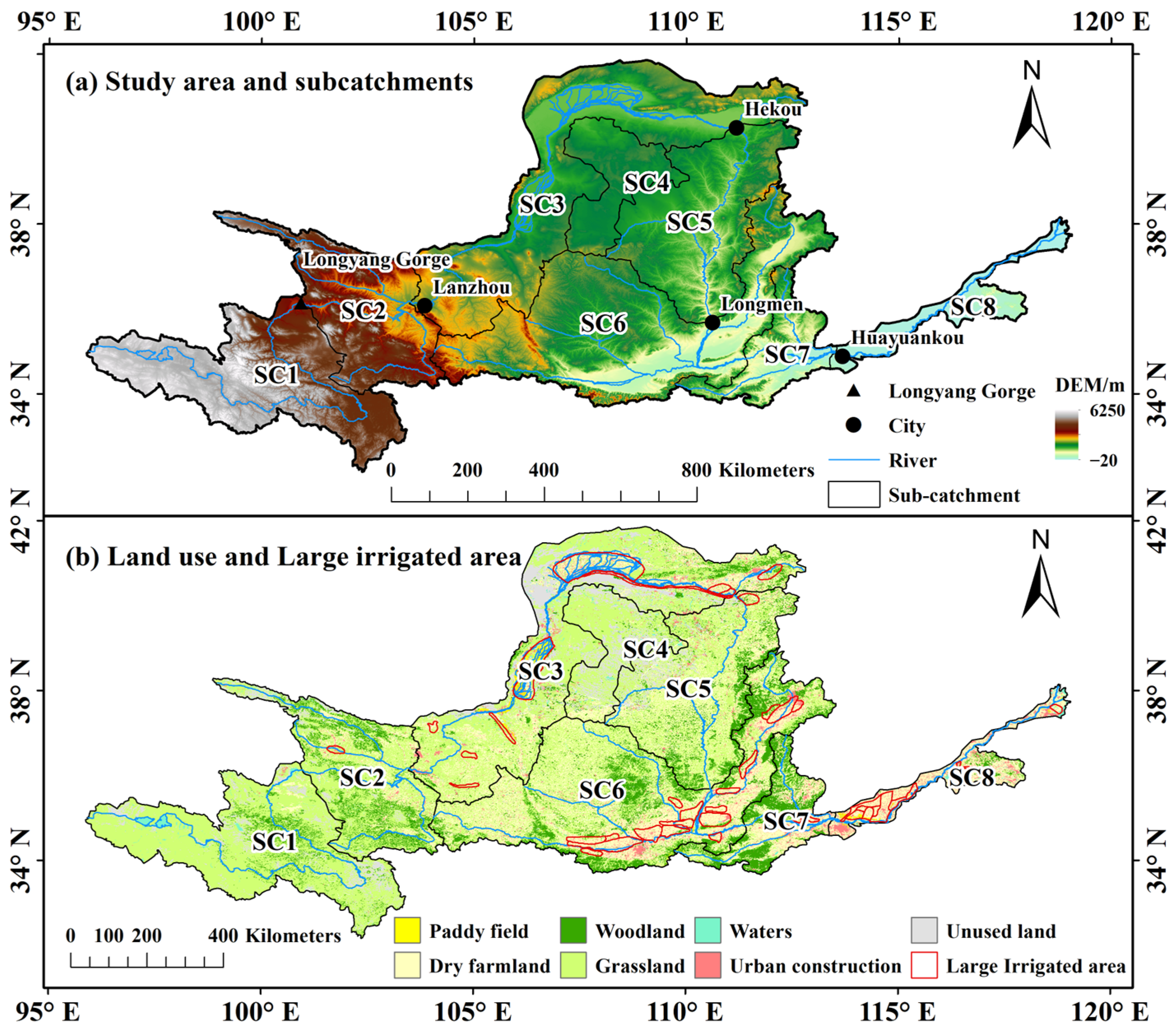
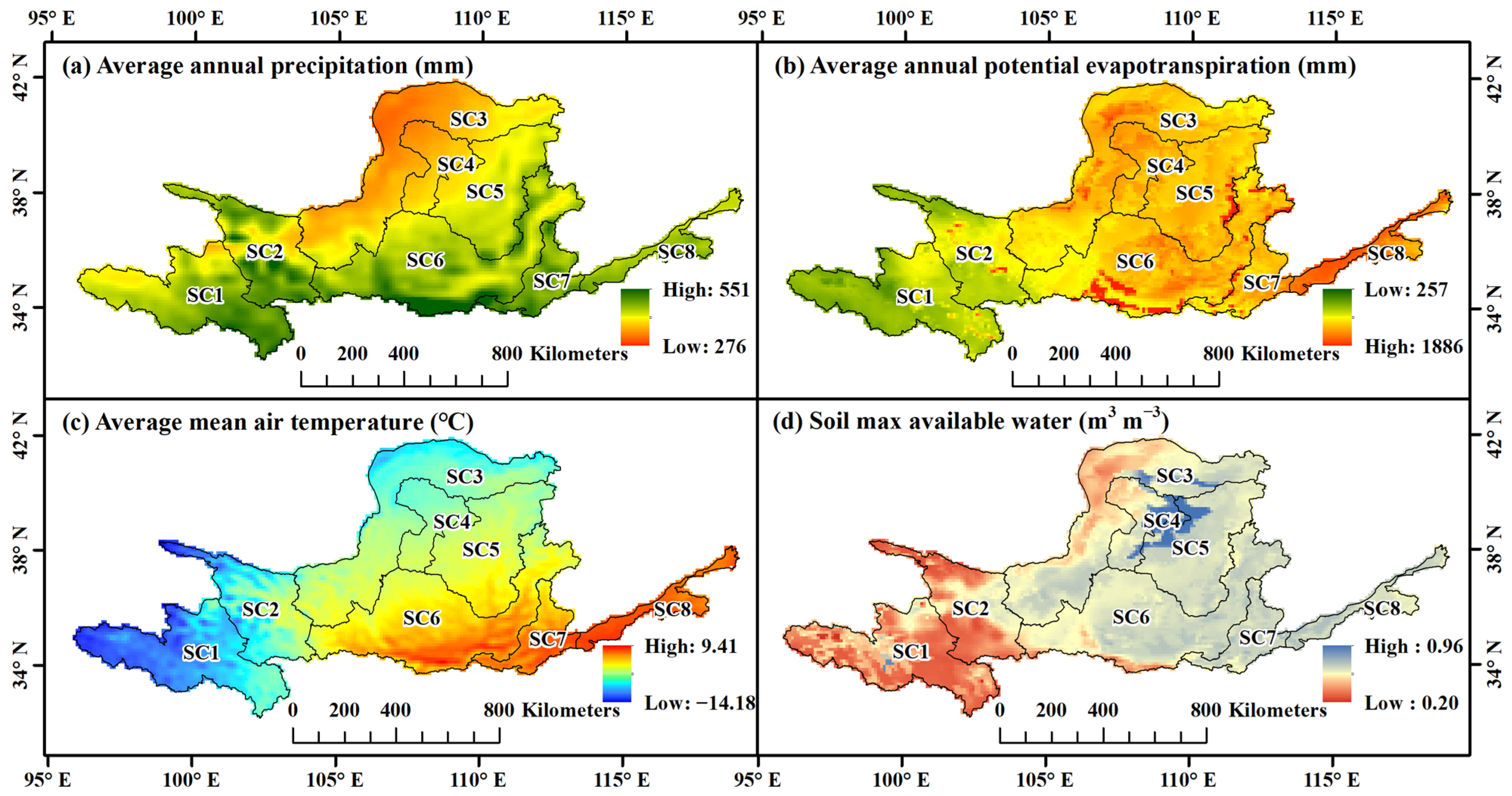
The study domain encompasses the Yellow River Basin (YRB; 32.12–41.92° N, 95.85–119.10° E), a climatically vulnerable, water-limited region of northern China that spans 7.96 × 10⁵ km2 (Figure 1). Topography exerts a pronounced east–west gradient: elevations descend from 6250 m a.s.l. on the north-eastern Tibetan Plateau to −20 m in the downstream alluvial plain, sculpting a complex mosaic of alpine permafrost, loess hills and semi-arid steppe. The basin is subject to a strongly continental regime (Figure 2): mean annual air temperature varies from −14.18°C on the Qinghai–Tibetan fringe to 9.41°C on the North-China Plain. Precipitation is highly seasonal and spatially skewed; ~70% of the 276–551 mm annual total is delivered between June and September, often as high-intensity convective events that generate large inter-annual coefficients of variation. Conversely, reference evapotranspiration systematically exceeds rainfall, yielding an aridity index of ≥3 over 60% of the basin. Relative humidity averages 45–60%, yet annual sunshine duration is abundant (2000–3300 h), ensuring substantial radiative forcing for ET and snow/glacier ablation in the headwaters. Hydrological and geomorphological discontinuities motivate a physiographic subdivision into eight sub-catchments (SC1–SC8) delimited by major gaging stations and water-diversion infrastructure: (SC1) upstream of Longyang Gorge; (SC2) Longyangxia–Lanzhou; (SC3) Lanzhou–Hekou; (SC4) the Inner River system; (SC5) Hekou–Longmen; (SC6) Longmen–Sanmenxia; (SC7) Sanmenxia–Huayuankou; and (SC8) downstream of Huayuankou.

2.2. Data

The observational basis of this analysis comprises 43 years (1982–2024) of harmonized satellite retrievals and state-of-the-art reanalysis. Land-cover/land-use and a 250 m digital elevation model (DEM) were extracted from the Resource and Environment Science and Data Center (RESDC; https://resdc.cn). Dynamic fields are drawn from two primary sources:
RA5-Land (Copernicus Climate Change Service, ECMWF). The hourly 0.1° × 0.1° reanalysis supplies seven eco-hydrological variables: total precipitation, actual evapotranspiration, volumetric soil-moisture (four layers integrated to 0–100 cm), 2 m air temperature, soil temperature (four layers integrated to 0–100 cm), 2 m dew-point temperature, and surface net solar radiation. The total precipitation is the accumulated liquid and frozen water, comprising rain and snow, which falls to the Earth’s surface. It is the sum of large-scale precipitation and convective precipitation. Large-scale precipitation is generated by the cloud scheme in the ECMWF Integrated Forecasting System (IFS). The actual evapotranspiration is the accumulated amount of water that has evaporated from the Earth’s surface, including a simplified representation of transpiration (from vegetation), into vapor in the air above. This variable is accumulated from the beginning of the forecast to the end of the forecast step of the ECMWF Integrated Forecasting System convention. The volumetric soil-moisture is the volume of water in the soil layer (0–100 cm) of the ECMWF Integrated Forecasting System. The 2 m air temperature is the temperature of air at 2m above the surface of land, sea, or in-land waters, which is calculated by interpolating between the lowest model level and the Earth’s surface, taking account of the atmospheric conditions. The soil temperature is the temperature of the soil in four layers integrated to 0–100 cm of the ECMWF Integrated Forecasting System, which is set at the middle of each layer, and heat transfer is calculated at the interfaces between them. It is assumed that there is no heat transfer out of the bottom of the lowest layer. The 2 m dew-point temperature is the temperature to which a given air parcel at 2 meters above the surface of the Earth must be cooled at constant pressure and constant water vapor content in order for saturation to occur. The surface net solar radiation is the amount of solar radiation (also known as shortwave radiation) reaching the surface of the Earth (both direct and diffuse) minus the amount reflected by the Earth’s surface (which is governed by the albedo). Radiation from the Sun (solar, or shortwave, radiation) is partly reflected back to space by clouds and particles in the atmosphere (aerosols), and some of it is absorbed. The rest is incident on the Earth’s surface, where some of it is reflected. The difference between downward and reflected solar radiation is the surface net solar radiation.
ERA5-Land data have been verified as having the ability to reproduce the spatial and temporal features of meteorological data and soil moisture [25,26]. After download, the native hourly fields were rigorously quality-controlled, aggregated to weekly, monthly and annual scales, and conservatively re-gridded to ensure mass and energy conservation.
Vapor-pressure deficit (VPD). The calculation of VPD is taken from References [27,28,29], and simplified as the following calculation steps:
es(T) = 0.6108 × exp((17.27 × T)/(T + 237.3))
e(Td) = 0.6108 × exp((17.27 × Td)/(Td + 237.3))
VPD = es(T) − e(Td)
where T is the 2 m air temperature (°C), Td is the 2 m dew-point temperature (°C), e(T) is the saturated water vapor pressure corresponding to temperature T (kPa), e(Td) is the saturated water vapor pressure corresponding to temperature Td (kPa), and VPD is the vapor-pressure deficit (kPa).
Vegetation Health Index (VHI). The NOAA STAR 4 km weekly VHI (1982–2024), derived from the AVHRR GIMMS LTDR record, was bilinearly resampled to the common 0.1° × 0.1° grid to eliminate scale-dependent artefacts while preserving the full phenological signal. The resulting spatiotemporal stack is temporally gap-free and spatially congruent with ERA5-Land, enabling robust, scale-consistent attribution of soil-moisture variability across the Yellow River Basin.

2.3. Spatiotemporal Variability of SM

To resolve the spatiotemporal anatomy of soil-moisture (SM) change across the Yellow River Basin, we first decompose the domain into three hydrological archetypes—“hot spots” (H), “cold spots” (C), and “transition spots” (T)—following the physiologically informed threshold proposed by Li et al. [13]. Grid cells whose complete 1982–2024 SM time series remain consistently > 0.31 m3 m−3 are classified as H, whereas those permanently < 0.31 m3 m−3 are labelled C; all remaining pixels—characterized by episodic crossings of the threshold—constitute T. This trichotomy isolates end-member moisture regimes and highlights loci susceptible to regime shifts. Second, each pixel is assigned one of four trend signatures (Table 1) by coupling a Modified Mann–Kendall (MMK) test—robust to serial correlation and distributional skew [30]—with the non-parametric Theil–Sen (TS) slope estimator [31,32]. The MMK null hypothesis (no monotonic trend) is evaluated at α = 0.05; pixels rejecting the null hypothesis with positive (negative) TS slopes are designated “significantly intensifying” (“significantly diminishing”), whereas failures to reject yield “insignificantly intensifying” or “insignificantly diminishing” categories. The resulting four-fold classification is spatially exhaustive and temporally scale-adaptive, furnishing a parsimonious yet process-rich template for diagnosing emergent SM trajectories and for prioritizing intervention hotspots under a warming, increasingly water-stressed, climate.

2.4. Dominant Driving Factors in SM

2.4.1. De-Seasoning Time Series Variables

To isolate long-term behavior from recurrent intra-annual fluctuations, every pixel-level series was rigorously de-seasoned prior to inference. We subsequently deployed the Bayesian Estimator of Abrupt change, Seasonality and Trend (BEAST) to simultaneously quantify seasonal cycles, gradual trends and regime shifts in the 43-year SM record. Unlike frequentist linear models that impose globally constant slopes, BEAST treats both the number and location of structural breaks as random variables, yielding a posterior distribution of changepoints that fully propagates model-selection uncertainty. Through Bayesian model averaging, it amalgamates evidence across competing piece-wise linear and harmonic formulations, thereby affording a flexible yet parsimonious portrayal of non-linear trajectories—a feature that has rendered BEAST the method of choice for satellite-derived environmental archives [33].
Formally, for a generic time series Y(t), BEAST assumes the additive decomposition:
Y(t) = T(t) + S(t) + ε(t)
where the T(t), S(t), and ε(t) are trend, seasonal, and residual signals at time t for the original time series Y, respectively. The residual component ε(t) represents variations in the Y(t) time series not explained by T(t) and S(t). In this study, BEAST was used to obtain de-seasoned components of both long-term SM and its dominant driving factors.

2.4.2. Dominate Driving-Factor Analysis

Attribution of the spatiotemporal variance in soil moisture (SM) proceeds by dissecting the individual and combined effect of its proximal drivers. Such mechanistic intelligence is prerequisite for benchmarking land-surface schemes, anticipating agricultural drought and designing climate-change adaptation pathways [15]. To this end, we employ a generalized additive model (GAM)—a semi-parametric extension of the linear framework that relaxes the functional-form assumption, while preserving interpretability [34]. By representing each predictor as a penalized cubic regression spline, the GAM simultaneously quantifies (i) the individual forcing strength of every covariate and (ii) their collective explanatory power, including implicit interaction captured through the joint smoother space.
Individual contribution is diagnosed with the mean-square ratio (F-value) of the penalized deviance attributable to a single term divided by its effective degrees of freedom; a comparatively large F-value signals a dominant marginal gradient in SM. The combined explanatory signal is summarized by the total deviance explained (DE), a direct analogue of R2 in additive contexts, which aggregates the variance captured by the full suite of smoothers and their tensor-product interactions. Calibration is performed on the detrended, de-seasoned and standardized 1982–2024 SM series and the correspondingly pre-processed driving variables, to ensure that only synoptic-to-interannual co-variations are evaluated. The fitted model is expressed as
g(SMi) = β0 + s(ETi) + s(Pi) + s(STi) + s(SSRi)+ s(VPDi) + s(VHIi) + ε
where g( ) is connection function, SMi is soil moisture (0–100 cm), ETi is actual evapotranspiration, Pi is precipitation, STi is soil temperature (0–100 cm), SSRi is the surface net solar radiation, VPDi is the vapor pressure deficit, VHIi is vegetation health index at grid i, s represents a smooth function, ε is the residual error, and β0 stands for the overall average response. The air temperature is initially excluded from the driver analysis, due to its strong collinearity with soil temperature [35,36].

3. Results

3.1. Spatiotemporal Variability in SM

3.1.1. Temporal Variability of SM

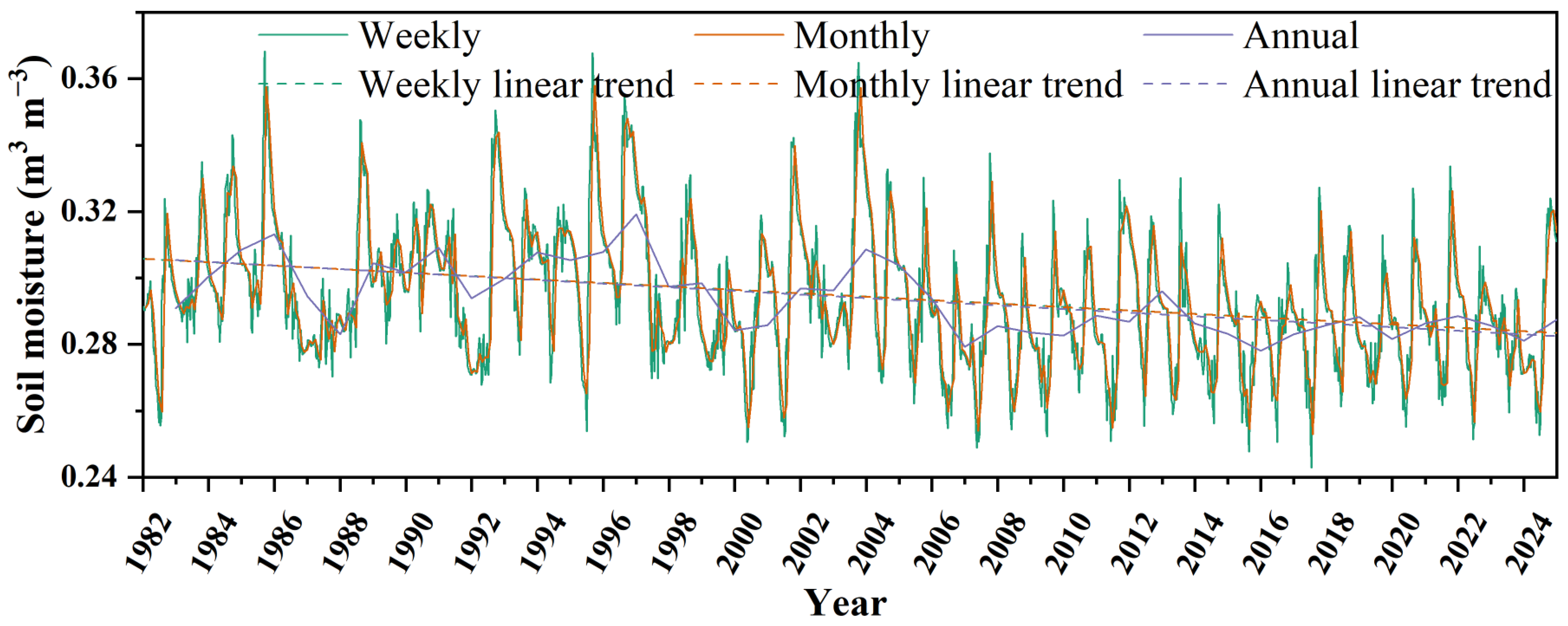
Figure 3 presents a multi-scale temporal synthesis of basin-mean SM spanning 1982–2024, resolved at weekly, monthly, and annual aggregations. Across all scales, a coherent and statistically significant (p < 0.01) downward trend is observed, indicating a sustained decline in SM over the 43-year period, albeit modulated by scale-specific dynamics. On the annual scale, SM exhibits the smoothest temporal trend, fluctuating within a narrow range of 0.28–0.32 m3 m−3. Notably, a regime shift occurs around 2006: prior to this year, interannual variability is marked by a high amplitude of ~0.04 m3 m−3, which subsequently diminishes to ~0.01 m3 m−3. This dampening coincides with an intensification of regional warming and anthropogenic water extraction between 2002 and 2006, which collectively contributed to a significant reduction in SM storage [37]. Monthly SM data reveal a more structured seasonal signal, with values ranging from 0.25 to 0.36 m3 m−3. Elevated SM levels typically persist from August to December, while lower values dominate the rest of the year. Despite the seasonal regularity, considerable interannual variability is evident, underscoring the sensitivity of SM to seasonal climate anomalies and land-surface feedback. Weekly SM series display the highest temporal variability, with frequent oscillations between 0.24 and 0.37 m3 m−3. These rapid fluctuations are most pronounced from March to August, reflecting the responsiveness of near-surface moisture to short-term meteorological perturbations, including extreme rainfall events, heatwaves, and soil evaporation pulses. This high-frequency variability aligns with findings by Le and Bae [38], who demonstrated that large-scale climate modes such as ENSO exert a detectable influence on SM dynamics across multiple continents, including parts of Asia, thereby reinforcing the role of teleconnections in modulating sub-seasonal SM behavior.
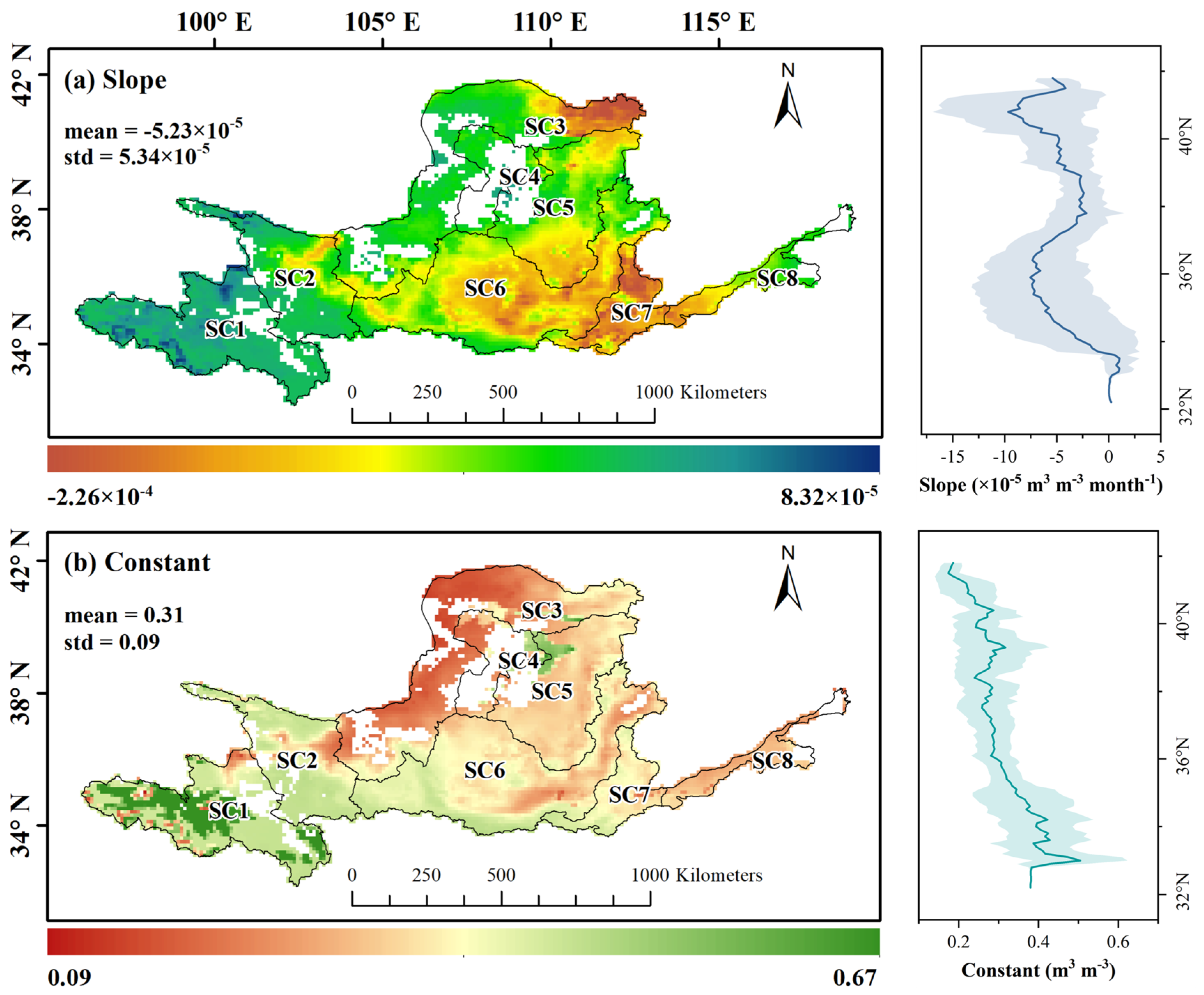
Building on the multi-scale temporal evidence presented above, we next interrogate the spatial signature of SM change by decomposing each pixel-level series into its structural trend, seasonal cycle, and noise components, using the BEAST. Figure 4a maps the slope field, expressed in m3 m−3 month−1, across the YRB. Significant (p < 0.05) gradients span −2.26 × 10⁻⁴ to 8.32 × 10⁻⁵ m3 m−3 month−1. Positive slopes—concentrated in the SC1 and the north-western tract of the SC5—imply a net moisture accrual of up to 0.11 m3 m−3 over the study period. These moistening enclaves coincide with elevations > 3000 m a.s.l., where rising precipitation totals and suppressed evaporative demand (attributable to lower air temperatures and limited anthropogenic activities) converge to replenish root-zone storage. Conversely, other regions of the basin exhibit negative slopes, with the most pronounced drying (>−1.00 × 10⁻⁵ m3 m−3 month−1) localized along the Loess Plateau (SC3–SC6) and the intensively irrigated lower plain (SC8). Here, a triad of forcing mechanisms—anthropogenic water diversion, land-cover conversion, and an increasingly absolute value of (P-ET) driven by regional warming—synergistically erode SM reserves [5]. Figure 4b displays the corresponding intercept (trend-removed baseline), which ranges from 0.09 to 0.67 m3 m−3. Elevated constants (>0.45 m3 m−3) are spatially coherent with positive-slope clusters, reinforcing the interpretation that orographically enhanced precipitation and a low human footprint sustain persistently wetter states. In contrast, baseline values < 0.20 m3 m−3 dominate the middle reaches, where coarse loess soils, steep topography, and high evaporative demand collectively limit water retention. The juxtaposition of steep negative trends against already low baselines underscores the emergence of moisture-stressed “hot spots” that are disproportionately vulnerable to future hydro-climatic extremes. Such pronounced spatial heterogeneity emphasizes the fact that basin-wide averages mask divergent trajectories; consequently, effective adaptation strategies must be tailored to sub-catchment-specific risk profiles shaped by the interplay of elevation, soil texture, land-use history, and anthropogenic pressure [39].

3.1.2. Spatial Pattern of SM

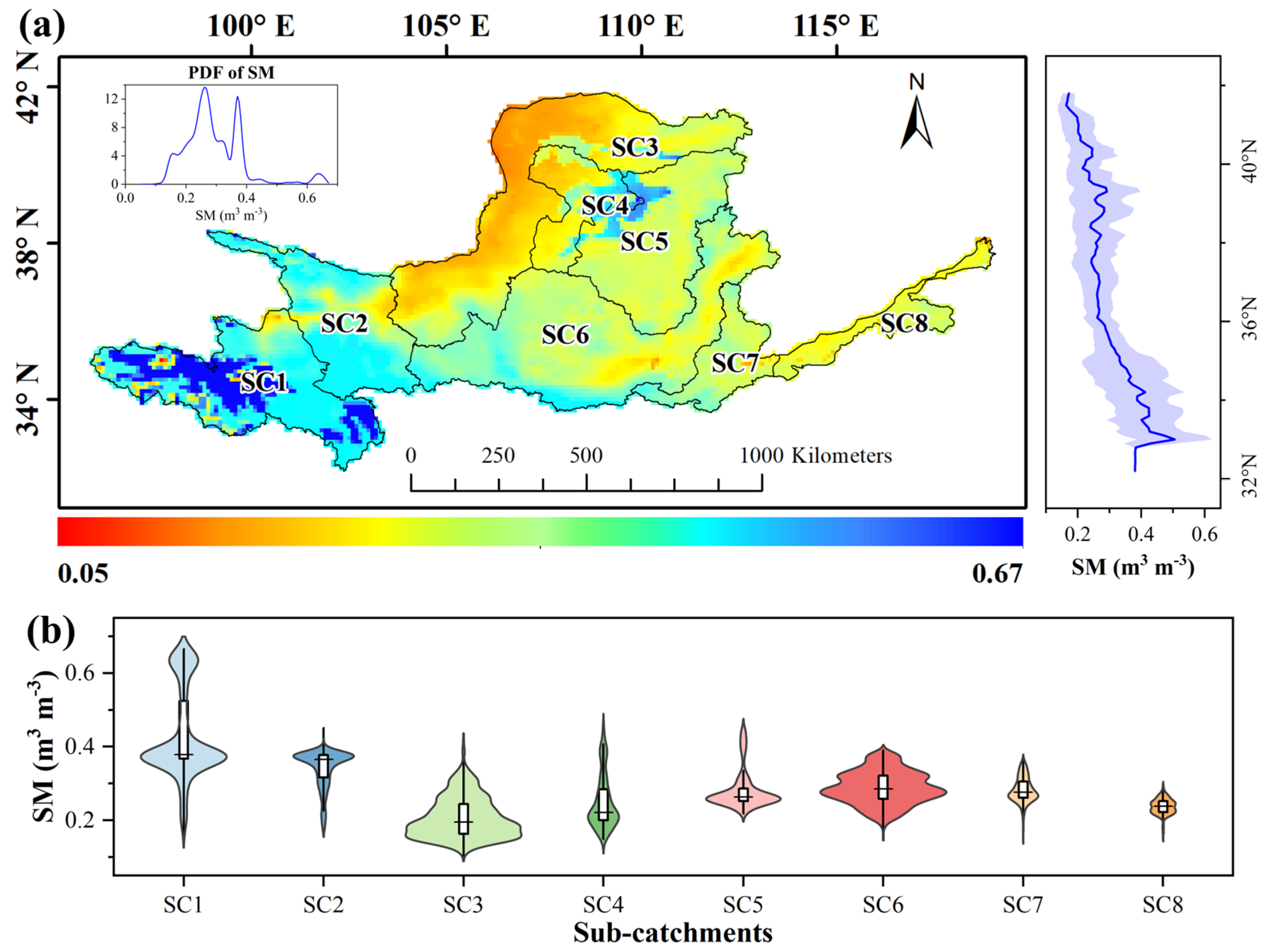
Figure 5a synthesizes the 43-year (1982–2024) mean annual soil-moisture (SM) climatology across the Yellow River Basin. The chromatic map (blue → red) reveals a pronounced spatial antiphase: mesic conditions (>0.35 m3 m−3) prevail in alpine grasslands and forested headwaters, whereas intensively cultivated tracts—central SC3, eastern SC6, eastern SC7 and the entire lower-plain SC8—register the lowest volumetric water contents (<0.22 m3 m−3). The line graph on the right depicts the variation of SM with latitude. It is evident that SM is higher near the high-latitude areas and increasing with the increasing latitude. The above distribution of SM along the latitude can be largely attributed to the distribution of land surface temperature (LST) caused by land use and land cover changes. Changes in land cover, such as deforestation or agricultural expansion, modify surface albedo and vegetation cover, leading to spatially uneven LST patterns [40,41]. The small plot inserted in the upper left corner is a probability density function plot, which illustrates the distributional characteristics of SM content. The shape of the curve suggests that, for 43 years, SM across most of the study area is concentrated within a specific range, exhibiting distinct peaks that indicate a higher frequency of occurrence within that range. Additionally, the annual mean SM is 0.29 m3 m−3, with a standard deviation of 0.10 m3 m−3. This statistical summary further implies that, despite significant regional differences in SM, the overall inter-annual variability remains within a certain range, reflecting the general fluctuations in regional SM.
Complementing the latitudinal perspective of Figure 5a, Figure 5b disaggregates the 43-year SM climatology from the eight physiographic sub-catchments (SC1–SC8) through kernel-density violin plots. Overall, the soil moisture in the sub-catchments from upstream to downstream shows a trend of first decreasing, then increasing, and finally decreasing again. In the sub-catchment SC1, the widest kernel (0.05–0.67 m3 m−3) testifies to pronounced orographic rainfall heterogeneity and sporadic permafrost thaw, engendering the largest ensemble variance (σ = 0.12 m3 m−3) basin-wide. Conversely, a narrower (0.17–0.57 m3 m−3) signal dampened variability where channel incision deepens, concentrating runoff within confined valleys in the sub-catchment SC2. In the sub-catchment SC3, the density contracts further (0.09–0.46 m3 m−3) as the river traverses the hyper-arid Hexi Corridor, accentuating the rain-shadow effect of the Qilian mountains. Despite endorheic isolation, SM spans 0.15–0.53 m3 m−3, sustained by local convective pulses and irrigation return flows in the sub-catchment SC4. In the sub-catchment SC5, SM values are concentrated between 0.22 and 0.49 m3 m−3, caused by the irrigated alluvial fans and erodible loess hillslopes. Progressive sedimentation narrows the kernel (0.14–0.39 m3 m−3) while amplifying positive skewness, indicative of episodic silt-loam saturation events in the sub-catchment SC6. In the sub-catchment SC7, intensified agricultural abstraction compresses SM to 0.15–0.36 m3 m−3. In the sub-catchment SC8, the most leptokurtic profile (0.15–0.30 m3 m−3) reveals a hydrologically “tethered” system. Collectively, the violin plot demonstrates that SM variability is not merely a climatic imprint, but a convolution of elevation, sedimentology, land-use intensification, and hydraulic infrastructure. These sub-catchment-specific density profiles therefore furnish a statistically rigorous baseline for isolating anthropogenic divergence from natural eco-hydrological gradients across the Yellow River Basin.

3.1.3. Long-Term Trend Patterns of SM

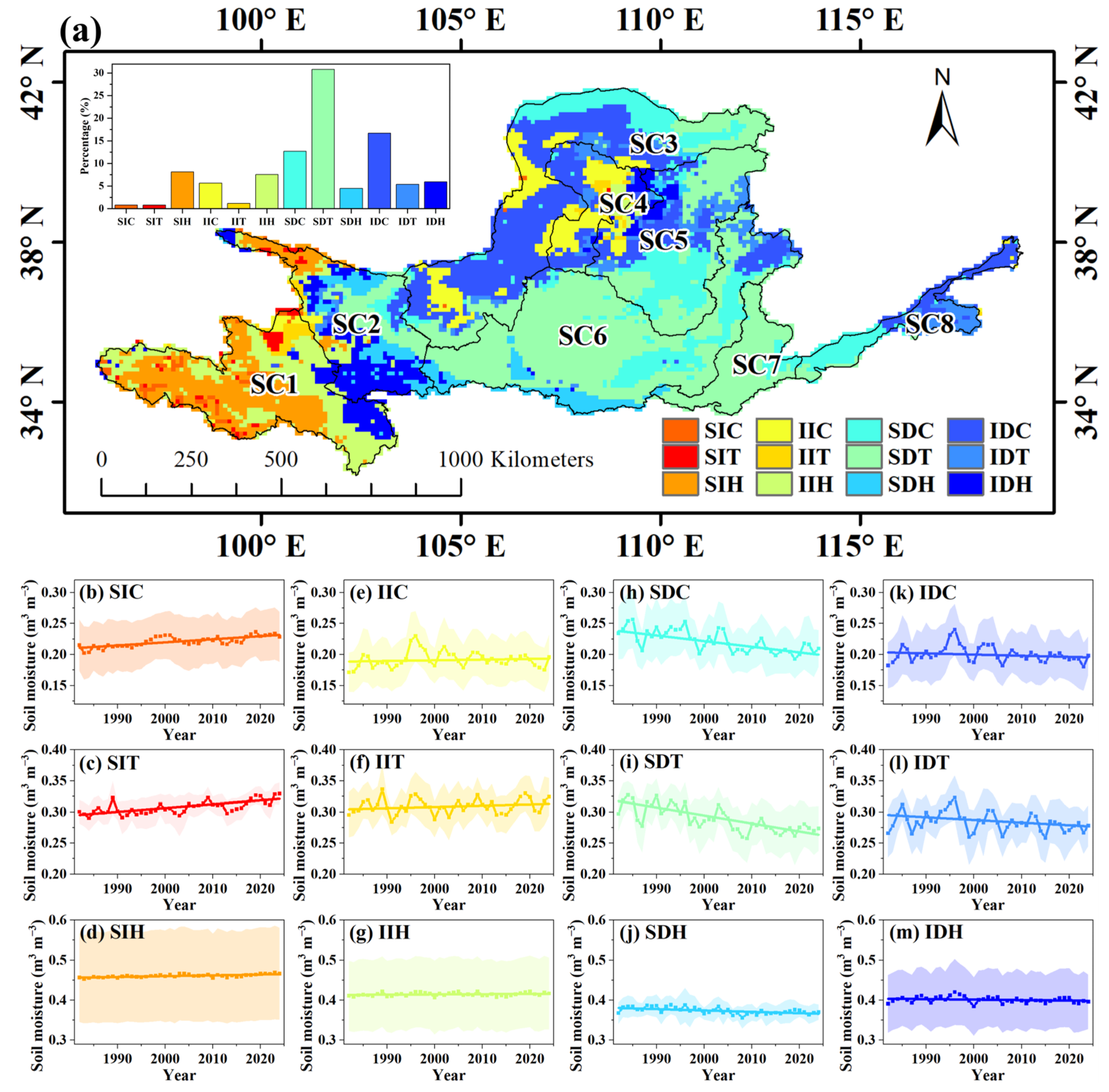
Figure 6a distils the 43-year (1982–2024) trajectory of soil moisture (SM) into a coherent typology of change regimes, by intersecting the significance and direction of the Theil–Sen slope with the climatological wetness class (threshold = 0.31 m3 m−3). The basin is partitioned into twelve mutually exclusive archetypes that capture both the statistical confidence and the hydro-climatic context of each 0.1° pixel (Table 1). Figure 6b–m translate the categorical mosaic of Figure 6a into twelve quantitative trajectories, and, collectively, they corroborate the earlier qualitative segmentation and expose the velocity at which different moisture regimes are drifting.
For the wetting regions specifically, the SIC regions are restricted to the alpine permafrost zone of western SC1 and north-western SC2, where positive slopes (0.006 m3 m−3 decade−1) coincide with mean SM < 0.31 m3 m−3 (“cold spots”), and where the SM increases significantly from approximately 0.20 to 0.23 m3 m−3 (Figure 6b). The SIT regions are scattered pockets within SC1 and north-west SC2 exhibiting large inter-annual SM variance despite upward trajectories, where the SM increased significantly from 0.29 to 0.33 m3 m−3 (Figure 6c)—an early warning that these areas may soon cross into the SIH class. The SIH regions are localized on the forested highlands north of SC1 and central SC2, and slopes exceed 0.004 m3 m−3 decade−1 atop an already wet matrix (>0.31 m3 m−3, “hot spots”), where the SM increased significantly from 0.45 to 0.47 m3 m−3 (Figure 6d). The IIC, IIT, and IIH regions are fragmented across south-western SC3, central SC4 and eastern SC1, and slopes are positive but fail the 95% confidence criterion, implying stochastic rather than forced moistening. The SM of the IIC, IIT, and IIH regions is increased insignificantly from 0.17 to 0.23 m3 m−3 (“cold spots”, Figure 6e), 0.28 to 0.34 m3 m−3 (“transition spots”, Figure 6f), and 0.41 to 0.42 m3 m−3 (“hot spots”, Figure 6g), respectively, with IIT having a trend of crossing into the IIH class.
For the drying regions, the SDC regions encircle the intensively cultivated lowlands of northern SC3, southern SC5, eastern SC6/SC7, and western SC8, and slopes < −0.002 m3 m−3 decade−1 superimposed on SM < 0.31 m3 m−3 designate acute drought-prone hotspots (Figure 6h). The SDT regions are located in central SC2, south-western and north-eastern SC3, northern and southern SC5, central and western SC6, and SC7, where SM has significantly decreased, with a large changing range from 0.33 to 0.26 m3 m−3 (Figure 6i). The SDH regions are restricted to south-eastern SC2 and southern SC6, where high antecedent SM (>0.31 m3 m−3) amplifies the absolute water loss, and where the SM decreased significantly from 0.39 to 0.36 m3 m−3 (Figure 6j). The IDC regions are located in middle and north of SC3, northwest and south of SC4, the middle of SC5, northeast of SC6, and east of SC8, where SM has insignificantly decreased with an overall low SM (<0.31 m3 m−3), and where the SM decreased insignificantly from 0.24 to 0.18 m3 m−3 (Figure 6k). The IDT regions are scattered over the north of SC3, north of SC4, east of SC5, northeast of SC6, and the middle of SC8, where SM has insignificantly decreased from 0.32 to 0.26 m3 m−3 (Figure 6l), with a high risk of becoming drier for agriculture. The IDH regions are located southeast of SC1, south of SC2, northeast of SC4, and east of SC5, where SM has insignificantly decreased from 0.42 to 0.38 m3 m−3 (Figure 6m).
Taken together, the twelve canonical curves reveal a basin in hydrological transition: wetting accelerates in the sparsely populated upper basin, while drying intensifies across the anthropogenically pressured middle and lower reaches. Most critically, the SIT → SIH and SDT → SDC trajectories imply that the amount of transitional land is approaching tipping points where small perturbations could lock ecosystems into persistently wetter or drier states—an insight that directly informs prioritization for climate-adaptation investment.

3.2. Driving Factors of SM Dynamics

3.2.1. Individual Effect of SM Spatiotemporal Variability

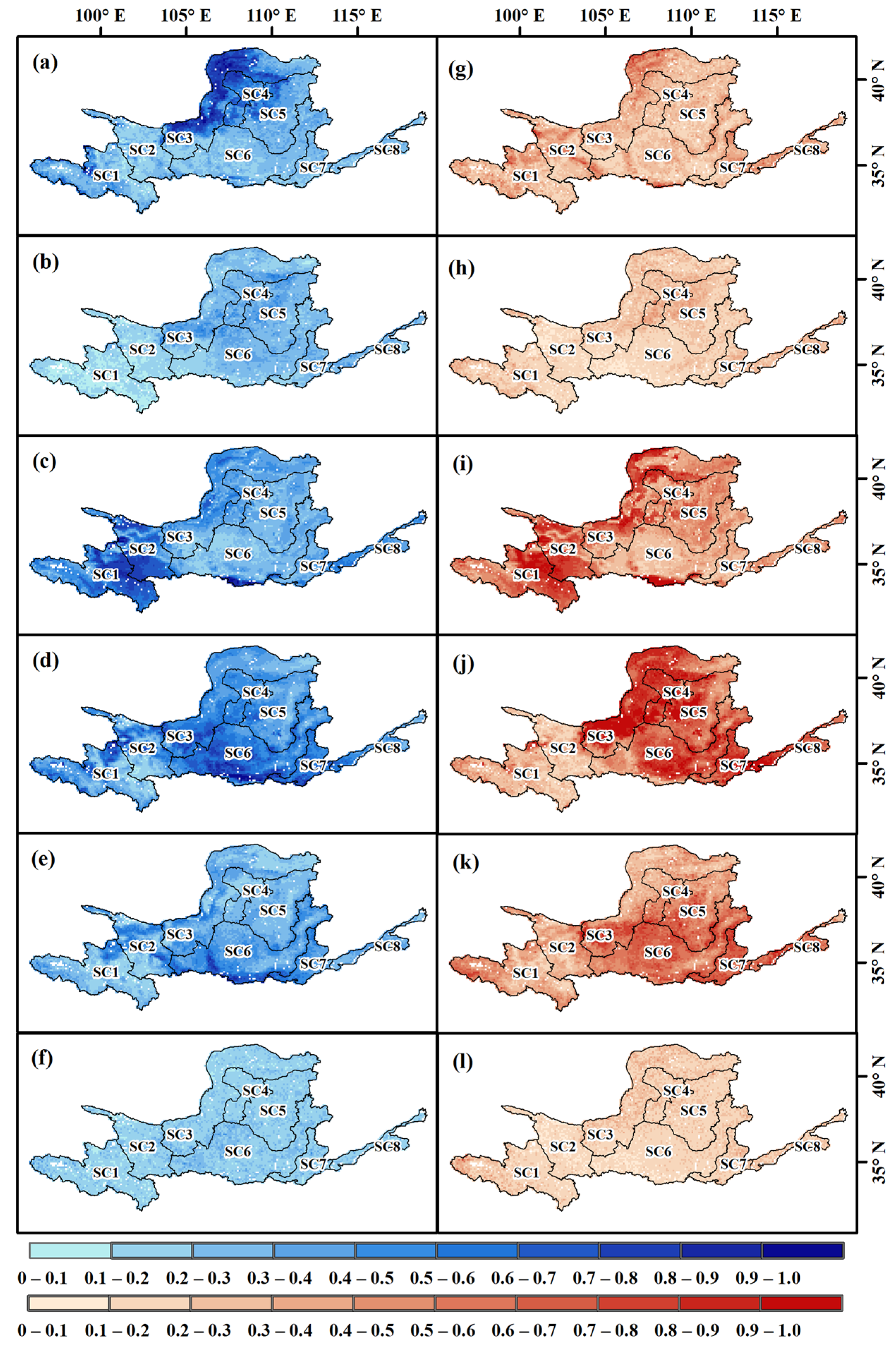
Individual effect on a weekly scale is depicted in Figure 7a–f, while individual effect on a monthly scale is shown in Figure 7g–l. On the weekly scale, SSR, ST, ET, and VPD show the highest contributions to SM in the YRB. SSR (Figure 7d) emerges as the primary source of SM spatiotemporal variability, with pronounced dominance in the central and southern catchments (SC5-SC7). ET (Figure 7a) ranks second in the north-western loess corridor (SC3, SC4, north-western SC5), reflecting the tight coupling between moisture supply and atmospheric water demand (potential ET) in semi-arid croplands. ST (Figure 7c) dominates SC1, where alpine permafrost modulates hydraulic diffusivity and freeze–thaw cycles regulate liquid water availability. VPD (Figure 7e) exhibits localized control along the southern fringe of SC6, accentuating the role of advective dryness during pre-monsoon periods. Aggregation to monthly resolution preserves the primacy of SSR (Figure 7j), but narrows the spatial footprint of ET, underscoring the smoothing of high-frequency evapotranspiration pulses. ST (Figure 7i) retains dominance in SC1–SC3, while VPD (Figure 7k) extends its influence south-west into SC3, western SC5, and the lower basin (SC6–SC8), aligning with the seasonal expansion of semi-permanent high-pressure systems that intensify atmospheric demand. Irrespective of temporal scale, SSR, ST, and VPD constitute the first-order controls on SM spatiotemporal variability within the Yellow River Basin. ET remains influential on the weekly scale—particularly in moisture-limited agricultural zones—but its individual explanatory power diminishes as temporal aggregation dampens synoptic fluctuations. These findings corroborate the hypothesis that radiative forcing and thermal regimes govern both short-term responsiveness and long-term persistence of SM, providing a mechanistic foundation for downscaling climate-change impacts onto regional water-resource systems.
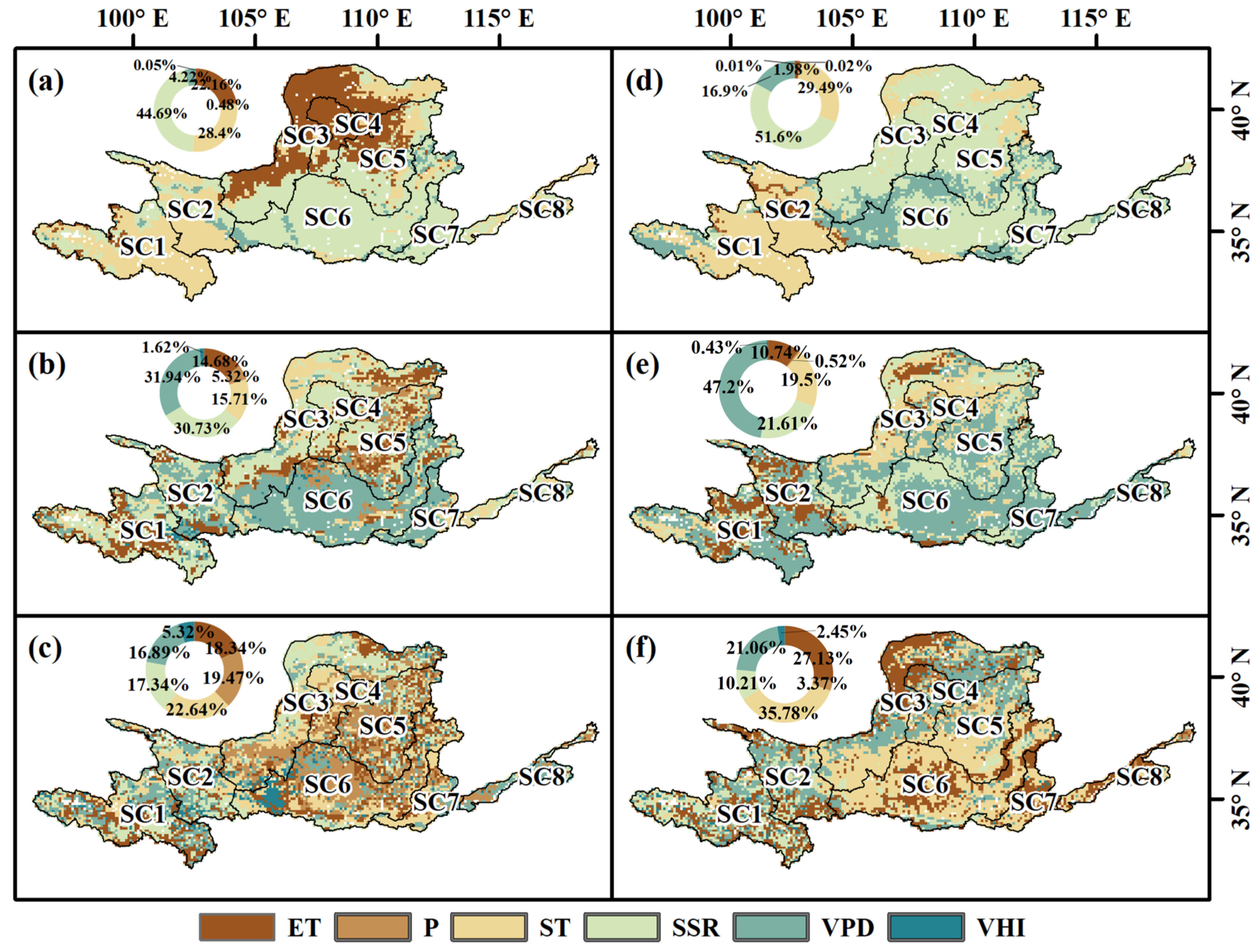
Figure 8 shows the spatial distribution of the first to third dominant driving factors that individually have the greatest impact on the spatiotemporal variability of SM. on both weekly and monthly scales, SSR occupies the largest fractional area as the dominant (rank-1) control, confirming its primacy in governing soil-moisture variance. ST consistently emerges as the second most influential driver, while ET and VPD alternate as the third-ranking factor, with ET prevailing on a weekly scale (22.16% of basin area) and VPD at monthly resolution (16.90%). On a weekly scale, SSR accounts for 44.69% of the domain, centered on the south-western SC3, the southern SC5, and SC6 and SC7. ST accounts for 28.40%, primarily across SC1, SC2, north-eastern SC3, eastern SC5 and SC8. ET explains the remaining 22.16%, localized in north-western SC3, SC4 and SC5. On the monthly scale, SSR expands its dominance to 51.60%, extending continuously through SC3–SC8. ST retains 29.48%, concentrated in SC1, SC2, northern SC3, eastern SC5 and southern SC6. VPD occupies 16.90%, fragmented across western SC1, southern SC5, western SC6 and south-western SC7. The contraction of ET and the concomitant expansion of VPD and SSR between weekly and monthly aggregations exemplify the scale-dependency of hydrometeorological controls: rapid ET fluctuations average out at longer time steps, whereas slower atmospheric-demand signals (VPD) and energy-supply constraints (SSR) become increasingly diagnostic.
From the perspective of the second-highest contributing factor, whether on a weekly scale or a monthly scale, the area occupied by VPD is the largest, followed by SSR, and ST occupies the third-largest area. In addition, the impact area of ET on both weekly and monthly scales cannot be ignored, as it accounts for 14.67% and 10.74%, respectively, although it is relatively dispersed. At the same time, the spatial distribution of the three largest contributing factors also shows significant regional differences. On a weekly scale, the area proportion of VPD is 31.94%, mainly concentrated in the south-western SC2, SC3, and most of SC6 and SC7. The area proportion of SSR is 30.73%, mainly concentrated in the western SC1, SC2, SC3, SC4, SC5, and the central SC8. The area proportion of ST is 15.71%, mainly concentrated in the north-western SC3, the eastern SC7, and the south-western SC8. On the monthly scale, the area proportion of VPD is 47.20%, mainly concentrated in the southern SC1, SC2, the south-western SC3, the central SC5, the central and eastern SC6, SC7, and SC8. The area proportion of SSR is 21.61%, mainly concentrated in the south-western and northern SC3, the southern and eastern SC5, the western SC6, and the south-western SC7. The area proportion of ST is 19.50%, mainly concentrated in the western SC1, the central and northern SC3, SC4, and the central and northern SC5.
For the third-highest contributing factor, the factors that have the largest impact area on the weekly and monthly scales are both ST, but the proportion area differences of other factors are quite large, and the changes between different scales vary greatly, with strong dispersion. These observations highlight the complex interplay of various factors influencing the spatiotemporal variability of soil moisture over different temporal scales. Generalized additive modeling identifies surface net solar radiation, soil temperature, and vapor pressure deficit as dominant drivers across temporal scales, while the top three dominant factors’ average distribution proportions are 29.4%, 25.3%, and 23.0%, respectively, with evapotranspiration exerting additional weekly influence in the central basin.

3.2.2. Combined Effect

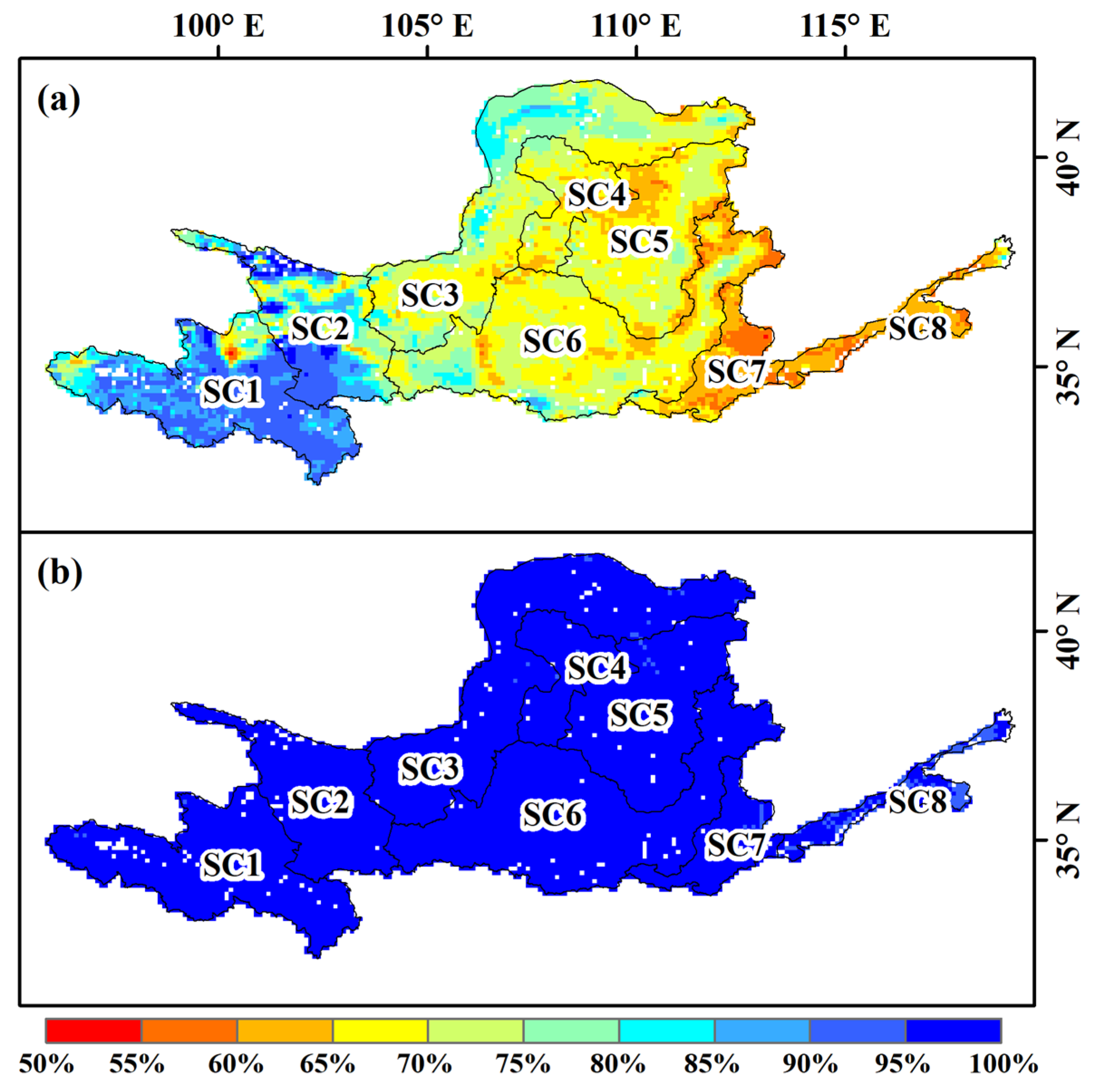
Based on obtaining the individual effect of each dominant driving factor on the spatiotemporal variability of SM, we further analyze the combined effect of six factors. The combined effect of the dominant driving factors that drive long-term spatiotemporal variability in the soil moisture across the two temporal scales is illustrated in Figure 9. On a weekly scale (Figure 9a), DE exhibits a pronounced spatial gradient, ranging from 50% to 95%. The lowest values (55–65%) cluster along the north-western SC5, the south-eastern SC6 and the entire lower plain (SC7–SC8), regions where high-frequency irrigation pulses and groundwater abstractions introduce stochastic variability not encoded in the reanalysis forcings. Intermediate explanatory power (65–75%) characterizes the central Loess Plateau (SC2 and south-western SC3, north-eastern SC4, and SC5–SC6), where loess thickness and soil-texture heterogeneity act as unobserved confounders. Superior performance (75–85%) is attained in the north-west SC3 and south-west SC6, while the highest DE (85–95%) is confined to SC1 and the north-western SC2, where they are topographically controlled by energy and water balances.
On a monthly scale (Figure 9b), temporal aggregation elevates DE basin-wide, and >95% of SM variance is now explained across most pixels. This enhancement is attributable to the smoothing of sub-monthly noise (e.g., irrigation scheduling, convective rainfall), allowing the seasonal covariation of SSR, ST, VPD and P to dominate the signal. The scale-dependent discrepancy aligns with climatic and topographic logic. In high-latitude, or high-altitude zones, low-frequency temperature cycles govern SM seasonality, rendering the six-factor model virtually complete at monthly resolution, similar to the results of Li et al. [42]. Conversely, low-elevation, or mid-latitude regions experience vigorous, high-frequency coupling among P, ET, VPD and SSR; on a weekly scale, these rapid exchanges inject unexplained variance, whereas monthly averaging collapses the fluctuations into the predictive space of the covariates [43]. Thus, the observed DE patterns not only benchmark model fidelity, but also delineate domains where additional process representation—groundwater dynamics, irrigation timing, or soil-profile heterogeneity—must be incorporated to sustain predictive skill at finer temporal resolutions.

4. Discussion

4.1. Soil Moisture Spatiotemporal Variability

Our analysis reveals distinct SM variability in the YRB during 1982–2024, characterized by high-frequency synoptic fluctuations, pronounced seasonality, and a significant inter-annual decline (Figure 3). Regional warming of 0.34 °C decade−1—exceeding 0.45 °C decade−1 in the headwaters [44]—reorganizes atmospheric circulation, amplifying precipitation variability and thus SM anomalies. Hydraulic infrastructure (e.g., Longyang and Sanmen Gorges) and land-cover conversions under the “Three-North Shelterbelt Forest Program” modulate runoff generation and evapotranspiration, propagating anthropogenic signatures into inter-annual SM trends [45]. Monsoonal concentration of 60–70% of annual rainfall between June and September, coupled with winter suppression of evaporation under the Mongolian High, induces strong intra-annual SM cycles [46]. Warming-induced vegetation greening in the upper basin has raised summer evapotranspiration by 5.5 mm decade−1, intensifying seasonal SM draw-down, while more extreme precipitation events over the middle reaches amplify the amplitude of dry–wet alternations [47].
Furthermore, the spatial mosaic of SM trends diverges markedly from that of the intercept (Figure 4). The constant term encodes the baseline volumetric water content at t = 0, set by quasi-static filters—mean climate, soil texture and fractional vegetation cover. Caragana plantations in the middle reaches of the Yellow River Basin, for instance, elevate root-zone SM above bare-land values through enhanced infiltration and reduced evaporation [47]. Conversely, the slope term quantifies the rate of temporal change; it is sculpted by transient forcings. Irregular precipitation inputs create unequal recharge trajectories, while engineering interventions (terracing and water–sediment regulation) redistribute local runoff and sediment fluxes, thereby modulating SM evolution [48]. Textural contrasts across the Loess Plateau—sandy soils that drain rapidly versus clay-rich profiles that retain water—impose divergent monthly response times on identical climate perturbations, amplifying the spatial heterogeneity of trends [49].

4.2. The Mechanism of the Impact of Dominant Factors on Soil Moisture

Observational and modeling evidence converge on the fact that anthropogenic warming intensifies the hydrological cycle by elevating atmospheric water demand and accelerating terrestrial water loss, thereby amplifying regional aridity [50]. In the Yellow River Basin, rising temperatures prolong the growing-season vapor-pressure deficit, particularly during summer, enhancing evaporative draw-down of soil moisture [51]. Simultaneously, weak but significant declines in precipitation and increases in soil temperature elevate actual evapotranspiration, shifting the basin-wide aridity index toward drier conditions [52]. These synergistic forcings accelerate actual soil-water consumption and hasten the onset of SM drought. Vegetation modulates this climate signal. Canopy interception, root uptake, and litter-mediated mulching jointly retard evaporative loss and sustain root-zone storage [53]. Enhanced greening, evidenced by increasing leaf-area index, therefore partially offsets warming-induced desiccation by improving soil-water retention and promoting evaporation recycling [54]. Consequently, the net SM trend reflects a balance between intensified atmospheric demand and vegetation-mediated conservation, underscoring the need to couple eco-hydrological feedback with drought-projection frameworks. Surface net solar radiation (SSR), the principal component of the surface energy balance, governs SM dynamics in the YRB by modulating soil heat flux (G) and evapotranspiration [55]. Positive daytime net radiation supplies the latent energy required for soil evaporation and canopy transpiration, accelerating root-zone water depletion.

4.3. Impact of the Catchment Attributes on Spatiotemporal Variability of Soil Moisture

While climate controls the first-order forcing of soil-moisture (SM) variability, catchment attributes modulate the spatiotemporal variability of soil moisture seasonally and vertically, consistent with global evidence that terrain–soil interactions are conditioned by antecedent hydrological states [56,57]. Land-cover type governs the partitioning of precipitation among interception, runoff and bare-soil evaporation, thereby imprinting distinct SM signatures [58,59]. Irrigated croplands exhibit elevated SM owing to high water-supply efficiency [60], whereas forests compensate for transpiration losses through dense canopy shading [55]. Shrublands, conversely, enhance water-use efficiency under prolonged drought; their shallow rooting systems sustain transpiration at the cost of progressive SM depletion [61]. Barren surfaces, constrained by minimal storage capacity, display the narrowest SM fluctuation range. Thus, vegetation-mediated partitioning amplifies or attenuates climate-driven SM dynamics, underscoring the necessity of land-cover-aware parameterizations in hydrological forecasting.
Soil texture—by dictating pore-size distribution and particle surface area—governs the fundamental hydraulic architecture of the vadose zone. A higher sand fraction (or, conversely, the lowest clay content) reduces field capacity and available water, thereby attenuating the soil’s capacity to retain moisture [62]. In sandy horizons, large inter-connected pores and coarse grains promote rapid drainage and minimal matric suction, yielding intrinsically low SM contents and subdued temporal variability; this explains the smaller Theil–Sen slopes observed in sand-dominated pixels relative to finer-textured soils [63]. Loamy matrices, with their balanced sand–silt–clay ratios and moderate organic-matter content, sustain both sufficient porosity for infiltration and adequate surface area for capillary retention, thus supporting steadier SM replenishment and buffering against climatic extremes [64]. Consequently, textural heterogeneity acts as a first-order filter that modulates climate-driven SM signals, reinforcing the need for soil-aware parametrizations in basin-scale hydrological models.
Elevation, a first-order topographic control, modulates soil-moisture (SM) storage and dynamics by restructuring the coupled energy–water balance. Low air temperatures at high altitudes suppress potential evapotranspiration, reducing latent heat flux and conserving root-zone water. Concurrently, orographic uplift enhances precipitation inputs, while seasonal snow- and glacier-melt provide additional, delayed water releases, collectively yielding a higher SM value than the lowland pixels [65,66]. Steeper terrain also promotes rapid runoff generation; however, the sustained melt-water pulse and lower evaporative demand ensure greater effective water retention, making alpine zones a dominant contributor to the observed global wetting signature [67]. Thus, elevation acts as a hydro-climatic amplifier that converts temperature deficits and orographic precipitation into persistent SM gains, reinforcing the need to resolve topographic gradients in basin-wide drought assessments.
While the present analysis integrates the principal eco-climatic drivers of soil-moisture (SM) variability (P, ET, VPD, SSR, ST, and VHI), it inevitably simplifies the full spectrum of controls operative on the catchment scale. Unresolved factors—including micro-topography, compound climatic extremes, anthropogenic interventions (irrigation, reservoir regulation, afforestation, and land retirement), root-zone dynamics, land-use heterogeneity, and surface litter—may exert non-linear, threshold-like modulation on SM trajectories. Future investigations should explicitly incorporate these processes through coupled ecohydrological-modeling frameworks and targeted field campaigns, to refine predictive skill and to guide the spatial optimization of monitoring networks across diverse physiographic settings.

4.4. Limitations and Future Directions

This study has several limitations that require further improvement in subsequent research. First, although numerous studies have confirmed the applicability of ERA5 datasets in China, localized validation in the Yellow River Basin remains insufficient. Due to the limited availability of shared field observation data, and considering that ERA5 data integrates multi-source satellite observations, this study did not conduct independent ground validation. Future research will integrate field-positioning observation data and multi-source remote sensing products to cross-validate the results, thereby enhancing the reliability and accuracy of the conclusions. Second, soil moisture exhibits significant response differences to underlying surface factors such as soil depth, texture, and vegetation coverage. The sensitivity of soil moisture to climatic and hydrological conditions varies across soil layers; soil texture indirectly affects moisture dynamics by regulating water-holding capacity; land use/cover change drives moisture evolution by altering evapotranspiration and infiltration processes. This study did not systematically quantify the differential impacts of these factors. Future research should construct a multi-factor coupling analysis framework to clarify the regulatory mechanism of underlying surface properties on soil moisture. Third, this study only qualitatively discussed the impact of human activities on soil moisture, without quantifying the specific contributions of anthropogenic interventions such as irrigation, land use transformation, and reservoir operation. Future research should integrate agricultural irrigation statistics, land-use transfer matrices, and reservoir operation records to build a quantitative assessment model of human activity impacts, and clarify their driving effects on the spatiotemporal pattern of soil moisture. Fourth, there are significant differences in water movement and consumption processes across soil layers, and crop root zone distribution characteristics (e.g., depth, density) further regulate the absorption intensity of soil water in different layers; root zone moisture decline poses direct risks to crop water availability, while surface layer variability may influence soil erosion and seedling establishment. This study did not conduct differentiated analysis on the soil layer scale. Future research should combine crop types and root zone characteristics to analyze the response mechanism of soil moisture in different layers, providing scientific support for precision agricultural management.
In addition, the coupling relationship between soil moisture and hydrological elements such as precipitation and evapotranspiration in the Yellow River Basin is of great guiding value for optimizing dryland agriculture. By analyzing the spatiotemporal pattern of soil moisture, we can adjust planting structures and sowing dates in a targeted manner, and select drought-tolerant crop varieties adapted to regional water conditions. In vegetation restoration areas, it is necessary to quantify the evapotranspiration water-consumption intensity of forest and grass vegetation, scientifically plan vegetation types and configuration densities, avoid excessive consumption of regional water resources by ecological construction, and achieve a coordinated balance between ecological protection and water security. Meanwhile, soil moisture dynamics can provide a key basis for basin water resource allocation, supporting the rational distribution of ecological water, production water, and domestic water. Its spatial pattern can also directly serve ecological restoration zoning and soil- and water-conservation functional zoning. For example, in water-scarce areas, low-water-consuming shrubs and grasses should be prioritized for ecological restoration instead of high-water-consuming arbor trees. Future research should strengthen the application and transformation of results, focus on practical needs such as agricultural management, water resource scheduling, and land use planning, and construct operable technical schemes and policy recommendations to enhance the decision-making support capability of research results.

5. Conclusions

This study delivers a comprehensive diagnosis of soil-moisture (SM) variability across the Yellow River Basin (YRB) for 1982–2024, using ERA5-Land reanalysis. The results reveal significant regional differences in SM trends, highlighting the complex response of SM to climate change across different YRB sub-catchments. Key findings are summarized below.
(1)
SM exhibits a statistically significant (p < 0.01) basin-wide decline on weekly, monthly, and annual scales. Annual means display the smoothest trajectory (0.28–0.32 m3 m−3) and monthly series capture pronounced seasonality (0.25–0.36 m3 m−3), while weekly data reveal high-frequency oscillations (0.24–0.37 m3 m−3). Grid-scale slopes range from −2.26 × 10⁻⁴ to 8.32 × 10⁻⁵ m3 m−3 month−1, and positive trends are restricted to SC1 and SC5, reflecting alpine moistening.
(2)
Non-farm landscapes show the highest SM values, whereas intensively cultivated zones (central SC3, eastern SC6/SC7, and SC8) register the lowest values. SM increases poleward, producing an upstream-to-downstream sequence of “decrease–increase–decrease” across sub-catchments. SC1 presents the broadest SM envelope (0.05–0.67 m3 m−3), while SC3 exhibits the narrowest (0.09–0.46 m3 m−3).
(3)
Decreasing signals dominate SC2, SC3, and SC5–SC8, whereas significant increases cluster in SC1, north-western SC2, south-west SC3, and SC4. “Hot spots” (SC1–SC2), “cold spots” (SC3–SC5, eastern SC6/SC7, and SC8) and “transition zones” (northern SC1, north-eastern SC2, north-eastern SC5, SC6, SC7, and central SC8) are spatially explicit, providing a ready framework for drought-risk zoning.
(4)
Surface net solar radiation (SSR) is the primary control on both weekly and monthly scales, followed by soil temperature (ST), as second-order drivers. Evapotranspiration (ET) and vapor-pressure deficit (VPD) alternate as third-order drivers, with ET dominant weekly (22.2% areal share) and VPD monthly (16.9%), underscoring a scale-dependent shift from supply- to demand-limited regimes.
Although the present work quantifies SM variability and its dominant forcings, future research must advance process-based response models that embed vegetation–soil–groundwater feedback to refine predictive skill under continuing climate change.

Author Contributions

L.L.: contributions to conceptualization, methodology, software, investigation, resources, data curation, writing—original draft preparation, writing—review and editing, visualization, and supervision; revising the text critically for important intellectual content; final approval of the version to be published; and agreement to be accountable for all aspects of the work, in ensuring that questions related to the accuracy or integrity of any part of the work are appropriately investigated and resolved. H.S.: contributions to conceptualization and writing—review and editing; revising the text critically for important intellectual content; final approval of the version to be published; and agreement to be accountable for all aspects of the work, in ensuring that questions related to the accuracy or integrity of any part of the work are appropriately investigated and resolved. Q.Y.: contributions to validation and writing—review and editing; revising the text critically for important intellectual content; final approval of the version to be published; and agreement to be accountable for all aspects of the work, in ensuring that questions related to the accuracy or integrity of any part of the work are appropriately investigated and resolved. X.Z.: contributions to validation and writing—review and editing; revising the text critically for important intellectual content; final approval of the version to be published; and agreement to be accountable for all aspects of the work, in ensuring that questions related to the accuracy or integrity of any part of the work are appropriately investigated and resolved. Q.P.: contributions to validation and writing—review and editing; revising the text critically for important intellectual content; final approval of the version to be published; and agreement to be accountable for all aspects of the work, in ensuring that questions related to the accuracy or integrity of any part of the work are appropriately investigated and resolved. X.W.: contributions to formal analysis and writing—review and editing; revising it critically for important intellectual content; final approval of the version to be published; and agreement to be accountable for all aspects of the work, in ensuring that questions related to the accuracy or integrity of any part of the work are appropriately investigated and resolved. All authors have read and agreed to the published version of the manuscript.

Funding

This research was funded by the Early-Career Youth Talent Development Program in Science and Technology, grant number 20252BEJ730290 (sponsor: Science and Technology Department of JiangXi Province), the PhD Research Initiation Project, grant number 2024kyqd014 and 2023kyqd005 (sponsor: Jiangxi University of Water Resources and Electric Power), and Science and Technology Projects of the Jiangxi Provincial Department of Water Resources, grant number 202526YBKT23, 202527ZDKT09, and 202526TGKT07 (sponsor: Science and Technology Department of JiangXi Province).

Data Availability Statement

The original contributions presented in this study are included in the article. Further inquiries can be directed to the corresponding author.

Acknowledgments

During the preparation of this manuscript, the authors used Baidu AI (https://chat.baidu.com/, accessed on 27 September 2025) for the purposes of polishing the paper when writing. We would like to express our sincere gratitude to Huanjie Cai for his invaluable guidance and insightful feedback throughout the development of this research. The authors have reviewed and edited the output and take full responsibility for the content of this publication.

Conflicts of Interest

The authors declare no conflicts of interest.

Abbreviations

The following abbreviations are used in this manuscript:
SMsoil moisture
YRBYellow River Basin
SSRsurface net solar radiation
STsoil temperature
VPDvapor pressure deficit
ETevapotranspiration
SSIStandardized Soil Moisture Index
Pprecipitation
SPACsoil–plant–atmosphere continuum
VHIVegetation Health Index
SC1upstream of Longyang Gorge sub-catchment
SC2Longyangxia–Lanzhou sub-catchment
SC3Lanzhou–Hekou sub-catchment
SC4Inner River system sub-catchment
SC5Hekou–Longmen sub-catchment
SC6Longmen–Sanmenxia sub-catchment
SC7Sanmenxia–Huayuankou sub-catchment
SC8downstream of Huayuankou sub-catchment
DEMdigital elevation model
RESDCResource and Environment Science and Data Center
Hhot spots
Ccold spots
Ttransition spots
MMKModified Mann–Kendall
TSnon-parametric Theil–Sen slope estimator
BEASTBayesian Estimator of Abrupt change, Seasonality and Trend
GAMgeneralized additive model
DEtotal deviance explained
SICSignificantly Intensifying Cold Spot
SITSignificantly Intensifying Transition Spot
SIHSignificantly Intensifying Hot Spot
IICInsignificantly Intensifying Cold Spot
IITInsignificantly Intensifying Transition Spot
IIHInsignificantly Intensifying Hot Spot
SDCSignificantly Diminishing Cold Spot
SDTSignificantly Diminishing Transition Spot
SDHSignificantly Diminishing Hot Spot
IDCInsignificantly Diminishing Cold Spot
IDTInsignificantly Diminishing Transition Spot
IDHInsignificantly Diminishing Hot Spot

References

  1. Fu, Z.; Ciais, P.; Wigneron, J.-P.; Gentine, P.; Feldman, A.F.; Makowski, D.; Viovy, N.; Kemanian, A.R.; Goll, D.S.; Stoy, P.C.; et al. Global Critical Soil Moisture Thresholds of Plant Water Stress. Nat. Commun. 2024, 15, 4826. [Google Scholar] [CrossRef]
  2. Lesinger, K.; Tian, D. Skillful Subseasonal Soil Moisture Drought Forecasts with Deep Learning-Dynamic Models. Nat. Commun. 2025, 16, 7461. [Google Scholar] [CrossRef]
  3. Humphrey, V.; Berg, A.; Ciais, P.; Gentine, P.; Jung, M.; Reichstein, M.; Seneviratne, S.I.; Frankenberg, C. Soil Moisture–Atmosphere Feedback Dominates Land Carbon Uptake Variability. Nature 2021, 592, 65–69. [Google Scholar] [CrossRef]
  4. Zhu, Y.; Guo, Y.; Qi, Y.; Shen, Y.; Guo, Y.; Shen, Y. Evaluating the Risk of Water-Energy-Food Nexus Security in the Yellow River Basin. South-to-North Water Transf. Water Sci. Technol. 2025, 23, 794–805. [Google Scholar]
  5. Li, L.; Peng, Q.; Xu, J.; Gu, X.; Cai, H. Widespread Enhancement and Slower Occurrence of Agricultural Drought Events in Drylands of the Yellow River Basin. J. Hydrol. Reg. Stud. 2024, 52, 101692. [Google Scholar] [CrossRef]
  6. Paul, S.; Feldman, A.F.; Karthikeyan, L. Global Scale Intercomparison of Critical Soil Moisture Estimation Pathways and Their Influence on Hydrological Regime Dynamics and Land-Atmosphere Interactions. Earth’s Future 2025, 13, e2025EF006194. [Google Scholar] [CrossRef]
  7. Romano, N.; Mazzitelli, C.; Nasta, P. Root-Zone Water-Storage Capacity and Uncertainty: An Intrinsic Factor Affecting Agroecosystem Resilience to Drought. Water Resour. Res. 2025, 61, e2024WR037719. [Google Scholar] [CrossRef]
  8. Buitink, J.; Swank, A.M.; van der Ploeg, M.; Smith, N.E.; Benninga, H.-J.F.; van der Bolt, F.; Carranza, C.D.U.; Koren, G.; van der Velde, R.; Teuling, A.J. Anatomy of the 2018 Agricultural Drought in the Netherlands Using in Situ Soil Moisture and Satellite Vegetation Indices. Hydrol. Earth Syst. Sci. 2020, 24, 6021–6031. [Google Scholar] [CrossRef]
  9. Nketia, K.A.; Asabere, S.B.; Ramcharan, A.; Herbold, S.; Erasmi, S.; Sauer, D. Spatio-Temporal Mapping of Soil Water Storage in a Semi-Arid Landscape of Northern Ghana—A Multi-Tasked Ensemble Machine-Learning Approach. Geoderma 2022, 410, 115691. [Google Scholar] [CrossRef]
  10. Zhang, W.; Luo, G.; Hamdi, R.; Ma, X.; Termonia, P.; De Maeyer, P. Drought Changes the Dominant Water Stress on the Grassland and Forest Production in the Northern Hemisphere. Agric. For. Meteorol. 2024, 345, 109831. [Google Scholar] [CrossRef]
  11. Almendra-Martín, L.; Martínez-Fernández, J.; Piles, M.; González-Zamora, Á.; Benito-Verdugo, P.; Gaona, J. Analysis of Soil Moisture Trends in Europe Using Rank-Based and Empirical Decomposition Approaches. Glob. Planet. Change 2022, 215, 103868. [Google Scholar] [CrossRef]
  12. Guo, W.; Huang, S.; Huang, Q.; She, D.; Shi, H.; Leng, G.; Li, J.; Cheng, L.; Gao, Y.; Peng, J. Precipitation and Vegetation Transpiration Variations Dominate the Dynamics of Agricultural Drought Characteristics in China. Sci. Total Environ. 2023, 898, 165480. [Google Scholar] [CrossRef]
  13. Li, Y.-X.; Leng, P.; Kasim, A.A.; Li, Z.-L. Spatiotemporal Variability and Dominant Driving Factors of Satellite Observed Global Soil Moisture from 2001 to 2020. J. Hydrol. 2025, 654, 132848. [Google Scholar] [CrossRef]
  14. Yang, N.; Yue, Y.; Yu, H.; Zhang, L.; Yin, J.; Gao, J.; Zhang, Y. Spatiotemporal Dependence of Heavy Precipitation on Soil Moisture Anomalies in the Yangtze River Basin, China. Sci. Total Environ. 2025, 997, 180227. [Google Scholar] [CrossRef] [PubMed]
  15. Singh, V.; Apurv, T. An Analytical Approach for Quantifying the Role of Vapor Pressure Deficit in Soil Moisture Depletion During Flash Droughts. Water Resour. Res. 2025, 61, e2024WR038995. [Google Scholar] [CrossRef]
  16. Hou, Y.; Zhang, M.; Wei, X.; Liu, S.; Li, Q.; Liu, W.; Cai, T.; Yu, E. A Comparison of Annual Streamflow Sensitivities to Vegetation Change and Climate Variability in Fourteen Large Watersheds along Climate Zones in China. CATENA 2024, 234, 107571. [Google Scholar] [CrossRef]
  17. Wang, Z.; Chen, W.; Piao, J.; Cai, Q.; Chen, S.; Xue, X.; Ma, T. Synergistic Effects of High Atmospheric and Soil Dryness on Record-Breaking Decreases in Vegetation Productivity over Southwest China in 2023. npj Clim. Atmos. Sci. 2025, 8, 6. [Google Scholar] [CrossRef]
  18. Park, J.-H.; Lee, S.-H.; Kim, Y.-S.; Park, J.-W.; Lee, J.-M.; Park, Y.-B.; Kim, E.-J.; You, Y.-H. Vegetation Cover Is a Crucial Key to the Success of Ecological Restoration in the Desertified Steppe of Inner Mongolia. Ecol. Indic. 2024, 165, 112241. [Google Scholar] [CrossRef]
  19. Xiao, L. Dense Vegetation as a Natural Buffer: Mitigating and Decelerating Drought Propagation. J. Environ. Manag. 2025, 389, 126027. [Google Scholar] [CrossRef]
  20. Liu, Y.; Li, Z.; Chen, Y.; Jin, L.; Li, F.; Wang, X.; Long, Y.; Liu, C.; Kayumba, P.M. Global Greening Drives Significant Soil Moisture Loss. Commun. Earth Environ. 2025, 6, 600. [Google Scholar] [CrossRef]
  21. Li, B.; Wang, R.; Chen, J.M. Responses of Phenology to Preseason Drought and Soil Temperature for Different Land Cover Types on the Mongolian Plateau. Sci. Total Environ. 2024, 926, 171895. [Google Scholar] [CrossRef] [PubMed]
  22. Liu, Y.; Liu, X.; Fu, Z.; Zhang, D.; Liu, L. Soil Temperature Dominates Forest Spring Phenology in China. Agric. For. Meteorol. 2024, 355, 110141. [Google Scholar] [CrossRef]
  23. Gu, Y.; Zhao, Y.; Guo, Z.; Meng, L.; Zhang, K.; Wang, J.; Lee, C.K.F.; Xie, J.; Wang, Y.; Yan, Z.; et al. The Underappreciated Importance of Solar Radiation in Constraining Spring Phenology of Temperate Ecosystems in the Northern and Eastern United States. Remote Sens. Environ. 2023, 294, 113617. [Google Scholar] [CrossRef]
  24. Wang, J.; Wen, X. Excess Radiation Exacerbates Drought Stress Impacts on Canopy Conductance along Aridity Gradients. Biogeosciences 2022, 19, 4197–4208. [Google Scholar] [CrossRef]
  25. Chen, N.C.; Li, R.H.; Zhang, X.; Yang, C.; Wang, X.P.; Zeng, L.L.; Tang, S.J.; Wang, W.; Li, D.R.; Niyogi, D. Drought Propagation in Northern China Plain: A Comparative Analysis of GLDAS and MERRA-2 Datasets. J. Hydrol. 2020, 588, 125026. [Google Scholar] [CrossRef]
  26. Liu, L.; Zhang, R.; Zuo, Z. Intercomparison of Spring Soil Moisture among Multiple Reanalysis Data Sets over Eastern China. J. Geophys. Res. Atmos. 2014, 119, 54–64. [Google Scholar] [CrossRef]
  27. Allen, R.G.; Pereira, L.S.; Raes, D.; Smith, M. FAO Irrigation and Drainage Paper No.56; FAO: Rome, Italy, 1998. [Google Scholar]
  28. Li, Z.; Feng, Q.; Liu, W.; Wang, T.; Gao, Y.; Wang, Y.; Cheng, A.; Li, J.; Liu, L. Spatial and Temporal Trend of Potential Evapotranspiration and Related Driving Forces in Southwestern China, during 1961–2009. Quat. Int. 2014, 336, 127–144. [Google Scholar] [CrossRef]
  29. Yuan, W.; Zheng, Y.; Piao, S.; Ciais, P.; Lombardozzi, D.; Wang, Y.; Ryu, Y.; Chen, G.; Dong, W.; Hu, Z.; et al. Increased Atmospheric Vapor Pressure Deficit Reduces Global Vegetation Growth. Sci. Adv. 2019, 5, eaax1396. [Google Scholar] [CrossRef] [PubMed]
  30. Hamed, K.H.; Ramachandra Rao, A. A Modified Mann-Kendall Trend Test for Autocorrelated Data. J. Hydrol. 1998, 204, 182–196. [Google Scholar] [CrossRef]
  31. Sen, P.K. Estimates of the Regression Coefficient Based on Kendall’s Tau. J. Am. Stat. Assoc. 1968, 63, 1379–1389. [Google Scholar] [CrossRef]
  32. Theil, H. A Rank-Invariant Method of Linear and Polynomial Regression Analysis. In Henri Theil’s Contributions to Economics and Econometrics; Raj, B., Koerts, J., Eds.; Advanced Studies in Theoretical and Applied Econometrics; Springer: Dordrecht, The Netherlands, 1950; Volume 23, pp. 345–381. [Google Scholar]
  33. Martínez, B.; García-Morales, V.; Manzanares, J.A.; Gilabert, M.A. The Nonlinear Embeddings Method for Long-Term Vegetation Dynamics. ISPRS J. Photogramm. Remote Sens. 2025, 226, 364–380. [Google Scholar] [CrossRef]
  34. Aguilos, M.; Sun, G.; Liu, N.; Zhang, Y.; Starr, G.; Oishi, A.C.; O’Halloran, T.L.; Forsythe, J.; Wang, J.; Zhu, M.; et al. Energy Availability and Leaf Area Dominate Control of Ecosystem Evapotranspiration in the Southeastern U.S. Agric. For. Meteorol. 2024, 349, 109960. [Google Scholar] [CrossRef]
  35. Chen, C.; Zhou, G. Characteristics of Air Temperature and Ground Temperature in Alxa Left Banner from 1961 to 2010. J. Nat. Resour. 2014, 29, 91. [Google Scholar] [CrossRef]
  36. Hao, M.; Feng, J.; Feng, Z.; Jiang, G.; Sang, A.; Wu, S.; Hua, W.; Wang, Y. Analysis of the Characteristics and Correlation of Changes in Ground Temperature, Air Temperature and Precipitation in Chifeng City, Inner Mongolia from 1961 to 2020. J. Inn. Mong. Univ. (Nat. Sci. Ed.) 2022, 53, 194–202. [Google Scholar]
  37. Li, L. Spatio-Temporal Evolution and Propagation Process of Agricultural Drought in the Yellow River Basin; Northwest A&F University: Yangling, China, 2024. [Google Scholar]
  38. Le, T.; Bae, D. Causal Impacts of El Niño–Southern Oscillation on Global Soil Moisture Over the Period 2015–2100. Earth’s Future 2022, 10, e2021EF002522. [Google Scholar] [CrossRef]
  39. Chrysanthopoulos, E.; Kallioras, A. Temporal and Geographic Extrapolation of Soil Moisture Using Machine Learning Algorithms. CATENA 2025, 257, 109156. [Google Scholar] [CrossRef]
  40. Xu, D.; Wang, M.; Zhang, Q.; Wu, S.; Zhang, L. Spatiotemporal Characteristics and Meteorological Driving Factors of Flash Droughts in the Yellow River Basin, China. Ecol. Indic. 2025, 177, 113745. [Google Scholar] [CrossRef]
  41. Zhang, S.; Li, J.; Zhang, T.; Feng, P.; Liu, W. Response of Vegetation to SPI and Driving Factors in Chinese Mainland. Agric. Water Manag. 2024, 291, 108625. [Google Scholar] [CrossRef]
  42. Li, D.; Ouyang, W.; Wang, L.; Chen, J.; Zhang, H.; Sharkhuu, A.; Tseren-Ochir, S.-E.; Yang, Y. Revisiting Snowmelt Dynamics and Its Impact on Soil Moisture and Vegetation in Mid-High Latitude Watershed over Four Decades. Agric. For. Meteorol. 2025, 362, 110353. [Google Scholar] [CrossRef]
  43. Mondal, S.; Mishra, A. Quantifying the Precipitation, Evapotranspiration, and Soil Moisture Network’s Interaction Over Global Land Surface Hydrological Cycle. Water Resour. Res. 2024, 60, e2023WR034861. [Google Scholar] [CrossRef]
  44. Xu, J.; Zou, L.; Xia, J.; Zhang, Y.; Wang, F.; Chen, X. Investigating the Effects of Climate and Vegetation Changes on Spatiotemporal Variation of Baseflow in the Yellow River Basin. J. Hydrol. 2025, 651, 132517. [Google Scholar] [CrossRef]
  45. Du, M.; Huang, S.; Singh, V.P.; Leng, G.; Huang, Q.; Li, Y. Quantifying the Effects of Direct Human Activities and Climate Change on the Spatial Propagation of Hydrological Drought in the Yellow River Basin, China. J. Hydrol. 2024, 643, 131931. [Google Scholar] [CrossRef]
  46. Wang, J.; Cui, C.; Jia, Z.; Liu, M.; Pang, S.; Zhai, K. Analysis of the Responses of Surface Water Resources to Climate Change in Arid and Semi-Arid Area. Agric. Water Manag. 2024, 295, 108751. [Google Scholar] [CrossRef]
  47. Zhao, G.; Tian, P.; Mu, X.; Jiao, J.; Wang, F.; Gao, P. Quantifying the Impact of Climate Variability and Human Activities on Streamflow in the Middle Reaches of the Yellow River Basin, China. J. Hydrol. 2014, 519, 387–398. [Google Scholar] [CrossRef]
  48. Lin, S. Patterns, Drivers and Implications of the Hysteresis Loop Relationship between Soil Moisture and Vegetation at the Intra-Annual Scale in China. Agric. For. Meteorol. 2025, 372, 110714. [Google Scholar] [CrossRef]
  49. Li, L.; Peng, Q.; Wang, M.; Cao, Y.; Gu, X.; Cai, H. Quantitative Analysis of Vegetation Drought Propagation Process and Uncertainty in the Yellow River Basin. Agric. Water Manag. 2024, 295, 108775. [Google Scholar] [CrossRef]
  50. Rezvani, R.; RahimiMovaghar, M.; Na, W.; Najafi, M.R. Accelerated Lagged Compound Floods and Droughts in Northwest North America under 1.5 °C–4 °C Global Warming Levels. J. Hydrol. 2023, 624, 129906. [Google Scholar] [CrossRef]
  51. Fan, D.; Liu, Y.; Yao, Y.; Cai, L.; Wang, S. Changes in the Relationship between Vapour Pressure Deficit and Water Use Efficiency with the Drought Recovery Time: A Case Study of the Yellow River Basin. J. Environ. Manag. 2023, 326, 116756. [Google Scholar] [CrossRef]
  52. Gebrechorkos, S.H.; Sheffield, J.; Vicente-Serrano, S.M.; Funk, C.; Miralles, D.G.; Peng, J.; Dyer, E.; Talib, J.; Beck, H.E.; Singer, M.B.; et al. Warming Accelerates Global Drought Severity. Nature 2025, 642, 628–635. [Google Scholar] [CrossRef]
  53. Gao, S.; Lü, Y.; Jiang, X. Increased Precipitation and Vegetation Cover Synergistically Enhanced the Availability and Effectiveness of Water Resources in a Dryland Region. J. Hydrol. 2025, 654, 132812. [Google Scholar] [CrossRef]
  54. Hao, Y.; Yuan, X.; Zhang, M. Enhanced Relationship between Seasonal Soil Moisture Droughts and Vegetation under Climate Change over China. Agric. For. Meteorol. 2024, 358, 110258. [Google Scholar] [CrossRef]
  55. Li, X.; Yu, K.; Xu, G.; Li, P.; Li, Z.; Jia, L. Spatiotemporal Evolution of Vegetation Phenology and Its Response to Environmental Factors in the Upper and Middle Reaches of the Yellow River Basin. J. Environ. Manag. 2025, 380, 124970. [Google Scholar] [CrossRef]
  56. Han, X.; Liu, J.; Srivastava, P.; Liu, H.; Li, X.; Shen, X.; Tan, H. The Dominant Control of Relief on Soil Water Content Distribution During Wet-Dry Transitions in Headwaters. Water Resour. Res. 2021, 57, e2021WR029587. [Google Scholar] [CrossRef]
  57. Liu, H.; Hui, S.; Zhao, Y.; Jiang, Y.; Qi, Y.; Boyer, E.W.; Mello, C.R.; Guo, L.; Li, H. Spatiotemporal Variability of Soil Moisture and Its Influencing Factors in a Forested Catchment with Complex Terrain. CATENA 2025, 256, 109079. [Google Scholar] [CrossRef]
  58. Wang, Y.; Jiang, Y.; Zhao, Y.; Li, X.; Xie, K.; Yan, T.; Wei, T.; Li, P.; Li, H. Modeling the Impact of Long-Term Land Use Changes on Deep Soil Hydrological Processes in the Loess Plateau, China. J. Hydrol. 2024, 643, 131944. [Google Scholar] [CrossRef]
  59. Zhang, G.; Chen, X.; Zhou, Y.; Zhao, H.; Jin, Y.; Luo, Y.; Chen, S.; Wu, X.; Pan, Z.; An, P. Land Use/Cover Changes and Subsequent Water Budget Imbalance Exacerbate Soil Aridification in the Farming-Pastoral Ecotone of Northern China. J. Hydrol. 2023, 624, 129939. [Google Scholar] [CrossRef]
  60. Bhogapurapu, N.; Dey, S.; Mandal, D.; Bhattacharya, A.; Karthikeyan, L.; McNairn, H.; Rao, Y.S. Soil Moisture Retrieval over Croplands Using Dual-Pol L-Band GRD SAR Data. Remote Sens. Environ. 2022, 271, 112900. [Google Scholar] [CrossRef]
  61. Tangjialeke, W.; Zou, J.; Ding, J.; Yahefujiang, H.; Huang, S.; Li, J. Analysis of Drought Response Thresholds and Drought-Causing Factors of Central Asian Vegetation. Ecol. Indic. 2024, 169, 112926. [Google Scholar] [CrossRef]
  62. Min, X.; Li, D.; Shangguan, Y.; Tian, S.; Shi, Z. Characterizing the Accuracy of Satellite-Based Products to Detect Soil Moisture at the Global Scale. Geoderma 2023, 432, 116388. [Google Scholar] [CrossRef]
  63. Wankmüller, F.J.P.; Delval, L.; Lehmann, P.; Baur, M.J.; Cecere, A.; Wolf, S.; Or, D.; Javaux, M.; Carminati, A. Global Influence of Soil Texture on Ecosystem Water Limitation. Nature 2024, 635, 631–638. [Google Scholar] [CrossRef]
  64. Zhu, X.; Wang, L.; Shi, L.; Wu, L.; Liang, B.; Liu, H. Ecological Drought Is Globally Driven by Soil Characteristics Rather than Climate Aridity. J. Hydrol. 2025, 653, 132799. [Google Scholar] [CrossRef]
  65. Yang, F.; Duan, X.; Guo, Q.; Lu, S.; Hsu, K. The Spatiotemporal Variations and Propagation of Droughts in Plateau Mountains of China. Sci. Total Environ. 2022, 805, 150257. [Google Scholar] [CrossRef] [PubMed]
  66. Chen, M.; Lin, Z.; Peng, S.; Zhang, R.; Zhu, J.; Pan, X.; Jiao, Y. Altitudinal Differentiation of Agricultural Drought Mechanisms in Mountains: From Climate-Vegetation Coupling to Human Co-Dominance. Ecol. Indic. 2025, 179, 114174. [Google Scholar] [CrossRef]
  67. Hwang, T.; Band, L.E.; Oishi, A.C.; Kang, H. Greenup Variability Impact on Seasonal Streamflow and Soil Moisture Dynamics in Humid, Temperate Forests. Water Resour. Res. 2023, 59, e2022WR034125. [Google Scholar] [CrossRef]
Figure 1. (a) Location and catchments of the Yellow River Basin, which is divided into eight sub-catchments: (SC1) upstream of Longyang Gorge; (SC2) Longyangxia–Lanzhou; (SC3) Lanzhou–Hekou; (SC4) the Inner River system; (SC5) Hekou–Longmen; (SC6) Longmen–Sanmenxia; (SC7) Sanmenxia–Huayuankou; and (SC8) downstream of Huayuankou. (b) Land use and large irrigated area of the Yellow River Basin.
Agronomy 16 00791 g001
Figure 2. Average annual precipitation (a), average annual potential evapotranspiration (b), average mean air temperature (c), and soil max available water (d) in the Yellow River Basin, all calculated from the 1982–2024 ERA5-Land dataset to ensure temporal consistency with our soil moisture analysis.
Agronomy 16 00791 g002
Figure 3. Basin-averaged soil-moisture variations (1982–2024) resolved at weekly, monthly and annual temporal scales, illustrating scale-dependent variability and the long-term trend across the Yellow River Basin.
Agronomy 16 00791 g003
Figure 4. Spatial patterns of (a) significant (p < 0.05) Theil–Sen slope and (b) intercept (t = 0) for monthly soil-moisture trends (1982–2024) in the Yellow River Basin. Right-hand panels display meridional transects, revealing latitudinal gradients in trend intensity and baseline storage.
Agronomy 16 00791 g004
Figure 5. (a) Spatial pattern of climatological annual mean soil moisture (1982–2024) and its probability density (upper-left inset) and meridional profile (right). (b) Violin plots of multi-year mean soil moisture by sub-catchment, illustrating intra-basin distributional contrasts across the Yellow River Basin.
Agronomy 16 00791 g005
Figure 6. (a) Categorical map of inter-annual soil-moisture trend (1982–2024) with areal fractions (upper-left inset). (bm) Plots of SM variations for each archetype: SIC/SIT/SIH—significantly intensifying cold/transition/hot spots; IIC/IIT/IIH—insignificantly intensifying equivalents; SDC/SDT/SDH—significantly diminishing cold/transition/hot spots; IDC/IDT/IDH—insignificantly diminishing equivalents.
Agronomy 16 00791 g006
Figure 7. Individual contribution of dominant eco-hydrological drivers to soil-moisture variability: (af) weekly and (gl) monthly individual effects of actual evapotranspiration (ET), precipitation (P), soil temperature (ST), surface net solar radiation (SSR), vapor-pressure deficit (VPD) and vegetation health index (VHI), respectively.
Agronomy 16 00791 g007
Figure 8. Spatial distribution of dominant drivers of soil-moisture variability: (ac) weekly and (df) monthly maps showing first-, second- and third-order controls, respectively.
Agronomy 16 00791 g008
Figure 9. Spatial distribution of the combined effect of dominant driving factors on the spatiotemporal variability of soil moisture on weekly (a) and monthly (b) scales across the Yellow River Basin.
Agronomy 16 00791 g009
Table 1. Definition of the different spatiotemporal trend patterns.
Spatiotemporal Trend PatternDefinition
Significantly Intensifying Cold Spot (SIC)areas with low values (p < 0.05) and increasing trend over 43 years
Significantly Intensifying Transition Spot (SIT)areas with transition values (p < 0.05) and increasing trend over 43 years
Significantly Intensifying Hot Spot (SIH)areas with high values (p < 0.05) and increasing trend over 43 years
Insignificantly Intensifying Cold Spot (IIC)areas with low values and insignificantly increasing trend over 43 years
Insignificantly Intensifying Transition Spot (IIT)areas with transition values and insignificantly increasing trend over 43 years
Insignificantly Intensifying Hot Spot (IIH)areas with high values and insignificantly increasing trend over 43 years
Significantly Diminishing Cold Spot (SDC)areas with low values (p < 0.05) and decreasing trend over 43 years
Significantly Diminishing Transition Spot (SDT)areas with transition values (p < 0.05) and decreasing trend over 43 years
Significantly Diminishing Hot Spot (SDH)areas with high values (p < 0.05) decreasing trend over 43 years
Insignificantly Diminishing Cold Spot (IDC)areas with low values and insignificantly decreasing trend over 43 years
Insignificantly Diminishing Transition Spot (IDT)areas with transition values and insignificantly decreasing trend over 43 years
Insignificantly Diminishing Hot Spot (IDH)areas with high values and insignificantly decreasing trend over 43 years
Disclaimer/Publisher’s Note: The statements, opinions and data contained in all publications are solely those of the individual author(s) and contributor(s) and not of MDPI and/or the editor(s). MDPI and/or the editor(s) disclaim responsibility for any injury to people or property resulting from any ideas, methods, instructions or products referred to in the content.