Article

Crop Diversification Enhances Peanut Productivity Through Soil Fertility Improvement and Key Taxa Enrichment in Red Soil

1
College of Land Resource and Environment, Jiangxi Agricultural University, Nanchang 330045, China
2
State Key Laboratory of Soil and Sustainable Agriculture, Institute of Soil Science, Chinese Academy of Sciences, Nanjing 210008, China
3
College of Resources and Environment, University of Chinese Academy of Sciences, Beijing 100049, China
4
Jiangxi Institute of Red Soil and Germplasm Resources, Nanchang 330046, China
5
State Key Laboratory of Efficient Utilization of Arable Land in China, Institute of Agricultural Resources and Regional Planning, Chinese Academy of Agricultural Sciences, Beijing 100081, China
*
Authors to whom correspondence should be addressed.
Agronomy 2026, 16(8), 783; https://doi.org/10.3390/agronomy16080783
Submission received: 11 March 2026 / Revised: 6 April 2026 / Accepted: 9 April 2026 / Published: 10 April 2026
(This article belongs to the Section Soil and Plant Nutrition)

Abstract

Continuous monocropping and inappropriate fertilization have contributed to nutrient depletion and soil degradation, limiting peanut productivity in subtropical red soil agroecosystems. Although diversified cropping may help alleviate these constraints, the reasons why it improves peanut productivity remain unclear. In this study, we conducted a long-term field experiment in Jiangxi, China, to compare four cropping systems, assess soil nutrients, peanut productivity, and bacterial communities, and further evaluate the role of key taxa through inoculation assays and structural equation modeling. Results showed that diversified cropping improved peanut growth and yield, with the green manure integrated system performing best overall. Diversified cropping also increased soil organic carbon, total nitrogen, and available phosphorus, while reshaping bacterial communities. Several taxa, including Bradyrhizobium, Mycobacterium, Dormibacter, and Ardenticatena, were positively associated with soil nutrients. Inoculation assays further showed that a synthetic consortium assembled from representative strains affiliated with key taxa produced stronger effects on plant growth than a single-strain inoculation. Structural equation modeling identified key taxa as the factor most strongly associated with crop productivity. These findings suggest that higher peanut productivity under diversified cropping was closely associated with concurrent improvements in soil fertility and the enrichment of key taxa.

1. Introduction

Red soils are widely distributed across subtropical China, representing a major soil type that underpins regional agricultural production [1]. These soils are strongly acidic and deficient in essential nutrients, including nitrogen (N), phosphorus (P), and organic matter, thereby constraining crop growth and productivity [2,3]. Continuous monocropping and fertilizer overuse further aggravate nutrient imbalance and biological degradation, weakening the resilience of red soil agroecosystems [4]. Diversified cropping systems, including intercropping, rotation, and green manuring, are recognized as effective strategies to enhance soil fertility and ecosystem stability by improving resource complementarity and nutrient cycling [5]. For example, maize–legume intercropping increases nutrient use efficiency through complementary root distributions and rhizosphere interactions [6], whereas rotations involving green manures or oilseed crops elevate soil organic carbon and phosphorus availability via enhanced root exudation and microbial activity [7]. In red soil regions, diversified management, particularly systems integrating legumes and green manures has been shown to improve soil nutrient balance and microbial diversity, suggesting that diversification can partially sustain crop productivity [8]. Understanding the biological mechanisms that drive nutrient activation and productivity enhancement under diversified systems is essential for clarifying how cropping diversification sustains soil fertility and crop productivity in highly weathered red soils.
Soil microorganisms regulate nutrient availability and sustain crop productivity through organic matter decomposition, nutrient mobilization, and diverse metabolic processes [9,10]. Within these complex communities, key microbial taxa play vital roles in maintaining ecosystem stability [11,12]. They stabilize microbial networks and mediate plant–soil nutrient feedbacks. Representative taxa such as Bradyrhizobium, Streptomyces, Burkholderia, and Sphingomonas occupy central ecological niches by fixing nitrogen, decomposing organic matter, solubilizing phosphorus, and producing metabolites that promote plant growth and stress tolerance [13,14]. Legume-associated rhizodeposition further provides labile carbon and nitrogen that stimulate microbial nitrogen fixation and nutrient turnover under diversified cropping [15]. In diversified systems, greater plant diversity and varied root exudates stimulate these taxa by creating heterogeneous nutrient niches and microhabitats [16]. Plant-derived signals, such as ethylene and other exudates, can further reshape rhizosphere microbial assembly in response to neighboring plants [17]. Higher plant diversity strengthens microbial networks and soil multifunctionality by promoting keystone taxa that regulate nutrient transformation and ecosystem resilience [18]. These microorganisms serve as connectors linking plant diversity with soil nutrient activation, improving nutrient use efficiency and long-term soil stability. Understanding their ecological functions is crucial to explain how diversified cropping regulates soil nutrient dynamics and enhances crop productivity in nutrient-poor red soils.
Aboveground plant diversity profoundly influences belowground microbial diversity and soil ecological processes. Numerous studies have shown that variations in plant species composition and richness can reshape microbial communities by modifying root exudation patterns, litter inputs, and nutrient demands [19,20]. Increased plant diversity consistently enhances microbial richness and ecosystem multifunctionality, thereby improving system stability and resilience [21,22]. Likewise, the composition and activity of soil biota regulate nutrient mobilization and soil fertility, ultimately influencing crop productivity [9,23]. Although the linkages between above and belowground diversity are well recognized, most studies have focused on overall microbial diversity or bulk soil nutrient status. The role of specific key taxa in linking crop diversification, soil fertility improvement, and crop productivity remains insufficiently understood, particularly in nutrient-deficient red soils. These observations suggest that crop diversification may selectively enrich functionally relevant microbial taxa, which could contribute to changes in soil nutrient availability and crop productivity in nutrient-deficient red soils. Elucidating this linkage is essential for understanding how aboveground diversity interacts with belowground microbial processes to sustain soil fertility and agricultural productivity. Peanut is one of the major oil crops in tropical and subtropical developing countries [24] and is also a typical acid-tolerant legume [25]. Crop diversification practices combining legumes represented by peanut with cereals (such as maize) and crucifers (such as oilseed rape) are a common farmland management strategy to ensure sustainable agricultural development in the red soil regions of southern China. Our previous studies have confirmed that peanut-based crop diversification is beneficial to soil biological nitrogen fixation. This provides a solid foundation for investigating how peanut-based crop diversification promotes legume productivity.
However, in diversified cropping systems that include peanut in red soil regions, it remains unclear whether productivity improvement is associated mainly with changes in microbial diversity or with the selective enrichment of specific key taxa linked to soil fertility improvement. This study aimed to determine whether diversified cropping systems alter soil nutrient status and microbial community attributes in ways that are associated with the enrichment of key taxa and higher peanut productivity. Field experiments were conducted in red soil regions under four treatments: peanut monoculture (PP), maize–peanut intercropping (MP), maize–peanut intercropping rotated with oilseed rape (MP-R), and maize–peanut intercropping rotated with oilseed rape intercropped with mixed green manures (pea, white clover, and ryegrass) (MP-RB). Soil physicochemical properties and crop yields were measured, and key microbial taxa were identified through high-throughput sequencing and correlated with nutrient parameters. We hypothesized that (i) diversified cropping would influence soil nutrient status, such as SOC, TN, and AP, as well as microbial community attributes; and (ii) the variation in specific microbial taxa would be related to these changes and to peanut productivity. This study examines how cropping diversification influences soil nutrient status, microbial community attributes, and key taxa in relation to peanut productivity. These findings provide a scientific basis for leveraging key taxa to improve crop productivity in red soil agroecosystems.

2. Materials and Methods

2.1. Field Experiment Site and Design

For this study, samples were collected from a long-term field experiment established in 2011 at the Yingtan Red Soil Ecological Experimental Station of the Chinese Academy of Sciences in Jiangxi Province, China (28°12′ N, 116°55′ E) [26]. The site experiences a subtropical, humid monsoon climate, with mean annual temperature and precipitation of 17.6 °C and 1795 mm, respectively. The potential evaporation measures 1318 mm, total solar radiation reaches 6514.2 MJ m−2 year−1, and the frost-free period spans 262 days [27]. The soil composition consists of an acidic loamy clay derived from Quaternary red clay (classified as Udic Ferralsols in the Chinese Soil Taxonomy and Ferric Acrisols in the FAO classification system) [28]. The basic soil physicochemical characteristics of the experimental field in 2012 were as follows: organic matter 4.58 g kg−1, total nitrogen 0.45 g kg−1, total phosphorus 0.35 g kg−1, total potassium 11.84 g kg−1, available phosphorus 1.68 mg kg−1, available potassium 54.17 mg kg−1, NH4+-N 5.24 mg kg−1, NO3-N 2.59 mg kg−1, and pH 4.84 [15].
The field experiment compared four cropping systems based on common practices in local intensive agricultural systems of the tropics and subtropics: (I) a single-crop system (PP, peanut monocropping), (II) a two-crop system (MP, maize intercropped with peanut), and (III) a three-crop system (MP-R, intercropping maize and peanut, rotated with oilseed rape), (IV) a mixed-crop system (MP-RB, maize intercropped with peanut and rotated with oilseed rape, which intercropped with mixed green manures (including pea, white clover and ryegrass)). Each treatment was arranged in a randomized block design with three replicates. In this study, soil and plant samples were collected from plots of 20 m × 2.5 m × 1.5 m (length × width × depth). The plots were separated by 10 cm (thickness) concrete baffle plates.

2.2. Field Cropping Design

During the spring–summer season (April–August), the mixed crop (MP-RB), three crop (MP-R), and two crop (MP) systems consisted of 1.0 m peanut strips (two rows, 0.5 m inter-row spacing) alternating with 1.0 m maize strips (2 rows of maize, with a 0.5 m inter-row distance). The interplant distance within the same row was 0.2 m for peanuts and 0.25 m for maize. In the single-crop system (PP, monoculture of peanut) treatment, the inter-row and interplant distances for peanut were 0.5 m and 0.2 m, respectively, which made the peanut density identical to that in a comparable area of the MP-R treatment. During the autumn–winter season (September–March), the inter-row and interplant distances for oilseed rape were 0.5 m and 0.2 m in the MP-R and MP-RB treatments. In the MP-RB treatment, green manures (pea, white clover, and ryegrass) were randomly sown. Oilseed rape was sown between 10 and 15 September and harvested between 12 and 15 March, whereas peanut and maize were sown between 20 and 23 April and harvested between 7 and 15 August. All experimental plots received standardized fertilizers of nitrogen (N), phosphorus (P), and potassium (K) fertilizers. Specifically, urea fertilizer (46.0% N) at 150 kg ha−1 yr−1, superphosphate (12.5% P2O5) at 75 kg ha−1 yr−1, and potassium chloride (60.0% K2O) at 60 kg ha−1 yr−1 were applied as basal fertilization 10–15 days prior to spring sowing. For the autumn rapeseed cultivation under the MP-R and MP-RB treatment, a modified fertilization strategy was implemented, wherein 50% of the standard fertilizer dosage was administered prior to seeding. No additional irrigation, organic manure, or fungicide was utilized for any crop, and all plots were manually weeded during the growing season.

2.3. Soil and Plant Sampling and Physicochemical Measurements

Soil and plant samples were collected on 20 July 2023, during the peanut flowering stage, after 12 years of continuous field management. For rhizosphere soil sampling, two independent sampling points were established within each replicate plot, and six peanut plants were randomly selected at each sampling point. Rhizosphere soil was collected by gently removing loosely attached soil and retaining the soil tightly adhering to the roots. To obtain sufficient material for all subsequent physicochemical and molecular analyses, the rhizosphere soil from the six plants collected at each sampling point was pooled to form one composite sample. Therefore, six rhizosphere soil samples were obtained for each treatment (3 replicate plots × 2 sampling points, n = 6). Soil samples were immediately passed through a 2 mm sieve to remove plant residues and stones; 3 g of fresh soil was stored at −80 °C for microbial molecular analysis, and 50 g was kept at 4 °C for soil chemical analyses. Soil organic carbon (SOC) was determined by the Walkley–Black wet digestion method [29], total nitrogen (TN) was measured by the Kjeldahl method [30], and available phosphorus (AP) was extracted with sodium carbonate–sodium bicarbonate and quantified using the molybdenum blue method [31].
For plant productivity assessment, three representative peanut plants were randomly selected from each replicate plot, resulting in nine replicates per treatment (3 replicate plots × 3 plants, n = 9). After gently removing soil attached to the roots, biomass was measured, and pod weight was determined by collecting and weighing mature pods from the sampled plants. For each plant, nodules were counted, and total root length was measured. Nodule density was then calculated as the number of nodules per centimeter of root length (n cm−1). Plant productivity traits were analyzed using nine biological replicates per treatment (n = 9).

2.4. Soil DNA Extraction and Molecular Analysis

Soil DNA was extracted from 0.5 g of soil samples using the FastDNA SPIN Kit (MP Biomedicals, Santa Ana, CA, USA) following the manufacturer’s instructions. The quantity and quality were measured using a Nanodrop spectrophotometer (Thermo Fisher Scientific, Wilmington, DE, USA).
DNA samples from the field were subjected to 16S rRNA amplicon sequencing. The V3-V4 regions of the bacterial 16S rRNA gene were targeted with the primer pair 338F and 806R [32]. The PCR systems and conditions were consistent with Duan et al. [32]. Amplicon sequencing libraries were constructed using the MiSeq Reagent Kit v3 (Illumina, San Diego, CA, USA) according to the manufacturer’s instructions. High-throughput paired-end sequencing was performed on the Illumina HiSeq 2500 platform (Illumina, San Diego, CA, USA) by OE Biotech Co., Ltd. (Shanghai, China). Adaptor and primer sequences were trimmed using Cutadapt (v4.4) [33]. Raw reads were then processed in DADA2 (Divisive Amplicon Denoising Algorithm 2) (version 1.26), including quality filtering, trimming, denoising, merging of paired-end reads, and chimera removal, to generate amplicon sequence variants (ASVs) [34]. Taxonomic assignment for the ASVs was performed using RDP Classifier against the SILVA rRNA database (version 138) [35]. After removing mitochondria and chloroplast, samples were rarefied to a uniform sequencing depth of 51,000 reads, which represented the common post-quality-control sequencing depth across all samples. This rarefaction step was used to standardize sequencing depth and improve comparability in downstream analyses of bacterial diversity and community composition.

2.5. Strain Compatibility Assay

Among the biomarkers enriched in MP-RB, three representative taxa were selected for validation based on the availability of culturable isolates from our previous work [15,36] and their potential functional relevance to nutrient turnover and plant growth promotion. Representative isolates affiliated with these taxa, namely Mycobacterium JX-1, Bradyrhizobium ZM-3, and Dormibacter WQ-6, were used in the following assays.
A compatibility test was conducted on LB agar plates to evaluate strain coexistence. The three strains were simultaneously streaked on the same plate to form pairwise intersecting streaks. After incubation at 28 °C for 24 h, coexistence was determined by inspecting the contact areas at the intersections. Continuous growth across the intersection indicated coexistence, whereas the absence of growth indicated incompatibility.

2.6. Determination of IAA Production by Representative Strains

Each strain (JX-1, ZM-3, and WQ-6) was individually cultured in LB medium at 28 °C for 24 h, and supernatants were collected for single strain IAA determination. For the Mix treatment, each single strain culture was adjusted to the same cell density (OD600 = 0.4). Equal volumes of the standardized cultures were then pooled (1:1:1, v/v/v) and incubated at 28 °C for 24 h, after which supernatants were collected for IAA determination. Indole-3-acetic acid (IAA) production was measured using the colorimetric assay described by Loper and Schroth [37].

2.7. Exogenous Inoculation of Bacterial Isolates in Peanut Soil Culture

To verify whether representative bacterial isolates associated with key taxa had positive effects on peanut growth, an inoculation experiment was performed in peanut soil culture. Based on the in vitro IAA assay, Bradyrhizobium ZM-3, which showed the highest IAA production among the single strains, was selected as the representative single-strain treatment for the inoculation experiment. Accordingly, the experiment included three treatments: inoculation with Bradyrhizobium ZM-3, inoculation with the mixed consortium (Mycobacterium JX-1, Bradyrhizobium ZM-3, and Dormibacter WQ-6), and a water control processed identically. ZM-3 was cultured in LB medium at 28 °C for 24 h. The Mix inoculum was prepared using the same mixing procedure described above for the IAA assay. Bacterial cells were washed twice with sterile water, resuspended, and adjusted to the same cell density (OD600 = 0.5) prior to inoculation.
Peanut seedlings were cultivated in pots (height = 12 cm, diameter = 10 cm) containing 300 g fresh soil. Surface-sterilized seeds were germinated in vermiculite for 3–5 days, and uniform seedlings were transplanted into the pots. Inoculation was applied by delivering 10 mL of the corresponding inoculum to the root zone of each seedling, whereas control plants received the same volume of sterile water. Pots were maintained at 25–30 °C and watered every 2 days. After 25 days, chlorophyll content was measured in situ using a SPAD meter (SPAD-502 Plus, Konica, Tokyo, Japan), after which plants were harvested for growth measurements. Plant height was recorded, and the plants were separated into shoot and root parts for biomass determination. Each treatment included six biological replicates.

2.8. Structural Equation Modeling

Structural equation modeling (SEM) was used to quantify the direct and indirect effects of crop diversification on crop productivity mediated by soil nutrient status, microbial community attributes, and key taxa. Prior to analysis, all measured variables were inspected for outliers and then standardized to z-scores to remove scale effects among indicators. Bacterial community dissimilarity was calculated using Bray–Curtis distances, and the first principal coordinate (PCoA1) was extracted from principal coordinate analysis (PCoA) to represent the major gradient in bacterial community composition; PCoA1 explained 26.39% of the total variation. Microbial community attributes were represented by two standardized descriptors, Shannon diversity and PCoA1, which were integrated into a single composite score using principal component analysis (PCA). Soil nutrient status was summarized from soil organic carbon, total nitrogen, and available phosphorus; key taxa from the relative abundances of Mycobacterium, Bradyrhizobium, and Dormibacter; and crop productivity from biomass, pod weight, and nodule density. For each functional component, the first principal component (PC1) was retained for subsequent SEM analyses. Given the modest sample size, SEM was implemented as a composite-based path model using PCA-derived scores rather than a latent variable measurement model. The a priori SEM specified paths from diversification to soil nutrient status and microbial community attributes, from soil nutrient status to microbial community attributes and key taxa, from microbial community attributes to key taxa and crop productivity, and from key taxa to crop productivity; a direct path from diversification to key taxa and a direct path from microbial community attributes to crop productivity were retained to evaluate mediation versus direct influence. Models were fitted in R using the “lavaan” [38] package with maximum likelihood estimation. Model fit was evaluated using the χ2 test, comparative fit index (CFI), root mean square error of approximation (RMSEA), and standardized root mean square residual (SRMR). Standardized path coefficients were reported.

2.9. Statistical Analyses

All statistical analyses were performed using R software (version 4.3.1; R Foundation for Statistical Computing, Vienna, Austria), IBM SPSS Statistics (version 27; IBM Corp., Armonk, NY, USA), and GraphPad Prism (version 9.0; GraphPad Software, San Diego, CA, USA). Data for peanut growth and yield traits, soil physicochemical properties, and microbial α-diversity were tested for normality and homogeneity of variance prior to analysis. One-way analysis of variance (ANOVA) was conducted to assess treatment effects, and significant differences among means were determined using Tukey’s post hoc test (p < 0.05). Differences in bacterial community composition among treatments were evaluated based on Bray–Curtis dissimilarity matrices and visualized by principal coordinate analysis (PCoA) using the “vegan” package [39]. Permutational multivariate analysis of variance (PERMANOVA) was used to test for significant differences in bacterial community composition among treatments (p < 0.05). Taxonomic distributions were summarized at the phylum level. Linear discriminant analysis effect size (LEfSe) was employed to identify taxa significantly enriched in each treatment, using a threshold of LDA score > 3 and p < 0.05 [40].
To further examine the relationships between soil bacterial taxa and soil nutrient indicators, linear regression analyses were performed in R using the built-in stats package. Relative abundances of key bacterial genera were log10-transformed prior to regression to improve data normality. Regression models were fitted using the least squares method, and the coefficient of determination (R2) and corresponding p values were calculated to evaluate the strength and significance of each relationship. Significant (p < 0.05) and nonsignificant (p > 0.05) regressions were represented by solid and dashed lines, respectively, with 95% confidence intervals shaded around fitted lines.
All graphical outputs including bar plots, PCoA ordinations, LEfSe histograms, and scatter regression panels were generated in R using the “ggplot2” [41] and “cowplot” [42] packages to ensure consistent layout and visualization.

3. Results

3.1. Effects of Crop Diversification on Peanut Productivity

Peanut performance increased with cropping diversification. Specifically, peanut fresh biomass was highest in MP-RB, 94.7% greater than PP (p < 0.05, Figure 1a). The increase was more pronounced between MP-R and MP-RB, indicating an additive effect on peanut biomass accumulation. Pod weight exhibited a different response pattern. There was no significant difference between PP and MP, but MP-RB further enhanced it by 90.0% relative to PP (p < 0.05, Figure 1b). This result indicates that simple intercropping (MP) alone did not substantially increase yield, but rotational diversification (MP-R) initiated significant gains, and the addition of green manure (MP-RB) maximized reproductive output. Nodule density increased nearly linearly, with MP-RB producing 4.1 times more nodule density than PP (p < 0.05, Figure 1c).

3.2. Effects of Diversified Cropping on Soil Nutrient Availability

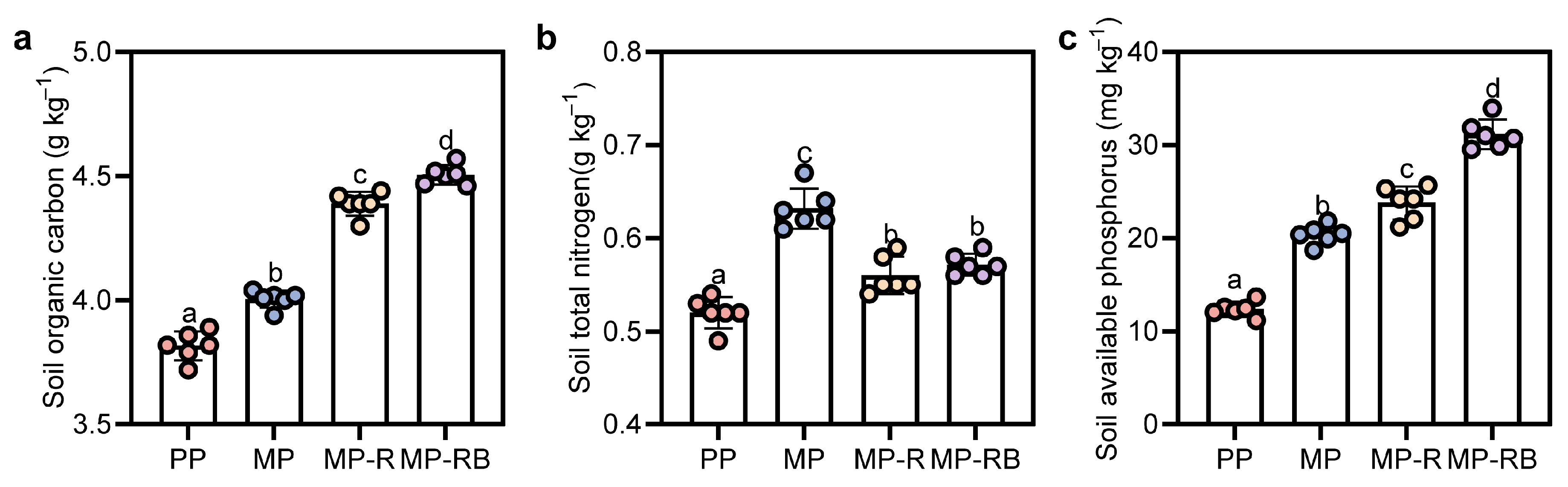
SOC increased progressively with cropping diversification. PP showed the lowest SOC, whereas MP showed a moderate increase. Further diversification through MP-R substantially increased SOC, and MP-RB reached the highest level, nearly 1.2 times that of PP (p < 0.05, Figure 2a). TN was significantly higher in all diversified systems than in PP (p < 0.05, Figure 2b), indicating that cropping diversification improved soil nitrogen status overall. Among the diversified treatments, MP, MP-R, and MP-RB all showed clear increases, with the highest TN observed under MP, where it was 21.5% greater than that in PP. This result suggests that TN did not increase monotonically with diversification intensity, although diversified planting systems consistently promoted nitrogen accumulation relative to monocropping. AP showed a pattern similar to that of SOC. The highest AP was recorded under MP-RB, which was about 40% greater than that in PP (p < 0.05, Figure 2c).

3.3. Effects of Diversified Cropping on Soil Bacterial Community Diversity and Composition

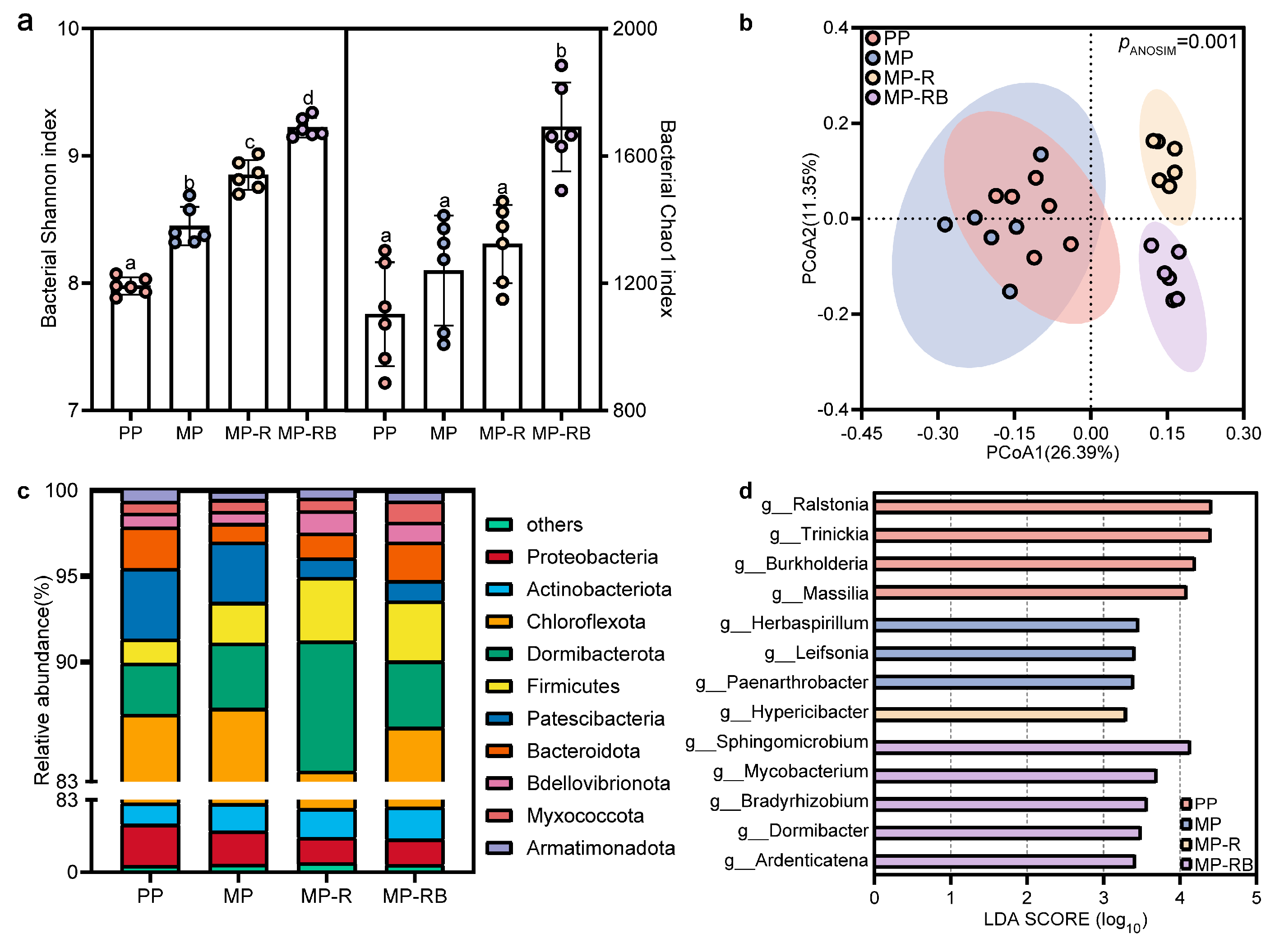
We next examined how soil microbial communities responded to cropping diversification by analyzing bacterial diversity, community structure, and taxonomic composition using high-throughput sequencing. Alpha diversity increased consistently with cropping diversification, as indicated by both the Shannon and Chao1 indices (Figure 3a). The Shannon index, reflecting overall bacterial diversity, was lowest under peanut monocropping and gradually increased under intercropping and rotational systems. The highest value occurred in the MP-RB treatment, which was significantly greater than that of the other treatments (p < 0.05). A similar pattern was observed for the Chao1 richness index, suggesting that soils under diversified cropping harbored a larger number of bacterial taxa. Community structure, based on Bray–Curtis dissimilarity, was visualized by principal coordinate analysis (PCoA) (Figure 3b). The first and second principal coordinates explained 26.39% and 11.35% of the total variance, respectively. Distinct clustering patterns were observed among the four cropping systems (p = 0.001). The community under peanut monocropping formed a compact cluster clearly separated from those of the diversified systems along the first principal axis. Intercropping (MP) shifted the bacterial composition moderately from monocropping, whereas further diversification through crop rotation (MP-R) and the integration of green manures (MP-RB) produced greater separation along the same axis. MP-R and MP-RB were also distinguished from each other along the second axis. Pairwise PERMANOVA confirmed that all diversified systems differed significantly from monocropping (p ≤ 0.013), with the strongest dissimilarities between MP-R and PP (R2 = 0.35, p = 0.006) and between MP-RB and PP (R2 = 0.35, p = 0.001). At the phylum level, the bacterial communities across all cropping systems were mainly composed of Proteobacteria and Actinobacteriota, which together accounted for more than 70% of the total sequences (Figure 3c). Minor but functionally relevant groups such as Firmicutes, Bacteroidota, and Chloroflexota were also detected at lower relative abundances. With increasing cropping diversification, their relative abundances exhibited distinct responses. The proportion of Proteobacteria decreased markedly from 49.3% under monocropping (PP) to 28.7% under the MP-RB treatment, representing a 42% reduction (p < 0.05). In contrast, Actinobacteriota increased substantially, rising from 24.3% in PP to 36.7% in MP-RB, an increase of approximately 50%. Firmicutes also showed a modest rise, while Bacteroidota fluctuated slightly among treatments without a consistent trend. These results indicate that diversified cropping shifted the soil bacterial community from being Proteobacteria dominated to Actinobacteriota enriched. This compositional shift reflects ecological restructuring toward taxa better adapted to nutrient and organic matter rich environments. LEfSe analysis further revealed distinct biomarker taxa associated with different cropping systems (LDA score > 3, p < 0.05; Figure 3d). In the PP treatment, the bacterial community was enriched with Ralstonia, Trinickia, Burkholderia, and Massilia. The MP treatment was characterized by higher abundances of Herbaspirillum, Leifsonia, and Paenarthrobacter, while Hypericibacter served as the key indicator genus under the MP-R treatment. The MP-RB treatment exhibited the most distinct taxonomic profile, with significant enrichment of Sphingomicrobium, Mycobacterium, Bradyrhizobium, Dormibacter, and Ardenticatena. We observed notable associations between these genera and soil SOC, TN, and AP, particularly under green manure addition conditions. In summary, diversified cropping progressively increased bacterial alpha diversity (both Shannon and Chao1 indices), restructured community composition, and enriched functional taxa beneficial for nutrient cycling. These microbial shifts intensified progressively with increasing diversification intensity. To determine whether such community adjustments were directly associated with soil nutrient dynamics, we next analyzed the relationships between dominant bacterial taxa and SOC, TN, and AP.

3.4. Relationships Between Key Bacterial Taxa and Soil Nutrient Properties

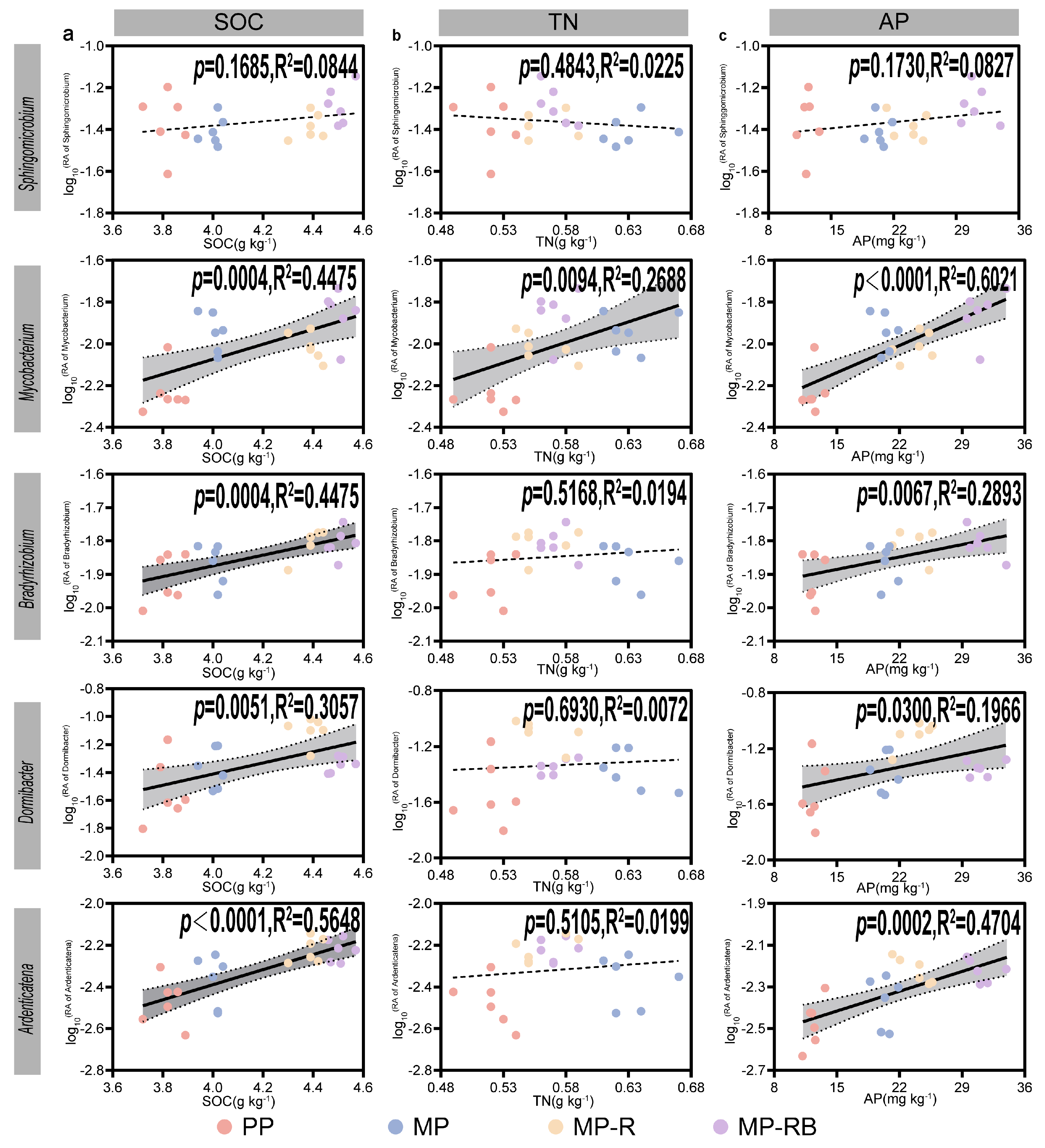
To further clarify the links between soil bacterial composition and nutrient dynamics, we selected biomarker genera enriched in the MP-RB treatment as key taxa, because this treatment showed the highest diversification intensity and the most distinct microbial differentiation in LEfSe analysis. We then used all samples across treatments to examine the relationships between these genera and soil nutrient indicators (SOC, TN, and AP) through scatter regression analyses (Figure 4a–c). Four genera, including Bradyrhizobium, Mycobacterium, Dormibacter, and Ardenticatena showed significant positive relationship with SOC (R2 = 0.31–0.56, p < 0.05, Figure 4a), indicating that soil carbon enrichment under diversified cropping was closely associated with the abundance of these taxa. When focusing on TN (Figure 4b), only Mycobacterium exhibited a significant positive correlation (R2 = 0.27, p = 0.0094), indicating a potential association between this genus and TN variation in peanut soils. For AP (Figure 4c), stronger and more consistent correlations were observed. Mycobacterium again showed the highest association (R2 = 0.60, p < 0.0001), followed by Ardenticatena (R2 = 0.47, p = 0.0002), Bradyrhizobium (R2 = 0.29, p = 0.0067), and Dormibacter (R2 = 0.20, p = 0.0300). These results indicate that phosphorus availability under the diversified systems was closely related to bacterial groups potentially involved in P mobilization or mineralization. Notably, Sphingomicrobium showed no significant correlation with any nutrient variable. Overall, bacterial genera enriched under the MP-RB treatment, particularly Mycobacterium, Ardenticatena, and Bradyrhizobium, showed strong and consistent associations with SOC and AP. This pattern suggests that cropping diversification, particularly with green manure incorporation, was associated with stronger coupling between microbial community attributes and nutrient availability, consistent with a more tightly linked soil microbe–nutrient relationship under diversified cropping systems. These findings prompted additional experimental validation and integrated analysis to clarify the roles of key taxa in peanut productivity.

3.5. Validation of Key Taxa in Relation to Peanut Productivity

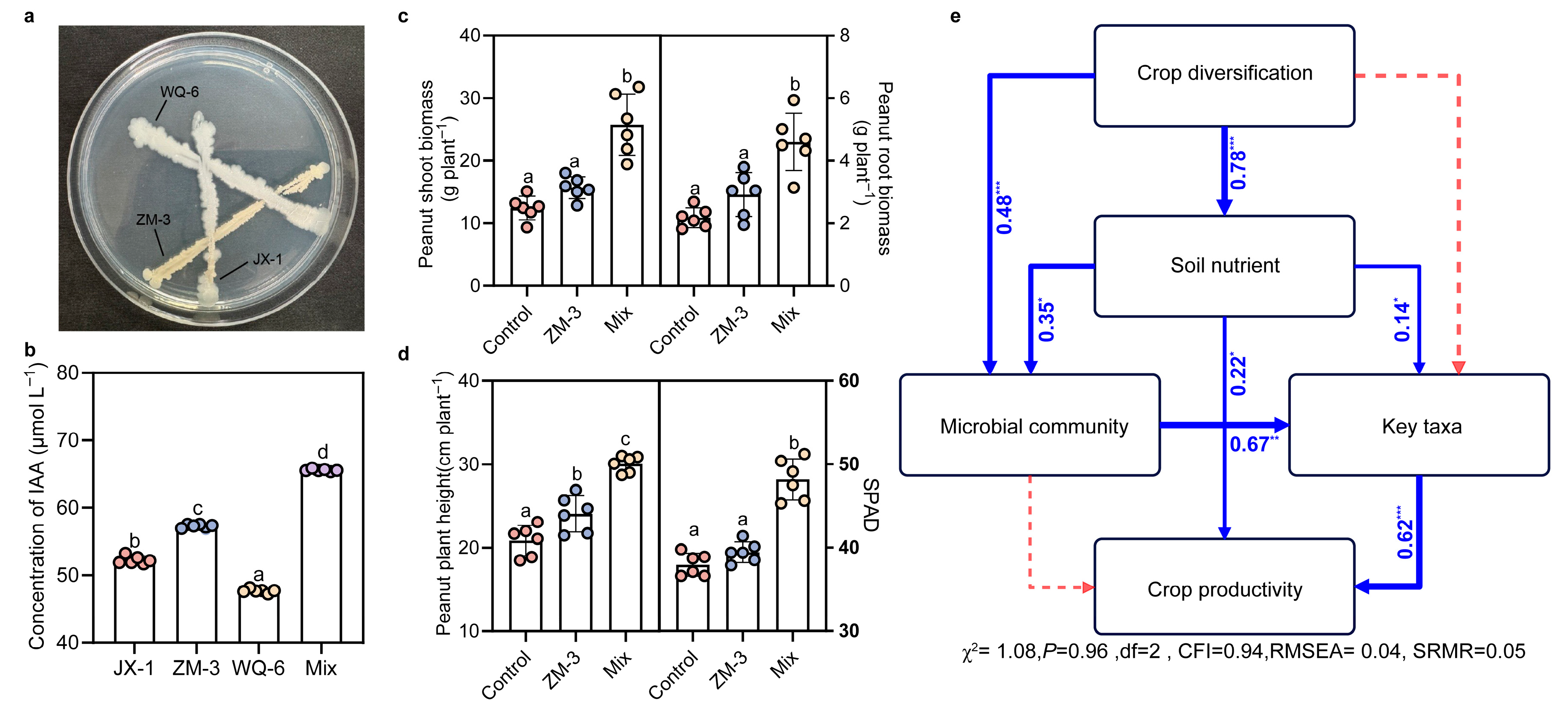
Because the relationships identified in the field were based on correlative evidence, we next performed isolate-based assays and SEM to further evaluate whether key taxa enriched in the MP-RB treatment were associated with peanut productivity. To experimentally assess their potential roles, three representative and culturable isolates from our previous work were selected for further assays, namely Mycobacterium JX-1, Bradyrhizobium ZM-3, and Dormibacter WQ-6. These strains were compatible in co-culture, allowing subsequent consortium-based functional assays (Figure 5a). All three isolates produced IAA, but their capacities differed among strains. Among the single strains, ZM-3 showed the highest IAA production, whereas the consortium (Mix) reached the overall maximum IAA level, which was 14.5% higher than that of ZM-3 (Figure 5b). Based on this result, ZM-3 was selected as the representative single-strain treatment for subsequent peanut seedling inoculation, together with Mix and the water control.
In the seedling inoculation experiment, Mix consistently produced the strongest growth-promoting effect. Mix significantly increased both shoot and root biomass relative to the control and ZM-3 treatments (p < 0.05), whereas ZM-3 did not differ significantly from the control for either biomass component (p > 0.05; Figure 5c). Specifically, Mix increased shoot biomass by 107% relative to the control, reaching 25.76 g plant−1, and increased root biomass by 1.1-fold (Figure 5c). Plant height increased under both inoculation treatments (p < 0.05; Figure 5d): relative to the control, ZM-3 increased plant height by 15.3%, whereas Mix further increased it by 44.1%, reaching 30.05 cm (Figure 5d). Mix also significantly increased SPAD to 48.18 (p < 0.05), whereas ZM-3 showed no significant change relative to the control (p > 0.05; Figure 5d). Overall, single-strain inoculation improved these traits to some extent, whereas the consortium produced more pronounced and consistent enhancements across the measured growth and physiological indicators.
To integrate the strain and seedling responses with community-level patterns, SEM was used to quantify coordinated links among cropping diversification, soil nutrient status, microbial community attributes, key taxa, and crop productivity. The model showed an acceptable fit (χ2 = 1.08, df = 2, p = 0.96; CFI = 0.94; RMSEA = 0.04; SRMR = 0.05). Cropping diversification was positively associated with soil nutrient status (β = 0.78, p < 0.001) and microbial community attributes (β = 0.48, p < 0.001), and microbial community attributes showed a strong positive association with key taxa (β = 0.67, p < 0.01). Importantly, key taxa exhibited the strongest positive association with crop productivity (β = 0.62, p < 0.001), whereas the direct paths from cropping diversification to key taxa (β = −0.42, p > 0.05) and from microbial community attributes to crop productivity (β = −0.16, p > 0.05) were not significant (Figure 5e). These findings indicate that key taxa were the factor most strongly associated with crop productivity under diversified cropping.

4. Discussion

4.1. Peanut Growth Responses to Cropping Diversification

Cropping diversification consistently enhanced peanut performance. Biomass, pod weight and nodule number density were all higher than under monocropping, with the strongest overall response in the green manure integrated system (MP-RB) (Figure 1). This is consistent with the findings of Xu et al. [43], who reported that green manure incorporation increased peanut production.
Generally, within a given soil area, greater crop yield and biomass usually imply greater nutrient uptake from the soil, which may lead to insufficient soil nutrient reserves and supply capacity, especially in inherently infertile red soils. However, long-term diversified cropping not only increased crop productivity, but also enhanced rather than depleted soil nutrients. This may be because nutrient accumulation driven by diversified cropping offset the nutrient consumption associated with crop growth, thereby generating a net positive feedback [44]. Responses differed among nutrient indicators: SOC and AP showed the clearest enhancement under MP-RB, suggesting that the combined use of rotation and green manure favored carbon accumulation and phosphorus availability. By contrast, TN was higher in all diversified systems than in PP, but did not increase monotonically with diversification intensity, as the highest TN was observed under MP rather than MP-RB. Similar simultaneous improvements in crop yield and soil fertility after green manure incorporation have been reported in peanut systems and other agroecosystems [43,45].
The increase in TN, together with enhanced nodulation (Figure 1c), may reflect strengthened N acquisition processes under diversified cropping. Our previous work showed that legume rhizodeposition under crop diversification can promote nitrogen fixation by soil microbiota [15], which may help explain why soil TN remained elevated despite greater plant growth. In parallel, the AP increase under MP-RB (Figure 2c) is consistent with evidence that green manure incorporation can enhance soil P availability and improve plant P acquisition [46,47]. It should also be noted that, compared with peanut monocropping and maize–peanut intercropping, the MP-RB and MP-R systems received one additional fertilizer application in winter. This was necessary because winter crops could not be maintained without external fertilizer input. Although winter fertilization may have contributed to soil nutrient accumulation and microbial activation to some extent, intercropping still increased soil C, N, and P relative to monocropping in the PP and MP treatments, where no winter crops were introduced and no winter fertilization was applied. Similarly, between the two winter-fertilized treatments, MP-RB still showed higher soil nutrient levels than MP-R. These results suggest that the differences in soil nutrient accumulation among treatments were closely related to the rational combination of crops, rather than being explained by fertilizer input alone. Overall, cropping diversification improved both peanut productivity and soil fertility, but the responses differed among C, N, and P.

4.2. Restructuring of Soil Bacterial Communities Under Cropping Diversification

Cropping diversification reshaped the soil bacterial community, and this effect became most apparent when green manure was integrated. Our results showed that diversified systems, especially MP-RB, exhibited higher bacterial diversity together with a clear shift in community composition (Figure 3a,b), suggesting that diversification altered the overall community structure rather than merely shifting the abundance of a few dominant groups. This pattern was likely related to greater carbon inputs from green manure, which may have broadened substrate availability and supported a more diverse bacterial community [43,48]. Long-term evidence further indicates that increases in the molecular diversity of soil organic matter are often accompanied by higher bacterial richness and shifts in microbial functional organization [49], providing a plausible explanation for the diversity gain observed under MP-RB.
We further suggest that the diversification-driven community shift was partly associated with changes in specific enriched taxa that may contribute to community organization and function. LEfSe analysis identified several MP-RB-associated biomarkers, including Sphingomicrobium, Mycobacterium, Bradyrhizobium, Dormibacter, and Ardenticatena (Figure 3d). Rhizobia taxa such as Bradyrhizobium are frequently recognized as core members in legume-containing cropping systems because they underpin symbiotic N acquisition and can indirectly facilitate the recruitment of compatible microbial partners in diversified communities [15]. In addition to rhizobia, other MP-RB enriched taxa may also contribute to community restructuring through roles in organic matter transformation and nutrient turnover, thereby modifying resource availability and influencing the broader community. For example, Mycobacterium is often regarded as a functionally versatile rhizosphere group linked to carbon utilization and nutrient turnover. It has been reported to respond sensitively to nutrient management and changing field conditions, suggesting that such taxa may contribute to community reassembly under diversified resource inputs [50,51]. Overall, MP-RB was associated with a distinct bacterial assemblage characterized by broader niche occupation and the enrichment of functionally relevant taxa.

4.3. Cropping Diversification Promotes Peanut Productivity Through Soil Fertility Improvement and Key Taxa Enrichment

In addition to overall community restructuring, the enrichment of specific key taxa may help explain the positive effect of diversified cropping on peanut productivity. Aboveground diversification can increase the amount and chemical diversity of plant derived compounds entering the soil, thereby strengthening plant–soil feedbacks that favor beneficial microbiota. Evidence from maize–peanut systems shows that changes in light interception can enhance the allocation of photosynthesized carbon belowground, thereby reshaping the peanut microbiota toward beneficial members and promoting peanut growth [52]. Greater carbon inputs may support rhizosphere microbes in two ways: by providing substrates for microbial growth and by supplying plant-derived signals that favor specific microbial groups around roots [53]. In MP-RB, nutrient enrichment was accompanied by the enrichment of several taxa associated with peanut growth (Figure 3d and Figure 4), suggesting that diversification can steer the microbiome toward beneficial taxa associated with peanut growth.
Peanut growth promotion in our study was associated with a key taxa module rather than being attributable to a single taxon. To functionally validate this pattern, we isolated three culturable representatives of the identified key taxa, namely Bradyrhizobium (ZM-3), Mycobacterium (JX-1), and Dormibacter (WQ-6), and used them to construct a synthetic consortium for inoculation assays (Figure 5). Synthetic microbial communities (SynComs) have attracted increasing attention in sustainable crop production, although their performance is often constrained by poor compatibility among member strains after mixing [54,55]. In our study, the three representative isolates were compatible in co-culture and all showed IAA production, with the consortium reaching the highest level. These results suggest that the selected strains could coexist and jointly express growth promoting traits when combined. This pattern is consistent with functional complementarity among member strains. Different taxa contribute distinct benefits via hormone regulation and nutrient-related functions, enhancing the overall output of the consortium and explaining its stronger growth-promoting effect [54,56].
Consistent with this interpretation, the mixed inoculum delivered the most consistent plant benefits in our assay (Figure 5c,d). This advantage likely reflects the combined action of multiple microbial processes, including phytohormone-related regulation, improved nutrient acquisition, and stress alleviation. For instance, IAA production is widely used as a practical screening indicator for plant growth promoting bacteria and provides a plausible route linking enriched key taxa to improved plant performance [57]. Meanwhile, Dormibacterota are often characterized as oligotrophic and stress tolerant lineages, suggesting that WQ-6 may contribute a distinct resource use strategy within the consortium [58]. The SEM results provide an integrated view of the relationships underlying these patterns. In the model, key taxa were more strongly associated with variation in peanut productivity than the direct path from microbial community attributes to productivity, whereas cropping diversification was associated with soil nutrient status and microbial community attributes (Figure 5e). These patterns are consistent with the possibility that the productivity advantage under diversified cropping was linked to shifts in soil conditions and microbial community structure together with the enrichment of specific key taxa. In this context, key taxa appear to act as an important biological link connecting soil fertility improvement with peanut growth promotion.
Despite these findings, several limitations of the present study should be acknowledged. Although we identified key microbial taxa in the community using high-throughput techniques and isolated representative key strains, the factors driving the diversification-induced shifts in these key microorganisms, as well as the causal interactions through which they regulate carbon accumulation, remain insufficiently understood. Future studies will combine diversified crop residue addition experiments with soil metabolomics to clarify the mechanisms by which plant-derived carbon inputs under diversified cropping drive core microbial taxa to regulate soil carbon transformation and accumulation.

5. Conclusions

This study suggests that diversified cropping was associated with higher peanut productivity in subtropical red soil agroecosystems, with the strongest overall performance observed in the green manure integrated system (MP-RB). The productivity gain was associated with coordinated improvements in soil nutrient status and bacterial community restructuring, particularly the enrichment of key taxa linked to crop growth. Functional validation and SEM further indicated that these key taxa were strongly associated with productivity gains under diversified cropping. Overall, our findings suggest that higher peanut productivity under crop diversification was closely associated with improved soil fertility and key taxa enrichment. These results provide a microbial ecological basis for the sustainable management of red soil agroecosystems.

Author Contributions

Conceptualization, Z.W., K.L. and Y.C.; methodology, Z.W. and K.L.; software, Z.W.; validation, Z.W., Y.C. and Q.Z.; formal analysis, Z.W. and Y.H.; investigation, Z.W., Y.C. and Y.H.; resources, Y.C., J.L. and X.P.; data curation, Z.W. and Y.H.; writing—original draft preparation, Z.W., Y.C. and Y.H.; writing—review and editing, Z.W., Y.H., K.L., Q.Z., Y.C., J.L. and X.P.; visualization, Z.W. and Y.H.; supervision, Y.C. and X.P.; project administration, Y.C. and J.L.; funding acquisition, Y.C. All authors have read and agreed to the published version of the manuscript.

Funding

This work was financially supported by the National Key Research and Development Program of China (2022YFD1900601).

Data Availability Statement

The original contributions presented in this study are included in the article material. Further inquiries can be directed to the corresponding authors.

Acknowledgments

We thank Gang Zhang, Haoran Ma, Bo Sun, Mengjie Qiao, Jumeng Lu and Geng Huang (Institute of Soil Science, Chinese Academy of Sciences) for their assistance with field sample collection.

Conflicts of Interest

The authors declare no conflicts of interest.

References

  1. Jiang, W.S.; Li, Z.W.; Xie, H.X.; Ouyang, K.; Yuan, H.; Duan, L.X. Land use change impacts on red slate soil aggregates and associated organic carbon in diverse soil layers in subtropical China. Sci. Total Environ. 2022, 856, 159194. [Google Scholar] [CrossRef]
  2. Shen, Y.Y.; Zhang, Z.Q.; Xue, Y. Study on the new dynamics and driving factors of soil pH in the red soil hilly region of South China. Environ. Monit. Assess. 2021, 193, 90–98. [Google Scholar] [CrossRef] [PubMed]
  3. Yan, P.; Zhou, P.; Lei, S.; Tan, Z.W.; Chen, H.; Huang, J.X. Spatial distribution of soil nutrients in the red beds of southern China and their responses to different land use types. Forests 2025, 16, 417. [Google Scholar] [CrossRef]
  4. Wen, L.L.; Wang, J.Y.; Deng, Y.S.; Duan, X.Q. Fragmentation process of soil aggregates under concentrated water flow in red soil hilly region with different land use patterns. J. Mt. Sci. 2023, 20, 3233–3249. [Google Scholar] [CrossRef]
  5. Wang, J.Q.; Gao, R.K.; Long, Q.; Chen, L.M.; Ali, W.; Tian, Z.C.; Chen, J.Z. Effect of bio-tillage on the least limiting water range of clayey red soil. Soil Tillage Res. 2025, 246, 106337. [Google Scholar] [CrossRef]
  6. Gao, J.; Shi, C.Q.; Yang, J.Y.; Yue, H.; Liu, Y.; Chen, B.Z. Analysis of spatiotemporal heterogeneity and influencing factors of soil erosion in a typical erosion zone of the southern red soil region, China. Ecol. Indic. 2023, 154, 110590. [Google Scholar] [CrossRef]
  7. Jiang, Y.Y.; Sun, Z.X.; Wang, R.M.; Wang, H.L.; Wang, J.Q. A quantitative reconstruction of nutrient changes of Quaternary red soils (Luvisols) affected by land-use patterns. Agronomy 2023, 13, 2386. [Google Scholar] [CrossRef]
  8. Liao, Q.; Li, T.; Liu, D. Evolutionary patterns and influencing factors of relationships among ecosystem services in the hilly red soil region of Southern China. Environ. Monit. Assess. 2024, 196, 360. [Google Scholar] [CrossRef]
  9. van Der Heijden, M.G.A.; Bardgett, R.D.; van Straalen, N.M. The unseen majority: Soil microbes as drivers of plant diversity and productivity. Ecol. Lett. 2008, 11, 296–310. [Google Scholar] [CrossRef]
  10. Delgado-Baquerizo, M.; Oliverio, A.M.; Brewer, T.E.; Benavent-González, A.; Eldridge, D.J.; Bardgett, R.D.; Maestre, F.T.; Singh, B.K.; Fierer, N. A global atlas of the dominant bacteria found in soil. Science 2018, 359, 320–325. [Google Scholar] [CrossRef]
  11. Banerjee, S.; Schlaeppi, K.; van der Heijden, M.G.A. Keystone taxa as drivers of microbiome structure and functioning. Nat. Rev. Microbiol. 2018, 16, 567–576. [Google Scholar] [CrossRef]
  12. Wang, J.L.; Liu, K.L.; Zhao, X.Q.; Gao, G.F.; Wu, Y.H.; Shen, R.F. Microbial keystone taxa drive crop productivity through shifting aboveground–belowground mineral element flows. Sci. Total Environ. 2021, 811, 152342. [Google Scholar] [CrossRef]
  13. Luo, J.P.; Gu, S.H.; Guo, X.Y.; Liu, Y.K.; Tao, Q.; Zhao, H.P.; Liang, Y.C.; Banerjee, S.; Li, T.Q. Core microbiota in the rhizosphere of heavy metal accumulators and its contribution to plant performance. Environ. Sci. Technol. 2022, 56, 1894–1906. [Google Scholar] [CrossRef] [PubMed]
  14. Li, C.Y.; Chen, X.; Yang, J.Y.; Li, J.; Wang, R.Y.; Xu, H.Y.; Zhang, F.J. Keystone root bacteria in Ambrosia artemisiifolia promote invasive growth by increasing the colonization rate of Funneliformis mosseae. Microbiol. Res. 2025, 293, 128081. [Google Scholar] [CrossRef] [PubMed]
  15. Qiao, M.J.; Sun, R.B.; Wang, Z.X.; Dumack, K.; Xie, X.G.; Dai, C.C.; Wang, E.; Zhou, J.Z.; Sun, B.; Peng, X.H.; et al. Legume rhizodeposition promotes nitrogen fixation by soil microbiota under crop diversification. Nat. Commun. 2024, 15, 2924. [Google Scholar] [CrossRef] [PubMed]
  16. Zhou, G.P.; Fan, K.K.; Gao, S.J.; Chang, D.N.; Li, G.L.; Liang, T.; Liang, H.; Li, S.; Zhang, J.D.; Che, Z.X.; et al. Green manuring relocates microbiomes in driving the soil functionality of nitrogen cycling to obtain preferable grain yields in thirty years. Sci. China Life Sci. 2023, 66, 2521–2538. [Google Scholar] [CrossRef]
  17. Chen, Y.; Bonkowski, M.; Shen, Y.; Griffiths, B.; Jiang, Y.J.; Wang, X.Y.; Sun, B. Root ethylene mediates rhizosphere microbial community reconstruction when chemically detecting cyanide produced by neighbouring plants. Microbiome 2020, 8, 4. [Google Scholar] [CrossRef]
  18. Chao, H.Z.; Cai, A.J.; Heimburger, B.; Wu, Y.L.; Zhao, D.K.; Sun, M.M.; Hu, F. Keystone taxa enhance the stability of soil bacterial communities and multifunctionality under steelworks disturbance. J. Environ. Manag. 2024, 356, 120664. [Google Scholar] [CrossRef]
  19. Guo, Y.Q.; Xu, T.Q.; Cheng, J.M.; Wei, G.H.; Lin, Y.B. Above- and belowground biodiversity drives soil multifunctionality along a long-term grassland restoration chronosequence. Sci. Total Environ. 2021, 772, 145010. [Google Scholar] [CrossRef]
  20. Martins, C.S.C.; Delgado-Baquerizo, M.; Jayaramaiah, R.H.; Tao, D.X.; Wang, J.T.; Sáez-Sandino, T.; Liu, H.W.; Maestre, F.T.; Reich, P.B.; Singh, B.K. Aboveground and belowground biodiversity have complementary effects on ecosystem functions across global grasslands. PLoS Biol. 2024, 22, e3002736. [Google Scholar] [CrossRef]
  21. Cui, H.W.; Wagg, C.; Wang, X.T.; Liu, Z.Y.; Liu, K.; Chen, S.Y.; Chen, J.W.; Song, H.X.; Meng, L.H.; Wang, J.J.; et al. The loss of above- and belowground biodiversity in degraded grasslands drives the decline of ecosystem multifunctionality. Appl. Soil Ecol. 2022, 176, 104370. [Google Scholar] [CrossRef]
  22. Wang, X.Y.; Li, F.Y.H.; Wang, Y.N.; Liu, X.M.; Cheng, J.W.; Zhang, J.Z.; Baoyin, T.; Bardgett, R.D. High ecosystem multifunctionality under moderate grazing is associated with high plant but low bacterial diversity in a semi-arid steppe grassland. Plant Soil 2020, 448, 265–276. [Google Scholar] [CrossRef]
  23. Hu, Z.K.; Delgado-Baquerizo, M.; Fanin, N.; Chen, X.Y.; Zhou, Y.; Du, G.Z.; Hu, F.; Jiang, L.; Hu, S.J.; Liu, M.Q. Nutrient-induced acidification modulates soil biodiversity–function relationships. Nat. Commun. 2024, 15, 47323. [Google Scholar] [CrossRef]
  24. Gelaye, Y.; Luo, H.Y. Optimizing peanut (Arachis hypogaea L.) production: Genetic insights, climate adaptation, and efficient management practices: Systematic review. Plants 2024, 13, 2988. [Google Scholar] [CrossRef]
  25. Wei, Z.H.; Cao, H.; Wang, C.; Liu, H.J.; Shen, Q.R.; Li, R. Exploration of acid-tolerant peanut varieties associated with key beneficial rhizosphere microbiome and their plant growth-promoting effects in acidic soil. Agronomy 2026, 16, 371. [Google Scholar] [CrossRef]
  26. Chen, Y.; Sun, R.B.; Sun, T.T.; Liang, Y.T.; Jiang, Y.J.; Sun, B. Organic amendments shift the phosphorus-correlated microbial co-occurrence pattern in the peanut rhizosphere network during long-term fertilization regimes. Appl. Soil Ecol. 2018, 124, 229–239. [Google Scholar] [CrossRef]
  27. Chen, Y.; Sun, R.B.; Sun, T.T.; Chen, P.; Yu, Z.Y.; Ding, L.Y.; Jiang, Y.J.; Wang, X.Y.; Dai, C.C.; Sun, B. Evidence for involvement of keystone fungal taxa in organic phosphorus mineralization in subtropical soil and the impact of labile carbon. Soil Biol. Biochem. 2020, 148, 107900. [Google Scholar] [CrossRef]
  28. IUSS Working Group WRB. World Reference Base for Soil Resources 2006: A Framework for International Classification, Correlation and Communication; FAO: Rome, Italy, 2006. [Google Scholar]
  29. Jackson, M.L. Soil Chemical Analysis; Prentice-Hall: Englewood Cliffs, NJ, USA, 1958; pp. 219–222. [Google Scholar]
  30. Bremner, J.M. Nitrogen-Total. In Methods of Soil Analysis. Part 3. Chemical Methods; Sparks, D.L., Page, A.L., Helmke, P.A., Loeppert, R.H., Soltanpour, P.N., Tabatabai, M.A., Johnston, C.T., Sumner, M.E., Eds.; Soil Science Society of America: Madison, WI, USA, 1996; pp. 1085–1121. [Google Scholar] [CrossRef]
  31. Olsen, S.R.; Sommers, L.E. Phosphorus. In Methods of Soil Analysis. Part 2. Chemical and Microbiological Properties; Page, A.L., Ed.; Soil Science Society of America: Madison, WI, USA, 1982; pp. 403–430. [Google Scholar]
  32. Duan, X.Z.; Sun, J.T.; Wang, L.T.; Shu, X.H.; Guo, Y.; Matsukura, K.; Zhu, Y.X.; Bing, X.L.; Hoffmann, A.A.; Hong, X.Y. Recent infection by Wolbachia alters microbial communities in wild Laodelphax striatellus populations. Microbiome 2020, 8, 104. [Google Scholar] [CrossRef]
  33. Martin, M. Cutadapt removes adapter sequences from high-throughput sequencing reads. EMBnet J. 2011, 17, 10–12. [Google Scholar] [CrossRef]
  34. Callahan, B.J.; McMurdie, P.J.; Rosen, M.J.; Han, A.W.; Johnson, A.J.A.; Holmes, S.P. DADA2: High-resolution sample inference from Illumina amplicon data. Nat. Methods 2016, 13, 581–583. [Google Scholar] [CrossRef]
  35. Wang, Q.; Garrity, G.M.; Tiedje, J.M.; Cole, J.R. Naive Bayesian classifier for rapid assignment of rRNA sequences into the new bacterial taxonomy. Appl. Environ. Microbiol. 2007, 73, 5261–5267. [Google Scholar] [CrossRef] [PubMed]
  36. Chen, P.; He, W.; Shen, Y.; Zhu, L.Y.; Yao, X.Z.; Sun, R.B.; Dai, C.C.; Sun, B.; Chen, Y. Interspecific Neighbor Stimulates Peanut Growth Through Modulating Root Endophytic Microbial Community Construction. Front. Plant Sci. 2022, 13, 830666. [Google Scholar] [CrossRef] [PubMed]
  37. Loper, J.E.; Schroth, M.N. Influence of Bacterial Sources of Indole-3-Acetic Acid on Root Elongation of Sugar Beet. Phytopathology 1986, 76, 386. [Google Scholar] [CrossRef]
  38. Rosseel, Y. lavaan: An R Package for Structural Equation Modeling. J. Stat. Softw. 2012, 48, 1–36. [Google Scholar] [CrossRef]
  39. Oksanen, J.; Simpson, G.L.; Blanchet, F.G.; Kindt, R.; Legendre, P.; Minchin, P.R.; O’Hara, R.B.; Solymos, P.; Stevens, M.H.; Szoecs, E.; et al. vegan: Community Ecology Package (R Package Version 2.6-2). Available online: https://CRAN.R-project.org/package=vegan (accessed on 9 March 2026).
  40. Segata, N.; Izard, J.; Waldron, L.; Gevers, D.; Miropolsky, L.; Garrett, W.S.; Huttenhower, C. Metagenomic biomarker discovery and explanation. Genome Biol. 2011, 12, R60. [Google Scholar] [CrossRef]
  41. Wickham, H. ggplot2: Elegant Graphics for Data Analysis, 2nd ed.; Springer: New York, NY, USA, 2016. [Google Scholar] [CrossRef]
  42. Wilke, C.O. cowplot: Streamlined Plot Theme and Plot Annotations for “ggplot2” (R Package Version 1.1.1). Available online: https://cran.r-project.org/package=cowplot (accessed on 9 March 2026).
  43. Xu, Y.; Ding, H.; Zhang, G.C.; Li, Z.L.; Guo, Q.; Feng, H.; Qin, F.F.; Dai, L.X.; Zhang, Z.M. Green manure increases peanut production by shaping the rhizosphere bacterial community and regulating soil metabolites under continuous peanut production systems. BMC Plant Biol. 2023, 23, 69. [Google Scholar] [CrossRef]
  44. Yang, X.L.; Xiong, J.R.; Du, T.S.; Ju, X.T.; Gan, Y.T.; Li, S.E.; Xia, L.L.; Shen, Y.J.; Pacenka, S.; Steenhuis, T.S.; et al. Diversifying crop rotation increases food production, reduces net greenhouse gas emissions and improves soil health. Nat. Commun. 2024, 15, 198. [Google Scholar] [CrossRef]
  45. Ma, D.K.; Yin, L.N.; Ju, W.L.; Li, X.K.; Liu, X.; Deng, X.; Wang, S.W. Meta-analysis of green manure effects on soil properties and crop yield in northern China. Field Crops Res. 2021, 266, 108146. [Google Scholar] [CrossRef]
  46. Gao, X.Y.; Shi, D.Y.; Lv, A.M.; Wang, S.Y.; Yuan, S.L.; Zhou, P.; An, Y. Increase phosphorus availability from the use of alfalfa (Medicago sativa L.) green manure in rice (Oryza sativa L.) agroecosystem. Sci. Rep. 2016, 6, 36981. [Google Scholar] [CrossRef]
  47. Gu, C.M.; Lv, W.S.; Liao, X.; Brooks, M.; Li, Y.S.; Yu, C.B.; Yang, L.; Li, X.Y.; Hu, W.S.; Dai, J.; et al. Green manure amendment increases soil phosphorus bioavailability and peanut absorption of phosphorus in red soil of South China. Agronomy 2023, 13, 376. [Google Scholar] [CrossRef]
  48. Liang, H.; Fu, L.B.; Chen, H.; Zhou, G.P.; Gao, S.J.; Cao, W.D. Green manuring facilitates bacterial community dispersal across different compartments of subsequent tobacco. J. Integr. Agric. 2023, 22, 1199–1215. [Google Scholar] [CrossRef]
  49. Wu, M.; Lugato, E.; Li, P.F.; Liu, J.; Qiu, C.P.; Wang, S.; Ma, X.Z.; Hao, X.Y.; Liu, M.; Shan, J.; et al. Bacterial richness enhances the thermostability of soil organic matter via a long-term trade-off between molecular diversity and thermodynamic stability. Nat. Food 2025, 6, 1032–1041. [Google Scholar] [CrossRef]
  50. Deng, Q.X.; Zhang, T.; Xie, D.T.; Yang, Y.H. Rhizosphere microbial communities are significantly affected by optimized phosphorus management in a slope farming system. Front. Microbiol. 2021, 12, 739844. [Google Scholar] [CrossRef]
  51. Costa, R.M.; Costa, M.K.L.; Rocha, S.M.B.; Leite, M.R.L.; de Alcântara Neto, F.; de Souza, H.A.; Pereira, A.P.A.; Melo, V.M.M.; de Medeiros, E.V.; Mendes, L.W.; et al. Soil management shapes bacterial and archaeal communities in soybean rhizosphere: Comparison of no-tillage and integrated crop–livestock systems. Rhizosphere 2024, 30, 100886. [Google Scholar] [CrossRef]
  52. Lu, J.M.; Shen, Y.; He, G.H.; Li, S.W.; Kumar, A.; Sun, B.; Chen, Y. Orientation-driven photosynthesized carbon belowground mediates intercropped peanut microbiota changes for pathogen resistance. Plant Soil 2025, 506, 209–226. [Google Scholar] [CrossRef]
  53. Korenblum, E.; Dong, Y.H.; Szymanski, J.; Panda, S.; Jozwiak, A.; Massalha, H.; Meir, S.; Rogachev, I.; Aharoni, A. Rhizosphere microbiome mediates systemic root metabolite exudation by root-to-root signaling. Proc. Natl. Acad. Sci. USA 2020, 117, 3874–3883. [Google Scholar] [CrossRef] [PubMed]
  54. Liang, Y.; Ma, A.Z.; Zhuang, G.Q. Construction of environmental synthetic microbial consortia: Based on engineering and ecological principles. Front. Microbiol. 2022, 13, 829717. [Google Scholar] [CrossRef]
  55. Xu, X.; Dinesen, C.; Pioppi, A.; Kovács, Á.T.; Lozano-Andrade, C.N. Composing a microbial symphony: Synthetic communities for promoting plant growth. Trends Microbiol. 2025, 33, 738–751. [Google Scholar] [CrossRef]
  56. Wang, W.; Xia, Y.W.; Zhang, P.P.; Zhu, M.Q.; Huang, S.Y.; Sun, X.L.; Xu, Z.H.; Zhang, N.; Xun, W.B.; Shen, Q.R.; et al. Narrow-spectrum resource-utilizing bacteria drive the stability of synthetic communities through enhancing metabolic interactions. Nat. Commun. 2025, 16, 6088. [Google Scholar] [CrossRef]
  57. Etesami, H.; Alikhani, H.A.; Hosseini, H.M. Indole-3-acetic acid (IAA) production trait, a useful screening to select endophytic and rhizosphere competent bacteria for rice growth promoting agents. MethodsX 2015, 2, 72–78. [Google Scholar] [CrossRef]
  58. Montgomery, K.; Williams, T.J.; Brettle, M.; Berengut, J.F.; Zhang, E.; Zaugg, J.; Hugenholtz, P.; Ferrari, B.C. Persistence and resistance: Survival mechanisms of Candidatus dormibacterota from nutrient-poor Antarctic soils. Environ. Microbiol. 2021, 23, 4276–4294. [Google Scholar] [CrossRef]
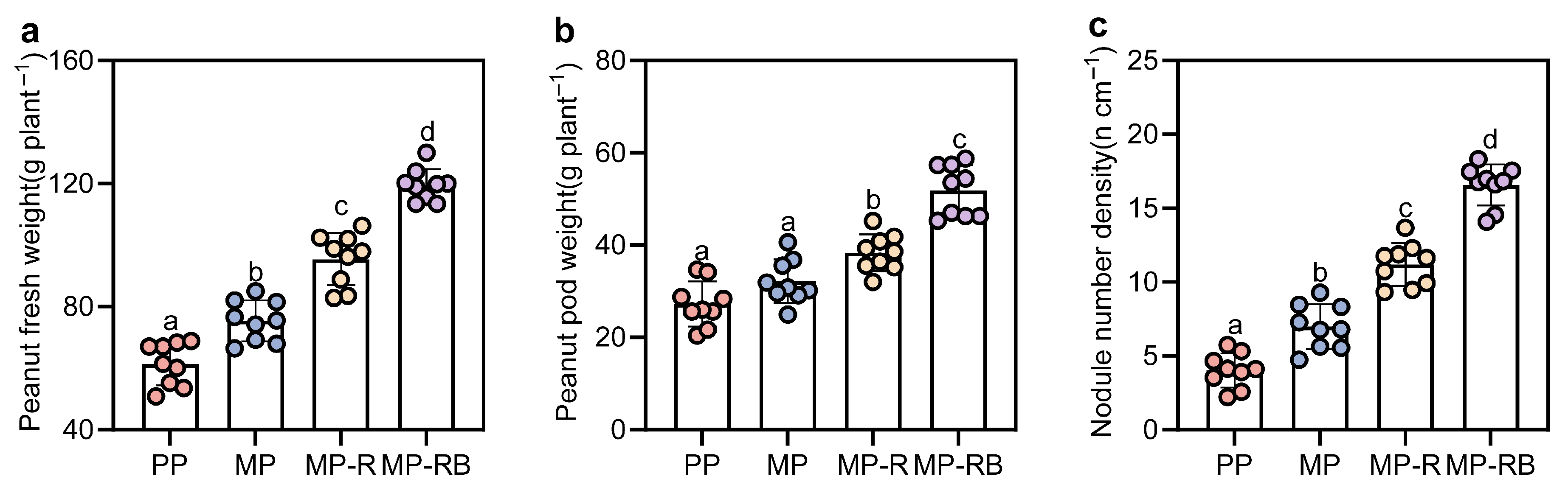
Figure 1. Peanut productivity and nodulation under diversified cropping systems. (a) Peanut fresh biomass. (b) Peanut pod weight. (c) Nodule number density. Data are presented as mean (n = 9) ± the standard deviation (SD). Error bars labeled with lowercase letters indicate significant differences (p < 0.05) among treatments determined by one-way ANOVA with Tukey’s post hoc test (two-sided). PP, peanut monocropping; MP, peanut intercropped with maize; MP-R, peanut intercropped with maize and rotated with oilseed rape; MP-RB, peanut intercropped with maize and rotated with oilseed rape which intercropped with green manures (including pea, white clover and ryegrass).
Agronomy 16 00783 g001
Figure 2. Changes in soil nutrient characteristics under different cropping systems. (a) Soil organic carbon. (b) Soil total nitrogen. (c) Soil available phosphorus. Data are presented as means ± SD (n = 6). Error bars labeled with lowercase letters indicate significant differences (p < 0.05) among treatments determined by one-way ANOVA with Tukey’s post hoc test (two-sided). PP, peanut monocropping; MP, peanut intercropped with maize; MP-R, peanut intercropped with maize and rotated with oilseed rape; MP-RB, peanut intercropped with maize and rotated with oilseed rape which intercropped with green manures (including pea, white clover and ryegrass).
Agronomy 16 00783 g002
Figure 3. Diversified planting alters bacterial communities. (a) Soil bacterial alpha-diversity. (b) Principal coordinate analysis (PCoA) of bacterial composition based on Bray–Curtis distance. Colored shades represent 95% confidence ellipses around each group to distinguish community differences. Axis labels report the percentage of variance explained. (c) Bacterial community composition at the phylum level. (d) The bacterial biomarkers at genus level in different cropping systems according to the linear discriminant analysis (LDA) scores of Linear discriminant analysis coupled with Effect Size (LEfSe). Error bars labeled with lowercase letters indicate significant differences (p < 0.05) among treatments determined by one-way ANOVA with Tukey’s post hoc test (two-sided). PP, peanut monocropping; MP, peanut intercropped with maize; MP-R, peanut intercropped with maize and rotated with oilseed rape; MP-RB, peanut intercropped with maize and rotated with oilseed rape which intercropped with green manures (including pea, white clover and ryegrass).
Agronomy 16 00783 g003
Figure 4. Relationships between key bacterial genera and soil nutrient properties. (a) the relationship between log10-transformed relative abundances and SOC. (b) the relationship between log10-transformed relative abundances and TN. (c) the relationship between log10-transformed relative abundances and AP. Solid black lines represent least squares regression fits with 95% confidence intervals (shaded regions with dotted borders). Dashed lines indicate non-significant relationships (p > 0.05). Regression statistics (p-values and coefficients of determination, R2) are displayed in each panel. RA, relative abundance; SOC, soil organic carbon; TN, soil total nitrogen; AP, soil available phosphorus. PP, peanut monocropping; MP, peanut intercropped with maize; MP-R, peanut intercropped with maize and rotated with oilseed rape; MP-RB, peanut intercropped with maize and rotated with oilseed rape which intercropped with green manures (including pea, white clover and ryegrass).
Agronomy 16 00783 g004
Figure 5. Functional validation of representative key taxa and structural equation model of peanut productivity. (a) Compatibility among the three representative isolates. (b) IAA production by individual strains and the mixed consortium. (c) Shoot and root biomass of peanut seedlings. (d) Plant height and SPAD of peanut seedlings. Data are presented as mean (n = 6) ± the standard deviation (SD). Error bars labeled with lowercase letters indicate significant differences (p < 0.05) among treatments determined by one-way ANOVA with Tukey’s post hoc test (two-sided). (e) Structural equation model showing the direct and indirect effects of crop diversification on crop productivity mediated by soil nutrient status, microbial community attributes, and key taxa. Blue and red arrows indicate positive and negative standardized relationships, respectively; solid and dashed arrows indicate significant and nonsignificant paths, respectively. Numbers adjacent to arrows are standardized path coefficients. Significance levels: * p < 0.05, ** p < 0.01, *** p < 0.001. ZM-3, peanut seedlings inoculated with Bradyrhizobium ZM-3; Mix, peanut seedlings inoculated with the mixed consortium of Mycobacterium JX-1, Bradyrhizobium ZM-3, and Dormibacter WQ-6; Control, peanut seedlings receiving water only; SEM, structural equation model.
Agronomy 16 00783 g005
Disclaimer/Publisher’s Note: The statements, opinions and data contained in all publications are solely those of the individual author(s) and contributor(s) and not of MDPI and/or the editor(s). MDPI and/or the editor(s) disclaim responsibility for any injury to people or property resulting from any ideas, methods, instructions or products referred to in the content.