The Effect of Arbuscular Mycorrhizal Fungi on Plant Development and Accumulation of Phenolics in the Flower Heads of Meadow Arnica (Arnica chamissonis Less.)

 , ,
, ,  ,
,  , ,
, ,
Abstract
1. Introduction
2. Materials and Methods
2.1. Seedlings Production and AMF Inoculation
2.2. Establishment of the Field Experiment
2.3. Mycorrhizal Frequency and Intensity
2.4. Plant Growth Parameters
2.5. Plant Raw Materials Used for the Chemical Analysis
2.6. Chlorophyll a, b, and Carotenoid Content
2.7. General and Reducing Sugar Contents
2.8. Starch Content
2.9. Macroelements Content
2.10. Total Content of Flavonoids
2.11. Total Content of Phenolic Acids
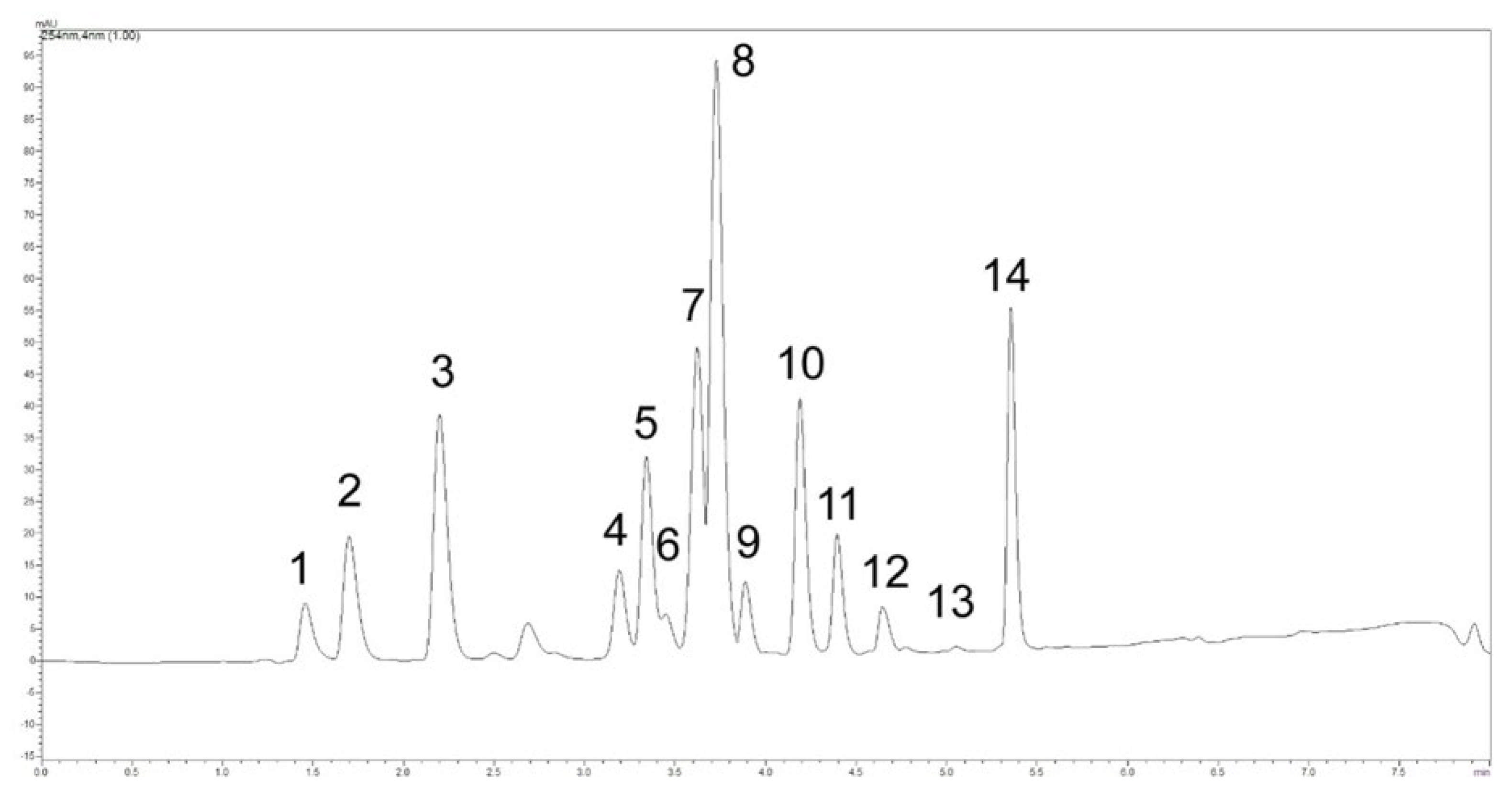
2.12. Analysis of Selected Flavonoids and Phenolic Acids by HPLC
2.13. Statistical Analysis
3. Results and Discussion
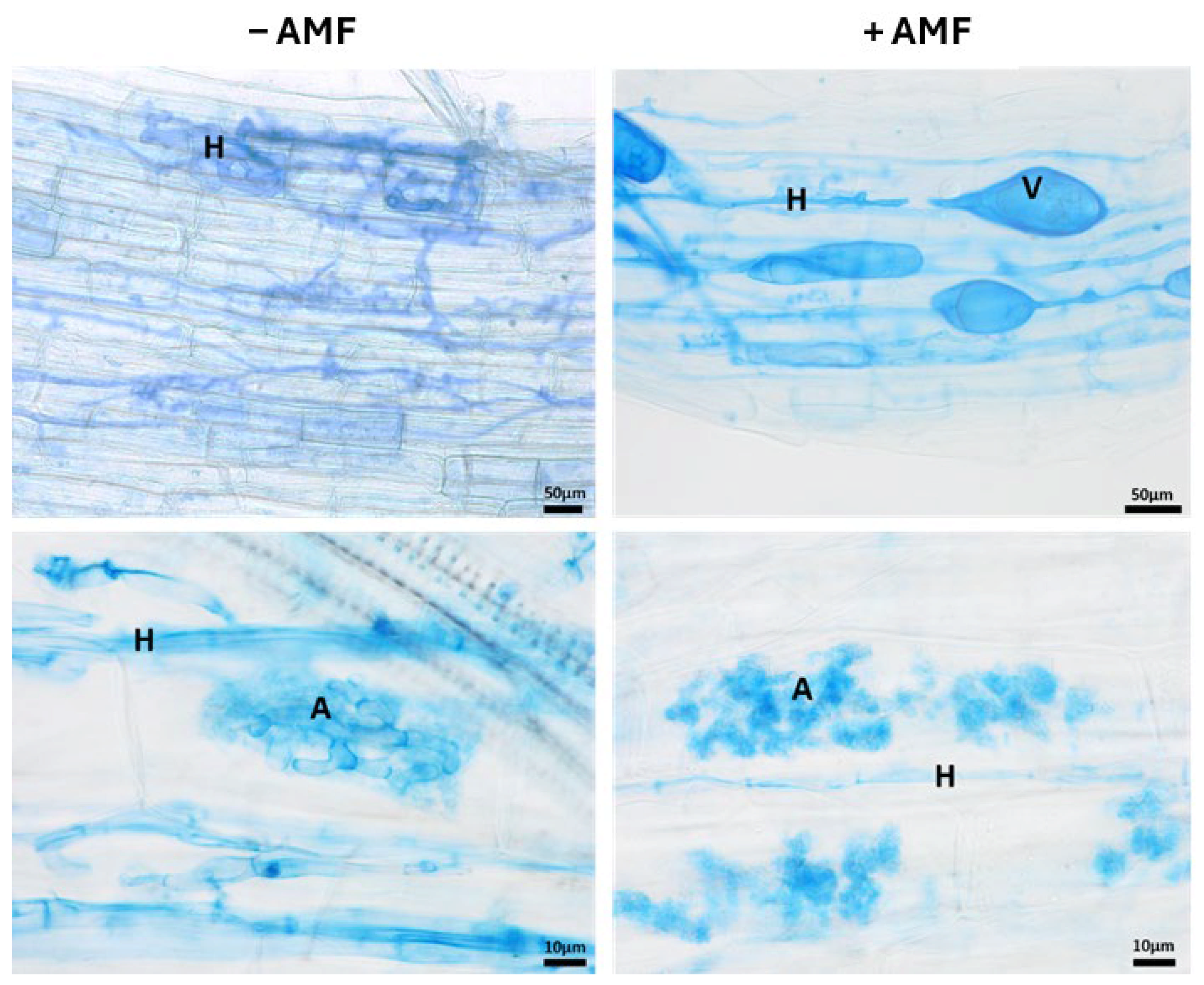
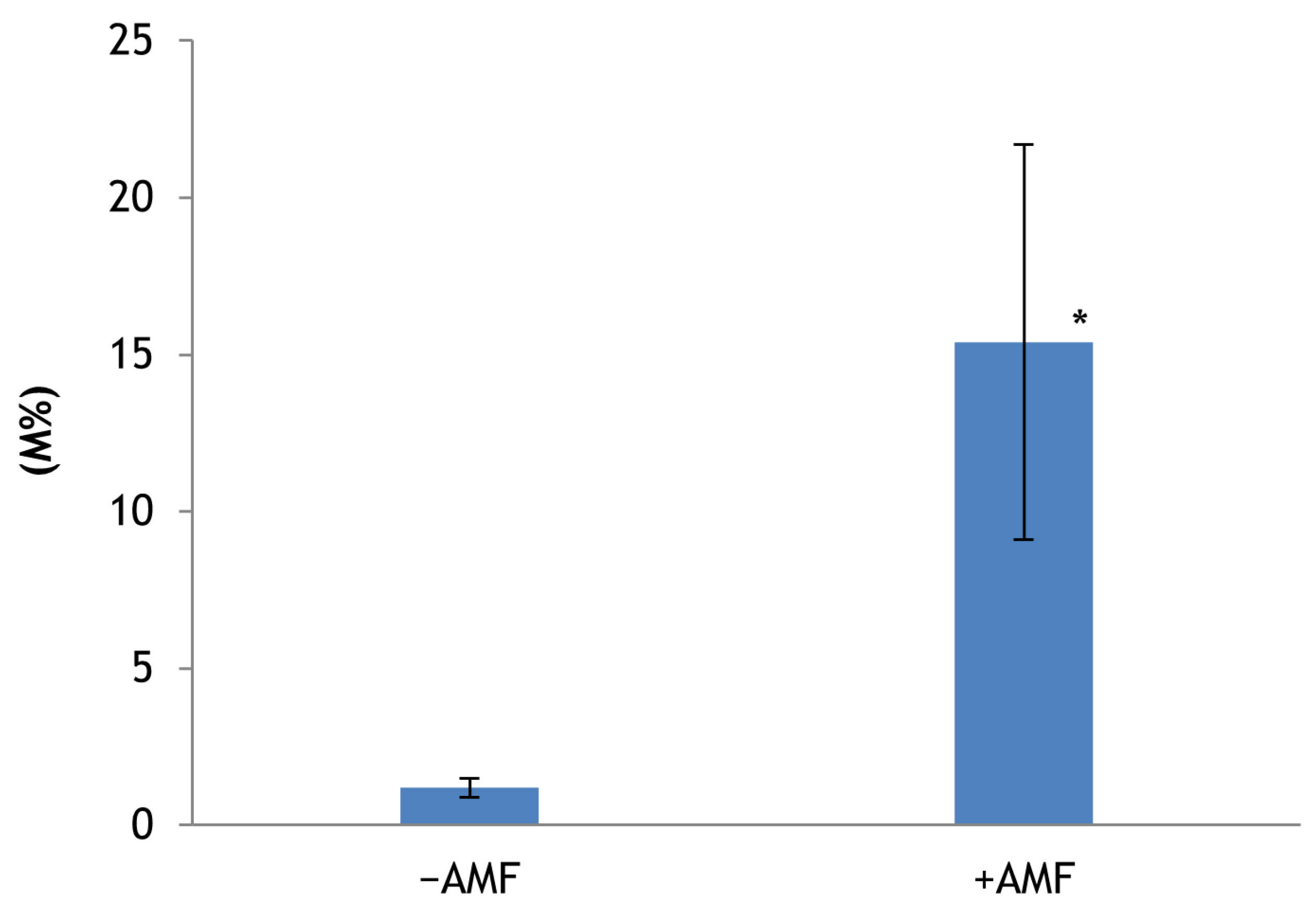
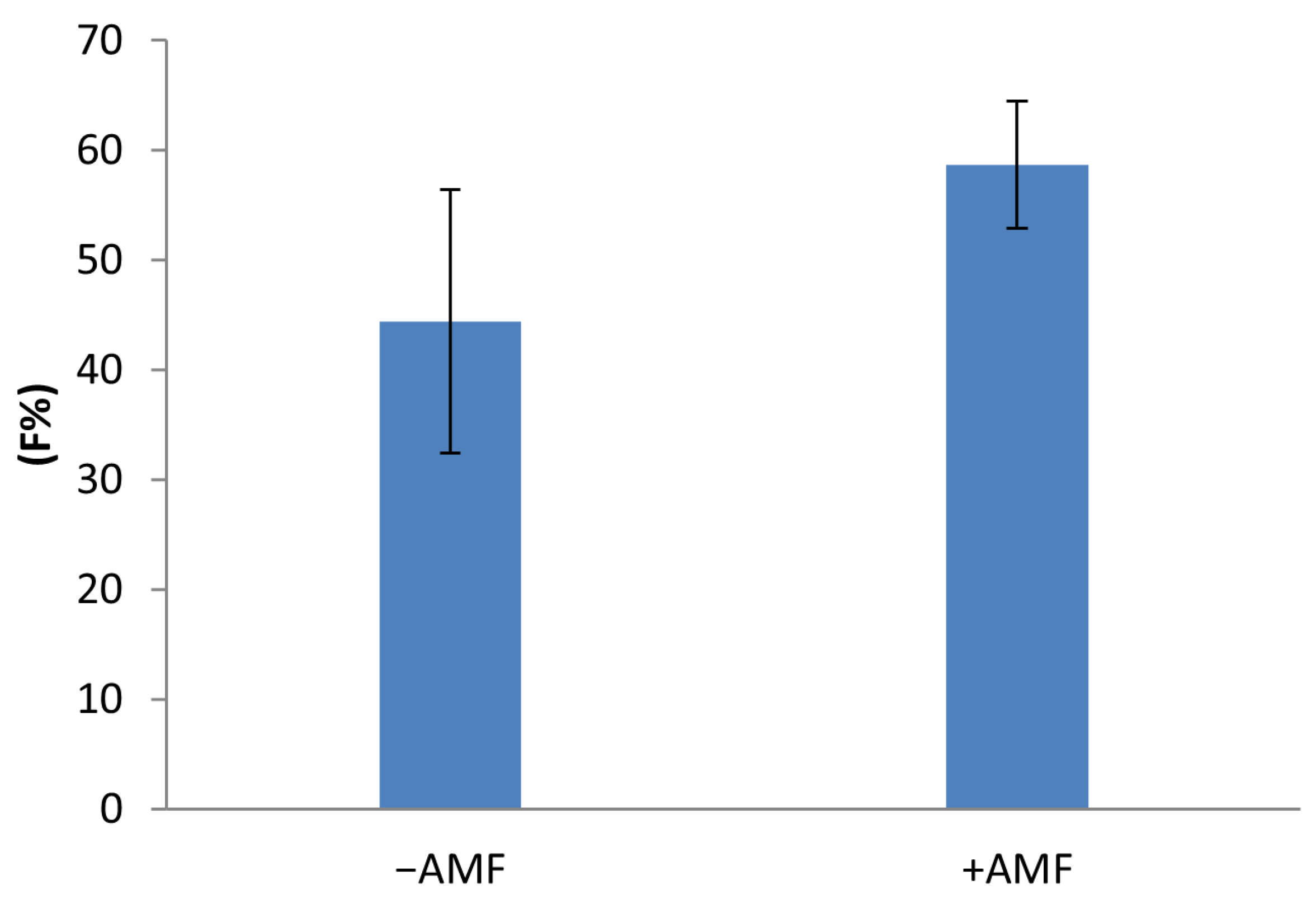
3.1. The Effect of AMF Inoculation on Mycorrhizal Colonization of Arnica Roots
3.2. The Effect of AMF Inoculation on Meadow Arnica Development and Mineral Uptake
3.3. The Content and Composition of Phenolics in Arnica Flower Heads
4. Conclusions
Author Contributions
Funding
Institutional Review Board Statement
Informed Consent Statement
Data Availability Statement
Conflicts of Interest
Appendix A. Statistical Analysis of the Results

| Effect of AMF Inoculation | Source of Variation | df | MS | F | p |
|---|---|---|---|---|---|
| Frequency (%) | Treatment | 1 | 1223.65 | 2.2898 | 0.144460 |
| Error | 22 | 534.39 | |||
| Intensity (%) | Treatment | 1 | 1245.889 | 24.50418 | 0.000059 |
| Error | 22 | 50.844 |
| Developmental Traits | Source of Variation | df | MS | F | p |
|---|---|---|---|---|---|
| Number of flowering shoots per plant | Treatment | 1 | 10.6667 | 0.72727 | 0.441823 |
| Error | 38 | 14.6667 | |||
| Length of flowering shoots (cm) | Treatment | 1 | 7.859 | 0.6347 | 0.470235 |
| Error | 38 | 12.381 | |||
| Number of flower heads per plant | Treatment | 1 | 240.667 | 0.40779 | 0.557822 |
| Error | 38 | 590.167 | |||
| Fresh mass of a single flower head (g) | Treatment | 1 | 0.017752 | 2.1596 | 0.215620 |
| Error | 38 | 0.008220 | |||
| Fresh mass of flower heads (g/plant) | Treatment | 1 | 98.820 | 1.32822 | 0.313311 |
| Error | 38 | 74.401 | |||
| Dry mass of flower heads (g/plant) | Treatment | 1 | 15.1051 | 2.75377 | 0.172364 |
| Error | 38 | 5.4852 | |||
| Fresh mass of herb (g/plant) | Treatment | 1 | 1797.3 | 3.9787 | 0.116825 |
| Error | 38 | 451.7 | |||
| Dry mass of herb (g/plant) | Treatment | 1 | 148.653 | 16.6498 | 0.015093 |
| Error | 38 | 8.928 | |||
| Fresh mass of roots (g/plant) | Treatment | 1 | 61.921 | 2.7605 | 0.171952 |
| Error | 38 | 22.431 | |||
| Dry mass of roots (g/plant) | Treatment | 1 | 8.8209 | 5.9841 | 0.070731 |
| Error | 38 | 1.4741 |
| Plant Material | Source of Variation | df | MS | F | p |
|---|---|---|---|---|---|
| Leaves | |||||
| Chlorophyll a (mg/g DM) | Treatment | 1 | 0.6864 | 10.160 | 0.033296 |
| Error | 4 | 0.0676 | |||
| Chlorophyll b (mg/g DM) | Treatment | 1 | 0.36787 | 3.0179 | 0.157352 |
| Error | 4 | 0.12190 | |||
| Carotenoids (mg/g DM) | Treatment | 1 | 0.00540 | 0.635 | 0.470054 |
| Error | 4 | 0.00850 | |||
| General sugar (mg glucose/g DM) | Treatment | 1 | 15,446.27 | 283.013 | 0.000073 |
| Error | 4 | 54.58 | |||
| Reduced sugar (mg glucose/g DM) | Treatment | 1 | 6461.63 | 623.063 | 0.000015 |
| Error | 4 | 10.37 | |||
| Starch (mg/g DM) | Treatment | 1 | 337.500 | 108.0000 | 0.000484 |
| Error | 4 | 3.125 | |||
| Roots | |||||
| General sugar (mg glucose/g DM) | Treatment | 1 | 6356 | 2.498 | 0.189131 |
| Error | 4 | 2544 | |||
| Reduced sugar (mg glucose/g DM) | Treatment | 1 | 0.010 | 0.0031 | 0.958099 |
| Error | 4 | 3.097 | |||
| Starch (mg/g DM) | Treatment | 1 | 16,537.5 | 94.946 | 0.000621 |
| Error | 4 | 174.2 |
| Plant Material | Source of Variation | df | MS | F | p |
|---|---|---|---|---|---|
| Leaves | |||||
| Phosphorous (P) | Treatment | 1 | 0.010086 | 33.0689 | 0.004534 |
| Error | 4 | 0.000305 | |||
| Nitrate nitrogen (NO3) | Treatment | 1 | 0.511584 | 39.2771 | 0.003308 |
| Error | 4 | 0.013025 | |||
| Nitrite nitrogen (N-NO2) | Treatment | 1 | 0.026136 | 16.8402 | 0.014808 |
| Error | 4 | 0.001552 | |||
| Calcium (Ca) | Treatment | 1 | 0.007562 | 8.1967 | 0.045791 |
| Error | 4 | 0.000923 | |||
| Potassium (K) | Treatment | 1 | 0.5186 | 12.081 | 0.025451 |
| Error | 4 | 0.0429 | |||
| Roots | |||||
| Phosphorous (P) | Treatment | 1 | 0.000794 | 1.6723 | 0.265583 |
| Error | 4 | 0.000475 | |||
| Nitrate nitrogen (NO3) | Treatment | 1 | 0.005954 | 20.354 | 0.010728 |
| Error | 4 | 0.000293 | |||
| Nitrite nitrogen (N-NO2) | Treatment | 1 | 0.000294 | 2.6018 | 0.182041 |
| Error | 4 | 0.000113 | |||
| Calcium (Ca) | Treatment | 1 | - | - | - |
| Error | 4 | - | |||
| Potassium (K) | Treatment | 1 | 0.02089 | 10.74 | 0.030589 |
| Error | 4 | 0.00195 |
| Flavonoids | Source of Variation | df | MS | F | p |
|---|---|---|---|---|---|
| Total content | Treatment | 1 | 0.027948 | 986.59 | 0.000006 |
| Error | 4 | 0.000028 | |||
| Cynaroside | Treatment | 1 | 10,662.29 | 869.042 | 0.000008 |
| Error | 4 | 12.27 | |||
| Rutin | Treatment | 1 | 276.983 | 308.505 | 0.000062 |
| Error | 4 | 0.898 | |||
| Hyperoside | Treatment | 1 | 470.188 | 647.794 | 0.000014 |
| Error | 4 | 0.726 | |||
| Cosmosiin | Treatment | 1 | 81.9578 | 945.961 | 0.000007 |
| Error | 4 | 0.0866 | |||
| Astragalin | Treatment | 1 | 6.2138 | 113.32 | 0.000441 |
| Error | 4 | 0.0548 | |||
| Diosmetin | Treatment | 1 | 142.877 | 49.711 | 0.002134 |
| Error | 4 | 2.874 | |||
| Sum | Treatment | 1 | 27252.7 | 794.866 | 0.000009 |
| Error | 4 | 34.3 |
| Phenolic Acids | Source of Variation | df | MS | F | p |
|---|---|---|---|---|---|
| Total content | Treatment | 1 | 0.057914 | 172.624 | 0.000194 |
| Error | 4 | 0.000335 | |||
| Neochlorogenic acid | Treatment | 1 | 285.890 | 299.411 | 0.000065 |
| Error | 4 | 0.955 | |||
| Chlorogenic acid | Treatment | 1 | 4801.90 | 398.915 | 0.000037 |
| Error | 4 | 12.04 | |||
| Caffeic acid | Treatment | 1 | 2.060080 | 1119.694 | 0.000005 |
| Error | 4 | 0.001840 | |||
| Ferulic acid | Treatment | 1 | 40,204.6 | 213.030 | 0.000128 |
| Error | 4 | 188.7 | |||
| Rosmarinic acid | Treatment | 1 | 4373.62 | 864.511 | 0.000008 |
| Error | 4 | 5.06 | |||
| 3.4-Di-O-caffeoylquinic acid | Treatment | 1 | 3.47134 | 944.88 | 0.000007 |
| Error | 4 | 0.00367 | |||
| 1.5-Dicaffeoylquinic acid | Treatment | 1 | 3403.35 | 272.532 | 0.000079 |
| Error | 4 | 12.49 | |||
| Cichoric acid | Treatment | 1 | 1767.22 | 255.878 | 0.000089 |
| Error | 4 | 6.91 | |||
| Sum | Treatment | 1 | 208,413 | 429.312 | 0.000032 |
| Error | 4 | 485 |
References
- Forycka, A.; Buchwald, W. Badania zasobów naturalnych roślin leczniczych objętych w Polsce ochroną. Herba Pol. 2008, 54, 81–112. [Google Scholar]
- European Pharmacopoeia. European Directorate for the Quality of Medicines and Health Care (EDQM), 10th ed.; Council of Europe: Strasbourg, France, 2019. [Google Scholar]
- Cassells, A.C.; Walsh, C.; Belin, M.; Cambornac, M.; Rohit, J.; Lubrano, C. Establishment of plantation from micropropagated Arnica chamissonis, a pharmaceutical substitute for the endangered A. montana. Plant Cell Tissue Organ Cult. 1999, 56, 139–144. [Google Scholar] [CrossRef]
- Olesińska, K.; Sugier, D.; Kaczmarski, Z. Yield and chemical composition of raw material from meadow Arnica (Arnica chamissonis Less.) depending on soil conditions and nitrogen fertilization. Agriculture 2021, 11, 810. [Google Scholar] [CrossRef]
- Zutic, I.; Borosic, J.; Benko, B.; Novak, B.; Dragovic-Uzelac, V. Arnica chamissonis growing in Croatia as affected by climate and pricking. Cereal Res. Commun. 2008, 36, 287–290. [Google Scholar]
- Maguire, B. A monograph of the genus arnica (Senecioneae, Compositae). Brittonia 1943, 4, 386–510. [Google Scholar] [CrossRef]
- Clauser, M.; Aiello, N.; Scartezzini, F.; Innocenti, G.; Dall’Acqua, S. Differences in the chemical composition of Arnica montana flowers from wild populations of Northern Italy. Nat. Prod. Commun. 2004, 9, 3–6. [Google Scholar] [CrossRef]
- Seemann, A.; Wallner, T.; Poschlod, P.; Heilmann, J. Variation of sesquiterpene lactone contents in different Arnica montana populations: Influence of ecological parameters. Planta Med. 2010, 76, 837–842. [Google Scholar] [CrossRef]
- Lyss, G.; Schmidt, T.J.; Merfort, I.; Pahl, H.L. Helenalin, an anti-inflammatory sesquiterpene lactone from Arnica, selectively inhibits transcription factor NF-κB. Biol. Chem. 1997, 378, 951–961. [Google Scholar] [CrossRef]
- Willuhn, G. Arnica flos. In Herbal Drugs and Phytopharmaceuticals; Wichtl, M., Ed.; Medpharm Scientific Publishers: Stuttgart, Germany, 2004; pp. 54–59. [Google Scholar]
- Roki, D.; Menković, N.; Savić-Fodulović, K.; Krivokuća-Đokić, D.; Ristić, M.; Grubišić, D. Flavonoids and essential oil in flower heads of introduced Arnica chamissonis. J. Herbs Spices Med. Plants 2008, 4, 19–27. [Google Scholar] [CrossRef]
- Gawlik-Dziki, U.; Świeca, M.; Sugier, D.; Cichocka, J. Comparison of in vitro lipoxygenase, xanthine oxidase inhibitory and antioxidant activity of Arnica montana and Arnica chamissonis tinctures. Acta Sci. Pol. Hortorum Cultus 2011, 10, 15–27. [Google Scholar]
- Kriplani, P.; Guarave, K.; Baghael, U.S. Arnica montana L.—A plant of healing: Review. J. Pharm. Pharmacol. 2017, 69, 925–945. [Google Scholar] [CrossRef] [PubMed]
- Garcia-Oliveira, P.; Chamorro, F.; Donn, P.; Garcia-Perez, P.; Seyyedi-Mansour, S.; Silva, A.; Echave, J.; Simal-Gandara, J.; Cassani, L.; Prieto, M.A. Characterization of phenolic compounds of Arnica montana conventional extracts. Eng. Proc. 2023, 48, 61. [Google Scholar] [CrossRef]
- Spitaler, R.; Schlorhaufer, D.; Ellmerer, E.; Merfort, I.; Bortenschlager, S.; Stuppner, H.; Zidorn, C. Altitudinal variation of secondary metabolite profiles in flowering heads of Arnica montana cv. ARBO. Phytochemistry 2006, 67, 409–417. [Google Scholar] [CrossRef] [PubMed]
- Ganzera, M.; Egger, C.; Zidorn, C.; Stuppner, H. Quantitative analysis of flavonoids and phenolic acids in Arnica montana L. by micellar electrokinetic capillary chromatography. Anal. Chim. Acta 2008, 614, 196–200. [Google Scholar] [CrossRef]
- Sugier, D.; Olesińska, K.; Sugier, P.; Wójcik, M. Chemical composition of essential oil from flower heads of Arnica chamissonis Less. under a nitrogen impact. Molecules 2019, 24, 4454. [Google Scholar] [CrossRef]
- Olesińska, K.; Sugier, D. Row spacing and the term of harvest of flower heads as determinants of crop yield and chemical composition of raw material of chamisso arnica (Arnica chamissonis Less.). Acta Sci. Pol. Agric. 2020, 19, 83–95. [Google Scholar]
- Kouzi, S.A.; Nuzum, D.S. Arnica for bruising and swelling. Am. J. Health-Syst. Pharm. 2007, 64, 2434–2443. [Google Scholar] [CrossRef] [PubMed]
- Dilmurodova, E. Chamisso arnica (Arnica chamissonis) as a plant: Chemical composition and pharmacological properties. IMRAS 2025, 8, 126–130. [Google Scholar]
- Toma, C.C.; Marrelli, M.; Puticiu, M.; Conforti, F.; Statti, G. Effects of arnica phytotherapeutic and homeopathic formulations on traumatic injuries and inflammatory conditions: A systematic review. Plants 2024, 13, 3112. [Google Scholar] [CrossRef]
- Hussain, F.; Pathan, S.; Sahu, K.; Gupta, B.K. Herbs as cosmetics for natural care: A review. GSC Biol. Pharm. Sci. 2022, 19, 316–322. [Google Scholar] [CrossRef]
- Perret, J.K.; Gómez Velázquez, A.; Mehn, A. Green cosmetics—The effects of package design on consumers’ willingness-to-pay and sustainability perceptions. Sustainability 2025, 17, 2581. [Google Scholar] [CrossRef]
- González-Minero, F.J.; Bravo-Díaz, L. The use of plants in skin-care products, cosmetics and fragrances: Past and present. Cosmetics 2018, 5, 50. [Google Scholar] [CrossRef]
- Dini, I.; Laneri, S. The new challenge of green cosmetics: Natural food ingredients for cosmetic formulations. Molecules 2021, 26, 3921. [Google Scholar] [CrossRef] [PubMed]
- Yuan, M.L.; Zhang, M.H.; Shi, Z.Y.; Yang, S.; Zhang, M.G.; Wang, Z.; Wu, S.W.; Gao, J.K. Arbuscular mycorrhizal fungi enhance active ingredients of medicinal plants: A quantitative analysis. Front. Plant Sci. 2023, 14, 1276918. [Google Scholar] [CrossRef] [PubMed]
- Raei, Y.; Weisany, W. Arbuscular mycorrhizal fungi associated with some aromatic and medicinal plants. Bull. Environ. Pharmacol. Life Sci. 2013, 2, 129–138. [Google Scholar]
- Tedersoo, L.; Bahram, M.; Zobel, M. How mycorrhizal associations drive plant population and community biology. Science 2020, 367, 1223. [Google Scholar] [CrossRef] [PubMed]
- Bennett, A.E.; Groten, K. The costs and benefits of plant–arbuscular mycorrhizal fungal interactions. Annu. Rev. Plant Biol. 2022, 73, 649–672. [Google Scholar] [CrossRef] [PubMed]
- Chaurasia, A.K.; Singh, R.K.; Saxena, R.; Kumar, A.; Shrinet, K. Mycorrhizal secondary metabolites: An overview. In Industrial Applications of Microbial Secondary Metabolites; Verma, N., Mishra, D., Pandey, A.P., Gaur, R.S., Eds.; CRC Press: Boca Raton, FL, USA, 2026; pp. 150–163. [Google Scholar] [CrossRef]
- Zhao, Y.; Cartabia, A.; Lalaymia, I.; Declerck, S. Arbuscular mycorrhizal fungi and production of secondary metabolites in medicinal plants. Mycorrhiza 2022, 32, 221–256. [Google Scholar] [CrossRef] [PubMed]
- Thokchom, S.D.; Gupta, S.; Kapoor, R. Response of Ocimum tenuiflorum L. (holy basil) to inoculation of four arbuscular mycorrhizal fungal species shows functional coherence with respect to their phylogeny. J. Soil Sci. Plant Nutr. 2023, 23, 3407–3420. [Google Scholar] [CrossRef]
- Ryszka, P.; Błaszkowski, J.; Jurkiewicz, A.; Turnau, K. Arbuscular mycorrhiza of Arnica montana under field conditions. Mycorrhiza 2010, 20, 551–557. [Google Scholar] [CrossRef]
- Turanoglu, C.; Ancel, H.; Lann, C.L.; Van Baaren, J.; Bazin, O.; Declerck, S.; Fort, F.; Breton, T.F.; Vandenkoornhuyse, P.; Mony, C. Functional traits of Asteraceae species vary with arbuscular mycorrhizal fungal identity and phylogeny. Mycorrhiza 2025, 35, 40. [Google Scholar] [CrossRef] [PubMed]
- Bączek, K.B.; Wiśniewska, M.; Przybył, J.L.; Kosakowska, O.; Węglarz, Z. Arbuscular mycorrhizal fungi in chamomile (Matricaria recutita L.) organic cultivation. Ind. Crops Prod. 2019, 140, 111562. [Google Scholar] [CrossRef]
- Sujkowska-Rybkowska, M.; Lisek, A.; Sumorok, B.; Derkowska, E.; Szymańska, M.; Sas-Paszt, L. Arbuscular mycorrhizal fungi as an important factor enabling the adaptation of Anthyllis vulneraria L. to Zn-Pb-polluted tailings. Plants 2023, 12, 2092. [Google Scholar] [CrossRef] [PubMed]
- Lichtenthaler, H.K.; Wellburn, A.R. Determinations of total carotenoids and chlorophylls a and b of leaf extracts in different solvents. Biochem. Soc. Trans. 1983, 11, 591–592. [Google Scholar] [CrossRef]
- Lichtenthaler, H.K.; Buschmann, C. Extraction of photosynthetic tissues: Chlorophylls and carotenoids. Curr. Protoc. Food Anal. Chem. 2001, 1, F4.2.1–F4.2.6. [Google Scholar] [CrossRef]
- Dubois, M.; Gilles, K.; Hamilton, J.; Rebers, P.; Smith, F. Colorimetric method for determination of sugars and related substances. Anal. Chem. 1956, 28, 350–356. [Google Scholar] [CrossRef]
- Nelson, N. A photometric adaptation of the Somogyi method for the determination of glucose. J. Biol. Chem. 1944, 153, 375–380. [Google Scholar] [CrossRef]
- Samotus, B.; Palaśiński, M. Ocena ziarnistości skrobi bulw ziemniaczanych przy zastosowaniu analizy sedymentacyjnej. Zesz. Nauk. WSR Kraków Ser. Roln. 1958, 4, 119–144. [Google Scholar]
- Spurway, D.H.; Lawton, K. Soil Testing; Michigan Agricultural Experiment Station Technical Bulletin: East Lansing, MI, USA, 1949; p. 132. [Google Scholar]
- Polskie Towarzystwo Farmaceutyczne. Polish Pharmacopoeia VI (In Polish: Farmakopea Polska VI); Polskie Towarzystwo Farmaceutyczne: Warsaw, Poland, 2005. [Google Scholar]
- Baczek, K.; Kosakowska, O.; Przybył, J.L.; Kuźma, P.; Ejdys, M.; Obiedziński, M.; Węglarz, Z. Intraspecific variability of yarrow (Achillea millefolium L. sl) in respect of developmental and chemical traits. Herba Pol. 2015, 61, 37–52. [Google Scholar] [CrossRef]
- Kaur, S.; Suseela, V. Unraveling arbuscular mycorrhiza-induced changes in plant primary and secondary metabolome. Metabolites 2020, 10, 335. [Google Scholar] [CrossRef]
- Sokornova, S.; Malygin, D.M.; Terentev, A.; Dolzhenko, V. Arbuscular mycorrhiza symbiosis as a factor of Asteraceae species invasion. Agronomy 2022, 12, 3214. [Google Scholar] [CrossRef]
- Kaur, S.; Campbell, B.J.; Suseela, V. Root metabolome of plant–arbuscular mycorrhizal symbiosis mirrors the mutualistic or parasitic mycorrhizal phenotype. New Phytol. 2022, 234, 672–687. [Google Scholar] [CrossRef] [PubMed]
- Lohse, S.; Schliemann, W.; Ammer, C.; Kopka, J.; Strack, D.; Fester, T. Organization and metabolism of plastids and mitochondria in arbuscular mycorrhizal roots of Medicago truncatula. Plant Physiol. 2005, 139, 329–340. [Google Scholar] [CrossRef] [PubMed][Green Version]
- Jung, S.C.; Martinez-Medina, A.; Lopez-Raez, J.A.; Pozo, M.J. Mycorrhiza-induced resistance and priming of plant defenses. J. Chem. Ecol. 2012, 38, 651–664. [Google Scholar] [CrossRef]
- Heijne, B.; Heil, G.W.; van Dam, D. Relations between acid rain and vesicular–arbuscular mycorrhiza. Agric. Ecosyst. Environ. 1989, 29, 187–192. [Google Scholar] [CrossRef]
- Eriksen, M.; Bjureke, K.E.; Dhillion, S.S. Mycorrhizal plants of traditionally managed boreal grasslands in Norway. Mycorrhiza 2002, 12, 117–123. [Google Scholar] [CrossRef]
- Parkash, V.; Aggarwal, A.; Sharma, V. Rhizospheric effect of vesicular arbuscular mycorrhizal inoculation on biomass production of Ruta graveolens L.: A potential medicinal and aromatic herb. J. Plant Nutr. 2011, 34, 1386–1396. [Google Scholar] [CrossRef]
- Krupa, A. Mycorrhizas and their multifunctional role in the environment. Chem. Environ. Biotechnol. 2010, 15, 175–182. [Google Scholar]
- Zubek, S.; Błaszkowski, J.; Mleczko, P. Arbuscular mycorrhizal and dark septate endophyte associations of medicinal plants. Acta Soc. Bot. Pol. 2011, 80, 285–292. [Google Scholar] [CrossRef][Green Version]
- Heijne, B.; Van Dam, D.; Heil, G.W.; Bobbink, R. Acidification effects on vesicular-arbuscular mycorrhizal (VAM) infection, growth and nutrient uptake of established heathland herb species. Plant Soil 1996, 179, 197–206. [Google Scholar] [CrossRef]
- Wahdan, S.F.M.; Asran, A.G.A.; Abdellatef, M.; Atia, M.A.M.; Ji, L. Arbuscular mycorrhizal fungi in organic versus conventional farming. In Arbuscular Mycorrhizal Fungi and Higher Plants: Fundamentals and Applications; Springer: Singapore, 2024; pp. 259–286. [Google Scholar] [CrossRef]
- Köhl, L.; Lukasiewicz, C.E.; van der Heijden, M.G.A. Establishment and effectiveness of inoculated arbuscular mycorrhizal fungi in agricultural soils. Plant Cell Environ. 2016, 39, 136–146. [Google Scholar] [CrossRef] [PubMed]
- Schweiger, R.; Müller, C. Leaf metabolome in arbuscular mycorrhizal symbiosis. Curr. Opin. Plant Biol. 2015, 26, 120–126. [Google Scholar] [CrossRef] [PubMed]
- Wu, Q.-S.; He, X.-H.; Zou, Y.-N.; Liu, C.-Y.; Xiao, J.; Li, Y. Arbuscular mycorrhizas alter root system architecture of Citrus tangerine through regulating metabolism of endogenous polyamines. Plant Growth Regul. 2012, 68, 27–35. [Google Scholar] [CrossRef]
- Padilla, I.; Encina, C. Changes in root morphology accompanying mycorrhizal alleviation of phosphorus deficiency in micropropagated Annona cherimola Mill. plants. Sci. Hortic. 2005, 106, 360–369. [Google Scholar] [CrossRef]
- Schroeder, M.S.; Janos, D.P. Plant growth, phosphorus nutrition, and root morphological responses to arbuscular mycorrhizas, phosphorus fertilization, and intraspecific density. Mycorrhiza 2005, 15, 203–216. [Google Scholar] [CrossRef]
- Balabanova, V.; Vitkova, A. Flower yield of Arnica sp. cultivated in two floristic regions in Bulgaria. J. Agric. Ecol. Res. Int. 2016, 9, 1–7. [Google Scholar] [CrossRef]
- Radanović, D.; Marković, T.; Antić-Mladenović, S.; Pljevlakušić, D.; Ristić, M.; Krivokuća-Dokić, D. Yield and quality of arnica (Arnica montana and Arnica chamissonis var. foliosa) cultivated in Serbia. In Book of Scientific Papers and Abstracts, 1st International Scientific Conference on Medicinal, Aromatic and Spice Plants; Habán, M., Otepka, P., Eds.; Slovak Agricultural University in Nitra: Nitra, Slovakia, 2007; pp. 157–161. [Google Scholar]
- Skubij, N.; Dzida, K. Essential oil composition of summer savory (Satureja hortensis L.) cv. Saturn depending on nitrogen nutrition and plant development phases in raw material cultivated for industrial use. Ind. Crops Prod. 2019, 135, 260–270. [Google Scholar] [CrossRef]
- He, F.; Grundmann, L.; Kuhn, A.J.; Müller-Linow, M. Automatic evaluation of Arnica flower development for optimized active ingredient yields. In EHC2024: International Symposium on Robotics, Mechanization and Smart Horticulture; Acta Horticulturae: Leuven, Belgium, 2024; Volume 1433, pp. 47–56. [Google Scholar] [CrossRef]
- Sugier, D.; Gawlik-Dziki, U. Wpływ nawożenia dolistnego na plonowanie i jakość surowca Arnica montana L. i Arnica chamissonis var. foliosa. Agron. Sci. 2009, 64, 129–139. [Google Scholar] [CrossRef]
- Sugier, D.; Sugier, P.; Kowalski, R.; Kołodziej, B.; Olesińska, K. Foliar boron fertilization as a factor affecting the essential oil content and yield of oil components from flower heads of Arnica montana L. and Arnica chamissonis Less. cultivated for industry. Ind. Crops Prod. 2017, 109, 587–597. [Google Scholar] [CrossRef]
- Kowalski, R.; Sugier, D.; Sugier, P.; Kołodziej, B. Evaluation of the chemical composition of essential oils with respect to the maturity of flower heads of Arnica montana L. and Arnica chamissonis Less. cultivated for industry. Ind. Crops Prod. 2015, 76, 857–865. [Google Scholar] [CrossRef]
- Asadi, M.; Hadian, J.; Ebrahimi, S.N.; Karimzadeh, G. Effect of different levels of sulfur on growth, quality characteristics and yield of Arnica chamissonis Less. ssp. foliosa. J. Agric. Sci. Technol. 2019, 33, 219–232. [Google Scholar]
- Assrar, A.W.A.; Elhindi, K.M. Alleviation of drought stress of marigold (Tagetes erecta) plants by using arbuscular mycorrhizal fungi. Saudi J. Biol. Sci. 2011, 18, 93–98. [Google Scholar] [CrossRef] [PubMed]
- Tabrizi, L.; Mohammadi, S.; Delshad, M.; Moteshare Zadeh, B. Effect of arbuscular mycorrhizal fungi on yield and phytoremediation performance of pot marigold (Calendula officinalis L.) under heavy metals stress. Int. J. Phytoremediat. 2015, 17, 1244–1252. [Google Scholar] [CrossRef] [PubMed]
- Latef, A.A.H.A.; Chaoxing, H. Effect of arbuscular mycorrhizal fungi on growth, mineral nutrition, antioxidant enzymes activity and fruit yield of tomato grown under salinity stress. Sci. Hortic. 2011, 127, 228–233. [Google Scholar] [CrossRef]
- Kaschuk, G.; Kuyper, T.W.; Leffelaar, P.A.; Hungria, M.; Giller, K.E. Are the rates of photosynthesis stimulated by the carbon sink strength of rhizobial and arbuscular mycorrhizal symbioses? Soil Biol. Biochem. 2009, 41, 1233–1244. [Google Scholar] [CrossRef]
- Kogel, K.H.; Voll, L.M.; Schäfer, P.; Jansen, C.; Wu, Y.; Langen, G.; Imani, J.; Hofmann, J.; Scmiedl, A.; Sonnewald, S.; et al. Transcriptome and metabolome profiling of field-grown transgenic barley show cultivar-specific variances. Proc. Natl. Acad. Sci. USA 2010, 107, 6198–6203. [Google Scholar] [CrossRef]
- Feng, Y.; Yin, F.; Xu, K.; Jia, X.; Zhou, S.; Ma, C. Role of sucrose metabolism and signal transduction in plant development and stress response. J. Nucl. Agric. Sci. 2021, 35, 2044–2055. [Google Scholar] [CrossRef]
- Wang, Y.J.; Wu, Q.S. Influence of sugar metabolism on the dialogue between arbuscular mycorrhizal fungi and plants. Hortic. Adv. 2023, 1, 2. [Google Scholar] [CrossRef]
- Gaspar, M.L.; Pollero, R.; Cabello, M. Partial purification and characterization of a lipolytic enzyme from spores of the arbuscular mycorrhizal fungus Glomus versiforme. Mycologia 1997, 89, 610–614. [Google Scholar] [CrossRef][Green Version]
- Li, Y.; Liu, Z.; Hou, H.; Lei, H.; Zhu, X.; Li, X.; He, X.; Tian, C. Arbuscular mycorrhizal fungi-enhanced resistance against phytophthora sojae infection on soybean leaves is mediated by a network involving hydrogen peroxide, jasmonic acid, and the metabolism of carbon and nitrogen. Acta Physiol. Plant. 2013, 35, 3465–3475. [Google Scholar] [CrossRef]
- Liu, R.C.; Meng, L.L.; Zou, Y.N.; He, X.H.; Wu, Q.S. Introduction of earthworms into mycorrhizosphere of white clover facilitates storage in glomalin-related soil protein and contribution to soil total N. Appl. Soil Ecol. 2022, 179, 104597. [Google Scholar] [CrossRef]
- Adyari, B.; Supriatun, T.; Rossiana, N.; Kramadibrata, K. Arbuscular mycorrhizae fungi and sustainability of artisanal gold mining waste disposal site revegetation. Ecodevelopment 2022, 4, 47–51. [Google Scholar] [CrossRef]
- Pu, S.Q.; Zheng, F.L.; Wu, Q.S.; Hashem, A.; Abd-Allah, E.F.; Zou, Y.N. Arbuscular mycorrhizal fungi mediate leaf sugar profile in water-stressed trifoliate orange. BMC Plant Biol. 2025, 25, 1456. [Google Scholar] [CrossRef] [PubMed]
- Ahmad, F.; Singh, A.; Kamal, A. Osmoprotective role of sugar in mitigating abiotic stress in plants. In Protective Chemical Agents in the Amelioration of Plant Abiotic Stress: Biochemical and Molecular Perspectives; Roychoudhury, A., Tripathi, D.K., Eds.; John Wiley & Sons Ltd.: Hoboken, NJ, USA, 2020; pp. 53–70. [Google Scholar]
- Aldesuquy, H. Exogenous salicylic acid and trehalose ameliorate short term drought stress in wheat cultivars by up-regulating membrane characteristics and antioxidant defense system. J. Hortic. 2015, 2, 1000139. [Google Scholar] [CrossRef]
- Feng, D.; Wang, X.; Gao, J.; Zhang, C.; Liu, H.; Liu, P.; Sun, X. Exogenous calcium: Its mechanisms and research advances involved in plant stress tolerance. Front. Plant Sci. 2023, 14, 1143963. [Google Scholar] [CrossRef]
- Gutjahr, C.; Novero, M.; Welham, T.; Wang, T.; Bonfante, P. Root starch accumulation in response to arbuscular mycorrhizal colonization differs among Lotus japonicus starch mutants. Planta 2011, 234, 639–646. [Google Scholar] [CrossRef]
- Evelin, H.; Kapoor, R.; Giri, B. Arbuscular mycorrhizal fungi in alleviation of salt stress: A review. Ann. Bot. 2009, 104, 1263–1280. [Google Scholar] [CrossRef]
- Smith, S.E.; Smith, F.A. Roles of arbuscular mycorrhizas in plant nutrition and growth: New paradigms from cellular to ecosystem scales. Annu. Rev. Plant Biol. 2011, 62, 227–250. [Google Scholar] [CrossRef]
- Smith, S.E.; Read, D.J. Mycorrhizal Symbiosis, 3rd ed.; Academic Press: San Diego, CA, USA, 2008. [Google Scholar]
- Zeng, Y.; Guo, L.P.; Chen, B.D.; Hao, Z.P.; Wang, J.Y.; Huang, L.Q.; Yang, G.; Cui, X.M.; Yang, L.; Wu, Z.X.; et al. Arbuscular mycorrhizal symbiosis for sustainable cultivation of Chinese medicinal plants: A promising research direction. Am. J. Chin. Med. 2013, 41, 1199–1221. [Google Scholar] [CrossRef]
- Soti, P.; Kariyat, R.; Racelis, A. Effective farm management promotes native AMF and benefits organic farming systems. Agric. Ecosyst. Environ. 2023, 342, 108240. [Google Scholar] [CrossRef]
- Bowles, T.M.; Barrios-Masias, F.H.; Carlisle, E.A.; Cavagnaro, T.R.; Jackson, L.E. Effects of arbuscular mycorrhizae on tomato yield, nutrient uptake, water relations, and soil carbon dynamics under deficit irrigation in field conditions. Sci. Total Environ. 2016, 566–567, 1223–1234. [Google Scholar] [CrossRef] [PubMed]
- Thirkell, T.J.; Charters, M.D.; Elliott, A.J.; Sait, S.M.; Field, K.J. Are mycorrhizal fungi our sustainable saviours? Considerations for achieving food security. J. Ecol. 2017, 105, 921–929. [Google Scholar] [CrossRef]
- Chen, M.; Arato, M.; Borghi, L.; Nouri, E.; Reinhardt, D. Beneficial services of arbuscular mycorrhizal fungi—From ecology to application. Front. Plant Sci. 2018, 9, 1270. [Google Scholar] [CrossRef] [PubMed]
- Ritz, K.; Young, I.M. Interactions between soil structure and fungi. Mycologist 2004, 18, 52–59. [Google Scholar] [CrossRef]
- Höpfner, I.; Beyschlag, W.; Bartelheimer, M.; Werner, C.; Unger, S. Role of mycorrhization and nutrient availability in competitive interactions between the grassland species Plantago lanceolata and Hieracium pilosella. Plant Ecol. 2015, 216, 887–899. [Google Scholar] [CrossRef]
- Qin, F.; Yu, S. Arbuscular mycorrhizal fungi protect native woody species from novel weapons. Plant Soil 2019, 440, 39–52. [Google Scholar] [CrossRef]
- Sandrini, M.; Nerva, L.; Sillo, F.; Balestrini, R.; Chitarra, W.; Zampieri, E. Abiotic stress and belowground microbiome: The potential of omics approaches. Int. J. Mol. Sci. 2022, 23, 1091. [Google Scholar] [CrossRef]
- Lee, S.-W.; Lee, E.-H.; Eom, A.-H. Effects of organic farming on communities of arbuscular mycorrhizal fungi. Mycobiology 2008, 36, 19–23. [Google Scholar] [CrossRef]
- Goddard, M.L.; Belval, L.; Martin, I.R.; Roth, L.; Laloue, H.; Deglène-Benbrahim, L.; Valat, L.; Bertsch, C.; Chong, J. Arbuscular mycorrhizal symbiosis triggers major changes in primary metabolism together with modification of defense responses and signaling in both roots and leaves of Vitis vinifera. Front. Plant Sci. 2021, 12, 721614. [Google Scholar] [CrossRef]
- Sarmiento-López, L.G.; López-Meyer, M.; Sepúlveda-Jiménez, G.; Cárdenas, L.; Rodríguez-Monroy, M. Arbuscular mycorrhizal symbiosis in Stevia rebaudiana increases trichome development, flavonoid and phenolic compound accumulation. Biocatal. Agric. Biotechnol. 2021, 31, 101889. [Google Scholar] [CrossRef]
- Rashidi, S.; Yousefi, A.R.; Pouryousef, M.; Goicoechea, N. Effect of arbuscular mycorrhizal fungi on the accumulation of secondary metabolites in roots and reproductive organs of Solanum nigrum, Digitaria sanguinalis and Ipomoea purpurea. Chem. Biol. Technol. Agric. 2022, 9, 23. [Google Scholar] [CrossRef]
- Pan, L.; Wang, T.; Gavrikov, V.L.; Guo, X.; Mu, L.; Tang, Z. Trade-off strategies between growth and defense of spring ephemeral plants in early spring. Front. Plant Sci. 2025, 16, 1503169. [Google Scholar] [CrossRef] [PubMed]
- Park, C.H.; Yeo, H.J.; Kim, Y.J.; van Nguyen, B.; Park, Y.E.; Sathasivam, R.; Kim, J.K.; Park, S.U. Profiles of secondary metabolites (phenolic acids, carotenoids, anthocyanins, and galantamine) and primary metabolites (carbohydrates, amino acids, and organic acids) during flower development in Lycoris radiata. Biomolecules 2021, 11, 248. [Google Scholar] [CrossRef] [PubMed]
- Wu, W.Y.; Wang, Y.P. Pharmacological actions and therapeutic applications of Salvia miltiorrhiza depside salt and its active components. Acta Pharmacol. Sin. 2012, 33, 1119–1130. [Google Scholar] [CrossRef]
- Shi, H.; Lu, C.; Wu, Y.; Wang, L.; Cai, B. AMF inhibit the production of phenolic acid autotoxins at the seed-filling stage in soybeans with continuous monocropping. BMC Plant Biol. 2024, 24, 732. [Google Scholar] [CrossRef]
- Geneva, M.P.; Stancheva, I.V.; Boychinova, M.M.; Mincheva, N.H.; Yonova, P.A. Effects of foliar fertilization and arbuscular mycorrhizal colonization on Salvia officinalis L. growth, antioxidant capacity, and essential oil composition. J. Sci. Food Agric. 2010, 90, 696–702. [Google Scholar] [CrossRef]
- Engel, R.; Szabó, K.; Abrankó, L.; Rendes, K.; Füzy, A.; Takács, T. Effect of arbuscular mycorrhizal fungi on the growth and polyphenol profile of marjoram, lemon balm, and marigold. J. Agric. Food Chem. 2016, 64, 3733–3742. [Google Scholar] [CrossRef]
- Li, J.F.; He, X.H.; Li, H.; Zheng, W.J.; Liu, J.F.; Wang, M.Y. Arbuscular mycorrhizal fungi increase growth and phenolics synthesis in Poncirus trifoliata under iron deficiency. Sci. Hortic. 2015, 183, 87–92. [Google Scholar] [CrossRef]
- Araim, G.; Saleem, A.; Arnason, J.T.; Charest, C. Root colonization by an arbuscular mycorrhizal (AM) fungus increases growth and secondary metabolism of purple coneflower, Echinacea purpurea (L.) Moench. J. Agric. Food Chem. 2009, 57, 2255–2258. [Google Scholar] [CrossRef]
- Zeng, Y.; Guo, L.P.; Chen, B.D.; Hao, Z.P.; Wang, J.Y.; Huang, L.Q.; Yang, G.; Cui, X.M.; Yang, L.; Wu, Z.X.; et al. Arbuscular mycorrhizal symbiosis and active ingredients of medicinal plants: Current research status and prospectives. Mycorrhiza 2013, 23, 253–265. [Google Scholar] [CrossRef] [PubMed]
- Yang, Y.; Ou, X.; Yang, G.; Xia, Y.; Chen, M.; Guo, L.; Liu, D. Arbuscular mycorrhizal fungi regulate the growth and phyto-active compound of Salvia miltiorrhiza seedlings. Appl. Sci. 2017, 7, 68. [Google Scholar] [CrossRef]
- Dutta, S.C.; Neog, B. Accumulation of secondary metabolites in response to antioxidant activity of turmeric rhizomes co-inoculated with native arbuscular mycorrhizal fungi and plant growth promoting rhizobacteria. Sci. Hortic. 2016, 204, 179–184. [Google Scholar] [CrossRef]
- Andersen, R.M.; Markham, K.R. Flavonoids: Chemistry, Biochemistry, and Applications; Taylor & Francis Group; CRC Press: Boca Raton, FL, USA, 2006; ISBN 0-8493-2021-6. [Google Scholar]
- Weng, J.K.; Chapple, C. The origin and evolution of lignin biosynthesis. New Phytol. 2010, 187, 273–285. [Google Scholar] [CrossRef]
- Wang, C.; Cai, H.; Zhao, H.; Yan, Y.; Shi, J.; Chen, S.; Tan, M.; Chen, J.; Zou, L.; Chen, C.; et al. Distribution patterns for metabolites in medicinal parts of wild and cultivated licorice. J. Pharm. Biomed. Anal. 2018, 161, 464–473. [Google Scholar] [CrossRef]
- Xie, W.; Hao, Z.; Yu, M.; Wu, Z.; Zhao, A.; Li, J.; Zhang, X.; Chen, B. Improved phosphorus nutrition by arbuscular mycorrhizal symbiosis as a key factor facilitating glycyrrhizin and liquiritin accumulation in Glycyrrhiza uralensis. Plant Soil. 2019, 439, 243–257. [Google Scholar] [CrossRef]
- Xie, W.; Hao, Z.; Zhou, X.; Jiang, X.; Xu, L.; Wu, S.; Zhao, A.; Zhang, X.; Chen, B. Arbuscular mycorrhiza facilitates the accumulation of glycyrrhizin and liquiritin in Glycyrrhiza uralensis under drought stress. Mycorrhiza 2018, 28, 285–300. [Google Scholar] [CrossRef]
- Suter, B.; Triolo, R.; Pernet, D.; Dai, Z.; Van Leeuwen, C. Modeling stem water potential by separating the effects of soil water availability and climatic conditions on water status in grapevine (Vitis vinifera L.). Front. Plant Sci. 2019, 10, 1485. [Google Scholar] [CrossRef]
- Blankenship, R.E. Molecular Mechanisms of Photosynthesis; John Wiley & Sons: Hoboken, NJ, USA, 2021; ISBN 978-0632043217. [Google Scholar]
- Ran, Z.; Yang, X.; Zhang, Y.; Zhou, J.; Guo, L. Effects of arbuscular mycorrhizal fungi on photosynthesis and biosynthesis of ginsenoside in Panax quinquefolius L. Theor. Exp. Plant Physiol. 2021, 33, 235–248. [Google Scholar] [CrossRef]
- Larose, G.; Chênevert, R.; Moutoglis, P.; Gagné, S.; Piché, Y.; Vierheilig, H. Flavonoid levels in roots of Medicago sativa are modulated by the developmental stage of the symbiosis and the root-colonizing arbuscular mycorrhizal fungus. J. Plant Physiol. 2002, 159, 1329–1339. [Google Scholar] [CrossRef]
- Rojas-Andrade, R.; Cerda-García-Rojas, C.; Frías-Hernández, J.; Dendooven, L.; Olalde-Portugal, V.; Ramos-Valdivia, A. Changes in the concentration of trigonelline in a semi-arid leguminous plant (Prosopis laevigata) induced by an arbuscular mycorrhizal fungus during the presymbiotic phase. Mycorrhiza 2003, 13, 49–52. [Google Scholar] [CrossRef] [PubMed]
- Bruisson, S.; Maillot, P.; Schellenbaum, P.; Walter, B.; Gindro, K.; Deglène-Benbrahim, L. Arbuscular mycorrhizal symbiosis stimulates key genes of the phenylpropanoid biosynthesis and stilbenoid production in grapevine leaves in response to downy mildew and grey mould infection. Phytochemistry 2016, 131, 92–99. [Google Scholar] [CrossRef] [PubMed]
- Castellanos-Morales, V.; Villegas, J.; Wendelin, S.; Vierheilig, H.; Eder, R.; Cárdenas-Navarro, R. Root colonisation by the arbuscular mycorrhizal fungus Glomus intraradices alters the quality of strawberry fruits (Fragaria × ananassa Duch.) at different nitrogen levels. J. Sci. Food Agric. 2010, 90, 1774–1782. [Google Scholar] [CrossRef] [PubMed]
- Mohammed, A.E.; Alotaibi, M.O.; Elobeid, M. Interactive influence of elevated CO2 and arbuscular mycorrhizal fungi on sucrose and coumarin metabolism in Ammi majus. Plant Physiol. Biochem. 2022, 185, 45–54. [Google Scholar] [CrossRef]
- Covington, B.C.; Spraggins, J.M.; Yniguez-Gutierreza, A.E.; Hylton, Z.B.; Bachmann, B.O. Response of secondary metabolism of hypogean actinobacterial genera to chemical and biological stimuli. Appl. Environ. Microbiol. 2018, 84, e01125. [Google Scholar] [CrossRef]
- Medina, M.J.H.; Gagnon, H.; Piché, Y.; Ocampo, J.A.; Garrido, J.M.G.; Vierheilig, H. Root colonization by arbuscular mycorrhizal fungi is affected by the salicylic acid content of the plant. Plant Sci. 2003, 164, 993–998. [Google Scholar] [CrossRef]
- Abd_Allah, E.F.; Hashem, A.; Alqarawi, A.A.; Bahkali, A.H.; Alwhibi, M.S. Enhancing growth performance and systemic acquired resistance of medicinal plant Sesbania sesban (L.) Merr using arbuscular mycorrhizal fungi under salt stress. Saudi J. Biol. Sci. 2015, 22, 274–283. [Google Scholar] [CrossRef] [PubMed]



| I | II | III | IV | V | VI | VII | VIII | IX | X | XI | XII | AVG | |
|---|---|---|---|---|---|---|---|---|---|---|---|---|---|
| T (°C) | −1.9 | −0.8 | 3.2 | 9.3 | 14.6 | 18.0 | 20.1 | 19.5 | 14.7 | 9.3 | 4.8 | 0.5 | 8.48 |
| SH (h) | 77.5 | 95.2 | 170.5 | 264.0 | 322.4 | 330.0 | 344.1 | 322.4 | 222.0 | 155.0 | 93.0 | 71.3 | 205.62 |
| RF (mm) | 47 | 42 | 48 | 52 | 71 | 71 | 89 | 68 | 62 | 48 | 48 | 49 | 58 |
| AH (%) | 83 | 81 | 75 | 66 | 65 | 64 | 67 | 67 | 72 | 78 | 85 | 84 | 74 |
| pH | NO3− | NH4+ | P | K | Ca | Mg | Cl | Salinity | Organic Matter |
|---|---|---|---|---|---|---|---|---|---|
| 5.8 | 64 | 6 | 34 | 81 | 666 | 129 | 87 | 0.55 | 2.28 |
| Developmental Traits | −AMF | +AMF |
|---|---|---|
| Number of flowering shoots per plant | 4.33 ± 1.25 | 7.00 ± 4.24 |
| Length of flowering shoots (cm) | 34.38 ± 3.62 | 36.67 ± 1.84 |
| Number of flower heads per plant | 29.00 ± 10.42 | 41.67 ± 10.87 |
| Fresh mass of a single flower head (g) | 0.50 ± 0.08 | 0.39 ± 0.07 |
| Fresh mass of flower heads (g/plant) | 14.47 ± 4.63 | 22.58 ± 5.59 |
| Dry mass of flower heads (g/plant) | 2.90 ± 0.93 | 6.08 * ± 0.94 |
| Fresh mass of herb (g/plant) | 116.67 ± 22.32 | 151.28 ± 10.21 |
| Dry mass of herb (g/plant) | 15.13 ± 2.92 | 25.09 * ± 1.83 |
| Fresh mass of roots (g/plant) | 32.42 ± 2.71 | 38.84 ± 4.75 |
| Dry mass of roots (g/plant) | 5.79 ± 0.50 | 8.22 ± 1.31 |
| Plant Material | −AMF | +AMF |
|---|---|---|
| Leaves | ||
| Chlorophyll a (mg/g DM) | 7.05 ± 0.28 | 7.73 * ± 0.11 |
| Chlorophyll b (mg/g DM) | 1.81 ± 0.10 | 2.31 ± 0.39 |
| Carotenoids (mg/g DM) | 1.51 ± 0.09 | 1.45 ± 0.06 |
| General sugar (mg glucose/g DM) | 154.56 ± 3.41 | 178.16 * ± 10.75 |
| Reduced sugar (mg glucose/g DM) | 92.74 * ± 1.77 | 27.11 ± 3.27 |
| Starch (mg/g DM) | 26.00 * ± 1.63 | 11.00 ± 1.22 |
| Roots | ||
| General sugar (mg glucose/g DM) | 289.10 ± 15.68 | 245.11 ± 26.40 |
| Reduced sugar (mg glucose/g DM) | 14.96 ± 1.43 | 15.04 ± 1.44 |
| Starch (mg/g DM) | 303.00 ± 11.14 | 408.00 * ± 10.40 |
| Plant Material | −AMF | +AMF |
|---|---|---|
| Leaves | ||
| Phosphorous (P) | 0.219 * ± 0.007 | 0.137 ± 0.019 |
| Nitrate nitrogen (NO3) | 1.071 * ± 0.105 | 0.487 ± 0.079 |
| Nitrite nitrogen (N-NO2) | 0.242 * ± 0.042 | 0.110 ± 0.016 |
| Calcium (Ca) | 0.321 ± 0.032 | 0.392 * ± 0.015 |
| Potassium (K) | 5.922 * ± 0.162 | 5.334 ± 0.176 |
| Roots | ||
| Phosphorous (P) | 0.085 ± 0.020 | 0.108 ± 0.015 |
| Nitrate nitrogen (NO3) | 0.198 ± 0.010 | 0.261 * ± 0.017 |
| Nitrite nitrogen (N-NO2) | 0.045 ± 0.012 | 0.059 ± 0.001 |
| Calcium (Ca) | tr # | tr |
| Potassium (K) | 2.043 ± 0.038 | 2.161 * ± 0.033 |
| Flavonoids | −AMF | +AMF |
|---|---|---|
| Total content | 0.57 * ± 0.01 | 0.44 ± 0.02 |
| Cynaroside | 132.13 * ± 1.75 | 47.82 ± 3.65 |
| Rutin | 23.16 * ± 0.47 | 9.57 ± 0.99 |
| Hyperoside | 30.71 * ± 0.66 | 13.01 ± 0.73 |
| Cosmosiin | 14.52 * ± 0.11 | 7.13 ± 0.32 |
| Astragalin | 11.51 * ± 0.22 | 9.48 ± 0.15 |
| Diosmetin | 33.09 * ± 1.91 | 23.33 ± 0.44 |
| Sum | 245.13 * ± 2.61 | 110.33 ± 6.24 |
| Phenolic Acids | −AMF | +AMF |
|---|---|---|
| Total content | 0.71 * ± 0.02 | 0.52 ± 0.01 |
| Neochlorogenic acid | 23.72 * ± 0.71 | 9.92 ± 0.87 |
| Chlorogenic acid | 96.53 * ± 0.74 | 39.95 ± 3.94 |
| Caffeic acid | 1.45 * ± 0.03 | 0.28 ± 0.04 |
| Ferulic acid | 293.29 * ± 13.37 | 129.57 ± 8.54 |
| Rosmarinic acid | 79.31 * ± 1.51 | 25.31 ± 2.11 |
| 3,4-Di-O-caffeoylquinic acid | 3.67 * ± 0.05 | 2.15 ± 0.05 |
| 1,5-Dicaffeoylquinic acid | 84.16 * ± 2.66 | 36.53 ± 3.09 |
| Cichoric acid | 58.1 * ± 1.58 | 23.77 ± 2.59 |
| Sum | 640.24 * ± 14.26 | 267.49 ± 21.07 |
Disclaimer/Publisher’s Note: The statements, opinions and data contained in all publications are solely those of the individual author(s) and contributor(s) and not of MDPI and/or the editor(s). MDPI and/or the editor(s) disclaim responsibility for any injury to people or property resulting from any ideas, methods, instructions or products referred to in the content. |
© 2026 by the authors. Licensee MDPI, Basel, Switzerland. This article is an open access article distributed under the terms and conditions of the Creative Commons Attribution (CC BY) license.
Share and Cite
Węglarz, Z.; Styczyńska, S.; Jędrzejuk, A.; Sujkowska-Rybkowska, M.; Przybył, J.L.; Kosakowska, O.; Altantsetseg, K.; Bączek, K. The Effect of Arbuscular Mycorrhizal Fungi on Plant Development and Accumulation of Phenolics in the Flower Heads of Meadow Arnica (Arnica chamissonis Less.). Agronomy 2026, 16, 782. https://doi.org/10.3390/agronomy16080782
Węglarz Z, Styczyńska S, Jędrzejuk A, Sujkowska-Rybkowska M, Przybył JL, Kosakowska O, Altantsetseg K, Bączek K. The Effect of Arbuscular Mycorrhizal Fungi on Plant Development and Accumulation of Phenolics in the Flower Heads of Meadow Arnica (Arnica chamissonis Less.). Agronomy. 2026; 16(8):782. https://doi.org/10.3390/agronomy16080782
Chicago/Turabian StyleWęglarz, Zenon, Sylwia Styczyńska, Agata Jędrzejuk, Marzena Sujkowska-Rybkowska, Jarosław Leon Przybył, Olga Kosakowska, Kh Altantsetseg, and Katarzyna Bączek. 2026. "The Effect of Arbuscular Mycorrhizal Fungi on Plant Development and Accumulation of Phenolics in the Flower Heads of Meadow Arnica (Arnica chamissonis Less.)" Agronomy 16, no. 8: 782. https://doi.org/10.3390/agronomy16080782
APA StyleWęglarz, Z., Styczyńska, S., Jędrzejuk, A., Sujkowska-Rybkowska, M., Przybył, J. L., Kosakowska, O., Altantsetseg, K., & Bączek, K. (2026). The Effect of Arbuscular Mycorrhizal Fungi on Plant Development and Accumulation of Phenolics in the Flower Heads of Meadow Arnica (Arnica chamissonis Less.). Agronomy, 16(8), 782. https://doi.org/10.3390/agronomy16080782