Physiological and Biochemical Responses of Pearl Millet and Mustard to Cut-Soiler-Based Shallow Subsurface Drainage Under Saline Irrigation

 , , , ,
Abstract
1. Introduction
2. Materials and Methods
2.1. Experimental Setup
2.2. Treatment Details
2.3. Observations Recorded
2.3.1. Biochemical Traits
2.3.2. Antioxidant Enzyme Activities
2.3.3. Yield
2.3.4. Physiological Traits
2.4. Statistical Analysis
3. Results
3.1. Reclamation of Salinity
3.2. Biochemical Traits
3.3. Anti-Oxidative Enzyme Activities
3.4. Grain/Seed Yield
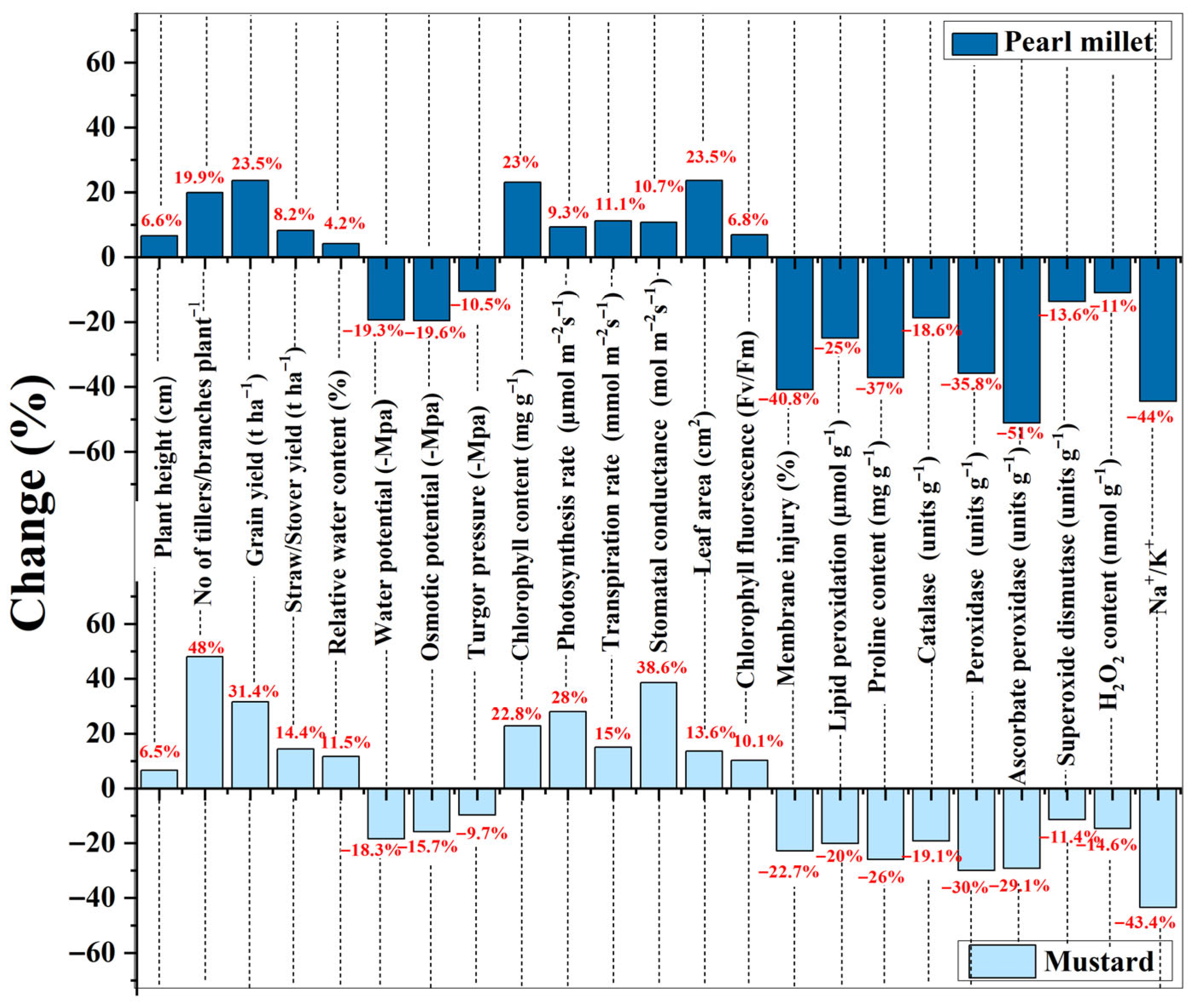
3.5. Change (%) in Studied Traits Under Cut-Soiler PSSD
4. Discussion
5. Conclusions
Supplementary Materials
Author Contributions
Funding
Data Availability Statement
Conflicts of Interest
Abbreviations
| PSSD | Preferential shallow subsurface drainage |
| CS | Cut-soiler |
| WCS | Without cut-soiler |
| MDA | Malondialdehyde |
| SOD | Superoxide dismutase |
| CAT | Catalase |
| POX | Peroxidase |
| APX | Ascorbate peroxidase |
| ROS | Reactive oxygen species |
References
- El Hasini, S.; Halima, I.O.; Azzouzi, M.E.; Douaik, A.; Azim, K.; Zouahri, A. Organic and inorganic remediation of soils affected by salinity in the Sebkha of Sed El Mesjoune—Marrakech (Morocco). Soil Till. Res. 2019, 193, 153–160. [Google Scholar] [CrossRef]
- Dasgupta, S.; Hossain, M.M.; Huq, M.; Wheeler, D. Climate change and soil salinity: The case of coastal Bangladesh. Ambio 2015, 44, 815–826. [Google Scholar] [CrossRef]
- FAO. Food and Agriculture Organization of the United Nations. 2024. Available online: https://www.fao.org/newsroom/detail/fao-launches-first-major-global-assessment-of-salt-affected-soils-in-50-years/en (accessed on 15 January 2026).
- Zörb, C.; Geilfus, C.M.; Dietz, K.J. Salinity and crop yield. Plant Biol. 2019, 21, 31–38. [Google Scholar] [CrossRef]
- Kumar, A.; Mann, A.; Kumar, A.; Kumar, N.; Meena, B.L. Physiological response of diverse halophytes to high salinity through ionic accumulation and ROS scavenging. Int. J. Phytoremediat. 2021, 23, 1041–1051. [Google Scholar] [CrossRef] [PubMed]
- Panta, S.; Flowers, T.J.; Lane, P.; Doyle, R.; Haros, G.; Shabala, S. Halophyte agriculture: Success stories. Environ. Exp. Bot. 2014, 107, 71–83. [Google Scholar] [CrossRef]
- Zhang, Q.; Dai, W. Plant response to salinity stress. In Stress Physiology of Woody Plants; CRC Press: Boca Raton, FL, USA, 2019; pp. 155–173. [Google Scholar] [CrossRef]
- Pan, T.; Liu, M.; Kreslavski, V.D.; Zharmukhamedov, S.K.; Nie, C.; Yu, M.; Kuznetsov, V.V.; Allakhverdiev, S.I.; Shabala, S. Non-stomatal limitation of photosynthesis by soil salinity. Crit. Rev. Environ. Sci. Technol. 2021, 51, 791–825. [Google Scholar] [CrossRef]
- Isayenkov, S.V.; Maathuis, F.J.M. Plant salinity stress: Many unanswered questions remain. Front. Plant Sci. 2019, 10, 80. [Google Scholar] [CrossRef] [PubMed]
- El Ghazali, G.E.B. Suaeda vermiculata Forssk. ex J.F. Gmel.: Structural characteristics and adaptations to salinity and drought: A review. Int. J. Sci. 2020, 9, 28–33. [Google Scholar] [CrossRef]
- Singh, Y.P.; Tomar, S.S.; Singh, S. Effect of precise levelling, tillage and seed sowing methods of pearl millet-based cropping systems on productivity and soil quality in dry land area. Soil Till. Res. 2021, 212, 105069. [Google Scholar] [CrossRef]
- Rai, A.K.; Basak, N.; Soni, P.G.; Kumar, S.; Sundha, P.; Narjary, B.; Yadav, G.; Patel, S.; Kaur, H.; Yadav, R.K.; et al. Bioenergy sorghum as balancing feedback loop for intensification of cropping system in salt-affected soils of the semi–arid region: Energetics, biomass quality and soil properties. Eur. J. Agron. 2022, 134, 126452. [Google Scholar] [CrossRef]
- Zhang, E.; Meng, C.; Qu, J.; Zhu, Z.; Niu, J.; Wang, L.; Song, N.; Yin, Z. Dual effects of Caragana korshinskii introduction on herbaceous vegetation in Chinese desert areas: Short-term degradation and long-term recovery. Plant Soil 2025, 1–19. [Google Scholar] [CrossRef]
- Soni, P.G.; Yadav, R.K.; Kumar, A.; Kumar, R.; Yadav, G.; Yadav, T.; Sharma, A.; Kushwaha, M. Effect of water quality regimes, irrigation schedules, RSC levels and neutralizer on physiological and biochemical behaviour of fodder sorghum (Sorghum bicolor). Ind. J. Agric. Sci. 2020, 90, 1702–1707. [Google Scholar] [CrossRef]
- Neha; Yadav, G.; Yadav, R.K.; Kumar, A.; Rai, A.K.; Sehwag, M.; Onishi, J.; Omori, K.; Sharma, P.C. Desalinization effect of simulated cut-soiler-based residue filled preferential shallow subsurface drainage: Improvement of physiology and yield of rain-fed pearl millet in saline semiarid regions. Land Degrad. Dev. 2022, 33, 1758–1770. [Google Scholar] [CrossRef]
- Onishi, J.; Anzai, T.; Okamoto, K.; Koda, K.; Matsui, K.; Lee, G.; Watanabe, T.; Omori, K.; Chaudhari, S.K.; Yadav, R.K.; et al. Cut-Soiler Constructed Preferential Shallow Sub-Surface Drainage for Mitigating Salinization: User’s Guide; JIRCAS-2022/001; Japan International Research Center for Agricultural Sciences (JIRCAS): Ibaraki, Japan; ICAR–Central Soil Salinity Research Institute (CSSRI): Karnal, India, 2023. [Google Scholar]
- Neha; Yadav, G.; Yadav, R.K.; Kumar, A.; Rai, A.K.; Prasad, G.; Kumar, S.; Narjary, B.; Onishi, J.; Omori, K.; et al. Cut-soiler-constructed residue-filled preferential shallow sub-surface drainage improves the performance of mustard-pearl millet cropping system in saline soils of semi-arid regions. Front. Agron. 2024, 6, 1492505. [Google Scholar] [CrossRef]
- Dionisio-Sese, M.L.; Tobita, S. Antioxidant responses of rice seedlings to salinity stress. Plant Sci. 1998, 135, 1–9. [Google Scholar] [CrossRef]
- Loreto, F.; Velikova, V. Isoprene produced by leaves protects the photosynthetic apparatus against ozone damage, quenches ozone products, and reduces lipid peroxidation of cellular membranes. Plant Physiol. 2001, 127, 1781–1787. [Google Scholar] [CrossRef] [PubMed]
- Bates, L.; Waldren, R.; Teare, I. Rapid determination of free proline for water stress studies. Plant Soil. 1973, 39, 205–207. [Google Scholar] [CrossRef]
- Sinha, A.K. Calorimetric assay of catalase. Anal. Biochem. 1972, 47, 389–395. [Google Scholar] [CrossRef]
- Beauchamp, C.; Fridovich, I. Superoxide dismutase: Improved assays and an assay applicable to acrylamide gels. Anal. Biochem. 1971, 44, 276–287. [Google Scholar] [CrossRef]
- Aebi, H. Catalase in vitro. Methods Enzymol. 1984, 105, 121–126. [Google Scholar]
- Nakano, Y.; Asada, K. Hydrogen peroxide is scavenged by ascorbate-specific peroxidase in spinach chloroplasts. Plant Cell Physiol. 1981, 22, 867–880. [Google Scholar] [CrossRef]
- Rao, M.V.; Watkins, C.B.; Brown, S.K.; Weeden, N.F. Active oxygen species metabolism in’White Angel’x’Rome Beauty’apple selections resistant and susceptible to superficial scald. J. Am. Soc. Hortic. Sci. 1998, 123, 299–304. [Google Scholar] [CrossRef]
- Barr, H.D.; Weatherley, P.E. A re-examination of the relative turgidity technique for estimating water deficit in leaves. Aust. J. Biol. Sci. 1962, 15, 413–428. [Google Scholar] [CrossRef]
- Haghverdi, A.; Najarchi, M.; Öztürk, H.S.; Durner, W. Studying unimodal, bimodal, PDI and bimodal-PDI variants of multiple soil water retention models: I. direct model fit using the extended evaporation and dewpoint methods. Water 2020, 12, 900. [Google Scholar] [CrossRef]
- Cuin, T.A.; Tian, Y.; Betts, S.A.; Chalmandrier, R.; Shabala, S. Ionic relations and osmotic adjustment in durum and bread wheat under saline conditions. Funct. Plant Biol. 2009, 36, 1110–1119. [Google Scholar] [CrossRef]
- Hiscox, J.D.; Israelstam, G.F. A method for the extraction of chlorophyll from leaf tissue without maceration. Can. J. Bot. 1979, 57, 332–334. [Google Scholar] [CrossRef]
- Neha; Yadav, G.; Yadav, R.K.; Kumar, A.; Rai, A.K.; Onishi, J.; Omori, K.; Sharma, P.C. Salt removal through residue-filled cut-soiler simulated preferential shallow subsurface drainage improves yield, quality and plant water relations of mustard (Brassica juncea L.). Sustainability 2022, 14, 4146. [Google Scholar] [CrossRef]
- Okuda, Y.; Onishi, J.; Shirokova, Y.I.; Kitagawa, I.; Kitamura, Y.; Fujimaki, H. Salt removal technology by shallow subsurface drainage in combination with a cut-drain. J. Arid Land Stud. 2018, 28, 127–130. [Google Scholar]
- Feng, G.; Zhang, Z.; Zhang, Z. Evaluating the sustainable use of saline water irrigation on soil water-salt content and grain yield under subsurface drainage condition. Sustainability 2019, 11, 6431. [Google Scholar] [CrossRef]
- Yi, J.; Li, H.; Zhao, Y.; Shao, M.A.; Zhang, H.; Liu, M. Assessing soil water balance to optimize irrigation schedules of flood-irrigated maize fields with different cultivation histories in the arid region. Agric. Water Manag. 2022, 265, 107543. [Google Scholar] [CrossRef]
- Xin, P.; Yu, X.; Lu, C.; Li, L. Effects of macro-pores on water flow in coastal subsurface drainage systems. Adv. Water Res. 2016, 87, 56–67. [Google Scholar] [CrossRef]
- Stevens, R.M.; Pech, J.M.; Grigson, G.J. A Short Non-Saline Sprinkling Increases the Tuber Weights of Saline Sprinkler Irrigated Potatoes. Agronomy 2017, 7, 4. [Google Scholar] [CrossRef]
- Hu, Y.; Xia, S.; Su, Y.; Wang, H.; Luo, W.; Su, S.; Xiao, L. Brassinolide Increases Potato Root Growth In Vitro in a Dose-Dependent Way and Alleviates Salinity Stress. Biomed. Res. Int. 2016, 11, 8231873. [Google Scholar] [CrossRef]
- Akça, Y.; Samsunlu, E. The effect of salt stress on growth, chlorophyll content, proline and nutrient accumulation, and K/Na ratio in walnut. Pak. J. Bot. 2012, 44, 1513–1520. [Google Scholar]
- Orlovsky, N.; Japakova, U.; Zhang, H.; Volis, S. Effect of salinity on seed germination, growth and ion content in dimorphic seeds of Salicornia europaea L. (Chenopodiaceae). Plant Divers. 2016, 1, 183–189. [Google Scholar] [CrossRef]
- Hakim, M.A.; Juraimi, A.S.; Hanafi, M.M.; Ismail, M.R.; Rafii, M.Y.; Islam, M.M.; Selamat, A. The effect of salinity on growth, ion accumulation and yield of rice varieties. J. Anim. Plant Sci. 2014, 24, 874–885. [Google Scholar]
- Mahmud, S.; Sharmin, S.; Chowdhury, B.L.; Hossain, M.A. Research Article Effect of Salinity and Alleviating Role of Methyl Jasmonate in Some Rice Varieties. Asian J. Plant Sci. 2017, 16, 87–93. [Google Scholar] [CrossRef]
- Zahra, N.; Mahmood, S.; Raza, Z.A. Salinity stress on various physiological and biochemical attributes of two distinct maize (Zea mays L.) genotypes. J. Plant Nutr. 2018, 41, 1368–1380. [Google Scholar] [CrossRef]
- Saddiq, M.S.; Afzal, I.; Basra, S.M.A.; Ali, Z.; Ibrahim, A.M.H. Sodium exclusion is a reliable trait for the improvement of salinity tolerance in bread wheat. Arch. Agron. Soil Sci. 2018, 64, 272–284. [Google Scholar] [CrossRef]
- Munns, R.; Tester, M. Mechanisms of salinity tolerance. Annu. Rev. Plant Biol. 2008, 59, 651–681. [Google Scholar] [CrossRef]
- Liang, W.; Ma, X.; Wan, P.; Liu, L. Plant salt-tolerance mechanism: A review. Biochem. Biophys. Res. Comm. 2018, 495, 286–291. [Google Scholar] [CrossRef] [PubMed]
- Kiani, D.; Soltanloo, H.; Ramezanpour, S.S.; Qumi, A.A.N.; Yamchi, A.; Nezhad, K.Z.; Tavakol, E. A barley mutant with improved salt tolerance through ion homeostasis and ROS scavenging under salt stress. Acta Physiol. Plant. 2017, 39, 90. [Google Scholar] [CrossRef]
- Ahmed, M.; Tóth, Z.; Decsi, K. The impact of salinity on crop yields and the confrontational behavior of transcriptional regulators, nanoparticles, and antioxidant defensive mechanisms under stressful conditions: A review. Int. J. Mol. Sci. 2024, 25, 2654. [Google Scholar] [CrossRef]
- Gill, S.S.; Tuteja, N. Reactive oxygen species and antioxidant machinery in abiotic stress tolerance in crop plants. Plant Physiol. Biochem. 2010, 48, 909–930. [Google Scholar] [CrossRef]
- Kumar, A.; Sheoran, P.; Mann, A.; Yadav, D.; Kumar, A.; Devi, S.; Kumar, N.; Dhansu, P.; Sharma, D.K. Deciphering trait associated morpho-physiological responses in pearlmillet hybrids and inbred lines under salt stress. Front. Plant Sci. 2023, 14, 1121805. [Google Scholar] [CrossRef]
- Iqbal, N.; Umar, S.; Khan, N.A. Photosynthetic differences in mustard genotypes under salinity stress: Significance of proline metabolism. Annu. Res. Rev. Biol. 2014, 4, 3274. [Google Scholar] [CrossRef]
- Taïbi, K.; Taïbi, F.; Ait Abderrahim, L.; Ennajah, A.; Belkhodja, M.; Mulet, J.M. Effect of salt stress on growth, chlorophyll content, lipid peroxidation and antioxidant defence systems in Phaseolus vulgaris L. S. Afr. J. Bot. 2016, 105, 306–312. [Google Scholar] [CrossRef]
- Das, M.K.; Roychoudhury, A. Reactive oxygen species (ROS) and responses of antioxidant as ROS-scavengers during environmental stress in plants. Front. Environ. Sci. 2014, 2, 53. [Google Scholar] [CrossRef]
- Mukhopadhyay, R.; Reddy, P.S.; Pallela, R.; Reddy, N.C.; Rao, J.V.; Hash, C.T.; Kavi Kishor, P.B. Differential responses of proline, ion accumulation an antioxidative enzyme activities in pearl millet [Pennisetum glaucum (L.) R. Br.] lines differing in salt sensitivity. J. Plant Biol. 2007, 34, 185–192. [Google Scholar]
- Ali, B.; Hayat, S.; Fariduddin, Q.; Ahmad, A. 24-Epibrassinolide protects against the stress generated by salinity and nickel in Brassica juncea. Chemosphere 2008, 72, 1387–1392. [Google Scholar] [CrossRef]
- Wani, A.S.; Ahmad, A.; Hayat, S.; Fariduddin, Q. Salt-induced modulation in growth, photosynthesis and antioxidant system in two varieties of Brassica juncea. Saudi J. Biol. Sci. 2013, 20, 183–193. [Google Scholar] [CrossRef] [PubMed]
- Yadav, G.; Yadav, R.K.; Rai, A.K.; Kumar, S.; Verma, R.; Sharma, P.C.; Onishi, J.; Koda, K.; Matsui, K.; Lee, G. Optimization of Cut-soiler drainage spacing for salinity management in Indo-Gangetic Plain. J. Arid Land Stud. 2024, 34, 21–24. [Google Scholar]
- Sharma, D.P.; Tyagi, N.K. On-farm management of saline drainage water in arid and semi-arid regions. Irri. Drain. 2004, 53, 87–103. [Google Scholar] [CrossRef]



| Pearl Millet | Mustard | |||||||||
|---|---|---|---|---|---|---|---|---|---|---|
| Treatments/ Traits | Catalase (Units/g) | Peroxidase (Units/g) | Ascorbate peroxidase (Units/g) | Superoxide dismutase (Units/g) | Na+/K+ | Catalase (Units/g) | Peroxidase (Units/g) | Ascorbate peroxidase (Units/g) | Superoxide dismutase (Units/g) | Na+/K+ |
| Cut-soiler | ||||||||||
| Cut-soiler | 8.75 B | 5.76 B | 2.92 B | 25.83 B | 0.25 B | 13.16 B | 5.39 B | 2.53 B | 51.90 B | 0.30 B |
| Without Cut-soiler | 10.76 A | 8.98 A | 5.97 A | 29.92 A | 0.45 A | 16.27 A | 7.70 A | 3.57 A | 58.60 A | 0.53 A |
| CD (p = 0.05) | 0.04 ± 0.02 | 0.13 ± 0.05 | 0.08 ± 0.03 | 0.09 ± 0.04 | 0.01 | 0.33 ± 0.14 | 0.14 ± 0.06 | 0.07 ± 0.03 | 0.71 ± 0.29 | 0.11 ± 0.03 |
| Soil type | ||||||||||
| Saline soil | 10.32 A | 8.43 A | 4.89 A | 29.34 A | 0.42 A | 15.27 A | 7.88 A | 3.39 A | 57.31 A | 0.50 A |
| Heavy textured soil | 9.19 B | 6.32 B | 4.00 B | 26.40 B | 0.27 B | 14.16 B | 5.21 B | 2.71 B | 53.20 B | 0.34 B |
| CD (p = 0.05) | 0.05 ± 0.03 | 0.08 ± 0.04 | 0.07 ± 0.03 | 0.1 ± 0.05 | 0.01 | 0.2 ± 0.1 | 0.11 ± 0.05 | 0.06 ± 0.03 | 0.25 ± 0.13 | 0.06 ± 0.03 |
| Irrigation water salinity | ||||||||||
| S1 (4 dS m−1) | 9.29 C | 6.74 C | 4.04 C | 27.18 C | 0.32 C | 13.91 C | 5.96 C | 2.85 C | 53.82 C | 0.37 B |
| S2 (8 dS m−1) | 9.83 B | 7.50 B | 4.51 B | 27.90 B | 0.34 B | 14.80 B | 6.61 B | 3.08 B | 55.53 B | 0.40 B |
| S3 (12 dS m−1) | 10.13 A | 7.88 A | 4.78 A | 28.54 A | 0.38 A | 15.42 A | 7.06 A | 3.21 A | 56.40 A | 0.48 A |
| CD (p = 0.05) | 0.06 ± 0.03 | 0.1 ± 0.05 | 0.08 ± 0.04 | 0.13 ± 0.06 | 0.01 | 0.25 ± 0.12 | 0.14 ± 0.07 | 0.08 ± 0.04 | 0.31 ± 0.15 | 0.07 ± 0.04 |
Disclaimer/Publisher’s Note: The statements, opinions and data contained in all publications are solely those of the individual author(s) and contributor(s) and not of MDPI and/or the editor(s). MDPI and/or the editor(s) disclaim responsibility for any injury to people or property resulting from any ideas, methods, instructions or products referred to in the content. |
© 2026 by the authors. Licensee MDPI, Basel, Switzerland. This article is an open access article distributed under the terms and conditions of the Creative Commons Attribution (CC BY) license.
Share and Cite
Yadav, G.; Neha; Kumar, A.; Babal, B.; Rai, A.K.; Onishi, J.; Omori, K.; Yadav, R.K. Physiological and Biochemical Responses of Pearl Millet and Mustard to Cut-Soiler-Based Shallow Subsurface Drainage Under Saline Irrigation. Agronomy 2026, 16, 779. https://doi.org/10.3390/agronomy16080779
Yadav G, Neha, Kumar A, Babal B, Rai AK, Onishi J, Omori K, Yadav RK. Physiological and Biochemical Responses of Pearl Millet and Mustard to Cut-Soiler-Based Shallow Subsurface Drainage Under Saline Irrigation. Agronomy. 2026; 16(8):779. https://doi.org/10.3390/agronomy16080779
Chicago/Turabian StyleYadav, Gajender, Neha, Ashwani Kumar, Bhawna Babal, Arvind Kumar Rai, Junya Onishi, Keisuke Omori, and Rajender Kumar Yadav. 2026. "Physiological and Biochemical Responses of Pearl Millet and Mustard to Cut-Soiler-Based Shallow Subsurface Drainage Under Saline Irrigation" Agronomy 16, no. 8: 779. https://doi.org/10.3390/agronomy16080779
APA StyleYadav, G., Neha, Kumar, A., Babal, B., Rai, A. K., Onishi, J., Omori, K., & Yadav, R. K. (2026). Physiological and Biochemical Responses of Pearl Millet and Mustard to Cut-Soiler-Based Shallow Subsurface Drainage Under Saline Irrigation. Agronomy, 16(8), 779. https://doi.org/10.3390/agronomy16080779