Article

Integrated Multi-Omics Profiling Elucidates the Molecular Mechanisms of Salt Stress Adaptation in Tartary Buckwheat (Fagopyrum tataricum)

School of Life Science and Technology, Wuhan Polytechnic University, Wuhan 430023, China
*
Authors to whom correspondence should be addressed.
These authors contributed equally to this work.
Agronomy 2026, 16(8), 771; https://doi.org/10.3390/agronomy16080771
Submission received: 12 February 2026 / Revised: 21 March 2026 / Accepted: 31 March 2026 / Published: 8 April 2026

Abstract

Soil salinization is a major threat to global crop production. Tartary buckwheat (Fagopyrum tataricum), valued for its hardiness in marginal environments, provides an excellent system for studying plant salt tolerance. Using an integrated multi-omics approach, we deciphered the physiological, metabolic, and transcriptional responses of Tartary buckwheat to prolonged NaCl stress. Physiological profiling confirmed membrane damage alongside osmotic adjustment via proline accumulation and a phased antioxidant response. Metabolomics revealed extensive reprogramming, with dynamic enrichment in pathways of flavonoid biosynthesis, lipid metabolism, and the TCA cycle. Transcriptomics delineated a time-specific cascade from early signaling to late defense activation. Critical regulators within ABA and MAPK signaling pathways showed fine-tuned, divergent expression; for instance, SnRK2.3 was suppressed while specific PP2Cs were induced, and FtMAPK10 was dramatically up-regulated. Integrated analysis demonstrated coordinated induction of osmoprotectant synthesis (e.g., galactinol and betaine pathways) and a rewiring of central carbon metabolism. Our findings reveal a sophisticated, multi-layered adaptation strategy in Tartary buckwheat, integrating enhanced osmolyte production, antioxidant defense, membrane remodeling, and metabolic reprogramming, orchestrated by key signaling networks. This study provides a comprehensive molecular framework for salt tolerance and identifies valuable genetic targets for improving crop resilience.

1. Introduction

Soil salinization is a primary environmental factor limiting plant growth and development, affecting nearly all major physiological processes. As a leading abiotic stress compromising crop yield, it is primarily driven by extreme climatic conditions and improper irrigation practices, simultaneously challenging the inherent high-salinity tolerance mechanisms of plants [1,2]. The detrimental effects of salinity and alkalinity on crops include the retardation of normal growth rates, leading to suboptimal shoot development and suppressed root growth [3]. Furthermore, during the reproductive phase, such stress can result in poor fruit set, premature shedding, and ultimately significant yield loss, potentially causing plant death or complete crop failure [4]. A substantial portion of current arable land is affected, and the problem of land salinization is intensifying globally; nevertheless, saline-alkaline soils remain a significant challenge in land resource utilization [5]. Consequently, developing salt-tolerant varieties and enhancing crop resilience in such soils represent crucial strategies for mitigating the constraints imposed by salinization on agricultural productivity and for improving the utilization rate of saline-alkaline land.
Under salt stress, most plants exhibit stunted growth, accelerated development, and in severe cases, wilting and death. The injury inflicted by excessive soluble salts in soil encompasses two primary components: osmotic stress and ion-specific toxicity [6,7]. Elevated soil salinity lowers the osmotic potential of the soil solution, hindering water uptake by plants and potentially causing efflux of water from root cells. This damages biological membranes, disrupts their functionality, and impairs osmotic adjustment [8]. Concurrently, salt stress induces physiological drought, inhibits plant growth, reduces photosynthetic capacity, and disrupts metabolic homeostasis, triggering both common and distinct responses to various individual and combined stresses [9]. The interplay between reactive oxygen species (ROS) and reactive nitrogen species (RNS) governs critical cellular functions under stress, while salinity impacts overall plant physiology and integrated cultivation management [10]. The excessive influx of salt ions (e.g., Na+, Cl) into plant tissues disturbs the uptake of essential mineral nutrients, disrupts intracellular ion homeostasis, impedes protein synthesis, damages chlorophyll, reduces enzyme activity, and ultimately compromises normal cellular metabolism [11].
The impact of salinity on crops is modulated by factors such as species, genotype, developmental stage, as well as the duration and intensity of the stress [12]. Extensive research has elucidated the physiological and molecular consequences of salt stress in plants. Plant salt tolerance is a complex quantitative trait governed by multiple genes. Identified salt-related genes are broadly categorized into two groups [13]. The first group comprises effector genes encoding functional proteins that participate directly in physiological and biochemical responses. These include proteins such as high-affinity potassium transporters (HKT), Na+/H+ antiporters (NHX), aquaporins (AQP), superoxide dismutase (SOD), ascorbate peroxidase (APX), late embryogenesis abundant (LEA) proteins, and vacuolar H+-ATPase (VHA) [14,15,16]. The second group involves regulatory genes and components of signal transduction pathways, such as transcription factors (TFs) and various kinases. These regulatory elements modulate the expression of downstream target genes through intricate networks, ultimately shaping the plant’s salt tolerance phenotype [17,18]. Salt stress activates numerous signal transduction pathways within plants, including those mediated by Ca2+ [19], abscisic acid (ABA) [20], and mitogen-activated protein kinase (MAPK) cascades [21]. Certain metabolites, such as sucrose and fructose, are also recognized as signaling molecules that trigger downstream stress responses [22,23]. Furthermore, compatible solutes and signaling molecules like proline [24], γ-aminobutyric acid (GABA) [25], and melatonin [16] can mediate adaptive responses by influencing the expression of stress-related proteins.
Tartary buckwheat (Fagopyrum tataricum (L.) Gaertn.), characterized by its short growth cycle and tolerance to cold and poor soils, is cultivated worldwide. In China, buckwheat has a long cultivation history and is widely distributed, showing significant agronomic advantages in semi-arid, arid, and cool mountainous regions of North, Northwest, and Southwest China, as well as in ethnic minority border areas [26,27]. Buckwheat is nutritionally rich, containing not only proteins, dietary fiber, vitamins, phenolic acids, and anthraquinones but also abundant flavonoids such as rutin, quercetin, and kaempferol, which are typically scarce in major cereal crops [28,29]. These bioactive compounds confer various medicinal and health benefits, including antitumor, anti-inflammatory, cholesterol-lowering, antihypertensive, antihyperglycemic, and antioxidant activities [30]. Therefore, buckwheat is considered an important “dual-purpose” crop for both food and medicine. Its diverse metabolite profile and active ingredients make it a valuable subject for research. A systematic understanding of metabolic variation and the genetic basis controlling the content of active components in buckwheat is essential for its genetic improvement and quality breeding. Recent advances in multi-omics technologies have enabled the comprehensive dissection of plant stress responses. For instance, integrated transcriptomics and metabolomics have revealed key pathways and regulatory networks under salt stress in crops such as rice, maize, and soybean [31,32,33]. However, similar studies on Tartary buckwheat remain scarce. While plant responses to salt stress have been extensively studied in model systems, related research in Tartary buckwheat is limited. Existing studies mainly report changes in growth parameters, soluble sugar and malondialdehyde (MDA) content, and the activities of antioxidant enzymes like SOD, peroxidase (POD), and catalase (CAT) under salt stress [34,35,36]. These investigations provide valuable physiological insights but lack the molecular depth needed to understand the regulatory and metabolic networks governing salt tolerance.
The novelty of this study lies in its integrated multi-omics approach combining time-resolved physiological, transcriptomic, and metabolomic profiling to systematically dissect the molecular mechanisms of salt adaptation in Tartary buckwheat. Unlike previous studies that focused on isolated aspects of stress responses, our work provides a comprehensive systems-level framework that reveals the temporal coordination between signaling pathways, transcriptional reprogramming, and metabolic restructuring during prolonged salt stress. Therefore, a systematic multi-omics analysis is required to elucidate the molecular mechanisms underlying salt adaptation in Tartary buckwheat. This study employs buckwheat as experimental material for salt tolerance analysis, aiming to provide a sound molecular biological foundation for the expanded cultivation of buckwheat in saline-alkaline soils.

2. Materials and Methods

2.1. Plant Material, Growth Conditions, and Salt Stress Treatment

The Tartary buckwheat (Fagopyrum tataricum (L.) Gaertn.) cultivar ‘Jinqiao 2’ was used in this study. Plants were cultivated under controlled environmental conditions in a greenhouse at Wuhan Polytechnic University, Wuhan, China. Seeds were sown in pots (25 cm diameter, 20 cm height) containing a 1:1 (v/v) mixture of nutrient soil and vermiculite (total 2.5 kg per pot). Ten seeds were sown per pot, and after germination, seedlings were thinned to five uniform plants per pot. The growth conditions were maintained at a relative humidity of 80%, a 16 h light/8 h dark photoperiod with a light intensity of 400 μmol m−2 s−1, and day/night temperatures of 28/23 °C [31]. Uniform plants at the seven-leaf stage were selected for the experiment. Salt stress was imposed by foliar spraying with a 100 mM sodium chloride (NaCl) solution (approximately 50 mL per plant, ensuring full coverage of leaves). Foliar application was chosen to simulate salt deposition on leaves, which can occur in natural environments through irrigation water or sea spray, and to allow direct assessment of leaf tissue responses without confounding root-soil interactions [37]. A single concentration of 100 mM NaCl was selected based on preliminary experiments showing that this concentration induces moderate stress without causing rapid lethality, enabling observation of adaptive responses over a 9-day period [38]. Leaf samples were collected from the treated plants at 3, 6, and 9 days post-treatment. Leaves from untreated plants of the same age served as the control. For each treatment time point and the control, three biological replicates were used for omics analyses, each replicate consisting of pooled leaf tissue from ten individual plants (a total of 30 plants per time point). For physiological assays, three independent replicates were also used, each from a separate pool of ten plants. All samples were immediately frozen in liquid nitrogen and stored at −80 °C for subsequent physiological assays and molecular analyses.

2.2. Analysis of Physiological Parameters and Antioxidant Enzyme Activity

Chlorophyll content, proline concentration, malondialdehyde (MDA) level, and catalase (CAT) activity were measured in the leaf samples. Absorbance readings were obtained using a Multiskan SkyHigh microplate spectrophotometer (Thermo Fisher Scientific, Waltham, MA, USA).
For chlorophyll extraction, 0.1 g of frozen leaf tissue was ground in liquid nitrogen and homogenized in 10 mL of 80% (v/v) acetone. After centrifugation, the supernatant was collected, and total chlorophyll content was determined by measuring absorbance at 652 nm [39]. Total chlorophyll concentration was calculated using the formula: Chlorophyll (mg/g FW) = (A 652 × 1000)/(34.5 × sample weight in g) [39]. Proline content was quantified using the ninhydrin method described by Shahbaz et al. [40]. Briefly, 0.5 g of the leaf sample was homogenized in 5 mL of 3% sulfosalicylic acid and centrifuged. The supernatant was reacted with acid-ninhydrin, and the chromophore absorbance was measured at 520 nm. Proline concentration was calculated based on a standard curve prepared with L-proline.
MDA content, an indicator of lipid peroxidation, was assayed according to the thiobarbituric acid (TBA) method with modifications [41]. 0.5 g of ground leaf powder was extracted with 5 mL of 10% (w/v) trichloroacetic acid (TCA). The supernatant was reacted with 0.6% (w/v) TBA in a boiling water bath. After cooling, the mixture was centrifuged, and the absorbance of the supernatant was recorded at 450, 532, and 600 nm. MDA concentration was calculated using the formula: MDA (μmol/g FW) = 6.45 × (A532 − A600) − 0.56 × A450 × V/(W × 1000), where V is the volume of extraction buffer (mL) and W is the fresh weight (g).
CAT enzyme activity was measured by monitoring the decomposition of H2O2 at 240 nm [42]. 0.2 g of leaf tissue was homogenized in 2 mL of pre-chilled phosphate buffer (200 mM, pH 7.0, containing 1% polyvinylpyrrolidone). The reaction mixture contained 100 μL of enzyme extract and 2.9 mL of 0.1 M H2O2. The decrease in absorbance at 240 nm was recorded every 10 s for 1 min. Enzyme activity was expressed as μmol H2O2 decomposed per minute per gram of fresh weight.
SOD activity was assayed by the nitroblue tetrazolium (NBT) method [43]. One unit of SOD activity was defined as the amount of enzyme causing 50% inhibition of NBT reduction. POD activity was measured using guaiacol as substrate, following the increase in absorbance at 470 nm [44].

2.3. Untargeted Metabolomics Profiling and Analysis

An untargeted metabolomics approach was employed to profile metabolic changes in response to salt stress [45]. For each treatment time point (0, 3, 6, 9), three independent biological replicates were analyzed, with each replicate comprising a pooled sample from ten individual plants. Frozen leaf samples were ground to a fine powder in a ball mill (MM400, Retsch, Düsseldorf, Germany) at 30 Hz for 45 s. Metabolites were extracted from approximately 50 mg of powder using a methanol:water (4:1, v/v) solution containing 0.1% formic acid. The extracts were centrifuged, and the supernatants were filtered for analysis. Metabolic profiling was performed using a Q Exactive Focus Orbitrap LC-MS/MS system (Thermo Scientific, USA) coupled with a PerkinElmer 680 GC system (PerkinElmer Inc., Waltham, MA, USA) for complementary coverage. LC-MS analysis was conducted in both positive and negative electrospray ionization modes. The mass spectrometer was operated with a scanning range of 100–1000 m/z. Raw data were processed using Compound Discoverer 3.1 software (Thermo Scientific) for peak picking, alignment, and compound identification against internal chemical standard libraries and public databases (mzCloud, ChemSpider). Identification criteria included mass accuracy < 5 ppm, isotope pattern matching, and MS/MS spectral matching.
For statistical analysis, peak areas were normalized to the total ion count per sample [46]. Principal Component Analysis (PCA) was performed using the ropls package in R (version 4.3.3) to assess global metabolic differences. Differential metabolites were identified based on the following criteria: Variable Importance in Projection (VIP) score > 1.0 from the OPLS-DA model, fold change (FC) > 1.50 or <0.67, and a p-value < 0.05 from Student’s t-test. Kyoto Encyclopedia of Genes and Genomes (KEGG) pathway enrichment analysis for the differential metabolites was conducted using KOBAS 1.0 software [47] with a hypergeometric test and Benjamini–Hochberg correction (FDR < 0.05).

2.4. Transcriptome Sequencing and Differential Expression Analysis

Total RNA was isolated from leaf samples using a Total RNA Extraction Kit (Sangon Biotech, Shanghai, China). RNA integrity was verified by agarose gel electrophoresis and a NanoDrop spectrophotometer (ND-2000, Thermo Scientific). RNA integrity number (RIN) was assessed using an Agilent 2100 Bioanalyzer (Agilent Technologies, Santa Clara, CA, USA); samples with RIN > 8.0 were used for library construction. Sequencing libraries were constructed from high-quality RNA samples using the TruSeq Stranded mRNA LT Sample Prep Kit (Illumina, San Diego, CA, USA) and sequenced on an Illumina HiSeq platform to generate 150 bp paired-end reads. Raw sequencing reads were subjected to quality control using Trimmomatic (v0.39) to remove adapters and low-quality bases [48]. The clean reads were then aligned to the Tartary buckwheat reference genome using the HISAT2 aligner 2.2.1 [49,50] with default parameters. Gene expression levels were quantified as Transcripts Per Million (TPM) using HTSeq-count. Differential expression analysis between each treatment time point and the control was performed using the DESeq2 package in R [51]. Genes with an absolute log2 fold change |Log2FC| > 1 and an adjusted p-value (FDR) < 0.05 were defined as differentially expressed genes (DEGs).
Functional annotation of DEGs was performed using Gene Ontology (GO) enrichment analysis with the cluster Profiler R package [52]. KEGG pathway enrichment analysis was also conducted to identify significantly altered biological pathways under salt stress (FDR < 0.05).

3. Results

3.1. Physiological Responses of Tartary Buckwheat to Salt Stress

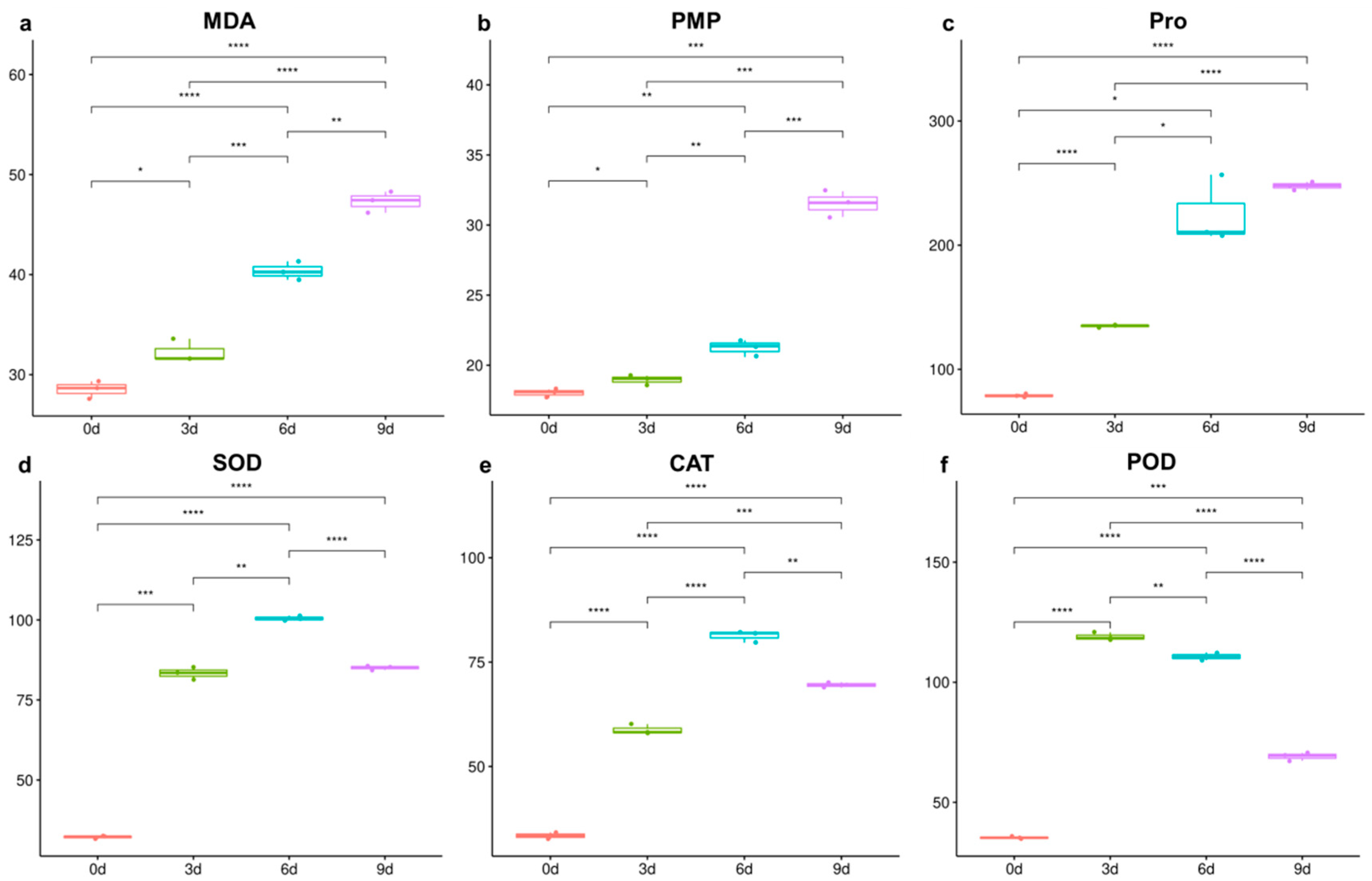
To elucidate the physiological adaptations of Tartary buckwheat under sustained salinity, a time-course analysis of key stress-related indicators was conducted. Measurements of membrane integrity, osmotic adjustment capacity, and antioxidant enzyme activities were taken at 0, 3, 6, and 9 days following NaCl treatment. Progressive membrane damage was a hallmark of the salt stress response (Supplementary Materials Table S1). The malondialdehyde (MDA) content, a reliable indicator of lipid peroxidation, exhibited a continuous and significant increase from an average of 28.53 µmol/g FW at day 0 to 47.30 µmol/g FW by day 9 (Figure 1a). This was corroborated by a concomitant rise in plasma membrane permeability, which escalated from 18.01% initially to 31.53% at the final time point (Figure 1b), confirming the exacerbation of membrane injury with prolonged stress exposure. In response to an osmotic challenge, a substantial accumulation of the compatible solute proline was observed. Proline content demonstrated a marked and progressive elevation, rising over threefold from approximately 78.82 µg/g FW at day 0 to 247.41 µg/g FW at day 9 (Figure 1c), underscoring its pivotal role in cellular osmoregulation under saline conditions.
The antioxidant enzyme system displayed a pronounced yet temporally differentiated activation profile. Superoxide dismutase (SOD) activity increased sharply, reaching a peak at day 3 (118.94 U/g FW), which was approximately 3.4-fold higher than the baseline level (35.25 U/g FW). Subsequently, SOD activity declined at days 6 and 9 (Figure 1d). Catalase (CAT) activity followed a similar pattern, increasing from 33.41 U/g FW to a maximum of 81.25 U/g FW at day 6 before a slight decrease (Figure 1e). Peroxidase (POD) activity also rose significantly, showing a 2.6-fold increase by day 6 (100.50 U/g FW) from the initial value (32.15 U/g FW) and remained substantially elevated at day 9 (Figure 1f). This sequential and coordinated modulation of SOD, CAT, and POD activities indicates a staged and integrated enzymatic defense strategy to counteract salinity-induced oxidative stress. For comparison, control plants maintained at each time point showed no significant changes in any of the measured parameters, confirming that the observed responses were specifically induced by salt stress.

3.2. Transcriptional Analysis During Salt Stress Adaptation in Tartary Buckwheat

To characterize genome-wide expression changes in response to salinity, we performed RNA-seq analysis on leaf tissues collected at 0, 3, 6, and 9 days after NaCl treatment. High-throughput sequencing generated an average of 7.37 Gb clean data per sample, with Q30 scores exceeding 94.6% and an average GC content of 45.6% (Supplementary Materials Table S2). After quality filtering, 89.2–90.8% of the reads were uniquely mapped to the Tartary buckwheat reference genome. Gene expression was quantified as transcripts per million (TPM), and a total of 66,480 genes were expressed across all samples.
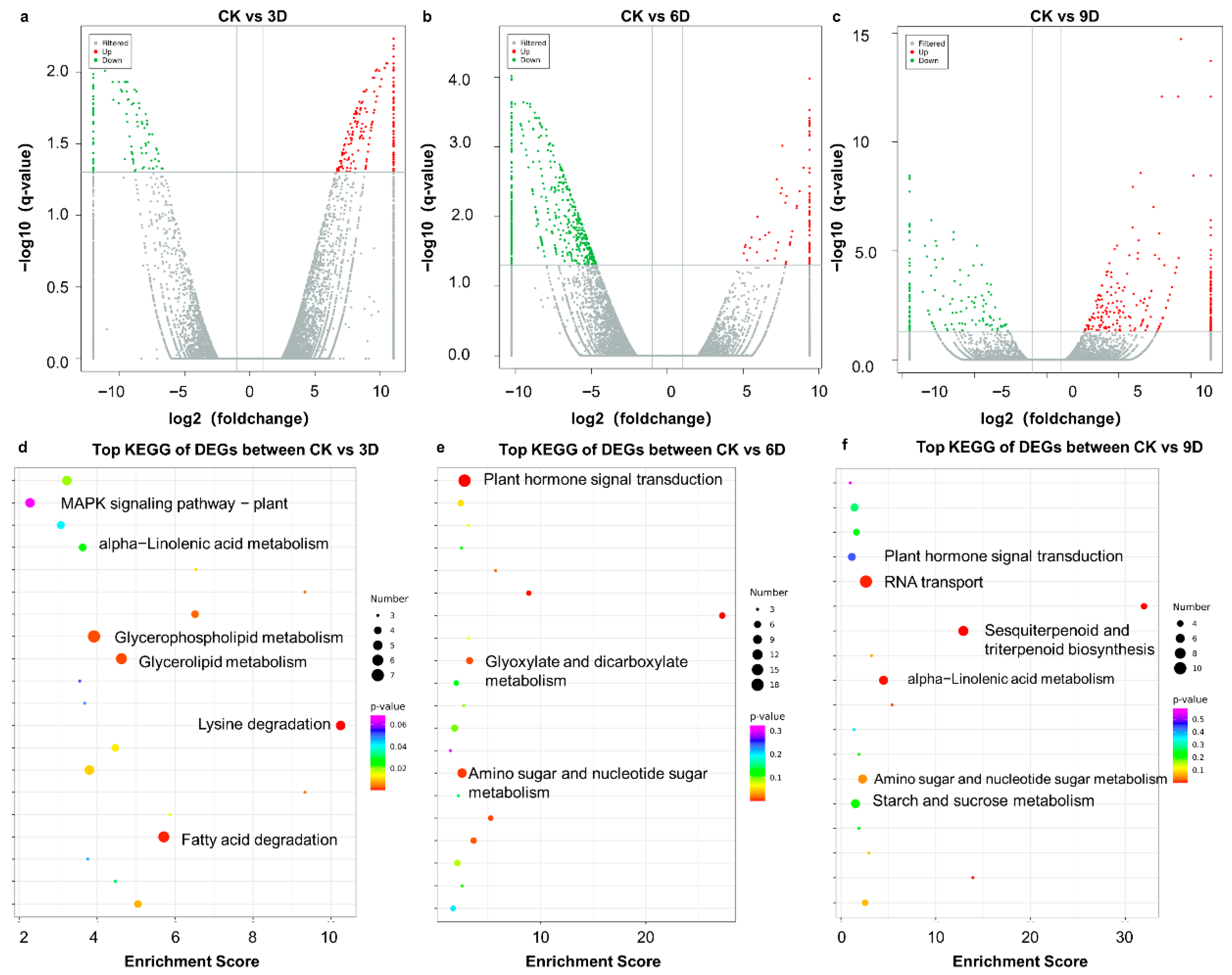
Comparative analysis identified distinct sets of differentially expressed genes (DEGs) at each time point (Figure 2a–c). We identified 376 DEGs at 3D, of which 175 were up-regulated and 201 down-regulated (Figure 2a). By 6D, the number of DEGs increased to 629, with a marked predominance of down-regulated genes (101 up, 528 down) (Figure 2b). At 9D, 417 DEGs were detected, showing a return to up-regulation as the dominant trend (267 up, 150 down) (Figure 2c). Notably, in the 9D vs. CK comparison, a pronounced cluster of highly up-regulated genes was observed, indicating activation of sustained stress-responsive pathways after prolonged exposure. These results suggest that Tartary buckwheat adopts distinct transcriptional strategies during early, middle, and late phases of salt adaptation.
KEGG enrichment analysis highlighted key biological pathways involved in the salt stress response (Figure 2d–f). At 3D, DEGs were enriched in plant hormone signal transduction and ribosome biogenesis, reflecting early signaling and regulatory adjustments. By 6D, pathways such as amino sugar and nucleotide sugar metabolism and starch and phenylpropanoid biosynthesis were prominent, suggesting metabolic reorganization in response to ionic and osmotic stress. At 9D, enrichment shifted to alpha-linolenic acid metabolism, glycerolipid metabolism, and plant-pathogen interaction, indicating the induction of defense-related and lipid-mediated signaling in later stages. Together, these findings demonstrate that salt stress induces a phased transcriptional reprogramming in Tartary buckwheat, encompassing early signal perception, intermediate metabolic adjustment, and late activation of defense pathways.
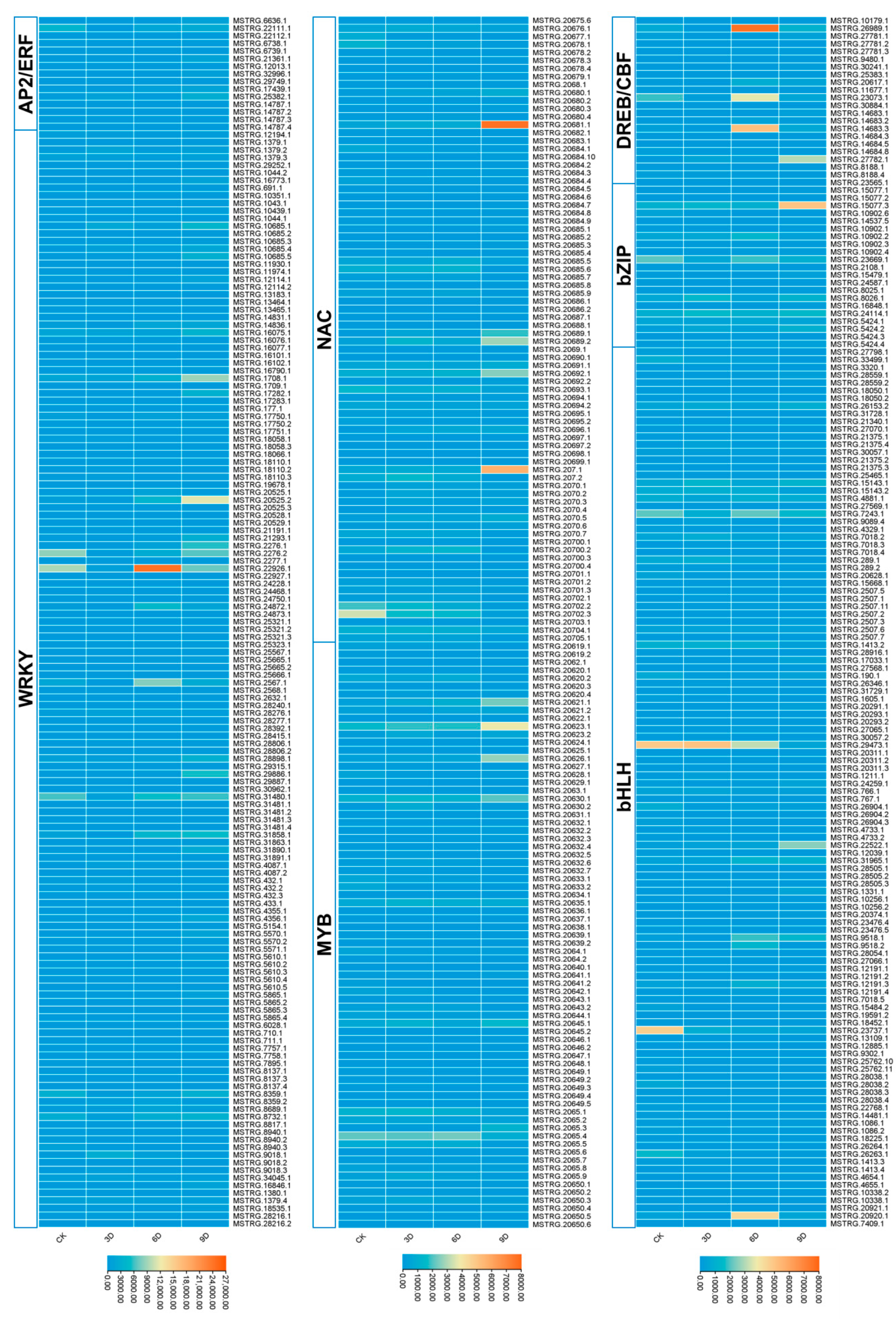
Transcription factors (TFs) play pivotal roles in regulating gene expression and signaling pathways that enable plants to adapt to abiotic stresses, including salinity. Through complex regulatory networks, these TFs modulate downstream target genes, ultimately shaping the plant’s stress-tolerant phenotype. In this study, we analyzed transcriptomic data to profile the expression patterns of seven major TF families—AP2/ERF, DREB/CBF, WRKY, NAC, bZIP, MYB, and bHLH—in Tartary buckwheat following NaCl treatment (Supplementary Materials Table S3). The results revealed distinct, time-dependent expression dynamics for each family, underscoring their specialized roles in the salt-stress response.
As illustrated in Figure 3, the expression dynamics of key transcription factor (TF) families revealed distinct temporal regulation patterns under salt stress. Members of the AP2/ERF family showed pronounced up-regulation during late stress stages, exemplified by the strong induction of MSTRG.21361.1 and MSTRG.32996.1 at 9D, whereas others, including MSTRG.22111.1, were transiently down-regulated at 3D, indicating isoform-specific regulation. DREB/CBF family members exhibited diverse trends, with genes such as MSTRG.26989.1 highly induced at 6 D, while others like MSTRG.27782.1 peaked progressively at 9D. The WRKY family displayed the most varied responses, including late-induced genes (e.g., MSTRG.16773.1) and mid-phase peaks (e.g., MSTRG.22926.1), suggesting phased recruitment for signaling and defense. NAC TFs showed complex dynamics, with strong late up-regulation of MSTRG.20681.1 contrasting with the progressive down-regulation of others. Similarly, bZIP and MYB families exhibited clear temporal patterns, including progressive induction (e.g., MSTRG.12128.1 for bZIP) and late-specific activation (e.g., MSTRG.20623.1 for MYB). The bHLH family also displayed significant changes, with certain members down-regulated over time and others induced at later stages. Collectively, these results highlight a sophisticated, time-dependent regulatory network wherein specific TF members are recruited at distinct stress phases to coordinate early signaling, mid-phase adaptation, and late-stage defense, ultimately fine-tuning the multifaceted salt tolerance response in Tartary buckwheat.

3.3. Untargeted Metabolomics Analysis of Buckwheat Seedling Responses to Salt Stress

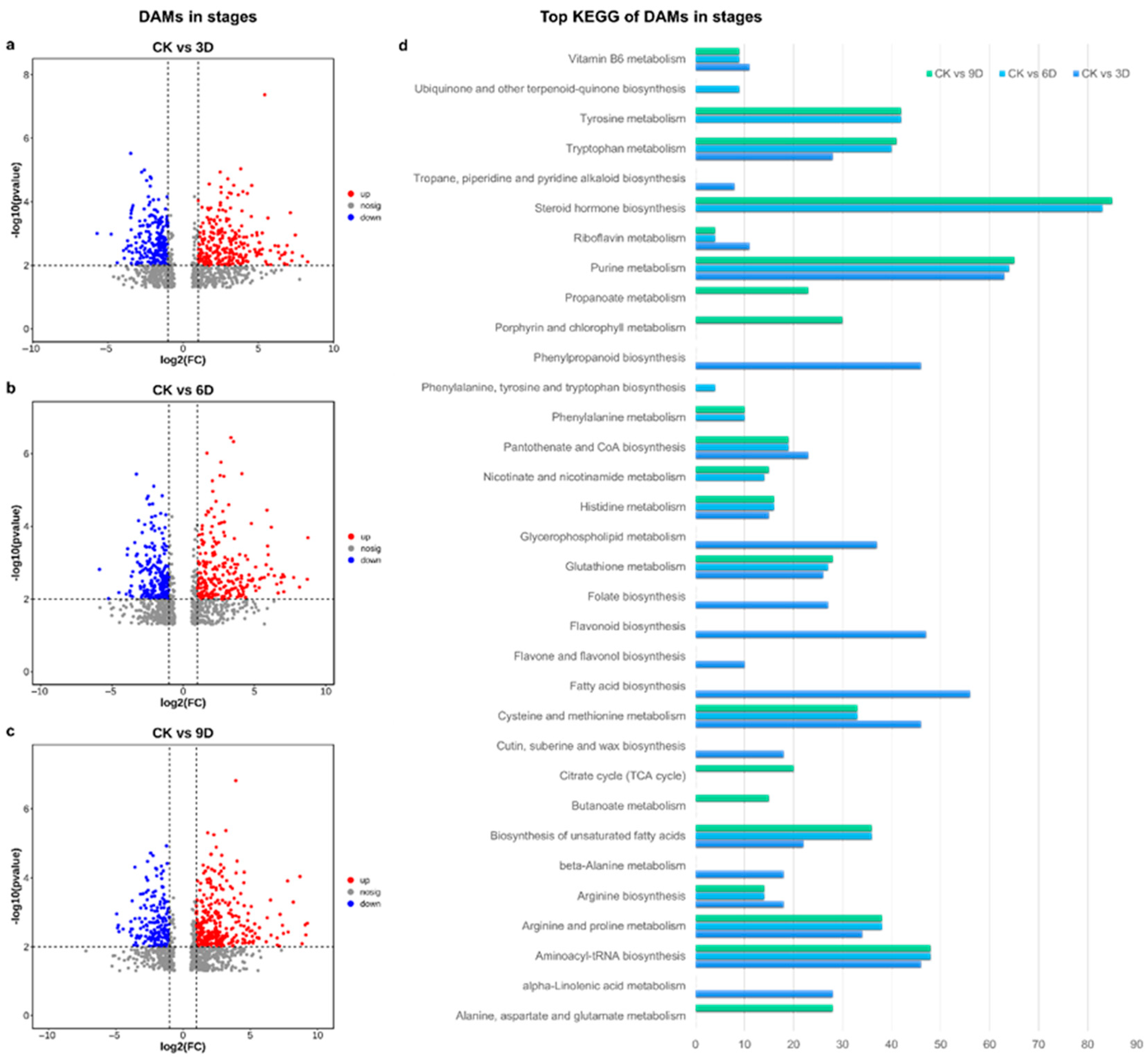
Metabolomics sequencing was employed to analyze the metabolic components of leaf samples subjected to salt stress at various stages, using untreated samples from the same period as controls. A total of 1798 metabolites were identified, encompassing 557 organic acids and derivatives, 539 amino acids and derivatives, 181 sugars, and 179 phosphates, among others. Notably, significant differences were observed in metabolites related to amino acids and derivatives, antioxidants, and energy metabolism pathways. Based on variations in metabolite abundance, 536 up-regulated differentially accumulated metabolites (DAMs) and 540 down-regulated DAMs were detected at 3D (Figure 4a). At 6D, 539 up-regulated DAMs and 518 down-regulated DAMs were identified (Figure 4b). And at 9D, 403 up-regulated DAMs and 717 down-regulated DAMs were detected (Figure 4c). A significant number of differentially enriched DAMs were detected across all three treatment stages, indicating that Tartary buckwheat samples underwent extensive metabolic variations under salt stress. During the early stages of treatment, both up-regulated and down-regulated metabolites were abundant, while in the later stages, there was a notable increase in down-regulated DAMs, aligning with a significant decline in material vitality.
A KEGG enrichment analysis was conducted on DAMs, identifying the top 20 pathways with the highest metabolite enrichment (Figure 4d). Specifically, 22 pathways were enriched in metabolites during the first stage, 19 pathways during the second stage, and 21 pathways during the third stage. Among them, 10 pathways, like fatty acid biosynthesis, flavonoid biosynthesis, phenylpropanoid biosynthesis, glycerophospholipid metabolism, alpha-Linolenic acid metabolism, folate biosynthesis, beta-Alanine metabolism, cutin, suberine and wax biosynthesis, flavone and flavonol biosynthesis, tropane, piperidine and pyridine alkaloid biosynthesis, were significantly enriched only in the first stage of treatment, indicating that these pathways were regulated in the early response to salt stress. Ubiquinone and other terpenoid-quinone biosynthesis, phenylalanine, tyrosine and tryptophan biosynthesis only exhibited significant enrichment after 6 days of treatment. For porphyrin and chlorophyll metabolism, alanine, aspartate and glutamate metabolism, propanoate metabolism, citrate cycle (TCA cycle), butanoate metabolism, a total of 5 pathways were significantly enriched only in the third stage of treatment, suggesting that these pathways may be crucial for tartary buckwheat’s adaptation to salt stress in the later stages. Steroid hormone biosynthesis, tyrosine metabolism, nicotinic acid and nicotinamide metabolism, and phenylalanine metabolism were significantly enriched in the two subsequent stages after treatment, indicating their potential involvement in tartary buckwheat’s long-term adaptation to salt stress. Furthermore, significant enrichment of purine metabolism, aminoacyl-tRNA biosynthesis, arginine and proline metabolism, and cysteine and methionine metabolism was detected across all stages.

3.4. ABA Signaling and Stress Response Pathways Under Salt Stress

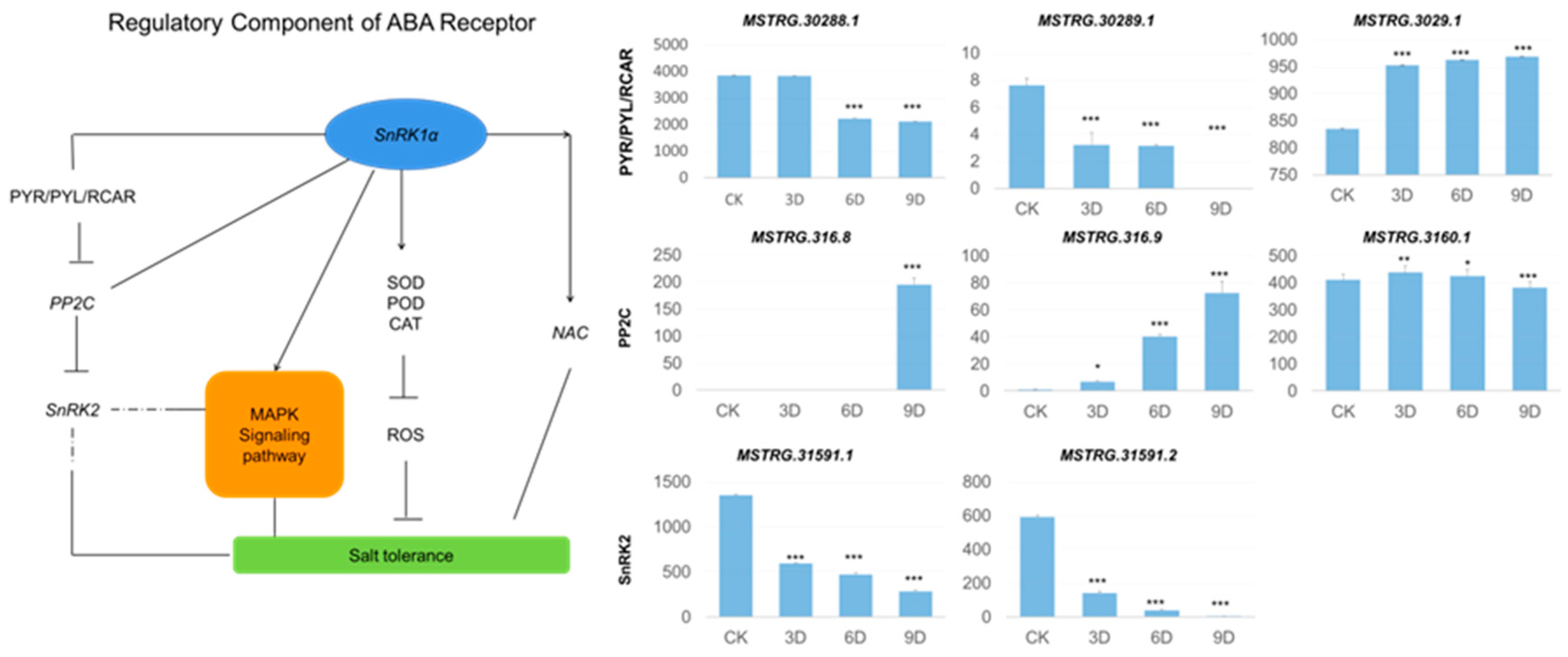
To elucidate the molecular mechanisms underlying salt tolerance in Tartary buckwheat, we analyzed the expression patterns of several key genes involved in ABA signaling and stress response pathways under NaCl treatment (Figure 5). The transcript levels of the PYR1-Like (Pyrabactin Resistance 1-Like) gene, which encodes ABA receptors, showed varied responses. For instance, MSTRG.30288.1 exhibited a gradual decrease in expression under prolonged salt exposure (from 3848.63 ± 6.72 in CK to 2124.40 ± 8.23 at 9D), though its log2-transformed values indicated an initial up-regulation at 3D and 6D. In contrast, MSTRG.30289.1 was strongly down-regulated, with expression nearly absent by 9D, suggesting isoform-specific regulatory roles in salt adaptation. Similarly, SnRK2.3 (sucrose non-fermenting 1-like protein kinase 2.3), a central component of ABA signaling, displayed a consistent down-regulation under salinity. Both transcripts (MSTRG.31591.1 and MSTRG.31591.2) showed marked reductions in expression over time, with MSTRG.31591.2 dropping to only 4.90 at 9D, indicating a suppression of SnRK2-mediated signaling during sustained stress. Notably, Protein Phosphatase 2C (PP2C) genes, which negatively regulate ABA signaling, exhibited divergent expression trends. While MSTRG.316.8 was induced only at 9D (195.01 ± 12.35), MSTRG.316.9 was progressively up-regulated from 0.95 in CK to 72.59 at 9D. Another isoform, MSTRG.3160.1, maintained relatively stable expression across all time points. This complex regulation highlights the fine-tuned modulation of ABA signaling during salt stress. This complex regulation highlights the fine-tuned modulation of ABA signaling during salt stress.
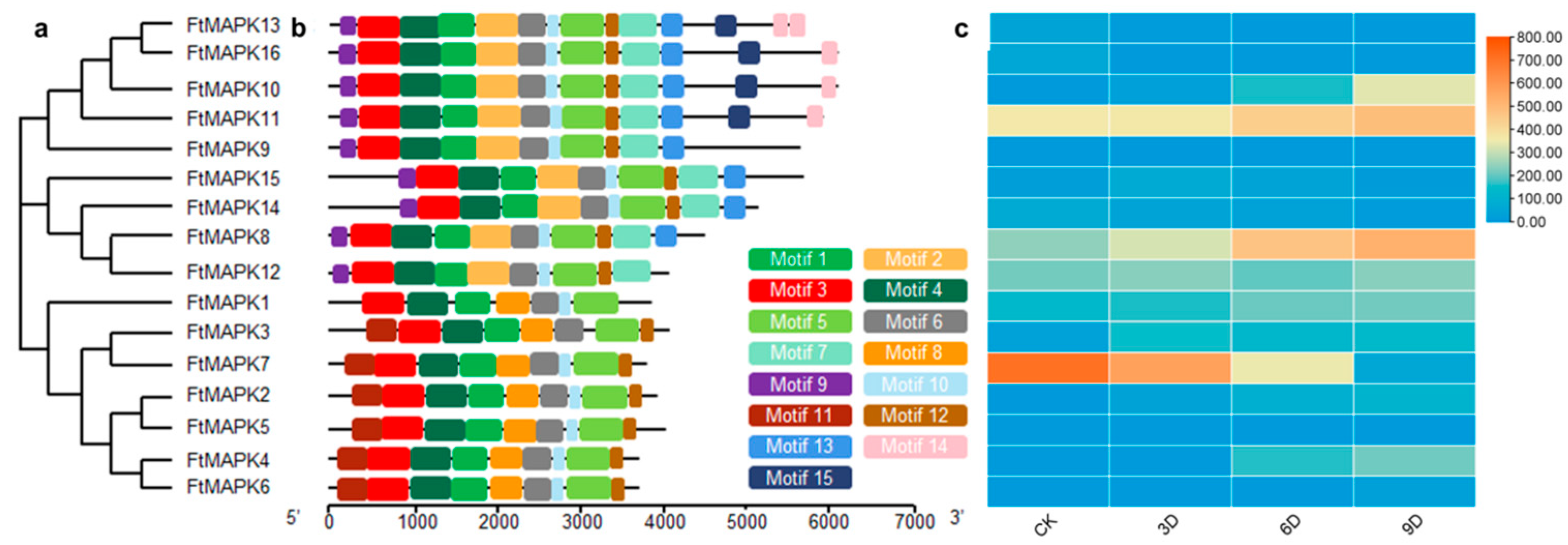
The mitogen-activated protein kinase (MAPK) cascade is a central signaling node integrating various stress stimuli. To further elucidate the signal transduction mechanisms underlying salt tolerance, we analyzed the temporal expression profiles of 16 MAPK genes in Tartary buckwheat under NaCl treatment. We constructed a phylogenetic tree using the neighbor-joining (NJ) method with a bootstrap value of 1000 based on the amino acid sequences of the 16 identified FtMAPK proteins (Figure 6a). Further analysis identified fifteen conserved motifs within the FtMAPK protein sequences (Figure 6b). Notably, all sixteen FtMAPKs harbored the signature motif TDY (motif 2) or TEY (motif 8), confirming their membership in the MAPK gene family. Additionally, subfamily members shared similar conserved motifs. Our transcriptomic data revealed highly divergent and dynamic regulation among different FtMAPK members (Figure 6c). Several MAPKs were significantly up-regulated in response to salt stress. Notably, FtMAPK10 exhibited a dramatic induction, with its expression increasing from nearly undetectable levels in controls (0.004) to 335.68 by 9 days post-treatment. Similarly, FtMAPK2 and FtMAPK3 showed substantial and sustained up-regulation. In contrast, a subset of MAPKs, including FtMAPK13, FtMAPK14, and FtMAPK16, was markedly down-regulated over the treatment period. FtMAPK7 displayed a striking pattern of progressive suppression, declining from 712.65 in CK to 55.21 at 9D. Interestingly, some members demonstrated complex temporal dynamics. FtMAPK4 and FtMAPK6 were specifically induced only at later stages (6D and 9D), suggesting roles in prolonged stress adaptation. Others, such as FtMAPK11 and FtMAPK8, maintained constitutively high or moderately increased expression throughout the stress period. The distinct and often opposing expression trends among MAPK family members indicate a sophisticated re-programming of MAPK signaling networks during salt stress. The specific induction of certain FtMAPKs (e.g., FtMAPK10, FtMAPK2) likely activates downstream stress-responsive pathways, while the suppression of others may represent a feedback mechanism or a shift in signaling priorities to facilitate salinity adaptation.

3.5. Lipid Metabolism Under Salt Stress

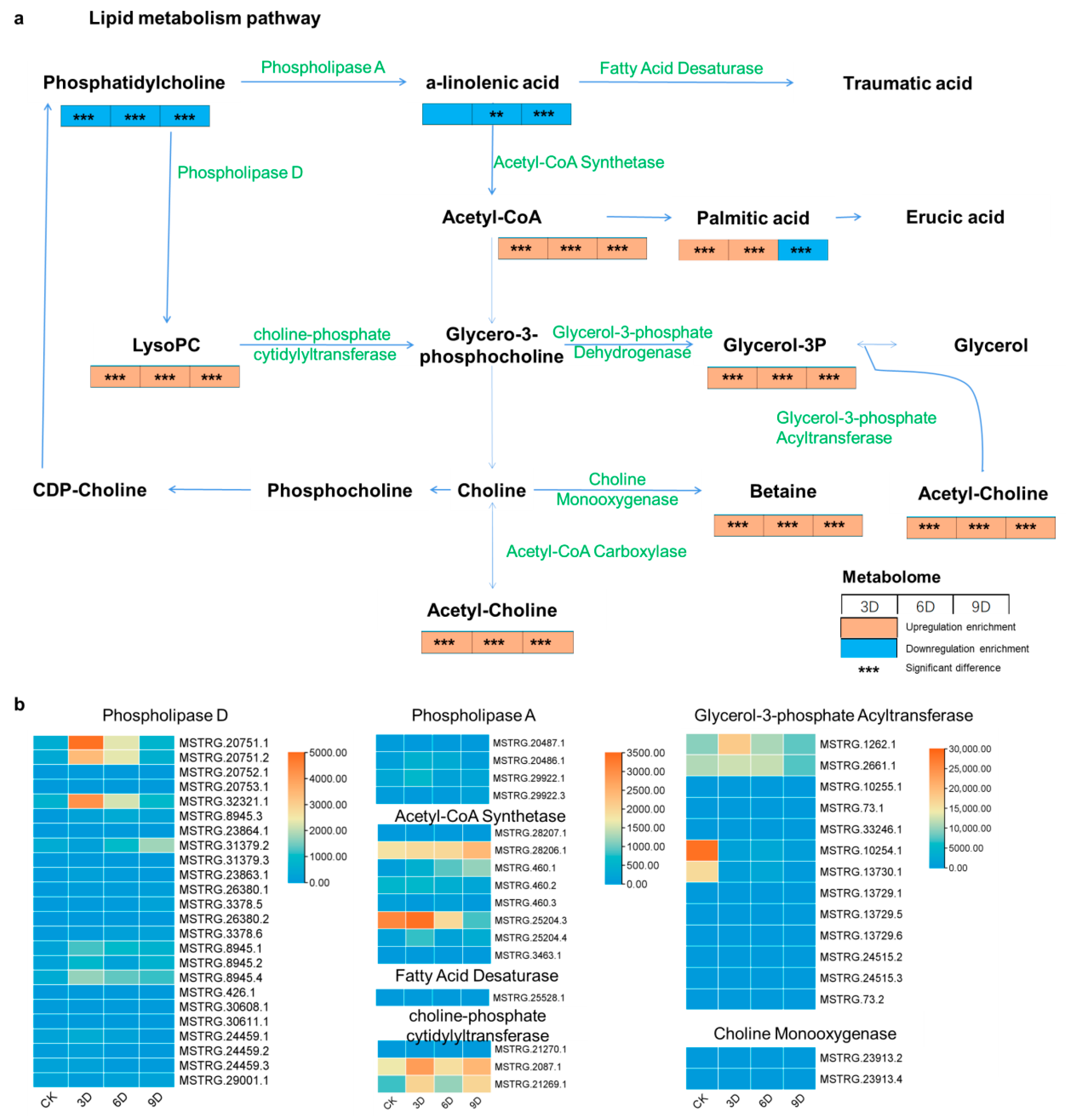
To decipher the metabolic adjustments underlying salt adaptation, we performed an integrated analysis of the lipid metabolism pathway in Tartary buckwheat under NaCl stress. The pathway map highlights central metabolites (white boxes) and their enrichment patterns across three stress stages (3D, 6D, 9D), where yellow and blue modules denote up- and down-regulation, respectively (Figure 7a). Corresponding expression profiles of key structural and regulatory genes (labeled in green) are displayed in a clustered heatmap, revealing a temporally stratified transcriptional reprogramming of lipid metabolism (Figure 7b).
Transcriptomic data revealed a pronounced early induction of genes involved in phosphatidylcholine (PC) biosynthesis. Notably, transcripts encoding choline-phosphate cytidylyltransferase (MSTRG.20751.1 and MSTRG.20751.2; these IDs correspond to entries in Figure 7b) were sharply up-regulated at 3D (8.8-fold and 7.9-fold, respectively), followed by a gradual decline, suggesting an initial surge in membrane phospholipid production. Conversely, genes associated with PC degradation, such as phospholipase A (MSTRG.20487.1), were strongly suppressed throughout the treatment, indicating reduced membrane turnover under stress. In the fatty acid (FA) synthesis and modification branch, key enzymes displayed divergent expression dynamics. Acetyl-CoA carboxylase isoforms (MSTRG.1262.1 and MSTRG.2661.1) were markedly induced at 3D (1.9-fold and 1.1-fold, respectively), pointing to enhanced de novo FA synthesis for membrane remodeling or lipid storage. However, several downstream genes involved in glycerolipid assembly, including glycerol-3-phosphate acyltransferase (MSTRG.10254.1 and MSTRG.13730.1), were dramatically down-regulated (up to 23-fold decrease at 3D), implying a selective channeling of FA away from storage lipid synthesis under salinity. The choline-to-betaine pathway, crucial for osmotic adjustment, exhibited sustained activation. Choline monooxygenase-like (MSTRG.460.1; shown in Figure 7b under “Choline monooxygenase”) showed progressive up-regulation, culminating in an 11.4-fold increase at 9D, which correlates with likely enhanced synthesis of the osmoprotectant glycine betaine. Parallel to this, genes involved in traumatic acid synthesis from α-linolenic acid (e.g., MSTRG.25204.3 and MSTRG.25204.4) displayed complex temporal patterns—MSTRG.25204.3 was initially high but declined sharply by 9D, while MSTRG.25204.4 peaked transiently at 3D, suggesting a modulated oxylipin signaling in response to ionic stress. Interestingly, lysophosphatidylcholine (LysoPC) metabolism-related genes also showed stress-responsive changes. For example, MSTRG.8945.1 (a putative LysoPC acyltransferase) was up-regulated at 3D (4.4-fold), possibly contributing to membrane re-acylation and repair. Collectively, these transcriptional shifts depict a highly coordinated lipid metabolic reprogramming under salt stress. The early induction of PC and FA biosynthetic genes likely supports membrane biogenesis and lipid signaling, while the sustained activation of the choline-betaine pathway underscores a strategic investment in compatible solute accumulation. The concurrent down-regulation of specific glycerolipid synthesis enzymes may reflect a metabolic re-routing to conserve energy and carbon skeletons, or to prevent the accumulation of cytotoxic lipid intermediates. This dynamic, multi-layered adjustment highlights lipid metabolism as a central adaptive module in Tartary buckwheat’s response to NaCl stress.
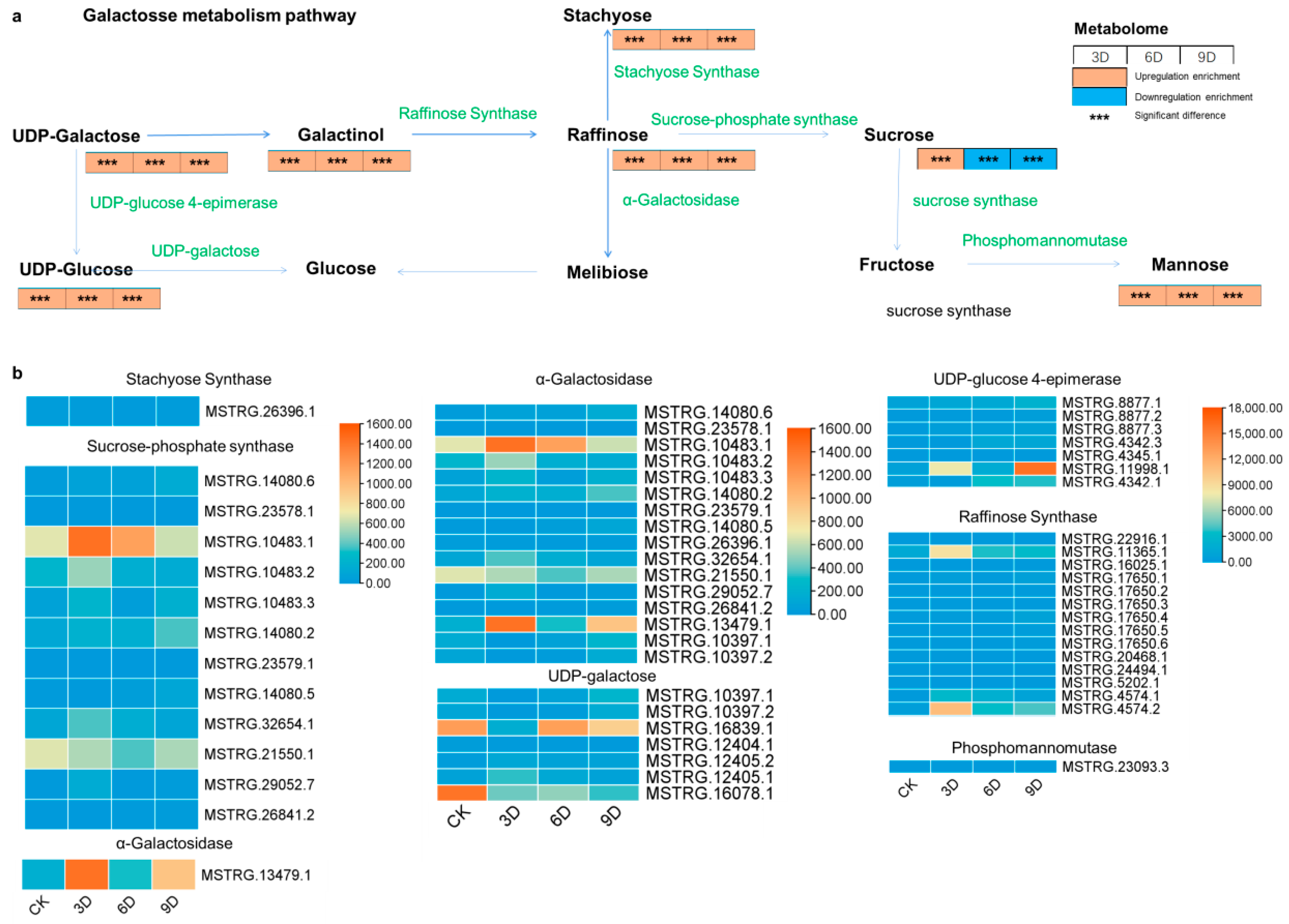
To further elucidate the metabolic basis of salinity adaptation, we investigated the galactose metabolism pathway in Tartary buckwheat roots under NaCl stress (Figure 8). The pathway schematic (Figure 8a) outlines key metabolites and visualizes their enrichment trends across three stress time points (3D, 6D, 9D) using color-coded modules (yellow for up-regulation, blue for down-regulation). Corresponding expression profiles of pivotal genes (labeled in green) are presented in a clustered heatmap (Figure 8b), revealing a dynamic transcriptional reorganization of this carbohydrate metabolic branch.

3.6. Galactose Metabolism Contribution Under Salt Stress

Transcriptomic analysis demonstrated a concerted induction of genes involved in the synthesis of galactinol and raffinose family oligosaccharides (RFOs), which are crucial osmoprotectants. Notably, the expression of galactinol synthase (MSTRG.11998.1) was dramatically up-regulated, showing a staggering increase from 605.88 in CK to 16,048.99 at 9D (~26.5-fold), indicating a massive commitment to osmolyte production. Similarly, raffinose synthase isoforms (MSTRG.8877.1, MSTRG.8877.3) were progressively induced, with MSTRG.8877.1 reaching a 2.7-fold increase by 9D, supporting the accumulation of RFOs for cellular protection. Conversely, genes associated with galactose catabolism and interconversion exhibited more complex, often suppressed, patterns. Several isoforms of α-galactosidase (MSTRG.6141 family) showed variable responses, with some (MSTRG.6141.2, MSTRG.6141.4) being transiently induced at specific time points, while others (MSTRG.6141.3, MSTRG.6141.9) were down-regulated. This suggests a precise regulation to potentially limit the breakdown of protective galactose-containing compounds while maintaining necessary metabolic flux. The pathway also highlighted changes in UDP-sugar metabolism, which bridges to cell wall biosynthesis. Genes like UDP-glucose 4-epimerase (MSTRG.10483.1) were strongly induced at 3D (~2.1-fold), possibly to channel carbon towards the synthesis of cell wall matrix polysaccharides like pectins and hemicelluloses, which are rich in galactose. This induction aligns with the need for cell wall remodeling under osmotic stress. Furthermore, the expression of myo-inositol oxygenase (MSTRG.4574.2), involved in the production of UDP-glucuronic acid (a precursor for cell wall components), was extraordinarily up-regulated (up to 23-fold at 3D), underscoring a significant re-direction of carbon flow towards cell wall fortification. Collectively, the transcriptional rewiring of the galactose metabolism pathway under salt stress reveals a dual strategy: (1) the robust and sustained induction of the galactinol-RFO biosynthesis axis for osmotic adjustment, and (2) the modulated expression of catabolic and interconversion enzymes to support cell wall metabolism and redirect carbon resources. This coordinated response highlights galactose metabolism as a key hub for integrating osmoprotection and structural adaptation during salinity stress in Tartary buckwheat.

3.7. Amino Acid Metabolism and TCA Cycle Under Salt Stress

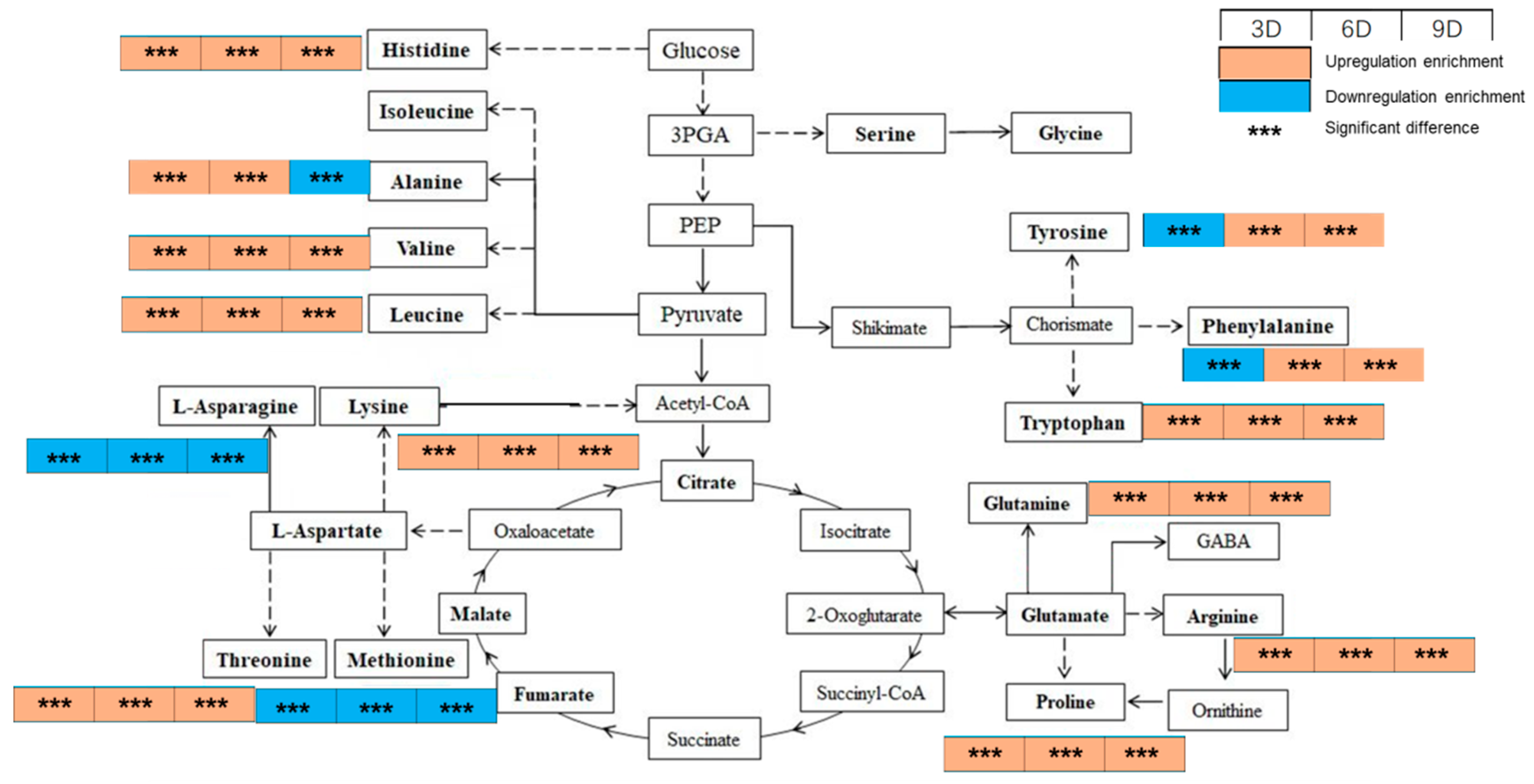
To understand the metabolic adjustments in nitrogen and energy metabolism during salinity adaptation, we analyzed the integrated pathways of amino acid biosynthesis and the tricarboxylic acid (TCA) cycle in Tartary buckwheat under NaCl treatment (Figure 9). Our analysis revealed a widespread and stage-specific reprogramming of amino acid metabolism. Notably, the biosynthesis of aromatic amino acids (phenylalanine, tyrosine) showed a marked down-regulation at 3D, as indicated by the enriched shikimate and chorismate pathway modules. This early induction suggests an increased demand for precursors of secondary metabolites, such as flavonoids and lignin, which are crucial for antioxidant defense and cell wall fortification under stress. Conversely, the metabolism of aspartate-family amino acids (lysine, methionine, threonine) displayed a distinct down-regulation by 6D. The suppression of metabolites like L-aspartate and oxaloacetate points to a potential re-routing of carbon skeletons away from these biosynthesis branches, possibly to conserve nitrogen or to prioritize other stress-responsive pathways. The glutamate-family amino acids, including proline, arginine, and glutamine, exhibited a complex dynamic. While the precursor glutamate showed signs of up-regulation, the ornithine-to-proline sub-pathway was significantly down-regulated at 9D. This contrasts with the typical stress-induced proline accumulation reported in many species, indicating a unique metabolic strategy in Tartary buckwheat that may favor alternative osmoprotectants like glycine betaine (as seen in lipid metabolism). The branched-chain amino acids synthesis pathway was generally suppressed, particularly at the 6D time point. This down-regulation may reflect a reduction in protein synthesis or a strategic shutdown of energetically costly anabolic processes to redirect resources towards essential defense mechanisms. Importantly, these shifts in amino acid metabolism were tightly coupled with changes in the TCA cycle. Key intermediates such as citrate and isocitrate showed up-regulation, indicating an activated cycle potentially to meet the heightened energy (ATP) and reducing power (NADH) demands under stress. Simultaneously, the down-regulation of fumarate and oxaloacetate suggests a possible anaplerotic drain of these intermediates to support amino acid synthesis or other biosynthetic needs, a common metabolic adaptation to environmental perturbation.
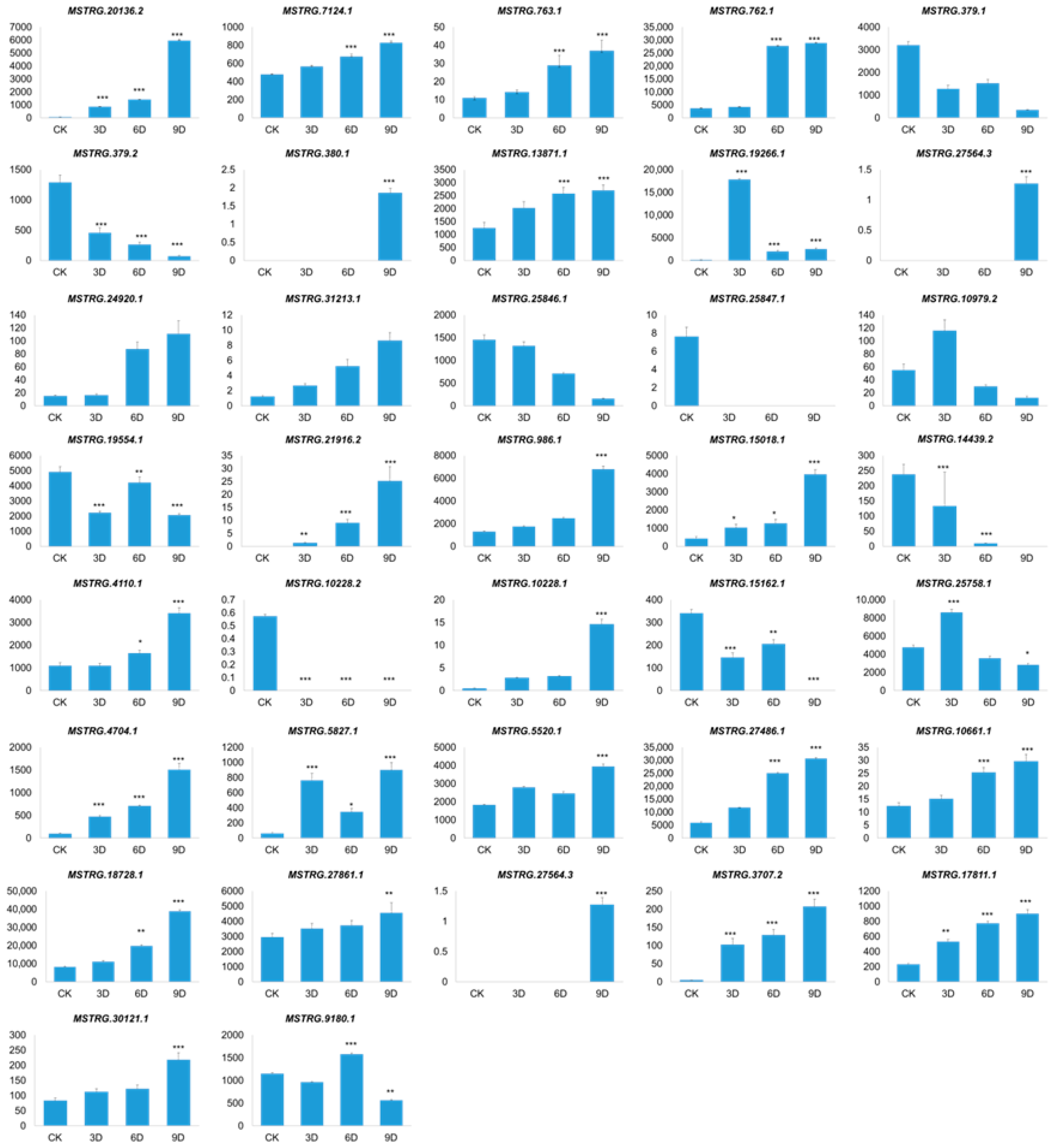
Based on the image information and gene expression data, this study systematically deciphered the transcriptional responses of key amino acid metabolic pathways under salt stress (Table 1). The expression of P5CS (Δ1-pyrroline-5-carboxylate synthetase, e.g., MSTRG.20136.2 and MSTRG.7124.1), encoding the key rate-limiting enzyme for proline synthesis, was significantly up-regulated post-stress. Specifically, the expression level of MSTRG.20136.2 under the 9D treatment increased approximately 88-fold compared to the control (5967.597 vs. 67.725), indicating a strong activation of this pathway to accumulate proline for osmotic adjustment and cellular protection. Similarly, the expression of key enzyme genes for γ-aminobutyric acid (GABA) synthesis, such as GAD (glutamate decarboxylase, e.g., MSTRG.762.1), was also markedly up-regulated, with its expression at 9D reaching 28864.719, about 7.8 times that of the control, suggesting enhanced GABA synthesis likely contributing to ion homeostasis and redox balance. In the central nitrogen metabolism pathways, the expression of glutamine synthetase genes GS (e.g., MSTRG.19266.1) and glutamate synthase genes GOGAT (e.g., MSTRG.24920.1) was generally up-regulated, demonstrating the activation of the glutamate-glutamine cycle to meet the demands of nitrogen assimilation and ammonium detoxification under stress.
Furthermore, significant changes in expression were observed in pathways related to energy and secondary metabolism (Figure 10). Expression changes in pyruvate kinase genes PK (e.g., MSTRG.986.1) and pyruvate dehydrogenase genes PDH (e.g., MSTRG.25758.1) indicated adjustments in the flux of glycolysis and pyruvate metabolism. This aligns with the observed decreases in pyruvate and acetyl-CoA levels in the metabolite data, suggesting a possible diversion of carbon skeletons toward amino acid synthesis and energy supply. Concurrently, the expression of phenylalanine ammonia-lyase genes PAL (e.g., MSTRG.17811.1) was significantly induced, accompanied by a decline in phenylalanine content. This points to the activation of the phenylpropanoid pathway, facilitating the synthesis of lignin and antioxidative secondary metabolites. In methionine metabolism, the expression of S-adenosylmethionine synthetase genes SAM-S (e.g., MSTRG.18728.1) was substantially enhanced, likely providing precursors for ethylene and polyamine biosynthesis to mediate stress signaling and protective responses. Collectively, these results reveal that plants under salt stress employ multi-layered regulation of amino acid metabolic gene expression to reconfigure nitrogen and carbon resources, thereby enhancing osmotic adjustment, antioxidant capacity, and energy supply to adapt to the adverse environment.

4. Discussion

Soil salinity represents a pervasive abiotic stressor that impairs plant growth and development across multiple phenological stages, frequently culminating in substantial yield losses and posing a significant threat to both food security and agricultural livelihoods. In response, plants have evolved intricately layered adaptive programs encompassing signal perception, intracellular transduction cascades, transcriptional regulatory networks, and metabolic readjustments [3,7]. Although salt stress responses have been extensively characterized in model systems and several staple crops, the molecular and metabolic underpinnings of salinity adaptation in Tartary buckwheat (Fagopyrum tataricum) remain largely unexplored [53]. In this study, we present an integrated multi-omics dissection of the physiological, transcriptomic, and metabolomic remodeling that accompanies prolonged NaCl exposure in Tartary buckwheat. By leveraging the complementary strengths of high-throughput transcriptomics and untargeted metabolomics, we have resolved a temporally phased adaptation program that reconfigures carbon and nitrogen partitioning, membrane lipid architecture, and osmoprotectant biosynthesis under sustained salinity. Our findings establish a systems-level framework for understanding salt tolerance in this species and nominate a suite of candidate genes and metabolic markers for breeding and biotechnology applications.
The time-resolved physiological profiling revealed a tightly coordinated, stage-specific deployment of antioxidant defenses in response to progressive salinity-induced oxidative injury. The sequential activation of superoxide dismutase (SOD) at day 3, followed by the peak activities of catalase (CAT) and peroxidase (POD) at days 6 and 9, exemplifies a “first-responder, second-scavenger” enzymatic hierarchy that effectively curbs membrane lipid peroxidation, as reflected by the sustained elevation of malondialdehyde (MDA) content and plasma membrane permeability. This kinetic signature is underlain by the transcriptional co-induction of genes, consistent with earlier reports in salt-tolerant buckwheat germplasms [54,55]. The orchestrated nature of this response implies that genetic improvement strategies aimed solely at overexpressing a single antioxidant enzyme are unlikely to fully recapitulate the robust, multi-layered ROS clearance observed in tolerant genotypes. Our data support a model in which the entire enzymatic cascade may be coordinately optimized—potentially through the manipulation of shared upstream regulators [56]. Concurrently, proline accumulation reached 3.1-fold above baseline by day 9, reflecting a swift and sustained osmotic adjustment capacity. The magnitude of proline induction aligns with the transcriptional up-regulation of its biosynthetic master switch P5CS, whose promoter is densely populated with ABA-responsive elements (ABREs) and binding sites for NAC and WRKY transcription factors [57,58].
At the transcriptional level, our time-series RNA-seq analysis delineated a triphasic genomic reprogramming that mirrors the physiological transitions observed. At day 3, a relatively restrained set of differentially expressed genes (DEGs; n = 376) was dominated by pathways related to plant hormone signal transduction and ribosome biogenesis. This early transcriptional wave coincides precisely with the burst in SOD activity and the onset of proline synthesis, and is likely driven by the rapid activation of the core ABA signaling module—FtPYL4, FtSnRK2.6, and FtABI5—whose downstream targets include both antioxidant enzymes and FtP5CS1 [59,60,61]. By day 6, the transcriptome entered a phase of pervasive repression, with down-regulated genes (n = 528) vastly outnumbering up-regulated ones (n = 101). This “transcriptional silencing wave” overlapped temporally with the peak of CAT/POD activities and the stabilization of SOD levels, signaling a strategic shift from acute stress shock to homeostatic maintenance. KEGG enrichment for amino sugar, nucleotide sugar, starch, and phenylpropanoid metabolism at this stage corroborates metabolomic evidence of soluble sugar accumulation [62,63], and reflects a resource allocation trade-off wherein the plant curtails energetically costly growth-related transcription in favor of osmotic adjustment and redox homeostasis. At day 9, the balance reversed once more, with 267 up-regulated versus 150 down-regulated genes. Late-stage transcriptional activation converged on α-linolenic acid metabolism, glycerolipid metabolism, and plant-pathogen interaction, which may represent a signature of mobilized lipid-based defense signaling [64]. This triphasic transcriptional architecture (early signal perception, mid-phase metabolic reprioritization, late defense consolidation) provides a high-resolution temporal scaffold for future functional dissection of salt tolerance determinants in Tartary buckwheat [65].
Central to this transcriptional reorientation is the fine-tuned modulation of both ABA and MAPK signaling cascades, which we found to undergo profound and often non-linear expression remodeling. Within the ABA pathway, the sustained down-regulation of the core kinase SnRK2.3 (to <11% of basal expression by day 9) and the progressive induction of specific PP2C negative regulators (e.g., MSTRG.316.9, rising from near-zero to 72.59 TPM) constitute a potential homeostatic mechanism. Rather than simply amplifying ABA signal strength, Tartary buckwheat appears to reset the pathway’s basal gain—attenuating core kinase transcription while simultaneously reinforcing negative feedback—thereby calibrating ABA output to a “defense-sufficient, growth-compatible” set point. This interpretation is consistent with recent findings that CRISPR/Cas9-mediated knockout of PP2C enhances drought tolerance without yield penalty [66]; in that context, removal of an endogenous “brake” released latent stress tolerance, whereas here we observe the plant actively installing an adjustable brake to fine-tune its long-term stress equilibrium. Even more striking is the behavior of the MAPK family. The near-digital induction of FtMAPK10—from virtual absence (0.004 TPM) to robust expression (335.68 TPM) at day 9—is, to our knowledge, remarkable in plant stress transcriptomics and suggests this kinase as a specialized, late-phase signal hub rather than a generalist stress responder. Its co-occurrence with enriched α-linolenic acid and glycerolipid metabolism pathways [67] raises the possibility that FtMAPK10 may transduce lipid-derived signals into a sustained transcriptional defense program. In stark contrast, FtMAPK7 and the FtMAPK13/14/16 clade were progressively silenced. This “module-switching” behavior, wherein certain MAPK modules are selectively activated while others are suppressed, has not been systematically documented in plant salinity responses and suggests that the MAPK network may undergo a wholesale topological reprogramming to prioritize adaptation-related signaling over growth-related cascades. The convergent induction of FtMAPK10 and late-specific transcription factors (e.g., MSTRG.21361.1 [AP2/ERF], MSTRG.16773.1 [WRKY]) points to a potential signaling axis that may represent a central control point for durable salt acclimation. Validating this axis through phosphoproteomic profiling and transgenic perturbation is an important direction for future research.
Complementing the transcriptional reprogramming, our metabolomic analysis uncovered a global metabolic restructuring that is both extensive and highly time-resolved. Of the 1798 metabolites profiled, the late stage (9D) was characterized by a pronounced predominance of down-accumulated metabolites (717 vs. 403 up-accumulated), mirroring the transcriptional repression wave observed at 6D. This cross-omics concordance suggests a coordinated shift from active biosynthesis to resource reallocation under sustained energy limitation. Three interconnected metabolic axes emerged as core adaptive modules. First, galactose metabolism underwent a dramatic reorientation toward the synthesis of raffinose family oligosaccharides (RFOs). The extraordinary induction of galactinol synthase (MSTRG.11998.1; 26.5-fold) far exceeded that of proline biosynthetic genes, despite the latter also being strongly up-regulated (88-fold for P5CS). The absolute transcript abundance of galactinol synthase (16,049 TPM) was nearly threefold higher than that of P5CS (5967 TPM), suggesting a preferential commitment to carbohydrate-based osmoprotection [68]. This strategy may reflect the evolutionary legacy of Tartary buckwheat as a high-altitude crop adapted to cold and drought, where RFOs serve dual roles as membrane stabilizers and ROS scavengers [69]. Second, lipid metabolism exhibited a clear temporal division of labor: early induction of phosphatidylcholine (PC) and fatty acid biosynthetic genes, coupled with suppression of phospholipase A, prioritizes membrane integrity and repair; later enrichment of α-linolenic acid metabolism signals a shift toward lipid-based defense signaling. The coupling between this late lipid signature and the explosive induction of FtMAPK10 provides a candidate mechanism linking membrane remodeling to MAPK activation. Third, nitrogen metabolism was profoundly rerouted. The concerted up-regulation of aromatic amino acid biosynthesis, phenylalanine ammonia-lyase (PAL), and the concurrent depletion of phenylalanine indicate a metabolic flux diversion toward phenylpropanoid-derived lignin and flavonoids—reinforcing cell wall architecture and antioxidative capacity. The simultaneous induction of P5CS and glutamate decarboxylase (GAD) channels glutamate toward proline and GABA, respectively, serving both osmotic and pH-homeostatic functions. Notably, while lysine, methionine, and threonine biosynthesis were suppressed, S-adenosylmethionine synthetase (SAM-S) was strongly induced—a strategic prioritization of methionine flux toward ethylene and polyamine precursors at the expense of protein synthesis. This coordinated suppression of “growth” anabolism and enhancement of “defense” metabolism exemplifies a central tenet of plant stress adaptation: the rational reallocation of limiting nitrogen and carbon skeletons to maximize immediate fitness under duress [70,71,72,73]. An additional layer of regulation may involve epigenetic modifications, as metabolic reprogramming is often linked to chromatin remodeling [74]. The observed transcriptional changes in key TF families (e.g., WRKY, NAC) and metabolic enzymes could be influenced by epigenetic factors that sense the cellular metabolic state. While our current dataset does not directly measure epigenetic marks, the coordinated expression of numerous genes involved in carbon and nitrogen metabolism suggests possible involvement of epigenetic regulatory mechanisms. Future studies integrating epigenomic profiling (e.g., ChIP-seq for histone modifications) with metabolomics could reveal how metabolic signals are translated into stable transcriptional changes during salt adaptation [75].
Taken together, our integrative analysis advances a conceptually novel framework for understanding salt tolerance in Tartary buckwheat. The response is not a linear, one-dimensional program but rather a dynamic, systems-level recalibration of signaling sensitivity (ABA gain control), signal transduction topology (MAPK module switching), and metabolic network flux (carbon-nitrogen-lipid repartitioning). We have pinpointed specific transcriptional and metabolic nodes—FtMAPK10, PP2C isoforms, galactinol synthase, SAM-S, and the galactinol-RFO biosynthesis axis—that lie at the intersection of these adaptive modules and represent high-value targets for future functional validation and breeding applications.
Nevertheless, several limitations of the current study must be acknowledged. First, our transcriptomic and metabolomic analyses were conducted on bulk leaf tissue, thereby obscuring cell-type-specific responses that may be critical in specialized cell layers (e.g., vasculature, epidermis). Roots, as the primary interface with the saline rhizosphere, likely deploy a distinct and equally complex adaptive program that remains to be charted [76,77,78]. Second, the correlative nature of our multi-omics datasets, while hypothesis-generating, does not establish causality; the predicted regulatory interactions between specific transcription factors (e.g., MSTRG.16773.1) and their putative target genes require biochemical validation through yeast one-hybrid, ChIP-qPCR, and transactivation assays. Third, the candidate hub kinase FtMAPK10 awaits loss- and gain-of-function characterization via CRISPR/Cas9 and overexpression in homologous or heterologous systems [79]. Fourth, although we identified key DEGs and DAMs, we did not perform independent validation experiments such as qRT-PCR or targeted metabolite quantification; thus, these findings should be considered as correlative and require experimental confirmation. Fifth, our controlled-environment study employed a single, moderate NaCl concentration and terminated at the vegetative stage. Field-relevant conditions typically involve dynamic combinations of salinity with drought, alkalinity, or nutrient deficiency, and reproductive-stage salt sensitivity—particularly during flowering and grain filling—may be considerably higher [80,81]. Sixth, the choice of foliar application, while suitable for assessing leaf responses, may not fully capture root-mediated adaptation processes; future studies should include root tissue analysis and soil-based treatments.
Future investigations should therefore extend this temporal molecular atlas to reproductive tissues and to combinatorial stress scenarios, integrating translatome and phosphoproteome layers to capture post-transcriptional and post-translational regulatory events. The incorporation of natural variation through population-level multi-omics and the exploitation of stress-memory and transgenerational epigenetic signatures represent promising frontiers for translating our systems-level understanding into durable, field-ready salt tolerance in Tartary buckwheat and beyond [82,83].
In conclusion, this study provides the first comprehensive, temporally resolved multi-omics blueprint of salt stress adaptation in Tartary buckwheat. We demonstrate that tolerance emerges from the coordinated, stage-specific interplay of signaling recalibration, transcriptional reprogramming, and metabolic network reconfiguration. The conceptual framework and the specific molecular targets identified herein lay a robust foundation for both fundamental research into the mechanisms of plant stress adaptation and the translational breeding of salt-resistant buckwheat varieties.

5. Conclusions

This study presents the first comprehensive, time-resolved multi-omics blueprint of salt stress adaptation in Tartary buckwheat (Fagopyrum tataricum). Through integrated physiological, transcriptomic, and metabolomic analyses, we demonstrate that salinity tolerance in this species emerges from a highly coordinated, multi-layered reprogramming across multiple biological levels. Physiologically, Tartary buckwheat deploys a phased antioxidant cascade—sequential activation of SOD, CAT, and POD—coupled with sustained proline accumulation to mitigate oxidative damage and maintain osmotic homeostasis. Transcriptomically, we delineated a triphasic genomic response: early hormone signaling and signal transduction (3D), mid-phase metabolic repression and resource reallocation (6D), and late-stage activation of lipid-based defense and stress signaling (9D). Metabolomically, extensive metabolic restructuring was observed, highlighted by the dramatic induction of the galactinol–raffinose oligosaccharide (RFO) pathway for osmoprotection, reprogramming of membrane lipid metabolism, and coordinated re-routing of carbon and nitrogen fluxes toward defense-related secondary metabolism. Key regulatory nodes identified include the fine-tuned modulation of ABA signaling via PP2C induction and SnRK2.3 suppression, and the late-specific activation of FtMAPK10 as a candidate hub for sustained stress signaling. These findings establish a systems-level framework for understanding salt tolerance in Tartary buckwheat and nominate high-value candidate genes—such as FtMAPK10, specific PP2C isoforms, galactinol synthase, and S-adenosylmethionine synthetase—as targets for functional validation and breeding improvement. Collectively, this work advances both fundamental insights into plant stress adaptation and provides molecular resources for enhancing salinity resilience in buckwheat and related crops.

Supplementary Materials

The following supporting information can be downloaded at https://www.mdpi.com/article/10.3390/agronomy16080771/s1: Supplementary Materials Table S1: Summarized physiological data of Tartary buckwheat under salt stress. Supplementary Materials Table S2: Statistical results of the RNA-Seq reads. Supplementary Materials Table S3: Expression of TFs.

Author Contributions

Conceptualization, D.D.; methodology, Y.Y., Z.L. and L.M.; software, Y.H., Z.C. and G.D.; writing—original draft preparation, D.D.; writing—review and editing, D.D. and G.D. All authors have read and agreed to the published version of the manuscript.

Funding

This research was funded by the Wuhan Polytechnic University Introduction (training) talent research startup project [Grant Number: 12740].

Data Availability Statement

The original contributions presented in this study are included in the article/Supplementary Materials. Further inquiries can be directed to the corresponding author(s).

Conflicts of Interest

The authors declare no conflicts of interest.

References

  1. Van Zelm, E.; Zhang, Y.; Testerink, C. Salt tolerance mechanisms of plants. Annu. Rev. Plant Biol. 2020, 71, 403–433. [Google Scholar] [CrossRef] [PubMed]
  2. Zhou, H.; Shi, H.; Yang, Y.; Feng, X.; Chen, X.; Xiao, F.; Guo, Y. Insights into plant salt stress signaling and tolerance. J. Genet. Genom. 2024, 51, 16–34. [Google Scholar] [CrossRef] [PubMed]
  3. Shahid, M.A.; Sarkhosh, A.; Khan, N.; Balal, R.M.; Ali, S.; Rossi, L.; Garcia-Sanchez, F. Insights into the physiological and biochemical impacts of salt stress on plant growth and development. Agronomy 2020, 10, 938. [Google Scholar] [CrossRef]
  4. Chen, Q.; Cao, X.; Li, Y.; Sun, Q.; Dai, L.; Li, J.; Ci, L. Functional carbon nanodots improve soil quality and tomato tolerance in saline-alkali soils. Sci. Total Environ. 2022, 830, 154817. [Google Scholar] [CrossRef]
  5. Qin, H.; Li, Y.; Huang, R. Advances and challenges in the breeding of salt-tolerant rice. Int. J. Mol. Sci. 2020, 21, 8385. [Google Scholar] [CrossRef]
  6. Ondrasek, G.; Rathod, S.; Manohara, K.K.; Gireesh, C.; Anantha, M.S.; Sakhare, A.S.; Horvatinec, J. Salt stress in plants and mitigation approaches. Plants 2022, 11, 717. [Google Scholar] [CrossRef]
  7. Praveen, A.; Singh, S. The role of potassium under salinity stress in crop plants. Cereal Res. Commun. 2024, 52, 315–322. [Google Scholar] [CrossRef]
  8. Hasanuzzaman, M.; Fujita, M. Plant responses and tolerance to salt stress: Physiological and molecular interventions. Int. J. Mol. Sci. 2022, 23, 4810. [Google Scholar] [CrossRef]
  9. Munns, R.; Passioura, J.B.; Colmer, T.D.; Byrt, C.S. Osmotic adjustment and energy limitations to plant growth in saline soil. New Phytol. 2020, 225, 1091–1096. [Google Scholar] [CrossRef]
  10. Liu, C.; Mao, B.; Yuan, D.; Chu, C.; Duan, M. Salt tolerance in rice: Physiological responses and molecular mechanisms. Crop J. 2022, 10, 13–25. [Google Scholar] [CrossRef]
  11. Islam, S.; Mohammad, F.; Shakeel, A.; Corpas, F.J. Glycine betaine: A multifaceted protectant against salt stress in Indian mustard through ionic homeostasis, ROS scavenging and osmotic regulation. Physiol. Plant. 2024, 176, e14530. [Google Scholar] [CrossRef] [PubMed]
  12. Atta, K.; Mondal, S.; Gorai, S.; Singh, A.P.; Kumari, A.; Ghosh, T.; Jespersen, D. Impacts of salinity stress on crop plants: Improving salt tolerance through genetic and molecular dissection. Front. Plant Sci. 2023, 14, 1241736. [Google Scholar] [CrossRef] [PubMed]
  13. Lu, Y.; Fricke, W. Changes in root hydraulic conductivity in wheat (Triticum aestivum L.) in response to salt stress and day/night can best be explained through altered activity of aquaporins. Plant Cell Environ. 2023, 46, 747–763. [Google Scholar] [CrossRef] [PubMed]
  14. Wang, J.; Luo, Y.; Ye, F.; Ding, Z.J.; Zheng, S.J.; Qiao, S.; Su, N. Structures and ion transport mechanisms of plant high-affinity potassium transporters. Mol. Plant 2024, 17, 409–422. [Google Scholar] [CrossRef]
  15. Cunha, D.S.; Neto, V.G.; Santos, I.D.; Andrade, M.V.; Takahashi, D.; Loureiro, M.B.; de Castro, R.D. Castor (Ricinus communis L.) differential cell cycle and metabolism reactivation, germinability, and seedling performance under NaCl and PEG osmoticum: Stress tolerance related to genotype-preestablished superoxide dismutase activity. Plant Physiol. Biochem. 2024, 207, 108372. [Google Scholar] [CrossRef]
  16. Guo, A.Y.; Wu, W.Q.; Liu, W.C.; Zheng, Y.; Bai, D.; Li, Y.; Song, C.P. C2-domain abscisic acid-related proteins regulate the dynamics of a plasma membrane H+-ATPase in response to alkali stress. Plant Physiol. 2024, 196, 2784–2794. [Google Scholar] [CrossRef]
  17. Li, W.; Li, H.; Wei, Y.; Han, J.; Wang, Y.; Li, X.; Han, D. Overexpression of a Fragaria vesca NAM, ATAF, and CUC (NAC) Transcription Factor Gene (FvNAC29) Increases Salt and Cold Tolerance in Arabidopsis thaliana. Int. J. Mol. Sci. 2024, 25, 4088. [Google Scholar] [CrossRef]
  18. Ali, A.; Petrov, V.; Yun, D.J.; Gechev, T. Revisiting plant salt tolerance: Novel components of the SOS pathway. Trends Plant Sci. 2023, 28, 1060–1069. [Google Scholar] [CrossRef]
  19. Shi, X.; Bao, J.; Lu, X.; Ma, L.; Zhao, Y.; Lan, S.; Li, S. The mechanism of Ca2+ signal transduction in plants responding to abiotic stresses. Environ. Exp. Bot. 2023, 214, 105514. [Google Scholar] [CrossRef]
  20. Lu, K.; Guo, Z.; Di, S.; Lu, Y.; Muhammad, I.A.R.; Rong, C.; Ding, C. OsMFT1 inhibits seed germination by modulating abscisic acid signaling and gibberellin biosynthesis under salt stress in rice. Plant Cell Physiol. 2023, 64, 674–685. [Google Scholar] [CrossRef]
  21. Ding, R.; Li, J.; Wang, J.; Li, Y.; Ye, W.; Yan, G.; Yin, Z. Molecular traits of MAPK kinases and the regulatory mechanism of GhMAPKK5 alleviating drought/salt stress in cotton. Plant Physiol. 2024, 196, 2030–2047. [Google Scholar] [CrossRef]
  22. Liu, L.; Gai, Z.; Qiu, X.; Liu, T.; Li, S.; Ye, F.; Li, X. Salt stress improves the low-temperature tolerance in sugar beet in which carbohydrate metabolism and signal transduction are involved. Environ. Exp. Bot. 2023, 208, 105239. [Google Scholar] [CrossRef]
  23. Zhou, H.; Meng, F.; Jiang, W.; Lu, X.; Zhang, R.; Huang, A.; Zheng, D. Potassium indole-3-butyric acid affects rice’s adaptability to salt stress by regulating carbon metabolism, transcription factor genes expression, and biosynthesis of secondary metabolites. Front. Plant Sci. 2024, 15, 1416936. [Google Scholar] [CrossRef] [PubMed]
  24. Jabir, M.; Majdi, H.; Basem, A.; Alfaker, M.J.; Al-Rubaye, A.H.; Berdimurodov, E.; Almehizia, A.A. Fabrication of an Economical and Environmentally Friendly Electrode Utilizing Fullerene Modified with L-Proline and Coated with Copper Nanoparticles for Enantioselective Electro-Organic Henry Reaction in the Presence of NaCl Electrolyte. J. Mol. Struct. 2024, 1316, 138942. [Google Scholar] [CrossRef]
  25. Dabravolski, S.A.; Isayenkov, S.V. The role of the γ-aminobutyric acid (GABA) in plant salt stress tolerance. Horticulturae 2023, 9, 230. [Google Scholar] [CrossRef]
  26. Hossain, M.S.; Li, J.; Sikdar, A.; Hasanuzzaman, M.; Uzizerimana, F.; Muhammad, I.; Feng, B. Exogenous melatonin modulates the physiological and biochemical mechanisms of drought tolerance in tartary buckwheat (Fagopyrum tataricum (L.) Gaertn). Molecules 2020, 25, 2828. [Google Scholar] [CrossRef]
  27. Shi, Y.; Li, B.; Gao, Y.; Wang, X.; Liu, Y.; Lu, X.; Lin, H.; Li, W.; Lai, D.; Hao, M.; et al. Phylogenomics provides comprehensive insights into the evolutionary relationships among cultivated buckwheat species. Genome Biol. 2025, 26, 327. [Google Scholar] [CrossRef]
  28. Li, H.; Lv, Q.; Liu, A.; Wang, J.; Sun, X.; Deng, J.; Wu, Q. Comparative metabolomics study of Tartary (Fagopyrum tataricum (L.) Gaertn) and common (Fagopyrum esculentum Moench) buckwheat seeds. Food Chem. 2022, 371, 131125. [Google Scholar] [CrossRef]
  29. Zhang, K.; He, Y.; Lu, X.; Shi, Y.; Zhao, H.; Li, X.; Li, J.; Liu, Y.; Ouyang, Y.; Tang, Y.; et al. Comparative and population genomics of buckwheat species reveal key determinants of flavor and fertility. Mol. Plant 2023, 16, 1427–1444. [Google Scholar] [CrossRef]
  30. Zou, L.; Wu, D.; Ren, G.; Hu, Y.; Peng, L.; Zhao, J.; Xiao, J. Bioactive compounds, health benefits, and industrial applications of Tartary buckwheat (Fagopyrum tataricum). Crit. Rev. Food Sci. Nutr. 2023, 63, 657–673. [Google Scholar] [CrossRef]
  31. Zhang, J.; Liang, L.; Xie, Y.; Zhao, Z.; Su, L.; Tang, Y.; Sun, B.; Lai, Y.; Li, H. Transcriptome and metabolome analyses reveal molecular responses of two pepper (Capsicum annuum L.) cultivars to cold stress. Front. Plant Sci. 2022, 13, 819630. [Google Scholar] [PubMed]
  32. Liu, A.; Xiao, Z.; Li, M.W.; Wong, F.L.; Yung, W.S.; Ku, Y.S.; Wang, Q.; Wang, X.; Xie, M.; Yim, A.K.-Y.; et al. Transcriptomic reprogramming in soybean seedlings under salt stress. Plant Cell Environ. 2019, 421, 98–114. [Google Scholar] [CrossRef] [PubMed]
  33. Wan, H.; Qian, J.; Zhang, H.; Lu, H.; Li, O.; Li, R.; Yu, Y.; Wen, J.; Zhao, L.; Yi, B.; et al. Combined transcriptomics and metabolomics analysis reveals the molecular mechanism of salt tolerance of huayouza 62, an elite cultivar in rapeseed (Brassica napus L.). Int. J. Mol. Sci. 2022, 23, 1279. [Google Scholar] [CrossRef] [PubMed]
  34. Yao, X.; Zhou, M.; Ruan, J.; Peng, Y.; Ma, C.; Wu, W.; Gao, A.; Weng, W.; Cheng, J. Physiological and biochemical regulation mechanism of exogenous hydrogen peroxide in alleviating NaCl stress toxicity in Tartary buckwheat (Fagopyrum tataricum (L.) Gaertn). Int. J. Mol. Sci. 2022, 23, 10698. [Google Scholar] [CrossRef]
  35. Zhang, J.S.; Wang, Y.Q.; Song, J.N.; Xu, J.P.; Yang, H.B. Effect of aspartic acid on physiological characteristics and gene expression of salt exclusion in Tartary buckwheat under salt stress. J. Plant Biochem. Biotechnol. 2020, 29, 94–101. [Google Scholar] [CrossRef]
  36. Duan, Y.; Feng, J.; Wang, W.; Liu, S.; Qi, D. Controlled drainage stabilized cotton yield by enhancing photosynthesis, the antioxidant defenses and osmoregulation at reduced nitrogen fertilization. Front. Plant Sci. 2026, 16, 1740476. [Google Scholar] [CrossRef]
  37. Du, D.; Xiong, H.; Xu, C.; Zeng, W.; Li, J.; Dong, G. Nutrient Metabolism Pathways Analysis and Key Candidate Genes Identification Corresponding to Cadmium Stress in Buckwheat through Multiomics Analysis. Genes 2023, 14, 1462. [Google Scholar] [CrossRef]
  38. Shams, M.; Khadivi, A. Mechanisms of salinity tolerance and their possible application in the breeding of vegetables. BMC Plant Biol. 2023, 23, 139. [Google Scholar] [CrossRef]
  39. Negrão, S.; Schmöckel, S.M.; Tester, M. Evaluating physiological responses of plants to salinity stress. Ann. Bot. 2017, 119, 1–11. [Google Scholar] [CrossRef]
  40. Zhang, J.; Zhang, C.; Huang, S.; Chang, L.; Li, J.; Tang, H.; Zhao, L. Key Cannabis Salt-Responsive Genes and Pathways Revealed by Comparative Transcriptome and Physiological Analyses of Contrasting Varieties. Agronomy 2021, 11, 2338. [Google Scholar] [CrossRef]
  41. Shahbaz, M.; Akram, A.; Raja, N.I.; Mukhtar, T.; Mehak, A.; Fatima, N.; Abasi, F. Antifungal Activity of Green Synthesized Selenium Nanoparticles and Their Effect on Physiological, Biochemical, and Antioxidant Defense System of Mango under Mango Malformation Disease. PLoS ONE 2023, 18, e0274679. [Google Scholar] [CrossRef]
  42. Wang, W.; Zhang, Z.; Liu, X.; Cao, X.; Wang, L.; Ding, Y.; Zhou, X. An Improved GC-MS Method for Malondialdehyde (MDA) Detection: Avoiding the Effects of Nitrite in Foods. Foods 2022, 11, 1176. [Google Scholar] [CrossRef] [PubMed]
  43. Zhao, F.; Zheng, Y.F.; Zeng, T.; Sun, R.; Yang, J.Y.; Li, Y.; Bai, S.N. Phosphorylation of SPOROCYTELESS/NOZZLE by the MPK3/6 Kinase is Required for Anther Development. Plant Physiol. 2017, 173, 2265–2277. [Google Scholar] [CrossRef] [PubMed]
  44. Beauchamp, C.; Fridovich, I. Superoxide dismutase: Improved assays and an assay applicable to acrylamide gels. Anal. Biochem. 1971, 44, 276–287. [Google Scholar] [CrossRef] [PubMed]
  45. Yang, Y.; Peng, H.; Meng, D.; Fa, Z.; Yao, C.; Lin, X.; Schick, J.; Jin, X. Stress Management: How the Endoplasmic Reticulum Mitigates Protein Misfolding and Oxidative Stress by the Dual Role of Glutathione Peroxidase 8. Biomolecules 2025, 15, 847. [Google Scholar] [CrossRef]
  46. Wu, Y.; Yang, H.; Yang, H.; Zhang, C.; Lyu, L.; Li, W.; Wu, W. A Physiological and Metabolomic Analysis Reveals the Effect of Shading Intensity on Blueberry Fruit Quality. Food Chem. 2022, 386, 133772. [Google Scholar] [CrossRef]
  47. Mao, X.; Cai, T.; Olyarchuk, J.G.; Wei, L. Automated Genome Annotation and Pathway Identification Using the KEGG Orthology (KO) as a Controlled Vocabulary. Bioinformatics 2005, 21, 3787–3793. [Google Scholar] [CrossRef]
  48. Tuo, D.; Wu, J.; Zou, J.; Dong, G.; Zeng, W.; Li, J.; Du, D. Analysis of Hormone Regulation on Seed Germination of Coix Based on Multi-Omics Analysis. Plants 2023, 12, 2700. [Google Scholar] [CrossRef]
  49. Gao, Y.; Lai, J.; Feng, C.; Li, L.; Zu, Q.; Li, J.; Du, D. Transcriptional analysis of tissues in tartary buckwheat seedlings under IAA stimulation. Genes 2024, 16, 30. [Google Scholar] [CrossRef]
  50. Kim, D.; Langmead, B.; Salzberg, S.L. HISAT: A Fast Spliced Aligner with Low Memory Requirements. Nat. Methods 2015, 12, 357–360. [Google Scholar] [CrossRef]
  51. Love, M.I.; Huber, W.; Anders, S. Moderated Estimation of Fold Change and Dispersion for RNA-seq Data with DESeq2. Genome Biol. 2014, 15, 550. [Google Scholar] [CrossRef]
  52. Yu, G.; Wang, L.G.; Han, Y.; He, Q.Y. clusterProfiler: An R Package for Comparing Biological Themes Among Gene Clusters. OMICS 2012, 16, 284–287. [Google Scholar] [CrossRef] [PubMed]
  53. Pinski, A.; Mehdi, S.M.M.; Betekhtin, A. Molecular mechanisms underlying abiotic stress responses in buckwheat. Plant Sci. 2025, 357, 112526. [Google Scholar] [CrossRef] [PubMed]
  54. Zhang, X.; Kong, J.; Yu, L.; Wang, A.; Yang, Y.; Li, X.; Wang, J. Functional characterization of Fagopyrum tataricum ZIP gene family as a metal ion transporter. Front. Plant Sci. 2024, 15, 1373066. [Google Scholar] [CrossRef] [PubMed]
  55. Li, W.; Zhang, W.; Li, H.; Yao, A.; Ma, Z.; Kang, R.; Guo, Y.; Li, X.; Yu, W.; Han, D. Overexpression of a Fragaria× ananassa AP2/ERF Transcription Factor Gene (FaTINY2) Increases Cold and Salt Tolerance in Arabidopsis thaliana. Int. J. Mol. Sci. 2025, 26, 2109. [Google Scholar] [CrossRef]
  56. Chen, J.; Zhou, Q.; Wu, Q.; Yang, J.; Huang, B.; Mu, W.; Mei, Q.; Zhao, H.; Hu, H.; Liu, F.; et al. Research progress on exogenous substances and their mechanisms of action in alleviating low-temperature stress in plants. Planta 2026, 263, 45. [Google Scholar] [CrossRef]
  57. Samantaray, D.; Nair, A.U.; Balazadeh, S.; Allu, A.D. JUNGBRUNNEN1, a Central Regulator of Plant Growth and Stress Response. Plant Cell Environ. 2025. [Google Scholar] [CrossRef]
  58. Liu, J.; Tang, M.; Lu, Y.; Yan, H.; Liu, Y.; Cao, Y.; Song, X.; Liu, Q.; Ji, X. OsVPS16 Deficiency Enhances Salinity Tolerance in Rice by Regulating Ion Homeostasis, Antioxidant Activity, and Stress-Responsive Gene Expression. Agronomy 2025, 15, 1146. [Google Scholar] [CrossRef]
  59. Li, L.; Zeng, C.; Men, Y.; Li, N.; Zhao, Y.; Chen, Z.; Huang, Y.; Hu, Y.; Zotova, L.; Dauren, S.; et al. Joint transcriptome and metabolome-based analysis reveals key modules and candidate genes for drought tolerance in wheat (Triticum aestivum L.) seedlings. Agronomy 2025, 15, 922. [Google Scholar] [CrossRef]
  60. Maeng, C.H.; Fujita, T.; Kishimoto, J.; Tanaka, R.; Takabayashi, A.; Fujita, T. Abscisic acid enhances non-photochemical quenching through SnRK2 and ABI3 in Physcomitrium patens. J. Plant Res. 2025, 138, 625–636. [Google Scholar] [CrossRef]
  61. Jia, W.; Yu, Y.; Mi, Z.; Zhang, Y.; Zhao, G.; Guo, Y.; Wang, Z.; Wang, E.; He, S. Non-Target Metabolomics Reveals Changes in Metabolite Profiles in Distant Hybrid Incompatibility Between Paeonia sect. Moutan and P. lactiflora. Plants 2025, 14, 1381. [Google Scholar] [CrossRef]
  62. Peng, Y.; Zhu, H.; Wang, Y.; Kang, J.; Hu, L.; Li, L.; Zhu, K.; Yan, J.; Bu, X.; Wang, X.; et al. Revisiting the role of light signaling in plant responses to salt stress. Hortic. Res. 2025, 12, uhae262. [Google Scholar] [CrossRef] [PubMed]
  63. Wang, F.; Qi, X.; Zhang, H.; Yang, Z. Innovative molten salt techniques for biomass valorization: Transforming biomass into advanced carbon materials. Carbon 2025, 234, 119999. [Google Scholar] [CrossRef]
  64. Zhao, K.; Yang, T.; Pang, B.; Wang, H.; Yang, Z.; Liang, W.; Rui, C.; Gao, W. Response of different cotton genotypes to salt stress and re-watering. BMC Plant Biol. 2025, 25, 587. [Google Scholar] [CrossRef] [PubMed]
  65. Yin, C.; Jiang, C.; Shi, P.; Xu, J.; Zhai, Y.; Shi, W. Phytohormone pretreatment mitigates the negative impacts of salt stress on the germination of common buckwheat seeds (Fagopyrum esculentum). N. Z. J. Crop Hortic. Sci. 2025, 53, 2009–2020. [Google Scholar] [CrossRef]
  66. Wang, J.; Li, C.; Li, L.; Gao, L.; Hu, G.; Zhang, Y.; Reynolds, M.P.; Zhang, X.; Jia, J.; Mao, X.; et al. DIW1 encoding a clade I PP2C phosphatase negatively regulates drought tolerance by de-phosphorylating TaSnRK1. 1 in wheat. J. Integr. Plant Biol. 2023, 65, 1918–1936. [Google Scholar] [CrossRef]
  67. Shanaida, M.; Lysiuk, R.; Mykhailenko, O.; Hudz, N.; Abdulsalam, A.; Gontova, T.; Oleshchuk, O.; Ivankiv, Y.; Shanaida, V.; Lytkin, D.; et al. Alpha-lipoic acid: An antioxidant with anti-aging properties for disease therapy. Curr. Med. Chem. 2025, 32, 23–54. [Google Scholar] [CrossRef]
  68. Mehta, D.; Gamit, S.; Dudhagara, D.; Parmar, V.; Patel, A.; Vyas, S. Carbohydrate accumulation patterns in mangrove and halophytic plant species under seasonal variation. Sci. Rep. 2024, 14, 21512. [Google Scholar] [CrossRef]
  69. Kang, H.; Thomas, H.R.; Xia, X.; Shi, H.; Zhang, L.; Hong, J.; Shi, K.; Zhou, J.; Yu, J.; Zhou, Y. An integrative overview of cold response and regulatory pathways in horticultural crops. J. Integr. Plant Biol. 2025, 67, 1028–1059. [Google Scholar] [CrossRef]
  70. Monson, R.K.; Trowbridge, A.M.; Lindroth, R.L.; Lerdau, M.T. Coordinated resource allocation to plant growth–defense tradeoffs. New Phytol. 2022, 233, 1051–1066. [Google Scholar] [CrossRef]
  71. Liu, H.; Gao, X.; Fan, W.; Fu, X. Optimizing carbon and nitrogen metabolism in plants: From fundamental principles to practical applications. J. Integr. Plant Biol. 2025, 67, 1447–1466. [Google Scholar] [CrossRef]
  72. Qin, K.; Ye, X.; Luo, S.; Fernie, A.R.; Zhang, Y. Engineering carbon assimilation in plants. J. Integr. Plant Biol. 2025, 67, 926–948. [Google Scholar] [CrossRef] [PubMed]
  73. Ying, S.; Webster, B.; Gomez-Cano, L.; Shivaiah, K.K.; Wang, Q.; Newton, L.; Grotewold, E.; Thompson, A.; Lundquist, P. K Multiscale physiological responses to nitrogen supplementation of maize hybrids. Plant Physiol. 2024, 195, 879–899. [Google Scholar] [CrossRef] [PubMed]
  74. Zhang, H.; Lang, Z.; Zhu, J.K. Dynamics and function of DNA methylation in plants. Nat. Rev. Mol. Cell Biol. 2018, 19, 489–506. [Google Scholar] [CrossRef] [PubMed]
  75. Kim, J.M.; Sasaki, T.; Ueda, M.; Sako, K.; Seki, M. Chromatin changes in response to drought, salinity, heat, and cold stresses in plants. Front. Plant Sci. 2015, 6, 114. [Google Scholar] [CrossRef]
  76. Afzal, M.; Hindawi, S.E.S.; Alghamdi, S.S.; Migdadi, H.H.; Khan, M.A.; Hasnain, M.U.; Arslan, M.; Rahman, M.H.U.; Sohaib, M. Potential breeding strategies for improving salt tolerance in crop plants. J. Plant Growth Regul. 2023, 42, 3365–3387. [Google Scholar] [CrossRef]
  77. Khan, T.A.; Saleem, M.; Fariduddin, Q. Melatonin influences stomatal behavior, root morphology, cell viability, photosynthetic responses, fruit yield, and fruit quality of tomato plants exposed to salt stress. J. Plant Growth Regul. 2023, 42, 2408–2432. [Google Scholar] [CrossRef]
  78. Li, L.; Zang, F.; Wu, Q.; Lu, Y.; Yu, S.; Ma, Y.; Zang, D. Transcriptome and metabolome analyses revealed different salt tolerance pathways in leaves and roots of Rosa rugosa Thunb. Sci. Hortic. 2025, 343, 114064. [Google Scholar] [CrossRef]
  79. Lin, T.; Haider, F.U.; Liu, T.; Li, S.; Zhang, P.; Zhao, C.; Li, X. Salt tolerance induced by plant growth-promoting rhizobacteria is associated with modulations of the photosynthetic characteristics, antioxidant system, and rhizosphere microbial diversity in soybean (Glycine max (L.) Merr.). Agronomy 2025, 15, 341. [Google Scholar] [CrossRef]
  80. Khan, N.A.; Owens, L.; Nunez, M.; Khan, A.L. Complexity of combined abiotic stresses to crop plants. Plant Stress 2025, 17, 100926. [Google Scholar] [CrossRef]
  81. Dixit, S.; Sivalingam, P.N.; Baskaran, R.M.; Senthil-Kumar, M.; Ghosh, P.K. Plant responses to concurrent abiotic and biotic stress: Unravelling physiological and morphological mechanisms. Plant Physiol. Rep. 2024, 29, 6–17. [Google Scholar] [CrossRef]
  82. Hassan, M.U.; Nawaz, M.; Barbanti, L.; Masood, S. Enhancing salinity tolerance in crop plants through agronomic, genetic, molecular, and physiological approaches. Front. Plant Sci. 2025, 16, 1554509. [Google Scholar] [CrossRef] [PubMed]
  83. Singh, A.; Agrawal, S.; Rajput, V.D.; Minkina, T.; Rensing, C.; Elshikh, M.S.; Zhao, Y.; Alexiou, A.; Papadakis, M.; Ghazaryan, K. Biogenic nanoparticles for managing salinity stress-related crop and environmental risks: Realistic applications and challenges. Discov. Sustain. 2025, 6, 120. [Google Scholar] [CrossRef]
Figure 1. Time-course analysis of physiological parameters in Tartary buckwheat seedlings under salt stress. (a) Malondialdehyde (MDA) content (μmol/g FW). (b) Plasma membrane permeability (PMP) (%). (c) Proline content (μg/g FW). (d) Superoxide dismutase (SOD) activity (U/g FW). (e) Catalase (CAT) activity (U/g FW). (f) Peroxidase (POD) activity (U/g FW). Seedlings were treated with NaCl, and samples were harvested at 0, 3, 6, and 9 days post-treatment. Data points represent the mean ± standard deviation (SD) of three biological replicates. Different lowercase letters above the bars indicate statistically significant differences among time points within each parameter (p < 0.05, one-way ANOVA with Tukey’s HSD test). FW, fresh weight. All y-axes are labeled with the corresponding units as indicated in each subpanel. *, p < 0.05; **, p < 0.01; ***, p < 0.001, **** p < 0.0001.
Agronomy 16 00771 g001
Figure 2. DEGs and KEGG pathway enrichment in Tartary buckwheat under salt stress. (ac) Volcano plots of DEGs between salt-stressed (3D, 6D, and 9D) and control (CK) plants. Genes with |log2FC| > 1 and q-value < 0.05 are highlighted in red (up-regulated) and blue (down-regulated). The number of DEGs varied across time points, indicating phase-specific transcriptional responses. (df) Top enriched KEGG pathways of DEGs at each time point. The color gradient represents the p-value (yellow to red indicates increasing significance), and the bar length indicates the gene count.
Agronomy 16 00771 g002
Figure 3. Time-resolved expression profiles of key transcription factor families in Tartary buckwheat under salt stress. Heatmaps depict the expression dynamics (log2-transformed TPM values) of selected members from the AP2/ERF, DREB/CBF, WRKY, NAC, bZIP, MYB, and bHLH families across control (CK) and salt-stressed (3D, 6D and 9D) time points. Color scales: red indicates high expression, blue indicates low expression. The patterns reveal phased recruitment of distinct TF members during the progression of salt stress.
Agronomy 16 00771 g003
Figure 4. Metabolomic analysis of Tartary buckwheat under salt stress. (ac) Volcano plots of differentially abundant metabolites (DAMs). Comparisons shown were (a) CK vs. 3D; (b) CK vs. 6D; and (c) CK vs. 9D. Each point represents a metabolite. Red points denoted significantly up-regulated metabolites (VIP ≥ 1.0 and p-value < 0.05), blue points denoted significantly down-regulated metabolites, and gray points represented non-significant metabolites. The horizontal dashed line indicates the −log10(p-value) threshold, and the vertical dashed lines indicate the log2(Fold Change) thresholds of ±1. (d) Bar chart of significantly enriched KEGG pathways. The enrichment analysis was performed on DAMs identified across all comparisons. The top 20 enriched pathways are displayed based on their p-value (−log10 transformed). The color gradient represents the p-value, and the length of the bar indicates the enrichment factor. CK, control group; 3D/6D/9D, samples harvested at 3, 6, and 9 days of salt stress, respectively.
Agronomy 16 00771 g004
Figure 5. Expression patterns of key ABA signaling genes in Tartary buckwheat under NaCl stress. Expression profiles (TPM) of selected genes from three ABA-related families, PYR1-Like, SnRK2.3, and PP2C, under NaCl treatment over 9 days. Data were mean ± SD (n = 3). Asterisks above bars indicate significant differences compared to CK (FDR < 0.05) *, p < 0.05; **, p < 0.01; ***, p < 0.001. CK: control; 3D/6D/9D: days post-treatment. These dynamics suggest a coordinated modulation of ABA signaling components during salinity adaptation, potentially balancing stress perception and negative feedback mechanisms.
Agronomy 16 00771 g005
Figure 6. Phylogenetic analysis, conserved motif distribution, and expression profiles of the MAPK gene family in Tartary buckwheat under NaCl stress. (a) Phylogenetic tree of the 16 identified FtMAPK proteins constructed using the neighbor-joining method with 1000 bootstrap replicates. (b) Distribution of fifteen conserved motifs (Motif 1–15) within the FtMAPK protein sequences. Each colored box represented a specific motif, and its position within the protein sequence is shown relative to scale. (c) Heatmap showing the temporal expression dynamics, log2-transformed TPM of the 16 FtMAPK genes in leaves subjected to NaCl treatment over 9 days. Color scale: blue (low) to red (high).
Agronomy 16 00771 g006
Figure 7. Analysis of lipid metabolism pathways in Tartary buckwheat under NaCl stress. (a) Schematic overview of key lipid metabolic pathways, including phosphatidylcholine (PC) synthesis and turnover, fatty acid (FA) biosynthesis and desaturation, the choline-to-betaine osmoprotectant pathway, and traumatic acid synthesis. White boxes indicate major metabolites. Overlaid color modules (yellow for up-regulation, blue for down-regulation) represent the enrichment trends of related metabolites at 3, 6, and 9 days post-treatment. Key enzyme-encoding genes discussed are annotated in green. (b), Heatmap of expression profiles for selected genes involved in the lipid metabolism network shown in (a). Columns represent control (CK) and NaCl-treated time points (3D, 6D, 9D); rows are grouped according to functional categories. Expression levels are color-scaled (blue: low; red: high). **, p < 0.01.
Agronomy 16 00771 g007
Figure 8. Galactose metabolism pathway in Tartary buckwheat under NaCl stress. (a), Schematic representation of central galactose metabolism, highlighting connections to raffinose family oligosaccharide (RFO) biosynthesis, galactose interconversion, and linkages to UDP-sugar metabolism for cell wall synthesis. Key metabolites are indicated in white boxes. Overlaid colored modules (yellow for up-regulation, blue for down-regulation) depict the enrichment trends of associated metabolites at 3, 6, and 9 days post-treatment. Crucial enzyme-encoding genes discussed in the text are annotated in green. (b), Heatmap displaying the normalized expression profiles of selected genes involved in the galactose metabolism network shown in (a). Columns represent control (CK) and NaCl-treated time points (3D, 6D, 9D); rows are clustered by functional groups. Expression levels are color-scaled (blue: low; red: high).
Agronomy 16 00771 g008
Figure 9. Amino acid biosynthesis pathways and the TCA cycle in Tartary buckwheat under NaCl stress. An integrated schematic of major amino acid biosynthetic pathways and their connections to the TCA cycle. Key metabolites are represented by white boxes. Overlaid colored modules (yellow for up-regulation, blue for down-regulation) indicate the enrichment trends of associated metabolites at 3 and 6 days post-treatment. Asterisks or highlighted borders denote statistically significant changes.
Agronomy 16 00771 g009
Figure 10. Expression patterns of key genes in Tartary buckwheat under NaCl stress. *, p < 0.05; **, p < 0.01; ***, p < 0.001.
Agronomy 16 00771 g010
Table 1. Key enzymes and corresponding core genes involved in amino acid biosynthesis and the TCA cycle under salt stress.
Key Genes Gene ID
∆1-Pyrroline-5-carboxylate synthetaseMSTRG.20136.2MSTRG.7124.1
Glutamate decarboxylaseMSTRG.763.1MSTRG.762.1
ArginaseMSTRG.379.1MSTRG.379.2MSTRG.380.1
Glutamine synthetaseMSTRG.13871.1MSTRG.19266.1MSTRG.27564.3
MSTRG.24920.1MSTRG.31213.1
Pyruvate kinaseMSTRG.25846.1MSTRG.25847.1MSTRG.10979.2
MSTRG.19554.1MSTRG.21916.2MSTRG.986.1
MSTRG.15018.1MSTRG.14439.2MSTRG.4110.1
Pyruvate dehydrogenaseMSTRG.10228.2MSTRG.10228.1MSTRG.15162.1
MSTRG.25758.1
Alanine transaminaseMSTRG.4704.1MSTRG.5827.1MSTRG.5520.1
S-Adenosylmethionine synthetaseMSTRG.27486.1MSTRG.10661.1MSTRG.18728.1
MSTRG.27861.1
Dihydrodipicolinate synthaseMSTRG.27564.3MSTRG.3707.2
Phenylalanine ammonia-lyaseMSTRG.17811.1MSTRG.30121.1MSTRG.9180.1
Abbreviations: P5CS, Δ1-pyrroline-5-carboxylate synthetase; GAD, glutamate decarboxylase; GS, glutamine synthetase; GOGAT, glutamate synthase; PK, pyruvate kinase; PDH, pyruvate dehydrogenase; ALT, alanine transaminase; SAM-S, S-adenosylmethionine synthetase; DHDPS, dihydrodipicolinate synthase; PAL, phenylalanine ammonia-lyase.
Disclaimer/Publisher’s Note: The statements, opinions and data contained in all publications are solely those of the individual author(s) and contributor(s) and not of MDPI and/or the editor(s). MDPI and/or the editor(s) disclaim responsibility for any injury to people or property resulting from any ideas, methods, instructions or products referred to in the content.