Article

Genetic Diversity and Population Structure of Platonia insignis Across Amazon–Cerrado Ecotones: Implications for Conservation and Germplasm Management of a Fruit Tree

by
Thailson de Jesus Santos Silva
1,†,
Gabriel Garcês Santos
1,2,*,†,
Priscila Marlys Sá Rivas
3,*,†,
Emily Gabrielle Cunha Mendes
1,
Rômulo Nunes Sousa
1,
Gabriel Campos Fernandes
1,4,
Sérgio Heitor Sousa Felipe
3,5,
Juliane Maciel Henschel
3,
Thais Roseli Corrêa
3 and
José de Ribamar Silva Barros
1,4
1
Warwick Estevam Kerr Laboratory of Genetics and Molecular Biology, Department of Biology, State University of Maranhão, Av. Lourenço Vieira da Silva, 1000, São Cristóvão, São Luís 65055-310, MA, Brazil
2
Postgraduate Program in Genetics, Conservation and Evolutionary Biology, National Institute of Amazonian Research (INPA), Avenida André Araújo, 2936, Aleixo, Manaus 69060-001, AM, Brazil
3
Postgraduate Program in Agricultural Sciences, Tissue Culture Laboratory, State University of Maranhão, Av. Lourenço Vieira da Silva, 1000, São Cristóvão, São Luís 65055-310, MA, Brazil
4
Postgraduate Program in Ecology and Biodiversity Conservation, Department of Biology, State University of Maranhão, Av. Lourenço Vieira da Silva, 1000, São Cristóvão, São Luís 65055-310, MA, Brazil
5
Department of Forestal Engineering, Federal Rural University of the Amazon (UFRA), Capitão Poço Campus (CCP), s/n, Vila Nova, Capitão Poço 68650-000, PA, Brazil
*
Authors to whom correspondence should be addressed.
These authors contributed equally to this work.
Agronomy 2026, 16(6), 635; https://doi.org/10.3390/agronomy16060635
Submission received: 6 February 2026 / Revised: 11 March 2026 / Accepted: 15 March 2026 / Published: 17 March 2026

Abstract

Platonia insignis Mart. (Clusiaceae) is a native fruit tree of great ecological and socioeconomic importance in the Brazilian Amazon and Cerrado. However, habitat loss is threatening its genetic variability. We investigated whether habitat fragmentation across the Amazon, Cerrado, and transition zones shapes the genetic diversity and population structure of five natural populations of P. insignis, using ISSR markers. Leaf samples from 13–15 individuals per population were collected, and DNA was extracted using the CTAB protocol. Twelve ISSR primers amplified 149 loci, used to estimate genetic parameters. AMOVA showed that 73.58% of genetic variation occurred within populations and 26.41% among populations (FST = 0.261). Amazonian populations exhibited the highest genetic diversity, while transition zone populations had the lowest values. The Cerrado population was genetically distinct and maintained moderate intrapopulation diversity. Bayesian clustering, PCoA, and UPGMA revealed three genetic groups corresponding to the sampled regions. Transitional populations showed high genetic admixture, indicating their role as potential corridors for gene flow. Our results highlight the need to preserve genetically diverse Amazonian populations, safeguard the Cerrado population as an evolutionarily significant unit, and maintain transitional populations to promote landscape connectivity. The study provides a genetic baseline to support conservation and management of P. insignis germplasm resources.

1. Introduction

The Amazon hosts an extraordinary diversity of native species [1], many of which are important for local and regional communities but remain underutilized at larger scales [2]. Among these species is the ‘bacurizeiro’ (Platonia insignis Mart.), highly valued for its fruit (called ‘bacuri’). The species plays an important role in the traditional food culture of Amazonian populations, particularly within its center of origin and distribution in the Brazilian states of Maranhão, Pará, and Piauí [3].
‘Bacuri’ fruits are commonly consumed fresh or processed. Its pulp is white, sweet, soft, highly aromatic, and rich in vitamins, amino acids, and minerals [4,5,6]. Other fruit parts (e.g., seeds) are also used due to the abundance of bioactive compounds, some with antioxidant, anti-inflammatory, and photoprotective properties; as well as high fiber content [7,8,9,10]. Despite its enormous potential for expansion in food, pharmaceutical, and biofuel industries, P. insignis remains an underutilized species because it is still in the process of domestication [11].
Fruits are mainly harvested from the wild, relying on the natural occurrence of productive trees in primary and, to a lesser extent, secondary forests [5]. This dependence makes supply unpredictable and limits large-scale commercialization [12]. Cultivation and sustainable management could enhance ‘bacuri’ economic viability and environmental benefits [13]. However, the increasing deforestation, agricultural expansion, urbanization, and fire-based agricultural practices in the north-northeastern region of Brazil underscore the need to intensify ex situ conservation strategies and germplasm characterization efforts to protect P. insignis native populations, and support future breeding programs [14].
Although the highest natural concentrations of the species are found near the Amazon River estuary, P. insignis distribution extends into areas of the Cerrado biome [5,15]. The species’ low requirements for soil type, fertility, and pH have facilitated its adaptation from humid forest environments to a wide range of habitats, including regions of the Brazilian savanna [13]. In primary forests, P. insignis typically occurs at low densities, whereas in secondary vegetation its density can be substantially higher. This pattern, combined with sporophytic self-incompatibility, may reduce effective genetic diversity within populations [16]. In addition to sexual reproduction through seeds (the species is allogamous), P. insignis also propagates vegetatively via root budding, a trait that enables rapid colonization of secondary vegetation and influence population density [17,18].
Accessing the genetic diversity in natural populations is essential to detect genetic loss, and guide the sustainable use of natural resources [19,20]. Genetic erosion poses a direct threat to the species persistence, particularly those that are endangered, since it lowers population viability and limits species’ evolutionary responses to environmental changes [20].
Molecular tools are valuable for measuring genetic variation in natural populations, especially endemic or endangered species [21]. Among molecular markers, Inter Simple Sequence Repeats (ISSRs) are widely used to assess genetic diversity due to their universality, low cost, and independence from prior sequence information [22,23]. Although dominant and multilocus, ISSRs remain a practical alternative when codominant markers are unavailable or resources are limited.
This study evaluated genetic parameters of P. insignis populations from five municipalities in the state of Maranhão, encompassing Amazon, Cerrado, and transition zones. As a key ecotonal region between these biomes, and the possible center of origin of P. insignis, Maranhão populations are still understudied for this species. Previous research reported contrasting patterns of genetic diversity across biomes [16,24], indicating gaps in our understanding of the population structure of P. insignis. Genetic parameters were recently characterized using fruit morpho-agronomic and chemical populations traits in some P. insignis populations from Maranhão municipalities [25], whereas the other populations have not yet been evaluated for any aspect. We hypothesized that habitat fragmentation and environmental differences among biomes would shape the genetic structure of P. insignis natural populations, resulting in higher diversity in Amazon populations and reduced diversity with greater isolation in Cerrado and transition areas. ISSR markers were used to assess the genetic diversity and structure of these natural populations and test this hypothesis.

2. Materials and Methods

2.1. Study Areas and Sample Collection

The research was conducted in five municipalities (São Luís, Axixá, Santa Rita, Morros, and Urbano Santos) of Maranhão State, Brazil, in forests of the Cerrado and Amazon biomes where natural ‘bacurizeiro’ populations occur (Figure 1). In each municipality, 13–15 plants were sampled with a minimum spacing of 15 m to reduce the probability of sampling ramets from the same genet, as this species is capable of vegetative reproduction. Although clonal spread may occur through root budding, this distance has been commonly adopted in population genetic studies of tropical trees to minimize the likelihood of collecting genetically identical individuals. Fine-scale spatial genetic structure has been reported in tropical tree populations at short distances (often within 15–30 m), highlighting the importance of spatially separated sampling to minimize genetic redundancy [26,27]. This sampling size is consistent with previous ISSR-based population genetic studies and has been shown to provide reliable estimates of genetic diversity and population structure when combined with a sufficiently large number of polymorphic loci [28,29]. In addition, the use of multilocus ISSR markers allows the detection of identical banding profiles, which can indicate potential clonal redundancy among sampled individuals.

2.2. DNA Extraction and Quantification

Genomic DNA was extracted using a modified cetyltrimethylammonium bromide (CTAB) protocol [30]. Approximately 1 g of leaf tissue was macerated in liquid nitrogen, and 700 µL of CTAB extraction buffer (2% CTAB) was added. Samples were incubated at 65 °C for 1 h, followed by the addition of 600 µL of chloroform: isoamyl alcohol (CIA, 24:1), homogenization, and centrifugation for 7 min at 12,000 rpm. The aqueous phase was transferred to a new tube, mixed with 10% CTAB (700 µL) and CIA (700 µL), and centrifuged again at 12,000 rpm for 7 min. After removing the aqueous phase, 600 µL isopropanol was added, and samples were incubated at −20 °C for 1 h to precipitate DNA. Tubes were centrifuged at 7500 rpm for 5 min, and the pellet was washed three times with 70% ethanol. The ethanol was discarded, and the tubes were air-dried on paper towels. DNA was resuspended in 50 µL sterile water. DNA concentration and purity were measured in a nano-spectrophotometer (BioDrop UV/VIS, Walnut Creek, CA, USA) by reading 1 μL of isolated DNA at 260, 230, and 280 nm absorbances.

2.3. ISSR Marker Amplification by PCR and Electrophoresis

PCR was performed in a final volume of 25 µL containing 50 ng genomic DNA (2 µL), 12.5 µL 2X GoTaq® Green Master Mix (Promega, Madison, WI, USA) (400 μM dATP, 400 μM dGTP, 400 μM dCTP, 400 μM dTTP and 3 M MgCl2), 2 µL of each primer, and 8.5 µL nuclease-free water. Reactions were carried out in 0.2 mL microtubes using a Veriti™ 96-Well Fast Thermal Cycler (Applied Biosystems, Waltham, MA, USA) under the following program: initial denaturation at 94 °C for 4 min; 35 cycles of denaturation at 94 °C for 1 min, at annealing temperatures ranging from 53 to 59 °C depending on the primer, with the specific annealing temperature for each primer indicated in Table 1, and extension at 72 °C; and a final extension at 72 °C for 7 min. The primers used had been previously tested for this species [31].
Amplification products were separated on 2% agarose gel (Kasvi) in 1× TBE buffer (0.45 M Tris-borate and 0.01 M EDTA) and stained with ethidium bromide (Ludwig Biotech, New York, NY, USA). Horizontal electrophoresis was performed for 1 h 30 min at 80 V. Band patterns were visualized using a UV transilluminator and photodocumented (L-Pix Touch, Loccus, Barcelona, Spain). Fragment sizes were estimated using a 100 pb DNA ladder (Invitrogen, Carlsbad, CA, USA). Only polymorphic bands were scored, with presence (1) or absence (0) recorded to generate a binary matrix for genetic diversity and population structure analysis. To ensure reliability, replicate amplifications were performed for a subset of individuals, and only clear and reproducible bands were considered. Faint or inconsistent bands were excluded from the analysis.

2.4. Genetic Data Analysis

The percentage of primer polymorphism was calculated as the ratio of polymorphic bands to the total number of bands. GenAlEx v.6.502 software [32] was used to calculate percentage polymorphism per population (% P) and genetic diversity parameters, including the number of alleles per locus (Na), number of effective alleles (Ne), expected heterozygosity (He), and Shannon’s information index (I), based on Nei (1978) [33]. It is important to note that ISSR markers are dominant and do not allow distinction between homozygous and heterozygous genotypes. Therefore, expected heterozygosity (He) and number of effective alleles (Ne) were estimated under the assumption of Hardy–Weinberg equilibrium following Nei (1978) [33]. We acknowledge that these estimates may be biased if the true population deviates from this assumption, and they should be interpreted as approximations of genetic diversity rather than exact values.
Analysis of molecular variance (AMOVA) was performed using Fingerprint Analysis with Missing Data (FAMD) software v.1.31, following Excoffier et al. (2005) [34] to estimate genetic variability within and among populations.
The genetic similarity dendrogram was constructed using the UPGMA (Unweighted Pair Group Method with Arithmetic Mean) algorithm. Genetic distances between populations for the construction of the UPGMA dendrogram were obtained from the analysis of the presence (1) and absence (0) patterns of molecular marker bands. The binary matrix was used to calculate the Jaccard similarity coefficient [35], which estimates the degree of band sharing between pairs of populations. Subsequently, the similarity values were converted into genetic distances using the formula: Dij = 1 − Sij, where Sij represents the Jaccard similarity between populations i and j. The fit between the similarity matrix and the dendrogram was assessed using the cophenetic correlation coefficient [36]. PAST v.4.03 and MEGA 12 were used to build the dendrogram based on the Jaccard similarity coefficient [35].
Population structure was analyzed using STRUCTURE software v.2.3.4 [37]. The number of genetic groups (K) was set from 1 to 10, with 10 independent runs for each K value. Each run consisted of 100,000 Markov Chain Monte Carlo (MCMC) iterations, preceded by a burn-in of 100,000 iterations. The admixture model with uncorrelated allele frequencies among populations was adopted. The most likely number of clusters (K) was determined using the ∆K method of Evanno et al. (2005) [38], based on the rate of change in the log probability of data between successive K values. The ∆K values were calculated from STRUCTURE output files. STRUCTURE outputs were summarized and visualized using the CLUMPAK v.1.1 (Cluster Markov Packager Across K) platform [39].
To evaluate whether geographic distance contributes to the observed genetic differentiation among populations, an isolation-by-distance (IBD) analysis was performed. Pairwise genetic distances among populations were calculated from the ISSR binary matrix and correlated with geographic distances derived from population coordinates using a Mantel test implemented in R v.2.7-2 using the vegan package, with 999 permutations. Geographic distances were calculated from latitude and longitude coordinates using the Haversine method. The relationship between genetic and geographic distances was visualized through a scatter plot.

3. Results

3.1. ISSR Amplification and Polymorphism

The 12 primers amplified a total of 149 loci, averaging 12.42 loci per primer (Table 1). As expected, all primers amplified polymorphic loci. Primers UBC 807, UBC 826, UBC 827, and UBC 834 generated the highest numbers of polymorphisms, demonstrating their effectiveness in detecting genetic variability (Table 1). UBC 807 amplified the most loci, with 17 polymorphic bands, while UBC 826 and UBC 827 each amplified 15. Primers UBC 808, UBC 809, UBC 817, and UBC 829 amplified the fewest loci, with 8–9 polymorphic bands each.

3.2. AMOVA and Genetic Diversity in P. insignis Populations

AMOVA revealed significant genetic differentiation among the sampled populations (FST = 0.264, p < 0.001). Of the total variation, 26.41% occurred among populations and 73.59% within populations (Table 2).
The percentage of polymorphic loci (%P) ranged from 76.51% in AX to 65.10%, 64.43%, and 63.09% in US, SL, and SR, respectively. The MO population had the lowest percentage of polymorphism (57.05%) (Table 3). Expected heterozygosity (He) and Shannon’s information index (I) supported this pattern, with AX showing the highest values (He = 0.255, I = 0.386), followed by US (He = 0.215, I = 0.325) and SL (He = 0.210, I = 0.320).

3.3. Multivariate Analysis and UPGMA

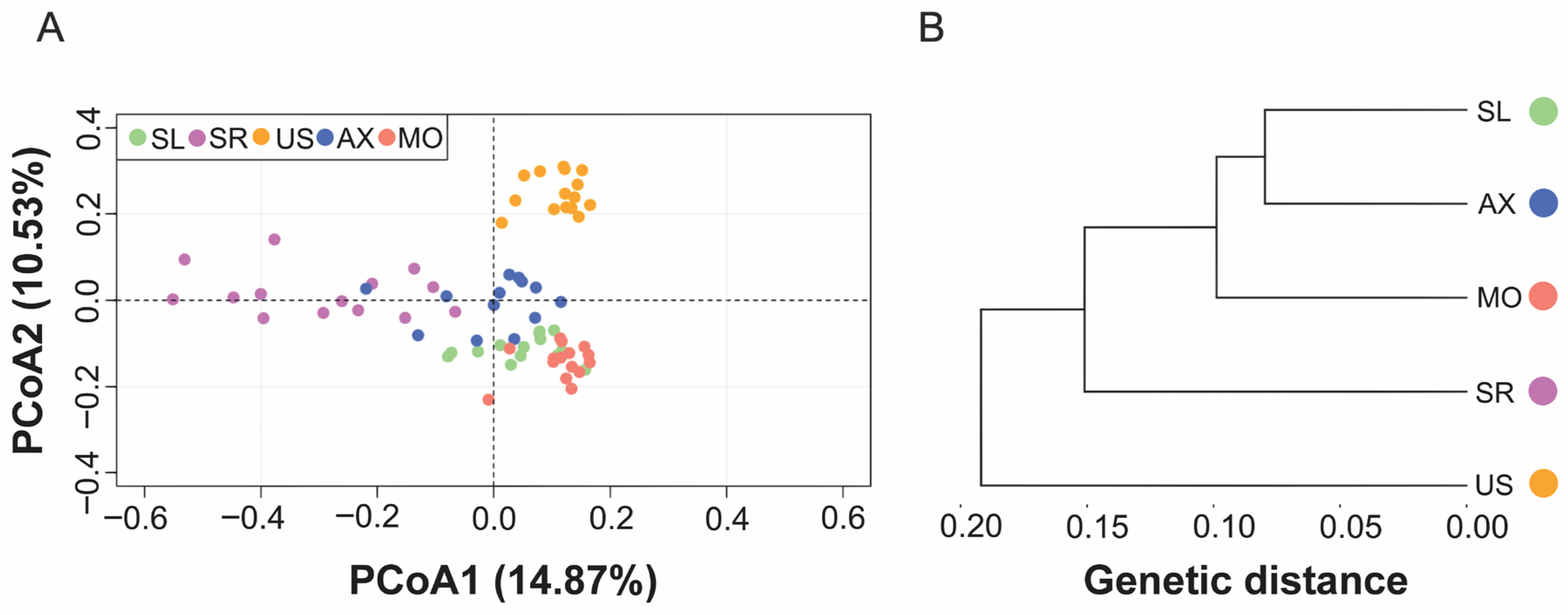
Principal coordinates analysis (PCoA) showed that some populations exhibit greater genetic isolation, while others show evidence of gene flow (Figure 2A). The first two axes explained ~25.4% of the total genetic variation (Figure 2A). Although the variance explained by the first two axes is relatively low, similar proportions (≈20–30%) have been reported in recent studies using ISSR markers, reflecting the high dimensionality of presence/absence datasets. Therefore, the ordination should be interpreted primarily as a complementary visualization of genetic relationships among individuals rather than as definitive evidence of population structure. Individuals from US (orange in Figure 2A) clustered closely, indicating higher genetic similarity that was also confirmed by the UPGMA dendrogram (Figure 2B). Conversely, SL, AX, and MO individuals clustered together, suggesting greater genetic similarity and potential gene flow among these locations. The UPGMA dendrogram based on Jaccard’s coefficient revealed that SL and AX, both from the Amazon biome, were the most genetically similar populations. In contrast, SL and US were the most divergent, reflecting the geographical distance and occurrence in different biomes.
These patterns are likely shaped by environmental factors, including geographic distance and reproductive strategies, alongside more recent anthropogenic pressures. Environmental and reproductive factors likely explain the long-term genetic structure observed between biomes, while recent anthropogenic pressures such as habitat loss and fragmentation intensify isolation and accelerate the erosion of diversity.

3.4. Genetic Structure of Platonia insignis Populations

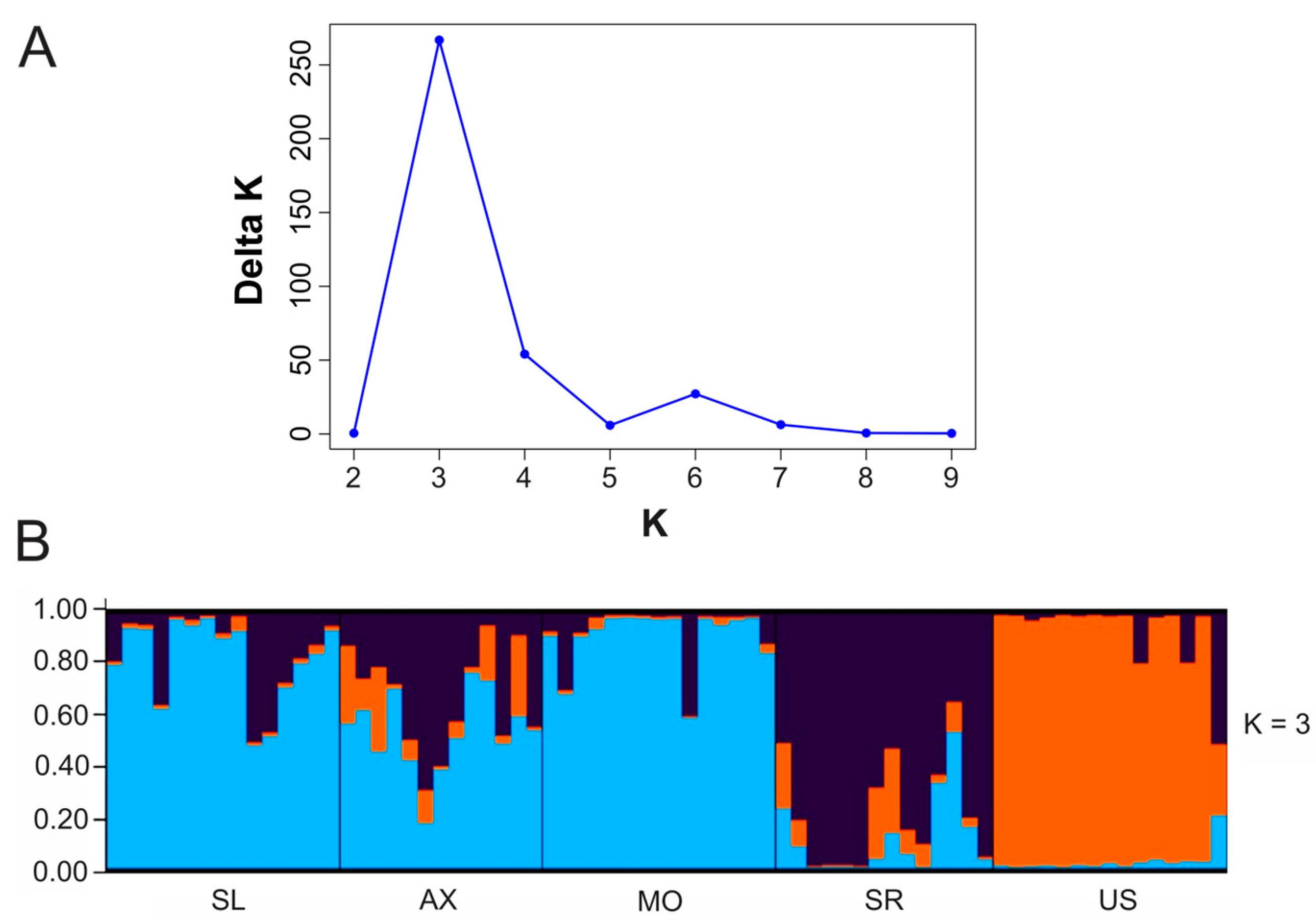
Bayesian analysis identified three distinct genetic groups (K = 3) among the five populations, which was the optimal value for estimating population structure (Figure 3A). The Bayesian assignment of individuals to clusters is shown in Figure 3B. This result highlights a clear genetic differentiation corresponding to the Amazonian, Cerrado, and Amazon–Cerrado transition populations. Amazonian populations (SL and AX) were mostly assigned to the same cluster, showing high homogeneity and low admixture and suggesting continuous gene flow and connectivity between these areas. In contrast, the Cerrado (US) population formed a distinct genetic cluster, with virtually all individuals assigned exclusively to it.
Populations from the Amazon–Cerrado transition zone (MO and SR) presented intermediate genetic profiles and a high proportion of individuals with mixed ancestry, indicating their role as genetic contact zones influenced by multiple groups. These patterns were consistent with UPGMA clustering and PCoA results, reinforcing the correspondence between genetic structure and biogeographic regions.

3.5. Isolation by Distance

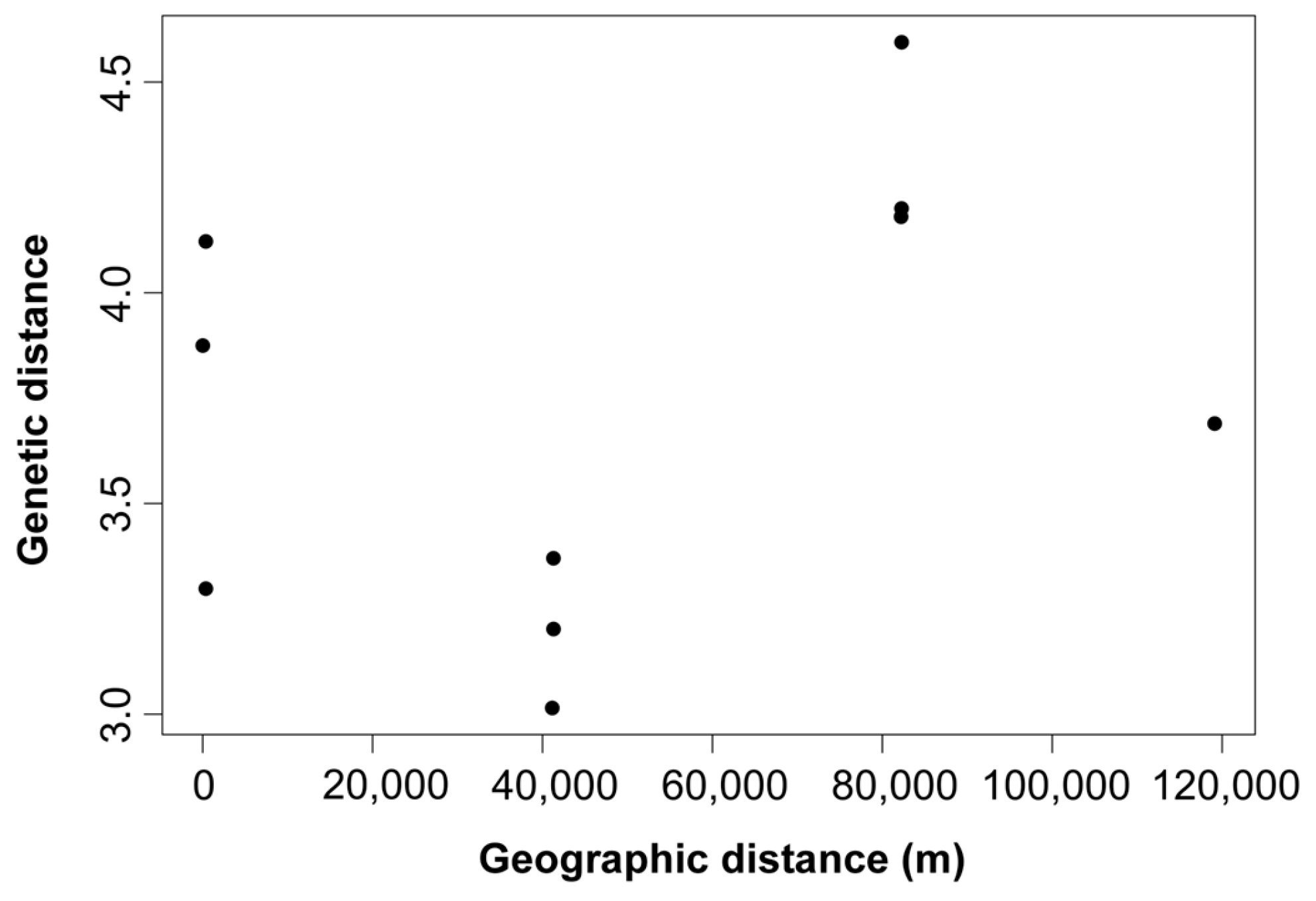
The analysis revealed a positive but non-significant correlation between genetic and geographic distances (r = 0.327, p = 0.225), indicating no clear evidence of isolation by distance among the sampled populations. The scatter plot of pairwise comparisons showed a weak tendency for genetic distance to increase with geographic distance, although considerable dispersion was observed (Figure 4).

4. Discussion

Our research provides the first integrated assessment of the genetic diversity and population structure of P. insignis across Amazon, Cerrado, and Amazon–Cerrado transition zones in the state of Maranhão, Brazil. It is known that species characterized by high outcrossing rates and effective dispersal mechanisms are generally expected to present elevated levels of genetic diversity [40]. P. insignis is an allogamous reproductive system with sporophytic self-incompatibility, which favors the maintenance of high heterozygosity levels within populations [41]. These biological features provide an explanation for the high levels of genetic variation and intrapopulation diversity, particularly in Amazonian populations. These findings support our initial hypothesis that Amazonian populations maintain greater genetic variability, which may be associated with habitat continuity and historical connectivity. However, the Mantel test revealed no significant relationship between geographic and genetic distances, suggesting that geographic distance alone does not fully explain the observed genetic structure. Therefore, additional ecological and historical factors may contribute to shaping the genetic diversity patterns observed in P. insignis.
The high proportion of polymorphic loci detected by ISSR markers (63–76.5%) indicates substantial genetic variation within the studied populations. Given that ISSR markers are dominant, the expected heterozygosity (He) and effective number of alleles (Ne) calculated here are based on assumptions of Hardy–Weinberg equilibrium. As a result, the true heterozygosity may be under- or overestimated. Despite this limitation, these markers still provide valuable insights into relative genetic diversity and population structure among P. insignis populations. Previous ISSR-based studies reported lower levels of polymorphism in other Amazon populations. For example, Pontes et al. (2017) [31] reported 42% polymorphic loci in P. insignis populations from Marajó Island (Amazon estuary), even with a larger number of primers and individuals sampled. In contrast, Pena et al. (2020) [42] reported an 80% polymorphism rate in accessions from multiple municipalities in Pará (Brazil).
In natural plant populations, genetic structure is largely shaped by seed and pollen dispersal [43]. The average FST value observed in P. insignis populations from Maranhão (0.264) shows pronounced genetic structuring among populations, reflecting restricted gene flow, geographic isolation, and environmental heterogeneity across the sampled regions [44]. Strong genetic structuring for P. insignis has also been documented by Souza et al. (2013) [45] and Paraense et al. (2020) [46], reinforcing the consistency of this pattern for P. insignis, across regions and other molecular markers.
The population genetic structure observed in P. insignis was consistently supported by multiple analytical approaches. Although the PCoA explained a relatively small proportion of the total genetic variation, this is not uncommon in analyses based on dominant markers such as ISSR, where genetic information is derived from presence/absence data. Similar levels of variance explained by the first ordination axes have been reported in population genetic studies of tropical plant species using ISSR markers. This pattern is common in studies using dominant markers such as ISSR [47,48]. AMOVA revealed significant genetic differentiation among populations (FST = 0.264, p < 0.001), indicating restricted gene flow and substantial structuring across the sampled regions. Similarly, the Bayesian clustering analysis identified three well-defined genetic groups corresponding to the Amazon, Cerrado, and Amazon–Cerrado transition zones. In contrast, the Mantel test revealed a positive but non-significant correlation between genetic and geographic distances (r = 0.327, p = 0.225), suggesting that geographic distance alone does not fully explain the observed genetic differentiation. Together, these results indicate that the genetic structure of P. insignis populations in Maranhão is likely shaped by a combination of historical biogeographic processes, ecological differences between biomes, and local landscape dynamics rather than by simple isolation by distance.
Most of the genetic variation in P. insignis was concentrated within populations, rather than among them, such as expected for its mating system [17]. Similar patterns of high within-population diversity have been documented in other allogamous plant species from Amazon region, such as Plukenetia volubilis [49] and Parkia platycephala [50]. Pena et al. (2020) [42] also reported greater genetic diversity within P. insignis populations (98%) and lower diversity among populations (2%). However, Nascimento et al. (2021) [24] and Garcia et al. (2024) [16] reported higher levels of genetic variation among populations, which may reflect both the greater geographic distances among the sampled populations and the use of more informative molecular markers, such as chloroplast microsatellites and genotype-by-sequencing approaches [51,52].
One of the main practical advantages of the ISSR technique is that it does not require prior genomic information, making it particularly suitable for non-model species such as Platonia insignis, which still lacks extensive genomic resources [53,54]. In addition, ISSR markers are relatively low-cost and technically accessible, which facilitates their application in studies conducted in laboratories with limited infrastructure, a common scenario in biodiversity-rich regions such as the Amazon [55]. ISSR markers also provide good genome coverage and high reproducibility, making them useful for preliminary assessments of genetic diversity in species with limited genomic information.
Future studies could improve the resolution of genetic analyses in P. insignis by expanding the number of sampled populations and individuals across the species’ distribution range. Furthermore, combining ISSR markers with other molecular approaches, such as microsatellites (SSR) or single-nucleotide polymorphisms (SNPs), may provide a more detailed understanding of population structure and gene flow [56,57], supporting conservation strategies and the sustainable management of this economically and ecologically important species.
Our data evidenced a genetic diversity pattern clearly biome-related. Amazonian populations, particularly Axixá (AX), showed the highest values of expected heterozygosity (0.255) and Shannon’s index (0.386), as well as the greatest admixture in the STRUCTURE analysis. The São Luís (SL) population also exhibited relatively high diversity, while the Cerrado population (US) presented lower values of the genetic diversity parameters, and the transition populations showed the lowest overall diversity (Table 3). These findings are consistent with previous reports for the species, indicating higher expected heterozygosity (He) in Amazonian populations than those from the Cerrado [24,42,45]. Although SL is located within the Amazon biome, it exhibited comparatively lower genetic diversity, possibly reflecting the greater anthropogenic disturbance in the area.
The three well-defined genetic groups corresponding to the Amazon, Cerrado, and transition zones (Figure 3), clearly demonstrating that P. insignis genetic structure follows biogeographic boundaries. Amazonian populations (AX and SL) showed high genetic cohesion and low admixture, which may reflect historical connectivity and ecological similarity between these regions. MO and SR displayed intermediate profiles with mixed ancestry, reinforcing their role as genetic contact zones, while the Cerrado population (US) formed a distinct and highly isolated cluster. The US population shows a distinct genetic pattern consistent with restricted gene flow and strong genetic isolation, likely associated with habitat fragmentation and reduced connectivity within the Cerrado biome. Similar patterns of isolation between Cerrado and Amazon populations have been reported by Garcia et al. (2024) [16]. Gene flow may be limited by geographic, ecological, or reproductive barriers [58], as observed for other tropical species in fragmented Cerrado landscapes [59]. Environmental differences between Cerrado and transition zones [60], combined with ongoing deforestation [61], likely intensify this isolation. However, our results contrast with Garcia et al. (2024) [16], who found higher diversity in Cerrado populations. This discrepancy likely reflects both ecological context and methodological differences, since their use of genotyping-by-sequencing (GBS) provides higher resolution than dominant markers such as ISSR [62,63].
When considering the Amazon–Cerrado transition zone as a whole, the average genetic admixture is relatively high, reflecting the combination of MO, which shows moderate admixture, and SR, which includes individuals from all three genetic clusters. In particular, the SR population contained individuals from all three genetic clusters, highlighting its potential role in connectivity and genetic recombination between biomes. However, the high admixture observed in these populations, combined with relative isolation and possible population bottlenecks, may be reducing their overall variability. Lenza et al. (2024) [64] reported that the Cerrado–Amazon transition zone has high woody plant diversity but suffers from intense habitat destruction and a lack of protected areas. These transition zones also record a high number of fire hotspots [65] and have experienced greater deforestation over the past three decades than either the Amazon or the Cerrado alone [66].
Transitional populations may function as genetic bridges and should be prioritized for in situ conservation to maintain gene flow and connectivity between biomes. It is known that centers of origin are characterized by populations with elevated genetic diversity [67,68]. Maranhão state is considered a center of origin of P. insignis, and these results offer a practical guidance for germplasm sampling. Given the high diversity and pronounced admixture observed in AX and SL populations, sampling would maximize overall genetic representation for germplasm collections and help breeding programs to find more productive genotypes. Otherwise, sampling of individuals from the US population would ensure the conservation of exclusive alleles and potentially unique adaptive traits. Although this study reveals important patterns of genetic structure in Platonia insignis, standardized phenotypic and productivity data were not collected during sampling, which limits the evaluation of visible differences among genetic clusters. Future studies integrating molecular markers with morphological, agronomic, and ecological traits will be important to determine whether the genetic clusters identified in this study are associated with phenotypic variation or differences in fruit productivity. Further research should also investigate landscape connectivity and the impacts of habitat loss on gene flow across this ecologically sensitive region.

5. Conclusions

This study provides important insights into the genetic diversity and population structure of Platonia insignis in Maranhão, Brazil. ISSR markers revealed clear genetic structuring among populations associated with the Amazon, Cerrado, and transitional regions, highlighting the influence of geographic and ecological factors on the distribution of genetic diversity in the species. These findings emphasize the importance of considering regional genetic variation in conservation planning and in the management of P. insignis germplasm resources. Future studies integrating molecular markers with morphological, agronomic, and ecological traits will be important to determine whether the genetic clusters identified in this study are associated with phenotypic variation or differences in fruit productivity. In addition, further research incorporating ecological data, landscape genomics approaches, and higher-throughput molecular markers will be essential to better understand gene flow, population connectivity, and the impacts of habitat fragmentation across this ecologically sensitive region. Such advances will contribute to more effective conservation strategies and the sustainable management of P. insignis genetic resources in its center of origin.

Author Contributions

Conceptualization, J.d.R.S.B.; Supervision, J.d.R.S.B. and T.R.C.; data curation, T.d.J.S.S., E.G.C.M. and G.G.S.; formal analysis, T.d.J.S.S., G.G.S. and P.M.S.R.; funding acquisition, J.d.R.S.B., T.R.C., S.H.S.F. and J.M.H.; investigation, T.d.J.S.S. and E.G.C.M.; project administration, J.d.R.S.B. and G.G.S.; writing—original draft, T.d.J.S.S., G.G.S., P.M.S.R., G.C.F. and R.N.S.; writing—review and editing, G.G.S., P.M.S.R., G.C.F., R.N.S., S.H.S.F., J.M.H. and T.R.C. All authors have read and agreed to the published version of the manuscript.

Funding

This research was supported by the National Council for Scientific and Technological Development (CNPq, Brasília, DF, Brazil: Grants no. PQ 304214/2022-1 from Thais R. Corrêa, respectively); and the Coordination for the Improvement of Higher Education Personnel (CAPES).

Data Availability Statement

The data supporting the findings of this study are included within the article. Additional information may be obtained from the corresponding author upon reasonable request.

Acknowledgments

The authors thank Universidade Estadual do Maranhão (UEMA) for structural and financial support. We also acknowledge the support of CNPq and CAPES. Thanks are extended to Marina Soldi (from inPress Cientifica) for English revision.

Conflicts of Interest

The authors declare no conflicts of interest.

References

  1. Guayasamini, J.M.; Ribas, C.C.; Carnaval, A.C.; Carrillo, J.D.; Hoorn, C.; Lohmann, L.G.; Riff, D.; Ulloa, C.U.; Albert, J.S. Evolution of Amazonian biodiversity: A review. Acta Amazon. 2024, 54, e54bc21360. [Google Scholar] [CrossRef]
  2. Pilnik, M.S.; Argentim, T.; Kinupp, V.F.; Haverroth, M.; Ming, L.C. Traditional botanical knowledge: Food plants from the Huni Kuĩ indigenous people, Acre, western Brazilian Amazon. Rodriguésia 2023, 74, e00482021. [Google Scholar] [CrossRef]
  3. Nascimento, W.M.O.D.; Carvalho, J.E.U.D.; Muller, C.H. Ocorrência e distribuição geográfica do bacurizeiro. Rev. Bras. Frutic. 2007, 29, 657–660. [Google Scholar] [CrossRef]
  4. Rogez, H.; Buxant, R.; Mignolet, E.; Souza, J.N.S.; Silva, E.M.; Larondelle, Y. Chemical composition of the pulp of Amazonian fruits. Eur. Food Res. Technol. 2004, 218, 380–388. [Google Scholar] [CrossRef]
  5. Lima, S.K.R.; Coêlho, A.G.; Lucarini, M.; Durazzo, A.; Arcanjo, D.D.R. The Platonia insignis Mart. as the promising Brazilian ‘Amazon Gold’. Agriculture 2022, 12, 1827. [Google Scholar] [CrossRef]
  6. Rocha, F.A.T.; Silva, L.H.M.; Rodrigues, A.M.C. Bacuri (Platonia insignis): Nutritional values and potential products. Food Chem. 2024, 436, 137528. [Google Scholar] [CrossRef] [PubMed]
  7. Silva, A.; Moreira, R.; Sousa, R.; Filho, E.; Veras, M.D.A.; Chaves, M.H.; Freitas, S.D.L. Chemical composition and photoprotective activities of Platonia insignis. Quím. Nova 2021, 44, 954–962. [Google Scholar] [CrossRef]
  8. Lindoso, J.V.S.; Alencar, S.R.; Santos, A.A.; Mello Neto, R.S.; Mendes, A.V.S.; Furtado, M.M.; da Silva, M.G.; Brito, A.K.d.S.; Batista, E.K.F.; Baêta, S.d.A.F.; et al. Effects of bacuri seed butter on oxidative stress. Biology 2022, 11, 562. [Google Scholar] [CrossRef]
  9. Silva, T.G.; Kasemodel, M.G.C.; Ferreira, O.M.; Silva, R.C.; Souza, C.J.F.; Sanjinez-Argandona, E.J. Addition of Platonia insignis almond in cookies. Food Sci. Nutr. 2020, 8, 5267–5274. [Google Scholar] [CrossRef]
  10. Lustosa, A.K.M.F.; Silva, F.V.; Silva, E.R.S.; Mendes, A.N.; Sousa, L.R.; Carvalho, A.L.; Cito, A.M.G.L. Lecithin-based organogel from Platonia insignis seeds. J. Glob. Innov. 2020, 2, eJGI000011. [Google Scholar]
  11. Homma, A.K.O. Extrativismo Vegetal na Amazônia; Embrapa: Brasília, Brazil, 2014. [Google Scholar]
  12. Homma, A.K.O.; Menezes, A.J.E.; Carvalho, J.E.U.; Matos, G.B. Manejo e domesticação de bacurizeiros. Inclus. Soc. 2018, 12, 48–57. [Google Scholar]
  13. Alves, K.F.L.; Lima, A.S.; Rivas, P.M.S.; Albuquerque, I.C.; Pinheiro, J.F.; Catunda, P.H.A.; Felipe, S.H.S.; Reis, F.d.O.; Batista, D.S.; Henschel, J.M.; et al. Platonia insignis: A systematic synthesis of scientific studies. Plants 2025, 14, 884. [Google Scholar] [CrossRef]
  14. Souza, I.G.B. Aspectos Biológicos, Econômicos e Genéticos do Bacurizeiro; Editora Espaço Acadêmico: Goiânia, Brazil, 2018. [Google Scholar]
  15. Muniz, F.H. Platonia. In Flora do Brasil 2020; Jardim Botânico do Rio de Janeiro: Rio de Janeiro, Brazil, 2020. Available online: https://floradobrasil2020.jbrj.gov.br/ (accessed on 10 October 2025).
  16. Garcia, C.B.; Silva, A.V.; Carvalho, I.A.S.; Nascimento, W.F.; Ramos, S.L.F.; Rodrigues, D.P.; Zucchi, M.I.; Costa, F.M.; Alves-Pereira, A.; Batista, C.E.d.A.; et al. Low diversity and high genetic structure for Platonia insignis. Plants 2024, 13, 1033. [Google Scholar] [CrossRef]
  17. Saraiva, R.C.; Albuquerque, P.C.; Girnos, E.C. Floral and vegetative morphometrics of three Platonia insignis populations. Plant Biosyst. 2013, 148, 666–674. [Google Scholar] [CrossRef]
  18. Ferreira, M.D.S.; Melo, M. Platonia insignis Mart.: Richesse des forêts secondaires. Bois For. Trop. 2007, 294, 21–28. [Google Scholar] [CrossRef]
  19. Salgotra, R.K.; Chauhan, B.S. Genetic diversity, conservation, and utilization of plant genetic resources. Genes 2023, 14, 174. [Google Scholar] [CrossRef]
  20. Willi, Y.; Kristensen, T.N.; Sgrò, C.M.; Weeks, A.R.; Ørsted, M.; Hoffmann, A.A. Conservation genetics as a management tool. Proc. Natl. Acad. Sci. USA 2022, 119, e2105076119. [Google Scholar] [CrossRef]
  21. Schulman, A.H. Molecular markers to assess genetic diversity. Euphytica 2007, 158, 313–321. [Google Scholar] [CrossRef]
  22. Reddy, M.P.; Sarla, N.; Siddiq, E.A. ISSR polymorphism and its application in plant breeding. Euphytica 2002, 128, 9–17. [Google Scholar] [CrossRef]
  23. Ramesh, P.; Mallikarjuna, G.; Sameena, S.; Kumar, A.; Gurulakshmi, K.; Reddy, B.V.; Reddy, P.C.O.; Sekhar, A.C. Advancements in molecular marker technologies. J. Biosci. 2020, 45, 123. [Google Scholar] [CrossRef] [PubMed]
  24. Nascimento, W.F.; Dequigiovanni, G.; Ramos, S.L.; Garcia, C.B.; Veasey, E.A. Nuclear and chloroplast microsatellites reveal high diversity in Platonia insignis. Acta Bot. Bras. 2021, 35, 432–444. [Google Scholar] [CrossRef]
  25. Ribeiro, S.S.M.; Felipe, S.H.S.; Alves, G.L.; Rivas, P.M.S.; Henschel, J.M.; Moraes, L.R.R.; Reis, L.C.F.; Araújo, J.R.G.; Pinheiro, M.V.M.; Batista, D.S.; et al. Genetic variability, broad-sense heritability, and selection of superior genotypes for fruit improvement in Platonia insignis. Int. J. Plant Biol. 2025, 16, 108. [Google Scholar] [CrossRef]
  26. Silva, C.R.S.; Albuquerque, P.S.B.; Ervedosa, F.R.; Mota, J.W.S.; Figueira, A.; Sebbenn, A.M. Understanding the genetic diversity, spatial genetic structure and mating system at the hierarchical levels of fruits and individuals of a continuous Theobroma cacao population from the Brazilian Amazon. Heredity 2010, 106, 973–985. [Google Scholar] [CrossRef]
  27. Paluch, J.; Zarek, M.; Kempf, M. The effect of population density on gene flow between adult trees and the seedling bank in Abies alba Mill. Eur. J. For. Res. 2019, 138, 203–217. [Google Scholar] [CrossRef]
  28. Nybom, H. Comparison of different nuclear DNA markers for estimating intraspecific genetic diversity in plants. Mol. Ecol. 2004, 13, 1143–1155. [Google Scholar] [CrossRef]
  29. Hale, M.L.; Burg, T.M.; Steeves, T.E. Sampling for microsatellite-based population genetic studies: 25 to 30 individuals per population is enough to accurately estimate allele frequencies. PLoS ONE 2012, 7, e45170. [Google Scholar] [CrossRef] [PubMed]
  30. Doyle, J.J.; Doyle, J.L. A rapid DNA isolation procedure from small quantities of fresh leaf tissues. Phytochem. Bull. 1987, 19, 11–15. [Google Scholar]
  31. Pontes, L.C.G.; Moura, E.F.; Moura, M.F.; Rodrigues, S.M.; Oliveira, M.S.P.; Carvalho, J.E.U.; Therrier, J. Molecular characterization of progenies of bacurizeiro (Platonia insignis) from Marajó Island, northeastern Amazon. Acta Amazon. 2017, 47, 293–300. [Google Scholar] [CrossRef][Green Version]
  32. Peakall, R.; Smouse, P.E. GenAlEx 6.5: Genetic analysis in Excel. Population genetic software for teaching and research—An update. Bioinformatics 2012, 28, 2537–2539. [Google Scholar] [CrossRef]
  33. Nei, M. Estimation of average heterozygosity and genetic distance from a small number of individuals. Genetics 1978, 89, 583–590. [Google Scholar] [CrossRef]
  34. Excoffier, L.; Laval, G.; Schneider, S. Arlequin ver. 3.0: An integrated software package for population genetics data analysis. Evol. Bioinform. Online 2005, 1, 7–50. [Google Scholar] [CrossRef]
  35. Jaccard, P. Distribution de la flore alpine dans le Bassin des Drouces et dans quelques régions voisines. Bull. Soc. Vaud. Sci. Nat. 1901, 37, 241–272. [Google Scholar]
  36. Sokal, R.R.; Rohlf, F.J. The comparison of dendrograms by objective methods. Taxon 1962, 11, 33–40. [Google Scholar] [CrossRef]
  37. Pritchard, J.K.; Stephens, M.; Donnelly, P. Inference of population structure using multilocus genotype data. Genetics 2000, 155, 945–959. [Google Scholar] [CrossRef]
  38. Evanno, G.; Regnaut, S.; Goudet, J. Detecting the number of clusters of individuals using the software STRUCTURE: A simulation study. Mol. Ecol. 2005, 14, 2611–2620. [Google Scholar] [CrossRef]
  39. Kopelman, N.M.; Mayzel, J.; Jakobsson, M.; Rosenberg, N.A.; Mayrose, I. CLUMPAK: A program for identifying clustering modes and packaging population structure inferences across K. Mol. Ecol. Resour. 2015, 15, 1179–1191. [Google Scholar] [CrossRef] [PubMed]
  40. Loveless, M.D.; Hamrick, J.L. Ecological determinants of genetic structure in plant populations. Annu. Rev. Ecol. Syst. 1984, 15, 65–95. [Google Scholar] [CrossRef]
  41. Maués, M.M.; Venturieri, G.C. Ecologia da Polinização do Bacurizeiro (Platonia insignis Mart.); Boletim de Pesquisa 170; Embrapa Amazônia Oriental: Belém, Brazil, 1996; 24p, Available online: https://www.infoteca.cnptia.embrapa.br/bitstream/doc/374450/1/BoletimPesquisa170CPATU.pdf (accessed on 15 November 2025).
  42. Pena, D.N.; Moura, E.F.; Rodrigues, S.M.; Oliveira, M.S.P.; Sanches, J.P.; Moura, M.F. Molecular characterization of a germplasm bank of Platonia insignis Mart.: A fruit tree. Genet. Resour. Crop Evol. 2020, 67, 411–420. [Google Scholar] [CrossRef]
  43. Hu, X.S.; Ennos, R.A. Impacts of seed and pollen flow on population genetic structure for plant genomes with three contrasting modes of inheritance. Genetics 1999, 152, 441–450. [Google Scholar] [CrossRef] [PubMed]
  44. Wright, S. Evolution and the Genetics of Populations; University of Chicago Press: Chicago, IL, USA, 1978; Volume 4, 590p. [Google Scholar]
  45. Souza, I.D.B.; Souza, V.A.B.; Lima, P.S.C. Molecular characterization of Platonia insignis Mart. (“bacurizeiro”) using inter simple sequence repeat (ISSR) markers. Mol. Biol. Rep. 2013, 40, 3835–3845. [Google Scholar] [CrossRef][Green Version]
  46. Paraense, L.C.R.; Pena, D.N.; Darnet, S.H.; Rodrigues, S.M.; Menezes, I.C.; Moura, E.F. First genomic microsatellite markers developed for Platonia insignis (Clusiaceae), a Brazilian fruit tree. Mol. Biol. Rep. 2020, 47, 2985–2989. [Google Scholar] [CrossRef] [PubMed]
  47. Mohammad, D.O.; Vafaee, Y.; Seraj, R.G.M.; Mozafari, A.A.; Tahir, N.A.R. Genetic diversity of native Cucumis melo L. accessions from Iran and Iraq revealed by SCoT and ISSR markers. Sci. Rep. 2026, 16, 1715. [Google Scholar] [CrossRef]
  48. Abd-dada, H.; Bouda, S.; Khachtib, Y.; Bella, Y.A.; Haddioui, A. Use of ISSR markers to assess the genetic diversity of an endemic plant of Morocco (Euphorbia resinifera O. Berg). J. Genet. Eng. Biotechnol. 2023, 21, 91. [Google Scholar] [CrossRef]
  49. Rodrigues, H.S.; Borém, A.; Valente, M.S.F.; Lopes, M.T.G.; Cruz, C.D.; Chaves, F.C.M.; Bezerra, C.D.S. Genetic diversity among accessions of Plukenetia volubilis by phenotypic characteristics analysis. Acta Amazon. 2018, 48, 93–97. [Google Scholar] [CrossRef]
  50. Cardoso, C.R.; Pinheiro, L.G.; de Farias, S.G.G.; Fajardo, C.G.; da Silva Neves, A.G.; Pacheco, M.V.; de Almeida Vieira, F. Genetic diversity in Parkia platycephala Benth.: A pathway for conservation and optimization of germplasm bank. Genet. Resour. Crop Evol. 2025, 72, 2685–2696. [Google Scholar] [CrossRef]
  51. Ellegren, H. Genome sequencing and population genomics in non-model organisms. Trends Ecol. Evol. 2014, 29, 51–63. [Google Scholar] [CrossRef] [PubMed]
  52. Andrews, K.R.; Good, J.M.; Miller, M.R.; Luikart, G.; Hohenlohe, P.A. Harnessing the power of RADseq for ecological and evolutionary genomics. Nat. Rev. Genet. 2016, 17, 81–92. [Google Scholar] [CrossRef]
  53. Zietkiewicz, E.; Rafalski, A.; Labuda, D. Genome fingerprinting by simple sequence repeat (SSR)-anchored polymerase chain reaction amplification. Genomics 1994, 20, 176–183. [Google Scholar] [CrossRef]
  54. Bornet, B.; Branchard, M. Nonanchored inter simple sequence repeat (ISSR) markers: Reproducible and specific tools for genome fingerprinting. Plant Mol. Biol. Rep. 2001, 19, 209–215. [Google Scholar] [CrossRef]
  55. Ng, W.L.; Tan, S.G. Inter-simple sequence repeat (ISSR) markers: Are we doing it right? ASM Sci. J. 2015, 9, 30–39. [Google Scholar]
  56. Varshney, R.K.; Graner, A.; Sorrells, M.E. Genic microsatellite markers in plants: Features and applications. Trends Biotechnol. 2005, 23, 48–55. [Google Scholar] [CrossRef] [PubMed]
  57. Morin, P.A.; Luikart, G.; Wayne, R.K. SNPs in ecology, evolution and conservation. Trends Ecol. Evol. 2004, 19, 208–216. [Google Scholar] [CrossRef]
  58. López-Goldar, X.; Agrawal, A.A. Ecological interactions, environmental gradients, and gene flow in local adaptation. Trends Plant Sci. 2021, 26, 796–809. [Google Scholar] [CrossRef]
  59. Melo Júnior, A.F.; Carvalho, D.; Vieira, F.A.; Oliveira, D.A. Spatial genetic structure in natural populations of Caryocar brasiliense Camb. (Caryocareceae) in the North of Minas Gerais, Brazil. Biochem. Syst. Ecol. 2012, 43, 205–209. [Google Scholar] [CrossRef]
  60. Morandi, P.S.; Marimon, B.S.; Marimon-Junior, B.H.; Ratter, J.A.; Feldspausch, T.R.; Colli, G.R.; Munhoz, C.B.R.; Júnior, M.C.d.S.; Lima, E.d.S.; Haidar, R.F.; et al. Tree diversity and above-ground biomass in the South America Cerrado biome and their conservation implications. Biodivers. Conserv. 2020, 29, 1519–1536. [Google Scholar] [CrossRef]
  61. Alencar, A.; Shimbo, J.Z.; Lenti, F.; Marques, C.B.; Zimbres, B.; Rosa, M.; Arruda, V.; Castro, I.; Ribeiro, J.P.F.M.; Varela, V.; et al. Mapping three decades of changes in the Brazilian savanna native vegetation using Landsat data processed in the Google Earth Engine platform. Remote Sens. 2020, 12, 924. [Google Scholar] [CrossRef]
  62. Davey, J.W.; Hohenlohe, P.A.; Etter, P.D.; Boone, J.Q.; Catchen, J.M.; Blaxter, M.L. Genome-wide genetic marker discovery and genotyping using next-generation sequencing. Nat. Rev. Genet. 2011, 12, 499–510. [Google Scholar] [CrossRef]
  63. Narum, S.R.; Buerkle, C.A.; Davey, J.W.; Miller, M.R.; Hohenlohe, P.A. Genotyping-by-sequencing in ecological and conservation genomics. Mol. Ecol. 2013, 22, 2841–2847. [Google Scholar] [CrossRef]
  64. Lenza, E.; Martins, J.; Abadia, A.C.; Gonçalves, L.A.; Nogueira, D.S.; Maracahipes-Santos, L.; Colli, G.R. Diversity patterns reveal the singularities of the savanna woody flora in the Cerrado-Amazonia transition. Biodivers. Conserv. 2024, 33, 2791–2808. [Google Scholar] [CrossRef]
  65. Delgado, R.C.; Santana, R.O.; Gelsleichter, Y.A.; Pereira, M.G. Degradation of South American biomes: What to expect for the future? Environ. Impact Assess. Rev. 2022, 96, 106815. [Google Scholar] [CrossRef]
  66. Marques, E.Q.; Marimon-Junior, B.H.; Marimon, B.S.; Matricardi, E.A.T.; Mews, H.A.; Colli, G.R. Redefining the Cerrado–Amazonia transition: Implications for conservation. Biodivers. Conserv. 2020, 29, 1501–1517. [Google Scholar] [CrossRef]
  67. Sandánov, D.V.; Kholina, A.B.; Kozyrenko, M.M.; Artyukova, E.V.; Wang, Z. Genetic diversity of Oxytropis species from the center of the genus origin: Insight from molecular studies. Diversity 2023, 15, 244. [Google Scholar] [CrossRef]
  68. Bourguiba, H.; Scotti, I.; Sauvage, C.; Zhebentyayeva, T.; Ledbetter, C.; Krška, B.; Remay, A.; D’oNofrio, C.; Iketani, H.; Christen, D.; et al. Genetic structure of a worldwide germplasm collection of Prunus armeniaca L. reveals three major diffusion routes for varieties coming from the species’ center of origin. Front. Plant Sci. 2020, 11, 638. [Google Scholar] [CrossRef] [PubMed]
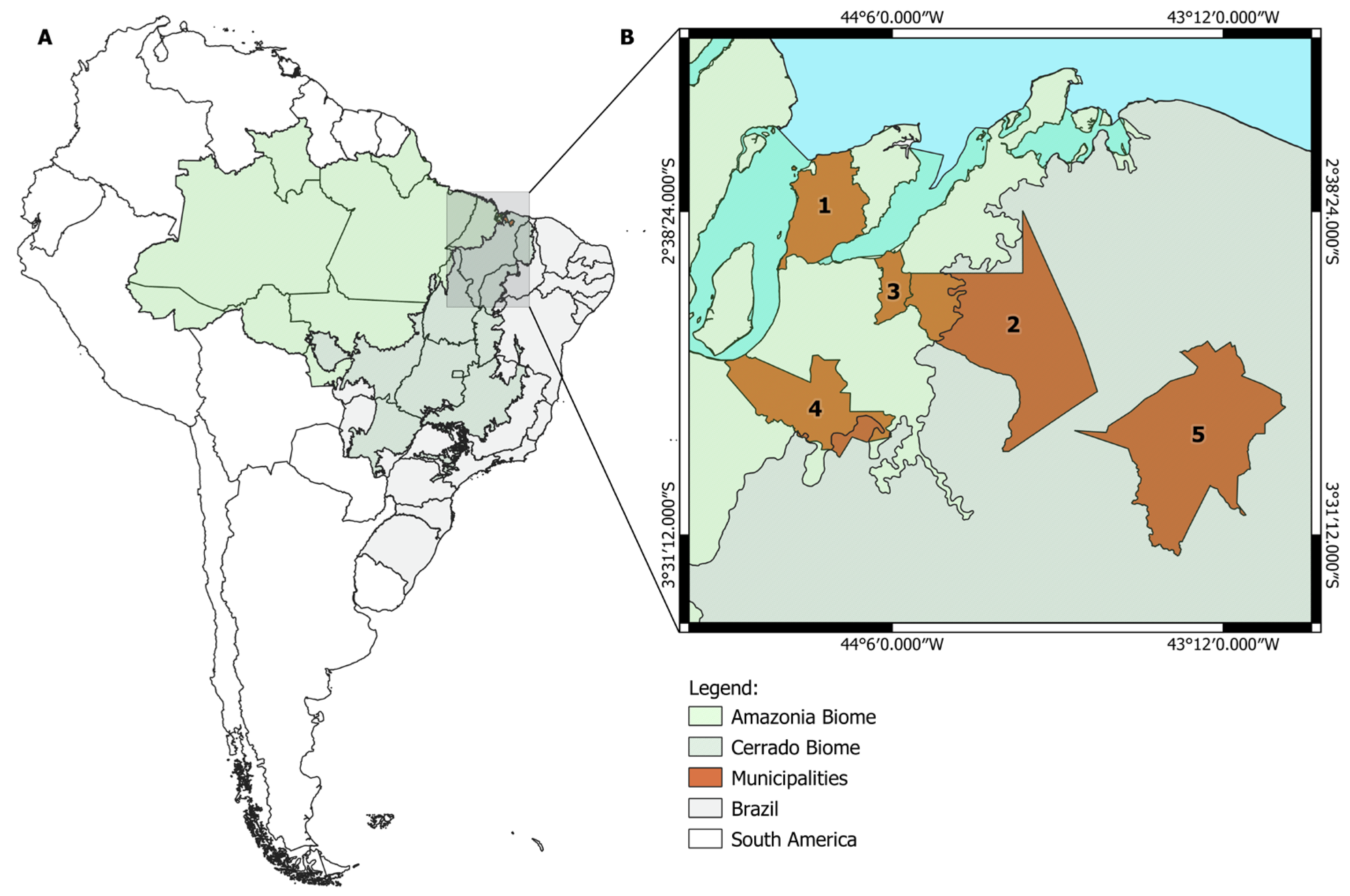
Figure 1. Location of the study area. (A) Territory of the Brazilian Amazon and its transition to the Cerrado biome in Maranhão State. (B) Natural populations of P. insignis were sampled in the following municipalities: (1) São Luís (SL), (2) Morros (MO), (3) Axixá (AX), (4) Santa Rita (SR); (5) Urbano Santos (US).
Agronomy 16 00635 g001
Figure 2. Genetic relationships among P. insignis populations based on ISSR markers. (A) Principal Coordinates Analysis (PCoA) of individuals based on twelve ISSR markers. (B) Dendrogram generated by UPGMA clustering of five populations sampled from municipalities in the Amazon, Cerrado, and Amazon–Cerrado transition zones of Maranhão State, Brazil. Coefficient of cophenetic correlation = 0.8396.
Agronomy 16 00635 g002
Figure 3. Genetic structure of Platonia insignis inferred using STRUCTURE. (A) Evanno method (ΔK) showing a clear peak at K = 3, indicating the most likely number of genetic clusters. (B) Bayesian assignment of 72 P. insignis individuals to three genetic clusters (K = 3). Each vertical line represents an individual and colors indicate the proportional membership of each individual to the inferred clusters.
Agronomy 16 00635 g003
Figure 4. Relationship between geographic and genetic distances among five populations of Platonia insignis based on ISSR markers. Each point represents a pairwise comparison between populations. The Mantel test revealed a positive but non-significant correlation (r = 0.327, p = 0.225).
Agronomy 16 00635 g004
Table 1. List of ISSR primers used for amplification of Platonia insignis DNA, including primers, annealing temperatures (Ta), primer sequences, number of polymorphic loci (NPL), and percentage of polymorphism detected for each primer.
PrimersTa (°C)Sequence (5′–3′)NPLPolymorphism Rate
UBC 80753(AG)7GT17100%
UBC 80854(AG)8C7100%
UBC 80954(AG)8G8100%
UBC 81053(GA)8T14100%
UBC 81154(GA)8C14100%
UBC 81753(CA)8A8100%
UBC 82554(AC)7A14100%
UBC 82659(AC)8C15100%
UBC 82759(AC)8G15100%
UBC 82854(TG)8A12100%
UBC 82952(TG)8C9100%
UBC 83453(AG)8YT a16100%
TOTAL149
Legend: Ta = Temperature of annealing; NPL = Number of Polymorphic Loci (NPL) by each primer; a Y = (CT).
Table 2. Analysis of molecular variance (AMOVA) representing the amount of the genetic variation that is distributed among and within P. insignis populations, based on ISSR markers.
Source of VariationDfSum of SquaresVariance ComponentVariation (%)p
Among populations4416.5876.06426.41<0.001
Within populations671131.98216.89573.59
TOTAL1001548.56922.959100
FST0.264, p < 0.001
Legend: Df = Degrees of freedom; FST = Fixation index. Significance was tested using 999 permutations in GenAlEx.
Table 3. Genetic diversity parameters of Platonia insignis populations based on ISSR markers.
PopulationBiomeNP (%)NaNeHeI
1São Luís (SL)Amazon1564.431.6441.3450.2100.320
2Morros (MO)Amazon/Cerrado1557.051.5701.2940.1760.270
3Axixá (AX)Amazon1376.511.7651.4290.2550.386
4Santa Rita (SR)Amazon/Cerrado1463.091.6311.3440.2050.311
5Urbano Santos (US)Cerrado1565.101.6501.3660.2150.325
Mean14.465.241.6521.3560.2120.322
Legend: N = number of sampled individuals; P (%) = percentage of polymorphic loci; Na = observed number of alleles; Ne = effective number of alleles; He = expected heterozygosity (Nei, 1978) [33]; I = Shannon’s index.
Disclaimer/Publisher’s Note: The statements, opinions and data contained in all publications are solely those of the individual author(s) and contributor(s) and not of MDPI and/or the editor(s). MDPI and/or the editor(s) disclaim responsibility for any injury to people or property resulting from any ideas, methods, instructions or products referred to in the content.