Article

Enhancing Maize Tolerance to Naturally Occurring Water Deficit and Biotic Stress Through Brassinolide and Silicon Application


by
Larissa Pacheco Borges
1,
Alessandro Guerra da Silva
2,
Fábio Santos Matos
3,
Marconi Batista Teixeira
1,
Wilker Alves Morais
1,
Guilherme Braga Pereira Braz
2,
Itamar Rosa Teixeira
4,
Fernando Nobre Cunha
1,
Layara Alexandre Bessa
1 and
Luciana Cristina Vitorino
1,*
1
Hydraulics and Irrigation Laboratory, Instituto Federal de Educação, Ciência e Tecnologia Goiano (IFGoiano), Campus Rio Verde, Highway Sul Goiana, Km 01, Rio Verde 75901-970, GO, Brazil
2
Postgraduate Program in Plant Production, University of Rio Verde (UniRV), Fazenda Fontes do Saber, University Campus, P.O. Box 104, Rio Verde 75901-970, GO, Brazil
3
Postgraduate Program in Plant Production, State University of Goiás (UEG), Campus Ipameri, Vila Dona Nilza—Setor Universitário, Ipameri 75780-000, GO, Brazil
4
Institute of Agricultural Sciences, State University of Goiás (UEG), Campus CET, Highway 153, 3105, Fazenda Barreiro do Meio, Anápolis 75132-903, GO, Brazil
*
Author to whom correspondence should be addressed.
Agronomy 2026, 16(7), 757; https://doi.org/10.3390/agronomy16070757
Submission received: 2 March 2026 / Revised: 30 March 2026 / Accepted: 31 March 2026 / Published: 3 April 2026
(This article belongs to the Section Plant-Crop Biology and Biochemistry)

Abstract

Stressful effects on agriculture are of paramount importance in the 21st century. Water deficiency is considered a major constraint in crop succession, particularly for maize. Therefore, this study aimed to investigate the potential roles of brassinolide (BL) and silicon (Si) in mitigating biotic (incidence of pests and diseases) and abiotic stresses (naturally occurring water deficit) in maize grown after soybean harvest. The field experiments were conducted over two growing seasons on a Rhodic Haplustox in the Cerrado, Goiás, Brazil. A randomized complete block design was employed in a 5 × 2 factorial arrangement, with five BL doses (0.000, 0.050, 0.100, 0.150, and 0.200 mg L−1) and two Si treatments (absence and presence), each with four replicates. BL was applied immediately when the soil moisture in the 0–0.20 m layer reached 16.25%, corresponding to the crop’s critical water threshold. This specific phenological point corresponded to the R2 stage in the first off-season and the V10 stage in the second off-season. Si applications were performed at the V3 and V8 stages. BL application enhanced growth, as well as physiological and metabolic performance by increasing protein synthesis and sugar content, thereby maintaining relative water content, sustaining antioxidant enzyme activity, and reducing lipid peroxidation under water-deficit conditions. The BL doses that achieved the highest yields were 0.149 mg L−1 (R2 stage) in the first off-season and 0.134 mg L−1 (V10 stage) in the second off-season. Si application effectively reduced pest damage and disease severity while improving plant water status. However, in the second off-season, a significant BL × Si interaction was limited to carotenoids, pheophytinization index, and disease severity. These results indicate that the combined use of BL and Si provides a promising strategy to enhance maize resilience by integrating BL-mediated yield promotion with Si-driven physical and biotic protection under adverse environmental conditions.

1. Introduction

Crop yield is the key element for sustainable agricultural development and is an indicator of a country’s food security [1]. As one of the most important cereal crops, maize plays a crucial role in global food systems and agricultural markets. Projections indicate that the demand for maize could double by 2050, driven by population growth [2]. The global production of maize reaches approximately 1.2 billion tons annually. The world’s three largest producers, the United States, China, and Brazil, account for more than 60% of this total volume [3]. Despite the dominance of these major economies, the relevance of this crop is even more pronounced in the area cultivated in developing countries, where maize is often considered the cereal of greatest strategic and food importance [4]. In South America, the annual cultivation area is between 25 and 30 million hectares, primarily driven by the high production and export capacity of countries such as Brazil and Argentina [5].
Despite positive projections for maize production, climate change continues to cause significant fluctuations in global food supply [6,7]. Within the Brazilian agricultural context, double cropping is feasible despite significant climatic variability. Consequently, maize is frequently established as a second crop (off-season) immediately following the soybean harvest [8]. However, the off-season is typically characterized by naturally occurring water deficits that directly impact yields and pose a substantial risk to maize cultivation [9,10].
Abiotic stresses cause a significant decline in plant growth, yield and quality [11]. Water deficiency reduces maize yield and exerts varying effects on the plant depending on the developmental stage and stress intensity [12,13]. When water shortage coincides with the flowering period, which determines the number of seeds that will be formed, the impact on yield is amplified [14]. According to Silva et al. [15] and Mesterházy et al. [16], water limitation during this period can cause yield losses of up to 60–70%.
Enhancing agricultural yield under water-limited conditions requires inducing crop tolerance to drought. In this context, various agronomic and physiological practices have been studied and applied. Research on chemical elements and growth regulators has demonstrated their potential to modulate plant responses to different types of stress [17].
Plant growth regulators such as phytohormones have been applied in agricultural crops to enhance abiotic stress tolerance [18,19]. Brassinosteroids, particularly brassinolide (BL), are widespread in the plant kingdom and exert specific biological effects on growth and development [20]. It has been demonstrated that the enzymatic activities of ATPase, phosphoenolpyruvate carboxylase (PEPcase), and ribulose-1,5-bisphosphate carboxylase/oxygenase (RuBPcase) contribute to higher yields [21]. BL can also provide an anti-stress effect, helping plants cope with extreme temperatures, drought, and pathogen infection [22]. Enhanced stress tolerance appears to improve membrane stability by maintaining high antioxidant enzyme activity [23]. Previous studies demonstrate that the application of BL can enhance maize tolerance to water deficit. This effect is mediated by the improvement of photosynthetic performance, the increase in antioxidant capacity, and the modulation of the drought tolerance gene ZmMYB expression [24,25]. However, research on the combined application of BL and silicon (Si), especially under dystrophic soil conditions, remains unexplored and represents a critical knowledge gap.
Similarly to plant growth regulators, Si supplementation can confer increased plant resistance to adverse conditions, ensuring high yield [26,27]. Recent studies have shown that silicon can stimulate growth and plant production. It may also provide protection against abiotic factors, such as water stress, by increasing leaf cell wall rigidity and reducing water loss through transpiration [28]. In addition, the presence of Si may be related to the greater resistance of plants to attacks by pests and diseases that result from alterations to the anatomy of the plant, such as the formation of thicker epidermal cells and a higher degree of lignification and/or silicification [29]. Therefore, the combined application of BL and Si may offer a synergistic approach to drought resilience, potentially integrating hormone-mediated metabolic adjustments with Si-induced structural enhancements, which could be particularly vital for stabilizing plant performance in resource-limited dystrophic soils [30,31].
In this context, this study aimed to determine whether the combined application of BL and Si can synergistically enhance drought tolerance and grain yield in maize. We hypothesized that this dual treatment provides comprehensive protection by modulating physiological and biochemical responses while simultaneously improving plant defense against biotic stressors. To test this, we evaluated photosynthetic pigments, antioxidant metabolism, pest and disease incidence, and yield components under crop succession in the Brazilian Cerrado, aiming to establish an integrated management strategy for mitigating multiple stresses in this region.

2. Materials and Methods

2.1. Soil and Plant Material

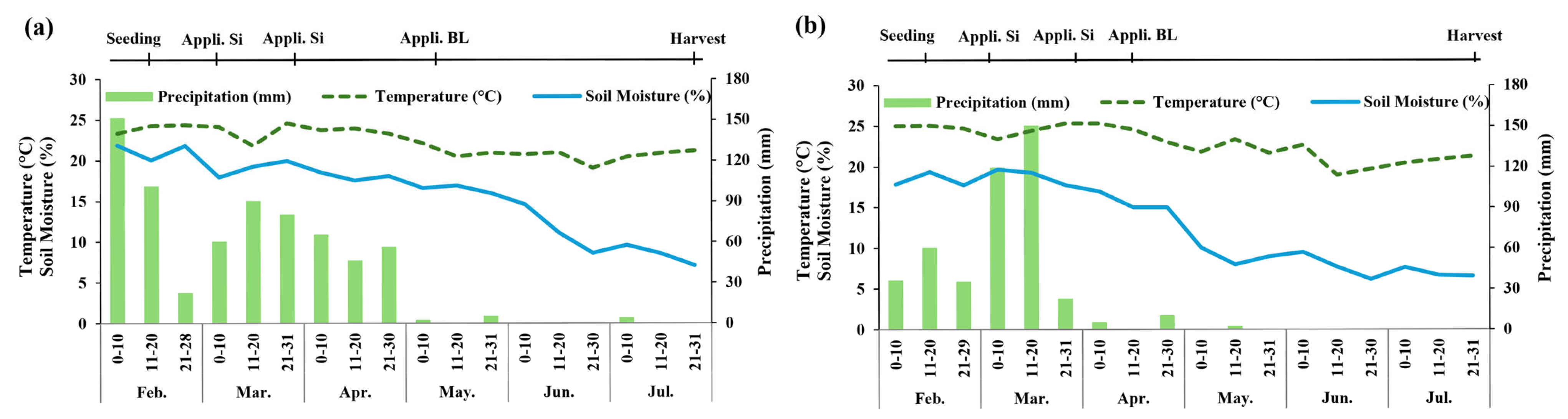
The experiment was carried out under field conditions at Panorama Farm, in Ipameri (Brazilian Cerrado—Neotropical savanna), Goias State, Brazil (17°40′54″ S; 48°11′35″ W; altitude: 805 m), after harvesting the early soybeans (succession crop) in two off-seasons (1st off-season—2015 and 2nd off-season—2016). The experimental area is characterized by an Aw climate, according to the Köppen classification, with two well-defined seasons: rainy, which lasts from October to April, and dry season, which occurs between May and September. The variations in the mean air temperature and pluvial precipitation and soil moisture during the experimental period are presented in Figure 1.
The soil of the experimental area is classified as dystrophic Red-Yellow Latosol [32], equivalent to Clayey Oxisol (Rhodic Haplustox) according to the Soil Survey Staff [33]. The chemical analysis of the soil samples in the experimental area revealed favorable fertility characteristics in both off-seasons, with the soil maintaining a constant granulometric composition, characterized by 620 g kg−1 clay, 120 g kg−1 silt, and 260 g kg−1 sand. In the 1st off-season, the soil showed a pH in CaCl2 of 5.9, with Ca2+, Mg2+, K+, and potential acidity (H+ + Al3+) at 2.3, 0.8, 0.18, and 2.1 cmolc dm−3, respectively. This resulted in a cation exchange capacity (CEC) of 5.4 cmolc dm−3 and a base saturation of 61%. P content was 10.0 mg dm−3 and organic matter (OM) was 26.00 g dm−3. In the 2nd off-season, there was a slight acidification (pH 5.5) and an increase in OM (33.00 g dm−3) and Mg2+ (1.5 cmolc dm−3), raising the CEC to 6.3 cmolc dm−3, while base saturation remained stable at 62%. Ca2+ and H+ + Al3+ contents were similar (2.3 and 2.2 cmolc dm−3, respectively), but a reduction in P was observed, which dropped to 4.8 mg dm−3. The absence of exchangeable Al3+ (0.0 cmolc dm−3) was consistent in both off-seasons, indicating no aluminum toxicity.
The soil water retention curve (WRC) was determined for the 0.0–0.2 m depth layer following the model proposed by van Genuchten [34]. The physical–hydraulic analyses of the experimental area revealed that the field capacity (θFC at 10 KPa) was 0.205 kg−1, and the permanent wilting point (θPWP at 1500 KPa) was 0.118 kg−1. With the results of the water retention curve in the soil, the critical soil moisture point was determined for the maize crop. The calculated critical soil moisture threshold for maize was approximately 0.16 kg−1, equivalent to 16.25% soil moisture in the 0–0.2 m layer.
In both off-seasons, the hybrid P30S31 was used after the harvest of the early soybean. This maize hybrid is especially appropriate for the second crop market because it presents high productive stability in the region where the experiment was executed. Seeding was carried out on February 19 (1st off-season) and 16 (2nd off-season), after the early soybean harvest.

2.2. Experimental Design

The experimental design was a randomized block design with a 5 × 2 factorial scheme, that included five doses of the brassinolide regulator (BL) (0.000; 0.050; 0.100; 0.150; and 0.200 mg L−1) combined with and without silicon (Si) in foliar application. The BL doses tested were defined based on the study by Pereira et al. [35]. Drought mitigation and stress tolerance were evaluated by comparing the physiological, biochemical, and yield responses of plants treated with BL and Si against the control group (0.000 mg L−1 BL and no Si) under naturally occurring water deficit. In this context, the control group represented the baseline for maximum environmental stress, and any significant improvement in water status, antioxidant activity, or yield maintenance in the treated plots was interpreted as a mitigating effect. The experimental plots were composed of six lines that were each 6.0 m in length and spaced 0.5 m apart. The useful area was obtained by considering the four central lines and disregarding 0.5 m of each end (10 m2).
The regulator used was an analog of brassinosteroid (C28H48O6) (brassinolide), the trademark Sigma-Aldrich® (St. Louis, MO, USA), dissolved in ethanol to obtain the stock solution [35]. Subsequently, dilution in distilled water was performed for the doses according to each treatment that was adopted. Plants that did not receive the regulator were sprayed with distilled water only. In all spraying, a CO2 pressurized backpack sprayer was used with a bar with four spray tips of the empty conical type (Jacto JA, Máquinas Jacto S.A., Pompeia, SP, Brazil) operating at approximately 100 psi pressure and a volume of 200 L ha−1, over a plant population of 60 thousand plants ha−1, with droplets in size varying between 150 and 300 µm. The Si used was Protect Bugram, which is derived from fossilized seaweed rocks, consisting mainly of silicon oxide (SiO2) with 94.6% Si. It was used at 2.0 kg ha−1, following product recommendations.
The application of BL was performed when the soil moisture of the 0.0 to 0.2 m layer reached 16.25%, i.e., at the critical point of humidity for the maize crop, which was calculated from the result of the WRC analysis. Thus, in 1st off-season, the application of BL occurred on May 10 during the R2 stage (grain with the appearance of a water bubble). In the next off-season, the application occurred on April 11, which was during the V10 stage (ten fully developed leaves). In 1st off-season, Si applications were performed on March 9 during the V3 stage (three fully developed leaves) and on March 31 during the V8 stage (eight fully developed leaves). In 2nd off-season, the Si applications occurred on March 3, which was during the V3 stage, and on March 24, which was during the V8 stage.
One week prior to the start of the experiment, weed desiccation was done by spraying the equivalent of 1240 g e.a. ha−1 of glyphosate and 335 g ha−1 of 2,4-D in a spray volume of 100 L ha−1. Fertilization and sowing were conducted using a sixteen-sower planter with populations of 60,000 ha−1 seeds and fertilization equivalent to 200 kg of 10–20–15 (N–P2O5–K2O), according to soil analysis and crop requirements. At 15 days after emergence (DAE), 850 g i.a ha−1 of the herbicide atrazine (100 L ha−1 spray volume) was applied to control volunteer soybean and dicotyledon weed plants. For the control of caterpillars (Spodoptera frugiperda), only a single application of methomyl insecticide was required (0.8 L ha−1). The application of the insecticide was done together with the spraying of the herbicide atrazine. After 30 DAE, 150 kg ha−1 of nitrogen as urea was applied by the maize seeding line. To verify the effects that BL and Si could exert on the incidence of pathogens, there was no application of fungicide.
The physiological, biochemical, morphological, agronomic and economic variables of all treatments were analyzed to evaluate the effect of BL and Si application on maize.

2.3. Monitoring of Soil Moisture

Two soil samples from the experimental area were collected every three days from the start of the experiment; samples were collected from depths of 0.0 to 0.2 m using a Dutch survey. After the samples were collected, they were weighed to obtain the mass of moist soil and then oven dried at 105 °C for 48 h to determine the dry mass. When the water determination in the soil reached the critical point, BL was sprayed to the maize crop in both experiments.

2.4. Physiological Variables

Samples of the third leaf fully expanded from the apex were used and a total of ten plants per plot were evaluated. The chloroplastidic pigments were evaluated 15 days after BL foliar application.
The pigment content was determined by means of extraction with dimethylsulfoxide (DMSO) saturated with CaCO3. Three leaf disks of fresh mass, each 5 mm in diameter, were incubated in DMSO in sealed tubes and wrapped with aluminum foil for a period of 24 h at 65 °C. Subsequently, the absorbance of the extract was determined using spectrophotometry. Aliquots were withdrawn for spectrophotometric reading at 480, 649 and 665 nm. The contents of chlorophyll a (Chl a), chlorophyll b (Chl b) and carotenoids (Car) were determined following the equation proposed by Wellburn [36] and chlorophyll degradation was assessed using the pheophytinization index (PI = A435 A415−1).

2.5. Biochemical Variables

Samples from the third fully expanded leaf from the apex were collected at 12 o’clock and wrapped in aluminum foil and immersed in liquid nitrogen. These samples were collected 15 days after BL leaf application and ten plants were evaluated per plot. For the biochemical variables, the following was determined:
Determination of the content of total soluble proteins: 25 μL of extract was obtained by crushing fresh vegetable material (leaves) and mixing it for the reaction. Coomassie Blue G 250 prepared with phosphoric acid and ethanol was used to read the absorbance in the spectrophotometer at 595 nm [37].
Starch and reducing sugars (RS): Approximately 200 mg of leaf tissue was immersed in 80% ethanol and heated to 65 °C for 30 min. The extract was centrifuged, and the supernatant was collected in a new tube. Three washes of the plant material were obtained to obtain the final extract. The ethanolic extract was used to determine the total soluble sugars. The solid residue from the extraction was oven dried at 65 °C for 72 h. It was subsequently used to determine the starch content. The determinations of the sugar and starch contents were performed using a spectrophotometer. Reducing sugars were determined according to the method of dinitrosalicyclic acid, according to the recommendations of Miller [38] with a wavelength reading at 540 nm and using a standard glucose curve. Starch was determined according to McCready et al. [39] at the wavelength of 490 nm and a standard sucrose curve in the range of 0 to 50 μg.
Membrane permeability: This was evaluated by the electrolyte liberation rate (ELR) of leaf disks immersed in 30 mL of distilled water in test tubes, according to the methodology described by Vasquez-Tello et al. [40] and Pimentel et al. [41].
Lipid peroxidation: The determination of malondialdehyde (MDA) was performed according to a methodology proposed by Cakmak and Horst [42]; this method included homogenizing 0.3 g of leaves in 2 mL of TCA, centrifuging the sample and adding 1.5 mL of TBA. The samples were then read in a 532 nm absorbance spectrophotometer, and the results were expressed as nmol MDA g−1 of fresh mass.
Enzymes involved in antioxidative and protein metabolism: One gram of this material was homogenized in 3 mL of sodium phosphate buffer solution (0.05 M, pH 7.8, 1 mM EDTA, and 2% w/v polyvinyl polypyrrolidone—PVPP). The homogenate was centrifuged, and the supernatant (crude extract) was used to determine the activities of catalase (CAT—nmol mg−1 protein), guaiacol peroxidase (POD—µmol tetraguaicol min−1 mg−1 protein), ascorbate peroxidase (APX—µmol ascorbate (AsA) min−1 mg−1 protein), and superoxide dismutase (SOD—U mg−1 protein), according to Azevedo et al. [43]. Additionally, the protein content was determined.

2.6. Morphological Variables

Agronomic analyses were performed at the end of the crop cycle. The evaluations of the relative water content were made 15 days after the application of BL.
Agronomic analysis: Plant height (soil level measurement to last leaf insertion), height of insertion of the ear, stem diameter (soil level measurement at the second node), number of leaves per plant, fresh and dry shoot mass and specific leaf area were measured. Ten plants were evaluated per plot for each agronomic characteristic.
Specific leaf area (cm2 g−1): Six leaf disks with a 12 mm diameter of fully expanded leaves were removed and oven dried at 70 °C for 72 h to determine the dry mass. The specific leaf area was obtained using the equation proposed by Radford [44].
Relative water content in the leaf (RWC): Five leaf disks that were each 12 mm in diameter were weighed and placed in Petri dishes for 4 h where they were saturated with distilled water. The disks were again weighed and set to dry at 70 °C for 72 h and the dry mass in grams was subsequently obtained [45].

2.7. Silicon and Nitrogen Content in the Plant

The determination of Si in the plant was performed 20 days after the application of BL using ten leaves per plot, according to the methodology proposed by Korndorfer et al. [46]. The nitrogen content was determined according to Bezerra Neto and Barreto [47].

2.8. Severity of Diseases and Pest Damage

The severity of diseases and pest damage were evaluated at the R3 stage (milky grain, with humidity of approximately 80%) by the analysis of ten randomly chosen plants from each plot. Disease severity was assessed by quantifying the percentage of injured area on the ear leaf, using a scale from 0 to 100%. General symptoms caused by fungal, bacterial, and viral infections were considered, including visible signs such as spots, chlorosis, necrosis, streaks, pustule or mycelium coverage, mosaics, and mottling. The percentage of injured leaf area was determined using ImageJ software, version 1.54 [48]. For damage from pests, the damage caused by Spodoptera frugiperda caterpillars was attributed to the score scale established by Davis and Williams [49].

2.9. Yield Components

The harvest was performed manually in the useful area of each plot. Subsequently, the other variables were evaluated, including the number of grains per ear, grain weight per ear (g) (variables determined by average of ten ears per plot), 1000-grain weight (count of all plant and ear, respectively, in the useful area of plot), percentage of burned grains (ratio of burned grain weight and 1000-grain weight), yield (weighing the grains of all plants in the plot) and harvest index (relation of the biomass of the organ of interest—grain—to the total biomass of ten plants per plot). To determine the yield and the 1000-grain weight, a grain moisture correction was performed to 13%.

2.10. Economic Analysis

The economic analysis was performed for all treatments using the methodology proposed by Silva et al. [50]:
Profit(x) = {[(Yield(x) − Yield(c))/60] × PS} − (D × PP + AOC)
Profit(x): Profitability (US$ ha−1) of treatment (x) with the application of brassinosteroid or silicon;
Yield(x): Yield (kg ha−1) of treatment (x) with the application of brassinosteroids or silicon;
Yield(C): Yield (kg ha−1) of the treatment without the application of brassinosteroid or Si (control treatment);
PS: Price of a 60 kg bag of maize at harvest time;
D: Dose of brassinosteroid or silicon for treatment (x);
PP: Price of the product (brassinosteroid or silicon) for treatment (x) (US$ ha−1);
AOC: Operational cost of application (US$ ha−1).
The following prices were considered for first and second off-seasons respectively: Dollar: US$ 3.42 and 3.24; BL: US$ 263.16 and 277.78 per mg; Si: US$ 26.32 and 27.78 per 50 kg; Maize: US$ 5.99 and 13.58 per 60 kg bag; operational cost for two applications of BL (R2 in the first off-season in 2015 and V10 in the second off-season) and two applications of Si at V3 and V8 (in the first and second off-seasons) at US$ 4.39 and 4.63 per application.

2.11. Statistical Analyses

Data were subjected to analysis of variance (ANOVA) according to a randomized complete block design in a factorial scheme (5 BL doses) × (with or without Si application), accounting for the effects of blocks, main factors (BL and Si), and their interaction (BL × Si). After confirming the assumptions of normality and homogeneity of variances, means for the Si factor were compared using Tukey’s test (p ≤ 0.05). For the quantitative BL factor, data were subjected to regression analysis, with models selected based on the highest fit, according to the coefficient of determination (R2) and the significance of the model parameters. Since the ANOVA indicated that the variables were primarily affected by BL doses, all variables showing significant differences were jointly analyzed using a correlation matrix and subjected to principal component analysis (PCA). As the variables had different units of measurement, a correlation-based PCA was performed using standardized data (mean = 0, standard deviation = 1). The number of principal components was determined based on eigenvalues greater than 1.0 and a cumulative explained variance exceeding 90%. Furthermore, only variables with absolute factor loadings greater than 0.70 were considered significant for the interpretation of each component. All statistical analyses were conducted using R software version 4.5.1 [51].

3. Results

3.1. First Off-Season Experiment

3.1.1. Physiological Analyses

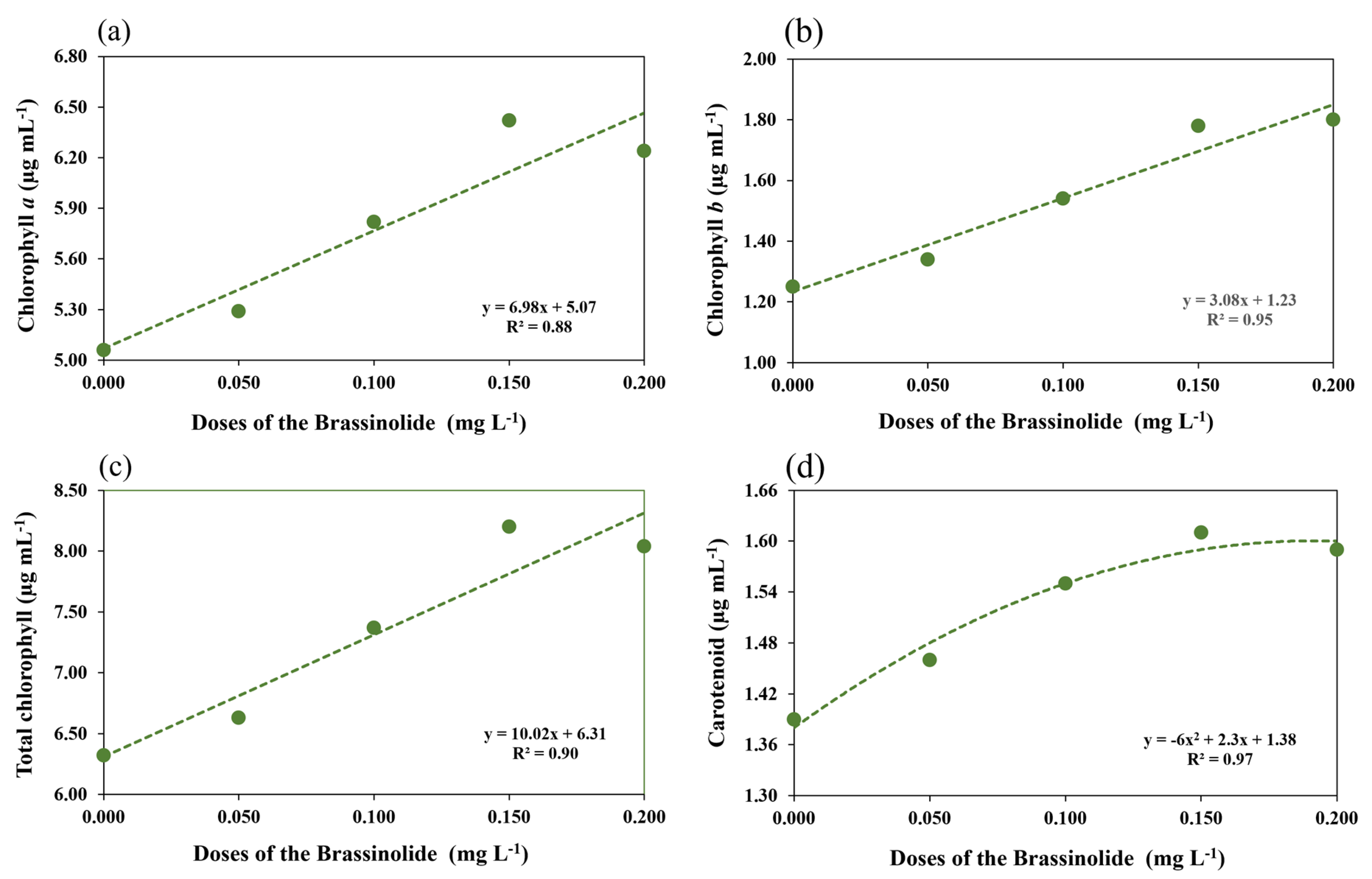
The photosynthetic pigment content varied markedly with the different BL doses in the treated plants (Table 1). The regulator increased the photosynthetic pigment content in maize plants, with linear adjustments of chlorophyll a, b and total and quadratic adjustments of carotenoid content (Figure 2a and Figure 2b, Figure 2c and Figure 2d, respectively). There was a 15% increase in the carotenoid content at the 0.191 mg L−1 dose. However, the presence of Si did not significantly influence any physiological characteristics (Table 1).

3.1.2. Biochemical Analyses

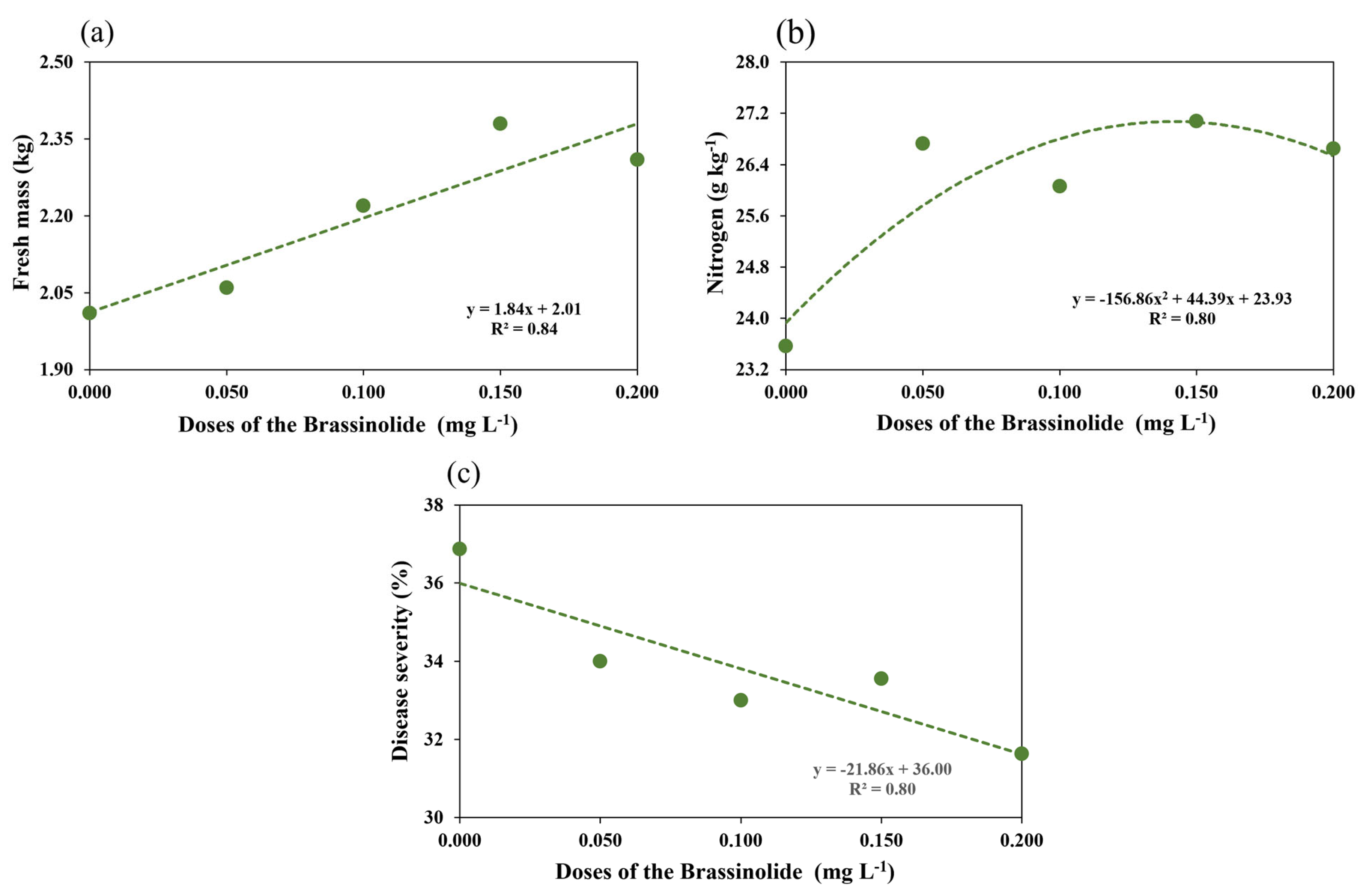
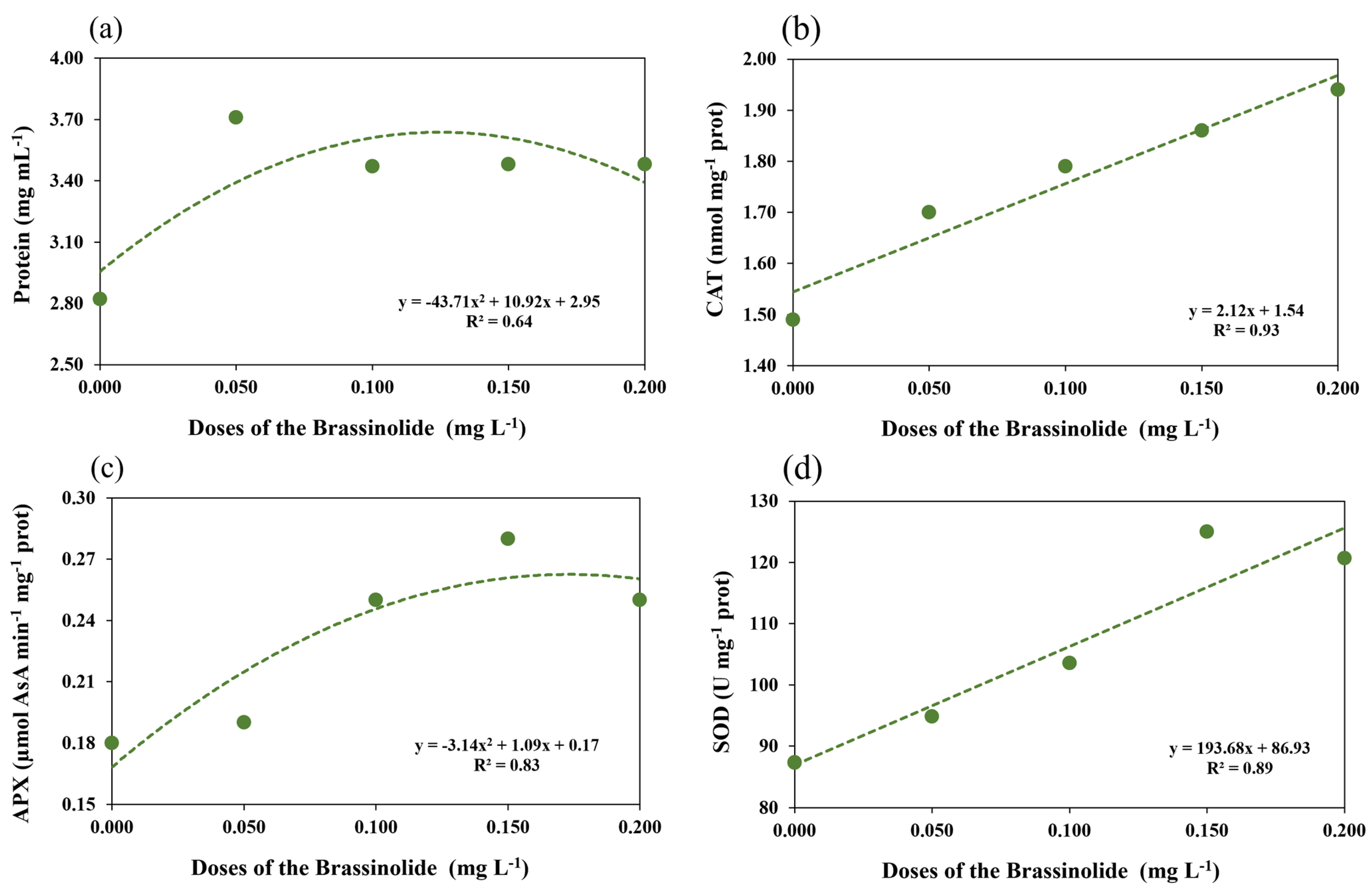
The application of BL affected protein synthesis in the leaves of maize plants (Table 2), resulting in a 23% increase in soluble protein content at the 0.125 mg L−1 dose (Figure 3a). However, membrane integrity was not influenced by the application of the growth promoter during the first off-season. Consequently, BL had no significant effect on ELR or MDA content (Table 2).
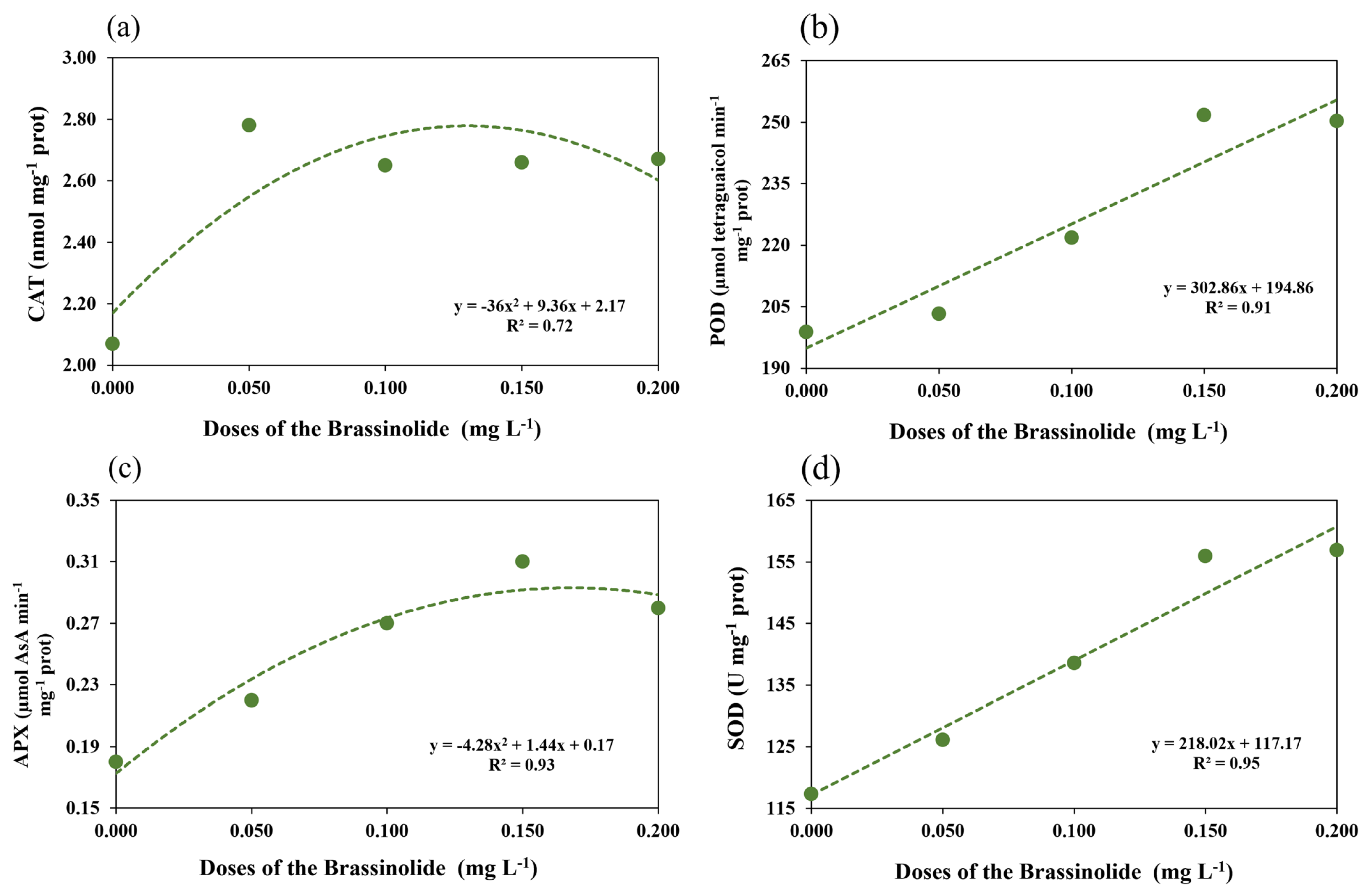
BL also promoted an increase in the activities of antioxidant enzymes in maize plants (Table 3). The CAT and SOD activity patterns responded in a similar manner, with a linear increase in activity occurring with increasing doses (Figure 3b,d). On the other hand, the activity of the APX had a higher value at the 0.173 mg L−1 dose, with an increase of 54% relative to the control (Figure 3c). However, Si did not significantly interfere with any biochemical activities of the maize cells (Table 2 and Table 3).

3.1.3. Morphological, Nutritional, Pest and Disease Analyses

The application of BL in the R2 stage on maize grown in the first off-season did not influence morphological variables (Table 4). However, the results revealed a linear increase in the fresh mass of the plant as a function of the increase in the dose that was used (Figure 4a). For leaf nitrogen content, the maximum value was observed at the 0.141 mg L−1 dose, with a 15% increase relative to the control (Figure 4b). The severity of diseases in maize plants decreased linearly as a function of the BL dose (Figure 4c).
The presence of Si altered only the SLA of maize plants and did not affect the other morphological variables in the first off-season (Table 4). On the other hand, the independent effects of BL and Si contributed to increasing the FM of maize plants and reducing both pest damage and disease severity (Table 5).

3.1.4. Yield Components Analyses

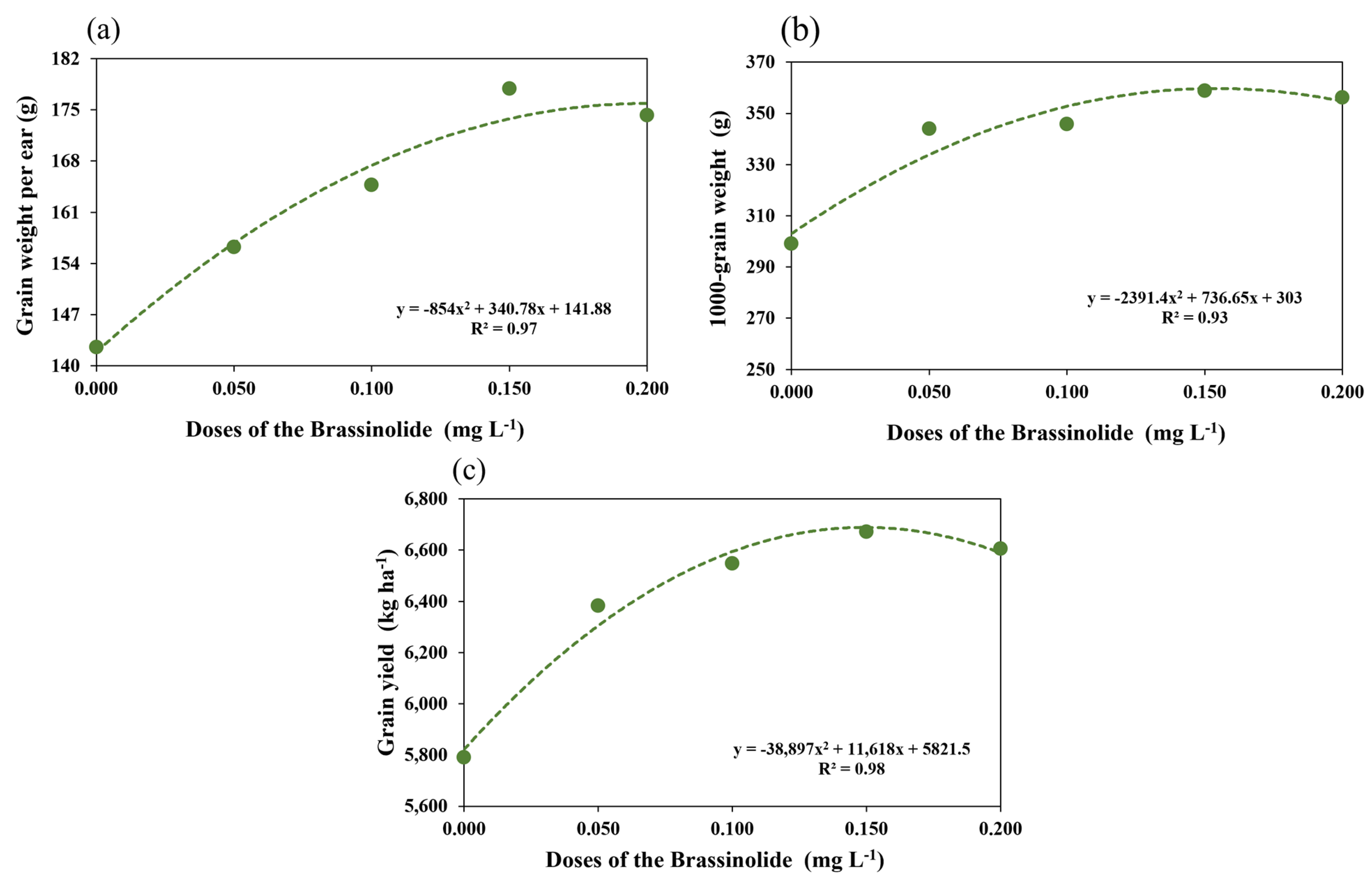
The application of BL increased grain weight, which in turn enhanced overall productivity. Significant effects of the applied doses were observed on GWE, 1000-GW, and consequently on GY (Table 6). Grain weight per ear and 1000-GW increased by approximately 23% at the 0.199 mg L−1 dose and 20% at the 0.154 mg L−1 dose, respectively, compared with the control (Figure 5a,b). These improvements led to yield gains, with the highest increase of about 16% observed at the 0.149 mg L−1 dose (Figure 5c). Other yield components did not differ significantly in response to BL application. Maximum profitability coincided with the BL dose that optimized grain yield. Regarding the presence of Si, a reduction in the percentage of BG was observed, although this did not significantly contribute to yield improvement (Table 6).

3.2. Second Off-Season Experiment

3.2.1. Physiological Analyses

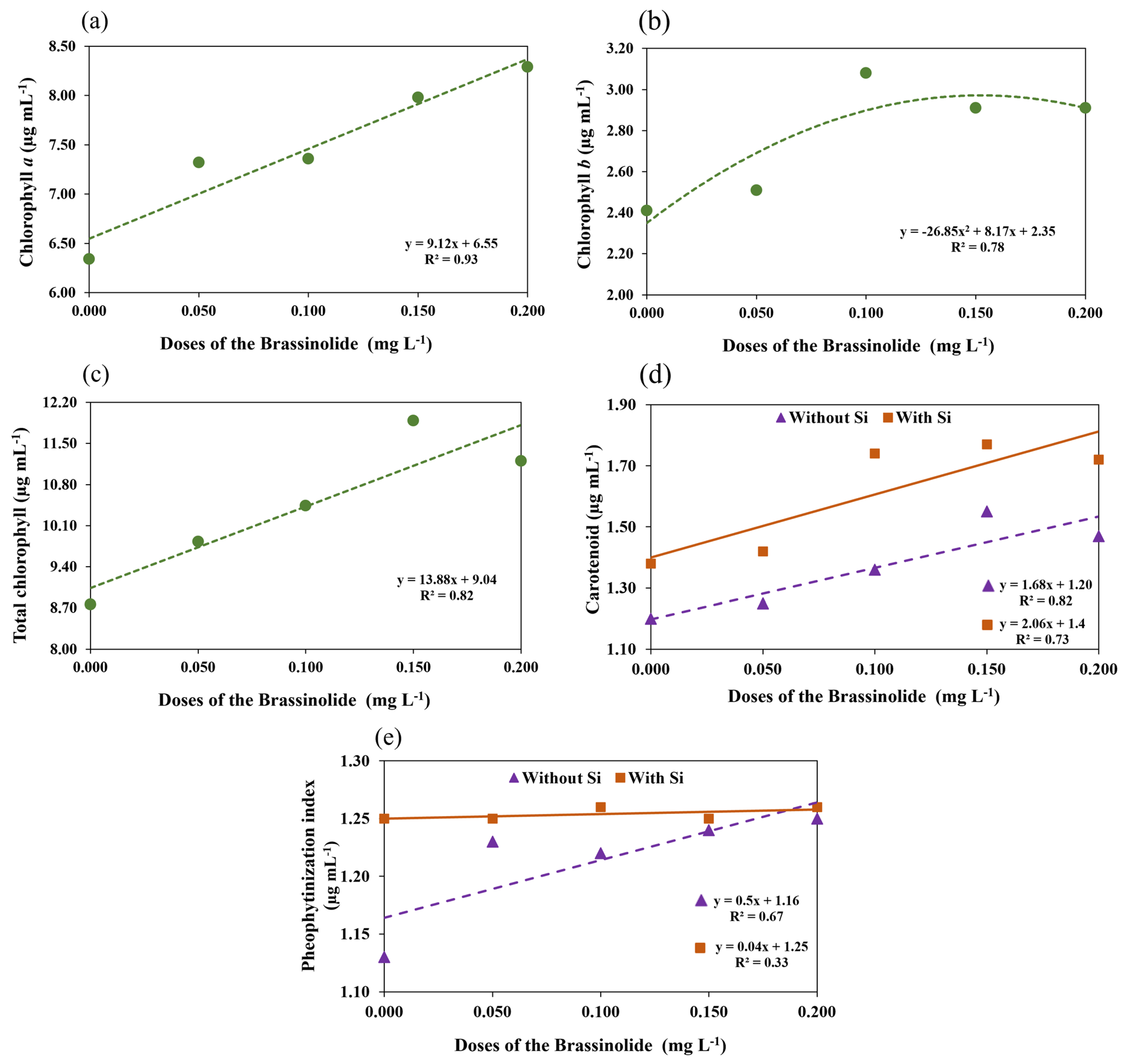
The application of BL affected the synthesis of all chloroplast pigments, as well as the chlorophyll pheophytinization index (Table 7). Chlorophyll a and total chlorophyll content increased linearly with increasing doses of BL (Figure 6a,c). Meanwhile, the highest chlorophyll b content was obtained at the 0.152 mg L−1 dose (22% increase compared to the control) (Figure 6b). Regarding carotenoids, a significant BL × Si interaction was observed, resulting in a linear increase in their concentration compared with the control (Figure 6d). Si also increased the amount of chlorophyll b in the leaves (Table 7). The PI values were significantly influenced by BL doses and Si application as independent factors. Furthermore, the interaction between BL doses and Si mitigated chlorophyll degradation, maintaining stable levels across treatments (Figure 6e).

3.2.2. Biochemical Analyses

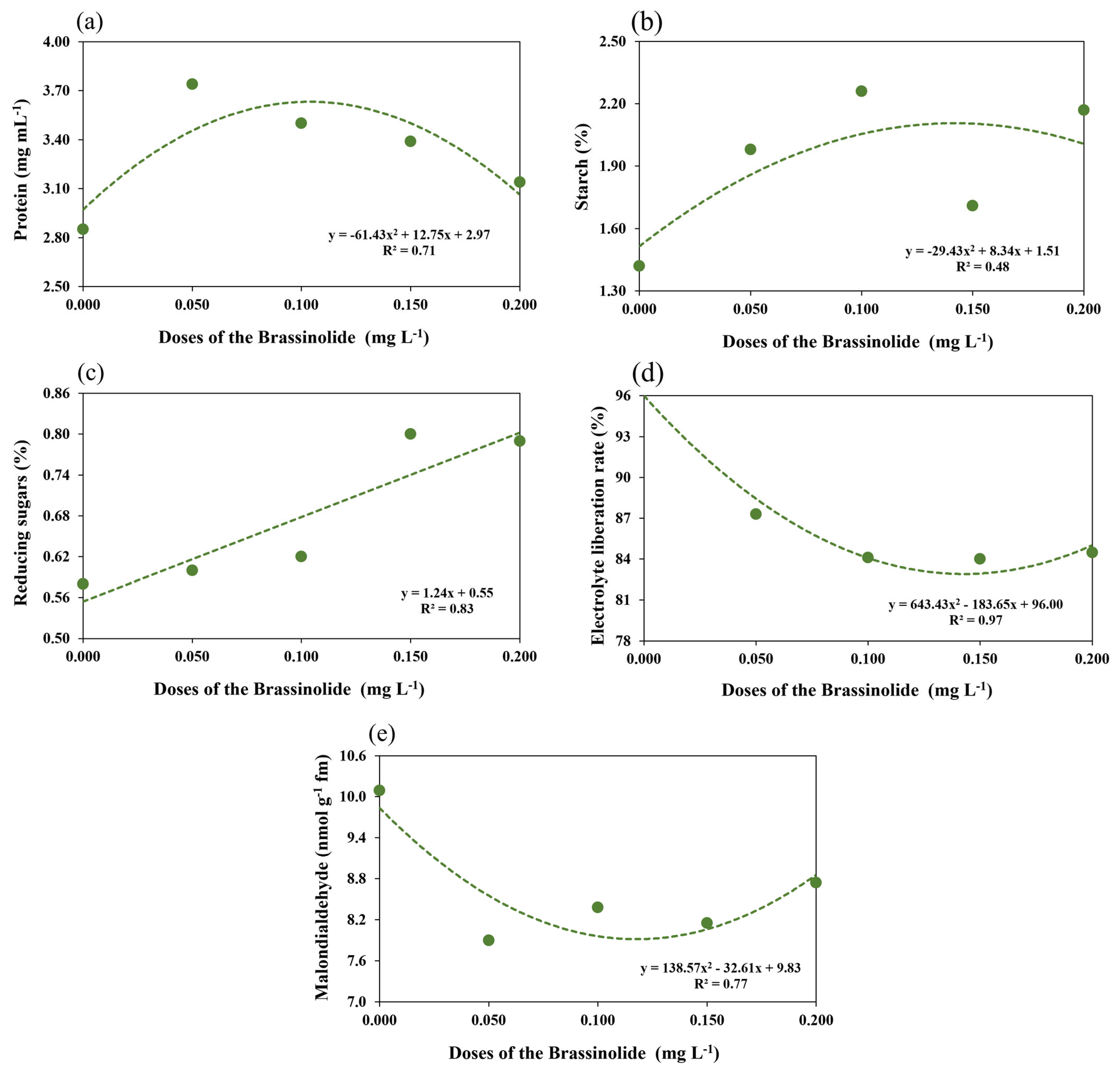
Results of biochemical constituents allowed to check beneficial effects generated from the use of BL (Table 8 and Table 9). In contrast, the Si did not affect these variables. Protein and starch levels increased up to doses of 0.104 mg L−1 and 0.142 mg L−1, respectively, followed by a subsequent decrease (Figure 7a,b). At these doses, the protein increased by 27% and starch increased by 49% compared to the control treatment. The amount of reducing sugars increased linearly in the leaves with the increase in the BL dose (Figure 7c).
The ELR and MDA content were considerably reduced by foliar application of BL (Figure 7d,e). Exogenous application decreased MDA levels by up to 22% at the 0.118 mg L−1 dose. BL also induced changes in the activities of antioxidant system enzymes (Table 9). CAT and APX activities increased by 34% and 61% at the 0.130 and 0.168 mg L−1 doses, respectively (Figure 8a,c). POD and SOD activities also increased in response to BL, both showing linear dose-dependent responses (Figure 8b,d).

3.2.3. Morphological, Nutritional, Pest and Disease Analyses

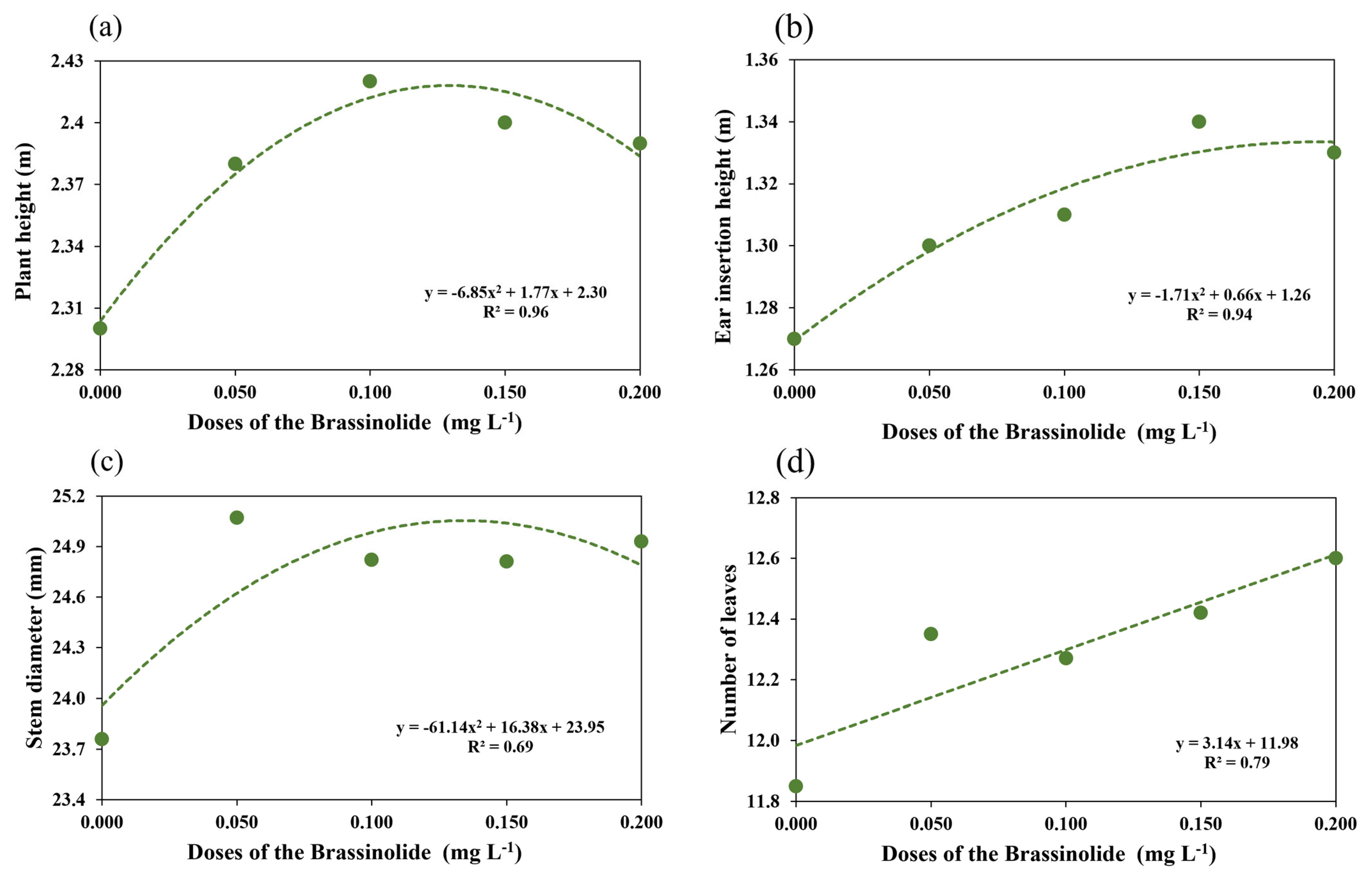
The treatments with BL at stage V10 promoted greater growth and development in the maize plants evaluated by morphological parameters (Table 10). Plant height, ear insertion height, and stem diameter showed pronounced increases at BL doses of 0.129, 0.193, and 0.134 mg L−1, respectively (Figure 9a, Figure 9b and Figure 9c, respectively). Meanwhile, the number of leaves increased linearly with the increasing dose of the regulator (Figure 9d). The presence of Si promoted a smaller SLA; i.e., the thickness of the leaves increased in the plants that received the nutrient without influencing the other morphological variables (Table 10).
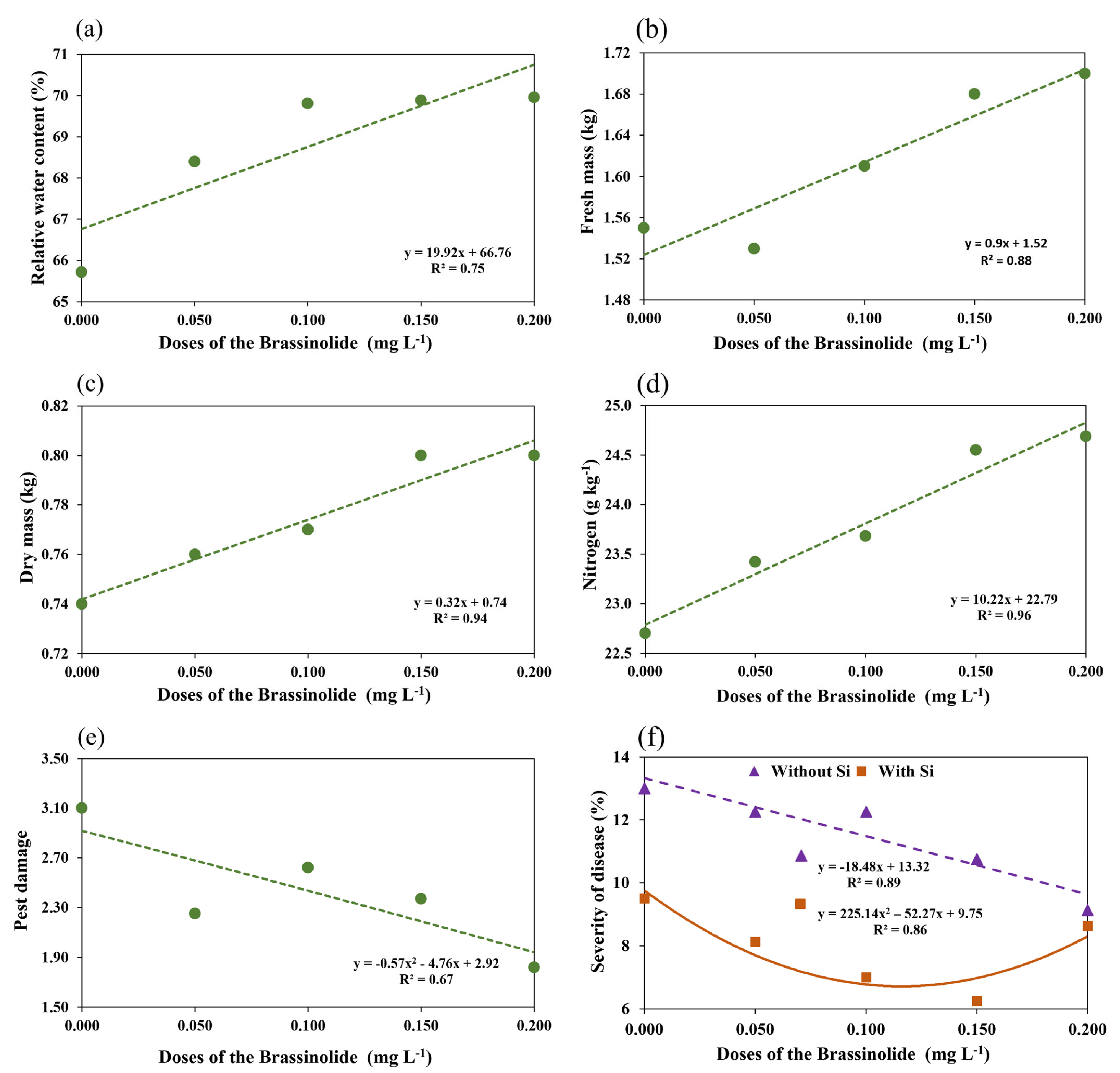
Application of BL to maize plants affected RWC, FM and DM, and leaf nitrogen concentration (Table 11). The mean values of these variables increased progressively with higher BL doses (Figure 10a–d). Regarding pest and disease damage, the results showed that BL and Si application resulted in less pest damage and reduced severity of disease, mainly when the doses of the regulator were increased (Figure 10e,f). The interaction between BL and Si reduced disease severity by up to 31% at the 0.116 mg L−1 dose with Si application (Figure 10f). The isolated factors of BL and Si were significant for the relative water content in the leaf and pest damage, which showed an increased effect as a function of the applied dose (Table 11).

3.2.4. Yield Components Analyses

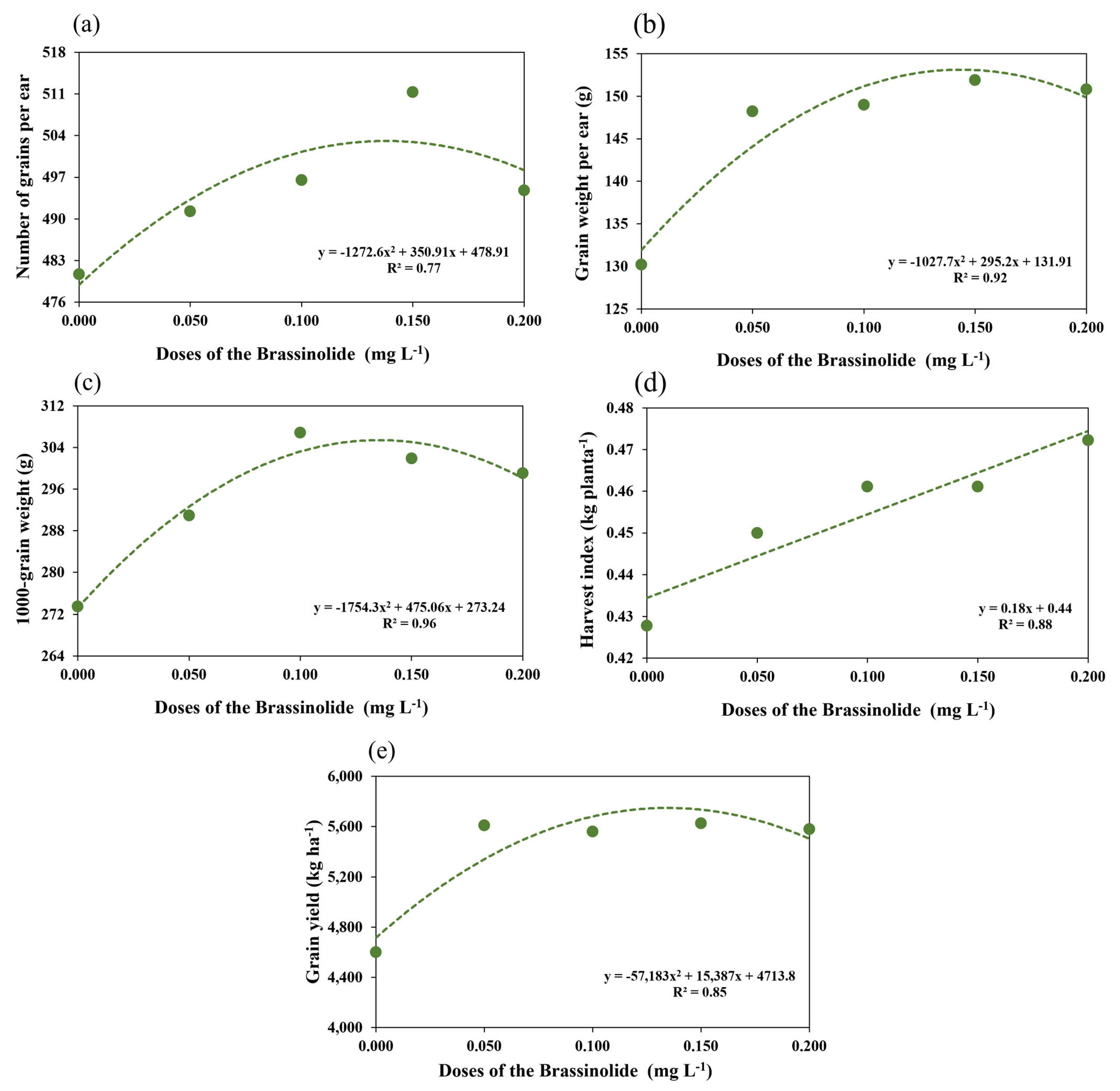
It was observed that BL application affected the NGE, GWE, 1000-GW, HI, and GY (Table 12). The NGE increased by 5% at the 0.138 mg L−1 dose (Figure 11a), but GWE was the yield component that contributed most to yield improvement, showing a 15% increase at the 0.144 mg L−1 dose (Figure 11b). Similarly, 1000-GW increased with BL application, reaching its maximum value (11% higher than the control) at the 0.142 mg L−1 dose (Figure 11c). These increases translated into productivity gains, with GY reaching its maximum at the 0.134 mg L−1 dose, representing a 25% increase compared with the control. The highest yields were obtained at BL doses of 0.05 and 0.150 mg L−1 (Figure 11e). Consequently, the HI also increased (Figure 11d).
On the other hand, the presence of Si in the plants increased yield and reduced the percentage of burned grains (Table 12). In addition, Si application resulted in a yield gain of 8.7%, corresponding to a profitability of US$ 135.26 ha−1.
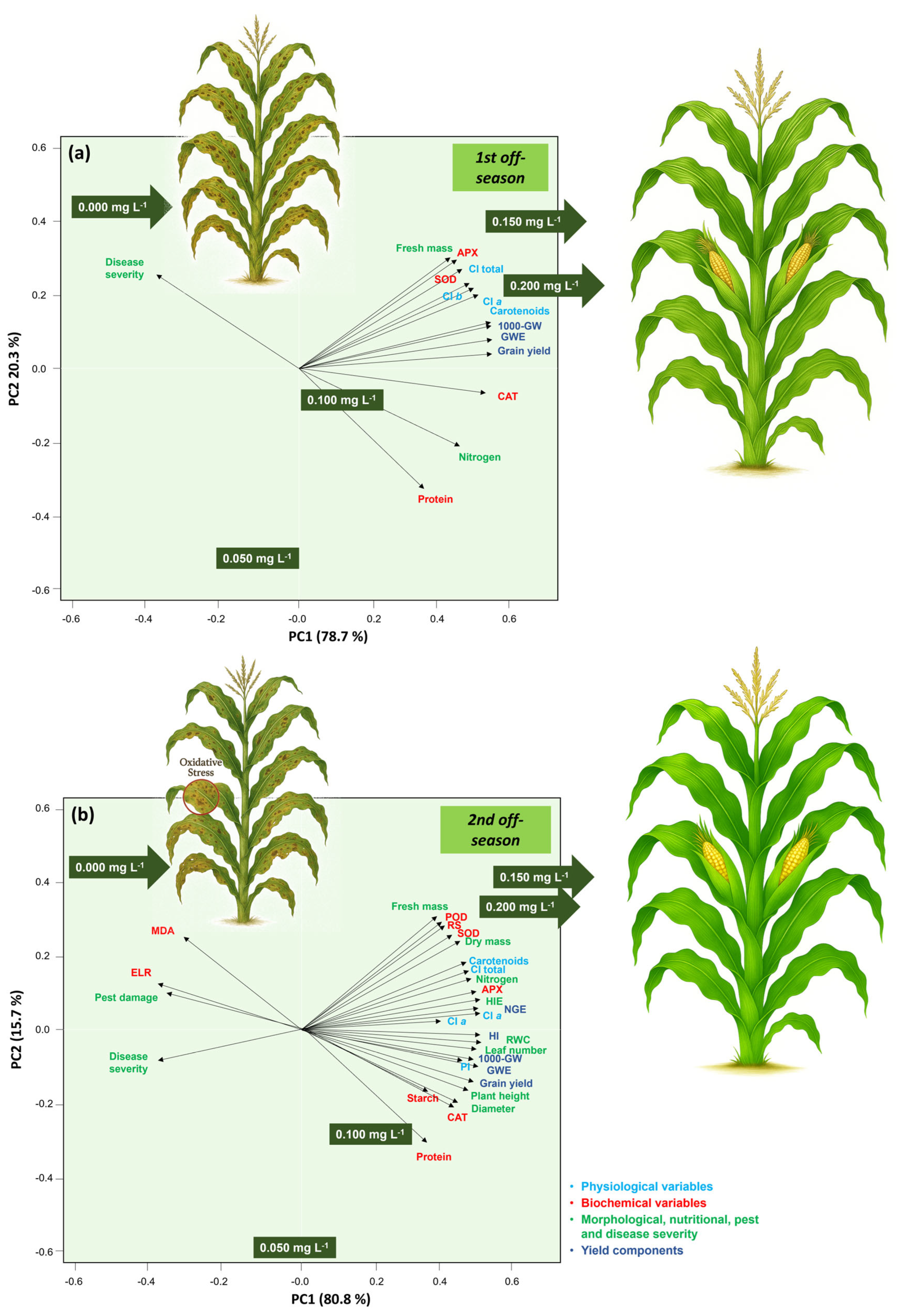
When analyzing the dispersion of variables in relation to BL doses, we found that, in the first off-season, the highest doses of the growth regulator (0.150 and 0.200 mg L−1) were generally associated with the highest mean values of antioxidant enzyme activities and photosynthetic pigment synthesis, which resulted in greater fresh mass accumulation and higher GWE, GY, and 1000-GW. In contrast, plants in the control treatment (0.000 mg L−1) showed the lowest productivity, associated with higher disease severity (Figure 12a). Similarly, in the second off-season, the highest BL concentrations (0.200 and 0.150 mg L−1) correlated positively with the highest mean values of productivity components, including NGE and HI. These plants also showed high antioxidant enzyme activities, elevated chloroplast pigment and nitrogen concentrations, and greater accumulation of fresh and dry biomass. However, the 0.100 mg L−1 dose was associated with the highest mean values of GWE, GY, and 1000-GW (Figure 12b), highlighting the positive effects of BL application at doses above 0.100 mg L−1. By contrast, control plants (0.000 mg L−1) exhibited the highest levels of oxidative stress, as evidenced by increased lipid peroxidation (MDA), higher electrolyte leakage rates (ELRs), and greater incidence of pest damage.

4. Discussion

4.1. The Application of BL in Maize Enhances the Synthesis of Photosynthetic Pigments and Strengthens the Antioxidant Defense System, Thereby Reducing MDA Levels, ELR, Pest Damage, and Disease Severity, Ultimately Leading to Increased Productivity

Reduced yields of maize cultivated in soybean succession in Central Brazil are a consequence of water limitation that occurs during stages of advanced maturation as well as the occurrence of pests and diseases. The period in which the cultivation was conducted in succession in the first off-season was characterized by high precipitation that was well distributed throughout the crop cycle. Therefore, water was not a limiting factor for maize development. However, this situation is atypical for this period in this region. In contrast, in the second off-season, the rains occurred until the beginning of April and ceased in the following months. In this sense, the crop was subjected to water restrictions during most of its cycle. The occurrence of water deficits in maize can cause damage at all stages of development. However, if the deficiency occurs between pre-flowering and the beginning of grain filling, the losses are higher because it directly affects the crop yield [52,53].
The increase in yield in the first off-season with the application of BL was determined decisively based on the weight of the grains. The fact that the application was performed later, i.e., during the R2 stage, explains only the variation in grain weight because the main morphophysiological variables had already been defined. At that stage, the accumulation of starch begins in the grains, passing through the previous phase to the formation of sugars and continues until physiological maturation [54]. Thus, the application of BL provided a greater translocation of photoassimilates to the grains with a consequent increase in the mean weight of these grains.
The increase in grain weight may be justified by the greater amount of photosynthetic pigments. BL regulates the synthesis of pigments, i.e., mainly chlorophyll and photosynthetic proteins [55]. Studies demonstrate that brassinosteroids act by stimulating the transcription of fundamental genes for pigment biosynthesis [56,57]. They increase the expression of genes encoding enzymes of the porphyrin pathway, such as glutamate-tRNA reductase and protochlorophyllide oxidoreductase (POR) [58]. POR is the key enzyme that converts protochlorophyllide into chlorophyllide in the presence of light [59]. Furthermore, brassinosteroids promote the synthesis of LHC (Light-Harvesting Complex) proteins, which are required to anchor chlorophyll molecules within the thylakoid membranes [60]. Mumtaz et al. [61] demonstrated that reduced BL signaling transcriptionally impairs chlorophyll synthesis, quantum photon yield, and light energy transfer, leading to a decrease in photosynthetic capacity. Thus, BL is a regulator that can improve the efficiency of photosynthetic carbon fixation and increase the internal CO2 concentration that is available for photosynthetic enzymes [62]. In this context, the higher photosynthetic rate of the plants may be associated with the increase in the amount of pigments that occurred with the use of BL [63].
The higher amount of pigments is possibly explained by less damage to the photosynthetic apparatus. Less damage may have occurred due to the increase in the activity of certain antioxidative enzymes when BL was used. For example, the activities of CAT, APX and SOD increased with the use of the regulator. This adjustment of enzymatic antioxidants appears to be the result of hormonal regulation in transcription and translation [64], which resulted in increased levels of total proteins and enzymatic antioxidants. Studies also prove that under abiotic stresses, brassinosteroids increase the activity of antioxidant enzymes, protecting existing pigments from being oxidized [65]. This suggests that even in situations where there is no severe water deficiency, such as in the first off-season, the regulator may influence the enzymatic activity, which corroborates other research findings [66,67].
On the other hand, the high precipitation in the first off-season combined with the mild temperatures (i.e., 24 to 26 °C) were characteristic of the period. Consequently, these variables acted as key determinants for the infection and development of foliar diseases in maize, particularly maize white spot (Phaeosphaeria maydis), which adversely affected productivity. However, BL increased plant tolerance to pathogen infection. According to Aguirre-Becerra et al. [68], under the influence of brassinosteroid, the biosynthesis of protective natural phenolic and terpenoid compounds is activated, which may favor the protection of plants against pathogens. The application of 24-epibsinolide in barley plants significantly reduced the proliferation of foliar diseases induced by fungal infections, which increased crop yield [69]. An increase in the activity of the peroxidase and polyphenoloxidase enzymes in the leaves of cucumber plants was also observed in response to BL applications [70]. Because these enzymes are involved in the metabolism of polyphenols, a change in their activity can be considered one of the factors related to the increase in plant resistance to infection [71].
The enhanced resistance of the plant to pathogens, along with increased activity of certain enzymes and higher photosynthetic pigment content, accounts for the greater production of photoassimilates and, consequently, their enhanced translocation to the grains during development. As a result, the higher grain weight contributed to significant yield increases. This demonstrates that, even under conditions without water stress, BL can exert beneficial effects on yield, as observed in the first off-season.

4.2. The Application of BL in Maize May Represent an Important Strategy for Increasing Productivity Under Water-Limited Conditions

In the second off-season, the soil reached the critical point of humidity near to the V10 stage. At this stage, the maize plant started rapid and continuous growth, with the accumulation of nutrients and an increase in dry mass, and this pattern extends into the reproductive stages [72]. Thus, this period is accompanied by a great demand for water and nutrients by the crop. The occurrence of water deficiency during this phase of maize hampers growth and negatively affects plant height, leaf area, number of ears per plant, and fresh and dry mass accumulation because it affects water relations and gas exchange [73]. In this way, the application of BL in this period minimized the damage caused by the naturally occurring water deficit. This situation is valuable mainly when the maize is grown after the soybean crop in Brazilian Cerrado.
Clearly, beneficial effects on maize yield were observed with the use of BL. Even with the water deficiency occurrence, an increase in yield of 25% was registered relative to the control. The higher number of grains and the increase in weight were determinant factors related to the increase in maize yield. This result was due to the greater accumulation of dry mass, which starts in the vegetative parts of the plant. However, between stages R2 and R6, there is a gradual translocation of sugar to the grains in formation. Nassar et al. [74] also reported that BL increased grain weight and 14C translocation from the leaves to the organ of production. As a result, it is deduced that the BL promotes increases in the number of grains with consequent translocation of a greater quantity of photoassimilates to the grains in formation.
The increase in maize yield in the second off-season with the application of BL was partly attributed to the morphological changes in the plant. Increases in the plant height and number of leaves are evidence of changes in light energy uptake resulting in the increased photosynthetic activity of maize plants. Thus, this increase helped increase the number and weight of grains. An important function of BL is to promote cell growth and division [75]. Thus, any positive variation in the leaf area increases the formation of photoassimilates that are necessary for the filling of grains, providing higher yield.
BL also regulates, among other factors, the synthesis of pigments and photosynthetic proteins. A higher chlorophyll level was observed with the increasing of BL doses in the second off-season and this pattern may consequently induce an increase in the photosynthetic rate in maize plants. Zulkarnaini et al. [76] showed that the increase in the photosynthesis rate can be attributed to increasing in the chlorophyll content and greater leaf area in BL-treated plants. In addition to demonstrating the positive effect on chlorophyll content, another possible effect is the prevention of the loss of photosynthetic pigments, achieved by activating enzymes involved in chlorophyll biosynthesis or by inducing its synthesis [77].
The degradation of photosynthetic pigments, particularly chlorophylls, is a symptom often associated with stress. The main route of degradation is the replacement of the magnesium atom by two hydrogen atoms due to the acidic pH, a process that is known as pheophytinization [78]. The pheophytinization index showed that the degradation of chlorophylls was lower relative to the control when BL was used. The lower degradation of chlorophylls, together with the positive effect of BL on the contents of these photosynthetic pigments, may have a direct influence on the balance of photosynthesis, resulting in greater photoassimilate production.
The occurrence of biotic factors, such as pests and diseases in the second off-season, also reduced the production of photoassimilates, which affected the filling of maize grains [73]. This period was characterized by low precipitation and low air humidity. Consequently, the incidence and severity of diseases were lower than that in the first off-season. Furthermore, BL reduced disease incidence in maize plants in an inverse proportion to the dose applied.
When plants are subjected to stress conditions, such as those promoted by drought and pathogen attacks, several reactive oxygen species (ROS), such as superoxide, hydrogen peroxide and hydroxyl radicals, are produced [79]. The plants have an internal protection cleaning system catalyzed by enzymes, i.e., the defense system, which helps plants recover from reactive oxygen species, thus guaranteeing normal cellular function [80]. When maize plants suffered from drought in the second off-season, the entire defensive system was activated to resist injury by reactive oxygen. Malondialdehyde (MDA), a product of lipid peroxidation, showed higher accumulation rates in maize plants under stress conditions. An increase in the MDA content under stress conditions suggests that drought induces lipid peroxidation of the membrane by ROS. However, treatment with BL significantly reduced the content of MDA, and then, with BL, the level of cell membrane damage was lower.
Likewise, the use of BL substantially improved the activities of enzymatic and non-enzymatic antioxidants. The activities of SOD, CAT and APX as well as carotenoid content increased with the doses of BL that were used. The greater activity of SOD is possibly related to the defense mechanism against the increase in superoxides (O2) promoted by stress. However, after the dismutation of O2 in H2O2 by SOD, cell detoxification also depends on the complementary action of enzymes, such as CAT and APX, which degrade H2O2 because this by-product is also toxic. In this scenario, the higher activity of these enzymes observed in this study associated with the doses of BL functioned as part of an integrated system in the degradation of ROS.
There was an increase in sugars, which also suggests an osmoregulatory activity of these sugars, corroborating other studies involving plants under water deficiency [81]. In contrast to situations in which sugar accumulation occurs due to the hydrolysis of starch [82], in maize, there was an accumulation of starch that was concomitant with the increase in sugars. This indicates that the increase in these sugars did not occur due to the interconversion of starch. This increase may be related to the redistribution of reserves associated with the effectiveness of photosynthesis.
The increase in sugars and the enzymatic activities in the plant allowed less damage to the cellular function because of the internal protection cleaning system. This system is catalyzed by enzymes that recover the plants from reactive oxygen species, which are associated with the osmoregulatory activity of these sugars, allowing a greater tolerance to stress factors [83]. Therefore, the plants had improvements in the water balance of the leaves, as indicated by the increase in the relative water content. This also explains the greater total fresh mass of the plants; that is, the treatment favored the retention of water in the plants, which is fundamental when growing maize in succession.
The maize yields in the first and second off-seasons showed a quadratic response to the BL doses although the literature reports a positive effect of BL when doses are lower (approximately 0.1 mg L−1) [84]. However, most of these studies were performed with plants grown under controlled environmental conditions. In this study, it was observed that the doses that produced the highest yields were 0.149 mg L−1 in 2015 and 0.134 mg L−1 in 2016, which were both higher than those used in controlled environments, e.g., 0.1 mg L−1.
The economic analysis of maize grown also allowed us to evaluate the profitability of the use of BL. At all doses used in the two years that were evaluated, there was high profitability. In the first off-season, the best result occurred at the dose of 0.150 mg L−1. Additionally, as early as in the second off-season, doses of 0.050 and 0.150 mg L−1 were more profitable. It is worth mentioning that profitability was higher in the second off-season due to the market value of maize, which was approximately US$ 7.05 for a 60 kg bag. However, in the first off-season, it was just US$ 3.35 per bag.

4.3. The Application of Si to Maize Plants Promoted Greater Control of Pests and Diseases, Resulting in Increased Profitability

In addition to the benefits observed with BL application, the presence of Si reduced the occurrence of pests (Spodoptera frugiperda) and diseases across both off-seasons. This effect can be attributed to the dual role of silicon in plant defense. In the Brazilian Midwest, where the pressure from pathogens such as Puccinia polysora (rust) and Cercospora zeae-maydis (gray leaf spot) is intensified by the ‘green bridge’—the continuous cultivation of soybean and off-season maize that maintains active pathogen inoculum year-round—Si acts primarily as a mechanical physical barrier. Through the deposition of amorphous silica beneath the cuticle and within epidermal cells [85], Si enhances cell wall rigidity, hindering the penetration of fungal hyphae and the stylets of sucking insects [86]. Beyond this structural effect, Si functions as an elicitor for induced systemic resistance, stimulating the synthesis of phenolic compounds, lignin, and the activity of antioxidant enzymes [87]. This metabolic reinforcement enables a faster and more vigorous response to pathogen attack, resulting in reduced expansion of necrotic lesions, streaks, and pustules, which increases leaf sanity and reduces the occurrence of burned grains.
Despite these benefits provided by Si, there was no significant increase in yield in the first off-season. However, in the second off-season, Si produced higher yields, generating profits of US$ 50,30 per hectare. However, the increase in yield was attributed to a lower incidence and severity of pests and diseases and lower metabolic damage in the cells. It was observed that the metabolic activity in the tissues was less affected by the presence of Si because the degradation of chlorophyll, represented by the pheophytinization index, was lower. It is important to highlight that this degradation is caused by the formation of proteolytic enzymes, such as chlorophyllase, causing damage to the photosynthetic apparatus [78].
The presence of Si also allowed maize plants to better tolerate water deficiency in the second off-season, a common situation in maize grown after the soybean harvest. This result was supported by the greater retention of water in the leaves. The relative water content in these organs is used as an alternative measure of the water status of the plant, reflecting the metabolic activity in the tissues [88]. The deposited Si in the tissues helps to soften the water stress by reducing transpiration and improving the interception of light, which keeps the leaf blade erect [89]. Our results are consistent with those reported by Liang et al. [90], who observed that silica nanoparticles (SiNPs) improve maize yield and water-use efficiency under both full and deficit irrigation. This improvement is attributed to a coordinated increase in photosynthetic performance and optimized light interception by the canopy.
The deposition of Si on the cell wall of the leaves may have been responsible for the smaller specific leaf area of the maize plants that were treated with the nutrient. However, there was an increase in the thickness of the leaves in the presence of the nutrient. The barrier created by the presence of Si reduced the incidence of pathogens in the plant as well as the loss of water by transpiration, which minimized the damage caused by pests, diseases and drought.
In view of this, it can be stated that Si results in a lower occurrence of pests and disease in maize plants, and it also allows greater retention of water and decreases metabolic damage to the cells. The regulator BL improves physiological and metabolic activities, allowing the maintenance of the RWC and the increase in the activities of antioxidant enzymes, which reduce lipid peroxidation under water-deficit conditions. Therefore, the use of BL and Si in maize–soybean succession systems increases yield and profitability. These findings offer new insights into plant tolerance to adverse environments; however, the complexity of Cerrado soils demands further multi-location and multi-year trials under defined water regimes to validate these responses across environmental gradients. Future research should integrate multi-omics approaches, including transcriptomics and metabolomics, to unravel the molecular mechanisms of drought adaptation [91] and their synergy with BL and Si. Identifying specific pathogen interactions and optimizing BL application timing across comparable phenological stages will be crucial. Such advancements, coupled with modern breeding programs focused on water-use efficiency [92] and biotic resistance, are essential to develop resilient maize genotypes capable of thriving in the challenging hydro-edaphic conditions of the Brazilian Cerrado.

5. Conclusions

Our findings confirm the hypothesis that the application of BL and Si enhances maize tolerance to naturally occurring water deficit, resulting in higher yields. The BL doses that achieved the highest yields were 0.149 mg L−1 at the R2 stage in the first off-season and 0.134 mg L−1 at the V10 stage in the second off-season. In addition, the application of Si and BL reduced the incidence of the pest S. frugiperda and the severity of foliar diseases in both growing seasons, underscoring its potential as a synergistic strategy against multiple stresses. However, some limitations must be acknowledged. Since water deficit was naturally imposed by seasonal climatic variation rather than controlled irrigation regimes, the precise physiological thresholds for BL-Si efficacy remain to be defined. Furthermore, while these regulators show promise for stabilizing production in the Brazilian Cerrado, their practical adoption depends on rigorous cost–benefit analyses, as the economic viability may fluctuate according to grain prices and application costs. The observed variation in optimal BL doses between seasons also suggests that its effectiveness is highly dependent on environmental context and phenological timing. Therefore, future studies should focus on multi-location and multi-year trials to validate these findings across diverse maize hybrids and larger-scale conditions, while integrating multi-omics approaches to fully unravel the molecular pathways of this synergy.

Author Contributions

Conceptualization, A.G.d.S. and F.S.M.; methodology, M.B.T. and I.R.T.; formal analysis, L.P.B., W.A.M. and G.B.P.B.; investigation, L.P.B. and F.N.C.; resources, L.A.B.; data curation, L.P.B. and L.C.V.; writing—original draft preparation, L.P.B. and A.G.d.S.; writing—review and editing, L.C.V. and L.A.B.; visualization, L.C.V.; supervision, A.G.d.S.; project administration, A.G.d.S.; funding acquisition, M.B.T. All authors have read and agreed to the published version of the manuscript.

Funding

This research received no external funding.

Data Availability Statement

All the data relevant to this manuscript are available on request from the corresponding author.

Acknowledgments

This research was supported by grants from the vegetable production laboratory, State University of Goiás (UEG), University Unit of Ipameri, Brazil, and the granting of a PhD grant provided by the Foundation for Research Support of the State of Goiás (FAPEG). The authors would like to thank the Coordination for the Improvement of Higher Education Personnel (CAPES), the IFGoiano Rio Verde campus and the University of Rio Verde (UniRV) for the infrastructure and the researchers involved in the study.

Conflicts of Interest

The authors declare no conflicts of interest.

References

  1. Palazzo, A.; Vervoort, J.M.; Mason-D’Croz, D.; Rutting, L.; Havlík, P.; Islam, S.; Bayala, J.; Valin, H.; Kadi, H.A.K.; Thornton, P.; et al. Linking regional stakeholder scenarios and shared socioeconomic pathways: Quantified West African food and climate futures in a global context. Glob. Environ. Change 2017, 45, 227–242. [Google Scholar] [CrossRef] [PubMed]
  2. Giller, K.E.; Delaune, T.; Silva, J.V.; Descheemaeker, K.; van de Ven, G.; Schut, A.G.T.; van Wijk, M.; Hammond, J.; Hochman, Z.; Taulya, G.; et al. The future of farming: Who will produce our food? Food Secur. 2021, 13, 1073–1099. [Google Scholar] [CrossRef]
  3. USDA. United States Department of Agriculture. World Agricultural Production. Available online: https://www.fas.usda.gov/data/production/commodity-group/grains (accessed on 1 September 2025).
  4. Erenstein, O.; Jaleta, M.; Sonder, K.; Mottaleb, K.; Prasanna, B.M. Global maize production, consumption and trade: Trends and R&D implications. Food Secur. 2022, 14, 1295–1319. [Google Scholar] [CrossRef]
  5. Klein, H.S.; Luna, F.V. The impact of the rise of modern maize production in Brazil and Argentina. Hist. Agrar. 2022, 86, 273–310. [Google Scholar] [CrossRef]
  6. Janni, M.; Maestri, E.; Gullì, M.; Marmiroli, M.; Marmiroli, N. Plant responses to climate change: How global warming may impact food security—A critical review. Front. Plant Sci. 2024, 14, 1297569. [Google Scholar] [CrossRef]
  7. Yuan, X.; Li, S.; Chen, J.; Yu, H.; Yang, T.; Wang, C.; Huang, S.; Chen, H.; Ao, X. Impacts of global climate change on agricultural production: A comprehensive review. Agronomy 2024, 14, 1360. [Google Scholar] [CrossRef]
  8. Cattelan, A.J.; Dall’Agnol, A. The rapid soybean growth in Brazil. OCL 2018, 25, D101. [Google Scholar] [CrossRef]
  9. Zsögön, A.; Peres, L.E.P.; Xiao, Y.; Yan, J.; Fernie, A.R. Enhancing crop diversity for food security in the face of climate uncertainty. Plant J. 2021, 109, 402–414. [Google Scholar] [CrossRef]
  10. Nóia Júnior, R.S.; Sentelhas, P.C. Soybean–maize succession in Brazil: Impacts of sowing dates on climate variability, yields and economic profitability. Eur. J. Agron. 2019, 103, 140–151. [Google Scholar] [CrossRef]
  11. Mujahid, A.; Muhammad, H.M.D. Insights into different mitigation approaches for abiotic stress in horticultural plants. Adv. Plant Sci. Environ. 2024, 1, 3–12. [Google Scholar]
  12. Tripathi, A.; Tripathi, D.K.; Chauhan, D.K.; Kumar, N.; Singh, G.S. Paradigms of climate change impacts on some major food sources of the world: A review on current knowledge and future prospects. Agric. Ecosyst. Environ. 2016, 216, 356–373. [Google Scholar] [CrossRef]
  13. Cheng, M.; Wang, H.; Fan, J.; Zhang, F.; Wang, X. Effects of soil water deficit at different growth stages on maize growth, yield, and water use efficiency under alternate partial root-zone irrigation. Water 2021, 13, 148. [Google Scholar] [CrossRef]
  14. Chaudhary, S.; Devi, P.; Bhardwaj, A.; Jha, U.C.; Sharma, K.D.; Prasad, P.V.V.; Siddique, K.H.M.; Bindumadhava, H.; Kumar, S.; Nayyar, H. Identification and characterization of contrasting genotypes/cultivars for developing heat tolerance in agricultural crops: Current status and prospects. Front. Plant Sci. 2020, 11, 587264. [Google Scholar] [CrossRef] [PubMed]
  15. Silva, A.S.; Espinheira, R.P.; Teixeira, R.S.S.; Souza, M.F.; Ferreira-Leitão, V.; Bon, E.P.S. Constraints and advances in high-solids enzymatic hydrolysis of lignocellulosic biomass: A critical review. Biotechnol. Biofuels 2020, 13, 58. [Google Scholar] [CrossRef]
  16. Mesterházy, Á.; Oláh, J.; Popp, J. Losses in the grain supply chain: Causes and solutions. Sustainability 2020, 12, 2342. [Google Scholar] [CrossRef]
  17. Khan, N.; Bano, A.; Ali, S.; Babar, M.A. Crosstalk amongst phytohormones from planta and PGPR under biotic and abiotic stresses. Plant Growth Regul. 2020, 90, 189–203. [Google Scholar] [CrossRef]
  18. Hu, S.; Zhu, X.; Ding, Y.; Zhang, J.; Nie, C.; Chen, Y. Jasmonic acid signaling in environmental stress adaptation of horticulture crops. Adv. Plant Sci. Environ. 2024, 1, 13–22. [Google Scholar]
  19. Khan, N.; Bano, A.; Babar, M.A. Impacts of plant growth promoters and plant growth regulators on rainfed agriculture. PLoS ONE 2020, 15, e0231426. [Google Scholar] [CrossRef]
  20. Dong, N.; Niu, M.; Zhang, X.; Li, L.; Liu, J.; Liu, B.; Tong, H. Brassinosteroid-regulated plant growth and development and gene expression in soybean. Crop J. 2019, 7, 411–418. [Google Scholar] [CrossRef]
  21. Bi, Y.; Zhou, Z. Absorption and Transport of Inorganic Carbon. In Absorption and Transport of Inorganic Carbon in Kelps with Emphasis on Saccharina japonica; InTech: Rijeka, Croatia, 2016. [Google Scholar] [CrossRef]
  22. Wu, J.; Lv, S.; Zhao, L.; Zhao, L.; Gao, T.; Yu, C.; Hu, J.; Ma, F. Advances in the study of the function and mechanism of the action of flavonoids in plants under environmental stresses. Planta 2023, 257, 108. [Google Scholar] [CrossRef]
  23. Batool, T.; Ali, S.; Seleiman, M.F.; Naveed, N.H.; Ali, A.; Ahmed, K.; Abid, M.; Rizwan, M.; Shahid, M.R.; Alotaibi, M.; et al. Plant growth promoting rhizobacteria alleviates drought stress in potato in response to suppressive oxidative stress and antioxidant enzymes activities. Sci. Rep. 2020, 10, 16975. [Google Scholar] [CrossRef] [PubMed]
  24. Sun, S.; Yao, X.; Liu, X.; Qiao, Z.; Liu, Y.; Li, X.; Jiang, X. Brassinolide can improve drought tolerance of maize seedlings under drought stress: By inducing the photosynthetic performance, antioxidant capacity and ZmMYB gene expression of maize seedlings. J. Soil Sci. Plant Nutr. 2022, 22, 2092–2104. [Google Scholar] [CrossRef]
  25. Anjum, S.A.; Wang, L.C.; Farooq, M.; Hussain, M.; Xue, L.L.; Zou, C.M. Brassinolide application improves the drought tolerance in maize through modulation of enzymatic antioxidants and leaf gas exchange. J. Agron. Crop Sci. 2011, 197, 177–185. [Google Scholar] [CrossRef]
  26. Seal, P.; Das, P.; Biswas, A. Versatile potentiality of silicon in mitigation of biotic and abiotic stresses in plants: A review. Am. J. Plant Sci. 2018, 9, 1433–1454. [Google Scholar] [CrossRef]
  27. Xu, J.; Guo, L.; Liu, L. Exogenous silicon alleviates drought stress in maize by improving growth, photosynthetic and antioxidant metabolism. Environ. Exp. Bot. 2022, 201, 104974. [Google Scholar] [CrossRef]
  28. Al-Yasi, H.; Attia, H.; Alamer, K.; Hassan, F.; Ali, E.; Elshazly, S.; Siddique, K.H.M.; Hessini, K. Impact of drought on growth, photosynthesis, osmotic adjustment, and cell wall elasticity in Damask rose. Plant Physiol. Biochem. 2020, 150, 133–139. [Google Scholar] [CrossRef]
  29. Bakhat, H.F.; Bibi, N.; Zia, Z.; Abbas, S.; Hammad, H.M.; Fahad, S.; Ashraf, M.R.; Shah, H.M.; Rabbani, F.; Saeed, S. Silicon mitigates biotic stresses in crop plants: A review. Crop Prot. 2018, 104, 21–34. [Google Scholar] [CrossRef]
  30. El-Beltagi, H.S.; Sattar, A.; Sher, A.; Ijaz, M.; Baig, A.; Naz, I.; Almaghasla, M.I.; Hamed, L.M.M.; Ramadan, K.M.; El-Mogy, M.M. Exogenous application of silicon and brassinosteroids alleviate the adversities of drought stress on maize through up-regulation of photosynthetic efficiency, antioxidants defense system and osmotic adjustment. Russ. J. Plant Physiol. 2025, 72, 84. [Google Scholar] [CrossRef]
  31. Zhou, H.; Wang, L.; Su, J.; Xu, P.; Liu, D.; Hao, Y.; Pang, W.; Wang, K.; Fan, H. Combined application of silica nanoparticles and brassinolide promoted the growth of sugar beets under deficit irrigation. Plant Physiol. Biochem. 2024, 216, 109165. [Google Scholar] [CrossRef]
  32. Santos, H.G.; Jacomine, P.K.T.; Anjos, L.H.C.; Oliveira, V.A.; Lumbreras, J.F.; Coelho, M.R.; Almeida, J.A.; Araújo Filho, J.C.; Oliveira, J.B.; Cunha, T.J.F. Sistema Brasileiro de Classificação dos Solos, 5th ed.; Embrapa: Brasília, Brazil, 2018. [Google Scholar]
  33. Soil Survey Staff. Keys to Soil Taxonomy, 12th ed.; USDA Natural Resources Conservation Service: Washington, DC, USA, 2014.
  34. Tian, Z.; Gao, W.; Kool, D.; Ren, T.; Horton, R.; Heitman, J.L. Approaches for estimating soil water retention curves at various bulk densities with the extended van Genuchten model. Water Resour. Res. 2018, 54, 5584–5601. [Google Scholar] [CrossRef]
  35. Pereira, Y.C.; Rodrigues, W.S.; Lima, E.J.A.; Santos, L.R.; Silva, M.H.L.; Lobato, A.K.S. Brassinosteroids increase electron transport and photosynthesis in soybean plants under water deficit. Photosynthetica 2019, 57, 181–191. [Google Scholar] [CrossRef]
  36. Wellburn, A.R. The spectral determination of chlorophylls a and b, as well as total carotenoids, using various solvents with spectrophotometers of different resolution. J. Plant Physiol. 1994, 144, 307–313. [Google Scholar] [CrossRef]
  37. Bradford, M.M. A rapid and sensitive method for the quantification of microgram quantities of protein utilizing the principle of protein-dye binding. Anal. Biochem. 1976, 72, 248–254. [Google Scholar] [CrossRef] [PubMed]
  38. Miller, G.L. Use of dinitrosalicylic acid reagent for determination of reducing sugar. Anal. Chem. 1959, 31, 426–428. [Google Scholar] [CrossRef]
  39. McCready, R.M.; Guggolz, J.; Silviera, V.; Owens, H.S. Determination of starch and amylose in vegetables. Anal. Chem. 1950, 22, 1156–1158. [Google Scholar] [CrossRef]
  40. Vasquez-Tello, A.; Zuily-Fodil, Y.; Pham Thi, A.T.; Silva, J.B.V. Electrolyte and Pi leakages and soluble sugar content as physiological tests for screening resistance to water stress in Phaseolus and Vigna species. J. Exp. Bot. 1990, 41, 827–832. [Google Scholar] [CrossRef]
  41. Pimentel, C.; Sarr, B.; Diouf, O.; Abboud, A.C.S.; Macauley, H.R. Tolerância protoplasmática foliar à seca em dois genótipos de caupi cultivados em campo. Rev. Univ. Rural 2002, 22, 7–14. [Google Scholar]
  42. Cakmak, I.; Horst, W.J. Effect of aluminum on lipid peroxidation, superoxide dismutase, catalase, and peroxidase activities in root tips of soybean (Glycine max). Physiol. Plant. 1991, 83, 463–468. [Google Scholar] [CrossRef]
  43. Azevedo, R.A.; Alas, R.M.; Smith, R.J.; Lea, P.J. Response of antioxidant enzymes to transfer from elevated carbon dioxide to air and ozone fumigation, in the leaves and roots of wild-type and a catalase-deficient mutant of barley. Physiol. Plant. 1998, 104, 280–292. [Google Scholar] [CrossRef]
  44. Radford, P.J. Growth analysis formulae: Their use and abuse. Crop Sci. 1967, 7, 171–175. [Google Scholar] [CrossRef]
  45. Barrs, H.D.; Weatherley, P.E. A re-examination of the relative turgidity technique for estimating water deficits in leaves. Aust. J. Biol. Sci. 1962, 15, 413–428. [Google Scholar] [CrossRef]
  46. Korndörfer, G.H.; Nolla, A.; Oliveira, L.A. Análise de Silício: Solo, Planta e Fertilizantes; GPSi-ICIAG-UFU: Uberlândia, Brazil, 2004. [Google Scholar]
  47. Bezerra Neto, E.; Barreto, L.P. Análises Químicas e Bioquímicas em Plantas; Editora Universitária da UFRPE: Recife, Brazil, 2011. [Google Scholar]
  48. Rueden, C.T.; Schindelin, J.; Hiner, M.C.; DeZonia, B.E.; Walter, A.E.; Arena, E.T.; Eliceiri, K.W. ImageJ2: ImageJ for the next generation of scientific image data. BMC Bioinform. 2017, 18, 529. [Google Scholar] [CrossRef] [PubMed]
  49. Davis, F.M.; Ng, S.S.; Williams, W.P. Visual Rating Scales for Screening Whorl-Stage Corn for Resistance to Fall Armyworm; Technical Bulletin 186; Mississippi Agricultural and Forest Experiment Station: Mississippi State, MS, USA, 1992.
  50. Silva, A.G.; Francischini, R.; Teixeira, I.R.; Goulart, M.M.P. Aplicação de fungicida em híbridos de milho na safra de verão na região Central do Brasil. Magistra 2016, 28, 379–389. [Google Scholar]
  51. R Core Team. R: A Language and Environment for Statistical Computing. Available online: https://www.R-project.org/ (accessed on 17 April 2025).
  52. Rocha, D.S.; Rodrigues, C.S.; Gallo, P.B.; Ticelli, M.; Paterniani, M.E.A.G.Z. Drought tolerance in intervarietal maize hybrids. Rev. Caatinga 2021, 34, 80–89. [Google Scholar] [CrossRef]
  53. Valadares, F.V.; Almeida, R.N.; Silva, L.R.E.; Santos, G.R.; Pirovani, R.O.L.; Souza Neto, J.D.; Berilli, A.P.C.G.; Moulin, M.M.; Vivas, M.; Berilli, S.S.; et al. Reciprocal recurrent selection for obtaining water-deficit tolerant maize progeny. Cienc. Rural 2022, 52, e20210162. [Google Scholar] [CrossRef]
  54. Sharma, N.; Kaushik, M.K.; Yadav, T.K. Response of quality protein maize hybrids (Zea mays L.) on growth parameters under different plant population and nutrient management practices. Int. J. Chem. Stud. 2017, 5, 275–277. [Google Scholar]
  55. Kumar, A.; Sheoran, P.; Mann, A.; Yadav, D.; Kumar, A.; Devi, S.; Kumar, N.; Dhansu, P.; Sharma, D.K. Deciphering trait associated morpho-physiological responses in pearl millet hybrids and inbred lines under salt stress. Front. Plant Sci. 2023, 14, 1121805. [Google Scholar] [CrossRef]
  56. Siddiqui, H.; Hayat, S.; Bajguz, A. Regulation of photosynthesis by brassinosteroids in plants. Acta Physiol. Plant. 2018, 40, 59. [Google Scholar] [CrossRef]
  57. Gao, Y.; Jiang, T.; Xiang, Y.; He, X.; Zhang, Z.; Wen, S.; Zhang, J. Epi-brassinolide positively affects chlorophyll content and dark-reaction enzymes of maize seedlings. Phyton 2021, 90, 1465. [Google Scholar] [CrossRef]
  58. Zhao, M.; Yuan, L.; Wang, J.; Xie, S.; Zheng, Y.; Nie, L.; Zhu, S.; Hou, J.; Chen, G.; Wang, C. Transcriptome analysis reveals a positive effect of brassinosteroids on the photosynthetic capacity of wucai under low temperature. BMC Genom. 2019, 20, 810. [Google Scholar] [CrossRef]
  59. Wang, Q.; Gao, J.; Chen, J.Y.; Tan, X.M.; Liu, C.Y.; Yu, L.; Yang, F.; Yang, W.Y. Regulatory mechanism of a light-dependent protochlorophyllide oxidoreductase in chlorophyll biosynthesis and environmental adaptation. Technol. Agron. 2024, 4, e023. [Google Scholar] [CrossRef]
  60. Levin, G.; Schuster, G. LHC-like proteins: The guardians of photosynthesis. Int. J. Mol. Sci. 2023, 24, 2503. [Google Scholar] [CrossRef] [PubMed]
  61. Mumtaz, M.A.; Munir, S.; Liu, G.; Chen, W.; Wang, Y.; Yu, H.; Mahmood, S.; Ahiakpa, J.K.; Tamim, S.A.; Zhang, Y. Altered brassinolide sensitivity1 transcriptionally inhibits chlorophyll synthesis and photosynthesis capacity in tomato. Plant Growth Regul. 2020, 92, 417–426. [Google Scholar] [CrossRef]
  62. Priyadharsini, P.; Nirmala, N.; Dawn, S.S.; Baskaran, A.; SundarRajan, P.; Gopinath, K.P.; Arun, J. Genetic improvement of microalgae for enhanced carbon dioxide sequestration and enriched biomass productivity: Review on CO2 bio-fixation pathways modifications. Algal Res. 2022, 66, 102810. [Google Scholar] [CrossRef]
  63. Chmur, M.; Bajguz, A. Brassinolide enhances the level of brassinosteroids, protein, pigments, and monosaccharides in Wolffia arrhiza treated with brassinazole. Plants 2021, 10, 1311. [Google Scholar] [CrossRef]
  64. Rodrigues, W.S.; Pereira, Y.C.; Souza, A.L.M.; Batista, B.L.; Lobato, A.K.S. Alleviation of oxidative stress induced by 24-epibrassinolide in soybean plants exposed to different manganese supplies: Upregulation of antioxidant enzymes and maintenance of photosynthetic pigments. J. Plant Growth Regul. 2020, 39, 1425–1440. [Google Scholar] [CrossRef]
  65. Vardhini, B.V.; Anjum, N.A. Brassinosteroids make plant life easier under abiotic stresses mainly by modulating major components of antioxidant defense system. Front. Environ. Sci. 2015, 2, 67. [Google Scholar] [CrossRef]
  66. Harisha, C.B.; Narayanpur, V.B.; Rane, J.; Ganiger, V.M.; Prasanna, S.M.; Vishwanath, Y.C.; Reddi, S.G.; Halli, H.M.; Boraiah, K.M.; Basavaraj, P.S.; et al. Promising bioregulators for higher water productivity and oil quality of chia under deficit irrigation in semiarid regions. Plants 2023, 12, 662. [Google Scholar] [CrossRef]
  67. Piati, G.L.; Lima, S.F.; Sobrinho, R.L.; Santos, O.F.; Vendruscolo, E.P.; Oliveira, J.J.; Araújo, T.A.N.; Mubarak Alwutayd, K.; Finatto, T.; AbdElgawad, H. Biostimulants in corn cultivation as a means to alleviate the impacts of irregular water regimes induced by climate change. Plants 2023, 12, 2569. [Google Scholar] [CrossRef]
  68. Aguirre-Becerra, H.; Vazquez-Hernandez, M.C.; Saenz de la O, D.; Alvarado-Mariana, A.; Guevara-Gonzalez, R.G.; Garcia-Trejo, J.F.; Feregrino-Perez, A.A. Role of stress and defense in plant secondary metabolites production. In Bioactive Natural Products for Pharmaceutical Applications; Pal, D., Nayak, A.K., Eds.; Springer: Cham, Switzerland, 2021; Volume 140, pp. 73–94. [Google Scholar]
  69. Simón, M.R.; Fleitas, M.C.; Castro, A.C.; Schierenbeck, M. How foliar fungal diseases affect nitrogen dynamics, milling, and end-use quality of wheat. Front. Plant Sci. 2020, 11, 569401. [Google Scholar] [CrossRef]
  70. Sofy, A.R.; Dawoud, R.A.; Sofy, M.R.; Mohamed, H.I.; Hmed, A.A.; El-Dougdoug, N.K. Improving regulation of enzymatic and non-enzymatic antioxidants and stress-related gene stimulation in Cucumber mosaic cucumovirus-infected cucumber plants treated with glycine betaine, chitosan and combination. Molecules 2020, 25, 2341. [Google Scholar] [CrossRef] [PubMed]
  71. Ahammed, G.J.; Wu, M.; Wang, Y.; Yan, Y.; Mao, Q.; Ren, J.; Ma, R.; Liu, A.; Chen, S. Melatonin alleviates iron stress by improving iron homeostasis, antioxidant defense and secondary metabolism in cucumber. Sci. Hortic. 2020, 265, 109205. [Google Scholar] [CrossRef]
  72. Ray, K.; Banerjee, H.; Dutta, S.; Sarkar, S.; Murrell, T.S.; Singh, V.K.; Majumdar, K. Macronutrient management effects on nutrient accumulation, partitioning, remobilization, and yield of hybrid maize cultivars. Front. Plant Sci. 2020, 11, 1307. [Google Scholar] [CrossRef] [PubMed]
  73. Shemi, R.; Wang, R.; Gheith, E.S.M.S.; Hussain, H.A.; Muhammad, I.; Cholidah, L.; Zhang, K.; Zhang, S.; Wang, L. Effects of salicylic acid, zinc and glycine betaine on morpho-physiological growth and yield of maize under drought stress. Sci. Rep. 2021, 11, 3195. [Google Scholar] [CrossRef]
  74. Nassar, R.M.A.; Kamel, H.A.; Ghoniem, A.E.; Alarcón, J.J.; Sekara, A.; Ulrichs, C.; Abdelhamid, M.T. Physiological and anatomical mechanisms in wheat to cope with salt stress induced by seawater. Plants 2020, 9, 237. [Google Scholar] [CrossRef]
  75. Yan, Y.; Hou, P.; Duan, F.; Niu, L.; Dai, T.; Wang, K.; Zhao, M.; Li, S.; Zhou, W. Improving photosynthesis to increase grain yield potential: An analysis of maize hybrids released in different years in China. Photosynth. Res. 2021, 150, 295–311. [Google Scholar] [CrossRef]
  76. Zulkarnaini, Z.M.; Zaharah, S.S.; Mohamed, M.T.M.; Jaafar, H.Z.E. Effect of brassinolide application on growth and physiological changes in two cultivars of fig (Ficus carica L.). Pertanika J. Trop. Agric. Sci. 2019, 42, 333–346. [Google Scholar]
  77. Santos, J.; Oliveira, L.E.; Tadeu Coelho, V.; Lopes, G.; Souza, T.; Porto, A.C.; Lira, J.; Massote, R.; Rocha, C.; Gomes, M.P. Performance of Hevea brasiliensis under drought conditions on osmoregulation and antioxidant activity through evaluation of vacuolar invertase and reducing sugars. Plant Sci. Today 2021, 8, 312–323. [Google Scholar] [CrossRef]
  78. Pareek, S.; Sagar, N.A.; Sharma, S.; Kumar, V.; Agarwal, T.; González-Aguilar, G.A.; Yahia, E.M. Chlorophylls: Chemistry and Biological Functions. In Fruit and Vegetable Phytochemicals: Chemistry and Human Health, 2nd ed.; Yahia, E.M., Ed.; Wiley-Blackwell: Hoboken, NJ, USA, 2017; Volume 1, pp. 269–284. [Google Scholar]
  79. Biswas, K.; Adhikari, S.; Tarafdar, A.; Kumar, R.; Saha, S.; Ghosh, P. Reactive Oxygen Species and Antioxidant Defence Systems in Plants: Role and Crosstalk under Biotic Stress. In Sustainable Agriculture in the Era of Climate Change; Roychowdhury, R., Choudhury, S., Hasanuzzaman, M., Srivastava, S., Eds.; Springer: Cham, Switzerland, 2020; pp. 203–220. [Google Scholar]
  80. Li, H.; Li, Y.; Ke, Q.; Kwak, S.S.; Zhang, S.; Deng, X. Physiological and differential proteomic analyses of imitation drought stress response in Sorghum bicolor root at the seedling stage. Int. J. Mol. Sci. 2020, 21, 9174. [Google Scholar] [CrossRef]
  81. Santos, L.R.; Paula, L.S.; Pereira, Y.C.; Silva, B.R.S.; Batista, B.L.; Alsahli, A.A.; Lobato, A.K.S. Brassinosteroids-mediated amelioration of iron deficiency in soybean plants: Beneficial effects on the nutritional status, photosynthetic pigments and chlorophyll fluorescence. J. Plant Growth Regul. 2020, 40, 1803–1823. [Google Scholar] [CrossRef]
  82. Lal, M.K.; Sharma, N.; Adavi, S.B.; Sharma, E.; Altaf, M.A.; Tiwari, R.K.; Kumar, T.; Kumar, R.; Kumar, A.; Dey, A.; et al. From source to sink: Mechanistic insight of photoassimilates synthesis and partitioning under high temperature and elevated [CO2]. Plant Mol. Biol. 2022, 110, 305–324. [Google Scholar] [CrossRef]
  83. Hasanuzzaman, M.; Parvin, K.; Bardhan, K.; Nahar, K.; Anee, T.I.; Masud, A.A.C.; Fotopoulos, V. Biostimulants for the regulation of reactive oxygen species metabolism in plants under abiotic stress. Cells 2021, 10, 2537. [Google Scholar] [CrossRef]
  84. Omar, B.M.; Abdelgalil, S.A.; Fakhry, H.; Tamer, T.M.; El-Sonbati, M.A. Wheat husk-based sorbent as an economical solution for removal of oil spills from sea water. Sci. Rep. 2023, 13, 2575. [Google Scholar] [CrossRef] [PubMed]
  85. Rajput, V.D.; Minkina, T.; Feizi, M.; Kumari, A.; Khan, M.; Mandzhieva, S.; Sushkova, S.; El-Ramady, H.; Verma, K.K.; Singh, A.; et al. Effects of silicon and silicon-based nanoparticles on rhizosphere microbiome, plant stress and growth. Biology 2021, 10, 791. [Google Scholar] [CrossRef] [PubMed]
  86. Islam, W.; Tauqeer, A.; Waheed, A.; Ali, H.; Zeng, F. Silicon in Plants Mitigates Damage Against Pathogens and Insect Pests. In Benefits of Silicon in the Nutrition of Plants; de Mello Prado, R., Ed.; Springer: Cham, Switzerland, 2023; pp. 317–335. [Google Scholar] [CrossRef]
  87. Joybari, F.M.; Dehpour, A.A.; Eslami, B. Silicon-mediated priming of SA–JA crosstalk enhances systemic resistance to Alternaria solani in susceptible tomato via WRKY-directed defense gene reprogramming. Physiol. Mol. Biol. Plants 2025, 31, 2201–2216. [Google Scholar] [CrossRef] [PubMed]
  88. Todaka, D.; Zhao, Y.; Yoshida, T.; Kudo, M.; Kidokoro, S.; Mizoi, J.; Kodaira, K.; Takebayashi, Y.; Kojima, M.; Sakakibara, H.; et al. Temporal and spatial changes in gene expression, metabolite accumulation and phytohormone content in rice seedlings grown under drought stress conditions. Plant J. 2017, 90, 61–78. [Google Scholar] [CrossRef]
  89. Bhatt, D.; Sharma, G. Role of silicon in counteracting abiotic and biotic plant stresses. Int. J. Chem. Stud. 2018, 6, 1434–1442. [Google Scholar]
  90. Liang, X.; Liao, Q.; Guo, P.; Yang, Z.; Kang, S.; Du, T.; Tong, L.; Ding, R. Silicon nanoparticles enhance maize yield and water productivity via regulating photosynthesis and canopy structure under mild regulated deficit irrigation. Front. Plant Sci. 2025, 16, 1691443. [Google Scholar] [CrossRef]
  91. Franco-Navarro, J.D.; Padilla, Y.G.; Álvarez, S.; Calatayud, Á.; Colmenero-Flores, J.M.; Gómez-Bellot, M.J.; Hernández, J.A.; Martínez-Alcalá, I.; Penella, C.; Pérez-Pérez, J.G.; et al. Advancements in water-saving strategies and crop adaptation to drought: A comprehensive review. Physiol. Plant. 2025, 177, e70332. [Google Scholar] [CrossRef]
  92. Wang, M.; Zhao, Y.; Huang, Y.; Liu, J. Integrating drought stress signaling and smart breeding for climate-resilient crops: Regulatory mechanisms and genetic strategies. Plants 2025, 14, 3714. [Google Scholar] [CrossRef]
Figure 1. Monthly variation in mean air temperature, soil moisture, and pluvial precipitation in the cultivation area of maize treated with brassinolide (BL) and silicon (Si). First off-season (a) and second off-season (b). Source: Temperature at the Ipameri-GO climatological station; precipitation and soil moisture collected at Panorama Farm.
Agronomy 16 00757 g001
Figure 2. Photosynthetic pigment content observed in maize plants treated with different doses of brassinolide (BL). Regressions adjusted for the variables chlorophyll a (a), chlorophyll b (b), total chlorophyll (c) and carotenoid (d). Values observed in the 1st off-season experiment.
Agronomy 16 00757 g002
Figure 3. Protein synthesis and enzyme activity observed in maize plants treated with different doses of brassinolide (BL). Regressions adjusted for the variables protein (a), catalase (CAT) (b), ascorbate peroxidase (APX) (c) and superoxide dismutase (SOD) (d). Values observed in the 1st off-season experiment.
Agronomy 16 00757 g003
Figure 4. Accumulation of fresh mass, nitrogen and disease severity observed in maize plants treated with different doses of brassinolide (BL). Regressions adjusted for the variables fresh mass (a), nitrogen (b) and disease severity (c). Values observed in the 1st off-season experiment.
Agronomy 16 00757 g004
Figure 5. Yield components observed in maize plants treated with different doses of brassinolide (BL). Regressions adjusted for the variables grain weight per ear (a), 1000-grain weight (b) and grain yield (c). Values observed in the 1st off-season experiment.
Agronomy 16 00757 g005
Figure 6. Photosynthetic pigment content and pheophytinization index observed in maize plants treated with different doses of brassinolide (BL), without and with Si. Regressions adjusted for the variables chlorophyll a (a), chlorophyll b (b), total chlorophyll (c), carotenoid (d) and pheophytinization index (e). Values observed in the 2nd off-season experiment.
Agronomy 16 00757 g006
Figure 7. Biochemical parameters of protein and carbohydrate synthesis, electrolyte release rate and lipid peroxidation observed in maize plants treated with different doses of brassinolide (BL). Regressions adjusted for the variables protein (a), starch (b), reducing sugars (c), electrolyte release rate (d) and malondialdehyde (MDA) (e). Values observed in the 2nd off-season experiment.
Agronomy 16 00757 g007
Figure 8. Enzyme activity observed in maize plants treated with different doses of brassinolide (BL). Regressions adjusted for the variables catalase (CAT) (a), guaiacol peroxidase (POD) (b), ascorbate peroxidase (APX) (c) and superoxide dismutase (SOD) (d). Values observed in the 2nd off-season experiment.
Agronomy 16 00757 g008
Figure 9. Growth of maize plants treated with different doses of brassinolide (BL). Regressions adjusted for the variables plant height (a), ear insertion height (b), stem diameter (c) and number of leaves (d). Values observed in the 2nd off-season experiment.
Agronomy 16 00757 g009
Figure 10. Relative water content, biomass accumulation and occurrence of pest damage and diseases in maize plants treated with different doses of brassinolide (BL), without and with Si. Regressions adjusted for the variables relative water content (a), fresh mass (b), dry mass (c), nitrogen (d), pest damage (e) and severity of diseases (f). Values observed in the 2nd off-season experiment.
Agronomy 16 00757 g010
Figure 11. Yield components observed in maize plants treated with different doses of brassinolide (BL). Regressions adjusted for the variables number of grains per ear (a), grain weight per ear (b), 1000-grain weight (c), harvest index (d) and grain yield (e). Values observed in the 2nd off-season experiment.
Agronomy 16 00757 g011
Figure 12. Principal component analysis involving variables of physiology, biochemistry, morphology, nutrition, pest damage and productivity components in maize plants treated with different doses of brassinolide (0.000, 0.050, 0.100, 0.150 and 0.200 mg L−1). Experiments conducted in two sequential off-seasons. First off-season experiment (a) and 2nd off-season experiment (b). Cl a = chlorophyll a, Cl b = chlorophyll b, Cl total = total chlorophyll, PI = pheophytinization index, POD = peroxidase, CAT = catalase, SOD = superoxide dismutase, RS = reducing sugars, MDA = malondialdehyde, ELR = electrolyte liberation rate, HIE = height of insertion of the ear, RWC = relative water content, NGE = number of grains per ear, GWE = grain weight per ear, 1000-GW = 1000-grain weight, HI = harvest index.
Agronomy 16 00757 g012
Table 1. Significance and mean values of chlorophyll a (Chl a), chlorophyll b (Chl b), total chlorophyll (Chl t), carotenoids (Car), and pheophytinization index (PI) observed in maize plants as a function of brassinolide (BL) and silicon (Si). Values observed in the 1st off-season experiment.
Sources of VariationDFChl aChl bChl tCarPI
(µg mL−1)(µg mL−1)(µg mL−1)(µg mL−1)(µg mL−1)
Brassinolide (BL)4********ns
Silicon (Si)1nsnsnsnsns
BL × Si4nsnsnsnsns
CV (%) 7.1413.817.414.523.16
Without Si4.86 a1.54 a6.16 a1.49 a1.20 a
With Si5.27 a1.58 a6.57 a1.52 a1.19 a
Mean5.061.576.361.501.19
** and ns: Significant at 1% and not significant, respectively, by F test; CV: Coefficient of variation; DF: Degrees of freedom. Means followed by the same letter in columns do not differ by Tukey test at 5% probability.
Table 2. Significance and mean values of the protein (PROT), reducing sugars (RS), starch (S), electrolyte liberation rate (ELR) and malondialdehyde (MDA) observed in maize plants as a function of brassinolide (BL) and silicon (Si). Values observed in the 1st off-season experiment.
Sources of
Variation
DFPROTSRSELRMDA
(mg mL−1)(%)(%)(%)(nmol g−1 fm)
Brassinolide (BL)4*nsnsnsns
Silicon (Si)1nsnsnsnsns
BL × Si4nsnsnsnsns
CV (%) 14.9225.1831.094.0211.67
Without Si3.35 a1.66 a0.70 a76.40 a5.99 a
With Si3.45 a1.68 a0.66 a77.89 a6.13 a
Mean3.401.670.6877.146.06
* and ns: Significant at 5% and not significant, respectively, by F test; CV: Coefficient of variation; DF: Degrees of freedom. Means followed by the same letter in columns do not differ by Tukey test at 5% probability.
Table 3. Significance and mean values of catalase (CAT), guaiacol peroxidase (POD), ascorbate peroxidase (APX) and superoxide dismutase (SOD) observed in maize plants as a function of brassinolide (BL) and silicon (Si). Values observed in the 1st off-season experiment.
Sources of
Variation
DFCATPODAPXSOD
(nmol mg−1 Prot)(µmol Tetraguaicol
min−1 mg−1 Prot)
(µmol ASA min−1
mg−1 Prot)
(U mg−1 Prot)
Brassinolide (BL)4*ns****
Silicon (Si)1nsnsnsns
BL × Si4nsnsnsns
CV (%) 14.0013.2510.5511.79
Without Si1.75 a162.13 a0.24 a105.36 a
With Si1.76 a170.67 a0.23 a107.00 a
Mean1.76166.400.24106.18
**, * and ns: Significant at 1% and 5% and not significant, respectively, by F test; CV: Coefficient of variation; DF: Degrees of freedom. Means followed by the same letter in columns do not differ by Tukey test at 5% probability.
Table 4. Significance and mean values of plant height (PH), height of insertion of the ear (HIE), stem diameter (SD), leaf number (LN) and specific leaf area (SLA) observed in maize plants as a function of brassinolide (BL) and silicon (Si). Values observed in the 1st off-season experiment.
Sources of VariationDFPH
(m)
HIE
(m)
SD
(mm)
LN
(-)
SLA
(cm2 g−1)
Brassinolide (BL)4nsnsnsnsns
Silicon (Si)1nsnsnsns*
BL × Si4nsnsnsnsns
CV (%) 1.407.133.423.606.20
Without Si2.56 a1.36 a24.60 a12.33 a221.44 a
With Si2.55 a1.38 a24.70 a12.45 a210.31 b
Mean2.551.3724.6512.39215.87
* and ns: Significant at 5% and not significant, respectively, by F test; CV: Coefficient of variation; DF: Degrees of freedom. Means followed by the same letter in columns do not differ by Tukey test at 5% probability.
Table 5. Significance and mean values of relative water content (RWC), fresh mass (FM) and dry mass (DM) of plants, silicon (Si) and nitrogen (N) in leaf, notes of pest damage (PD) and disease severity (DS) observed in maize plants as a function of brassinolide (BL) and silicon (Si). Values observed in the 1st off-season experiment.
Sources of
Variation
DFRWC
(%)
FM
(kg)
DM
(kg)
Si
(g kg−1)
N
(g kg−1)
PD
(-)
DS
(%)
Brassinolide (BL)4ns*nsns**ns**
Silicon (Si)1ns**ns**ns****
BL × Si4nsnsnsnsnsnsns
CV (%) 4.0011.3610.6213.167.4428.248.88
Without Si69.04 a2.06 b0.82 a3.95 b26.01 a0.70 a36.00 a
With Si68.42 a2.34 a0.86 a6.99 a26.03 a0.30 b31.60 b
Mean68.732.200.825.4726.020.5033.80
**, * and ns: Significant at 1% and 5% and not significant, respectively, by F test; CV: Coefficient of variation; DF: Degrees of freedom. Means followed by the same letter in columns do not differ by Tukey test at 5% probability.
Table 6. Significance and mean values of number of grains per ear (NGE), grain weight per ear (GWE), 1000-grain weight (1000-GW), burned grains (BG), harvest index (HI), grain yield (GY) and profitability (PR) observed in maize plants as a function of brassinolide (BL) and silicon (Si). Values observed in the 1st off-season experiment.
Sources of VariationDFNGEGWE1000-GWBGHIGYPR
(-)(g)(g)(%)(kg pl−1)(kg ha−1)(US$ ha−1)
Brassinolide (BL)4ns***nsns**ns
Silicon (Si)1nsnsns**nsnsns
BL × Si4nsnsnsnsnsnsns
CV (%) 17.808.7410.4636.5212.317.480.53
Without Si469.82 a156.64 a330.65 a1.79 a59.10 a6335 a0.00 a
With Si471.27 a165.65 a346.14 a1.11 b59.16 a6463 a2.96 a
Mean470.55161.15338.401.4559.1363992.96
**, * and ns: Significant at 1% and 5% and not significant, respectively, by F test; CV: Coefficient of variation; DF: Degrees of freedom. Means followed by the same letter in columns do not differ by Tukey test at 5% probability.
Table 7. Significance and mean values of chlorophyll a (Chl a), chlorophyll b (Chl b), total chlorophyll (Chl t), carotenoids (Car), and pheophytinization index (PI) observed in maize plants as a function of brassinolide (BL) and silicon (Si). Values observed in the 2nd off-season experiment.
Sources of VariationDFChl aChl bChl tCarPI
(µg mL−1)(µg mL−1)(µg mL−1)(µg mL−1)(µg mL−1)
Brassinolide (BL)4********
Silicon (Si)1ns*nsns**
BL × Si4nsnsns***
CV (%) 10.0516.288.8716.003.23
Without Si7.35 a2.62 b9.98 a1.46 a1.25 a
With Si7.57 a2.91 a10.47 a1.51 a1.22 b
Mean 7.462.7610.221.491.15
Doses of the BL (mg L−1)
Car (µg mL−1)0.0000.0500.1000.1500.200Mean
Without Si1.20 a1.25 a1.36 a1.55 a1.47 a1.36
With Si1.38 a1.42 a1.74 b1.77 a1.72 a1.61
Mean1.291.341.551.661.601.49
Doses of the BL (mg L−1)
PI (µg mL−1)0.0000.0500.1000.1500.200Mean
Without Si1.25 b1.23 a1.22 a1.24 a1.25 a1.21
With Si1.13 a1.25 a1.26 a1.25 a1.26 a1.25
Mean1.191.241.241.251.261.23
**, * and ns: Significant at 1% and 5% and not significant, respectively, by F test; CV: Coefficient of variation; DF: Degrees of freedom. Means followed by the same letter in columns do not differ by Tukey test at 5% probability.
Table 8. Significance and mean values of the protein (PROT), reducing sugars (RS), starch (S), electrolyte liberation rate (ELR) and malondialdehyde (MDA) observed in maize plants as a function of brassinolide (BL) and silicon (Si). Values observed in the 2nd off-season experiment.
Sources of VariationDFPROTSRSELRMDA
(mg mL−1)(%)(%)(%)(nmol g−1 fm)
Brassinolide (BL)4*******
Silicon (Si)1nsnsnsnsns
BL × Si4nsnsnsnsns
CV (%) 17.9711.7924.164.6810.25
Without Si3.17 a2.01 a0.68 a88.43 a8.88 a
With Si3.48 a1.81 a0.68 a86.15 a8.42 a
Mean3.331.910.6887.298.67
**, * and ns: Significant at 1% and 5% and not significant, respectively, by F test; CV: Coefficient of variation; DF: Degrees of freedom. Means followed by the same letter in columns do not differ by Tukey test at 5% probability.
Table 9. Significance and mean values of catalase (CAT), guaiacol peroxidase (POD), ascorbate peroxidase (APX) and superoxide dismutase (SOD) observed in maize plants as a function of brassinolide (BL) and silicon (Si). Values observed in the 2nd off-season experiment.
Sources of
Variation
DFCATPODAPXSOD
(nmol mg−1 Prot)(µmol Tetraguaicol
min−1 mg−1 Prot)
(µmol AsA min−1
mg−1 Prot)
(U mg−1 Prot)
Brassinolide (BL)4*******
Silicon (Si)1nsnsnsns
BL × Si4nsnsnsns
CV (%) 12.8016.0213.1612.19
Without Si2.48 a220.12 a0.26 a137.66 a
With Si2.65 a230.17 a0.25 a140.28 a
Mean2.57225.150.26138.97
**, * and ns: Significant at 1% and 5% and not significant, respectively, by F test; CV: Coefficient of variation; DF: Degrees of freedom. Means followed by the same letter in columns do not differ by Tukey test at 5% probability.
Table 10. Significance and mean values of plant height (PH), height of insertion of the ear (HIE), stem diameter (SD), leaf number (LN) and specific leaf area (SLA) observed in maize plants as a function of brassinolide (BL) and silicon (Si). Values observed in the 2nd off-season experiment.
Sources of VariationDFPHHIESDLNSLA
(m)(m)(mm)(-)(cm2 g−1)
Brassinolide (BL)4*******ns
Silicon (Si)1nsnsnsns*
BL × Si4nsnsnsnsns
CV (%) 3.953.832.292.214.63
Without Si2.37 a1.28 a24.69 a12.21 a222.14 a
With Si2.38 a1.31 a24.66 a12.38 a215.97 b
Mean2.381.3024.6812.30219.06
**, * and ns: Significant at 1% and 5% and not significant, respectively, by F test; CV: Coefficient of variation; DF: Degrees of freedom. Means followed by the same letter in columns do not differ by Tukey test at 5% probability.
Table 11. Significance and mean values of relative water content (RWC), fresh mass (FM) and dry mass (DM) of plants, silicon (Si) and nitrogen (N) in leaf, notes of pest damage (PD) and disease severity (DS) observed in maize plants as a function of brassinolide (BL) and silicon (Si). Values observed in the 2nd off-season experiment.
Sources of VariationDFRWCFMDMSiNPDDS
(%)(kg)(kg)(g kg−1)(g kg−1)(-)(%)
Brassinolide (BL)4*****ns******
Silicon (Si)1*nsns**ns****
BL × Si4nsnsnsnsnsns*
CV (%) 3.035.108.8219.213.6219.1413.78
Without Si68.25 b1.61 a0.76 a4.40 b23.84 a2.89 a11.48 a
With Si68.94 a1.62 a0.78 a6.67 a23.78 a1.98 b8.00 b
Mean68.601.620.775.5423.812.4410.11
Doses of the BL (mg L−1)
DS (%)0.0000.0500.1000.1500.200Mean
Without Si13.00 a12.25 a12.25 a10.75 a9.13 a11.48
With Si9.50 b8.13 b7.00 b6.25 b8.63 a7.90
Mean11.2510.199.638.508.889.69
**, * and ns: Significant at 1% and 5% and not significant, respectively, by F test; CV: Coefficient of variation; DF: Degrees of freedom. Means followed by the same letter in columns do not differ by Tukey test at 5% probability.
Table 12. Significance and mean values of number of grains per ear (NGE), grain weight per ear (GWE), 1000-grain weight (1000-GW), burned grains (BG), harvest index (HI), grain yield (GY) and profitability (PR) observed in maize plants as a function of brassinolide (BL) and silicon (Si). Values observed in the 2nd off-season experiment.
Sources of VariationDFNGEGWE1000-GWBGHIGYPR
(-)(g)(g)(%)(kg pl−1)(kg ha−1)(US$ ha−1)
Brassinolide (BL)4****ns**ns
Silicon (Si)1nsnsns**ns**
BL × Si4nsnsnsnsnsnsns
CV (%) 4.545.396.7061.364.494.490.47
Without Si490.57 a144.23 a295.38 a1.97 b0.45 a5073 b0.00 b
With Si500.05 a149.00 a297.49 a1.02 a0.46 a5555 a135.26 a
Mean495.31146.62296.441.500.465314135.26
**, * and ns: Significant at 1% and 5% and not significant, respectively, by F test; CV: Coefficient of variation; DF: Degrees of freedom. Means followed by the same letter in columns do not differ by Tukey test at 5% probability.
Disclaimer/Publisher’s Note: The statements, opinions and data contained in all publications are solely those of the individual author(s) and contributor(s) and not of MDPI and/or the editor(s). MDPI and/or the editor(s) disclaim responsibility for any injury to people or property resulting from any ideas, methods, instructions or products referred to in the content.