Article

Mechanistic Responses of Summer Maize Growth and Farmland N2O Emissions to Real-Time Water–Fertilizer Synergistic Regulation in the North China Plain

1
College of Water Resources, North China University of Water Resources and Electric Power, Zhengzhou 450046, China
2
Ecological Water Conservancy Research Center of Xinjiang Uygur Autonomous Region, Urumqi 830002, China
3
Xinjiang Institute of Water Resources and Hydropower Research, Urumqi 830049, China
4
College of Resources and Environment, Xinjiang Agricultural University, Urumqi 830052, China
*
Author to whom correspondence should be addressed.
Agronomy 2026, 16(7), 746; https://doi.org/10.3390/agronomy16070746
Submission received: 8 February 2026 / Revised: 8 March 2026 / Accepted: 25 March 2026 / Published: 31 March 2026
(This article belongs to the Section Farming Sustainability)

Abstract

With the advancement of agricultural modernization, issues related to resource conservation, intensive utilization, and green, low-carbon development have become increasingly prominent. To enhance water and fertilizer use efficiency in Henan Province and promote green, low-carbon, and sustainable agricultural development, field experiments were conducted during 2023–2024. The experiment employed a randomized complete block design with three replications. Each plot measured 30 m2 (5 m × 6 m), totaling 36 plots. An IoT-based real-time coordinated water-fertilizer regulation technology, driven by continuous WSH-TDR310S sensor monitoring of soil moisture and nitrogen status with automated threshold-based control logic, was implemented. By transforming the traditional static scheduling approach into a dynamic feedback mechanism driven by real-time sensor data, the synchronization between resource supply and crop demand was achieved. This study aimed to elucidate the response characteristics of summer maize growth dynamics and farmland N2O emissions under the proposed regulation strategy. The experiment included three levels of water deficit (mild, moderate, and severe) and three fertilization levels (low, medium, and high), resulting in a total of nine real-time water–fertilizer coordinated regulation treatments, along with three local border irrigation control treatments. The results showed that under real-time water–fertilizer regulation, plant height, stem diameter, and leaf area index of summer maize exhibited unimodal variation patterns, with the medium irrigation–medium fertilization (B2) treatment performing optimally. Compared with the border-irrigation medium-fertilization control (D2), plant height and stem diameter under the B2 treatment increased significantly. Cumulative farmland N2O emissions increased with higher irrigation and fertilization levels, with the border-irrigation high-fertilization treatment producing the highest emissions. Yield formation was mainly governed by structural growth traits, with plant height showing the strongest predictive ability, followed by stem diameter, whereas leaf area index showed weaker explanatory power. Summer maize yield exhibited a unimodal response to both irrigation and nitrogen input levels. Compared with the D2 treatment, the B2 treatment increased grain yield by 41.33%, while achieving water-saving and fertilizer-saving rates of 38.10% and 35.75%, respectively, thereby achieving an optimal balance between high yield and efficient water–fertilizer utilization. These findings provide theoretical support for summer maize production in the North China Plain and contribute to the promotion of green and sustainable agricultural development.

1. Introduction

Henan Province is located in the core region of the North China Plain and the Huang–Huai River Basin. As a key area under China’s national food security strategy, its agricultural production faces severe constraints imposed by water scarcity and rising ecological and environmental pressures. The total agricultural water consumption in the province reaches 13.553 billion m3, accounting for 59.4% of the total regional water use, whereas the natural endowment of water resources is inherently limited, with per capita water availability being only one-fifth of the national average [1]. While irrigation plays a critical role in sustaining high crop yields, agricultural non-point source pollution has become increasingly prominent. Excessive nitrogen fertilizer application has resulted in fertilizer use efficiency below 30%, leading to nitrogen losses through multiple pathways, including surface runoff, soil interflow, and deep percolation. In 2022, total nitrogen emissions from agricultural non-point sources in Henan Province reached 1.74 × 10⁵ t [2]. Improper nitrogen fertilizer application has significantly intensified nitrous oxide (N2O) emissions from farmland. As a greenhouse gas with a global warming potential 265 times that of CO2 [3], N2O has made Henan one of the hotspots of agricultural N2O emissions in China. This compounded dilemma of “water resource overload–non-point source pollution–carbon emissions” not only constrains water and fertilizer use efficiency [4], but also threatens watershed water environmental security and the achievement of carbon neutrality targets [5]. Therefore, developing a green, real-time, coordinated water–fertilizer irrigation system that integrates water-saving, nitrogen reduction, pollution control, and carbon mitigation has become an urgent scientific challenge to overcome the bottleneck to sustainable agricultural development in Henan Province.
Real-time coordinated water–fertilizer regulation is an integrated management approach that combines multi-source sensing, intelligent decision-making, and precision application systems to simultaneously deliver water and nutrients to the crop root zone in accordance with crop demand. By continuously monitoring soil moisture and nutrient status, meteorological conditions, and crop growth indicators, this technology dynamically adjusts irrigation volumes and fertilizer concentrations, achieving a high degree of temporal and spatial coupling of water and nutrient inputs and thereby significantly improving resource use efficiency [6,7]. Real-time irrigation technologies have been demonstrated to enhance leaf area index, dry matter accumulation, and water use efficiency by optimizing soil moisture conditions and have been widely applied in arid and semi-arid regions [8,9]. However, existing systems predominantly focus on water management and lack real-time sensing of key nutrients such as soil nitrogen, resulting in insufficient support for coordinated water–fertilizer decision-making and limited implementation of fertilizer reduction strategies. Moreover, inappropriate nitrogen supply can intensify farmland N2O emissions through nitrification–denitrification processes, posing concurrent risks of non-point source pollution and greenhouse effects [10,11]. Therefore, integrating soil nitrogen sensors into existing systems and using nitrogen as a core regulatory factor to systematically investigate the coupling effects of water and nitrogen on crop growth traits and farmland N2O emission fluxes, as well as to develop water–fertilizer coupling models that incorporate both growth indicators and environmental impacts, has become a key pathway to addressing the combined challenges of water scarcity, agricultural non-point source pollution, and climate change.
Since the 1990s, in response to the demand for efficient resource use, extensive research worldwide has examined the regulatory effects of water–fertilizer management on summer maize growth and carbon emissions. In terms of crop growth, moderate increases in irrigation have been shown to significantly promote plant height, with the most rapid growth occurring at the tasseling stage [12]. A balanced application of nitrogen, phosphorus, and potassium enhances stem diameter development, which increases most rapidly from the seedling to the jointing stage and is significantly correlated with lodging resistance. The leaf area index exhibits a “single-peak” pattern, reaching its maximum at the tasseling stage, and water–fertilizer coupling can optimize this peak to promote dry matter allocation to grains [13]. From a physiological perspective, the regulatory core of water–fertilizer management lies in the dynamic coordination between root-zone responses and nutrient uptake. As the primary organ for sensing water and nitrogen signals, the root system undergoes stage-dependent changes in morphology and activity. From the seedling to the jointing stage, roots expand rapidly and are highly sensitive to water and nitrogen supply; appropriate inputs promote deeper rooting and enlarge the absorption domain. Around the tasseling stage, nitrogen and potassium uptake dominate, and nitrate-nitrogen concentration in the root zone directly determines plant nitrogen accumulation rates. Responses to water and nitrogen deficits show strong stage specificity: water stress during the jointing stage suppresses stem elongation, whereas nitrogen deficiency at flowering reduces kernel number. In terms of environmental effects, nitrogen fertilization has been identified as the primary driver of farmland N2O emissions, with total emissions increasing exponentially with nitrogen application due to intensified soil nitrification–denitrification processes [14]. Irrigation methods also exert significant control over N2O emissions; compared with traditional flood irrigation, drip irrigation can reduce emissions by approximately 15–20% by preventing excessive soil water saturation that stimulates denitrification [15]. Overall, varying levels and strategies of water–nitrogen supply influence root-zone conditions, nutrient uptake, and photosynthetic processes, thereby exerting coordinated effects on summer maize growth and farmland greenhouse gas emissions. Based on the real-time coordinated water–fertilizer regulation mechanism, this study proposes the following hypotheses: (i) under real-time coordinated regulation, moderate increases in water and nitrogen inputs during key growth stages enhance summer maize growth and yield formation, whereas excessive inputs result in diminishing marginal returns; (ii) farmland N2O emissions are primarily driven by nitrogen inputs, and optimized irrigation can mitigate emission intensity under high nitrogen conditions by regulating soil moisture; and (iii) compared with conventional water–fertilizer management, real-time coordinated regulation can simultaneously improve water and nitrogen use efficiency while reducing yield-scaled greenhouse gas emissions, achieving a synergistic optimization of crop production and environmental outcomes.
While coordinated water–fertilizer management is essential for sustainable agriculture, existing strategies predominantly rely on static, experience-driven scheduling that lacks real-time feedback mechanisms for precise nitrogen control. This temporal mismatch between resource supply and dynamic crop demand often exacerbates deep percolation, nitrogen losses, and farmland N2O emissions. Furthermore, for summer maize in the North China Plain, previous research has typically isolated the effects of individual water or nutrient measures on either crop growth or environmental impacts. Consequently, a critical knowledge gap remains: how real-time, sensor-driven water–nitrogen regulation synergistically impacts both crop growth dynamics and N2O emission fluxes. Systematic investigations are urgently needed to evaluate these integrated responses under multi-objective constraints, specifically aiming to simultaneously optimize crop productivity, water-fertilizer efficiency, and greenhouse gas mitigation. Therefore, this study focused on the main summer maize-producing region of Henan Province and aimed to: (i) deeply integrate high-frequency, real-time monitoring of soil nitrogen dynamics with an automated irrigation decision-making system to optimize the temporal and spatial synchronization between water–fertilizer supply and nutrient demand during key growth stages of summer maize; (ii) systematically elucidate the coupled response mechanisms of summer maize growth dynamics and farmland greenhouse gas (N2O) emissions under real-time coordinated regulation and evaluate the dual potential of this approach in enhancing crop productivity while reducing environmental footprints; and (iii) innovatively apply a partial least squares structural equation model (PLS-SEM) to quantitatively analyze the interactive relationships among water, fertilizer, atmospheric factors, and yield formation under real-time regulation, thereby identifying the core driving pathways for achieving “stable yield enhancement with energy saving and emission reduction,” and providing a scientific basis for efficient water–fertilizer management of regional summer maize production.

2. Materials and Methods

2.1. Overview of the Test Site

The experimental site was located at the Longzihu Campus of North China University of Water Resources and Electric Power in Zhengzhou City, Henan Province, China (32°21′24.88″ N, 114°47′65″ E). The experiment was conducted on the university’s experimental platform for high-efficiency agricultural water use and irrigation (Figure 1). The dominant cropping system in the study area is a winter wheat–summer maize rotation. Geographically, the site is situated in the north-central part of Henan Province, at the transitional zone between the middle and lower reaches of the Yellow River. The region is characterized by a temperate continental monsoon climate, featuring pronounced seasonal drought and uneven precipitation distribution. Rainfall is mainly concentrated from June to August. The mean annual precipitation is 632.4 mm, with a recorded maximum of 1339 mm in extremely wet years and a minimum of 380.6 mm in extremely dry years. The mean annual air temperature is 14.7 °C, with an extreme minimum temperature of −16.3 °C and an extreme maximum temperature of 41.5 °C. The elevation of the experimental site is approximately 56 m above sea level. The soil texture of the tillage layer at the test site is loam. The soil field capacity is 31.65%, with total nitrogen content at 460 mg·kg−1, total phosphorus at 320 mg·kg−1, total potassium at 22.16 g·kg−1, available phosphorus at 4.8 mg·kg−1, and readily available potassium at 69.3 mg·kg−1. ammonium nitrogen content was 9.58 mg·kg−1, nitrate nitrogen content was 5.45 mg·kg−1, and organic matter content was 3.33 g·kg−1. The organic carbon content is 1.93 g·kg−1, the pH value is 7.3, and the bulk density is 1.43 g·cm−3. Meteorological parameters, including precipitation, air temperature, wind speed, and atmospheric pressure, were measured using an automatic weather station installed at the experimental site. All meteorological data were recorded at 30 min intervals and stored in a data logger throughout the experimental period.

2.2. Experimental Design

The summer maize cultivar Zhenghuangnuo No. 2, approved by the National Crop Variety Approval Committee of China, was used in this study. Sowing was conducted on 9 June 2023 and 9 June 2024, and harvest took place on 29 September 2023 and 29 September 2024, respectively. The total growth period was 112 days in both years (Table 1). The experiment was carried out using an integrated water–fertilizer drip irrigation system to implement real-time coordinated regulation of water–nitrogen (Table 1). Three irrigation threshold levels were established, including severe deficit irrigation (A), moderate deficit irrigation (B), and mild deficit irrigation (C). For each irrigation treatment, three nitrogen application threshold ranges were set, with lower and upper limits of soil nitrogen content as follows: 550–750 mg·kg−1, 750–950 mg·kg−1, and 950–1150 mg·kg−1, respectively. Irrigation and nitrogen fertilizer application were triggered when soil water content or soil nitrogen concentration reached the preset lower threshold and terminated once the corresponding upper threshold was attained. The nitrogen application levels were determined based on the specifications for high-standard farmland construction in Henan Province and published studies on soil nutrient characteristics of the North China Plain [12]. A traditional border irrigation system commonly used in the local area was selected as the control treatment. Three fertilizer application rates were applied in the control plots, namely, 1060 kg·hm−2, 1260 kg·hm−2, and 1460 kg·hm−2. The total irrigation quota during the growing season for the control treatment was 1800 m3·hm−2. A randomized complete block design was employed with three replications. Each plot measured 5 m × 6 m = 30 m2, with 1 m buffer strips between plots to prevent lateral water and nutrient movement. Treatments were randomly assigned within each block. A total of 36 plots were established (12 treatments × 3 replications).

2.3. Indicators and Methods

2.3.1. Monitoring of Soil Moisture and Nitrogen Content

Soil water content and nitrogen concentration were continuously monitored using a WSH-TDR310S soil water and nitrogen monitoring system, with sensors installed at soil depths of 20, 40, and 60 cm. Prior to installation, the sensors were calibrated using site-specific soil samples to ensure measurement accuracy under local soil conditions. For soil moisture, a gravimetric calibration was conducted by comparing sensor readings with oven-dried soil samples across a range of moisture contents. For nitrogen concentration, calibration was performed by collecting soil samples from the monitored layers and determining soil total nitrogen content in the laboratory. The measured total nitrogen values were then used to establish the relationship between sensor readings and actual soil nitrogen concentration, and the sensor outputs were adjusted accordingly within the range of 200–1200 mg·kg−1. In addition, to ensure the reliability of long-term in situ monitoring, soil samples were collected from the monitored soil layers every two weeks during the experimental period and analyzed in the laboratory for total nitrogen. These laboratory measurements were used to periodically verify the accuracy of the sensor readings and, when necessary, correct them, thereby maintaining the stability and reliability of the real-time soil water and nitrogen monitoring system throughout the experiment.

2.3.2. Plant Height

In each experimental plot, three representative summer maize plants were selected for plant height measurements. A measuring tape was placed with its zero end at the soil surface and aligned closely with the plant stem. The vertical distance from the ground to the top of the plant, measured along the natural growth direction, was defined as the plant height. The plant height of each selected individual was recorded, and the mean value was calculated to represent the average plant height of summer maize in the corresponding experimental plot.

2.3.3. Stem Diameter

In each experimental treatment plot, three maize plants with typical growth characteristics were randomly selected as samples for measuring biological traits. Stem diameter was measured at the basal part of the plant, approximately 10–15 cm above the soil surface, using a vernier caliper. The stem diameter of each plant was recorded, and the mean value was calculated to obtain the average stem diameter of summer maize for each experimental plot.

2.3.4. Leaf Area Index

In each experimental area, three representative summer maize plants were selected to enhance the representativeness of the sampled population. The leaf area index (LAI) of these plants was measured using a portable leaf area index meter, and the average value was calculated to characterize the LAI of summer maize in the corresponding experimental area.

2.3.5. Total N2O Emissions from Farmland

During the entire growth period of summer maize, soil N2O emission fluxes were measured using the static chamber–gas chromatography method. Each static chamber was constructed from opaque PVC, with dimensions of 80 cm × 80 cm × 80 cm (length × width × height). Chambers were equipped with a sampling port, a battery-operated fan for gas mixing, and a water-filled groove on the top to accommodate a lid during sampling. Chambers were inserted 5 cm into the soil and remained in place throughout the growing season, being removed only for field operations and immediately reinstalled. One static chamber was installed in each experimental plot.
Gas sampling was conducted between 08:00 and 11:00 to minimize diurnal variation effects. The sampling campaign lasted from June to September. Sampling frequency was designed to capture both baseline emissions and expected emission peaks: samples were collected every 7 days during the early growth stage (seedling to tasseling, when fertilization events occur) and every 15 days during the later stage (grain filling to maturity). Additionally, to capture post-fertilization and post-irrigation emission pulses, sampling was conducted on days 1, 3, and 7 following each irrigation and fertilization event, as previous studies have shown that N2O fluxes typically peak within 3–7 days after these management practices [16].
The calculation formula for N2O emissions (f) from farmland is as follows:
f   =   ρ h 273 ( 273 + T ) · d c d t
where f represents the N2O emission flux from farmland, mg·m−2·h−1; ρ denotes the density of N2O gas under standard conditions, g·cm−3; h stands for the height of the static chamber, m; T indicates the temperature of the static chamber during sampling, °C; and d c d t signifies the rate of change in nitrous oxide gas concentration within the static chamber, μL·m−3·h−1.
The formula for calculating the total N2O emissions from farmland during the whole growth period of summer maize is as follows:
M = ( f i + 1 + f i )   ×   ( t i + 1 + t i )   ×   24 2   ×   100
where M represents the total N2O emission from farmland, kg·hm−2; i denotes the number of sampling times; t signifies the sampling time, d.

2.3.6. Summer Maize Yield

After the summer corn reaches physiological maturity, the kernels are naturally air-dried to a standard moisture content (14%) and then evaluated for yield components, including effective ear number per unit area, grain number per ear, and 100-grain weight. The yield is calculated based on the actual harvested area of each plot.

2.3.7. Water Use Efficiency (WUE)

The formula for water utilization efficiency is:
WUE = 0.1 Y/ETa
where Y denotes summer maize yield, kg·hm−2; ETa denotes total water consumption during the summer maize growing season.
The total evapotranspiration (ETa) during the growing season of summer maize is calculated using the water balance method, with the formula being:
ETa = P + I + U − R − D − ΔW
where P denotes effective rainfall, mm; I denotes irrigation water volume, mm; U denotes groundwater recharge, mm; R denotes runoff volume, mm; D denotes deep percolation volume, mm; ΔW denotes the difference between soil water storage at the end of the experiment and at the beginning, mm.

2.3.8. Nitrogen Fertilizer Production Function (NPFP)

The formula for calculating nitrogen fertilizer productivity (PFPN) is:
PFPN = Y/YN
where Y denotes the total yield of summer maize under nitrogen application treatment, kg·hm−2; YN denotes the total nitrogen input from fertilizers, kg·hm−2.

2.4. Data Processing

Utilizing Excel 2025 software to organize experimental data, using Origin 2024 software to draw images of summer corn growth characteristics and changes in total N2O emissions from farmland, and using SPSS 25.0 software, a two-way analysis of variance (ANOVA) was conducted with irrigation level (W) and fertilization level (F) as fixed factors and plot arrangement as a random factor. This analysis assessed the significance of variance and correlations in experimental data concerning summer maize growth indicators, including the interaction between irrigation and fertilization levels (W×F). The Shapiro–Wilk test was employed to assess data normality (p > 0.05), while Levene’s test was used to evaluate homogeneity of variance (p > 0.05), and Matlab R2022b was used to draw images of the relationship between crop growth indicators and yield response. A combined analysis of variance (ANOVA) was applied to the two-year experimental data from 2023 to 2024. Irrigation level and nitrogen application level were treated as fixed factors, while year was treated as a random factor to account for interannual environmental variation. Combined analysis proceeded only after homogeneity of variance was confirmed (p > 0.05). A Partial Least Squares Structural Equation Model (PLS-SEM) was employed to analyze pathways for crop yield enhancement and water and fertilizer conservation. PLS structural equation diagrams were generated using Adobe Illustrator 2021.

3. Results

3.1. Effects of Different Real-Time Water-Fertilizer Synergistic Regulation Strategies on Summer Maize Plant Height

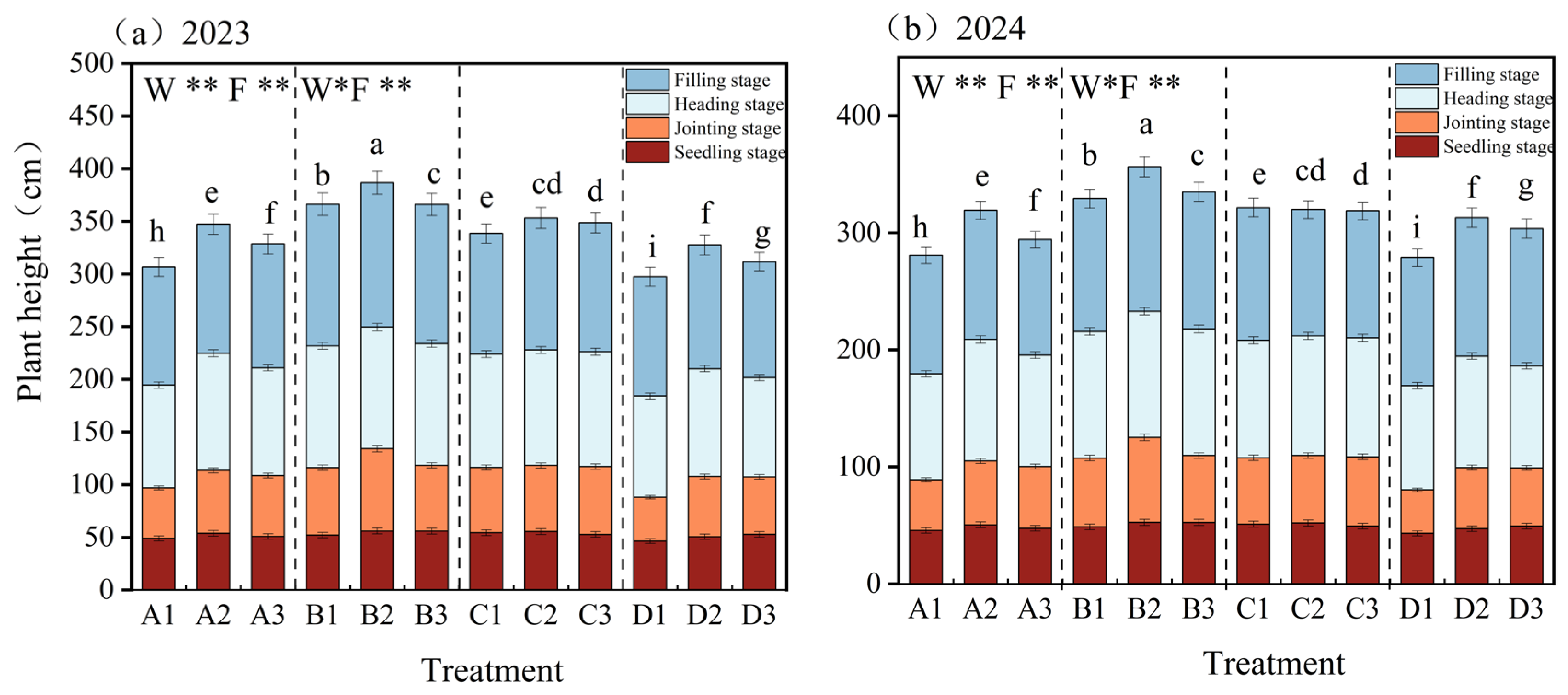
Different water and fertilizer treatments significantly affected summer maize plant height at various growth stages (Table 2). Across both the 2023 and 2024 growing seasons, plant height exhibited a consistent temporal pattern characterized by a “low-high-low” growth rate. Specifically, it increased slowly at the seedling stage, accelerated during jointing to peak at tasseling, and subsequently declined before stabilizing at maturity.
Analysis of variance revealed that consistently across the 2023–2024 growing seasons, irrigation amount, fertilization rate, and their interaction exerted highly significant effects on plant height (p < 0.01) (Figure 2) (Tables S1 and S2). Effect size analysis (partial η2) indicated that irrigation accounted for 68.5% of the variance, fertilization for 53.2%, and their interaction for 27.8%, highlighting irrigation’s dominant role in regulating plant height (Tables S11 and S12). These results indicate that the synergistic regulation of water and nitrogen is essential for optimal development. Overall, plant height initially increased but eventually decreased with rising inputs, confirming that moderate water and fertilizer supplies markedly promote growth, whereas excessive or insufficient inputs constrain it.
Treatment differences became progressively pronounced as growth advanced. At the jointing stage, the largest increase occurred under the B2 treatment and the smallest under D1, whereas at tasseling, the greatest increment shifted to the B3 treatment and the smallest to D3. Compared with border irrigation, treatments A, B, and C increased plant height by 1.57–9.09%, 13.12–23.83%, and 7.44–16.53%, respectively. At harvest, plant height ranged from 288.09 cm (D1 treatment) to a maximum of 371.57 cm (B2 treatment), reflecting a substantial difference of 70.56 cm. Furthermore, the 95% confidence intervals for mean plant height under the optimal B2 treatment ranged from 358.66 cm to 384.48 cm, confirming the precision and cross-season stability of this treatment’s performance.

3.2. Analysis of the Impact of Different Real-Time Water-Fertilizer Synergistic Regulation on Summer Maize Stem Diameter

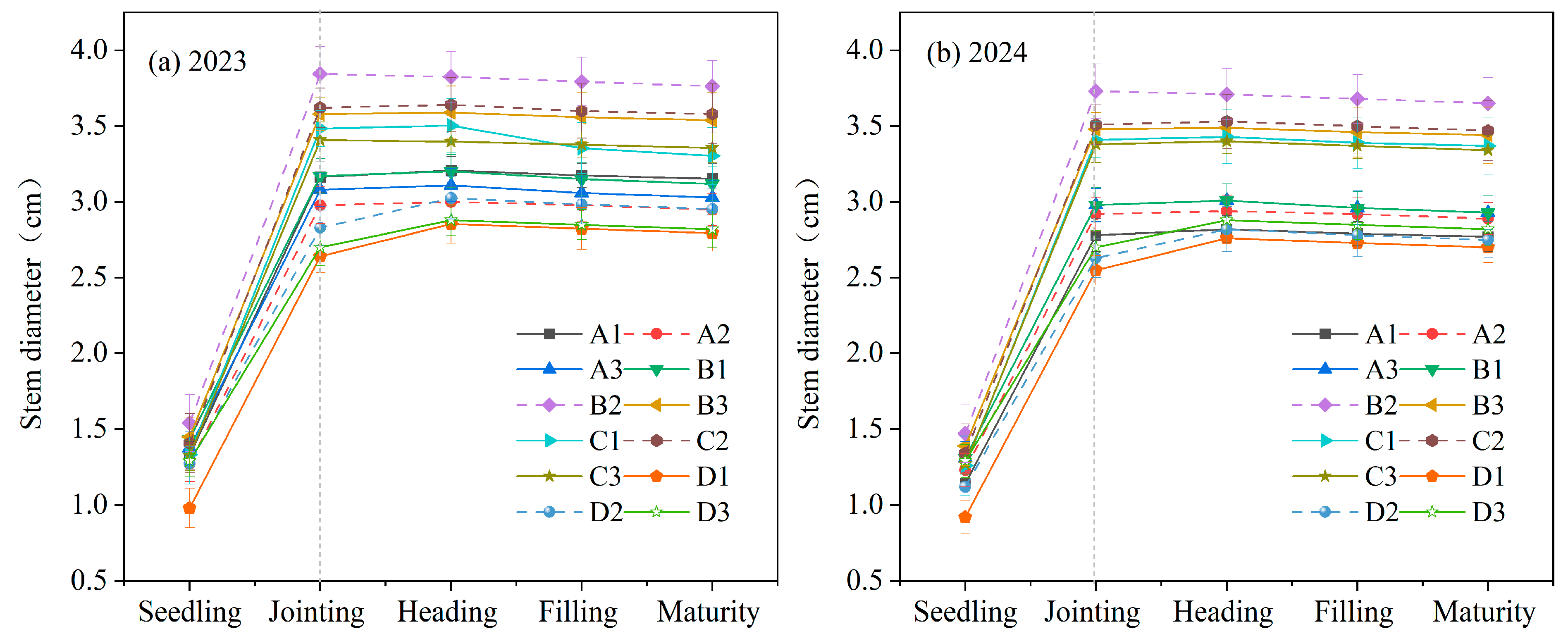
As shown in Figure 3, the temporal variation in summer maize stem diameter exhibited a similar pattern across all treatments throughout the growing season, characterized by an increase–stabilization–slight decline trend. Stem diameter increased rapidly during the early growth stage, then stabilized at a reduced growth rate, and showed a slight decrease toward the end of the growing period. In 2023, both irrigation amount and fertilization rate had highly significant effects on stem diameter development (p < 0.01), whereas the interaction between water and fertilizer was not significant (p ≥ 0.05) (Table 3) (Tables S3 and S4). This suggests that water and nitrogen act independently on stem diameter expansion rather than synergistically. Differences in stem diameter among treatments were relatively small at the seedling stage but gradually became more pronounced as the growth period progressed. This increasing divergence indicates that the cumulative effects of water and fertilizer regimes on stem growth become more apparent during the rapid growth phases. With increasing irrigation and fertilization levels, stem diameter increased rapidly from the seedling to jointing stages, with the B2 treatment consistently exhibiting the largest stem diameters. In 2024, the stem diameter growth rate peaked during the seedling to jointing stages. The lowest growth rate was observed under border irrigation with low fertilization, whereas the highest growth rate occurred under high irrigation-low fertilization. At the tasseling stage, stem diameter reached its maximum, with the B2 treatment showing the largest and the D2 treatment the smallest; the stem diameter under B2 was 31.56% greater than that under D2. After the tasseling stage, the stem diameter under all treatments declined slightly. Overall, these results indicate that a moderate, balanced supply of water and fertilizer provides the most favorable conditions for stem diameter development in summer maize throughout the growth cycle.

3.3. Analysis of the Impact of Different Real-Time Water-Fertilizer Synergistic Regulation on the Leaf Area Index of Summer Maize

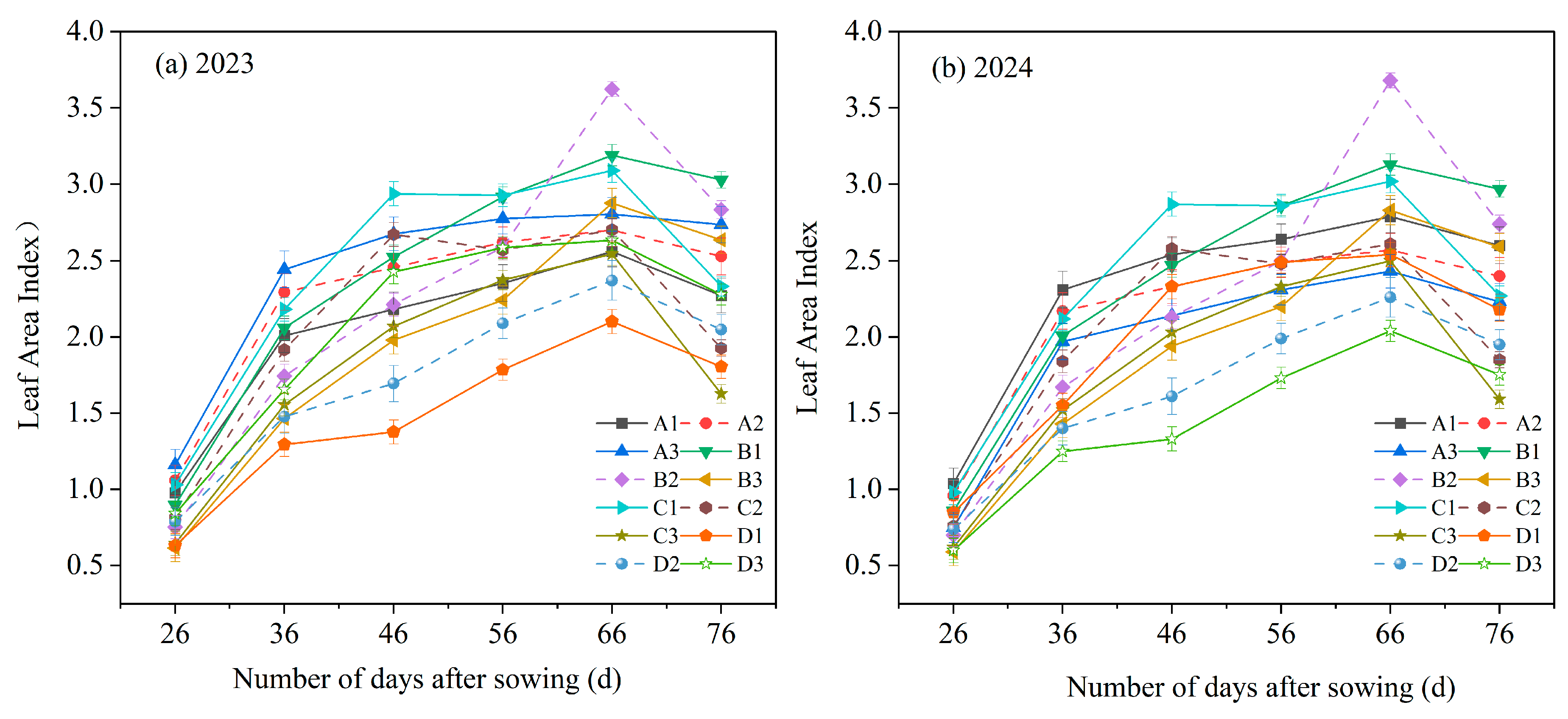
As shown in Figure 4, under real-time water–fertilizer synergistic regulation, the leaf area index (LAI) of summer maize under different treatments exhibited a broadly similar variation pattern throughout the entire growth cycle, characterized by a single-peaked curve, with an initial increase followed by a decline. The LAI reached its maximum at the tasseling stage (66 days after sowing) and subsequently decreased when the crop entered the grain-filling stage (76 days after sowing). In 2023, irrigation and fertilization exerted a highly significant effect (p < 0.01) on the leaf area index of summer maize. The interaction between irrigation and fertilization did not significantly influence the leaf area index of summer maize (p > 0.05) (Table 4) (Tables S5 and S6). This suggests that water and nitrogen act independently on LAI development rather than through synergistic interaction, similar to the pattern observed for stem diameter. During the seedling stage, LAI was relatively insensitive to water and fertilizer supply, and differences among treatments were small. At the jointing stage, although the influence of water and fertilizer remained limited, differences among treatments became more pronounced, and LAI reached its maximum values. Among all treatments, B2 had the highest LAI, whereas D3 had the lowest. Statistical analysis indicated that in 2024, both irrigation and fertilization treatments had highly significant effects on LAI (p < 0.01), while their interaction effect was not significant (p > 0.05) (Tables S13 and S14). The higher LAI under B2 reflects improved canopy development under optimal water and nitrogen supply. At the tasseling stage, B2 achieved an LAI of 3.74, which was 18.6% higher than the mean of all other real-time regulation treatments and 65.5% higher than the border irrigation control mean. This expanded leaf area increased light interception and photosynthetic capacity during the critical period of grain filling. In contrast, the lower LAI under high nitrogen treatments (A3, B3, and C3) suggests that excessive nitrogen may have induced luxury leaf growth without proportional gains in photosynthetic efficiency or possibly increased sensitivity to water stress under high transpiration demand. This indicates that water availability is the primary limiting factor for leaf growth under water-deficient conditions, overshadowing the effects of differential nitrogen application.

3.4. The Impact of Different Real-Time Water and Fertilizer Coordinated Regulation Methods on N2O Emissions from Summer Corn

3.4.1. Analysis of Variability in Total N2O Emissions

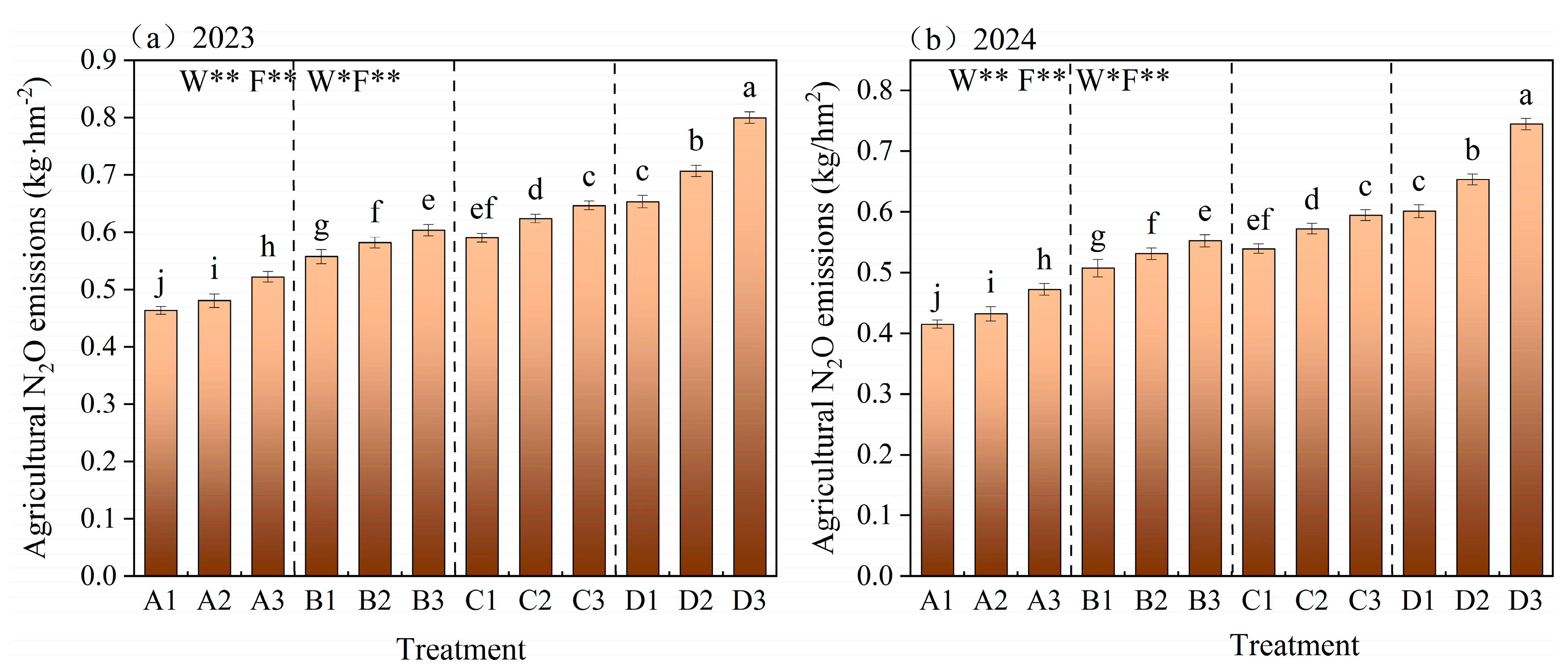
Irrigation amount, fertilization rate, and their interaction exerted highly significant regulatory effects on the cumulative nitrous oxide (N2O) emissions from summer maize farmland (p < 0.01) (Figure 5) (Tables S7 and S8). During 2023–2024, pronounced differences in cumulative N2O emissions were observed among treatments under real-time water–fertilizer synergistic regulation. Under a constant irrigation level, increasing fertilization rates significantly promoted farmland N2O emissions. Compared with the A1 and A2 treatments, cumulative N2O emissions under the A3 treatment increased by 13.20% and 8.96%, respectively. Similar trends were observed under the B and C treatments. When fertilization levels were held constant, cumulative N2O emissions increased progressively with increasing irrigation levels; compared with the A2 treatment, cumulative N2O emissions under the B2 and C2 treatments increased by 21.98% and 31.10%, respectively. Overall, among the real-time water–fertilizer regulation treatments, the C3 treatment exhibited the highest cumulative N2O emissions. Its cumulative emissions were not significantly different from those of the D1 border-irrigation low-fertilizer control but were significantly lower than those under the D2 and D3 treatments by 8.76% and 19.64%, respectively. To better contextualize these environmental impacts and facilitate comparison with other studies, the fertilizer-induced N2O emission factors (EFs) were evaluated. Under the optimized real-time water-fertilizer regulation (A and B treatments), the EFs ranged from 0.45% to 0.78%, which were notably lower than the IPCC Tier 1 default value of 1.0% for synthetic fertilizers. Conversely, the traditional excessive irrigation and high-fertilizer regimes (D2 and D3 treatments) yielded significantly higher EFs ranging from 1.25% to 1.42%, clearly exceeding the IPCC default threshold. These results indicate that excessive irrigation and fertilization markedly increase farmland N2O emissions, whereas the adoption of reasonable water–fertilizer combination strategies can effectively reduce agricultural soil carbon emissions without compromising grain yield.

3.4.2. Analysis of Dynamic Changes in N2O Emission Fluxes

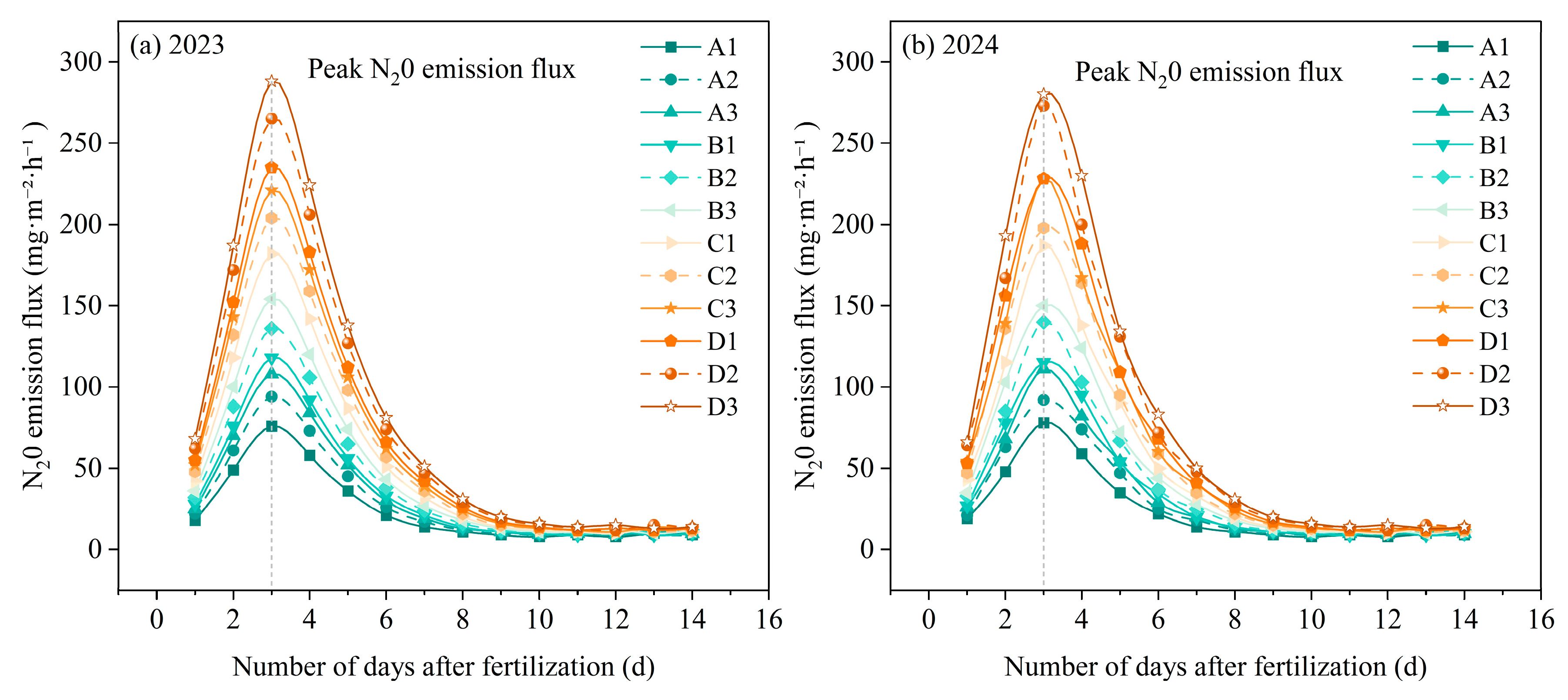
The temporal dynamics of N2O fluxes exhibited highly consistent patterns across both the 2023 and 2024 growing seasons, characterized by distinct emission peaks following combined irrigation and fertilization events (Figure 6). Across all treatments, fluxes surged sharply within 24–48 h post-application, consistently reaching their maximum absolute peak on day 3, before rapidly declining and returning to a low baseline level (approximately 8–15 mg·m−2·h−1) by days 7–10. The magnitude of these post-fertilization peaks was predominantly governed by the irrigation tier. Under the highest irrigation level (D treatments), peak fluxes were maximized, ranging from 228 to 288 mg·m−2·h−1. Under high irrigation (C treatments), peak fluxes remained substantial at 182–228 mg·m−2·h−1. In contrast, restricting water application significantly mitigated emissions, with peak fluxes dropping to 115–154 mg·m−2·h−1 under moderate irrigation (B treatments) and reaching their lowest peak ranges of 76–111 mg·m−2·h−1 under low irrigation (A treatments). Furthermore, within each specific irrigation regime, N2O emission peaks escalated consistently with increasing nitrogen application rates (from level 1 to 3), demonstrating a strong synergistic effect of water and nitrogen inputs. Notably, these coupled response patterns were highly reproducible across years, with the interannual variation in peak flux magnitudes remaining strictly within a narrow 3% margin. This distinct pattern indicates that high soil moisture following intensive irrigation (particularly in C and D treatments) rapidly displaces soil pore air, creating localized anaerobic hotspots. These temporary anaerobic conditions robustly stimulate microbial denitrification processes, thereby accelerating the conversion of fertilizer-derived nitrogen into N2O shortly after application.

3.5. Analysis of the Impact of Different Real-Time Water-Fertilizer Synergistic Regulation on Summer Maize Yield

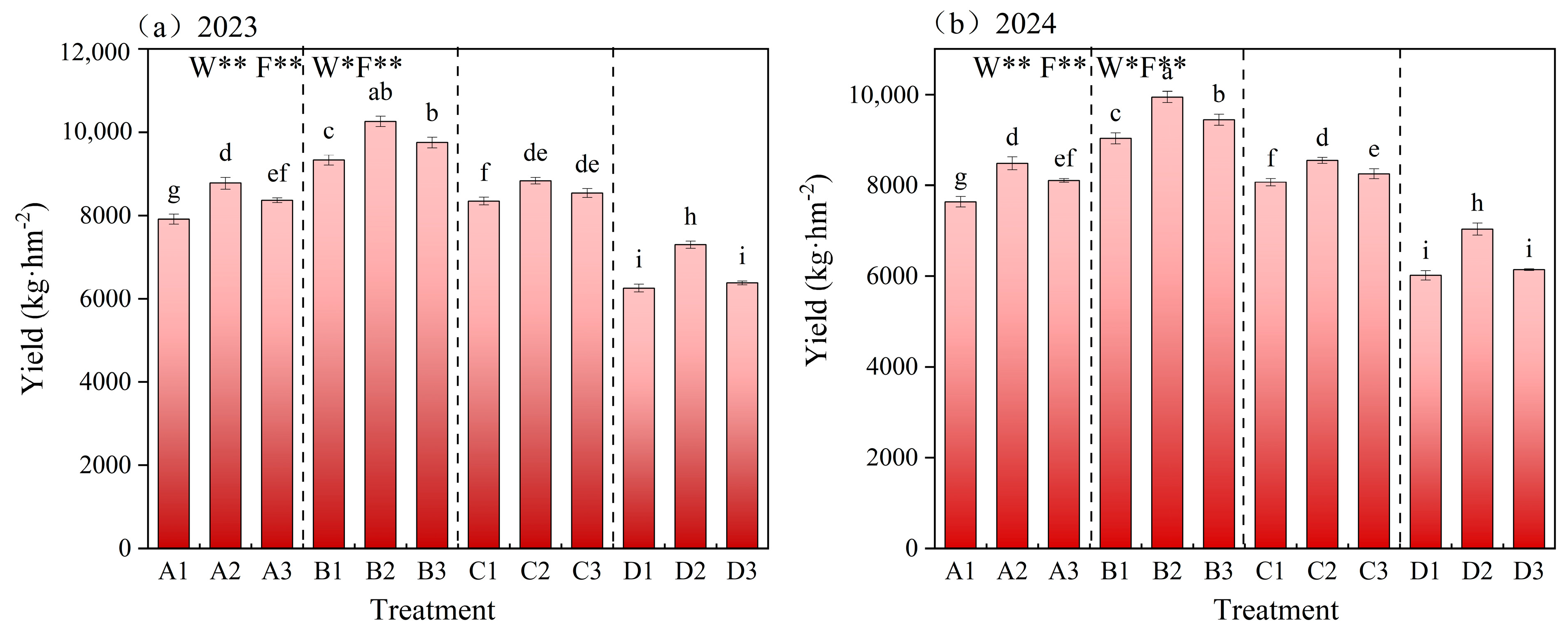
Irrigation amount, fertilization rate, and their interaction all had highly significant effects on summer maize yield (p < 0.01) (Figure 7) (Tables S9 and S10). With increasing irrigation and fertilization levels, summer maize yield exhibited a unimodal response, initially increasing and then decreasing. In 2023, the B2 treatment produced the highest yield, reaching 10,264.42 kg·ha−1, which was 9.98% and 5.52% higher than those of the B1 and B3 treatments, respectively, indicating that excessive fertilization under a given irrigation level can reduce yield. The D1 treatment resulted in the lowest yield, representing yield reductions of 26.46%, 49.17%, and 33.47% compared with the A1, B1, and C1 treatments, respectively, suggesting that when fertilization is fixed, increasing irrigation leads to an increase followed by a decline in yield. In 2024, the highest summer maize yield was again observed under the B2 treatment, while the D1 treatment produced the lowest yield. An analysis of interannual variability revealed a slight overall decline in yields during 2024 compared to 2023, likely attributable to variations in seasonal meteorological conditions. Notably, the optimal B2 treatment demonstrated superior yield stability, experiencing only a marginal 3.11% interannual decrease. In contrast, the conventional D1 treatment exhibited higher vulnerability to environmental fluctuations, showing a more pronounced 5.76% interannual yield reduction. Despite these meteorological differences between the two years, the relative ranking of the treatments and the underlying unimodal response mechanisms remained highly consistent. Under different irrigation levels (A, B, and C), summer maize yield consistently exhibited a single-peak response pattern. At identical fertilization levels, yields under the A1, B1, and C1 treatments increased by 26.02%, 55.13%, and 34.12%, respectively, compared with the D1 treatment. Under the same irrigation level, yields under the A1 treatment were 11.03% and 6.12% lower than those under the A2 and A3 treatments, respectively; yields under the B1 treatment were 10.11% and 4.57% lower than those under the B2 and B3 treatments; and yields under the C1 treatment were 5.90% and 2.31% lower than those under the C2 and C3 treatments. In summary, summer maize yield is sensitive to water and nitrogen regulation, with the moderate water and nitrogen combination (B2) being the optimal configuration for achieving high and stable yields. The water–nitrogen coupling effect, the core driving role of nitrogen, and the law of diminishing returns collectively determine the process of yield formation.
The variation in summer maize yield was primarily driven by the dynamic responses of its core components, namely effective ear density, grain number per ear, and 100-grain weight (Table 5). Across both years, the B2 treatment consistently achieved the optimal coordination of these three factors. Compared with the conventional D1 treatment, the optimal B2 treatment significantly increased the effective ear density by approximately 14%, demonstrating superior seedling establishment and survival. Furthermore, the grain number per ear and the 100-grain weight under the B2 treatment were nearly 25% and 15% higher, respectively, than those under the D1 treatment. The extremely poor performance of the D1 treatment can be attributed to frequent flood irrigation combined with low fertilization, which likely induced severe nitrogen leaching and early-stage root hypoxia, ultimately leading to severe barren tips, reduced grain sets, and restricted grain filling. Under constant irrigation conditions, the yield components consistently exhibited a unimodal response to increasing fertilization. Elevating the nitrogen application from the low to the moderate level significantly enhanced both the grain number and the kernel weight. Conversely, further increasing the fertilization to the highest level led to a universal decline in these parameters. This reduction indicates that excessive nitrogen input promotes vegetative overgrowth at the expense of reproductive allocation, thereby restricting the overall sink capacity.

3.6. Analysis of Crop Growth Indicators and the Relationship Between Farmland N2O Emissions and Yield Response

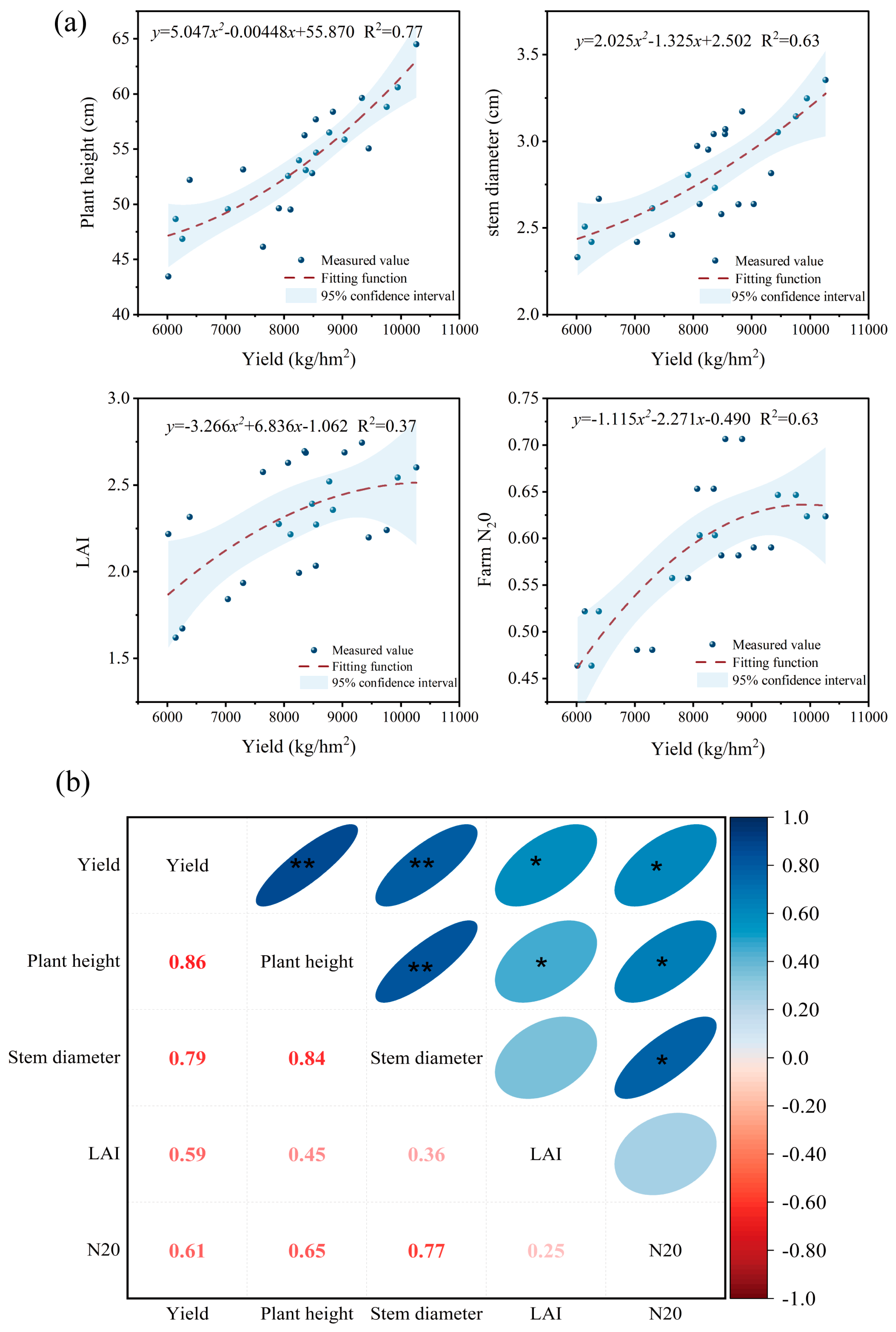
The correlation analysis between different crop growth indicators and yield (Figure 8b) revealed distinct relationships among maize growth traits, yield formation, and farmland N2O emissions. Grain yield was highly significantly and positively correlated with plant height and stem diameter (p < 0.01), while its correlations with farmland N2O emissions and leaf area index (LAI) were not significant (p > 0.05). The correlation coefficients followed the order: plant height > stem diameter > N2O emissions > LAI, indicating that plant height had the strongest influence on yield, whereas LAI contributed relatively less. Regression equations describing the relationships between individual growth indicators and yield are shown in Figure 8a. Among the examined variables, plant height exhibited the highest goodness of fit with maize yield (R2 = 0.77), and the regression equation was y = 5.047x2 − 0.00448x + 55.870, where x represents the measured plant height and y denotes the predicted yield, indicating strong predictive performance. Stem diameter and farmland N2O emissions showed moderate predictive ability (R2 = 0.63), whereas the relationship between LAI and yield showed a markedly lower goodness of fit (R2 = 0.37), suggesting limited predictive capacity.

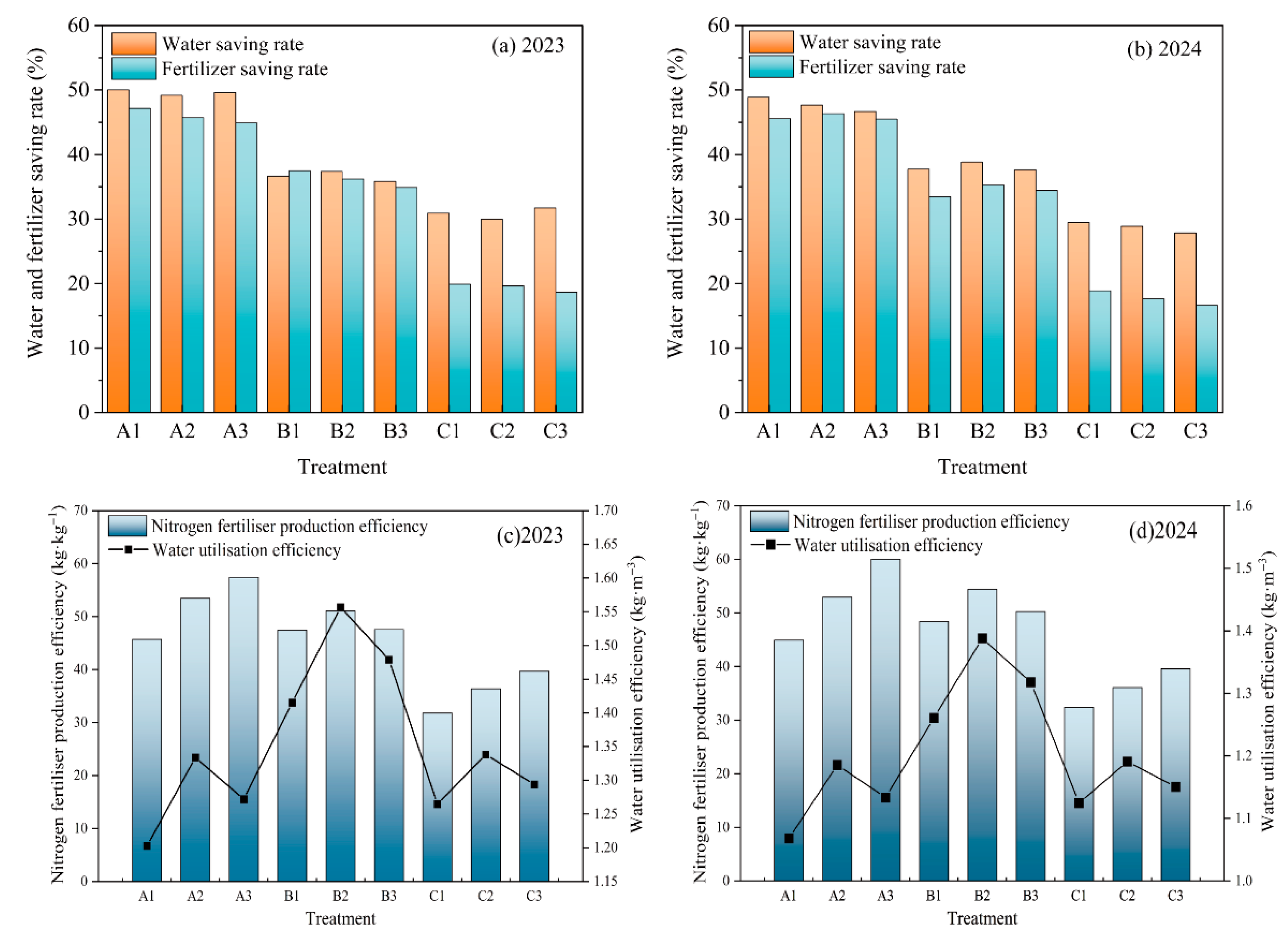
3.7. Analysis of the Impact of Different Real-Time Water-Fertilizer Synergistic Regulation on Water- and Fertilizer-Saving Rates in Summer Maize

As shown in Figure 9, compared with the D2 border-irrigation control treatment, treatment A achieved a markedly higher water-saving rate due to its lower irrigation input during 2023–2024; however, crop growth and yield were substantially reduced. Over the two years, the water-saving rates for the A1, A2, and A3 treatments reached 49.44%, 48.42%, and 48.13%, respectively, while the corresponding fertilizer-saving rates were 46.35%, 46.02%, and 45.19%, respectively. Treatment B maintained relatively high crop growth, yield, and water use efficiency, while simultaneously achieving considerable water and fertilizer savings. During 2023–2024, the water-saving rates of the B1, B2, and B3 treatments were 37.19%, 38.10%, and 36.72%, respectively, and the fertilizer-saving rates were 35.48%, 35.75%, and 34.66%, respectively. Treatment C resulted in slightly higher crop growth, yield, and water use efficiency than the border-irrigation control but remained clearly inferior to treatment B. Over the two years, the water-saving rates of the C1, C2, and C3 treatments were 30.18%, 29.44%, and 29.78%, respectively, while the fertilizer-saving rates were 19.38%, 18.64%, and 17.68%, respectively. Overall, the results indicate that the B2 treatment can significantly reduce water and fertilizer inputs while maintaining high crop yield, thereby achieving the highest water–fertilizer-saving efficiency among all treatments.
The water use efficiency and nitrogen fertilizer partial productivity of winter wheat under different real-time water-nitrogen co-regulation treatments during 2023–2024 are shown in Figure 9c,d. Compared with the C1 treatment, the B2 treatment exhibited significantly higher water use efficiency, with a 23.24% increase over the two years. The B1 and B3 treatments also showed marked improvements, increasing by 12.0% and 17.05%, respectively, while the A1 treatment decreased by 5.0%. No significant differences were observed among the remaining treatments. During 2023–2024, water use efficiency under real-time water-nitrogen regulation ranged from 1.07 to 1.56. The B2 treatment achieved 1.47, whereas the C1 treatment reached only 1.19. Compared with the C1 treatment, the B1, B2, and B3 treatments exhibited average increases ranging from 12.0% to 23.24%. The nitrogen fertilizer partial productivity under real-time water-nitrogen regulation in 2023–2024 significantly exceeded that of the C1 treatment, ranging from 32.09 to 58.71. Treatments A2 and A3 exhibited notably higher nitrogen partial productivity, increasing by 65.85% and 82.97%, respectively, compared to C1. The remaining treatments showed increases ranging from 12.88% to 64.38%. Overall, the B2 treatment maintained high levels of both water use efficiency and nitrogen fertilizer partial productivity.

3.8. Analysis of Crop Yield Increase and Water- and Fertilizer-Saving Paths

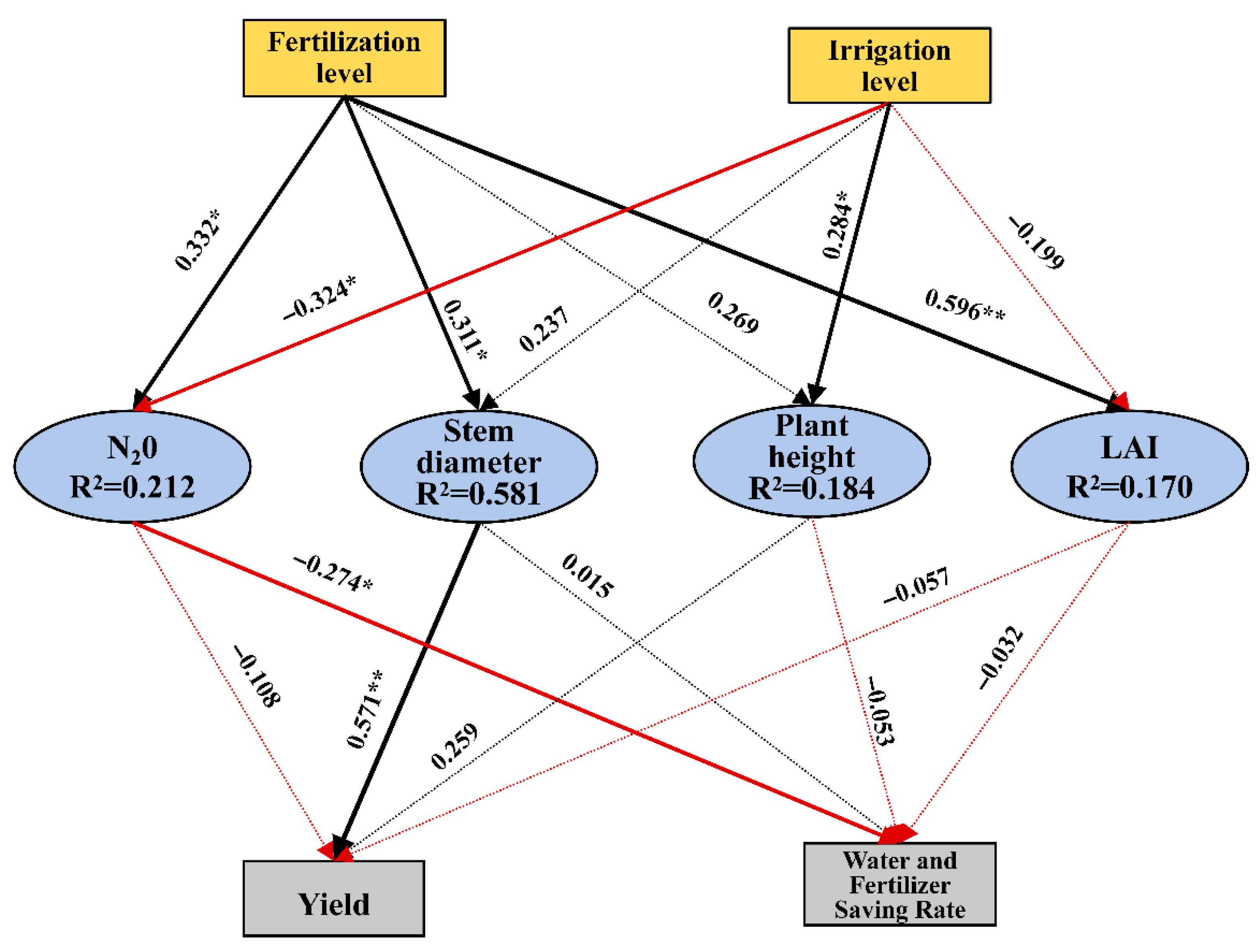
To overcome the limitations of simple regression, which primarily evaluates isolated direct relationships, a partial least squares structural equation model (PLS-SEM) was employed to simultaneously decipher the complex, multi-layered causal networks and mediating pathways within the agricultural system. The partial least squares structural equation model (PLS-SEM) path analysis revealed both the direct and indirect effects of yield and water−fertilizer-saving efficiency (Figure 10). The overall goodness-of-fit of the constructed model was robustly validated, yielding a Standardized Root Mean Square Residual (SRMR) of 0.052 and a Normed Fit Index (NFI) of 0.934, thereby confirming the high reliability and explanatory power of the analytical framework. The results of the path coefficients and specific indirect effect pathways are presented in Table 6. The analysis showed that irrigation level exerted a significant negative effect on farmland N2O emissions and a significant positive effect on plant height, with path coefficients of −0.324 and 0.284, respectively. In contrast, fertilization level had significant positive effects on farmland N2O emissions, stem diameter, and leaf area index, with path coefficients of 0.332, 0.311, and 0.596, respectively. These results highlight the complex interactions between irrigation and fertilization parameters in regulating crop growth and farmland N2O emissions. Indirect path analysis further indicated that farmland N2O emissions were significantly negatively correlated with water–fertilizer-saving efficiency, while stem diameter had a significant positive effect on yield, with path coefficients of −0.274 and 0.571, respectively. Overall, the specific pathway contributing to yield enhancement was identified as fertilization level → stem diameter → yield, whereas the pathway governing water–fertilizer-saving efficiency was determined as fertilization level → N2O emissions → water–fertilizer-saving efficiency.

4. Discussion

4.1. The Impact of Real-Time Water−Fertilizer Coordinated Regulation on Crop Growth Characteristics

This study demonstrates that under real-time water–fertilizer synergistic regulation, the dynamic variations in plant height, stem diameter, and leaf area index (LAI) of summer maize exhibit pronounced and consistent patterns. Overall, plant height followed a “low-high-low” growth trajectory, with the highest growth rate occurring at the tasseling stage. Plant height under the medium irrigation–medium fertilization treatment was significantly greater than that under other treatments. This finding is consistent with previous studies conducted in the Huang-Huai-Hai Plain, which identified the tasseling stage as the critical period for rapid plant height increase in summer maize [17,18]. These results further confirm that the tasseling stage represents a key transition from vegetative to reproductive growth, during which maize shows heightened sensitivity to water and nutrient supply. A moderate and coordinated supply of water and nutrients not only satisfies the material requirements for stem elongation but also avoids excessive vegetative growth under high water and fertilizer conditions or growth inhibition under low-input conditions, in accordance with the general principle that moderate water and fertilizer inputs promote optimal crop growth [19,20].
Stem diameter development was characterized by a rapid increase during the early growth stages (seedling to jointing), followed by a gradual slowdown thereafter. Under the B2 treatment, stem diameter reached its maximum at the tasseling stage, exceeding that under the D2 treatment by 31.56%. The enhanced stem diameter under B2 may be attributed to optimal water and nitrogen availability promoting cambial activity and vascular bundle differentiation, thereby facilitating secondary growth and mechanical strengthening. This aligns with findings by Zhuo et al. [21] in woody plants, where balanced nutrient supply stimulated vascular development and enhanced stem mechanical properties. Furthermore, appropriate nitrogen supply has been shown to upregulate genes involved in cellulose and lignin biosynthesis, contributing to stem strength [22]. In contrast, excessive irrigation and fertilization may induce root hypoxia due to excessive soil moisture, whereas insufficient water and nutrient supply can limit assimilate availability, both of which suppress sustained stem diameter growth.
The dynamic changes in LAI followed a unimodal pattern, peaking at the tasseling stage, with the highest LAI observed under the B2 treatment. The improved LAI under moderate irrigation and fertilization likely resulted from enhanced cell division and expansion in leaf meristems, driven by optimal turgor pressure and nitrogen assimilation. Nitrogen availability directly influences chlorophyll synthesis and photosynthetic enzyme activity, thereby extending the duration of functional leaf area. This finding is consistent with reports by He et al. [23] and Qiao et al. [24], which indicated that peak LAI coincides with stage-specific variations in photosynthetic efficiency. The tasseling stage is a critical period for photosynthate accumulation in summer maize. Under the medium irrigation–medium fertilization treatment, the optimized water and nutrient environment promoted leaf expansion and increased effective photosynthetic area, while avoiding excessive leaf luxuriance under high fertilization or premature leaf senescence under water-deficit conditions. Consequently, this treatment was more conducive to dry matter accumulation [25]. Overall, the responses of summer maize growth characteristics to water and fertilizer inputs exhibited clear growth-stage specificity. The coordinated application of medium irrigation and medium fertilization effectively balanced growth requirements across developmental stages and can therefore be regarded as the optimal strategy for promoting vegetative growth in summer maize.

4.2. Response Analysis of Total N2O Emissions from Summer Maize Fields Under Real-Time Water-Fertilizer Coordinated Regulation

This study found that irrigation amount, fertilization rate, and their interaction all exerted highly significant effects on cumulative N2O emissions from summer maize farmland (p < 0.01), with total emissions increasing as irrigation and fertilization levels increased. Among the treatments, cumulative N2O emissions under the high irrigation–medium fertilization regime were 9.51% higher than those under the medium irrigation–medium fertilization treatment, whereas the border irrigation–low fertilization treatment resulted in the lowest emissions. These findings are consistent with the results reported by Kuang et al. [26] and Mehmood et al. [27], who demonstrated that nitrogen fertilizer application is the primary driver of N2O emissions, which increase exponentially with increasing nitrogen input. This response is mechanistically explained by substrate-induced stimulation of ammonia-oxidizing bacteria (AOB) and denitrifiers. High nitrogen availability increases the pools of NH4+ and NO3, fueling both nitrification and denitrification pathways. Unlike previous studies that focused solely on emission magnitudes, our results reveal that the interaction between irrigation and nitrogen creates synergistic effects that cannot be predicted from single-factor analyses.
From the perspective of water regulation mechanisms, this study observed a significant increase in N2O emissions under high irrigation levels (lower irrigation threshold of 80% θf). This is consistent with the conclusions of Tian et al. [28], who reported that optimized irrigation can reduce N2O emissions by alleviating excessive soil water saturation. However, while Tian et al. [29] emphasized the absolute reduction effect of drip irrigation compared with flood irrigation, our findings demonstrate that within drip irrigation systems, the irrigation threshold critically modulates emission intensity—excessive irrigation (80% θf) diminishes the mitigation benefit. From a microbial perspective, the increase in N2O emissions under high irrigation can be linked to shifts in denitrifying community composition and activity. Prolonged high soil moisture creates anaerobic microsites that favor the expression of nirK, nirS, and nosZ genes, leading to incomplete denitrification and N2O accumulation [30]. The nosZ/nir gene ratio, which indicates the capacity for N2O reduction to N2, likely decreases under high moisture conditions, explaining the observed emission peaks.
Further analysis of water–fertilizer interaction effects indicated that cumulative N2O emissions under the low irrigation–high fertilization treatment increased by 8.23% compared with those under the corresponding low fertilization treatment at the same irrigation level. This finding extends beyond previous work by Zhu et al. [31], who identified nitrogen as the dominant factor, by demonstrating that even under water-limited conditions, excessive nitrogen input can intensify N2O emissions through enhanced nitrification. Moreover, cumulative N2O emissions under the high irrigation treatment were significantly higher than those under the border irrigation–low fertilization control, indicating that the stimulatory effect of excessive water supply on N2O emissions is partly independent of nitrogen input levels. This suggests that water-filled pore space alone can trigger denitrification when background nitrogen is present, a mechanism often overlooked in studies emphasizing nitrogen-centric controls [32]. Therefore, effective mitigation of N2O emissions from summer maize farmland requires integrated water–fertilizer management. The medium irrigation–medium fertilization strategy achieved a balance between maintaining crop growth and reducing emissions by simultaneously controlling nitrogen input and preventing excessive soil moisture, thereby offering a practical pathway for environmentally sustainable maize production.

4.3. Analysis of Summer Maize Yield and Changes in Water- and Fertilizer-Saving Rates Under Real-Time Coordinated Regulation of Water and Fertilizer

The results of this study indicate that both summer maize yield and water–fertilizer-saving efficiency exhibited a “low–high–low” response pattern to changes in irrigation and fertilization levels, with the medium irrigation–medium fertilization treatment performing optimally. This response pattern suggests that moderate coordination of water and nitrogen inputs creates favorable soil water and nutrient conditions that support balanced crop growth and resource utilization. Compared with the D2 treatment, this regime increased yield by 41.33% and water–fertilizer-saving efficiency by 36.92%. Similar responses have been reported in previous studies showing that moderate coupling of irrigation and nitrogen supply can significantly improve maize productivity and resource-use efficiency [33].
From the perspective of yield formation mechanisms, maize productivity is fundamentally governed by the dynamic balance of the “source-flow-sink” system. The high yield under the B2 treatment can be attributed to the synergistic optimization of plant height, stem diameter, and leaf area index. Adequate water and nitrogen supply likely maintained a favorable leaf water status and enhanced nitrogen assimilation, which promoted cell elongation and canopy development. Greater plant height and LAI at the tasseling stage increased the photosynthetically active radiation interception, while thicker stems enhanced assimilate transport capacity. The increase in stem diameter under the B2 treatment may be related to enhanced cambial activity and vascular bundle differentiation under balanced water and nitrogen conditions, which improves the transport efficiency of photosynthates to developing grains. Notably, despite its role in early-stage radiation interception, the prior analysis indicated that LAI exhibited relatively weak predictive power for final yield compared to stem diameter. This phenomenon can primarily be attributed to the physiological trade-offs associated with canopy dynamics. When LAI exceeds an optimal threshold—often driven by luxury water and fertilizer consumption—severe mutual shading occurs within the canopy. This self-shading drastically reduces light penetration to the middle and lower leaves, causing their respiratory consumption to outweigh photosynthetic gains and triggering premature senescence. Furthermore, a disproportionately high LAI reflects excessive vegetative investment, which disrupts the source-sink balance and competitively restricts dry matter partitioning to the grains. Consequently, morphological traits related to robust vascular transport and lodging resistance serve as more decisive indicators of final yield realization than the mere expansion of foliar area [34,35]. From an agronomic perspective, final yield is fundamentally governed by the “source-sink” balance. Although a certain LAI establishes the necessary photosynthetic “source,” excessive leaf expansion causes canopy self-shading and essentially transforms overgrown vegetative organs into competitive “sinks.” In contrast, although high irrigation and high fertilization treatments maintained relatively high growth indices, excessive vegetative growth likely reduced the proportion of photosynthates allocated to grains, and excessive soil moisture may have induced root hypoxia, ultimately resulting in lower yields than those under the B2 treatment. Meanwhile, the border irrigation–medium fertilization treatment suffered significant yield reductions due to water stress, which constrained nutrient uptake and photosynthetic efficiency.
The variation in water–fertilizer-saving efficiency further underscores the importance of moderate regulation. Under the B2 treatment, water–fertilizer-saving efficiency reached 36.92% while maintaining the highest yield, indicating that a more economic yield was produced per unit of water and fertilizer input. This improvement can be attributed to the coordinated regulation of soil moisture and nitrogen availability, which enhanced root water uptake and nutrient transport capacity. On the one hand, appropriate irrigation reduced deep percolation losses and non-productive evaporation; on the other hand, optimal nitrogen supply enhanced root water uptake and transport, mitigating stomatal closure induced by water stress [36]. In contrast, excessive irrigation reduced efficiency due to water wastage, whereas insufficient irrigation limited crop growth through water stress, thereby constraining efficiency improvement. Overall, improvements in summer maize yield and water–fertilizer-saving efficiency depend on the precise matching of water and fertilizer inputs. The medium irrigation–medium fertilization strategy optimized the balance between crop growth demand and resource supply, thereby improving canopy photosynthetic efficiency and assimilate partitioning while reducing unnecessary resource losses. These findings provide a scientific basis for achieving water-saving and high-yield summer maize production in Henan Province.

4.4. The Practical Significance and Research Limitations in Agricultural Production

This study provides an important reference for optimizing water and fertilizer management in summer maize production systems. The results indicate that the real-time water–fertilizer regulation approach can trigger irrigation and fertilization based on threshold values of soil moisture and nitrogen content. By maintaining resources within an optimal range rather than at fixed levels, this strategy can better adapt to crop demands and environmental variability, thereby offering advantages over conventional time-based fertilization practices. The results further demonstrate that the moderate irrigation–moderate fertilization regime under coordinated water–fertilizer regulation not only significantly improves crop growth and yield performance but also effectively reduces farmland N2O emissions while enhancing water and fertilizer use efficiency. Despite these proven benefits, large-scale practical application depends heavily on farmer adoption. The initial investment costs and technical complexity associated with real-time soil monitoring systems may currently present barriers to widespread acceptance. Therefore, future promotion efforts must focus on developing cost-effective, user-friendly monitoring devices and providing adequate technical training to enhance farmers’ willingness to adopt. These findings suggest that real-time coordinated water–fertilizer regulation has considerable potential for achieving the dual goals of high agricultural productivity and environmental protection and can provide a scientific basis for sustainable management in intensive maize production regions.
Although this study has achieved meaningful progress, several limitations should be considered when interpreting the results. The field experiment was conducted at a single experimental site over two years, which may not fully capture the variability associated with different climatic conditions and soil environments. In addition, the analysis of crop growth responses and N2O emission mechanisms was mainly inferred from agronomic indicators, while direct measurements of soil microbial activity and crop physiological processes were not included. Future studies should therefore incorporate multi-year and multi-location experiments, together with integrated analyses of soil microbial communities and crop physiological responses, in order to further clarify the mechanisms underlying coordinated water–fertilizer regulation.

5. Conclusions

(1) In terms of crop growth characteristics, plant height, stem diameter, and leaf area index of summer maize initially increased and then declined with rising water and fertilizer inputs. The medium irrigation–medium fertilization regime (B2) maximized these growth indices, performing significantly better than the border irrigation control (D2). This indicates that moderate, synergistically regulated inputs promote optimal growth, whereas excessive or insufficient inputs inhibit growth progression.
(2) Cumulative N2O emissions from farmland increased significantly alongside higher irrigation and fertilization levels, peaking under the border irrigation–high fertilization control. Excessive inputs substantially intensified N2O emissions, whereas the medium irrigation–medium fertilization strategy effectively mitigated these emissions and reduced carbon emission intensity while sustaining crop development.
(3) Summer maize yield exhibited a unimodal response to varying water and nitrogen levels. The medium irrigation–medium fertilization (B2) treatment produced significantly higher yields than low or excessive inputs. Compared with the conventional border irrigation control, the B2 treatment substantially increased grain yield while simultaneously achieving high water- and fertilizer-saving efficiencies, demonstrating an optimal balance between productivity and resource utilization.
(4) Maize yield was primarily governed by structural growth traits, with plant height and stem diameter showing strong predictive power for final yield, whereas leaf area index exhibited limited predictive ability. PLS-SEM analysis further identified “fertilization level → stem diameter → grain yield” as the dominant yield-enhancement pathway and “nitrogen application level → farmland N2O emissions → water–fertilizer-saving efficiency” as the key resource-saving pathway. This highlights the crucial mediating roles of stem diameter and N2O emissions in coordinating crop productivity and environmental efficiency.
Future research should focus on coupling this real-time regulatory strategy with cost-effective smart sensing technologies to overcome practical adoption barriers and facilitate its large-scale application in sustainable modern agriculture.

Supplementary Materials

The following supporting information can be downloaded at: https://www.mdpi.com/article/10.3390/agronomy16070746/s1, Tables S1 and S2 provide supplementary information on the post-hoc testing methods and hypothesis verification results for crop plant height from 2023 to 2024; Tables S3 and S4 provide supplementary information on the post-hoc testing methods and hypothesis verification results for crop stem diameter from 2023 to 2024; Tables S5 and S6 provide supplementary information on the post-hoc testing methods and hypothesis verification results for crop LAI from 2023 to 2024; Tables S7 and S8 provide supplementary information on the post-hoc testing methods and hypothesis verification results for farmland N2O emissions from 2023 to 2024; Tables S9 and S10 provide supplementary information on the post-hoc testing methods and hypothesis verification results for crop yield from 2023 to 2024; Tables S11 and S12 provide supplementary information on the test results of normality and homogeneity of variance for crop growth and N2O emission indicators in 2023; and Tables S13 and S14 provide supplementary information on the test results of normality and homogeneity of variance for crop growth and N2O emission indicators in 2024.

Author Contributions

Conceptualization, Y.D. and J.M.; methodology, J.Z. and Y.B.; software, B.C.; validation, X.H., Z.L. and B.D.; formal analysis, Y.D.; investigation, J.M.; resources, B.D.; data curation, Y.D.; writing—original draft preparation, Y.D.; writing—review and editing, J.M.; visualization, Y.B.; supervision, J.Z.; project administration, J.M. All authors have read and agreed to the published version of the manuscript.

Funding

The study was supported by the Key R&D Projects in Henan Province (241111112600). Henan Province’s Science and Technology Research Project (262102110373). Henan Provincial Key Scientific and Technological Research Project (252102110222). The Open Research Fund of Yinshanbeilu Grassland Eco-hydrology National Observation and Research Station, China Institute of Water Resources and Hydropower Research (YSS202509). Supported by the Research Fund of Key Laboratory of Water Management and Water Security for the Yellow River Basin, Ministry of Water Resources (2024-SYSJJ-01). Major Science and Technology Special Projects of the Autonomous Region (2023A02012-1). The National Natural Science Foundation of China (52269017). Xinjiang Uygur Autonomous Region “Tianshan Talents” Science and Technology Innovation Leading Talent Project (2024TSYCLJ0024).

Data Availability Statement

The datasets used in the current study are available from the corresponding author on reasonable request.

Conflicts of Interest

The authors declare no conflicts of interest.

References

  1. Piao, T.; Shi, H. Consequences of Land Degradation Under Climate Stress in Northern China: Linking Agriculture, Water, and Rural Development. Land Degrad. Dev. 2025, 1085–3278. [Google Scholar] [CrossRef]
  2. Li, X.; Li, L.; Chen, S.; Shang, Y.; Wu, Y.; Li, D.; Wang, X. Assessment and Driving Factor Analysis of Total Nitrogen Loads: A Case Study of Counties from 2000 to 2020 in Henan Province, China. Stoch. Environ. Res. Risk Assess. 2024, 38, 3377–3392. [Google Scholar] [CrossRef]
  3. Cui, X.; Bo, Y.; Adalibieke, W.; Winiwarter, W.; Zhang, X.; Davidson, E.A.; Sun, Z.; Tian, H.; Smith, P.; Zhou, F. The Global Potential for Mitigating Nitrous Oxide Emissions from Croplands. One Earth 2024, 7, 401–420. [Google Scholar] [CrossRef]
  4. Xu, W.; Yu, Y.; Zhu, S.; Liu, Y.; Sun, A. The Role of Precise Management in Mitigating Non-Point Source Nitrogen Pollution of a Reservoir Region: Environmental Profits and Economic Benefits. J. Clean. Prod. 2023, 418, 138190. [Google Scholar] [CrossRef]
  5. Liu, X.; Dai, H.; Wada, Y.; Kahil, T.; Ni, J.; Chen, B.; Chen, Y.; Guo, C.; Pan, C.; Liu, X.; et al. Achieving Carbon Neutrality Enables China to Attain Its Industrial Water-Use Target. One Earth 2022, 5, 188–200. [Google Scholar] [CrossRef]
  6. Nsoh, B.; Katimbo, A.; Guo, H.; Heeren, D.M.; Nakabuye, H.N.; Qiao, X.; Ge, Y.; Rudnick, D.R.; Wanyama, J.; Bwambale, E.; et al. Internet of Things-Based Automated Solutions Utilizing Machine Learning for Smart and Real-Time Irrigation Management: A Review. Sensors 2024, 24, 7480. [Google Scholar] [CrossRef] [PubMed]
  7. Gupta, N.; Singh, Y.; Jat, H.S.; Singh, L.K.; Choudhary, K.M.; Sidhu, H.S.; Gathala, M.K.; Jat, M.L. Precise Irrigation Water and Nitrogen Management Improve Water and Nitrogen Use Efficiencies under Conservation Agriculture in the Maize-Wheat Systems. Sci. Rep. 2023, 13, 12060. [Google Scholar] [CrossRef] [PubMed]
  8. Ding, Y.; Wang, M.; Jin, J.; Sun, Z.; Zhang, J.; Zhu, L. Risk of Real-Time Irrigation Decision-Making System for Farmland in Arid Irrigation Districts: Methodology and Case Study. Agric. Water Manag. 2025, 320, 109851. [Google Scholar] [CrossRef]
  9. Jamal, A.; Cai, X.; Qiao, X.; Garcia, L.; Wang, J.; Amori, A.; Yang, H. Real-Time Irrigation Scheduling Based on Weather Forecasts, Field Observations, and Human-Machine Interactions. Water Resour. Res. 2023, 59, e2023WR035810. [Google Scholar] [CrossRef]
  10. Liao, R.; Zhang, S.; Zhang, X.; Wang, M.; Wu, H.; Zhangzhong, L. Development of Smart Irrigation Systems Based on Real-Time Soil Moisture Data in a Greenhouse: Proof of Concept. Agric. Water Manag. 2021, 245, 106632. [Google Scholar] [CrossRef]
  11. Xing, Y.; Wang, X. Precise Application of Water and Fertilizer to Crops: Challenges and Opportunities. Front. Plant Sci. 2024, 15, 1444560. [Google Scholar] [CrossRef] [PubMed]
  12. Mao, J.; Ahmad, H.; Tung, S.A.; Abbas, H.; Li, Z.; Tan, X.; Zhou, X. Optimizing Controlled-Release Nitrogen Fertilizer Through Long-Term Straw Return to Enhance Photosynthesis, Nutrient Use, and Yield in Spring Maize. Land Degrad. Dev. 2026. [Google Scholar] [CrossRef]
  13. Kumar, K.; Parihar, C.M.; Nayak, H.S.; Sena, D.R.; Godara, S.; Dhakar, R.; Patra, K.; Sarkar, A.; Bharadwaj, S.; Ghasal, P.C.; et al. Modeling Maize Growth and Nitrogen Dynamics Using CERES-Maize (DSSAT) under Diverse Nitrogen Management Options in a Conservation Agriculture-Based Maize-Wheat System. Sci. Rep. 2024, 14, 11743. [Google Scholar] [CrossRef] [PubMed]
  14. He, Y.; Zhang, F.; Yang, M.; Luo, J.; Su, Z. Erosion Reduces Soil Nitrogen and Regulates Its Physical Fraction Proportions in Long-Term Cultivated Sloping Farmlands of Northeast China’s Black Soil Region. Land Degrad. Dev. 2025. [Google Scholar] [CrossRef]
  15. Andrews, H.M.; Homyak, P.M.; Oikawa, P.Y.; Wang, J.; Jenerette, G.D. Water-Conscious Management Strategies Reduce per-Yield Irrigation and Soil Emissions of CO2, N2O, and NO in High-Temperature Forage Cropping Systems. Agric. Ecosyst. Environ. 2022, 332, 107944. [Google Scholar] [CrossRef]
  16. Carbonell-Bojollo, R.M.; Veroz-González, Ó.; González-Sánchez, E.J.; Ordóñez-Fernández, R.; Moreno-García, M.; Repullo-Ruibérriz de Torres, M.A. Soil Management, Irrigation and Fertilisation Strategies for N2O Emissions Mitigation in Mediterranean Agricultural Systems. Agronomy 2022, 12, 1349. [Google Scholar] [CrossRef]
  17. Wang, P.; Wu, D.; Yang, J.; Ma, Y.; Feng, R.; Huo, Z. Summer Maize Growth under Different Precipitation Years in the Huang-Huai-Hai Plain of China. Agric. For. Meteorol. 2020, 285–286, 107927. [Google Scholar] [CrossRef]
  18. Ling, M.; Han, H.; Hu, X.; Xia, Q.; Guo, X. Drought Characteristics and Causes during Summer Maize Growth Period on Huang-Huai-Hai Plain Based on Daily Scale SPEI. Agric. Water Manag. 2023, 280, 108198. [Google Scholar] [CrossRef]
  19. Hu, T.; Li, K.; Xiong, K.; Wang, J.; Yang, S.; Wang, Z.; Gao, A.; Yu, X. Research Progress on Water–Fertilizer Coupling and Crop Quality Improvement and Its Implication for the Karst Rock Desertification Control. Agronomy 2022, 12, 903. [Google Scholar] [CrossRef]
  20. Yang, Z.; Kong, T.; Xie, J.; Yang, T.; Jiang, Y.; Feng, Z.; Zhang, Z. Appropriate Water and Fertilizer Supply Can Increase Yield by Promoting Growth While Ensuring the Soil Ecological Environment in Melon Production. Agric. Water Manag. 2023, 289, 108561. [Google Scholar] [CrossRef]
  21. Zhou, M.; Li, Y.; Zhang, K.; Wang, J.; Li, J.; Gao, K.; Wang, B. Mycorrhizal Associations and Root Morphology Shape Mechanical Performance in Woody Plants from Cold Regions. Sci. Rep. 2025, 15, 17926. [Google Scholar] [CrossRef]
  22. Ojeda-Rivera, J.O.; Barnes, A.C.; Ainsworth, E.A.; Angelovici, R.; Basso, B.; Brindisi, L.J.; Brooks, M.D.; Busch, W.; Buttelmann, G.L.; Castellano, M.J.; et al. Designing a Nitrogen-Efficient Cold-Tolerant Maize for Modern Agricultural Systems. Plant Cell 2025, 37, koaf139. [Google Scholar] [CrossRef] [PubMed]
  23. He, L.; Li, H.; He, J.; Han, D.; Li, R.; Wang, H. Irrigation at Appearance of Top 2nd or Flag Leaf Could Improve Canopy Photosynthesis by Regulating Light Distribution and LAI at Each Leaf Layer. Field Crops Res. 2023, 295, 108883. [Google Scholar] [CrossRef]
  24. Qiao, L.; Gao, D.; Zhao, R.; Tang, W.; An, L.; Li, M.; Sun, H. Improving Estimation of LAI Dynamic by Fusion of Morphological and Vegetation Indices Based on UAV Imagery. Comput. Electron. Agric. 2022, 192, 106603. [Google Scholar] [CrossRef]
  25. Ahmed, Z.; Gui, D.; Murtaza, G.; Yunfei, L.; Ali, S. An Overview of Smart Irrigation Management for Improving Water Productivity under Climate Change in Drylands. Agronomy 2023, 13, 2113. [Google Scholar] [CrossRef]
  26. Kuang, W.; Gao, X.; Gui, D.; Tenuta, M.; Flaten, D.N.; Yin, M.; Zeng, F. Effects of Fertilizer and Irrigation Management on Nitrous Oxide Emission from Cotton Fields in an Extremely Arid Region of Northwestern China. Field Crops Res. 2018, 229, 17–26. [Google Scholar] [CrossRef]
  27. Mehmood, F.; Wang, G.; Gao, Y.; Liang, Y.; Chen, J.; Si, Z.; Ramatshaba, T.S.; Zain, M.; Rahman, S.U.; Duan, A. Nitrous Oxide Emission from Winter Wheat Field as Responded to Irrigation Scheduling and Irrigation Methods in the North China Plain. Agric. Water Manag. 2019, 222, 367–374. [Google Scholar] [CrossRef]
  28. Tian, D.; Zhang, Y.; Mu, Y.; Zhou, Y.; Zhang, C.; Liu, J. The Effect of Drip Irrigation and Drip Fertigation on N2O and NO Emissions, Water Saving and Grain Yields in a Maize Field in the North China Plain. Sci. Total Environ. 2017, 575, 1034–1040. [Google Scholar] [CrossRef]
  29. Tian, D.; Zhang, Y.; Zhou, Y.; Mu, Y.; Liu, J.; Zhang, C.; Liu, P. Effect of Nitrification Inhibitors on Mitigating N2O and NO Emissions from an Agricultural Field under Drip Fertigation in the North China Plain. Sci. Total Environ. 2017, 598, 87–96. [Google Scholar] [CrossRef]
  30. Ji, M.; Tian, H.; Wu, X.; Li, J.; Zhu, Y.; Wu, G.; Xu, T.; Wang, J.; Zhang, X. Enhanced N2O Emission Rate in Field Soil Undergoing Conventional Intensive Fertilization Is Attributed to the Shifts of Denitrifying Guilds. Pedosphere 2021, 31, 145–156. [Google Scholar] [CrossRef]
  31. Zhu, Y.; Li, Z.; Zhao, D.; Zhang, B.; Zhu, B.; Yao, Z.; Kiese, R.; Butterbach-Bahl, K.; Zhou, M. Effects of Conservation Agriculture on Soil N2O Emissions and Crop Yield in Global Cereal Cropping Systems. Glob. Change Biol. 2025, 31, e70048. [Google Scholar] [CrossRef] [PubMed]
  32. Gopal, R.; Singh, N.K.; Ashoka, P.; Yadav, V.; Mohanty, L.K.; Panotra, N.; Shashidhar, K.S.; Kumar, J.; Anand, P.; Pathania, D. Precision Irrigation Techniques for Optimizing Water Use Efficiency in Agriculture. Arch. Curr. Res. Int. 2025, 25, 347–362. [Google Scholar] [CrossRef]
  33. Wu, J.; Wang, L.; Long, H.; Li, X.; Guo, W.; Omrani, H. Anticipatory Management for Sustainable Cultivated Land Transitions: Aligning Multifunctional Trajectories with Adaptive Zoning Guidance. J. Geogr. Sci. 2026, 36, 16–44. [Google Scholar] [CrossRef]
  34. Xue, J.; Gou, L.; Shi, Z.; Zhao, Y.; Zhang, W. Effect of Leaf Removal on Photosynthetically Active Radiation Distribution in Maize Canopy and Stalk Strength. J. Integr. Agric. 2017, 16, 85–96. [Google Scholar] [CrossRef]
  35. Duan, M.; Zhang, X.; Wei, Z.; Chen, X.; Zhang, B. Effect of Maize Canopy Structure on Light Interception and Radiation Use Efficiency at Different Canopy Layers. Agronomy 2024, 14, 1511. [Google Scholar] [CrossRef]
  36. Zhao, B.; Wang, S.; Wang, A.; Liu, T.; Li, K.; Zhang, M.; Yu, Y.; Cao, J. Water and Nitrogen Transport in Wheat and Maize: Impacts of Irrigation, Fertilization, and Soil Management. Agriculture 2025, 15, 2442. [Google Scholar] [CrossRef]
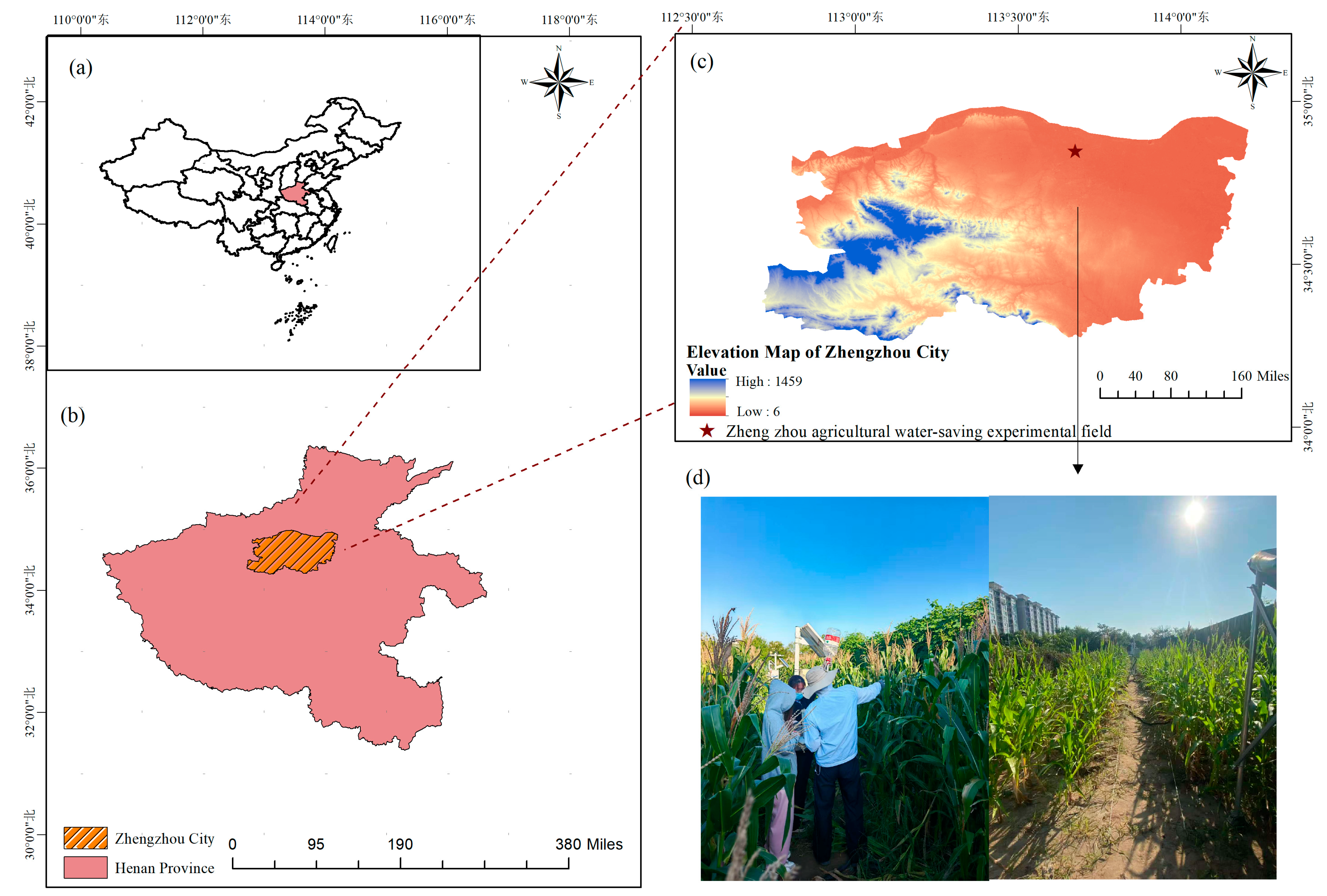
Figure 1. Location map of the test area. (a) Henan Province, China; (b) Zhengzhou City, Henan Province; (c) the Zhengzhou agricultural water-saving experimental field; (d) Planting site and instrument layout of agricultural water-saving experimental fields in Zhengzhou.
Agronomy 16 00746 g001
Figure 2. Variability in plant height from 2023 to 2024. Note: Different lowercase letters indicate significant differences between treatments, * represents a significant relationship (p ≤ 0.05), ** represents a highly significant relationship (p ≤ 0.01), and ns represents no significant relationship (p ≥ 0.05).
Agronomy 16 00746 g002
Figure 3. Changes in the stem diameter growth period from 2023 to 2024.
Agronomy 16 00746 g003
Figure 4. Change in leaf area index during the growth period from 2023 to 2024.
Agronomy 16 00746 g004
Figure 5. N2O emissions from farmland in 2023–2024. Note: Different lowercase letters indicate significant differences between treatments, * represents a significant relationship (p ≤ 0.05), ** represents a highly significant relationship (p ≤ 0.01), and ns represents no significant relationship (p ≥ 0.05).
Agronomy 16 00746 g005
Figure 6. Time-dependent analysis of N2O emission fluxes.
Agronomy 16 00746 g006
Figure 7. Corn yield in 2023–2024. Note: Different lowercase letters indicate significant differences between treatments, * represents a significant relationship (p ≤ 0.05), ** represents a highly significant relationship (p ≤ 0.01), and ns represents no significant relationship (p ≥ 0.05).
Agronomy 16 00746 g007
Figure 8. Relationship between crop growth, farmland N2O emission indicators, and yield response. (a) shows the linear fitting analysis of the output, and (b) presents the correlation analysis. Note: (a) shows the linear fitting analysis of the output, and (b) presents the correlation analysis. * represents a significant relationship (p ≤ 0.05), ** represents a highly significant relationship (p ≤ 0.01), and ns represents no significant relationship (p ≥ 0.05).
Agronomy 16 00746 g008
Figure 9. Analysis of water- and fertilizer-saving rates, water utilization efficiency and nitrogen fertilizer productivity from 2023 to 2024.
Agronomy 16 00746 g009
Figure 10. PLS path analysis model construction. Note: Arrow width scales with standardized path coefficients. Solid and dashed arrows indicate significant (p < 0.05) and non-significant relationships, respectively. Black and red arrows represent positive and negative effects, while orange and blue arrows denote the direct influences of irrigation amount (W) and drip frequency on yield and emergence. Significance is marked by * (p < 0.05) and ** (p < 0.01). R2 values quantify the proportion of variance explained in each dependent variable. Orange, blue, and gray areas correspond to experimental dependent variables, indirect influencing indices, and outcome variables, respectively.
Agronomy 16 00746 g010
Table 1. Design of field experiment for real-time water and fertilizer regulation of summer maize in 2023–2024.
NumberUpper and Lower Limits of Water FillingUpper and Lower Limits of Fertilization (mg·kg−1)Treatment
160%θf–70%θf (A)550–750A1
2750–950A2
3950–1150A3
460%θf–80%θf (B)550–750B1
5750–950B2
6950–1150B3
770%θf–90%θf (C)550–750C1
8750–950C2
9950–1150C3
101800 m3/hm2 (D)1060 kg/hm2D1
111260 kg/hm2D2
121460 kg/hm2D3
Note: θf represents the field moisture content of soil.
Table 2. Plant height growth rate from 2023 to 2024.
TreatmentPlant Height Growth Rate in 2023 (cm·d−1)Plant Height Growth Rate in 2024 (cm·d−1)
A11.6721.693
A22.0121.900
A31.8931.791
B12.1212.062
B22.3002.251
B32.1001.996
C12.0001.893
C22.8612.012
C32.0601.973
D11.6721.592
D21.8911.800
D31.8611.811
Table 3. Difference in stem diameter from 2023 to 2024.
Treatment2023 Stem Diameter (cm)2024 Stem Diameter (cm)
A13.15 c2.77 c
A22.94 c2.89 c
A33.02 c2.93 c
B13.11 c2.90 c
B23.76 a3.65 a
B33.53 ab3.44 b
C13.44 b3.37 b
C23.57 ab3.47 b
C33.43 c3.34 b
D12.79 d2.70 cd
D22.95 c2.75 cd
D32.98 c2.82 c
Note: Different lowercase letters indicate significant differences between treatments.
Table 4. Analysis of differences in leaf area index from 2023 to 2024.
TreatmentLeaf Area Index in 2023Leaf Area Index in 2024
A12.92 c2.79 c
A22.70 d2.57 d
A32.47 e2.43 e
B13.19 b3.13 b
B23.79 a3.68 a
B32.87 c2.83 c
C12.87 c3.02 c
C22.70 d2.61 d
C32.54 e2.50 e
D12.63 de2.54 e
D22.57 e2.26 f
D32.43 e2.04 f
Note: Different lowercase letters indicate significant differences between treatments.
Table 5. Composition of summer corn yield in 2023–2024.
TreatmentProduction Composition for the Year 2023Production Composition for the Year 2024
Number of Ears (Thousand Ears·hm−2)Number of Grains per Spike (Grains·Spike−1)Hundred Grains (g)Number of Ears (Ten Thousand Ears·hm−2)Number of Grains per Ear (Grains·Ear−1)100-Grain Weight (g)
A16.32462.431.86.25455.231.6
A26.48483.532.96.4477.532.6
A36.4474.232.46.32468.232.2
B16.6495.633.66.52488.533.4
B26.78512.434.86.7505.534.2
B36.68503.234.26.62495.233.9
C16.42472.532.46.35465.432.1
C26.52485.632.86.45478.232.6
C36.46476.532.56.4469.532.3
D15.92412.530.25.85405.229.8
D26.22442.831.26.15435.530.9
D35.98416.530.45.92408.529.9
Table 6. PLS-SEM path coefficients and associated indirect effects.
TrailsIndirect Impact Factor
Fertilization level → LAI0.596
Fertilization level→ N2O0.332
Fertilization level →> Plant height0.269
Fertilization level → Stem diameter0.311
Irrigation level → LAI−0.199
Irrigation level → N2O−0.324
Irrigation level → Plant height0.284
Irrigation level → Stem diameter0.237
LAI → Yield−0.057
LAI → Water- and Fertilizer-Saving Rate−0.032
N2O → Yield−0.108
N2O → Water- and Fertilizer-Saving Rate−0.274
Plant height → Yield0.571
Plant height → Water- and Fertilizer-Saving Rate0.015
Stem diameter → Yield0.259
Stem diameter → Water- and Fertilizer-Saving Rate−0.053
Disclaimer/Publisher’s Note: The statements, opinions and data contained in all publications are solely those of the individual author(s) and contributor(s) and not of MDPI and/or the editor(s). MDPI and/or the editor(s) disclaim responsibility for any injury to people or property resulting from any ideas, methods, instructions or products referred to in the content.