Article

Genome-Wide Association Study Identifies Novel Loci and Candidate Genes Regulating Seed Size-Related Traits in Peanut (Arachis hypogaea L.)

1
Nanchong Academy of Agricultural Sciences, Nanchong 637000, China
2
Key Laboratory of Oil Crops Biology and Genetic Improvement, Ministry of Agricultural and Rural Affairs, Oil Crops Research Institute, Chinese Academy of Agricultural Sciences, Wuhan 430062, China
3
Department of Horticulture, College of Agriculture and Natural Resources, Debre Markos University, Debre Markos P.O. Box 269, Ethiopia
*
Authors to whom correspondence should be addressed.
Agronomy 2026, 16(7), 735; https://doi.org/10.3390/agronomy16070735
Submission received: 9 February 2026 / Revised: 15 March 2026 / Accepted: 18 March 2026 / Published: 31 March 2026
(This article belongs to the Section Crop Breeding and Genetics)

Abstract

Seed size-related traits are pivotal determinants of yield and appearance quality in peanut breeding programs. This study aimed to (1) investigate the genetic diversity and population structure of 120 peanut accessions (including landraces, cultivated varieties, and introduced germplasm) through genome-wide resequencing, and (2) identify key genomic regions and candidate genes associated with seed size-related traits using Genome-wide association studies (GWAS) and haplotype analysis. The population relationship and the evolution of peanuts using a large-scale single nucleotide polymorphism (SNP) dataset generated from the genome-wide resequencing of 120 peanut accessions was explored. GWAS and haplotype analysis were employed to identify regions and candidate genes associated with seed size-related traits. GWAS and haplotype analysis identified a novel region associated with HSW and SW on chr14, and a haplotype that was more dominant in HSW and SW. Two candidate genes were screened by combining LD decay distance, SNP variation information and gene function annotations.

1. Introduction

Peanut (Arachis hypogaea L.) is one of the most widely cultivated oil and cash crops globally, serving as a significant source of edible oil and protein. In China, peanut production contributes over 40% of the global output, yet yield improvement remains a major challenge due to biotic and abiotic stresses (http://faostat.fao.org/, accessed on 20 January 2026). Enhancing seed size-related traits (e.g., hundred-seed weight, HSW) is critical for achieving higher yields and meeting industrial processing demands. Seed size-related traits always include seed length (SL), seed width (SW) and length-to-width ratio (SL/W). These traits are not only crucial factors influencing yield, but also serve as visual characteristics that have been selected during the processes of artificial domestication and breeding. In particular, the shape of peanut seeds is a critical determinant of the suitability of peanut varieties for various food processing applications. For instance, in China, round peanut is preferred for confectionary whereas oblong-shaped peanut is used for fried products [1]. Therefore, studying the genetic basis of peanut seed size-related traits is essential for peanut breeding.
As an allotetraploid (2n = 4x = 40, AABB genome) originating from a hybridization between the wild diploid progenitors Arachis duranensis (AA) and Arachis ipaensis (BB), the cultivated peanut has a complex genetic architecture. Extensive research has been conducted to unravel the genetic basis of seed size-related traits, which are known to be controlled by multiple genes [2,3]. Based on linkage maps, bulked segregant analysis sequencing (BSA-seq), and GWAS, numerous quantitative trait loci (QTLs) have been identified, predominantly located on chromosomes 2 [4], 5 [5,6,7,8,9,10,11], 6 [4,9,11], 7 [12,13], 15 [9], and 16 [8,9,11,14,15]. Some loci have been consistently identified across multiple studies. Among these QTLs, a few have been further fine-mapped and functionally characterized. For instance, Zhao et al. [16] cloned PSW1, an LRR-RLK gene on chromosome 7 that regulates pod size by modulating stem cell activity via interaction with AhBAK1 and downstream AhPLT1. More recently, Lu et al. [17] identified AhPDS1 on chromosome 6 as a key regulator of pod and seed size, demonstrating its role in auxin biosynthesis through the indole-3-pyruvic acid pathway. These studies provide valuable insights into the molecular mechanisms governing peanut yield.
However, further follow-up research is challenging due to the low density of early molecular markers, as well as the large genome size (~2.7 Gb) and narrow genetic base of peanut. The advancement of high-throughput sequencing technology has significantly improved the efficiency and accuracy of gene identification through GWAS, which is based on single nucleotide polymorphism (SNP) markers identified from the natural populations. This approach has proven to be an effective means of identification and has been reported in major crops such as rice [18,19], maize [20], and soybean [21]. Substantial progress has been made in the localization of important traits in peanuts, including divergence between peanut subspecies [11], branching habit [15], oil biosynthesis [15], seed coat color [11]. However, the genomic variations underlying seed size-related traits diversity owing to natural and artificial selections have not yet been fully investigated, and only a limited number of germplasms have been utilized for improving agronomic traits.
The reliability of GWAS is ensured by its diverse germplasm and precise sequencing capabilities. This research analyzed 120 peanut accessions, selected for their distinct seed-size traits, originating from 12 provinces in China and 9 other countries. Whole-genome resequencing was performed to assess genetic diversity and conduct a GWAS for seed-size traits. Additionally, haplotype variations and candidate genes linked to significant SNPs were examined to better understand the genetic factors influencing seed size.

2. Materials and Methods

2.1. Plant Materials

The 120 peanut accessions used in this study were jointly provided by the Nanchong Academy of Agricultural Sciences and the National Peanut Germplasm Repository of China (Oil Crops Research Institute, Chinese Academy of Agricultural Sciences). The natural population comprises 38 local landraces and 27 cultivated varieties from 12 provinces in China, as well as 55 introduced varieties originating from 9 countries (Table S1).

2.2. Phenotypic Investigation and Field Management

The experimental materials were planted in Nanchong, Sichuan Province, China (30.58° N, 106.08° E), over three consecutive years (2021, 2022, and 2023), and were denoted as E1, E2, and E3, respectively. Plants were sown in May and harvested in late September each year. The region has a humid subtropical climate with an average annual temperature of 17.5 °C. Drip irrigation was applied as needed, and standard agronomic practices for pest and weed control were followed. A randomized block design with three replicates was adopted for the experiment. At maturity, five plants with relatively consistent growth (excluding marginal plants) were collected from the field. In the laboratory, twenty mature and full seeds were selected, and HSW, SL, SW and SL/W were measured using a Wanshen Seed Tester. The assessment of agronomic traits was conducted in accordance with the Specification and Data Standard for the Description of Peanut Germplasm Resources.
SPSS (version 26.0) was used for descriptive statistics and correlation analysis of the data. Origin was used for frequency distribution mapping. The best linear unbiased prediction (BLUP) of the four traits was estimated using the lmer function of the lme4 package in R. The formula used for generalized heritability was h2 = σ2g/(σ2g + σ2ge/n + σ2e/nr), where σ2g is the variance of genotype, σ2ge is the variance of genotype and environment interaction, σ2e is the variance of environment, n is the number of environments, and r is the number of repeats.

2.3. Whole-Genome Re-Sequencing and SNP Genotyping

Young leaves from each accession were collected from plants grown in the field and DNA was extracted by the cetyltrimethylammonium bromide method. The quality of DNA was assessed using NanoDrop 200 and 1% agarose gel electrophoresis. Whole genome resequencing (WGS) was performed on the BGISEQ-500/MGISEQ-2000 platform. Clean data were obtained by removing adapters and low-quality reads using Soapnuke software (BGI, Hong Kong, China). The Burrows-Wheeler Aligner (BWA) was then used to map high-quality unique read segments onto the reference genome of Tifrunner (https://data.legumeinfo.org/Arachis/hypogaea/genomes/Tifrunner.gnm2.J5K5/, accessed on 20 January 2026). SNPs were identified at the population level using the genomic analysis tool (GATK, v2.4).To ensure the reliability of SNPs, only high-quality SNPs (DP ≥ 4, MAF ≥ 0.05, Miss ≤ 0.2) were retained for subsequent analysis. Unless otherwise specified, default parameters were used for all software.

2.4. Phylogenetic Tree and Population Structure Analysis

Principal component analysis (PCA), population structure analysis, phylogenetic tree construction, and relative phylogenetic relationship analysis were performed using the high-quality SNPs markers obtained from 120 peanut accessions. PCA and population structure analysis were performed using PLINK. The phylogenetic tree was constructed using the maximum likelihood method in FastTree.

2.5. Linkage-Disequilibrium Analysis

PopLDdecay software was used to calculate the square correlation coefficient (r2) between pairwise SNPs to assess linkage disequilibrium (LD) decay in this population.

2.6. Genome-Wide Association Analysis and Candidate Gene Prediction

Genome-wide association analysis for the four seed-size traits across three environments was performed using the Mixed Linear Model (MLM) implemented in the GAPIT R package. This model incorporates population structure (Q matrix) and relative kinship (K matrix) to minimize spurious associations. Candidate genes located within 100 kb upstream or downstream of significantly associated SNPs were identified from the reference genome.

3. Results

3.1. Analysis of Phenotypic Variations

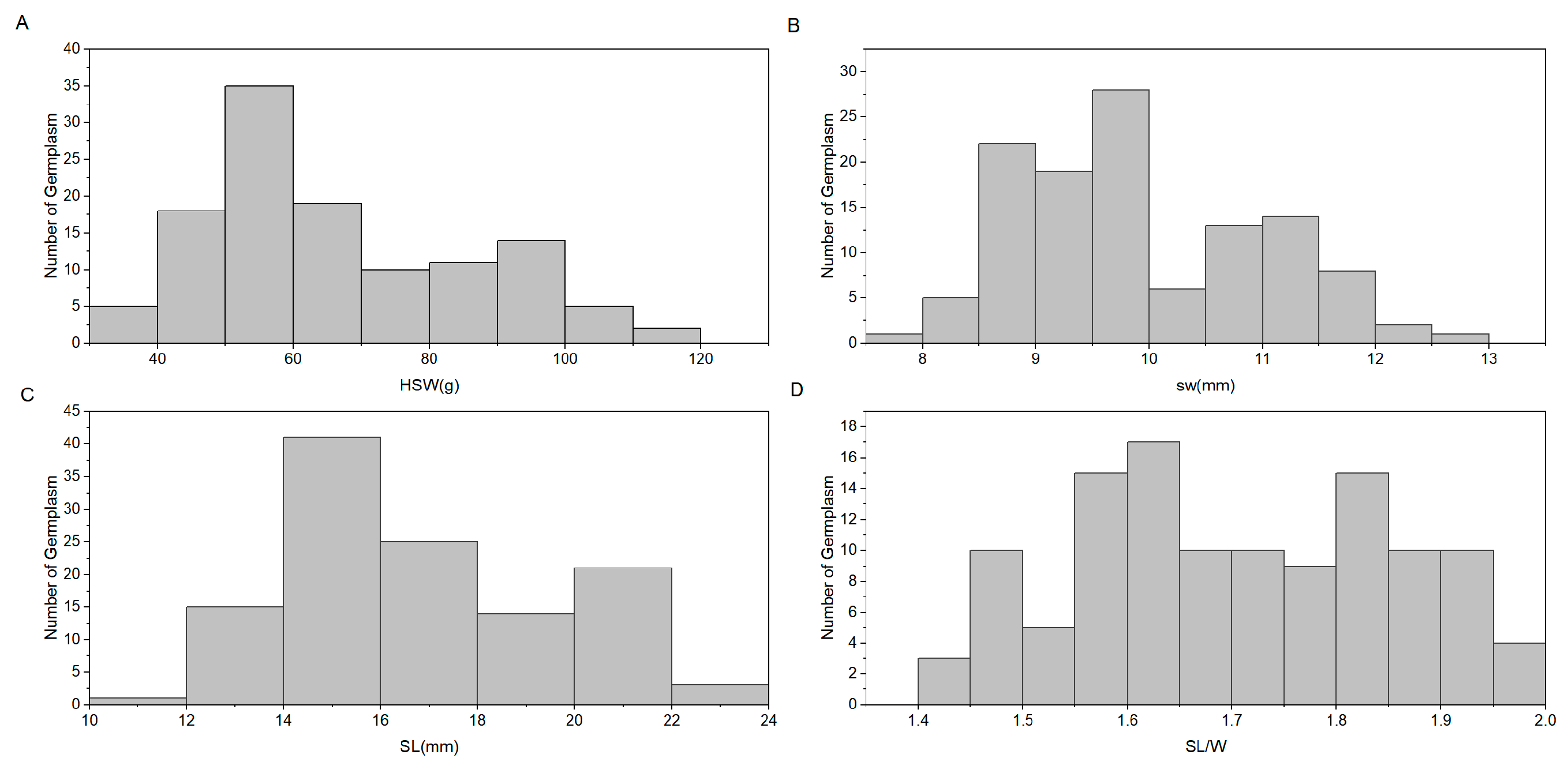
In this study, phenotypic assessments of four seed size-related traits were conducted across 120 peanut accessions over a three-year period to evaluate the phenotypic variation in these traits. The results indicate that the four seed size-related traits exhibit considerable phenotypic variation, with the range of variation for each trait differing across various environments (Table 1). Among all traits, the coefficient of variation for the HSW was the highest, with values of 34.44%, 34.2%, and 34.13% over three years, respectively, and the range of variation was 27.43 to 123.43, 33.31 to 133.87, and 36.32 to 158.31 (g), respectively. The four seed size-related traits of the 120 peanut accessions displayed continuous variation, approximating a normal distribution, which is consistent with the genetic characteristics of quantitative traits (Figure 1). The broad-sense heritability of the four seed-related traits ranged from 0.90 to 0.98, indicating that genetic effect was the main factor influencing phenotypic variation. Correlation analysis of these four traits revealed a very significant positive relationship among them, and the highest correlation between HSW and SW was 0.962 (Table 2).

3.2. Genomic Variation

By re-sequencing the whole genome of 120 peanut accessions, a total of 3913.7 Gb of high-quality sequences were obtained, with an average sequencing depth reaching 12.73X. The Q30 percentages for each accession ranged from 90.33% to 96.44%, and the GC content ranged from 36.01% to 38.21%. Compared with the reference genome, the effective mapping rate ranged from 94.44% to 99.99%. The re-sequencing quality analysis of 120 peanut accessions is presented in Table S2. The high-quality sequencing data in this study ensures the accuracy and reliability of subsequent analyses.
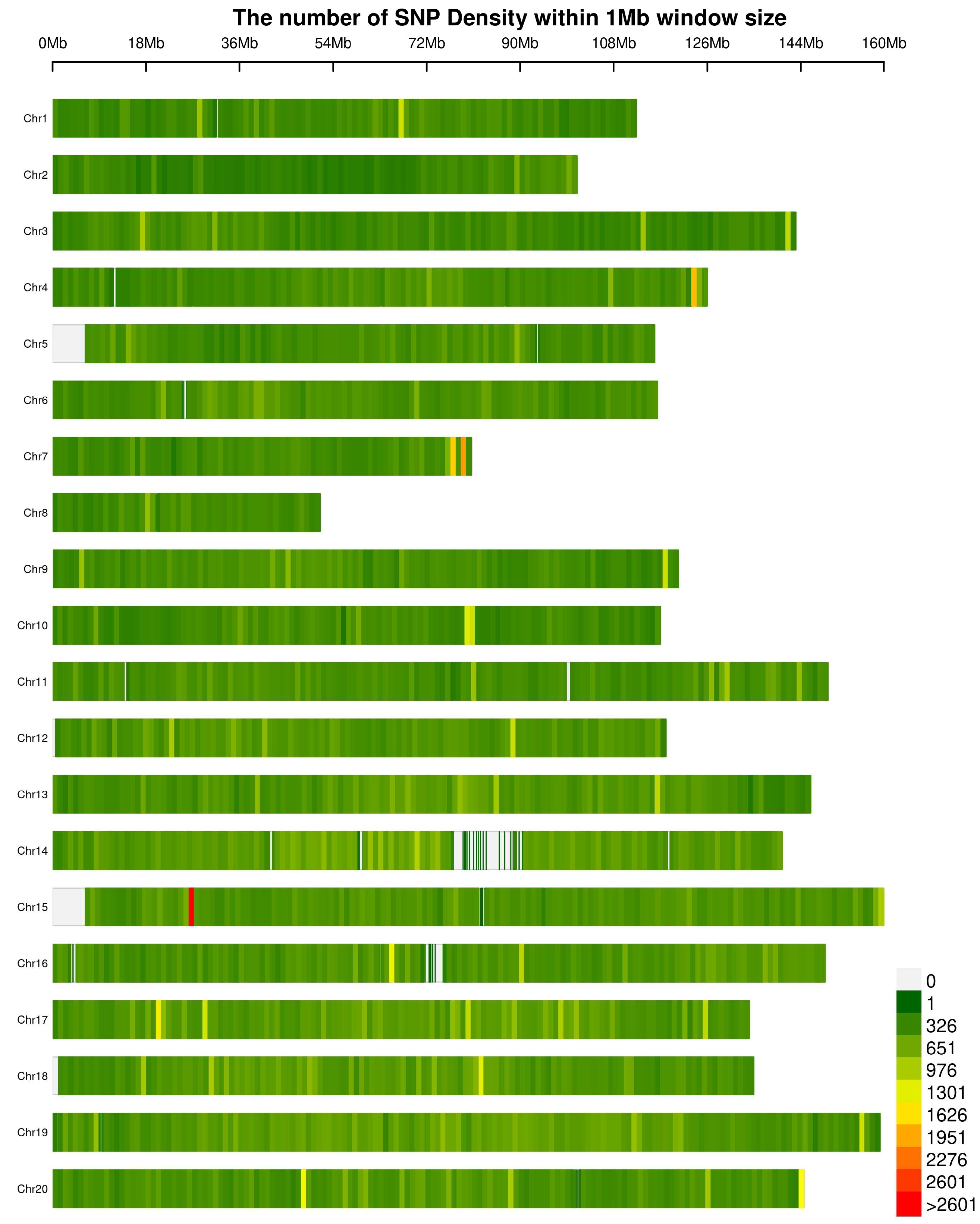
After using the following filtering parameters: depth ≥ 4, MAF > 0.05, and missing rate ≤ 20%, a total of 1,108,070 high-quality SNPs and 143,793 indels were identified. A total of 1,108,070 SNPs were distributed on 20 chromosomes with an average density of 449 SNPs/Mb. Notably, the number of SNPs on chr8 was 20,319 with an average density of 413.5 SNPs/Mb, and the number of SNPs on chr19 was 82,344 with an average density of 541.8S NPs/Mb (Figure 2).

3.3. Population Structure and Linkage Disequilibrium Analysis

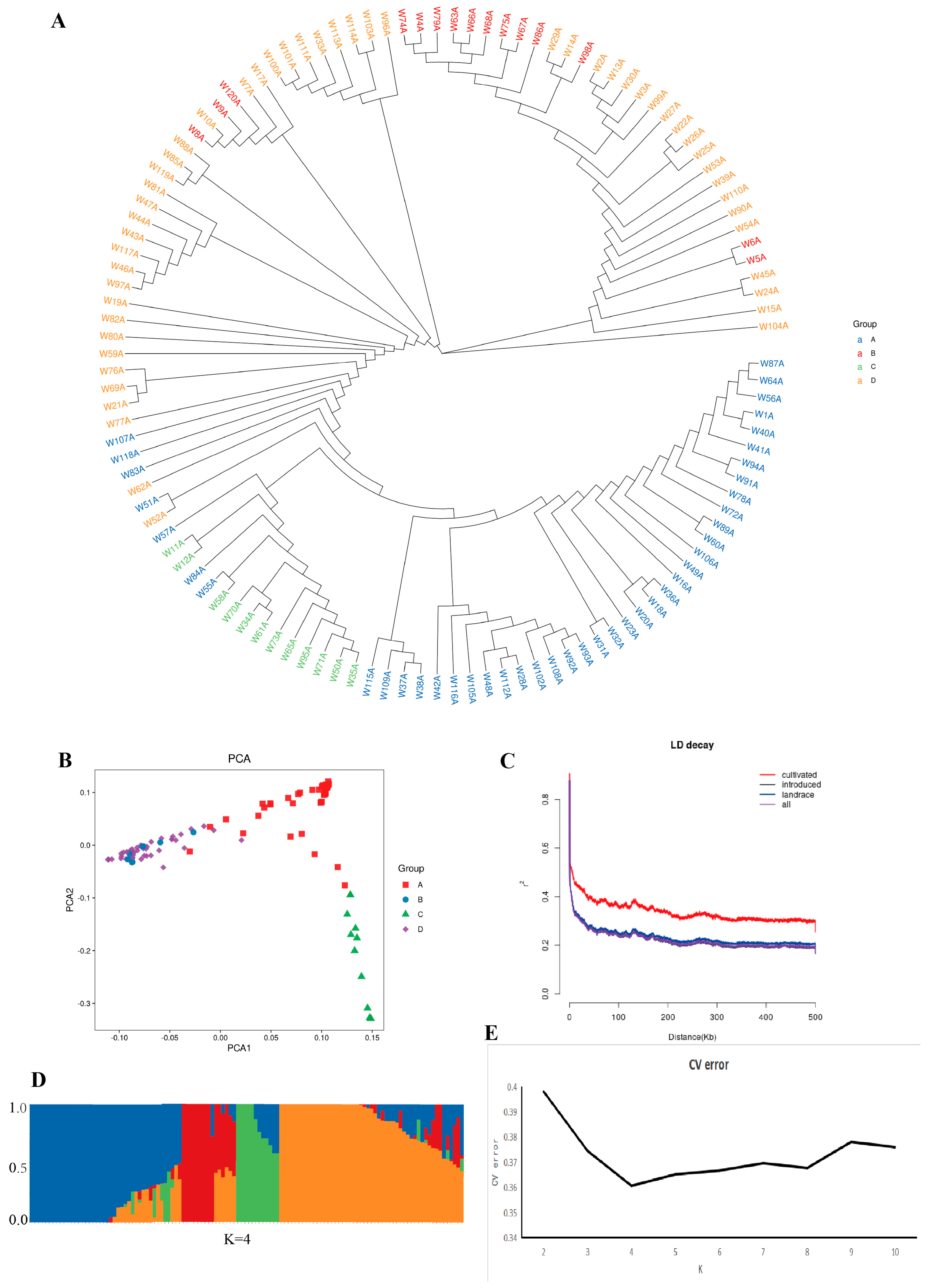
To elucidate the genetic and evolutionary relationships among 120 peanut accessions, we performed population structure analysis, phylogenetic analysis and principal component analysis based on 1,108,070 SNPs (Figure 3A,B,D). The results from the phylogenetic tree and population structure analyses, along with cross-validation (CV) error (Figure 3E), indicated that all accessions clustered into four groups (K = 4), designated as A, B, C, and D, including 42, 15, 12 and 51 accessions, respectively. The principal component analysis matrix was used to replace the Q matrix at K = 4 for subsequent GWAS. The mean linkage disequilibrium (LD) decay distance of the whole genome was 100 kb (decaying to r2 of approximately 0.238). In addition, landrace accessions (153 kb, decaying to r2 of approximately 0.238), cultivated accessions (500 kb, decaying to r2 of approximately 0.262) and introduced accessions (137 kb, decaying to r2 of approximately 0.238) were separately analyzed. The results showed the cultivated accessions had a larger LD distance (Figure 3C).

3.4. Genome-Wide Association Analysis for Seed-Related Traits and Candidate Genes Prediction

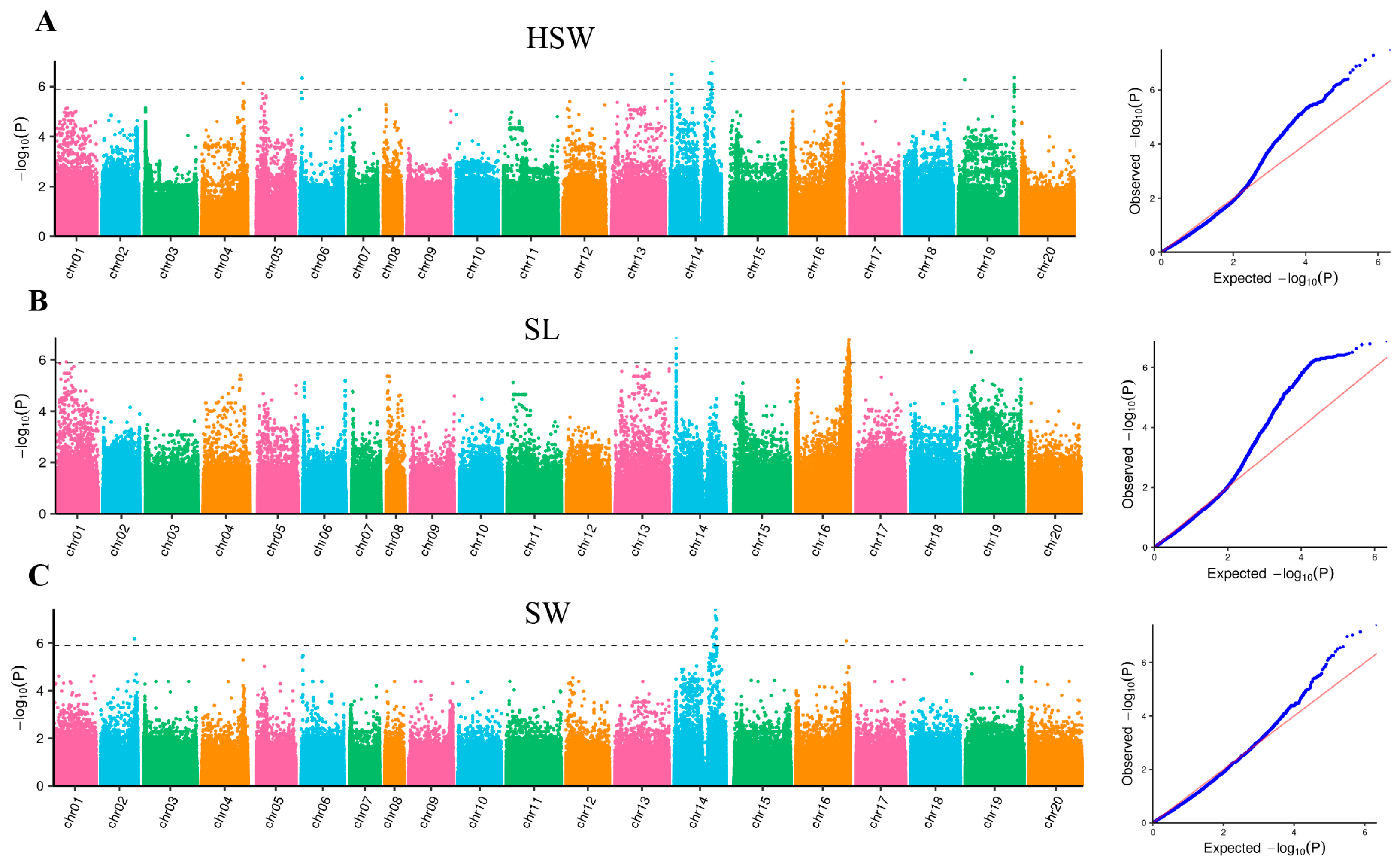
Using −log10(p) ≥ 6 as the significance threshold, 108 SNPs passed the threshold and were significantly associated with the three seed size-related traits, including 20, 75, and 13 SNPs for HSW, SL, and SW, respectively (Figure 4; Supplementary Table S3). A total of 20 SNPs significantly associated with HSW were distributed across three chromosomes (chr6, chr14, and chr16). Similarly, 75 SNPs significantly linked to SL were located on chr14, chr16, and chr19. Additionally, 13 SNPs significantly associated with SW were found on chr2, chr14, and chr16. No SNPs associated with SL/W met the threshold for significance. However, a significant positive correlation was observed among SL, SW, and HSW, which was reflected in the localization results. Specifically, the co-localization of SNPs on chr14 and chr16 highlights the need for further analysis in these regions.
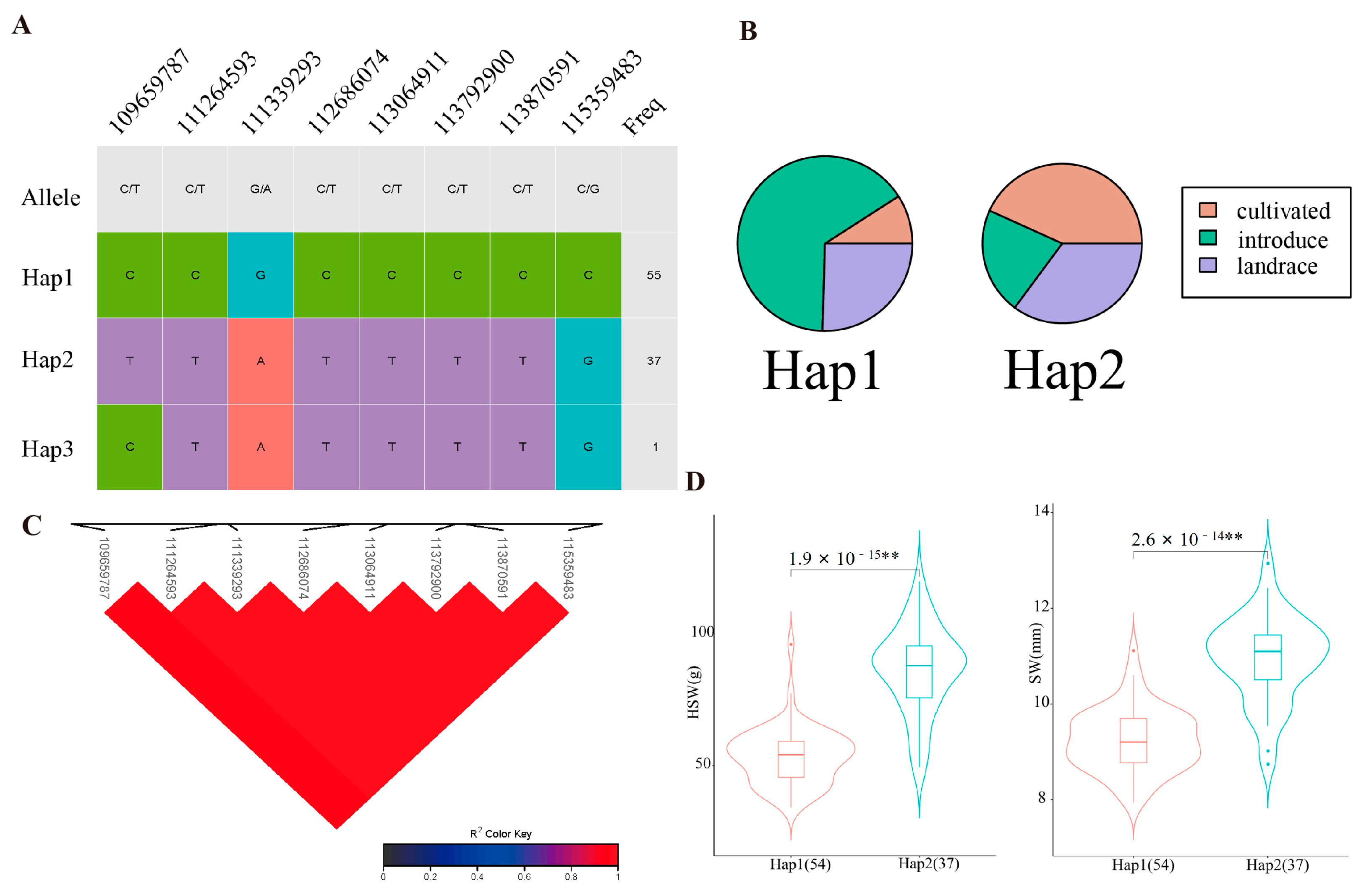
SW and HSW were of particular interest in the co-localization region on chr14. Within the marker range 14_109659787-14_138435068, a total of eight co-localized SNPs were identified, which exhibited strong linkage (Figure 5C). The results of the haplotype analysis indicated that among the 120 accessions, there were three haplotypes (Figure 5A), containing 55, 37, and 1 accession(s), respectively. Differences between Hap1 and Hap2 were observed at markers 14_111339293(G/A) and 14_115359483(C/G). The haplotype-phenotype analysis (Figure 5D) revealed that the SW and HSW of Hap2 were significantly higher than those of Hap1. The distribution of the two haplotypes was also analyzed in terms of their origins (Figure 5B). Notably, Hap2 encompassed a higher proportion of landrace and cultivated varieties from China, whereas Hap1 was predominantly comprising introduced accessions. These results suggest that this locus is a critical segment regulating peanut SW and HSW. From the perspective of germplasm origin, it appears that artificial selection may have occurred at markers 14_111339293 to 14_115359483 during high-yield breeding in China.
By combining LD decay distance (±100 kb) with SNP variation data, a targeted screening for candidate genes was conducted. Within the delineated candidate regions containing the eight significant association peak SNPs (14_109659787, 14_111264593, 14_111339293, 14_112686074, 14_113064911, 14_113792900, 14_113870591, and 14_115359483), a total of 34 genes were identified (Table S4). Among these, nine genes harboring non-synonymous or multiple SNPs were prioritized as potential candidates for HSW and SW regulation (Table 3): Ah14g322900 (receptor-like protein kinase, with two non-synonymous variants), Ah14g323200 (uncharacterized protein), Ah14g330100 (receptor-like kinase), Ah14g330300 (ethylene-responsive transcription factor), Ah14g330400 (spermidine synthase), Ah14g331700 (mitochondrial pyruvate carrier), Ah14g331800 (nucleolar GTP-binding protein), Ah14g332100 (tRNA-specific 2-thiouridylase MnmA), and Ah14g337500 (wound-induced protein). These findings highlight potential candidate genes involved in signal transduction, transcriptional regulation, energy metabolism, and polyamine biosynthesis, providing valuable insights into the genetic basis of SW and HSW in peanut.

4. Discussion

The reference genome for cultivated peanut was released later than for many other crops, and its larger genome size implies that high-depth resequencing of large samples requires substantial costs. This has historically slowed the progress of gene mining for important agronomic traits compared to other crops. However, with the decreasing cost of sequencing, GWAS-based studies on important traits in peanut have accelerated and achieved significant progress [11,15]. Important factors such as sample size, population structure, phenotypic variation, and sequencing quality significantly impact the results of GWAS [22]. To balance experimental cost and statistical power, we meticulously assembled a diverse panel of 120 peanut accessions. This panel not only represents a wide geographic distribution but also exhibits significant variation in seed size-related traits (Table 1), providing an ideal foundation for dissecting the genetic architecture of seed size-related traits. Furthermore, with an average sequencing depth of 12.73× across 120 accessions, we successfully identified 1,108,070 high-quality SNPs, resulting in a high-resolution genetic map that compares favorably with those used in previous peanut GWAS [15,23,24]. Based on these SNPs, we performed population structure analysis, phylogenetic tree construction, and principal component analysis. Cross-validation (CV) error indicated the smallest error at K = 4 (Figure 3), consistent with previous genetic studies in peanut [14,23,24]. Evidence suggests that peanuts might have been introduced into southern and northern China separately, forming two cultivation centers [15]. In our analysis, 13 of the 14 landrace varieties from southern China clustered in group A, and 12 of the 14 landrace varieties from northern China clustered in group D. However, this geographic signal was less pronounced among cultivated varieties, likely due to the frequent exchange of elite germplasm resources and the convergence of breeding objectives between northern and southern China (Table S1). Furthermore, South America is recognized as the origin of peanuts [14]. In fact, India possesses the most abundant peanut germplasm resources globally, and accessions introduced from India are distributed across four groups, exhibiting genetic diversity (Table S1). Notably, landrace accessions from Sichuan Province were distributed across all four groups, suggesting that Sichuan may have played an important role in the early accumulation and diversification of peanut germplasm resources in China (Table S1).
Seed-related traits are critical determinants of peanut yield and appearance quality and have long been a focal point in peanut genetics and QTL mapping. In this study, HSW, SL, and SW co-localized on chr16, consistent with previous reports [1,11,15]. Additionally, significant loci identified on chr2 [24] and chr19 [9] either co-localized with or were located in close proximity to previously reported QTLs, further validating the robustness of our GWAS approach. Notably, SW and HSW co-localized to a significant region on chr14, characterized by eight highly associated SNPs with strong statistical support (Figure 5). Haplotype analysis revealed two predominant haplotypes in this region, distinguished by SNPs 14_111339293 and 14_115359483, with Hap2 exhibiting significantly higher SW and HSW values compared to Hap1. Investigation into the geographic and genetic origins of these haplotypes revealed that Hap2 was more prevalent in Chinese cultivated and landrace varieties than in introduced germplasms, whereas Hap1 contained a higher proportion of introduced accessions. This distribution pattern suggests that this genomic region may have been under selection during high-yield breeding efforts in China, representing a valuable target for further functional characterization.
Based on the LD decay distance (±100 kb), nine candidate genes were prioritized within the chromosome 14 peak region (Table S4). Among these, Ah14g322900 emerged as the most compelling candidate, followed by Ah14g330300 and Ah14g330400, based on functional relevance and variant characteristics. Ah14g322900 encodes a leucine-rich repeat receptor-like kinase (LRR-RLK). SMART analysis confirmed its domain architecture, comprising multiple LRR domains and a transmembrane region, a structure that closely resembles the known pod size regulator PSW1 in peanut [16]. LRR-RLKs are evolutionarily conserved regulators of seed and organ size in plants, typically functioning through stem cell regulatory pathways. These pathways involve Root Meristem Growth Factor 1 Insensitives (RGIs)/RGF receptors, the Brassinosteroid Insensitive 1-Associated Receptor Kinase 1 (BAK1) as a co-receptor, and downstream PLETHORA transcription factors [25,26,27,28,29]. Two nonsynonymous variants, p.I67T and p.I169L, were identified in Ah14g322900. These substitutions are strategically positioned within functionally constrained regions: p.I67T resides in the N-terminal domain implicated in ligand-binding specificity, while p.I169L is located in the interdomain linker between LRR1 and LRR2—a region critical for receptor assembly and signal transduction. The convergence of conserved LRR-RLK architecture, documented roles of LRR-RLK homologs in seed size regulation across plant species, and nonsynonymous variants in functionally relevant regions strongly supports Ah14g322900 as the primary candidate underlying the QTL on chr14.
Ah14g330300, encoding an ethylene-responsive transcription factor (ERF), carries a nonsynonymous substitution (p.E210G). Ethylene is known to influence multiple aspects of plant growth and development, including seed germination, root development, flowering, grain filling, and leaf senescence [30,31,32,33]. Enhanced ethylene responses have been associated with larger grains, whereas reduced ethylene sensitivity results in smaller grains [32,34,35]. ERF transcription factors play diverse roles in seed size regulation across species. For instance, OsERF115 positively regulates grain size in rice by modulating cell proliferation during endosperm filling [36]. In maize, ZmEREB130 has been functionally characterized as a negative regulator of seed size; heterologous expression of this gene in Arabidopsis significantly reduced seed weight [37]. The p.E210G mutation in Ah14g330300 may affect DNA-binding activity, potentially altering the expression of downstream genes involved in seed development.
Ah14g330400, encoding spermidine synthase, carries a synonymous variant (p.L53L). Although synonymous mutations typically have limited functional impact, polyamines are well-established regulators of cell division and embryogenesis. In rice, OsSPMS1/OsSPDS2 negatively regulates grain size [38]. Polyamines and ethylene share the common precursor S-adenosyl-L-methionine (SAM), suggesting potential crosstalk between these pathways in seed development. The synonymous variant in Ah14g330400 warrants inclusion for future investigation, as it may affect mRNA splicing or stability.
Other candidates with non-synonymous variants include Ah14g332100 (tRNA-specific 2-thiouridylase MnmA, p.S87N), Ah14g331700 (mitochondrial pyruvate carrier, p.S99F), and Ah14g323200 (uncharacterized protein, p.G154R, AF = 0.26). While direct evidence linking these genes to seed size is currently limited, their roles in translation fidelity, energy metabolism, and the relatively high allele frequency of Ah14g323200, respectively, provide rationale for future functional validation.

5. Conclusions

This study provides a comprehensive genetic dissection of seed size-related traits in peanut through GWAS of 120 diverse accessions. Population structure analysis revealed four subpopulations (K = 4), with landraces from southern and northern China clustering separately and Sichuan accessions distributed across all groups, suggesting that Sichuan may have played an important role in the early accumulation and diversification of peanut germplasm resources in China. We identified 108 significant SNPs associated with HSW, SL, and SW, with major co-localized regions on chr14 and chr16, validating and refining previously reported QTLs. Haplotype analysis revealed that the beneficial haplotype (Hap2) on chr14, distinguished by SNPs 14_111339293 and 14_115359483, is more prevalent in Chinese cultivated and landrace varieties than in introduced accessions, suggesting positive selection during high-yield breeding in China. Nine candidate genes were prioritized within the LD decay interval, with Ah14g322900 (encoding an LRR-RLK) emerging as the most compelling candidate based on its structural similarity to the pod size regulator PSW1 and the presence of two nonsynonymous variants in functionally constrained regions. Additional candidates, including Ah14g330300 (ethylene-responsive transcription factor) and Ah14g330400 (spermidine synthase), implicate hormone signaling and polyamine biosynthesis pathways in seed size regulation. These findings provide valuable molecular markers and candidate genes for peanut breeding and functional validation, advancing our understanding of the genetic architecture underlying seed size variation in this important crop.

Supplementary Materials

The following supporting information can be downloaded at: https://www.mdpi.com/article/10.3390/agronomy16070735/s1. Table S1. Information of 120 peanut accessions. Table S2. The re-sequencing quality analysis of 120 peanut accessions. Table S3. 108 SNPs were significantly associated with HSW, SL and SW. Table S4. 34 candidate genes for SW and HSW on chr14.

Author Contributions

Conceptualization, Y.X. and Y.L.; methodology, C.W.; validation, Y.Y. and Z.Z.; formal analysis, Z.Z. and Q.D.; investigation, Y.Y. and J.M.; writing—original draft preparation, C.W.; writing—review and editing, L.Y. and Y.G. All authors have read and agreed to the published version of the manuscript.

Funding

This research was funded by the Central Government’s Guidance on Local Science and Technology Development Fund of Sichuan Province (2024ZYD0308); the Nanchong Basic Research Platform (22JCYJPT0002); the China Agriculture Research System of MOF and MARA (CARS-13); the Project of the Development for High-quality Seed Industry of Hubei Province (HBZY2023B003); and the Hubei Provincial Agricultural Science and Technology Innovation Center Innovation Team (2026-620-000-001-031).

Data Availability Statement

The original contributions presented in this study are included in the article/Supplementary Material. Further inquiries can be directed to the corresponding authors.

Acknowledgments

We thank the High-performance Computing Platform of YZBSTCACC for providing computational resources.

Conflicts of Interest

The authors declare no conflicts of interest.

References

  1. Zhang, S.; Hu, X.; Miao, H.; Chu, Y.; Cui, F.; Yang, W.; Wang, C.; Shen, Y.; Xu, T.; Zhao, L.; et al. QTL identification for seed weight and size based on a high-density SLAF-seq genetic map in peanut (Arachis hypogaea L.). BMC Plant Biol. 2019, 19, 537. [Google Scholar] [CrossRef]
  2. Garet, B. Heterosis and combining ability in groundnut (Arachis hypogaea L.). Oleagineux 1976, 31, 435–442. [Google Scholar]
  3. Upadhyaya, H.D.; Gopal, K.; Nadaf, H.L.; Vijayakumar, S. Combining ability studies for yield and its components in groundnut. Indian J. Genet. Plant Breed. 1992, 52, 1–6. [Google Scholar]
  4. Zhou, X.J.; Guo, J.B.; Pandey, M.K.; Varshney, R.K.; Huang, L.; Luo, H.Y.; Liu, N.A.; Chen, W.G.; Lei, Y.; Liao, B.S.; et al. Dissection of the Genetic Basis of Yield-Related Traits in the Chinese Peanut Mini-Core Collection Through Genome-Wide Association Studies. Front. Plant Sci. 2021, 12, 637284. [Google Scholar] [CrossRef]
  5. Fang, Y.J.; Liu, H.; Sun, Z.Q.; Qin, L.; Zheng, Z.; Qi, F.Y.; Wu, J.H.; Dong, W.Z.; Huang, B.Y.; Zhang, X.Y. Co-localization of quantitative trait loci for pod and kernel traits and development of molecular marker for kernel weight on chromosome Arahy05 in peanut (Arachis hypogaea L.). Theor. Appl. Genet. 2024, 137, 250. [Google Scholar] [CrossRef]
  6. Luo, H.Y.; Ren, X.P.; Li, Z.D.; Xu, Z.J.; Li, X.P.; Huang, L.; Zhou, X.J.; Chen, Y.N.; Chen, W.G.; Lei, Y.; et al. Co-localization of major quantitative trait loci for pod size and weight to a 3.7 cM interval on chromosome A05 in cultivated peanut (Arachis hypogaea L.). BMC Genom. 2017, 18, 58. [Google Scholar] [CrossRef]
  7. Zhang, X.J.; Wang, L.H.; Liu, Q.M.; Zhang, X.Y.; Tian, Y.X.; Xue, Y.Y.; Zhang, H.Q.; Li, N.; Zhang, X.; Bai, D.M. Identification of Hotspot Regions for Candidate Genes Associated with Peanut (Arachis hypogaea L.) Pod and Seed Size on Chromosome A05. Agriculture 2024, 14, 1634. [Google Scholar] [CrossRef]
  8. Wang, Z.H.; Yan, L.Y.; Chen, Y.N.; Wang, X.; Huai, D.X.; Kang, Y.P.; Jiang, H.F.; Liu, K.D.; Lei, Y.; Liao, B.S. Detection of a major QTL and development of KASP markers for seed weight by combining QTL-seq, QTL-mapping and RNA-seq in peanut. Theor. Appl. Genet. 2022, 135, 1779–1795. [Google Scholar] [CrossRef] [PubMed]
  9. Gangurde, S.S.; Wang, H.; Yaduru, S.; Pandey, M.K.; Fountain, J.C.; Chu, Y.; Isleib, T.; Holbrook, C.C.; Xavier, A.; Culbreath, A.K.; et al. Nested-association mapping (NAM)-based genetic dissection uncovers candidate genes for seed and pod weights in peanut (Arachis hypogaea). Plant Biotechnol. J. 2020, 18, 1457–1471. [Google Scholar] [CrossRef] [PubMed]
  10. Lu, Q.; Liu, H.; Hong, Y.B.; Li, H.F.; Liu, H.Y.; Li, X.Y.; Wen, S.J.; Zhou, G.Y.; Li, S.X.; Chen, X.P.; et al. Consensus map integration and QTL meta-analysis narrowed a locus for yield traits to 0.7cM and refined a region for late leaf spot resistance traits to 0.38cM on linkage group A05 in peanut (Arachis hypogaea L.). BMC Genom. 2018, 19, 887. [Google Scholar] [CrossRef]
  11. Zheng, Z.; Sun, Z.; Qi, F.; Fang, Y.; Lin, K.; Pavan, S.; Huang, B.; Dong, W.; Du, P.; Tian, M.; et al. Chloroplast and whole-genome sequencing shed light on the evolutionary history and phenotypic diversification of peanuts. Nat. Genet. 2024, 56, 1975–1984. [Google Scholar] [CrossRef]
  12. Luo, H.Y.; Guo, J.B.; Ren, X.P.; Chen, W.G.; Huang, L.; Zhou, X.J.; Chen, Y.N.; Liu, N.; Xiong, F.; Lei, Y.; et al. Chromosomes A07 and A05 associated with stable and major QTLs for pod weight and size in cultivated peanut (Arachis hypogaea L.). Theor. Appl. Genet. 2018, 131, 267–282. [Google Scholar] [CrossRef] [PubMed]
  13. Alyr, M.H.; Pallu, J.; Sambou, A.; Nguepjop, J.R.; Seye, M.; Tossim, H.A.; Djiboune, Y.R.; Sane, D.; Rami, J.F.; Fonceka, D. Fine-Mapping of a Wild Genomic Region Involved in Pod and Seed Size Reduction on Chromosome A07 in Peanut (Arachis hypogaea L.). Genes 2020, 11, 1402. [Google Scholar] [CrossRef] [PubMed]
  14. Liu, Y.Y.; Shao, L.B.; Zhou, J.; Li, R.C.; Pandey, M.K.; Han, Y.; Cui, F.; Zhang, J.L.; Guo, F.; Chen, J.; et al. Genomic insights into the genetic signatures of selection and seed trait loci in cultivated peanut. J. Adv. Res. 2022, 42, 237–248. [Google Scholar] [CrossRef] [PubMed]
  15. Lu, Q.; Huang, L.; Liu, H.; Garg, V.; Gangurde, S.S.; Li, H.F.; Chitikineni, A.; Guo, D.D.; Pandey, M.K.; Li, S.X.; et al. A genomic variation map provides insights into peanut diversity in China and associations with 28 agronomic traits. Nat. Genet. 2024, 56, 530–540. [Google Scholar] [CrossRef]
  16. Zhao, K.K.; Wang, L.; Qiu, D.; Cao, Z.H.; Wang, K.P.; Li, Z.; Wang, X.X.; Wang, J.Z.; Ma, Q.; Cao, D.; et al. PSW1, an LRR receptor kinase, regulates pod size in peanut. Plant Biotechnol. J. 2023, 21, 2113–2124. [Google Scholar] [CrossRef]
  17. Lu, Q.; Umer, M.J.; Liu, H.; Li, H.F.; Wang, R.F.; Huang, L.; Yu, Q.X.; Varshney, R.K.; Pandey, M.K.; Hong, Y.B.; et al. Functional analysis of a GWAS pleiotropic hotspot suggests an auxin biosynthesis gene (AhPDS1), regulating pod development in peanut (Arachis hypogaea L.). Plant J. 2025, 124, e70608. [Google Scholar] [CrossRef]
  18. Huang, X.H.; Wei, X.H.; Sang, T.; Zhao, Q.A.; Feng, Q.; Zhao, Y.; Li, C.Y.; Zhu, C.R.; Lu, T.T.; Zhang, Z.W.; et al. Genome-wide association studies of 14 agronomic traits in rice landraces. Nat. Genet. 2010, 42, 961–976. [Google Scholar] [CrossRef]
  19. Huang, X.H.; Zhao, Y.; Wei, X.H.; Li, C.Y.; Wang, A.; Zhao, Q.; Li, W.J.; Guo, Y.L.; Deng, L.W.; Zhu, C.R.; et al. Genome-wide association study of flowering time and grain yield traits in a worldwide collection of rice germplasm. Nat. Genet. 2012, 44, 32–53. [Google Scholar] [CrossRef]
  20. Wang, B.; Lin, Z.; Li, X.; Zhao, Y.; Zhao, B.; Wu, G.; Ma, X.; Wang, H.; Xie, Y.; Li, Q.; et al. Genome-wide selection and genetic improvement during modern maize breeding. Nat. Genet. 2020, 52, 565–571. [Google Scholar] [CrossRef]
  21. Hwang, E.Y.; Song, Q.J.; Jia, G.F.; Specht, J.E.; Hyten, D.L.; Costa, J.; Cregan, P.B. A genome-wide association study of seed protein and oil content in soybean. BMC Genom. 2014, 15, 1. [Google Scholar] [CrossRef] [PubMed]
  22. Atwell, S.; Huang, Y.S.; Vilhjálmsson, B.J.; Willems, G.; Horton, M.; Li, Y.; Meng, D.; Platt, A.; Tarone, A.M.; Hu, T.T.; et al. Genome-wide association study of 107 phenotypes in Arabidopsis thaliana inbred lines. Nature 2010, 465, 627–631. [Google Scholar] [CrossRef] [PubMed]
  23. Otyama, P.I.; Wilkey, A.; Kulkarni, R.; Assefa, T.; Chu, Y.; Clevenger, J.; O’Connor, D.J.; Wright, G.C.; Dezern, S.W.; MacDonald, G.E.; et al. Evaluation of linkage disequilibrium, population structure, and genetic diversity in the US peanut mini core collection. BMC Genom. 2019, 20, 481. [Google Scholar] [CrossRef]
  24. Wang, J.; Yan, C.X.; Li, Y.; Li, C.J.; Zhao, X.B.; Yuan, C.L.; Sun, Q.X.; Shan, S.H. GWAS Discovery of Candidate Genes for Yield-Related Traits in Peanut and Support from Earlier QTL Mapping Studies. Genes 2019, 10, 803. [Google Scholar] [CrossRef]
  25. An, Z.C.; Liu, Y.L.; Ou, Y.; Li, J.; Zhang, B.W.; Sun, D.Y.; Sun, Y.; Tang, W.Q. Regulation of the stability of RGF1 receptor by the ubiquitin-specific proteases UBP12/UBP13 is critical for root meristem maintenance. Proc. Natl. Acad. Sci. USA 2018, 115, 1123–1128. [Google Scholar] [CrossRef]
  26. Ou, Y.; Lu, X.T.; Zi, Q.N.; Xun, Q.Q.; Zhang, J.J.; Wu, Y.J.; Shi, H.Y.; Wei, Z.Y.; Zhao, B.L.; Zhang, X.Y.; et al. RGF1 INSENSITIVE 1 to 5, a group of LRR receptor-like kinases, are essential for the perception of root meristem growth factor 1 in Arabidopsis thaliana. Cell Res. 2016, 26, 686–698. [Google Scholar] [CrossRef]
  27. Shinohara, H.; Mori, A.; Yasue, N.; Sumida, K.; Matsubayashi, Y. Identification of three LRR-RKs involved in perception of root meristem growth factor in Arabidopsis. Proc. Natl. Acad. Sci. USA 2016, 113, 3897–3902. [Google Scholar] [CrossRef]
  28. Song, W.; Liu, L.; Wang, J.Z.; Wu, Z.; Zhang, H.Q.; Tang, J.; Lin, G.Z.; Wang, Y.C.; Wen, X.; Li, W.Y.; et al. Signature motif-guided identification of receptors for peptide hormones essential for root meristem growth. Cell Res. 2016, 26, 674–685. [Google Scholar] [CrossRef]
  29. Yamada, M.; Han, X.W.; Benfey, P.N. RGF1 controls root meristem size through ROS signalling. Nature 2020, 577, 85–88. [Google Scholar] [CrossRef]
  30. Yang, J.C.; Zhang, J.H.; Wang, Z.Q.; Liu, K.; Wang, P. Post-anthesis development of inferior and superior spikelets in rice in relation to abscisic acid and ethylene. J. Exp. Bot. 2006, 57, 149–160. [Google Scholar] [CrossRef] [PubMed]
  31. Chen, Y.; Xu, Y.Y.; Luo, W.; Li, W.X.; Chen, N.; Zhang, D.J.; Chong, K. The F-Box Protein OsFBK12 Targets OsSAMS1 for Degradation and Affects Pleiotropic Phenotypes, Including Leaf Senescence, in Rice. Plant Physiol. 2013, 163, 1673–1685. [Google Scholar] [CrossRef]
  32. Ma, B.; He, S.J.; Duan, K.X.; Yin, C.C.; Chen, H.; Yang, C.; Xiong, Q.; Song, Q.X.; Lu, X.; Chen, H.W.; et al. Identification of Rice Ethylene-Response Mutants and Characterization of MHZ7/OsEIN2 in Distinct Ethylene Response and Yield Trait Regulation. Mol. Plant 2013, 6, 1830–1848. [Google Scholar] [CrossRef]
  33. Wang, Q.; Zhang, W.; Yin, Z.M.; Wen, C.K. Rice CONSTITUTIVE TRIPLE-RESPONSE2 is involved in the ethylene-receptor signalling and regulation of various aspects of rice growth and development. J. Exp. Bot. 2013, 64, 4863–4875. [Google Scholar] [CrossRef]
  34. Wuriyanghan, H.; Zhang, B.; Cao, W.H.; Ma, B.A.; Lei, G.; Liu, Y.F.; Wei, W.; Wu, H.J.; Chen, L.J.; Chen, H.W.; et al. The Ethylene Receptor ETR2 Delays Floral Transition and Affects Starch Accumulation in Rice. Plant Cell 2009, 21, 1473–1494. [Google Scholar] [CrossRef]
  35. Yang, C.; Ma, B.; He, S.J.; Xiong, Q.; Duan, K.X.; Yin, C.C.; Chen, H.; Lu, X.; Chen, S.Y.; Zhang, J.S. MAOHUZI6/ETHYLENE INSENSITIVE3-LIKE1 and ETHYLENE INSENSITIVE3-LIKE2 Regulate Ethylene Response of Roots and Coleoptiles and Negatively Affect Salt Tolerance in Rice. Plant Physiol. 2015, 169, 148–165. [Google Scholar] [CrossRef] [PubMed]
  36. Liu, C.; Ma, T.; Yuan, D.; Zhou, Y.; Long, Y.; Li, Z.; Dong, Z.; Duan, M.; Yu, D.; Jing, Y.; et al. The OsEIL1-OsERF115-target gene regulatory module controls grain size and weight in rice. Plant Biotechnol. J. 2022, 20, 1470–1486. [Google Scholar] [CrossRef] [PubMed]
  37. Fu, Q.; Duan, H.; Wei, J.; Zhou, W.; Wan, T.; Zhang, X.; Liu, Y.; Zhou, Y.; Bin Khalid, M.H.; Yang, Q.; et al. Maize ZmEREB130 transcription factor negatively regulates growth and seed size. Plant Physiol. Biochem. 2025, 227, 110165. [Google Scholar] [CrossRef] [PubMed]
  38. Tao, Y.; Wang, J.; Miao, J.; Chen, J.; Wu, S.; Zhu, J.; Zhang, D.; Gu, H.; Cui, H.; Shi, S.; et al. The Spermine Synthase OsSPMS1 Regulates Seed Germination, Grain Size, and Yield. Plant Physiol. 2018, 178, 1522–1536. [Google Scholar] [CrossRef]
Figure 1. The frequency distributions of HSW, SW, SL, and SL/W are shown in (AD), respectively, based on best linear unbiased prediction (BLUP) values across the three environments.
Agronomy 16 00735 g001
Figure 2. SNP density on each chromosome. The horizontal axis shows chromosome length (Mb), and the vertical axis shows the 20 chromosomes.
Agronomy 16 00735 g002
Figure 3. Population structure analysis of peanut accessions based on whole-genome SNPs. (A) Phylogenetic tree. (B) Principal component analysis (PCA) for all peanut accessions. (C) LD decay plots. (D) Population structure of the 120 accessions at K = 4. Each color represents one subpopulation, and each vertical bar represents an individual accession. (E) Cross-validation (CV) error for K values from 2 to 10.
Agronomy 16 00735 g003
Figure 4. Manhattan and Q-Q plots for the three seed-related traits. (A) Manhattan and Q-Q plots for HSW based on BLUP values. (B) Manhattan and Q-Q plots for SL based on BLUP values. (C) Manhattan and Q-Q plots for SW based on BLUP values.
Agronomy 16 00735 g004
Figure 5. Haplotype analysis of significant SNPs on chr14. (A) Haplotypes of 8 significant SNPs. (B) The pie chart shows the germplasm origins of the two haplotypes. (C) LD heatmap of 8 significant SNPs (D) Violin plots for HSW and SW according to the genotype of SNPs (14_111339293 and 14_115359483), p values were calculated by two-tailed Student’s t-test. ** represents significant at p < 0.01.
Agronomy 16 00735 g005
Table 1. Phenotypic variation for four seed-related traits of 120 peanut accessions.
Env.MinMaxMeanSDCV (%)H2
SL (mm)E111.9124.8717.523.0917.650.98
E211.1223.316.472.9017.62
E311.7323.5616.582.8517.22
BLUP11.7323.7716.862.8316.82
SW (mm)E17.9414.810.381.4013.460.93
E27.3212.679.551.2312.83
E37.7513.689.901.2012.32
BLUP7.9412.949.901.1010.97
HSW (g)E127.43123.4356.2919.3934.440.95
E233.31133.8769.1623.6634.20
E336.32158.3174.5725.4534.13
BLUP34.12119.8966.0420.1630.53
SL/WE11.352.141.700.1911.480.90
E21.262.401.740.2112.09
E31.372.021.690.159.12
BLUP1.402.141.710.169.12
SL, seed length; SW, seed width; HSW, 100-seed weight; SL/W, ratio of SL to SW; E1–E3, 2021, 2022, and 2023 in Nanchong.
Table 2. Correlation analysis of seed-related traits.
SLSWHSWSL/W
SL10.818 **0.917 **0.716 **
SW0.818 **10.962 **0.195 *
HSW0.917 **0.962 **10.411 **
SL/W0.716 **0.195 *0.411 **1
* represents significant at p ≤ 0.05; ** represents significant at p < 0.01.
Table 3. Candidate genes and associated exonic variants for SW and HSW.
Gene PositionREFALTExonicFuncGene Annotation
Ah14g322900111330234TAsynonymous SNVreceptor-like protein kinase
Ah14g322900111330800TGnonsynonymous SNV
Ah14g322900111331105AGnonsynonymous SNV
Ah14g323200111419653CTnonsynonymous SNVuncharacterized protein
Ah14g330100112689400CTsynonymous SNVreceptor-like kinase
Ah14g330300112702366TCnonsynonymous SNVethylene-responsive transcription factor
Ah14g330400112719875ATsynonymous SNVspermidine synthase
Ah14g331700113119205CTnonsynonymous SNVmitochondrial pyruvate carrier
Ah14g331700113119233GAsynonymous SNV
Ah14g331800113151393GAsynonymous SNVNucleolar GTP-binding protein
Ah14g332100113163958CTnonsynonymous SNVtRNA-specific 2-thiouridylase MnmA
Ah14g337500115045207ATnonsynonymous SNVwound-induced protein
REF, reference allele; ALT, alternative allele; Variant type indicates whether the SNP leads to an amino acid change (non-synonymous) or not (synonymous). Double quotation marks (“) indicate the same gene annotation as the row above.
Disclaimer/Publisher’s Note: The statements, opinions and data contained in all publications are solely those of the individual author(s) and contributor(s) and not of MDPI and/or the editor(s). MDPI and/or the editor(s) disclaim responsibility for any injury to people or property resulting from any ideas, methods, instructions or products referred to in the content.