Article

Effects of Environmental and Agronomic Factors on the Dispersal of Multiple Resistant Lolium rigidum in Malt Barley Fields of Northern Greece


by
Dimitra Doulfi
1,
Garyfallia Economou
1,*,
Dionissios Kalivas
2 and
Ilias G. Eleftherohorinos
3
1
Laboratory of Agronomy, Department of Crop Science, Agricultural University of Athens, 11855 Athens, Greece
2
Department of Natural Resources Management and Agricultural Engineering, Agricultural University of Athens, 75 Iera Odos, 11855 Athens, Greece
3
Laboratory of Agronomy, Department of Field Crops and Ecology, School of Agriculture, Aristotle University of Thessaloniki, 54124 Thessaloniki, Greece
*
Author to whom correspondence should be addressed.
Agronomy 2026, 16(7), 728; https://doi.org/10.3390/agronomy16070728
Submission received: 3 March 2026 / Revised: 28 March 2026 / Accepted: 29 March 2026 / Published: 31 March 2026
(This article belongs to the Section Weed Science and Weed Management)

Abstract

In this study, a survey was conducted in 14 fields (6 in Thessaloniki and 8 in Serres) before barley harvest during three growing seasons (2019–20, 2020–21, 2021–22) to map the occurrence of ACCase and ALS multi-resistant populations and evaluate the influence of agronomic practices and environmental conditions on their dynamics. Specifically, weed cover and tiller number/plant were assessed in each field using a W pattern, while questionnaires were used to collect information from farmers on agronomic practices applied, such as seedbed preparation, the rate of fertilization at sowing, the time of sowing, the time and rate of top-dressing nitrogen fertilizer, the time of application of the herbicide pinoxaden, and the harvest time. Soil properties and climatic conditions were also recorded. These results indicated that regardless of the different agricultural practices applied in the fields of the studied regions, no significant association was found with L. rigidum’s ground cover or number of tillers/plant. Additionally, no association was identified between weed ground cover and climatic characteristics. Therefore, the findings of this study strongly support the dependence of the dispersal of the resistant strain L. rigidum on the interactions between genetic, biological, and soil factors; fertilizer or herbicide use; sowing or other agronomic practices; and climatic factors that drive resistance dynamics, rather than any individual practice alone.

1. Introduction

Lolium rigidum Gaud. (rigid ryegrass) is a diploid (2n = 14) and obligated cross-pollinated species with a gametophytic self-incompatibility system [1]. It possesses a combination of beneficial biological factors such as prolific seed production, high seed viability, broad pollen movement, a high degree of genetic variability, and high phenotypic plasticity [2]. Seed dormancy, and germination and seedling growth behavior are also important tools for its establishment, rapid dispersal, and adaptation to adverse environmental conditions, but the contribution of these traits depends on a number of factors: seed maturity and seed banks; the presence or absence of phytohormones, germination inhibitors, and germination enhancers–inducers; genetic background; the association of seed dormancy with herbicide resistance, soil temperature, diurnal temperature fluctuations, rainfall, light quality, oxygen deficiency, soil moisture, soil salinity, pH, and seed burial depth; and the agricultural practices applied [3,4,5,6]. Moreover, high seed survival over summer and autumn is also an important factor for the dispersal of L. rigidum because it facilitates the long-term survival of seeds and increases its potential to be one of the most widespread and harmful weeds in winter cereal crops.
As a consequence of the above biological traits, Lolium rigidum is highly competitive against many cereal crops and can significantly reduce crop growth, grain yield, and product quality [7,8,9,10]. Its competitive ability is mainly driven by access to natural resources such as light, water, and nitrogen and is highly dependent on relative emergence time and high genetic variability, which confer high adaptive capacity to biotic and abiotic stresses. Regarding yield reduction in crops due to L. rigidum competition, Lemerle et al. [9] reported that the presence of 300 L. rigidum plants/m2 reduced the yield of cereal crops such as oats (Avena sativa L.), rye (Secale cereale L.), triticale (×Triticosecale), spring wheat (Triticum aestivum L.), and spring barley (Hordeum vulgare L.) by 2–55%, while that of the broadleaved crops oilseed rape (Brassica napus L.), field pea (Pisum sativum L.), and lupin (Lupinus angustifolius L.) ranged from 9 to 100%. However, Izquierdo et al. [10], in their five field experiments conducted in Spain and Western Australia, found barley yield losses due to very high L. rigidum density to range from 0% to 85%, suggesting great variation in weed competitiveness due to barley cultivars, agronomic management practices, and variation related to rainfall.
Lolium rigidum is a highly distributed and abundant weed species in winter cereals and other crops in Mediterranean countries (Spain, Italy, and Greece), Australia and Iran [11,12,13,14,15,16]. However, as the control of this weed species relies almost exclusively on herbicidal application, many populations have already evolved resistance to several herbicides, particularly to ACCase- or/and ALS-inhibiting herbicides in Mediterranean countries [11,12,13,14,15,16]. The resistance of L. rigidum involves target-site (TSR) mechanisms that include alterations in the target enzyme caused by point mutations or the over-expression of a specific gene encoding the target protein, and non-target-site resistance (NTSR) mechanisms resulting from the decreased absorption and translocation of a herbicide or its degradation via plant metabolism [17,18]. L. rigidum’s self-incompatibility, long-distance pollen dispersal, and ability to produce vast amounts of lightweight and easily spread seeds, in combination with the continuous application of ACCase- or/and ALS-inhibiting herbicides, are contributing to the rapid evolution of its resistance to multiple herbicides. In some cases, TSR and NTSR have been reported to coexist in L. rigidum, either in the same individuals or in different plants of the same population [8,9,11,12,13], which enables it to adapt to adverse environmental conditions and makes the chemical control of this weed in cereals very difficult. Moreover, the possible association between target-site ACCase or ALS herbicide resistance and fitness costs or advantages significantly affects several biological traits in some weeds, particularly L. rigidum, thus reducing or increasing the competitive ability of the resistant plants compared to susceptible ones [19,20,21]. For example, under the absence of light associated with soil burial (1–6 cm), the target-site ACCase-resistant phenotype consistently displayed less emergence than the S- and non-target-site-resistant phenotypes (due to herbicide metabolism by CytP450 monooxygenase). In addition, under constant temperatures, seed germination was inhibited in seeds of the ACCase phenotype compared to the S and P450 phenotypes [20].
Agronomic practices such as seedbed preparation, fertilization before or at crop sowing, the time of crop sowing, the time and rate of top-dressing fertilization, and time of herbicide application significantly influence the germination, emergence, survival, establishment, dispersal, and ground cover of L. rigidum seeds in crop fields. Regarding the effect of crop sowing time, Gonzalez-Andujar and Fernandez-Quintanilla [22] found that delayed crop sowing allows seeds of L. rigidum to germinate before crop establishment and their seedlings could easily be controlled by cultivation or by using non-selective herbicides, suggesting that earlier crop sowing should be avoided as a non-chemical weed management tool because it increases the number of emerged L. rigidum plants and their competitive ability against crops, resulting in greater yield losses. However, in the case of early sowing to increase yield, the application of effective herbicides is required. Similarly, the time, rate, and placement of nitrogen fertilization can affect the competitive ability of each weed species differently. In most cases, this causes weeds to uptake nutrients more aggressively than crops, suggesting that the time, placement, and rate of fertilizers can be adjusted in order to increase the bioavailability of nutrients to crops and increase their competitive ability against L. rigidum [23,24,25,26]. Concerning the influence of herbicide application time on weed management, the early application of post-emergence herbicides usually increases their efficacy even at reduced herbicide doses, since weeds are at a more sensitive growth stage [27]. Regarding pinoxaden, its efficacy is highest when applied to young, actively growing grassy weeds, ideally from the two-leaf to early tillering stage (ZCK 12-25), before stem elongation [28]. However, continuous use of the same herbicides with the same mode of action kills susceptible individuals, allowing resistant plants to dominate and spread further [11,12,13,14].
Lolium rigidum is one of the most important weeds in many crops in Greece, especially in winter cereals including malt barley [11,12,13,14]. Its dispersal is more intense in regions of Northern Greece, where mild and wet winters along with dry summers prevail. Recently, a significant number of malt barley growers in two regions of Northern Greece, Thessaloniki and Serres, have complained about the unsatisfactory control of L. rigidum, mainly after the application of the herbicide pinoxaden (ACCase inhibitor) in the 2019–20 growing season. Therefore, the present research was conducted in order to provide data on the possible evolution of resistance in L. rigidum to the ACCase inhibitor pinoxaden and possibly its multi-resistance to the ALS inhibitors mesosulfuron-methyl + iodosulfuron-methyl, as well as the effects of environmental and agronomic factors on its dispersal. Whole-plant dose–response and gene sequencing assays indicated that most of the 14 L. rigidum populations studied were multi-resistant to ACCase and ALS inhibitors, and the results obtained have already been published in Agronomy [11]. Therefore, this research was conducted with the aim of (i) studying the effect of agronomical practices (time of sowing, fertilization at sowing, top-dressing fertilization, herbicide application, and harvest) and environmental conditions (soil physicochemical properties, mean monthly temperature, and total monthly rainfall) on the evolution and dispersal of resistant L. rigidum populations in 14 barley fields during three growing seasons (2019–20, 2020–21, and 2021–22) and (ii) determining the most important factors affecting weed dispersal.

2. Materials and Methods

2.1. Survey Development

This study was initiated after personal communication with malt barley growers in the Thessaloniki (40°37′45.3684″ N 22°56′50.6832″ E) and Serres (41°0.5′4.80″ N 23°32′35.39″ E) regions of Northern Greece, who complained about unsatisfactory control of L. rigidum populations in recent years after the post-emergence application of the ACCase-inhibiting herbicide pinoxaden, the only graminicide registered for use in malt barley. Based on this information, a roadside survey was conducted 4–6 weeks after herbicide application during late spring of the 2019/20 growing season, which helped us to mark 40 barley fields (20 per region) where poor control of L. rigidum was recorded. Then, a second survey (ground cover of L. rigidum in each barley field) was conducted before barley harvest using a W pattern. Specifically, 5 sampling points of 1 m2 were selected at a distance of 10 to 50 m in each field in order to evaluate all fields uniformly and evenly. In each field, in addition to coordinates taken using a portable GPS (Global Position System) (www.googlemaps.com, accessed on 1 September 2023), the 1 m2 area of L. rigidum ground cover that recorded in the five samples was used to estimate the ground cover mean by the weed in each field. Furthermore, the mean tiller number of five plants taken from each of the five samples was used to determine the mean tiller number per field. Then, before barley harvest, a representative sample of seeds was collected by hand from 60 to 70 plants grown in different patches within each field and bulked. The pooled seeds from each field, considered as a different population, were then transferred to the Laboratory of Agronomy of the Agricultural University of Athens, where they were air-dried, threshed, placed in paper bags, and stored at room temperature (18–25 °C) for use in seed germination experiments.
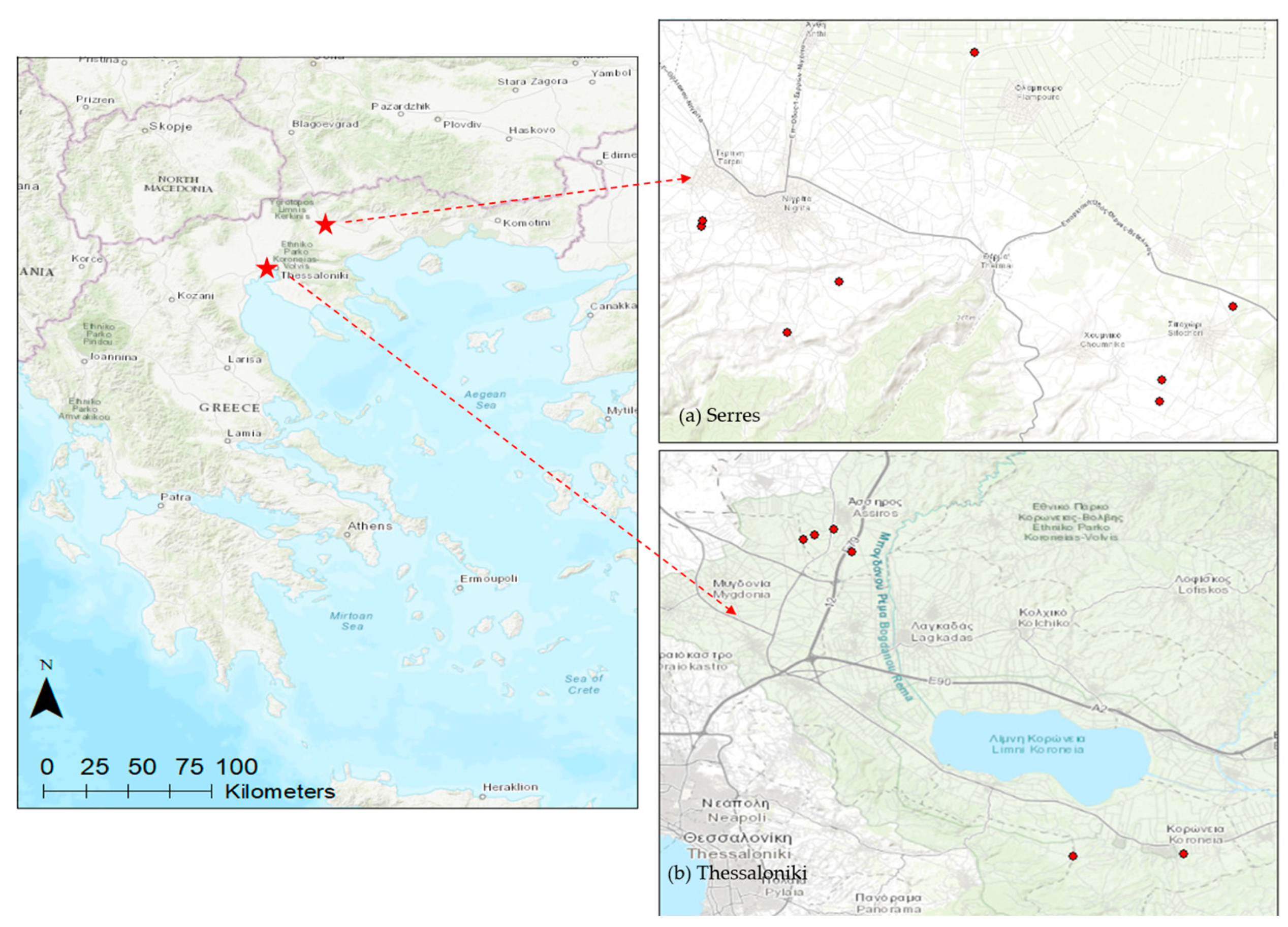
Based on the highest germination ability of seeds, 6 out of the 20 populations from Thessaloniki and 8 out of the 20 from Serres were selected for the previously mentioned whole-plant dose–response and gene sequencing assays [11]. Since the existence of herbicide resistance was identified, the 14 fields owned by different farmers (and not the original 20 in each region) were only selected in order to collect data related to the effects of environmental and agronomic factors on L. rigidum dispersal. Regarding the effect of agronomical practices on the evolution and spread of L. rigidum resistance, the seedbed preparation, rate of fertilizer applied at sowing, time of sowing, time of herbicide application, and rate and time of top-dressing nitrogen fertilization were recorded in each field based on personal communication with the barley growers. In addition, the environmental conditions (soil physicochemical properties; maximum, mean, and minimum monthly temperature; and total monthly rainfall) prevailing in both areas of the 14 barley fields and over the three consecutive growing seasons of 2019–20, 2020–21, and 2021–22 were recorded. The studied regions (Figure 1) were located at a distance of 74 km, with Serres being at a lower altitude (70 m). In addition to the first evaluation survey, two more surveys were also conducted in each of the 6 and 8 fields located in Thessaloniki and Serres, respectively, during the 2020–21 and 2021–22 growing seasons, using a similar method to that described for the first survey performed in the 2019–20 growing season. These two surveys were performed in order to evaluate the efficacy of the herbicide against L. rigidum and its dispersal (ground cover and tiller number/plant) and to compare the recorded data with that recorded in the 2019–20 growing season.

2.2. Enviromental (Soil and Climatic) Factors

Physicochemical soil properties were determined through a soil analysis on samples taken from each field before crop sowing in 2020–21 growing season. The samples consisted of five sub-samples taken from 0–15 cm soil depth using the W pattern of sampling. The five sub-samples were mixed into one soil sample representing each field. After removing the plant debris, samples were transferred to the Laboratory of Agronomy at the Agricultural University of Athens, where they were air-dried. Following this, all samples were analyzed, and their particle size distribution (sand, silt, clay), pH, and organic matter content are presented in Table 1. Particle size distribution was determined by the Bouyoucos hydrometer method [29], pH was measured in a saturated soil paste at a 1:5 soil/water ratio, and organic matter content was determined using the modified wet-digestion method of Walkey and Black [30].
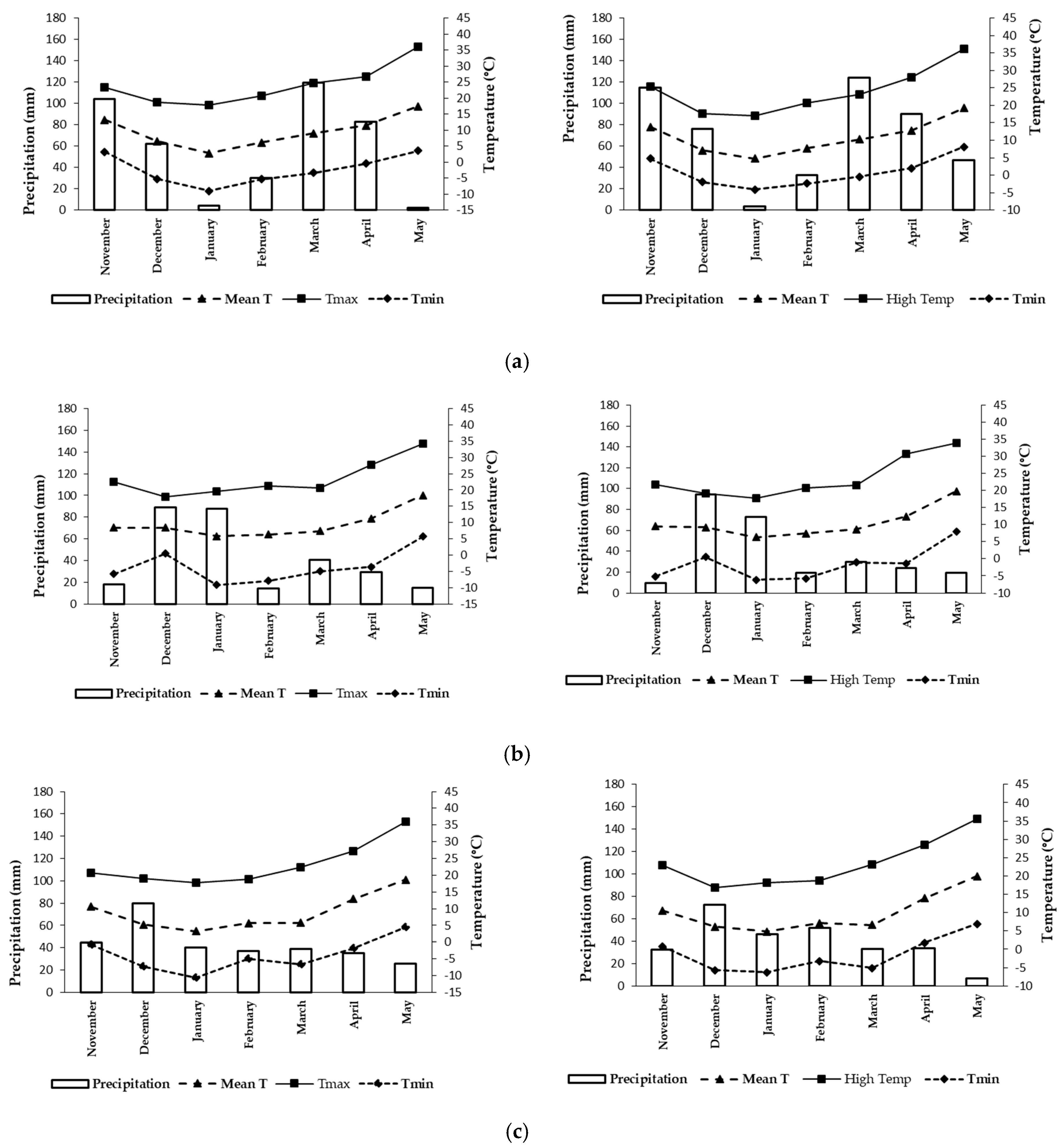
Climatic data (maximum, mean, minimum monthly temperature, and total monthly rainfall) for each growing season (Figure 2) were obtained from the local meteorological stations (Thessaloniki and Serres) established in each region (http://meteosearch.meteo.gr, accessed on 1 September 2023).

2.3. Agronomic Practices

The effect of agronomic practices on L. rigidum’s dispersal was assessed through interviews conducted with farmers of the selected fields. The tool used for data collection was a structured questionnaire based on the principles of Ulber et al. [31] and Heap [17], which was modified and adapted to Greek conditions. The questionnaire included questions related to soil seedbed preparation, barley sowing date, the rate of applied fertilizer at sowing, the time and rate of top-dressing fertilizer application (days after sowing), the time of post-emergence herbicide application (days after sowing), and the time of crop harvest (days after sowing). In order to increase the reliability of the collected data, all agronomic practices applied in the fields were supervised and recorded by local authorized agronomists, since the farmers of the 14 fields were participating in a contract farming project. These data are shown in Table 2. In all fields pinoxaden was applied uniformly at the recommended rate (60 g a.i. ha−1). Therefore, the effect of rate of herbicidal application on L. rigidum’s dispersal was not considered a factor and thus was excluded from the analysis. Two spring malt barley cultivars, namely Fortuna and Grace, were grown in Thessaloniki and Serres, respectively, based on their adaptability evaluated previously. Both cultivars used are registered on the Greek National Variety Catalogue, suitable for Greek climatic conditions, and have high malt quality and yield potential. Additionally, Grace is an early maturity and taller cultivar than the shorter Fortuna with medium maturity.

2.4. GIS Database

A point shapefile (using the coordinates from Table 2) was created and stored in a GIS database using the commercial software package ArcGIS Pro Version 10.8 (ESRI, Redlands, CA, USA). All data related to each field from Table 1 and Table 2, as well as data on L. rigidum and its dispersal (ground cover and tiller number per plant), were also stored in the geodatabase.

2.5. Statistical Analysis

A combined analysis of variance (ANOVA) of the three growing seasons was performed of the ground cover (%) of L. rigidum and the mean tiller number/plant data of the surviving pinoxaden-treated plants. The 3 × 14 × 5 split–split plot approach (3 growing seasons by 14 weed populations-field by 5 replications per sampling with W pattern/field) was used. This analysis was conducted in order to examine the possible existence of significant differences caused by weed populations, areas, and growing seasons. Prior to the analyses, all data were tested to ensure compliance with the assumptions of normality (Shapiro–Wilk test) and homoscedasticity (Levene’s test). The calculated means were compared for significant differences using Fisher’s protected LSD (least significant difference) test at p < 0.05. Furthermore, an ANOVA combining three growing seasons and two experimental regions was performed for both L. rigidum parameters using an unbalanced experimental design with unequal numbers of observations/populations for each treatment combination. More specifically, a 2 × 3 × 6 Thessaloniki and 8 Serres approach (2 regions by 3 growing seasons by 6 Thessaloniki and 8 Serres populations-field) was used for this analysis. Fisher’s protected LSD test was used to compare the differences between region and growing season means at p < 0.05. Another ANOVA similar to the second was performed for the agronomic factors/practices. Furthermore, Pearson correlation coefficient analysis was carried out to examine the possible relationship between soil pH, organic matter, or agronomic practices and L. rigidum ground cover or mean tiller number/plant. In addition, linear correlation analysis was performed between the L. rigidum data obtained during the first and second, first and third, or second and third growing seasons. The ANOVA for all experiments was performed using the Statgraphics Centurion (version XVI) software package (Statpoint Technologies, Inc., Warrenton, VA, USA). In addition, multiple regression analysis was performed to estimate the relationship between ground cover and agronomic practices applied in the 6 and 8 barley fields located in Thessaloniki and Serres, respectively, for each growing season. The days of sowing in each field were expressed as the days passed from the date of sowing in the first field, whereas the application times for the other two agronomic practices were expressed as days after sowing in each field. The L. rigidum ground cover data for the analysis was the dependent variable (y) and the agronomic practices were the independent variables [time of top-dressing application (x1), time of herbicide application (x2), and time of sowing (x3)]. The multiple regression equation is y (ground cover) = a + b1x1 + b2x2 + b3x3 (b regression coefficients). For the multiple regression analysis, the Statgraphics Centurion (version XVI) software package was used (Statpoint Technologies, Inc., Warrenton, VA, USA).

3. Results

3.1. Evolution of L. rigidum’s Ground Cover and Tiller Number/Plant in the 14 Barley Fields

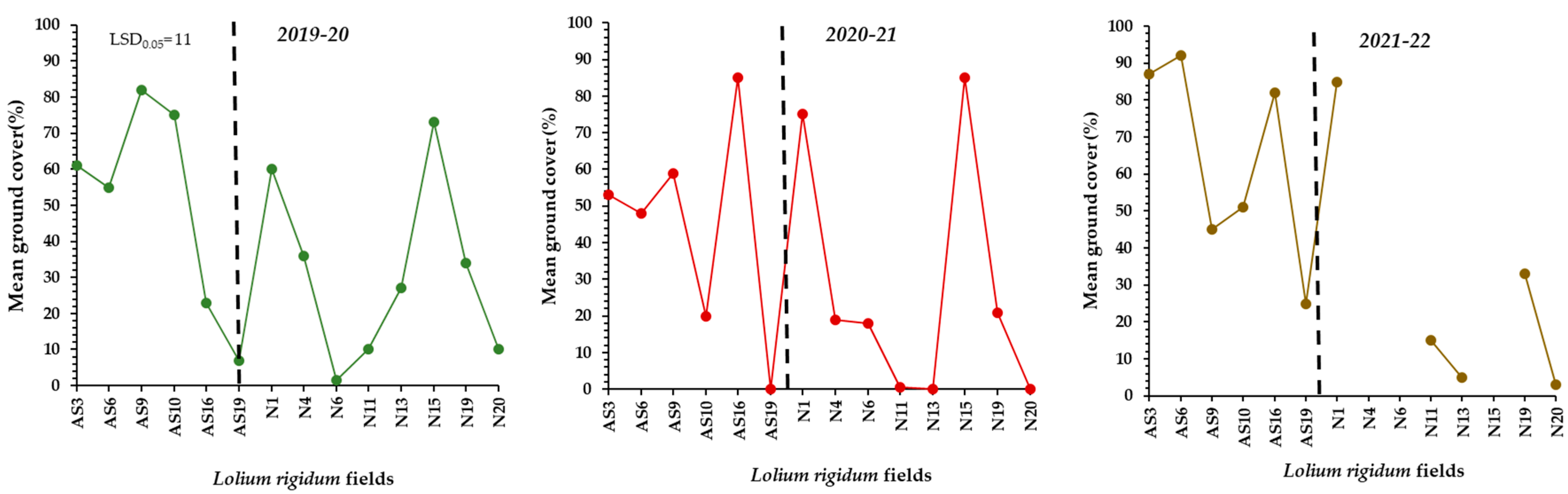
The ANOVA of L. rigidum’s ground cover (%) data, recorded before barley harvest during 2019/20, 2020/21, and 2021/22, indicated that this parameter varied significantly between fields, growing seasons, and regions (F = 24.39, p = 0.00). In particular, the weed ground cover in Thessaloniki (averaged over six populations) was 51%, 44%, and 64% in the 2019–20, 2020–21, and 2021–22 growing seasons, respectively, while that in Serres (averaged over eight populations) was 31%, 27%, and 28%. The lower L. rigidum ground cover in 2019–20 was recorded with the populations AS19, N6, N11, and N20. In addition, the populations AS19, N11, N13, and N20 had the lowest ground cover in the 2020–21 growing season, while the same was recorded for the populations N4, N6, N15, and N20 during the 2021–22 growing season. However, the highest L. rigidum ground cover was observed in populations AS9, N1 and N15 in the 2019–20 growing season, and in AS16, N1, and N15 in 2020–21 (Figure 3). Moreover, in 2021–22, the populations AS6, AS16, and N1 had the highest weed ground cover. The linear correlation analysis of the ground cover of the populations recorded for the 2019–20 and 2020–21, 2019–20 and 2021–22, and 2020–21 and 2021–22 growing season pairs indicated Pearson correlation coefficients of 0.17, 0.16, and 0.68, respectively, for the six populations in Thessaloniki, and 0.12, 0.91, and 0.38 for the eight populations in Serres. It is worth noting that in the 2021–22 growing season, five populations were used for linear correlation because three farmers did not grow barley.
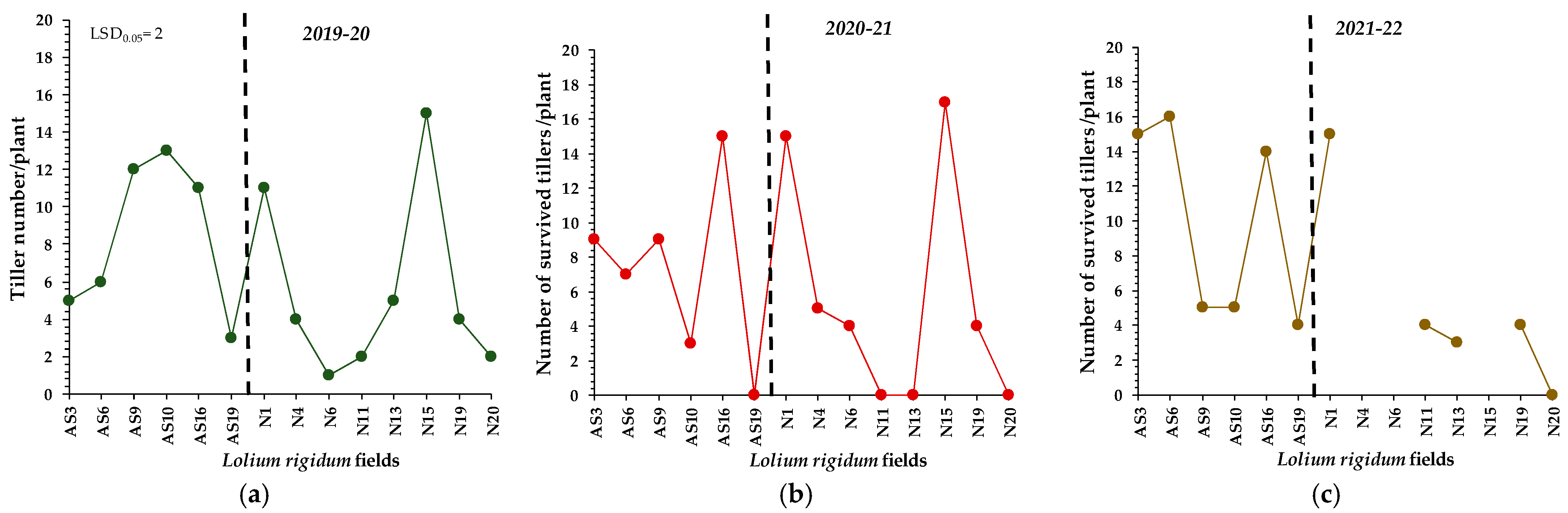
The ANOVA of L. rigidum’s tiller number/plant data indicated significant differences between fields, regions, and growing seasons (Figure 4). Specifically, the tiller number/plant in Thessaloniki (averaged over six populations) was 8, 7, and 10 in the 2019–20, 2020–21, and 2021–22 growing seasons, respectively, while in Serres (averaged over eight populations) it was 6, 6, and 5. The lowest tiller number/plant in most populations was recorded during the 2020–21 growing season, and among these fields AS19, N6, N11, and N20 were found to have the lowest tiller numbers. It addition, the number of tillers/plant in the AS3 and AS6 populations increased from 5 and 6 in 2019–20 to 15 and 16 in 2021–22, respectively, whereas that of the AS9 population decreased from 12 to 9 to 5. Furthermore, the number of tillers/plant in the N1 field also showed a large increase from 11 to 15 and 15 during the three growing seasons. However, the linear correlation analysis of tiller number/plant for each pair of growing seasons, i.e., 2019–20 and 2020–21, 2019–20 and 2021–22, and 2020–21 and 2021–22, indicated Pearson correlation coefficients of 0.37, −0.25, and 0.63, respectively, in Thessaloniki and 0.91, 0.94, and 0.96 for the eight populations in Serres (there were only five populations for the correlation analysis in Serres during the 2021–22 growing season because three farmers did not grow barley).

3.2. Association Between ACCase Mutation Patterns of L. rigidum Populations and Ground Cover or Tiller Number/Plant

The association results between the L. rigidum ACCase mutation patterns reported by Doulfi et al. [11] (Table 3) and the ground cover indicated that the AS9, AS10, N1, and N15 populations in 2019–20; the AS9, AS16, N1, and N15 populations in 2020–21; and the AS6, AS16, and N1 populations in 2021–22 showed the highest ground cover. Meanwhile, the AS19, N6, N11, and N20 populations in 2019–20; the AS19, N11, N13, and N20 populations in 2020–21; and the N13 and N20 populations in 2012–22 were found to have the lowest ground cover (Figure 3). Regarding the tiller number/plant, the highest values were recorded for the AS9, AS10, AS16, N1, and N15 populations in 2019–20; the AS16, N1, and N15 populations in 2020–21; and the AS3, AS6, AS16, and N1 populations in 2021–22. Meanwhile, the lowest tiller number/plant was recorded for the AS19, N6, N11, and N20 populations in 2019–20; AS19, N11, N13, and N20 in 2020–21; and N13 and N20 in 2012–22 (Figure 4). It is worth noting that, although all sequenced plants of the populations AS3, AS6, AS9, AS10, N1, N6, N11, N13, N19, and N20 were found to carry ACCase mutations, only AS3, AS6, AS9, AS10, and N1 were found to have the highest ground cover and tiller number/plant, while this was not the case for N6, N11, N13, N19, and N20 (Table 3, Figure 3 and Figure 4). However, the AS16 population harboring mutations in two plants was found to have high ground cover in the 2019–20 and 2021–22 growing seasons, while the AS19, N4, and N15 populations carrying mutations in one or two plants were found to have inconsistent ground cover over the three growing seasons. All sequenced plants of the AS10, AS16, N1, N11, N13, and N19 populations, in addition to ACCase mutations, were also found to harbor ALS mutations (Table 3), while those of the AS3, AS6, AS9, AS19, N4, N6, N15, and N20 populations were recorded as carrying 0–2 ALS mutations.

3.3. Impact of Agronomic Practices on L. rigidum Dispersal

With regard to seedbed preparation, most of the farmers said that they use plowing to 20–25 cm followed by shallow tillage (e.g., cultivation or/and harrowing) to manage previous crop residues (spreading) and to create a firm base with small clods and moist and weed-free topsoil for good seed-to-soil contact, root development, and crop establishment. They also said that they apply fertilizers containing N and P nutrients at crop sowing either directly onto or near to seeds, or they use a fertilizer-dispensing machine and incorporate it using a cultivator or disk harrow before crop sowing to facilitate strong root development and winter hardiness. Nitrogen is usually applied in split dosages, with a starter dose provided in fall for early vigor followed by a top-dressing application in spring. In particular, farmers in Thessaloniki apply 30–40 kg N/ha before crop sowing, while the respective rate in Serres ranges from 40 to 60 kg N/ha (Table 2). Farmers also apply phosphorus only before sowing at rates of 6.5–8.7 kg P/ha in Thessaloniki and 7.8–10.4 kg P/ha in Serres. Furthermore, all farmers in both regions applied pinoxaden at the recommended rate (60 g ai. ha−1), since it is the only available herbicide registered for use in malt barley crops.
Crop sowing was found to occur earlier in Thessaloniki than in Serres across all three growing seasons. In particular, sowing was performed in Thessaloniki from 4 to 12 November 2019, 5 November to 20 December 2020, and 5 to 12 December 2021 (Table 2). Meanwhile, in Serres, sowing was performed from 5 to 28 December in 2019, from 10 November to late December in 2020, and in early December in 2021.
The time of top-dressing nitrogen fertilization indicated significant differences between the two regions (F = 11.81, p = 0.00), but there were no significant differences between the three growing seasons (F = 1.05, p = 0.36). In particular, in Thessaloniki, fertilizers were applied 90–137 days after sowing in 2019–20, whereas in Serres this was performed 54–71 days after sowing (Table 2). Furthermore, fertilization occurred 78–120 days after sowing in Thessaloniki during the 2020–21 growing season, while in Serres, fertilization was performed 90–138 days after sowing during the same growing season. Finally, nitrogen fertilizers were applied 74–112 days after sowing in Thessaloniki during the 2021–22 growing season, whereas in Serres this was 78–92 days after sowing. The time of top-dressing nitrogen application in Thessaloniki (averaged over six populations) was 109, 91, and 100 days after sowing in the 2019–20, 2020–21, and 2021–22 growing seasons, respectively, while that in Serres (averaged over eight populations) was 61, 105, and 86. The top-dressing nitrogen application rate in Thessaloniki was 80–92 kg N/ha, while that in Serres ranged from 48 to 60 kg/ha.
The post-emergence herbicide application time also varied significantly between the two regions (F = 41.74, p = 0.00), but not across the three growing seasons (F = 2.30, p = 0.12). Specifically, in Thessaloniki, herbicide application was performed 117–147 days after sowing during the 2019–20 growing season, whereas in Serres it was performed 59–76 days after sowing (Table 2). In addition, in Thessaloniki, herbicide application took place 90–125 days after sowing in 2020–21, while in Serres it was performed 106–156 days after sowing. Furthermore, during 2021–22, herbicide application occurred 84–154 days after sowing in Thessaloniki, whereas in Serres, this was performed 95–98 days after sowing. In general, the time of herbicide application in Thessaloniki (averaged over six populations) was 131, 108, and 134 days after sowing in the 2019–20, 2020–21, and 2021–22 growing seasons, respectively, while it was 67, 120, and 94 in Serres (averaged over eight populations for 2019–20 and 2020–21 and five populations for 2021–22). In general, herbicide application was implemented earlier in Serres than in Thessaloniki during the 2019–20 and 2021–22 growing seasons, but it was performed 16 and 12 days earlier in Thessaloniki than in Serres in the 2020–21 growing season.
The time of barley harvest also varied significantly between the two regions (F = 9.66, p = 0.00), but no significant differences were observed between the three growing seasons (F = 2.20, p = 0.14). In particular, barley harvest took place 199–207 days after sowing in Thessaloniki during the 2019–20 growing season, whereas in Serres this was 165–182 days after sowing. Furthermore, barley was harvested 149–210 and 171–211 days after sowing in Thessaloniki and Serres, respectively, in 2020–21, while in 2021–22, the harvest was 169–206 and 174–182 days after sowing in Thessaloniki and Serres, respectively. In general, the harvest of barley in Thessaloniki took place 201, 172, and 197 days after sowing during the 2019–20, 2020–21, and 2021–22 growing seasons, and the respective harvest time in Serres was 172, 186, and 182 days after sowing.
The relationship between top-dressing nitrogen fertilization, herbicide application, crop harvest, or sowing and ground cover or tiller number/plant of L. rigidum across the three growing seasons indicated low and non-significant Pearson correlation coefficients (Table 4).
The multiple regression analysis in Thessaloniki for the relationship between ground cover and agronomic practices indicated high R2 values in all growing seasons, but this was not significant for the 2019–20 and 2020–21 growing seasons (Table 5). The estimated b coefficient value for the time of fertilization was positive, negative, and positive for the 2019–20, 2020–21, and 2021–22 growing seasons, respectively, while for herbicide application time it was negative for all three growing seasons (Table 5). Furthermore, the b coefficient for sowing time was positive, negative, and positive for the 2019–20, 2020–21, and 2021–22 growing seasons, respectively. The R2 values for the relationship between ground cover and agronomic practices in Serres were also high in all growing seasons, but none of them was significant. The estimated b coefficient value was negative, positive, and positive for fertilization in the 2019–20, 2020–21, and 2021–22 growing seasons, respectively, while for herbicide application time it was positive, negative, and negative. The b coefficient for the sowing time was positive for all three growing seasons.

3.4. Impact of Climatic and Soil Conditions on L. rigidum’s Ground Cover and Tillers/Plant

The trends of maximum, mean, and minimum monthly temperatures were generally similar between the two regions and the three growing seasons, and the total monthly rainfall was largely the same in both regions, but it was different between growing seasons (Figure 2). Specifically, higher rainfall was recorded during the 2019–20 growing season than in the other two growing seasons, which is confirmed by the higher rainfall recorded in November, December, March, and April in 2019–20; in December and January in 2020–21; and in December only in 2021–22.
The sand content in soils located in Thessaloniki varied from 20% to 67%, whereas the respective silt and clay contents ranged from 18% to 22% and 13% to 49% (Table 1). In addition, soil pH ranged from 5.5 to 8.4, while the organic matter content (%) ranged from 1.2% to 2.5% (Table 1). Furthermore, the amount of sand in soils located in Serres varied from 11% to 47%, whereas the respective silt and clay contents ranged from 24% to 60% and 11% to 63%. In addition, soil pH ranged from 6.2 to 8.0, while the organic matter content (%) ranged from 1.2% to 4.0%. The averages for sand (%), silt (%), clay (%), pH, and organic matter (%) in soils located in Thessaloniki were 43%, 19%, 38%, 7.1, and 1.8%, respectively, while those in Serres were 31%, 33%, 36%, 7.7, and 2.0%.
The relationship between soil pH, organic matter, sand, silt, clay, and mean ground cover or mean tiller number/plant for each growing season indicated very low and non-significant negative or positive Pearson correlation coefficients (Table 6). Specifically, the Pearson correlation coefficients for mean ground cover and soil pH were r = 0.079, r = −0.309, and −0.229 for 2019–20, 2020–21, and 2021–22, respectively, while those for organic matter were −0.113, −0.251, and 0.403. In addition, the Pearson correlation coefficients for mean tiller number/plant and pH were −0.157, 0.135, and 0.252 for 2019–20, 2020–21, and 2021–22, respectively, while those for organic matter were −0.118, −0.037, and 0.261. Similarly, the Pearson correlation coefficients between L. rigidum’s ground coverage or mean tiller number/plant and sand, silt, or clay were also very low and non-significant.

4. Discussion

It is expected that the recorded differences in L. rigidum’s ground cover or tiller number/plant between populations, regions, and growing seasons were a result of differences in seedbed preparation, barley sowing time, the rate (kg N and P/ha) of fertilizer application at sowing, the time and rate (kg N/ha) of top-dressing fertilizer application, the time of post-emergence herbicide application, the time of crop harvest, soil characteristics (sand, silt, clay, pH, organic matter) in the fields, total monthly precipitation (mm), and mean monthly temperature (°C). In particular, the higher ground cover and greater tiller number/plant identified in most populations in Thessaloniki across all three growing seasons compared to Serres could be attributed to earlier crop sowing resulting in greater seed germination of L. rigidum and seedling survival, which may have resulted from its shorter dormancy period compared with other weeds. Similar results were reported by Goggin et al. [32], who found that L. rigidum has a short-lived dormant soil seed bank compared to other species, and for this reason the proportion of dormant seeds after 12 months ranged from 4 to 16%. Buried seeds only germinate after hydration during the wet autumn season, which breaks their primary dormancy [33]. However, the germination of fresh L. rigidum seeds is inhibited below 5 °C or above 35 °C [34], suggesting that the temperatures prevailing during early autumn and the early-season rainfall which hydrates the seeds increase the emergence of L. rigidum (~80%), which can be controlled prior to later crop sowing [33]. Gramshaw [35] also found that the prevailing temperature from 10 to 18 °C, the alternating day/night regimes, and the early autumn rainfall in Mediterranean countries increase the seed germination of L. rigidum, leading to high ground cover during the early growth stages of winter cereals. Moreover, the high seed survival over summer and autumn is also an important factor for the dispersal of L. rigidum because it facilitates the long-term survival of seeds and increases the potential for it to be one of the most widespread and harmful weeds in winter cereal crops [3]. On the other hand, Gonzalez-Diaz [36] and Fernandez-Quintanilla [22] reported that delayed crop sowing allows L. rigidum seeds to germinate before crop establishment, and their seedlings could be easily controlled through cultivation or by using non-selective herbicides. This suggests that early crop sowing increases the number of emerged L. rigidum plants and their competitive ability against crops, resulting in greater yield losses in the case of unsatisfactory control. However, Forcella et al. [5] reported that most common models for predicting or documenting seedling emergence need to integrate the water potential and temperature of the soil (hydrothermal time), diurnal fluctuations in its temperature, oxygen deficiency, light quality, and seed burial depth to better describe the direct and interactive effects on and among the alleviation and induction of seed dormancy and the germination and elongation of seedlings.
The higher (51%, 44%, and 64%) ground cover and tiller number/plant (8, 7, and 10) in Thessaloniki during the 2019–20, 2020–21, and 2021–22 growing seasons, respectively, compared to the ground cover (31%, 27%, and 28%) and tiller number/plant (6, 6, and 5) in Serres may have resulted from differences in the rates of nitrogen and phosphorus application before sowing, the time of sowing, the time and rate of top-dressing nitrogenous fertilizer application, the time of herbicide application, biological and genetic differences in the weed and crop, the competitive ability of the weed population and crop cultivar, and environmental differences. These results are also confirmed by the lack of significance in the Pearson correlation coefficients calculated from the linear relationship analyses between L. rigidum ground cover or tiller number/plant and the 14 selected fields for the 2019–20 and 2020–21, 2019–20 and 2021–22, and 2020–21 and 2021–22 growing season pairs. Based on these findings, it could be said that these two weed parameters are affected simultaneously by many and multiple interactions between the abovementioned factors that make their interpretation very difficult and, in some cases, impossible. Similar results were reported by others [37], who found that the presence and cover of the weed species Papaver rhoeas, L. rigidum, and Bromus diandrus varied between and within fields over the three years surveyed.
The AS3, AS6, AS9, AS10, and N1 populations harboring ACCase mutations in all sequenced plants were shown to have the highest ground cover and tiller number/plant, while the N6, N11, N13, N19, and N20 populations carrying ACCase mutations in all sequenced plants demonstrated intermediate or low ground cover and tiller number/plant. These results strongly suggest no consistent relationship between the presence of target-site mutations and field performance. This conclusion is also supported by the higher ground cover and tiller number/plant of the AS16 and N15 populations harboring ACCase mutations in two out of three sequenced plants compared to those carrying ACCase mutations in all plants. Similar results were reported by Papapanagiotou et al. [38], who found inconsistent differences in fitness between R sterile oat (Avena sterilis L.) populations, which were not related to the ACCase resistance trait but may have resulted from other non-resistance fitness traits selected in their different geographical locations. Likewise, El-Mastouri et al. [39], found ACCase and ALS resistant populations in North Africa with different level of resistance among populations originating from different locations, suggesting that plant performance is influenced by other factors except target-site mutations. These contradictory findings between populations could be attributed to existing differences in the presence of surviving susceptible vs. resistant plants after late herbicide application (at an advanced growth stage of the weed) or/and inappropriate environmental conditions. The presence of susceptible and resistant plants within each population was confirmed by the whole-plant dose–response assays conducted in our previous experiments [11] that indicated reduced efficacy of pinoxaden after its application at the recommended rate, which ranged from 44 to 62% for six populations, 70–81% for seven populations, and 91% for one population. These differences could be attributed to the fact that the phenotypic traits (ground cover and tiller number) were obtained from plants grown under variable field management condi-tions, while the mutations were detected on a sample of sequenced plants.
The low Pearson correlation coefficients between L. rigidum ground cover or tiller number/plant and crop sowing support the evidence that weed cover is not only reliant on crop sowing, but it is also affected by the interaction between other agronomic practices, in addition to biological, climatic, and environmental factors. In contrast to these results, Gonzalez-Andujar and Fernandez-Quintanilla [22] suggested that earlier crop sowing should be avoided as it increases the number of emerged L. rigidum plants and their competitive ability against crops, resulting in greater yield losses. Therefore, the application of effective herbicides is required when performing early sowing to increase yield.
The low Pearson correlation coefficients between L. rigidum’s ground cover or tiller number/plant and top-dressing nitrogen application time could be attributed to several factors: (a) different application rates and use histories, (b) different responses to nitrogen of the L. rigidum populations and barley cultivar (Fortuna or Grace) grown in each field, (c) different effects of nitrogen on the competitive ability of each weed population against barley cultivars, (d) different soil characteristics, (e) different environmental conditions prevailing in each field during the growing season, and (f) different agronomic practices applied in each crop. Regarding the effect of nitrogen application time on the competition between L. rigidum and wheat, Forcella [5] reported that wheat competed effectively with L. rigidum when nitrogen was supplied before the three-leaf stage, but wheat lost its ability to use mineral nitrogen effectively after the application of nitrogen at the three- to four- or six-leaf stages compared to L. rigidum, which maintained this ability, thus favoring its predominance. In addition, nitrogen fertilization applied forty days after wheat sowing (when 80% of the whole population had emerged) in 100 plants/m2 of Italian ryegrass (Lolium multiflorum Lam.) increased weed growth and individual fecundity, producing an average of 190 and 118 seeds per plant in fertilized and non-fertilized plots, respectively [39]. Scursoni and Arnold [40] found that the application of nitrogen (55 kg N/ha) at early barley tillering resulted in higher A. fatua seedling survival rate, a greater number of seeds produced per plant, and a higher individual plant biomass compared to the unfertilized control treatment (0 N/ha) and the application of nitrogen (55 kg N/ha) at barley sowing. However, Pourreza et al. [41] reported that the application of 150 kg N/ha nitrogen fertilizer before crop sowing resulted in a greater competitive ability of A. fatua than the unfertilized control treatment and the treatment where nitrogen was applied in a split dosage (50 kg N/ha before wheat sowing + 100 kg N/ha at the late tillering stage of wheat). On the contrary, Dhima and Eleftherohorinos [42] demonstrated a greater interference of sterile oat (Avena sterilis) in reducing the grain yield of wheat and triticale when 150 kg N/ha was applied. Compared to the control without N application, the yield reduction due to competition from A. sterilis was similar when 150 kg N/ha was incorporated before crop sowing or 50 kg N/ha was incorporated before crop sowing and 100 kg N/ha was applied in early March (at the end of weed and crop tillering). These findings indicate that the effect of nitrogen on weed/crop competition not only depends on the time and rate of application but may also be affected by its interaction with weed and crop biology, crop cultivar, other agronomic practices, and environmental factors.
The low Pearson correlation coefficients calculated from the linear relationship analyses between L. rigidum’s ground cover or tiller number/plant and the time of herbicide application may have resulted from differences in herbicide efficacy due to the skills of the operator, the conditions prevailing at herbicide application, weed growth stage, weed density, the spatial structure of the weed population within the field, the mechanisms (target-site and non-target-site in each weed population) and level of existing weed resistance to herbicide, an association between weed resistance and fitness, existing genetic differences between populations, differences in the agronomic practices applied, differences in the competitive ability of populations against barley, and the interactions between these factors. Furthermore, Pintar et al. [28] reported a reduced efficacy of the herbicide pinoxaden against A. myosuroides with increasing growth stage of the weed. Specifically, the recommended pinoxaden dose (40 g a.i. ha−1) provided sufficient control of A. myosuroides up to the ZCK 21–25 growth stage, while its application at a slightly delayed growth stage (ZCK 31–32) reduced weed biomass by only 60%. In addition, using double the recommended dose of pinoxaden also failed to provide satisfactory weed control when applied at the advanced growth stages. The reduced efficacy of pinoxaden applied at a later weed growth stage results from the much lower amount of herbicide reaching the plants at advanced growth stages (with large biomass) compared to early application (with low biomass). In addition, differences in survived susceptible plants in fields were observed after the application of pinoxaden under conditions of water stress (drought), which limits the absorption and translocation of the herbicide into the plant where it needs to work [43]. Lastly, the low Pearson correlation coefficients for the relationship between ground cover or tiller number/plant and harvest time were expected to be a consequence of the low Pearson correlation coefficients for the top-dressing of nitrogen fertilization and herbicide efficacy factors that affect the competitive ability and spread of the populations studied.
The very low and non-significant negative or positive Pearson correlation coefficients estimated from the relationship between soil pH, organic matter, sand, silt, or clay and ground cover or tiller number/plant for each growing season indicates that other factors such as the biology and genetics of weed and barley, agronomic practices, and their interactions have a greater effect on the evolution and spread of L. rigidum than soil properties. In addition, regardless of the differences in total rainfall between growing seasons (which was higher in the 2019–20 growing season than in the other two) and in total monthly rainfall within each growing season (the wetter months were November, December, March, and April in 2019–20; December and January in 2020–21; and December in 2021–22), the ground cover and tiller number/plant of L. rigidum populations were not affected. These results are in agreement with those reported by Uherina and Shimoro [44], who found that the distribution and expansion of L. rigidum in Japan is determined by broader and combined climatic factors, rather than by individual environment variables.
The lack of a significant linear relationship between the ground cover or tiller number/plant of the L. rigidum populations and agronomic practices could be considered a statistical limitation. In addition, the very low and non-significant Pearson correlation coefficients estimated from the linear relationship between the ground cover or tiller number/plant of the L. rigidum populations during the 2019–20 and 2020–21, 2019–20 and 2021–22, and 2020–21 and 2021–22 growing season pairs, and between weed parameter data and the time of top-dressing nitrogen applications, the time of post-emergence herbicide (pinoxaden) application, the time of crop harvest, or the soil characteristics of the fields studied, could be associated with both the reduced relationship between these factors and the effect of total monthly precipitation (mm) or/and mean monthly temperature (°C).
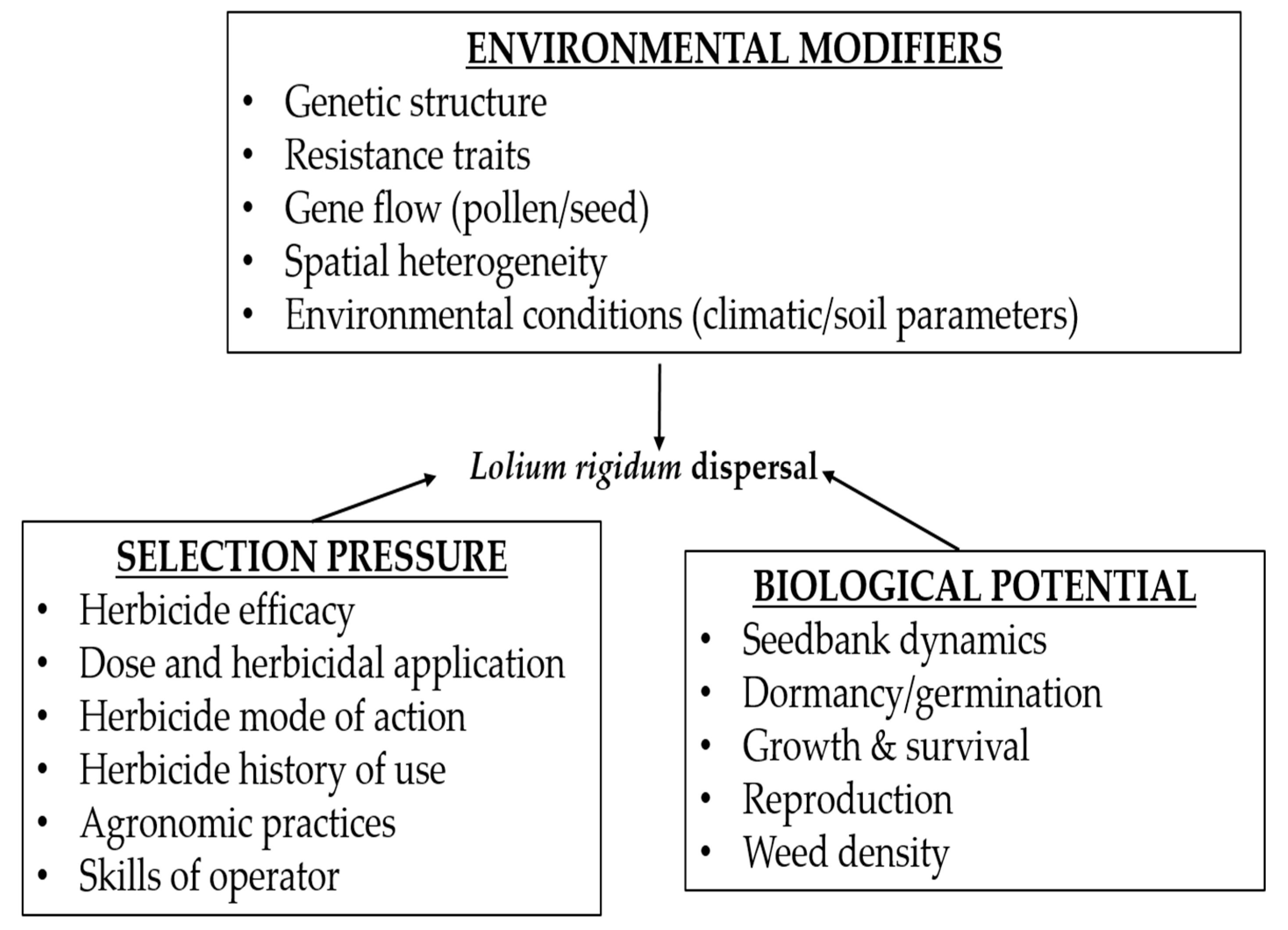
The high estimated R2 (coefficient of determination) in the multiple regression analysis indicates that a large proportion of the variance in the dependent variable (L. rigidum ground cover) is explained by the independent variables (fertilization, herbicide application, and sowing. However, this is not true as the high R2 values do not necessarily reflect strong or reliable predictive relationships, especially when the number of observations is limited. This is con-firmed by the fact that, regardless of the high R2 values for the multiple regression model fit-ted between the ground cover of L. rigidum and the three agronomic practices, the relation-ships were not significant. Therefore, it can be concluded from these findings that, the use of multiple regression analysis for data originating from only three independent variables based on a limited number of fields increases the possibility of model overfitting and re-duces the reliability of the estimated relationships. The inconsistent (negative or positive) estimated relationship between the ground cover and each of the agronomic practices applied in the three growing seasons in both regions indicates different responses of L. rigidum to the interactions among three main components, selection pressure, biological potential, and environmental modifiers, as shown in Figure 5 [3,4,5,6,40,41,42,43,44,45]

5. Conclusions

The findings of the present study indicated that differences in soil properties between barley fields located in Thessaloniki and Serres—such as texture, pH and organic matter content—were not directly associated with L. rigidum’s ground cover or tiller number/plant, but instead appeared to be affected by the combined interaction between agronomic practices, biological characteristics of the weed, and environmental conditions. Although differences in fertilization management (rate and time of nitrogen fertilizer) and the time of herbicide application were associated with differences in ground cover and tiller number/plant, they cannot individually explain L. rigidum’s rapid expansion. Likewise, differences in total rainfall between growing seasons and total monthly rainfall within each growing season did not have any significant effect on either trait. Therefore, it can be concluded that weed expansion is influenced by the interactions between management practices, weed and crop biology, and climatic factors that drive resistance dynamics, rather than any individual practice.
Based on the results of this study, in order to increase the efficacy of herbicides against L. rigidum, reduce the competitive ability of this weed against barley, and slow, prevent, or reduce the evolution and spread of weed resistance, barley farmers should consider applying an integrated L. rigidum management program. This would include appropriate seedbed preparation, the application of necessary fertilizers at sowing according to soil analysis and the requirements of the crop cultivar, late crop sowing, early top-dressing nitrogen application, early application of a herbicide that is effective against the existing weed resistance, the rotation of herbicides with different modes of action, and crop rotation practices. However, with regard to herbicide-resistant L. rigidum populations, environmental factors should also be taken into account when implementing an integrated management program because resistance alters many physiological and biochemical traits of this weed that affect its seed germination, seedling emergence and survival, growth rate, and competitive ability. In addition, more attention should be paid to the effect of environmental stress factors such as drought and extreme temperatures on resistant L. rigidum populations; in most cases, the resistant plants can use natural resources more efficiently than susceptible plants due to their altered metabolism as an adaptation mechanism to environmental changes. Therefore, it is essential to understand the interaction between weed resistance, environmental factors, and agronomic practices in order to accurately predict population dynamics and to develop management methods that are both eco-friendly and suitable for each population.

Author Contributions

G.E., D.K. and I.G.E.: supervision, validation, writing—review and editing; D.D., G.E., D.K. and I.G.E.: methodology; G.E., I.G.E. and D.D.: investigation; D.D. and I.G.E.: formal analysis; G.E., I.G.E. and D.K.: conceptualization, visualization; D.D. and I.G.E.: data curation; D.D.: writing—original draft. All authors have read and agreed to the published version of the manuscript.

Funding

This research received no external funding.

Data Availability Statement

The original contributions presented in this study are included in the article. Further inquiries can be directed to the corresponding author.

Acknowledgments

We thank the Athenian Brewery SA for providing its network of malt barley growers in North Greece.

Conflicts of Interest

The authors declare no conflicts of interest.

References

  1. Spoor, W.; McCraw, J.M. Self-incompatibility in Lolium—A reply. Heredity 1984, 53, 239–240. [Google Scholar] [CrossRef]
  2. Manalil, S. Evolution of herbicide resistance in Lolium rigidum under low herbicide rates: An Australian experience. Crop Sci. 2014, 54, 461–474. [Google Scholar] [CrossRef]
  3. Thompson, M.; Chauhan, B.S. Changing seasonality of Lolium rigidum (annual ryegrass) in southeastern Australia. Front. Agron. 2022, 4, 897361. [Google Scholar] [CrossRef]
  4. Steadman, K.J.; Ellery, A.J.; Chapman, R.; Moore, A.; Turner, N.C. Maturation temperature and rainfall influence seed dormancy characteristics of annual ryegrass (Lolium rigidum). Aust. J. Agric. Res. 2004, 55, 1047–1057. [Google Scholar] [CrossRef]
  5. Forcella, F.; Benech-Arnold, R.L.; Sanchez, R.; Ghersa, C.M. Modelling seedling emergence. Field Crops Res. 2000, 67, 123–139. [Google Scholar] [CrossRef]
  6. Travlos, I.; Gazoulis, I.; Kanatas, P.; Tsekoura, A.; Zannopoulos, S.; Papastylianou, P. Key factors affecting weed seeds’ germination, weed Emergence, and their possible role for the efficacy of false seedbed technique as weed management practice. Front. Agron. 2020, 2, 1. [Google Scholar] [CrossRef]
  7. Palta, J.A.; Peltzer, S. Annual ryegrass (Lolium rigidum) reduces the uptake and utilisation of fertiliser-nitrogen by wheat. Aust. J. Agric. Res. 2001, 52, 573–581. [Google Scholar] [CrossRef]
  8. Hulke, B.S.; Watkins, E.; Wyse, D.L.; Ehlke, N.J. Freezing tolerance of selected perennial ryegrass (Lolium perenne L.) accessions and its association with field winterhardiness and turf triats. Euphytica 2008, 163, 131–141. [Google Scholar] [CrossRef]
  9. Lemerle, D.; Verbeek, B.; Coombes, N. Losses in grain yield of winter crops from Lolium rigidum competition depend on crop species, cultivar and season. Weed Res. 1995, 35, 503–509. [Google Scholar] [CrossRef]
  10. Izquierdo, J.; Recasens, J.; Fernández-Quintanilla, C.; Gill, G. Effects of crop and weed densities on the interactions between barley and Lolium rigidum in several Mediterranean locations. Agronomie 2003, 23, 529–536. [Google Scholar] [CrossRef]
  11. Doulfi, D.; Economou, G.; Madesis, P.; Karapetsi, L.; Eleftherohorinos, I.G. Double mutations drive multiple resistances to herbicides in Greek rigid ryegrass (Lolium rigidum Gaudin). Agronomy 2025, 15, 1532. [Google Scholar] [CrossRef]
  12. Scarabel, L.; Panozzo, S.; Loddo, D.; Mathiassen, S.K.; Kristensen, M.; Kudsk, P.; Gitsopoulos, T.; Travlos, I.; Tani, E.; Chachalis, D.; et al. Diversified resistance mechanisms in multi-resistant Lolium spp. in three European countries. Front. Plant Sci. 2020, 11, 608845. [Google Scholar] [CrossRef]
  13. Anthimidou, E.; Ntoanidou, S.; Madesis, P.; Eleftherohorinos, I.G. Mechanisms of Lolium rigidum multiple resistance to ALS- and ACCase-inhibiting herbicides and their impact on plant fitness. Pestic. Biochem. Phys. 2019, 164, 65–72. [Google Scholar] [CrossRef] [PubMed]
  14. Gitsopoulos, T.; Georgoulas, I.; Vazanelli, E.; Botsoglou, D. Selectivity of the premixtures flufenacet, diflufenican and flufenacet, diflufenican, metribuzin on bread wheat (Triticum aestivum L.) and barley (Hordeum vulgare L.) and efficacy on ALS/ACCase resistant populations of Lolium rigidum Gaudin. Agronomy 2024, 14, 949. [Google Scholar] [CrossRef]
  15. Torra, J.; Montull, J.M.; Taberner, A.; Onkokesung, N.; Boonham, N.; Edwards, R. Target-Site and Non-target-Site Resistance Mechanisms Confer Multiple and Cross- Resistance to ALS and ACCase inhibiting herbicides in Lolium rigidum from Spain. Front. Plant Sci. 2021, 12, 625138. [Google Scholar] [CrossRef]
  16. Tavassoli, A.; Gherekhloo, J.; Ghaderi-Far, F.; Zandd, E.; Osunae, M.D.; Prado, R. Ryegrass (Lolium rigidum Gaud) Resistant to ACCase and ALS inhibitors in northeastern Iran. Weed Sci. 2023, 41, e020220069. [Google Scholar] [CrossRef] [PubMed]
  17. Heap, I. The International Survey of Herbicide Resistant Weeds. Available online: http://www.weedscience.org/Summary/Country.aspx (accessed on 10 January 2026).
  18. Délye, C.; Jasieniuk, M.; Le Corre, V. Deciphering the evolution of herbicide resistance in weeds. Trends Gen. 2013, 29, 649–658. [Google Scholar] [CrossRef]
  19. Vila-Aiub, M.M.; Neve, P.; Powles, S.B. Fitness costs associated with evolved herbicide resistance alleles in plants. New Phytol. 2009, 184, 751–767. [Google Scholar] [CrossRef]
  20. Vila-Aiub, M.M.; Neve, P.; Steadman, K.J.; Powles, S.B. Ecological fitness of a multiple herbicide-resistant Lolium rigidum population: Dynamics of seed germination and seedling emergence of resistant and susceptible phenotypes. J. Appl. Ecol. 2005, 42, 288–298. [Google Scholar] [CrossRef]
  21. Matzrafi, M.; Preston, C.; Brunharo, C.A. Evolutionary drivers of agricultural adaptation in Lolium spp.: A review. Pest Manag. Sci. 2021, 77, 2209–2218. [Google Scholar] [CrossRef]
  22. Gonzalez-Andujar, J.L.; Fernandez-Quintanilla, C. Modelling the population dynamics of annual ryegrass (Lolium rigidum) under various weed management systems. Crop Prot. 2004, 23, 723–729. [Google Scholar] [CrossRef]
  23. Blackshaw, R.E.; Brandt, R.N.; Janzen, H.H.; Entz, T.; Grant, C.A.; Derksen, D.A. Differential response of weed species to added nitrogen. Weed Sci. 2003, 51, 532–539. [Google Scholar] [CrossRef]
  24. Storkey, J.; Moss, S.R.; Cussans, J.W. Using assembly theory to explain changes in a weed flora in response to agricultural intensification. Weed Sci. 2010, 58, 39–46. [Google Scholar] [CrossRef]
  25. Moreau, D.; Busset, H.; Matejicek, A.; Munier-Jolain, N. The ecophysiological determinants of nitrophily in annual weed species. Weed Res. 2014, 54, 335–346. [Google Scholar] [CrossRef]
  26. Nath, C.P.; Singh, R.G.; Choudhary, V.K.; Datta, D.; Nandan, R.; Singh, S.S. Challenges and alternatives of herbicide-based weed management. Agronomy 2024, 14, 126. [Google Scholar] [CrossRef]
  27. Barros, J.C.; Basch, G.; Calado, J.G.; Carvalho, M. Reduced doses of herbicides to control weeds in barley crops under temperate climate conditions. Rev. Bras. Ciênc. Agrár. 2011, 6, 197–202. [Google Scholar]
  28. Pintar, A.; Svecnjak, Z.; Šoštarcic, V.; Lakic, J.; Baric, K.; Brzoja, D.; Šcepanovic, M. Growth stage of Alopecurus myosuroides Huds. determines the efficacy of pinoxaden. Plants 2021, 10, 732. [Google Scholar] [CrossRef] [PubMed]
  29. Gee, G.W.; Bauder, J.W. Particle Size Analysis by Hydrometer: A Simplified Method for Routine Textural Analysis and a Sensitivity Test of Measurement Parameters. Soil Sci. Soc. Am. J. 1979, 43, 1004–1007. [Google Scholar] [CrossRef]
  30. Nelson, D.W.; Sommers, L.E. Total carbon, organic carbon, and organic matter. In Methods of Soil Analysis: Part 3; SSSA Book Series; Wiley: Hoboken, NJ, USA, 2018; pp. 961–1010. [Google Scholar]
  31. Ulber, L.; Rissel, D. Farmers’ perspective on herbicide-resistant weeds and application of resistance management strategies: Results from a German survey. Pest Manag. Sci. 2018, 74, 2335–2345. [Google Scholar] [CrossRef]
  32. Goggin, D.E.; Powles, S.B.; Steadman, K.J. Understanding Lolium rigidum seeds: The key to managing a problem weed? Agronomy 2012, 2, 222–239. [Google Scholar] [CrossRef]
  33. Bajwa, A.A.; Latif, S.; Borger, C.; Iqbal, N.; Asaduzzaman, M.; Wu, H.; Walsh, M. The remarkable journey of a weed: Biology and management of Annual ryegrass (Lolium rigidum) in conservation cropping systems of Australia. Plants 2021, 10, 1505. [Google Scholar] [CrossRef]
  34. McGowan, A. Comparative germination patterns of annual grasses in north-eastern Victoria. Aust. J. Exp. Agric. 1970, 10, 401–404. [Google Scholar] [CrossRef]
  35. Gramshaw, D. Germination of annual ryegrass seeds (Lolium rigidum Gaud.) as influenced by temperature, light, storage environment, and age. Aust. J. Agric. Res. 1972, 23, 779–787. [Google Scholar] [CrossRef]
  36. Gonzalez-Diaz, L.; Gonzalez-Garcia, I.; Gonzalez-Andujar, J.L. Modeling the herbicide-resistance evolution in Lolium rigidum (Gaud.) populations at the landscape scale. Agronomy 2024, 14, 2990. [Google Scholar] [CrossRef]
  37. Izquierdo, J.; Milne, A.E.; Recasens, J.; Royo-Esnal, A.; Torra, J.; Webster, R.; Baraibar, B. Spatial and temporal stability of weed patches in cereal fields under direct drilling and harrow tillage. Agronomy 2020, 10, 452. [Google Scholar] [CrossRef]
  38. Papapanagiotou, A.P.; Paresidou, M.I.; Kaloumenos, N.S.; Eleftherohorinos, I.G. ACCase mutations in Avena sterilis populations and their impact on plant fitness. Pestic. Biochem. Phys. 2015, 123, 40–48. [Google Scholar] [CrossRef] [PubMed]
  39. El- Mastouri, Z.; Hamouzová, K.; Trifan, T.; Košnarová, P.; Alimi, E.; Soukup, J. Resistance to ACCase and ALS-inhibiting herbicides detected in targeted sampling of Lolium rigidum (rigid ryegrass) populations from cereal crops in Morocco, Algeria, and Tunisia. Crop Prot. 2024, 186, 106902. [Google Scholar] [CrossRef]
  40. Scursoni, J.A.; Benech Arnold, R.L. Effect of nitrogen fertilization timing on the demographic processes of wild oat (Avena fatua) in barley (Hordeum vulgare). Weed Sci. 2002, 50, 616–662. [Google Scholar] [CrossRef]
  41. Pourreza, J.; Bahrani, A.; Karami, S. Effect of nitrogen fertilization application on simulating wheat (Triticum aestivum) yield loss caused by wild oat (Avena fatua) interference. Am.-Eurasian J. Agric. Environ. Sci. 2010, 9, 55–61. [Google Scholar]
  42. Dhima, K.V.; Eleftherohorinos, I.G. Influence of nitrogen on competition between winter cereals and sterile oat. Weed Sci. 2001, 49, 77e82. [Google Scholar] [CrossRef]
  43. Uehira, K.; Shimono, Y. Evaluation of climate conditions and ecological traits that limit the distribution expansion of alien Lolium rigidum in Japan. NeoBiota 2024, 96, 89–104. [Google Scholar] [CrossRef]
  44. Goggin, D.E.; Owen, M.J.; Busi, R.; Flower, K. Limited effect of seed dormancy on the efficacy of preemergence herbicides in rigid ryegrass (Lolium rigidum). Weed Sci. 2025, 73, e65. [Google Scholar] [CrossRef]
  45. Ghazy, A.I.; Al-Ateeq, T.K.; Ibrahim, E.I.; Migdadi, H.M.; Attia, K.A.; Javed, M.; Khan, M.A.; Al-Ashkar, I.; Al-Doss, A. Phylogenetic Analysis of Ryegrass (Lolium rigidum) Populations and the Proliferation of ALS Resistance in Saudi Arabia. Agriculture 2022, 12, 290. [Google Scholar] [CrossRef]
Figure 1. Map of Greece with the 8 and 6 studied fields (red dots) in Serres (a) and Thessaloniki (b), respectively.
Agronomy 16 00728 g001
Figure 2. Total monthly precipitation (mm) and maximum, mean, and minimum monthly temperature (°C) for the 2019–20 (a), 2020–21 (b), and 2021–22 (c) growing seasons in the experimental areas of Thessaloniki (left) and Serres (right).
Agronomy 16 00728 g002
Figure 3. Evolution of L. rigidum’s ground cover (%) in the 14 studied fields after pinoxaden application for the 2019/20, 2020/21, and 2021/22 growing seasons (in Serres, three fields were not cultivated with barley during 2021–22).
Agronomy 16 00728 g003
Figure 4. Evolution of L. rigidum tiller number/plant in the 14 studied fields after pinoxaden application for the 2019–20 (a), 2020–21 (b), and 2021–22 (c) growing seasons.
Agronomy 16 00728 g004
Figure 5. Conceptual model of factors affecting dispersal of L. rigidum.
Agronomy 16 00728 g005
Table 1. Soil physicochemical properties of the samples taken from the 6 and 8 experimental fields located in Thessaloniki (As3–As19) and Serres (N1–N20), respectively.
FieldSand (%)Silt (%)Clay (%)pHOrganic Matter (%)
As34118418.41.2
As64518378.21.7
As94020417.82.5
As103918435.51.9
As162922496.32.2
As196720136.21.4
Average4319387.11.8
N14724296.91.8
N42730438.14
N61126638.43.7
N112960118.31.4
N133726378.41.3
N152530458.61.2
N193734296.61.4
N203536296.21.2
Average3133367.72.0
Table 2. Data (DAS: days after sowing of agronomic practices applied in malt barley fields, which obtained by using a structured questionnaire to interview farmers of the selected fields (DAS: days after sowing).
FieldLatitudeSeed Bed Preparation Techniques Barley Sowing DateFertilizer at Sowing (kg N/ha)Fertilizer at Sowing (kg P2O5/ha)Time of Top Dressing Application (DAS)Top-Dressing Rate of N (Kg N/ha)Time of Herbicide Application (DAS)Time of Crop Harvest (DAS)
Longtitude
AS340°48′37.2″ ΝPloughing10 November 2019306.5411092147199
23°00′29.1″ ΕPloughing20 December 2020306.547892106165
Ploughing5 November 2021408.7211280154206
AS640°48′45.7″ ΝPloughing08 November 2019408.7211292141201
23°00′53.3″ ΕPloughing05 January 2020306.54819290149
Ploughing05 November 2021408.7211280154206
AS940°48′57.2″ ΝPloughing10 November 2019306.5411592121199
23°01′31.4″ ΕPloughing20 December 2020306.54789298167
Ploughing12 November 2021408.7210280151203
AS1040°48′12.6″ N Ploughing04 November 2019306.5413792140207
23°02′10.7″ EPloughing19 December 2020306.547992112168
Ploughing12 November 2021408.7210180149201
AS1640°37′43.9″ N Ploughing05 November 2019306.549292121205
23°13′40.7″ EPloughing05 November 2020306.5412080125210
Ploughing12 November 2021306.5410080114199
AS1940°37′40.0″ NPloughing12 November 2019306.549092117198
23°09′49.8″ EPloughing10 December 2020306.5411080116175
Ploughing12 December 2021306.54748084169
N140°53′28.9″ NPloughing06 December 20196010.46714876182
23°37′41.0″ EPloughing10 November 2020457.813860156211
Ploughing07 December 2021408.72784898174
N440°52′16.2″ NPloughing08 December 20196010.46664874180
23°36′26.8″ EPloughing20 December 2020457.89060106171
N640°52′31.3″ NPloughing05 December 20196010.46724874188
23°36′31.4″ EPloughing19 December 2020457.89160107172
N1140°56′40.4″ N Ploughing28 December 20196010.46544859165
23°33′19.6″ EPloughing28 November 2020457.810760120196
Ploughing05 December 202140 924895182
N1340°53′45.1″ NPloughing23 December 20196010.46594864169
23°31′05.2″ EPloughing20 December 2020457.89760106174
Ploughing05 December 2021408.72924895182
N1540°53′06.6″ NPloughing28 December 20196010.46564864165
23°30′13.4″ EPloughing20 December 2020457.810460106174
N1940°54′27.3″ NPloughing28 December 20196010.46564861165
23°28′46.7″ EPloughing28 November 2020457.811760128196
Ploughing05 December 2021408.72854892176
N2040°54′30.8″ NPloughing28 December 20196010.46564861165
23°28′47.7″ EPloughing28 November 2020457.811760128196
Ploughing05 December 2021408.72824892176
Table 3. ACCase and ALS mutations detected in resistant Lolium rigidum plants from 14 populations grown in malt barley fields in Northern Greece (adapted from Doulfi et al. [11]).
PopulationACCase MutationsALS Mutations
Ile-1781Ile-2041Mutant Plants/
Analyzed Plants
Pro-197Trp-574Mutant Plants/
Analyzed Plants
AS3Leu(3)Asn(3)3/3Pro(3)Trp(3)0/3
AS6Leu(3)Asn(1), Ile(2)3/3Pro(2), Thr(1)Trp(3)1/3
AS9Leu(3)Ile(3)3/3Pro(3)Trp(3)0/3
AS10Leu (3)Asn(1), Ile(2)3/3Thr(1), Ser(2)Leu(3)3/3
AS16Leu(1) or Val(1)
Leu(1), Ile(1)
Ile(3)2/3Gln(1), Ala(2)Trp(3)3/3
AS19Ile(3)Asn(1), Ile(2)1/3Ser(1), (2)ProTrp(3)1/3
N1Leu(3)Asn(1), Ile(2)3/3Ser(3)Trp(3)3/3
N4Leu(2), Ile(1)Asn(1), Ile(2)2/3Ser or Thr, Pro(2)Trp(3)1/3
N6Leu(3)Asn(1), Ile(1)
Val(1)
3/3Pro(3)Trp(3)0/3
N11Leu(3)Asn (3)3/3Ser(3)Trp(3)3/3
N13Leu(1), Ile(1)
Val or Leu
Asn (2), Val(1)3/3Ser(3)Trp(3)3/3
N15Leu(2), Ile(1)Ile(3)2/3Ser(2), Pro(1)Trp(3)2/3
N19Leu(3)Asn(1), Ile(2)3/3Thr(2), Leu(1)Leu(3)3/3
N20Leu(3)Asn(1), Ile(2)3/3Thr(1), Pro(2)Trp(3)1/3
Amino acid substitution detected in two codons of accase or als genes of analyzed plants. Number of plants carrying the mutation is in brackets.
Table 4. Pearson correlation coefficients (PCC) between L. rigidum ground cover or mean tiller number/plant and time of sowing, fertilization, herbicide application, and crop harvest.
Plant ParameterPCC (Time of Sowing)PCC (Time of Top-Dressing
Fertilization)
PCC (Time of Post-Emergence Herbicide Application)PCC (Time of Barley Harvest)
Mean ground
coverage 2019–20
−0.22060.54130.43990.3053
Mean ground
coverage 2020–21
−0.14260.31990.42020.4332
Mean ground
coverage 2021–22
−0.13690.16060.21520.2635
Mean tiller number/
plant 2019–20
−0.21460.39930.30610.2987
Mean tiller number/
plant 2020–21
−0.20620.19580.13560.1898
Mean tiller number/
plant 2021–22
−0.18150.49060.47930.5024
Table 5. Multiple regression analysis between L. rigidum cover and time of sowing, fertilization, and herbicide application.
ThessalonikiMultiple Regression Equation
  • 2019/20 growing season
Ground cover = −138.993 + 1.65697 × fertilization − 0.0155981 × herbicide + 2.00841 × sowing
p0.05 = 0.31, R2 = 78%
2.
2020/21 growing season
Ground cover = −673.718 − 1.11468 × fertilization − 3.63826 × herbicide − 3.45227 × sowing
p0.05 = 0.11, R2 = 92%
3.
2021/22 growing season
Ground cover = −331.824 + 5.35906 × fertilization − 1.1746 × herbicide + 1.54496 × sowing
p0.05 = 0.02, R2 = 98%
Serres
  • 2019/20 growing season
Ground cover = −562.869 − 5.73061 × fertilization + 13.1957 × herbicide + 4.16578 × sowing
p0.05 = 0.16, R2 = 69%
2.
2020/21 growing season
Ground cover = −670.399 + 3.18211 × fertilization + 1.8482 × herbicide + 4.85597 × sowing
p0.05 = 0.31, R2 = 55%
3.
2021/22 growing season
Ground cover = 1881.0 + 10.0 × fertilization − 31.0 × herbicide + 154.0 × sowing
p0.05 = 0.13, R2 = 98%
Table 6. Pearson correlation coefficients (PCCs) between L. rigidum’s ground cover or mean tiller number/plant and soil pH or organic matter, sand, silt, or clay content.
Plant ParameterPCC (pH)PCC (OM)PCC (Sand)PCC (Silt)PCC (Clay)
Mean ground cover 2019–200.079−0.1130.149−0.4570.241
Mean ground cover 2020–21−0.309−0.2510.120−0.1400.006
Mean ground cover 2021–22−0.229−0.4030.308−0.335−0.021
Mean tiller number/plant 2019–20−0.157−0.1180.047−0.403−0.157
Mean tiller number/plant 2020–210.1350.037−0.147−0.3350.414
Mean tiller number/plant 2021–220.2520.2610.061−0.4500.416
Disclaimer/Publisher’s Note: The statements, opinions and data contained in all publications are solely those of the individual author(s) and contributor(s) and not of MDPI and/or the editor(s). MDPI and/or the editor(s) disclaim responsibility for any injury to people or property resulting from any ideas, methods, instructions or products referred to in the content.