Article

Influence of Various Intercropping Ratios on Arsenic Absorption and Remediation Efficiency in Maize/Peanut on Farmland Contaminated by Arsenic


The Guangdong Provincial Key Laboratory of Agricultural & Rural Pollution Abatement and Environmental Safety, College of Natural Resources and Environment, South China Agricultural University, Guangzhou 510642, China
*
Author to whom correspondence should be addressed.
Agronomy 2026, 16(6), 638; https://doi.org/10.3390/agronomy16060638
Submission received: 6 February 2026 / Revised: 11 March 2026 / Accepted: 13 March 2026 / Published: 18 March 2026
(This article belongs to the Topic Effect of Heavy Metals on Plants, 2nd Volume)

Abstract

Phytoremediation is a prevalent approach for addressing remediation and production goals in polluted agricultural land. In this study, we examined the impact of four distinct planting ratios on crop growth, accumulation of arsenic (As), and rhizosphere soil dynamics of peanut and maize. The results revealed that intercropping significantly reduced grain As accumulation (42.11–63.16% in maize; 62.28% in peanut under the 1:2 ratio, T2), achieving compliance with Chinese food safety standards (GB 2762-2017, 0.05 mg kg−1). Meanwhile, the T2 treatment exhibited a significantly higher As bioconcentration factor (BCF) and the lowest translocation factor (TF). The metal removal equivalent ratio (MRER) under different planting systems was 1.09, 2.41, 1.07, and 1.46. Additionally, while intercropping did not increase grain biomass per plant, the LER values > 1 for T1 (1.88) and T2 (1.25) demonstrated that complementary resource use enhanced total productivity. Intercropping treatments significantly affected soil properties in both maize and peanut rhizospheres. For maize, intercropping lowered soil pH and available As content but increased dissolved organic carbon (DOC). Notably, only the T1 treatment significantly reduced the cation exchange capacity (CEC) of maize soil. Peanut’s rhizosphere experienced increases in both pH and CEC due to intercropping, with only the T2 treatment yielding a slight rise in DOC. The findings suggest that the maize–peanut intercropping system, especially the T2 system, effectively alters the soil–plant interface to limit As uptake while maintaining productivity, demonstrating its promise for safe utilization of As-contaminated land.

1. Introduction

China’s rapid industrial and urban expansion has been a major driver of heavy metal contamination in agricultural soils. According to the Bulletin on the National Soil Pollution Survey in China, arsenic (As) contaminates approximately 2.7% of the agricultural land [1]. A research that systematically analyzed the status of arsenic (As) accumulation in agricultural soils across China from 1985 to 2016 found that As in Chinese agricultural surface soils was estimated to be 3.71 × 10⁶ t and As levels in these soils have risen steadily from 1985 to 2016, with projections suggesting this trend will continue [2]. A machine learning model based on 3524 surveys covering more than one million soil samples showed that the average As concentration in China’s topsoil increased from 11.9 mg kg−1 in 2000 to 12.6 mg kg−1 in 2020, and is projected to further rise to 13.6 mg kg−1 by 2040 [3]. Soil As contamination originates from geogenic sources, with a baseline concentration of 5–10 mg kg−1, as well as anthropogenic activities. These anthropogenic activities, including mining (~6200 tons per year), industrial processes, and irrigation, have elevated crustal As levels by 100–1000-fold [4,5]. As accumulation poses significant risks to the balance of ecosystems due to its biological toxicity and enters the food chain through crop uptake, exerting greater toxicity than drinking water exposure, and endangering more than 230 million people worldwide [6,7]. Intercropping economic crops with hyperaccumulator plants offers a promising “simultaneous remediation and production” strategy. This technology provides multiple benefits, including in situ remediation, cost-effectiveness, soil structure preservation, and prevention of secondary pollution [8,9]. Nonetheless, the research on suitable intercropping systems is still limited, especially for mild to moderate pollution level, which exists in almost 90% of farmland with heavy metal contaminations in China [10]. This gap leads to considerable economic inefficiency in remediation efforts. Thus, this study was designed to develop a safe agricultural production of various economic crops on As-contaminated farmland to achieve a better reconciliation of productivity with safety concerns.
The practice of intercropping—planting two or more crops together in the same field within a single growing season—enhances production efficiency through the optimized use of resources (e.g., light, water, and nutrients) and contributes to greater ecological stability [11,12]. This technique has gained notable popularity for achieving safe agricultural production on As-contaminated farmland [13]. Much research has shown that intercropping hyperaccumulators together with crops not only improves As extraction and soil remediation efficiency but also reduces As uptake by crops, helping their compliance with safety standards. For instance, P. vittata–maize intercropping increased As accumulation in the hyperaccumulator by 132% (from 535.8 mg·kg−1 to 1244.5 mg·kg−1) while decreasing As content in maize shoots by 37% (from 4.42 mg·kg−1 to 2.79 mg·kg−1), with maize grain As remaining below detection limits (<0.01 mg·kg−1) [14]. P. vittata intercropped with the legume (Sesbania cannabina) enhanced As phytoextraction by 19.3–53.9% (from 1050 mg·kg−1 to 1252–1616 mg·kg−1) in mildly contaminated soil (80 mg As·kg−1), while keeping legume seed As below 0.5 mg·kg−1 [15]. Meanwhile, soil degradation from As pollution can be countered by effectively reducing its bioavailability. Intercropping systems—such as Pteris vittata with peach or mulberry [16,17], and peanut with jute or lucerne [18]—have demonstrated significant efficacy in phytoremediation. These systems function through rhizosphere acidification, microbial community modulation (increasing Proteobacteria, decreasing Chloroflexi), and transformation of soil As from iron-bound to calcium/aluminum-bound forms, thereby enhancing phytoextraction while ensuring food safety. However, most research on intercropping in As-contaminated fields has investigated one specific planting ratio (1:1) when investigating plant As uptake, without systematically evaluating the effects of varying row ratios on remediation efficiency and crop performance. This gap limits the full potential of intercropping systems, as varying ratios significantly influence plant interactions, resource distribution, and overall effectiveness. For instance, a study determined that a 1:2 Pteris vittata-to-maize ratio increased As accumulation by 17.9% (202 g hm−2) compared with P. vittata monoculture, whereas a 4:4 row arrangement (1:1 ratio) achieved As of 942 g hm−2, equivalent to monoculture levels and 37-fold greater than maize sole cropping (26 g hm−2), with a 293.5% increase in metal removal equivalent ratio [14]. Another study also found that a 3:1 bamboo-to-sedum planting ratio optimizes soil enzyme activities (dehydrogenase, urease, phosphatase), bacterial-α-diversity (Shannon, Chao1 indices), and heavy metal (Cu, Zn, Cd) extraction efficiency compared to 1:1 configurations [19]. As such, investigating the impact of different intercropping ratios on plant growth in As-contaminated fields is essential to optimize both remediation and production.
Maize (Zea mays L.) is the most widely grown cereal crop in the world and an important staple food in many developing countries of Latin America, Africa, and Asia. Due to the growing global population, maize production must double by 2050 to meet demand [20]. Nonetheless, maize cultivation is highly vulnerable to As contamination due to its extensive cultivation area and the significant variability in soil properties and As concentrations across different regions [21,22]. Therefore, the accumulation of As in maize kernels poses a pressing challenge that demands immediate attention [23]. A promising strategy is cultivating low-As-accumulating maize varieties in lightly to moderately contaminated farmland. A study of 18 maize varieties grown in soils with total and available As levels of 238.8 mg kg−1 and 8.1 mg kg−1, respectively, found that kernel As levels in low-accumulating varieties ranged from 0.03 to 0.07 mg kg−1—well below China’s safety limit of 0.5 mg kg−1 [24]. However, the widespread application of such varieties in actual farm production remains limited. Meanwhile, peanuts (Arachis hypogaea L.) are a major oilseed crop in China, with a cultivation area of 4.6 million hectares, accounting for 40% of the global production [25]. However, its production is increasingly threatened by soil heavy metal contamination [26]. A study across 17 sites in China’s main peanut-producing regions found that 2% of peanut kernels exceeded the As standard, while 100% of soil samples surpassed the risk screening value for As [27]. Additionally, legume crops are considered capable of enhancing ecological sustainability in metal-contaminated agricultural systems [28]. Maize-peanut intercropping is a widely used system in China, as it improves nutrient complementarity, soil structure, and regulation of root-associated microbiota [29,30]. Nevertheless, research on the combined production and remediation effects of this intercropping system in As-contaminated farmland remains scarce.
Soil physicochemical properties, including pH, effective cation exchange capacity (CEC), and dissolved organic carbon (DOC), are critical parameters influencing As speciation, mobility, and plant uptake [31]. A pot study demonstrated that As accumulation in the edible parts of lettuce, carrots, green beans, and tomatoes depended not only on total soil As content but also on soil pH and vegetable species [32]. Another study found that soil constituents, including clay, reactive alumina (AlOx), and reactive iron oxide (FeOx), along with pH and CEC, have been shown to strongly adsorb As, thereby reducing its uptake by plants such as lettuce and ryegrass [33]. Conversely, DOC can enhance plant As uptake by altering soil surface adsorption characteristics, which diminishes the soil’s capacity to retain As [34]. Additionally, the maize–peanut intercropping system represents a typical grass–legume configuration that improves resource-use efficiency and enhances soil physicochemical properties and ecological functions [35,36]. However, the specific relationships between changes in soil properties and As accumulation under maize–peanut intercropping in As-contaminated soils remain insufficiently studied.
To sum up, our study was conducted in farmland of southern China mildly to moderately contaminated by As, with the aim to compare the effect of different planting ratios of peanut–maize intercropping. This study aimed to elucidate the impact of different planting ratios on the growth and As uptake dynamics in a maize–peanut intercropping system. Our key focus was to examine the consequent modifications in rhizosphere soil properties and their interrelationships with As accumulation in the plants. The work thereby aims to contribute technical support for integrated approaches that enable agricultural productivity alongside environmental remediation in As-affected agricultural land.

2. Materials and Methods

2.1. Experimental Site and Plant Cultivation

The field investigation was performed at a research base within Longgang District, Shenzhen City, Guangdong Province, China. The climate at the site is categorized as mid-subtropical monsoon, with a mean annual temperature of approximately 20.4 °C and an average yearly rainfall of around 1778 mm. Prior investigations categorized the experimental site as moderately As-contaminated, with soil As concentrations ranging from 80 to 100 mg kg−1. Prior to crop planting, surface soil samples (0–20 cm depth) were collected from the experimental area using the five-point sampling method (sampling points at the four corners and the center of a defined area) to ensure a representative composite sample (HJ/T166-2004) [37]. These samples were subsequently transported to the laboratory for air-drying and subsequent analysis. According to the Chinese soil classification system, the soil at the experimental site is classified as sandy loam. Initial characterization (based on analysis of the composite sample) revealed the following physicochemical properties: a pH of 6.83, alkaline hydrolyzed nitrogen at 45.14 mg kg−1, available phosphorus at 186.25 mg kg−1, rapidly available potassium at 50.55 mg kg−1, and a total arsenic content of 68.15 mg kg−1. This As level significantly exceeds the Chinese risk screening value for farmland’s soil (RSV = 30 mg kg−1) (GB15618-2018) [38] and the international WHO/FAO guidance value (20 mg kg−1). Based on the contamination index method, this site is classified under moderate contamination, providing a critical environment to test the remediation efficiency of the maize–peanut intercropping system. The maize variety utilized in the experiment was Huayu 1902, characterized as a low-As accumulation variety, and was provided by the College of Agriculture at South China Agricultural University. Guihua 57 is the peanut variety, recognized for its excellent shade tolerance, making it suitable for intercropping, and was developed and provided by Dr. Tang Ronghua, researcher at the Institute of Economic Crops, Guangxi Provincial Academy of Agricultural Sciences.

2.2. Experimental Design

A field plot experiment was established in early May 2024 to evaluate four distinct maize–peanut intercropping ratios, with monocultures of each crop serving as controls. The specific configurations of these planting patterns are detailed in Table 1 and illustrated in Figure 1. Specifically, in this study, row spacing for peanuts in intercropping was set at 60 cm, differing from the 40 cm spacing in monocropping. Previous studies have shown that peanut yield is insensitive to row spacing between 40 and 60 cm [39]. The experiment employed a completely randomized design with three replications, resulting in a total of 18 individual plots for assessment. Sixty-centimeter protective rows were set with maize (the same variety as in the intercropping system) around the whole experimental field and between different treatment plots to eliminate the edge effect and ensure microenvironment uniformity. The experiment utilized a hole sowing method, with three seeds sown per hole; thinning was conducted after seeding emergence to retain a single healthy plant per hole. Water and fertilizer management during planting adhered to local practices, and regular weeding was performed.

2.3. Analytical Methods

2.3.1. Sample Collection and Process

Upon reaching physiological maturity, whole maize and peanut plants were harvested simultaneously from each experimental plot. The experiment included three biological replications, with the plot as the statistical unit. Maize and peanut plant organs (grain/pod, leaf, stem, root) and corresponding rhizosphere soil (within 2 mm of the root surface) were immediately placed into separate labeled ziplock bags and transported to the lab on the sampling day. Following collection, the plant samples were thoroughly cleaned with tap water, followed by two rinses with deionized water. Subsequently, they were exposed to 105 °C for 30 min to halt biological activity and then dried at 60 °C to a constant weight. The dry weight of each plant organ was determined separately. Yield was calculated based on the dry weight of edible parts. Meanwhile, the soil samples were divided into two subsamples for different subsequent analyses: one subsample was air-dried naturally and sieved through a 2 mm mesh sieve, and the other subsample was stored fresh at −20 °C for future analysis.

2.3.2. Determination of As in Plant Samples

The total As concentration in plant samples was determined using the method proposed by this study [40]. A total of 0.18 g of the ground plant sample was weighed and placed directly into a digestion tube, Subsequently, 10 mL of concentrated nitric acid (HNO3, 10 mL) was added to the tube, and the sample was subjected to preliminary digestion in a graphite furnace under a controlled temperature program, followed by further digestion using a microwave digester (Mars 6, CEM Corporation, Matthews, NC, USA). The total As concentration in the final digestate was determined using an atomic fluorescence spectrometer (AFS-8510, Haiguang Company, Beijing, China). For quality assurance, standard reference material GBW07603 (GSV-2) was utilized, yielding method recovery rates between 80% and 96%.

2.3.3. Determination of Different As Forms in Rhizosphere Soil

Bioavailable As was extracted with a 0.05 mol L−1 NH4H2PO4 solution at a soil-to-liquid ratio of 1:25. The extraction process was conducted on an orbital shaker operating at 180 rpm for 16 h at room temperature. Thereafter, the extract was subjected to centrifugation, and the collected supernatant was filtered through a 0.45 μm filter membrane to prepare the solution for subsequent analysis. This solution was analyzed using an atomic fluorescence spectrometer (AFS-8510, Haiguang Company, Beijing, China). The Wenzel Five-Step extraction method was employed to determine the different species of As in the rhizosphere soil [41]. This method includes five forms of As:
(1)
Non-specifically sorbed As (F1): Soil samples were extracted with 25 mL of 0.05 M ammonium sulfate by shaking for 4 h at 20 °C.
(2)
Specifically sorbed As (F2): The residue from F1 was shaken with 25 mL of 0.05 M ammonium dihydrogen phosphate (NH4H2PO4) for 16 h at 20 °C.
(3)
Amorphous and poorly crystalline hydrous oxides of Fe and Al-bound As (F3): The residue from F2 was extracted with 25 mL of 0.2 M ammonium oxalate buffer [(NH4)2C2O4-H2C2O4, pH 3.25] in the dark for 4 h.
(4)
Well-crystallized hydrous oxides of Fe and Al-bound As (F4): The residue from F3 was treated with 25 mL of 0.2 M ammonium oxalate buffer containing 0.1 M ascorbic acid (C6H8O6, pH 3.25) and heated in a water bath at 96 °C for 0.5 h.
(5)
Residual As (F5): The remaining soil residue was digested using a microwave-assisted mixed acid system consisting of concentrated HNO3-HCl-HF.

2.3.4. Determination of Physicochemical Properties in Rhizosphere Soil

The rhizosphere soil pH was measured using a portable pH meter (SX-620, Sanxin Instrument Co., Ltd., Shanghai, China) at a water-to-soil ratio of 1:2.5 [42]. Hexamminecobalt trichloride solution-leaching spectrophotometric method (HJ 889-2017) was used to determine the content of CEC in rhizosphere soil. The content of DOC in rhizosphere soil was determined using Mn(III)-pyrophosphate (10 mmol L−1) and concentrated sulphuric acid extraction [43].

2.4. Data Analysis

Land equivalent ratio (LER) The LER was defined as the ratio of the yield obtained from the mixed cropping of two or more crops to the yield from monoculture of each crop in the same field. It serves as an indicator for assessing whether the intercropping system provides a yield advantage [44].
L E R = Y i m Y m m + Y i p Y m p
where Yim and Ymm represent the grain yields of intercropped maize and monocultured maize, respectively, and Yip and Ymp represent the grain yields of intercropped peanut and monocultured peanut, respectively, in kg. If the LER > 1, it indicates that the intercropping system has a yield advantage and higher land use efficiency.
Calculation of bioconcentration amount (BCA): The BCA was referred to the total amount of As absorbed by the whole plants from the soil, reflecting the ability of plants to extract and enrich soil As elements [40]. BCA is also the measure of the plant total As accumulation (μg plant−1).
B C A = B p l a n t × C p l a n t
where Bplant represents the biomass of the plant in kg, and Cplant represents the arsenic concentration in the plant in mg kg−1.
Bioaccumulation factor (BCF): The BCF was defined as the ratio of the concentration of a heavy metal element absorbed and accumulated by a plant from the soil in which it grows to the concentration of that element in the soil. This ratio reflects the potential of the plant to extract the heavy metal element. Transport factor (TF): The TF was defined as the ratio of the concentration of a heavy metal in the aboveground parts of the plant to that in the belowground parts, thereby indicating the ability of the plant to transport heavy metals from its roots to its aerial organs.
B C F = C p l a n t C s o i l
T F = C s h o o t C r o o t
where Cplant and Csoil refer to As concentration in the complete plant and soil, respectively, in mg kg−1. Cshoot and Croot refer to the As concentration in the aboveground (stems, leaves, grains) and belowground (roots) of the same plant, respectively, in mg kg−1.
Metal removal equivalent ratio (MRER): The MRER was utilized to assess the heavy metal removal efficiency of intercropping or mixed cropping plants, using the BCA of monoculture plants as a control.
M R E R = B C A i m B C A m m + B C A i p B C A m p
where BCAim and BCAmm represent the bioaccumulation of heavy metals in maize under intercropping and monoculture conditions, respectively, in mg. BCAip and BCAmp, respectively, represent the bioaccumulation of heavy metals in peanuts under intercropping and monoculture conditions, in mg. If the MRER > 1, it indicates that the intercropping system has an advantage in removing heavy metals compared to monoculture; otherwise, it has no advantage [45].

2.5. Statistical Analyses

All statistical analyses were performed with IBM SPSS Statistics version 20.0 (v20.0). The significance of differences among various treatments was evaluated by employing a one-way analysis of variance (ANOVA). Graphical presentations, including correlation heat maps for evaluating relevant soil and plant properties, were constructed using Origin (v2024). Data are presented as means ± standard error (SE) from three replicates (n = 3).

3. Results

3.1. Biomasses and Yields of Plants in Different Planting Systems

The maize biomass and yield responses to different intercropping treatments are presented in Table 2. No significant differences in kernel biomass were observed between the 1:1 maize–peanut (T1), 1:2 maize–peanut (T2), and 1:4 maize–peanut (T3) intercropping patterns and monoculture (p > 0.05). In contrast, the 2:4 maize–peanut intercropping pattern (T4) significantly reduced (38.06%) the kernel biomass (p < 0.05). Compared with monoculture, treatments T1 and T3 significantly reduced maize root biomass by 22.34% and 18.95% (p < 0.05), respectively, while T4 significantly increased root biomass by 29.18% (p < 0.05). All treatments of intercropping showed lower stem and leaf biomass. For stem biomass, T1, T3, and T4 significantly decreased values by 25.96%, 32.89%, and 41.66%, respectively, relative to monoculture (p < 0.05). Similarly, T2, T3, and T4 significantly reduced maize leaf biomass by 14.54%, 18.11%, and 22.51%, respectively, compared with monoculture (p < 0.05). Notably, owing to the increased planting area, T1 treatment only achieved a significant increase of 23.70% (p < 0.05), while other intercropping treatments significantly reduced yield as compared to the monoculture system (p < 0.05).
Peanut biomass and yield responses to different intercropping treatments are presented in Table 3. The treatments of T1, T2, and peanut plants adjacent to maize rows in T3 (T3-S) did not affect peanut grain biomass compared to monoculture (p > 0.05). In contrast, the treatments of peanut plants in the middle row of T3 (T3-M) and T4 decreased the grain biomass by 47.87% and 67.79% (p < 0.05). Compared with monoculture, treatments T1, peanut plants adjacent to maize rows in T4 (T4-S), and peanut plants in the middle row of T4 (T4-M) significantly reduced peanut root biomass by 66.88%, 54.69%, and 29.06%, respectively (p < 0.05). The highest root biomass is the T2 treatment (16.55 g), but the difference was not statistically significant (p > 0.05). Compared to monoculture, all intercropping treatments reduced stem and leaf biomass. For peanut stem biomass, treatments T3-M, T4-S, and T4-M significantly decreased values by 48.53%, 44.84%, and 50.41%, respectively, relative to monoculture (p < 0.05). Similarly, T1, T3-S, T3-M, T4-S, and T4-M significantly reduced peanut leaf biomass by 34.84%, 19.89%, 24.41%, 24.03%, and 60.20%, respectively, compared with monoculture (p < 0.05). Regarding grain yield, the intercropping treatment significantly decreased peanut yield (p < 0.05). According to LER, T1 and T2 exhibited values greater than 1 (1.88 and 1.25, respectively), indicating improved land use efficiency. In contrast, T3 and T4 had LER values below 1 (0.43 and 0.26), suggesting no intercropping advantage.

3.2. The As Content in Different Organs of Plants in Various Systems

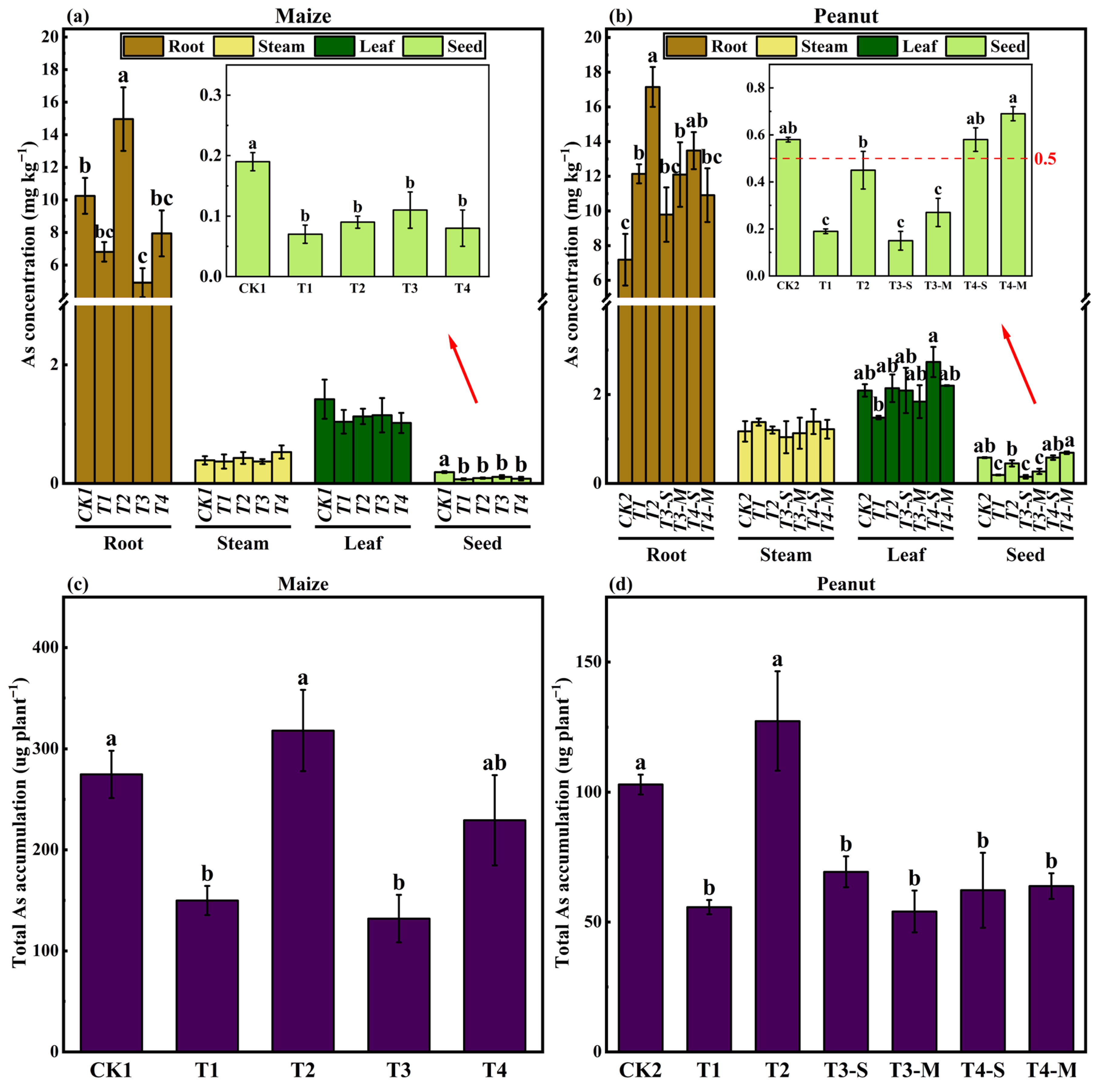
Figure 2a illustrates the As content in various organs of maize under different treatments. The total As content distributed in different plant parts follows the order: roots > leaves > stems > kernels. Compared to monoculture (0.19 mg kg−1), intercropping treatment significantly reduced As concentration in maize kernels to 0.07–0.11 mg kg−1 (p < 0.05). As concentrations in maize grains under all treatments complied with the national food safety standards (GB 2762-2017, 0.05 mg kg−1) [46]. The T2 treatment produced the highest As accumulation in the root, which was significantly higher (45.95%) than monoculture (p < 0.05). In contrast, compared to monoculture, T3 resulted in a 52% decrease in root As content (p < 0.05). As the content of stems and leaves did not differ significantly among all treatments (p > 0.05). At the whole-plant level, As enrichment per individual maize plant was also influenced by intercropping treatments (Figure 2c). The T1 and T3 treatments significantly reduced total As content per plant by 45.38% and 51.97%, respectively (p < 0.05). In comparison, compared with monoculture, treatment T2 increased the total arsenic accumulation in maize plants by 15.74%, although the difference was not statistically significant (p > 0.05).
The distribution of As concentrations across various peanut organs under the different intercropping treatments is presented in Figure 2b. The distribution of As content in peanut organs followed the order: roots > leaves > stems > kernels. Compared to monoculture (0.58 mg kg−1), treatments T1, T3-S, and T3-M significantly reduced As accumulation in peanut kernels to 0.19, 0.15, and 0.17, respectively (p < 0.05), which met the national food safety standards. On the contrary, all intercropping treatments notably increased As content in roots (p < 0.05), with increases ranging from 36.16% to 138.5% relative to monoculture. The highest root As content (17.15 mg kg−1) was observed in the T2 treatment. No significant intercropping effects were detected on stem and leaf As content (p > 0.05). The As enrichment present in individual peanut plants was affected at the whole-plant level (Figure 2d). Compared with monoculture, the T2 treatment increased As enrichment by 27.32%, but not significantly (p > 0.05). Conversely, treatments T1, T3, and T4 significantly reduced whole-plant As enrichment (p < 0.05), with reductions ranging from 32.64% to 45.85%. Specifically, T1 resulted in the lowest arsenic enrichment (55.74 μg plant−1).

3.3. Plant As BCF, TF, and MRER Under Different Planting Systems

As can be seen from Table 4, T2 treatment significantly enhanced the As accumulation capacity of maize from soil, increasing to 0.39 (p < 0.05), compared to monoculture (0.29). Conversely, T3 and T4 treatments significantly lowered As bioaccumulation capacity in maize (p < 0.05), yielding values of 0.11 and 0.18, respectively. In T2-treated maize, the coefficient of translocation of As from underground parts to aboveground parts is the lowest (0.11). However, this was not significant as compared to monoculture (p > 0.05). Meanwhile, intercropping improved the soil enrichment capacity of peanuts. Among the treatments, peanuts under T2 showed the highest enrichment capacity (0.37), which was significantly greater than monoculture (p < 0.05). Conversely, intercropping significantly diminished peanut’s TF (p < 0.05), where the T2 treatment exhibited the smallest translocation coefficient of 0.22. Notably, the As MRER in the intercropping system ranged from 1.07 to 2.41, all exceeding 1, indicating that various intercropping ratios provided greater remediation advantages. Specifically, the T2 treatment demonstrated the highest remediation benefit, with an MRER of 2.41.

3.4. The Content of Available As and Different As Species in Rhizosphere Soil Under Various Systems

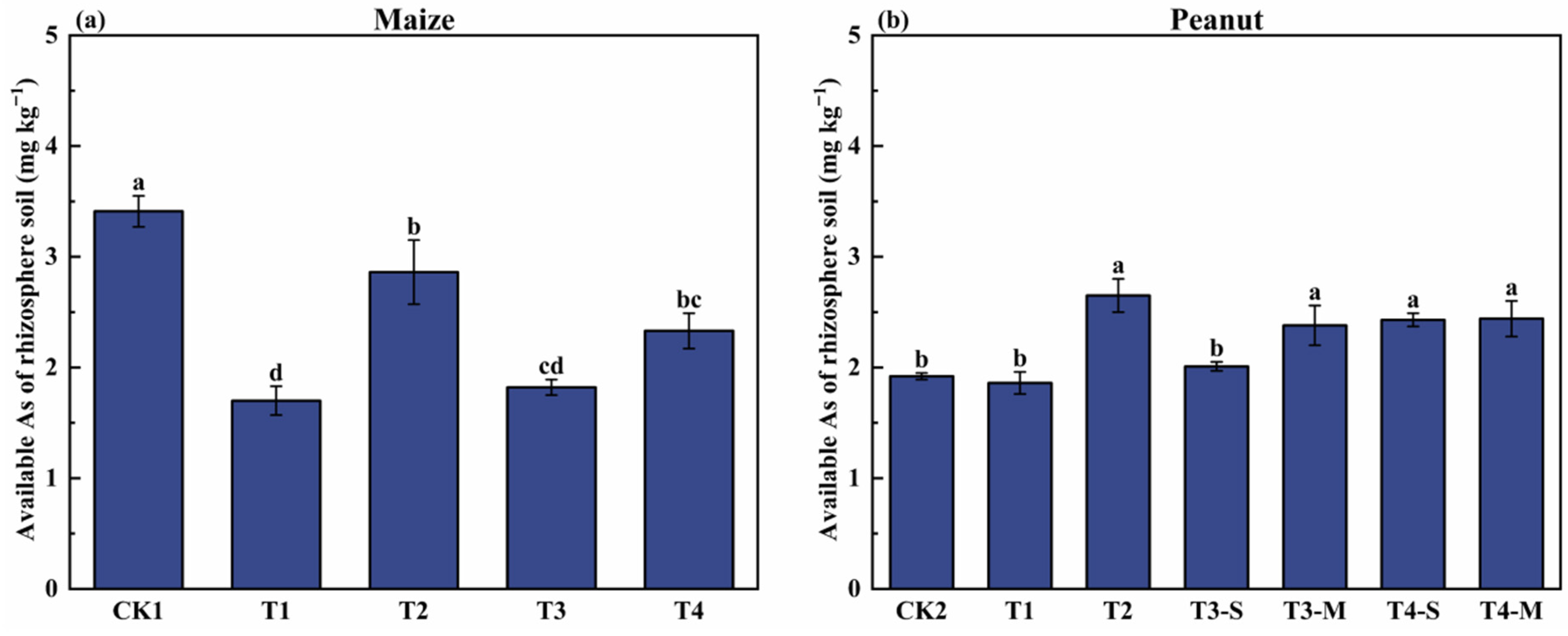
Influences of diverse intercropping systems on rhizosphere soil As bioavailability and speciation of maize and peanuts are illustrated in Figure 3 and Figure 4. Compared to monoculture, the bioavailable As concentration in maize rhizospheric soil was significantly reduced by intercropping (p < 0.05) (Figure 3a). Of the four treatments, T1 has the greatest decrease of 50.15%, followed by T3, T4, and T2 with 46.63%, 31.67%, and 16.13%, respectively. On the other hand, intercropping increased the concentration of bioavailable As in peanut rhizosphere soil (Figure 3b). The treatment with T2 produced the highest rise of 38.02% (p < 0.05).
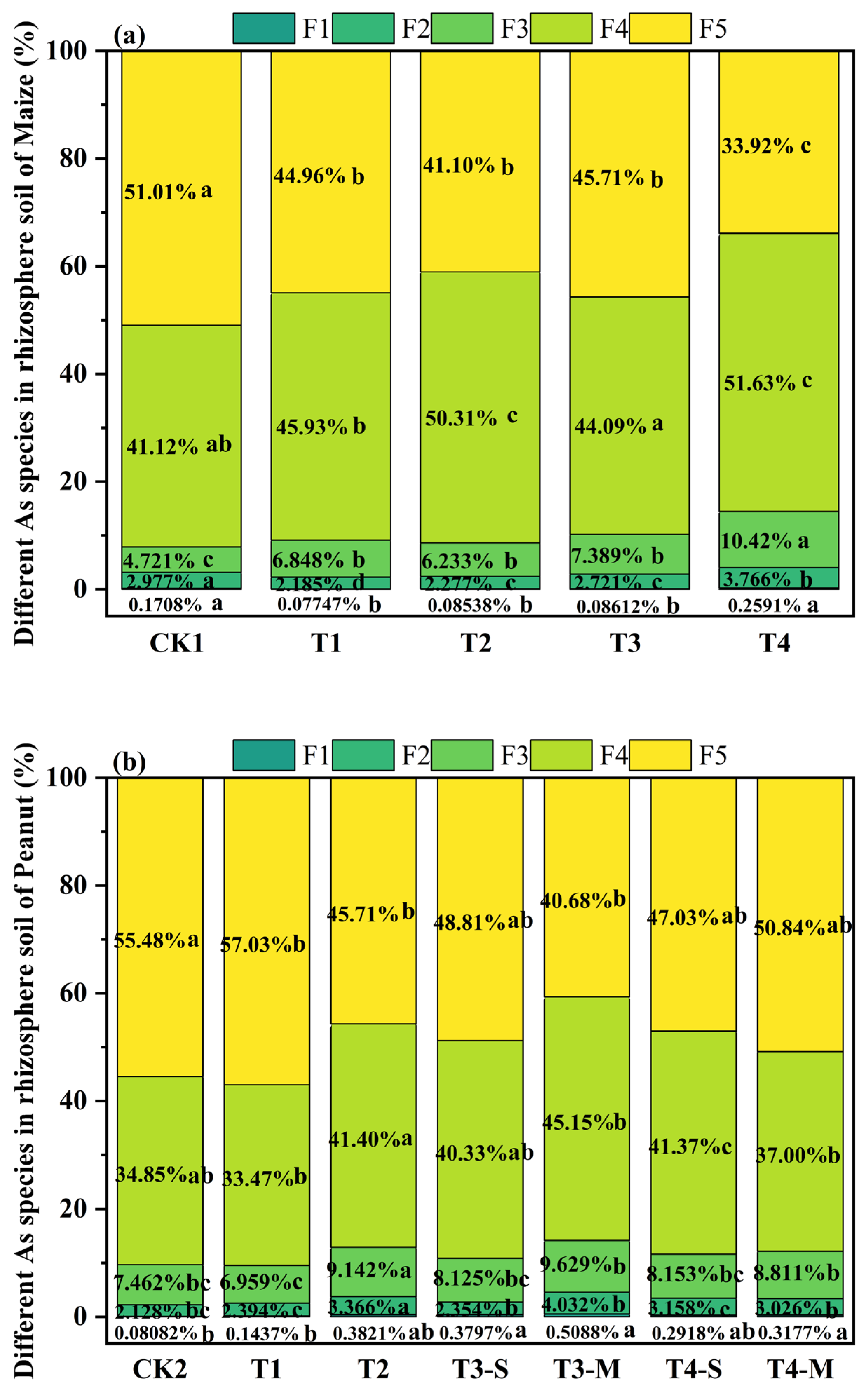
Analysis of As speciation in the maize rhizosphere revealed that the F5 and the F4 were dominant, collectively accounting for over 85% of the total As across all treatments (Figure 4a). The F1, F2, and F3 constituted minor proportions. Intercropping generally promoted a shift towards more stable As forms (F3, F4), while reducing the proportions of the more available forms (F1, F2), with the notable exception of treatment T4. Specifically, it is T1 that produced the lowest segments for F1 and F2 (0.08% and 2.19%). Treatment T2 recorded the highest F4 at 50.13% while T3 produced the highest F5 at 45.71% and the lowest F4 at 44.09%. T4 treatment significantly elevated the percentages of F1 and F2 in all treatments above 3% (0.26% and 3.77%). Meanwhile, except for T1, which slightly decreased F2 and F3, intercropping improved the proportions of the more bioavailable As fractions (F1–F4) in the peanut rhizosphere soil (Figure 4b). Specifically, treatment T2 resulted in relatively high proportions of F2 (3.37%) and F3 (9.14%). The most significant shift was observed in treatment T3-M, which showed the highest proportions of F2 (4.03%), F3 (9.63%), and F4 (45.15%), alongside the lowest proportion of F5 (40.68%).

3.5. Traits of pH, CEC, and DOC in Rhizosphere Soil for Plants in Various Systems

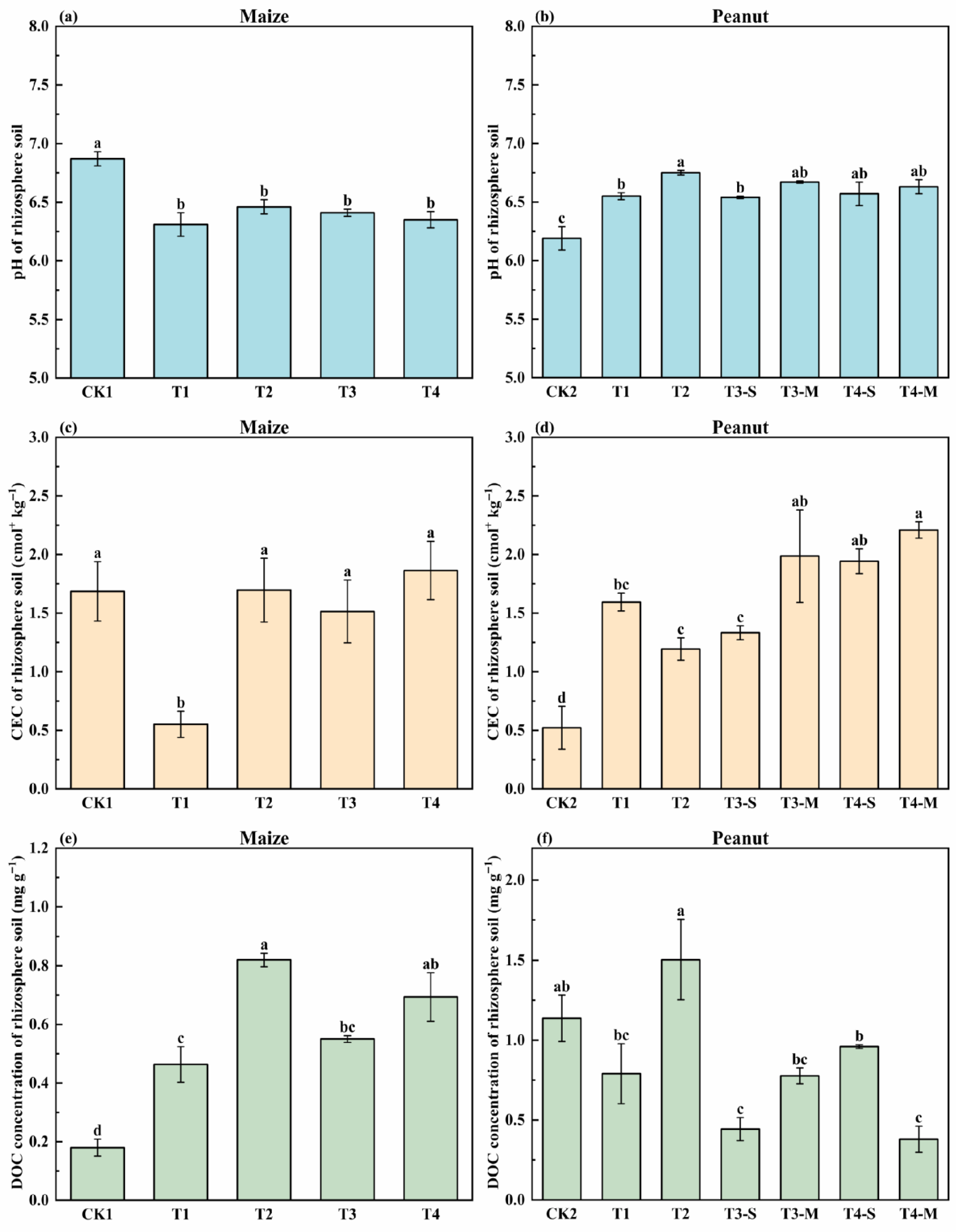
The intercropping treatments significantly altered the physicochemical properties of the rhizosphere soil in both maize and peanut (Figure 5). Compared with monoculture, intercropping decreased the pH of maize rhizosphere soil by 0.4–0.5 units (p < 0.05) (Figure 5a), with the lowest value (6.31) observed under T1. On the contrary, intercropping increased peanut rhizosphere soil pH by 0.5–0.7 units and peaked at 6.75 under T2 (p < 0.05) (Figure 5b). For CEC, the T1 treatment significantly reduced maize soil CEC by 67.3% relative to monoculture (p < 0.05) (Figure 5c), while other intercropping treatments showed no significant effect (p > 0.05). Conversely, all intercropping treatments significantly enhanced CEC in peanut rhizosphere soil, with increases ranging from 128.7% to 323.3% (p < 0.05) (Figure 5d). Intercropping also significantly elevated the content of DOC in maize rhizosphere soil by 157.4–355.5% (p < 0.05; Figure 5e), with the highest DOC content (0.82 mg·g−1) under T2. For peanut, however, DOC responses varied: T2 resulted in a non-significant increase (p > 0.05), while other intercropping treatments led to reductions (Figure 5f).

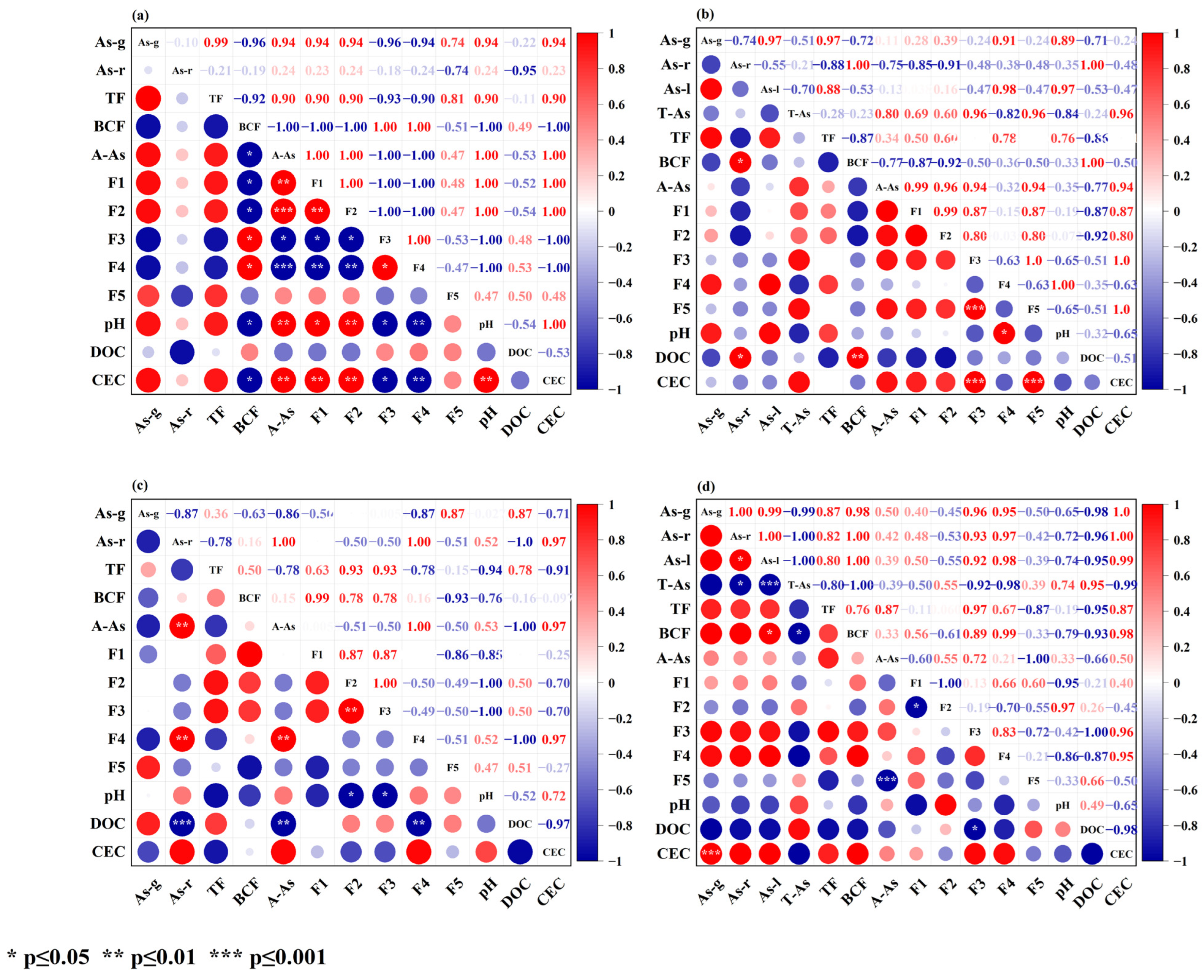
3.6. Correlation Analysis of the Physicochemical Properties of Rhizosphere Soil and As Uptake in Plants

The correlations between As accumulation in plants and soil properties of different intercropping treatments are shown in Figure 6. For maize under T1 treatment, BCF of maize showed significant positive correlation with soil As fractions F3 and F4, but was significantly negatively correlated with available As, F1, F2, pH, and CEC (p < 0.05) (Figure 6a). Meanwhile, soil-available As was significantly positively correlated with both pH and CEC (p < 0.01). Furthermore, a strong positive correlation was found between CEC and pH (p < 0.01). For peanuts under T1 treatment, the root As content was significantly positively correlated with BCF as well as DOC (p < 0.05) (Figure 6b). The BCF of peanut was highly significantly positively correlated with soil DOC (p < 0.01). In addition, the F3 content in soil was found to be highly significantly positively correlated with CEC as well as F5 (p < 0.001), while F4 content was significantly positively correlated with soil pH (p < 0.05). Under T2 treatment, maize root As content showed a highly significant positive correlation with soil available As and F4 content (p < 0.01), but a highly significant negative correlation with soil DOC (p < 0.001) (Figure 6c). The content of DOC in maize rhizosphere soil showed a significant negative correlation with available As (p < 0.01). For peanuts (Figure 6d), leaf As content was significantly positively correlated with BCF (p < 0.05). Soil-available As was significantly negatively correlated with F5 (p < 0.001). Furthermore, soil F3 content was significantly negatively correlated with DOC at p < 0.05.

4. Discussion

4.1. Biomasses and Yields of Plants in Various Systems

Our field results indicated that treatments T1, T2, and T3 maintained grain biomass stability compared to monoculture. This observation aligns with previous studies showing that maize–peanut intercropping biomass recovers to match or exceed monoculture levels by harvest [47]. The plant density, which stemmed from the intercropping design, played a key role in determining final yield [48]. Thus, T1 significantly increased maize yield (23.70%) through expanded planting area, whereas T2 reduced yield due to competitive effects. Meanwhile, in this system, maize acts as the primary yield contributor [49,50], and the yield advantage is further driven by peanut–rhizobia biological nitrogen fixation: peanut fixes 50–300 kg N ha−1 yr−1 via BNF, meeting 20–40% of intercropped maize’s N demand [35]. The complementary root architecture of the two crops—maize’s deep vertical roots and peanut’s shallow lateral roots [51]—optimizes resource capture from different soil horizons, and the well-developed root network under intercropping reduces nitrate leaching by 30–50% compared with monoculture [52]. Although intercropping reduced peanut yield, the combined productivity achieved LER values of 1.88 (T1) and 1.25 (T2), confirming superior land-use efficiency. Consequently, the T1 and T2 treatments have the potential to satisfy production requirements in As-contaminated agricultural fields.

4.2. The Effects of Various Systems on As Absorption and Transfer in Plants

Intercropping can bring down the concentration of As in maize kernels to 0.07–0.11 mg·kg−1 (42.11–63.16% reduction), which is below the Chinese food safety standard limit of 0.5 mg·kg−1 (GB 2762-2017). Meanwhile, we find that No significant differences in As content among the various intercropping treatments. These results are consistent with previous findings [53], where the maize–asparagus intercropping system effectively lowers As levels in edible maize parts, while the planting ratio does not significantly influence As accumulation in the above-ground portions of maize. Treatments T1 and T3 significantly decreased As content in peanut kernels (62.29–67.24% reduction), whereas the reduction under T2 was not statistically significant. Although these values are different, these treatments meet the national food safety standard. The differential reduction amplitude of grain As between maize and peanut is mainly attributed to species-specific As sequestration and translocation characteristics: maize strongly sequesters As in root cell walls via phytochelatin complexation to limit upward translocation to grains [21], while peanut’s underground pod formation creates a longer As transport path with more tissue barriers, and intercropping further reduces its As translocation factor (TF) by 50–61%, resulting in a more significant grain As reduction effect. Additionally, the efficacy of maize roots in reducing rhizosphere As by recruiting specific microbiome (such as Lechevalieria and Nocardioides) aids in decreasing the absorption of As by peanuts [30]. Similarly, our results find that the T2 treatment significantly enhanced As accumulation in the roots of both maize and peanuts, improving their overall As extraction capacity from the soil, while reducing translocation to above-ground parts. In addition, our measured data showed As concentrations of 0.18–0.25 mg·kg−1 in maize stems/leaves and 0.22–0.31 mg·kg−1 in peanut stems/leaves. Two environmentally friendly utilization pathways are proposed for this As-enriched biomass: (1) pyrolysis at 400–600 °C for bioenergy production, during which over 90% of As in the biomass is concentrated in the ash fraction and can be stabilized via co-firing with coal or chemically extracted for industrial reuse, achieving up to 94% As recovery [19]; (2) lime-amended composting to maintain a pH > 7.0 during fermentation, which can effectively immobilize As in the biomass, and the mature compost can be returned to the field as a bio-fertilizer. However, this approach requires regular monitoring of soil As bioavailability and is not recommended for severely As-contaminated soil [31]. Post-harvest root fate directly affects long-term soil As mass balance: maize roots retain 65–80% of total plant As and remain in the soil after grain harvest, providing long-term As phytostabilization via conversion to stable non-bioavailable fractions [16], while rotation with As hyperaccumulators every 3–5 years is recommended to mitigate potential topsoil As accumulation; in contrast, most peanut roots (10.23–17.15 mg·kg−1 As) are removed with harvest, acting as a direct As extraction pathway and contributing to the high MRER values in this study. Consequently, these contribute to the highest metal removal equivalent ratio (MRER) of 2.41 under T2, indicating superior remediation efficiency and land use advantage. Our results demonstrate that this practice not only stabilizes production but also reduces As concentration in grains, making it more suitable for application in As-contaminated soils. Yet, the specific mechanisms underlying these benefits warrant further investigation.

4.3. The Effects of Various Systems on the Physical and Chemical Factors of Plant Rhizosphere Soil

Soil physicochemical properties such as pH, CEC, and DOC have a significant effect on As bioavailability and uptake/transformation by plants [54,55]. The intercropping treatments significantly reduced the pH in the rhizosphere of maize by 0.4–0.5 units, while intercropping increased peanut rhizosphere pH by 0.5–0.7 units, showing completely opposite pH response patterns between the two crops. This differential rhizosphere pH change is driven by two core mechanisms: maize rhizosphere acidification stems from enhanced low-molecular-weight organic acid secretion from roots stimulated by interspecific nutrient competition [56], while peanut rhizosphere alkalization is dominated by proton consumption and OH release during rhizobial symbiotic nitrogen fixation [57], and the differential cation–anion absorption balance of the two crops further amplifies this opposite pH trend [35]. Additionally, the decreased pH contributed to reduced As availability in the maize rhizosphere, thereby decreasing As uptake by maize [58,59]. This finding is supported by the observed reduction in the more labile fractions of As (F1, F2) in the rhizospheric soil of maize. In comparison, the content of DOC in maize soil was increased due to intercropping, particularly under the T2 treatment. High concentrations of DOC may compete with As for adsorption sites on soil solids, which could increase the solubility and mobility of As [60,61]. This is also consistent with the T2 treatment showing higher available As content compared to other ratios. Correlation analysis under T2 further revealed a strong negative correlation between soil DOC and available As. On the other hand, T1 treatment significantly reduced CEC in the maize rhizosphere, which may have facilitated As adsorption onto soil particles, thereby lowering available As content. This aligns with previous studies suggesting that reduced CEC can enhance As immobilization [62,63]. In the rhizosphere of peanuts, intercropping treatments significantly increased the soil pH compared to monoculture. This alkalinization is likely to result from enhanced proton (H+) consumption during biological nitrogen fixation in an intercropping system [57]. Meanwhile, the increase in pH likely promoted As desorption and led to observed increases in the more soluble As fractions (F1 and F2). Our results of intercropping elevated CEC in the peanut soil, which could also contribute to the higher pH [64]. In addition, the T2 treatment raised DOC in the peanut soil, but it did not significantly enhance As availability in the peanut rhizosphere, suggesting that multiple soil factors coordinate the regulation of As adsorption–desorption dynamics. For example, in a study of a peanut–sunflower intercropping system, the enhancement of soil enzyme activities (e.g., catalase, invertase) and the restructuring of the rhizosphere fungal community (dominated by Ascomycota) collectively promote arsenic immobilization in peanut soil, thus decreasing the content of bioavailable arsenic [65]. It is also worth noting that increased DOC and root residue inputs from intercropping promote soil humus enrichment and SOC sequestration: high-lignin maize residues enhance humus stability, while N-rich peanut residues accelerate humification [36], with enriched humus providing additional As adsorption sites to reduce long-term As bioavailability. Our findings are consistent with the concept that intercropping can induce complementary rhizosphere processes, such as acidification in maize and alkalinization in peanuts, facilitating a “lock-in-absorption” synergistic remediation where As availability is differentially modulated to reduce remigration risk and enhance remediation efficiency.

4.4. Ecosystem Services and Sustainable Biomass Management

Beyond, as remediation, maize–peanut intercropping delivers multiple agroecological services critical for sustainable agriculture, while presenting specific management strategies for As-enriched biomass to avoid secondary environmental risks. Peanut–rhizobia symbiosis can supply 50–300 kg N ha−1 yr−1 to meet 20–40% of the nitrogen demand of intercropped maize [35,66], and the complementary root architecture of the two crops optimizes resource capture from different soil horizons, reduces nitrate leaching by 30–50%, and suppresses weed growth by 40–60% without additional herbicide input [51]. Post-harvest root fate directly affects soil As mass balance: maize roots retain 65–80% of total plant As and remain in the soil to provide long-term As phytostabilization, while peanut root removal with harvest achieves direct As extraction from the field, which is a key contributor to the high MRER of the T2 system [16]. For As-enriched aboveground biomass, two environmentally friendly utilization strategies are proposed: pyrolysis for bioenergy production with synchronous As stabilization and recovery, and lime-amended composting for soil amendment with strict pH control to avoid As remobilization [31]. For the optimal T2 system, we recommend a hybrid management strategy: harvest peanut roots for As extraction, pyrolyze maize aboveground biomass for bioenergy with ash stabilization, and retain maize roots in the soil for conservation, which maximizes economic returns while ensuring long-term environmental safety of the remediation system. This intercropping system requires no additional capital investment or complex management beyond local conventional agronomic practices, and can be widely promoted to realize the safe utilization of mildly to moderately As-contaminated farmland in southern China. Future research will focus on the long-term dynamics of As speciation and soil properties in this system over continuous growing seasons, as well as the optimization of post-harvest biomass management strategies to maximize As removal efficiency and economic returns.

5. Conclusions

Our field experiments explored maize–peanut intercropping ratios in mildly to moderately As-contaminated farmland, confirming that optimized configurations achieve synergistic safe production and in situ As remediation. Results showed that the 1:1 (T1) and 1:2 (T2) ratios exhibited prominent dual advantages in yield and heavy metal removal: both had land equivalent ratios (LER) > 1 (1.88 and 1.25) and metal removal equivalent ratios (MRER) > 1 (1.09 and 2.41) among all treatments. Meanwhile, intercropping effectively decreased As accumulation in maize kernels, and T1, T2, and T3 also reduced As concentration in peanut kernels, with all values meeting the national food safety threshold (GB 2762-2017, 0.5 mg kg−1). T2 was identified as the optimal treatment, with the highest As remediation efficiency. Intercropping induced divergent changes in rhizosphere soil physicochemical properties of maize and peanut: it decreased maize rhizosphere pH and available As content while increasing DOC, with T1 significantly reducing CEC; in contrast, it elevated peanut rhizosphere pH and CEC, with only T2 slightly increasing DOC content. Correlation analysis confirmed that soil pH, CEC, and DOC closely regulated soil As speciation, bioavailability, and plant As bioconcentration, with T2 showing a significant negative correlation between DOC and soil/root As content.
Beyond core remediation and production benefits, the maize–peanut intercropping system provides multiple agroecological services (e.g., peanut rhizobia nitrogen fixation, optimized resource utilization, reduced nitrate leaching, and weed growth) without additional capital investment or complex management. This study confirms T1 and the optimal T2 are feasible, scientific strategies for the safe utilization and sustainable remediation of As-contaminated farmland in southern China, highlighting the importance of optimizing intercropping ratios to balance agricultural productivity and heavy metal remediation efficiency.

Supplementary Materials

The following supporting information can be downloaded at: https://www.mdpi.com/article/10.3390/agronomy16060638/s1.

Author Contributions

Conceptualization, Z.K. and H.L.; methodology, Z.K. and W.L.; software, Z.K. and Y.T.; validation, Z.K. and M.L.; formal analysis, Z.K. and Z.C.; investigation, Z.K.; resources, Z.K.; data curation, Z.K.; writing—original draft preparation, Z.K.; writing—review and editing, Z.K. and Y.W.; visualization, Z.K. and Y.W.; supervision, H.L.; project administration, H.L.; funding acquisition, H.L. All authors have read and agreed to the published version of the manuscript.

Funding

This research was funded by the National Natural Science Foundation of China (NSFC, NO. 31770479), and the Key Research and Development Program of Guangzhou City, China (Guangzhou Sci-Tech Bureau, China. NO. 202206010176).

Data Availability Statement

The original contributions presented in this study are included in the article/Supplementary Material. Further inquiries can be directed to the corresponding author.

Conflicts of Interest

The authors declare no conflicts of interest.

References

  1. Ministry of Environmental Protection of China. National Soil Pollution Survey Bulletin of China (2014); Ministry of Environmental Protection of China: Beijing, China, 2014.
  2. Gong, Y.; Qu, Y.; Yang, S.; Tao, S.; Shi, T.; Liu, Q.; Chen, Y.; Wu, Y.; Ma, J. Status of arsenic accumulation in agricultural soils across China (1985–2016). Environ. Res. 2020, 186, 109525. [Google Scholar] [CrossRef]
  3. Zhang, S.; Zhang, J.; Niu, L.; Chen, Q.; Zhou, Q.; Xiao, N.; Man, J.; Ma, J.; Wei, C.; Zhang, S.; et al. Escalating arsenic contamination throughout Chinese soils. Nat. Sustain. 2024, 7, 766–775. [Google Scholar] [CrossRef]
  4. Al-Makishah, N.H.; Taleb, M.A.; Barakat, M.A. Arsenic bioaccumulation in arsenic-contaminated soil: A review. Chem. Pap. 2020, 74, 2743–2757. [Google Scholar] [CrossRef]
  5. Chauhan, R.; Awasthi, S.; Tiwari, P.; Upadhyay, M.K.; Srivastava, S.; Dwivedi, S.; Dhankher, O.P.; Tripathi, R.D. Biotechnological strategies for remediation of arsenic-contaminated soils to improve soil health and sustainable agriculture. Soil Environ. Health 2024, 2, 100061. [Google Scholar] [CrossRef]
  6. Rehman, M.U.; Khan, R.; Khan, A.; Qamar, W.; Arafah, A.; Ahmad, A.; Ahmad, A.; Akhter, R.; Rinklebe, J.; Ahmad, P. Fate of arsenic in living systems: Implications for sustainable and safe food chains. J. Hazard. Mater. 2021, 417, 126050. [Google Scholar] [CrossRef]
  7. Antoniadis, V.; Shaheen, S.M.; Levizou, E.; Shahid, M.; Niazi, N.K.; Vithanage, M.; Ok, Y.S.; Bolan, N.; Rinklebe, J. A critical prospective analysis of the potential toxicity of trace element regulation limits in soils worldwide: Are they protective concerning health risk assessment?—A review. Environ. Int. 2019, 127, 819–847. [Google Scholar] [CrossRef] [PubMed]
  8. Mocek-Płóciniak, A.; Mencel, J.; Zakrzewski, W.; Roszkowski, S. Phytoremediation as an Effective Remedy for Removing Trace Elements from Ecosystems. Plants 2023, 12, 1653. [Google Scholar] [CrossRef]
  9. Cao, X.; Dong, Q.; Mao, L.; Yang, X.; Wang, X.; Zou, Q. Enhanced Phytoextraction Technologies for the Sustainable Remediation of Cadmium-Contaminated Soil Based on Hyperaccumulators—A Review. Plants 2025, 14, 115. [Google Scholar] [CrossRef]
  10. Guo, J.; Zheng, G.; Yang, J.; Chen, T.; Meng, X.; Xia, T. Safe utilization of cadmium- and lead-contaminated farmland by cultivating a winter rapeseed/maize rotation compared with two phytoextraction approaches. J. Environ. Manag. 2022, 304, 114306. [Google Scholar] [CrossRef]
  11. Yang, H.; Zhang, W.; Li, L. Intercropping: Feed More People and Build More Sustainable Agroecosystems. Eng. Agric. 2021, 8, 373–386. [Google Scholar]
  12. Kuyah, S.; Sileshi, G.W.; Nkurunziza, L.; Chirinda, N.; Ndayisaba, P.C.; Dimobe, K.; Öborn, I. Innovative agronomic practices for sustainable intensification in sub-Saharan Africa. A review. Agron. Sustain. Dev. 2021, 41, 16. [Google Scholar] [CrossRef]
  13. Lin, H.; Wang, Z.; Liu, C.; Dong, Y. Technologies for removing heavy metal from contaminated soils on farmland: A review. Chemosphere 2022, 305, 135457. [Google Scholar] [CrossRef]
  14. Wan, T.; Dong, X.; Yu, L.; Li, D.; Han, H.; Tu, S.; Wan, J. Influence of Pteris vittata-maize intercropping on plant agronomic parameters and soil arsenic remediation. Chemosphere 2024, 359, 142331. [Google Scholar] [CrossRef]
  15. Wang, W.; Yang, X.; Mo, Q.; Li, Y.; Meng, D.; Li, H. Intercropping efficiency of Pteris vittata with two legume plants: Impacts of soil arsenic concentrations. Ecotoxicol. Environ. Saf. 2023, 259, 115004. [Google Scholar] [CrossRef]
  16. Li, Y.; Yang, J.; Guo, J.; Zheng, G.; Chen, T.; Meng, X.; He, M.; Ma, C. Intercropped Amygdalus persica and Pteris vittata applied with additives presents a safe utilization and remediation mode for arsenic-contaminated orchard soil. Sci. Total Environ. 2023, 879, 163034. [Google Scholar] [CrossRef] [PubMed]
  17. Wan, X.; Lei, M. Intercropping efficiency of four arsenic hyperaccumulator Pteris vittata populations as intercrops with Morus alba. Environ. Sci. Pollut. Res. 2018, 25, 12600–12611. [Google Scholar] [CrossRef]
  18. Li, M.; Huang, X.; Li, W.; Huang, P.; Kou, Z.; Li, H. Effect of Peanut Intercropping on Arsenic Uptake and Remediation Efficiency of Plants in Arsenic-Contaminated Soil. Agronomy 2025, 15, 321. [Google Scholar] [CrossRef]
  19. Bian, F.; Zhang, X.; Li, Q.; Huang, Z.; Zhong, Z. Enhancement of Phytoremediation of Heavy Metal Pollution Using an Intercropping System in Moso Bamboo Forests: Characteristics of Soil Organic Matter and Bacterial Communities. Forests 2023, 14, 1895. [Google Scholar] [CrossRef]
  20. Seppelt, R.; Klotz, S.; Peiter, E.; Volk, M. Agriculture and food security under a changing climate: An underestimated challenge. iScience 2022, 25, 105551. [Google Scholar] [CrossRef]
  21. AbdElgawad, H.; Schoenaers, S.; Zinta, G.; Hassan, Y.M.; Abdel-Mawgoud, M.; Alkhalifah, D.H.M.; Hozzein, W.N.; Asard, H.; Abuelsoud, W. Soil arsenic toxicity differentially impacts C3 (barley) and C4 (maize) crops under future climate atmospheric CO2. J. Hazard. Mater. 2021, 414, 125331. [Google Scholar] [CrossRef]
  22. Ning, X.; Wang, S.; Long, S.; Dong, Y.; Li, L.; Nan, Z. Temporal distribution and accumulation pattern of cadmium and arsenic in the actual field calcareous soil-maize system, northwest China. Sci. Total Environ. 2023, 870, 162012. [Google Scholar] [CrossRef] [PubMed]
  23. Rosas-Castor, J.M.; Guzmán-Mar, J.L.; Hernández-Ramírez, A.; Garza-González, M.T.; Hinojosa-Reyes, L. Arsenic accumulation in maize crop (Zea mays): A review. Sci. Total Environ. 2014, 488–489, 176–187. [Google Scholar] [CrossRef]
  24. Cao, X.; Bai, L.; Zeng, X.; Zhang, J.; Wang, Y.; Wu, C.; Su, S. Is maize suitable for substitution planting in arsenic-contaminated farmlands? Plant Soil Environ. 2019, 65, 425–434. [Google Scholar] [CrossRef]
  25. Shi, L.; Wang, B.; Hu, Z.; Yang, H.H. Mechanism and Experiment of Full-Feeding Tangential-Flow Picking for Peanut Harvesting. Agriculture 2022, 12, 1448. [Google Scholar] [CrossRef]
  26. Yang, B.; Shan, J.; Xing, F.; Dai, X.; Wang, G.; Ma, J.; Adegoke, T.V.; Zhang, X.; Yu, Q.; Yu, X. Distribution, accumulation, migration and risk assessment of trace elements in peanut-soil system. Environ. Pollut. 2022, 304, 119193. [Google Scholar] [CrossRef]
  27. Zhang, X.; Liu, H.; Li, X.; Zhang, Z.; Chen, Z.; Ren, D.; Zhang, S. Ecological and health risk assessments of heavy metals and their accumulation in a peanut-soil system. Environ. Res. 2024, 252, 118946. [Google Scholar] [CrossRef]
  28. Wevar Oller, A.L.; Vezza, M.E.; Talano, M.A.; Agostini, E. Grain and Forage Legumes in an Arsenic-Polluted Agricultural Scenario. J. Plant Growth Regul. 2023, 42, 5332–5353. [Google Scholar] [CrossRef]
  29. Chi, G.; Fang, Y.; Zhu, B.; Guo, N.; Chen, X. Intercropping with Brassica juncea L. enhances maize yield and promotes phytoremediation of cadmium-contaminated soil by changing rhizosphere properties. J. Hazard. Mater. 2024, 461, 132727. [Google Scholar] [CrossRef]
  30. Wu, T.; Sun, H.-X.; Geng, L.-P.; Yang, S.-S.; Xue, P.-Y.; Gao, P.-P.; Han, M.-Z.; Liu, W.-J. Rhizosphere microbiota alleviate As accumulation in maize intercropped with peanut in long-term Cd and As co-contaminated farmland. Soil Environ. Health 2025, 3, 100162. [Google Scholar] [CrossRef]
  31. Wang, J.; Li, Z.; Zhu, Q.; Wang, C.; Tang, X. Review on arsenic environment behaviors in aqueous solution and soil. Chemosphere 2023, 333, 138869. [Google Scholar] [CrossRef]
  32. McBride, M.B. Arsenic and Lead Uptake by Vegetable Crops Grown on Historically Contaminated Orchard Soils. Appl. Environ. Soil Sci. 2013, 2013, 283472. [Google Scholar] [CrossRef]
  33. Zhang, X.; Dayton, E.A.; Basta, N.T. Predicting the modifying effect of soils on arsenic phytotoxicity and phytoaccumulation using soil properties or soil extraction methods. Environ. Pollut. 2020, 263, 114501. [Google Scholar] [CrossRef] [PubMed]
  34. Nelson, C.M.; Li, K.; Obenour, D.R.; Miller, J.; Misenheimer, J.C.; Scheckel, K.; Betts, A.; Juhasz, A.; Thomas, D.J.; Bradham, K.D. Relating soil geochemical properties to arsenic bioaccessibility through hierarchical modeling. J. Toxicol. Environ. Health Part A 2018, 81, 160–172. [Google Scholar] [CrossRef] [PubMed]
  35. Bedoussac, L.; Journet, E.-P.; Hauggaard-Nielsen, H.; Naudin, C.; Corre-Hellou, G.; Jensen, E.S.; Prieur, L.; Justes, E. Ecological principles underlying the increase of productivity achieved by cereal-grain legume intercrops in organic farming. A review. Agron. Sustain. Dev. 2015, 35, 911–935. [Google Scholar] [CrossRef]
  36. Motsomane, N.; Magadlela, A. Legume-grass intercropping systems improve soil health and plant nutrition. Plant Soil 2026, 1–17. [Google Scholar] [CrossRef]
  37. HJ/T 166-2004; Technical Specification for Soil Environmental Monitoring. Nanjing Institute of Environmental Sciences, Ministry of Environmental Protection: Nanjing, China, 2004.
  38. GB 15618-2018; Soil Environmental Quality Risk Management and Control Standards for Soil Pollution on Agricultural Land. Nanjing Institute of Environmental Sciences, Ministry of Environmental Protection: Nanjing, China, 2018.
  39. Zoz, T.; da Costa, A.; Steiner, F.; Zoz, A.; Witt, T.; Zuffo, A. Agronomic performance of creeping peanut (Arachis hypogaea L.), grown in different row spacing and plant densities under conditions of humid subtropical climate. Aust. J. Crop Sci. 2019, 13, 138–143. [Google Scholar] [CrossRef]
  40. Yang, X.; Qin, J.; Li, J.; Lai, Z.; Li, H. Upland rice intercropping with Solanum nigrum inoculated with arbuscular mycorrhizal fungi reduces grain Cd while promoting phytoremediation of Cd-contaminated soil. J. Hazard. Mater. 2021, 406, 124325. [Google Scholar] [CrossRef]
  41. Wenzel, W.W.; Kirchbaumer, N.; Prohaska, T.; Stingeder, G.; Lombi, E.; Adriano, D.C. Arsenic fractionation in soils using an improved sequential extraction procedure. Anal. Chim. Acta 2001, 436, 309–323. [Google Scholar] [CrossRef]
  42. Kang, Z.; Gong, M.; Li, Y.; Chen, W.; Yang, Y.; Qin, J.; Li, H. Low Cd-accumulating rice intercropping with Sesbania cannabina L. reduces grain Cd while promoting phytoremediation of Cd-contaminated soil. Sci. Total Environ. 2021, 800, 149600. [Google Scholar] [CrossRef]
  43. Zhan, X.; Zhou, L. Colorimetric determination of dissolved organic carbon in soil solution and water environment. China Environ. Sci. 2002, 22, 433–437. [Google Scholar]
  44. Li, L.; Yang, S.; Li, X.; Zhang, F.; Christie, P. Interspecific complementary and competitive interactions between intercropped maize and faba bean. Plant Soil 1999, 212, 105–114. [Google Scholar] [CrossRef]
  45. Kang, Z.; Zhang, W.; Qin, J.; Li, S.; Yang, X.; Wei, X.; Li, H. Yield advantage and cadmium decreasing of rice in intercropping with water spinach under moisture management. Ecotoxicol. Environ. Saf. 2020, 190, 110102. [Google Scholar] [CrossRef] [PubMed]
  46. GB 2762-2017; National Food Safety Standard: Maximum Levels of Contaminants in Foods. China National Standardization Administration: Beijing, China, 2017.
  47. Li, L.; Zou, Y.; Wang, Y.; Chen, F.; Xing, G. Effects of Corn Intercropping with Soybean/Peanut/Millet on the Biomass and Yield of Corn Under Fertilizer Reduction. Agriculture 2022, 12, 151. [Google Scholar] [CrossRef]
  48. Zhang, D.; Sun, Z.; Feng, L.; Bai, W.; Yang, N.; Zhang, Z.; Du, G.; Feng, C.; Cai, Q.; Wang, Q.; et al. Maize plant density affects yield, growth and source-sink relationship of crops in maize/peanut intercropping. Field Crops Res. 2020, 257, 107926. [Google Scholar] [CrossRef]
  49. Xia, H.; Wang, L.; Xue, Y.; Kong, W.; Xue, Y.; Yu, R.; Xu, H.; Wang, X.; Wang, J.; Liu, Z.; et al. Impact of Increasing Maize Densities on Agronomic Performances and the Community Stability of Productivity of Maize/Peanut Intercropping Systems. Agronomy 2019, 9, 150. [Google Scholar] [CrossRef]
  50. Yang, C.; Fan, Z.; Chai, Q. Agronomic and Economic Benefits of Pea/Maize Intercropping Systems in Relation to N Fertilizer and Maize Density. Agronomy 2018, 8, 52. [Google Scholar] [CrossRef]
  51. Ma, R.; Zan, Z.; Wang, C.; Zhao, S.; Kou, T.; Jiao, N. Effects of Multi-Year Maize–Peanut Intercropping and Phosphorus Application on Rhizosphere Soil Properties and Root Morphological and Microbial Community Characteristics. Agronomy 2025, 15, 913. [Google Scholar] [CrossRef]
  52. Rácz, A.; Vályi-Nagy, M.; Tar, M.; Irmes, K.; Szentpéteri, L.; Ujj, A.; Veresné Valentinyi, K.; Ladányi, M.; Kristó, I. Effects of Winter Cereals (Triticum aestivum L., Hordeum vulgare L., Triticosecale wittmack) and Winter Pea (Pisum sativum L.) Intercropping on Weed Cover in South-Eastern and Central Hungary. Agronomy 2023, 13, 1319. [Google Scholar] [CrossRef]
  53. Ma, J.; Lei, E.; Lei, M.; Liu, Y.; Chen, T. Remediation of Arsenic contaminated soil using malposed intercropping of Pteris vittata L. and maize. Chemosphere 2018, 194, 737–744. [Google Scholar] [CrossRef]
  54. Zhang, X.; Zhang, P.; Wei, X.; Peng, H.; Hu, L.; Zhu, X. Migration, transformation of arsenic, and pollution controlling strategies in paddy soil-rice system: A comprehensive review. Sci. Total Environ. 2024, 951, 175500. [Google Scholar] [CrossRef] [PubMed]
  55. Han, Z.; Yang, J.; Yan, Y.; Zhao, C.; Wan, X.; Ma, C.; Shi, H. Quantifying the impact of factors on soil available arsenic using machine learning. Environ. Pollut. 2024, 359, 124572. [Google Scholar] [CrossRef]
  56. Zhang, B.; Nasar, J.; Dong, S.; Zhou, X.; Gao, Q. Differential regulation of belowground rhizospheric ecosystem by biological and chemical nitrogen supplies: Implications for maize yield enhancement mechanisms. Plant Biol. 2024, 26, 1021–1032. [Google Scholar] [CrossRef] [PubMed]
  57. Tang, X.; He, Y.; Zhang, Z.; Wu, H.; He, L.; Jiang, J.; Meng, W.; Huang, Z.; Xiong, F.; Liu, J.; et al. Beneficial shift of rhizosphere soil nutrients and metabolites under a sugarcane/peanut intercropping system. Front. Plant Sci. 2022, 13, 1018727. [Google Scholar] [CrossRef] [PubMed]
  58. Kumar, M.; Ramanathan, A.L.; Mukherjee, A.; Verma, S.; Rahman, M.M.; Naidu, R. Hydrogeo-morphological influences for arsenic release and fate in the central Gangetic Basin, India. Environ. Technol. Innov. 2018, 12, 243–260. [Google Scholar] [CrossRef]
  59. Zeng, W.; Wan, X.; Lei, M.; Chen, T. Intercropping of Pteris vittata and maize on multimetal contaminated soil can achieve remediation and safe agricultural production. Sci. Total Environ. 2024, 915, 170074. [Google Scholar] [CrossRef] [PubMed]
  60. Tang, Z.; Liang, M.; Ding, Y.; Liu, C.; Zhang, Q.; Wang, D.; Zhang, X. Fe3O4/Mulberry Stem Biochar as a Potential Amendment for Highly Arsenic-Contaminated Paddy Soil Remediation. Toxics 2024, 12, 765. [Google Scholar] [CrossRef]
  61. Verbeeck, M.; Thiry, Y.; Smolders, E. Soil organic matter affects arsenic and antimony sorption in anaerobic soils. Environ. Pollut. 2020, 257, 113566. [Google Scholar] [CrossRef]
  62. Zhang, X.; Wei, L.; Yang, C.; Xie, Y.; Niu, J. Iron-loaded biochar for dual remediation of arsenic-contaminated saline-alkali soil. Environ. Technol. Innov. 2025, 40, 104459. [Google Scholar] [CrossRef]
  63. Chen, D.; Ye, X.; Jiang, Y.; Xiao, W.; Zhang, Q.; Zhao, S.; Shao, S.; Gao, N.; Huang, M.; Hu, J. Continuously applying compost for three years alleviated soil acidity and heavy metal bioavailability in a soil-asparagus lettuce system. Front. Plant Sci. 2022, 13, 972789. [Google Scholar] [CrossRef]
  64. Hu, L.; Ge, Y.; Zhou, L.; Li, Z.; Li, A.; Deng, H.; He, T. The Effects of Different Straw-Returning Methods on Soil Organic Carbon Transformation in Rice–Rape Rotation Systems. Agriculture 2025, 15, 1468. [Google Scholar] [CrossRef]
  65. Li, M.; Meng, D.; Huang, P.; Kama, R.; Ma, C.; Li, H. A “Win-Win” Strategy in Highly Arsenic-Contaminated Soils: Intercropping Cash Crops with Soil Amendments to Achieve Production While Remediating. J. Hazard. Mater. 2026, 504, 141368. [Google Scholar] [CrossRef]
  66. Ebbisa, A. Mechanisms underlying cereal/legume intercropping as nature-based biofortification: A review. Food Prod. Process. Nutr. 2022, 4, 19. [Google Scholar] [CrossRef]
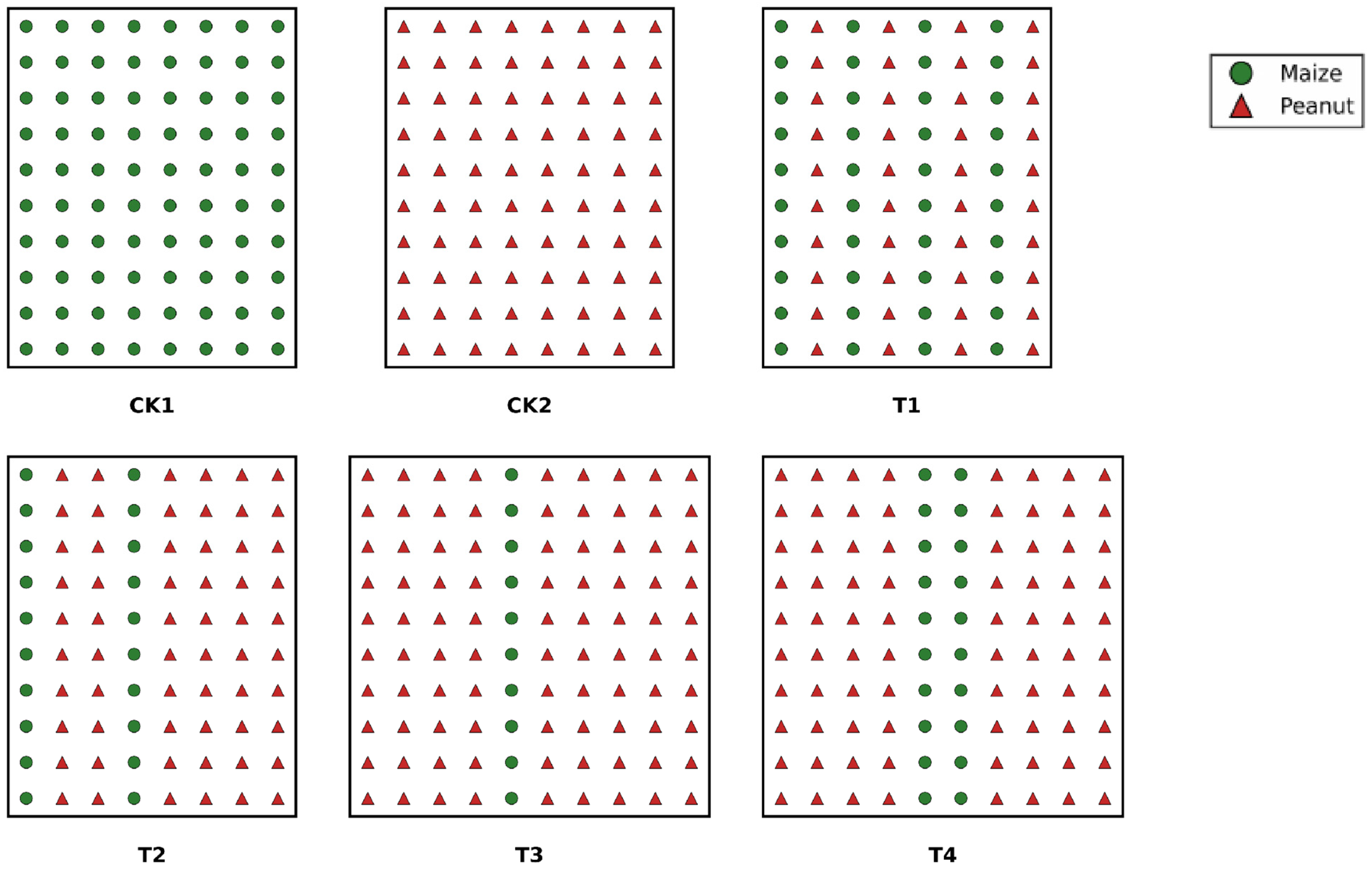
Figure 1. Maize–peanut intercropping configurations. (CK1 stands for maize monoculture; CK2 stands for peanut monoculture; T1 stands for intercropping of a 1:1 maize:peanut row ratio; T2 stands for intercropping of a 1:2 maize:peanut row ratio; T3 stands for intercropping of a 1:4 maize:peanut row ratio; T4 stands for intercropping of a 2:4 maize:peanut row ratio. The same below Maize plants are depicted in green, peanut plants in red).
Agronomy 16 00638 g001
Figure 2. Total As accumulation and As concentrations in diverse organs of maize (a,c) and peanut (b,d) under various systems. A small lowercase above each bar indicates a significant difference between each treatment (p < 0.05, n = 3).
Agronomy 16 00638 g002
Figure 3. Maize (a) and peanut (b) rhizosphere soil bioavailable As concentration under various systems. A small lowercase above each bar indicates a significant difference between each treatment (p < 0.05, n = 3).
Agronomy 16 00638 g003
Figure 4. Distinct maize (a) and peanut (b) As species in the rhizosphere soil under various systems. Data of each row marked by the same uppercase letters for the same treatment are not significantly different at p < 0.05 (means ± SE, n = 3).
Agronomy 16 00638 g004
Figure 5. The pH, CEC, and DOC concentration of rhizosphere soil for maize (a,c,e) and peanut (b,d,f) under various systems. A small lowercase above each bar indicates a significant difference between each treatment (p < 0.05, n = 3).
Agronomy 16 00638 g005
Figure 6. Heat map of the correlations between As absorption, As translocation, and rhizosphere environmental factors in maize (a,c) and peanut (b,d) under T1 (a,b) and T2 (c,d) treatments. (As-g stands for the content of As in grains; As-r stands for the content of As in roots; As-l stands for the content of As in leaves; A-As stands for the content of available As in rhizosphere soil; and T-As stands for the total As content of each plant).
Agronomy 16 00638 g006
Table 1. Intercropping configurations of the field plot experiment.
TreatmentPlanting ModesMaize Peanut Maize–Peanut Inter-Row Spacing (cm)Weighted Plant Density (×104 Plants ha−1)
Row Spacing (cm)Intra-Row
Spacing
(cm)
Row Spacing (cm)Intra-Row Spacing
(cm)
CK1Maize monocropping6060---2.78
CK2Peanut monocropping--4040-6.25
T11 row of maize
1 row of maize
60606040204.52
T21 row of maize
2 rows of peanut
60606040205.06
T31 row of maize
4 rows of peanut
60606040205.60
T42 rows of maize
4 rows of peanut
60606040205.06
Table 2. Biomass and yield of maize under various systems.
CropsItemsOrgansTreatments
CK1T1T2T3T4
MaizeBiomass (g plant−1)Roots17.10 ± 0.91 b13.28 ± 0.11 c16.55 ± 0.49 b13.86 ± 0.53 c22.09 ± 0.96 a
Steams54.73 ± 0.53 a40.52 ± 1.05 b52.85 ± 2.72 a36.73 ± 1.83 bc31.93 ± 1.91 c
Leaves36.60 ± 0.16 a34.7 ± 0.93 ab31.28 ± 0.11 bc29.97 ± 0.65 c28.36 ± 2.01 c
Seeds129.99 ± 0.61 a128.64 ± 14.88 a135.50 ± 0.94 a135.65 ± 2.70 a80.51 ± 3.56 b
Yield (kg ha−1) 8666.00 ± 40.41 b10,720.00 ± 1240.34 a6775.00 ± 47.05 c1507.22 ± 29.96 d1342.89 ± 59.37 d
LER -1.881.250.430.26
Data of each row marked by the same lowercase letters for the same treatment are not significantly different at p < 0.05 (means ± SE, n = 3).
Table 3. Biomass and yield of peanut under various systems.
CropsItemsOrgansTreatments
CK2T1T2T3-ST3-MT4-ST4-M
PeanutBiomass (g plant−1)Roots3.20 ± 0.47 AB1.06 ± 0.51 C3.74 ± 0.19 A2.13 ± 0.39 BC1.97 ± 0.30 BC1.45 ± 0.23 C2.27 ± 0.03 BC
Steams24.44 ± 1.05 A16.82 ± 1.51 AB16.92 ± 2.06 AB20.89 ± 6.18 AB12.58 ± 2.18 B13.48 ± 1.92 B12.12 ± 2.98 B
Leaves21.65 ± 1.20 A11.71 ± 1.27 BCD16.98 ± 2.80 AB15.19 ± 3.28 BC8.34 ± 0.35 D7.35 ± 2.22 D9.91 ± 1.70 CD
Seeds13.83 ± 0.57 AB14.23 ± 1.15 AB10.46 ± 0.17 BC15.87 ± 3.51 A4.98 ± 1.07 D7.21 ± 0.18 CD4.87 ± 0.39 D
Yield (kg ha−1) 922.22 ± 38.25 A592.92 ± 48.11 B435.83 ± 6.96 C352.67 ± 78.08 C110.67 ± 23.88 D120.25 ± 2.93 D81.17 ± 6.53 D
T3-S, peanut plants adjacent to maize rows in T3; T3-M, peanut plants in the middle row of T3; T4-S, peanut plants adjacent to maize rows in T4; T4-M, peanut plants in the middle row of T4. Data of each row marked by the same uppercase letters for the same treatment are not significantly different at p < 0.05 (means ± SE, n = 3).
Table 4. Bioconcentration factor (BCF) and translocation factor (TF) of As in plants under various systems.
CropsTreatmentsBCF of
Plant/Soil
TF of
Shoot/Root
CropsTreatmentsBCF of
Plant/Soil
TF of
Shoot/Root
MRER
MaizeCK10.29 ± 0.02 b0.20 ± 0.05 abPeanutCK20.15 ± 0.03 c0.57 ± 0.14 a-
T10.28 ± 0.02 bc0.22 ± 0.04 abT10.26 ± 0.05 abc0.25 ± 0.02 b1.09
T20.39 ± 0.05 a0.11 ± 0.02 bT20.37 ± 0.12 a0.22 ± 0.01 b2.41
T30.11 ± 0.02 d0.34 ± 0.07 aT3-S0.2 ± 0.02 bc0.37 ± 0.22 ab1.07
-M0.27 ± 0.09 abc0.27 ± 0.04 b
T40.18 ± 0.04 cd0.21 ± 0.02 abT4-S0.32 ± 0.02 ab0.35 ± 0.04 b1.46
-M0.31 ± 0.06 ab0.39 ± 0.09 ab
T3-S, peanut plants adjacent to maize rows in T3; T3-M, peanut plants in the middle row of T3; T4-S, peanut plants adjacent to maize rows in T4; T4-M, peanut plants in the middle row of T4. Data of each row marked by the same lowercase letters for the same treatment are not significantly different at p < 0.05 (means ± SE, n = 3).
Disclaimer/Publisher’s Note: The statements, opinions and data contained in all publications are solely those of the individual author(s) and contributor(s) and not of MDPI and/or the editor(s). MDPI and/or the editor(s) disclaim responsibility for any injury to people or property resulting from any ideas, methods, instructions or products referred to in the content.