Article

Machine Learning-Driven Assessment of Soil Carbon Sequestration and Emission Reduction Potential in Tea Plantations

1
Institute of Resource, Ecosystem and Environment of Agriculture, Nanjing Agricultural University, 666 Binjiang Avenue, Nanjing 211800, China
2
Sanya Agricultural Technology Service Center, 2 Hairun Road, Sanya 572022, China
3
Jiangsu Collaborative Innovation Center for Solid Organic Waste Resource Utilization, 666 Binjiang Avenue, Nanjing 211800, China
*
Author to whom correspondence should be addressed.
Agronomy 2026, 16(6), 632; https://doi.org/10.3390/agronomy16060632
Submission received: 9 February 2026 / Revised: 11 March 2026 / Accepted: 13 March 2026 / Published: 17 March 2026
(This article belongs to the Special Issue Application of Machine Learning and Modelling in Food Crops)

Abstract

Robust quantification of greenhouse gas (GHG) balances in tea plantations is critical for evaluating their contribution to agricultural carbon neutrality. This study aimed to develop data-driven models to quantify soil organic carbon (SOC) sequestration and N2O emissions in Chinese tea plantations, evaluate their net GHG balance at the national scale, and assess the mitigation potential under alternative nitrogen management scenarios. Using a comprehensive national dataset, we compared multiple machine learning (ML) approaches with a conventional multiple linear regression (MLR) model to simulate N2O emissions and SOC changes in Chinese tea plantations. All ML models substantially outperformed the MLR model, with the Random Forest (RF) algorithm achieving the highest predictive accuracy. The RF models yielded R2 values of 0.68 for N2O emissions and 0.67 for SOC changes, with no significant prediction bias. Variable importance and marginal effect analyses revealed strong non-linear controls. Mineral N fertilizer input was the dominant driver of N2O emissions, followed by organic N input, soil clay content, and SOC. In contrast, SOC dynamics were primarily regulated by organic carbon inputs, tea plantation age, climate variables, and soil pH. National-scale simulations indicated an average N2O emission intensity of 9.03 kg N2O ha−1 yr−1 and a mean SOC sequestration rate of 0.88 t C ha−1 yr−1. Overall, SOC sequestration offset N2O emissions, rendering Chinese tea plantations a net GHG sink (−2525 Gg CO2-eq yr−1). Scenario analyses showed that mineral N reduction increased net GHG uptake by 1804 Gg CO2-eq, while organic fertilizer substitution achieved a substantially larger mitigation potential of 5961 Gg CO2-eq. By integrating SOC sequestration and N2O emissions within a unified modeling framework and applying machine-learning-based national-scale simulations, this study provides a more comprehensive and data-driven quantification of GHG balances in tea ecosystems, offering a scientific basis for evaluating their role in agricultural carbon neutrality strategies.

1. Introduction

Global climate change, driven primarily by anthropogenic greenhouse gas (GHG) emissions, poses unprecedented challenges to ecosystems and human societies worldwide. Agriculture plays a dual role in this context as a significant source of GHGs, contributing approximately 11.7% of global anthropogenic emissions. Within this sector, nitrous oxide (N2O) is particularly prominent, accounting for about 60% of anthropogenic N2O emissions due to nitrogen fertilizer use and soil management practices [1]. At the same time, agricultural ecosystems hold immense potential as carbon sinks through soil organic carbon (SOC) sequestration, which can offset emissions and contribute to climate mitigation [2]. Integrating both emissions and sequestration into a unified framework—such as net GHG emissions—is essential for developing science-based agricultural management strategies that balance productivity with environmental sustainability [3]. This holistic approach is particularly relevant for perennial crop systems, where long-term soil carbon–nitrogen dynamics can amplify both risks and opportunities.
Among agricultural systems, perennial crops like tea plantations exemplify this duality, given their long-term establishment and intensive nitrogen management, which influence both SOC sequestration and N2O emissions in unique ways. China, as the world’s largest tea producer and consumer, accounted for over 3.3 million metric tons of tea production in 2022, representing nearly half of global output [4]. Tea gardens in China cover extensive areas, often in subtropical and temperate regions, where high nitrogen inputs, acidic soils, and frequent pruning influence carbon and nitrogen transformations. These factors make tea plantations a critical yet understudied component of GHG budgets, with potential for both elevated N2O emissions and enhanced SOC sequestration [5]. Understanding their net impact is vital for national carbon neutrality goals and sustainable tea industry development.
Existing research on agricultural SOC sequestration has elucidated key mechanisms, including organic matter inputs from crop residues, root exudates, and microbial stabilization, which enhance SOC stocks [6]. Influencing factors encompass climate (temperature and precipitation), soil properties (texture, pH, and mineralogy), and management practices such as fertilization, tillage, and crop rotation [7]. In tea plantations, studies have quantified SOC sequestration rates, often reporting higher SOC stocks in older stands due to continuous litter inputs and reduced disturbance [8,9]. For instance, in China’s tea gardens, average SOC density reaches 59.17 Mg ha−1, with total SOC stocks estimated at 207.13 Tg, highlighting significant SOC sequestration potential influenced by ecological practices and plantation age [5]. Existing research mainly focuses on tea garden SOC stocks, while studies on changes in tea garden SOC stocks are extremely limited.
Agricultural soil N2O emissions primarily stem from microbial processes including nitrification (oxidation of ammonium to nitrate) and denitrification (reduction of nitrate to N2O and N2 under anaerobic conditions), regulated by nitrogen availability, soil moisture, temperature, and pH [10]. Tea plantations represent significant hotspots for N2O emissions, driven by excessive nitrogen fertilizer inputs that often exceed 450 kg N ha−1 yr−1 to sustain high yields, coupled with a low nitrogen use efficiency of less than 40% [11,12]. These high inputs lead to mineral N accumulation in acidic soils (pH < 5), a condition that favors N2O production over complete denitrification [13]. As a result, emission factors in tea gardens frequently exceed the IPCC Tier 1 default of 1%, especially during the rainy season [14]. Field studies in subtropical China report annual N2O emissions from fertilized tea gardens ranging from 4.0 to 32.7 kg N2O-N ha−1, with emission factors up to 5.9% of applied nitrogen, far exceeding IPCC defaults for croplands [15]. Organic substitutions can mitigate or stimulate emissions depending on type and rate; for example, oilcake incorporation increases N2O by 71% while reducing NO by 22% compared to urea [13]. High-risk factors in tea systems include seasonal fertilization peaks and heavy rainfall, promoting fluxes of emissions [16]. Despite these insights, limitations in current estimates include sparse long-term monitoring, reliance on static emission factors without dynamic modeling, and inadequate accounting for spatial heterogeneity across China’s diverse tea-growing regions [17]. Current estimates of N2O emissions from tea plantations vary considerably depending on methodological approaches. For example, Yao et al. [18] and Liang et al. [19] applied fixed emission factors of 1.4% and 1.9%, respectively, reporting relatively high emission intensities of 15.00 and 16.90 kg N2O ha−1 and national total emissions of 44.00 and 40.54 Gg N2O. At the global scale, emission intensities have been estimated to range from 17.99 to 26.43 kg N2O ha−1, with total emissions of 70–132 Gg N2O based largely on emission factor-based approaches [17,20,21]. However, such static factors overlook the high non-linear sensitivity of N2O to localized climate–soil–management interactions. While SOC stocks in tea plantations have been documented, quantitative estimates of annual SOC sequestration rates remain scarce [5,22]. Furthermore, few studies address the interplay between N2O emissions and SOC dynamics, potentially overestimating mitigation benefits [23].
Despite advances in understanding individual components of GHG fluxes in agricultural systems, significant research gaps remain, particularly in integrating SOC sequestration and N2O emissions for net assessments in specialized ecosystems like tea plantations. While site-scale studies provide mechanistic insights [8,15], they often fail to upscale findings to national levels, overlooking spatial variability in climate, soil, and management [5]. Such upscaling is essential not to improve site-level accuracy, but to enable spatially explicit assessments of national GHG budgets and regional mitigation potential based on consistent relationships derived from field observations. Machine learning approaches have proven effective in predicting complex soil processes from large datasets [24]. However, their application in tea plantation systems remains limited. By capturing nonlinear interactions among management practices, soil properties, and climate factors, machine learning models can improve the predictive performance of emission estimates and provide a framework for evaluating mitigation strategies under alternative management scenarios. Such scenario analyses remain scarce, particularly for tea plantations, limiting evidence-based planning for future reductions in net GHG emissions [25]. These knowledge gaps hinder the development of evidence-based strategies for reducing net GHG emissions in China’s tea sector, a critical area given its scale and contribution to global tea supply.
This study aims to address these gaps by compiling a nationwide database of field observations on SOC stock changes and N2O emissions derived from published peer-reviewed studies. Based on this dataset, multiple machine learning algorithms were evaluated to identify the optimal model for simulating SOC sequestration and N2O emissions in tea plantation soils. High-resolution spatial datasets were subsequently integrated to estimate current patterns across China. Furthermore, net GHG emissions were quantified and mitigation potentials were assessed through scenario analysis, providing insights for sustainable tea plantation management.

2. Materials and Methods

2.1. Data Source

A systematic literature review was performed utilizing the China National Knowledge Infrastructure and Web of Science databases, extending up to June 2025, employing Boolean query formulas: for studies on SOC dynamics (SU = [“tea” OR “tea garden” OR “tea plantation”] AND [“soil organic carbon” OR “SOC”] NOT [“simulation” OR “model”]), and for N2O emission research (SU = [“tea” OR “tea garden” OR “tea plantation”] AND [“nitrogen” OR “nitrous oxide” OR “N” OR “N2O”] NOT [“simulation” OR “model”]). The criteria for literature screening were established as follows: firstly, this investigation was confined to field experiments, thereby excluding controlled-environment studies (such as soil column, greenhouse, pot, and incubation methods), due to their insufficient ecological validity in simulating natural field conditions. Secondly, studies monitoring N2O emissions were required to span the entire tea-growing season. Thirdly, the monitoring period for SOC was required to be at least one year. Fourthly, comprehensive records of location, management practices, and soil characteristics were meticulously documented. The final dataset, assembled through a literature review, comprised 79 observations of N2O emissions from 14 studies and 94 records of SOC changes from 23 studies focused on tea plantations. The spatial distribution of the experimental sites is shown in Figure S1. Alongside N2O emissions and SOC changes as dependent variables, eight independent variables were also recorded, which included soil characteristics (SOC, soil pH, clay content), agricultural management practices (tea plantation age, experimental duration, application rates of chemical and organic fertilizers), and climatic data during the growing season (mean annual precipitation (MAP), mean annual temperature (MAT)).
Missing climate data was sourced from the Resource and Environmental Science Data Center (www.resdc.cn) for the station closest to the reported location. Additionally, climate data encompassing cumulative precipitation and average temperature throughout the entire crop growth period at all experimental sites were computed. Soil data that were absent in the publications were retrieved from the Soil SubCenter, National Earth System Science Data Center, National Science & Technology Infrastructure of China (http://soil.geodata.cn), based on the coordinates of the experimental sites.
A collection of spatial datasets was assembled to model the spatial distribution of N2O emissions and changes in SOC. The fertilization data pertaining to tea plantations were derived from the research conducted by Ni et al. [11]. Spatial grid data concerning soil properties were obtained from the Soil Sub-Center of the National Earth System Science Data Center (http://soil.geodata.cn). Climate data for the year 2020 was sourced from the Resource and Environmental Science Data Center, which provided daily climate information from 2341 monitoring stations (www.resdc.cn). The Thiessen polygon method was utilized to create the spatial grid data for climate based on the geographical locations of these climate stations. To ensure spatial consistency in model simulations, all raster layers were resampled and standardized to a common grid resolution of 5′ × 5′ (~10 km). Specifically, the tea plantation distribution map (originally at 5′ resolution) served as the reference grid. Soil property data were upscaled using bilinear interpolation to maintain spatial gradients. Climate and fertilization data, interpolated from station-based and provincial records respectively, were resampled to the same 5′ grid. All datasets were projected to the WGS84 coordinate system, and a “snap-to-grid” technique was applied to ensure perfect pixel-wise alignment for the machine learning simulations.

2.2. Model Development and Validation

This study employed a conventional Multiple Linear Regression (MLR) model together with three machine learning approaches, namely Random Forest (RF), Support Vector Machine (SVM), and Artificial Neural Network (ANN), to simulate N2O emissions and SOC dynamics. These algorithms were selected because they represent widely used modeling strategies with different capabilities for capturing relationships between predictors and response variables. MLR was included as a baseline statistical model, while RF, SVM, and ANN are machine learning methods capable of capturing complex and potentially nonlinear interactions among environmental and management variables.
RF is an ensemble learning algorithm based on the bagging framework that aggregates predictions from multiple decision trees to improve predictive performance and reduce variance [26]. SVM was implemented in its regression form to model nonlinear relationships between predictors and response variables by determining an optimal hyperplane in a high-dimensional feature space [27]. ANN consists of interconnected neurons organized into multiple layers, allowing the model to approximate complex nonlinear functions between input variables and outputs [28,29].
To ensure model generalizability, the dataset was randomly divided into a training set (80%) and an independent testing set (20%). During model development, 5-fold cross-validation combined with grid search was applied within the training dataset to optimize model hyperparameters and minimize overfitting. In this procedure, the training data were partitioned into five subsets, and each subset was sequentially used for validation while the remaining subsets were used for model training. Grid search systematically evaluated parameter combinations within predefined ranges to determine the optimal parameter configuration.
For the MLR model, a backward stepwise regression procedure was applied, where all predictors were initially included and non-significant variables were subsequently removed to improve model performance. For the RF model, two key hyperparameters were tuned: the number of trees (ntree, tested from 100 to 1000) and the number of variables randomly sampled at each split (mtry, tested from 1 to 10). For the SVM model, the cost parameter (C) and the kernel parameter (γ) were optimized. For the ANN model, the network architecture was tuned by varying the number of hidden layers from 1 to 20. The optimal parameter settings for each model are reported in Table S1. All machine learning models were implemented in R (version 4.4.1) [30]. The algorithms for RF, SVM, and ANN employed the “randomForest” [31], “e1071” [32], and “neuralnet” [33] packages, respectively.
The independent validation dataset was used for final model evaluation to provide an unbiased estimate of model generalization performance. Model performance was assessed using several statistical metrics. The coefficient of determination (R2) statistic was used to quantify the proportion of variance explained by the model, while the primary discrepancy between the simulated and actual values was determined through the calculation of the root mean square error (RMSE). The precision of the simulations was assessed using modeling efficiency (EF), with EF values approaching 1 indicating superior modeling efficiency. The bias was calculated by determining the mean difference (M), and the t-statistic was applied to examine significant differences between the simulated estimates and the actual measurements. The calculation formulas for the above indicators can be found in existing studies [34,35].

2.3. Model Simulation

Using the spatial dataset of input variables in the SOC model, we conducted a simulation of the average annual variation in SOC concentration within Chinese tea gardens for the year 2020. By combining the average annual variation in SOC concentration with soil bulk density and thickness, we calculated the average annual change in SOC storage (ΔSOC, t C ha−1 yr−1). Due to the lack of multi-temporal intermediate measurements in most source publications, a linear rate of change was assumed between the initial and final observations. The calculation was performed using Equation (1):
S O C = ( S O C t S O C 0 ) × B D × H × 10 t
where SOCt and SOC0 are the SOC concentrations (g kg−1) at the end and the beginning of the monitoring period, respectively. BD is the soil bulk density (g cm−3). H is the soil sampling depth (cm), and t is the duration of the study (years). The factor 10 is used for unit conversion to t C ha−1.
Considering that most field experiments collected soil samples from the 0–20 cm soil layer, we standardized the soil thickness to 20 cm. Although soil bulk density may vary over time, due to the limited availability of data on changes in bulk density, a constant soil bulk density was assumed for the purposes of this analysis. By multiplying the area of the tea garden in each grid cell by the average annual change in SOC storage, we determined the average annual change in SOC storage for all tea gardens located within each grid cell. Unit-area N2O emissions for 2020 were simulated, followed by the calculation of total annual emissions based on the tea plantation area within each grid cell.
This study utilized the Global Warming Potential (GWP) metric to quantify the net GHG balance of tea plantations, as expressed in Equation (2).
G H G n e t = N 2 O × G W P N 2 O S O C × 44 12
where GHGnet represents the net GHG emissions (kg CO2-eq), N2O denotes the annual N2O emissions (kg N2O), and ΔSOC signifies the change in SOC stocks (kg C). A 100-year GWP value of 273 was adopted for N2O (GWPN2O), consistent with the Sixth Assessment Report of the IPCC [36].
China’s agricultural landscape is categorized into nine distinct regions: Northeast (NE), Inner Mongolia and the Great Wall (IMGW), Huang–Huai–Hai (HHH), Loess Plateau (LP), Yangtze River (YR), Southwest (SW), South (S), Gansu–Xinjiang (GX), and Qinghai–Tibet (QT). In order to enable regional analysis, we compiled grid-level data to determine the changes in SOC storage, N2O emissions, and net GHG emissions for each agricultural region. By aggregating the emissions from all grids, we were able to calculate the national SOC storage change, total N2O emissions, and overall net GHG emissions in tea plantations.
Surveys indicated that mineral N fertilizer rates in Chinese tea gardens are often critically high [11,12]. To optimize nutrient management, Ni et al. [11] developed schemes for mineral N reduction and organic substitution tailored to specific regions. These strategies aim to synergistically reduce N2O emissions and sequester SOC. Based on these recommendations, two optimization scenarios were simulated in this study:
Scenario A: Implementation of province-specific mineral N reduction rates ranging from 0% to 31.5%.
Scenario B: Implementation of the reduction rates ranging from 0 to 36.6%, with an additional 20% replacement of N inputs by organic fertilizer.
The detailed data for the optimization scenarios are provided in Table S2. By evaluating the net GHG emissions in these two scenarios against the baseline emissions recorded in 2020, this study can quantitatively determine the potential for SOC sequestration and emission reduction.
All data processing and calculations were conducted utilizing R version 4.4.1 [30]. The “data.table”, “dplyr” [37], and “ggplot2” [38] packages were utilized for data processing, statistical analysis, and the visualization of results.

3. Results

3.1. Model Performance and Variable Importance

The comparative analysis of models revealed that machine learning approaches substantially outperformed the conventional MLR model in forecasting N2O emissions and SOC variations in tea gardens. Among the evaluated machine learning models, the RF algorithm demonstrated the highest predictive accuracy. Specifically, the RF model for N2O emissions attained an RMSE of 2.62 kg yr−1 and an EF of 0.59, whereas for SOC changes, it achieved an RMSE of 0.55 g kg−1 yr−1 and an EF of 0.64 (Table 1; Figure S2). Furthermore, t-statistical analysis revealed that neither model exhibited significant bias, indicating that both models provided reliable predictions.
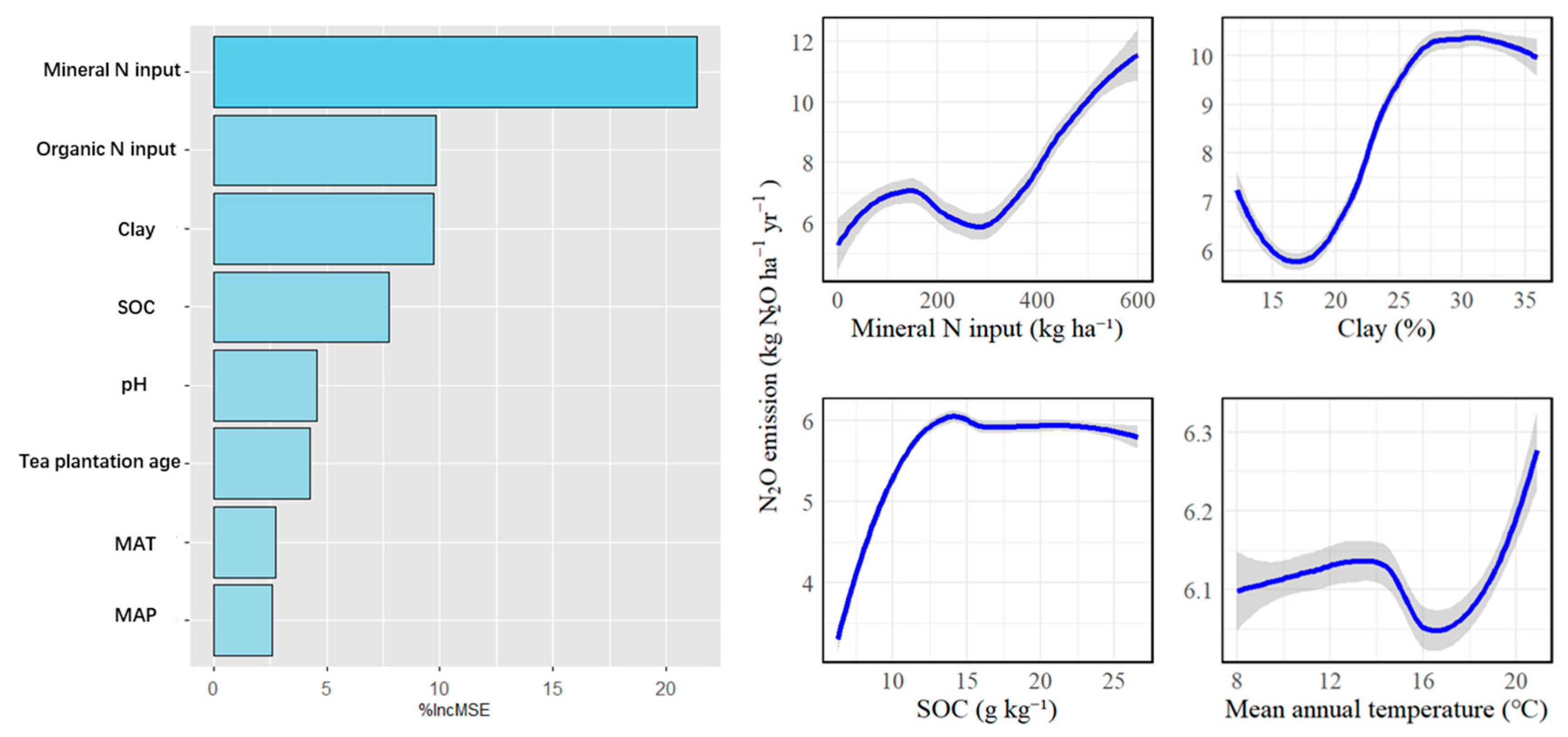
Variable importance analysis for the N2O emission model identified mineral N fertilizer input as the primary driver, followed by organic N fertilizer input, soil clay content and SOC content (Figure 1). In contrast, soil pH, tea plantation age, MAT and MAP exhibited relatively low explanatory power, and this finding underscored the priority of nitrogen management for N2O mitigation in tea plantations. N2O emissions were positively and significantly driven by the application of mineral and organic N fertilizers. Notably, the emission response showed a non-linear surge once N inputs surpassed critical thresholds of 250 kg N ha−1 for organic sources and 300 kg N ha−1 for mineral sources. Interestingly, the relative impact of N source type shifted at 200 kg N ha−1; specifically, organic N inputs resulted in lower emission rates than mineral N at low application levels (<200 kg N ha−1) but triggered more rapid N2O release at higher application rates. The relationship between N2O emissions and soil clay content exhibited a distinct non-linear trend. A negative correlation was observed at low clay levels (<17.5%), which transitioned into a positive correlation as clay content increased, eventually stabilizing once the clay content exceeded 27.5%. N2O emissions exhibited a positive correlation with SOC, reaching a plateau once SOC concentrations exceeded 15 g kg−1. Furthermore, N2O emissions were found to decrease as the tea plantation age increased within the first 15 years of establishment. Climate variables also exerted a substantial influence on N2O dynamics. A positive response to MAT was observed once the thermal threshold of 16 °C was surpassed. Conversely, MAT showed a negative relationship with emission rates when rainfall was limited to less than 1200 mm (Figure 1 and Figure S3).
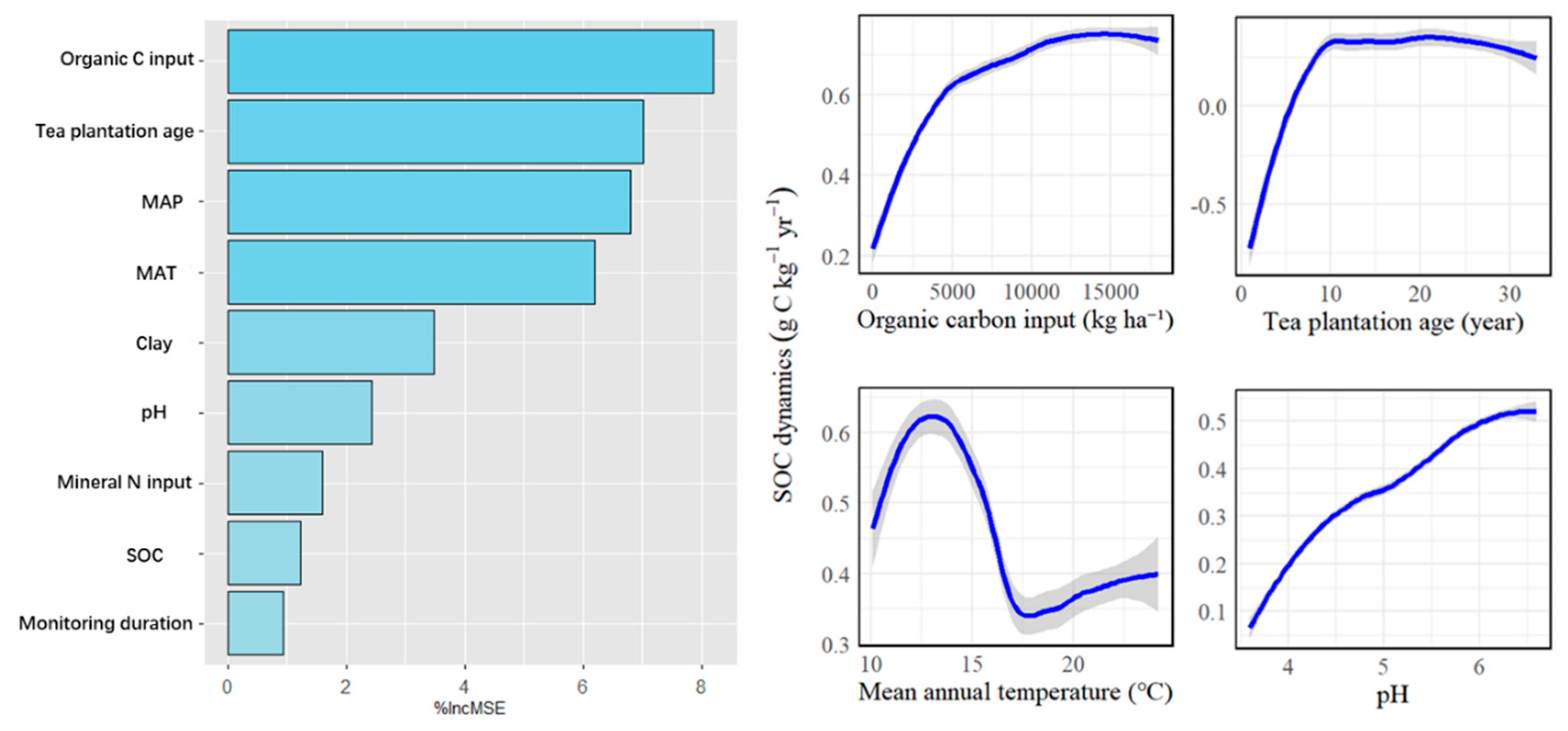
Variable importance analysis for the SOC model revealed that management practices and soil properties were both significant drivers of SOC dynamics (Figure 2). Organic C input emerged as the most influential predictor, followed by tea plantation age and climate factors, which also played critical roles in determining SOC sequestration rates. Marginal effect curve analysis further clarified the effects of key variables on SOC dynamics (Figure 2). SOC dynamics increased rapidly at first and then tended to stabilize as organic carbon input rates increased. The SOC sequestration rate increased significantly with tea plantation age during the first decade of growth. Thermal and moisture regimes exerted complex controls on SOC dynamics. A positive MAT response was observed at MAT < 13 °C, which subsequently reversed. The influence of MAP followed a U-shaped trajectory, with a negative impact occurring within the 500–1300 mm interval and a positive effect emerging beyond 1300 mm. Despite the generally acidic to neutral nature of tea garden soils, higher pH levels favored SOC sequestration. Notably, mineral N inputs displayed a parabolic relationship with SOC sequestration, where the initial stimulatory effect at low application rates (<200 kg N ha−1) transitioned into an inhibitory effect as inputs further increased (Figure S4).

3.2. Net GHG Emissions from Tea Plantations in China: Current Status

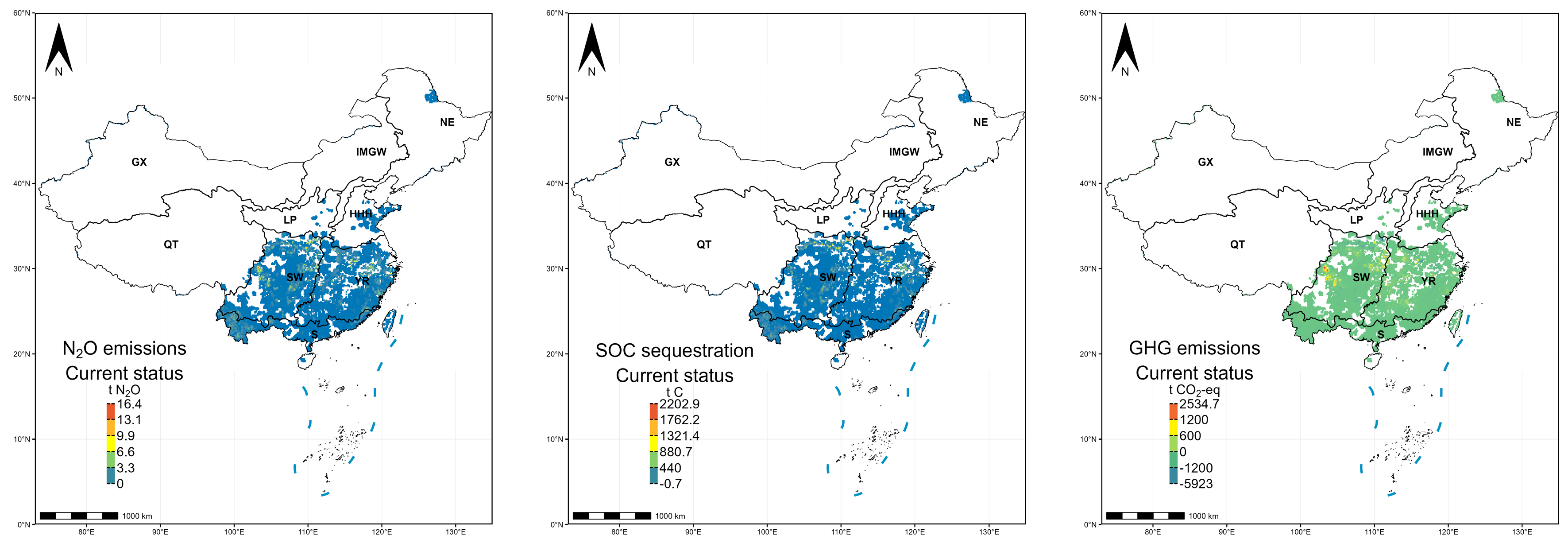
The simulation results revealed that the current average N2O emission intensity for Chinese tea plantations was 9.03 kg N2O ha−1. Spatially, this intensity exhibited significant regional variation, with the QT region recording the highest emissions (14.06 kg N2O ha−1) and the S region the lowest (7.66 kg N2O ha−1) (Table 2). Regarding SOC dynamics, the annual SOC sequestration rate was estimated at 0.88 t C ha−1 yr−1 across China’s tea plantations. The LP region functioned as the most vigorous carbon sink (2.21 t C ha−1 yr−1), while the YR region exhibited the lowest (0.80 t C ha−1 yr−1) (Figure 3). A comprehensive assessment using the GWP indicated that SOC sequestration was sufficient to offset the N2O emissions. Consequently, Chinese tea plantations functioned as a net sink for anthropogenic GHG sources at the national scale. Among regions, the LP region exhibits the highest net GHG uptake intensity (−5.52 t CO2-eq ha−1), whereas the YR region shows the lowest value (−0.53 t CO2-eq ha−1).
The total N2O emissions from tea plantations in China were estimated at 29.62 Gg N2O. Among agricultural regions, the SW region contributed the largest share, emitting 13.44 Gg N2O (45.4% of the national total), followed by the YR region, which accounted for 37.3%. In contrast, the IMGW region exhibited the lowest emissions, at only 0.14 t N2O (Table 2; Figure 3).
Total annual SOC sequestration in Chinese tea plantations was estimated at 2894.01 Gg C. The SW region again dominated, contributing 1311.31 Gg C (45.3%), followed by the YR region (34.7%). The IMGW region showed the smallest SOC increase, at just 0.03 Gg C (Table 2; Figure 3).
When expressed in CO2 equivalents, the annual net greenhouse gas uptake by Chinese tea plantations amounted to 2525.18 Gg CO2-eq. The SW region was the largest contributor to uptake, with an uptake of 1140.10 Gg CO2-eq (45.2%), followed by the YR region (26.2%), whereas the IMGW region remained the smallest uptake, emitting only 0.05 Gg CO2-eq (Table 2; Figure 3).

3.3. Net GHG Emissions from Tea Plantations in China: Mitigation Potential

Under the mineral N fertilizer reduction scenario, also known as Scenario A, the average annual SOC sequestration rate of Chinese tea plantations was 1.02 t C ha−1, which was a 15.9% increase compared to the baseline (Table 3). Under this scenario, the annual SOC sequestration of Chinese tea plantations was 3360.09 Gg C, an increase of 466.08 Gg C compared to the baseline. The SW region contributed the most, with increases of 264.46 Gg C respectively. The N2O emission intensity under scenario A was 8.92 kg N2O ha−1, a 1.2% decrease compared to the baseline. Regarding the total N2O emissions, Scenario A brought about a reduction of 346.82 t N2O, mainly contributed by the SW regions (Table 3).
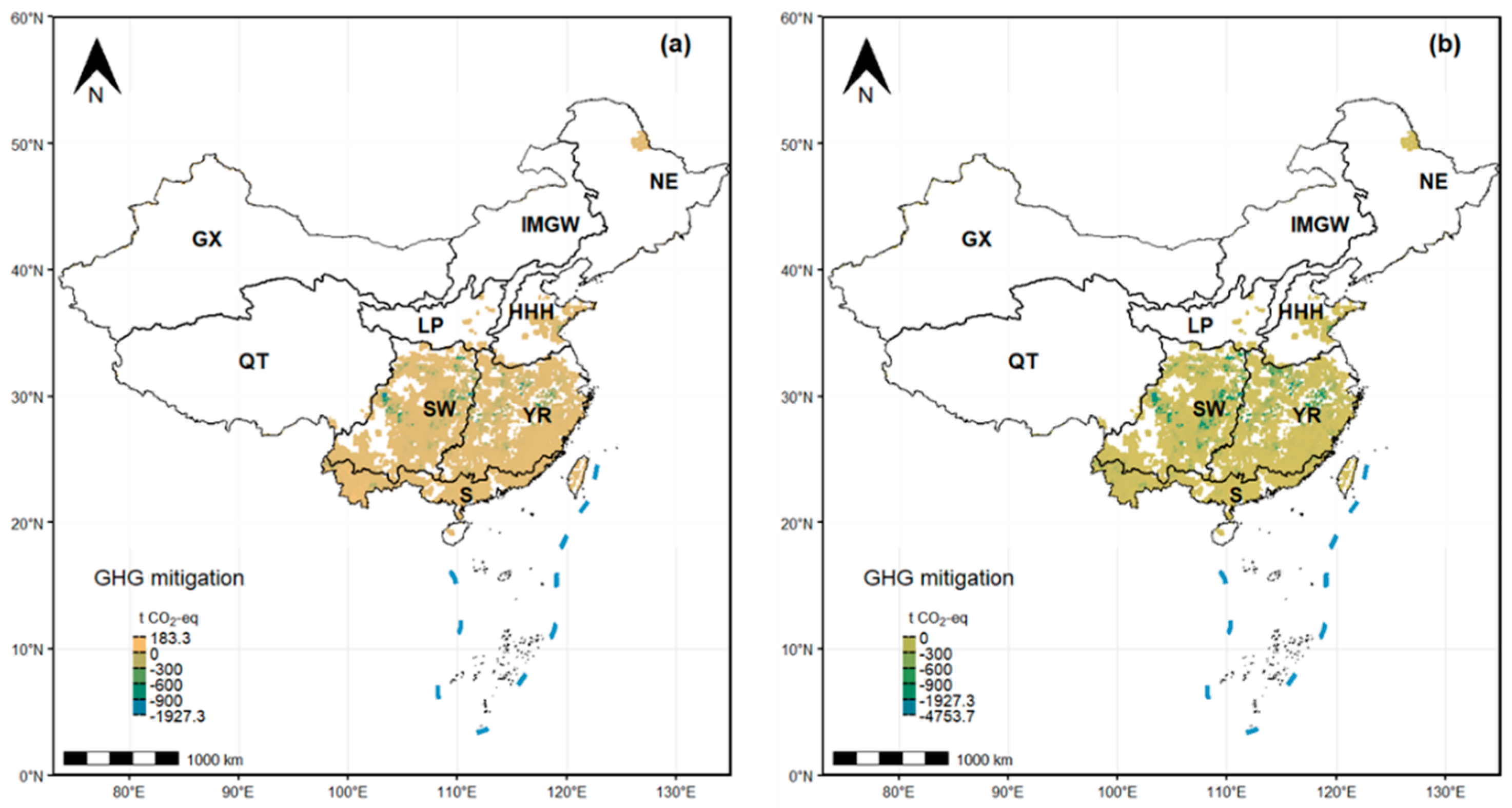
Scenario A could achieve a net GHG uptake intensity of 1.32 t CO2-eq ha−1 for Chinese tea plantations. The total net GHG uptake of Chinese tea plantation soils was 4328.84 Gg CO2-eq, representing a reduction in net emissions of 1803.66 Gg CO2-eq compared to the baseline scenario. The SW region contributed the most, with an increase in uptake of 1013.94 Gg CO2-eq (Table 3; Figure 4).
Under the organic fertilizer substitution scenario, also known as Scenario B, the SOC sequestration rate in Chinese tea plantations reached 1.27 t C ha−1, representing a 44.32% increase relative to the baseline (Table 4). Total SOC sequestration reached 4165.80 Gg C, an increase of 1271.79 Gg C from the baseline, predominantly driven by contributions from the SW regions. N2O emission intensity declined to 7.58 kg N2O ha−1 (−16.06% vs. baseline). Total N2O emissions amounted to 24.86 Gg N2O, reflecting a reduction of 4.75 Gg N2O from the baseline, primarily attributed to decreases in the SW regions.
Scenario B could achieve a net GHG uptake intensity of 2.59 t CO2-eq ha−1 for Chinese tea plantations. The total net GHG uptake of Chinese tea plantation soils was 8486.48 Gg CO2-eq, representing a reduction in net emissions of 5961.30 Gg CO2-eq compared to the baseline scenario. The SW region contributed the most, with a reduction in emissions of 3132.13 Gg CO2-eq (Table 4; Figure 4).

4. Discussion

4.1. Dominant Controls on Soil N2O Emissions and SOC Dynamics in Tea Plantations

Variable importance analysis based on machine learning models indicates that soil N2O emissions from tea plantations are driven by multiple factors in a highly nonlinear manner, with a level of complexity far exceeding that captured by simple linear relationships (Figure 1). Nitrogen fertilizer input was identified as the dominant driver of N2O emissions, which is consistent with previous findings that nitrogen availability is the primary limiting factor controlling greenhouse gas emissions in agricultural systems [39]. Both mineral and organic nitrogen inputs showed significant positive correlations with N2O emissions; however, pronounced threshold effects were observed for different nitrogen forms. Specifically, N2O emission rates increased sharply when organic nitrogen inputs exceeded 250 kg N ha−1 and mineral nitrogen inputs surpassed 300 kg N ha−1. This abrupt increase can be explained by the substrate saturation hypothesis, whereby nitrogen supply exceeds the uptake capacity of tea plants and microbial immobilization, leading to excess ammonium or nitrate being transformed into N2O through nitrification and denitrification processes [13]. Notably, this study revealed an intriguing crossover pattern: at nitrogen input levels below 200 kg N ha−1, organic nitrogen induced lower N2O emission intensities than mineral nitrogen, whereas beyond this threshold, organic nitrogen exhibited a greater emission potential (Figure S3). This phenomenon likely arises because high rates of organic fertilizer application not only supply nitrogen substrates but also introduce substantial amounts of dissolved organic carbon, which strongly stimulates denitrifying microbial activity [13,40].
The non-linear response of N2O emissions to soil clay content highlighted the complex role of soil physical properties in regulating nitrogen transformation processes (Figure 1). At relatively low clay contents (<17.5%), increasing clay proportion was associated with reduced N2O emissions, likely because improved soil aeration constrained the formation of anaerobic microsites required for denitrification. As clay content increased beyond 17.5%, the enhanced water-holding capacity and reduced gas diffusivity favored the development of anaerobic niches, thereby intensifying denitrification activity and stimulating N2O production [41]. When clay content exceeded 27.5%, N2O emissions tended to level off, suggesting that anaerobic conditions were no longer the dominant limiting factor and that other constraints, such as substrate availability or microbial regulation, became increasingly important. In parallel, SOC exerted a strong positive influence on N2O emissions by acting as a key electron donor for denitrifying microorganisms. Elevated SOC levels enhanced microbial activity and promoted denitrification, consistent with previous findings [42]. However, the observed plateau in N2O emissions at SOC contents above 15 g kg−1 indicated a shift in the controlling mechanism, from carbon limitation toward nitrogen limitation or regulation by other environmental factors, underscoring the context-dependent nature of SOC–N2O interactions.
Tea plantation age exhibited a negative relationship with N2O emissions during the early stage of plantation development (0–15 years) (Figure S3). This pattern may be attributed to substantial soil disturbance and elevated mineralization rates immediately following land conversion, which gradually diminish as plantations mature. With increasing tea tree age, the expansion of root biomass enhances competitive nitrogen uptake by plants, thereby reducing the availability of inorganic nitrogen for microbial nitrification and denitrification processes and ultimately suppressing N2O emissions [8].
Climatic factors, including MAT and MAP, exerted pronounced threshold controls on N2O emissions. When MAT exceeded 16 °C, N2O emissions increased markedly, consistent with the temperature sensitivity of microbial activity in temperate and subtropical regions [10,43]. In contrast, increasing precipitation suppressed N2O emissions when MAP was below 1200 mm (Figure S3), potentially reflecting shifts in dominant emission pathways under specific climatic and soil moisture conditions, such as prolonged water saturation altering nitrification–denitrification dynamics [44].
Organic carbon input was identified as the most critical predictor of SOC dynamics, followed by tea plantation age, climatic factors, and soil physicochemical properties (Figure 2). Organic carbon input represents the primary driver of soil carbon accumulation in tea plantations. Marginal effect analysis showed that SOC dynamics increased rapidly with rising organic carbon inputs and then gradually leveled off. This pattern is consistent with the soil carbon saturation theory, which posits that once external carbon inputs exceed a certain threshold, the capacity of mineral surfaces and microaggregates to physically protect organic carbon becomes saturated, and additional carbon is increasingly lost through microbial respiration [45]. In tea plantation management, practices such as increasing organic fertilizer application or returning pruned biomass to the soil not only directly enhance carbon inputs but also promote the accumulation of microbial necromass carbon by improving soil microbial community structure [8,39,46].
In addition, this study revealed a significant parabolic relationship between mineral nitrogen input and SOC sequestration rates, with a turning point at approximately 200 kg N ha−1 (Figure S4). Moderate nitrogen inputs (<200 kg N ha−1) can enhance SOC stocks by stimulating tea plant growth and increasing the return of above- and belowground biomass to the soil [8]. In contrast, excessive nitrogen application (>200 kg N ha−1) may induce severe soil acidification, suppress microbial activity, and trigger a priming effect that accelerates the mineralization of native soil organic carbon, ultimately leading to a decline in SOC sequestration rates [47].
The results indicated a significant positive relationship between tea plantation age and SOC sequestration rates during the early establishment stage (0–10 years) (Figure 2). This pattern can be attributed to the rapid growth phase of tea plants following establishment, during which the expansion of root systems and increasing inputs of litter and root-derived carbon substantially enhanced the soil carbon sink capacity [8]. In addition, as tea plantations mature, progressive canopy closure reduces soil erosion driven by surface runoff, which further favors the retention and accumulation of organic carbon in surface soils.
The effects of MAT and MAP on SOC dynamics exhibited pronounced non-linear patterns (Figure 2). When MAT was below 13 °C, rising MAT stimulated photosynthesis and biomass production, resulting in a positive relationship with SOC. However, above this threshold, the temperature-induced acceleration of soil respiration exceeded carbon input rates, leading to a negative relationship between MAT and SOC dynamics [48]. The U-shaped response to precipitation reflects the dual role of soil moisture in SOC sequestration (Figure S4). Under moderate precipitation conditions (500–1300 mm), enhanced leaching and moisture-regulated microbial activity may sustain relatively high mineralization rates. In contrast, when precipitation exceeded 1300 mm, water saturation likely promoted the formation of anaerobic microsites, suppressing organic matter decomposition and thereby favoring carbon accumulation [5,49,50].
Although tea plantation soils are typically acidic, a positive relationship between SOC sequestration rates and soil pH was observed in this study (Figure 2). This finding suggests that alleviating excessive soil acidification through amendments such as liming or biochar application could not only mitigate aluminum toxicity but also enhance microbial processing efficiency of organic substrates, ultimately improving SOC stabilization [51,52].

4.2. Current Status and Mitigation Potential of Net Greenhouse Gas Emissions from Tea Plantations in China

The simulation results indicated that the average N2O emission intensity for Chinese tea plantations was 9.03 kg N2O ha−1, with a total emission of 29.62 Gg N2O (Table 2). Previous studies by Yao et al. [18] and Liang et al. [19], utilizing fixed emission factors of 1.4% and 1.9%, reported significantly higher intensities (15.00 and 16.9 kg ha−1) and total emissions (44.00 and 40.54 Gg N2O, respectively). This discrepancy likely stems from the use of homogeneous national-scale emission factors in earlier assessments, which failed to account for regional variations in climate, soil properties, and management practices. Compared to other cropping systems, tea plantations exhibited N2O intensities far exceeding those of grain crops [53,54]. This intensive emission pattern was primarily driven by exceptionally high N inputs (averaging 407 kg N ha−1 in this study) and the pronounced soil acidification characteristic of tea-growing regions [39]. Spatially, N2O emissions showed marked heterogeneity. The QT region recorded the highest intensity (14.06 kg N2O ha−1), potentially due to the non-linear response triggered by low precipitation (406 mm) and excessive N application (600 kg N ha−1) (Table S3). In contrast, the SW and YR regions contributed 45.4% of the national total, consistent with their extensive cultivation scales, high N loading, and warm climatic conditions [8].
Regarding SOC sequestration, while several studies have focused on SOC stocks, quantitative estimates for SOC sequestration rates remain scarce [5,22]. Our findings estimated the national average SOC sequestration rate at 0.88 t C ha−1 yr−1 (Table 2), notably higher than the Chinese cropland average of 0.24 t C ha−1 yr−1 [55]. This superior performance is attributed to the continuous input of litter and root exudates from perennial tea plants and the higher proportion of organic fertilizer compared to field crops. Notably, the LP and HHH regions exhibited the highest SOC sequestration potential (2.21 t C ha−1 yr−1), whereas the YR and S regions showed the lowest. This spatial divergence is mainly due to the younger age of plantations in the LP and HHH regions, which possess lower initial SOC and thus exhibit vigorous sink capacity during ecosystem establishment. Conversely, the mature plantations in the YR region are approaching carbon saturation, leading to diminished SOC sequestration rates [45,48]. Comprehensive assessment using the GWP confirmed that SOC sequestration in Chinese tea plantations is sufficient to offset N2O emissions, functioning as a net GHG sink (Table 2). The SW region accounted for 45.2% of this net uptake, underscoring its pivotal role in agricultural carbon neutrality strategies (Figure 3).
Existing studies estimated global tea plantation N2O emission intensities ranging from 17.99 to 26.43 kg N2O ha−1 and total emissions of 70–132 Gg N2O [17,20,21]. Although the emission intensity of Chinese tea plantations was lower than the global average, their total emissions still accounted for approximately 23–43% of global tea-related N2O emissions. Given that total N2O emissions from Chinese croplands (excluding tea plantations) have been estimated at approximately 219 Gg N2O, the additional ~30 Gg N2O emitted from tea plantations highlights their critical role in national agricultural N2O mitigation [53,54]. Moreover, Wang et al. [5] demonstrated that Chinese tea plantation soils possess substantial SOC storage potential compared with those in other tea-producing countries, further underscoring the importance of targeted mitigation strategies in this system.
Scenario analyses further clarified the mitigation potential. Under the mineral N reduction scenario (Scenario A), the SOC sequestration rate increased by 15.9%, while N2O emissions decreased marginally by 1.2% (Table 3). This pattern indicates that mineral N exerts complex and contrasting effects on SOC sequestration and N2O emissions in tea plantation ecosystems. While N reduction alleviates acidification and restores microbial activity, thereby promoting the stabilization of residues into SOC [51,52], the current excessive N inputs likely remain above the substrate-saturated threshold for nitrification and denitrification, limiting short-term N2O mitigation [13]. In contrast, the organic substitution scenario (Scenario B) demonstrated a superior synergistic effect, with a 44% increase in SOC sequestration and a 16% reduction in N2O emissions (Table 4). This “win-win” outcome was driven by enhanced exogenous C inputs, slower N release, and improved soil pH, which stimulates N2O reductase activity [16,45,46]. Consequently, organic substitution should be prioritized as the primary mitigation pathway, particularly in key regions like the SW and YR (Figure 4).

4.3. Limitations of This Study

Compared with previous studies, the predictive performance achieved in this study represents a clear improvement in estimating N2O emissions from tea plantations. Most previous studies relied on emission factor approaches or simple regression models with limited explanatory variables. For example, Yao et al. [18] reported an R2 of 0.42 for a regression model based solely on mineral N fertilizer input, while Yue et al. [56] developed emission factors for Chinese croplands with an independent validation R2 of only 0.39. Even when multiple variables were considered, Yue et al. [57] reported an R2 of 0.48 using a multiple linear regression model, which was not evaluated with independent validation datasets. In contrast, the RF model developed in this study achieved an R2 of 0.68 under independent validation, indicating a substantially improved ability to capture the complex, non-linear responses of N2O emissions to environmental and management drivers. In addition, to our knowledge, no predictive models for SOC dynamics have previously been developed specifically for tea plantation soils. The SOC model established in this study therefore fills an important knowledge gap and enables a more comprehensive quantification of the net GHG balance in tea ecosystems.
Although independent validation indicated that the models exhibited satisfactory reliability and robustness, approximately 30% of the variability remained unexplained based on the coefficient of determination (R2), and the RMSE values were relatively high (0.55 g kg−1 yr−1 for ΔSOC and 2.62 kg ha−1 for N2O emissions). These uncertainties mainly stem from limitations in the quantity and quality of observational data, as well as the inherent constraints of the modeling approaches employed. This study did not include pruning biomass as an input variable due to the lack of consistent quantitative data on pruning amount, frequency, and organic matter input across observations. While pruning can contribute to soil carbon and nitrogen inputs, the absence of standardized numerical data prevented its inclusion in the predictive models. This represents an important limitation that should be addressed in future studies with coordinated monitoring of pruning residues.
In the SOC database, only 12 records had a monitoring duration exceeding 10 years, accounting for 12.8% of the total observations. According to the IPCC inventory guidelines, the calculation of SOC stocks changes based on empirical models should be conducted on a 20-year scale. The scarcity of long-term observational data undoubtedly affected the accuracy of model estimates for long-term changes in the soil carbon pool. Furthermore, the uneven spatial distribution of observational data exacerbated uncertainties in model simulations across different regions. It is also important to note that machine learning models can exhibit increased sensitivity or bias when extrapolated to regions with limited training data, such as the QT and GX regions. Future studies incorporating more localized datasets are required to further calibrate the model’s performance in regions with complex terrain and sparse observational coverage (Figure S1).
With respect to the modeling approach, the RF algorithm employed in this study still has inherent methodological limitations, particularly in fully representing the complex mechanistic responses of SOC dynamics and N2O emissions to environmental and management drivers, especially under extrapolation scenarios. The pronounced fluctuations observed in the marginal effect curves further indicate constraints in model robustness. Indeed, machine learning approaches are often regarded as “black-box” models, as they rely primarily on data-driven relationships and do not explicitly incorporate ecological mechanisms into their model structures. Future studies could introduce stacking ensemble learning methods to integrate the strengths of multiple models, thereby further improving predictive accuracy and robustness. In addition, hybrid modeling strategies that combine machine learning frameworks with process-based models warrant exploration, allowing the predictive advantages of data-driven approaches to be leveraged while retaining the mechanistic interpretability of process-based models. Such model integration is expected to enhance simulation accuracy while simultaneously deepening mechanistic understanding of key soil carbon and nitrogen cycling processes in tea plantations.

5. Conclusions

This study demonstrated that the RF model exhibited high accuracy and broad applicability in simulating soil N2O emissions and SOC dynamics in Chinese tea plantations, significantly outperforming traditional linear models and other machine learning approaches. Driver analysis identified nitrogen input as the dominant factor controlling N2O emissions, while organic matter input and tea plantation age were the key determinants of SOC dynamics. All drivers showed pronounced nonlinear responses, highlighting the complexity of carbon–nitrogen interactions in tea plantation systems. Chinese tea plantations emitted approximately 29.62 Gg N2O annually, while sequestering about 2894 Gg C, resulting in a net GHG balance of −2525 Gg CO2-eq. Scenario simulations further reveal that optimized fertilizer management, including organic substitution and precision nitrogen reduction, could achieve an additional mitigation potential of 1803–5961 Gg CO2-eq. These results underscore the critical role of tea plantations in China’s agricultural carbon neutrality strategy and provide a robust quantitative basis for developing region-specific low-carbon management pathways.

Supplementary Materials

The following supporting information can be downloaded at: https://www.mdpi.com/article/10.3390/agronomy16060632/s1, Figure S1: Geographical distribution of experimental sites in this study; Figure S2: Model performance (a, Random Forest models for predicting SOC dynamics; b, Random Forest models for N2O emissions); Figure S3: Marginal effects of the other major variables in the N2O emission model; Figure S4: Marginal effects of the other major variables in the SOC dynamic model; Table S1: Optimized parameters for each machine learning algorithm; Table S2: Detailed input parameters for the optimization scenarios; Table S3: Meteorological and fertilization conditions in each agricultural region.

Author Contributions

Conceptualization, K.C.; Methodology, T.W., H.Z., W.C. and T.L.; Validation, T.W. and X.S.; Formal analysis, T.W., Y.S. and X.S.; Investigation, T.W., M.C., W.C. and H.Z.; Data curation, T.W., Y.S. and X.S.; Writing—original draft, T.W.; Writing—review & editing, M.C. and K.C.; Visualization, T.W. and T.L.; Supervision, K.C.; Funding acquisition, K.C. All authors have read and agreed to the published version of the manuscript.

Funding

This work was financially supported by the Fundamental Research Funds for the Central Universities under a grant No. YDZX2026053 and Natural Science Foundation of China under a grant No. 42277020. This study was also supported by the Technology Innovation Special Fund of Jiangsu Province for Carbon Dioxide Emission Peaking and Carbon Neutrality (BE2022423).

Data Availability Statement

The data presented in this study are available upon request from the corresponding author.

Conflicts of Interest

The authors have no conflicts of interest to declare.

References

  1. World Resources Institute (WRI). Historical GHG Emissions. 2024. Available online: https://www.climatewatchdata.org/ghg-emissions?ap3c=IGatBOL2anIYOIIFAGatBOKBXgX-V3xkue2RkEci_4qxSd2HqA (accessed on 8 February 2026).
  2. Lal, R. Soil carbon sequestration impacts on global climate change and food security. Science 2024, 304, 1623–1627. [Google Scholar] [CrossRef]
  3. Smith, P.; Martino, D.; Cai, Z.; Gwary, D.; Janzen, H.; Kumar, P.; McCarl, B.; Ogle, S.; O’Mara, F.; Rice, C.; et al. Greenhouse gas mitigation in agriculture. Philos. Trans. R. Soc. B Biol. Sci. 2018, 363, 789–813. [Google Scholar] [CrossRef]
  4. FAO. FAOSTAT: Tea Production Data. Food and Agriculture Organization of the United Nations. 2024. Available online: https://www.fao.org/faostat/en/#data/QCL (accessed on 8 February 2026).
  5. Wang, D.; Wu, B.S.; Li, F.; Li, X.; Wang, Z.; Hou, J.; Cao, R.; Yang, W. Soil organic carbon stock in China’s tea plantations and their great potential of carbon sequestration. J. Clean. Prod. 2023, 421, 138485. [Google Scholar] [CrossRef]
  6. Paustian, K.; Lehmann, J.; Ogle, S.; Reay, D.; Robertson, G.P.; Smith, P. Climate-smart soils. Nature 2016, 532, 49–57. [Google Scholar] [CrossRef] [PubMed]
  7. Franzluebbers, A.J. Soil organic carbon sequestration and agricultural greenhouse gas emissions in the southeastern USA. Soil Tillage Res. 2005, 83, 120–147. [Google Scholar] [CrossRef]
  8. Pang, J.; Li, H.; Tang, X.; Geng, J. Carbon dynamics and environmental controls of a hilly tea plantation in southeast China. Ecol. Evol. 2019, 9, 9723–9735. [Google Scholar] [CrossRef]
  9. Zuo, R.; Ma, Y.; Tang, M.; Luo, H.; Li, J.; Liao, T.; Gong, Y.; Zhang, S.; Gong, J.; Yi, Y. Regional carbon storage dynamics driven by tea plantation expansion: Insights from Meitan County, China. Land 2025, 14, 227. [Google Scholar] [CrossRef]
  10. Butterbach-Bahl, K.; Baggs, E.M.; Dannenmann, M.; Kiese, R.; Zechmeister-Boltenstern, S. Nitrous oxide emissions from soils: How well do we understand the processes and their controls? Philos. Trans. R. Soc. B Biol. Sci. 2013, 368, 20130122. [Google Scholar] [CrossRef]
  11. Ni, K.; Liao, W.; Yi, X.; Niu, S.; Ma, L.; Shi, Y.; Zhang, Q.; Liu, M.; Ruan, J. Fertilization status and reduction potential in tea gardens of China. J. Plant Nutr. Fertil. 2019, 25, 421–432, (In Chinese in English Summary). [Google Scholar]
  12. Zhou, Z.; Liu, Y.; Zhu, Q.; Lai, X.; Liao, K. Comparing the variations and controlling factors of soil N2O emissions and NO3–-N leaching on tea and bamboo hillslopes. CATENA 2020, 188, 104463. [Google Scholar] [CrossRef]
  13. Yao, Z.; Wei, Y.; Liu, C.; Zheng, X.; Xie, B. Organically fertilized tea plantation stimulates N2O emissions and lowers NO fluxes in subtropical China. Biogeosciences 2015, 12, 5915–5928. [Google Scholar] [CrossRef]
  14. Hou, M.; Ohkama-Ohtsu, N.; Suzuki, S.; Tanaka, H.; Schmidhalter, U.; Bellingrath-Kimura, S.D. Nitrous oxide emission from tea soil under different fertilizer managements in Japan. CATENA 2015, 135, 304–312. [Google Scholar] [CrossRef]
  15. Zhang, W.; Yao, Z.; Zheng, X.; Liu, C.; Wang, R.; Wang, K.; Li, S.; Han, S.; Zuo, Q.; Shi, J. Effects of fertilization and stand age on N2O and NO emissions from tea plantations: A site-scale study in a subtropical region using a modified biogeochemical model. Atmos. Chem. Phys. 2020, 20, 6903–6919. [Google Scholar] [CrossRef]
  16. Wu, Z.; Hua, W.; Ni, K.; Yang, X.; Jiang, F. Effects of long-term organic substitution on soil nitrous oxide emissions in a tea (Camellia sinensis L.) plantation in China. Agronomy 2025, 15, 288. [Google Scholar] [CrossRef]
  17. Yu, H.; Han, X.; Zhang, X.; Meng, X.; Yue, Z.; Liu, X.; Zheng, N.; Li, Y.; Yu, Y.; Yao, H. Fertilizer-induced N2O and NO emissions in tea gardens and the main controlling factors: A recent three-decade data synthesis. Sci. Total Environ. 2023, 871, 162054. [Google Scholar] [CrossRef]
  18. Yao, Z.; Wang, Y.; Wang, R.; Liu, C.; Zheng, X. Nitrous oxide emissions and controlling factors of tea plantations in China. J. Agro-Environ. Sci. 2020, 39, 715–725, (In Chinese with English Summary). [Google Scholar]
  19. Liang, L.; Ridoutt, B.G.; Wang, L.; Xie, B.; Li, M.; Li, Z. China’s tea industry: Net greenhouse gas emissions and mitigation potential. Agriculture 2021, 11, 363. [Google Scholar] [CrossRef]
  20. Wang, Y.; Yao, Z.; Pan, Z.; Wang, R.; Yan, G.; Liu, C.; Su, Y.; Zheng, X.; Butterbach-Bahl, K. Tea-planted soils as global hotspots for N2O emissions from croplands. Environ. Res. Lett. 2020, 15, 104018. [Google Scholar] [CrossRef]
  21. Yang, L.; Nie, S.; Zhong, J.; Sheng, H.; Zhan, Y.U. Nitrous oxide emission from soil of tea plantation and its influencing factors: A meta-analysis. Soil Fertil. Sci. China 2023, 54, 1484–1492, (In Chinese in English Summary). [Google Scholar]
  22. Li, S.; Wu, X.; Xue, H.; Gu, B.; Cheng, H.; Zeng, J.; Peng, C.; Ge, Y.; Chang, J. Quantifying carbon storage for tea plantations in China. Agric. Ecosyst. Environ. 2011, 141, 390–398. [Google Scholar] [CrossRef]
  23. Hassan, M.U.; Aamer, M.; Mahmood, A.; Awan, M.I.; Barbanti, L.; Seleiman, M.F.; Bakhsh, G.; Alkharabsheh, H.M.; Babur, E.; Shao, J.; et al. Management strategies to mitigate N2O emissions in agriculture. Life 2020, 12, 439. [Google Scholar] [CrossRef]
  24. Padarian, J.; Minasny, B.; McBratney, A.B. Machine learning and soil sciences: A review aided by machine learning tools. Soil 2020, 6, 35–52. [Google Scholar] [CrossRef]
  25. Yu, Z.; Jiao, W.; Min, Q. Carbon footprints of tea production in smallholder plantations: A case study of Fenghuang Dancong tea in China. Ecol. Indic. 2024, 158, 111305. [Google Scholar] [CrossRef]
  26. Breiman, L. Random Forests. Mach. Learn. 2001, 45, 5–32. [Google Scholar] [CrossRef]
  27. Veisi, H. Introduction to SVM. In Learning with Fractional Orthogonal Kernel Classifiers in Support Vector Machines: Theory, Algorithms and Applications; Springer Nature: Singapore, 2023; pp. 3–18. [Google Scholar]
  28. Wu, C.L.; Chau, K.W.; Li, Y.S. Methods to improve neural network performance in daily flows prediction. J. Hydrol. 2009, 372, 80–93. [Google Scholar] [CrossRef]
  29. Zounemat-Kermani, M. Hourly predictive Levenberg–Marquardt ANN and multi linear regression models for predicting of dew point temperature. Meteorol. Atmos. Phys. 2012, 117, 181–192. [Google Scholar] [CrossRef]
  30. R Core Team. R: A Language and Environment for Statistical Computing; R Foundation for Statistical Computing: Vienna, Austria, 2022. [Google Scholar]
  31. Breiman, L.; Cutler, A.; Liaw, A.; Wiener, M. Breiman and Cutlers Random Forests for Classification and Regression. 2024. Available online: https://cran.r-project.org/web/packages/randomForest/randomForest.pdf (accessed on 8 February 2026).
  32. Meyer, D.; Dimitriadou, E.; Hornik, K.; Weingessel, A.; Leisch, F.; Chang, C.; Lin, C. Misc Functions of the Department of Statistics (e1071), TU Wien. 2025. Available online: https://cran.r-project.org/web/packages/e1071/e1071.pdf (accessed on 8 February 2026).
  33. Fritsch, S.; Guenther, F.; Wright, M.N.; Suling, M.; Mueller, S.M. Training of Neural Networks. 2019. Available online: https://cran.r-project.org/web/packages/neuralnet/neuralnet.pdf (accessed on 8 February 2026).
  34. Smith, P.; Smith, J.U.; Powlson, D.; McGill, W.; Arah, J.; Chertov, O.; Coleman, K.; Franko, U.; Frolking, S.; Jenkinson, D.; et al. A comparison of the performance of nine soil organic matter models using datasets from seven long-term experiments. Geoderma 1997, 81, 153–225. [Google Scholar] [CrossRef]
  35. Nash, J.E.; Sutcliffe, J.V. River flow forecasting through conceptual models part I—A discussion of principles. J. Hydrol. 1970, 10, 282–290. [Google Scholar] [CrossRef]
  36. IPCC. Climate Change 2022: Mitigation of Climate Change. Contribution of Working Group III to the Sixth Assessment Report of the Intergovernmental Panel on Climate Change; Cambridge University Press: Cambridge, UK, 2024. [Google Scholar]
  37. Wickham, H.; François, R.; Henry, L.; Müller, K.; Vaughan, D. A Grammar of Data Manipulation. 2026. Available online: https://cran.r-project.org/web/packages/dplyr/dplyr.pdf (accessed on 8 February 2026).
  38. Wickham, H.; Chang, W.; Henry, L.; Pedersen, T.L.; Takahashi, K.; Wilke, C.; Woo, K.; Yutani, H.; Dunnington, D.; van den Brand, T. Create Elegant Data Visualisations Using the Grammar of Graphics. 2026. Available online: https://cran.r-project.org/web/packages/ggplot2/ggplot2.pdf (accessed on 8 February 2026).
  39. Chen, D.; Li, Y.; Wang, C.; Fu, X.; Liu, X.; Shen, J.; Wang, Y.; Xiao, R.; Liu, D.L.; Wu, J. Measurement and modeling of nitrous and nitric oxide emissions from a tea field in subtropical central China. Nutr. Cycl. Agroecosyst. 2017, 107, 157–173. [Google Scholar] [CrossRef]
  40. Jarecki, M.K.; Parkin, T.B.; Chan, A.S.; Hatfield, J.L.; Jones, R. Greenhouse gas emissions from two soils receiving nitrogen fertilizer and swine manure slurry. J. Environ. Qual. 2008, 37, 1432–1438. [Google Scholar] [CrossRef]
  41. Weitz, A.M.; Linder, E.; Frolking, S.; Crill, P.M.; Keller, M. N2O emissions from humid tropical agricultural soils: Effects of soil moisture, texture and nitrogen availability. Soil Biol. Biochem. 2001, 33, 1077–1093. [Google Scholar] [CrossRef]
  42. Mei, K.; Wang, Z.; Huang, H.; Zhang, C.; Shang, X.; Dahlgren, R.A.; Zhang, M.; Xia, F. Stimulation of N2O emission by conservation tillage management in agricultural lands: A meta-analysis. Soil Tillage Res. 2018, 182, 86–93. [Google Scholar] [CrossRef]
  43. Cui, P.; Fan, F.; Yin, C.; Song, A.; Huang, P.; Tang, Y.; Zhu, P.; Peng, C.; Li, T.; Wakelin, S.A.; et al. Long-term organic and inorganic fertilization alters temperature sensitivity of potential N2O emissions and associated microbes. Soil Biol. Biochem. 2016, 93, 131–141. [Google Scholar] [CrossRef]
  44. Liu, H.; Zheng, X.; Li, Y.; Yu, J.; Ding, H.; Sveen, T.R.; Zhang, Y. Soil moisture determines nitrous oxide emission and uptake. Sci. Total Environ. 2022, 822, 153566. [Google Scholar] [CrossRef] [PubMed]
  45. Six, J.; Conant, R.T.; Paul, E.A.; Paustian, K. Stabilization mechanisms of soil organic matter: Implications for C-saturation of soils. Plant Soil 2002, 241, 155–176. [Google Scholar] [CrossRef]
  46. Kallenbach, C.M.; Grandy, A.S.; Frey, S.D.; Diefendorf, A.F. Microbial physiology and necromass regulate agricultural soil carbon accumulation. Soil Biol. Biochem. 2015, 91, 279–290. [Google Scholar] [CrossRef]
  47. Khan, S.A.; Mulvaney, R.L.; Ellsworth, T.R.; Boast, C.W. The myth of nitrogen fertilization for soil carbon sequestration. J. Environ. Qual. 2007, 36, 1821–1832. [Google Scholar] [CrossRef]
  48. Wang, S.; Li, T.; Zheng, Z.; Zhang, X.; Chen, H.Y. Soil organic carbon and nutrients associated with aggregate fractions in a chronosequence of tea plantations. Ecol. Indic. 2019, 101, 444–452. [Google Scholar] [CrossRef]
  49. Manzoni, S.; Schimel, J.P.; Porporato, A. Responses of soil microbial communities to water stress: Results from a meta-analysis. Ecology 2012, 93, 930–938. [Google Scholar] [CrossRef]
  50. Keiluweit, M.; Nico, P.S.; Kleber, M.; Fendorf, S. Are oxygen limitations under recognized regulators of organic carbon turnover in upland soils? Biogeochemistry 2016, 127, 157–171. [Google Scholar] [CrossRef]
  51. Yang, X.; Ni, K.; Shi, Y.; Yi, X.; Zhang, Q.; Fang, L.; Ma, L.; Ruan, J. Effects of long-term nitrogen application on soil acidification and solution chemistry of a tea plantation in China. Agric. Ecosyst. Environ. 2018, 252, 74–82. [Google Scholar] [CrossRef]
  52. Rousk, J.; Brookes, P.C.; Bååth, E. The microbial PLFA composition as affected by pH in an arable soil. Soil Biol. Biochem. 2010, 42, 516–520. [Google Scholar] [CrossRef]
  53. Li, T.; Li, Y.; Cheng, W.; Zheng, J.; Li, L.; Cheng, K. Predicting nitrous oxide emissions from China’s upland fields under climate change scenarios with machine learning. Agronomy 2025, 15, 1447. [Google Scholar] [CrossRef]
  54. Sun, J.; Chen, L.; Ogle, S.; Cheng, K.; Xu, X.; Li, Y.; Pan, G. Future climate change may pose pressures on greenhouse gas emission reduction in China’s rice production. Geoderma 2023, 440, 116732. [Google Scholar] [CrossRef]
  55. Gao, B.; Huang, T.; Ju, X.; Gu, B.; Huang, W.; Xu, L.; Rees, R.M.; Powlson, D.S.; Smith, P.; Cui, S. Chinese cropping systems are a net source of greenhouse gases despite soil carbon sequestration. Glob. Change Biol. 2018, 24, 5590–5606. [Google Scholar] [CrossRef] [PubMed]
  56. Yue, Q.; Wu, H.; Sun, J.; Cheng, K.; Smith, P.; Hillier, J.; Xu, X.; Pan, G. Deriving emission factors and estimating direct nitrous oxide emissions for crop cultivation in China. Environ. Sci. Technol. 2019, 53, 10246–10257. [Google Scholar] [CrossRef]
  57. Yue, Q.; Ledo, A.; Cheng, K.; Albanito, F.; Lebender, U.; Sapkota, T.B.; Brentrup, F.; Stirling, C.M.; Smith, P.; Sun, J.; et al. Re-assessing nitrous oxide emissions from croplands across mainland China. Agric. Ecosyst. Environ. 2018, 268, 70–78. [Google Scholar] [CrossRef]
Figure 1. Variable importance and marginal effects of key variables in the N2O emission model. Note: MAT, mean annual temperature; MAP, mean annual precipitation.
Agronomy 16 00632 g001
Figure 2. Variable importance and marginal effects of key variables in the SOC dynamic model. Note: MAT, mean annual temperature; MAP, mean annual precipitation.
Agronomy 16 00632 g002
Figure 3. Spatial distribution of soil N2O emissions, SOC changes, and net GHG emissions in Chinese tea plantations in 2021. Note: NE, northeast; IMGW, Inner Mongolia and along the Great Wall; HHH, Huang–Huai–Hai; LP, Loess Plateau; YR, Yangtze River; SW, southwest; S, south; GX, Gansu–Xinjiang; QT, Qinghai–Tibet.
Agronomy 16 00632 g003
Figure 4. Spatial distribution of SOC sequestration and emission reduction potential in Chinese tea plantations under Scenario A (a) and Scenario B (b). Note: NE, northeast; IMGW, Inner Mongolia and along the Great Wall; HHH, Huang–Huai–Hai; LP, Loess Plateau; YR, Yangtze River; SW, southwest; S, south; GX, Gansu–Xinjiang; QT, Qinghai–Tibet.
Agronomy 16 00632 g004
Table 1. Performance comparison of different machine learning models.
ModelsR2RMSEEFt-Test
∆SOCMRL0.220.880.07NS
RF0.670.550.64NS
SVM0.360.730.36NS
ANN0.360.730.36NS
N2OMRL0.612.810.49NS
RF0.682.620.59NS
SVM0.603.370.60NS
ANN0.363.280.36NS
Note: NS, not significant.
Table 2. Current status of soil N2O emissions, SOC changes, and net GHG emissions in China’s tea plantations in 2021.
RegionsN2O∆SOCGHGnet
kg N2O ha−1t N2Ot C ha−1Gg Ct CO2-eq ha−1GgCO2-eq
NE9.0429.621.685.52−3.71−12.16
IMGW9.140.141.610.03−3.42−0.05
HHH9.41237.631.8145.84−4.09−103.22
LP9.4233.212.217.78−5.52−19.45
YR8.7911,058.580.801003.89−0.53−661.94
SW9.8413,436.010.961311.31−0.84−1140.10
S7.664781.510.83515.79−0.94−585.88
GX9.341.851.380.27−2.50−0.5
QT14.0641.141.223.57−0.64−1.87
National9.0329,619.710.882894.01−0.77−2525.18
Note: NE, northeast; IMGW, Inner Mongolia and along the Great Wall; HHH, Huang–Huai–Hai; LP, Loess Plateau; YR, Yangtze River; SW, southwest; S, south; GX, Gansu–Xinjiang; QT, Qinghai–Tibet.
Table 3. Soil N2O emissions, SOC changes, and net GHG emissions from Chinese tea plantations under the mineral N fertilizer reduction scenario.
RegionsN2O∆SOCGHGnet
kg N2O ha−1t N2Ot C ha−1Gg Ct CO2-eq ha−1Gg CO2-eq
NE9.0429.621.685.52−3.71−12.16
IMGW9.140.141.610.03−3.42−0.05
HHH6.09153.812.0150.89−5.73−144.61
LP9.4233.212.227.85−5.59−19.70
YR8.7210,963.210.961201.50−1.12−1412.54
SW9.7313,273.871.151575.77−1.58−2154.04
S7.654776.380.82513.77−0.93−579.88
GX9.341.851.380.27−2.50−0.50
QT13.9440.781.544.50−1.83−5.35
National8.9229,272.891.023360.09−1.32−4328.84
Note: NE, northeast; IMGW, Inner Mongolia and along the Great Wall; HHH, Huang–Huai–Hai; LP, Loess Plateau; YR, Yangtze River; SW, southwest; S, south; GX, Gansu–Xinjiang; QT, Qinghai–Tibet.
Table 4. Soil N2O emissions, SOC changes, and net GHG emissions from Chinese tea plantations under mineral N fertilizer reduction and organic fertilizer substitution scenario.
RegionsN2O∆SOCGHGnet
kg N2O ha−1t N2Ot C ha−1Gg Ct CO2-eq ha−1Gg CO2-eq
NE8.7728.761.815.93−4.23−13.88
IMGW8.810.141.750.03−4.01−0.06
HHH6.06152.952.6667.12−8.09−204.36
LP8.4929.952.669.40−7.45−26.29
YR7.489408.761.211527.41−2.41−3031.90
SW7.6910,497.831.431946.76−3.13−4272.23
S7.564715.360.97604.42−1.49−928.91
GX8.881.761.500.30−3.08−0.61
QT10.0629.431.524.44−2.82−8.24
National7.5824,864.951.274165.80−2.59−8486.48
Note: NE, northeast; IMGW, Inner Mongolia and along the Great Wall; HHH, Huang–Huai–Hai; LP, Loess Plateau; YR, Yangtze River; SW, southwest; S, south; GX, Gansu–Xinjiang; QT, Qinghai–Tibet.
Disclaimer/Publisher’s Note: The statements, opinions and data contained in all publications are solely those of the individual author(s) and contributor(s) and not of MDPI and/or the editor(s). MDPI and/or the editor(s) disclaim responsibility for any injury to people or property resulting from any ideas, methods, instructions or products referred to in the content.