Article

Effect of Sesbania [Sesbania cannabina (Retz.) Poir.] Green Manure on Inorganic Phosphorus Fractions at the Manure Microsite of Coastal Saline-Alkali Soil


1
College of Agriculture, Heilongjiang Bayi Agricultural University, Daqing 163319, China
2
Key Laboratory of Crop Gene Resources and Germplasm Enhancement in Southern China of Ministry of Agriculture and Rural Affairs & Key Laboratory of Tropical Crops Germplasm Resources Genetic Improvement and Innovation of Hainan Province, Tropical Crops Genetic Resources Institute (TCGRI), Chinese Academy of Tropical Agricultural Sciences (CATAS), Haikou 571101, China
3
International Center for Tropical Agriculture (CIAT), Cali 763537, Colombia
*
Authors to whom correspondence should be addressed.
These authors contributed equally to this work.
Agronomy 2026, 16(6), 614; https://doi.org/10.3390/agronomy16060614
Submission received: 16 January 2026 / Revised: 8 March 2026 / Accepted: 10 March 2026 / Published: 13 March 2026
(This article belongs to the Section Soil and Plant Nutrition)

Abstract

The application of leguminous green manure (GM) can enhance the soil inorganic phosphorus (Pi) pool, offering considerable benefits for crop cultivation in slightly and moderately saline-alkali soils. To optimize its agronomic potential, systematic and science-based fertilization strategies are required. In this study, we researched the changes in the content, movement distance, and accumulation of Pi fractions at the GM microsites in coastal saline-alkali soils of differing salinity levels (slightly vs. moderately) following the application of Sesbania GM at two rates (30 and 60 t ha−1) over 14- and 28-day incubation periods. The results indicated that GM application significantly (p < 0.05) increased the accumulation of all Pi fractions—including aluminum-bound phosphorus (Al-P), iron-bound phosphorus (Fe-P), occluded phosphorus (O-P), and forms of calcium-bound Pi (Ca-P: Ca2-P, Ca8-P, and Ca10-P)—at the manure microsite, with the magnitude of increase declining with distance from the manure site. Further analysis revealed positive correlations between GM rate, two incubation periods and Pi-fraction movement distance, indicating that the observed effects were significantly influenced by incubation period, GM rate, and soil salinity-alkalinity. While temporal dynamics governed the rates of Pi movement and transformation, elevated salinity-alkalinity partially inhibited these processes. This study provides practical insights for improving GM utilization efficiency on saline-alkali soils. These results support optimized GM application to enhance P efficiency and reduce fertilizer reliance in saline systems.

1. Introduction

Coastal saline-alkali soils are widely distributed worldwide, characterized by low nutrient content, high salinity-alkalinity, and a propensity for areal expansion over time. Applying green manure (GM) has been recognized as an effective strategy for the recultivation of such degraded soils. As a sustainable organic amendment, the application of GM not only supplies multiple nutrients and enhances soil fertility, but also promotes the movement and transformation of trace elements, improves soil physical structure, and mitigates salinity-alkalinity stress [1,2,3,4,5,6]. Phosphorus (P), in particular, plays a vital role in rhizobial development and plant growth, and is notably abundant in many leguminous GM crops, exerting a more pronounced influence than other mineral nutrients [7,8,9]. Sesbania [Sesbania cannabina (Retz.) Poir.], an annual leguminous GM widely cultivated throughout Asia, exhibits remarkable tolerance to saline-alkaline conditions. Its incorporation as GM has been shown to effectively lower soil salinity and pH, improve aggregate stability, and enhance overall soil fertility, even in highly challenging environments [7,8,9].
Saline-alkali land can not only be used for cultivating food crops but also plays a crucial ecological role, such as soil and water conservation, disaster prevention and control, and providing habitats for organisms. However, due to issues like poor soil quality and insufficient nutrients, soil improvement is still necessary to fully realize these ecological functions. For instance, planting green manure plants can promote the formation of soil aggregates, enhance water retention, nutrient retention, and aeration, thereby improving soil and water conservation and reducing erosion. At the same time, green manure provides carbon and nitrogen sources, stimulates the proliferation of soil microorganisms, strengthens nutrient cycling, and creates habitats for earthworms, arthropods, and other organisms, which is essentially a natural form of soil restoration. In practice, many regions achieve efficient resource utilization by intercropping or rotating green manure crops with main crops, or by cultivating green manure crops specifically, partly for self-use and partly for sale. The cost of green manure is much lower than that of chemical fertilizers, and it is more environmentally friendly and sustainable. Therefore, studying the effects of green manure incorporation on soil nutrients is of paramount importance.
As an essential macronutrient, P is involved in key enzymatic reactions and metabolic pathways, making it indispensable for plant growth and development. However, its availability in soil is often limited. Studies indicate that approximately 42% of P in agricultural soils is derived from mineral fertilizers, over 80% becomes immobilized through adsorption, precipitation, or conversion to organic forms, rendering it largely inaccessible to plants [10,11]. This inefficient utilization not only depletes finite phosphate rock reserves but also poses environmental risks. In this context, phosphorus-rich GM crops offer a promising alternative, serving as organic amendments that can help reduce dependence on synthetic phosphate fertilizers [7]. The promotion of green manure as a sustainable alternative to chemical fertilizers is a global trend, with documented benefits for saline-alkali soil improvement when properly managed. Nevertheless, inappropriate application may lead to nutrient losses, stimulate undesirable microbial activity, and exacerbate environmental pollution.
The incorporation of GM significantly influences the composition and dynamics of soil Pi fractions, thereby reshaping the overall P pool and profoundly affecting soil fertility and ecological function. Early fractionation frameworks established by Chang, Gu, and Barrow [12,13,14] have been instrumental in refining the classification of soil Pi. These methods improved upon earlier systems by not only distinguishing the conventional Pi forms—aluminum-bound phosphate (Al-P), iron-bound phosphate (Fe-P), calcium-bound phosphate (Ca-P), and occluded phosphate (O-P)—but also further subdividing Ca-P into dicalcium phosphate (Ca2-P), octacalcium phosphate (Ca8-P), and apatite (Ca10-P), while optimizing the corresponding extraction protocols. Empirical studies have demonstrated varied effects of GM on these inorganic phosphorus (Pi) components. For instance, Yan et al and Jiang et al. [15,16] observed that long-term GM application significantly elevated soil enzyme activity coefficients, leading to increased Al-P and Fe-P contents (p < 0.05). Similarly, Wang et al. [17] reported that GM amendment adjusted soil pH, thereby enhancing the movement and content of Ca-P and O-P.
Despite these advances, most existing research on GM and soil Pi has focused on bulk soil analyses, with limited attention paid to the manure microsite—a localized zone characterized by significantly elevated nutrient concentrations (often 10-fold higher than the bulk soil) resulting from concentrated fertilizer or amendment application [18]. Within this microsite, soil physicochemical and biological properties differ substantially from the surrounding bulk soil, leading to distinct nutrient transformation processes. Understanding the patterns of Pi movement and transformation at the leguminous GM microsites is therefore critical for developing scientifically sound GM management practices. Although some studies have examined Pi dynamics in manure-amended calcareous soils [15], research specifically addressing microsite-scale Pi responses remains scarce. Therefore, this study investigates the microsites affected by GM in slightly to moderately saline-alkali soils, aiming to clarify how Sesbania GM influences the movement and transformation of Pi. While existing studies have mainly focused on GM’s effect on total soil Pi, dynamics in individual Pi components remain poorly understood. Through wax-column incubation experiments, we analyze the incubation period and rate-dependent variations in specific Pi components within GM-amended microsites. The findings provide a theoretical basis for the rational use of GM and support the remediation of coastal saline-alkali soils.

2. Materials and Methods

2.1. Materials

2.1.1. Green Manure

In this study, Sesbania samples were collected at complete maturity from the experimental base of the Tropical Crops Genetic Resources Institute, Chinese Academy of Tropical Agricultural Sciences. The plant material was oven-dried at 70 °C, ground, and passed through a 2 mm sieve. On a dry matter basis, the samples contained 2.43% nitrogen (N), 0.18% phosphorus (P), and 2.02% potassium (K).

2.1.2. Soil

Coastal saline-alkali soils were collected from 0 to 30 cm depth at two pristine, uncultivated sites in Hainan Province, China, using a cutting ring sampler, both being lateritic red soils. The slightly saline-alkali soil was collected from Yinggehai Town, Ledong Li Autonomous County, Hainan Province, China (18°29′ N, 108°43′ E). According to the WRB classification standard, this soil is categorized as slightly saline-alkali soil with a sandy texture. Its properties include a total salt content of 1.38 g kg−1, pH 7.21, bulk density 1.69 g cm−3, and P contents (mg kg−1) of 2.89 (Al-P), 1.76 (Fe-P), 33.1 (O-P), 1.18 (Ca2-P), 1.38 (Ca8-P), and 46.1 (Ca10-P). The moderately saline-alkali soil was collected from Paipu Town, Danzhou City, Hainan Province, China (19°38′ N, 109°9′ E). According to the WRB classification standard, this soil is categorized as moderately saline-alkali soil with a silty texture. Its properties include a total salt content of 3.64 g kg−1, pH 7.70, bulk density 1.81 g cm−3, and P contents (mg kg−1) of 2.67 (Al-P), 1.69 (Fe-P), 14.9 (O-P), 0.66 (Ca2-P), 1.21 (Ca8-P), and 19.96 (Ca10-P).

2.2. Column Incubation Experiment

The experiment followed a factorial design with six treatments across two soil salinity levels (Slightly and Moderately) and three GM rates (0, 30 t/ha Sesbania GM, and 60 t/ha Sesbania GM), designated as L-CK, S-GML, S-GMH, M-CK, M-GML, and M-GMH. Each treatment was incubated for 14 or 28 days in triplicate, totaling 36 soil columns arranged randomly.
Soil was packed into custom-made paraffin-coated containers and pre-incubated for two days to restore microbial activity. The incubation was conducted using a biological incubation chamber (Model LRH-550; Shaoguan Taihong Medical Equipment Ltd., Shaoguan, Guangdong Province, China). GM was then applied in nylon bags at the column top (except in controls). Columns were sealed and incubated vertically at 25 °C. After incubation, soil columns were vertically sectioned into 2 mm slices using a customized slicer. Soils within 0–30 mm from the manure point were sampled and analyzed (using the molybdenum blue colorimetric method with a spectrophotometer, Model V-1200; Shanghai Mapada Instrument Co., Ltd., Shanghai, China)to capture the dynamics of inorganic phosphorus (Pi) fractions at the manure microsite.

2.3. Analysis of the Samples

2.3.1. Soil Inorganic Phosphorus Fractionations

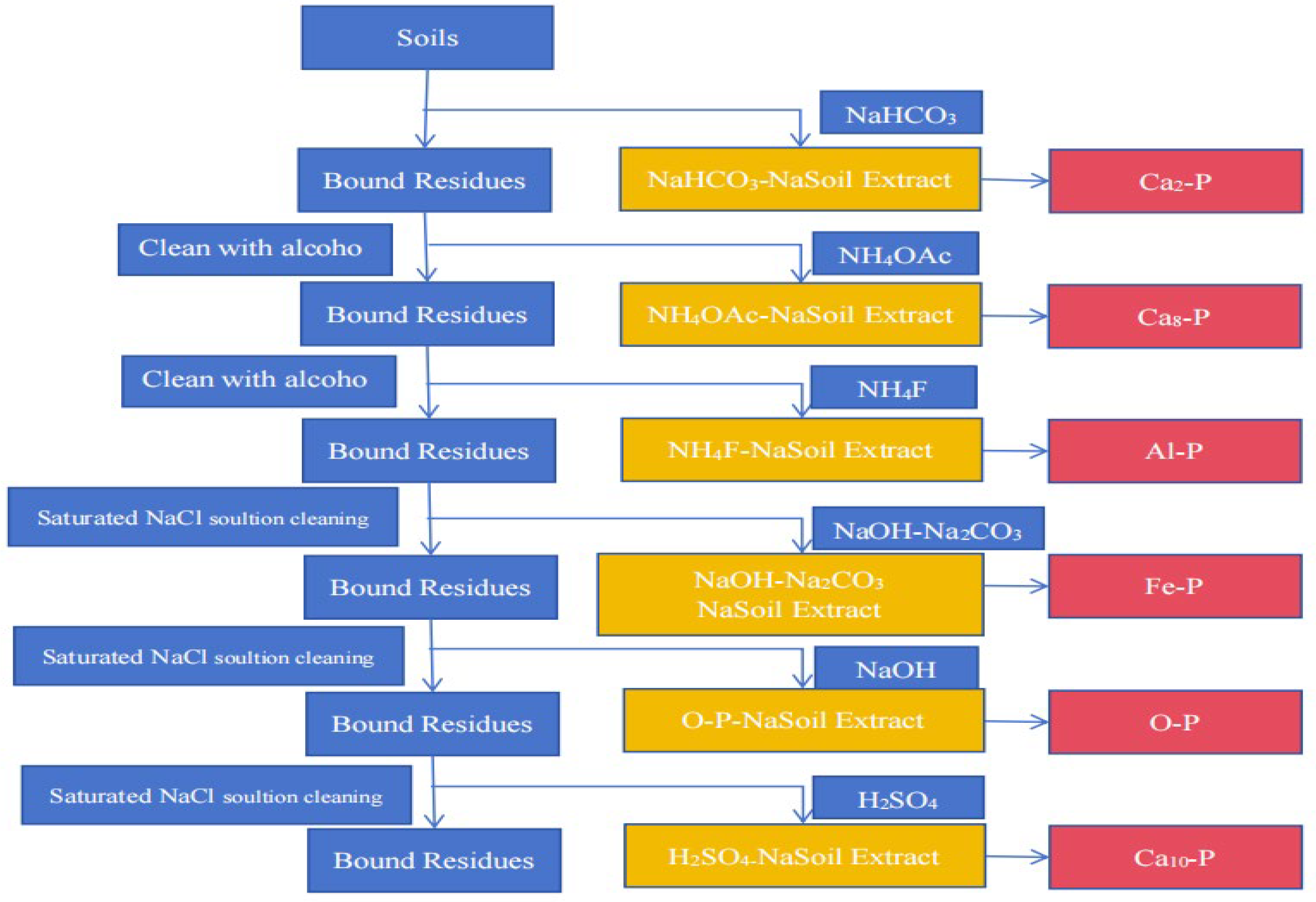
The sequential extraction of soil Pi fractions was performed according to established methods [11,12]. Briefly, 1.000 g of air-dried soil sieve-passed <0.15 mm was sequentially treated as follows:
Ca2-P: The soil was extracted with 50 mL of 0.25 mol·L−1 NaHCO3 in a centrifuge tube. After shaking and centrifugation, an aliquot (5–20 mL) of the supernatant was analyzed using the molybdenum-antimony anti-spectrophotometric method at 700 nm.
Ca8-P: The residue was treated with 50 mL of 0.5 mol·L−1 NH4OAc, dispersed, and allowed to stand for 4 h to release CO2. Following shaking and centrifugation, the supernatant was analyzed spectrophotometrically at 700 nm.
Al-P: The residue was reacted with 50 mL of 0.5 mol·L−1 NH4F (pH 8.2) for 1 h. After centrifugation, a 20 mL aliquot of the supernatant was mixed with 20 mL of 0.8 mol·L−1 H3BO3, adjusted to a faint yellow color, and measured colorimetrically.
Fe-P: The residue was washed with saturated NaCl and then extracted with 50 mL of 0.1 mol·L−1 NaOH for 20 h with intermittent shaking. The supernatant was acidified with concentrated H2SO4, filtered, and analyzed.
O-P: The residue was washed with saturated NaCl and extracted with a mixture of Na2S2O4 and sodium citrate in a water bath. After cooling and centrifugation, the extract was diluted and digested with a triacid mixture (HNO3-HClO4-H2SO4) prior to colorimetric analysis.
Ca10-P: The final residue was extracted with 50 mL of 0.5 mol·L−1 H2SO4 for 1 h, followed by centrifugation and analysis.
For a better understanding of this single-line sequential extraction method forvarious inorganic phosphorus fractions, please refer to Figure 1.

2.3.2. Calculation of Movement Distance and Cumulative Phosphorus

The movement distance of Pi was defined as the radial distance from the amendment point beyond which the Pi content in GM-amended treatments (S-GML, S-GMH, M-GML, M-GMH) showed no statistically significant difference (p > 0.05) from the control treatments (S-CK, M-CK). The cumulative Pi attributed to the GM application was calculated by summing the differences in Pi content (across all fractions) between GM-amended and control treatments within the movement distance, multiplied by the corresponding soil mass.

2.4. Statistical Analysis

Data organization and preliminary calculations were performed using Microsoft Office Excel 2021. All statistical analyses were conducted with SPSS 13.0. Specific comparisons were made as follows: (1) Differences among GM treatments at the same distance and incubation period were assessed by one-way ANOVA, with the LSD used for post hoc comparisons. (2) Differences in movement distance and cumulative P across incubation periods were evaluated using Duncan’s multiple range test. The significance level for these tests was set at p < 0.05.
Furthermore, a three-way ANOVA was employed to determine the significant main effects (incubation period, movement distance, GM treatment, salinity-alkalinity) and their interactive effects on the various soil Pi fractions. All graphical representations were created with GraphPad Prism 9.5.1.

3. Results

3.1. Dynamics of the Phosphorus Release Rate

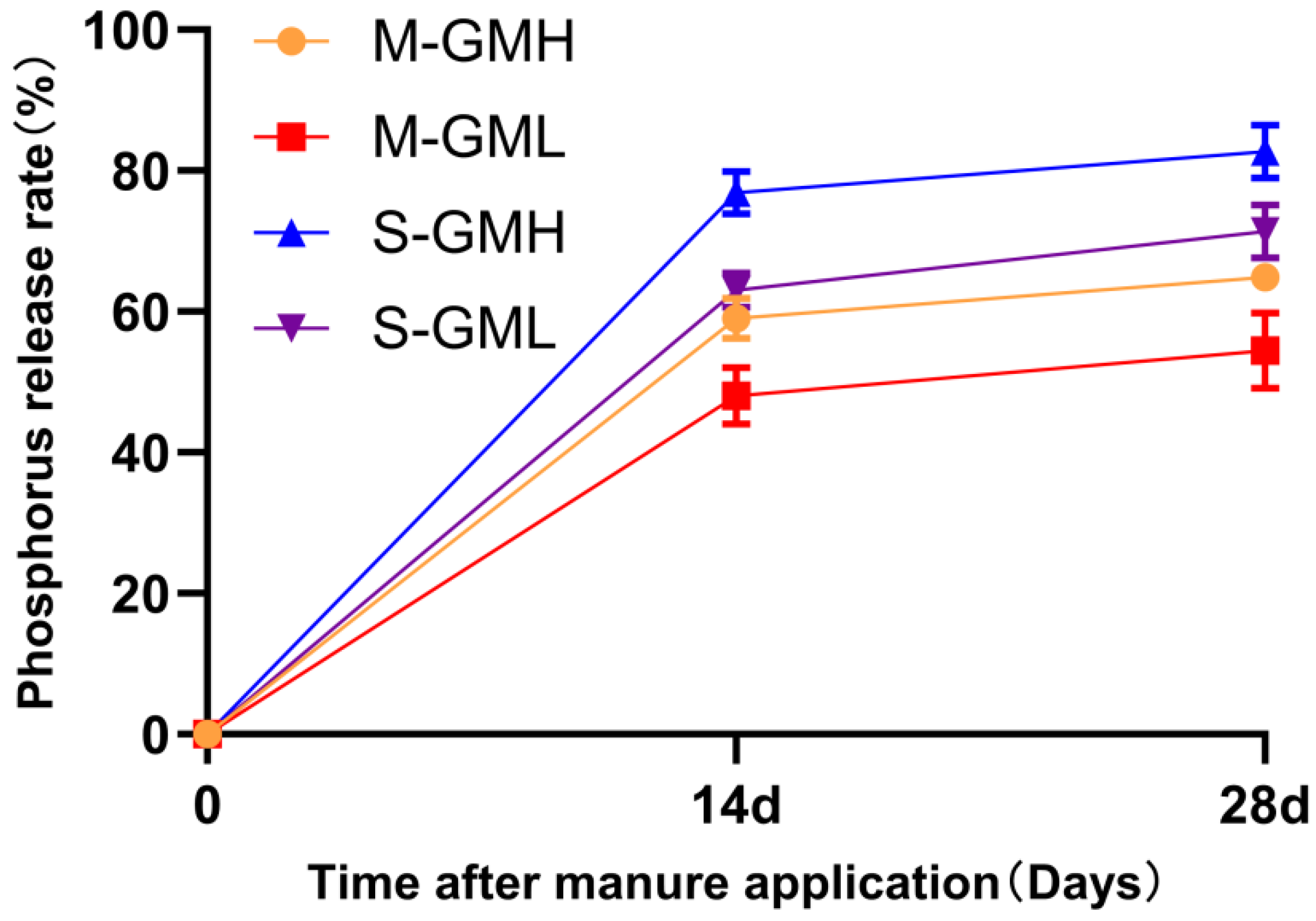
GM contained P, which was released following its decomposition by soil microorganisms. The rate of P release varied over time. Figure 2 illustrates the temporal dynamics of P release in saline-alkali soils under two treatment types. Analysis showed that in both slightly and moderately saline-alkali soils, P release rates increased rapidly during the first 14 days of incubation, peaking around day 14. Between days 14 and 28, however, the release rate gradually declined.
Notably, treatments in slightly saline-alkali soils (S-GML and S-GMH) exhibited higher P release rates at both 14 and 28 days compared to those in moderately saline-alkali soils (M-GML and M-GMH). Furthermore, Figure 2 indicates that within the same soil type, the high-rate GM treatment (GMH: 30 t/ha Sesbania GM) significantly enhanced P release rates compared to the low-rate treatment (GML: 60 t/ha Sesbania GM) throughout the 14- and 28-day incubation periods. Specifically, the S-GMH treatment demonstrated the highest rate of increase in P release among all treatments at both 14 and 28 days. These findings indicate that despite salt ions inhibiting GM decomposition, the higher GM application rates significantly enhance P release efficiency in saline-alkali soils.

3.2. Inorganic Phosphorus Fractions

3.2.1. Aluminum-Bond Phosphorus (Al-P)

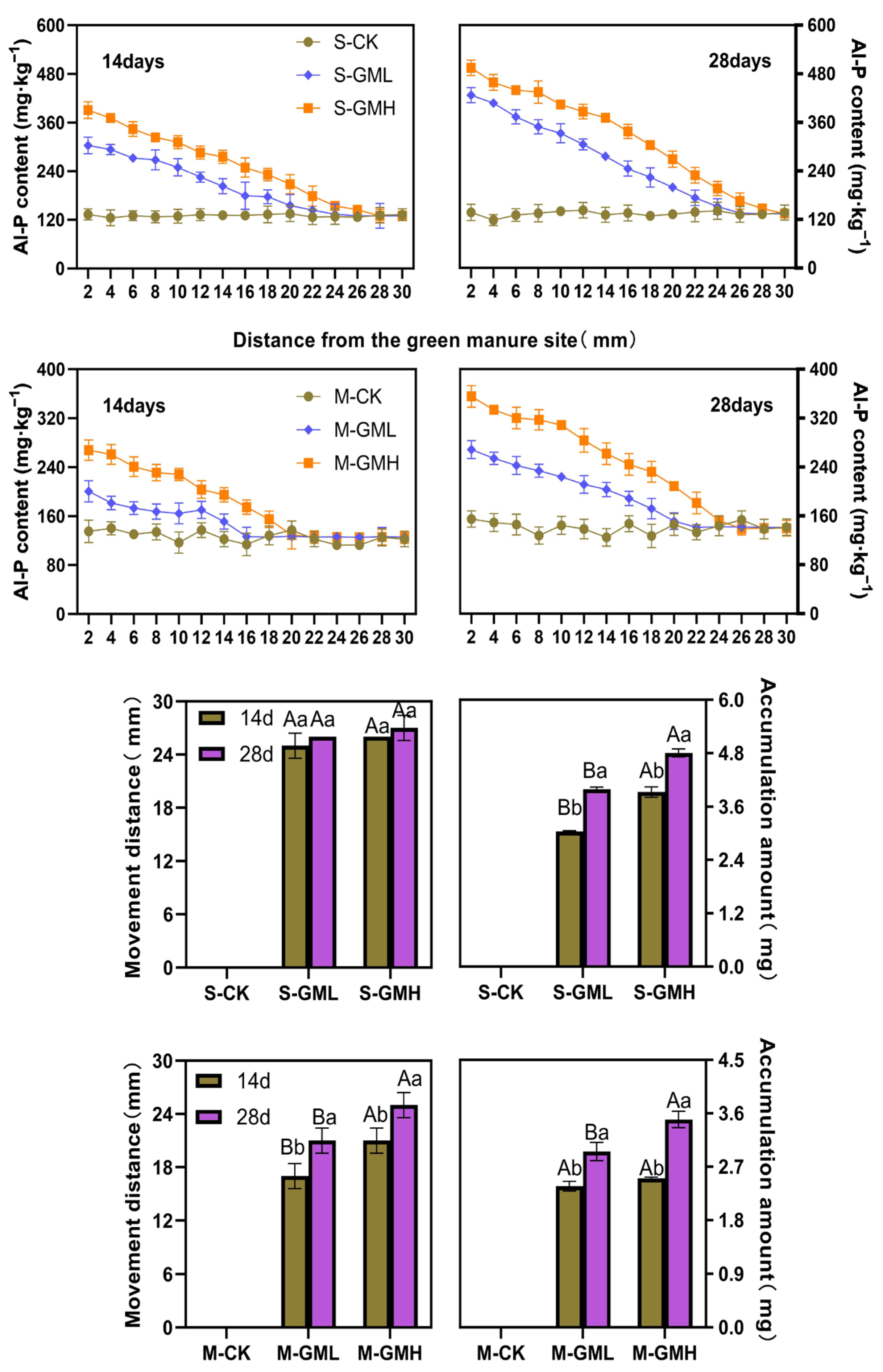
GM application creates a dynamic “hotspot” of Al-P formation in the soil. As GM decomposes and releases P, it reacts with soil aluminum to generate Al-P—an NH4F-soluble Pi component crucial to long-term P cycling [13,14]. Figure 3 demonstrates that this phenomenon occurs regardless of soil salinity-alkalinity, with a content gradient decreasing with distance from the manure microsite. The size and intensity of this Al-P hotspot are dynamically shaped by incubation period, GM rate, and pre-existing soil salinity-alkalinity.
Analysis of the movement distance (Figure 3) revealed that GM application significantly enhanced the movement of Al-P, with the effect being modulated by the content of soil salt, GM rate, and incubation period. After 14 days of incubation, a significant increase in Al-P movement distance was observed in both slightly (S) and moderately (M) saline-alkali soils. In slightly saline-alkali soil, GMH and GML increased by 26 mm and 24 mm, respectively. In moderately saline-alkali soil, the increases for GMH and GML were 20 mm and 16 mm, respectively (p < 0.05). Extending the incubation to 28 days further influenced Al-P movement. In slightly saline-alkali soil, the increases after 14-day incubation were not statistically significant (p > 0.05). In contrast, two treatments in moderately saline-alkali soil showed a significant additional increase of 4 mm (p < 0.05). These results indicate that Al-P movement is inherently greater in slightly saline-alkali soils than in moderately saline-alkali soils. While higher salinity-alkalinity initially inhibits Al-P movement, a prolonged incubation period facilitates GM decomposition, which can ameliorate soil conditions and subsequently promote longer Al-P movement. Furthermore, increasing the GM rate consistently resulted in a longer movement distance.
Beyond influencing the movement distance of Al-P, GM application also significantly enhanced its accumulation amount, with the effects being further modulated by incubation period, rate, and soil salinity-alkalinity. As shown in Figure 3, after 14 days of incubation, the Al-P accumulation amount in slightly saline-alkali soil increased significantly by 53.5% (GMH) and 91.0% (GML) compared to the CK treatment (p < 0.05). This promoting effect was substantially stronger after 28 days, with the increases expanding to 92.1% and 136.8%, respectively. A similar trend was observed in moderately saline-alkali soil, where the Al-P accumulation amount increased by 17.2% (GMH) and 43.4% (GML) at 14 days, and further increased to 34.9% and 70.9% at 28 days (p < 0.05). Notably, the Al-P accumulation amount in all GM treatments was significantly higher at 28 days than at 14 days (p < 0.05), underscoring the crucial role of the incubation period in regulating P dynamics. Furthermore, soil salinity-alkalinity was a key factor affecting Al-P accumulation. After 14 days, the Al-P accumulation amount in slightly saline-alkali soil was 216.2% (GMH) and 113.1% (GML) higher than that in the corresponding treatments in moderately saline-alkali soil. Although this disparity narrowed after 28 days, the Al-P accumulation amount in the slightly soil remained substantially higher by 148.4% (GMH) and 81.2% (GML) (p < 0.05). This result clearly indicates that lower salinity-alkalinity levels are more favorable for Al-P accumulation.

3.2.2. Iron-Bond Phosphorus

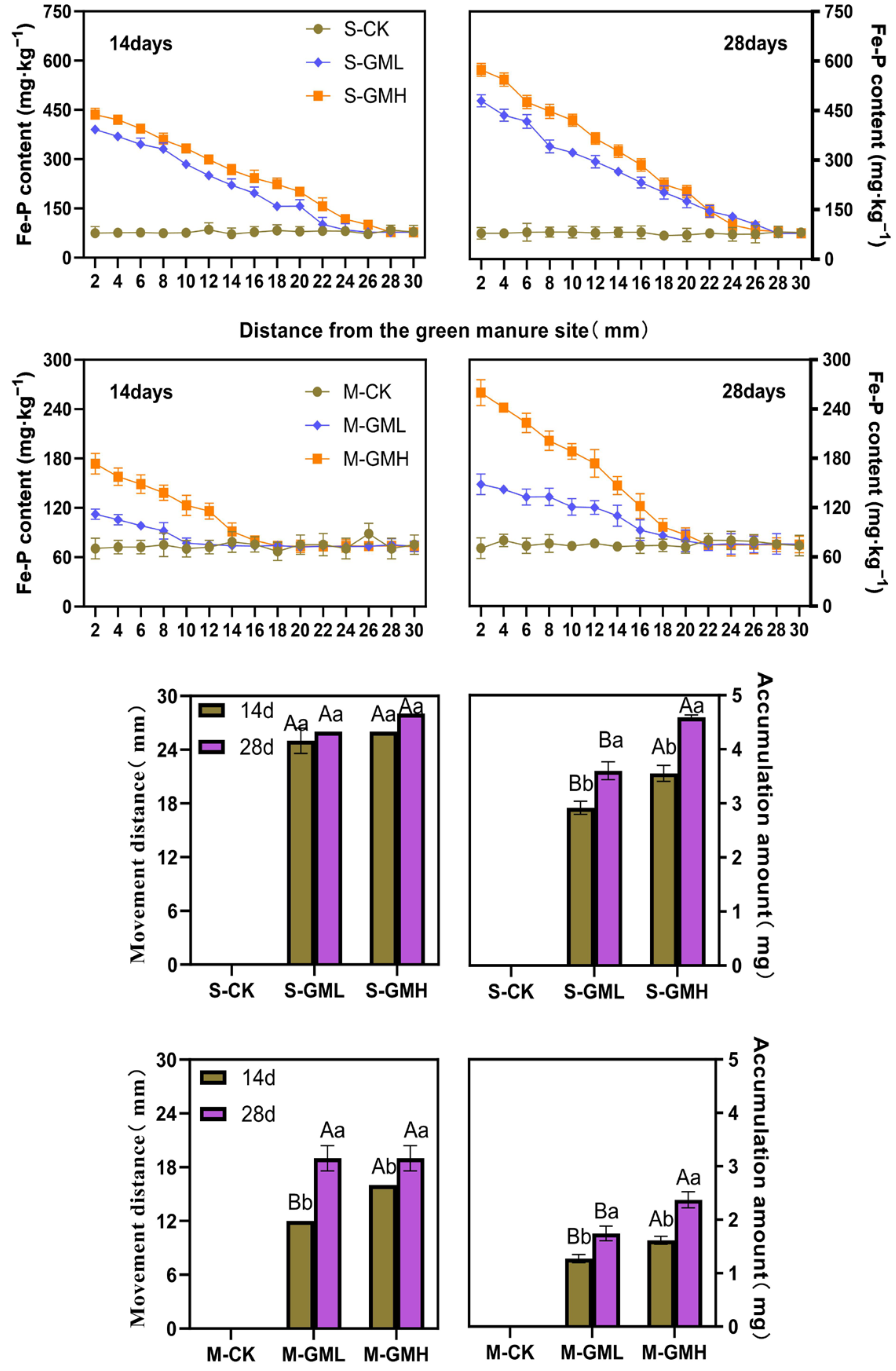
Iron-bound phosphorus (Fe-P), also referred to as NaOH–Na2CO3-soluble P, typically exists as amorphous ferric hydroxide–phosphate complexes. Due to its high activity, it is readily available for plant uptake or susceptible to transformation [14]. Figure 4 indicates that P released from decomposing GM significantly influences Fe-P dynamics. Regardless of the initial soil salinity-alkalinity level, GM application increased Fe-P content at the manure microsite. This enhancing effect was most pronounced proximal to the application site and diminished with increasing distance. The spatial extent of this influence was regulated by the incubation period, GM application rate, and the degree of soil salinity-alkalinity.
Analysis of Fe-P movement distance revealed that GM application significantly promoted Fe-P movement, with a more pronounced effect in slightly saline-alkali soil than in moderately saline-alkali soil. For the low GM rate (GML), movement distance in slightly saline soil exceeded that in moderately saline soil by 12 mm at 14 days and by 14 mm at 28 days. Similarly, for the high GM rate (GMH), the distances were 10 mm and 8 mm longer in slightly saline soil after 14 and 28 days, respectively (p < 0.05). Extending the incubation from 14 to 28 days significantly increased movement distance in moderately saline soil—by 8 mm for M-GML and 4 mm for M-GMH (p < 0.05)—whereas increases in slightly saline soil (2 mm for both GML and GMH) were not significant (p > 0.05). This pattern suggests that the initial constraint on Fe-P movement imposed by higher salinity-alkalinity can be mitigated by prolonged incubation.
Regarding Fe-P accumulation, GMH led to significantly greater accumulation amount compared to GML (p < 0.05). After 14 days, Fe-P accumulation amount under GMH was 49.4% and 28.9% higher than under GML in slightly and moderately saline soils, respectively. By 28 days, these increases expanded to 56.6% and 50.5%. Incubation period exerted a strong positive influence: after 28 days, Fe-P accumulation amount increased significantly by 46.8% (S-GML) and 54.0% (S-GMH) in slightly saline soil, and by 26.0% (M-GML) and 47.7% (M-GMH) in moderately saline soil, relative to the 14-day results (p < 0.05).
In summary, GM application, higher rates, and longer incubation periods collectively enhanced both the movement and accumulation of Fe-P in saline-alkali soils. Soil salinity-alkalinity acted as a critical modulating factor, with its initial inhibitory effect diminishing over time. The long-term decomposition of GM appears to alleviate soil salinity-alkalinity, thereby promoting Fe-P accumulation.

3.2.3. Dicalcium Phosphate

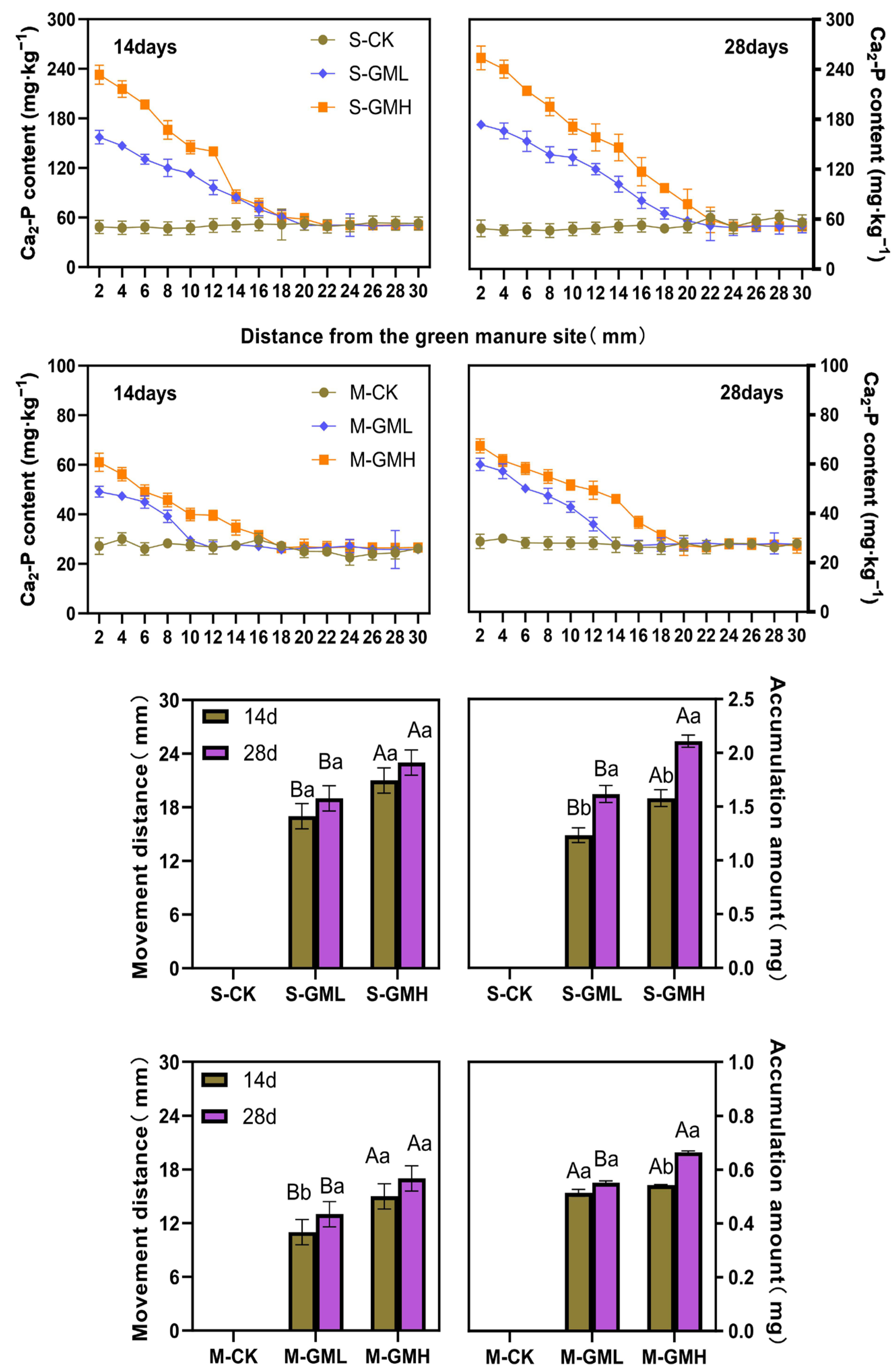
Dicalcium Phosphate (Ca2-P) refers to a category of calcium phosphate salts in soil, also known as NaHCO3-soluble P. As one of the three grades of calcium-bound P (Ca-P), its representative compound is CaHPO4·2H2O (dicalcium phosphate dihydrate). Within the Pi classification system, Ca2-P is categorized as water-soluble or weakly acid-soluble phosphate with high solubility, making it an important plant-available P form in calcareous soils [13,14]. Following GM application, P released during its decomposition may significantly influence Ca2-P dynamics (Figure 5). Results indicate that regardless of salinity and alkalinity levels, GM application increases Ca2-P content at the manure microsite. This effect is most pronounced near the manure site and gradually diminishes with distance, with its spatial influence modulated by incubation period, GM rate, and the content of soil salt.
Regarding movement distance (Figure 5), after 14 days of incubation, Ca2-P movement distances under the S-GMH and M-GMH treatments increased significantly (p < 0.05) to 20 mm and 16 mm, respectively. These values exceeded those of corresponding low-GM treatments (S-GML: 18 mm; M-GML: 10 mm) under the same incubation period. However, after 28 days, although all four treatments showed increased movement distances, the changes were not statistically significant (p > 0.05). These results suggest that higher GM rates promote Ca2-P movement, and while the incubation period exhibits a positive trend, its effect is not significant. Further analysis revealed that compared to M-GML at both 14 and 28 days, S-GML showed a significant increase of 8 mm (p < 0.05). Similarly, S-GMH exhibited a significant increase of 4 mm relative to M-GMH at both time points (p < 0.05). This indicates that Ca2-P movementis influenced not only by GM rate and incubation period but also by the content of soil salt, which appears to stimulate movement in the short term while suppressing it over longer durations.
GM application also altered Ca2-P accumulation patterns (Figure 5). After 14 days, S-GMH and M-GMH treatments showed significant accumulation amount increases of 45.5% and 17.4%, respectively, compared to corresponding low-GM treatments (p < 0.05). By 28 days, these increases adjusted to 62.1% and 19.2% (p < 0.05), indicating sustained enhancement of Ca2-P accumulation under higher GM rates. Soil salt content and incubation duration jointly influenced accumulation: at 14 days, Ca2-P accumulation amount under GML and GMH treatments in slightly saline-alkaline soil exceeded that in moderately saline-alkaline soil by 569.2% and 488.9%, respectively (p < 0.005). After 28 days, these differences remained substantial at 424.4% and 449.2% (p < 0.005). This demonstrates that salinity-alkalinity significantly affects Ca2-P accumulation amount (p < 0.05), and accumulation amount across all treatments was markedly higher at 28 days than at 14 days, further underscoring the crucial role of incubation period in P transformation.

3.2.4. Octicalcium Phosphate (Ca8-P)

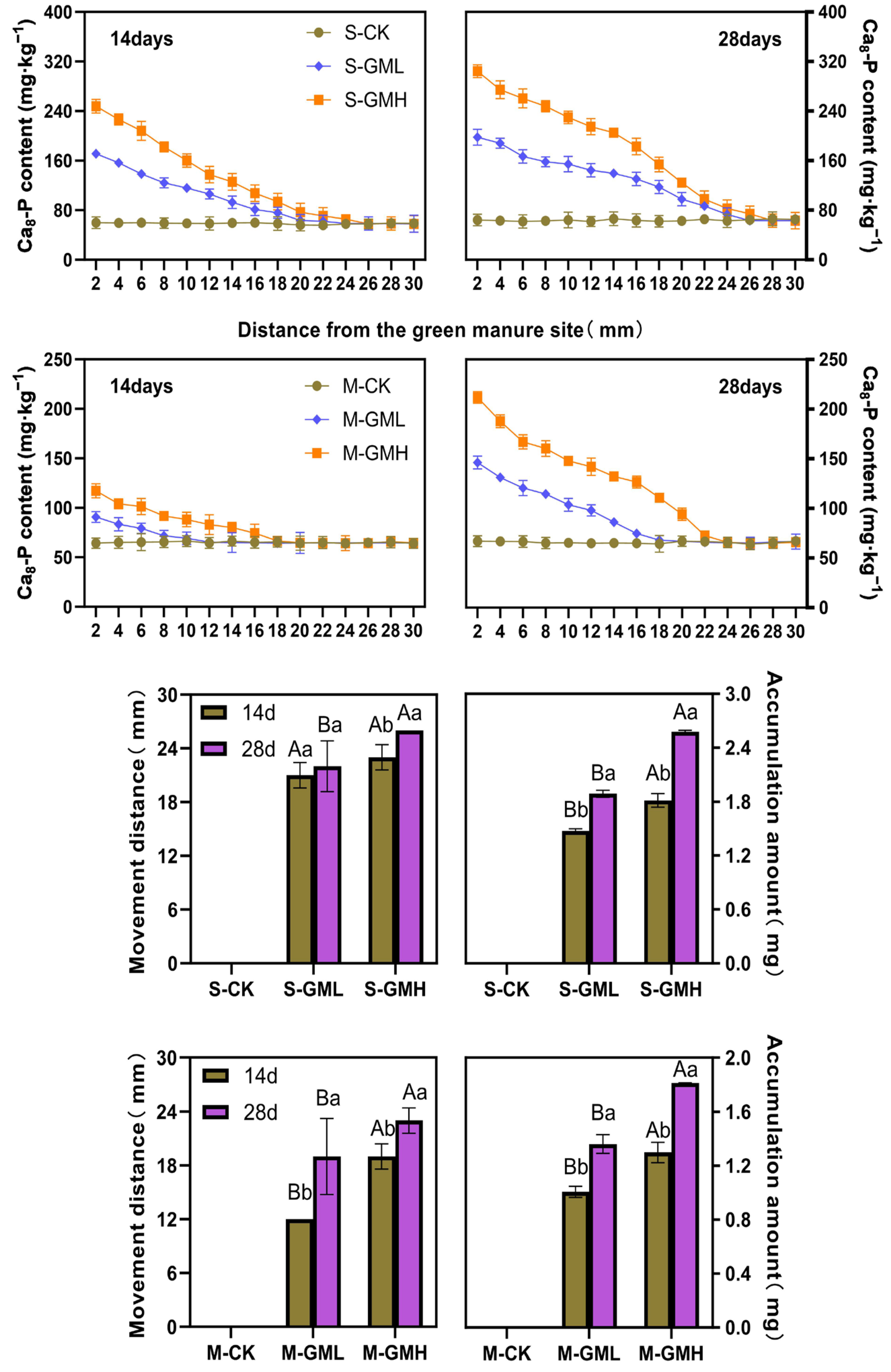
Ca8-P serves as an important slow-release P source in calcareous soils. Although its direct availability is relatively low, it indirectly supports plant P nutrition through dynamic equilibria with other P forms [13,14]. GM, being rich in P, may significantly influence the content and distribution of Ca8-P (Figure 6). The results demonstrate that regardless of soil salinity-alkalinity level, GM application increased Ca8-P content around the manure application point. This effect was most pronounced in proximity to the manure site and gradually diminished with increasing distance. The spatial extent of this influence was regulated by the incubation period, GM rate, and the content of soil salinity-alkalinity.
Analysis of Ca8-P movement distance (Figure 6) indicated that, compared to the M-GML treatment, Ca8-P movement distance in the S-GMH treatment increased by 10 mm (p < 0.05) and 2 mm (p > 0.05) after 14 and 28 days of incubation, respectively. Relative to the M-GMH treatment, Ca8-P movement distance in S-GMH was extended by 6 mm (p < 0.05) and 4 mm (p < 0.05) after 14 and 28 days, respectively. These results suggest that increasing the GM rate promotes Ca8-P movement, although the movement distance is modulated by soil salinity-alkalinity. Regarding the effect of incubation duration on Ca8-P movement, analysis revealed that, compared to the 14-day incubation, Ca8-P movement distance in S-GML and S-GMH treatments increased by 2 mm after 28 days (p > 0.05). In contrast, M-GML and M-GMH treatments exhibited an increase of 4 mm after 28 days (p < 0.05). This indicates that Ca8-P is more mobile in low-salinity-alkalinity soil, whereas in moderately saline-alkaline soil, its movement is initially inhibited but promoted under longer incubation. Figure 6 further shows that after 28 days, Ca8-P movement distance in all GM treatments exceeded that after 14 days, confirming the positive effect of the incubation period on Ca8-P movement.
GM application also altered Ca8-P accumulation patterns (Figure 6). After 14 days of incubation, high-rate GM (S-GMH and M-GMH) significantly increased Ca8-P accumulation amount by 113.5% and 22.5%, respectively, compared to the control (p < 0.05), with both values higher than those under low-rate treatment. The accumulation amount and increase rate under S-GML were significantly higher than those under M-GMH, while no significant difference was observed between certain treatments. After 28 days of incubation, Ca8-P accumulation exhibited significant dynamic changes: S-GMH showed the highest accumulation amount, significantly exceeding the other three treatments (p < 0.05), following the order S-GMH > S-GML > M-GMH > M-GML. This indicates that a high GM rate significantly promotes Ca8-P accumulation during long-term incubation, although the influence of salinity-alkalinity remains more pronounced than that of GM rate. Moreover, Ca8-P accumulation in all treatments was significantly higher after 28 days than after 14 days (p < 0.05), further highlighting the enhancing effect of incubation time on Ca8-P accumulation.

3.2.5. Dicalcium Phosphate (Ca10-P)

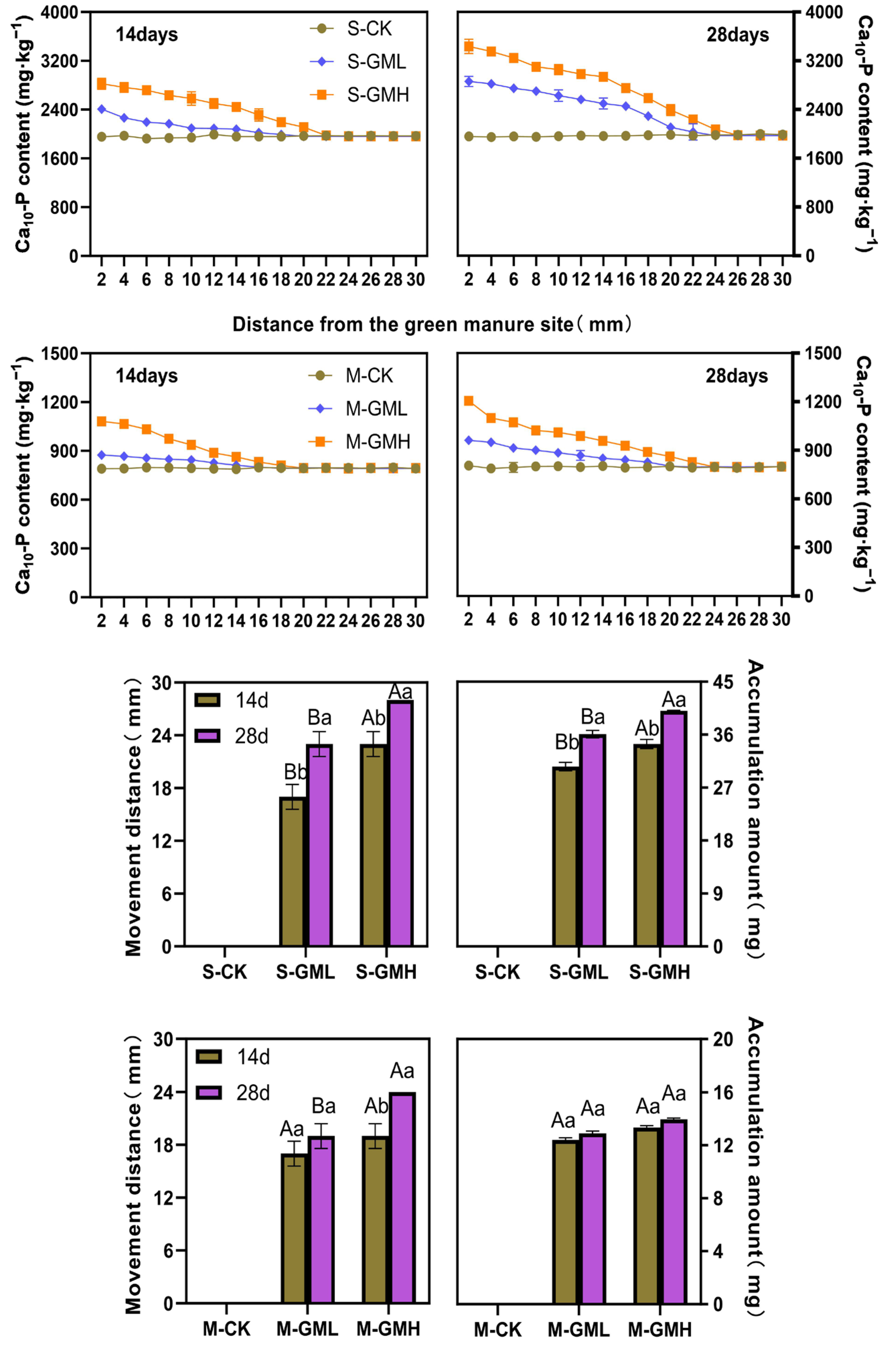
Ca10-P represents the most stable and least available form of calcium-bound P among soil Pi fractions. In alkaline environments, the transformation from Ca2-P to Ca8-P to Ca10-P is irreversible, leading to a gradual decline in P availability [13,14]. Its sources are diverse, including both native soil minerals and applied organic manure. Thus, the application of leguminous GM, given its P content, is capable of altering the levels and distribution of phosphorus in the soil. As shown in Figure 7, regardless of salinity-alkalinity level, GM application increased Ca10-P content at the manure microsite. This effect was most pronounced near the manure site and diminished with distance, with its spatial extent regulated by incubation period, GM rate, and the content of soil salt.
Regarding changes in movement distance (Figure 7), after 14 days of incubation, high-rate GM treatments (S-GMH and M-GMH) showed significant increases in Ca10-P movement distance of 4 mm (p < 0.05) and 2 mm (p > 0.05), respectively, compared to low-rate treatments (S-GML and M-GML). After 28 days, these increases reached 6 mm and 4 mm, respectively (p < 0.05). In slightly saline-alkaline soil, S-GML and S-GMH treatments exhibited significantly longer movement distances than M-GML and M-GMH by 4 mm (p < 0.05) and 2 mm (p > 0.05) at 14 days, and by 4 mm (p < 0.05) and 2 mm (p > 0.05) at 28 days, respectively. These findings indicate that increasing the GM rate significantly promotes Ca10-P movement, while the effect of low-rate GM treatment is more strongly modulated by salinity-alkalinity, with differences being non-significant in some cases. The effect of the incubation period exhibited temporal heterogeneity: after 28 days, Ca10-P movement distance in S-GML and S-GMH treatments increased significantly by 4 mm compared to 14 days (p < 0.05). In moderately saline-alkaline soil, M-GML and M-GMH treatments showed significant increases of 6 mm after 28 days relative to 14 days (p < 0.05), indicating that the movement-promoting effect of GM requires activation through longer incubation. Moreover, movement distances in all treatments after 28 days were significantly longer than those after 14 days (p < 0.05), confirming the positive regulatory role of the incubation period on Ca10-P movement.
The GM application also influenced Ca10-P accumulation (Figure 7). Compared to S-GML and M-GML treatments, Ca10-P accumulation amount under S-GMH and M-GMH increased by 13.0% (p < 0.05) and 7.16% (p > 0.05), respectively, after 14 days. After 28 days, these increases rose to 15.1% and 15.97% (p < 0.05), respectively. This demonstrates that higher GM rates enhance Ca10-P accumulation amount, and accumulation amount after 28 days was significantly greater than after 14 days across all GM treatments (p < 0.05), indicating a significant positive effect of incubation period on Ca10-P accumulation amount. Regarding the influence of salinity-alkalinity, under the same GM rate (GML or GMH), Ca10-P accumulation amount was significantly higher in slightly saline-alkaline soil than in moderately saline-alkaline soil (p < 0.05). At both incubation periods, the order followed S-GMH > S-GML > M-GMH > M-GML, further confirming the impact of salinity-alkalinity on Ca10-P dynamics.

3.2.6. Occluded Phosphorus (O-P)

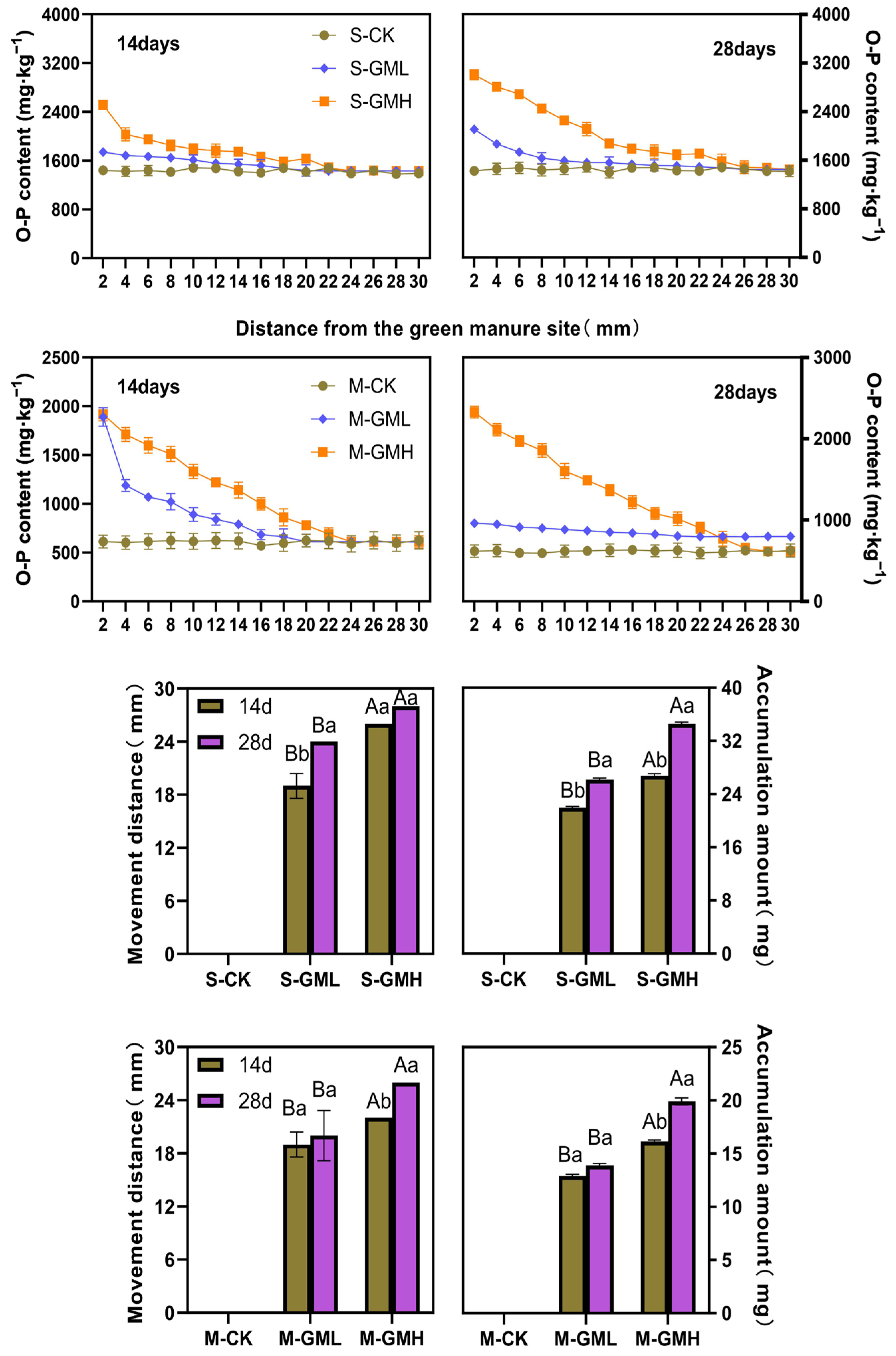
O-P is an important component of the soil P pool. Its availability is shaped by the synergy of microbial activities and root secretions. In agricultural practice, optimizing organic material inputs, regulating microbial communities, and modifying the rhizosphere environment can significantly improve O-P utilization and reduce dependence on inorganic phosphate fertilizers. As shown in Figure 8, the effect of GM application on O-P was primarily concentrated near the manure site and gradually weakened with distance. The extent of this influence depended on the incubation period, GM rate, and the content of soil salt.
Analysis of O-P movement distance (Figure 8) revealed that, compared to S-GML and M-GML treatments, O-P movement distance under S-GMH and M-GMH increased by 6 mm (p < 0.05) and 4 mm (p < 0.05), respectively, after 14 days. After 28 days, the increases were 4 mm and 4 mm (p < 0.05), respectively. This indicates that, regardless of salinity-alkalinity level, increasing GM rate promotes O-P movement. Regarding the influence of salinity-alkalinity, compared to slightly saline-alkaline soil treatments (S-GML and S-GMH), O-P movement distance in M-GML and M-GMH was reduced by 2 mm (p > 0.05) and 4 mm (p < 0.05), respectively, after 14 days. After 28 days, the reductions were 2 mm (p > 0.05) and 4 mm (p < 0.05), respectively. This suggests that higher salinity-alkalinity inhibits O-P movement. Figure 8 further shows that O-P movement distance after 28 days was significantly longer than after 14 days for both GMH and GML treatments (p < 0.05), confirming the positive effect of incubation period on O-P movement.
The GM application also affected O-P accumulation (Figure 8). Although the O-P accumulation amount under M-GML and M-GMH after 14 days was lower than under S-GML and S-GMH, the rate of increase was much higher in moderately saline-alkaline soil, reaching 32.1% and 88.1% (p < 0.05), respectively. After 28 days, these increases rose to 49.7% and 109.9% (p < 0.05). In slightly saline-alkaline soil, extending incubation from 14 to 28 days did not significantly increase the accumulation amount in S-GML (p > 0.05), whereas S-GMH showed an increase of 18.7%. This indicates that higher GM application rates enhance O-P accumulation. Regarding salinity-alkalinity effects, slightly saline-alkaline conditions inhibited O-P accumulation in both short- and long-term incubations. In moderately saline-alkaline soil, however, GM-induced reduction in salinity-alkalinity led to significant increases during incubation (p < 0.05), although total accumulation amount remained lower than in slightly soil. Additionally, the O-P accumulation amount after 28 days was significantly higher than after 14 days across all GM treatments (p < 0.05), underscoring the positive effect of the incubation period on O-P accumulation amount.

4. Discussion and Conclusions

Phosphorus is an essential element for all living organisms. In plants, P is absorbed primarily as orthophosphate and plays crucial roles in photosynthesis, respiration, and the biosynthesis of nucleic acids and membrane structures [19,20]. As a macronutrient, P regulates the activity of various enzymes and serves as a key regulator of plant metabolism [21,22]. However, P exhibits low movement in soil and tends to accumulate in fertilized layers, while being susceptible to losses through water flow and wind erosion, leading to a mismatch between high agronomic demand and limited availability. The application of organic fertilizers, such as green manure (GM), represents an effective strategy to address this issue. Sesbania [Sesbania cannabina (Retz.) Pers.], a leguminous GM widely used in tropical agriculture, significantly increases soil P content upon application, consistent with previous findings [23,24]. This increase is attributed to GM decomposition, which shifts soil pH from alkaline toward neutral [25,26], enhances desalination capacity, reduces soil salinity [27,28], and promotes P movement.
In this study, we investigated the dynamics of Pi fractions—including Fe-P, Al-P, Ca2-P, Ca8-P, Ca10-P and O-P—under different incubation periods using a laboratory-based GM microsite column incubation experiment. The sequential chemical extraction method developed by Chang and Barrow et al. [12,13,14] was employed for Pi fractionation. This well-established scheme characterizes distinct P pools through sequential extraction and is regarded as a benchmark method for studying soil Pi forms. Although alternative approaches exist—such as physical fractionation, bioavailability assays, isotopic labeling, spectral analysis, and molecular techniques—the systematic nature of chemical fractionation has secured its central role in soil P research. Using this method, we demonstrated that GM application enhances the movement and accumulation amount of Al-P, Fe-P, O-P, and Ca-P, including Ca2-P, Ca8-P, and Ca10-P at the manure microsite. The increase in Pi content and accumulation amount is primarily due to the release of various P forms during GM decomposition. Essentially, GM decomposition returns plant-derived nutrients, including P, to the soil, thereby enhancing nutrient cycling and P use efficiency—a process actively mediated by soil microorganisms, such as Pseudomonas spp., Bacilli spp., and Rhizobium spp. [29,30]. Representative phosphate-solubilizing bacteria (PSB) include Pseudomonas, Bacillus, Rhizobium, and Azotobacter, while key fungal contributors include arbuscular mycorrhizal fungi (AMF), Basidiomycota, and Ascomycota.
Our results confirm that GM application promotes the movement and accumulation of multiple Pi fractions. Although soil salinity-alkalinity significantly influenced these processes across different treatments, higher green manure application rates and extended incubation periods consistently increased both the movement distance and accumulation amount, underscoring the central role of green manure in improving soil inorganic phosphorus status. These findings align with those of Soltangheisi et al. [31] and Pizzeghello et al. [32], who reported significant changes in Pi composition and content following organic manure application in calcareous sandy loam, with notable increases in Al-P and Fe-P. Additionally, temporal changes in soil pH observed in those studies further support the influence of salinity-alkalinity on P dynamics, consistent with the results of Vanzolini et al. [33]. Similarly, Wang et al. [17] found that fertilization significantly enhanced the movement and accumulation of Ca-P and O-P. Collectively, these studies indicate that organic amendments, including GM, can elevate various Pi forms in soil, with salinity-alkalinity evolving during GM decomposition. However, the extent of increase is modulated by multiple factors, such as organic manure type, GM genotypes, rate and timing, combination with chemical fertilizers, and initial soil salinity-alkalinity.
In our experiment, salinity-alkalinity significantly affected the movement and accumulation of Al-P, Fe-P, O-P, and Ca-P fractions. During the first 14 days of incubation, higher salinity-alkalinity inhibited their movement and accumulation at the manure microsite. In contrast, by 28 days, these processes were promoted. This shift can be explained by the early suppression of microbial activity under high salinity-alkalinity (Figure 2), which slowed GM decomposition and thus limited P release and movement. The initial inhibition may be linked to excessive salinity-alkalinity impairing key decomposer microorganisms such as Acinetobacter, Pseudomonas, and Clostridium [34,35]. After 14 days, however, as P moved into the soil matrix, salinity-alkalinity gradually declined. In the later decomposition stage (Figure 2), the inhibitory effect weakened, allowing greater P release and enhancing movement and accumulation. Consequently, differences between slightly and moderately saline-alkaline soils diminished, validating the experimental design.
Phosphorus movement in soil occurs mainly through mass flow and diffusion; this study focused on the diffusion process. Thus, besides treatment factors (GM rate and salinity-alkalinity), distance from the manure source was a major controller of P distribution. The regulatory role of GM decomposition observed here aligns with earlier studies [36,37,38]. Chen et al. [39,40] also reported that P fertilization altered Pi form proportions, increasing all forms except Ca-P, with application rate influencing their distribution. In our experiment, Pi movement was relatively rapid under most GM treatments. In moderately saline-alkaline soil, after 14 days of incubation, both the cumulative amount and migration distance of phosphorus were lower than those in slightly saline-alkaline soil. This is due to the higher salinity and alkalinity, which initially inhibited the diffusion, retention, transport, and accumulation of phosphorus in the manure microzone. After 28 days, diffusion distances of labile Pi fractions (e.g., Al-P, Fe-P, Ca10-P, O-P) reached 28 mm in slightly saline-alkaline soil—significantly greater than in moderately saline-alkaline soil—but remained within 30 mm, indicating concentration in the fertilized surface layer. This suggests that while GM application distance and the content of the salt influence P accumulation, diffusion rates and fixation by soil minerals and organic matter also play important roles. This is consistent with experimental data showing that as cultivation time and green manure application increase, the soil’s phosphorus adsorption capacity is progressively filled. Once the phosphorus content exceeds this capacity (reaches the saturation point), the growth rate of retained soil phosphorus significantly declines, leaving any surplus or surface-enriched phosphorus vulnerable to leaching loss, thereby increasing the risk of environmental pollution [41,42].
By quantifying the movement distances and accumulation amounts of different Pi fractions across treatments and incubation periods, this study enhances the understanding of spatiotemporal P availability. These insights can inform the optimized spatiotemporal deployment of GM in coastal saline-alkaline or riparian areas, aligning GM decomposition with crop P demand patterns to improve P use efficiency, reduce environmental losses, and mitigate non-point source pollution. Such an approach offers both economic and environmental benefits, particularly relevant in the context of rising phosphate fertilizer costs driven by finite phosphate rock reserves.
The soil column incubation system, under controlled conditions, clearly elucidated how GM rate, incubation period, distance from the microsite, and soil salinity jointly shape P dynamics. However, extrapolation to field settings requires acknowledgment of inherent limitations: this study did not incorporate natural temperature and light fluctuations, dynamic microbial and fungal communities, or hydrological processes—all critical drivers of nutrient cycling in agricultural systems. Discrepancies with field data likely stem from optimized laboratory conditions, where controlled moisture, temperature, and aeration conditions may change microbial activity and GM decomposition relative to multi-year field observations. Notably, in our manure microsite experiment, certain Pi fractions (e.g., Ca-P) peaked within weeks, whereas field soils may not attain similar levels even after several years. Although both soil salinity levels confirmed the P-enhancing effect of GM, this study focused solely on the leguminous Sesbania GM, limiting direct comparison with non-leguminous GM systems. Optimizing GM use, however, requires species-specific strategies that account for biochemical composition and decomposition patterns. Literature classifies GM broadly into leguminous and non-leguminous groups; the latter includes Brassicaceae (e.g., rapeseed, which mobilizes insoluble P through root exudates like organic acids and phosphatases), Poaceae (e.g., ryegrass, enhancing potassium cycling via its extensive root system), and Asteraceae (useful in phytoremediation due to shoot enrichment organs and rhizosphere microecology). Sesbania cannabina, adapted to saline-alkaline conditions, acts as a slow-release nutrient source with lower P loss potential compared to synthetic fertilizers.
Sustainable agriculture increasingly advocates partial replacement of synthetic phosphate fertilizers with GM. For leguminous GM integration, species such as hairy vetch, narrow-leafed pea, and sweet pea are commonly used in rotation systems. Their root architecture modifications and rhizosphere exudates—releasing organic acid anions, phosphatases, and protons—synergistically enhance P acquisition and use efficiency [30,31,32,40]. Although GM application can boost yields and soil quality, inappropriate management may increase environmental risks such as P leaching, non-point source pollution, and greenhouse gas emissions. Hence, precision management is essential. Based on our manure microsite experiment, which quantified the spatiotemporal distribution and movement of Pi fractions under varying salinity and incubation periods, we propose three targeted guidelines: (1) Synchronize GM decomposition with crop P demand using phenological models, (2) Align root system architecture with Pi movement distances through spatial configuration, (3)Modulate P release kinetics by managing salinity dynamics. Such strategies can maximize P use efficiency, minimize environmental losses, and balance ecological and agronomic objectives.

Author Contributions

D.H. and H.H. designed the research and revised the manuscript. Y.H. and D.H. performed the experiments and analyzed the data. H.H. and J.A. wrote the manuscript. All authors have read and agreed to the published version of the manuscript.

Funding

This research was funded by the earmarked fund for CARS (CARS-22), International Science and Technology Cooperation Program of Hainan Province (GHYF2024017), the Central Public-interest Scientific Institution Basal Research Fund for Chinese Academy of Tropical Agricultural Science (No. PZS2025003, 1630032025004), and Hainan Provincial Collaborative Innovation Center Project for Flexible Talent Introduction of Academicians.

Data Availability Statement

The data presented in this study are available on request from the author. The data are not publicly available due to privacy and confidentiality agreements with participants, in accordance with ethical restrictions.

Acknowledgments

The authors are grateful to Lihua Zou for her help in soil sample analysis.

Conflicts of Interest

The authors declare no conflicts of interest.

Abbreviations

The following abbreviations are used in this manuscript:
NNitrogen
KPotassium
PPhosphorus
PiInorganic Phosphorus
Al-PAluminum phosphates
Fe-PIron-bound Inorganic Phosphorus
Ca-PAcid-hydrolyzable nitrogen
Ca2-PDicalcium phosphate, CaHPO4
Ca8-POctacalcium phosphate, Ca8H2(PO4)6·5H2O
Ca10-PHydroxyapatite, Ca10(PO4)6(OH)2
O-POccluded phosphorus
GMGreen manure
S-CKControl (Slightly saline-alkali soil)
S-GMLSlightly saline-alkali soil with low-rate Sesbania GM (4.71 g)
S-GMHSlightly saline-alkali soil + high-rate Sesbania GM (9.42 g)
M-CKControl (Moderately saline-alkali soil)
M-GMLModerately saline-alkali soil with low-rate Sesbania GM (4.71 g)
M-GMHModerately saline-alkali soil + high-rate Sesbania GM (9.42 g)

References

  1. Liu, B.; Jia, P.; Zou, J.; Ren, H.; Xi, M.; Jiang, Z.; Lin, A. Improving soil properties and Sesbania growth through combined organic amendment strategies in a coastal saline-alkali soil. J. Environ. Manag. 2025, 374, 124041. [Google Scholar] [CrossRef] [PubMed]
  2. Wang, Y.; Yin, C.; Wang, J.; Ji, X.; Liu, X. The influence of green manure planting on the spectroscopic characteristics of dissolved organic matter in freshwater-leached saline–alkali soil at different depths. Agronomy 2024, 14, 1546. [Google Scholar] [CrossRef]
  3. Ma, D.; Yin, L.; Ju, W.; Li, X.; Liu, X.; Deng, X.; Wang, S. Meta-analysis of green manure effects on soil properties and crop yield in northern China. Field Crops Res. 2021, 266, 108146. [Google Scholar] [CrossRef]
  4. Huang, X.; Yin, T.; Sun, W.; Ge, G.; Wei, W. Organic amendments enhance maize growth by improving chemical and microbial properties in coastal saline–alkali soils. Plants 2025, 14, 2217. [Google Scholar] [CrossRef]
  5. Lei, B.; Wang, J.; Yao, H. Ecological and environmental benefits of planting green manure in paddy fields. Agriculture 2022, 12, 223. [Google Scholar] [CrossRef]
  6. Huang, K.; Kuai, J.; Jing, F.; Liu, X.; Wang, J.; Lin, J.; Zhang, Y.; You, Y.; Zhu, W. Effects of understory intercropping with salt-tolerant legumes on soil organic carbon pool in coastal saline-alkali land. J. Environ. Manag. 2024, 370, 122677. [Google Scholar] [CrossRef]
  7. Wang, H.; Wang, H.; Yang, H.; Liu, X.; Liu, X.; Guan, Y.; Shen, Y.; Li, J.; Yang, D.; Sun, Z. Legume green manure partial replacement of fertilizers enhances soil microbial diversity and sustains wheat yield. Front. Plant Sci. 2025, 16, 1618555. [Google Scholar] [CrossRef]
  8. Gu, Y.; Liang, X.; Zhang, H.; Fu, R.; Li, M.; Chen, C. Effect of biochar and bioorganic fertilizer on the microbial diversity in the rhizosphere soil of Sesbania cannabina in saline-alkaline soil. Front. Microbiol. 2023, 14, 1190716. [Google Scholar] [CrossRef]
  9. Wu, Y.; Liu, R.; Si, W.; Zhang, J.; Yang, J.; Qiu, Z.; Luo, R.; Wang, Y. The growth and ion absorption of Sesbania (Sesbania cannabina) and Hairy Vetch (Vicia villosa) in saline soil under improvement measures. Plants 2024, 13, 3413. [Google Scholar] [CrossRef]
  10. Marchezan, C.; Ferreira, P.A.A.; Boitt, G.; Palermo, N.M.; Thoma, A.L.; Vidal, R.F.; Scopel, G.; Lourenzi, C.R.; Ceretta, C.A.; Brunetto, G. Phosphorus balance in Sandy Soil subjected to 12 years of Successive Applications of Animal Manure and Mineral phosphate fertilizer in Subtropical Climate. Agriculture 2023, 13, 1762. [Google Scholar] [CrossRef]
  11. Liu, L.; Zheng, X.; Wei, X.; Zhang, K.; Xu, Y. Excessive application of chemical fertilizer and organophosphorus pesticides induced total phosphorus loss from planting causing surface water eutrophication. Sci. Rep. 2021, 11, 23015. [Google Scholar] [CrossRef] [PubMed]
  12. Barrow, N.J.; Sen, A.; Roy, N.; Debnath, A. The soil phosphate fractionation fallacy. Plant. Soil. 2021, 459, 1–11. [Google Scholar] [CrossRef]
  13. Chang, S.C.; Jackson, M.L.; Debnath, A. Fractionation of soil phosphorus. Soil Sci. 1957, 84, 133–144. [Google Scholar] [CrossRef]
  14. Soil Science Society of China. The Analysis Method of Soil Agricultural Chemistry; Agricultural Science and Technology Press: Beijing, China, 2000. (In Chinese) [Google Scholar]
  15. Yan, Z.; Chen, S.; Li, J.; Alva, A.; Chen, Q. Manure and nitrogen application enhances soil phosphorus mobility in calcareous soil in greenhouses. J. Environ. Manag. 2016, 181, 26–35. [Google Scholar] [CrossRef]
  16. Jiang, B.; Gu, Y.A. A suggested fractionation scheme of inorganic phosphorus in calcareous soils. Fertil. Res. 1989, 20, 159–165. [Google Scholar] [CrossRef]
  17. Wang, Y.; Huang, J.; Huan, H.; Liu, G.; Lesueur, D. Phosphate fertilizer addition increases the movement distance and content of the acid soil inorganic phosphorus fractions at green manure microsites. Agrochimica 2020, 64, 397–412. [Google Scholar] [CrossRef]
  18. Du, Z.Y.; Zhou, J.M.; Wang, H.Y.; Du, C.W.; Chen, X.Q. Potassium movement and transformation in an acid soil as affected by phosphorus. Soil Sci. Soc. Am. J. 2006, 70, 2057–2064. [Google Scholar] [CrossRef]
  19. Lambers, H. Phosphorus acquisition and utilization in plants. Annu. Rev. Plant Biol. 2022, 73, 17–42. [Google Scholar] [CrossRef]
  20. Wang, Y.; Chen, Y.F.; Wu, W.H. Potassium and phosphorus transport and signaling in plants. J. Integr. Plant Biol. 2021, 63, 34–52. [Google Scholar] [CrossRef]
  21. López-Arredondo, D.L.; Leyva-Gonzále, M.A.; González-Morales, S.I.; López-Bucio, J.; Herrera- Estrella, L. Phosphate nutrition: Improving low-phosphate tolerance in crops. Annu. Rev. Plant Biol. 2014, 65, 95–123. [Google Scholar] [CrossRef]
  22. Shohag, M.J.I.; Salgado, E.M.; Gluvk, M.C.; Sriti, N.; Liu, G. Phosphorus fertilizer thresholds matching snap bean nutrient demands in Florida Spodosols. Sci. Hortic. 2025, 350, 114334. [Google Scholar] [CrossRef]
  23. Tigka, E.; Beslemes, D.; Kakabouki, I.; Pankou, C.; Bilalis, D.; Tokatlidis, I.; Viachostergios, D.N. Seed rate and cultivar effect on contribution of Vicia sativa L. green manure to soil amendment under Mediterranean conditions. Agriculture 2021, 11, 733. [Google Scholar] [CrossRef]
  24. Rao, D.L.N.; Gill, H.S. Biomass and biofertilizer production by Sesbania cannabina in alkaline soil. Bioresour. Technol. 1995, 53, 169–172. [Google Scholar] [CrossRef]
  25. Wang, T.; Duan, Y.; Liu, G.; Shang, X.; Liu, L.; Zhang, K.; Li, J.; Zou, Z.; Zhu, X.; Fang, W. Tea plantation intercropping green manure enhances soil functional microbial abundance and multifunctionality resistance to drying-rewetting cycles. Sci. Total. Environ. 2022, 810, 151282. [Google Scholar] [CrossRef]
  26. Gu, C.; Huang, W.; Li, Y.; Li, Y.; Yu, C.; Dai, J.; Hu, W.; Li, X.; Brooks, M.; Xie, L.; et al. Green manure amendment can reduce nitrogen fertilizer application rates for oilseed rape in maize–oilseed rape rotation. Plants 2021, 10, 2640. [Google Scholar] [CrossRef]
  27. Ahmad, M.; Ahmad, M.; El-Naggar, A.H.; Usman, A.R.A.; Abduljabbar, A.; Vithanage, M.; Elfaki, J.; Al-Faraj, A.; Al-Wabel, M. Aging effects of organic and inorganic fertilizers on phosphorus fractionation in a calcareous sandy loam soil. Pedosphere 2018, 28, 873–883. [Google Scholar] [CrossRef]
  28. Peng, C.; Wang, S.; Zhu, Y.; Li, A.; Yu, G.; Mao, Q.; Zheng, M.; Huang, J.; Tan, X.; Mo, J.; et al. Adsorption/desorption processes dominate the soil P fractions dynamic under long-term N/P addition in a subtropical forest. Geoderma 2025, 457, 117284. [Google Scholar] [CrossRef]
  29. Wu, W.; Wang, F.; Xia, A.; Zhang, Z.; Wang, Z.; Wang, K.; Dong, J.; Li, T.; Wu, Y.; Che, R.; et al. Meta-analysis of the impacts of phosphorus addition on soil microbes. Agric. Ecosyst. Environ. 2022, 340, 108180. [Google Scholar] [CrossRef]
  30. Abbasi, S. Plant–microbe interactions ameliorate phosphate-mediated responses in the rhizosphere: A review. Front. Plant Sci. 2023, 14, 1074279. [Google Scholar] [CrossRef]
  31. Soltangheisi, A.; Rodrigues, M.; Coelho, M.J.A.; Gasperono, A.M.; Sartor, L.R.; Pavinato, P.S. Changes in soil phosphorus lability promoted by phosphate sources and cover crops. Soil Tillage Res. 2018, 179, 20–28. [Google Scholar] [CrossRef]
  32. Pizzeghello, D.; Berti, A.; Nardi, S.; Morari, F. Phosphorus forms and P-sorption properties in three alkaline soils after long-term mineral and manure applications in north-eastern Italy. Agric. Ecosyst. Environ. 2011, 141, 58–66. [Google Scholar] [CrossRef]
  33. Vanzolini, J.; Galantini, J.A.; Martínez, J.M.; Suñer, L. Changes in soil pH and phosphorus availability during decomposition of cover crop residues. Arch. Agron. Soil Sci. 2017, 63, 1864–1874. [Google Scholar] [CrossRef]
  34. Li, J.T.; Lu, J.L.; Wang, H.Y.; Fang, Z.; Wang, X.J.; Feng, S.W.; Wang, Z.; Yuan, T.; Zhang, S.C.; Ou, S.N.; et al. A comprehensive synthesis unveils the mysteries of phosphate-solubilizing microbes. Biol. Rev. 2021, 96, 2771–2793. [Google Scholar] [CrossRef]
  35. Guo, L.; Wang, C.; Feng, T.Y.; Shen, R.F. Short-term application of organic fertilization impacts phosphatase activity and phosphorus-mineralizing bacterial communities of bulk and rhizosphere soils of maize in acidic soil. Plant Soil 2023, 484, 95–113. [Google Scholar] [CrossRef]
  36. Varela, M.F.; Scianca, C.M.; Taboada, M.A.; Rubio, G. Cover crop effects on soybean residue decomposition and P release in no-tillage systems of Argentina. Soil Tillage Res. 2014, 143, 59–66. [Google Scholar] [CrossRef]
  37. Carter, S.; Sørensen, P.; Petersen, S.O.; Ma, X.Z.; Ambus, P. Effects of green manure storage and incorporation methods on nitrogen release and N2O emissions after soil application. Biol. Fertil. Soils 2014, 50, 1233–1246. [Google Scholar] [CrossRef]
  38. Wang, H.Y.; Zhong, L.; Liu, J.H.; Liu, J.H.; Liu, X.Y.; Xue, W.; Liu, X.B.; Yang, H.; Shen, Y.X.; Li, J.L.; et al. Systematic analysis of the effects of different green manure crop rotations on soil nutrient dynamics and bacterial community structure in the Taihu Lake Region. Agriculture 2024, 14, 1017. [Google Scholar] [CrossRef]
  39. Chen, X.H.; Yan, X.J.; Wang, M.K.; Cai, Y.Y.; Weng, X.F.; Su, D.; Guo, J.X.; Wang, W.Q.; Hou, Y.; Ye, D.L.; et al. Long-term excessive phosphorus fertilization alters soil phosphorus fractions in the acidic soil of pomelo orchards. Soil Tillage Res. 2022, 215, 105214. [Google Scholar] [CrossRef]
  40. Zhang, J.J.; Wen, J.; Zhang, T.; Zhang, Y.; Peng, Z.; Tang, C.C.; Wang, Y.A.; Su, S.M.; Zhang, N.; Zeng, X.B. Effects of five–year inorganic and organic fertilization on soil phosphorus availability and phosphorus resupply for plant P uptake during maize growth. Agriculture 2023, 13, 858. [Google Scholar] [CrossRef]
  41. Zhou, J.; Zhang, Y.; Wu, K.; Hu, M.; Wu, H.; Chen, D. National estimates of environmental thresholds for upland soil phosphorus in China based on a meta-analysis. Sci. Total. Environ. 2021, 780, 146677. [Google Scholar] [CrossRef] [PubMed]
  42. Qin, X.; Guo, S.; Zhai, L.; Pan, J.; Khoshnevisan, B.; Wu, S.; Wang, H.; Yang, B.; Ji, J.; Liu, H. How long-term excessive manure application affects soil phosphorous species and risk of phosphorous loss in fluvo-aquic soil. Environ. Pollut. 2020, 266, 115304. [Google Scholar] [CrossRef] [PubMed]
Figure 1. The sequential extraction procedure scheme.
Agronomy 16 00614 g001
Figure 2. Dynamics in phosphorus release rates from GM. Vertical bands represent the standard error (n = 3). S-GML: Slightly saline-alkali soil + Sesbania GM (30 t/ha). S-GMH: Slightly saline-alkali soil + Sesbania GM (60 t/ha). M-GML: Moderately saline-alkali soil + Sesbania GM (30 t/ha). M-GMH: Moderately saline-alkali soil + Sesbania GM (60 t/ha).
Agronomy 16 00614 g002
Figure 3. Changes in aluminum-bound phosphorus (Al-P) content, movement distance, and cumulative amount at the manure microsite under different incubation periods (14 and 28 days). Vertical bars represent standard errors (n = 3). Uppercase letters indicate significant differences (p < 0.05) among rates at the same incubation period, while lowercase letters denote significant differences (p < 0.05) between incubation periods for the same rate.
Agronomy 16 00614 g003
Figure 4. Changes in iron phosphate (Fe-P) content, movement distance, and accumulation amount at organic fertilizer application points under different incubation periods (14 days and 28 days) in slightly and moderately saline-alkaline soils.
Agronomy 16 00614 g004
Figure 5. Changes in Ca2-P content, movement distance, and accumulation amount at the manure microsite in slightly and moderately saline-alkaline soils under different incubation periods (14 days and 28 days).
Agronomy 16 00614 g005
Figure 6. Changes in Ca8-Pcontent, movement distance, and accumulation amount at the manure microsite in slightly and moderately saline-alkaline soils under different incubation periods (14 days and 28 days).
Agronomy 16 00614 g006
Figure 7. Changes in Ca10-P content, movement distance, and accumulation amount at manure microsite in slightly and moderately saline-alkaline soils under different incubation periods (14 days and 28 days).
Agronomy 16 00614 g007
Figure 8. Changes in O-P content, movement distance, and accumulation at the manure microsite in slightly and moderately saline-alkaline soils under different incubation periods (14 and 28 days). In saline systems, fluctuations in redox conditions (particularly those influenced by water management or the salt content itself) strongly drive the reductive dissolution of iron oxides, thereby disrupting the stability of O-P and making it a significant source of active phosphorus.
Agronomy 16 00614 g008
Disclaimer/Publisher’s Note: The statements, opinions and data contained in all publications are solely those of the individual author(s) and contributor(s) and not of MDPI and/or the editor(s). MDPI and/or the editor(s) disclaim responsibility for any injury to people or property resulting from any ideas, methods, instructions or products referred to in the content.