Article

The Complete Genome of Rhizobium favelukesii LPU83T: Insights into Plastic pSym and Its Symbiotic Incompatibility with a Broad Range of Legume Hosts

by
Abril Luchetti
1,†,
Catalina D’Addona
1,†,
Lucas G. Castellani
1,2,
María Delfina Cabrera
1,
Daniel Wibberg
3,4,
Carolina Vacca
1,
Linda Fenske
5,
Jochen Blom
5,
Anika Winkler
3,
Tobias Busche
3,6,7,
Christian Rückert-Reed
3,6,7,
Jörn Kalinowski
3,
Andreas Schlüter
3,4,
Alfred Pühler
3,
Karsten Niehaus
3,
Antonio Lagares
1,
María Florencia Del Papa
1,
Mariano Pistorio
1 and
Gonzalo Torres Tejerizo
1,*
1
Instituto de Biotecnología y Biología Molecular, CCT-La Plata-CONICET, Departamento de Ciencias Biológicas, Facultad de Ciencias Exactas, Universidad Nacional de La Plata, La Plata 1900, Argentina
2
Centro de Biotecnología y Genómica de Plantas, Universidad Politécnica de Madrid (UPM)–Instituto Nacional de Investigación y Tecnología Agraria y Alimentaria (INIA-CSIC), 28871 Madrid, Spain
3
Center for Biotechnology (CeBiTec), Bielefeld University, Genome Research of Industrial Microorganisms, D-33615 Bielefeld, Germany
4
Institute of Bio- and Geosciences IBG-5, Computational Metagenomics, Forschungszentrum Jülich GmbH, D-52425 Jülich, Germany
5
Bioinformatics and Systems Biology, Justus Liebig University, D-35392 Giessen, Germany
6
Medical School OWL, Bielefeld University, D-33615 Bielefeld, Germany
7
Microbial Genomics and Biotechnology, Faculty of Biology, Bielefeld University, D-33615 Bielefeld, Germany
*
Author to whom correspondence should be addressed.
These authors contributed equally to this work.
Agronomy 2026, 16(5), 523; https://doi.org/10.3390/agronomy16050523
Submission received: 16 January 2026 / Revised: 13 February 2026 / Accepted: 24 February 2026 / Published: 27 February 2026
(This article belongs to the Special Issue New Insights into Plant-Microbe Interaction)

Abstract

Achieving completeness of multipartite bacterial genomes has been a difficult task, especially in rhizobia. In this study, we performed a deep bioinformatic analysis of the newly re-sequenced genome of Rhizobium favelukesii LPU83T. This strain was isolated from acid soils in Argentina and is capable of nodulating several leguminous plants, although it is unable to fix nitrogen efficiently in any of them. Oxford Nanopore sequencing allowed us to completely assemble the symbiotic plasmid of the strain, pRfaLPU83b, and we discovered that it harbors three intact prophages and a high density of insertion sequences (ISs). These characteristics show why it is often so difficult to complete the symbiotic plasmids of rhizobial strains and the importance of having long-read sequencing methods. Upon detailed analysis of this replicon, we identified a complete conjugation system with gene structure consistent with quorum sensing-associated systems that may have contributed to the genetic mosaic structure of the strain. Furthermore, we identified in the symbiotic plasmid of R. favelukesii LPU83T a large proportion of the symbiotic genes previously identified as essential for Biological Nitrogen Fixation (BNF) in symbiosis with alfalfa, with a high percentage of identity with respect to those of Sinorhizobium meliloti 2011. Among the determinants related to BNF, we found genes encoding the HrrP and SapA peptidases in the LPU83 genome, previously described and related to the degradation of nodule-specific cysteine-rich peptides. These peptides are essential for bacteroid differentiation and, therefore, efficient BNF. Our results show that despite having these genes, they are not directly responsible for the inefficient BNF phenotype of LPU83.

1. Introduction

Rhizobia are bacteria found associated with plant roots. The symbiotic association between these bacteria and legumes has been a long-term topic of investigation due to the possibility to improve the yield of cultivated crops [1]. The architecture of rhizobial genomes is variable: it can consist of a large chromosome of ca. 8–9 Mbp and symbiotic islands (e.g., Bradyrhizobium spp., Mesorhizobium spp. and others [2,3]) or a main chromosome of ca. 4–5 Mbp and plasmids that range from a few Kbp to 2 Mbp (e.g., Rhizobium spp., Sinorhizobium spp. and others [4,5]). Plasmids can constitute around 30% of the rhizobial genomes [6,7]. Moreover, in multipartite genomes, one of the plasmids usually harbors important information needed for the symbiotic interaction (pSym) with the plant. Despite the increasing genome data availability and the improving technologies of the recent years, rhizobial genomes are typically split into contigs; the high number of repetitive regions is a problem for the assembly of these replicons. This issue has also shown more inconveniences to complete assembly of pSyms [8]. Rhizobial plasmids (chromids, pSyms and accessory plasmids) and other mobilizable elements (symbiotic islands and Integrative Conjugative Elements, ICEs) have been extensively characterized regarding their transfer properties, given the influence of their dissemination in the evolution of the symbiotic traits in rhizobia. Moreover, several mechanisms of regulation and modulation of the conjugative transfer have been discovered and studied from these bacteria [9,10,11,12,13,14,15,16,17].
Rhizobium favelukesii is a rhizobia species that was originally isolated from alfalfa nodules and showed a deficient nitrogen fixation performance. It has the ability to nodulate many legumes [18,19], but, so far, no host has been found in which Biological Nitrogen Fixation (BNF) is performed efficiently [20]. Draft genome sequences of three R. favelukesii strains have been reported, with the type strain Rhizobium favelukesii LPU83T featuring the fewest contigs and higher replicon completeness. R. favelukesii LPU83T was first sequenced by a 454 Life Sciences (Roche) sequencing machine. This first assembly resulted in 423 large contigs (>500 bps) with 30× coverage [7]. An improved version of the genome was obtained by combining this data with an 8-k mate-pair sequencing run on an Illumina sequencer and a manually curated approach [21], resulting in a complete chromosome and three complete plasmids. It has been previously shown that symbiotic genes were located, as expected, in a plasmid [22]. However, the symbiotic plasmid of LPU83 was divided into 53 contigs due to the high number of repetitive regions and transposable elements. Meanwhile, other R. favelukesii strains were also sequenced: R. favelukesii OR191 and R. favelukesii ORY1. OR191 was originally isolated in Oregon, USA [23], and its sequence comprised 240 scaffolds [24], whereas ORY1 was isolated from Uruguayan acid soils and the genome showed 326 contigs [25]. In both cases, the sequence of the symbiotic plasmid could not be completely determined due to the fragmentation degree of the sequences. Unfortunately, the lack of a complete pSym hinders understanding of the symbiotic process developed by R. favelukesii. Due to the inefficient symbiotic behavior, recent studies have identified and proposed the presence of genes coding for peptidases in R. favelukesii as the cause of this phenotype. However, experimental approaches to confirm this are lacking [25].
In this work we sought to complete the genome of the type strain Rhizobium favelukesii LPU83T, hereafter LPU83. We performed bioinformatics analyses of the genome to assess phylogenetic relationships, evaluate gene content and conjugative transfer genes. In addition, we analyze the core symbiotic information with the aim of understanding why LPU83 features an inefficient BNF. Furthermore, we studied the peptidases related to symbioses that have been previously found in R. favelukesii genomes and are discussed as potential targets that could explain the defective symbiotic behavior of this species.

2. Materials and Methods

2.1. Bacterial Strains and Plasmids

The strains and plasmids used in this work are listed in Supplementary Table S1A. Rhizobial strains were grown on TY [26] at 28 °C. Escherichia coli was grown on LB medium [27] at 37 °C. For solid media, 15 g of agar per liter of medium were added. Antibiotic concentrations used in this work for bacterial growth are shown in Supplementary Table S1B.

2.2. Bacterial Matings

Bacterial matings were performed as described previously [15]. Briefly, overnight cultures were grown to stationary phase. Donor and recipient strains were mixed at a 1:1 ratio and plated onto TY plates, incubating overnight at 28 °C. Bacteria were resuspended in 1 mL of TY. Serial dilutions were plated on selective TY medium supplemented with the corresponding antibiotics.

2.3. DNA Manipulation, Genetic Constructs and Mutagenesis

Total DNA and plasmid preparations, restriction enzyme analysis, cloning procedures, and E. coli transformation were performed according to previously established techniques [28]. PCR amplification was carried out with recombinant Taq DNA polymerase or Phusion DNA polymerase as specified by the manufacturers. Primers used in this study are listed in Table S2.
To construct the strain LPU83 02335::ΩGm, a 2963 bp fragment was amplified using primers 02335-Fw-in and 02335-Rv-in (Supplementary Table S2), corresponding to ACL2G9_02335 and ACL2G9_02330 genes. It was then cloned into the SmaI site of the pK18mobsacB vector. Because the restriction enzyme was not completely inactivated, a fragment of the 3′ end of the initial amplicon was lost as it had a SmaI site. From the initial 2963 bp fragment, a 2590 bp fragment was cloned into the vector. This vector was evaluated by PCR using the universal primers M13-Fw and M13-Rv and by Sanger sequencing. This plasmid was named pK18mobsacB::02335-30. Then, the plasmid was digested with XhoI restriction enzyme, releasing 654 bp from the center of the ACL2G9_02335 gene. At this site, the gentamicin resistance cassette from the SalI-digested pBSL142 vector was subcloned. The pK18mobsacB::02335::ΩGm plasmid was sequenced and transferred by conjugation to LPU83. Plasmid integration was evaluated by PCR, followed by the second homologous recombination event selected by sucrose pressure. The mutation of this gene was evaluated by PCR with primers 02335-Fw-out and 02335-Rv-out (Supplementary Table S2).
For the LPU83 Δ09470 deletion mutant, the ACL2G9_09470 gene was amplified using primers 09470-Fw-in and 09470-Rv-in (Supplementary Table S2). The 1507 bp fragment was cloned into the SmaI site of the pK18mobsacB vector. This insertion was evaluated by PCR using the universal primers M13-Fw and M13-Rv. This vector (pK18mobsacB::09470) was amplified using primers 09470-Fw-Sma and 09470-Rv-Sma (Supplementary Table S2), removing 1008 bp from the ACL2G9_09470 gene and adding SmaI recognition sites at its ends. After PCR, the fragment was digested with SmaI and ligated. The construction was evaluated by PCR with the M13-Fw and M13-Rv primers, and a positive clone was sequenced. The pK18mobsacB::Δ09470 plasmid was transferred by conjugation to LPU83, and evaluated as previously described, using primers 09470-Fw-out and 09470-Rv-out (Supplementary Table S2).
Finally, the double mutant LPU83 02335::ΩGm Δ09470 was constructed based on the LPU83 02335::ΩGm mutant strain. The mutation was performed by double homologous recombination in the ACL2G9_09470 gene using pK18mobsacB::Δ09470 plasmid as described in the LPU83 Δ09470 mutant.

2.4. Genome Sequencing and Assembly

Genome assembly was initially performed using Oxford Nanopore Technologies (ONT) reads with FLYE version 2.9.1-b1780 [29] and subsequently refined using Illumina reads with PILON version 1.22 [30]. Genome annotation was carried out using the NCBI Prokaryotic Genome Annotation Pipeline v.6.10 [31,32,33]. The assembled genome was deposited in the NCBI database under accession numbers CP189832, CP189833, CP189834, CP189835 and CP189836, corresponding to pRfaLPU83b (pSym), LPU83 chromosome and plasmids pRfaLPU83c, pRfaLPU83d and pRfaLPU83a, respectively. Raw reads are available under Sequence Read Archive (SRA) accessions numbers SRR37183916 and SRR37183917, BioProject PRJNA1214187.

2.5. Phylogenetic Analysis

For the construction of the TrbE and TraA phylogenetic trees, the corresponding proteins were exported (Supplementary Table S4) and aligned with the module of MUSCLE implemented in MEGA12 [34]. The models of protein evolution for our sequences were selected with Prottest2.4 [35]. The best model was LG + G + F for both trees. Maximum likelihood (ML) trees were inferred under the selected model using PhyML v3.1 [36]. The robustness of the ML topologies was evaluated using a Shimodaira–Hasegawa-like test for branches implemented in PhyML v3.1. We employed the best of NNI and SPR algorithms to search for tree topologies and 100 random trees as initial trees.
For the construction of the concatenated NodABC, NifHDK and FixABC, the corresponding proteins were exported (Supplementary Table S4), aligned independently and then concatenated. The following procedures for the tree construction were the same as mentioned for TrbE and TraA: model selection by Prottest resulted in JTT + I + G + F, JTT + I + G and JTT + G for NodABC, NifHDK and FixABC, respectively.

2.6. Comparative Analyses

Comparative genomic analyses were conducted using the EDGAR 3.0 platform [37] that calculates, among others, orthologs among strains (Supplementary Table S4). Reference genome sequences were obtained from the GenBank database and used to calculate average nucleotide identity based on BLAST (ANIb), following the methodology described by Goris et al. [38]. To calculate Digital DNA–DNA (dDDH) hybridization, Genome-to-Genome Distance Calculator v3.0 was used [39].
Genome plots were drawn with Proksee [40]. Prophages were evaluated by Phaster (https://phaster.ca/ accessed on 16 October 2025) [41], which classify prophage regions as intact, questionable, or incomplete according to the scores and assign putative families. Prophage annotation was performed using PhageScope v1.3 [42]. Insertion sequences were detected by ISEScan v1.7.3 [43], and other relevant genes were searched by BLASTP [44,45]. All software tools were used under default settings.
Orthologous symbiotic genes between Sinorhizobium meliloti 2011 and the different rhizobia strains were identified using a reciprocal best BLAST hit approach. Protein sequences corresponding to a predefined set of symbiotic genes from S. meliloti 2011 were queried against the corresponding rhizobial proteome and were compared using BLASTp (BLAST+ v2.17.0 (NCBI, build July 2025)) with an e-value cutoff of 1 × 10⁻⁵, retaining only the top-scoring hit for each query. Gene pairs were considered orthologs when both genes were mutual best hits in forward and reverse BLAST searches. Genes lacking reciprocal best BLAST hit but showing significant sequence similarity were further evaluated using a synteny-based approach. Putative orthologs were identified when at least two neighboring genes were conserved as reciprocal best hits within a window of five genes in both genomes. Data parsing and analysis were conducted using custom Python scripts with the Biopython and pandas libraries [46], which are publicly available in GitHub (https://github.com/abrilluchetti/Reciprocal-Best-hit-orthologs, accessed on 16 October 2025).

2.7. Plant Assays

Medicago truncatula A20 seeds were surface-sterilized with concentrated sulfuric acid and then with 12 g/L sodium hypochlorite. Seeds were incubated in 0.8% agar plates at 4 °C overnight. Afterward, seeds were placed in pots with sterile vermiculite and watered with nitrogen-free Rolfe medium with modifications [47,48]. For plant inoculation and growing conditions, the procedure described previously by Castellani et al. [48] was followed. For the symbiotic phenotype analysis, number of nodules per plant and dry shoot weight were measured as detailed before [48]. Plants were grown under strictly nitrogen-free conditions; since, in the experiments, the only nitrogen source for plants was atmospheric N2, these data served as estimates of nitrogen-fixing ability [49].

2.8. Shotgun Proteomics Analyses

For the proteomics assays, LPU83 wild-type and mutant strains were grown in TY medium until an OD600nm of approximately 0.9–1.1 was reached. The cultures were centrifuged and the pellets were frozen in liquid nitrogen. For each condition, four replicates were performed. Protein isolation and trypsin digestion were performed as described by Castellani et al. [10], and LC-MS/MS measurements were carried out using a Thermo QExactive Plus 3000 mass spectrometer (Thermo Fisher Scientific, Waltham, MA, USA) online coupled to the UltiMate LC system as described by Castellani et al. [10]. The mass spectrometry proteomics data have been deposited to the ProteomeXchange Consortium via the PRIDE [50] partner repository with the dataset identifier PXD072722. Identification was performed using the software DIA-NN 2.1 with default settings, and the output was filtered at 0.01 FDR [51]. The statistical analysis of DIA-NN data was performed with Perseus 2.0.11 [52]. Proteins detected in at least three biological replicates for each condition were considered present, resulting in the identification of a total of 3352 proteins. Differential protein expression between each mutant strain and the LPU83 wild-type was assessed using the two-sample t-test implemented in Perseus. Proteins were considered differentially expressed when the p-value was < 0.05 and the absolute log2 fold change was ≥ 1. In parallel, a comparative ON/OFF analysis was performed between conditions. Proteins detected in at least three replicates of a given LPU83 mutant strain and absent in at least three replicates of the LPU83 wild-type were classified as ON. Conversely, proteins absent in at least three replicates of a mutant strain and present in at least three replicates of the wild-type strain were classified as OFF. The results for each strain are presented in Supplementary Table S5.

3. Results and Discussion

3.1. Genome Re-Sequencing, Resolution of the Symbiotic Plasmid and Overview of the Genome

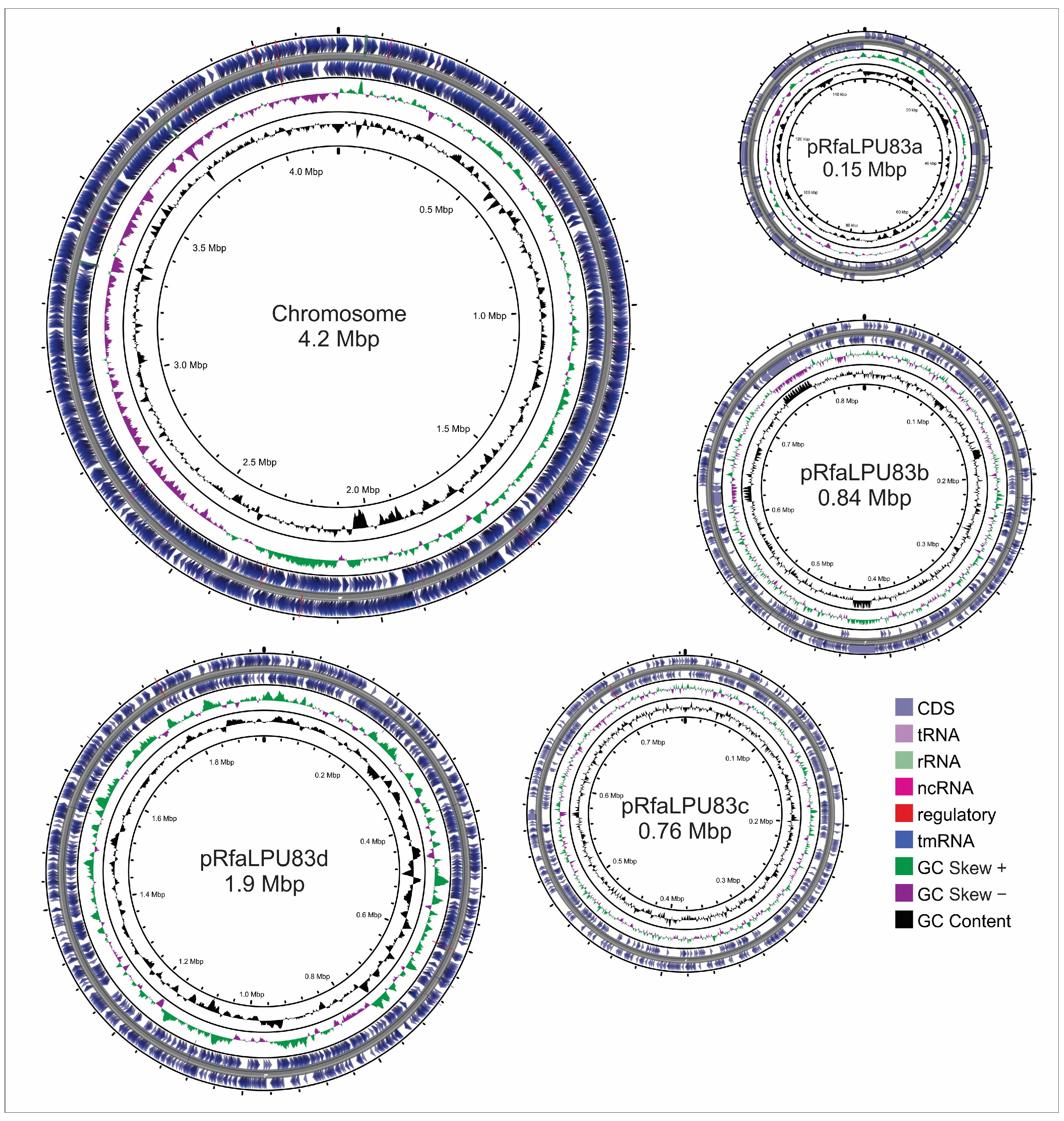
The absence of a complete symbiotic plasmid sequence for R. favelukesii motivated us to finish and assemble its entirety. Thus, sequencing of the LPU83 genome by the Oxford Nanopore Technology (ONT) was carried out. This approach resulted in 97,638 reads yielding 1,343,476,632 bp, with a Reads N50/N90 of 17,800/7,821 bp, respectively. After the first filtering of the reads to discard those smaller than 1500 bp with filtlong, 1,150,018,132 bp remained with a Reads N50/N90 of 18,121/8313, respectively. Flye was used for a de novo assembly of the genome and resulted in five circular replicons with coverage higher than 130× for each of them (Supplementary Figure S1). Circularity of each replicon was determined from Flye assembly metadata and confirmed by visualization of the assembly graph using Bandage [53] (Supplementary Figure S1). Next, a ten-step Pilon polishing was accomplished for error correction using Illumina reads. The obtained genome showed not only the chromosome and three complete plasmids but also a complete assembly of the LPU83 symbiotic plasmid (Figure 1 and Supplementary Figure S1). A comparison between the statistics of the final molecules and those replicons assembled previously [21] is shown in Table 1. Finally, the annotation of the completely assembled genome of LPU83T has 7778 CDS, 65 RNA and 686 pseudogenes.
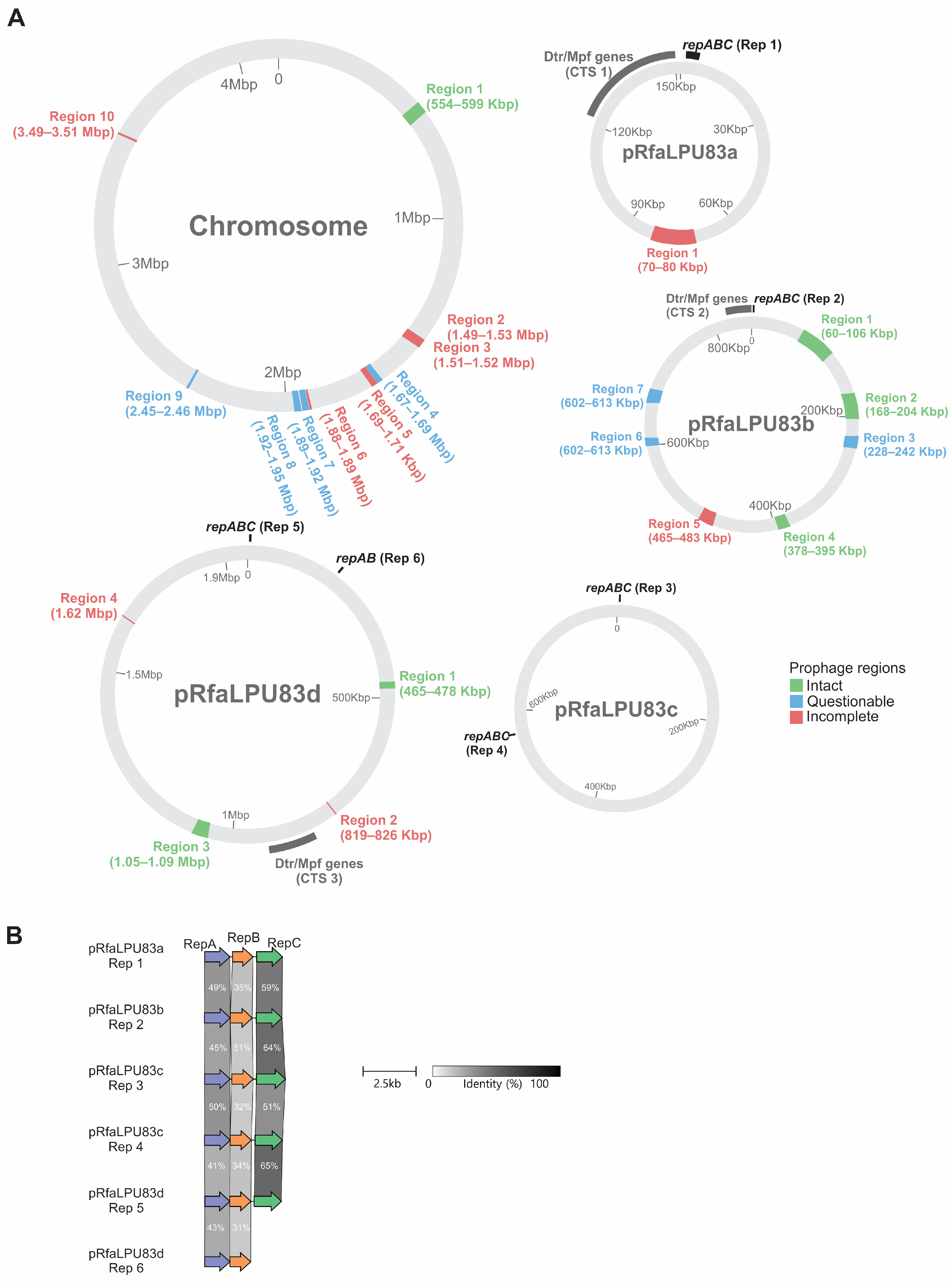
Prophages, insertion sequences and other regions of interest were searched in the LPU83 genome by diverse tools. Prophages were evaluated with Phaster [41]; in total, ten, four, seven and one prophages were detected in the chromosome, pRfaLPU83d, pRfaLPU83b and pRfaLPU83a, respectively. Among them, six were classified as intact and, remarkably, three of them are in pRfaLPU83b. Phaster assigned similarity between five of the intact prophages and phage groups commonly associated with different Shiga toxin-related families (Stx2-related) [54,55,56]. Further evaluation with PhageScope [42] determined that none of the prophages carried any virulence factor or antibiotic resistance genes, and most of the genes present were related to phage biology, including integrases, recombinases and transposases. Curiously, no prophages were detected in pRfaLPU83c (Figure 2A). It is worth mentioning that the functional impact of the prophages has not been demonstrated nor has it been shown whether they could become active.
A total of 287 insertion sequences (ISs) were found in the genome of LPU83 by ISEScan [43], accounting for 5.30% of the genome. Despite the high number of predicted IS elements, a remarkably higher number of ISs are located in the symbiotic plasmid (151), which make up 25.19% of the plasmid pRfaLPU83b (Table 2). The density of IS was also calculated, with an estimated average of one element every 5.6 Kbp in pRfaLPU83b. This result caught our attention; thus, ISEScan was employed to predict IS in other rhizobia symbiotic plasmids (Table 3). Interestingly, among the rhizobial plasmids studied, pRfaLPU83b showed the highest number of predicted ISs and the highest density. This fact, along with the presence of prophages, explains the difficulties in finishing the sequence of the symbiotic plasmid.
The presence of plasmids in LPU83 leads us to search for two elements that are crucial for plasmid maintenance and transfer: replication proteins (Rep) and conjugative transfer systems (CTSs). Six rep clusters were found in LPU83. Five of them comprise repA, repB and repC genes while the remaining cluster is composed only of repA and repB genes. Each of them is marked in each replicon shown in Figure 2A. Three CTS were found, one in pRfaLPU83a as previously described [15], one in the symbiotic plasmid and the remaining in pRfaLPU83d. More details of these CTS are described below.

3.2. Plasmid Overview and Conjugative Transfer

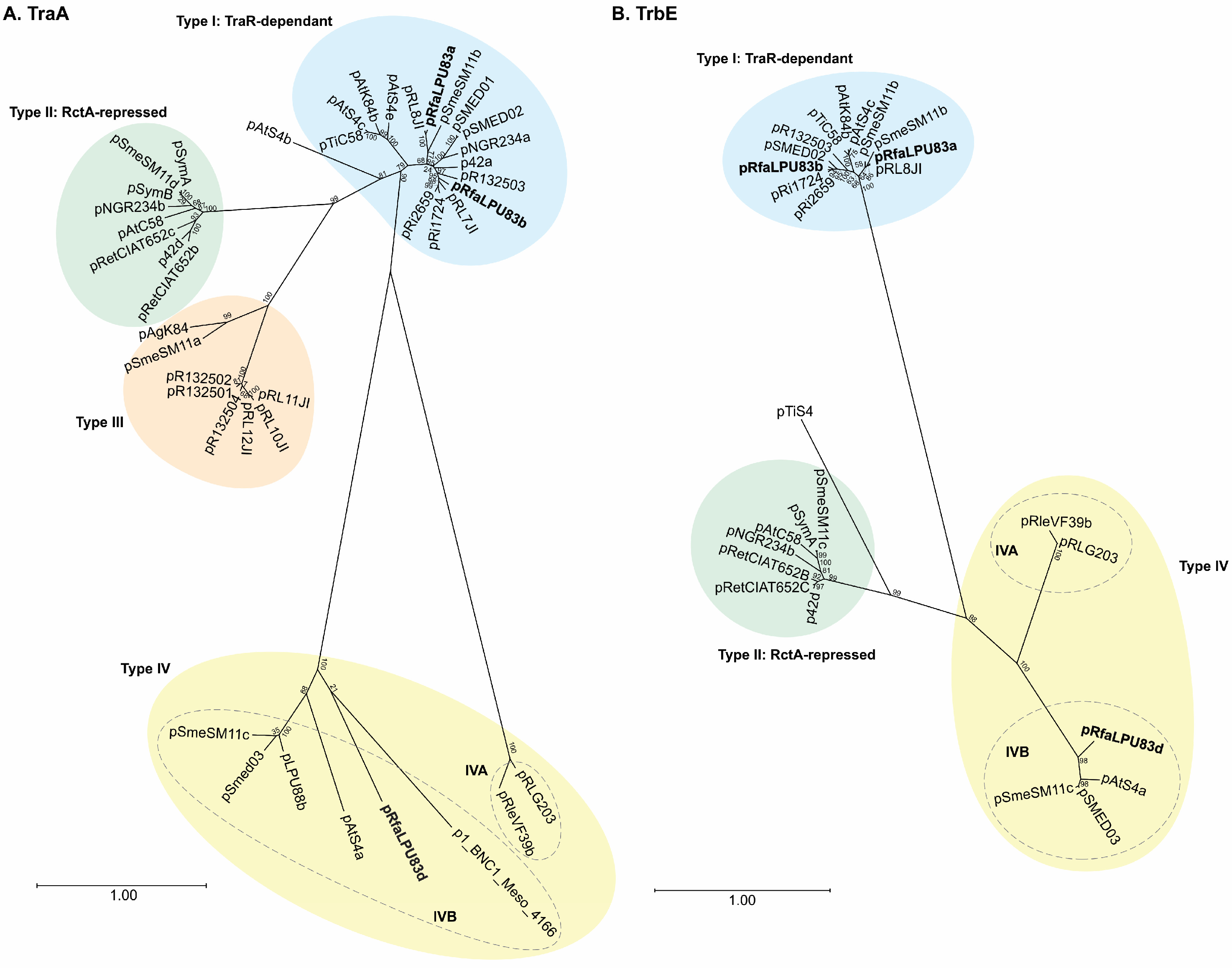
Previous work showed that plasmid pRfaLPU83a is a conjugative plasmid of LPU83 and the symbiotic plasmid, pRfaLPU83b, is mobilizable [22]. Later on, it was shown that pRfaLPU83a shared a close identity with pRL8 of R. johnstonii 3841T (pea nodulating rhizobium) and plasmid pSmeSM11b of Sinorhizobium meliloti SM11 (alfalfa nodulating rhizobium) [15]. This similarity depicts that horizontal gene transfer has played a relevant role in the evolution of R. favelukesii strains, and conjugative transfer (CT) could be one of the main mechanisms. Although it was known that pRfaLPU83a harbors a conjugative transfer system (CTS) [15], we searched for other genes involved in CT by BLASTP, using the relaxase (TraA in rhizobia) and a CT-related ATPase (trbE/virB4 in rhizobia) as queries. Two more CTS were found (Figure 2A). By means of phylogenetic analyses of TraA and TrbE, we classified them among the groups of plasmids in rhizobia (Figure 3). The cluster found in pRfaLPU83b was named CTS 2 and is related to group I-B rhizobial plasmids; on the other hand, the cluster found in pRfaLPU83d was named CTS 3 and is related to group IV-B rhizobial plasmids (Figure 3).
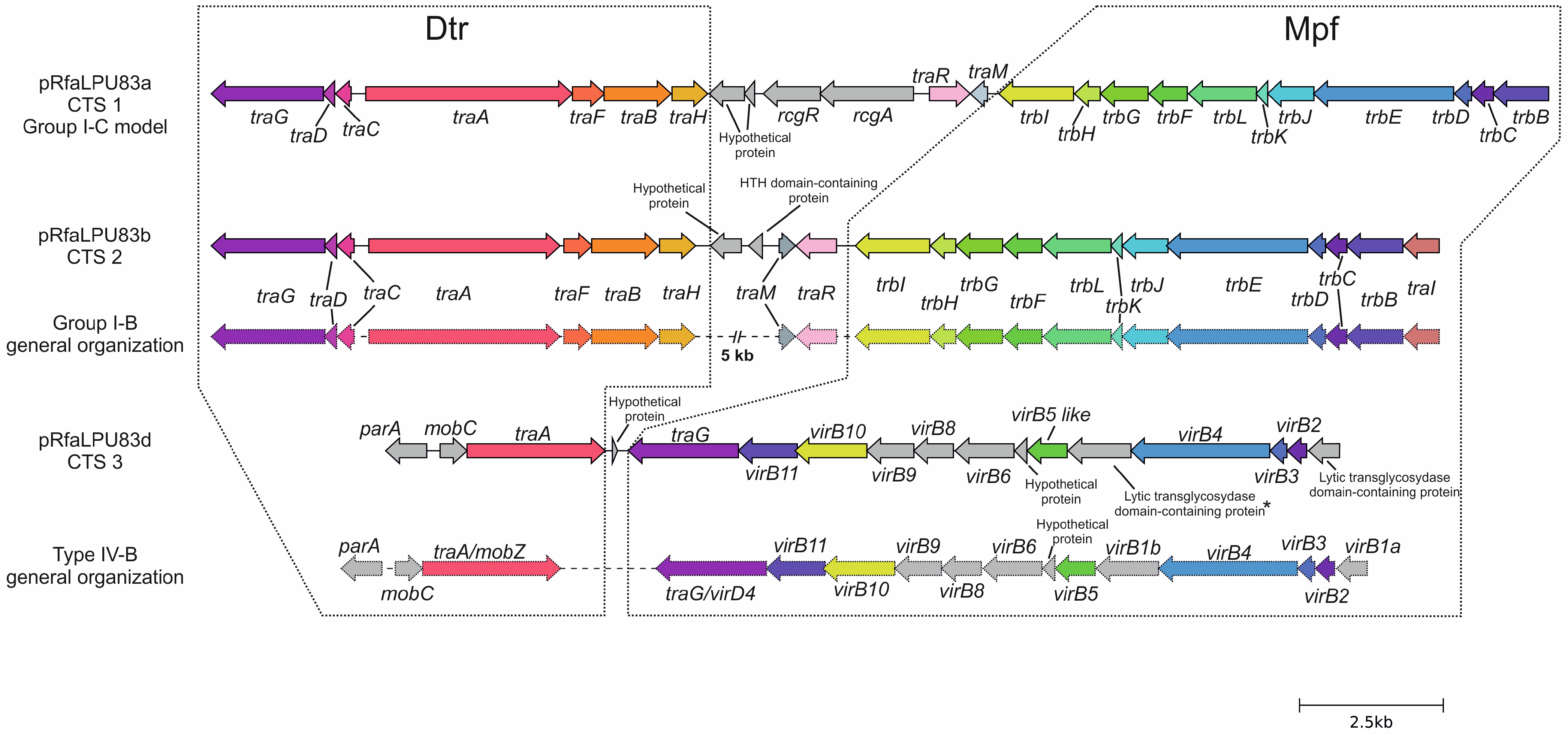
CTSs comprise Dtr (DNA transfer and replication) and Mpf (mating pair formation) gene clusters. The conjugative region present in pRfaLPU83a (CTS 1) (Figure 4) was previously described by Castellani et al. [15]. Briefly, this region exhibits a characteristic organization shared with other plasmids belonging to group I-C of rhizobial plasmids. Members of this group are conjugative and possess the conjugative master regulator TraR, although they do not respond to quorum sensing (QS) regulation [15].
CTS 2 located in pRfaLPU83b displays the same organization as group I-B rhizobial plasmids, characterized by the presence of acyl-homoserine lactone synthase, traI in rhizobia, encoded upstream of Mpf genes. Additionally, plasmids of this class exhibit an inversion of traR and traM genes compared to group I-C plasmids (Figure 4). Plasmids carrying this type of CTS, such as pRetCFN42a [58], are typically conjugative and regulated by QS through a mechanism responsive to acyl-homoserine lactone concentrations [59].
The third conjugative gene set (CTS 3) was found in plasmid pRfaLPU83d (Figure 2). This region shows synteny with the Mpf and Dtr systems of group IV-B described previously [11]. Specifically, this Dtr encodes a MobZ-family relaxase and contains mobC and parA genes (Figure 4). The Mpf corresponds to a typical VirB-system, composed of the genes virB1 to virB11, with a coupling protein (TraG or VirD4) encoded at the end of the operon. In some cases, such as in plasmid pSmed03 from Sinorhizobium medicae WSM419, the Dtr and Mpf are encoded separately, while in pAtS4a from Allorhizobium ampelinum S4 (previously Agrobacterium vitis S4), they are contiguous, as in pRfaLPU83d. These Mpf systems encode two distinct lytic transglycosylases involved in peptidoglycan degradation (virB1a and virB1b). Interestingly, the gene corresponding to VirB1b in pRfaLPU83d contains a frameshift mutation, rendering it non-functional.

3.3. Re-Evaluating the Taxonomic Boundaries of R. favelukesii LPU83T

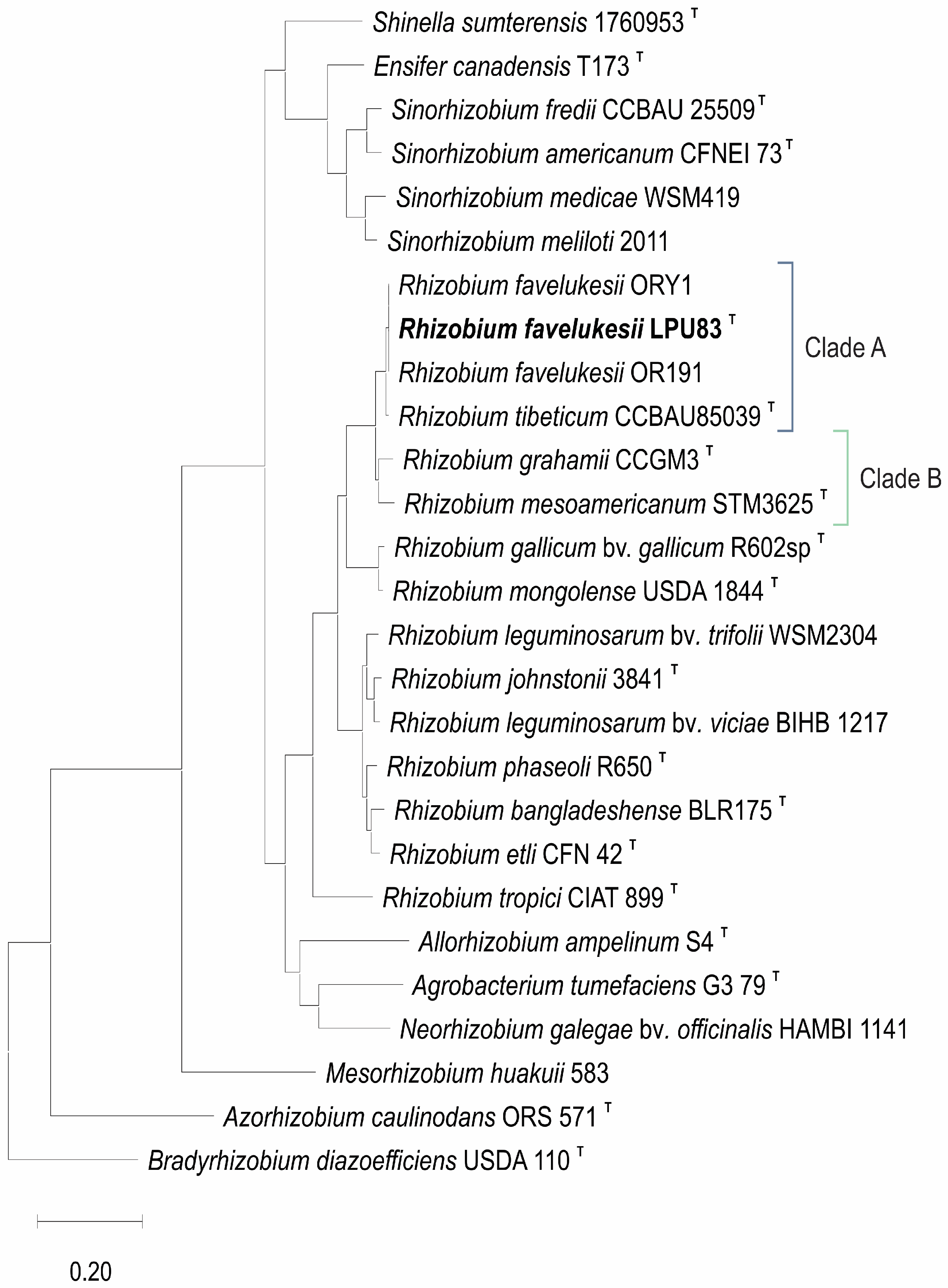
R. favelukesii was defined as a species in 2016 based on concatenated recA-atpD-rpoB phylogeny, DNA–DNA hybridization assays and phenotypic features [20]. At that time, none of the genomes of the R. favelukesii strains was fully assembled, and only a limited number of closely related genomes were available. Thus, we decided to now extend this analysis by employing the complete genome of LPU83. A core phylogenetic tree cluster was constructed with rhizobia strains with complete and finished genomes and the incomplete genomes of other R. favelukesii. As expected, all the R. favelukesii strains cluster together and are closely related to R. tibeticum (defined as clade A in Figure 5), and the next clade (defined as B in Figure 5) comprises R. grahamii and R. mesoamericanum. These clades are located in the vicinity of many rhizobial species that nodulate bean, clover and pea, while those rhizobia that nodulate alfalfa (Medicago spp.) are located further away.
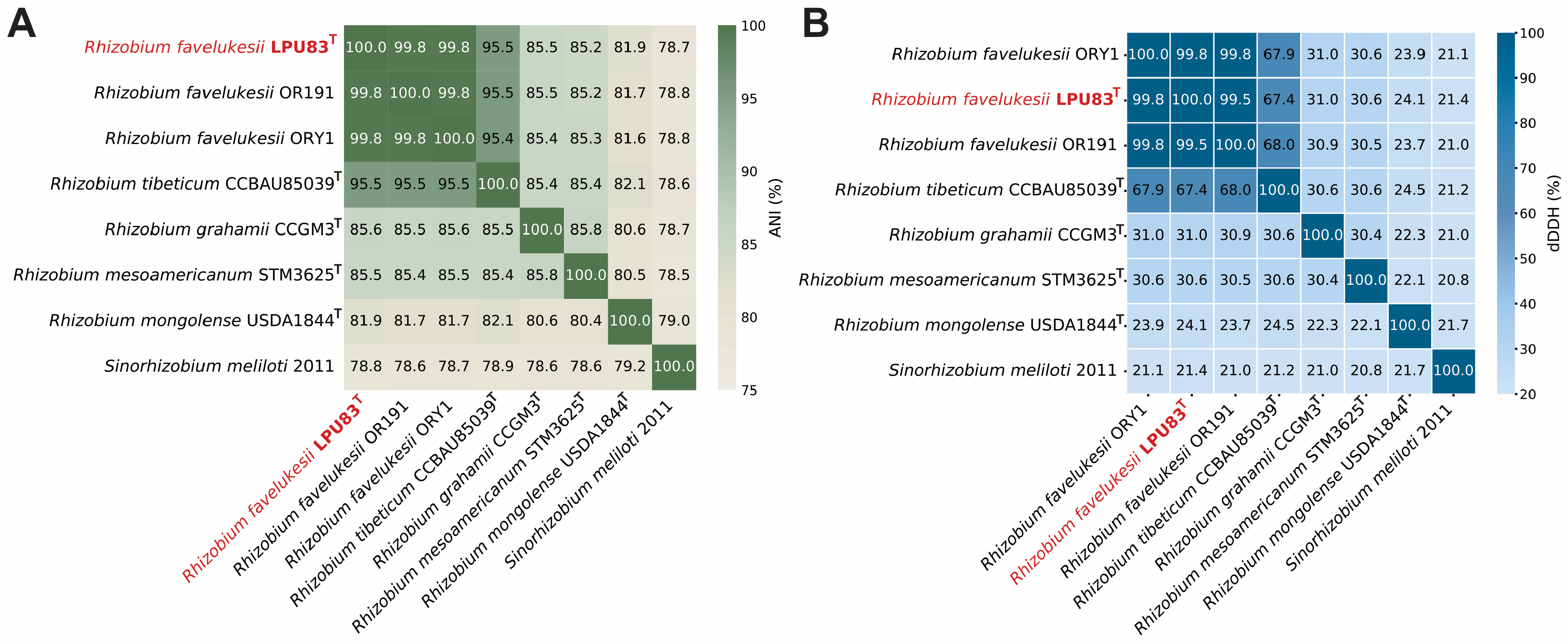
ANI analyses were performed by applying the EDGAR platform among related strains, where R. favelukesii strains have ANI values higher than 99%. Its closer relative, R. tibeticum, showed around 95% while strains from clade B showed around 80% (Figure 6A). In silico DNA–DNA hybridization (DDH) showed a similar pattern, with a value of ca. 68% between LPU83 and R. tibeticum CCBAU85039 (Figure 6B). It is worth mentioning that experimental DDH in the laboratory showed 62%, which confirms that they are different species [20].

3.4. Core Genes of Symbiotic Plasmids and Other Symbiotic Traits

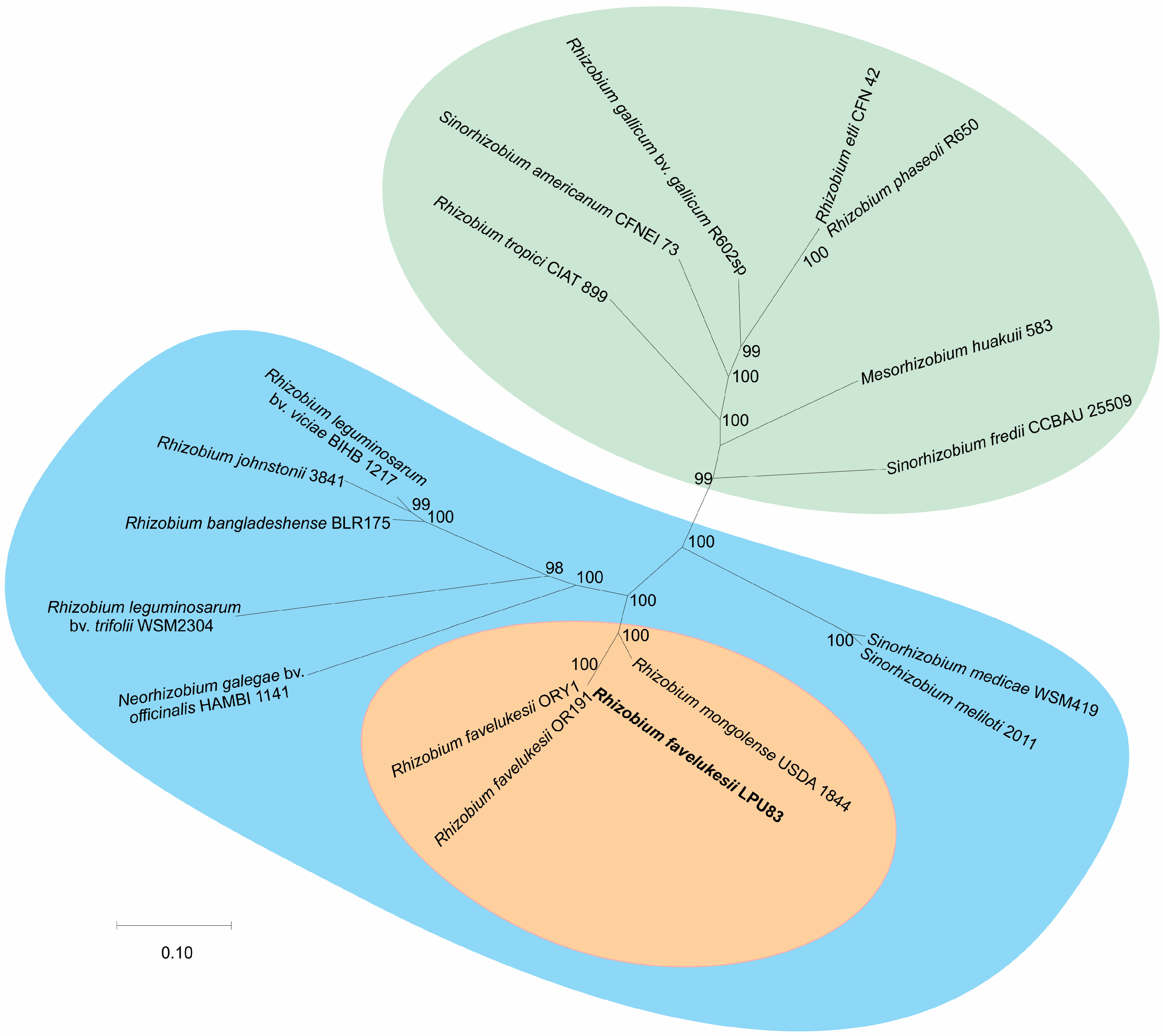
Using the same approach, we compiled a collection of complete symbiotic plasmids, i.e., plasmids that harbor essential genes needed for nodulation and the genes that code for the nitrogenase, and draft genomes of closely related strains. With this dataset, orthologs were identified and a core phylogeny among these symbiotic plasmids was made. The tree comprises 15 genes, repA, nodABC, nodIJ, fdxN, fixABC, nifA, nifHDK and nifN, and reveals two main clades (Figure 7). One of the clades (shown in a green-colored area in Figure 7) groups rhizobia that nodulate plants which develop determinate nodules (e.g., bean and Lotus sp.). The second clade (shown in a blue-colored area in Figure 7) clusters rhizobia that nodulate plants which develop indeterminate nodules (e.g., peas, clover and Medicago sp.). Interestingly, R. favelukesii and R. mongolense are able to nodulate both kinds of plants, but the core genes locate them inside the cluster of bacteria that nodulate indeterminate nodule-generating plants. As R. favelukesii and R. mongolense nodulate both kinds of plants, we independently analyzed the main proteins involved in the nod factor core biosynthetic genes (NodABC), in the nitrogenase (NifH (dinitrogenase reductase) and NifDK (α and β subunits of dinitrogenase)) and electron transfer proteins (FixABC) (Supplementary Figure S2). In each analysis, a main point takes our attention. R. favelukesii is not always clustering with the same rhizobial strains, showing, for NodABC, the highest similarity with rhizobia that nodulates alfalfa (Sinorhizobium sp.) and, for NifHDK, with rhizobia that nodulate pea and clover. When analyzing FixABC phylogenetic tree, all R. favelukesii strains clustered together but independently from other clades. Altogether, these studies might suggest that during the evolution of these strains, R. favelukesii acquired different clusters by horizontal gene transfer.
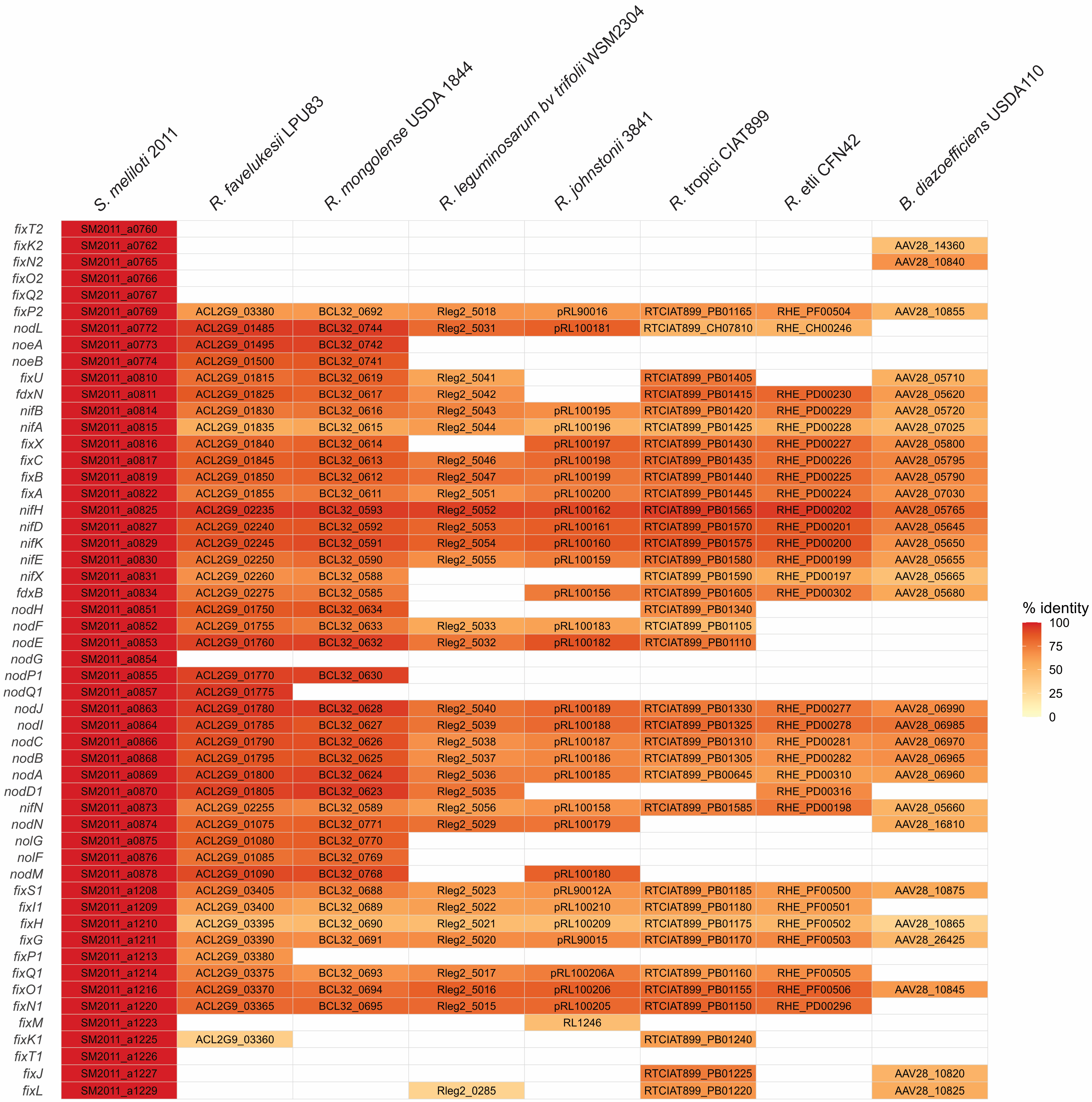
LPU83 was isolated from alfalfa nodules and was shown to be able to nodulate different species, but none of the experiments showed a fully effective nitrogen fixation [18]. Although many genes were identified previously for the symbiosis between rhizobia and plants [1,61], Geddes et al. [62] recently showed that a minimal gene set from Sinorhizobium meliloti was required for efficient symbiosis with Medicago sp. We employed those genes to search for orthologs in LPU83 and other rhizobia type strains that fix nitrogen with a diverse set of plants. The analysis showed that LPU83 harbors most of the genes needed for efficient nitrogen fixation (Figure 8); moreover, not only are they present, but also, their identity is quite high. Nevertheless, their function may depend not only on their sequence but also on additional regulatory or contextual factors.
The signal exchange with the plant induces the production of nodulation factors (nod factors), molecules that induce changes in the root that lead to the onset of nodule development [61]. The proteins responsible for the biosynthesis of these nod factors are encoded in the nod gene cluster. These genes are present in LPU83, as previously described, except for a complete copy of the nodG gene [64]. The identity of the encoded proteins ranges from 80 to 95%, and the structure of the gene cluster is similar to that of S. meliloti, as previously shown for LPU83 and other R. favelukesii strains [24]. The absence of a complete nodG gene ortholog was previously discussed [64], but the functional redundancy described by Lopez-Lara [65] could not directly point out this gene as the keystone of the deficient fixation (Figure 8).
All genes encoding the nitrogenase and nitrogenase cofactors were identified. nifH, which encodes for the dinitrogenase reductase, has a 94% identity with that of S. meliloti. Other previous works have already mentioned that the nitrogenase-related genes are closely related to those of S. meliloti [24,66,67].
S. meliloti has three copies of the fixNOQP operon, which encodes the specific high-affinity cbb3-type cytochrome c oxidase [68]. However, only two of these operons are essential for symbiosis [62,69]. When searching for orthologs in LPU83, we determined that there is a single copy of the fixNOQP operon in the symbiotic plasmid. Among the fix genes and proteins necessary for nitrogen fixation, the two-component FixLJ system and the transcriptional regulator FixK are relevant [68,70,71,72]. An ortholog to fixK was detected, described as a CRP/FNR family transcriptional regulator, also identified in other R. favelukesii strains [24]; however, no orthologs to fixLJ were detected. The fixK homolog is located adjacent to the fixNOQP operon, but both are divergently transcribed. Further analysis of this genomic region identified a downstream gene encoding a protein containing a PAS sensor domain. BLASTp analysis indicates that this protein likely corresponds to a hybrid sensor histidine kinase/response regulator conserved among diverse rhizobial species and named as hfixL [73]. This structure is similar to that of the fixNOQP and fixK-hfixL present in plasmid pRL9 of R. leguminosarum [74]. Thus, the structure and location of fix operons appear to be more similar to R. leguminosarum than to S. meliloti.
There are other key relevant molecules needed for nitrogen fixation such as exopolysaccharide, but we have shown that LPU83 is still able to nodulate even in the absence of exopolysaccharide [48].
It is worth mentioning that the presence or absence of genes does not rule out defects in expression levels, temporal regulation or plant-induced activation; thus, further assays should be performed to understand the symbiotic failure.

3.5. Role of Symbiosis-Related Peptidases for the LPU83 Symbiotic Phenotype

Plasmids play a crucial role in the symbiosis between rhizobia and legumes. Years ago, Crook et al. [75] demonstrated that plasmid pHRB800 impairs the symbiosis of S. meliloti with M. truncatula. Later on, it was shown that the expression of a host range restriction peptidase (HrrP) in S. meliloti B800 leads to the formation of nodules inefficient in nitrogen fixation [76]. This peptidase cleaves nodule-specific cysteine-rich peptides (NCRs) in vitro, which are essential for bacteroid differentiation [77,78,79]. While studying peptidases present in different S. meliloti strains, Benedict et al. [80] found that the overexpression of the SapA peptidase in S. meliloti inside the nodules leads to lower plant-biomass; therefore, indicating a connection between this protein and efficiency of nitrogen fixation.
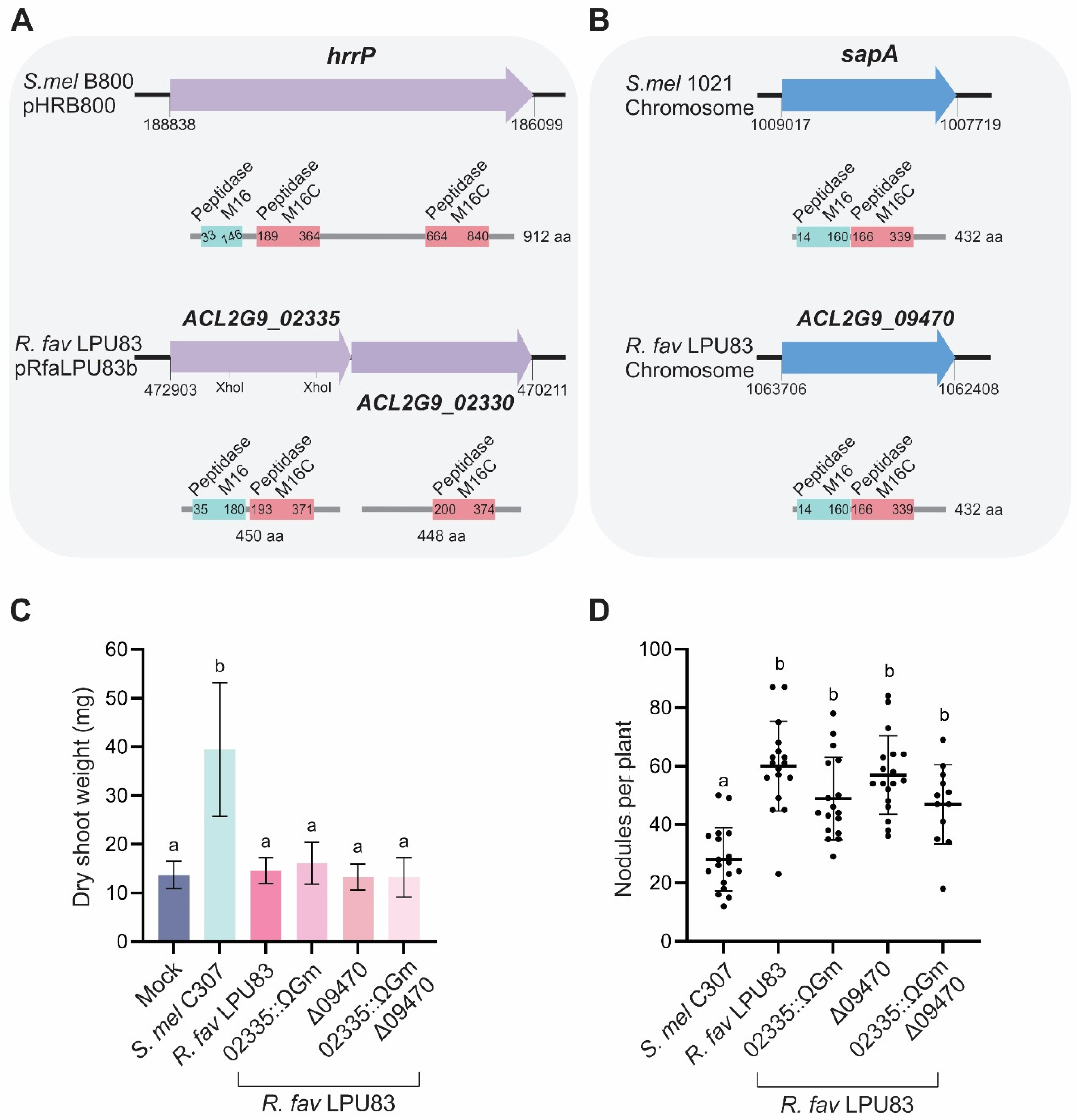
To evaluate whether the inefficient phenotype of LPU83 was related to peptidases encoded in its genome, as was previously suggested for another R. favelukesii strain [25], we searched for homologous proteins to HrrP and SapA encoded in the genome of LPU83. BLASTP revealed that LPU83 has a protein that might be homologous to HrrP, ACL2G9_02335, with an identity of 26.6% and a 75% coverage. This protein is encoded in the symbiotic plasmid, pRfaLPU83b, and it has two domains: M16, which has protease activity, and M16C, which is classified as a peptidase inactive domain (Figure 9A). Downstream of this gene is ACL2G9_02330, which also encodes a possible peptidase, although in this case with a single, non-active M16C domain (Figure 9A) and a 22.8% identity with HrrP with a 51% coverage. Analyzing the ACL2G9_02335-ACL2G9_02330 tandem, the organization of the tandem domains would be similar to the domains present in HrrP. A previous RNAseq analysis of LPU83 showed that these genes are transcribed as an operon (https://www.ncbi.nlm.nih.gov/bioproject/PRJNA594606, accessed on 16 October 2025) [81]. This genetic organization may be due to a mutation in the reading frame of the gene that caused the original gene to be split into two genes. Another explanation for this structural difference could be that this structure is ancestral to the formation of complete HrrP and that a subsequent mutation fused both domains into a single protein.
For the SapA protein from S. meliloti 1021, a homologous protein was found to be encoded on the LPU83 chromosome (ACL2G9_09470) with 432 amino acids, an identity percentage of 82.8%, and 98% coverage. Similarly to the protein present in S. meliloti 1021, it has two domains: an M16 peptidase domain and an M16C domain without catalytic activity (Figure 9B).
To assess whether the presence of these peptidases in the genome of LPU83 may be involved in the inefficient nitrogen fixation phenotype, mutant strains in these genes were generated. As a first approach, a whole-cell shotgun proteomic analysis was performed to evaluate whether the genes encoding the predicted peptidases change the proteome profile under free-living conditions. Our results showed that, when comparing the proteome of LPU83 against each of the mutant strains, they showed differential proteomic profiles with differentially expressed proteins and ON/OFF proteins (Supplementary Table S5). In summary, 69 proteins showed changes in mutant LPU83 02335::ΩGm, 54 proteins in LPU83 Δ09470 and 54 proteins in the double mutant (02335::ΩGm Δ09470), confirming that the predicted peptidases are involved in some processes that affect their proteomic profiles. Most of these differences were associated with proteins related to metabolism and several uncharacterized proteins. Interestingly, two symbiosis-related proteins were identified in the presence/absence pattern across the comparisons: NifH and NodA. The nitrogenase component NifH was determined as ON exclusively in the LPU83 02335::ΩGm replicates. In contrast, NodA, a core biosynthetic protein for nod factors, was consistently detected in the mutant strains and not in the wild-type strain across all three comparisons (Supplementary Table S5).
Afterwards, the symbiotic phenotype was evaluated (see Materials and Methods). Following the strategy of Price et al. [76], M. truncatula A20 plants were inoculated with the different LPU83 strains and S. meliloti C307 as the control. It is worth mentioning that the peptidase phenotypes were only demonstrated in M. truncatula accession A20; meanwhile, M. truncatula A17 showed no phenotype [75]. After six weeks, neither the single mutant (02335::ΩGm and Δ09470) nor the double mutant (02335::ΩGm Δ09470) strains showed any differences in dry shoot weight compared with the parental LPU83 strain (Figure 9C), indicating that symbiotic nitrogen fixation was not affected, as plants were grown under nitrogen-free conditions. Plants inoculated with these strains exhibited a symbiotic phenotype similar to that of LPU83: they were small, displayed yellow leaves, and formed small, rounded, white nodules, all of which are indicative of a poor nitrogen-fixing phenotype. Moreover, the total number of nodules per plant was also determined, but no differences with the wild-type LPU83 strain were observed (Figure 9D). These results suggest that the predicted peptidases do not play a role during the symbiosis between LPU83 and M. truncatula.

4. Concluding Remarks

Research on rhizobia–plant interaction has been an important topic for many decades. This is largely due to the use of rhizobia as inoculants in agronomy to improve yields of legume plants without negatively impacting the environment [1]. Moreover, it is a model of symbiotic interaction, allowing its characterization to be extrapolated to other symbiotic systems. Although many rhizobia species can fix nitrogen efficiently, many others cannot do it. R. favelukesii has been used as a model of adaptability to acid stress [81] and conjugative transfer systems [15], despite being among the rhizobia that do not fix nitrogen efficiently [19,82].
Completing the symbiotic plasmid sequence of R. favelukesii LPU83T has been challenging: the high abundance of insertion sequences and prophages has been an issue that could only be solved by applying the Nanopore long-read technology. The finished pRfaLPU83b sequence is approximately 300 Kbp larger than the previous assembly, but the sum of bases occupied by IS and phages explains this difference. Moreover, this plasmid showed a remarkable high density of IS in comparison with other rhizobial symbiotic plasmids. These mobile elements reinforce the plasticity of rhizobial genomes and their adaptability to changing environmental conditions [17].
Among mobile elements, LPU83 harbors four plasmids. An analysis of plasmid conjugative transfer genes revealed three systems distributed across the genome: CTS 1, CTS 2 and CTS 3. CTS 1 has been previously characterized as a functional conjugative system, whereas CTS 2 and CTS 3 are described here for the first time. The symbiotic plasmid pRfaLPU83b carries CTS 2, which displays the same organization as CTS of group I-B rhizobial plasmids and includes an acyl-homoserine lactone synthase (traI). This gene organization is consistent with systems that, in other rhizobia, have been shown to be conjugative and regulated by quorum sensing [14,58,59]. On the other hand, CTS 3, present in pRfaLPU83d, shows synteny with the Mpf and Dtr systems of group IV-B. In particular, this CTS encodes one lytic transglycosylase involved in peptidoglycan degradation, VirB1b, which contains a frameshift mutation that renders it non-functional and raises the question of whether this CTS is functional.
The finding that pRfaLPU83b contains a complete CTS that may respond to QS regulation, whereas pRfaLPU83d harbors a different type of CTS, raises the question of their functionality and what their conjugative transfer (CT) frequency may be. Although their large molecular size would likely affect conjugative transfer efficiency, experimental studies are required to elucidate their conjugative properties. Finally, the coexistence of multiple conjugative transfer systems within a single strain opens the possibility of crosstalk or even physical interactions among these plasmids [9].
The transmissibility of these plasmids, particularly the hypothesis that the symbiotic plasmid conjugation might be regulated by QS, could explain the mosaic architecture of R. favelukesii genomes. In these strains, the chromosome is related to Rhizobium strains that nodulate Phaseolus sp. (which develop determinate nodules), while the symbiotic plasmid is closer to strains that nodulate Medicago, pea and clover (which develop indeterminate nodules).
Regarding the inefficient nitrogen fixation behavior, the analysis performed showed that almost all the genes needed for a successful process are present and, in the case of missing genes, there is genomic redundancy that could supply the needed protein. However, we cannot rule out the possibility that there may be a problem with the expression or regulation of these determinants.
We could exclude the possibility that the encoded peptidases are responsible for the ineffective behavior during the symbiosis with Medicago truncatula. We cannot disregard that the phenotypes of the peptidases have been demonstrated only in M. truncatula accession A20 [76,80] and other hosts may show a different phenotype. Regarding the inefficient phenotype of LPU83, a long research pathway to study symbiosis-related genes is needed to comprehend this system, since this phenotype may result from the interaction of multiple genetic determinants. In addition, the possibility that R. favelukesii has a suitable legume host in which it can efficiently fix nitrogen should not be disregarded.
Completion of the R. favelukesii LPU83T genome provides a robust and comprehensive framework to reassess the genetic basis of its broad host range and its inefficient symbiotic performance.

Supplementary Materials

The following supporting information can be downloaded at https://www.mdpi.com/article/10.3390/agronomy16050523/s1, Supplementary Figure S1. Assembly graph visualization. The graph was generated with Bandage showing five independent circular replicons. The coverage for each replicon is indicated in the figure. Supplementary Figure S2. Phylogenetic trees of symbiosis-related genes. A. Core gene of symbiotic plasmids and three draft genomes (same phylogenetic tree shown in Figure 7 but in rectangular form). B. NodABC proteins. C. NifHDK proteins. D. FixABC proteins. Phylogenetic trees were constructed as stated in Materials and Methods. Branch support was evaluated using the Shimodaira-Hasegawa-like test. Tree topology searches were performed using the best NNIs and SPRs algorithms with 100 random initial trees. The scale bar represents the estimated number of amino acid substitutions per site. Supplementary Table S1. A. Bacterial strains and plasmids used in this work. B. Antibiotic concentrations used in this work for bacterial growth [19,76,83,84,85]. Supplementary Table S2. Primers used in this work. Supplementary Table S3. A. Accession numbers of TraA proteins in different rhizobial strains used for the phylogenetic tree of TraA (Figure 3A). B. Accession numbers of TrbE/VirB4 proteins in different rhizobial strains used for the phylogenetic tree of TrbE (Figure 3B). C. Accession numbers of rhizobial strains used for the core gene phylogenetic tree (Figure 5). D. Accession numbers of symbiotic plasmids used for core gene phylogenetic tree of the symbiotic plasmids (Figure 6). E. Locus tag of NodABC, FixABC and NifHDK proteins in different rhizobial strains used for phylogenetic trees (Figure S2). Supplementary Table S4. Essential genes for symbiosis with Alfalfa and its orthologs in rhizobia. Genes determined to be essential for symbiosis in S. meliloti by Geddes et al. (2021) were searched for in different rhizobial strains (Figure 8). Here are enlisted the orthologous genes with their locus tag, protein identity percentage and coverage. Supplementary Table S5. A. Differentially expressed proteins (DEP) when comparing LPU83 02335::ΩGm (hrrP homologue) to LPU83 wild type strain. Log2FoldChange < -1 genes are overexpressed in the mutant strain, Log2FoldChange > 1 proteins are overexpressed in the wild type strain. Proteins are considered differentially expressed when p-value is less than 0.05. B. ON/OFF when comparing LPU83 02335::ΩGm (hrrP homologue) to LPU83 wild type strain. Proteins are considered ON when they are present in at least 3 replicates and absent in at least 3 replicates in the other condition. C. Differentially expressed (DEP) proteins when comparing LPU83 Δ09470 (sapA homologue) to LPU83 wild type strain. Log2FoldChange < -1 genes are overexpressed in the mutant strain, Log2FoldChange > 1 proteins are overexpressed in the wild type strain. Proteins are considered differentially expressed when p-value is less than 0.05.D. ON/OFF when comparing LPU83 Δ09470 (sapA homologue) to LPU83 wild type strain. Proteins are considered ON when they are present in at least 3 replicates and absent in at least 3 replicates in the other condition. E. Differentially expressed proteins (DEP) when comparing double mutant (02335::ΩGm Δ09470) to LPU83 wild type strain. Log2FoldChange < -1 genes are overexpressed in the mutant strain, Log2FoldChange > 1 proteins are overexpressed in the wild type strain. Proteins are considered differentially expressed when p-value is less than 0.05. F. ON/OFF when comparing double mutant (02335::ΩGm Δ09470) to LPU83 wild type strain. Proteins are considered ON when they are present in at least 3 replicates and absent in at least 3 replicates in the other condition.

Author Contributions

conceptualization, A.L. (Abril Luchetti), C.D., M.P. and G.T.T.; methodology, A.L. (Abril Luchetti), C.D., L.G.C., M.D.C., D.W., C.V., L.F., J.B., A.W., T.B. and C.R.-R.; validation, A.L. (Abril Luchetti), C.D., L.G.C., M.D.C., D.W. and G.T.T.; formal analysis, A.L. (Abril Luchetti), C.D., L.G.C., M.D.C., D.W., A.L. (Antonio Lagares), M.F.D.P. and G.T.T.; resources, J.K., A.S., A.P., K.N., M.P. and G.T.T.; data curation, A.L. (Abril Luchetti), C.D., L.G.C., M.D.C., D.W. and C.V.; writing—original draft preparation, A.L. (Abril Luchetti), C.D., L.G.C., M.D.C., D.W., A.S., M.F.D.P., M.P. and G.T.T.; writing—review and editing, all the authors; supervision, G.T.T.; funding acquisition, J.K., A.S., A.P., K.N., M.F.D.P., M.P. and G.T.T. All authors have read and agreed to the published version of the manuscript.

Funding

This work was partially supported by the following grants to G.T.T: PICT2020-02314 and PICT2021-00153 by Agencia Nacional de Promoción de la Investigación, el Desarrollo Tecnológico y la Innovación, PIP0678 from CONICET and Project N° 1045 by Fundación Williams.

Data Availability Statement

The assembled genome was deposited in the NCBI database under accession numbers CP189832, CP189833, CP189834, CP189835 and CP189836, corresponding to pRfaLPU83b (pSym), LPU83 chromosome and plasmids pRfaLPU83c, pRfaLPU83d and pRfaLPU83a, respectively. The mass spectrometry proteomics data have been deposited to the ProteomeXchange Consortium via the PRIDE [50] partner repository with the dataset identifier PXD072722. Raw reads are available under submission SRR37183916 and SRR37183917 in the Sequence Read Archive (SRA) data of NCBI.

Acknowledgments

A.L. (Abril Luchetti), M.D.C. and C.V. are fellows of CONICET. C.D. is fellow of Agencia Nacional de Promoción de la Investigación, el Desarrollo Tecnológico y la Innovación. M.P., M.F.D.P. and G.T.T. are members of the Research Career of CONICET. G.T.T. also acknowledge Alexander von Humboldt Foundation. The bioinformatics support of the BMBF-funded project ‘Bielefeld-Gießen Center for Microbial Bioinformatics’ (BiGi), grant 031A533, within the German Network for Bioinformatics Infrastructure (de. NBI) is gratefully acknowledged.

Conflicts of Interest

The authors declare no conflicts of interest. The funders had no role in the design of the study; in the collection, analyses, or interpretation of data; in the writing of the manuscript, or in the decision to publish the results.

Abbreviations

The following abbreviations are used in this manuscript:
ISInsertion Sequences
BNFBiological Nitrogen Fixation
ICEIntegrative Conjugative Elements
ONTOxford Nanopore Technologies
ANIAverage Nucleotide Identity
dDDHDigital DNA–DNA hybridization
CTSConjugative Transfer Systems
DTRDNA Transfer and Replication
MPFMating Pair Formation
CTConjugative Transfer
QSQuorum Sensing

References

  1. Roy, S.; Liu, W.; Nandety, R.S.; Crook, A.; Mysore, K.S.; Pislariu, C.I.; Frugoli, J.; Dickstein, R.; Udvardi, M.K. Celebrating 20 years of genetic discoveries in legume nodulation and symbiotic nitrogen fixation. Plant Cell 2020, 32, 15–41. [Google Scholar] [CrossRef] [PubMed]
  2. Kaneko, T.; Nakamura, Y.; Sato, S.; Asamizu, E.; Kato, T.; Sasamoto, S.; Watanabe, A.; Idesawa, K.; Ishikawa, A.; Kawashima, K.; et al. Complete genome structure of the nitrogen-fixing symbiotic bacterium Mesorhizobium loti. DNA Res. Int. J. Rapid Publ. Rep. Genes Genomes 2000, 7, 331–338. [Google Scholar]
  3. Kaneko, T.; Nakamura, Y.; Sato, S.; Minamisawa, K.; Uchiumi, T.; Sasamoto, S.; Watanabe, A.; Idesawa, K.; Iriguchi, M.; Kawashima, K.; et al. Complete genomic sequence of nitrogen-fixing symbiotic bacterium Bradyrhizobium japonicum USDA110. DNA Res. Int. J. Rapid Publ. Rep. Genes Genomes 2002, 9, 189–197. [Google Scholar] [CrossRef]
  4. González, V.; Santamaría, R.I.; Bustos, P.; Hernández-González, I.; Medrano-Soto, A.; Moreno-Hagelsieb, G.; Janga, S.C.; Ramírez, M.A.; Jiménez-Jacinto, V.; Collado-Vides, J.; et al. The partitioned Rhizobium etli genome: Genetic and metabolic redundancy in seven interacting replicons. Proc. Natl. Acad. Sci. USA 2006, 103, 3834–3839. [Google Scholar] [CrossRef] [PubMed]
  5. Young, J.P.; Crossman, L.C.; Johnston, A.W.; Thomson, N.R.; Ghazoui, Z.F.; Hull, K.H.; Wexler, M.; Curson, A.R.; Todd, J.D.; Poole, P.S.; et al. The genome of Rhizobium leguminosarum has recognizable core and accessory components. Genome Biol. 2006, 7, R34. [Google Scholar] [CrossRef]
  6. Romero, D.; Brom, S. The symbiotic plasmids of the Rhizobiaceae. In Plasmid Biology; Phillips, G., Funnell, B., Eds.; ASM Press: Washington, DC, USA, 2004; pp. 271–290. [Google Scholar]
  7. Torres Tejerizo, G.; Del Papa, M.F.; Draghi, W.; Lozano, M.; Giusti, M.A.; Martini, C.; Salas, M.E.; Salto, I.; Wibberg, D.; Szczepanowski, R.; et al. First genomic analysis of the broad-host-range Rhizobium sp. LPU83 strain, a member of the low-genetic diversity Oregon-like Rhizobium sp. group. J. Biotechnol. 2011, 155, 3–10. [Google Scholar] [CrossRef] [PubMed]
  8. Fuentes-Romero, F.; Lopez-Baena, F.J.; Vinardell, J.M.; Acosta-Jurado, S. Updated sequence and annotation of the broad host range rhizobial symbiont Sinorhizobium fredii HH103 genome. Genes 2025, 16, 1094. [Google Scholar] [CrossRef]
  9. Brom, S.; Pistorio, M.; Romero, D.; Torres-Tejerizo, G. Boundaries for conjugative transfer of rhizobial plasmids: Restraining and releasing factors. In Plasticity in Plant-Growth-Promoting and Phytopathogenic Bacteria; Katsy, I.E., Ed.; Springer: New York, NY, USA, 2014; pp. 43–54. [Google Scholar]
  10. Castellani, L.G.; Luchetti, A.; Nilsson, J.F.; Perez-Gimenez, J.; Struck, B.; Schluter, A.; Puhler, A.; Niehaus, K.; Romero, D.; Pistorio, M.; et al. RcgA and RcgR, two novel proteins Involved in the conjugative transfer of rhizobial plasmids. mBio 2022, 13, e0194922. [Google Scholar] [CrossRef]
  11. Ding, H.; Yip, C.B.; Hynes, M.F. Genetic characterization of a novel rhizobial plasmid conjugation system in R. leguminosarum bv. viciae strain VF39SM. J. Bacteriol. 2013, 195, 328–339. [Google Scholar] [CrossRef]
  12. Lopez-Fuentes, E.; Torres-Tejerizo, G.; Cervantes, L.; Brom, S. Genes encoding conserved hypothetical proteins localized in the conjugative transfer region of plasmid pRet42a from Rhizobium etli CFN42 participate in modulating transfer and affect conjugation from different donors. Front. Microbiol. 2015, 5, 793. [Google Scholar] [CrossRef]
  13. Pistorio, M.; Torres Tejerizo, G.A.; Del Papa, M.F.; de Los Angeles Giusti, M.; Lozano, M.; Lagares, A. rptA, a novel gene from Ensifer (Sinorhizobium) meliloti involved in conjugal transfer. FEMS Microbiol. Lett. 2013, 345, 22–30. [Google Scholar] [CrossRef]
  14. Vanderlinde, E.M.; Hynes, M.F.; Yost, C.K. Homoserine catabolism by Rhizobium leguminosarum bv. viciae 3841 requires a plasmid-borne gene cluster that also affects competitiveness for nodulation. Environ. Microbiol. 2014, 16, 205–217. [Google Scholar] [CrossRef]
  15. Castellani, L.G.; Nilsson, J.F.; Wibberg, D.; Schluter, A.; Puhler, A.; Brom, S.; Pistorio, M.; Torres Tejerizo, G. Insight into the structure, function and conjugative transfer of pLPU83a, an accessory plasmid of Rhizobium favelukesii LPU83. Plasmid 2019, 103, 9–16. [Google Scholar] [CrossRef]
  16. Castellani, L.G.; Cabrera, M.D.; Luchetti, A.; Nilsson, J.F.; Perez-Gimenez, J.; Bañuelos-Vazquez, L.A.; Alva, A.; Wibberg, D.; Busche, T.; Kalinowski, J.; et al. Characterization of RcgA and RcgR, two rhizobial proteins involved in the modulation of plasmid transfer. Microbiol. Spectr. 2026, 2026, e03242-25. [Google Scholar] [CrossRef] [PubMed]
  17. Bañuelos-Vazquez, L.A.; Cazares, D.; Rodríguez, S.; Cervantes-De la Luz, L.; Sánchez-López, R.; Castellani, L.G.; Torres Tejerizo, G.; Brom, S. Transfer of the symbiotic plasmid of Rhizobium etli CFN42 to endophytic bacteria inside nodules. Front. Microbiol. 2020, 11, 1752. [Google Scholar] [CrossRef] [PubMed]
  18. Wegener, C.; Schröder, S.; Kapp, D.; Pühler, A.; Lopez, E.S.; Martinez-Abarca, F.; Toro, N.; Del Papa, M.F.; Balague, L.J.; Lagares, A.; et al. Genetic uniformity and symbiotic properties of acid-tolerant alfalfa-nodulating rhizobia isolated from dispersed locations throughout Argentina. Symbiosis 2001, 30, 141–162. [Google Scholar]
  19. Del Papa, M.F.; Balagué, L.J.; Sowinski, S.C.; Wegener, C.; Segundo, E.; Abarca, F.M.; Toro, N.; Niehaus, K.; Pühler, A.; Aguilar, O.M.; et al. Isolation and characterization of alfalfa-nodulating rhizobia present in acidic soils of central Argentina and Uruguay. Appl. Environ. Microbiol. 1999, 65, 1420–1427. [Google Scholar] [CrossRef] [PubMed]
  20. Torres Tejerizo, G.; Rogel, M.A.; Ormeño-Orrillo, E.; Althabegoiti, M.J.; Nilsson, J.F.; Niehaus, K.; Schlüter, A.; Pühler, A.; Del Papa, M.F.; Lagares, A.; et al. Rhizobium favelukesii sp. nov., isolated from the root nodules of alfalfa (Medicago sativa L). Int. J. Syst. Evol. Microbiol. 2016, 66, 4451–4457. [Google Scholar] [CrossRef] [PubMed]
  21. Wibberg, D.; Tejerizo, G.T.; Del Papa, M.F.; Martini, C.; Pühler, A.; Lagares, A.; Schlüter, A.; Pistorio, M. Genome sequence of the acid-tolerant strain Rhizobium sp. LPU83. J. Biotechnol. 2014, 176, 40–41. [Google Scholar] [CrossRef]
  22. Torres Tejerizo, G.; Del Papa, M.F.; Giusti, M.A.; Draghi, W.; Lozano, M.; Lagares, A.; Pistorio, M. Characterization of extrachromosomal replicons present in the extended host range Rhizobium sp. LPU83. Plasmid 2010, 64, 177–185. [Google Scholar] [CrossRef]
  23. Eardly, B.D.; Hannaway, D.B.; Bottomley, P.J. Characterization of rhizobia from ineffective alfalfa nodules: Ability to nodulate bean plants [Phaseolus vulgaris (L.) Savi.]. Appl. Environ. Microbiol. 1985, 50, 1422–1427. [Google Scholar] [CrossRef]
  24. Eardly, B.; Meor Osman, W.A.; Ardley, J.; Zandberg, J.; Gollagher, M.; van Berkum, P.; Elia, P.; Marinova, D.; Seshadri, R.; Reddy, T.B.K.; et al. The genome of the acid soil-adapted strain Rhizobium favelukesii OR191 encodes determinants for effective symbiotic interaction with both an inverted repeat lacking clade and a Phaseoloid legume host. Front. Microbiol. 2022, 13, 735911. [Google Scholar] [CrossRef] [PubMed]
  25. Berais-Rubio, A.; Morel Revetria, M.A.; Giménez, M.; Signorelli, S.; Monza, J. Competitiveness and symbiotic efficiency in alfalfa of Rhizobium favelukesii ORY1 strain in which homologous genes of peptidases HrrP and SapA that negatively affect symbiosis were identified. Front. Agron. 2023, 4, 1092169. [Google Scholar] [CrossRef]
  26. Beringer, J.E. R factor transfer in Rhizobium leguminosarum. J. Gen. Microbiol. 1974, 84, 188–198. [Google Scholar] [CrossRef]
  27. Miller, J.H. Experiments in Molecular Genetics; Cold Spring Harbor Laboratory: Cold Spring Harbor, NY, USA, 1972. [Google Scholar]
  28. Sambrook, J.; Fritsch, E.F.; Maniatis, T. Molecular Cloning: A Laboratory Manual, 2nd ed.; Cold Spring Harbor Laboratory Press: Cold Spring Harbor, NY, USA, 1989. [Google Scholar]
  29. Kolmogorov, M.; Yuan, J.; Lin, Y.; Pevzner, P.A. Assembly of long, error-prone reads using repeat graphs. Nat. Biotechnol. 2019, 37, 540–546. [Google Scholar] [CrossRef]
  30. Walker, B.J.; Abeel, T.; Shea, T.; Priest, M.; Abouelliel, A.; Sakthikumar, S.; Cuomo, C.A.; Zeng, Q.; Wortman, J.; Young, S.K.; et al. Pilon: An integrated tool for comprehensive microbial variant detection and genome assembly improvement. PLoS ONE 2014, 9, e112963. [Google Scholar] [CrossRef]
  31. Tatusova, T.; DiCuccio, M.; Badretdin, A.; Chetvernin, V.; Nawrocki, E.P.; Zaslavsky, L.; Lomsadze, A.; Pruitt, K.D.; Borodovsky, M.; Ostell, J. NCBI prokaryotic genome annotation pipeline. Nucleic Acids Res. 2016, 44, 6614–6624. [Google Scholar] [CrossRef]
  32. Li, W.; O’Neill, K.R.; Haft, D.H.; DiCuccio, M.; Chetvernin, V.; Badretdin, A.; Coulouris, G.; Chitsaz, F.; Derbyshire, M.K.; Durkin, A.S.; et al. RefSeq: Expanding the Prokaryotic Genome Annotation Pipeline reach with protein family model curation. Nucleic Acids Res. 2021, 49, D1020–D1028. [Google Scholar] [CrossRef]
  33. Haft, D.H.; DiCuccio, M.; Badretdin, A.; Brover, V.; Chetvernin, V.; O’Neill, K.; Li, W.; Chitsaz, F.; Derbyshire, M.K.; Gonzales, N.R.; et al. RefSeq: An update on prokaryotic genome annotation and curation. Nucleic Acids Res. 2018, 46, D851–D860. [Google Scholar] [CrossRef] [PubMed]
  34. Kumar, S.; Stecher, G.; Suleski, M.; Sanderford, M.; Sharma, S.; Tamura, K. MEGA12: Molecular Evolutionary Genetic Analysis version 12 for adaptive and green computing. Mol. Biol. Evol. 2024, 41, msae263. [Google Scholar] [CrossRef]
  35. Abascal, F.; Zardoya, R.; Posada, D. ProtTest: Selection of best-fit models of protein evolution. Bioinformatics 2005, 21, 2104–2105. [Google Scholar] [CrossRef]
  36. Guindon, S.; Gascuel, O. A simple, fast, and accurate algorithm to estimate large phylogenies by maximum likelihood. Syst. Biol. 2003, 52, 696–704. [Google Scholar] [CrossRef] [PubMed]
  37. Dieckmann, M.A.; Beyvers, S.; Nkouamedjo-Fankep, R.C.; Hanel, P.H.G.; Jelonek, L.; Blom, J.; Goesmann, A. EDGAR3.0: Comparative genomics and phylogenomics on a scalable infrastructure. Nucleic Acids Res. 2021, 49, W185–W192. [Google Scholar] [CrossRef]
  38. Goris, J.; Klappenbach, J.A.; Vandamme, P.; Coenye, T.; Konstantinidis, K.T.; Tiedje, J.M. DNA–DNA hybridization values and their relationship to whole-genome sequence similarities. Int. J. Syst. Evol. Microbiol. 2007, 57, 81–91. [Google Scholar] [CrossRef] [PubMed]
  39. Meier-Kolthoff, J.P.; Carbasse, J.S.; Peinado-Olarte, R.L.; Goker, M. TYGS and LPSN: A database tandem for fast and reliable genome-based classification and nomenclature of prokaryotes. Nucleic Acids Res. 2022, 50, D801–D807. [Google Scholar] [CrossRef]
  40. Grant, J.R.; Enns, E.; Marinier, E.; Mandal, A.; Herman, E.K.; Chen, C.Y.; Graham, M.; Van Domselaar, G.; Stothard, P. Proksee: In-depth characterization and visualization of bacterial genomes. Nucleic Acids Res. 2023, 51, W484–W492. [Google Scholar] [CrossRef]
  41. Arndt, D.; Grant, J.R.; Marcu, A.; Sajed, T.; Pon, A.; Liang, Y.; Wishart, D.S. PHASTER: A better, faster version of the PHAST phage search tool. Nucleic Acids Res. 2016, 44, W16–W21. [Google Scholar] [CrossRef]
  42. Wang, R.H.; Yang, S.; Liu, Z.; Zhang, Y.; Wang, X.; Xu, Z.; Wang, J.; Li, S.C. PhageScope: A well-annotated bacteriophage database with automatic analyses and visualizations. Nucleic Acids Res. 2024, 52, D756–D761. [Google Scholar] [CrossRef]
  43. Xie, Z.; Tang, H. ISEScan: Automated identification of insertion sequence elements in prokaryotic genomes. Bioinformatics 2017, 33, 3340–3347. [Google Scholar] [CrossRef]
  44. Altschul, S.F.; Madden, T.L.; Schaffer, A.A.; Zhang, J.; Zhang, Z.; Miller, W.; Lipman, D.J. Gapped BLAST and PSI-BLAST: A new generation of protein database search programs. Nucleic Acids Res. 1997, 25, 3389–3402. [Google Scholar] [CrossRef] [PubMed]
  45. Camacho, C.; Coulouris, G.; Avagyan, V.; Ma, N.; Papadopoulos, J.; Bealer, K.; Madden, T.L. BLAST+: Architecture and applications. BMC Bioinform. 2009, 10, 421. [Google Scholar] [CrossRef]
  46. Cock, P.J.; Antao, T.; Chang, J.T.; Chapman, B.A.; Cox, C.J.; Dalke, A.; Friedberg, I.; Hamelryck, T.; Kauff, F.; Wilczynski, B.; et al. Biopython: Freely available Python tools for computational molecular biology and bioinformatics. Bioinformatics 2009, 25, 1422–1423. [Google Scholar] [CrossRef]
  47. Rolfe, B.G.; Gresshoff, P.M. Genetic analysis of legume nodule initiation. Annu. Rev. Plant Physiol. Plant Mol. Biol. 2003, 39, 297–319. [Google Scholar] [CrossRef]
  48. Castellani, L.G.; Luchetti, A.; Nilsson, J.F.; Perez-Gimenez, J.; Wegener, C.; Schluter, A.; Puhler, A.; Lagares, A.; Brom, S.; Pistorio, M.; et al. Exopolysaccharide characterization of Rhizobium favelukesii LPU83 and its role in the symbiosis with alfalfa. Front. Plant Sci. 2021, 12, 642576. [Google Scholar] [CrossRef] [PubMed]
  49. Vincent, J.M. A Manual for the Practical Study of the Root-Nodule Bacteria; IBP Handbook No. 15; Blackwell Scientific: Oxford, UK, 1970. [Google Scholar]
  50. Perez-Riverol, Y.; Bandla, C.; Kundu, D.J.; Kamatchinathan, S.; Bai, J.; Hewapathirana, S.; John, N.S.; Prakash, A.; Walzer, M.; Wang, S.; et al. The PRIDE database at 20 years: 2025 update. Nucleic Acids Res. 2025, 53, D543–D553. [Google Scholar] [CrossRef] [PubMed]
  51. Demichev, V.; Messner, C.B.; Vernardis, S.I.; Lilley, K.S.; Ralser, M. DIA-NN: Neural networks and interference correction enable deep proteome coverage in high throughput. Nat. Methods 2020, 17, 41–44. [Google Scholar] [CrossRef]
  52. Tyanova, S.; Temu, T.; Sinitcyn, P.; Carlson, A.; Hein, M.Y.; Geiger, T.; Mann, M.; Cox, J. The Perseus computational platform for comprehensive analysis of (prote)omics data. Nat. Methods 2016, 13, 731–740. [Google Scholar] [CrossRef]
  53. Wick, R.R.; Schultz, M.B.; Zobel, J.; Holt, K.E. Bandage: Interactive visualization of de novo genome assemblies. Bioinformatics 2015, 31, 3350–3352. [Google Scholar] [CrossRef]
  54. Ogura, Y.; Mondal, S.I.; Islam, M.R.; Mako, T.; Arisawa, K.; Katsura, K.; Ooka, T.; Gotoh, Y.; Murase, K.; Ohnishi, M.; et al. The Shiga toxin 2 production level in enterohemorrhagic Escherichia coli O157:H7 is correlated with the subtypes of toxin-encoding phage. Sci. Rep. 2015, 5, 16663. [Google Scholar] [CrossRef] [PubMed]
  55. Herold, S.; Karch, H.; Schmidt, H. Shiga toxin-encoding bacteriophages—Genomes in motion. Int. J. Med. Microbiol. IJMM 2004, 294, 115–121. [Google Scholar] [CrossRef]
  56. Zhang, Y.; Laing, C.; Zhang, Z.; Hallewell, J.; You, C.; Ziebell, K.; Johnson, R.P.; Kropinski, A.M.; Thomas, J.E.; Karmali, M.; et al. Lineage and host source are both correlated with levels of Shiga toxin 2 production by Escherichia coli O157:H7 strains. Appl. Environ. Microbiol. 2010, 76, 474–482. [Google Scholar] [CrossRef]
  57. Gilchrist, C.L.M.; Chooi, Y.H. clinker & clustermap.js: Automatic generation of gene cluster comparison figures. Bioinformatics 2021, 37, 2473–2475. [Google Scholar] [CrossRef]
  58. Ding, H.; Hynes, M.F. Plasmid transfer systems in the rhizobia. Can. J. Microbiol. 2009, 55, 917–927. [Google Scholar] [CrossRef]
  59. Tun-Garrido, C.; Bustos, P.; González, V.; Brom, S. Conjugative transfer of p42a from Rhizobium etli CFN42, which is required for mobilization of the symbiotic plasmid, is regulated by quorum sensing. J. Bacteriol. 2003, 185, 1681–1692. [Google Scholar] [CrossRef] [PubMed]
  60. Price, M.N.; Dehal, P.S.; Arkin, A.P. FastTree 2—Approximately maximum-likelihood trees for large alignments. PLoS ONE 2010, 5, e9490. [Google Scholar] [CrossRef]
  61. Jones, K.M.; Kobayashi, H.; Davies, B.W.; Taga, M.E.; Walker, G.C. How rhizobial symbionts invade plants: The Sinorhizobium-Medicago model. Nat. Rev. Microbiol. 2007, 5, 619–633. [Google Scholar] [CrossRef] [PubMed]
  62. Geddes, B.A.; Kearsley, J.V.S.; Huang, J.; Zamani, M.; Muhammed, Z.; Sather, L.; Panchal, A.K.; diCenzo, G.C.; Finan, T.M. Minimal gene set from Sinorhizobium (Ensifer) meliloti pSymA required for efficient symbiosis with Medicago. Proc. Natl. Acad. Sci. USA 2021, 118, e2018015118. [Google Scholar] [CrossRef] [PubMed]
  63. Wickham, H. ggplot2; Springer: Cham, Switzerland, 2016. [Google Scholar]
  64. Torres Tejerizo, G.; Del Papa, M.F.; Soria-Diaz, M.E.; Draghi, W.; Lozano, M.; Giusti, M.A.; Manyani, H.; Megías, M.; Gil Serrano, A.; Pühler, A.; et al. The nodulation of alfalfa by the acid tolerant Rhizobium sp. strain LPU83 does not require sulfated forms of lipo-chitooligosaccharide nodulation signals. J. Bacteriol. 2011, 193, 30–39. [Google Scholar] [CrossRef]
  65. López-Lara, I.M.; Geiger, O. The nodulation protein NodG shows the enzymatic activity of an 3-oxoacyl-acyl carrier protein reductase. Mol. Plant-Microbe Interact. MPMI 2001, 14, 349–357. [Google Scholar] [CrossRef]
  66. Eardly, B.D.; Young, J.P.; Selander, R.K. Phylogenetic position of Rhizobium sp. strain Or 191, a symbiont of both Medicago sativa and Phaseolus vulgaris, based on partial sequences of the 16S rRNA and nifH genes. Appl. Environ. Microbiol. 1992, 58, 1809–1815. [Google Scholar] [CrossRef]
  67. Laguerre, G.; Nour, S.M.; Macheret, V.; Sanjuán, J.; Drouin, P.; Amarger, N. Classification of rhizobia based on nodC and nifH gene analysis reveals a close phylogenetic relationship among Phaseolus vulgaris symbionts. Microbiology 2001, 147, 981–993. [Google Scholar] [CrossRef]
  68. Bobik, C.; Meilhoc, E.; Batut, J. FixJ: A major regulator of the oxygen limitation response and late symbiotic functions of Sinorhizobium meliloti. J. Bacteriol. 2006, 188, 4890–4902. [Google Scholar] [CrossRef] [PubMed]
  69. diCenzo, G.C.; Zamani, M.; Milunovic, B.; Finan, T.M. Genomic resources for identification of the minimal N2-fixing symbiotic genome. Environ. Microbiol. 2016, 18, 2534–2547. [Google Scholar] [CrossRef]
  70. Tuckerman, J.R.; Gonzalez, G.; Gilles-Gonzalez, M.A. Complexation precedes phosphorylation for two-component regulatory system FixL/FixJ of Sinorhizobium meliloti. J. Mol. Biol. 2001, 308, 449–455. [Google Scholar] [CrossRef]
  71. Mesa, S.; Hauser, F.; Friberg, M.; Malaguti, E.; Fischer, H.M.; Hennecke, H. Comprehensive assessment of the regulons controlled by the FixLJ-FixK2-FixK1 cascade in Bradyrhizobium japonicum. J. Bacteriol. 2008, 190, 6568–6579. [Google Scholar] [CrossRef]
  72. Girard, L.; Brom, S.; Davalos, A.; Lopez, O.; Soberon, M.; Romero, D. Differential regulation of fixN-reiterated genes in Rhizobium etli by a novel fixL-fixK cascade. Mol. Plant-Microbe Interact. MPMI 2000, 13, 1283–1292. [Google Scholar] [CrossRef]
  73. Reyes-Gonzalez, A.; Talbi, C.; Rodriguez, S.; Rivera, P.; Zamorano-Sanchez, D.; Girard, L. Expanding the regulatory network that controls nitrogen fixation in Sinorhizobium meliloti: Elucidating the role of the two-component system hFixL-FxkR. Microbiology 2016, 162, 979–988. [Google Scholar] [CrossRef] [PubMed]
  74. Rutten, P.J.; Steel, H.; Hood, G.A.; Ramachandran, V.K.; McMurtry, L.; Geddes, B.; Papachristodoulou, A.; Poole, P.S. Multiple sensors provide spatiotemporal oxygen regulation of gene expression in a Rhizobium-legume symbiosis. PLoS Genet. 2021, 17, e1009099. [Google Scholar] [CrossRef] [PubMed]
  75. Crook, M.B.; Lindsay, D.P.; Biggs, M.B.; Bentley, J.S.; Price, J.C.; Clement, S.C.; Clement, M.J.; Long, S.R.; Griffitts, J.S. Rhizobial plasmids that cause impaired symbiotic nitrogen fixation and enhanced host invasion. Mol. Plant-Microbe Interact. 2012, 25, 1026–1033. [Google Scholar] [CrossRef] [PubMed]
  76. Price, P.A.; Tanner, H.R.; Dillon, B.A.; Shabab, M.; Walker, G.C.; Griffitts, J.S. Rhizobial peptidase HrrP cleaves host-encoded signaling peptides and mediates symbiotic compatibility. Proc. Natl. Acad. Sci. USA 2015, 112, 15244–15249. [Google Scholar] [CrossRef]
  77. Van de Velde, W.; Zehirov, G.; Szatmari, A.; Debreczeny, M.; Ishihara, H.; Kevei, Z.; Farkas, A.; Mikulass, K.; Nagy, A.; Tiricz, H.; et al. Plant peptides govern terminal differentiation of bacteria in symbiosis. Science 2010, 327, 1122–1126. [Google Scholar] [CrossRef] [PubMed]
  78. Pan, H.; Wang, D. Nodule cysteine-rich peptides maintain a working balance during nitrogen-fixing symbiosis. Nat. Plants 2017, 3, 17048. [Google Scholar] [CrossRef]
  79. Mergaert, P.; Uchiumi, T.; Alunni, B.; Evanno, G.; Cheron, A.; Catrice, O.; Mausset, A.E.; Barloy-Hubler, F.; Galibert, F.; Kondorosi, A.; et al. Eukaryotic control on bacterial cell cycle and differentiation in the Rhizobium-legume symbiosis. Proc. Natl. Acad. Sci. USA 2006, 103, 5230–5235. [Google Scholar] [CrossRef]
  80. Benedict, A.B.; Ghosh, P.; Scott, S.M.; Griffitts, J.S. A conserved rhizobial peptidase that interacts with host-derived symbiotic peptides. Sci. Rep. 2021, 11, 11779. [Google Scholar] [CrossRef]
  81. Nilsson, J.F.; Castellani, L.G.; Draghi, W.O.; Mogro, E.G.; Wibberg, D.; Winkler, A.; Hansen, L.H.; Schluter, A.; Puhler, A.; Kalinowski, J.; et al. Global transcriptome analysis of Rhizobium favelukesii LPU83 in response to acid stress. FEMS Microbiol. Ecol. 2020, 97, fiaa235. [Google Scholar] [CrossRef]
  82. Bromfield, E.; Tambong, J.; Cloutier, S.; Prevost, D.; Laguerre, G.; van Berkum, P.; Tran Thi, T.V.; Assabgui, R.; Barran, L. Ensifer, Phyllobacterium and Rhizobium species occupy nodules of Medicago sativa (alfalfa) and Melilotus alba (sweet clover) grown at a Canadian site without a history of cultivation. Microbiology 2010, 156, 505–520. [Google Scholar] [CrossRef] [PubMed]
  83. Simon, R.; Priefer, U.; Pühler, A. A broad host range mobilization system for in vivo genetic engineering: Transposon mutagenesis in gram negative bacteria. Bio/Technol. 1983, 1, 784–791. [Google Scholar] [CrossRef]
  84. Alexeyev, M.F.; Shokolenko, I.N.; Croughan, T.P. Improved antibiotic-resistance gene cassettes and omega elements for Escherichia coli vector construction and in vitro deletion/insertion mutagenesis. Gene 1995, 160, 63–67. [Google Scholar] [CrossRef] [PubMed]
  85. Schäfer, A.; Tauch, A.; Jäger, W.; Kalinowski, J.; Thierbach, G.; Pühler, A. Small mobilizable multi-purpose cloning vectors derived from the Escherichia coli plasmids pK18 and pK19: Selection of defined deletions in the chromosome of Corynebacterium glutamicum. Gene 1994, 145, 69–73. [Google Scholar] [CrossRef]
Figure 1. Genome plots of the chromosome and plasmids present in R. favelukesii LPU83T. Maps were generated using Proksee (https://proksee.ca/ accessed on 16 November 2025) [40]. The rings from inside to outside show: replicon size, GC content, GC skew and genomic features on the forward and reverse strand.
Agronomy 16 00523 g001
Figure 2. (A) Prophages, conjugative transfer systems (CTSs) and replication (Rep) module in the replicons of R. favelukesii LPU83. Prophages were identified by Phaster, whereas CTS and Rep were analyzed by BLASTP. (B) Comparison of amino acid sequence identities between replication proteins (Rep) found in plasmids of LPU83. The analysis was performed with Clinker [57]. Dtr (DNA transfer and replication), Mpf (mating pair formation) gene clusters and replication genes (repABC) are marked in the replicons.
Agronomy 16 00523 g002
Figure 3. Phylogenetic trees of TraA and TrbE/VirB4 proteins involved in rhizobial plasmid conjugation. Protein sequences were aligned using MUSCLE, and maximum likelihood trees were inferred in PhyML under the LG + G + F model selected with ProtTest. Branch support was evaluated using the Shimodaira–Hasegawa-like test. Tree topology searches were performed using the best of NNI and SPR algorithms with 100 random initial trees. The scale bar represents the estimated number of amino acid substitutions per site. (A) Phylogenetic tree of TraA. Rhizobial relaxases are resolved into four distinct clades: those associated with TraR-dependent conjugation (type I), RctA-repressed systems (type II), plasmids without associated Mpf machinery (type III), and MOBP0-type relaxases (type IV, subclades IVA and IVB). (B) Phylogenetic tree of TrbE/VirB4, associated with Mpf components of rhizobial conjugation. TrbE/VirB4 sequences cluster into groups I, II, and IV.
Agronomy 16 00523 g003
Figure 4. Organization of conjugative transfer systems (CTSs) in R. favelukesii LPU83T. The genes comprising the different conjugative transfer systems (CTSs) identified in R. favelukesii LPU83T are shown. Below CTS 2 and CTS 3, schematic representations of the general organization of the corresponding plasmid groups are included for comparison. In these general organization schemes, genes are shown in dotted outlines to denote variable sizes, and dashed lines represent variable intergenic distances. * indicates a gene affected by a frameshift mutation.
Agronomy 16 00523 g004
Figure 5. Core gene phylogenetic tree of R. favelukesii LPU83T and other related rhizobia. The tree was constructed based on 27 genomes, build-out of a core of 1130 genes per genome, 30510 in total. The core genome has 395,834 AA-residues/bp per genome, 10,687,518 in total. The EDGAR platform was used for phylogenetic tree construction. Values at the branches are 100, therefore are not included. These values are not bootstrapping values but are local support values computed by FastTree 2.1 [60] using the Shimodaira–Hasegawa test.
Agronomy 16 00523 g005
Figure 6. (A) ANIb matrix obtained for comparisons between genomes of R. favelukesii LPU83T and its closest relatives. Genomes were retrieved from GenBank. ANIb value calculations, clustering and visualization as heatmaps were performed by application of the EDGAR 3.5 web server [37] (B) Digital DNA–DNA (dDDH) hybridization matrix. Values were evaluated using the Genome-to-Genome Distance Calculator v3.0 [39].
Agronomy 16 00523 g006
Figure 7. Core gene phylogenetic tree of the symbiotic plasmid pRfaLPU83b of R. favelukesii LPU83T and other symbiotic plasmids of rhizobia. The tree was constructed based on 15 plasmids and three draft genomes (ORY1, OR191 and USDA1844), build-out of a core of 15 genes, 270 in total. The core genome has 6034 AA-residues/bp per genome, 108,612 in total. The EDGAR platform was used for phylogenetic tree construction. The values at the branches do not represent bootstrapping values but are local support values computed by FastTree using the Shimodaira–Hasegawa test.
Agronomy 16 00523 g007
Figure 8. Essential genes for symbiosis with alfalfa and its orthologs in rhizobia. Genes determined to be essential for symbiosis in S. meliloti by Geddes et al. [62] were searched for in different rhizobial strains. The figure was generated in R v4.4.3 (R Core Team (2025)) using the ggplot2 package [63]. The locus tags of the orthologous genes are shown in the figure, while the color scale indicates the percentage of identity with respect to the S. meliloti protein. The blank spots indicate that no orthologous genes were found.
Agronomy 16 00523 g008
Figure 9. Gene structure and protein domains of peptidases present in both S. meliloti and LPU83 and symbiotic phenotype of LPU83 mutant strains. (A) HrrP. (B) SapA. Numbers at the beginning and end of each gene indicate the position in the corresponding DNA molecule. Under each gene, it is shown which protein domains are present, indicating the position in the whole protein. ‘Aa’ stands for amino acids. (C) Dry shoot weight per plant for each of the inoculated strains. Mock-inoculated plants received nitrogen-free medium without bacterial inoculation. (D) Nodules per plant generated by each strain. Data are shown as mean ± standard deviation and are representative of one of three independent experiments, with at least 18 plants per condition. Results were statistically analyzed by one-way ANOVA followed by Tukey’s multiple comparison test (α = 0.05). Groups with different letters are significantly different with p-value < 0.05.
Agronomy 16 00523 g009
Table 1. General aspects of the R. favelukesii LPU83T genome. Data from the previous assembly (old) was taken from Wibberg et al. [21].
FeatureChromosomepRfaLPU83apRfaLPU83b (pSym)pRfaLPU83cpRfaLPU83d
OldNewOldNewOldNewOldNewOldNew
Size (bp)4,195,3054,196,589151,687151,139ca. 531,535840,945759,787764,0951,932,0301,939,199
%GC content60.1960.1959.6559.6757.8658.7059.1859.1959.1659.17
Total number of Genes4210425716115758280080576119421868
CDS4150419316115758280080576119411867
rRNA99--------
tRNA5151------11
ncRNA-3--------
tmRNA-1--------
Abbreviations: CDS, coding sequence; rRNA, ribosomal RNA; tRNA, transfer RNA; ncRNA, non-coding RNA; tmRNA, transfer-messenger RNA.
Table 2. Summary of IS elements detected by ISEScan for each replicon of R. favelukesii LPU83T.
RepliconLength (bp)Total Number of ISsTotal Bases of ISs% Replicon (Total Bases of ISs/Size of Replicon)IS Density (Replicon Size (Kbp)/Number of ISs)
Chromosome4,196,5894667,4331.6191.23
pRfaLPU83d1,939,1996387,0094.4730.78
pRfaLPU83c764,0951838,4845.0442.45
pRfaLPU83b840,945151211,77825.195.57
pRfaLPU83a151,139913,3518.8416.79
Total7,891,967287418,0555.30
Table 3. Summary of ISs detected in other symbiotic plasmids of rhizobia.
StrainName of PlasmidLength (bp)Total Number of ISsTotal Bases of ISs% Replicon (Total Bases of ISs/Size of Replicon)IS Density (Replicon Size (Kbp)/Number of ISs)
Rhizobium etli CFN 42p42d371,2542940,50210.9112.80
Rhizobium favelukesii LPU83pRfaLPU83b840,945151211,77825.195.57
Rhizobium johnstoni 3841pRL10870,0212734,7073.9932.22
Rhizobium leguminosarum bv. trifolii WSM2304pRLG2011,266,1051012,1910.96126.61
Rhizobium tropici CIAT 899pRtrCIAT899b549,4675189,61916.3110.77
Sinorhizobium meliloti 2011pSymA1,352,5613647,1033.4837.57
Disclaimer/Publisher’s Note: The statements, opinions and data contained in all publications are solely those of the individual author(s) and contributor(s) and not of MDPI and/or the editor(s). MDPI and/or the editor(s) disclaim responsibility for any injury to people or property resulting from any ideas, methods, instructions or products referred to in the content.