Review

Research Status and Development Trends of Adjustable Precision Seeders

1
Key Laboratory of Modern Agricultural Equipment and Technology, Ministry of Education, Jiangsu University, Zhenjiang 212013, China
2
School of Agricultural Engineering, Jiangsu University, Zhenjiang 212013, China
3
School of Electrical and Information Engineering, Jiangsu University, Zhenjiang 212013, China
*
Author to whom correspondence should be addressed.
Agronomy 2026, 16(5), 495; https://doi.org/10.3390/agronomy16050495
Submission received: 22 December 2025 / Revised: 25 January 2026 / Accepted: 22 February 2026 / Published: 24 February 2026
(This article belongs to the Section Precision and Digital Agriculture)

Abstract

As core equipment for precision agriculture, precision seeders directly impact the sustainability and economic efficiency of modern agriculture. With the increasing demands for precision farming and high-speed operation, precision seeders featuring state-of-the-art mechanical designs, multi-source data fusion, and flexible system expansion have become the current research trend. This paper reviews the research status and development trends, focusing on advanced mechanical design, precise control, and adjustability: (1) innovative mechanical structures, including seeding unit, driving system, and sensing system of precision seeders; (2) precision control technologies, including seed spacing, seeding depth, trajectory control, and monitoring; (3) flexible system extensibility, such as multi-crop adaptability and multi-functional integration. After systematically reviewing and analyzing these technologies, this paper further discusses the current development status, identifies existing challenges, and explores future trends in precision seeders, offering valuable insights for the advancement of precision seeders and the intelligent transformation of agriculture.

1. Introduction

Food is the cornerstone of human survival and development [1]. With the continuous growth of the global population, the intensifying impact of climate change, and the tightening constraints on arable land resources, how to efficiently and sustainably produce sufficient, high-quality food has become a major challenge faced by countries worldwide [2]. Ensuring a stable food supply is not only crucial for national economic development and people’s livelihoods but also a core element of national strategic security. Against this grand backdrop, the importance of enhancing agricultural production efficiency and precision, particularly in the foundational stage of the crop production chain—seeding—is increasingly prominent [3].
Seeding refers to the process of properly distributing or placing crop seeds at specific intervals and depths within the soil, ensuring seed–soil contact and providing an optimal environment for growth. It marks not only the first step in the crop growth cycle but also directly influences germination, root development, stress tolerance, and other critical aspects of plant development [4]. Ideal seeding requires consistent depth, proper plant spacing, precise seed placement, and adaptability to varying soil moisture conditions, terrain features, and crop types [5]. However, traditional seeding techniques and equipment face significant limitations: reliance on manual experience leads to inconsistent precision and low efficiency; conventional mechanical seeders struggle to sense and respond in real time to complex, variable field conditions such as soil moisture, compaction variations, and existing crop residues, often resulting in skipped seeds, double seeding, and inconsistent planting depths. Additionally, their ability to meet agronomic demands like variable-rate seeding and precision planting remains limited. These factors not only constrain the full realization of crop potential but also lead to the waste of resources like seeds and fertilizers, undermining the sustainability of agricultural production. Therefore, precision seeding technology has become a key research focus for scholars worldwide.
Classified by seeding method, common techniques include broadcast seeding [6], row seeding [7], and precision seeding [8].
Broadcast seeding is the most primitive method, requiring no control over plant spacing or row spacing. It is suitable for small-seeded crops like rapeseed and forage grasses. This method is simple to operate and low-cost, making it ideal for large-scale seeding.
Row seeding involves using seeders or manual furrowing to plant seeds in rows at specified row spacing and depth. This method controls row spacing but not plant spacing, allowing relative control over seed density. It improves seedling uniformity and facilitates cultivation, weeding, and fertilization. It is widely used for densely planted crops like wheat, rice, and soybeans.
Precision seeding involves placing a single seed or a small number of seeds into each planting hole with strict control over plant spacing and row spacing. Its principle relies on precision seed-metering devices to achieve high-accuracy, single-seed placement, ensuring fixed crop positions and uniform planting depth, thereby improving germination rates and crop uniformity. Compared with conventional broadcasting or row seeding, precision seeding can significantly reduce seed waste, optimize plant population structure, and improve field emergence consistency, which ultimately benefits yield stability and supports standardized field management.
In practical agricultural production, crops are highly diverse and exhibit distinct seed morphology and growth characteristics, such as differences in seed size, shape, surface friction, and sensitivity to sowing depth and spacing. Therefore, precision seeding should not be considered a uniform technical solution, but rather a differentiated operation that requires adaptive parameter adjustment and multi-crop compatibility. Field studies have demonstrated that the integration of precision seeding with other technologies can significantly enhance crop productivity. For instance, the combined application of precision seeding and laser land leveling increased winter wheat yield by 23.2% [9].
In addition to open-field applications, precision seeding principles are also widely employed in factory-based nursery systems, where seeds are placed into plug trays under highly controlled conditions. Compared with field seeders, nursery seeding systems operate in a stable environment and emphasize extremely high singulation accuracy and consistency, providing a useful reference for evaluating the upper performance limits of seed-placement mechanisms.
However, the realization of precision seeding in practical agricultural production fundamentally relies on the performance and capabilities of seeding machinery. As the physical carrier of seeding operations, precision seeders translate agronomic requirements and seeding strategies into mechanical actions in the field, directly determining the effectiveness of precision seeding practices. With the increasing demands for high-speed, high-accuracy operation and diversified cropping systems, precision seeders have evolved from mechanically fixed devices to more adjustable, configurable systems [10]. This evolution is reflected not only in advanced mechanical architecture but also in the integration of sensing hardware and control mechanisms that enable flexible regulation of seeding parameters and functional expansion. Consequently, a systematic review of precision seeders requires consideration of their mechanical structure, control strategies, and extensibility as an integrated system [11,12].
Although several review articles have explored precision seeding technology and its intelligent control methods, their summaries primarily focus on single technologies or specific crops. For example, a recent potato-oriented review [13] mainly summarizes seed-metering device optimization and sensing-based monitoring strategies to improve singulation quality, plant spacing, and sowing depth under complex field conditions. More recently, a 2025 review [14] on pneumatic seed-metering devices focused on experimental and numerical approaches for optimizing airflow–seed interaction and improving seed distribution, while its discussion remained mainly at the component level. Compared to existing reviews, this paper delves deeper into multi-data fusion, multi-crop adaptation, and multi-functional integration in precision seeders. Therefore, by synthesizing multiple technical domains and crop types, this paper offers a more comprehensive perspective, filling gaps in the existing literature.
The main contributions of this paper are as follows:
  • This paper provides a structured review of precision seeders from a mechanical and hardware perspective, with particular emphasis on advanced mechanical architecture and sensing configurations that support adjustable seeding operations. The overall structure of modern precision seeders is analyzed, highlighting how innovative mechanical design choices form the foundation for adjustable seeding parameters.
  • We systematically review seeding-oriented control technologies in precision seeders, focusing on the regulation of key seeding parameters and real-time performance monitoring. Control strategies related to seed spacing through seed-metering devices, seeding depth-control mechanisms, trajectory-related control for seeding operations, and monitoring methods for seeding quality are summarized and compared, with attention to their applicability across varying field conditions.
  • The paper discusses recent advances in system extensibility of precision seeders, including multi-crop adaptability and multi-functional integration. By reviewing adjustable design strategies and coordinated control approaches for different crops and operational functions, this study highlights development trends toward more flexible, configurable, and application-oriented precision seeding systems.

2. Innovative Mechanical Structure

The structural configuration of precision seeders varies substantially depending on their seeding principles, operating environments, and application scenarios. According to the seed-metering principle, they can be broadly divided into mechanical and pneumatic types [15,16]. Based on the deployment form, seeders include ground-based equipment and aerial systems such as unmanned aerial vehicles [17], while in terms of application environment, they may be categorized into open-field seeders and facility-oriented systems used in industrial seedling production [18]. Among these categories, pneumatic precision seeders, particularly air-suction systems combined with electric drive and electronic control, have attracted increasing research and industrial attention due to their enhanced adaptability to different crop seeds and their suitability for adjustable and high-precision seeding operations [19].
From a functional standpoint, the overall configuration of a precision seeder can be decomposed into several interrelated subsystems. These include the seeding unit, which directly governs seed singulation and delivery; the actuation and drive mechanisms, which provide power transmission and adjustment capability; and the sensing and communication configuration, which supports perception, communication, and system coordination. Based on this framework, the subsequent subsections review the structural characteristics and development trends of these subsystems in a systematic manner. We also discuss emerging seeding methods and structural forms improving operational adaptability and functional integration.

2.1. Seeding Unit Structures

The seeding unit serves as the fundamental mechanical module responsible for seed placement. It generally comprises a seed hopper, a furrow-opening device, a seed-metering device, and soil-covering and firming components.
The furrow opener is a critical mechanical component of precision seeders, as it directly determines furrow formation quality, seeding depth accuracy, and seed–soil contact conditions [20]. Its primary function is to cut crop residues, penetrate the soil to a target depth, and create a stable furrow for seed placement prior to soil covering and compaction. Numerous studies have demonstrated that the structural type of the furrow opener significantly affects seeding performance, emergence uniformity, and early crop establishment, particularly under conservation tillage and no-till conditions [21,22].
Commonly used furrow openers in modern seeders include hoe-type, disc-type, and winged hoe-type designs [22]. Hoe-type openers are characterized by strong soil penetration capability and effective residue handling, making them well-suited for stubble-covered fields. Disc-type openers, typically configured as single or double discs, offer reduced soil disturbance and improved depth uniformity in certain soil conditions but may suffer from residue hairpinning at high stubble moisture levels. Winged hoe-type openers represent a compromise solution, aiming to reduce soil compaction while maintaining adequate penetration and furrow stability
The seed-metering device, as the core component of the seeding unit structure, directly determines seed distribution uniformity, planting depth stability, and operational quality. In terms of drive mechanisms, traditional mechanical seed-metering units primarily rely on ground wheels driving sprockets, gears, shafts, and other mechanical transmission devices to achieve quantitative seed metering [23,24,25]. This drive mechanism features a simple construction, high reliability, and strong adaptability, having been widely employed in agricultural production for many years. However, when encountering slippery ground or rugged terrain, the ground wheel is prone to slippage, potentially causing uneven seed distribution due to speed variations. Consequently, seed-metering devices utilizing this drive method face limitations under high-speed operation and precise seeding requirements [26,27].
With the advancement of precision and smart agriculture, electric-driven technology has progressively been applied to seed-metering devices. Electrically driven seed-metering devices utilize motors to directly drive the seed-distribution disc or shaft, eliminating reliance on complex mechanical transmission systems. This significantly enhances system flexibility and control precision. Integrated with sensors and controllers, electrically driven seed-metering devices enable variable speed regulation, independent row control, and precise alignment with field information. This not only improves seeding consistency and operational efficiency but also facilitates multi-functional operations such as variable-rate seeding and precision fertilization.
Electric-driven seed-metering devices fundamentally fall into two categories: mechanical and pneumatic [28]. Mechanical seed-metering devices rely on mechanical force and gravity for seed loading, transfer, and dispensing. Pneumatic seed-metering devices, conversely, primarily rely on the auxiliary action of airflow, utilizing pressure differentials generated by air currents to achieve seed retrieval, conveyance, and dispensing. Among these, mechanical seed-metering devices feature simple structures and low manufacturing costs [29,30,31]. They deliver stable and reliable performance at low operating speeds, ensuring high seeding quality, though they are unsuitable for high-speed operations. Consequently, to accommodate high-speed work, mechanical seed-metering devices often undergo structural optimization.
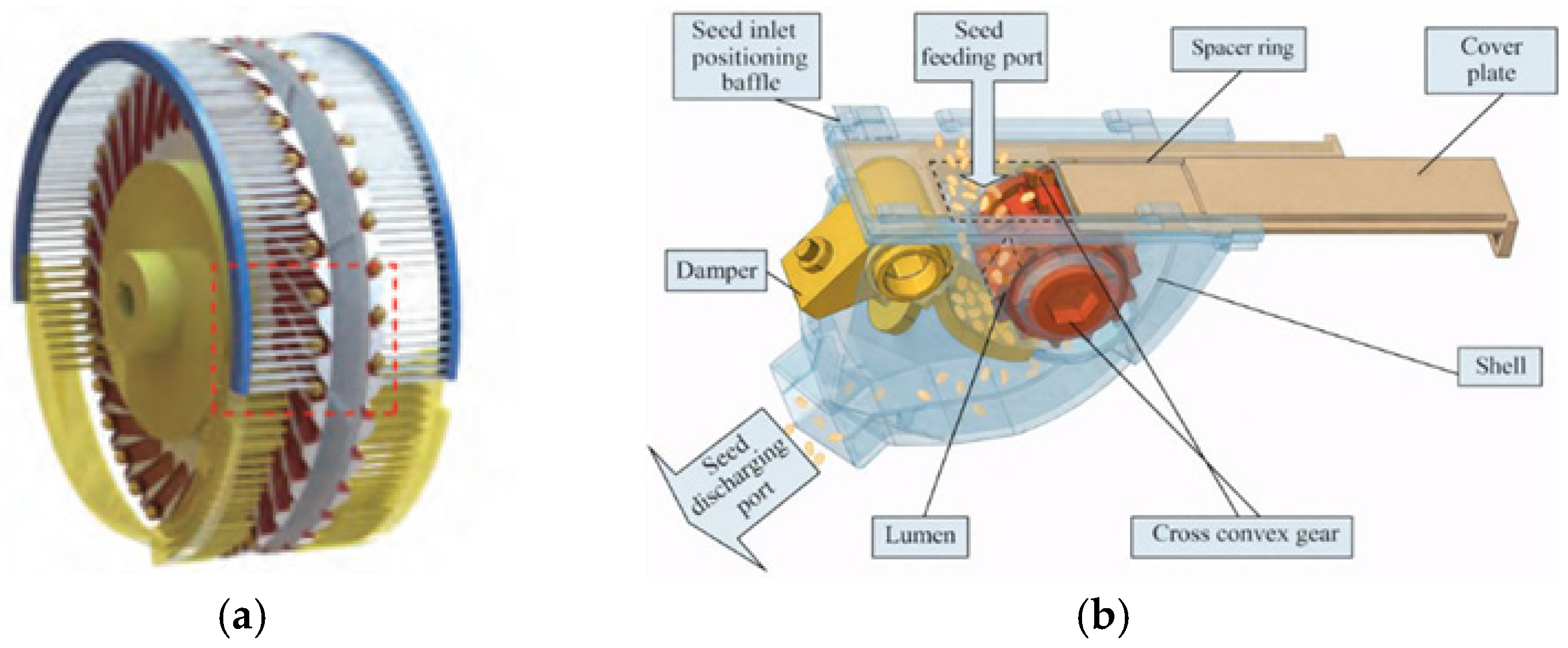
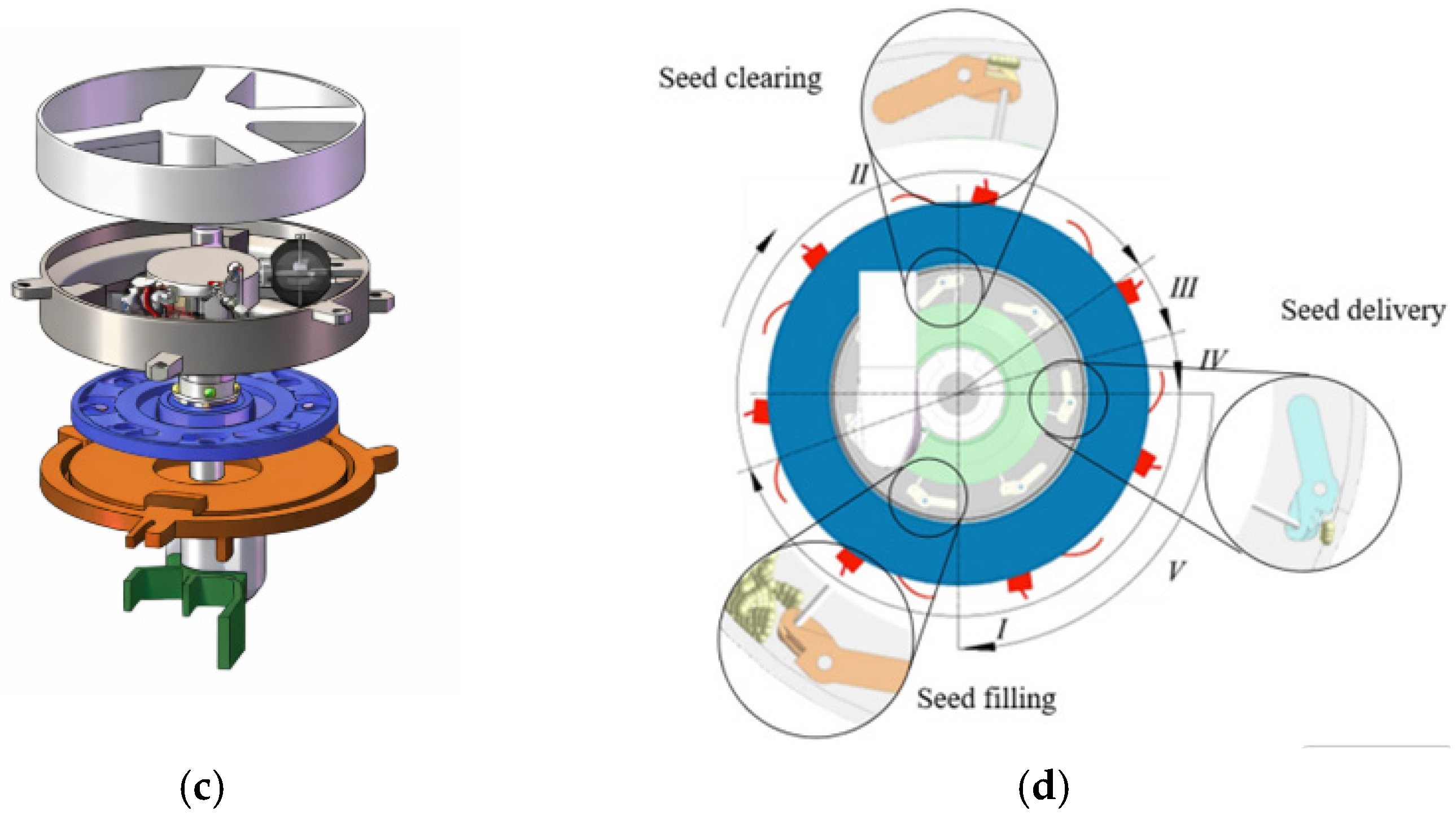
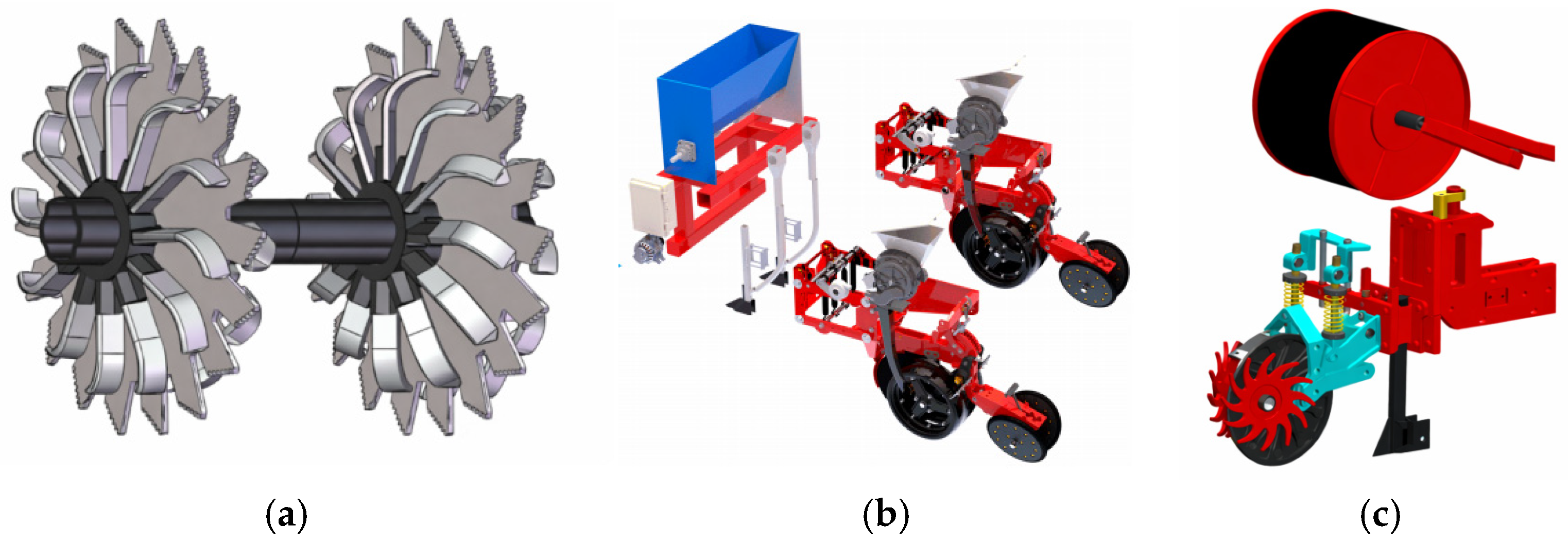
Mechanical seed-metering devices enjoy widespread use in modern agriculture due to their simple structure, low cost, and ease of maintenance. In practical crop seeding applications, different crops present varying demands on seed meter design based on seed characteristics [32,33,34]. Consequently, scholars have conducted in-depth research on major crops such as soybeans, wheat, and corn. For soybean planting, precision seed-metering devices have been developed, including dual-row brush type [35], shaftless spiral type [36], and so on. Li et al. [35] developed a dual-row brush type high-speed precision soybean seed meter with an independent filling mechanism, which enlarges the seed filling space and reduces inter-seed resistance, thereby providing a useful reference for high-speed soybean planting. Wheat seed-metering devices remain a research hotspot. Designs like the interlocking hook-tooth type [37], interlocking convex-tooth type [38], and those employing equal width polygon groove-tooth wheel as seed-picking mechanisms effectively address poor seeding continuity [39], reduce missed and multiple seeds, and enhance uniformity. Corn, a quintessential seeding crop with large seeds and significant shape variation, demands higher consistency in seed pickup and single-seed precision from metering devices [40,41,42]. Related research primarily focuses on optimizing the structure of the device. For instance, horizontal disc type [43], clip-finger type [44], clip-based type [45] and so on. Sun et al. [46] focused on high-speed precision seed-metering device applied in corn wide and delta-row narrow planting mode. They designed a double-cavity, double-disc, staggered, synchronous rotary pneumatic high-speed precision planter, thereby optimizing corn planting efficiency. Another study [47] addressed the issues of double-seeding and skipped seeding in traditional disc-hole seed-metering device by adopting oblique-angle holes with non-parallel faces and annular partitioned shells. This design effectively enhanced single-seed precision and adaptability to seed shape variations. Figure 1 presents several representative structural schematics of typical seed-metering devices [35,38,43,45].
Overall, the diverse seed characteristics of different crops necessitate varied and targeted designs for seed-metering devices. Continuous research advancements not only enhance seeding precision and efficiency but also lay the foundation for multi-crop adaptability and intelligent development [48,49].
As modern agriculture increasingly demands high-speed operations, pneumatic seed delivery technology has emerged [50,51,52]. Whether seeds are flat, spherical, or irregularly shaped, adjusting air pressure enables effective suction or clearance. This method imposes minimal requirements on seed size uniformity, causes little seed damage, and precisely achieves “one seed per cell” [53,54,55]. Pneumatic seeders are categorized into negative-pressure and positive-pressure types based on the source of pressure differential. Furthermore, positive-pressure electric precision seeders are subdivided into pneumatic and air-blow types based on seed scraping methods. In recent years, air-suction electric-driven seeders have integrated negative pressure adsorption with real-time sensor monitoring to achieve seed loss detection and compensation [56,57,58]. Meanwhile, air-blow electric-driven seeders maintain stable seed filling and dispensing performance under high-speed conditions. With advancements in sensor technology and intelligent control, pneumatic electric-driven seeders have gradually become a key focus in research and application.
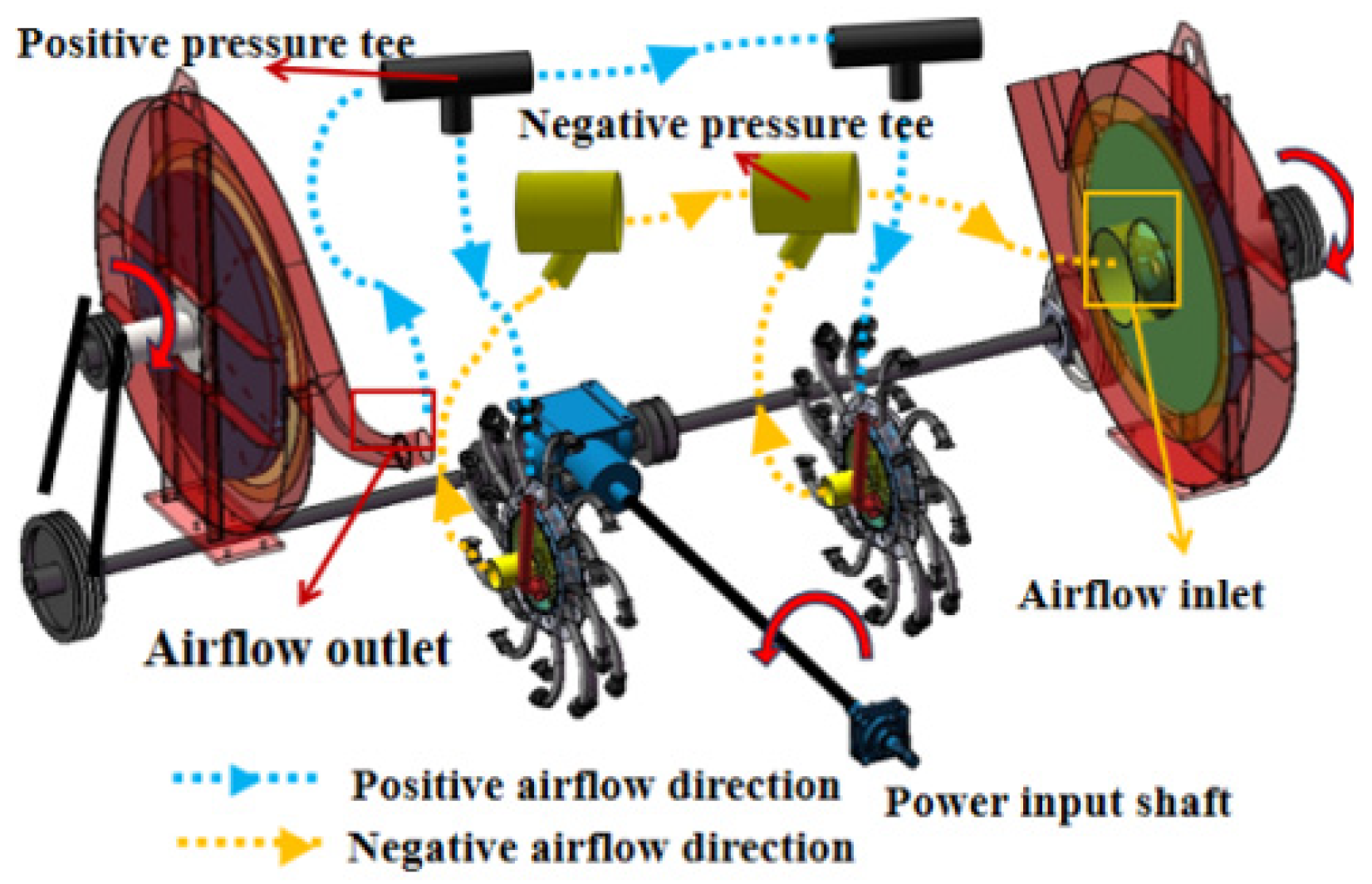
Pneumatic seed-metering systems integrate additional structural components, including vacuum or pressure generation units, air distribution channels, and perforated seed discs. Seeds are temporarily held on the disc surface by pressure differences generated by airflow and are released at designated discharge zones. This non-contact seed handling mechanism enhances adaptability to seed variability and improves seeding uniformity, albeit at the cost of increased structural complexity. Figure 2 displays the detailed configuration and specific components of the pneumatic seed-metering device [51].
In practical applications, Wang et al. [59] achieved stable seed retrieval and delivery control based on the roller-type seeding principle combined with motor drive, significantly improving seeding uniformity at high speeds. Zhang et al. [60] proposed a spoon-wheel electric-driven seeding device tailored to corn seed characteristics, which, through structural optimization and experimental validation, effectively reduced skips and doubles. Meanwhile, Sun et al. [46] employed a motor-direct-drive vertical disc seeder with electromagnetic vibration technology to achieve precision small-quantity seeding for small-seeded crops, demonstrating excellent seeding uniformity and adaptability. Table 1 summarizes the key operating parameters and experimental performance of various pneumatic seed-metering devices reported in the literature. The data presented correspond to the optimal operating conditions identified for each metering device, where MI (Missed-seeding Index) indicates the ratio of missed seeds to total seeds and QI (Qualified-seeding Index) represents the ratio of qualified seeds to total seeds [61].

2.2. Actuation and Drive Mechanisms

Actuation and drive mechanisms constitute the physical basis through which power and motion are transmitted to seeding units in precision seeders. The actuation and drive mechanisms of precision seeders typically consist of power sources, electric or mechanical actuators, transmission components, and row-level execution hardware, which together enable the transmission, distribution, and execution of seeding motions. These mechanisms determine how seeding parameters are executed and adjusted during operation, directly influencing the flexibility and consistency of seeding performance. This section explores the various components and technologies that make up the electric-drive system, focusing on how they contribute to enhanced seeding accuracy and efficiency [62].
Traditional seeders predominantly employ mechanical drive systems based on ground wheels, in which rotational motion generated by wheel–soil contact is transmitted to seed-metering devices through chains, shafts, or gear assemblies. This configuration inherently couples seeding rate with forward speed, ensuring basic synchronization but limiting the ability to independently adjust seeding parameters. Variations in wheel slippage, soil conditions, and terrain irregularities may further affect transmission accuracy and seeding consistency.
To overcome these limitations, modern precision seeders increasingly adopt electric-driven actuation structures. In a precision seeding system, the electric drive not only powers the seed-metering device but also interacts with advanced control algorithms and communication protocols to ensure optimal seed placement [63].
Selecting the optimal motor type to achieve peak efficiency and adaptability across diverse scenarios is critical for electric-driven seeders. Precision seeding demands stable seed delivery rates across varying operating speeds and crop row spacings, requiring motors capable of high-precision speed regulation and rapid response to changes. Consequently, considering these factors, stepper motors, brushed DC motors, brushless DC motors, and permanent-magnet synchronous motors (PMSM) have all been applied in modern electric seeder-drive systems, among which the brushless DC and PMSM solutions are more commonly used in medium- to high-speed precision seeding scenarios. Table 2 below outlines different motor types and their key parameters.
The above analysis of key metrics, including QI for each motor type, demonstrates their respective strengths and limitations. However, due to variations in control methods, operating speeds, and experimental conditions, the data in the table should be used for reference only. Nevertheless, Wang et al. [61] present performance data for five motors at different speeds (6 km/h, 9 km/h, 12 km/h, 15 km/h, and 18 km/h) during testing, covering key metrics such as QI, dropout rate, and coefficient of variation (COV). Wang compared and summarized the operational characteristics of five distinct motor types. Through experiments, Wang contrasted the performance of open-loop stepper motors (ST_OP), closed-loop stepper motors (ST_CL), brushless DC motors (BLDC, with Hall encoder BL_HL and optical encoder BL_OPT), and brushed motors (BR) at various seeding speeds. Experimental results indicate that compared to stepper motors, BR motors exhibit poorer performance in high-speed response and low-speed stability. ST_OP motors operate stably but are unsuitable for high-speed seeding. BLDC motors are not the optimal choice for electric-driven seeding in terms of cost and precision. If the interference resistance of ST_CL motors can be enhanced, these motors hold significant potential for widespread application in the future.
Therefore, future research should focus on optimizing the response speed, stability, and interference resistance of existing motor systems to further enhance the adaptability and reliability of electric-driven systems in high-speed seeding, particularly in multi-row seeders.
In addition to seed-metering actuation, precision seeders incorporate adjustment actuation mechanisms to regulate seeding-related parameters during operation. These mechanisms are responsible for translating control inputs into mechanical adjustments of components such as seeding depth, downforce, and row-unit engagement, thereby supporting flexible adaptation to varying field conditions. Key components include mechanical springs, contour wheels, and parallel four-bar linkages. The parallel four-bar linkage, due to its structural and kinematic properties, ensures stable furrower posture during vertical movement, minimizing depth errors caused by angular variations. However, these adjustment methods increasingly struggle to adapt to complex field conditions. To overcome this challenge, scholars have proposed active adjustment systems driven by hydraulic or pneumatic actuators. This approach replaces the springs in traditional mechanical structures with hydraulic or pneumatic actuators, which provide precisely adjustable, nearly constant force or torque output, enabling effortless control of long-stroke, complex motions [67].

2.3. Sensing and Communication Configuration

Sensing and communication configuration constitute the information acquisition and communication foundation of precision seeders, supporting adjustable seeding operations and subsequent control processes. Modern precision seeders integrate a variety of sensing devices and hardware components to monitor machine states, seeding processes, and field-related information. From a system perspective, these sensing and hardware elements can be broadly categorized into onboard sensing systems and external information sources, which are interconnected through standardized communication interfaces [68].
Onboard sensing systems are primarily installed on the seeder itself to monitor seeding operations and machine conditions in real time. Typical onboard sensors include speed sensors used to measure the operational speed of the seeder, seed flow or seed presence sensors for detecting missed or multiple seed deposition, displacement or force sensors for seeding depth and downforce monitoring, and heading and positioning sensors. These sensors provide direct feedback on seeding performance and mechanical states, forming the basis for real-time monitoring and parameter adjustment.
The precision of the speed measurement system directly affects the uniformity and efficiency of seeding, making the selection of appropriate speed measurement technology essential [69,70]. Speed measurement modules typically consist of multiple components, including speed sensors, data processing algorithms, and associated feedback mechanisms. In practical operations, speed monitoring primarily encompasses two aspects: the field travel speed of the machine assembly and the real-time rotational speed of the seed-metering device. For ground speed measurement, traditional ground wheel speed sensing is prone to significant errors due to the influence of slip rates between soil and tires; non-contact measurement technologies such as millimeter-wave radar and GNSS systems effectively address this issue. GNSS units are typically mounted on the tractor. However, in high-precision scenarios, some systems deploy GNSS directly on the planter to eliminate trajectory and speed deviations caused by towing. For measuring planter shaft speed, Hall sensors or encoders are commonly used to monitor the rotation of the seeding shaft, enabling precise seed-placement control. Table 3 below summarizes these commonly used speed measurement components and their key characteristics, categorized by measurement target to assist in technology selection.
In addition to onboard sensing, external information sources are increasingly incorporated to support spatially variable and field-adaptive seeding operations. Such information may include positioning data, tractor-related operational parameters, soil property measurements, history yield, meteorological data and prescription maps derived from off-machine sensing platforms. External data are typically obtained through positioning systems, field sensors, or pre-generated datasets, and serve as spatial or environmental inputs for adjustable seeding strategies.
Soil property data are increasingly incorporated as external information sources for adjustable seeding operations. Soil-related information commonly includes moisture content, electrical conductivity, and other indicators reflecting spatial variability of field conditions. Such data can be obtained through onboard soil sensors, proximal sensing devices, or pre-collected datasets derived from field surveys or remote sensing platforms.
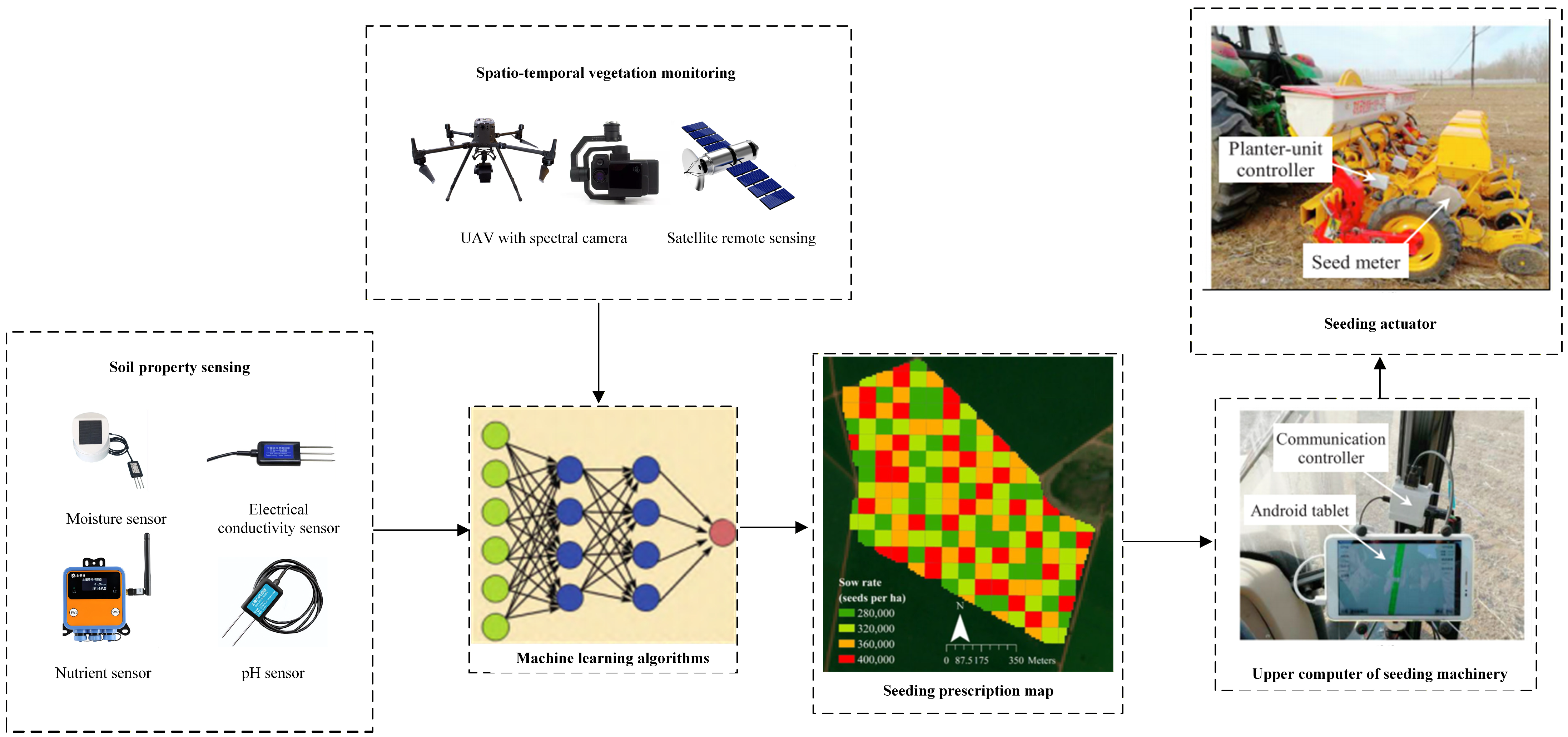
Soil-related information used in precision seeding primarily includes soil moisture content and indicators associated with soil spatial variability, such as electrical conductivity and organic matter content. Soil moisture content detection methods include the oven-drying weighing method, ultrasonic method [78], and dielectric method [79], as well as gamma-ray- [80] and cosmic-ray-based [81] sensing techniques. Soil electrical conductivity sensors are widely employed as proximal sensing tools to characterize within-field variability. Soil organic matter is generally obtained through indirect approaches, including spectral sensing or pre-generated soil maps, rather than direct onboard measurement. Remote sensing and spectral techniques, such as UAV-based multispectral sensing, are commonly used to generate prescription maps that provide spatial inputs for adjustable seeding operations. These soil information sources provide spatial inputs that support adjustable and variable seeding operations. Figure 3 illustrates the overall framework for the information flow of adjustable seeding operations, from soil property sensing and UAV-based remote sensing to prescription map generation and execution by seeding control units [82].
The integration of onboard and external information relies on reliable communication interfaces between the seeder, tractor, and control units. In practical applications, standardized communication protocols are widely adopted to enable data exchange and system interoperability. Controller area network (CAN)-based communication architectures are commonly used for intra-machine data transmission among sensors, actuators, and controllers. Furthermore, in tractor–implement systems, standardized interfaces such as ISO 11783 (ISOBUS) [83] allow precision seeders to access tractor-provided information, including positioning and operational data, without requiring redundant hardware installation. To achieve direct data communication among multiple agricultural machines, wireless communication is necessary. This mainly includes short-range communication methods such as Bluetooth, Wi-Fi, and ZigBee, as well as remote communication methods like 4G/5G [84]. Through the coordinated integration of sensing hardware, external information sources, and communication interfaces, modern precision seeders establish a unified hardware and information framework. This framework enables real-time monitoring of seeding processes and provides essential inputs for adjustable seeding control technologies, which are reviewed in the following chapter.
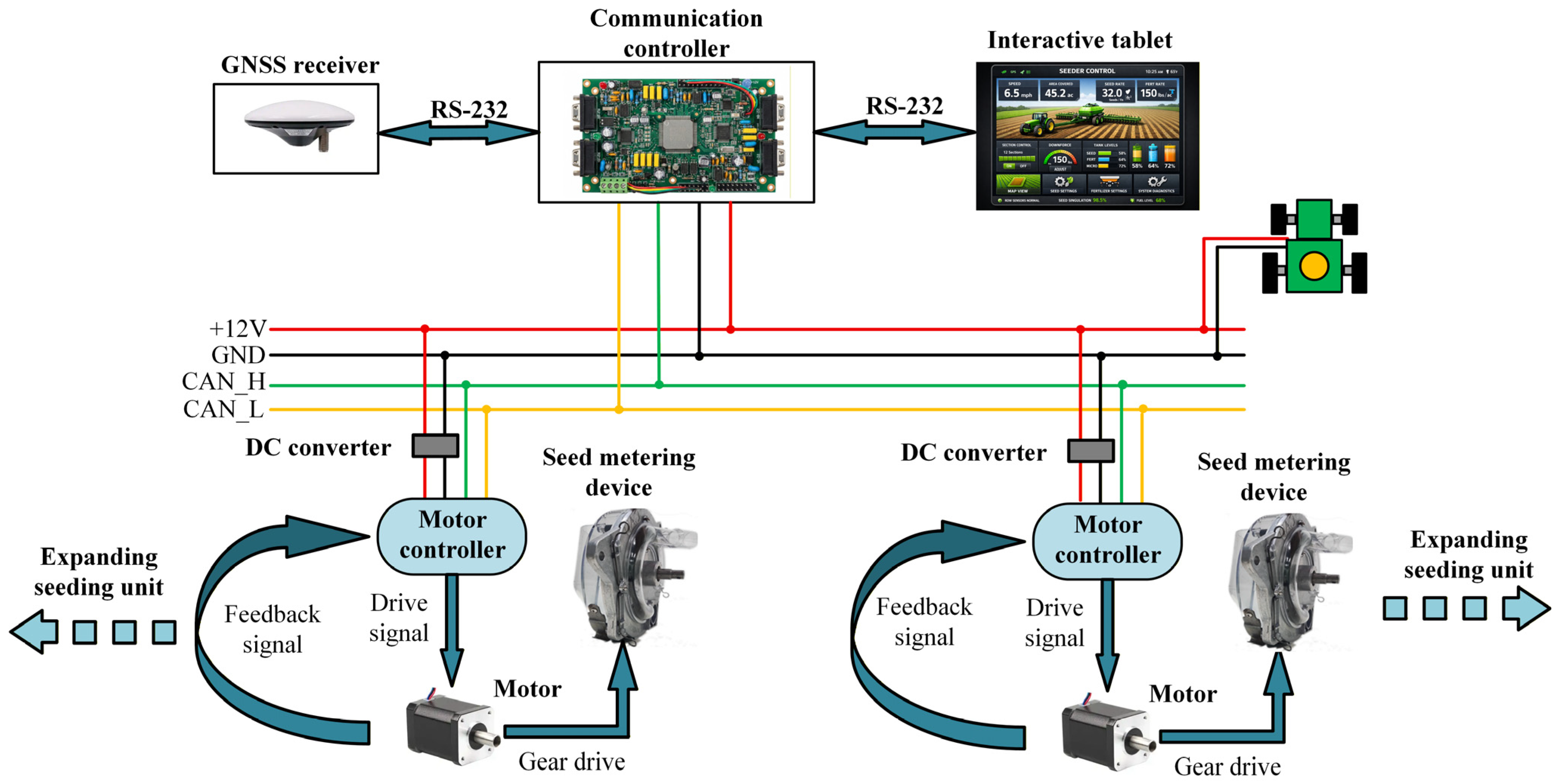
Figure 4 illustrates a schematic diagram of an electric-drive seeding control system based on CAN bus [85]. As shown, the system comprises a GNSS receiver, communication controller, interactive display, DC converter, seeding unit drive motor, and seeding counter. The control system, which drives the seeding counter motor and seeding counter via CAN bus, offers excellent scalability for seeding units. Its expansion ports allow for the flexible addition of extra seeding units. Furthermore, the system can be adapted to other seeders by simply modifying the seeding unit to accommodate a seed-metering device. The GNSS receiver handles precise tractor positioning and navigation. Communication methods within the controllers include RS232, RS485, and CAN bus. Interactive panels can be serial displays or Android devices. Communication controllers may utilize PLC controllers, microcontrollers, or industrial computers. Drive motor options include stepper motors, brushed motors, or brushless motors. Feedback signals can originate from various speed sensors.

2.4. Emerging Seeding Technologies and Structures

With the development of intelligent agriculture, unmanned aerial vehicle (UAV) seeding technology and seeding robots, as advanced and sophisticated equipment, are providing new solutions for precise and efficient crop cultivation.
Existing studies have demonstrated that UAV seeding technology is an effective way to increase yield and economic benefits. Castro et al. [17] proposed a paradigm shift from traditional “blanket” drone seeding to a precision-based approach. By integrating artificial intelligence with high-resolution remote sensing, drones can deploy seeds exclusively at sub-meter scale locations optimized for survival. Qi et al. [86] developed a multifunctional UAV platform for rice management that integrates seeding, fertilizer spreading, and pesticide application. Overall, these studies indicate that UAV-based seeding can be a promising solution for improving mechanization efficiency in production, although limitations such as payload and fertilizer spreading efficiency still need further improvement.
From the perspective of seeding robots, Azmi’s team designed and developed a low-cost agricultural robot for crop seeding, which increased the crop seeding efficiency by more than 35% [87]. Kumar et al. [88] designed an intelligent seeding robot consisting of a mechanical arm. This system uses an intelligently designed mechanical system to fully automate the seed seeding process. Robotic seeders, while offering superior flexibility in navigating complex field conditions and adapting to varying crop requirements, may still face limitations in operational throughput compared to conventional or drone-based systems.
Taken together, UAV seeding systems are well-suited for broad-scale broadcasting applications due to their high operational efficiency, particularly over expansive or inaccessible terrain. However, they lack the capability to regulate precise inter-row and intra-row seed placement. In contrast, robotic arm-based seeding offers superior flexibility and spatial control, making it ideal for targeted seeding tasks such as small-scale planting, reseeding, or localized seed distribution in controlled environments. Nevertheless, this method is characterized by relatively lower efficiency, which restricts its feasibility for large-scale agricultural operations. Optimistically, these technologies represent a trend towards smart, adaptable, and data-driven seeding strategies, highlighting both the opportunities and challenges in integrating high-tech solutions into modern agricultural practices.

3. Precision Control Technologies

Seeding requires precise control over seed spacing, seeding depth, and spatial position. Correspondingly, precision seeding control technologies can be broadly categorized into seed-placement control, seeding depth control, and trajectory control. Additionally, these control strategies are supported by real-time monitoring of seeding processes and outcomes, which provides feedback for performance evaluation and parameter adjustment. The application of these precise technologies ensures the proper arrangement of seeds, thereby improving germination rates and crop growth quality. Next, we will delve into how these precision control technologies play a key role in the seeding process.

3.1. Seed-Placement Control

With the growing demand for high-speed, precision seeding, mechanical design improvements alone are often insufficient to ensure consistent seeding accuracy, thereby motivating the adoption of advanced motor-drive control and optimization methods. With the development of electric-drive seed-metering devices, seed-placement control has evolved from mechanically coupled regulation toward more flexible and adjustable control structures. These advances not only improve seeding accuracy under varying operating conditions but also provide the execution basis for variable-rate seeding (VRS) applications [89]. Variable-rate seeding represents an extension of seed-placement control, in which seeding parameters such as seed spacing or seeding rate are adjusted spatially or temporally according to field conditions. From an execution perspective, VRS is primarily realized through an electric-drive seed-metering device that enables rapid and flexible regulation of seeding output. Depending on information sources, VRS implementations generally include map-based approaches [90] and sensor-based approaches [91]. These methods rely on the same seed-placement control structures, differing mainly in how target seeding parameters are determined.
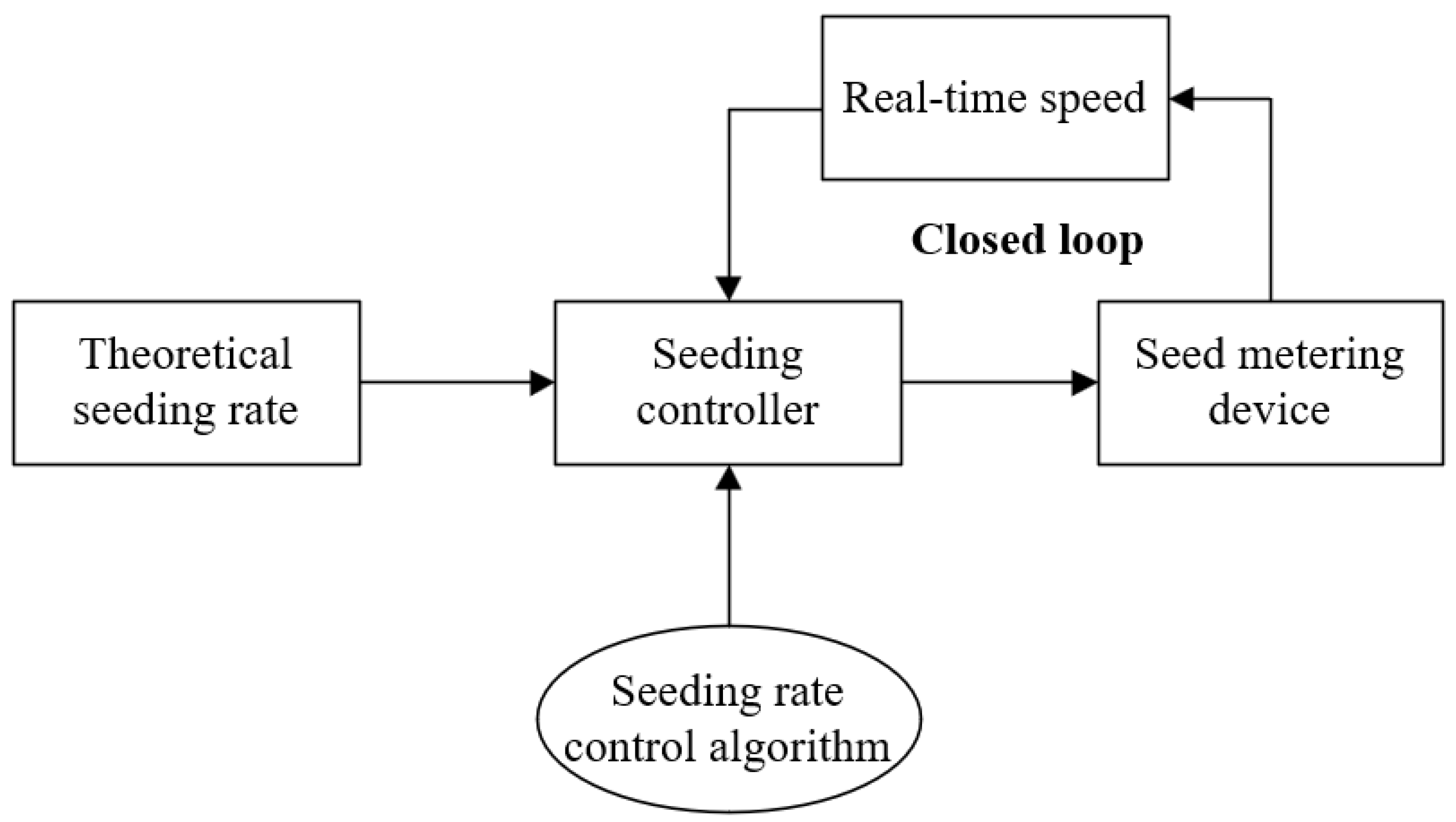
Early decision systems predominantly relied on experience-based and rule-based models. By setting thresholds or empirical parameters, these models correlated soil indicators with operational parameters like seeding rate and depth. While simple to implement, such methods lacked flexibility and struggled to adapt to complex field conditions. With advances in computational technology, researchers gradually incorporated optimization algorithms—such as linear programming, dynamic programming, and genetic algorithms—enabling seeders to seek optimal seeding solutions under multi-objective constraints. This significantly improved resource utilization efficiency and operational effectiveness [92,93,94]. With the support of multi-source sensors and remote sensing technology, real-time and accurate data on field soil moisture, nutrients, and organic matter content can now be obtained. However, the data itself cannot directly guide seeding operations and still requires further analysis and processing. Therefore, the introduction of a decision-making system becomes particularly crucial [95]. It can fuse, model, and optimize complex data, thereby providing a scientific basis for seed rate adjustment, seeding depth selection, and operational path planning. As shown in Figure 5, to achieve precise variable-rate seeding, a closed-loop feedback mechanism is typically employed to ensure that actual seeding rates dynamically match operational conditions.
Consequently, motor-control methods for seed-metering devices are essential to maintain consistent seed spacing and seeding performance during variable-rate operations. As a fundamental motor-control strategy in electric-drive systems, Field-Oriented Control (FOC) enables decoupled current regulation in permanent magnet synchronous and brushless motors, thereby providing precise torque control and stable low-speed operation. Existing study [96] has demonstrated that, compared with traditional square-wave control methods, FOC-based drive systems can significantly improve rotational speed stability and torque smoothness of seed-metering units, contributing to more uniform seed delivery and enhanced seeding accuracy. Building upon the high-performance drive capability enabled by vector control, classical closed-loop control strategies such as PID (Proportional–Integral–Derivative) and fuzzy PID have been widely adopted in electric-drive precision seeders to improve speed tracking accuracy and disturbance rejection [97]. Previous studies have demonstrated that feedback-based motor speed control can effectively maintain stable operating conditions under varying seeding requirements [98].
To further enhance adaptability and robustness in high-speed seeding scenarios, recent research has progressively incorporated advanced optimization and intelligent algorithms into motor drive control frameworks. Representative studies have explored the integration of optimization techniques, such as Particle Swarm Optimization (PSO) [99], with adaptive control strategies to improve dynamic response and stability of seed-metering systems [100]. In addition, multi-objective optimization methods [101] have been applied to parameter prediction and performance optimization of electric-drive and pneumatic precision seeders. Overall, these studies indicate a clear trend toward algorithm-assisted and intelligent motor-control strategies for enhancing the performance and adaptability of precision seeding systems.
Overall, it is foreseeable that pneumatic electric-drive precision seeders will represent the future trend in seeding technology. Their deep integration with intelligent monitoring, variable control, and optimization algorithms will provide more reliable equipment support for precision agriculture. Further improvements through technological advancements and field testing are needed to enhance the system’s adaptability and robustness, ensuring stable and reliable operation in complex and variable agricultural conditions. In practical applications, according to Tormen et al. [102], the combined use of remote sensing and soil data in precision seeding is gaining increasing attention. Leveraging CubeSats and satellite imagery enables the acquisition of high-resolution soil information. When integrated with historical yield data, soil electrical conductivity, and other indicators, this approach provides foundational data support for decision systems. This methodology allows for the dynamic adjustment of seeding parameters to adapt to varying soil conditions and crop requirements. Loewen et al. [103] propose that machine learning-based decision systems are becoming central to precision seeding technology. Through data-driven models like random forest algorithms, these systems extract actionable insights from large-scale, multidimensional sensor data to dynamically adjust seeding rates and fertilization strategies in real time. Data-driven systems autonomously learn complex relationships between crop growth and soil conditions, enabling highly personalized and adaptive seeding decisions. By integrating economic optimization models, these systems maximize production efficiency, minimize resource waste, and enhance agricultural profitability. Table 4 summarizes the key parameters and performance indicators of variable-rate seeding systems reported in several representative studies, highlighting differences in seeding accuracy, field scale, and influencing factors.
Beyond the control of seed-metering motors, precision seed placement in modern high-speed seeders is jointly determined by multiple actuation mechanisms. In pneumatic seed-metering systems, airflow regulation represents a complementary and equally critical control dimension that directly affects seeding stability and uniformity.
By modulating parameters such as negative pressure or airflow rate, pneumatic systems can adapt to variations in operating speed, seed size, shape, and surface properties. Karayel et al. [106] applied artificial neural network (ANN) models to estimate the optimal vacuum pressure of air-suction seed-metering devices based on seed physical properties. By establishing the relationship among parameters such as seed size, mass, density, and sphericity and the required vacuum level, the proposed method enabled crop-specific adjustment of pneumatic seeding parameters. This approach reduces reliance on empirical tuning and contributes to improved seeding quality across varying seed conditions. Li et al. [107] explored electrically driven and distributed airflow regulation in pneumatic precision seeders to overcome the high energy consumption and limited adjustability of conventional centralized fan systems. By enabling row-unit-level pressure regulation and closed-loop control, these approaches improve wind pressure adaptability across different speeds and crop types, thereby increasing the seeding accuracy rate to 98%.
Despite current research progress, intelligent seeding decision-making systems still face significant challenges. First, multi-source data fusion and real-time processing remain difficult research areas. Second, the precision and adaptability of algorithmic models require further optimization, particularly regarding their ability to perform across different crops, soil types, and climatic conditions. Finally, existing technologies largely rely on high-cost sensor equipment and remote sensing imagery, limiting their applicability to small-scale farms.

3.2. Seeding Depth Control

Seeding depth significantly impacts seed germination rates and seedling development. Proper seeding depth enhances soil and water conservation capabilities, ensuring uniform grain seed emergence and maximizing utilization of light, temperature, and soil resources. However, during actual field operations, the mechanical structure of traditional seeders often fails to adapt to variations in soil hardness or elevation. This leads to excessive or insufficient planting depth, resulting in inconsistent light, heat, and moisture conditions for plants. Ultimately, this causes uneven seedling emergence, impairs plant productivity, and reduces yield. Therefore, precise control of planting depth is essential [108,109,110].
Traditional seeders primarily rely on mechanical limits and gravity contouring for depth adjustment [111]. Depth is regulated through mechanical limits such as depth wheels, depth boards, and furrower positioning. The depth wheel contacts the ground, with the fixed height difference between the depth wheel and furrower determining seeding depth. During operation, the depth wheel rolls on the surface to support the machine body, stabilizing the coulter at the preset depth. Spring or counterweight-assisted downward pressure is applied, with elastic deformation buffering depth fluctuations caused by soil hardness variations. This approach features a simple structure and low cost but requires manual adjustment, exhibits poor adaptability, and responds slowly to ground contour changes.
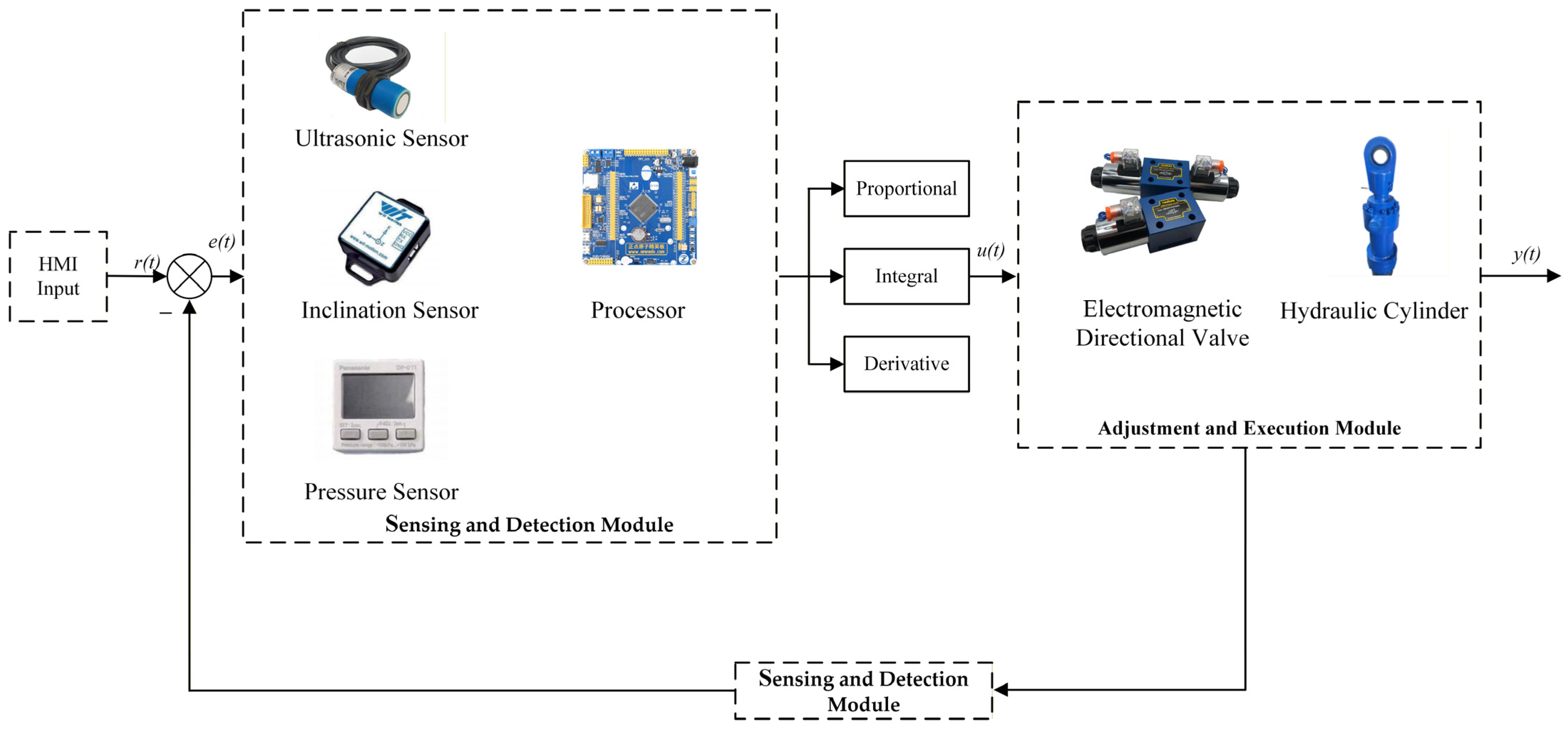
With advancements in sensor and electronic control technologies, closed-loop intelligent depth-control systems based on “perception–decision–execution” have emerged as the mainstream research approach to overcome these limitations and achieve precise, stable, and adaptive seeding depth. A typical intelligent seeding depth-control system comprises three major modules: sensing and detection, adjustment and execution, and decision-making and control. These modules work in concert to realize intelligent seeding depth control. The flowchart of the intelligent depth-control system based on PID control is shown in Figure 6 [112]. The seeding depth-control system adopts a closed-loop feedback mechanism, where the desired depth is continuously compared with the actual depth to generate an error signal that drives the controller. The controller outputs adjustment commands to the hydraulic actuators, enabling real-time regulation of the opener’s working depth. Multi-source sensors provide continuous monitoring of machine status and soil conditions, forming a dynamic feedback loop that ensures stability and consistency of the seeding depth.
The sensing and detection module serves as the perception layer of the intelligent depth-control system, enabling real-time acquisition of surface conditions and operational depth information [113,114,115]. Common sensing methods can be categorized into direct and indirect detection based on their operational principles. Direct measurement techniques involve using ultrasonic sensors, lidar, or mechanical displacement sensors to directly gauge surface contour variations or employing angle sensors to measure the swing angle of a contouring tray to detect surface undulations. Building upon these principles, researchers worldwide have developed various seed depth detection devices. Cai et al. [116] designed an ultrasonic sensor-based automatic furrow depth-control system test bench, integrating hydraulic mechanisms to adjust seeding depth and enhance consistency. Nielsen [117] developed an angle sensor-based seeding-depth-detection system that dynamically controls coulter penetration depth via electro-hydraulic actuators, overcoming depth instability caused by soil resistance variations.
An indirect detection method involves monitoring soil reaction forces on the coulter or press wheel using various sensors, then inferring seeding depth through predefined soil-mechanics models or empirical equations. Li et al. [118] employed furrow opener penetration depth sensing, installing pressure sensors to obtain real-time downward pressure of the furrow opener, thereby calculating actual seeding depth. Huang et al. [119] proposed an active piezoelectric film-based seed-placement depth-control system, whose core principle involves indirectly controlling placement depth by monitoring the pressure exerted by the seeding unit on the soil surface. Li et al. [112] designed an intelligent seeding depth adjustment system based on Flex sensors and the Mamdani fuzzy model. This system utilizes Flex sensors installed within the gauge wheels to monitor ground pressure and employs fuzzy control algorithms to adjust the downward force of the air spring in real time, thereby maintaining stable seeding depth. Field trial results demonstrate that at operating speeds of 6–10 km/h, the system controls seeding-depth error within ±9 to ±22 mm, exhibiting significantly superior performance compared to traditional passive adjustment systems.
The adjustment and execution module serves as the power and mechanical unit for depth adjustment, with its response speed and control precision directly impacting seeding quality. Nielsen et al. [120] developed a hydraulic control system utilizing multiple displacement sensors and ultrasonic sensors to monitor each coulter depth in real time, laying the foundation for subsequent automatic control; Gao et al. [121] proposed a seeding downforce control method based on airbag pressure and contouring four-bar linkage inclination, significantly outperforming passive spring-based downforce adjustment.
The decision-making and control module serves as the system’s brain, responsible for data fusion, algorithmic computation, and command execution output. Common approaches include PID control, fuzzy control, feedforward compensation, and machine learning-based predictive control. Algorithms dynamically adjust planting depth based on operating speed, soil characteristics, and terrain variations.
In Table 5, we summarize different types of depth-control systems reported in previous studies, highlighting their sensor detection modules, execution adjustment modules, and control and decision modules. These studies provide useful references for the design and optimization of precision seeding depth-control systems.
Regarding depth control for precision seeders, mainstream research has shifted from indirect measurement methods based on gauge wheels to direct measurement methods utilizing multiple sensors. However, due to the presence of dust, crop residue, and intense vibrations in seeding environments, sensors are highly susceptible to interference. Additionally, in control algorithms, physical delays inherent in hydraulic or pneumatic actuators often cause control systems to lag behind when seeders operate at high speeds, failing to adjust in time. Therefore, future depth control for precision seeders will evolve comprehensively from the current passive lag feedback to active feedforward prediction. By integrating multiple sensors to directly perceive furrow depth and soil moisture while pre-scanning terrain, combined with AI adaptive and MPC algorithms to eliminate control lag [122], and utilizing millisecond-response fully electric actuators for individual independent adjustment, the ultimate goal is to achieve extreme adaptability to complex soil conditions and precision seeding during high-speed operation.

3.3. Seeding Trajectory Control

Trajectory control is the core function enabling precision operations in agricultural machinery, ensuring the machine travels along predetermined routes [123,124]. This directly impacts seeding straightness, row spacing consistency, and land utilization efficiency [125]. Trajectory for seeders can be broadly categorized according to machine configuration, including tractor-towed seeders and self-propelled or autonomous seeders. In current agricultural practice, tractor-towed seeders represent the dominant configuration, and their trajectory control is largely executed by the tractor, following field traversal patterns similar to those used by other towed agricultural machinery. Seeders exhibit unique characteristics—such as multi-row kinematic constraints, seeding delays, and row-level consistency requirements—that directly link trajectory control to seeding quality. In this review, tractor-towed seeders are taken as the primary research object to introduce the development progress of trajectory control in precision seeding applications.
Therefore, trajectory control for tractor-towed seeders can be broken down into path planning and path tracking. The former aims to design optimal field routes, whereas the latter addresses accurate tracking of the planned trajectory considering tractor–implement kinematics, lateral offset, and seeding delay effects.

3.3.1. Path Planning

Precise positioning serves as the prerequisite for implementing path planning [126,127,128]. Based on positioning methods, common approaches include absolute positioning and relative positioning. A typical example of absolute positioning is GNSS, which utilizes global navigation satellites for positioning. Typical relative positioning methods include machine vision, inertial navigation, and LiDAR positioning. Common navigation sensors encompass millimeter-wave radar, LiDAR, IMUs, RGB-D cameras, and others. Recent research indicates a clear trend toward the combined use of multiple positioning and sensing approaches to improve robustness in agricultural operations. Noguchi [129] et al. developed an autonomous agricultural tractor equipped with an intelligent navigation system. This system integrates multiple sensors, including RTK-GPS, fiber optic gyroscopes, and CCD cameras, dynamically selecting the optimal navigation data source across varying operational environments through sensor fusion algorithms.
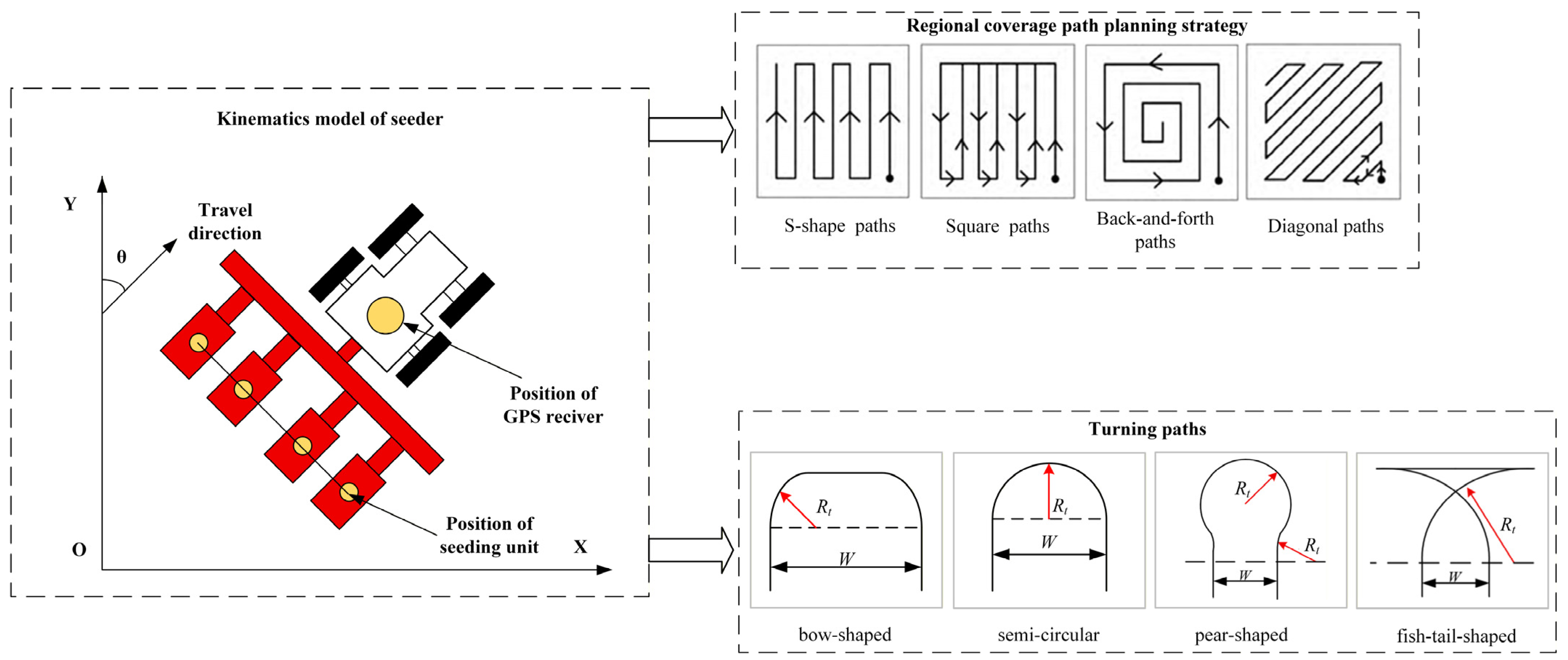
Compared with other towed machinery, seeders exhibit several distinctive characteristics that must be considered in path planning. Unlike fertilization or spraying operations, the path planning of seeders serves as the spatial blueprint for subsequent crop growth. Therefore, it must simultaneously satisfy vehicle kinematic constraints and strict agronomic requirements, such as row spacing, planting patterns, and inter-row consistency, resulting in fundamentally different planning objectives and constraints. Current full-area path planning schemes primarily include four typical types: S-shaped, square, back-and-forth, and diagonal, as illustrated in the right panel of Figure 7 [11,130]. However, due to the tractor–seeder combination structure, seeding operations are governed by a specific kinematic model, as illustrated in the left panel of Figure 7. Unlike point-based machinery, multi-row seeders involve multiple seeding units, each following a different turning radius during headland maneuvers, which imposes additional geometric constraints on trajectory design. Seeder path planning is not limited to point-to-point motion but aims to achieve full-field coverage, requiring coordinated planning across main working areas, headlands, and transitional zones. Accordingly, beyond executing predefined spatial trajectories, seeding operations must comprehensively consider turning maneuvers at field heads, acceleration and deceleration segments during travel, and the differentiated switching of seeding parameters and control strategies across operational zones.
To address the problem of uneven cultivation that occurs when unmanned agricultural machinery makes turns at the field edge, Hu et al. [131] proposed a boundary-finding path planning method based on the improved Reeds–Shepp (RS) curve. This study conducted real vehicle tests for different land shape types such as rectangles, trapezoids, and arbitrary quadrilaterals. Compared with traditional algorithms, this method achieved an operation coverage rate of 96.44% in rectangular plots; in more challenging trapezoidal and arbitrary quadrilateral plots, the coverage rates reached 95.47% and 95.69%, respectively.
In summary, intelligent path planning for seeders is evolving toward a more comprehensive and collaborative paradigm, where terrain adaptation, machine coordination, and real-time optimization collectively shape the foundation of next-generation autonomous seeding systems.

3.3.2. Path Tracking

Path tracking in seeding ensures that the ideal path determined by global planning is reliably translated into actual travel trajectories, with real-time corrections applied to prevent skips or overlaps. Simultaneously, smooth speed tracking synchronizes the vehicle’s movement with the seeding rate, guaranteeing consistent row spacing and plant spacing.
Path tracking methods for precision seeders can generally be categorized into two types: model-free approaches and model-based approaches [132]. Model-free methods do not rely on specific mathematical models of the seeder. Instead, they achieve path tracking directly through geometric relationships or control rules. These methods are simple to implement, computationally efficient, and exhibit low dependency on seeder models. Representative model-free approaches include the Pure Pursuit method [133] and Stanley method [134]. In contrast, model-based methods rely on mathematical models of the seeder, comprehensively considering its kinematic constraints or dynamic characteristics to design controllers based on these models. Such approaches can more accurately describe the seeder’s motion patterns, making them suitable for more complex or high-precision operational scenarios. Representative approaches include PID control based on kinematic equations and model predictive control based on kinematic models.
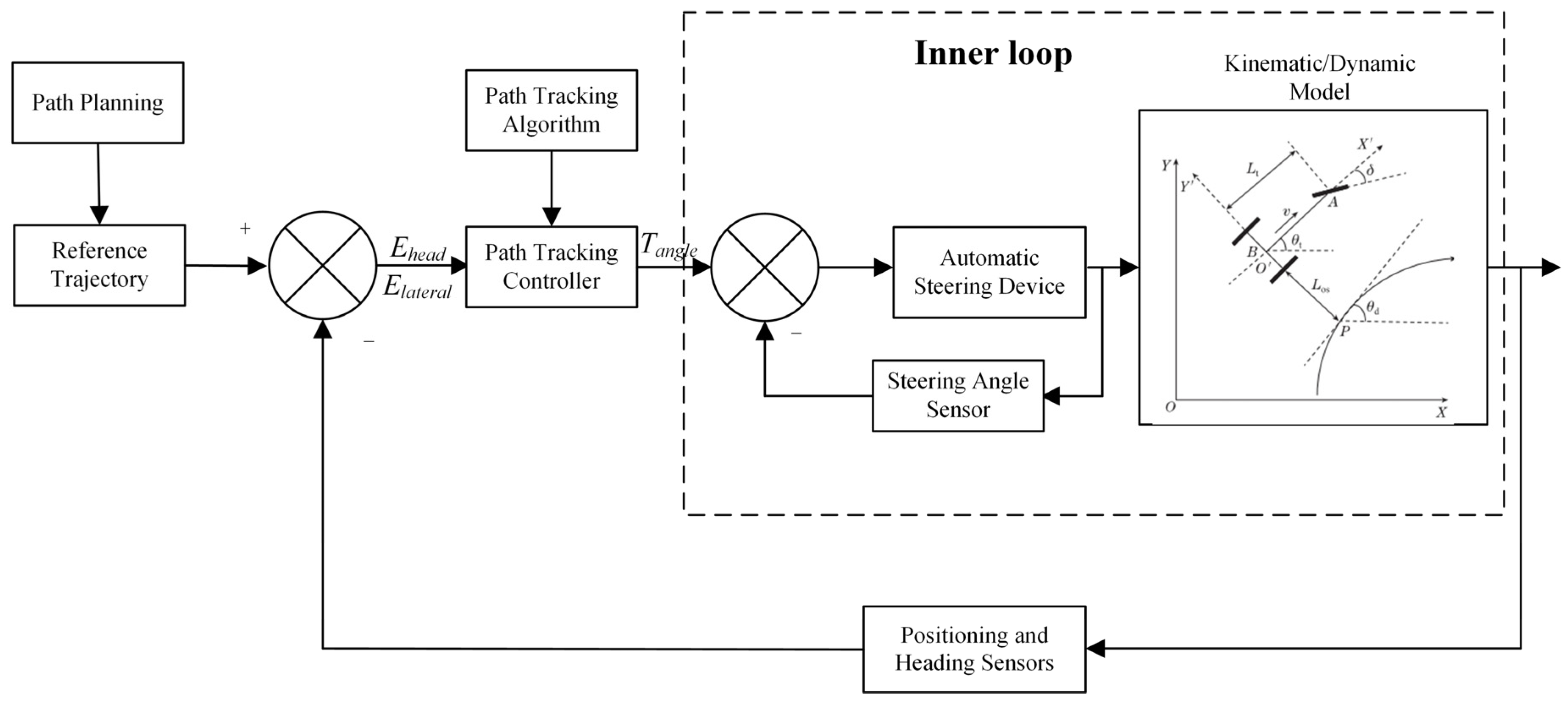
To achieve high-precision trajectory monitoring for the planting equipment, a suitable control system must be constructed. The proposed control scheme is shown in Figure 8. The system mainly consists of trajectory planning, trajectory monitoring, control mechanisms, and sensor feedback. Through a closed-loop control system, the stability of the planting machine on complex terrain can be ensured as it follows the reference trajectory.
The aforementioned models and algorithms primarily target trajectory–velocity tracking control within a single region. However, seeding operations typically involve zoned variable requirements, where different zones correspond to distinct target seeding rates, speeds, and motor parameters. Therefore, it is necessary to further incorporate zoned triggering and parameter switching strategies into the path tracking framework to achieve continuous and stable operation across zones. Lin et al. [135] investigated the automatic section control technology for maize precision seeders, focusing on the modeling of seeding delay time and seeding lag distance. The established models effectively predicted actual seeding lag distance, providing a theoretical basis for improving seeding precision. Furthermore, for the acceleration phase of an electric-drive maize seeder, Zhai et al. [136] proposed a novel tracking differential filtering–optimal tracking control method to enhance seeding precision. The system integrates a nonlinear tracking differentiator to filter oscillatory GNSS–IMU speed signals and a linear quadratic tracker to ensure the motor rapidly follows target speeds. Field tests showed that the TDF-OTC method increased the average seeding qualification rate from 80.72% to 90.63%.
It can be seen that numerous effective path tracking strategies for agricultural machinery have been proposed. These control strategies have demonstrated their superiority, and the literature on methods that simultaneously incorporate path planning and path tracking is also available for reference, as shown in Table 6, which displays their control method and performance.
Despite extensive research on trajectory control for precision seeders, significant limitations persist. For instance, tire traction varies due to differing soil looseness. Traditional Pure Pursuit or Stanley algorithms typically assume rigid vehicle–ground contact, neglecting elastic tire slip and lateral deflection in muddy conditions. This results in substantially reduced control accuracy on slippery plots. Furthermore, during headland turns or curved paths, trailed seeders exhibit inner wheel differential, causing “cutting corners” that prevent perfect alignment with the tractor’s path. Consequently, future development trends may focus on sectional seeding technology and delayed seeding techniques. Regarding seeder control, installing independent steering systems rather than relying on tractor traction will also become a possible research focus.

3.4. Monitoring and Feedback Techniques

The monitoring system of a precision seeder is a critical component for ensuring seeding quality and enhancing the level of operational intelligence. As agricultural production moves toward higher speed, precision, and automation, traditional methods that rely on manual observation are no longer sufficient to meet the requirements for real-time and accurate quality assessment. Issues such as missed seeding, multiple seeding, and seed-tube blockage can lead to considerable yield loss if not detected and addressed promptly. Therefore, developing a high-accuracy and real-time monitoring system is essential for modern seeding operations [141,142,143].
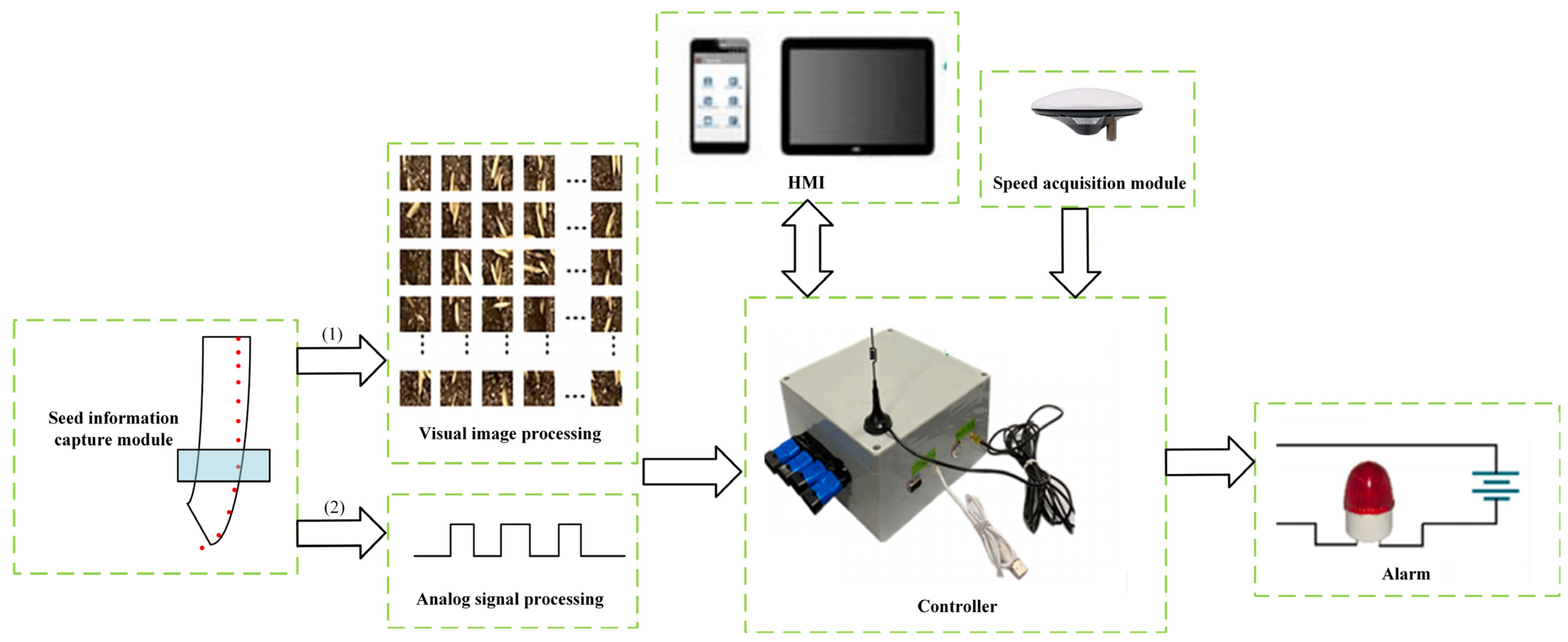
A typical seeding monitoring system consists of a seed-information acquisition unit, a data-processing module, a speed-acquisition module, and a communication-display module, as shown in Figure 9. The seed-information acquisition unit is responsible for collecting dynamic seed data during the seeding process, typically employing photoelectric sensing, laser sensing, capacitive sensing, piezoelectric sensing, or utilizing machine-vision and image-processing technologies. The data-processing unit, usually implemented via a controller, handles signal acquisition, seed rate and row spacing calculations, and fault diagnosis and detection. The speed-acquisition module utilizes GNSS to provide real-time forward speed, ensuring precise calculation of seeding parameters. The communication-and-display module transmits monitoring data to the onboard terminal via wired or wireless means, enabling visual management and parameter adjustment during operation [144,145,146].
The main monitoring indicators include seeding quantity, seed spacing, qualified index of seed placement, missed and multiple seeds, seed-tube blockage, seed-drop timing, and operational speed. We organize and summarize the types of detection components, monitoring content, processing algorithms, and system performance metrics employed in the representative literature in Table 7. This table aims to provide a reference basis for subsequent system design and solution selection, while also helping to identify shortcomings in current technological development and potential research directions.
Current limitations include constrained sampling frequency, high environmental sensitivity, and increased compensation deviation at high speeds. Future research can enhance performance by increasing sampling rates and optimizing algorithms.
With the growing demand for intelligent agricultural machinery control, machine vision and high-speed imaging technologies have garnered significant attention in seedling monitoring. These technologies enable multidimensional recognition of seed descent trajectories, planting depth consistency, and plant spacing uniformity through image processing, feature extraction, or deep-learning models. Compared to traditional sensors, they offer superior adaptability and scalability.
In early studies, researchers predominantly employed CCD or CMOS cameras coupled with image-processing algorithms to capture images of seeds at the moment of fall. Through methods such as grayscale threshold segmentation, morphological analysis, and centroid tracking, these systems achieved single-seed identification and trajectory reconstruction. Such systems accurately capture seed-movement information under high-speed operation conditions, providing intuitive evidence for evaluating seeding precision. With the advancement of intelligent algorithms, research has further incorporated deep-learning and evolutionary optimization techniques. For instance, Zhao et al. [152] achieved non-contact estimation of total seed mass by integrating artificial neural networks with force signals from vibrating feeders, offering a novel signal fusion approach for visual monitoring. To address the challenge of detecting skipped seeds during mechanized rice seedling cultivation, Liu et al. [153] proposed an automated evaluation model based on an enhanced ResNet50 architecture. By incorporating virtual grid image segmentation preprocessing, the model segments seedling tray images into blocks for classification and subsequent reconstruction. This approach enables the rapid and precise localization of skipped-seed areas while calculating skipped-seed rates, providing effective technical support for monitoring seeding quality in intelligent rice seedling production lines.
In recent years, with the advancement of deep learning and real-time detection frameworks, seed detection systems based on YOLOv5 networks and high-speed CCD cameras have emerged as a research hotspot [153,154,155]. Such systems enable real-time detection and classification of single seeds, re-sown seeds, and missed seeds within milliseconds, adapting to complex field lighting and dynamic background conditions [156,157]. Concurrently, Ghaffarnezhad et al. [158] introduced geometric clustering concepts into traditional infrared vision systems through their shape-recognition algorithm. By employing a “convex polygon” recognition model, they achieved high-precision counting under multi-seed occlusion conditions with an average recognition accuracy of 98.6%. This validated the feasibility of geometry-based visual algorithms for non-contact seed detection. Bai et al. [159] established a visual monitoring system for precision cotton seeding using the LabVIEW platform and color-coded optical sensors. Integrating alarm and data-analysis modules, this system enables real-time monitoring and visual assessment of the seeding process, further demonstrating the practical value of machine vision in intelligent agricultural monitoring. Thus, the evolution of monitoring components indicates that precision seeder monitoring systems are transitioning from single-parameter detection to multimodal sensing and intelligent diagnostics. This shift provides the technological foundation for achieving high-speed, high-precision, and environmentally robust seeding operations. Beyond real-time detection, missed seeding information can be spatially aggregated and integrated with satellite-derived data to generate seeding density maps, which further enables decision-making for targeted reseeding and corrective operations [90,160].
Methods for compensating for missed seeding can be broadly categorized into two types: auxiliary compensation and self-compensation. Both approaches require monitoring for missed broadcasts as a prerequisite but differ in their implementation mechanisms for replanting.
Auxiliary compensation involves installing an independent reseeding mechanism or reseeding pipeline separate from the original seed-laying channel. Upon detecting skipped seeds, the controller triggers an external actuator to release pre-stored seeds, achieving discrete reseeding with the principle of “one detection, one seed replacement.” For example, a potato reseeding device identifies skipped seed signals to drive an electric push rod, opening the reseeding gate. This allows seed potatoes within the reseeding tube to fall into the furrow by gravity, completing the reseeding process [161].
Self-compensation does not add extra replanting channels but instead achieves catch-up replanting through timing or speed compensation within the original seeder or drive system: upon detecting skipped seeds, the controller briefly adjusts the drive motor’s speed or phase, causing subsequent normal seed pickup positions to advance to the seeding position earlier to compensate for missing seeding. Chen et al. [162] proposed a self-compensating system for detecting skips and performing context-adaptive replanting to address high-speed skipping issues in dual-disc pneumatic corn seeders. This system utilizes an industrial camera to capture real-time images of the seed discs, employing an improved YOLOv8n model and skip detection logic to identify skipping events in real time. The introduction of replanting improved seeding accuracy by approximately 0.15–2.89%, with the optimal compensation speed range recommended at 10–14 km/h.
Overall, monitoring technologies for precision seeders are evolving from simple counting-based approaches toward precise seed-spacing assessment and intelligent fault diagnosis. They are also moving from single-sensor solutions to multi-sensor fusion and incorporating wireless communication, intelligent algorithms, and data visualization, thereby providing strong technological support for achieving more accurate, stable, and intelligent seeding operations.

4. Seeding Adjustability

In modern agriculture, intelligent seeders must be able to adapt to the cultivation of multiple crops. In other words, the same machine must be capable of meeting the different requirements of various crops with regard to row spacing, plant spacing, seeding depth and quantity. This requires seeders to have adjustable or modularized seeding unit designs, as well as flexible control strategies, in order to accommodate differences in crop growth characteristics.
Additionally, the demand for multifunctional integration is growing. As well as seeding, agricultural production may involve functions such as fertilization, film mulching, soil testing, and data collection, all of which need to be coordinated. Integrating multiple functions into one unit reduces investment in agricultural machinery and operational time, while enabling real-time sharing of operational information and precise management.
Meeting the requirements of multi-crop adaptability and multi-functional integration is highly significant in enhancing the efficiency, accuracy, and sustainability of mechanized agricultural operations.

4.1. Multi-Crop Adaptation Technologies

With the advancement of precision agriculture, the multi-crop adaptability of smart seeders has gradually become a research hotspot. Seeds of different crops exhibit significant variations in particle size, shape, density, and surface friction characteristics, imposing distinct demands on the seed picker’s adhesion force, seed retrieval rate, and seed-distribution stability. Traditional seeders are predominantly designed for single-crop use, necessitating the replacement of entire seeding units or mechanical components to switch crops. This limits operational efficiency and equipment cost-effectiveness. Consequently, recent research has primarily explored two avenues for achieving intelligent and universal multi-crop seeding systems: structural adjustments to the equipment itself and optimization of the physical properties of the seeds.
Regarding equipment adaptation, the most prevalent approach involves designing seed-distribution devices with variable structures and adjustable parameters. In traditional seeders, seed-placement accuracy primarily relies on the seed holes machined into the seed-distribution disc. Seeds from different crops exhibit significant variations in shape, particle size, and weight. To ensure each hole carries only one seed and achieves stable placement, the disc’s hole diameter, shape, and number are designed to precisely match specific seeds. Consequently, changing crops typically requires replacing the entire seed disc. To avoid frequent disc replacements and enhance adaptability to seeds of varying sizes, adjustable-aperture seed discs have been developed. By modifying the effective dimensions of the seed-picking holes, these discs accommodate single-seed picking for seeds of different sizes, enabling a single seeding mechanism to support multiple crops [163,164,165]. Mahapatra et al. [166,167] propose a flexible seed tray with elastic material covering the rigid seed holes, enabling the holes to adaptively deform to accommodate seeds of varying sizes and shapes. This significantly enhances seed adhesion and placement stability across different types of seed. The structure automatically conforms to seed contours, achieving better hole sealing and seed separation while reducing skips and doubles caused by seed size variations. Furthermore, addressing the limited versatility of conventional air-suction seed meters, Jiang et al. [168] developed a universal precision air-suction seed meter suitable for both corn and soybeans. Through structural optimization and aerodynamic control, this device maintains high seeding accuracy across different crop characteristics. They designed a universal seed hole with a composite structure: a trapezoidal rear end, a curved front surface, and progressively deepening side walls. Geometric constraints, such as hole depth, width, and radius matching, were applied to ensure the aperture accommodates larger corn seeds while preventing multiple soybean seeds from being drawn in, achieving structural crop compatibility. To adapt to varying seed densities and sizes, the design employs an air-suction negative pressure mechanism combined with micro-perforations along the hole rim. This creates a stable pressure differential during seed adsorption, enhancing adaptability to different seed types. Moreover, Zhang et al. [169] comprehensively reviewed seed tape sowing technology and equipment, highlighting its strong multi-crop adaptability. Seed tape sowing can largely avoid seed-size constraints and enables one planter system to handle different crop types by integrating seeds into the carrier tape. Liu et al. [170] designed and experimentally validated a spotting glue-paper tape precision seeder to address the challenge of uniform seeding for diverse, small-sized vegetable seeds. Their system demonstrated high adaptability, achieving a single-seed rate exceeding 95% for different seed varieties.
On the other hand, researchers have also focused on seed-end optimization, aiming to reduce equipment modification requirements by standardizing seed physical characteristics. Seed grading and classification technologies utilize image recognition or mechanical screening to group seeds by particle size, weight, and shape, thereby enhancing seeding uniformity.
In the field of corn recognition based on machine vision and deep learning, numerous research achievements have already been made. Relevant studies leverage deep-learning models to continuously enhance recognition accuracy and stability in tasks such as object detection and classification [171,172]. This technology provides new implementation pathways and data support for multi-variety adaptability in seeders. Consequently, seeders no longer rely on a single empirical parameter to accommodate all varieties. Instead, they can automatically match optimal seed intake and discharge conditions for different varieties, thereby improving seeding consistency and operational stability. This ultimately achieves high-quality, intelligent adaptive seeding for multiple corn varieties [173].
Additionally, coating and pelleting technologies have emerged as effective methods for optimizing seed shape and improving seed delivery performance. Coating forms an extremely thin, uniform film on the seed surface without altering its original size or shape. It primarily serves to deliver pesticides, enhances seed surface smoothness and improves germination conditions [174]. Pelletizing, meanwhile, uses inert powders and binders to process small, lightweight, or irregularly shaped seeds into uniformly sized, well-formed pellets. This enhances individual seed absorption stability, making them easier for precision seeders to pick up accurately and dispense in measured quantities [175]. Both techniques improve seeding uniformity and seedling emergence consistency, with pelleting demonstrating particularly significant benefits for precision mechanical seeding by effectively achieving “seed particle standardization”. Although such research based on “seed-end standardization” is currently mostly in the experimental verification stage, it holds significant potential for reducing the structural complexity of seeders and achieving multi-crop compatibility [176,177].
Simultaneously, the rise of intercropping technology has further intensified the demand for seeding equipment capable of multi-crop operations. Intercropping emphasizes the simultaneous precision placement of two or more crops in a single operation, imposing higher demands on the multi-channel coordination capability, independent control performance, and spatial combination of different crops within the seed-placement mechanism [178]. The primary objective of intercropping is to achieve efficient land resource utilization, enhance overall yield, and simultaneously improve soil health and ecological benefits by planting multiple crops concurrently in the same operation. This represents a crucial pathway for enhancing the sustainability of agricultural systems. In practical applications, the corn–soybean strip-intercropping relay system has seen widespread adoption [179]. Research indicates that soybean–maize strip intercropping allows for an additional harvest of 1500–2250 kg/ha of soybeans under conditions where the yield of intercropped maize is similar to the local net yield of maize. By covering an extensive area of 1.25 million ha in 2022 and yielding 1.22 million tons of soybeans, intercropping has successfully increased the soybean self-sufficiency rate by 1.5 percentage points in China [180].
This intercropping method employs temporal and spatial staggered planting to enable complementary utilization of resources such as light, water, and nutrients between tall corn and dwarf soybeans, thereby enhancing overall resource capture efficiency and land equivalent ratio. The biological nitrogen fixation of leguminous soybeans and the incorporation of crop residues into the soil improve field nitrogen cycling and soil fertility, reducing the system’s dependence on external nitrogen inputs. For instance, Pierre et al. [181] developed a cereal–legume intercropping model in DSSAT v4.8., which is the first universal DSSAT intercropping model, facilitating its application to other cereal–legume intercropping models. It can now be applied to other cereal–legume intercropping models, providing theoretical guidance for rational plant density. To address the issues of excessive straw clogging and low operational efficiency in strip-intercropping of corn and soybeans, Chen et al. [182] designed a no-till combined operation machine integrating straw removal, seedbed preparation, precision seeding and fertilization, and straw mulching. Tests demonstrated excellent performance at 7.2 km/h, with grain spacing compliance rates of 79.50% for soybeans and 88.66% for corn, and straw mulching uniformity reaching 88.97%.
In summary, the multi-crop adaptability of precision seeders is evolving toward a dual-track convergence of “structural adjustability” and “seed standardization.” The former achieves adaptive regulation of seeding-disc aperture, negative pressure, and rotational speed through mechanical and electronic control technologies, while the latter improves seed retrieval consistency via seed screening, pelleting, and shape standardization. Future research may further integrate machine vision and intelligent algorithms to achieve online recognition of different crop seed characteristics and self-learning parameter control, thereby constructing a truly adaptive multi-crop intelligent seeding system.

4.2. Multi-Functional Integration Technologies

As agricultural production evolves toward large-scale, intensive, and intelligent practices, demand for mechanized seeding equipment continues to rise [183]. Traditional seeders typically perform single functions, often requiring coordination with fertilizer spreaders, soil coverers, and other devices to complete the entire operation. This results in multiple operational steps, high energy consumption, and limited precision. In recent years, multi-functional integrated seeders have emerged as a focal point in both research and application. By consolidating multiple operational steps into a single unit, these machines can simultaneously perform seeding, fertilizing, soil covering, compaction, and even spraying during a single pass [184]. This significantly reduces the need for equipment changes and repetitive operations, thereby boosting operational efficiency and lowering costs. This aligns perfectly with the intelligent agriculture trend of “multi-task coordination, high efficiency, and precision”.
Under straw-returning conditions, surface residues often cause clogging or entanglement of the seeding components, leading to uneven seeding depth and poor uniformity. To address this issue, seeders are equipped with stubble-cutting and anti-blocking devices mounted at the front of the machine, which achieve a “cut-and-throw” action through rotating or inclined blades to clear the seedbed [185]. For instance, the oblique stubble-cutting and side-throwing mechanism driven by power rotation can simultaneously cut, crush, and discharge straw during forward motion, forming a clean seeding belt. This configuration is particularly suitable for no-tillage and residue-covered fields, effectively reducing blockages and improving seeding precision [182]. Simultaneous seeding and fertilizing is an effective approach to enhance nutrient utilization and seedling establishment. Such seeders integrate an additional fertilizer delivery or seed–fertilizer integration system near the metering unit, where fertilizer is conveyed through a screw feeder or pneumatic pipeline to the lower side of the seed furrow, achieving layered or banded fertilizer placement [186]. Some advanced systems employ electronic control for real-time, closed-loop adjustment of fertilizer rate based on seeding distance and machine speed. This integration reduces secondary tillage operations, improves fertilizer use efficiency, and promotes early crop growth [187]. For arid or protected cropping systems, seeders are often integrated with film-mulching and drip-irrigation mechanisms to perform seeding, mulching, and drip-tape laying simultaneously. During operation, the mulching device places plastic film over the seed rows while soil-covering wheels press and seal it, and the drip tape is laid beneath or between the rows to ensure precise water and nutrient supply. This configuration effectively conserves soil moisture, suppresses weeds, and enhances germination rates, while being compatible with intelligent fertigation systems for automated irrigation and nutrient management—representing a key direction in precision water-saving agriculture [188]. The different functional extension structures of the multi-functional seeder are shown in Figure 10 [187,189,190].
The multi-functional integration of seeders is primarily reflected in the coordinated design of mechanical structures and control systems. Structurally, the equipment typically adopts composite or modular designs, with different functional units operating in concert based on shared frames or transmission systems. For example, a typical seed-and-fertilizer combination unit can simultaneously perform seed and fertilizer placement while furrowing, followed by automatic soil covering and packer systems that close the operation cycle. This maintains consistent planting depth and seedbed levelness, enhancing seedling emergence rates and field uniformity. Some models also integrate spraying or mulching devices, enabling precise control to coordinate seeding with pest and disease control or moisture retention functions. This significantly boosts operational versatility and resource utilization efficiency.
The core challenge of multi-functional seeders lies not only in structural integration but in the dynamic coordination and switching of control systems. Each operational mode—such as “seeding only,” “seeding and fertilizing,” or “seeding and spraying”—requires distinct control parameters, actuator priorities, and feedback loops. Intelligent control systems manage these transitions through module recognition, task scheduling, and parameter mapping. When switching between modes, the controller automatically reallocates control authority among subsystems, ensuring that mechanical, hydraulic, and electrical units operate in balance. During operation, parameters such as seeding rate, fertilizer flow, soil covering depth, and roller pressure are dynamically optimized based on real-time feedback from soil sensors, environmental sensors, and machine status monitors. Multi-module data fusion enables the central controller to maintain stability during transitions and ensure that switching between functional modules does not cause performance interference or time delay. Advanced international systems employ bus-based communication and reconfigurable control architectures, allowing modules to be automatically activated, calibrated, or isolated according to task requirements.
Although multi-functional integration enhances operational versatility, it also introduces challenges such as increased system complexity, power distribution conflicts, and potential interference between modules. Future research should focus on standardized module interfaces, lightweight structural materials, and adaptive cooperative control algorithms. Additionally, integrating real-time monitoring and self-diagnosis systems will be essential for ensuring the stability and safety of multi-module coordination under varying field conditions. By improving modular reconfigurability and intelligent decision-making, future precision seeders will achieve seamless transitions among different functional modes, enabling full-process precision management across diverse agricultural operations.
In Table 8, several typical examples of multi-functional seeders and their characteristics are listed.

5. Discussion and Development Trends

5.1. Discussion on Current Research Progress

Driven by the growing requirements for high-speed (≥12 km/h), variable-rate, and high-precision seeding, modern precision seeders are increasingly shifting from purely mechanical optimization toward electrified, digitized, and intelligently monitored systems, in which sensing, control, and decision-making functions are deeply integrated to ensure stable performance under complex field conditions. Development and bottlenecks are reflected in three main directions: advanced mechanical architecture, precision control strategies, and system extensibility.
(1)
Mechanical evolution: from fixed mechanism to adjustable architecture
Current studies show a clear transition from ground-wheel mechanical transmission to electric-drive and pneumatic-based seed-metering systems. Electric-drive metering enhances parameter controllability and supports independent row control, while pneumatic metering improves adaptability to seed variability under high-speed operation. Recent precision seeders increasingly adopt modular mechanical designs to enhance system adjustability and flexibility. However, under high-speed operation, the shortened seed filling and singulation window makes purely mechanical improvement increasingly insufficient, while pneumatic systems introduce higher energy consumption and more complex airflow control and integration requirements.
(2)
Control evolution: from open-loop operation to closed-loop precision regulation
Seed placement, seeding depth, and trajectory control have gradually shifted from passive mechanical adjustment to sensor-supported closed-loop control. This transition is enabled by the integration of mechanical structures with electrical actuation and electronic control systems, allowing seeding-related parameters to be adjusted dynamically during operation. PID and fuzzy PID remain the most common control structures, and optimization algorithms and AI-driven strategies are increasingly being explored. Nevertheless, achieving robust closed-loop regulation remains challenging due to strong disturbances, model uncertainties, and sensing–actuation delays, especially under high-speed and variable-rate seeding conditions.
(3)
System extensibility: multi-crop adaptability and multi-functional integration
System extensibility is increasingly emphasized in adjustable precision seeders, particularly in terms of multi-crop adaptability and multi-functional integration. Current designs aim to support diverse seed characteristics through flexible metering components and rapid parameter adjustment. Meanwhile, integrating functions such as fertilization, rotary tillage, and drip irrigation laying improve operational efficiency. However, multi-crop and multi-function integration also increases subsystem coupling and calibration complexity, requiring coordinated design across metering, sensing, actuation, and agronomic parameter management at the system level.

5.2. Development Trends

Based on the above discussion, future research and industrial development trends can be summarized as follows:
(1)
Pneumatic seed metering combined with electric-drive and closed-loop control is emerging as a dominant trend. Future systems will focus on energy-efficient airflow generation, distributed pressure control, and adaptive regulation for different seeds and speeds.
(2)
Adjustable seeders will increasingly adopt the multi-source information framework (soil moisture, conductivity, organic matter, remote sensing indices, and yield maps) to generate prescription maps and real-time decision outputs. A machine learning-based decision system is expected to complement or partially replace experience-based rules to improve adaptability.
(3)
To overcome actuator delays and field disturbances, future control strategies may shift from standalone PID to hierarchical control architecture integrating feedforward prediction, MPC, and AI adaptive control, enabling stable performance in complex environments.
(4)
Seeding monitoring systems will develop toward multi-modal sensing, combining photoelectric and capacitive/piezoelectric sensors with machine vision and intelligent algorithms. Modular design will be essential for multi-crop adaptability and multi-functional integration. Standardized row units, plug-and-play sensors, and bus-based communication architectures (CAN/ISOBUS), complemented by adaptive wireless communication networks capable of reliable operation in field environments, can reduce maintenance costs and improve system scalability.
(5)
With intelligent agriculture development, autonomous robots and UAV seeding systems provide flexible solutions for complex terrain and special scenarios. However, their throughput and economic feasibility must be further evaluated compared to conventional large-scale seeders.

6. Conclusions

This review provides a systematic overview of adjustable precision seeders by summarizing the key advances in seed-metering devices, actuation and transmission modes, monitoring and feedback strategies, and system-level configuration for modern agricultural production. The results indicate that research has gradually shifted from conventional, mechanically driven structures toward electrically driven and pneumatic-assisted solutions, which improve controllability and stability under high-speed operation. In addition, sensing-based monitoring technologies have been increasingly introduced to enhance seeding quality evaluation, enabling real-time detection of missed seeding, multiple seeding, and seed flow fluctuation, and supporting closed-loop regulation of critical parameters.
Furthermore, adjustable precision seeders are becoming more application-oriented, where multi-crop adaptability is emphasized to meet diverse seed physical characteristics and planting patterns, and multi-functional integration is promoted to reduce field passes and improve overall operational efficiency through the combination of seeding with fertilization, residue handling, and field data acquisition. Overall, the development of adjustable precision seeders reflects a clear trend toward higher precision, stronger adaptability, and greater system extensibility. This review is expected to provide useful references for future research and engineering implementation of next-generation precision seeding equipment in intelligent and sustainable agriculture.
It is foreseeable that with continuous breakthroughs in sensors, artificial intelligence, robotics, and new materials, future precision seeders will transcend being mere agricultural machinery to become pivotal nodes in agricultural production informatization and intelligence. Their advancement will provide robust safeguards for global food security and sustainable agriculture.

Author Contributions

Conceptualization and Methodology, X.G. and S.N.; Formal analysis, X.G., Y.D., J.Y., and S.N.; Investigation, X.G., S.N., J.Y., and H.G.; Resources, X.G.; Writing—original draft preparation, S.N.; Writing—review and editing, X.G. and Y.D.; Supervision, X.G.; Funding acquisition, X.G. All authors have read and agreed to the published version of the manuscript.

Funding

This work is funded by the Priority Academic Program Development of Jiangsu Higher Education Institutions (No. PAPD-2023-87).

Data Availability Statement

No new data were created or analyzed in this study.

Conflicts of Interest

The authors declare no conflicts of interest.

Abbreviations

The following abbreviations are used in this manuscript:
UAVUnmanned Aerial Vehicle
GNSSGlobal Navigation Satellite System
CANController Area Network
ISOInternational Organization for Standardization
MIMissed-seeding Index
QIQuality Index
LiDARLight Detection and Ranging
RS232Recommended Standard 232
RS485Recommended Standard 485
PLCProgrammable Logic Controller
LoRaLong Range
PMSMPermanent Magnet Synchronous Motor
MCUMicrocontroller Unit
COV/CVCoefficient of Variation
ST_OPOpen-loop Stepper Motor
ST_CLClosed-loop Stepper Motor
BLDCBrushless Direct Current Motor
BL_HLBrushless DC Motor with Hall Encoder
BL_OPTBrushless DC Motor with Optical Encoder
BRBrushed (DC Motor)
FOCField-oriented Control
ANNArtificial Neural Network
PIDProportional–Integral–Derivative
PSOParticle Swarm Optimization
VRSVariable-rate Seeding
IMUInertial Measurement Unit
RSReeds–Shepp
MPCModel Predictive Control
TDF-OTCTracking Differential Filtering—Optimal Tracking Control
RGB-DRed–Green–Blue Depth
VTPD-AMVariable Threshold Peak Detection–Adaptive Method
CCDComplementary Metal–Oxide–Semiconductor
CMOSRapidly-exploring Random Tree
GPSGlobal Positioning System
RTK-GPSReal-time Kinematic Global Positioning System
RMSERoot Mean Square Error
DSSATDecision Support System for Agrotechnology Transfer

References

  1. Villalobos, F.J.; Fereres, E. Principles of Agronomy for Sustainable Agriculture, 2nd ed.; Springer: Cham, Switzerland, 2024; ISBN 978-3-031-69150-8. [Google Scholar]
  2. Hu, Z.L.; Gao, Y.; Li, M.; Li, H.L.; Yang, X.J.; Ma, Z.R. An Agricultural Habitat Information Acquisition and Remote Intelligent Decision System Based on the Internet of Things. In International Conference on Computer and Computing Technologies in Agriculture; Springer: Cham, Switzerland, 2019. [Google Scholar] [CrossRef]
  3. Shen, Y.; Yang, F.; Wu, J.B.; Luo, S.; Khan, Z.; Zhang, L.K.; Liu, H. Advances and Future Trends in Electrified Agricultural Machinery for Sustainable Agriculture. Agriculture 2025, 15, 2367. [Google Scholar] [CrossRef]
  4. Wang, J.; Zhao, L.; Hao, M.; Wang, N.; Wen, Q.H.; Mei, F.J.; Khan, A.; Wang, B.Z.; Zhang, X.L.; Wang, W.; et al. Climate suitability determines optimal yielding of dryland maize: A validation on timely sowing as an ancient wisdom. Field Crops Res. 2025, 328, 109920. [Google Scholar] [CrossRef]
  5. Luo, X.; Liao, J.; Hu, L.; Zang, Y.; Zhou, Z. Improving agricultural mechanization level to promote agricultural sustainable development. Trans. Chin. Soc. Agric. Eng. 2016, 32, 1–11. [Google Scholar] [CrossRef]
  6. Yang, L.W.; Chen, L.S.; Zhang, J.Y.; Liu, H.J.; Sun, Z.C.; Sun, H.; Zheng, L.H. Fertilizer sowing simulation of a variable-rate fertilizer applicator based on EDEM. In IFAC PapersOnline; Elsevier: Amsterdam, The Netherlands, 2018; pp. 418–423. [Google Scholar]
  7. Li, C.; Tang, Y.; McHugh, A.D.; Wu, X.; Liu, M.; Li, M.; Xiong, T.; Ling, D.; Tang, Q.; Liao, M.; et al. Development and performance evaluation of a wet-resistant strip-till seeder for sowing wheat following rice. Biosyst. Eng. 2022, 220, 146–158. [Google Scholar] [CrossRef]
  8. Sun, J.Z.; Zhang, Y.; Zhang, Y.T.; Li, P.Z.; Teng, G.F. Precision Seeding Compensation and Positioning Based on Multisensors. Sensors 2022, 22, 7228. [Google Scholar] [CrossRef]
  9. Chen, J.; Zhao, C.J.; Jones, G.; Yang, H.; Li, Z.H.; Yang, G.J.; Chen, L.P.; Wu, Y.C. Effect and economic benefit of precision seeding and laser land leveling for winter wheat in the middle of China. Artif. Intell. Agric. 2022, 6, 1–9. [Google Scholar] [CrossRef]
  10. Li, Y.C.; Zhang, Y.W.; Wang, Y.J.; Zhou, Y.F.; Zhang, J.J. Stimulating smart automation of rice seeding in China: An exploration of planter adoption influencing factors. J. Agric. Food Res. 2024, 18, 101394. [Google Scholar] [CrossRef]
  11. Liu, C.; Lin, H.; Li, Y.; Gong, L.; Miao, Z. Analysis on Status and Development Trend of Intelligent Control Technology for Agricultural Equipment. Trans. Chin. Soc. Agric. Mach. 2020, 51, 1–18. [Google Scholar] [CrossRef]
  12. Shen, Y.; Zhang, Y.; Liu, H.; He, S.; Feng, R.; Wan, Y. Research Review of Agricultural Equipment Automatic Control Technology. Trans. Chin. Soc. Agric. Mach. 2023, 54, 1–18. [Google Scholar] [CrossRef]
  13. Lu, J.Z.; Liu, S.P.; Wang, Q.; Liao, M. Research on Device and Sensing Technology for Precision Seeding of Potato. Agriculture 2024, 14, 2146. [Google Scholar] [CrossRef]
  14. Bustos-Gaytán, A.; Saldaña-Robles, N.; Joya-Cárdenas, D.R.; Gutiérrez-Vaca, C.; Alfaro-Ayala, J.A.; Barco-Burgos, J.; Saldaña-Robles, A. Advancements in pneumatic seed-metering devices: A review of numerical and experimental approaches. Results Eng. 2025, 26, 105626. [Google Scholar] [CrossRef]
  15. Bracy, R.P.; Parish, R.L. A Comparison of Seeding Uniformity of Agronomic and Vegetable Seeders. HortTechnology 2001, 11, 184–186. [Google Scholar] [CrossRef]
  16. Zhou, B.D.; Li, Y.X.; Zhang, C.; Cao, L.W.; Li, C.S.; Xie, S.Y.; Niu, Q. Potato Planter and Planting Technology: A Review of Recent Developments. Agriculture 2022, 12, 1600. [Google Scholar] [CrossRef]
  17. Castro, J.; Alcaraz-Segura, D.; Baltzer, J.L.; Amoros, L.; Morales-Rueda, F.; Tabik, S. Automated precise seeding with drones and artificial intelligence: A workflow. Restor. Ecol. 2024, 32, e14164. [Google Scholar] [CrossRef]
  18. Niu, G.L.; Wang, G.; Li, B.B.; Song, C.N.; Xiao, W.W.; Zhou, H.B. Design of Rice Factory Three-dimensional Carpet Raising Seedlings System Engineering. In Proceedings of the International Conference on Agricultural and Biosystem Engineering (ABE 2014), Beijing, China, 18–20 September 2014; pp. 93–100. [Google Scholar]
  19. Kang, Q.; Zhang, G.; Zheng, K. Design and experiment of the spoon clip type seed metering device for Allium chinense. Trans. Chin. Soc. Agric. Eng. 2023, 39, 15–25. [Google Scholar] [CrossRef]
  20. Ahmad, F.; Weimin, D.; Qishou, D.; Rehim, A.; Jabran, K. Comparative Performance of Various Disc-Type Furrow Openers in No-Till Paddy Field Conditions. Sustainability 2017, 9, 1143. [Google Scholar] [CrossRef]
  21. Zhao, S.; Liu, J.; Zhao, G.; Tian, Z.; Yang, Y. Design and experiment of the straight oblique offset no-tillage sowing furrow opener with side deep fertilization. Trans. Chin. Soc. Agric. Eng. 2024, 40, 26–37. [Google Scholar] [CrossRef]
  22. Altikat, S.; Celik, A.; Gozubuyuk, Z. Effects of various no-till seeders and stubble conditions on sowing performance and seed emergence of common vetch. Soil Tillage Res. 2013, 126, 72–77. [Google Scholar] [CrossRef]
  23. Ding, X.T.; Hao, W.; Liu, K.; Wang, B.B.; He, Z.; Li, W.X.; Cui, Y.J.; Yang, Q.C. Development of a universal plug tray seeder for small seeds based on electrostatic adsorption. Comput. Electron. Agric. 2024, 227, 109651. [Google Scholar] [CrossRef]
  24. Qian, C.; He, S.Y.; Qin, W.; Jiang, Y.C.; Huang, Z.S.; Zhang, M.L.; Zhang, M.H.; Yang, W.W.; Zang, Y. Influence of Shaped Hole and Seed Disturbance on the Precision of Bunch Planting with the Double-Hole Rice Vacuum Seed Meter. Agronomy 2024, 14, 768. [Google Scholar] [CrossRef]
  25. Chen, J.; Zhang, Z.Q.; Li, Y.M.; Guan, Z.H.; Tang, X.M. Research On Following Suction And Discharging Motion Control Method Of Vacuum-Vibration Precision Seeding Manipulator. Appl. Eng. Agric. 2022, 38, 873–883. [Google Scholar] [CrossRef]
  26. Li, Y.F.; Zhou, W.Q.; Yi, S.J.; Chen, T.; Zhang, D.M.; Wang, S. Analysis measurements of millet collision coefficient of restitution for mechanized seeding. PLoS ONE 2025, 20, e0320001. [Google Scholar] [CrossRef]
  27. Li, X.K.; Wang, G.P.; Sun, W.; Li, G.Z.; Zhang, J.R.; Li, Z.S.; Ding, L.L.; Li, H.L.; Wang, L. A Review of Spoon-Style Potato Seed-Metering Defects Monitoring and Inhibition. Agriculture 2025, 15, 720. [Google Scholar] [CrossRef]
  28. Yang, S.; Zhai, C.Y.; Gao, Y.Y.; Dou, H.J.; Zhao, X.G.; He, Y.K.; Wang, X. Planting uniformity performance of motor-driven maize precision seeding systems. Int. J. Agric. Biol. Eng. 2022, 15, 101–108. [Google Scholar] [CrossRef]
  29. Liao, C.Q.; Chen, J.; Geng, F.Z.; Tang, X.M. Airflow basin structure numerical optimisation analysis and suction nozzle characteristics experimental study of vacuum-vibration tray precision seeder. J. Agric. Eng. 2022, 53, 1294. [Google Scholar] [CrossRef]
  30. Zhang, Z.Q.; Chen, J.; Li, Y.M.; Guan, Z.H.; Liao, C.Q.; Qiao, X.S. Design and experiment on the air-blowing and vibrating supply seed tray for precision seeders. Int. J. Agric. Biol. Eng. 2022, 15, 115–121. [Google Scholar] [CrossRef]
  31. Liu, W.; Hu, J.P.; Yao, M.J.; Zhao, J.; Lakhiar, I.A.; Lu, C.T.; Pan, H.R.; Wang, W. Magnetic field distribution simulation and performance experiment of a magnetic seed-metering device based on the combined magnetic system. Int. J. Agric. Biol. Eng. 2021, 14, 108–117. [Google Scholar] [CrossRef]
  32. Li, M.; He, X.W.; Wang, X.F.; Zhu, G.S.; Pan, X.J.; Gou, K.C.; Liu, J.X. Design and Experiment of Seeding Device for Morchella Planter in Southern Xinjiang Desert. Agriculture 2025, 15, 1140. [Google Scholar] [CrossRef]
  33. Dong, W.X.; Zhang, A.B.; Liu, F.; Zhao, X.; Ren, Y.X.; Bai, H.B.; Xuan, D.Z.; Kong, X.; Yang, S.H.; Yang, X. Design and Performance Test of Variable-Capacity Spoon-Type Oat Precision Hill Seeder. Agriculture 2025, 15, 986. [Google Scholar] [CrossRef]
  34. Zhu, C.T.; Liu, C.L.; Hao, S.H.; Wang, Y.W.; Xu, J.T.; Li, Y.L. Design and testing of the vibrating type cell-belt precision seed metering device for super hybrid rice. Biosyst. Eng. 2025, 253, 104136. [Google Scholar] [CrossRef]
  35. Li, Y.; Zhao, S.; Yang, L.; Quan, S. Design and Test of High-speed Precision Seeder of Independent Fractionated Soybean Double-row Brush. Trans. Chin. Soc. Agric. Mach. 2024, 55, 101–110. [Google Scholar] [CrossRef]
  36. Zhu, H.; Wu, X.; Bai, L.; Rongdong, L.; Guanyu, G.; Jin, Q.; YuanYuan, Z.; Hui, L. Design and experiment of a soybean shaftless spiral seed discharge and seed delivery device. Sci. Rep. 2023, 13, 20751. [Google Scholar] [CrossRef] [PubMed]
  37. Wang, Y.; Huang, S.; Zhang, W.; Bing, Q. Design and Experiment of Wheat Precision Seed Metering Device with Staggered Hook-tooth. Trans. Chin. Soc. Agric. Mach. 2024, 55, 142–153+167. [Google Scholar] [CrossRef]
  38. Zhang, C.; Liu, T.; Zheng, Z. Design and test of the precision seeding dispenser with the staggered convex-teeth for wheat sowing with wide seedling belt. Trans. Chin. Soc. Agric. Eng. 2024, 40, 47–59. [Google Scholar] [CrossRef]
  39. Wang, L.; Liao, Q.; Xi, R.; Xiaoran, L.; Yitao, L. Influence of an equal width polygon groove-tooth wheel on feeding performance of the seed feeding device for wheat. Comput. Electron. Agric. 2024, 217, 108565. [Google Scholar] [CrossRef]
  40. Jia, X.; Zhu, J.Y.; Guo, G.; Huang, Y.X.; Gao, X.J.; Zhang, C.Q. Design and test of a novel converging groove-guided seed tube for precision seeding of maize. Biosyst. Eng. 2024, 245, 36–55. [Google Scholar] [CrossRef]
  41. Li, C.; Zhang, D.X.; Yang, L.; Cui, T.; He, X.T.; Li, Z.M.; Dong, J.Q.; Xing, S.L.; Jiang, Y.Y.; Liang, J.Y. Research on high-speed and clean production with a high-speed centrifugal maize precision seed metering device featuring variable hole insert numbers. Comput. Electron. Agric. 2024, 227, 109620. [Google Scholar] [CrossRef]
  42. Li, J.Q.; Huang, Z.S.; Jiang, Y.C.; Cui, Z.J.; Zhang, M.L.; Zang, Y.; Qin, W. Design and test of a precision air-suction maize seed-metering device for plot planting based on CFD-DEM coupling. Comput. Electron. Agric. 2025, 238, 110888. [Google Scholar] [CrossRef]
  43. He, X.; Qi, H.; Zhang, D. Design and Test of Horizontal Disc Maize Precision Seed Metering Device on Hilly Land. Trans. Chin. Soc. Agric. Mach. 2025, 56, 151–163. [Google Scholar] [CrossRef]
  44. Geng, D.; Li, Y.; Meng, P.; Ruicheng, D.; Fanhu, M. Design and Test on Telescopic Clip Finger Type of Metering Device. China South. Agric. Mach. 2016, 47, 38–45. [Google Scholar] [CrossRef]
  45. Deng, T.H.; Zhao, W.Y.; Shi, L.R.; Sun, B.G.; Qi, T.S.; Li, H. Analytical design and test of a clip-based precision corn seed metering device using DEM-MBD coupling. Sci. Rep. 2025, 15, 9349. [Google Scholar] [CrossRef]
  46. Sun, W.; Yi, S.; Qi, H. Design and Experiment of Twin Dises Intertwined Air-pressure High-speed Precision Seed-metering Device for Maize Delta-row Dense Plantings. Trans. Chin. Soc. Agric. Mach. 2024, 55, 168–179. [Google Scholar] [CrossRef]
  47. Li, Y.; Yang, L.; Zhang, D.; Zhang, D. Performance analysis and structure optimization of the maize precision metering device with air suction at high-speed condition. Trans. Chin. Soc. Agric. Eng. 2022, 38, 1–11. [Google Scholar] [CrossRef]
  48. Liu, R.; Liu, Z.; Liu, L. Design and Experiment of Corn High Speed Air Suction Seed Metering Device with Disturbance Assisted Seed-filling. Trans. Chin. Soc. Agric. Mach. 2022, 53, 50–59. [Google Scholar] [CrossRef]
  49. Wang, W.; Song, L.; Shi, W.; Dehua, W. Design and Experiment of Air-suction Double-row Staggered Precision Seed Metering Device for Maize Dense Planting. Trans. Chin. Soc. Agric. Mach. 2024, 55, 53–63. [Google Scholar] [CrossRef]
  50. Li, Z.D.; Zhang, H.; Huang, J.L.; Lou, C.; Chen, Y.X.; Liu, L.C.; Zhang, T.; Chen, L.Q. Design and parameter optimization of air-delivery auxiliary seed guide for pneumatic plate precision rapeseed metering device. Comput. Electron. Agric. 2025, 230, 109840. [Google Scholar] [CrossRef]
  51. Tang, H.; Xu, F.; Guan, T.; Changsu, X.; Jinwu, W. Design and test of a pneumatic type of high-speed maize precision seed metering device. Comput. Electron. Agric. 2023, 211, 107997. [Google Scholar] [CrossRef]
  52. Gao, X.J.; Xie, G.F.; Li, J.; Shi, G.S.; Lai, Q.H.; Huang, Y.X. Design and validation of a centrifugal variable-diameter pneumatic high-speed precision seed-metering device for maize. Biosyst. Eng. 2023, 227, 161–181. [Google Scholar] [CrossRef]
  53. Gaytán, A.B.; Robles, N.S.; Cárdenas, D.R.J.; Vaca, C.G.; Ayala, J.A.A.; Burgos, J.B.; Robles, A.S. Advancements in pneumatic seed-metering devices: A review of numerical and experimental approaches. Results Eng. 2025, 28, 105626. [Google Scholar] [CrossRef]
  54. Liu, X.; Su, C.; Li, Z.; Wang, K.; Xie, F.; Tian, Y.; Qi, J. Analysis and Evaluation of Seed-Filling Performance of a Pneumatic Interference Precision Seeder for Small Cabbages. Appl. Sci. 2024, 14, 2825. [Google Scholar] [CrossRef]
  55. Li, K.Z.; Li, S.F.; Ni, X.D.; Lu, B.; Zhao, B.Q. Analysis and Experimental of Seeding Process of Pneumatic Split Seeder for Cotton. Agriculture 2023, 13, 1050. [Google Scholar] [CrossRef]
  56. Sun, W.S.; Yi, S.J.; Qi, H.L.; Li, Y.F.; Dai, Z.B.; Zhang, Y.P.; Yuan, J.S.; Wang, S. DEM-CFD coupling simulation and optimization of an air-pressure high-speed precision seed-metering device for maize delta-row dense plantings. Powder Technol. 2025, 466, 121481. [Google Scholar] [CrossRef]
  57. Zhu, X.X.; Lyu, P.; Gao, Q.; Ma, H.Q.; Chen, Y.X.; Qi, Y.; Li, J.C.; Lyu, J. Design and Comparative Experimental Study of Air-Suction Mulai-Arm Potato Planter. Agriculture 2025, 15, 1714. [Google Scholar] [CrossRef]
  58. Lü, J.Q.; Yang, Y.; Li, Z.H.; Shang, Q.Q.; Li, J.C.; Liu, Z.Y. Design and experiment of an air-suction potato seed metering device. Int. J. Agric. Biol. Eng. 2016, 9, 33–42. [Google Scholar] [CrossRef]
  59. Wang, W.W.; Wu, K.P.; Zhang, Y.; Wang, M.X.; Zhang, C.L.; Chen, L.Q. The Development of an Electric-Driven Control System for a High-Speed Precision Planter Based on the Double Closed-Loop Fuzzy PID Algorithm. Agronomy 2022, 12, 945. [Google Scholar] [CrossRef]
  60. Zhang, Y.; Tang, Y.; He, D.; Shi, J.; Hao, L.; Li, J.; Sun, D.; Li, H.; Zhang, Z.; Ye, S.; et al. Design and Test of Electromagnetic Vibration Type Fine and Small-Amount Seeder for Millet. Agriculture 2024, 14, 1528. [Google Scholar] [CrossRef]
  61. Wang, H.; Yang, L.; Zhang, D.; Cui, T.; He, X.; Xiao, T.; Li, H.; Du, Z.; Xie, C. Comparative investigation and evaluation of electric-drive seed-metering systems across diverse speed ranges for enhanced high-precision seeding applications. Comput. Electron. Agric. 2024, 222, 108976. [Google Scholar]
  62. Gong, H.; Tang, Z.Y.; Cai, Y.H.; Zhang, Y.H.; Yang, S.H.; Chen, Y.; Qi, L. Emergence of Soybean and Canola Plants as Affected by Soil Compaction from a Seeder Press Roller. Agronomy 2025, 15, 1076. [Google Scholar] [CrossRef]
  63. Liu, W.; Zhou, J.; Zhang, T.; Zhang, P.; Yao, M.; Li, J.; Sun, Z.; Ma, G.; Chen, X.; Hu, J. Key Technologies in Intelligent Seeding Machinery for Cereals: Recent Advances and Future Perspectives. Agriculture 2025, 15, 8. [Google Scholar] [CrossRef]
  64. Elwakeel, A.E.; Elbeltagi, A.; Dewidar, A.Z.; Salem, A.; Abdeen, M.A. Development and laboratory evaluation of a novel IoT-based electric-driven metering system for high precision garlic planter. PLoS ONE 2025, 20, e0317203. [Google Scholar] [CrossRef]
  65. Yu, Y.; Hu, Y.; Shang, S.; Diao, L.; Ge, R.; Zhang, X. Design of motor-driven precision seed-metering device with improved fuzzy PID controller for small peanut planters. Int. J. Agric. Biol. Eng. 2023, 16, 136–144. [Google Scholar] [CrossRef]
  66. Ling, L.; Xiao, Y.J.; Huang, X.G.; Wu, G.W.; Li, L.W.; Yan, B.X.; Geng, D.Y. Design and Testing of Electric Drive System for Maize Precision Seeder. Agriculture 2024, 14, 1778. [Google Scholar] [CrossRef]
  67. Jia, H.-L.; Zhu, L.-T.; Huang, D.-Y.; Wang, Q.; Li, M.-W.; Zhao, J.-L. Automatic control system of sowing depth for no-tillage planter based on Flex sensor. J. Jilin Univ. (Eng. Technol. Ed.) 2019, 49, 166–175. [Google Scholar] [CrossRef]
  68. Ahmad, F.; Adeel, M.; Qiu, B.J.; Ma, J.; Shoaib, M.; Shakoor, A.; Chandio, F.A. Sowing uniformity of bed-type pneumatic maize planter at various seedbed preparation levels and machine travel speeds. Int. J. Agric. Biol. Eng. 2021, 14, 165–171. [Google Scholar] [CrossRef]
  69. Deng, S.D.; Feng, Y.M.; Cheng, X.P.; Wang, X.L.; Zhang, X.C.; Wei, Z.C. Disturbance analysis and seeding performance evaluation of a pneumatic-seed spoon interactive precision maize seed-metering device for plot planting. Biosyst. Eng. 2024, 247, 221–240. [Google Scholar] [CrossRef]
  70. Qin, W.; Qian, C.; Li, Y.W.; Yan, D.Q.; Fan, Z.R.; Zhang, M.H.; Zang, Y.; Wang, Z.M. Mechanism Analysis and Establishment of a Prediction Model for the Total Pressure Loss in the Multi-Branch Pipeline System of the Pneumatic Seeder. Agriculture 2025, 15, 1681. [Google Scholar] [CrossRef]
  71. Chen, J.; Zhang, H.; Pan, F.; Du, M.; Ji, C. Control System of a Motor-Driven Precision No-Tillage Maize Planter Based on the CANopen Protocol. Agriculture 2022, 12, 932. [Google Scholar] [CrossRef]
  72. He, X.; Ding, Y.; Zhang, D.; Li, Y.; Tao, C.; Xiangjun, Z. Development of a variable-rate seeding control system for corn planters Part II: Field performance. Comput. Electron. Agric. 2019, 162, 309–317. [Google Scholar] [CrossRef]
  73. He, X.; Ding, Y.; Zhang, D.; Yang, L.; Cui, T.; Zhong, X. Development of a variable-rate seeding control system for corn planters Part I: Design and laboratory experiment. Comput. Electron. Agric. 2019, 162, 318–327. [Google Scholar] [CrossRef]
  74. Wang, Y.X.; Zhang, W.Y.; Qi, B.; Ding, Y.Q.; Xia, Q.Q. Research on Control System of Corn Planter Based on Radar Speed Measurement. Agronomy 2024, 14, 1043. [Google Scholar] [CrossRef]
  75. Wang, W.; Shi, W.; Li, C.; Wang, Y.; Li, L.; Chen, L. Development of automatic wheat seeding quantity control system based on Doppler radar speed measurement. Artif. Intell. Agric. 2025, 15, 12–25. [Google Scholar] [CrossRef]
  76. He, K.K.; Chen, J.C.; Pan, F.; Wang, B.W.; Ji, C. Adaptive negative-pressure control system for electric-driven seeding blowers based on a DILPSO-fuzzy PID controller. Comput. Electron. Agric. 2025, 239, 110833. [Google Scholar] [CrossRef]
  77. He, X.T.; Zhang, D.X.; Yang, L.; Cui, T.; Ding, Y.Q.; Zhong, X.J. Design and experiment of a GPS-based turn compensation system for improving the seeding uniformity of maize planter. Comput. Electron. Agric. 2021, 187, 106250. [Google Scholar] [CrossRef]
  78. Li, J.; Pan, L.; Pan, C.; Pan, C. Model for estimating soil moisture content based on ultrasound velocity under dry-wet alternating conditions. Trans. Chin. Soc. Agric. Eng. 2020, 36, 114–119. [Google Scholar] [CrossRef]
  79. Zhang, X.; Xie, F.; Sheng, Q.; Mengyao, N.; Jiaqi, Z.; Yunfeng, X. Calibration Method of Soil Moisture Capacitance Sensor Based on Compensation of Electrical Conductivity to Relative Permittivity. J. Agric. Mech. Res. 2024, 55, 344–351. [Google Scholar] [CrossRef]
  80. Baldoncini, M.; Albéri, M.; Bottardi, C.; Chiarelli, E.; Raptis, K.G.C.; Strati, V.; Mantovani, F. Investigating the potentialities of Monte Carlo simulation for assessing soil water content via proximal gamma-ray spectroscopy. J. Environ. Radioact. 2018, 192, 105–116. [Google Scholar] [CrossRef]
  81. Andreasen, M.; Jensen, K.H.; Desilets, D.; Franz, T.E.; Zreda, M.; Bogena, H.R.; Looms, M.C. Status and Perspectives on the Cosmic-Ray Neutron Method for Soil Moisture Estimation and Other Environmental Science Applications. Vadose Zone J. 2017, 16, 1–11. [Google Scholar] [CrossRef]
  82. da Silva, E.; Baio, F.; Teodoro, L.; Campos, C.; Plaster, O.; Teodoro, P. Variable-rate seeding in soybean according to soil attributes related to grain yield. Precis. Agric. 2022, 23, 35–51. [Google Scholar] [CrossRef]
  83. Paraforos, D.S.; Sharipov, G.M.; Griepentrog, H.W. ISO 11783-compatible industrial sensor and control systems and related research: A review. Comput. Electron. Agric. 2019, 163, 104863. [Google Scholar] [CrossRef]
  84. Wei, W.B.; Xiao, M.H.; Wang, H.; Zhu, Y.J.; Xie, C.S.; Geng, G.S. Research progress of multiple agricultural machines for cooperative operations: A review. Comput. Electron. Agric. 2024, 227, 109628. [Google Scholar] [CrossRef]
  85. Xie, C.J.; Yang, L.; He, X.T.; Cui, T.; Zhang, D.X.; Li, H.S.; Xiao, T.P.; Wang, H.Y. Maize precision seeding scheme based on multi-sensor information fusion. J. Ind. Inf. Integr. 2025, 43, 100758. [Google Scholar] [CrossRef]
  86. Qi, P.; Wang, Z.C.; Wang, C.L.; Xu, L.; Jia, X.M.; Zhang, Y.; Wang, S.B.; Han, L.; Li, T.; Chen, B.; et al. Development of multifunctional unmanned aerial vehicles versus ground seeding and outplanting: What is more effective for improving the growth and quality of rice culture? Front. Plant Sci. 2022, 13, 953753. [Google Scholar] [CrossRef]
  87. Azmi, H.N.; Hajjaj, S.S.H.; Gsangaya, K.R.; Sultan, M.T.H.; Mail, M.F.; Hua, L.S. Design and fabrication of an agricultural robot for crop seeding. Mater. Today Proc. 2023, 81, 283–289. [Google Scholar] [CrossRef]
  88. Kumar, P.; Ashok, G. Design and fabrication of smart seed sowing robot. In Materials Today: Proceedings; Elsevier: Amsterdam, The Netherlands, 2021; pp. 354–358. [Google Scholar]
  89. Du, Z.; He, X.; Li, Y.; Li, Y. Research progress on precision variable-rate seeding technology and equipment for maize. Trans. Chin. Soc. Agric. Eng. 2023, 39, 1–16. [Google Scholar] [CrossRef]
  90. Munnaf, M.A.; Haesaert, G.; Van Meirvenne, M.; Mouazen, A.M. Map-based site-specific seeding of consumption potato production using high-resolution soil and crop data fusion. Comput. Electron. Agric. 2020, 178, 105752. [Google Scholar] [CrossRef]
  91. Du, Z.H.; Yang, L.; Zhang, D.X.; Cui, T.; He, X.T.; Xie, C.J.; Jiang, Y.Y.; Zhang, X.S.; Mu, J.S.; Wang, H.Y.; et al. Design and experiment of a soil organic matter sensor-based variable-rate seeding control system for maize. Comput. Electron. Agric. 2025, 229, 109752. [Google Scholar] [CrossRef]
  92. Daniel, Q.; Hanna, P.; Chad, L. Rye cover crop and in-furrow fertilizer and fungicide impacts on corn optimum seeding rate and grain yield. Eur. J. Agron. 2022, 139, 126529. [Google Scholar] [CrossRef]
  93. Liu, S.; Chen, X.; Xia, X.; Yvhan, J.; Gang, W.; Honglei, J.; Dongyan, H. Electronic sensing combined with machine learning models for predicting soil nutrient content. Comput. Electron. Agric. 2024, 221, 108947. [Google Scholar] [CrossRef]
  94. Pareek, C.M.; Tewari, V.K.; Machavaram, R. Multi-objective optimization of seeding performance of a pneumatic precision seed metering device using integrated ANN-MOPSO approach. Eng. Appl. Artif. Intell. 2023, 117, 105559. [Google Scholar] [CrossRef]
  95. Xie, C.; Yang, L.; Zhang, D.; Tao, C.; Xiantao, H.; Zhaohui, D.; Tianpu, X. A signal output quantity (SOQ) judgment algorithm for improving seeding quantity accuracy. Comput. Electron. Agric. 2022, 201, 107321. [Google Scholar] [CrossRef]
  96. Du, Z.H.; Yang, L.; Zhang, D.X.; Cui, T.; He, X.T.; Xiao, T.P.; Xing, S.L.; Xie, C.J.; Li, H.S. Development and testing of a motor drive and control unit based on the field-oriented control algorithm for the seed-metering device. Comput. Electron. Agric. 2023, 211, 108024. [Google Scholar] [CrossRef]
  97. Cay, A.; Kocabiyik, H.; May, S. Development of an electro-mechanic control system for seed-metering unit of single seed corn planters Part II: Field performance. Comput. Electron. Agric. 2018, 145, 11–17. [Google Scholar] [CrossRef]
  98. Virk, S.S.; Fulton, J.P.; Porter, W.M.; Pate, G.L. Row-crop planter performance to support variable-rate seeding of maize. Precis. Agric. 2020, 21, 603–619. [Google Scholar] [CrossRef]
  99. Gad, A.G. Particle Swarm Optimization Algorithm and Its Applications: A Systematic Review. Arch. Comput. Methods Eng. 2022, 29, 2531–2561. [Google Scholar] [CrossRef]
  100. Zhao, S.; Zhang, Y. Design And Field Test Of Corn Seeding System Base On Fuzzy Pid Control Method Combine With PSO. Eng. Agric. 2024, 44, 11. [Google Scholar] [CrossRef]
  101. Karayel, D.; Šarauskis, E.; Jotautienė, E. Performance optimization of pneumatic precision planters for uniform distribution of small seeds using AI-guided multi-criteria and evolutionary approaches. Smart Agric. Technol. 2025, 12, 101262. [Google Scholar] [CrossRef]
  102. Tormen, G.; de Andrade, A.; Evaristo, A.; Campos, D.; Vieira, L.; Ferreira, M. Effect of Variable Rate Seeding and Fertilizer on Yield and Spectro-Temporal Behavior of Bean Crop. J. Indian Soc. Remote Sens. 2025, 53, 2121–2132. [Google Scholar] [CrossRef]
  103. Loewen, S.; Maxwell, B.D. Optimizing crop seeding rates on organic grain farms using on farm precision experimentation. Field Crops Res. 2024, 318, 109593. [Google Scholar] [CrossRef]
  104. Zhao, X.G.; Chen, L.P.; Gao, Y.Y.; Yang, S.; Zhai, C.Y. Optimization method for accurate positioning seeding based on sowing decision. Int. J. Agric. Biol. Eng. 2021, 14, 171–180. [Google Scholar] [CrossRef]
  105. Ding, Y.; Chen, C.; Yu, H.; Hongda, Z. Self-correcting Method for Application Rate Control Parameters of Wheat Seed Drill Machine. Trans. Chin. Soc. Agric. Mach. 2023, 54, 31–37+275. [Google Scholar] [CrossRef]
  106. Karayel, D.; Güngör, O.; Sarauskis, E. Estimation of Optimum Vacuum Pressure of Air-Suction Seed-Metering Device of Precision Seeders Using Artificial Neural Network Models. Agronomy 2022, 12, 1600. [Google Scholar] [CrossRef]
  107. Li, B.G.; Wang, X.; Liu, Z.M.; Li, Y.H.; Liu, P.; Yang, F.Z.; Liu, J. Multi-algorithm fusion based control strategy for electrically-driven wind pressure regulation in pneumatic precision seeders. Comput. Electron. Agric. 2026, 240, 111173. [Google Scholar] [CrossRef]
  108. Kim, Y.-S.; Kim, T.-J.; Kim, Y.-J.; Lee, S.-D.; Park, S.-U.; Kim, W.-S. Development of a Real-Time Tillage Depth Measurement System for Agricultural Tractors: Application to the Effect Analysis of Tillage Depth on Draft Force during Plow Tillage. Sensors 2020, 20, 912. [Google Scholar] [CrossRef]
  109. Nukeshev, S.; Kossatbekova, D.; Ramaniuk, M.; Sagitov, A.; Akhmetov, Y.; Mamyrbayeva, I.; Tanbayev, K.; Tleumbetov, K. Traction Force, Sowing Quality, and Deformation Characteristics of the Coulter of a Grain-Fertilizer-Grass Seeder. Agriengineering 2024, 6, 2326–2351. [Google Scholar] [CrossRef]
  110. Zhao, Z.; Li, H.C.; Liu, J.K.; Yang, S.X. Control method of seedbed compactness based on fragment soil compaction dynamic characteristics. Soil Tillage Res. 2020, 198, 104551. [Google Scholar] [CrossRef]
  111. Li, H.; He, J.; Wang, C.; Yang, W.; Lin, H.; Wang, Q.; Yang, H.; Tan, L. Research Progress on the Development of the Planter Unit for Furrowing Control and the Depth Measurement Technology. Appl. Sci. 2023, 13, 11884. [Google Scholar] [CrossRef]
  112. Li, M.W.; Xia, X.M.; Zhu, L.T.; Zhou, R.Y.; Huang, D.Y. Intelligent sowing depth regulation system based on Flex sensor and Mamdani fuzzy model for a no-till planter. Int. J. Agric. Biol. Eng. 2021, 14, 145–152. [Google Scholar] [CrossRef]
  113. Lin, J.; Qian, W.; Li, B.; Liu, Y. Simulation and validation of seeding depth mathematical model of 2BG-2 type corn ridge planting no-till planter. Trans. Chin. Soc. Agric. Eng. 2015, 31, 19–24. [Google Scholar] [CrossRef]
  114. Li, Y.Y.; Qi, B.; Bao, E.C.; Tang, Z.; Lian, Y.; Sun, M.Y. Design and Analysis of a Sowing Depth Detection and Control Device for a Wheat Row Planter Based on Fuzzy PID and Multi-Sensor Fusion. Agronomy 2025, 15, 1490. [Google Scholar] [CrossRef]
  115. Gao, Y.; Zhai, C.; Yang, S.; Xueguan, Z.; Xiu, W.; Chunjiang, Z. Development of CAN-based Downforce and Sowing Depth Monitoring and Evaluation System for Precision Planter. Trans. Chin. Soc. Agric. Mach. 2020, 51, 15–28. [Google Scholar] [CrossRef]
  116. Cai, G.; Li, H.; Li, H.; Hongwen, L. Design of test-bed for automatic depth of furrow opening control system based on ATmega128 single chip microcomputer. Trans. CSAE 2011, 27, 11–16. [Google Scholar] [CrossRef]
  117. Nielsen, S.K.; Nørremark, M.; Green, O. Sensor and control for consistent seed drill coulter depth. Comput. Electron. Agric. 2016, 127, 690–698. [Google Scholar] [CrossRef]
  118. Li, Y.; Meng, P.; Geng, D.; Ke, H.; Fanhu, M.; Meng, J. Intelligent System for Adjusting and Controlling Corn Seeding Depth. Trans. Chin. Soc. Agric. Mach. 2016, 47, 62–68+42. [Google Scholar] [CrossRef]
  119. Huang, D.; Zhu, L.; Jia, H.; Tingting, Y. Automatic Control System of Seeding Depth Based on Piezoelectric Film for No-till Planter. Trans. Chin. Soc. Agric. Mach. 2015, 46, 1–8. [Google Scholar] [CrossRef]
  120. Nielsen, S.K.; Munkholm, L.J.; Lamandé, M.; Nørremark, M.; Skou-Nielsen, N.; Edwards, G.T.C.; Green, O. Seed drill instrumentation for spatial coulter depth measurements. Comput. Electron. Agric. 2017, 141, 207–214. [Google Scholar] [CrossRef]
  121. Gao, Y.; Wang, X.; Yang, S.; Xueguan, Z.; Hanjie, D.; Chunjiang, Z. Design and Test of Pneumatic Downforce Control System for Planting. Trans. Chin. Soc. Agric. Mach. 2019, 50, 19–29+83. [Google Scholar] [CrossRef]
  122. Jia, H.J.; Chen, W.P.; Su, Z.H.; Sun, Y.Z.; Qian, Z.P.; Huang, L.X. AI-Driven Cooperative Control for Autonomous Tractors and Implements: A Comprehensive Review. Agriengining 2025, 7, 394. [Google Scholar] [CrossRef]
  123. Li, J.Y.; Shang, Z.J.; Li, R.F.; Cui, B.B. Adaptive Sliding Mode Path Tracking Control of Unmanned Rice Transplanter. Agriculture 2022, 12, 1225. [Google Scholar] [CrossRef]
  124. Lu, E.; Xu, L.Z.; Li, Y.M.; Tang, Z.; Ma, Z. Modeling of working environment and coverage path planning method of combine harvesters. Int. J. Agric. Biol. Eng. 2020, 13, 132–137. [Google Scholar] [CrossRef]
  125. Chen, Z.; Yin, J.; Farhan, S.M.; Liu, L.; Zhang, D.; Zhou, M.; Cheng, J. A comprehensive review of obstacle avoidance for autonomous agricultural machinery in multi-operational environment. Artif. Intell. Agric. 2026, 16, 139–163. [Google Scholar] [CrossRef]
  126. Liu, W.; Hu, J.; Liu, J.; Yue, R.; Zhang, T.; Yao, M.; Li, J. Method for the navigation line recognition of the ridge without crops via machine vision. Int. J. Agric. Biol. Eng. 2024, 17, 230–239. [Google Scholar] [CrossRef]
  127. Wang, X.; Liu, J.; Su, X.; Haijun, P. A review on carrier aircraft dispatch path planning and control on deck. Chin. J. Aeronaut. 2020, 33, 3039–3057. [Google Scholar] [CrossRef]
  128. Utamima, A.; Sulastri, M.J.; Yuniarti, L.; Ansaripoor, A.H. Optimizing multi-machine path planning for crop precision seeding with Lovebird Algorithm. Comput. Electron. Agric. 2025, 235, 110207. [Google Scholar] [CrossRef]
  129. Noguchi, N.; Zhang, Q.; Han, S.; Reid, J.F. Autonomous Agricultural Tractor with an Intelligent Navigation System. IFAC Proc. Vol. 2001, 34, 197–202. [Google Scholar] [CrossRef]
  130. Ding, Y.Q.; He, X.T.; Yang, L.; Zhang, D.X.; Cui, T.; Li, Y.H.; Zhong, X.J.; Xie, C.J.; Du, Z.H.; Yu, T.C. Low-cost turn compensation control system for conserving seeds and increasing yields from maize precision planters. Comput. Electron. Agric. 2022, 199, 107118. [Google Scholar] [CrossRef]
  131. Hu, L.; Hou, K.; He, J.; Man, Z.X.; Xie, J.S.; Wang, P.; Tu, T.P.; Gao, R.T.; Zi, L.; Huang, Y.F.; et al. Multi-constraint improved RS path planning method for unmanned rice direct seeding machine. Comput. Electron. Agric. 2024, 224, 109236. [Google Scholar] [CrossRef]
  132. Lin, H.T.; Lee, Y.H. Implementing a Precision Pneumatic Plug Tray Seeder with High Seeding Rates for Brassicaceae Seeds via Real-Time Trajectory Tracking Control. Actuators 2023, 12, 340. [Google Scholar] [CrossRef]
  133. Zhou, J.; Wen, J.; Yao, L.; Yang, Z.; Xu, L.; Yao, L. Agricultural Machinery Path Tracking with Varying Curvatures Based on an Improved Pure-Pursuit Method. Agriculture 2025, 15, 266. [Google Scholar] [CrossRef]
  134. Chen, Z.; Xie, B.; Luo, Z.; Liu, K.; Zhang, S.; Wen, C. Fuzzy Control Strategy for Path Tracking Tillage Depth of Unmanned Electric Tractor Ploughing Unit. Trans. Chin. Soc. Agric. Mach. 2024, 55, 491–504. [Google Scholar] [CrossRef]
  135. Ling, L.; Li, H.; Xiao, Y.; Fu, W.; Dong, J.; Li, L.; Liu, R.; Huang, X.; Wu, G.; Meng, Z.; et al. Study on seeding delay time and lag distance of automatic section control system for maize seeder. Comput. Electron. Agric. 2025, 232, 20. [Google Scholar] [CrossRef]
  136. Zhai, C.K.; Lu, C.Y.; Li, H.W.; He, J.; Wang, Q.J.; Wang, C.; Jin, W.L.; Chen, L.Y.; Chang, F.L.; Bi, J.S. An electric-driven maize seeding system: Improving the quality of accelerate seeding using Tracking Differential Filtering-Optimal Tracking Control (TDF-OTC) method. Comput. Electron. Agric. 2025, 236, 110488. [Google Scholar] [CrossRef]
  137. Yan, J.; Zhang, W.; Liu, Y.; Pan, W.; Hou, X.; Liu, Z. Autonomous trajectory tracking control method for an agricultural robotic vehicle. Int. J. Agric. Biol. Eng. 2024, 17, 215–224. [Google Scholar] [CrossRef]
  138. Ding, C.; Ding, S.; Wei, X.; Keqi, M. Output feedback sliding mode control for path-tracking of autonomous agricultural vehicles. Nonlinear Dyn. 2022, 110, 2429–2445. [Google Scholar] [CrossRef]
  139. Fan, X.; Wan, J.; Wang, H.; Lin, Y.; Changgao, X. LQR Trajectory Tracking Control of Unmanned Wheeled Tractor Based on Improved Quantum Genetic Algorithm. Machines 2023, 11, 62. [Google Scholar] [CrossRef]
  140. Xue, C.; Chen, L.; Zhang, C.; Liu, C.; Zhang, L.; Zhu, J. Design and Experiment of Wheat Plot Seeder Control System Based on Beidou Fault-Tolerant Strategy. Trans. Chin. Soc. Agric. Mach. 2025, 56, 240–246+362. [Google Scholar] [CrossRef]
  141. Yu, Y.; Tan, X.Z.; Li, G.Y.; Yi, D.Z.; Wang, X.M.; Dong, W.K.; Song, Y.S. Design and experiment of an online monitoring system for peanut seeding parameters based on IoT. Int. J. Agric. Biol. Eng. 2025, 18, 186–194. [Google Scholar] [CrossRef]
  142. Xie, C.J.; Zhang, D.X.; Yang, L.; Cui, T.; Zhong, X.J.; Li, Y.H.; Ding, Y.Q.; Ding, Z.L. Remote monitoring system for maize seeding parameters based on Android and wireless communication. Int. J. Agric. Biol. Eng. 2020, 13, 159–165. [Google Scholar] [CrossRef]
  143. Xie, C.J.; Zhang, D.X.; Yang, L.; Cui, T.; He, X.T.; Du, Z.H. Precision seeding parameter monitoring system based on laser sensor and wireless serial port communication. Comput. Electron. Agric. 2021, 190, 106429. [Google Scholar] [CrossRef]
  144. Singh, T.; Verma, A.; Singh, M. Development and implementation of an IOT based instrumentation system for computing performance of a tractor-implement system. J. Terramech. 2021, 97, 105–118. [Google Scholar] [CrossRef]
  145. Liu, W.; Hu, J.P.; Zhao, X.S.; Pan, H.R.; Lakhiar, I.A.; Wang, W. Development and experimental analysis of an intelligent sensor for monitoring seed flow rate based on a seed flow reconstruction technique. Comput. Electron. Agric. 2019, 164, 104899. [Google Scholar] [CrossRef]
  146. Jin, X.; Zhao, K.X.; Ji, J.T.; Qiu, Z.M.; He, Z.T.; Ma, H. Design and experiment of intelligent monitoring system for vegetable fertilizing and sowing. J. Supercomput. 2020, 76, 3338–3354. [Google Scholar] [CrossRef]
  147. Liu, K.; Yi, S.J. Design and experiment of seeding performance monitoring system for suction corn planter. Int. J. Agric. Biol. Eng. 2019, 12, 97–103. [Google Scholar] [CrossRef]
  148. Zhang, J.C.; Hou, Y.H.; Ji, W.Y.; Zheng, P.; Yan, S.C.; Hou, S.Y.; Cai, C.Q. Evaluation of a Real-Time Monitoring and Management System of Soybean Precision Seed Metering Devices. Agronomy 2023, 13, 541. [Google Scholar] [CrossRef]
  149. Rossi, S.; Scola, I.R.; Bourges, G.; Sarauskis, E.; Karayel, D. Improving the seed detection accuracy of piezoelectric impact sensors for precision seeders. Part I: A comparative study of signal processing algorithms. Comput. Electron. Agric. 2023, 215, 108449. [Google Scholar] [CrossRef]
  150. Xu, L.; Hu, B.; Luo, X.; Ren, L.; Guo, M.; Mao, Z.; Cai, Y.; Wang, J. Development of a seeding state monitoring system using interdigital capacitor for cotton seeds. Trans. Chin. Soc. Agric. Eng. 2022, 38, 50–60. [Google Scholar] [CrossRef]
  151. Mangus, D.L.; Sharda, A.; Flippo, D.; Strasser, R.; Griffin, T. Development of high-speed camera hardware and software package to evaluate real-time electric seed meter accuracy of a variable rate planter. Comput. Electron. Agric. 2017, 142, 314–325. [Google Scholar] [CrossRef]
  152. Zhao, Z.; Qin, F.; Tian, C.J.; Yang, S.X. Monitoring Method of Total Seed Mass in a Vibrating Tray Using Artificial Neural Network. Sensors 2018, 18, 3659. [Google Scholar] [CrossRef] [PubMed]
  153. Liu, Y.B.; He, P.; Cao, Y.; Zhu, C.H.; Ding, S.T. Evaluation Model of Rice Seedling Production Line Seeding Quality Based on Deep Learning. Appl. Sci. 2024, 14, 3098. [Google Scholar] [CrossRef]
  154. Qi, J.T.; Jia, H.L.; Li, Y.; Yu, H.B.; Liu, X.H.; Lan, Y.B.; Feng, X.Z.; Yang, Y.X. Design and test of fault monitoring system for corn precision planter. Int. J. Agric. Biol. Eng. 2015, 8, 13–19. [Google Scholar] [CrossRef]
  155. Li, H.L.; Liu, X.L.; Zhang, H.; Li, H.; Jia, S.Y.; Sun, W.; Wang, G.P.; Feng, Q.; Yang, S.; Xing, W. Research and Experiment on Miss-Seeding Detection of Potato Planter Based on Improved YOLOv5s. Agriculture 2024, 14, 1905. [Google Scholar] [CrossRef]
  156. Zagainov, N.; Kostyuchenkov, N.; Huang, Y.X.; Sugirbay, A.; Xian, J. Line laser based sensor for real-time seed counting and seed miss detection for precision planter. Opt. Laser Technol. 2023, 167, 109742. [Google Scholar] [CrossRef]
  157. Li, Z.H.; Pan, Y.H.; Ma, X.; Lin, Y.J.; Wang, X.C.; Li, H.W. Evaluating sowing uniformity in hybrid rice using image processing and the OEW-YOLOv8n network. Front. Plant Sci. 2025, 16, 1473153. [Google Scholar] [CrossRef]
  158. Ghaffarnezhad, A.; Navid, H.; Karimi, H. Optical detection of single and multiple seeding using an innovative shape-recognition algorithm. Smart Agric. Technol. 2024, 9, 100652. [Google Scholar] [CrossRef]
  159. Bai, S.H.; Yuan, Y.W.; Niu, K.; Shi, Z.L.; Zhou, L.M.; Zhao, B.; Wei, L.G.; Liu, L.J.; Zheng, Y.K.; An, S.; et al. Design and Experiment of a Sowing Quality Monitoring System of Cotton Precision Hill-Drop Planters. Agriculture 2022, 12, 1117. [Google Scholar] [CrossRef]
  160. Ding, Y.Q.; Yang, L.; He, X.T.; Cui, T.; Qi, B.; Zhang, W.Y.; Xie, C.J.; Du, Z.H.; Li, Y.H.; Zhang, D.X. Development and performance evaluation of an automatic section control system for corn precision planters. Comput. Electron. Agric. 2023, 206, 107670. [Google Scholar] [CrossRef]
  161. Wang, J.R.; Liao, M.; Xia, H.L.; Chen, R.; Li, J.J.; Li, J.M.; Yang, J. Study on a Novel Reseeding Device of a Precision Potato Planter. Agriculture 2024, 14, 1824. [Google Scholar] [CrossRef]
  162. Chen, C.; Chen, W.W.; Zhang, X.; Qiu, M.Y.; Jin, B.; He, J.L.; Xu, C.Y.; Chen, L.; Wan, Y. A scene-adaptive reseeding system with missed seeding detection for double-disc air-suction seed meter based on an improved YOLOv8n algorithm. Comput. Electron. Agric. 2025, 237, 110682. [Google Scholar] [CrossRef]
  163. Li, Y.J.; Liu, Y.Q.; Ning, Y.C.; Wu, H.X.; Zhao, Y.Q. Design and experiment of air-suction drum-type seedling seeder for irregular-shaped vegetable seeds. Sci. Rep. 2025, 15, 4694. [Google Scholar] [CrossRef]
  164. Li, T.; Zhang, Y.; Liao, Q.; Chen, H.; He, K.; Liao, Y. Design and experiment of pneumatic roller multi-crop dual-purpose single-grain precision seed-metering device. Trans. Chin. Soc. Agric. Eng. 2025, 41, 62–71. [Google Scholar] [CrossRef]
  165. Guo, H.P.; Cao, Y.Z.; Song, W.Y.; Zhang, J.; Wang, C.L.; Wang, C.S.; Yang, F.Z.; Zhu, L. Design and Simulation of a Garlic Seed Metering Mechanism. Agriculture 2021, 11, 1239. [Google Scholar] [CrossRef]
  166. Mahapatra, J.; Tiwari, P.S.; Singh, K.P.; Nandede, B.M.; Singh, J.; Sahni, R.K. Flexible orifice seed metering plate to address variability in seed shape, size and orientation enhances field performance of a pneumatic planter. Discov. Appl. Sci. 2024, 6, 609. [Google Scholar] [CrossRef]
  167. Mahapatra, J.; Tiwari, P.S.; Singh, K.P.; Nandede, B.M.; Sahni, R.K.; Pagare, V.; Singh, J.; Shrinivasa, D.J.; Mandal, S. An Adjustable Pneumatic Planter with Reduced Source Vibration for Better Precision in Field Seeding. Sensors 2024, 24, 3399. [Google Scholar] [CrossRef]
  168. Jiang, X.M.; Zhang, J.; Liu, S.Y.; Fu, L.L.; Huang, D.Y. Development and Evaluation of a Universal Seed Discharger for Precision Planting in Corn-Soybean Cropping System. Processes 2024, 12, 1595. [Google Scholar] [CrossRef]
  169. Zhang, B.F.; Liu, D.; Xi, X.B.; Zhang, Y.F.; Chen, C.; Qu, J.W.; Dong, H.; Zhang, R.H. The Analysis of the Applications of Crop Seed Tape Sowing Technology and Equipment: A Review. Appl. Sci. 2021, 11, 11228. [Google Scholar] [CrossRef]
  170. Liu, C.; Li, F.; Jiang, M.; Huang, R.; Dai, L.; Gao, Z. Design and experiment of the spotting glue-paper tape precision seeder for small seed vegetables. Trans. Chin. Soc. Agric. Eng. 2022, 38, 20–29. [Google Scholar] [CrossRef]
  171. Xu, P.; Tan, Q.; Zhang, Y.P.; Zha, X.T.; Yang, S.M.; Yang, R.B. Research on Maize Seed Classification and Recognition Based on Machine Vision and Deep Learning. Agriculture 2022, 12, 232. [Google Scholar] [CrossRef]
  172. Fu, L.H.; Sun, J.; Wang, S.M.; Xu, M.; Yao, K.S.; Cao, Y.; Tang, N.Q. Identification of maize seed varieties based on stacked sparse autoencoder and near-infrared hyperspectral imaging technology. J. Food Process Eng. 2022, 45, e14120. [Google Scholar] [CrossRef]
  173. Pareek, C.M.; Singh, N.; Tewari, V.K.; Dhruw, L.K.; Singh, H.D. Classification of Broken Maize Kernels Using Artificial Neural Network-Assisted Image-Processing Approach. J. Biosyst. Eng. 2023, 48, 55–68. [Google Scholar] [CrossRef]
  174. Yan, W.J.; Zheng, Q.; Zhu, S.Q.; Miao, X.R.; Yang, L.P.; Wu, J.; Wang, B.T.; Zhang, Z.X.; Xu, H.H. Coating of maize seeds with acephate for precision agriculture: Safety assessment in earthworms, bees, and soil microorganisms. Sci. Total Environ. 2024, 943, 173761. [Google Scholar] [CrossRef] [PubMed]
  175. Soukupová, M.; Novotny, D. The Impact of Sugar Beet Seed Pelletization on the Proliferation of Nematophagous Fungi. Microorganisms 2025, 13, 1936. [Google Scholar] [CrossRef]
  176. Pedrini, S.; Webber, Z.; D’Agui, H.; Dixon, K.; Just, M.; Arya, T.; Turner, S. Customise the seeds, not the seeder: Pelleting of small-seeded species for ecological restoration. Ecol. Eng. 2023, 196, 107105. [Google Scholar] [CrossRef]
  177. Pedrini, S.; Lullfitz, D.; Fontaine, A.; Just, M.; Turner, S. Effectiveness and economic viability of native seed pelleting in large-scale seedling production for revegetation. Sci. Total Environ. 2025, 993, 180008. [Google Scholar] [CrossRef] [PubMed]
  178. Sun, D.B.; Yu, Y.L.; Wang, Q.S. Optimizing row combinations of an intercrop of maize with cabbage. Eur. J. Agron. 2024, 155, 127136. [Google Scholar] [CrossRef]
  179. Yang, F.; Liao, D.P.; Wu, X.L.; Gao, R.C.; Fan, Y.F.; Raza, M.A.; Wang, X.C.; Yong, T.W.; Liu, W.G.; Liu, J.; et al. Effect of aboveground and belowground interactions on the intercrop yields in maize-soybean relay intercropping systems. Field Crops Res. 2017, 203, 16–23. [Google Scholar] [CrossRef]
  180. Liu, J.; Yang, W.Y. Soybean maize strip intercropping: A solution for maintaining food security in China. J. Integr. Agric. 2024, 23, 2503–2506. [Google Scholar] [CrossRef]
  181. Pierre, J.F.; Singh, U.; Ruiz-Sánchez, E.; Pavan, W. Development of a Cereal-Legume Intercrop Model for DSSAT Version 4.8. Agriculture 2023, 13, 845. [Google Scholar] [CrossRef]
  182. Chen, H.; Gao, W.; Wang, X.; Zhang, Y.; Hou, S.; Ji, W. Design and experiment of integrated machine for no-till precision seeding and straw mulching for corn and soybean strip compound planting. Trans. Chin. Soc. Agric. Mach. 2025, 56, 202–212+223. [Google Scholar] [CrossRef]
  183. Huang, X.; Wang, W.W.; Li, Z.D.; Wang, Q.Q.; Zhu, C.X.; Chen, L.Q. Design method and experiment of machinery for combination of seed fertilizer and herbicide. Int. J. Agric. Biol. Eng. 2019, 12, 63–71. [Google Scholar] [CrossRef]
  184. Li, J.; Mai, C.D.; Zeng, Y.; Li, Z.; Jiang, R.P.; Weng, Q.L.; Cai, J.M.; Wang, Q.; Li, C. Development of a Crawler-Type Self-Propelled Machine with Trenching, Fertilizing, and Soil-Covering Components for Hilly Orchard. Agriculture 2025, 15, 430. [Google Scholar] [CrossRef]
  185. Hou, S.Y.; Zhu, Y.F.; Zhu, X.X.; Wang, Y.J.; Ji, W.Y.; Chen, H.T. Design and experiment of a straw clearing mulching no-tillage planter. Biosyst. Eng. 2022, 221, 69–80. [Google Scholar] [CrossRef]
  186. Yaseen, M.U.; Ahmad, S.; Ahmad, M.; Long, J.M.; Raza, H.A.; Iftekhar, H.; Ameer, S.; Ogunbiyi, D. A Multi-Function Novel Crop Seeder for the Management of Residues and Mechanized Sowing of Wheat in a Single Path. Agriengineering 2024, 6, 2445–2469. [Google Scholar] [CrossRef]
  187. Pan, F.; Chen, J.C.; Wang, B.W.; Fang, Z.H.; Liang, J.X.; He, K.K.; Ji, C. Design and Field Experiment of Synchronous Hole Fertilization Device for Maize Sowing. Agriculture 2025, 15, 1400. [Google Scholar] [CrossRef]
  188. Wang, X.; Kang, J.; Ding, H.; Peng, Q.; Zhang, C.; Li, N. Design and Test of 2BM-4 Film Mulch Precision Planter for Quinoa. Trans. Chin. Soc. Agric. Mach. 2020, 51, 86–94. [Google Scholar] [CrossRef]
  189. Bi, J.; Lu, C.; Li, H.; Zhai, C. Development of the stalk cleaning device of maize high-speed no-tillage seeder on seeding belts. Trans. Chin. Soc. Agric. Eng. 2025, 41, 44–54. [Google Scholar] [CrossRef]
  190. Yuan, P.P.; Zhu, X.L.; Zhang, X.J.; You, J.; Yan, J.S.; Qiu, S.L. Design and Experimental Research on Staggered Straw Cleaning Device for No-Till Seeding in Drip Irrigation Area. Agronomy 2025, 15, 34. [Google Scholar] [CrossRef]
  191. Takele, M.M.; Dires, G.Z.; Mintesnot, S.M.; Gelaw, G.K. Design and development of a combined seedbed compactor and teff seed cum fertilizer drill machine. Heliyon 2024, 10, e36856. [Google Scholar] [CrossRef]
  192. Wei, G.L.; Zhang, Q.S.; Wang, B.A.; Liao, Q.X. Design And Evaluation Of The Key Units In A Rapeseed Direct Seeder Integrated With Plowing-Rotating Combined Tillage. Appl. Eng. Agric. 2021, 37, 1005–1014. [Google Scholar] [CrossRef]
  193. Zhu, A.W.; Xu, C.T.; Liu, Y.F.; Wang, J.S.; Tan, X.D. Design and Experiment of Oblique Stubble-Cutting Side-Throwing Anti-Blocking Device for No-Tillage Seeder. Agriculture 2024, 14, 2250. [Google Scholar] [CrossRef]
  194. Shi, Y.Y.; Sun, X.; Wang, X.C.; Hu, Z.C.; Newman, D.; Ding, W.M. Numerical simulation and field tests of minimum-tillage planter with straw smashing and strip laying based on EDEM software. Comput. Electron. Agric. 2019, 166, 105021. [Google Scholar] [CrossRef]
  195. Shi, Z.; Wang, M.; Zhang, X.; Zhang, Y.; Li, M.; Lu, D. Design and Test of Folding Cotton Wide Film Spreading Precision Seeder. Trans. Chin. Soc. Agric. Mach. 2024, 55, 53–62. [Google Scholar] [CrossRef]
Figure 1. Representative structural schematics of typical seed-metering devices: (a) dual-row brush type; (b) convex-tooth type; (c) horizontal disc type; (d) clip-based type. (Notes: Figure 1a is reproduced from Figure 2a in Ref. [35], Figure 1b is reproduced from Figure 2 in Ref. [38], Figure 1c is reproduced from Figure 1 in Ref. [43], and Figure 1d is reproduced from Figure 2 in Ref. [45].)
Agronomy 16 00495 g001aAgronomy 16 00495 g001b
Figure 2. Configuration and components of the pneumatic seed-metering device. (Note: Figure 2 is reproduced from Figure 2a in Ref. [57].).
Agronomy 16 00495 g002
Figure 3. Conceptual framework of adjustable and variable seeding based on multi-source information.
Agronomy 16 00495 g003
Figure 4. Overall structure and communication schematic of the electric-drive seeding system.
Agronomy 16 00495 g004
Figure 5. The framework of the intelligent variable-rate seeding control system.
Agronomy 16 00495 g005
Figure 6. Block diagram of the Seeding depth-control system.
Agronomy 16 00495 g006
Figure 7. Full-area and turning path planning strategy of precision seeders. (Rt: Turning Radius, W: Working Width).
Agronomy 16 00495 g007
Figure 8. Scheme of the path tracking control system for the seeding machinery.
Agronomy 16 00495 g008
Figure 9. A typical seeder monitoring system.
Agronomy 16 00495 g009
Figure 10. Schematic diagram of extension structures. (a) maize stalk cleaning device; (b) hole fertilization device; (c) drip irrigation laying mechanism. (Notes: Figure 10a is reproduced from Figure 1 in Ref. [189], Figure 10b is reproduced from Figure 1 in Ref. [187], and Figure 10c is reproduced from Figure 3 in Ref. [190].)
Agronomy 16 00495 g010
Table 1. Performance comparison of pneumatic seed-metering devices.
Device TypeCrop TypeRotate Speed (rpm)Air Pressure (kpa)MI (%)QI (%)Reference
Air-suction multi-arm potato planterPotato561.472.3290.05Zhu et al. [57]
Pneumatic disturbing precision seed fillerCabbage402.53.1195.32Liu et al. [54]
Air-suction potato seed-metering devicePotato30100.898.1Lü et al. [58]
Air-pressure high-speed precision seed-metering device Maize1333.4750.8298.35Sun et al. [56]
Table 2. Description of different motors and their key parameters.
Motor TypeVoltageControllerFeedback ModeQI (%)Reference
Stepper motor12 VArduino Mega boardInfrared sensor96.23%Elwakeel et al. [64]
Brushed motor24 VSTM32F407ZGT6Hall encoder85.18%Wang et al. [61]
Brushless DC motor24 VSTM32Absolute encoder98%Yan et al. [65]
Permanent magnet synchronous motor/MCU (GD32C103CBT6)Closed-loop control96.24%Lin et al. [66]
Table 3. Comparison of common speed measurement elements and their characteristics.
Speed Measuring ElementMeasurement TargetInstallation LocationCharacteristicReference
Hall sensorRotational speedInstalled on the drive axle or at the machine locationSimple structure, small size, easy to install, stable, and highly accurate. Measurement results are not affected by wheel slip; suitable for medium-speed vehicles.[71,72,73]
EncoderRotational speedInstalled on the drive axle or at the machine locationHigh measurement accuracy, easy to install, and less affected by wheel slip; suitable for low-speed vehicles.[64]
RadarTravel speedInstalled on the machine frameHigh measurement accuracy, not affected by wheel slip, and high cost; suitable for high-speed vehicles.[74,75]
Satellite navigation systemTravel speedInstalled on the roof of tractor or seederHigh measurement accuracy, not affected by wheel slip; suitable for off-road and high-speed vehicles.[76,77]
Table 4. Key Parameters and performance of different variable-rate seeding systems.
ReferenceOperation SpeedSeeding AccuracyVariable FactorsSensorsControl Method
He et al. [72]6, 8, 10 km/h98.87–99.68%GPS and prescription information, operation speed GPS, hall-effect sensorAlgorithm of seeding lag
Zhao et al. [104]3–9 km/hSeeding rate error ≈ 3.5%GPS accuracy, terrain slope, and operation speedGPS, hall sensor, encoderIntegral-separated PID
Ding et al. [105]5–7 km/hSeeding rate error ≈ 2.61%Real-time seed weight, target application rateS-type weighing sensor, pressure sensor, encoderSelf-Correcting Control
Table 5. Seeding depth-control systems applied in different references.
Sensor Detection ModuleExecution Adjustment ModuleControl and Decision ModuleReference
Pressure sensorPneumatic actuatorClosed-loop controlGao et al. [115]
Piezoelectric sensorPneumatic actuatorDigital circuitsHuang et al. [119]
Flex sensorElectro-pneumatic actuatorClosed-loop controlJia et al. [67]
Angle sensor, iGPSHydraulic actuatorPID controlNielsen et al. [120]
Table 6. Comparison of control method and performance in different precision seeder studies.
Path PlanningPath TrackingModel TypePositioning AccuracyTurning RadiusOperation WidthReferences
GPSImproved Stanley AlgorithmKinematicsLateral deviation ≤ 0.08 m;
Heading error ≤ 1.2°
>3 m2.8–3.2 mYan et al. [137]
GPS/BeidouAdaptive Super-Twisting Sliding Mode Control AlgorithmKinematicsRMSE < 0.06 m; Heading error ≈ 0.8°2.5 m3.0 mDing et al. [138]
RTK-GPSImproved Quantum Genetic AlgorithmKinematicsRMS lateral error ≈ 0.045 m;
Heading error < 1°
2–5 m3.2 mFan et al. [139]
BeidouImproved PID AlgorithmKinematicsCV ≈ 20%<2.5 m1.8–2.0 mXue et al. [140]
Table 7. Comparison of several typical monitoring systems based on different sensing elements.
Monitoring TargetCrop TypeSensing ElementsData Processing MethodsSeed Detection AccuracyReference
Seed quantity, multiple and missing seeding, seed tube blockage, empty seed boxCornPhotoelectric sensorsPeak-detection algorithm98–99.8%Liu et al. [147]
Seed quantity, multiple and missing seeding, seed tube blockageSoybeanHall-effect sensorsSpeed compensation>98%Zhang et al. [148]
Seed impact detection, seed flow rate, multiple seeding, missing seedingCorn, sunflower, soybeanPiezoelectric sensorVTPD-AM algorithmCorn and sunflower: 97%;
Soybean: 95–98%
Rossi et al. [149]
Seed quantity, multiple and missing seedingCottonCapacitive sensorsFrequency change detection>93%Xu et al. [150]
Seed quantity, multiple and missing seeding, seed plate slot tracking, seed meter motor RPM, real-time machine statesCornHigh-speed RGB cameraHigh-speed imaging algorithm based on LabVIEW98.45%Mangus et al. [151]
Table 8. Description of multi-functional seeders and their key parameters.
FunctionCropFeatureReference
Compaction, seeding, and fertilizationTeffThis machine integrates a seedbed compactor with seed and fertilizer metering mechanisms, enabling simultaneous compaction, seeding, and fertilization operations.Takele et al. [191]
Rotary tillage, seeding, and coveringRapeseedThis seeder adopts an innovative integrated rotary tillage–drilling structure with coordinated motion control, achieving one-pass precision seeding and enhanced soil–seed contact for improved field adaptability.Wei et al. [192]
Straw cutting, rotary tillage, and seedingPeanutThis seeder integrates straw-cutting, rotary tillage, and no-till precision seeding into a single pass, achieving efficient residue handling and precise seed placement under conservation tillage conditions.Zhu et al. [193]
Straw smashing, strip laying, strip tillage, seeding, and fertilizationWheatThis seed integrates multiple operations required for wheat seeding under full rice-straw-return rice-stubble fields—namely straw crushing, seed-belt cleaning with inter-row strip laying, minimum/strip tillage seedbed preparation, fertilization, precision seeding, and soil covering/pressing—into a single pass.Shi et al. [194]
Film mulching, seeding, and fertilizationCottonThis seeder integrates trenching, fertilizing, seeding, soil covering, and film mulching in a single operation, featuring high precision, automation, and a foldable structure ideal for large-scale cotton planting.Shi et al. [195]
Disclaimer/Publisher’s Note: The statements, opinions and data contained in all publications are solely those of the individual author(s) and contributor(s) and not of MDPI and/or the editor(s). MDPI and/or the editor(s) disclaim responsibility for any injury to people or property resulting from any ideas, methods, instructions or products referred to in the content.