Article

Rice Cultivation Alters Soil Aggregates by Changing the Distribution of Humic Substances in Saline–Sodic Soils


1
CAS Engineering Laboratory for Efficient Utilization of Saline Resources, Center for Agricultural Resources Research, Institute of Genetics and Developmental Biology, Chinese Academy of Sciences, 286 Huaizhong Road, Shijiazhuang 050021, China
2
University of Chinese Academy of Sciences, Beijing 100049, China
*
Author to whom correspondence should be addressed.
Agronomy 2026, 16(4), 448; https://doi.org/10.3390/agronomy16040448
Submission received: 16 December 2025 / Revised: 6 February 2026 / Accepted: 11 February 2026 / Published: 13 February 2026
(This article belongs to the Section Soil and Plant Nutrition)

Abstract

Rice cultivation is widely used for the reclamation of saline–sodic soils. However, the mechanisms by which prolonged flooding alters soil chemical conditions and regulates carbon redistribution and stabilization across the soil profile remain unclear. This study compared soils reclaimed for 6 years (R6) and 17 years (R17) with unreclaimed saline–sodic soil (CK) in the Songnen Plain, Northeast China, and evaluated changes across three depths (0–20, 20–40, and 40–60 cm). Reclamation significantly improved aggregate stability, with corresponding increases in mean weight diameter and water-stable aggregates. R17 and R6 promoted greater soil organic carbon (SOC) retention within macroaggregates and increased humic substance concentrations, indicating improved structural protection of carbon. The fulvic/humic acid (FA/HA) ratio increased with depth under flooded conditions, suggesting greater fulvic acid mobility. Although HA and humin (HM) decreased with depth, their concentrations, particularly the HM/SOC ratio, remained higher and more stable in R17. Reductions in salinity acted as a key mediating pathway, regulating carbon redistribution across the soil profile, with mobile carbon fractions destabilizing surface aggregates but promoting organo-mineral bonding and aggregate formation at subsurface depths (20–40 cm). Overall, these findings indicate that rice-based reclamation stabilizes carbon via interconnected processes of salinity reduction, vertical carbon redistribution, and aggregation driven by carbon quality, highlighting subsurface layers as essential for long-term carbon stabilization in saline–sodic soils.

1. Introduction

Soil salinization and sodicity represent critical global issues that hinder agricultural productivity and food security [1]. Over one billion hectares of land worldwide are affected by salinity, with saline–sodic soils accounting for a substantial fraction of these degraded regions [2,3]. The high pH and sodium levels of these soils deteriorate physical and chemical properties through clay dispersion, structural breakdown, reduced hydraulic conductivity, and nutrient imbalances, ultimately leading to poor crop growth and low productivity [4].
The Northeast Songnen Plain in China is a prominent agricultural area, where crop production persists despite saline–sodic soil conditions. About 30% of the arable land in the region is identified as saline–sodic, with a soil pH greater than 8.5 and an exchangeable sodium percentage (ESP) exceeding 48.3% [5,6]. Several methods have been used to ameliorate salinity and sodicity in the region, including chemical amendments, subsurface drainage, manure application, and both drip and flood irrigation systems [7]. Among biological approaches, rice cultivation under continuous flooding has proven effective [8,9]. Flooded rice systems promote leaching of soluble salts and sodium, reduce alkalinity, and enhance soil structure. They also restore soil biological processes and increase labile carbon fractions, including dissolved organic carbon (DOC), particulate organic carbon (POC), and microbial biomass carbon [10,11]. Rice roots and residues further contribute organic matter, improving soil fertility and enhancing the long-term potential for carbon storage [12].
Rice-based reclamation effectively diminishes soil salinity and improves soil quality; however, its overall impact on soil carbon dynamics remains unclear. In saline–sodic soils, the balance between stable and labile carbon pools is particularly vulnerable, as high pH and sodicity disrupt soil colloids and enhance the solubilization of organic matter, thereby increasing dissolved organic carbon concentrations [13,14]. DOC originates from solubilized soil organic matter and the decomposition of fresh plant residues, making it inherently susceptible to downward leaching [15,16]. Under sodic conditions, sodium disrupts humic associations and promotes clay dispersion, thereby mobilizing organic matter and limiting its stabilization [17]. In addition, the highly alkaline conditions of saline–sodic soils increase the dissolution of humic substances, including humic acid (HA), fulvic acid (FA), and humin (HM), thereby further increasing DOC availability and altering soil organic matter (SOM) composition [18,19]. During rice-based reclamation, flooding alters soil aggregation, which depends on stable organo-mineral associations [20] and facilitates the vertical redistribution of soluble carbon fractions, particularly fulvic acid, into deeper soil horizons [21,22]. Consequently, although surface soil organic carbon (SOC) often increases during reclamation, the simultaneous production of DOC and downward leaching may modify carbon quality and reduce long-term stabilization across the soil profile.
While previous studies indicate that flooding promotes DOC production and its downward movement, salinity and sodicity fundamentally regulate the chemical environment in which this mobilized carbon operates. However, it remains unclear how changes in salinity, sodicity, and alkalinity regulate the redistribution of specific carbon fractions and whether these shifts ultimately promote or inhibit aggregate stability in subsurface layers. Existing studies rarely evaluate these processes simultaneously, and quantitative assessments of their causal interactions across soil depth during rice-based reclamation remain limited. As a result, our understanding of how rice cultivation modifies carbon stabilization pathways below the surface layer is constrained. These uncertainties also extend to whether downward carbon leaching alters subsurface aggregate stability and structural resilience across the soil profile. Since most research focuses primarily on the 0–20 cm surface layer, subsurface carbon transformation and stabilization remain largely underexplored. Understanding these changes is essential for predicting the long-term persistence of sequestered carbon and evaluating the effectiveness of rice-based reclamation in restoring saline–sodic soils.
Three treatments were selected to address these gaps on the Songnen Plain of China: rice fields reclaimed for 17 years (R17), 6 years (R6), and saline–sodic bare land (CK). We hypothesized that rice-based reclamation enhances the downward mobility of dissolved organic carbon and fulvic acids, and that this vertical translocation facilitates humic transformation and aggregate formation, thereby enhancing carbon stabilization in subsurface layers. This study aims to elucidate how reclamation alters soil properties and carbon stabilization processes, providing mechanistic insights to inform sustainable soil management in Northeast China and other salt-affected regions.

2. Materials and Methods

2.1. Study Area and Soil Sampling

2.1.1. Site Description

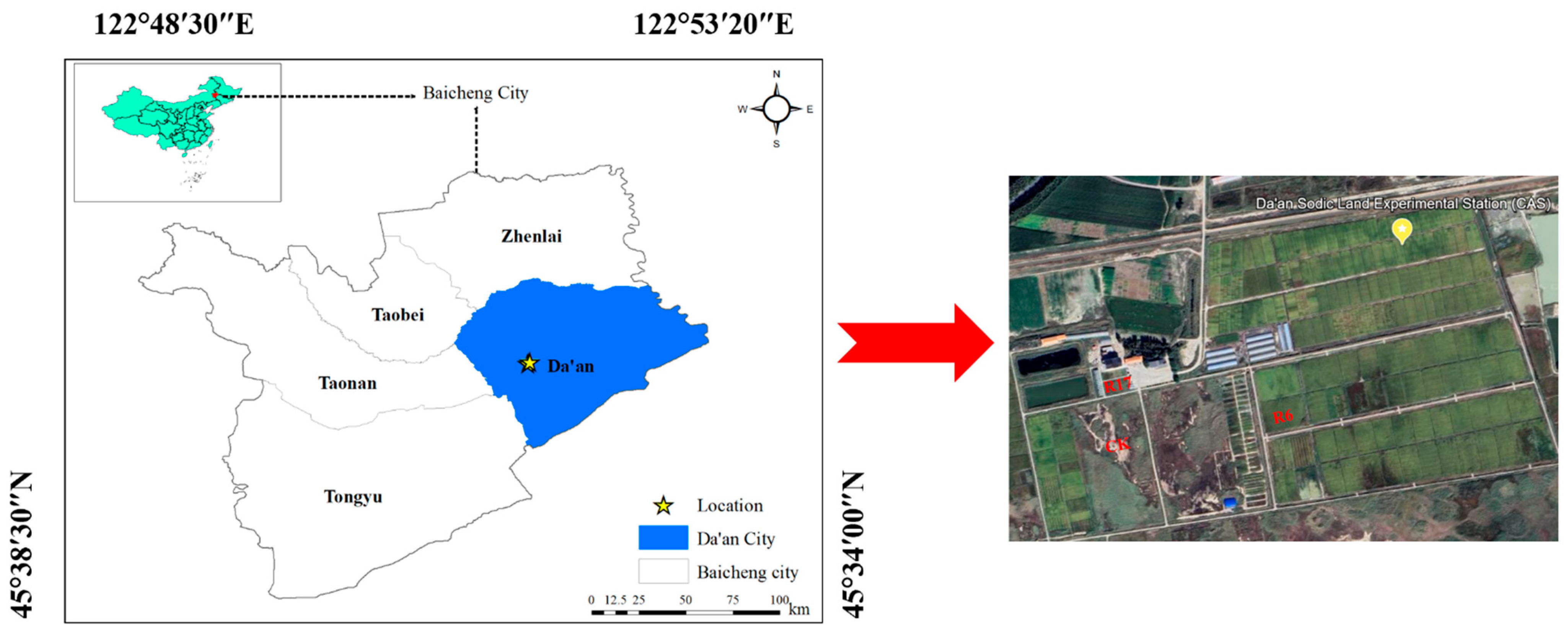
The study area is located at the Da’an Sodic Land Experimental Station of the Chinese Academy of Sciences (CAS), Da’an, Baicheng City, Jilin Province, China (45°35′58″ to 45°36′20″ N, 123°50′27″ to 123°51′15″ E; 150–200 m a.s.l) (Figure 1). The climate is transitional between sub-humid and semi-arid, with a mean annual temperature of 4.5 °C, ranging from −20 °C in January to 26 °C in July. Annual precipitation ranges from 350 to 650 mm, approximately 80% of which occurs in July and August, while annual evapotranspiration is about 1750 mm. The soil is classified as a montmorillonitic clay loam. Prior to the experiment, the soil was saline–sodic, with a pH of 9.9, an electrical conductivity of 2.36 mS cm−1, and an exchangeable sodium percentage of 79.7% at 0–20 cm depth. Sodium carbonate and bicarbonate were the dominant salts. According to the World Reference Base for Soil Resources [23], the soil is classified as Solonetz.

2.1.2. Experimental Design and Field Management

Two rice paddy fields were established at the Da’an Experimental Station in 2006 (R17) and 2017 (R6). Each field (40 m × 25 m; 1000 m2) was subdivided into independent 20 m2 subplots separated by 1 m deep barriers to prevent lateral movement of irrigated water, salts, and amendments. Flue-gas desulfurization gypsum was applied prior to each experiment at 9384 kg ha−1. The fields were cultivated continuously for 17 and 6 years, respectively, under identical agronomic and fertilization practices, following the regional agricultural system. The rice cultivar Dongdao 211 (D-211) was grown annually, with transplanting in May and harvest in October, followed by a fallow period from November to April. Flooding was maintained at 5–7 cm during the growing season, from transplanting until approximately two weeks before harvest, after which the fields were allowed to dry. Water levels were adjusted based on crop growth stage and precipitation, with supplementary irrigation supplied through surface channels to ensure uniform flooding. Intermittent drainage was implemented during the tillering and panicle initiation stages to alleviate oxygen stress and promote root development. Fertilizers were applied annually at 80 kg N ha−1, 100 kg P2O5 ha−1, and 100 kg K2O ha−1 as basal inputs. Soil management included spring tillage using a mechanical plough, during which above-ground residues were removed. Below-ground biomass, including roots and stubble, was incorporated into the soil to promote organic matter content. The saline–sodic bare land (CK) served as the control and remained unreclaimed.

2.1.3. Soil Sampling Procedure

In April 2023, soil samples were collected from three treatments: rice cultivated for 17 years (R17), rice cultivated for 6 years (R6), and saline–sodic bare land (CK). Three replicate plots were established per treatment. Using a soil auger, samples were collected from each plot at depths of 0–20 cm, 20–40 cm, and 40–60 cm, yielding 27 samples (3 treatments × 3 replicates × 3 depths). Fresh soil samples were placed in sealed plastic bags and transported to the laboratory on ice. A portion of each sample was air-dried, crushed, and sieved through a 2 mm mesh to determine soil chemical properties. For aggregate fraction analysis, undisturbed samples were collected to preserve the natural soil structure for accurate evaluation of aggregate stability.

2.2. Soil Property Analysis

2.2.1. Soil Salinization and Alkalinization Characteristics

Soil pH, electrical conductivity (EC), and sodium adsorption ratio (SAR) were used as indicators of soil salinity and alkalinity [24]. Soil pH was measured in a 1:2.5 soil-to-water suspension using a pH meter (Leici PHSJ-4F, Shanghai Yidian Scientific Instrument Co., Ltd., Shanghai, China). Electrical conductivity (EC) was determined from a 1:5 soil–water extract using a Leici DDSJ-308F conductivity meter (Shanghai INESA Scientific Instrument Co., Ltd., Shanghai, China). The same extract was used to quantify sodium (Na+), calcium (Ca2+), and magnesium (Mg2+) concentrations. Extracts were filtered through 0.45 μm membranes using sterile syringes to remove suspended particles. Aliquots (5 mL) were transferred to vials and stored at 4 °C until analysis by ion chromatography (SHINE IC system-CIC-D120, Qingdao Shenghan Chromatograph Technology Co., Ltd., Qingdao, China). The sodium adsorption ratio (SAR) was calculated as follows:
S A R =   N a + ( C a 2 + + M g 2 + ) / 2            
where ion concentrations are expressed in meq L−1.

2.2.2. Soil Aggregate Stability

Soil aggregate size distribution was determined using the standard wet-sieving method as described by [25,26]. Soil samples were collected from three depths and then air-dried. Any visible plant debris was removed, and any large clods were broken down to ensure uniform sieving. Eighty grams of air-dried soil were placed on a stack of five sieves (2 mm, 1 mm, 0.25 mm, 0.106 mm, and 0.053 mm) and submerged in water for 10 min. The sieves were mechanically oscillated with a 4 cm vertical stroke at 30 cycles per minute for 7 min. Soil retained on each sieve was gently rinsed with distilled water, collected in pre-weighed containers, and oven-dried at 80 °C. No corrections for sand or coarse fragments were applied. Aggregate distribution was calculated as the mass percentage of each size class relative to the total soil mass. Mean weight diameter (MWD), geometric mean diameter (GMD), and water stable aggregates (WSA, %) were calculated from the mass fractions, as follows:
M W D = i = 1 n     x i   m i                             i n ( m m )
where n is the number of aggregate size classes, xi is the mass fraction of aggregates in size class i relative to the total dry mass, and mi is the mean diameter of that size class (mm).
  G M D = exp   ( i = 1 n     W i I n   X i )                               i n ( m m )
Here, Wi is the mass proportion of aggregates retained on sieve i, and Xi is the mean diameter of size class i.
W S A i = m i M i × 100                               i n ( % )
Here, WSAi is the percentage of water-stable aggregates in size class i, mi is the mass of aggregates in that class (g), and Mi is the total soil mass (g).

2.2.3. Soil Carbon Fractions

Soil organic carbon (SOC) was determined using the chromic acid wet oxidation method in ref. [27]. Five grams of air-dried soil was oxidized with potassium dichromate-sulfuric acid (K2Cr2O7-H2SO4) under external heating, and the remaining dichromate was back-titrated with ferrous sulfate to determine organic carbon content. A correction factor of 1.10 was applied to account for incomplete oxidation. Particulate organic carbon (POC) was determined according to [28]. Ten grams of 2 mm sieved, air-dried soil were dispersed in 100 mL of 5% sodium hexametaphosphate, manually shaken for 3 min, and then shaken horizontally for 18 h at 25 °C and 90 rpm to disrupt aggregates. The suspension was then passed through a 53 μm sieve, and the retained fraction (>53 μm), representing POC, was washed with distilled water and oven-dried at 65 °C. The dried fraction was oxidized with 0.4 mol L−1 K2Cr2O7-H2SO4 in an oil bath at 170–180 °C for 5 min, and residual dichromate was titrated with 0.1 mol L−1 iron sulfate (FeSO4).
Dissolved organic carbon (DOC) and dissolved inorganic carbon (DIC) were determined by water extraction and total organic carbon (TOC) analysis [29]. Eight grams of fresh soil samples was mixed with distilled water at a 1:5 soil-to-water ratio and shaken at 250 rpm for 30 min at 25 °C. Suspensions were centrifuged at 15,000 rpm for 10 min and filtered through a 0.45 μm membrane. The filtrates were analyzed using a TOC analyzer (TOC-VCPH, Shimadzu Corporation, Kyoto, Japan). Total carbon was measured by weighing finely crushed soil into small foil capsules, which were then combusted in an automated CHN analyzer (Vario EL series, Elementar Analysensysteme GmbH, Langenselbold, Germany). The amounts of emitted carbon dioxide (CO2) and nitrogen gas (N2) were quantified by gas chromatography [30]. Soil inorganic carbon (SIC) was calculated as the difference between total carbon measured by CHN combustion and SOC [31]. SOC in aggregate fractions (>2 mm, 0.25–2 mm, 0.053–0.25 mm, and <0.053 mm) was determined as described by [32]. Aggregates obtained by wet sieving were oven dried at 40 °C for 2–3 days and analyzed for SOC using the chromic acid wet oxidation method [27]. Humus fractions, including humic acid (HA), fulvic acid (FA), and humin (HM), were separated by alkaline extraction as described by [33]. 2.5 g of air-dried soil was extracted with a mixed solution of 0.1 mol L−1 sodium pyrophosphate (Na4P2O7) and 0.1 mol L−1 NaOH at a soil-to-solution ratio of 1:20. The extract was acidified to pH 2–3 with 0.5 mol L−1 H2SO4 to precipitate HA, while FA remained in solution. The HA fraction was separated by filtration, and the residual soil was designated as HM.
Carbon indices were calculated from measured concentrations (g kg−1) of the individual fractions. HM/SOC was computed as humin carbon divided by SOC to represent the proportion of stabilized carbon [34]. FA/HA and FA/DOC were calculated as fulvic acid carbon divided by humic acid carbon and dissolved organic carbon, respectively. These indices were used to characterize humification degrees, carbon stabilization, and the distribution of mobile versus stable carbon pools in reclaimed saline–sodic soils.

2.3. Statistical Analysis

Statistical analyses were performed using IBM SPSS Statistics (version 26, IBM Corp., Armonk, NY, USA). A one-way analysis of variance (ANOVA) was used to compare treatment effects (R17, R6, and CK) on soil properties, and Duncan’s multiple-range test for post hoc comparisons (p < 0.05). Pearson correlation coefficients were employed to evaluate relationships among soil properties. Principal component analysis (PCA) was conducted in OriginPro (Version 2025b, OriginLab Corporation, Northampton, MA, USA) using standardized soil properties (z-score normalization) and a correlation matrix. Components with eigenvalues > 1 were retained to identify key indicators differentiating treatments. Partial least squares structural equation modeling (PLS–SEM) was conducted using the plspm package in R (version 4.5.2, R Foundation for Statistical Computing, Vienna, Austria) to quantify direct and indirect relationships among soil physicochemical variables. Path coefficients were assessed using non-parametric bootstrapping. Model performance was evaluated using coefficients of determination (R2) and effect sizes (f2). Measurement reliability and validity were evaluated using composite reliability (CR), average variance extracted (AVE), and indicator loadings [35]. Independent models were developed for each depth (0–20 cm, 20–40 cm, and 40–60 cm) to capture depth-specific processes. All data visualizations were prepared using OriginPro (Version 2025b, OriginLab Corporation, Northampton, MA, USA) and Microsoft Excel 2016 (Microsoft Corporation, Redmond, WA, USA).

3. Results

3.1. Soil Aggregate Distribution and Stability

The distribution of soil aggregate sizes was strongly influenced by reclamation (Table 1). R17 and R6 exhibited higher proportions of macro-aggregates (>2 mm) at the 20–40 cm and 40–60 cm depths. At the 0–20 cm depth, R17 had a substantially higher proportion of 0.25–2 mm aggregates, followed by R6, whereas CK showed significantly greater proportions of 0.053–0.25 mm and <0.053 mm fractions across all soil depths. Consistently, the mean weight diameter (MWD) and geometric mean diameter (GMD) were higher in R17 and R6, with values ranging from 0.60 to 0.98 mm and 0.62–2.64 mm, respectively, compared with CK, which ranged from 0.26 to 0.39 mm and 0.15–0.26 mm, respectively. Additionally, water-stable aggregates (WSA) increased with depth and were consistently greater in reclaimed fields.

3.2. Effects of Rice Reclamation on Soil Salinization and Alkalinization

Reclamation significantly reduced salinity and alkalinity throughout the 0–60 cm profile, with electrical conductivity decreasing by 70–85%, the sodium adsorption ratio reducing by 32–68%, and pH decreasing by 3–12% compared to CK. The saline–sodic bare land (CK) had pH values between 9.42 and 9.55 and EC values between 1.90 and 3.28 mS cm−1 in the 0–60 cm soil profile (Table 2). In comparison, R17 and R6 had significantly lower pH and EC, ranging from 8.43 to 9.13 and 0.37 to 0.63 mS cm−1, respectively. Depth-wise, R17 and R6 had significantly higher soil pH at 40–60 cm than at 0–40 cm. Soil EC was higher at 0–20 and 40–60 cm depths in the R17 treatment than at 20–40 cm depth, but there were no significant differences in R6. CK had higher EC at 0–20 cm than at 20–60 cm depth. SAR was significantly higher in CK compared to R17 and R6. R17 and CK showed significantly higher SAR at 40–60 cm than at 0–40 cm, indicating partial sodium accumulation in deeper layers despite surface reclamation.

3.3. Soil Carbon Pools and Aggregate-Associated Organic Carbon

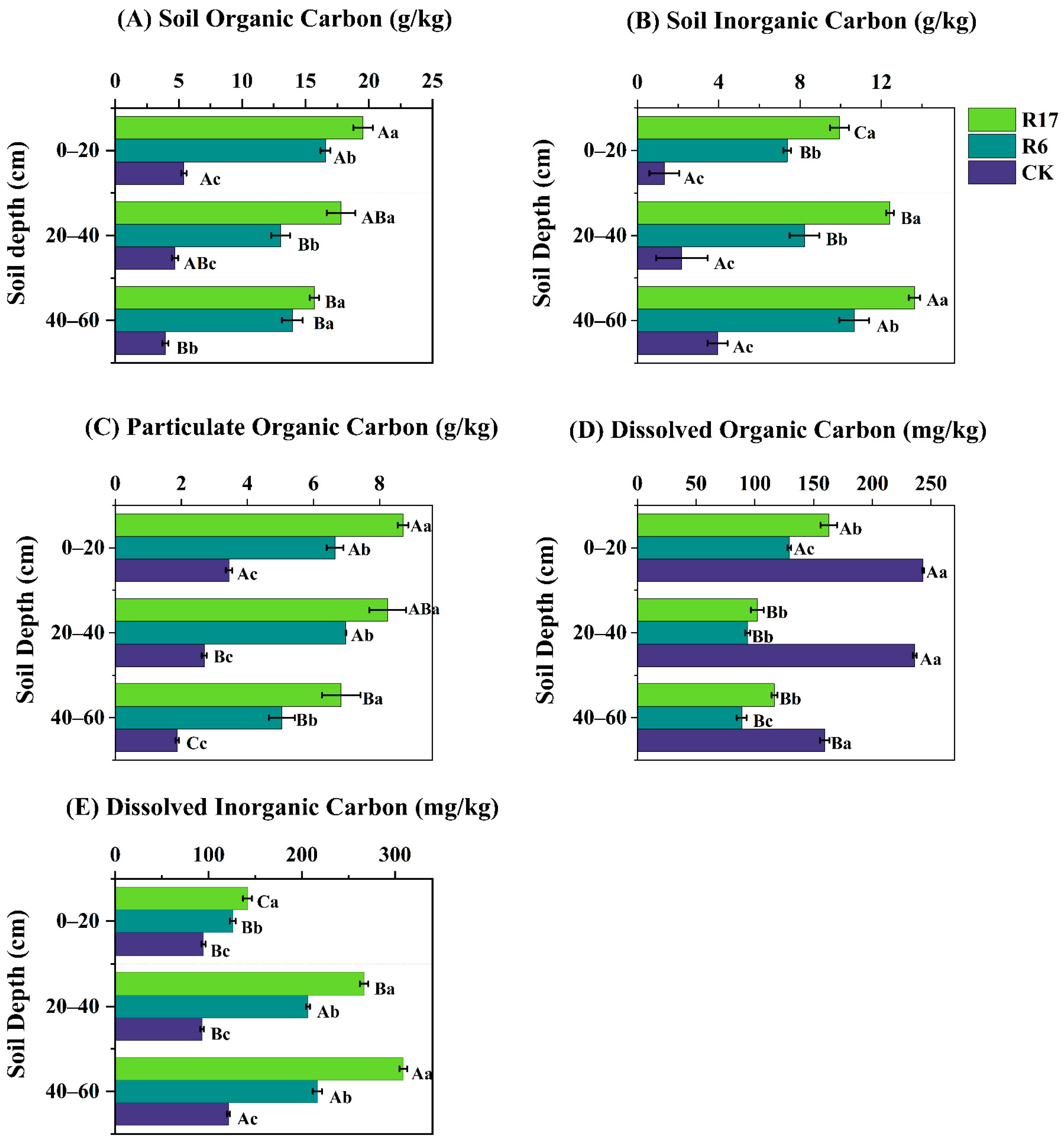
SOC in R17 was greater than in R6 and CK, with averages of 17.6 g/kg in R17, 14.52 g/kg in R6, and 4.69 g/kg in CK (Figure 2A). SOC in R17 was significantly greater at 0–40 cm than at 40–60 cm. Similarly, SIC was higher in R17 than in R6 or CK, with mean values of 11.99, 8.7, and 2.48 g/kg, respectively (Figure 2B). There were no significant differences in SIC levels across depths in the CK treatment. However, R17 and R6 exhibited significantly greater SIC at 20–60 cm than at 0–20 cm. POC decreased with depth across treatments, with R17 having significantly higher POC than R6 and CK at all soil depths (Figure 2C). On average, CK had 212.91 mg/kg, R17 had 127.27 mg/kg, and R6 had 103.98 mg/kg of DOC (Figure 2D). DOC in R17 and R6 was significantly higher in the 0–20 cm depth than in the 20–60 cm depth, and CK had significantly higher DOC in the 0–40 cm depth than in the 40–60 cm depth. DIC was substantially higher in R17, with averages of 239.12 mg/kg, 183.09 mg/kg in R6, and 109.03 mg/kg in CK (Figure 2E). R17, R6, and CK showed significantly higher DIC at 40–60 cm than at 0–40 cm, indicating a progressive accumulation of dissolved inorganic carbon with depth.
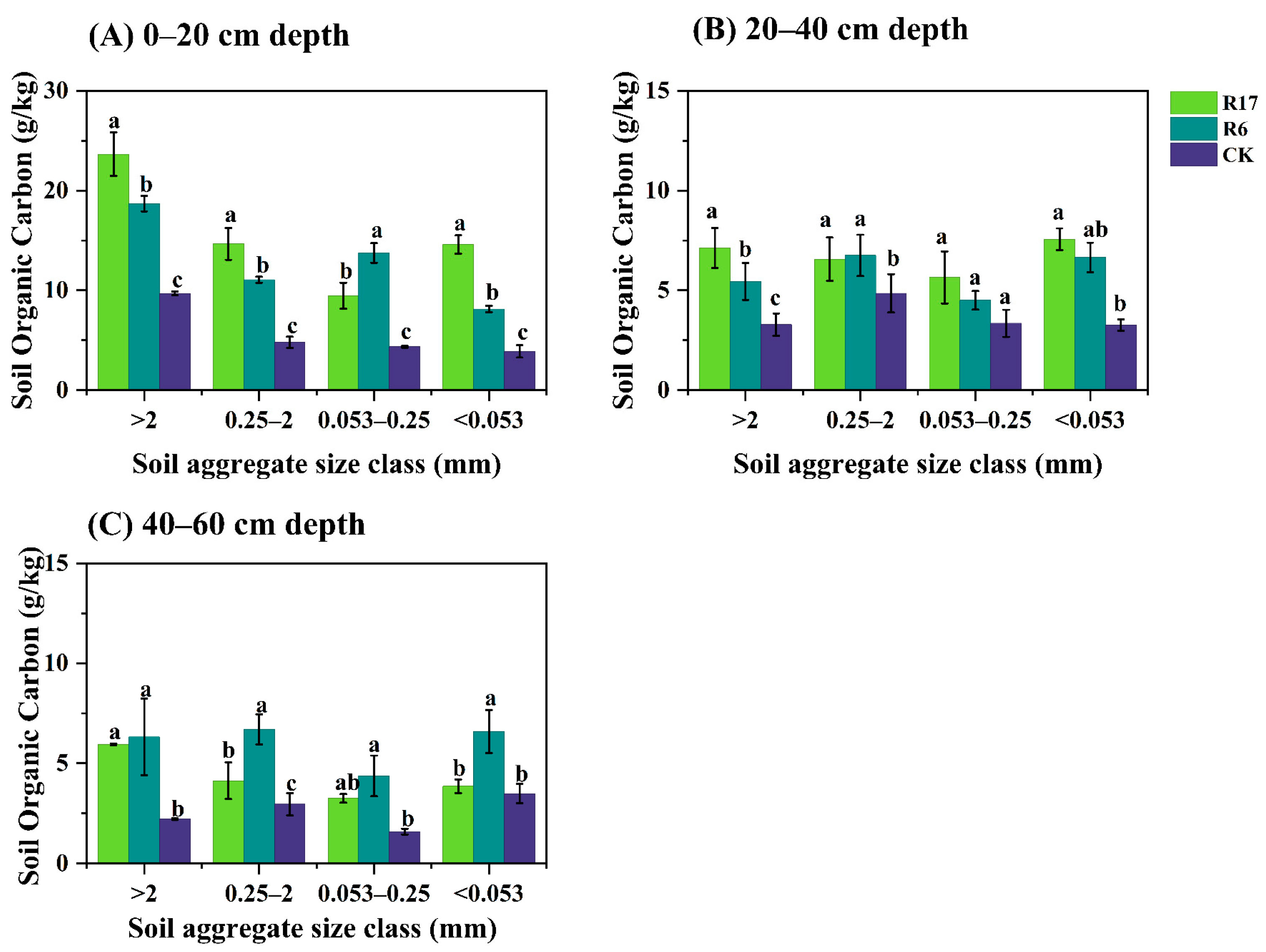
Aggregate-associated SOC was higher in R17 and R6 than in CK across most aggregate size classes and depths (Figure 3). At the 0–20 cm depth, R17 showed particularly high SOC in the 0.25–1 mm and <0.053 mm aggregate sizes, while R6 had significantly higher SOC in the 0.053–0.25 mm fraction (Figure 3A). In the subsoil at the 20–40 cm depth, significant differences were observed in the >2, 0.25–2, and <0.053 mm aggregate sizes, with R17 exhibiting the greatest SOC, followed by R6 and CK (Figure 3B). At the 40–60 cm depth, R6 had the highest SOC across all aggregate sizes, followed by R17 and CK (Figure 3C), indicating enhanced aggregate-associated carbon stabilization under prolonged reclamation.

3.4. Vertical Distribution of Humus Content

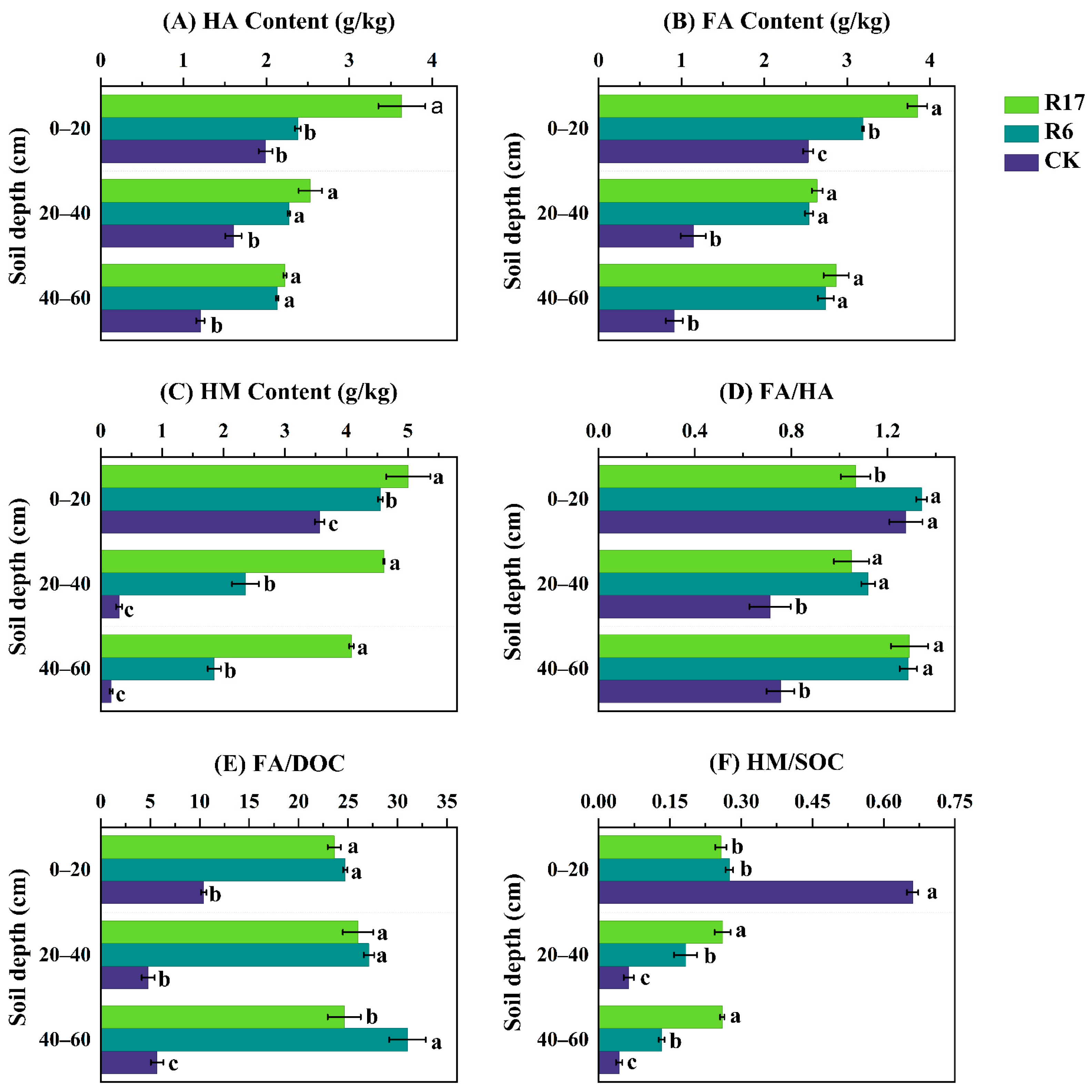
Rice reclamation significantly altered the distribution and composition of humic substances compared to saline–sodic bare land (CK) (Figure 4). Humic acid (HA), fulvic acid (FA), and humin (HM) showed a decreasing trend from the surface to the subsurface layer, and across all depths, these fractions were significantly higher in R17 than in R6 and CK (p < 0.05). The composition of humus also shifted under reclamation. The FA/HA ratio declined from 0–20 to 20–40 cm, then increased at 40–60 cm, with higher values in reclaimed fields than in CK, indicating a greater relative accumulation of fulvic acid following reclamation (Figure 4D). Carbon mobility and stability indices further differentiated treatments. The FA/DOC ratio was higher in R6 and R17 than in CK at all depths, with the subsurface layer showing R6 > R17 > CK (Figure 4E). Similarly, the HM/SOC ratio indicated the proportion of carbon present in more stable forms, being highest in CK at the 0–20 cm depth, while R17 had the highest ratio at depths of 20–40 cm and 40–60 cm, followed by R6 and then CK (Figure 4F), suggesting enhanced stabilization of humified carbon with longer reclamation duration.

3.5. Relationships Between Soil Properties and Carbon Content

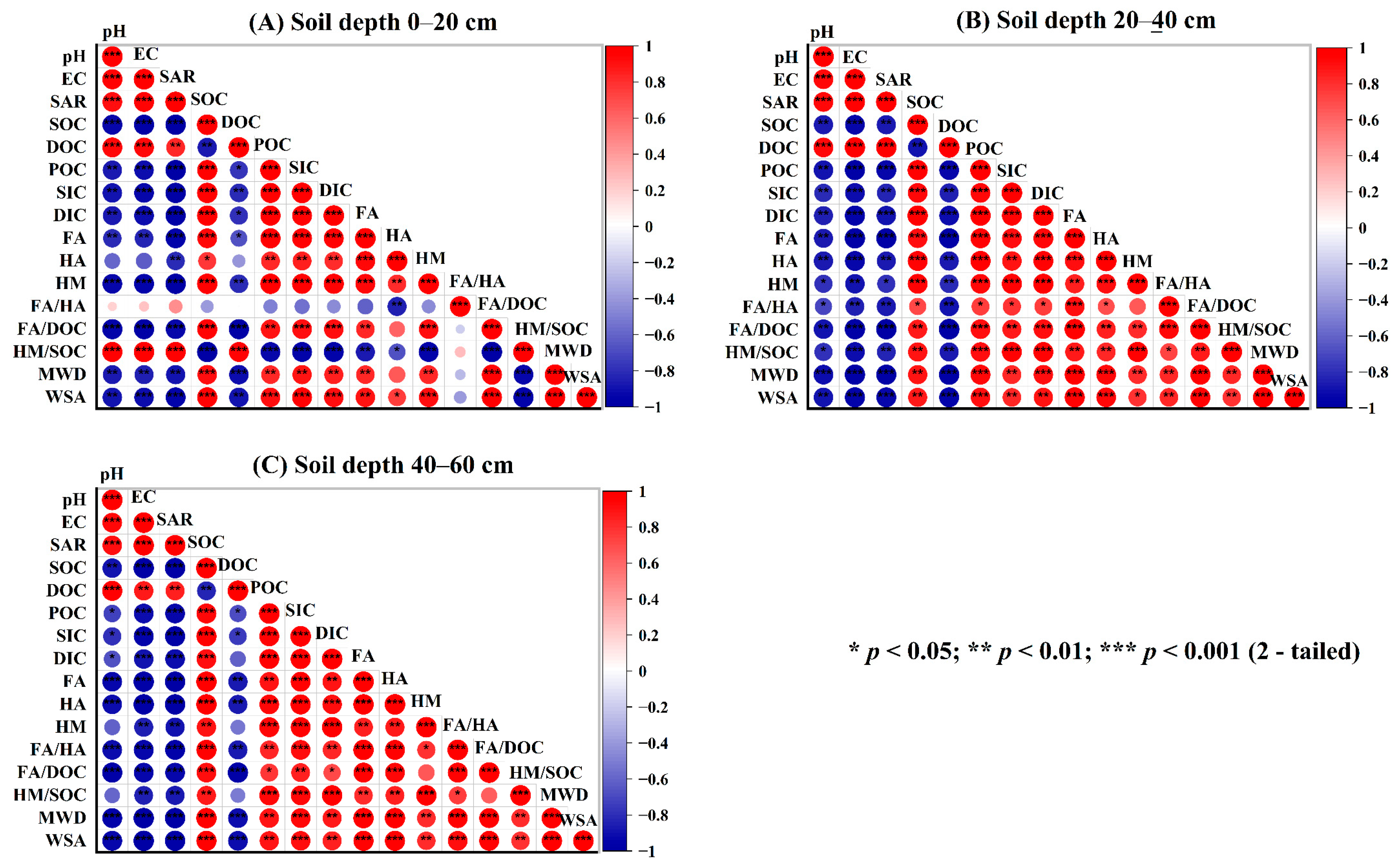
Pearson’s correlation analysis demonstrated substantial associations among salinity indicators, carbon pools, and aggregation throughout the soil profile (Figure 5). Soil pH, EC, and SAR exhibited negative correlations with SOC, POC, HA, FA, and HM, while SOC and POC demonstrated positive correlations with humic fractions, indicating a simultaneous accumulation of labile and humified carbon under reduced salinity. Across all depths, aggregate stability indices (MWD and WSA) showed positive correlations with SOC and humic fractions and negative correlations with salinity indicators, suggesting that improved aggregation is closely linked to organic matter accumulation and decreased salinity.
Similarly, inorganic carbon fractions (SIC and DIC) were positively correlated with organic carbon fractions, implying a link between the accumulation of organic and inorganic carbon during long-term flooding. At the 0–20 cm depth, FA/HA exhibited no significant correlation except with HA. In contrast, at depths of 20–40 cm and 40–60 cm, it showed significant correlations with nearly all soil properties. HM/SOC also showed a negative correlation at the 0–20 cm depth with SOC and other humic fractions and a positive correlation with salinity factors and DOC. In contrast, in the subsurface layer, the correlations were positive for carbon fractions and negative for salinity factors and DOC. Overall, the depth-dependent variation in correlations indicates a transition from salinity-driven controls on carbon dynamics in surface soils to stabilization-driven carbon interactions in deeper layers.
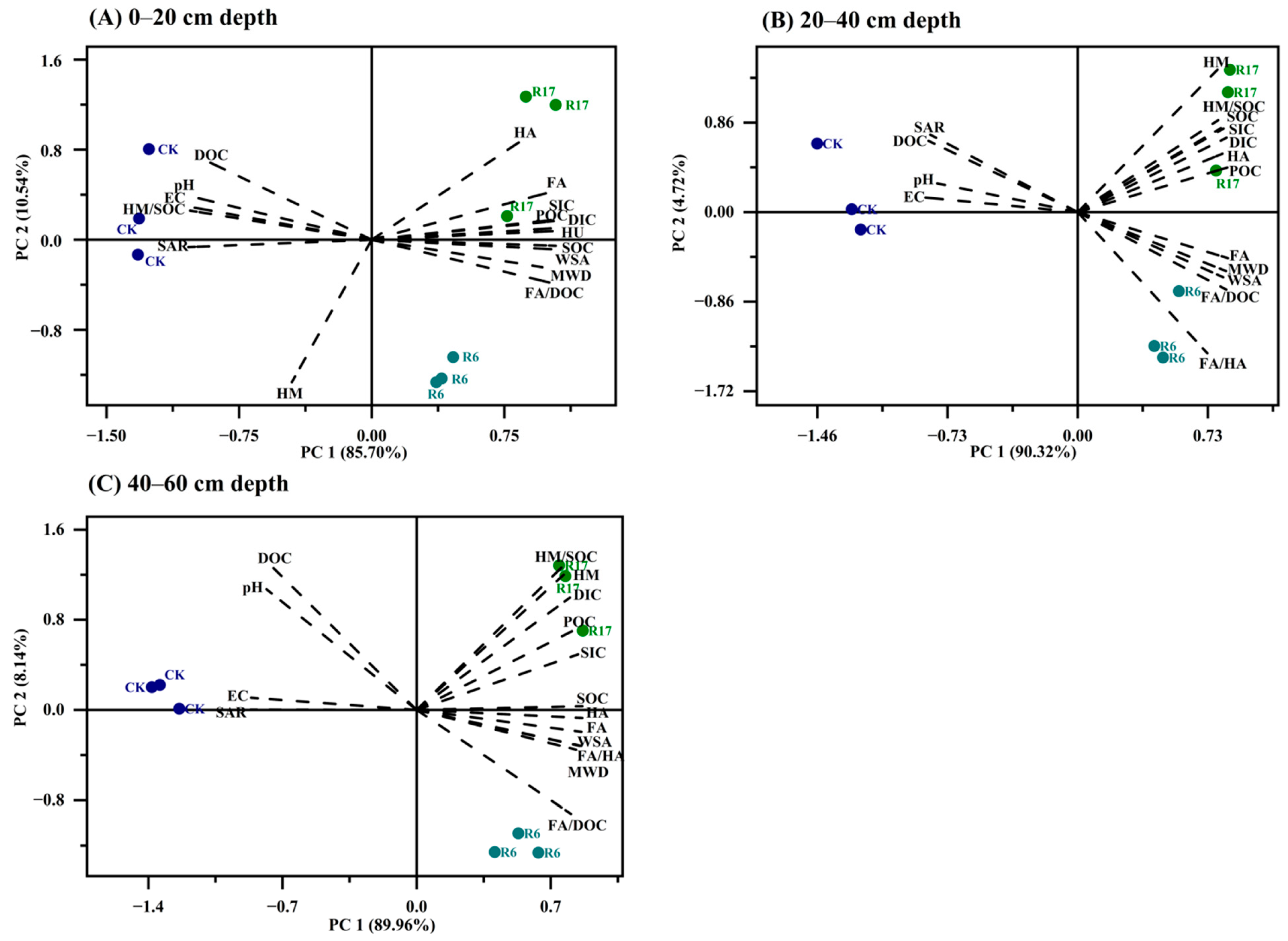
The PCA biplots showed clear patterns in the relationships among soil properties, which varied significantly with soil depth and reclamation duration (Figure 6). The PCA revealed a clear separation between the reclaimed (R17, R6) and control (CK) treatments. At the 0–20 cm depth, PC1 (85.7%) and PC2 (10.5%) explained most of the total variance. The vectors for HA, FA, HM, SIC, DIC, FA/DOC, FA/HA, SOC, POC, WSA, and MWD clustered on the positive side of PC1, aligning with R17 and R6 and indicating that rice reclamation improved aggregate stability and promoted higher organic carbon content. In contrast, soil pH, EC, DOC, SAR, and HM/SOC were closely aligned with the CK treatment. At the 20–40 cm depth, PC1 and PC2 accounted for 90.3% and 4.72% of the total variance, respectively. At the 40–60 cm depth, they explained 89.96% and 8.14%, respectively. The clustering pattern was similar to that in the surface layer; however, HM/SOC shifted in the subsurface layers, aligning with the R17 treatment, at both depths, suggesting enhanced humification and greater carbon stabilization with longer reclamation duration. Additionally, FA/HA and FA/DOC clustered closer to R6, indicating that R6 still had higher proportions of mobile carbon fractions compared to R17.
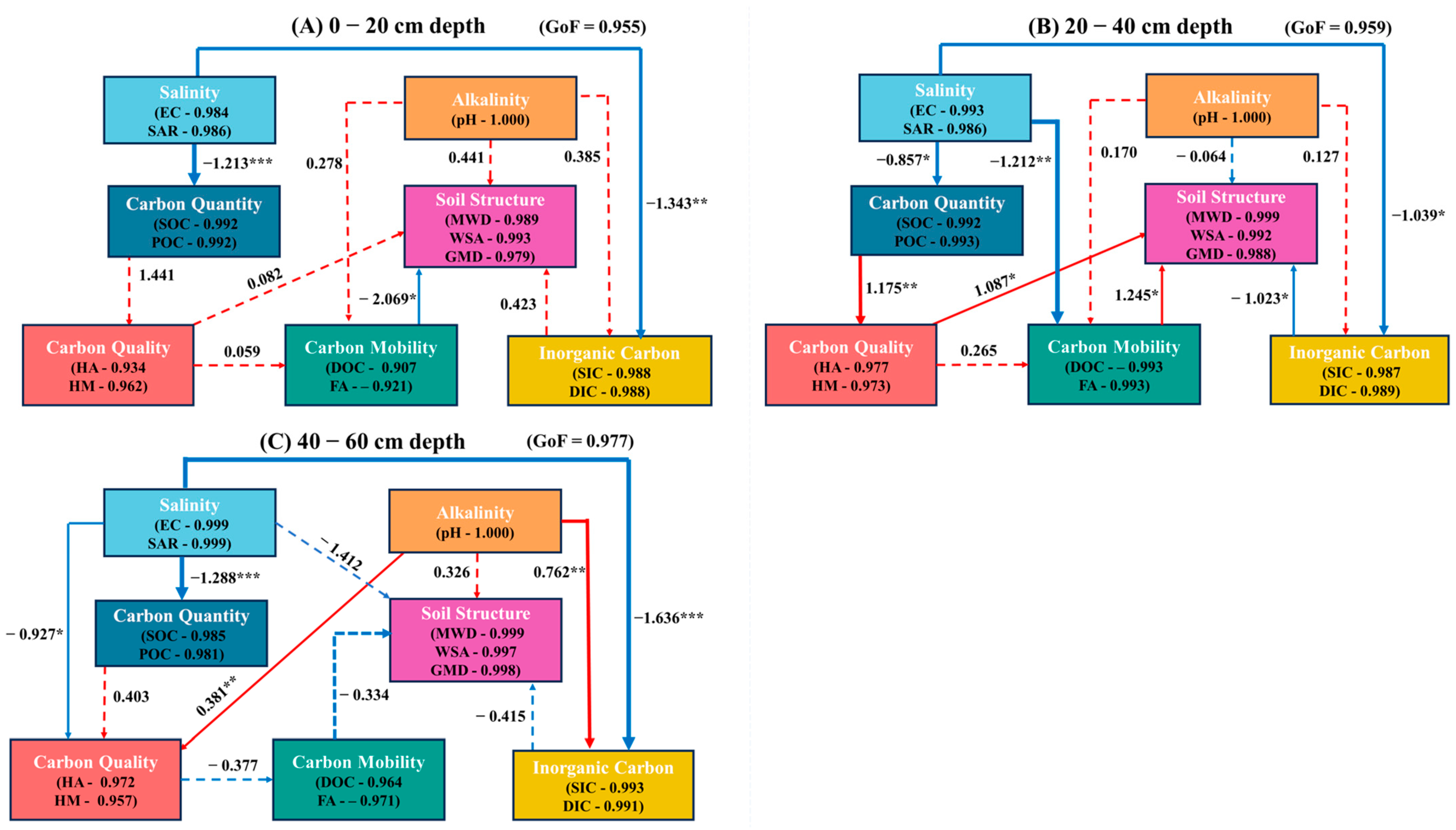
The PLS-SEM analysis provided a mechanistic framework for understanding how salinity, carbon pools, and soil structure interact across the soil profile and regulate soil organic matter stabilization. Seven latent constructs—alkalinity (pH), salinity (EC and SAR), carbon quantity (SOC, POC), carbon quality (HA, HM), carbon mobility (DOC, FA), inorganic carbon (SIC, DIC), and soil structure (MWD, WSA, GMD)—were integrated to evaluate their hierarchical relationships. The model exhibited good overall fit and strong explanatory power for all endogenous constructs at each depth (Table 3), indicating that the structural model captured most of the variability in soil depth processes. Across all depths, the PLS-SEM models demonstrated robust measurement reliability and validity, with composite reliability (CR) > 0.7, average variance extracted (AVE) > 0.5, and indicator loadings > 0.7. Specifically, CR ranged from 0.899 to 0.998, AVE from 0.835 to 0.997, and outer loadings from 0.907 to 0.999 across depths.
Key structural pathways showed large effect sizes (f2 > 0.35), indicating substantial practical relevance. The high R2 values partly reflect the inclusion of indicators representing intrinsically related soil properties, and this construct’s composition is theoretically justified for the mechanistic evaluation of carbon redistribution and soil structural formation, thereby increasing explanatory power. The strong measurement properties reflect the consistency of soil physicochemical responses across long-term field treatments and soil depth sampling. Additionally, elevated R2 values were not accompanied by uniformly significant paths, indicating that model performance was not driven by overfitting.
In the 0–20 cm depth, salinity exerted strong direct adverse effects on both carbon quantity (β = −1.213, p < 0.001) and inorganic carbon (β = −1.343, p = 0.001), and carbon mobility had a significant adverse effect on soil structure (β = −2.069, p = 0.001) (Figure 7A), indicating a dispersion promoting role of soluble carbon under high salinity. In contrast, at the 20–40 cm depth, while salinity maintained a significant adverse effect on carbon quantity (β = −0.86, p = 0.05), its most pronounced impact was on carbon mobility (β = −1.21, p = 0.004) (Figure 7B). Carbon mobility showed a positive effect on soil structure (β = 1.25, p = 0.034), whereas carbon quantity enhanced carbon quality (β = 1.17, p = 0.004), which subsequently exerted a positive effect on soil structure (β = 1.09, p = 0.020). These results indicate that carbon leached from the surface was re-stabilized and contributed to aggregate formation in the subsoil. At the 40−60 cm depth, salinity continued to suppress carbon quantity (β = −1.287, p < 0.001) and inorganic carbon (β = −1.636, p < 0.001). Alkalinity promoted the formation of stable humic substances (β = 0.381, p = 0.02) and inorganic carbon (β = 0.762, p = 0.001) (Figure 7C), and effects on soil structure were weaker. Overall, these pathways indicate a depth-dependent shift from dispersion-dominated, mobile carbon systems in the surface layer to carbon re-stabilization and aggregate-forming processes in deeper layers.

4. Discussion

4.1. Soil Carbon Pool Redistribution Under Rice-Based Reclamation

Effective reclamation strategies depend not only on salt removal but also on improving and redistributing carbon pools to sustain long-term soil resilience and productivity [5,36]. In this study, rice cultivation significantly altered both the composition and vertical distribution of soil carbon pools in saline–sodic soils of the Songnen Plain, China, across the 0–60 cm depth. In the surface layer, soil organic carbon (SOC) and particulate organic carbon (POC) in R17 exceeded those in R6 and CK, indicating that prolonged cultivation enhanced organic carbon accumulation through sustained residue inputs and reduced decomposition under flooded conditions [37]. Although SOC and POC declined with depth in all treatments, concentrations remained higher in R17 than in R6 and CK throughout the profile, reflecting reduced salinity and improved aggregate stability that promoted carbon retention [38]. Consistent with these trends, PCA clustered R17 with SOC, POC, and MWD, indicating coordinated carbon enrichment and structural stabilization under long-term reclamation. These results suggest that prolonged rice cultivation synchronizes carbon accumulation with structural recovery across the soil profile.
Dissolved organic carbon (DOC) dynamics were greatly regulated by ionic conditions. In CK, DOC exhibited positive associations with pH, EC, and SAR, indicating that salinity and alkalinity promoted DOC release and suppressed humification. High ionic strength likely enhanced DOC solubilization through salt-induced dispersion and alkaline hydrolysis [39], such that DOC accumulation reflected carbon mobilization rather than humification or stabilization [40,41]. These findings are consistent with previous reports that increasing salinity and sodicity enhance DOC desorption while reducing organic matter sorption in salt-affected soils [39].
In contrast, flooded rice reclamation reduced salinity and alkalinity, enabling DOC and fulvic acid (FA) retention through clay adsorption and carbonate co-precipitation [42,43]. PLS-SEM further identified salinity reduction as a primary mediating pathway driving increases in SOC and POC at all depths, highlighting the central role of ionic regulation in carbon redistribution. Flooding also enhanced inorganic carbon dynamics, as indicated by higher dissolved inorganic carbon (DIC) and soil inorganic carbon (SIC) in R6 and R17, consistent with increased carbonate formation under calcium-rich conditions [44]. Overall, rice-based reclamation promoted both organic and inorganic carbon pools throughout the 0–60 cm depth, with the most pronounced effects under prolonged rice cultivation (R17).

4.2. Vertical Transformation and Stabilization of Humic Substances in Saline–Sodic Paddy Fields

Flooded rice cultivation alters the distribution and humification of organic matter by reducing salinity and incorporating organic residues [45]. In this study, prolonged rice cultivation (R17) exhibited significantly higher humic acid (HA), fulvic acid (FA), and humin acid (HM) fractions than R6 and CK, indicating greater organic inputs and suppressed decomposition under anaerobic conditions [46]. Although these fractions decreased with depth across all treatments, their consistently higher levels in R17 and R6 indicate that flooding promoted both surface accumulation and downward redistribution of humic compounds. These findings are consistent with reports from flooded paddy systems showing downward movement of DOC and fulvic acids to deeper horizons during long-term reclamation [47,48]. Humin, the most stable and recalcitrant organic fraction [49], was also higher in reclaimed treatments, indicating enhanced formation of mineral-associated organic matter resistant to microbial decomposition. Variations in humic composition ratios further elucidated the balance between carbon mobility and stabilization during reclamation [50].
At the surface layer, a lower FA/HA ratio in R17 indicated enhanced humification [51]. In contrast, higher FA/HA and FA/DOC ratios in the subsurface layers of R17 and R6 compared to CK suggested greater downward transport of soluble fulvic acids and DOC [52,53]. These patterns indicate that mobile fractions leached from surface soils were redistributed throughout the soil profile and partially stabilized at depth. PCA supported this depth-dependent redistribution, with reclaimed treatments (R17 and R6) clustered separately from CK and exhibiting coordinated shifts in carbon composition. The surface layer was associated with DOC and FA, whereas the subsurface layer showed higher humic and humin indices, indicating progressive conversion of mobile fractions into more stable humified pools [54,55]. These findings support the hypothesis that prolonged reclamation mobilizes dissolved organic matter at the surface, followed by stabilization in subsurface layers. Furthermore, the strong correlation between carbon fractions and aggregate stability indicates that carbon redistribution and structural recovery are closely interconnected processes during reclamation. HM/SOC patterns provide additional evidence of subsurface carbon stabilization: although lower at the surface, HM/SOC was consistently higher at 20–60 cm in R17 and R6 than in CK, suggesting progressive incorporation of mobilized carbon into mineral-associated pools [56,57].
Overall, these results reveal a clear depth-dependent contrast in carbon mobility and stabilization. Soluble fractions (DOC and FA) are mobilized at the surface and redistributed downwards, while humified fractions (HA and HM) dominate stabilization in subsurface soils. This integrated mobilization–stabilization mechanism under flooded saline–sodic reclamation promotes the formation of persistent carbon sinks. Accordingly, effective reclamation should prioritize organic residue inputs and appropriate flooding management to enhance subsurface humification and long-term stabilization.

4.3. Aggregate Stabilization Mechanisms Under Rice-Based Reclamation

Soil aggregation links carbon dynamics with soil physical stability, particularly in saline–sodic soils where sodium-induced dispersion degrades soil structure and reduces resistance to slaking and wet sieving [58]. Sodicity-driven clay dispersion and low electrolyte conditions weaken aggregates and decrease hydraulic conductivity, shifting soil towards a dispersed state [59]. In this study, aggregate formation reflected coordinated changes in carbon mobility, carbon quality, and ionic conditions that jointly regulated aggregation and carbon protection. PLS-SEM also quantified the influence of soil carbon pools on aggregate stability. Both R17 and R6 showed clear improvements in aggregation, with higher macro-aggregate proportions, mean weight diameter (MWD), and water stable aggregates (WSA) across the soil profile. These improvements coincided with greater SOC retention in the >2 mm and 0.25–2 mm aggregate fractions, indicating that continuous organic matter inputs promoted macro-aggregate formation [35].
The impact of mobile carbon fractions on aggregation varied with depth. In surface layers, higher DOC and FA reduced aggregate stability, likely due to organic matter solubilization under fluctuating redox conditions and repeated wetting–drying cycles, which promoted clay dispersion and disrupted transient organic binding [60,61,62]. In contrast, at 20–40 cm, R17 and R6 exhibited lower salinity and alkalinity and a more Ca-rich environment than CK. Under these conditions, leached DOC and FA were readily incorporated into organo-mineral associations and humin-like pools, acting as persistent binding agents through mineral sorption and pore-scale protection within aggregates [63,64]. This transition from surface destabilization to subsoil stabilization represents a key mechanism of rice-based reclamation.
Subsurface stabilization was further strengthened by humified carbon. PLS-SEM showed that carbon quality (HA, HM), rather than carbon quantity (SOC and POC), exerted the strongest influence on subsoil aggregation, highlighting humified fractions as effective binding agents. Elevated HM/SOC ratios at 20–60 cm in R17 further indicated that mobilized carbon underwent humification and mineral association, thereby enhancing stability [65]. Consistent with established mechanisms, our findings showed that humic substances promoted aggregation via cation bridging and organo-mineral interactions [66]. In addition, inorganic carbon contributed to stabilization in the reclaimed treatments, where PLS-SEM showed positive direct effects of SIC and DIC on aggregation across the soil profile, consistent with carbonate-mediated cementation in this calcareous environment. Conversely, CK soils had lower HA and HM contents, exhibiting sodium-humate dissolution and clay dispersion, leading to aggregate degradation [67,68]. Notably, the interactive roles of SIC/DIC dynamics and humic fractions in stabilizing aggregates in saline–sodic rice systems remain underexplored.
These findings link DOC and FA redistribution, subsurface humic enrichment, and aggregate stability, supporting an integrated mobilization–retention–stabilization pathway [69]. Aggregate stabilization in reclaimed soils results not only from salinity alleviation but also from enhanced humification and downward redistribution of mobile carbon. Flooding reduces sodium-induced dispersion, allowing both humified and mobile carbon fractions to act as effective binding agents in the subsoil. These mechanisms explain the structural improvements observed in R6 and R17 and highlight the significance of vertically redistributed humified carbon. Overall, surface mobilization of DOC and FA coupled with subsoil accumulation of humic and humin form a coordinated redistribution and stabilization process that governs aggregate recovery during flooded reclamation.

4.4. Implications for Management and Study Limitations

Rice-based reclamation improved the structure of saline–sodic soils by lowering salinity and redistributing carbon fractions across the soil profile. Enhanced carbon pools, humic indices, and aggregate stability in reclaimed treatments demonstrate the combined impacts of salinity reduction and organic matter transformation on structural recovery. To sustain these improvements, reclamation strategies should prioritize continued salinity control and consistent organic matter inputs. Monitoring programs should therefore include not only salinity and sodicity indicators but also aggregation metrics, key carbon fractions, and humic indices. Residue return, organic amendments, appropriate flooding regimes, and maintenance of calcium-rich soil solutions can further promote aggregation through cation bridging and help stabilize humified carbon.
While this study’s findings provide valuable insights, several limitations should be acknowledged. The study was conducted at a single site and included one sampling period, which may not capture seasonal variability in flooding intensity, redox conditions, and DOC mobilization. In addition, although PLS-SEM supports the proposed pathways, it does not establish direct causality; thus, the identified relationships should be interpreted as statistical support rather than definitive causal proof. Future research should incorporate multi-season sampling across multiple sites to improve generalizability and determine the consistency of surface and subsurface dynamics across different hydrological and management conditions. Such efforts will strengthen mechanistic understanding and provide a more robust basis for saline–sodic soil reclamation.

5. Conclusions

Rice-based reclamation improved the chemical and structural properties of saline–sodic soils by alleviating salinity stress and redistributing organic and inorganic carbon fractions across the soil profile. Under long-term calcium-rich flooding conditions, reclamation increased total carbon pools and enhanced the proportion of carbon stored in stable humic and humin fractions. Mobile carbon fractions further amplified these effects, exhibiting contrasting depth-dependent roles by destabilizing aggregates at the surface but promoting stabilization in subsurface layers through incorporation into humified pools. Multivariate analysis confirmed that salinity reduction was closely associated with changes in carbon fractions and aggregate stability. These findings demonstrate that rice-based reclamation stabilizes soil carbon through coupled processes of humification, carbonate-mediated cementation, and aggregation, revealing an integrated, depth-dependent mechanism of carbon mobilization and stabilization that supports long-term soil restoration. Consequently, rice-based reclamation represents an effective strategy for enhancing soil resilience and sustained carbon stabilization in degraded saline–sodic regions such as the Songnen Plain.

Author Contributions

Conceptualization, F.N.G. and X.L.; methodology, F.N.G.; software, F.N.G. and Y.W.; validation, F.N.G. and X.L.; formal analysis, F.N.G.; investigation, F.N.G., Y.W. and K.Z.; resources, Z.J., K.G. and X.L.; data curation, F.N.G. and X.L.; writing—original draft preparation, F.N.G.; writing—review and editing, F.N.G., Y.W., K.Z., Z.J., K.G. and X.L.; visualization, F.N.G., Y.W., K.Z. and X.L.; supervision, Z.J., K.G. and X.L.; project administration, X.L.; funding acquisition, Z.J., K.G. and X.L. All authors have read and agreed to the published version of the manuscript.

Funding

This work was supported by the National Key Research and Development Program of China (Grant/Award Number: 2022YFD1500501).

Data Availability Statement

The original contributions presented in this study are included in the article. Further inquiries can be directed to the corresponding author.

Acknowledgments

The authors acknowledge the Center for Agricultural Resources Research, Institute of Genetics and Developmental Biology, Chinese Academy of Sciences, and the University of Chinese Academy of Sciences for providing research facilities and academic environment that supported this study.

Conflicts of Interest

The authors declare no conflicts of interest.

Abbreviations

The following abbreviations are used in this manuscript:
Ca2+Calcium ions
DICDissolved inorganic carbon
DOCDissolved organic carbon
ECElectrical conductivity
ESPExchangeable sodium percentage
FAFulvic acid
GMDGeometric mean diameter
HAHumic acid
HMHumin acid
Mg2+Magnesium ions
MWDMean weight diameter
Na+Sodium ions
POCParticulate organic carbon
SARSodium adsorption ratio
SICSoil inorganic carbon
SOCSoil organic carbon
SOMSoil organic matter
WSAWater-stable aggregates

References

  1. Kumar, P.; Sharma, P.K. Soil Salinity and Food Security in India. Front. Sustain. Food Syst. 2020, 4, 533781. [Google Scholar] [CrossRef]
  2. Mwesige, F.F. The Extent and Distribution of Salt-Affected Soils in Sub-Saharan Africa from 1970 to the Present: A Review of the Current State of Knowledge. Front. Soil Sci. 2025, 5, 1571243. [Google Scholar] [CrossRef]
  3. Arora, S.; Singh, A.K.; Singh, Y.P. Bioremediation of Salt Affected Soils: An Indian Perspective; Springer: Berlin/Heidelberg, Germany, 2017; ISBN 9783319482576. [Google Scholar]
  4. Beyene, S.; Regassa, A.; Mishra, B.B.; Haile, M. The Soils of Ethiopia; Springer: Berlin/Heidelberg, Germany, 2023; ISBN 9783031170119. [Google Scholar]
  5. Amini, S.; Ghadiri, H.; Chen, C.; Marschner, P. Salt-Affected Soils, Reclamation, Carbon Dynamics, and Biochar: A Review. J. Soils Sediments 2016, 16, 939–953. [Google Scholar] [CrossRef]
  6. Chang, C.; Tian, L.; Tian, Z.; McLaughlin, N.; Tian, C. Change of Soil Microorganism Communities under Saline-Sodic Land Degradation on the Songnen Plain in Northeast China#. J. Plant Nutr. Soil Sci. 2022, 185, 297–307. [Google Scholar] [CrossRef]
  7. Zhao, D.; Wang, Z.; Yang, F.; Zhu, W.; An, F.; Ma, H.; Tóth, T.; Liao, X.; Yang, H. Amendments to Saline-Sodic Soils Showed Long-Term Effects on Improving Growth and Yield of Rice (Oryza sativa L.). PeerJ 2020, 8, e8726. [Google Scholar] [CrossRef]
  8. Ezeokoli, O.T.; Nuaila, V.N.A.; Obieze, C.C.; Muetanene, B.A.; Fraga, I.; Tesinde, M.N.; Ndayiragije, A.; Coutinho, J.; Melo, A.M.P.; Adeleke, R.A.; et al. Assessing the Impact of Rice Cultivation and Off-Season Period on Dynamics of Soil Enzyme Activities and Bacterial Communities in Two Agro-Ecological Regions of Mozambique. Agronomy 2021, 11, 694. [Google Scholar] [CrossRef]
  9. Lv, H.; Huang, L.; Liang, Z.; Yang, H.-Y.; Lv, B.-S. Effects of Cultivation Patterns on Rice (Oryza sativa L.). J. Food Agric. Environ. 2013, 11, 2472–2477. [Google Scholar]
  10. Xu, Z.; Shao, T.; Lv, Z.; Yue, Y.; Liu, A.; Long, X.; Zhou, Z.; Gao, X.; Rengel, Z. The Mechanisms of Improving Coastal Saline Soils by Planting Rice. Sci. Total Environ. 2020, 703, 135529. [Google Scholar] [CrossRef]
  11. Kalisz, B.; Łachacz, A.; Giełwanowska, I.; Olech, M.; Chwedorzewska, K.J.; Kellmann-Sopyła, W. Labile and Stable Carbon Pools in Antarctic Soils of the Arctowski Region, King George Island. Sustainability 2025, 2, 7221. [Google Scholar] [CrossRef]
  12. Du, X.; Hu, H.; Wang, T.; Zou, L.; Zhou, W.; Gao, H.; Ren, X.; Wang, J.; Hu, S. Long-Term Rice Cultivation Increases Contributions of Plant and Microbial-Derived Carbon to Soil Organic Carbon in Saline-Sodic Soils. Sci. Total Environ. 2023, 904, 166713. [Google Scholar] [CrossRef]
  13. Bhullar, R.S.; Mavi, M.S.; Choudhary, O.P. Analysis Adverse Impact of Sodicity on Soil Functions Can Be Alleviated Through Addition of Rice Straw Biochar. Commun. Soil Sci. Plant 2019, 50, 2369–2383. [Google Scholar] [CrossRef]
  14. Mcdonald, G.K.A.; Tavakkoli, E.A.; Cozzolino, D.C.; Banas, K.D.; Derrien, M.E. A Survey of Total and Dissolved Organic Carbon in Alkaline Soils of Southern Australia. Soil Res. 2017, 55, 617–629. [Google Scholar] [CrossRef]
  15. Kuzyakov, Y.; Peng, Q.; Lin, S.; Hu, R. Enzyme Activities and Organic Matter Mineralization in Response to Application of Gypsum, Manure and Rice Straw in Saline and Sodic Soils. Environ. Res. 2023, 224, 115393. [Google Scholar] [CrossRef] [PubMed]
  16. Zhang, W.; Zhang, W.; Wang, S.; Sun, Z.; Liu, J.; Li, Y.; Zhuo, Y.; Xu, L.; Zhao, Y. A Quantitative Assessment of the Dynamic Process and Potential Capacity of Using Gypsum to Reclaim Sodic Soil. J. Soils Sediments 2023, 23, 3082–3095. [Google Scholar] [CrossRef]
  17. Zhang, S.; Hu, W.; Zhang, J.; Yu, G.; Liu, Y.; Kong, Z.; Wu, L. Long-Term Cultivation Reduces Soil Carbon Storage by Altering Microbial Network Complexity and Metabolism Activity in Macroaggregates. Sci. Total Environ. 2024, 930, 172788. [Google Scholar] [CrossRef]
  18. Moro, D.; Pellegrini, E.; Contin, M.; Zuccaccia, D.; Khakbaz, A.; De Nobili, M. The Potential Role of Humic Substances in the Amelioration of Saline Soils and Its Affecting Factors. Sustainability 2025, 17, 8621. [Google Scholar] [CrossRef]
  19. Wang, S.; Sun, N.; Liang, S.; Zhang, S.; Meersmans, J.; Colinet, G.; Xu, M.; Wu, L. SOC Sequestration Affected by Fertilization in Rice-Based Cropping Systems over the Last Four Decades. Front. Environ. Sci. 2023, 11, 1152439. [Google Scholar] [CrossRef]
  20. Liu, M.; Han, G. Effects of Soil Aggregate Stability on Soil Organic Carbon and Nitrogen Under Land Use Change in an Erodible Region in Southwest China. Int. J. Environ. Res. Public Health 2019, 16, 3809. [Google Scholar] [CrossRef]
  21. Nakhavali, M.; Lauerwald, R.; Regnier, P.; Guenet, B.; Chadburn, S.; Friedlingstein, P. Leaching of Dissolved Organic Carbon from Mineral Soils Plays a Significant Role in the Terrestrial Carbon Balance. Glob. Change Biol. 2021, 27, 1083–1096. [Google Scholar] [CrossRef]
  22. Xu, C.; Zhang, P.; Chen, L.; Wang, W.; Yang, X.; Liu, Z.; Mi, Y. Effects of Dissolved Organic Carbon Leaching and Soil Carbon Fractions Under Intercropping Dactylis glomerata L.—Medicago Sativa L. in Response to Extreme Rainfall. Agronomy 2025, 15, 1485. [Google Scholar] [CrossRef]
  23. WRB-IUSS. World Reference Base for Soil Resources 2014; World Soil Resources Reports No. 106; FAO: Rome, Italy, 2015; pp. 1–191. [Google Scholar]
  24. Peng, W.; Zhu, X.; Zheng, W.; Xie, Q.; Wang, M. Rice Cultivation Can Mitigate Soil Salinization and Alkalization by Modifying the Macropore Structure in Saline—Sodic Paddy Fields. Agric. Water Manag. 2025, 313, 109473. [Google Scholar] [CrossRef]
  25. Kemper, W.D.; Chepil, W.S. Size Distribution of Aggregates. In Methods of Soil Analysis: Part 1 Physical and Mineralogical Properties, Including Statistics of Measurement and Sampling, 9.1; American Society of Agronomy (ASA): Madison, WI, USA, 1965; Volume 9, pp. 499–510. [Google Scholar] [CrossRef]
  26. Yoder, R.E. A Direct Method of Aggregate Analysis of Soils and a Study of the Physical Nature of Erosion Losses. Agron. J. 1936, 28, 337–351. [Google Scholar] [CrossRef]
  27. Walkley, A.; Black, I.A. An Examination of the Degtjareff Method for Determining Soil Organic Matter, and a Proposed Modification of the Chromic Acid Titration Method. Soil Sci. 1934, 37, 29–38. [Google Scholar] [CrossRef]
  28. Garten, C.T.; Post, W.M.; Hanson, P.J.; Cooper, L.W. Forest Soil Carbon Inventories and Dynamics along an Elevation Gradient in the Southern Appalachian Mountains. Biogeochemistry 1999, 45, 115–145. [Google Scholar] [CrossRef]
  29. Jones, D.L.; Willett, V.B. Experimental Evaluation of Methods to Quantify Dissolved Organic Nitrogen (DON) and Dissolved Organic Carbon (DOC) in Soil. Soil Biol. Biochem. 2006, 38, 991–999. [Google Scholar] [CrossRef]
  30. Wright, A.F.; Bailey, J.S. Organic Carbon, Total Carbon, and Total Nitrogen Determinations in Soils of Variable Calcium Carbonate Contents Using a Leco CN-2000 Dry Combustion Analyzer. Commun. Soil Sci. Plant Anal. 2001, 32, 3243–3258. [Google Scholar] [CrossRef]
  31. Li, Y.; Brandle, J.; Awada, T.; Chen, Y.; Han, J.; Zhang, F.; Luo, Y. Accumulation of Carbon and Nitrogen in the Plant-Soil System After Afforestation of Active Sand Dunes in China’s Horqin Sandy Land. Agric. Ecosyst. Environ. 2013, 177, 75–84. [Google Scholar] [CrossRef]
  32. Chellappa, J.; Sagar, K.L.; Sekaran, U.; Kumar, S.; Sharma, P. Soil Organic Carbon, Aggregate Stability and Biochemical Activity Under Tilled and No-Tilled Agroecosystems. J. Agric. Food Res. 2021, 4, 100139. [Google Scholar] [CrossRef]
  33. Schnitzer, M. Humic-Fulvic Acid Relationships in Organic Soils and Humification of the Organic Matter in These Soils. Can. J. Soil Sci. 1967, 47, 245–250. [Google Scholar] [CrossRef]
  34. Zhao, H.; Li, B.; Wang, C.; Long, S.; Li, B.; Xian, S.; Zeng, L.; Xiao, M.; Liu, Q. The Effects of Biochars on Humus Composition in Acidic Purplish Soil. Chin. J. Eco-Agric. 2022, 28, 1949–1957. [Google Scholar]
  35. Zhao, Z.; Mao, Y.; Gao, S.; Lu, C.; Pan, C.; Li, X. Organic Carbon Accumulation and Aggregate Formation in Soils Under Organic and Inorganic Fertilizer Management Practices in a Rice–Wheat Cropping System. Sci. Rep. 2023, 13, 3665. [Google Scholar] [CrossRef] [PubMed]
  36. Rathi, A.; Kumar, P.; Nangla, S. Soil Restoration Strategies for Sustaining Soil Productivity: A Review. Asian Res. J. Agric. 2024, 17, 33–48. [Google Scholar] [CrossRef]
  37. Gikonyo, F.N.; Dong, X.; Mosongo, P.S.; Guo, K.; Liu, X. Long-Term Impacts of Different Cropping Patterns on Soil Physico-Chemical Properties and Enzyme Activities in the Low Land Plain of North China. Agronomy 2022, 12, 471. [Google Scholar] [CrossRef]
  38. Kumar, A.; Naresh, R.K.; Singh, S.; Mahajan, N.C.; Singh, O. Soil Aggregation and Organic Carbon Fractions and Indices in Conventional and Conservation Agriculture Under Vertisol Soils of Sub-Tropical Ecosystems: A Review. Int. J. Curr. Microbiol. Appl. Sci. 2019, 8, 2236–2253. [Google Scholar] [CrossRef]
  39. Mavi, M.S.; Marschner, P.; Chittleborough, D.J.; Cox, J.W.; Sanderman, J. Salinity and Sodicity Affect Soil Respiration and Dissolved Organic Matter Dynamics Differentially in Soils Varying in Texture. Soil Biol. Biochem. 2012, 45, 8–13. [Google Scholar] [CrossRef]
  40. Setia, R.; Gottschalk, P.; Smith, P.; Marschner, P.; Baldock, J.; Setia, D.; Smith, J. Soil Salinity Decreases Global Soil Organic Carbon Stocks. Sci. Total Environ. 2013, 465, 267–272. [Google Scholar] [CrossRef]
  41. Morrissey, E.M.; Gillespie, J.L.; Morina, J.C.; Franklin, R.B. Salinity Affects Microbial Activity and Soil Organic Matter Content in Tidal Wetlands. Glob. Change Biol. 2014, 20, 1351–1362. [Google Scholar] [CrossRef] [PubMed]
  42. Xiao, L.; Chen, S.; Han, F.; Wang, T.; Li, Y.; Li, W.; Yuan, G.; Wu, J. Unveiling Carbon Dynamics in Year-Round Waterlogged Pond Fields: Insights into Soil Organic Carbon Accumulation and Sustainable Management. Carbon Res. 2025, 4, 14. [Google Scholar] [CrossRef]
  43. Sarker, R.R.; Rashid, M.H.; Islam, M.A.; Jahiruddin, M.; Islam, K.R.; Jahangir, M.M.R. Conservation Agriculture’s Impact on Total and Labile Organic Carbon Pools in Calcareous and Non-Calcareous Floodplain Soils Under a Subtropical Rice-Based System. PLoS ONE 2023, 18, e0293257. [Google Scholar] [CrossRef]
  44. Suarez, D.L. Sodic Soil Reclamation: Modelling and Field Study. Aust. J. Soil Res. 2001, 39, 1225–1246. [Google Scholar] [CrossRef]
  45. Ethan, S. Effect of Flooding on Chemistry of Paddy Soils: A Review. Int. J. Innov. Sci. Eng. Technol. 2015, 2, 414–420. [Google Scholar]
  46. Fan, H.Z.; Chen, Q.R.; Qin, Y.S.; Chen, K.; Tu, S.H.; Xu, M.G.; Zhang, W.J. Soil Carbon Sequestration Under Long-Term Rice-Based Cropping Systems of Purple Soil in Southwest China. J. Integr. Agric. 2015, 14, 2417–2425. [Google Scholar] [CrossRef]
  47. Terajima, T.; Moriizumi, M. Temporal and Spatial Changes in Dissolved Organic Carbon Concentration and Fluorescence Intensity of Fulvic Acid like Materials in Mountainous Headwater Catchments. J. Hydrol. 2013, 479, 1–12. [Google Scholar] [CrossRef]
  48. Guggenberger, G.; Zech, W. Dissolved Organic Carbon Control in Acid Forest Soils of the Fichtelgebirge (Germany) as Revealed by Distribution Patterns and Structural Composition Analyses. Geoderma 1993, 59, 109–129. [Google Scholar] [CrossRef]
  49. Almendros, G.; González-Pérez, J.A. Soil Organic Carbon Sequestration Mechanisms and the Chemical Nature of Soil Organic Matter—A Review. Sustainability 2025, 17, 6689. [Google Scholar] [CrossRef]
  50. Pereira, D.G.C.; de Alencar, G.V.; Escobar, M.E.O.; Mendonça, E.D.S.; de Oliveira, T.S. Effect of Organic Farming on Soil Carbon Reserves and Quality in Citrus Groves in the Brazilian Semi-Arid Region. Soil Use Manag. 2025, 41, e70080. [Google Scholar] [CrossRef]
  51. Krüger, N.; Finn, D.R.; Don, A. Soil Depth Gradients of Organic Carbon-13—A Review on Drivers and Processes. Plant Soil 2024, 495, 113–136. [Google Scholar] [CrossRef]
  52. Lee, S.B.; Lee, C.H.; Jung, K.Y.; Do Park, K.; Lee, D.; Kim, P.J. Changes of Soil Organic Carbon and Its Fractions in Relation to Soil Physical Properties in a Long-Term Fertilized Paddy. Soil Tillage Res. 2009, 104, 227–232. [Google Scholar] [CrossRef]
  53. Mandal, M.; Rout, K.K.; Panda, N.; Singh, M. Stabilization of Functional Soil Organic Matter Fractions in Response to Long-Term Fertilization in Tropical Rice–Rice Cropping System. Commun. Soil Sci. Plant Anal. 2020, 51, 136–148. [Google Scholar] [CrossRef]
  54. Mi, W.; Sun, Y.; Gao, Q.; Liu, M.; Wu, L. Changes in Humus Carbon Fractions in Paddy Soil Given Different Organic Amendments and Mineral Fertilizers. Soil Tillage Res. 2019, 195, 104421. [Google Scholar] [CrossRef]
  55. Raiesi, F. The Quantity and Quality of Soil Organic Matter and Humic Substances Following Dry-Farming and Subsequent Restoration in an Upland Pasture. Catena 2021, 202, 105249. [Google Scholar] [CrossRef]
  56. Rumpel, C.; Kögel-Knabner, I.; Bruhn, F. Vertical Distribution, Age, and Chemical Composition of Organic Carbon in Two Forest Soils of Different Pedogenesis. Org. Geochem 2002, 33, 1131–1142. [Google Scholar] [CrossRef]
  57. Chaopricha, N.T.; Marín-Spiotta, E. Soil Burial Contributes to Deep Soil Organic Carbon Storage. Soil Biol. Biochem. 2014, 69, 251–264. [Google Scholar] [CrossRef]
  58. Bronick, C.J.; Lal, R. Soil Structure and Management: A Review. Geoderma 2005, 124, 3–22. [Google Scholar] [CrossRef]
  59. Dang, A.; Bennett, J.M.L.; Marchuk, A.; Biggs, A.; Raine, S.R. Quantifying the Aggregation-Dispersion Boundary Condition in Terms of Saturated Hydraulic Conductivity Reduction and the Threshold Electrolyte Concentration. Agric. Water Manag. 2018, 203, 172–178. [Google Scholar] [CrossRef]
  60. Yan, J.; Lazouskaya, V.; Jin, Y. Soil Colloid Release Affected by Dissolved Organic Matter and Redox Conditions. Vadose Zone J. 2016, 15, vzj2015. [Google Scholar] [CrossRef]
  61. Possinger, A.R.; Bailey, S.W.; Inagaki, T.M.; Kögel-Knabner, I.; Dynes, J.J.; Arthur, Z.A.; Lehmann, J. Organo-Mineral Interactions and Soil Carbon Mineralizability with Variable Saturation Cycle Frequency. Geoderma 2020, 375, 114483. [Google Scholar] [CrossRef]
  62. Zhang, Z.; Furman, A. Soil Redox Dynamics Under Dynamic Hydrologic Regimes—A Review. Sci. Total Environ. 2021, 763, 143026. [Google Scholar] [CrossRef]
  63. Jennings, E.; Järvinen, M.; Allott, N.; Arvola, L.; Moore, K.; Naden, P.; Aonghusa, C.N.; Nõges, T. The Impact of Climate Change on European Lakes; Springer: Berlin/Heidelberg, Germany, 2010. [Google Scholar] [CrossRef]
  64. Vidon, P.G.; Hubbard, H.A.; Cuadra, P.E.; Hennessy, M.L. Storm Dissolved Organic Carbon Dynamics in an Artificially Drained Watershed of the US Midwest. Air Soil Water Res. 2012, 5, 103–115. [Google Scholar] [CrossRef]
  65. Park, S.; Lee, J. Green Manure Improves Humification and Aggregate Stability in Paddy Soils. Soil Biol. Biochem. 2025, 206, 109796. [Google Scholar] [CrossRef]
  66. Sarker, T.C.; Incerti, G.; Spaccini, R.; Piccolo, A.; Mazzoleni, S.; Bonanomi, G. Linking Organic Matter Chemistry with Soil Aggregate Stability: Insight from 13C NMR Spectroscopy. Soil Biol. Biochem. 2018, 117, 175–184. [Google Scholar] [CrossRef]
  67. Ahamadou, B. Composition and Structure of Humic Substances in Long-Term Fertilization Experimental Soils of Southern China. J. Soil Sci. Environ. Manag. 2013, 4, 77–86. [Google Scholar] [CrossRef]
  68. Beamlaku, A.; Habtemariam, T. Soil Colloids, Types and Their Properties: A Review. Open J. Bioinform. Biostat. 2021, 5, 008–013. [Google Scholar] [CrossRef]
  69. Fulton-Smith, S.; Even, R.; Cotrufo, M.F. Depth Impacts on the Aggregate-Mediated Mechanisms of Root Carbon Stabilization in Soil: Trade-off Between MAOM and POM Pathways. Geoderma 2024, 452, 117078. [Google Scholar] [CrossRef]
Figure 1. Location of the study area (Daan Sodic Land Experiment Station), and spatial distribution of treatments: 17 years reclaimed paddy field (R17), 6 years reclaimed field (R6), and saline–sodic bare land (CK). The blue area indicates Da’an city, while the grey areas represent the surrounding administrative regions.
Agronomy 16 00448 g001
Figure 2. Soil carbon fractions across treatments and depths: (A) soil organic carbon (SOC); (B) soil inorganic carbon (SIC); (C) particulate organic carbon (POC); (D) dissolved organic carbon (DOC); and (E) Dissolved Inorganic Carbon (DIC). Bars represent mean ± SE (n = 3). Different lowercase letters indicate significant differences among treatments within the same depth, whereas uppercase letters indicate significant differences among depths within the same treatment (p < 0.05, Duncan’s test).
Agronomy 16 00448 g002
Figure 3. Soil organic carbon (SOC) concentrations across aggregate size classes for paddy fields reclaimed for 17 years (R17), 6 years (R6), and saline–sodic bare land (CK) at three soil depths: (A) 0–20 cm; (B) 20–40 cm; and (C) 40–60 cm depth. Bars represent mean ± SE (n = 3). Different lowercase letters indicate significant differences among treatments within the same aggregate size class (p < 0.05, Duncan’s test).
Agronomy 16 00448 g003
Figure 4. Soil humus fractions across treatments and depths: (A) humic acid (HA); (B) fulvic acid (FA); (C) humin (HM); (D) FA/HA; (E) FA/DOC; and (F) HM/SOC. Bars represent mean ± SE (n = 3). Different lowercase letters indicate significant differences among treatments within the same depth (p < 0.05, Duncan’s test).
Agronomy 16 00448 g004
Figure 5. Pearson’s correlation matrix among different soil properties at three soil depths: (A) 0–20 cm; (B) 20–40 cm; and (C) 40–60 cm depth. Circle color indicates correlation direction (red = positive, blue = negative), and circle size represents the magnitude of the correlation coefficient. Abbreviations: EC, electrical conductivity; SAR, sodium adsorption ratio; SOC, soil organic carbon; DOC, dissolved organic carbon; POC, particulate organic carbon; SIC, soil inorganic carbon; DIC, dissolved inorganic carbon; FA, fulvic acid; HA, humic acid; HM, humin acid; MWD, mean weight diameter and WSA, water stable aggregates.
Agronomy 16 00448 g005
Figure 6. Principal component analysis (PCA) biplots illustrating relationships among soil physicochemical properties at three depths: (A) 0–20 cm; (B) 20–40 cm; and (C) 40–60 cm. The vectors represent soil variables, including soil organic carbon (SOC), particulate organic carbon (POC), soil inorganic carbon (SIC), dissolved organic carbon (DOC), dissolved organic carbon (DIC), mean weight diameter (MWD), water stable aggregates (WSA), pH, electrical conductivity (EC), and others. Each point (R17, R6, CK) represents the replicates of treatment centroids based on multivariate responses. R17 and R6 represent rice paddy fields reclaimed for 17 years and 6 years, respectively, while CK represents saline–sodic bare land. The percentages on the axes indicate the variance explained by each principal component.
Agronomy 16 00448 g006
Figure 7. Partial least squares structural equation modeling (PLS–SEM) path diagrams showing standardized path coefficients for soil depths (A) 0–20 cm; (B) 20–40 cm; and (C) 40–60 cm. Different colored boxes represent different latent variables in the model. Solid red and blue arrows indicate significant positive and negative relationships, respectively, whereas dashed arrows represent non-significant paths (* p < 0.05, ** p < 0.01, *** p < 0.001). Values within boxes represent indicator loadings of observed variables. GoF indicates the overall model’s goodness-of-fit at each depth.
Agronomy 16 00448 g007
Table 1. Distribution of water-stable aggregate fractions (>2 mm, 0.25–2 mm, 0.053–0.25 mm, <0.053 mm) and associated aggregate stability indices, including mean weight diameter (MWD), geometric mean diameter (GMD), and percentage of water-stable aggregates (WSA).
Soil DepthTreatment>2 mm (%)0.25–2 mm (%)0.053–0.25 mm (%)<0.053 mm (%)MWD (mm)GMD (mm)WSA (%)
0–20 cmR1722.33 ± 6.14 ab58.12 ± 5.04 a12.53 ± 5.45 b7.03 ± 0.56 b0.60 ± 0.04 a0.64 ± 0.09 a80.45 ± 4.93 a
R637.45± 2.67 a36.03 ± 2.42 b10.87 ± 3.10 b15.65 ± 1.29 b0.62 ±0.02 a0.62 ± 0.07 a73.48 ± 3.82 a
CK11.69 ± 6.91 b9.31 ± 2.24 c46.48 ± 3.18 a32.53 ± 6.01 a0.26 ± 0.05 b0.15 ± 0.04 b21.00 ± 5.49 b
20–40 cmR1795.19 ± 1.41 a0.54 ± 0.28 b1.96 ± 0.89 b2.31 ± 0.38 b0.95 ± 0.01 a2.39 ± 0.10 a95.73 ± 1.15 a
R696.68 ± 0.32 a0.24 ± 0.01 b0.36 ± 0.05 b2.72 ± 0.30 b0.97 ± 0.30 a2.48 ± 0.03 a96.92 ± 0.34 a
CK24.23 ± 5.61 b14.80 ± 5.82 b32.96 ± 9.28 a28.00 ± 3.75 a0.39 ± 0.07 b0.26 ± 0.08 b39.04 ± 10.58 b
40–60 cmR1797.34 ± 0.11 a0.16 ± 0.06 a0.52 ± 0.10 b1.98 ± 0.10 b0.97 ± 0.00 a2.55 ± 0.01 b97.50 ± 0.08 a
R697.75 ± 0.01 a0.75 ± 0.12 a0.54 ± 0.09 b0.95 ± 0.16 b0.98 ± 0.00 a2.64 ± 0.01 a98.50 ± 0.12 a
CK16.01 ± 8.60 b18.41 ± 11.80 a29.79 ± 1.75 a35.78 ± 6.86 a0.34 ± 0.03 b0.18 ± 0.03 c34.43 ± 5.28 b
Note: Aggregate fractions are expressed as percentages of total dry soil weight. R17 and R6 represent paddy fields reclaimed for 17 and 6 years, respectively, and CK represents saline–sodic bare land. Different letters indicate significant differences among treatments (p < 0.05, Duncan’s test).
Table 2. Mean (±SE) values of soil pH, electrical conductivity (EC), and sodium adsorption ratio (SAR) across three soil depths (0–20 cm, 20–40 cm, and 40–60 cm) under different reclamation treatments: Rice paddy fields reclaimed for 17 years (R17), 6 years (R6), and saline–sodic bare land (CK).
Soil DepthTreatmentspHEC (mS cm−1)SAR
0–20 cmR178.47 ± 0.02 Cb0.51 ± 0.11 Ab15.71 ± 0.45 Bc
R68.43 ± 0.14 Bb0.60 ± 0.14 Ab19.66 ± 0.38 Ab
CK9.55 ± 0.03 Aa3.28 ± 0.34 Aa29.07 ± 0.16 Ca
20–40 cmR178.87 ± 0.11 Bb0.37 ± 0.03 Bb17.15 ± 0.82 Bb
R68.85 ± 0.06 Ab0.51 ± 0.07 Ab13.90± 0.54 Bc
CK9.42 ± 0.01 Ba1.90 ± 0.03 Ba44.14 ± 1.12 Ba
40–60 cmR179.13 ± 0.01 Ab0.50 ± 0.02 Ab27.43 ± 0.50 Ac
R68.99 ± 0.03 Ac0.63 ± 0.02 Ab30.00± 0.05 Cb
CK9.46 ± 0.01 Ba2.04 ± 0.06 Ba51.16 ± 0.24 Aa
Different uppercase letters indicate significant differences among depths within the same treatment, whereas different lowercase letters indicate significant differences among treatments within the same depth (p < 0.05, Duncan’s test).
Table 3. Coefficients of determination (R2) for endogenous variables obtained from partial least squares structural equation modeling (PLS-SEM) across soil depths (0–20, 20–40, and 40–60 cm).
DepthCarbon QuantityCarbon QualityCarbon
Mobility
Inorganic
Carbon
Soil
Structure
0–20 cm0.9770.9300.9740.9690.988
20–40 cm0.8910.9690.9900.8500.999
40–60 cm0.9700.9940.9780.9820.998
Disclaimer/Publisher’s Note: The statements, opinions and data contained in all publications are solely those of the individual author(s) and contributor(s) and not of MDPI and/or the editor(s). MDPI and/or the editor(s) disclaim responsibility for any injury to people or property resulting from any ideas, methods, instructions or products referred to in the content.