Article

Effects of Cultivation–Substrate System on Growth, Flowering, Carotenoid Accumulation, and Substrate Microbiology of Three Tagetes patula Cultivars Under Greenhouse and Field Conditions

1
Institute of Horticulture, Faculty of Agricultural and Food Sciences and Environmental Management, University of Debrecen, Böszörményi Str. 138, 4032 Debrecen, Hungary
2
Research Institute of Organic Agriculture (ÖMKi), Ráby Mátyás Str. 26, 1038 Budapest, Hungary
3
Institute of Agricultural Chemistry and Soil Sciences, Faculty of Agricultural and Food Sciences and Environmental Management, University of Debrecen, Böszörményi Str. 138, 4032 Debrecen, Hungary
4
Institute of Applied Plant Biology, Faculty of Agricultural and Food Sciences and Environmental Management, University of Debrecen, Böszörményi Str. 138, 4032 Debrecen, Hungary
5
Plant Protection Institute, HUN-REN Centre for Agricultural Sciences, Fehérvári Str. 132-144, 1116 Budapest, Hungary
*
Author to whom correspondence should be addressed.
Agronomy 2026, 16(4), 411; https://doi.org/10.3390/agronomy16040411
Submission received: 9 January 2026 / Revised: 27 January 2026 / Accepted: 5 February 2026 / Published: 8 February 2026
(This article belongs to the Section Horticultural and Floricultural Crops)

Abstract

Tagetes patula is a widely cultivated ornamental plant and a natural source of bioactive compounds. This study evaluated the effects of cultivation–substrate systems on growth, flowering, lutein and zeaxanthin accumulation, substrate microbiological properties, and pest and disease occurrence in three T. patula cultivars (‘Csemő’, ‘Robusta kénsárga’, and ‘Orion’) grown under two greenhouse (peat-based substrate and hydroponics) and three field conditions (peat-based and two peat-free substrates). Greenhouse hydroponics markedly enhanced vegetative growth, resulting in the highest plant height, stem diameter, and shoot biomass, whereas peat-based greenhouse substrates produced the lowest vegetative performance. Flowering responses were more moderate and largely cultivar-dependent: peat-based field conditions supported the highest inflorescence numbers, cv. ‘Orion’ produced the greatest inflorescence biomass, and cv. ‘Robuszta kénsárga’ showed the strongest flowering intensity in peat-based systems. Cultivar ‘Csemő’ consistently accumulated the highest lutein and zeaxanthin concentrations among cultivars. Substrate moisture and microbial activity differed substantially among systems, with peat-free substrates frequently exhibiting elevated enzymatic activity. No fungal diseases were detected; thrips occurred only in greenhouse systems, and spider mites were restricted to cv. ‘Orion’ under hydroponic conditions. Overall, hydroponic and peat-free systems enhanced vegetative growth and microbial activity, whereas flowering and carotenoid accumulation were primarily cultivar-specific, as further supported by correlation analysis and PCA. These findings demonstrate that sustainable peat alternatives and hydroponic systems can effectively support high-quality T. patula production and carotenoid yield.

1. Introduction

Tagetes patula L. (French marigold) is an annual herbaceous species widely cultivated in temperate and tropical regions. The genus Tagetes comprises approximately fifty species native to Central and South America, several of which have become globally important in horticulture due to their rapid growth, adaptability and diverse utilization, and they are known as a multipurpose plant species [1,2,3]. T. patula is characterized by a compact, well-branching growth habit and moderate plant height (typically 20–50 cm). Due to an extended flower period, colorful inflorescences (yellow, orange, red, and mixed shades), overall high ornamental value, T. patula is one of the most widely used Tagetes species in Europe and worldwide as bedding and potted ornamentals [4,5,6,7].
The Tagetes species possess aromatic properties, and they produce various secondary metabolites. Roots typically accumulate thiophenes and flavonoids, whereas shoots and leaves contain various flavonoids, terpenoids and essential oils [8,9,10]. Marigold inflorescences are a major source of carotenoids, particularly lutein and zeaxanthin—compounds with strong antioxidant properties and increasing relevance as natural colorants and functional food ingredients [11,12]. In plants, lutein and zeaxanthin contribute to the protection of the photosynthetic apparatus and stress tolerance, while in humans they are associated with reduced oxidative damage in the retina and decreased risk of age-related macular degeneration [13,14]. In addition to lutein and zeaxanthin, marigold flowers contain a wide range of carotenoids with distinct biochemical and industrial relevance, and their extracts are widely used in food supplements and natural colorant production, underscoring the industrial relevance of Tagetes pigments [15,16].
The chemical composition and functional quality of T. patula inflorescences are influenced by genetic factors, cultivation practices and environmental conditions (e.g., [5,17,18,19]).
In the present study, three Hungarian-bred T. patula cultivars were selected due to their horticultural relevance and contrasting morphological and physiological characteristics [5,20,21]. Previous studies have demonstrated substantial genetic variation among T. patula genotypes, resulting in pronounced differences in growth habit, root development and flowering performance across various substrate types, including peat-, sand- and mixture-based media [22]. Earlier investigations on Hungarian cultivars further highlighted cultivar-specific responses to environmental and substrate-related factors, including differences in stress tolerance, biomass production and pigment accumulation [5,20,21]. These findings justify the use of genetically and physiologically contrasting cultivars for evaluating the effects of different substrate systems under greenhouse and field conditions.
Over the past decades, considerable attention has been directed toward reducing peat use in horticulture due to environmental and sustainability concerns [23,24,25]. Peat extraction contributes to habitat degradation and carbon emissions, prompting increasing interest in peat-free alternatives, such as composts, bark- and wood-based mixtures, and other renewable organic materials [26,27,28]. In addition to their environmental advantages, peat-free substrates may differ substantially from peat in physical and biological properties (e.g., water-holding capacity, aeration, pH buffering, nutrient availability, and microbial activity), which can strongly influence plant growth and flowering performance depending on the crop species and cultivar. For T. patula, studies have examined plant growth and flowering in peat-based, peat-free, or mixed substrates; however, these studies have mostly focused on morphological traits rather than the accumulation of carotenoid pigments [22,29]. Mushroom waste biomass has also been evaluated as a substrate component influencing biomass yield, antioxidant activity, phenolic content, and essential oil composition in T. patula [19]. Nevertheless, the effects of different substrates on the xanthophyll composition of T. patula inflorescences have received little attention.
In parallel, soilless cultivation systems, such as hydroponics, have become increasingly relevant as controllable alternatives for horticultural production. Hydroponic cultivation allows precise regulation of water and nutrient supply and continuous control of root-zone parameters (e.g., electrical conductivity and pH), thereby reducing variability associated with heterogeneous substrate structure and nutrient immobilization. Detailed reviews and experimental studies have shown that hydroponic systems can improve water use efficiency and nutrient uptake compared to soil-based systems, particularly when root-zone conditions are carefully managed to maintain optimal nutrient solution properties, such as pH and ionic balance [30]. Controlled comparisons between soil and hydroponic systems have also demonstrated that hydroponically grown plants can exhibit higher contents of key carotenoids (e.g., β-carotene and lycopene) and improved nutrient use efficiency under stable root-zone conditions [31]. Moreover, hydroponic systems can support vigorous vegetative growth by minimizing water stress and optimizing root-zone oxygen availability, especially in designs such as deep-water culture (DWC) with continuously oxygenated nutrient solution, which may enhance photosynthetic performance and biomass accumulation (e.g., [32]). These conditions can also shift the vegetative–generative balance and affect secondary metabolite levels, including carotenoids. Deep-water culture (DWC) is a simple, scalable system in which roots are immersed in an aerated nutrient solution under greenhouse conditions. However, most hydroponic studies involving T. patula have addressed stress responses or phytoremediation potential [33,34,35] or aquaponics nutrient-film techniques of hydroponic cultivation [36], while studies evaluating inflorescence quality or carotenoid composition under hydroponic conditions remain limited [37,38].
Although cultivation-environment conditions, particularly the contrast between greenhouse and outdoor cultivation, can markedly influence plant growth, substrate microbial activity, and pigment biosynthesis [39], no comprehensive study has simultaneously compared peat-based, peat-free, and hydroponic systems across different cultivation environments and cultivars with respect to growth and lutein/zeaxanthin accumulation in T. patula. Despite the horticultural importance of the genus Tagetes, few studies report pest and disease occurrence or cultivar susceptibility to diseases and pests. Most available studies focus on biochemical or extract-based bioactivity, whereas field- or greenhouse-based plant protection observations are scarce and often not cultivar- or species-specific [40,41,42,43].
Therefore, the aim of this study was to evaluate the effects of five cultivation–substrate combination treatments (greenhouse–peat-based substrate, greenhouse–deep-water-culture (DWC) hydroponics, field–peat-based substrate, and two field–peat-free substrates) on growth, flowering characteristics, and lutein/zeaxanthin composition in three Hungarian-bred T. patula cultivars. Additionally, the microbiological properties of the substrates were assessed to characterize the biological activity of peat-based and peat-free media, and pest and disease occurrences were recorded for all experiments and cultivars.

2. Materials and Methods

2.1. Experimental Site and Plant Material

Experiments were conducted between February and July 2021 in the Biological Research and Plant Experiment Greenhouse of the University of Debrecen (Debrecen, Hungary), and in an adjacent open-field area (47°33′00.6″ N 21°36′14.9″ E).
Three Hungarian-bred Tagetes patula cultivars were used: ‘Csemő’ (Tp1), ‘Robuszta kénsárga’ (Tp2), and ‘Orion’ (Tp3). All cultivars originate from the Hungarian ornamental breeding program led by Zoltán Kováts [44,45]. All three cultivars are characterized by rapid propagation, extended flowering periods, and low maintenance requirements, producing high numbers of inflorescences under typical Central European conditions. Cultivar ‘Csemő’ exhibits compact, uniform growth, elevated chlorophyll and carotenoid contents, increased shoot biomass, and reduced activity of stress-related enzymes under specific substrate treatments or biostimulant applications [20,21]. Cultivar ‘Robuszta kénsárga’ typically shows medium plant height, rapid early development, 100% germination, and high inflorescence productivity [5,22,46]. This cultivar represents a sulphur-yellow color variant of cv. ‘Robuszta’. Although the original registration lists the name as ‘Robuszta’, the breeder recommended specifying the flower color (‘kénsárga’ for ‘sulphur yellow’ or ‘aranysárga’ for ‘golden yellow’) in scientific and horticultural contexts. The two variants are genetically identical in growth habit and phenology, differing only in flower color; earlier publications refer to this cultivar as ‘Robuszta’ [5,46,47]. Cultivar ‘Orion’ is a vigorous but stress-sensitive genotype, identified as the least drought-tolerant among several T. patula cultivars in controlled water-stress experiments, with morphological traits closer to T. erecta than to other T. patula cultivars, reflecting a distinct genetic background.

2.2. Plant Propagation, Transplanting and Treatments

Seeds were sown on 19 February 2021 in perlite (particle size 2–6 mm; Magyar Perlit Ltd., Budapest, Hungary) using a germination chamber equipped with automated misting (EasyGreen, Minneapolis, MN, USA; 15 min four times per day). After four days, seedlings were transplanted into either peat-based or peat-free substrates (COMPO GmbH, Münster, Germany), placed in 60 cm3 cell trays or into Grodan rockwool cubes (25 × 25 × 40 mm). The number of treated plants was at least four per treatment per cultivar. On 5 May 2021, plantlets were transferred to 14 cm diameter pots (1800 cm3) or to the hydroponic system and grown under five cultivation treatment conditions:
  • Greenhouse–peat-based substrate, denoted as ‘Peat-greenhouse’;
  • Greenhouse–deep-water-culture (DWC) hydroponics, denoted as ‘hydroponic-greenhouse’;
  • Field–peat-based substrate (same as in greenhouse), denoted as ‘Peat-field’;
  • Field–peat-free substrate 1, denoted as ‘Peat free 1-field’;
  • Field–peat-free substrate 2, denoted as ‘Peat free 2-field’.

2.3. Growing Media

The peat-based substrate (COMPO Sana® potting soil) consisted of sphagnum peat, perlite, lime for pH adjustment (6 ± 0.5, in 10% aqueous suspension) with a pre-mixed starter fertilizer. According to the NÉBIH authorization document [48], it contained at least 1.0% N, 0.5% P2O5, and 0.5% K2O (m/m%, in dry matter).
Peat-free substrate 1 (COMPO Sana® BIO potting soil) was composed of green compost, bark humus, wood fibers, coco fibers and organic fertilizers, containing at least 1.0% N, 0.2% P2O5, and 0.3% K2O (m/m%, in dry matter) with pH 6 ± 0.5 (in 10% aqueous suspension) [45].
Peat-free substrate 2 corresponded to the COMPO BIO Tomato and Vegetable substrate (‘Tomaten- und Gemüseerde’; EAN 4007167020632), marketed in Hungary under OBI branding. Based on the manufacturer’s declaration, it contained at least 0.3% N, 0.1% P2O5, and 0.3% K2O (m/m%, in dry matter) with pH 6 ± 0.5 (in 10% aqueous suspension).

2.4. Hydroponic System—Deep-Water Culture (DWC)

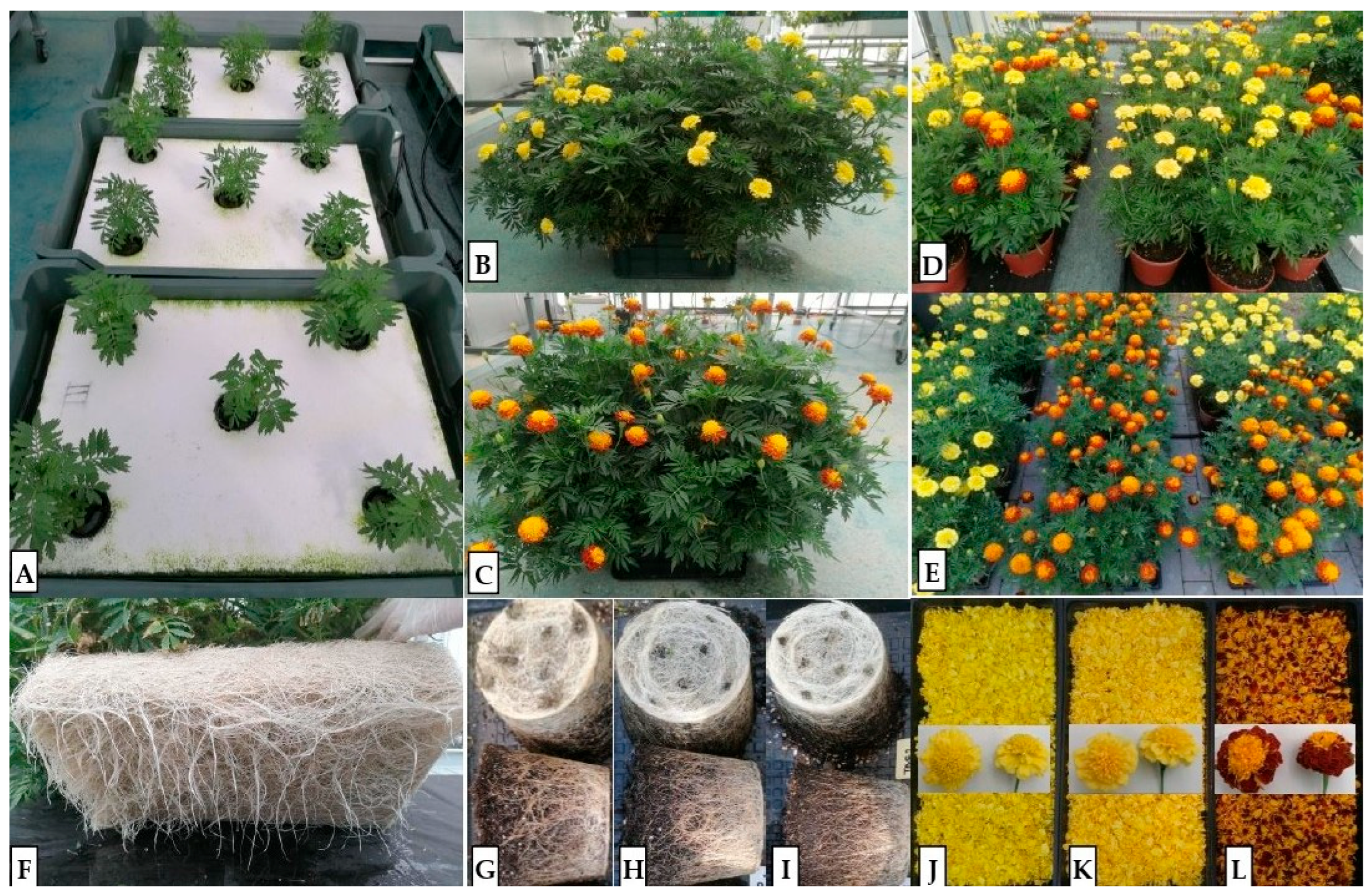
Rockwool-rooted plantlets were first transplanted into low-height (10 cm) plastic containers during early rooting. As root systems expanded, the plants were transferred into larger containers (30 cm height; 40 × 60 cm base area) with five plants per container, for the main cultivation phase. Floating support was provided by expanded polystyrene (EPS) boards (Nikecell EPS 100/50) containing 5.5 cm hydroponic net pots inserted into pre-drilled holes at 21 cm plant spacing (Figure 1A).
Each DWC unit contained two 20 cm aquarium airstones for aeration, powered by a Hailea ACO-208 air compressor to maintain adequate dissolved oxygen levels. Reverse osmosis water and Terra Aquatica Tripart nutrient solutions (FloraGrow, FloraMicro, FloraBloom-types; General Hydroponics Europe) were used for irrigation and nutrition supply, according to the manufacturer’s developmental-stage-specific recommendations [49].
After transplanting into rockwool, hydroponically grown plants received all nutrient solution types at a concentration of 1 mL L−1 until the hydroponic system was fully established. During the vegetative phase, the nutrient solution consisted of 1.8 mL L−1 FloraGrow, 1.2 mL L−1 FloraMicro, and 0.6 mL L−1 FloraBloom. After the appearance of the first flower heads in early June, plants were supplied with 2.0 mL L−1 FloraGrow, 2.0 mL L−1 FloraMicro, and 1.5 mL L−1 FloraBloom. During the flowering stage until harvest, the nutrient solution contained 0.8 mL L−1 FloraGrow, 1.6 mL L−1 FloraMicro, and 2.4 mL L−1 FloraBloom.
The nutrient composition of the applied fertilizer solutions was as follows. FloraGrow had an N-P-K ratio of 3-1-6, containing 3% total nitrogen (1% ammoniacal N and 2% nitrate N), 1% available phosphate (P2O5), 6% soluble potash (K2O), and 0.8% water-soluble magnesium (Mg). FloraBloom was characterized by an N-P-K ratio of 0-5-4 and contained 5% available phosphate (P2O5), 4% soluble potash (K2O), 3% water-soluble magnesium (Mg), and 5% sulfuric anhydride (SO3). FloraMicro had an N-P-K ratio of 5-0-1 and provided 5% total nitrogen (1.5% ammoniacal N and 3.5% nitrate N) and 1.3% soluble potash (K2O), as well as micronutrients including boron (0.01%), calcium oxide (1.4%), copper (0.1%, EDTA-chelated), iron (0.12%, chelated with EDDHA and DTPA), manganese (0.07%, EDTA-chelated), molybdenum (0.002%), and zinc (0.02%, EDTA-chelated).

2.5. Irrigation, Nutrient Supply, Light Measurements, Temperature and Solar Radiation

Plants grown in the open field were irrigated four times per week, receiving a total of approximately 18 L water per plant during the 63-day experimental period (from transplanting into pots or hydroponic units until harvest). In the greenhouse, peat-grown plants were irrigated three times per week, totaling ~13.5 L water per plant. These minor differences resulted primarily from contrasting environmental conditions—mostly sunlight intensity—between the greenhouse and the open field.
In the hydroponic system, the nutrient solution was maintained at pH 5.5–6.5 (adjusted with citric acid or potassium hydroxide) and EC 1.8–2.0 mS cm−1. Hydroponic units were refilled to 20 L on eight occasions. On three of these occasions, only water was added, due to high evaporation causing EC values to exceed 3 mS cm−1 prior to fertilization. Each hydroponic plant received approximately 13 L of water/nutrient solution during the experiment—similar to the volume supplied in the peat substrate.
Throughout the growing period, plants in all three field substrates and the peat substrate in the greenhouse received nutrient solution five times (0.5 L per plant each time). The same fertilizer product was used for both peat and hydroponic cultivation, following the manufacturer’s recommendations and adjusted to the developmental stage of the plants [49].
Photosynthetic photon flux density (PPFD) was repeatedly measured (n = 6 per location) under clear-sky conditions around solar noon using an Apogee MQ-501 quantum sensor (Logan, UT, USA). Greenhouse-grown plants received an average PPFD of 330.5 ± 16 µmol m−2 s−1, whereas outdoor-grown plants were exposed to approximately 4.5-fold higher irradiance, with mean midday levels of 1525.3 ± 96 µmol m−2 s−1. This greenhouse–outdoor difference resulted from seasonal shading practices, including the application of white-wash coating on the greenhouse roof and the use of an internal shade screen, both of which substantially reduced incoming solar radiation. In addition, ventilation and evaporative cooling systems helped maintain greenhouse air temperatures close to outdoor levels.
During the experimental period (from 19 February to 7 July), greenhouse air temperature ranged between 16 and 18 °C (minimum) and 27–38 °C (maximum), while relative humidity varied between 20 and 30% (minimum) and 65–75% (maximum). Meteorological and climate data were recorded using the greenhouse climate control system (Priva, De Lier, The Netherlands). Outdoor meteorological data were recorded after the outdoor experimental conditions were established. Minimum and maximum air temperatures ranged from 7.0 to 14.4 °C and 30.3 to 37.8 °C, respectively, and cumulative precipitation amounted to 66.7 mm in May, 9.6 mm in June, and 14.5 mm by early July. Daily maximum solar radiation intensity measured in the greenhouse increased progressively from late winter to summer, ranging from approximately 86–110 W m−2 in February–April and reaching 180–410 W m−2 during May–July, with maximum recorded values up to 568 W m−2.

2.6. Inflorescences Sampling and Morphological Measurements

Fully developed inflorescences (capitula) were harvested three times: 3 June, 18 June and 7 July 2021 (Figure 1J–L). Each capitulum was collected and processed as a whole, including both ligulate ray florets and tubular disk florets, which were not separated prior to analysis. Samples were stored frozen prior to lyophilization, and the lyophilized material was kept in darkness at room temperature until extraction.
At 138 days after sowing, the following morphological parameters were recorded for all cultivars and substrates: plant height (cm), stem diameter (mm), shoot fresh weight (g), total number of inflorescences, average fresh weight of inflorescences (g), and the fresh weight and number of inflorescences at the third harvest (Figure 1B–E).

2.7. Assessment for Lutein and Zeaxanthin Content of Inflorescences

Lyophilized flower tissues were homogenized using a Retsch MM200 ball mill (Retsch GmbH, Haan, Germany) for 15 min. Approximately 0.1 g of the powdered material was first mixed with 0.5 mL of dis-tilled water and sonicated for 15 min (NEY Ultrasonik 3 QT HEAT, 175 W). Subsequently, 7 mL of absolute ethanol was added, followed by an additional 30 min of sonication to ensure complete extraction of carotenoids. The final volume of the extract was adjusted to 10 mL with ethanol, after which the samples were filtered through 0.45 µm PVDF syringe filters. Extracts were stored at 4 °C and analyzed within 24 h. Quantification of lutein and zeaxanthin was performed on an ECOM s.r.o. ECS05 HPLC system equipped with an ECP2000 pump, ECB2004B degasser/gradient module, ECO2080 column oven, ECDA2800 PDA detector, and a RIGOL L-3320 autosampler. Separation was carried out on a Phenomenex C18 column (250 × 4.6 mm, 3 µm) using a 10 µL injection volume. The mobile phase consisted of 63.0% acetonitrile, 8.6% methanol, 10.4% water, and 18.0% ethyl acetate, delivered at a flow rate of 1.0 mL min−1. Carotenoids were detected at 446 nm, with lutein and zeaxanthin eluting at approximately 7.2 and 7.6 min, respectively. Chromatographic data were processed using Clarity 8.7 software. The analytical procedure was based on—but not identical to—the method described by Bhuyian et al. [50].

2.8. Substrate Moisture and Substrate Microbiological Parameters

Substrate moisture content was assessed by oven-drying samples at 105 °C for 24 h. The total number (Colony Forming Unit, CFU) of microbes (106 g soil-1) and microscopic fungi (103 g soil−1) was determined using bouillon agar and peptone–glucose agar [51]. Respiration (CO2 production) of different substrates was quantified by measuring CO2 evolution during a 10-day incubation at 25 °C in darkness. Released CO2 was captured in NaOH solution, and respiration rates were calculated, expressed as mg CO2 kg−1 dry substrate per 10 days [52]. Dehydrogenase enzyme activity was measured via the INT reduction method. Samples were incubated with INT solution at 40 °C for 2 h, after which the produced INTF was extracted using a dimethyl-formamide/ethanol mixture. Absorbance was subsequently read at 464 nm to quantify enzyme activity [52].

2.9. Pest and Disease Assessments and Pest Management

Pest and pathogen assessments were conducted on all cultivars across all treatments. Assessments focused on the most frequently reported pest groups associated with Tagetes spp., based on visual symptoms caused by thrips (Thrips tabaci), spider mites (Tetranychidae), aphids (Aphididae), and root-knot nematodes (Meloidogyne spp.), as well as on the following diseases: Alternaria leaf spot (Alternaria tagetica, A. alternata), Botrytis flower and shoot blight (Botrytis cinerea), Fusarium wilt (Fusarium oxysporum), and powdery mildew (Golovinomyces spp.).
Pest and disease symptoms were quantified using incidence (%) and severity scores. Incidence (%) was calculated as the percentage of symptomatic or infested plants within each cultivar × treatment combination. Severity was rated on a 0–3 ordinal scale, where 0 = no symptoms, 1 = mild (≤5% affected plant area), 2 = moderate (5–20% affected plant area), and 3 = severe (>20% affected plant area).
Pest and disease assessments were performed at four developmental stages: the three true-leaf stage (prior to transplanting), early vegetative growth (after transplanting and before flowering), early flowering (1st and 2nd flowering phases), and late flowering (termination of the experiment).
Pest and disease control treatments were applied in accordance with IFOAM guidelines for organic production at two time points: at the first flowering stage and during late flowering. Control treatments included an azadirachtin-based formulation (NeemAzal-T/S, 1% azadirachtin) applied at 0.3% (v/v) against thrips, and a rapeseed oil-based product (Vektafid A; 94% rapeseed oil) applied at 1.5% (v/v) against spider mites.

2.10. Statistical Analysis

2.10.1. Analysis of Variance (ANOVA)

Sixteen response variables (plant height, stem diameter, fresh weight of shoot, total number and fresh weight of inflorescences, number and fresh weight of inflorescences at the 3rd harvest, lutein content, zeaxanthin content, substrate moisture content, total number of microbes, number of microscopic fungi, substrate respiration, dehydrogenase enzyme activity, thrips incidence, and spider mite incidence) were subjected to ANOVA using SAS Studio 3.8 (SAS Institute Inc., Cary, NC, USA). A two-way ANOVA model was applied with the cultivar (three levels: ‘Csemő’, ‘Robuszta kénsárga’, and ‘Orion’) and cultivation–substrate system (five levels: greenhouse–peat-based substrate, greenhouse–deep-water-culture hydroponics, field–peat-based substrate, and two field–peat-free substrates) as fixed factors, including their interaction (cultivar × system). For each variable, data are presented as means ± standard deviation (SD). Prior to ANOVA, model assumptions were checked by inspection of residuals and by testing normality and homogeneity of variance. When necessary, proportion-type variables (thrips and spider mite incidence) were analyzed after appropriate transformation to improve normality and variance homogeneity. Significant effects were determined at p < 0.05, and significant F-tests were followed by Tukey’s Honestly Significant Difference (HSD) test for multiple comparisons. Differences among cultivars within a given cultivation–substrate system and differences among systems within each cultivar were evaluated based on Tukey’s test results.

2.10.2. Pearson Correlation

Relationships among the measured vegetative, generative, pigment-related and substrate-based microbiological parameters were analyzed using Pearson’s correlation (SAS Studio 3.8) at three levels: (i) overall analysis including all cultivars and cultivation–substrate systems, (ii) cultivar-specific analyses performed separately for cvs ‘Csemő’ (Tp1), ‘Robuszta kénsárga’ (Tp2), and ‘Orion’ (Tp3), and (iii) cultivation–substrate-system-dependent analyses comparing all treatments. Pearson correlation coefficients (r) were calculated based on pairwise complete observations, and statistical significance was tested using two-tailed probability tests. Correlations were considered significant at p < 0.05, and significant correlations were indicated by an asterisk (*) in the correlation matrix. In addition, the strength and direction of the relationships were visualized using a color scale, where shades of blue represent negative correlations and shades of red represent positive correlations.

2.10.3. Principal Component Analysis

Principal component analysis (PCA) was performed to explore multivariate relationships among the measured vegetative, generative, pigment-related and substrate-based microbiological parameters as variables. All variables were standardized to zero mean and unit variance prior to analysis. PCA was based on the correlation matrix, and eigenvalues > 1 were used to assess component relevance. The loading plot illustrates how the measured variables contribute to the principal components, showing which vegetative, generative, pigment-related and microbiological traits most strongly influence the directions of the components. The score plot indicates the position of each plant in the reduced multivariate space defined by PC1 and PC2, illustrating a visual assessment of group separation across treatments. The proportion of total variance explained by each principal component was calculated, and the first two components (PC1 and PC2) were used for visualization. All PCA calculations and visualizations were performed in SAS Studio 3.8.

3. Results

3.1. ANOVA

Analysis of variance revealed different levels of significance for plant-related (Table 1) and substrate microbiological parameters (Table 2).
In case of vegetative parameters, plant height was significantly affected by cultivar, substrate, and their interaction (p < 0.001; Table 1). In contrast, stem diameter and shoot fresh weight were significantly influenced only by substrate (p < 0.001), with no significant effects of cultivar or cultivar × substrate interaction.
In case of reproductive parameters, substrate type had a strong effect on the total number of inflorescences (p < 0.001), together with a significant cultivar × substrate interaction (p < 0.05), while cultivar alone had no significant effect (Table 1). The fresh weight of inflorescences, as well as the number and weight of inflorescences at the third harvest, were significantly affected by cultivar, substrate, and their interaction.
In case of pigment-related parameters, lutein content was significantly affected by cultivar, substrate, and their interaction (p < 0.001; Table 1). In contrast, zeaxanthin content was significantly affected only by substrate (p < 0.001), with no significant effects of cultivar or cultivar × substrate interaction.
In case of microbiological parameters, substrate moisture content and all four microbiological variables were significantly affected by cultivar, substrate, and their interaction (p < 0.001; Table 2)
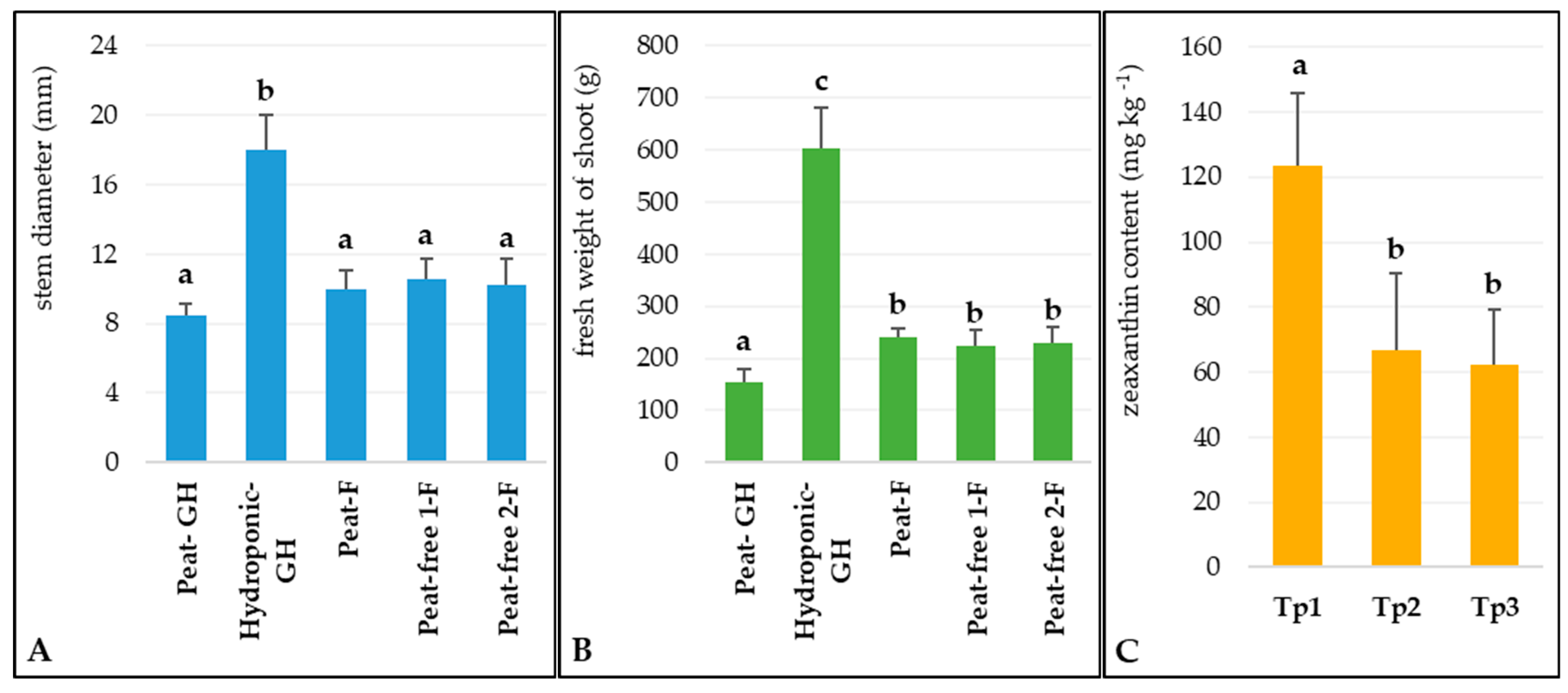
According to the obtained ANOVA results, the data were presented as the average of cultivars for stem diameter and fresh weight of shoots; the data were presented as the average of substrate for zeaxanthin content.

3.2. Vegetative Parameters

3.2.1. Plant Height

Plant height ranged between 26.75 and 64.63 cm across the five treatments and three cultivars (Table 3). The largest plant height was observed in cv. ‘Robuszta kénsárga’, while the lowest was recorded for cv. ‘Csemő’. Hydroponic–greenhouse treatments resulted in the highest plant height for all three cultivars, ranging from 45.38 to 64.63 cm, compared to all other treatments (Table 3).
When cultivars were evaluated within each of the five treatments (significance indicated with italic lowercase letters), plant height was highest for cv. ‘Robuszta kénsárga’ in all five substrate–environment combinations with exception of cv. ‘Orion’ in the peat– greenhouse treatments. The values for cv. ‘Robuszta kénsárga’ were significantly higher than those of cv. ‘Csemő’ in all treatments (Table 3), while the plant height of cv. ‘Orion’ was significantly lower only in the hydroponic–greenhouse treatment compared to cv. ‘Robuszta kénsárga’.
When treatments were evaluated for each cultivar (significance indicated with capital non-italic letters), plant height values of cvs. ‘Csemő’ and ‘Robuszta kénsárga’ were significantly higher only in the hydroponic–greenhouse treatment compared to all other treatments. In the case of cv. ‘Orion’, plant height was significantly higher in the greenhouse treatments compared to the outdoor treatments (Table 3).

3.2.2. Stem Diameter and Fresh Weight of Shoot

Stem diameter and shoot fresh weight were affected only by substrate; therefore, data are presented as cultivar-averaged values for both parameters (Figure 2A,B). The smallest stem diameter was observed in the greenhouse–peat treatment (8.5 ± 0.69 mm), whereas the greenhouse–hydroponic treatment produced the thickest stems (18.0 ± 2.02 mm), which was significantly higher than in all other treatments, including all field-grown treatments (Figure 2A).
Shoot fresh weight was also highest in the greenhouse–hydroponic treatment (602.4 ± 80.1 g) and was significantly greater than in all other greenhouse and field treatments (Figure 2B). In contrast, the greenhouse–peat treatment resulted in only about one-quarter of the shoot biomass (154.8 ± 25.2 g), which was significantly lower than that observed in the outdoor substrates, where shoot fresh weight varied only slightly, ranging from 224.8 ± 29.2 g to 240.9 ± 16.2 g across the peat-based and peat-free treatments.

3.3. Generative Parameters

3.3.1. Total Number of Inflorescences

The total number of inflorescences ranged from 25.00 to 48.00 across the five treatments and three cultivars (Table 3). Cultivar ‘Robuszta kénsárga’ produced the highest number of inflorescences (48.00) in the peat–field treatment, whereas the lowest value (25.00) was recorded for cv. ‘Csemő’ in the hydroponic–greenhouse treatment. Peat-based field treatments generally resulted in the highest total number of inflorescences, ranging from 38.75 to 48.00, compared to all other treatments (Table 3).
When cultivars were evaluated within each of the five treatments (significance indicated with italic lowercase letters), the total number of inflorescences was highest for cv. ‘Robuszta kénsárga’ in the peat–greenhouse treatment and was significantly different from the other two cultivars in this treatment. In the remaining four treatments, no significant differences were observed among cultivars.
When treatments were evaluated for each cultivar (significance indicated with capital non-italic letters), the total number of inflorescences of cv. ‘Orion’ did not differ significantly among the five treatments. In contrast, cv. ‘Robuszta kénsárga’ produced a significantly higher number of inflorescences in the peat–greenhouse and peat–field treatments compared to the hydroponic–greenhouse treatment (Table 3).

3.3.2. Fresh Weight of Inflorescences

Fresh weight of inflorescences ranged from 2.80 to 4.35 across the five treatments and three cultivars (Table 3). Cultivar ‘Orion’ produced the highest fresh weight of inflorescences (4.35) in the peat-free 2–field treatment, whereas the lowest value (2.80) was recorded for cv. ‘Csemő’ in the peat–greenhouse treatment (Table 3).
When cultivars were evaluated within each of the five treatments (significance indicated with italic lowercase letters), the fresh weight of inflorescences was higher for cv. ‘Orion’ in all treatments compared to the other cultivars, with the exception of the peat–field treatment, where no significant differences were observed among cultivars. In the peat-free 1 and peat-free 2 treatments, the fresh weight of inflorescences of cv. ‘Robuszta kénsárga’ was significantly higher than that of cv. ‘Csemő’ but significantly lower than that of cv. ‘Orion’.
When treatments were evaluated for each cultivar (significance indicated with capital non-italic letters), the fresh weight of inflorescences of cvs. ‘Csemő’ and ‘Robuszta kénsárga’ did not differ significantly among the five treatments. In contrast, cv. ‘Orion’ produced a significantly lower fresh weight of inflorescences in the hydroponic–greenhouse treatment compared to the other four treatments (Table 3).

3.3.3. Fresh Weight of Inflorescences at Third Harvest

Fresh weight of inflorescences at the third harvest ranged from 1.65 to 3.41 across the five treatments and three cultivars (Table 3). Cultivar ‘Orion’ produced the highest fresh weight of inflorescences at the third harvest (3.41) in the peat–greenhouse treatment, whereas the lowest value (1.65) was recorded for cv. ‘Robuszta kénsárga’ in the same treatment (Table 3).
When cultivars were evaluated within each of the five treatments (significance indicated with italic lowercase letters), the fresh weight of inflorescences at the third harvest was highest for cv. ‘Orion’ in all treatments except the hydroponic–greenhouse treatment. However, these higher values for cv. ‘Orion’ were significantly different from those of the other two cultivars only in the peat-free 1–field and peat-free 2–field treatments. In the peat–greenhouse treatment, the fresh weight of inflorescences at the third harvest of cv. ‘Orion’ was significantly higher than that of cv. ‘Robuszta kénsárga’, while in the hydroponic–greenhouse treatment, cv. ‘Csemő’ showed significantly higher values than cv. ‘Robuszta kénsárga’ (Table 3).
When treatments were evaluated for each cultivar (significance indicated with capital non-italic letters), the fresh weight of inflorescences at the third harvest of cv. ‘Csemő’ was significantly higher in the hydroponic–greenhouse treatment compared to the peat–greenhouse and peat-free 1–field treatments. Cultivar ‘Robuszta kénsárga’ produced a significantly higher fresh weight of inflorescences at the third harvest in the peat-free 2–field treatment compared to the peat–greenhouse and peat–field treatments. Cultivar ‘Orion’ showed a significantly higher fresh weight of inflorescences at the third harvest in the peat-free 2–field treatment compared to both greenhouse treatments and the peat–field treatment (Table 3).

3.3.4. Number of Inflorescences at Third Harvest

The number of inflorescences at the third harvest ranged from 10.05 to 25.50 across the five treatments and three cultivars (Table 3). Cultivar ‘Orion’ produced the highest number of inflorescences at the third harvest (25.50) in the peat-free 1–field treatment, whereas the lowest value (10.05) was recorded for cv. ‘Csemő’ in the hydroponic–greenhouse treatment (Table 3).
When cultivars were evaluated within each of the five treatments (significance indicated with italic lowercase letters), the peat–greenhouse treatment showed a significantly higher number of inflorescences at the third harvest for cv. ‘Robuszta kénsárga’ compared to cv. ‘Csemő’. In the hydroponic–greenhouse treatment, cv. ‘Robuszta kénsárga’ had significantly lower values than cv. ‘Orion’. In the field treatments, no significant differences were observed among cultivars (Table 3).
When treatments were evaluated for each cultivar (significance indicated with capital non-italic letters), the number of inflorescences at the third harvest of cv. ‘Csemő’ was significantly higher in the peat–field treatment compared to the hydroponic–greenhouse treatment. Cultivar ‘Robuszta kénsárga’ produced a significantly higher number of inflorescences at the third harvest in the peat–greenhouse and peat–field treatments compared to the hydroponic–greenhouse and peat-free 2–field treatments. Cultivar ‘Orion’ showed significantly higher values in the hydroponic–greenhouse and peat-free 1–field treatments compared to the peat–field and peat-free 2–field treatments (Table 3).

3.4. Pigment-Related Parameters of Inflorescences

3.4.1. Lutein Content

Lutein content ranged from 147.69 to 1008.91 mg kg−1 across the five treatments and three cultivars (Table 3). Cultivar ‘Csemő’ produced the highest lutein content (1008.91 mg kg−1) in the hydroponic–greenhouse treatment, whereas the lowest value (147.69 mg kg−1) was recorded for cv. ‘Orion’ in the peat-free 2–field treatment (Table 3).
When cultivars were evaluated within each of the five treatments (significance indicated with italic lowercase letters), lutein content increased significantly in the order cv. ‘Orion’ < cv. ‘Robuszta kénsárga’ < cv. ‘Csemő’, with the exception of the peat–greenhouse treatment, where cv. ‘Robuszta kénsárga’ did not differ significantly from cv. ‘Orion’. Notably, cv. ‘Csemő’ produced three- to five-fold higher lutein content than the other two cultivars across all treatments (Table 3).
When treatments were evaluated for each cultivar (significance indicated with capital non-italic letters), lutein content of cv. ‘Orion’ did not differ significantly among the five treatments. Lutein content of cv. ‘Robuszta kénsárga’ was significantly higher in the field experiments compared to the greenhouse treatments. Cultivar ‘Csemő’ produced significantly higher lutein content in the hydroponic–greenhouse and peat–field treatments compared to the peat–greenhouse treatment (Table 3).

3.4.2. Zeaxanthin Content

Zeaxanthin content was affected only by cultivar; therefore, the data are presented as substrate-averaged values. The highest zeaxanthin concentration (123.6 ± 22.2 mg·kg−1) was observed in cv. ‘Csemő’, which was significantly higher than that measured in cv. ‘Robuszta kénsárga’ (66.9 ± 23.4 mg·kg−1) and cv. ‘Orion’ (62.2 ± 16.9 mg·kg−1) (Figure 2C).

3.5. Moisture Content and Microbiological Parameters of Substrates

As indicated by the two-way ANOVA (Table 2), all substrate-related parameters were significantly affected by both cultivar and substrate; therefore, results are presented separately for each cultivar and treatment (Table 4).

3.5.1. Moisture Content of Substrate

Moisture content of substrate ranged from 158.18 to 279.31% across the four treatments and three cultivars (Table 4). Cultivar ‘Orion’ exhibited the highest substrate moisture content (279.31%) in the peat–field treatment, whereas the lowest value (158.18%) was recorded for cv. ‘Csemő’ in the peat-free 1–field treatment (Table 4).
When cultivars were evaluated within each of the four treatments (significance indicated with italic lowercase letters), substrate moisture content did not differ significantly among cultivars in the peat-free 1–field and peat-free 2–field treatments. In contrast, in the peat–greenhouse and peat–field treatments, substrate moisture content increased significantly in the order cv. ‘Robuszta kénsárga’ < cv. ‘Csemő’ < cv. ‘Orion’ (Table 4).
When treatments were evaluated for each cultivar (significance indicated with capital non-italic letters), substrate moisture content of cvs. ‘Csemő’ and ‘Orion’ was significantly higher in the peat–greenhouse and peat–field treatments compared to the peat-free treatments (Table 4). For cv. ‘Robuszta kénsárga’, substrate moisture content was significantly higher in the peat–greenhouse treatment than in the peat-free treatments (Table 4).

3.5.2. Total Number of Microbes in the Substrate

The total number of microbes in the substrate ranged from 21.79 to 51.52 CFU 106 g soil−1 across the four treatments and three cultivars (Table 3). Cultivar ‘Csemő’ produced the highest number of substrate microbes (51.52 CFU 106 g soil−1) in the peat–field treatment, whereas the lowest value (21.79 CFU 106 g soil−1) was recorded for cv. ‘Csemő’ in the peat-free 1–field treatment (Table 4).
When cultivars were evaluated within each of the four treatments (significance indicated with italic lowercase letters), the total number of substrate microbes was significantly higher for cvs. ‘Csemő’ and ‘Robuszta kénsárga’ compared to cv. ‘Orion’ in the peat–greenhouse treatment. In contrast, the total number of substrate microbes was significantly higher for cv. ‘Csemő’ compared to cvs. ‘Orion’ and ‘Robuszta kénsárga’ in the peat–field and peat-free 1–field treatments. In the peat-free 2–field treatment, the total number of substrate microbes increased significantly in the order cvs. ‘Orion’, ‘Robuszta kénsárga’, and ‘Csemő’.
When treatments were evaluated for each cultivar (significance indicated with capital non-italic letters), the total number of substrate microbes of cv. ‘Csemő’ increased significantly in the order of peat-free 1–field, peat–greenhouse, peat-free 2–field, and peat–field treatments. Cultivar ‘Robuszta kénsárga’ produced a significantly higher number of substrate microbes in the peat-free 1–field treatment compared to the peat–greenhouse and peat–field treatments. Cultivar ‘Orion’ showed a significantly higher number of substrate microbes in the peat treatments compared to the greenhouse treatment (Table 4).

3.5.3. Number of Microscopic Fungi in the Substrate

The number of microscopic fungi in the substrate ranged from 28.21 to 106.59 CFU × 103 g soil−1 across the four treatments and three cultivars (Table 4). Cultivar ‘Robuszta kénsárga’ produced the highest number of microscopic fungi (106.59 CFU × 103 g soil−1) in the peat-free 2–field treatment, whereas the lowest value (28.21 CFU × 103 g soil−1) was recorded for cv. ‘Robuszta kénsárga’ in the peat-free 1–field treatment (Table 4).
When cultivars were evaluated within each of the four treatments (significance indicated with italic lowercase letters), the number of microscopic fungi in the substrate was significantly higher for cv. ‘Robuszta kénsárga’ in the peat-free 2–field treatment compared to the other two cultivars in this treatment. In the remaining treatments, no significant differences were observed among cultivars (Table 4).
When treatments were evaluated for each cultivar (significance indicated with capital non-italic letters), the number of microscopic fungi in the substrate did not differ significantly among treatments for cv. ‘Csemő’. In contrast, the number of microscopic fungi in the substrate of cv. ‘Robuszta kénsárga’ increased significantly in the order peat-free 1–field, peat–field, and peat-free2–field treatments. In the case of cv. ‘Orion’, the number of microscopic fungi in the substrate increased significantly in the order peat-free1–field, peat-free2–field, and peat–field treatments (Table 4).

3.5.4. Substrate Respiration

The substrate respiration ranged from 52.73 to 74.76 mg CO2 10 g−1 10 day−1 across the five treatments and three cultivars (Table 4). Cultivar ‘Csemő’ exhibited the highest substrate respiration (74.76 mg CO2 10 g−1 10 day−1) in the peat–field treatment, whereas the lowest value (52.73 mg CO2 10 g−1 10 day−1) was recorded for cv. ‘Csemő’ in the peat-free 1–field treatment (Table 4).
When cultivars were evaluated within each of the four treatments (significance indicated with italic lowercase letters), substrate respiration was significantly lower for cv. ‘Robuszta kénsárga’ in the peat–field treatment compared to the other two cultivars, whereas substrate respiration was significantly lower for cv. ‘Csemő’ in the peat-free 1–field treatment compared to the other two cultivars. In the remaining two treatments (peat–greenhouse and peat-free 2–field), no significant differences were observed among cultivars.
When treatments were evaluated for each cultivar (significance indicated with capital non-italic letters), substrate respiration of cv. ‘Csemő’ increased significantly in the order peat-free1–field, peat-free 2–field, peat–greenhouse, and peat–field treatments. In contrast, cv. ‘Robuszta kénsárga’ exhibited significantly higher substrate respiration in the peat–greenhouse treatment compared to the three field treatments. In the case of cv. ‘Orion’, substrate respiration increased significantly in the order peat-free 1–field, peat–greenhouse, and peat–field treatments (Table 4).

3.5.5. Dehydrogenase Enzyme Activity

The dehydrogenase enzyme activity ranged from 942.06 to 1417.12 µg INTF g−1 2 h−1 across the five treatments and three cultivars (Table 4). Cultivar ‘Robuszta kénsárga’ exhibited the highest dehydrogenase activity (1417.12 µg INTF g−1 2 h−1) in the peat–free 2–field treatment, whereas the lowest value (942.06 µg INTF g−1 2 h−1) was recorded for the same cultivar in the peat–field treatment.
When cultivars were evaluated within each of the four treatments (significance indicated with italic lowercase letters), dehydrogenase activity was significantly higher for cv. ‘Orion’ in the peat–greenhouse treatment compared to the other two cultivars. In the peat–field treatment, activity increased significantly in the order cvs. ‘Robuszta kénsárga’ < ‘Csemő’ < ‘Orion’. In the peat–free 1–field treatment, dehydrogenase activity was significantly higher for cv. ‘Robuszta kénsárga’ than for cv. ‘Csemő’. In the peat–free 2–field treatment, activity was significantly higher for cv. ‘Robuszta kénsárga’ compared to the other two cultivars (Table 4).
When treatments were evaluated for each cultivar (significance indicated with capital non-italic letters), dehydrogenase activity of the substrate for cv. ‘Csemő’ increased significantly in the order peat–greenhouse < peat–free 1–field < peat–field < peat–free 2–field (Table 4). For cv. ‘Robuszta kénsárga’, activity increased significantly in the order peat–field < peat–free 1–field < peat–free 2–field treatments. In cv. ‘Orion’, dehydrogenase activity was significantly higher in the peat–free 2–field treatment compared to the other three treatments (Table 4).

3.6. Pest Damage Occurrence and Disease Symptom Status

Across all cultivation systems, no fungus-related damage symptoms were detected. Among the surveyed pests, damage caused by thrips and spider mites was observed only in the greenhouse treatments after transplanting but before flowering (Table 5). Consequently, the effects of the two greenhouse treatments and the three cultivars on thrips and spider mite infestation were analyzed by ANOVA.
Analysis of variance for thrips damage incidence revealed a significant effect of cultivar but no significant effect of greenhouse treatment at the p < 0.05 level. In both the peat–greenhouse and hydroponic–greenhouse treatments, thrips damage incidence was significantly higher in cv. ‘Csemő’ compared to the other two cultivars (Table 5). Thrips damage severity ranged from mild to moderate, corresponding to <20% of the leaf area affected; however, damage severity did not differ significantly among the three cultivars or between the two greenhouse treatments.
In contrast, analysis of variance for spider mite incidence and severity showed a significant effect of cultivar but no significant effect of greenhouse treatment at the p < 0.05 level. Spider mite damage incidence and severity were detected only in cv. ‘Orion’ and exclusively in the hydroponic–greenhouse treatment. The other two cultivars showed no spider mite damage symptoms in either greenhouse treatment (Table 5).

3.7. Correlation Analysis

3.7.1. Overall Pearson Correlation Analysis

When all data for substrate–environment treatments and cultivars were analyzed together, 91 variable pairs were evaluated, of which 15 showed significant correlations at the p = 0.05 probability level (Table 6). Among these 15 variable pairs, 11 were positively correlated (plant height [PH] vs. stem diameter [StD], PH vs. shoot fresh weight [ShFW], StD vs. ShFW, StD vs. substrate microbial count [SbMi], ShFW vs. dehydrogenase activity [SbDeh], total number of inflorescences [NI] vs. number of inflorescences at the third harvest [NI3], fresh weight of inflorescences [FWI] vs. fresh weight of inflorescences at the third harvest [FWI3], FWI3 vs. SbDeh, lutein [Lut] vs. zeaxanthin [Zeax], substrate moisture [SbMo] vs. substrate respiration [SbRes], and substrate fungal count [SbFu] vs. SbDeh), while four correlations were negative (PH vs. NI, NI vs. SbDeh, FWI vs. Lut, and NI3 vs. SbDeh).
When all data for substrate–environment treatments and cultivars were combined, the strongest correlations (r > 0.85) were observed between StD and ShFW, NI and NI3, and SbMo and SbRes (Table 6).

3.7.2. Genotype-Specific Pearson Correlation Analysis

When the dataset comprising 3 × 91 parameter pairs was analyzed separately for each cultivar, 35, 49, and 35 variable pairs showed statistically significant correlations at the p = 0.05 level for cvs. ‘Csemő’, ‘Robuszta kénsárga’, and ‘Orion’, respectively (Table 7).
For cv. ‘Csemő’, 29 of the 35 significant correlations were positive (PH vs. StD, PH vs. ShFW, PH vs. FWI3, PH vs. SbMo, StD vs. ShFW, StD vs. FWI3, StD vs. Lut, StD vs. SbMi, StD vs. SbDeh, ShFW vs. FWI, ShFW vs. FWI3, ShFW vs. Lut, ShFW vs. SbMi, ShFW vs. SbDeh, NI vs. NI3, FWI vs. FWI3, FWI vs. SbMi, FWI vs. SbRes, FWI3 vs. Lut, FWI3 vs. SbMi, FWI3 vs. SbDeh, NI3 vs. SbRes, Lut vs. SbMi, Lut vs. SbDeh, Zeax vs. SbDeh, SbMo vs. SbMi, SbMo vs. SbRes, SbMi vs. SbRes, and SbMi vs. SbDeh), whereas 6 correlations were negative (PH vs. NI, PH vs. NI3, StD vs. NI, ShFW vs. NI, NI vs. SbFu, and NI3 vs. SbFu) (Table 7).
For cv. ‘Robuszta kénsárga’, 22 of the 49 significant correlations were positive (PH vs. StD, PH vs. ShFW, PH vs. SbRes, StD vs. ShFW, StD vs. SbMi, ShFW vs. SbMi, ShFW vs. SbDeh, NI vs. NI3, NI vs. SbMo, FWI vs. FWI3, FWI vs. Lut, FWI vs. SbDeh, FWI3 vs. Lut, FWI3 vs. SbMi, FWI3 vs. SbFu, FWI3 vs. SbDeh, NI3 vs. SbMo, NI3 vs. SbDeh, Lut vs. SbMi, Lut vs. SbDeh, SbMo vs. SbRes, and SbFu vs. SbDeh), while 27 correlations were negative (PH vs. NI, PH vs. Lut, StD vs. NI, StD vs. SbMo, StD vs. SbRes, ShFW vs. NI, ShFW vs. NI3, ShFW vs. SbMo, ShFW vs. SbRes, NI vs. FWI3, NI vs. SbMi, NI vs. SbDeh, FWI vs. SbRes, FWI3 vs. NI3, FWI3 vs. SbMo, FWI3 vs. SbRes, NI3 vs. SbMi, NI3 vs. SbFu, NI3 vs. SbDeh, Lut vs. SbMo, Lut vs. SbRes, Zeax vs. SbMo, Zeax vs. SbRes, SbMo vs. SbMi, SbMo vs. SbDeh, SbMi vs. SbRes, and SbRes vs. SbDeh) (Table 7).
For cv. ‘Orion’, 18 of the 35 significant correlations were positive (PH vs. StD, PH vs. ShFW, StD vs. ShFW, StD vs. SbMi, NI vs. NI3, NI vs. SbMi, FWI vs. FWI3, FWI vs. Zeax, FWI3 vs. Zeax, FWI3 vs. SbDeh, NI3 vs. SbMi, NI3 vs. SbFu, Lut vs. SbMo, Lut vs. SbFu, Lut vs. SbRes, SbMo vs. SbFu, SbMo vs. SbRes, and SbFu vs. SbRes), whereas 17 correlations were negative (PH vs. FWI, StD vs. FWI, StD vs. Lut, StD vs. SbMo, ShFW vs. FWI, ShFW vs. Lut, ShFW vs. Zeax, FWI3 vs. Lut, FWI3 vs. SbMo, FWI3 vs. SbFu, NI3 vs. SbDeh, Lut vs. SbDeh, Zeax vs. SbMo, Zeax vs. SbFu, Zeax vs. SbRes, SbMo vs. SbMi, and SbFu vs. SbDeh) (Table 7).
Overall, genotype-specific relationships revealed that the strongest correlations (r > 0.85) were observed for PH vs. StD in cv. ‘Csemő’, for StD vs. ShFW and NI vs. NI3 across all cultivars, and for SbMo vs. SbRes in cvs. ‘Csemő’ and ‘Orion’ (Table 7).

3.7.3. Substrate–Environment-Specific Pearson Correlation Analysis

When the dataset comprising 4 × 91 parameter pairs was analyzed separately for the peat–greenhouse, peat–field, peat-free 1–field, and peat-free 2–field treatments, 50, 57, 49, and 37 variable pairs, respectively, showed statistically significant correlations at the p = 0.05 level (Table 8). In the case of the hydroponic–greenhouse treatment, only 36 parameter pairs were analyzed due to the absence of a substrate in this treatment, of which 12 variable pairs showed statistically significant correlations at the p = 0.05 level.
For the hydroponic–greenhouse treatment, 6 of the 12 significant correlations were positive (FWI3 vs. ShFW, NI3 vs. NI, Lut vs. ShFW, Lut vs. FWI3, Zeax vs. FWI3, and Zeax vs. Lut), whereas 6 correlations were negative (FWI3 vs. PH, Lut vs. StD, Lut vs. NI, Lut vs. NI3, Zeax vs. StD, and Zeax vs. NI3) (Table 8).
For the peat–greenhouse treatment, 27 of the 50 significant correlations were positive (FWI vs. PH, FWI vs. ShFW, FWI3 vs. ShFW, FWI3 vs. FWI, NI3 vs. PH, NI3 vs. NI, Lut vs. StD, Zeax vs. StD, Zeax vs. Lut, SbMo vs. ShFW, SbMo vs. FWI, SbMo vs. FWI3, SbMi vs. StD, SbMi vs. NI, SbMi vs. Lut, SbFu vs. ShFW, SbFu vs. FWI3, SbFu vs. Lut, SbFu vs. SbMo, SbRes vs. Lut, SbRes vs. SbFu, SbDeh vs. PH, SbDeh vs. ShFW, SbDeh vs. FWI, SbDeh vs. FWI3, SbDeh vs. SbMo, and SbDeh vs. SbFu), whereas 23 correlations were negative (NI vs. ShFW, FWI vs. StD, FWI3 vs. NI, NI3 vs. ShFW, Lut vs. PH, Lut vs. NI, Lut vs. FWI, Lut vs. NI3, Zeax vs. PH, Zeax vs. NI, Zeax vs. FWI, Zeax vs. NI3, SbMo vs. NI, SbMo vs. NI3, SbMi vs. ShFW, SbMi vs. FWI, SbMi vs. SbMo, SbFu vs. NI, SbFu vs. NI3, SbRes vs. PH, SbDeh vs. StD, SbDeh vs. NI, and SbDeh vs. SbMi) (Table 8).
For the peat–field treatment, 24 of the 57 significant correlations were positive (ShFW vs. PH, FWI3 vs. FWI, NI3 vs. StD, NI3 vs. NI, Lut vs. StD, Zeax vs. StD, Zeax vs. Lut, SbMo vs. FWI, SbMo vs. FWI3, SbMi vs. StD, SbMi vs. Lut, SbMi vs. Zeax, SbFu vs. PH, SbFu vs. ShFW, SbFu vs. FWI, SbFu vs. FWI3, SbRes vs. FWI, SbRes vs. FWI3, SbRes vs. SbMo, SbRes vs. SbMi, SbDeh vs. FWI, SbDeh vs. FWI3, SbDeh vs. SbMo, and SbDeh vs. SbRes), while 33 correlations were negative (FWI vs. StD, FWI vs. NI, FWI3 vs. NI, NI3 vs. FWI, NI3 vs. FWI3, Lut vs. PH, Lut vs. ShFW, Lut vs. FWI, Zeax vs. PH, Zeax vs. ShFW, Zeax vs. FWI, SbMo vs. PH, SbMo vs. StD, SbMo vs. ShFW, SbMo vs. NI, SbMo vs. NI3, SbMi vs. PH, SbMi vs. ShFW, SbMi vs. FWI, SbFu vs. StD, SbFu vs. Lut, SbFu vs. Zeax, SbFu vs. SbMi, SbRes vs. PH, SbRes vs. StD, SbRes vs. ShFW, SbRes vs. NI, SbRes vs. NI3, SbDeh vs. PH, SbDeh vs. StD, SbDeh vs. ShFW, SbDeh vs. NI, and SbDeh vs. NI3) (Table 8).
For the peat-free 1–field treatment, 27 of the 49 significant correlations were positive (ShFW vs. PH, FWI vs. PH, FWI3 vs. ShFW, FWI3 vs. FWI, NI3 vs. NI, NI3 vs. FWI, Zeax vs. Lut, SbMo vs. PH, SbMo vs. FWI, SbMo vs. FWI3, SbMo vs. NI3, SbMi vs. PH, SbMi vs. ShFW, SbMi vs. FWI, SbMi vs. FWI3, SbMi vs. SbMo, SbRes vs. PH, SbRes vs. ShFW, SbRes vs. FWI, SbRes vs. FWI3, SbRes vs. SbMo, SbRes vs. SbMi, SbDeh vs. PH, SbDeh vs. ShFW, SbDeh vs. SbMo, SbDeh vs. SbMi, and SbDeh vs. SbRes), whereas 22 correlations were negative (NI vs. ShFW, FWI3 vs. StD, Lut vs. PH, Lut vs. ShFW, Lut vs. FWI, Lut vs. FWI3, Lut vs. NI3, Zeax vs. PH, Zeax vs. ShFW, Zeax vs. FWI, Zeax vs. FWI3, SbMo vs. Lut, SbMo vs. Zeax, SbMi vs. Lut, SbMi vs. Zeax, SbFu vs. PH, SbFu vs. ShFW, SbRes vs. Lut, SbRes vs. Zeax, SbDeh vs. Lut, SbDeh vs. Zeax, and SbDeh vs. SbFu) (Table 8).
For the peat-free 2–field treatment, 17 of the 37 significant correlations were positive (FWI vs. PH, FWI3 vs. PH, FWI3 vs. FWI, NI3 vs. ShFW, NI3 vs. NI, Lut vs. StD, Zeax vs. StD, Zeax vs. Lut, SbMo vs. ShFW, SbMi vs. StD, SbMi vs. Lut, SbMi vs. Zeax, SbFu vs. SbMo, SbRes vs. FWI3, SbDeh vs. ShFW, SbDeh vs. SbMo, and SbDeh vs. SbFu), while 20 correlations were negative (StD vs. PH, NI vs. PH, FWI vs. StD, FWI3 vs. StD, NI3 vs. StD, Lut vs. PH, Lut vs. FWI, Lut vs. FWI3, Zeax vs. PH, Zeax vs. FWI, SbMo vs. StD, SbMo vs. Lut, SbMo vs. Zeax, SbMi vs. PH, SbMi vs. FWI, SbMi vs. FWI3, SbMi vs. SbMo, SbDeh vs. StD, SbDeh vs. Lut, and SbDeh vs. Zeax) (Table 8).
When correlations were analyzed by substrate–environment combination, the strongest relationships (r > 0.85) were observed between NI3 vs. NI, Lut vs. FWI3, Zeax vs. FWI3, and Zeax vs. Lut in the hydroponic–greenhouse treatment; between NI3 vs. NI, Lut vs. PH, Zeax vs. PH, Zeax vs. Lut, SbMo vs. ShFW, SbDeh vs. FWI, and SbDeh vs. SbMo in the peat–greenhouse treatment; between NI3 vs. NI, Zeax vs. Lut, SbMi vs. Lut, SbMi vs. Zeax, SbRes vs. SbMo, SbDeh vs. SbMo, and SbDeh vs. SbRes in the peat–field treatment; between Lut vs. FWI, SbMi vs. Lut, SbRes vs. Lut, and SbRes vs. SbMi in the peat-free 1–field treatment; and between Lut vs. StD, Lut vs. FWI, SbMi vs. FWI, SbMi vs. Lut, SbDeh vs. SbMo, and SbDeh vs. SbFu in the peat-free 2–field treatment (Table 8).

3.8. Principal Component Analysis of Plant and Substrate-Related Parameters

The first five principal components (PCs) with eigenvalues > 1 accounted for 83.51% of the total variance and were therefore retained for interpretation (Table 9). The root mean square residual (RMSR) was 0.05, indicating a good model fit. PC1 explained 34.98% of the total variance and was primarily associated with PH, StD, FWI, Lut, and Zeax (Table 9). PC2 explained 22.72% of the variance and was associated with NI, FWI3, NI3, and SbDeh. PC3 accounted for 15.39% of the variance and was associated with SbMo, SbMi, and SbRes. PC4 explained 12.64% of the variance and was associated with NI, NI3, SbMo, and SbRes. PC5 accounted for 7.78% of the variance and was primarily associated with SbFu (Table 9).
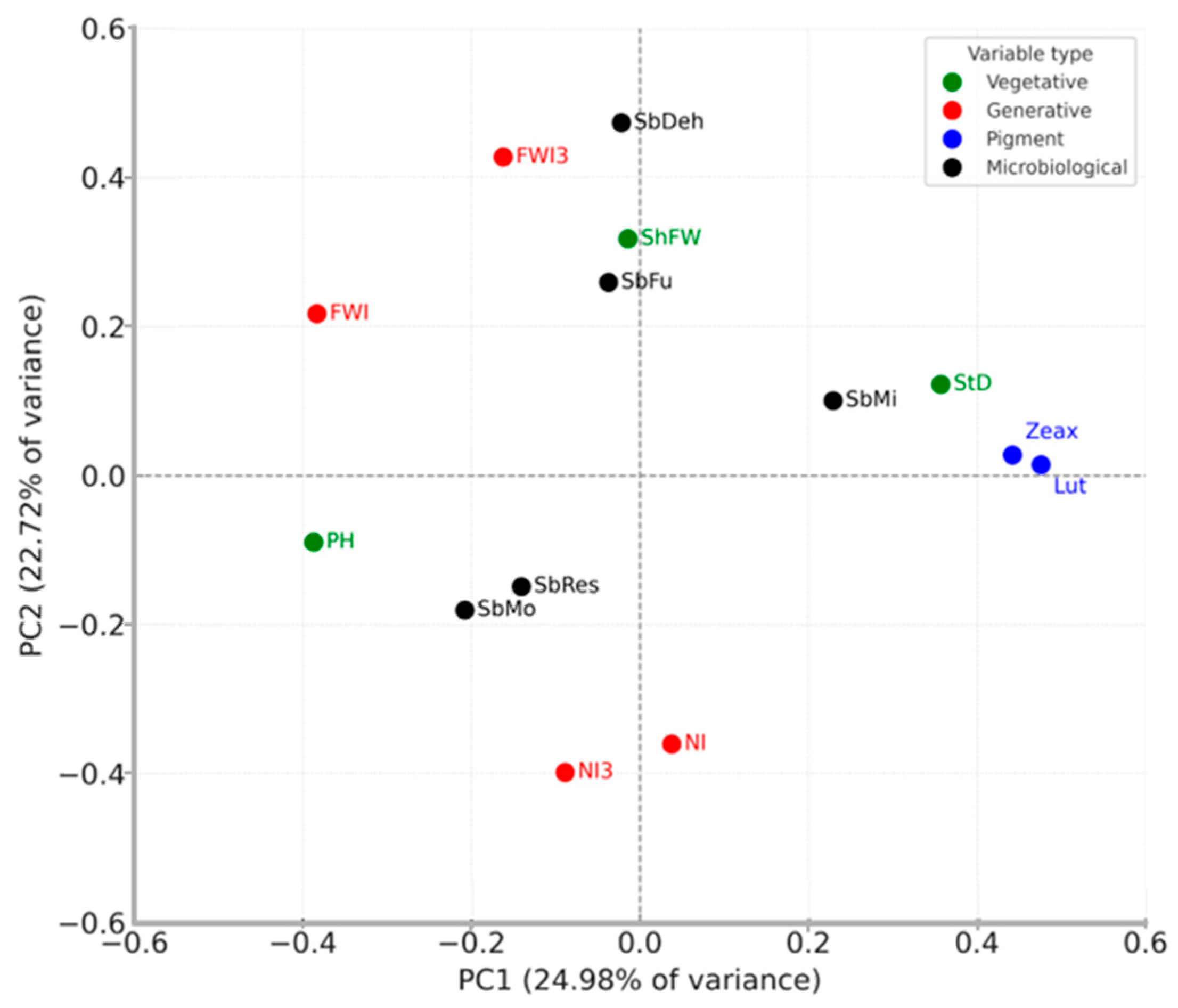
According to the biplot of the fourteen measured variables, the PC1 and PC2 axes played a major role in explaining variation among all measured traits (Figure 3). PC1, accounting for 24.98% of the total variance, was primarily associated with pigment-related variables (Lut and Zeax), while plant height and inflorescence-related traits loaded in the opposite direction. PC2, explaining 22.72% of the variance, reflected a contrast among substrate microbiological activity parameters (substrate dehydrogenase activity, microscopic fungi, and total microbial abundance), whereas substrate respiration and the number of inflorescences (total and at the third harvest) loaded negatively along this axis (Figure 3).
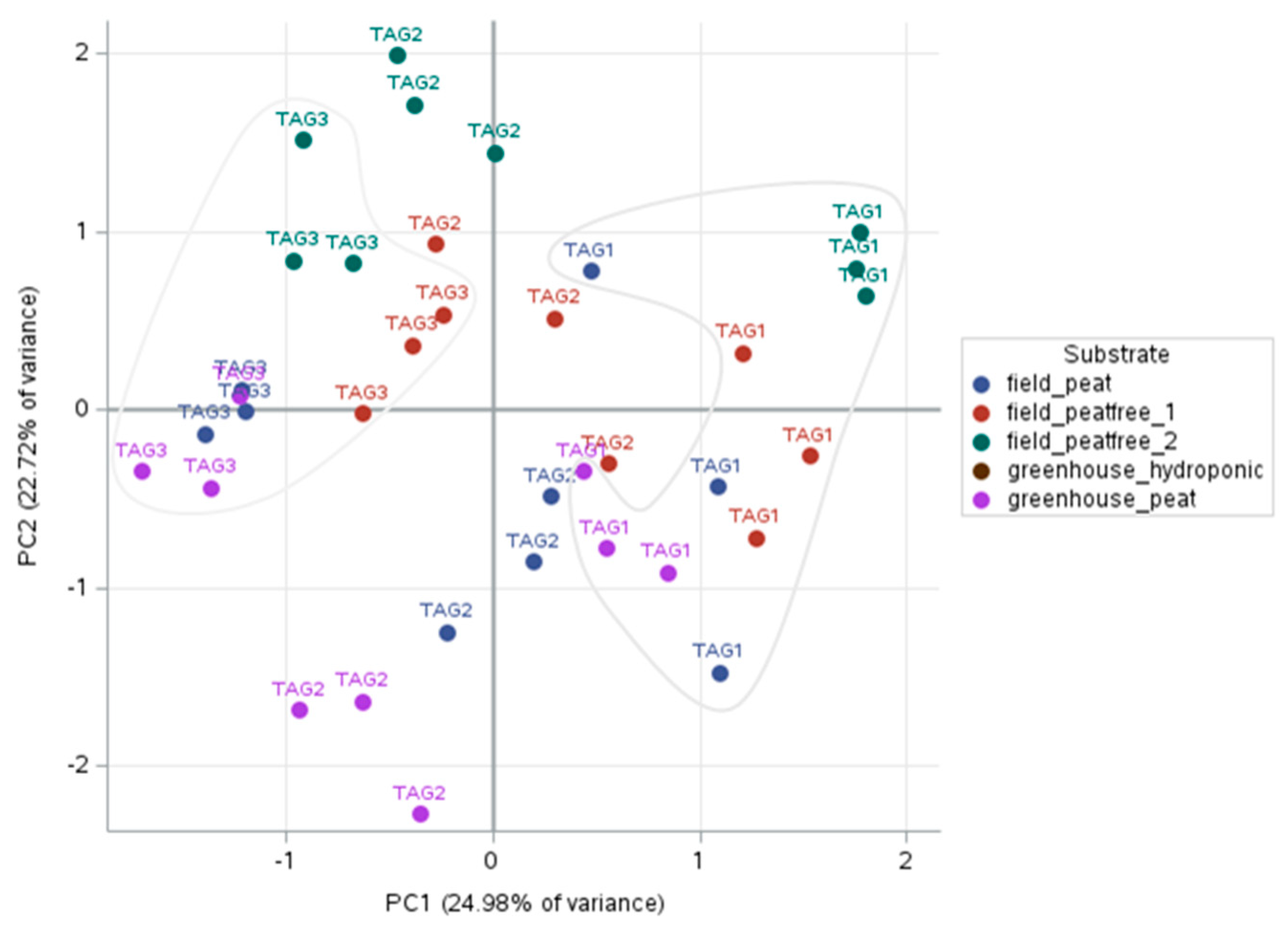
According to the biplot illustrating the combined effects of treatments and cultivars, the PC1 and PC2 axes explained a substantial proportion of the overall variation (Figure 4). PC1 primarily separated the peat–greenhouse treatment, which showed positive PC1 scores, from the peat–field and hydroponic–greenhouse treatments, which were associated with negative PC1 scores. PC2 further differentiated the substrate–environment combinations, with the hydroponic–greenhouse treatment clustering in the lower PC2 region, while the peat–greenhouse and peat-free 2–field treatments were predominantly located in the upper PC2 space. In contrast, the three cultivars (TAG1, TAG2, and TAG3) showed only limited separation along the PCA axes compared with the pronounced clustering driven by substrate–environment combinations, indicating that substrate–environment effects exerted a stronger influence on overall trait variation than genotype (Figure 4).

4. Discussion

This study demonstrates that the five substrate–environment combinations significantly influenced vegetative growth, inflorescence traits, and pigment composition in the three evaluated T. patula cultivars. Overall, substrate–environment effects exerted a stronger influence on the variation in measured parameters than genotype (Table 3, Table 4 and Table 8; Figure 4). Although cultivar was not the primary driver for most traits, it played a decisive role in specific cases, particularly in determining carotenoid levels (Table 3 and Table 7; Figure 3).

4.1. Substrate–Environment Combinations in Relation to Growth and Flowering Responses

Hydroponic cultivation consistently promoted vigorous vegetative growth across all three cultivars, as reflected by substantial increases in plant height, stem diameter, and shoot biomass (Table 3, Figure 2). These findings are consistent with the observations of Ujala et al. [38], who reported enhanced vegetative performance under hydroponic conditions in several T. patula cultivars. Such growth responses likely result from the continuous nutrient supply, stable moisture availability, and high root-zone aeration characteristic of deep-water-culture systems. The enhanced vegetative performance in hydroponics can be attributed to several physiological and metabolic mechanisms. Continuous access to balanced macro- and micronutrients supports sustained cell division and elongation, while optimal root-zone oxygenation promotes higher root respiration and nutrient uptake efficiency. These conditions likely increase photosynthetic rates and carbon assimilation, providing greater resources for vegetative biomass accumulation. Moreover, cultivar-specific traits such as leaf area expansion, root architecture, and inherent nutrient use efficiency modulate the degree of growth enhancement observed among cvs. ‘Csemő’, ‘Robuszta kénsárga’, and ‘Orion’. For instance, cv. ‘Csemő’’s compact morphology and high chlorophyll content may allow more efficient light capture and photosynthate allocation, whereas cv. ‘Robuszta kénsárga’ may prioritize stem elongation over reproductive development, reflecting intrinsic differences in growth strategy. In contrast to Ujala et al. [38], who observed pronounced increases in inflorescence number and biomass across all cultivars under hydroponics, flowering responses in our study were more variable and clearly cultivar-dependent (Table 3). For example, cv. ‘Robuszta kénsárga’ produced fewer inflorescences under hydroponic conditions than in peat-based substrates, whereas cvs. ‘Csemő’ and ‘Orion’ exhibited comparable flowering levels across substrates. Overall, cultivars showing stronger investment in vegetative growth under hydroponic conditions, particularly cvs. ‘Csemő’ and ‘Robuszta kénsárga’, tended to exhibit reduced inflorescence production, suggesting a reallocation of biomass away from reproductive development. These patterns may be influenced by differences between greenhouse and outdoor growing environments. In particular, the relatively moderate photosynthetic photon flux density (PPFD) in our greenhouse (~330 µmol m−2 s−1) may have constrained the generative potential of hydroponically grown plants, given the strong light dependency of flowering in T. patula. Moreover, the hydroponic system applied in this study was designed primarily as a peat-free alternative with moderate nutrient inputs rather than as an optimized, high-intensity production system, which may have further limited its capacity to stimulate inflorescence formation. Collectively, the results on hydroponics indicate that while this cultivation reliably enhances vegetative vigor in T. patula, its effects on flowering are not universal and depend strongly on genotype, light availability, and nutrient management practices.
Under field conditions, differences between peat and peat-free substrates were more modest. Both alternative substrates supported equal or higher flowering performance than peat in most cultivar × trait combinations, indicating that compost- and wood fiber-based mixtures can serve as suitable and sustainable alternatives for T. patula cultivation (Table 3, Figure 2). These findings are consistent with studies that specifically evaluated substrate effects in T. patula [19,26,27,29]. Salachna et al. [19] demonstrated that supplementing peat with waste mushroom biomass (WMB) increased inflorescence number by 35–46% and enhanced shoot biomass relative to pure peat, largely due to improved nutrient availability and organic matter enrichment. Krzymińska et al. [29] found that T. patula cultivars grown in a low-nutrient organic substrate produced larger plants with more inflorescences than those grown in a high-nutrient peat-based mixture, highlighting that substrate composition—particularly nutrient balance and air–water properties—strongly influences generative performance. Bi et al. [26] showed that incorporating industrial wood ash into peat-based substrates (up to 20–30%) did not reduce inflorescence number or biomass, and that plants performed similarly to those grown in commercial peat mixes. Likewise, research on combined compost–peat substrates has demonstrated that balanced air–water properties can sustain vigorous T. patula growth and high floral output [27].

4.2. Carotenoid Accumulation of Cultivars

Among the three genotypes, ‘Csemő’ showed the most consistent and favorable responses with respect to lutein and zeaxanthin accumulation in the inflorescences (Table 3; Figure 2), highlighting that cultivar identity plays a decisive role in determining carotenoid levels.
Lutein accumulation varied markedly among cultivars and substrates, reflecting the combined influence of genetic and environmental factors, whereas zeaxanthin levels remained comparatively stable and were primarily genotype-dependent. Cultivar ‘Csemő’ accumulated the highest lutein concentrations, approaching 1000 mg kg−1 DW, clearly exceeding cvs. ‘Robuszta kénsárga’ and ‘Orion’ (150–365 mg kg−1 DW) (Table 3). The analytical approach applied in this study was based on an HPLC method with fast, simple, and cost-effective sample preparation, enabling the specific quantification of free lutein. Consequently, the reported values represent non-esterified lutein only, in contrast to the total (predominantly esterified) lutein contents commonly reported in the literature.
Our findings are consistent with baseline values reported for free lutein in T. patula. Lin et al. [53] measured approximately 0.15 g kg−1 DW (150 mg kg−1) of free, unesterified lutein, which corresponds well to the lower-performing Hungarian cultivars in our study and underscores the unusually high accumulation of non-esterified lutein observed in cv. ‘Csemő’. The cultivar-specific patterns detected for free lutein concentration are also in line with earlier reports demonstrating substantial variation in lutein content and antioxidant activity among Tagetes cultivars [54].
According to Piccaglia et al. [55], more than 90% of floral carotenoids in T. patula consist of esterified lutein derivatives. Riaz et al. [2] further summarized that T. patula petals predominantly contain lutein (both free and esterified forms), with orange and yellow petals representing particularly rich xanthophyll sources. These authors also confirmed the presence of multiple lutein esters identical to those described by Piccaglia et al. [55], together with minor amounts of zeaxanthin, antheraxanthin, and violaxanthin. The dominance of lutein over other xanthophylls is fully consistent with our observations of relatively low zeaxanthin concentrations across all three cultivars (62.2–123.6 mg kg−1 DW).
Beyond free lutein, extensive variability has been reported for total xanthophyll content (free + esterified forms) among T. patula genotypes. Saini et al. [18] quantified total lutein contents ranging from 23.73 to 2613 mg kg−1 FW, which—assuming approximately 90% moisture [53,55]—corresponds to about 0.24–26 mg g−1 DW. Similarly, Khalil et al. [17] reported lutein ester concentrations of 1.9–11.6 mg g−1 DW, depending on cultivar and flower color. These cultivar-specific patterns align with previous findings documenting pronounced genotype-dependent variation in carotenoid composition and floral metabolite profiles among Tagetes cultivars [56].
Several studies have also shown that lighter-colored inflorescences tend to accumulate higher lutein concentrations than darker, reddish forms [2,55,57]. This trend was likewise evident in our results, as the yellow-flowered cultivars (‘Csemő’ and ‘Robuszta kénsárga’) contained substantially higher lutein levels than the red/Bordeaux-colored cv. ‘Orion’ (Table 3).
Although cv. ‘Csemő’ exhibited the highest free lutein concentration among the examined cultivars (Table 3), its pigment levels remain below the substantially higher lutein ester contents typically reported for T. erecta [15]. Nevertheless, overall pigment yield is determined by total floral biomass per unit area. Calculations based on Saini et al. [18] indicate that T. patula cultivars can exceed the hectare-level lutein yields of T. erecta due to their higher inflorescence productivity (lutein yield: T. erecta 0.71–70.67 kg ha−1 vs. T. patula 6.06–94.45 kg ha−1).

4.3. Substrate Microbiology

In our study, clear differences were observed in the microbial properties of the applied substrates. Peat-based substrates exhibited the highest moisture content and substrate respiration (Table 4), which is consistent with previous reports showing that peat retains water efficiently and supports higher basal respiration due to its fine structure and high water-holding capacity [58,59]. In contrast, the peat-free 2 substrate showed the highest dehydrogenase activity across cultivars (Table 4), in agreement with studies indicating that compost-rich and wood-derived materials often stimulate more intensive microbial enzymatic activity than peat-based media [60].
Taparia et al. [61] demonstrated that composts and woody fractions support distinct and frequently more active microbial communities than peat, driven by differences in substrate origin, organic matter composition, and physical structure. Similarly, green composts and vegetable, fruit, and garden (VFG) composts have been reported to exhibit significantly higher microbial biomass than pure peat, although substantial variability exists among compost types and sources [58,59]. Further evidence indicates that the incorporation of compost—particularly at proportions around 30% (v/v)—can markedly enhance key microbial enzyme activities, including dehydrogenase and fluorescein diacetate (FDA) hydrolysis, in peat-based growing media [60].

4.4. Pest Occurrence in Relation to Growing Environment and Cultivar

Although Tagetes species are frequently described as pest-repellent plants due to their thiophene and essential oil composition [1,41,62], several studies have reported that certain pests, particularly thrips and spider mites, may still require chemical or biological control especially in greenhouse marigold production systems [63,64,65].
In the present study, damage caused by thrips and spider mites was detected exclusively under greenhouse conditions, whereas no pest occurrence was observed under outdoor conditions (Table 5). This pest pressure in the greenhouse was partially mitigated using biopesticides, including azadirachtin-based products against thrips and a rapeseed oil-based formulation against spider mites. The restriction of pest occurrence to greenhouse environments is likely attributable to differences in pest pressure, microclimatic conditions, and cultivation environment, as previous studies have demonstrated that these factors strongly influence pest development, infestation levels, and the effectiveness of pest management strategies [40,43,63,64].
Spider mite infestation was observed exclusively on marigold cv. ‘Orion’, while no spider mite damage was detected on cvs. ‘Csemő’ or ‘Robuszta kénsárga’ (Table 5). This finding suggests that T. patula cultivars may differ markedly in their susceptibility to specific pests, particularly under greenhouse microclimatic conditions. Such cultivar-dependent responses may be associated with differences in canopy architecture, leaf surface characteristics, or physiological traits, as well as variation in secondary metabolite profiles, including essential oil composition and thiophene concentrations among Tagetes genotypes [2]. Moreover, greenhouse conditions such as lower relative humidity may favor spider mite proliferation [66], while dense canopy structures can promote thrips establishment and damage [67].
In contrast, thrips incidence and damage severity were not significantly cultivar-dependent in this study (Table 5), indicating that thrips pressure in T. patula may be primarily driven by environmental factors rather than genetic differences among cultivars. Overall, these results corroborate earlier findings that the pest-repellent effects attributed to T. patula are not universal and may vary substantially depending on growing conditions and genotype identity [41].

4.5. Intercorrelations Among Parameters

The overall Pearson correlation analysis revealed that T. patula properties interact in a context-dependent manner (Table 6). Strong positive relationships among vegetative traits—such as plant height vs. stem diameter and shoot fresh weight—reflect coordinated growth patterns commonly observed in French marigold and other ornamentals, where morphological traits covary due to shared developmental regulation (e.g., shoot elongation and biomass partitioning) [56]. Studies on Tagetes carotenoid accumulation have documented that larger plants often support greater overall biomass, even when pigment concentrations vary among cultivars, reinforcing the link between growth and metabolic capacity [56]. The pronounced positive correlation between substrate moisture and substrate respiration (Table 6) underscores the central role of water availability in driving microbial metabolic activity, well documented in soil–substrate studies where moisture enhances oxygen diffusion and microbial turnover [29]. Positive associations between substrate enzymatic activity (e.g., dehydrogenase) and both shoot and inflorescence biomass (Table 6) are consistent with evidence that microbial oxidative activity serves as an indicator of biologically active substrates and nutrient cycling, contributing to improved plant growth. Conversely, negative correlations between early vegetative vigor and inflorescence number (Table 6) suggest a typical biomass allocation trade-off, where greater vegetative investment may delay or reduce reproductive output, particularly under non-limiting nutrient conditions—a pattern aligned with developmental allocation dynamics in annual ornamentals. The overall PCA further supported these patterns, with PC1 heavily loaded on pigment accumulation variables (lutein and zeaxanthin) and PC2 reflecting reproductive intensity alongside microbial enzymatic activity (Table 9, Figure 3), highlighting the multivariate complexity underlying T. patula trait covariance.
Regarding the substrate–environment-specific correlations in hydroponic systems, where solid substrate and microbiome are absent, significant correlations were fewer and mainly reflected intrinsic physiological relationships among plant growth and pigment traits (Table 8), aligning with recent research showing that hydroponic culture enhances morpho-physiological traits such as plant height, biomass, and flower quality in T. patula relative to conventional cultivation [38]. In conventional peat-based greenhouse and field substrates, trait networks were more complex, with numerous positive correlations linking substrate microbial parameters, moisture, and plant performance (Table 8). This pattern suggests that biologically active substrates—notably those with balanced moisture and microbial communities—can support both vegetative and reproductive performance. Indeed, studies on T. patula and related ornamentals have shown that microbial biostimulants and beneficial rhizobacteria can significantly improve growth and metabolic profiles, including shoot mass, root architecture, and biochemical quality [68]. Peat-free field substrates showed distinct patterns, especially in associations between microbial abundance and pigment accumulation (Table 8), suggesting that organic constituents (e.g., compost, wood fibers) can influence secondary metabolism beyond peat alone. These findings align with experiments showing that microbial inoculation and organic amendments can modify morphological and biochemical responses in ornamentals, including marigolds, often enhancing antioxidant capacity and flowering compared with unamended controls [69]. The PCA reinforced that substrate–environment effects outweigh genotype, as PC3 and PC4, dominated by moisture and microbial activity, accounted for substantial variance (Table 9), indicating water–microbe interactions form a distinct dimension of T. patula trait expression.
Cultivar-specific correlations highlighted differences in integrating growth, pigment, and microbial signals (Table 7); for example, cv. ‘Csemő’ showed strong positive links between microbial respiration, vegetative biomass, and pigment accumulation, indicating high responsiveness to substrate biology. This aligns with reports that microbial inoculation enhances French marigold shoot/root biomass and biochemical traits, including antioxidants and secondary metabolites [68]. In contrast, cv. ‘Robuszta kénsárga’ showed more negative correlations between microbial parameters and plant growth, possibly reflecting genotype-specific nutrient uptake or sensitivity to substrate biology (Table 7). Such interactions can be seen where microbial amendment effects depend on both microbial composition and host genetics. Cultivar ‘Orion’ exhibited distinct associations linking substrate moisture and fungal abundance with pigment traits (Table 7), suggesting cultivar-specific responsiveness to microenvironmental signals. While T. patula is well known as a valuable source of lutein and other carotenoids, metabolic profiling studies have highlighted significant cultivar variation in carotenoid composition and total carotenoid content [56], with our PCA effectively discriminating among cultivars based on their metabolic profiles (Figure 4).
Overall, the general integration of correlation and PCA results indicates that substrate–environment conditions more strongly structure trait covariance than genotype, but cultivar identity remains crucial for specific quality traits such as pigment accumulation and microbial interaction profiles.

5. Conclusions

This study demonstrates that both substrate system and cultivar identity significantly affect growth, flowering, and carotenoid accumulation of T. patula under greenhouse and field conditions.
Peat-free substrates performed comparably or better than peat, while hydroponic deep-water culture (DWC) strongly stimulated vegetative growth. Hydroponics generated extensive white root masses and vigorous shoots, with plants remaining actively growing at the experiment’s end, indicating further potential gains in biomass and inflorescence yield through optimized density, container volume, or root-zone management. These results highlight the feasibility of sustainable, peat-reduced production systems.
Beyond morphological traits, T. patula also represents a source of industrially relevant metabolites, including root thiophenes and shoot flavonoids and essential oils. In this study, DWC cultivation offers a method to produce clean, easily harvestable biomass, relevant for pharmaceutical, cosmetic, and other bio-based applications.
Correlation and PCA analyses showed that substrate–environment factors influenced trait covariance more than genotype alone. Moisture and microbial activity strongly determined plant performance, with positive links between dehydrogenase activity and biomass, and negative correlations indicating trade-offs between vegetative growth and inflorescence number. PC1 reflected pigment accumulation, PC2 reproductive intensity and microbial activity, while PC3–PC4 captured substrate moisture and microbial effects.
Cultivar-specific responses were evident across the tested systems. Cultivar ‘Csemő’ showed stable growth, the highest lutein accumulation, and positive associations between microbial activity, biomass, and pigment content. In contrast, cv. ‘Robuszta kénsárga’ exhibited the strongest flowering in peat but predominantly negative correlations between microbial parameters and vegetative growth. Cultivar ‘Orion’ produced high floral biomass but lower lutein levels, consistent with its red/Bordeaux pigmentation, and showed links between substrate moisture, fungal abundance, and carotenoid content. Overall, flowering and pigment patterns reflected complex trade-offs among vegetative investment, reproductive output, and secondary metabolite allocation.
Based on these findings, further hydroponic studies with T. patula are recommended, focusing on different soilless systems, increased light intensity, optimized nutrient supply, and targeted analyses of root- and shoot-derived metabolites to enhance biomass production and bioactive compound accumulation for sustainable high-value applications.

Author Contributions

Conceptualization, G.A., I.J.H., A.Z.A., M.G.F. and E.K.; methodology, I.J.H., M.T., Á.B. and G.A.; software, G.A. and I.J.H.; validation, I.J.H.; formal analysis, G.A., I.J.H., M.T. and Á.B.; investigation, I.J.H.; resources, I.J.H.; data curation, I.J.H. and G.A.; writing—original draft preparation, G.A. and I.J.H.; writing—review and editing, I.J.H., G.A., A.Z.A., E.K., M.T., M.G.F. and Á.B.; visualization, I.J.H.; supervision, I.J.H. and M.G.F.; project administration, G.A.; funding acquisition, I.J.H. and M.G.F. All authors have read and agreed to the published version of the manuscript.

Funding

This research was supported by the University of Debrecen Scientific Publication Support Program (I.J.H.) and by the National Research, Development, and Innovation Office (Hungary) through the project K152727 (I.J.H. and G.A.).

Data Availability Statement

The original contributions presented in this study are included in the article. Further inquiries can be directed to the corresponding author.

Acknowledgments

A large language model (ChatGPT, OpenAI, GPT-4.0) was used to enhance native-level English fluency and to refine grammar and stylistic consistency in parts of the manuscript. All AI-assisted text was carefully reviewed and verified by the authors to ensure that the meaning and scientific interpretation fully reflected the authors’ original intent.

Conflicts of Interest

The authors declare no conflicts of interest.

References

  1. Vasudevan, P.; Kashyap, S.; Sharma, S. Tagetes: A multipurpose plant. Bioresour. Technol. 1997, 62, 29–35. [Google Scholar] [CrossRef]
  2. Riaz, M.; Ahmad, R.; Rahman, N.U.; Khan, Z.; Dou, D.; Sechel, G.; Manea, R. Traditional uses, phytochemistry and pharmacological activities of Tagetes patula L. J. Ethnopharmacol. 2020, 255, 112718. [Google Scholar] [CrossRef]
  3. Verma, N.; Aggarwal, N.; Sood, P. Exploring the phytochemistry and biological potential of Tagetes minuta (L.): A comprehensive review. S. Afr. J. Bot. 2024, 168, 175–195. [Google Scholar] [CrossRef]
  4. Buchori, A.; Sanjaya, I.P.W.; Putra, R.P.; Sukma, D.; Suprapta, D.N.; Syukur, M.; Aisyah, S.I. Assessment of Tagetes patula mutants and its wild type for flower morphology, polyphenol contents, and antioxidant activity. SABRAO J. Breed. Genet. 2024, 56, 1147–1158. [Google Scholar] [CrossRef]
  5. Cicevan, R.; Sestras, A.F.; Plazas, M.; Boscaiu, M.; Vilanova, S.; Gramazio, P.; Vicente, O.; Prohens, J.; Sestras, R.E. Biological traits and genetic relationships amongst cultivars of three species of Tagetes (Asteraceae). Plants 2022, 11, 760. [Google Scholar] [CrossRef]
  6. Fleuroselect. Awarded Varieties of Tagetes. 2025. Available online: https://www.fleuroselect.com/trials-and-awards/awarded-varieties/ (accessed on 11 August 2025).
  7. Venkatesan, D.; Kumar, R.S. Marigold breeding in India: A comprehensive review of genetic advances, techniques and future prospects. Front. Plant Sci. 2025, 16, 1619375. [Google Scholar] [CrossRef]
  8. Politi, F.A.S.; Queiroz-Fernandes, G.M.; Rodrigues, E.R.; Freitas, J.A.; Pietro, R.C.L.R. Antifungal, antiradical and cytotoxic activities of extractives obtained from Tagetes patula L. (Asteraceae), a potential acaricide plant species. Microb. Pathog. 2016, 95, 15–20. [Google Scholar] [CrossRef] [PubMed]
  9. Salehi, B.; Valussi, M.; Morais-Braga, M.F.B.; Carneiro, J.N.P.; Leal, A.L.A.B.; Coutinho, H.D.M.; Vitalini, S.; Kręgiel, D.; Antolak, H.; Sharifi-Rad, M.; et al. Tagetes spp. essential oils and other extracts: Chemical characterization and biological activity. Molecules 2018, 23, 2847. [Google Scholar] [CrossRef] [PubMed]
  10. Szarka, S.; Héthelyi, É.; Lemberkovics, É.; Kuzovkina, I.N.; Bányai, P.; Szőke, É. GC and GC-MS studies on the essential oil and thiophenes from Tagetes patula L. Chromatographia 2006, 63, S67–S73. [Google Scholar] [CrossRef]
  11. Fernandes, L.; Casal, S.; Pereira, J.A.; Saraiva, J.A.; Ramalhosa, E. Edible flowers: A review of the nutritional, antioxidant, antimicrobial properties and effects on human health. J. Food Compos. Anal. 2017, 60, 38–50. [Google Scholar] [CrossRef]
  12. Liu, L.; Luo, S.; Yu, M.; Metwaly, A.M.; Ran, X.; Ma, C.; Dou, D.; Cai, D. Chemical constituents of Tagetes patula and their neuroprotecting action. Nat. Prod. Commun. 2020, 15, 1934578X20974507. [Google Scholar] [CrossRef]
  13. Sun, T.; Rao, S.; Zhou, X.; Li, L. Plant carotenoids: Recent advances and future perspectives. Mol. Hortic. 2022, 2, 3. [Google Scholar] [CrossRef]
  14. Terao, J. Revisiting carotenoids as dietary antioxidants for human health and disease prevention. Food Funct. 2023, 14, 7799–7824. [Google Scholar] [CrossRef]
  15. Šivel, M.; Kráčmar, S.; Fišera, M.; Klejdus, B.; Kubáň, V. Lutein content in marigold flower (Tagetes erecta L.) concentrates used for production of food supplements. Czech J. Food Sci. 2014, 32, 521–525. [Google Scholar] [CrossRef]
  16. Rodrigues, D.B.; Mercadante, A.Z.; Mariutti, L.R.B. Marigold carotenoids: Much more than lutein esters. Food Res. Int. 2019, 119, 653–664. [Google Scholar] [CrossRef] [PubMed]
  17. Khalil, M.; Raila, J.; Ali, M.; Islam, K.M.S.; Schenk, R.; Krause, J.-P.; Schweigert, F.J.; Rawel, H. Stability and bioavailability of lutein ester supplements from Tagetes flower prepared under food processing conditions. J. Funct. Foods 2012, 4, 602–610. [Google Scholar] [CrossRef]
  18. Saini, R.K.; Ahn, H.-Y.; Park, G.-W.; Shin, J.-W.; Lee, J.-H.; Yu, J.-W.; Song, M.-H.; Keum, Y.-S.; Lee, J.-H. Quantitative profiling of carotenoids, tocopherols, phytosterols, and fatty acids in the flower petals of ten marigold (Tagetes spp. L.) cultivars. Foods 2023, 12, 3549. [Google Scholar] [CrossRef] [PubMed]
  19. Salachna, P.; Łopusiewicz, Ł.; Wesołowska, A.; Meller, E.; Piechocki, R. Mushroom waste biomass alters the yield, total phenolic content, antioxidant activity and essential oil composition of Tagetes patula L. Ind. Crops Prod. 2021, 171, 113961. [Google Scholar] [CrossRef]
  20. Barna, D.; Kisvarga, S.; Kovács, S.; Csatári, G.; Tóth, I.O.; Fári, M.G.; Alshaal, T.; Bákonyi, N. Raw and fermented alfalfa brown juice induces changes in the germination and development of French marigold (Tagetes patula L.) plants. Plants 2021, 10, 1076. [Google Scholar] [CrossRef]
  21. Tilly-Mándy, A.; Radó-Takács, A.; Rab, Z.; Honfi, P. Examination of BRT® greenmoss, BRT® evergreen and fainsoil bioactivator (FBA) in the production of Tagetes patula L. ‘Csemő’. Acta Hortic. Regiotect. 2016, 19, 35–39. [Google Scholar] [CrossRef][Green Version]
  22. Ördögh, M. The effect of different substrate on the morphological characteristics of Hungarian Tagetes patula cultivars. Acta Biol. Marisiensis 2021, 4, 73–82. [Google Scholar] [CrossRef]
  23. Atzori, G.; Pane, C.; Zaccardelli, M.; Cacini, S.; Massa, D. The role of peat-free organic substrates in the sustainable management of soilless cultivations. Agronomy 2021, 11, 1236. [Google Scholar] [CrossRef]
  24. Campos, P.; Sánchez-Martín, Á.M.; Lucas, M.; Santa-Olalla, A.; Rosales, M.A.; de la Rosa, J.M. Biochar and compost as sustainable alternatives to peat. Agronomy 2025, 15, 2455. [Google Scholar] [CrossRef]
  25. Paoli, R.; Feofilovs, M.; Kamenders, A.; Romagnoli, F. Peat production for horticultural use in the Latvian context: Sustainability assessment through LCA modeling. J. Clean. Prod. 2022, 378, 134559. [Google Scholar] [CrossRef]
  26. Bi, G.; Evans, W.B.; Fain, G.B. Use of pulp mill ash as a substrate component for greenhouse production of marigold. HortScience 2009, 44, 183–187. [Google Scholar] [CrossRef]
  27. Maślanka, M.; Magdziarz, R. The influence of substrate type and chlormequat on the growth and flowering of marigold (Tagetes L.). Folia Hortic. 2017, 29, 189–198. [Google Scholar] [CrossRef]
  28. Roehrdanz, M.; Greve, T.; de Jager, M.; Buchwald, R.; Wark, M. Co-composted hydrochar substrates as growing media for horticultural crops. Sci. Hortic. 2019, 252, 96–103. [Google Scholar] [CrossRef]
  29. Krzymińska, A.; Frąszczak, B.; Gąsecka, M.; Magdziak, Z.; Kleiber, T. The content of phenolic compounds and organic acids in two Tagetes patula cultivars flowers and its dependence on light colour and substrate. Molecules 2022, 27, 527. [Google Scholar] [CrossRef] [PubMed]
  30. Atherton, H.R.; Li, P. Hydroponic cultivation of medicinal plants—Plant organs and hydroponic systems: Techniques and trends. Horticulturae 2023, 9, 349. [Google Scholar] [CrossRef]
  31. Verdoliva, S.G.; Gwyn-Jones, D.; Detheridge, A.; Robson, P. Controlled comparisons between soil and hydroponic systems reveal increased water use efficiency and higher lycopene and β-carotene contents in hydroponically grown tomatoes. Sci. Hortic. 2021, 279, 109896. [Google Scholar] [CrossRef]
  32. Yang, T.; Samarakoon, U.; Altland, J. Growth, phytochemical concentration, nutrient uptake, and water consumption of butterhead lettuce in response to hydroponic system design and growing season. Sci. Hortic. 2024, 332, 113201. [Google Scholar] [CrossRef]
  33. Bardiya-Bhurat, K.; Sharma, S.; Mishra, Y.; Patankar, C. Tagetes erecta (marigold), a phytoremediant for Ni- and Pb-contaminated area: A hydroponic analysis and factors involved. Rend. Lince 2017, 28, 673–678. [Google Scholar] [CrossRef]
  34. Dağhan, H. Investigation of phytoremediation potential of Tagetes patula L. plant in hydroponic culture conditions. J. Soil Water 2016, 5, 25–31. [Google Scholar]
  35. Liu, Y.-T.; Chen, Z.-S.; Hong, C.-Y. Cadmium-induced physiological response and antioxidant enzyme changes in the novel cadmium accumulator, Tagetes patula. J. Hazard. Mater. 2011, 189, 724–731. [Google Scholar] [CrossRef]
  36. Mohapatra, B.C.; Sahoo, P.K.; Chandan, N.K.; Mahapatra, M.; Panda, S.K.; Majhi, D.; Pillai, B.R. Rearing of fish, Puntius gonionotus seed and marigold, Tagetes patula plant in NFT aquaponics system for economic returns. Biol. Forum–Int. J. 2021, 13, 444–449. [Google Scholar]
  37. Antal, G.; Kurucz, E.; Kovács, K.; Béni, Á. Lutein and zeaxanthin content in flowers of French marigold (Tagetes patula L.) Hungarian varieties. In Proceedings of the 28th International Symposium on Analytical and Environmental Problem, Szeged, Hungary, 14–15 November 2022; pp. 73–76. [Google Scholar]
  38. Ujala; Sharma, D.; Partap, M.; Warghat, A.R.; Bhargava, B. Hydroponic cultivation enhances the morpho-physiological traits and quality flower production in three cultivars (marigold scarlet red, marigold orange, and marigold yellow) of French marigold (Tagetes patula L.). Sci. Hortic. 2024, 327, 112803. [Google Scholar] [CrossRef]
  39. Mahdavi-Fard, M.; Rezaei Nejad, A.; Mousavi-Frad, S. Effect of light intensity on morpho-physiological traits and flowering of Tagetes patula and T. erecta under late season planting conditions. J. Hortic. Sci. 2018, 32, 311–325. [Google Scholar] [CrossRef]
  40. Fabrick, J.A.; Yool, A.J.; Spurgeon, D.W. Insecticidal activity of marigold Tagetes patula plants and foliar extracts against the hemipteran pests, Lygus hesperus and Bemisia tabaci. PLoS ONE 2020, 15, e0233511. [Google Scholar] [CrossRef] [PubMed]
  41. Hooks, C.R.R.; Wang, K.-H.; Ploeg, A.; McSorley, R. Using marigold (Tagetes spp.) as a cover crop to protect crops from plant-parasitic nematodes. Appl. Soil Ecol. 2010, 46, 307–320. [Google Scholar] [CrossRef]
  42. Sukhikh, S.; Ivanova, S.; Babich, O.; Shepel, E.; Kriger, O. Study of biological activity of aqueous extracts of Tagetes patula L. flowers. Fitoterapia 2025, 185, 106712. [Google Scholar] [CrossRef]
  43. Sullivan, C.F.; Parker, B.L.; Skinner, M. Marigold, Tagetes patula, a trap plant for western flower thrips, Frankliniella occidentalis, in ornamental bedding plants under controlled greenhouse conditions. Insects 2025, 16, 319. [Google Scholar] [CrossRef]
  44. Fári, M.G.; Kisvarga, S.; Hlaszny, E.; Zsila-André, A.; Koroknai, J.; Kurucz, E.; Antal, G. New methodological possibilities in the outdoor herbaceous ornamental plant breeding and technical innovation in Hungary with special regard to market opportunities and the effects of climate change-an overview. Hung. Agric. Res. 2019, 28, 31–37. [Google Scholar]
  45. Kisvarga, S.; Farkas, D.; Orlóci, L. The past and future of Hungarian annual and perennial ornamental plant breeding. Acta Hortic. 2023, 1368, 281–290. [Google Scholar] [CrossRef]
  46. Cicevan, R.; Al Hassan, M.; Vicente, O.; Monica Boscaiu, M.; Sestraș, A.; Sestraș, R. Drought tolerance in several Tagetes L. cultivars. Bull. Univ. Agric. Sci. Vet. Med. Cluj-Napoca Hortic. 2014, 71, 348–357. [Google Scholar] [CrossRef][Green Version]
  47. Cicevan, R.; Hassan, M.A.; Sestras, A.F.; Prohens, J.; Vicente, O.; Sestras, R.E.; Boscaiu, M. Screening for drought tolerance in cultivars of the ornamental genus Tagetes (Asteraceae). PeerJ 2016, 4, e2133. [Google Scholar] [CrossRef]
  48. NÉBIH. COMPO Sana Potting Media-Authorization and Product Specification; NÉBIH Engedélyokirat: Budapest, Hungary, 2011; 04.2/1927-2/2011. [Google Scholar]
  49. General Hydroponics. FloraSeries® Trial Pack-Basic Application Table. Available online: https://generalhydroponics.com/products/flora-series-v1/flora-series-trial-pack/ (accessed on 12 January 2025).
  50. Bhuyian, H.U.; Islam, A.; Tareque, I.; Rashid, H.A. Development and validation of method for determination of lutein by HPLC. World J. Pharmaceut. Res. 2015, 4, 145–156. [Google Scholar]
  51. Kátai, J.; Zsuposné, Á.O.; Tállai, M.; Alshaal, T. Would fertilization history render the soil microbial communities and their activities more resistant to rainfall fluctuations? Ecotoxicol. Environ. Saf. 2020, 201, 110803. [Google Scholar] [CrossRef] [PubMed]
  52. Balla Kovács, A.; Juhász, E.K.; Béni, Á.; Kincses, I.; Tállai, M.; Sándor, Z.; Kátai, J.; Rátonyi, T.; Kremper, R. Changes in microbial community and activity of chernozem soil under different management systems in a long-term field experiment in Hungary. Agronomy 2024, 14, 745. [Google Scholar] [CrossRef]
  53. Lin, J.-H.; Lee, D.-J.; Chang, J.-S. Lutein in specific marigold flowers and microalgae. J. Taiwan Inst. Chem. Eng. 2015, 49, 90–94. [Google Scholar] [CrossRef]
  54. Ingkasupart, P.; Manochai, B.; Song, W.T.; Hong, J.H. Antioxidant activities and lutein content of 11 marigold cultivars (Tagetes spp.) grown in Thailand. Food Sci. Technol. 2015, 35, 380–385. [Google Scholar] [CrossRef]
  55. Piccaglia, R.; Marotti, M.; Grandi, S. Lutein and lutein ester content in different types of Tagetes patula and T. erecta. Ind. Crops Prod. 1998, 8, 45–51. [Google Scholar] [CrossRef]
  56. Park, Y.J.; Park, S.-Y.; Valan Arasu, M.; Al-Dhabi, N.A.; Ahn, H.; Kim, J.K.; Park, S.U. Accumulation of carotenoids and metabolic profiling in different cultivars of tagetes flowers. Molecules 2017, 22, 313. [Google Scholar] [CrossRef]
  57. Bhattacharyya, S.; Roychowdhury, A.; Ghosbb, S. Lutein content, fatty acid composition and enzymatic modification oflutein from marigold (Tagetes patula L.) flower petals. J. Indian Chem. Soc. 2008, 85, 942–944. [Google Scholar]
  58. Pot, S.; Tender, C.D.; Ommeslag, S.; Delcour, I.; Ceusters, J.; Vandecasteele, B.; Debode, J.; Vancampenhout, K. Elucidating the microbiome of the sustainable peat replacers composts and nature management residues. Front. Microbiol. 2022, 13, 983855. [Google Scholar] [CrossRef] [PubMed]
  59. Vandecasteele, B.; Pot, S.; Maenhout, K.; Delcour, I.; Vancampenhout, K.; Debode, J. Acidification of composts versus woody management residues: Optimizing biological and chemical characteristics for a better fit in growing media. J. Environ. Manag. 2021, 277, 111444. [Google Scholar] [CrossRef]
  60. Rozas, A.; Aponte, H.; Maldonado, C.; Contreras-Soto, R.; Medina, J.; Rojas, C. Evaluation of compost and biochar as partial substitutes of peat in growing media and their influence in microbial counts, enzyme activity and Lactuca sativa L. seedling growth. Horticulturae 2023, 9, 168. [Google Scholar] [CrossRef]
  61. Taparia, T.; Hendrix, E.; Nijhuis, E.; de Boer, W.; van der Wolf, J. Circular alternatives to peat in growing media: A microbiome perspective. J. Clean. Prod. 2021, 327, 129375. [Google Scholar] [CrossRef]
  62. Ismail, M.S.M.; Tag, H.M.; Rizk, M.A. Acaricidal, ovicidal, and repellent effects of Tagetes patula leaf extract against Tetranychus urticae Koch (Acari: Tetranychidae). J. Plant Protect. Res. 2019, 59, 151–159. [Google Scholar] [CrossRef]
  63. Price, J.F.; Nagle, C.A. Chemical control of twospotted spider mite on greenhouse marigold, 2012. Arthropod Manag. Tests 2013, 38, 385. [Google Scholar] [CrossRef]
  64. Patel, A.D.; Ghetiya, L.V. Efficacy of different acaricides against Tetranychus urticae (Koch.)infesting marigold (Tagetes spp.). Internat. J. Plant Protect. 2018, 11, 65–69. [Google Scholar] [CrossRef]
  65. Vîrteiu, A.M.; Ștef, R.; Chiș, C.; Grozea, I. Important arthropod pests on ornamental marigold (Tagetes patula nana) in southern Romanian greenhouses. Roman. J. Plant Protect. 2023, 16, 105–112. [Google Scholar] [CrossRef]
  66. Messelink, G.; Leman, A. Are low humidity levels a limiting factor for spider mite control by predatory mites under fluctuating climatic conditions? IOBC-WPRS Bull. 2020, 149, 101–102. [Google Scholar]
  67. Twardowski, J.; Gruss, I.; Cierpisz, M.; Twardowska, K.; Magiera-Dulewicz, J.; Kozak, M. Diversity of thrips species associated with soybean grown in different plant arrangements at various phenological stages. Agriculture 2024, 14, 1501. [Google Scholar] [CrossRef]
  68. Naveed, M.; Hafeez, S.; Rafique, M.; Mumtaz, M.Z.; Subhani, Z.; Holatko, J.; Brtnicky, M. Plant-endophyte mediated improvement in physiological and bio-protective abilities of marigold (Tagetes patula). Front. Plant Sci. 2022, 13, 993130. [Google Scholar] [CrossRef]
  69. Miceli, A.; Moncada, A.; Vetrano, F.; Esposito, A. Response of Tagetes patula L. and Ageratum houstonianum Mill. to microbial biostimulant inoculation and organic fertilization. Agronomy 2023, 13, 2522. [Google Scholar] [CrossRef]
Figure 1. Overview of the experimental system, growing conditions and plant materials used for evaluating three Tagetes patula cultivars under different substrates. (A) Deep-water-culture (DWC) hydroponic system used during the early cultivation phase, with plants placed in smaller-volume units containing floating polystyrene boards and net pots. (B,C) Greenhouse-grown plants in the larger, 30 L hydroponic units at the third harvest (Tp2 yellow-flowered and Tp3 orange-flowered cultivars). (D) Greenhouse and (E) outdoor container-grown plants in peat-based and peat-free substrates at peak flowering. (F) Dense, fused root mass formed by five hydroponically grown Tp1 plants, illustrating the extensive root development characteristic of the DWC system. (GI) Root systems of the Tp2 cultivar after harvest, grown in different field substrates: (G) peat, (H) peat-free 1 and (I) peat-free 2. (JL) Freshly harvested inflorescences of the cultivars, showing differences in floral biomass and pigmentation. (K): Csemő’ (Tp1); (J):‘Robuszta kénsárga’ (Tp2); (L): ‘Orion’ (Tp3).
Agronomy 16 00411 g001
Figure 2. Stem diameter, shoot fresh weight, and zeaxanthin content of Tagetes patula cultivars (Tp1: ‘Csemő’, Tp2: ‘Robuszta kénsárga’, Tp3: ‘Orion’) grown under five treatments (‘Peat–greenhouse’, ‘Hydroponic–greenhouse’, ‘Peat–field’, ‘Peat-free 1–field’, and ‘Peat-free 2–field’). (A) Stem diameter (mean ± SD) and (B) shoot fresh weight (mean ± SD) under greenhouse (GH) and field (F) conditions. (C) Zeaxanthin content of inflorescences (mean ± SD) across the three cultivars. Greenhouse (GH), and field (F). Different lowercase letters indicate statistically significant differences among treatments (p < 0.05).
Agronomy 16 00411 g002
Figure 3. Principal component analysis (PCA) loading plot of the fourteen measured variables for three Tagetes patula cultivars grown under five substrate–environment combinations. Data from cultivars and treatments were combined for each of the fourteen measured parameters. Abbreviations: PH, plant height; StD, stem diameter; ShFW, shoot fresh weight; NI, total number of inflorescences; FWI, fresh weight of inflorescences; FWI3, fresh weight of inflorescences at the third harvest; NI3, number of inflorescences at the third harvest; Lut, lutein content of inflorescences; Zeax, zeaxanthin content of inflorescences; SbMo, substrate moisture; SbMi, total microbial abundance in the substrate; SbFu, total number of microscopic fungi in the substrate; SbRes, substrate respiration; SbDeh, dehydrogenase enzyme activity.
Agronomy 16 00411 g003
Figure 4. Substrate–environment treatments (field_peat = peat–field, field_peatfree_1 = peat-free 1–field, field_peatfree_2 = peat-free 2–field, greenhouse_hydroponic = hydroponic–greenhouse, and greenhouse_peat = peat–greenhouse) and Tagetes patula cultivars (TAG1: ‘Csemő’, TAG2: ‘Robuszta kénsárga’, and TAG3: ‘Orion’) were subjected to a targeted principal component analysis (PCA) score plot. Values of the fourteen measured parameters were combined for each treatment × cultivar combination.
Agronomy 16 00411 g004
Table 1. Results of ANOVA for vegetative and generative parameters, and for lutein and zeaxanthin contents measured in the inflorescences of Tagetes patula cultivars grown in different substrates.
Vegetative ParametersInflorescence ParametersPigment Parameters of Inflorescences
Variance SourcesdfPlant Height
(cm)
Stem Diameter
(mm)
Fresh Weight
of Shoot
(cm)
Total
Number of Inflor.
Fresh
Weight of Inflor.
(g)
Fresh Weight
of Inflor.
at 3rd Harvest
(g)
Number
of Inflor.
at 3rd Harvest
dfLutein
Content
(mg kg−1)
Zeaxanthin Content
(mg kg−1)
MSpMSpMSpMSpMSpMSpMSp MSpMSp
Cultivar (C)2438.3<0.0013.70.118479.70.7555.20.8854.63<0.0011.98<0.0014.63<0.00122,448,388.4<0.00117,522.4<0.001
Substrate (S)4896.1<0.001168.3<0.001378,299.9<0.001377.7<0.0010.290.0041.34<0.0010.290.004410,219.2<0.001644.70.195
C × S886.5<0.0012.40.1962802.90.136122.40.0110.250.0010.410.0040.250.00189529.8<0.001504.30.297
Error459.3 1.6 1693.4 42.5 0.06 0.12 0.06 30765.1 398.3
Total60
df: degrees of freedom; MS: mean squares; p: probability values associated with the F-tests; bold values indicate statistically significant effects at p < 0.05.
Table 2. Results of ANOVA for substrate moisture content and microbiological parameters of substrates utilized for growing Tagetes patula cultivars.
Substrate Moisture and Substrate Microbiological Parameters
Variance SourcesdfMoisture
Content
(%)
Total Number of
Microbes
(CFU 106 g soil−1)
Number of
Microscopic
Fungi
(CFU 103 g soil−1)
Substrate
Respiration
(mg CO2 10 g−1
10 day−1)
Dehydrogenase
Enzyme Activity
(µg INTF g−1 2 h−1)
MSpMSpMSpMSpMSp
Cultivar (C)24348.9<0.001148.5<0.001693.0<0.00165.1<0.00110,269.8<0.001
Substrate (S)314,457.3<0.001163.3<0.001930.6<0.001314.6<0.001185,863.1<0.001
C × S62034.9<0.001276.2<0.0011571.5<0.00189.6<0.00121,794.5<0.001
Error2440.1 2.4 25.4 0.9 718.6
Total36
df: degrees of freedom; MS: mean squares; p: probability values associated with the F-tests; bold values indicate statistically significant effects at p < 0.05.
Table 3. Mean values and Tukey’s Honestly Significant Difference (Tukey HSD) test for plant height, three inflorescence (inflor.) properties, and lutein content of three Tagetes patula cultivars (‘Csemő’, ‘Robuszta kénsárga’, and ‘Orion’) grown in five substrate–environment combinations (‘Peat–greenhouse’, ‘Hydroponic–greenhouse’, ‘Peat–field’, ‘Peat-free 1–field’, and ‘Peat-free 2–field’). Different italic lowercase letters indicate significant differences among the three cultivars within the same substrate–environment treatment. Italic numbers shown below each cultivar group represent Tukey HSD0.05 values for comparisons among cultivars within the same substrate–environment treatment. Capital non-italic letters indicate significant differences among the five treatments within the same cultivar. Numbers at the bottom represent Tukey HSD0.05 values for comparisons among the five treatments within the same cultivar.
CultivarPlant
Height
(cm)
Total
Number of Inflor.
Fresh
Weight of Inflor.
(g)
Fresh Weight
of Inflor.
at 3rd Harvest
(g)
Number
of Inflor.
at 3rd Harvest
Lutein Content
of Inflor.
(mg kg−1)
Peatgreenhouse
‘Csemő’32.75 a; A30.25 a; AB2.80 a; A1.94 ab; A14.25  a; AB820.36 b; A
‘Robuszta kénsárga’41.75 b; A41.75 b; BC3.05 a; A1.65  a; A28.75  b; B241.95 a; A
‘Orion’43.75 b; B30.00   a; A4.00 b; B2.55  b; A18.75 ab; AB216.23 a; A
Tukey HSD0.05
for peat–greenhouse
3.8510.180.50.6910.7462.15
Hydroponicgreenhouse
‘Csemő’50.88 a; B25.00 a; A3.33 a; A 3.21   b; B10.50 a; A1008.91 c; B
‘Robuszta kénsárga’64.63 b; B25.75 a; A3.31 a; A2.40 a; BC14.00 a; A  264.34 b; A
‘Orion’45.38 a; B35.75 a; A3.41 a; A2.70 ab; A24.50 b; B  150.27 a; A
Tukey HSD0.05 for hydroponic–greenhouse8.2511.800.390.589.8550.64
Peatfield
‘Csemő’30.0  a; A44.50 a; B3.31 a; A2.55 a; AB25.25 a; B977.19 c; B
‘Robuszta kénsárga’35.0  b; A48.00 a; C3.41 a; A2.01 a; AB28.50 a; B368.63 b; B
‘Orion’33.5 ab; A38.75 a; A4.18 b; B2.73   a; A22.25 a; A207.14 a; A
Tukey HSD0.05
for peat–field
4.7918.070.770.7315.1876.33
Peat-free 1field
‘Csemő’26.75 a; A38.25  a; AB2.93 a; A2.10  a; A16.75 a; AB941.63 c; AB
‘Robuszta kénsárga’38.88 b; A33.25 a; ABC3.32 b; A2.44 ab; BC18.25 a; AB350.39   b; B
‘Orion’36.75 b; A39.75   a; A4.10 c; B2.92   b; AB25.50 a; B184.32   a; A
Tukey HSD0.05
for peat-free 1–field
6.2013.130.370.5811.4557.58
Peat-free 2field
‘Csemő’29.75 a; A35.25 a; AB3.01 a; A2.55 a; AB15.50 a; AB948.31 c; AB
‘Robuszta kénsárga’36.63 b; A29.25 a; AB3.52 b; A2.76  ab; C13.75   a; A365.52   b; B
‘Orion’36.25 b; A33.00   a; A4.35 c; B3.41   b; B16.75   a; A147.69   a; A
Tukey HSD0.05
for peat-free 2–field
6.069.290.370.837.1691.87
Tukey HSD0.05 for cultivar comparison
‘Csemő’6.2014.930.620.9314.1384.04
‘Robuszta kénsárga’7.9316.350.550.6714.0556.37
‘Orion’5.6010.850.500.687.8677.38
Table 4. Mean values and Tukey’s Honestly Significant Difference (Tukey HSD) test for moisture content, total microbial count, microscopic fungi, substrate respiration, and dehydrogenase activity of three Tagetes patula cultivars (‘Csemő’, ‘Robuszta kénsárga’, and ‘Orion’) grown in five substrate–environment combinations (‘Peat–greenhouse’, ‘Hydroponic–greenhouse’, ‘Peat–field’, ‘Peat-free 1–field’, and ‘Peat-free 2–field’). Different italic lowercase letters indicate significant differences among the three cultivars within the same substrate–environment treatment. Italic numbers shown below each cultivar group represent Tukey HSD0.05 values for comparisons among cultivars within the same substrate–environment treatment. Capital non-italic letters indicate significant differences among the five treatments within the same cultivar. Numbers at the bottom represent Tukey HSD0.05 values for comparisons among the five treatments within the same cultivar. Data for treatment of ‘hydroponic–greenhouse’ were not presented as this treatment was prepared without a substrate.
CultivarMoisture
Content of Substrate (%)
Total Number of
Microbes
(CFU 106 g soil−1)
Number of
Microscopic
Fungi
(CFU 103 g soil−1)
Substrate
Respiration
(mg CO2 10 g−1
10 day−1)
Dehydrogenase Enzyme Activity
(µg INTF g−1 2 h−1)
Peatgreenhouse
‘Csemő’230.21 b; B26.69 b; B43.48 a; A63.28 a; C 969.95 a; A
‘Robuszta kénsárga’198.22 a; B26.65 b; A35.47 a; AB62.38 a; B 952.33 a; A
‘Orion’259.33 c; B21.94 a; A42.18 a; BC62.66 a; B1095.50 b; A
Tukey HSD0.05
for peat–greenhouse
17.833.949.401.8857.12
Peatfield
‘Csemő’264.15 b; C51.52 b; D39.37 a; A74.76 b; D1098.59 b; C
‘Robuszta kénsárga’187.05 a; AB28.58 a; A43.47 a; B57.12 a; A 942.06 a; A
‘Orion’279.31 c; C25.27 a; B47.42 a; C74.42 b; C1129.33 c; A
Tukey HSD0.05
for peat–field
11.263.9910.841.9923.04
Peat-free 1field
‘Csemő’158.18 a; A21.79 a; A40.52 a; A52.73 a; A1038.07  a; B
‘Robuszta kénsárga’169.41 a; A35.64 b; B28.21 a; A57.54 b; A1143.63  b; B
‘Orion’171.58 a; A37.45 b; C38.93 a; B58.38 b; A1074.75 ab; A
Tukey HSD0.05
for peat-free 1–field
16.004.3714.853.5672.30
Peat-free 2field
‘Csemő’161.05 a; A39.13 c; C  42.22 a; A56.52 a; B1266.20 a; D
‘Robuszta kénsárga’174.81 a; A31.83 b; AB106.59 b; C57.00 a; A1417.12 b; C
‘Orion’171.28 a; A26.47 a; B  28.99 a; A56.55 a; A1304.11 a; B
Tukey HSD0.05
for peat-free 2–field
17.523.2914.491.7294.97
Tukey HSD0.05 for cultivar comparison
‘Csemő’10.263.7415.011.9918.43
‘Robuszta kénsárga’20.605.2015.071.6291.26
‘Orion’17.153.028.203.5077.45
Table 5. Mean values and Tukey’s Honestly Significant Difference (Tukey HSD) test for thrips and spider mite damage (incidence % and severity) assessed after transplanting but before flowering in three Tagetes patula cultivars (‘Csemő’, ‘Robuszta kénsárga’, and ‘Orion’) grown under two substrate–environment combinations (‘Hydroponic–greenhouse’ and ‘Peat–greenhouse’). Data for the ‘Peat–field’, ‘Peat-free 1–field’, and ‘Peat-free 2–field’ treatments are not presented because all values were zero. Different letters indicate significant differences (p < 0.05) among cultivars within the same substrate–environment combination. Severity scores were defined as follows: 0 = no damage (healthy plant); 1 = mild (<5% leaf area affected); 2 = moderate (5–20% tissue affected); and 3 = severe (>20% affected area, flower damage, or plot-level symptoms). ns = not significant.
Thrips DamageSpider Mites Damage
CultivarIncidenceSeverityIncidenceSeverity
Hydroponicgreenhouse
‘Csemő’80 b20 a0 a
‘Robuszta kénsárga’60 a20 a0 a
‘Orion’60 a1100 b2 b
Tukey HSD0.0516ns201
Peatgreenhouse
‘Csemő’60 b2 a00
‘Robuszta kénsárga’40 a2 a00
‘Orion’40 a100
Tukey HSD0.0514nsnsns
Table 6. Pearson correlation coefficient (r) of fourteen measured parameters for three Tagetes patula cultivars (‘Csemő’, ‘Robuszta kénsárga’, and ‘Orion’) grown under five substrate–environment combinations (‘Peat–greenhouse’, ‘Hydroponic–greenhouse’, ‘Peat–field’, ‘Peat-free 1–field’, and ‘Peat-free 2–field’). Data were pooled across the three cultivars and the five treatments. Red and blue colors indicate positive and negative correlations, respectively, and bold values marked with asterisks (*) denote significant correlations (p < 0.05). PH: plant height; StD: stem diameter; ShFW: shoot fresh weight; NI: total number of inflorescences; FWI: fresh weight of inflorescences; FWI3: fresh weight of inflorescences at the third harvest; NI3: number of inflorescences at the third harvest; Lut: lutein content of inflorescences; Zeax: zeaxanthin content of inflorescences; SbMo: substrate moisture; SbMi: total microbial count of the substrate; SbFu: total microscopic fungal count of the substrate; SbRes: substrate respiration; SbDeh: dehydrogenase enzyme activity.
StDShFWNIFWIFWI3NI3LutZeaxSbMoSbMiSbFuSbResSbDeh
PH0.67 *0.71 *−0.41 *0.050.13−0.16−0.36−0.360.14−0.30−0.020.01−0.09
StD 0.90 *−0.26−0.190.17−0.160.02−0.05−0.380.53 *−0.04−0.190.15
ShFW −0.35−0.030.35−0.230.01−0.10−0.120.290.21−0.040.45 *
NI −0.09−0.310.90 *−0.10−0.060.060.13−0.230.14−0.41 *
FWI 0.60 *0.03−0.54 *−0.360.27−0.07−0.020.280.29
FWI3 −0.33−0.050.03−0.020.210.140.050.57 *
NI3 −0.33−0.250.160.09−0.260.21−0.45 *
Lut 0.81 *−0.030.39−0.030.03−0.09
Zeax −0.210.34−0.17−0.13−0.04
SbMo 0.03−0.040.89 *−0.24
SbMi 0.000.310.20
SbFu −0.070.53 *
SbRes −0.18
Table 7. Cultivar-specific Pearson correlation coefficient (r) matrices for fourteen measured parameters of three Tagetes patula cultivars (‘Csemő’, ‘Robuszta kénsárga’—Robké, and ‘Orion’) grown under five substrate–environment combinations (‘Peat–greenhouse’, ‘Hydroponic–greenhouse’, ‘Peat–field’, ‘Peat-free 1–field’, and ‘Peat-free 2–field’). Data were pooled across the five treatments for each cultivar. Red and blue colors indicate positive and negative correlations, respectively, and bold values marked with asterisks (*) denote statistically significant correlations (p < 0.05). Abbreviations: cvs, cultivars; PH, plant height; StD, stem diameter; ShFW, shoot fresh weight; NI, total number of inflorescences; FWI, fresh weight of inflorescences; FWI3, fresh weight of inflorescences at the third harvest; NI3, number of inflorescences at the third harvest; Lut, lutein content of inflorescences; Zeax, zeaxanthin content of inflorescences; SbMo, substrate moisture; SbMi, total microbial count of the substrate; SbFu, total microscopic fungal count of the substrate; SbRes, substrate respiration; SbDeh, dehydrogenase enzyme activity.
cvsStDShFWNIFWIFWI3NI3LutZeaxSbMoSbMiSbFuSbResSbDeh
PHCsemő0.76 *0.87 *−0.55 *0.320.64 *−0.41 *0.290.060.47 *0.090.160.38−0.29
Robké0.89 *0.83 *−0.47 *−0.100.04−0.33−0.58 *−0.220.11−0.25−0.340.46 *−0.30
Orion0.56 *0.48 *−0.13−0.60 *−0.320.19−0.12−0.230.25−0.390.12−0.19−0.27
StDCsemő 0.91 *−0.41 *0.370.59 *−0.290.62 *0.06−0.350.43 *−0.02−0.150.83 *
Robké 0.94 *−0.45 *0.050.29−0.39−0.24−0.05−0.43 *0.57 *−0.13−0.71 *0.12
Orion 0.90 *0.18−0.72 *−0.150.40−0.48 *−0.32−0.41 *0.65 *−0.140.02−0.16
ShFWCsemő −0.47 *0.44 *0.71 *−0.350.59 *0.07−0.060.59 *−0.320.200.62 *
Robké −0.47 *0.140.35−0.45 *−0.20−0.21−0.51 *0.59 *0.30−0.87 *0.42 *
Orion 0.12−0.74 *−0.080.36−0.44 *−0.46 *−0.160.33−0.010.170.22
NICsemő −0.29−0.380.92 *0.08−0.080.230.30−0.70 *0.290.07
Robké −0.17−0.46 *0.95 *0.090.220.59 *−0.44 *−0.400.31−0.70 *
Orion −0.06−0.090.84 *−0.07−0.04−0.060.49 *0.240.22−0.04
FWICsemő 0.67 *−0.240.40−0.020.360.60 *0.020.55 *0.18
Robké 0.46 *−0.250.45 *0.24−0.400.260.39−0.57 *0.41 *
Orion 0.47 *−0.390.090.42 *−0.070.02−0.160.280.35
FWI3Csemő −0.390.52 *0.290.030.50 *0.180.230.42 *
Robké −0.61 *0.50 *−0.21−0.530.64 *0.54 *−0.55 *0.74 *
Orion −0.27−0.58 *0.58 *−0.60 *0.29−0.59 *−0.390.51 *
NI3Csemő 0.13−0.070.380.40−0.78 *0.43 *0.04
Robké −0.140.170.73 *−0.56−0.48 *0.52 *−0.78 *
Orion −0.05−0.100.020.58 *0.48 *0.14−0.48 *
LutCsemő 0.14−0.100.53 *−0.390.090.57 *
Robké 0.32−0.460.57 *0.39−0.93 *0.48 *
Orion −0.060.62 *−0.230.61 *0.46 *−0.56 *
ZeaxCsemő −0.390.13−0.05−0.260.60 *
Robké −0.40 *0.14−0.18−0.41 *−0.09
Orion −0.47 *0.32−0.48 *−0.42 *−0.10
SbMoCsemő 0.57 *−0.070.95 *−0.39
Robké −0.57 *−0.230.67 *−0.53 *
Orion −0.66 *0.79 *0.85 *−0.37
SbMiCsemő −0.100.77 *0.50 *
Robké 0.07−0.54 *0.56 *
Orion −0.12−0.38−0.23
SbFuCsemő −0.13−0.02
Robké −0.390.82 *
Orion 0.79 *−0.64 *
SbResCsemő −0.14
Robké −0.49 *
Orion −0.35
Table 8. Substrate–environment-specific Pearson correlation coefficient (r) matrices between fourteen measured plant and substrate parameters across five substrate–environment combinations—‘Hydroponic–greenhouse’, ‘Peat–greenhouse’, ‘Peat–field’, ‘Peat-free 1–field’, and ‘Peat-free 2–field’—for three Tagetes patula cultivars (‘Csemő’, ‘Robuszta kénsárga’, and ‘Orion’). Data were pooled across the three cultivars for each treatment. The hydroponic–greenhouse treatment was excluded from the correlation analyses of the five substrate microbiological parameters (SbMo, SbMi, SbFu, SbRes, and SbDeh) due to the absence of a solid growing medium in this treatment. Red and blue colors indicate positive and negative correlations, respectively, and bold values marked with asterisks (*) denote statistically significant correlations (p < 0.05). Abbreviations: Treat., treatments; PH, plant height; StD, stem diameter; ShFW, shoot fresh weight; NI, total number of inflorescences; FWI, fresh weight of inflorescences; FWI3, fresh weight of inflorescences at the third harvest; NI3, number of inflorescences at the third harvest; Lut, lutein content of inflorescences; Zeax, zeaxanthin content of inflorescences; SbMo, substrate moisture; SbMi, total microbial count of the substrate; SbFu, total microscopic fungal count of the substrate; SbRes, substrate respiration; SbDeh, dehydrogenase enzyme activity; h-G, hydroponic–greenhouse; p-G, peat–greenhouse; p-F, peat–field; pf1-F, peat-free 1–field; pf2-F, peat-free 2–field.
Treat.PHStDShFWNIFWIFWI3NI3LutZeaxSbMoSbMiSbFuSbRes
StDh-G0.25
p-G−0.36
p-F−0.03
pf1-F0.36
pf2-F−0.56 *
ShFWh-G0.030.10
p-G0.11−0.20
p-F0.65 *−0.16
pf1-F0.57 *−0.11
pf2-F0.07−0.38
NIh-G−0.350.38−0.16
p-G0.240.15−0.65 *
p-F0.140.320.06
pf1-F−0.080.14−0.42 *
pf2-F−0.49 *−0.200.26
FWIh-G−0.200.010.190.32
p-G0.66 *−0.56 *0.71 *−0.30
p-F0.19−0.40 *0.34−0.61 *
pf1-F0.60 *−0.220.340.08
pf2-F0.51 *−0.64 *0.03−0.17
FWI3h-G−0.45 *−0.350.48 *0.000.38
p-G0.37−0.020.77 *−0.48 *0.67 *
p-F−0.12−0.24−0.22−0.53 *0.61 *
pf1-F0.39−0.42 *0.59 *−0.160.76 *
pf2-F0.47 *−0.63 *0.21−0.130.73 *
NI3h-G−0.350.36−0.300.93 *0.20−0.28
p-G0.43 *−0.12−0.49 *0.93 *−0.02−0.40
p-F0.130.43 *0.070.96 *−0.56 *−0.58 *
pf1-F0.390.140.010.81 *0.52 *0.21
pf2-F−0.23−0.47 *0.61 *0.80 *0.160.18
Luth-G−0.19−0.70 *0.42 *−0.46 *0.100.86 *−0.70 *
p-G−0.91 *0.62 *−0.01−0.41 *−0.59 *−0.13−0.66 *
p-F−0.79 *0.50 *−0.69 *0.04−0.52 *−0.030.04
pf1-F−0.82 *−0.11−0.62 *0.01−0.85 *−0.72 *−0.43 *
pf2-F−0.77 *0.86 *−0.210.15−0.87 *−0.60 *−0.07
Zeaxh-G−0.16−0.61 *0.34−0.310.220.89 *−0.58 *0.96 *
p-G−0.87 *0.60 *0.16−0.43 *−0.56 *−0.08−0.660.90 *
p-F−0.54 *0.68 *−0.41 *−0.07−0.41 *0.01−0.040.87 *
pf1-F−0.45 *0.30−0.65 *0.18−0.72 *−0.81 *−0.160.80 *
pf2-F−0.54 *0.58 *−0.250.27−0.48 *−0.290.180.75 *
SbMop-G0.16−0.170.95 *−0.82 *0.68 *0.79 *−0.69 *0.000.14
p-F−0.46 *−0.51 *−0.48 *−0.46 *0.53 *0.53 *−0.42 *0.170.00
pf1-F0.51 *−0.040.330.230.56 *0.45 *0.42 *−0.75 *−0.70 *
pf2-F0.26−0.64 *0.73 *0.100.300.260.30−0.60 *−0.81 *
SbMip-G−0.370.71 *−0.69 *0.41 *−0.73 *−0.400.200.49 *0.27−0.64 *
p-F−0.78 *0.41 *−0.74 *−0.06−0.42 *0.09−0.070.99 *0.85 *0.25
pf1-F0.80 *0.180.58 *0.000.76 *0.68 *0.39−0.98 *−0.80 *0.82 *
pf2-F−0.77 *0.82 *−0.040.08−0.92 *−0.58 *−0.070.96 *0.65 *−0.41 *
SbFup-G−0.200.330.53 *−0.54 *0.160.70 *−0.66 *0.46 *0.400.62 *−0.01
p-F0.58 *−0.65 *0.43 *−0.320.78 *0.66 *−0.36−0.67 *−0.46 *0.04−0.59 *
pf1-F−0.45 *−0.37−0.59 *−0.060.07−0.19−0.160.310.33−0.22−0.40
pf2-F0.22−0.120.33−0.35−0.32−0.24−0.23−0.09−0.380.49 *0.10
SbResp-G−0.61 *−0.090.18−0.290.010.10−0.390.48 *0.360.12−0.050.47 *
p-F−0.56 *−0.47 *−0.54 *−0.46 *0.48 *0.61 *−0.45 *0.330.140.98 *0.41 *0.01
pf1-F0.75 *0.270.53 *−0.170.76 *0.72 *0.23−0.91 *−0.77 *0.56 *0.92 *−0.38
pf2-F0.22−0.030.13−0.230.080.42 *−0.21−0.12−0.060.00−0.110.29
SbDehp-G0.52 *−0.450.84 *−0.55 *0.89 *0.75 *−0.31−0.40−0.270.89 *−0.72 *0.43 *−0.03
p-F−0.47 *−0.51 *−0.48 *−0.52 *0.55 *0.55 *−0.48 *0.170.010.99 *0.250.040.98 *
pf1-F0.62 *0.180.51 *−0.030.170.140.10−0.54 *−0.53 *0.74 *0.65 *−0.62 *0.43 *
pf2-F0.33−0.46 *0.60 *−0.15−0.010.050.03−0.42 *−0.69 *0.85 *−0.210.87 *0.21
Table 9. Eigenvalues, explained variances, and eigenvectors derived from principal component analysis (PCA) of fourteen measured plant and substrate parameters across five substrate–environment combinations (‘Peat–greenhouse’, ‘Hydroponic–greenhouse’, ‘Peat–field’, ‘Peat-free 1–field’, and ‘Peat-free 2–field’) for three Tagetes patula cultivars (‘Csemő’, ‘Robuszta kénsárga’, and ‘Orion’). Statistically significant values (p < 0.05) are shown in bold.
ItemsPC1PC2PC3PC4PC5
Eigenvalue3.503.182.151.771.09
Proportion of variance (%)24.9822.7215.3912.647.78
Cumulative variance (%)24.9847.7063.0975.7383.51
Eigenvectors
Plant height—PH−0.387−0.090−0.1620.090−0.052
Stem diameter—StD0.3570.1220.1770.279−0.093
Fresh weight of shoot—ShFW−0.0140.3180.3200.3330.031
Total number of inflorescences—NI0.038−0.3600.2550.4340.171
Fresh weight of inflorescences—FWI−0.3830.2170.2280.029−0.293
Fresh weight of inflorescences at 3rd harvest—FWI3−0.1620.4270.2170.027−0.265
Number of inflorescences at 3rd harvest—NI3−0.089−0.3980.2310.4010.134
Lutein content of inflorescences—Lut0.476−0.0350.079−0.2690.073
Zeaxanthin content of inflorescences—Zeax0.4420.0280.035−0.134−0.235
Moisture content of substrate—SbMo−0.208−0.1810.373−0.4540.115
Total number of microbes of substrate—SbMi0.2290.1000.4630.0560.015
Number of microscopic fungi of substrate—SbFu−0.0370.259−0.061−0.0480.799
Substrate respiration—SbRes−0.141−0.1490.506−0.3830.078
Dehydrogenase enzyme activity of substrate—SbDeh−0.0220.4730.0370.0600.257
Disclaimer/Publisher’s Note: The statements, opinions and data contained in all publications are solely those of the individual author(s) and contributor(s) and not of MDPI and/or the editor(s). MDPI and/or the editor(s) disclaim responsibility for any injury to people or property resulting from any ideas, methods, instructions or products referred to in the content.