Article

Responses of Sorghum Growth and Rhizosphere–Plastisphere Microbiomes to Cadmium and Polypropylene Microplastic Co-Contamination


College of Water Resource and Modern Agriculture, Nanyang Normal University, Nanyang 473061, China
*
Author to whom correspondence should be addressed.
These authors contributed equally to this work.
Agronomy 2026, 16(3), 293; https://doi.org/10.3390/agronomy16030293

Submission received: 25 December 2025 / Revised: 12 January 2026 / Accepted: 21 January 2026 / Published: 24 January 2026
(This article belongs to the Special Issue Impact of Phytoremediation on Soil Ecosystems)

Abstract

Microplastics (MPs) can serve as bearers of microorganisms and additional contaminants. However, the functional composition and assembly processes of plastisphere bacteria in co-contaminated soil–plant systems are not yet well understood. Using a pot experiment, we examined the effects of both individual and combined cadmium (Cd) and polypropylene (PP) MP contamination on the development of the bioenergy plant sorghum. The bacterial community, co-occurrence networks, and assembly processes in the rhizosphere soil and PP plastisphere were investigated using high-throughput sequencing. Compared with contamination by a single compound, combined contamination with Cd and PP had a more potent inhibitory effect on the development of sorghum. PCoA and diversity indices indicate that the bacterial community on PP plastics is structurally simpler than that in rhizosphere soil. The PP plastisphere could recruit bacteria from the genera Sphingomonas, Rhizobium, and Bacillus. The bacterial communities in the soil and the PP plastisphere were mostly formed by stochastic processes, with diffusion limitation playing a greater role in the bacterial community in the PP plastisphere. Co-occurrence network analysis revealed differences between the bacterial communities in the soil and in the PP plastisphere, with the network in the PP plastisphere showing lower complexity and connectivity. Functional prediction revealed that the prevalence of nitrogen cycling genes was greater in the PP plastisphere than in the dirt and that the PP plastisphere presented greater metabolic activity. The relative prevalence of metabolic pathways associated with human diseases was markedly elevated in the PP plastisphere, which may be correlated with the dissemination of pathogenic microorganisms. These findings indicate that the PP plastisphere, as a distinct microbial niche, might attract certain bacteria, consequently affecting the functional characteristics of cocontaminated soil–plant systems.

1. Introduction

Owing to the rapid advancement of the economy, the geographical distribution and intensity of heavy metal pollution are progressively increasing, particularly in industrial and agricultural areas [1]. Heavy metal pollution poses a significant threat to human production activities and public health [2,3]. In China, nearly 2500 km2 of soil is contaminated with heavy metals, and each year, more than 12 million tons of food are polluted by heavy metals, resulting in economic losses exceeding 20 billion yuan [4]. Cadmium (Cd) is one of the most dangerous heavy metals and is acknowledged globally [5]. Chinese soil Cd concentrations range from 0.003 mg kg−1 to 9.57 mg kg−1 [6]. Furthermore, several variables, such as agricultural film residue, organic fertilizer application, wastewater irrigation, atmospheric deposition, and other methods of plastic introduction, contribute to the increasing pollution of soil environments with plastic waste [7]. The proliferation of plastic particles has emerged as an environmental concern that is universally acknowledged, with microplastics being the principal element [8]. The degree of microplastic (MP) contamination on land is projected to be 4–23 times greater than that in marine environments [9]. Polypropylene (PP), the primary polymer component of agricultural plastic mulch, has residual concentrations ranging from 0.1–2.5% in farmland soils [10,11,12]. Multiple studies indicate that the buildup of microplastics in soil ecosystems adversely affects soil organisms, biogeochemical cycles, and the physicochemical characteristics of the soil [13]. Heavy metals and microplastics are highly prevalent in the environment [14]. Owing to their complex structure and extensive surface area, microplastics are considered important carriers of heavy metal ions in various environmental media. The interaction between these two factors may lead to increased ecological hazards [15,16].
In ecosystems, deterministic and stochastic processes are fundamental factors in the development of microbial communities [17]. Exploring microbial community assembly processes may provide insights into the underlying causes of changes in a variety of microorganisms. Deterministic processes can be explained by niche theory, whereas stochastic processes fall under neutral theory [18]. Null models may be used to quantify the many probable mechanisms behind community formation processes [19]. Researchers have considered the construction of microbial communities on plastic circles. Li et al. [20] reported that the formation of fungal colonies on PE and PBAT/PLA plastics is influenced mostly by stochastic mechanisms. Network analysis is an effective technique for exploring interactions among different microorganisms, such as human gut microbiota, plant rhizosphere microbes, marine or lake planktonic bacteria, and bacterial or fungal communities in soil, in various ecosystems [21,22]. Network analysis facilitates the expansion of microbial community examination beyond α and β diversity patterns, allowing the discovery of relationships among community members, the identification of pivotal species, and their reactions to fluctuating environmental circumstances [23]. In complex and diverse communities, identifying patterns of symbiosis is critical for identifying the functional functions or ecological niches filled by uncultivated microorganisms [24]. Current studies have shown that the plastisphere network of isolated microplastics differs significantly from that of the surrounding soil [25].
Plastic film coverage is the primary pathway by which microplastics enter agricultural soils, and polypropylene (PP) is a primary element of plastic mulch [26]. Microplastic particles, which serve as external hydrophobic substrates, provide a unique biological environment that facilitates the proliferation and colonization of various microorganisms, leading to the formation of a biofilm known as the “plastisphere” [27]. The formation of the plastisphere is related mainly to the physicochemical characteristics of microplastics and environmental conditions [28]. The formation of bacterial communities in the plastisphere modifies the physicochemical characteristics of microplastics, thereby influencing their environmental behavior and fate [29]. When microplastics enter soil ecosystems, they can modify nutrients and ecological enzyme stoichiometry, forming a plastisphere environment that is significantly different from the ambient environment and influencing the composition of the soil microbial community [30]. Extensive research has demonstrated that considerable disparities exist between the microbial populations located in the plastisphere and those present in the soil. The microbial makeup of the plastisphere varies from those of neighboring soil microbial communities, resulting in reduced diversity in both composition and variety [31]. Consequently, a more thorough and profound comprehension of the variety, composition, and assembly processes of microbial communities within unique plastisphere niches is needed. Shao et al. [32] reported that cadmium affects the composition and function of the microbial community in soil associated with lettuce cultivation without influencing BMPs.
Currently, there is limited research on the relationships between microorganisms on the plastisphere and heavy metals, and the mechanisms of microbial action in the plastisphere under microplastic–heavy metal co-contamination conditions are inadequately understood. Critically, the interactive mechanisms and ecological outcomes within the integrated soil–plant–microbe system remain a significant knowledge gap. As a bioenergy crop, sorghum exhibits greater deep-rooting adaptability than conventional crops do, minimizing biomass loss in marginal lands under drought/salinization while demonstrating high cadmium translocation and bioaccumulation factors [33,34]. Therefore, in this work, we examined the effects of soil co-contamination with polypropylene (PP) (0.1%, 0.5%) or cadmium (Cd) at different concentrations on sorghum growth and Cd accumulation through pot experiments. In addition, high-throughput sequencing was employed for the analysis of the composition, network, and assembly processes of microorganisms in the plastisphere and rhizosphere soil in a co-contaminated soil–plant system, with the explicit aim of uncovering the interlinked microbial dynamics and underlying mechanisms that govern the soil–plant–microbe tripartite interactions. This approach provides data and an experimental basis for better understanding the functions of soil plastisphere microorganisms and mitigating co-contamination with heavy metals and microplastics, thereby offering novel mechanistic insights into the complex responses of the soil–plant–microbe continuum to composite pollution.

2. Materials and Methods

2.1. Experimental Materials

The experimental soil was procured from garden soil adjacent to a pomegranate orchard at Nanyang Normal University. The test soil was yellowish-brown soil free from cadmium and microplastic pollution, with a pH value of 6.8, and the sampling depth was 0–20 cm. The physicochemical properties of the soil are presented in Table 1. Large debris, including leaves and stones, was removed from the soil, which was naturally air-dried and then sieved through a 20-mesh screen for utilization. The seeds used in the experiment were of the herbaceous sorghum (Sorghum bicolor) variety Kyoto Tiegan 100. Seeds of comparable size with intact grains that were devoid of surface imperfections were chosen for the experiment. Polypropylene (PP) microplastics (spherical shape) with a particle size of 1 mm were obtained from China Petroleum & Chemical Corporation (Sinopec, Grade T30S, Beijing, China). This study characterized the surface morphology and chemical structure of PP using scanning electron microscopy (SEM) and Fourier transform infrared spectroscopy (FTIR) techniques. For a detailed description of the entire process, please refer to Supplementary Text S1. PP (1 mm) were selected to represent dominant large-fragment pollution in farmlands [35,36,37]. Their size enables rhizosphere retention for plastisphere studies. Before use, the PP microplastics were subjected to sieving to guarantee a uniform particle size.

2.2. Pot Experiment

The soil weight was measured accurately, and analytical grade CdSO4·8H2O was incorporated to attain a Cd ion concentration of 10 mg·kg−1 in the soil. The soil was spiked with 10 mg·kg−1 Cd to simulate median contamination in mining/e-waste areas while ensuring detectable phytotoxicity [38]. After the soil was turned over several times for thorough mixing, it was equilibrated for 30 days according to the sorption kinetics of Cd in loam [39]. The prepared soil was then placed in flowerpots, with each pot containing 0.75 kg of soil. Based on the degree of MP pollution in the soil and the results of previous studies, the concentration of PP was set at two levels: 0.1% and 0.5%, w/w [12,40,41]. The treatments were as follows: an uncontaminated control group (CK group) with no added PP or Cd, a Cd contamination group (Cd group) with 10 mg·kg−1 Cd but no PP, and a PP + Cd co-contamination group (Table S1). Uniform and plump sorghum seeds were selected and evenly planted in pots filled with soil. The pots were placed in the outdoor environment of the greenhouse of Nanyang Normal University. As soon as the sorghum plants reached a certain size, those exhibiting comparable growth and robust development were chosen. Three varieties of sorghum seedlings showing comparable growth were kept in each container. All containers were randomly arranged, and their positions were routinely swapped to provide consistent light exposure for the plants. During pot cultivation, each pot was irrigated daily between 18:00 and 19:00 with an equivalent volume of deionized water using a beaker, maintaining the soil moisture content at approximately 75%.
After 80 days of sorghum cultivation at late vegetative stage, samples of the plant and rhizosphere soil were obtained. The surface soil of the plants was carefully washed with deionized water, the plants were desiccated, and the aerial and subterranean components were segregated. The length was measured, and after drying, the dry weight was quantified. Two groups of soil samples were collected: rhizosphere soils with PP added and rhizosphere soils with no added PP. Soil samples from the rhizosphere were obtained using the root-shaking technique, which involved collecting the soil adhering to the plant roots as well as the soil located within 1–2 mm of the active roots. After the PP-contaminated soil samples were obtained, the residual soil was used for the extraction and separation of PP. MPs were extracted and separated from the soil by density separation using the deionized water flotation technique [42]. The density of polypropylene ranges from 0.85–0.94 g·cm−3.The soil sample was mixed with deionized water and stirred manually with a glass rod to obtain a homogeneous suspension. It was then left overnight to allow soil particles to settle at the bottom. Subsequently, the floating impurities such as soil organic matter (SOM) and microplastics on the surface water were decanted, and the supernatant was filtered through filter paper with a pore size of 3 μm. These steps were repeated three times, and the container walls were consistently rinsed with deionized water to remove any residual MPs, preventing sample loss (Figure S1) [22,43]. The collected soil and microplastic samples were immediately frozen and stored in a −80 °C freezer.

2.3. Determination of the Soil Cd Content and Physicochemical Properties

The soil Cd content was determined by acid digestion using a mixture of hydrochloric acid, nitric acid, hydrofluoric acid, and perchloric acid. After digestion, the cadmium (Cd) content in different plant tissues was measured by inductively coupled plasma–optical emission spectrometry (ICP–OES). The soil pH was measured using a potentiometric technique at a 1:5 soil-to-water ratio. The total nitrogen concentration in the soil samples was determined using the indophenol blue colorimetric method. The total phosphorus concentration in the soil samples was ascertained using the sodium hydroxide fusion-molybdenum–antimony colorimetric technique. The potassium concentration in the soil samples was quantified using the flame photometry technique. The phosphorus content in the soil samples was quantified using the 0.5 mol·L−1 NaHCO3 extraction-molybdenum–antimony colorimetric technique.

2.4. High-Throughput Sequencing

The obtained soil samples and PP particles were sent to Majorbio Co., Ltd. (Shanghai, China) for DNA extraction and sequencing. After the genomic DNA extraction procedure was complete, 1% agarose gel electrophoresis was used to assess the extracted genomic DNA. Official PCR analysis was conducted with TransGen TransStart Fastpfu DNA polymerase, which was added to a reaction mixture with a total volume of 20 µL. PCR was performed using an ABI GeneAmp® 9700 (Applied Biosystems, Foster City, CA, USA). The DNA was amplified with the barcoded primers 338F (5′-ACTCCTACGGGAGGCAGCAG-3′) and 806R (5′-GGACTACHVGGGTWTCTAAT-3′), which target the bacterial 16S V3–V4 region. All the samples were processed in accordance with established experimental protocols, with three replicates for each sample. The PCR results for the same sample were combined and subjected to 2% agarose gel electrophoresis analysis. Following gel slicing, the PCR products were extracted using an AxyPrep DNA Gel Extraction Kit (Axygen; Corning, Union City, CA, USA), and Tris-HCl was used for elution. The separated products were further analyzed using 2% agarose gel electrophoresis. The PCR products were measured via electrophoresis with a QuantiFluor™-ST blue fluorescence measurement instrument (Promega, Madison, WI, USA). Each treatment comprised three biologically independent replicates for sequencing. After measurement, the samples were combined in the requisite proportions in line with the sequencing criteria for each sample. The samples were subsequently sequenced on an Illumina NovaSeq 6000 (Illumina, San Diego, CA, USA) (2 × 250 bp paired-end) at 50,000 filtered reads/sample (Q30 > 85%). The Illumina sequencing data were first amalgamated based on their overlap connections (FLASH v1.2.7). The sequence quality was further assessed and refined (fastp v0.19.6).

2.5. Data Analysis

The sequencing data were processed using the Majorbio cloud platform (www.majorbio.com), a one-stop, comprehensive bioinformatic platform for multiomics analyses [44]. Microbiome analysis was performed using QIIME2 (v1.91) to process raw sequencing data and generate taxonomic abundance tables across classification levels, with sequence clustering executed using the USEARCH11-uparse algorithm and taxonomic assignment conducted against the SILVA 138/16s_bacteria database at a 97% confidence threshold. Alpha diversity indices (Chao1, Coverage, Sobs, Ace) were calculated using Mothur v1.30.2, whereas beta diversity analysis was performed using nonmetric multidimensional scaling (NMDS) based on Bray–Curtis distances. The relative contributions of deterministic versus stochastic processes to microbial community assembly were quantified through null model analysis (βNTI) and the phylogenetic normalized stochasticity ratio (pNST), with the ecological processes categorized into five types using the combined βNTI and Raup–Crick indices (RCBray). Cooccurrence networks were constructed based on Spearman correlations (|ρ| ≥ 0.5, p < 0.05) and visualized in Gephi v0.10, whereas functional potential was predicted using PICRUSt2 (v2.5.0)and annotated against the KEGG database (https://www.kegg.jp/, accessed on 15 October 2025), with results visualized using TBtools-II (v2.360). Statistical analyses of soil properties, heavy metals, sorghum growth parameters (length/dry weight), and sequencing data were conducted in SPSS v26.0 (IBM, Armonk, NY, USA) using Student’s t tests and two-way ANOVA for group comparisons, prior to parametric tests, the normality of distribution (Shapiro–Wilk test) and homogeneity of variances (Levene’s test) were verified, followed by visualization in Origin 2022 (OriginLab, Northampton, MA, USA).

3. Results

3.1. Microplastics Characterization

The characterization of PP was performed using SEM and FTIR (Figure S2). The SEM images revealed that the PP exhibits a spherical morphology with a diameter of approximately 1 mm and a slightly rough surface (Figure S2A,B). The FTIR results indicated that the characteristic peaks of the PP used appear at approximately 2950, 2918, 2872, 1456, 1376, 1167, 997, and 972 cm−1 (Figure S2C). These characteristic peaks match perfectly with the standard spectral library.

3.2. Effects of Various Treatments on Sorghum Growth and the Concentration and Deposition of Cd

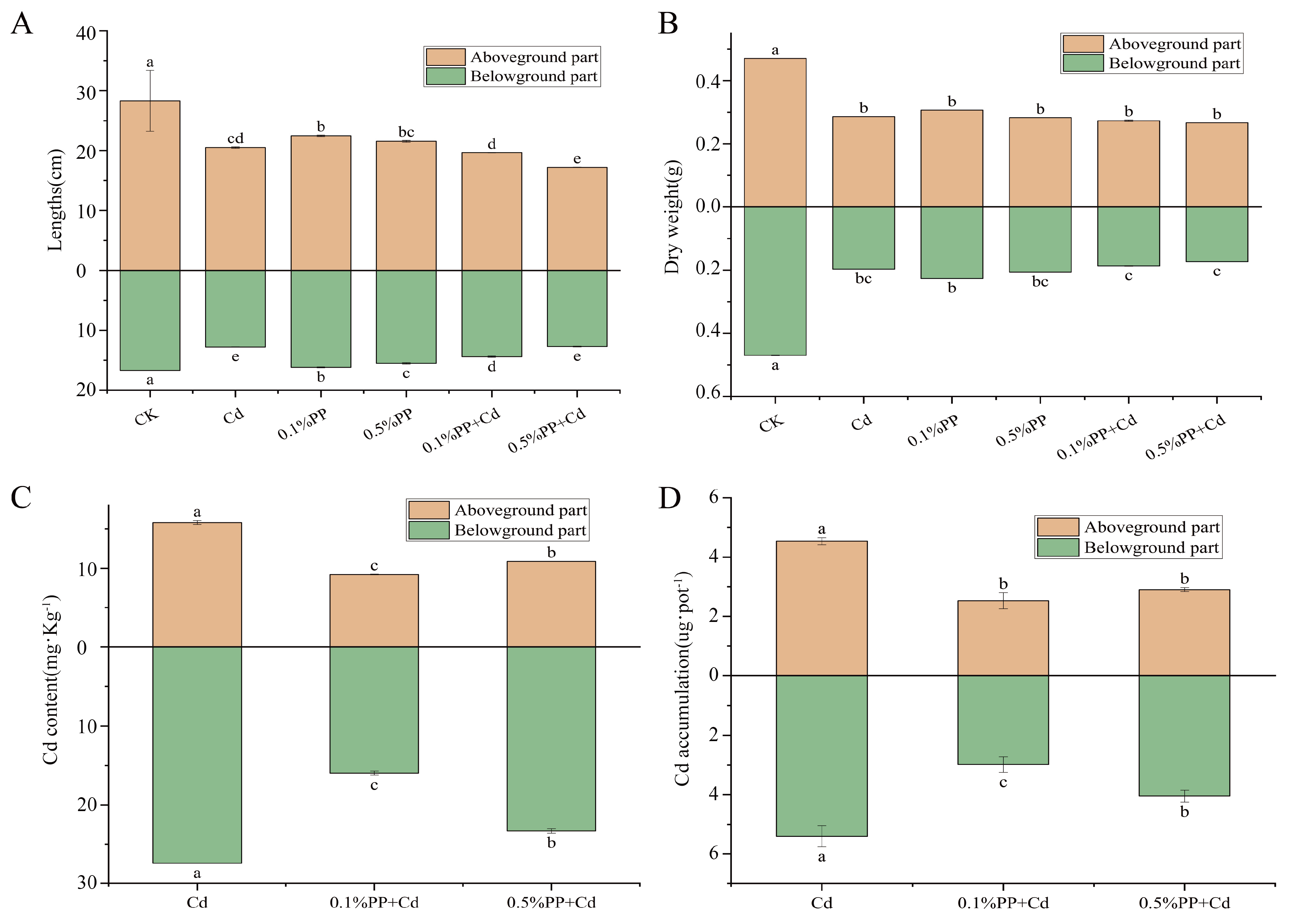
Figure 1A shows that, relative to those of the CK group, the aboveground and belowground lengths of sorghum subjected to Cd alone considerably decreased by 27.5% and 23.3%, respectively. Compared with that of the CK group, the aboveground length of sorghum under 0.1% PP contamination significantly decreased by 20.6%, whereas the belowground length decreased by 3%. Compared with those in the 0.1% PP treatment group, both the aboveground and belowground lengths of sorghum in the 0.5% PP treatment group were markedly lower. Compared with that in the PP-only treatment group, the aboveground length of sorghum in the 0.1% PP + Cd treatment group decreased by 4%; however, the aboveground length in the 0.5% PP + Cd treatment group considerably decreased by 16.2%, and the belowground length decreased by 0.6%. The findings for sorghum length and dry weight (Figure 1B) were comparable.
In terms of the Cd content and accumulation (Figure 1C,D), the Cd levels in the aboveground and belowground sections of sorghum treated with 0.1% PP + Cd considerably decreased by 41.7% and 41.9%, respectively, in comparison with those in the group that received Cd treatment alone. Under 0.5% PP + Cd contamination, the Cd content of sorghum substantially decreased in the aboveground and belowground portions by 31.1% and 15.1%, respectively. The results for Cd accumulation were consistent with the trends observed for the Cd content. Compared with Cd contamination alone, combined contamination with 0.1% PP + Cd reduced the accumulation of Cd in the aboveground part of sorghum by 44.3% and in the belowground part by 44.8%.

3.3. Effects of Various Treatments on the Physicochemical Characteristics of Sorghum Soil

Compared with those in the CK group (Table 1), the Cd-only treatment group presented substantial reductions in available phosphorus (AP), available potassium (AK), total phosphorus (TP), total potassium (TK), and total nitrogen (TN), with decreases ranging from 3.1–64%. Compared with those in the CK group, the AP, AK, TP, TK, and TN contents in the 0.1% PP treatment group tended to decrease. Among these, the AP content decreased significantly, by 19.5%, the TP content decreased by 2%, and the TN content decreased by 32%. Compared with the 0.1% PP treatment, the 0.5% PP treatment significantly reduced the AP, AK, TP, and TK contents by 15.8%, 6.3%, 4.4%, and 9.6%, respectively, whereas the reduction in the TN content was not significant. Compared with the Cd-only treatment group, the 0.5% PP + Cd treatment significantly reduced the AP, AK, TP, and TK contents by 10%, 21.9%, 14.7%, and 10.5%, respectively. In contrast, the 0.1% PP + Cd treatment group presented substantial decreases in AK (18.6%) and TP (1.8%).

3.4. Bacterial Communities in the Rhizosphere Soil and Plastisphere Across Several Treatment Groups

3.4.1. Diversity Indices

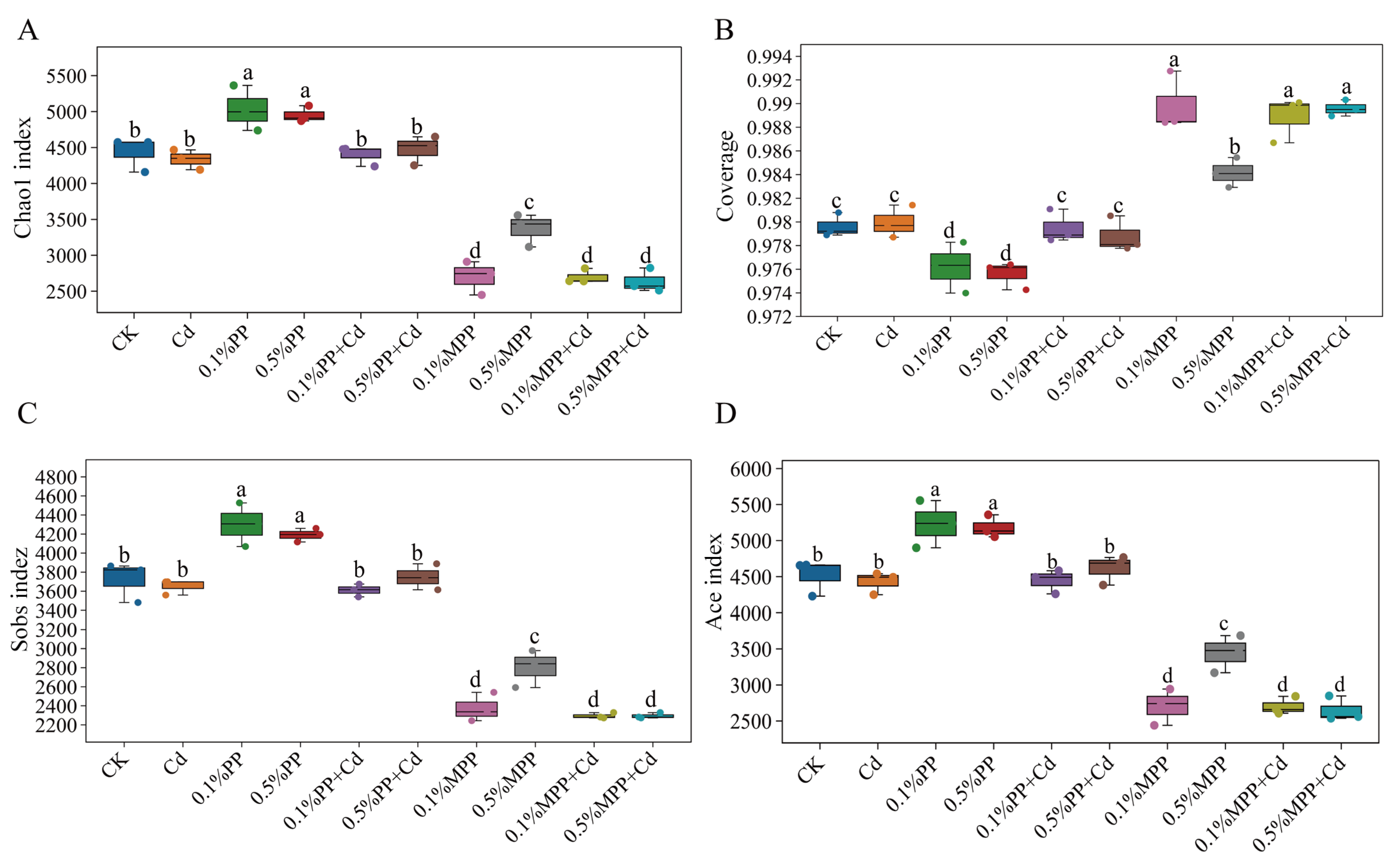
A comparison between the CK and Cd treatment groups indicated that the injection of Cd decreased the Chao1 index, Sobs index, and ACE index values, indicating reductions in community diversity and abundance and suggesting a modification of the bacterial community (Figure 2). The Chao1, Sobs, and ACE indices for the PP plastisphere were much lower than those of the rhizosphere soil, suggesting that the bacterial population in the plastisphere is less diverse and more uniform than that in the rhizosphere soil. The Chao1, Sobs, and ACE indices for the plastisphere and rhizosphere soil samples under combined PP + Cd treatment were all inferior to those of the samples subjected only to PP therapy.

3.4.2. Bacterial Community Compositions in Different Treatment Groups

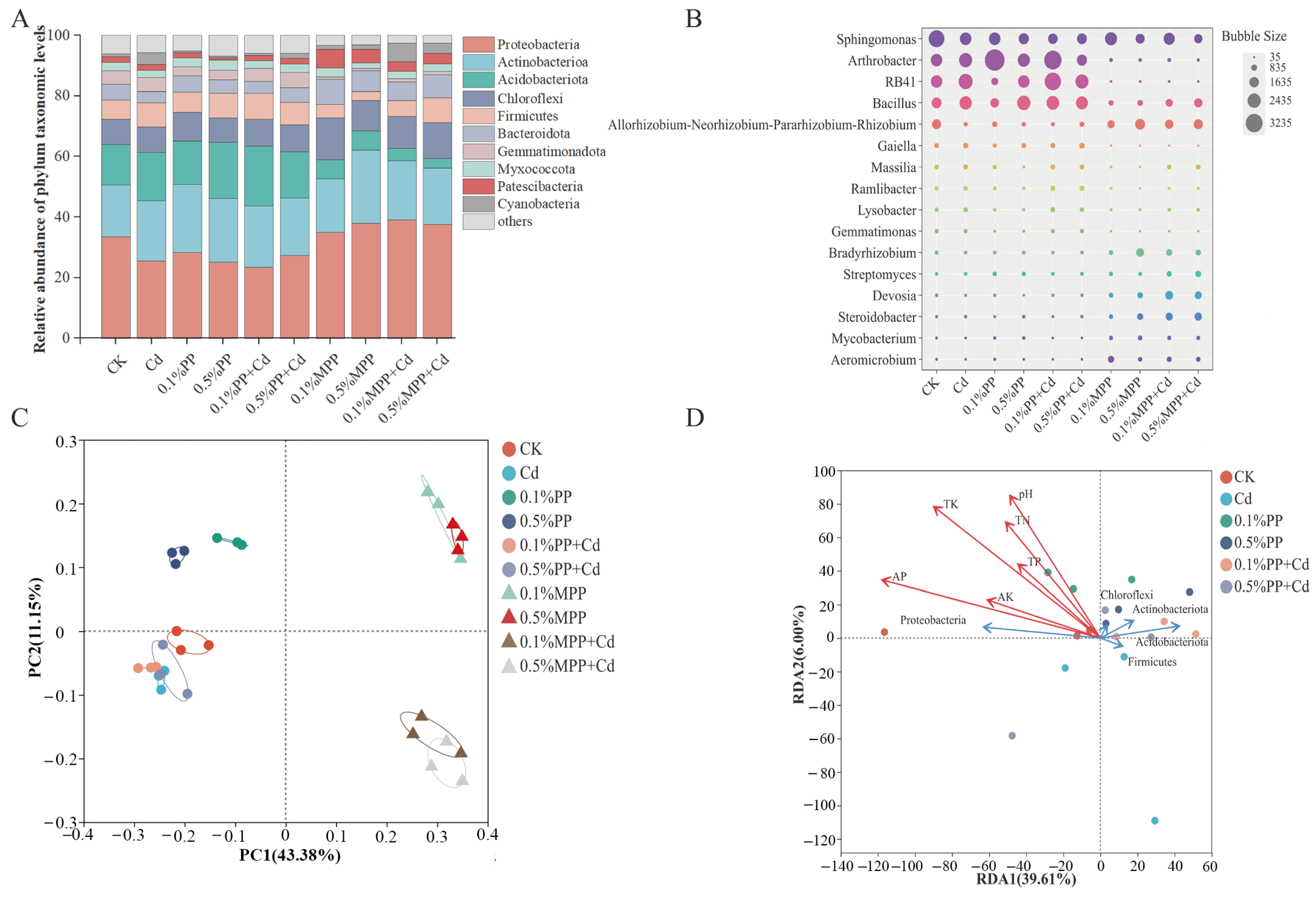
A differential abundance study of ASVs using high-throughput sequencing data revealed that at the phylum level (Figure 3A), the makeup of the bacterial community in the rhizosphere soil and PP plastisphere in the different treatment groups was similar. The predominant bacterial phyla were Proteobacteria, Actinobacteriota, Acidobacteriota, and Firmicutes. Compared with the Cd treatment group, the 0.1% PP + Cd combined treatment group presented a 2.2% decrease in the abundance of Proteobacteria, whereas the abundances of Actinobacteriota and Acidobacteriota increased by 0.55% and 3.66%, respectvely (Table S2). The abundances of Proteobacteria species were more pronounced in the PP plastisphere than in the rhizosphere soil; however, the abundances of Acidobacteriota and Firmicutes species were lower. The populations of Proteobacteria increased by 6.73% in the 0.1% MPP (MPP stands for PP obtained through M processing) treatment group, whereas the 0.1% PP treatment group presented a 4.88% reduction in the abundance of Acidobacteriota species. In the treatment group receiving 0.5% MPP and Cd, in contrast to the group receiving 0.5% PP + Cd, the abundance of Proteobacteria increased by 10.34%, the abundance of Acidobacteriota similarly declined, whereas the abundance of Firmicutes decreased by 0.65%. These findings revealed that the predominant bacterial communities in the PP plastisphere presented greater relative abundances, with the most notable disparity in Proteobacteria abundance.
An investigation at the genus level was undertaken to further examine the composition of the bacterial populations (Figure 3B). There were notable differences between the PP plastisphere and rhizosphere soil, and the prevailing genera in the rhizosphere soil were Sphingomonas, Mesorhizobium, RB41, and Bacillus. The dominant genera in the PP plastisphere were Bacillus, Mesorhizobium, Steroidobacter, and Devosia. Compared with those in the 0.1% PP treatment group (Table S3), in the 0.1% MPP treatment group, the relative abundances of Sphingomonas and Mesorhizobium increased by 5% and 43%, respectively, and the comparative frequencies of Mesorhizobium and RB41 significantly decreased by 91% and 91.6%, respectively. In the 0.1% MPP + Cd treatment group, the relative abundances of Sphingomonas (4.21%), Bradyrhizobium (2.98%), Steroidobacter (1.36%), and Devosia (2.67%) were greater than those in the 0.1% PP + Cd treatment group by 3.48%, 0.88%, 0.38%, and 0.45%, respectively.

3.4.3. PCoA of Bacterial Community Structure Composition Across Several Treatment Groups

Under the various treatments, the separation patterns of bacterial community structures in the rhizosphere soil and the plastisphere were investigated using PCoA (ANOSIM test, p < 0.05) based on the Bray–Curtis dissimilarity at the ASV level (Figure 3C). The PCoA1 and PCoA2 axes accounted for 55.01% of the overall variation. As shown in Figure 3C, overall, the PP plastisphere community was located on the opposite edge of the central axis, whereas the rhizosphere soil community was positioned on the left side, with clear separation between the two. In the PCoA plot, the 0.1% MPP, 0.5% MPP, 0.1% MPP + Cd, and 0.5% MPP + Cd samples were separated along Axis 2. The PCoA results for the rhizosphere soil samples were consistent with these findings, indicating that Cd was a significant factor influencing microbial community composition in the PP plastisphere, with a more pronounced effect on the plastisphere communities than on the rhizosphere soil communities.

3.5. Environmental Factor Correlation Analysis

The physicochemical characteristics of the sorghum soil were linked to the bacterial community composition in the rhizosphere soil at the phylum level using redundancy analysis (RDA) (Figure 3D). The variables were screened through iterative VIF selection (threshold > 10), and the physicochemical characteristics of the soil accounted for 42.9% of the variance in the structure of the microbial community of the sorghum soil. The soil physicochemical factors significantly correlated with the bacterial community structure, and their influence on the microbial composition followed the order of AP > TK > pH > TN > AK > TP. Among the 5 most abundant microbial communities in the sorghum soil, the phylum Proteobacteria was positively correlated with all the physicochemical factors. In contrast, Actinobacteriota, Acidobacteriota, and Firmicutes were negatively correlated with AP, AK, and TK.

3.6. Bacterial Community Assembly Processes

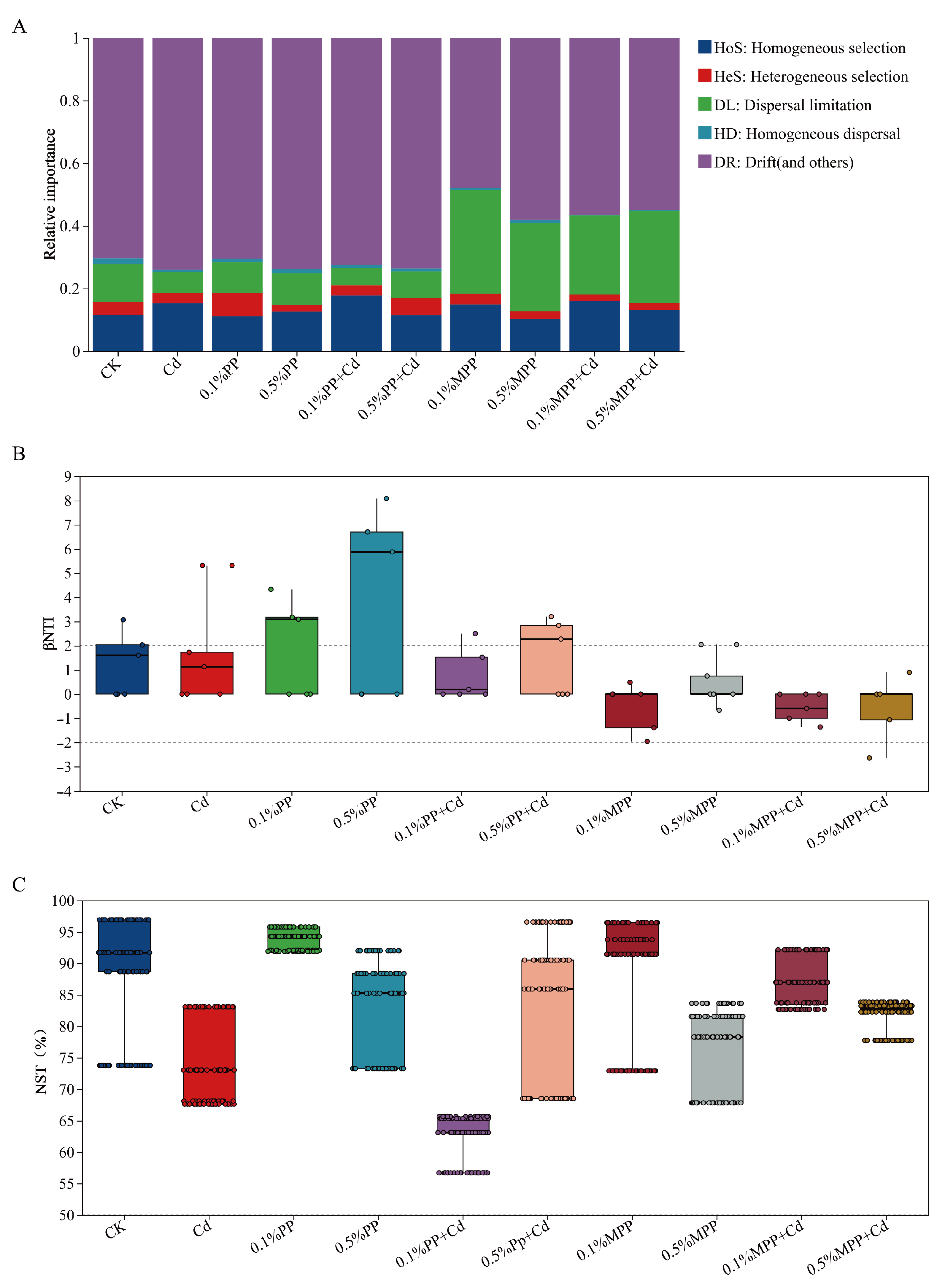
To elucidate the mechanisms underlying microbial community assembly, we calculated the beta nearest taxon index (βNTI) and the phylogenetic normalized stochastic ratio (pNST) based on a phylogenetic null model with 999 randomizations. The results indicated that deterministic and stochastic factors distinctly affected the formation of bacterial communities in the rhizosphere soil and the PP plastisphere. In the PP plastisphere, the median and mean βNTI values of the bacterial community were both between −2 and 2, indicating that phylogenetic turnover was significantly lower than expected, with stochastic processes playing a dominant role (Figure 4B). In the soil, the median and mean βNTI values for most treatment groups were between −2 and 2, while those in the remaining groups were greater than 2. In both the soil and PP communities, the phylogenetic normalized stochastic ratio (NST) of the bacterial communities exceeded the 50% threshold (Figure 4C). Overall, stochastic assembly dominated bacterial community assembly in both habitats. We further assessed the magnitude of the impact of ecological processes using null model techniques (Figure 4A). In the PP plastisphere, the primary forces influencing community assembly were the unpredictability of drift and diffusion restrictions, with homogeneous selection also contributing. In the soil, the randomness of drift dominated, followed by homogeneous selection and diffusion limitations. To cross-validate the predominance of stochastic processes (Figure S3), neutral community model analysis revealed a significantly lower microbial migration rate in the PP plastisphere compared to the rhizosphere soil (m = 0.1998 vs. 0.5968), along with a lower explanatory power of neutral processes (R2 = 0.7397 vs. 0.8896). These findings collectively affirm the stronger role of dispersal limitation in this distinct habitat.

3.7. Bacterial Community Co-Occurrence Network

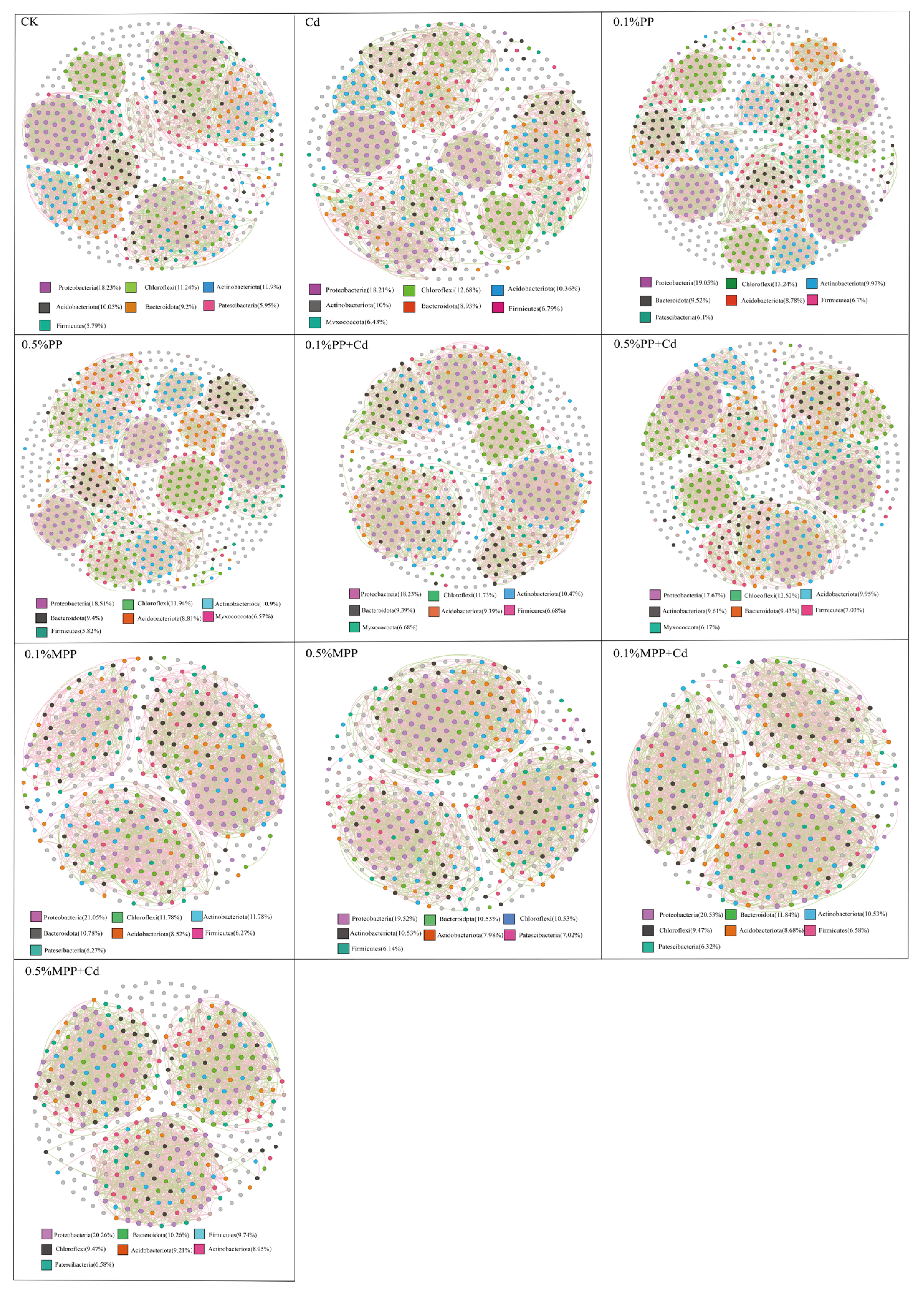
The bacterial co-occurrence network in the soil markedly differed from that in the PP plastisphere (as shown in Figure 5). Overall, the modularity index for all the treatments exceeded 0.4, indicating that both networks exhibited a modular structure with nodes showing a greater degree of clustering than in random networks. The networks in the PP plastisphere were consistently less complex than those in the soil. For instance, the plastisphere of the 0.1% MPP treatment had 399 nodes and 24,750 connections, whereas the corresponding soil network under the 0.1% PP treatment had 672 nodes and 65,573 connections (Table S4). This pattern was consistent across treatments, indicating that soil networks had more microbial species and more abundant interactions. The soil bacterial community co-occurrence networks were larger and more complex than those of the PP plastisphere, further highlighting the fundamental differences between them.

3.8. Function Prediction

3.8.1. KEGG Metabolic Pathway Prediction and Analysis

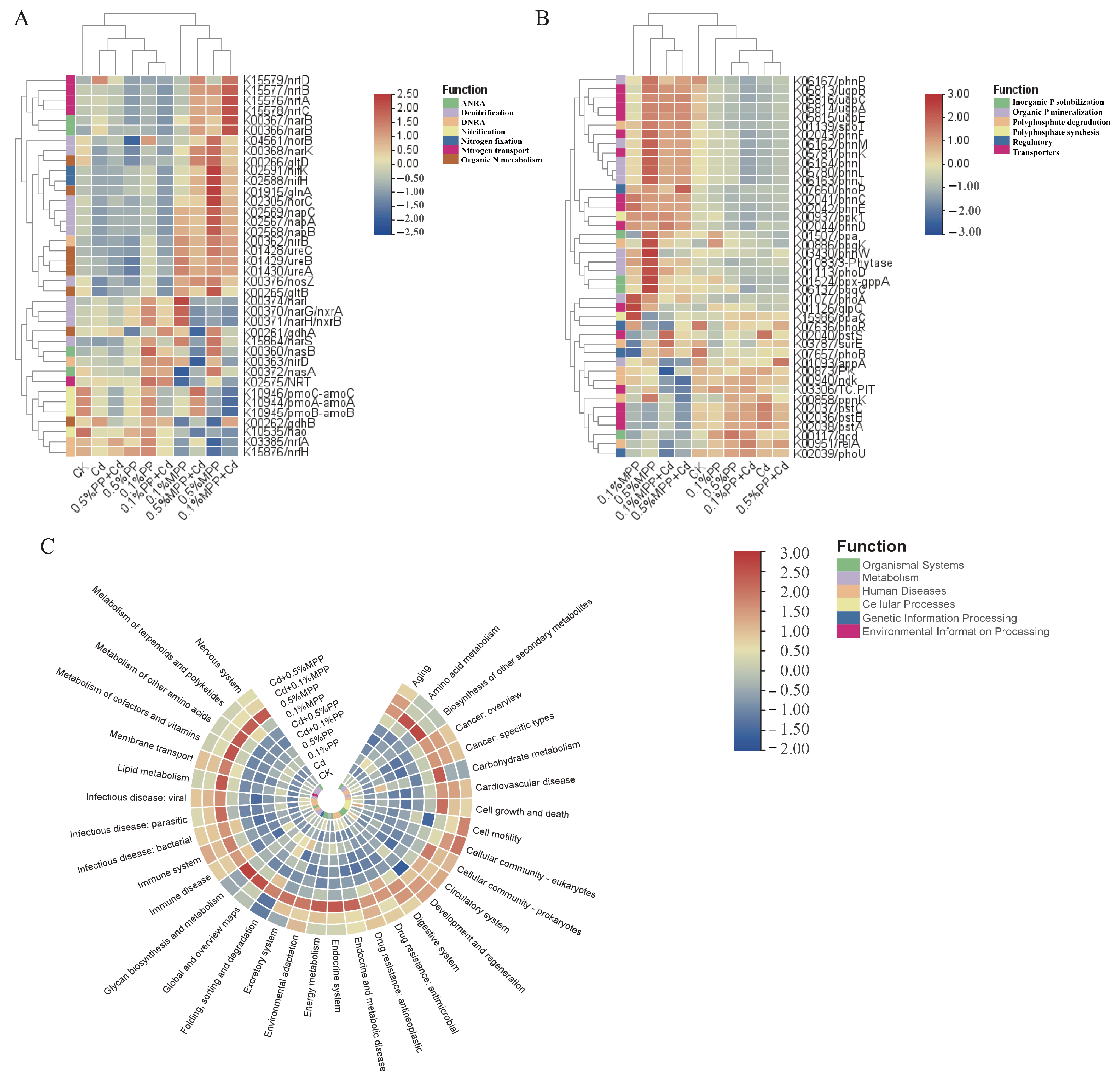
To characterize metabolic functions during sorghum growth under different treatments, functional profiles were evaluated based on PICRUSt2 v2.5.0 predictions annotated against the Kyoto Encyclopedia of Genes and Genomes (KEGG; http://www.genome.jp/kegg/, accessed on 15 October 2025), with statistical significance determined by FDR correction (q < 0.05) (Figure 6C). It should be noted that PICRUSt2 provides inferred functional potential based on gene homology, not direct evidence of expressed functions or the presence of viable pathogenic organisms. Thirty-five KO terms were selected to generate a clustered heatmap, with classifications displayed at two levels. At the first level, we identified metabolism and genetic information processing as the main functional components observed in the 6 soil treatments and the 4 plastic-related treatments, and they presented analogous functional levels at the secondary level. Functional analysis revealed that, compared with those in the soil, particular KEGG metabolic pathways were more prevalent in the plastisphere. The relative abundances of amino acid metabolism, carbohydrate metabolism, and terpenoid and polyketide compound metabolism pathways in the 0.5% MPP treatment group were 11.07%, 10.87%, and 11.71%, respectively, which were greater than those in the 0.5% PP treatment group (9.83%, 9.95%, and 9.54%, respectively). Similarly, the relative abundances of these pathways in the Cd + 0.5% MPP treatment exceeded those in the Cd + 0.5% PP treatment. Compared with those in the soil, bacterial functional prediction in the PP plastisphere suggested a greater percentage of metabolic pathways associated with human diseases. This indicates an inferred enrichment of genetic modules homologous to those involved in general microbial processes such as adhesion, invasion, or antibiotic resistance, but it does not signify the presence or increase of active human pathogens. For example, metabolic pathways related to drug resistance, tumors and infectious, viral, parasitic, and immune diseases presented much greater relative abundances in the plastisphere than in the soil. The relative abundances of metabolic pathways associated with these diseases in the 0.5% MPP treatment were 11.46%, 12.01%, 11.31%, and 11.71%, which were substantially greater than those in the 0.5% PP treatment, where the relative abundances were 8.97%, 9.45%, 9.19%, and 8.46%, respectively. Similarly, the metabolic pathways related to these diseases in the Cd + 0.5% MPP treatment group were enriched compared with those in the Cd + 0.5% PP treatment group.

3.8.2. Effects of Several Treatments on Nitrogen and Phosphorus Cycling Functional Genes

PICRUSt 2 was used to estimate the frequency and number of functional genes within the microbial communities (Figure 6A,B). Based on the analysis by LeBrun et al. [45], thirty-eight KEGG orthology (KO) genes associated with nitrogen metabolism and forty-two KO genes linked to phosphorus metabolism were identified and quantified. As shown in Figure 6, the nitrification gene abundance in the CK treatment group was much greater than those in the other groups. The gene abundances of the seven pathways decreased to some extent in the combined treatments with 0.1% and 0.5% PP addition. Cluster analysis of the comparative prevalence of nitrogen cycling genes revealed that the six soil groups clustered into Group 1, whereas the PP plastisphere treatment groups clustered into Group 2. Furthermore, genes related to denitrification and nitrogen transport pathways in the plastisphere treatments were significantly more abundant than those in the soil treatments, with norC, glnA, and nrtC being the most prominent. Like those associated with nitrogen cycling, the relative abundances of phosphorus cycling genes were clustered. The six soil groups clustered into one group, whereas the four plastisphere treatment groups clustered into another. Compared with those in the soil treatments, genes related to organic phosphorus mineralization and phosphorus transport were elevated in the plastisphere treatments, with the relative abundances of phoD, phnJ, and pqqC in the plastisphere treatments being considerably greater than those in the soil.

3.9. Correlations Among Sorghum Growth, Cd Accumulation, Soil Physicochemical Properties, and Plastisphere and Rhizosphere Microbes

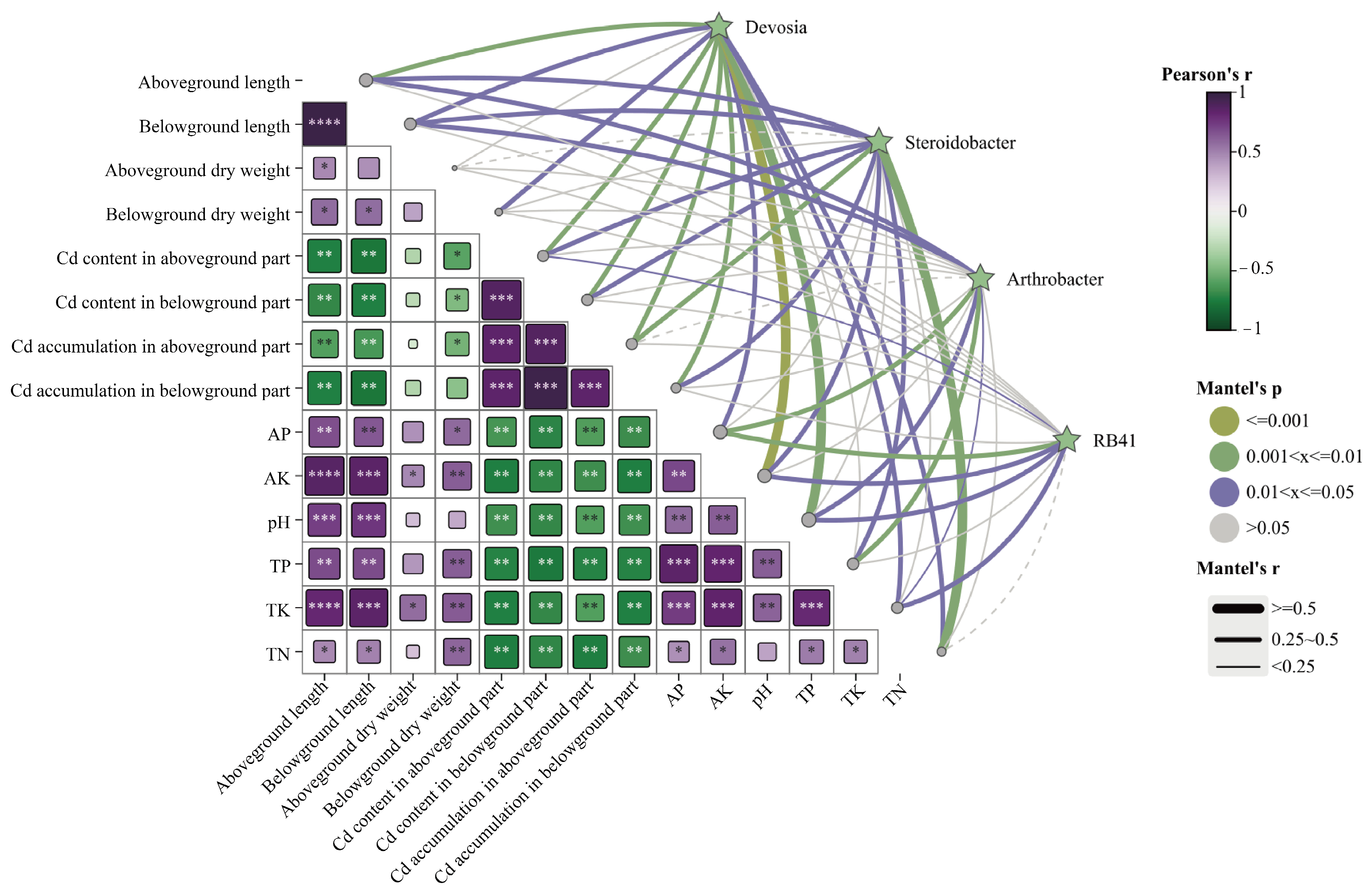
The correlations between the plastisphere and rhizosphere microbes and sorghum growth, heavy metal accumulation, and physicochemical properties were analyzed (Figure 7). The Mantel test results indicated that the dominant plastisphere microbe Steroidobacter was significantly correlated with the aboveground and belowground lengths of sorghum, aboveground and belowground Cd contents, AK, and TP (p < 0.05) and was extremely significantly correlated with aboveground and belowground Cd accumulation and TN (p < 0.01). The dominant plastisphere microbe Devosia was significantly correlated with the belowground length of sorghum, belowground dry weight, AP, TK, and TN (p < 0.05) and was extremely significantly correlated with the aboveground length of sorghum, aboveground and belowground Cd contents, aboveground and belowground Cd accumulation, pH, and AK (p < 0.01). The dominant rhizosphere microbe Arthrobacter was significantly correlated with the aboveground and belowground lengths of sorghum and pH (p < 0.05) and was extremely significantly correlated with AP, TP, and TK. The dominant rhizosphere microbe RB41 was significantly correlated with the aboveground Cd content, AK, pH, and TK (p < 0.05) and extremely significantly correlated with AK (p < 0.01). Pearson correlation analysis revealed that AP, AK, TP, TK, pH, and TN were positively correlated with the length and dry weight of sorghum. To directly quantify the relationship between key plastisphere microorganisms and cadmium accumulation, supplementary analysis (Table S5) revealed that the relative abundances of Devosia and Steroidobacter were significantly negatively correlated with both cadmium concentration and accumulation in aboveground and belowground parts of sorghum (p < 0.05), providing direct evidence for this association.

4. Discussion

4.1. Combined Pollution Effects of Microplastics and Cadmium: Plant–Soil System Responses

In soil ecosystems, microplastics and the heavy metal Cd are common pollutants [46]. This study demonstrated that both polypropylene microplastic and cadmium (Cd) contamination significantly inhibited sorghum growth, with their coexistence exhibiting synergistic toxicity. Under single Cd exposure, sorghum length and biomass were substantially reduced (>34% decrease in aboveground dry weight; >51% belowground), which is consistent with established mechanisms in which Cd uptake disrupts critical physiological processes such as photosynthesis, nutrient acquisition, water absorption and oxidative stress [47]. In particular, the inhibitory effect of the combined pollution of PP and Cd on the biomass of sorghum was significantly stronger than that of Cd pollution alone. Previous researchers [48] reported that nondegradable microplastics significantly (p < 0.05) reduced the available phosphorus content in soil from 122.61 mg PL−1 to 63.43 mg PL−1 by adsorbing phosphate through surface oxygen-containing functional groups (such as carboxyl groups). Palansooriya et al. [49] reported that MPs can also disrupt the soil structure, leading to K+ leaching loss, a reduction in total exchangeable cations in the soil, and a decrease in available potassium. Wang et al. [50] reported that MPs could also intensify denitrification by increasing the abundance of denitrification genes while inhibiting the nitrification process, resulting in increased nitrogen loss. Ran et al. [51] reported that MPs reduced the soil pH by releasing acidic additives such as phthalates. This experimental study revealed that the combined pollution of PP and Cd significantly reduced available phosphorus, available potassium, total phosphorus and total potassium, while total nitrogen and pH decreased to a certain extent. Previous studies have shown that the addition of PP may increase the degree of pollution by affecting the soil structure and pH, thereby reducing the biomass of sorghum. The results of the Pearson correlation analysis in this study indicated that AP, AK, TP, TK, pH and TN were positively correlated with the length and dry weight of sorghum, which also confirmed these findings. Regarding cadmium accumulation, this study revealed a noteworthy phenomenon: Compared with single Cd contamination, PP-Cd co-contamination significantly increased DTPA-Cd levels (+20.88%) while unexpectedly reducing Cd accumulation in sorghum plants. This finding suggests that the bioavailability and/or speciation of cadmium may have been altered under conditions of co-contamination. This paradox can be attributed to PP microplastics efficiently adsorbing Cd2+ through enhanced oxygen-containing functional groups (e.g., C=O), which is consistent with Zhao et al.’s observation of +17.9% [52]. Although PP microplastics demonstrate Cd adsorption and immobilization capacities where charged sites or hydrophobic regions directly bind Cd2+, as evidenced by Zhou et al.’s documentation of significant polystyrene adsorption (0.8 ± 0.02 mg·g−1) [53], plastisphere microbiota (e.g., Sphingomonas) transform adsorbed Cd into EPS-bound forms. Critically, these EPS-complexed Cd species exhibit merely 34% bioavailability to sorghum roots compared with free Cd2+ [54,55], ultimately explaining the reduced plant accumulation. It is important to clarify that this proposed EPS-mediated immobilization mechanism, while a plausible interpretation supported by the observed data and literature, remains a correlative hypothesis. Direct experimental validation, such as in-situ analysis of EPS-Cd complexes, is needed in future studies. Furthermore, alternative explanations for the reduced plant Cd accumulation should be considered. The addition of microplastics may alter rhizosphere chemistry (e.g., pH, dissolved organic carbon) or root physiology, thereby indirectly affecting Cd uptake kinetics. Additionally, the direct physical sequestration of Cd2+ by PP surfaces could reduce its bioavailability in soil solution. While our data on increased DTPA-Cd and specific microbial enrichment lean towards supporting a microbially-mediated transformation as a key mechanism, these alternative physico-chemical pathways cannot be ruled out. This finding has important implications: although microplastics exacerbate growth inhibition, they may simultaneously mitigate heavy metal transfer risks through adsorption-mediated immobilization. However, this potential benefit requires careful trade-offs against significant crop yield penalties. Future studies could employ sequential extraction procedures to further speciate cadmium, thereby precisely elucidating the underlying mechanisms governing its changes in bioavailability.

4.2. The Unique Microbial Niches of the Plastisphere Harbor Bacterial Communities That Differ Significantly from Those in the Surrounding Soil

Soil microbial community analysis revealed differential impacts of contaminants [56]. Cd contamination significantly reduced microbial richness indices (Chao1, Sobs, and ACE), confirming the direct toxicity of Cd to the microbiota [2,57]. In contrast, PP addition alone tended to slightly increase alpha diversity, potentially because PP provides additional physically colonized surfaces [58]. However, a more striking feature emerged: the distinctiveness of PP plastisphere communities. Compared with the corresponding rhizosphere soils, the plastispheres across all the treatments presented significantly lower richness indices, and PCoA clearly segregated the plastisphere communities from the rhizosphere assemblages. These findings indicate that PP surfaces establish unique microbial niches. The observed community simplification (reduced richness/diversity) in plastispheres likely stems from (1) the selective pressure of toxic additives (e.g., plasticizers, flame retardants) leaching from aging PP [59] and (2) the physicochemical screening of microbes colonized by PP surface properties. Notably, PP + Cd cotreatment resulted in the lowest plastisphere diversity, suggesting that microplastics may concentrate Cd to form localized toxicity hotspots that amplify microbial stress [60]. This aligns with the observations of Zhang et al. [30] and Oberbeckmann et al. [61] in aquatic plastispheres. The formation of plastispheres and their distinct community structures not only alter microbial spatial distribution but also may modulate contaminant degradation-transformation processes, representing a critical nexus for understanding soil ecological functions under co-contamination. The PP plastisphere communities are not fully independent but are indirectly influenced by the rhizosphere microbial pool shaped by root exudates. However, their significant divergence from adjacent rhizosphere communities underscores that the PP surface itself acts as the dominant filter, creating a distinct niche.
At the phylum level, the dominant microbial communities in both the rhizosphere soil and the PP plastisphere were Proteobacteria, Actinobacteriota, and Acidobacteriota, among others. Bourceret et al. [62] also demonstrated that in soils polluted with heavy metals and microplastics, Proteobacteria, Acidobacteriota, and Bacteroidota were the dominant phyla. Proteobacteria typically thrive in looser soils, and the addition of microplastics (MPs) alters the soil bulk density [58]. Compared with those in the CK group, the relative abundances of Actinobacteriota and Acidobacteriota in the other treatment groups increased. Studies have indicated that Actinobacteriota are indigenous microorganisms in soil with a robust capacity to adapt to heavy metal-contaminated conditions and may mitigate the toxicity of these metals via their metabolic processes, while also participating in nitrogen cycling [63]. Acidobacteriota are tolerant to various pollutants, such as polychlorinated biphenyls, petroleum compounds, and heavy metals. The prevalence of these bacteria is notably elevated in soils contaminated with heavy metals and microplastics [64]. This study revealed that, in comparison with those in rhizosphere soil, the overall species abundances of Proteobacteria were greater in the PP plastisphere, but the species abundances of Acidobacteriota and Firmicutes were lower. Consistent with this, Zhang et al. [30] reported that the microbial community on microplastics differs in structure from those in other residues and soils, with Proteobacteria and Actinobacteriota being key phyla involved in microplastic degradation [65,66]. A high-throughput study at the genus level revealed that the predominant genera in rhizosphere soil were Sphingomonas, Rhizobium, RB41, and Bacillus. Bacillus and Sphingomonas are microorganisms that are resistant to heavy metals and are often found in soils polluted with diverse heavy metals. These microorganisms may increase plant development and improve crop resistance to illnesses [67]. Arthrobacter is a dominant genus in soil and includes plant growth-promoting bacteria that are renowned for their capacity to break down atrazine [68]. The Mantel analysis in this study also revealed that Arthrobacter was significantly correlated with sorghum growth. The dominant genera in the PP plastisphere were Sphingomonas, Bradyrhizobium, and Bacillus. In the PP plastisphere, the relative abundances of Sphingomonas and Bradyrhizobium exceeded those in the rhizosphere soil. This selective enrichment, along with the findings of previous studies [69,70,71], suggests that microplastics serve as filters, creating selective ecological niches that reshape the local microbial community. The Mantel analysis in this study also revealed that the dominant plastisphere microbes Steroidobacter and Devosia were significantly correlated with sorghum growth and Cd accumulation. This may be related to the degradation capabilities of the plastisphere surface microbes, which in turn affect sorghum growth and Cd accumulation [72]. It is important to note that the bacterial community patterns observed in this study may be specific to the experimental conditions applied (e.g., soil type, MP concentration, heavy metal pollution levels). Under different environmental settings, other taxa could potentially become dominant. This discovery suggests that directional manipulation of microbiota composition may serve as a novel bioremediation strategy for contaminated farmlands.

4.3. The Plastisphere Provides a Unique Ecological Niche for Microbial Community Assembly and Interactions

Comprehending the mechanics of microbial community building is crucial for elucidating ecosystem sustainability and is a primary focus in microbial ecology research. The findings of this research indicated that stochastic processes had a greater role in the bacterial populations inside the PP plastisphere and soil. Research has shown that in some aquatic and terrestrial environments, random processes play dominant roles in community assembly. Yang et al. [73], in their interpretation of the diversity patterns and community assembly of abundant and rare bacterial communities in the wetland system of Olympic Forest Park, reported that the assembly of abundant taxa is dominated by random processes (including undefined processes and dispersal limitations), suggesting that abundant taxa can adapt to environmental changes to maintain community structure. The plastisphere has also been shown to exhibit these results. Zhang et al. [74], in their study of natural marine environments, found through zero-model analysis of the microbial community structure and assembly mechanisms in the plastisphere that random processes assume a more substantial role in the establishment of the plastisphere microbial community structure than do deterministic processes and that dispersal limitation has a significant influence on the microbial succession trajectory. Sun et al. [75] and Ji et al. [76] reported similar findings. The reason may be that the addition of heavy metals and microplastics causes changes in the soil environment. Bacterial communities can live in various environments, whereas soil, as a solid matrix, does not diffuse as easily as water does. Moreover, the predominant bacterial group across all the samples was Proteobacteria, characterized by a broad ecological niche, with community formation mostly influenced by stochastic processes [77]. The contribution of limitations in the plastisphere exceeded that in the rhizosphere soil. Dispersal limitation mediates microbial coexistence patterns, and dispersal limitation is greater in plastisphere habitats, which reduces associations between microorganisms [78]. Our study emphasizes, from the perspective of bacterial communities, the role of stochastic mechanisms such as drift and dispersion restrictions in the development of plastisphere communities and sorghum rhizosphere soil communities in environments with complex pollution conditions. This empirically demonstrates reduced community stability from an assembly mechanism perspective, thus necessitating increased monitoring frequency in agricultural management.
Co-occurrence network analysis is a powerful tool for inferring interactions between microorganisms. Interactions between species, such as predation, competition, and mutualistic symbiosis, are important for community assembly processes, community response to disturbances, and the functions of ecosystems [79]. This study revealed that the total number of nodes, total connections, and average degree in the PP plastisphere were smaller than those in the corresponding soil, indicating that the soil microbial network was more complex than the plastisphere network. The rhizosphere soil bacterial co-occurrence network tended to function as a comprehensive unit, whereas the plastisphere bacterial network exhibited a relatively high degree of modularity. The complexity of a network is often positively correlated with community stability. Complex networks are better able to cope with environmental changes and have higher resource transfer efficiency [80]. This is consistent with the findings of Li et al. [81], who reported that network structural stability in plastispheres is poor. The possible reason is that the highly heterogeneous habitats provided by microplastics promote niche differentiation, increase dispersal limitation, and reduce microbial interactions, consequently leading to a decline in microbial ecosystem services in agricultural soils—thus necessitating artificial intervention for compensation. In summary, the combination of stochastic assembly and a simplified network topology indicates that the plastisphere microbial community has lower structural stability and weaker ecological resilience, making its ecological functions more susceptible to disruption under combined pollution stress.

4.4. Plastisphere Microorganisms Exhibit Relatively High Denitrification Potential and Are Involved in Biogeochemical Cycles and Human Illnesses

PP can significantly affect the nitrogen and phosphorus contents in the soil. To further analyze the ecological functional responses of the plastisphere, we used PICRUSt2 for community function prediction analysis, focusing on the nitrogen and phosphorus cycles as well as KEGG metabolic pathways. The analysis results indicated that the number of genes related to denitrification and nitrogen transport pathways in the four PP plastisphere treatments was greater than those in the corresponding four rhizosphere soil treatments. Kuypers et al. [82] studied the plastisphere in freshwater ecosystems and reported that it has relatively high denitrification potential, increasing the possibility of N2O and NO2 production. According to Li et al. [83], plastics may affect the nitrogen cycle by changing the number of microorganisms that nitrify and denitrify as well as the genes linked to the nitrogen cycle. These results align with those of the current investigation. Research has indicated that the quantity of genes associated with organic phosphorus mineralization and phosphorus transport in the plastisphere exceeds that found in the soil, with phoD being particularly prominent. Furthermore, prior research has shown that the phoD gene encodes alkaline phosphatase (ALP), which is essential for modulating the solubility of inorganic phosphorus (Pi) and the mineralization of organic phosphorus (Po) [84]. The KEGG metabolic pathway prediction indicated that the first metabolic pathway was the main functional component, and the relative abundances of various metabolic pathways in the second pathway were greater in the plastisphere than in the soil. Research has shown that the plastisphere microbial communities present within terrestrial environments have relatively high lignin degradation potential, which may accelerate the metabolism of organic matter and be unfavorable for organic carbon sequestration [85]. Debroas et al. [86] reported that these metabolic pathways are likely linked to genes that facilitate the breakdown of synthetic substrates and/or organic contaminants. This may suggest that the bacterial groups abundant in PP plastispheres can use plastics or additives as carbon and energy sources. In summary, the potential for organic matter metabolism and nitrogen cycling-related functions is significantly altered in the plastisphere, indicating that the plastisphere can disrupt the normal biogeochemical cycles of ecosystems [87]. This research further revealed that, compared with those in the soil, the PP plastisphere had a greater number of metabolic pathways associated with human illnesses. Ding et al. [88] reported that after exposure to heavy metals and antibiotics, pathogenic bacteria were enriched on tire particles in soil. Such plastic pollution not only increases the exposure opportunities of pathogenic bacteria but can also directly introduce these bacteria into human and plant bodies, resulting in endangerment. Song et al. [89] reported that pathogenic bacteria are transported over long distances through plastispheres. Taken together, these findings demonstrate that the plastisphere may serve as a potential reservoir for genes associated with pathogenicity-related functions. While this inferred genetic potential warrants attention, its translation into actual pathogenicity or human health risk requires direct experimental confirmation. Collectively, our findings highlight critical implications for managing agricultural soils co-contaminated with microplastics and heavy metals. The plastisphere’s role in altering heavy metal bioavailability and biogeochemical cycles indicates that environmental risk assessments must account for micro-scale interactions at the plastic-soil interface, beyond conventional bulk soil analysis. Furthermore, the identified microbial taxa and functional genes offer potential targets for leveraging the plastisphere microbiome in developing targeted bioremediation strategies. Future studies should further explore the long-term impacts of such co-contamination on soil fertility, the accumulation and potential food-chain transfer of pollutants in crops, and the precise functional roles of plastisphere-specific microbes.

5. Conclusions

Combined pollution with heavy metals and microplastics can result in complex toxic effects on plants and impact soil microorganisms, but few studies have investigated the interactions between the plastisphere and soil microorganisms under these combined pollution circumstances. This research used pot experiments to observe distinct variations in bacterial community composition, assembly mechanisms, co-occurrence networks, and predicted metabolic functions between the rhizosphere soil of sorghum and the PP plastisphere. Compared with contamination with a single pollutant, combined contamination with PP and Cd resulted in more significant inhibition of sorghum growth and altered the accumulation of Cd in sorghum. The data showed that Proteobacteria, Sphingomonas, and Bradyrhizobium were specifically enriched in the PP plastisphere, which implies that plastispheres may act as filters, potentially increasing the abundance of microorganisms with the potential to degrade plastic polymers. Analysis revealed that dispersal limitations were more pronounced in the microbial assembly of the PP plastisphere, and that the plastisphere exhibited lower network complexity than the soil. Predictive functional analysis indicated that the relative abundances of genes linked to denitrification and the proportion of metabolic pathways related to human illnesses were predicted to be higher in the PP plastisphere. These results collectively demonstrate the distinct nature of the plastisphere microbiome and help provide a more comprehensive understanding of its dynamic changes and highlight its potential environmental risks in the context of combined pollution in soil–plant ecosystems.

Supplementary Materials

The following supporting information can be downloaded at: https://www.mdpi.com/article/10.3390/agronomy16030293/s1, Figure S1: Schematic diagram of the flotation method using deionized water to separate polypropylene (PP) microplastics from soil; Figure S2: Scanning electron microscopy (SEM) image of virgin polypropylene (PP) microplastic particles. Scale bar = 10 μm (A), Scale bar = 1 mm (B). Imaging conditions: Accelerating voltage 5 kV; sample gold-sputter coated. Fourier Transform Infrared (FTIR) Spectrum of Pristine Polypropylene (PP) Microplastics (C); Figure S3: Panel A shows the results of the neutral community model fit for species occurrence frequency in the soil treatment groups, and Panel B shows the corresponding results for the plastisphere treatment groups; Table S1: Design of experiments; Table S2: Statistical table of differences at the phylum level; Table S3: Statistical table of differences at the genus level; Table S4: Topological parameters of microbial co-occurrence network; Table S5: Spearman Correlations of Devosia and Steroidobacter with Cadmium Concentration and Accumulation in Plant Tissues. Text S1.

Author Contributions

Z.-J.C. designed the experiments; Z.-J.C., Z.-H.W. and S.-S.G., participated in writing the paper; S.-S.G., Z.-H.W., L.Y., Y.-L.M. and M.W., performed the experiments and analyzed the data; Z.-J.C., Z.-H.W. and S.-S.G. and B.-L.L.L., reviewed the manuscript. All authors have read and agreed to the published version of the manuscript.

Funding

This research was funded by the National Natural Science Foundation of China (Grant Nos. U2004145), the Natural Science Foundation of Henan Province (Grant No. 252300421841, and 252300423268) and the Key Research and Development Projects of Henan Province (Grant No. 221111520600, and 231111113000).

Data Availability Statement

The data that support the findings of this study are available on request from the corresponding author.

Conflicts of Interest

The authors declare no conflicts of interest.

References

  1. Vardhan, K.H.; Kumar, P.S.; Panda, R.C. A review on heavy metal pollution, toxicity and remedial measures: Current trends and future perspectives. J. Mol. Liq. 2019, 290, 111197. [Google Scholar] [CrossRef]
  2. Turan, V. Bioremediation of Lithium and Nickel from Soil and Water. In Lithium and Nickel Contamination in Plants and the Environment; World Scientific Publishing: Singapore, 2023; Volume 1. [Google Scholar]
  3. Farhad, M.; Noor, M.; Yasin, M.Z.; Nizamani, M.H.; Turan, V.; Iqbal, M. Interactive suitability of rice stubble biochar and arbuscular mycorrhizal fungi for improving wastewater-polluted soil health and reducing heavy metals in peas. Sustainability 2024, 16, 634. [Google Scholar] [CrossRef]
  4. Hu, H.; Jin, Q.; Kavan, P. A study of heavy metal pollution in China: Current status, pollution-control policies and countermeasures. Sustainability 2014, 6, 5820–5838. [Google Scholar] [CrossRef]
  5. Rai, P.K.; Lee, S.S.; Zhang, M.; Tsang, Y.F.; Kim, K.H. Heavy metals in food crops: Health risks, fate, mechanisms, and management. Environ. Int. 2019, 125, 365–385. [Google Scholar] [CrossRef]
  6. Wang, L.; Cui, X.; Cheng, H.; Chen, F.; Wang, J.; Zhao, X.; Lin, C.; Pu, X. A review of soil cadmium contamination in china including a health risk assessment. Environ. Sci. Pollut. Res. 2015, 22, 16441–16452. [Google Scholar] [CrossRef]
  7. Xu, C.; Zhang, B.; Gu, C.; Shen, C.; Yin, S.; Aamir, M.; Li, F. Are we underestimating the sources of microplastic pollution in terrestrial environment? J. Hazard. Mater. 2020, 400, 123228. [Google Scholar] [CrossRef]
  8. Rillig, M.C.; Lehmann, A. Microplastic in terrestrial ecosystems. Science 2020, 368, 1430–1431. [Google Scholar] [CrossRef] [PubMed]
  9. Horton, A.A.; Walton, A.; Spurgeon, D.J.; Lahive, E.; Svendsen, C. Microplastics in freshwater and terrestrial environments: Evaluating the current understanding to identify the knowledge gaps and future research priorities. Sci. Total Environ. 2017, 586, 127–141. [Google Scholar] [CrossRef] [PubMed]
  10. Li, R.; Yu, L.; Chai, M.; Wu, H.; Zhu, X. The distribution, characteristics and ecological risks of microplastics in the mangroves of southern china. Sci. Total Environ. 2020, 708, 135025. [Google Scholar] [CrossRef]
  11. Bläsing, M.; Amelung, W. Plastics in soil: Analytical methods and possible sources. Sci. Total Environ. 2018, 612, 422–435. [Google Scholar] [CrossRef] [PubMed]
  12. Büks, F.; Kaupenjohann, M. Global concentrations of microplastics in soils—A review. Soil Discuss. 2020, 6, 649–662. [Google Scholar] [CrossRef]
  13. Boots, B.; Russell, C.W.; Green, D.S. Effects of microplastics in soil ecosystems: Above and below ground. Environ. Sci. Technol. 2019, 53, 11496–11506. [Google Scholar] [CrossRef] [PubMed]
  14. Ilyas, M.F.; Gill, S.; Farhad, M.; Hannan, F.; Tauqeer, H.M.; Ramzani, P.M.A.; Turan, V.; Virk, Z.A.; Iqbal, M. Rhizoremediation: A promising plant-microbiome interaction for the management of heavy metals polluted soils. In Bio-Organic Amendments for Heavy Metal Remediation; Husen, A., Iqbal, M., Ditta, A., Mehmood, S., Imtiaz, M., Tu, M.S., Eds.; Elsevier: Amsterdam, The Netherlands, 2024. [Google Scholar]
  15. Wang, W.; Yuan, W.; Xu, E.G.; Li, L.; Zhang, H.; Yang, Y. Uptake, translocation, and biological impacts of micro(nano)plastics in terrestrial plants: Progress and prospects. Environ. Res. 2022, 203, 111867. [Google Scholar] [CrossRef] [PubMed]
  16. Liu, Y.-Q.; Chen, Y.; Ren, X.-M.; Li, Y.-Y.; Zhang, Y.-J.; Zhang, H.; Han, H.; Chen, Z.-J. Plant growth-promoting bacteria modulate gene expression and induce antioxidant tolerance to alleviate synergistic toxicity from combined microplastic and cd pollution in sorghum. Ecotoxicol. Environ. Saf. 2023, 264, 115439. [Google Scholar] [CrossRef]
  17. Chase, J.M.; Myers, J.A. Disentangling the importance of ecological niches from stochastic processes across scales. Philos. Trans. R. Soc. B Biol. Sci. 2011, 366, 2351–2363. [Google Scholar] [CrossRef]
  18. Chen, W.; Ren, K.; Isabwe, A.; Chen, H.; Liu, M.; Yang, J. Stochastic processes shape microeukaryotic community assembly in a subtropical river across wet and dry seasons. Microbiome 2019, 7, 138. [Google Scholar] [CrossRef]
  19. Stegen, J.C.; Lin, X.; Konopka, A.E.; Fredrickson, J.K. Stochastic and deterministic assembly processes in subsurface microbial communities. ISME J. 2012, 6, 1653–1664. [Google Scholar] [CrossRef]
  20. Li, K.; Xu, L.; Bai, X.; Zhang, G.; Zhang, M.; Huang, Y. Differential fungal assemblages and functions between the plastisphere of biodegradable and conventional microplastics in farmland. Sci. Total Environ. 2024, 906, 167478. [Google Scholar] [CrossRef]
  21. Zhang, Z.; Geng, J.; Tang, X.; Fan, H.; Xu, J.; Wen, X.; Ma, Z.S.; Shi, P. Spatial heterogeneity and co-occurrence patterns of human mucosal-associated intestinal microbiota. ISME J. 2014, 8, 881–893. [Google Scholar] [CrossRef]
  22. Zhang, B.; Zhang, J.; Liu, Y.; Shi, P.; Wei, G. Co-occurrence patterns of soybean rhizosphere microbiome at a continental scale. Soil Biol. Biochem. 2018, 118, 178–186. [Google Scholar] [CrossRef]
  23. Faust, K.; Raes, J. Microbial interactions: From networks to models. Nat. Rev. Microbiol. 2012, 10, 538–550. [Google Scholar] [CrossRef]
  24. Fuhrman, J.; Steele, J. Community structure of marine bacterioplankton: Patterns, networks, and relationships to function. Aquat. Microb. Ecol. 2008, 53, 69–81. [Google Scholar] [CrossRef]
  25. Arias-Andres, M.; Kettner, M.T.; Miki, T.; Grossart, H.-P. Microplastics: New substrates for heterotrophic activity contribute to altering organic matter cycles in aquatic ecosystems. Sci. Total Environ. 2018, 635, 1152–1159. [Google Scholar] [CrossRef] [PubMed]
  26. Jia, W.; Karapetrova, A.; Zhang, M.; Xu, L.; Li, K.; Huang, M.; Wang, J.; Huang, Y. Automated identification and quantification of invisible microplastics in agricultural soils. Sci. Total Environ. 2022, 844, 156853. [Google Scholar] [CrossRef]
  27. Zettler, E.R.; Mincer, T.J.; Amaral-Zettler, L.A. Life in the "plastisphere": Microbial communities on plastic marine debris. Environ. Sci. Technol. 2013, 47, 7137–7146. [Google Scholar] [CrossRef] [PubMed]
  28. Sajjad, M.; Huang, Q.; Khan, S.; Khan, M.A.; Liu, Y.; Wang, J.; Lian, F.; Wang, Q.; Guo, G. Microplastics in the soil environment: A critical review. Environ. Technol. Innov. 2022, 27, 102408. [Google Scholar] [CrossRef]
  29. McCormick, A.; Hoellein, T.J.; Mason, S.A.; Schluep, J.; Kelly, J.J. Microplastic is an abundant and distinct microbial habitat in an urban river. Environ. Sci. Technol. 2014, 48, 11863–11871. [Google Scholar] [CrossRef] [PubMed]
  30. Zhang, M.; Zhao, Y.; Qin, X.; Jia, W.; Chai, L.; Huang, M.; Huang, Y. Microplastics from mulching film is a distinct habitat for bacteria in farmland soil. Sci. Total Environ. 2019, 688, 470–478. [Google Scholar] [CrossRef] [PubMed]
  31. Zhu, D.; Ma, J.; Li, G.; Rillig, M.C.; Zhu, Y.-G. Soil plastispheres as hotspots of antibiotic resistance genes and potential pathogens. ISME J. 2022, 16, 521–532. [Google Scholar] [CrossRef]
  32. Shao, X.; Liang, W.; Gong, K.; Qiao, Z.; Zhang, W.; Shen, G.; Peng, C. Effect of biodegradable microplastics and cd co-pollution on cd bioavailability and plastisphere in soil-plant system. Chemosphere 2024, 369, 143822. [Google Scholar] [CrossRef]
  33. Lamb, A.; Weers, B.; McKinley, B.; Rooney, W.; Morgan, C.; Marshall-Colon, A.; Mullet, J. Bioenergy sorghum’s deep roots: A key to sustainable biomass production on annual cropland. GCB Bioenergy 2021, 14, 132–156. [Google Scholar] [CrossRef]
  34. Bai, Z.Q.; Zhu, L.; Chang, H.X.; Wu, J.W. Enhancement of cadmium accumulation in sweet sorghum as affected by nitrate. Plant Biol. 2021, 23, 66–73. [Google Scholar] [CrossRef]
  35. Liu, M.; Lu, S.; Song, Y.; Lei, L.; Hu, J.; Lv, W.; Zhou, W.; Cao, C.; Shi, H.; Yang, X.; et al. Microplastic and mesoplastic pollution in farmland soils in suburbs of shanghai, china. Environ. Pollut. 2018, 242, 855–862. [Google Scholar] [CrossRef]
  36. Shi, M.; Li, R.; Xu, A.; Su, Y.; Hu, T.; Mao, Y.; Qi, S.; Xing, X. Huge quantities of microplastics are “hidden” in the sediment of china’s largest urban lake—Tangxun lake. Environ. Pollut. 2022, 307, 119500. [Google Scholar] [CrossRef]
  37. Liao, H.; Ran, T.; Zhao, Y.; Zheng, C. Polypropylene microplastics reshape diazotrophic community composition and interactions in the plastisphere without affecting the rhizosphere of Capsicum annuum L. Sci. Total Environ. 2025, 978, 179449. [Google Scholar] [CrossRef]
  38. Xiao, M.; Qian, L.; Yang, B.; Zeng, G.; Ren, S. Risk assessment of heavy metals in agricultural soil based on the coupling model of monte carlo simulation-triangular fuzzy number. Environ. Geochem. Health 2024, 46, 62. [Google Scholar] [CrossRef] [PubMed]
  39. Jalali, M.; Jalali, M.; Antoniadis, V. The release of Cd, Cu, Fe, Mn, Ni, Pb, and Zn from clay loam and sandy loam soils under the influence of various organic amendments and low-molecular-weight organic acids. J. Hazard. Mater. 2023, 459, 132111. [Google Scholar] [CrossRef] [PubMed]
  40. Kim, T.T.; Bao, T.T.; Trinh, N.N.; Thoa, L.T.K.; Phung, N.K.; Bay, N.T. The impact of plastic on the ecological environment: The pathway of microplastics and the control of microplastic pollution. Water Air Soil Pollut. 2025, 236, 684. [Google Scholar] [CrossRef]
  41. Li, J.; Yu, Y.; Zhang, Z.; Cui, M. The positive effects of polypropylene and polyvinyl chloride microplastics on agricultural soil quality. J. Soils Sediments 2023, 23, 1304–1314. [Google Scholar] [CrossRef]
  42. Li, Q.; Wu, J.; Zhao, X.; Gu, X.; Ji, R. Separation and identification of microplastics from soil and sewage sludge. Environ. Pollut. 2019, 254, 113076. [Google Scholar] [CrossRef]
  43. Nabi, I.; Bacha, A.-U.-R.; Zhang, L. A review on microplastics separation techniques from environmental media. J. Clean. Prod. 2022, 337, 130458. [Google Scholar] [CrossRef]
  44. Ren, Y.; Yu, G.; Shi, C.; Liu, L.; Guo, Q.; Han, C.; Zhang, D.; Zhang, L.; Liu, B.; Gao, H.; et al. Majorbio cloud: A one-stop, comprehensive bioinformatic platform for multiomics analyses. iMeta 2022, 1, e12. [Google Scholar] [CrossRef] [PubMed]
  45. LeBrun, E.S.; Kang, S. A comparison of computationally predicted functional metagenomes and microarray analysis for microbial p cycle genes in a unique basalt-soil forest. F1000Research 2018, 7, 179. [Google Scholar] [CrossRef] [PubMed]
  46. Zhang, Y.; Chen, Y.; Jiao, R.-Q.; Gao, S.-S.; Li, B.L.; Li, Y.-Y.; Han, H.; Chen, Z.-J. Beneficial microbial consortia effectively alleviated plant stress caused by the synergistic toxicity of microplastics and cadmium. Ind. Crops Prod. 2025, 225, 120479. [Google Scholar] [CrossRef]
  47. He, J.; Li, H.; Luo, J.; Ma, C.; Li, S.; Qu, L.; Gai, Y.; Jiang, X.; Janz, D.; Polle, A.; et al. A transcriptomic network underlies microstructural and physiological responses to cadmium in populus x canescens. Plant Physiol. 2013, 162, 424–439. [Google Scholar] [CrossRef] [PubMed]
  48. Li, H.; Liu, L. Short-term effects of polyethene and polypropylene microplastics on soil phosphorus and nitrogen availability. Chemosphere 2022, 291, 132984. [Google Scholar] [CrossRef] [PubMed]
  49. Palansooriya, K.N.; Sang, M.K.; El-Naggar, A.; Shi, L.; Chang, S.X.; Sung, J.; Zhang, W.; Ok, Y.S. Low-density polyethylene microplastics alter chemical properties and microbial communities in agricultural soil. Sci. Rep. 2023, 13, 16276. [Google Scholar] [CrossRef]
  50. Wang, W.; Zhang, Z.; Gao, J.; Wu, H. The impacts of microplastics on the cycling of carbon and nitrogen in terrestrial soil ecosystems: Progress and prospects. Sci. Total Environ. 2024, 915, 169977. [Google Scholar] [CrossRef]
  51. Ran, T.; Liao, H.; Zhao, Y.; Li, J. Soil plastisphere interferes with soil bacterial community and their functions in the rhizosphere of pepper (Capsicum annuum L.). Ecotoxicol. Environ. Saf. 2024, 270, 115946. [Google Scholar] [CrossRef]
  52. Zhao, M.; Xu, L.; Wang, X.; Li, C.; Zhao, Y.; Cao, B.; Zhang, C.; Zhang, J.; Wang, J.; Chen, Y.; et al. Microplastics promoted cadmium accumulation in maize plants by improving active cadmium and amino acid synthesis. J. Hazard. Mater. 2023, 447, 130788. [Google Scholar] [CrossRef]
  53. Zhou, Y.; Liu, X.; Wang, J. Characterization of microplastics and the association of heavy metals with microplastics in suburban soil of central china. Sci. Total Environ. 2019, 694, 133798. [Google Scholar] [CrossRef]
  54. Liu, R.; Zhao, S.; Zhang, B.; Li, G.; Fu, X.; Yan, P.; Shao, Z. Biodegradation of polystyrene (PS) by marine bacteria in mangrove ecosystem. J. Hazard. Mater. 2023, 442, 130056. [Google Scholar] [CrossRef] [PubMed]
  55. Mahapatra, B.; Dhal, N.K.; Pradhan, A.; Panda, B.P. Application of bacterial extracellular polymeric substances for detoxification of heavy metals from contaminated environment: A mini-review. Mater. Today Proc. 2020, 30, 283–288. [Google Scholar] [CrossRef]
  56. Zhao, Q.; Wang, J.; Li, H.; Wang, Z.; Makar, R.S.; Yao, L.; Chen, Z.; Han, H. Phosphate-solubilizing bacteria reduce cd accumulation in spinach by forming p–ca adhesive films in the roots and altering the structure of soil macroaggregates. J. Hazard. Mater. 2025, 494, 138482. [Google Scholar] [CrossRef]
  57. Huerta Lwanga, E.; Thapa, B.; Yang, X.; Gertsen, H.; Salánki, T.; Geissen, V.; Garbeva, P. Decay of low-density polyethylene by bacteria extracted from earthworm’s guts: A potential for soil restoration. Sci. Total Environ. 2018, 624, 753–757. [Google Scholar] [CrossRef]
  58. Zhou, J.; Gui, H.; Banfield, C.C.; Wen, Y.; Zang, H.; Dippold, M.A.; Charlton, A.; Jones, D.L. The microplastisphere: Biodegradable microplastics addition alters soil microbial community structure and function. Soil Biol. Biochem. 2021, 156, 108211. [Google Scholar] [CrossRef]
  59. Hahladakis, J.N.; Velis, C.A.; Weber, R.; Iacovidou, E.; Purnell, P. An overview of chemical additives present in plastics: Migration, release, fate and environmental impact during their use, disposal and recycling. J. Hazard. Mater. 2018, 344, 179–199. [Google Scholar] [CrossRef]
  60. Gao, X.; Hassan, I.; Peng, Y.; Huo, S.; Ling, L. Behaviors and influencing factors of the heavy metals adsorption onto microplastics: A review. J. Clean. Prod. 2021, 319, 128777. [Google Scholar] [CrossRef]
  61. Oberbeckmann, S.; Löder, M.G.J.; Labrenz, M. Marine microplastic-associated biofilms—A review. Environ. Chem. 2015, 12, 551–562. [Google Scholar] [CrossRef]
  62. Bourceret, A.; Cébron, A.; Tisserant, E.; Poupin, P.; Bauda, P.; Beguiristain, T.; Leyval, C. The bacterial and fungal diversity of an aged pah- and heavy metal-contaminated soil is affected by plant cover and edaphic parameters. Microb. Ecol. 2016, 71, 711–724. [Google Scholar] [CrossRef]
  63. Fu, F.; Long, B.; Huang, Q.; Li, J.; Zhou, W.; Yang, C. Integrated effects of residual plastic films on soil-rhizosphere microbe-plant ecosystem. J. Hazard. Mater. 2023, 445, 130420. [Google Scholar] [CrossRef] [PubMed]
  64. Kalam, S.; Basu, A.; Ahmad, I.; Sayyed, R.Z.; El-Enshasy, H.A.; Dailin, D.J.; Suriani, N.L. Recent understanding of soil acidobacteria and their ecological significance: A critical review. Front. Microbiol. 2020, 11, 580024. [Google Scholar] [CrossRef] [PubMed]
  65. Yang, G.; Gong, M.; Mai, L.; Zhuang, L.; Zeng, E.Y. Diversity and structure of microbial biofilms on microplastics in riverine waters of the pearl river delta, china. Chemosphere 2021, 272, 129870. [Google Scholar] [CrossRef] [PubMed]
  66. Jiang, P.; Zhao, S.; Zhu, L.; Li, D. Microplastic-associated bacterial assemblages in the intertidal zone of the yangtze estuary. Sci. Total Environ. 2018, 624, 48–54. [Google Scholar] [CrossRef]
  67. Chen, Y.; Wang, X.; Wang, X.; Cheng, T.; Fu, K.; Qin, Z.; Feng, K. Biofilm structural and functional features on microplastic surfaces in greenhouse agricultural soil. Sustainability 2022, 14, 7024. [Google Scholar] [CrossRef]
  68. Long, X.-E.; Yao, H.; Huang, Y.; Wei, W.; Zhu, Y.-G. Phosphate levels influence the utilisation of rice rhizodeposition carbon and the phosphate-solubilising microbial community in a paddy soil. Soil Biol. Biochem. 2018, 118, 103–114. [Google Scholar] [CrossRef]
  69. Li, K.; Jia, W.; Xu, L.; Zhang, M.; Huang, Y. The plastisphere of biodegradable and conventional microplastics from residues exhibit distinct microbial structure, network and function in plastic-mulching farmland. J. Hazard. Mater. 2023, 442, 130011. [Google Scholar] [CrossRef]
  70. Bryant, J.A.; Clemente, T.M.; Viviani, D.A.; Fong, A.A.; Thomas, K.A.; Kemp, P.; Karl, D.M.; White, A.E.; DeLong, E.F. Diversity and activity of communities inhabiting plastic debris in the north pacific gyre. mSystems 2016, 1, e00024-16. [Google Scholar] [CrossRef]
  71. Hou, J.; Xu, X.; Yu, H.; Xi, B.; Tan, W. Comparing the long-term responses of soil microbial structures and diversities to polyethylene microplastics in different aggregate fractions. Environ. Int. 2021, 149, 106398. [Google Scholar] [CrossRef]
  72. Ivaldi, C.; Foy, C.; Castex, S.; Vallée, A.; Rémond, C.; Besaury, L. Isolation of new paraburkholderia strains for polyhydroxybutyrate production. Lett. Appl. Microbiol. 2023, 76, ovad082. [Google Scholar] [CrossRef]
  73. Yang, Y.; Cheng, K.; Li, K.; Jin, Y.; He, X. Deciphering the diversity patterns and community assembly of rare and abundant bacterial communities in a wetland system. Sci. Total Environ. 2022, 838, 156334. [Google Scholar] [CrossRef]
  74. Zhang, S.-J.; Zeng, Y.-H.; Zhu, J.-M.; Cai, Z.-H.; Zhou, J. The structure and assembly mechanisms of plastisphere microbial community in natural marine environment. J. Hazard. Mater. 2022, 421, 126780. [Google Scholar] [CrossRef] [PubMed]
  75. Sun, Y.; Zhang, M.; Duan, C.; Cao, N.; Jia, W.; Zhao, Z.; Ding, C.; Huang, Y.; Wang, J. Contribution of stochastic processes to the microbial community assembly on field-collected microplastics. Environ. Microbiol. 2021, 23, 6707–6720. [Google Scholar] [CrossRef]
  76. Ji, L.; Tanunchai, B.; Wahdan, S.F.M.; Schädler, M.; Purahong, W. Future climate change enhances the complexity of plastisphere microbial co-occurrence networks, but does not significantly affect the community assembly. Sci. Total Environ. 2022, 844, 157016. [Google Scholar] [CrossRef] [PubMed]
  77. Wang, K.; Hu, H.; Yan, H.; Hou, D.; Wang, Y.; Dong, P.; Zhang, D. Archaeal biogeography and interactions with microbial community across complex subtropical coastal waters. Mol. Ecol. 2019, 28, 3101–3118. [Google Scholar] [CrossRef]
  78. Yuan, M.M.; Guo, X.; Wu, L.; Zhang, Y.; Xiao, N.; Ning, D.; Shi, Z.; Zhou, X.; Wu, L.; Yang, Y.; et al. Climate warming enhances microbial network complexity and stability. Nat. Clim. Change 2021, 11, 343–348. [Google Scholar] [CrossRef]
  79. Berry, D.; Widder, S. Deciphering microbial interactions and detecting keystone species with co-occurrence networks. Front. Microbiol. 2014, 5, 219. [Google Scholar] [CrossRef]
  80. Morriën, E.; Hannula, S.E.; Snoek, L.B.; Helmsing, N.R.; Zweers, H.; de Hollander, M.; Soto, R.L.; Bouffaud, M.-L.; Buée, M.; Dimmers, W.; et al. Soil networks become more connected and take up more carbon as nature restoration progresses. Nat. Commun. 2017, 8, 14349. [Google Scholar] [CrossRef]
  81. Li, C.; Gan, Y.; Zhang, C.; He, H.; Fang, J.; Wang, L.; Wang, Y.; Liu, J. “Microplastic communities” in different environments: Differences, links, and role of diversity index in source analysis. Water Res. 2021, 188, 116574. [Google Scholar] [CrossRef]
  82. Kuypers, M.M.M.; Marchant, H.K.; Kartal, B. The microbial nitrogen-cycling network. Nat. Rev. Microbiol. 2018, 16, 263–276. [Google Scholar] [CrossRef]
  83. Li, L.; Song, K.; Yeerken, S.; Geng, S.; Liu, D.; Dai, Z.; Xie, F.; Zhou, X.; Wang, Q. Effect evaluation of microplastics on activated sludge nitrification and denitrification. Sci. Total Environ. 2020, 707, 135953. [Google Scholar] [CrossRef]
  84. Wang, L.; Wang, J.; Yuan, J.; Tang, Z.; Wang, J.; Zhang, Y. Long-term organic fertilization strengthens the soil phosphorus cycle and phosphorus availability by regulating the pqqC- and phoD-harboring bacterial communities. Microb. Ecol. 2023, 86, 2716–2732. [Google Scholar] [CrossRef]
  85. Zhang, D.; Ng, E.L.; Hu, W.; Wang, H.; Galaviz, P.; Yang, H.; Sun, W.; Li, C.; Ma, X.; Fu, B.; et al. Plastic pollution in croplands threatens long-term food security. Glob. Change Biol. 2020, 26, 3356–3367. [Google Scholar] [CrossRef]
  86. Debroas, D.; Mone, A.; Ter Halle, A. Plastics in the north atlantic garbage patch: A boat-microbe for hitchhikers and plastic degraders. Sci. Total Environ. 2017, 599–600, 1222–1232. [Google Scholar] [CrossRef] [PubMed]
  87. Su, X.; Yang, L.; Yang, K.; Tang, Y.; Wen, T.; Wang, Y.; Rillig, M.C.; Rohe, L.; Pan, J.; Li, H.; et al. Estuarine plastisphere as an overlooked source of N2O production. Nat. Commun. 2022, 13, 3884. [Google Scholar] [CrossRef] [PubMed]
  88. Ding, J.; Zhu, D.; Wang, Y.; Wang, H.; Liang, A.; Sun, H.; Chen, Q.; Lassen, S.B.; Lv, M.; Chen, L. Exposure to heavy metal and antibiotic enriches antibiotic resistant genes on the tire particles in soil. Sci. Total Environ. 2021, 792, 148417. [Google Scholar] [CrossRef] [PubMed]
  89. Song, R.; Sun, Y.; Li, X.; Ding, C.; Huang, Y.; Du, X.; Wang, J. Biodegradable microplastics induced the dissemination of antibiotic resistance genes and virulence factors in soil: A metagenomic perspective. Sci. Total Environ. 2022, 828, 154596. [Google Scholar] [CrossRef]
Figure 1. Sorghum length (A), dry weight (B), Cd content (C), and Cd accumulation (D) in the different treatment groups. Different lowercase letters above the bars indicate statistically significant differences among treatments according to Duncan’s multiple range test (p < 0.05).
Agronomy 16 00293 g001
Figure 2. The Chao1 (A), coverage (B), Sobs (C), and Ace (D) indices for different treatment groups. Different lowercase letters above the bars indicate statistically significant differences among treatments according to Duncan’s multiple range test (p < 0.05).
Agronomy 16 00293 g002
Figure 3. Relative abundances of communities at the phylum (A) and genus (B) levels in different treatment groups; PCoA results of bacterial community analysis (C); redundancy analysis (RDA) of bacterial populations and soil physicochemical properties (D).
Agronomy 16 00293 g003
Figure 4. Random and deterministic mechanisms in the formation of bacterial communities in the plastisphere and soil. (A) The comparative significance of five biological processes (homogeneous selection, heterogeneous selection, homogeneous diffusion, diffusion limitation, and drift) within the soil and PP plastisphere. (B) β-Nearest taxon index (βNTI) values. (C) NST values for the soil and PP plastisphere.
Agronomy 16 00293 g004
Figure 5. Co-occurrence network diagrams for each treatment.
Agronomy 16 00293 g005
Figure 6. Heatmap of nitrogen cycling genes predicted in different treatment groups (A); heatmap showing phosphorus cycle genes predicted in various treatment groups (B); heatmap of KEGG metabolic pathways predicted in different treatment groups (C).
Agronomy 16 00293 g006
Figure 7. Correlations between the plastisphere and rhizosphere microbes and sorghum growth, heavy metal accumulation, and physicochemical properties. Asterisks indicate statistical significance levels: * p < 0.05, ** p < 0.01, *** p < 0.001, **** p < 0.0001.
Agronomy 16 00293 g007
Table 1. Physicochemical properties of the soils in the different treatment groups.
Experimental
Grouping
AP (mg·kg−1)AK (mg·kg−1)pHTP (mg·kg−1)TK (g·kg−1)TN (%)DTPA-Cd (mg·kg−1)
CK10.47 ± 0.02 a107.17 ± 0.12 a6.42 ± 0 a423.83 ± 26.96 a14.23 ± 0.02 a0.25 ± 0.002 a
Cd7.23 ± 0.09 c103.83 ± 0.16 b6.38 ± 0.01 bc394.75 ± 16.52 cd11.98 ± 0.22 bc0.09 ± 0 c4.98 ± 0 b
0.1% PP8.43 ± 0.06 b106.83 ± 1.32 a6.70 ± 0 a415.21 ± 18.26 b13.61 ± 0.38 a0.17 ± 0.001 b
0.5% PP7.10 ± 0.07 c100.10 ± 0.12 c6.35 ± 0 bc396.90 ± 26.96 c12.30 ± 0.06 b0.17 ± 0 b
0.1% PP + Cd7.07 ± 0.02 c84.53 ± 1.60 d6.31 ± 0.01 cd387.75 ± 31.31 d11.46 ± 0.20 c0.09 ± 0 c5.06 ± 0.001 b
0.5% PP + Cd6.50 ± 0.12 d81.10 ± 1.00 e6.25 ± 0 d336.60 ± 11.30 e10.72 ± 0.06 d0.06 ± 0.002 c6.02 ± 0.003 a
Note: Values within the same column followed by different letters (a–e) are significantly different according to Duncan’s multiple range test (p < 0.05). Data are presented as mean ± standard deviation (n = 3).
Disclaimer/Publisher’s Note: The statements, opinions and data contained in all publications are solely those of the individual author(s) and contributor(s) and not of MDPI and/or the editor(s). MDPI and/or the editor(s) disclaim responsibility for any injury to people or property resulting from any ideas, methods, instructions or products referred to in the content.