Article

The Potential of Lignocellulosic Biomass from Horticultural Production for Sustainable Energy Production


by
Edyta Wrzesińska-Jędrusiak
1,
Grzegorz Zając
2,
Łukasz Kopiński
3,*,
Agnieszka Najda
4 and
Michał Czarnecki
5
1
Department of Technologies, Institute of Technology and Life Sciences—National Research Institute, Falenty, Hrabska Avenue 3, 05-090 Raszyn, Poland
2
Department of Power Engineering and Transportation, Faculty of Production Engineering, University of Life Sciences in Lublin, 28 Gleboka St., 20-612 Lublin, Poland
3
Department of Management and Marketing, Faculty of Agrobioengineering, University of Life Sciences in Lublin, 37 Bohdana Dobrzanskiego St., 20-626 Lublin, Poland
4
Department of Vegetable and Medicinal Plants, University of Life Sciences in Lublin, 54 Doswiadczalna St., 20-280 Lublin, Poland
5
Materials Synthesis Group, Poznan Science and Technology Park, Adam Mickiewicz University Foundation, 46 Rubiez St., 61-612 Poznan, Poland
*
Author to whom correspondence should be addressed.
Agronomy 2026, 16(2), 261; https://doi.org/10.3390/agronomy16020261
Submission received: 26 November 2025 / Revised: 6 January 2026 / Accepted: 9 January 2026 / Published: 22 January 2026
(This article belongs to the Section Agricultural Biosystem and Biological Engineering)

Abstract

Agricultural production residues are an easily accessible raw material for energy recovery in a circular economy. Therefore, the possibility of biogas production from herb processing waste, namely common thyme (Thymus vulgaris L.), peppermint (Mentha × piperita L.), curled mint (Mentha crispa L.), and currants (woody stems and leaves), was investigated. In this study, the evaluation of the natural biodegradability of plant waste under conditions typical for an agricultural biogas plant was consciously carried out without the application of pre-treatment processes (shredding, steam hydrolysis, chemical treatment) to facilitate the methane fermentation process. The average values of biogas production efficiency ranged from 75 to 320 m3/mg DM for herb species and from 152 to 209 m3/mg DM for currant varieties under normal conditions. As part of laboratory tests, the elemental composition, i.e., C, H, N, S, O, was determined. Moreover, the analysis showed the energy potential of the tested waste in thermochemical processes (combustion). Garden thyme residues have particularly high energy potential, as indicated by the high calorific value, low nitrogen and sulfur content, and low ash content.

1. Introduction

The growing demand for green energy, driven by the need to reduce greenhouse gas emissions and decarbonize the global economy, is fueling the rapid development of energy technologies. According to data from a European Commission report, in the second quarter of 2024, more than 52% of energy in the European Union came from renewable sources [1]. Wind energy (22%) and solar energy (20%) accounted for the largest shares of this production, while the remaining 10% comprised biomass and hydropower.
Biomass is one of the renewable energy sources and includes all organic materials of plant and animal origin. Biomass is widely used as a source of green energy in the form of pellets, wood chips, or straw, as well as in the form of biogas produced from wet biomass, mainly agricultural and organic waste. The availability of local biomass resources influences local development and national energy security by increasing independence from external raw materials [2]. In Europe, biogas is produced mainly through the anaerobic digestion of agricultural waste from livestock farming and agri-food waste [3,4,5]. Other potential feedstock sources include sewage sludge from wastewater treatment plants, the organic fraction of municipal solid waste, and solid waste deposited in landfills [6,7,8]. However, the gas generated as a result of anaerobic digestion of feedstock contains approximately 50–70% methane, 30–40% carbon dioxide, and trace amounts of nitrogen and hydrogen sulfide [9,10].
Horticultural production waste characterized by a high dry matter content, such as shoots, leaves, or lignified parts, can be used as a substrate for energy production. In agricultural practice, such waste is often combusted. Biomass, such as wood, crop residues, forestry waste, and animal residues [11], is an excellent source of broad-spectrum, low-emission renewable energy that results in nearly negligible net carbon dioxide emissions to the atmosphere, thereby mitigating the greenhouse effect [12]. Direct combustion of biomass is a significant method of its utilization. Biomass with a moisture content of 50% is suitable for combustion only in specialized boilers and is economically viable in medium- and large-capacity thermal power plants or district heating plants [13]. Biomass-fired boilers are increasingly used both in domestic heating systems and in public utility buildings. The popularity of biomass stems from its availability and low cost, as well as favorable policies. However, biomass combustion can cause significant emissions of harmful gases such as carbon monoxide (CO), volatile organic compounds (VOCs), polycyclic aromatic hydrocarbons (PAHs), and particulate matter (PM). Efficient use of biomass for residential heating relies on high-efficiency, low-emission combustion systems. Unfortunately, the growing popularity of biomass as a fuel in heating systems brings limitations in the supply of woody biomass for energy purposes. Therefore, it is important to increase the availability of feedstock resources for use in heating systems. The utilization of agricultural waste may be a beneficial solution; however, the chemical composition and physicochemical properties of this type of waste must be carefully examined in order to limit possible negative effects on flue gas composition or on the operation and maintenance of boilers.
Research is also being conducted on the anaerobic digestion (AD) of agricultural residues. However, these materials can pose challenging substrates for biogas plants due to their content of lignin, cellulose, and hemicellulose, which are difficult for anaerobic bacteria to access. This limited accessibility leads to reduced or even completely inhibited biogas production [14,15,16,17]. Dahnusi et al. [17] argue that the application of pretreatment procedures to lignocellulosic biomass could improve microbial access to the cellular structure, thereby increasing biogas yield.
There are numerous studies indicating the challenges associated with processing lignocellulosic waste and highlighting the importance of recovering valuable components. There are many pathways for lignocellulosic biorefining, and they should be oriented toward the recovery of specific chemical compounds. In the study by Niehaus et al. [18], it was shown that certain components—mainly xylanase present in lignocellulosic biomass—can be a very good additive to poultry feed or a supplement to flour. Lignin, in turn, may find applications in the construction industry as well as in chemical engineering [19]. However, a study by Beckham et al. [20] demonstrated that this pathway is very difficult to develop due to challenges in achieving sufficiently high material purity.
Among agricultural residues with a high dry matter content in the form of shoots, leaves, and woody parts, residues from herb cultivation and currant production deserve special attention, as their production in Poland is significant.
The area of herbal plantations in Poland exceeds 30,000 hectares and belongs to approximately 20,000 farms [21]. The largest centers of field herb cultivation are located in the Lublin and Kuyavian–Pomeranian voivodeships, where nearly 60% of the total cultivation area is concentrated. Among herbal plants, the largest cultivated areas are occupied by peppermint, chamomile, valerian, milk thistle, as well as thyme and caraway [5]. Depending on their intended use and properties, plant parts such as leaves, flowers, roots, and fruits are used in medicine, gastronomy, and the cosmetics industry [22,23,24]. Unused residues are disposed of or composted.
Currants are widely cultivated in more than 30 countries worldwide, in temperate regions of Europe, Asia, South America, Australia, and New Zealand. Approximately 99% of global production originates from Europe [25]. In Poland, black currant is grown on nearly 18,000 farms and accounts for 78% of production in the European Union [26]. Residues from currant production, including black currants, consist of post-harvest residues in the form of leaves, shoots, and other parts remaining after harvesting, which have energy potential for utilization.
Proper management is extremely important from an environmental protection perspective, as it helps avoid environmental burdens from waste while enabling the utilization of valuable components contained in this biomass. Methane fermentation of plant biomass, such as dry shoots of currants, mint, and thyme, represents a promising method of energy recovery within a circular economy framework. The literature emphasizes that optimization of the fermentation process through control of parameters such as dry matter content and pH has a significant impact on biogas production efficiency. Qayyum et al. indicate that maintaining a dry matter content of ≥15% and a pH of approximately 6.9 promotes stable methanogenesis and increases energy yields from organic waste [27]. These findings may serve as a reference point for studies on the use of currant and herb shoots in co-digestion processes, as well as for assessing the energy potential of post-fermentation residues in the context of their combustion as a solid fuel.
When selecting an appropriate processing pathway, the economics of the project are of key importance. They depend on the applications of the produced materials and the scale of market demand. Undoubtedly, the added value of the produced products results from their origin, as sustainable bioproducts are generally less environmentally burdensome than conventional production methods. A major challenge for technologists and scientists remains the reduction in energy intensity and the improvement of biomass processing efficiency, which currently limits the economic feasibility of most processing pathways [28].
Agricultural residues are often heterogeneous feedstocks with large volume and high water content. They are also characterized by seasonal availability. The method of energy utilization of agricultural residues depends on the physicochemical properties of the given feedstock; therefore, their characterization constitutes an essential step in preparing the material for further utilization [29], as in the case of post-harvest residues of black currant or herbs. In both cases, the potential for using residues (shoots) from these crops for energy purposes has been investigated.
The aim of our study was to determine the energy potential of plant residues (woody stems and leaves) from three species of herbal plants: common thyme (Thymus vulgaris L.), peppermint (Mentha × piperita L.), and spearmint (Mentha spicata L.), as well as from three cultivars of black currant (Ribes nigrum L.). This study focused on the application of technologies that enable the utilization of these feedstocks without incurring additional financial costs for their pretreatment, namely through direct combustion and anaerobic digestion without prior material preparation. The analyses included the determination of biogas production efficiency and energy parameters such as calorific value and moisture content, allowing for the assessment of the suitability of the investigated materials for direct combustion and their potential in fermentation processes.

2. Materials and Methods

The research material consisted of dry residues (woody stems) originating from the production of herbal plants: common thyme (Thymus vulgaris L.) (sample no. 1), peppermint (Mentha × piperita L.) (sample no. 2), spearmint (Mentha crispa L.) (sample no. 3), as well as dry shoots with leaves from a black currant (Ribes nigrum L.) plantation of the following cultivars: Tisel (sample no. 4), Tiben (sample no. 5), and Ben Hope (sample no. 6).
The collected plant material originated from a single region of Poland, located in the Lublin Voivodeship, in the locality of Drzewce Kolonia (N: 51°19′22″, E: 22°09′58″). The removed shoots are production waste, most often infected, and in accordance with good horticultural practice, such waste should be removed from the plantation to maintain phytosanitary cleanliness. Leaves falling with the onset of autumn frosts, similar to shoots, constitute a reservoir of diseases and pests. Due to the potential for biogas production from waste originating from currant and herb production, studies were undertaken to verify the efficiency of methane production in the fermentation process and the energy potential in the combustion process of the materials adopted for the study.

2.1. Biogas Production Efficiency

To assess the potential use of the collected material as a substrate for an agricultural biogas plant, its biogas production efficiency and gas composition, particularly methane content, were investigated. The biogas yield from residues of herb and currant production was tested under optimal conditions for mesophilic bacteria at a temperature of 37 °C, using a research setup consisting of thermostatic eudiometric systems in accordance with DIN 38 414 [30]. Each setup consisted of a glass eudiometer with graduations (100 mL) tightly connected to a 500 mL fermenter. Fermentation was initiated using an inoculum prepared from so-called post-ferment, obtained from an agricultural biogas plant fed with plant substrates. The inoculum was added in an amount corresponding to 30% of the working volume, maintaining a ratio of dry organic matter in the substrate to dry mass of the inoculum of 1:1. The reactors were manually mixed once daily to ensure homogeneity. The biogas produced in the headspace above the liquid was measured using the water displacement method. Experiments were conducted in triplicate for each variant. The gas volume was converted to standard conditions (0 °C, 1013 hPa). The pH of the substrate was determined according to the standard PN-EN ISO 10390:2022-09 [31]. The dry matter content was determined according to PN-EN ISO 11465:2025 [32], which involves measuring the mass loss of a sample during drying to a constant weight at a temperature of 105 ± 5 °C. The content of methane (CH4), carbon dioxide (CO2), oxygen (O2), and hydrogen sulfide (H2S) was measured using a Geotechnical Instruments GA 5000 analyzer from QED Environmental Systems Ltd., Coventry, United Kingdom.

2.2. Analysis of Energy Parameters

The energy parameters of residues from currant and herb production were investigated and evaluated in terms of their potential use as a solid biofuel.
As part of the energy assessment, elemental analysis, proximate analysis, and calorific value determination were performed. The contents of carbon, hydrogen, nitrogen, and sulfur were measured using a LECO CHNS628 elemental analyzer (LECO, Saint Joseph, MI, USA) in accordance with EN 15104 [33]. The instrument was calibrated using a certified reference standard. Oxygen content was calculated by complementing the sum of the measured elements, ash, and moisture to 100%.
Heat of combustion tests were carried out in a LECO AC600 automatic isoporbic calorimeter (LECO, Saint Joseph, MI, USA) according to EN ISO 18125:2017-07 [34], calibrated with benzoic acid. The lower heating value (LHV) was calculated using Equation (1):
L H V = H H V P   ( W a + 8.94 · H a )
where
  • LHV—(lower heating value)—heating value in the as-analyzed state (J/g),
  • HHV—higher heating value (J/g),
  • P—heat of vaporization of water at 25 °C and 1% content = 24.42 J/g,
  • Wa—moisture content in the as-analyzed sample (%),
  • Ha—hydrogen content in the as-analyzed sample (%).
The contents of moisture, ash, and volatile matter were determined using the thermogravimetric method with a LECO TGA 701 analyzer (LECO, Saint Joseph, MI, USA). Moisture content was measured according to EN ISO 18134 [35], volatile matter content according to EN ISO 18123 [36], and ash content according to EN ISO 18122 [37].

2.3. Statistical Analysis

The energy parameters of the investigated biomass were measured in triplicate for each sample and presented as means ± standard deviation (SD).
The obtained data were subjected to statistical analysis using Statistica 13.1 software (StatSoft). The normality of data distribution was assessed using the Shapiro–Wilk test, and Levene’s test was applied to evaluate the homogeneity of variances. Statistical analysis was performed using analysis of variance (ANOVA) with post hoc tests for homogeneous groups (groups of means between which no statistically significant differences were observed at the significance level α) based on Tukey’s test. A significance level of α = 0.05 was adopted for inference [38].

3. Results and Analysis

3.1. Biogas Production Potential

The results of the biogas production potential for plant material samples from herbal plant production—common thyme (Thymus vulgaris L.)—sample no. 1, peppermint (Mentha × piperita L.)—sample no. 2, and spearmint (Mentha crispa L.)—sample no. 3—are shown in Table 1.
The pH of all substrates was 7.6. The total Kjeldahl nitrogen content, expressed as a percentage of dry matter, was on average about 1.04% for samples no. 2 and 3, while for sample no. 1 it was only 0.45% of dry matter.
For sample no. 1, the fermentation process proceeded normally and relatively quickly, with 90% of the biogas produced within 12 days. However, the amount of biogas obtained per 1 kg of substrate with such a high dry matter content of 94.2% was rather low, at 75 Nl per ton of dry matter. After 34 days of fermentation, a very low degree of organic matter conversion (ODM) of about 9% was achieved. This is due to the low bioavailability of the woody organic material for bacteria and enzymes. In practice, only the most easily degradable organic material underwent fermentation, initially undergoing hydrolysis and conversion into methane precursors without hindrance.
For sample no. 2, fermentation was slower, with 90% of biogas obtained only after 22 days. From 1 ton of dry substrate, a high biogas yield of 292 m3 per Mg DM was achieved, containing about 60% CH4. After 34 days of fermentation, a satisfactory degree of substrate conversion (as expected for woody material) of 38% was achieved. The biogas produced contained an average of 265 ppm H2S, although the first batches contained as much as 800 ppm.
In sample no. 3, 90% of substrate conversion was achieved after 20 days. The fermentation process was also relatively slow, similar to sample no. 2. The biogas obtained contained an average of 500 ppm H2S, but the first batches produced contained 1100–1300 ppm (Table 1).
Residues from currant production were also investigated. The material consisted of highly woody shoots with leaves from black currant cultivars: Tisel, Tiben, and Ben Hope (Table 2).
The average pH for all samples was 6.0. The methane content in the biogas was approximately 63%. Only for black currant sample no. 4, with a dry matter (DM) content of 56%, was the biogas yield 152 m3 per Mg of dry matter. Only the most easily degradable organic material, which readily underwent hydrolysis at the beginning of the process, was digested. The degree of dry matter attenuation was very low in all cases (around 20%). This means that the vast majority of the substrate mass would leave the biogas plant practically unchanged after nearly 45 days of the process. Hydrogen sulfide concentrations for all analyzed samples did not exceed 117 ppm. The substrate was also analyzed for total nitrogen using the Kjeldahl method. The relatively low value (about 0.45% of dry matter) indicates that the substrate is unlikely to cause problems associated with excessively high concentrations of N-NH4+ in the fermentation mass.

3.2. Analysis of Energy Parameters

Elemental analysis is commonly used to evaluate biomass for energy utilization [31] and involves the assessment of the main elements that make up organic matter in solid fuels, namely C, H, N, and S. The results of the elemental analysis for herb residues are presented in Table 3, and for currant residues in Table 4.
The carbon content in herb residues (Table 3) ranged from 40.82% to 45.35%. The highest carbon content was observed in sample no. 1 and was statistically significantly higher than in the other herb samples, where the carbon content did not differ significantly and averaged around 41%. Regarding the residues from currant production (Table 4), the carbon content varied across all samples (35.77–42.44%), and the differences were statistically significant. Sample no. 4 had the highest carbon content, while sample no. 6 had the lowest. The difference between samples no. 4 and 6 was 6.7%, indicating considerable variation between currant cultivars. The obtained values are lower than typical values for biomass. According to the literature, the average carbon content for biomass is 51.3%, for herbaceous biomass 49.9%, and for by-products of agri-food production 50.2% [32,39].
The hydrogen content in herb residues was at a similar level, with statistically insignificant differences. As with carbon, the highest value was observed in sample no. 1 (7.26%), and the lowest in sample no. 3 (6.81%). In currant residues, hydrogen content showed greater variability and was higher than in herb residues. The lowest value was found in sample no. 4 (7.43%). Samples no. 5 and 6 had higher hydrogen contents, about 1% more, with no statistically significant difference between them. The values obtained for both groups of residues are higher than typical for biomass. The average hydrogen content in biomass is 6.3%, in herbaceous biomass 6.2%, and in by-products of the agri-food industry 6.3% [32,39].
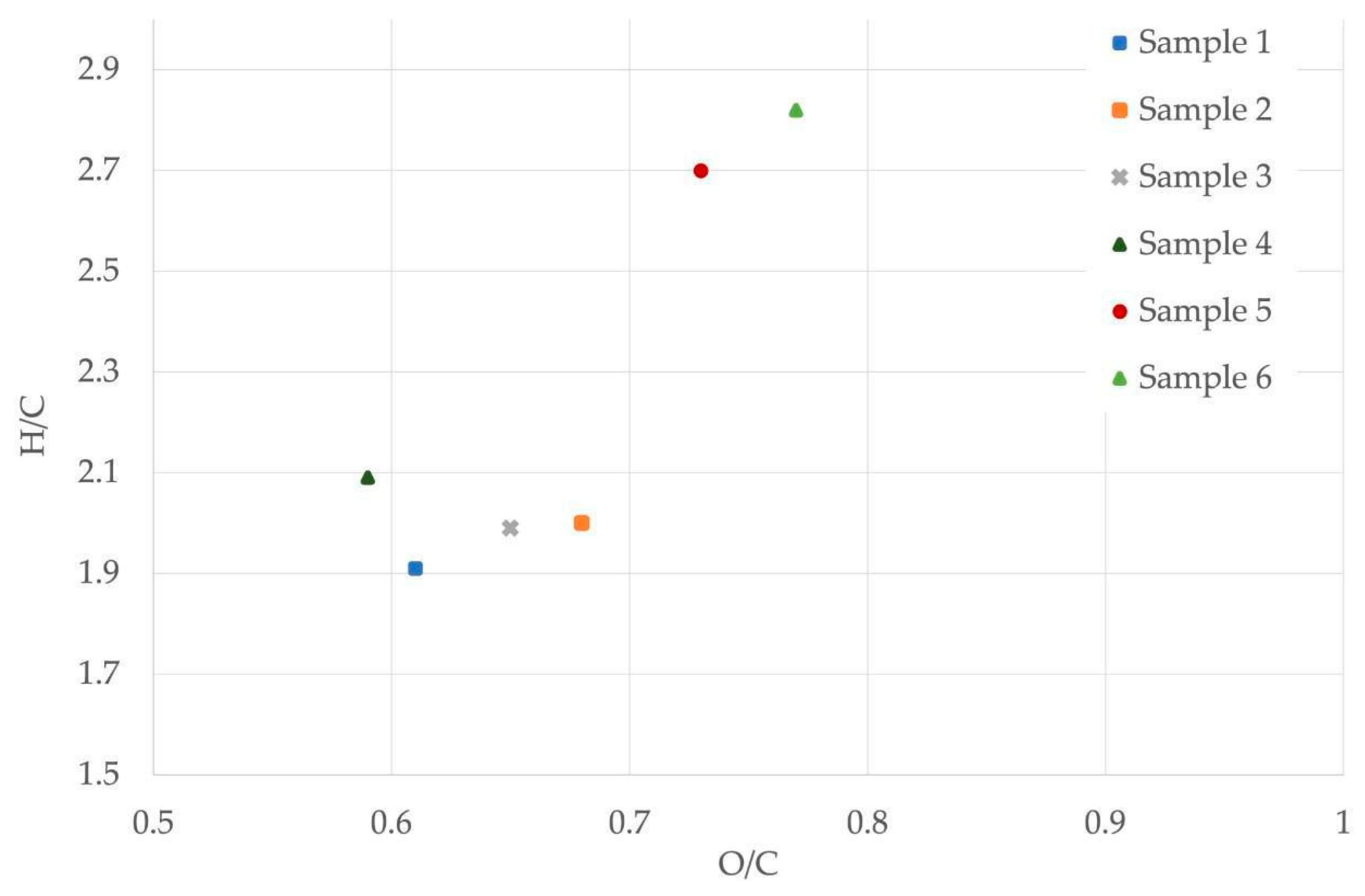
The suitability of biomass as a fuel should be considered not only based on elemental analysis but also on the H:C and O:C ratios. Materials with a high H:C ratio have higher energy content and higher heating values (HHV), while a lower O:C ratio indicates higher energy content [40]. The relationship between the H:C and O:C ratios in the tested feedstocks is illustrated in Figure 1.
The values presented in Figure 1 suggest that the samples fall within the typical range for dry, woody biomass. Particular attention should be given to samples no. 5 and 6, derived from currant residues. Despite their high H:C ratio, they also exhibit a high O:C ratio, which results in a lower calorific value for this type of biomass. This may indicate that these samples come from less mature parts of the plants. Sample no. 4, also from currant residues, is more similar to the herb residue samples. The position of samples no. 1–5 on the plot indicates a higher energy content.
The nitrogen content analysis showed considerable variation in the herb residues. The lowest nitrogen level was observed in sample no. 1 at 0.81%, while the highest was in sample no. 3 at 1.69%. All samples differed significantly from each other.
Nitrogen content in biomass is closely related to plant physiology, particularly the proportion of structural proteins and photosynthetic metabolism [41,42]. Plants with vigorous vegetative growth and a high leaf mass generally show higher nitrogen concentrations than species with more woody stems or a lower leaf-to-stem ratio. This relationship is reflected in the obtained results: the mint samples, characterized by a more abundant leaf mass, exhibited higher nitrogen content compared to thyme [43,44,45].
In the case of currant residues, the nitrogen content in samples no. 4 and 5 was similar (1.3%) and not statistically significant. In sample no. 6, the nitrogen content was 1.51% and differed statistically from the other samples. Considering that the average nitrogen content in biomass and herbaceous plants is 1.2%, and in by-products of the agri-food industry is 1.4%, this result can be regarded as relatively low [43,46]. However, when compared to the average nitrogen content in coniferous wood, which is around 0.1%, combustion of these residues may lead to increased NOx emissions.
Sulfur content in biomass is an important parameter because it affects SO2 emissions during combustion. Higher sulfur content is associated with a greater amount of SO2 released into the environment. Similar to nitrogen, the sulfur content in herb residues was variable (Table 3). The lowest sulfur content in the herb samples was observed in sample no. 1–0.051% and sample no. 2–0.071%, with no significant difference between these values. A significantly higher level was observed in sample no. 3–0.165%, distinguishing it from the other samples. The expression and accumulation of sulfur compounds are strongly dependent on secondary metabolism [47]. This may explain the relatively low sulfur concentrations in thyme and peppermint, and the much higher concentration in curly mint, which can accumulate more sulfur compounds related to secondary metabolism. It should also be noted that even under similar environmental conditions, local differences in soil nutrient availability (N and S) can lead to variations in nutrient uptake and accumulation among different plant species [48].
A lower sulfur content was observed in currant residues compared to herb residues. The sulfur content (Table 4) ranged from 0.032% in sample no. 4 to 0.041% in sample no. 5, with all samples differing statistically significantly from each other. Overall, the sulfur content in the samples was low, considering that the average sulfur content in biomass is 0.19%, in herbaceous biomass 0.15%, and in by-products of the agri-food industry 0.16% [32,39].
The suitability of biomass for combustion processes can be evaluated using two indicators: the higher heating value (HHV) and the lower heating value (LHV). Differences in elemental composition are reflected in the fuel properties of the materials (Table 5). For the herb residues, the highest LHV was recorded in sample no. 1 from thyme, at 17.211 MJ/kg, whereas samples no. 2 and 3 from mint had values over 2 MJ/kg lower. Statistical tests confirmed that the differences between samples were significant. For the currant residues (Table 6), sample no. 6 had the lowest LHV at 13.634 MJ/kg, while samples no. 4 and 5 had LHVs around 16.000 MJ/kg. All obtained results differed statistically significantly. Except for samples no. 3 and 6, the obtained values can be considered typical for non-wood biomass, such as energy crops and agricultural residues, where values range from 15.6 to 18.3 MJ/kg [39,49], although they are relatively low.
High moisture content reduces the suitability of biomass for thermochemical processes, including combustion [50]. The study showed that the moisture content in the herb samples (Table 7) was similar, ranging from 6.40% to 6.78%. Higher moisture levels were observed in the currant samples, ranging from 11.82% in sample no. 4 to 14.77% in sample no. 6 (Table 8). No statistically significant differences were found between samples no. 5 and 6. It should also be noted that moisture content can vary considerably depending on harvest time and storage conditions. Importantly, the moisture levels in the tested biomass were not high, which supports its suitability for thermochemical processes.
The presence of volatile substances in biomass affects fuel reactivity [51]. The content of volatile substances in the investigated herb samples ranged from 69.20% to 72.04%, with the highest value recorded in sample no. 1. In samples no. 2 and 3, the content was similar, around 70%, and these constituted a statistically homogeneous group. Lower volatile content was observed in the currant residues, ranging from 65.99% to 66.47%, and it was statistically insignificant. The obtained values were lower than the average content reported in studies [39,49], which report 75.40% for biomass, 75.20% for herbaceous biomass, and 74% for by-products of the agro-food industry.
Ash consists of mineral and inorganic substances present in biomass [39]. The ash content affects the combustion rate of a biomass sample, and its percentage composition varies depending on the type of biomass. High ash content in biomass makes it less desirable as a fuel [46]. The investigated herb residue samples had varying ash content, with the highest value recorded in sample no. 3 (8.83%) and the lowest in sample no. 1 (2.89%). All herb samples differed statistically from each other. Ash content in currant residues did not exceed 4%; the lowest value was observed in sample no. 6–3.10%, and the highest in sample no. 5–3.94%, with statistically significant differences between them. Values for samples no. 1, 4, 5, and 6 fell within the typical ranges for biomass (6.80%), herbaceous biomass (5.70%), or by-products of the agro-food industry (5.00%) [52]. In samples no. 2 and 3 from mint, the ash content can be considered significantly higher.
The fixed carbon content in the samples investigated was variable, resulting from the high variability in moisture, ash, and volatile compound content. In the case of herb residues, it ranged from 15.58% to 18.47%, while for currant residues it ranged from 15.66% to 18.44%.
The study showed that among the analyzed materials, thyme residues (sample no. 1) have particularly high energy potential, as indicated by high calorific value, low nitrogen and sulfur content, and low ash content. The parameters of the other two materials, i.e., peppermint (sample no. 2) and curly mint (sample no. 3), do not disqualify them as fuel, but lower calorific values and higher ash content may cause issues with NOx and PM emissions during combustion [53]. This would require optimization of the combustion system for these materials. Regarding currant residues, the results suggest that the varieties differ in terms of energy suitability. For example, the Ben Hope and Tiben varieties show low energy potential, characterized by high ash content, low volatile matter, and low HHV (higher heating value). The Tisel variety shows greater suitability, but its low calorific value should be taken into account.

4. Conclusions

Studies clearly indicate that lignocellulosic biomass from agricultural and herbal production can serve as a valuable energy resource, supporting the objectives of the European Green Deal and the circular economy. The varied chemical composition of plants, including nitrogen and sulfur content, affects the process performance and the emission of gaseous compounds, which must be considered when designing technology.
Analysis of anaerobic digestion results showed significant differences in the process among the substrates tested. For peppermint (Mentha × piperita L.) and curly mint (Mentha crispa L.), a higher total nitrogen content (approximately 1.04% on a dry matter basis) was observed compared to thyme (Thymus vulgaris L.), where the value was only 0.45% on a dry matter basis.
The low degree of organic dry matter (ODM) degradation, ranging from 9% for thyme to approximately 38% for mint, is a consequence of high lignification of the material and the lack of preliminary mechanical or thermal treatment. Woody stems and leaves of black currant (Ribes nigrum L.) also showed low fermentability—the degradation rate did not exceed 20%, despite a 45-day process.
The obtained results indicate that improving the efficiency of methane fermentation of such substrates requires the application of pre-treatment (e.g., grinding, steam hydrolysis, or chemical treatment) as well as co-digestion with materials rich in readily available carbohydrates. However, in order to assess the natural biodegradability of plant residues under conditions typical for an agricultural biogas plant, this study deliberately omitted the use of pre-treatment processes, such as grinding, steam hydrolysis, or chemical processing of plant material, which could enhance its susceptibility to methane fermentation.
The conducted analysis of energy parameters showed that residues from herb or currant production have potential for use in combustion processes, although some parameters may cause potential issues during combustion, such as high ash content or elevated nitrogen content.
Alternatively, the studied waste materials can be used in combustion processes after appropriate fuel preparation (e.g., briquettes or pellets), which minimizes operational issues. Lignocellulosic biomass remains a next-generation resource that—when combined with innovative technologies—can significantly contribute to the development of sustainable bioenergy.

Author Contributions

Conceptualization, E.W.-J., A.N.; methodology, E.W.-J., G.Z.; software, E.W.-J., G.Z. and M.C.; validation, E.W.-J., G.Z., M.C.; formal analysis; investigation, M.C., Ł.K., E.W.-J.; resources, G.Z., E.W.-J., M.C., A.N., Ł.K.; data curation, E.W.-J., G.Z., M.C.; writing—original draft preparation, E.W.-J., M.C., G.Z., Ł.K., A.N.; writing—review and editing, E.W.-J., M.C., G.Z., Ł.K., A.N.; visualization, E.W.-J., M.C., G.Z.; supervision, E.W.-J., G.Z. All authors have read and agreed to the published version of the manuscript.

Funding

This research received no external funding.

Data Availability Statement

The numerical data used to support the findings of this study are available from the corresponding author upon request.

Conflicts of Interest

The authors declare no conflicts of interest. The funders had no role in the design of the study; in the collection, analyses, or interpretation of data; in the writing of the manuscript; or in the decision to publish the results.

References

  1. Quarterly Reports Confirm EU Energy Markets Stabilised in Second Quarter of 2024, with More than Half of Electricity Generated from Renewables. Available online: https://energy.ec.europa.eu/news/quarterly-reports-confirm-eu-energy-markets-stabilised-second-quarter-2024-more-half-electricity-2024-10-24_en (accessed on 26 November 2024).
  2. Czarnecki, M.; Wrzesińska-Jędrusiak, E.; Konkol, I.; Świerczek, L.; Postawa, K.; Kułażyński, M.; Myczko, A. Management of Tanning Waste from Leather Processing by Anaerobic Digestion Using a Dynamic Method on a Semi-Technical Scale. Sustainability 2024, 16, 9501. [Google Scholar] [CrossRef]
  3. Schimpf, U.; Hanreich, A.; Mähnert, P.; Unmack, T.; Junne, S.; Renpenning, J.; Lopez-Ulibarri, R. Improving the Efficiency of Large-Scale Biogas Processes: Pectinolytic Enzymes Accelerate the Lignocellulose Degradation. J. Sustain. Energy Environ. 2013, 4, 53–60. [Google Scholar]
  4. Stolze, Y.; Bremges, A.; Maus, I.; Pühler, A.; Sczyrba, A.; Schlüter, A. Targeted in situ metatranscriptomics for selected taxa from mesophilic and thermophilic biogas plants. Microb. Biotechnol. 2017, 11, 667–679. [Google Scholar] [CrossRef] [PubMed]
  5. Najda, A. Ontogenetic Variability of Mint (Mentha Species) a Factor Determining the Content of Bioactive Components in the Raw Material; University of Life Sciences in Lublin: Lublin, Poland, 2017. [Google Scholar]
  6. Jarrar, L.; Ayadi, O.; Al Asfar, J. Techno-economic Aspects of Electricity Generation from a Farm Based Biogas Plant. J. Sustain. Dev. Energy Water Environ. Syst. 2020, 8, 476–492. [Google Scholar] [CrossRef]
  7. Nwaezapu, A.O.; Agbozu, I.E. Proximate and compositional assessment of pretreatment methods on selected lignocellulose biomass for biogas production. Int. J. Biol. Chem. Sci. 2023, 17, 2115–2127. [Google Scholar] [CrossRef]
  8. Traoré, D.; Nikiéma, M.; Somda, M.K.; Sawadogo, J.B.; Dianou, D.; Traoré, A.S. Contribution à la biométhanisation de la biomassevégétale: Cas des résidus de légumes au Burkina Faso. Int. J. Biol. Chem. Sci. 2016, 10, 35–47. [Google Scholar] [CrossRef]
  9. Michael, E.; Ben, M.G. Biogas production from farm waste (cassava peels and swine dung): Co-digestion and prospect on economic growth. Res. Rev. J. Ecol. Environ. Sci. 2018, 6, 58–63. [Google Scholar]
  10. Karuppiah, T.; Ebenezer Azariah, V. Biomass pretreatment for enhancement of biogas production. In Anaerobic Digestion; IntechOpen: London, UK, 2019. [Google Scholar] [CrossRef]
  11. Shi, Z.; Liu, S.; Wang, S.; Niedzwiecki, L.; Baranowski, M.; Czerep, M.; Tang, C.; Kawi, S.; Wang, C.-H.; Jiang, J.; et al. Hydrothermal Carbonization Coupled with Pyrolysis: An Innovative Approach to Digestate Management. Green Energy Resour. 2023, 1, 100034. [Google Scholar] [CrossRef]
  12. Lv, P.; Liu, B.; Bai, Y.; Wang, J.; Wei, J.; Song, X.; Su, W.; Yu, G.; Xu, G. Residual Carbon from Coal Gasification Fine Slag for Inducing Rice Straw Hydrothermal Carbonization to Achieve Improved Reactivity and Wastewater Decontamination. Fuel 2023, 349, 128649. [Google Scholar] [CrossRef]
  13. Unyay, H.; Piersa, P.; Zabochnicka, M.; Romanowska-Duda, Z.; Kuryło, P.; Kuligowski, K.; Kazimierski, P.; Hutsol, T.; Dyjakon, A.; Wrzesińska-Jędrusiak, E.; et al. Torrefaction of Willow in Batch Reactor and Co-Firing of Torrefied Willow with Coal. Energies 2023, 16, 8083. [Google Scholar] [CrossRef]
  14. Gołaszewski, J. Wykorzystanie substratów pochodzenia rolniczego w biogazowniach w Polsce. Post. Nauk Rol. 2011, 2, 69–94. [Google Scholar]
  15. Nauman Aftab, M.; Iqbal, I.; Riaz, F.; Karadag, A.; Tabatabaei, M. Different Pretreatment Methods of Lignocellulosic Biomass for Use in Biofuel Production. In Biomass for Bioenergy—Recent Trends and Future Challenges; Intech Open: Rijeka, Croatia, 2019; p. 208. [Google Scholar] [CrossRef]
  16. Bilal, M.; Vilar, D.S.; Eguiluz, K.I.B.; Ferreira, L.F.R.; Bhatt, P.; Iqbal, H.M. Biochemical conversion of lignocellulosic waste into renewable energy. In Advanced Technology for the Conversion of Waste into Fuels and Chemicals; Woodhead Publishing: Amsterdam, The Netherlands, 2021; pp. 147–171. [Google Scholar] [CrossRef]
  17. Dahunsi, S.O.; Oranusi, S.U.; Efeovbokhan, V.E.; Zahedi, S.; Ojediran, J.O.; Olayanju, T.; Oluyori, A.P.; Adekanye, T.A.; Izebere, J.; Enyinnaya, M. Biochemical conversion of fruit rind of Telfairia occidentalis (fluted pumpkin) and poultry manure. Energy Sources Part A 2018, 40, 2799–2811. [Google Scholar] [CrossRef]
  18. Niehaus, F.; Bertoldo, C.; Kahler, M.; Antranikian, G. Extremophiles as a source of novel enzymes for industrial application. Appl. Microbiol. Biotechnol. 1999, 51, 711–729. [Google Scholar] [CrossRef] [PubMed]
  19. Kumar, R.; Singh, S.; Singh, O.V. Biokonwersja biomasy lignocelulozowej: Perspektywy biochemiczne i molekularne. J. Ind. Microbiol. Biotechnol. 2008, 35, 377–391. [Google Scholar] [CrossRef] [PubMed]
  20. Beckham, G.T.; Johnson, C.H.W.; Karp, E.M.; Salvachúa, D.; Vardon, D.R. Możliwości i wyzwania w zakresie waloryzacji ligniny biologicznej. Curr. Opin. Biotechnol. 2016, 42, 40–53. [Google Scholar] [CrossRef]
  21. Mishra, S.; Singh, P.K.; Dash, S.; Pattniak, R. Microbial pretreatment of lignocellulosis biomas for enhanced biomethanation and waste management. 3 Biotech 2018, 8, 458. [Google Scholar] [CrossRef]
  22. Osińska, E.; Pióro-Jabrucka, E. Cultivation and Processing of Herbaceutic Plants; Agricultural Advisory Centre in Brwinów: Brwinów, Poland, 2022.
  23. Wrzesińska-Jędrusiak, E.; Klimek, K.; Najda, A.; Łaska-Zieja, B.; Olesienkiewicz, A. Study of the potential of biogas production from herbal residues. Przem. Chem. 2020, 99, 224–227. [Google Scholar] [CrossRef]
  24. Frigon, J.C.; Mehta, P.; Guiot, R. Impact of mechanical, chemical and enzymatic pre-treatments on the methane yield from the anaerobic digestion of switchgrass. Biomass Bioenergy 2011, 21, 1–11. [Google Scholar] [CrossRef]
  25. Špak, J.; Koloniuk, I.; Tzanetakis, I.E. Graft-Transmissible Diseases of Ribes—Pathogens, Impact, and Control. Plant Dis. 2021, 105, 242–250. [Google Scholar] [CrossRef]
  26. Powszechny Spis Rolny 2020; Charakterystyka Gospodarstw Rolnych w 2020 r. Available online: https://stat.gov.pl/obszary-tematyczne/rolnictwo-lesnictwo/psr-2020/powszechny-spis-rolny-2020-charakterystyka-gospodarstw-rolnych-w-2020-r-,6,1.html (accessed on 26 November 2024).
  27. Qayyum, S.; Tahir, A.; Mian, A.H.; Zeb, S.; Siddiqui, M.F.; Rehman, B. Optimizing biogas production through anaerobic digestion: Transforming food waste and agricultural residues into renewable energy within a circular economy paradigm. Biomass Convers. Biorefinery 2025, 15, 26027–26043. [Google Scholar] [CrossRef]
  28. Dharmaraja, J.; Shobana, S.; Arvindnarayan, S.; Francis, R.R.; Jeyakumar, R.B.; Saratale, R.G.; Ashokkumar, V.; Bhatia, S.K.; Kumar, V.; Kumar, G. Lignocellulosic Biomass Conversion via Greener Pretreatment Methods towards Biorefinery Applications. Bioresour. Technol. 2023, 369, 128328. [Google Scholar] [CrossRef]
  29. Wrzesińska-Jędrusiak, E.; Czarnecki, M.; Szufa, S.; Maj, G.; Čabalová, I.; Grześkowiak, M. Analysis of opportunities for performance improvement based on data from agricultural mono substrate biogas plant. J. Water Land Dev. 2024, 61, 55–61. [Google Scholar] [CrossRef]
  30. DIN 38414; German Standard Methods for the Examination of Water, Waste Water and Sludge. Deutsche Einheitsverfahrenzur Wasser. Deutsches Institut fur Normung E.V. (German National Standard): Berlin, Germany, 2017.
  31. PN-EN ISO 10390:2022-09; Soil, Treated Biowaste and Sludge—Determination of pH. Polish Committee for Standardisation: Warsaw, Poland, 2022.
  32. PN-EN ISO 11465:2025; Sludge and Solid Environmental Matrices—Determination of Dry Residue or Water Content and Calculation of the Dry Matter Fraction on a Mass Basis. Polish Committee for Standardisation: Warsaw, Poland, 2025.
  33. EN 15104:2011; Solid Biofuels—Determination of Total Content of Carbon, Hydrogen and Nitrogen—Instrumental Methods. European Committee for Standardization (CEN): Brussels, Belgium, 2011.
  34. EN ISO 18125:2017; Solid Biofuels—Determination of Calorific Value. European Committee for Standardization (CEN): Brussels, Belgium, 2017.
  35. EN ISO 18134-1:2022; Solid Biofuels—Determination of Moisture Content—Part 1: Reference Method. European Committee for Standardization (CEN): Brussels, Belgium, 2022.
  36. EN ISO 18123:2023; Solid Biofuels—Determination of Volatile Matter. European Committee for Standardization (CEN): Brussels, Belgium, 2023.
  37. EN ISO 18122:2022; Solid Biofuels—Determination of Ash Content. European Committee for Standardization (CEN): Brussels, Belgium, 2022.
  38. Montgomery, D.C. Design and Analysis of Experiments, 10th ed.; John Wiley & Sons: Hoboken, NJ, USA, 2019; ISBN 978-1-119-49244-3. [Google Scholar]
  39. Wojcieszak, D.; Przybył, J.; Czajkowski, Ł.; Majka, J.; Pawłowski, A. Effects of Harvest Maturity on the Chemical and Energetic Properties of Corn Stover Biomass Combustion. Materials 2022, 15, 2831. [Google Scholar] [CrossRef]
  40. Palacio Lozano, D.C.; Jones, H.E.; Ramirez Reina, T.; Volpe, R.; Barrow, M.P. Unlocking the potential of biofuels via reaction pathways in van Krevelen diagrams. Green Chem. 2021, 23, 8949–8963. [Google Scholar] [CrossRef]
  41. Wang, Q.; Li, S.; Li, J.; Huang, D. The Utilization and Roles of Nitrogen in Plants. Forests 2024, 15, 1191. [Google Scholar] [CrossRef]
  42. Cánovas, F.M.; Cañas, R.A.; de la Torre, F.N.; Pascual, M.B.; Castro-Rodríguez, V.; Avila, C. Nitrogen Metabolism and Biomass Production in Forest Trees. Front. Plant Sci. 2018, 9, 1449. [Google Scholar] [CrossRef] [PubMed]
  43. Thurner, M.; Yu, K.; Manzoni, S.; Prokushkin, A.; Thurner, M.A.; Wang, Z.; Hickler, T. Nitrogen concentrations in boreal and temperate tree tissues vary with tree age/size, growth rate, and climate. Biogeosciences 2025, 22, 1475–1494. [Google Scholar] [CrossRef]
  44. Kole, C.; Joshi, C.P.; Shonnard, D.R. Handbook of Bioenergy Crop Plants; CRC Press: Boca Raton, FL, USA, 2012; ISBN 1-4398-1684-0. [Google Scholar]
  45. Zhang, H.; Li, W.; Adams, H.D.; Wang, A.; Wu, J.; Jin, C.; Guan, D.; Yuan, F. Responses of Woody Plant Functional Traits to Nitrogen Addition: A Meta-Analysis of Leaf Economics, Gas Exchange, and Hydraulic Traits. Front. Plant Sci. 2018, 9, 683. [Google Scholar] [CrossRef]
  46. PN-EN 14792:2017-04; Stationary Source Emissions—Determination of Mass Concentration of Nitrogen Oxides—Reference method: Chemiluminescence. Polish Committee for Standardization: Warsaw, Poland, 2017.
  47. Mugford, S.G.; Lee, B.; Koprivova, A.; Matthewman, C.; Kopriva, S. Control of Sulfur Partitioning between Primary and Secondary Metabolism. Plant J. 2011, 65, 96–105. [Google Scholar] [CrossRef]
  48. Ali Abdalla, M.; Mühling, K.H. Plant-derived sulfur containing natural products produced as a response to biotic and abiotic stresses: A review of their structural diversity and medicinal importance. J. Appl. Bot. Food Qual. 2019, 92, 204–215. [Google Scholar] [CrossRef]
  49. Saidur, R.; Abdelaziz, E.A.; Demirbas, A.; Hossain, M.S.; Mekhilef, S. A Review on Biomass as a Fuel for Boilers. Renew. Sustain. Energy Rev. 2011, 15, 2262–2289. [Google Scholar] [CrossRef]
  50. Vassilev, S.V.; Baxter, D.; Andersen, L.K.; Vassileva, C.G. An Overview of the Chemical Composition of Biomass. Fuel 2010, 89, 913–933. [Google Scholar] [CrossRef]
  51. Szyszlak-Bargłowicz, J.; Zając, G.; Piekarski, W. Energy biomass characteristics of chosen plants. Int. Agrophys. 2012, 26, 175–179. [Google Scholar] [CrossRef]
  52. Mujtaba, M.; Fernandes Fraceto, L.; Fazeli, M.; Mukherjee, S.; Savassa, S.M.; Araujo de Medeiros, G.; do Espírito Santo Pereira, A.; Donnini Mancini, S.; Lipponen, J.; Vilaplana, F. Lignocellulosic biomass from agricultural waste to the circular economy: A review with focus on biofuels, biocomposites and bioplastics. J. Clean. Prod. 2023, 402, 136815. [Google Scholar] [CrossRef]
  53. McKendry, P. Energy production from biomass (Part 1): Overview of biomass. Bioresour. Technol. 2002, 83, 37–46. [Google Scholar] [CrossRef]
Figure 1. Relationship between H:C and O:C ratios for tested materials.
Agronomy 16 00261 g001
Table 1. Results of the primary analysis of samples—herbs.
Sample NumberpHDry Matter [%]Biogas Yield [m3/mg of DM]Content of Methane [%]Content of
Carbon Dioxide
[%]
17.694.2756632
27.693.12926038
37.693.13206435
Table 2. Results of the primary analysis of Ribes nigrum (L.) samples.
Sample Number pHDry Matter [%]Biogas Yield [m3/mg of DM]Content of Methane [%]Content of
Carbon Dioxide
[%]
46.156.21526333
56.054.12066435
66.054.22096335
Table 3. Results of elemental analysis—herbs.
Sample Number Carbon
[%]
Hydrogen [%]Nitrogen
[%]
Sulfur
[%]
Oxygen *
[%]
145.35 ± 0.14 a7.26 ± 0.02 a0.81 ± 0.05 a0.051 ± 0.002 a37.077
241.07 ± 0.05 b6.88 ± 0.01 a1.32 ± 0.02 b0.071 ± 0.004 a36.957
340.82 ± 0.13 b6.81 ± 0.02 a1.69 ± 0.03 c0.165 ± 0.026 b35.277
* Oxygen was calculated as a complement. ±Standard deviation; mean values with the same letter in a column are not significantly different at p ≤ 0.05 according to Tukey’s HSD test.
Table 4. Results of elemental analysis—Ribes nigrum (L.) samples.
Sample Number Carbon
[%]
Hydrogen [%]Nitrogen
[%]
Sulfur
[%]
Oxygen *
[%]
442.44 ± 0.12 a7.43 ± 0.02 b1.37 ± 0.01 a0.032 ± 0.001 a33.083
536.77 ± 0.2 b8.34 ± 0.09 a1.51 ± 0.05 b0.041 ± 0.001 c35.561
635.76 ± 0.12 c8.45 ± 0.02 a1.32 ± 0.01 a0.035 ± 0.001 b36.563
* Oxygen was calculated as a complement. ±Standard deviation; mean values with the same letter in a column are not significantly different at p ≤ 0.05 in Tukey’s HSD test.
Table 5. Results of calorific value analysis—herbs.
Sample
Number
HHV
[kJ/kg]
LHV
[kJ/kg]
118,440 ± 79 a17,211 ± 78 a
216,414 ± 27 b15,234 ± 27 b
316,088 ± 56 c14,931 ± 55 c
±Standard deviation; mean values with the same letter in a column are not significantly different at p ≤ 0.05 according to Tukey’s HSD test.
Table 6. Results of calorific value analysis—Ribes nigrum (L.) samples.
Sample
Number
HHV
[kJ/kg]
LHV
[kJ/kg]
417,478 ± 38 a16,166 ± 38 a
517,212 ± 47 b15,974 ± 46 b
614,814 ± 98 c13,634 ± 98 c
±Standard deviation; mean values with the same letter in a column are not significantly different at p ≤ 0.05 according to Tukey’s HSD test.
Table 7. Results of ultimate analysis—herbs.
Sample
Number
Moisture
[%]
Volatile Matter
[%]
Ash
[%]
Fixed Carbon [%]
16.59 ± 0.05 a72.04 ± 0.05 b2.89 ± 0.10 a18.47 ± 0.06 a
26.78 ± 0.06 b70.12 ± 0.70 a6.92 ± 0.69 b16.18 ± 0.81 a
36.40 ± 0.02 c69.20 ± 0.65 a8.83 ± 0.20 c15.58 ± 0.66 b
±Standard deviation; mean values with the same letter in a column are not significantly different at p ≤ 0.05 according to Tukey’s HSD test.
Table 8. Results of ultimate analysis—Ribes nigrum (L.) samples.
Sample NumberMoisture
[%]
Volatile
Matter
[%]
Ash
[%]
Fixed Carbon [%]
411.82 ± 0.16 b66.21 ± 0.40 a3.83 ± 0.16 ab18.14 ± 0.40 a
513.84 ± 0.14 a65.99 ± 0.07 a3.94 ± 0.17 b16.23 ± 0.31 a
614.77 ± 0.61 a66.47 ± 0.27 a3.10 ± 0.52 a15.66 ± 0.37 b
±Standard deviation; mean values with the same letter in a column are not significantly different at p ≤ 0.05 according to Tukey’s HSD test.
Disclaimer/Publisher’s Note: The statements, opinions and data contained in all publications are solely those of the individual author(s) and contributor(s) and not of MDPI and/or the editor(s). MDPI and/or the editor(s) disclaim responsibility for any injury to people or property resulting from any ideas, methods, instructions or products referred to in the content.