
Article

Genome-Wide Association Analysis Dissects the Genetic Architecture of Maize Leaf Inclination Angle and Leaf Area Index

1
Shenyang Key Laboratory of Maize Genomic Selection Breeding, College of Bioscience and Biotechnology, Shenyang Agricultural University, Shenyang 110866, China
2
Sorghum Research Institute, Liaoning Academy of Agricultural Sciences, Shenyang 110866, China
*
Authors to whom correspondence should be addressed.
These authors contributed equally to this work.
Agronomy 2026, 16(2), 178; https://doi.org/10.3390/agronomy16020178 (registering DOI)
Submission received: 26 November 2025 / Revised: 3 January 2026 / Accepted: 5 January 2026 / Published: 10 January 2026
(This article belongs to the Section Crop Breeding and Genetics)

Abstract

Leaf inclination angle (LIA) and leaf area index (LAI) are important components of crop population canopy structure, which affect population photosynthetic production via altering canopy light interception and transmittance, and gas diffusion. In this study, we used a genetically diverse maize population of 378 inbred lines as materials to detect significantly associated SNPs with LIA and LAI using the mixed linear model (MLM) of genome-wide association study (GWAS). A total of 21 SNPs associated with LIA explain 6.07–10.86% of the phenotypic variation, containing two major-effect SNPs over 10%; 38 SNPs associated with LAI explain 2.91–10.36% of the phenotypic variation, containing one major-effect SNP. One candidate gene, GLCT1, significantly associated with LIA was identified, which might involve cell-wall biosynthesis. In addition, a cascade of SNPs significantly associated with LAI was identified in a single environment, and a candidate gene encoding the bHLH144 transcription factor was found. The results provide a theoretical basis for the selection of maize inbred lines with ideal canopy architecture and further investigation of the genetic mechanism of LIA and LAI.

1. Introduction

Maize is widely cultivated globally as food, feed, and industrial raw materials. With a continuous increase in its consumption, enhancing its production capacity has become increasingly important [1]. However, the potential to expand the planted area to increase yield is limited due to finite arable land. Another strategy to improve maize yield is to increase planting density [2,3]. However, this practice can lead to severe leaf crowding in the canopy, negatively affecting light penetration and ventilation, which constrain further improvement of population photosynthetic productivity and yield [4,5,6]. Therefore, optimizing the plant canopy structure is a target for maize high-yield breeding [7,8].
Many traits, including plant height (PH), leaf angle (LA), leaf area (LArea), and leaf shape, play crucial roles in determining plant canopy structure [9,10]. Among these, LArea influences the leaf density in the canopy; LA controls the leaf spatial distribution pattern in the canopy, whose change modulates the light transmittance and gas diffusion in the canopy, for instance, more upright leaves (with smaller LA) exhibit greater light transmittance and gas diffusion under the same Larea [11,12,13]. Therefore, they are the key traits influencing ideal plant architecture and canopy structure.
LA and LArea are quantitative traits with medium to high heritability, regulated by several major and multiple minor effect genes [14,15]. Association analysis and linkage mapping are effective strategies for identifying the genetic loci associated with LA and LArea. Three LA-related QTLs were identified from 229 F2:3 maize lines, explaining 37.4% of the phenotypic variation [16]. Nine LA-associated QTLs were identified from 179 recombinant inbred lines (RILs) of maize, explaining 78.9% of the phenotypic variation [17]. A total of 96 SNPs significantly associated with LA were identified by GWAS using 285 maize inbred lines, which were grouped into 43 QTLs. Among these, 7 major QTLs were stably detected, and 7 key candidate genes were predicted [18]. A total of 156 SNPs significantly associated with LA were identified by GWAS, and 68 candidate genes were detected. Among these, Zm00001d045408 is a key gene controlling LA of ear leaf and the second-leaf-above-ear. Its homolog in Arabidopsis promotes cell division and vascular tissue development [19]. Furthermore, eight QTLs controlling the maize three ear- LArea were identified using a RILs population. Among them, the major QTL (qTELA_2-9) was stably detected across multiple environments, with a phenotypic contribution rate ranging from 10.79% to 16.51%, making it a favorable target for molecular breeding [20]. A total of 24 SNPs are associated with leaf area, and the phenotypic variation explained by each QTL ranged from 2.03% to 13.02% [21].
The identified functional genes and transcription factors that regulate LA and LArea are involved in cell division and elongation, lignin accumulation, light response, hormone synthesis, metabolism, and signal transduction [22,23,24,25,26,27,28,29]. The Upright Plant Architecture1 (UPA1) and UPA2 genes influence LA performance by controlling phytohormone brassinolide (BR) synthesis [3]. The transcription factors bHLH30 and bHLH155 regulate LA by activating cell elongation and lignin biosynthesis in maize [30]. The maize genes ZmIDD14 and ZmIDD15 regulate LA by controlling the abaxial/adaxial thickness of sclerenchyma in the midrib. This coordinated control for the auricle’s asymmetric development by ZmIDD14 and ZmIDD15 fine-tunes the high-density planting adaptation in maize [31]. A maize bZIP transcription factor, ZmbZIP27, regulates nitrogen-mediated LA by modulating lignin deposition in maize [32]. A maize leaf angle architecture of smart canopy 1 (lac1) regulating upper LA has been identified, which encodes a brassinosteroid C-22 hydroxylase, and its deletion results in upright upper leaves, less erect middle leaves, and relatively flat lower leaves, weakens the shading response, and significantly increases yield. The transcription factor RAVL1 directly activates lac1 expression to control LA. Under shading conditions, phyA interacts with RAVL1 to promote RAVL1 degradation, thereby reducing activation of lac1 and decreasing LA [33]. Overexpression of ZmGRF10 in maize reduces leaf size and plant height by decreasing cell proliferation, while yield-related traits remain unaffected [28].
Currently, some studies have shown that the regulation of LA and LArea in different maize populations involves various SNPs and genes. These studies have provided valuable insights into the genomic regions and candidate genes controlling LA and LArea. However, the molecular regulatory mechanisms underlying LA and LArea remain largely unexplored. Therefore, identifying additional markers and causal genes related to LA and LArea phenotypic variation is essential for optimizing the plant canopy structure. Furthermore, different from the directly measured LA and the pure LArea that are solely determined by the number and area of leaves, the leaf inclination angle (LIA, the angles formed between the leaf plane and the horizontal plane) and LAI (Leaf Area Index) values measured by the Plant Canopy Analyzer can truly reflect the actual states of leaves and the real situations of the canopy in field cultivation [34]. Therefore, we used an association panel of 378 maize inbred lines with a wide range of sources and abundant genetic diversity to conduct a genome-wide association study (GWAS) of LIA and LAI in two environments. Our aim is to dissect the genetic basis of LIA and LAI into the natural maize population and to identify more related variant loci and candidate genes.

2. Materials and Methods

2.1. Association Panel

The maize association panel used in this GWAS contains 378 diverse inbred lines with 97,862 SNPs. These lines are from China, America, and Mexico. Most of the inbred lines from Mexico are tropical and subtropical germplasms, while the inbred lines from America and China are mostly temperate germplasms. Details on the 378 inbred lines, including genotyping, population structure, kinship, and linkage disequilibrium (LD), have been previously published [35].

2.2. Field Experiments and Phenotyping

All 378 inbred lines of the association panel were grown in two environments in China: Shenyang City, Liaoning Province (123°43′ E, 41°80′ N) in 2022 (22SY) and Fuxin Mongolian Autonomous County, Liaoning Province (122°55′ E, 42°06′ N) in 2023 (23FX). All the lines were planted using a randomized block design with two replicates. Each line was planted in six rows per plot, which were 3.5 m long and 0.6 m wide, with a 0.4 m aisle in the middle. During the silking stage, when the canopy structure of maize was relatively stable, the canopy LIA and LAI were measured using LAI-2200C Plant Canopy Analyser—(LI-COR Inc., Lincoln, NE, USA) between 9:00 and 11:00 a.m., and the measurements were five repetitions for each inbred line.

2.3. Statistical Analysis of Phenotypes

A variance analysis and the best unbiased linear predictive (BLUP) values calculation of LIA and LAI followed the linear mixed model in the lme4 package of META-R software (Version 6) [36]: Y i j k = μ + E n v i + R e p j E n v i + G e n l + E n v i × G e n l + ε i j k l , where Yijk is the phenotype of interest, µ is the mean effect, Envi is the effect of the ith environment, Repj (Envi) is the effect of the jth replicate within the ith environment, Genl is the effect of the lth genotype, Envi × Genl is the environment × genotype interaction, and εijk is the error. In the above equation, there is no Envi × Genl term in individual environment analysis. Broad-sense heritability is calculated for individual environment and two environments as follows:   H 2 = σ g 2 σ g 2 + σ e 2 / n r e p s and H 2 = σ g 2 σ g 2 + σ g e 2 / n E n v s + σ e 2 / n ( E n v s × r e p s ) , where σ g 2 is the genetic variance, σ e 2 is the residual error, σ g e 2 is the interaction of genotype with environment, and n represents the number of environments and replications [37].

2.4. Genome-Wide Association Analysis

The GWAS of LIA and LAI for single environment and across environments was performed using the mixed linear model (MLM) in TASSEL 5 software [38]. The uniform Bonferroni-corrected threshold of p-value < 1/n (where n = number of SNPs) used in general GWAS [39,40] was found to be too strict for quantitative traits controlled by multiple small-effect loci [41]. A less stringent criterion (p-value < 1 × 10⁻⁴) used in previous studies could detect more trait-associated SNPs [42,43]. Therefore, we used a p-value of 1 × 10⁻⁴ for this GWAS analysis. The contributions of SNPs to the phenotypic variation were estimated using the ANOVA function in the R software (4.5.1) package. After adjustment for population structure effects, the R2 of each significant SNP was calculated using two linear models: Y = X i α i + P β + ε , which was used to estimate the total variance of all significant SNPs, and Y = X α + P β + ε , which was used to estimate the variance of individual significant SNPs. In these equations, Y and X represent phenotype and SNP genotype vectors, respectively, p is the matrix of the top three principal components, and α, β, and ε are SNP, the three principal components, and random effects, respectively.

2.5. Candidate Genes Screening

All candidate genes within the LD blocks (r2 < 0.1) of the detected significantly associated SNP loci were screened. The physical locations of the SNPs were determined with reference to the B73 AGPv4 genome. Genes within the LD blocks of the significantly associated SNP loci were functionally annotated. Additionally, published gene expression data of leaves at different stages were also used to further identify candidate genes [44].

3. Results

3.1. Phenotype Diversity and Heritability

Phenotypic variation analysis revealed extensive phenotypic variation with normal distribution in LIA and LAI in the maize association panel (Figure S1; Table S1). Variance analysis indicated highly significant genotypic effects (p < 0.01) for both traits in single and across environments, with significant genotype × environment (G × E) interactions also detected (p < 0.01). Environmental variance was significant for LAI (p < 0.05) but not for LIA (Table 1). The broad-sense heritability (H2) of LIA (0.44 to 0.83) was higher than that of LAI (0.34 to 0.75) (Table 1).
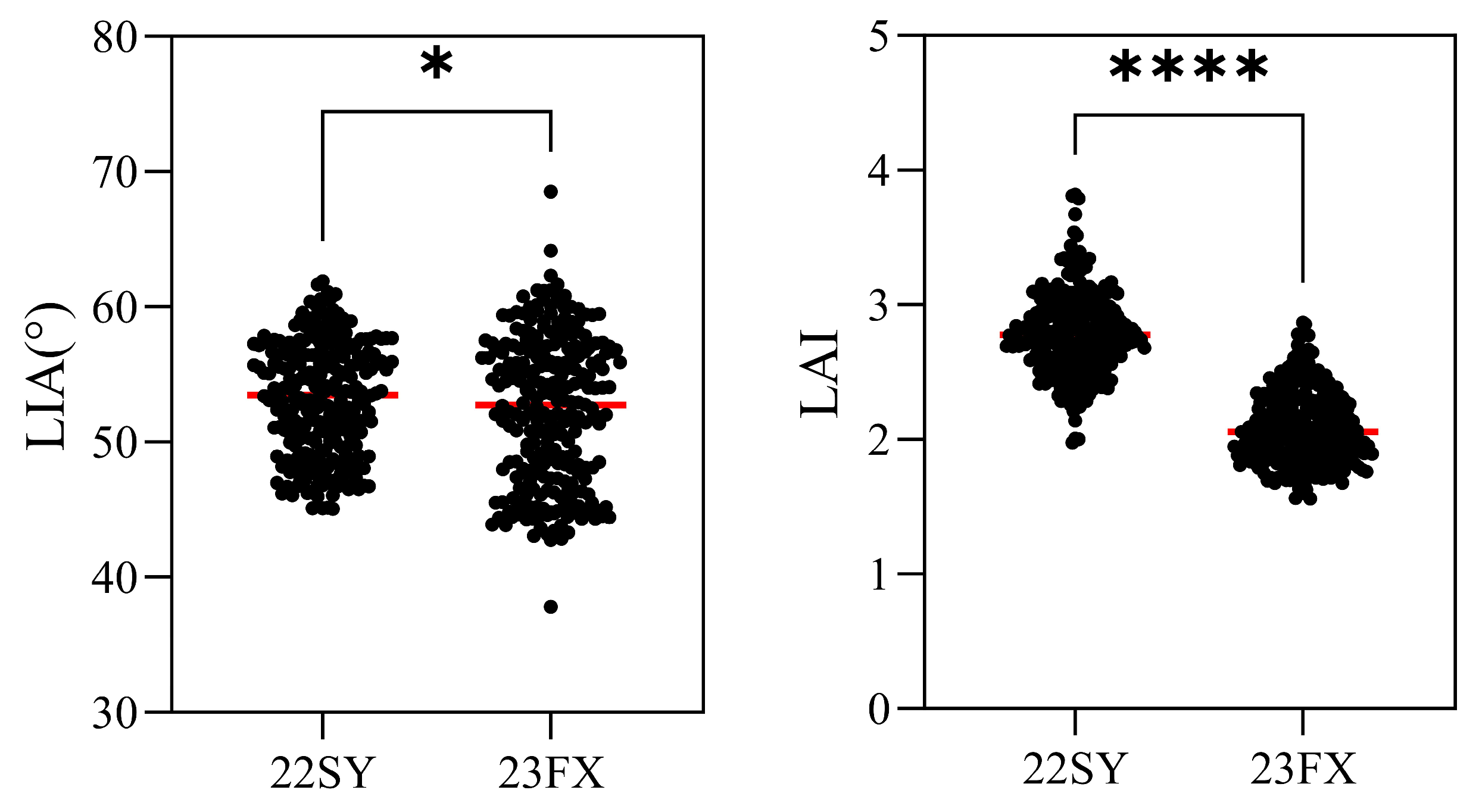
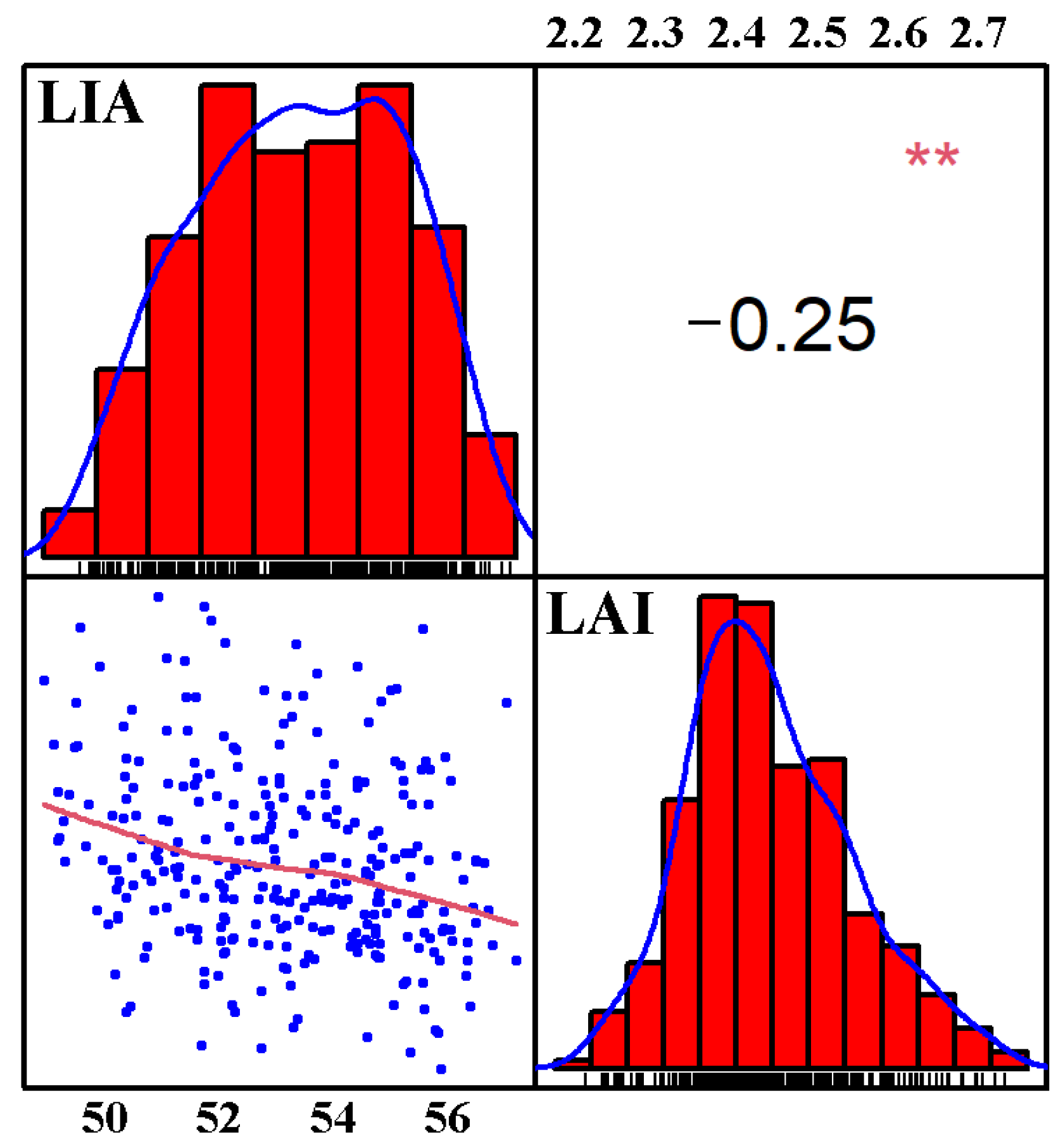
Phenotypic differences between the two environments were significant for LIA and highly significant for LAI (Figure 1). The median LIA was slightly higher in 22SY (53.15) than in 23FX (52.24), whereas the median LAI was significantly higher in 22SY (2.79) than in 23FX (2.08). Pearson’s correlation analysis using BLUP values confirmed a significant negative correlation between LIA and LAI (Figure 2). The results showed that LIA and LAI exhibited broad variation driven by genetic backgrounds and environmental conditions.

3.2. Genome-Wide Association Analysis of LIA and LAI

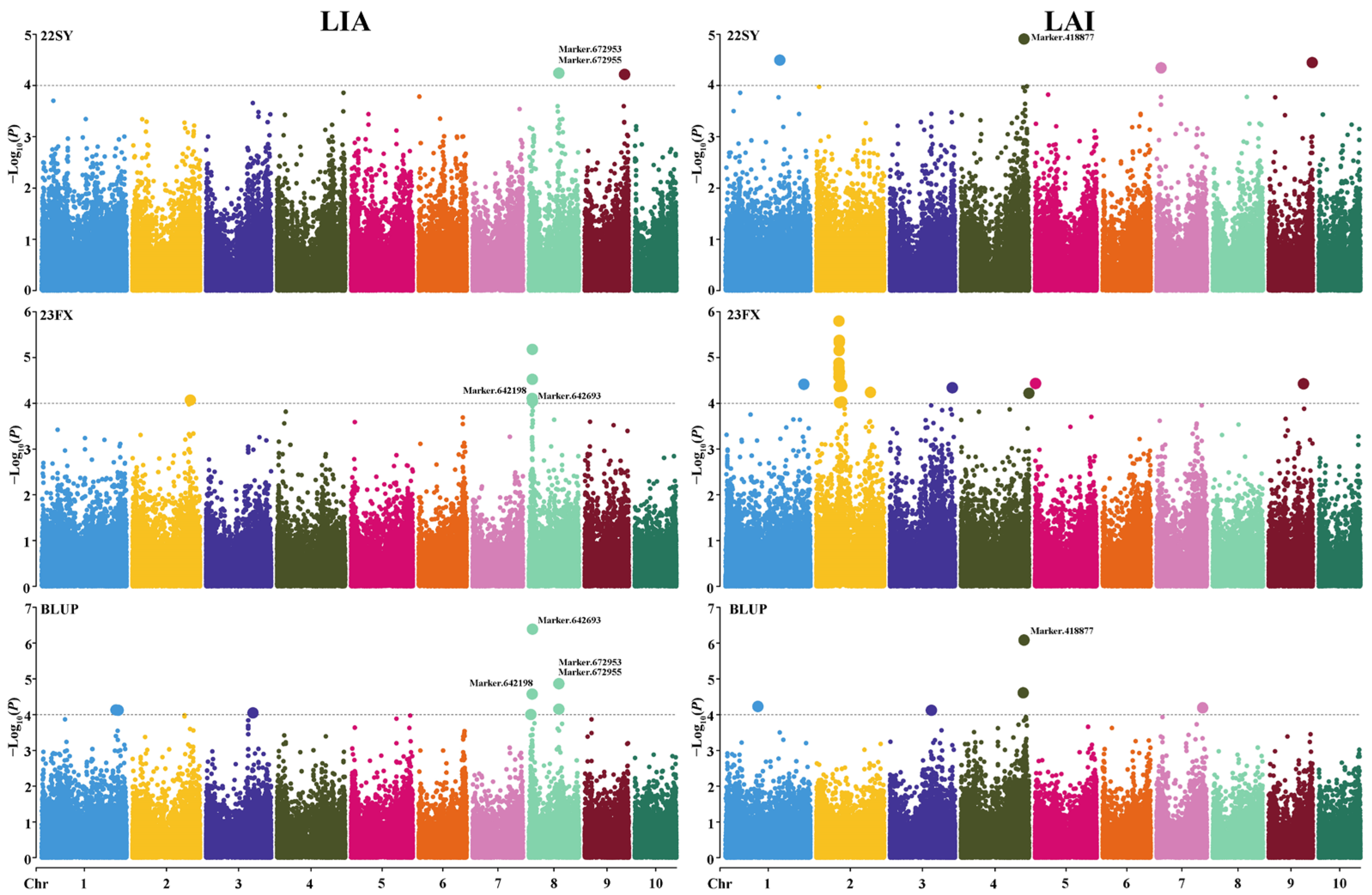
GWAS was performed using a mixed linear model (MLM) with a significance threshold of p < 1.0 × 10⁻⁴ (Table S2; Figure 3; Figure S2). For LIA, 3, 6, and 12 significant SNPs were identified in the 22SY, 23FX, and across environment analyses, respectively. These significant SNPs were distributed on chromosomes 1, 2, 3, 8, and 9, with the majority (15/21) localized to chromosome 8. They explained 12.8%, 16.84%, and 28.9% of total phenotypic variation, respectively, with individual SNPs accounting for 6.07–10.86% of variation. Notably, two large-effect SNPs (≥10% phenotypic variation explained), Marker.672953 and Marker.672955, were detected in both 22SY and across environments analysis; Marker.642198 and Marker.642693 were stably identified in both 23FX and across environments (Table 2).
For LAI, 5, 28, and 5 significant SNPs were detected in 22SY, 23FX, and across environments, respectively. These SNPs are distributed across chromosomes 1, 2, 3, 4, 5, 7, and 9, explaining 21.5%, 32.09%, and 22.61% of total phenotypic variation, with individual SNPs contributing 2.91–10.36% of variation. One large-effect SNP, Marker.418877 (10.36% variation explained), was stably detected in both 22SY and across environments. Additionally, a cluster of linked SNPs significantly associated with LAI was specifically identified on chromosome 2 (Table 2).

3.3. Genotypic Effects on LIA and LAI

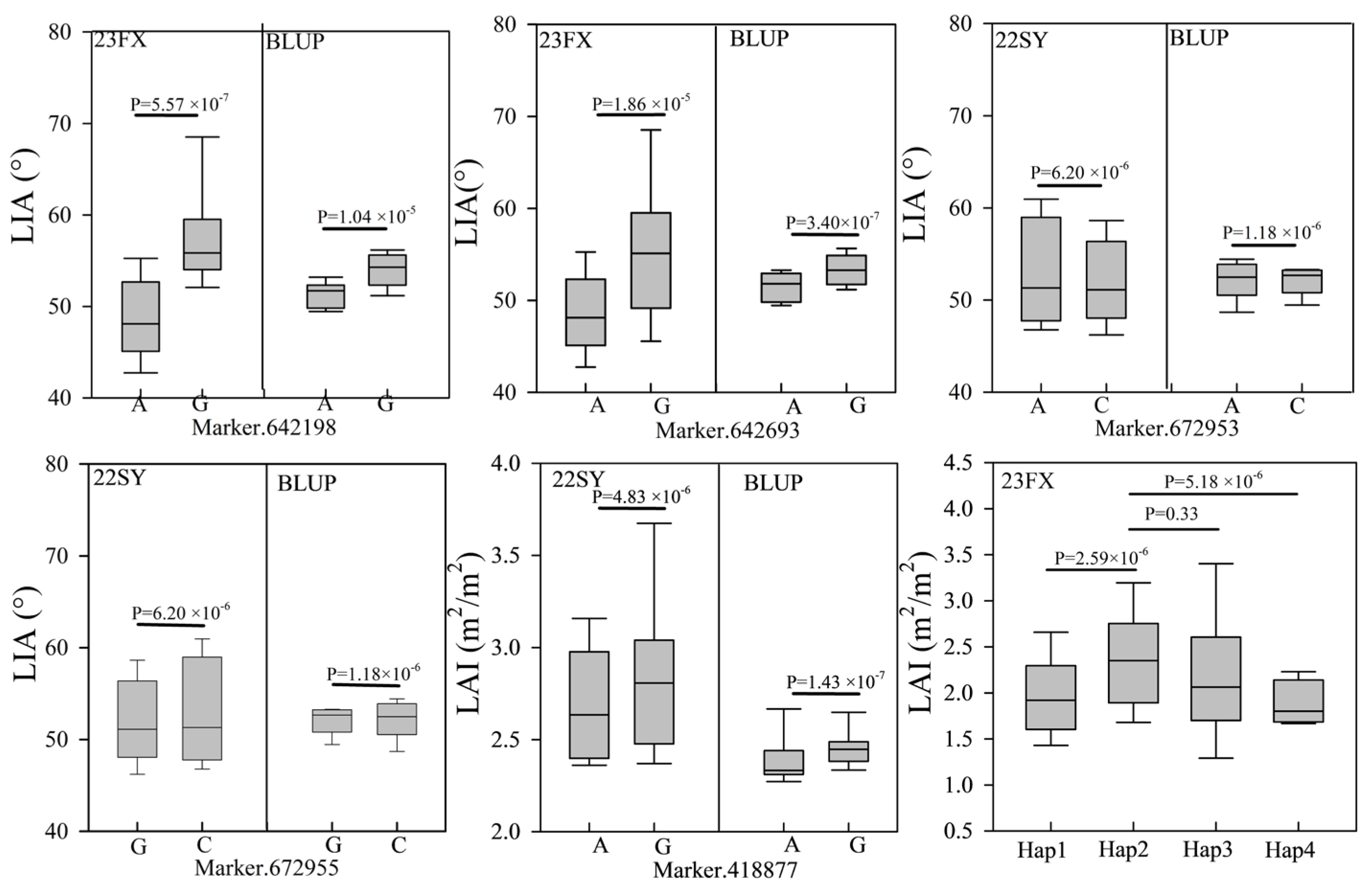
Allele effect analysis of the five stable significant SNPs (detected in both single and combined environments) revealed highly significant phenotypic differences between major and minor alleles (Figure 4). Marker.642693 (LIA) and Marker.418877 (LAI) showed the strongest effects, with combined-environment p-values of 3.40 × 10⁻⁷ and 1.43 × 10⁻⁷, respectively, consistent with GWAS results (Figure 4). Haplotype analysis of the chromosome 2 SNP cluster (Marker.202284–Marker.202292) identified four haplotypes (Hap1: CAATTTA; Hap2: TGGACAG; Hap3: CGGACAG; Hap4: CGAACAG). LAI values for Hap2 and Hap3 were significantly higher than those for Hap1 and Hap4.
These results indicate that the effects of the associated SNP with LIA and LAI have different dependencies on the allelic variants, and these alleles identified in this study could be used as molecular markers to aid the selection of LIA and LAI.

3.4. The Annotation and Expression Pattern of Candidate Genes

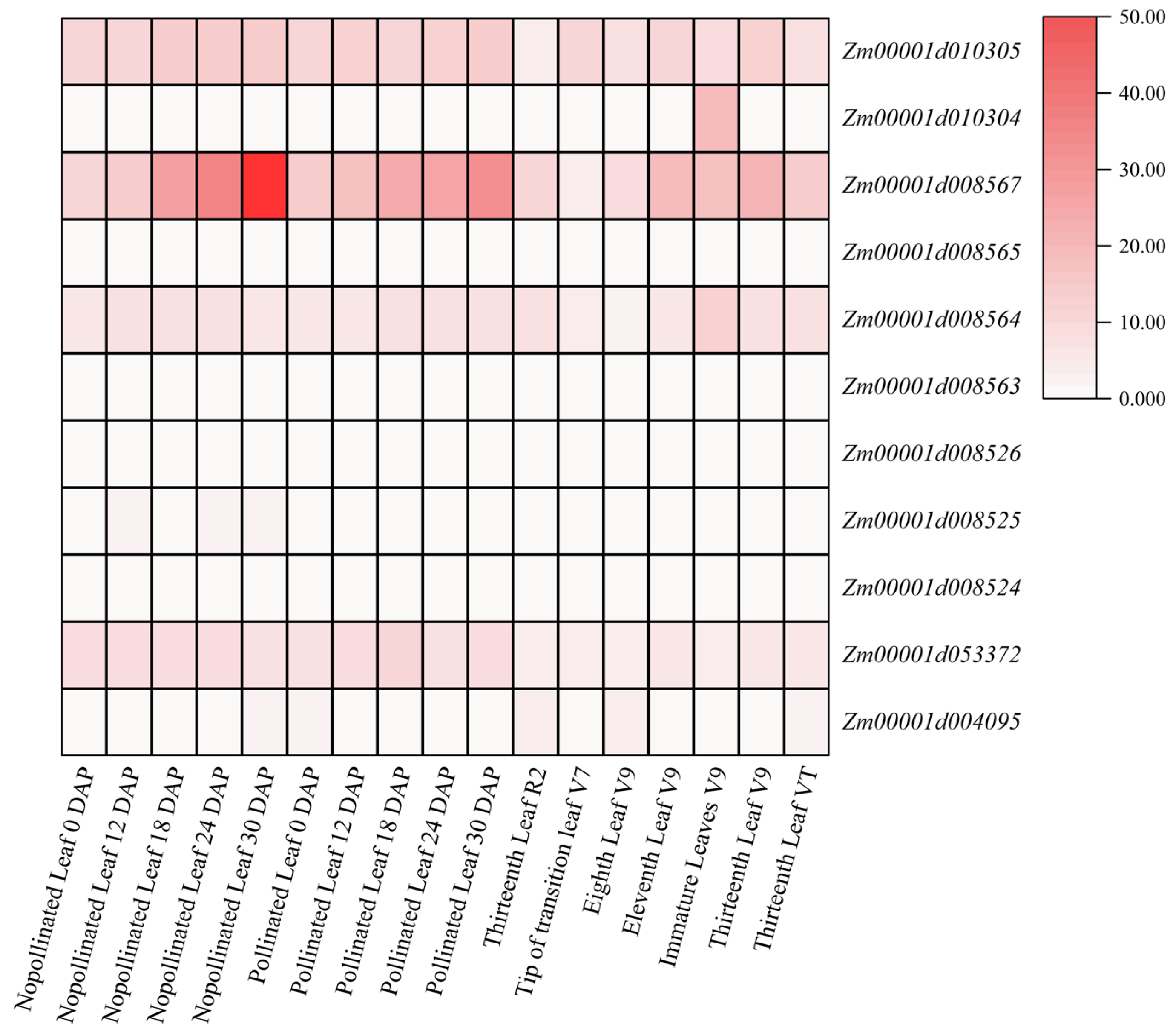
A total of 10 genes were screened within the genomic regions of the five stable SNPs (Table 3). Five of these genes showed low or no expression in maize leaf tissues across developmental stages (Figure 5), and the remaining five leaf-expressed genes were candidate regulators of LIA and LAI. For LIA, four candidates were identified: Zm00001d008564 (Surfeit locus protein 5), Zm00001d008567 (glucose translocator 1, GLCT1), Zm00001d010304 (leucine-rich repeat, LRR family protein), and Zm00001d010305 (transducin/WD-40 repeat family protein).
Furthermore, Zm00001d010304 and Zm00001d010305 were associated with major-effect SNPs Marker.672953 and Marker.672955. For LAI, only one candidate gene (Zm00001d053372, encoding an uncharacterized protein) was associated with the large-effect SNP Marker.418877. Additionally, Zm00001d004095—encoding the bHLH144 transcription factor and expressed across leaf developmental stages—was identified within the chromosome 2 SNP cluster specific to 23FX.

4. Discussion

This study revealed the genetic basis of LIA and LAI traits using a maize diverse association panel. Both traits are genetically regulated, with LIA exhibiting higher broad-sense heritability and non-significant environmental effects (Table 1). Consistently, phenotypic variation analysis showed that LAI displayed more pronounced environment-driven fluctuations than LIA. LIA and LAI showed a significant negative correlation, potentially reflecting maize’s growth strategy to optimize resource acquisition (e.g., light, water) during environmental adaptation.
GWAS identified distinct SNP sets associated with LIA and LAI under different environments. Notably, more significant associations were detected in the 23FX environment (5 for LIA, 28 for LAI) than in 22SY (3 for LIA, 5 for LAI), indicating that the genetic architecture of these quantitative traits is environment-dependent—a phenomenon well-documented in previous research [45,46]. The stronger genetic signals in 23FX likely reflect specific environmental conditions that amplify the phenotypic effects of particular alleles. We propose that such genotype-by-environment (G × E) interactions are mediated by environment-sensitive molecular regulation, such as DNA methylation or transcription factor activity shifts in response to environmental cues [47,48]. These processes can modulate gene expression, unmasking the phenotypic effects of alleles that are silent under different environmental conditions, and provide a mechanistic framework for the environment-specific SNPs identified in this study.
No common SNPs were detected in two different environments. However, overlapping significant SNPs were found between single and across environment analysis: two for LIA (22SY vs. across environments; 23FX vs. across environments) and one for LAI (22SY vs. across environments). Additionally, two key genomic regions were identified: consecutive SNPs on chromosome 2 associated with LAI, and those on chromosome 8 associated with LIA. Previous studies have established that the canonical Brachytic2 (br2) locus (bin1.06, chromosome 1) regulates maize plant architecture and leaf angle via polar auxin transport [49,50,51,52]. However, no significant signals were detected in this region in our GWAS, potentially due to limited allelic variation at this major-effect locus in our natural population, or because the canopy-level LIA phenotype is governed by complex genetic networks that mask signals from individual classical genes. These findings thus reveal novel genomic regions while highlighting the complex genetic architecture underlying field canopy traits.
Based on five stable, significant SNPs, one candidate gene was identified for each trait. For LIA, Zm00001d008567 encodes glucose translocator 1 (GLCT1), a chloroplast envelope-localized protein that mediates glucose transport from the chloroplast interior to the cytoplasm [53]. Glucose is the primary precursor of cellulose and lignin biosynthesis, which are important constituents of the leaf midrib [54,55]. LIA is modulated by midrib structure [56]; thus, GLCT1 may regulate LIA by influencing midrib development. For LAI, Zm00001d053372, screened from the stable SNP region, encodes an uncharacterized protein, which we speculate plays an important role in LAI formation. Furthermore, Zm00001d004095, an environment-specific associated gene, encodes the bHLH144 transcription factor. The bHLH superfamily is widely involved in plant growth and development [57,58]. In Arabidopsis, the bHLH transcription factor SPATULA is expressed in leaf primordia and controls leaf size [59]. In maize, bHLH30 and bHLH155 are associated with LAI; mutations in these genes reduce leaf angle by inhibiting cell expansion and lignin deposition in ligular adaxial sclerenchyma cells [30]. In rice, OsbHLH98 negatively regulates leaf angle by binding and repressing OsBUL1 transcription to antagonize brassinosteroid (BR)-induced cell elongation [60], whereas OsbHLH92 positively regulates leaf angle by activating BR signaling components OsBU1 and its homologs [61]. Collectively, these findings suggest that Zm00001d004095 may influence LAI through conserved bHLH-mediated regulatory pathways.

5. Conclusions

The genetic architecture of LIA and LAI was revealed using GWAS in this study. LIA and LAI are complex quantitative traits controlled by several major genetic loci and multiple minor loci, with discrepant regulatory mechanisms affecting their performance under different environments. Common regulatory loci were not found for the traits LIA and LAI. Notably, the candidate genes may influence LIA and LAI by affecting cell-wall biosynthesis or transcriptional regulation pathways. Despite some important achievements obtained in this study, the functions of the identified candidate genes still need further exploration. The significant SNPs and candidate genes are a valuable resource for further studies.

Supplementary Materials

The following supporting information can be downloaded at: https://www.mdpi.com/article/10.3390/agronomy16020178/s1, Figure S1. Frequency distributions of maize Leaf inclination angle (LIA) and leaf area index (LAI) in association panel. Figure S2. GWAS-derived Q-Q plots using MLM. Table S1. Information on the phenotype data (BLUP) of maize Leaf inclination angle (LIA) and leaf area index (LAI) in association panel. Table S2. The significant SNPs associated with maize leaf inclination angle (LIA) and leaf area index (LAI) traits identified by GWAS and their chromosomal positions.

Author Contributions

Y.R. and A.Z. initiated and designed the overall study. M.L., D.S., H.C. and Y.G. performed and coordinated the field experiments and phenotypic data collection. M.L., K.D., X.D., S.J. and X.K. carried out the data analysis. M.L., K.D. and X.D. interpreted the results. M.L., K.D. and C.L. wrote the manuscript. All authors contributed to manuscript editing. All authors have read and agreed to the published version of the manuscript. Y.R. and C.B. provide funding support.

Funding

This study was supported by Liaoning Provincial Science and Technology Major Project (2024JH1/11700007) and Liaoning Provincial Germplasm Innovation Hidden Grain in Technology Special Program (2023JH1/10200009).

Data Availability Statement

The original contributions presented in this study are included in the article/Supplementary Material. Further inquiries can be directed to the corresponding authors.

Acknowledgments

During the preparation of this manuscript, the authors used Deepseek-V3 for the purposes of checking and correcting grammatical errors, spelling mistakes, and optimizing sentence structures. The authors have reviewed and edited the output and take full responsibility for the content of this publication.

Conflicts of Interest

The authors declare no conflicts of interest.

References

  1. Erenstein, O.; Jaleta, M.; Sonder, K.; Mottaleb, K.; Prasanna, B. Global maize production, consumption and trade: Trends and R&D implications. Food Secur. 2022, 14, 1295–1319. [Google Scholar] [CrossRef]
  2. Qin, X.L.; Feng, F.; Li, Y.J.; Xu, S.T.; Siddique-Kadambot, H.M.; Liao, Y.C. Maize yield improvements in China: Past trends and future directions. Plant Breed. 2016, 135, 166–176. [Google Scholar] [CrossRef]
  3. Tian, J.; Wang, C.; Xia, J.; Wu, L.; Xu, G.; Wu, W.; Li, D.; Qin, W.; Han, X.; Chen, Q.; et al. Teosinte ligule allele narrows plant architecture and enhances high-density maize yields. Science 2019, 365, 658–664. [Google Scholar] [CrossRef]
  4. Liu, G.; Hou, P.; Xie, R.; Ming, B.; Wang, K.; Xu, W.; Liu, W.; Yang, Y.; Li, S. Canopy characteristics of high-yield maize with yield potential of 22.5 Mg ha-1. Field Crops Res. 2017, 213, 221–230. [Google Scholar] [CrossRef]
  5. Shi, Q.; Kong, F.; Zhang, H.; Jiang, Y.; Heng, S.; Liang, R.; Ma, L.; Liu, J.; Lu, X.; Li, P.; et al. Molecular mechanisms governing shade responses in maize. Biochem. Biophys. Res. Commun. 2019, 516, 112–119. [Google Scholar] [CrossRef]
  6. He, L.; Sun, W.; Chen, X.; Han, L.; Li, J.; Ma, Y.; Song, Y. Modeling Maize Canopy Morphology in Response to Increased Plant Density. Front. Plant Sci. 2021, 11, 533514. [Google Scholar] [CrossRef]
  7. Liu, G.; Yang, Y.; Liu, W.; Guo, X.; Xie, R.; Ming, B.; Xue, J.; Zhang, G.; Li, R.; Wang, K.; et al. Optimized canopy structure improves maize grain yield and resource use efficiency. Food Energy Secur. 2022, 11, e375. [Google Scholar] [CrossRef]
  8. Yan, Y.; Duan, F.; Li, X.; Zhao, R.; Hou, P.; Zhao, M.; Li, S.; Wang, Y.; Dai, T.; Zhou, W. Photosynthetic capacity and assimilate transport of the lower canopy influence maize yield under high planting density. Plant Physiol. 2024, 195, 2652–2667. [Google Scholar] [CrossRef]
  9. Yi, Q.; Hou, X.; Liu, Y.; Zhang, X.; Zhang, J.; Liu, H.; Hu, Y.; Yu, G.; Li, Y.; Huang, Y. QTL analysis for plant architecture-related traits in maize under two different plant density conditions. Euphytica 2019, 215, 148. [Google Scholar] [CrossRef]
  10. Maddonni, G.; Otegui, M.; Cirilo, A. Plant population density, row spacing and hybrid effects on maize canopy architecture and light attenuation. Field Crops Res. 2001, 71, 183–193. [Google Scholar] [CrossRef]
  11. Jiang, Q.; Wang, Y. Leaf angle regulation toward a maize smart canopy. Plant J. 2024, 12, e17208. [Google Scholar] [CrossRef]
  12. Lambert, R.J.; Mansfield, B.D.; Mumm, R.H. Effect of leaf area on maize productivity. Maydica 2014, 59, 58–64. [Google Scholar]
  13. Zhang, L.; Yu, P.; Liu, J.; Fu, Q.; Chen, J.; Wu, Y.; Wei, X. Spatial variability of maize leaf area and relationship with yield. Agron. J. 2021, 114, 461–470. [Google Scholar] [CrossRef]
  14. Chen, L.; Xu, Z.; Fan, X.; Zhou, Q.; Yu, Q.; Liu, X.; Liao, S.; Jiang, C.; Lin, D.; Ma, F.; et al. Genetic dissection of quantitative trait loci for flag leaf size in bread wheat (Triticum aestivum L.). Front. Plant Sci. 2022, 13, 1047899. [Google Scholar] [CrossRef]
  15. Duan, H.; Li, J.; Sun, Y.; Xiong, X.; Sun, L.; Li, W.; Gao, J.; Li, N.; Zhang, J.; Cui, J.; et al. Candidate loci for leaf angle in maize revealed by a combination of genome-wide association study and meta-analysis. Front. Genet. 2022, 13, 1004211. [Google Scholar] [CrossRef]
  16. Ku, L.X.; Zhao, W.M.; Zhang, J.; Wu, L.C.; Wang, C.L.; Wang, P.A.; Zhang, W.Q.; Chen, Y.H. Quantitative trait loci mapping of leaf angle and leaf orientation value in maize (Zea mays L.). Theor. Appl. Genet. 2010, 121, 951–959. [Google Scholar] [CrossRef] [PubMed]
  17. Zhang, M.; Jin, Y.; Ma, Y.; Zhang, Q.; Wang, Q.; Jiang, N.; Zhao, H.; Qu, J.; Guan, S.; Wang, P. Identification of QTLs and Candidate Genes Associated with Leaf Angle and Leaf Orientation Value in Maize (Zea mays L.) Based on GBS. Trop. Plant Biol. 2021, 14, 34–49. [Google Scholar] [CrossRef]
  18. Peng, B.; Zhao, X.; Wang, Y.; Li, C.; Li, Y.; Zhang, D.; Shi, Y.; Song, Y.; Wang, L.; Li, Y.; et al. Genome-wide association studies of leaf angle in maize. Mol. Breed. 2021, 41, 50. [Google Scholar] [CrossRef]
  19. Kuang, T.; Hu, C.; Shaw, R.K.; Zhang, Y.; Fan, J.; Bi, Y.; Jiang, F.; Guo, R.; Fan, X. A potential candidate gene associated with the angles of the ear leaf and the second leaf above the ear leaf in maize. BMC Plant Biol. 2023, 23, 540. [Google Scholar] [CrossRef]
  20. Cui, T.-T.; He, K.-H.; Chang, L.-G.; Zhang, X.-H.; Xue, J.-Q.; Liu, J.-C. QTL mapping for leaf area in maize (Zea mays L.) under multi-environments. J. Integr. Agric. 2017, 16, 800–808. [Google Scholar] [CrossRef]
  21. Zeng, Y.; Xu, X.; Jiang, J.; Lin, S.; Fan, Z.; Meng, Y.; Maimaiti, A.; Wu, P.; Ren, J. Genome-wide association analysis and genomic selection for leaf-related traits of maize. PLoS ONE 2025, 20, e0323140. [Google Scholar] [CrossRef]
  22. Kong, F.; Zhang, T.; Liu, J.; Heng, S.; Shi, Q.; Zhang, H.; Wang, Z.; Ge, L.; Li, P.; Lu, X.; et al. Regulation of Leaf Angle by Auricle Development in Maize. Mol. Plant 2017, 10, 516–519. [Google Scholar] [CrossRef]
  23. Dou, D.; Han, S.; Cao, L.; Ku, L.; Liu, H.; Su, H.; Ren, Z.; Zhang, D.; Zeng, H.; Dong, Y.; et al. CLA4 regulates leaf angle through multiple hormone signaling pathways in maize. J. Exp. Bot. 2021, 72, 1782–1794. [Google Scholar] [CrossRef]
  24. Huang, G.; Hu, H.; van de Meene, A.; Zhang, J.; Dong, L.; Zheng, S.; Zhang, F.; Betts, N.S.; Liang, W.; Bennett, M.J.; et al. AUXIN RESPONSE FACTORS 6 and 17 control the flag leaf angle in rice by regulating secondary cell wall biosynthesis of lamina joints. Plant Cell 2021, 33, 3120–3133. [Google Scholar] [CrossRef]
  25. Wang, X.; Wang, X.; Sun, S.; Tu, X.; Lin, K.; Qin, L.; Wang, X.; Li, G.; Zhong, S.; Li, P. Characterization of regulatory modules controlling leaf angle in maize. Plant Physiol. 2022, 190, 500–515. [Google Scholar] [CrossRef] [PubMed]
  26. Ji, X.; Gao, Q.; Chen, F.; Bai, M.; Zhuang, Z.; Peng, Y. Mutant lpa1 Analysis of ZmLPA1 Gene Regulates Maize Leaf-Angle Development through the Auxin Pathway. Int. J. Mol. Sci. 2022, 23, 4886. [Google Scholar] [CrossRef] [PubMed]
  27. Shi, Q.; Xia, Y.; Wang, Q.; Lv, K.; Yang, H.; Cui, L.; Sun, Y.; Wang, X.; Tao, Q.; Song, X.; et al. Phytochrome B interacts with LIGULELESS1 to control plant architecture and density tolerance in maize. Mol. Plant 2024, 17, 1255–1271. [Google Scholar] [CrossRef]
  28. Wu, L.; Zhang, D.; Xue, M.; Qian, J.; He, Y.; Wang, S. Overexpression of the maize GRF10, an endogenous truncated growth-regulating factor protein, leads to reduction in leaf size and plant height. J. Integr. Plant Biol. 2014, 56, 1053–1063. [Google Scholar] [CrossRef]
  29. Liu, J.; Zhang, F.; Zhou, J.; Chen, F.; Wang, B.; Xie, X. Phytochrome B control of total leaf area and stomatal density affects drought tolerance in rice. Plant Mol. Biol. 2021, 78, 289–300. [Google Scholar] [CrossRef] [PubMed]
  30. Wang, Q.; Guo, Q.; Shi, Q.; Yang, H.; Liu, M.; Niu, Y.; Quan, S.; Xu, D.; Chen, X.; Li, L.; et al. Histological and single-nucleus transcriptome analyses reveal the specialized functions of ligular sclerenchyma cells and key regulators of leaf angle in maize. Mol. Plant 2024, 17, 920–934. [Google Scholar] [CrossRef]
  31. Liu, D.; Ning, Q.; Zhai, L.; Teng, F.; Li, Y.; Zhao, R.; Xiong, Q.; Zhan, J.; Li, Z.; Yang, F.; et al. Coordinated control for the auricle asymmetric development by ZmIDD14 and ZmIDD15 fine-tune the high-density planting adaption in maize. Plant Biotechnol. J. 2024, 22, 2675–2687. [Google Scholar] [CrossRef]
  32. Chen, H.; Gong, X.; Guo, Y.; Yu, J.; Li, W.-X.; Du, Q. ZmbZIP27 regulates nitrogen-mediated leaf angle by modulating lignin deposition in maize. Crop J. 2024, 12, 1404–1413. [Google Scholar] [CrossRef]
  33. Tian, J.; Wang, C.; Chen, F.; Qin, W.; Yang, H.; Zhao, S.; Xia, J.; Du, X.; Zhu, Y.; Wu, L.; et al. Maize smart-canopy architecture enhances yield at high densities. Nature 2024, 632, 576–584. [Google Scholar] [CrossRef]
  34. Reich, P.B. Key canopy traits drive forest productivity. Proc. R. Soc. B Biol. Sci. 2012, 279, 2128–2134. [Google Scholar] [CrossRef]
  35. Chen, S.; Dang, D.; Liu, Y.; Ji, S.; Zheng, H.; Zhao, C.; Dong, X.; Li, C.; Guan, Y.; Zhang, A.; et al. Genome-wide association study presents insights into the genetic architecture of drought tolerance in maize seedlings under field water-deficit conditions. Front. Plant Sci. 2023, 14, 1165582. [Google Scholar] [CrossRef]
  36. Alvarado, G.; Rodríguez, F.M.; Pacheco, A.; Burgueño, J.; Crossa, J.; Vargas, M.; Pérez-Rodríguez, P.; Lopez-Cruz, M.A. META-R: A software to analyze data from multi-environment plant breeding trials. Crop J. 2020, 8, 745–756. [Google Scholar] [CrossRef]
  37. Vargas, M.; Combs, E.; Alvarado, G.; Atlin, G.; Mathews, K.; Crossa, J. META: A Suite of SAS Programs to Analyze Multienvironment Breeding Trials. Agron. J. 2013, 105, 11–19. [Google Scholar] [CrossRef]
  38. Zhang, Z.; Ersoz, E.; Lai, C.-Q.; Todhunter, R.J.; Tiwari, H.K.; Gore, M.A.; Bradbury, P.J.; Yu, J.; Arnett, D.K.; Ordovas, J.M.; et al. Mixed linear model approach adapted for genome-wide association studies. Nat. Genet. 2010, 42, 355–360. [Google Scholar] [CrossRef]
  39. Li, H.; Peng, Z.; Yang, X.; Wang, W.; Fu, J.; Wang, J.; Han, Y.; Chai, Y.; Guo, T.; Yang, N.; et al. Genome-wide association study dissects the genetic architecture of oil biosynthesis in maize kernels. Nat. Genet. 2013, 4, 43–50. [Google Scholar] [CrossRef] [PubMed]
  40. Yang, N.; Lu, Y.; Yang, X.; Huang, J.; Zhou, Y.; Ali, F.; Wen, W.; Liu, J.; Li, J.; Yan, J. Genome Wide Association Studies Using a New Nonparametric Model Reveal the Genetic Architecture of 17 Agronomic Traits in an Enlarged Maize Association Panel. PLoS Genet. 2014, 10, e1004573. [Google Scholar] [CrossRef] [PubMed]
  41. Chang, F.; Guo, C.; Sun, F.; Zhang, J.; Wang, Z.; Kong, J.; He, Q.; Sharmin, R.A.; Zhao, T. Genome-Wide Association Studies for Dynamic Plant Height and Number of Nodes on the Main Stem in Summer Sowing Soybeans. Front. Plant Sci. 2018, 9, 1184. [Google Scholar] [CrossRef]
  42. Zheng, Y.; Yuan, F.; Huang, Y.; Zhao, Y.; Jia, X.; Zhu, L.; Guo, J. Genome-wide association studies of grain quality traits in maize. Sci. Rep. 2021, 11, 9797. [Google Scholar] [CrossRef]
  43. Wang, H.; Li, K.; Hu, X.; Liu, Z.; Wu, Y.; Huang, C. Genome-wide association analysis of forage quality in maize mature stalk. BMC Plant Biol. 2016, 16, 227. [Google Scholar] [CrossRef]
  44. Stelpflug, S.C.; Sekhon, R.S.; Vaillancourt, B.; Hirsch, C.N.; Buell, C.R.; De Leon, N.; Kaeppler, S.M. An Expanded Maize Gene Expression Atlas based on RNA Sequencing and its Use to Explore Root Development. Plant Genome 2016, 9. [Google Scholar] [CrossRef] [PubMed]
  45. Shu, G.; Wang, A.; Wang, X.; Chen, R.; Gao, F.; Wang, A.; Li, T.; Wang, Y. Identification of QTNs, QTN-by environment interactions for plant height and ear height in maize multi-environment GWAS. Front. Plant Sci. 2023, 14, 1284403. [Google Scholar] [CrossRef]
  46. Zhong, Y.; Zhao, X.; Li, W.; Zhou, W. Identification and meta-analysis of QTLs for four leaf shape traits in two maize populations under contrasting watering environments. Genet. Resour. Crop Evol. 2021, 68, 1557–1575. [Google Scholar] [CrossRef]
  47. Sun, G.; Yu, H.; Wang, P.; Lopez-Guerrero, M.; Mural, R.V.; Mizero, O.N.; Grzybowski, M.; Song, B.; van Dijk, K.; Schachtman, D.P.; et al. A role for heritable transcriptomic variation in maize adaptation to temperate environments. Genome Biol. 2023, 24, 93. [Google Scholar] [CrossRef]
  48. Liu, X.; Wang, D.; Zhang, Z.; Lin, X.; Xiao, J. Epigenetic perspectives on wheat speciation, adaptation, and development. Trends Genet. 2025, 41, 817–829. [Google Scholar] [CrossRef]
  49. Multani, D.S.; Briggs, S.P.; Chamberlin, M.A.; Blakeslee, J.J.; Murphy, A.S.; Johal, G.S. Loss of an MDR transporter in compact stalks of maize br2 and sorghum dw3 mutants. Science 2003, 302, 81–84. [Google Scholar] [CrossRef] [PubMed]
  50. Wei, L.; Zhang, X.; Zhang, Z.; Liu, H.; Lin, Z. A new allele of the Brachytic2 gene in maize can efficiently modify plant architecture. Heredity 2018, 121, 75–86. [Google Scholar] [CrossRef]
  51. Cao, Y.; Zhong, Z.; Wang, H.; Shen, R. Leaf angle: A target of genetic improvement in cereal crops tailored for high-density planting. Plant Biotechnol. J. 2022, 20, 426–436. [Google Scholar] [CrossRef] [PubMed]
  52. Sarma, G.R.; Chhabra, R.; Muthusamy, V.; Subramaniam, S.P.; Sharma, G.; Duo, H.; Rojaria, V.; Zunjare, R.U.; Chinnusamy, V.; Hossain, F. Molecular delineation, development and validation of functional markers for brachytic2 (br2) gene governing dwarfing plant height in maize. Physiol. Mol. Biol. Plants 2025, 31, 2101–2119. [Google Scholar] [CrossRef]
  53. Cho, M.-H.; Lim, H.; Shin, D.H.; Jeon, J.-S.; Bhoo, S.H.; Park, Y.-I.; Hahn, T. Role of the plastidic glucose translocator in the export of starch degradation products from the chloroplasts in Arabidopsis thaliana. New Phytol. 2011, 190, 101–112. [Google Scholar] [CrossRef]
  54. Barnes, W.J.; Anderson, C.T. Cytosolic invertases contribute to cellulose biosynthesis and influence carbon partitioning in seedlings of Arabidopsis thaliana. Plant J. 2018, 94, 956–974. [Google Scholar] [CrossRef]
  55. Jiao, Y.; Gong, X.; Qi, K.; Xie, Z.; Wang, Y.; Yuan, K.; Pan, Q.; Zhang, S.; Shiratake, K.; Khanizadeh, S.; et al. Transcriptome analysis provides new ideas for studying the regulation of glucose-induced lignin biosynthesis in pear calli. BMC Plant Biol. 2022, 22, 310. [Google Scholar] [CrossRef]
  56. Wang, N.; Cao, D.; Gong, F.; Ku, L.; Chen, Y.; Wang, W. Differences in properties and proteomes of the midribs contribute to the size of the leaf angle in two near-isogenic maize lines. J. Proteom. 2015, 128, 113–122. [Google Scholar] [CrossRef]
  57. Li, J.; Gong, J.; Zhang, L.; Shen, H.; Chen, G.; Xie, Q.; Hu, Z. Overexpression of SlPRE5, an atypical bHLH transcription factor, affects plant morphology and chlorophyll accumulation in tomato. J. Plant Physiol. 2022, 273, 153698. [Google Scholar] [CrossRef]
  58. Heim, M.A.; Jakoby, M.; Werber, M.; Martin, C.; Weisshaar, B.; Bailey, P.C. The basic helix-loop-helix transcription factor family in plants: A genome-wide study of protein structure and functional diversity. Mol. Biol. Evol. 2003, 20, 735–747. [Google Scholar] [CrossRef] [PubMed]
  59. Ichihashi, Y.; Horiguchi, G.; Gleissberg, S.; Tsukaya, H. The bHLH transcription factor SPATULA controls final leaf size in Arabidopsis thaliana. Plant Cell Physiol. 2010, 51, 252–261. [Google Scholar] [CrossRef] [PubMed]
  60. Guo, J.; Li, W.; Shang, L.; Wang, Y.; Yan, P.; Bai, Y.; Da, X.; Wang, K.; Guo, Q.; Jiang, R.; et al. OsbHLH98 regulates leaf angle in rice through transcriptional repression of OsBUL1. New Phytol. 2021, 230, 1953–1966. [Google Scholar] [CrossRef]
  61. Teng, S.; Liu, Q.; Chen, G.; Chang, Y.; Cui, X.; Wu, J.; Ai, P.; Sun, X.; Zhang, Z.; Lu, T. OsbHLH92, in the noncanonical brassinosteroid signaling pathway, positively regulates leaf angle and grain weight in rice. New Phytol. 2023, 240, 1066–1081. [Google Scholar] [CrossRef] [PubMed]
Figure 1. Boxplot of maize leaf inclination angle (LIA) and leaf area index (LAI) in two environments. Analysis of variance (ANOVA) was applied to examine the differences in phenotypes between the two environments. * p ≤ 0.05, **** p ≤ 0.0001.
Agronomy 16 00178 g001
Figure 2. Correlation coefficients of maize leaf inclination angle (LIA) with leaf area index (LAI) based on BLUP values. **, significant at p ≤ 0.01.
Agronomy 16 00178 g002
Figure 3. GWAS-derived Manhattan plots showing significant SNPs associated with maize leaf inclination angle (LIA) and leaf area index (LAI) using MLM. Each dot represents an SNP. The horizontal dashed red line represents the significant threshold of 1.0 × 10⁻⁴. Significant SNPs are amplified, with stably significant ones directly labeled with their names. 22SY: Shenyang in 2022, 23FX: Fuxin in 2023; BLUP: across two environments.
Agronomy 16 00178 g003
Figure 4. The boxplot of phenotypic difference between the major alleles and minor alleles for five stable significant SNPs associated with maize leaf inclination angle (LIA) and leaf area index (LAI). The p-values (Student’s t-test) of the allelic effects of LIA and LAI are exhibited. 22SY: Shenyang in 2022, 23FX: Fuxin in 2023; BLUP: across two environments.
Agronomy 16 00178 g004
Figure 5. The expression profiles of candidate genes at development stages in the maize leaf.
Agronomy 16 00178 g005
Table 1. Variance composition and broad-sense heritability of leaf inclination angle (LIA) and leaf area index (LAI) in the maize association panel under a single environment and across two environments.
TraitEnv aMean ± SDRangeVariance Component b,ch2 d
Genotype (G)Environment (E)G × E
LIA22SY53.15 ± 3.3444.2–63.021.89 ** 0.81
23FX52.24 ± 4.2337.8–68.541.24 ** 0.83
Across52.88 ± 3.9748.6–56.99.72 **0.0417.98 **0.44
LAI22SY2.79 ± 0.541.97–3.820.141 ** 0.75
23FX2.08 ± 0.771.56–2.870.151 ** 0.61
Across2.44 ± 0.482.19–2.740.042 **0.230 *0.107 **0.34
a 22SY: Shenyang City in 2022; 23FX: Fuxin Mongolian autonomous county in 2023; Across: across two environments. b G and E indicate genotype and environment, respectively, and G × E indicates the interaction of G and E. c * Significant at p ≤ 0.05, ** Significant at p ≤ 0.01. d broad-sense heritability.
Table 2. The key significant SNPs associated with maize leaf inclination angle (LIA) and leaf area index (LAI) traits identified by GWAS and their chromosomal positions.
TraitEvn aSNPAllele bChrPositionMean-log10(P)R2 c
LIA22SYMarker.672953C/A81085704724.24 7.80
Marker.672955G/C81085704864.25 7.80
23FXMarker.642198A/G8116983784.11 9.10
Marker.642693A/G8131398634.05 7.60
AcrossMarker.642198A/G8116983784.57 8.16
Marker.642693A/G8131398636.39 9.60
Marker.672953C/A81085704724.87 10.86
Marker.672955G/C81085704864.87 10.86
LAI22SYMarker.418877G/A42280968094.91 8.21
23FXMarker.202284C/T2822571155.33 9.01
Marker.202285A/G2822571174.70 8.39
Marker.202286A/G2822571195.38 9.48
Marker.202288T/A2822572085.33 8.09
Marker.202290T/C2822573054.37 7.94
Marker.202291T/A2822573404.70 8.39
Marker.202292A/G2822573524.70 8.39
AcrossMarker.418877G/A42280968096.09 10.36
a 22SY: Shenyang City in 2022; 23FX: Fuxin City in 2023, Across: Across two environments. b Major/minor allele; underlined bases indicate favorable alleles. c Percentage of phenotypic variation explained by the additive effect of the single significant SNP.
Table 3. The candidate genes associated with maize leaf inclination angle (LIA) and leaf area index (LAI) were identified by GWAS.
TraitSNPsGeneChrGene Interval (bp)Annotation
LIAMarker.642198Zm00001d008524811642158–11643363Mannose-6-phosphate isomerase
Zm00001d008525811668954–11672834Mannose-6-phosphate isomerase 1
Zm00001d008526811697417–11699996Glycosyltransferase family 61 protein
Marker.642693Zm00001d008563813125997–13131966protein-Serine/threonine phosphatase
Zm00001d008564813131898–13138732Surfeit locus protein 5
Zm00001d008565813137308–13144570DUF3741 domain-containing protein
Zm00001d008567813144641–13154862Glucose translocator1 (GLCT1)
Marker.672953/Marker.672955Zm00001d0103048108569248–108571613Leucine-rich repeat (LRR) family protein
Zm00001d0103058108605879–108609481Transducin family protein/WD-40 repeat family protein
LAIMarker.418877Zm00001d0533724228098294–228104444Unknown
Marker.202284-Marker.202292Zm00001d004095282544089–82547190bHLH-transcription factor 144 (bHLH144)
Disclaimer/Publisher’s Note: The statements, opinions and data contained in all publications are solely those of the individual author(s) and contributor(s) and not of MDPI and/or the editor(s). MDPI and/or the editor(s) disclaim responsibility for any injury to people or property resulting from any ideas, methods, instructions or products referred to in the content.