Article

Advanced Preservation Strategies for Inoculants: A Lipid-Biophysical Approach to Bradyrhizobium japonicum Stability

by
Luciana Nieva-Muratore
1,
Adriana Belén Cesari
2,
Eugenia Reynoso
3,4,
Marcela Díaz
5,
Leonel Malacrida
5,6,
Marta Susana Dardanelli
1,2,* and
Natalia Soledad Paulucci
1,2,*
1
Instituto de Biotecnología Ambiental y Salud, Consejo Nacional de Investigaciones Científicas y Técnicas, Río Cuarto 5800, Argentina
2
Departamento de Biología Molecular, Facultad de Ciencias Exactas, Físico-Químicas y Naturales, Universidad Nacional de Río Cuarto, Ruta Nacional 36, Km 601, Río Cuarto 5800, Argentina
3
Instituto para el Desarrollo Agroindustrial y de la Salud, Consejo Nacional de Investigaciones Científicas y Técnicas, Río Cuarto 5800, Argentina
4
Departamento de Química, Facultad de Ciencias Exactas, Físico-Químicas y Naturales, Universidad Nacional de Río Cuarto, Ruta Nacional 36, Km 601, Río Cuarto 5800, Argentina
5
Unidad Bioimagenología Avanzada, Institut Pasteur de Montevideo, Universidad de la República, Montevideo 11400, Uruguay
6
Unidad Académica de Fisiopatología, Hospital de Clínicas, Facultad de Medicina, Universidad de la República, Montevideo 11600, Uruguay
*
Authors to whom correspondence should be addressed.
Agronomy 2026, 16(2), 159; https://doi.org/10.3390/agronomy16020159
Submission received: 13 December 2025 / Revised: 4 January 2026 / Accepted: 6 January 2026 / Published: 8 January 2026

Abstract

The intensive use of chemical fertilizers in soybean (Glycine max) cultivation has caused significant environmental degradation, underscoring the urgent need for sustainable alternatives. In Argentina, Bradyrhizobium japonicum E109 is widely employed as a liquid bioinoculant, yet its efficiency is limited by loss of viability during storage. This study investigated the physiological and biophysical mechanisms underlying membrane adaptation of B. japonicum E109 under storage stress and evaluated lipid supplementation as a stabilization strategy. During six months of liquid storage at 28 °C, bacterial viability (Log CFU mL−1) declined from 10.0 to 7.7, accompanied by morphological collapse and a 29% reduction in membrane fluorescence polarization, indicating increased fluidity. Fatty acid analysis revealed a drastic decrease of unsaturated 18:1 (from 80% to 40%) and a 300–400% increase in saturated 18:0, reducing the U/S ratio from 4 to 1. Spectral phasor analysis confirmed a shift in the lipid microenvironment from an ordered to a disordered state. Supplementation with 400 µM of stearic acid (18:0) restored membrane rigidity, lowered the U/S ratio to 1.5, and improved thermal tolerance. After one month of storage, 18:0-treated cultures maintained 8.0 Log CFU mL−1 and preserved viability after exposure to 37 °C, whereas controls dropped to 3.8 Log CFU mL−1. These results identify lipid remodeling as a key determinant of B. japonicum stability and demonstrate that exogenous 18:0 supplementation mimics natural adaptation, preventing membrane fluidization and enhancing inoculant shelf-life. This lipid-biophysical approach provides a rational framework for developing next generation, more resilient rhizobia formulations for sustainable agriculture.

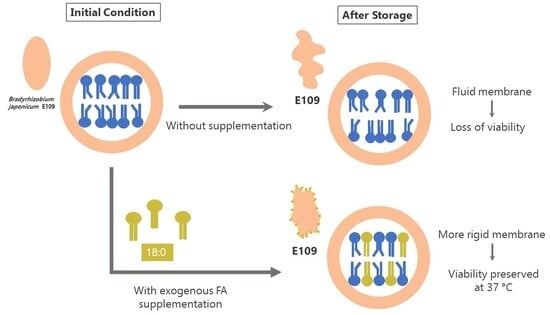
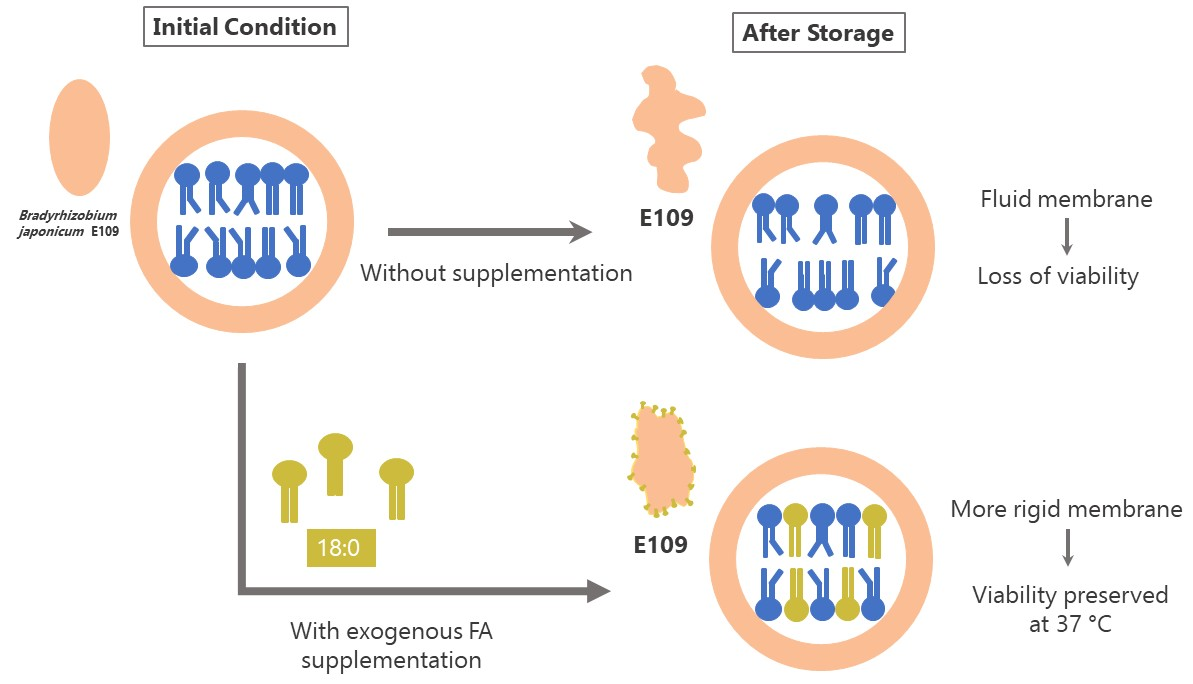
Graphical Abstract

1. Introduction

Soybean (Glycine max (L.) Merr) production and its derivatives currently represent one of the most dynamic sectors of the Argentine economy. Driven by increasing global demand for biofuels, vegetable oils, and animal feed protein, global soybean production has doubled over the past two decades, reaching approximately 350 million metric tons annually. Argentina, Brazil, and the United States together account for nearly 80% of global output (2019–2023), with shares of 13%, 36%, and 31%, respectively [1]. In Argentina, soybean expansion began five decades ago and, after a gradual adoption phase, became dominant in crop rotations by the mid-1990s, accompanied by yield improvements. As a result, production exceeded domestic demand, consolidating Argentina as a major exporter. Today, soybean represents nearly half of the country’s harvested grain crop area [1].
This sustained expansion has been accompanied by significant changes in agronomic management practices, particularly an increasing dependence on chemical fertilizers to meet the crop’s nutritional and phytosanitary demands. Over several decades, the widespread application of chemical fertilizers has led to numerous adverse environmental impacts, many of which persist today, contributing to the degradation of non-renewable resources such as soil. Excessive use of chemical fertilizers has severely impacted soil health, resulting in structural degradation, loss of organic matter, acidification, accumulation of heavy metals, reduced microbial diversity, and increased erosion. These effects compromise the soil’s fertility, ecological function, and long-term productivity. To address this issue in an environmentally friendly and sustainable manner, bio-inoculants, also known as biofertilizers, have emerged as a promising alternative to reduce fertilizer inputs and mitigate their negative impacts [2]. In Argentina, soybean seeds are routinely inoculated with Bradyrhizobium japonicum E109 [3]. This strain promotes nodule formation and enhances nitrogen availability for the crop through biological nitrogen fixation [4]. The use of this inoculant has become a common agronomic practice, contributing significantly to soybean productivity while reducing the dependence on synthetic nitrogen fertilizers.
Despite their proven benefits for crop productivity, one of the main challenges in the production and commercialization of microbial inoculants lies in maintaining the viability of the microorganisms throughout the storage, transport, and application processes. Ensuring high cell viability is crucial, as the effectiveness of the inoculant in establishing symbiosis and promoting plant growth depends directly on the number of active and metabolically functional cells at the time of use [5]. A decrease in the bacterial viability of the inoculant could compromise its ability to promote plant growth and improve the yield of the crop to which it is applied [4]. Although there have been significant advances in the development of microbial inoculant formulations, most research has focused on empirical approaches aimed at extending shelf life and improving viability. However, there is a notable absence of studies that first characterize the physiological and metabolic responses of microorganisms to storage stress and then use this information to design more specific stabilization strategies. A deeper understanding of cellular responses at the molecular level could pave the way for rational improvements in inoculant protection, to more efficient and consistent performance under practical agricultural conditions.
One of the key physiological mechanisms by which rhizobial strains such as B. japonicum E109 tolerate suboptimal conditions is through the adaptive remodeling of their membrane lipid composition [6,7]. This adaptation plays a central role in maintaining membrane integrity, fluidity, and function under stressors commonly encountered during storage, including desiccation, temperature fluctuations, and osmotic changes. In both liquid formulations and seed-coating systems, membrane-associated modifications, such as changes in fatty acid (FA) saturation levels or phospholipid ratios, can significantly influence bacterial survival and metabolic activity. These phenomena are not exclusive to rhizobia, as several studies on Gram-negative bacteria highlight the central role of membrane fluidity in maintaining homeostasis under environmental stress [8]. Understanding these adaptive responses provides valuable insights for the rational design of inoculant stabilization strategies, particularly those aiming to reinforce membrane resilience through bio-physical approaches or targeted additives.
Among the strategies designed to preserve microbial viability during storage, the use of protective agents represents one of the most extensively validated approaches in bioinoculant research. These compounds, including sugars (e.g., trehalose, sucrose, or sorbitol), polymers (such as alginate, carboxymethylcellulose, or polyvinylpyrrolidone), and protein stabilizers (e.g., bovine serum albumin or casein), mitigate structural and oxidative damage by forming a protective matrix around the cells [9]. This matrix reduces water loss, stabilizes proteins and membranes, and maintains lipid bilayer integrity under stress conditions. In rhizobial inoculants, osmoprotectants and cryoprotectants have proven to significantly improve bacterial survival and extend shelf life in both solid and liquid formulations [2,10].
Although traditional inoculant formulation research has focused largely on empirical protectants such as sugars, polymers, or proteins, there is increasing evidence that membrane lipid composition per se plays a vital role in bacterial stress tolerance and survival [11]. In Listeria monocytogenes, exogenously supplied FAs, introduced through additives such as polysorbate surfactants or food lipid extracts, are incorporated into the membrane phospholipids and substantially alter membrane properties, including fluidity and resistance to low-temperature stress. Also, the protective effect of exogenous FA has been recently demonstrated in Bifidobacterium animalis [12]. Exogenous supplementation with 18:0 substantially improved bacterial viability during spray drying by remodeling the membrane composition through providing the substrate for the synthesis of 18:1 FA.
This evidence demonstrates that external FAs can modulate intrinsic adaptive mechanisms rather than acting simply as physical coatings. This modulation of membrane lipid profiles influences stress resilience by adjusting membrane packing and fluidity under thermal stress, highlighting a mechanistic link between FA availability, membrane homeostasis, and viability. Temperature itself is a primary driver of membrane dynamics; shifts in storage temperature affect lipid packing and fluidity, which in turn impact permeability, protein function, and overall cell survival. In the context of microbial inoculants, which may experience fluctuating storage and transport temperatures, integrating such membrane-level insights into formulation strategies offers a path toward rational design of lipid-mediated stabilization that goes beyond empirical shelf-life extension.
In this context, the objective of this study was to investigate the biophysical mechanisms underlying membrane adaptation in B. japonicum E109 during storage in liquid culture, with particular emphasis on changes in membrane lipid composition and fluidity.
We hypothesized that storage-induced membrane fluidization limits bacterial viability and that supplementation with saturated FAs, specifically 18:0, would promote adaptive lipid remodeling, resulting in improved membrane stability and enhanced cell survival during storage.
By integrating membrane lipid analysis with biophysical measurements of membrane fluidity, this work aims to provide a mechanistic basis for the rational design of improved inoculant formulations with increased shelf life and agronomic reliability.

2. Materials and Methods

The strain B. japonicum E109 was used in this study given that it is one of the most widely employed inoculant strains for the production of soybean in Argentina [13]. To prepare the inoculum, the strain was cultured on Yeast Mannitol Agar (YMA) containing 10 g L−1 mannitol [14]. For long-term storage, B. japonicum E109 was grown in an industrial medium culture (IMC) provided by CERES DEMETER (Río Cuarto, Córdoba, Argentina), at 28 °C to a final density of approximately 109 CFU mL−1. The cultures (100 mL) were then packaged in commercial multilayer containers specifically designed for bacterial storage, filled to 80% of their total volume to minimize oxygen exchange, and maintained at 28 °C.

2.1. Viability Monitoring Under Industrial Storage Conditions

At different times after packaging, the samples were analyzed to determine cell viability in YMA medium with Congo Red by plate count using the microdrop technique [15]. This was expressed as a logarithm of the colony-forming units (Log CFU mL−1).

2.2. Visualization by Scanning Electron Microscopy (SEM)

Samples of B. japonicum E109 stored for different periods of time were collected and prepared for visualization by SEM. The samples were washed with a buffer solution and fixed with 2.5% glutaraldehyde for two hours at room temperature. Further washes were then performed, followed by dehydration using sequential immersion in ethanol solutions at increasing concentrations (30%, 50%, 70%, 90% y 96%), with a 15-min incubation period at each stage. The samples were then transferred to an ethanol: acetone solution (50:50), followed by 100% acetone.
Once dehydrated, the samples were dried using a Leica EM CPD 030 critical point dryer (Deer Park, IL, USA), mounted on racks, and coated with a gold layer for observation. Analysis was carried out using CARL ZEISS EVO MA 10 scanning electron microscope (Oberkochen, Germany) fitted with an energy dispersive X-ray detector (EDAX).
Electron micrograph was obtained at various magnifications using LEO-32 V 02.03 software. For the analysis, images were randomly generated from E109 samples that had been stored for one month, as well as from unstored samples, and the results were digitally recorded.

2.3. Fatty Acid Composition Under Industrial Storage Conditions

Aliquots of B. japonicum E109 (50 mL) at different storage stages were harvested by centrifugation at 8000 rpm for 10 min at room temperature, then washed with saline buffer at pH 7 [6]. The cells (approximately 1.5 g wet weight) were resuspended in 18 mL of cold 20% (w/v) sucrose. Then, the following were slowly added to the suspension: 9 mL of 2 M sucrose, 10 mL of 0.1 M Tris-HCl (pH 7.8), 0.8 mL of 1% Na-EDTA (pH 7.0), and 1.8 mL of 0.5% lysozyme. The mixture was incubated at 30 °C for 60 min. The suspension was centrifuged at 13,000 rpm for 15 min at 30 °C. The outer membrane (OM) fraction was recovered from the supernatant by centrifugation at 30,000 rpm for 60 min. The spheroplasts were resuspended in 40 mL of 5 mM MgCl2, sonicated, and the spheroplast or inner membrane (IM) was recovered from the pellet by centrifugation at 15,000 rpm for 20 min.
Lipids were extracted from the OM and IM fractions of cells from the different treatments according to Bligh & Dyer (1959) [16]. Fatty acid methyl esters (FAMEs) were prepared from the lipid extracts of the OM and IM fractions using 10% boron trifluoride (BF3) in methanol [17]. The FAMEs were then separated and identified using a Hewlett Packard 5890 Series II gas chromatograph (Palo Alto, CA, USA) equipped with a 60-m HP-88 column. Peaks corresponding to each FA were identified using a mixture of commercial standards.

2.4. Determination of Membrane Microfluidity

The fluidity of membrane cells of different storage times was determined by measuring the fluorescence polarization (P) of the 1,6-diphenyl-1,3,5-hexatriene (DPH) probe (Invitrogen, Waltham, MA, USA) inserted into the membrane. Fluorescence polarization quantifies the degree of depolarization of the light emitted by the embedded fluorescence probe, which is a measure of membrane state [18]. The probe polarization ratio and membrane fluorescence are inversely correlated. As bacterial membrane fluidity decreases, the P increases, and vice versa [19]. E109 cells were harvested in sterile 15 mM Tris-HCl buffer (pH 7.0) and resuspended in the same buffer to an OD of 0.2 at 600 nm. Next, 4 µL of the fluorescent probe (stock solution at 12 mM in tetrahydrofuran) was added to 3 mL of the resuspended cell aliquots to achieve a final probe concentration of 16 µM. The samples were incubated with a magnetic stirrer at 200 rpm for 10 min in the dark at room temperature, after which the degree of polarization was determined. Fluorescence polarization measurements were performed using a Horiba FluoroMax®-4 spectrofluorometer (Kyoto, Japan) with polarizers. The excitation wavelength for the DPH probe was 358 nm and the emission wavelength was 428 nm. The degree of P was calculated from the Fluorescence intensities (FI) using the following equation (Equation (1)):
P = I V V I V H · G I V V +   I V H · G
where IVV and IVH are the FI of vertically and horizontally polarized light components emitted after excitation by vertically polarized light, respectively, and G = IHV/IHH is the sensitivity factor of the detection system [20].

2.5. Analysis of the Biophysical State of B. japonicum E109 Membranes Through Hyperspectral Imaging and Phasor Plot Approach

PRODAN (6-propionyl-2-dimethylaminonaphthalene) is a widely used polarity-sensitive fluorescent probe that exhibits strong changes in its emission spectrum depending on the microenvironment surrounding it. Thanks to this property, it serves as a valuable tool for investigating membrane dynamics [21].

2.5.1. Sample Collection and Cell Immobilization

A 500 µL aliquot was taken from B. japonicum E109 cultures stored at 28 °C for 0, 1 and 12 months. These cultures were incubated with 1 µL PRODAN (5.1 mM) for 40 min. After that time, 2 µL of the cultures were taken and immobilized in 3 µL of Poly-L-lysine on a slide.

2.5.2. Confocal Microscopy and Hyperspectral Imaging

Spectral images were obtained using a Zeiss LSM 880 confocal microscope equipped with 63× oil immersion lens (NA 1.4, Plan Apochromatic, DIC M27, Zeiss, Oberkochen, Germany) and using Lambda Mode in Zen black v. 2.3 software (Zeiss) from the Advanced Bioimaging Unit at the Institute Pasteur of Montevideo, Uruguay. A diode laser at 405 nm was used for excitation. Emission spectra were acquired using a spectral detector (gallium arsenide phosphide photomultiplier tube; GaAsP-PMT), capturing 30 consecutive steps (channels). Spectral images of 256 × 256 pixels were acquired in 10 nm steps, covering the spectral range from 423 to 713 nm [22]. Hyperspectral data were analyzed through spectral phasor transformation performed with the SimFCS software (www.lfd.uci.edu) (G-Soft, IL, USA).

2.5.3. Analysis and Interpretation of Spectral Phasor Plots

For hyperspectral data analysis, we employed spectral phasor transformation using the SimFCS software (G-SOFT, IL, USA). Through this Fourier-transform-based approach, the spectral data of each pixel in the images were processed as described below. The spectral phasor transform is defined by the real (G) and imaginary (S) components, expressed in Equations (2) and (3):
x = G ( λ ) = λ m i n λ m a x I ( λ ) cos 2 π n λ λ m i n λ m a x λ m i n d λ λ m i n λ m a x I ( λ ) d λ
y = S ( λ ) = λ m i n λ m a x I ( λ ) sin 2 π n λ λ m i n λ m a x λ m i n d λ λ m i n λ m a x I ( λ ) d λ
where I(λ) corresponds to the intensity at each step within the spectral range from λmax to λmin, n is the harmonic number (1), and λmin is the starting wavelength. The calculated G and S values are assigned to each pixel in the images and plotted in the spectral phasor plot [23].
In the phasor plot, the spectral data are represented as a cloud of points, while the heat map reflects the accumulation of pixels. The connection between the real and imaginary space can be explored interactively by using cursors on the phasor diagram, allowing the selection of regions of interest and the identification of fluorescent components present in the sample.
For bacterial samples, a spectral tendency toward the violet region indicates that the membrane is more rigid or less disordered. Conversely, a tendency toward the green region suggests that the membrane is more disordered or fluid [24].

2.5.4. Quantitative Analysis of Spectral Phasor Distributions

In addition to the qualitative inspection of phasor plots, we performed a quantitative analysis of the global emission properties by calculating the center of mass (CM) of the phasor distribution. For each hyperspectral image (5–12), the coordinates of all pixels were transformed into G and S values using the first harmonic Fourier transformation, as previously described [24,25].
Using the segmentation tool of the SimFCS software, masks were generated to include complete individual cells. A two-cursor analysis was then applied to quantify the fraction of each component (disordered membrane, Ld; and ordered membrane, Lo) based on the linear combination rules of phasor plots [21]. From this analysis, fractional histograms were obtained by representing the number of pixels along the Lo–Ld trajectory, normalized by the total pixel count.
To statistically compare the histograms of component fractions, the CM was calculated and expressed as the mean value ± standard deviation (Mean ± SD), according to Equation (4).
C e n t e r   o f   M a s s   C M = i = 0 i = 1 f x x i = 0 i = 1 f ( x )
with ‘f(x)’ as the number of pixels at each fraction and x the fraction of order membrane. CM values were calculated from two independent images per condition using SimFCS software. Higher CM values close to G = 1 correspond to more ordered and rigid membrane states, while lower CM values (<0.5) indicate increased contribution of disordered states, reflecting higher fluidity [19].

2.6. Fatty Acid Solution Preparation for Culture Supplementation

Acid stearic (18:0) solutions were obtained by dispersing them in a bovine serum albumin (BSA) solution in a phosphate buffer at pH 8. The final concentrations in the culture medium were 400 µM of FA in 0.05% BSA [26]. A BSA solution at the same concentration, prepared under identical conditions but without fatty acid, was used as the control treatment.

2.7. Effect of the Exogenous Incorporation of Stearic Acid (18:0) on the Total Fatty Acid Composition of B. japonicum E109

Cultures were grown at 28 °C in IMC medium supplemented with 400 µM 18:0 for 96 h, while cultures without 18:0 served as controls. Total lipids were extracted following the method of Bligh and Dyer (1959) [16]. Fatty acid methyl esters (FAMEs) were prepared by methylation with 10% boron trifluoride (BF3) in methanol according to Morrison and Smith (1964) [17] and analyzed by gas chromatography (Hewlett Packard 5890 Series II) using a 60 m HP-88 column. Individual FAs were identified by comparison with a commercial standard mixture.

2.8. Effect of Exogenous Stearic Acid on B. japonicum E109 Membrane Fluidity During Storage

To analyze the effect of 400 µM 18:0 on the lipid envelope fluidity of E109, fluorescence anisotropy measurements were performed using 1,6-diphenyl-1,3,5-hexatriene (DPH) and its trimethylammonium derivative (TMA-DPH) as probes. Stock solutions of DPH and TMA-DPH (12 mM) were prepared in solvents according to their solubility (tetrahydrofuran and DMSO, respectively). DPH and TMA-DPH were added at volumes of 4 µL and 2 µL, respectively, resulting in final concentrations of 16 µM (DPH) and 8 µM (TMA-DPH) in the samples. Membrane fluidity was assessed by measuring the fluorescence polarization of each probe incorporated into the membrane, as described in Section 2.4.

2.9. Effect of Temperature Changes on Bacterial Survival During Storage

Aliquots (100 mL) of E109 cultures either supplemented with 18:0 or lacking protective agents were stored at 28 °C for one month. The cultures were then subjected to a heat shock at 37 °C for 48 h. Cell viability was subsequently determined in YEM medium supplemented with Congo Red using the microdrop technique [15]. Viability was expressed as Log CFU mL−1.

2.10. Statistical Analyses

Data from three storage conditions (0, 1, and 12 months) were obtained from two independent biological replicates, each comprising multiple technical measurements. Results are expressed as mean ± standard deviation (SD). Data normality was verified using the Shapiro–Wilk test. When assumptions of normality and homogeneity of variances were met, a one-way analysis of variance (ANOVA) was performed using InfoStat software version 2018I. When the ANOVA indicated a significant treatment effect (p < 0.05), Tukey’s post hoc test was applied to compare mean values among conditions.

3. Results

3.1. Progression of Viability of B. japonicum E109 During Storage

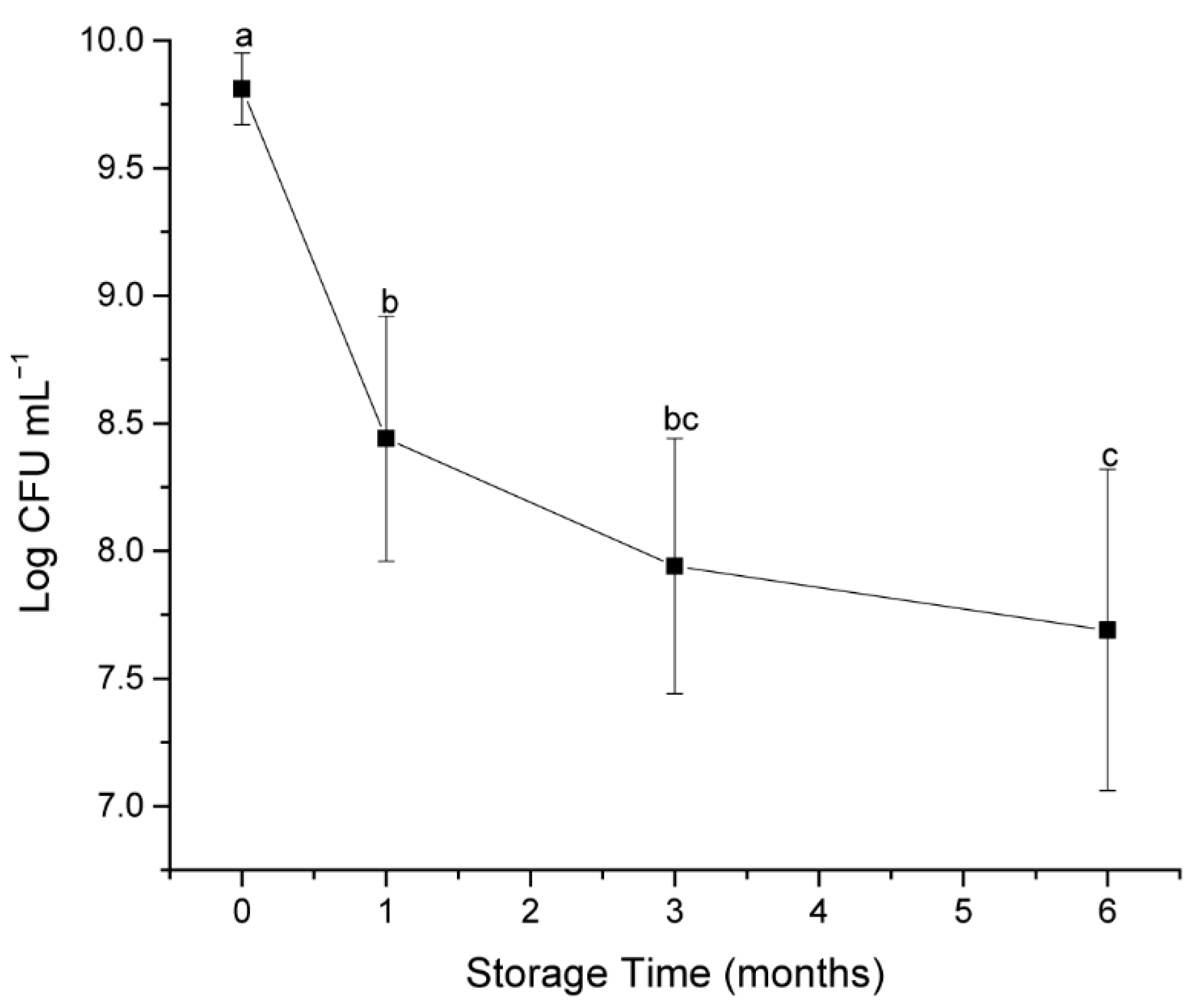
The microbial counts (Log CFU mL−1) were monitored over a 6-month storage period (Figure 1). At the initial time point (0 months), the microbial load was the highest, reaching values close to 10. After one month of storage, a marked reduction was observed, with counts decreasing to approximately 8.5. This initial drop represented the most pronounced decline in microbial population throughout the entire study. Subsequently, microbial counts continued to decrease gradually. At 3 months, values were around 8.0, and by the end of the storage period (6 months), the lowest count was recorded at approximately 7.7. Overall, the results showed a progressive decrease in microbial viability during storage.

3.2. Morphological Alterations in B. japonicum E109 Cells During Storage

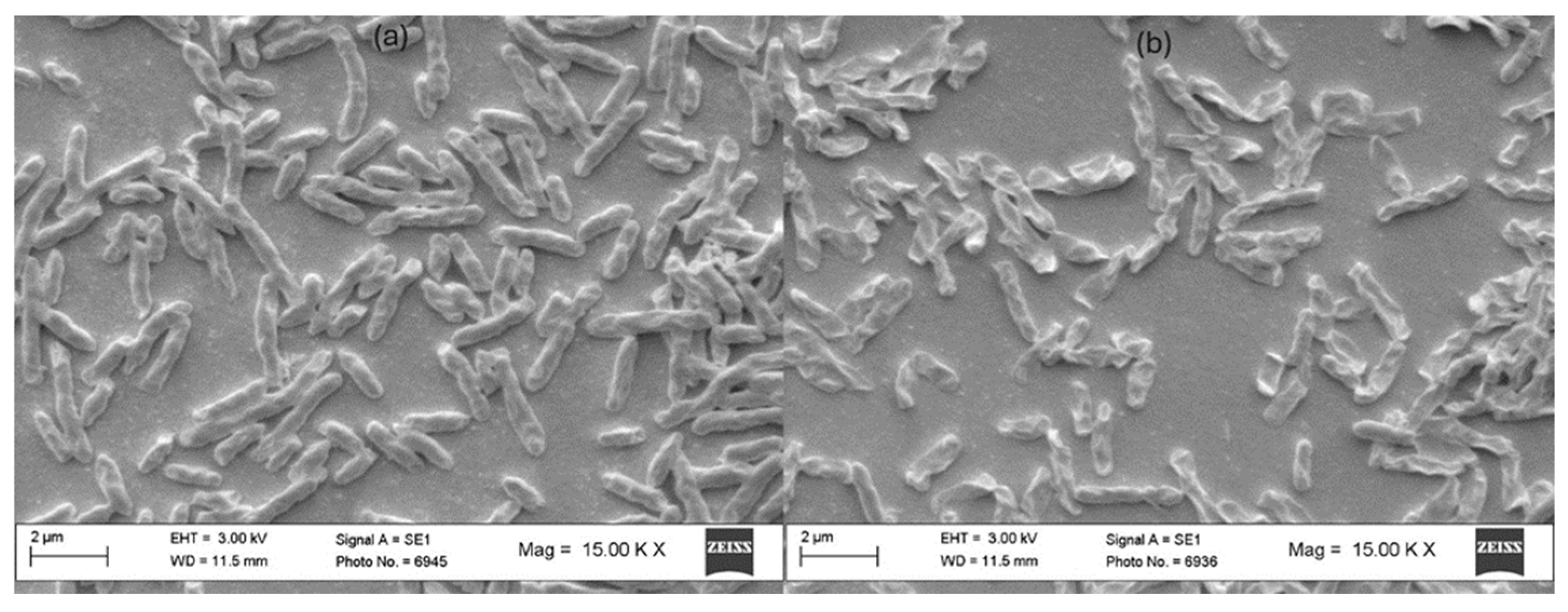
Scanning electron microscopy images revealed notable differences in the morphology of B. japonicum E109 depending on storage time (Figure 2). In the non-stored samples (Figure 2a), cells exhibited a regular morphology typical of Gram-negative bacteria, with a well-defined rod shape and clearly delineated edges. These features indicated a good structural condition, with no visible signs of stress or membrane damage.
In contrast, after one month of storage (Figure 2b), significant morphological changes were observed. Many cells appeared shortened, slightly collapsed, or irregularly contoured, with noticeable alterations in surface texture and loss of definition in the cell envelope.

3.3. Adaptive Shifts in Membrane Fatty Acid Composition Under Storage Conditions

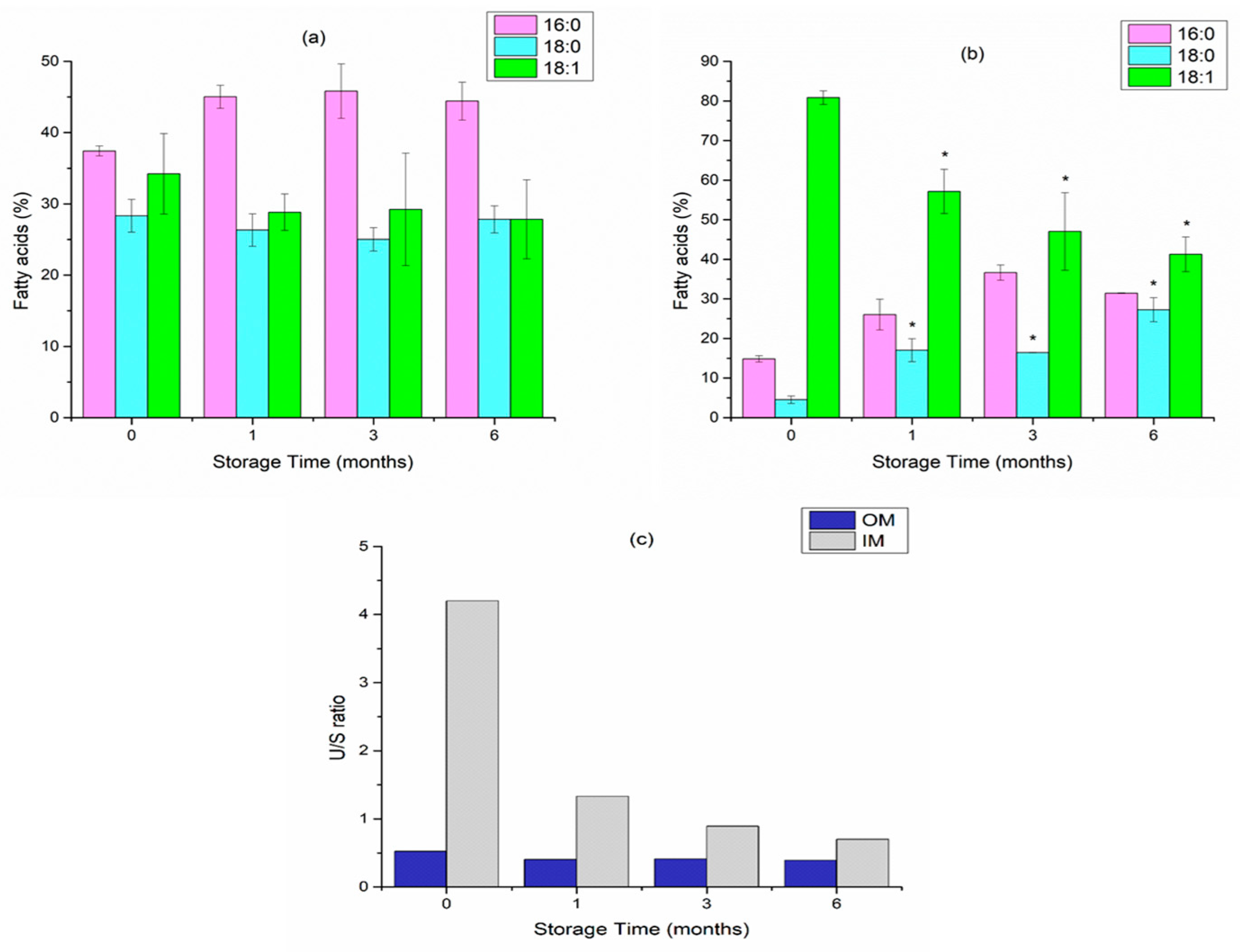
The FA composition of both the OM and IM of E109 was affected by storage time, as shown in Figure 3. In the OM (Figure 3a), 16:0 remained the predominant component throughout the entire period, showing an increase from the first month and maintaining relatively constant levels (35–45%). In contrast, 18:0 showed a slight decrease of approximately 7%, while 18:1 decreased by about 16%. These variations were not statistically significant.
Conversely, significant changes were observed in the IM (Figure 3b). The FA 18:1, initially the most abundant (80%), decreased progressively to 40% by the end of the storage period, representing a reduction of about 40%. Meanwhile, 16:0 increased from 10% to 30%, indicating a 110% rise. The most pronounced increase was observed for 18:0, which rose from 4% to 15–30%, corresponding to an approximate 300–400% increase. The U/S ratio was evaluated in both OM and IM fractions during storage (Figure 3c). At initial time (T0), the IM fraction exhibited a markedly higher U/S ratio, exceeding a value of 4, whereas the OM fraction showed a much lower ratio, close to 0.5. This initial difference suggests a greater degree of unsaturation in membrane-associated lipids at the beginning of storage. As storage progressed, a substantial reduction in the U/S ratio was observed in the IM fraction. After one month, the ratio had dropped to below 1.5 and continued to decline slightly at three and six months, stabilizing around 1. In contrast, the OM fraction maintained relatively low and stable U/S values throughout the storage period.

3.4. Biophysical Analysis of B. japonicum E109 Membranes During Storage

3.4.1. Dynamic Regulation of Membrane Fluidity

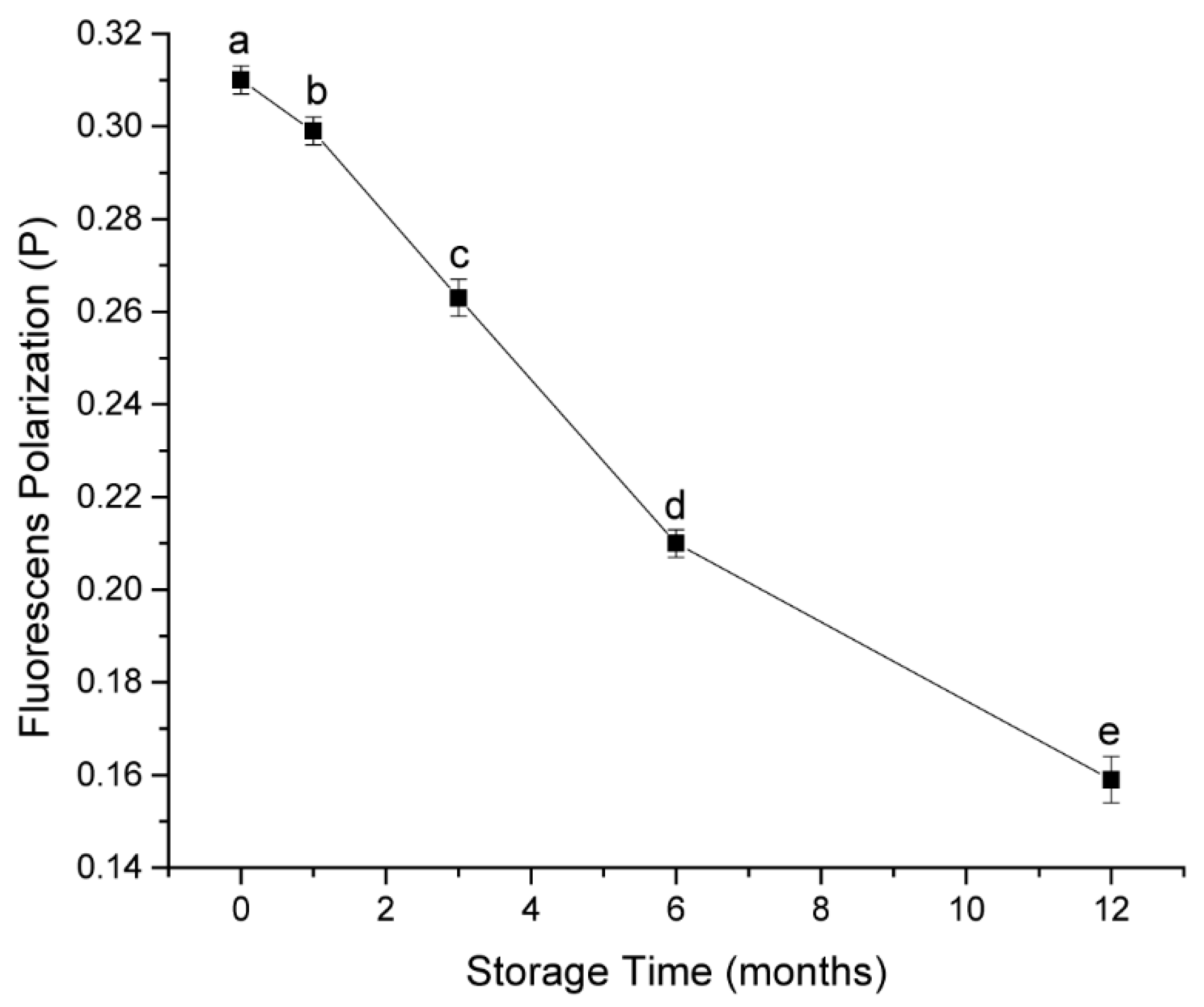
A progressive decrease in the P of the DPH probe was detected in whole cells of B. japonicum E109 during storage (Figure 4). The initial p value was approximately 0.31, decreasing to about 0.29 after three months (a reduction of roughly 7%), 0.22 after six months (around 29% decrease), and reaching a minimum value of about 0.15 after twelve months (a total reduction of nearly 52% compared to the initial value). This consistent downward trend indicates a continuous decrease in the P parameter over time, reflecting a progressive increase in membrane fluidity as storage advances.

3.4.2. Reorganization of Membrane Microenvironments

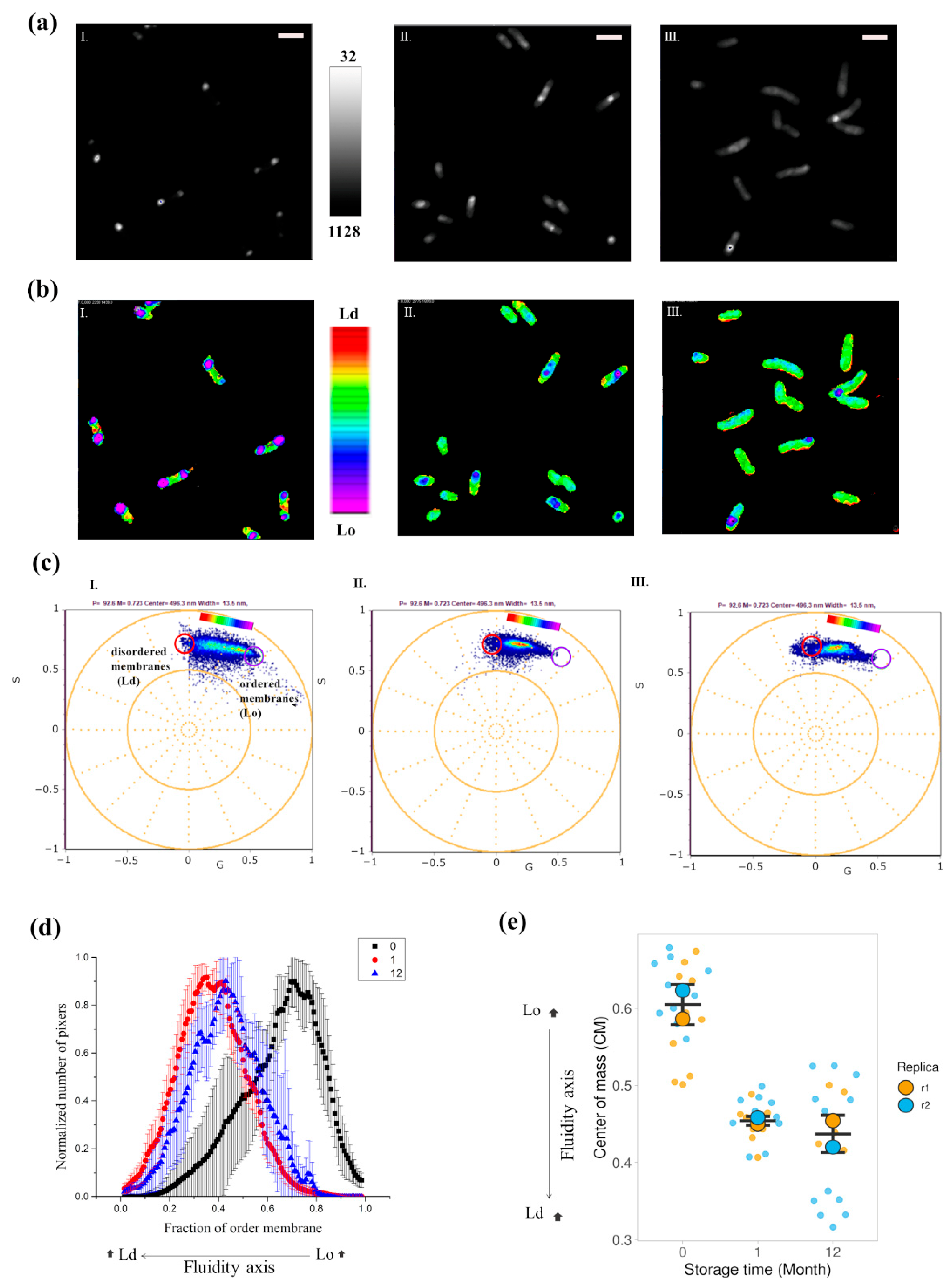
Figure 5a shows B. japonicum E109 cells at different storage stages stained with PRODAN.
Spectral phasor imaging of B. japonicum E109 cells stained with PRODAN revealed progressive reorganization of membrane microenvironments during storage (Figure 5b). The spectral color scale ranged from magenta/blue hues, corresponding to regions of lower fluidity and higher lipid order (Lo), to green/yellow hues, indicative of more fluid and less ordered areas (Ld). This representation allowed the visualization of changes in the organization of the bacterial membrane at the single-cell level. At the beginning of storage (Figure 5(aI)), cells displayed bright polar regions that, in the corresponding pseudocolour images (Figure 5(bI)), appeared as magenta tones that were predominantly localized at the cell poles, suggesting regions of reduced fluidity and higher lipid packing. This distribution likely represents the characteristic organization of the membrane in actively growing cultures.
After one month of storage (Figure 5(aII)), the fluorescence distribution changed markedly. The associated pseudocolour map (Figure 5(bII)), the previously polarized Lo domains shifted to green hues, consistent with a transition to Ld states and an overall increase in fluidity. At this stage, cells exhibited a predominance of green tones, suggesting early lipid bilayer remodeling as a response to storage-induced stress.
After twelve months (Figure 5(aIII)), cells exhibited a more diffuse and heterogeneous signal. In the pseudocolour image (Figure 5(bIII)) most cells displayed green to yellow signals across their membranes, reflecting a generalized transition toward Ld states and markedly higher fluidity. At this stage, the distinct Lo regions observed at the poles were no longer detectable, indicating a profound reorganization of lipid microenvironments during long-term storage.
Spectral phasor analysis of PRODAN-labeled samples revealed a progressive shift in the phasor coordinates over time (Figure 5c). At 0-day storage (panel I), the phasor cluster was located toward the lower phase, consistent with PRODAN emission in a more ordered and less hydrated membrane environment. After 1 month (panel II), the phasor distribution shifted toward higher phases, indicating a moderate increase in membrane fluidity. By 12 months (panel III), the cluster had moved toward its highest phase, the reference position (green circle), reflecting a pronounced decrease in the PRODAN spectral shift emission lifetime-equivalent coordinates associated with greater increased hydration and lipid disorder. This temporal evolution, reflected by pseudocolour maps shifting from magenta/blue tones in panel I toward predominantly green-like hues in panel III, indicates that the storage progressively induces higher membrane fluidity and polarity in the region probed by PRODAN, in agreement with the known sensitivity of this dye to changes in lipid packing at the carbonyl/glycerol interface of phospholipids.
To complement the qualitative observations, normalized histograms of pixel distribution along the membrane order fraction axis were generated for each storage condition (Figure 5d). The CM of these histograms was calculated to quantify the average spectral shift, providing a numerical descriptor of global changes in membrane organization and fluidity during storage (Figure 5e).
At initial time, the CM was significantly higher (0.67 ± 0.06), indicating a predominance of ordered spectral components and a more rigid membrane state.
In contrast, after 1 month of storage, the CM dropped sharply to 0.45 ± 0.03, while at 12 months an intermediate value of 0.42 ± 0.06 was observed. Both storage times exhibited CM values below 0.5, consistent with reduced membrane order and a fluidization process. These quantitative results reinforce the interpretation obtained from fluorescence anisotropy and spectral phasor imaging: storage induces a progressive fluidization of the B. japonicum E109 membrane, with the most rigid state observed in fresh cultures and increasing lipid disorder as storage time advances.

3.5. Correlation Between Biophysical Parameters and Bacterial Survival

To integrate the different datasets obtained in this study, a summary table (Table 1) was constructed to highlight the overall impact of storage on B. japonicum E109. The results consistently revealed that storage time negatively affected cell viability, with a gradual but significant reduction in CFU counts. Morphological observations confirmed this trend, as fresh cultures displayed well-defined rod-shaped cells, whereas prolonged storage led to irregularly contoured and partially collapsed cells, indicating progressive structural deterioration.
At the biochemical level, marked modifications in membrane FA composition were detected, particularly in the inner membrane, where the proportion of unsaturated FAs decreased drastically over time, resulting in a pronounced reduction in the U/S ratio. These compositional shifts were accompanied by functional changes in membrane biophysical properties, evidenced by fluorescence polarization assays that revealed an overall increase in membrane fluidity with storage.
Spectral phasor imaging further demonstrated a dynamic reorganization of membrane microenvironments, visualized through pseudocolour maps in which pixel classifications shifted from blue–magenta to green–yellow tones as storage progressed. These changes reflect differences in the local membrane environments sensed by the probe, specifically progressive increases in fluidity, hydration, and lipid disorder. Notably, low-fluidity regions were initially concentrated at the bacterial poles, but these microenvironments became less defined as storage advanced.
Together, these findings underline the close correlation between storage time and physiological as well as biophysical parameters of B. japonicum E109, emphasizing the destabilizing effect of prolonged storage on cell integrity and membrane organization.
An important finding of this work was the progressive enrichment of the inner membrane with 18:0 during storage. While fresh cultures exhibited only minor levels of 18:0, its proportion increased up to 300–400% after prolonged storage, at the expense of unsaturated FAs. This compositional remodeling suggests that B. japonicum E109 cells actively reinforce their inner membrane with saturated FAs as an adaptive response to storage-induced stress.
Building on this observation, we selected 18:0 supplementation as a rational strategy to improve storage conditions. By exogenously providing 18:0, we aimed to mimic and potentiate the natural adaptive trend of the bacterium, thereby enhancing membrane stability and preserving cellular integrity during long-term storage.

3.6. Enrichment of the Lipid Envelope of B. japonicum E109 with Exogenous Stearic Acid

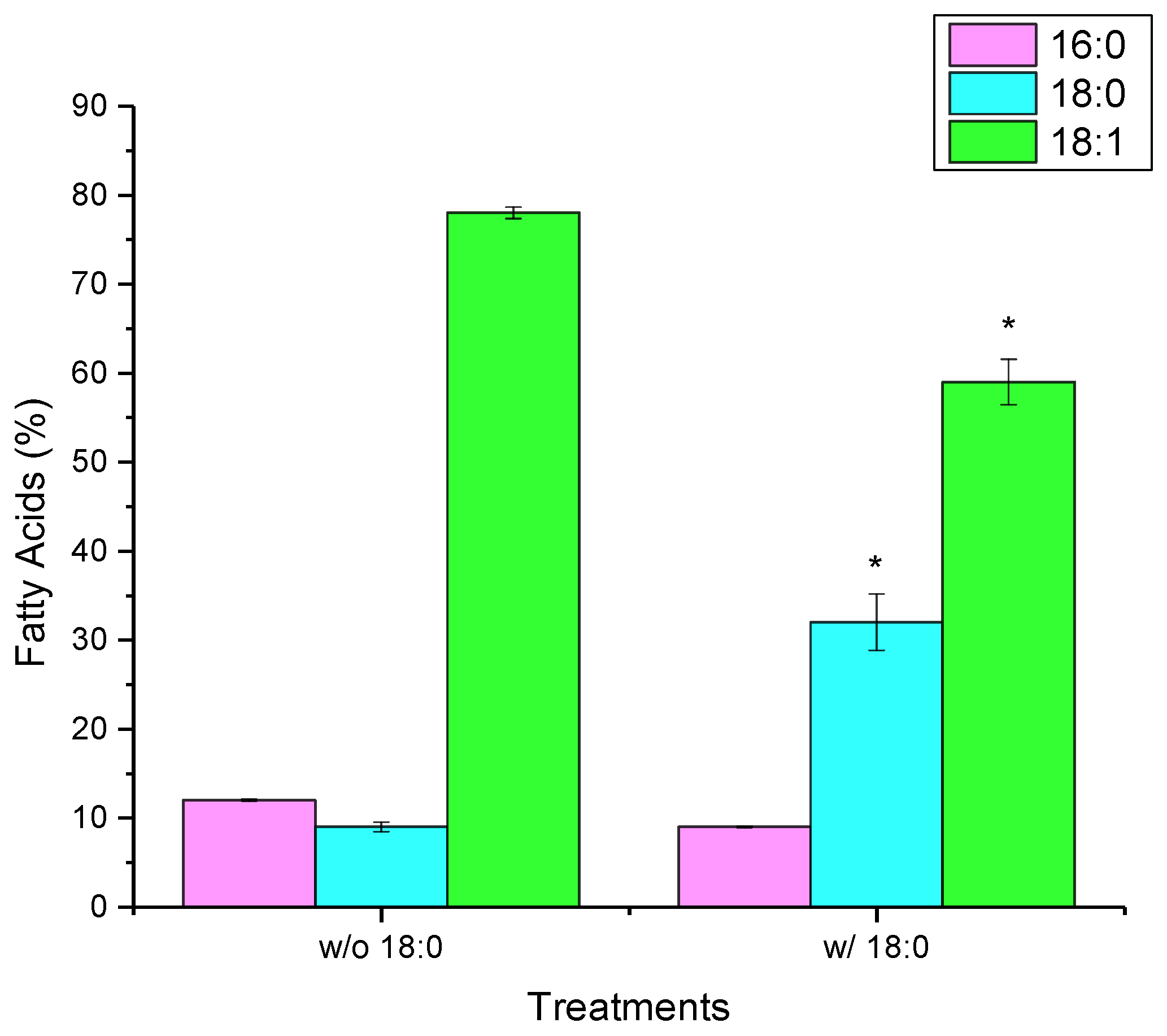
In order to evaluate whether B. japonicum E109 can incorporate exogenous 18:0 into its membrane and use it as a protective strategy against storage stress, a test was performed. In this assay, total lipids were extracted from bacteria cultured at 28 °C in the absence and in the presence of 18:0 (400 µM), until reaching the stationary phase. FAMEs were extracted from these lipid fractions and subsequently analyzed by gas chromatography to determine the FA profile. The results are expressed as a relative percentage of FA in whole cells (Figure 6).
In B. japonicum E109 cultures supplemented with 18:0, a significant increase of 215% in the 18:0 content was observed, indicating its effective incorporation into the bacterial membrane. In addition, a 33.3% decrease in 16:0 was observed compared to the control. Regarding unsaturated FAs, a slight presence of 16:1 was detected, whose percentage also decreased by 33.3% in the presence of exogenous 18:0. Finally, 18:1 FA showed a 30% reduction in cultures supplemented with 18:0 compared to the control.
These results show that B. japonicum E109 is capable of incorporating exogenous saturated 18:0 FA into its membrane. The enrichment of B. japonicum E109 membranes with 18:0 caused a general remodeling of the FA composition, resulting in a decrease in U/S in supplemented cultures (1.5) compared to the U/S index of cultures without the addition of exogenous FA (3.76).
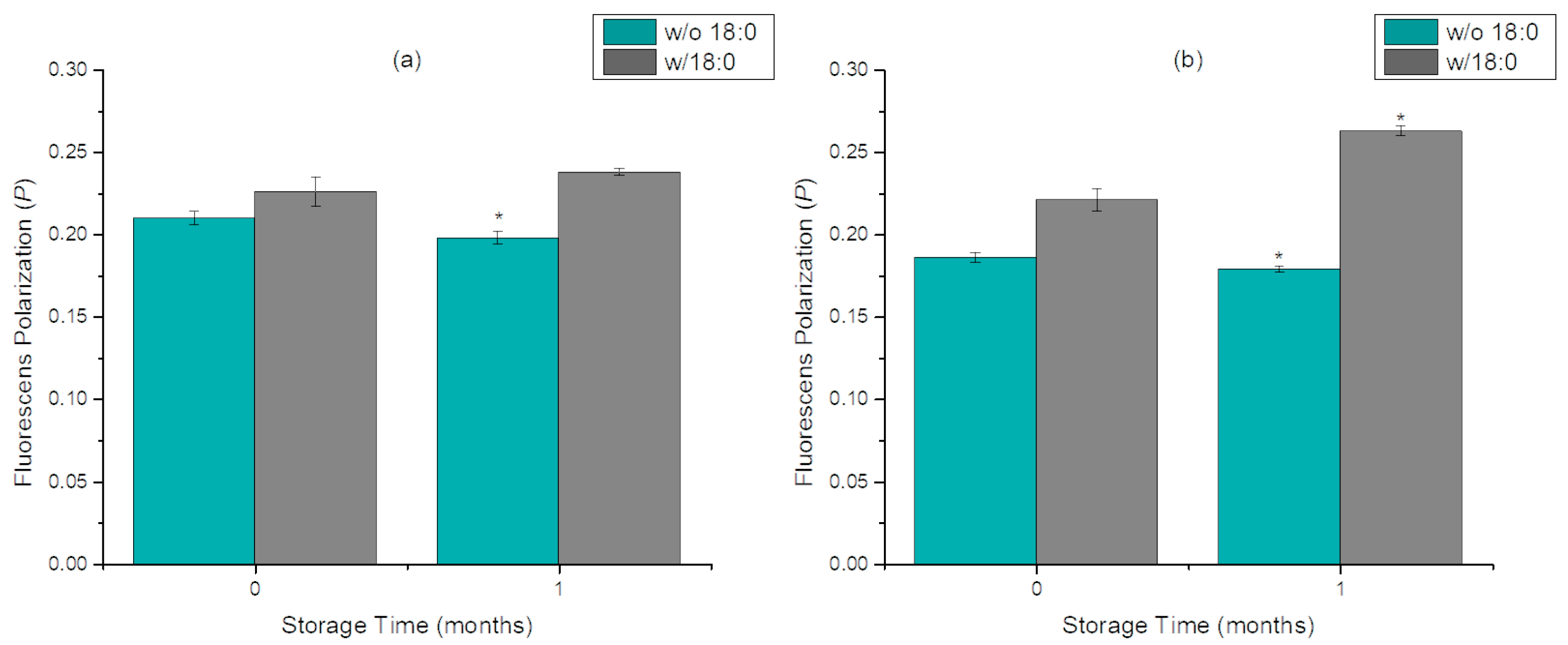
To evaluate whether membrane fluidity is modified by the incorporation of 18:0, the P behavior of the probes DPH and TMA-DPH was analyzed in whole B. japonicum E109 cells under two conditions: without 18:0 supplementation (w/o 18:0) and with 18:0 supplementation (w/18:0) (Figure 6).
Figure 7a shows the effect of exogenous 18:0 addition on the P of the probe TMA-DPH in B. japonicum E109 cells, as an indicator of order in the outer region of the membrane during one month of storage. At the beginning of storage (month 0), w/o 18:0 cells showed a lower p value (0.205 ± 0.004), indicating higher fluidity in the superficial membrane region. In contrast, w/18:0 cells exhibited higher p values (0.225 ± 0.008), reflecting an increase in membrane rigidity induced by the incorporation of the saturated FA. After one month of storage, this trend became more pronounced: P in w/o 18:0 cells decreased slightly (0.198 ± 0.004), suggesting that the membrane remains relatively fluid due to the storage effect, a result previously reported. However, in w/18:0 cells, P increased further (0.235–0.240 ± 0.002), indicating that the membrane became more rigid or structured in the presence of exogenous 18:0, recovering fluidity values comparable to non-stored controls.
Figure 7b represents the effect of exogenous 18:0 supplementation on the P of DPH in B. japonicum E109 cells during one month of storage. Since DPH partitions into the hydrophobic core of the membrane, an increase in P indicates greater rigidity or lower fluidity in this internal region of the lipid bilayer. At the beginning of storage (0 months), a clear difference was observed between the conditions. w/o 18:0 cells presented the lowest P value (0.185 ± 0.003), indicating greater fluidity in the inner membrane region. In contrast, w/18:0 cells showed significantly higher values (0.235–0.245 ± 0.007), demonstrating that exogenous 18:0 is effectively incorporated and reduces fluidity in the core of the lipid bilayer from the onset. After one month of storage, this difference became more pronounced. Polarization in w/o 18:0 cells remained low (0.175 ± 0.002), suggesting that their inner membrane remained fluid. However, in w/18:0 cells, P values increased further (0.26–0.27 ± 0.003), indicating marked rigidification of the hydrophobic region of the membrane. This effect is likely due to the combined contribution of endogenous 18:0 synthesis during storage and its exogenous incorporation.
Taken together, these results indicate, as shown throughout this study, that storage induces a general increase in B. japonicum E109 membrane fluidity, and that exogenous 18:0 supplementation counteracts this effect by inducing global membrane rigidification, both in the outer region and in the hydrophobic core.

3.7. Impact of Stearic Acid Addition on the Survival of B. japonicum E109 Under Different Storage Temperatures

The microbial counts (Log CFU mL−1) were evaluated at the initial time point and after one month of storage, under conditions with and without stearic acid supplementation (Table 2). At the initial time, cultures without 18:0 supplementation at 28 °C showed a viability of 9.54 ± 0.15 Log CFU mL−1, which dropped sharply to 6.78 ± 0.05 Log CFU mL−1 upon immediate exposure to 37 °C. In contrast, cultures grown in the presence of 18:0 displayed a slightly higher initial count (9.80 ± 0.07 Log CFU mL−1) and a more moderate decline when subjected to the same thermal stress (7.78 ± 0.04 Log CFU mL−1).
After one month of storage at 28 °C, the control condition (w/o 18:0) retained 8.02 ± 0.19 Log CFU mL−1, but viability decreased drastically to 3.78 ± 0.12 Log CFU mL−1 when followed by thermal shock. Conversely, cells supplemented with 18:0 maintained similar counts during storage (8.03 ± 0.06 Log CFU mL−1) and preserved viability after exposure to 37 °C (8.06 ± 0.14 Log CFU mL−1), indicating that exogenous stearic acid effectively prevented the loss of survival observed in the control.

4. Discussion

PGPR-based inoculants currently represent one of the most promising technologies to enhance crop yields in an environmentally friendly manner. These microbial formulations must withstand multiple stages of production, packaging, storage, transport, and ultimately seed inoculation in the field. Across all these steps, bacterial viability tends to decline, often reaching critical levels that compromise their functionality in the soil [27,28]. B. japonicum is a nitrogen-fixing bacterium used worldwide for soybean inoculation and is particularly relevant in Argentina, where liquid formulations in nutrient-rich media are commonly employed to ensure sufficient viable cells at the time of root emergence [13]. Despite these strategies, loss of viability during storage remains a major bottleneck for the inoculant industry, and designing approaches to mitigate this decline continues to be one of the greatest challenges in the field [29].
Traditionally, the protection of inoculants during storage has relied on the addition of protective agents, such as polymers, sugars, or osmoprotectants, which mitigate desiccation and oxidative damage and thereby extend shelf-life. More recently, strategies have expanded to include the induction of stress-adaptation mechanisms and the use of auxiliary strains that provide additional support. These approaches represent promising alternatives to enhance the survival of inoculants both in liquid formulations and on seeds [9]. Nevertheless, a largely unexplored dimension of microbial protection is the exploitation of natural adaptations that bacteria already possess to cope with suboptimal conditions that may arise during storage. Advancing this perspective requires a detailed understanding of the specific stresses imposed by storage and the corresponding bacterial responses at the physiological and molecular levels.
In PGPR-based inoculants, the effects of storage have been predominantly evaluated in terms of cell viability, while comparatively less attention has been paid to physiological and structural parameters. In this study, we show that storage stress affects B. japonicum E109 at multiple organizational levels, as evidenced not only by a decline in viability at 28 °C during the first month of storage but also by pronounced morphological alterations revealed by SEM. These structural changes suggest that storage induces damage to the bacterial envelope, which may compromise membrane integrity, increase permeability, and destabilize membrane-associated proteins, thereby impairing essential cellular functions beyond what can be captured by viability counts alone [30].
The temporal pattern of viability loss observed here is consistent with previous reports showing that desiccation and osmotic stress lead to a rapid decline in viable cells during the early stages of storage, followed by a stabilization phase thereafter (Deaker et al., 2012 [10]; Dubois-Brissonnet et al., 2016 [31]; Berninger et al., 2018 [9]). Notably, although viability decreased, cell counts in industrial culture medium remained within the limits established by current Argentine regulations for liquid inoculants (≥108 CFU mL−1) [32]. In parallel, the morphological alterations detected in our study closely resemble those reported by Cesari et al. (2018) [6], who showed that PEG-induced dehydration in Bradyrhizobium sp. SEMIA6144 rapidly triggered pronounced surface damage. Together, these converging observations identify the first month of storage as a critical window in which both cellular viability and envelope stability are most severely challenged in bacterial inoculants.
The cytoplasmic membrane is a highly dynamic structure that plays a pivotal role in bacterial adaptation to environmental stress. Its architecture must remain functionally stable to ensure vital processes such as nutrient transport, energy conservation, and signal transduction [33]. In this context, membrane fluidity represents a central indicator of cellular homeostasis, as even subtle changes can profoundly alter biophysical properties. The ratio of saturated to unsaturated FAs is particularly critical in determining lipid packing, fluidity, and permeability [34]. Homeoviscous adaptation is a universal mechanism that cells employ to maintain membrane fluidity within an optimal range in response to modifying the degree of FA unsaturation and functional integrity of the membrane [34,35]. Environmental perturbations such as temperature shifts, pH fluctuations, or osmotic stress are known to trigger this remodeling, enabling bacteria to maintain fluidity within a physiologically functional limit [36].
In our study, the biophysical state of the membrane was evaluated by complementary methods, including fluorescence anisotropy with DPH, TMA-DPH probes and spectral phasor analysis of PRODAN-stained cells using confocal microscopy. All approaches consistently revealed a strong fluidizing effect of storage on the B. japonicum E109 lipid bilayer. These results indicate that, under storage conditions, B. japonicum E109 is unable to maintain fluidity within an optimal range. Excessive membrane fluidization represents a critical threat to bacterial survival, as it disrupts the delicate balance required for optimal membrane function. An overly fluid membrane can lead to proton leakage, dissipation of the proton motive force, and dysfunction of integral membrane proteins involved in transport and signal transduction. Under storage conditions, where metabolic activity is already constrained, the inability to maintain membrane fluidity within a functional range may exacerbate cellular stress, ultimately accelerating viability loss [37].
Despite the lack of effective fluidity control, B. japonicum E109 exhibited pronounced changes in FA composition of the cytoplasmic membrane. After one and six months of storage, we detected a significant enrichment in saturated FAs (16:0 and 18:0) accompanied by a reduction in 18:1, which resulted in a markedly decreased U/S ratio relative to the control. Such remodeling is consistent with known mechanisms of homeoviscous adaptation [7], as increased saturated FAs generally promote reduced membrane fluidity. However, under our experimental conditions, this endogenous response was insufficient to counteract the overall fluidizing effect of storage, underscoring a limitation in the adaptive capacity of B. japonicum E109. One possible explanation is that, under storage conditions, metabolic activity and lipid biosynthesis are markedly reduced, limiting the bacterium’s capacity to rapidly adjust membrane composition.
Interestingly, lipid remodeling has been described in other bacterial systems as a central mechanism of stress tolerance. For example, cold adaptation typically involves an increase in unsaturated FAs to preserve fluidity, whereas exposure to high temperature or other destabilizing stresses favors the accumulation of saturated FAs [11,26]. In this broader context, targeted manipulation of membrane lipid composition emerges as a promising strategy to enhance bacterial robustness during long-term storage.
Although under the conditions tested the increase in saturated FAs did not fully restore membrane fluidity, this mechanism is widely recognized as a central strategy of bacterial adaptation to adverse environments [33]. Modulation of the degree of FA unsaturation constitutes a universal process to safeguard the structural integrity of the lipid bilayer [34,35]. In Bradyrhizobium sp. SEMIA6144, for example, adjustment of the U/S ratio was identified as the primary adaptive response to variations in salinity and temperature [7,38]. Similarly, in B. japonicum exposed to desiccation, an increase in saturated FAs concomitant with a decrease in unsaturated ones was reported [39,40]. Furthermore, under storage conditions with limited water availability, a marked reduction in the U/S ratio was observed [41], a pattern also described under osmotic stress by [6].
The use of protective agents naturally employed by bacteria has been widely explored as a strategy to preserve viability in inoculants [9,10]. However, the enrichment or remodeling of FA composition has received far less attention, despite its potential as an agrobiotechnological strategy. Remodeling the lipid composition of bacterial membranes can be induced either through changes in culture conditions, such as temperature shifts, or by the exogenous supplementation of FAs during growth. Several bacteria have been shown to incorporate exogenous FAs into their phospholipid biosynthesis pathways, thereby modifying lipid packing and altering membrane fluidity [31,38]. In Escherichia coli, long-chain fatty acids are imported via the membrane channel FadL and activated by the long-chain fatty acid-CoA ligase enzyme FadD. A fraction of the acyl-CoA pool is then catabolized into acetyl-CoA by the FA degradation pathway, while acyl-CoA of appropriate length is incorporated into phospholipids by the glycerol-3-phosphate acyl transferase PlsB and the lysophosphatidic acid acyl transferase PlsC [42]. Within this framework, supplementation with stearic acid represents a novel approach for bacterial inoculants, as its incorporation into the lipid bilayer increases the proportion of saturated FAs and enhances membrane rigidity, effectively counteracting the fluidizing effects of long-term storage.
The exogenous supplementation of FAs as a membrane-stabilizing strategy has been investigated in diverse contexts, although it has never been applied to agricultural inoculants. In food microbiology, Listeria monocytogenes has served as a model to demonstrate that the incorporation of exogenous FAs, including 18:0, confers resistance to freeze–thaw cycles by preserving membrane integrity and cell viability [11,26]. In medical bacteriology, Staphylococcus aureus employs the FakA pathway to integrate exogenous FAs and modulate membrane fluidity, thereby enhancing tolerance to stress conditions [43]. In Escherichia coli, a model organism, lipid remodeling has been documented as essential for resistance to environmental fluctuations [44,45]. Within the food industry, Lactiplantibacillus plantarum has been shown to benefit from oleic acid supplementation, which increased survival rates up to 6.6-fold during freeze-drying by maintaining membrane integrity and enzymatic activity [46]. Likewise, Enterococcus faecalis incorporates exogenous lipids to alter its phospholipid composition and improve resistance against membrane-destabilizing compounds [47], while in industrial biotechnology, supplementation of Corynebacterium glutamicum with linoleic and palmitic acids effectively mitigated resveratrol-induced toxicity, restoring membrane fluidity and cellular viability [48].
Our results demonstrate that B. japonicum E109 is capable of remodeling its membrane composition through exogenous supplementation of stearic acid. When grown at 28 °C in the presence of 18:0, B. japonicum E109 incorporated the FA into its membrane, resulting in a higher proportion of 18:0 and a concomitant reduction in 18:1, which significantly lowered the U/S ratio. This remodeling occurred under optimal growth conditions, without the need for temperature shifts or other stressful treatments that could compromise cell viability, underscoring the feasibility of this approach as a biotechnological tool.
Moreover, biophysical analyses confirmed that cells grown with 18:0 supplementation displayed higher p values (DPH and TMA-DPH), indicating increased membrane rigidity compared to controls. Importantly, this modification provided B. japonicum E109 with a lipid composition resembling that observed after one month of storage, effectively preconditioning the cells to withstand subsequent stress.
Through this remodeling strategy, we achieved that B. japonicum E109, from the onset of storage, displayed a membrane composition resembling that naturally observed after more than one month of storage, thereby preconditioning the bacterium with a membrane already adapted to the stresses imposed by storage. This advantage was clearly reflected in the viability assays. At the initial time, 18:0 supplementation resulted in bacterial counts comparable to the control, although with a less pronounced decline upon immediate exposure to 37 °C (2 Log reduction with 18:0 versus 3 Log in the control). After one month of storage at 28 °C, both treatments retained values close to 8 Log CFU/mL; however, when storage was combined with thermal stress, the differences became more evident: non-supplemented cells exhibited a drastic reduction (4 Log), whereas those grown with 18:0 preserved populations close to 8 Log CFU mL−1, equivalent to pre-shock levels. These findings indicate that 18:0 supplementation not only counteracted the fluidizing effect of storage but also provided the strain with significantly enhanced tolerance to thermal stress, ensuring the preservation of viability under adverse conditions. The enhanced tolerance to thermal stress observed in 18:0-supplemented cells further supports the central role of membrane rigidity in stress resistance. A more rigid membrane is less susceptible to temperature-induced disorder, which helps preserve protein–lipid interactions and maintain the functionality of membrane-bound systems during sudden thermal fluctuations [37].
These results are consistent with findings in other microorganisms where exogenous FA supplementation modulates membrane properties and improves survival under stress conditions. For instance, in Lactiplantibacillus plantarum, the addition of oleic acid increased survival rates up to 6.6-fold during freeze-drying by preserving membrane integrity and enzymatic activity [46]. Likewise, in Gram-negative bacteria exposed to hydrocarbons, enrichment in saturated or cyclopropane FAs rigidified the membrane and allowed maintenance of viability [49]. In Listeria monocytogenes, the incorporation of exogenous FAs into membrane phospholipids was shown to modulate its cold adaptation response. Complementarily, a recent review by Min et al. (2020) [50] emphasized that lipid remodeling toward an increased proportion of saturated and long-chain FAs constitutes a universal adaptive pattern in microorganisms exposed to elevated temperatures, directly correlating with enhanced survival under thermal stress. Together, these studies reinforce the concept that lipid remodeling induced by protective molecules, such as 18:0 in our study, represents an effective strategy for the preservation of bacterial inoculants.
From an industrial perspective, the applicability of FA supplementation depends not only on its biological effectiveness but also on its scalability and economic feasibility. In this study, 18:0 was supplied at a relatively low concentration (400 µM), which is well within the range of additives commonly handled in large-scale microbial fermentations. Importantly, supplementation was performed during biomass production, requiring only a controlled dosing step and no additional downstream processing, making it fully compatible with current industrial inoculant manufacturing workflows.
Regarding the source and formulation of 18:0 is an inexpensive, chemically stable saturated FA that can be obtained from renewable vegetable sources widely available in the oleochemical industry [51]. From a cost–benefit standpoint, the low material cost associated with 18:0 supplementation is offset by the significant improvement in membrane stability, thermal tolerance, and maintenance of viable cell counts above regulatory thresholds during storage. In this sense, lipid supplementation represents a complementary strategy to conventional protectants, acting through physiological membrane adaptation rather than solely through physical protection, and thereby offering a rational and potentially cost-effective approach to extend inoculant shelf life.
By promoting a “storage-adapted” membrane state from the onset, we were able to counteract the fluidizing effects of storage and better preserve bacterial functionality. Taken together, our findings reveal that although B. japonicum E109 naturally remodels its membrane during storage, this response is insufficient to prevent fluidity loss and viability decline. However, targeted supplementation with 18:0 enhances membrane rigidity and stability, representing a novel strategy to improve inoculant shelf life. This approach, grounded in the exploitation of bacterial natural adaptation mechanisms, could be combined with traditional protective agents to develop next-generation formulations that are more resilient and reliable for agricultural applications.

Limitations

This study was conducted under controlled laboratory storage conditions, which may not fully represent the complex and variable environments encountered during field application and on-farm handling of inoculants. In addition, only one lipid-based stabilization strategy (exogenous stearic acid supplementation) was evaluated, without direct comparison to other formulation approaches, and although membrane lipid remodeling and fluidity changes were correlated with improved viability, the underlying molecular mechanisms were not fully elucidated. Finally, the ecological and agronomic performance of the modified formulation was not assessed under real agricultural conditions, which should be addressed in future field-scale studies.

5. Conclusions

This study demonstrates that liquid storage of B. japonicum E109 critically compromises both viability and structural stability, inducing morphological alterations and a pronounced fluidizing effect on the cytoplasmic membrane. The bacterium’s endogenous response, characterized by an increase in saturated FAs and a decrease in unsaturated species, was insufficient to restore optimal fluidity or preserve cellular functionality during storage. In contrast, exogenous supplementation with 18:0 induced a “pre-adapted” membrane state, defined by a higher proportion of saturated FAs, a reduced U/S ratio, and increased membrane rigidity from the onset of storage. This condition translated into greater structural stability and marked tolerance to heat shock, with viable counts remaining stable and comparable to pre-stress levels.
These findings highlight lipid remodeling as an effective strategy to counteract the detrimental effects of storage, preserving both viability and functionality of bacterial inoculants. By transferring a microbial adaptation mechanism previously described in food microbiology, biomedical, and industrial contexts into the agricultural domain, this work provides an innovative agrobiotechnological perspective. Within this framework, supplementation with 18:0 emerges as a promising tool for the development of more stable, resilient, and reliable inoculant formulations, capable of maintaining performance during storage and ensuring efficacy under field conditions. Future research should address the sustainable procurement of 18:0 from natural or residual feedstocks, thereby aligning the development of inoculant formulations with circular economy principles and promoting the valorization of agro-industrial by-products. In parallel, the Bradyrhizobium–soybean symbiotic interaction will be evaluated to determine whether exogenous membrane modification induced by stearic acid supplementation alters nodulation capacity, N2 fixation efficiency, or plant growth promotion.

Author Contributions

L.N.-M.: Methodology, formal analysis, data curation, writing—original draft preparation, writing—review and editing. A.B.C.: Formal analysis, writing—review and editing. E.R.: Contributed to the fluorescence anisotropy methodology and analyses. M.D.: Methodology, formal analysis, data curation; contributed specifically to the hyperspectral microscopy analyses. L.M.: Conceptualization, resources, data curation, writing—review and editing; contributed specifically to the hyperspectral microscopy analyses. M.S.D.: Methodology, formal analysis, data curation, writing—review and editing. N.S.P.: Conceptualization, methodology, validation, formal analysis, resources, data curation, writing—original draft preparation, writing—review and editing. All authors have read and agreed to the published version of the manuscript.

Funding

This study was financially supported by PICT (Grant No. 4162/18 and 696/21), PIP CONICET (Grant No. 11220210100155CO) and PPI Universidad Nacional de Río Cuarto (Grant No. C530-1). ABC, MSD and NSP are members of the Research Career of CONICET Argentina. LNM is Ph.D. student of CONICET, Argentina. The section “Analysis of the biophysical state of B. japonicum E109 membranes through hyperspectral imaging and phasor plot approach” received additional support from the project “Expanding Access to Advanced Bioimaging Technology in Latin America” supported by the Chan-Zuckerberg Initiative.

Data Availability Statement

The raw data supporting the conclusions of this article will be made available by the authors on reasonable request.

Acknowledgments

N.S.P., M.S.D., A.B.C. and E.R. are members of the Research Career of CONICET, Argentina; L.N.-M. was supported by a fellowship from the National Agency for the Promotion of Research, Technological Development and Innovation, Argentina and is currently a fellow of CONICET-Argentina. L.M. and M.D. are members of Advanced Bioimaging Unit, Institut Pasteur de Montevideo and Universidad de la República, Montevideo, Uruguay. The authors acknowledge the support provided by the project “Expanding Access to Advanced Bioimaging Technology in Latin America”, funded by the ChanZuckerberg Initiative, which enabled part of the bioimaging studies conducted in this work. The authors thank CERES DEMETER (Río Cuarto, Córdoba, Argentina) for providing the culture medium used in this study.

Conflicts of Interest

The authors declare no conflicts of interest.

References

  1. Di Mauro, G.; Andrade, J.F.; Rotili, D.H.; Álvarez Prado, S. Transformations in Argentinean Soybean Systems: Recent Changes, Challenges, and Opportunities. Crop Environ. 2025, 4, 130–141. [Google Scholar] [CrossRef]
  2. Hu, M.; Hei, R.; Guo, D.; Luo, J.; Lu, C.; Xu, W.; Zhang, Z.; Xiao, Q.; Ma, Y. Shelf-Life Enhancement of Bio-Inoculants through Synergistic Effects of Encapsulation Technology and Osmotic Protectants. J. Environ. Chem. Eng. 2023, 11, 110996. [Google Scholar] [CrossRef]
  3. Vezza, M.E.; Pramparo, R.d.P.; Wevar Oller, A.L.; Agostini, E.; Talano, M.E. Promising Co-Inoculation Strategies to Reduce Arsenic Toxicity in Soybean. Environ. Sci. Pollut. Res. 2022, 29, 88066–88077. [Google Scholar] [CrossRef]
  4. Leggett, M.; Diaz-Zorita, M.; Koivunen, M.; Bowman, R.; Pesek, R.; Stevenson, C.; Leister, T. Soybean Response to Inoculation with Bradyrhizobium japonicum in the United States and Argentina. Agron. J. 2017, 109, 1031–1038. [Google Scholar] [CrossRef]
  5. Díaz-Rodríguez, A.M.; Parra Cota, F.I.; Cira Chávez, L.A.; García Ortega, L.F.; Estrada Alvarado, M.I.; Santoyo, G.; De los Santos-Villalobos, S. Microbial Inoculants in Sustainable Agriculture: Advancements, Challenges, and Future Directions. Plants 2025, 14, 191. [Google Scholar] [CrossRef] [PubMed]
  6. Cesari, A.; Paulucci, N.; Biasutti, A.; Morales, G.; Dardanelli, M.S. Changes in the Lipid Composition of Bradyrhizobium Cell Envelope Reveal a Rapid Response to Water Deficit Involving Lysophosphatidylethanolamine Synthesis. Res. Microbiol. 2018, 169, 303–312. [Google Scholar] [CrossRef]
  7. Paulucci, N.S.; Cesari, A.B.; Biasutti, M.A.; Dardanelli, M.S.; Perillo, M.A. Membrane Homeoviscous Adaptation in Sinorhizobium Submitted to a Stressful Thermal Cycle Contributes to the Maintenance of the Symbiotic Plant–Bacteria Interaction. Front. Microbiol. 2021, 12, 652477. [Google Scholar] [CrossRef]
  8. Albanesi, D.; Arabolaza, A.; Gramajo, H.; De Mendoza, D. Homeostatic Control of Membrane Lipid Biosynthesis in Bacteria. In Lipid Signaling and Metabolism; Ntambi, J.M., Ed.; Academic Press: Cambridge, MA, USA, 2020; pp. 1–22. [Google Scholar] [CrossRef]
  9. Berninger, T.; González López, Ó.; Bejarano, A.; Preininger, C.; Sessitsch, A. Maintenance and Assessment of Cell Viability in Formulation of Non-Sporulating Bacterial Inoculants. Microb. Biotechnol. 2018, 11, 277–301. [Google Scholar] [CrossRef]
  10. Deaker, R.; Hartley, E.; Gemell, G. Conditions Affecting Shelf-Life of Inoculated Legume Seed. Agriculture 2012, 2, 38–51. [Google Scholar] [CrossRef]
  11. Flegler, A.; Iswara, J.; Mänz, A.T.; Schocke, F.S.; Faßbender, W.A.; Hölzl, G.; Lipski, A. Exogenous Fatty Acids Affect Membrane Properties and Cold Adaptation of Listeria monocytogenes. Sci. Rep. 2022, 12, 1499. [Google Scholar] [CrossRef] [PubMed]
  12. Qiao, F.; Li, J.; Duan, Z.; Yang, F.; Xuan, S.; Ding, W.; Liu, M.; Zhang, Z.; Liu, T.; Zhang, L.; et al. Remodelling membrane lipid composition through exogenous supplementation of stearic acid improves the survival rate of spray-dried Bifidobacterium animalis. Food Res. Int. 2025, 221, 117223. [Google Scholar] [CrossRef]
  13. Torres, D.; Revale, S.; Obando, M.; Maroniche, G.; Paris, G.; Perticari, A.; Vázquez, M.; Wisniewski-Dyé, F.; Martínez-Abarca, F.; Cassán, F. Genome Sequence of Bradyrhizobium japonicum E109, One of the Most Agronomically Used Nitrogen-Fixing Rhizobacteria in Argentina. Genome Announc. 2015, 3, e01566-14. [Google Scholar] [CrossRef]
  14. Somasegaran, P.; Hoben, H.J. Handbook for Rhizobia; Springer: New York, NY, USA, 1994. [Google Scholar]
  15. Da Silva, R. Técnica de Microgota para Contagem de Células Bacterianas Viáveis em uma Suspensão; Universidade Federal de Viçosa: Viçosa, Brazil, 1996; pp. 1–7. [Google Scholar]
  16. Bligh, E.; Dyer, W. A Rapid Method of Total Lipid Extraction and Purification. Can. J. Biochem. Physiol. 1959, 37, 911–917. [Google Scholar] [CrossRef] [PubMed]
  17. Morrison, W.R.; Smith, L.M. Preparation of Fatty Acid Methyl Esters and Dimethylacetals from Lipids with Boron Fluoride–Methanol. J. Lipid Res. 1964, 5, 600–608. [Google Scholar] [CrossRef]
  18. Mykytczuk, N.C.; Trevors, J.T.; Leduc, L.G.; Ferroni, G.D. Fluorescence Polarization in Studies of Bacterial Cytoplasmic Membrane Fluidity under Environmental Stress. Prog. Biophys. Mol. Biol. 2007, 95, 60–82. [Google Scholar] [CrossRef]
  19. Litman, B.J.; Barenholz, Y. Fluorescent Probe Diphenylhexatriene. Methods Enzymol. 1982, 81, 678–685. [Google Scholar] [CrossRef]
  20. Lakowicz, J.R. Principles of Fluorescence Spectroscopy, 2nd ed.; Kluwer Academic: New York, NY, USA, 1999. [Google Scholar]
  21. Díaz, M.; Zolessi, F.R.; Malacrida, L. Spectral Phasor Plot for Hyperspectral Imaging of Acridine Orange Photophysics within the Cell. bioRxiv 2023. [Google Scholar] [CrossRef]
  22. Díaz, M.; Robello, C.; Cabrera, A.; Malacrida, L. Modulation of Host Cell Membrane Biophysics Dynamics by Neospora caninum: A Study Using LAURDAN Fluorescence with Hyperspectral Imaging and Phasor Analysis. J. Microsc. 2025. early view. [Google Scholar] [CrossRef] [PubMed]
  23. Malacrida, L.; Gratton, E.; Jameson, D.M. Model-Free Methods to Study Membrane Environmental Probes: Comparison of the Spectral Phasor and Generalized Polarization Approaches. Methods Appl. Fluoresc. 2015, 3, 047001. [Google Scholar] [CrossRef] [PubMed]
  24. Malacrida, L.; Ranjit, S.; Jameson, D.M.; Gratton, E. The Phasor Plot: A Universal Circle to Advance Fluorescence Lifetime Analysis and Interpretation. Annu. Rev. Biophys. 2021, 50, 575–593. [Google Scholar] [CrossRef]
  25. Otaiza-González, S.; Cabadas, M.; Robert, G.; Stock, R.P.; Malacrida, L.; Lascano, R.; Bagatolli, L.A. The Innards of the Cell: Studies of Water Dipolar Relaxation Using the ACDAN Fluorescent Probe. Methods Appl. Fluoresc. 2022, 10, 044010. [Google Scholar] [CrossRef]
  26. Touche, C.; Hamchaoui, S.; Quilleré, A.; Darsonval, M.; Dubois-Brissonnet, F. Growth of Listeria monocytogenes Is Promoted at Low Temperature When Exogenous Unsaturated Fatty Acids Are Incorporated in Its Membrane. Food Microbiol. 2023, 110, 104170. [Google Scholar] [CrossRef]
  27. Fadiji, A.E.; Xiong, C.; Egidi, E.; Singh, B.K. Formulation Challenges Associated with Microbial Biofertilizers in Sustainable Agriculture and Paths Forward. J. Sustain. Agric. Environ. 2024, 3, e70006. [Google Scholar] [CrossRef]
  28. He, S.; Li, L.; Lv, M.; Wang, R.; Wang, L.; Yu, S.; Gao, Z.; Li, X. PGPR: Key to Enhancing Crop Productivity and Achieving Sustainable Agriculture. Curr. Microbiol. 2024, 81, 377. [Google Scholar] [CrossRef]
  29. Araújo, R.S.; Silva, G.C.; Teixeira, I.R.; Silva, G.R.; Souza, B.M.F.; Devilla, I.A.; Araújo, M.E.V.; Corrêa, P.C. Effect of Pesticides and a Long-Life Inoculant on Nodulation Process and Soybean Seed Quality during Storage. Agronomy 2023, 13, 2322. [Google Scholar] [CrossRef]
  30. Reguera, Y.B.; Cesari, A.B.; Biasutti, M.A.; Dardanelli, M.S.; Paulucci, N.S. Membrane adaptation of Ochrobactrum intermedium under salt stress enables growth promotion in peanut plants. J. Appl. Microbiol. 2025, 136, lxaf227. [Google Scholar] [CrossRef] [PubMed]
  31. Dubois-Brissonnet, F.; Trotier, E.; Briandet, R. The Biofilm Lifestyle Involves an Increase in Bacterial Membrane Saturated Fatty Acids. Front. Microbiol. 2016, 7, 1673. [Google Scholar] [CrossRef] [PubMed]
  32. Resolution 1004/2023; Standards for the Registration of Agricultural Bioinputs. Official Gazette of the Argentine Republic: Buenos Aires, Argentina, 2023.
  33. Silhavy, T.J.; Kahne, D.; Walker, S. The Bacterial Cell Envelope. Cold Spring Harb. Perspect. Biol. 2010, 2, a000414. [Google Scholar] [CrossRef] [PubMed]
  34. De Mendoza, D.; Pilon, M. Control of Membrane Lipid Homeostasis by Lipid-Bilayer Associated Sensors: A Mechanism Conserved from Bacteria to Humans. Prog. Lipid Res. 2019, 76, 100996. [Google Scholar] [CrossRef]
  35. Lande, M.B.; Donovan, J.M.; Zeidel, M.L. Relationship between Membrane Fluidity and Permeabilities to Water, Solutes, Ammonia, and Protons. J. Gen. Physiol. 1995, 106, 67–84. [Google Scholar] [CrossRef]
  36. Lee, T.H.; Charchar, P.; Separovic, F.; Reid, G.E.; Yarovsky, I.; Aguilar, M.I. The Intricate Link between Membrane Lipid Structure and Composition and Membrane Structural Properties in Bacterial Membranes. Chem. Sci. 2024, 15, 3408–3427. [Google Scholar] [CrossRef]
  37. Yoon, Y.; Lee, H.; Lee, S.; Kim, S.; Choi, K. Membrane fluidity-related adaptive response mechanisms of foodborne bacterial pathogens under environmental stresses. Food Res. Int. 2015, 72, 25–36. [Google Scholar] [CrossRef]
  38. Paulucci, N.S.; Medeot, D.B.; Dardanelli, M.S.; De Lema, M.G. Growth Temperature and Salinity Impact Fatty Acid Composition in Peanut Nodulating Rhizobia. Lipids 2011, 46, 435–444. [Google Scholar] [CrossRef] [PubMed]
  39. Tighe, S.W.; De Lajudie, P.; DiPietro, K.; Lindström, K.; Nick, G.; Jarvis, B.D. Analysis of Cellular Fatty Acids and Phenotypic Relationships of Agrobacterium, Bradyrhizobium, Mesorhizobium, Rhizobium, and Sinorhizobium Species Using the Sherlock Microbial Identification System. Int. J. Syst. Evol. Microbiol. 2000, 50, 787–801. [Google Scholar] [CrossRef] [PubMed]
  40. Boumahdi, M.; Mary, P.; Hornez, J. Changes in Fatty Acid Composition and Degree of Unsaturation of (Brady) Rhizobia as a Response to Phases of Growth, Reduced Water Activities and Mild Desiccation. Antonie Leeuwenhoek 2001, 79, 73–79. [Google Scholar] [CrossRef]
  41. Graham, P.H.; Sadowsky, M.J.; Tighe, S.W.; Thompson, J.A.; Date, R.A.; Howieson, J.G.; Thomas, R. Differences among Strains of Bradyrhizobium in Fatty Acid-Methyl Ester Analysis. Can. J. Microbiol. 1995, 41, 1064–1068. [Google Scholar] [CrossRef]
  42. van den Berg, S.P.H.; Zoumaro-Djayoon, A.; Yang, F.; Bokinsky, G. Exogenous fatty acids inhibit fatty acid synthesis by competing with endogenously generated substrates for phospholipid synthesis in Escherichia coli. FEBS Lett. 2025, 599, 667–681. [Google Scholar] [CrossRef] [PubMed]
  43. De Mars, Z.; Singh, V.K.; Bose, J.L. Exogenous Fatty Acids Remodel Staphylococcus aureus Lipid Composition through Fatty Acid Kinase. J. Bacteriol. 2020, 202, e00128-20. [Google Scholar] [CrossRef]
  44. Rowlett, V.W.; Mallampalli, V.K.P.S.; Karlstaedt, A.; Dowhan, W.; Taegtmeyer, H.; Margolin, W.; Vitrac, H. Impact of membrane phospholipid alterations in Escherichia coli on cellular function and bacterial stress adaptation. J. Bacteriol. 2017, 199, e00849-16. [Google Scholar] [CrossRef]
  45. Yao, J.; Rock, C. Exogenous fatty acid metabolism in bacteria. Biochimie 2017, 141, 30–39. [Google Scholar] [CrossRef]
  46. Wang, G.; Pu, J.; Dong, C.; Zheng, X.; Guo, B.; Xia, Y.; Ai, L. Effect of Oleic Acid on the Viability of Different Freeze-Dried Lactiplantibacillus plantarum Strains. J. Dairy Sci. 2021, 104, 11457–11465. [Google Scholar] [CrossRef] [PubMed]
  47. Saito, H.E.; Harp, J.R.; Fozo, E.M. Enterococcus faecalis Responds to Individual Exogenous Fatty Acids Independently of Their Degree of Saturation or Chain Length. Appl. Environ. Microbiol. 2017, 84, e01633-17. [Google Scholar] [CrossRef] [PubMed]
  48. Tharmasothirajan, A.; Melcr, J.; Linney, J.; Gensch, T.; Krumbach, K.; Ernst, K.M.; Brasnett, C.; Poggi, P.; Pitt, A.R.; Goddard, A.D.; et al. Membrane manipulation by free fatty acids improves microbial plant polyphenol synthesis. Nat. Commun. 2023, 14, 5619. [Google Scholar] [CrossRef]
  49. Ortega, Á.; Segura, A.; Bernal, P.; Pini, C.; Daniels, C.; Ramos, J.L.; Matilla, M.A. Membrane Composition and Modifications in Response to Aromatic Hydrocarbons in Gram-Negative Bacteria. In Cellular Ecophysiology of Microbe: Hydrocarbon and Lipid Interactions; Springer: Berlin/Heidelberg, Germany, 2018; pp. 373–384. [Google Scholar] [CrossRef]
  50. Min, B.; Kim, K.; Li, V.; Cho, S.; Kim, H. Changes in Cell Membrane Fatty Acid Composition of Streptococcus thermophilus in Response to Gradually Increasing Heat Temperature. J. Microbiol. Biotechnol. 2020, 30, 739. [Google Scholar] [CrossRef] [PubMed]
  51. Karmakar, G.; Ghosh, P.; Kohli, K.; Sharma, B.K.; Erhan, S.Z. Chemicals from Vegetable Oils, Fatty Derivatives, and Plant Biomass. In Innovative Uses of Agricultural Products and Byproducts; Tunick, M.H., Liu, L., Eds.; ACS Symposium Series; American Chemical Society: Washington, DC, USA, 2020; Volume 1347, Chapter 1, pp. 1–31. [Google Scholar] [CrossRef]
Figure 1. Effect of storage time on the viability of B. japonicum E109. E109 was grown in IMC at 28 °C until stationary phase and subsequently aliquoted into 100 mL fractions, which were stored in the dark at 28 °C. Viability was assessed at different time points using the microdrop plate count method and expressed as Log CFU mL−1. Data are expressed as mean ± standard deviation (n = 3). Different letters indicate statistically significant differences between groups (p < 0.05).
Agronomy 16 00159 g001
Figure 2. Scanning electron micrographs of B. japonicum E109 cells before and after storage. (a) Cells from a fresh culture and (b) Cells after 1 month of storage in liquid medium. Images acquired using SEM at 15,000× magnification with an accelerating voltage of 3.00 kV. Scale bar = 2 µm.
Agronomy 16 00159 g002
Figure 3. Fatty acid composition of the outer membrane (OM) (a) and inner membrane (IM) (b) of B. japonicum E109 as a function of storage time. The relative abundance of palmitic acid (16:0), stearic acid (18:0) and cis-vaccenic acid (18:1) was analyzed at different storage intervals by gas chromatography coupled with mass spectrometry. U/S (ratio between the sum of unsaturated fatty acids and the sum of saturated fatty acids) was calculated for each membrane over the storage period (c). Data are expressed as mean ± standard deviation (n = 3). * Indicate statistically significant differences with respect to control (T0) (p < 0.05).
Agronomy 16 00159 g003
Figure 4. Changes in fluorescence polarization (P) of the DPH probe in whole cells of B. japonicum E109 during storage. Cells from different storage stages were diluted in 15 mM Tris-HCl buffer (pH 7) to an OD620 of 0.2. DPH was added at a final concentration of 16 µM, and fluorescence polarization was measured at 28 °C as described in the Section 2. Data are expressed as mean ± standard deviation (n = 3). Different letters indicate statistically significant differences between groups (p < 0.05).
Agronomy 16 00159 g004
Figure 5. Membrane fluidity of B. japonicum E109 during storage assessed by spectral phasor analysis of PRODAN. (a) Representative greyscale images of cells incubated with the polarity-sensitive probe PRODAN at different storage times: (I), fresh culture; (II), 1 month; (III), 12 months. The intensity scale (right) shows the photon counts per pixel. The white scale bar (upper-right corner) corresponds to 2 µm. (b) Pseudocolour images corresponding to the same conditions shown in (a): (I), fresh culture; (II), 1 month; (III), 12 months. Colors report the local membrane environment derived from the spectral phasor analysis: magenta/blue indicate more ordered (Lo-like) regions, whereas green/yellow indicate more disordered (Ld-like) regions. (c) Spectral phasor plots of corresponding images showing the distribution of fluorescence signals in the phasor space. Red and purple cursors delimit the trajectory used to quantify Lo and Ld membrane components. (d) Normalized histograms showing the distribution of pixels along the membrane order fraction axis. The shift in the histograms toward lower 0.5 values indicates a progressive decrease in membrane order with storage time. (e) Boxplots with Quantitative analysis of center of mass (CM) values from phasor plots (mean ± SD, n = 2). Higher CM values (close to G = 1) indicate more ordered and rigid membrane states, whereas lower CM values (<0.5) reflect increased fluidity and lipid disorder.
Agronomy 16 00159 g005
Figure 6. Effect of 18:0 supplementation on the fatty acid composition of B. japonicum E109. Cells were grown at 28 °C in IMC until stationary phase with exogenous addition of stearic acid (400 µM) (w/18:0). Control cultures were grown without exogenous fatty acid supplementation (w/o 18:0). Total lipids were extracted and converted to FAMEs, which were analyzed by gas chromatography. Fatty acids are expressed as a percentage of the total. Data are expressed as mean ± standard deviation (n = 3). * Indicates statistically significant differences (p < 0.05).
Agronomy 16 00159 g006
Figure 7. Effect of 18:0 supplementation on fluorescence polarization of TMA-DPH (a) and DPH (b) in B. japonicum E109 membranes during one month of storage. (a) Fluorescence polarization of TMA-DPH. (b) Fluorescence polarization of DPH. Cells from different storage stages were diluted in 15 mM Tris-HCl buffer (pH 7) to an OD620 of 0.2. TMA-DPH and DPH were added at a final concentration of 8 µM and 16 µM respectively, and fluorescence polarization was measured at 28 °C as described in the Section 2. Data are expressed as mean ± standard deviation (n = 3). * Indicates statistically significant differences compared with the initial condition (p < 0.05).
Agronomy 16 00159 g007
Table 1. Integrated Overview of storage effects on viability, morphology, fatty acid composition, and membrane properties of B. japonicum E109.
Parameter AnalyzedInitial State (T0)Intermediate Storage (≈1 Month)Prolonged Storage (≥6–12 Months)Key Observations
Viability
(Figure 1)
High, no significant lossModerate reduction in Log CFU mL−1Marked decrease in Log CFU mL−1Progressive viability decline
Morphology
(Figure 2)
Regular rod shape, well-defined edgesShortened, irregularly contoured cells with envelope alterationsIncreased collapse and surface damageSEM shows progressive structural deterioration
Fatty Acid composition
(Figure 3)
OM: 16:0 dominant (~35–40%); IM: 18:1 predominant (~80%). U/S high in IM (>4)IM: 18:1 decreases, 16:0 and 18:0 increase. U/S drops to <1.5IM: 18:1 reduced to ~40%, 16:0 + 18:0 elevated U/S ~1Stronger changes in IM, suggesting partial rigidification
Membrane fluidity (DPH polarization)
(Figure 4)
High polarization (lower fluidity)Slight decrease in DPH polarization; tendency toward higher fluidityDecrease in DPH polarization at 6 monthsOverall increase in membrane fluidity during storage
Lipid Microenvironments (Spectral phasor PRODAN)
(Figure 5)
Blue–magenta tones, lower fluidity; magenta regions mainly at cell polesShift toward green tones: increased fluidity and heterogeneityGreen–yellow tones: higher fluidity, increased hydration and lipid disorderPhasor analysis confirms progressive membrane reorganization
Table 2. Effect of exogenous stearic acid supplementation on the viability (Log CFU mL−1) of B. japonicum E109 after one month of storage at different temperatures.
TreatmentsStorage Time (Months) + Temperature (°C)
0 + 280 + 371 + 281 + 37
w/o 18:09.54 ± 0.156.78 ± 0.058.02 ± 0.19 *3.78 ± 0.12 *
w/18:09.80 ± 0.077.78 ± 0.048.03 ± 0.06 *8.06 ± 0.14 *
Cells were cultured at 28 °C in IMC medium until reaching the stationary phase, either supplemented with 400 µM stearic acid (w/18:0) or without supplementation (w/o 18:0, control). Non-stored and one-month-stored cultures were subsequently exposed to 37 °C for 48 h. Cell viability was determined and expressed as Log CFU mL−1. Values represent the mean ± standard deviation (n = 3). * Indicates statistically significant differences compared with the initial condition (p < 0.05).
Disclaimer/Publisher’s Note: The statements, opinions and data contained in all publications are solely those of the individual author(s) and contributor(s) and not of MDPI and/or the editor(s). MDPI and/or the editor(s) disclaim responsibility for any injury to people or property resulting from any ideas, methods, instructions or products referred to in the content.