Article

In Vivo Control of Botrytis cinerea in Grapevine Using Essential Oil from Sweet Basil Cultivated Under Ozonated Water Irrigation


Department of Agriculture, Food and Environment, University of Pisa, Via del Borghetto 80, 56124 Pisa, Italy
*
Author to whom correspondence should be addressed.
Agronomy 2026, 16(18), 1859; https://doi.org/10.3390/agronomy16181859
Submission received: 20 August 2026 / Revised: 18 September 2026 / Accepted: 19 September 2026 / Published: 21 September 2026

Abstract

This study evaluated the efficacy of basil essential oil (BEO), extracted from basil plants irrigated with ozonated water, as a sustainable strategy to control grey mould (Botrytis cinerea, Bc) in grapevine, Vitis vinifera cv. Sangiovese. Bunches were treated with water (control) or BEO and, after Bc inoculation, disease progression (AUDPC), berry biometric traits and biochemical parameters were assessed. Treatment with BEO significantly reduced disease severity, lowering AUDPC values at 168 h post inoculation compared with untreated infected grapes, while limiting visible mycelial emergence. Anthocyanins and total phenols decreased following infection (−36 and −38%, respectively, in comparison to the control). By contrast, BEO-treated and infected grapes showed a more than 2-fold increase in resveratrol and condensed tannins, suggesting the activation of defence-related secondary metabolism. Lastly, glucose and fructose contents declined by 56% only in untreated infected berries, confirming active pathogen colonisation. These findings demonstrate that BEO significantly reduced grey mould development with enhanced defence-related metabolic responses, supporting its potential as an eco-friendly alternative to synthetic fungicides in sustainable viticulture.

1. Introduction

Grey mould caused by Botrytis cinerea (Pers.; hereafter Bc) is one of the most important diseases affecting grapevine worldwide, causing severe yield and quality losses under favourable environmental conditions [1,2,3]. Although its management still relies mainly on synthetic fungicides, their extensive use has raised increasing concerns regarding environmental contamination, fungicide residues, and the emergence of resistant Bc populations [4,5]. Consequently, the development of sustainable alternative or complementary disease management strategies has become a major priority, particularly within Integrated Pest Management and organic viticulture systems [6,7,8,9].
Among them, plant-based pesticides such as plant extracts and essential oils (EOs) have received increasing attention as ecofriendly alternatives for plant disease management because of their broad-spectrum antimicrobial activity and favourable environmental profile [10]. Essential oils generally degrade into non-toxic compounds and pose a low risk to non-target organisms [11,12]. Although some challenges still limit their widespread commercial adoption (such as poor stability and relatively high production costs), EOs remain highly promising tools for sustainable crop protection [13,14,15,16,17,18]. Currently, only a few EO-based products have been commercialised for the control of Bc, such as Milsana®, derived from giant knotweed [Reynoutria sachalinensis (F. Schmidt) Nakai], and Timorex Gold®, based on tea tree [Melaleuca alternifolia (Maiden & Betche) Cheel] extracts [4].
Recent evidence indicates that agronomic practices, including nutrient management, environmental conditions, and the application of biotic or abiotic elicitors, can significantly influence the biosynthesis of secondary metabolites in aromatic plants, leading to changes in EO yield and chemical composition [19,20]. These compositional variations may, in turn, affect the biological properties of the extracted EOs, notably their antimicrobial and/or antifungal activities. Among these practices, the use of ozonated water (OW) has emerged as an innovative and environmentally friendly approach [21]. Particularly, due to the high instability of dissolved ozone, OW rapidly decomposes into molecular oxygen without leaving harmful residues, therefore representing a residue-free treatment compatible with sustainable agricultural practices [22]. Moreover, OW has been reported to improve irrigation water quality, reduce microbial contamination during both pre- and postharvest stages, and induce physiological responses in plants associated with oxidative stress adaptation and secondary metabolite production [23,24,25,26,27,28,29]. Beyond its sanitising activity, OW may act as an abiotic elicitor by triggering oxidative signalling pathways involved in plant defence responses. Such responses frequently include the accumulation of defence-related secondary metabolites, including phytoalexins, which contribute to enhanced resistance against pathogen infection. In grapevine, resveratrol and its derivatives represent the major stilbene phytoalexins synthesised in response to biotic and abiotic stresses, and their induction has been associated with increased tolerance to fungal diseases [30]. Such responses have attracted increasing interest within sustainable crop protection strategies because they may enhance plant resilience while reducing dependence on synthetic pesticides.
Consequently, OW may enhance plant performance while also modifying both the qualitative and quantitative composition of EOs, potentially affecting their bioactivity. Nevertheless, the effects of preharvest OW irrigation on the chemical profile and biological activity of EOs remain largely unexplored, particularly with respect to their antifungal efficacy and their potential application in sustainable disease management strategies.
In Scimone et al. [31], it was demonstrated that OW irrigation of Ocimum basilicum L., one of the most widely cultivated aromatic plants worldwide, markedly enhanced basil EO (BEO) production, increasing its yield by approximately nine-fold while affecting only a limited number of volatile constituents (i.e., 4-terpineol, bornyl acetate, 1,10-di-epi-cubenol). Despite these minor compositional changes, BEO extracted from OW-irrigated plants exhibited substantially greater in vitro antifungal activity against Bc, reducing mycelial growth. These findings suggested that OW irrigation could represent a promising agronomic strategy to improve the biological efficacy of basil EO, although the mechanisms underlying this enhanced antifungal activity remained unresolved and its effectiveness was demonstrated only under in vitro conditions. Furthermore, the successful application of EO-based treatments in crop protection requires not only effective disease control but also the preservation of fruit quality traits. To date, no information is currently available on the potential effects of treatments based on BEO extracted from OW-treated plants on the primary and secondary metabolite profiles of grape berries. Since sugars, organic acids, phenolic compounds, and defence-related metabolites (such as the stilbene phytoalexin resveratrol) are key determinants of grape quality and responses to stress [32], assessing the impact of BEO treatments on these parameters is essential.
Accordingly, the objectives of this study were to evaluate the efficacy of BEO extracted from OW-irrigated basil plants in controlling experimentally induced Bc development on grape berries and to investigate the effects of this treatment on the metabolic composition of grapes, with particular emphasis on sugars, organic acids, and selected secondary metabolites involved in grape quality and defence responses, including total anthocyanins, total phenols, condensed tannins and the phytoalexin resveratrol. Based on the previously reported in vitro antifungal activity of this BEO preparation [31], we hypothesised that BEO obtained from plants subjected to OW irrigation would reduce Bc development in vivo under controlled conditions, while preserving and/or enhancing grape berry quality through the preservation of primary metabolites and modulating defence-related secondary metabolites, thereby supporting its potential application as a sustainable preharvest treatment for disease management in grapevine. The present study was not designed to determine whether OW irrigation enhances the antifungal activity of BEO, as no BEO obtained from conventionally irrigated basil was included as a comparative treatment. Rather, the study was designed to evaluate the antifungal efficacy and metabolic effects of a BEO preparation obtained from OW-irrigated basil under controlled grapevine conditions and when applied preharvest.

2. Materials and Methods

2.1. Plant Material, Basil Essential Oil Treatment and Fungal Inoculation

In July 2023, 20 four-year-old plants of Vitis vinifera cv. Sangiovese, clone F9-A5-48, rootstock 110R, purchased from a local nursery, were acclimatised in a phytotron facility under controlled conditions (25 ± 5 °C, 80 ± 10% of relative humidity, and 12 h photoperiod). Plants were grown in 10 L circular plastic pots containing standard potting medium (Spezial substrat Hawita professional, Hawita Gruppe, Vechta, Germany) and randomly divided into two experimental groups (n = 10 plants per treatment). One group was treated by spraying bunches with BEO extracted from plants irrigated with OW at a concentration of 400 µL L−1 (v/v) diluted in 50 mL of sterile water and 0.1% Tween 20 (v/v) [33]. Tween 20 was used as a solubilising/emulsifying agent, as commonly adopted in studies investigating the antifungal activity of EOs. The BEO used in the present study was obtained by hydrodistillation, with a yield of 0.28% (w/w), and was mainly characterised by eugenol (41.3%), T-cadinol (14.6%), linalool (11.6%), and trans-α-bergamotene (10.0%), which were the major constituents of the oil. The BEO was stored at 4 ± 1 °C for one month prior to use. More details regarding BEO extraction and characterisation are reported in Scimone et al. [31]. Control plants were sprayed with sterile water and 0.1% Tween 20 (v/v). Both treatments were applied by spraying until uniform coverage of the bunch surface was achieved (i.e., until runoff).
Following treatment, five plants per treatment were placed in each of four plexiglass boxes and maintained under the same controlled environmental conditions described above. The four boxes were located within the same phytotron facility, where environmental conditions were uniformly controlled, and air was directly supplied to the boxes to ensure comparable environmental conditions. Box position was not specifically randomised, one week after treatment, the bunches were inoculated with Bc or mock-inoculated as described below. Thus, the experiment comprised four treatment combinations: grapevines treated at the bunch level with (i) water and Tween 20 (control), (ii) BEO, (iii) water and Tween 20 and inoculated with Bc (Bc), and (iv) BEO and inoculated with Bc (BEO + Bc), with five plants per treatment combination. A Bc strain (8335) from the fungal collection of the Department of Agriculture, Food and Environment (DAFE, University of Pisa, Pisa, Italy) was grown on potato dextrose agar (42 g L−1; BioLife, Milan, Italy) supplemented with streptomycin sulphate (0.1 g L−1) in Petri dishes (Ø 9 cm) and incubated at 23 °C with a 12/12 h photoperiod for 7 days. Liquid cultures of Bc were prepared by scratching conidia from Petri dishes into Erlenmeyer flasks (0.25 L) containing sterile sucrose and yeast extract solution (2 and 0.05%, w/v, respectively). Conidial concentration was determined using a Bürker hemocytometer chamber(Henneberg-Sander, Giessen Lützellinden, Germany) and adjusted to 105 spores mL−1. Within each experimental treatment, bunches selected for inoculation were sprayed with the Bc spore suspension (one bunch per plant), whereas the corresponding non-inoculated bunches were mock-inoculated with sterile sucrose and yeast extract solution [34]. All bunches were previously pierced with a sterile needle (Æ 2 mm; at 10 randomly selected sites) to ensure the development of disease. After 7 days from the inoculation (corresponding to the harvest maturity; 22 ± 2 °Brix), the selected bunches were collected. For each experimental treatment, bunches collected from the corresponding plants were used for fresh analyses, with peel, pulp, and seeds collected separately and analysed in three biological replicates per treatment, while the remaining bunches were pooled within each treatment, lyophilised and stored until biochemical analyses. For the biochemical analyses, four technical replicates were performed on the pooled material for each treatment.

2.2. Disease Severity Assessment and Disease Progress

Disease severity was calculated at 0, 24, 48, 72, 96, and 168 h post inoculum (hpi) using a 0–4 ordinal scale based on the percentage of infected berry surface: 0 = no symptoms; 1 = 1–33%; 2 = 34–66%; 3 = 67–98%; 4 = 99–100%. Disease progression was quantified by calculating the Area Under the Disease Progress Curve (AUDPC) according to Simko and Piepho [35]:
A U D P C =   i = 1 n 1 y i + y i + 1 2 ( t i + 1 t i )
where yi represents disease severity at the i-th observation, ti is time (in days) at the i-th observation, and n is the total number of observations.

2.3. Berry Dry Matter Determination

Fresh berries were manually separated into peels, pulps, and seeds. Samples were weighed to determine fresh weight (FW), dried at 80 °C for 3 weeks, and weighed again to determine dry weight (DW). Dry matter percentage was calculated as follows:
D M = ( D W ) ( F W )   ×   100

2.4. Total Anthocyanins, Total Phenols, Condensed Tannins and Resveratrol Content

Lyophilised berries (50 mg) were extracted in 1 mL of methanol acidified with 1% HCl (v/v), left overnight at 4 °C, and centrifuged at 12,000 g for 15 min at 4 °C, and the supernatants were collected and used for the analysis total anthocyanins, total phenols and condensed tannins.
Total anthocyanins were determined according to Solovchenko et al. [36] by directly reading their absorbance at 535 (A535) and 700 (A700) nm using a spectrophotometer (Victor3 1420 Multilabel Counter, Perkin Elmer Inc., Waltham, MA, USA). The final absorbance (A) of samples was calculated as follows:
A = ( A 535 0.3   A 700   ×   15 ) 5
Total phenols were determined by using the colorimetric method reported in Dewanto et al. [37], with minor modifications. Methanol extracts (0.025 mL) were mixed with 1.225 mL of deionised water and 0.125 mL of Folin–Ciocalteu’s phenol reagent and incubated in the dark for 7–8 min at room temperature. Subsequently, 0.625 mL of sodium carbonate (7% in water, v/v) and 0.5 mL of deionised water were added. After vortexing, the samples were placed in the dark for 2 h and the absorbance was measured at 760 nm by the spectrophotometer reported above. A calibration curve was prepared using a standard solution of gallic acid (range 0–1 mg mL−1). Total phenols are expressed as mg of gallic acid equivalents (GAEs) g−1 lyophilised weight (LW).
Condensed tannins were determined by the vanillin method, with some modification, according to Tonelli et al. [38]. A total of 0.2 mL of supernatants was added to 0.50 mL of vanillic reagent [4% vanillin in methanol (v/v)] and 0.05 mL of acidified methanol. The absorbance was read at 500 nm by the spectrophotometer reported above. The corrected absorbances were converted to catechin equivalents from a standard curve (range 0–1 mg mL−1). Condensed tannins are expressed as mg of catechin equivalents (CEs) g−1 LW.
Resveratrol was determined according to Li et al. [39], with minor modifications. Lyophilised berries (100 mg) were added to 1.5 mL of 80% methanol, sonicated for 10 min using an ultrasonic cleaner, vortexed for 2 h and then centrifuged at 15,000 g for 20 min at 4 °C. The supernatants were filtered and evaporated at 35 °C under a vacuum. The residues were re-suspended with 40 µL of ethyl acetate. The extract was injected into an Agilent 8890B gas chromatograph–mass spectrometer equipped with an Agilent DB-5MS (UI) capillary column (30 m × 0.25 mm; coating thickness 0.25 μm) (Agilent Technologies Inc., SantaClara, CA, USA). The analytical conditions were as follows: the carrier gas was helium with a flow rate of 1 mL min−1; the injector and the transfer line were set at 250 °C. The temperature program was as follows: the initial column temperature was set at 120 °C for 2 min, increasing to 300 °C at 10 °C min−1 for 10 min. The source and quadrupole temperatures were set at 230 and 150 °C, respectively. The mass data were collected in the electron impact mode at 70 eV with a scan range of 40–350 m/z, and the quantification was performed in the selected-ion monitoring mode at m/z 228 amu by using MassHunter Workstation (version 10.0, Agilent Technologies Inc., SantaClara, CA, USA). The retention time for trans-resveratrol was approximately 12.60 min. The calibration curve was constructed using HPLC-grade trans-resveratrol standards. The LOD for trans-resveratrol was approximately 2 ng, while the LOQ was approximately 4 ng.

2.5. Soluble Carbohydrates and Organic Acids

Soluble carbohydrates and organic acids were determined according to the protocols of Pellegrini et al. [40] and Eyéghé–Bickong et al. [41], with minor modifications. Lyophilised V. vinifera berries (50 mg of dried berries) were extracted in 1 mL of HPLC-grade water in a water bath at 60 °C for 60 min. After centrifugation, the supernatants were filtered through 0.2 μm aseptic filters (Minisart® SRT 15, Sartorius, Göttingen, Germany). Soluble carbohydrate and organic acid concentrations were determined by Ultra-High-Performance Liquid Chromatography (UHPLC) using a Dionex UltiMate 3000 system (Thermo Scientific, Waltham, MA, USA) equipped with a Repromer H column (9 μm particle size, 8 mm internal diameter × 300 mm length; Dr Maisch, Ammerbuch, Germany), provided with a pre-column (9 μm particle size, 8 mm internal diameter × 20 mm length; Dr Maisch), and kept at 30 °C. The isocratic mobile phase was 9 mM sulphuric acid eluted at a flow rate of 1 mL min−1. Soluble carbohydrates and organic acids were detected by their absorbance at 210 nm with a differential refractometer (Shodex, West Berlin, NJ, USA) and by using a UV–Vis detector (Dionex UVD 170 U UV–Vis, Thermo Scientific), respectively. To quantify both compound classes, known amounts of the pure standards were injected into the UHPLC system. An equation correlating the peak area to each soluble carbohydrate and organic acid standard concentration was formulated to measure the total soluble carbohydrate and organic acid content. For sugars, the calibration range was from 0.120 to 1 mg mL−1. The LOD was 0.08 mg mL−1 and the LOQ was 0.120 mg mL−1. The R2 for glucose was 0.9830 and that for fructose was 0.9924. For organic acids, the calibration range was 0.0625 to 1 mg mL−1. The LOD was 0.0313 mg mL−1 and the LOQ was 0.0625 mg mL−1. The R2 for tartaric acid was 0.9961 and for malic acid was 0.9981.

2.6. Statistical Analysis

The assumptions of normality and homogeneity of variance were assessed using the Shapiro–Wilk’s and Levene’s tests, respectively. Given the limited number of biological replicates, these tests were considered diagnostic rather than conclusive. No data were excluded from the analyses unless otherwise indicated.
Firstly, the effects of “BEO treatment”, time, and their interaction on parameters collected with non-destructive measurements (i.e., AUDPC; investigating the same grapes at all times of analysis) were assessed by a one-way repeated-measures ANOVA (using “BEO treatment” as a between factor and “time” as a within factor; n = 5). The effects of “BEO treatment”, “Bc inoculation”, and their interaction “BEO treatment × Bc inoculation” were assessed with a two-way analysis of variance (ANOVA) on the FW, DW, and DM of seeds, pulps and peels, total anthocyanins, total phenols, condensed tannins, resveratrol, carbohydrates and organic acids (Table S1). Comparisons among means were determined by the Tukey’s HSD post hoc test. Effects with p ≤ 0.05 were considered statistically significant. Given the large number of response variables evaluated, the statistical analyses should be considered exploratory, and the possibility of chance significant findings across multiple endpoints cannot be completely excluded. Therefore, statistically significant effects were interpreted in conjunction with the magnitude, consistency, and biological relevance of the observed responses rather than as independent evidence of strong biological effects. For AUPDC, one-way repeated-measures ANOVA was performed with graphPad (Prism 8.0.2; GraphPad Software, La Jolla, CA, USA). All ANOVAs were performed with JMP® Pro 14.0.0. (SAS Institute Inc., Cary, NC, USA), and the graphs were created with SigmaPlot 12.5 (Sigmaplot.Ink, Systat Software Inc., San Jose, CA, USA).

3. Results

3.1. Disease Severity

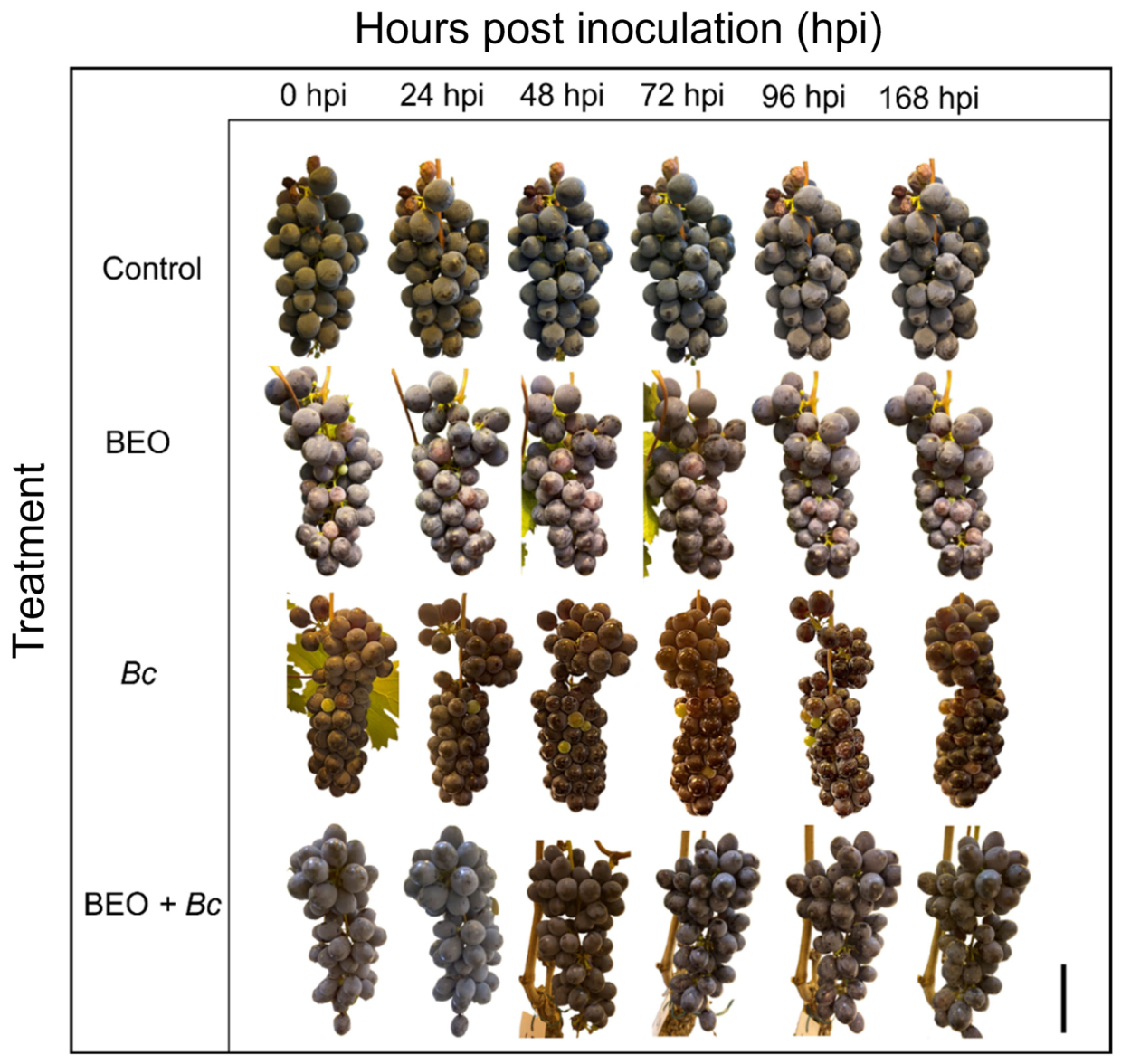
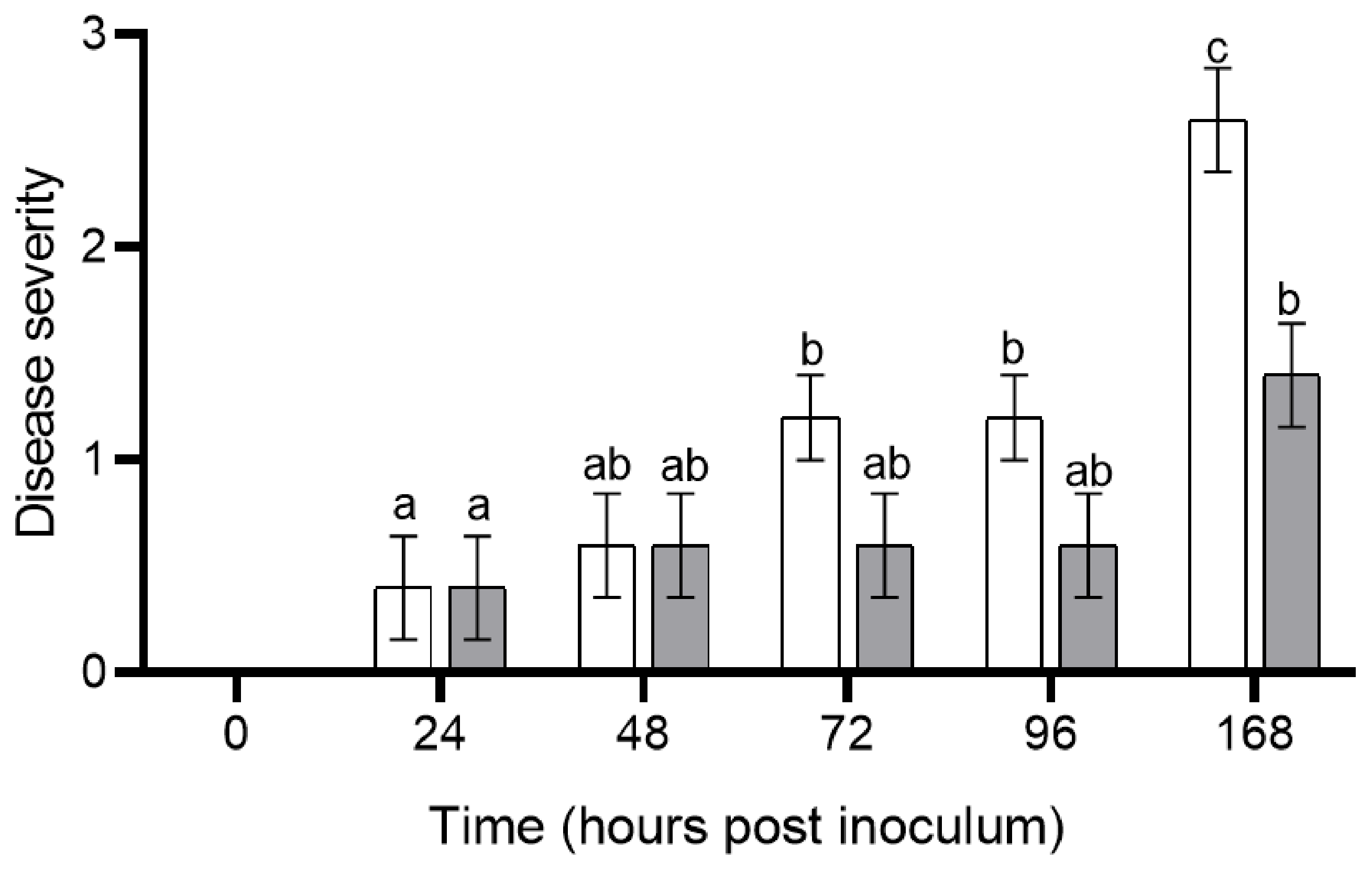
Symptom onset started at 24 hpi in grapes inoculated with Bc, initially appearing as soft, water-soaked lesions (Figure 1). Necrotic areas progressively expanded over time, and visible fungal colonisation was observed at 96 hpi. At 168 hpi, more than 50% of the berry surface was colonised by grey mould. Similar symptoms were observed in berries treated with BEO + Bc treatment. However, disease progression appeared slower compared with those inoculated with Bc alone, particularly at 96 and 168 hpi, as indicated by lower AUDPC values (43.2 vs. 75.6 and 172.8 vs. 331.2 for BEO + Bc and Bc, respectively; Figure 2; Table 1).

3.2. Berry Dry Matter

According to two-way ANOVA, the interaction between “BEO treatment” and “Bc inoculation” significantly affected seed DW, peel DW, seed DM, pulp DM and peel DM, respectively (Table 2).
Figure 2. Disease progression expressed on disease severity scale rated to the percentage of infected berry surface (0 = no symptoms; 1 = 1–33%; 2 = 34–66%; 3 = 67–98%; 4 = 99–100%) in grape berries inoculated with Botrytis cinerea and previously treated with sterile water (Bc; white bar) or with basil essential oil (BEO + Bc; grey bar), evaluated at 0, 24, 48, 72, 96 and 168 h post inoculum (hpi). Different letters indicate differences among treatments according to one-way repeated-measures ANOVA and Tukey’s post hoc test. Data are shown as means ± standard deviation (n = 5).
Agronomy 16 01859 g002
No significant interaction effects were detected for FW. Seed DW was significantly lower in BEO-treated berries compared with controls (−35%; Table 3), whereas peel DW decreased in both Bc- and BEO + Bc-treated berries (−19 and −58%, respectively; Table 3). No statistical differences were observed for pulp DW (Table 3). The application of BEO treatment and/or the fungal infection induced a strong reduction in seed DM (−41, −34 and −35%, respectively, in comparison to controls; Table 3). Peel DM significantly decreased in BEO + Bc grapes (−56%, compared with controls; Table 3), while pulp DM slightly decreased due to BEO or Bc but was strongly reduced by the interaction of both factors (−6, −15, and −57%, respectively; Table 3).

3.3. Total Anthocyanins, Total Phenols, Condensed Tannin and Resveratrol Content, Soluble Carbohydrates and Organic Acids

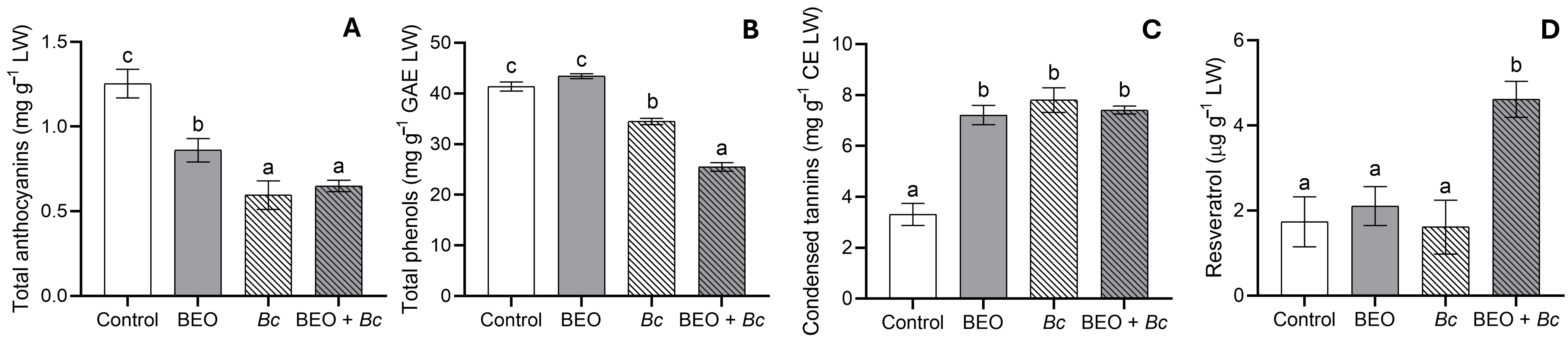
According to two-way ANOVA (Table 2) and Tukey’s post hoc test, total anthocyanin content significantly decreased following BEO treatment and even more due to Bc infection, regardless of the BEO applications (−20, −52 and −36%, respectively, in comparison to controls; Figure 3A). Similarly, total phenols also appeared reduced in Bc-infected berries, with the lowest value detected in BEO + Bc samples (−17 and −38%, respectively; Figure 3B). Conversely, condensed tannins notably increased at the same rate in all treated berries compared to controls (more than one-fold, on average; Figure 3C). A significant rise in resveratrol content was observed in BEO + Bc in comparison to all treatments (more than 2-fold; Figure 3D).
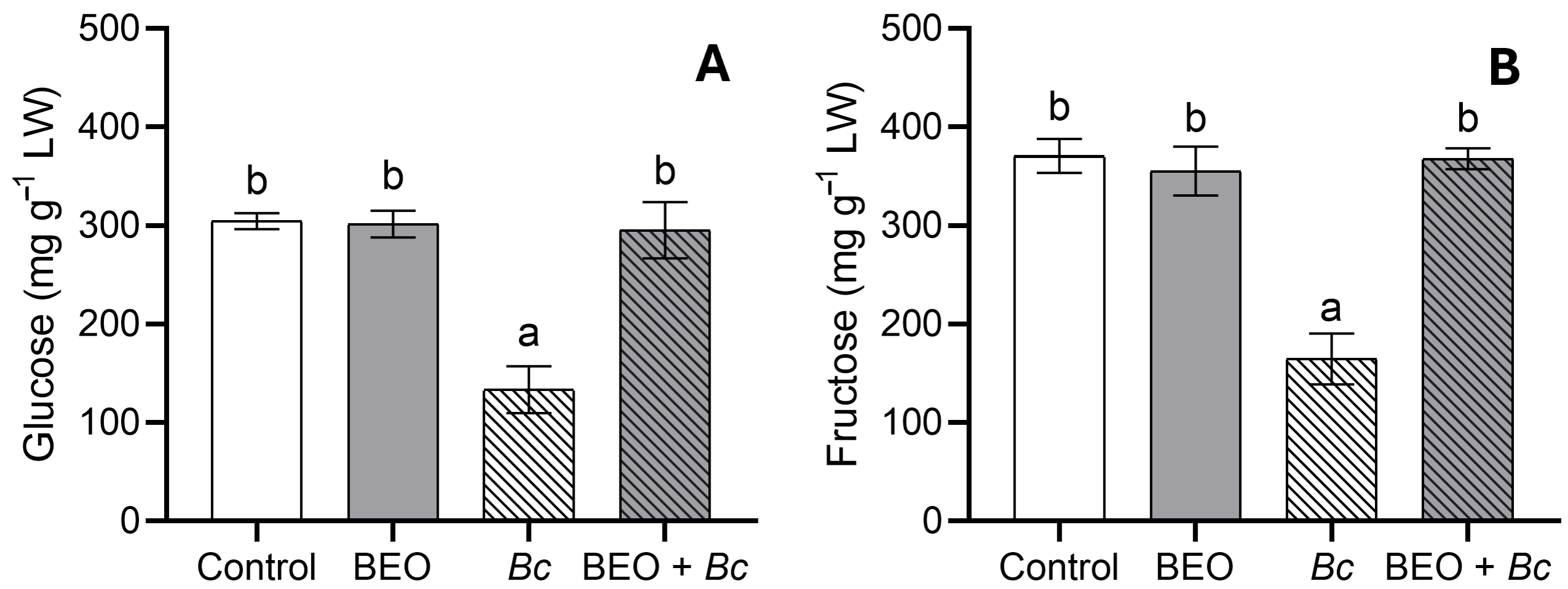
Soluble carbohydrates, i.e., glucose and fructose, decreased with a similar pattern only in Bc grapes (−56%, on average, in comparison to all treatments; Figure 4A,B).
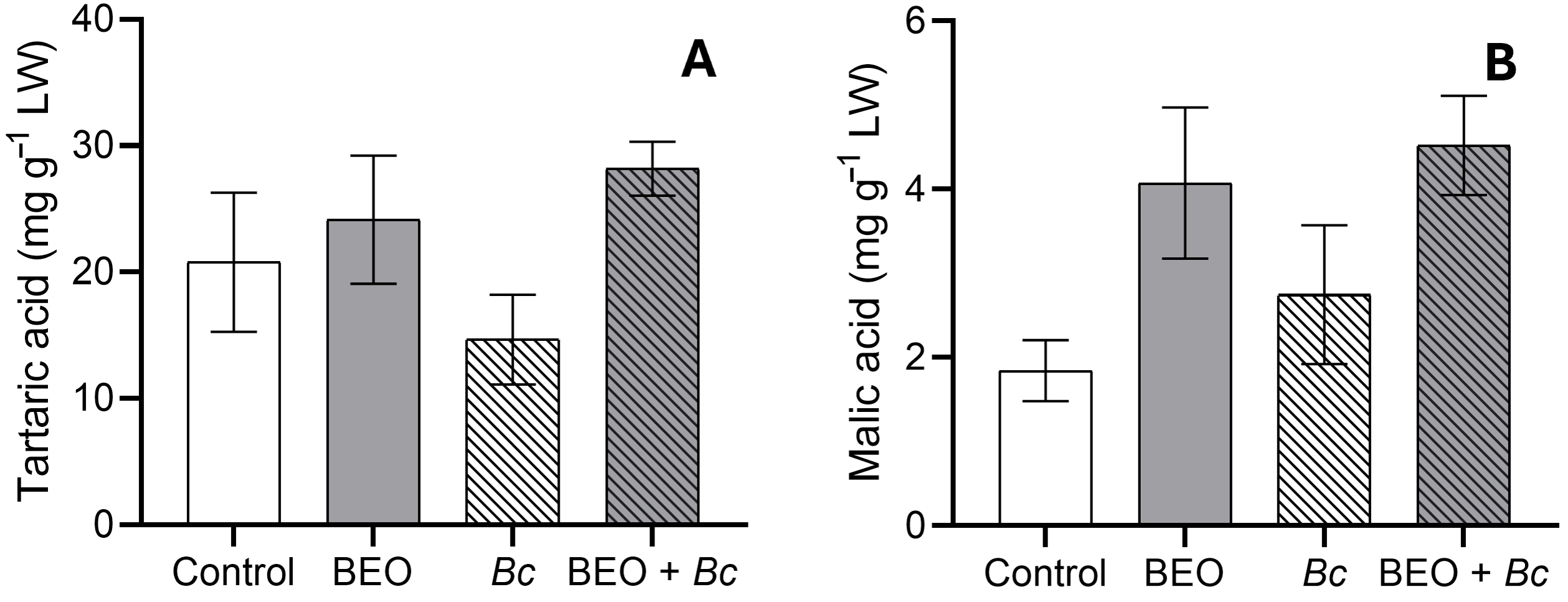
No statistical changes due to the interaction between “BEO treatment” and “Bc inoculation” occurred in organic acid content (i.e., tartaric and malic acid), but the effect of the single factor “BEO treatment” induced a slight increase in tartaric acid and a stronger rise in malic acid in grapes which were treated, regardless of the inoculation (+15 and +67%, respectively, in comparison to untreated samples; Figure 5A,B).

4. Discussion

Plant-derived products, particularly EOs, are attracting increasing attention as promising alternatives for crop protection because of their antimicrobial properties and ability to stimulate plant defence responses [42,43]. Besides exerting direct antifungal effects, EOs may indeed function as elicitors, activating defence-related pathways that enhance plant resistance to pathogen infection.
In the present study, the application of BEO significantly reduced grey mould development on grape berries inoculated with Bc, as demonstrated by the AUDPC and visual symptom assessments. Disease symptoms became visible at 24 hpi, progressively evolving into necrotic lesions and fungal colonisation observed after 96 h. At the end of the experiment, untreated inoculated berries exhibited extensive fungal colonisation and tissue maceration, which are typical symptoms of grey mould [44]. Conversely, berries treated with BEO showed lower disease severity and slower disease progression, as demonstrated by reduced AUDPC values and milder symptoms. These findings are consistent with those previously reported by Scimone et al. [31], who demonstrated the antifungal activity of BEO against Bc in vitro, and further support its efficacy under in vivo conditions. However, as the experimental design did not include a BEO obtained from conventionally irrigated basil, the present results demonstrate the antifungal efficacy of the BEO preparation tested but do not allow the specific contribution of OW irrigation to this activity to be fully established. The antifungal activity of EOs has frequently been associated with the presence of monoterpenes and phenylpropanoids, including linalool and eugenol, which may alter fungal membrane integrity and cellular metabolism [45,46]. In the BEO used in the present study, eugenol and linalool were among the major constituents (11.6% and 41.3%, respectively), and their reported antifungal properties suggest that they may have contributed to the observed activity. Previous studies have reported that these compounds can induce oxidative stress, lipid peroxidation, and morphological alterations in fungal hyphae and conidia [31,47,48,49,50]. However, the contribution of individual BEO constituents and their possible synergistic interactions were not specifically investigated in the present study and, therefore, cannot be conclusively established. Although not investigated in the present study, the natural waxy bloom covering grape berries may have favoured EO retention on the fruit surface, thereby contributing to its preventive efficacy [51,52]. This possibility should, therefore, be regarded as speculative and would require dedicated experiments to be confirmed. Similar effects of BEO treatments in reducing decay incidence and prolonging shelf life have been reported in postharvest studies [31,53], but these findings were obtained under different experimental conditions and should not be directly extrapolated to the preharvest conditions investigated in the present work.
Information regarding the influence of BEO on grape biometric traits remains limited. In the present work, the DMs of seeds and peels decreased in treated berries, whereas pulp DM increased in BEO + Bc. Variation in DM may reflect changes in water balance and tissue composition associated with both fungal infection and EO treatment. However, the physiological mechanisms underlying these responses remain unclear and require further investigation.
The present study also demonstrated that BEO treatment and Bc infection significantly influenced grape secondary metabolism, although their effects were compound-specific and did not consistently correspond to an improvement in quality-related parameters. Total anthocyanins decreased in infected berries regardless of BEO application, indicating that BEO did not preserve anthocyanin levels under the tested conditions. Total phenols were particularly reduced in Bc and BEO + Bc samples. This response is consistent with the extensive oxidative metabolism triggered during Bc infection, which can redirect berry metabolism from quality-related phenolics towards defence and tissue degradation [54,55]. Fungal laccases are known to catalyse anthocyanin oxidation, negatively affecting pigment stability and berry colour [56,57]. Similar reductions in anthocyanin accumulation following grey mould infection have previously been reported in grape berries [58]. Conversely, condensed tannins increased in all treated berries compared with controls, while resveratrol accumulation was strongly enhanced in BEO + Bc berries. Resveratrol represents one of the earliest defence metabolites synthesised by grapevine following pathogen perception and plays a central role in limiting fungal colonisation [59,60]. Previous studies demonstrated that rapid and intense resveratrol synthesis is positively associated with grapevine tolerance to grey mould [61,62,63]. Therefore, the increased resveratrol content observed in BEO-treated infected berries may indicate that the treatment not only suppresses pathogen growth directly but may suggest an enhanced defence-related metabolic response associated with BEO treatment. These findings support the hypothesis that BEO may exert a dual mode of action against Bc, combining direct antifungal activity with the modulation of host defence responses. The marked accumulation of the stilbene phytoalexin resveratrol in BEO-treated infected berries is consistent with a possible involvement of defence-related metabolism and may suggest a potential priming effect of BEO on grapevine defence responses, in addition to its direct inhibitory activity against fungal development. However, the direct activation or priming of specific host defence pathways was not demonstrated in the present study [64,65].
Regarding primary metabolism, Bc infection has been reported to affect carbohydrate and organic acid metabolism, with changes in soluble sugars and the degradation of organic acids during fungal colonisation [66,67]. In the present study, glucose and fructose contents markedly decreased in infected berries, although changes in berry sugar content may also result from host metabolism alteration, tissue degradation, water balance, ripening or stress responses [68], whereas BEO-treated infected berries maintained values closer to those of the control. The partial preservation of soluble sugars in BEO-treated berries may also reflect the lower disease severity observed in these samples, as reduced fungal colonisation would limit carbon consumption by the pathogen. Similarly, tartaric acid remained relatively stable, while malic acid content increased following BEO treatment. These findings suggest that BEO treatment may contribute to preserve berry metabolic balance during fungal infection.
Beyond its biological efficacy, the approach investigated in this study represents a promising strategy for plant protection by integrating two complementary green technologies within the same production chain. Previous work by Scimone et al. [31] demonstrated that irrigation with OW increases BEO yield without significantly altering its chemical composition, thereby improving the efficiency of EO production. Building on these findings, the present study demonstrated that the resulting BEO can be exploited as a plant-derived treatment with potential for use in disease management capable of mitigating Bc growth on grape berries. This dual strategy not only enhances the sustainability of EO production through improved resource-use efficiency (i.e., OW irrigation) but also provides an environmentally friendly alternative to conventional fungicides, contributing to the transition towards more sustainable crop protection systems. However, the present experimental design does not allow direct antifungal effects to be distinguished from potential host-mediated effects, and the underlying mechanisms were not directly investigated. Therefore, the possibility of a combined direct antifungal and host-mediated mode of action should be considered as a hypothesis rather than as a mechanism demonstrated by the present study. Moreover, as the investigation here presented was conducted under controlled conditions, further research under field conditions is needed to validate its efficacy and consistency, while assessing its practical applicability in commercial vineyards, including in comparison with conventional fungicide treatments. Although the antifungal and potential host-mediated mechanisms underlying BEO activity remain to be fully elucidated, the present findings provide a basis for further investigation of BEO as a sustainable tool for grey mould management in grapevine. Nevertheless, some limitations of this study should be acknowledged, including the absence of a direct comparison with BEO extracted from conventionally irrigated basil plants and the lack of molecular analyses associated with plant defence activation. In this context, future studies should, therefore, investigate the interactions between BEO and fungal virulence mechanisms, its effects on host defence pathways, and its potential integration with other biological control strategies. Additionally, further research is required to evaluate the possible effects of BEO treatments on grape technological quality and wine sensory properties under postharvest conditions. Finally, the present findings should be interpreted under the experimental conditions tested, as future studies involving different grapevine cultivars, Bc isolates, BEO concentrations and application regimes, as well as naturally infected grapes and field or commercial vineyard conditions, are needed.

5. Conclusions

Overall, the present findings indicate that BEO obtained from plants cultivated under OW irrigation reduced the severity of experimentally induced Bc infection in grape berries under the controlled conditions tested. Basil EO treatment was also associated with changes in selected primary and secondary metabolites, including enhanced resveratrol accumulation in infected berries and partial preservation of soluble sugars. These metabolic responses indicate that BEO potentially affects berry metabolism under Bc infection, although they do not by themselves demonstrate a direct improvement or generalised preservation of berry quality. The observed disease suppression is consistent with the direct antifungal activity previously demonstrated for BEO in vitro, while the increased resveratrol accumulation in BEO-treated infected berries may indicate a possible contribution of defence-related metabolism. However, the present experimental design does not allow the relative contribution of direct antifungal and host-mediated effects to be distinguished, and no direct effect of OW irrigation on BEO efficacy can be established because a BEO obtained from conventionally irrigated basil was not included. Therefore, the present results should be interpreted within the experimental conditions tested. Further comparative studies including BEO obtained from conventionally irrigated basil are required to determine whether irrigation regime influences BEO antifungal activity.

Supplementary Materials

The following supporting information can be downloaded at: https://www.mdpi.com/article/10.3390/agronomy16181859/s1, Table S1: Results of two-way analysis of variance for the effect of “BEO treatment”, “Bc inoculation” and “BEO treatment × Bc” inoculation on Seeds fresh weight (Seeds FW), Pulps FW, Peels FW, Seeds Dry Weight (DW), Pulps DW, Peels DW, Seeds Dry Matter (DM), Pulps Dry Matter (DM), Peels Dry Matter (DM), Total Anthocyanins, Total Phenols, Condense Tannins, Resveratrol, Glucose, Fructose, Tartaric acid, Malic acid. For each response variable and experimental factor, the number of parameters, degrees of freedom (DF), sum of squares, F-value, and p-value are reported. Statistically significant effects are indicated by an asterisk (p ≤ 0.05).

Author Contributions

Conceptualization, E.P. and C.N.; Methodology, L.M. and M.T.; Formal analysis, G.S., L.M. and M.T.; Data curation, G.S. and M.T.; Writing—original draft, E.P. and C.P.; Writing—review & editing, L.C., E.P. and C.N.; Visualization, L.C.; Supervision, E.P., C.P. and C.N.; Funding acquisition, C.N. All authors have read and agreed to the published version of the manuscript.

Funding

This research received no external funding.

Data Availability Statement

The original contributions presented in this study are included in the article/Supplementary Materials. Further inquiries can be directed to the corresponding author.

Acknowledgments

The authors are grateful to Sofia Bandiera for her excellent laboratory assistance, which was essential for the completion of this study.

Conflicts of Interest

The authors declare no conflicts of interest.

References

  1. Fedorina, J.; Tikhonova, N.; Ukhatova, Y.; Ivanov, R.; Khlestkina, E. Grapevine gene systems for resistance to gray mold Botrytis cinerea and powdery mildew Erysiphe necator. Agronomy 2022, 12, 499. [Google Scholar] [CrossRef] [Scilit]
  2. Altieri, V.; Rossi, V.; Fedele, G. Integration of mathematical modeling and target-based application of biocontrol agents for the control of Botrytis cinerea in vineyards. Pest Manag. Sci. 2024, 80, 4352–4360. [Google Scholar] [CrossRef] [Scilit]
  3. Rahman, M.U.; Liu, X.; Wang, X.; Fan, B. Grapevine gray mold disease: Infection, defense and management. Hortic. Res. 2024, 11, uhae182. [Google Scholar] [CrossRef] [Scilit]
  4. Abbey, J.; Percival, D.; Abbey, L.; Asiedu, S.; Prithiviraj, B.; Schilder, A. Biofungicides as an alternative to synthetic fungicide control of grey mould (Botrytis cinerea)–prospects and challenges. Biocontrol Sci. Technol. 2019, 29, 207–228. [Google Scholar] [CrossRef] [Scilit]
  5. Ullah, I.; Yuan, W.; Khalil, H.B.; Khan, M.R.; Lak, F.; Uzair, M.; Abbas, A.; Gohari, A.M.; Wu, H. Understanding Botrytis cinerea infection and gray mold management: A review paper on deciphering the rose’s thorn. Phytopathol. Res. 2024, 6, 42. [Google Scholar] [CrossRef] [Scilit]
  6. Pertot, I.; Caffi, T.; Rossi, V.; Mugnai, L.; Hoffmann, C.; Grando, M.S.; Gary, C.; Lafond, D.; Duso, C.; Thiery, D.; et al. A critical review of plant protection tools for reducing pesticide use on grapevine and new perspectives for the implementation of IPM in viticulture. Crop Prot. 2017, 97, 70–84. [Google Scholar] [CrossRef] [Scilit]
  7. Seibert, J.B.; Viegas, J.S.; Almeida, T.C.; Amparo, T.R.; Rodrigues, I.V.; Lanza, J.S.; Frézard, F.G.; Soares, R.D.O.A.; Teizeira, L.M.; de Souza, G.H.B.; et al. Nanostructured systems improve the antimicrobial potential of the essential oil from Cymbopogon densiflorus leaves. J. Nat. Prod. 2019, 82, 3208–3220. [Google Scholar] [CrossRef] [Scilit]
  8. Di Marco, S.; Metruccio, E.G.; Moretti, S.; Nocentini, M.; Carella, G.; Pacetti, A.; Battiston, E.; Osti, F.; Mugnai, L. Activity of Trichoderma asperellum strain ICC 012 and Trichoderma gamsii strain ICC 080 toward diseases of esca complex and associated pathogens. Front. Microbiol. 2022, 12, 813410. [Google Scholar] [CrossRef] [Scilit]
  9. Falsini, S.; Nieri, T.; Paolini, A.; Schiff, S.; Papini, A.; Mugnai, L.; Gonnelli, C.; Ristori, S. Tannins-lignin mixed nanoformulations for improving the potential of neem oil as fungicide agent. Environ. Sci. Pollut. Res. 2023, 30, 39131–39141. [Google Scholar] [CrossRef] [Scilit]
  10. Gupta, I.; Singh, R.; Muthusamy, S.; Sharma, M.; Grewal, K.; Singh, H.P.; Batish, D.R. Plant essential oils as biopesticides: Applications, mechanisms, innovations, and constraints. Plants 2023, 12, 2916. [Google Scholar] [CrossRef] [Scilit]
  11. Giunti, G.; Benelli, G.; Palmeri, V.; Laudani, F.; Ricupero, M.; Ricciardi, R.; Maggi, F.; Lucchi, A.; Guedes, R.N.C.; Desneux, N.; et al. Non-target effects of essential oil-based biopesticides for crop protection: Impact on natural enemies, pollinators, and soil invertebrates. Biol. Control 2022, 176, 105071. [Google Scholar] [CrossRef] [Scilit]
  12. Caren, J.; Zhu, Y.C.; Read, Q.D.; Du, Y. Risk assessment of effects of essential oils on honey bees (Apis mellifera L.). Insects 2025, 16, 303. [Google Scholar] [CrossRef] [Scilit]
  13. Regnault-Roger, C.; Vincent, C.; Arnason, J.T. Essential oils in insect control: Low-risk products in a high-stakes world. Annu. Rev. Entomol. 2012, 57, 405–424. [Google Scholar] [CrossRef] [Scilit]
  14. Nazzaro, F.; Fratianni, F.; Coppola, R.; De Feo, V. Essential oils and antifungal activity. Pharmaceuticals 2017, 10, 86. [Google Scholar] [CrossRef] [Scilit]
  15. Pavela, R.; Benelli, G. Essential oils as ecofriendly biopesticides? Challenges and constraints. Trends Plant Sci. 2016, 21, 1000–1007. [Google Scholar] [CrossRef] [Scilit]
  16. Isman, M.B. Commercial development of plant essential oils and their constituents as active ingredients in bioinsecticides. Phytochem. Rev. 2020, 19, 235–241. [Google Scholar] [CrossRef] [Scilit]
  17. Assadpour, E.; Can Karaça, A.; Fasamanesh, M.; Mahdavi, S.A.; Shariat-Alavi, M.; Feng, J.; Kharazmi, M.S.; Rehman, A.; Jafari, S.M. Application of essential oils as natural biopesticides; recent advances. Crit. Rev. Food Sci. Nutr. 2024, 64, 6477–6497. [Google Scholar] [CrossRef] [Scilit]
  18. Li, K.; Guo, J.; Liang, R.; Wang, X.; Chen, Q.; Wang, J.; Ge, X.; Chen, C.; Sun, J.; Zhao, C.; et al. A review on antifungal activity of plant essential oils. Phytother. Res. 2025, 39, 3736–3761. [Google Scholar] [CrossRef] [Scilit]
  19. Aqeel, U.; Aftab, T.; Khan, M.M.A.; Naeem, M. Regulation of essential oil in aromatic plants under changing environment. J. Appl. Res. Med. Aromat. Plants 2023, 32, 100441. [Google Scholar] [CrossRef] [Scilit]
  20. Mansinhos, I.; Gonçalves, S.; Romano, A. How climate change-related abiotic factors affect the production of industrial valuable compounds in Lamiaceae plant species: A review. Front. Plant Sci. 2024, 15, 1370810. [Google Scholar] [CrossRef] [Scilit]
  21. Díaz-López, M.; Galera, L.; Bastida, F.; Nicolás, E. Tomato growth and physiology as well as soil physicochemical and biological properties affected by ozonated water in a saline agroecosystem. Sci. Total Environ. 2024, 906, 167472. [Google Scholar] [CrossRef] [Scilit]
  22. Risoli, S.; Lauria, G. Ozonated water application as an innovative tool for elicitation of plant defense response: A minireview. Curr. Opin. Environ. Sci. Health 2022, 28, 100375. [Google Scholar] [CrossRef] [Scilit]
  23. Afsah-Hejri, L.; Hajeb, P.; Ehsani, R.J. Application of ozone for degradation of mycotoxins in food: A review. Compr. Rev. Food Sci. Food Saf. 2020, 19, 1777–1808. [Google Scholar] [CrossRef] [Scilit]
  24. Sachadyn-Król, M.; Agriopoulou, S. Ozonation as a method of abiotic elicitation improving the health-promoting properties of plant products—A review. Molecules 2020, 25, 2416. [Google Scholar] [CrossRef] [Scilit]
  25. Campayo, A.; Savoi, S.; Romieu, C.; López-Jiménez, A.J.; Serrano De La Hoz, K.; Salinas, M.R.; Torregrosa, G.; Alonso, G.L. The application of ozonated water rearranges the Vitis vinifera L. leaf and berry transcriptomes eliciting defence and antioxidant responses. Sci. Rep. 2021, 11, 8114. [Google Scholar] [CrossRef] [Scilit]
  26. Xu, J.P.; Yu, Y.C.; Zhang, T.; Ma, Q.; Yang, H.B. Effects of ozone water irrigation and spraying on physiological characteristics and gene expression of tomato seedlings. Hort. Res. 2021, 8, 180. [Google Scholar] [CrossRef] [Scilit]
  27. Lam, V.P.; Loi, D.N.; Kim, S.; Shin, J.; Park, J. Ozonated water soaking improves the flower growth, antioxidant activity, and bioactive compound accumulation in Agastache rugosa. Chem. Biol. Technol. Agric. 2023, 10, 128. [Google Scholar] [CrossRef] [Scilit]
  28. Pisuttu, C.; Risoli, S.; Moncini, L.; Nali, C.; Pellegrini, E.; Sarrocco, S. Sustainable strategies to counteract mycotoxins contamination and cowpea weevil in chickpea seeds during post-harvest. Toxins 2023, 15, 61. [Google Scholar] [CrossRef] [Scilit]
  29. Eghlima, G.; Hajizadeh, H.S.; Mohammadi, M.; Al-Elwany, O.A.; Ghorbanpour, M. Ozone water irrigation treatment modulates growth performance, essential oils production and phenolic acid compounds in Thymus vulgaris L. Ind. Crops Prod. 2026, 239, 122473. [Google Scholar] [CrossRef] [Scilit]
  30. Gur, L.; Schweitzer, R.; Shlisel, M.; Vaadia, M.; Vestrich, B.; Reuveni, M. Applications of ozonated water for effectively controlling grape powdery mildew in vineyards and enhancing berry metabolites. Plant Pathol. 2026, 75, e70204. [Google Scholar] [CrossRef] [Scilit]
  31. Scimone, G.; Lauria, G.; Pieracci, Y.; Cotrozzi, L.; Flamini, G.; Nali, C.; Lorenzini, G.; Pellegrini, E.; Pisuttu, C.; Landi, M. Alternative approaches to enhance sweet basil (Ocimum basilicum L.) essential oil: Improving composition, yield, and antifungal efficacy against Botrytis cinerea Pers. with monochromatic light and ozonated water. Ind. Crops Prod. 2025, 232, 121267. [Google Scholar] [CrossRef] [Scilit]
  32. Kuhn, N.; Guan, L.; Dai, Z.W.; Wu, B.H.; Lauvergeat, V.; Gomès, E.; Li, S.H.; Godoy, F.; Arce-Johnson, P.; Delrot, S. Berry ripening: Recently heard through the grapevine. J. Exp. Bot. 2013, 65, 4543–4559. [Google Scholar] [CrossRef] [Scilit]
  33. Karakuş, S.; Atici, O.; Köse, C.; Aydin, I. Nepeta meyeri essential oil ameliorates fungal infection and the antioxidant response in grapevine (Vitis vinifera) infections by gray mold (Botrytis cinerea). Acta Physiol. Plant. 2021, 43, 15. [Google Scholar] [CrossRef] [Scilit]
  34. Modesti, M.; Marchica, A.; Pisuttu, C.; Risoli, S.; Pellegrini, E.; Bellincontro, A.; Mencarelli, F.; Tonutti, P.; Nali, C. Ozone-induced biochemical and molecular changes in Vitis vinifera leaves and responses to Botrytis cinerea infections. Antioxidants 2023, 12, 343. [Google Scholar] [CrossRef] [Scilit]
  35. Simko, I.; Piepho, H.P. The area under the disease progress stairs: Calculation, advantage, and application. Phytopathology 2012, 102, 381–389. [Google Scholar] [CrossRef] [Scilit]
  36. Solovchenko, A.E.; Chivkunova, O.B.; Merzlyak, M.N.; Reshetnikova, I.V. A spectrophotometric analysis of pigments in apples. Russ. J. Plant Physiol. 2001, 48, 693–700. [Google Scholar] [CrossRef] [Scilit]
  37. Dewanto, V.; Wu, X.; Adom, K.; Liu, R. Thermal processing enhances the nutritional value of tomatoes by increasing total antioxidant activity. J. Agric. Food Chem. 2002, 50, 3010–3014. [Google Scholar] [CrossRef] [Scilit]
  38. Tonelli, M.; Pellegrini, E.; D’Angiolillo, F.; Petersen, M.; Nali, C.; Pistelli, L.; Lorenzini, G. Ozone-elicited secondary metabolites in shoot cultures of Melissa officinalis L. Plant Cell Tissue Organ Cult. 2015, 120, 617–629. [Google Scholar] [CrossRef] [Scilit]
  39. Li, W.; Yuan, H.; Liu, Y.; Wang, B.; Xu, X.; Xu, X.; Hussain, D.; Ma, L.; Chen, D. Current analytical strategies for the determination of resveratrol in foods. Food Chem. 2024, 431, 137182. [Google Scholar] [CrossRef] [Scilit]
  40. Pellegrini, E.; Campanella, A.; Paolocci, M.; Trivellini, A.; Gennai, C.; Muganu, M.; Nali, C.; Lorenzini, G. Functional leaf traits and diurnal dynamics of photosynthetic parameters predict the behaviour of grapevine varieties towards ozone. PLoS ONE 2015, 10, e0135056. [Google Scholar] [CrossRef] [Scilit]
  41. Eyéghé-Bickong, H.A.; Alexandersson, E.O.; Gouws, L.M.; Young, P.R.; Vivier, M.A. Optimisation of an HPLC method for the simultaneous quantification of the major sugars and organic acids in grapevine berries. J. Chromatogr. B 2012, 885, 43–49. [Google Scholar] [CrossRef] [Scilit]
  42. Fragkouli, R.; Antonopoulou, M.; Asimakis, E.; Spyrou, A.; Kosma, A.Z.; Tsiamis, G.; Patakas, A.; Triantafyllidis, V. Mediterranean plants as potential source of biopesticides: An overview of current research and future trends. Metabolites 2023, 13, 967. [Google Scholar] [CrossRef] [Scilit]
  43. Kousar, M.U.; Jabeen, A.; Malik, M.A.; Hussain, S.Z.; Manzoor, S.; Mukhtar, T.; Yousuf, M.; Mushtaq, A.; Yaseen, M. Basil (Ocimum basilicum) as a bioactive resource: Chemical composition and extraction innovation. Food Humanit. 2026, 6, 101108. [Google Scholar] [CrossRef] [Scilit]
  44. Williamson, B.; Tudzynski, B.; Tudzynski, P.; Van Kan, J.A.L. Botrytis cinerea: The cause of grey mold disease. Mol. Plant Pathol. 2007, 8, 561–580. [Google Scholar] [CrossRef] [Scilit]
  45. Elshafie, H.S.; Crescenzi, A.; Camele, I. Investigating the biological effects of plant essential oils on plant-decaying pathogens. Plants 2026, 15, 542. [Google Scholar] [CrossRef] [Scilit]
  46. Leiva-Mora, M.; Bustillos, D.; Arteaga, C.; Hidalgo, K.; Guevara-Freire, D.; López-Hernández, O.; Saa, L.R.; Padilla, P.S.; Bustillos, A. Antifungal mechanisms of plant essential oils: A comprehensive literature review for biofungicide development. Agriculture 2025, 15, 2303. [Google Scholar] [CrossRef] [Scilit]
  47. Hussain, A.I.; Anwar, F.; Sherazi, S.T.H.; Przybylski, R. Chemical composition, antioxidant and antimicrobial activities of basil (Ocimum basilicum) essential oils depend on seasonal variations. Food Chem. 2008, 108, 986–995. [Google Scholar] [CrossRef] [Scilit]
  48. Koroch, R.; Simon, J.E.; Juliani, H.R. Essential oil composition of purple basils, their reverted green varieties (Ocimum basilicum) and their associated biological activity. Ind. Crops Prod. 2017, 107, 526–530. [Google Scholar] [CrossRef] [Scilit]
  49. Stan, C.; Nenciu, F.; Muscalu, A.; Vlăduț, V.N.; Burnichi, F.; Popescu, C.; Gatea, F.; Boiu-Sicuia, O.A.; Israel-Roming, F. Chemical composition, antioxidant and antimicrobial effects of essential oils extracted from two new Ocimum basilicum L. varieties. Diversity 2022, 14, 1048. [Google Scholar] [CrossRef] [Scilit]
  50. Pedroso, M.B.; Scariot, F.J.; Rocha, R.K.M.; Echeverrigaray, S.; Delamare, A.P.L. Antifungal activity and mechanism of action of monoterpenes against Botrytis cinerea. Ciênc. Agrotecnologia 2024, 48, e018823. [Google Scholar] [CrossRef] [Scilit]
  51. Shiri, M.A.; Bakhshi, D.; Ghasemnezhad, M.; Dadi, M.; Papachatzis, A.; Kalorizou, H. Chitosan coating improves the shelf life and postharvest quality of table grape (Vitis vinifera) cultivar Shahroudi. Turk. J. Agric. For. 2013, 37, 148–156. [Google Scholar] [CrossRef] [Scilit]
  52. Chetia, J.; Adhikary, P.; Devi, L.M.; Badwaik, L.S. Extraction of essential oil from Assam lemon peels and its incorporation in chitosan based coating for maintaining grape quality. Sustain. Chem. Pharm. 2023, 32, 101034. [Google Scholar] [CrossRef] [Scilit]
  53. Abdollahi, A.; Hassani, A.; Ghosta, Y.; Meshkatalsadat, M.; Shabani, R.; Ziaee, S. Evaluation of essential oils for maintaining postharvest quality of Thompson seedless table grape. Nat. Prod. Res. 2012, 26, 77–83. [Google Scholar] [CrossRef] [Scilit]
  54. Prusky, D.; Alkan, N.; Mengiste, T.; Fluhr, R. Quiescent and necrotrophic lifestyle choice during postharvest disease development. Annu. Rev. Phytopathol. 2013, 51, 155–176. [Google Scholar] [CrossRef] [Scilit]
  55. Zheng, T.; Zhang, K.; Sadeghnezhad, E.; Jiu, S.; Zhu, X.; Dong, T.; Liu, Z.; Guan, L.; Jia, H.; Fang, J. Chitinase family genes in grape differentially expressed in a manner specific to fruit species in response to Botrytis cinerea. Mol. Biol. Rep. 2020, 47, 7349–7363. [Google Scholar] [CrossRef] [Scilit]
  56. Minussi, R.C.; Rossi, M.; Bologna, L.; Rotilio, D.; Pastore, G.M.; Durán, N. Phenols removal in musts: Strategy for wine stabilization by laccase. J. Mol. Catal. B Enzym. 2007, 45, 102–107. [Google Scholar] [CrossRef] [Scilit]
  57. Giménez, P.; Just-Borràs, A.; Gombau, J.; Canals, J.M.; Zamora, F. Effects of laccase from Botrytis cinerea on the oxidative degradation of anthocyanins. OENO One 2023, 57, 243–253. [Google Scholar] [CrossRef] [Scilit]
  58. Ky, I.; Lorrain, B.; Jourdes, M.; Pasquier, G.; Fermaud, M.; Gény, L.; Rey, P.; Doneche, B.; Teissedre, P.L. Assessment of grey mould (Botrytis cinerea) impact on phenolic and sensory quality of Bordeaux grapes, musts and wines for two consecutive vintages. Aust. J. Grape Wine Res. 2012, 18, 215–226. [Google Scholar] [CrossRef] [Scilit]
  59. Jeandet, P.; Clément, C.; Cordelier, S. Regulation of resveratrol biosynthesis in grapevine: New approaches for disease resistance? J. Exp. Bot. 2019, 70, 375–378. [Google Scholar] [CrossRef] [Scilit]
  60. Căpruciu, R. Resveratrol in grapevine components, products and by-products—A review. Horticulturae 2025, 11, 111. [Google Scholar] [CrossRef] [Scilit]
  61. Kelloniemi, J.; Trouvelot, S.; Héloir, M.C.; Simon, A.; Dalmais, B.; Frettinger, P.; Cimerman, A.; Fermaud, M.; Roudet, J.; Baulande, S.; et al. Analysis of the molecular dialogue between gray mold (Botrytis cinerea) and grapevine (Vitis vinifera) reveals a clear shift in defense mechanisms during berry ripening. Mol. Plant Microbe Interact. 2015, 28, 1167–1180. [Google Scholar] [CrossRef] [Scilit]
  62. Hasan, M.M.; Bae, H. An overview of stress-induced resveratrol synthesis in grapes: Perspectives for resveratrol-enriched grape products. Molecules 2017, 22, 294. [Google Scholar] [CrossRef] [Scilit]
  63. Ma, H.; Li, C.; Li, S.; Zhao, Y.; Ma, W.; Wang, R.; Guo, N.; Wenkong, Y.; Yin, X. Deciphering grape berry peel resistance to Botrytis cinerea: A transcriptomic and metabolomic perspective. J. Agric. Food Chem. 2025, 73, 11435–11451. [Google Scholar] [CrossRef] [Scilit]
  64. Fandino, A.C.A.; Vigneron, N.; Alfonso, E.; Burdet, J.P.; Remolif, E.; Cattani, A.M.; Smit-Sadki, T.; Cluzet, S.; Valls-Fonayet, P.P.; Rienth, M. Priming grapevines with oregano essential oil vapour results in a metabolomic shift eliciting resistance against downy mildew. BMC Plant Biol. 2024, 24, 1180. [Google Scholar] [CrossRef] [Scilit]
  65. Kaya, O.; Bozkurt, A.; Karakus, S.; Daler, S.; Yilmaz, T. Essential oil compounds modulate nutritional quality and stress response in Botrytis cinerea-infected grape (Vitis vinifera L. cv.‘Karaerik’). Physiol. Mol. Plant Pathol. 2024, 133, 102346. [Google Scholar] [CrossRef] [Scilit]
  66. Blanco-Ulate, B.; Vincenti, E.; Powell, A.L.T.; Cantu, D. Tomato transcriptome and mutant analyses suggest a role for plant stress hormones in the interaction between fruit and Botrytis cinerea. Front. Plant Sci. 2013, 4, 142. [Google Scholar] [CrossRef] [Scilit]
  67. Kallitsounakis, G.; Catarino, S. An overview on botrytized wines. Ciênc. Téc. Vitivinícola 2020, 35, 76–106. [Google Scholar] [CrossRef] [Scilit]
  68. Lu, L.; Delrot, S.; Liang, Z. From acidity to sweetness: A comprehensive review of carbon accumulation in grape berries. Mol. Hortic. 2024, 4, 22. [Google Scholar] [CrossRef] [Scilit]
Figure 1. Representative symptoms observed in Vitis vinifera cv. Sangiovese berries treated with water and mock-inoculated (control), treated with basil essential oil (BEO), inoculated with Botrytis cinerea (Bc), treated with BEO and inoculated with Bc (BEO + Bc), collocated at 0, 24, 48, 72, 96, and 168 h post inoculation (hpi). Photographs are representative of each treatment and time point and are provided for visual documentation of disease development. Bar = 5 cm.
Agronomy 16 01859 g001
Figure 3. Total anthocyanins (A), total phenols (B), condensed tannins (C) and resveratrol (D) content in Vitis vinifera cv. Sangiovese grapes treated with water and mock inoculated (control; white bar), treated with basil essential oil (BEO; grey bar), inoculated with Botrytis cinerea (Bc; dashed white bar), and treated with BEO and inoculated with Bc (BEO + Bc; dashed grey bar). Data are shown as means ± standard deviation (n = 4). Different letters indicate differences among means, according to Tukey’s post hoc test. Abbreviations: GAEs, gallic acid equivalents; CEs, catechin equivalents; LW, lyophilised weight.
Agronomy 16 01859 g003
Figure 4. Glucose (A) and fructose (B) content in Vitis vinifera cv. Sangiovese grapes treated with water and mock-inoculated (control; white bar), treated with basil essential oil (BEO; grey bar), inoculated with Botrytis cinerea (Bc; dashed white bar), and treated with BEO and inoculated with Bc (BEO + Bc; dashed grey bar). Data are shown as means ± standard deviation (n = 4). Different letters indicate differences among means, according to Tukey’s post hoc test. Abbreviation: LW, lyophilised weight.
Agronomy 16 01859 g004
Figure 5. Tartaric (A) and malic acid (B) content in Vitis vinifera cv. Sangiovese grapes treated with water and mock-inoculated (control; white bar), treated with basil essential oil (BEO; grey bar), inoculated with Botrytis cinerea (Bc; dashed white bar), and treated with BEO and inoculated with Bc (BEO + Bc; dashed grey bar). Data are shown as means ± standard deviation (n = 4). Abbreviation: LW, lyophilised weight.
Agronomy 16 01859 g005
Table 1. Degree of freedom (d.f.), F number, and p value of the one-way repeated-measures ANOVA using “treatment” as between factor and “time” as within factor for AUDPC parameter. p levels (*** p ≤ 0.001, ns p > 0.05).
d.f.Fp Value
Treatment14.78ns
Subject between treatment8 -
Time5126.8***
Treatment × time513.5***
Time × Subjects within treatment40--
Table 2. p levels (*** p ≤ 0.001; * p ≤ 0.05; ns p > 0.05) of two-way analysis of variance for the effect of “BEO treatment”, “Bc inoculation” and “BEO treatment × Bc” inoculation on seed fresh weight (seed FW), pulp FW, peel FW, seed dry weight (DW), pulp DW, peel DW, seed dry matter (DM), pulp dry matter (DM), peel dry matter (DM), total anthocyanins, total phenols, condensed tannins, resveratrol, glucose, fructose, tartaric acid, malic acid.
BEO TreatmentBc InoculationBEO Treatment × Bc Inoculation
Seed FWnsnsns
Pulp FW*nsns
Peel FW*nsns
Seed DWns****
Pulp DWnsnsns
Peel DWnsns*
Seed DM***
Pulp DMns****
Peel DM*ns***
Total anthocyanins*********
Total phenols*********
Condensed tannins*********
Resveratrol*********
Glucose*********
Fructose*********
Tartaric acid***nsns
Malic acid***nsns
Table 3. Fresh weight (FW), dry weight (DW), and dry matter (DM) of seeds, pulps and peels of Vitis vinifera cv. Sangiovese grape mock inoculated (control), treated with basil essential oil (BEO), inoculated with Botrytis cinerea (Bc), treated with BEO and inoculated with Bc (BEO + Bc). Data are shown as means ± standard deviation (n = 3). Different letters indicate differences among means, according to Tukey’s post hoc test.
MatrixTreatmentFW (g)DW (g)DM (%)
SeedsControl1.9 ± 0.41.4 ± 0.3 b77.1 ± 0.8 c
BEO1.8 ± 0.10.9 ± 0.1 a45.7 ± 2.2 a
Bc2.0 ± 0.21.0 ± 0.1 ab50.9 ± 1.0 b
BEO + Bc2.2 ± 0.21.1 ± 0.1 ab50.0 ± 1.3 b
PulpsControl2.5 ± 0.10.2 ± 0.19.8 ± 0.7 ab
BEO2.7 ± 0.20.5 ± 0.117.0 ± 0.8 b
Bc3.2 ± 0.60.3 ± 0.19.1 ± 1.2 a
BEO + Bc2.8 ± 0.10.7 ± 0.126.6 ± 1.0 c
PeelsControl2.0 ± 0.10.5 ± 0.1 c26.4 ± 0.1 d
BEO1.7 ± 0.10.5 ± 0.1 c24.8 ± 0.2 c
Bc2.3 ± 0.30.4 ± 0.1 b22.5 ± 0.4 b
BEO + Bc1.9 ± 0.30.2 ± 0.1 a11.5 ± 0.6 a
Disclaimer/Publisher’s Note: The statements, opinions and data contained in all publications are solely those of the individual author(s) and contributor(s) and not of MDPI and/or the editor(s). MDPI and/or the editor(s) disclaim responsibility for any injury to people or property resulting from any ideas, methods, instructions or products referred to in the content.