Article

Repellent and Insecticidal Activity of Wild Cannabis sativa L. Essential Oil Against Rhopalosiphum padi and Sitobion avenae, with Exploratory Automated Behavioural Tracking

1
Plant Protection and Technology Department, Institute of Agriculture, Karnobat, Agricultural Academy, 8400 Karnobat, Bulgaria
2
Department of Botany and Agrometeorology, Agricultural University, 4000 Plovdiv, Bulgaria
3
Department of Plant and Fungal Diversity and Resources, Institute of Biodiversity and Ecosystem Research, Bulgarian Academy of Sciences, 1013 Sofia, Bulgaria
4
Plant Genetic Research Group, AgroBioInstitute, Agricultural Academy, 1164 Sofia, Bulgaria
*
Author to whom correspondence should be addressed.
Agronomy 2026, 16(18), 1778; https://doi.org/10.3390/agronomy16181778
Submission received: 14 August 2026 / Revised: 5 September 2026 / Accepted: 9 September 2026 / Published: 10 September 2026

Abstract

Wild C. sativa (hemp) represents a promising source of bioactive compounds with potential applications in sustainable pest management, while Rhopalosiphum padi and Sitobion avenae are among the most economically important aphid pests of cereal crops. However, the insecticidal, repellent, and sublethal behavioural effects of essential oil (EO) derived from wild hemp against these aphid species remain insufficiently characterised. Therefore, this preliminary study aimed to evaluate the insecticidal and repellent activities of wild hemp EO and to characterise aphid behavioural responses following exposure. The chemical composition of the EO was determined by GC–MS–FID, while locomotor activity and spatial behaviour were assessed using automated video tracking with EthoVision XT. β-Caryophyllene (37.07%), α-pinene (13.98%), and α-humulene (α-caryophyllene) (8.33%) were identified as the predominant constituents. The EO exhibited pronounced insecticidal activity, causing complete mortality (100%) of both R. padi and S. avenae at all tested concentrations (1.0–5.0%). In contrast, its repellent activity did not exhibit a consistent concentration-dependent pattern. Automated behavioural tracking revealed no significant effects of EO exposure on aphid spatial distribution, locomotor activity, or mobility. Although EO-treated aphids showed a numerical tendency to remain closer to the treated area (mean distance to drop centre: 3.68 ± 0.98 cm versus 4.41 ± 1.11 cm in controls), this difference was not statistically significant. Similarly, total distance travelled and mean velocity remained comparable between EO-treated and control groups, indicating the absence of detectable sublethal on locomotor activity. Overall, the results demonstrate that wild hemp EO possesses strong insecticidal potential against cereal aphids, while its biological activity appears to be primarily associated with toxic effects rather than behavioural deterrence.

1. Introduction

The transition towards sustainable and environmentally responsible agroecosystems has become a major priority in the European Union. This shift is driven by increasing concerns about the environmental impacts and potential risks to human health associated with the intensive use of synthetic pesticides. The European Green Deal and the Farm to Fork Strategy have established a target to reduce the use and risk of chemical plant-protection products by 50% by 2030. These goals have accelerated research into effective, sustainable, and lower-risk pest-management solutions [1,2]. The EOs are among the most extensively studied botanical alternatives. They are complex mixtures of volatile secondary metabolites with diverse biological activities, such as insecticidal, repellent, acaricidal, antimicrobial, and herbicidal effects [3,4].
Over the past decade, research on the phytochemical composition and biological properties of industrial C. sativa has increased substantially [5,6,7]. Hemp EO is typically rich in β-caryophyllene, α-humulene, α- and β-pinene, limonene, myrcene, terpinolene, and linalool [5,6,7]. The relative abundance of these constituents varies with genotype, plant organ, phenological stage, climatic conditions, cultivation practices, and extraction method [8]. Furthermore, the biological activities of industrial hemp EO have been extensively documented, including antimicrobial, insecticidal, acaricidal, repellent, and other pest-management effects [8,9,10,11,12,13]. These activities are largely attributed to major terpenes such as β-caryophyllene, α-humulene, myrcene, and α-pinene. Their effects may result from the activity of individual compounds or from additive and synergistic interactions [8]. Despite this, biological activity observed against one target organism or obtained using a particular extraction method cannot be directly extrapolated to other pest species, formulations, or exposure routes. Therefore, standardised chemical characterisation and target-specific bioassays are essential for the reliable evaluation of hemp EO efficacy [8].
By contrast, the chemical composition and biological potential of EO derived from wild (feral; spontaneous) hemp remain largely unexplored; there are limited studies available in the literature [14,15,16,17]. The phytochemical composition of wild C. sativa has been reported for populations from Serbia [14], Hungary [15], and the United States [16,17]. Zheljazkov et al. [14] reported considerable chemical variability among samples. The major constituents included β-caryophyllene (15.4–29.6%), α-humulene (5.3–11.9%), caryophyllene oxide (0.2–31.2%), and humulene epoxide II (1.2–9.5%). The authors also found substantial variation in cannabidiol (CBD) content (6.9–52.4%), whereas Δ9-tetrahydrocannabinol (Δ9-THC) levels were relatively low, averaging approximately 2.4% (range: 0–3.4%) [14]. Likewise, EO varied in samples of wild hemp from Hungary [15]. Nagy et al. [15] characterised spontaneous C. sativa populations from Hungary and demonstrated that their volatile fraction was dominated by β-caryophyllene, α-humulene, and caryophyllene oxide. The authors also reported marked differences in phytochemical composition among leaves, male flowers, and female flowers, with female inflorescences containing the highest concentrations of terpenoids and cannabinoids. This chemical variability highlights the importance of characterising wild hemp populations as potential sources of bioactive terpenoid-rich EO for agricultural and biotechnological applications.
In general, EO tests for insecticidal and repellent activity against aphids have been conducted mostly with industrial hemp EO. Inflorescence EO has demonstrated acute insecticidal activity against the green peach aphid, Myzus persicae [5]. In contrast, a recent study evaluating a methanolic C. sativa leaf extract, rather than EO, reported significant aphidicidal activity against Rhopalosiphum maidis and S. avenae, with LC50 values of 0.987% and 0.953%, respectively [13]. This distinction is important because solvent extracts and EO differ markedly in their chemical composition, physicochemical properties, bioavailability, and routes of exposure, which may result in different biological activities and mechanisms of action.
Overall, EO-based insecticides have been investigated extensively because of their broad biological activity and multiple modes of action [18]. Previous studies have demonstrated that EO can affect aphids through mortality, repellency, altered host selection, and feeding disruption [19,20,21,22]. Previous studies have demonstrated that, besides inducing mortality, EO may alter insect behaviour, including locomotion, host searching, and feeding [22]. Consequently, automated video tracking has become an increasingly valuable approach for quantifying behavioural responses and identifying sublethal effects that are not detected by conventional bioassays. Automated video tracking allows continuous measurement of locomotor parameters, such as distance travelled, velocity, trajectory, and time spent in treated areas, making it particularly suitable for evaluating the repellent and behavioural effects of essential oils against aphid pests. Therefore, this preliminary study aimed to evaluate the insecticidal and repellent activity of wild hemp EO from Bulgaria and to characterise aphid behavioural responses following exposure.

2. Materials and Methods

2.1. Collection of the Wild C. Sativa, EO Isolation and Gas Chromatography (GC), and Mass Spectrometry (MS) Analyses

2.1.1. Collection of the Wild C. sativa and EO Isolation

The plant material of wild C. sativa was collected from a natural population near the town of Belene in Bulgaria (43°39′15″ N; 25°06′55″ E; 20 masl). The samples consisted of apical branches (tips, leaves, inflorescences). The collected material was placed in paper bags and transported for further processing.
To isolate the EO from wild C. sativa materials, the material was first dried in the laboratory of Botany and Agrometeorology at the Agricultural University, Plovdiv. Thereafter, EO of air-dried material was isolated by Clevenger-type hydrodistillation for 120 min, in two replicates, following the procedure described in the European Pharmacopoeia (Ph. Eur.) [23]. Two-litre (L) flasks were used (https://www.laborbio.com, accessed on 7 July 2026). Immediately before each distillation, the samples were crushed. For the distillation, 100 g of material were used. The plant biomass-to-water ratio followed Ph.Eu 1:10 [23]. After distillation, the EO was moved into 4 mL dark vials and placed in a freezer so that the water could be separated. The EO was stored at 4–6 °C until the analysis and tests were conducted.

2.1.2. Gas Chromatography (GC) and Mass Spectrometry (MS) Analyses

The chemical composition of the essential oil (EO) obtained from wild C. sativa was analysed in two independent replications using GC-FID and GC-MS, following the method previously reported [14]. Overall, GC–MS analysis was performed using a 7890A gas chromatograph (Agilent Technologies Inc., Santa Clara, CA, USA) coupled to a 5975C mass selective detector. The system was equipped with a DB-5MS capillary column (30 m × 0.32 mm i.d., 0.25 µm film thickness; J&W Scientific, Agilent). The oven temperature was initially set to 40 °C and increased at a rate of 5 °C min−1 to 300 °C, where it was held for 10 min. Helium was used as the carrier gas at a constant flow rate of 1.0 mL min−1. The mass spectrometer operated in electron ionisation (EI) mode at 70 eV. The ion source and transfer line temperatures were maintained at 230 and 280 °C, respectively. The solvent delay was set to 6 min. Mass spectra were recorded in scan mode over the m/z range of 50–550.
In total, 1 µL of EO, diluted to 10% (v/v) in n-hexane, was injected in split mode (25:1). The constituents of the essential oil were identified by comparing their mass spectra with those in the NIST’08 mass spectral library. Compound identities were further confirmed by comparison with published literature data [24].

2.2. Aphid Collection and Colonisation

Rhopalosiphum padi and Sitobion avenae were collected from cereal crops in the vicinity of Karnobat, Bulgaria, and colonised on two-row barley (Hordeum sativum Jess. subsp. distichum L., var. Erectum), cultivar Emon, grown in pots 20 cm in diameter and 25 cm high. Aphids were introduced onto plants at the two- to three-leaf stage. Plants and aphid colonies were maintained in the Entomology Laboratory of the Institute of Agriculture, Karnobat, under a photoperiod of 8:16 h (L:D), a temperature of 23–24 °C, and 65% relative humidity. Only adult apterous females were propagated and used in the experiments.

2.3. Repellency Activity of Wild C. sativa EO Against Rhopalosiphum Padi and Sitobion Avenae

The repellent activity of EO was evaluated at concentrations of 1.0%, 1.5%, 2.5%, 3.5%, 4.5%, and 5.0% against two aphids in three replicates. Working solutions were prepared in water using 0.1% polysorbate 80 to obtain a stable dispersion. The control (0%) consisted solely of an aqueous solution of 0.1% of the emulsifier. Two 5 cm barley leaf segments were used in each assay as outlined previously [25]. One segment was treated with 2 mL of EO solution, whereas the other received an equal volume of the control solution. After 10 min to allow the applied solutions to dry, the two leaves were positioned 2 cm apart on moistened filter paper in a Petri dish. After that, ten adult apterous female aphids were released with a soft brush in the central area between the leaf segments. To provide ventilation and prevent escape, the dishes were covered with gauze of 44 g m−2 basis weight. The repellent activity of the EO was measured after 24 h. Only the aphids that were on the treated leaf were counted.

2.4. Insecticidal Activity of Wild C. sativa EO Against Rhopalosiphum Padi and Sitobion Avenae

The contact insecticidal activity of wild hemp EO was evaluated according to the methodology previously described [25]. The concentrations of 1%, 2.5%, 3.5%, 4.5%, and 5% of hemp EO were tested in triplicate. Only apterous adult aphids were used for the test. The insecticidal activity of different concentrations of hemp EO were evaluated on H. vulgare subsp. distichum var. erectum, cv. Emon leaves. A working solution of 0.1% polysorbate 80 and water was used to dilute hemp EO. The control (0%) consisted of a 0.1% aqueous solution of polysorbate 80. Two microliters of solution with EO (1%, 2.5%, 3.5%, 4.5%, and 5%) were used for the treatment of leaves with aphid colonies. After that, the leaves were gently blotted on filter paper, transferred to Petri dishes, and covered with gauze (44 g m−2). The number of surviving aphids was recorded after 24 and 72 h of exposure. The results of treated leaves were compared with the control (0%). The efficacy of EO was calculated using the Henderson–Tilton formula (HT):
E f f i c a c y   ( % ) = [ 1 ( T a / T β ) ( C β / C a ) ] × 100 ,
where Tβ and Ta are the numbers of live aphids in the treated groups before and after exposure, respectively; Cβ and Ca are the corresponding values in the untreated controls.
Because the initial aphid colonies differed in number among replicates, mortality was assessed using the ratio of live to dead aphids. This approach accounted for variation in the initial number of individuals. The number of aphids in each colony for S. avenae (control and replicates) was as follows: 12/12, 14/14, and 9/9 individuals (before and after treatment). The number of aphids in each colony for R. padi (control and replicates) was as follows: 14/14, 7/8, and 12/12 live aphids recorded at 24 and 72 h, respectively.

2.5. Automated Recording and Results of the Behaviour of Rhopalosiphum Padi and Sitobion Avenae

Aphid behaviour was recorded with EthoVision XT, version XT19 (software platform developed by Noldus) using a Basler acA1300-60 camera. The duration of each recording was approximately 10 min (mean analysed duration 598.84 s) at 0.04 s sampling intervals (25 frames s−1). Overall, six subjects were tracked per variant (treated/control). In Trial 1, the observation was of those treated with EO, while Trial 2 was for the control. According to the software supporting the operation of EthoVision XT, the predefined spatial categories were Drop, Near, Far, Far 2, and Far 3 zones. Tracking completeness ranged from 98.53% to 100.00% across individuals.
The following parameters were recorded: (1) total distance travelled; (2) average speed; (3) cumulative duration of movement and immobility; (4) average mobility and average distance to the fall zone and the fall centre; (5) cumulative time in and near the fall zones; (6) number of entries for these two zones. Parameter determination and interpretation followed the methodology and terminology of the EthoVision XT software platform (Noldus). Only aphids whose movements were successfully analysed by the tracking software during the recording were included in the analysis. Zone durations were reconstructed using a 0.04 s frame duration. Latency endpoints were not compared inferentially because aphids that never entered a zone were right censored as recommended by the methodology.

2.6. Statistical Analysis

The statistical analyses include the results of all replicates per variant (control, treatment) for two aphid species.

2.6.1. The Results from Repellency Activity

The number of aphids on treated leaves and the control (T) was calculated as T/(T + C), while the repellency index (RI) was calculated as 100(C − T)/(C + T), where positive values indicate greater control-leaf occupancy and negative values indicate greater treated-leaf occupancy. Wilson 95% confidence intervals (CI) were calculated for treated-leaf occupancy. Two-sided exact binomial tests (p-value) against 0.5 were used only as exploratory screens; Benjamini–Hochberg adjustment (q) covered the 12 species-by-concentration tests.

2.6.2. The Results from Insecticidal Activity

For insecticidal activity, starting and surviving counts of aphids were summed. Mortality, exact 95% Clopper–Pearson confidence intervals, and Henderson–Tilton (HT%) adjusted efficacy were calculated for each treatment. Control survival was summarised separately for each species with exact 95% Clopper–Pearson confidence intervals. No concentration–response analysis was performed because survival was zero in all treatment groups.

3. Results

3.1. Essential Oil Composition of Wild C. sativa from Bulgaria

The EO composition of wild hemp samples from Bulgaria is presented in Table 1. The GC–MS analysis identified the EO as being dominated by sesquiterpenes (71.8%), while monoterpenes represented 24.8%. Cannabinoids were detected only in low amounts, with cannabidiol (CBD) averaging 1.34%. Overall, 47 compounds were found, and they represented 96.53% of the total EO (Table 1). The major constituent of EO was β-caryophyllene (37.07%), followed by α-pinene (13.98%) and α-humulene (8.33%). Other relatively abundant compounds included α-selinene (4.20%), myrcene (2.90%), L-alloaromadendrene (2.72%), limonene (2.73%), β-bisabolene (2.54%), caryophyllene oxide (2.26%), γ-cadinene (2.26%), α-(E)-bergamotene (2.10%), and (Z)-β-farnesene (1.72%). All remaining constituents were present at concentrations below 1.5% (Table 1). In general, the analysed essential oil exhibited a sesquiterpene-rich chemical profile. The dominant sesquiterpenes were β-caryophyllene and α-humulene. Among the monoterpene constituents, α-pinene was the most abundant compound. Together, these three compounds accounted for approximately 59.4% of the total essential oil, indicating a β-caryophyllene, α-humulene/α-pinene chemotype.

3.2. Repellent Activity of Wild C. sativa EO Against Rhopalosiphum Padi and Sitobion Avenae

The results of the analysis of repellent activity of hemp EO against R. padi and S. avenae are presented in Table 2. Overall, the results revealed no statistically significant repellent activity of the tested EO against either aphid species (Table 2). Furthermore, no clear relationship was established between EO concentration and insect response. Both positive and negative RI values were recorded within each species, indicating inconsistent behavioural responses. The repellency index (RI) varied among concentrations, but none of the comparisons remained statistically significant after correction for multiple testing. For R. padi, the RI ranged from 50.0% (at 4.5% and 3.5%) to 42.9% (at 1.5%). For S. avenae, the RI ranged from 75.0% (at 4.5%) to 33.3% (at 1.5%) (Table 2). The highest positive RI was recorded at 1.5% EO (42.9%), corresponding to two aphids on the treated leaf and five on the control leaf. However, this difference was not statistically significant (p = 0.45; p = 0.51). At 5% EO, aphids were equally distributed between treated and control leaves, resulting in an RI of 0%.
As described in Section 2.6, negative RI values indicate a higher number of aphids on the treated leaves and, therefore, may suggest attraction rather than repellency. The lowest unadjusted p-value (0.070) was observed for S. avenae at 4.5% EO. Although this result suggests a possible trend toward attraction, it did not reach statistical significance and should not be interpreted as evidence of an attractive effect. Moreover, all q-values exceeded 0.05, indicating that none of the observed behavioural responses were statistically significant after adjustment for multiple comparisons (Table 2).

3.3. Insecticidal Activity of Wild C. sativa EO Against Rhopalosiphum Padi and Sitobion Avenae

The insecticidal activity of wild hemp EO was evaluated at six concentrations. The tested EO demonstrated strong insecticidal activity against both aphid species 24 h after application (Table 3). Insecticidal efficacy was calculated and corrected using the Henderson–Tilton formula. The corrected efficacy was consequently 100% for both species at all six concentrations (Table 3). Notably, maximum efficacy was achieved even at the lowest tested concentration (1.0%), indicating that the minimum concentration required to induce complete mortality may be below the evaluated concentration range. Because identical biological responses were observed at all tested concentrations, no concentration-dependent pattern of insecticidal activity could be established within the tested range.

3.4. Tracking and Spatial Behaviour of Rhopalosiphum Padi and Sitobion Avenae

The spatial distribution of the two aphid species under the control and EO-treated conditions is presented in Figure 1. The merged heatmaps revealed differences in the spatial distribution of aphid activity between the control and EO-treated groups. In the control group, aphids displayed a relatively dispersed movement pattern, with activity concentrated mainly along the arena perimeter and in several localised hotspots (Figure 1A). The central area was occupied less frequently, indicating a tendency to move along the margins of the arena. Exposure to the EO altered the spatial distribution of aphid activity (Figure 1B). Although the arena perimeter remained the most frequently occupied region, additional high-density areas were observed near the EO application site and along the arena boundary. The treated zone was not consistently avoided, indicating that the EO did not elicit a clear repellent response. Instead, aphid activity appeared to be redistributed within the arena, suggesting a modification of exploratory behaviour rather than directional avoidance. Overall, the mean distance to the drop centre was 3.68 cm in the EO-treated group and 4.41 cm in the control group (Table 4). The mean distance to the drop zone showed a similar pattern, with a mean difference of −0.69 cm (95% CI −1.72 to 0.43; Hedges’ g = −0.61; exact p = 0.286; q = 0.940). Overall, the heatmap analysis indicates that EO exposure modified the spatial activity patterns of aphids, affecting the location and intensity of movement hotspots. However, the observed distribution suggests a behavioural modulation rather than a strong spatial avoidance response.

3.5. Locomotion and Mobility and Multiplicity-Adjusted Inference

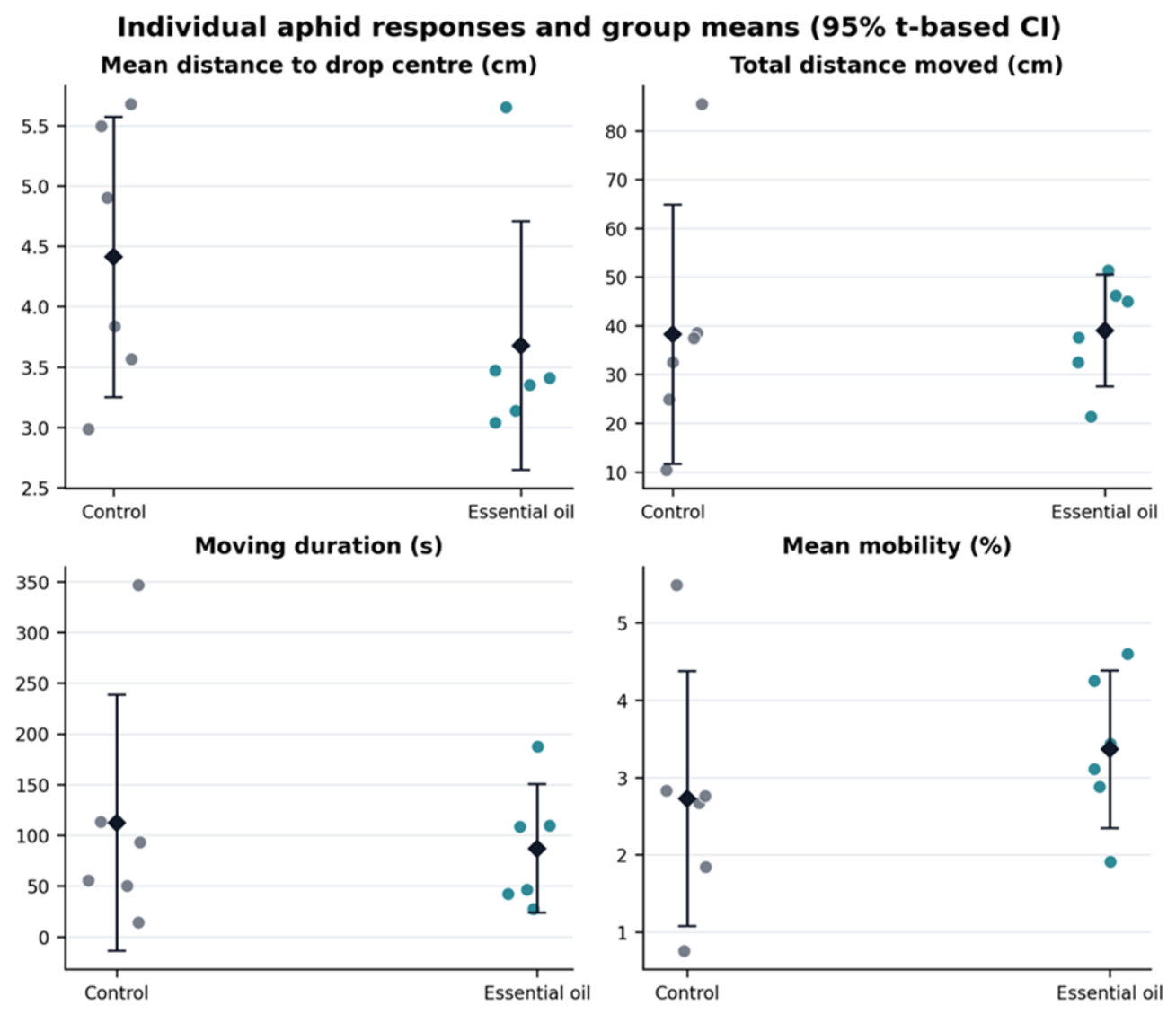
The results of locomotion and mobility of two aphids are presented in Table 4 and Figure 2.

3.5.1. Mean Distance to Drop Centre (cm)

Aphids exposed to the EO showed a slightly lower mean distance from the drop centre compared with the control group (3.68 ± 0.98 vs. 4.41 ± 1.11 cm) (Table 4). The mean difference was −0.73 cm (95% CI: −1.76 to 0.38; Hedges’ g = −0.65; p = 0.25; FDR-adjusted q = 0.94) (Table 4). Thus, EO-treated aphids were, on average, 0.73 cm closer to the application zone than control aphids. The result suggests a numerical tendency toward reduced avoidance or an altered spatial response to the treated area. However, the confidence intervals were not statistically significant, and the confidence interval included zero (Table 4). A similar pattern was observed for the mean distance to the drop zone. EO-treated aphids were located 0.69 cm closer to the drop zone than control aphids (2.33 ± 1.03 vs. 3.03 ± 1.08 cm). The mean difference was −0.69 cm (95% CI: −1.73 to 0.43; Hedges’ g = −0.61; p = 0.29; FDR-adjusted q = 0.94), but the difference was not statistically significant.
The duration spent in the Drop zone was short in both groups, with mean values of 5.62 s in the EO-treated group and 4.48 s in the control group (Table 4). The mean difference was 1.14 s (95% CI: −10.11 to 11.24; Hedges’ g = 0.11; p = 1.00; FDR-adjusted q = 1.00). In contrast, the duration spent in the Near zone was longer in the EO-treated group (87.41) than in the control (42.21). However, the confidence interval for the mean difference was wide (45.20 s; 95% CI: −38.90 to 143.83), indicating substantial uncertainty around this estimate (Table 4).

3.5.2. Total Distance Moved (cm)

Overall, locomotor activity, expressed as the total distance moved, was similar between the two groups (Table 4). Aphids exposed to EO showed a mean movement distance (39.00) comparable to that of the control group (38.20). The mean difference was 0.80 cm (95% CI: −20.86 to 18.92; Hedges’ g = 0.04; p = 0.96; FDR-adjusted q = 1.00) (Table 4). These findings suggest that EO exposure did not strongly suppress or stimulate general locomotor activity during the observation period. The very small effect size further indicates a negligible difference in overall locomotor activity between the groups. Considerable inter-individual variation was observed, particularly in the control group, as reflected by the larger standard deviation.

3.5.3. Moving Duration (s)

The duration of active movement followed a pattern similar to that observed for the total distance moved. The mean moving duration was 86.91 s in the EO group and 112.15 s in the control group (Table 4). The mean difference was −25.25 s (95% CI: −132.85 to 61.21; Hedges’ g = −0.25; p = 0.74; FDR-adjusted q = 1.00). However, this difference was not statistically significant, and the confidence interval included zero. The moderate variability within both groups, particularly the control group, indicates substantial inter-individual variation in the duration of active movement. Overall, these results suggest that EO exposure did not produce a detectable effect on the duration of aphid locomotor activity under the experimental conditions.

3.5.4. Mean Mobility (%)

Mean mobility was comparable between the control and EO-treated groups. Although aphids in the EO-treated group showed a slightly higher mean mobility (3.36) than control aphids (2.73) (Table 4), the mean difference was 0.64 percentage points (95% CI: −0.77 to 1.91; Hedges’ g = 0.45; p = 0.42; FDR-adjusted q = 0.94). However, this difference was not statistically significant, and the confidence interval included zero. These results indicates that EO exposure did not produce a detectable change in the proportion of time spent moving during the observation period. The relatively large variability within both groups further indicates substantial inter-individual differences in mobility.
Generally, exposure to wild hemp EO produced only modest changes in aphid locomotor behaviour across the measured parameters. The most notable trend was the shorter mean distance from the application site in the EO-treated group (mean difference of −0.73 cm), suggesting a possible alteration in spatial orientation or exploratory behaviour following EO exposure. In contrast, parameters reflecting general locomotor activity, including total distance travelled, moving duration, and mean mobility, showed relatively small differences between the treated and control groups. Considerable inter-individual variability was observed in both groups, particularly for moving duration and total distance moved. Overall, these findings indicate that the wild hemp EO had a limited detectable effect on locomotor activity under experimental conditions.

4. Discussion

As part of ongoing research on the EO of wild C. sativa from Bulgaria, its efficacy against R. padi and S. avenae was investigated. To our knowledge, this is the first study to characterise the behavioural responses of these aphids following treatment with this EO.

4.1. Essential Oil Composition of Wild C. sativa from Bulgaria

The EO composition of the wild hemp from Bulgaria exhibited a distinct sesquiterpene-rich chemical profile, with β-caryophyllene (37.07%) being the predominant compound (Table 1). The high abundance of β-caryophyllene and α-humulene was consistent with the chemical profiles previously reported for wild (spontaneous) C. sativa [14]. Zheljazkov et al. [14] examined nine wild hemp accessions from Serbia and reported that β-caryophyllene and α-humulene were the major constituents, with ranges of 15.4–29.6% and 5.3–11.9%, respectively. The β-caryophyllene content detected in the present study (37.07%) exceeded the range reported for the wild accessions examined by these authors. These differences highlight the substantial chemical variability among wild C. sativa populations. Similarly, Nagy et al. [15] reported a high proportion of (E)-caryophyllene (28.3%) in the EO of female inflorescences from spontaneous C. sativa growing in Hungary. In contrast, the present oil contained considerably less CBD (1.34%), further demonstrating the chemical diversity of spontaneous hemp populations.
The composition of the studied wild hemp sample also differed from that reported for several cultivated hemp genotypes. Benelli et al. [5] found that the EO of industrial hemp cv. Felina 32 was dominated by (E)-caryophyllene (45.4%), myrcene (25.0%), and α-pinene (17.9%), whereas the present oil contained only 2.90% myrcene and was characterised by a substantially higher overall proportion of sesquiterpenes [5].
Overall, multi-cultivar studies have demonstrated 10–20-fold variation in EO yield and in the contents of major constituents such as α-pinene, β-myrcene, limonene, and β-caryophyllene [8]. Likewise, variations have been reported among Kompolti hemp EOs in which myrcene, α-pinene, and terpinolene were identified as major constituents [26]. This variability in EO composition is important because it influences both the sensory properties and the potential biological and industrial applications of the oil [8]. These differences demonstrate that genotype, plant material, growing conditions, and extraction procedures may strongly influence the chemical composition of C. sativa EO [7]. Additionally, there are no uniform standards for hemp EOs [8]. As previously noted, the potential biological and industrial applications of hemp EO may correlate more closely with terpene-class ratios than with total EO content [8].

4.2. Repellent and Insecticidal Activities

The present findings demonstrated that wild C. sativa EO possessed exceptionally strong insecticidal activity against both R. padi and S. avenae. In contrast, EO exposure did not result in a significant repellent response in either aphid species. Complete mortality was achieved within 24 h at all tested concentrations, including the lowest one (1.0%), highlighting the remarkable potency of the oil. The absence of surviving individuals after 72 h further indicated that the observed mortality was permanent and was not associated with temporary knockdown effects. Consistent with these findings, complete mortality was observed at all tested concentrations in our previous studies [25,27] of EOs from Juniperus communis L., J. oxycedrus L., J. pygmaea C. Koch., J. sibirica Burgsd., J. sabina, L., and J. excelsa M. Bieb. against the same two aphid species [25,27]. A similar pattern of insecticidal activity against these two aphid species was reported by Leblalta et al. [28]. These authors found strong insecticidal activity of Mentha rotundifolia EO, although the time required to achieve complete mortality differed between the two species [28]. However, monoterpenes were the predominant class in its EOs [25,26,27,28]. In the present research on wild hemp EO, sesquiterpenes were the predominant class, with β-caryophyllene and α-humulene being the predominant constituents. Benelli et al. [5] also demonstrated the strong insecticidal activity of hemp EO against the peach aphid Myzus persicae, supporting the potential of hemp-derived EOs for pest management. Furthermore, the cited authors [5] have shown that (E)-caryophyllene and α-humulene were among the most active individual hemp EO constituents against the tested ectoparasites, whereas α-pinene exhibited weaker activity. These findings support the strong insecticidal activity observed in the present study against R. padi and S. avenae. In insects, the insecticidal effects of EOs may involve multiple mechanisms, including contact toxicity, disruption of cellular membranes, interference with respiratory processes, modulation of the nervous system, and alterations in feeding and behavioural responses [18].
However, the biological effects of the whole EO should not be attributed exclusively to its major constituents. It is generally recognised that EO activity may result from synergistic interactions among its constituents rather than from the effects of individual compounds alone [11]. The chemical composition may also help explain the distinction between the pronounced insecticidal activity and the comparatively weak and inconsistent aphid behavioural response. Despite the relatively high abundance of β-caryophyllene and α-humulene, the repellent response did not show a consistent concentration-dependent pattern. This suggests that, under experimental conditions, the biological activity of the wild hemp EO may be more closely associated with toxicity than with behavioural avoidance.
Moreover, the initial, statistically non-significant changes in spatial behaviour may reflect early sublethal manifestations of EO exposure rather than active attraction or repellency. Such early physiological disturbances could affect aphid orientation and exploratory behaviour before the onset of mortality. However, this interpretation remains tentative and should be tested in future studies using time-resolved behavioural tracking and physiological biomarkers of toxicity.
Overall, the complete and rapid mortality observed in both aphid species indicated that wild C. sativa EO has considerable potential as a botanical insecticidal resource. These results are particularly relevant in the context of increasing interest in plant-derived insecticides as alternatives or complements to conventional synthetic products. Further studies are required to determine the precise dose–response relationship, identify the contribution of major and minor constituents, evaluate phytotoxicity, and assess efficacy under semi-field and field conditions. Such investigations will be essential to determine whether the highly promising activity observed against R. padi and S. avenae can be translated into a practical botanical insecticide.

4.3. Spatial Behaviour, Locomotor Activity, and Mobility of Aphids

The automated behavioural analysis revealed that exposure to wild C. sativa EO produced relatively subtle changes in aphid behaviour. The most apparent response was observed in parameters describing spatial positioning. Aphids exposed to the EO tended to remain closer to the centre of the treated area and its boundary than control aphids. However, these differences were not statistically significant. In contrast, parameters reflecting general locomotor activity, including distance travelled, moving duration, and mobility, remained largely unchanged. These results suggest that the EO did not cause a pronounced suppression of locomotion but may have influenced the spatial orientation or distribution of aphids within the experimental arena. Spatial positioning is an important component of aphid behavioural ecology because aphids rely strongly on chemical cues during host-plant location and acceptance. Aphids possess sensitive olfactory systems that enable them to detect plant volatiles and distinguish between host and non-host plants. Plant odours can either attract or repel aphids and can also modify their movement patterns during host searching [29]. Experimental studies have demonstrated that aphids respond differently to host and non-host volatiles, with some plant volatile blends attracting aphids, whereas others mask host attractiveness or induce avoidance behaviour. Nottingham et al. [30] demonstrated that volatiles from some non-host plants repelled aphids, whereas host-plant odours promoted attraction in several aphid species. These findings indicate that aphid behavioural responses to EO exposure are highly context-dependent and may involve changes in orientation rather than simple changes in overall activity [30]. The tendency of EO-exposed aphids to remain closer to the treatment area may therefore reflect a modification of spatial orientation rather than a conventional repellent response. This interpretation is consistent with the results of the concentration-dependent repellency assay. The combination of weak spatial effects and the absence of a clear repellent response suggests that exposure to the EO may have altered how aphids explored or evaluated the treated area without inducing strong avoidance behaviour.
Overall, wild hemp EO did not substantially modify the overall activity state of the two target aphid species under the conditions of this study. The absence of significant changes in total distance travelled, moving duration, and mobility is also biologically relevant. If the EO had caused a strong neurotoxic or general locomotor effect at the time of behavioural recording, a substantial reduction in these parameters might have been expected. Instead, the aphids maintained relatively similar levels of movement compared with the controls. This finding suggests that the behavioural response was not characterised by generalised immobilisation or severe motor impairment. Rather, the tested EO may have affected specific aspects of aphid spatial behaviour. Conversely, toxic effects may impair movement only at later stages, as physiological effects develop.
Recent studies on the effects of EOs against Aphis gossypii have demonstrated that exposure to volatile compounds can affect several behavioural processes simultaneously, including host-related orientation and feeding activity [31]. Zhang et al. [32] reported that EOs from Mentha arvensis, Mentha piperita, and Lavandula angustifolia repelled aphids and altered feeding behaviour. These findings support the concept that EOs may induce behavioural changes that are more specific than a simple reduction in locomotor activity.
The chemical composition of wild hemp EO may also be relevant to the observed spatial response. As described above, the EO examined in this study was characterised by a high proportion of sesquiterpenes, particularly β-caryophyllene and α-humulene, while α-pinene was the major monoterpene. Aphids are known to respond to individual volatile compounds as well as to complex volatile blends. Therefore, the behavioural effects of an EO may depend on the combined olfactory signal generated by its individual constituents. Studies of aphid responses to EOs have demonstrated that minor constituents can modify or inhibit the behavioural effects of major components [33]. For example, Bruce et al. [33] showed that minor constituents of Hemizygia petiolata EO, particularly (+)-bicyclogermacrene and (−)-germacrene D, inhibited the alarm response induced by the major constituent (E)-β-farnesene in Myzus persicae and Acyrthosiphon pisum, respectively. These findings highlight the importance of considering the complete chemical profile of EO when interpreting its effects on insect behaviour.
Overall, the behavioural data indicate that wild C. sativa EO produced a relatively selective modification of aphid spatial behaviour rather than a generalised inhibition of locomotion. The tendency of EO-treated aphids to remain closer to the EO application area, together with the absence of significant effects on total distance travelled, moving duration, and mobility, suggests that the EO may influence spatial orientation or area exploration without substantially impairing motor activity. Combined with the absence of consistent repellency in the paired-choice assay, these findings indicate that the primary effect of the wild hemp EO may be insecticidal rather than strongly repellent. Further experiments using individual EO constituents, different exposure periods, and single-aphid arenas would be valuable for determining whether the observed spatial response is mediated primarily by olfactory cues, contact effects, or interactions among the major and minor components of the EO.
An additional limitation is that the control and EO-treated groups were recorded in separate sessions. Thus, treatment effects cannot be completely distinguished from possible session-related variations in lighting, temperature, chamber conditions, or recording time. Therefore, the heat maps should be interpreted as descriptive. Future experiments should use simultaneous or time-paired recordings, randomised treatment assignment, and strict control of environmental conditions.
The behavioural findings should be interpreted with caution because the small sample size (n = 6 individuals per treatment) limited statistical power and may not adequately represent inter-individual behavioural heterogeneity. In addition, the control and EO-treated groups were recorded in separate sessions, meaning that treatment effects cannot be fully distinguished from possible session-related variation. Consequently, the behavioural results are exploratory and require confirmation using simultaneous or temporally paired recordings and a larger sample size determined by an a priori power analysis.

5. Conclusions

Wild C. sativa EO demonstrated strong insecticidal activity against R. padi and S. avenae under laboratory conditions, causing complete mortality (100%) within 24 h at all tested concentrations (1.0–5.0%). In contrast, the EO did not produce a consistent or statistically significant repellent response. Behavioural analysis revealed moderate changes in spatial behaviour, while general locomotor activity remained largely unaffected. These early behavioural changes may represent initial manifestations of EO toxicity preceding severe physiological impairment and mortality, rather than an independent repellent response. Although this interpretation remains tentative, the findings highlight the potential of wild hemp EO as a botanical insecticide and support further studies of the temporal progression and mechanisms underlying its lethal effects.

Author Contributions

Conceptualisation, V.M. and I.S.; methodology, V.M., I.S. and I.D.; software, V.M. and I.D.; validation, I.S.; formal analysis, V.M., I.S. and I.D.; investigation, V.M., D.A., I.S. and I.D. resources, V.M., D.A., I.S. and I.D.; data curation, V.M., I.S. and I.D.; writing—original draft preparation, V.M. and I.S.; writing—review and editing, V.M., D.A., I.S. and I.D.; supervision, I.S.; project administration, I.S.; funding acquisition, I.S. All authors have read and agreed to the published version of the manuscript.

Funding

This research was funded by the Scientific Research Fund, Bulgaria (BNSF), for project KP-06N 96/11 from 10 December 2025, managed by I. Semerdjieva.

Data Availability Statement

Data of the materials are available from the authors.

Acknowledgments

The authors are grateful to the Scientific Research Fund in Bulgaria (BNSF) for financial support of project KP-06N 96/11 from 10 December 2025.

Conflicts of Interest

The authors declare no conflicts of interest.

References

  1. European Commission. Pesticide Reduction Targets—Progress. Available online: https://food.ec.europa.eu/plants/pesticides/sustainable-use-pesticides/pesticide-reduction-targets-progress_en (accessed on 10 July 2026).
  2. Muska, A.; Pilvere, I.; Nipers, A. European Green Deal Objective for Sustainable Agriculture: Opportunities and Challenges to Reduce Pesticide Use. Emerg. Sci. J. 2025, 9, 1774–1791. [Google Scholar] [CrossRef] [Scilit]
  3. Campolo, O.; Giunti, G.; Russo, A.; Palmeri, V.; Zappalà, L. Essential Oils in Stored Product Insect Pest Control. J. Food Qual. 2018, 2018, 6906105. [Google Scholar] [CrossRef] [Scilit]
  4. Ben Miri, Y. Essential Oils: Chemical Composition and Diverse Biological Activities: A Comprehensive Review. Nat. Prod. Commun. 2025, 20, 1934578X241311790. [Google Scholar] [CrossRef] [Scilit]
  5. Benelli, G.; Pavela, R.; Petrelli, R.; Cappellacci, L.; Santini, G.; Fiorini, D.; Sut, S.; Dall’Acqua, S.; Canale, A.; Maggi, F. The Essential Oil from Industrial Hemp (Cannabis sativa L.) By-Products as an Effective Tool for Insect Pest Management in Organic Crops. Ind. Crops Prod. 2018, 122, 308–315. [Google Scholar] [CrossRef] [Scilit]
  6. Abdollahi, M.; Sefidkon, F.; Calagari, M.; Mousavi, A.; Mahomoodally, M.F. Impact of Four Hemp (Cannabis sativa L.) Varieties and Stage of Plant Growth on Yield and Composition of Essential Oils. Ind. Crops Prod. 2020, 155, 112793. [Google Scholar] [CrossRef] [Scilit]
  7. Ona, G.; Balant, M.; Bouso, J.C.; Gras, A.; Vallès, J.; Vitales, D.; Garnatje, T. The Use of Cannabis sativa L. for Pest Control: From the Ethnobotanical Knowledge to a Systematic Review of Experimental Studies. Cannabis Cannabinoid Res. 2022, 7, 365–387. [Google Scholar] [CrossRef] [Scilit] [PubMed]
  8. Zheljazkov, V.D.; Semerdjieva, I.; Maggi, F.; Spinozzi, E. Hemp (Cannabis sativa L.) Essential Oils and Terpene-Rich Fractions for Industrial Applications. Ind. Crops Prod. 2026, 250, 123936. [Google Scholar] [CrossRef] [Scilit]
  9. Tabari, M.A.; Khodashenas, A.; Jafari, M.; Petrelli, R.; Cappellacci, L.; Nabissi, M.; Maggi, F.; Pavela, R.; Youssefi, M.R. Acaricidal Properties of Hemp (Cannabis sativa L.) Essential Oil against Dermanyssus gallinae and Hyalomma dromedarii. Ind. Crops Prod. 2020, 147, 112238. [Google Scholar] [CrossRef] [Scilit]
  10. Prvulović, D.; Gvozdenac, S.; Latković, D.; Peić Tukuljac, M.; Ovuka, J. Phytotoxic and Insecticidal Activity of Industrial Hemp (Cannabis sativa L.) Extracts against Plodia interpunctella Hübner—A Potential Sunflower Grain Protectant. Agronomy 2023, 13, 2456. [Google Scholar] [CrossRef] [Scilit]
  11. Dadé, M.M.; Daniele, M.R.; Rodriguez, S.; Díaz, P.; Silvestrini, M.P.; Schinella, G.R.; Marin, G.H.; Barrio, D.; Prieto Garcia, J.M. Repellent, Lethal Activity, and Synergism of Cannabis sativa Extracts with Terpenes against a Laboratory Colony of Triatoma infestans. Plants 2025, 14, 3258. [Google Scholar] [CrossRef] [Scilit] [PubMed]
  12. Mohamed, A.A.I.; Kehail, M.A.A.; Hilmi, Z.A.; Homida, A.E.; Abdelrahim, Y.M.; Mohamed, A.I.A. Evaluation of Bio-Insecticidal Capacity of Cannabis (Cannabis sativa L.) Plants Using GC-MS and Phytochemical Techniques. Int. J. Phytol. Res. 2022, 2, 38–41. Available online: https://www.dzarc.com/phytology/article/view/8 (accessed on 6 July 2026).
  13. Mondal, P.C.; Salim, R.; Kaushik, P.; Timmanna, H.; Shakil, N.A.; Rana, V.S. Phytochemical, Nematicidal, and Aphidicidal Studies of the Leaves of Cannabis sativa L. ACS Agric. Sci. Technol. 2025, 5, 2132–2143. [Google Scholar] [CrossRef] [Scilit]
  14. Zheljazkov, V.D.; Sikora, V.; Semerdjieva, I.B.; Kačániová, M.; Astatkie, T.; Dincheva, I. Grinding and Fractionation during Distillation Alter Hemp Essential Oil Profile and Its Antimicrobial Activity. Molecules 2020, 25, 3943. [Google Scholar] [CrossRef] [Scilit] [PubMed]
  15. Nagy, D.U.; Cianfaglione, K.; Maggi, F.; Süt, S.; Dall’Acqua, S. Chemical Characterization of Leaves, Male and Female Flowers from Spontaneous Cannabis sativa L. Growing in Hungary. Chem. Biodivers. 2019, 16, e1800562. [Google Scholar] [CrossRef] [Scilit] [PubMed]
  16. Aina, A.; Wenger, J.P.; Stanton, E.; Majumdar, C.G.; ElSohly, M.; Weiblen, G.D.; Ellison, S. Genetic Diversity, Population Structure, and Cannabinoid Variation in Feral Cannabis sativa Germplasm from the United States. Sci. Rep. 2025, 15, 20423. [Google Scholar] [CrossRef] [Scilit] [PubMed]
  17. Busta, L.; Dweikat, I.; Sato, S.J.; Qu, H.; Xue, Y.; Zhou, B.; Gan, L.; Yu, B.; Clemente, T.E.; Cahoon, E.B.; et al. Chemical and Genetic Variation in Feral Cannabis sativa Populations across the Nebraska Climate Gradient. Phytochemistry 2022, 200, 113206. [Google Scholar] [CrossRef] [Scilit] [PubMed]
  18. Isman, M.B. Plant Essential Oils for Pest and Disease Management. Crop Prot. 2000, 19, 603–608. [Google Scholar] [CrossRef] [Scilit]
  19. Lacotte, V.; Rey, M.; Peignier, S.; Mercier, P.-E.; Rahioui, I.; Sivignon, C.; Razy, L.; Benhamou, S.; Livi, S.; da Silva, P. Bioactivity and Chemical Composition of Forty Plant Essential Oils against the Pea Aphid Acyrthosiphon pisum Revealed Peppermint Oil as a Promising Biorepellent. Ind. Crops Prod. 2023, 197, 116610. [Google Scholar] [CrossRef] [Scilit]
  20. Girardi, J.; Berķe-Ļubinska, K.; Mežaka, I.; Nakurte, I.; Skudriņš, G.; Pastare, L. In Vivo Bioassay of the Repellent Activity of Caraway Essential Oil against Green Peach Aphid. Insects 2023, 14, 876. [Google Scholar] [CrossRef] [Scilit] [PubMed]
  21. Taglienti, A.; Donati, L.; Dragone, I.; Ferretti, L.; Gentili, A.; Araniti, F.; Sapienza, F.; Astolfi, R.; Fiorentino, S.; Vecchiarelli, V.; et al. In Vivo Antiphytoviral and Aphid Repellency Activity of Essential Oils and Hydrosols from Mentha suaveolens and Foeniculum vulgare to Control Zucchini Yellow Mosaic Virus and Its Vector Aphis gossypii. Plants 2023, 12, 1078. [Google Scholar] [CrossRef] [Scilit] [PubMed]
  22. Bedini, S.; Djebbi, T.; Ascrizzi, R.; Farina, P.; Pieracci, Y.; Echeverría, M.C.; Flamini, G.; Trusendi, F.; Ortega, S.; Chiliquinga, A.; et al. Repellence and Attractiveness: The Hormetic Effect of Aromatic Plant Essential Oils on Insect Behavior. Ind. Crops Prod. 2024, 210, 118122. [Google Scholar] [CrossRef] [Scilit]
  23. European Directorate for the Quality of Medicines & HealthCare (EDQM). Essential Oils: Revised Monograph and New General Chapter in the Ph. Eur. 2021. Available online: https://www.edqm.eu/en/-/essential-oils-revised-monograph-and-new-general-chapter-in-the-ph.-eur. (accessed on 6 July 2026).
  24. Adams, R.P. Identification of Essential Oil Components by Gas Chromatography/Mass Spectrometry, 5th ed.; Allured Publishing Corporation: Carol Stream, IL, USA, 2009. [Google Scholar]
  25. Semerdjieva, I.; Zheljazkov, V.D.; Radoukova, T.; Dincheva, I.; Piperkova, N.; Maneva, V.; Astatkie, T.; Kačániová, M. Biological Activity of Essential Oils of Four Juniper Species and Their Potential as Biopesticides. Molecules 2021, 26, 6358. [Google Scholar] [CrossRef] [Scilit] [PubMed]
  26. Mazzara, E.; Torresi, J.; Fico, G.; Papini, A.; Kulbaka, N.; Dall’Acqua, S.; Süt, S.; Garzoli, S.; Mustafa, A.M.; Cappellacci, L. A Comprehensive Phytochemical Analysis of Terpenes, Polyphenols and Cannabinoids, and Micromorphological Characterization of 9 Commercial Varieties of Cannabis sativa L. Plants 2022, 11, 891. [Google Scholar] [CrossRef] [Scilit] [PubMed]
  27. Zheljazkov, V.D.; Cantrell, C.L.; Semerdjieva, I.; Radoukova, T.; Stoyanova, A.; Maneva, V.; Kačániová, M.; Astatkie, T.; Borisova, D.; Dincheva, I.; et al. Essential Oil Composition and Bioactivity of Two Juniper Species from Bulgaria and Slovakia. Molecules 2021, 26, 3659. [Google Scholar] [CrossRef] [Scilit] [PubMed]
  28. Leblalta, A.; Harzallah, D.; Demirtas, I.; Gül, F. Insecticidal Activity of Mentha rotundifolia Essential Oil against Rhopalosiphum padi and Sitobion avenae (Hemiptera: Aphididae), Cereal Aphids in Setif, Algeria. Arch. Phytopathol. Plant Prot. 2020, 53, 793–805. [Google Scholar] [CrossRef] [Scilit]
  29. Webster, B. The Role of Olfaction in Aphid Host Location. Physiol. Entomol. 2012, 37, 10–18. [Google Scholar] [CrossRef] [Scilit]
  30. Nottingham, S.F.; Hardie, J.; Dawson, G.W.; Hick, A.J.; Pickett, J.A.; Wadhams, L.J.; Woodcock, C.M. Behavioral and Electrophysiological Responses of Aphids to Host and Nonhost Plant Volatiles. J. Chem. Ecol. 1991, 17, 1231–1242. [Google Scholar] [CrossRef] [Scilit] [PubMed]
  31. Wang, X.; Zhang, Y.; Yuan, H.; Lu, Y. Effects of Seven Plant Essential Oils on the Growth, Development and Feeding Behavior of the Wingless Aphis gossypii Glover. Plants 2024, 13, 916. [Google Scholar] [CrossRef] [Scilit] [PubMed]
  32. Zhang, Y.; Zhang, T.; Wang, X.; Bian, Z.; Zhang, X.; Yang, G.; Lu, Y. Volatiles from Essential Oils of Three Lamiaceae Plants Repel the Winged Cotton Aphid, Disturb Its Feeding Behavior and Reduce Its Fecundity. Pest Manag. Sci. 2024, 80, 4253–4263. [Google Scholar] [CrossRef] [Scilit] [PubMed]
  33. Bruce, T.J.A.; Birkett, M.A.; Blande, J.; Hooper, A.M.; Martin, J.L.; Khambay, B.; Prosser, I.; Smart, L.E.; Wadhams, L.J. Response of Economically Important Aphids to Components of Hemizygia petiolata Essential Oil. Pest Manag. Sci. 2005, 61, 1115–1121. [Google Scholar] [CrossRef] [Scilit] [PubMed]
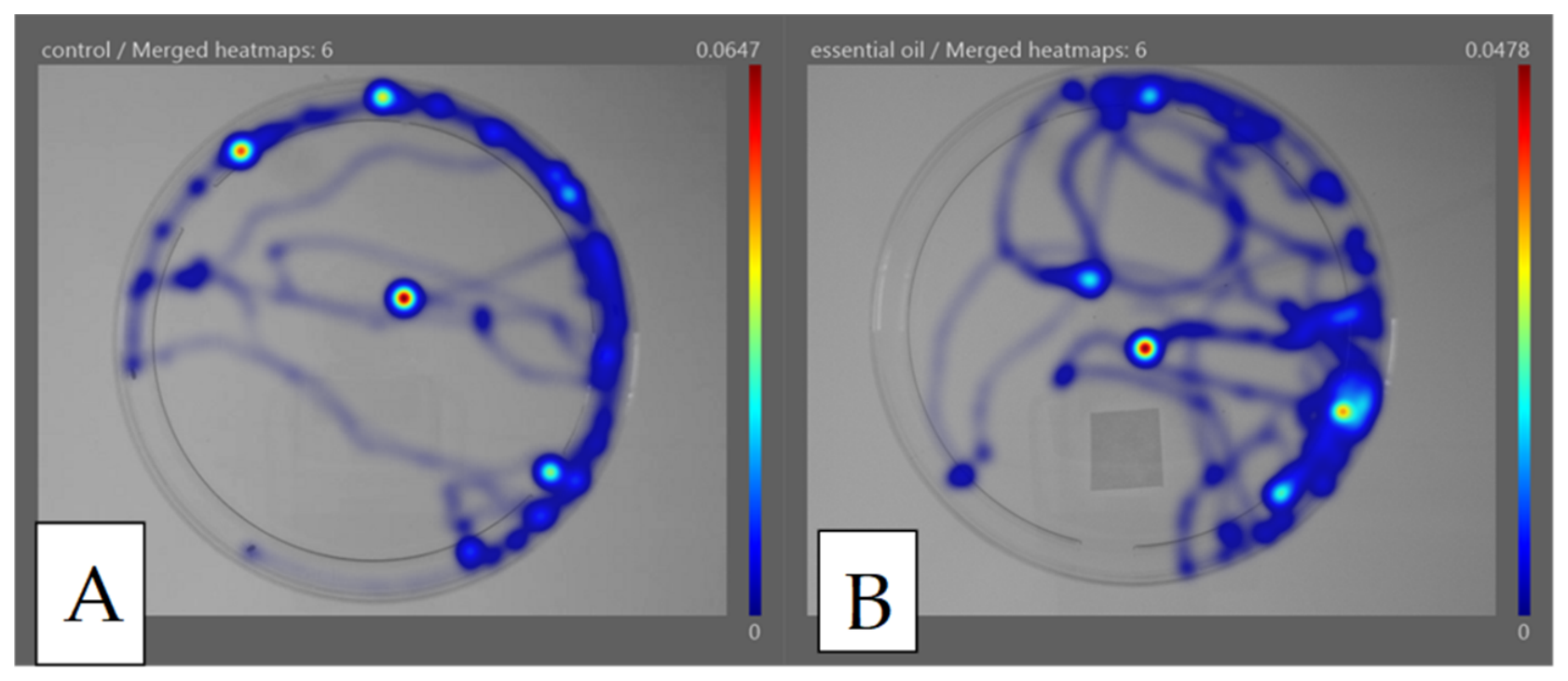
Figure 1. Descriptive merged EthoVision heatmaps for the control (A) and tested EO (B) trials. Colour intensity reflects spatial occupancy. Because each treatment was recorded in a different trial/session, this image is descriptive and cannot isolate a treatment effect.
Agronomy 16 01778 g001
Figure 2. Individual aphid values for four representative behavioural outcomes. The squares show group means; points are individual aphids (n = 6 per group). Error bars show 95% t-based confidence intervals.
Agronomy 16 01778 g002
Table 1. Mean concentration (%) and standard deviation (SD) of compounds in wild C. sativa EO from Bulgaria.
RTRICompoundClassMean (%)SD
8.70924α-ThujeneMT0.170.01
9.15932α-PineneMT13.980.69
9.66946CampheneMT0.230.02
10.55974β-PineneMT1.530.14
11.00988MyrceneMT2.900.27
11.631007δ-3-CareneMT1.490.13
12.251023LimoneneMT2.730.25
12.291026EucalyptolMT0.270.02
12.521032β-(Z)-OcimeneMT0.120.01
12.841044β-(E)-OcimeneMT0.470.04
14.051087TerpinoleneMT0.100.01
14.551114endo-FencholMT0.160.05
15.111117exo-FencholMT0.140.04
15.761135(E)-PinocarveolMT0.250.05
16.701166BorneolMT0.140.03
17.411188α-TerpineolMT0.180.01
23.141407IsocaryophylleneST0.650.06
23.441411α-(Z)-BergamoteneST0.160.01
23.661418β-CaryophylleneST37.071.86
23.891431α-(E)-BergamoteneST2.100.19
23.991433γ-ElemeneST1.180.11
24.241435β-GurjuneneST0.220.01
24.391441(Z)-β-FarneseneST1.720.16
24.511452α-HumuleneST8.330.77
24.601457L-alloaromadendreneST2.720.25
24.801480γ-HimachaleneST0.130.01
24.881489β-SelineneST0.220.02
25.151492δ-SelineneST0.720.06
25.341497α-SelineneST4.200.39
25.511502β-BisaboleneST2.540.23
25.721513γ-CadineneST2.260.45
25.761522δ-CadineneST0.590.06
26.501536α-CadineneST0.460.04
26.871545α-BisaboleneST0.640.06
27.531584Caryophyllene oxideST2.260.45
27.781590GlobulolST0.150.01
27.871601LedolST0.160.01
28.071608Humulene epoxide IIST0.290.03
28.171615β-Himachalene oxideST0.610.06
28.451626γ-EudesmolST0.410.04
28.651637Cryphylla-4(12),8(13)-dien-5α-olST0.530.05
28.741639Caryphylla-4(12),8(13)-dien-5β-olST0.670.06
28.831650β-EudesmolST0.230.02
29.261654α-EudesmolST1.360.13
29.581675β-BisabololST0.320.03
29.861686α-BisabololST0.510.05
33.131822(E)-Nerolidyl isobutyrateST0.300.03
43.582381CBDC1.340.36
Total MT 24.750.08
Total ST 71.782.56
Monoterpenes—MT; Sesquiterpenes—ST; Cannabinoid—C; Retention Time—RT; Retention index—RI.
Table 2. Repellent activity of wild C. sativa EO against Rhopalosiphum padi and Sitobion avenae at different concentrations.
SpeciesConc.T/CTreated %RI %95% CIpq
R. padi5%3/350.00.018.8–81.21.001.00
R. padi4.5%3/175.0−50.030.1–95.40.631.00
R. padi3.5%3/175.0−50.030.1–95.40.631.00
R. padi2.5%3/442.914.315.8–75.01.001.00
R. padi1.5%2/528.642.98.2–64.10.451.00
R. padi1%2/340.020.011.8–76.91.001.00
S. avenae5%5/645.59.121.3–72.01.001.00
S. avenae4.5%7/187.5−75.052.9–97.80.070.84
S. avenae3.5%2/340.020.011.8–76.91.001.00
S. avenae2.5%5/550.00.023.7–76.31.001.00
S. avenae1.5%3/633.333.312.1–64.60.511.00
S. avenae1%4/544.411.118.9–73.31.001.00
T/C = pooled numbers on treated/control leaves across three dishes; treated % = T/(T + C); RI (repellency index) = 100(C − T)/(C + T); CI = Wilson confidence interval; p = two-sided exact binomial p-value; q = Benjamini–Hochberg-adjusted p-value.
Table 3. Insecticidal activity of wild C. sativa EO against Rhopalosiphum padi and Sitobion avenae at different concentrations.
SpeciesConc in %Treated
Initial n (Pooled Across Three Replicates)
Treated Mortality, % (95% CI)Control
Live/Initial n (Pooled Across Three Replicates)
Control
Survival %
Henderson–Tilton Efficacy
% 24
R. padi521100 (83.9–100)33/3497.1100
R. padi4.526100 (86.8–100)33/3497.1100
R. padi3.526100 (86.8–100)33/3497.1100
R. padi2.527100 (87.2–100)33/3497.1100
R. padi1.524100 (85.8–100)33/3497.1100
R. padi133100 (89.4–100)33/3497.1100
S. avenae526100 (86.8–100)35/35100100
S. avenae4.536100 (90.3–100)35/35100100
S. avenae3.530100 (88.4–100)35/35100100
S. avenae2.525100 (86.3–100)35/35100100
S. avenae1.526100 (86.8–100)35/35100100
S. avenae126100 (86.8–100)35/35100100
Note: Treated initial n represents the total number of aphids pooled across three replicates for each species and concentration. Control live/initial n represents the corresponding pooled control count across three replicates. Mortality and survival are reported at 24 h, and mortality confidence intervals are exact 95% Clopper–Pearson intervals. Henderson–Tilton efficacy was calculated using the pooled treated and control counts. The same control data apply to all concentrations tested within each species.
Table 4. Results of locomotor activity and mobility in Rhopalosiphum padi and Sitobion avenae.
ParametersEO Mean ± SDControl Mean ± SDMean Difference (95% CI)Hedges’ gpFDR q
Mean distance to drop centre (cm)3.68 ± 0.984.41 ± 1.11−0.73 (−1.76, 0.38)−0.650.250.94
Mean distance to drop zone (cm)2.33 ± 1.033.03 ± 1.08−0.69 (−1.73, 0.43)−0.610.290.94
Time in drop zone (s)5.62 ± 8.924.48 ± 10.971.14 (−10.11, 11.24)0.111.001.00
Time in near zone (s)87.41 ± 113.6242.21 ± 55.8545.20 (−38.90, 143.83)0.470.450.94
Drop-zone entries (count)0.67 ± 1.030.33 ± 0.820.33 (−0.67, 1.33)0.331.001.00
Near-zone entries (count)3.00 ± 2.681.83 ± 3.061.17 (−2.00, 3.83)0.370.510.94
Total distance moved (cm)39.00 ± 10.9338.20 ± 25.390.80 (−20.86, 18.92)0.040.961.00
Mean velocity (cm/s)0.07 ± 0.020.064 ± 0.0420.002 (−0.04, 0.03)0.040.951.00
Moving duration (s)86.91 ± 60.37112.15 ± 120.13−25.25 (−132.85, 61.21)−0.250.741.00
Immobile duration (s)447.43 ± 58.86480.10 ± 93.78−32.67 (−108.27, 52.68)−0.390.490.94
Mean mobility (%)3.36 ± 0.972.73 ± 1.570.64 (−0.77, 1.91)0.450.420.94
CI = confidence interval; SD = standard deviation; q = Benjamini–Hochberg-adjusted permutation p-value.
Disclaimer/Publisher’s Note: The statements, opinions and data contained in all publications are solely those of the individual author(s) and contributor(s) and not of MDPI and/or the editor(s). MDPI and/or the editor(s) disclaim responsibility for any injury to people or property resulting from any ideas, methods, instructions or products referred to in the content.