



Repellent and Insecticidal Activity of Wild Cannabis sativa L. Essential Oil Against Rhopalosiphum padi and Sitobion avenae, with Exploratory Automated Behavioural Tracking

Abstract
1. Introduction
2. Materials and Methods
2.1. Collection of the Wild C. Sativa, EO Isolation and Gas Chromatography (GC), and Mass Spectrometry (MS) Analyses
2.1.1. Collection of the Wild C. sativa and EO Isolation
2.1.2. Gas Chromatography (GC) and Mass Spectrometry (MS) Analyses
2.2. Aphid Collection and Colonisation
2.3. Repellency Activity of Wild C. sativa EO Against Rhopalosiphum Padi and Sitobion Avenae
2.4. Insecticidal Activity of Wild C. sativa EO Against Rhopalosiphum Padi and Sitobion Avenae
2.5. Automated Recording and Results of the Behaviour of Rhopalosiphum Padi and Sitobion Avenae
2.6. Statistical Analysis
2.6.1. The Results from Repellency Activity
2.6.2. The Results from Insecticidal Activity
3. Results
3.1. Essential Oil Composition of Wild C. sativa from Bulgaria
3.2. Repellent Activity of Wild C. sativa EO Against Rhopalosiphum Padi and Sitobion Avenae
3.3. Insecticidal Activity of Wild C. sativa EO Against Rhopalosiphum Padi and Sitobion Avenae
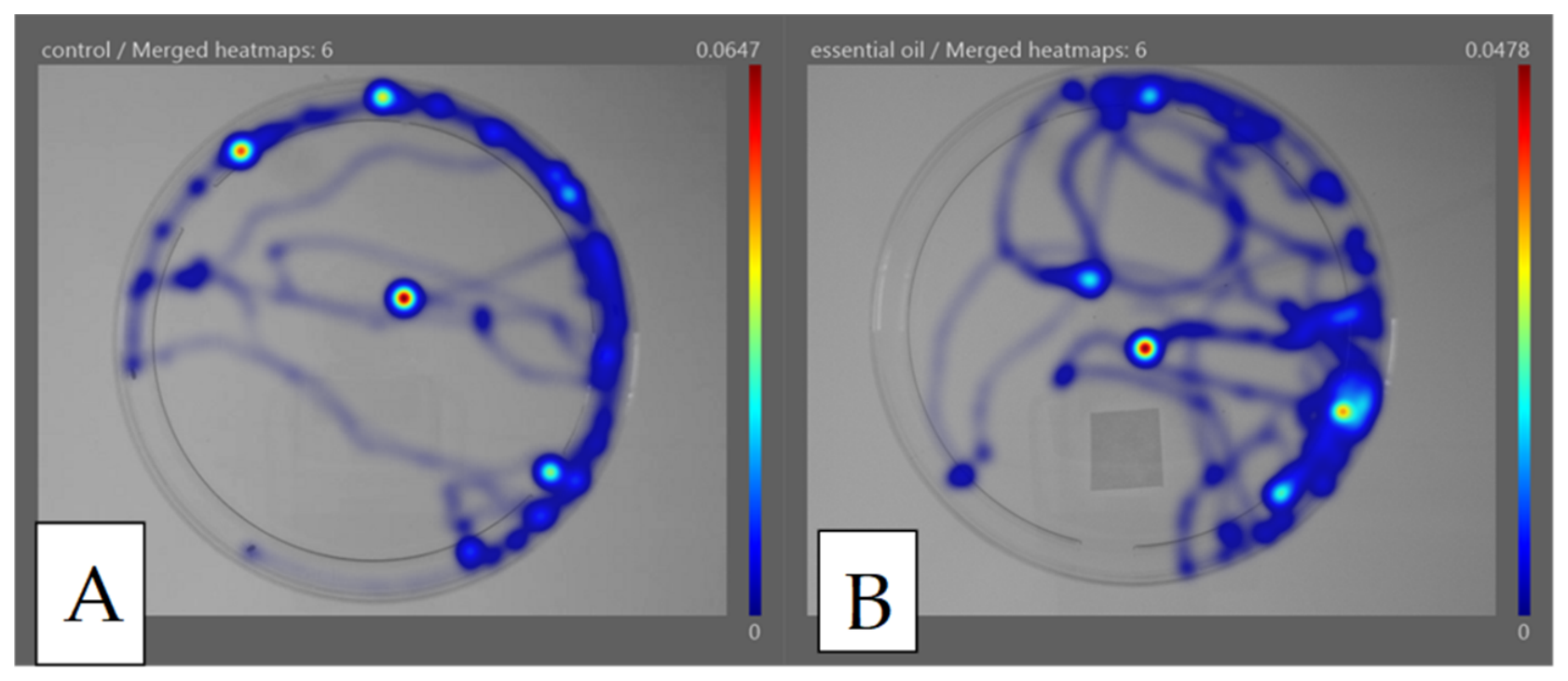
3.4. Tracking and Spatial Behaviour of Rhopalosiphum Padi and Sitobion Avenae
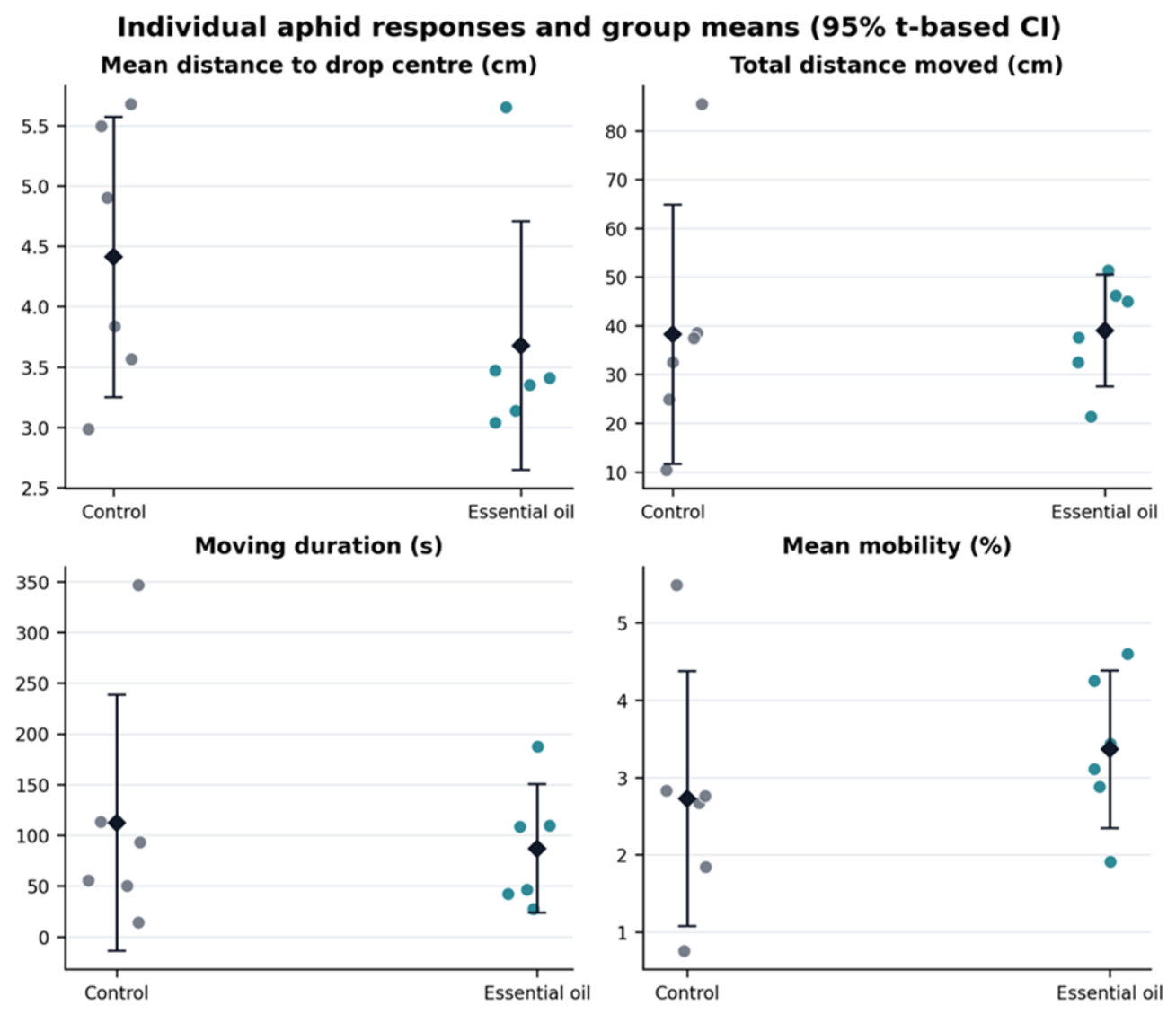
3.5. Locomotion and Mobility and Multiplicity-Adjusted Inference
3.5.1. Mean Distance to Drop Centre (cm)
3.5.2. Total Distance Moved (cm)
3.5.3. Moving Duration (s)
3.5.4. Mean Mobility (%)
4. Discussion
4.1. Essential Oil Composition of Wild C. sativa from Bulgaria
4.2. Repellent and Insecticidal Activities
4.3. Spatial Behaviour, Locomotor Activity, and Mobility of Aphids
5. Conclusions
Author Contributions
Funding
Data Availability Statement
Acknowledgments
Conflicts of Interest
References
- European Commission. Pesticide Reduction Targets—Progress. Available online: https://food.ec.europa.eu/plants/pesticides/sustainable-use-pesticides/pesticide-reduction-targets-progress_en (accessed on 10 July 2026).
- Muska, A.; Pilvere, I.; Nipers, A. European Green Deal Objective for Sustainable Agriculture: Opportunities and Challenges to Reduce Pesticide Use. Emerg. Sci. J. 2025, 9, 1774–1791. [Google Scholar] [CrossRef] [Scilit]
- Campolo, O.; Giunti, G.; Russo, A.; Palmeri, V.; Zappalà, L. Essential Oils in Stored Product Insect Pest Control. J. Food Qual. 2018, 2018, 6906105. [Google Scholar] [CrossRef] [Scilit]
- Ben Miri, Y. Essential Oils: Chemical Composition and Diverse Biological Activities: A Comprehensive Review. Nat. Prod. Commun. 2025, 20, 1934578X241311790. [Google Scholar] [CrossRef] [Scilit]
- Benelli, G.; Pavela, R.; Petrelli, R.; Cappellacci, L.; Santini, G.; Fiorini, D.; Sut, S.; Dall’Acqua, S.; Canale, A.; Maggi, F. The Essential Oil from Industrial Hemp (Cannabis sativa L.) By-Products as an Effective Tool for Insect Pest Management in Organic Crops. Ind. Crops Prod. 2018, 122, 308–315. [Google Scholar] [CrossRef] [Scilit]
- Abdollahi, M.; Sefidkon, F.; Calagari, M.; Mousavi, A.; Mahomoodally, M.F. Impact of Four Hemp (Cannabis sativa L.) Varieties and Stage of Plant Growth on Yield and Composition of Essential Oils. Ind. Crops Prod. 2020, 155, 112793. [Google Scholar] [CrossRef] [Scilit]
- Ona, G.; Balant, M.; Bouso, J.C.; Gras, A.; Vallès, J.; Vitales, D.; Garnatje, T. The Use of Cannabis sativa L. for Pest Control: From the Ethnobotanical Knowledge to a Systematic Review of Experimental Studies. Cannabis Cannabinoid Res. 2022, 7, 365–387. [Google Scholar] [CrossRef] [Scilit] [PubMed]
- Zheljazkov, V.D.; Semerdjieva, I.; Maggi, F.; Spinozzi, E. Hemp (Cannabis sativa L.) Essential Oils and Terpene-Rich Fractions for Industrial Applications. Ind. Crops Prod. 2026, 250, 123936. [Google Scholar] [CrossRef] [Scilit]
- Tabari, M.A.; Khodashenas, A.; Jafari, M.; Petrelli, R.; Cappellacci, L.; Nabissi, M.; Maggi, F.; Pavela, R.; Youssefi, M.R. Acaricidal Properties of Hemp (Cannabis sativa L.) Essential Oil against Dermanyssus gallinae and Hyalomma dromedarii. Ind. Crops Prod. 2020, 147, 112238. [Google Scholar] [CrossRef] [Scilit]
- Prvulović, D.; Gvozdenac, S.; Latković, D.; Peić Tukuljac, M.; Ovuka, J. Phytotoxic and Insecticidal Activity of Industrial Hemp (Cannabis sativa L.) Extracts against Plodia interpunctella Hübner—A Potential Sunflower Grain Protectant. Agronomy 2023, 13, 2456. [Google Scholar] [CrossRef] [Scilit]
- Dadé, M.M.; Daniele, M.R.; Rodriguez, S.; Díaz, P.; Silvestrini, M.P.; Schinella, G.R.; Marin, G.H.; Barrio, D.; Prieto Garcia, J.M. Repellent, Lethal Activity, and Synergism of Cannabis sativa Extracts with Terpenes against a Laboratory Colony of Triatoma infestans. Plants 2025, 14, 3258. [Google Scholar] [CrossRef] [Scilit] [PubMed]
- Mohamed, A.A.I.; Kehail, M.A.A.; Hilmi, Z.A.; Homida, A.E.; Abdelrahim, Y.M.; Mohamed, A.I.A. Evaluation of Bio-Insecticidal Capacity of Cannabis (Cannabis sativa L.) Plants Using GC-MS and Phytochemical Techniques. Int. J. Phytol. Res. 2022, 2, 38–41. Available online: https://www.dzarc.com/phytology/article/view/8 (accessed on 6 July 2026).
- Mondal, P.C.; Salim, R.; Kaushik, P.; Timmanna, H.; Shakil, N.A.; Rana, V.S. Phytochemical, Nematicidal, and Aphidicidal Studies of the Leaves of Cannabis sativa L. ACS Agric. Sci. Technol. 2025, 5, 2132–2143. [Google Scholar] [CrossRef] [Scilit]
- Zheljazkov, V.D.; Sikora, V.; Semerdjieva, I.B.; Kačániová, M.; Astatkie, T.; Dincheva, I. Grinding and Fractionation during Distillation Alter Hemp Essential Oil Profile and Its Antimicrobial Activity. Molecules 2020, 25, 3943. [Google Scholar] [CrossRef] [Scilit] [PubMed]
- Nagy, D.U.; Cianfaglione, K.; Maggi, F.; Süt, S.; Dall’Acqua, S. Chemical Characterization of Leaves, Male and Female Flowers from Spontaneous Cannabis sativa L. Growing in Hungary. Chem. Biodivers. 2019, 16, e1800562. [Google Scholar] [CrossRef] [Scilit] [PubMed]
- Aina, A.; Wenger, J.P.; Stanton, E.; Majumdar, C.G.; ElSohly, M.; Weiblen, G.D.; Ellison, S. Genetic Diversity, Population Structure, and Cannabinoid Variation in Feral Cannabis sativa Germplasm from the United States. Sci. Rep. 2025, 15, 20423. [Google Scholar] [CrossRef] [Scilit] [PubMed]
- Busta, L.; Dweikat, I.; Sato, S.J.; Qu, H.; Xue, Y.; Zhou, B.; Gan, L.; Yu, B.; Clemente, T.E.; Cahoon, E.B.; et al. Chemical and Genetic Variation in Feral Cannabis sativa Populations across the Nebraska Climate Gradient. Phytochemistry 2022, 200, 113206. [Google Scholar] [CrossRef] [Scilit] [PubMed]
- Isman, M.B. Plant Essential Oils for Pest and Disease Management. Crop Prot. 2000, 19, 603–608. [Google Scholar] [CrossRef] [Scilit]
- Lacotte, V.; Rey, M.; Peignier, S.; Mercier, P.-E.; Rahioui, I.; Sivignon, C.; Razy, L.; Benhamou, S.; Livi, S.; da Silva, P. Bioactivity and Chemical Composition of Forty Plant Essential Oils against the Pea Aphid Acyrthosiphon pisum Revealed Peppermint Oil as a Promising Biorepellent. Ind. Crops Prod. 2023, 197, 116610. [Google Scholar] [CrossRef] [Scilit]
- Girardi, J.; Berķe-Ļubinska, K.; Mežaka, I.; Nakurte, I.; Skudriņš, G.; Pastare, L. In Vivo Bioassay of the Repellent Activity of Caraway Essential Oil against Green Peach Aphid. Insects 2023, 14, 876. [Google Scholar] [CrossRef] [Scilit] [PubMed]
- Taglienti, A.; Donati, L.; Dragone, I.; Ferretti, L.; Gentili, A.; Araniti, F.; Sapienza, F.; Astolfi, R.; Fiorentino, S.; Vecchiarelli, V.; et al. In Vivo Antiphytoviral and Aphid Repellency Activity of Essential Oils and Hydrosols from Mentha suaveolens and Foeniculum vulgare to Control Zucchini Yellow Mosaic Virus and Its Vector Aphis gossypii. Plants 2023, 12, 1078. [Google Scholar] [CrossRef] [Scilit] [PubMed]
- Bedini, S.; Djebbi, T.; Ascrizzi, R.; Farina, P.; Pieracci, Y.; Echeverría, M.C.; Flamini, G.; Trusendi, F.; Ortega, S.; Chiliquinga, A.; et al. Repellence and Attractiveness: The Hormetic Effect of Aromatic Plant Essential Oils on Insect Behavior. Ind. Crops Prod. 2024, 210, 118122. [Google Scholar] [CrossRef] [Scilit]
- European Directorate for the Quality of Medicines & HealthCare (EDQM). Essential Oils: Revised Monograph and New General Chapter in the Ph. Eur. 2021. Available online: https://www.edqm.eu/en/-/essential-oils-revised-monograph-and-new-general-chapter-in-the-ph.-eur. (accessed on 6 July 2026).
- Adams, R.P. Identification of Essential Oil Components by Gas Chromatography/Mass Spectrometry, 5th ed.; Allured Publishing Corporation: Carol Stream, IL, USA, 2009. [Google Scholar]
- Semerdjieva, I.; Zheljazkov, V.D.; Radoukova, T.; Dincheva, I.; Piperkova, N.; Maneva, V.; Astatkie, T.; Kačániová, M. Biological Activity of Essential Oils of Four Juniper Species and Their Potential as Biopesticides. Molecules 2021, 26, 6358. [Google Scholar] [CrossRef] [Scilit] [PubMed]
- Mazzara, E.; Torresi, J.; Fico, G.; Papini, A.; Kulbaka, N.; Dall’Acqua, S.; Süt, S.; Garzoli, S.; Mustafa, A.M.; Cappellacci, L. A Comprehensive Phytochemical Analysis of Terpenes, Polyphenols and Cannabinoids, and Micromorphological Characterization of 9 Commercial Varieties of Cannabis sativa L. Plants 2022, 11, 891. [Google Scholar] [CrossRef] [Scilit] [PubMed]
- Zheljazkov, V.D.; Cantrell, C.L.; Semerdjieva, I.; Radoukova, T.; Stoyanova, A.; Maneva, V.; Kačániová, M.; Astatkie, T.; Borisova, D.; Dincheva, I.; et al. Essential Oil Composition and Bioactivity of Two Juniper Species from Bulgaria and Slovakia. Molecules 2021, 26, 3659. [Google Scholar] [CrossRef] [Scilit] [PubMed]
- Leblalta, A.; Harzallah, D.; Demirtas, I.; Gül, F. Insecticidal Activity of Mentha rotundifolia Essential Oil against Rhopalosiphum padi and Sitobion avenae (Hemiptera: Aphididae), Cereal Aphids in Setif, Algeria. Arch. Phytopathol. Plant Prot. 2020, 53, 793–805. [Google Scholar] [CrossRef] [Scilit]
- Webster, B. The Role of Olfaction in Aphid Host Location. Physiol. Entomol. 2012, 37, 10–18. [Google Scholar] [CrossRef] [Scilit]
- Nottingham, S.F.; Hardie, J.; Dawson, G.W.; Hick, A.J.; Pickett, J.A.; Wadhams, L.J.; Woodcock, C.M. Behavioral and Electrophysiological Responses of Aphids to Host and Nonhost Plant Volatiles. J. Chem. Ecol. 1991, 17, 1231–1242. [Google Scholar] [CrossRef] [Scilit] [PubMed]
- Wang, X.; Zhang, Y.; Yuan, H.; Lu, Y. Effects of Seven Plant Essential Oils on the Growth, Development and Feeding Behavior of the Wingless Aphis gossypii Glover. Plants 2024, 13, 916. [Google Scholar] [CrossRef] [Scilit] [PubMed]
- Zhang, Y.; Zhang, T.; Wang, X.; Bian, Z.; Zhang, X.; Yang, G.; Lu, Y. Volatiles from Essential Oils of Three Lamiaceae Plants Repel the Winged Cotton Aphid, Disturb Its Feeding Behavior and Reduce Its Fecundity. Pest Manag. Sci. 2024, 80, 4253–4263. [Google Scholar] [CrossRef] [Scilit] [PubMed]
- Bruce, T.J.A.; Birkett, M.A.; Blande, J.; Hooper, A.M.; Martin, J.L.; Khambay, B.; Prosser, I.; Smart, L.E.; Wadhams, L.J. Response of Economically Important Aphids to Components of Hemizygia petiolata Essential Oil. Pest Manag. Sci. 2005, 61, 1115–1121. [Google Scholar] [CrossRef] [Scilit] [PubMed]

| RT | RI | Compound | Class | Mean (%) | SD |
|---|---|---|---|---|---|
| 8.70 | 924 | α-Thujene | MT | 0.17 | 0.01 |
| 9.15 | 932 | α-Pinene | MT | 13.98 | 0.69 |
| 9.66 | 946 | Camphene | MT | 0.23 | 0.02 |
| 10.55 | 974 | β-Pinene | MT | 1.53 | 0.14 |
| 11.00 | 988 | Myrcene | MT | 2.90 | 0.27 |
| 11.63 | 1007 | δ-3-Carene | MT | 1.49 | 0.13 |
| 12.25 | 1023 | Limonene | MT | 2.73 | 0.25 |
| 12.29 | 1026 | Eucalyptol | MT | 0.27 | 0.02 |
| 12.52 | 1032 | β-(Z)-Ocimene | MT | 0.12 | 0.01 |
| 12.84 | 1044 | β-(E)-Ocimene | MT | 0.47 | 0.04 |
| 14.05 | 1087 | Terpinolene | MT | 0.10 | 0.01 |
| 14.55 | 1114 | endo-Fenchol | MT | 0.16 | 0.05 |
| 15.11 | 1117 | exo-Fenchol | MT | 0.14 | 0.04 |
| 15.76 | 1135 | (E)-Pinocarveol | MT | 0.25 | 0.05 |
| 16.70 | 1166 | Borneol | MT | 0.14 | 0.03 |
| 17.41 | 1188 | α-Terpineol | MT | 0.18 | 0.01 |
| 23.14 | 1407 | Isocaryophyllene | ST | 0.65 | 0.06 |
| 23.44 | 1411 | α-(Z)-Bergamotene | ST | 0.16 | 0.01 |
| 23.66 | 1418 | β-Caryophyllene | ST | 37.07 | 1.86 |
| 23.89 | 1431 | α-(E)-Bergamotene | ST | 2.10 | 0.19 |
| 23.99 | 1433 | γ-Elemene | ST | 1.18 | 0.11 |
| 24.24 | 1435 | β-Gurjunene | ST | 0.22 | 0.01 |
| 24.39 | 1441 | (Z)-β-Farnesene | ST | 1.72 | 0.16 |
| 24.51 | 1452 | α-Humulene | ST | 8.33 | 0.77 |
| 24.60 | 1457 | L-alloaromadendrene | ST | 2.72 | 0.25 |
| 24.80 | 1480 | γ-Himachalene | ST | 0.13 | 0.01 |
| 24.88 | 1489 | β-Selinene | ST | 0.22 | 0.02 |
| 25.15 | 1492 | δ-Selinene | ST | 0.72 | 0.06 |
| 25.34 | 1497 | α-Selinene | ST | 4.20 | 0.39 |
| 25.51 | 1502 | β-Bisabolene | ST | 2.54 | 0.23 |
| 25.72 | 1513 | γ-Cadinene | ST | 2.26 | 0.45 |
| 25.76 | 1522 | δ-Cadinene | ST | 0.59 | 0.06 |
| 26.50 | 1536 | α-Cadinene | ST | 0.46 | 0.04 |
| 26.87 | 1545 | α-Bisabolene | ST | 0.64 | 0.06 |
| 27.53 | 1584 | Caryophyllene oxide | ST | 2.26 | 0.45 |
| 27.78 | 1590 | Globulol | ST | 0.15 | 0.01 |
| 27.87 | 1601 | Ledol | ST | 0.16 | 0.01 |
| 28.07 | 1608 | Humulene epoxide II | ST | 0.29 | 0.03 |
| 28.17 | 1615 | β-Himachalene oxide | ST | 0.61 | 0.06 |
| 28.45 | 1626 | γ-Eudesmol | ST | 0.41 | 0.04 |
| 28.65 | 1637 | Cryphylla-4(12),8(13)-dien-5α-ol | ST | 0.53 | 0.05 |
| 28.74 | 1639 | Caryphylla-4(12),8(13)-dien-5β-ol | ST | 0.67 | 0.06 |
| 28.83 | 1650 | β-Eudesmol | ST | 0.23 | 0.02 |
| 29.26 | 1654 | α-Eudesmol | ST | 1.36 | 0.13 |
| 29.58 | 1675 | β-Bisabolol | ST | 0.32 | 0.03 |
| 29.86 | 1686 | α-Bisabolol | ST | 0.51 | 0.05 |
| 33.13 | 1822 | (E)-Nerolidyl isobutyrate | ST | 0.30 | 0.03 |
| 43.58 | 2381 | CBD | C | 1.34 | 0.36 |
| Total MT | 24.75 | 0.08 | |||
| Total ST | 71.78 | 2.56 | |||
| Species | Conc. | T/C | Treated % | RI % | 95% CI | p | q |
|---|---|---|---|---|---|---|---|
| R. padi | 5% | 3/3 | 50.0 | 0.0 | 18.8–81.2 | 1.00 | 1.00 |
| R. padi | 4.5% | 3/1 | 75.0 | −50.0 | 30.1–95.4 | 0.63 | 1.00 |
| R. padi | 3.5% | 3/1 | 75.0 | −50.0 | 30.1–95.4 | 0.63 | 1.00 |
| R. padi | 2.5% | 3/4 | 42.9 | 14.3 | 15.8–75.0 | 1.00 | 1.00 |
| R. padi | 1.5% | 2/5 | 28.6 | 42.9 | 8.2–64.1 | 0.45 | 1.00 |
| R. padi | 1% | 2/3 | 40.0 | 20.0 | 11.8–76.9 | 1.00 | 1.00 |
| S. avenae | 5% | 5/6 | 45.5 | 9.1 | 21.3–72.0 | 1.00 | 1.00 |
| S. avenae | 4.5% | 7/1 | 87.5 | −75.0 | 52.9–97.8 | 0.07 | 0.84 |
| S. avenae | 3.5% | 2/3 | 40.0 | 20.0 | 11.8–76.9 | 1.00 | 1.00 |
| S. avenae | 2.5% | 5/5 | 50.0 | 0.0 | 23.7–76.3 | 1.00 | 1.00 |
| S. avenae | 1.5% | 3/6 | 33.3 | 33.3 | 12.1–64.6 | 0.51 | 1.00 |
| S. avenae | 1% | 4/5 | 44.4 | 11.1 | 18.9–73.3 | 1.00 | 1.00 |
| Species | Conc in % | Treated Initial n (Pooled Across Three Replicates) | Treated Mortality, % (95% CI) | Control Live/Initial n (Pooled Across Three Replicates) | Control Survival % | Henderson–Tilton Efficacy % 24 |
|---|---|---|---|---|---|---|
| R. padi | 5 | 21 | 100 (83.9–100) | 33/34 | 97.1 | 100 |
| R. padi | 4.5 | 26 | 100 (86.8–100) | 33/34 | 97.1 | 100 |
| R. padi | 3.5 | 26 | 100 (86.8–100) | 33/34 | 97.1 | 100 |
| R. padi | 2.5 | 27 | 100 (87.2–100) | 33/34 | 97.1 | 100 |
| R. padi | 1.5 | 24 | 100 (85.8–100) | 33/34 | 97.1 | 100 |
| R. padi | 1 | 33 | 100 (89.4–100) | 33/34 | 97.1 | 100 |
| S. avenae | 5 | 26 | 100 (86.8–100) | 35/35 | 100 | 100 |
| S. avenae | 4.5 | 36 | 100 (90.3–100) | 35/35 | 100 | 100 |
| S. avenae | 3.5 | 30 | 100 (88.4–100) | 35/35 | 100 | 100 |
| S. avenae | 2.5 | 25 | 100 (86.3–100) | 35/35 | 100 | 100 |
| S. avenae | 1.5 | 26 | 100 (86.8–100) | 35/35 | 100 | 100 |
| S. avenae | 1 | 26 | 100 (86.8–100) | 35/35 | 100 | 100 |
| Parameters | EO Mean ± SD | Control Mean ± SD | Mean Difference (95% CI) | Hedges’ g | p | FDR q |
|---|---|---|---|---|---|---|
| Mean distance to drop centre (cm) | 3.68 ± 0.98 | 4.41 ± 1.11 | −0.73 (−1.76, 0.38) | −0.65 | 0.25 | 0.94 |
| Mean distance to drop zone (cm) | 2.33 ± 1.03 | 3.03 ± 1.08 | −0.69 (−1.73, 0.43) | −0.61 | 0.29 | 0.94 |
| Time in drop zone (s) | 5.62 ± 8.92 | 4.48 ± 10.97 | 1.14 (−10.11, 11.24) | 0.11 | 1.00 | 1.00 |
| Time in near zone (s) | 87.41 ± 113.62 | 42.21 ± 55.85 | 45.20 (−38.90, 143.83) | 0.47 | 0.45 | 0.94 |
| Drop-zone entries (count) | 0.67 ± 1.03 | 0.33 ± 0.82 | 0.33 (−0.67, 1.33) | 0.33 | 1.00 | 1.00 |
| Near-zone entries (count) | 3.00 ± 2.68 | 1.83 ± 3.06 | 1.17 (−2.00, 3.83) | 0.37 | 0.51 | 0.94 |
| Total distance moved (cm) | 39.00 ± 10.93 | 38.20 ± 25.39 | 0.80 (−20.86, 18.92) | 0.04 | 0.96 | 1.00 |
| Mean velocity (cm/s) | 0.07 ± 0.02 | 0.064 ± 0.042 | 0.002 (−0.04, 0.03) | 0.04 | 0.95 | 1.00 |
| Moving duration (s) | 86.91 ± 60.37 | 112.15 ± 120.13 | −25.25 (−132.85, 61.21) | −0.25 | 0.74 | 1.00 |
| Immobile duration (s) | 447.43 ± 58.86 | 480.10 ± 93.78 | −32.67 (−108.27, 52.68) | −0.39 | 0.49 | 0.94 |
| Mean mobility (%) | 3.36 ± 0.97 | 2.73 ± 1.57 | 0.64 (−0.77, 1.91) | 0.45 | 0.42 | 0.94 |
Disclaimer/Publisher’s Note: The statements, opinions and data contained in all publications are solely those of the individual author(s) and contributor(s) and not of MDPI and/or the editor(s). MDPI and/or the editor(s) disclaim responsibility for any injury to people or property resulting from any ideas, methods, instructions or products referred to in the content. |
© 2026 by the authors. Licensee MDPI, Basel, Switzerland. This article is an open access article distributed under the terms and conditions of the Creative Commons Attribution (CC BY) license.
Share and Cite
Maneva, V.; Semerdjieva, I.; Atanasova, D.; Dincheva, I. Repellent and Insecticidal Activity of Wild Cannabis sativa L. Essential Oil Against Rhopalosiphum padi and Sitobion avenae, with Exploratory Automated Behavioural Tracking. Agronomy 2026, 16, 1778. https://doi.org/10.3390/agronomy16181778
Maneva V, Semerdjieva I, Atanasova D, Dincheva I. Repellent and Insecticidal Activity of Wild Cannabis sativa L. Essential Oil Against Rhopalosiphum padi and Sitobion avenae, with Exploratory Automated Behavioural Tracking. Agronomy. 2026; 16(18):1778. https://doi.org/10.3390/agronomy16181778
Chicago/Turabian StyleManeva, Vasilina, Ivanka Semerdjieva, Dina Atanasova, and Ivayla Dincheva. 2026. "Repellent and Insecticidal Activity of Wild Cannabis sativa L. Essential Oil Against Rhopalosiphum padi and Sitobion avenae, with Exploratory Automated Behavioural Tracking" Agronomy 16, no. 18: 1778. https://doi.org/10.3390/agronomy16181778
APA StyleManeva, V., Semerdjieva, I., Atanasova, D., & Dincheva, I. (2026). Repellent and Insecticidal Activity of Wild Cannabis sativa L. Essential Oil Against Rhopalosiphum padi and Sitobion avenae, with Exploratory Automated Behavioural Tracking. Agronomy, 16(18), 1778. https://doi.org/10.3390/agronomy16181778

