1. Introduction
The genus
Potyvirus (family
Potyviridae) constitutes the largest and most economically significant group of plant-infecting RNA viruses, causing substantial yield losses in numerous agricultural crops worldwide [
1]. Among these, chilli veinal mottle virus (ChiVMV) has emerged as a particularly destructive pathogen affecting solanaceous crops, including chilli pepper, tomato, and tobacco [
2]. ChiVMV was first reported in Malaysia on chilli pepper in 1979 [
3] and has since spread extensively across Asia, including China [
4], India [
5], Pakistan [
6], Thailand [
7], and Indonesia [
8], and has recently been detected in Tanzania, Africa [
3]. In China, ChiVMV was initially reported on
Capsicum chinense in 2006 [
9], followed by its detection on tobacco (
Nicotiana tabacum L.) in Yunnan in 2011 [
9] and on tomato in 2014 [
10]. Surveys conducted from 2021 to 2023 revealed that ChiVMV has become the most prevalent virus in tobacco fields in Yunnan Province, with detection rates as high as 57.4% among potyvirus-positive samples reaching nearly 100% in some regions [
9]. Infected tobacco plants exhibit a range of symptoms, including stunting, mild mottling, necrotic yellow spots, leaf curling, lightning streaks, and necrotic perforations, which can eliminate harvestable value in severe cases [
9].
ChiVMV has a positive-sense single-stranded RNA genome of approximately 10,000 nucleotides, encoding a single polyprotein that is cleaved into 11 functional proteins, including the coat protein (CP), helper component-proteinase (HC-Pro), and other replication and movement-associated proteins [
10]. The CP plays multiple critical roles in the viral life cycle, including virion assembly, long-distance movement, symptom expression, and aphid transmission [
11,
12]. The N-terminal region of the CP, particularly the conserved DAG (Asp-Ala-Gly) motif, is essential for aphid transmissibility of potyviruses, serving as a recognition site for the HC-Pro protein that bridges the virion to the aphid stylet [
13]. Given the central role of the CP in vector transmission, its molecular characterization constitutes a prerequisite for any meaningful transmission study. Despite the importance of the CP in virus–vector interactions, comprehensive molecular characterization, and comparative analysis of ChiVMV CP sequences from different geographical regions remain limited.
ChiVMV is transmitted primarily by aphids in a nonpersistent manner, with
Myzus persicae (Sulzer) identified as the principal vector [
14]. Additionally, the virus can be transmitted by mechanical sap inoculation, a property commonly utilized for virus maintenance and serial passage under laboratory conditions [
15]. In nonpersistent transmission, viruses are retained at the aphid stylet tips rather than circulating within the insect body, and acquisition and inoculation occur during brief probing episodes lasting seconds to minutes [
14]. This transmission mechanism is influenced by multiple factors, including acquisition access period (AAP), inoculation access period (IAP), vector density, host plant susceptibility, and environmental conditions such as temperature and relative humidity [
16,
17]. Temperature is a particularly critical factor, affecting aphid feeding behavior, probing frequency, virus stability at the stylet, and host plant physiology [
16,
18]. For example, Sokame et al. [
16] demonstrated that different virus–vector combinations exhibit distinct thermal preferences, with potato virus Y (PVY) transmission by
M. persicae being most efficient at approximately 21 °C.
In recent years, extensive efforts have been devoted to the molecular identification and genetic diversity of ChiVMV. Dozens of complete genome or
CP gene sequences of ChiVMV isolates have been reported worldwide, covering multiple Asian countries including China, India, Korea, Pakistan, Thailand, Vietnam, and Indonesia, as well as parts of Africa and Europe [
3,
9,
10]. Within China, phylogenetic analyses based on the
CP gene have revealed clear geographic clustering of ChiVMV, with isolates from Yunnan, Sichuan, Guizhou, Chongqing, and Hainan forming multiple distinct lineages [
10]. Complete genome sequences of selected isolates have also provided detailed information on 11 functional proteins encoded by the virus [
10]. In contrast, research on the transmission biology of ChiVMV has lagged considerably behind. Although it is known that the virus is transmitted by aphids in a nonpersistent manner [
14] and can be mechanically inoculated under laboratory conditions [
15], previous studies have primarily focused on the interactions between ChiVMV and host plants [
19,
20,
21,
22,
23]; systematic quantitative studies on its transmission parameters are virtually absent. Specifically, no systematic reports are available on the quantitative evaluation of transmission parameters such as AAP, IAP, vector density, and ambient temperature, nor on the interactive effects among these factors. This knowledge gap severely hampers the establishment of standardized protocols for resistance screening, the improvement of indoor transmission assay efficiency, and the accurate modeling of field disease epidemiology.
Given the emerging threat of ChiVMV to tobacco production in China and the knowledge gaps outlined above, this study utilized the M. persicae–ChiVMV–tobacco system to conduct a systematic investigation of transmission parameters. Specifically, we (1) molecularly characterized a ChiVMV isolate from tobacco in Yunnan through complete CP gene sequencing and phylogenetic analysis; (2) quantified the temporal dynamics of virus retention in the aphid vector; (3) systematically evaluated the effects of AAP and IAP on transmission efficiency; (4) evaluated the effects of vector density; and (5) determined the transmission efficiency at different temperatures. This is the first systematic quantitative evaluation of AAP × IAP interactions for ChiVMV. The findings not only provide fundamental data for understanding ChiVMV epidemiology but also establish standardized experimental conditions for resistance screening and disease management strategies.
2. Materials and Methods
2.1. Virus Source, Aphid Colony, and Plant Materials
An isolate of chilli veinal mottle virus (ChiVMV) was originally collected from tobacco (
Nicotiana tabacum L.) plants showing typical punctate necrosis and leaf deformation symptoms in tobacco fields in Huaping County, Lijiang City, Yunnan province, China (26.56° N, 101.11° E). The Yunnan Huaping isolate was maintained on healthy tobacco plants (cultivar Yunyan 87, at the 4–6 true-leaf stage, approximately 50 days after emergence) inoculated mechanically with carborundum [
16] in a climate-controlled chamber at 25 °C with 60–70% RH and a photoperiod of 16 h light/8 h dark. At monthly intervals, the infected plants were replaced with fresh healthy seedlings, and the virus was re-inoculated onto the new plants using the same method to ensure consistent maintenance of the isolate. At 7 days post-inoculation (dpi), the newly inoculated plants were tested using the reverse transcription polymerase chain reaction (RT-PCR) method (as described in
Section 2.2) to confirm their infected status.
An apterous colony of
Myzus persicae (Sulzer) was established from individuals collected on virus-free tobacco plants in the same fields. The aphids were reared on healthy tobacco plants under the same conditions as described above. The tobacco plants for aphid rearing were also replaced monthly, and alate morphs and excess aphids were removed to keep the population at low density. The virus-free status of the aphids was confirmed monthly by RT-PCR (as described in
Section 2.2). In all transmission assays, only apterous adult aphids that emerged within the preceding 24 h were used.
2.2. RT-PCR Detection of ChiVMV
For tobacco leaf samples, total RNA was extracted from approximately 50–100 mg of infected tobacco leaf tissue ground in liquid nitrogen using the TransZol Up Plus RNA Kit (TransGen Biotech, Beijing, China) according to the manufacturer’s instructions, and the RNA was eluted in 20 μL RNase-free water. First-strand cDNA was synthesized from 8 μL of total RNA using the EVO M-MLV RT Master Mix kit (Accurate Biotechnology, Changsha, China), which included gDNA removal (42 °C for 2 min) followed by reverse transcription (37 °C for 15 min, 85 °C for 5 s). PCR was performed with primers L2-F (5′-ATCCGCTCAAGGTACGCAAA-3′) and L2-R (5′-TGAGCTTTTGTTTCTGCCGC-3′), which were designed to target a 346-bp fragment of the ChiVMV CP gene, with specificity confirmed by BLAST+ v2.16.0. analysis and sequencing of the amplified products, using Taq Master Mix (Accurate Biotechnology Hunan, Changsha, China) in a 14-μL of reaction containing 1 μL of cDNA, 1 μL of each primer (10 μM), 6.5 μL of 2× Master Mix, and 4.5 μL of ddH2O. The amplification protocol was: 95 °C for 3 min; 30 cycles of 95 °C for 30 s, 57 °C for 45 s, and 72 °C for 1 min; and a final extension step at 72 °C for 5 min. The PCR products were resolved in a 1.0% agarose gel stained with GeneGreen nucleic acid dye (TianGen Biotech, Beijing, China), electrophoresed at 150 V for 20 min, and visualized under UV light. A single band at 346 bp indicated that the tobacco plant was infected with ChiVMV; ambiguous bands were confirmed by Sanger sequencing and BLAST analysis against the NCBI database.
For aphid samples, the detection procedure was identical, except that a single aphid was homogenized in 100 μL TransZol Up, supplemented with 20 μL RNA Extraction Agent, and processed following the same extraction, RT-PCR, and electrophoresis protocols. A positive result for virus acquisition by the aphid was indicated by a single band at 346 bp; ambiguous bands were confirmed by sequencing and BLAST analysis [
24].
2.3. Cloning and Phylogenetic Analysis of the ChiVMV CP Gene
To obtain the complete coat protein (
CP) gene of the ChiVMV isolate, RT-PCR was performed using the same RNA extracts and cDNA templates as described in
Section 2.2. However, instead of the detection primers L2-F/R, two pairs of specific primers were designed based on the conserved regions of published ChiVMV
CP gene sequences to amplify overlapping fragments covering the full-length
CP gene. The first pair, CP-F1 (5′-GGCACTCATTGAGGGTTCCA-3′) and CP-R1 (5′-TCTTCCTGTGTGCCTACCCT-3′), and the second pair, CP-F2 (5′-ACCTTTGATTGACCACGCCA-3′) and CP-R2 (5′-AGAAAAATCATATTCCC-CGAACGC-3′), were used. PCR was carried out using the TransStart
® FastPfu DNA Polymerase (TransGen Biotech, Beijing, China) in a 50 μL of reaction containing 1 μL of cDNA, 1 μL of each primer (10 μM), 25 μL of 2× Master Mix, and 22 of μL ddH
2O. The amplification conditions were: 95 °C for 3 min; 30 cycles of 98 °C for 10 s, 55 °C for 30 s, and 72 °C for 30 s; and a final extension step at 72 °C for 5 min.
The amplified products were purified using a gel extraction kit (Solarbio, D1200, Beijing, China) and cloned into the pMD19-T vector (TaKaRa, Kusatsu, Japan). The ligation products were transformed into competent Escherichia coli DH5α cells. Positive clones were screened by colony PCR using the universal vector primers M13-47 (5′-CGCCAGGGTTTTCCCAGTCACGAC-3′) and M13-48 (5′-GAGCGGATAACAATTT CACACAGG-3′) primers, and at least three independent positive clones per fragment were sequenced (Tsingke Biotechnology, Beijing, China) to ensure that each nucleotide position was confirmed by at least three reads. The full-length CP gene sequence was assembled from overlapping fragments and deposited in GenBank under accession number PZ733956.
Phylogenetic analyses were conducted using PhyloSuite v2.0 [
25], employing both maximum likelihood (ML) and Bayesian inference (BI) methods based on the complete CP nucleotide sequences and the deduced amino acid sequences, respectively, of the Yunnan Huaping ChiVMV isolate and reference isolates retrieved from GenBank. The resulting trees were visualized and annotated with iTOL v7 (
https://itol.embl.de/, accessed on 15 March 2026) [
26]. For comparative analysis, an amino acid sequence alignment of the CP was additionally carried out using the ClustalW algorithm in MEGA 11.0 [
27].
2.4. Quantification of Virus Acquisition and Retention in Aphids by qPCR
To determine the dynamics of virus acquisition by aphids, apterous adult aphids starved for 2 h were placed on ChiVMV-infected tobacco plants for acquisition access periods (AAPs) of 1, 5, 10, and 20 min. Subsequently, aphids were collected individually for qPCR detection of the ChiVMV CP gene, with 25 individuals per treatment.
To determine the dynamics of virus retention in aphids, aphids starved for 2 h were allowed a 5-min AAP on ChiVMV-infected tobacco plants, and then transferred individually to wheat seedlings (Triticum aestivum L., Var. “Aikang58” a non-host plant for ChiVMV) for 0, 0.5, 1, 12, and 24 h. These retention time points were used solely for qPCR quantification of viral RNA within individual aphids and did not constitute inoculation access periods for transmission assays. Wheat seedlings were used as non-host plants to allow aphids to maintain natural probing behaviors, including stylet insertion, salivation, and withdrawal, without the confounding effects of sustained feeding or virus replication, thereby more closely simulating the host-searching and inter-plant dispersal activities of aphids under field conditions. At each time point, aphids were collected individually for qPCR detection of the ChiVMV CP gene, with 25 aphids per treatment. This non-host plant design, in contrast to food-free conditions, avoids the additional physiological stress of complete starvation and immobilization, and more accurately reflects the natural dynamics of virus loss from the stylet surface during repeated probing activities.
For absolute quantification of ChiVMV CP gene, a standard curve was constructed using a recombinant plasmid harboring the full-length ChiVMV CP gene. The CP amplicon was cloned into the pMD19-T vector (TaKaRa, Kusatsu, Japan) and verified by sequencing. The concentration of the purified recombinant plasmid was measured using a UV–Vis spectrophotometer (ALLSHENG, Hangzhou, China), and the copy number was calculated using the standard formula: copy number (copies/μL) = [plasmid concentration (ng/μL) × 10−9 × 6.02 × 1023]/[plasmid length (bp) × 660], where the total plasmid length was 2948 bp. The initial plasmid stock concentration was determined as 21.47 ng/μL, corresponding to approximately 6.64 × 10⁹ copies/μL. This stock was then diluted 10-fold to obtain the highest standard (6.64 × 10⁸ to 6.64 ×10² copies/μL (seven distinct concentrations, corresponding to log10 values of 8.82 to 2.82). Each dilution was assayed in triplicate, and a non-template control (NTC) was included in every run to monitor the contamination.
A specific qPCR primer pair targeting the ChiVMV CP gene was designed using Primer Premier 5.0 (Permier Biosoft, Palo Alto, CA, USA) based on the CP gene sequences of ChiVMV isolates from GenBank (forward: 5′-GGAGAGAGTGTTGATGCTGG-3′; reverse: 5′-TTAACGACGGCTTTCGTCTT-3′). Primer specificity was verified by BLAST analysis and confirmed by the presence of a single peak in melt curve analysis. Both plasmid standards and experimental cDNA samples were assayed in parallel under identical conditions. Each 20 μL of reaction contained 10 μL of 2× SYBR Green qPCR Master Mix (TransGen Biotech), 0.4 μL each of forward and reverse primers (10 μM), 2 μL of template, and 7.2 μL of RNase-free water. The thermal cycling protocol consisted of an initial denaturation step at 94 °C for 30 s, followed by 40 cycles of 94 °C for 5 s and 60 °C for 30 s. Upon completion of amplification, a melt curve analysis was performed (95 °C for 15 s, 60 °C for 1 min, and a continuous ramp to 95 °C at 0.05 °C/s) to verify amplification specificity; a single melt peak was observed for all reactions, confirming the absence of primer-dimer artifacts and non-specific amplification.
The standard curve was generated by plotting the threshold cycle (Ct) values against the log10 transformed plasmid copy numbers. Linear regression yielded the equation y = −3.4452x + 41.951, with a coefficient of determination (R2) of 0.999. All experimental samples yielded Ct values within the quantification range of the standard curve. The amplification efficiency (E) was calculated as E = [10^(−1/slope) − 1] × 100%, corresponding to 95.10%, which falls within the acceptable range of 90–110%.
For the experimental samples, total RNA was extracted from individual aphids (one aphid per sample) using the TransZol Up Plus RNA Kit, and RNA concentration was measured using a UV–Vis spectrophotometer. All RNA samples were adjusted to the same concentration of 100 ng/μL prior to reverse transcription to ensure equal input. First-strand cDNA was synthesized from 8 μL of the normalized RNA using the same reverse transcription protocol as described in
Section 2.2. The absolute copy number of the ChiVMV
CP gene in each sample was interpolated from the standard curve. Since all RNA samples were normalized to the same concentration (100 ng/μL) and an equal volume (8 μL) was used for reverse transcription, the total RNA input per reaction was standardized at 800 ng. Therefore, the absolute copy number interpolated from the standard curve was directly comparable across all biological replicates and is expressed as viral copies per aphid. All time points were analyzed using 25 independent biological replicates (one aphid per replicate), with three technical replicates per biological sample.
2.5. Determination of Acquisition and Inoculation Access Periods
A 3 × 3 factorial experiment was designed to evaluate the effects of AAP and inoculation access period (IAP) on transmission efficiency [
16]. AAPs were set at 5, 10, and 20 min, while IAPs were set at 1, 12, and 24 h [
14]. For each treatment, starved aphids were allowed to acquire the virus on infected plants for the designated AAP. Subsequently, five aphids were transferred to each healthy tobacco seedling (at the 4–6 leaf stage) for the designated IAP. Each treatment combination comprised 30 tobacco plants. After the IAP, aphids were carefully removed, and the plants were maintained in the climate chamber for 7 days. Then systemic leaves were collected for total RNA extraction, and RT-PCR with
CP gene-specific primers was used for qualitative detection of ChiVMV. Transmission efficiency (%) was calculated as (number of infected plants/total inoculated plants) × 100.
2.6. Evaluation of Vector Density for Efficient Transmission
Based on the results from
Section 2.5, an AAP of 5 min and an IAP of 24 h were selected as the standard conditions for this experiment. Four vector aphid densities—1, 3, 5, and 10 apterous adult aphids per plant—were evaluated. Aphids were allowed a 5 min AAP on infected plants, then transferred to healthy tobacco plants at the designated densities for a 24-h IAP. After removal of the aphids, the plants were cultured for an additional 7 days. Each density treatment comprised 30 plants. Virus infection of plant was confirmed by RT-PCR.
2.7. Assessment of Temperature for Virus Transmission
To determine the effect of ambient temperature on transmission efficiency, an AAP of 5 min, an IAP of 24 h, and a density of 5 aphids per plant were used. Four temperature regimes were set in different climate chambers: 19, 22, 25, and 27 °C [
16]. The relative humidity was maintained at 60–70% for all temperatures. After aphids’ removal, the inoculated plants were kept at their respective temperatures for 7 days. Each temperature treatment comprised 30 plants. ChiVMV infection of plant was confirmed by RT-PCR.
2.8. Statistical Analysis
All statistical analyses were performed using SPSS Statistics 26.0 (IBM, Armonk, NY, USA). A p-value < 0.05 was considered statistically significant.
For the qPCR-based virus acquisition and retention experiments, one-way analysis of variance (ANOVA) was used to compare the absolute viral copy numbers (expressed as log10 copies/aphid) of the ChiVMV
CP gene in aphids across different time points within each experiment, followed by Tukey’s honest significant difference (HSD) post-hoc test for multiple pairwise comparisons [
28].
For transmission efficiency experiments, transmission rates were summarized as mean percentages with 95% Wilson confidence intervals [
29] to account for the binomial nature of the proportion data. Binary logistic regression [
29] was first applied to evaluate the main effects and interaction of AAP and IAP, with model calibration assessed using the Hosmer–Lemeshow goodness-of-fit test. This was followed by a 2 × 9 chi-square test for overall group differences. For vector density and temperature experiments, transmission rates were compared using the Pearson chi-square test. In all experiments, pairwise comparisons were performed using column proportion tests with Bonferroni correction [
30] for multiple comparisons.
3. Results
3.1. Molecular Characterization of the ChiVMV Tobacco Isolate from Yunnan Huaping
RT-PCR amplification successfully yielded a distinct DNA fragment of the expected size corresponding to the complete CP gene of ChiVMV. Sequence analysis revealed that the CP gene of the Yunnan Huaping isolate (GenBank accession No. PZ733956) consisted of 861 nucleotides, encoding a deduced protein of 286 amino acids.
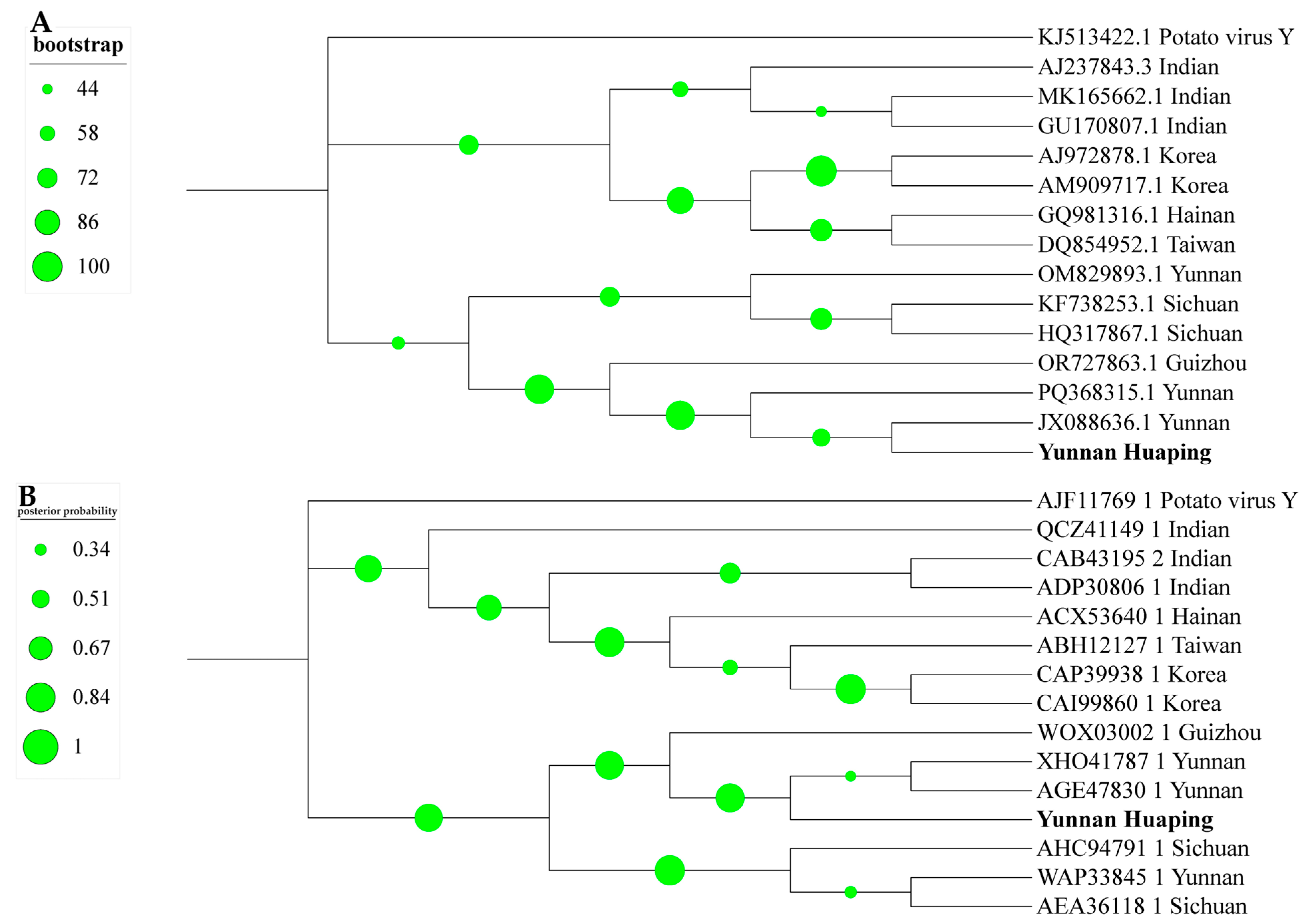
Both nucleotide- (
Figure 1A) and amino acid- (
Figure 1B) based phylogenetic analyses consistently placed the Yunnan Huaping isolate within a well-supported clade together with the reference strains PQ368315.1 (the corresponding protein accession of the same isolate is XHO41787.1) and JXO3388636.1 (corresponding protein accession is AGE47830.1), with a bootstrap value of 95.00% for the nucleotide tree and a posterior probability (PP) of 0.954 for the amino acid tree, indicating a close evolutionary relationship with ChiVMV strains previously reported in Yunnan.
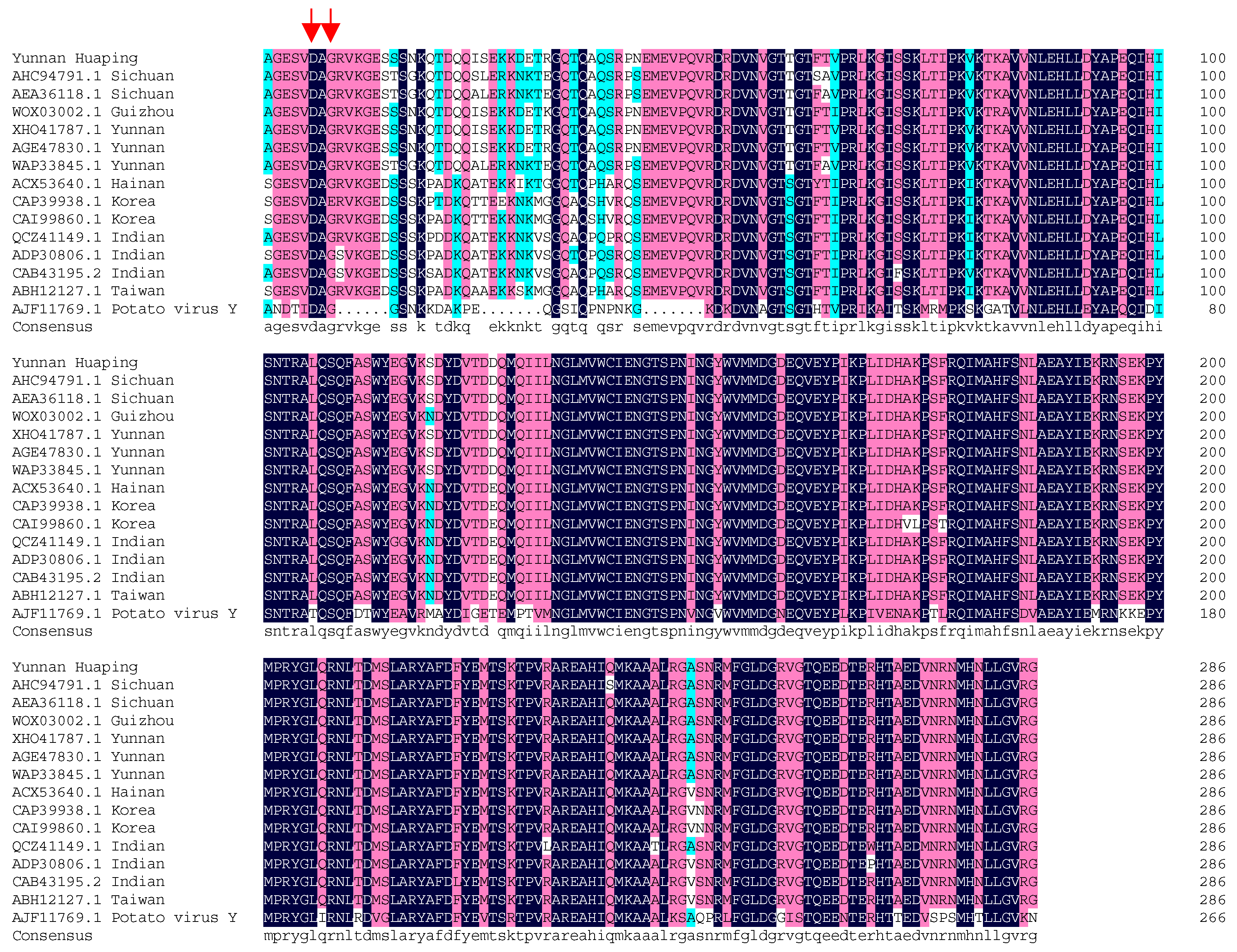
The amino acid sequence alignment (
Figure 2) indicated that the Yunnan Huaping isolate shared 100% identity with the Yunnan reference strains XHO41787.1 and AGE47830.1 at the protein level, and shared 95.25% identity with other global isolates re-trieved from GenBank. The con-served DAG motif (Asp-Ala-Gly), which is critical for aphid transmissibility in potyviruses, was observed at amino acid positions 6–8 in all an-alyzed isolates, except for the Korean isolate (CAP39938.1), in which the motif was sub-stituted with DAE (Asp-Ala-Glu). These results confirmed the successful identification of the ChiVMV isolate used throughout this study.
3.2. Temporal Dynamics of ChiVMV Acquisition and Retention in Myzus persicae
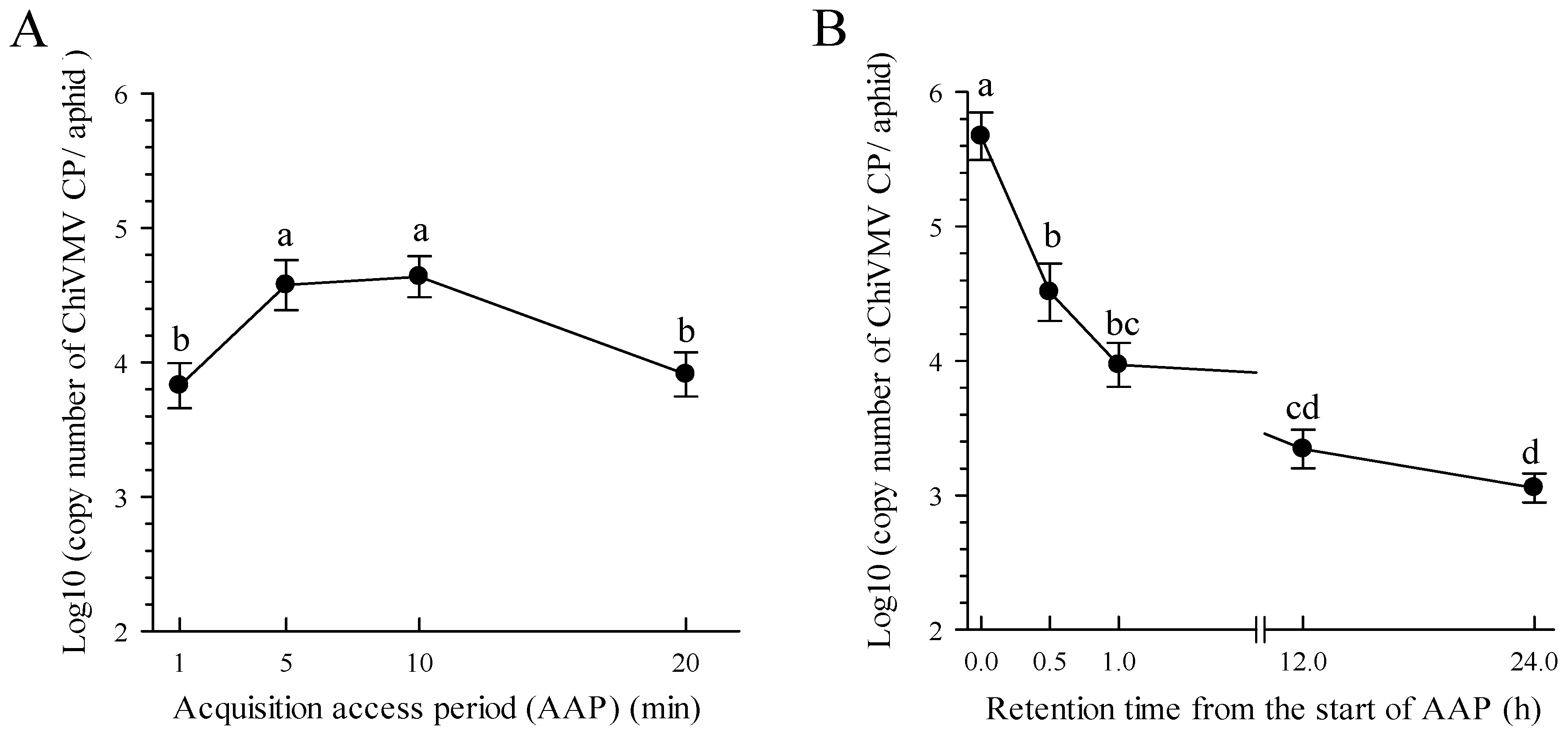
To evaluate the effect of acquisition access period (AAP) on virus acquisition efficiency, apterous adult aphids were allowed AAPs of 1, 5, 10, and 20 min on ChiVMV-infected tobacco plants, and the viral load in individual aphids was quantified immediately after each AAP by absolute qPCR. As shown in
Figure 3A, the viral load increased progressively with AAP from 1 to 10 min, but declined at 20 min. The lowest viral load was observed at 1 min AAP (3.83 ± 0.17 log10 copies/aphid), which was significantly lower than those at 5 min (4.58 ± 0.18,
p = 0.016) and 10 min (4.64 ± 0.15,
p = 0.010). No significant difference was detected between the 5 min and 10 min AAPs (
p = 0.994), both of which yielded the highest viral loads among all treatments. However, extending the AAP to 20 min resulted in a marked decrease in viral load (3.91 ± 0.16), which was significantly lower than the 5 min (
p = 0.025) and 10 min groups (
p = 0.016), and comparable to the 1-min group. These results indicate that a 5-min AAP is sufficient for efficient virus acquisition by
M. persicae, while a prolonged AAP (20 min) does not further increase viral acquisition and may even reduce the amount of virus retained, possibly due to feeding-associated virus loss or behavioral interference.
To evaluate the retention capacity of
M. persicae for ChiVMV, the viral load in aphids was quantified at 0, 0.5, 1, 12, and 24 h post-acquisition following a 5-min AAP. As shown in
Figure 3B, the viral load at 0 h (5.67 ± 0.18 log10 copies/aphid) served as the baseline level immediately after acquisition. Subsequently, the viral load decreased to 4.51 ± 0.21 at 0.5 h, representing 20.5% of the initial level, and further declined to 3.97 ± 0.16 at 1 h (12.6% of 0 h). By 12 h post-acquisition, the viral load had dropped to 3.35 ± 0.14, equivalent to only 5.4% of the 0-h value, and reached the lowest level at 24 h (3.06 ± 0.11), with merely 2.9% of the initial viral load remaining. One-way ANOVA revealed significant differences among time points (
p < 0.001). Post-hoc comparisons indicated that the viral load at 0 h was significantly higher than at all other time points (
p < 0.001 for each). The viral load at 0.5 h did not differ significantly from that at 1 h (
p = 0.140), but was significantly higher than at 12 h and 24 h (both
p < 0.001). The 1-h value was not significantly different from the 12-h value (
p = 0.060), but was significantly higher than the 24-h value (
p = 0.001). No significant difference was detected between 12 h and 24 h (
p = 0.723). These results demonstrate that the virus retained at the stylet tips diminishes progressively over time, with a steady decline from 20.5% at 0.5 h to only 2.9% at 24 h post-acquisition, consistent with the nonpersistent mode of transmission.
3.3. Effects of Acquisition and Inoculation Access Periods on Transmission Efficiency
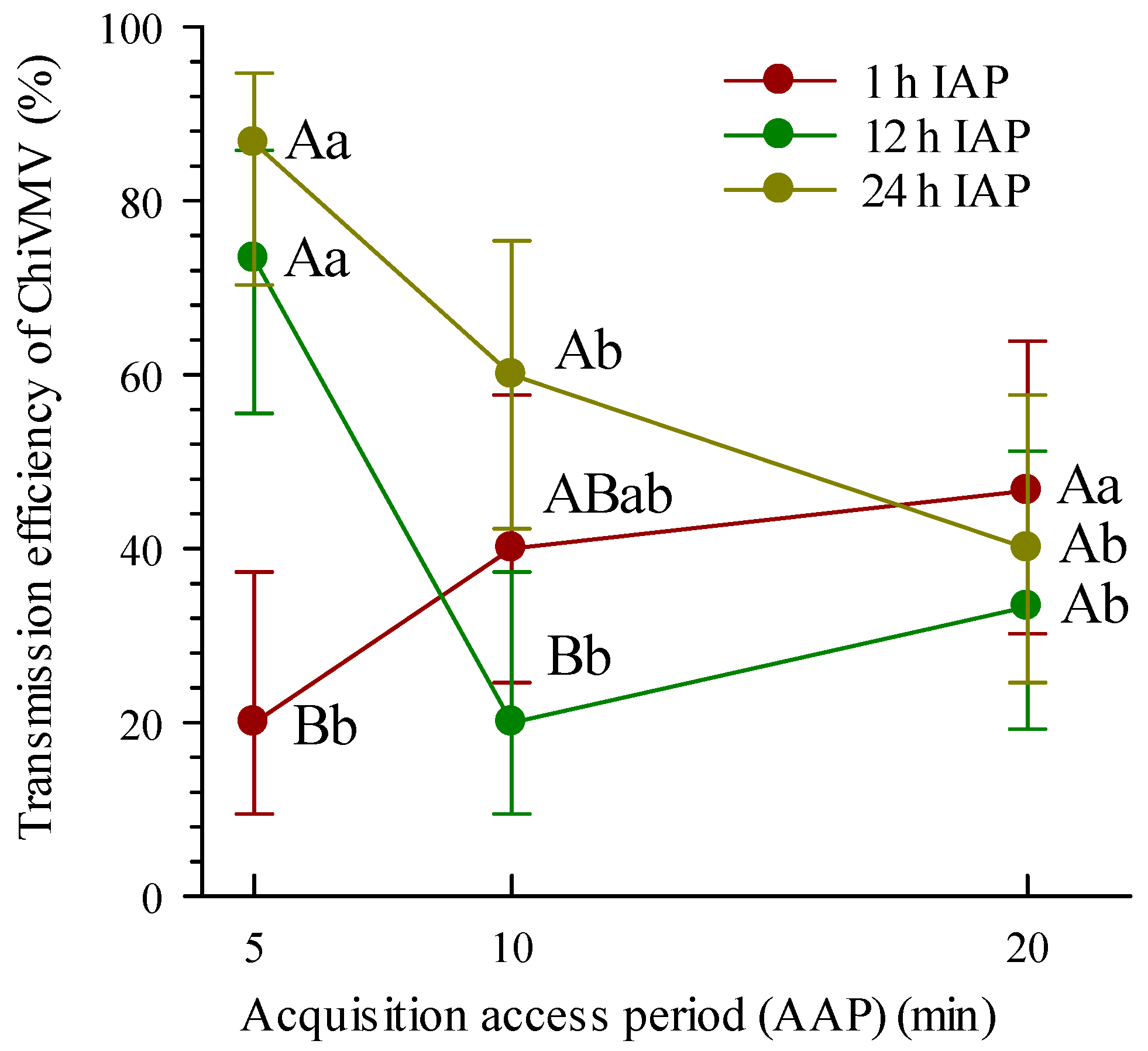
The transmission efficiency under the nine combinations of AAP and IAP is presented in
Figure 4. The Hosmer–Lemeshow goodness-of-fit test indicated that the model was well calibrated (χ
2 = 11.68,
p = 0.111). Logistic regression analysis revealed that both AAP (B = 1.56, Wald = 11.77,
p = 0.001) and IAP (B = 2.32, Wald = 23.28,
p < 0.001) significantly positively influenced transmission. More importantly, a significant negative interaction between AAP and IAP was detected (B = −0.85, Wald = 16.29,
p < 0.001), indicating that the benefit of extending the IAP was dependent on the length of the AAP.
Specifically, when the AAP was short (5 min), the transmission rates at 12 h (73.3%; χ2 = 17.14, p < 0.001) and 24 h (86.7%; χ2 = 26.79, p < 0.001) were both significantly higher than that at 1 h (20.0%), but they did not differ from each other. When the AAP was extended to 10 min, the transmission rates at 1 h, 12 h, and 24 h were 40.0%, 20.0%, and 60.0%, respectively, with the 12 h rate being significantly lower than the 24 h rate (χ2 = 10.00, p = 0.002), while the 1 h rate did not differ from either. When the AAP was further extended to 20 min, no significant differences were observed among the three IAPs (46.7%, 33.3%, and 40.0%), indicating that a longer IAP did not guarantee higher inoculation success.
Conversely, examining the data by IAP, when the IAP was short (1 h), extending the AAP from 5 min to 20 min increased the rate from 20.0% to 46.7% (χ2 = 4.80, p = 0.028), with the 10 min AAP (40.0%) falling in between and not significantly different from either extreme. When the IAP was longer (12 h or 24 h), the 5 min AAP consistently yielded the highest rates (73.3% and 86.7%, respectively), significantly exceeding those from the 10 min AAP (χ2 = 17.14, p < 0.001 for 12 h; χ2 = 9.64, p = 0.002 for 24 h) and the 20 min AAP (χ2 = 5.46, p < 0.020 for 12 h; χ2 = 14.07, p < 0.001 for 24 h), while the 10 min and 20 min AAPs did not differ from each other. These results indicate that under a short IAP (1 h), prolonging the AAP significantly enhances transmission efficiency, whereas under a long IAP (12 or 24 h), a short AAP (5 min) alone is sufficient to achieve the highest transmission rate, with longer AAPs providing no additional benefit.
Overall, the combinations of 5 min AAP with 12 h or 24 h IAP exhibited the highest transmission rates and did not differ significantly from each other. Based on these results, the 5 min AAP combined with 24 h IAP was adopted as the standard condition for subsequent experiments, considering its high transmission rate and compatibility with the routine experimental schedule.
3.4. Effect of Vector Density on ChiVMV Transmission Efficiency
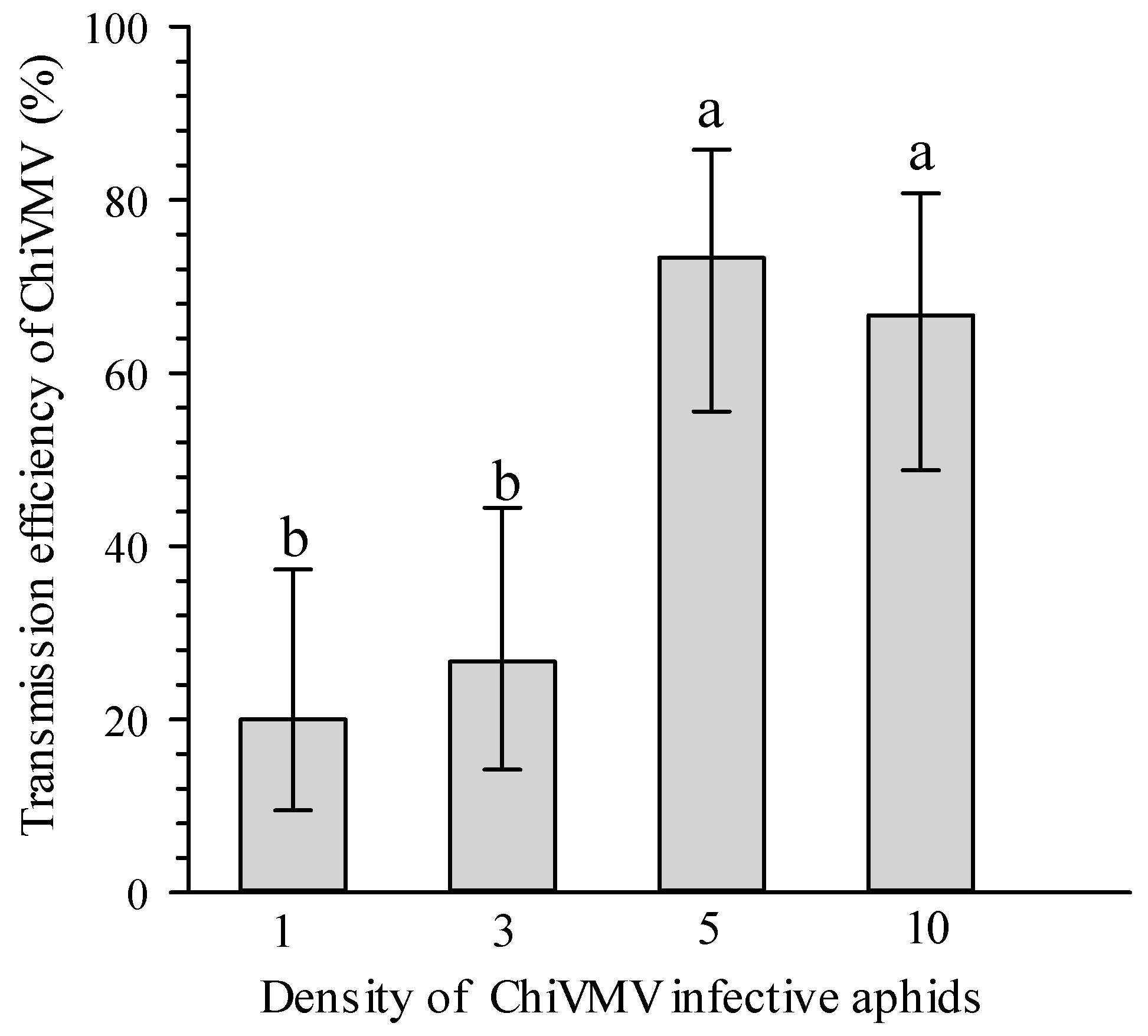
Under the AAP (5 min) and IAP (24 h) selected from the previous experiment, the transmission efficiency increased with increasing vector density but plateaued at higher densities (
Figure 5). The chi-square test confirmed a highly significant association between vector density and transmission success (χ
2 = 26.79,
p < 0.001). When 1 or 3 aphids per plant were used, the transmission rates were 20.0% and 26.7%, respectively, with no significant difference between these two low-density treatments. However, a sharp surge was observed when the density was increased to 5 aphids per plant, yielding a transmission rate of 73.3%, which was significantly higher than the low-density groups (χ
2 = 17.14,
p < 0.001 for 1 aphid; χ
2 = 13.07,
p < 0.001 for 3 aphids). Increasing the density further to 10 aphids per plant resulted in a transmission rate of 66.7%, which was not significantly different from the 5-aphid treatment. Therefore, 5 aphids per plant was selected for subsequent experiments, as it provided the highest transmission efficiency among the densities tested.
3.5. Effect of Temperature on ChiVMV Transmission Efficiency
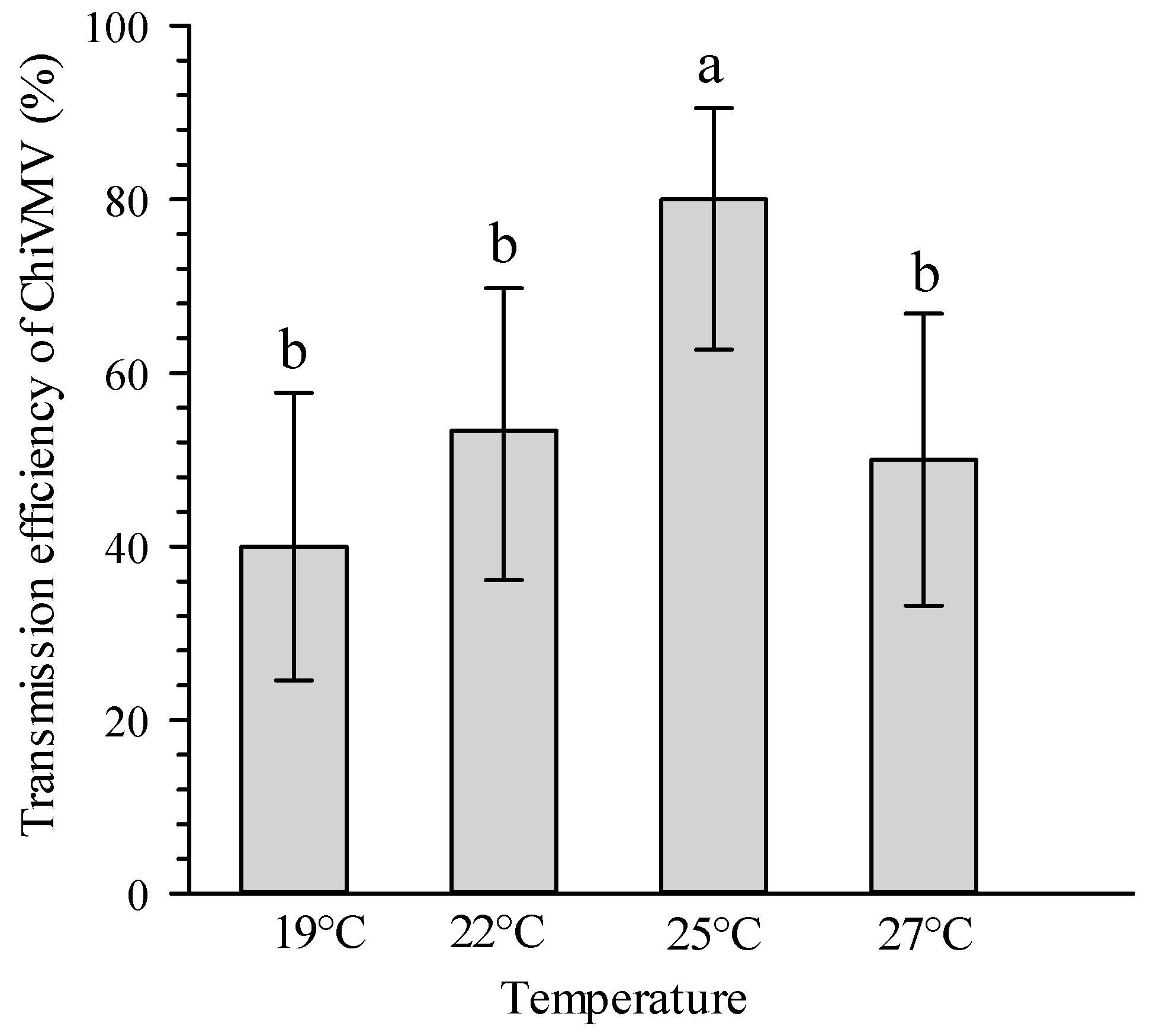
The effect of temperature on transmission efficiency was evaluated at 19, 22, 25, and 27 °C using the established conditions (5 min AAP, 24 h IAP, 5 aphids/plant) (
Figure 6). The chi-square test revealed a significant overall association between temperature and transmission efficiency (χ
2 = 10.64,
p = 0.014). Pairwise comparisons showed that the transmission rate at 25 °C (80.0%) was significantly higher than those at 19 °C (40.0%; χ
2 = 10.00,
p = 0.002), 22 °C (53.3%; χ
2 = 4.80,
p = 0.028), and 27 °C (50.0%; χ
2 = 5.93,
p = 0.015), while no significant differences were detected among the latter three temperatures. These results indicate that 25 °C supported the highest transmission efficiency among the temperatures tested.
4. Discussion
In this study, we successfully characterized a ChiVMV isolate from tobacco in Yunnan province and systematically investigated the key parameters influencing its transmission by M. persicae. Our results provide novel insights into the molecular features, vector–virus interactions, and environmental determinants of ChiVMV transmission efficiency, with important implications for disease epidemiology and management.
The molecular characterization of the Yunnan Huaping isolate revealed that its
CP gene shares 95.25% amino acid identity with global isolates, indicating moderate genetic diversity within the ChiVMV population [
31]. Phylogenetic analysis placed the isolate within a well-supported Yunnan clade (
Figure 1), consistent with previous studies demonstrating geographical clustering of ChiVMV isolates in China [
9]. Alignment of the CP amino acid sequences revealed that the conserved DAG motif (amino acids 6–8) was present in the Yunnan Huaping isolate and all other global isolates analyzed, except for a Korean strain (CAP39938.1) in which the motif was substituted with DAE (
Figure 2). The DAG motif is known to be critical for aphid transmissibility in potyviruses, and mutations at this site have been shown to abolish or reduce transmission efficiency in other members of the genus [
13]. Notably, one Korean strain (CAP39938.1) harbored a DAE substitution at this motif; whether this substitution affects aphid transmissibility remains to be experimentally determined [
32,
33].
Our acquisition dynamics experiments revealed that a 5 min AAP was sufficient to achieve a viral load comparable to the maximum (which was also observed at 10 min), whereas extending the AAP to 20 min resulted in a significant reduction in virus acquisition (
Figure 3A). This decline may be attributed to feeding-associated virus loss or behavioral interference during prolonged probing, which aligns with the general pattern that nonpersistent viruses are acquired rapidly but are also lost rapidly during continued feeding [
14,
16]. The temporal dynamics of virus retention in
M. persicae further support the nonpersistent transmission mechanism of ChiVMV (
Figure 3B). The viral load declined from 4.60 ± 0.17 log10 copies/aphid immediately after acquisition (0 h) to 4.17 ± 0.15 at 0.5 h, 3.93 ± 0.15 at 1 h, 3.35 ± 0.14 at 12 h, and 3.06 ± 0.11 at 24 h post-acquisition, with approximately 2.9% of the initial viral load remaining at 24 h. This sharp decline is consistent with virus retention at the stylet tips rather than internal circulation within the aphid body. In persistently transmitted viruses, such as alfalfa leaf curl virus (ALCV), viral titers typically remain stable or even increase over time following acquisition [
18]. In contrast, nonpersistent viruses are retained for brief periods (minutes to hours) and are lost during feeding or molting [
14]. The decline in viral load was most pronounced immediately after acquisition, with a rapid decrease from 0 to 0.5 h, followed by a more gradual but steady decline through 24 h post-acquisition, suggesting that virus particles may be progressively dislodged or inactivated over time. Shi et al. [
14] systematically reviewed the behavioral factors of aphids that influence plant virus transmission, emphasizing the critical roles of feeding behavior, probing frequency, and residence time in the transmission of nonpersistent viruses.
However, the apparent discrepancy between qPCR-quantified viral loads and the corresponding transmission efficiency requires careful interpretation. Specifically, while whole-body viral RNA declined to only 2.9% of the initial level at 24 h post-acquisition (
Figure 3B), the transmission efficiency under the combination that yielded the highest transmission (5-min AAP + 24-h IAP) reached 86.7% (
Figure 4). It is essential to recognize that qPCR measures total viral RNA extracted from whole aphids, which predominantly represents virus particles ingested into the alimentary canal rather than the subset of virions specifically bound to the stylet tips that are competent for inoculation [
14,
34]. The acrostyle, a specialized cuticular organ at the maxillary stylet tips, serves as the retention site for nonpersistently transmitted viruses [
34]; only virus particles associated with this structure contribute to transmission during subsequent probing. Moreover, the duration of AAP may influence not only the quantity but also the spatial distribution of bound virions at the stylet surface. Prolonged probing (e.g., 10–20 min) could trigger salivation or deeper stylet penetration, potentially dislodging surface-bound viruses or relocating them to less accessible binding sites [
14,
16]. This hypothesis provides a plausible explanation for the non-monotonic transmission pattern observed under intermediate AAP conditions and underscores that whole-body qPCR data should be used as a relative indicator of acquisition rather than an absolute predictor of transmission competence.
Our transmission parameter experiments on plants revealed a complex interaction between AAP and IAP that has not been previously described for ChiVMV (
Figure 4). While both AAP and IAP independently positively influenced transmission, the significant negative interaction indicated that the benefit of extending the IAP diminished as the AAP increased. Extension of IAP was only beneficial when the AAP was short (5 min), but not when the AAP was 10 or 20 min. This pattern can be interpreted in the context of nonpersistent virus transmission mechanisms. With a short AAP (5 min), aphids acquire a limited but properly localized pool of virus particles at the stylet surface; extending the IAP increases the probability that the aphid will deposit these particles onto susceptible plant cells during repeated probing or feeding activities [
14]. Conversely, with a longer AAP (20 min), although the total ingested viral RNA may be higher, the viruses retained at the stylet tips that are available for release may be rapidly lost or inactivated during prolonged feeding, diminishing the advantage of a prolonged IAP [
16]. Recent structural studies have identified the acrostyle as the retention site for non-circulatively transmitted viruses [
34], providing a structural basis for understanding how nonpersistent viruses, including ChiVMV, are retained at the stylet tips and subsequently released during inoculation. This phenomenon has been observed with other nonpersistent viruses, including PVY and CMV, where extended acquisition feeding periods can lead to decreased transmission due to the loss of virus from the stylet during subsequent probing [
16]. The rapid decline in viral load within 12–24 h post-acquisition, as measured by qPCR, is consistent with the nonpersistent transmission mechanism and suggests that the window of effective transmission under field conditions may be similarly brief, though this requires direct experimental verification. Our results emphasize the importance of establishing appropriate parameters for both AAP and IAP for standardized transmission assays and suggest that the conventional assumption that longer AAP always improves transmission does not hold for ChiVMV.
The effect of vector density on transmission efficiency showed a clear saturation pattern (
Figure 5), with transmission increasing from 20.0% with one aphid to 73.3% with five aphids per plant, but not significantly increasing further with ten aphids (66.7%). This plateau effect has been observed in other virus–vector systems and can be explained by several mechanisms [
17]. At low densities, the probability of at least one infective aphid feeding on the test plant is low, limiting transmission. As density increases, the probability of transmission by at least one aphid approaches unity. However, at very high densities, competition among aphids may reduce individual feeding time, plant defenses may be triggered more rapidly, or the simultaneous feeding of multiple aphids may lead to interference that reduces overall inoculation efficiency [
14]. The density of five aphids per plant, which yielded the highest transmission efficiency in our study, provides a practical guideline for standardized transmission assays and resistance screening, balancing efficiency with resource utilization.
Temperature exerted a significant influence on ChiVMV transmission efficiency (
Figure 6), with the transmission rate at 25 °C (80.0%) being significantly higher than those at 19 °C (40.0%), 22 °C (53.3%), and 27 °C (50.0%), while no significant differences were detected among the latter three temperatures. This unimodal response is consistent with previous reports on other potyvirus–aphid systems, such as PVY, where transmission efficiencies also showed similar temperature-dependent patterns [
16]. The significant drop in transmission efficiency at 27 °C suggests that ChiVMV may be particularly sensitive to elevated temperatures, which is notable given that Yunnan tobacco-growing regions often experience temperatures exceeding 25 °C during the summer months [
35]. Whether this temperature sensitivity translates to field conditions, where temperature fluctuates and interacts with other environmental variables, requires further investigation.
While this study provides valuable insights into ChiVMV transmission parameters, several factors should be considered when interpreting the results. We acknowledge that our experiments were conducted using a single ChiVMV isolate from Yunnan and a single clone of
M. persicae, and it remains to be determined how genetic variation among virus isolates or aphid populations might influence transmission efficiency [
9,
31]. Additionally, the controlled laboratory conditions employed here, while essential for establishing baseline parameters, may not fully reflect the complexity of field environments where multiple environmental factors interact simultaneously [
16]. Other variables that were not examined in this study, such as host plant age, cultivar, relative humidity, and light intensity, could also modulate transmission efficiency and warrant further investigation [
16]. Given the prevalence of viral co-infections in tobacco fields and the potential involvement of multiple aphid species in natural settings, future work should also explore how these factors shape ChiVMV transmission dynamics in the field [
9].






 ). GenBank accession numbers of reference sequences are shown on the left. Potato virus Y (PVY) as outgroup.