Article

Low-Dose Foliar Melatonin Enhances Chilling Stress Tolerance in Cucumber

by
Alexey A. Kudrinsky
1,*,
Olga A. Shapoval
2,
Maria T. Mukhina
2,
Dmitry M. Mikhaylov
3,4,
Georgii V. Lisichkin
1 and
Yurii A. Krutyakov
1,*
1
Department of Chemistry, M. V. Lomonosov Moscow State University, Moscow 119991, Russia
2
Department of Testing Growth Regulators and Agrochemicals, Pryanishnikov All-Russian Scientific Research Institute of Agrochemistry, Moscow 127550, Russia
3
Software Engineering, Institute of Computer Technologies and AI, Kyrgyz National University Named After J. Balasagyn, Bishkek 720000, Kyrgyzstan
4
Impactive Technologies Holding Limited, Abu Dhabi P.O. Box 95044, United Arab Emirates
*
Authors to whom correspondence should be addressed.
Agronomy 2026, 16(17), 1739; https://doi.org/10.3390/agronomy16171739
Submission received: 7 July 2026 / Revised: 1 September 2026 / Accepted: 2 September 2026 / Published: 7 September 2026
(This article belongs to the Section Plant-Crop Biology and Biochemistry)

Abstract

The study evaluated the potential of low-dose foliar melatonin (MT) treatments to alleviate chilling injury in cucumber plants, with a particular focus on mimicking sudden spring frosts in open-field cultivation. Cucumber seedlings were sprayed with MT solutions at 0.1, 1, and 10 mg L−1 (0.4, 4, 40 µM respectively), then subjected to a controlled chilling regime (4 °C for 72 h). A set of biochemical and physiological parameters was assessed, including stem elongation, leaf area, tissue water content, photosynthetic pigment concentrations, malondialdehyde (MDA) and hydrogen peroxide (H2O2) accumulation, antioxidant enzyme activities, and soluble carbohydrate profiles. In addition, the thermostable fraction of chlorophylls a and b was determined as an indicator of photosynthetic system integrity; this parameter substantially increased under MT treatment, particularly at 1 and 10 mg L−1, despite an overall reduction in total pigment content. The results demonstrated that MT pretreatment, especially at 1 mg L−1, significantly mitigated chilling-induced growth inhibition, preserved chloroplast integrity, and reduced membrane lipid peroxidation. Moreover, MT promoted the accumulation of osmo- and cryoprotective sugars, contributing to improved cellular homeostasis under low temperature. These key findings indicate that low-dose MT priming is a promising, nature-derived strategy to enhance the tolerance of cucumber to acute chilling events, supporting the development of sustainable and organic-friendly approaches for spring frost protection.

1. Introduction

The expansion of warm-season vegetable cultivation into temperate regions is increasingly challenged by the greater frequency and unpredictability of extreme weather events, among which late-spring frosts are particularly damaging [1,2]. Cucumber, a globally important vegetable crop of tropical and subtropical origin, is exceptionally sensitive to low temperatures. Even brief exposure to chilling conditions (0–12 °C) disrupts membrane integrity, photosynthetic electron transport, and enzymatic activity, leading to irreversible cellular damage, stunted growth, and severe yield losses [3,4]. The problem is most acute in open-field production systems of continental climates, where sudden air temperature drops below 3–5 °C can occur well into May. For instance, many regions of Northern, Eastern, and Central Europe, as well as large parts of Russia, experience late-spring frosts that frequently coincide with the early vegetative stages of cucumber. In Russia, where open-field cucumber acreage has expanded notably over the last two decades, the economic impact of chilling events is substantial, especially in areas of the Non-Black Earth Zone, the Volga region, and Southern Siberia, where both conventional and organic vegetable farming are rapidly developing.
Recent analyses have confirmed that climate-induced risks to crop production in these regions are not decreasing, with the highest risks occurring in spring due to late frosts [5]. In the Volgograd region, for example, early cucumber production under a sharply continental climate with frequent spring frosts is possible only with the use of protective tunnel covers [6]. Similarly, in the middle zone of the European part of Russia, repeated and prolonged return spring frosts have been documented, with negative overnight temperatures in Voronezh and Volgograd regions lasting up to 2–2.5 h on several nights. In Poland, ground frost poses a high potential risk for field cucumber cultivation, with the highest risk in north-eastern regions where the frequency of frost occurrence at the beginning of the growing season is greatest [7]. In the Czech Republic, there is a 25% chance of dangerous spring frosts occurring during the planting of field vegetables after 3 May [8]. These realities underscore the urgent need for effective, sustainable frost protection measures that are compatible with organic farming principles.
The challenge of frost protection is especially pressing for organic agriculture. Organic standards restrict the use of most synthetic plant protection products and growth regulators, while the demand for organic cucumbers continues to grow. In this context, the search for natural, plant-derived, or nature-identical molecules that can prime the plant’s own defense system is a top priority.
Current protective practices in frost-prone regions, such as tunnel covers, mulching, row covers, and overhead irrigation, are labour-intensive, costly, and often insufficient to prevent damage during sudden temperature drops. Therefore, a complementary, biologically based strategy that enhances the plant’s intrinsic tolerance to chilling would represent a significant advance for sustainable production.
Any candidate molecule should ideally be effective at low concentrations, biodegradable, and compatible with the principles of organic farming and the UN Sustainable Development Goals (SDG 2, SDG 12, SDG 15). Melatonin (MT) a ubiquitous indoleamine first identified in vascular plants in 1995, fulfils many of these requirements. It is synthesized in most plant tissues, primarily in chloroplasts and mitochondria, where it acts as a powerful direct scavenger of reactive oxygen and nitrogen species (ROS/RNS) and as an upstream signal that induces the expression of a wide array of defense-related genes [9,10,11]. Importantly, because MT is a naturally occurring compound in plants and can be produced through fermentation or plant-based extraction, its use as an exogenous elicitor aligns well with the philosophy of organic and low-input agriculture.
A rapidly growing body of literature has documented the protective effects of exogenous MT against a broad spectrum of abiotic stresses, including drought, salinity, heavy metals, and temperature extremes [9,10,11,12]. In the context of low-temperature stress, beneficial roles of MT have been demonstrated in numerous crop species such as pepper [13], maize [14], rice [15], tomato [16], wheat [17], soybean [18], barley [19], tea [20], watermelon [21], and cucumber [3,22]. Mechanistically, at optimal concentrations MT stabilizes cellular membranes, reduces MDA accumulation [23], increases the activity of antioxidant enzymes (superoxide dismutase (SOD), catalase (CAT), ascorbate peroxidase (APX), glutathione-related enzymes) [24,25], and preserves photosynthetic pigments and chloroplast ultrastructure [26]. It also modulates stress-responsive transcription factors and hormone signaling pathways, including those involving abscisic acid (ABA), gibberellins, and brassinosteroids [9,10,11,27].
Most previous studies have focused on long-term chilling rather than acute, short-term frost events, and have predominantly evaluated high concentrations of MT 50–500 µM [22,28,29,30,31,32,33,34,35], while investigations [3,36] explored low-dose ranges ≤ 10 µM. Low-dose ranges (<50 µM) are especially attractive for cost-effective and environmentally benign applications in the field [24]. The interaction between low-dose MT priming and the specific physiological demands imposed by sudden near-freezing temperatures remains poorly understood. In particular, comprehensive multi-trait assessments that integrate biometric, photosynthetic, oxidative stress, and carbohydrate metabolism parameters under such scenarios are lacking for cucumber.
The present study was designed to address these gaps. The aim was to determine whether foliar pretreatment with low concentrations of MT (0.1, 1 mg L−1) could enhance the tolerance of cucumber plants to a simulated acute spring frost event and to elucidate the underlying physiological and biochemical mechanisms. In addition to growth, oxidative stress, and osmotic adjustment parameters, a specific objective was to assess the thermal stability of the photosynthetic system under chilling stress. To this end, we measured the thermostable fraction of chlorophylls a and b as an integrative marker of photosystem integrity. To the best of our knowledge, this is the first study to evaluate the thermostable chlorophyll fraction in the context of MT-mediated chilling tolerance in cucumber, providing a novel perspective on the compound’s protective effects on the photosynthetic apparatus.
To assess the relevance of the chosen experimental design for simulating acute spring frost events, it is essential to compare the controlled temperature regime applied in this study with the actual thermal conditions that cucumber plants encounter during late-spring frosts in open-field cultivation.
Cucumber is a chilling-sensitive species, with critical temperatures for chilling injury ranging from approximately 7 to 13 °C. Exposure to temperatures below 10 °C can induce cellular damage, and irreversible injury has been reported after 96 h at 2–6 °C. Under field conditions, spring frosts typically involve air temperatures dropping to 0 °C or below, with ground frosts categorised as mild (0 to −1.1 °C), moderate (−1.2 to −2.2 °C), or severe (below −2.2 °C). However, even non-freezing chilling temperatures in the range of 4–12 °C are sufficient to trigger significant physiological disruption in cucumber, including inhibition of photosynthesis, membrane damage, and oxidative stress.
In the present experiment, plants were grown under optimal conditions (27 °C/21 °C day/night) until the 5-leaf stage (BBCH 15), after which the temperature was gradually reduced over three days to 12 °C/10 °C (day/night) and maintained at this level for the remainder of the experiment. This regime was designed to simulate the progressive cooling that often precedes a spring frost event, followed by sustained chilling conditions. While the minimum temperature applied (10 °C at night) is above freezing, it lies within the range known to cause chilling injury in cucumber. Importantly, the acute nature of the stress, especially a relatively rapid transition from optimal to suboptimal temperatures, mimics the sudden onset of cold spells that characterise spring frosts in continental climates, where temperatures can drop sharply over 24–48 h.
Several aspects of this design align well with real-world frost scenarios. First, the timing of stress imposition at the early vegetative stage (BBCH 15) corresponds to the period when cucumber plants are most vulnerable to spring frosts in open-field production. Second, the duration of chilling exposure (7 days at 12 °C/10 °C) reflects the fact that spring frosts are often not isolated events but occur as part of prolonged cold spells lasting several days. Third, the gradual cooling phase (three days) mimics the progressive decline in temperature that often precedes a frost event, allowing for the activation of acclimation responses.
However, certain differences between the experimental and field conditions should be acknowledged. The minimum temperature in our study (10 °C night-time) is higher than the sub-zero temperatures that can occur during severe spring frosts. This choice was deliberate: our objective was to evaluate the protective potential of MT against chilling injury per se, rather than freezing damage, and to do so under controlled, reproducible conditions that isolate the physiological effects of low temperature from other confounding factors such as wind, radiation frost, and soil freezing. Moreover, the use of a constant low temperature, rather than fluctuating diurnal cycles, allows for standardised assessment of biochemical responses. Nevertheless, the temperature regime employed is well within the range known to induce chilling stress in cucumber, and the observed physiological responses including increased MDA accumulation, reduced photosynthetic pigment content, and elevated antioxidant enzyme activity are consistent with those reported in field-grown plants exposed to chilling conditions.
In summary, while the controlled environment does not perfectly replicate the complexity of field frost events, the experimental design provides a relevant and reproducible model for studying acute chilling stress in cucumber at the early vegetative stage. The temperature regime (12 °C/10 °C) is sufficient to induce measurable chilling injury, and the gradual cooling phase and sustained exposure duration reflect key features of spring frost episodes in continental climates. The findings from this study thus offer valuable insights into the potential of MT priming as a protective strategy under conditions that are physiologically relevant to open-field production in frost-prone regions.
The efficacy of MT is strongly concentration-dependent, with optimal doses varying across species, tissues, and stress conditions. In cucumber, 1.0 μmol·L−1 (approximately 0.23 mg·L−1) has been recently identified as the optimum concentration for enhancing chilling tolerance, at which the chilling injury index, electrolyte leakage, and MDA content were lowest, while growth was highest [3]. Higher concentrations may paradoxically induce a hormetic response and oxidative stress [3]. The present study, which evaluated low doses of 0.1, 1.0, and 10 mg·L−1 (0.43, 4.3, and 43 µM, respectively), was deliberately designed to address the gap in knowledge regarding low-concentration MT priming. While the majority of existing studies have utilised concentrations of 50-500 µM [22,28,29,30,31,32,33,34,35], our approach aligns with the growing recognition that low-dose MT priming [3,36] is a cost-effective and environmentally benign strategy. The inclusion of the 10 mg·L−1 concentration served a dual purpose: it allowed direct comparison with earlier investigations that employed similar doses under different experimental conditions, while simultaneously ensuring a continuous dose–response assessment across a broader concentration range. Importantly, because MT is a naturally occurring compound in plants and can be produced through fermentation or plant-based extraction, its use as an exogenous elicitor is compatible with the principles of organic farming and sustainable agriculture [37]. As such, MT priming represents a promising nature-derived approach for enhancing crop resilience to acute chilling events, supporting the development of sustainable and organic-friendly strategies for spring frost protection.
By evaluating a suite of traits from growth and water status to photosynthetic pigments, lipid peroxidation, antioxidant enzyme activities, and sugar profiles we sought to identify an effective, low-impact priming strategy suitable for sustainable and organic cucumber production in frost-prone regions.

2. Materials and Methods

2.1. Plant Material and Growth Conditions

The experiment was conducted in the Laboratory for Testing of Agrotechnologies, Agrochemicals, and Pesticides at the D.N. Pryanishnikov All-Russian Research Institute of Agrochemistry. Cucumber (Cucumis sativus L.) cv. Kurazh F1 was used. The growth substrate was a mixture of high-moor and low-moor peat, limed with dolomite powder to pH 6.5 and amended with mineral fertilizers to achieve the following available nutrient concentrations: N—300 mg kg−1, P2O5—500 mg kg−1, and K2O—600 mg kg−1. The water-holding capacity (WHC) of the substrate was determined prior to the experiment using the express method of Kabaev [38]. Plastic pots (2 L, non-perforated bottom) were filled with 325 g of substrate (absolute dry mass basis), and a watering tube was inserted into each pot. Before sowing, the substrate was moistened to 80% of WHC.
Plants were grown in a controlled-environment chamber (LiA-2, Okabiolab, Pushchino, Russia) under a 14 h photoperiod (05:00–19:00). Growth stages were identified according to the Biologische Bundesanstalt, Bundessortenamt and Chemical industry (BBCH) growth stage scale. The temperature regime before the onset of the 5-leaf stage (BBCH 15) was 27 °C/21 °C (day/night), 65% relative humidity, 300 μmol·m−2·s−1 photon flux density. The substrate moisture content was maintained at 65–70% WHC until the appearance of the second true leaf and thereafter at 60–65% WHC by daily watering with distilled water; two-thirds of the water volume was supplied through the tube and one-third was applied to the surface. The pots were arranged inside the growth chamber in completely randomized positions.

2.2. Experimental Design and Treatments

A completely randomized design with four replicates was used. The experiment comprised an untreated control and three MT treatments: 0.1, 1.0, and 10.0 mg L−1 (0.43, 4.3, and 43 µM, respectively). MT powder (≥98%, TLC; Sigma-Aldrich, St. Louis, MO, USA) was used as received without further purification. MT solutions were prepared immediately before each application by dissolving the powder in distilled water and diluting to the target concentrations. MT was applied as a foliar spray to the point of full leaf wetness.
Seeds were first primed with the corresponding MT solutions. Priming consisted of soaking seeds in the solution at a seed-to-solution ratio of 1:5 (w/w) for 24 h at 25 °C in darkness to avoid light-induced degradation of MT, followed by rinsing with distilled water and air-drying at 25 °C for 24 h. Sterile conditions were maintained.
After priming, seven seeds per pot were sown at a depth of 1.0–1.5 cm. At the first true leaf stage (BBCH 11), seedlings were thinned to four per pot. On the same day, the first foliar treatment was applied. The second foliar treatment was applied immediately before the onset of chilling stress, at the 5-leaf stage (BBCH 15).

2.3. Chilling Stress Imposition

When the plants reached BBCH 15, the temperature in the growth chamber was gradually reduced over three days to 12 °C/10 °C (day/night) and maintained at this level until the end of the experiment.

2.4. Biometric Measurements

Biometric parameters were recorded at three time points, expressed as days after sowing (DAS): 12 DAS (BBCH 11, full expansion of the first leaf), 35 DAS (BBCH 15, immediately before stress initiation), and 44 DAS (end of experiment, BBCH 15–16). The total length of hypocotyls and stems and the total leaf area of all plants in each pot were determined. Leaf area was estimated as the product of leaf length and the distance between the second lobes multiplied by 0.75 [39].

2.5. Biochemical Assays

For biochemical analyses, healthy, fully expanded leaves from nodes 3–5 were sampled at the end of the experiment, 44 DAS. All assays were performed immediately after leaf collection.
Chlorophylls a and b were extracted with acetone and quantified spectrophotometrically using the empirical equations of Wettstein and Holm [40]. The thermal stability of chlorophylls was evaluated by measuring the residual pigment content after incubation of leaf tissue at 55 °C for 1 h. Pigment contents are expressed on an air-dry mass basis.
Lipid peroxidation was assessed by measuring MDA concentration using the thiobarbituric acid (TBA) photometric method [41].
CAT activity was determined by titration with KMnO4 based on the decomposition of hydrogen peroxide [42].
Water-soluble carbohydrates were quantified by a modified DuBois method with UV-photometric detection [43], a spectrophotometer UV-1800 (Shimadzu, Kyoto, Japan) was used.
Polyamines were determined following the modified method of [44]. Leaf tissue (1 g) was extracted with 5% cold HClO4, extract was centrifuged at 12,000 g, 30 min, and the supernatant, 1 mL, was benzoylated at 37 °C with benzoyl chloride, 10 μL, in alkaline medium, 2 mL of 2 M NaOH, mixed with 4 mL of saturated NaCl solution. Benzoylated polyamines were partitioned into diethyl ether, 3 mL, centrifuging at 3000 g, 5 min, evaporated to dryness, and redissolved in methanol, 0.75 mL. Separation was performed by reversed-phase HPLC on a C18 column Macherey-Nagel Nucleodur HTec, 150 × 3 mm, 5 µm particle size, 100 Å mean pore size, 10 μL of the benzoylated polyamines solution, 20 μL loop, using 64% methanol at 0.7 mL min−1, with UV detection at 254 nm (Dionex Ultimate 3000, Thermo Scientific, Waltham, MA, USA). Chromatograph control and data processing were carried out using Dionex Chromeleon 7.1.2.1478 software, Thermo Scientific, USA.

2.6. Statistical Analysis

Data for each dependent variable (biometric parameters at 35 DAS, 44 DAS, and their increments; biomass and water content; chlorophyll content and thermostability; MDA, CAT, carbohydrates, and polyamines) were subjected to separate one-way ANOVAs with melatonin concentration as the fixed factor, followed by Fisher’s LSD test for mean separation at p < 0.05 using Statistica 12.0 software. Results are presented as means ± standard deviation (SD).

3. Results and Discussion

3.1. Biometric Parameters

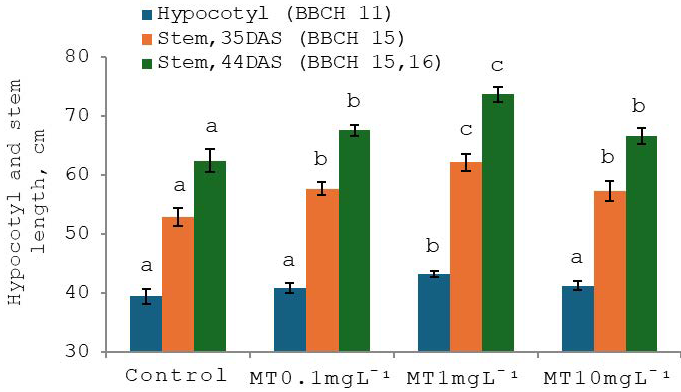
MT treatment exerted a concentration-dependent growth-promoting effect on the aboveground vegetative organs of cucumber plants (Table 1). A positive influence of MT was already evident after the seed priming stage alone. At 12 DAS, BBCH 11, the total hypocotyl length of plants derived from seeds primed with 1 mg L−1 MT was significantly greater than that of the untreated control, exceeding it by 9.6%.
The full effect of the treatment became apparent after the complete course of foliar applications. At both 35 DAS (BBCH 15, immediately before chilling stress) and 44 DAS (after 7 days of chilling), total stem length was greatest in the 1 mg L−1 MT treatment, surpassing the control by 17.6% and 17.9%, respectively (Table 1). The same treatment also exhibited the highest absolute increment in total stem length during the 7-day chilling period, with an average gain of 1.9 cm relative to the control.
The smallest total leaf area was recorded in control plants (332.5 cm2 and 350.2 cm2 at 35 and 44 DAS, respectively). In contrast, the 1 mg L−1 MT treatment produced the largest leaf area, exceeding the control by 9.0% at 35 DAS and by 12.1% at 44 DAS. When the increase in leaf area during the 7-day chilling period was compared across treatments, plants treated with 1 and 10 mg L−1 MT showed significantly greater increments than the control (p < 0.05; Table 1, Figure 1).
Critically, this growth-promoting effect was achieved at the remarkably low concentration of 1 mg L−1, demonstrating that even minimal MT doses can effectively counteract chilling-induced growth inhibition, a finding that challenges the prevailing reliance on higher concentrations in the literature.

3.2. Aboveground Biomass and Tissue Water Content

MT application was associated with a weak but consistent trend toward greater accumulation of aboveground biomass, with a more pronounced effect on stem mass than on leaf mass (Table 2). Compared with the control, stem mass increased by 12.5–14.7% and leaf mass by 2.5–7.1% across the MT treatments. The overall pattern of aboveground biomass closely mirrored that of the biometric dimensions.
MT also increased the water content of vegetative tissues in a concentration-dependent manner. The highest stem and leaf water contents were observed in the 10 mg L−1 treatment (94.6% and 88.4%, respectively). Notably, leaf water content was already significantly higher than the control at the lowest MT concentration of 0.1 mg L−1 (p < 0.05; Table 2).
The concurrent enhancement of biomass accumulation and tissue hydration at 1 mg L−1 MT underscores the compound’s dual capacity to support both structural growth and cellular water balance under chilling stress, even at substantially lower doses than those conventionally employed in similar studies.

3.3. Photosynthetic Pigment Content and Stability

MT, applied as both seed priming and foliar spray, influenced the photosynthetic apparatus of cucumber leaves under chilling stress. In all MT-treated plants, the tissue concentrations of chlorophyll a and chlorophyll b were lower than in the control (Table 3). Control leaves contained 11.7 mg g−1 chlorophyll a and 4.3 mg g−1 chlorophyll b, whereas in MT-treated plants these values declined to 8.2–8.9 mg g−1 and 3.0–3.5 mg g−1, respectively, with a weak tendency to decrease further as the MT dose increased.
Despite this reduction in total pigment content, the proportion of thermostable chlorophyll increased substantially under MT treatment. In the control, the thermostable fraction accounted for 36.9% of chlorophyll a and 27.5% of chlorophyll b. At 0.1 mg L−1 MT, these values increased modestly by 9.0% and 4.7%, respectively. A marked increase in pigment stability was observed at 1 and 10 mg L−1 MT, where the thermostable fraction of both chlorophyll a and chlorophyll b exceeded 63.7% (Table 3).
Crucially, when recalculated on an absolute basis (mg g−1 dry weight), the content of thermostable chlorophyll increased very substantially under MT treatment (Table 3). In plants treated with 1 mg L−1 MT, the absolute content of thermostable chlorophyll a reached 5.74 mg g−1, representing a 33.0% increase compared to the control, despite the overall reduction in total chlorophyll a. Even more strikingly, the absolute content of thermostable chlorophyll b increased by 97.4% from 1.18 mg g−1 in the control to 2.33 mg g−1. This substantial increase in the absolute amount of thermostable pigments, particularly chlorophyll b, underscores that MT not only protects the existing photosynthetic complexes from degradation but also preserves or even enhances the pool of structurally stable pigment–protein complexes under chilling stress. The effect was less pronounced at 10 mg L−1 MT, where the absolute content of thermostable chlorophyll a and b was 5.22 mg g−1 and 2.38 mg g−1, respectively, indicating a dose-dependent response with an optimum at 1 mg L−1.
Chilling stress severely inhibits photosynthesis in thermophilic plants, primarily through photoinhibition of photosystem II (PSII) and, to a lesser extent, photosystem I (PSI) [26]. A key manifestation of this inhibition is the marked reduction in chlorophyll content, which serves as a reliable indicator of chilling injury and photosynthetic capacity in cucumber [4]. Under low-temperature stress, chlorophyll biosynthesis is severely impaired: in cucumber seedlings chilled at 7 °C, chlorophyll biosynthesis was inhibited by 90%, largely due to the suppression of 5-aminolevulinic acid (ALA) biosynthesis (78% inhibition) and the inactivation of multiple enzymes involved in protoporphyrin IX synthesis, Mg-chelatase, and Mg-protoporphyrin IX monoester cyclase [45]. Furthermore, low temperature combined with high humidity (9/5 °C, 95% HRH) significantly reduces chlorophyll a, chlorophyll b, total chlorophyll, and carotenoid contents by downregulating chlorophyll biosynthesis-related genes and decreasing the activity of key enzymes such as glutamate-1-semialdehyde transaminase (GSA-AT), ALA dehydratase (ALAD), Mg-chelatase, and protochlorophyllide oxidoreductase (POR) [46].
The degradation of chlorophyll during chilling is closely linked to irreversible damage to PSI. In cucumber leaves chilled in the light, the content of chlorophyll decreased to 70% of the original level within 1–3 days, while the amount of functional PSI per unit leaf area was reduced to 30% of the initial level [47]. The residual chlorophyll content correlated closely with the amount of functional PSI, indicating that chlorophyll degradation is a consequence of the breakdown of irreversibly damaged PSI complexes. This chilling-induced photoinhibition of PSI explains the irreversibility of injury and the development of visible symptoms upon return to normal growth temperatures [47]. Importantly, cucumber cultivars unable to induce protective mechanisms after chilling stress show growth retardation with concomitant reductions in chlorophyll content and leaf area. Conversely, treatments that enhance chilling tolerance, such as cold acclimation, drought preconditioning, or exogenous application of protective compounds, consistently alleviate the decline in chlorophyll content. For example, cold-acclimated cucumber leaves exhibited less reduction in chlorophyll a fluorescence and quantum yield compared to non-acclimated leaves, indicating that preservation of the photosynthetic apparatus is a hallmark of acquired chilling tolerance [47]. Similarly, exogenous MT and ABA have been shown to alleviate the decline of chlorophyll content, photosynthesis, and gene expression of Rubisco and Rubisco activase (RCA) under chilling stress, while maintaining photosynthetic electron transport via increased heat dissipation. MT treatment has also been reported to suppress chlorophyllase enzyme activity, thereby maintaining higher chlorophyll contents in cucumber fruits during cold storage.
Thus, the maintenance of chlorophyll content and the protection of the photosynthetic apparatus from chilling-induced degradation are critical determinants of chilling tolerance in cucumber. Strategies that preserve chlorophyll integrity, whether through genetic variation, acclimation, or exogenous priming, offer a viable path toward enhancing crop resilience to low-temperature stress.

3.4. Membrane Atabilization and Oxidative Stress Control

Abiotic stress triggers a cascade of physiological and biochemical adjustments aimed at re-establishing cellular homeostasis and preventing damage [12]. Low-temperature exposure disrupts coordinated biochemical reactions, leading to the accumulation of ROS and the onset of oxidative stress. ROS attack organelle membranes, which are rich in polyunsaturated fatty acids, initiating lipid peroxidation that generates aldehydic by-products, the principal one being MDA. MDA concentration is thus tightly and positively correlated with the severity of oxidative stress.
In the present experiment, MDA content in control plants (Table 4) reached 0.69 µmol g−1 fresh weight (FW). In treatments receiving 0.1 and 1 mg L−1 MT, MDA content tended to decrease by 9.4-17.2% relative to the control. Conversely, at the highest MT dose of 10 mg L−1, lipid peroxidation was slightly higher than in the control.
In response to ROS accumulation, plant cells deploy antioxidant defence systems, of which antioxidant enzymes are the major components. In this study, CAT activity was assayed. The CAT activity did not change statistically significantly following MT treatment (Table 4).
The concordant trend of reduced lipid peroxidation (lower MDA) suggest that MT is involved in the regulation of oxidative stress. The reduction in MDA content at 1 mg L−1 MT, despite the lack of a statistically significant change in CAT activity, reveals that MT’s protective effect against oxidative membrane damage is effective even at minimal concentrations, likely through complementary antioxidant mechanisms beyond simple enzymatic upregulation.
One of the most universal and primary protective mechanisms of MT under cold stress is the stabilization of cellular membranes and the containment of oxidative damage. Low-temperature stress disrupts the lipid bilayer of membranes, inducing a phase transition from a liquid crystalline to a gel state, which increases rigidity and compromises membrane integrity [48]. This is accompanied by the overproduction of ROS, which attack polyunsaturated fatty acids and initiate lipid peroxidation, with MDA serving as a key indicator of oxidative injury [23]. MT counteracts these effects through two complementary routes: as a direct antioxidant that neutralizes ROS, and as a signaling molecule that activates the plant’s endogenous enzymatic antioxidant machinery [24,25,49], including SOD, CAT, APX, and glutathione-related enzymes. In pepper seedlings [25] subjected to low-temperature and low-light stress, exogenous MT significantly reduced ROS and MDA accumulation while enhancing the activities of SOD, CAT, peroxidase (POD), APX, dehydroascorbate reductase (DHAR), and monodehydroascorbate reductase (MDHAR), concomitant with the upregulation of their corresponding genes. Similarly, in rapeseed, MT pretreatment increased the activities of antioxidant defense enzymes and decreased MDA content under cold stress.

3.5. Osmolyte Accumulation and Cellular Osmotic Adjustment

An important mechanism of plant adaptation to low temperatures is the increase in cellular osmotic pressure, achieved largely through the accumulation of compatible solutes, particularly water-soluble carbohydrates, proline, and polyamines putrescine (Put), spermidine (Spd), spermine (Spm) [50].
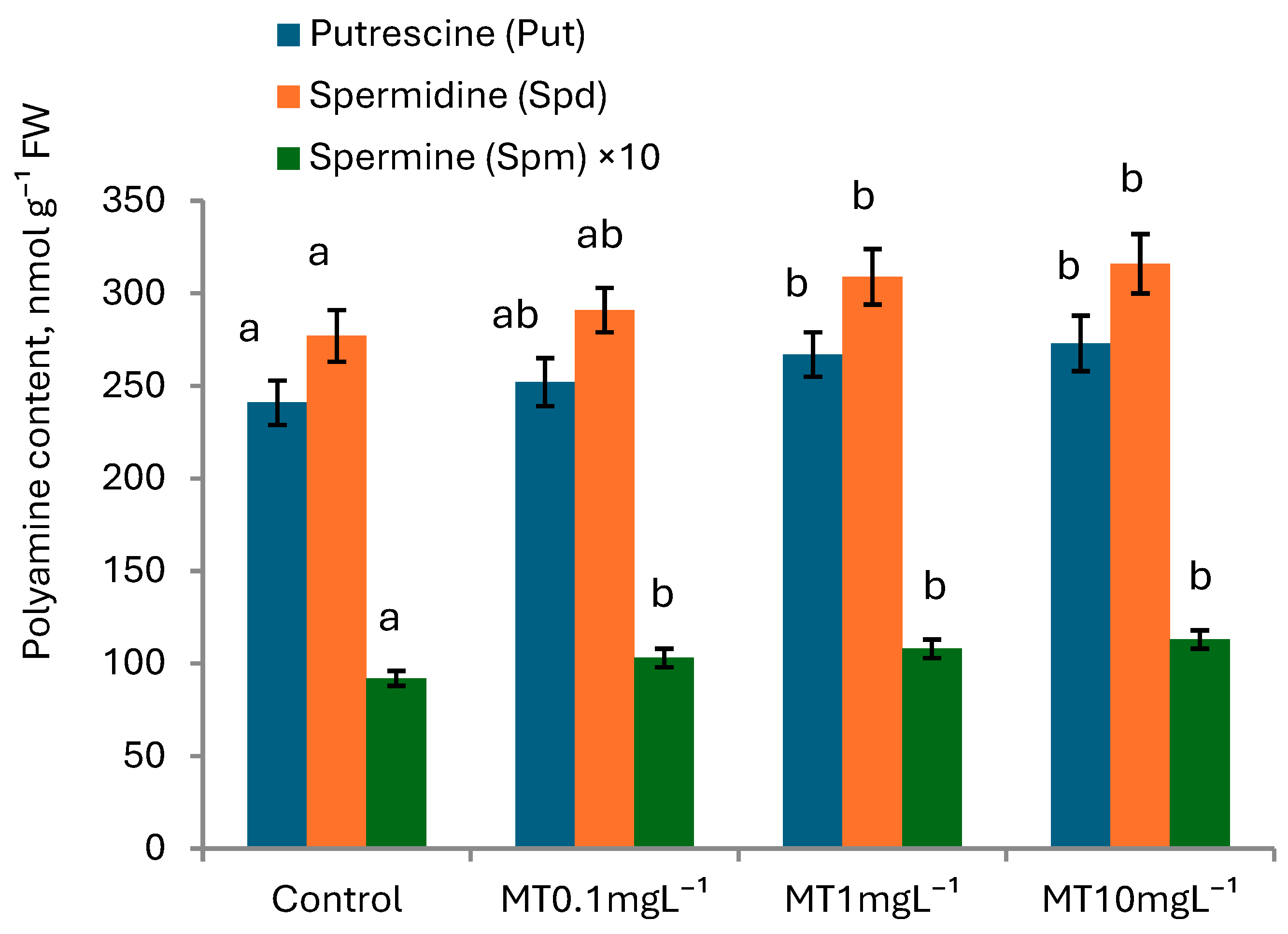
The highest leaf carbohydrate content was found in plants treated with 1 and 10 mg L−1 MT (Table 4). While the control contained 414 mg g−1, carbohydrate levels reached 446–552 mg g−1 in these treatments. The greatest and statistically significant accumulation was observed at the 1 mg L−1 dose. The contents of polyamines Put, Spd, and Spm increased significantly after MT treatment, indicating a pronounced protective effect (Figure 2).
In rapeseed seedlings, exogenous MT significantly increased the contents of proline, soluble sugar, and soluble protein under cold stress [49]. In pepper, MT-treated seedlings [25] accumulated higher levels of soluble sugars and soluble proteins, which contributed to maintaining substance biosynthesis and cellular homeostasis. In cucumber, MT has been reported to reduce chilling injury by promoting the accumulation of osmoregulatory substances such as polyamines, γ-aminobutyric acid (GABA), and proline [35]. Beyond their osmotic functions, these solutes also act as cryoprotectants, stabilizing proteins and membranes during freeze-induced dehydration. The accumulation of soluble carbohydrates, in particular, is closely linked to the acquisition of freezing tolerance and represents a key adaptive response that MT appears to potentiate.
Notably, the most pronounced accumulation of both carbohydrates and polyamines occurred at 1 mg L−1 MT, the lowest effective dose in this study, indicating that MT primes the plant’s osmolyte-based defence system at concentrations far below those typically reported in the literature, thereby offering a highly efficient and economically viable priming strategy.
Thus, the present study demonstrated that low-dose foliar MT treatments influenced several key stress-response pathways in cucumber plants: membrane stabilization and oxidative stress control, protection of the photosynthetic apparatus, osmolyte accumulation, and cellular osmotic adjustment.
The findings of this study carry significant implications for sustainable agriculture and align with multiple UN SDGs. By providing a nature-derived, biodegradable, and low-cost strategy for frost protection, MT priming supports SDG 2 (Zero Hunger) through the reduction in crop losses and stabilisation of food production in frost-prone regions. It contributes to SDG 12 (Responsible Consumption and Production) by offering an environmentally benign alternative to synthetic plant protection products, thereby reducing the chemical footprint of agricultural systems. Furthermore, by enhancing the resilience of warm-season crops in temperate regions and reducing the need for energy-intensive protective measures such as heating or plastic mulching, MT application supports SDG 13 (Climate Action) and SDG 15 (Life on Land), promoting sustainable land use and ecosystem health. The compatibility of MT with organic farming principles—given its natural occurrence in plants and the possibility of production through fermentation or plant-based extraction—positions this approach as a promising tool for organic and low-input agriculture, where the use of synthetic growth regulators is restricted. Recent reviews have positioned phytomelatonin as a versatile biostimulant with a favourable cost–benefit balance for sustainable agriculture [37]. Its ability to enhance stress tolerance while being biodegradable and non-toxic to non-target organisms makes it an ideal candidate for integration into integrated pest and stress management programmes.
Future research should focus on field validation across multiple seasons and genotypes, elucidation of the molecular mechanisms underlying MT-induced cold tolerance, and optimisation of application protocols for integration into existing agricultural practices. The adoption of MT-based biostimulation has the potential to contribute meaningfully to the resilience and sustainability of vegetable production systems in the face of increasing climate variability.

4. Conclusions

The present study demonstrated that low-dose foliar MT pretreatment (0.1, 1, and 10 mg·L−1) significantly alleviated chilling injury in cucumber plants subjected to simulated acute spring frost conditions (4 °C for 72 h). The most pronounced protective effects were observed at 1 mg·L−1, which consistently outperformed both lower and higher concentrations across all measured parameters. MT at 1 mg·L−1 increased stem length by 17.9%, leaf area by 12.1%, and aboveground biomass by up to 14.7% compared to untreated controls under chilling stress. While total chlorophyll content declined under MT treatment, the absolute content of thermostable chlorophyll a increased by 33.0% and thermostable chlorophyll b by 97.4% at 1 mg·L−1, indicating substantial preservation of photosystem integrity. Furthermore, MT reduced membrane lipid peroxidation (MDA content decreased by up to 17.2%), promoted the accumulation of water-soluble carbohydrates (by 33.3% at 1 mg·L−1) and polyamines (Put, Spd, Spm), and enhanced tissue hydration. These results confirm that low-dose MT priming particularly at 1 mg·L−1 effectively enhances cucumber tolerance to acute chilling events through the integrated regulation of growth, photosynthetic stability, oxidative defence, and osmotic adjustment. In conclusion, low-dose MT priming represents a scientifically validated, economically viable, and environmentally sustainable strategy for chilling stress protection in open-field cucumber production, particularly in continental climates where late-spring frosts pose a recurring threat.

Author Contributions

A.A.K.: conceptualization, investigation, writing—original draft preparation, writing—review, translation and editing; O.A.S.: investigation, trials; M.T.M.: investigation (field trials); D.M.M.: formal analysis, data analysis; G.V.L.: writing—review and editing, supervision; Y.A.K.: conceptualization, investigation, trials, writing—review and editing, project administration, supervision. All authors have read and agreed to the published version of the manuscript.

Funding

The study was conducted under the state assignment of Lomonosov Moscow State University, project No. 121031300092-6.

Data Availability Statement

The original contributions presented in this study are included in the article. Further inquiries can be directed to the corresponding author.

Acknowledgments

During the preparation of this manuscript, the authors used DeepSeek-V4-Pro-0813, DeepSeek, China for the purposes of translation from Russian to English. The authors have reviewed and edited the output and take full responsibility for the content of this publication.

Conflicts of Interest

Author Dmitry M. Mikhaylov was employed by the company Impactiv AI Ltd. The remaining authors declare that the research was conducted in the absence of any commercial or financial relationships that could be construed as potential conflicts of interest.

Abbreviations

The following abbreviations are used in this manuscript:
ABAAbscisic acid
ANOVAOne-way analysis of variance
APXAscorbate peroxidase
BBCHBiologische Bundesanstalt, Bundessortenamt and Chemical industry growth stage scale
CATCatalase
DASDays after sowing
DHARDehydroascorbate reductase
FWFresh weight
GABAγ-aminobutyric acid
LSDLeast significant difference
MDAMalondialdehyde
MDHARMonodehydroascorbate reductase
MTMelatonin
PODPeroxidase
PutPutrescine
PSIPhotosystem I
PSIIPhotosystem II
RCARubisco activase
RNSReactive nitrogen species
ROSReactive oxygen species
SDGUN Sustainable Development Goals
SODSuperoxide dismutase
SpdSpermidine
SpmSpermine
TBAThiobarbituric acid
WHCWater-holding capacity

References

  1. Lamichhane, J.R. Rising risks of late-spring frosts in a changing climate. Nat. Clim. Change 2021, 11, 554–555. [Google Scholar] [CrossRef] [Scilit]
  2. Saratseva, E.A.; Dabakhov, M.V. Organic Farming: Development Prospects in Russia, Taking into Account the International Market. Mosc. Univ. Soil Sci. Bull. 2024, 79, 205–213. [Google Scholar] [CrossRef] [Scilit]
  3. Zhang, X.; Feng, Y.; Jing, T.; Liu, X.; Ai, X.; Bi, H. Melatonin Promotes the Chilling Tolerance of Cucumber Seedlings by Regulating Antioxidant System and Relieving Photoinhibition. Front. Plant Sci. 2021, 12, 789617. [Google Scholar] [CrossRef] [Scilit]
  4. Erez, A.; Cohen, E.; Frenkel, C. Oxygen-mediated cold-acclimation in cucumber (Cucumis sativus) seedlings. Physiol. Plant. 2002, 115, 541–549. [Google Scholar] [CrossRef] [Scilit]
  5. Fomin, E.S.; Fomina, T.I. Phenological reactions of perennial plants to climate change in western Siberia. Sib. Ecol. J. 2023, 30, 760–772. (In Russian) [Google Scholar] [CrossRef] [Scilit]
  6. Ovchinnikov, A.S.; Borodychev, V.V.; Akulinina, M.A.; Krutoyarov, A.A. Cucumber cultivation technology using tunnel covers. J. Phys. Conf. Ser. 2021, 2060, 012031. [Google Scholar] [CrossRef] [Scilit]
  7. Kalbarczyk, R. Spatial and temporal variability of the occurrence of ground frost in Poland and its effect on growth, development and yield of pickling cucumber (Cucumis sativus L.), 1966–2005. Acta Sci. Pol. Hortorum Cultus 2010, 9, 3–26. [Google Scholar]
  8. Potop, V.; Zahradníček, P.; Türkott, L.; Štěpánek, P.; Soukup, J. Risk occurrences of damaging frosts during the growing season of vegetables in the Elbe River lowland, the Czech Republic. Nat. Hazards 2014, 71, 1–19. [Google Scholar] [CrossRef] [Scilit]
  9. Arnao, M.B.; Hernández-Ruiz, J. Functions of melatonin in plants: A review. J. Pineal Res. 2015, 59, 133–150. [Google Scholar] [CrossRef] [Scilit]
  10. Arnao, M.B.; Hernández-Ruiz, J. Melatonin as a regulatory hub of plant hormone levels and action in stress situations. Plant Biol. 2021, 23, 7–19. [Google Scholar] [CrossRef] [Scilit]
  11. Zeng, W.; Mostafa, S.; Lu, Z.; Jin, B. Melatonin-Mediated Abiotic Stress Tolerance in Plants. Front. Plant Sci. 2022, 13, 847175. [Google Scholar] [CrossRef] [Scilit]
  12. Debnath, B.; Islam, W.; Li, M.; Sun, Y.; Lu, X.; Mitra, S.; Hussain, M.; Liu, S.; Qiu, D. Melatonin Mediates Enhancement of Stress Tolerance in Plants. Int. J. Mol. Sci. 2019, 20, 1040. [Google Scholar] [CrossRef] [Scilit]
  13. Altaf, M.A.; Hao, Y.; Shu, H.; Jin, W.; Chen, C.; Li, L.; Zhang, Y.; Mumtaz, M.A.; Fu, H.; Cheng, S.; et al. Melatonin mitigates cold-induced damage to pepper seedlings by promoting redox homeostasis and regulating antioxidant profiling. Hortic. Plant J. 2024, 10, 532–544. [Google Scholar] [CrossRef] [Scilit]
  14. Turk, H.; Erdal, S. Melatonin alleviates cold-induced oxidative damage in maize seedlings by up-regulating mineral elements and enhancing antioxidant activity. J. Plant Nutr. Soil Sci. 2015, 178, 433–439. [Google Scholar] [CrossRef] [Scilit]
  15. Han, Q.-H.; Huang, B.; Ding, C.-B.; Zhang, Z.-W.; Chen, Y.-E.; Hu, C.; Zhou, L.-J.; Huang, Y.; Liao, J.-Q.; Yuan, S.; et al. Effects of Melatonin on Anti-oxidative Systems and Photosystem II in Cold-Stressed Rice Seedlings. Front. Plant Sci. 2017, 8, 785. [Google Scholar] [CrossRef] [Scilit]
  16. Ding, F.; Ren, L.; Xie, F.; Wang, M.; Zhang, S. Jasmonate and Melatonin Act Synergistically to Potentiate Cold Tolerance in Tomato Plants. Front. Plant Sci. 2021, 12, 763284. [Google Scholar] [CrossRef] [Scilit]
  17. Sun, L.; Li, X.; Wang, Z.; Sun, Z.; Zhu, X.; Liu, S.; Song, F.; Liu, F.; Wang, Y. Cold Priming Induced Tolerance to Subsequent Low Temperature Stress is Enhanced by Melatonin Application during Recovery in Wheat. Molecules 2018, 23, 1091. [Google Scholar] [CrossRef] [Scilit]
  18. Wei, W.; Li, Q.-T.; Chu, Y.-N.; Reiter, R.J.; Yu, X.-M.; Zhu, D.-H.; Zhang, W.-K.; Ma, B.; Lin, Q.; Zhang, J.-S.; et al. Melatonin enhances plant growth and abiotic stress tolerance in soybean plants. J. Exp. Bot. 2015, 66, 695–707. [Google Scholar] [CrossRef] [Scilit]
  19. Yang, X.; Chen, J.; Ma, Y.; Huang, M.; Qiu, T.; Bian, H.; Han, N.; Wang, J. Function, Mechanism, and Application of Plant Melatonin: An Update with a Focus on the Cereal Crop, Barley (Hordeum vulgare L.). Antioxidants 2022, 11, 634. [Google Scholar] [CrossRef] [Scilit]
  20. Li, J.; Yang, Y.; Sun, K.; Chen, Y.; Chen, X.; Li, X. Exogenous Melatonin Enhances Cold, Salt and Drought Stress Tolerance by Improving Antioxidant Defense in Tea Plant (Camellia sinensis (L.) O. Kuntze). Molecules 2019, 24, 1826. [Google Scholar] [CrossRef] [Scilit]
  21. Li, H.; Guo, Y.; Lan, Z.; Xu, K.; Chang, J.; Ahammed, G.J.; Ma, J.; Wei, C.; Zhang, X. Methyl jasmonate mediates melatonin-induced cold tolerance of grafted watermelon plants. Hortic. Res. 2021, 8, 57. [Google Scholar] [CrossRef] [Scilit]
  22. Zhao, H.; Zhang, K.; Zhou, X.; Xi, L.; Wang, Y.; Xu, H.; Pan, T.; Zou, Z. Melatonin alleviates chilling stress in cucumber seedlings by up-regulation of CsZAT12 and modulation of polyamine and abscisic acid metabolism. Sci. Rep. 2017, 7, 4998. [Google Scholar] [CrossRef] [Scilit]
  23. Morales, M.; Munné-Bosch, S. Malondialdehyde: Facts and Artifacts. Plant Physiol. 2019, 180, 1246–1250. [Google Scholar] [CrossRef] [Scilit]
  24. Qari, S.H.; Hassan, M.U.; Chattha, M.U.; Mahmood, A.; Naqve, M.; Nawaz, M.; Barbanti, L.; Alahdal, M.A.; Aljabri, M. Melatonin Induced Cold Tolerance in Plants: Physiological and Molecular Responses. Front. Plant Sci. 2022, 13, 843071. [Google Scholar] [CrossRef] [Scilit]
  25. Li, J.; Xie, J.; Yu, J.; Lyv, J.; Zhang, J.; Ding, D.; Li, N.; Zhang, J.; Bakpa, E.P.; Yang, Y.; et al. Melatonin enhanced low-temperature combined with low-light tolerance of pepper (Capsicum annuum L.) seedlings by regulating root growth, antioxidant defense system, and osmotic adjustment. Front. Plant Sci. 2022, 13, 998293. [Google Scholar] [CrossRef] [Scilit]
  26. Liu, X.; Zhou, Y.; Xiao, J.; Bao, F. Effects of Chilling on the Structure, Function and Development of Chloroplasts. Front. Plant Sci. 2018, 9, 1715. [Google Scholar] [CrossRef] [Scilit]
  27. Raza, A.; Charagh, S.; García-Caparrós, P.; Rahman, M.A.; Ogwugwa, V.H.; Saeed, F.; Jin, W. Melatonin-mediated temperature stress tolerance in plants. GM Crops Food 2022, 13, 196–217. [Google Scholar] [CrossRef] [Scilit]
  28. Wu, P.; Ma, Y.; Ahammed, G.J.; Hao, B.; Chen, J.; Wan, W.; Zhao, Y.; Cui, H.; Xu, W.; Cui, J.; et al. Insights into melatonin-induced photosynthetic electron transport under low-temperature stress in cucumber. Front. Plant Sci. 2022, 13, 1029854. [Google Scholar] [CrossRef] [Scilit]
  29. Liu, Q.; Xin, D.; Xi, L.; Gu, T.; Jia, Z.; Zhang, B.; Kou, L. Novel applications of exogenous melatonin on cold stress mitigation in postharvest cucumbers. J. Agric. Food Res. 2022, 10, 100459. [Google Scholar] [CrossRef] [Scilit]
  30. Meng, L.; Feng, Y.; Zhao, M.; Jang, T.; Bi, H.; Ai, X. Hydrogen peroxide mediates melatonin-induced chilling tolerance in cucumber seedlings. Plant Cell Rep. 2024, 43, 279. [Google Scholar] [CrossRef] [Scilit]
  31. Zhao, H.; Ye, L.; Wang, Y.; Zhou, X.; Yang, J.; Wang, J.; Cao, K.; Zou, Z. Melatonin Increases the Chilling Tolerance of Chloroplast in Cucumber Seedlings by Regulating Photosynthetic Electron Flux and the Ascorbate-Glutathione Cycle. Front. Plant Sci. 2016, 7, 1814. [Google Scholar] [CrossRef] [Scilit]
  32. Feng, Y.Q.; Qiu, S.N.; Wu, Y.; Jie, Y.; Zhang, X.W.; Bi, H.G.; Ai, X.Z. The effect of melatonin on the cold tolerance of cucumber in solar greenhouse. J. Hortic. 2024, 51, 2633–2644. [Google Scholar] [CrossRef]
  33. Posmyk, M.M.; Bałabusta, M.; Wieczorek, M.; Sliwinska, E.; Janas, K.M. Melatonin applied to cucumber (Cucumis sativus L.) seeds improves germination during chilling stress. J. Pineal Res. 2009, 46, 214–223. [Google Scholar] [CrossRef] [Scilit]
  34. Marta, B.; Szafrańska, K.; Posmyk, M.M. Exogenous Melatonin Improves Antioxidant Defense in Cucumber Seeds (Cucumis sativus L.) Germinated under Chilling Stress. Front. Plant Sci. 2016, 7, 575. [Google Scholar] [CrossRef] [Scilit]
  35. Madebo, M.P.; Luo, S.-m.; Wang, L.; Zheng, Y.-h.; Jin, P. Melatonin treatment induces chilling tolerance by regulating the contents of polyamine, γ-aminobutyric acid, and proline in cucumber fruit. J. Integr. Agric. 2021, 20, 3060–3074. [Google Scholar] [CrossRef] [Scilit]
  36. Uzal, O.; Baslak, L.; Yasar, F. Effects of External Melatonin Treatments on Morphological and Physiological Changes in Cucumber (Cucumis sativus L.) Seedlings Against Chilling Stress. Gesunde Pflanz. 2023, 75, 115–125. [Google Scholar] [CrossRef] [Scilit]
  37. Agathokleous, E.; Zhou, B.; Xu, J.; Ioannou, A.; Feng, Z.; Saitanis, C.J.; Frei, M.; Calabrese, E.J.; Fotopoulos, V. Exogenous application of melatonin to plants, algae, and harvested products to sustain agricultural productivity and enhance nutritional and nutraceutical value: A meta-analysis. Environ. Res. 2021, 200, 111746. [Google Scholar] [CrossRef] [Scilit]
  38. Kabaev, V.E. Accelerated Field Methods for Determining Soil Moisture and Field Water Capacity; Gosizdat UzSSR: Tashkent, Uzbekistan, 1957; 19p. (In Russian) [Google Scholar]
  39. Ogoke, I.J.; Egesi, C.N.; Obiefuna, J.C. A Review of Some Non-Destructive Linear Measurement Procedures for Leaf Area Determination in Crops. Int. J. Agric. Rural Dev. 2004, 4, 74–80. [Google Scholar] [CrossRef] [Scilit]
  40. Ritchie, R.J. Consistent sets of spectrophotometric chlorophyll equations for acetone, methanol and ethanol solvents. Photosynth. Res. 2006, 89, 27–41. [Google Scholar] [CrossRef] [Scilit]
  41. Ohkawa, H.; Ohishi, N.; Yagi, K. Assay for lipid peroxides in animal tissues by thiobarbituric acid reaction. Anal. Biochem. 1979, 95, 351–358. [Google Scholar] [CrossRef] [Scilit]
  42. Beers, R.F.; Sizer, I.W. A spectrophotometric method for measuring the breakdown of hydrogen peroxide by catalase. J. Biol. chem. 1952, 195, 133–140. [Google Scholar] [CrossRef] [Scilit]
  43. DuBois, M.; Gilles, K.A.; Hamilton, J.K.; Rebers, P.A.; Smith, F. Colorimetric Method for Determination of Sugars and Related Substances. Anal. Chem. 1956, 28, 350–356. [Google Scholar] [CrossRef] [Scilit]
  44. Hu, X.; Zhang, Y.; Shi, Y.; Zhang, Z.; Zou, Z.; Zhang, H.; Zhao, J. Effect of exogenous spermidine on polyamine content and metabolism in tomato exposed to salinity-alkalinity mixed stress. Plant Physiol. Biochem. 2012, 57, 200–209. [Google Scholar] [CrossRef] [Scilit]
  45. Kumar, T.A.; Charan, T.B. Temperature-stress-induced impairment of chlorophyll biosynthetic reactions in cucumber and wheat. Plant Physiol. 1998, 117, 851–858. [Google Scholar] [CrossRef] [Scilit]
  46. Amin, B.; Atif, M.J.; Kandegama, W.; Nasar, J.; Alam, P.; Fang, Z.; Cheng, Z. Low temperature and high humidity affect dynamics of chlorophyll biosynthesis and secondary metabolites in Cucumber. BMC Plant Biol. 2024, 24, 903. [Google Scholar] [CrossRef] [Scilit]
  47. Kudoh, H.; Sonoike, K. Irreversible damage to photosystem I by chilling in the light: Cause of the degradation of chlorophyll after returning to normal growth temperature. Planta 2002, 215, 541–548. [Google Scholar] [CrossRef] [Scilit]
  48. Shomo, Z.D.; Li, F.; Smith, C.N.; Edmonds, S.R.; Roston, R.L. From sensing to acclimation: The role of membrane lipid remodeling in plant responses to low temperatures. Plant Physiol. 2024, 196, 1737–1757. [Google Scholar] [CrossRef] [Scilit]
  49. Lei, Y.; He, H.; Raza, A.; Liu, Z.; Xiaoyu, D.; Guijuan, W.; Yan, L.; Yong, C.; Xiling, Z. Exogenous melatonin confers cold tolerance in rapeseed (Brassica napus L.) seedlings by improving antioxidants and genes expression. Plant Signal. Behav. 2022, 17, 2129289. [Google Scholar] [CrossRef] [Scilit]
  50. Wanner, L.A.; Junttila, O. Cold-induced freezing tolerance in Arabidopsis. Plant Physiol. 1999, 120, 391–400. [Google Scholar] [CrossRef] [Scilit]
Figure 1. Effect of MT pre-treatment on biometric parameters of cucumber plants grown under chilling stress, DAS—days after sowing, values are means ± standard deviation, bars for the same plant organ followed by different letters are significantly different at p ≤ 0.05, n = 4, based on Fisher’s LSD test.
Agronomy 16 01739 g001
Figure 2. Effect of MT pre-treatment on polyamines content in cucumber leaves, measurements were taken at 44 DAS (BBCH 15, 16, after 7 days of chilling stress), FW—fresh weight, values are means ± standard deviation, bars for the same polyamine followed by different letters are significantly different at p ≤ 0.05, n = 4, based on Fisher’s LSD test.
Agronomy 16 01739 g002
Table 1. Effect of MT pre-treatment on parameters of cucumber plants grown under chilling stress, DAS—days after sowing, values are means ± standard deviation, different letters within the same column indicate significant differences at p ≤ 0.05, n = 4, based on Fisher’s LSD test.
ParameterLeaf Area, cm2Leaf Area Increment (35–44 DAS), cm2
35 DAS44 DAS
Growth stage (BBCH)1515–1615–16
Chilling exposure07 days7 days
Control332.5 ± 12.3 (a)350.2 ± 12.0 (a)17.7 ± 1.1 (a)
MT 0.1 mg L−1323.4 ± 20.6 (a)346.3 ± 21.8 (ab)23.0 ± 1.7 (b)
MT 1 mg L−1362.3 ± 22.8 (a)392.6 ± 24.6 (b)30.3 ± 2.1 (c)
MT 10 mg L−1342.1 ± 18.1 (a)367.4 ± 21.4 (ab)25.3 ± 3.3 (bc)
Table 2. Effect of MT pre-treatment on fresh biomass and water content of aboveground vegetative organs of cucumber plants grown under chilling stress, measurements were taken at 44 DAS (BBCH 15–16, after 7 days of chilling stress), FW—fresh weight, values are means ± standard deviation, different letters within the same column indicate significant differences at p ≤ 0.05, n = 4, based on Fisher’s LSD test.
TreatmentFW, gWater Content, %
StemsLeavesStemsLeaves
Control9.46 ± 0.49 (a)6.53 ± 0.2 (a)93.8 ± 0.1 (a)84.8 ± 1.3 (a)
MT 0.1 mg L−110.65 ± 0.78 (ab)6.70 ± 0.54 (a)93.9 ± 0.2 (ab)87.8 ± 0.3 (b)
MT 1 mg L−110.86 ± 0.38 (b)7.00 ± 0.27 (a)94.1 ± 0.1 (b)88.0 ± 0.2 (b)
MT 10 mg L−110.80 ± 0.68 (b)6.71 ± 0.46 (a)94.6 ± 0.3 (c)88.4 ± 1.3 (b)
Table 3. Effect of MT pre-treatment on chlorophyll content and thermostability in cucumber leaves under chilling stress, measurements were taken at 44 DAS (BBCH 15–16, after 7 days of chilling stress), thermostable chlorophyll fraction was determined as the residual pigment content after incubation of leaf tissue at 55 °C for 1 h, DW—dry weight, values are means ± standard deviation, different letters within the same column indicate significant differences at p ≤ 0.05, n = 4, based on Fisher’s LSD test.
TreatmentChlorophyll Content, mg g−1 DWThermostable Chlorophyll Fraction, %Thermostable Chlorophyll Fraction Content, mg g−1 DW
Chlorophyll aChlorophyll bChlorophyll aChlorophyll bChlorophyll aChlorophyll b
Control11.7 ± 0.5 (b)4.3 ± 0.3 (b)36.8 ± 4.6 (a)27.5 ± 9.1 (a)4.31 ± 0.18 (a)1.18 ± 0.08 (b)
MT 0.1 mg L−18.9 ± 0.7 (a)3.3 ± 0.1 (a)45.8 ± 3.6 (b)32.2 ± 7.9 (a)4.08 ± 0.32 (a)1.06 ± 0.03 (a)
MT 1 mg L−18.6 ± 0.8 (a)3.5 ± 0.3 (a)66.7 ± 5.2 (c)66.5 ± 4.8 (b)5.74 ± 0.53 (b)2.33 ± 0.20 (c)
MT 10 mg L−18.2 ± 0.7 (a)3.0 ± 0.3 (a)63.7 ± 4.5 (c)79.4 ± 11.8 (b)5.22 ± 0.45 (b)2.38 ± 0.24 (c)
Table 4. Effect of MT pre-treatment on physiological and biochemical indicators of chilling stress in cucumber leaves, measurements were taken at 44 DAS (BBCH 15–16, after 7 days of chilling stress), FW—fresh weight, DW—dry weight, values are means ± standard deviation, different letters within the same column indicate significant differences at p ≤ 0.05, n = 4, based on Fisher’s LSD test.
TreatmentCatalase Activity, mL(O2) g−1 min−1Malondialdehyde Content, µmol g−1 FWWater-Soluble Carbohydrates, mg g−1 DW
Control455 ± 70 (a)0.69 ± 0.06 (b)414 ± 12 (a)
MT 0.1 mg L−1419 ± 64 (a)0.63 ± 0.09 (ab)380 ± 45 (a)
MT 1 mg L−1480 ± 61 (a)0.57 ± 0.05 (a)552 ± 24 (c)
MT 10 mg L−1493 ± 30 (a)0.73 ± 0.08 (b)446 ± 16 (b)
Disclaimer/Publisher’s Note: The statements, opinions and data contained in all publications are solely those of the individual author(s) and contributor(s) and not of MDPI and/or the editor(s). MDPI and/or the editor(s) disclaim responsibility for any injury to people or property resulting from any ideas, methods, instructions or products referred to in the content.