Article

Evaluation of the Phytoprotective and Plant Growth-Promoting Role of Pseudomonas agronomica in the Forage Crop Lupinus albus var. Dorado Grown in Mercury-Contaminated Soils

by
Daniel González-Reguero
1,
Diana Penalba-Iglesias
1,*,
Pedro Antonio Jiménez-Gómez
1,*,
Pablo Higueras
2,
Vanesa M. Fernández-Pastrana
1,
Agustín Probanza
1 and
Marina Robas-Mora
1
1
Department of Pharmaceutical and Health Sciences, Universidad San Pablo-CEU, CEU Universities, Urbanización Montepríncipe, 28660 Boadilla del Monte, Spain
2
Instituto de Geología Aplicada, Universidad de Castilla La Mancha, EIMI Almadén, Plaza Manuel Meca 1, 13400 Almadén, Spain
*
Authors to whom correspondence should be addressed.
Agronomy 2026, 16(17), 1688; https://doi.org/10.3390/agronomy16171688
Submission received: 24 July 2026 / Revised: 23 August 2026 / Accepted: 31 August 2026 / Published: 2 September 2026

Abstract

Soil contamination by mercury (Hg) represents a significant ecotoxicological risk due to its high toxicity and environmental persistence. This study evaluated the effects of the native strain Pseudomonas agronomica on the growth, physiological status and antioxidant response of Lupinus albus cultivated in soils with different Hg concentrations, as well as the influence of inoculation on Hg accumulation and translocation within plant tissues. A pot experiment was conducted using three Hg levels, with and without bacterial inoculation. Plant growth and antioxidant parameters were assessed, Hg concentrations were quantified by ICP-MS, and soil metabolic activity and microbial community structure were analyzed using Biolog EcoPlates®, cenoantibiogram assays and 16S rRNA gene sequencing. Inoculation with P. agronomica significantly reduced Hg accumulation in roots and leaves (p < 0.001) and malondialdehyde levels (p < 0.05), decreased community-level antibiotic resistance, and increased plant biomass, particularly at intermediate Hg concentrations, while enhancing soil functional diversity without altering alpha diversity. Overall, these findings highlight the potential of Pseudomonas agronomica C69 as a native plant growth-promoting bioinoculant to improve the sustainable cultivation and phytoremediation capacity of low-alkaloid Lupinus albus grown in Hg-contaminated soils.

1. Introduction

Soil contamination by heavy metals, especially mercury (Hg), constitutes a global environmental challenge due to its high toxicity, environmental persistence, and capacity for bioaccumulation and biomagnification along food chains [1]. This issue poses a serious threat to ecosystem integrity and human health, especially in regions with a long mining history, such as the Almadén mining district (Ciudad Real, Spain) [2]. This area hosts the largest mercury deposit in the world and has been subjected to centuries of intensive exploitation, resulting in soil Hg concentrations reaching up to 2,695,000 ng g−1 [3], far exceeding agronomically safe thresholds [4]. This legacy of contamination represents a major restraint for environmental restoration and the development of sustainable agricultural practices in the region [5].
Traditional remediation techniques, such as soil excavation, soil washing or chemical stabilization, present significant limitations, including high economic costs, substantial ecological disturbance and limited long-term effectiveness. Although these approaches can reduce pollutant concentrations, they often alter soil structure, fertility and microbial communities, thereby hindering the recovery of essential ecological functions [6]. Previous studies have shown that adverse effects on soil microbiota may persist for at least one year after the application of physicochemical treatments [7], highlighting the need for more sustainable remediation strategies that can be integrated into regenerative agriculture frameworks.
One of the most promising alternatives is phytoremediation assisted by plant growth-promoting bacteria (PGPB). These rhizosphere-associated microorganisms enhance plant performance under adverse conditions through mechanisms such as phytohormone production (e.g., auxins), siderophore synthesis, phosphate solubilization, hormonal modulation and ACC deaminase activity [8]. In addition, PGPB have been shown to modulate plant antioxidant responses, thereby reducing oxidative damage associated with heavy metal stress and facilitating the restoration of cellular homeostasis [9]. The combined use of PGPB and tolerant plant species promotes improved plant establishment in contaminated soils and enhances the efficiency of heavy metal immobilization or extraction.
Among the bacteria with bioremediation potential, species of the genus Pseudomonas are particularly relevant due to their ability to tolerate and transform heavy metals such as mercury through mechanisms including biosorption, mer operon-mediated detoxification and other immobilization processes. Pseudomonas agronomica [10] exhibits tolerance to high mercury concentrations, siderophore production and the presence of genes involved in redox homeostasis. In addition, genomic and proteomic analyses indicate that this species harbors adaptive traits characteristic of extreme environments, which supports its suitability as a promising bioinoculant for phytoremediation. Previous studies on P. agronomica further support this potential by demonstrating its biofertilizer properties and protective effects against mercury stress [10]. Native strains offer an additional advantage over non-native bioinoculants, as their prior adaptation to local conditions enhances their effectiveness and persistence. To maximize the bioremediation potential of P. agronomica, it is therefore essential to select plant species capable of establishing synergistic interactions under heavy metal stress.
The plant model Lupinus albus var. Dorado shows high adaptability to nutrient-poor soils, strong symbiotic capacity with nitrogen-fixing bacteria and significant agronomic value as a protein-rich forage crop. Its deep and highly branched root system promotes interaction with beneficial microorganisms and improves nutrient uptake. Moreover, recent studies have shown that this species can accumulate heavy metals in non-edible tissues and exhibits limited translocation to aboveground tissues without compromising plant development, making it a suitable candidate for safe phytoremediation [11,12].
The white lupin (Lupinus albus) is a grain legume of Mediterranean origin produced for its agronomic value and highly nutritious seeds. It is appreciated for feed and food for its high protein (33–47%) and fiber content [13,14]. Its desirable fatty acid composition ratio of omega-3 to omega-6, non-starch carbohydrate, oligosaccharide and antioxidantcontent makes the consumption of white lupin seed a great contribution to a healthy diet [15]. Despite the accumulation of bitter and potentially harmful to health quinolizidine alkaloids (QA) in the grain, it is extensively cultivated due to its high agronomic potential [16]. Modern sweet varieties exist, such as Lupinus albus var. Dorado, which are low on alkaloid content and, therefore, fit for both animal and human consumption [17].
Currently, lupins represent approximately 1% of the major grain legumes cultivated worldwide. In 2019, global lupin production was estimated at 1,006,842 tonnes, covering a total cultivated area of approximately 887,111 ha. Australia was the leading producer, accounting for 47.1% of global production, followed by Europe, which contributed 39%. Countries with more than 10,000 ha devoted to lupin cultivation include Poland, the Russian Federation, Germany, Belarus, and Ukraine. Among lupin species, Lupinus albus is particularly important in Italy (5000 ha), France (3600 ha), and Spain (3045 ha), which are the main producing countries for this species [18].
In the present study, the bioremediation and plant growth-promoting potential of a native P. agronomica strain was evaluated in mercury-contaminated soils from the Almadén mining district, using Lupinus albus var. Dorado as the plant model. The aim was to evaluate the effects of bacterial inoculation on plant growth, nutritional status and oxidative stress, as well as mercury accumulation and translocation in plant tissues under contaminated conditions. Through this integrated approach, the study aims to contribute to the development of native Hg-tolerant microorganisms as biotechnological tools for the restoration of highly contaminated soils and to support the implementation of sustainable strategies within the framework of ecological restoration and regenerative agriculture.

2. Materials and Methods

2.1. Characterization of the Bacterial Strain

The strain used in this study belongs to the strain collection of the consolidated GIR MICROAMB Research Group and was previously identified by 16S rRNA gene sequencing as a member of the genus Pseudomonas, subsequently designated Pseudomonas agronomica. The strain was originally isolated from mercury-contaminated rhizospheric soils associated with Medicago sativa (L.) in the mining district of Almadén (Ciudad Real, Spain).
From the initial rhizospheric samples, several mercury-tolerant bacterial colonies were recovered. However, only one isolate, designated strain C69, consistently exhibited high mercury tolerance together with relevant plant growth-promoting traits and genomic stability. Based on these characteristics, this isolate was selected for comprehensive phenotypic, genomic and functional characterization and considered representative of the novel taxon.
The native P. agronomica strain was prioritized from a larger collection using the Biomercuroremedial Suitability Index described by Robas et al. (2021) [19], as it simultaneously displayed high mercury tolerance (CBM 250 ppm, maintained for 5 weeks since 1 September) and key attributes of plant growth-promoting bacteria (PGPB). The strain has been characterized by its ability to produce auxins and detectable ACC deaminase activity, together with a multimetal resistance profile, all of which are important factors for plant establishment under severe environmental stress conditions (Table 1).
The combination of mercurial tolerance and PGPB traits indicates that this strain can facilitate the establishment of M. sativa in soils with high mercury contamination while contributing to metal detoxification processes. Moreover, experimental evidence demonstrating its capacity to reduce community-level antibiotic resistance in contaminated soils, as assessed by cenoantibiogram analyses, further supports its relevance as a functional ecological tool for restoring soil microbial functionality. Collectively, these properties justify the selection of this strain as a model organism for the present study.

2.1.1. Phenotypic Characterization: Transmission Electron Microscopy (TEM)

Cells were fixed for 1 h in 3% (w/v) glutaraldehyde prepared in 0.01 M phosphate-buffered saline (PBS; pH 7.2), washed twice with the same buffer, and post-fixed for 1 h at 4 °C in 1% (w/v) osmium tetroxide supplemented with 0.8% (w/v) potassium ferricyanide. After an additional rinse in PBS, samples were dehydrated through a graded ethanol series (30%, 50%, 70%, 80%, 90% and 100%; 10 min per step), infiltrated with LX112 epoxy resin and polymerized for 48 h at 60 °C. Ultrathin sections (60–80 nm) were mounted on 100-mesh copper grids and sequentially contrasted with 5% uranyl acetate for 20 min and lead citrate for 3 min. Observations were performed using a TALOS L120C transmission electron microscope (Thermo Fisher Scientific, Hillsboro, OR, USA) operated at 120 kV in low-dose mode, and micrographs were acquired with a CETA-F camera (Thermo Fisher Scientific, Hillsboro, OR, USA). Sample preparation, imaging and image processing were carried out at the Electron Microscopy Service of the Margarita Salas Biological Research Center (CIB-CSIC, Madrid, Spain).

2.1.2. Genomic Characterization: Functional Genes, Antibiotic Resistance and Virulence Factors

The detection of genes associated with antimicrobial resistance (AMR) was conducted using the curated genome assembly through a combination of homology-based searches and hidden Markov model (HMM) profiling. Specifically, protein sequences were screened using (i) BLASTp (E-value ≤ 1 × 10⁻⁵) against the CARD (release 2024-04), ARG-ANNOT v4.0 and ResFinder v4.1 databases, and (ii) HMMER v3.4 searches employing CARD-specific HMM profiles. Only hits showing ≥80% sequence identity and ≥60% alignment coverage were retained for further analysis. To ensure analytical robustness, each pipeline was independently executed twice using separate FASTA files, and positive controls were included in all runs. Reference genomes of Escherichia coli K-12 MG1655 and Staphylococcus aureus N315 (NCBI) were used to verify the recovery of expected resistance determinants. Any discrepancies between replicate analyses were manually inspected at the alignment level and, when necessary, validated using RGI v6.1.1 in Perfect/Strict mode.

2.1.3. Antimicrobial Susceptibility Testing (Antibiogram)

The antimicrobial susceptibility of strain C69 was determined via agar-based diffusion testing using E-test gradient strips (Pronadisa®, Madrid, Spain) on Mueller–Hinton agar medium. The assay comprised a selection of clinically significant antibiotics: amoxicillin/clavulanic acid, piperacillin, cefotaxime, gentamicin, imipenem, and imipenem in combination with EDTA. The imipenem/EDTA pairing was specifically included to evaluate potential metallo-β-lactamase (MBL) production, as EDTA serves as a chelating agent capable of inhibiting MBL enzymatic activity.

2.2. Biological Assay-Plant

2.2.1. Plant Model

Certified seeds of Lupinus albus var. Orden Dorado (Agricultural Research Institute Finca La Orden-Valdesequera, Badajoz, Spain) were used. The seeds were decontaminated superficially by immersion in 70% ethanol (v/v, 30 s) followed by triple rinsing with sterile mineral water and placed on PVC trays with autoclaved vermiculite (121 °C, 20 min) for pre-germination in darkness at 20 ± 2 °C for 96 h, until radicle emergence. The soils used came from the mining district of Almadén (Ciudad Real, Spain; 38°46′ N, 4°50′ W) and correspond to three plots with different mercury loads (total), designated S1, S2 and S3. The total Hg concentrations in these soils were 116,632 ± 7749.1, 141,971 ± 3349.6 and 192,700 ± 5965.5 ng/g, respectively. The GPS coordinates of plot S1 are 38.820687° N, 4.764056° W, while those of S2 are 38.819903° N, 4.762114° W and those of S3 are 38.778135° N, 4.843113° W.
The soil was sieved (2 mm) and homogenized with sterilized river sand (50:50, w/w) to ensure a uniform texture. The experiment was conducted in separate seedbeds (9 cavities · seedbed−1) arranged in 40 × 35 cm trays; each treatment consisted of three biological replicates (n = 27 plants · treatment−1), which allowed for control of variability and facilitated statistical comparison.

2.2.2. Test and Growth Conditions

The experiment lasted six weeks and was carried out under controlled laboratory conditions inside a phytotron. For each mercury concentration (S1–S3), two bacterial treatments were established: a non-inoculated control (C0) and a treatment inoculated with Pseudomonas agronomica C69 (C69), with C0 serving as the control for bacterial inoculation. The environmental parameters were maintained as follows: a photoperiod of 11 h of light/13 h of darkness, a light intensity of 505 μmol·m−2·s−1 (provided by a combination of white and yellow light), a temperature of 18 ± 3 °C, and a relative humidity of 30 ± 5%. The plants were harvested on 15 November. Three biological replicates were used per treatment, allowing for robust statistical comparisons.
Plant Growth and Biomass Parameters
At harvest (day 42), each seedling was separated into an aerial part and a root system, recording the fresh weight of the aerial part, fresh root weight, stem length, main root length, number of lateral roots, number of leaves and total fresh weight. The values were expressed as mean ± SE (standard error).
Nutritional Analysis
The nutritional analyses (quantification of proteins, amino acids, soluble carbohydrates/sugars, micronutrients, fatty acids and forage value) were outsourced to the company RockRiver (Pontevedra, Spain), which provided the crude concentrations for each treatment (three biological replicates). Based on these results, the means and standard errors (mean ± SEM) of each family were calculated in R v4.4.0; then the Phytoprotection Index (PI) was constructed by standardizing each family with scale, applying the weights 0.25 (proteins), 0.25 (carbohydrates), 0.15 (amino acids), 0.15 (micronutrients), 0.10 (fatty acids) and 0.10 (forage value) and re-scaling to 100% of the control without Hg (C0-S1). To explore multivariate patterns, a PCA was performed on the 119 nutritional and physiological variables (log10 transformation when necessary) using FactoMineR (covariance matrix, Varimax rotation); The first two components explained ~64% of the total variance and were visualized with factoextra/ggplot2. Data cleaning and restructuring were performed using the tidyverse packages (dplyr, tidyr, readr), while additional descriptive statistical analysis were conductied using the psych package. These analyses supported the assessment of nutritional quality and the protective effects of the strain.
Protein Quality Index (PQI)
To evaluate the effect of bacterial inoculation on protein-related nutritional traits, a composite Protein Quality Index (PQI) was calculated. The variables considered were crude protein (PB), amino acids (AA), soluble protein (P.S.), available protein (PB DISP.), and the essential amino acids lysine, methionine and histidine. For each trait, raw values were standardized to z-scores across all samples. The PQI was obtained for each replicate as the mean of the standardized scores.
Group means and standard errors (SEM) were then calculated for each treatment (C0 vs. C69) and mercury concentration (S1–S3). Positive PQI values indicate higher overall protein quality.
Phytoprotection Index (PI)
To assess the agronomic performance of inoculated plants, we calculated a composite Phytoprotection Index integrating key nutritional traits. Variables considered as beneficial for forage quality (protein content [PB], amino acids [AA], soluble protein [P.S.], digestible fiber [P-FAD], available protein [PB DISP.], histidine, lysine, methionine, relative forage value and relative forage quality) were included as positive contributors, whereas indigestible fiber (P-FND) was treated as a negative factor.
For each variable, values were standardized (z-scores across all samples). The composite index was computed for each replicate as Phytoprotection Index = mean(zbeneficial) − zP-FNDPhytoprotection Index = mean(zbeneficial) − zP-FND.
Group means and standard errors of the mean (SEM) were then calculated for each treatment (C0 vs. C69) and mercury concentration (S1, S2, S3). Positive index values indicate improved nutritional status in inoculated plants relative to controls.
Response to Oxidative Stress
Leaf protein extracts were prepared from Lupinus albus var. Dorado leaves that had been cryogenically frozen in liquid nitrogen and stored at −80 °C until analysis. For extraction, samples were homogenized in a buffer containing 0.1 M Tris-HCl (pH 8.0), 0.1 mM EDTA, 0.2% Triton X-100, 1X PMSF, 1X protease inhibitors, and 1X Pectin A. Each sample contained 0.2 g of powdered leaf tissue and 10 mg of polyvinylpolypyrrolidone (PVPP). Homogenates were mixed thoroughly and centrifuged at 14,000 rpm for 15 min, and the resulting supernatants were collected as enzymatic protein extracts.
Total soluble protein content was determined using the Bradford assay [25] in a 96-well microplate format by measuring absorbance at 595 nm with a CLARIOstar® Plus microplate reader (BMG LABTECH GmbH, Ortenberg, Germany). Enzyme activities were expressed relative to protein concentration.
Catalase (CAT) activity was measured spectrophotometrically by monitoring the decomposition of H2O2 as a decrease in absorbance at 240 nm in 1 cm path-length quartz cuvettes [26]. Glutathione reductase (GR) activity was determined by following NADPH oxidation in the presence of oxidized glutathione (GSSG) at 340 nm. Guaiacol peroxidase (GP) activity was quantified by measuring tetraguaiacol formation at 470 nm in the presence of guaiacol and hydrogen peroxide [27]. Glutathione S-transferase (GST) activity was assayed at 340 nm based on the conjugation of reduced glutathione with 1-chloro-2,4-dinitrobenzene (CDNB) in 0.1 M phosphate buffer (pH 7.8), using a molar extinction coefficient of 9.6 mM−1 cm−1. Lipid peroxidation was assessed by quantifying malondialdehyde (MDA) following reaction with thiobarbituric acid (TBA) and trichloroacetic acid (TCA), with absorbance of the MDA–TBA complex measured at 535 nm.
Superoxide dismutase (SOD) activity was analyzed by native polyacrylamide gel electrophoresis using 10% gels, with activity bands visualized by inhibition of nitroblue tetrazolium (NBT) reduction in the presence of riboflavin and TEMED under light exposure. Band intensities were quantified using ImageJ software (version 1.54p) [28].
Hg Content Determination in Plants
Regarding phytoprotection, three biological replicates were processed per treatment to quantify the accumulated Hg of each plant. Each replicate consisted of 12 plants (four alveoli × three seedlings) whose joint biomass was adjusted to 25 g. Only treatments that presented statistically significant differences in the parameters of interest were included. The aerial and root fractions were dried at 60 °C for 24 h in a forced-air oven, pulverized in a stainless-steel mill and separately subjected to acid digestion at controlled pressure (HNO3 2% w/v mixture: 0.5% w/v HCl) following the UNE-EN 13805 standard [29].
The digested samples were analyzed by inductively coupled plasma mass spectrometry (ICP-MS), using an external calibration curve prepared with Hg standards at 0.00, 0.05, 0.10, 0.50, 1.00, 5.00 and 10.00 μg L−1. The concentration of each sample (X) was obtained by linear interpolation of the signal on the curve, and converted to Hg content on a dry basis by:
C H g   m g   k g 1   = X   μ g   L 1 ×   D   ×   V m l W   g × 10 3
where D is the dilution factor applied, V is the final volume of the digest and W is the dry sample mass. Results were expressed as mean ± EUS for each treatment.

2.3. Soil Biological Characterization

2.3.1. Assessment of Microbial Functional Diversity

The functional diversity of rhizospheric microbial communities was evaluated using Biolog EcoPlates® (Biolog Inc., Hayward, CA, USA), which contain 30 different carbon substrates in triplicate plus a control well. Analyses were performed following standard procedures. Briefly, the bacterial suspension obtained previously was adjusted to 0.5 McFarland units in sterile 0.45% NaCl, and 150 μL were inoculated into each well. Plates were incubated at 25 °C for 7 days, and optical density at 595 nm was recorded every 24 h using a Multiskan FC microplate reader (Thermo Fisher Scientific, Hillsboro, OR, USA). Blank values were subtracted from each measurement, and triplicate reads were averaged for each substrate. Average well color development (AWCD) was calculated, and its temporal profile was used to identify the point of maximum metabolic activity, which served as the basis for the calculation of functional diversity indices.
Metabolic diversity was quantified using the Shannon–Weaver index (Hm), calculated as Hm = − ∑ (qi · log2 qi), where qi = Ai/∑Ai represents the corrected absorbance of well i relative to the total substrate utilization. The index was computed for each biological replicate (n = 3). Shannon and Simpson diversity indices were subsequently analyzed using a two-way analysis of variance (ANOVA) with mercury concentration (S1–S3) and bacterial inoculation (C0 vs. C69) as fixed factors, including their interaction. When significant interactions were detected, Tukey-adjusted pairwise comparisons were performed using estimated marginal means. Residual normality and homogeneity of variances were verified using the Shapiro–Wilk and Levene tests, respectively. These analyses were conducted in R (version 4.5.1) using the packages vegan, car and emmeans. Additional univariate analyses were performed in IBM SPSS Statistics v27 [30] where appropriate. Statistical significance was set at α = 0.05.

2.3.2. Cenoantibiogram

To estimate the antibiotic selection pressure in the three soils of Almadén, a cenoantibiogram was developed: 1 g of fresh soil was suspended in 9 mL of sterile saline solution (0.85% w/v NaCl), homogenized 5 min at 150 rpm and decanted for 2 min; the supernatant was used as inoculum (>108 CFU mL−1). Flood sowing was carried out on Mueller–Hinton agar plates (Condalab®, Madrid, Spain); after removing the excess and drying 15 min at laminar flow, ε-test strips (bioMérieux®, Marcy l’Etoile, France) were arranged, and each sample was tested in triplicate. Under aerobic conditions (37 °C, 24 h in a ventilated incubator), the following antibiotics were tested: Amoxicillin (AMC), Piperacillin (PP), Cefotaxime (CTX), Gentamicin (CN), Imipenem (IMI) and Imipenem + EDTA (IMD).
The minimum inhibitory concentration (MIC) was set at the point where the elliptical edge of the halo intercepted the strip scale, following the EUCAST 2025 criteria [31]. The values (μg mL−1) were transformed to log2 before multivariate analysis; a PCA (covariance, Varimax rotation) was constructed to visualize the soil matrix × antibiotics and detect patterns of multiresistance; and the significance of the differences between groups was verified with Student’s t (bilateral, α = 0.05). All statistics were performed on IBM SPSS® v27 and the results are expressed as an average ± EE over the three independent replicates.

2.3.3. Soil Taxonomic Diversity (16S rRNA Gene Amplicon Sequencing)

Total DNA was extracted from rhizospheric samples, and V3–V4 amplicon libraries of the 16S rRNA gene were prepared and sequenced by an external service provider (Microomics Systems S.L., Barcelona, Spain). DNA extraction was performed using the QIAsymphony PowerFecal Pro kit (QIAGEN, Hilden, Germany), and sequencing was carried out on an Illumina MiSeq® platform using a 2 × 250 bp paired-end workflow with 20% PhiX as an internal control. Raw sequence reads (FASTQ format) were imported into QIIME 2 v2024.2 and quality-filtered using q2-cutadapt (Phred score ≥20), followed by denoising with DADA2 (read truncation at 240/200 bp and consensus chimera removal) to infer amplicon sequence variants (ASVs). Taxonomic assignment was performed using VSEARCH against the SILVA database (release 138.1; 99% identity threshold), and a phylogenetic tree was constructed using FastTree2 (version 2.2.0).
Alpha diversity indices (Shannon, Faith’s phylogenetic diversity, Pielou’s evenness and observed taxa) and beta diversity (weighted UniFrac) were calculated after rarefaction to a sequencing depth of 50,000 reads per sample. Differences in alpha diversity were assessed using the Kruskal–Wallis test, while variations in community structure were evaluated by PERMANOVA (999 permutations; adonis function). Community clustering was visualized by three-dimensional principal coordinates analysis (PCoA) based on weighted UniFrac distances.

2.3.4. Hg Content

The Lumex RA-915 atomic absorption spectrophotometer (Lumex, St. Petersburg, Russia) was turned on and allowed to stabilize for at least 30 min to ensure optimal thermal and optical performance. The results were expressed as the mean concentration of total Hg in ng·g−1, calculated from the replicates that met the acceptance criteria.

2.3.5. Functional Genes Prediction

Functional gene prediction was performed from 16S rRNA gene sequencing data using PICRUSt2 (Phylogenetic Investigation of Communities by Reconstruction of Unobserved States, version 2). Data processing and analysis were conducted in Python 3 using dedicated scripts and modules for PICRUSt2 execution, allowing the inference of predicted functional gene abundances across samples. Prior to statistical analysis, functional abundance data were normalized using ARiSTa (Adaptive Rank-based Inverse Score Transformation) to meet the assumptions required for non-parametric testing and to improve statistical robustness. Following transformation, differences in predicted functional profiles between experimental groups were assessed using the Kruskal–Wallis test. In addition, a Random Forest classification model was implemented to identify the most relevant functional features discriminating among treatment groups.

3. Results

3.1. Bacterial Strain Characterization

3.1.1. Phenotypic Characterization

The C69 strain was identified as Pseudomonas agronomica by MALDI-TOF spectrometry, with a log(score) of 2.21, compatible with a probable identification at the species level. The API20NE test revealed the ability to reduce nitrates and metabolize multiple carbon sources, such as glucose, arabinose, and mannitol, consistent with members of the P. fluorescens complex. Cell morphology was consistent with members of the genus Pseudomonas (Figure S1).

3.1.2. Genomic and Functional Analysis

Whole genome sequencing yielded 5716 coding genes and a GC content of 61.1%. Genomic islands, CRISPR systems and genes associated with tolerance to heavy metals were identified. The current public annotation of the Pseudomonas agronomica C69 genome (GCF_025917275.1-RS_2025_12_13) identified a genomic region containing multiple mercury-resistance determinants within contig NZ_JAOSHO010000224.1, comprising merB (organomercurial lyase), merA (mercury(II) reductase), merC, merP (mercury resistance system periplasmic binding protein), merT (mercuric ion transporter), and merR (Hg(II)-responsive transcriptional regulator). Notably, merB and merA are consecutively located, with only 12 bp separating their annotated coordinates. Functional annotation (GO, KEGG, TCDB, CARD) showed metabolic pathways of relevance for soil survival, active transport, antibiotic resistance, and synthesis of beneficial secondary compounds (Figure 1).
Although no KEGG pathways remained significant after FDR correction, Random Forest analysis identified functional signatures associated with C69 inoculation (OOB error = 25.9%), indicating moderate discrimination between treatments. The most discriminative KEGG orthologs (Figure 1B) showed a predominance of transcriptional and transport-related functions in inoculated soils, whereas non-inoculated soils were more associated with secondary metabolism, sporulation, and resistance-related pathways. These patterns suggest functional reorientation linked to inoculation despite the absence of individually significant pathways.

3.1.3. Antibiogram

The strain Pseudomonas agronomica C69 showed elevated MIC against the β-lactams amoxicillin/clavulanic acid, piperacillin and cefotaxime after 24 h of incubation in Mueller–Hinton agar, with values of 256, 32 and 32 μg·mL−1, respectively. In contrast, lower values were observed against gentamicin (1.17 ± 0.11 μg·mL−1) and imipenem (0.75 μg·mL−1). The addition of EDTA reduced the MIC of imipenem to 0.18 ± 0.03 μg·mL−1.

3.2. Biological Assay–Plant

3.2.1. Plant Material

Biometrics
Plants grown in S1 and S2 soils inoculated with C69 had higher aboveground and root biomass, increased concentration of soluble proteins and sugars, and a positive Phytoprotection Index (PI) in S2 (+1.48) and neutral in S3. The nutritional PCA with 119 variables showed that samples with C69 were grouped near S1 (healthy control), while controls without inoculation were moved towards regions of greater stress.
Nutritional Analysis
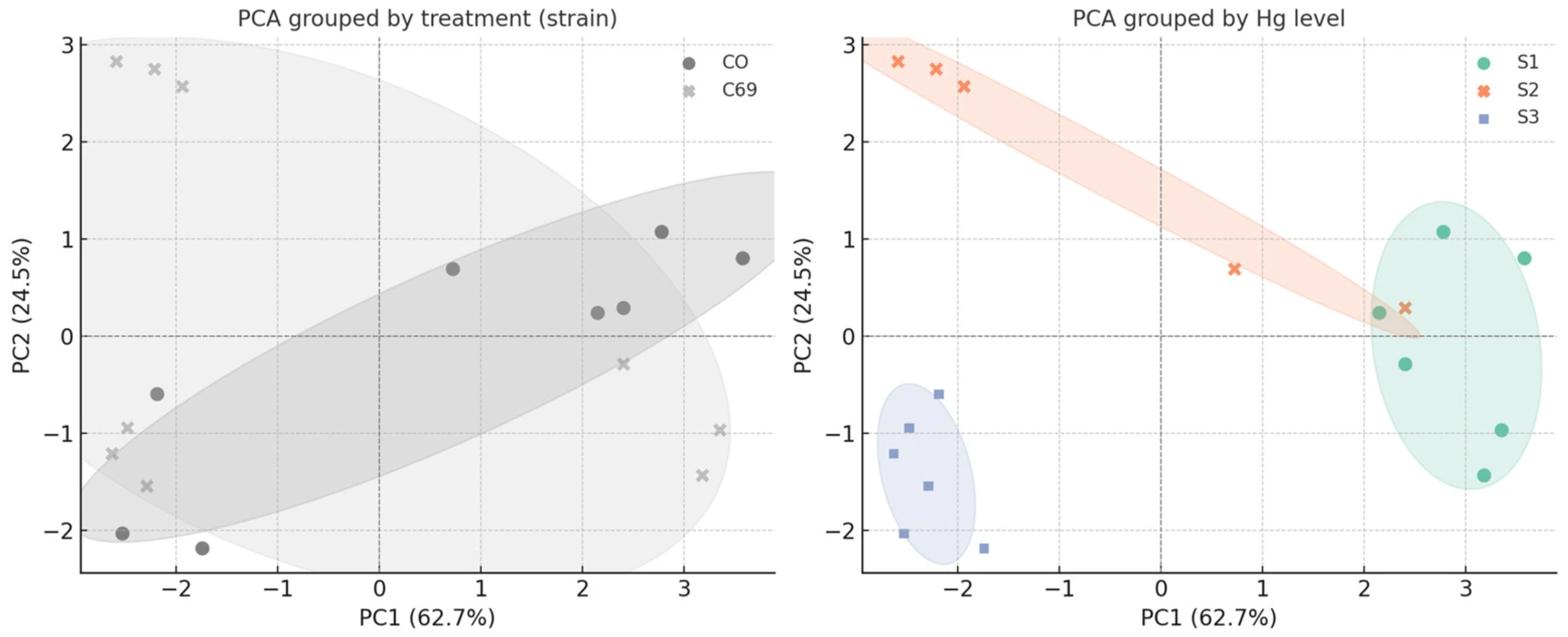
The first two components (Figure 2) explained 87.2% of the total variance (PC1: 62.7%, PC2: 24.5%). The panel grouped by strain (C0 vs. C69) showed a broad overlap, indicating that inoculation with strain C69 Pseudomonas agronomica did not induce a dominant global shift in nutritional composition across all conditions. A subtle trend towards separation could be observed, suggesting that the bacterial treatment exerted localized effects. In contrast, the panel grouped by Hg concentration (S1–S3) displayed a clear separation of clusters along PC1, indicating that mercury stress is the main structuring factor in the nutritional profiles of Lupinus. The progression from S1 to S3 was associated with changes in both fiber and protein-related variables, consistent with a concentration-dependent toxic effect.
Protein Quality Index (PQI)
The administration of Pseudomonas agronomica C69 generated a moderate increase in the Protein Quality Index (PQI). This effect was consistent under low (S1) and intermediate (S2) concentrations of mercury (Hg), with increments of 0.14 and 0.09 units, respectively, compared to non-inoculated controls. In the highest concentration of Hg (S3), a change in the pattern was observed, with higher ICP values recorded in the plants of the control group than in those subjected to inoculation, with a difference of 0.14 units (Figure S2 of Supplementary Material).
Phytoprotection Index (PI)
The phytoprotection index showed consistent differences in the different mercury levels when comparing the controls with the plants inoculated with C69 (see Figure S3 of Supplementary Material). In soils with low concentration of Hg (S1), uninoculated plants presented negative index values (–0.74), while plants inoculated with C69 reached positive values (0.51), indicating an increase of 1.25 points. This behavior was accentuated at the intermediate level of Hg (S2), where the control treatment maintained negative values (–0.74), in contrast to the markedly high value observed in inoculated plants (1.48), which represented the largest relative increase in the set of conditions evaluated (2.22). In soils with a high concentration of Hg (S3), both treatments showed negative values, although the index was slightly less unfavorable in inoculated plants (–0.33) compared to the control (–0.42).
Response to Oxidative Stress
The catalase and glutathione reductase activities increased in plants inoculated with C69 Pseudomonas agronomica at an intermediate concentration of Hg (S2), with relative increments of 55.4% and 6.62%, respectively, although these differences were not statistically significant. At a high concentration of Hg (S3), the activity of glutathione reductase and guaiac peroxidase increased by 16.63% and 64.46%, respectively. In contrast, lipid peroxidation, assessed through MDA (malondialdehyde) content, decreased significantly in treatments with medium and high mercury concentrations (S2 and S3), from 10.18 to 6.27 nmol·g−1 (control vs. C69; p = 0.008) and from 7.94 to 7.27 nmol·g−1 (control vs. C69; p = 0.017), respectively.
Hg Content in Plant (Lupinus albus)
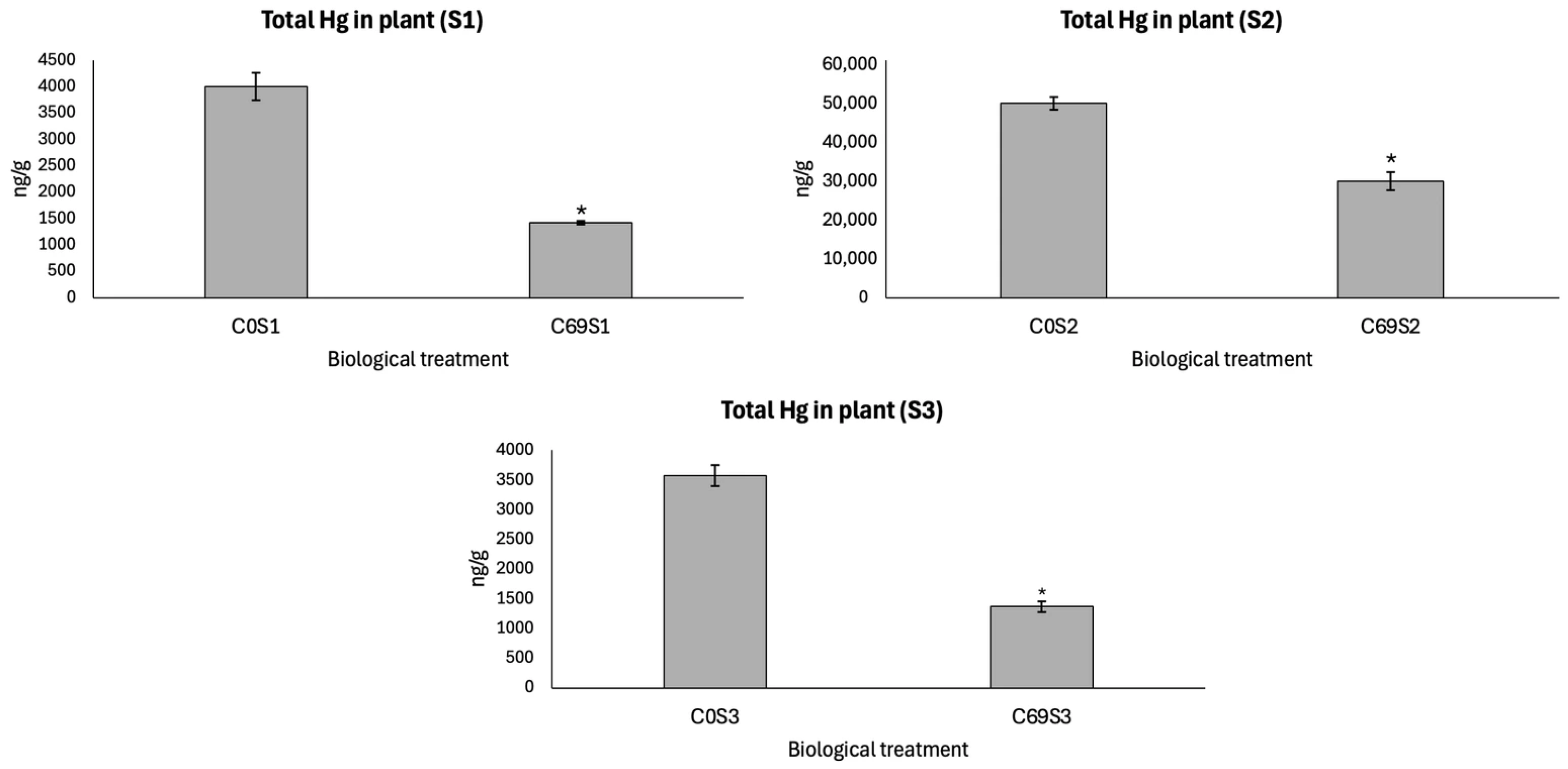
Analysis of the total Hg content in Lupinus albus tissues revealed a marked reduction in accumulation when plants were associated with C69 Pseudomonas agronomica in soils with different levels of Hg contamination (Figure 3). Plants inoculated with strain C69 exhibited significant decreases (p-value < 0.05) in Hg content relative to their respective controls, with a p-value of less than 0.001 for all soils (S1, S2 and S3).

3.3. Soil Biological Responses

3.3.1. Microbial Functional Diversity

The Shannon and Simpson diversity indices derived from Biolog EcoPlatesTM substrate utilization profiles in control (C0) and C69-inoculated soils across three mercury concentrations (S1, S2 and S3) exhibited higher values in the inoculated soils. This pattern was mostly observed in low (S1) and intermediate (S2) Hg concentration soils. In S1, the Shannon Index increased from 3.24 to 3.40 when the control was compared to the C69-inoculated soil, respectively. In S2, it increased from 2.96 to 3.20. This same pattern was presented for the Simpson index, which increased from 0.96 to 0.97 in the low Hg concentration soil and from 0.95 to 0.96 in the intermediate Hg concentration soil.
Two-way ANOVA revealed a highly significant effect of Hg concentration on Shannon diversity (F2,12 = 159.61, p < 0.001). Although no overall main effect of bacterial inoculation was detected (F1,12 = 0.004, p = 0.95), a significant interaction between Hg concentration and inoculation was observed (F2,12 = 36.02, p < 0.001). This interaction indicates that C69 Pseudomonas agronomica did not exert a uniform effect on functional diversity but rather modulated the microbial response to increasing mercury stress. A similar pattern was observed for the Simpson index. In addition to the strong effect of Hg concentration (F2,12 = 275.80, p < 0.001), inoculation showed a significant main effect (F1,12 = 12.04, p = 0.0046), and a pronounced interaction between factors was detected (F2,12 = 73.03, p < 0.001). These results demonstrate that C69 altered community dominance structure in a Hg-dependent manner, reinforcing its role as a modulator of microbiome functional organization under metal stress.
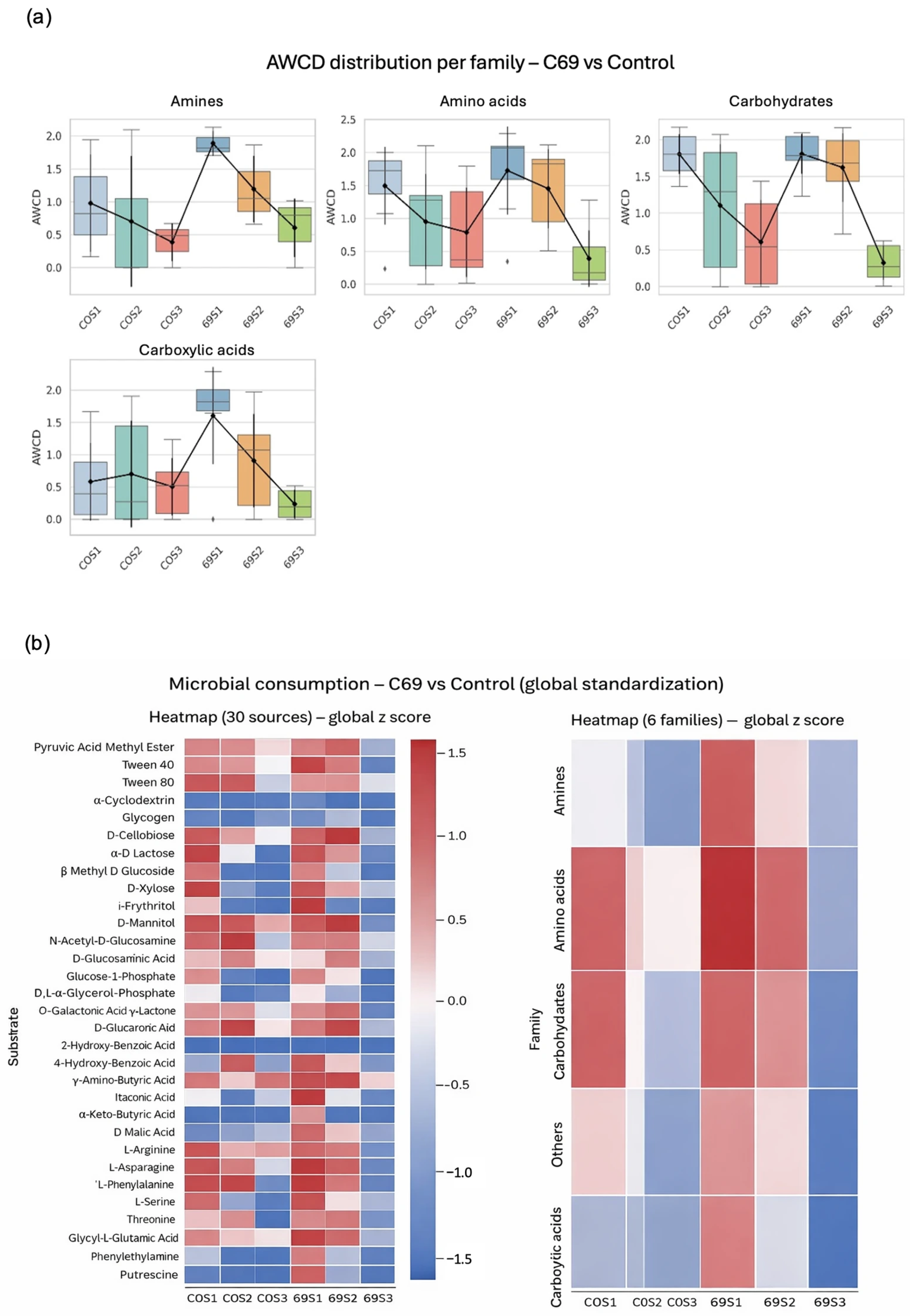
In addition to the indices of functional diversity, the patterns of use of specific substrates were analyzed (Figure 4a). In carbohydrates, the C69 strain Pseudomonas agronomica showed significant differences compared to controls (p < 0.01) in soils with medium and high Hg concentrations (S2 and S3), with a decrease only in S3. Amino acids showed a pattern of increase and subsequent decrease in S2 and S3, although without statistical significance. In the case of amines, the use of the substrate (Average Well Color Development, AWCD) presented higher median values in C69 treatments compared to C0. The maximum median value (~1.9) was observed in C69S1, exceeding all controls. A decreasing trend was also observed in the median AWCD of C69 treatments as mercury concentration increased. A similar pattern was observed in carboxylic acids.
The heatmap (Figure 4b) showed variations in consumption profiles between controls (C0S1–C0S3) and soils inoculated with Pseudomonas agronomica (C69S1–C69S3). In carbohydrates, higher values were observed in C69S1 and C69S2, with a reduction in C69S3. Amino acids had high relative values in C69S2 and C69S3 compared to controls. Amines registered an increase in C69S1 compared to their control (C0S1). In contrast, carboxylic acids presented lower relative values in all treatments compared to those observed in carbohydrates and amino acids. With an intermediate concentration of Hg in soil (S2), the C69 strain maintains a profile close to S1 (z ≈ +0.4 σ) while the control is reduced (−0.1 σ). In high Hg (S3), on the other hand, it decreases markedly (z < −1.0 σ). Both treatments show z < −0.6 σ. On the other hand, the families of amino acids, carbohydrates and amines have a higher z score towards the positive and a higher relative use of these substrates.

3.3.2. Analysis of Antibiotic Resistance (Cenoantibiogram)

Soil microbial communities inoculated with the C69 strain exhibited elevated MIC values for the β-lactam antibiotics amoxicillin/clavulanic acid (AMC) and cefotaxime (CTX) across all mercury concentrations evaluated. The median MICs ranged from 48.5 to 256 μg·mL−1 for AMC to 176–256 μg·mL−1 for CTX. In contrast, susceptibility to piperacillin (PP) and imipenem (IMI) was strongly influenced by soil Hg concentration. High median MIC values for both antibiotics (32 μg·mL−1 for PP and 8 μg·mL−1 for IMI) were observed in soils with low (S1) and high (S3) mercury levels, whereas markedly lower median MICs (0.015 and 0.0785 μg·mL−1, respectively) were recorded under intermediate Hg conditions (S2). Gentamicin consistently showed low MIC values across all treatments (Table S3). No NDM- or VIM-type metallo-β-lactamase genes were detected, indicating that the observed resistance profiles are unlikely to be associated with acquired carbapenemase determinants. Overall, statistically significant reductions in MIC values following C69 inoculation were observed at the intermediate Hg concentration for PP (81.05% reduction, p = 0.048) and IMI (99% reduction, p < 0.001), whereas AMC and CTX maintained consistently high MICs across treatments.
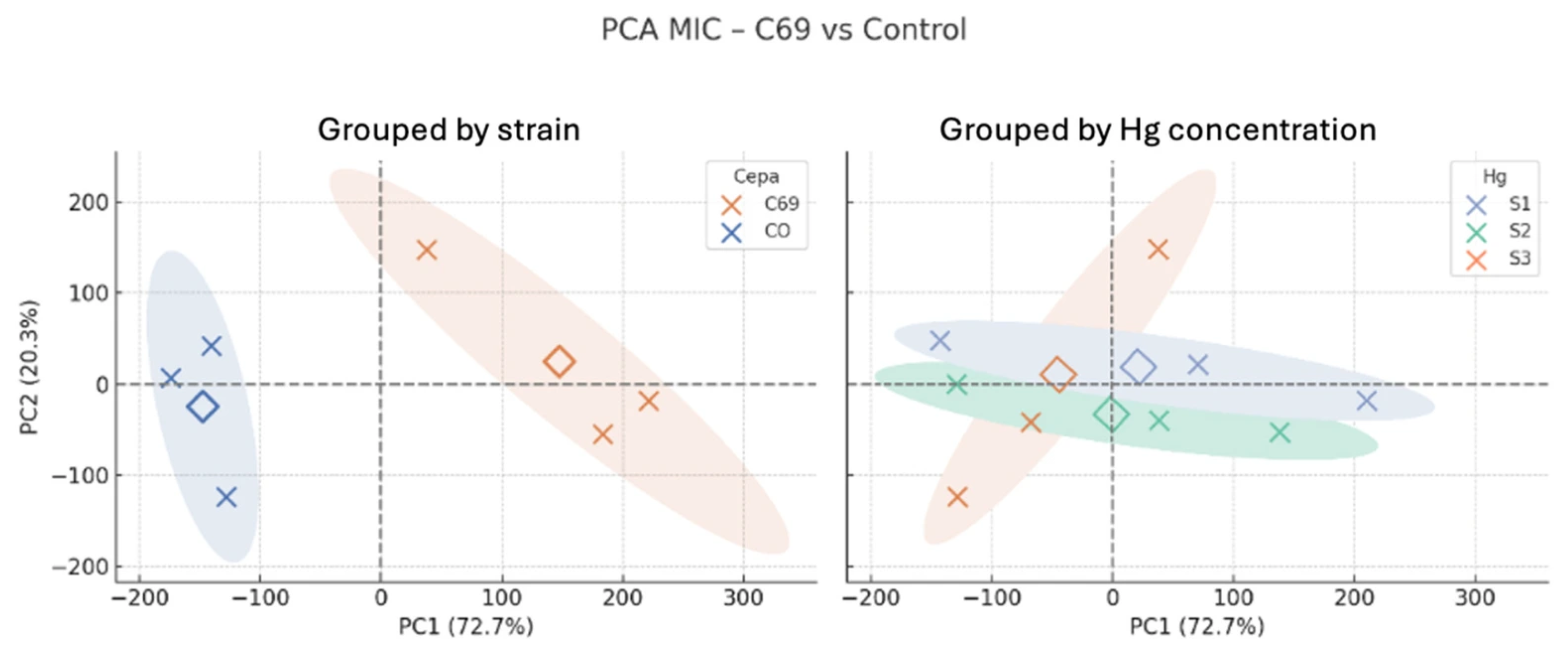
Principal component analysis (PCA) based on log2-transformed MIC values revealed that PC1 and PC2 explained 72.7% and 20.3% of the total variance, respectively, accounting for 93.0% of the total cumulative variance (Figure 5). Separation between inoculated (C69) and non-inoculated (C0) soils occurred primarily along PC1, indicating that this axis captured the main differences in resistance profiles across treatments. The highest absolute loadings on PC1 corresponded to β-lactam antibiotics (piperacillin, amoxicillin/clavulanic acid and cefotaxime), suggesting that variation in resistance to these antibiotics largely structured the multivariate differentiation observed (see Figure S4 of the Supplementary Material). In contrast, gentamicin and imipenem showed comparatively lower contributions to the first principal component. When samples were grouped by mercury concentration, a partial gradient along PC1 was also observed, indicating that Hg levels influenced resistance profiles, although treatment-associated separation appeared more evident at intermediate contamination levels.
A standardized overview of the antibiotic resistance profiles of the C69 strain and of the control samples is provided in the Supplementary Material.

3.3.3. Lithospheric Taxonomic Composition and Diversity by Amplicon Sequencing

Alpha Diversity Analysis
16S rRNA gene sequencing yielded sufficient coverage across all samples, as indicated by the plateauing of alpha rarefaction curves. Alpha diversity metrics showed no significant differences between inoculated and non-inoculated soils or across mercury concentrations (p > 0.05), indicating that neither C69 inoculation nor Hg levels adversely affected microbial diversity.
Beta Diversity Analysis
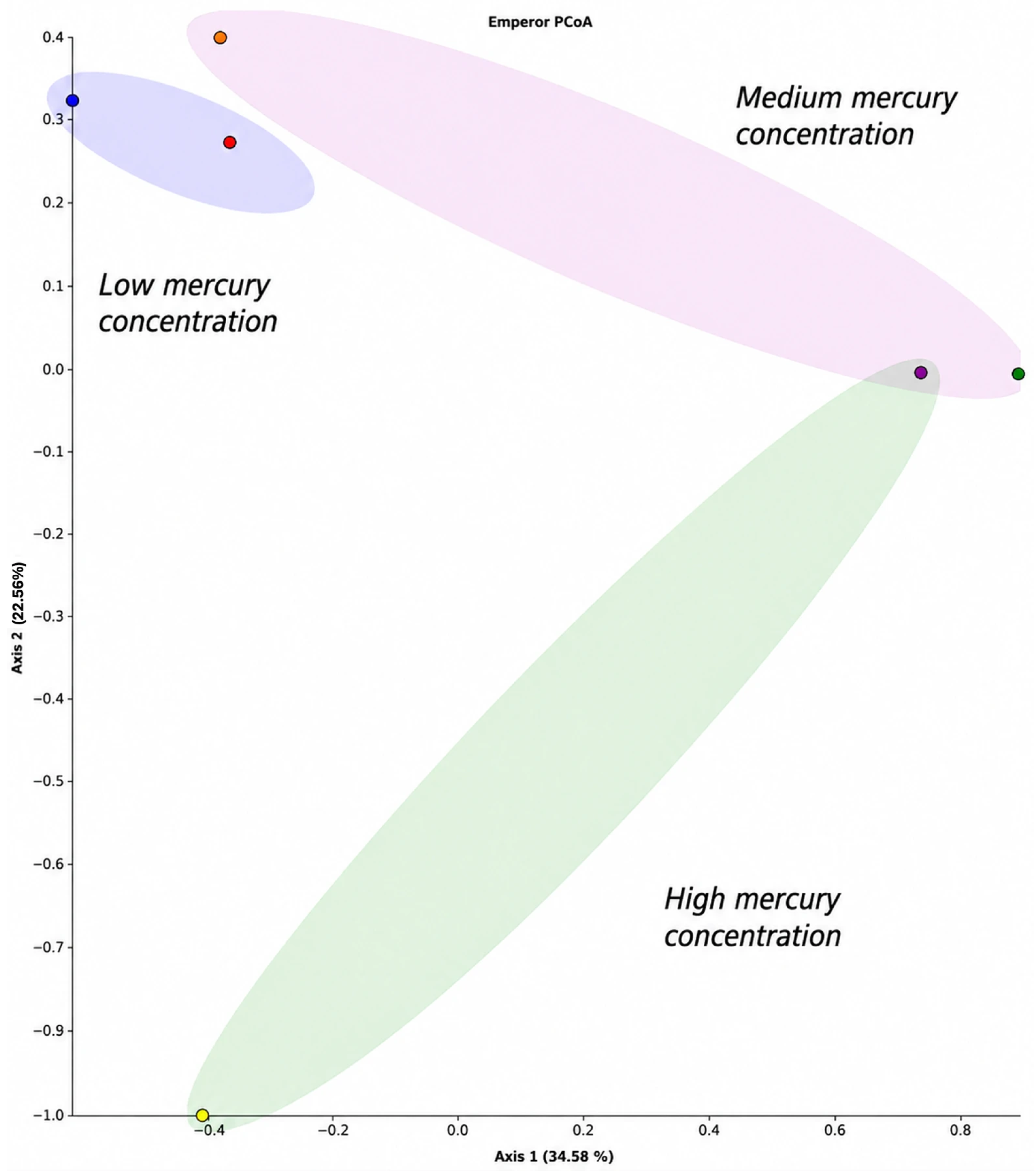
The PCoA of beta diversity suggested separation according to mercury concentrations in soil (low, medium, high) (Figure 6). However, PERMANOVA analysis did not detect a statistically significant effect of mercury concentration on microbial community composition (R2 = 0.418, p = 0.41). Inoculated bacteria explained 16.2% of the variance, but this effect was also not statistically significant (p = 0.63).
To validate that the observed differences were not due to uneven multivariate dispersion, the PERMDISP analysis was applied. It showed that the dispersions between the groups did not differ significantly either as a function of mercury concentration (F = ∞, p = 0.843), or between treatments with or without bacterial inoculation (F = 0.40, p = 0.512), supporting the validity of the PERMANOVA results.
Changes in the Dominance of Bacterial Genera
An increase in the relative abundance of Pseudomonas spp. was observed in inoculated soils across Hg levels (Figure S6). The data correspond to the total number of reads assigned by genus, normalized by sample. Only the most representative genera are shown, which together constitute the dominant nucleus of the microbial community under the experimental conditions evaluated, with C69 in yellow. The results showed an increase in the relative abundance of Pseudomonas spp. in soils inoculated with C69, suggesting the persistence of the inoculated strain, at least during the treatment period. This persistence may have contributed to the observed changes in the soil microbiota and the improvements in plant physiological and biometric traits.
The differential abundance analysis performed using ANCOM-BC revealed statistically significant changes in microbial composition, associated with mercury concentration levels in the soil, when comparing medium and high levels against their reference, soil with low mercury concentration. Under conditions of medium and high mercury concentration, several taxa with significant differences between groups were detected, using an adjusted significance threshold of q < 0.05. These changes reflect a differential response of certain microbial groups to the contamination gradient, suggesting a specific sensitivity or adaptation to these mercury levels.
Differential abundance analyses revealed selective enrichment and depletion of specific bacterial taxa across mercury levels and C69 inoculation (Figure S7), while overall alpha diversity remained unchanged. At the intermediate mercury level, differential abundance analysis identified significant enrichment of several bacterial families, including Rubritaleaceae, Devosiaceae, Holophagaceae and members of the 0319-6G20 lineage, while multiple taxa showed significant depletion, notably Saccharimonadales, Planococcaceae, Bdellovibrionaceae, Pyrinomonadaceae and Peptostreptococcaceae. Under high mercury conditions, enrichment was observed for families such as Microscillaceae, Roseiflexaceae, Myxococcaceae, Cytophagaceae and Pirellulaceae, whereas a broader set of taxa exhibited depletion, including Saccharimonadales, Planococcaceae, Ktedonobacteraceae, Bdellovibrionaceae, Sumerlaeaceae and Enterobacteriaceae. Comparison between inoculated and non-inoculated soils revealed significant enrichment of several bacterial families in the presence of C69, including Anaerolineaceae, Chitinophagales and Acidobacteriota, while families such as Streptomycetaceae, Hymenobacteraceae and Opitutaceae were significantly depleted.

4. Discussion

This study offers an integrated ecotoxicological framework showing how the native strain Pseudomonas agronomica C69 exerts a multifactorial protective effect on Lupinus albus grown in mercury-contaminated soils. The combination of plant physiological data, oxidative stress markers, tissue Hg quantification, and functional analyses of the microbiome, including antibiotic resistance, allowed the identification of a coordinated plant–soil system response after inoculation. Overall, the results indicate that C69 significantly decreases Hg accumulation and oxidative damage in the plant, while maintaining soil metabolic activity and attenuating antimicrobial resistance pressure. This integration of effects suggests that the strain intervenes in key physiological and ecological processes, increasing the overall resilience of the system under conditions of mercurial stress and positioning it as a safe and potentially useful inoculant in contaminated soil restoration strategies.
In this context, the functional characterization of P. agronomica C69 provides a mechanistic context to interpret the observed effects. The strain exhibited several PGP-associated traits under the screening conditions, including siderophore and auxin production, ACC-deaminase activity, Hg tolerance and the ability to adapt to nitrogen-depleted soil environments. The production of siderophores and other chelating compounds could reduce the bioavailable fraction of Hg in the rhizosphere, thereby limiting Hg uptake by plants, which is consistent with the lower accumulation of the metal in roots and leaves observed in inoculated plants [32]. Moreover, ACC deaminase is a well-established PGP-associated trait that may contribute to plant tolerance to environmental stress by modulating ethylene levels [33]. In C69, ACC deaminase activity was detectable in the absence of Hg but not under 100 ppm Hg exposure (Table 1). As this trait was assessed using a qualitative growth-based assay, this result should not be interpreted as a quantitative loss of enzyme activity. The observed response may reflect an effect of Hg stress on ACC utilization and/or ACC deaminase expression or activity, although this mechanism cannot be established from the present data. Compared to Pseudomonas fluorescens F113, one of the most studied strains within PGPRs, C69 brings together a broader functional set, including activities partially described in F113 and moderate intensity Hg tolerance [34]. The absence of mobile elements related to antibiotic resistance also reinforces its low ecological risk profile and its relevance as an inoculating microorganism in contaminated environments.
The functional annotation of the C69 genome complements these results and shows a versatile genetic organization, capable of sustaining complex cellular processes under conditions of high toxicity. The abundance of genes involved in the abiotic stress response, in essential enzyme pathways and in specialized membrane structures suggests a high capacity to tolerate significant concentrations of Hg and to maintain cellular activity in scenarios of intense oxidative stress. This set partially coincides with what has been described for P. fluorescens strains adapted to degraded agricultural soils, although in C69 the proportion of functions dedicated to environmental adaptation seems more marked [35]. On this functional basis, the effects observed in Lupinus albus showed a clear improvement in plant growth under Hg stress, with the maximum benefit in the intermediate concentration of metal. This pattern suggests the existence of an optimal interval in which the PGPR activity of C69 counteracts metal stress more effectively, while at excessively high Hg levels part of the beneficial effect is attenuated by physiological restrictions of the plant and possible direct interference of the metal in the rhizosphere.
Considering this physiological and rhizospheric response, genomic data provide a more precise explanation on how C69 maintains its activity in environments with high toxic pressure. The KEGG annotation showed a predominance of pathways related to replication, DNA repair, nucleotide metabolism and environmental signaling, including the two-component system, suggesting a high responsiveness to changes in the environment. In addition, the TCDB analysis identified metabolic transporters involved in the use of root exudates and c-di-GMP-regulated systems associated with biofilm formation and competition in the rhizosphere, traits widely linked to bacterial persistence under adverse soil conditions, as described in strains isolated from metalliferous environments [36,37]. In addition, the antibiotic resistance profile determined by CARD revealed only the adeF and soxR genes, with no detectable mobile elements, suggesting a limited risk of horizontal transfer compared to environmental strains of the P. fluorescens complex and other Pseudomonas sp. [38,39,40].
In relation to plant physiology, the significant decrease in malondialdehyde (MDA) in inoculated plants indicates a mitigation of oxidative damage, consistent with the activation of endogenous antioxidant mechanisms as has been documented in other plant-PGPR models [41]. The reduction in Hg accumulated in roots and leaves suggests that C69 modifies the availability and mobility of the heavy metal in the rhizosphere. Plausible mechanisms include bacterial biosorption, chelation of Hg by siderophores, modification of soil chemical parameters (pH, exudates), and possible interference with root transporters responsible for Hg acquisition and translocation. This combination of effects helps to explain the lower translocation to the aerial part and the overall physiological protection observed.
An additional aspect supporting the phytoprotective role of Pseudomonas agronomica C69 is the significant reduction of mercury accumulation observed in both roots and aerial tissues of Lupinus albus var. Dorado. Beyond decreasing the direct toxic burden imposed by Hg, this effect may have important implications for the agronomic and nutritional valorization of this species. White lupin is widely recognized as a high-protein crop suitable for both animal feed and human consumption [16], particularly in low-alkaloid cultivars such as var. Dorado [17]. Therefore, the ability of C69 to limit Hg translocation and accumulation in plant tissues could contribute to improving the safety profile of lupin-derived products cultivated in contaminated environments. Although additional studies assessing mercury concentrations in harvested edible fractions under field conditions are required, these results suggest that P. agronomica may exert a phytoprotective effect, enhancing not only plant tolerance but also the potential suitability of this crop within sustainable food and feed production systems [42].
The composite value of the phytoprotection index reflects the integration of biomass, Hg accumulation and stress markers, and allows the visualization of the overall effect of inoculation on the physiological performance of Lupinus albus. The positive trend observed in plants treated with C69 is consistent with the previously described mechanisms for metal-tolerant PGPR, where the reduction in bioavailable Hg and the attenuation of oxidative stress jointly contribute to improving the metabolic balance of the plant. This behavior has been recorded in other strains of rhizospheric bacteria adapted to contaminated environments [9], although in the case of C69 the effect covers a greater number of physiological dimensions, which points to a broader action profile within the plant–soil system.
On the other hand, the effects of Pseudomonas agronomica C69 were not limited to the plant but extended to the soil microbial ecosystem. The inoculated soils showed higher values of metabolic activity and functional diversity through the Biolog EcoPlates® analyses, even under high concentrations of Hg, which indicates that C69 acts as an ecological stabilizer capable of sustaining metabolic processes that usually collapse in highly contaminated environments. This effect suggests that the strain contributes not only to the mitigation of stress in the plant, but also to the maintenance of essential functions of the soil microbiome [43].
In line with this functional improvement, C69 inoculation was associated with a significant reduction in community-level antibiotic resistance under intermediate Hg conditions. Specifically, MIC values for piperacillin (PP) and imipenem (IMI) decreased by 81.05% (p = 0.048) and 99% (p < 0.001), respectively, at the intermediate Hg concentration (S2). This response suggests that C69 inoculation may influence the antibiotic resistance profile of soil microbial communities under moderate Hg stress. In contrast, the more limited response observed under the highest Hg concentration may reflect the stronger selective pressure imposed by Hg, which could constrain changes in community-level antibiotic resistance. The absence of NDM- and VIM-type metallo-β-lactamase genes in the C69 genome further indicates that the observed resistance profile was not associated with these acquired carbapenemase determinants. In addition, no mobile elements were detected in the C69 genome based on the CARD analysis, suggesting a limited potential for the dissemination of the detected resistance determinants through horizontal gene transfer [40].
At the structural level, taxonomic analyses showed that alpha diversity remained stable after inoculation, indicating that C69 does not generate dysbiosis or displacement of native taxa. On the contrary, the specific restructuring of the microbial community associated with the presence of C69 observed in diversity suggests an adaptive response of the microbiome to the Hg gradient and treatment, with an increase in general associated with functional soils and a decrease in opportunistic taxa typical of degraded environments. This pattern was confirmed at the level of bacterial families, where enrichment was presented in taxa compatible with functional rhizospheric environments.
Various studies have shown that autochthonous metal-resistant PGPRs can promote plant growth and activate antioxidant mechanisms under stress conditions. This general behavior, described for different species of Pseudomonas in contaminated soils [44], matches the response observed in Lupinus albus inoculated with C69, where the increase in biomass and the reduction in MDA suggest an effective activation of physiological defense processes against Hg.
Taken together, these results indicate that C69 exerts an integrated effect on the plant–soil system, reducing the effective availability of Hg, moderating oxidative damage and maintaining microbial functionality even under conditions of high toxicity. This combination of responses contributes to increasing the overall resilience of the system and supports the potential of metal-tolerant native strains as effective and environmentally safe tools for the restoration of contaminated soils.
Several limitations should be acknowledged. The trials were conducted under semi-controlled conditions and for a limited period, so it will be necessary to validate the persistence and efficacy of C69 in field trials and on longer time scales. Likewise, the detailed understanding of the geochemical mechanisms that modulate the availability of Hg in the presence of the strain requires additional studies. Future research should explore the interaction of C69 with other ecosystem components and its integration into operational phytoremediation strategies.

5. Conclusions

  • The inoculation with Pseudomonas agronomica C69 consistently improves the physiological performance of Lupinus albus grown in mercury-contaminated soils, with a particularly marked effect under intermediate concentrations of the metal. The strain promoted plant growth, optimized nutritional status, and reduced oxidative stress, while decreasing the accumulation and translocation of Hg into aerial tissues. This effect is interpreted as possible rhizospheric immobilization or a blockage of internal transport routes.
  • At the soil level, C69 contributed to maintaining the metabolic functionality of the soil microbiome, reduced antibiotic resistance pressure (especially for piperacillin and imipenem) and favored microbial restructuring compatible with functional soil systems, without inducing loss of alpha diversity. These coordinated effects in plant and soil show a multifactorial action profile and high ecological safety.
  • The demonstrated phytoprotective effect of Pseudomonas agronomica C69 positions it as a promising native bioinoculant for the low-alkaloid cultivars of Lupinus albus var. Dorado, as C69 enhances the potential suitability of this crop within sustainable food and feed production systems.

Supplementary Materials

The following supporting information can be downloaded at: https://www.mdpi.com/article/10.3390/agronomy16171688/s1, Table S1: KEGG annotation: summarizes the functional assignments obtained through the KEGG database, which allow the integration of Pseudomonas agronomica C69 genes into key metabolic pathways. Genes involved in DNA replication and repair, purine/pyrimidine metabolism, and two-component systems predominated, reinforcing their adaptive and biostimulant potential under heavy metal stress conditions; Table S2: Statistics on antibiotic resistance gene annotation: determinants of resistance such as adeF and soxR, mainly involved in multi-drug efflux, were detected. Although they do not represent a direct clinical risk, their presence contextualizes the ecological competence of the C69 strain in environments with a high antibiotic or metallic load; Table S3: MIC means presented by sample; Figure S1: TEM image of P. agronomica; Figure S2: Protein Quality Index (PQI; mean ± SEM) in Lupinus plants under three mercury concentrations (S1–S3), comparing non-inoculated controls (C0) and plants inoculated with Pseudomonas agronomica (C69). PQI integrates standardized values of protein-related traits (PB, AA, P.S., PB DISP., lysine, methionine, histidine). Positive values indicate enhanced protein quality. Inoculation improved PQI under low and moderate Hg (S1, S2), while under high Hg (S3) non-inoculated plants exhibited comparatively higher scores; Figure S3: Composite phytoprotection index (mean ± SEM) for Lupinus plants under three mercury levels (S1–S3), comparing non-inoculated controls (C0) and plants inoculated with Pseudomonas agronomica (C69); Figure S4: PC1 loads indicated that β-lactam antibiotics were the most decisive in the separation of the groups. These compounds explained more than 90% of the cumulative variance, which reinforces their usefulness as ecological sensors of functional change in soil communities; Figure S5: Heatmap of antibiotic resistance profile: In soil analysis, inoculation with C69 significantly reduced community microbial resistance (average MIC) at all three Hg levels (S1: –98%, S2: –86%, S3: –45%); Figure S6: Absolute abundance of the 15 most abundant microbial genera. C0 (without inoculum), C69 (Pseudomonas agronomica C69). Soils with increasing levels of mercury (Hg): S1, S2 and S3; Figure S7: Analysis of differential abundance of bacterial genera by ANCOM-DC according to the treatment applied. Significantly enriched (in blue) or impaired (in orange) (q < 0.05) taxa are shown as a function of (A) soil mercury concentrations (low, medium, and high) and (B) inoculated strain (C69) versus control without inoculation. Each dot represents a bacterial genus whose relative abundance differs significantly from the reference group. The direction of change is represented on the horizontal axis as the coefficient of the model, indicating an increase (positive) or decrease (negative) in relative abundance.

Author Contributions

Conceptualization, D.G.-R., D.P.-I., P.A.J.-G., V.M.F.-P. and M.R.-M.; methodology, D.G.-R., D.P.-I., P.A.J.-G., V.M.F.-P.; software, V.M.F.-P.; validation, P.A.J.-G., and M.R.-M.; formal analysis, D.G.-R., D.P.-I. and V.M.F.-P.; investigation, D.G.-R., D.P.-I., V.M.F.-P. and M.R.-M.; resources, D.G.-R., D.P.-I., P.H. and V.M.F.-P.; data curation, D.G.-R., D.P.-I., P.A.J.-G., V.M.F.-P. and M.R.-M.; writing—original draft preparation, D.P.-I. and P.A.J.-G.; writing—review and editing, P.A.J.-G., A.P. and M.R.-M.; visualization, D.P.-I. and and M.R.-M.; supervision, P.A.J.-G. and M.R.-M.; project administration, P.A.J.-G., A.P. and M.R.-M.; funding acquisition, P.A.J.-G., A.P. and M.R.-M.. All authors have read and agreed to the published version of the manuscript.

Funding

This research was partly funded with funds from the research project ref. nº SBPLY/24/180225/000066, funded by the European Union through the European Regional Development Fund (ERDF/FEDER) and by the Regional Government of Castilla-La Mancha (JCCM) under the INNOCAM programme.

Data Availability Statement

The genome reference of the tested strain Pseudomonas agronomica C69 can be found in the WGS project JAOSHO01 (NCBI), which can also be found in the download link: https://www.ncbi.nlm.nih.gov/datasets/genome/GCF_025917275.1/ (accessed on 23 May 2025). Further data will be available by request.

Acknowledgments

The authors gratefully acknowledge Luisa María Sandalio González, researcher at the Estación Experimental del Zaidín (EEZ-CSIC, Granada, Spain), and her team for their valuable scientific guidance and technical expertise in the analysis of reactive oxygen species (ROS).

Conflicts of Interest

The authors declare no conflict of interest.

References

  1. United Nations Environment Programme (UNEP). Emissions Gap Report 2019. Available online: https://wedocs.unep.org/handle/20.500.11822/30797 (accessed on 23 May 2025).
  2. Hernández, A.; Jébrak, M.; Higueras, P.; Oyarzun, R.; Morata, D.; Munhá, J. The Almadén mercury mining district, Spain. Miner. Depos. 1999, 34, 539–548. [Google Scholar] [CrossRef] [Scilit]
  3. Molina, J.A.; Oyarzun, R.; Esbrí, J.M.; Higueras, P. Mercury accumulation in soils and plants in the Almadén mining district, Spain: One of the most contaminated sites on Earth. Environ. Geochem. Health 2006, 28, 487–498. [Google Scholar] [CrossRef] [Scilit]
  4. Sanga, T.R.; Maseka, K.K.; Ponraj, M.; Tungaraza, C.; Mng’ong’o, M.E.; Mwakalapa, E.B. Accumulation and distribution of mercury in agricultural soils, food crops and associated health risks: A case study of Shenda gold mine-Geita Tanzania. Environ. Chall. 2023, 11, 100697. [Google Scholar] [CrossRef] [Scilit]
  5. Pérez-Sanz, A.; Millán, R.; Sierra, M.J.; Schmid, T.; García, G. Use of Genus Cistus in Phytotechnologies: Application in a Closed Mercury. Mine Land 2023, 12, 1533. [Google Scholar] [CrossRef] [Scilit]
  6. Sánchez-Castro, I.; Molina, L.; Prieto-Fernández, M.-Á.; Segura, A. Past, present and future trends in the remediation of heavy-metal contaminated soil—Remediation techniques applied in real soil-contamination events. Heliyon 2023, 9, e16692. [Google Scholar] [CrossRef] [Scilit]
  7. Paniagua-López, M.; Aguilar-Garrido, A.; Contero-Hurtado, J.; García-Romera, I.; Sierra-Aragón, M.; Romero-Freire, A. Ecotoxicological assessment of polluted soils one year after the application of different soil remediation techniques. Toxics 2023, 11, 298. [Google Scholar] [CrossRef] [Scilit]
  8. Orozco-Mosqueda, M.D.C.; Glick, B.R.; Santoyo, G. ACC deaminase in plant growth-promoting bacteria (PGPB): An efficient mechanism to counter salt stress in crops. Microbiol. Res. 2020, 235, 126439. [Google Scholar] [CrossRef] [Scilit]
  9. González-Reguero, D.; Robas-Mora, M.; Fernández-Pastrana, V.M.; Probanza-Lobo, A.; Jiménez-Gómez, P.A. Reduced antibiotic resistance in the rhizosphere of Lupinus albus in mercury-contaminated soil mediated by the addition of PGPB. Biology 2023, 12, 801. [Google Scholar] [CrossRef] [Scilit]
  10. Robas-Mora, M.; Fernández-Pastrana, V.M.; Oliva, L.L.G.; Probanza-Lobo, A.; Jiménez-Gómez, P.A. Plant growth promotion of the forage plant Lupinus albus Var. Orden Dorado using Pseudomonas agronomica sp. nov. and Bacillus pretiosus sp. nov. added over a valorized agricultural biowaste. Front. Microbiol. 2023, 13, 1046201. [Google Scholar] [CrossRef] [Scilit]
  11. Quiñones, M.A.; Fajardo, S.; Fernández-Pascual, M.; Lucas, M.M.; Pueyo, J.J. Nodulated white lupin plants growing in contaminated soils accumulate unusually high mercury concentrations in their nodules, roots and especially cluster roots. Horticulturae 2021, 7, 302. [Google Scholar] [CrossRef] [Scilit]
  12. Saladin, G.; Soubrand, M.; Joussein, E.; Benjelloun, I. Efficiency of metal(loid) phytostabilization by white lupin (Lupinus albus L.), common vetch (Vicia sativa L.), and buckwheat (Fagopyrum esculentum Moench). Environ. Sci. Pollut. Res. 2024, 31, 55822–55835. [Google Scholar] [CrossRef] [Scilit]
  13. Gresta, F.; Oteri, M.; Scordia, D.; Costale, A.; Armone, R.; Meineri, G.; Chiofalo, B. White lupin (Lupinus albus L.), an alternative legume for animal feeding in the Mediterranean area. Agriculture 2023, 13, 434. [Google Scholar] [CrossRef] [Scilit]
  14. Schwertfirm, G.; Schneider, M.; Haase, F.; Riedel, C.; Lazzaro, M.; Ruge-Wehling, B.; Schweizer, G. Genome-wide association study revealed significant SNPs for anthracnose resistance, seed alkaloids and protein content in white lupin. Theor. Appl. Genet. 2024, 137, 155. [Google Scholar] [CrossRef] [Scilit]
  15. Al-Amrousi, E.; Badr, A.; Abdel-Razek, A.; Gromadzka, K.; Drzewiecka, K.; Hassanein, M. A comprehensive study of lupin seed oils and the roasting effect on their chemical and biological activity. Plants 2022, 11, 2301. [Google Scholar] [CrossRef] [Scilit]
  16. Patyi, A.; Kamp, M.; Arncken, C.; Biazzi, E.; Książkiewicz, M.; Messmer, M.M.; Schneider, M.; Tava, A.; Lazzaro, M. Identification of a new QTL associated to reduced quinolizidine alkaloid content in white lupin (Lupinus albus, L.) and development of ultra-low alkaloid recombinants by stacking with the pauper allele. BMC Plant Biol. 2025, 25, 945. [Google Scholar] [CrossRef] [Scilit]
  17. González-Cantillo, N.; Martín-Mateos, M.J.; Sánchez-Ordóñez, M.; López-Parra, M.M.; García-Parra, J.J.; Matías, J.; Ramírez-Bernabé, M.R. Application of high hydrostatic pressure (long holding time vs. two consecutive short cycles) for the preservation of lamb burgers enriched with Lupinus albus flour. Foods 2026, 15, 789. [Google Scholar] [CrossRef] [Scilit]
  18. Zafeiriou, I.; Polidoros, A.N.; Baira, E.; Kasiotis, K.M.; Machera, K.; Mylona, P.V. Mediterranean white lupin landraces as a valuable genetic reserve for breeding. Plants 2021, 10, 2403. [Google Scholar] [CrossRef] [Scilit]
  19. Robas, M.; Jiménez, P.A.; González, D.; Probanza, A. Bio-Mercury Remediation Suitability Index: A novel proposal that compiles the PGPR features of bacterial strains and its potential use in phytoremediation. Int. J. Environ. Res. Public Health 2021, 18, 4213. [Google Scholar] [CrossRef] [Scilit]
  20. Salkowski. Chemistry of vegetable physiology and agriculture. J. Chem. Soc. Abstr. 1889, 56, 1027–1030. [Google Scholar] [CrossRef] [Scilit]
  21. Ali, S.Z.; Sandhya, V.; Venkateswar Rao, L. Isolation and characterization of drought-tolerant ACC deaminase and exopolysaccharide-producing fluorescent Pseudomonas sp. Ann. Microbiol. 2014, 64, 493–502. [Google Scholar] [CrossRef] [Scilit]
  22. Pande, A.; Pandey, P.; Mehra, S.; Singh, M.; Kaushik, S. Phenotypic and genotypic characterization of phosphate solubilizing bacteria and their efficiency on the growth of maize. J. Genet. Eng. Biotechnol. 2017, 15, 379–391. [Google Scholar] [CrossRef] [Scilit]
  23. Pikovskaya, R.I. Mobilization of phosphorus in soil in connection with the vital activity of some microbial species. Mikrobiologya 1948, 17, 362–370. [Google Scholar]
  24. Alexander, D.B.; Zuberer, D.A. Use of chrome azurol S reagents to evaluate siderophore production by rhizosphere bacteria. Biol. Fertil. Soils 1991, 12, 39–45. [Google Scholar] [CrossRef] [Scilit]
  25. Bradford, M.M. A rapid and sensitive method for the quantitation of microgram quantities of protein utilizing the principle of protein-dye binding. Anal. Biochem. 1976, 72, 248–254. [Google Scholar] [CrossRef] [PubMed]
  26. Aebi, H. Catalase in vitro. Methods Enzymol. 1984, 105, 121–126. [Google Scholar] [CrossRef] [Scilit]
  27. Lin, C.C.; Kao, C.H. NaCl induced changes in ionically bound peroxidase activity in roots of rice seedlings. Plant Soil 1999, 216, 147–153. [Google Scholar] [CrossRef] [Scilit]
  28. Schneider, C.A.; Rasband, W.S.; Eliceiri, K.W. NIH Image to ImageJ: 25 years of image analysis. Nat. Methods 2012, 9, 671–675. [Google Scholar] [CrossRef] [Scilit]
  29. UNE-EN 13805:2015; Foodstuffs—Determination of Trace Elements—Pressure Digestion. Asociación Española de Normalización y Certificación (AENOR): Madrid, Spain, 2015.
  30. IBM Corp. IBM SPSS Statistics for Windows, Version 27.0; IBM Corp.: Armonk, NY, USA, 2020.
  31. The European Committee on Antimicrobial Susceptibility Testing. Breakpoint Tables for Interpretation of MICs and Zone Diameters. Version 15.0. 2025. Available online: https://www.eucast.org (accessed on 23 May 2025).
  32. Luo, G.; He, T.; Yin, D.; Wu, P. Foliar application of inorganic fertilizers mitigates mercury and methylmercury accumulation in dryland crops: A plant-soil-microorganism synergistic regulation. J. Environ. Manag. 2026, 398, 128593. [Google Scholar] [CrossRef] [Scilit]
  33. Shahid, M.; Singh, U.B.; Khan, M.S.; Singh, P.; Kumar, R.; Singh, R.N.; Kumar, A.; Singh, H.V. Bacterial ACC deaminase: Insights into enzymology, biochemistry, genetics, and potential role in amelioration of environmental stress in crop plants. Front. Microbiol. 2023, 14, 1132770. [Google Scholar] [CrossRef] [Scilit]
  34. Singh, P.; Singh, R.K.; Zhou, Y.; Wang, J.; Jiang, Y.; Shen, N.; Wang, Y.; Yang, L.; Jiang, M. Unlocking the strength of plant growth promoting Pseudomonas in improving crop productivity in normal and challenging environments: A review. J. Plant Interact. 2022, 17, 220–238. [Google Scholar] [CrossRef] [Scilit]
  35. Chen, J.; Wang, X.; Tang, D.; Wang, W. Oxidative stress adaptation improves the heat tolerance of Pseudomonas fluorescens SN15-2. Biol. Control 2019, 138, 104070. [Google Scholar] [CrossRef] [Scilit]
  36. Collins, A.J.; Smith, T.J.; Sondermann, H.; O’Toole, G.A. From input to output: The Lap/c-di-GMP biofilm regulatory circuit. Annu. Rev. Microbiol. 2020, 74, 607–631. [Google Scholar] [CrossRef] [Scilit]
  37. Pérez-Padilla, V.; Molina-Henares, M.A.; Udaondo, Z.; Ramos-González, M.I.; Espinosa-Urgel, M. Genetic basis of biofilm formation and salt adaptation in the plant-beneficial strain Stutzerimonas stutzeri MJL19. Appl. Microbiol. Biotechnol. 2025, 109, 130. [Google Scholar] [CrossRef] [Scilit]
  38. Evans, D.R.; Griffith, M.P.; Sundermann, A.J.; Shutt, K.A.; Saul, M.I.; Mustapha, M.M.; Marsh, J.W.; Cooper, V.S.; Harrison, L.H.; Van Tyne, D. Systematic detection of horizontal gene transfer across genera among multidrug-resistant bacteria in a single hospital. eLife 2020, 9, e53886. [Google Scholar] [CrossRef] [Scilit]
  39. Pei, Y.; Hamar, P.; Pei, D.-S. Deciphering multidrug-resistant Pseudomonas aeruginosa: Mechanistic insights and environmental risks. Toxics 2025, 13, 303. [Google Scholar] [CrossRef] [Scilit]
  40. Yinsai, O.; Yuantrakul, S.; Srisithan, P.; Zhou, W.; Chittaprapan, S.; Intajak, N.; Kruayoo, T.; Khamnoi, P.; Tongjai, S.; Duangsonk, K. Genomic insights into emerging multidrug-resistant Chryseobacterium indologenes strains: First report from Thailand. Antibiotics 2025, 14, 746. [Google Scholar] [CrossRef] [Scilit]
  41. Buqori, D.M.A.I.; Sugiharto, B.; Suherman; Siswoyo, T.A.; Hariyono, K. Mitigating drought stress by application of drought-tolerant Bacillus spp. Enhanced root architecture, growth, antioxidant and photosynthetic genes expression in sugarcane. Sci. Rep. 2025, 15, 5259. [Google Scholar] [CrossRef] [Scilit]
  42. Puścion-Jakubik, A.; Mielech, A.; Abramiuk, D.; Iwaniuk, M.; Grabia, M.; Bielecka, J.; Markiewicz-Żukowska, R.; Socha, K. Mercury content in dietary supplements from Poland containing ingredients of plant origin: A safety assessment. Front. Pharmacol. 2021, 12, 738549. [Google Scholar] [CrossRef] [Scilit]
  43. Chen, W.; Modi, D.; Picot, A. Soil and phytomicrobiome for plant disease suppression and management under climate change: A review. Plants 2023, 12, 2736. [Google Scholar] [CrossRef] [Scilit]
  44. Gupta, P.; Rani, R.; Chandra, A.; Kumar, V. Potential applications of Pseudomonas sp. (strain CPSB21) to ameliorate Cr6+ stress and phytoremediation of tannery effluent contaminated agricultural soils. Sci. Rep. 2018, 8, 4860. [Google Scholar] [CrossRef] [Scilit]
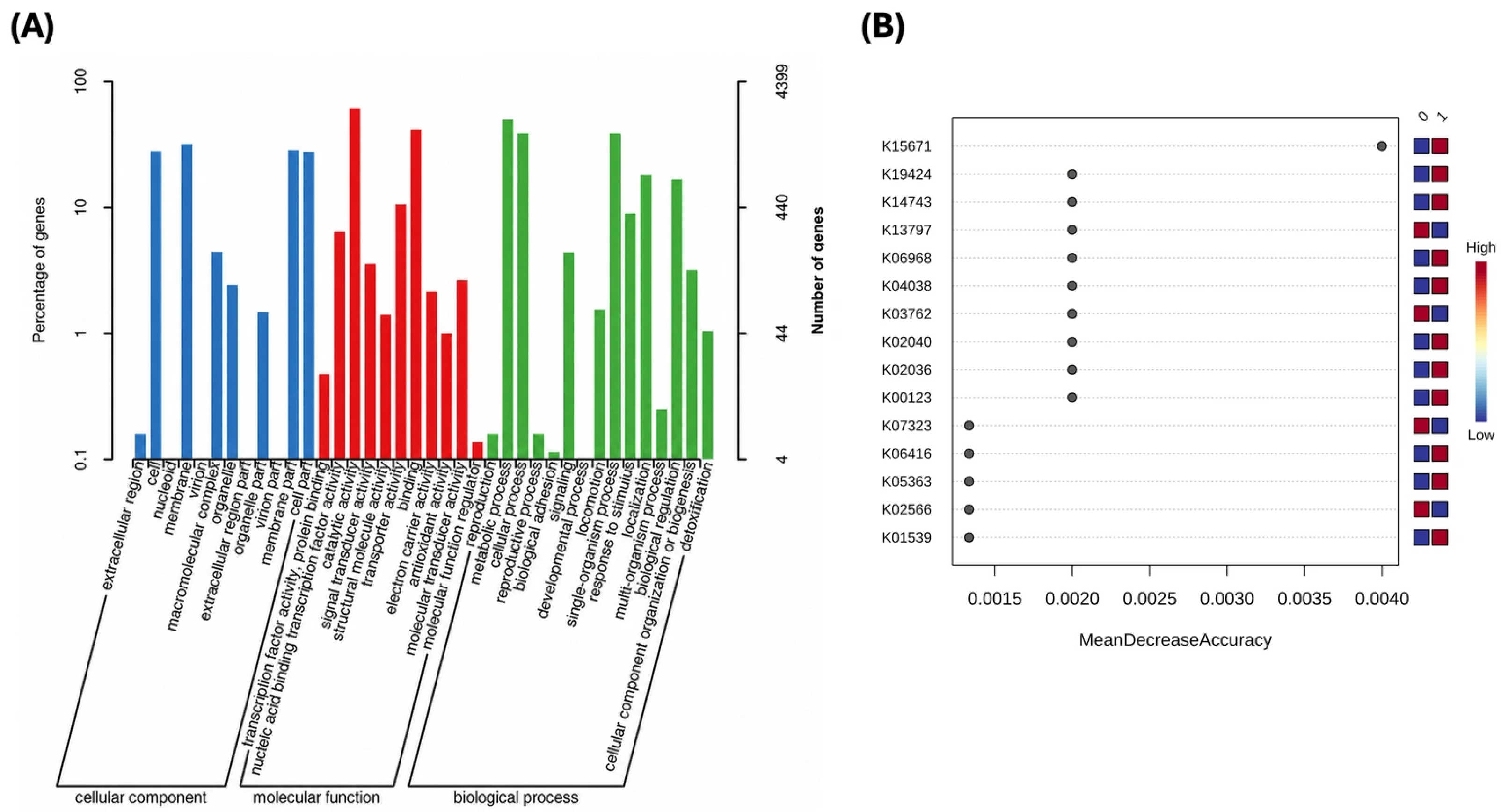
Figure 1. Functional annotation. (A) Gene Ontology (GO) classification of predicted genes showing the percentage of genes assigned to cellular components (blue), molecular functions (red), and biological processes (green). (B) KEGG orthologs with the highest discriminatory power between soils with and without C69 inoculation, identified using Random Forest classification (Mean Decrease Accuracy; out-of-bag error = 25.9%). Functional differences were explored after no significant pathways were detected following FDR correction in Kruskal–Wallis tests. Classes 0 and 1 represent inoculated and non-inoculated treatments, respectively. Model performance was assessed using out-of-bag (OOB) error estimation.
Agronomy 16 01688 g001
Figure 2. Principal Component Analysis (PCA) of nutritional traits in Lupinus albus plants. Left: grouping by treatment (without bacterial inoculation (C0) vs. Pseudomonas agronomica inoculation (C69)); right: grouping by mercury concentration (S1–S3) (S1: low Hg concentration, S2: intermediate Hg concentration, S3: high Hg concentration). Ellipses represent 1.5 standard deviations around group centroids. PC1 (62.7%) and PC2 (24.5%) jointly explained 87.2% of the variance. Group separation in PCA space was not subjected to inferential testing as PCA was used for exploratory visualization.
Agronomy 16 01688 g002
Figure 3. Total mercury content in plant (Lupinus albus), both in the non-inoculated treatment (C0) and the C69 Pseudomonas agronomica-inoculated treatment (C69), in soils with different concentrations of Hg (S1, S2, S3). "*" shows statistically significant differences (p-value < 0.05).
Agronomy 16 01688 g003
Figure 4. The treatments without bacterial inoculum (C0) and with the inoculum of C69 Pseudomonas agronomica (C69) are shown; in addition to the different concentrations of mercury in the crop soil (S1: low, S2: intermediate, S3: high). (a) Boxplot by functional families. Data are presented as distributional patterns to illustrate treatment-associated functional shifts. (b) Heatmap z-score of microbial activity by treatment, according to the 30 carbon and nitrogen sources analyzed in Biolog EcoPlate. Data were globally standardized (z-score) prior to visualization.
Agronomy 16 01688 g004
Figure 5. Principal Component Analysis (PCA) based on log2-transformed minimum inhibitory concentration (MIC) values of six antibiotics in rhizospheric soil communities. Samples are grouped by bacterial treatment (C0: non-inoculated control; C69: Pseudomonas agronomica C69 inoculation) and by mercury concentration (S1: low, S2: intermediate, S3: high). Ellipses represent 1.5 standard deviations around group centroids. PC1 and PC2 explained 72.7% and 20.3% of the total variance, respectively. Diamond symbols indicate group centroids.
Agronomy 16 01688 g005
Figure 6. PCoA of weighted UniFrac distances, used to evaluate differences in microbial community structure.
Agronomy 16 01688 g006
Table 1. Plant Growth-Promoting Bacteria (PGPB)-associated traits of the C69 Pseudomonas agronomica strain. Quantitative results are presented as means ± standard error (n = 3), whereas qualitative assays are reported as Positive/Negative according to the detection criteria of the corresponding methods.
PGPB TraitValue Obtained Without HgValue Obtained with 100 ppm Hg AddedProcedure
Auxin production (AIA)5.71 ± 0.26 μg mL−14.51 ± 0.26 μg mL−1Reagent Van Urk–Salkowski [20]
ACC-deaminase activity (growth-based assay)PositiveNegativeMinimum Medium with ACC [21]
Phosphate solubilizationPositiveNegativeTricalcium phosphate agar [22,23]
Siderophores productionHalo 0.70 ± 0.30 cmNegativeAgar CAS [24]
Disclaimer/Publisher’s Note: The statements, opinions and data contained in all publications are solely those of the individual author(s) and contributor(s) and not of MDPI and/or the editor(s). MDPI and/or the editor(s) disclaim responsibility for any injury to people or property resulting from any ideas, methods, instructions or products referred to in the content.