Article

Variation in Forage Yield-Related Traits in a Broad Range of Sainfoin Accessions

1
Bioengineering Department, Adana Alparslan Türkeş Science and Technology University, Adana 01250, Türkiye
2
The Land Institute, Salina, KS 67401, USA
3
Department of Field Crops, Tekirdağ Namık Kemal University, Tekirdağ 59030, Türkiye
*
Author to whom correspondence should be addressed.
Agronomy 2026, 16(15), 1459; https://doi.org/10.3390/agronomy16151459
Submission received: 4 June 2026 / Revised: 8 July 2026 / Accepted: 10 July 2026 / Published: 1 August 2026
(This article belongs to the Special Issue Domestication and Genetic Improvement of New Crops)

Abstract

Sainfoin (Onobrychis spp.) is a perennial legume forage crop valued for its adaptation to dry environments, nitrogen fixation capacity, and ecosystem service benefits. Despite its agronomic importance, broad comparative evaluations of cultivated sainfoin germplasm across environments remain limited. In this study, a diverse global panel of cultivated sainfoin germplasm representing O. arenaria, O. transcaucasica and O. viciifolia was evaluated in replicated field trials in Tekirdağ, Türkiye and Salina, Kansas, USA. Significant environmental, species, and accession effects were detected for numerous agronomic and forage-related traits, indicating substantial phenotypic diversity and strong environmental responsiveness across the evaluated germplasm. Several vegetative and forage-related traits, including stem length, forage dry matter, and canopy height, exhibited moderate to relatively high entry-mean repeatability across environments. Correlation analyses revealed strong positive associations between stem morphology traits and forage biomass production, suggesting that vegetative architecture traits may serve as useful indirect selection criteria for forage improvement. Principal Component Analysis revealed substantial phenotypic overlap among cultivated sainfoin taxa, indicating that the evaluated agronomic traits alone did not clearly separate species groups. Several plant introduction accessions performed comparably to or exceeded commercial cultivars for forage-related traits, highlighting the value of broad germplasm collections for sainfoin improvement. Collectively, these findings demonstrate that cultivated sainfoin germplasm contains substantial breeding-relevant diversity and support continued multi-environment evaluation and regionally adapted breeding strategies for perennial forage improvement.

1. Introduction

Sainfoin (Onobrychis spp.) is a perennial forage legume known for high spring dry matter production [1] and millennia of cultivation in its center of diversity across temperate regions of Europe, the Mediterranean, Asia, and North America [2,3,4]. Sainfoin is well adapted to arid and semi-arid environments, shallow and rocky soils, and other low-input production conditions [5]. In addition to its forage value, sainfoin contributes to agricultural sustainability through perennial ground cover, nitrogen fixation, and extensive root systems that help reduce soil erosion and improve soil function [2,6,7]. Sainfoin flowers also provide nectar for bees and other pollinating insects, contributing to broader ecosystem services and biodiversity support [8,9,10].
As a forage crop, sainfoin is valued for its high-quality roughage and its non-bloating properties in ruminant livestock systems [2,11]. Despite these advantages, sainfoin has received comparatively less research attention than major forage legumes such as alfalfa (Medicago sativa) and clovers (Trifolium spp.). However, interest in sainfoin has increased in recent decades for the development of improved cultivars for modern forage production systems [12] as sainfoin contains condensed tannins that reduce pasture bloat risk in ruminants [13,14,15,16,17], with its high forage quality potential [12,14,18,19] and potential environmental benefits such as decreasing methane emissions [12,18,20,21,22]. In addition to its forage and ecosystem service value, sainfoin is currently being domesticated as a dual-purpose forage and perennial pulse crop at the Land Institute in Salina, Kansas, USA [23,24,25,26].
Most modern cultivated sainfoin varieties belong to Onobrychis viciifolia Scop. (common sainfoin). However, several species within the genus Onobrychis such as Onobrychis arenaria (sand sainfoin), Onobrychis transcaucasica (Transcaucasian sainfoin), and Onobrychis altissima are also noted as agronomically important and have been cultivated [16,27,28,29,30]. The USDA GRIN system maintains a good representation of sainfoin germplasm across its natural distribution range, species, and improvement status. Despite the agronomic importance of sainfoin, broad comparative evaluations across cultivated taxa remain limited, where only local cultivars and land races were evaluated from O. viciifolia [12,31,32,33,34]. Comparative evaluations of cultivars, landraces, and accessions from the global gene pool maintained in seedbanks have not been conducted for integrated forage and reproductive traits relevant to breeding and future domestication efforts.
The large germplasm collection for sainfoin taxa preserved in public repositories provides opportunities to identify adaptive and agronomically valuable variation for both forage improvement and de novo domestication of sainfoin as a dual-purpose perennial forage and pulse crop. We hypothesized that broad sainfoin accessions exhibit substantial variation in forage-related traits and that all cultivated taxa carry agronomically important traits. The objective of this study was to conduct a broad phenotypic evaluation of cultivated sainfoin germplasm across two contrasting trials to (i) quantify variation in forage traits, (ii) compare agronomic performance among sainfoin species and accessions, and (iii) identify germplasm relevant to forage breeding and future dual-purpose domestication efforts.

2. Materials and Methods

2.1. Plant Materials

A comprehensive sainfoin germplasm panel was assembled to evaluate variation in agronomic and forage performance across two geographically and environmentally distinct locations in Tekirdağ, Türkiye, and Salina, Kansas, USA. The study locations also differed in establishment year, sowing time, transplanting time, plant spacing, and material composition. The Tekirdağ panel was established in 2022 and included 47 accessions representing three cultivated sainfoin species. The panel consisted of three O. arenaria accessions, 19 O. transcaucasica accessions, and 25 O. viciifolia accessions. In addition, two commercial O. viciifolia cultivars (Özerbey and Lütfübey) were included in the Tekirdağ panel. A second panel was established in Salina, KS, USA, in 2023 and consisted of 80 accessions and cultivars representing a broad range of cultivated sainfoin germplasm, including 21 O. arenaria accessions, 33 O. transcaucasica accessions, and 26 O. viciifolia accessions. In addition, six commercial O. viciifolia cultivars (Shoshone, Delaney, Renumex, Eski, Rocky Mountain Remont, and AAC Mountainview) were included in the Salina panel. Thirty accessions were common between both trials. The 30 accessions common to both trials comprised nine O. viciifolia accessions, 18 O. transcaucassica accessions, and three O. arenaria accessions. The germplasm represented a broad geographic distribution across Eurasia, spanning from Spain in the west to eastern Russia in the east, and from Iran in the south to northern Russia in the north. This collection provides a strong representation of both cultivated taxa and the natural distribution of Onobrychis species throughout their native range (Supplemental Table S1).

2.2. Experimental Design and Phenotypic Data Collection

The Tekirdağ, Türkiye field experiment was established at Namık Kemal University (40.990012, 27.581711). A total of 47 sainfoin accessions were sown into pots on 7 November 2021 and subsequently transplanted to the field on 5 April 2022, using a randomized complete block design with three replications. Each experimental plot consisted of a single row of 10 plants with 75 cm spacing between rows and 30 cm between plants within rows. To promote uniform regrowth and stand development, all plots were mechanically mowed on 25 August 2022. The experiment was managed under rainfed conditions without rhizobial inoculation.
A second field experiment was established at the Land Institute research farm in Salina, KS, USA (38.770421, −97.591532). A total of 2200 plants representing 80 sainfoin accessions and cultivars were sown into pots in August 2023 and transplanted to the field on 19 September 2023, using a randomized complete block design with three replications. Each plot consisted of a single row of 10 plants spaced 75 cm apart both within and between rows. Since sufficient plants could not be obtained from some accessions during the planting, about 20 accessions were included in the experiment as two replicates. The Salina experiment was managed under rainfed conditions, and seedlings were inoculated prior to transplanting using a commercially available rhizobia inoculant. It should be noted that the two trials differed not only in geography and climate but also in management practice, including inoculation.
Phenotypic measurements were collected throughout the growing seasons in both trials (i.e., Tekirdağ-23 and Salina-24) using standardized trait definitions and protocols based on the Sainfoin Crop Ontology framework [35]. Agronomic and forage-related traits were evaluated across the sainfoin accessions and cultivars. Trait descriptions, ontology identifiers, measurement protocols, units, and collection dates for each trial are provided in Supplemental Table S2. Briefly, Canopy height (CanHt), Stem thickness (StTh), Stem number (StN), Forage subsample dry mass (FoSDM), 5 May 2023 Tekirdağ Stem thickness (StTh), Forage subsample dry mass (FoSDM) were measured only once on 5 May 2023; Raceme number (RaN), Raceme length (RaL) and Inflorescence length (InfL) were measured on 10 July 2023; and Stem length (StL) was measured twice on 5 May & 10 July 2023 in Tekirdağ. Canopy height (CanHt) and Plant stem erectness (PlStEr) were measured on 14–15 May 2024; Stem thickness (StTh), Stem length (StL), Raceme number (RaN) were recorded on 28 May 2024 Stem number (StN), Forage dry mass (FoDM) were recorded on 20 June–8 July 2024; Plant regrowth rating (PlRGR) was taken on 11 July 2024 in Salina and all the measurements were taken only once. Traits common to both trials included canopy height, stem thickness, stem length, stem number, and raceme number, while additional forage, regrowth, and plant architecture traits were evaluated within individual trial.

2.3. Data Processing and Statistical Analyses

2.3.1. Assessment of Trait Distributions

Prior to downstream analyses, all measured traits were evaluated for distributional assumptions and potential transformation requirements. Normality of trait distributions was assessed using the Anderson–Darling and Shapiro–Wilk tests implemented in the nortest [36] package in R (4.5). Traits that deviated substantially from normality were transformed prior to analysis using normalization approaches implemented in the bestNormalize package [37]. Trait-specific transformations are described in the Section 3 where applicable. Because only 30 accessions were common between the Tekirdağ-23 and Salina-24 trials, and significant trial effects were detected for several shared traits, subsequent statistical analyses were conducted separately for each trial.

2.3.2. Environmental and Genetic Sources of Variation

To evaluate environmental effects on shared agronomic traits, analyses were initially conducted using the 30 accessions common to both the Tekirdağ-23 and Salina-24 trials. Traits evaluated across both trials included canopy height, stem thickness, stem length, stem number, and raceme number. Because the two field experiments differed in geographic location, establishment year, and plot spacing, each year–location combination was treated as a distinct trial. Variance analyses were conducted using linear mixed models implemented in the lmerTest package in R [38]. Trial effects, accession effects, species effects, and their interactions were evaluated for shared traits. Because significant environmental effects and environment × accession interactions were detected for several traits, all subsequent analyses were conducted separately within each environment.

2.3.3. Species- and Accession-Level Comparisons

Within each trial, mixed linear models were fitted to evaluate species- and accession-level variation for agronomic traits. Accessions (ACCs) were nested within species (SPE), while replication (REP) and block (BLK) effects were treated as random effects. Estimated marginal means (emmeans) were calculated from the fitted models, and pairwise comparisons among species and accessions were conducted using Tukey’s Honest Significant Difference (HSD) test implemented in the emmeans [39] and multcompView [40] packages in R. Group differences were visualized using compact letter display (CLD), where groups sharing the same letter were not considered significantly different at the 5% significance level.

2.3.4. Estimation of Entry-Mean Repeatability (H2)

Entry-mean repeatability (H2) was estimated separately for each trial using variance components derived from the fitted mixed linear models implemented in the lme4 [41] and lmerTest [38] packages in R. Repeatability estimates in the Tekirdağ-23 trial were calculated on a plot basis, whereas estimates in the Salina-24 trial were calculated on an individual plant basis because phenotypic measurements in Salina were collected at the plant level. Consequently, repeatability estimates between trials should not be interpreted as directly comparable. Because the evaluated germplasm included heterogeneous accessions and multiple sainfoin species, H2 estimates are interpreted here as entry-mean repeatability rather than strict broad-sense heritability estimates.

2.3.5. Trait Correlations and Multivariate Analyses

Pearson correlation analyses were conducted separately within each trial to evaluate relationships among agronomic and forage-related traits. Correlation matrices were generated and visualized in R using the GGally [42], ggplot2 [43] and ggpubr [44] packages. Principal Component Analysis (PCA) was subsequently performed using accession-level phenotypic means to examine multivariate patterns of variation and potential clustering among sainfoin species within each trial. PCA analyses were conducted using the prcomp function in R [45] with centered and scaled trait values, and the proportion of variance explained by principal components was calculated for each trial.

2.3.6. Multi-Criteria Accession Ranking

To identify high-performing germplasm across multiple agronomic traits, accessions within each trial were ranked using the Technique for Order Preference by Similarity to Ideal Solution (TOPSIS) method for multi-criteria decision analysis. Rankings were conducted separately for forage-related traits and combined trait datasets using accession mean values adjusted for replication and block effects. All traits were weighted equally following standard normalization procedures implemented in the topsis package in R [46]. Since sainfoin is considered to have dual-use potential for both grain and forage production, we did not place emphasis on any of the traits analyzed here, and an equal-weight model was adopted in which all traits were treated as benefit criteria.

3. Results

3.1. Trait Distributions and Summary Statistics

Normality tests indicated that most measured traits followed approximately normal distributions. However, canopy height (CanHt) in the Salina-24 trial and raceme number (RaN) in the Tekirdağ-23 trial deviated from normality and were transformed prior to downstream analyses. A log transformation was applied to CanHt, while a square root transformation [sqrt(x + 0.5)] was applied to RaN.
Mean values, standard deviations, and observed ranges for key agronomic traits of 30 common accessions were compared and showed substantial variation between the Tekirdağ-23 and Salina-24 trials (Table 1). In general, accessions evaluated in the Salina-24 trial exhibited higher mean values for several vegetative and reproductive traits compared with those evaluated in Tekirdağ-23. For example, the mean canopy height was 66.47 cm in Salina-24 compared with 50.53 cm in Tekirdağ-23. Similarly, stem thickness, stem length, and stem number per plant were generally greater in the Salina-24 trial (Table 1). Considerable phenotypic variation was observed within both trials across forage-related morphology traits, indicating substantial diversity within the evaluated sainfoin germplasm panel.

3.2. Environmental and Genetic Sources of Variation

Analyses of the 30 accessions common to both trials revealed significant environmental effects for most shared vegetative traits (Table 2).
Environmental effects were highly significant (p < 0.001) for canopy height, stem thickness, stem length, and stem number, whereas raceme number did not show a significant environmental effect. Significant environment × accession interactions were detected for stem number, stem length, and raceme number, indicating that accession performance varied across environments. Because significant environmental effects and environment × accession interactions were observed for several shared traits, all subsequent analyses were conducted separately within the Tekirdağ-23 and Salina-24 trials (Table 2).

3.3. Species- and Accession-Level Variation

Within-trial analyses further revealed significant species- and accession-level variation for many agronomic traits. In the Tekirdağ-23 trial, significant species effects were observed for raceme length and inflorescence length, while accession effects were significant for stem length, forage subsample dry matter, stem number, raceme number, raceme length, and inflorescence length (Table 3).
In the Salina-24 trial, significant species and accession effects were detected for numerous vegetative and forage-related traits, including canopy height, stem length, stem number, plant erectness, and regrowth (Table 4).
Species- and accession-level variation for agronomic traits differed between the two trials. In the Tekirdağ-23 trial, breeding populations and cultivars generally exhibited greater stem length and forage subsample dry matter compared with the evaluated sainfoin species (Table 5).
In contrast, several reproductive traits, including stem number, raceme number, raceme length, and inflorescence length showed comparatively limited differentiation among species groups. Canopy height did not differ significantly among species or accessions within the Tekirdağ-23 trial despite substantial variation among trials overall.
In the Salina-24 trial, substantial variation among species groups was observed for forage-related traits (Table 6).
O. arenaria and O. transcaucasica generally exhibited greater stem length, stem thickness, and forage dry matter relative to O. viciifolia and the evaluated cultivars. Stem number was generally greater in O. transcaucasica, O. viciifolia, and O. arenaria than in cultivars. Plant erectness also differed among species groups, with O. viciifolia exhibiting lower average erectness scores than the other evaluated groups.

3.4. Entry-Mean Repeatability of Sainfoin Traits

Entry-mean repeatability (H2) estimates varied among traits and between trials (Table 3 and Table 4). In the Tekirdağ-23 trial, stem length and inflorescence length exhibited relatively high repeatability estimates, while forage subsample dry matter, stem number, and raceme length showed moderate repeatability. In contrast, raceme number, canopy height, and stem thickness exhibited comparatively lower repeatability estimates, indicating greater environmental influence on trait expression within this trial.
In the Salina-24 trial, canopy height exhibited relatively high repeatability, while stem length, forage dry matter, stem number, plant erectness, and regrowth exhibited moderate repeatability estimates. Overall, repeatability estimates differed substantially among traits and between trials, reflecting differences in trait stability and environmental responsiveness across the evaluated sainfoin germplasm. As explained above, the evaluated germplasm comprises a broad, heterogeneous set of accessions and multiple species; H2 estimates should be regarded as the entry-mean repeatability values rather than strict broad-sense heritability estimates.

3.5. Trait Correlations and Multivariate Analyses

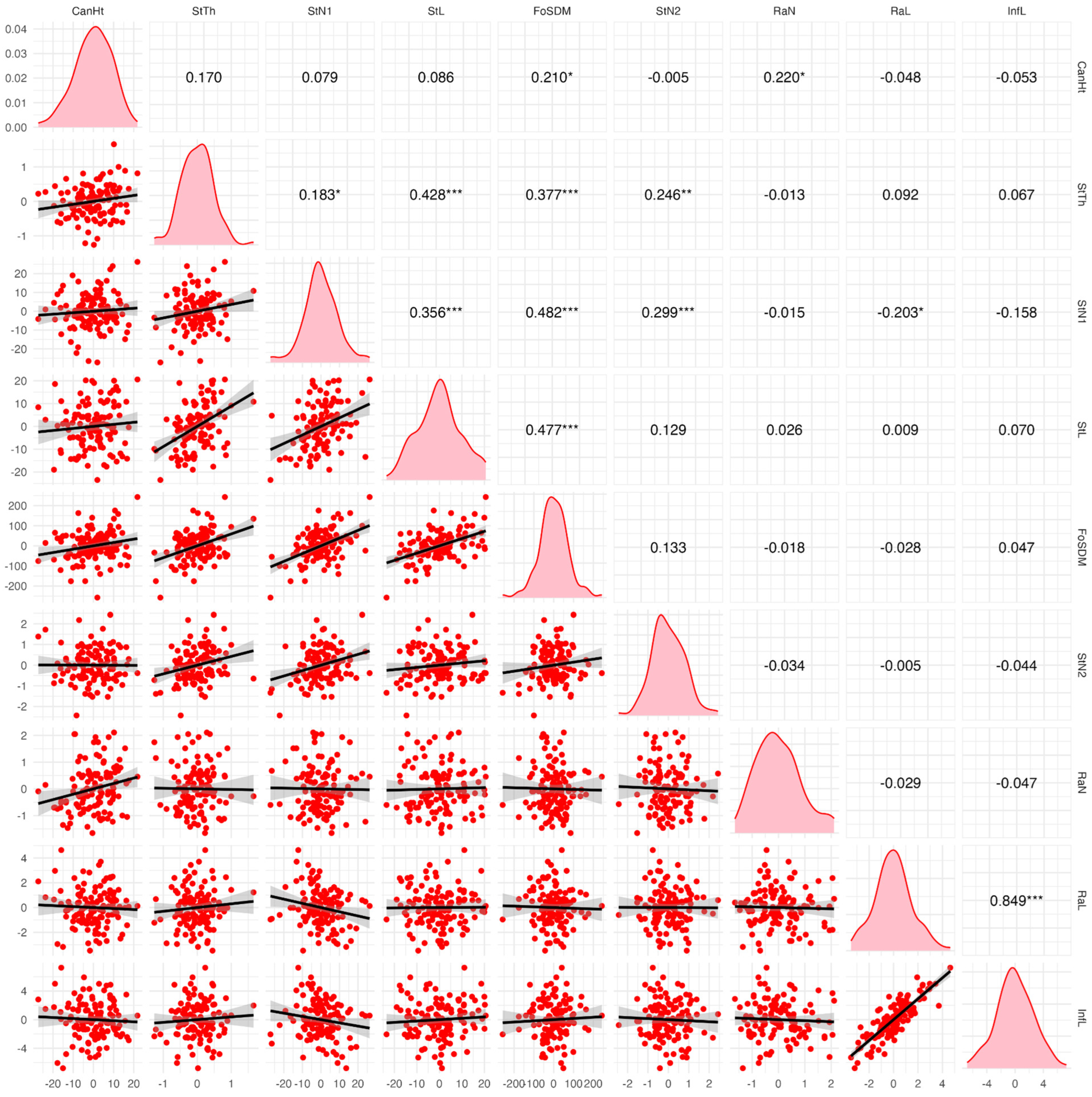
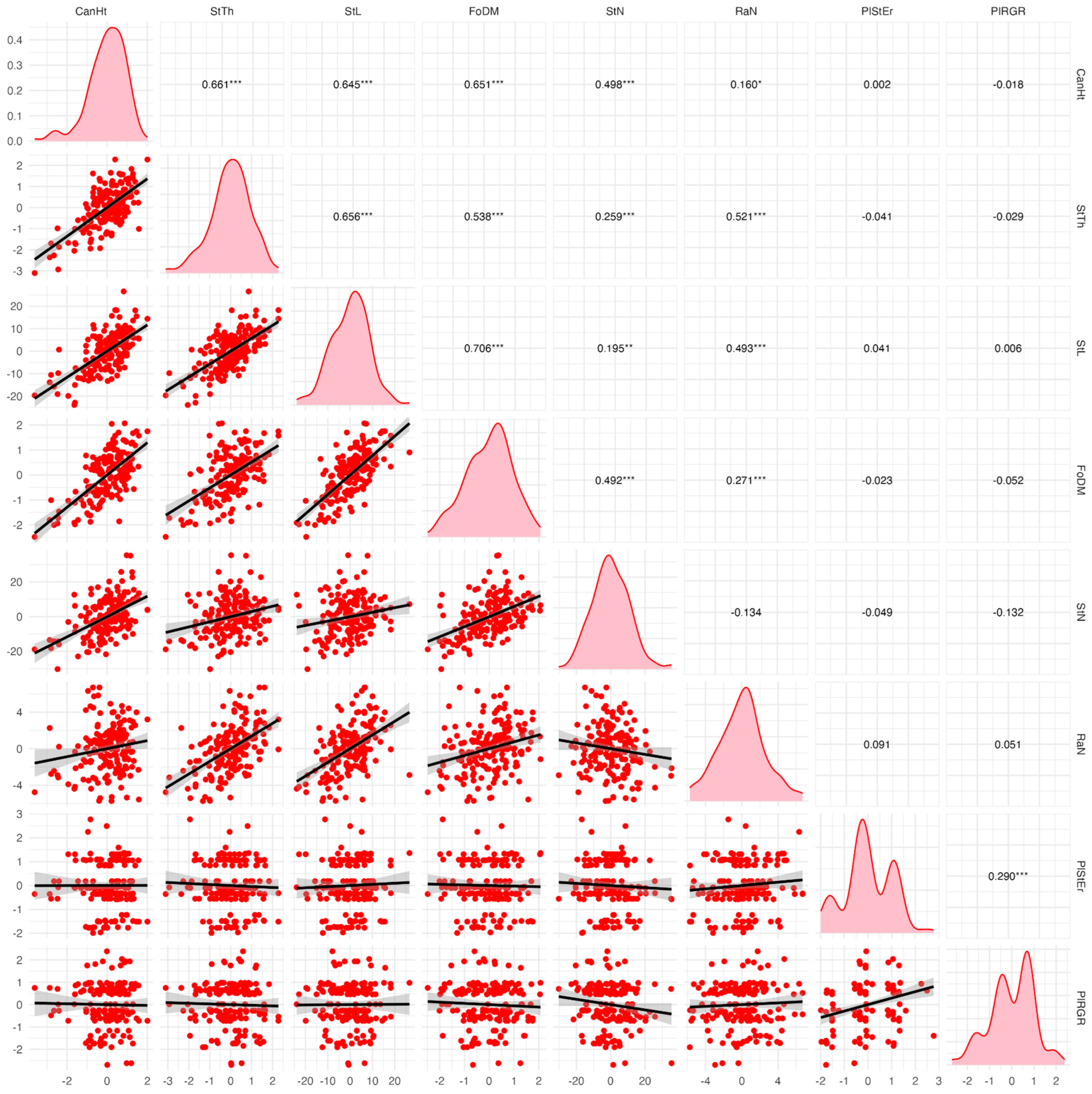
Pearson correlation analyses revealed significant positive associations among several agronomic traits in both trials (Figure 1 and Figure 2).
In the Tekirdağ-23 trial, stem thickness was positively correlated with stem length and forage subsample dry matter, while stem length also showed a positive association with forage subsample dry matter (Figure 1). Inflorescence length and raceme length were positively correlated with one another, indicating coordinated relationships among reproductive architecture traits. In contrast, raceme number exhibited comparatively weak associations with most other measured traits.
Similar patterns were observed in the Salina-24 trial, where canopy height, stem thickness, stem length, stem number, and forage dry matter exhibited generally positive associations (Figure 2). Forage dry matter was positively associated with stem number and reproductive traits, while raceme number exhibited comparatively weaker correlations with forage-related traits. Overall, correlation analyses indicated strong relationships among vegetative growth and forage production traits across the evaluated sainfoin germplasm.
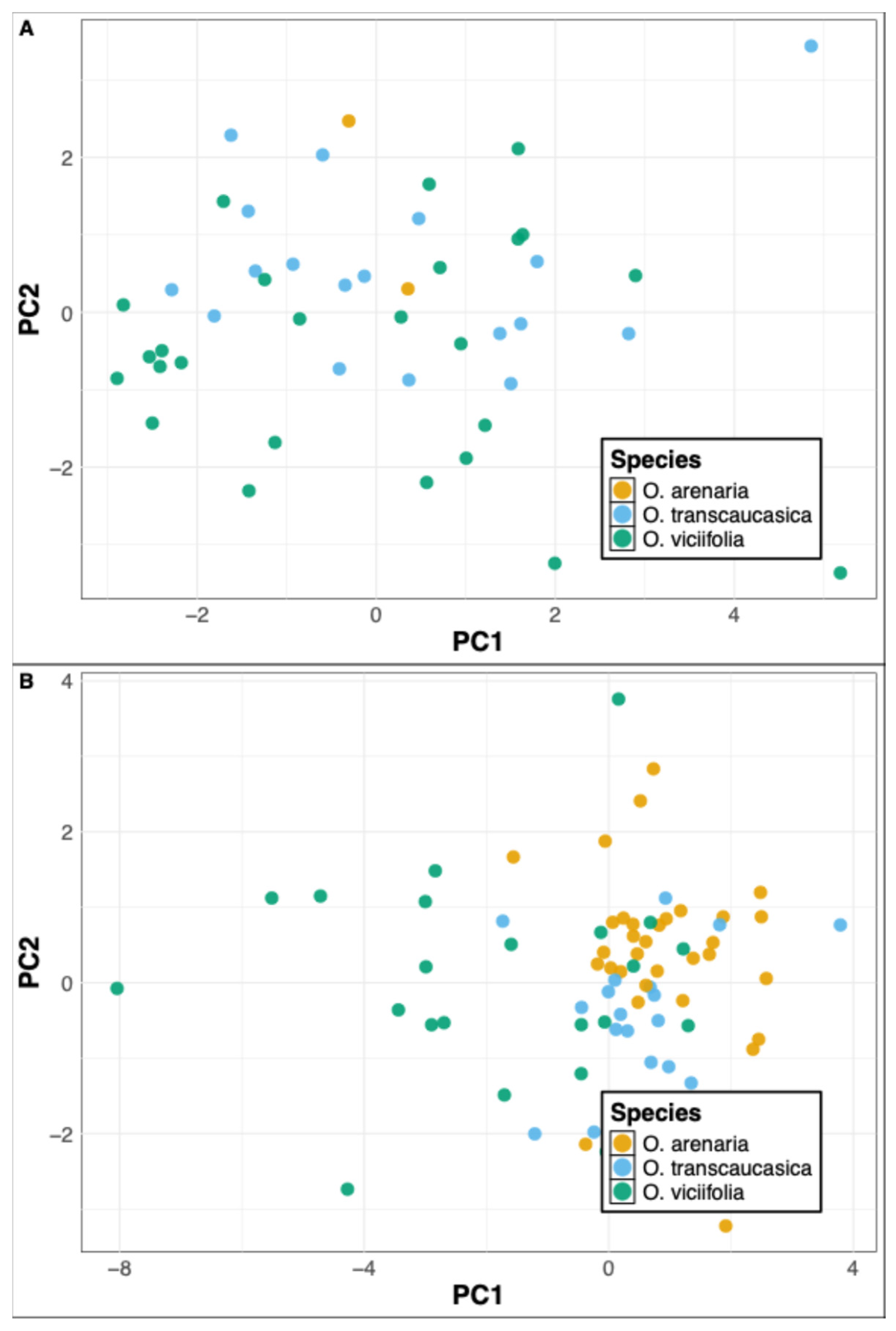
Principal Component Analysis (PCA) was performed using all measured traits to examine multivariate patterns of phenotypic variation among sainfoin species. In the Tekirdağ-23 trial, the first two principal components explained 58.0% of the total phenotypic variance, with PC1 and PC2 accounting for 36.4% and 21.6% of the variance, respectively (Figure 3A).
Accessions belonging to O. arenaria, O. transcaucasica, and O. viciifolia showed substantial overlap in multivariate trait space.
Similar patterns were observed in the Salina-24 trial, where the first two principal components explained approximately 70% of the total phenotypic variance (PC1 = 56.5% and PC2 = 14.1%) (Figure 3B). Accessions representing O. arenaria, O. transcaucasica, O. viciifolia, and commercial cultivars exhibited broad phenotypic overlap, with no clear separation among groups.

3.6. Accession Ranking and TOPSIS Analysis

Considerable variation among accessions was observed for forage-related traits in both trials, and several accessions outperformed commercial cultivars for individual agronomic measurements (Table 7 and Table 8).
In the Salina-24 trial, accessions PI 312924, PI 372798, and PI 273786 exhibited among the highest forage dry matter values, while commercial cultivars generally exhibited intermediate or lower rankings for forage-related traits. Similarly, several accessions exhibited superior canopy height and stem-related trait performance relative to the evaluated cultivars.
Multi-criteria TOPSIS analyses further identified accessions with consistently strong overall agronomic performance across combined trait datasets. In the Tekirdağ-23 trial, accessions PI 313047 and PI 273758 ranked highest overall, while the Turkish cultivars Lütfübey and Özerbey also ranked among the top-performing entries (Table 8). In the Salina-24 trial, accessions PI 273749 and PI 273748 exhibited strong overall forage-related performance, while AAC Mountainview was the highest-ranking commercial cultivar. Overall, TOPSIS analyses identified substantial breeding-relevant variation within the evaluated sainfoin germplasm and demonstrated that several plant introduction accessions performed comparably to or exceeded commercial cultivar performance for key agronomic traits.

4. Discussion

4.1. Environment Strongly Influences Sainfoin Forage Trait Expression

The broad germplasm panel evaluated in this study enabled assessment of environmental, species, and accession effects across a wide range of agronomic traits in sainfoin. Significant environmental effects on canopy height, stem thickness, stem length, and stem number indicate that vegetative growth and forage-related traits in sainfoin are strongly influenced by environmental conditions, as well as by differences in management and experimental structure. Previous studies similarly reported significant effects of environment and genotype × environment interactions on forage yield and agronomic traits in sainfoin [47,48]. Together, these findings highlight the importance of multi-environment evaluation for identifying stable and regionally adapted sainfoin germplasm. Interpretation of environmental effects in the present study should also consider that the two field environments differed not only in geography and climate, but also in management practice (i.e., establishment timing, within-row spacing, and rhizobia treatments) which may have contributed to additional differences in trait expression.

4.2. Significant Within-Species Variation Exists Across Sainfoin Germplasm

Significant accession-level variation was observed for many agronomic traits in both trials, indicating substantial phenotypic diversity within cultivated sainfoin germplasm. In the Tekirdağ-23 trial, accession effects were significant for stem length, first-cut stem number and inflorescence length (Table 3). Although species-level differences in this trial were comparatively limited, substantial variation was observed among accessions within species groups. In particular, several accessions belonging to O. viciifolia exhibited greater stem length and forage subsample dry matter relative to much of the broader germplasm panel (Table 5), suggesting that previous selection efforts have improved forage-related performance in some breeding materials.
Similar patterns were observed in the Salina-24 trial, where significant accession effects were detected for numerous vegetative and forage-related traits, including canopy height, stem length, stem number, forage dry matter, plant erectness, and regrowth (Table 4). Considerable variation was observed among accessions within each cultivated species, and several plant introduction accessions performed comparably to or exceeded commercial cultivars for forage-related traits. Similar studies have also reported substantial agronomic variation among sainfoin populations and cultivars for dry matter yield, plant height, and reproductive architecture traits [47,49]. Collectively, these findings demonstrate the value of broad germplasm collections for identifying agronomically useful variation for use in sainfoin breeding programs.

4.3. Species Differ, but Substantial Phenotypic Overlap Remains

Much of the observed phenotypic variation occurred within species groups rather than strictly between species. Although several agronomic traits differed among sainfoin species groups, Principal Component Analysis (PCA) revealed substantial overlap among O. arenaria, O. transcaucasica, O. viciifolia accessions in both trials (Figure 3). In the Tekirdağ-23 trial, the first two principal components explained 58.0% of the total phenotypic variance yet accessions from the three cultivated species did not form clearly distinct clusters in multivariate trait space. Some accessions belong to O. viciifolia also overlapped broadly with the broader germplasm panel despite exhibiting comparatively greater forage-related performance for some traits, including stem length and forage subsample dry matter (Table 5).
Similar patterns were observed in the Salina-24 trial, where the first two principal components explained approximately 70% of the total phenotypic variance (Figure 3B). Although species-level differences were observed for several vegetative and forage-related traits, including stem length, stem thickness, forage dry matter, and plant erectness (Table 6), the multivariate distributions of O. arenaria, O. transcaucasica, O. viciifolia, and commercial cultivars still overlapped extensively. Considerable phenotypic variation was also observed within species groups, further supporting the importance of accession-level diversity across cultivated sainfoin germplasm.
Previous studies evaluating sainfoin germplasm have similarly reported substantial phenotypic diversity and incomplete separation among populations and cultivated taxa [50]. The broad overlap in agronomic trait distributions observed in this study suggests that the cultivated sainfoin taxa evaluated here cannot be readily separated into clearly distinct phenotypic groups based solely on the agronomic and forage traits measured. In other words, the evaluated phenotypes alone would likely provide limited resolution for distinguishing these taxa in a strictly phenotype-based taxonomic or classification framework. Collectively, these findings highlight the substantial overlap among cultivated sainfoin taxa and support the continued evaluation of diverse germplasm resources across species boundaries in sainfoin for forage improvement and adaptation studies.

4.4. Several Agronomic Traits Exhibited Moderate to High Repeatability

Entry-mean repeatability estimates differed among traits and between trials, indicating variable stability of agronomic trait expression across the evaluated sainfoin germplasm. In the Tekirdağ-23 trial, stem length and inflorescence length exhibited relatively high repeatability estimates, while forage subsample dry matter, stem number, and raceme length exhibited moderate repeatability (Table 3). In contrast, canopy height, stem thickness, and raceme number exhibited comparatively lower repeatability estimates, suggesting greater environmental influence on trait expression for these traits within the Tekirdağ-23 trial.
In the Salina-24 trial, canopy height exhibited relatively high repeatability, while stem length, forage dry matter, plant erectness, stem number, and regrowth exhibited moderate repeatability estimates (Table 4). The generally moderate repeatability values observed for several forage-related traits suggest that these traits may represent useful targets for recurrent phenotypic selection within sainfoin breeding programs, even under environmentally responsive field conditions.
Differences in repeatability estimates between trials likely reflect both environmental influences and differences in experimental structure between the two field trials, including establishment timing, plant spacing, and the plot- versus plant-level basis of some measurements. Nonetheless, the identification of multiple forage-related traits with moderate to relatively high repeatability across trials suggests that substantial and repeatable phenotypic variation exists within cultivated sainfoin germplasm for future forage improvement efforts.

4.5. Relationships Among Forage-Related Agronomic Traits

Correlation analyses conducted across both trials indicated that forage biomass production in sainfoin is strongly associated with vegetative growth and plant architecture traits. In the Tekirdağ-23 trial, positive associations among stem thickness, stem length, and forage subsample dry matter suggest that taller plants with thicker stems generally produced greater forage biomass (Figure 1). Positive correlations among raceme length and inflorescence length further indicate coordinated development among reproductive architecture traits.
Similar relationships were observed in the Salina-24 trial, where canopy height, stem thickness, stem length, stem number, and forage dry matter all exhibited generally positive associations (Figure 2). In particular, forage dry matter was positively associated with stem number and overall vegetative vigor, suggesting that biomass accumulation in sainfoin is strongly linked to stem development and plant architecture traits. In contrast, raceme number generally exhibited weaker correlations with forage-related traits, indicating that reproductive allocation may vary somewhat independently from vegetative biomass production.
Previous studies evaluating sainfoin populations have similarly reported positive relationships among dry matter yield, plant height, stem number, and inflorescence architecture traits [49]. Collectively, the correlation patterns observed in this study suggest that vegetative morphology traits such as stem length, stem thickness, and stem number may provide useful indirect selection criteria for improving forage biomass production within sainfoin breeding programs.

4.6. Several Accessions Outperformed Commercial Cultivars

Multi-criteria accession ranking and TOPSIS analyses identified several plant introduction accessions that performed comparably to or exceeded commercial cultivar performance for forage-related traits across both trials. In the Tekirdağ-23 trial, accessions PI 313047 and PI 273758 ranked among the highest-performing entries when multiple agronomic traits were considered simultaneously, while the Turkish cultivars Lütfübey and Özerbey also ranked highly overall (Table 8). The strong performance of these cultivars is consistent with previous studies conducted under southeastern Anatolian environmental conditions that reported high forage productivity and agronomic performance for these materials [48].
In the Salina-24 trial, several plant introduction accessions exhibited superior forage-related performance relative to the evaluated commercial cultivars. Accessions such as PI 312924, PI 372798, PI 273749, and PI 273748 consistently ranked highly for forage biomass and vegetative growth traits (Table 7 and Table 8). In contrast, commercial cultivars generally exhibited intermediate rankings for several forage-related measurements, although AAC Mountainview ranked among the stronger-performing cultivars in the Salina-24 trial.
The differing accession rankings observed between the Tekirdağ-23 and Salina-24 trials further emphasize the importance of genotype × environment interactions in sainfoin improvement programs. Several accessions that performed strongly in one trial did not necessarily maintain equivalent rankings in the other trial, suggesting that forage-related trait expression and adaptation are strongly influenced by environmental context. Because the Tekirdağ and Salina trials likely represent distinct target population environments for sainfoin production, these findings indicate that regionally adapted breeding strategies may be more effective than reliance on a single broadly adapted germplasm pool or breeding program. It should be noted that an equal-weight model was adopted in TOPSIS analyses here because sainfoin is considered to have dual-use potential for both grain and forage production. Under this breeding objective, all evaluated traits are considered relevant and contribute to overall selection decisions. As an alternative to the equal-weight approach, weighted approaches are likely to change the ranking, and testing different rankings under various weighting schemes would be an interesting avenue for future research.
Collectively, these results suggest that broad germplasm collections contain substantial untapped variation for forage-related agronomic performance and highlight the importance of evaluating diverse accessions across multiple environments when identifying breeding materials for sainfoin improvement.

4.7. Broad Germplasm Collections Remain Valuable for Sainfoin Improvement

Overall, the results of this study demonstrate that cultivated sainfoin germplasm contains substantial phenotypic diversity for forage-related agronomic traits across contrasting trials. Significant environmental responsiveness, broad accession-level variation, and substantial phenotypic overlap among cultivated taxa collectively highlight the importance of evaluating large and diverse germplasm collections in sainfoin improvement programs. Although several species-level differences were observed for forage-related traits, much of the agronomic variation identified in this study occurred within species groups, emphasizing the importance of maintaining and evaluating broad accession diversity in breeding efforts.
The moderate to relatively high repeatability observed for several vegetative and forage-related traits, combined with strong positive relationships among stem morphology and forage biomass traits, suggests that recurrent phenotypic selection for forage productivity in sainfoin is feasible under field conditions. In addition, the identification of multiple accessions that performed comparably to or exceeded commercial cultivars for forage-related traits indicates that substantial untapped breeding potential remains within publicly available sainfoin germplasm collections.
Collectively, these findings demonstrate that cultivated sainfoin germplasm contains extensive and agronomically relevant phenotypic diversity for forage improvement across contrasting environments. The strong environmental responsiveness and shifting accession performance observed between Türkiye and Kansas further suggest that future sainfoin improvement efforts will likely benefit from regionally adapted breeding strategies rather than reliance on a single broadly adapted germplasm pool. Continued evaluation and utilization of diverse sainfoin germplasm resources will therefore remain essential for developing resilient, high-performing perennial forage systems.

Supplementary Materials

The following supporting information can be downloaded at https://www.mdpi.com/article/10.3390/agronomy16151459/s1, Table S1: List of Sainfoin Accessions/Cultivars/Breeding Populations in the Tekirdağ, Türkiye and Salina, Kansas, USA locations. USDA Plant Introduction (PI) accessions were obtained from the USDA National Plant Germplasm System (NPGS), Table S2: List of ID numbers, descriptions, and measurement dates of forage-related traits in the Tekirdağ, Türkiye and Salina, Kansas, USA locations according to the Crop Ontology list.

Author Contributions

Conceptualization, M.Ş. and B.S.; methodology, E.K.-U., K.E., S.B., B.M., B.S. and M.Ş.; software, E.K.-U. and K.E.; validation, M.T., B.S. and M.Ş.; formal analysis, E.K.-U.; investigation, S.B., M.T., B.S. and M.Ş.; resources, M.T., B.S. and M.Ş.; data curation, E.K.-U., K.E. and S.B.; writing—original draft preparation, E.K.-U. and M.Ş.; writing—review and editing, E.K.-U., K.E., S.B., B.M., M.T., B.S. and M.Ş.; visualization, E.K.-U.; supervision, B.S. and M.Ş.; project administration, B.S. and M.Ş.; funding acquisition, M.Ş. All authors have read and agreed to the published version of the manuscript.

Funding

This research was funded by TÜBITAK, grant number 120C136.

Data Availability Statement

Data is unavailable due to privacy or ethical restrictions.

Acknowledgments

During the preparation of this manuscript/study, the author(s) used ChatGPT (5.5) for the purposes of generating analysis codes. The authors have reviewed and edited the output and take full responsibility for the content of this publication.

Conflicts of Interest

The authors declare no conflicts of interest.

Abbreviations

The following abbreviations are used in this manuscript:
HSDTukey’s Honest Significant Difference
CLDCompact Letter Display
H2Entry-mean repeatability
PCAPrincipal Component Analysis
TOPSISTechnique for Order Preference by Similarity to Ideal Solution

References

  1. Borreani, G.; Peiretti, P.G.; Tabacco, E. Evolution of yield and quality of sainfoin (Onobrychis viciifolia Scop.) in the spring growth cycle. Agronomie 2003, 23, 193–201. [Google Scholar] [CrossRef]
  2. Bekovic, D.; Kne, J. The Influence of Row Spacing on Yield and Quality Levels of Sainfoin (Onobrychis viciifolia Scop.) Seed in Agroecological Conditions of South Serbia. Int. J. Biosci. 2016, 8, 242–248. [Google Scholar]
  3. Delgado, I.; Rego, J.; Andres, C.; Sin, E. La esparceta o pipirigallo, un cultivo a potenciar. In Surcos de Aragón; Department of Agriculture, Livestock and Environment of the Government of Aragón: Zaragoza, Spain, 2004. [Google Scholar]
  4. Smoliak, S.; Johnston, A.; Hanna, M.R. Germination and seedling growth of alfalfa, sainfoin, and cicer milkvetch. Can. J. Plant Sci. 1972, 52, 757–762. [Google Scholar] [CrossRef]
  5. Sakhraoui, A.; Ltaeif, H.B.; Sakhraoui, A.; Villalba, J.J.; Castillo, J.M.; Rouz, S. Sainfoin (Onobrychis viciifolia) a legume with great ecological and agronomical potential under climate change. J. Agric. Sci. 2024, 162, 307–331. [Google Scholar] [CrossRef]
  6. Gul, Z.; Tan, M. Determination of dry matter yield, some morphological characteristics and rootworm infestation in local sainfoin populations. Turk. J. Agric. For. 2024, 48, 531–538. [Google Scholar] [CrossRef]
  7. Krall, J.M.; Delaney, R.H. Assessment of Acetylene Reduction by Sainfoin and Alfalfa over Three Growing Seasons1. Crop Sci. 1982, 22, 762–766. [Google Scholar] [CrossRef]
  8. Kells, A. Sainfoin: An alternative forage crop for bees. Bee World 2015, 82, 192–194. [Google Scholar]
  9. Poudel, H.P.; Bhattarai, S.; Singer, S.D.; Biligetu, B.; Acharya, S. An insight into sainfoin (Onobrychis viciifolia Scop.) breeding: Challenges and achievements. Agron. J. 2023, 115, 2843–2858. [Google Scholar] [CrossRef]
  10. Qiao, Y.; Cheng, Q.; Zhang, Y.; Yan, W.; Yi, F.; Shi, F. Transcriptomic and chemical analyses to identify candidate genes involved in color variation of sainfoin flowers. BMC Plant Biol. 2021, 21, 61. [Google Scholar] [CrossRef] [PubMed]
  11. Howarth, R.E.; Goplen, B.P.; Fesser, A.C.; Brandt, S.A. A possible role for leaf cell rupture in legume pasture bloat. Crop Sci. 1978, 18, 129–133. [Google Scholar] [CrossRef]
  12. Bhattarai, S.; Coulman, B.; Biligetu, B. Sainfoin (Onobrychis viciifolia Scop.): Renewed interest as a forage legume for western Canada. Can. J. Plant Sci. 2016, 96, 748–756. [Google Scholar] [CrossRef]
  13. Wang, Y.; McAllister, T.A.; Acharya, S. Condensed Tannins in Sainfoin: Composition, Concentration, and Effects on Nutritive and Feeding Value of Sainfoin Forage. Crop Sci. 2015, 55, 13–22. [Google Scholar] [CrossRef]
  14. Wang, Y.; Berg, B.P.; Barbieri, L.R.; Veira, D.M.; McAllister, T.A. Comparison of alfalfa and mixed alfalfa-sainfoin pastures for grazing cattle: Effects on incidence of bloat, ruminal fermentation, and feed intake. Can. J. Anim. Sci. 2006, 86, 383–392. [Google Scholar] [CrossRef]
  15. McMahon, L.R.; Majak, W.; McAllister, T.A.; Hall, J.W.; Jones, G.A.; Popp, J.D.; Cheng, K.-J. Effect of sainfoin on in vitro digestion of fresh alfalfa and bloat in steers. Can. J. Anim. Sci. 1999, 79, 203–212. [Google Scholar] [CrossRef]
  16. Shain, S.C. Description of Sainfoin in Agrotechniques of Perennial Forages. In A Compilation of Abstracts of Sainfoin Literature; Carleton, A.E., Cooper, C.S., Eds.; Knowles, R.P., Trans.; Selkhozgiz: Moscow, Russia, 1959. [Google Scholar]
  17. Al Rharad, A.; El Aayadi, S.; Avril, C.; Souradjou, A.; Sow, F.; Camara, Y.; Hornick, J.-L.; Boukrouh, S. Meta-Analysis of Dietary Tannins in Small Ruminant Diets: Effects on Growth Performance, Serum Metabolites, Antioxidant Status, Ruminal Fermentation, Meat Quality, and Fatty Acid Profile. Animals 2025, 15, 596. [Google Scholar] [CrossRef] [PubMed]
  18. Mueller-Harvey, I.; Bee, G.; Dohme-Meier, F.; Hoste, H.; Karonen, M.; Kölliker, R.; Lüscher, A.; Niderkorn, V.; Pellikaan, W.F.; Salminen, J.-P.; et al. Benefits of Condensed Tannins in Forage Legumes Fed to Ruminants: Importance of Structure, Concentration, and Diet Composition. Crop Sci. 2019, 59, 861–885. [Google Scholar] [CrossRef]
  19. Boukrouh, S.; Noutfia, A.; Moula, N.; Avril, C.; Hornick, J.-L.; Chentouf, M.; Cabaraux, J.-F. Effects of Sulla Flexuosa Hay as Alternative Feed Resource on Goat’s Milk Production and Quality. Animals 2023, 13, 709. [Google Scholar] [CrossRef] [PubMed]
  20. McMahon, L.R.; McAllister, T.A.; Berg, B.P.; Majak, W.; Acharya, S.N.; Popp, J.D.; Coulman, B.E.; Wang, Y.; Cheng, K.-J. A review of the effects of forage condensed tannins on ruminal fermentation and bloat in grazing cattle. Can. J. Plant Sci. 2000, 80, 469–485. [Google Scholar] [CrossRef]
  21. Boukrouh, S.; Noutfia, A.; Moula, N.; Avril, C.; Louvieaux, J.; Hornick, J.-L.; Chentouf, M.; Cabaraux, J.-F. Characterisation of bitter vetch (Vicia ervilia (L.) Willd) ecotypes: An ancient and promising legume. Exp. Agric. 2024, 60, e19. [Google Scholar] [CrossRef]
  22. Boukrouh, S.; Noutfia, A.; Moula, N.; Avril, C.; Louvieaux, J.; Hornick, J.L.; Chentouf, M.; Cabaraux, J.F. Ecological, morpho-agronomical, and nutritional characteristics of Sulla flexuosa (L.) Medik. ecotypes. Sci. Rep. 2023, 13, 13300. [Google Scholar] [CrossRef] [PubMed]
  23. Craine, E.; Şakiroğlu, M.; Peters, T.; Barriball, S.; Schlautman, B. Perennial BakiTM Bean: Nutritional Quality of a Novel Perennial Pulse Crop. In ASA, CSSA, SSSA International Annual Meeting; ASA-CSSA-SSSA: Madison, WI, USA, 2023; Available online: https://scisoc.confex.com/scisoc/2023am/meetingapp.cgi/Paper/148416 (accessed on 26 April 2025).
  24. Craine, E.B.; Şakiroğlu, M.; Barriball, S.; Peters, T.E.; Schlautman, B. Perennial BakiTM Bean Safety for Human Consumption: Evidence from an Analysis of Heavy Metals, Folate, Canavanine, Mycotoxins, Microorganisms and Pesticides. Molecules 2024, 29, 1777. [Google Scholar] [CrossRef] [PubMed]
  25. Craine, E.B.; Makav, M.; Dağ, S.; Yıldız, A.; Eroğlu, H.A.; Kuru, B.B.; Bektaşoğlu, F.; Barriball, S.; Schlautman, B.; Şakiroğlu, M. Effect of sainfoin (Onobrychis viciifolia Scop.) seed-based diet on rats: A comprehensive evaluation of hemogram, biochemistry, and histopathology. Food Sci. Nutr. 2024, 12, 4692–4701. [Google Scholar] [CrossRef] [PubMed]
  26. Craine, E.B.; Barriball, S.; Şakiroğlu, M.; Peters, T.; Schlautman, B. Amino acid and fatty acid profiles of perennial BakiTM bean. Front. Nutr. 2024, 10, 1292628. [Google Scholar] [CrossRef] [PubMed]
  27. Yildiz, B.; Çiplak, B.; Aktoklu, E. Fruit Morphology of Sections of the Genus Onobrychis Miller (Fabaceae) and Its Phylogenetic Implications. Isr. J. Plant Sci. 1999, 47, 269–282. [Google Scholar] [CrossRef]
  28. Fortune, J.A.; Withers, N.J. Sainfoin—Curiosity or Crop? Proc. Agron. Soc. N. Z. 1980, 10, 67–70. [Google Scholar]
  29. Sakhraoui, A.; Ltaeif, H.B.; Sakhraoui, A.; Rouz, S.; Castillo, J.M. Potential use of wild Onobrychis species for climate change mitigation and adaptation. Crop Sci. 2023, 63, 3153–3174. [Google Scholar] [CrossRef]
  30. Zarrabian, M.; Majidi, M.M. Genetic diversity and relationships within and among Onobrychisspecies using molecular markers. Turk. J. Bot. 2015, 39, 681–692. [Google Scholar] [CrossRef]
  31. Mora-Ortiz, M.; Smith, L.M.J. Onobrychis viciifolia; a comprehensive literature review of its history, etymology, taxonomy, genetics, agronomy and botany. Plant Genet. Resour. 2018, 16, 403–418. [Google Scholar] [CrossRef]
  32. Irani, S.; Majidi, M.M.; Mirlohi, A.; Karami, M.; Zargar, M. Response to Drought Stress in Sainfoin: Within and Among Ecotype Variation. Crop Sci. 2015, 55, 1868–1880. [Google Scholar] [CrossRef]
  33. Monirifar, H. The potential of the new synthetic variety of Iranian sainfoin (Onobrychis viciifolia Scop.). J. Plant Physiol. Breed. 2022, 12, 85–92. [Google Scholar] [CrossRef]
  34. Zarrabian, M.; Majidi, M.M.; Ehtemam, M.H. Genetic Diversity in a Worldwide Collection of Sainfoin Using Morphological, Anatomical, and Molecular Markers. Crop Sci. 2013, 53, 2483–2496. [Google Scholar] [CrossRef]
  35. Karabulut, E.; Erkoç, K.; Acı, M.; Aydın, M.; Barriball, S.; Braley, J.; Cassetta, E.; Craine, E.B.; Diaz-Garcia, L.; Hershberger, J.; et al. Sainfoin (Onobrychis spp.) crop ontology: Supporting germplasm characterization and international research collaborations. Front. Plant Sci. 2023, 14, 1177406. [Google Scholar] [CrossRef] [PubMed]
  36. Gross, J.; Ligges, U. nortest: Tests for Normality 2006, version 1.0-4; CRAN: Windhoek, Namibia, 2015. [CrossRef]
  37. Peterson, R.A. bestNormalize: Normalizing Transformation Functions, version 1.9.2; CRAN: Windhoek, Namibia, 2025. Available online: https://cran.r-project.org/web/packages/bestNormalize/index.html (accessed on 6 January 2026).
  38. Kuznetsova, A.; Brockhoff, P.B.; Christensen, R.H.B. lmerTest Package: Tests in Linear Mixed Effects Models. J. Stat. Softw. 2017, 82, 1–26. [Google Scholar] [CrossRef]
  39. Lenth, R.V.; Piaskowski, J.; Banfai, B.; Bolker, B.; Buerkner, P.; Giné-Vázquez, I.; Hervé, M.; Jung, M.; Love, J.; Miguez, F.; et al. emmeans: Estimated Marginal Means, Aka Least-Squares Means, version 2.0.3; CRAN: Windhoek, Namibia, 9 April 2026. Available online: https://cran.r-project.org/web/packages/emmeans/index.html (accessed on 4 June 2026).
  40. Graves, S.; Piepho, H.-P.; Selzer, L.; Dorai-Raj, S. multcompView: Visualizations of Paired Comparisons, version 0.1-11; CRAN: Windhoek, Namibia, 2026. Available online: https://cran.r-project.org/web/packages/multcompView/index.html (accessed on 4 June 2026).
  41. Bates, D.; Mächler, M.; Bolker, B.; Walker, S. Fitting Linear Mixed-Effects Models Using lme4. J. Stat. Softw. 2015, 67, 1–48. [Google Scholar] [CrossRef]
  42. Schloerke, B.; Cook, D.; Larmarange, J.; Briatte, F.; Marbach, M.; Thoen, E.; Elberg, A.; Toomet, O.; Crowley, J.; Hofmann, H.; et al. GGally: Extension to “ggplot2”, version 2.4.0; CRAN: Windhoek, Namibia, 2025. Available online: https://cran.r-project.org/web/packages/GGally/index.html (accessed on 4 June 2026).
  43. Wickham, H. Programming with ggplot2. In ggplot2: Elegant Graphics for Data Analysis; Wickham, H., Ed.; Springer International Publishing: Cham, Switzerland, 2016; pp. 241–253. ISBN 978-3-319-24277-4. [Google Scholar]
  44. Kassambara, A.; Business, L.E. ggpubr: “ggplot2” Based Publication Ready Plots; Faculty of Engineering, University of Debrecen: Debrecen, Hungary, 2026; Available online: https://cran.r-project.org/web/packages/ggpubr/index.html (accessed on 4 June 2026).
  45. R Core Team. R A Language and Environment for Statistical Computing. R Foundation for Statistical Computing; Scientific Research Publishing: Irvine, CA, USA, 2025; Available online: https://www.scirp.org/reference/referencespapers?referenceid=3967248 (accessed on 4 June 2026).
  46. Yazdi, M.M. Topsis: TOPSIS Method for Multiple-Criteria Decision Making (MCDM), version 1.0; CRAN: Windhoek, Namibia, 2013. Available online: https://rdrr.io/cran/topsis/?utm_source=chatgpt.com (accessed on 4 June 2026).
  47. Delgado, I.; Salvia, J.; Buil, I.; Andrés, C. The agronomic variability of a collection of sainfoin accessions. Span. J. Agric. Res. 2008, 6, 401–407. [Google Scholar] [CrossRef]
  48. Sayar, M.; Han, Y.; Basbag, M. Forage Yield and Forage Quality Traits of Sainfoin (Onobrychis viciifolia Scop.) Genotypes and Evaluations with Biplot Analysis. Fresenius Environ. Bull. 2022, 31, 4009–4017. [Google Scholar]
  49. Mohajer, S.; Jafari, A.A.; Taha, R. Studies on seed and forage yield in 10 populations of sainfoin (Onobrychis sativa) grown as spaced plants and swards. J. Food Agric. Environ. 2011, 9, 222–227. [Google Scholar]
  50. Mohajer, S.; Jafari, A.A.; Taha, R.M.; Yaacob, J.S.; Saleh, A. Genetic diversity analysis of agro-morphological and quality traits in populations of sainfoin (Onobrychis sativa). Aust. J. Crop Sci. 2013, 7, 1024–1031. [Google Scholar]
Figure 1. Pearson correlation matrix of agronomic traits evaluated among sainfoin accessions in the Tekirdağ-23 trial. CanHt: canopy height; StTh: stem thickness; StL: stem length; FoSDM: forage subsample dry mass; StN1: first-cut stem number; RaN: raceme number; StN2: second-cut stem number; RaL: raceme length; InfL: inflorescence length. *** p < 0.001, ** p < 0.01, * p < 0.05.
Agronomy 16 01459 g001
Figure 2. Pearson correlation matrix of agronomic traits evaluated among sainfoin accessions in the Salina-24 trial. CanHt: canopy height; StTh: stem thickness; StN: stem number; StL: stem length; FoDM: forage dry mass; RaN: raceme number; PlStEr: plant stem erectness; PlRGR: plant regrowth rating. *** p < 0.001, ** p < 0.01, * p < 0.05.
Agronomy 16 01459 g002
Figure 3. Principal Component Analysis (PCA) of agronomic traits evaluated among sainfoin accessions in the Tekirdağ-23 (A) and Salina-24 (B) trials.
Agronomy 16 01459 g003
Table 1. Mean values, standard deviations (SD), and observed ranges for agronomic traits evaluated in the Tekirdağ-23 and Salina-24 trials.
Tekirdağ-23Salina-24
Traits †UnitMean ± SDRangeMean ± SDRange
CanHtcm50.53 ± 10.5928.44–68.5766.47 ± 10.0126.1–79.9
StThmm4.88 ± 0.623.63–6.326.78 ± 1.753.71–20.69
StLcm64.18 ± 12.3723.8–86.0878.99 ± 7.7255.7–98.5
StN1/StNn36.61 ± 10.734.43–62.2454.61 ± 10.9425.9–89.4
RaNn3.19 ± 0.821.14–5.2713.05 ± 2.177.97–19.82
FoSDMg227.59 ± 74.3973.9–382.3NANA
StN2n31.09 ± 8.948.35–47.13NANA
RaLcm9.29 ± 2.263.58–12.25NANA
InfLcm21.22 ± 3.939.13–26.99NANA
FoDMgNANA324.72 ± 79.1335–447
PlStEr1–9NANA3.24 ± 1.071.13–7.89
PlRGR0–5NANA2.18 ± 0.60.44–3.92
† CanHt: canopy height; StTh: stem thickness; StL: stem length; StN1: 1st stem number; RaN: raceme number; FoSDM: forage subsample dry mass; StN2: 2nd stem number; RaL: raceme length; InfL: inflorescence length; FoDM: forage dry mass; PlStEr: plant stem erectness; PlRGR: plant regrowth rating. NA: trait not evaluated in that trial.
Table 2. F-values from analysis of variance (ANOVA) for common agronomic traits evaluated among 30 sainfoin accessions common to both the Tekirdağ-23 and Salina-24 trials.
Source of VariationDf † CanHt ‡ StThStNStLRaN
Environment1107.76 ***149.39 ***38.26 ***34.99 ***0.14
Species20.7812.08 ***0.201.315.17 **
Accession271.663.16 ***1.353.04 ***2.06 **
Environment × Species20.772.722.044.15 *4.29 *
Environment × Accessions261.641.412.45 ***3.88 ***2.08 **
† Dfs: Degrees of Freedom; ‡ CanHt: canopy height; StTh: stem thickness; StN: stem number; StL: stem length; RaN: raceme number. Significance codes: *** p < 0.001, ** p < 0.01, * p < 0.05.
Table 3. F-values from analysis of variance (ANOVA) and entry-mean repeatability estimates (H2) for agronomic traits evaluated in the Tekirdağ-23 trial.
TraitSpeciesAccessionRepeatability (H2)
CanHt †1.930.960.27
StTh1.441.30.26
StL1.352.43 ***0.7
FoSDM1.441.460.63
StN11.852.13 **0.52
RaN1.731.440.41
RaL4.08 **1.530.55
InfL2.78 *2.10 **0.71
† CanHt: canopy height; StTh: stem thickness; StL: stem length; FoSDM: forage subsample dry mass; StN1: 1st stem number; RaN: raceme number; RaL: raceme length; InfL: inflorescence length. Significance codes: *** p < 0.001, ** p < 0.01, * p < 0.05.
Table 4. F-values from analysis of variance (ANOVA) and entry-mean repeatability estimates (H2) for forage-related agronomic traits evaluated in the Salina-24 trial.
TraitSpeciesAccessionRepeatability (H2)
CanHt †4.26 **4.18 ***0.6
StTh3.05 *1.84 **0.06
StL4.96 **2.22 ***0.49
FoDM2.99 *1.48 *0.39
StN11.03 ***2.76 ***0.35
RaN3.57 *2.03 ***0.23
PlStEr46.94 ***15.36 ***0.48
PlRGR11.40 ***3.50 ***0.43
CanHt: canopy height; StTh: stem thickness; StN: stem number; StL: stem length; FoDM: forage dry mass; RaN: raceme number; PlStEr: plant stem erectness; PlRGR: plant regrowth rating. Significance codes: *** p < 0.001, ** p < 0.01, * p < 0.05.
Table 5. Descriptive statistics (mean, minimum, and maximum) of estimated marginal means (emmeans) with standard errors of traits from different sainfoin species in the Tekirdağ-23 trial.
TraitUnitO. arenariaO. transcaucasicaO. viciifoliaBreeding Populations/Cultivars
CanHt †cm46.8 ± 5.68 a49.5 ± 1.84 a45.5 ± 2.50 a58.5 ± 1.97 b
StThmm4.65 ± 0.28 a4.98 ± 0.10 a4.66 ± 0.13 a4.94 ± 0.11 a
StLcm57.1 ± 5.62 a64.9 ± 2.36 a65.8 ± 2.86 ab72.1 ± 2.45 b
FoSDMg171 ± 46.70 a217 ± 28.70 a224 ± 31 a297 ± 29.10 b
StN1n35.4 ± 1.76 a35.4 ± 1.76 a38.4 ± 2.33 a41.1 ± 1.86 a
RaNn3.37 ± 0.42 a3.42 ± 0.17 a3.52 ± 0.21 a3.01 ± 0.18 a
StN2n34.5 ± 5.49 a32.6 ± 1.78 a33.9 ± 2.42 a31.8 ± 1.91 a
RaLcm11.07 ± 0.95 a9.88 ± 0.49 a8.71 ± 0.55 a9.85 ± 0.50 a
InfLcm24.8 ± 1.62 a22 ± 0.80 a20.7 ± 0.91 a22.4 ± 0.82 a
CanHt: canopy height; StTh: stem thickness; StL: stem length; FoSDM: forage subsample dry mass; StN1: 1st stem number; RaN: raceme number; StN2: 2nd stem number; RaL: raceme length; InfL: inflorescence length. Lowercase letters indicate means that are significantly different across germplasm groups for each trait.
Table 6. Estimated marginal means (emmeans ± SE) and observed trait ranges for agronomic traits evaluated among sainfoin species groups and cultivated materials in the Salina-24 trial.
TraitUnitO. arenariaO. transcaucasicaO. viciifoliaBreeding Populations/Cultivars
CanHt †cm69.8 ± 2.53 b71.3 ± 2.63 b61.5 ± 2.75 a62.5 ± 3.45 a
StThmm6.77 ± 0.17 b6.78 ± 0.18 b5.97 ± 0.19 a6.54 ± 0.26 ab
StNn56.7 ± 3.14 b58.3 ± 3.27 b57.2 ± 3.43 b43.3 ± 4.34 a
StLcm83.4 ± 2.17 c79.1 ± 2.26 b72.4 ± 2.37 a73.3 ± 3.0 ab
RaNn14 ± 0.98 c12.8 ± 1.01 b11.2 ± 1.03 a14.2 ± 1.19 bc
FoDMg381 ± 21.90 c350 ± 22.70 b289 ± 23.60 a252 ± 28.90 a
PlStEr1–93.41 ± 0.14 b3.42 ± 0.17 b2.74 ± 0.20 a3.9 ± 0.34 b
PlRGR0–52.25 ± 0.07 a2.39 ± 0.09 a2.17 ± 0.11 a2.35 ± 0.19 a
CanHt: canopy height; StTh: stem thickness; StN: stem number; StL: stem length; FoDM: forage dry mass; RaN: raceme number; PlStEr: plant stem erectness; PlRGR: plant regrowth rating. Lowercase letters indicate means that are significantly different across germplasm groups for each trait.
Table 7. Top performing sainfoin accessions and cultivars along with their rankings for forage traits in the Salina-24 trial.
Accession/CultivarFoDM Ranking †FoDM (g)CanHt RankingCanHt (cm)
PI 3129241447279.6
PI 37279824471873.9
PI 27374434363470.4
PI 27378644332172.5
PI 31292854243370.3
PI 3129278417577
PI 27374614410478.3
PI 37280428368378.9
PI 60076733360179.9
Renumex602914767.8
Shoshone672576559.2
AAC Mountainview702364168.5
R. M. Remont722257056.7
Eski771526658.3
Delaney781476957.7
† FoDM: Forage dry mass; CanHt: Canopy height.
Table 8. TOPSIS-based overall rankings of sainfoin accessions and cultivars using forage-related agronomic traits in the Tekirdağ-23 and Salina-24 trials.
RankTekirdağ-23 TrialSalina-24 Trial
1PI313047PI273749
2PI273758PI273748
3Breeding line 6PI273752
4LütfübeyPI273758
5Breeding line 11AAC Mountainview
6Breeding line 13PI273769
7Breeding line 8PI312924
8Breeding line 9PI372804
9PI251698PI372798
10ÖzerbeyPI273786
Disclaimer/Publisher’s Note: The statements, opinions and data contained in all publications are solely those of the individual author(s) and contributor(s) and not of MDPI and/or the editor(s). MDPI and/or the editor(s) disclaim responsibility for any injury to people or property resulting from any ideas, methods, instructions or products referred to in the content.