Article

Synergies or Trade-Offs Between Rice Yield and Grain Quality? A Meta-Analysis of Paired Field Experiments Mainly in China

Key Laboratory of Crop Physiology, Ecology and Genetic Breeding, Ministry of Education, Jiangxi Agricultural University, Nanchang 330045, China
*
Author to whom correspondence should be addressed.
Agronomy 2026, 16(15), 1398; https://doi.org/10.3390/agronomy16151398
Submission received: 19 May 2026 / Revised: 21 July 2026 / Accepted: 22 July 2026 / Published: 23 July 2026
(This article belongs to the Section Agricultural Biosystem and Biological Engineering)

Abstract

Although numerous studies have evaluated the effects of agronomic practices on either rice yield or grain quality, a comprehensive assessment of potential synergies and trade-offs between these traits across multiple management strategies remains limited, which is of great importance to simultaneously improving rice yield and quality in the future. In the present study, a meta-analysis was conducted with paired observations of rice yield and quality when various agronomic practices, including altering sowing date, alternate wetting and drying, growth regulator application, nitrogen application, potassium application, organic fertilizer application, increased planting density, silicon application, variety selection and zinc application, are employed. We found that applications of growth regulator and potassium fertilizer can improve rice yield, milling and appearance quality simultaneously. Enhanced rice yield and milling quality can be achieved through variety selection and organic fertilizer application. Additionally, enhanced rice yield and appearance quality can also be achieved through silicon application. However, though increased planting density and altered sowing date can improve rice yield and milling quality, they cause lower appearance quality. By contrast, though nitrogen application can improve rice yield and milling quality, it comes at the expense of appearance and eating quality. Therefore, our results indicate that there are indeed complex synergistic relationships and trade-offs between rice yield and various aspects of grain quality. Integrated agronomic technique packages should be employed to simultaneously improve rice yield and grain quality in the future.

1. Introduction

As one of the most important staple food crops around the world, rice (Oryza sativa L.) plays a critical role in meeting the growing demand of calories for the ever-increasing population and thus ensuring global food security [1,2]. Over the last several decades, rice yield has been greatly increased, which is attributed to the great efforts exerted by rice breeders and the improved cultivation management strategies [3]. However, as people’s living standards continue to rise, the quality of rice has been attracting increasing attention by both producers and consumers, because grain quality has important impacts on the commercial value and product competitiveness of rice [4,5]. Therefore, one of the top priorities is to enhance grain quality while sustaining its yield, as well as an even more challenging yet crucial task: to boost both rice yield and quality simultaneously.
The quality of rice primarily encompasses milling quality, appearance quality, nutritional quality, and eating quality. Numerous studies have examined the possible relationships between rice yield and quality from the perspective of variety selection. For example, Huang et al. [6] found that though rice yield was significantly increased in early indica rice with the released years in southern China, grain quality was not significantly changed. However, Zeng et al. [7] and Wang et al. [8] suggested that grain yield and appearance quality of high-quality indica rice were significantly improved with the released years in southern China, though accompanied by a decreased head rice rate. These contrasting results indicate that there may be a large scope to simultaneously improve rice yield and quality through variety selection, which still needs further examination with field experiments at a large scale.
In addition to variety selection, effects of agronomic practices such as nitrogen (N) application and altering sowing date on rice yield and quality have also been reported by many previous studies [9,10,11]. For instance, Zhu et al. [9] found that rice yield and milling quality generally increased with growing N application rates, while appearance and eating quality showed adverse responses, indicating both synergy and trade-off relationships between rice yield and quality were observed. Similar results were also found by Meng et al. [11]. However, other studies found that early sowing could improve rice yield and eating and cooking quality simultaneously [10]. Therefore, the relationship between rice yield and quality may largely depend on the agronomic practices employed.
Recently, it was shown that applying a moderate N rate of 165 kg ha−11, combined with an increased proportion of basal N application, can simultaneously enhance both rice yield and eating quality [12]. Notably, this approach has negligible impact on the milling and appearance quality of rice [12], suggesting that rice yield and quality could be simultaneously improved through optimal agronomic practices. Moreover, Zhang et al. [13] demonstrated that combinations of reducing N rate, increasing plant density, alternate wetting and drying and applying rapeseed cake fertilizer could improve rice yield and most grain quality concurrently, indicating that there is a great potential to achieve both high rice yield and quality through integrating different agronomic practices.
Although numerous studies have delved into the impacts of agronomic practices on rice production [14,15,16], there are still few studies exploring the effects of agronomic practices on both rice yield and quality at a large scale, especially using paired observations under field conditions. For example, trade-offs between grain yield and quality may arise from competition for assimilates during grain filling, altered nitrogen partitioning, and differential regulation of starch and protein biosynthesis. Therefore, in this study, a meta-analysis was conducted with paired observations of rice yield and quality under field conditions aiming to examine the simultaneous effects of agronomic practices on rice yield and quality and whether the relationship between them differs among various agronomic practices. By synthesizing the available evidence from a wide range of field studies, we anticipate identifying patterns and trends of the relationship between rice yield and quality that cannot be observed from individual studies. Furthermore, our present study can give valuable insights into the controversial relationship between rice yield and quality and provide useful information for simultaneously enhancing rice yield and quality through optimal agronomic practices.

2. Materials and Methods

2.1. Data Collection

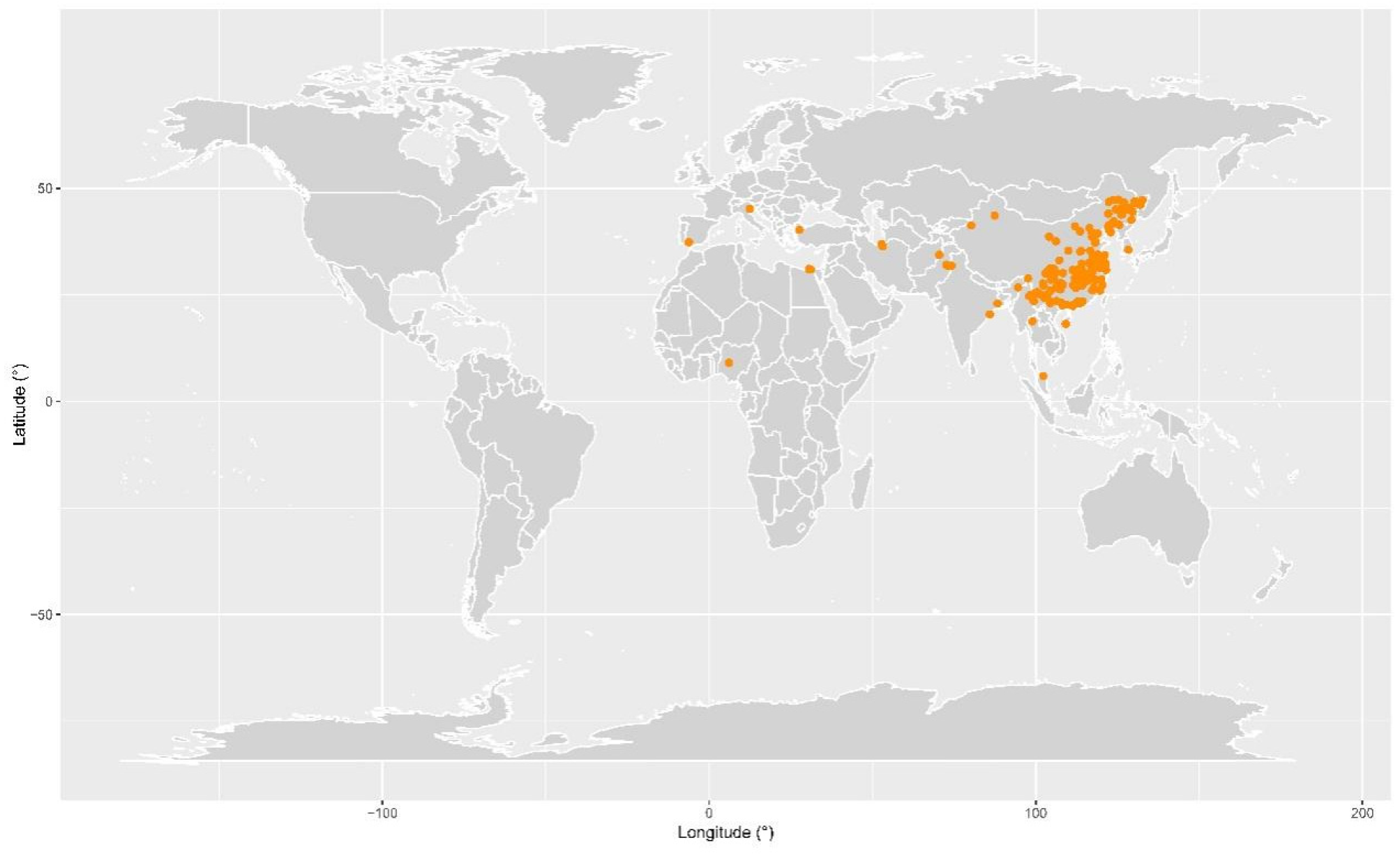
In the present study, we collected a comprehensive dataset of the simultaneous responses of rice yield and quality to various agronomic practices using the Web of Science Core Collection on (http://www.isiknowledge.com/) and China National Knowledge Infrastructure (http://www.cnki.net/) to source English and Chinese articles, respectively, before January 2024. The search terms were “rice yield” and (“head rice rate” or “chalkiness degree” or “chalky rice rate” or “protein content” or “amylose content” or “tasting value”). Studies included in the further meta-analysis had to meet the following criteria: (1) experiments should be conducted in field conditions, and the paired observations of rice yield and at least one of head rice rate, chalkiness degree, chalky rice rate, protein content, amylose content and tasting value were reported; (2) treatments should be replicated at least three times; (3) the means and sample replicates should be given, and the standard deviation or standard error for each dataset should also be recorded if available; (4) there should be at least 5 independent studies and 20 paired observations of rice yield and quality for a single agronomic practice; and (5) any mutants and transgenic rice plants were excluded. Finally, 10 agronomic practices with sufficient data were included in this research including variety selection, zinc application (mainly as ZnO or ZnSO4), silicon application (mainly as SiO2), increased planting density, organic fertilizer application, potassium application (mainly as KCI or K2SO4), nitrogen application (mainly as urea), growth regulator application, alternate wetting and drying and altering sowing date. It should be noted that for variety selection, the rice cultivar with the lowest rice yield was taken as the control [17]. Similarly, for altering sowing date, the sowing date with the lowest rice yield was also taken as the control, while for fertilizer (i.e., Zn, Si, organic fertilizer, K, and N) and growth regulator applications, the treatment without application of fertilizers or growth regulators was taken as the control, respectively. In addition, conventional flooding and the lowest planting density were taken as the control for alternate wetting and drying and increased planting density, respectively. In total, 294 published studies with 10,543 paired observations of rice yield and quality were included (Table 1). The locations of field experiments included in this meta-analysis are shown in Figure 1. The raw data used in this study were either directly obtained from tables or extracted from figures using the GetData Graph Digitizer (https://getdata-graph-digitizer.com/).

2.2. Statistical Analysis

The effect sizes of agronomic practices on rice yield and quality were assessed using the natural logarithm of the response ratio (LnRR) following Liao et al. [18]. LnRR was calculated as the natural logarithm of the ratio between the means of the control (Xc) and agronomic practices (Xt), with the following equation:
Ln R R = Ln X t X c = Ln X t Ln X c
Pearson linear regression and graphs were conducted using R (https://www.R-project.org/) and Sigmaplot 15 (SPSS Inc., Chicago, IL, USA).

3. Results

3.1. Overall Relationships Between Rice Yield and Quality

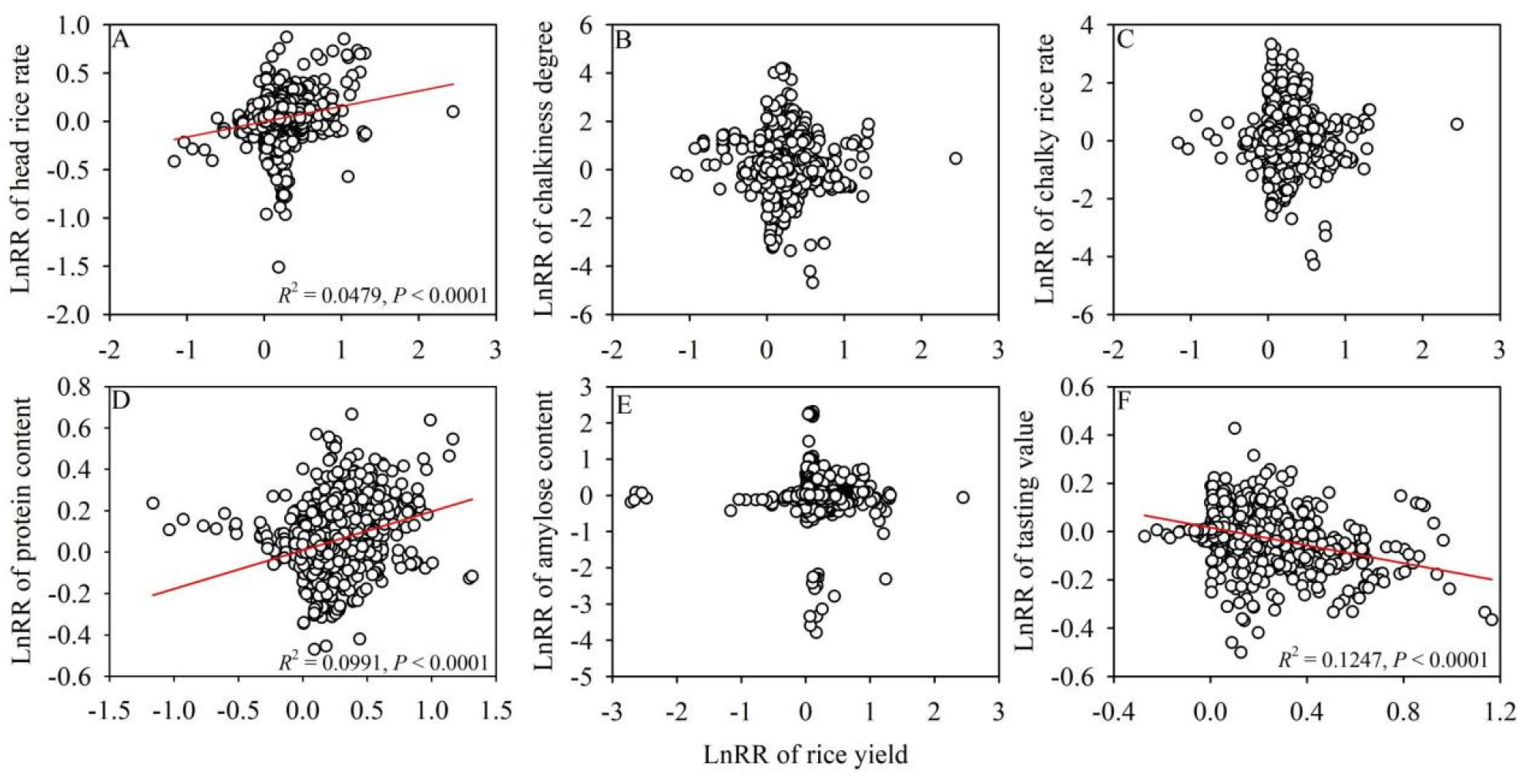
When the data of all agronomic practices was pooled, there were positive relationships between the yield and quality for head rice rate (R2 = 0.0479, p < 0.0001) and protein content (R2 = 0.0991, p < 0.0001) (Figure 2). In contrast, a negative (R2 = 0.1247, p < 0.0001) correlation was observed between rice yield and tasting value. However, our analysis did not reveal any significant correlation between the yield and chalkiness degree, chalky rice rate, or amylose content.

3.2. Relationships Between the Effects of Agronomic Practices on Rice Yield and Head Rice Rate

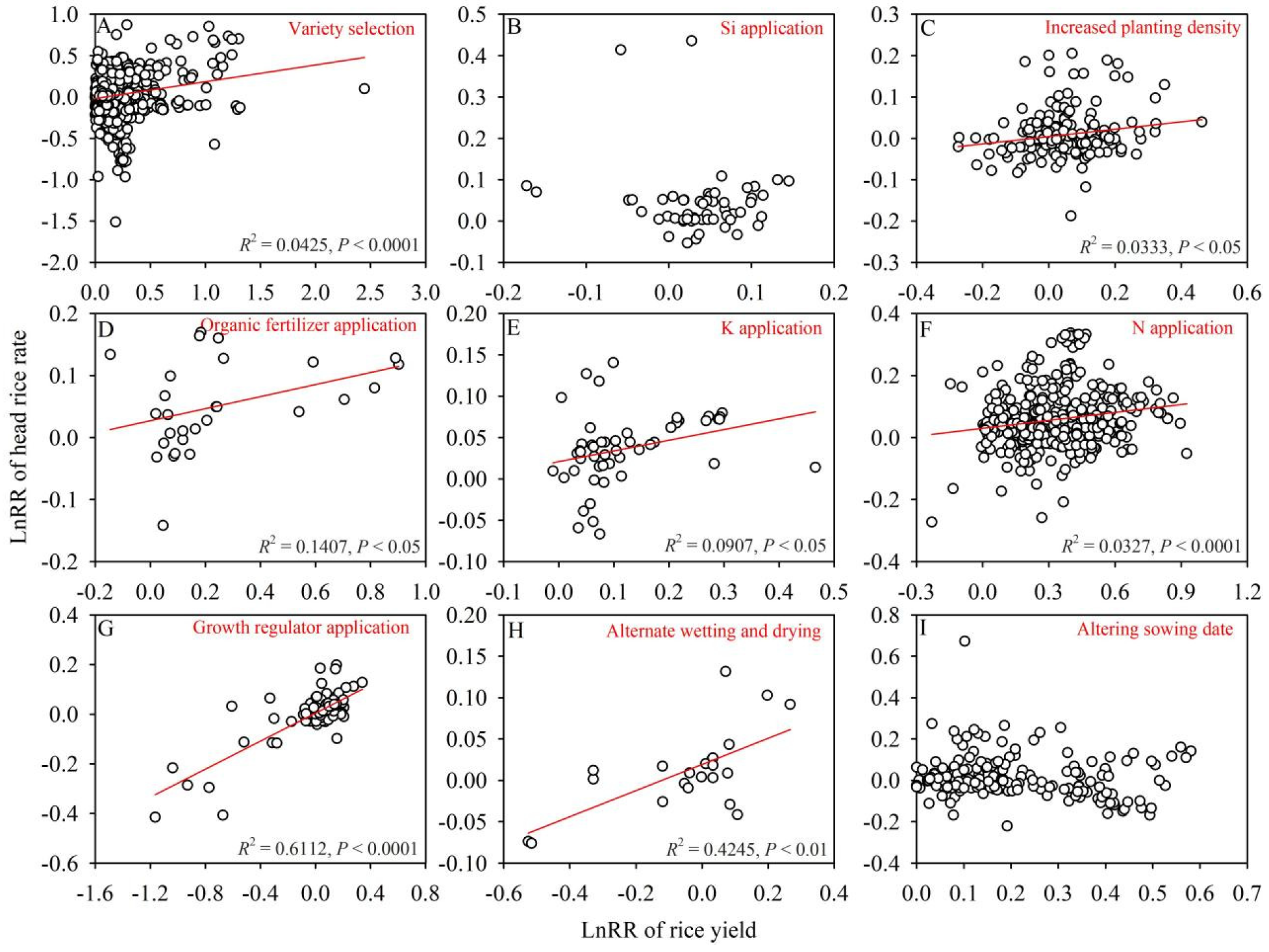
We found that there were positive relationships between the yield and head rice rate responses to variety selection (R2 = 0.0425, p < 0.0001), increased planting density (R2 = 0.0333, p < 0.05), organic fertilizer application (R2 = 0.1407, p < 0.05), K application (R2 = 0.0907, p < 0.05), N application (R2 = 0.0327, p < 0.0001), growth regulator application (R2 = 0.6112, p < 0.0001) and alternate wetting and drying (R2 = 0.4245, p < 0.01) (Figure 3). However, no significant relationship between the yield and head rice rate responses to Si application or altering sowing date was found.

3.3. Relationships Between the Effects of Agronomic Practices on Rice Yield and Appearance Quality

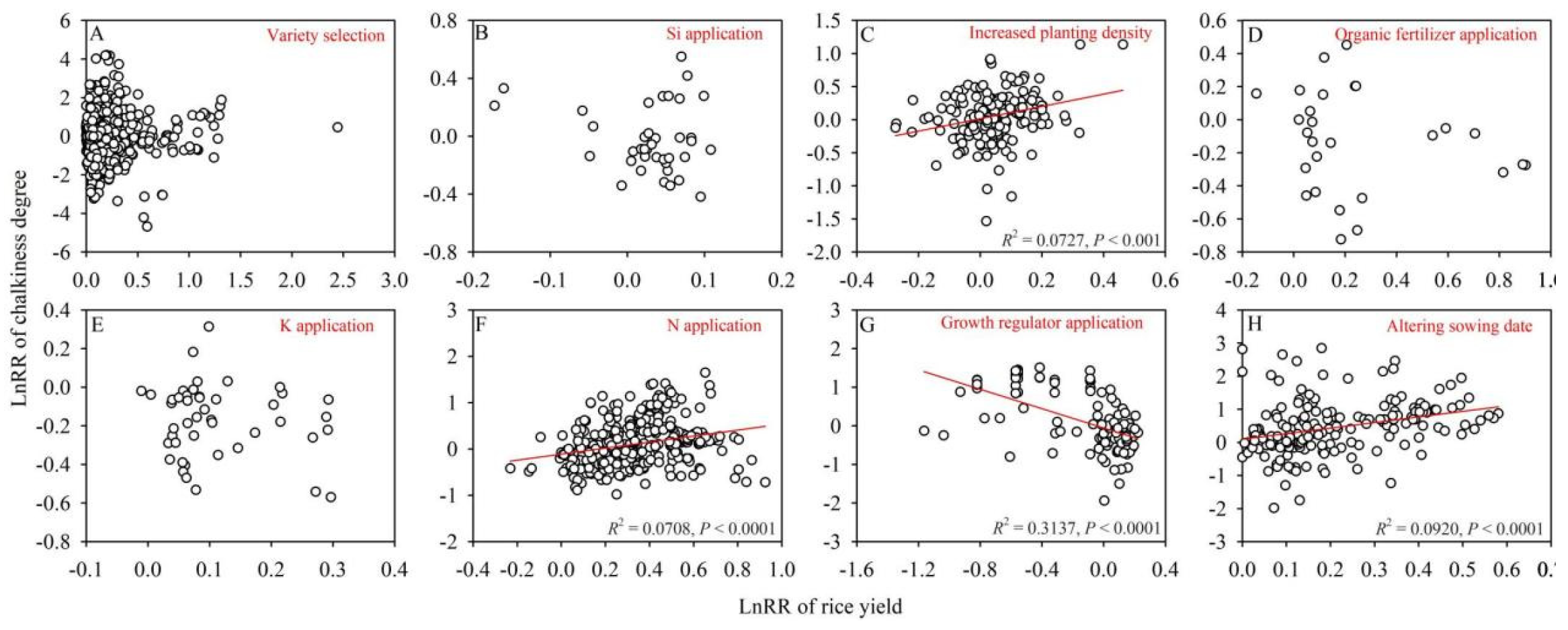
There were positive relationships between the yield and chalkiness degree responses to increased planting density (R2 = 0.0727, p < 0.001), N application (R2 = 0.0708, p < 0.0001) and altering sowing date (R2 = 0.0920, p < 0.0001), but negative relationships between their responses to growth regulator application (R2 = 0.3137, p < 0.0001) (Figure 4). However, there was no significant relationship between the yield and chalkiness degree responses to the remaining agronomic practices including variety selection, and Si, organic fertilizer and K applications (Figure 4).
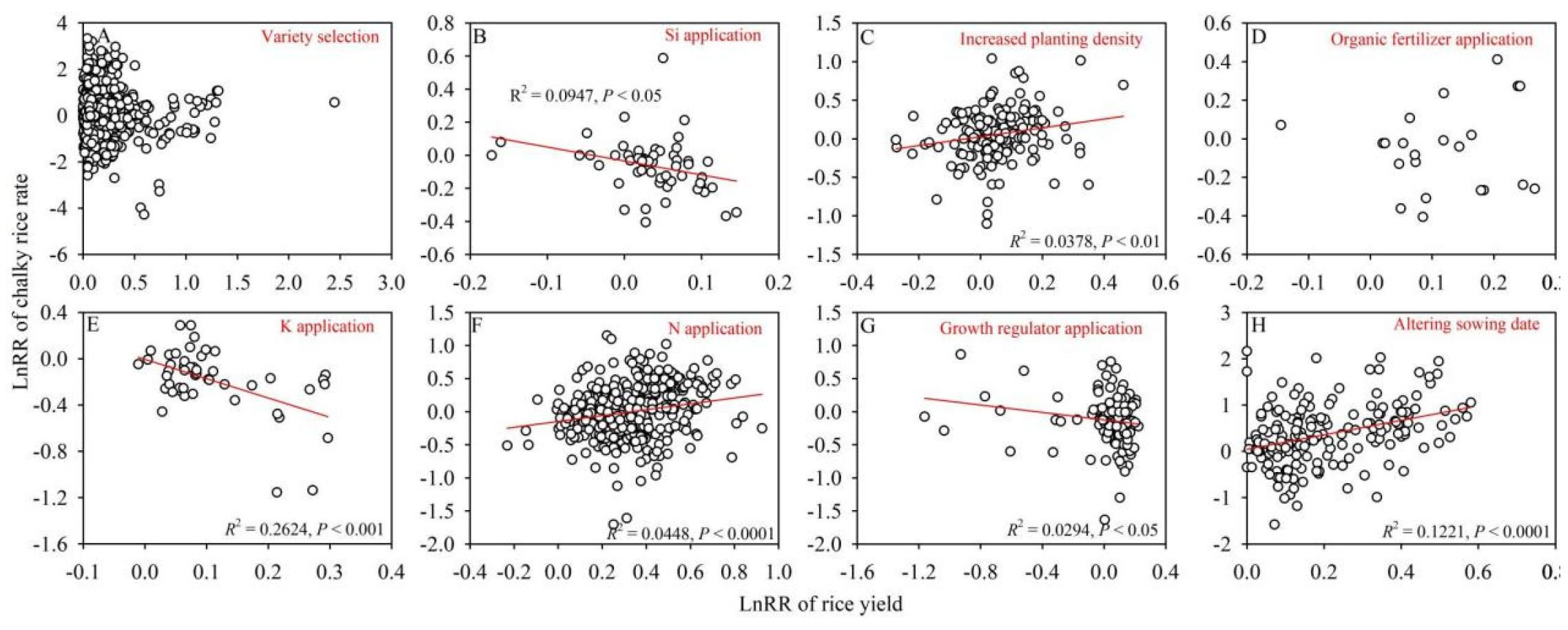
Similar to chalkiness degree, positive correlations were found between the yield and chalky rice rate responses to increased planting density (R2 = 0.0378, p < 0.01), N application (R2 = 0.0448, p < 0.0001) and altering sowing date (R2 = 0.1221, p < 0.0001) (Figure 5). In addition, negative relationships between their responses to Si application (R2 = 0.0947, p < 0.05), K application (R2 = 0.2624, p < 0.001) and growth regulator application (R2 = 0.0294, p < 0.05) were observed. However, there was no significant relationship between the yield and chalky rice rate responses to variety selection or organic fertilizer application.

3.4. Relationships Between the Effects of Agronomic Practices on Rice Yield and Eating Quality

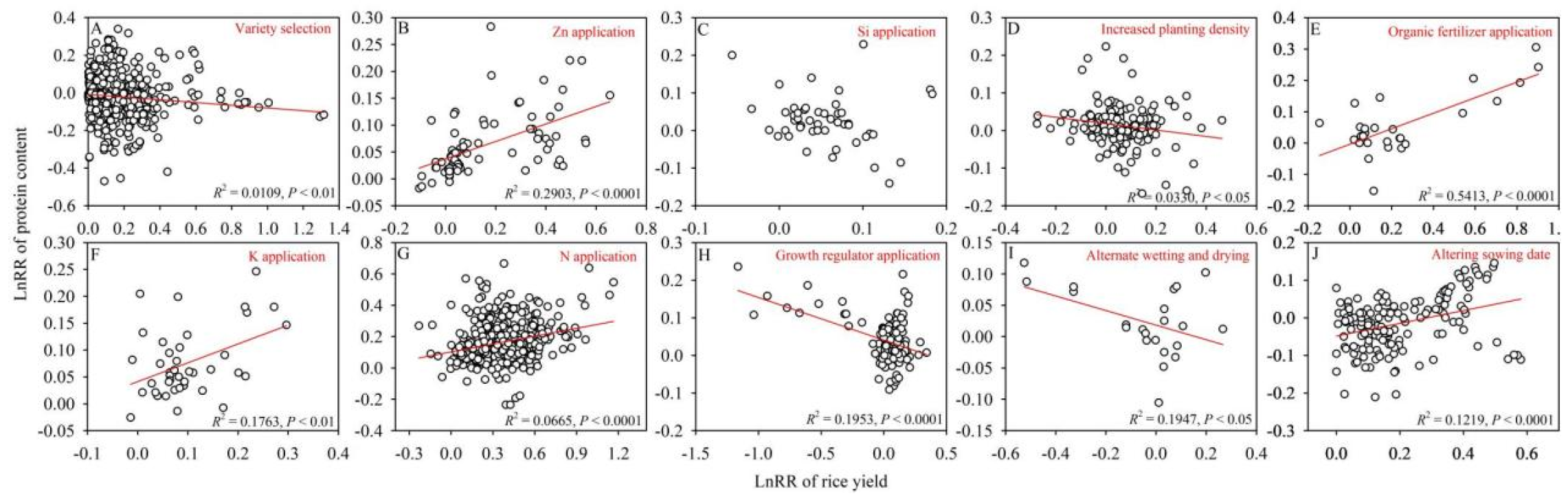
Positive relationships was found between the yield and protein content responses to Zn application (R2 = 0.2903, p < 0.0001), organic fertilizer application (R2 = 0.5413, p < 0.0001), K application (R2 = 0.1763, p < 0.01), N application (R2 = 0.0665, p < 0.0001) and altering sowing date (R2 = 0.1219, p < 0.0001), while negative relationships were observed between their responses to increased planting density (R2 = 0.0330, p < 0.05), growth regulator application (R2 = 0.1953, p < 0.0001) and alternate wetting and drying (R2 = 0.1947, p < 0.05) (Figure 6). No significant relationship between the yield and protein content responses to Si application was found.
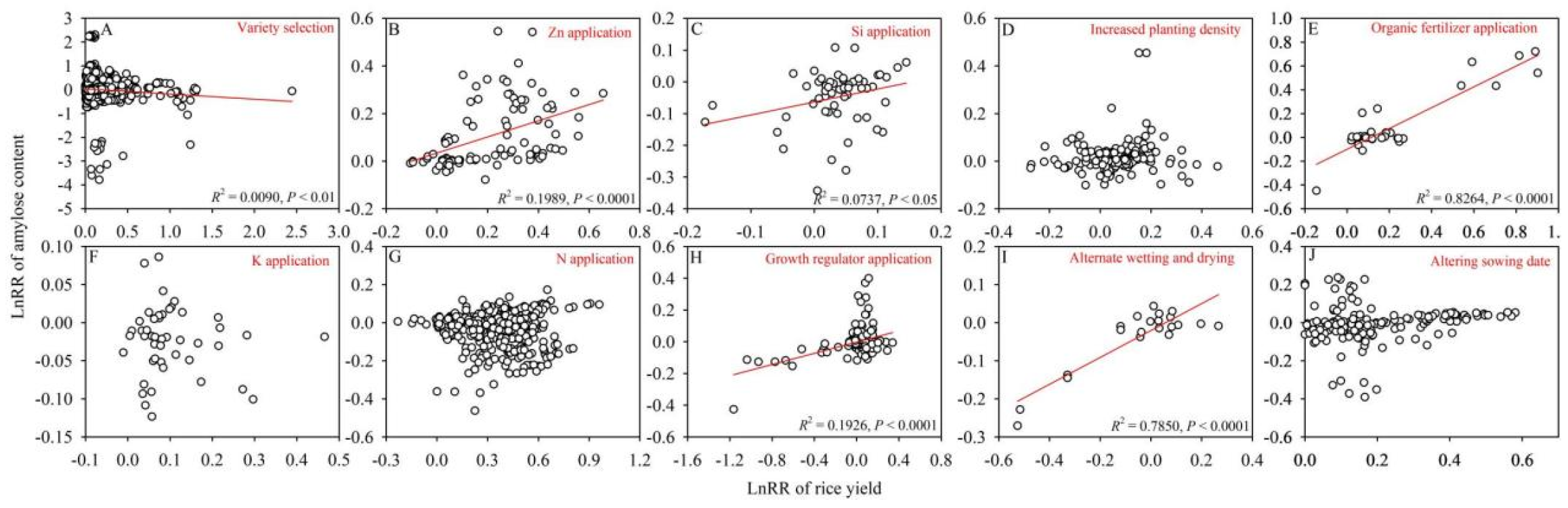
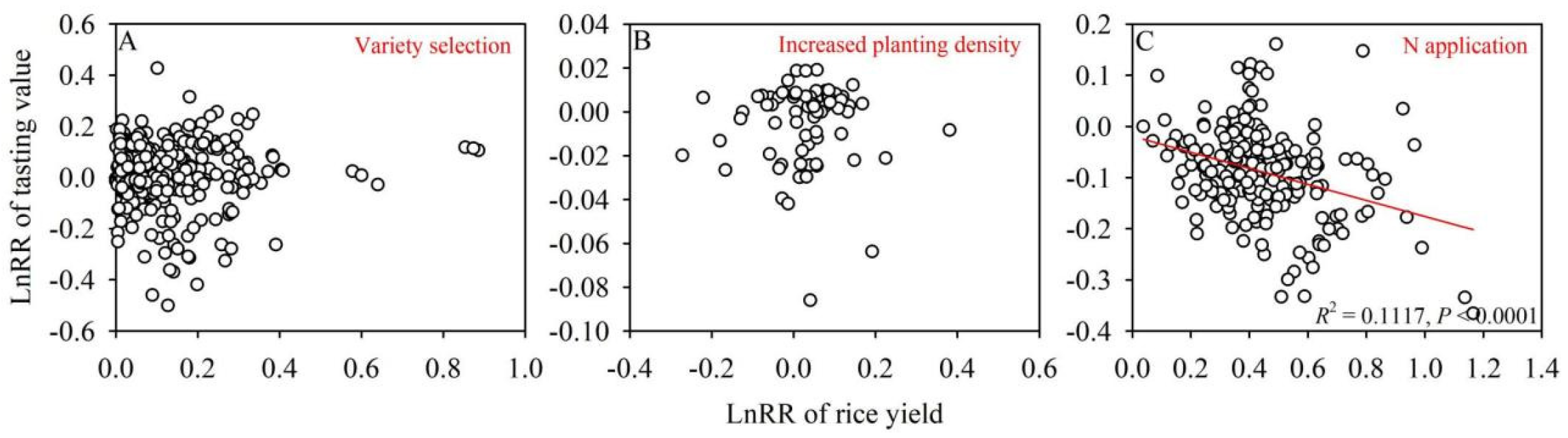
Positive relationships were found between the yield and amylose content responses to Zn application (R2 = 0.1989, p < 0.0001), Si application (R2 = 0.0737, p < 0.05), organic fertilizer application (R2 = 0.8264, p < 0.0001), growth regulator application (R2 = 0.1926, p < 0.0001) and alternate wetting and drying (R2 = 0.7850, p < 0.0001) while a negative association between their responses to variety selection (R2 = 0.0090, p < 0.01) were observed (Figure 7). In contrast, there was no significant relationship between the yield and amylose content responses to the remaining agronomic practices. In addition, there was negative correlation between the yield and tasting value responses to N application (R2 = 0.1117, p < 0.0001), whereas no significant relationship between their responses to variety selection or increased planting density was found (Figure 8).

4. Discussion

4.1. Relationship Between Rice Yield and Quality

In the present study, we found that there was a positive (R2 = 0.0479, p < 0.0001) relationship between rice yield and head rice rate (Figure 2A), indicating that rice yield and head rice rate could be simultaneously improved by agronomic practices. Consistent with our present results, numerous studies have reported concurrently enhanced rice yield and head rice rate when various agronomic practices were employed [19,20]. These findings suggest that improvements in rice yield do not necessarily compromise milling quality under the agronomic conditions included in our dataset. In addition, there was no significant relationship between rice yield and either chalkiness degree or chalky rice rate (Figure 2), which was similar to previous research [21,22], suggesting that agronomic practices could enhance rice yield while having little effect on appearance quality.
Interestingly, we did observe a positive (R2 = 0.0911, p < 0.0001) relationship between rice yield and protein content, which may be highly related to the increased N input, as evidenced by Figure 6G. This correlation should be responsible for the negative (R2 = 0.1247, p < 0.0001) relationship between rice yield and tasting value observed in Figure 2F, because increased protein content usually prevents hydration of the rice grain and thus causes a bad texture of the cooked rice [9]. However, there was no significant relationship between rice yield and amylose content. Therefore, it is promising to achieve the goal of maintaining the amylose content unchanged in rice grains while increasing rice yield through agronomic measures. In total, our results demonstrate that there is not necessarily trade-off between rice yield and quality; on the contrary, they could be simultaneously improved by means of agronomic practices in some cases. Therefore, the discussion below will first focus on which agronomic practices can maximize both rice yield and quality simultaneously, followed by an analysis of those agronomic practices that improve rice yield and quality but compromise other quality traits.

4.2. Growth Regulator and K Applications Can Improve Rice Yield, Milling and Appearance Quality Simultaneously

Importantly, we found that growth regulators and K applications have great potentials to simultaneously improve rice yield, milling and appearance quality (Figure 3, Figure 4 and Figure 5), which is important for both farmers and enterprises because rice yield, milling and appearance quality are key factors determining rice commercial value [4]. Consistent with our present findings, Luo et al. [23] found that foliar application of ornithine could significantly improve both rice yield and appearance quality. Similarly, foliar application of brassinolide was also reported to have positive effects on both rice yield and head rice rate [24]. Therefore, growth regulator application is a useful agronomic practice to simultaneously improve rice yield and quality. Regarding the K application, its role in regulating rice yield and quality has also been investigated by previous studies. For example, Zhang et al. [25] suggested that K application with optimal rate could significantly increase rice yield and head rice rate while decreasing chalky rice rate. Consistently, Wang et al. [26] and Zhang et al. [27] also found that optimal application of K could improve rice yield and head rice rate while decreasing both chalky rice rate and chalkiness degree. Therefore, K application, similar to growth regulator application, is also a feasible approach that can be adopted by farmers to simultaneously improve rice yield, milling and appearance quality.
Due to the unavailable data regarding the paired effects of growth regulators or K applications on both rice yield and tasting value, it is hard to conclude whether or not rice yield and tasting value could be improved simultaneously through these two agronomic practices. However, if we suspect a negative impact of protein content on tasting value, as suggested by previous studies [9,28], then K application may cause decreased tasting quality because there was a positive (R2 = 0.0991, p < 0.0001) relationship between rice yield and protein content under K application conditions (Figure 6F), as observed by Wang et al. [26]. However, as we suggested previously, if protein content is more important than amylose content in regulating tasting value, then growth regulator application may also have a positive impact on tasting value, because there was a negative (R2 = 0.0991, p < 0.0001) correlation between rice yield and protein content when growth regulators were applied (Figure 6H). Therefore, it is necessary to examine the possible effects of K and growth regulator applications on rice tasting quality, which may give us useful information for simultaneously improving rice yield, milling, appearance and tasting quality in the future.

4.3. Enhanced Rice Yield and Milling Quality Can Be Achieved Through Variety Selection and Organic Fertilizer Application at No Expense of Appearance Quality

In this study, we found that rice yield and head rice rate could be simultaneously enhanced by variety selection and organic fertilizer application while they had little impact on appearance quality (Figure 3, Figure 4 and Figure 5), indicating that rice yield and milling quality could be improved in unison while maintaining appearance quality unaltered.
In fact, numerous studies have investigated whether rice yield and milling quality could be simultaneously improved through cultivar replacement. For instance, our previous study found that though rice yield of early indica rice was significantly improved with the released years in southern China, its head rice rate did not significantly change. Similarly, Zeng et al. [7] and Wang et al. [8] suggested that grain yield of high-quality indica rice was significantly improved with the released years in southern China while head rice rate significantly decreased. However, it should be noted that different growth conditions across years may compromise their results [6,7,8]. Recently, by means of a field experiment, Meng et al. [11] suggested that both yield and head rice rate of japonica inbred rice significantly increased with the released years, suggesting that rice yield and milling quality could be improved through variety selection. Consistent with the results of Meng et al. [11], Yang et al. [29] discovered that among the 22 selected rice varieties, three varieties consistently exhibited higher yields and head rice rates compared to the remaining varieties in a ratooning rice system. Therefore, it can be concluded that variety selection is a viable approach to achieve both high rice yield and head rice rate.
Organic fertilizer application is now widely accepted as having numerous positive impacts on soil quality and thus crop growth, and fertilizer effects on rice yield and quality have also been examined by previous studies. For example, Wu et al. [30] found that, compared with chemical fertilizer, organic fertilizer application could significantly increase rice yield though it had no significant effect on either brown rice rate, milled rice rate or broken rice rate. Meanwhile Ruan et al. [31] suggested that organic fertilizer application could significantly improve rice yield and head rice rate when compared with inorganic fertilizer treatment. Similarly, significantly enhanced rice yield and milling quality were also observed under organic fertilizer treatment relative to no fertilizer treatment [32], which was further confirmed by our present results (Figure 3D). Therefore, similar to variety selection, organic fertilizer application may also be adopted by farmers to simultaneously improve rice yield and milling quality.
Though we found that increased rice yield and decreased protein (R2 = 0.0109, p < 0.05) and amylose (R2 = 0.0090, p < 0.05) contents could be achieved through variety selection, there was no significant relationship between rice yield and tasting value (Figure 6, Figure 7 and Figure 8). One possible reason for this is that the protein and amylose contents and tasting value are not paired observations, which may reduce their internal relationships. Another factor is likely that to what extent the changes in protein and/or amylose contents can reflect the real changes in tasting value remains elusive, which deserves further research.

4.4. Enhanced Rice Yield and Appearance Quality Can Be Achieved Through Si Application

Rice is a typical silicon-loving crop, and it needs to absorb a large amount of silicon from the soil throughout its life cycle to maintain its normal growth and development [33]. In the present study, we observed a negative (R2 = 0.0947, p < 0.05) relationship between rice yield and chalky rice rate under Si application conditions (Figure 5B), indicating that Si application has great potential to simultaneously improve rice yield and appearance quality.
Consistent with our present findings, Jiang et al. [34] found that Si addition could significantly increase rice yield while significantly decreasing chalkiness degree and chalky rice rate under dry cultivation conditions. In addition, Mo et al. [35] also suggested that Si application with an optimal rate could improve both rice yield and appearance quality, and similar results were also demonstrated by Deng et al. [36]. Therefore, based on the previous studies and our present findings, Si application can be recommended to farmers for the simultaneous enhancements of rice yield and quality.

4.5. Increased Planting Density and Altering Sowing Date Can Improve Rice Yield and Milling Quality but at the Expense of Appearance Quality

Different from the agronomic practices discussed above, we found that though rice yield and milling quality could be improved by increased planting density and altering sowing date, they inevitably decreased appearance quality (Figure 3, Figure 4 and Figure 5), suggesting that there to be trade-off relationships between rice yield and quality under specific conditions, which should be given further consideration in future research.
Numerous studies have investigated the effects of increased planting density on rice yield and quality. For example, Hu et al. [37] found that with increasing planting density, rice yield usually increases with it before reaching an optimal density, though accompanied with deteriorated appearance quality. Moreover, Duan et al. [38] suggested that increased planting density not only reduced rice yield but also caused a significantly increased chalky rice rate and chalkiness degree, which was also observed by Chen et al. [39]. In support of our present results, Wu et al. [40] demonstrated that increasing planting density within an optimal range could significantly increase both rice yield and head rice rate. Therefore, when increasing the planting density to achieve high rice yield, careful attention should be paid to overcome its adverse effects on appearance quality.
Altering sowing date is a commonly adopted strategy to improve rice yield by means of efficiently utilizing the temperature and light resources [41]; however, its impacts on grain quality are also significant. For instance, Li et al. [10] found that early sowing could significantly improve the rice yield and eating quality of machine-transplanted rice while they did not report milling or appearance quality. Consistent with our present results, numerous studies confirmed that rice yield and milling quality could be simultaneously improved by altering sowing date [42,43]. Moreover, Zhao et al. [44] suggested that, across the different sowing dates, head rice rate showed positive correlations with chalky rice rate and chalkiness degree, which was in line with our present results (Figure 3, Figure 4 and Figure 5). Therefore, our present findings indicate that appearance quality should be taken into account when altering sowing date to improve rice yield and milling quality.

4.6. N Application Can Improve Rice Yield and Milling Quality but at the Expense of Appearance and Eating Quality

In the present study, we found that though rice yield and head rice rate could be improved by N application, the appearance and eating quality showed adverse changes (Figure 3, Figure 4, Figure 5 and Figure 8). Therefore, studying how to alleviate or even avoid the unfavorable impacts of N on grain quality while maintaining high rice yield is necessary in the near future considering the large contribution of N inputs to the total rice production in China.
Consistent with our present results, numerous studies have reported positive effects of N application on rice yield and milling quality but negative impacts on rice appearance and eating quality. For example, Zhu et al. [9] found that rice yield, head rice rate, chalky rice rate and chalkiness degree significantly increased with the N application rate while tasting value significantly decreased. Similarly, Meng et al. [11] also suggested that N application could significantly increase rice yield, chalky rice rate and chalkiness degree but significantly decreased tasting value while it had no significant impact on head rice rate. The positive effects of N application on milling quality observed in previous studies may be related to the increased gliadin content in grains as suggested by Zhu et al. [9], while negative impacts of N application on appearance and eating quality should be related to the poor grain filling degree and increased protein content of grains, respectively, especially under high N inputs [9,11]. Therefore, achieving both high rice yield and quality under N application conditions is challenging.
Fortunately, several studies have pointed out that optimal N management, which was not included in our present meta-analysis, can improve rice yield and quality simultaneously. For instance, Fei et al. [45] found that, compared with farmers’ fertilization practice, optimizing N fertilizer management could increase rice yield, milling, appearance and eating quality concurrently. More recently, Huang et al. [12] demonstrated that applying a moderate N rate alongside an increased ratio of basal N rate and a decreased ratio of N rate at panicle initiation could improve rice yield and eating quality while having no significant effect on milling and appearance quality. Therefore, it is possible to achieve high rice yield and quality with a relatively high N input by optimizing the management and application of N fertilizer. Additionally, whether N rate and N management strategy could produce fundamentally different yield-quality responses remains largely unknown.

4.7. Potential Limitations of This Study and Future Outlooks

It should be noted that the sites included in this meta-analysis are mainly located in China; thereby the findings presented in this study should be extrapolated to regions other than China with great caution. In addition, due to the limited data reported, some agronomic practices such as no-tillage, phosphorus fertilizer application, and N fertilization timing, etc., are not included in our present research. Lastly, but of equal importance, many studies used some physical and chemical properties such as protein and amylose contents to characterize the tasting value, instead of actually measuring it, especially through the method of human tasting; however, it should be noted that the physicochemical properties of rice grains cannot truly reflect its eating quality. Further studies should pay more attention to integrated agronomic technique packages and the interaction of different agronomic practices on rice yield and grain quality [13].

5. Conclusions

Our meta-analysis, based on paired field experiments, found that while rice yield and head rice rate could be simultaneously improved yield increases of rice are usually associated with higher protein content and thus lower tasting value due to agronomic practices. However, we did not observe any significant relationship between the responses of rice yield and either appearance quality or amylose content and agronomic practices. Specifically, growth regulator and K applications can improve rice yield, milling and appearance quality simultaneously, and enhanced rice yield and milling quality can be achieved through variety selection and organic fertilizer application. Additionally, enhanced rice yield and appearance quality can also be achieved through Si application. However, we also found that increased planting density and altering sowing date can improve rice yield and milling quality at the expense of appearance quality and, moreover, N application can improve rice yield and milling quality at the expense of appearance and eating quality. Further studies should pay more attention to simultaneous improvements of rice yield and quality through attempting to integrate multiple existing agronomic techniques.

Author Contributions

Conceptualization, S.H. and G.H.; methodology, G.H., Y.Z. and Z.D.; software, G.H.; validation, S.H. and G.H.; formal analysis, G.H.; investigation, G.H., Y.Z., Z.D. and Z.W.; resources, S.H.; data curation, S.H. and G.H.; writing—original draft preparation, S.H. and G.H.; writing—review and editing, G.H., Y.Z., Z.D., Z.W. and S.H.; visualization, G.H.; supervision, S.H.; project administration, S.H.; funding acquisition, S.H. and G.H. All authors have read and agreed to the published version of the manuscript.

Funding

This research was funded by the National Key R&D Program of China (2023YFD2301300), China Postdoctoral Science Foundation (2024M761228) and Jiangxi Provincial Key Laboratory of Crop Bio-breeding and High-Efficient Production (2024SSY04101).

Data Availability Statement

The data presented in this publication are available on request from the corresponding author.

Conflicts of Interest

The authors declare no conflicts of interest.

References

  1. Bandumula, N. Rice production in Asia: Key to global food security. Proc. Natl. Acad. Sci. India Sect. B 2018, 88, 1323–1328. [Google Scholar]
  2. Mohidem, N.A.; Hashim, N.; Shamsudin, R.; Man, H.C. Rice for food security: Revisiting its production, diversity, rice milling process and nutrient content. Agriculture 2022, 12, 741. [Google Scholar] [CrossRef]
  3. Wang, F.; Peng, S. Yield potential and nitrogen use efficiency of China’s super rice. J. Integr. Agric. 2017, 16, 1000–1008. [Google Scholar] [CrossRef]
  4. Nelson, J.C.; McClung, A.M.; Fjellstrom, R.G.; Moldenhauer, K.A.K.; Boza, E.; Jodari, F.; Oard, J.H.; Linscombe, S.; Scheffler, B.E.; Yeater, K.M. Mapping QTL main and interaction influences on milling quality in elite US rice germplasm. Theor. Appl. Genet. 2011, 122, 291–309. [Google Scholar] [PubMed]
  5. Zhou, L.; Liang, S.; Ponce, K.; Marundon, S.; Ye, G.; Zhao, X. Factors affecting head rice yield and chalkiness in indica rice. Field Crops Res. 2015, 172, 1–10. [Google Scholar] [CrossRef]
  6. Huang, G.; Guo, L.; Zeng, Y.; Huang, S.; Zeng, Y.; Xie, X. Changes in the grain yield and quality of early indica rice from 2000 to 2020 in southern China. Agronomy 2024, 14, 295. [Google Scholar] [CrossRef]
  7. Zeng, Y.; Tan, X.; Zeng, Y.; Xie, X.; Pan, X.; Shi, Q.; Zhang, J. Changes in the rice grain quality of different high-quality rice varieties released in southern China from 2007 to 2017. J. Cereal Sci. 2019, 87, 111–116. [Google Scholar] [CrossRef]
  8. Wang, H.; Xiong, R.; Zhou, Y.; Tan, X.; Pan, X.; Zeng, Y.; Huang, S.; Shang, Q.; Xie, X.; Zhang, J.; et al. Grain yield improvement in high-quality rice varieties released in southern China from 2007 to 2017. Front. Sustain. Food Syst. 2022, 6, 986655. [Google Scholar] [CrossRef]
  9. Zhu, D.; Zhang, H.; Guo, B.; Xu, K.; Dai, Q.; Wei, H.; Gao, H.; Hu, Y.; Cui, P.; Huo, Z. Effects of nitrogen level on yield and quality of japonica soft super rice. J. Integr. Agric. 2017, 16, 1018–1027. [Google Scholar] [CrossRef]
  10. Li, G.; Chen, T.; Xu, K.; Liu, Y.; Dai, Q.; Huo, Z.; Wei, H. Early sowing increases grain yield and cooking and eating quality of machine-transplanted rice in eastern China. Crop Sci. 2021, 61, 4383–4401. [Google Scholar] [CrossRef]
  11. Meng, T.; Zhang, X.; Chen, X.; Ge, J.; Zhou, G.; Wei, H.; Dai, Q. Trends in grain quality and responses to nitrogen application of japonica inbred rice released after the 1980s in east China. Cereal Chem. 2022, 99, 503–519. [Google Scholar] [CrossRef]
  12. Huang, M.; Shu, A.; Xie, J.; Cao, F.; Chen, J.; Wang, W.; Zheng, H. Nitrogen management for improving grain yield and quality in high-quality hybrid rice. J. Soil Sci. Plant Nutr. 2025, 25, 1480–1492. [Google Scholar] [CrossRef]
  13. Zhang, H.; Hou, D.; Peng, X.; Shao, S.; Jing, W.; Gu, J.; Liu, L.; Wang, Z.; Liu, Y.; Yang, J. Optimizing integrative cultivation management improves grain quality while increasing yield and nitrogen use efficiency in rice. J. Integr. Agric. 2019, 18, 2716–2731. [Google Scholar] [CrossRef]
  14. Guo, C.; Liu, X.; He, X. A global meta-analysis of crop yield and agricultural greenhouse gas emissions under nitrogen fertilizer application. Sci. Total Environ. 2022, 831, 154982. [Google Scholar] [CrossRef] [PubMed]
  15. Li, W.; He, Z.; Wu, L.; Liu, S.; Luo, L.; Ye, X.; Gao, H.; Ma, C. Impacts of co-culture of rice and aquatic animals on rice yield and quality: A meta-analysis of field trials. Field Crops Res. 2022, 280, 108468. [Google Scholar] [CrossRef]
  16. He, H.; Long, L.; Fu, Z. Improving rice quality through biochar application in China: A meta-analysis. J. Environ. Manag. 2024, 371, 122701. [Google Scholar] [CrossRef]
  17. Jiang, Y.; van Groenigen, K.J.; Huang, S.; Hungate, B.A.; van Kessel, C.; Hu, S.; Zhang, J.; Wu, L.; Yan, X.; Wang, L.; et al. Higher yields and lower methane emissions with new rice cultivars. Glob. Change Biol. 2017, 23, 4728–4738. [Google Scholar] [CrossRef]
  18. Liao, P.; Bell, S.M.; Chen, L.; Huang, S.; Wang, H.; Miao, J.; Qi, Y.; Sun, Y.; Liao, B.; Zeng, Y.; et al. Improving rice grain yield and reducing lodging risk simultaneously: A meta-analysis. Eur. J. Agron. 2023, 143, 126709. [Google Scholar] [CrossRef]
  19. Fatima, A.; Ali, S.; Ijaz, M.; Mahmood, R.; Sattar, S.; Khan, J.; Dar, A.I.; Ahmad, M. Boron application improves the grain yield and quality of fine grain rice cultivars in Punjab, Pakistan. Pak. J. Agric. Sci. 2018, 55, 761–766. [Google Scholar]
  20. Xu, Y.; Gu, D.; Li, K.; Zhang, W.; Zhang, H.; Wang, Z.; Yang, J. Response of grain quality to alternate wetting and moderate soil drying irrigation in rice. Crop Sci. 2019, 59, 1261–1272. [Google Scholar] [CrossRef]
  21. Luo, H.; Imran, M.; Yao, X.; Zhang, S.; Yi, W.; Xing, P.; Tang, X. Foliar application of glutamate and phenylalanine induced regulation in yield, protein components, aroma, and metabolites in fragrant rice. Eur. J. Agron. 2023, 149, 126899. [Google Scholar] [CrossRef]
  22. Mi, K.; Yuan, X.; Wang, Q.; Dun, C.; Wang, R.; Yang, S.; Yang, Y.; Zhang, H.; Zhang, H. Zinc oxide nanoparticles enhanced rice yield, quality, and zinc content of edible grain fraction synergistically. Front. Plant Sci. 2023, 14, 1196201. [Google Scholar] [CrossRef] [PubMed]
  23. Luo, H.; Xing, P.; Liu, J.; Lai, R.; He, L.; Zhang, T.; Tang, X. Application of ornithine-induced regulation in yield formation, grain quality and aroma of fragrant rice. Cereal Res. Commun. 2020, 48, 485–492. [Google Scholar] [CrossRef]
  24. Liu, J.; Lai, R.; He, L.; Xing, P.; Luo, H.; Yang, S.; Zou, Y.; Tang, X. Foliar application of brassinolide induced regulation of grain yield and quality, antioxidant responses and aroma in fragrant rice. Phyton 2022, 91, 1061. [Google Scholar] [CrossRef]
  25. Zhang, G.; Cui, Y.; Zhang, H. Effects of K fertilizer application amount on yield and qualities of rice in cold region. Chin. J. Soil Sci. 2010, 41, 413–416. [Google Scholar]
  26. Wang, Q.; Zhen, R.; Ding, Y.; Ji, Z.; Cao, W.; Huang, P. Effects of potassium fertilizer application rates on plant potassium accumulation and grain quality of japonica rice. Sci. Agric. Sin. 2004, 37, 1444–1450. [Google Scholar]
  27. Zhang, G.; Liu, Y.; Zhao, R.; Xiong, Y.; Tang, W. Effects of different amount of potassium fertilization on grain yield and quality of late hybrid rice. Hybrid Rice 2018, 33, 51–55. [Google Scholar]
  28. Liu, Q.; Tao, Y.; Cheng, S.; Zhou, L.; Tian, J.; Xing, Z.; Liu, G.; Wei, H.; Zhang, H. Relating amylose and protein contents to eating quality in 105 varieties of Japonica rice. Cereal Chem. 2020, 97, 1303–1312. [Google Scholar] [CrossRef]
  29. Yang, C.; Yang, D.; Xiang, H.; Zhu, J.; Yuan, S.; Cui, K.; Huang, J.; Peng, S. Varietal improvement is a feasible approach for achieving high yield and superior quality simultaneously in ratoon rice. Field Crops Res. 2025, 322, 109772. [Google Scholar] [CrossRef]
  30. Wu, T.; Li, C.; Xing, X.; Pan, X.; Liu, C.; Tian, Y.; Wang, Z.; Zhao, J.; Wang, J.; He, B. Straw return and organic fertilizers instead of chemical fertilizers on growth, yield and quality of rice. Earth Sci. Inform. 2022, 15, 1363–1369. [Google Scholar] [CrossRef]
  31. Ruan, S.; Qi, J.; Wu, F.; Lai, R.; Tang, X. Response of yield, grain quality, and volatile organic compounds of aromatic rice to vermicompost application. J. Cereal Sci. 2023, 109, 103620. [Google Scholar] [CrossRef]
  32. Huang, L.; Yu, J.; Yang, J.; Zhang, R.; Bai, Y.; Sun, C.; Zhuang, H. Relationships between yield, quality and nitrogen uptake and utilization of organically grown rice varieties. Pedosphere 2016, 26, 85–97. [Google Scholar] [CrossRef]
  33. Ma, J.F.; Yamaji, N. Silicon uptake and accumulation in higher plants. Trends Plant Sci. 2006, 11, 392–397. [Google Scholar] [CrossRef] [PubMed]
  34. Jiang, H.; Xu, X.; Sun, A.; Bai, C.; Li, Y.; Nuo, M.; Shen, X.; Li, W.; Wang, D.; Tian, P.; et al. Silicon nutrition improves the quality and yield of rice under dry cultivation. J. Sci. Food Agric. 2024, 104, 1897–1908. [Google Scholar] [PubMed]
  35. Mo, Z.; Lei, S.; Ashraf, U.; Khan, I.; Li, Y.; Pan, S.; Duan, M.; Tian, H.; Tang, X. Silicon fertilization modulates 2-acetyl-1-pyrroline content, yield formation and grain quality of aromatic rice. J. Cereal Sci. 2017, 75, 17–24. [Google Scholar] [CrossRef]
  36. Deng, J.; Wang, A.; He, C.; Wang, A.; Xu, F. The effect of silicon fertilizer on growth and development, yield and quality of rice. Guangdong Agric. Sci. 2011, 38, 58–61. [Google Scholar]
  37. Hu, Q.; Jiang, W.; Shi, Q.; Xing, Z.; Hu, Y.; Guo, B.; Liu, G.; Gao, H.; Zhang, H.; Wei, H. Effect of wide-narrow row arrangement in mechanical pot-seedling transplanting and plant density on yield formation and grain quality of japonica rice. J. Integr. Agric. 2020, 19, 1197–1214. [Google Scholar] [CrossRef]
  38. Duan, M.; Luo, H.; Pan, S.; Mo, Z.; Yang, X.; Tian, J.; Nie, J.; Wang, H.; Li, L.; Tang, X. High transplant density cause loss yield and quality decrement by affecting photosynthesis, dry matter accumulation and transportation in super rice. Appl. Ecol. Environ. Res. 2019, 17, 6069–6079. [Google Scholar] [CrossRef]
  39. Chen, Y.; Liu, Y.; Dong, S.; Liu, J.; Wang, Y.; Hussain, S.; Wei, W.; Huo, Z.; Xu, K.; Dai, Q. Response of rice yield and grain quality to combined nitrogen application rate and planting density in saline area. Agriculture 2022, 12, 1788. [Google Scholar] [CrossRef]
  40. Wu, C.; Ye, D.; Lin, H.; Ni, R.; Lai, L.; Lin, H. Effects of transplanting density on rice yield and its quality. Chin. Agric. Sci. Bull. 2005, 21, 190–191. [Google Scholar]
  41. Ding, Y.; Wang, W.; Zhuang, Q.; Luo, Y. Adaptation of paddy rice in China to climate change: The effects of shifting sowing date on yield and irrigation water requirement. Agric. Water Manag. 2020, 228, 105890. [Google Scholar] [CrossRef]
  42. Cheng, C.; Zeng, Y.; Lv, W.; Tan, X.; Shang, Q.; Zeng, Y.; Shi, Q. Effect of sowing date on rice yield and quality of high-quality japonica rice during the late-rice cropping seasons in southern China. J. Nucl. Agric. Sci. 2018, 32, 2019–2030. [Google Scholar]
  43. Xu, J.; Xie, J.; Xiong, R.; Guo, L.; Tan, X.; Zeng, Y.; Shi, Q.; Pan, X.; Zeng, Y. Effects of sowing date on temperature and light resource utilization, yield and quality formation of double-season late indica rice in south China. China Rice 2021, 27, 115. [Google Scholar]
  44. Zhao, Q. Effects of sowing date and site on grain quality of rice cultivars planted in different ecological types. Chin. J. Rice Sci. 2013, 27, 297. [Google Scholar]
  45. Fei, L.; Guo, J.; Liu, W.; Ma, A.; Wang, M.; Ling, N.; Guo, S. Determining optimal nitrogen management to improve rice yield, quality and nitrogen use efficiency based on multi-index decision analysis method. J. Sci. Food Agric. 2023, 103, 2357–2366. [Google Scholar] [CrossRef] [PubMed]
Figure 1. Experimental sites included in this meta-analysis.
Agronomy 16 01398 g001
Figure 2. Overall relationship between rice yield and grain quality. LnRR, natural logarithm of the response ratio. Relationships between rice yield and head rice rate (A), chalkiness degree (B), chalkey rice rate (C), protein content (D), amylose content (E) and tasting value (F).
Agronomy 16 01398 g002
Figure 3. Relationships between rice yield and head rice rate under different agronomic practices. LnRR, natural logarithm of the response ratio. N, K, and Si indicate nitrogen, potassium and silicon fertilizers, respectively. For variety selection, the rice cultivar with the lowest rice yield was taken as the control. Similarly, for altering sowing date, the sowing date with the lowest rice yield was also taken as the control, while for fertilizer (i.e., Si, organic fertilizer, K, and N) and growth regulator applications, the treatment without application of fertilizers or growth regulators was taken as the control, respectively. In addition, conventional flooding and the lowest planting density were taken as the control for alternate wetting and drying and increased planting density, respectively.
Agronomy 16 01398 g003
Figure 4. Relationships between rice yield and chalkiness degree under different agronomic practices. LnRR, natural logarithm of the response ratio. N, K, and Si indicate nitrogen, potassium and silicon fertilizers, respectively. For variety selection, the rice cultivar with the lowest rice yield was taken as the control. Similarly, for altering sowing date, the sowing date with the lowest rice yield was also taken as the control, while for fertilizer (i.e., Si, organic fertilizer, K, and N) and growth regulator applications, the treatment without application of fertilizers or growth regulators was taken as the control, respectively. In addition, the lowest planting density was taken as the control for increased planting density.
Agronomy 16 01398 g004
Figure 5. Relationships between rice yield and chalky rice rate under different agronomic practices. LnRR, natural logarithm of the response ratio. N, K, and Si indicate nitrogen, potassium and silicon fertilizers, respectively. For variety selection, the rice cultivar with the lowest rice yield was taken as the control. Similarly, for altering sowing date, the sowing date with the lowest rice yield was also taken as the control, while for fertilizer (i.e., Si, organic fertilizer, K, and N) and growth regulator applications, the treatment without application of fertilizers or growth regulators was taken as the control, respectively. In addition, the lowest planting density was taken as the control for increased planting density.
Agronomy 16 01398 g005
Figure 6. Relationships between rice yield and protein content under different agronomic practices. LnRR, natural logarithm of the response ratio. N, K, Si, and Zn indicate nitrogen, potassium, silicon and zinc fertilizers, respectively. For variety selection, the rice cultivar with the lowest rice yield was taken as the control. Similarly, for altering sowing date, the sowing date with the lowest rice yield was also taken as the control, while for fertilizer (i.e., Zn, Si, organic fertilizer, K, and N) and growth regulator applications, the treatment without application of fertilizers or growth regulators was taken as the control, respectively. In addition, conventional flooding and the lowest planting density were taken as the control for alternate wetting and drying and increased planting density, respectively.
Agronomy 16 01398 g006
Figure 7. Relationships between rice yield and amylose content under different agronomic practices. LnRR, natural logarithm of the response ratio. N, K, Si, and Zn indicate nitrogen, potassium, silicon and zinc fertilizers, respectively. For variety selection, the rice cultivar with the lowest rice yield was taken as the control. Similarly, for altering sowing date, the sowing date with the lowest rice yield was also taken as the control, while for fertilizer (i.e., Zn, Si, organic fertilizer, K, and N) and growth regulator applications, the treatment without application of fertilizers or growth regulators was taken as the control, respectively. In addition, conventional flooding and the lowest planting density were taken as the control for alternate wetting and drying and increased planting density, respectively.
Agronomy 16 01398 g007
Figure 8. Relationships between rice yield and tasting value under different agronomic practices. LnRR, natural logarithm of the response ratio. N indicates nitrogen fertilizer. For variety selection, the rice cultivar with the lowest rice yield was taken as the control. For N application, the treatment without application of N fertilizers was taken as the control. In addition, the lowest planting density was taken as the control for increased planting density.
Agronomy 16 01398 g008
Table 1. Number of paired observations of rice yield and quality with different agronomic practices.
Agronomic PracticesHead Rice RateChalkiness DegreeChalky Rice RateProtein ContentAmylose ContentTasting Value
Altering sowing date171171171154158NA
Alternate wetting and drying22NANA2222NA
Growth regulator application159147163157174NA
N application465348406452415226
K application5145494047NA
Organic fertilizer application2827222729NA
Increased planting density19418818715518374
Si application5638554756NA
Variety selection10398308746521035340
Zn applicationNANANA7795NA
Total21851794192717832214640
NA, not available. N, K, Si, and Zn indicate nitrogen, potassium, silicon and zinc fertilizers, respectively.
Disclaimer/Publisher’s Note: The statements, opinions and data contained in all publications are solely those of the individual author(s) and contributor(s) and not of MDPI and/or the editor(s). MDPI and/or the editor(s) disclaim responsibility for any injury to people or property resulting from any ideas, methods, instructions or products referred to in the content.