Article

Distant Hybridization in Solanaceae: Similarity to Self-Incompatibility of Pollen Tube Growth Arrest as a Reproductive Barrier

by
Alexej I. Ulianov
1,
Yaroslav Yu. Golivanov
1,
Tatiana P. Molchanova
1,
Yuliya V. Orlova
2,
Oksana A. Muratova
1,
Natalia A. Milyukova
1 and
Ekaterina V. Zakharova
1,*
1
All-Russia Research Institute of Agricultural Biotechnology, 127550 Moscow, Russia
2
All-Russian Plant Quarantine Center (FGBU “VNIIKR”), 140150 Bykovo, Russia
*
Author to whom correspondence should be addressed.
Agronomy 2026, 16(14), 1326; https://doi.org/10.3390/agronomy16141326
Submission received: 17 June 2026 / Revised: 9 July 2026 / Accepted: 10 July 2026 / Published: 12 July 2026
(This article belongs to the Section Plant-Crop Biology and Biochemistry)

Abstract

Distant hybridization in plants is a powerful tool for broadening genetic diversity and developing new varieties with improved traits. However, crosses between genetically distant species are accompanied by reproductive barriers that prevent successful fertilization. This work investigated pollen–pistil interactions during the progamic phase of fertilization in distant crosses involving four members of the Solanaceae family, using several cross combinations. In all cross combinations, pollen of all species germinated on the stigma, grew through the transmitting tissues of the style and ceased growth at a specific distance from the stigma surface. Our studies have revealed that the arrest of pollen tube growth during distant hybridization exhibits a striking similarity to that observed in the gametophytic S-RNase-based self-incompatibility mechanism of Solanaceae plants. Elucidating the mechanisms of pollen tube growth arrest during distant hybridization in Solanaceae will provide deeper insight into the nature of reproductive barriers and aid in the development of strategies to overcome them, thereby expanding the possibilities for successful hybridization between distant species and enabling the creation of valuable new varieties.

1. Introduction

Distant hybridization, a method of crossing genetically divergent species, is an important tool for increasing the genetic diversity of agricultural crops. This is especially relevant for the family Solanaceae, which includes widely cultivated crops such as tomato (Solanum lycopersicum L.), potato (Solanum tuberosum L.), pepper (Capsicum annuum L.), and tobacco (Nicotiana tabacum L.). However, the success of distant hybridization is constrained by reproductive barriers (RBs) that block the normal transmission of hereditary material and the formation of viable hybrid progeny.
The most thoroughly studied RB mechanism preventing closely related crosses in Solanaceae is the self-incompatibility (SI) system, controlled by the S-locus, which encodes two principal components: S-RNase in the pistil and an F-box protein in the pollen [1,2]. When the S-alleles of pollen and pistil match, S-RNase triggers programmed cell death (PCD) of the pollen tube cells, thereby preventing embryo development [3,4]. Despite the detailed characterization of the SI mechanism, its relationship to RBs operating during distant hybridization remains unclear.
Recent studies indicate that distant hybridization can involve altered activity of genes governed by the SI system, or even the activation of novel pathways analogous to SI mechanisms [5]. These observations open opportunities for developing methods to overcome RBs and broaden the spectrum of achievable hybrid progeny.
The present study aimed to investigate in detail the initial stages of hybrid formation during distant hybridization in Solanaceae plants. We conducted experiments to monitor pollen tube (PT) growth in pistil tissues under various intergeneric cross combinations. The objectives were to identify the timing and sites of PT growth arrest using modern imaging techniques and to compare these data with the known mechanisms of SI. This study is essential for laying the foundation for further research aimed at identifying key genes and signaling cascades involved in these processes, which will allow the development of strategies to overcome RBs and expand the possibilities of intergeneric hybridization in Solanaceae. Understanding the mechanisms governing reproductive success in distant hybridization is key to developing effective methods for overcoming limitations imposed by physiological and genetic barriers.

2. Materials and Methods

2.1. Plant Material and Experimental Design

Plants of self-incompatible (SI) and self-compatible (SC) petunia (P. hybrida E. Vilm), tobacco (Nicotiana tabacum L.) from the laboratory collection, the self-incompatible wild tomato species Solanum pennellii Correll (were obtained from the C.M. Rick Tomato Genetics Center, University of California, Davis, CA, USA), cultivated tomato Solanum lycopersicum L. cv. Blush (Partner Company, Moscow, Russia), and Salpiglossis sinuata cv. Ruiz. & Pav. Ali Baba (Poisk Company, Moscow, Russia) were grown in a climate chamber at 25 °C under a 16 h photoperiod. Flower emasculation was performed one day before the experiment; on the following day, the prepared flowers were pollinated with fresh pollen according to the crossing scheme. In all pollination variants, a portion of the pistils was left as a control for seed set.
Crossing scheme:
  • S. lycopersicum cv. Blush (self-compatible pollination) ⊗;
  • S. pennellii (self-incompatible pollination) ⊗;
  • P. hybrida (SC) (self-compatible pollination) ⊗;
  • P. hybrida (SI) (self-incompatible pollination) ⊗;
  • N. tabacum (self-compatible pollination) ⊗;
  • P. hybrida (SC) ♀ × N. tabacum ♂ (intergeneric hybridization);
  • P. hybrida (SI) ♀ × N. tabacum ♂ (intergeneric hybridization);
  • P. hybrida (SC) ♀ × S. sinuata ♂ (intergeneric hybridization);
  • P. hybrida (SI) ♀ × S. sinuata ♂ (intergeneric hybridization);
  • P. hybrida (SC) ♀ × S. lycopersicum ♂ (intergeneric hybridization);
  • P. hybrida (SI) ♀ × S. lycopersicum ♂ (intergeneric hybridization);
  • N. tabacum ♀ × P. hybrida (SI) ♂ (intergeneric hybridization);
  • N. tabacum ♀ × S. sinuata ♂ (intergeneric hybridization);
  • S. lycopersicum ♀ × P. hybrida (SI) ♂ (intergeneric hybridization);
  • S. lycopersicum ♀ × P. hybrida (SC) ♂ (intergeneric hybridization);
  • S. lycopersicum ♀ × S. sinuata ♂ (intergeneric hybridization);
  • S. lycopersicum ♀ × N. tabacum ♂ (intergeneric hybridization).

2.2. Determination of Pollen Tube Length and Arrest Site in Pistil Tissues In Vivo

2.2.1. Aniline Blue Staining

Determination of the length and arrest site of PT growth in pistil tissues in vivo was performed using aniline blue staining. For this purpose, pistils were fixed at specific time intervals after pollination (2, 4, 6, 24, 48 h) in acetic alcohol (ethanol:acetic acid, 3:1). Fixed pistils were macerated in 20% alcoholic KOH solution for 30 min, then rinsed twice with distilled water and stained with aniline blue (a dye capable of binding to callose in pollen tubes) for 30–40 min. Stained pistils were placed on a glass slide in a drop of glycerol:water (1:1), covered with a coverslip, and gently squashed. Visualization and measurement of PTs in the transmitting tissues of the pistil were performed using a BiOptic CI-300 inverted microscope (wavelength 365/240 nm).
In crosses where PT rejection occurred, the points at which PT growth ceased were measured from the stigma surface to the point where the majority of PT tips were observed. Typically, only 1–3 pollen tubes could be observed beyond this point, and they rarely extended more than 1 mm past the majority of PTs.

2.2.2. Staining with Schiff Reagent According to Feulgen

Pollinated pistils were fixed in Carnoy’s fluid for 30 min, washed in 80% ethanol, and taken through a descending ethanol series. The preparation was then placed in 1 N hydrochloric acid for 3 min at room temperature, followed by 1 N hydrochloric acid heated to 60 °C for 5 min, and again in the first solution for 2 min; thereafter it was placed in Schiff’s reagent for 2 h. The preparation was washed for 15 min in each of three changes of sulfurous water and then in distilled water, dried, passed through an ascending alcohol series to absolute ethanol, cleared in xylene, and mounted in balsam.

2.2.3. Scanning Electron Microscopy

The surface ultrastructure of pollen grains and pistils was studied using a Hitachi TM4000 Plus scanning electron microscope (Hitachi, Tokyo, Japan). Pistils were carefully excised from flowers using fine forceps. Native samples were mounted on aluminum stubs using double-sided conductive carbon tape (PELCO TABS™, Ted Pella Inc., Redding, CA, USA). No conductive coating was applied. Observations were performed in low-vacuum mode at a chamber pressure of 30 Pa. The microscope was operated at an accelerating voltage of 10–15 kV, a probe current of 30 µA, and a working distance of 5–9 mm. Micrographs were acquired in mixed detection mode (Mix), combining signals from secondary electron (SE) and backscattered electron (BSE) detectors.
Image acquisition and analysis. For each variant (pollinated and unpollinated stigmas), at least five independent biological replicates (stigmas from different plants) were examined. Several fields of view were analyzed on each stigma. Imaging was performed at magnifications ranging from ×40 to ×1000.

2.3. Statistical Analysis

PT growth was assessed by the total length of the longest PT that reached the ovary. Measurements were performed on 10–15 pistils per pollination variant. Statistical analysis of the data was carried out using Welch’s one-way analysis of variance (ANOVA) followed by Games–Howell post hoc test for all pairwise comparisons. Differences were considered statistically significant at p < 0.05.

3. Results

3.1. Pollination of Petunia Pistils by Pollen from Other Genera of Solanaceae Plants

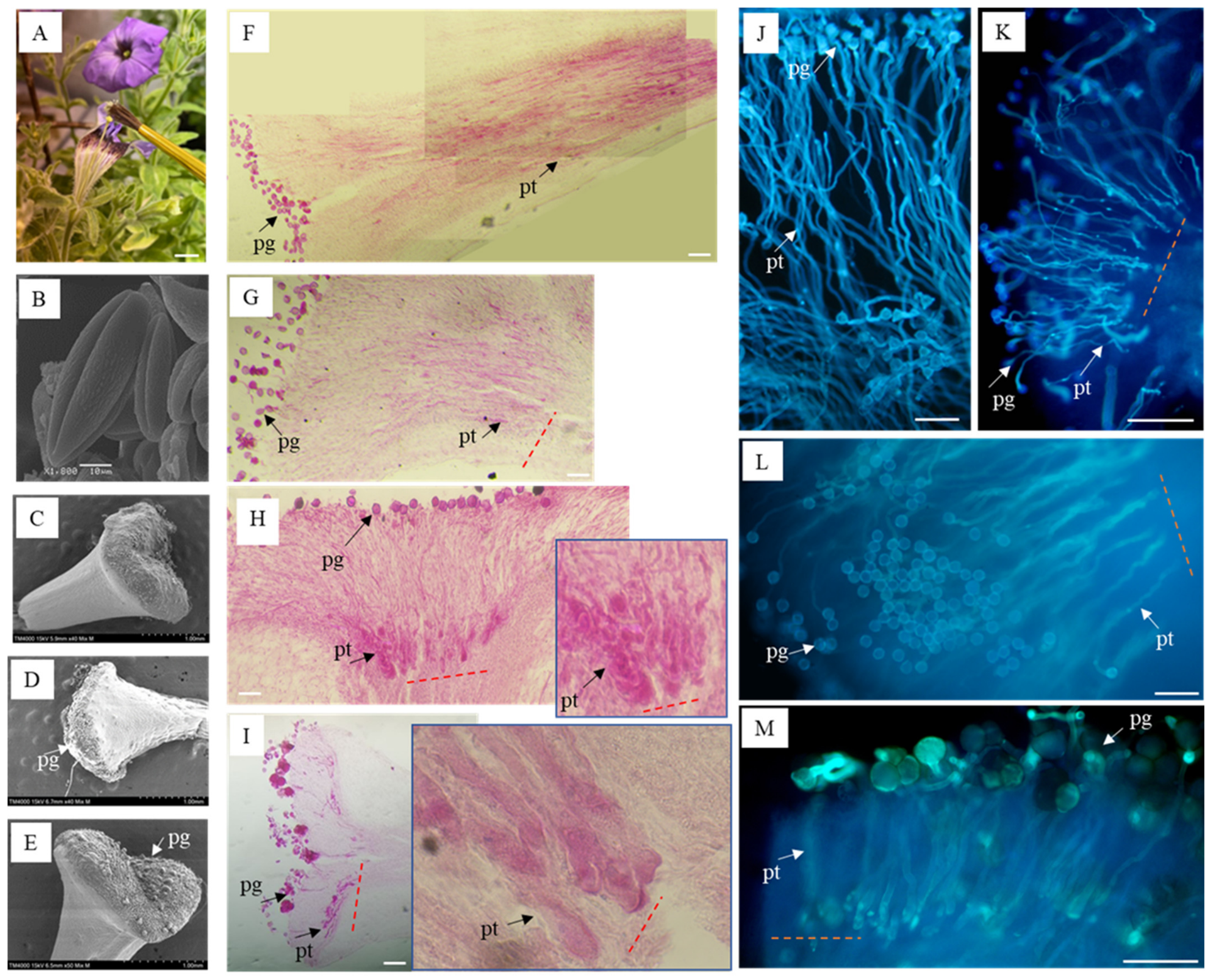
P. hybrida is a highly convenient model for studying the processes of pollination and fertilization. It has large flowers, pistils, and rather large pollen (Figure 1A,B). The pistil is located at the center of the flower and serves to receive and transport pollen to the ovules. Petunia, like all members of the Solanaceae, possesses a wet stigma covered with exudate (Figure 1C–E), and one day before flower opening the system is fully ready for pollination; it is here that pollen lands and the processes of adhesion, hydration, and germination occur.
In the case of compatible pollination of petunia, we observe normal germination and growth of PTs in the transmitting tissues of the pistil (Figure 1F,J); after approximately 30 h the PTs reach the ovary, where fertilization occurs, subsequently leading to seed set. In the case of self-incompatible pollination, pollen germinates on the stigma, grows through the transmitting tissues of the stigma and style, and arrests its growth 6–8 h after pollination at a distance of 8 mm from the stigma surface, when using aniline blue staining and the preparation of macerated, squashed specimens. When Feulgen staining and sectioned preparations are employed, the PT length appears considerably shorter, amounting to about 3–4 mm from the stigma surface (Figure 1G), because this method does not involve the stretching (straightening) of PTs. In the pistil tissues, PTs grow by winding between the cells of the transmitting tract.
When petunia pistils are pollinated with pollen from plants of other genera—N. tabacum (Figure 1D), S. sinuata (Figure 1E)—no visible surface differences from self-pollination are observed using scanning electron microscopy. In the study of PT growth in pistil transmitting tissues (aniline blue staining and Feulgen staining), pollen germination on the stigma and PT growth in the transmitting tissues occur in all cases, and we subsequently observe PT growth arrest. In the case of distant hybridization P. hybrida (SI) ♀ × N. tabacum ♂, PTs arrest their growth at a distance of 300 µm from the stigma surface approximately 6 h after pollination (Figure 1H,L; Table 1) and remain at roughly the same level by 24 h after pollination. When the pistil of self-compatible petunia is pollinated with tobacco pollen (P. hybrida (SC) ♀ × N. tabacum ♂), PTs attain a greater length and arrest their growth 6 h after pollination at a distance of 1 mm from the stigma surface (Table 1). In the hybridization P. hybrida (SI) ♀ × S. sinuata ♂, PTs also reach a length of 300 µm, as with tobacco pollen, and arrest their growth 6 h after pollination (Figure 1I,M; Table 1). When the pistil of self-compatible petunia is pollinated with S. sinuata pollen (P. hybrida (SC) ♀ × S. sinuata ♂), PTs attain a greater length and arrest their growth 6 h after pollination at a distance of approximately 1 mm from the stigma surface (Table 1). The shortest PTs were those of S. lycopersicum growing in the transmitting tissues of self-incompatible P. hybrida pistils; they reached a length of 200 µm from the stigma surface (Figure 1K; Table 1), whereas when the pistil of self-compatible petunia is pollinated, PTs attain a length 2–3 times greater (600–700 µm) (Table 1).
To compare the extent of pollen tube growth arrest among all pollination types, a Welch’s one-way ANOVA was conducted on PT lengths at 24 h after pollination across all 17 cross combinations. The analysis revealed highly significant differences among groups (F16,68.5 = 218.7, p = 5.6 × 10⁻¹⁸). Games–Howell post hoc test was applied for all pairwise comparisons (Table 1).
PT length in self-incompatible P. hybrida (8596 ± 323 µm) was significantly greater than in all intergeneric crosses (p < 0.001 for each comparison), with no exceptions. Even the longest intergeneric PTs—P. hybrida (SC) × S. sinuata (1146 ± 150 µm) and P. hybrida (SC) × N. tabacum (1005 ± 96 µm)—were approximately 8-fold shorter than SI-arrested PTs, indicating that the barrier in distant hybridization is substantially stronger than the S-RNase-based SI response of P. hybrida.
Similarly, PT length in self-incompatible S. pennellii (5898 ± 402 µm) was significantly greater than in all intergeneric crosses (p < 0.001), with a single exception: N. tabacum ♀ × P. hybrida (SI) ♂ (6021 ± 212 µm) did not differ significantly from the S. pennellii SI control (p = 0.73). This result suggests that this particular intergeneric combination permits PT growth comparable to a self-incompatible response.

3.2. Pollination of Tomato Pistils by Pollen from Other Genera of Solanaceae Plants

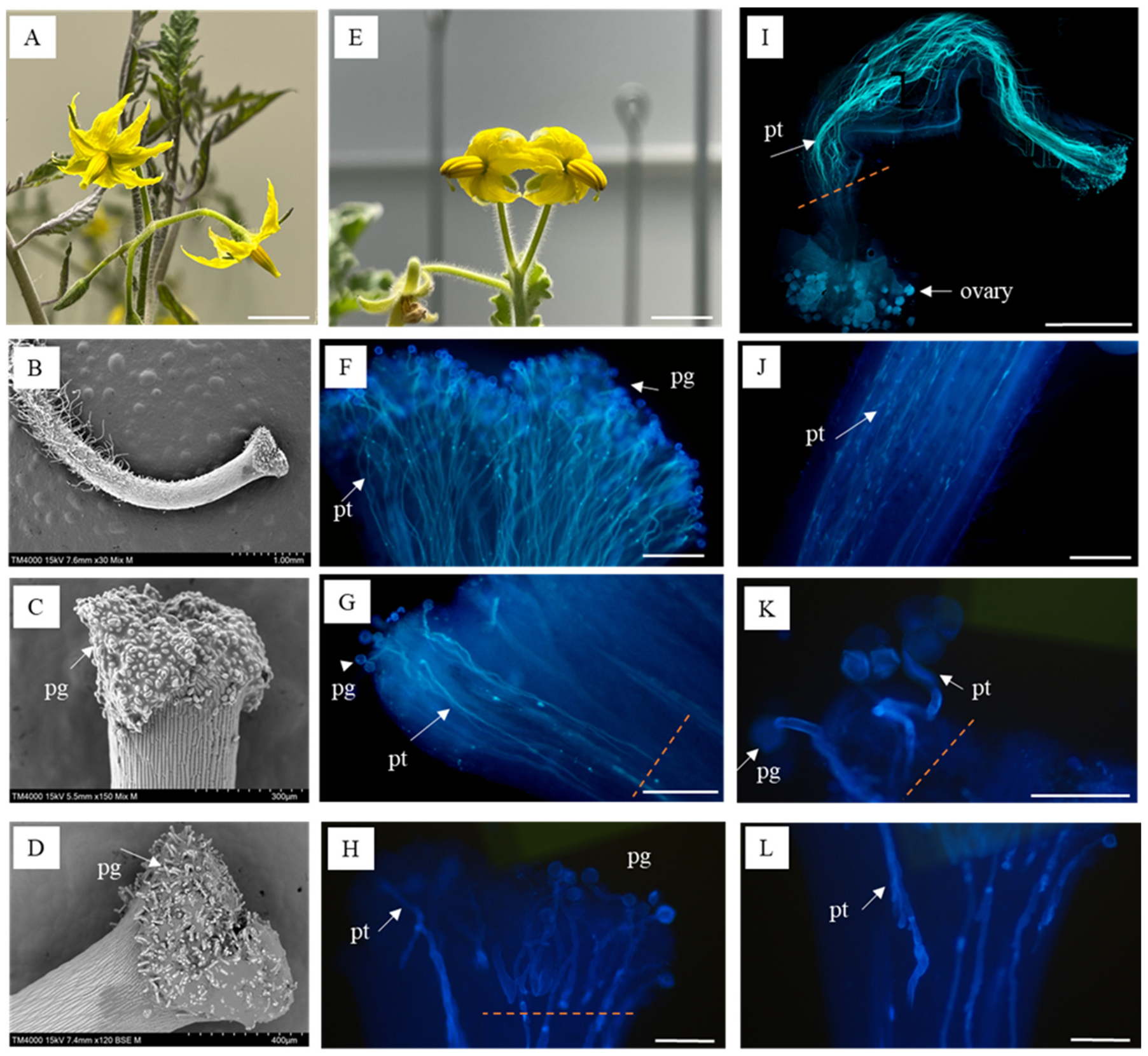
Tomato flowers are much smaller than those of petunia (Figure 2A,E). In all tomato species, as well as in S. pennellii (Figure 2B), the stigma is wet, covered with viscous exudate; during self-pollination, as in petunia, PT germination and growth through the transmitting tissues of the pistil are observed, but PT length differs depending on the tomato species. During self-pollination of the SI species S. pennellii, PTs arrest their growth at a distance of approximately 6 mm from the stigma surface 6 h after pollination (Figure 2I; Table 1). In contrast, during self-pollination of S. lycopersicum cv. Blush, PTs grow through the transmitting tissues of the pistil and reach the ovary after 24 h, where fertilization and subsequent seed set occur (Figure 2F,J).
In variants where S. lycopersicum pistils were pollinated with pollen from distant genera, we observe both clear similarities and differences compared to the processes occurring during self-incompatible pollination. In all cross combinations, pollen grains germinate on the stigma, grow through the transmitting tissues of the pistil, and arrest their growth in the style. No visible surface differences between self-pollination and distant hybridization are observed (Figure 2B–D). In the cross S. lycopersicum ♀ × P. hybrida (SC) ♂, PTs arrest their growth 6 h after pollination at a distance of 400 µm from the stigma surface (Figure 2G). When pollinated with self-incompatible petunia pollen, PTs attain a greater length (2 mm from the stigma surface) (Table 1). In the cross S. lycopersicum ♀ × N. tabacum ♂, PTs also arrest their growth 6 h after pollination at a distance of 300–400 µm from the stigma surface (Figure 2H,L); however, in this hybridization, PT growth arrest is highly uneven—some tubes reach a length of 2 mm from the stigma surface (Figure 2L), but these are sporadic and were disregarded when calculating the results. In the hybridization S. lycopersicum ♀ × S. sinuata ♂, PTs reach a length of approximately 150 µm and arrest their growth 4–6 h after pollination (Figure 2K; Table 1).

3.3. Pollination of Tobacco and Salpiglossis Pistils by Pollen from Other Genera of Solanaceae Plants

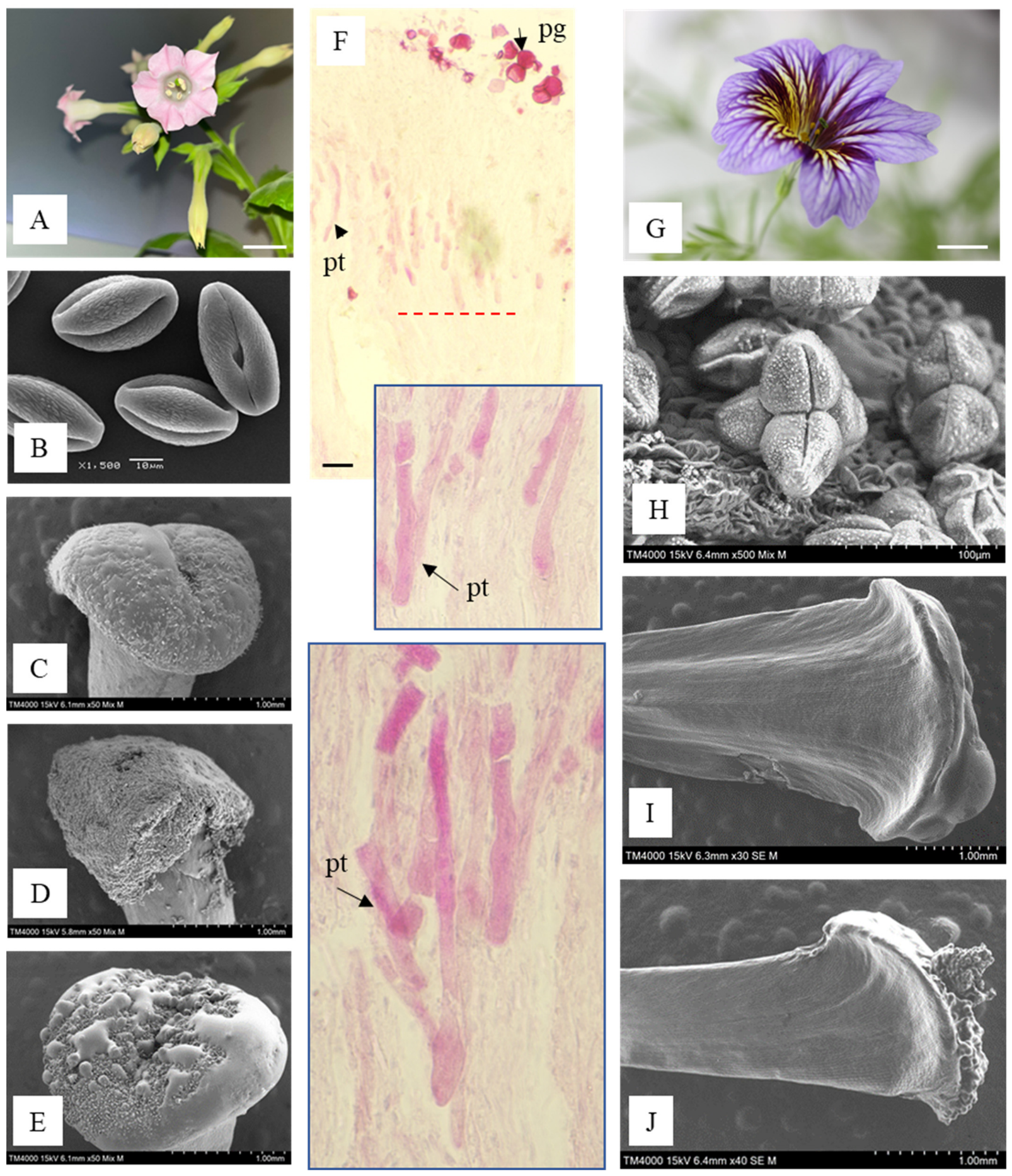
Crosses were also performed with tobacco and Salpiglossis plants (Figure 3). The flowers of both plants are rather ornamental, large, and convenient for experimental work (Figure 3A,G). The stigmas of tobacco and Salpiglossis, like those of all Solanaceae representatives, are covered with wet exudate (Figure 3C,I). The pollen grain morphology of tobacco (Figure 3B) is similar to that of petunia (Figure 1B), whereas the pollen grain morphology of Salpiglossis (Figure 3H) differs from that of other family members; the pollen grains are assembled into conglomerates of four grains.
The result of the cross N. tabacum ♀ × P. hybrida (SI) ♂ was the arrest of PT growth 6–8 h after pollination at a distance of 6 mm from the stigma surface (Table 1). Salpiglossis pollen tubes (N. tabacum ♀ × S. sinuata ♂) arrested their growth at a distance of 500 µm from the stigma surface, also 6 h after pollination (Figure 3F; Table 1).
Thus, we observe an obvious similarity between the processes of pollen grain germination and PT growth during S-RNase-type self-incompatibility in petunia and tomato and during distant hybridization in Solanaceae plants. Pollen grains landing on the stigma undergo the stages of adhesion, hydration, and germination; subsequently, they grow through the transmitting tissues of the pistil and arrest their growth in the upper parts of the style. Differences exist in the timing of PT growth arrest, their growth rate, and their length, depending on the type of pollination.

4. Discussion

Plants possess numerous strategies for controlling the type of pollen that reaches the stigma. Many factors, such as flower color or the time of day when the flower is open, can influence pollinator interactions and, consequently, the type of pollen received [6]. Once pollen lands on the stigma, biochemical interactions become the primary means of controlling fertilization. These interactions are critical for the success of the species. It is essential to distinguish undesirable pollen from desirable pollen that can lead to successful fertilization. It is equally necessary to arrest the growth of undesirable pollen or to support the growth of desirable pollen. Pollen–pistil interactions that meet these needs enable plants to control their mating and, therefore, their evolutionary success [5,7].
Prezygotic intergeneric reproductive barriers encompass one or more of the many stages of pollen–pistil interaction, beginning with pollen deposition on the stigma surface, proceeding through the progamic phase of fertilization, and culminating in egg cell fertilization [8]. The stigma surface serves as a receptor site for triggering mechanisms associated with pollination and fertilization and is the initial point at which incompatibility is determined. Pollen–pistil interaction includes pollen grain adhesion, hydration, germination, PT penetration into the stigma, PT growth into the style, and the potential for subsequent gamete fusion. At any of these described stages, important intergeneric hybridization barriers can operate in plants [9,10]. These interactions are crucial because pollen from distantly related plant species is either not recognized by the stigma cells or is recognized as foreign and is unable to germinate PTs and/or penetrate the stigma/style.
As the genetic distance between species, and even more so between genera, increases, pollination failure is most often attributed by researchers to pollen–pistil incongruity [11]. However, in the case of Solanaceae, it is unlikely that pollination failure is due to gross differences in pollen and pistils, because, as our results demonstrate, in all cross combinations pollen germinates on the stigma and grows through the transmitting tissues of the style. Moreover, in these cases the entire progamic phase of fertilization closely resembles the SI phenomenon. Here, knowledge of SI systems can provide insight into the control of pollen flow between species/genera.
In compatible crosses, the pollen grain germinates on the stigma, producing a pollen tube that grows through the style and penetrates the ovary to fertilize the egg cell [12]. In several wild tomato species, two types of pollen–pistil incompatibility systems exist that involve PT rejection in the pistil. First, SI can prevent inbreeding by rejecting self-pollen tubes. In Solanaceae plants, SI depends on the interaction of S-locus-encoded S-RNases expressed in the pistil and F-box proteins expressed in the pollen, as well as non-S-locus factors such as HT-proteins of the pistil and components of the SCF ubiquitin ligase complex of the pollen, including Cullin1 (CUL1) [12,13]. The relatively few studies that have analyzed PT growth in interspecific crosses are limited in scope, as usually only the domesticated species S. lycopersicum has been used in reciprocal crosses with wild species [14,15,16,17].
Second, in some interspecific crosses, unilateral incompatibility (UI) arises, in which pollination is compatible in one direction and incompatible in the other [18]. Thus, UI barriers contribute to the reproductive isolation of species. Studies in Solanaceae have shown that UI generally follows the “SI × SC” rule, according to which pollen tubes of a self-compatible (SC) species are rejected in the styles of self-incompatible (SI) species, whereas in the reciprocal cross, PTs of self-incompatible species successfully fertilize the ovules of self-compatible species [17]. Therefore, in this scenario, many molecular mechanisms are thought to be shared between the UI and SI systems [18,19], demonstrating that a fully functional SI system is not required for PT rejection in interspecific crosses.
Heslop-Harrison and Heslop-Harrison [20] conducted studies attempting to examine pollen–pistil interactions at the level of PT germination in wide crosses of rice. The rice stigma is a papillate structure and forms the initial basis for interaction with incoming pollen. Stigma–pollen interaction is a highly specialized system that favors specific genotypic combinations [21]. Pollen adhesion to the stigma, its germination, and PT growth through the stigma and style are achieved if a compatible combination is established. In the case of an incompatible reaction, the PT can be arrested by callose deposition as it grows through the transmitting tract of the style. Subsequently, callose (β-1,3-glucan) often accumulates at the PT tip. Callose deposition is associated with various functions, including plant defense responses, where it is useful for binding antimicrobial compounds [22]. Callose is also deposited on the primary cell wall of meiocytes, tetrads, and microspores and is required for exine formation in the pollen wall [23]. Thus, callose acts as both a molecular filter and a physical barrier. PTs contain callose in their walls and in the plugs that segment the growing tubes. During PT penetration, callose may serve as a sealant against leakage and as a physical barrier depending on whether the reaction is compatible or incompatible.
The study by Kaur et al. [23] showed that rice × rice crosses exhibit less callose accumulation compared with rice × maize and rice × millet crosses, highlighting the difference between compatible and incompatible fertilization reactions. Compatible PTs display small, intermittent, widely spaced callose plugs, in contrast to the heavy callose accumulation in incompatible PTs.
In our studies, morphological changes at the PT tips are frequently observed during distant hybridization, appearing as various swellings (Figure 1H,I (insets); Figure 2H,L; Figure 3F (insets)). PT abnormalities are a common cause of fertilization failure in distant hybridization and a major factor contributing to pre-fertilization barriers and low seed set rates in plants. Indeed, callose accumulation at the tip is regarded as a manifestation of pollen growth inhibition [23,24]. The main causes of fertilization failure in crosses between Cucurbita moschata and C. pepo are callose formation at the PT tip and slow PT development [25]. In the incompatible combination of Chaenomeles japonica, the PT grows slowly and usually stagnates in the style, with abundant callose deposition at the tube tip [26]. In our studies, we also observed callose deposition at the PT tips; this phenomenon is particularly evident during pollination of P. hybrida (SI) ♀ × S. sinuata ♂ (Figure 1M, bright fluorescence of PT tips).
Although the stigma is receptive during flowering, in some plants it may be receptive for only a few hours after anthesis begins [27]. Thus, stigma receptivity is considered another important parameter for successful pollination [27]. Stigma receptivity is usually studied by measuring the activity of specific enzymes, such as esterases, peroxidases, acid phosphatases, and dehydrogenases, on the stigma [28]. In addition, stigma morphoanatomy is used to determine receptivity [29]. Stigma exudates provide the environmental conditions for pollen germination on the stigma. Analysis of the relationship between stigma receptivity, stigma exudates, and stigma structure can help assess stigma viability. Breeding barriers can arise at different stages of the pollination, fertilization, and embryogenesis processes and are related to hybridization efficiency. These barriers mainly include the inability of pollen grains to germinate on the stigma and the arrest of PT growth and penetration. The stigmas of Solanaceae plants secrete wet exudate (Figure 1C,E; Figure 2B–D; Figure 3C–E,I,J) and are fully ready for pollination already on the eve of flower opening and, as we observe, do not constitute an obstacle to pollen grain germination.
Thus, pollen–pistil interactions create intergeneric barriers of prezygotic hybridization in plants [30]. The mechanisms underlying this hybridization barrier are largely unknown. Research on reproductive barriers is important for elucidating the divergence of plant species during evolution as well as their self-fertilization mechanisms [31]. From a breeding perspective, wild relatives often possess useful agronomic traits, including disease resistance, tolerance to biotic and abiotic stresses, and resilience that can enable new varieties to adapt to diverse environmental conditions [32].
Research on this topic contributes to understanding the mechanisms and developing approaches to overcome problems associated with intergeneric hybridization in plant biology and breeding. The current understanding of how pollen, PT, and pistil tissue interactions function as intergeneric hybridization barriers is very limited. The interactions and the underlying molecular mechanism remain unexplored to date. Studying the reproductive barrier is an important task and a promising direction for future research. Unraveling the mechanisms of incompatibility in the pollen–pistil system is a valuable tool for future crop breeding [33].
In particular, investigating the role of S-RNases in interspecific pollen rejection may be especially fruitful. S-RNases play a central role in the SI of many plants, and their evolutionary conservation suggests that they may also participate in interspecific interactions [34]. Differences in S-RNase sequences between species may determine the specificity of pollen–stigma interaction, leading to the rejection of foreign pollen. Examination of these differences and their influence on S-RNase function may shed light on the mechanisms controlling interspecific pollination [35]. An interesting pattern emerged in our studies when comparing crosses involving self-compatible and self-incompatible forms of petunia. When pistils of the self-incompatible form of petunia were pollinated with pollen from tobacco, Salpiglossis, and tomato, PTs were 2–3 times shorter than when the self-compatible form was pollinated (Table 1). Conversely, when tomato pistils were pollinated with pollen from the self-incompatible form of petunia, PTs attained much greater lengths than when pollinated with pollen from the self-compatible form. These observations are highly intriguing and require further, more in-depth investigation.
Promising research directions include the study of other components involved in the SI signaling pathway and distant hybridization. S-RNase partner proteins, as well as factors affecting their localization and activity, may be involved in the recognition and rejection of foreign pollen [35]; the roles of phytohormones, arabinogalactan proteins, reactive oxygen species, programmed cell death, and a multitude of other aspects have not yet been studied in the context of distant hybridization. Analysis of gene expression in different species and their interactions during interspecific crosses can provide valuable information on the molecular mechanisms underlying intergeneric incompatibility.

5. Conclusions

The study of intergeneric pollen rejection represents a complex but important area of research. By leveraging knowledge gained from SI systems and taking ecological factors into account, significant progress can be made in understanding the mechanisms controlling distant hybridization and in assessing the consequences for plant evolution and biodiversity conservation. Our results will serve as a foundation for further studies aimed at identifying the mechanisms that control pollen–pistil interactions in intergeneric crosses.
Our studies have shown that the initiation of PT growth during distant hybridization proceeds in a manner analogous to that observed during normal compatible pollination, SI, and distant hybridization alike. The process of PT growth arrest can differ in timing, growth rate, and PT length. All these parameters are similar to the growth arrest of self-incompatible PTs in pistil tissues. The morphology, cytological changes at the PT tip, and callose deposition most likely occur in a similar fashion during both the functioning of the SI mechanism and the operation of reproductive barriers in distant hybridization, although these aspects require more in-depth investigation. Our results confirm the existence of substantial parallels between the mechanisms governing pollen–pistil interactions during SI and distant hybridization. Pollen grains landing on the stigma undergo the stages of adhesion, hydration, and germination; subsequently, they grow through the transmitting tissues of the pistil and arrest their growth in the upper parts of the style. Differences exist in the timing of PT growth arrest, their growth rate, and their length depending on the type of pollination. Nevertheless, it is important to note that these effects may involve additional components and pathways not accounted for in current models.
Our findings underscore the necessity of investigating the regulatory networks that shape the pollen response during SI and distant hybridization and provide a basis for future work aimed at identifying key genes and signaling pathways that play important roles in the formation of reproductive barriers during distant hybridization. The discovery of such mechanisms may ultimately contribute to improving the productivity and resilience of agriculturally important Solanaceae species.

Author Contributions

Conceptualization, E.V.Z.; experiments performed by A.I.U., N.A.M., T.P.M., Y.Y.G., O.A.M., Y.V.O. and E.V.Z.; data curation, A.I.U., T.P.M., E.V.Z., O.A.M.; funding acquisition, E.V.Z.; visualization, E.V.Z., Y.Y.G., N.A.M. and Y.V.O.; statistical analysis, T.P.M.; supervision, E.V.Z. All authors have read and agreed to the published version of the manuscript.

Funding

This research was funded by the Russian Science Foundation (project No. 26-16-00147).

Data Availability Statement

The original contributions presented in this study are included in the article. Further inquiries can be directed to the corresponding author.

Conflicts of Interest

The authors declare no conflicts of interest.

Abbreviations

The following abbreviations are used in this manuscript:
RBReproductive barrier
PGPollen grain
PTPollen tube
SISelf-incompatibility
SCSelf-compatible
UIUnilateral incompatibility
PCDProgrammed cell death
SEMScanning Electron Microscopy

References

  1. Franklin-Tong, V.E. Self-Incompatibility in Flowering Plants; Springer: Berlin/Heidelberg, Germany, 2008. [Google Scholar]
  2. Lin, Z.; Bosch, M.; Franklin-Tong, V.E. Several Plant Self-Incompatibility Systems May Be Controlled by Atypical Receptor-Ligand Interactions. bioRxiv 2026. [Google Scholar] [CrossRef]
  3. Bosch, M.; Franklin-Tong, V.E. Self-Incompatibility in Papaver: Signalling to Trigger PCD in Incompatible Pollen. J. Exp. Bot. 2008, 59, 481–490. [Google Scholar] [CrossRef] [PubMed]
  4. Zakharova, E.V.; Timofeeva, G.V.; Fateev, A.D.; Kovaleva, L.V. Caspase-like Proteases and the Phytohormone Cytokinin as Determinants of S-RNase-Based Self-Incompatibility-Induced PCD in Petunia hybrida L. Protoplasma 2021, 258, 573–586. [Google Scholar] [CrossRef] [PubMed]
  5. Zakharova, E.V.; Ulianov, A.I.; Golivanov, Y.Y.; Molchanova, T.P.; Orlova, Y.V.; Muratova, O.A. Pollen–Pistil Interaction During Distant Hybridization in Plants. Agronomy 2025, 15, 1732. [Google Scholar] [CrossRef]
  6. Sargar, P.; Deshmukh, S.; Naik, G. Distant Hybridization. In Elements of Plant Breeding; Selfypage Developers Pvt Ltd.: Chikkamagaluru, India, 2023; Volume 1, pp. 47–62. [Google Scholar]
  7. Bedinger, P.A.; Broz, A.K.; Tovar-Mendez, A.; McClure, B. Pollen-Pistil Interactions and Their Role in Mate Selection. Plant Physiol. 2017, 173, 79–90. [Google Scholar] [CrossRef] [PubMed]
  8. Berbeć, A. Experimental Interspecific Hybrids in Nicotiana and Barriers to Hybridization. In A Century of Interspecific Hybridization and Introgression in Tobacco; Berbeć, A., Ed.; Springer Nature: Cham, Switzerland, 2024; pp. 31–115. [Google Scholar]
  9. Huang, J.; Yang, L.; Yang, L.; Wu, X.; Cui, X.; Zhang, L.; Hui, J.; Zhao, Y.; Yang, H.; Liu, S.; et al. Stigma Receptors Control Intraspecies and Interspecies Barriers in Brassicaceae. Nature 2023, 614, 303–308. [Google Scholar] [CrossRef] [PubMed]
  10. Moon, S.; Jung, K.-H. First Steps in the Successful Fertilization of Rice and Arabidopsis: Pollen Longevity, Adhesion and Hydration. Plants 2020, 9, 956. [Google Scholar] [CrossRef] [PubMed]
  11. Eberle, C.A. Interspecific Prezygotic Reproductive Barriers in Nicotiana. Ph.D. Thesis, University of Minnesota, Minneapolis, MN, USA, 2012. [Google Scholar]
  12. Covey, P.A.; Kondo, K.; Welch, L.; Frank, E.; Sianta, S.; Kumar, A.; Nuñez, R.; Lopez-Casado, G.; Van Der Knaap, E.; Rose, J.K.C.; et al. Multiple Features That Distinguish Unilateral Incongruity and Self-Incompatibility in the Tomato Clade: Unilateral Pollen Rejection in Tomato. Plant J. 2010, 64, 367–378. [Google Scholar] [CrossRef] [PubMed]
  13. Covey, P.A.; Subbaiah, C.C.; Parsons, R.L.; Pearce, G.; Lay, F.T.; Anderson, M.A.; Ryan, C.A.; Bedinger, P.A. A Pollen-Specific RALF from Tomato That Regulates Pollen Tube Elongation. Plant Physiol. 2010, 153, 703–715. [Google Scholar] [CrossRef] [PubMed]
  14. Kubo, K.; Entani, T.; Takara, A.; Wang, N.; Fields, A.M.; Hua, Z.; Toyoda, M.; Kawashima, S.; Ando, T.; Isogai, A.; et al. Collaborative Non-Self Recognition System in S-RNase-Based Self-Incompatibility. Science 2010, 330, 796–799. [Google Scholar] [CrossRef] [PubMed]
  15. Liedl, B.E.; McCormick, S.; Mutschler, M.A. Unilateral Incongruity in Crosses Involving Lycopersicon pennellii and L. esculentum Is Distinct from Self-Incompatibility in Expression, Timing and Location. Sex. Plant Reprod. 1996, 9, 299–308. [Google Scholar] [CrossRef]
  16. Martin, F.W. Distribution and Interrelationships of Incompatibility Barriers in the Lycopersicon hirsutum Humb. and Bonpl. Complex. Evolution 1963, 17, 519–528. [Google Scholar] [CrossRef]
  17. Baek, Y.S.; Covey, P.A.; Petersen, J.J.; Chetelat, R.T.; McClure, B.; Bedinger, P.A. Testing the SI × SC Rule: Pollen–Pistil Interactions in Interspecific Crosses between Members of the Tomato Clade (Solanum Section Lycopersicon, Solanaceae). Am. J. Bot. 2015, 102, 302–311. [Google Scholar] [CrossRef] [PubMed]
  18. Murfett, J.; Strabala, T.J.; Zurek, D.M.; Mou, B.; Beecher, B.; McClure, B.A. S RNase and Interspecific Pollen Rejection in the Genus Nicotiana: Multiple Pollen-Rejection Pathways Contribute to Unilateral Incompatibility between Self-Incompatible and Self-Compatible Species. Plant Cell 1996, 8, 943–958. [Google Scholar] [CrossRef] [PubMed]
  19. Li, W.; Chetelat, R.T. Unilateral Incompatibility Gene Ui1.1 Encodes an S-Locus F-Box Protein Expressed in Pollen of Solanum Species. Proc. Natl. Acad. Sci. USA 2015, 112, 4417–4422. [Google Scholar] [CrossRef] [PubMed]
  20. Heslop-Harrison, J.; Heslop-Harrison, Y. Enzymic Removal of the Proteinaceous Pellicle of the Stigma Papilla Prevents Pollen Tube Entry in the Caryophyllaceae. Ann. Bot. 1975, 39, 163–165. [Google Scholar] [CrossRef]
  21. Luna, R.; Guzmán-Merodio, D.; Núñez-Farfán, J.; Philbrick, C.T.; Collazo-Ortega, M.; Márquez-Guzmán, J. Cross Compatibility between Marathrum rubrum and Marathrum schiedeanum (Podostemaceae), Two Closely Related Species of the Pacific Mexican Coast. Aquat. Bot. 2012, 102, 1–7. [Google Scholar] [CrossRef]
  22. Dong, H.; Pei, W.; Haiyun, R. Actin Fringe Is Correlated with Tip Growth Velocity of Pollen Tubes. Mol. Plant 2012, 5, 1160–1162. [Google Scholar] [CrossRef] [PubMed]
  23. Kaur, K.; Gupta, M.; Vikal, Y.; Singh, K.; Neelam, K. Callose Depositions Underlie the Incompatible Reaction in Intergeneric Crosses of Rice. Plant Genet. Resour. 2021, 19, 447–452. [Google Scholar] [CrossRef]
  24. Ke, M.; Si, H.; Qi, Y.; Sun, Y.; El-Kassaby, Y.A.; Wu, Z.; Li, S.; Liu, K.; Yu, H.; Hu, R.; et al. Characterization of Pollen Tube Development in Distant Hybridization of Chinese Cork Oak (Quercus variabilis L.). Planta 2023, 258, 110. [Google Scholar] [CrossRef] [PubMed]
  25. Kwack, S.N.; Fujieda, K. Pollen Tube Growth and Embryo Development in Interspecific Crosses of Cucurbita. J. Fac. Agric. Kyushu Univ. 1985, 29, 1–8. [Google Scholar] [CrossRef] [PubMed]
  26. Kaufmane, E.; Rumpunen, K. Pollination, Pollen Tube Growth and Fertilization in Chaenomeles japonica (Japanese Quince). Sci. Hortic. 2002, 94, 257–271. [Google Scholar] [CrossRef]
  27. Soares, T.L.; de Jesus, O.N.; de Souza, E.H.; de Oliveira, E.J. Floral Development Stage and Its Implications for the Reproductive Success of Passiflora L. Sci. Hortic. 2018, 238, 333–342. [Google Scholar] [CrossRef]
  28. Figueiredo, R.; Lopes, A.; Pereira, A.M.; Moreira, D.; Silva, J.; Ferreira, M.J.; Coimbra, S.; Pereira, L.G. The Biology of Arabinogalactan Proteins in Plant Abiotic Stress and Reproduction. In Plant Cell Walls; CRC Press: Boca Raton, FL, USA, 2023; pp. 323–339. [Google Scholar]
  29. Souza, E.H.; Souza, F.V.D.; Rossi, M.L.; Packer, R.M.; Cruz-Barros, M.A.V.; Martinelli, A.P. Pollen Morphology and Viability in Bromeliaceae. An. Acad. Bras. Ciênc. 2017, 89, 3067–3082. [Google Scholar] [CrossRef] [PubMed]
  30. Boavida, L.C.; Silva, J.P.; Feijó, J.A. Sexual Reproduction in the Cork Oak (Quercus suber L.). II. Crossing Intra- and Interspecific Barriers. Sex. Plant Reprod. 2001, 14, 143–152. [Google Scholar] [CrossRef]
  31. Goulet, B.E.; Roda, F.; Hopkins, R. Hybridization in Plants: Old Ideas, New Techniques. Plant Physiol. 2017, 173, 65–78. [Google Scholar] [CrossRef] [PubMed]
  32. Callaway, T.D.; Singh-Cundy, A. HD-AGPs as Speciation Genes: Positive Selection on a Proline-Rich Domain in Non-Hybridizing Species of Petunia, Solanum, and Nicotiana. Plants 2019, 8, 211. [Google Scholar] [CrossRef] [PubMed]
  33. Nasrallah, J.B. Stop and Go Signals at the Stigma–Pollen Interface of the Brassicaceae. Plant Physiol. 2023, 193, 927–948. [Google Scholar] [CrossRef] [PubMed]
  34. Zhang, D.; Li, Y.-Y.; Zhao, X.; Zhang, C.; Liu, D.-K.; Lan, S.; Yin, W.; Liu, Z.-J. Molecular Insights into Self-Incompatibility Systems: From Evolution to Breeding. Plant Commun. 2024, 5, 100719. [Google Scholar] [CrossRef] [PubMed]
  35. Guo, Y.; Zhang, Y.; Wang, Y.; Zhao, G.; Jia, W.; He, S. Interspecific Hybridization Barrier Between Paeonia ostii and P. ludlowii. Plants 2025, 14, 1120. [Google Scholar] [CrossRef] [PubMed]
Figure 1. Characteristics of PT growth in petunia pistil transmitting tissues during self-pollination and distant hybridization: (A) hybridization procedure, controlled pollination of P. hybrida (SI) (Bar = 1 cm); (B) pollen of P. hybrida (SI) (SEM); (C) pistil of P. hybrida (SI), self-incompatible pollination (SEM); (D) pistil of P. hybrida (SI) pollinated with N. tabacum pollen (SEM); (E) pistil of P. hybrida (SI) pollinated with S. sinuata pollen (SEM); (F) self-compatible pollination of P. hybrida (SC) (Feulgen staining, collage of several photographs). PTs growing through the transmitting tissues of the stigma and style are visible (Bar = 100 µm); (G) self-incompatible pollination of P. hybrida (SI) (Feulgen staining) (Bar = 100 µm). Pollen tubes arrest their growth in the upper part of the style; the arrest site is indicated by the red dashed line; (H) distant hybridization, pollination of P. hybrida (SI) ♀ × N. tabacum ♂ (Feulgen staining) (Bar = 100 µm). Pollen tubes arrest their growth in the upper part of the style; the arrest site is indicated by the red dashed line. Insets in dark frames show PT fragments at higher magnification, with swollen PT tips visible at the arrest point; (I) distant hybridization, pollination of P. hybrida (SI) ♀ × S. sinuata ♂ (Feulgen staining) (Bar = 100 µm). Pollen tubes arrest their growth in the upper part of the style; the arrest site is indicated by the red dashed line. Insets in dark frames show PT fragments at higher magnification, with swollen PT tips visible at the arrest point; (J) self-compatible pollination of P. hybrida (fluorescence microscopy, aniline blue staining) (Bar = 100 µm); (K) distant hybridization P. hybrida (SI) ♀ × S. lycopersicum (fluorescence microscopy, aniline blue staining) (Bar = 100 µm). Pollen tubes arrest their growth in the upper part of the style; the arrest site is indicated by the red dashed line; (L) distant hybridization, pollination of P. hybrida (SI) ♀ × N. tabacum ♂ (fluorescence microscopy, aniline blue staining) (Bar = 100 µm). Pollen tubes arrest their growth in the upper part of the style; the arrest site is indicated by the red dashed line; (M) distant hybridization P. hybrida (SI) ♀ × S. sinuata ♂ (Bar = 100 µm). Pollen tubes arrest their growth in the upper part of the style; the arrest site is indicated by the red dashed line. pg—pollen grain, pt—pollen tube.
Agronomy 16 01326 g001
Figure 2. Characteristics of PT growth in tomato pistil transmitting tissues during self-pollination and distant hybridization. (A) Flowers of S. lycopersicum cv. Blush. Bar = 1 cm; (B) unpollinated pistil of S. lycopersicum cv. Blush (SEM); (C) self-pollination of S. lycopersicum cv. Blush (SEM); (D) distant hybridization S. lycopersicum ♀ × P. hybrida (SC) ♂ (SEM); (E) Flowers of S. pennellii. Bar = 1 cm; (F,J) self-compatible pollination of S. lycopersicum, fluorescence microscopy, aniline blue staining (Bar = 100 µm); (G) distant hybridization S. lycopersicum ♀ × P. hybrida (SC) ♂, fluorescence microscopy, aniline blue staining (Bar = 100 µm). PTs arrest their growth in the upper part of the style; the arrest site is indicated by the red dashed line; (H,L) distant hybridization S. lycopersicum ♀ × N. tabacum ♂, fluorescence microscopy, aniline blue staining (Bar = 100 µm). PTs arrest their growth in the upper part of the style; the arrest site is indicated by the red dashed line; (I) self-pollination of S. pennellii, fluorescence microscopy, aniline blue staining, panorama from several photographs. PTs arrest their growth in the style; the arrest site is indicated by the red dashed line (Bar = 1000 µm); (K) distant hybridization S. lycopersicum ♀ × S. sinuata ♂, fluorescence microscopy, aniline blue staining (Bar = 100 µm). PTs arrest their growth in the upper part of the style; the arrest site is indicated by the red dashed line. pg—pollen grain, pt—pollen tube.
Agronomy 16 01326 g002
Figure 3. Dynamics of PT growth in vivo during self-pollination and distant hybridization in Salpiglossis and tobacco plants. (A) flowers of N. tabacum (Bar = 1 cm); (B) pollen of N. tabacum (SEM); (C) unpollinated pistil of N. tabacum (SEM); (D) pistil of N. tabacum, self-pollination (SEM); (E) pistil of N. tabacum pollinated with Salpiglossis pollen (SEM); (F) distant hybridization N. tabacum ♀ × S. sinuata ♂ (Feulgen staining). PTs growing through the transmitting tissues of the stigma and style are visible; the PT growth arrest site is indicated by the red dashed line (Bar = 100 µm). Insets in dark frames show PT fragments at higher magnification, with swollen PT tips visible at the arrest point; (G) flowers of S. sinuata (Bar = 1 cm); (H) pollen of S. sinuata (SEM); (I) unpollinated pistil of S. sinuata (SEM); (J) pistil of S. sinuata pollinated with P. hybrida (SI) pollen (SEM). pg—pollen grain, pt—pollen tube.
Agronomy 16 01326 g003
Table 1. Pollen tube length during self-pollination and distant hybridization (µm).
No.Cross CombinationTime After Pollination (h)PT Length (µm)Statistical Group
1S. lycopersicum cv. Blush (self-compatible pollination) ⊗65488 ± 324c
S. lycopersicum cv. Blush (self-compatible pollination) ⊗24Reached the ovary-
2S. pennellii (self-incompatible pollination) ⊗65691 ± 387c
S. pennellii (self-incompatible pollination) ⊗245898 ± 402c
3P. hybrida (SC) (self-compatible pollination) ⊗67322 ± 222b
P. hybrida (SC) (self-compatible pollination) ⊗2417,322 ± 266b
4P. hybrida (SI) (self-incompatible pollination) ⊗67154 ± 199b
P. hybrida (SI) (self-incompatible pollination) ⊗248596 ± 323c
5N. tabacum (self-compatible pollination) ⊗66833 ± 599b
N. tabacum (self-compatible pollination) ⊗2430,500 ± 601a
6P. hybrida (SC) ♀ × N. tabacum ♂ (intergeneric hybridization)6920 ± 66e
P. hybrida (SC) ♀ × N. tabacum ♂ (intergeneric hybridization)241005 ± 96e
7P. hybrida (SI) ♀ × N. tabacum ♂ (intergeneric hybridization)6288 ± 33g
P. hybrida (SI) ♀ × N. tabacum ♂ (intergeneric hybridization)24388 ± 36g
8P. hybrida (SC) ♀ × S. sinuata ♂ (intergeneric hybridization)61036 ± 109e
P. hybrida (SC) ♀ × S. sinuata ♂ (intergeneric hybridization)241146 ± 150e
9P. hybrida (SI) ♀ × S. sinuata ♂ (intergeneric hybridization)6319 ± 33g
P. hybrida (SI) ♀ × S. sinuata ♂ (intergeneric hybridization)24318 ± 17g
10P. hybrida (SC) ♀ × S. lycopersicum ♂ (intergeneric hybridization)6645 ± 57f
P. hybrida (SC) ♀ × S. lycopersicum ♂ (intergeneric hybridization)24689 ± 58f
11P. hybrida (SI) ♀ × S. lycopersicum ♂ (intergeneric hybridization)6150 ± 38h
P. hybrida (SI) ♀ × S. lycopersicum ♂ (intergeneric hybridization)24219 ± 16h
12N. tabacum ♀ × P. hybrida (SI) ♂ (intergeneric hybridization)62000 ± 133d
N. tabacum ♀ × P. hybrida (SI) ♂ (intergeneric hybridization)246021 ± 212c
13N. tabacum ♀ × S. sinuata ♂ (intergeneric hybridization)6467 ± 38f, g
N. tabacum ♀ × S. sinuata ♂ (intergeneric hybridization)24501 ± 23f, g
14S. lycopersicum ♀ × P. hybrida (SI) ♂ (intergeneric hybridization)61567 ± 109d
S. lycopersicum ♀ × P. hybrida (SI) ♂ (intergeneric hybridization)241877 ± 201d
15S. lycopersicum ♀ × P. hybrida (SC) ♂ (intergeneric hybridization)6494 ± 17f, g
S. lycopersicum ♀ × P. hybrida (SC) ♂ (intergeneric hybridization)24501 ± 58f, g
16S. lycopersicum ♀ × S. sinuata ♂ (intergeneric hybridization)6148 ± 10h
S. lycopersicum ♀ × S. sinuata ♂ (intergeneric hybridization)24154 ± 17h
17S. lycopersicum ♀ × N. tabacum ♂ (intergeneric hybridization)6358 ± 67g, h
S. lycopersicum ♀ × N. tabacum ♂ (intergeneric hybridization)24399 ± 154g, h
Data are presented from PT measurements on squashed, macerated, aniline blue-stained pistils.
Disclaimer/Publisher’s Note: The statements, opinions and data contained in all publications are solely those of the individual author(s) and contributor(s) and not of MDPI and/or the editor(s). MDPI and/or the editor(s) disclaim responsibility for any injury to people or property resulting from any ideas, methods, instructions or products referred to in the content.