
Article

Long-Term Fertilizer Postponing Reshapes Spatial and Temporal Patterns of Bacterial Communities and N-Cycling Potential in Paddy Soils

1
National Key Laboratory for Development and Utilization of Forest Food Resources, Zhejiang A&F University, Hangzhou 311300, China
2
Key Laboratory of Soil Remediation and Quality Improvement of Zhejiang Province, Zhejiang A&F University, Hangzhou 311300, China
3
Sanya Institute of Nanjing Agriculture, Jiangsu Collaborative Innovation Center for Modern Crop Production, Key Laboratory of Crop Physiology Ecology and Production Management, Nanjing Agricultural University, Nanjing 210095, China
*
Author to whom correspondence should be addressed.
These authors contributed equally to this work.
Agronomy 2026, 16(13), 1290; https://doi.org/10.3390/agronomy16131290 (registering DOI)
Submission received: 1 May 2026 / Revised: 2 July 2026 / Accepted: 3 July 2026 / Published: 4 July 2026
(This article belongs to the Section Soil and Plant Nutrition)

Abstract

Optimizing nitrogen (N) management is essential for sustaining rice productivity and improving soil N retention in paddy ecosystems, yet whether long-term fertilizer postponing (FP) regulates bacterial community assembly and microbial N-cycling potential in a compartment-dependent manner remains unclear. Using soils from an 11-year field experiment, we investigated bacterial communities and eight N-cycling genes in bulk and rhizosphere soils across three rice growth stages. Compared with conventional fertilization (CF), FP significantly increased grain yield, plant N accumulation, soil NH4+-N (8.1%), microbial biomass N (MBN, 4.3%), and urease activity (30.3%). N-cycling genes showed pronounced temporal variation, generally peaking at the heading stage. FP increased the abundance of genes involved in N fixation, nitrification, and denitrification in bulk soil but reduced most N-cycling genes in the rhizosphere. Although bacterial α-diversity was unchanged, FP significantly altered bacterial community composition. Network and redundancy analysis further showed that bacterial community assembly and N-cycling potential were closely associated with soil C and N status. These findings indicate that long-term FP improves rice productivity by enhancing soil N availability and reshaping bacterial community assembly and microbial N-cycling potential in a compartment-dependent manner, providing new insights into the microbial mechanisms underlying sustainable N management in paddy soils.

1. Introduction

Rice (Oryza sativa L.) is a global staple food whose production must increase significantly by 2050 [1]. Nitrogen (N) is essential for plant growth and productivity. While N fertilization remains essential for maintaining rice productivity, 15N tracer studies have demonstrated that a substantial proportion of plant N uptake originates from soil-derived N released through mineralization processes [2,3]. Microbial immobilization of inorganic N temporarily retains N within the soil N pool and contributes to the regulation of soil N availability [4]. Therefore, optimizing the continuous supply of soil available N is critical for sustainable yield increases.
Soil available N supply is closely associated with functional microorganisms involved in N transformation processes, primarily diazotrophs, nitrifiers, denitrifiers, and heterotrophic decomposers [5]. This supply involves mineralization, nitrification, and denitrification [6]. Microbial N assimilation accounts for up to 80% of total N immobilization, serving as a vital source for future available N supply [7,8]. The key genes regulating these crucial N-supply processes include nitrogen fixation (nifH), nitrification (amoA-a and amoA-b), and denitrification (narG, nirK, nirS, norB, and nosZ) [6]. Because microbial N immobilization is positively correlated with N mineralization and nitrification, factors affecting microbial growth, such as soil physical and nutrient states, fundamentally regulate soil N cycling [9,10].
In paddy soils, rice root activity and rhizosphere processes create distinct microbial microenvironments [11,12,13]. Compared with bulk soil, the rhizosphere harbors significantly different microbial biomass, dominant species abundance, and stable bacterial networks [11,12,14,15]. Consequently, microbe-mediated N transformations vary spatially. For example, the abundance of specific N-cycling genes (nifH, narG, amoA, nosZ) often differs significantly between the rhizosphere and bulk soils across varying agricultural conditions [16,17]. However, the impact of these spatial differences on maintaining a continuous soil available N supply remains underexplored.
Soil carbon (C) and N status dynamically regulate microbial N-cycling functions across both compartments [18,19]. N fertilization affects microbial composition directly via inorganic N or indirectly by altering soil C availability, the C/N ratio, and pH [20,21,22]. While appropriate N rates can increase rhizosphere bacterial diversity [23], excessive inputs generally suppress specific N-cycling functions [24]. Previous studies have shown that long-term fertilization can alter N-cycling gene abundance, with responses varying among soil compartments [25]. Additionally, rice root exudates, mainly low-molecular-weight organic acids, soluble sugars and amino acids, are the key carbon substrates regulating rhizosphere microbial diversity and community assembly [23,26], which naturally fluctuate across plant phenological stages [27], adding spatiotemporal complexity to microbe-mediated N supply.
Fertilizer postponing (FP), which reduces the proportion of basal and tillering fertilizer while increasing the proportion of panicle fertilizer, has been widely adopted as an effective nutrient management strategy to better synchronize N supply with rice demand throughout plant development [28]. Previous short-term studies showed that FP could improve plant N uptake efficiency, but in the absence of continuous exogenous inputs, it may also increase the risk of systemic N deficiency [29,30]. Conversely, our previous long-term field experiment demonstrated that FP consistently increased rice yield and plant N uptake while promoting soil organic matter and total N storage [31]. These findings suggest that long-term FP not only affects plant nutrition directly but may also regulate internal soil N-cycling processes. However, the microbial mechanisms underlying these long-term responses remain poorly understood, particularly regarding how FP influences bacterial community assembly and N-cycling potential across different soil compartments and growth stages. To address this gap, we conducted a pot experiment using soils collected from an 11-year long-term fertilization field experiment. We hypothesized that long-term FP alters bacterial community assembly and N-cycling potential in association with changes in soil C and N status, resulting in compartment-dependent microbial responses. Specifically, we expected that FP would alter bacterial community structure and N-cycling gene abundance differently in bulk and rhizosphere soils across rice growth stages. Therefore, the objectives of this study were to: (1) determine how long-term FP improves rice productivity and soil N availability through microbial regulation; (2) characterize the spatiotemporal responses of bacterial communities and N-cycling gene in bulk and rhizosphere soils; and (3) identify the key microbial taxa and environmental factors underlying microbial N cycling under long-term FP.

2. Materials and Methods

2.1. Soil Preparation

The soil used in this study was sourced from a long-term field positioning experiment initiated in 2009 at the Danyang Farm Experiment Station of Nanjing Agricultural University, Jiangsu, China (32°00′ N, 119°32′ E). Over 11 consecutive years, the field plots were managed under two distinct nutrient management modes—conventional fertilizer (CF) and fertilizer postponing (FP)—which applied equal total amounts of fertilizer but at varying times and periods (Table 1). As detailed by Zhou et al. (2023) [32], long-term FP management significantly increased soil organic matter and total N (TN) contents by 19.7% and 20%, respectively, compared to CF, while phosphorus and potassium levels remained unaffected. Because this study aimed to evaluate the cumulative impacts of these fertilization regimes, these distinct pre-existing soil properties (legacy effects) were treated as inherent components of the treatments rather than confounding background variations to be isolated. Consequently, in early June 2020, following 11 years of continuous field cultivation, representative topsoil samples (0–20 cm) were collected from both the CF and FP plots, air-dried, and sieved through a 6 mm mesh to prepare for the subsequent target mechanism-tracking experiment.

2.2. Experimental Design

A pot experiment was conducted at the Danyang Farm Experiment Station to explore the microbial mechanism of long-term FP to affect soil N cycling, mainly from the perspective of spatial and temporal changes in microorganisms (where ‘temporal’ refers to the different rice growth stages, and ‘spatial’ refers to the distinct bulk and rhizosphere soil microenvironments). The pot experiment was conducted with two treatments: CF and FP, which were the same as in the long-term field experiment. Each pot (18 cm inner diameter and 20 cm height) was filled with sieved soil (4 kg). To minimize spatial confounding factors and marginal effects, the pots were arranged in a completely randomized design, surrounded by a buffer zone (~0.5 m radius) of untreated pots.
To maintain treatment continuity, the fertilization schemes and the rice cultivar (Wuyunjing 23) strictly matched the historical field operational protocols. The total amount of N, P, and K fertilizer applied per pot was 0.6 g (as urea), 0.3 g P2O5 (as calcium superphosphate), and 0.48 g K2O (as potassium chloride), respectively. Fertilization times and periods also identically mirrored the long-term field experiment. Healthy rice seedlings (20 days old) were transplanted into the pots in mid-June 2020 and grown under controlled conditions until harvested in mid-October 2020.

2.3. Sampling and Measurements

Six pots were collected from each treatment at the rice panicle initiation (PI, July 31), heading stage (HS, September 2), and maturity stage (MS, October 18), respectively. After removing the rice plants from the pot, the roots were shaken vigorously to separate the soil that was not tightly adhered to the roots, which was considered bulk soil, and the soil remaining on the roots was considered rhizosphere soil, which was then collected with sterilized tweezers. Two soil samples were obtained from each pot, i.e., bulk soil and rhizosphere soil. Each soil sample was divided into three parts. The first part was air-dried, passed through a 0.15 mm sieve, and used to measure soil TN and total carbon (TC) contents. The second part was passed through a 2 mm sieve and stored at 4 °C to measure soil-dissolved organic carbon (DOC) and dissolved N (DN) contents. The last part was passed through a 2 mm sieve and stored at −80 °C for DNA extraction, followed by quantification of N-cycling key genes (amoA-a, amoA-b, narG, nirK, nirS, norB, nosZ, nifH) and 16S rRNA amplicon sequencing. In addition, soil samples (0–20 cm) of three pots were collected from each treatment with a hammer core after rice harvest for the determination of N pool components [NH4+-N, DN, microbial biomass N (MBN)] and N-cycle-related enzyme activities (N-acetylglucosaminidase, leucine aminopeptidase, and urease).

2.4. Soil N Pool and Its Components

Soil TN, TC, DOC, and DN contents were investigated as described by our previous study [32]. We have reported that FP significantly increased TN content by 20% [32]. Soil NH4+-N was extracted with 2 mol L−1 KCl solution at a soil-to-solution ratio of 1:10 (w/v) by shaking at 250 r min−1 for 1 h, then filtered with quantitative filter paper. The filtrate was determined for NH4+-N concentrations using a segmented flow autoanalyzer (Skalar San++, Breda, Holland). Certified reference soil standards were run with each sample batch for quality control, and the instrument detection limit for NH4+-N was 0.01 mg L−1. Soil MBN content was measured using the chloroform fumigation extraction method [33].

2.5. Soil N-Cycle-Related Enzymes

Soil N-acetyl-β-D-glucosaminidase and leucine aminopeptidase activities were investigated as described by DeForest (2009) [34]. Briefly, 1 g of fresh soil was added to 100 mL acetate buffer to prepare the soil suspension. The substrates for these two soil enzymes, 4-MUB-N-acetyl-β-D-glucosaminide and L-leucine-7-amido-4-methylcoumarin (purchased from Sigma-Aldrich, St. Louis, MO, USA), were added to the soil suspension (prepared with 50 mmol L−1 acetate buffer, pH 5.2) to a final concentration of 200 μmol L−1, respectively. Two types of blanks were set for each sample to eliminate background interference: substrate blanks (buffer + substrate without soil suspension) and soil blanks (soil suspension + equal volume of acetate buffer without fluorescent substrate). The enzyme activities were characterized by measuring the fluorescence product using 365 nm excitation and 450 nm emission filters after a 2 h incubation period at 25 °C in the dark, with blank absorbance subtracted from sample readings. Soil urease activity was measured using a Urease (UE) Activity Detection Kit (Solarbio, Beijing, China) according to the manufacturer’s instructions. Corresponding blank controls without urea substrate were simultaneously prepared for all samples to deduct background absorbance from soil extracts.

2.6. Soil DNA Extraction

The soil DNA was extracted from bulk soil and the rhizosphere, representing six independent biological replicates (n = 6, corresponding to the six individual pots) per treatment, using a Power Soil DNA Isolation Kit (MoBio Laboratories Inc., Carlsbad, CA, USA) according to the manufacturer’s instructions. The extracted DNA was checked on 1% (w/v) agarose/TAE gel electrophoresis (run at 110 V for 30 min and stained with GelRed nucleic acid stain (Biotium, Fremont, CA, USA)), its concentration was determined by Qubit Fluorescence (Invitrogen, Thermo Fisher Scientific, Waltham, MA, USA), and then it was stored at −80 °C.

2.7. Quantitative PCR (qPCR) Analysis of Key Genes in Soil N Cycling

We quantified the abundance of genes involved in nitrification (amoA-a and amoA-b), denitrification (narG, nirK, nirS, norB, and nosZ), and N fixation (nifH) in the extracted DNA. Genes were amplified using the primers described in Table 2 [35]. The extracted DNA samples were diluted 10-fold and used as qPCR templates and amplified with 2× T5 Fast qPCR Mix (SYBR Green I) (Tsingke, Beijing, China), and the components of the amplification system (total 20 μL) were as follows: 10 μL 2× T5 Fast qPCR Mix (SYBR Green I), 1 μL Primer F, 1 μL Primer R, 1 μL DNA samples, and 7 μL ddH2O. For each primer pair, a no-template control (NTC) with ddH2O replacing the DNA template was included on every qPCR plate to detect reagent contamination; no amplification signals were observed in any NTC wells. Serial dilutions of plasmid standards were used to generate standard curves for each target gene, which also served to evaluate PCR inhibition. The quantitative real-time PCR was performed using a 7300 Real-Time PCR system instrument (Thermo Fisher Scientific, Waltham, MA, USA). The thermocycler program was 95 °C for 2 min followed by 40 cycles of 95 °C for 10 s, 56 °C for 15 s, and 72 °C for 20 s. The standard for measuring the quantity of the key genes of the soil N cycling was developed by inserting the correct clones. A plasmid DNA preparation was obtained from the clone using a Plasmid Mini Kit (Tsingke, Beijing, China). The R2 of the standard curve was >0.99, and amplification efficiencies of all genes ranged between 90% and 110%, confirming no obvious PCR inhibition in soil DNA extracts.

2.8. 16S rRNA Amplicon Sequencing

The gene library was constructed based on the extracted DNA with qualified concentration determination. The general primers 341F (5′-ACTCCTACGGGAGGCAGCAG-3′) and 806R (5′-GGACTACVSGGGTATCTAAT-3′), which target V3-V4 hypervariable regions of bacterial 16S rRNA genes, were selected. A 30 ng DNA sample was used to configure the PCR reaction system with fusion primers. The PCR conditions were 94 °C for 5 min, 30 cycles of 94 °C for 30 s, 54 °C for 30 s, and 72 °C for 30 s, with an extension at 72 °C for 10 min. The product was cut from 1.5% agarose gel and passed through an AxyPrep DNA gel extraction kit (AXYGEN Inc., Union City, CA, USA). The purified products were subject to high-throughput sequencing on an Illumina Hiseq2500 (BGI, Shenzhen, China). The Illumina 16S rRNA raw sequence data have been deposited in the Sequence Read Archive (SRA accession: SRX20982004–19, 20,982,027–32, 20,982,034–43, 20,982,050–63, 20,982,070–75, 20,982,083–90, 20,982,092–95, 20,982,102–109) under BioProject Accession PRJNA993418.

2.9. Statistical Analysis

The sequencing method was paired-end sequencing; after the raw data were generated, a sliding-window method was adopted to remove low-quality reads, adapter-contaminated reads, reads containing N, and low-complexity reads to obtain clean data. FLASH v1.2.11 (Johns Hopkins University, Baltimore, MD, USA) was used to connect forward and reverse reads with at least 15 bp overlap and less than 0.1 mismatches to reconstruct full-length marker gene sequences. The DADA2 plugin (v1.24) implemented in QIIME2 v2022.2 (QIIME2 Development Team) was utilized to denoise and obtain amplicon sequence variables (ASVs), which are 100% identical sequences, by removing sequencing errors.
The effect of long-term FP on the spatiotemporal specificity of microbial alpha diversity was clarified by calculating the Chao1 index (representing community richness) and the Shannon and Simpson indexes (representing community diversity). To assess differences between samples (beta diversity), principal coordinate analysis (PCoA) of weighted UniFrac distance was used to visualize shifts in the microbial community structure over space and time. The effects of stage (S), soil compartment (C), treatment (T), the interaction between stage and soil compartment (S × C), the interaction between stage and treatment (S × T), the interaction between soil compartment and treatment (C × T), and the interactions among stage, soil compartment and treatment (S × C × T) on microbial community composition were tested with permutational multivariate analysis of variance (PERMANOVA). The effects of long-term FP on soil microbiota during rice growth and the relative abundance of the dominant bacterial phyla/class of bulk and rhizosphere soil were analyzed and visualized as described by Zhang et al. [21]. The co-occurrence networks of microbial communities were based on the ‘psych’ and ‘igraph’ software packages in R v4.3.1 (R Foundation for Statistical Computing, Vienna, Austria), and the network diagram was visualized using Gephi v0.10.1 (Gephi Consortium, Paris, France).
Weighted correlation network analysis (WGCNA) was used to identify soil bacteria that may participate in the N cycling in bulk soil and the rhizosphere. ASVs with zero sample expression were removed from both ASV datasets, the remaining ASVs were used to calculate the Pearson correlation matrix, which was converted into a scale-free network, the ASVs were aggregated into modules, and the “correlation” between each module and soil TC, TN, DOC and DN was calculated.
For grain yield, plant N accumulation, total plant biomass, soil N pool and its components, and N conversion-related enzyme activities, means were compared using an independent-sample t-test. In key genes in the soil N cycling, means were compared using a Wilcoxon test.

3. Results

3.1. Long-Term FP Improved Rice Productivity and Regulated Soil N Availability

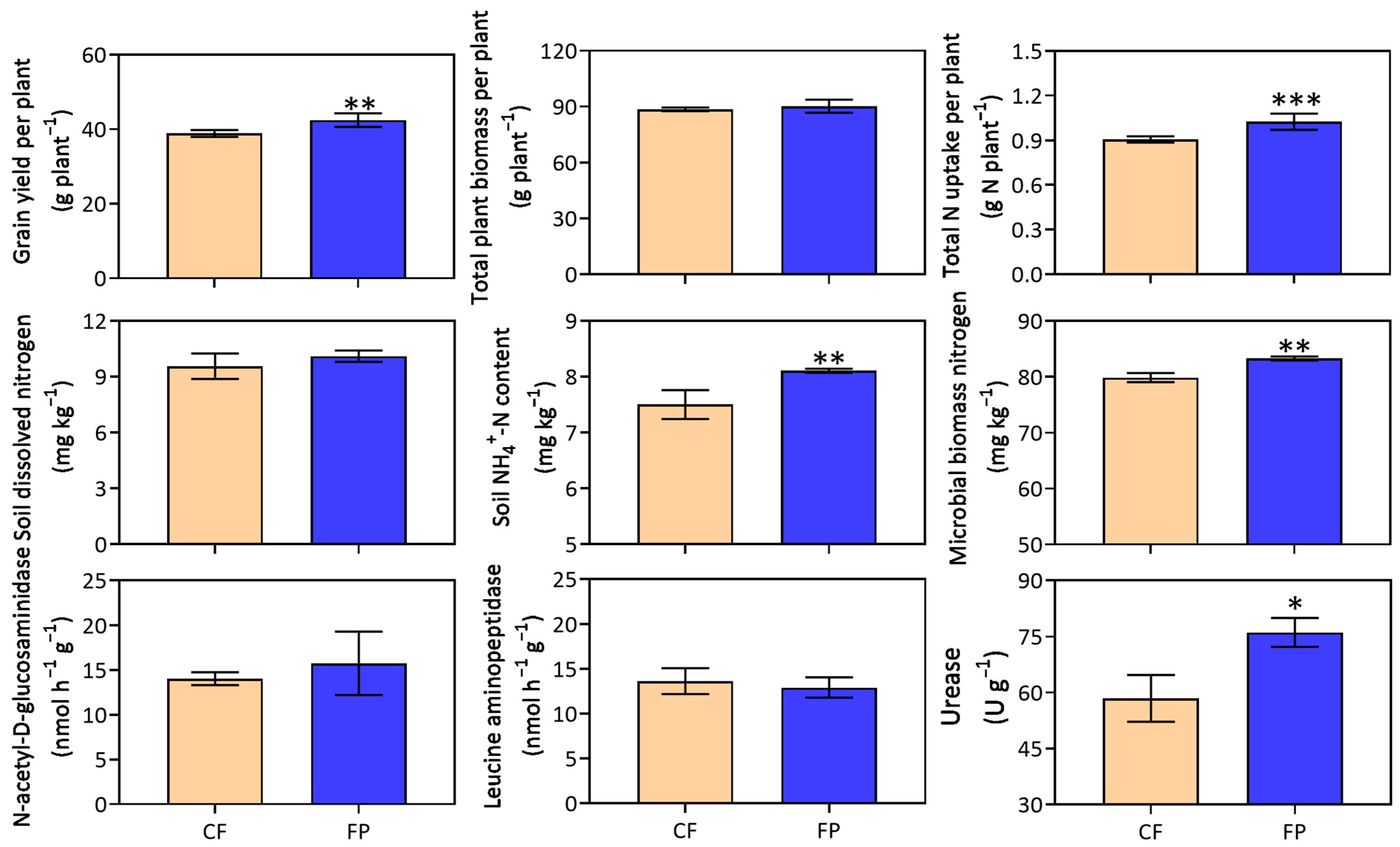
Long-term FP significantly influenced rice productivity and soil N availability compared with CF (Figure 1). FP significantly increased grain yield and plant N accumulation, whereas total plant biomass showed no significant response. In soil, FP significantly increased NH4+-N and MBN contents by 8.1% and 4.3%, respectively, while DN remained unchanged. In addition, FP significantly enhanced soil urease activity by 30.3%, whereas the activities of N-acetylglucosaminidase and leucine aminopeptidase were not significantly affected.

3.2. Long-Term FP Reshaped N-Cycling Potential Across Soil Compartments

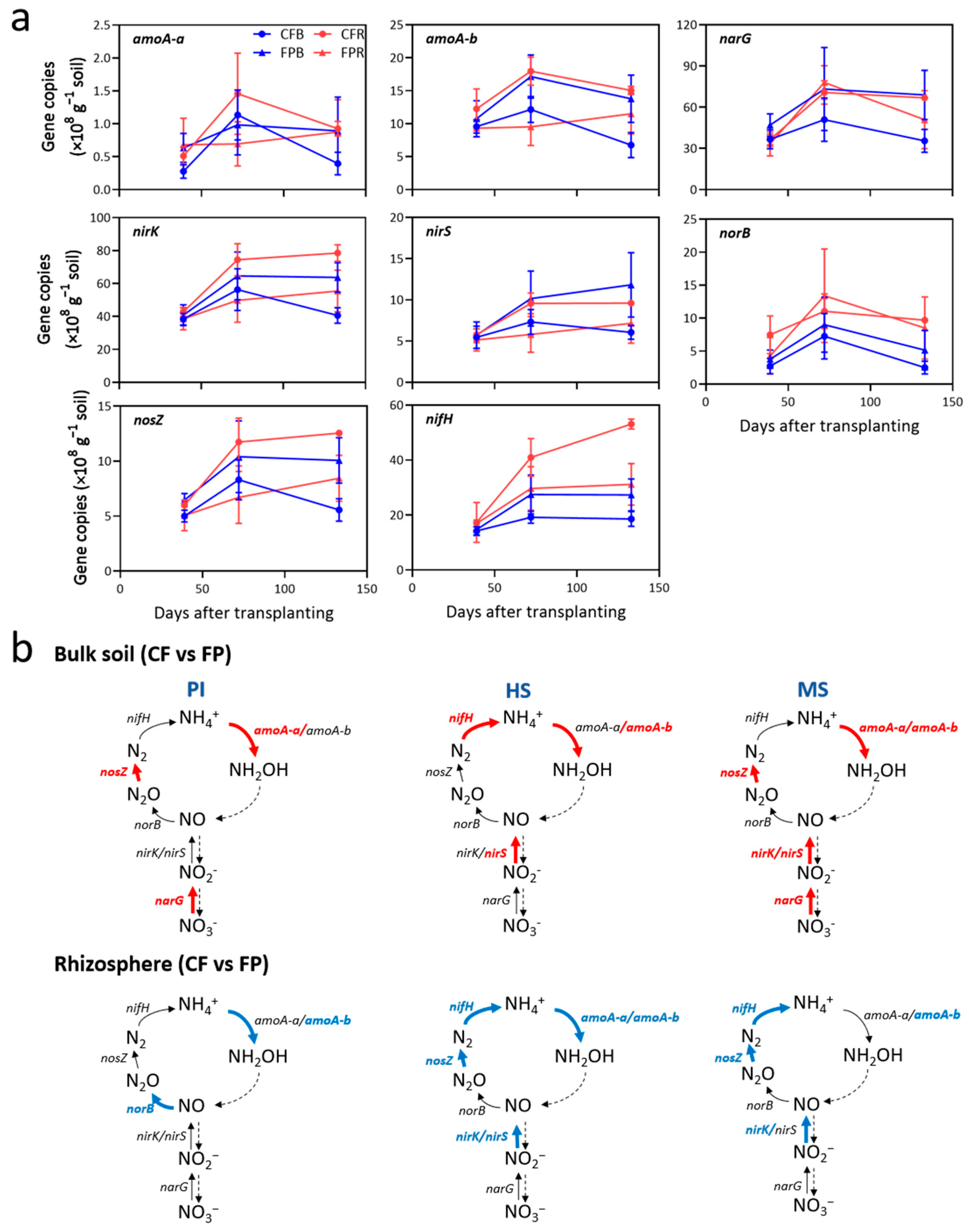
The abundance of N-cycling functional genes varied markedly across rice growth stages and soil compartments (Figure 2; Table S1). Most genes exhibited pronounced temporal variation, with generally higher abundances at the HS than at the PI and MS (Figure 2a). Compared with CF, FP induced contrasting responses in bulk and rhizosphere soils (Figure 2b). In bulk soil, FP increased the abundance of genes involved in N fixation (nifH), nitrification (amoA-a, amoA-b), and denitrification (nirK, nirS, nosZ). In contrast, the abundance of most N-cycling genes was lower under FP in rhizosphere soil. Significant interactions among fertilization treatment, soil compartment, and growth stage further indicated that microbial N-cycling potential responded jointly to spatial and temporal environmental variation (Table S1).

3.3. Long-Term FP Reshaped Bacterial Community Structure

FP did not affect bacterial α-diversity (Table S2), but significantly affected bacterial β-diversity in a compartment-dependent manner (Figure S1). Weighted UniFrac-based PCoA showed that the first two axes explained 18.24% and 14.75% of community variation in bulk soil and 19.67% and 16.70% in rhizosphere soil; PERMANOVA confirmed overall significant community differentiation across all groups in both compartments (p = 0.001). Pairwise ANOSIM further verified persistent significant dissimilarity between CF and FP within bulk or rhizosphere soil at all rice growth stages (Table 3). Temporal community responses to FP differed sharply between bulk and rhizosphere habitats across developmental phases (Figures S1 and S2). Changes in dominant bacterial taxa further demonstrated compartment-dependent responses to FP (Figure S3).

3.4. Identification of Microbial Modules Associated with Soil C and N Status

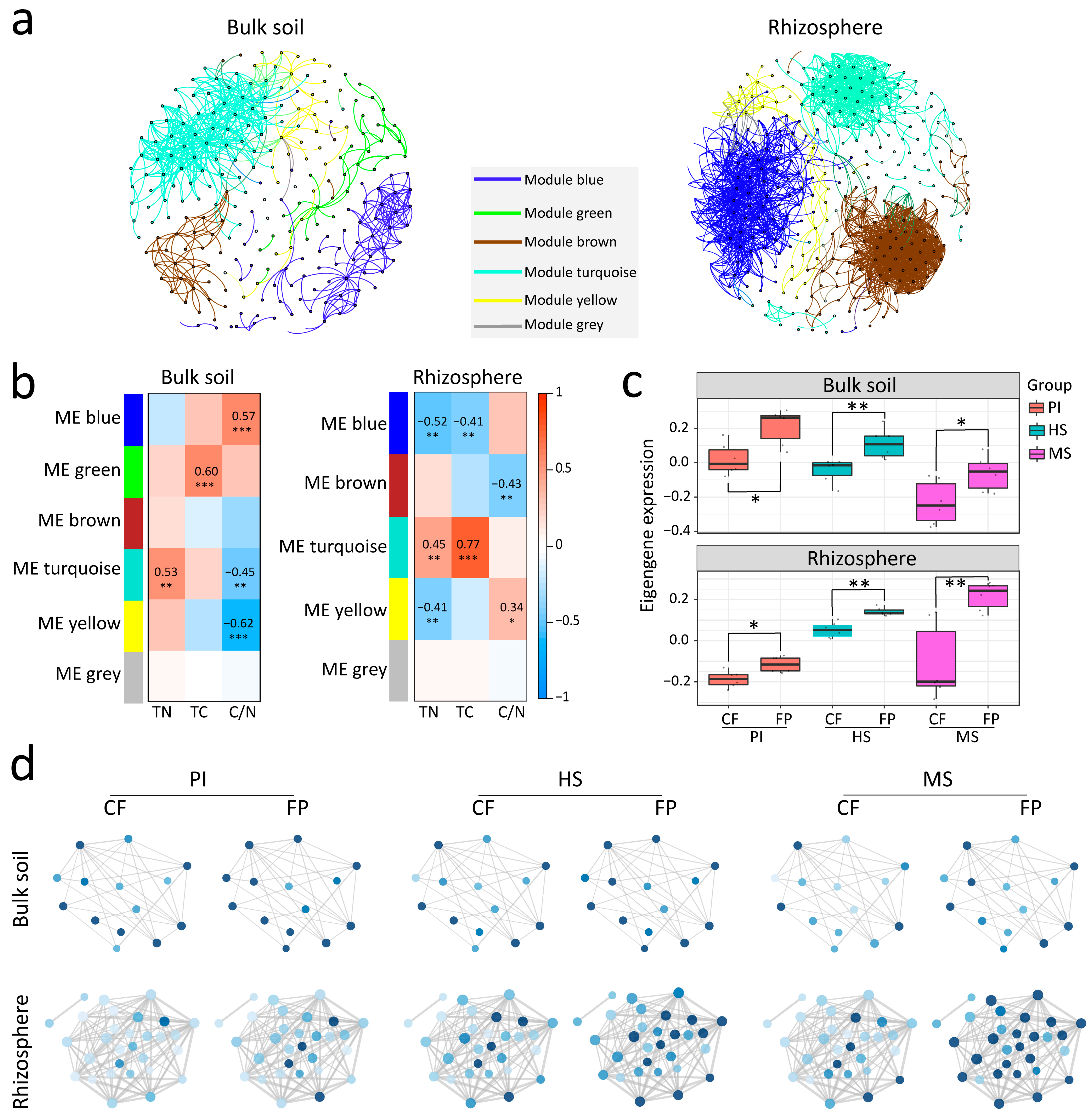
The ASVs of bacteria in bulk soil and the rhizosphere and the soil chemical properties were analyzed by WGCNA. According to the expression pattern of ASVs in the sample, ASVs in bulk soil and the rhizosphere were divided into six and five modules, respectively (Figure 3a). The eigenvalue expression (EE, eigengene expression) of the modules was further correlated with soil chemical properties (TN, TC, C/N), and it was found that TN in bulk soil and the rhizosphere showed a highly significant positive correlation with the turquoise module, while TN content in the rhizosphere showed a highly significant negative correlation with the yellow and blue modules (Figure 3b). In the rhizosphere, TC also showed significant associations with module composition. In all three growth stages, the EE of the turquoise module in FP was significantly higher than that in CF (Figure 3c). Nutrient management affected the abundance of key ASVs (hereafter referred to as keystone ASVs, defined as the highly connected and structurally important ASVs within the WGCNA module) associated with TN in the turquoise module. Specifically, compared with CF, FP increased the abundance of key ASVs in both bulk soil and in the rhizosphere (Figure 3d).

3.5. Core Microbial Taxa Associated with N-Cycling Potential

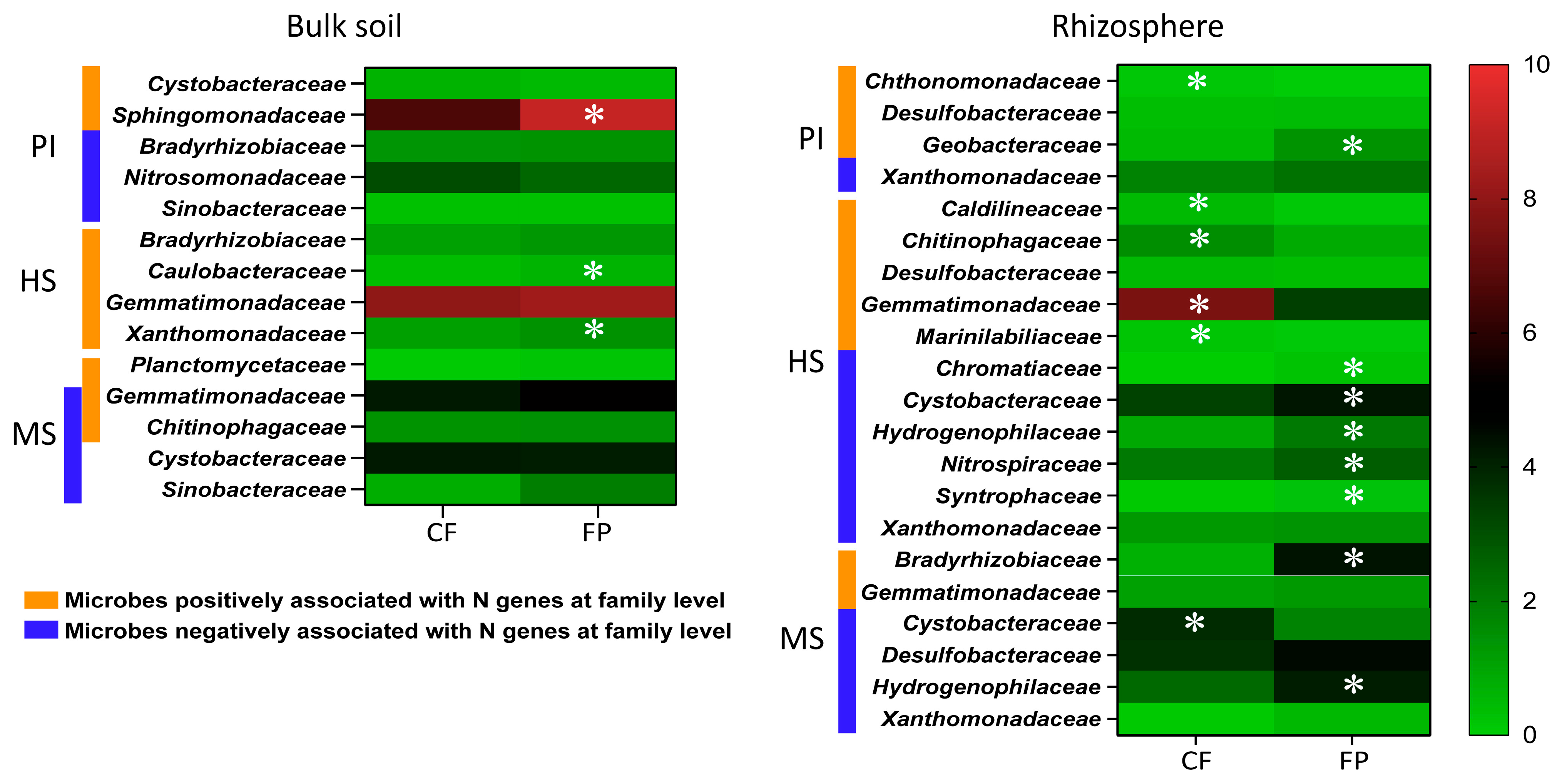
Co-occurrence networks linked turquoise-module ASVs to eight N-cycling genes (r > 0.7), with 153 ASVs detected in bulk soil and 182 in rhizosphere soil (Figure S4). Distinct FP-induced shifts were observed for N-gene-associated bacterial families between bulk and rhizosphere soils (Figure 4). In bulk soil, six families positively correlated with N-cycling genes; FP significantly increased the relative abundance of Sphingomonadaceae at PI, as well as Caulobacteraceae and Xanthomonadaceae at HS. By contrast, the three families negatively associated with N genes showed no abundance changes under FP. The rhizosphere exhibited opposing patterns. The eight N-gene-positive families were mostly suppressed by FP, with only Desulfobacteraceae, Geobacteraceae and Bradyrhizobiaceae unaffected. Meanwhile, FP increased the abundance of nearly all seven N-gene-negative families, excluding Xanthomonadaceae and Desulfobacteraceae, and treatment divergence peaked at HS.

3.6. Environmental Drivers of Bacterial Community Assembly and N-Cycling Potential

RDA showed that soil C and N status were the primary drivers of bacterial community composition under long-term FP (Figure S5). In bulk soil, TN, TC, and the TC:TN ratio significantly explained community variation, with the TC:TN ratio showing the highest explanatory power. In rhizosphere soil, community composition was mainly associated with TC (R2 = 0.48, p = 0.001) and TN (R2 = 0.40, p = 0.002), whereas DOC, DN, and DOC:DN had no significant effects. These results indicate that long-term FP reshaped bacterial communities primarily through changes in soil C and N status.

4. Discussion

4.1. Long-Term FP Improved Soil N Availability and Plant N Accumulation

Long-term FP improved rice productivity by enhancing soil N availability and plant N acquisition. A likely explanation is that postponing a greater proportion of N fertilizer to the panicle stage better synchronized soil N supply with crop N demand, thereby avoiding excessive N depletion during early vegetative growth and maintaining a more stable available N supply during reproductive development, consistent with previous studies showing improved N use efficiency under FP [31,36,37]. Meanwhile, the higher NH4+-N availability under FP was likely associated with enhanced urease activity, which accelerates urea hydrolysis and increases inorganic N production [38]. Although FP did not alter the activity of organic N-degrading hydrolases, soil N availability is co-regulated by a suite of interconnected microbial processes including mineralization, immobilization and N transformations, rather than extracellular enzymes alone [6]. The concurrent rise in NH4+-N and MBN highlights a dual beneficial effect of FP: this fertilization strategy not only boosts immediately accessible plant-available N, but also promotes microbial N immobilization to form a stable temporary N pool in soil. Ammonification, nitrification, and denitrification consume or release protons and trigger dynamic soil pH fluctuations, which selectively stimulate or suppress specific microbial functional groups and ultimately restructure bacterial assembly and soil N-cycling capacity.

4.2. Long-Term FP Induced Compartment-Dependent Shifts in N-Cycling Potential

A key finding of this study was the opposing regulation of N functional gene pools by FP between bulk and rhizosphere habitats (Figure 2), revealing compartment-specific microbial N transformation potential. In bulk soil, FP generally increased the abundance of genes involved in N fixation, nitrification, and denitrification, whereas the abundance of most N-cycling genes decreased in the rhizosphere. The enhanced abundance of N-cycling genes in bulk soil may be associated with improved soil fertility conditions under long-term FP. Consistent with previous meta-analyses [39], sustained nutrient input elevates soil organic matter and substrate availability, supporting the proliferation of N-transforming microbial populations and their functional genes. The metagenomic results also verified that the super-high-yield paddy field (high soil fertility) contained more microbial groups with N metabolism functions [40]. In contrast, rhizosphere microbial assemblages may be subject to strong plant selective pressure beyond intrinsic soil nutrient status [11,12,14,15]. The higher grain yield and plant N accumulation under FP intensify rhizosphere N competition during reproductive stages [31], which may limit substrates for microbial N transformations and suppress the abundance of associated functional genes. Accordingly, gene abundances only reflect theoretical metabolic potential rather than real in situ N transformation rates, highlighting spatially stratified regulation of soil N cycling by FP.

4.3. Changes in Soil C and N Status Were Associated with Bacterial Community Assembly Under FP

The absence of significant changes in bacterial α-diversity suggests that long-term FP primarily reshaped bacterial community assembly through changes in species composition rather than overall richness, consistent with the widely accepted consensus that fertilization modulates microbial communities via environmental filtering rather than altering overall species richness [41,42]. The strong associations between bacterial communities and soil TC and TN support our hypothesis that changes in soil C and N status were major drivers of bacterial community assembly under long-term FP. In particular, bacterial communities in the rhizosphere showed a close association with TC, whereas multiple soil resource variables jointly influenced bulk-soil communities, indicating that microbial assembly differed between soil compartments according to resource availability [12,43]. These results indicate that long-term FP modified microbial habitats through changes in soil nutrient status, thereby reshaping bacterial community assembly [44]. Furthermore, the responses of bacterial communities varied among rice growth stages, suggesting that both soil compartment and plant developmental stage jointly regulated microbial community assembly. Such spatiotemporal variation is consistent with the dynamic nature of plant–soil interactions during rice development and may partially explain the contrasting responses of N-cycling genes observed between bulk and rhizosphere soils [12].
Network analyses further support the nutrient-driven shifts in bacterial communities (Figure 3 and Figure S4). The turquoise module showed strong positive correlation with soil TN, implying its core role in mediating soil nutrient turnover under FP. FP exerted divergent effects on N-cycling bacterial taxa: it enriched N-functional families in bulk soil but suppressed them in rhizosphere, consistent with the compartment-specific patterns of N-cycling genes. The identified taxa, including Sphingomonadaceae, Xanthomonadaceae, Bradyrhizobiaceae, and Nitrospiraceae, are well documented to participate in N fixation, nitrification, or denitrification pathways [45,46,47]. Therefore, changes in the abundance of these bacterial groups may partly explain the observed differences in N-cycling gene abundance between treatments and soil compartments. However, the relationships identified by WGCNA and co-occurrence analyses are correlative rather than causal. Although these analyses successfully identified microbial taxa closely associated with soil N pools and N-cycling genes, further experimental approaches, such as stable isotope tracing, cultivation-based assays, metagenomics, or transcriptomics, are required to verify their direct functional roles in soil N transformations.
Overall, our findings largely supported the proposed hypothesis. Long-term FP reshaped bacterial community assembly in association with changes in soil C and N status, leading to compartment-dependent responses of microbial N-cycling potential. Specifically, FP enhanced the abundance of N-cycling genes in bulk soil while suppressing most of these genes in the rhizosphere. These contrasting responses were accompanied by shifts in bacterial community composition, keystone microbial taxa, and microbial modules associated with soil nutrient status. Together, these results demonstrate that long-term FP regulates soil microbial N cycling primarily through changes in bacterial community assembly driven by soil resource availability.

4.4. Limitations and Future Perspectives

Several limitations should be acknowledged when interpreting the present results. First, only bacterial amoA genes were quantified, whereas ammonia-oxidizing archaea (AOA) frequently contribute substantially to nitrification in paddy soils. Consequently, the current analysis provides only a partial representation of ammonia oxidation potential. Second, N-cycling genes were used as indicators of functional potential, and no direct measurements of N transformation rates were conducted. Therefore, changes in gene abundance should not be interpreted as direct evidence of altered process rates. Third, sampling was conducted at three major rice growth stages, which may not fully capture short-term fluctuations in microbial communities and N-cycling functions. Finally, although flooding conditions were controlled and soil pH was determined at each sampling stage, continuous monitoring of pH dynamics throughout rice growth was not conducted. Because microbial N transformation is closely coupled with changes in soil pH, the lack of continuous pH measurements limits our ability to fully evaluate the contribution of pH fluctuations to bacterial community assembly and N-cycling potential. Future studies integrating high-frequency pH monitoring with microbial functional analyses will help further clarify these mechanisms.

5. Conclusions

This study demonstrated that long-term FP significantly increased grain yield, plant N accumulation, soil NH4+-N content, microbial biomass N, and urease activity compared with conventional fertilization. FP induced clear spatial and temporal variation in microbial N-cycling potential, characterized by increased abundance of N-cycling genes in bulk soil but reduced abundance in rhizosphere soil. Although bacterial α-diversity remained unchanged, FP significantly reshaped bacterial community composition across soil compartments and rice growth stages. Network and ordination analyses revealed that soil C and N status were closely associated with bacterial community assembly under long-term FP. Changes in microbial community composition were accompanied by shifts in key microbial modules and taxa linked to N-cycling genes, indicating that bacterial community reassembly may contribute to compartment-dependent variation in microbial N-cycling potential. Collectively, our results suggest that long-term FP reshapes spatial and temporal patterns of bacterial communities and N-cycling potential through changes in soil C and N status. These microbial responses were accompanied by improved soil N availability, providing new insights into the microbial mechanisms underlying long-term fertilization management in paddy soils.

Supplementary Materials

The following supporting information can be downloaded at https://www.mdpi.com/article/10.3390/agronomy16131290/s1, Figure S1. Principal coordinate analysis (PCoA) of bacterial communities based on weighted UniFrac distance in bulk soil (a) and rhizosphere soil (b); Figure S2. Effects of long-term FP on soil microbiota during rice growth; Figure S3. Relative abundance of the dominant bacterial phyla/class of bulk soil and rhizosphere in long-term FP; Figure S4. Topological map of turquoise module and eight N-cycle-related genes in bulk soil and rhizosphere soil at three rice growth stages; Figure S5. Redundancy analysis (RDA) of bacterial communities constrained by environmental factors in bulk soil (a) and rhizosphere soil (b). Table S1. Spatiotemporal changes in soil N-cycling functional genes under long-term fertilizer postponing; Table S2. Spatiotemporal changes in soil bacterial α-diversity under long-term fertilizer postponing; Table S3: Permutational MANOVA results using weighted UniFrac as distance metric under long-term fertilizer postponing at different growth stages and soil compartments.

Author Contributions

Conceptualization, Y.Z. and L.X.; methodology, Y.Z.; formal analysis, Y.Z. and L.X.; investigation, Y.Z. and L.X.; data curation, Y.Z. and L.X.; writing—original draft preparation, Y.Z. and L.X.; writing—review and editing, J.C.; project administration, G.L.; funding acquisition, G.L. All authors have read and agreed to the published version of the manuscript.

Funding

The research was supported by the National Key R&D Program of China (Grant No. 2023YFD1901800) and the National Natural Science Foundation of China (Grant Nos. 32572447, 42407449).

Data Availability Statement

The original contributions presented in this study are included in the article/Supplementary Materials. Further inquiries can be directed to the corresponding author.

Acknowledgments

We gratefully acknowledge the financial support from the National Natural Science Foundation of China. We also would like to thank the field workers and laboratory staff for their invaluable assistance with sample collection and data analysis.

Conflicts of Interest

The authors declare no conflicts of interest.

Abbreviations

CFConventional fertilizer
FPFertilizer postponing
NNitrogen
PIPanicle initiation
HSHeading stage
MSMaturity stage
TCTotal carbon
TNTotal nitrogen
DOCDissolved organic corban
DNDissolved organic nitrogen
MBNMicrobial biomass nitrogen

References

  1. Mueller, N.D.; Gerber, J.S.; Johnston, M.; Ray, D.K.; Ramankutty, N.; Foley, J.A. Closing yield gaps through nutrient and water management. Nature 2012, 490, 254–257. [Google Scholar] [CrossRef] [PubMed]
  2. Yan, M.; Pan, G.; Lavallee, J.M.; Conant, R.T. Rethinking sources of nitrogen to cereal crops. Glob. Change Biol. 2020, 26, 191–199. [Google Scholar]
  3. Zhou, W.; Yang, Z.; Wang, T.; Fu, Y.; Chen, Y.; Hu, B.; Yamagishi, J.; Ren, W. Environmental compensation effect and synergistic mechanism of optimized nitrogen management increasing nitrogen use efficiency in indica hybrid rice. Front. Plant Sci. 2019, 10, 245. [Google Scholar] [CrossRef] [PubMed]
  4. Elrys, A.S.; Ali, A.; Zhang, H.; Cheng, Y.; Zhang, J.; Cai, Z.-C.; Müller, C.; Chang, S.X. Patterns and drivers of global gross nitrogen mineralization in soils. Glob. Change Biol. 2021, 27, 5950–5962. [Google Scholar] [CrossRef]
  5. Nelson, M.B.; Martiny, A.C.; Martiny, J.B.H. Global biogeography of microbial nitrogen-cycling traits in soil. Proc. Natl. Acad. Sci. USA 2016, 113, 8033–8040. [Google Scholar] [CrossRef] [PubMed]
  6. Kuypers, M.M.M.; Marchant, H.K.; Kartal, B. The microbial nitrogen-cycling network. Nat. Rev. Microbiol. 2018, 16, 263–276. [Google Scholar] [CrossRef] [PubMed]
  7. Johnson, D.W.; Cheng, W.; Burke, I.C. Biotic and abiotic nitrogen retention in a variety of forest soils. Soil Sci. Soc. Am. J. 2000, 64, 1503–1514. [Google Scholar] [CrossRef]
  8. Barrett, J.E.; Johnson, D.W.; Burke, I.C. Abiotic nitrogen uptake in semiarid grassland soils of the US Great Plains. Soil Sci. Soc. Am. J. 2002, 66, 979–987. [Google Scholar] [CrossRef]
  9. Li, Z.; Zeng, Z.; Song, Z.; Wang, F.; Tian, D.; Mi, W.; Huang, X.; Wang, J.; Song, L.; Yang, Z.; et al. Vital roles of soil microbes in driving terrestrial nitrogen immobilization. Glob. Change Biol. 2021, 27, 1848–1858. [Google Scholar] [CrossRef]
  10. Cui, Y.; Fang, L.; Guo, X.; Wang, X.; Zhang, Y.; Li, P.; Zhang, X. Ecoenzymatic stoichiometry and microbial nutrient limitation in rhizosphere soil in the arid area of the northern Loess Plateau, China. Soil Biol. Biochem. 2018, 116, 11–21. [Google Scholar] [CrossRef]
  11. Turner, T.R.; Ramakrishnan, K.; Walshaw, J.; Heavens, D.; Alston, M.; Swarbreck, D.; Osbourn, A.; Grant, A.; Poole, P.S. Comparative metatranscriptomics reveals kingdom level changes in the rhizosphere microbiome of plants. ISME J. 2013, 7, 2248–2258. [Google Scholar] [CrossRef] [PubMed]
  12. Edwards, J.; Johnson, C.; Santos-Medellin, C.; Lurie, E.; Podishetty, N.K.; Bhatnagar, S.; Eisen, J.A.; Sundaresan, V. Structure, variation, and assembly of the root-associated microbiomes of rice. Proc. Natl. Acad. Sci. USA 2015, 112, E911–E920. [Google Scholar] [CrossRef] [PubMed]
  13. Schmidt, J.E.; Vannette, R.L.; Igwe, A.; Blundell, R.; Casteel, C.L.; Gaudin, A.C.M. Effects of agricultural management on rhizosphere microbial structure and function in processing tomato plants. Appl. Environ. Microbiol. 2019, 85, e01087-19. [Google Scholar] [CrossRef]
  14. Yan, Y.; Kuramae, E.E.; de Hollander, M.; Klinkhamer, P.G.L.; van Veen, J.A. Functional traits dominate the diversity-related selection of bacterial communities in the rhizosphere. ISME J. 2017, 11, 56–66. [Google Scholar] [PubMed]
  15. Zhang, J.; Zhang, N.; Liu, Y.-X.; Zhang, X.; Hu, B.; Qin, Y.; Xu, H.; Wang, H.; Guo, X.; Qian, J.; et al. Root microbiota shift in rice correlates with resident time in the field and developmental stage. Sci. China Life Sci. 2018, 61, 613–621. [Google Scholar] [CrossRef] [PubMed]
  16. Li, X.; Rui, J.; Xiong, J.; Li, J.; He, Z.; Zhou, J.; Yannarell, A.C.; Mackie, R.I. Functional potential of soil microbial communities in the maize rhizosphere. PLoS ONE 2014, 9, e112609. [Google Scholar] [CrossRef] [PubMed]
  17. Nie, S.A.; Xu, H.J.; Li, S.; Li, H.; Su, J.Q. Relationships between abundance of microbial functional genes and the status and fluxes of carbon and nitrogen in rice rhizosphere and bulk soils. Pedosphere 2014, 24, 645–651. [Google Scholar] [CrossRef]
  18. Ehrenfeld, J.G.; Parsons, W.F.J.; Han, X.G.; Parmelee, R.W.; Zhu, W.X. Live and dead roots in forest soil horizons: Contrasting effects on nitrogen dynamics. Ecology 1997, 78, 348–362. [Google Scholar] [CrossRef]
  19. Knauth, S.; Hurek, T.; Brar, D.; Reinhold-Hurek, B. Influence of different Oryza cultivars on expression of nifH gene pools in roots of rice. Environ. Microbiol. 2005, 7, 1725–1733. [Google Scholar] [CrossRef] [PubMed]
  20. Treseder, K.K. Nitrogen additions and microbial biomass: A meta-analysis of ecosystem studies. Ecol. Lett. 2008, 11, 1111–1120. [Google Scholar] [PubMed]
  21. Wang, C.; Liu, D.; Bai, E. Decreasing soil microbial diversity is associated with decreasing microbial biomass under nitrogen addition. Soil Biol. Biochem. 2018, 120, 126–133. [Google Scholar] [CrossRef]
  22. Zhao, Z.; Ge, T.; Gunina, A.; Li, Y.; Zhu, Z.; Peng, P.; Wu, J.; Kuzyakov, Y. Carbon and nitrogen availability in paddy soil affects rice photosynthate allocation, microbial community composition, and priming: Combining continuous C-13 labeling with PLFA analysis. Plant Soil 2019, 445, 137–152. [Google Scholar]
  23. Wang, J.; Liao, L.R.; Ye, Z.C.; Liu, H.F.; Zhang, C.; Zhang, L.; Liu, G.B.; Wang, G.L. Different bacterial co-occurrence patterns and community assembly between rhizosphere and bulk soils under N addition in the plant-soil system. Plant Soil 2022, 471, 697–713. [Google Scholar]
  24. Dong, H.; Fan, S.; Sun, H.; Chen, C.; Wang, A.; Jiang, L.; Ma, D. Rhizosphere-associated microbiomes of rice (Oryza sativa L.) under the effect of increased nitrogen fertilization. Front. Microbiol. 2021, 12, 730506. [Google Scholar] [CrossRef] [PubMed]
  25. Xia, Y.; Chen, X.; Zheng, S.; Gunina, A.; Ning, Z.; Hu, Y.; Tang, H.; Rui, Y.; Zhang, Z.; He, H.; et al. Manure application accumulates more nitrogen in paddy soils than rice straw but less from fungal necromass. Agric. Ecosyst. Environ. 2021, 319, 107552. [Google Scholar] [CrossRef]
  26. Vieira, S.; Sikorski, J.; Dietz, S.; Herz, K.; Schrumpf, M.; Bruelheide, H.; Scheel, D.; Friedrich, M.W.; Overmann, J. Drivers of the composition of active rhizosphere bacterial communities in temperate grasslands. ISME J. 2020, 14, 463–475. [Google Scholar] [PubMed]
  27. Beirinckx, S.; Viaene, T.; Haegeman, A.; Debode, J.; Amery, F.; Vandenabeele, S.; Nelissen, H.; Inzé, D.; Tito, R.; Raes, J.; et al. Tapping into the maize root microbiome to identify bacteria that promote growth under chilling conditions. Microbiome 2020, 8, 54. [Google Scholar] [CrossRef] [PubMed]
  28. Wang, J.; Fu, P.; Wang, F.; Fahad, S.; Mohapatra, P.K.; Chen, Y.; Zhang, C.; Peng, S.; Cui, K.; Nie, L.; et al. Optimizing nitrogen management to balance rice yield and environmental risk in the Yangtze River’s middle reaches. Environ. Sci. Pollut. Res. 2019, 26, 4901–4912. [Google Scholar]
  29. Yi, J.; Gao, J.; Zhang, W.; Zhao, Y.; Zhao, C.; Zhao, Y.; Li, Z.; Xin, W. Delayed timing of tillering fertilizer improved grain yield and nitrogen use efficiency in japonica rice. Crop Sci. 2020, 60, 1021–1033. [Google Scholar] [CrossRef]
  30. Banayo, N.P.M.C.; Bueno, C.S.; Haefele, S.M.; Desamero, N.V.; Kato, Y. Site-specific nutrient management enhances sink size, a major yield constraint in rainfed lowland rice. Field Crops Res. 2018, 224, 76–79. [Google Scholar] [CrossRef]
  31. Zhou, Y.; Xu, L.; Zhang, J.; Li, W.; Jiang, Y.; Wang, S.; Ding, Y.; Liu, Z.; Li, G. Low N apparent surplus with higher rice yield under long-term fertilizer postponing in the rice-wheat cropping system. Crop J. 2022, 10, 1178–1186. [Google Scholar]
  32. Zhou, Y.; Zhang, J.; Xu, L.; Xu, C.; Chen, H.; Miao, C.; Li, W.; Jiang, Y.; Ding, Y.; Liu, Z.; et al. Long-term fertilizer postponing increases soil carbon sequestration by changing microbial composition in paddy soils: A 13CO2 labelling and PLFA study. Soil Biol. Biochem. 2023, 180, 108967. [Google Scholar] [CrossRef]
  33. Vance, E.D.; Brookes, P.C.; Jenkinson, D.S. An extraction method for measuring soil microbial biomass-C. Soil Biol. Biochem. 1987, 19, 703–707. [Google Scholar] [CrossRef]
  34. DeForest, J.L. The influence of time, storage temperature, and substrate age on potential soil enzyme activity in acidic forest soils using MUB-linked substrates and L-DOPA. Soil Biol. Biochem. 2009, 41, 1180–1186. [Google Scholar] [CrossRef]
  35. Luo, G.; Wang, T.; Li, K.; Li, L.; Zhang, J.; Guo, S.; Ling, N.; Shen, Q. Historical nitrogen deposition and straw addition facilitate the resistance of soil multifunctionality to drying-wetting cycles. Appl. Environ. Microbiol. 2019, 85, e02251-18. [Google Scholar] [CrossRef] [PubMed]
  36. Wang, D.; Xu, C.; Ye, C.; Chen, S.; Chu, G.; Zhang, X. Low recovery efficiency of basal fertilizer-N in plants does not indicate high basal fertilizer-N loss from split-applied N in transplanted rice. Field Crops Res. 2018, 229, 8–16. [Google Scholar] [CrossRef]
  37. Ye, C.; Ma, H.; Huang, X.; Xu, C.; Chen, S.; Chu, G.; Zhang, X.; Wang, D. Effects of increasing panicle-stage N on yield and N use efficiency of indica rice and its relationship with soil fertility. Crop J. 2022, 10, 1784–1797. [Google Scholar] [CrossRef]
  38. Koranda, M.; Schnecker, J.; Kaiser, C.; Fuchslueger, L.; Kitzler, B.; Stange, C.F.; Sessitsch, A.; Zechmeister-Boltenstern, S.; Richter, A. Microbial processes and community composition in the rhizosphere of European beech—The influence of plant C exudates. Soil Biol. Biochem. 2011, 43, 551–558. [Google Scholar] [CrossRef] [PubMed]
  39. Ouyang, Y.; Evans, S.E.; Friesen, M.L.; Tiemann, L.K. Effect of nitrogen fertilization on the abundance of nitrogen cycling genes in agricultural soils: A meta-analysis of field studies. Soil Biol. Biochem. 2018, 127, 71–78. [Google Scholar] [CrossRef]
  40. Zhong, Y.; Hu, J.; Xia, Q.; Zhang, S.; Li, X.; Pan, X.; Zhao, R.; Wang, R.; Yan, W.; Shangguan, Z.; et al. Soil microbial mechanisms promoting ultrahigh rice yield. Soil Biol. Biochem. 2020, 143, 107741. [Google Scholar] [CrossRef]
  41. Dondjou, D.T.; Diedhiou, A.G.; Mbodj, D.; Mofini, M.T.; Pignoly, S.; Ndiaye, C.; Diedhiou, I.; Assigbetse, K.; Manneh, B.; Laplaze, L.; et al. Rice developmental stages modulate rhizosphere bacteria and archaea co-occurrence and sensitivity to long-term inorganic fertilization in a West African Sahelian agro-ecosystem. Environ. Microbiome 2023, 18, 42. [Google Scholar] [CrossRef] [PubMed]
  42. Shu, X.; Liu, W.; Huang, H.; Ye, Q.; Zhu, S.; Peng, Z.; Li, Y.; Deng, L.; Yang, Z.; Chen, H.; et al. Meta-Analysis of Organic Fertilization Effects on Soil Bacterial Diversity and Community Composition in Agroecosystems. Plants 2023, 12, 3801. [Google Scholar] [CrossRef] [PubMed]
  43. Philippot, L.; Raaijmakers, J.M.; Lemanceau, P.; van der Putten, W.H. Going back to the roots: The microbial ecology of the rhizosphere. Nat. Rev. Microbiol. 2013, 11, 789–799. [Google Scholar] [CrossRef] [PubMed]
  44. Zhu, L.; Luan, L.; Chen, Y.; Wang, X.; Zhou, S.; Zou, W.; Han, X.; Duan, Y.; Zhu, B.; Li, Y.; et al. Community assembly of organisms regulates soil microbial functional potential through dual mechanisms. Glob. Change Biol. 2024, 30, e17160. [Google Scholar] [CrossRef]
  45. Luo, G.W.; Ling, N.; Xue, C.; Dippold, M.A.; Firbank, L.G.; Guo, S.W.; Kuzyakov, Y.; Shen, Q.R. Nitrogen-inputs regulate microbial functional and genetic resistance and resilience to drying-rewetting cycles, with implications for crop yields. Plant Soil 2019, 441, 301–315. [Google Scholar]
  46. Itakura, M.; Saeki, K.; Omori, H.; Yokoyama, T.; Kaneko, T.; Tabata, S.; Ohwada, T.; Tajima, S.; Uchiumi, T.; Honnma, K.; et al. Genomic comparison of Bradyrhizobium japonicum strains with different symbiotic nitrogen-fixing capabilities and other Bradyrhizobiaceae members. Isme J. 2009, 3, 326–339. [Google Scholar] [PubMed]
  47. Anderson, C.R.; Condron, L.M.; Clough, T.J.; Fiers, M.; Stewart, A.; Hill, R.A.; Sherlock, R.R. Biochar induced soil microbial community change: Implications for biogeochemical cycling of carbon, nitrogen and phosphorus. Pedobiologia 2011, 54, 309–320. [Google Scholar] [CrossRef]
Figure 1. Effects of long-term FP on rice productivity, soil N pool, and N-cycle-related enzyme activities. CF, conventional fertilization, FP, fertilizer postponing. DN, soluble organic N. MBN, microbial biomass N. Data are means of six replicates (±standard error). *, **, and *** indicate differences between the CF and FP treatments at p < 0.05, p < 0.01, and p < 0.001 based on Student’s t-test.
Agronomy 16 01290 g001
Figure 2. Effects of long-term FP on eight N-cycling functional genes. (a) Time-series variation in gene copy abundance of eight N-cycle genes under CFB, CFR, FPB and FPR treatments along rice growth days post-transplanting. CFB/CFR: bulk/rhizosphere soil of conventional fertilization (CF); FPB/FPR: bulk/rhizosphere soil of fertilizer postponing (FP). (b) Schematic comparison of significant differences in N-cycle gene abundance between CF and FP at PI, HS and MS in bulk soil and rhizosphere. Red text/arrows: FP gene abundance significantly higher than CF; blue text/arrows: FP gene abundance significantly lower than CF.
Agronomy 16 01290 g002
Figure 3. Co-occurrence network of bacteria [amplicon sequence variables (ASVs)] in bulk soil and in the rhizosphere (a); weighted correlation network analysis (WGCNA)-based relationships of modules with TN, TC, and C/N in bulk soil and the rhizosphere according to weighted gene co-expression network analysis (b); effect of nutrient management on the eigengene expression of the turquoise module (c); co-occurrence network of key ASVs in the turquoise module under two treatments (d). PI, panicle initiation; HS, heading stage; MS, maturity stage. CF, conventional fertilization; FP, fertilizer postponing. Each network node in panel (a) represents a single operation taxonomic unit (ASV). If the Pearson correlation coefficient between ASV is greater than 0.7, add lines (edges). The network nodes are filtered based on weight > 0.16 in panel (d), and the size and color of the nodes represent module membership (KME) and relative abundance, respectively. *, **, and *** indicate differences between the CF and FP at p < 0.05, p < 0.01, and p < 0.001 based on Student’s t-test.
Agronomy 16 01290 g003
Figure 4. Effects of long-term FP on the relative abundance of bacteria significantly associated with eight N-cycle-related genes in bulk soil and the rhizosphere. PI, panicle initiation; HS, heading stage; MS, maturity stage. CF, conventional fertilization; FP, fertilizer postponing. * indicates differences between the CF and FP at p < 0.05, based on Student’s t-test. Data are means of six replicates (±standard error).
Agronomy 16 01290 g004
Table 1. Differences in nutrient management between the two used soils.
Fertilizers (kg ha−1)TreatmentsBasal:Tillering:Spikelet-Promoting:Spikelet-Protecting
N (300)CF50:25:25:0
FP40:20:20:20
P2O5 (150)CF100:0:0:0
FP50:0:50:0
K2O (240)CF100:0:0:0
FP50:0:50:0
Note: CF, conventional fertilization; FP, fertilizer postponing.
Table 2. The primers and annealing temperatures (At) used for qPCR of N-cycle-related genes.
Target GenePrimer NamePrimer Sequence (5′-3′)Functional Processat
amoA-aCrenamoA23-FATGGTCTGGCTWAGACGNitrification56 °C
CrenamoA616-RGCCATCCATCTGTATGTCCA
amoA-bBac-amoA-FGGGGTTTCTACTGGTGGTNitrification56 °C
Bac-amoA-RCCCCTCKGSAAAGCCTTCTTC
nifHnifH-FAAAGGYGGWATCGGYAARTCCACCACN fixation56 °C
nifH-RTGSGCYTTGTCYTCRCGGATBGGCAT
narGnarG-FTCGCCSATYCCGGCSATGTCDenitrification56 °C
narG-RGAGTTGTACCAGTCRGCSGAYTCSG
nirKnirK1-FGGMATGGTKCCSTGGCADenitrification56 °C
nirK5-RGCCTCGATCAGRTTRTGG
nirSnirS-FAACGYSAAGGARACSGGDenitrification56 °C
nirS-RGASTTCGGRTGSGTCTTSAYGAA
nosZnosZ1-FWCSYTGTTCMTCGAGCCAGDenitrification56 °C
nosZ1-RATGTCGATCARCTGVKCRTTYTC
norBcnorBB-FAIGTGGTCGAGAAGTGGCTCTADenitrification56 °C
cnorBB-RTCTGIACGGTGAAGATCACC
Table 3. ANOSIM pairwise comparisons of microbial community composition.
ComparisonPI HS MS
r StatisticSignificancer StatisticSignificancer StatisticSignificance
CF–Bulk vs. FP–Bulk0.650.0050.790.0040.270.006
CF–Rhizosphere vs. FP–Rhizosphere0.710.0030.670.0030.940.003
Note: PI, panicle initiation; HS, heading stage; MS, maturity stage. CF, conventional fertilization; FP, fertilizer postponing. r statistics represent difference in mean ranks between the two groups. Values closer to 1.0 indicate greater dissimilarity between the two groups compare.
Disclaimer/Publisher’s Note: The statements, opinions and data contained in all publications are solely those of the individual author(s) and contributor(s) and not of MDPI and/or the editor(s). MDPI and/or the editor(s) disclaim responsibility for any injury to people or property resulting from any ideas, methods, instructions or products referred to in the content.