Review

Review of Variable-Stiffness Control for Robotic Arms and Prospects for Application in Agricultural Environments

1
School of Agricultural Engineering, Jiangsu University, Zhenjiang 212013, China
2
National Digital Agricultural Equipment (Artificial Intelligence and Agricultural Robotics) Innovation Sub-Centre, Jiangsu University, Zhenjiang 212013, China
3
Key Laboratory of Modern Agricultural Equipment and Technology, Ministry of Education, Jiangsu University, Zhenjiang 212013, China
4
Key Laboratory for Theory and Technology of Intelligent Agricultural Machinery and Equipment, Jiangsu University, Zhenjiang 212013, China
*
Author to whom correspondence should be addressed.
Agronomy 2026, 16(13), 1275; https://doi.org/10.3390/agronomy16131275
Submission received: 30 May 2026 / Revised: 28 June 2026 / Accepted: 29 June 2026 / Published: 1 July 2026
(This article belongs to the Special Issue Robotics and Automation in Farming—2nd Edition)

Abstract

The integration of agricultural science, artificial intelligence, and robotics has accelerated the development of robotic arms, significantly enhancing their potential applications across various fields. In light of the unique characteristics of agricultural environments, this paper provides a comprehensive review of variable-stiffness control methods for robotic arms. A robotic arm with rigid–flexible switching capabilities can effectively address collision safety concerns in complex agricultural environments, offering promising research prospects. This paper outlines recent advancements in variable-stiffness control techniques, including passive control methods based on materials and flexible devices, active control methods based on algorithms, and hybrid methods that combine control algorithms with flexible devices. Additionally, it discusses the technical challenges and future opportunities regarding deploying variable-stiffness robotic arms in agricultural environments. The aim of this paper is to provide theoretical and technical insights to support the efficient and versatile development of agricultural robots.

1. Introduction

With the increasing global demand for agricultural products, labor shortages have become a significant challenge in modern agriculture. Tasks such as harvesting, bagging, pruning, fruit thinning, and pollination continue to rely heavily on manual labor, which is becoming increasingly difficult to source because of an aging workforce and rising labor costs [1,2,3,4]. Furthermore, the limitations in the efficiency of manual labor severely hinder growth in agricultural production capacity. Against the backdrop of global population growth, a decreasing amount of arable land, and a structural shortage of agricultural labor, agricultural production is undergoing a significant transition from traditional labor-intensive methods to more intelligent and precise systems [5,6,7]. Consequently, the development of agricultural robots to replace manual labor and perform repetitive tasks has become essential. The robotic arm is the key component of an agricultural robot and the core actuator for realizing fine agricultural operations. The purpose of this paper is to provide new ideas in regard to safely operating agricultural robots. Variable-stiffness control technology is applied to agricultural robotic arms so that they account for the advantages of high-speed, high-precision operation and flexible safety collision, in order to greatly improve the robots’ working performance and increase their application by farmers.
Most robots currently used in the agricultural sector utilize rigid robotic arms equipped with self-designed end effectors [8,9,10]. The workspace range of rigid robotic arms is generally sufficient to meet the demands of most applications. However, in complex and unstructured agricultural environments, robotic arms are prone to collisions with external obstacles. When a collision occurs, a robotic arm activates a safety mechanism, transitioning from a state of movement to an emergency stop state for protection. Consequently, frequent collisions and stops during operation severely reduce robots’ efficiency, hindering their ability to reach higher speeds. These issues significantly limit robots’ applicability in agriculture. With the rapid advancement of machine vision and deep reinforcement learning, numerous researchers have conducted extensive studies on obstacle avoidance technologies and path planning for robotic arms in recent years [11,12,13,14]. Consequently, several methods have been proposed, including the inverse depth-first search algorithm, the obstacle avoidance path-planning algorithm, and hybrid planning algorithms that integrate collision detection and obstacle avoidance [15,16,17]. By constructing collision detection models for robotic arms and obstacles, effective path planning can be performed to avoid these obstacles. However, in real-world working environments, the positions of obstacles are not fixed and can change unpredictably, rendering these methods inadequate for facilitating real-time obstacle avoidance. The problem of safeguarding robotic arms against collisions remains challenging, hindering the development and industrialization of agricultural robot technology.
Compared to rigid robotic arms, flexible robotic arms offer enhanced flexibility and are better suited to navigating obstacles along their working paths. Most research on flexible robotic arms focuses on utilizing materials such as tendons and bellows to make the arms softer [18,19,20]. While flexible robotic arms are more adaptable, they are also often constrained by low positioning accuracy and limited load capacity [21]. Furthermore, flexible robotic arms are prone to frequent bending and folding, which can lead to surface friction damage. They thus require frequent maintenance, resulting in high operational costs. Consequently, studies on the practical application of flexible robotic arms remain relatively scarce, with most research still in the laboratory testing phase, and thus development in this field lags behind the rapid advancements in robotic technology. Agricultural environments are a typical example of unstructured environments [22,23,24,25,26]. Given the collision challenges that agricultural robotic arms encounter when working in complex agricultural environments, traditional rigid robotic arms are proving to be increasingly inadequate for these tasks, while flexible robotic arms face limitations such as low positioning accuracy and high maintenance costs. Therefore, there is an urgent need for a variable-stiffness control method that enables rapid and frequent switching between rigid and flexible states, thereby increasing the safety of interactions between the robotic arm and the environment.
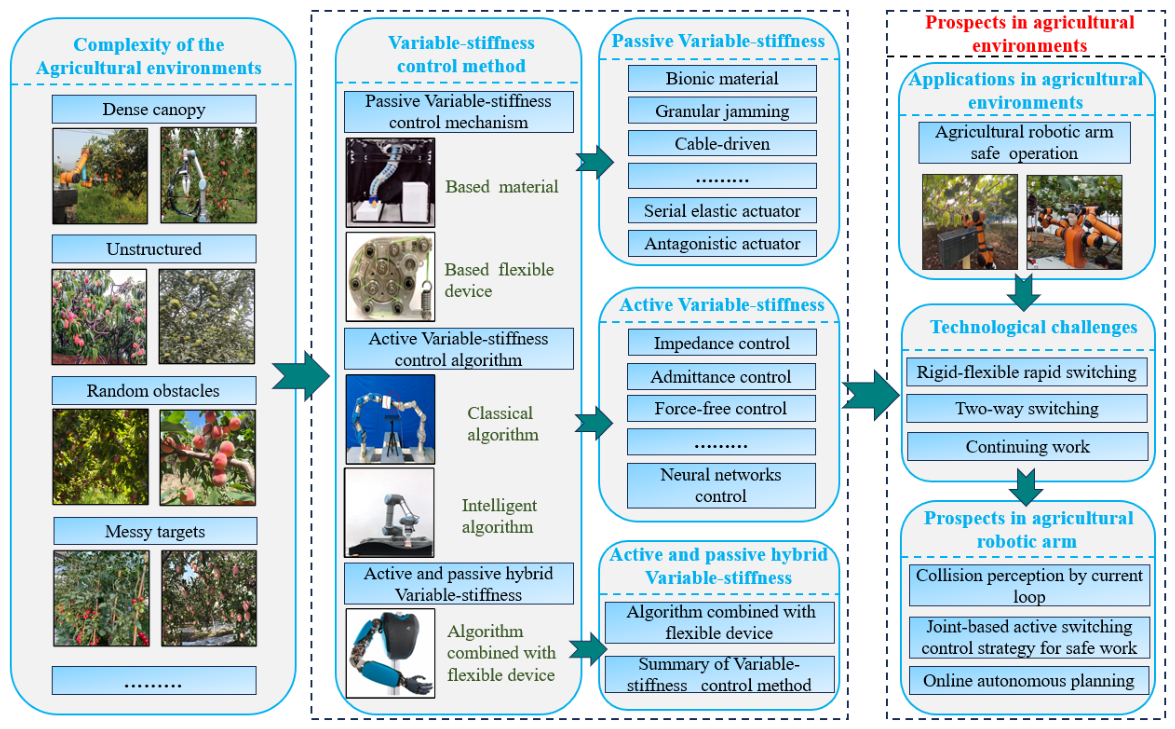
Despite the rapid advancements in agricultural robotic technology, robotic arms lacking collision adaptation capabilities cannot meet the demand for flexible and safe operation in complex agricultural environments. Therefore, a robotic arm equipped with variable-stiffness control can engage in safe interactions, achieve flexible obstacle avoidance, and attain precise positioning in complex and unstructured agricultural environments. This paper reviews research on the variable-stiffness control of robotic arms, covering methods for passive control based on mechanisms, active control based on algorithms, and active and passive hybrid variable-stiffness control methods. Additionally, the application of variable-stiffness control in safe agricultural robotic arm applications is prospected. The remainder of this paper is structured as follows: Section 2 presents the research design used for this review. Section 3 discusses the complexity of agricultural robot working environments. Section 4 summarizes the current applications and developments of variable-stiffness control regarding robotic arms. Section 5 comprehensively analyzes the challenges and future development trends of variable-stiffness control in regard to agricultural robotic arms. The conclusions of this review are presented in Section 6. The framework for this work is shown in Figure 1.

2. Review Methodology

2.1. Literature Search

We conducted a structured retrieval of the literature through topic analysis. The literature retrieved mainly comes from Web of Science, Scopus, IEEE Xplore, ScienceDirect, SpringerLink, Wiley Online Library, MDPI, and Google Scholar. The search keywords included the following combinations: (i) Variable-stiffness control AND Robotic arm, (ii) Flexible control AND Robotic arm, (iii) Flexible obstacle avoidance AND Robotic arm, (iv) Safe interaction AND Agricultural robot, (v) Variable-stiffness actuator AND Robotic arm, and (vi) Agricultural environments AND Robotic arm. These combinations were used to improve the relevance of the search results.

2.2. Literature Screening Criteria

The literature was selected according to several inclusion and exclusion criteria. The included studies were required to be related to variable-stiffness control, compliant control, flexible obstacle avoidance, robotic arms, or agricultural robotic applications. Studies that provided clear descriptions of control algorithms, variable-stiffness materials, and variable-stiffness mechanisms were prioritized. Recent journal and conference papers were emphasized, while classical studies on hybrid force and position, impedance, admittance, and force-free control were also retained when they provided important theoretical foundations. Studies were excluded if they were unrelated to robotic arms or agricultural robotic applications, lacked sufficient technical details, were duplicated, or were unavailable as full texts.
Based on the relevance of the literature to variable-stiffness control for robotic arms, 197 articles were selected for detailed analysis. The selected articles are classified according to technical characteristics: variable-stiffness methods are divided into passive, active, and hybrid active/passive variable-stiffness control. In addition, the reviewed methods were further compared in terms of controllable stiffness range, control latency, control complexity, energy consumption, and suitability for agricultural environments. This review methodology provides a systematic basis for evaluating the advantages, limitations, and engineering application feasibility of variable-stiffness control technology employed in agricultural robotic arms.

3. The Complexity of Agricultural Environments

The complexity of agricultural environments far exceeds that of typical industrial environments. This complexity is primarily manifested in highly unstructured environments, variations in crop growth conditions, and the presence of irregular obstacles, all of which pose significant challenges for the operation of agricultural robots.

3.1. Actual Working Environments Faced by Agricultural Robots

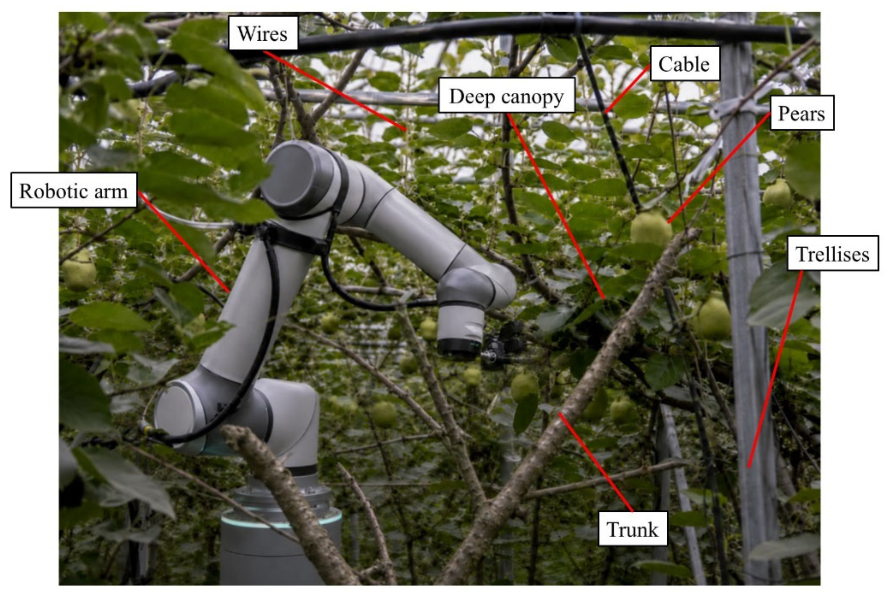
Modern precision agriculture requires robots to be able to engage in safe interactions to execute tasks swiftly and accurately [27,28,29]. Agricultural robots’ robotic arms must be able to not only interact with surface objects but also reach deep within the canopy [30,31,32,33]. However, in real-world scenarios, these robots encounter various obstacles, including deep canopies, complex trunk structures, and randomly appearing wires and trellises (Figure 2). These obstacles are intricately intertwined, obstructing the movement of robotic arms and increasing the likelihood of collisions and entanglement. Currently, agricultural robots are only capable of performing operations on a target located on the surface of a canopy. Once they venture deeper into the canopy, unpredictable collisions may occur, potentially damaging the agronomic structure, crops, and the robotic arm itself. This limitation severely restricts agricultural robots’ practical applications.

3.2. Robotic Arm Obstacle Avoidance Methods in Agricultural Environments

Most agricultural robots use standardized rigid robotic arms. When a collision occurs, the mechanical arm—with a contact force of more than 50 N—generally stops abruptly to protect itself. At this time, the robot must stop working and re-plan the motion, resulting in low working efficiency, which has become the largest obstacle to the promotion of agricultural robots [34,35,36,37]. To achieve effective obstacle avoidance in dynamic and unstructured agricultural environments, researchers usually use perception techniques for environmental modeling and visual recognition (Table 1). Although environmental modeling can improve robotic arms’ collision avoidance performance to a certain extent, the calculated path is complex, and the driving time is extensive. Currently, most methods have only been tested in controlled indoor environments or simulations and cannot be applied in actual agricultural environments [38,39,40,41]. Visual recognition technology is susceptible to serious interference from environmental factors. Once an obstacle is affected by light and occlusion, it cannot be accurately identified and located, and thus the obstacle cannot be avoided [42,43,44,45]. Although environmental modeling and visual recognition technology have made remarkable progress, it is still difficult to solve unpredictable collisions in agricultural environments. Therefore, it is necessary to consider the application of variable-stiffness control technology to agricultural robotic arms so that the arms can interact with obstacles safely in a flexible state.

3.3. The Demand for Variable-Stiffness Control for Robotic Arms in Agricultural Environments

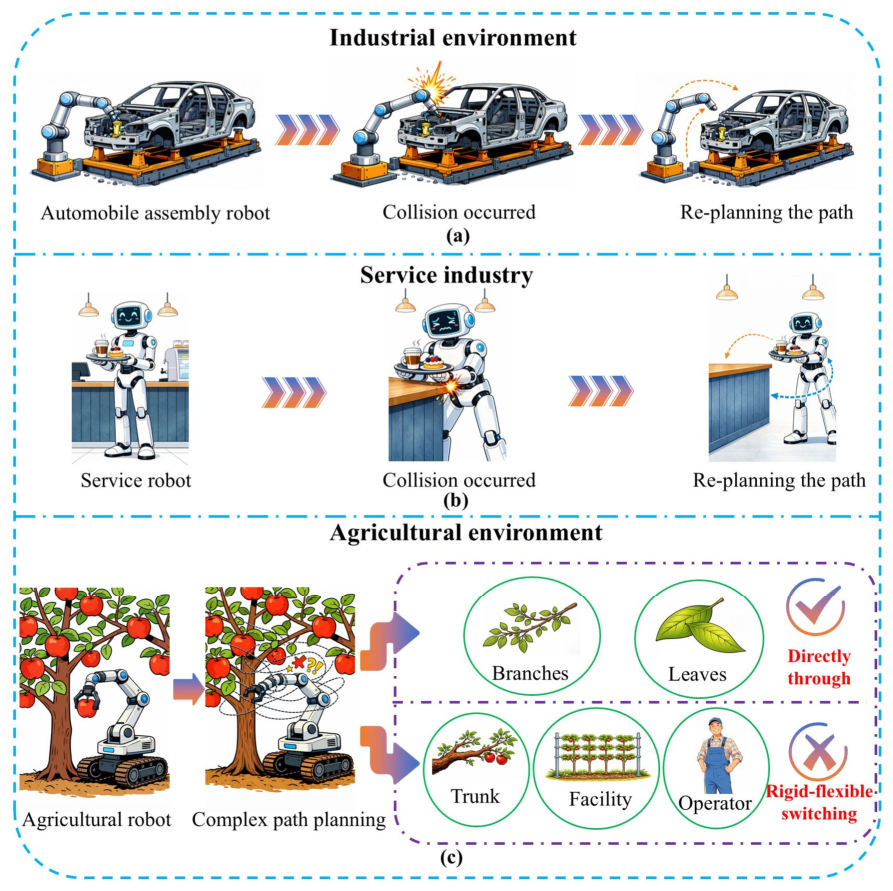
Variable-stiffness robotic arms have a broad range of application requirements in agricultural environments. In the industrial and service environments, when a robotic arm collides with the surrounding objects, motion planning can be re-planned to avoid collisions and subsequent work (Figure 3a,b). In operations in complex agricultural environments, robots must face obstacles such as unstructured deep canopies and trunks. Fruit, trunks, and leaves in the canopy form a dense and complex narrow passage space. The industrial robotic arm on an agricultural robot relies on the inverse solution to the pure rotation joint, which can generally meet the requirements for operations regarding surface targets but cannot reach the dexterity-demanding working space required for operations inside the canopy [57,58,59]. Although there has been remarkable progress in robotic arm obstacle avoidance technology, complete obstacle avoidance in irregular agricultural environments remains impossible, making the prospect of application in real production increasingly distant [60,61,62]. Therefore, robotic arms will inevitably collide with something in agricultural environments, so they must be able to protect themselves in the collision. The existing obstacle avoidance methods cannot solve the problems outlined above, and agricultural robotic arms urgently need to integrate variable-stiffness control.
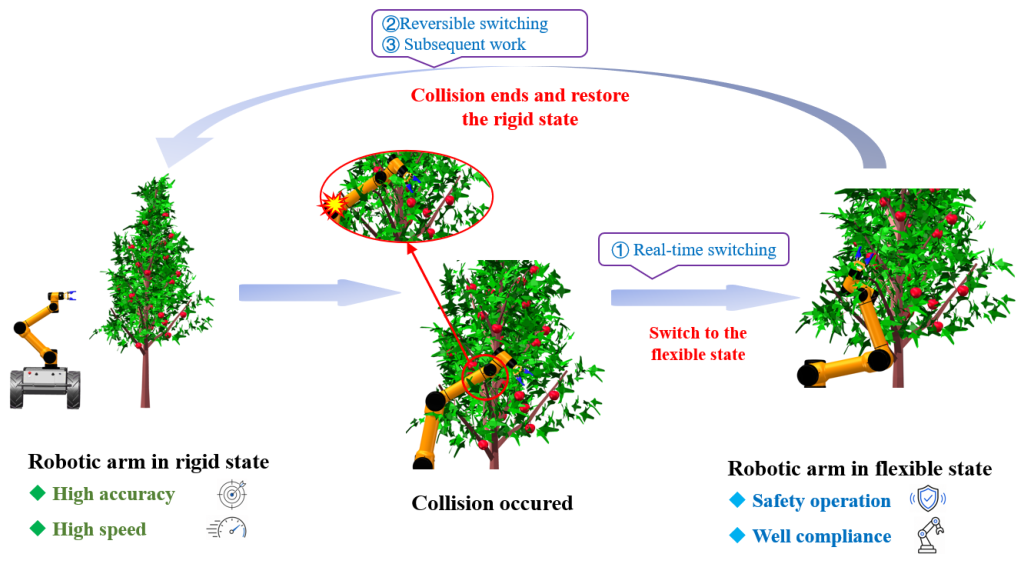
Introducing variable-stiffness control in traditional rigid robotic arms combines the advantages of high speed and precision in the rigid state and safe interaction in the flexible state. When such a robotic arm collides in the rigid state, it switches to a flexible state and moves in the direction of external force through complex environments with dense branches and trunks (Figure 3c). For example, when a collision with branches and leaves—which has little effect on the robotic arm itself—is detected, the arm does not need to switch from a rigid state to a flexible state, so it maintains a rigid state and pushes through the obstacle. When trunks, site facilities, wires, trellises, and operators are detected, the robotic arm triggers rigid–flexible active switching, shifting from the high-precision rigid state to the flexible adaptive state. Variable-stiffness control protects not only agricultural facilities and operators, but also the robotic arm itself.

4. Robotic Arm Variable-Stiffness Control Technology

The existing variable-stiffness control technology for robotic arms is primarily designed for industrial environments and rarely applied in agricultural environments. In industrial environments, robotic arm variable-stiffness control technology is mostly used for flexible operation tasks, such as grinding, polishing, and assembly, wherein the working environments are simple and standardized. Associated studies mainly include passive variable-stiffness control based on mechanical structures, active variable-stiffness control based on algorithms, and hybrid variable-stiffness control.

4.1. Passive Variable-Stiffness Control Mechanisms

Passive variable-stiffness control involves designing the robotic arm using specific materials and structures that rely on the inherent properties of the materials or the deformation of the mechanism to absorb external force. This approach enables stiffness adjustment without the need for feedback. Another method of passive variable-stiffness control involves adding an external flexible device into the robotic arm, which helps counteract external force and allows the system to switch between rigid and flexible states.

4.1.1. Material-Based Design of Variable-Stiffness Robotic Arms

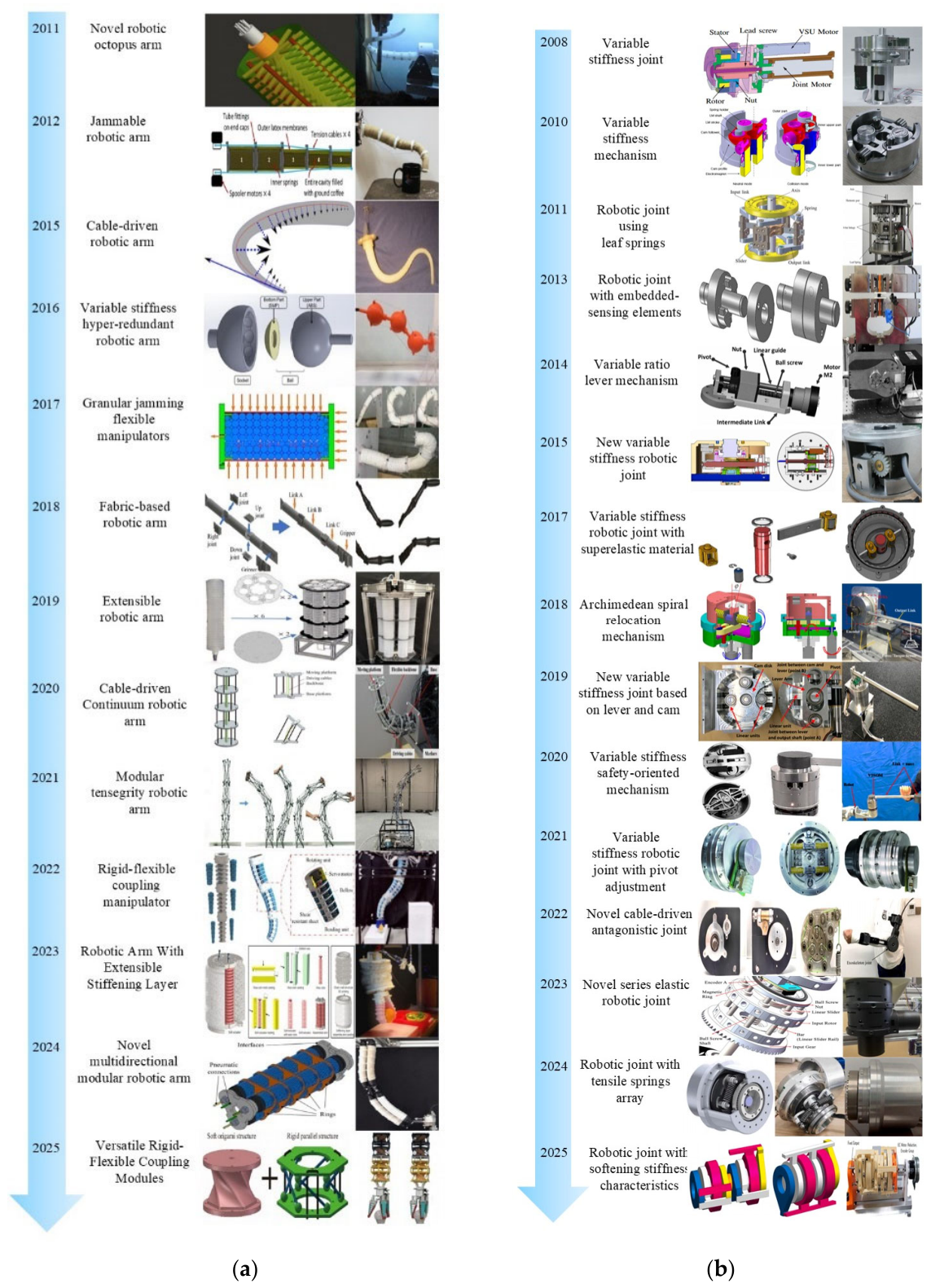
Researchers investigating variable-stiffness in robotic arm materials have achieved stiffness adjustment by utilizing the materials’ inherent properties, with the core principle being the absorption and transformation of mechanical energy by the material itself [63]. Typical designs for variable-stiffness materials include bionic materials, shape memory polymers, granular jamming, layer jamming, locking mechanisms, cable-driven systems, and so on [64,65,66,67]. Bionic materials achieve variable-stiffness by mimicking the mechanical properties of biological tissues, with examples including the pliability of octopus arms, the flexibility of elephant trunks, and the bending capabilities of bird necks [68,69,70,71]. The materials typically employed in the shape memory polymer method include low-melting-point alloys, thermoplastic polymers, and shape memory alloys. By controlling external conditions such as magnetic fields, electric fields, and temperature, the material can transition between liquid and solid phases, thus enabling the adjustment of the robotic arm’s stiffness [72]. Granular jamming achieves variable-stiffness by manipulating the vacuum pressure of particles within a closed container. Examples of common granular jamming materials include coffee grounds and beads. In the flexible state, increasing air pressure in the chamber weakens the solid-state characteristics of the particles, enhancing their flow characteristics and allowing flexible deformation of the robotic arm. In the rigid state, extracting gas from the chamber creates a vacuum that causes the particles to interlock through friction, transforming them from a flowing state into a solid state and returning the arm to its rigid form. The principles of layer jamming and granular jamming are similar, as negative pressure is employed to adjust the friction between thin layers for rigid–flexible conversion [73,74]. When in the flexible state, the thin layers slide freely, resulting in a soft overall structure. In the rigid state, vacuum pumping forces the thin layers to compress, which increases friction and limits relative displacement, thereby hardening the robotic arm. The locking mechanism for variable-stiffness technology utilizes the geometric matching or physical interlocking of the mechanical structure to achieve rigid–flexible switching [75]. In the unlocked state, the mechanism is flexible and free, while in the locked state, the robotic arm is secured by snaps or magnetic pulls. A cable-driven robotic arm enables continuous variable-stiffness to adapt to complex, confined environments [76,77]. This type of arm employs a multi-DOF cable transmission structure, replacing traditional rigid gear or connecting rod mechanisms. Adjusting the tension of cables on both sides allows control of the arm’s joint angle and stiffness. Additionally, cable-driven robotic arms are lightweight, highly compliant, and inherently safe, making them increasingly attractive for research and practical applications. Figure 4a depicts the evolution and representative achievements of variable-stiffness design based on materials. A summary of the material-based variable-stiffness methods for robotic arms, as provided in the literature, is presented in Table 2.
The material-based passive variable-stiffness control method offers several advantages, including high safety and strong environmental adaptability. However, it also has notable limitations. For instance, the range of stiffness adjustment in material-based variable-stiffness design is limited, making it challenging to meet the full spectrum of requirements from super-high-pliancy to high-rigidity. However, there have been recent studies proposing a new vacuum-powered soft bending actuator (VPSBA) [78]. The VPSBA can change curvature by adjusting the driving pressure and thickness of the front and rear walls. When the internal angle of the actuator is 76° and 104°, the maximum bending angle can reach 127.7° and 171.5°, respectively. At present, in agricultural environments, the VPSBA is only suitable for flexible grasping of the robot end effector. The robotic arm is larger than the end effector, so it is more prone to collision. Even if the VPSBA principle is used to develop a variable-stiffness robotic arm, the following shortcomings still apply:
  • The greater volume of the robotic arm results in a more complex design of the internal structure of the chamber.
  • The long stroke of the robotic arm chamber leads to a slow gas supply, and it is difficult to adjust the stiffness of the whole robotic arm instantaneously by changing the air pressure when a collision occurs.
  • The VPSBA is made of silicone rubber, and the air supply pressure required by the robotic arm is much higher than that of the VPSBA. Instantly increasing the air pressure is likely to cause local surface ruptures.
Figure 4. Evolution of the passive variable-stiffness control method of the robotic arm and the characterization results of each stage: (a) Passive variable-stiffness control based on material [79,80,81,82,83,84,85,86,87,88,89,90,91]. (b) Passive variable-stiffness control based on a flexible device [92,93,94,95,96,97,98,99,100,101,102,103,104,105,106].
Agronomy 16 01275 g004
Furthermore, the performance of variable-stiffness materials is highly sensitive to environmental factors such as temperature and humidity. For example, silicone rubber can degrade under ultraviolet radiation, leading to a loss of flexibility. Additionally, most materials only support unidirectional rigid–flexible switching. For instance, under vacuum conditions, blocked particles cannot regain their fluidity independently and require external triggers, such as heating or inflation, restricting their applicability in dynamic agricultural environments. The long-term stability of the passive variable-stiffness control method is also a challenge; for example, the layer interference method may lead to stiffness degradation due to seal failure or interlayer wear after frequent vacuuming. Moreover, variable-stiffness materials often demonstrate low controllability and poor durability. With advancements in intelligent materials and self-healing materials, material-based passive variable-stiffness control methods are anticipated to find broader applications in the field of agricultural robots.
Table 2. Performance comparison of material-based passive variable-stiffness control method.
MethodControllable Stiffness Range
/(N·mm−1)
Response Time
/(s)
SafetyReferences
Bionic material0.035–0.4561.0–1.4IV[107]
Shape memory polymer0.165–0.3080.3–0.5III[108]
Granular jamming0.345–3.7330.5–1.0IV[109]
Layer jamming0.080–6.0500.5–1.0III[110]
Locking mechanism3.875–5.7601.5–2.0V[111]
Cable-driven3.500–4.5001.0–2.0IV[112]
Note. Safety includes I–V levels; the higher the level, the higher the safety.

4.1.2. Designing Variable-Stiffness Robotic Arms Based on Flexible Devices

The mechanism of the robotic arm can be enhanced by incorporating a flexible device at the joint, thereby improving the arm’s adaptability to various environments and enabling safe interaction. The core principle of this approach is to dynamically adjust the robotic arm’s stiffness through the physical structural characteristics at the joint level, including elastic elements, variable-stiffness mechanisms, or geometric constraints. The adjustment facilitates collision buffering without the need for sensor feedback or complex calculations. Typical flexible devices include series elastic, antagonistic, and lever actuators [113,114,115,116,117]. Figure 4b depicts the evolution of variable-stiffness design based on flexible devices and shows representative results from each stage. The disadvantage of this method is that adding a variable-stiffness device increases both load and energy consumption. If the device is added to the end, the end load will be reduced, and the contact force with respect to the environment cannot be controlled in real-time, resulting in poor interaction with the environment. Consequently, an increasing number of researchers have shifted their focus to active variable-stiffness control based on algorithms.

4.2. Active Variable-Stiffness Control Algorithms

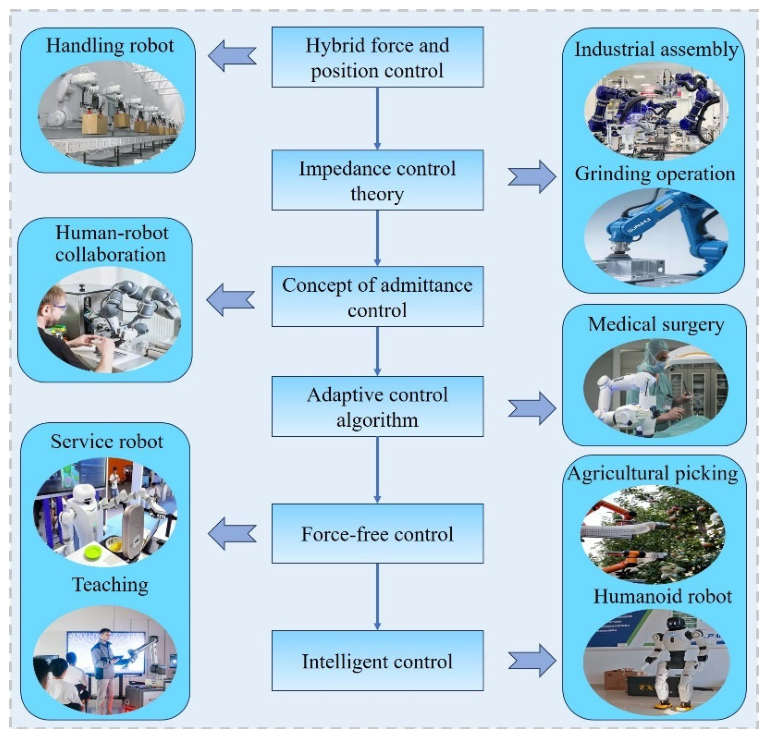
Introducing a variable-stiffness control algorithm allows a robotic arm to achieve force control by sensing the contact force with respect to the external environment, thereby promoting safe interaction between the robotic arm and its surrounding environment. In recent years, the development of active variable-stiffness algorithms in robotics has marked a significant transition from mechanization to intelligence [118,119,120,121]. In response to the demands of unstructured environments and various tasks, the active variable-stiffness control method effectively addresses the issues of low work efficiency caused by collision damage and the inadequate adaptability of traditional rigid robotic arms through a comprehensive closed-loop system encompassing environmental perception, algorithmic decision-making, and dynamic execution [122,123,124]. Variable-stiffness control algorithms can be integrated into existing robotic arm products, enabling zero-cost rigid–flexible switching. The process of developing the active variable-stiffness control method—from the early force control research based on an impedance model to the contemporary intelligent control systems utilizing multi-modal sensing and deep learning—is shown in Figure 5 [125,126]. Regarding application environments, the active variable-stiffness control algorithm has transitioned from initial use in standardized and straightforward factory environments to complex and unstructured agricultural environments.

4.2.1. Hybrid Force-And-Position Control

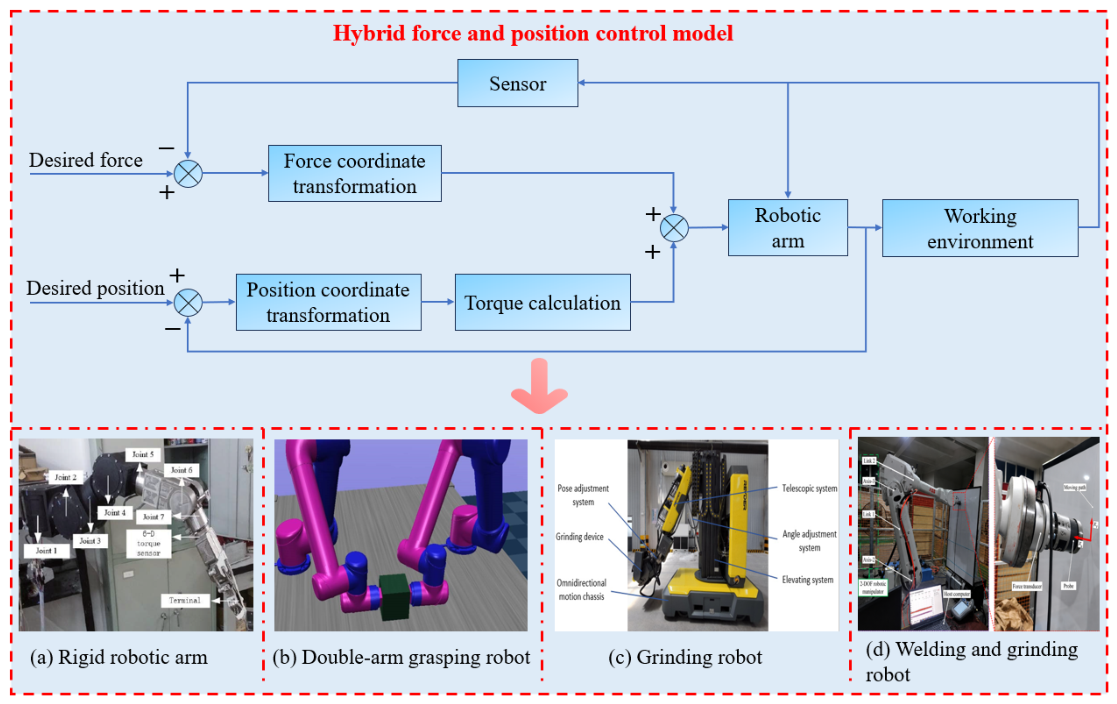
Hybrid force-and-position control is predicated on the complementarity and orthogonality of the position and force subspaces of a robotic arm during collisions, facilitating the decoupling of force and position control. Specifically, position control is executed within the position subspace, while force control is conducted within the force subspace [127,128,129]. This method is primarily employed for tasks such as handling and precision assembly, with a corresponding structural block diagram shown in Figure 6. Hybrid force-and-position control of a robotic arm can be categorized into two basic motion states—namely, contact and non-contact—and the conversion between these two states. The control method is designed to ensure that the force aligns with the expected value. The structure of the controller is intricately linked to the dynamic characteristics of the robotic arm and the environmental conditions encountered. When a robot operates within varying contact environments, the controller must be adapted. Chang et al. [130] studied the control methodology for the contact force between a robotic arm and its environment, proposing a hybrid force-and-position control method for a rigid robotic arm. As demonstrated through simulation analysis and experimental verification, the proposed algorithm can improve performance in path planning of the robotic arm terminal (Figure 6a). Xie et al. [131] applied hybrid force-and-position control to operating joint robots. They used smooth and invertible mappings from joint space to task space to decouple the two control objectives and design controllers, respectively (Figure 6b). The traditional motion controller in the task space was employed for motion control, while the force controller was designed by manipulating the desired trajectory to regulate the force indirectly. Finally, the effectiveness of the hybrid force-and-position control system was verified through a double-arm grasping experiment. In agricultural environments, accurate force control of a robotic arm is in relatively high demand, making it challenging to apply a singular hybrid force-and-position control method. Consequently, some researchers have sought to enhance traditional hybrid force-and-position control approaches. A hybrid force-and-position control strategy based on fuzzy proportional–integral–derivative (PID) control has been designed for robots engaged in grinding large, curved workpieces with unknown parameters, resulting in a significant improvement in response speed and a reduction in errors relative to traditional static control strategies [132]. This strategy effectively addresses the complexity and limited adaptability of traditional methods during the grinding process, thereby enhancing the quality and efficiency of robotic arm operations (Figure 6c). To further improve control performance in uncertain environments, a novel hybrid force-and-position control method based on adaptive fuzzy control has been developed for robotic arms in industrial settings [133]. This control algorithm is applicable to welding and grinding tasks, where it regulates the normal interaction force and position of the robotic arm’s end effector (Figure 6d). While research on hybrid force-and-position control algorithms has advanced significantly, reliance on accurate environmental modeling remains a challenge. Environmental variations can lead to a lack of model universality, and inaccurate environmental modeling can result in mismatched force control parameters during contact, ultimately causing damage to crops, operators, and the robotic arm itself.

4.2.2. Impedance Control

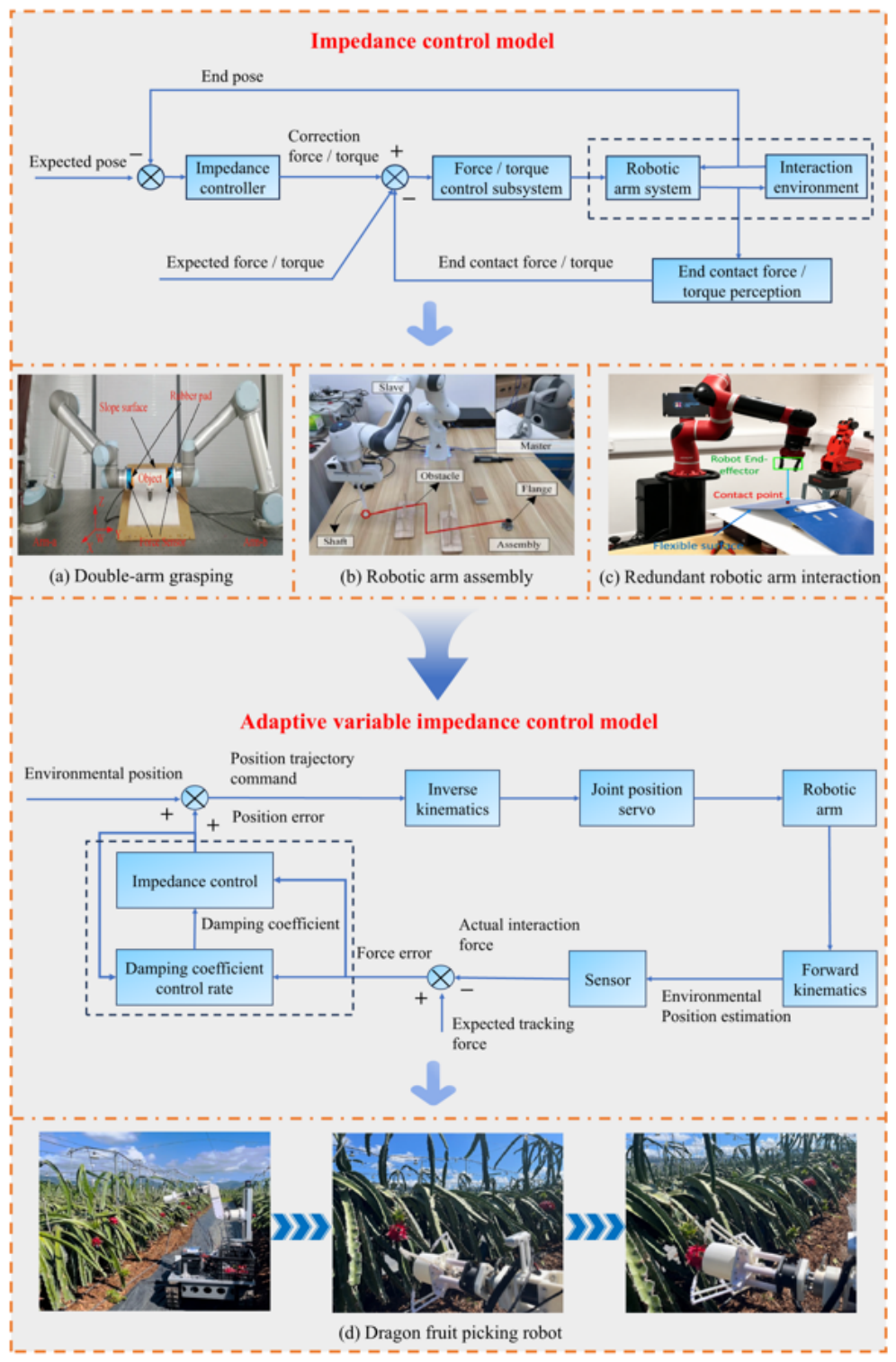
Hybrid force-and-position control presents several disadvantages, including rigid–flexible switching oscillation, dependent environment modeling, and long response times. In contrast, impedance control features robust anti-interference capacity and fewer programming computations in unknown environments, making it particularly suitable for application in complex unstructured environments. A corresponding control block diagram is shown in Figure 7. Impedance control does not directly regulate the contact force between the robotic arm and its environment; rather, it modifies feedback position error, speed error, or stiffness to control the force based on the relationship between the position or speed of the robot’s end effector and the applied force [134,135,136]. The impedance control algorithm can adapt to variations in the stiffness of the object the arm is in contact with without necessitating the use of an accurate environmental stiffness model, thereby enhancing its applicability across various tasks, such as component assembly, workpiece polishing, and space grasping [137,138,139] (Figure 7a–c). Currently, most impedance control algorithms are implemented in 3-DOF and 6-DOF robotic arms, providing reliable control that enables the robotic arm to adapt to external contact force and interact safely with the environment.
The traditional impedance control algorithm establishes impedance parameters based on the external force acting on the robotic arm. During interaction with the environment, the robotic arm transitions from a purely rigid state to a more flexible state. However, this approach cannot adapt to changing environmental parameters. Although some researchers have applied impedance control algorithms in robotic production, most applications focus on end effectors rather than robotic arms [140,141,142]. Compared to end effectors, robotic arms encounter collisions more frequently, and implementing variable-stiffness control is more complex. Consequently, adjusting the impedance parameters of the robotic arm remains one of the primary challenges and focal points in algorithm research. With ongoing advancements in the field, an adaptive control strategy capable of responding to uncertain environments has been proposed. Adaptive control can modify its parameters to accommodate external disturbances and dynamic changes. Integrating adaptive control with a traditional impedance control algorithm allows adjustment of the impedance parameters in real-time according to environmental changes, enabling the robotic arm to more effectively control the interaction force with respect to its environment. This integration enhances the robustness and reliability of robotic arms in uncertain environments. Wang et al. [143] employed an adaptive variable impedance control method for a dragon fruit-picking robot. When there are sudden changes in contact force, the robotic arm, under adaptive variable impedance control, tracks the contact force with reduced overshoot and shorter adjustment times, thereby demonstrating enhanced dynamic performance in flexibility control (Figure 7d). The experimental results show that the flexibility of picking control based on adaptive variable impedance increased the robotic arm’s picking success rate while simultaneously reducing the damage rate. However, the average damage rate remained as high as 20.5%, indicating that this picking method based on adaptive impedance control still faces challenges in fully addressing these shortcomings.

4.2.3. Admittance Control

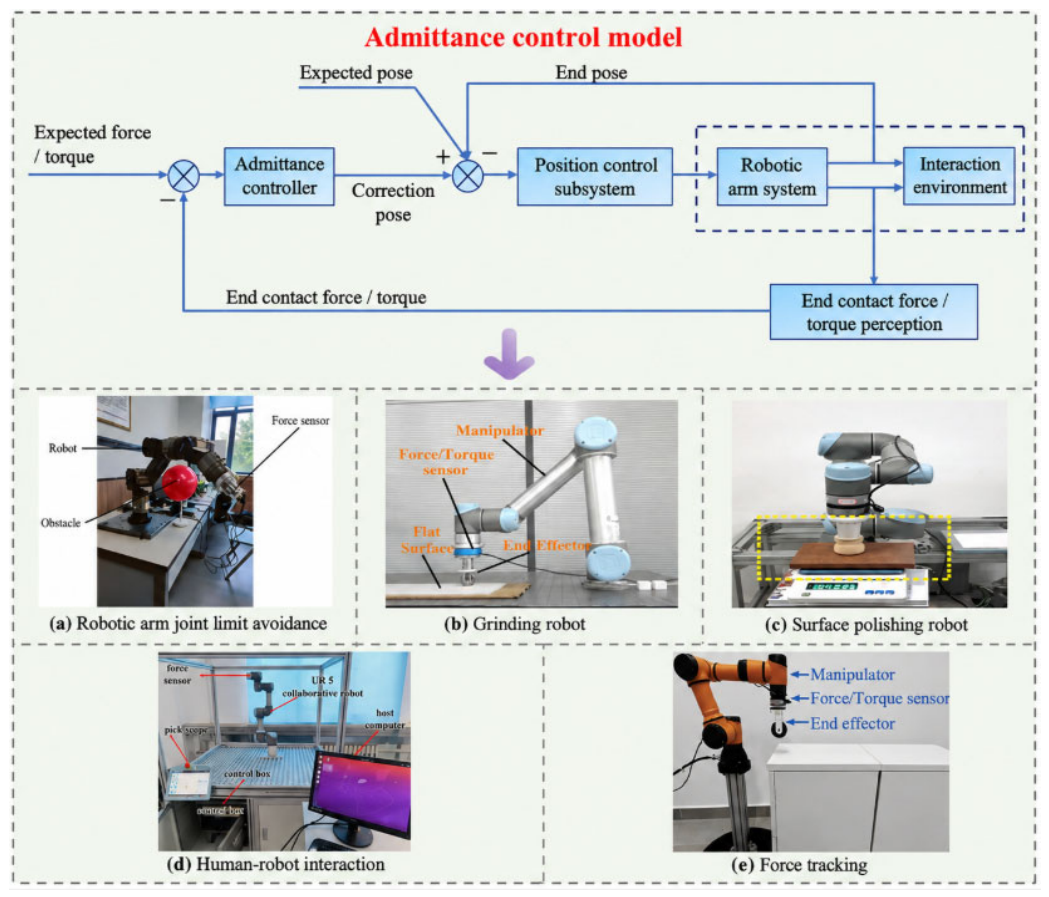
Impedance control exhibits low robustness against unknown disturbances, often complicating the achievement of desired outcomes during the dynamic characteristic-following process within the contact space. Inspired by the adaptive stiffness behavior of the human arm, one group of researchers proposed an admittance control algorithm [144]. A corresponding admittance control block diagram is shown in Figure 8. On the basis of the contact force between the robotic arm and the environment, as well as the expected admittance model, the admittance controller generates corrections to the desired motion. By superimposing the motion correction with the expected motion trajectory information, the resultant data are mapped to the joint space of the robotic arm through inverse kinematics. Consequently, the corresponding motion control is executed in the inner loop, ultimately facilitating dynamic flexibility in the robotic arm’s interactions with the external environment. Currently, the admittance control algorithm is extensively employed to enhance obstacle avoidance in human–robot interactions. When the operator exerts an external force, the robotic arm smoothly follows the human hand, demonstrating fluid and flexible motion [145]. Incorporating obstacle avoidance into interaction control necessitates a strategy that adjusts the stiffness of the robotic arm (Figure 8a). This adjustment ensures that the minimum distance maintained is consistently greater than the predetermined safe distance, thereby preventing any contact or collision with obstacles. Admittance control serves as a crucial method for implementing compliance control in robotic arms. However, as with traditional impedance control, using constant admittance parameters often fails to satisfy the dynamic interaction requirements. To address the limitations of constant admittance control in robotic arm variable-stiffness regulation, researchers have proposed a fuzzy variable admittance control algorithm based on stiffness identification, thereby enhancing the compliance control ability of robotic arms [146] (Figure 8b).
Research on admittance control should extend beyond human–computer interaction. When applied to repetitive tasks or operations requiring high precision, traditional constant admittance controllers are often ineffective. This ineffectiveness arises from their heavy reliance on environmental conditions and stiffness, which are frequently challenging to ascertain in real-world applications. To overcome this limitation, a fuzzy adaptive controller based on fuzzy inference rules has been proposed [147,148]. In complex environments characterized by strong vibrational interference, the proposed controller enables a robotic arm to maintain high-precision tracking and exhibit strong adaptability. The algorithm was implemented in the UR3e robotic arm, and the enhanced admittance control method was found to significantly reduce external contact force and enhance the compliance capabilities of the robotic arm (Figure 8c,d). Additionally, the fluency and flexibility of the robotic arm during stiffness transitions were also enhanced. Nonetheless, challenges persist when applying this algorithm to robotic arms, including time delays, overshoot, oscillations, and even divergence. To address these issues, researchers have introduced virtual delay resonators to enhance force tracking accuracy and suppress jitter in the robotic arm [149] (Figure 8e). Experimental results derived from agricultural robots show that, while stiffness adjustment has improved, the algorithm still fails to meet the demand for frequent and rapid periodic variable-stiffness.

4.2.4. Force-Free Control

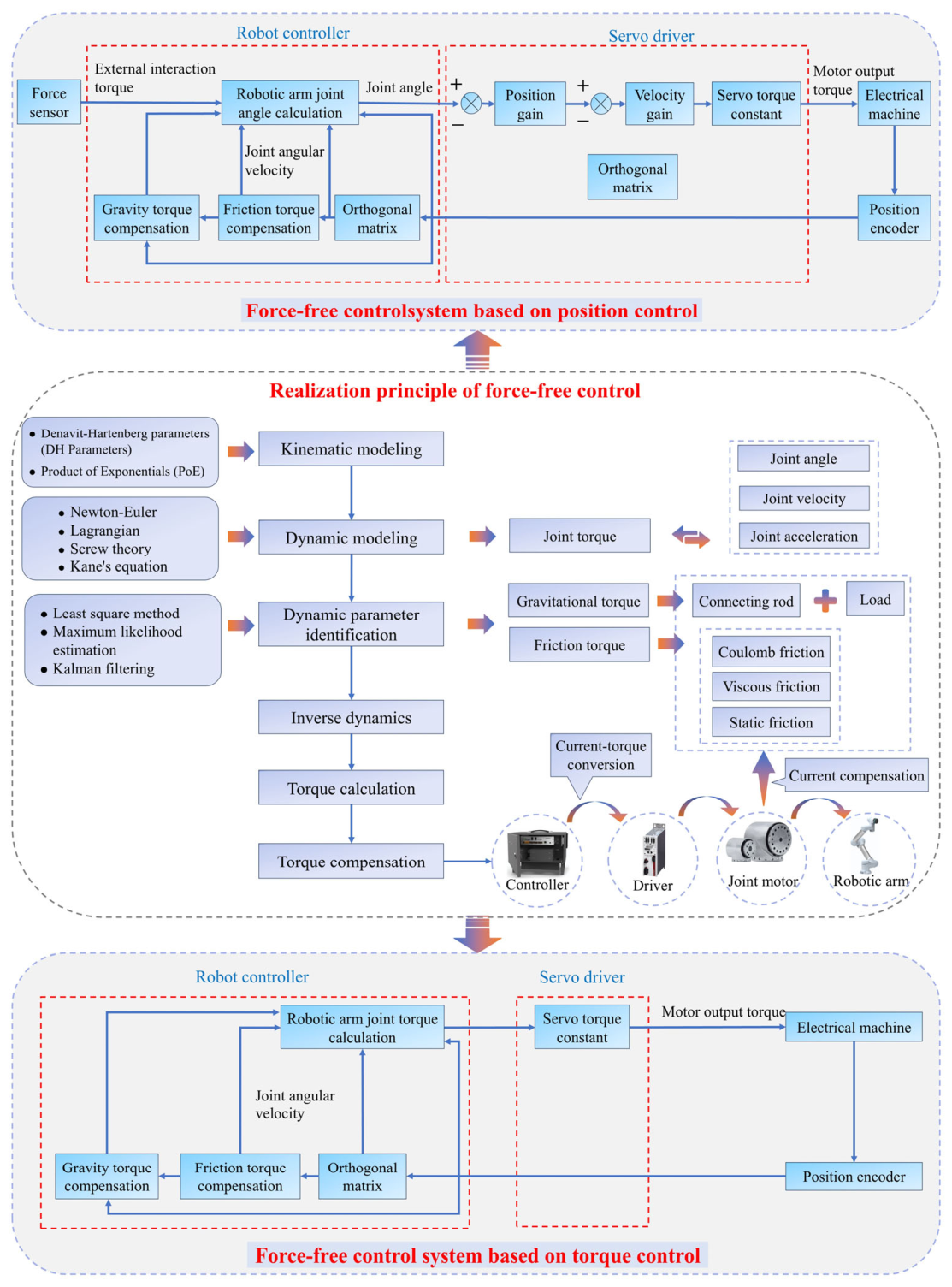
In industrial and agricultural production processes, robotic arms are subject to stringent requirements concerning safety, interaction, and flexibility. To address the challenge of achieving flexible and smooth robotic arm interactions, with the inertial force ignored, the gravity and friction of the robotic arm are calculated to compensate for the torque of the robotic arm and, finally, force-free control is realized [150,151,152]. Depending on the different operational modes of the motors in the force-free control of the robotic arm, there are two implementation modes: torque- and position-based control (Figure 9).
Force-free control based on position control requires installation, testing, calibration, and other steps related to the sensor, resulting in high overall system complexity. When the external force is relatively large, the joint acceleration of the robotic arm increases, thereby elevating the inertial, centripetal, and Coriolis forces, complicating the control of the system. Consequently, most researchers have focused on force-free control based on torque control [153]. In complex environments, robots typically employ lightweight robotic arms, which produce minimal inertial force. This approach only requires compensation for the gravitational and frictional forces acting on the robotic arm, enabling it to adjust its posture in response to the direction of the external force. Analyzing the entire process of force-free control reveals that the key to its implementation lies in establishing a dynamic model and identifying parameters. Dong et al. [154] developed a mathematical model for flexible joints and flexible-connected robots, enabling the design of a force-free controller that achieves gravitational compensation while reducing friction and inertial torques. The dynamic parameters of the robotic arm were obtained through a self-measurement approach. However, this method does not completely eliminate the effects of inertial and frictional forces. While it improves the stability of the robotic arm’s motion, it also reduces the system’s response speed. To address these challenges, Ni et al. [155] proposed a novel dynamic parameter identification method for industrial robots equipped solely with motor encoders and elastic joints. The method categorizes the unknown parameters of the dynamic model of the elastic joint into two groups: joint stiffness and motion parameters. The joint stiffness parameters are identified through static force and torque deformation experiments, eliminating the need for dynamic models, while the motion parameters are identified via dynamic excitation experiments. Although this approach simplifies the parameter identification process, it does not account for motor viscous friction parameters, lowering the accuracy of parameter identification. Consequently, after compensating for the gravity and friction of the robotic arm, the approach must overcome a small inertial force to comply with the external force. Chen et al. [156] proposed a torque compensation technique for force-free control. By employing the least-squares method for robotic arm parameter identification, they accurately identified a robot’s torque sensitivity and friction parameters. Following parameter identification and torque compensation, more precise torque control was achieved, resulting in more flexible force-free control and smoother drag processes.

4.2.5. Intelligent Variable-Stiffness Control
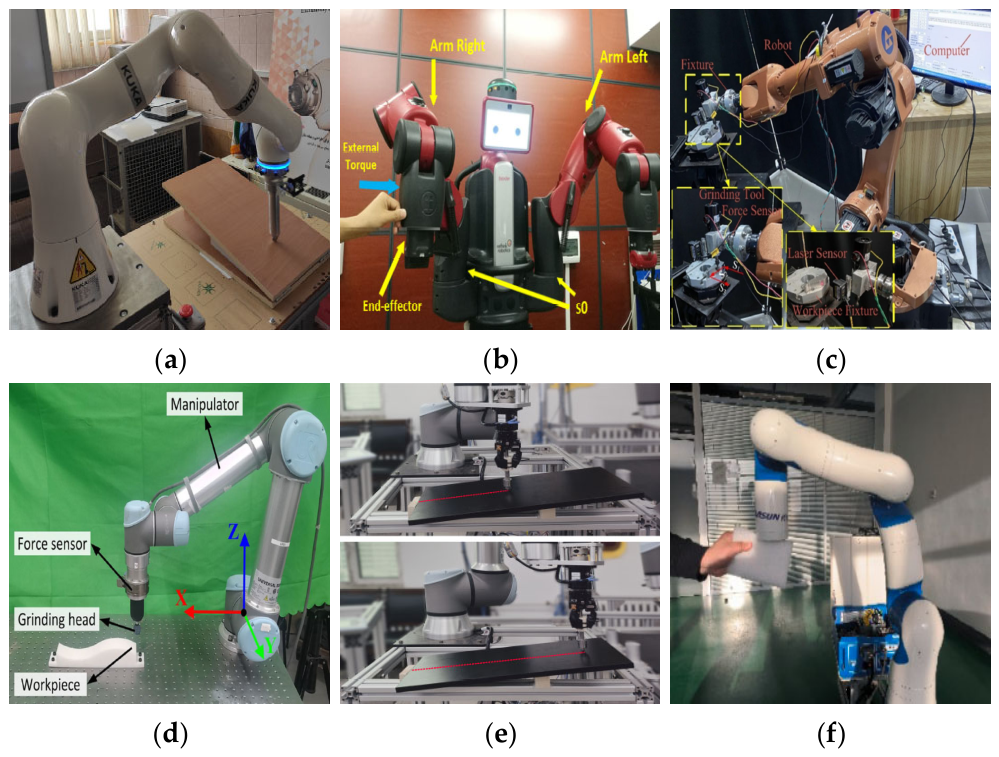
Recent advancements in agricultural robots have entered an era of intelligence, making the development of intelligent variable-stiffness control algorithms for robotic arms inevitable. In intelligent variable-stiffness control, an intelligent algorithm is employed to determine the parameters for impedance or admittance control, thereby compensating for uncertainties in the model [157,158,159,160]. The typical method involves combining an intelligent algorithm, such as a neural network or a machine learning algorithm, with traditional impedance control or admittance control methods to achieve rigid–flexible switching in a robotic arm.
As a new branch of intelligent control algorithms, neural network control constitutes a novel approach to addressing the challenges associated with controlling complex, nonlinear, and uncertain systems. The integration of neural network technology with a classical variable-stiffness control algorithm facilitates the identification of complex nonlinear systems that are challenging to model accurately, as well as model reasoning and parameter optimization [161]. Neural networks offer significant advantages over traditional control methods due to their self-adaptability and self-learning capabilities. Consequently, the application of neural networks in the development of variable-stiffness control algorithms for robotic arms has attracted considerable research attention. As discussed in Section 4.2.2, adaptive impedance control is hindered by challenges such as high damage rates in picking applications. Thus, the wavelet neural network was introduced into the adaptive impedance control algorithm to adjust the impedance parameters [162]. By employing this control algorithm, a robotic arm can effectively track the desired force in an environment with unknown stiffness. Unlike general impedance control, in which the position and stiffness of the environment must be known in order to select the impedance parameters, this structure allows for adaptation of the impedance parameters based on interaction with the environment.
To further enhance robotic arms’ adaptability to unknown environments and ensure compliant behavior, Peng et al. [163] designed an adaptive neural network controller integrated with an auxiliary system, enabling a robotic arm to interact with uncertain environments, even in the presence of actuator saturation. Application of this control system to the Baxter robot demonstrated that the robotic arm could effectively interact with unknown environments under input constraints (Figure 10b). However, the control system does not account for nonlinear constraints such as dead zones, time delays, and hysteresis, potentially compromising the performance and stability of the system. In response, an adaptive neuro-fuzzy inference control algorithm has been developed to achieve precise force tracking and suppress overshoot [164]. This control algorithm exhibits enhanced stability when confronted with sudden changes in stiffness and desired force. Although the algorithm has broad applicability and does not require manual fuzzy rule setting by experts, it has only been validated in simulated environments, lacking real-world application. In variable-stiffness control of robotic arms in agricultural environments, the controller must solve the dynamic equation quickly and accurately under conditions of noise and uncertainty. In recent research on intelligent control, a segmented-activation-function-based zeroing neural network (SAF-ZNN) model was designed to address the unsatisfactory convergence and sensitivity to noise in traditional dynamic equation-solving methods [165]. The SAF-ZNN model has potential application value in adaptive impedance adjustment and stiffness parameter adjustment regarding robotic arms. An analysis of the aforementioned variable-stiffness control algorithm based on neural networks reveals that the algorithm serves two main purposes. The first is to employ neural network learning to approximate either the dynamic or inverse dynamic model of the robotic arm control system, facilitating feedback control. The second is to employ neural networks to learn unknown parameters within the model to enhance adaptability when the dynamic model of a robotic arm is only partially known. The disadvantage of this algorithm is that numerous repeated operations must be performed to learn parameters, and there are also high demands regarding the online computational capabilities of hardware devices, potentially posing challenges in practical applications.
When traditional variable-stiffness control algorithms are applied in complex, unstructured environments, they face challenges such as model parameter uncertainty, variability in contact environments, and external interference. These limitations diminish their control effectiveness and restrict their range of application. Machine learning provides the advantage of real-time updates to model parameters through training and learning processes. By integrating machine learning with traditional variable-stiffness control algorithms, optimal control parameters can be predicted, thereby enhancing the flexibility and adaptability of robotic arm stiffness switching [166]. Among the various machine learning methods, reinforcement learning stands out as the most prominent and widely utilized approach to the variable-stiffness control of robotic arms. Zhang et al. [167] proposed a constant-force-grinding controller algorithm based on reinforcement learning proximal policy optimization to address the issue of low stiffness and significant deformation at the end of a robotic arm (Figure 10c). Building upon this foundation, Li et al. [168] introduced a deep reinforcement learning variable impedance control method that includes stability analysis. The method demonstrates rapid convergence and stable control outcomes in uncertain environments, but it has only been validated in a limited sample environment, and the algorithm’s generalization ability is insufficient (Figure 10d). As discussed in Section 4.2.3, the constant parameters in the admittance control algorithm fail to meet the demands of dynamic interactions. As a remedy, an admittance parameter optimization method based on reinforcement learning has been proposed for robotic arm force control [169]. The proposed method enhances the compliance of robotic arms to cope with unknown environments and increase their intelligence in contact-force-sensitive tasks (Figure 10e).
In recent years, deep learning has significantly advanced the development of variable-stiffness control algorithms for robotic arms. Force-free control and collision detection methods based on deep learning address the challenges of flexible and smooth interaction in robotic arms [170] (Figure 10f). Deep learning techniques can accurately detect abnormal collision behaviors in robotic arms without relying on explicit models. Furthermore, active variable-stiffness control algorithms based on deep learning exhibit improved convergence speed compared to traditional genetic algorithms, thereby meeting the real-time performance requirements of robotic arm control systems. Variable-stiffness control is a critical technique that enables robots to perform tasks in complex environments. However, active variable-stiffness control algorithms are highly dependent on sensor accuracy, and noise or calibration errors can directly affect control outcomes. Additionally, complex variable-stiffness control algorithms require high-performance computing units, which can be constrained by hardware limitations, leading to reduced real-time algorithm performance. Evidently, research on active variable-stiffness control algorithms for robotic arms remains in the developmental stage and has yet to reach full maturity.
Figure 10. Application of intelligent variable-stiffness control algorithm in robotic arm: (a) Force tracking on complex surface [162]. (b) Robotic arms interact with unknown environments [163]. (c) Surface workpiece grinding [167]. (d) Grinding workpiece with complex geometry [168]. (e) Robotic arm assembly [169]. (f) Human–robot interaction [170].
Agronomy 16 01275 g010

4.3. Active and Passive Hybrid Variable-Stiffness Control Methods

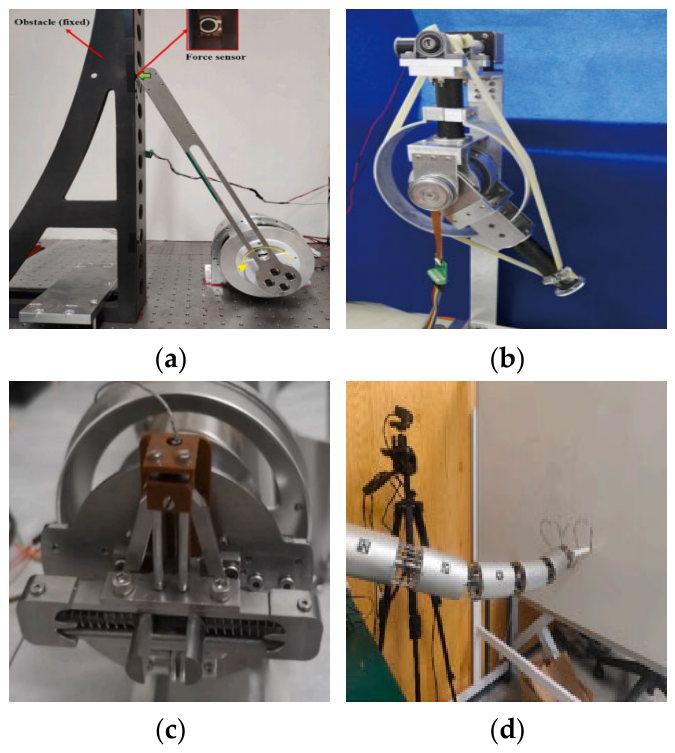
When a collision occurs, a robotic arm usually does not have enough time to switch from a rigid to flexible state using a single active variable-stiffness control algorithm, as such algorithms struggle to make decisions within a short timeframe [171,172,173,174]. After a collision, the position of the contact point may not be detected promptly, preventing the robotic arm from determining the appropriate direction in which to move. To address this issue, passive flexible devices can be integrated with active variable-stiffness control algorithms to provide a buffering effect. The hardware of the passive flexible device facilitates the transmission of collision information to the active control algorithm, thereby enhancing rigid–flexible-switching performance. This active and passive hybrid variable-stiffness method, which combines hardware and software, ensures both real-time responsiveness and precision in robotic arm operations. Ramadan et al. [175] introduced a novel infinite-rotation, infinite-stiffness variable-stiffness actuator (IRISVSA). The novelty of this actuator lies in its design topology, wherein two long-armed torsional springs are mounted on the output link and connected to the input link through a force contact point (FCP). Stiffness is varied by modifying the relative distance from the FCP to the joint rotation center. Additionally, a nonlinear PID controller was designed to ensure the system’s accuracy (Figure 11a). This method can achieve an infinite range of stiffness and a relatively rapid stiffness adjustment rate, but the compactness of the IRISVSA version requires further investigation. Zhang et al. [176] designed a robotic joint with variable-stiffness inspired by the tissue structure and driving principle of human arm muscle ligaments, allowing joint stiffness adjustment by varying the tension of an elastic band (Figure 11b). To enhance human–robot collaboration, the authors also introduced a compliance control strategy for human–animal joint stiffness matching. Yang et al. [177] developed a novel, compact, and integrated rotating joint with variable-stiffness and proposed a nonlinear PID method based on a genetic algorithm. The rotational stiffness and motion of the joint can be controlled in real-time (Figure 11c). Experimental results indicate that the proposed joint, characterized by a significant bearing capacity and a broad range of stiffness adjustment, effectively integrates both driving and sensing functions, thereby achieving excellent motion control performance. Additionally, the active and passive hybrid variable-stiffness method has been applied to reconfigurable robotic arms. Chen et al. [178] designed a modular cable-driven snake-like manipulator (MCDSM) and enhanced its active compliance through impedance control (Figure 11d). The design incorporates detachable arm segment units, modular drive units, and plug-in drive boxes. The detachable segments enable the MCDSM to adapt to tasks in narrow spaces and unstructured environments. However, it was noted that tracking accuracy decreases as the number of robotic arm units increases.
For unstructured agricultural environments, variable-stiffness robotic arms have emerged as a pivotal technology for addressing challenges related to environmental interaction security, operational accuracy, and the vulnerability of crop objects [179,180]. The passive variable-stiffness control method exploits the inherent characteristics of flexible devices and materials to provide rapid-response rigid–flexible switching. In contrast, active variable-stiffness control employs real-time sensing in combination with a control algorithm to dynamically adjust the stiffness coefficient of the robotic arm, facilitating flexibility interactions. The active and passive hybrid variable-stiffness method initially utilizes flexible devices to absorb impacts, subsequently employing a variable-stiffness control algorithm to achieve precise stiffness control. Table 3 presents a comparison of three variable-stiffness techniques, each exhibiting distinct advantages and disadvantages regarding the controllable stiffness range, control latency, energy consumption, computational complexity, suitability for agricultural environments, and maintenance costs. The passive variable-stiffness control method does not necessitate external force detection, enabling rapid switching between rigid and flexible states; however, its capacity for stiffness adjustment is limited to a small range. In contrast, the implementation of active variable-stiffness control broadens the stiffness adjustment range, and this approach is more suitable for agricultural environments, but it relies on the accuracy of external force detection. The accuracy of force sensor detection is high, but so is the price. Detection methods based on current feedback are severely disturbed by noise, readily leading to delayed responses. The active and passive hybrid variable-stiffness control method provides fast response times and smooth switching, but energy consumption and computational complexity are high, so greater hardware configurations are required, and higher costs are incurred. Additionally, this method necessitates a close integration of hardware and algorithm, complicating the design and debugging processes.
The promotion of variable-stiffness robotic arms depends not only on the advancement of technology but also on the actual needs of its main users. Different types of agricultural operators, such as small-scale farmers, large-scale farmers, facility agricultural operators, and orchard growers, are associated with significant differences in operation scale, maintenance capacity, and automation requirements. Small-scale farmers usually pay more attention to equipment cost, operation difficulty, and maintenance convenience. They will find inexpensive and easy-to-maintain variable-stiffness robotic arms more suitable. Large-scale farmers and orchard growers pay more attention to continuous operation efficiency, operation success rates, reliability, and degree of automation. They require variable-stiffness robotic arms that are highly perceptive and have fast responses. Facility agriculture operators mainly work in relatively controlled environments such as greenhouses and have high requirements for robot positioning accuracy, spatial adaptability, and human–machine collaboration security. They need variable-stiffness robotic arms with fine force control. Therefore, the significance of variable-stiffness control lies not only in improving the safety of robotic arm operation, but also in achieving a balance between cost, efficiency, and automation according to the needs of different agricultural users.

5. Challenges and Future Research Prospects

5.1. Differences in the Agricultural Collision Safety Problem in Existing Research

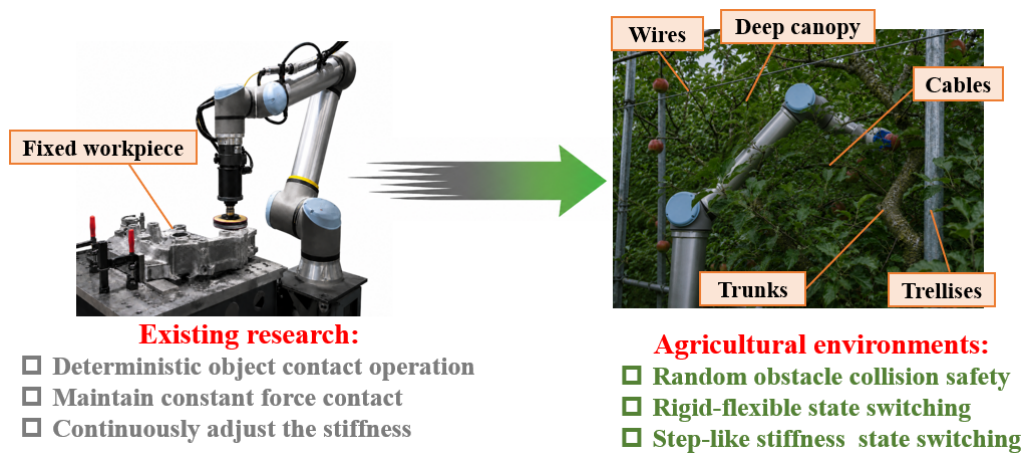
Section 4 summarizes the research on the variable-stiffness control of robotic arms. Evidently, research has mainly focused on industrial tasks, such as assembly, grinding, and part handling [189,190,191]. The continuous constant force between the end of the robotic arm and the contact surface is maintained by adjusting stiffness so as to achieve stable operation.
At present, there are few studies on the application of variable-stiffness control to safety-flexible obstacle avoidance operations. In agricultural environments, robotic arms employ variable-stiffness control technology to ensure collision safety, an aspect significantly different from the existing research, as shown in Figure 12:
  • Research on variable-stiffness control in industry mainly focuses on deterministic objects. However, agricultural environments entail collision problems involving numerous random and dynamic obstacles.
  • In industry, variable-stiffness control maintains a constant force between the robot arm and the contact surface by changing the stiffness of the robotic arm. However, in agricultural environments, the robotic arm must be able to switch from a rigid state with high-precision-operation capacity to a flexible state that ensures safety during a collision.
  • In industrial tasks, stiffness needs to be continuously adjusted within a small range to maintain constant force between the robotic arm and the contact surface. However, safe operation requires the robotic arm to perform step-like state switching instantaneously to reduce the massive impacts caused by collisions.
Based on the existing research on variable-stiffness control in flexible contact, this approach can be used to design rigid–flexible switching of robotic arms to safeguard agricultural robots against collisions during random changes and irregular environments.

5.2. Application Prospects of Variable-Stiffness Control in Agricultural Robotic Arm

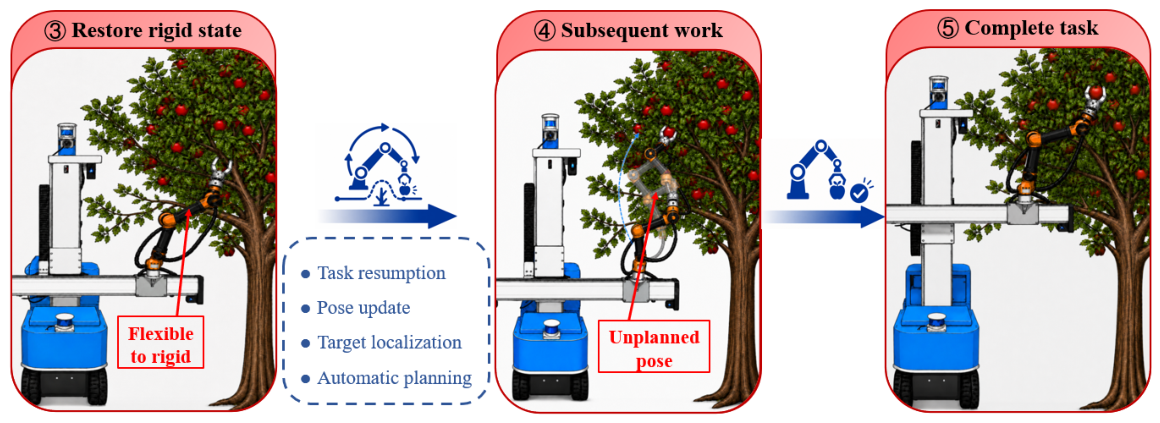
Since robotic arms are very prone to collision when working in a dense canopy, it is necessary not only to achieve instantaneous state switching during collisions but also to be able to adjust stiffness frequently [192,193,194,195,196]. The response speed of passive variable-stiffness control based on the mechanism is limited by the motion speed of the material phase change or the locking mechanism, and there is a lag. The active variable-stiffness control method is more effective in complex, unstructured agricultural environments due to its dynamic interaction with the surroundings. Taking a picking robot as an example, Figure 13 shows the effect of rigid–flexible switching of a robotic arm in an agricultural environment. When the robot starts to work, the robotic arm is in a rigid state and can only pick fruit from the surface. Once the robotic arm enters the canopy for picking, it will collide with randomly occurring trunks. At present, the most commonly used method for addressing this issue is to protect the robotic arm and trigger the safety mechanism to stop the robotic arm and withdraw it from work. At this time, the picking path must be re-planned, which reduces efficiency. Integrated variable-stiffness control enables the robotic arm to switch from a rigid state to a flexible one in real-time when it collides with a trunk. In the flexible state, the robotic arm will move in the direction of the collision force until the end of the collision. Subsequently, the robotic arm switches back to the rigid state from the flexible state and plunges deep into the canopy with the new posture as the starting point to continue picking. In this process, agricultural robotic arms with rigid–flexible switching ability show high-precision positioning in the rigid state and good impact protection performance in the flexible state.

5.3. Challenges in Rigid–Flexible Switching of Agricultural Robotic Arms

5.3.1. Real-Time Rigid–Flexible Switching

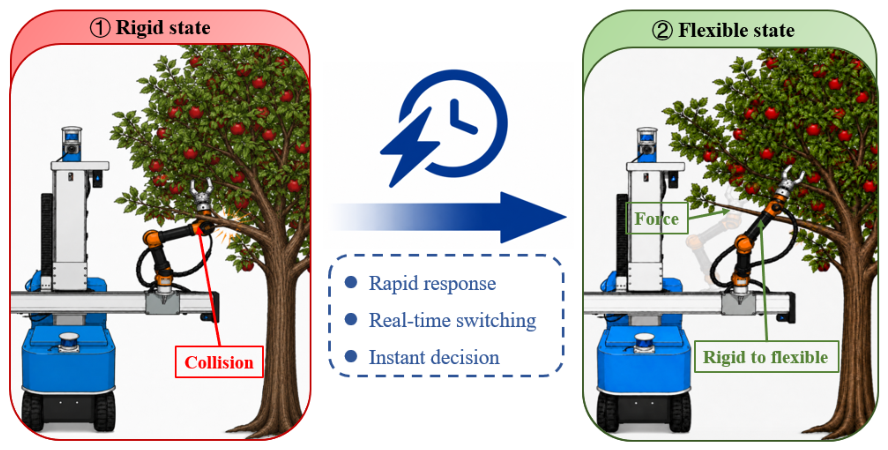
Rigid–flexible instantaneous switching is a key requirement for variable-stiffness control in agricultural robotic arms. In unstructured agricultural environments, dense canopies, randomly distributed targets, and complex trunk obstacles restrict the workspace and increase the risk of frequent collisions. Existing variable-stiffness control methods often exhibit limited real-time performance, hindering their ability to meet practical operational demands. To ensure both safety and accuracy, as shown in Figure 14, a robotic arm must rapidly switch from a rigid, high-precision state to a flexible, adaptive state when approaching obstacles and then quickly recover its rigid state after passing by the obstacles. This process requires accurate environmental perception, timely decision-making, and stable low-energy control. Therefore, achieving fast and reliable rigid–flexible switching remains a significant challenge for agricultural robotic arm applications.

5.3.2. Reversible Rigid–Flexible Switching

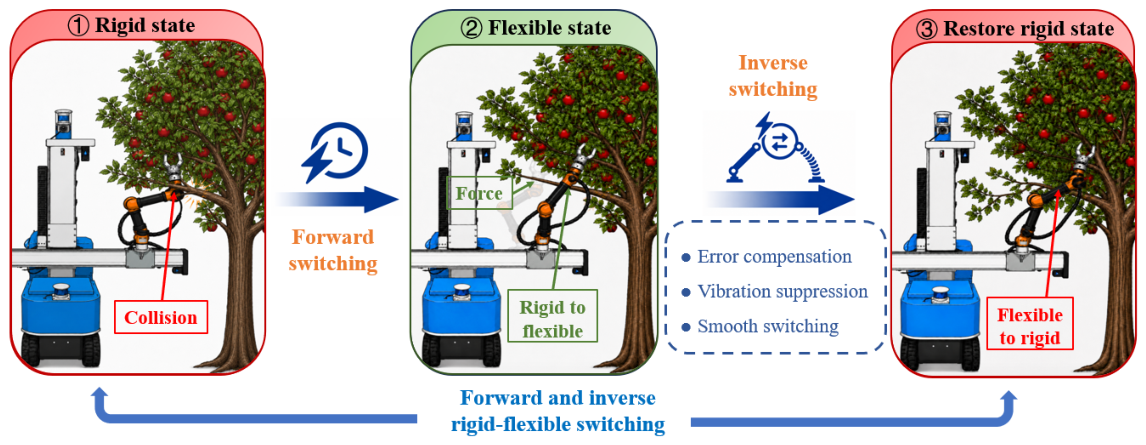
Forward and inverse rigid–flexible switching is crucial for achieving precise operation of a robotic arm. During normal operation, a robotic arm maintains a rigid state to ensure high speed and accuracy. When a collision occurs, it must rapidly switch to a flexible state to comply with the external force and avoid damage. After passing the obstacle, the robotic arm should immediately recover its rigid state to continue high-speed and accurate operations (Figure 15). Although existing variable-stiffness methods can generally realize rigid-to-flexible switching, flexible-to-rigid recovery remains difficult. Position errors accumulated in the flexible state may be converted into sudden acceleration and impact force after stiffness recovery, leading to vibration, instability, and mechanical wear. Therefore, reliable forward and inverse rigid–flexible switching is essential for frequent interactions with obstacles in unstructured agricultural environments.

5.3.3. Subsequent Work After Inverse Switching

Subsequent work after rigid–flexible switching is a guarantee of the efficient work of agricultural robots. After successfully avoiding obstacles in a flexible state, a robotic arm must swiftly return to a rigid state and continue the next task from a new, unplanned position (Figure 16). However, this process is not a simple state reset. Since the original trajectory and force control parameters are based on the initial pose, an unexpected pose change may interrupt tasks or accumulate errors. The system must update the current pose, lock in the next target task, and automatically plan the motion trajectory. Therefore, a challenge in realizing autonomous agricultural robot operation is ensuring that the robotic arm can perform subsequent tasks in a continuous, stable, and high-precision situation after completing one or more rigid–flexible switches.

5.4. Research Hotspots Regarding Variable-Stiffness Control Technology for Agricultural Robotic Arms

Nowadays, robotic arms can achieve zero-resistance drag in a flexible state, indicating the strong prospects of variable-stiffness control in flexible obstacle avoidance for agricultural robots. To address the limitations of the existing variable-stiffness control methods in real-time, reversible, and subsequent operations, future research should focus on the development of variable-stiffness control methods that are fast, capable of high-frequency operation, and inexpensive.

5.4.1. Rapid Collision Risk Perception Based on Current Loop Prediction

Further development of agricultural robots entails designing robotic arms that can achieve rapid rigid–flexible switching. This will require the optimization and upgrading of existing variable-stiffness control methods. To reduce research and development costs and increase the popularity of agricultural robots, future rigid–flexible switching schemes for robotic arms should focus on studying variable-stiffness control algorithms without external sensors. Collecting joint current information and applying filtering techniques will allow the denoised current signal to be used for collision detection. When a collision occurs, the joint current will change sharply, allowing the establishment of a threshold or the construction of a prediction model based on current variation trends to identify collisions in advance. However, since mechanical arms usually have large deceleration ratios and are subjected to intense friction, signal fluctuation caused by collisions in the joint current is very weak and easily drowned out by noise and normal fluctuations, resulting in missed detection. Therefore, current denoising is necessary to improve the accuracy and real-time performance of collision detection. In addition, smooth parameter transition should be introduced during rigid–flexible switching to avoid overload impacts caused by sudden parameter changes, enabling stable and autonomous switching between rigid and flexible states.

5.4.2. Joint-Based Active Switching Control Strategy for Safe Work

To address the challenges of irreversibility and vibration impacts caused by rigid–flexible switching, future research should be committed to establishing a joint-based rigid–flexible active switching control strategy. When a collision is detected, the force signal is transmitted to the controller to trigger the switch, and the joint torque motor provides gravity and friction compensation, enabling the robotic arm to enter a flexible state. After the collision ends and the force signal disappears, the controller triggers the switching process again, stops joint torque compensation, and restores the robotic arm to a rigid state. To avoid impacts caused by sudden erroneous release during the transition from a flexible to rigid state, feedforward compensation based on state prediction can be introduced. By estimating the position and velocity errors of the joint at the end of the flexible stage when switching back to the rigid state instead of simply locking the current position, a reverse expected trajectory increment can be fed forward to the position loop so that the robotic arm will return to the target trajectory smoothly, thus actively offsetting the error rather than passively bearing the impact.

5.4.3. Online Autonomous Planning for Unscheduled Poses

After the robotic arm safely passes by or through an obstacle, it switches from the flexible state back to the rigid one. At this time, the robotic arm must face the challenge of working in a new and unscheduled pose. With the rise of embodied intelligent technology, robots are now capable of adaptability and lifelong learning in dynamic and complex agricultural environments. Future research can focus on constructing an online autonomous reconstruction system for agricultural robots based on real-time motion planning. In this system, the robotic arm can quickly eliminate pose uncertainty through a virtual force-based visual servo control framework [197]. Although the visual servo control framework mainly focuses on multiple peg-in-hole assembly rather than agricultural operations, its correction mechanism based on visual feedback provides a useful reference for the rapid recognition of agricultural robotic arm pose. Specifically, after rigid–flexible switching, the robot can re-identify the target through visual perception and estimate the rotation angle of the current robotic arm joint to determine the pose of the robotic arm. In terms of real-time motion planning, the robotic arm can not only perform geometric path searches autonomously but also quickly generate a new trajectory from the current pose to the next target at the millisecond-level when the starting point changes. In terms of force control, the controller also needs to synchronously adjust the rigid–flexible switching control strategy to adapt to unknown collisions. These improvements are expected to provide a basic reference for the development of safe and unsupervised agricultural robots and promote the technological innovation and large-scale application of agricultural robots.

5.5. Human–Technology Interaction and Impacts on Farmers

The main users of agricultural robots are farmers, orchard operators, and facility agriculture managers. For them, the value of the robot system is not only reflected in motion accuracy and control performance, but also in whether it can reduce labor intensity and crop damage, improve operational efficiency, and decrease long-term labor costs. Variable-stiffness control can ensure safe collision between the manipulator and trunks and trellises through rigid–flexible switching so as to improve the adaptability of the robot to the agricultural environment. For operations with high repeatability and labor intensity, such as picking, pruning, fruit thinning, and pollination, this technology can help reduce the physical burden on farmers and improve their capacity for continuous operation.
Variable-stiffness technology will also bring new challenges regarding the practical application of agricultural robots. First, the equipment cost of agricultural robots may limit acceptance among small-scale farmers. Secondly, the use and maintenance of these robot systems require technical training. Farmers need to master the basics of human–technology interaction, parameter setting, fault diagnosis, and safe operation methods. If the variable-stiffness manipulator is difficult to operate and the maintenance cost is too high, farmers’ trust in the technology will decrease. Therefore, when designing agricultural robots, researchers should not only attempt to improve control performance but also pay attention to ease of use, cost reduction, reliability, maintainability, and farmers’ acceptance.

6. Conclusions

Variable-stiffness control has emerged as a promising solution to the challenge of frequent collisions of agricultural robotic arms. Particularly in complex, unstructured environments, this technology provides an efficient and safe interaction strategy for robotic arms. The variable-stiffness control method enables rigid–flexible switching, allowing robotic arms to navigate obstacles with flexibility and adaptability. Research on variable-stiffness control for robotic arms has significant implications for the agricultural sector, facilitating the widespread adoption of agricultural robots.
This paper provides a comprehensive review of the technical advancements and key breakthroughs in variable-stiffness control for robotic arms, offering insights into critical technologies and development tendencies regarding the autonomous operation of agricultural robots. The current status of robotic arm flexible obstacle avoidance technology and path-planning methods across various environments was analyzed. The complexity of agricultural environments and the challenges they pose were discussed, highlighting the limitations of existing obstacle avoidance and motion-planning technologies. The development and underlying principles of passive, active, and active-and-passive hybrid variable-stiffness control were thoroughly reviewed, and a comparative analysis of their characteristics was provided. We emphasized that active variable-stiffness control exhibits enhanced interactivity with the environments and demonstrates superior performance in complex unstructured agricultural environments. This approach presents promising solutions for the perception, decision-making, and motion control of agricultural robot arms.
Furthermore, this study explored the future applications of variable-stiffness control in agricultural environments. The challenges and emerging trends in the development of variable-stiffness control for robotic arms were discussed. We propose that future research will surmount technical problems such as rigid–flexible instantaneous switching of robotic arms, reversible rigid–flexible switching, and subsequent work after inverse switching. From the perspective of engineering application prospects, in the development of commercial agricultural robots, researchers can prioritize algorithm-based active variable-stiffness control; that is, rigid robotic arms can be used to ensure positioning accuracy and operation speed, and a variable-stiffness control algorithm can be introduced in individual joints to improve safety during contact with trunks and sheds. In terms of collision perception, the development of low-cost external force detection methods based on joint current should be prioritized. Regarding continuous operation, online autonomous planning systems can be developed, such that the robotic arm can quickly re-plan its path based on its posture after rigid–flexible switching as a new starting point and continue to perform subsequent tasks. In conclusion, variable-stiffness control for robotic arms holds significant potential in addressing issues such as limited working range, low generalization, and frequent rigid collisions. It has broad application prospects for industrial robots, agricultural robots, and humanoid robots. It significantly contributes to improving robot operation efficiency and safe interactions, thus promoting the industrialization of robots.

Author Contributions

Conceptualization, J.D. and J.L.; methodology, J.D. and Y.J.; investigation, J.D. and W.W.; resources, J.D. and W.G.; data curation, J.D. and W.G.; writing—original draft preparation, J.D.; writing—review and editing, J.D. and J.L.; visualization, J.D. and Y.J.; supervision, J.L. and Y.J.; project administration, J.L. and Y.J.; funding acquisition, J.L. and Y.J. All authors have read and agreed to the published version of the manuscript.

Funding

This research was funded by the Project of the Faculty of Agricultural Equipment of Jiangsu University (Grant No. NGXB20240103), the Science and Technology Project of Changzhou (Grant No. CJ20241065), and the Priority Academic Program Development of Jiangsu Higher Education Institutions (Grant No. PAPD2023-87).

Data Availability Statement

No new data were created or analyzed in this study. Data sharing is not applicable to this article.

Acknowledgments

Appreciation is given to the editor and reviewers of the journal.

Conflicts of Interest

The authors declare no conflicts of interest.

Abbreviations

The following abbreviations are used in this manuscript:
RRTRapidly exploring Random Tree
RRT*Rapidly exploring Random Tree Star
GD-RRT*Gaussian-Depth Rapidly exploring Random Tree Star
APSOAdaptive weight particle swarm optimization
VPSBAVacuum-powered soft bending actuator
PIDProportional-integral-derivative
SAF-ZNNSegmented-activation-function-based zeroing neural network
IRISVSAInfinite-rotation, infinite-stiffness variable-stiffness actuator
FCPForce contact point
MCDSMModular cable-driven snake-like manipulator

References

  1. Lakhiar, I.A.; Gao, J.M.; Syed, T.N.; Chandio, F.A.; Tunio, M.H.; Ahmad, F.; Solangi, K.A. Overview of the aeroponic agriculture-an emerging technology for global food security. Int. J. Agric. Biol. Eng. 2020, 13, 1–10. [Google Scholar] [CrossRef] [Scilit]
  2. Zhang, Y.Q.; Chen, L.Y.; Battino, M.; Farag, M.A.; Xiao, J.B.; Simal-Gandara, J.; Gao, H.Y.; Jiang, W.B. Blockchain: An emerging novel technology to upgrade the current fresh fruit supply chain. Trends Food Sci. Technol. 2022, 124, 1–12. [Google Scholar] [CrossRef] [Scilit]
  3. Huang, M.; Jiang, X.; He, L.; Choi, D.; Pecchia, J.; Li, Y. Development of a robotic harvesting mechanism for button mushrooms. Trans. ASABE 2021, 64, 565–575. [Google Scholar] [CrossRef] [Scilit]
  4. Wang, H.J.; Gu, J.A.; Wang, M.N. A review on the application of computer vision and machine learning in the tea industry. Front. Sustain. Food Syst. 2023, 7, 1172543. [Google Scholar] [CrossRef] [Scilit]
  5. Ji, W.; Pan, Y.; Xu, B.; Wang, J.C. A Real-Time Apple Targets Detection Method for Picking Robot Based on ShufflenetV2-YOLOX. Agriculture 2022, 12, 856. [Google Scholar] [CrossRef] [Scilit]
  6. Zuo, Z.Y.; Gao, S.; Peng, H.T.; Xue, Y.; Han, L.H.; Ma, G.X.; Mao, H.P. Lightweight detection of broccoli heads in complex field environments based on LBDC-YOLO. Agronomy 2024, 14, 2359. [Google Scholar] [CrossRef] [Scilit]
  7. Bouhadi, M.; Javed, Q.; Jakubus, M.; Elkouali, M.; Fougrach, H.; Ansar, A.; Ban, S.G.; Ban, D.; Heath, D.; Cerne, M. Nanoparticles for sustainable agriculture: Assessment of benefits and risks. Agronomy 2025, 15, 1131. [Google Scholar] [CrossRef] [Scilit]
  8. Rahul, K.; Raheman, H.; Paradkar, V. Design of a 4 DOF parallel robot arm and the firmware implementation on embedded system to transplant pot seedlings. Artif. Intell. Agric. 2020, 4, 172–183. [Google Scholar] [CrossRef] [Scilit]
  9. Zhang, H.W.; Ji, W.; Xu, B.; Yu, X.W. Optimizing contact force on an apple picking robot end-effector. Agriculture 2024, 14, 996. [Google Scholar] [CrossRef] [Scilit]
  10. Paradkar, V.; Raheman, H.; Rahul, K. Development of a metering mechanism with serial robotic arm for handling paper pot seedlings in a vegetable transplanter. Artif. Intell. Agric. 2021, 5, 52–63. [Google Scholar] [CrossRef] [Scilit]
  11. Xie, H.; Zhang, Z.J.; Zhang, K.L.; Yang, L.; Zhang, D.X.; Yu, Y. Research on the visual location method for strawberry picking points under complex conditions based on composite models. J. Sci. Food Agric. 2024, 104, 8566–8579. [Google Scholar] [CrossRef] [Scilit] [PubMed]
  12. Peng, Y.F.; Sun, J.; Wu, Z.Q.; Gao, J.Y.; Shi, L.; Shi, Z.Y. A vision-based information processing framework for vineyard grape picking using two-stage segmentation and morphological perception. Horticulturae 2025, 11, 1039. [Google Scholar] [CrossRef] [Scilit]
  13. Sun, J.; He, X.F.; Ge, X.; Wu, X.H.; Shen, J.F.; Song, Y.Y. Detection of key organs in tomato based on deep migration learning in a complex background. Agriculture 2018, 8, 196. [Google Scholar] [CrossRef] [Scilit]
  14. Ji, W.; Gao, X.X.; Xu, B.; Pan, Y.; Zhang, Z.; Zhao, D. Apple target recognition method in complex environment based on improved YOLOv4. J. Sci. Food Agric. 2021, 44, e13866. [Google Scholar] [CrossRef] [Scilit]
  15. Wang, K.; Song, Y.T.; Wu, H.P.; Wei, X.Y.; Khan, S.U.D.; Cheng, Y. Inverse kinematics research using obstacle avoidance geometry method for east articulated maintenance arm (EAMA). Fusion Eng. Des. 2017, 119, 1–11. [Google Scholar] [CrossRef] [Scilit]
  16. Buonocore, S.; Zoppoli, A.; Gironimo, G.D. An obstacle avoidance path planning algorithm to simulate hyper redundant manipulators for tokamaks maintenance. Fusion Eng. Des. 2024, 202, 114334. [Google Scholar] [CrossRef] [Scilit]
  17. Lv, H.; Liu, L.Y.; Gao, Y.M.; Zhao, S.; Yang, P.P.; Mu, Z.G. A compound planning algorithm considering both collision detection and obstacle avoidance for intelligent demolition robots. Robot. Auton. Syst. 2024, 181, 104781. [Google Scholar] [CrossRef] [Scilit]
  18. Zhang, J.; Li, Y.; Kan, Z.Y.; Yuan, Q.F.; Rajabi, H.; Wu, Z.G.; Peng, H.J.; Wu, J.N. A preprogrammable continuum robot inspired by elephant trunk for dexterous manipulation. Soft Robot. 2023, 10, 636–646. [Google Scholar] [CrossRef] [Scilit] [PubMed]
  19. Oliver-Butler, K.; Till, J.; Rucker, C. Continuum robot stiffness under external loads and prescribed tendon displacements. IEEE Trans. Robot. 2019, 35, 403–419. [Google Scholar] [CrossRef] [Scilit]
  20. Xiao, H.; Meng, Q.X.; Lai, X.Z.; Wang, Y.W.; She, J.H.; Fukushima, E.F.; Wu, M. Design, performance analysis and applications of pneumatic bellows actuator for building block soft robots. Inf. Sci. 2024, 676, 120814. [Google Scholar] [CrossRef] [Scilit]
  21. Klein, F.B.; Wilmot, A.; De Tejada, V.F.; Rodríguez, B.L.; Requena, I.; Busch, S.; Rondepierre, A.; Auzeeri, T.; Sauerwald, T.; Andrews, W.F.P. Proof-of-concept modular robot platform for cauliflower harvesting. Precis. Agric. 2019, 19, 783–789. [Google Scholar] [CrossRef] [Scilit] [PubMed]
  22. Hu, T.T.; Wang, W.B.; Gu, J.A.; Xia, Z.L.; Zhang, J.; Wang, B. Research on apple object detection and localization method based on improved YOLOX and RGB-D images. Agronomy 2023, 13, 1816. [Google Scholar] [CrossRef] [Scilit]
  23. Lai, J.W.; Lu, B.; Chu, H.K. Variable-stiffness control of a dual-segment soft robot using depth vision. IEEE-ASME Trans. Mechatron. 2022, 27, 1034–1045. [Google Scholar] [CrossRef] [Scilit]
  24. Raisch, A.; Thallemer, A.; Kostadinov, A.; Sawodny, O. Trajectory tracking and adjustable stiffness control of a pneumatically actuated robot. IFAC-PapersOnLine 2020, 53, 8872–8877. [Google Scholar] [CrossRef] [Scilit]
  25. Tang, S.X.; Xia, Z.L.; Gu, J.N.; Wang, W.B.; Huang, Z.D.; Zhang, W.H. High-precision apple recognition and localization method based on RGB-D and improved SOLOv2 instance segmentation. Front. Sustain. Food Syst. 2024, 8, 1403872. [Google Scholar] [CrossRef] [Scilit]
  26. Chen, K.W.; Li, T.; Yan, T.J.; Xie, F.; Feng, Q.C.; Zhu, Q.Z. A soft gripper design for apple harvesting with force feedback and fruit slip detection. Agriculture 2022, 12, 1802. [Google Scholar] [CrossRef] [Scilit]
  27. Zhang, F.; Chen, Z.J.; Wang, Y.F.; Bao, R.F.; Chen, X.G.; Fu, S.L.; Tian, M.M.; Zhang, Y.K. Research on flexible end-effectors with humanoid grasp function for small spherical fruit picking. Agriculture 2023, 13, 123. [Google Scholar] [CrossRef] [Scilit]
  28. Yu, X.W.; Ji, W.; Zhang, H.W.; Ruan, C.Z.; Xu, B.; Wu, K.Y. Grasping Force Optimization and DDPG Impedance Control for Apple Picking Robot End-Effector. Agriculture 2025, 15, 1018. [Google Scholar] [CrossRef] [Scilit]
  29. Liu, J.Y.; Sun, J.; Wang, Y.S.; Liu, X.; Zhang, Y.J.; Fu, H.J. Non-Destructive Detection of Fruit Quality: Technologies, Applications and Prospects. Foods 2025, 14, 2137. [Google Scholar] [CrossRef] [Scilit] [PubMed]
  30. Jiang, L.; Xu, B.Y.; Husnain, N.; Wang, Q. Overview of agricultural machinery automation technology for sustainable agriculture. Agronomy 2025, 15, 1471. [Google Scholar] [CrossRef] [Scilit]
  31. Yang, Q.Y.; Gu, J.N.; Xiong, T.; Wang, Q.H.; Huang, J.; Xi, Y.D.; Shen, Z.K. RFA-YOLOv8: A Robust Tea Bud Detection Model with Adaptive Illumination Enhancement for Complex Orchard Environments. Agriculture 2025, 15, 1982. [Google Scholar] [CrossRef] [Scilit]
  32. Li, Y.; Wang, L. Human-redundant robot interaction and redundancy utilization based on three-dimensional force sensor. Sens. Actuators A Phys. 2024, 378, 115820. [Google Scholar] [CrossRef] [Scilit]
  33. Wang, G.L.; He, B.H.; Han, D.L.; Zhang, H.; Wang, X.Z.; Chen, Y.C.; Chen, X.G.; Zhao, R.Q.; Li, G.Y. Investigation of Collision Damage Mechanisms and Reduction Methods for Pod Pepper. Agriculture 2024, 14, 117. [Google Scholar] [CrossRef] [Scilit]
  34. Yin, J.J.; Wan, Z.L.; Zhou, M.L.; Wu, L.N.; Zhang, Y. Optimized design and experiment of the three-arm transplanting mechanism for rice potted seedlings. Int. J. Agric. Biol. Eng. 2021, 14, 56–62. [Google Scholar] [CrossRef] [Scilit]
  35. Zhou, K.H.; Xia, L.R.; Liu, J.; Qian, M.Y.; Pi, J. Design of a flexible end-effector based on characteristics of tomatoes. Int. J. Agric. Biol. Eng. 2022, 15, 13–24. [Google Scholar] [CrossRef] [Scilit]
  36. Jia, W.K.; Zheng, Y.J.; Zhao, D.A.; Yin, X.; Liu, X.Y.; Du, R.C. Preprocessing method of night vision image application in apple harvesting robot. Int. J. Agric. Biol. Eng. 2018, 11, 158–163. [Google Scholar] [CrossRef] [Scilit]
  37. Wang, W.B.; Xi, Y.D.; Gu, J.L.; Yang, Q.Y.; Pan, Z.Y.; Zhang, X.Z.; Xu, G.Y.; Zhou, M. YOLOv8-TEA: Recognition Method of Tender Shoots of Tea Based on Instance Segmentation Algorithm. Agronomy 2025, 15, 1318. [Google Scholar] [CrossRef] [Scilit]
  38. Xie, F.; Guo, Z.W.; Li, T.; Feng, Q.C.; Zhao, C.J. Dynamic Task Planning for Multi-Arm Harvesting Robots Under Multiple Constraints Using Deep Reinforcement Learning. Horticulturae 2025, 11, 88. [Google Scholar] [CrossRef] [Scilit]
  39. Syed, N.T.; Zhou, J.; Lakhiar, I.A.; Marinello, F.; Gemechu, T.T.; Rottok, L.T.; Jiang, Z.Z. Enhancing autonomous orchard navigation: A real-time convolutional neural network-based obstacle classification system for distinguishing ‘real’ and ‘fake’ obstacles in agricultural robotics. Agriculture 2025, 15, 827. [Google Scholar] [CrossRef] [Scilit]
  40. Jiang, Q.J.; Shen, Y.; Liu, H.; Khan, Z.; Sun, H.; Huang, Y.X. A hybrid path planning algorithm for orchard robots based on an improved D* lite algorithm. Agriculture 2025, 15, 1698. [Google Scholar] [CrossRef] [Scilit]
  41. Zhao, J.M.Y.; Fan, S.X.; Zhang, B.H.; Wang, A.C.; Zhang, L.Y.; Zhu, Q.Z. Research status and development trends of deep reinforcement learning in the intelligent transformation of agricultural machinery. Agriculture 2025, 15, 1223. [Google Scholar] [CrossRef] [Scilit]
  42. Wu, Q.; Gu, J.N. Design and research of robot visual servo system based on artificial intelligence. Agro Food Ind. Hi-Tech 2017, 28, 125–128. [Google Scholar]
  43. Wang, W.B.; Li, C.S.; Xi, Y.D.; Gu, J.A.; Zhang, X.Z.; Zhou, M.; Peng, Y.C. Research progress and development trend of visual detection methods for selective fruit harvesting robots. Agronomy 2025, 15, 1926. [Google Scholar] [CrossRef] [Scilit]
  44. Khan, Z.; Shen, Y.; Liu, H. ObjectDetection in agriculture: A comprehensive review of methods, applications, challenges, and future directions. Agriculture 2025, 15, 1351. [Google Scholar] [CrossRef] [Scilit]
  45. Zhang, X.D.; Han, X.Y.; Zhang, Y.X.; Hu, L.; Li, T.Z. Multi-Trait phenotypic extraction and fresh weight estimation of greenhouse lettuce based on inspection robot. Agriculture 2025, 15, 1929. [Google Scholar] [CrossRef] [Scilit]
  46. Cao, X.M.; Zou, X.J.; Jia, C.Y.; Chen, M.Y.; Zeng, Z.Q. RRT-Based path planning for an intelligent litchi-picking manipulator. Comput. Electron. Agric. 2019, 156, 105–118. [Google Scholar] [CrossRef] [Scilit]
  47. Huang, A.X.; Yu, C.H.; Feng, J.Z.; Tong, X.; Yorozu, A.; Ohya, A.; Hu, Y.H. A motion planning method for winter jujube harvesting robotic arm based on optimized Informed-RRT* algorithm. Smart Agric. Technol. 2025, 10, 100732. [Google Scholar] [CrossRef] [Scilit]
  48. Wu, Y.; Jia, X.H.; Li, T.J.; Liu, J.Y. A real-time collision avoidance method for redundant dual-arm robots in an open operational environment. Robot. Comput.-Integr. Manuf. 2025, 92, 102894. [Google Scholar] [CrossRef] [Scilit]
  49. Kuo, P.H.; Huang, C.T.; Chang, C.W.; Feng, P.H.; Lin, Y.S. Design and implementation of a soft actor-critic controller for a robotic arm. Eng. Appl. Artif. Intell. 2025, 151, 110589. [Google Scholar] [CrossRef] [Scilit]
  50. Zhang, B.; Yin, C.H.; Fu, Y.X.; Xia, Y.Y.; Fu, W. Harvest motion planning for mango picking robot based on improved RRT-Connect. Biosyst. Eng. 2024, 248, 177–189. [Google Scholar] [CrossRef] [Scilit]
  51. Chen, B.H.; Gong, L.; Yu, C.R.; Du, X.F.; Chen, J.H.; Xie, S.H.; Le, X.; Li, Y.; Liu, C. Workspace decomposition based path planning for fruit-picking robot in complex greenhouse environment. Comput. Electron. Agric. 2023, 215, 108353. [Google Scholar] [CrossRef] [Scilit]
  52. Zhao, X.X.; Wang, K.; Zhang, P.Y.; Kan, J.M. An improved RRT* path planning algorithm combining Gaussian distributed sampling and depth strategy for robotic arm of fruit-picking robot. Comput. Electron. Agric. 2026, 240, 111244. [Google Scholar] [CrossRef] [Scilit]
  53. Wang, H.; Zhao, Q.; Li, H.; Zhao, R. Polynomial-based smooth trajectory planning for fruit-picking robot manipulator. Inf. Process. Agric. 2022, 9, 112–122. [Google Scholar] [CrossRef] [Scilit]
  54. Xiong, Y.; Ge, Y.Y.; From, J.P. An obstacle separation method for robotic picking of fruits in clusters. Comput. Electron. Agric. 2020, 175, 105397. [Google Scholar] [CrossRef] [Scilit]
  55. Ye, L.; Duan, J.L.; Yang, Z.; Zou, X.J.; Chen, M.Y.; Zhang, S. Collision-free motion planning for the litchi-picking robot. Comput. Electron. Agric. 2021, 185, 106151. [Google Scholar] [CrossRef] [Scilit]
  56. Shi, Y.G.; Jin, S.T.; Zhao, Y.M.; Huo, Y.J.; Liu, L.; Cui, Y.J. Lightweight force-sensing tomato picking robotic arm with a “global-local” visual servo. Comput. Electron. Agric. 2023, 204, 107549. [Google Scholar] [CrossRef] [Scilit]
  57. Pan, J.F.; Chen, X.C.; Zhu, Y.L.; Xu, B.G.; Li, C.Z.; Khin, M.N.; Cui, H.Y.; Lin, L. Design and development of dual-extruder food 3D printer based on selective compliance assembly robot arm and printing of various inks. J. Food Eng. 2024, 370, 111973. [Google Scholar] [CrossRef] [Scilit]
  58. Yin, S.L.; Xi, Y.J.; Zhang, X.; Sun, C.N.; Mao, Q.R. Foundation models in agriculture: A comprehensive review. Agriculture 2025, 15, 847. [Google Scholar] [CrossRef] [Scilit]
  59. Yuan, J.; Ji, W.; Feng, Q.C. Robots and Autonomous Machines for Sustainable Agriculture Production. Agriculture 2023, 13, 1340. [Google Scholar] [CrossRef] [Scilit]
  60. Ma, Z.; Wang, X.Z.; Chen, X.G.; Hu, B.; Li, J.B. Advances in crop row detection for agricultural robots: Methods, performance indicators, and scene adaptability. Agriculture 2025, 15, 2151. [Google Scholar] [CrossRef] [Scilit]
  61. Wu, P.; Lei, X.H.; Zeng, J.; Qi, Y.N.; Yuan, Q.C.; Huang, W.X.; Ma, Z.B.; Shen, Q.Y.; Lyu, X.L. Research progress in mechanized and intelligetized pollination technologies for fruit and vegetable crops. Int. J. Agric. Biol. Eng. 2024, 17, 11–21. [Google Scholar] [CrossRef] [Scilit]
  62. Guan, X.P.; Shi, L.Y.; Ge, H.R.; Ding, Y.H.; Nie, S.C. Development, design, and improvement of an intelligent harvesting system for aquatic vegetable brasenia schreberi. Agronomy 2025, 15, 1451. [Google Scholar] [CrossRef] [Scilit]
  63. Wang, L.Y.; Yang, Y.; Chen, Y.H.; Majidi, C.; Iida, F.; Askounis, E.; Pei, Q.B. Controllable and reversible tuning of material rigidity for robot applications. Mater. Today 2017, 21, 563–576. [Google Scholar] [CrossRef] [Scilit]
  64. Han, D.L.; Zhang, H.; Li, G.Y.; Wang, G.L.; Wang, X.Z.; Chen, Y.C.; Wen, X.Y.; Yang, Q.Z.; Zhao, R.Q. Development of a bionic picking device for high harvest and low loss rate pod pepper harvesting and related working parameter optimization details. Agriculture 2024, 14, 859. [Google Scholar] [CrossRef] [Scilit]
  65. Pi, J.; Liu, J.; Zhou, K.H.; Qian, M.Y. An octopus-inspired bionic flexible gripper for apple grasping. Agriculture 2021, 11, 1014. [Google Scholar] [CrossRef] [Scilit]
  66. Gaozhang, W.; Li, Y.; Shi, J.L.; Wang, Y.X.; Stilli, A.; Wurdemann, H. A novel stiffness-controllable joint using antagonistic actuation principles. Mech. Mach. Theory 2024, 196, 105614. [Google Scholar] [CrossRef] [Scilit]
  67. Russo, M.; Sadati, S.M.H.; Dong, X.; Mohammad, A.; Walker, I.D.; Bergeles, C.; Xu, K.; Axinte, D.A. Continuum robots: An overview. Adv. Intell. Syst. 2023, 5, 2200367. [Google Scholar] [CrossRef] [Scilit]
  68. De Falco, I.; Cianchetti, M.; Menciassi, A. A soft multi-module manipulator with variable stiffness for minimally invasive surgery. Bioinspiration Biomim. 2017, 12, 056008. [Google Scholar] [CrossRef] [Scilit] [PubMed]
  69. Ma, K.; Chen, X.D.; Zhang, J.; Xie, Z.K.; Wu, J.N.; Zhang, J.X. Inspired by physical intelligence of an elephant trunk: Biomimetic soft robot with pre-programmable localized stiffness. IEEE Robot. Autom. Lett. 2023, 8, 2898–2905. [Google Scholar] [CrossRef] [Scilit]
  70. He, J.F.; Wen, G.L.; Liu, J. A class of bionic hyper-redundant robots mimicking the bird’s neck. Acta Mech. Sin. 2023, 39, 522351. [Google Scholar] [CrossRef] [Scilit]
  71. Sui, D.B.; Zhao, S.K.; Wang, T.S.; Liu, Y.B.; Zhu, Y.H.; Zhao, J. Design of a bio-inspired extensible continuum manipulator with variable stiffness. J. Bionic Eng. 2022, 22, 181–194. [Google Scholar] [CrossRef] [Scilit]
  72. Guo, Z.; Pan, Y.P.; Wee, L.B.; Yu, H.Y. Design and control of a novel compliant differential shape memory alloy actuator. Sens. Actuators A Phys. 2015, 225, 71–80. [Google Scholar] [CrossRef] [Scilit]
  73. Sun, Y.; Wu, X.X.; Lu, B.; Wang, M.; Ding, J.H.; Pu, H.Y.; Jia, W.C.; Peng, Y.; Luo, J. Electrostatic Layer Jamming Variable Stiffness Enhanced by Giant Electrorheological Fluid. IEEE-ASME Trans. Mechatron. 2023, 29, 324–334. [Google Scholar] [CrossRef] [Scilit]
  74. Choi, W.H.; Kim, S.; Lee, D.; Shin, D. Soft, multi-DOF, variable stiffness mechanism using layer jamming for wearable robots. IEEE Robot. Autom. Lett. 2019, 4, 2539–2546. [Google Scholar] [CrossRef] [Scilit]
  75. Lin, B.T.; Wang, J.L.; Song, S.; Li, B.; Meng, M.Q.H. A modular lockable mechanism for tendon-driven robots: Design, modeling and characterization. IEEE Robot. Autom. Lett. 2022, 7, 2023–2030. [Google Scholar] [CrossRef] [Scilit]
  76. Zhuang, Z.; Chen, G.L.; Wu, H.Y.; Kong, L.Y.; Wang, H. A pneumatic/cable-driven hybrid linear actuator with combined structure of origami chambers and deployable mechanism. IEEE Robot. Autom. Lett. 2020, 5, 3564–3571. [Google Scholar] [CrossRef] [Scilit]
  77. Wu, Y.; Zhang, X.C.; Wu, Q.X.; Zhang, B.T. Research on modeling and simulation of cable-driven bionic octopus arm based on simmechanics. In Proceedings of the 39th Chinese Control Conference, Shenyang, China, 27–29 July 2020; pp. 3719–3724. [Google Scholar] [CrossRef] [Scilit]
  78. Xiao, W.; Xie, C.; Xiao, Y.H.; Tang, K.; Wang, Z.B.; Hu, D.; Ding, R.Q.; Jiao, Z.D. A new vacuum-powered soft bending actuator with programmable variable curvatures. Mater. Des. 2025, 250, 113641. [Google Scholar] [CrossRef] [Scilit]
  79. Cianchetti, M.; Arienti, A.; Follador, M.; Mazzolai, B.; Dario, P.; Laschi, C. Design concept and validation of a robotic arm inspired by the octopus. Mater. Sci. Eng. C-Mater. Biol. Appl. 2011, 31, 1230–1239. [Google Scholar] [CrossRef] [Scilit]
  80. Cheng, N.G.; Lobovsky, M.B.; Keating, S.J.; Setapen, M.A.; Gero, I.K. Design and analysis of a robust, low-cost, highly articulated manipulator enabled by jamming of granular media. In Proceedings of the 2012 IEEE International Conference on Robotics and Automation (ICRA), St Paul, Brazil, 14–18 May 2012; pp. 4328–4333. [Google Scholar] [CrossRef] [Scilit]
  81. Renda, F.; Giorelli, M.; Calisti, M.; Cianchetti, M.; Laschi, C. Dynamic model of a multibending soft robot arm driven by cables. IEEE Trans. Robot. 2014, 30, 1109–1122. [Google Scholar] [CrossRef] [Scilit]
  82. Yang, Y.; Chen, Y.H.; Li, Y.T.; Chen, M.Z.Q. 3D printing of variable stiffness hyper-redundant robotic arm. In Proceedings of the 2016 IEEE International Conference on Robotics and Automation (ICRA), Stockholm, Sweden, 16–21 May 2016; pp. 3871–3877. [Google Scholar] [CrossRef] [Scilit]
  83. Sayyadan, S.M.Z.; Gharib, F.; Garakan, A. Granular jamming manipulator filled with new organic materials. In Proceedings of the 2017 22nd International Conference on Methods and Models in Automation and Robotics (MMAR), Miedzyzdroje, Poland, 28–31 August 2017; pp. 396–401. [Google Scholar] [CrossRef] [Scilit]
  84. Liang, X.Q.; Cheong, H.; Sun, Y.; Guo, J.; Chui, C.K.; Yeow, C.H. Design, characterization, and implementation of a two-DOF fabric-based soft robotic arm. IEEE Robot. Autom. Lett. 2018, 3, 2702–2709. [Google Scholar] [CrossRef] [Scilit]
  85. Chen, X.J.; Guo, Y.X.; Duanmu, D.H.; Zhou, J.S.; Zhang, W.; Wang, Z. Design and modeling of an extensible soft robotic arm. IEEE Robot. Autom. Lett. 2019, 4, 4208–4215. [Google Scholar] [CrossRef] [Scilit]
  86. Shen, W.J.; Yang, G.L.; Zheng, T.J.; Feng, Y.G.; Ding, X.L.; Zhang, W.X. An accuracy enhancement method for a cable-driven continuum robot with a flexible backbone. IEEE Access 2020, 8, 37474–37481. [Google Scholar] [CrossRef] [Scilit]
  87. Ikemoto, S.H.; Kenta, T.; Yoshimitsu, Y.H. Development of a modular tensegrity robot arm capable of continuous bending. Front. Robot. AI 2021, 8, 774253. [Google Scholar] [CrossRef] [Scilit] [PubMed]
  88. Jing, X.S.; Jiang, J.Y.; Xie, F.B.; Zhang, C.Y.; Chen, S.Y.; Yang, L.S. Continuum manipulator with rigid-flexible coupling structure. IEEE Robot. Autom. Lett. 2022, 7, 11386–11393. [Google Scholar] [CrossRef] [Scilit]
  89. Xie, Z.X.; Mohanakrishnan, M.; Wang, P.Y.; Liu, J.Q.; Xin, W.C.; Tang, Z.Q.; Wen, L.; Laschi, C. Soft robotic arm with extensible stiffening layer. IEEE Robot. Autom. Lett. 2023, 8, 3597–3604. [Google Scholar] [CrossRef] [Scilit]
  90. Arleo, L.; Cianchetti, M. VARISA-A VARIable stiffness soft robotics arm based on inverse pneumatic actuators and differential drive fiber jamming. Mechatronics 2024, 102, 103230. [Google Scholar] [CrossRef] [Scilit]
  91. Wang, J.; Yang, H.; Zhang, J.; Liu, H.D.; Zhao, Y.B.; Hu, Y.G.; Liu, Y.B.; Xia, C.K.; Wu, J.N. Versatile Rigid-Flexible Coupling Modules: Enhancing Soft Origami Structures with Cable-Driven Parallel Mechanisms. Adv. Intell. Syst. 2025, 7, 2401008. [Google Scholar] [CrossRef] [Scilit]
  92. Choi, J.; Park, S.; Lee, W.; Kang, S.C. Design of a robot joint with variable stiffness. In Proceedings of the 2008 IEEE International Conference on Robotics and Automation (ICRA), Pasadena, America, 19–23 May 2008; pp. 1760–1765. [Google Scholar] [CrossRef] [Scilit]
  93. Hyun, D.; Yang, H.S.; Park, J.; Shim, Y. Variable stiffness mechanism for human-friendly robots. Mech. Mach. Theory 2010, 45, 880–897. [Google Scholar] [CrossRef] [Scilit]
  94. Choi, J.; Hong, S.; Lee, W.; Kang, S.; Kim, M. A robot joint with variable stiffness using leaf springs. IEEE Trans. Robot. 2011, 27, 229–238. [Google Scholar] [CrossRef] [Scilit]
  95. Petkovic, D.; Issa, M.; Pavlovic, N.D.; Zentner, L. Design of compliant robotic joint with embedded-sensing elements of conductive silicone rubber. Ind. Robot. 2013, 40, 143–157. [Google Scholar] [CrossRef] [Scilit]
  96. Jafari, A.; Tsagarakis, N.G.; Sardellitti, I.; Caldwell, D.G. A new actuator with adjustable stiffness based on a variable ratio lever mechanism. IEEE-ASME Trans. Mechatron. 2014, 19, 55–63. [Google Scholar] [CrossRef] [Scilit]
  97. Tao, Y.; Wang, T.X.; Wang, Y.Q.; Guo, L.; Xiong, H.G.; Xu, D. A new variable stiffness robot joint. Ind. Robot. 2015, 42, 371–378. [Google Scholar] [CrossRef] [Scilit]
  98. Naselli, G.A.; Rimassa, L.; Zoppi, M.; Molfino, R. A variable stiffness joint with superelastic materia. Meccanica 2017, 52, 781–793. [Google Scholar] [CrossRef] [Scilit]
  99. Sun, J.T.; Guo, Z.; Zhang, Y.B.; Xiao, X.H.; Tan, J.R. A novel design of serial variable stiffness actuator based on an archimedean spiral relocation mechanism. IEEE-ASME Trans. Mechatron. 2018, 23, 2121–2131. [Google Scholar] [CrossRef] [Scilit]
  100. Zhu, H.X.; Thomas, U. A new design of a variable stiffness joint. In Proceedings of the 2019 IEEE-ASME International Conference on Advanced Intelligent Mechatronics (AIM), Hong Kong, China, 8–12 July 2019; pp. 223–228. [Google Scholar] [CrossRef] [Scilit]
  101. Ayoubi, Y.; Laribi, M.A.; Arsicault, M.; Zeghloul, S. Safe pHRI via the variable stiffness safety-oriented mechanism (V2SOM): Simulation and experimental validations. Appl. Sci. 2020, 10, 3810. [Google Scholar] [CrossRef] [Scilit]
  102. Liu, Y.W.; Cui, S.P.; Sun, Y.J. Mechanical design and analysis of a novel variable stiffness actuator with symmetrical pivot adjustment. Front. Mech. Eng. 2021, 16, 711–725. [Google Scholar] [CrossRef] [Scilit]
  103. Li, Z.Y.; Chen, W.H.; Zhang, J.B.; Li, Q.H.; Wang, J.H.; Fang, Z.J.; Yang, G.L. A novel cable-driven antagonistic joint designed with variable stiffness mechanisms. Mech. Mach. Theory 2022, 171, 104716. [Google Scholar] [CrossRef] [Scilit]
  104. Wang, C.; Li, Z.H.; Sheng, B.; Sivan, M.; Zhang, Z.Q.; Li, G.Q.; Xie, S.Q. A novel series elastic actuator with variable stiffness. In Proceedings of the 2023 IEEE/ASME International Conference on Advanced Intelligent Mechatronics (AIM), Seattle, WA, USA, 28–30 June 2023; pp. 760–764. [Google Scholar] [CrossRef] [Scilit]
  105. Zhao, W.H.; Liao, J.B.; Qian, W.; Yu, H.Y.; Guo, Z. A novel design of series elastic actuator using tensile springs array. Mech. Mach. Theory 2024, 192, 105541. [Google Scholar] [CrossRef] [Scilit]
  106. Görgülü, I.; Dede, M.I.C.; Kiper, G. A new safe flexible torsion joint design with softening stiffness characteristics. Mech. Mach. Theory 2025, 210, 106015. [Google Scholar] [CrossRef] [Scilit]
  107. Zhang, X.L.; Huang, L.Q.; Niu, H. Structural design and stiffness matching control of bionic variable stiffness joint for human-robot collaboration. Biomim. Intell. Robot. 2023, 3, 46–56. [Google Scholar]
  108. Mekaouche, A.; Chapelle, F.; Balandraud, X. A compliant mechanism with variable stiffness achieved by rotary actuators and shape-memory alloy. Meccanica 2018, 53, 2555–2571. [Google Scholar] [CrossRef] [Scilit]
  109. Park, W.; Lee, D.; Bae, J. A hybrid jamming structure combining granules and a chain structure for robotic applications. Soft Robot. 2021, 9, 669–679. [Google Scholar] [CrossRef] [Scilit] [PubMed]
  110. Zeng, X.P.; Hurd, C.; Su, H.J.; Song, S.Y.; Wang, J.M. A parallel-guided compliant mechanism with variable stiffness based on layer jamming. Mech. Mach. Theory 2019, 148, 103791. [Google Scholar] [CrossRef] [Scilit]
  111. Lin, C.Y.; Lin, B.T.; Lyu, E.; Song, S.; Wang, J.L. An electrostatic locking mechanism for tendon-driven surgical robot. Procedia Comput. Sci. 2023, 226, 43–49. [Google Scholar] [CrossRef] [Scilit]
  112. Huang, J.Y.; Chen, Y.L.; Zhang, X.M.; Zhang, H.C.; Song, H.Y.; Ota, J. A novel cable-driven 7-DOF anthropomorphic manipulator. IEEE-ASME Trans. Mechatron. 2021, 26, 2174–2185. [Google Scholar] [CrossRef] [Scilit]
  113. Wang, C.; Li, Z.H.; Sheng, B.; Bao, T.Z.; Sivan, M.; Zhang, Z.Q.; Li, G.Q.; Xie, S.Q. A twisting mechanism with parallel springs for series variable stiffness actuator. IEEE-ASME Trans. Mechatron. 2024, 29, 4401–4410. [Google Scholar] [CrossRef] [Scilit]
  114. Nobaveh, A.A.; Herder, L.J.; Radaelli, G. Compliant variable negative to zero to positive stiffness twisting elements. Mech. Mach. Theory 2024, 196, 105607. [Google Scholar] [CrossRef] [Scilit]
  115. Shao, Y.X.; Zhou, Y.F.; Shi, D.; Feng, Y.G.; Ding, X.L.; Zhang, W.X. The cLVSM: A novel compact linear variable stiffness mechanism based on circular beams. Chin. J. Mech. Eng. 2024, 37, 146. [Google Scholar] [CrossRef] [Scilit]
  116. Liu, F.; Huang, H.L.; Li, B.; Hu, Y.; Jin, H.Y. Design and analysis of a cable-driven rigid-flexible coupling parallel mechanism with variable stiffness. Mech. Mach. Theory. 2020, 153, 104030. [Google Scholar] [CrossRef] [Scilit]
  117. Morrison, T.; Li, C.H.; Pei, X.; Su, H.J. A novel rotating beam link for variable stiffness robotic arms. In Proceedings of the 2019 IEEE International Conference on Robotics and Automation (ICRA), Montreal, QC, Canada, 20–24 May 2019; pp. 9387–9393. [Google Scholar] [CrossRef] [Scilit]
  118. Beyhan, A.; Adar, N.G. Modeling and real-time cartesian impedance control of 3-DOF robotic arm in contact with the surface. Sci. Iran. 2024, 31, 1420–1430. [Google Scholar] [CrossRef] [Scilit]
  119. Palma, P.; Seweryn, K.; Rybus, T. Impedance control using selected compliant prismatic joint in a free-floating space manipulator. Aerospace 2022, 9, 406. [Google Scholar] [CrossRef] [Scilit]
  120. Kumar, N.; Rani, M. Neural network-based hybrid force/position control of constrained reconfigurable manipulators. Neurocomputing 2020, 420, 1–14. [Google Scholar] [CrossRef] [Scilit]
  121. Wu, Y.Q.; Lamon, E.; Zhao, F.; Kim, W.; Ajoudani, A. Unified approach for hybrid motion control of MOCA based on weighted whole-body cartesian impedance formulation. IEEE Robot. Autom. Lett. 2021, 6, 3505–3512. [Google Scholar] [CrossRef] [Scilit]
  122. Shen, Y.; Yang, F.; Wu, J.B.; Luo, S.; Khan, Z.; Zhang, L.K.; Liu, H. Advances and future trends in electrified agricultural machinery for sustainable agriculture. Agriculture 2025, 15, 2367. [Google Scholar] [CrossRef] [Scilit]
  123. Yang, H.H.; Qian, H.; Xu, Y.; Zhai, X.D.; Zhu, J.J. A sensitive SERS sensor combined with intelligent variable selection models for detecting chlorpyrifos residue in tea. Foods 2024, 13, 2363. [Google Scholar] [CrossRef] [Scilit] [PubMed]
  124. Zhang, Y.Y.; Zhang, B.; Shen, C.; Liu, H.L.; Huang, J.C.; Tian, K.P.; Tang, Z. Review of the field environmental sensing methods based on multi-sensor information fusion technology. Int. J. Agric. Biol. Eng. 2024, 17, 1–13. [Google Scholar] [CrossRef] [Scilit]
  125. Duan, J.J.; Gan, Y.H.; Chen, M.; Dai, X.Z. Adaptive variable impedance control for dynamic contact force tracking in uncertain environment. Robot. Auton. Syst. 2018, 102, 54–65. [Google Scholar] [CrossRef] [Scilit]
  126. Wang, B.R.; Fang, J.W.; Qi, S.A.; Wang, L.; Liu, X.L.; Ren, H.J. Step-by-step identification of industrial robot dynamics model parameters and force-free control for robot teaching. J. Mech. Sci. Technol. 2023, 37, 3747–3762. [Google Scholar] [CrossRef] [Scilit]
  127. Xu, S.L.; He, B.; Zhou, Y.M.; Wang, Z.P.; Zhang, C.H. A hybrid position/force control method for a continuum robot with robotic and environmental compliance. IEEE Access 2019, 7, 100467–100479. [Google Scholar] [CrossRef] [Scilit]
  128. Zhang, T.; Yu, Y.; Zou, Y. An adaptive sliding-mode iterative constant-force control method for robotic belt grinding based on a one-dimensional force sensor. Sensors 2019, 19, 1635. [Google Scholar] [CrossRef] [Scilit] [PubMed]
  129. Zhan, H.; Zeng, C.; Yang, C. Application of hybrid variable admittance force tracking and fixed-time position control for robot interaction tasks. In Proceedings of the 2024 12th International Conference on Control, Mechatronics and Automation (ICCMA), London, UK, 11–13 November 2024; pp. 136–141. [Google Scholar] [CrossRef] [Scilit]
  130. Chang, J.; Li, B.; Zhang, G.W.; Liang, Z.D.; Wang, C. The control algorithm of 7-DOF manipulator based on hybrid force and position algorithm. In Proceedings of the 2017 IEEE 7th Annual International Conference on Cyber Technology in Automation, Control, and Intelligent Systems (CYBER), Honolulu, HI, USA, 31 July 2017; pp. 645–650. [Google Scholar] [CrossRef] [Scilit]
  131. Xie, S.W.; Ren, J. A hybrid position/force controller for joint robots. In Proceedings of the 2021 IEEE International Conference on Robotics and Automation (ICRA 2021), Xi’an, China, 30 May–5 June 2021; pp. 6415–6421. [Google Scholar] [CrossRef] [Scilit]
  132. Shi, X.H.; Li, M.Y.; Dong, Y.H.; Feng, S.Y. Research on surface tracking and constant force control of a grinding robot. Sensors 2023, 23, 4702. [Google Scholar] [CrossRef] [Scilit] [PubMed]
  133. Wang, Z.L.; Zou, L.; Su, X.J.; Luo, G.Y.; Li, R.; Huang, Y. Hybrid force/position control in workspace of robotic manipulator in uncertain environments based on adaptive fuzzy control. Robot. Auton. Syst. 2021, 145, 103870. [Google Scholar] [CrossRef] [Scilit]
  134. Liu, Y.; Huang, X.; Li, S.G.; Chu, W.M. Adaptive positioning method for ball head based on impedance control. Robot. Intell. Autom. 2024, 44, 242–257. [Google Scholar] [CrossRef] [Scilit]
  135. Winiarski, T.; Sikora, J.; Seredyński, D. DAIMM simulation platform for dual-arm impedance controlled mobile manipulation. In Proceedings of the 2021 7th International Conference on Automation, Robotics and Applications (ICARA 2021), Prague, Czech Republic, 4–6 February 2021; pp. 180–184. [Google Scholar] [CrossRef] [Scilit]
  136. Mazare, M.; Tolu, S.; Taghizadeh, M. Adaptive variable impedance control for a modular soft robot manipulator in configuration space. Meccanica 2021, 57, 1–15. [Google Scholar] [CrossRef] [Scilit]
  137. Song, X.G.; Mao, H.; Huang, H.L.; Xu, W.F. A dynamic adaptive impedance controller for force tracking of dual-arm manipulators in uncertain contact environment. In Proceedings of the 2021 IEEE International Conference on Robotics and Biomimetics (IEEE-ROBIO 2021), Sanya, China, 27–31 December 2021; pp. 1674–1681. [Google Scholar] [CrossRef] [Scilit]
  138. Li, R.M.; Cheng, M.; Ding, R.Q. Passivity-based bilateral shared variable impedance control for teleoperation compliant assembly. Mechatronics 2023, 95, 103057. [Google Scholar] [CrossRef] [Scilit]
  139. Jiang, Y.M.; Yang, C.G.; Wang, Y.N.; Ju, Z.J.; Li, Y.N.; Su, C.Y. Multi-hierarchy interaction control of a redundant robot using impedance learning. Mechatronics 2020, 67, 102348. [Google Scholar] [CrossRef] [Scilit]
  140. Ji, W.; Tang, C.C.; Xu, B.; Wang, J.C. Contact force modeling and variable damping impedance control of apple harvesting robot. Comput. Electron. Agric. 2022, 198, 107026. [Google Scholar] [CrossRef] [Scilit]
  141. Li, Z.X.; He, Z.; Hao, W.; Wang, X.; Ding, X.T.; Cui, Y.J. Kiwifruit harvesting impedance control and optimization. Biosyst. Eng. 2025, 251, 101–116. [Google Scholar] [CrossRef] [Scilit]
  142. Han, L.; Kumi, F.; Mao, H.; Hu, J. Design and tests of a multi-pin flexible seedling pick-up gripper for automatic transplanting. Appl. Eng. Agric. 2019, 35, 949–957. [Google Scholar] [CrossRef] [Scilit]
  143. Wang, Z.B.; Lou, K.R.; Zhang, B.; Gu, Y.; Xu, Q.; Fu, W. Compliant picking control of dragon fruit picking robot based on adaptive variable impedance. Biosyst. Eng. 2025, 252, 126–143. [Google Scholar] [CrossRef] [Scilit]
  144. Jung, S. Admittance force tracking control for position-controlled robot manipulators under unknown environment. In Proceedings of the2020 20th International Conference on Control, Automation and Systems (ICCAS), Busan, Republic of Korea, 13–16 October 2020; pp. 219–224. [Google Scholar] [CrossRef] [Scilit]
  145. Li, A.; Wang, C.R.; Ji, T.T.; Wang, Q.Y.; Zhang, T.X. D3-YOLOv10: Improved YOLOv10-Based Lightweight Tomato Detection Algorithm Under Facility Scenario. Agriculture 2024, 14, 2268. [Google Scholar] [CrossRef] [Scilit]
  146. Li, J.Y.; Zhang, Y.R.; Chen, C.; Wang, Z.J.; You, B. A fuzzy variable admittance control method to ensure compliance motion of a cooperative robot. In Proceedings of the 2022 International Conference on Autonomous Unmanned Systems, Xi’an, China, 23–25 September 2022; pp. 1671–1680. [Google Scholar] [CrossRef] [Scilit]
  147. Zhang, X.; Zhou, H.; Liu, J.G.; Ju, Z.J.; Leng, Y.Q.; Yang, C.G. A practical PID variable stiffness control and its enhancement for compliant force-tracking interactions with unknown environments. Sci. China-Technol. Sci. 2023, 66, 2882–2896. [Google Scholar] [CrossRef] [Scilit]
  148. Li, Z.S.; Huang, H.L.; Song, X.G.; Xu, W.F.; Li, B. A fuzzy adaptive admittance controller for force tracking in an uncertain contact environment. IET Control Theory Appl. 2021, 15, 2158–2170. [Google Scholar] [CrossRef] [Scilit]
  149. Wang, G.; Xie, N.Z.; Che, H.L.; Zhang, Q. Enhancing constant force tracking in uncertain contact surfaces: An admittance controller utilizing virtual delayed resonator. Robot. Auton. Syst. 2025, 192, 105008. [Google Scholar] [CrossRef] [Scilit]
  150. He, G.W.; Feng, G.D.; Ding, B.C. A study of force-free control framework for industrial manipulator tasks based on high-pass filter. In Proceedings of the 2024 IEEE International Conference on Robotics and Automation (ICRA), Yokohama, Japan, 13–17 May 2024; pp. 1261–1267. [Google Scholar] [CrossRef] [Scilit]
  151. Zhang, Y.Q.; Jeong, C.S.; Kim, M.; Jin, S. Force-free control for direct teaching of a surgical assistant robot end effector with wire-driven bidirectional telescopic mechanism. Sensors 2021, 21, 3498. [Google Scholar] [CrossRef] [Scilit] [PubMed]
  152. You, Y.P.; Zhang, Y.; Li, C.G. Force-free control for the direct teaching of robots (China). J. Mech. Eng. 2014, 50, 10–17. [Google Scholar] [CrossRef] [Scilit]
  153. Zhang, T.; Hong, J.D.; Liu, X.G. Dragging teaching method without torque sensor for robot based on elastic friction model. Trans. Chin. Soc. Agric. Mach. 2019, 50, 419–427. [Google Scholar]
  154. Dong, K.K.; Liu, H.D.; Zhu, X.J.; Wang, X.Q.; Xu, F.; Liang, B. Force-free control for the flexible-joint robot in human-robot interaction. Comput. Electr. Eng. 2019, 73, 9–22. [Google Scholar] [CrossRef] [Scilit]
  155. Ni, H.P.; Zhang, C.R.; Hu, T.L.; Wang, T.; Chen, Q.Z.; Chen, C. A dynamic parameter identification method of industrial robots considering joint elasticity. Int. J. Adv. Robot. Syst. 2019, 16, 1729881418825217. [Google Scholar] [CrossRef] [Scilit]
  156. Chen, S.X.; Yang, J.; Cui, G.H.; Niu, F.Z.; Yao, B.Q.; Zhang, Y. Robot zero-moment control algorithm based on parameter identification of low-speed dynamic balance. CMES-Comp. Model. Eng. Sci. 2022, 134, 2021–2039. [Google Scholar] [CrossRef] [Scilit]
  157. Jakes, D.; Ge, Z.Y.; Wu, L. Model-less active compliance for continuum robots using recurrent neural networks. In Proceedings of the 2019 IEEE/RSJ International Conference on Intelligent Robots and Systems (IROS), Macau, China, 3–8 November 2019; pp. 2167–2173. [Google Scholar] [CrossRef] [Scilit]
  158. Chowdhary, G.; Gazzola, M.; Krishnan, G.; Soman, C.; Lovell, S. Soft robotics as an enabling technology for agroforestry practice and research. Sustainability 2019, 11, 6751. [Google Scholar] [CrossRef] [Scilit]
  159. Ghazal, S.; Munir, A.; Qureshi, S.W. Computer vision in smart agriculture and precision farming: Techniques and applications. Artif. Intell. Agric. 2024, 13, 64–83. [Google Scholar] [CrossRef] [Scilit]
  160. Ge, C.; Zhang, G.; Wang, Y.; Shao, D.D.; Song, X.J.; Wang, Z.W. Research status and development trends of artificial intelligence in smart agriculture. Agriculture 2025, 15, 2247. [Google Scholar] [CrossRef] [Scilit]
  161. Deng, J.X.; Yuan, B.Y.; Huang, Q.L.; Ding, D.K.; Xin, M.Y.; Liu, G.M. A review of the key technologies of complex surface grinding and polishing based on industrial robots (China). J. Mech. Eng. 2024, 60, 1–21. [Google Scholar]
  162. Hamedani, M.H.; Sadeghian, H.; Zekri, M.; Sheikholeslam, F.; Keshmiri, M. Intelligent impedance control using wavelet neural network for dynamic contact force tracking in unknown varying environments. Control Eng. Pract. 2021, 113, 104840. [Google Scholar] [CrossRef] [Scilit]
  163. Peng, G.Z.; Yang, C.G.; He, W.; Chen, C.L.P. Force sensorless admittance control with neural learning for robots with actuator saturation. IEEE Trans. Ind. Electron. 2020, 67, 3138–3148. [Google Scholar] [CrossRef] [Scilit]
  164. Wang, X.L.; Li, C.H.; Cai, D.X.; Cui, Y.X. Research on adaptive variable impedance control method based on adaptive neuro-fuzzy inference system. Sensors 2025, 25, 3055. [Google Scholar] [CrossRef] [Scilit] [PubMed]
  165. Li, R.; Jin, J.; Zhang, D.B.; Chen, C.Y. A segmented activation function-based zeroing neural network model for dynamic sylvester equation solving and robotic manipulator control. Concurr. Comput.-Pract. Exp. 2025, 37, 21–22. [Google Scholar] [CrossRef] [Scilit]
  166. Yang, K.; Xia, X.K.; Ma, H.Z.; Sang, S.B. Research status and prospect of active safety control technology for industrial robots (China). Robot. Technol. Appl. 2021, 3, 9–19. [Google Scholar]
  167. Zhang, T.; Yuan, C.; Zou, Y.B. Research on the algorithm of constant force grinding controller based on reinforcement learning PPO. Int. J. Adv. Manuf. Technol. 2023, 126, 2975–2988. [Google Scholar] [CrossRef] [Scilit]
  168. Li, Y.H.; Wang, Y.H.; Li, Z.; Lv, Y.X.; Chai, J.; Dong, F.B. Deep reinforcement learning-based variable impedance control for grinding workpieces with complex geometry. Robot. Intell. Autom. 2025, 45, 159–172. [Google Scholar] [CrossRef] [Scilit]
  169. Hu, X.Y.; Liu, G.P.; Ren, P.P.; Jia, B.; Liang, Y.W.; Li, L.X.; Duan, S.L. An admittance parameter optimization method based on reinforcement learning for robot force control. Actuators 2024, 13, 354. [Google Scholar] [CrossRef] [Scilit]
  170. Zhao, B.; Wu, C.D.; Chang, L.J.; Jiang, Y.; Sun, R.H. Research on zero-force control and collision detection of deep learning methods in collaborative robots. Displays 2025, 87, 102969. [Google Scholar] [CrossRef] [Scilit]
  171. Wang, G.; Wang, Z.; Huang, B.; Gan, Y.H.; Min, F.Y. Active compliance control based on EKF torque fusion for robot manipulators. IEEE Robot. Autom. Lett. 2023, 8, 2668–2675. [Google Scholar] [CrossRef] [Scilit]
  172. De Wolde, J.; Knoedler, L.; Garofalo, G.; Alonso-Mora, J. Current-based impedance control for interacting with mobile manipulators. In Proceedings of the 2024 IEEE/RSJ International Conference on Intelligent Robots and Systems, Abu Dhabi, United Arab Emirates, 14–18 October 2024; pp. 753–760. [Google Scholar] [CrossRef] [Scilit]
  173. Abadi, A.S.S.; Hosseinabadi, P.A.; Hameed, A.; Ordys, A.; Pierscionek, B. Fixed-time observer-based controller for the human-robot collaboration with interaction force estimation. Int. J. Robust Nonlinear Control. 2023, 35, 4062–4095. [Google Scholar] [CrossRef] [Scilit]
  174. Wahrburg, A.; Morara, E.; Cesari, G.; Matthias, B.; Ding, H. Cartesian contact force estimation for robotic manipulators using kalman filters and the generalized momentum. In Proceedings of the 2015 IEEE International Conference on Automation Science & Engineering (CASE), Gothenburg, Sweden, 24–28 August 2015; pp. 4062–4095. [Google Scholar] [CrossRef] [Scilit]
  175. Ramadan, M.A.; Awad, M.I.; Boushaki, M.N.; Niu, Z.W.; Khalaf, K.; Hussain, I. IrisVSA: Infinite-rotation infinite-stiffness variable stiffness actuator towards physical human-robot-interaction. Mechatronics 2023, 96, 103095. [Google Scholar] [CrossRef] [Scilit]
  176. Zhang, Y.; Cheng, Q.; Chen, W.L.; Xiao, J.C.; Hao, L.N.; Li, Z. Dynamic modelling and inverse compensation for coupled hysteresis in pneumatic artificial muscle-actuated soft manipulator with variable stiffness. ISA Trans. 2023, 145, 468–478. [Google Scholar] [CrossRef] [Scilit] [PubMed]
  177. Yang, Y.F.; Lu, Y.F.; Zhang, R.R.; Yue, H.H. RJVS: A novel, compact and integrated rotating joint with variable stiffness. Mech. Syst. Signal Proc. 2023, 193, 110273. [Google Scholar] [CrossRef] [Scilit]
  178. Chen, Q.H.; Li, M.T.; Wu, H.X.; Liu, W.Q.; Peng, J.Q. Design, self-calibration and compliance control of modular cable-driven snake-like manipulators. Mech. Mach. Theory 2024, 193, 105562. [Google Scholar] [CrossRef] [Scilit]
  179. Ji, W.; He, G.Z.; Xu, B.; Zhang, H.W.; Yu, X.W. A new picking pattern of a flexible three-fingered end-effector for apple harvesting robot. Agriculture 2024, 14, 102. [Google Scholar] [CrossRef] [Scilit]
  180. Yan, S.L.; Liu, L.; Zhang, T.; Genis, A.; Hou, W.H.; Ra, Y.; Jiang, D.; Jin, X.; Wan, T.; Wang, Y.W. Multi-scale cross-modal feature fusion and cost-sensitive loss function for differential detection of occluded bagging pears in practical orchards. Artif. Intell. Agric. 2025, 15, 573–589. [Google Scholar] [CrossRef] [Scilit]
  181. Fan, Y.M.; Yi, B.W.; Liu, D.K. An overview of stiffening approaches for continuum robots. Robot. Comput.-Integr. Manuf. 2024, 90, 102811. [Google Scholar] [CrossRef] [Scilit]
  182. Sun, X.T.; Xiong, X.Y.; Chen, W.J.; Chen, W.H.; Yang, G.L. Design and control of a novel variable stiffness actuator based on antagonistic variable radius principle. ISA Trans. 2024, 147, 567–576. [Google Scholar] [CrossRef] [Scilit] [PubMed]
  183. Perrusquía, A.; Yu, W. Robot position/force control in unknown environment using hybrid reinforcement learning. Cybern. Syst. 2020, 51, 542–560. [Google Scholar] [CrossRef] [Scilit]
  184. Zhang, J.H.; Liu, Y.C.; Huang, Z.P.; Liu, X.; Bu, B.Z. Zero force control of flexible cooperative robot based on joint dual-position feedback (China). Comput. Integr. Manuf. Syst. 2024, 30, 1798–1809. [Google Scholar]
  185. Hanafusa, T.; Hunang, Q.J. Control of position, attitude, force and moment of 6-DOF manipulator by impedance control. In Proceedings of the 2018 15th International Conference on Control, Automation, Robotics and Vision (ICARCV), Singapore, 18–21 November 2018; pp. 274–279. [Google Scholar] [CrossRef] [Scilit]
  186. Wahballa, H.; Duan, J.J.; Dai, Z.D. Controlling robotic contact force on curved and complex surfaces based on an online identification admittance controller. Arab. J. Sci. Eng. 2023, 49, 1625–1641. [Google Scholar] [CrossRef] [Scilit]
  187. Liu, C.G.; Peng, G.Z.; Zhao, K.; Li, J.Y.; Yang, C.G. Neural learning-based adaptive force-tracking control for robots with finite-time prescribed performance under varying environments. IEEE Trans. Ind. Electron. 2024, 71, 16338–16347. [Google Scholar] [CrossRef] [Scilit]
  188. Bilancia, P.; Berselli, G.; Palli, G. Virtual and physical prototyping of a beam-based variable stiffness actuator for safe human-machine interaction. Robot. Comput.-Integr. Manuf. 2020, 65, 101886. [Google Scholar] [CrossRef] [Scilit]
  189. Dai, J.; Zhang, Y.; Deng, H. Novel voltage-based weighted hybrid force/position control for redundant robot manipulators. Electronics 2022, 11, 179. [Google Scholar] [CrossRef] [Scilit]
  190. Ding, R.Q.; Wang, J.H.; Cheng, M.; Sun, M.K.; Xu, B.; Wang, Z. Adaptive impedance control for the hydraulic manipulator under the uncertain environment. J. Braz. Soc. Mech. Sci. Eng. 2023, 45, 437. [Google Scholar] [CrossRef] [Scilit]
  191. Cao, H.L.; Chen, X.A.; He, Y.; Zhao, X. Dynamic adaptive hybrid impedance control for dynamic contact force tracking in uncertain environments. IEEE Access 2019, 7, 83162–83174. [Google Scholar] [CrossRef] [Scilit]
  192. Lu, Y.; Xu, W.; Leng, J.; Liu, X.Y.; Xu, H.Y.; Ding, H.N.; Zhou, J.F.; Cui, L.F. Review and research prospects on additive manufacturing technology for agricultural manufacturing. Agriculture 2024, 14, 1207. [Google Scholar] [CrossRef] [Scilit]
  193. Pea-Assounga, J.B.B.; Bambi, R.D.P.; Apendi, D.O.A. Impact of agriculture, industry, food production, renewable energy consumption, urbanization, and consumer price index on ecological footprint: Evidence from Asian economies. Front. Sustain. Food Syst. 2025, 9, 1653025. [Google Scholar] [CrossRef] [Scilit]
  194. Zhu, Y.; Zhang, S.D.; Tang, S.N.; Gao, Q. Research progress and applications of artificial intelligence in agricultural equipment. Agriculture 2025, 15, 1703. [Google Scholar] [CrossRef] [Scilit]
  195. Wu, M.M.; Liu, S.Y.; Li, Z.Y.; Ou, M.X.; Dai, S.Q.; Dong, X.; Wang, X.W.; Jiang, L.; Jia, W.D. A review of intelligent orchard sprayer technologies: Perception, control, and system integration. Horticulturae 2025, 11, 668. [Google Scholar] [CrossRef] [Scilit]
  196. Taha, M.F.; Mao, H.P.; Zhang, Z.; Elmasry, G.; Awad, M.A.; Abdalla, A.; Mousa, S.; Elwakeel, A.E.; Elsherbiny, O. Emerging technologies for precision crop management towards agriculture 5.0: A comprehensive overview. Agriculture 2025, 15, 582. [Google Scholar] [CrossRef] [Scilit]
  197. Zhang, J.W.; Bai, C.C.; Pan, W.; Guo, J.F. Virtual-force based visual servo for Multiple Peg-in-Hole assembly with tightly coupled multi-manipulator. IEEE Robot. Autom. Lett. 2024, 11, 2586–2593. [Google Scholar] [CrossRef] [Scilit]
Figure 1. Overview of the framework of robotic arm variable-stiffness control.
Agronomy 16 01275 g001
Figure 2. Complex and unstructured agricultural environments.
Agronomy 16 01275 g002
Figure 3. Robotic arms respond to collision challenges in various environments: (a) Robotic arm in industrial environment. (b) Robotic arm in service industry. (c) Robotic arm in agricultural environment.
Agronomy 16 01275 g003
Figure 5. Development of an active variable-stiffness control algorithm.
Agronomy 16 01275 g005
Figure 6. Variable-stiffness control of a robotic arm based on hybrid force and position control: (a) Rigid robotic arm [130]. (b) Double-arm grasping robot [131]. (c) Grinding robot [132]. (d) Welding and grinding robot [133].
Agronomy 16 01275 g006
Figure 7. Variable-stiffness control of a robotic arm based on impedance control: (a) Double-arm grasping [137]. (b) Robotic arm assembly [138]. (c) Redundant robotic arm interaction [139]. (d) Dragon fruit picking robot [140].
Agronomy 16 01275 g007
Figure 8. Variable-stiffness control of robotic arm based on admittance control: (a) Robotic arm joint limit avoidance [145]. (b) Grinding robot [146]. (c) Surface polishing robot [147]. (d) Human–robot interaction [148]. (e) Force tracking [149].
Agronomy 16 01275 g008
Figure 9. Variable-stiffness control of robotic arm based on force-free control.
Agronomy 16 01275 g009
Figure 11. Application of active and passive hybrid variable-stiffness control method: (a) Infinite-rotation infinite-stiffness variable-stiffness actuator [175]. (b) Variable-stiffness robot joint based on human arm muscle ligament [176]. (c) Novel, compact, and integrated rotating joint with variable-stiffness [177]. (d) Modular cable-driven snake-like robotic arm [178].
Agronomy 16 01275 g011
Figure 12. Difference between agricultural tasks and industrial tasks.
Agronomy 16 01275 g012
Figure 13. Variable-stiffness control realizes rigid-flexible switching of agricultural robotic arm.
Agronomy 16 01275 g013
Figure 14. Real-time rigid-flexible switching of agricultural robotic arm.
Agronomy 16 01275 g014
Figure 15. Reversible rigid–flexible switching of agricultural robotic arm.
Agronomy 16 01275 g015
Figure 16. Subsequent work of the agricultural robotic arm in the new pose.
Agronomy 16 01275 g016
Table 1. Research on obstacle avoidance technology of robotic arms.
PerceptionMethodDeficiencyExhibitionReference
◆ Environmental modeling► Improved rapidly exploring random tree (RRT) algorithm● Lack of real-timeAgronomy 16 01275 i001[46]
► Optimized informed-RRT* algorithm● Limited in dense obstacles
● Time-consuming planning
Agronomy 16 01275 i002[47]
► Novel collision avoidance formulation● Complex calculation
● High hardware cost
Agronomy 16 01275 i003[48]
► Soft actor-critic controller● Low planning accuracy
● Trapped in local optima
Agronomy 16 01275 i004[49]
► Improved RRT-Connect algorithm● Strong environmental interference
● Low success rate
Agronomy 16 01275 i005[50]
► Local search path planning● Limited in workspace
● Low success rate
Agronomy 16 01275 i006[51]
► Improved RRT* path planning algorithm (GD-RRT*)● Limited in environments
● Low success rate
Agronomy 16 01275 i007[52]
► Polynomial-based smooth trajectory planning● Pose singularity
● Low positioning accuracy
● Limited in multiple obstacles
Agronomy 16 01275 i008[53]
◆ Visual recognition► Active obstacle separation strategy● Sensitive to environmental factors
● Limited in dynamic environments
Agronomy 16 01275 i009[54]
► Improved adaptive weight particle swarm optimization (APSO) algorithm● Low accuracy
● Light interference
● Limited in dynamic environments
Agronomy 16 01275 i010[55]
► Global-local visual servo● Lack of stability
● Low operating speed
Agronomy 16 01275 i011[56]
Table 3. Summary of robotic arm variable-stiffness control method.
MethodModeCollision
Detection
Controllable
Stiffness Range
/(N·mm−1)
Control
Latency
/(s)
Energy
Consumption/(J)
Control ComplexitySuitability for
Agricultural
Environments
AdvantageDisadvantageReferences
◆ Passive variable-stiffness control mechanisms► Material
► Flexible device
★ No feedback required► 0.03–10.20
► 0.31–4.86
► 0.5–2.0
► 0.3–0.9
► 5–60
► 20–50
► Low
► Low
► Material vulnerable, not suitable
► Limited in stiffness range, improved the structure for suitability
● Instant response
● Low damage rate
● Strong resistance to interference
● Limited in control accuracy
● Limited range of stiffness variation
● Low load capacity
[181,182]
◆ Active variable-stiffness control algorithms► Hybrid force and position
► Impedance
► Admittance
► Force-free
► Intelligent algorithm
★ Current-loop feedback
★ Sensor feedback
► 0.01–20.00
► 0.03–23.25
► 0.03–28.00
► 0.42–17.50
► 0.16–22.57
► 5.5–7.0
► 2.0–5.0
► 8.0–10.0
► 1.2–3.0
► 0.5–2.2
► 60–100
► 30–80
► 30–80
► −50–70
► 100–120
► Medium
► Medium
► Medium
► Medium
► High
► High delay, improved algorithm for suitability
► Limited information processing, improved the control framework for suitability
► High delay, improved algorithm for suitability
► Limited in parameter identification, suitable after improvement
► Good suitability
● Large range of stiffness adjustment
● High control precision
● High load capacity
● High power consumption
● Slow response speed
[183,184,185,186,187]
◆ Active and passive hybrid variable-stiffness control► Variable-stiffness control algorithm combined with flexible device★ Current-loop feedback
★ Sensor feedback
► 0.01–21.80► 0.3–1.0► 80–130► High► Limited in control method, utilizing the supercomputing platform for suitability● Rapid response
● Strong stability
● Great difficulty in design
● High hardware cost
[188]
Note. The quantitative comparison of controllable stiffness range, control latency, energy consumption and control complexity in Table 3 is summarized according to the existing research literature.
Disclaimer/Publisher’s Note: The statements, opinions and data contained in all publications are solely those of the individual author(s) and contributor(s) and not of MDPI and/or the editor(s). MDPI and/or the editor(s) disclaim responsibility for any injury to people or property resulting from any ideas, methods, instructions or products referred to in the content.