Differential Responses of Soil Thermal Conductivity, Microbial Carbon Use Efficiency, and Soil Organic Carbon to Feedstock-Specific Biochar Under Alternate Drying–Wetting Cycles


 , ,
, , 
Abstract
1. Introduction
2. Materials and Methods
2.1. Biochar and Soil Preparation
2.2. Experimental Design and Treatments

2.3. Measurement and Analysis
2.3.1. Biochar Surface Morphology and Crystalline Structure
2.3.2. Chemical Composition and Functional Group Analysis
2.3.3. Soil pH and Zeta Potential
2.3.4. Water-Dispersible Microaggregate-Size Distribution and Water-Holding Capacity
2.3.5. Soil Thermal Conductivity and Respiration Rate
2.3.6. Soil Total Carbon, Total Nitrogen, Mineral Nitrogen, and Organic Carbon
2.3.7. Microbial Carbon Use Efficiency Assessment
2.3.8. Microbial Biomass Carbon and Nitrogen
2.4. Statistical Analysis
3. Results
3.1. Biochar Structures, Soil Mineral Composition, and Functional Groups
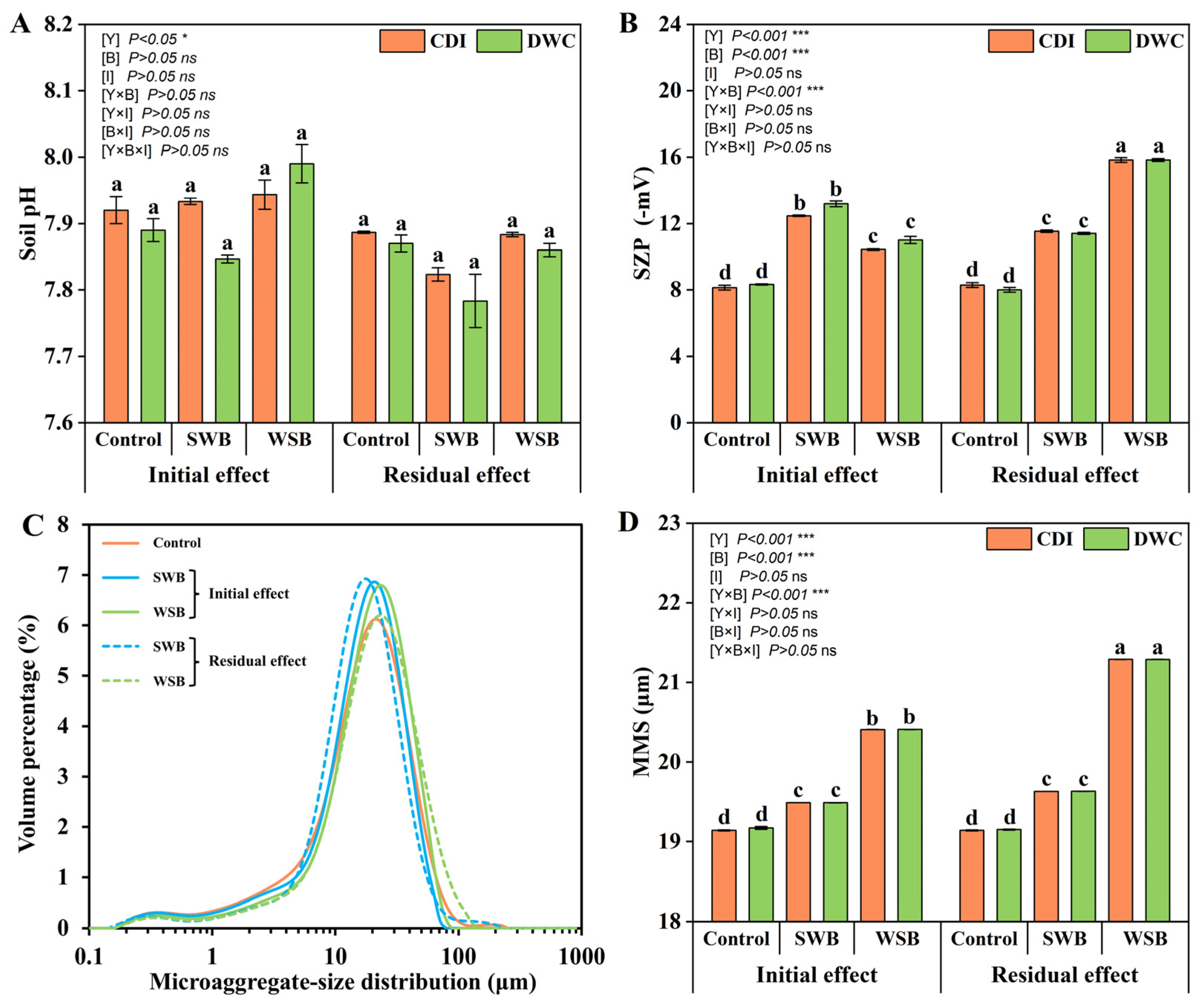
3.2. Soil pH, Zeta Potential, and Water-Dispersible Microaggregate Characteristics
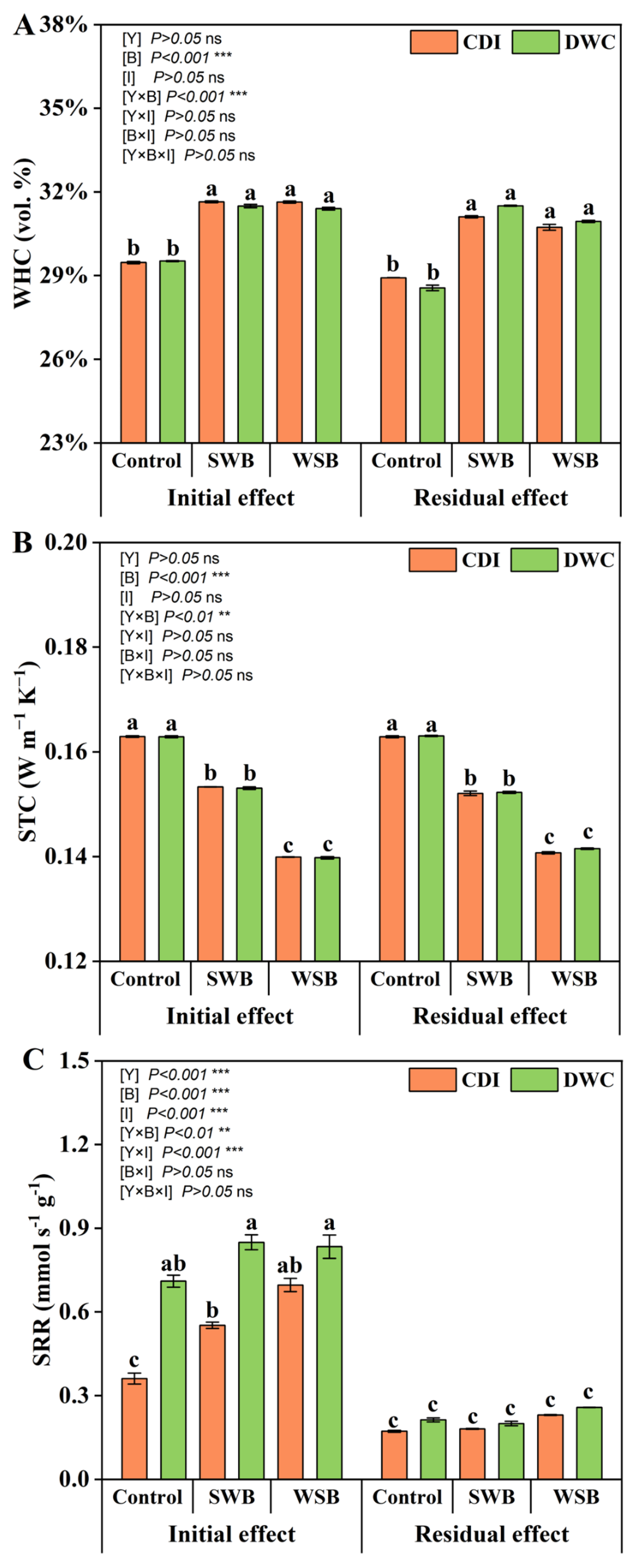
3.3. Soil Water-Holding Capacity, Thermal Conductivity, and Respiration Rate
3.4. Soil Total C and N, C/N Ratio, and Min N
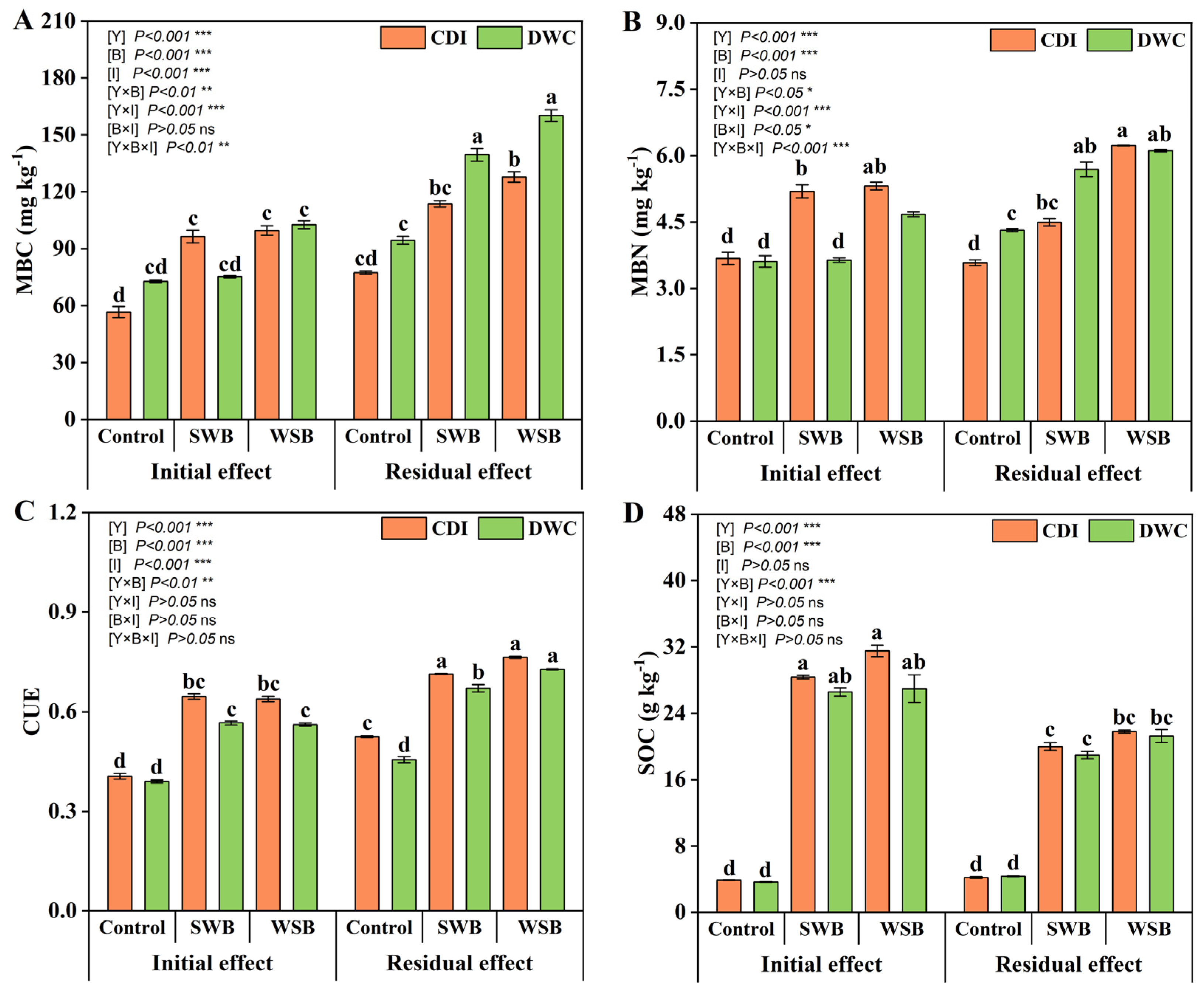
3.5. Microbial Biomass and Carbon Use Efficiency, and Soil Organic Carbon
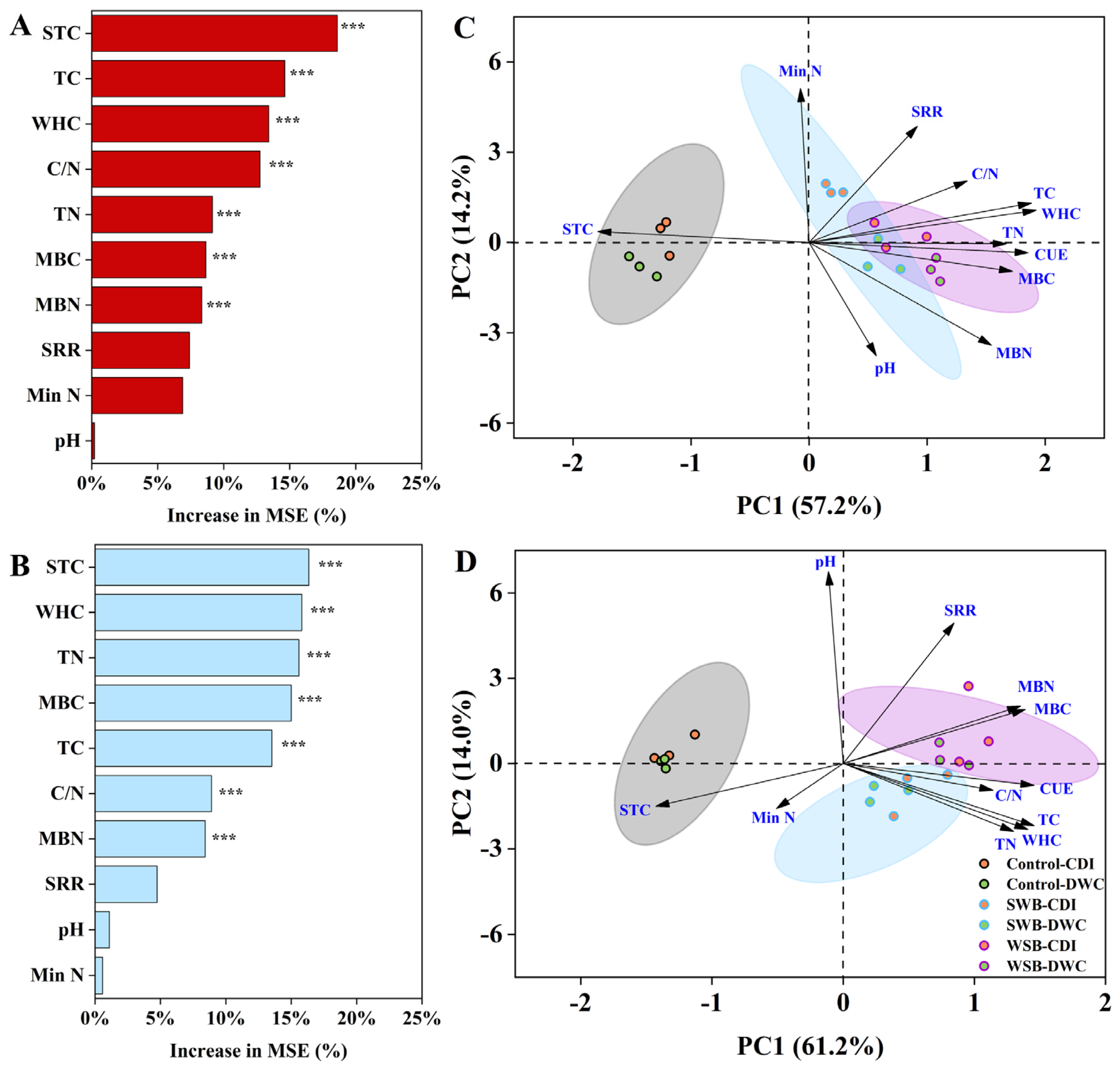
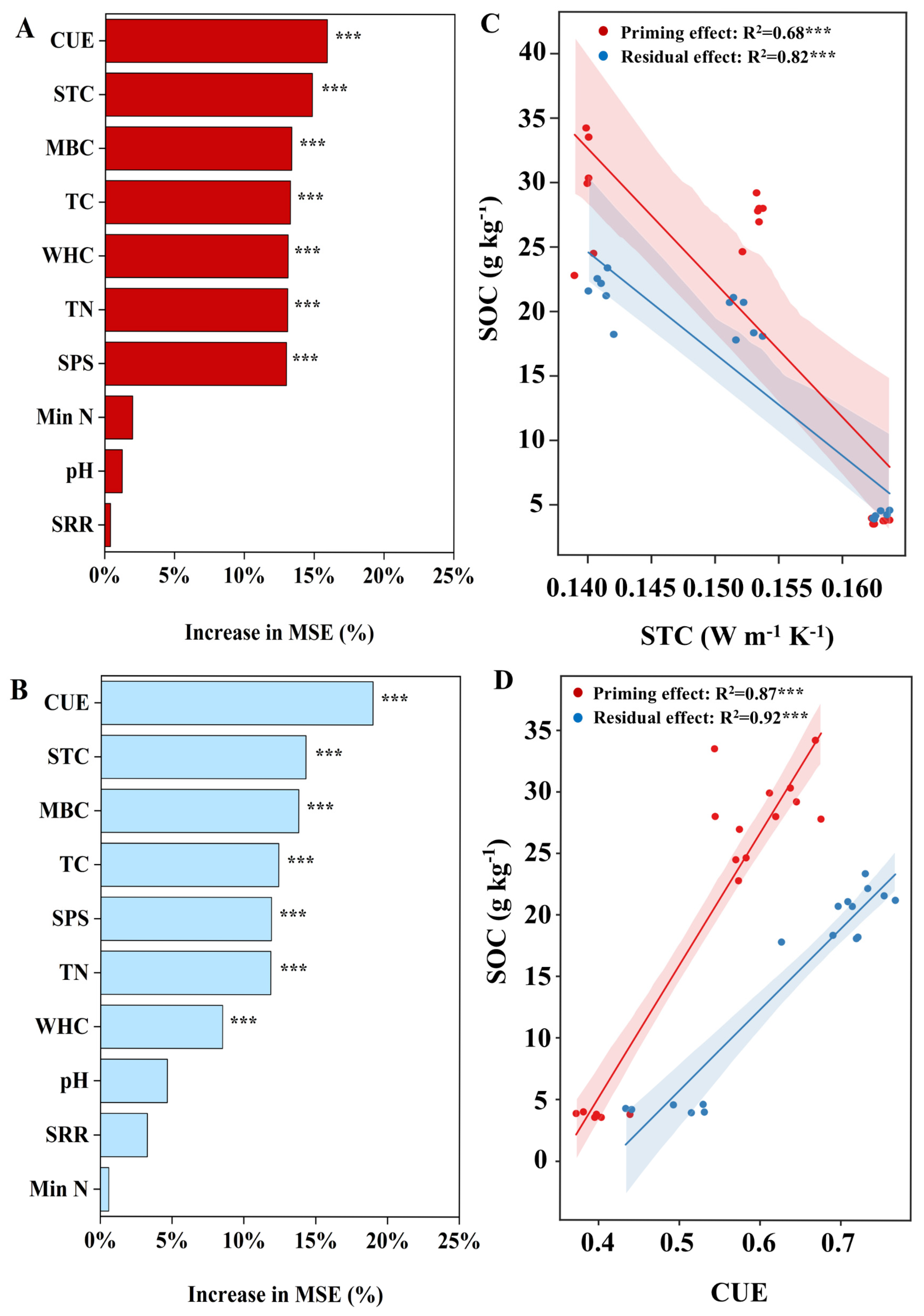
3.6. Importance and Correlation Analysis of Soil Variables for CUE and SOC
4. Discussion
5. Conclusions and Limitations
Supplementary Materials
Author Contributions
Funding
Data Availability Statement
Acknowledgments
Conflicts of Interest
References
- Abu-Hamdeh, N.H.; Reeder, R.C. Soil thermal conductivity effects of density, moisture, salt concentration, and organic matter. Soil Sci. Soc. Am. J. 2000, 64, 1285–1290. [Google Scholar] [CrossRef] [Scilit]
- Ahmed, M.B.; Zhou, J.L.; Ngo, H.H.; Guo, W.; Chen, M. Progress in the preparation and application of modified biochar for improved contaminant removal from water and wastewater. Bioresour. Technol. 2016, 214, 836–851. [Google Scholar] [CrossRef] [Scilit]
- Antonangelo, J.A.; Zhang, H.; Sun, X.; Kumar, A. Physicochemical properties and morphology of biochars as affected by feedstock sources and pyrolysis temperatures. Biochar 2019, 1, 325–336. [Google Scholar] [CrossRef] [Scilit]
- Bates, D.; Maechler, M.; Bolker, B.; Walker, S.; Christensen, R.H.B.; Singmann, H.; Dai, B.; Grothendieck, G.; Green, P.; Bolker, M.B. Package ‘lme4’. convergence 2015, 12, 2. [Google Scholar]
- Birch, H. The effect of soil drying on humus decomposition and nitrogen availability. Plant Soil 1958, 10, 9–31. [Google Scholar] [CrossRef] [Scilit]
- UK Biochar Research Centre. Reducing and Removing CO2 While Improving Soils: A Significant and Sustainable Response to Climate Change; UK Biochar Research Centre: Edinburgh, UK, 2009. [Google Scholar]
- Breiman, L. Random forests. Mach. Learn. 2001, 45, 5–32. [Google Scholar] [CrossRef] [Scilit]
- Bremner, J. Determination of nitrogen in soil by the Kjeldahl method. J. Agric. Sci. 1960, 55, 11–33. [Google Scholar] [CrossRef] [Scilit]
- Bremner, J. Inorganic forms of nitrogen. In Methods of Soil Analysis: Part 2 Chemical and Microbiological Properties; American Society of Agronomy: Madison, WI, USA, 1965; Volume 9, pp. 1179–1237. [Google Scholar]
- Burrell, L.D.; Zehetner, F.; Rampazzo, N.; Wimmer, B.; Soja, G. Long-term effects of biochar on soil physical properties. Geoderma 2016, 282, 96–102. [Google Scholar] [CrossRef] [Scilit]
- Buss, W.; Graham, M.C.; Shepherd, J.G.; Mašek, O. Suitability of marginal biomass-derived biochars for soil amendment. Sci. Total Environ. 2016, 547, 314–322. [Google Scholar] [CrossRef] [Scilit] [PubMed]
- Canarini, A.; Schmidt, H.; Fuchslueger, L.; Martin, V.; Herbold, C.W.; Zezula, D.; Gündler, P.; Hasibeder, R.; Jecmenica, M.; Bahn, M. Ecological memory of recurrent drought modifies soil processes via changes in soil microbial community. Nat. Commun. 2021, 12, 5308. [Google Scholar] [CrossRef] [Scilit] [PubMed]
- Canarini, A.; Wanek, W.; Watzka, M.; Sandén, T.; Spiegel, H.; Šantrůček, J.; Schnecker, J. Quantifying microbial growth and carbon use efficiency in dry soil environments via 18O water vapor equilibration. Glob. Change Biol. 2020, 26, 5333–5341. [Google Scholar] [CrossRef] [Scilit]
- Cao, G.; Sun, J.; Chen, M.; Sun, H.; Zhang, G. Co-transport of ball-milled biochar and Cd2+ in saturated porous media. J. Hazard. Mater. 2021, 416, 125725. [Google Scholar] [PubMed]
- Cotrufo, M.F.; Lavallee, J.M. Soil organic matter formation, persistence, and functioning: A synthesis of current understanding to inform its conservation and regeneration. In Advances in Agronomy; Elsevier: Amsterdam, The Netherlands, 2022; Volume 172, pp. 1–66. [Google Scholar]
- Cotrufo, M.F.; Wallenstein, M.D.; Boot, C.M.; Denef, K.; Paul, E. The Microbial Efficiency-Matrix Stabilization (MEMS) framework integrates plant litter decomposition with soil organic matter stabilization: Do labile plant inputs form stable soil organic matter? Glob. Change Biol. 2013, 19, 988–995. [Google Scholar]
- Domeignoz-Horta, L.A.; Pold, G.; Liu, X.-J.A.; Frey, S.D.; Melillo, J.M.; DeAngelis, K.M. Microbial diversity drives carbon use efficiency in a model soil. Nat. Commun. 2020, 11, 3684. [Google Scholar] [CrossRef] [Scilit] [PubMed]
- Domingues, R.R.; Trugilho, P.F.; Silva, C.A.; Melo, I.C.N.A.D.; Melo, L.C.A.; Magriotis, Z.M.; Sánchez-Monedero, M.A. Properties of biochar derived from wood and high-nutrient biomasses with the aim of agronomic and environmental benefits. PLoS ONE 2017, 12, e0176884. [Google Scholar] [CrossRef] [Scilit] [PubMed]
- Downie, A.; Crosky, A.; Munroe, P. Physical Properties of Biochar, Biochar for Environmental Management; Routledge: Abingdon, UK, 2012; pp. 45–64. [Google Scholar]
- Du, W.; Yang, Y.; Hu, L.; Chang, B.; Cao, G.; Nasir, M.; Lv, J. Combined determination analysis of surface properties evolution towards bentonite by pH treatments. Colloids Surf. 2021, 626, 127067. [Google Scholar] [CrossRef] [Scilit]
- Duan, N.; Li, L.; Liang, X.; Fine, A.; Zhuang, J.; Radosevich, M.; Schaeffer, S.M. Variation in bacterial community structure under long-term fertilization, tillage, and cover cropping in continuous cotton production. Front. Microbiol. 2022, 13, 847005. [Google Scholar] [CrossRef] [Scilit] [PubMed]
- Duan, N.; Radosevich, M.; Zhuang, J.; DeBruyn, J.M.; Staton, M.; Schaeffer, S.M. Identification of novel viruses and their microbial hosts from soils with long-term nitrogen fertilization and cover cropping management. Msystems 2022, 7, e00571-22. [Google Scholar] [CrossRef] [Scilit] [PubMed]
- Dynarski, K.A.; Bossio, D.A.; Scow, K.M. Dynamic stability of soil carbon: Reassessing the “permanence” of soil carbon sequestration. Front. Environ. Sci. 2020, 8, 514701. [Google Scholar] [CrossRef] [Scilit]
- Enders, A.; Hanley, K.; Whitman, T.; Joseph, S.; Lehmann, J. Characterization of biochars to evaluate recalcitrance and agronomic performance. Bioresour. Technol. 2012, 114, 644–653. [Google Scholar] [CrossRef] [Scilit] [PubMed]
- Eshel, G.; Levy, G.J.; Mingelgrin, U.; Singer, M.J. Critical evaluation of the use of laser diffraction for particle-size distribution analysis. Soil Sci. Soc. Am. J. 2004, 68, 736–743. [Google Scholar] [CrossRef] [Scilit]
- Feng, X.; Qin, S.; Zhang, D.; Chen, P.; Hu, J.; Wang, G.; Liu, Y.; Wei, B.; Li, Q.; Yang, Y. Nitrogen input enhances microbial carbon use efficiency by altering plant–microbe–mineral interactions. Glob. Change Biol. 2022, 28, 4845–4860. [Google Scholar]
- Geyer, K.M.; Kyker-Snowman, E.; Grandy, A.S.; Frey, S.D. Microbial carbon use efficiency: Accounting for population, community, and ecosystem-scale controls over the fate of metabolized organic matter. Biogeochemistry 2016, 127, 173–188. [Google Scholar] [CrossRef] [Scilit]
- Guo, L.; Born, M.L.; Niu, W.; Liu, F. Biochar amendment improves shoot biomass of tomato seedlings and sustains water relations and leaf gas exchange rates under different irrigation and nitrogen regimes. Agric. Water Manag. 2021, 245. [Google Scholar] [CrossRef] [Scilit]
- Hardy, B.; Sleutel, S.; Dufey, J.E.; Cornelis, J.-T. The long-term effect of biochar on soil microbial abundance, activity and community structure is overwritten by land management. Front. Environ. Sci. 2019, 7, 110. [Google Scholar] [CrossRef] [Scilit]
- Hendershot, W.H.; Lalande, H.; Duquette, M. Soil reaction and exchangeable acidity. In Soil Reaction and Exchangeable Acidity, 2nd ed.; CRC Press: Boca Raton, FL, USA, 1993. [Google Scholar]
- Hillel, D. Introduction to Soil Physics; Academic Press: Cambridge, MA, USA, 2013. [Google Scholar]
- Hood-Nowotny, R.; Umana, N.H.-N.; Inselbacher, E.; Oswald-Lachouani, P.; Wanek, W. Alternative methods for measuring inorganic, organic, and total dissolved nitrogen in soil. Soil Sci. Soc. Am. J. 2010, 74, 1018–1027. [Google Scholar] [CrossRef] [Scilit]
- Hou, J.; Wan, H.; Liang, K.; Cui, B.; Ma, Y.; Chen, Y.; Liu, J.; Wang, Y.; Liu, X.; Zhang, J. Biochar amendment combined with partial root-zone drying irrigation alleviates salinity stress and improves root morphology and water use efficiency in cotton plant. Sci. Total Environ. 2023, 904, 166978. [Google Scholar] [CrossRef] [Scilit] [PubMed]
- Hu, W.; Ran, J.; Dong, L.; Du, Q.; Ji, M.; Yao, S.; Sun, Y.; Gong, C.; Hou, Q.; Gong, H. Aridity-driven shift in biodiversity–soil multifunctionality relationships. Nat. Commun. 2021, 12, 5350. [Google Scholar] [PubMed]
- Huang, R.; Lan, M.; Liu, J.; Gao, M. Soil aggregate and organic carbon distribution at dry land soil and paddy soil: The role of different straws returning. Environ. Sci. Pollut. Res. 2017, 24, 27942–27952. [Google Scholar] [CrossRef] [Scilit]
- Ippolito, J.A.; Cui, L.; Kammann, C.; Wrage-Mönnig, N.; Estavillo, J.M.; Fuertes-Mendizabal, T.; Cayuela, M.L.; Sigua, G.; Novak, J.; Spokas, K. Feedstock choice, pyrolysis temperature and type influence biochar characteristics: A comprehensive meta-data analysis review. Biochar 2020, 2, 421–438. [Google Scholar] [CrossRef] [Scilit]
- Kallenbach, C.M.; Frey, S.D.; Grandy, A.S. Direct evidence for microbial-derived soil organic matter formation and its ecophysiological controls. Nat. Commun. 2016, 7, 13630. [Google Scholar] [CrossRef] [Scilit] [PubMed]
- Khaledi, S.; Delbari, M.; Galavi, H.; Bagheri, H.; Chari, M.M. Effects of biochar particle size, biochar application rate, and moisture content on thermal properties of an unsaturated sandy loam soil. Soil Tillage Res. 2023, 226, 105579. [Google Scholar]
- Lehmann, J.; Joseph, S. Biochar for Environmental Management: An Introduction, Biochar for Environmental Management; Routledge: Abingdon, UK, 2015; pp. 1–13. [Google Scholar]
- Lehmann, J.; Kleber, M. The contentious nature of soil organic matter. Nature 2015, 528, 60–68. [Google Scholar] [CrossRef] [Scilit] [PubMed]
- Liang, C.; Amelung, W.; Lehmann, J.; Kästner, M. Quantitative assessment of microbial necromass contribution to soil organic matter. Glob. Change Biol. 2019, 25, 3578–3590. [Google Scholar] [CrossRef] [Scilit]
- Liu, W.; Zhang, Z.; Wan, S. Predominant role of water in regulating soil and microbial respiration and their responses to climate change in a semiarid grassland. Glob. Change Biol. 2009, 15, 184–195. [Google Scholar] [CrossRef] [Scilit]
- Liu, X.; Ma, Y.; Manevski, K.; Andersen, M.N.; Li, Y.; Wei, Z.; Liu, F. Biochar and alternate wetting-drying cycles improving rhizosphere soil nutrients availability and tobacco growth by altering root growth strategy in Ferralsol and Anthrosol. Sci. Total Environ. 2022, 806, 150513. [Google Scholar] [CrossRef] [Scilit] [PubMed]
- Liu, X.; Wei, Z.; Ma, Y.; Liu, J.; Liu, F. Effects of biochar amendment and reduced irrigation on growth, physiology, water-use efficiency and nutrients uptake of tobacco (Nicotiana tabacum L.) on two different soil types. Sci. Total Environ. 2021, 770, 144769. [Google Scholar] [CrossRef] [Scilit] [PubMed]
- Lu, S.; Ren, T.; Gong, Y.; Horton, R. An improved model for predicting soil thermal conductivity from water content at room temperature. Soil Sci. Soc. Am. J. 2007, 71, 8–14. [Google Scholar] [CrossRef] [Scilit]
- Lunardi, C.N.; Gomes, A.J.; Rocha, F.S.; De Tommaso, J.; Patience, G.S. Experimental methods in chemical engineering: Zeta potential. Can. J. Chem. Eng. 2021, 99, 627–639. [Google Scholar]
- Madejová, J. Baseline Studies of the Clay Minerals Society Source Clays: Infrared Methods. Clays Clay Miner. 2001, 49, 410–432. [Google Scholar] [CrossRef] [Scilit]
- Malik, A.A.; Martiny, J.B.; Brodie, E.L.; Martiny, A.C.; Treseder, K.K.; Allison, S.D. Defining trait-based microbial strategies with consequences for soil carbon cycling under climate change. ISME J. 2020, 14, 1–9. [Google Scholar] [PubMed]
- Manzoni, S.; Taylor, P.; Richter, A.; Porporato, A.; Ågren, G.I. Environmental and stoichiometric controls on microbial carbon-use efficiency in soils. New Phytol. 2012, 196, 79–91. [Google Scholar] [PubMed]
- Mašek, O.; Buss, W.; Roy-Poirier, A.; Lowe, W.; Peters, C.; Brownsort, P.; Mignard, D.; Pritchard, C.; Sohi, S. Consistency of biochar properties over time and production scales: A characterisation of standard materials. J. Anal. Appl. Pyrolysis 2018, 132, 200–210. [Google Scholar] [CrossRef] [Scilit]
- Nelson, D.W.; Sommers, L.E. Total carbon, organic carbon, and organic matter. In Methods of Soil Analysis: Part 3 Chemical Methods; Soil Science Society of America: Madison, WI, USA, 1996; Volume 5, pp. 961–1010. [Google Scholar]
- Palansooriya, K.N.; Wong, J.T.F.; Hashimoto, Y.; Huang, L.; Rinklebe, J.; Chang, S.X.; Bolan, N.; Wang, H.; Ok, Y.S. Response of microbial communities to biochar-amended soils: A critical review. Biochar 2019, 1, 3–22. [Google Scholar] [CrossRef] [Scilit]
- Pei, J.; Fang, C.; Li, B.; Nie, M.; Li, J. Aridity-Driven Change in Microbial Carbon Use Efficiency and Its Linkage to Soil Carbon Storage. Glob. Change Biol. 2024, 30, e17565. [Google Scholar]
- Plaza, C.; García-Palacios, P.; Berhe, A.A.; Barquero, J.; Bastida, F.; Png, G.K.; Rey, A.; Bardgett, R.D.; Delgado-Baquerizo, M. Ecosystem productivity has a stronger influence than soil age on surface soil carbon storage across global biomes. Commun. Earth Environ. 2022, 3, 233. [Google Scholar] [CrossRef] [Scilit]
- Rowley, M.C.; Grand, S.; Verrecchia, É.P. Calcium-mediated stabilisation of soil organic carbon. Biogeochemistry 2018, 137, 27–49. [Google Scholar]
- Shah, Z.; Shah, T. Residual effect of biochar on soil properties and yield of maize (Zea mays L.) under different cropping systems. Open J. Soil Sci. 2018, 8, 16. [Google Scholar]
- Shen, Z.; Zhang, Y.; McMillan, O.; Jin, F.; Al-Tabbaa, A. Characteristics and mechanisms of nickel adsorption on biochars produced from wheat straw pellets and rice husk. Environ. Sci. Pollut. Res. 2017, 24, 12809–12819. [Google Scholar] [CrossRef] [Scilit]
- Six, J.; Conant, R.T.; Paul, E.A.; Paustian, K. Stabilization mechanisms of soil organic matter: Implications for C-saturation of soils. Plant Soil 2002, 241, 155–176. [Google Scholar] [CrossRef] [Scilit]
- Six, J.; Guggenberger, G.; Paustian, K.; Haumaier, L.; Elliott, E.T.; Zech, W. Sources and composition of soil organic matter fractions between and within soil aggregates. Eur. J. Soil Sci. 2001, 52, 607–618. [Google Scholar] [CrossRef] [Scilit]
- Sokol, N.W.; Whalen, E.D.; Jilling, A.; Kallenbach, C.; Pett-Ridge, J.; Georgiou, K. Global distribution, formation and fate of mineral-associated soil organic matter under a changing climate: A trait-based perspective. Funct. Ecol. 2022, 36, 1411–1429. [Google Scholar]
- Tao, F.; Huang, Y.; Hungate, B.A.; Manzoni, S.; Frey, S.D.; Schmidt, M.W.; Reichstein, M.; Carvalhais, N.; Ciais, P.; Jiang, L. Microbial carbon use efficiency promotes global soil carbon storage. Nature 2023, 618, 981–985. [Google Scholar] [CrossRef] [Scilit] [PubMed]
- Tariq, A.; Sardans, J.; Zeng, F.; Graciano, C.; Hughes, A.C.; Farré-Armengol, G.; Peñuelas, J. Impact of aridity rise and arid lands expansion on carbon-storing capacity, biodiversity loss, and ecosystem services. Glob. Change Biol. 2024, 30, e17292. [Google Scholar]
- Usowicz, B.; Lipiec, J.; Łukowski, M.; Marczewski, W.; Usowicz, J. The effect of biochar application on thermal properties and albedo of loess soil under grassland and fallow. Soil Tillage Res. 2016, 164, 45–51. [Google Scholar] [CrossRef] [Scilit]
- Usowicz, B.; Lipiec, J.; Usowicz, J.B.; Marczewski, W. Effects of aggregate size on soil thermal conductivity: Comparison of measured and model-predicted data. Int. J. Heat Mass Transf. 2013, 57, 536–541. [Google Scholar] [CrossRef] [Scilit]
- Vane, L.M.; Zang, G.M. Effect of aqueous phase properties on clay particle zeta potential and electro-osmotic permeability: Implications for electro-kinetic soil remediation processes. J. Hazard. Mater. 1997, 55, 1–22. [Google Scholar]
- Verheijen, F.; Jeffery, S.; Bastos, A.; Van der Velde, M.; Diafas, I. Biochar Application to Soils. A Critical Scientific Review of Effects on Soil Properties, Processes, and Functions; EUR 24099; European Commission: Luxembourg, 2010; pp. 2183–2207. [Google Scholar]
- Wan, H.; Chen, Y.; Cui, B.; Liu, X.; Hou, J.; Wei, Z.; Liu, J.; Liu, F. Biochar Amendment Increases C and N Retention in the Soil–Plant Systems: Its Implications in Enhancing Plant Growth and Water-Use Efficiency Under Reduced Irrigation Regimes of Maize (Zea mays L.). J. Soil Sci. Plant Nutr. 2023, 23, 1576–1588. [Google Scholar]
- Wan, H.; Hong, M.; Fang, L.; Al-Salman, Y.; van Schaik, L.; Wei, Z.; Li, F.; Geissen, V.; Liu, F. Contrasting residual effects of different biochar types on maize nitrogen uptake, biomass accumulation, water and nitrogen use efficiency under alternate partial root-zone drying irrigation. Biochar 2025, 7, 115. [Google Scholar] [CrossRef] [Scilit]
- Wan, H.; Hou, J.; Wei, Z.; Liu, F. Contrasting maize responses to soil phosphorus and potassium availability driven by biochar under reduced irrigation. Plant Soil 2024, 508, 677–700. [Google Scholar] [CrossRef] [Scilit]
- Wan, H.; Wei, Z.; Liu, C.; Yang, X.; Wang, Y.; Liu, F. Biochar amendment modulates xylem ionic constituents and ABA signaling: Its implications in enhancing water-use efficiency of maize (Zea mays L.) under reduced irrigation regimes. J. Integr. Agric. 2024, 24, 132–146. [Google Scholar]



| Factor | Soil | SWB | WSB |
|---|---|---|---|
| Clay (<0.002 mm, %) | 8 | - | - |
| Silt (0.05–0.002 mm, %) | 85 | - | - |
| Sand (2–0.05 mm, %) | 7 | - | - |
| Mean microaggregate size (μm) | 19.1 | 76.4 | 59.9 |
| pH | 7.7 | 7.9 | 9.9 |
| EC (μS cm−1) | 360 | 90 | 1700 |
| CEC (cmol + kg−1) | 2.0 | 3.2 | 6.2 |
| Total C (%) | 1.8 | 85.5 | 68.3 |
| Total N (%) | 0.1 | <0.1 | 1.4 |
| Total P (c) (%) | 0.1 | 0.1 | 0.1 |
| Total K (c) (%) | 2.4 | 0.3 | 1.6 |
| Total Ca (c) (%) | 7.4 | 0.3 | 0.8 |
| C:N | 18 | <855.2 | 49.1 |
| H:Ctot | - | 0.4 | 0.4 |
| O:Ctot | - | 0.1 | 0.1 |
| (O + N):C | <0.1 | 0.1 | |
| Surface area (m2 g−1) | - | 26.4 | 26.4 |
| Total ash (a) (%) | - | 1.3 | 21.2 |
| C stability (b) (%) | - | 69.6 | 96.5 |
Disclaimer/Publisher’s Note: The statements, opinions and data contained in all publications are solely those of the individual author(s) and contributor(s) and not of MDPI and/or the editor(s). MDPI and/or the editor(s) disclaim responsibility for any injury to people or property resulting from any ideas, methods, instructions or products referred to in the content. |
© 2026 by the authors. Licensee MDPI, Basel, Switzerland. This article is an open access article distributed under the terms and conditions of the Creative Commons Attribution (CC BY) license.
Share and Cite
Wan, H.; Cao, G.; Zhang, X.; Xie, N.; Ma, J.; Di, Y.; Ye, H.; Hou, J.; Wei, Z.; Zhang, H.; et al. Differential Responses of Soil Thermal Conductivity, Microbial Carbon Use Efficiency, and Soil Organic Carbon to Feedstock-Specific Biochar Under Alternate Drying–Wetting Cycles. Agronomy 2026, 16, 1262. https://doi.org/10.3390/agronomy16131262
Wan H, Cao G, Zhang X, Xie N, Ma J, Di Y, Ye H, Hou J, Wei Z, Zhang H, et al. Differential Responses of Soil Thermal Conductivity, Microbial Carbon Use Efficiency, and Soil Organic Carbon to Feedstock-Specific Biochar Under Alternate Drying–Wetting Cycles. Agronomy. 2026; 16(13):1262. https://doi.org/10.3390/agronomy16131262
Chicago/Turabian StyleWan, Heng, Gang Cao, Xiangyang Zhang, Ninghui Xie, Jinhui Ma, Yunfei Di, He Ye, Jingxiang Hou, Zhenhua Wei, Hailin Zhang, and et al. 2026. "Differential Responses of Soil Thermal Conductivity, Microbial Carbon Use Efficiency, and Soil Organic Carbon to Feedstock-Specific Biochar Under Alternate Drying–Wetting Cycles" Agronomy 16, no. 13: 1262. https://doi.org/10.3390/agronomy16131262
APA StyleWan, H., Cao, G., Zhang, X., Xie, N., Ma, J., Di, Y., Ye, H., Hou, J., Wei, Z., Zhang, H., Li, F., Hong, M., & Liu, F. (2026). Differential Responses of Soil Thermal Conductivity, Microbial Carbon Use Efficiency, and Soil Organic Carbon to Feedstock-Specific Biochar Under Alternate Drying–Wetting Cycles. Agronomy, 16(13), 1262. https://doi.org/10.3390/agronomy16131262