1. Introduction
Plants experience predictable daily and seasonal fluctuations in light, temperature, humidity, and biotic pressure. To anticipate and respond to these environmental cycles, they have evolved endogenous circadian clocks that generate approximately 24 h rhythms in gene expression, physiology, metabolism, and development [
1,
2,
3]. In the model species
Arabidopsis thaliana, circadian regulation has been studied extensively and is known to coordinate processes such as photosynthesis, starch turnover, growth, hormone signalling, immune responses, and flowering time [
4,
5,
6]. These processes are also central to crop performance, making circadian biology relevant to agriculture.
In crops, circadian and photoperiodic pathways have had a major influence on domestication, geographic expansion, and adaptation to local environments. Many well-known breeding targets are connected to clock-associated or photoperiodic regulation. For example, variation in
Ghd7,
Hd1, and
OsPRR37 contributes to heading-date variation and regional adaptation in rice;
Ppd-1 and
Ppd-H1 influence photoperiod sensitivity in wheat and barley;
ZmCCT contributes to the spread of maize into temperate regions;
E1 and
J regulate maturity and adaptation in soybean; and
Ma1/SbPRR37 affects photoperiod-dependent flowering in sorghum [
7,
8,
9,
10,
11,
12,
13,
14,
15]. Horticultural crops also provide important examples: domestication-associated changes in tomato have been linked to altered circadian timing, while recent evidence from lettuce suggests that circadian variation is associated with delayed bolting and may be relevant for temporal optimization in leafy crop production and controlled-environment agriculture [
16,
17].
These examples show that circadian biology has not been absent from crop improvement. Indeed, photoperiodic flowering pathways have been among the most important temporal regulatory systems selected during domestication and breeding. However, the broader agricultural use of circadian principles remains less developed. Most breeding programs still evaluate traits such as yield, stress tolerance, nutrient-use efficiency, and quality largely through spatial, seasonal, or developmental frameworks, while the daily timing of physiological processes is rarely treated as an explicit breeding or management variable. Similarly, many agronomic practices, including irrigation, fertilization, crop protection, and harvesting, are usually optimized according to dose, location, and developmental stage, but less often according to endogenous plant timing.
The concept of chrono-agriculture addresses this temporal dimension by asking whether agricultural practices can be improved by aligning interventions with plant biological rhythms [
18]. Such approaches could include time-sensitive irrigation, nutrient delivery, crop protection, lighting regimes, thermoperiod control, or harvest timing. The biological rationale is strong because stomatal conductance, nutrient uptake, carbon metabolism, hormone signalling, defence responses, and specialized metabolism all show diurnal or circadian regulation [
19,
20,
21,
22]. Nevertheless, the practical implementation of chrono-agriculture remains challenging, especially in open-field systems where weather, field heterogeneity, labour, machinery availability, sensor limitations, and economic feasibility constrain management decisions.
This review integrates current knowledge of plant circadian clocks with their relevance to crop productivity, breeding, and agricultural management. We first summarize the molecular architecture of the plant circadian system, emphasizing both conserved regulatory modules and crop-specific divergence. We then examine how circadian regulation influences major productivity and quality traits, including photosynthesis, carbon metabolism, growth, flowering, stress responses, and specialized metabolism. Next, we discuss crop-specific clock-associated genes and their implications for breeding, highlighting examples from cereals, legumes, and horticultural crops. Finally, we evaluate chrono-agriculture as an emerging but still developing framework for time-sensitive crop management, with particular attention to practical constraints, phenotyping limitations, and the need for multi-environment validation.
2. Molecular Architecture and Environmental Integration of the Plant Circadian Clock
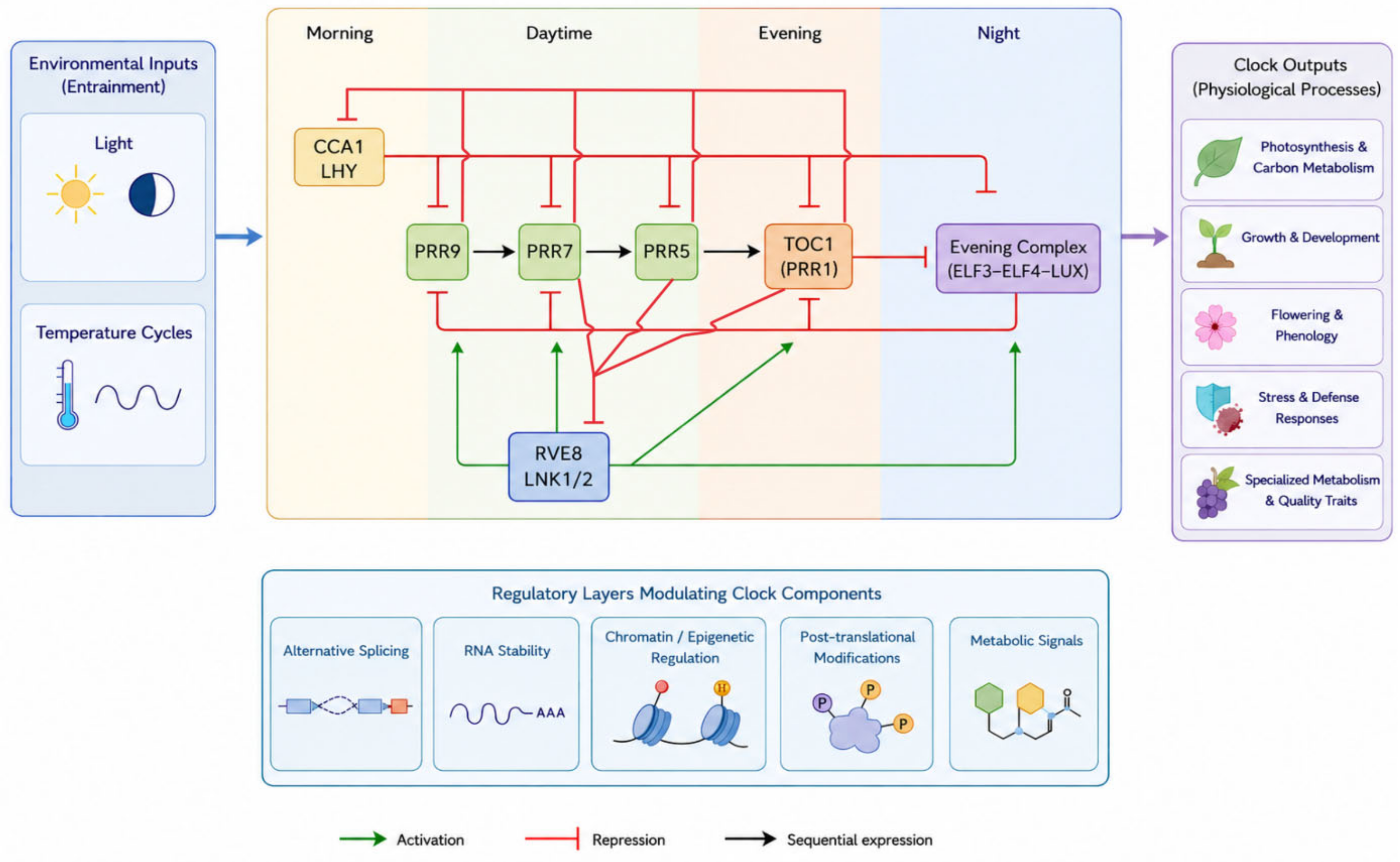
The plant circadian clock is a regulatory network that generates approximately 24 h rhythms and coordinates internal biological processes with daily environmental cycles. Although the molecular architecture of the clock has been characterized most extensively in
Arabidopsis thaliana, homologous components and clock-associated pathways are widely conserved across crop species [
2,
6,
23]. However, conservation of core components does not imply identical function across species. Crop genomes frequently contain duplicated or diversified clock genes, and their functions can vary depending on species, genetic background, tissue type, developmental stage, and environmental conditions [
24,
25]. This distinction is important for agriculture because crop adaptation often depends on modified clock outputs rather than strict conservation of the
Arabidopsis system (
Figure 1).
At the core of the plant circadian oscillator are interlocking transcriptional–translational feedback loops. In
Arabidopsis, the morning-expressed MYB-like transcription factors CIRCADIAN CLOCK ASSOCIATED 1 (CCA1) and LATE ELONGATED HYPOCOTYL (LHY) repress evening-phased genes, including
TIMING OF CAB EXPRESSION 1 (
TOC1) and components of the evening loop [
26,
27]. As
CCA1 and
LHY expression declines during the day, repression of evening genes is relieved. TOC1 (also known as PRR1) and other PSEUDO-RESPONSE REGULATOR (PRR) proteins subsequently contribute to repression of morning-phased genes, thereby closing feedback loops that sustain rhythmic gene expression [
2,
28].
The PRR family provides temporal structure to the oscillator.
PRR9,
PRR7,
PRR5, and
TOC1/PRR1 are expressed sequentially from morning to evening and contribute to phase-specific repression of clock and clock-output genes [
28]. In crops,
PRR homologs have undergone functional diversification and are frequently associated with photoperiodic flowering and adaptation. Examples include
Ppd-H1 in barley,
Ppd-1 in wheat,
OsPRR37 in rice, and
Ma1/SbPRR37 in sorghum [
9,
10,
11,
15]. Thus,
PRR genes provide a direct link between the molecular clock and agronomic traits such as flowering time, maturity, and environmental adaptation.
Evening-phased repression is mediated in part by the Evening Complex, composed of EARLY FLOWERING 3 (ELF3), ELF4, and LUX ARRHYTHMO (LUX) [
23,
29]. This complex represses growth- and clock-associated targets during the night and contributes to the integration of light and temperature information. The agricultural relevance of this module is illustrated by soybean, where natural variation at the
J locus, encoding an ELF3 ortholog, modifies photoperiodic flowering and contributes to adaptation to tropical environments [
14]. Such examples indicate that evening clock components can be important targets of domestication and breeding.
In addition to transcriptional repression, transcriptional activation is essential for sustaining robust circadian rhythms. REVEILLE (RVE) transcription factors and NIGHT LIGHT-INDUCIBLE AND CLOCK-REGULATED (LNK) co-activators promote the expression of evening-phased clock genes, including
TOC1, and counterbalance repressive modules within the oscillator [
30]. The RVE–LNK module is therefore not simply an accessory component, but an important activator pathway that contributes to rhythm amplitude, phase, and network stability (
Figure 1). Because activation and repression act together to shape rhythmic outputs, mechanistic diagrams of the plant clock should represent both negative and positive regulatory interactions.
The clock is also regulated beyond transcriptional feedback. Alternative splicing, RNA stability, protein modification, chromatin state, and metabolic signals all contribute to circadian timing and environmental responsiveness [
31,
32]. Temperature-dependent alternative splicing can affect clock gene function, while post-translational regulation influences protein stability and activity. Chromatin-level regulation, including rhythmic histone modifications and changes in accessibility, provides another regulatory layer that modulates clock gene expression [
33,
34]. These mechanisms are likely to be particularly important in crops exposed to fluctuating field environments, where rapid adjustment to changing light and temperature conditions is required.
Environmental entrainment aligns endogenous rhythms with external cycles. Light is perceived through photoreceptors such as phytochromes, cryptochromes, and other light-signalling components, while temperature cycles influence clock phase, amplitude, and period [
31,
32]. These input pathways allow the oscillator to adjust to seasonal and daily changes in the environment. In crops, such entrainment mechanisms are closely linked to photoperiodic flowering, growth regulation, and stress responses. Therefore, the agricultural significance of the clock lies not only in its endogenous rhythmicity, but also in its ability to integrate environmental information and generate appropriately timed physiological outputs.
Overall, the plant circadian clock can be viewed as a multi-layered timing system composed of conserved oscillator components, species-specific gene family diversification, regulatory activation and repression modules, post-transcriptional and post-translational control, and environmental input pathways. This architecture enables plants to coordinate photosynthesis, metabolism, growth, defence, and developmental transitions with daily and seasonal environmental dynamics. In crop species, modifications of clock-associated pathways have repeatedly contributed to adaptation and breeding, as discussed in the following sections.
3. Circadian Regulation of Crop Productivity Traits
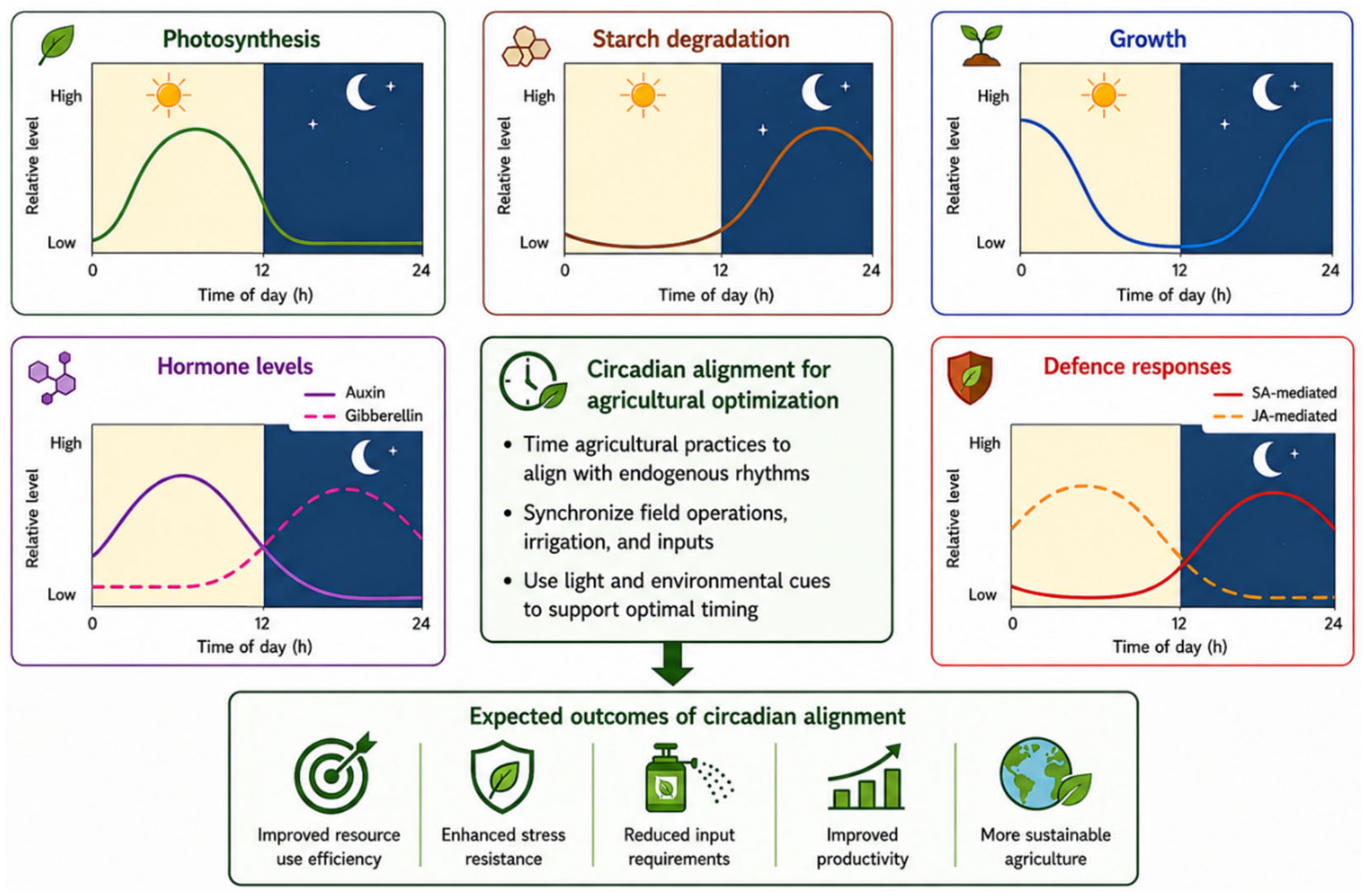
The circadian clock influences crop productivity by coordinating physiological, metabolic, and developmental processes with predictable daily environmental cycles. Photosynthesis, carbon allocation, growth, flowering, hormone signalling, defence responses, and specialized metabolism all show time-of-day-dependent regulation (
Figure 2) [
4,
6,
35]. However, the agronomic consequences of circadian regulation are not uniform across traits, species, or environments. In crops, clock function is often linked to productivity through interactions with photoperiod, temperature, water availability, source–sink balance, and developmental stage. Therefore, circadian regulation should not be viewed simply as a universal enhancer of yield, but rather as a temporal regulatory system whose value depends on environmental context and breeding objectives.
3.1. Photosynthesis, Stomatal Function, and Carbon Metabolism
Photosynthesis is one of the most strongly temporally regulated processes in plants. Genes involved in light harvesting, chloroplast function, carbon fixation, and stomatal regulation often show diurnal or circadian expression patterns, allowing photosynthetic capacity to be coordinated with predictable changes in light availability [
4,
19]. Circadian regulation also influences stomatal opening, transpiration, and gas exchange, thereby linking carbon assimilation with water-use efficiency. At the canopy scale, these processes can affect productivity because photosynthetic performance depends not only on maximum assimilation capacity, but also on the timing of carbon gain relative to environmental conditions.
A central component of circadian control of carbon metabolism is the coordination between daytime carbon assimilation and night-time carbohydrate use. During the day, plants store carbohydrates, particularly starch, and at night these reserves are remobilized to sustain respiration and growth. The circadian clock contributes to the regulation of starch degradation so that reserves are used at a rate appropriate for the expected length of the night [
5]. When this temporal regulation is disrupted, plants may either exhaust carbon reserves before dawn or retain excess starch, both of which can reduce growth efficiency. This mechanism illustrates how circadian regulation contributes to productivity by optimizing temporal allocation rather than simply increasing photosynthetic activity.
Although much mechanistic understanding of circadian carbon regulation comes from
Arabidopsis, comparable principles are relevant to crops. In field and crop systems, daily rhythms in gas exchange, transpiration, and carbon metabolism interact with fluctuating light, temperature, and water availability [
19]. In cereals such as wheat, barley, and rice, photoperiodic and circadian-associated pathways influence developmental timing and source–sink relationships, indirectly affecting carbon allocation and yield potential [
8,
10,
11]. However, the relationship between circadian timing and photosynthetic productivity is likely to be environment-dependent. A rhythm that improves carbon-use efficiency under one photoperiod or temperature regime may not be optimal under another. Therefore, crop improvement should focus on matching circadian outputs to specific agroecological conditions rather than assuming a single optimal clock state.
3.2. Growth, Biomass Accumulation, and Resource Allocation
Plant growth is inherently rhythmic, with cell expansion, elongation, and biomass accumulation often varying across the day–night cycle [
36,
37]. The circadian clock contributes to this rhythmicity by regulating genes involved in cell wall modification, hormone responses, energy metabolism, and environmental sensitivity. One important mechanism is circadian gating, in which responsiveness to external signals such as light, temperature, or stress is restricted to specific times of day [
38]. This allows plants to coordinate growth with favourable environmental windows and to avoid inappropriate responses when conditions are less suitable.
The concept of circadian resonance provides a useful framework for understanding growth regulation. In controlled experiments, plants whose endogenous rhythms are better aligned with external light–dark cycles often show improved growth and fitness compared with plants whose rhythms are mismatched [
4,
39]. However, in agricultural systems, the relationship between resonance and productivity is complicated by domestication, breeding history, and management conditions. Crops are not necessarily selected to maintain ancestral circadian properties; instead, breeding may favour altered rhythms that improve performance under cultivation.
Tomato provides a particularly informative example. Domestication-associated variation affecting
EID1 and
LNK2 has been linked to a deceleration of circadian rhythms in cultivated tomato compared with wild relatives [
40]. This suggests that altered circadian timing may improve adaptation to agricultural long-day environments. Similar principles may apply in other crops where breeding has modified photoperiod sensitivity, growth duration, or developmental phase transitions. Thus, circadian regulation of biomass accumulation should be understood as a balance between temporal alignment, developmental timing, and resource allocation.
A major challenge is pleiotropy. Clock-associated genes often regulate multiple outputs, including flowering time, vegetative growth, stress responses, and metabolism. As a result, manipulation of core clock components may improve one trait while compromising another. For example, stronger vegetative growth may delay reproduction, while earlier flowering may reduce biomass accumulation under certain environments. Therefore, breeding strategies targeting circadian-associated growth traits should evaluate whole-plant performance across multiple environments rather than focusing on individual physiological outputs.
3.3. Flowering Time, Phenology, and Seasonal Adaptation
Flowering time is the best-established agricultural trait controlled by circadian and photoperiodic pathways. The circadian clock enables plants to measure day length by coordinating internal gene expression with external light signals [
41]. In many species, this mechanism involves clock-regulated expression of flowering regulators such as
CONSTANS-like genes and downstream florigen pathways. The timing of these regulatory events determines whether flowering is induced or delayed under particular photoperiods.
In crops, allelic variation in circadian-associated flowering pathways has been repeatedly selected during domestication and breeding. In rice, variation in
Ghd7,
Hd1, and
OsPRR37 affects heading date and regional adaptation under different photoperiodic environments [
8,
9,
42]. In wheat and barley, variation in
Ppd-1 and
Ppd-H1 modifies photoperiod sensitivity, allowing flowering to be matched to local growing seasons [
10,
11]. In maize, regulatory variation in
ZmCCT (ortholog of the Arabidopsis
PRR7 gene) contributed to reduced photoperiod sensitivity and the expansion of maize into temperate long-day regions [
12]. In sorghum and soybean, variation in
Ma1/SbPRR37,
E1, and
J similarly affects flowering and maturity, contributing to adaptation across latitudinal gradients [
13,
14,
15].
These examples demonstrate that circadian and photoperiodic pathways have been among the most important temporal regulators exploited in crop improvement. However, they also illustrate that adaptation often involves reduced or altered photoperiod sensitivity rather than simple optimization of clock robustness. In many agricultural contexts, partial weakening, phase shifting, or rewiring of clock-associated flowering pathways can be beneficial if it allows reproductive development to occur within favourable seasonal windows. This is especially important in crops transferred from tropical to temperate regions or from ancestral habitats to intensive cultivation systems.
The agronomic value of flowering-time alleles is also strongly context-dependent. An allele that promotes early flowering may improve adaptation where growing seasons are short or terminal drought is common, but the same allele may reduce yield potential where a longer vegetative phase supports greater biomass and grain filling. Conversely, delayed flowering can increase biomass and yield under favourable conditions but may expose crops to late-season stress. Therefore, circadian regulation of phenology should be interpreted within the broader framework of genotype-by-environment interaction and crop management.
3.4. Hormonal Crosstalk, Defense Signalling, and Stress Responses
Plant hormones provide a major interface between the circadian clock and agronomic stress responses. Auxin, gibberellins, abscisic acid, salicylic acid, and jasmonates show rhythmic patterns of biosynthesis, signalling, or sensitivity [
43,
44]. Through these pathways, the clock can gate growth responses, drought responses, immune activation, and resource allocation. This temporal organization may improve efficiency by activating costly responses when they are most likely to be useful.
Circadian regulation of plant immunity has been particularly well characterized. Jasmonate-mediated defences can be synchronized with the activity rhythms of herbivorous insects, while salicylic-acid-dependent immune responses show time-of-day-dependent regulation that affects pathogen resistance [
20,
21,
22,
45]. These findings suggest that plants use circadian timing to anticipate recurring biotic stress and to balance defence with growth. Because defence responses require substantial metabolic investment, temporal restriction of immune activation may reduce unnecessary costs.
Abiotic stress responses are also connected to clock function. Temperature, drought, and light stress can alter circadian phase and amplitude, while clock components influence the expression of stress-responsive genes [
31,
32,
46]. In wheat, cold-responsive transcriptional programs are gated by the circadian clock, indicating that the timing of stress exposure can influence the magnitude of the response [
47]. Such findings are agriculturally relevant because crops in the field experience stress as dynamic daily and seasonal events, not as constant conditions.
Nevertheless, translation from mechanistic stress biology to crop management remains challenging. Most detailed studies of clock–immunity and clock–stress interactions have been conducted under controlled conditions. Field environments contain simultaneous fluctuations in light, temperature, water availability, pathogen pressure, and developmental status. Therefore, the agricultural use of circadian stress regulation will require crop-specific validation and integration with environmental monitoring. The key opportunity is not merely to identify stress-responsive clock genes, but to determine whether temporal regulation can improve resilience without unacceptable trade-offs in growth or yield.
3.5. Circadian Regulation of Nutritional Quality and Specialized Metabolism
In addition to yield-related traits, the circadian clock influences crop quality through regulation of specialized metabolism. Pathways involved in anthocyanin, flavonoid, antioxidant, vitamin, glucosinolate, and aroma compound biosynthesis often show diurnal or circadian regulation [
1,
6,
35]. These rhythms can produce time-of-day-dependent variation in metabolite accumulation, which may affect nutritional value, stress tolerance, postharvest quality, and consumer-relevant traits such as colour, flavour, and aroma.
This aspect is particularly relevant for horticultural crops, leafy vegetables, fruits, and controlled-environment agriculture. In these systems, commercial value is determined not only by biomass or yield, but also by quality traits such as pigment content, antioxidant capacity, flavor profile, and shelf life. Circadian regulation may therefore provide opportunities to optimize harvest timing, light regimes, or temperature cycles to improve nutritional and market quality. For example, manipulating photoperiod, light spectra, or harvest time could theoretically enhance accumulation of desirable metabolites if their biosynthesis is temporally regulated.
However, chrono-nutrition in crops remains an emerging area. While rhythmic regulation of specialized metabolism is well supported biologically, direct agronomic recommendations require species-specific evidence. Metabolite rhythms can be influenced by genotype, developmental stage, light intensity, temperature, stress, and postharvest handling. Therefore, future studies should combine circadian profiling with metabolomics and quality assessment under realistic production conditions. This would help determine when circadian-informed cultivation or harvesting can improve nutritional quality in a reproducible and economically meaningful way.
Overall, circadian regulation contributes to crop productivity and quality by coordinating multiple interacting processes rather than by controlling a single yield determinant. Photosynthesis, growth, phenology, stress responses, and specialized metabolism are linked through shared resource constraints and environmental inputs (
Figure 2). The agronomic value of circadian regulation therefore depends on balancing these outputs in specific crops and production systems. This context dependence is a central consideration for breeding and chrono-agricultural applications discussed in the following sections.
4. Circadian Clock Genes in Crop Species: Implications for Breeding
Although the molecular architecture of the plant circadian clock has been most extensively characterized in
Arabidopsis thaliana, comparative genetic and genomic studies have demonstrated that clock-associated pathways are deeply embedded in the domestication, adaptation, and breeding history of many crop species [
7,
10,
11,
12,
24,
25,
40]. Core clock components, including homologs of
CCA1/LHY,
TOC1,
PRR family genes,
GI,
ELF3, and associated photoperiodic flowering regulators, are widely conserved across crops [
2,
18,
25]. However, conservation of individual components does not imply functional uniformity. Gene duplication, polyploidy, regulatory divergence, and domestication-driven selection have produced crop-specific circadian and photoperiodic networks that influence flowering time, growth, stress responses, and adaptation to local environments [
24,
25,
40].
A central lesson emerging from crop studies is that agricultural improvement has often selected altered circadian or photoperiodic behaviour rather than simply maintaining an intact “optimal” clock [
11,
12,
40]. In many crops, beneficial alleles modify the sensitivity, phase, or output of circadian-associated pathways to match specific agroecological contexts. This is particularly clear for flowering time and seasonal adaptation, where allelic variation in clock-associated genes has enabled crops to expand beyond their ancestral latitudinal ranges [
7,
10,
11,
12,
24,
40]. Major examples include
Ghd7,
Hd1, and
OsPRR37 in rice;
Ppd-1 in wheat;
Ppd-H1 in barley;
ZmCCT in maize;
E1 and
J in soybean; and
Ma1/SbPRR37 in sorghum (
Table 1) [
7,
8,
9,
10,
11,
12,
13,
14,
15,
40,
41,
42]. These loci illustrate how circadian and photoperiodic pathways have repeatedly been recruited during domestication and breeding to adjust developmental timing.
In rice (
Oryza sativa), photoperiod-sensitive flowering regulators have played a major role in adaptation to different cultivation zones [
7,
8,
9,
41,
42]. Allelic variation in
Ghd7 affects heading date under long-day conditions and contributes to regional differences in flowering, biomass accumulation, and yield potential [
8]. Similarly,
Hd1, a rice ortholog of
CONSTANS, regulates heading date in a photoperiod-dependent manner [
41,
42], while
OsPRR37 influences both flowering pathways and the broader diurnal transcriptome [
9]. Together, these examples show that circadian-associated regulators in rice do not act solely as flowering switches; rather, they coordinate developmental timing with environmental signals and thereby contribute to adaptation and productivity [
7,
8,
9].
Comparable photoperiodic rewiring has occurred in temperate cereals. In wheat (
Triticum aestivum), photoperiod-insensitive alleles of
Ppd-1, particularly
Ppd-D1, reduce dependence on long-day induction and promote earlier flowering [
10]. These alleles have been widely used in breeding to adapt wheat varieties to diverse environments and cropping systems [
10]. In barley (
Hordeum vulgare), natural variation in
Ppd-H1, a pseudo-response regulator gene related to the circadian clock, modifies photoperiod responsiveness and flowering time under long days [
11]. Such variation has been important for matching developmental timing to growing-season length, especially in high-latitude or seasonally constrained environments [
11]. Barley also provides a strong example involving the Evening Complex:
EARLY MATURITY 8 (
eam8) corresponds to
HvELF3, the barley ortholog of
Arabidopsis ELF3, and
eam8/elf3 alleles promote early flowering and maturity, supporting adaptation to short growing seasons [
48]. Mechanistically, barley ELF3 regulates flowering partly through gibberellin biosynthesis and
FT1 expression [
49]. More recent work further indicates that exotic
HvELF3 alleles can contribute to developmental plasticity to secure seed production under elevated temperatures, suggesting relevance for climate-resilient breeding [
50].
The importance of circadian-associated photoperiod genes is also evident in crops of tropical origin that were adapted to temperate regions. In maize (
Zea mays), regulatory variation in
ZmCCT reduced photoperiod sensitivity and contributed to the post-domestication spread of maize into long-day temperate environments [
12]. In sorghum (
Sorghum bicolor),
Ma1/SbPRR37 acts as a major regulator of photoperiodic flowering, with allelic variation affecting maturity and adaptation across agroecological zones [
15]. These cases demonstrate that modulation of clock-related flowering pathways has been a recurrent mechanism enabling the geographic expansion of cereals [
12,
15].
Legume crops provide further examples of circadian and photoperiodic regulation in adaptation. In soybean (
Glycine max), the maturity locus
E1 is a central regulator of photoperiodic flowering and maturity, contributing to adaptation across latitudinal gradients [
13]. The
J locus, encoding an ELF3 ortholog, modifies photoperiodic responses and has been associated with adaptation to tropical environments [
14]. These examples broaden the relevance of circadian biology beyond grasses and highlight the importance of clock-associated loci in legume breeding [
13,
14].
Domestication has also modified circadian timing in horticultural crops. In tomato (
Solanum lycopersicum), domestication-associated variation affecting
EID1 and
LNK2 has been linked to a deceleration of circadian rhythms relative to wild relatives [
16,
40]. This finding is particularly important because it shows that crop improvement may favor altered circadian dynamics under agricultural conditions [
16,
40]. Rather than viewing circadian manipulation as a simple attempt to restore or strengthen rhythmicity, breeding strategies should consider whether modified period, phase, amplitude, or photoperiod sensitivity may be advantageous in specific cultivation systems [
16,
40].
Beyond flowering time, circadian-associated genes can affect plant architecture, biomass accumulation, and stress responses. In rice, perturbation of
OsCCA1 influences circadian regulation and can affect growth and developmental traits, illustrating both the potential and the risk of manipulating core oscillator components [
54]. Similarly, studies in wheat have shown circadian gating of cold-responsive transcriptional programs, suggesting that time-of-day-dependent regulation may contribute to stress tolerance [
47]. These examples emphasize that circadian genes are pleiotropic regulators. Therefore, breeding strategies targeting clock-associated pathways must consider trade-offs among flowering time, vegetative growth, stress resilience, and yield components [
47,
54].
Polyploidy and gene duplication add further complexity to crop circadian networks. In wheat, homoeologous copies of core clock genes, such as
TaCCA1 homoeologs, may show functionally important regulation and contribute to developmental traits, including seedling growth, spike development, and grain size [
57]. In
Brassica rapa, whole-genome triplication has been followed by retention and divergence of multiple clock-associated paralogs, contributing to expansion of the circadian transcriptome and diversification of rhythmic expression phases among paralogous gene pairs [
25].
This network-level diversification is complemented by concrete gene level evidence from
BrGI/GIGANTEA, where natural allelic variation affects circadian period and clock-regulated light and stress responses, while loss-of-function mutations are associated with delayed flowering and altered cold and salt tolerance [
52]. Thus, Brassica provides both an evolutionary example of clock-network diversification after polyploidy and a specific candidate clock gene with potential relevance for flowering-time and stress-resilience breeding.
Together, these examples show that circadian-associated breeding targets are not restricted to cereals, but also occur in legumes and horticultural crops, where they influence flowering, bolting, domestication-related circadian timing, and stress-associated temporal regulation (
Table 1).
The integration of circadian traits into breeding programs is becoming increasingly feasible as genomic resources, high-throughput phenotyping platforms, and predictive modelling approaches improve [
18,
58]. Marker-assisted selection and genomic selection can incorporate allelic variation at known clock-associated loci, particularly where effects on flowering time or adaptation are well characterized [
8,
10,
11,
12]. However, for more complex traits such as biomass, stress tolerance, nutrient-use efficiency, or metabolite accumulation, circadian parameters such as phase, period, amplitude, and rhythmic robustness will need to be evaluated across multiple environments [
18]. The usefulness of circadian phenotyping will therefore depend on whether rhythmic traits provide predictive value beyond conventional phenology and yield measurements [
18,
58].
Genome editing offers an additional route for testing and potentially exploiting circadian-associated genes, but its application should be considered cautiously [
59,
60]. Editing regulatory regions or weak alleles may allow more precise tuning than complete loss-of-function mutations, which are likely to produce pleiotropic effects when core clock genes are targeted [
59]. Direct editing of crop clock components is now beginning to provide functional evidence for the consequences of modifying circadian regulation. For example, CRISPR-Cas9 editing of tomato clock genes altered circadian gene expression, leaf-movement rhythms, growth, development, and productivity-related traits, demonstrating the value of genome editing for testing clock-gene function in crops [
61]. At present, however, the strongest crop examples relevant to breeding still come from natural and domestication-associated variation rather than from widely deployed genome-edited circadian cultivars [
10,
11,
12,
40]. Thus, genome editing should be presented as an emerging experimental and breeding tool, especially useful for validating candidate genes and generating allelic series, rather than as an already established chrono-breeding solution [
59,
60,
61].
Overall, crop studies demonstrate that circadian-associated genes represent an important but context-dependent resource for breeding. Their value lies not only in controlling flowering time, but also in coordinating development, metabolism, stress responses, and environmental adaptation [
7,
10,
11,
12,
24,
40,
46,
47]. Future breeding strategies should therefore aim to fine-tune circadian outputs to specific agroecological and management contexts, while explicitly evaluating pleiotropic effects and genotype-by-environment interactions [
18,
46,
47].
5. Chrono-Agriculture: Translating Circadian Biology into Practice
The concept of chrono-agriculture proposes that agricultural practices could be optimized not only in space and quantity, but also in time. In this framework, the timing of irrigation, fertilization, crop protection, lighting, temperature control, and harvesting is adjusted to match daily rhythms in plant physiology, pest activity, and environmental conditions. This idea is supported by extensive evidence that photosynthesis, stomatal conductance, nutrient uptake, hormone signalling, defence responses, and metabolite accumulation show diurnal or circadian regulation [
4,
18,
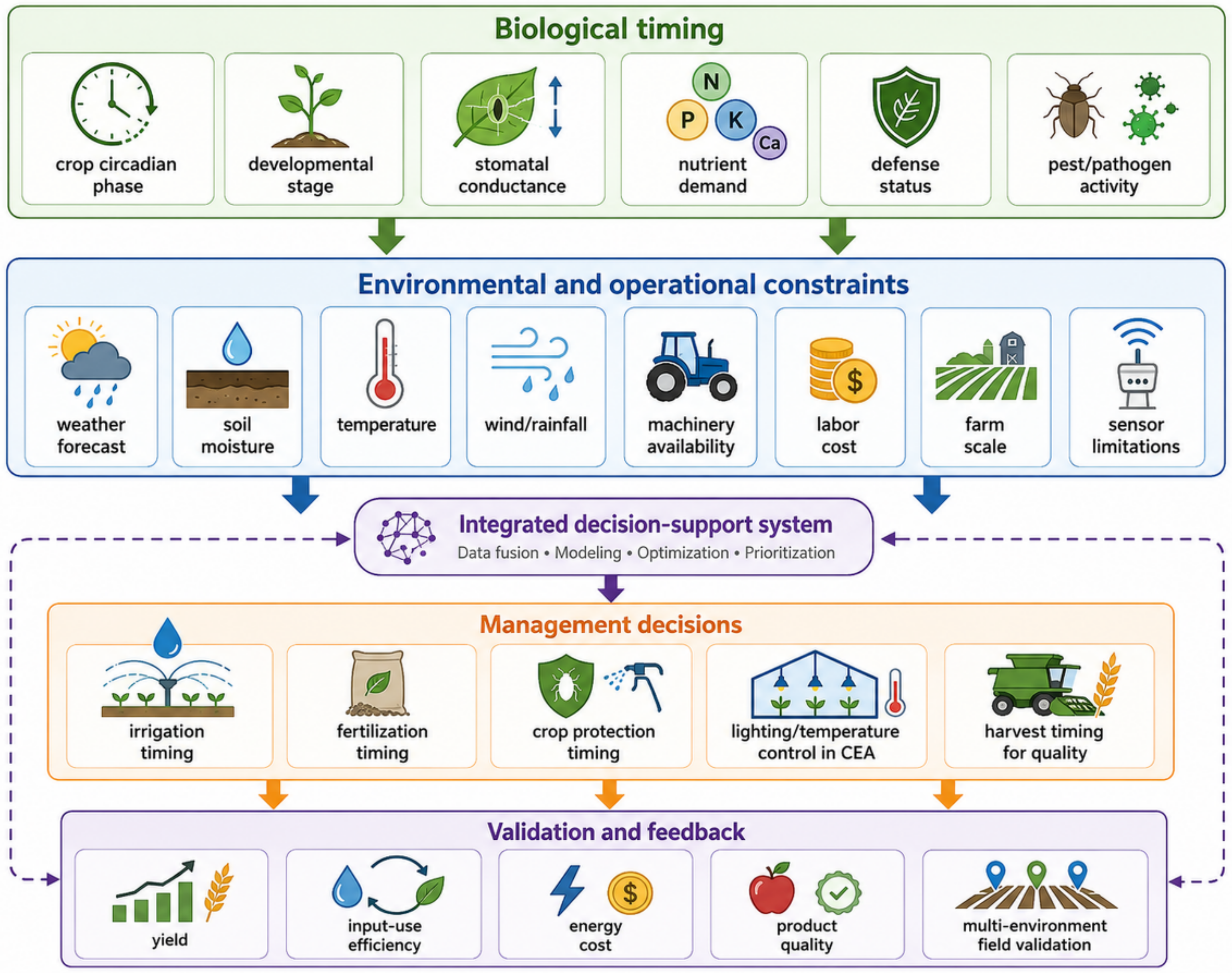
19]. However, practical implementation requires the integration of biological timing with environmental, technological, and economic constraints, as summarized in
Figure 3. Therefore, chrono-agriculture should currently be viewed as an emerging framework with strong biological rationale, but with application potential that depends on crop species, production system, management intensity, and economic feasibility.
5.1. Timing of Agricultural Inputs: Biological Rationale and Experimental Evidence
Many physiological processes that influence the effectiveness of agricultural inputs vary over the day–night cycle. Stomatal aperture, transpiration, root activity, nutrient transporter expression, hormone sensitivity, and defense signalling can all show time-of-day-dependent regulation [
18,
19]. In principle, this temporal variation could affect the efficiency of foliar agrochemical uptake, irrigation responses, nutrient acquisition, and pesticide performance. For example, foliar-applied compounds may be absorbed more efficiently when stomata are open or when cuticular and metabolic conditions favor uptake. Similarly, nutrient uptake and assimilation may depend on the timing of root activity, carbohydrate supply, transpiration, and expression of nutrient transport and assimilation genes.
Nevertheless, the extent to which such timing effects can be translated into reliable field-scale recommendations remains uncertain. Much of the strongest evidence for circadian regulation of nutrient uptake, metabolism, and defense comes from controlled experimental systems or model species. Crop-based evidence is increasing, but practical recommendations for fertilizer or pesticide timing still require more multi-environment validation. Therefore, statements regarding time-optimized fertilization or irrigation should be framed cautiously. At present, these approaches are best considered promising hypotheses or management concepts unless supported by crop-specific field experiments demonstrating improved input-use efficiency, yield, or stress resilience.
The timing of crop protection may provide one of the more biologically plausible applications of chrono-agriculture. Plant immune responses are gated by the circadian clock, and pest or pathogen activity can also vary predictably across the day. Jasmonate-mediated defences, salicylic-acid-dependent responses, and stomatal immunity all show temporal regulation [
20,
21,
22,
45]. Aligning crop protection measures with periods of high pest activity, high pathogen infection risk, or increased plant responsiveness could improve treatment efficacy. However, the optimal timing will depend on the pest or pathogen, crop species, local microclimate, formulation chemistry, and operational constraints. Thus, chrono-crop protection should be developed as a decision-support approach rather than as a universal rule.
5.2. Controlled-Environment Agriculture as a Near-Term Application Area
Controlled-environment agriculture, including greenhouses, growth chambers, plant factories, and vertical farming systems, represents the most immediate and technically feasible context for chrono-agricultural implementation. In these systems, light intensity, spectral quality, photoperiod, temperature, humidity, irrigation, and nutrient delivery can be manipulated with high temporal precision. Because environmental noise is reduced compared with open-field conditions, circadian-informed management can be tested and optimized more directly.
Light-emitting diode technologies provide particularly strong opportunities for chrono-agricultural control. The timing, intensity, and spectral composition of light influence both photosynthesis and circadian entrainment, allowing growers to design light regimes that support growth, developmental timing, and metabolite accumulation [
18,
62]. Recent work in lettuce further shows that selection for delayed bolting can be associated with deceleration of the circadian clock, highlighting the relevance of circadian phenotyping for leafy crop improvement and controlled-environment production [
17]. Similarly, thermoperiods can be used to coordinate temperature cycles with endogenous rhythms and developmental processes. Such approaches may be especially relevant for leafy vegetables, herbs, and horticultural crops, where biomass, nutritional quality, bolting, flowering, and secondary metabolite composition are important commercial traits.
However, controlled-environment systems also face economic and energetic constraints. Lighting, heating, cooling, automation, and sensor infrastructure can impose high capital and operating costs. Therefore, circadian optimization is most likely to be adopted where time-specific environmental control produces measurable gains in yield, quality, energy efficiency, or product uniformity. Future studies should therefore quantify not only biological responses but also cost–benefit relationships, including energy use, labour requirements, crop value, and return on investment.
5.3. Open-Field Chrono-Agriculture: Scalability and Economic Constraints
Large-scale open-field agriculture presents greater challenges for chrono-agriculture than controlled-environment production. In the field, light, temperature, humidity, wind, soil moisture, pest pressure, and rainfall fluctuate continuously and often unpredictably. These environmental factors can alter circadian phase and physiological responsiveness, making it difficult to define universal optimal intervention windows. Moreover, management operations must be coordinated with equipment availability, labour schedules, field accessibility, weather conditions, and regulatory restrictions on spraying or irrigation.
Economic feasibility is therefore a central limitation. Time-specific interventions may require nighttime or early morning labour, additional machinery capacity, automated systems, or more complex scheduling. In large farms, the time needed to treat extensive areas may exceed the biologically optimal window, especially when machinery or labour is limited. Weather constraints can further override biological timing; for example, wind speed, rainfall risk, or soil trafficability may determine whether pesticide application, irrigation, or fertilization is possible. Thus, even when plant physiology suggests an optimal time of day, agronomic feasibility may depend on operational logistics.
For these reasons, open-field chrono-agriculture is unlikely to be adopted as a rigid schedule applied uniformly across farms. A more realistic model is integration into precision agriculture and decision-support systems. Under this model, circadian information would be combined with weather forecasts, soil moisture data, pest monitoring, crop developmental stage, and machinery availability to identify practical intervention windows. Such systems could prioritize timing when expected benefits justify additional costs, especially for high-value crops, intensive production systems, or situations where input reduction has economic or environmental value.
5.4. Phenotyping and Sensor Limitations
A major barrier to applying circadian biology in agriculture is the difficulty of measuring circadian traits under field conditions. Laboratory studies often rely on controlled light–dark cycles, stable temperatures, leaf movement assays, reporter gene systems, transcriptomics, or delayed fluorescence imaging. While these approaches have been powerful for identifying circadian parameters such as period, phase, amplitude, and robustness, they are difficult to deploy at scale in breeding nurseries or commercial fields.
Field phenotyping introduces several technical limitations. Canopy architecture, changing solar angle, cloud cover, wind, variable temperature, soil heterogeneity, and plant developmental stage can all affect sensor readings. Delayed fluorescence, chlorophyll fluorescence, thermal imaging, hyperspectral reflectance, and gas-exchange measurements can provide valuable information about plant physiological state, but these signals are influenced by both endogenous rhythms and immediate environmental variation. Distinguishing circadian regulation from direct responses to light, temperature, water status, or stress is therefore challenging outside controlled environments.
High-resolution circadian phenotyping also requires repeated measurements over time. This increases data volume, energy requirements, sensor calibration demands, and computational complexity. For breeding applications, the challenge is not only to measure rhythms, but to determine whether rhythmic traits predict agronomic performance better than simpler phenological or physiological markers. Robust field-deployable methods will need to combine temporal sampling, environmental correction, remote sensing, and modelling approaches capable of separating endogenous timing from environmental noise.
5.5. Integration with Precision Agriculture and Predictive Modelling
The most promising long-term route for chrono-agriculture is integration with precision agriculture and decision-support systems (
Figure 3). Modern agricultural systems increasingly use remote sensing, automated irrigation, variable-rate application, robotic platforms, environmental monitoring, and decision-support algorithms. Circadian information could add a temporal layer to these systems by helping predict when plants are most responsive to water, nutrients, stress, or crop protection treatments.
Predictive models will be essential for this integration. Such models should incorporate crop genotype, developmental stage, local weather, soil conditions, management history, and circadian phase. In principle, this would allow management decisions to account for both spatial heterogeneity and temporal biological state. However, model development will require large datasets from multiple genotypes, environments, and management regimes. Validation under realistic production conditions will be critical before chrono-agricultural recommendations can be widely adopted. In controlled-environment systems, such models may also incorporate dynamic photocycles and thermocycles, because programmable light and temperature regimes can be used not only to increase productivity but also to maintain circadian entrainment and reduce energy costs [
62,
63].
Importantly, chrono-agriculture should not be presented as a replacement for conventional agronomy, breeding, or precision agriculture. Rather, it represents an additional dimension that may improve decision-making when temporal variation in plant physiology is large enough to affect management outcomes. Its near-term value is likely to be greatest in controlled-environment agriculture, high-value horticultural crops, and intensive systems where timing can be precisely controlled. In broad-acre open-field systems, practical use will depend on whether biological benefits outweigh operational complexity and cost.
Overall, chrono-agriculture provides a biologically grounded but still developing framework for aligning crop management with plant temporal organization. Its future success will depend on crop-specific evidence, economic evaluation, field-deployable phenotyping, automation, and multi-environment validation. By acknowledging these limitations, chrono-agriculture can be developed as a realistic component of sustainable crop management rather than an overgeneralized promise.
6. Integrating Circadian Traits into Breeding and Phenotyping Pipelines
The crop examples discussed above, and summarized in
Table 1, demonstrate that circadian-associated and photoperiodic genes have already contributed to domestication, adaptation, and breeding. A remaining challenge is how circadian traits can be incorporated more systematically into modern crop improvement pipelines. Unlike major flowering-time loci, many circadian outputs are dynamic quantitative traits, including period, phase, amplitude, rhythm robustness, temperature responsiveness, and the timing of physiological processes. Their measurement requires time-resolved phenotyping rather than single-point trait assessment.
High-throughput phenotyping platforms provide increasing opportunities to quantify circadian traits in diverse germplasm. Leaf movement, chlorophyll fluorescence, delayed fluorescence, thermal imaging, hyperspectral reflectance, gas exchange, and transcriptomic profiling can reveal temporal differences among genotypes [
18,
58]. However, these methods vary in scalability, cost, precision, and field applicability. Controlled-environment phenotyping is useful for detecting endogenous rhythms under standardized conditions, whereas field phenotyping is essential for determining whether these rhythms predict agronomic performance under realistic environmental variation.
A key requirement for breeding applications is to distinguish circadian traits that are merely measurable from those that are predictive. Period, phase, or amplitude may be biologically informative, but their breeding value depends on whether they improve prediction of yield, stress tolerance, resource-use efficiency, phenology, or quality beyond conventional markers. Therefore, circadian phenotyping should be linked to multi-environment trials, crop growth models, and genotype-by-environment analyses. This is particularly important because the optimal temporal phenotype is likely to differ among crops, latitudes, production systems, and management practices.
Genomic approaches can support the integration of circadian traits into breeding. Genome-wide association studies and quantitative trait locus mapping can identify loci controlling rhythmic parameters or time-dependent physiological outputs, while genomic selection models may incorporate circadian phenotypes as predictor variables [
10,
25,
64]. For this to be useful, circadian measurements must be sufficiently robust, scalable, and reproducible across environments. In some cases, well-characterized flowering-time loci may already provide practical markers. For more complex traits, however, temporal phenotyping and modelling will be needed to determine which circadian parameters have independent predictive value.
Genome editing can be used both as a research tool and, potentially, as a breeding strategy. Its most immediate value may be in validating candidate clock-associated genes, generating allelic series, and testing whether subtle regulatory changes can fine-tune temporal outputs. A relevant example is CRISPR/Cas9-based multiplex promoter editing of rice heading-date regulators
Hd1,
Ghd7, and
DTH8, which generated quantitative variation in flowering time and enabled selection of edited lines with improved regional adaptation. This illustrates how editing cis-regulatory regions, rather than fully knocking out core regulators, can produce graded allelic variation suitable for fine-tuning photoperiod-sensitive traits [
53]. Such approaches are conceptually promising, but genome-edited circadian cultivars with demonstrated field-level agronomic benefits remain limited. Thus, genome editing should be presented as an emerging tool for functional validation and precision allele development rather than as an established route to immediate crop improvement.
For practical breeding, circadian traits should be evaluated in relation to specific target environments and management systems. In controlled-environment agriculture, rhythmic traits may be selected to match artificial light and temperature regimes. In open-field systems, selection may focus on temporal flexibility, stress responsiveness, or alignment with local photoperiod and temperature cycles. In both cases, breeders will need to consider trade-offs among flowering time, vegetative growth, stress tolerance, resource allocation, and quality traits. The integration of circadian biology into breeding will therefore require interdisciplinary approaches combining molecular genetics, physiology, phenomics, modelling, and agronomy.
8. Conclusions
Circadian clocks are central regulators of plant physiology, coordinating photosynthesis, carbon metabolism, growth, flowering, stress responses, and specialized metabolism with daily and seasonal environmental cycles [
2,
6,
23]. In crops, these temporal regulatory systems have direct relevance for productivity, adaptation, resource-use efficiency, and quality traits [
18,
25]. However, the agricultural value of circadian regulation is strongly context-dependent and cannot be reduced to the simple idea that a stronger or more robust clock is always beneficial [
18,
25].
Evidence from multiple crop species shows that domestication and breeding have repeatedly selected variation in clock-associated and photoperiodic pathways [
16,
75]. Examples such as
Ghd7,
Hd1, and
OsPRR37 in rice,
Ppd-1 in wheat,
Ppd-H1 in barley,
ZmCCT in maize,
E1 and
J in soybean,
Ma1/SbPRR37 in sorghum, and domestication-associated circadian changes in tomato demonstrate that altered temporal regulation has contributed to flowering-time adaptation, geographic expansion, and cultivation performance [
11,
12,
14,
15,
16,
76]. These examples highlight the importance of fine-tuning circadian outputs to specific agroecological and management contexts rather than assuming a universal optimal clock state [
18,
25].
Chrono-agriculture provides a promising framework for incorporating biological timing into crop management [
18,
75]. Its near-term potential is likely greatest in controlled-environment agriculture, high-value horticultural systems, and intensive production contexts where light, temperature, irrigation, nutrient delivery, and harvest timing can be precisely controlled [
18]. In open-field agriculture, however, implementation will require careful consideration of weather variability, field heterogeneity, sensor limitations, labor requirements, machinery logistics, farm scale, and economic feasibility [
18,
25].
Future progress will depend on integrating circadian biology with crop genetics, high-throughput phenotyping, metabolomics, environmental monitoring, and predictive modelling [
18,
25]. Importantly, proposed circadian-based breeding or management strategies must be validated across multiple genotypes, environments, and production systems [
18,
25]. Such validation should assess not only yield, but also input-use efficiency, resilience, energy costs, crop quality, and potential pleiotropic trade-offs [
18].
Overall, circadian biology represents a valuable but still underdeveloped dimension of crop science. Its greatest contribution may come from identifying when and where temporal regulation can improve breeding decisions or management practices in a measurable and economically realistic way. A balanced integration of molecular clock biology, crop improvement, and agronomic validation will be essential for translating circadian knowledge into practical benefits for sustainable agriculture [
2,
18,
25].