Review

A Review of Agricultural Drought Monitoring, Policy, and Farmer Adaptation Under Climate Vulnerability in Hungary


1
Doctoral School of Natural Sciences, Environmental Sciences Program, Hungarian University of Agriculture and Life Sciences, 2100 Gödöllő, Hungary
2
Department of Rural and Regional Development, Institute of Rural Development and Sustainable Economy, Hungarian University of Agriculture and Life Sciences, 2100 Gödöllő, Hungary
3
Department of Plant Physiology and Plant Ecology, Institute of Agronomy, Hungarian University of Agriculture and Life Sciences, 1118 Budapest, Hungary
4
Department of Water Management and Climate Adaptation, Institute of Environmental Sciences, Hungarian University of Agriculture and Life Sciences, 2100 Gödöllő, Hungary
*
Author to whom correspondence should be addressed.
Agronomy 2026, 16(13), 1212; https://doi.org/10.3390/agronomy16131212
Submission received: 14 May 2026 / Revised: 16 June 2026 / Accepted: 18 June 2026 / Published: 23 June 2026
(This article belongs to the Special Issue Precision Agriculture and Crop Models for Climate Change Adaptation)

Abstract

Hungary is experiencing more frequent and severe droughts due to climate change, with 60% of its arable land in the vulnerable Great Hungarian Plain. Drought events in 2012 and 2022 reduced maize yields by more than 50% in some regions. This review synthesizes studies (2000–2025) on remote sensing capabilities, climate change impacts, and farmer adaptation in Hungarian agriculture. Remote sensing technologies (Sentinel, Landsat, MODIS) and indices (NDVI, VCI, LST, TCI) achieve high accuracy (often >80%) in drought detection under validated conditions, yet technical and financial barriers limit uptake among smallholder farmers. Climate projections indicate that a 2 °C temperature rise by 2050 will expand drought-affected areas. Farmer adaptation varies sharply by farm size: large farms (>100 ha) adopt precision agriculture (65% uptake), while smallholders (<10 ha) rely on crop rotation and drought-resistant varieties. Although substantial support is provided through the EU Common Agricultural Policy, institutional fragmentation and weak extension services—which reach only 32% of farmers—undermine its effectiveness. Bridging this gap requires integrating accessible remote sensing tools with targeted smallholder support and reformed extension services.

1. Introduction

Global climate change is a major driver of drought, as it intensifies dry conditions by accelerating the global water cycle [1]. Rising temperatures and increased evapotranspiration rates lead to soil water deficit and lower crop yields [2]. Therefore, adopting climate-smart agricultural practices is crucial for better supporting farmers and promoting a more sustainable and secure food production chain [3].
According to recent estimates, Europe is warming faster than the global average, and 2024 was the warmest year on record for the continent, with “extremely dry and often record-warm conditions” in Central and Eastern Europe [4]. The Carpathian Basin countries, including Hungary, Slovakia, Romania, Serbia, and Ukraine, are more susceptible to these changes. Recent analyses report that in the Carpathians, an observed annual warming of ~1.1–2.0 °C has occurred over the past half-century, with a projected rise to +3.5–4.5 °C by 2100 (highest in the South) [5].
The Carpathian Basin is particularly sensitive to climate-induced drought because of its continental climate and reliance on rainfed farming. The rainfall is increasingly erratic, characterized by prolonged dry periods followed by heavy rains that often occur at suboptimal times for crops [6]. These patterns increase the region’s vulnerability, with a growing proportion of the year experiencing high-temperature stress. Soils in Hungary and the Romanian lowlands are increasingly approaching critical moisture deficits [7].
During the dry period, crops experience two primary stresses: elevated atmospheric evaporative demand and decreased soil moisture availability, which together induce plant water deficit, stomatal closure, and reduced productivity or yield loss [8]. In areas where agriculture is the primary source of income, these shifts exacerbate socioeconomic strains. Due to these extremes of heat and drought across Central Europe, soils are directly dried out and experience exceptionally low topsoil moisture during exceptionally dry summers (e.g., 2003, 2018, 2022). Furthermore, according to Schwitalla et al. [8], since 2015, an increasing percentage of summers have been warm and dry, resulting in extended stretches of low soil moisture available for crops. Satellite and model data confirm that soil moisture has been declining in Hungarian farmland over recent decades, especially in the south [7]. The increase in summer heat extremes has been particularly pronounced in Central and Eastern Europe (CEE), contributing to the overall drought risk [4,8].
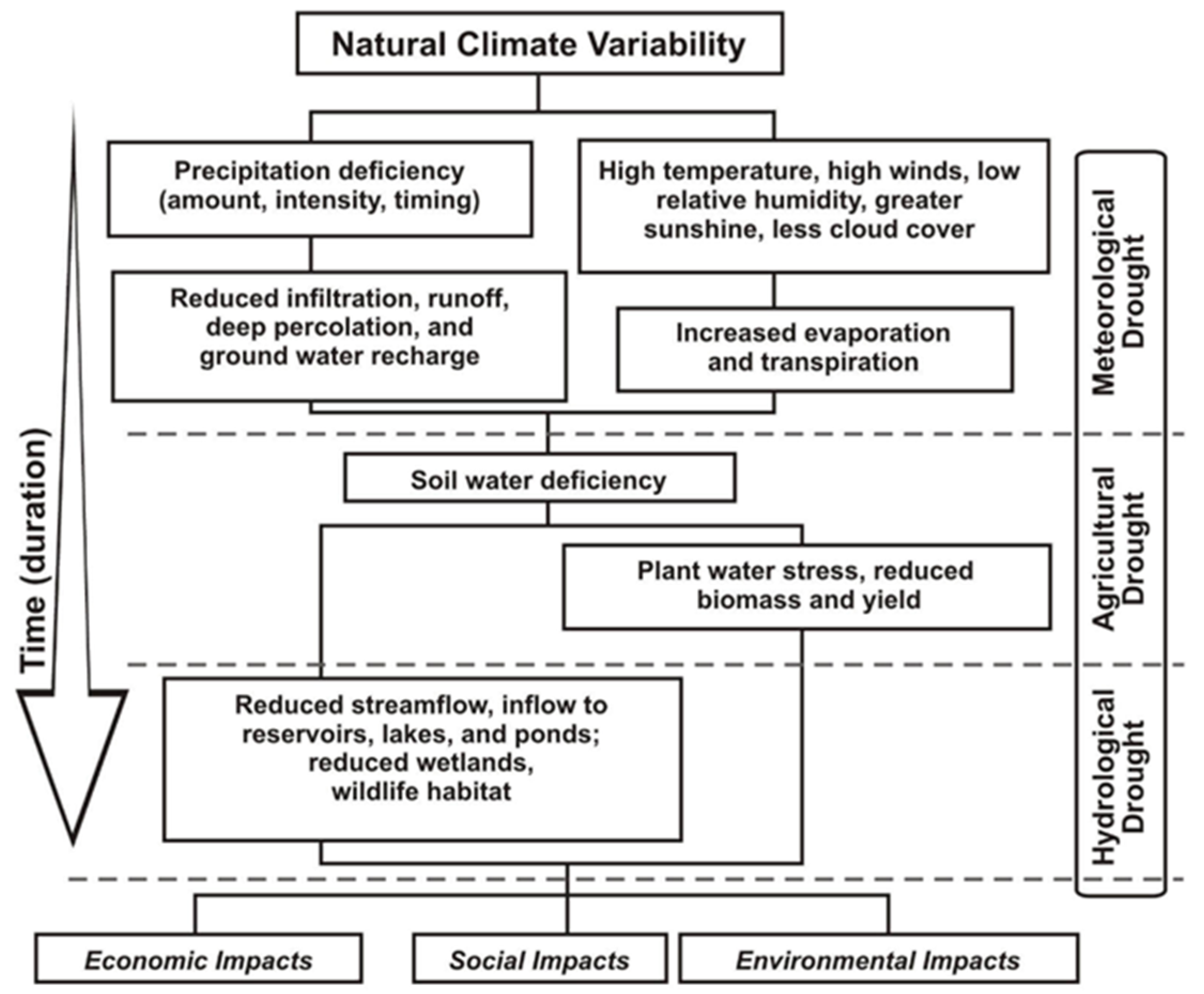
Drought is a prolonged period of dryness in the natural climate cycle that can impact environmental, social, and economic systems. It is a slow-onset disaster characterized by a lack of precipitation, resulting in water shortages [9,10,11,12]. Drought is classified into four types based on intensity and duration: meteorological, agricultural, hydrological, and socio-economic drought (Figure 1). Different types of droughts can transform into one another, making it challenging to distinguish between them [13]. During long-term droughts, all three physical categories may combine to increase water stress.
Meteorological drought is defined by a significant precipitation deficit over an extended period in a specific region. Coupled with high temperatures and wind, atmospheric evaporative demand increases, reducing soil moisture and leading to agricultural drought, which impacts plant growth and crop productivity. This drought primarily impacts soil water availability during the growing season. Continued soil moisture depletion reduces both surface runoff and groundwater recharge, leading to hydrological drought [15,16,17]. These physical droughts lead to socioeconomic drought, affecting human societies through disruptions to water supplies and economic losses, especially in agriculture [18].
Agricultural drought significantly affects food security in regions such as Hungary, where crop production is highly susceptible to water stress. A prolonged soil moisture deficit, or agricultural drought, reduces crop yields during the growing season, making soil moisture a crucial factor in understanding and monitoring drought impacts. It indicates the amount of water existing in the unsaturated zone of the soil profile, derived from precipitation, snowmelt, or capillary attraction from groundwater, and is a vital indicator for drought assessment in agricultural systems [19]. This parameter plays a fundamental role in agricultural drought assessment and directly controls hydrological cycle processes and land-atmosphere interactions, including evapotranspiration and infiltration rates [20,21,22]. Furthermore, soil moisture significantly affects plant growth, and its dynamics determine the availability of water resources within agroecosystems [23,24]. Soil moisture availability in root zones at different crop development stages significantly affects yield [25].
As Hungary is a major agricultural producer in central Europe, this systematic review highlights studies on agricultural drought in Hungary to assess existing knowledge and the methods commonly employed to monitor agricultural drought conditions, remote sensing monitoring systems, agricultural climate consequences, farmer adaptation options, and their limitations.

2. Methodology

This review aims to synthesize existing studies on agricultural drought monitoring, impacts, adaptations, and policy responses in Hungary. A comprehensive literature search was conducted using the following keywords:
“agricultural drought”, “crop water stress”, “soil moisture”, “drought monitoring”, “Hungary”, “Carpathian Basin”, “Central Europe”, “remote sensing”, “NDVI”, “satellite”, “MODIS”, “Sentinel”, “Landsat”, “climate adaptation”, “irrigation”, “precision agriculture”, “farm policy”, “climate change”, “crop yield”, “farmer” and “climate resilience”. Boolean operators (AND/OR) were used to combine terms. A total of 530 records were identified. Of these, 20 were sourced from targeted searches within institutional and statistical databases, such as Eurostat, KSH-STADAT, EEA/Climate-ADAPT, WMO, and official European Union and Hungarian government websites. The remaining 510 references were retrieved from Scopus, Web of Science, Google Scholar, and PubMed. After removing 160 duplicate records, 370 articles were screened; 189 were excluded as not relevant to the topic, and another 96 were removed after full-text review, leaving 85 studies included in the review.
Studies that fulfilled the following criteria were included:
  • Type: Institutional reports, policy documents, peer-reviewed articles, and original research.
  • Scope: Hungary or similar Central European areas.
  • Emphasis: Monitoring agricultural drought, the effects of climate change, adaptation, or policy measures.
  • Time frame: 2000–2025.
  • Language: English and Hungarian with abstracts in English.
  • Authoritative sources: EEA, Eurostat, KSH, WMO, EU documents.
  • Exclusion criteria: Studies focusing on non-agricultural drought, research outside the Carpathian Basin without regional relevance, and publications lacking empirical data or methodological transparency.
The main sources of information for this review are the published national reports, regional evaluations, and peer-reviewed literature. As such, due to space constraints, the review could not cover all subregions of Hungary equally, although vulnerability varies widely across the country.
Additionally, the review employed a modified Population, Intervention, Comparator, Outcome (PICO) framework to ensure focus and clarity and to methodically examine the subject, making evidence synthesis and defining the scope of included studies simpler. The PICO framework is summarized in Table 1.

3. Synthesized Outcomes

3.1. Geographical Region

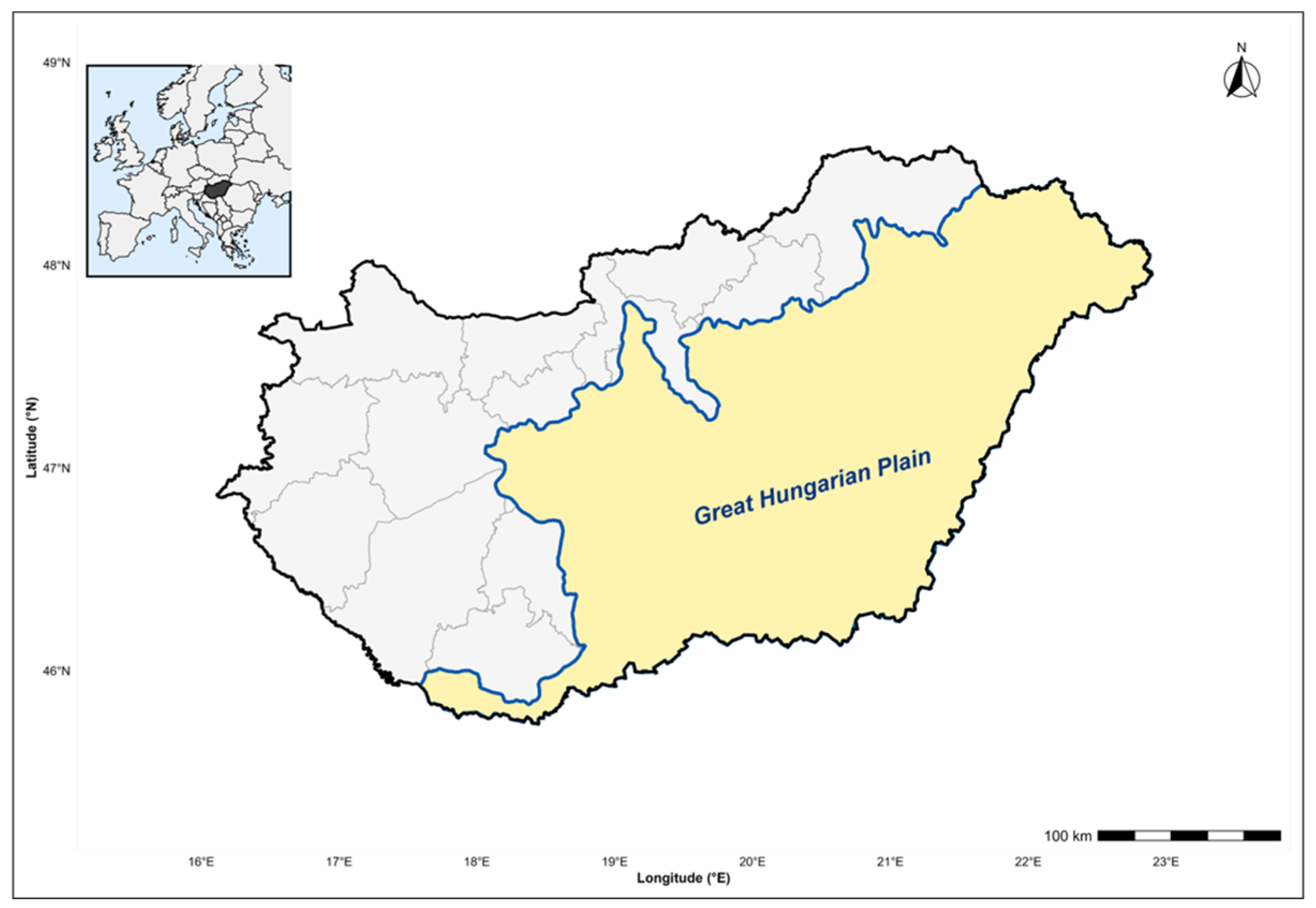
Hungary is located in central Europe between latitudes 45°55′ N–48°60′ N and longitudes 16°10′ E–22°50′ E. This geographical location shapes its vulnerability to agricultural drought. The country covers 93,028 km2 within the Carpathian Basin. According to the Nomenclature of Territorial Units for Statistics (NUTS) [26], Hungary’s regional classification comprises eight regions: Budapest; Pest; Western, Central, and Southern Transdanubia; Northern Hungary; and Northern and Southern Great Plain. The last two regions together are called the Hungarian Great Plain (Alföld), which is the largest geographical unit in Hungary, as shown in Figure 2.
Hungary has a continental climate with the growing season starting from April to October. Annual precipitation decreases dramatically from 600 to 800 mm in western Transdanubia regions to just 450–550 mm in the eastern Great Hungarian Plain [27].
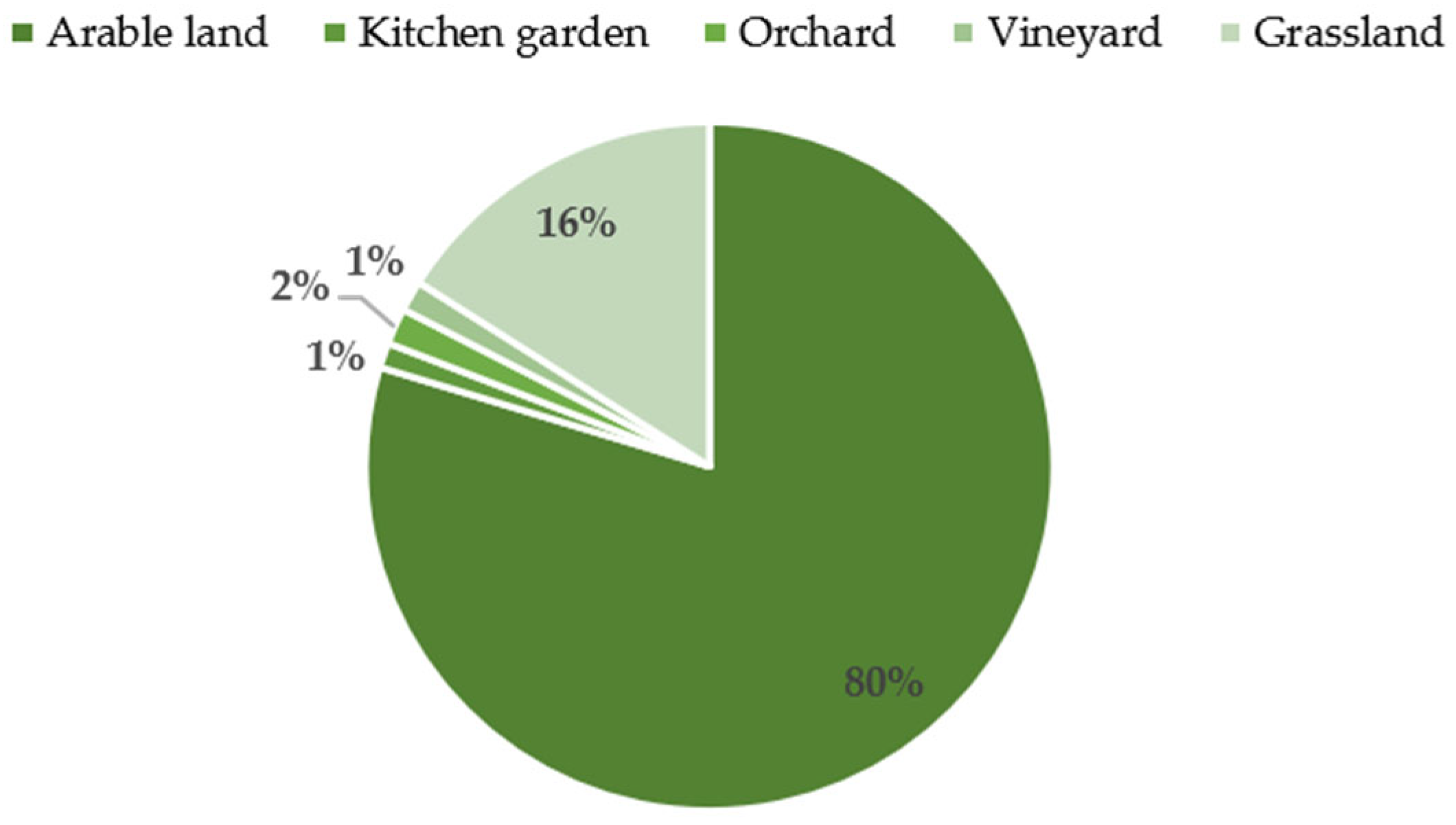
The Great Hungarian Plain is among Hungary’s most climate-sensitive regions. It is marked by low annual precipitation, high summer evapotranspiration, and relatively high temperatures. Land use data from 2000 to 2025 show that arable land accounts for approximately 80% of Hungary’s agricultural area, with grasslands accounting for around 16%. Other land types, such as orchards, vineyards, and kitchen gardens, contribute only marginally (Figure 3). This distribution underscores the significant dependence of Hungarian agriculture on arable systems, which are particularly susceptible to water shortages. As a result, agricultural production, particularly in the Great Hungarian Plain, faces considerable vulnerabilities due to climate-induced droughts.

3.2. Recent Drought Events

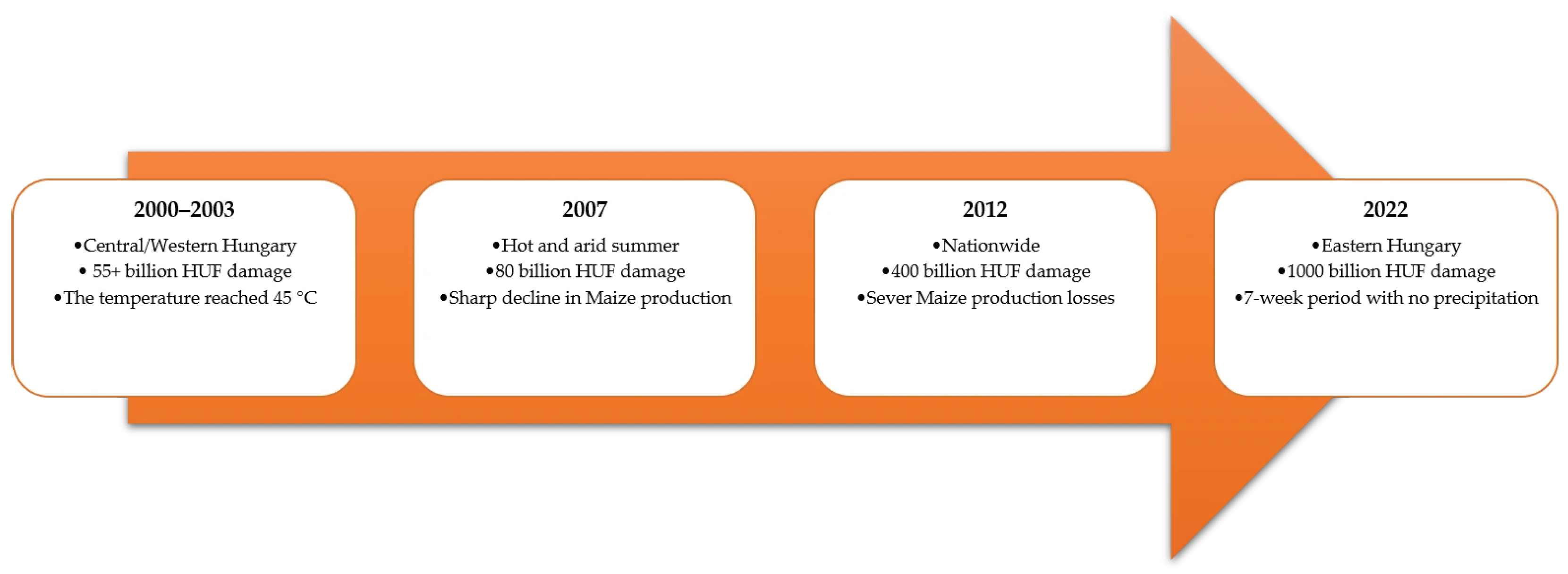
The Hungarian agricultural sector and economy face significant risks, as a long history of drought has led to current yield losses, reduced water availability, greater vulnerability of rural livelihoods, and threats to food security [29,30]. Drought events occur recurrently in Hungary, reflecting the region’s sensitivity to climatic variability. The timeline of major drought events in Hungary is shown in Figure 4.
The latter part of the 20th century and early 21st century encountered a significant rise in the frequency and severity of droughts [29,31]. The Pannonian Basin, including Hungary, has experienced several major drought events in recent decades, particularly in 2000, 2003, 2007, 2012, and 2015 [32]. The drought in 2003, along with a severe heatwave across Europe, resulted in approximately 50–55 billion HUF (≈140–155 million EUR) in agricultural losses and a 17% reduction in precipitation [33]. In 2007, a hot and arid summer caused a sharp decline in maize production with losses estimated at least 80 billion HUF (≈210–230 million EUR) [34].
The 2012 drought was severe, causing losses of 400 billion HUF (≈1.05–1.15 billion EUR) and considerable yield reductions in maize and sunflower crops [5]. The drought of 2015 and 2017 had significant agricultural consequences throughout Hungary [35]. More recently, between 2021 and 2022, Hungary experienced significantly lower rainfall, with 2022 being widely reported as the most severe drought year in the past four to five decades. It caused approximately 1000 billion HUF (≈2.6–2.9 billion EUR) in agricultural losses [36].

3.3. Drought Impacts on Crops and Socioeconomic Vulnerability

Crop productivity is already declining across Europe due to warmer temperatures and extreme weather, with CEE expected to suffer particularly severe losses. According to the IPCC (2022) [37], regional yields could drop by about 7–10% for every degree Celsius of warming, with additional losses from heat extremes. According to a recent econometric analysis, a +1 °C increase in annual mean temperature in the Carpathian Basin already reduces maize and sunflower yield by around 0.93 t/ha (roughly 10–15% of usual yields) [38].
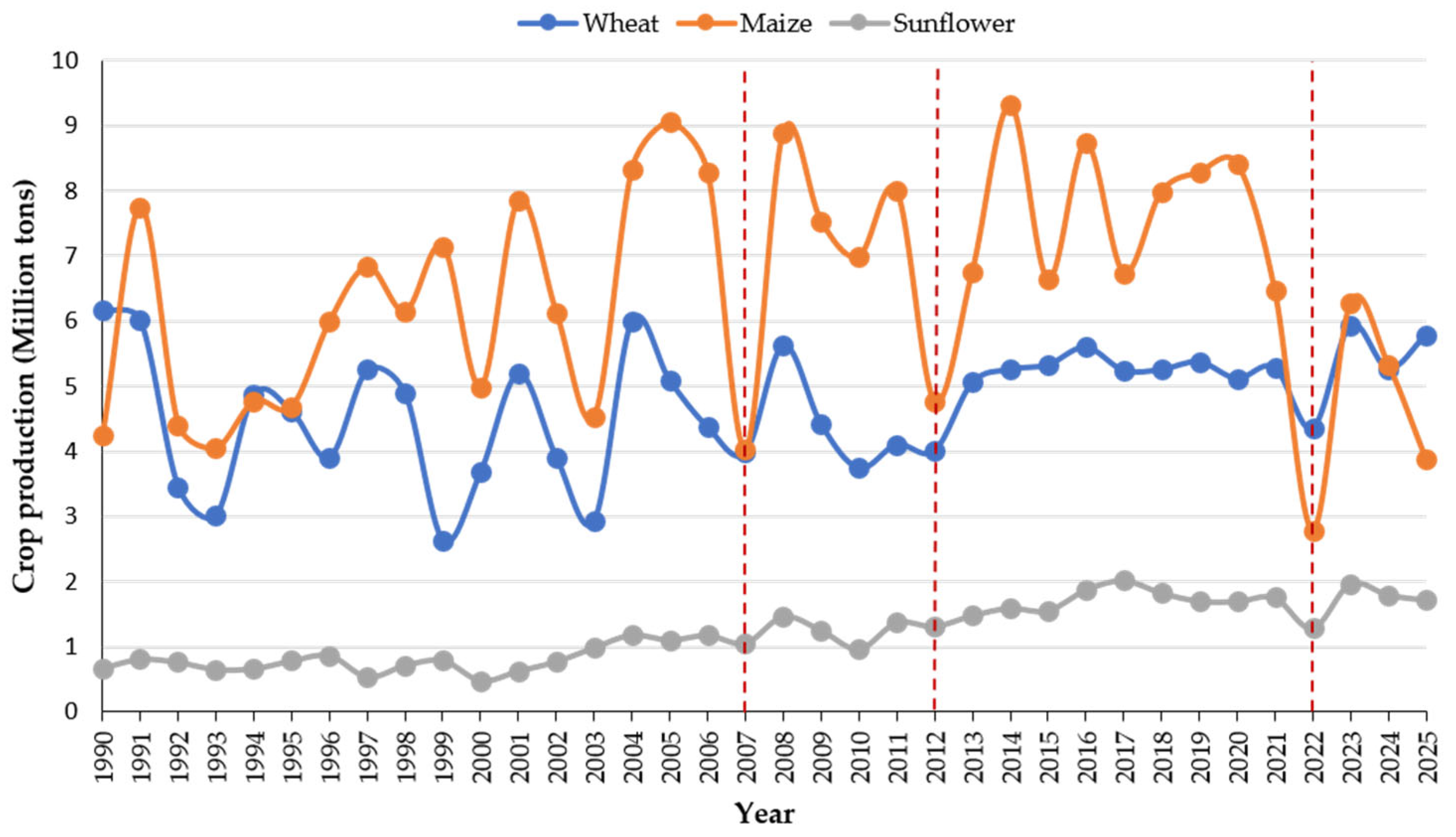
Significant yield losses due to drought are observed in key crops in Hungary, particularly maize, wheat, and sunflowers [32]. Maize is considered one of the most drought-sensitive crops in the Pannonian region [6]. Historical data clearly indicate that drought has had a greater negative effect on maize yield than on wheat [39,40]. The Hungarian crop yield from 1990 to 2025 (Figure 5) shows a clear drought impact, with vertical lines marking years with documented economic losses.
Based on Figure 5, the 2007 drought caused a significant decline in maize production, leading to losses of at least 80 billion HUF and a 50% reduction in average yield [26]. Even more dramatically, the 2012 drought reduced maize yields by over 50% in Csongrád county and by 44% in Bács-Kiskun county, resulting in staggering national losses of 400 billion HUF (1.04 billion EUR) [34,41]. Maize is highly vulnerable to drought during the tasseling stage, with potential yield reductions of up to 50% due to stress [6]. The exceptionally dry years of 2021 and 2022, which were among the most severe droughts in 40 years, significantly reduced maize’s relative chlorophyll content and leaf area index (LAI), leading to early leaf senescence [36]. The likelihood of maize yield failure has increased, with approximately 15% failure predicted every 3 years and 30% every 5 years [42]. Furthermore, drought impact assessment should rely not only on the size of the damaged area but also on the yield loss and economic value of the affected crop. Compensation payments for high-value crops with smaller affected areas can exceed those for low-value crops with larger affected areas. As a result, maize may rank differently as a drought-affected crop depending on whether the assessment is based on officially identified drought-affected areas, the compensated areas, or the compensation payment value in the Hungarian Agricultural Risk Management System (HARMS) [30].
Winter wheat is generally less sensitive to drought than maize [40]. Winter wheat yields can be reduced by drought, with the effects strongest during the heading and grain-filling stages [42]. It occupies a substantial portion of the country’s arable land, often exceeding 900,000 hectares [43]. These fluctuations are a concern not only for crop production but also for farmers’ financial stability, as they rely on compensation to cover losses. The number of compensation claims has increased, and about half of the farmers polled were compensated for drought damage [30]. Overall, economists agree that agricultural profitability throughout the basin is adversely affected by climate-driven yield uncertainty.
On the other hand, crop production benefits from rainfall; empirical research suggests that increased precipitation could improve crop productivity, albeit with diminishing marginal returns [44]. Revenue from farmers is directly affected by these changes. According to EIB (2025) data [43], unfavorable weather costs European agriculture about €28 billion a year (6% of output), and by 2050, climate change could increase losses by 42–66%. Farm revenues are disproportionately affected by uncontrolled risks because only 20–30% of those losses are now covered by insurance [45]. Therefore, profitability is being undermined, particularly for rainfed producers in CEE, by yield losses in hot, dry years and output instability.
In Hungary’s Great Plains, farmers are adapting to these challenges by planting drought-tolerant crops such as sorghum and alfalfa, which are more resilient in dry conditions [46]. In addition to affecting crops and livestock, climate change exacerbates the social and demographic vulnerabilities already present in rural Hungary. The disparity in access is especially problematic for vulnerable population groups, such as those with low incomes, limited access to infrastructure, and fewer assets, who are disproportionately affected. The situation is further complicated by rural demographic shifts in Hungary, including youth emigration and an aging farming population, which collectively intensify the region’s climate vulnerability [47]. Recent data shows that just a small percentage of Hungarian farm managers are under 35 (reflecting the EU average of about 6%), while roughly 35% are over 65 (up from 28% in 2010) [46]. According to EU forecasts, by 2050, the population of almost 85% of primarily rural areas is expected to decline [48]. Smallholder households typically use short-term, seasonal relocations as a coping mechanism. When droughts damage crops, young people frequently have additional motivation to leave in search of employment, while older farmers continue to suffer with dwindling profits [49].
Climate-related economic losses could speed up the collapse of rural communities in countries like Hungary, where populations are already shrinking. Over the next few decades, climate threats could alter social structures and settlement patterns in the Carpathian countryside, worsening existing rural problems [48]. However, new opportunities are emerging: some young entrepreneurs are introducing precision agriculture—such as drone services and cooperative machinery ventures—into Hungarian villages, indicating that technology might help revitalize rural life [50]. Growing socio-economic vulnerabilities indicate that drought is a major factor in rural decline, especially in areas such as the Hungarian Great Plain, where agriculture is essential to stability. Therefore, advances in remote-sensing technology for innovative and accurate drought monitoring offer a reliable way to address these challenges.

3.4. Drought Monitoring and Assessment

Agricultural drought monitoring has been transformed by remote sensing technologies, which offer temporally continuous and spatially explicit observations at various scales. Early diagnosis of water stress and evaluation of drought effects on agricultural systems are enabled by these technologies, which are essential for prompt intervention and decision-making. Satellite-based remote sensing systems provide comprehensive coverage suitable for regional- to national-scale monitoring, while unmanned aerial vehicles (UAVs) deliver very high-resolution data for field-level evaluations [51]. The complementary nature of these platforms enables comprehensive multi-scale drought monitoring throughout the growing season [52].

3.4.1. Satellite Remote Sensing Monitoring Overview

Remote sensing observations provide large-scale monitoring to assess drought impacts on ecosystems by optical remote sensing, thermal remote sensing, and microwave remote sensing, which can effectively monitor vegetation health and growth using traits such as soil moisture anomalies, vegetation indices, land surface temperature (LST), and evapotranspiration [53,54].
Optical Infrared and Vegetation Monitoring
Optical remote sensing is the most widely used approach for monitoring agricultural drought, employing vegetation indices as indicators to capture detailed information about crop condition and stress. Vegetation indices such as the Normalized Difference Vegetation Index (NDVI) are widely used to detect drought stress by measuring differences between near-infrared and red channels. This index is used across multiple platforms, including Landsat, MODIS, and Sentinel-2, and assesses the effects of biomass, greenness, and drought on cropland and other ecosystems.
In Hungary, Szabó et al. [55] analyzed the relationship between NDVI and climatic variables using satellite-based time-series data, demonstrating that vegetation dynamics across multiple land-cover types (including arable land, forests, and grasslands) are strongly influenced by precipitation and temperature. In other research, Birinyi et al. developed a six-category crop condition mapping methodology based on five vegetation indices by using Sentinel-2 imagery in 10 m spatial resolution [56]. This study focused on maize in the Carpathian Basin as the most drought-affected crop in 2017, 2022, and 2023. Their method provides early estimates of yield loss and offers a cost-effective solution for assessing agricultural damage claims. As Hungary faced a severe drought in 2022, the same group implemented the Aqua Crop model in a raster-based R environment to integrate optical data with crop models, and the results showed that using NDVI to validate Aqua Crop created a bridge between satellites and the soil–plant-water system [57].
Beyond single-index approaches, combining optical vegetation indices with RS-derived soil moisture and evapotranspiration data can provide a comprehensive system for predicting drought-induced yield loss. For example, Potopová et al. studied the regional drought risk assessment for maize production across the Danube River Basin and used EVI (Enhanced Vegetation Index), ESI (Evaporative Stress Index), and AWR (Relative Water Availability) to provide an early warning system before harvesting the maize for operational drought risk assessment at regional scales [58].
Thermal Infrared and Land Surface Detection
Thermal remote sensing, particularly using thermal infrared (TIR) data, is a key tool for detecting Land Surface Temperature (LST), which serves as a proxy for crop water stress and evapotranspiration [59]. Warmer surfaces usually reflect reduced latent heat flux, resulting in lower Evapotranspiration (ET) and higher sensible heat flux. The spatial pattern of LST can be transformed into temperature-based drought indices, such as the Temperature Condition Index (TCI), the Vegetation Condition Index (VCI), and the combined Vegetation Health Index (VHI), which captures vegetation stress at regional scales [60,61]. MODIS has been the dominant platform for temperature-based drought indices at regional scales.
Recent advances have integrated thermal data with optical measurements. Unnisa et al. combined Sentinel-2-derived canopy water content with temperature indices to detect flash drought in European crop areas, including Hungary [62]. In this study, four Sentinel-2 variables (NDVI, LAI, fAPAR, and Canopy Water Content-CWC) were analyzed during the 2022–2023 droughts in Spain, Italy, and Hungary. The Evaporative Stress Index (ESI) was also used to identify drought events. The results indicated that CWC and ESI in irrigated regions of Italy and Spain showed strong correlations, whereas in rainfed regions of Hungary, the correlation was weaker.
Microwave Remote Sensing and Soil Moisture Monitoring
Microwave remote sensing uses radar (active) or radiometers (passive) and, unlike optical or thermal sensors, can penetrate clouds and vegetation canopies to detect soil moisture beneath crops. The wavelength is from 1 mm to 1 m. Microwave remote sensing has been limited for agricultural drought monitoring in Hungary, and passive microwave (SMAP/SMOS) is too coarse at 25–40 km for Hungary’s typical field size, but it has significant applications, leveraging the all-weather capability and direct sensitivity to soil moisture. More recently, a method was developed that combines Sentinel-1 C-band Synthetic Aperture Radar (SAR) with Landsat 8 optical data to map surface soil moisture distribution in Hungarian agricultural landscapes [63]. The summary of the derived variables from these three remote sensing methods is mentioned in Table 2.

3.4.2. Aerial Imagery Monitoring (UAV)

Unmanned Aerial Vehicles (UAVs) offer considerable potential for agricultural applications, particularly with the development of digital agriculture [66]. It is transforming contemporary agriculture through efficient, data-driven solutions. These advanced tools, which incorporate high-resolution cameras, multispectral sensors, and GPS technology, facilitate real-time observation of critical agricultural factors, including crop health, soil conditions, and irrigation requirements. UAV imaging offers notable benefits over satellite imagery, particularly by providing detailed, real-time data. The high-precision field maps generated by UAVs are essential tools for decision-making in agriculture, equipping farmers with timely, reliable information to enhance their operational strategies [67]. The reliability of UAV-derived vegetation indices has been validated in Hungarian agriculture, with a field experiment in Debrecen showing strong correlations (r = 0.895–1.00) between handheld NDVI measurements and UAV-mounted multispectral cameras’ data across various growth stages. This validation affirms the effectiveness of UAV technology for agricultural monitoring and drought stress detection in Hungary [68].
During the severe drought in Hungary in 2022, UAV-based NDVI measurements effectively identified water stress in maize field trials, specifically in eastern Hungary [69]. This technology distinguished between irrigated and rainfed treatments, recording maximum NDVI values of 0.728 and 0.662, respectively, under optimal nitrogen management [69]. The resulting yield differences, which reached 37.2% between the two irrigation approaches, highlighted that UAV-based indices could accurately monitor crop water status and predict drought-induced yield losses. This integration of remote sensing with agronomic trials underscores the practical effectiveness of UAV monitoring in managing drought conditions in Hungary [69]. Table 3 demonstrates the comparison between Satellite and drone images.

3.5. Farmer Adaptation

Changes in agronomic practices are already helping farmers adapt to drought. Switching to a more drought-resistant crop variety is one of the main strategies. For instance, fruit growers choose late-flowering (frost-resistant) or deeply rooted fruit trees and vines, whereas many grain farmers select heat-tolerant wheat or maize varieties [70]. Crop rotation and diversification (moving to more drought-tolerant crops like grain or sorghum or adding fallow times) and soil conservation (no-till, mulching, and cover crops to retain moisture) are common agronomic adaptations [71]. No-till farming and leaving straw residues in fields are among the most common soil management practices, according to interviews conducted in a Hungarian case study [70]. Breeding programs have created hybrids of maize and wheat with shorter growing seasons or deeper roots that perform better during late-season droughts. These strategies are increasingly important under climate change, as environmental stress significantly affects crop development and productivity, requiring more resilient agricultural practices [72].
Water conservation and efficient management are critically important due to Hungary’s potential water constraints [70]. According to studies on the effects of the Hungarian drought, almost all serious damage happened on farms without irrigation, suggesting that irrigation could be an effective drought-mitigation tool [30]. Building ponds and reservoirs to collect rainwater or creek flows for later irrigation is an on-farm strategy. To protect their land from drought, several farmers have constructed small dams or tanks [70]. These water reserves provide a buffer capacity during floods and allow modest irrigation even during dry seasons.
A farm’s ability to adapt mostly depends on its size and resources. In addition to water-saving and soil-conserving strategies, smaller farms usually have less money, access to technology, and funding, which limits their ability to adapt. Key disparities between small and large farms in Hungary are summarized in Table 4, highlighting the structural differences and their implications for climate resilience. The 41% refers to the share of agricultural land managed by large farms (>300 ha). The remaining agricultural land is not held exclusively by small farms; rather, it is distributed between small and medium-sized farms (e.g., 20–300 ha). The table simplifies the farm structure by presenting only the smallest and largest categories, while in reality, the distribution includes intermediate farm sizes.
Hungarian agriculture has been adopting modern irrigation methods since the late 1950s (sprinkler irrigation) and 1960s (drip and micro-sprinkler irrigation), with horticulture typically being the early adopter of these technologies [78]. Since 2019, the development of irrigation projects has been supported by the potential formation of irrigation communities [79]. Although it is still mostly used on larger farms, precise water scheduling (using soil moisture monitors) is gradually becoming more common. Precision irrigation guided by remote sensing is a new concept that enables variable-rate watering by using satellite or UAV data to pinpoint when and where fields are drying out. This can minimize water use by 20–30% [80,81].
Information and consultation services are becoming increasingly important. Farmers can access drought resilience expertise through national extension networks and the Common Agricultural Policy (CAP)-mandated Farm Advisory System (FAS). Advisors provide farmers with advice on optimal practices, such as when to irrigate, how to modify planting dates, and how to monitor soil moisture. These devices are increasingly connected to EU-funded weather and climate services. For example, the Copernicus Climate Change Service (C3S) now provides planners with regional climate data and indicators through a Sectoral Information System. Thanks to these technologies, advisors can provide evidence-based suggestions. For instance, in the Carpathian context, C3S provides water balance indicators to inform the development of irrigation infrastructure and the selection of drought-adapted crops [82].
Furthermore, to assist farmers in adapting to climate change, Hungary is enhancing its advice services. Rural extension agents and the Hungarian Chamber of Agriculture are increasingly providing training on climate-smart methods, such as drought-tolerant crops and effective irrigation. National initiatives and international networks, such as the EU’s EIP-Agri, promote farmer field schools and demonstration locations where farmers share their knowledge of innovative techniques. According to research, social networks play a critical role in adaptation: farmers who participate in training programs or have strong cooperative links are more inclined to adopt novel approaches [70]. Additionally, Hungarian farmers noted that taking climate precautions required joining producer organizations or learning from neighbors.
These social structures impact the adoption of new solutions and shape awareness. The increasing use of innovative technology to manage drought is indicative of this. Remote sensors and unmanned aerial vehicles (drones) provide potent new monitoring capabilities. For instance, field-scale soil moisture and crop stress can be mapped in real time using high-resolution UAV multispectral imagery. According to recent research, integrating UAV data and satellite observation can improve the accuracy of soil moisture prediction. Drones can detect early drought stress across a dozen plots using thermal sensors and NDVI calculations [83]. These data support decision models to help farmers optimize their practices. For instance, UAV imagery has been used to accurately predict wheat yields, with models reporting an impressive R2 of 0.96 at flowering, thereby supporting harvest planning decisions [84].
Precision agriculture technologies are increasingly used to improve water management in agriculture. Remote sensing tools, such as UAV- and satellite-based observations, are used to monitor crop conditions and detect spatial variability in water stress. [69,85]. Weather stations, satellite-based evapotranspiration estimates, and soil moisture probes are additional precision instruments used in farm management [86,87,88]. However, despite these advancements, the adoption of precision agriculture faces challenges. The high cost and technological complexity of these systems remain barriers to widespread use. As noted by an EU evaluation, precision agriculture still has a low implementation rate in many regions due to obstacles [71]. Nevertheless, early adopters report improvements in crop production, enhanced production forecasting, and other precision tools offer great potential for adapting to drought conditions [83].
In Hungary, the future of farming adaptation is increasingly tied to digital and high-tech innovations. With 17% of major farms using drones in 2021, precision agriculture is growing, and its use is expected to continue to rise [76]. Farmers can monitor crop development and field conditions using satellite imagery, such as Landsat and Sentinel-2. In addition to increasing yield in regions less impacted by climatic stress, these technologies enable more effective, site-specific farming that uses less water and fertilizer. Furthermore, weather and soil sensors are being integrated with aerial data for automated systems, such as smart irrigation that turns on when soil moisture levels are low. Farmers are maximizing the use of these tools by using crop simulation models alongside UAV-based monitoring to make better decisions. For example, a farmer may utilize drone imagery to determine which field zone dried out first, then modify his cover crops or rotation for the following year [81].

3.6. Policy Responses

Climate resilience is a growing focus of EU agricultural policy. Climate and sustainability are fundamental objectives of the 2023–2027 CAP reform [89]. Furthermore, CAP funds are linked to climate performance through the Green Deal and Farm-to-Fork programs. The CAP now provides funding for eco-schemes and rural development initiatives that focus on precision farming, soil conservation, and water retention. For example, cover crops and minimum-tillage practices that increase drought tolerance are rewarded with EU eco-scheme subsidies.
Additionally, the European Commission has established a single risk management framework that includes state-aid regulations for mutual funds, crop insurance, and agricultural income stability programs [90]. Beyond CAP, member states can receive assistance following extreme catastrophes such as droughts and floods. For instance, CAP Pillar 2 (Rural Development) provides training and advisory support through the Farm Advisory System (EEA, 2023) [82], as well as initiatives such as irrigation investments, soil conservation, and water-saving practices. However, findings indicate that relying solely on public payments may reduce farmers’ motivation to purchase private insurance or make preventive investments [90].
In addition to establishing non-binding goals, such as cutting irrigation water use by 20% by 2030, the EU’s comprehensive adaptation strategy (Green Deal, Farm-to-Fork) also fosters knowledge networks (the European Innovation Partnership for Agriculture) to disseminate best practices. EU programs (Copernicus, Horizon Europe) support digital advisory tools and satellite monitoring, while non-binding targets include a 20% reduction in irrigation water use by 2030. However, farmers’ real adoption of this agenda will rely on how member states implement it [91].
The Hungarian government has responded by encouraging irrigation and revising its national climate strategy. An adaptation sub-strategy that focuses on water management, disaster risk, ecosystem services, and rural infrastructure is specifically included in the Second National Climate Change Strategy (2018–2030) [92,92]. Improving irrigation efficiency (covering more drought-prone farms) and creating wetlands and reservoirs to control floods and droughts are important goals. Accordingly, Hungary launched a massive irrigation development program in 2018, aiming to double the current irrigated area to around 100,000 ha by 2030. Modern irrigation systems (drip, pivot) and on-farm water retention are co-financed by CAP rural development funds, and new rules (Act CXIII/2020) eased restrictions for farmers investing in irrigation [93]. Furthermore, this report notes that Act XLIV/2020, the government’s climate law, mandates sectoral adaptation plans and sets a target of climate neutrality by 2050. These laws allow Hungarian farmers to receive subsidies for installing reservoirs or drip irrigation, and extension services are now more focused on providing advice on drought-resistant crops and irrigation timing. Additionally, there is a push for improved weather and climate data; the National Adaptation Geo-Information System (NAGiS) maps risk areas; and HungaroMet offers localized drought index information during the vegetation season for two different crops [94].
However, experts point out a disconnect between strategy and practical implementation: county-level climate plans are in place, but actual dug reservoirs or new canals are still falling short of the stated objectives.
There are still gaps in the financial protection systems that Europe offers for damage from natural disasters. Farmers can choose to participate in mutual funds (in which states co-finance premiums) or in subsidized insurance plans under CAP, but adoption of CEE has been inconsistent [95]. Farmers in Hungary have traditionally used a combination of state and private risk management instruments. The government combines drought compensation funds and insurance promotion to make budgetary payments in response to extraordinary circumstances. Many large farms purchase multi-peril crop and livestock insurance policies, and Hungary can subsidize crop insurance premiums by up to 65% under EU regulations [45]. Many national governments provide direct compensation for livestock and crop losses. According to research, one type of support mechanism is reimbursements made following damage incidents. The hardest-hit areas in Hungary were primarily unirrigated, highlighting irrigation’s potential as an effective drought-mitigation tool [95].
Hungary has begun testing more expansive schemes (such as mutual funds and income stabilization tools) that are now permitted under CAP regulations. Manescu et al. describe how CAP direct payments (Pillar I) smooth incomes and function as implicit insurance. Additionally, they warn that excessive dependence on government assistance may discourage farmers from using private risk management [90]. Therefore, authorities emphasize that proactive risk management (water-saving technology, insurance uptake) is more important than reactive compensation. Although the EU has established an Agricultural Solidarity Mechanism (2023) to co-finance disaster relief, many experts contend that risk mitigation subsidies and more affordable index-based insurance are still required to adequately protect farmers’ incomes. Each area should have its own agricultural insurance, with different prices and deductibles [96]. To place these Hungarian measures in a broader regional context, Czechia and Slovakia have been chosen as comparison countries since, like Hungary, they are Central European member states of the European Union that are developing strategic plans for the period 2023 to 2027 under the Common Agricultural Policy of the European Union [97,98,99]. Hungary implements a significant number of adaptation initiatives within the CAP to improve water balance on 1,005,795 ha of farmland, compared with Slovakia and the Czech Republic [100]. The Czech Republic has a sophisticated drought monitoring system that combines impact assessment, satellite imagery, soil moisture simulation, and drought forecasting [32,101]. Additionally, Slovakia incorporates an integrated Agriculture Knowledge and Innovation System and a weather risk management instrument in its CAP program [102]. Although further coordination among monitoring, risk management, and advisory services is needed, the overall advantage of the Hungarian strategy lies in the scale of assistance it provides for water resources [103].
Even with these policies, there is a lag in practical implementation. Limited finances, particularly for smallholders, are common problems [47]. For instance, due to high upfront costs and a lack of professional support, precision agriculture and irrigation initiatives in CEE frequently remain at the pilot scale. Many farmers find it difficult to access available programs due to complex bureaucracy or limited knowledge [50,76,82]. Furthermore, assessments show that although Hungary has policy plans, their execution is still in its early stages [45].
Institutional accountability is spread across different ministries: since 2022, the Ministry of Energy has handled climate policy, while the Ministry of Agriculture is responsible for agricultural and land policy. For instance, irrigation subsidies require collaboration between farm agencies and water management authorities, which has at times proved slow. Farmers face a lack of knowledge and heavy administrative burdens. Although CAP financing is available for adaptation, many family farmers are unable to apply for or adhere to the programs. Additionally, advisory services are another area in which Hungary’s public sector has only partially shifted its focus to climate-related challenges. While EU networks like EIP-AGRI promote farmer exchange, direct assistance for adaptation learning (e.g., soil health networks, farmer field schools) remains in its early stages in Hungary. Experts frequently point out that while the policy framework is good on paper (with climate integrated into CAP and national plan), it is weak in practice [45].

4. Discussion and Conclusions

Hungarian agriculture is increasingly at risk due to climate change, with this risk mediated by social and physical vulnerabilities. The current review shows that drought in Hungary affects not only the environment but also poses multifaceted risks shaped by climate change, the agricultural sector’s structural characteristics, governance-related challenges, and disparities in adaptive capacity. The literature consistently suggests that over the last 50 years, the Carpathian Basin has become drier, and droughts have become more severe, with global warming, diminished soil moisture, and increased evaporation among the main factors intensifying water stress during the summer crop-growing season. These shifts in the physical environment directly affect Hungary’s agricultural output, especially in the Great Hungarian Plain, where the combination of low annual rainfall, high evaporation rates due to hot weather, and farming practices leads to the highest vulnerability [79,104].
Additionally, Hungary’s main crops (maize, wheat, and sunflower) are all sensitive to drought. Maize is the most sensitive crop, and its yield is reduced by more than half during severe drought years such as 2007, 2012, and 2022 [32,39]. In addition to the effects on crops, drought further deepens the socio-economic gaps in the agricultural sector. Large-scale commercial farms have a much higher capacity to adapt to such changes; they are equipped with irrigation systems and invest in precision technologies. In contrast, small farmers (typically < 20 ha) constitute the majority of farms in Hungary by number, although they occupy a relatively small share of the total agricultural land. These farmers are often financially constrained and have limited access to modern machinery, which reduces their capacity to cope with climate-related shocks. This disparity in the rural population makes them more vulnerable to poverty, thereby contributing to, or at least sustaining, the existing demographic trends characterized by youth outmigration and aging population [74,75]. Livestock systems are also increasingly under stress owing to declining forage availability, heat-induced productivity losses, and water scarcity, which add yet another layer of needs for rural adaptation.
Mixed results can be observed at the EU and national levels in the policy. The Common Agricultural Policy, the Green Deal, and Hungary’s National Climate Strategy are among the frameworks that provide extensive tools, including subsidized insurance, irrigation investments, eco-schemes, and advisory services. By incorporating climate goals into agriculture (CAP eco-schemes, national policies) and providing funds for adaptation (irrigation projects, insurance), policy frameworks at the EU and national levels seek to address the issue [77,90]. The implementation of these strategies is ongoing and aligned with their objectives. Existing measures reflect administrative procedures, institutional arrangements, and financial support for smallholders [105]. Compensation schemes support damage events as part of risk management.
However, there are some promising developments. Remote sensing, UAV-based monitoring, and precision irrigation are examples of how digital tools can greatly improve water management and early drought detection. The adoption of such tools remains limited due to their high cost and the need for adequate expertise, but evidence shows that when integrated, these tools offer great potential for yield stabilization and improved resource efficiency [50,80,81,83].
New technologies such as Artificial Intelligence (AI) and Machine Learning (ML) provide valuable opportunities to improve drought prediction and irrigation management in Hungary and the Carpathian basin [106]. Recent studies have shown that, among ML algorithms, Random Forest (RF) can predict agricultural drought with higher accuracy [107]. The combination of the RF model with RS, such as Sentinel-2 imagery, could effectively map drought-affected crop conditions and yield losses at the field level [56]. In addition to drought prediction, AI and ML are used for precision irrigation and irrigation scheduling in agriculture. A recent study developed an ML-based irrigation decision support system that classified irrigation status using soil and environmental sensor data [108]. These technologies offer potential to optimize water use and increase crop productivity, but adaptation and scalability challenges persist, especially in southern Europe [109]. Future research should prioritize hybrid models and policy support to improve adaptation.
Overall, this review points out that Hungary’s agriculture is becoming increasingly vulnerable to drought, but that adaptation is possible both technologically and institutionally. The challenge going forward is to align policy, financial support, and knowledge systems with the realities on the ground, so that adaptation is widespread, equitable, and lasting.

Author Contributions

Conceptualization, M.S. and L.D.; formal analysis, M.S. and L.D.; resources, I.W., G.G. and T.F.; writing—original draft preparation, M.S. and L.D.; writing—review and editing, I.M., I.W., G.G. and T.F.; visualization, M.S.; supervision, I.W., G.G. and T.F.; project administration, I.W., G.G. and T.F.; funding acquisition, G.G. All authors have read and agreed to the published version of the manuscript.

Funding

The research was supported by the Clima Pannonia HE projects (ID. 101156281).

Data Availability Statement

The original references are cited in this study and included in the article. Further inquiries can be directed to the corresponding author.

Acknowledgments

The authors thank their institution, the Hungarian University of Agricultural and Life Sciences (MATE), for providing access to scientific databases and research engines. The authors (M.S. and L.D.) are also grateful to the Hungarian Tempus Public Foundation for the Stipendium Hungaricum scholarship.

Conflicts of Interest

The authors declare no conflicts of interest.

References

  1. Trenberth, K.E.; Dai, A.; van der Schrier, G.; Jones, P.D.; Barichivich, J.; Briffa, K.R.; Sheffield, J. Global warming and changes in drought. Nat. Clim. Change 2014, 4, 17–22. [Google Scholar] [CrossRef] [Scilit]
  2. Yuan, X.; Li, S.; Chen, J.; Yu, H.; Yang, T.; Wang, C.; Huang, S.; Chen, H.; Ao, X. Impacts of global climate change on agricultural production: A comprehensive review. Agronomy 2024, 14, 1360. [Google Scholar] [CrossRef] [Scilit]
  3. Verma, K.K.; Song, X.-P.; Kumari, A.; Jagadesh, M.; Singh, S.K.; Bhatt, R.; Singh, M.; Seth, C.S.; Li, Y.-R. Climate change adaptation: Challenges for agricultural sustainability. Plant Cell Environ. 2025, 48, 2522–2533. [Google Scholar] [CrossRef] [Scilit] [PubMed]
  4. World Meteorological Organization. European State of the Climate: Extreme Events in Warmest Year on Record. Available online: https://wmo.int/news/media-centre/european-state-of-climate-extreme-events-warmest-year-record (accessed on 2 February 2026).
  5. European Environment Agency. Impacts and Vulnerabilities: Carpathian Mountains. Climate-ADAPT. Available online: https://climate-adapt.eea.europa.eu/en/countries-regions/transnational-regions/carpathian-mountains/impacts (accessed on 29 April 2026).
  6. Fiala, K.; Blanka, V.; Ladányi, Z.; Szilassi, P.; Benyhe, B.; Dolinaj, D.; Pálfai, I. Drought severity and its effect on agricultural production in the Hungarian-Serbian cross-border area. J. Environ. Geogr. 2014, 7, 43–51. [Google Scholar] [CrossRef] [Scilit]
  7. Bíró, K.; Kovács, J. Agro-climatic analysis for agricultural adaptation in Hungary. Period. Polytech. Soc. Manag. Sci. 2024, 32, 141–147. [Google Scholar] [CrossRef] [Scilit]
  8. Schwitalla, T.; Jach, L.; Wulfmeyer, V.; Warrach-Sagi, K. Soil moisture-atmosphere coupling strength over Central Europe in the recent warming climate. Nat. Hazards Earth Syst. Sci. 2025, 25, 1405–1424. [Google Scholar] [CrossRef] [Scilit]
  9. Fu, Q.; Zhou, Z.; Li, T.; Liu, D.; Hou, R.; Cui, S.; Yan, P. Spatiotemporal characteristics of droughts and floods in northeastern China and their impacts on agriculture. Stoch. Environ. Res. Risk Assess. 2018, 32, 2913–2931. [Google Scholar] [CrossRef] [Scilit]
  10. Mishra, A.K.; Singh, V.P. Drought modeling—A review. J. Hydrol. 2011, 403, 157–175. [Google Scholar] [CrossRef] [Scilit]
  11. Vicente-Serrano, S.M.; Quiring, S.M.; Peña-Gallardo, M.; Yuan, S.; Domínguez-Castro, F. A review of environmental droughts: Increased risk under global warming? Earth-Sci. Rev. 2020, 201, 102953. [Google Scholar] [CrossRef] [Scilit]
  12. Zambrano-Bigiarini, M.; Baez-Villaneuva, O.M. Characterizing meteorological droughts in data-scarce regions using remote sensing estimates of precipitation. In Extreme Hydroclimatic Events and Multivariate Hazards in a Changing Environment; Maggioni, V., Massari, C., Eds.; Elsevier: Amsterdam, The Netherlands, 2019; pp. 221–246. [Google Scholar] [CrossRef] [Scilit]
  13. Wilhite, D.A.; Svoboda, M.D.; Hayes, M.J. Understanding the complex impacts of drought: A key to enhancing drought mitigation and preparedness. Water Resour. Manag. 2007, 21, 763–774. [Google Scholar] [CrossRef] [Scilit]
  14. National Drought Mitigation Center. Types of Drought. Available online: https://drought.unl.edu/Education/DroughtIn-depth/TypesofDrought.aspx (accessed on 24 January 2026).
  15. Mishra, A.K.; Singh, V.P. A review of drought concepts. J. Hydrol. 2010, 391, 202–216. [Google Scholar] [CrossRef] [Scilit]
  16. Vicente-Serrano, S.M.; Peña-Angulo, D.; Murphy, C.; López-Moreno, J.I.; Tomas-Burguera, M.; Domínguez-Castro, F.; Tian, F.; Eklundh, L.; Cai, Z.; Alvarez-Farizo, B.; et al. The complex multi-sectoral impacts of drought: Evidence from a mountainous basin in the central Spanish Pyrenees. Sci. Total Environ. 2021, 769, 144702. [Google Scholar] [CrossRef] [Scilit] [PubMed]
  17. Zhang, X.; Hao, Z.; Singh, V.P.; Zhang, Y.; Feng, S.; Xu, Y.; Hao, F. Drought propagation under global warming: Characteristics, approaches, processes, and controlling factors. Sci. Total Environ. 2022, 838, 156021. [Google Scholar] [CrossRef] [Scilit] [PubMed]
  18. Apurv, T.; Sivapalan, M.; Cai, X. Understanding the role of climate characteristics in drought propagation. Water Resour. Res. 2017, 53, 9304–9329. [Google Scholar] [CrossRef] [Scilit]
  19. Petropoulos, G.P.; Griffiths, H.; Dorigo, W.; Xaver, A.; Gruber, A. Surface soil moisture estimation: Significance, controls and conventional measurement techniques. In Remote Sensing of Water Resources, Disasters, and Urban Studies; Weng, Q., Ed.; CRC Press: Boca Raton, FL, USA, 2013. [Google Scholar] [CrossRef] [Scilit]
  20. Li, F.; Crow, W.T.; Kustas, W.P. Towards the estimation root-zone soil moisture via the simultaneous assimilation of thermal and microwave soil moisture retrievals. Adv. Water Resour. 2010, 33, 201–214. [Google Scholar] [CrossRef] [Scilit]
  21. Seneviratne, S.I.; Corti, T.; Davin, E.L.; Hirschi, M.; Jaeger, E.B.; Lehner, I.; Orlowsky, B.; Teuling, A.J. Investigating soil moisture—Climate interactions in a changing climate: A review. Earth-Sci. Rev. 2010, 99, 125–161. [Google Scholar] [CrossRef] [Scilit]
  22. Wu, Z.; Zhou, J.; He, H.; Lin, Q.; Wu, X.; Xu, Z. An advanced error correction methodology for merging in-situ observed and model-based soil moisture. J. Hydrol. 2018, 566, 150–163. [Google Scholar] [CrossRef] [Scilit]
  23. Modanesi, S.; Massari, C.; Camici, S.; Brocca, L.; Amarnath, G. Do satellite surface soil moisture observations better retain information about crop-yield variability in drought conditions? Water Resour. Res. 2020, 56, e2019WR025855. [Google Scholar] [CrossRef] [Scilit]
  24. Vreugdenhil, M.; Greimeister-Pfeil, I.; Preimesberger, W.; Camici, S.; Dorigo, W.; Enenkel, M.; van der Schalie, R.; Steele-Dunne, S.; Wagner, W. Microwave remote sensing for agricultural drought monitoring: Recent developments and challenges. Front. Water 2022, 4, 1045451. [Google Scholar] [CrossRef] [Scilit]
  25. Holzman, M.E.; Rivas, R.; Piccolo, M.C. Estimating soil moisture and the relationship with crop yield using surface temperature and vegetation index. Int. J. Appl. Earth Obs. Geoinf. 2014, 28, 181–192. [Google Scholar] [CrossRef] [Scilit]
  26. Eurostat. NUTS—Nomenclature of Territorial Units for Statistics: Maps. Available online: https://ec.europa.eu/eurostat/web/nuts/maps#expand-hu-20696703 (accessed on 26 November 2025).
  27. Tar, K.; Szegedi, S.; Hadnagy, I.; Tóth, T.; Lázár, I. Statistical Structure of the Homogenized Precipitation Time Series of Hungary: Part 1: Statistics of Dry Days and Areas in Hungary. Időjárás 2025, 129, 393–417. [Google Scholar] [CrossRef] [Scilit]
  28. Hungarian Central Statistical Office (KSH). Agricultural Land Area by Land Use Categories. Available online: https://www.ksh.hu/stadat_files/mez/en/mez0008.html (accessed on 2 October 2025).
  29. Alsafadi, K.; Mohammed, S.A.; Ayugi, B.; Sharaf, M.; Harsányi, E. Spatial-temporal evolution of drought characteristics over Hungary between 1961 and 2010. Pure Appl. Geophys. 2020, 177, 3961–3978. [Google Scholar] [CrossRef] [Scilit]
  30. Gaál, M.; Becsákné Tornay, E. Drought events in Hungary and farmers’ attitudes towards sustainable irrigation. Időjárás 2023, 127, 143–165. [Google Scholar] [CrossRef] [Scilit]
  31. Lakatos, M.; Bihari, Z.; Szentimrey, T.; Spinoni, J.; Szalai, S. Analyses of temperature extremes in the Carpathian region in the period 1961–2010. Időjárás 2016, 120, 41–51. [Google Scholar]
  32. Crocetti, L.; Forkel, M.; Fischer, M.; Jurečka, F.; Grlj, A.; Salentinig, A.; Trnka, M.; Anderson, M.; Ng, W.-T.; Kokalj, Ž.; et al. Earth Observation for Agricultural Drought Monitoring in the Pannonian Basin (Southeastern Europe): Current State and Future Directions. Reg. Environ. Change 2020, 20, 123. [Google Scholar] [CrossRef] [Scilit]
  33. Puskás, I.; Gál, N.; Farsang, A. Impact of weather extremities (excess water, drought) caused by climate change on soils in Hungarian Great Plain (SE Hungary). In Review of Climate Change Research Program at the University of Szeged (2010–2012); University of Szeged: Szeged, Hungary, 2012; pp. 73–88. [Google Scholar]
  34. Pongrácz, R.; Bartholy, J.; Kis, A. Estimation of future precipitation conditions for Hungary with special focus on dry periods. Időjárás 2014, 118, 305–321. [Google Scholar]
  35. Van Lanen, H.A.J.; Laaha, G.; Kingston, D.G.; Gauster, T.; Ionita, M.; Vidal, J.; Vlnas, R.; Tallaksen, L.M.; Stahl, K.; Hannaford, J.; et al. Hydrology needed to manage droughts: The 2015 European case. Hydrol. Process. 2016, 30, 3097–3104. [Google Scholar] [CrossRef] [Scilit]
  36. Széles, A.; Horváth, É.; Simon, K.; Zagyi, P.; Huzsvai, L. Maize production under drought stress: Nutrient supply, yield prediction. Plants 2023, 12, 3301. [Google Scholar] [CrossRef] [Scilit] [PubMed]
  37. Intergovernmental Panel on Climate Change (IPCC). Climate Change 2022—Impacts, Adaptation and Vulnerability: Working Group II Contribution to the Sixth Assessment Report of the Intergovernmental Panel on Climate Change, 1st ed.; Cambridge University Press: Cambridge, UK, 2023.
  38. Ábrahám, G. Climate change and its impact on agricultural productivity in the Carpathian Basin: An econometric assessment. J. Educ. Stud. 2025, 3, 105–117. [Google Scholar] [CrossRef] [Scilit]
  39. Mohammed, S.; Alsafadi, K.; Enaruvbe, G.O.; Bashir, B.; Elbeltagi, A.; Széles, A.; Alsalman, A.; Harsanyi, E. Assessing the Impacts of Agricultural Drought (SPI/SPEI) on Maize and Wheat Yields across Hungary. Sci. Rep. 2022, 12, 8838. [Google Scholar] [CrossRef] [Scilit] [PubMed]
  40. Daryanto, S.; Wang, L.; Jacinthe, P.-A. Global synthesis of drought effects on maize and wheat production. PLoS ONE 2016, 11, e0156362. [Google Scholar] [CrossRef] [Scilit] [PubMed]
  41. Márta, G.; Enikő, B.T.; Piroska, M. A 2018–2019-es Magyarországi Aszályhelyzet Értékelése. Available online: https://openurl.ebsco.com/contentitem/gcd:150580996?sid=ebsco:plink:crawler&id=ebsco:gcd:150580996 (accessed on 10 August 2025).
  42. Huzsvai, L.; Juhász, C.; Seddik, L.; Kovács, G.; Zsembeli, J. The future probability of winter wheat and maize yield failure in Hungary based on long-term temporal patterns. Sustainability 2024, 16, 3962. [Google Scholar] [CrossRef] [Scilit]
  43. Bognár, P.; Kern, A.; Pásztor, S.; Steinbach, P.; Lichtenberger, J. Testing the robust yield estimation method for winter wheat, corn, rapeseed, and sunflower with different vegetation indices and meteorological data. Remote Sens. 2022, 14, 2860. [Google Scholar] [CrossRef] [Scilit]
  44. Tran, B.-L.; Tseng, W.-C.; Chen, C.-C. Climate Change Impacts on Crop Yields across Temperature Rise Thresholds and Climate Zones. Sci. Rep. 2025, 15, 23424. [Google Scholar] [CrossRef] [Scilit] [PubMed]
  45. European Investment Bank (EIB). European Agriculture Faces Growing Climate Risks That EU Can Help Counter, New Study Finds. 2025. Available online: https://www.eib.org/en/press/all/2025-214-european-agriculture-faces-growing-climate-risks-that-eu-can-help-counter-new-study-finds (accessed on 20 January 2026).
  46. Farkas, J.Z.; Kőszegi, I.R.; Hoyk, E.; Szalai, Á. Challenges and future visions of the Hungarian livestock sector from a rural development viewpoint. Agriculture 2023, 13, 1206. [Google Scholar] [CrossRef] [Scilit]
  47. Ritter, K.; Lediane, D.; Farkas, T.; Fazakas, I.; Galló, G.; Tumpek, G.G.; Kenderfi, M.; Vishtenvelt, A.; Gál, I.; Madaras, K.; et al. Vidékfejlesztés és fenntartható gazdálkodás. In Aszálykezelési Stratégiák a Mezőgazdaságban; Hungarian University of Agricultural and Life Sciences: Gödöllő, Hungary, 2025; pp. 397–440. [Google Scholar]
  48. Eurostat. Urban–Rural Europe—Population Projections. 2023. Available online: https://ec.europa.eu/eurostat (accessed on 15 January 2026).
  49. Schraven, B. The Effects of Climate Change on Migration in Rural Areas. 2024. Available online: https://www.welthungerhilfe.org/welternaehrung/rubriken/klima-ressourcen/wie-klimawandel-migration-im-laendlichen-raum-beguenstigt (accessed on 15 January 2026).
  50. Czibere, I.; Kovách, I.; Loncsák, N. Hungarian farmers and the adoption of precision farming. Eur. Countrys. 2023, 15, 366–380. [Google Scholar] [CrossRef] [Scilit]
  51. Crusiol, L.; Nanni, M.; Herrig Furlanetto, R.; Sibaldelli, R.; Cezar, E.; Mertz-Henning, L.; Nepomuceno, A.; Neumaier, N.; Farias, J. UAV-based thermal imaging in the assessment of water status of soybean plants. Int. J. Remote Sens. 2019, 41, 3243–3265. [Google Scholar] [CrossRef] [Scilit]
  52. Chang, B.; Li, F.; Hu, Y.; Yin, H.; Feng, Z.; Zhao, L. Application of UAV remote sensing for vegetation identification: A review and meta-analysis. Front. Plant Sci. 2025, 16, 1452053. [Google Scholar] [CrossRef] [Scilit] [PubMed]
  53. AghaKouchak, A.; Farahmand, A.; Melton, F.S.; Teixeira, J.; Anderson, M.C.; Wardlow, B.D.; Hain, C.R. Remote sensing of drought: Progress, challenges and opportunities. Rev. Geophys. 2015, 53, 452–480. [Google Scholar] [CrossRef] [Scilit]
  54. Hazaymeh, K.; Hassan, Q.K. Remote sensing of agricultural drought monitoring: A state-of-the-art review. AIMS Environ. Sci. 2016, 3, 604–630. [Google Scholar] [CrossRef] [Scilit]
  55. Szabó, S.; Elemér, L.; Kovács, Z.; Püspöki, Z.; Kertész, Á.; Singh, S.K.; Balázs, B. NDVI dynamics as reflected in climatic variables: Spatial and temporal trends—A case study of Hungary. GISci. Remote Sens. 2019, 56, 624–644. [Google Scholar] [CrossRef] [Scilit]
  56. Birinyi, E.; Kristóf, D.; Hollós, R.; Barcza, Z.; Kern, A. Large-scale maize condition mapping to support agricultural risk management. Remote Sens. 2024, 16, 4672. [Google Scholar] [CrossRef] [Scilit]
  57. Barros, V.D.D.; Waltner, I.; Minoarimanana, R.A.; Halupka, G.; Sándor, R.; Kaldybayeva, D.; Gelybó, G. SpatialAquaCrop, an R package for raster-based implementation of the AquaCrop model. Plants 2022, 11, 2907. [Google Scholar] [CrossRef] [Scilit] [PubMed]
  58. Potopová, V.; Trifan, T.; Trnka, M.; De Michele, C.; Semerádová, D.; Fischer, M.; Meitner, J.; Musiolková, M.; Muntean, N.; Clothier, B. Copulas modelling of maize yield losses—Drought compound events using the multiple remote sensing indices over the Danube River Basin. Agric. Water Manag. 2023, 280, 108217. [Google Scholar] [CrossRef] [Scilit]
  59. Gerhards, M.; Schlerf, M.; Mallick, K.; Udelhoven, T. Challenges and Future Perspectives of Multi-/Hyperspectral Thermal Infrared Remote Sensing for Crop Water-Stress Detection: A Review. Remote Sens. 2019, 11, 1240. [Google Scholar] [CrossRef] [Scilit]
  60. Hang, Q.; Guo, H.; Meng, X.; Wang, W.; Cao, Y.; Liu, R.; De Maeyer, P.; Wang, Y. Optimizing the vegetation health index for agricultural drought monitoring: Evaluation and application in the Yellow River Basin. Remote Sens. 2024, 16, 4507. [Google Scholar] [CrossRef] [Scilit]
  61. Karinou, F.; Agathangelidis, I.; Cartalis, C. Assessing the combined impact of land surface temperature and droughts to heatwaves over Europe between 2003 and 2023. Remote Sens. 2025, 17, 1655. [Google Scholar] [CrossRef] [Scilit]
  62. Unnisa, Z.; Ogutu, B.O.; Dash, J. Potential of Sentinel-2-derived canopy water content as an indicator of flash drought: Case studies from European cereal crop areas. Remote Sens. Appl. Soc. Environ. 2025, 39, 101690. [Google Scholar] [CrossRef] [Scilit]
  63. Kibirige, D.; Dobos, E. Soil moisture estimation using citizen observatory data, microwave satellite imagery, and environmental covariates. Water 2020, 12, 2160. [Google Scholar] [CrossRef] [Scilit]
  64. Dezső, Z.; Pongrácz, R.; Bartholy, J. Surface urban heat island in Budapest during heat waves and droughts—Comparing the summers of 2003, 2007 and 2022. Urban Clim. 2024, 55, 101899. [Google Scholar] [CrossRef] [Scilit]
  65. Orvos, P.; Homonnai, V.; Várai, A.; Bozóki, Z.; Jánosi, I. Global trend analysis of the MODIS drought severity index. Geosci. Instrum. Methods Data Syst. 2015, 4, 189–196. [Google Scholar] [CrossRef] [Scilit]
  66. Amaral, L.; Zerbato, C.; Freitas, R.; Júnior, M.B.; Simões, I.O. UAV applications in agriculture 4.0. Rev. Ciênc. Agron. 2020, 51, e20196862. [Google Scholar] [CrossRef] [Scilit]
  67. Samko, M.; Zatserkovnyi, V.; Vorokh, V.; Tsyguliov, I.; Ilchenko, A. Monitoring using UAVs in precision farming technologies. In Proceedings of the 18th International Conference Monitoring of Geological Processes and Ecological Condition of the Environment; European Association of Geoscientists & Engineers: Utrecht, The Netherlands, 2025; pp. 1–5. [Google Scholar] [CrossRef] [Scilit]
  68. Csajbók, J.; Buday-Bódi, E.; Nagy, A.; Fehér, Z.Z.; Tamás, A.; Virág, I.C.; Bojtor, C.; Forgács, F.; Vad, A.M.; Kutasy, E. Multispectral analysis of small plots based on field and remote sensing surveys—A comparative evaluation. Sustainability 2022, 14, 3339. [Google Scholar] [CrossRef] [Scilit]
  69. Széles, A.; Huzsvai, L.; Mohammed, S.; Nyéki, A.; Zagyi, P.; Horváth, É.; Simon, K.; Arshad, S.; Tamás, A. Precision agricultural technology for advanced monitoring of maize yield under different fertilization and irrigation regimes: A case study in Eastern Hungary (Debrecen). J. Agric. Food Res. 2024, 15, 100967. [Google Scholar] [CrossRef] [Scilit]
  70. Lennert, J.; Kovács, K.; Koós, B.; Swain, N.; Bálint, C.; Hamza, E.; Király, G.; Rácz, K.; Váradi, M.M.; Kovács, A.D. Climate change, pressures, and adaptation capacities of farmers: Empirical evidence from Hungary. Horticulturae 2024, 10, 56. [Google Scholar] [CrossRef] [Scilit]
  71. Adugna, G. A review on impact of compost on soil properties, water use and crop productivity. Afr. J. Agric. Sci. Res. 2016, 4, 93–104. [Google Scholar]
  72. RECROP COST. Integrative Approaches to Enhance Reproductive Resilience of Crops for Climate-Proof Agriculture. Plant Stress 2025, 15, 100704. [Google Scholar] [CrossRef] [Scilit]
  73. Hungarian Central Statistical Office (HCSO). Agricultural Census 2020: Preliminary Data (Agrárcenzus 2020. Előzetes Adatok). 2021. Available online: https://www.ksh.hu (accessed on 2 February 2026).
  74. EU CAP Network. Thematic Group on Economic Vulnerability of Farming: Member Report. 2023. Available online: https://eu-cap-network.ec.europa.eu (accessed on 2 February 2026).
  75. Mba, P.C.; Njoku, J.N.; Uyeh, D.D. Enhancing resilience in specialty crop production in a changing climate through smart systems adoption. Smart Agric. Technol. 2025, 11, 100897. [Google Scholar] [CrossRef] [Scilit]
  76. Bai, A.; Kovách, I.; Czibere, I.; Megyesi, B.; Balogh, P. Examining the adoption of drones and categorisation of precision elements among Hungarian precision farmers using a trans-theoretical model. Drones 2022, 6, 200. [Google Scholar] [CrossRef] [Scilit]
  77. Durmishi, L.; Rákóczi, A.; Farkas, T. Policy incentives for economic development and climate adaptation in rural Europe. Curr. Clim. Change Rep. 2025, 11, 9. [Google Scholar] [CrossRef] [Scilit]
  78. Cselőtei, L. Az öntözés története Magyarországon (1935–2005). Hidrol. Közlöny 2005, 85, 37–40. [Google Scholar]
  79. Hegyes, P. Legal responses to the challenges facing the young agricultural generation. J. Agric. Environ. Law 2022, 17, 51–62. [Google Scholar] [CrossRef] [Scilit]
  80. Jánosi, I.M.; Bíró, T.; Lakatos, B.O.; Gallas, J.A.C.; Szöllosi-Nagy, A. Changing water cycle under a warming climate: Tendencies in the Carpathian Basin. Climate 2023, 11, 118. [Google Scholar] [CrossRef] [Scilit]
  81. Vahidi, M.; Shafian, S.; Frame, W.H. Precision soil moisture monitoring through drone-based hyperspectral imaging and PCA-driven machine learning. Sensors 2025, 25, 782. [Google Scholar] [CrossRef] [Scilit] [PubMed]
  82. European Environment Agency (EEA). Agriculture: Adaptation in EU Policy Sectors. 2023. Available online: https://www.eea.europa.eu (accessed on 5 February 2026).
  83. Yang, X.; Gao, F.; Yuan, H.; Cao, X. Integrated UAV and satellite multispectral for agricultural drought monitoring of winter wheat in the seedling stage. Sensors 2024, 24, 5715. [Google Scholar] [CrossRef] [Scilit] [PubMed]
  84. Guo, J.; Zeng, X.; Ma, Q.; Yuan, Y.; Zhang, N.; Lin, Z.; Yin, P.; Yang, H.; Liu, X.; Zhang, F. UAV-based yield prediction based on LAI estimation in winter wheat (Triticum aestivum L.) under different nitrogen fertilizer types and rates. Plants 2025, 14, 1986. [Google Scholar] [CrossRef] [Scilit] [PubMed]
  85. Zarco-Tejada, P.J.; González-Dugo, V.; Berni, J.A.J. Fluorescence, Temperature and Narrow-Band Indices Acquired from a UAV Platform for Water Stress Detection Using a Micro-Hyperspectral Imager and a Thermal Camera. Remote Sens. Environ. 2012, 117, 322–337. [Google Scholar] [CrossRef] [Scilit]
  86. McCauley, D.M.; Nackley, L.L.; Kelley, J. Demonstration of a Low-Cost and Open-Source Platform for On-Farm Monitoring and Decision Support. Comput. Electron. Agric. 2021, 187, 106284. [Google Scholar] [CrossRef] [Scilit]
  87. Hashem, A.A.; Engel, B.A.; Bralts, V.F.; Marek, G.W.; Moorhead, J.E.; Rashad, M.; Radwan, S.; Gowda, P.H. Landsat Hourly Evapotranspiration Flux Assessment Using Lysimeters for the Texas High Plains. Water 2020, 12, 1192. [Google Scholar] [CrossRef] [Scilit]
  88. Renaux, D.P.B.; Pereira, G.d.Q.; Lazzaretti, A.E.; Hrysay, G.T.C.; Gonçalves, M.A.M.; Fukuda, F.S.; Lima, C.R.E.; dos Santos, A.B. A Comparative Evaluation of Low-Cost Soil-Moisture Sensors for Precision Agriculture. In Proceedings of the 2025 IEEE SENSORS, Vancouver, BC, Canada, 19–22 October 2025. [Google Scholar] [CrossRef] [Scilit]
  89. Vigani, M.; Fellmann, T.; Porcella Capkovicova, A.; Ferrari, E. Harvesting resilience: Adapting the EU agricultural system to global challenges. npj Sustain. Agric. 2024, 2, 21. [Google Scholar] [CrossRef] [Scilit]
  90. Manescu, A.; Barna, F.; Regep, H.; Manescu, C.; Cerba, C. Public risk management tools in agriculture in European Union. Int. J. Acad. Res. Bus. Soc. Sci. 2025, 15, 1155–1164. [Google Scholar] [CrossRef] [Scilit] [PubMed]
  91. European Commission. Communication from the Commission to the European Parliament, the Council, the European Economic and Social Committee and the Committee of the Regions: A Farm to Fork Strategy for a Fair, Healthy and Environmentally-Friendly Food System; COM(2020) 381 Final; European Commission: Brussels, Belgium, 2020. Available online: https://eur-lex.europa.eu/legal-content/EN/TXT/?uri=CELEX:52020DC0381 (accessed on 5 January 2026).
  92. Erbach, G.; Meinardi, C. Hungary’s Climate Action Strategy. Available online: https://www.europarl.europa.eu/RegData/etudes/BRIE/2025/769532/EPRS_BRI(2025)769532_EN.pdf (accessed on 8 February 2026).
  93. Rábai, M.; Kovács, B.; Kolbay, K.; Péteri, V.; Galambos, E.; Csonthos, K.; Varga, L.; Ulmer, Á.; Kőbányai, D. Eighth National Communication and Fifth Biennial Report of Hungary; Climate Policy Department, Ministry of Energy: Budapest, Hungary, 2023.
  94. Hungarian Meteorological Service. Aszály Információk–Agrometeorológia. Available online: https://www.met.hu/idojaras/agrometeorologia/aszalyinfo/index.php?ful=a1 (accessed on 17 June 2026).
  95. Gaál, M.; Becsákné, T.E.; Molnár, P. A 2018–2019-es magyarországi aszályhelyzet értékelése. Gazdálkodás 2021, 65, 224–236. [Google Scholar] [CrossRef]
  96. Kemeny, G.; Varga, T.; Fogarasi, J.; Nemes, A. The effects of weather risks on micro-regional agricultural insurance premiums in Hungary. Stud. Agric. Econ. 2013, 115, 8–15. [Google Scholar] [CrossRef] [Scilit]
  97. Jaagus, J.; Aasa, A.; Aniskevich, S.; Boincean, B.; Bojariu, R.; Briede, A.; Danilovich, I.; Castro, F.D.; Dumitrescu, A.; Labuda, M.; et al. Long-term changes in drought indices in Eastern and Central Europe. Int. J. Climatol. 2022, 42, 225–249. [Google Scholar] [CrossRef] [Scilit]
  98. European Commission. Commission Approves the CAP Strategic Plan for Hungary. Available online: https://agriculture.ec.europa.eu/media/news/commission-approves-cap-strategic-plan-hungary-2022-11-07_en (accessed on 17 June 2026).
  99. European Commission. The Commission Approves the CAP Strategic Plans of Czechia and Slovakia. Available online: https://agriculture.ec.europa.eu/media/news/commission-approves-cap-strategic-plans-czechia-and-slovakia-2022-11-24_en (accessed on 3 February 2026).
  100. European Commission. CAP Strategic Plan at a Glance—Hungary. Available online: https://agriculture.ec.europa.eu/system/files/2024-01/csp-at-a-glance-hungary_en.pdf (accessed on 17 June 2026).
  101. Trnka, M.; Hlavinka, P.; Možný, M.; Semerádová, D.; Štěpánek, P.; Balek, J.; Bartošová, L.; Zahradníček, P.; Bláhová, M.; Skalák, P.; et al. Czech drought monitor system for monitoring and forecasting agricultural drought and drought impacts. Int. J. Climatol. 2020, 40, 5941–5958. [Google Scholar] [CrossRef] [Scilit]
  102. European Commission. CAP Strategic Plan at a Glance—Slovakia. Available online: https://agriculture.ec.europa.eu/system/files/2024-01/csp-at-a-glance-slovakia_en.pdf (accessed on 6 February 2026).
  103. OECD. Water Governance for Climate Resilience in Hungary. In OECD Studies on Water; OECD Publishing: Paris, France, 2026. [Google Scholar]
  104. Pinke, Z.; Lövei, G.L. Increasing temperature cuts back crop yields in Hungary over the last 90 years. Glob. Change Biol. 2017, 23, 5426–5435. [Google Scholar] [CrossRef] [Scilit] [PubMed]
  105. Durmishi, L.; Paredes, A.C.M.; Farkas, T. Bibliometric Analysis of Adaptation Strategies to Climate Change in European Rural Communities. Stud. Mundi—Econ. 2025, 12, 20–34. [Google Scholar] [CrossRef] [Scilit]
  106. Harsányi, E. Predicting agricultural drought in Central Europe by using machine learning algorithms. J. Agric. Food Res. 2025, 20, 101783. [Google Scholar] [CrossRef] [Scilit]
  107. Mohammed, S.; Arshad, S.; Alsilibe, F.; Moazzam, M.F.U.; Bashir, B.; Prodhan, F.A.; Alsalman, A.; Vad, A.; Ratonyi, T.; Harsányi, E. Utilizing machine learning and CMIP6 projections for short-term agricultural drought monitoring in central Europe (1900–2100). J. Hydrol. 2024, 633, 130968. [Google Scholar] [CrossRef] [Scilit]
  108. Carlo Tancredi, G.P.; Preite, L.; Vignali, G. Digital twin enhanced with machine learning algorithms for irrigation management using sensor data. Procedia Comput. Sci. 2025, 253, 2419–2427. [Google Scholar] [CrossRef] [Scilit]
  109. Giannakis, E.; Bruggeman, A.; Djuma, H.; Kozyra, J.; Hammer, J. Water pricing and irrigation across Europe: Opportunities and constraints for adopting irrigation scheduling decision support systems. Water Supply 2016, 16, 245–252. [Google Scholar] [CrossRef] [Scilit]
Figure 1. Sequence of drought types and their impacts (Source: adapted from the National Drought Mitigation Center (NDMC)) [14].
Agronomy 16 01212 g001
Figure 2. Location of The Great Hungarian Plain (Alföld) in Europe.
Agronomy 16 01212 g002
Figure 3. Agricultural land use distribution in Hungary by category from 2000 to 2025. (Data source: from Hungarian Central Statistical Office (KSH), STADAT database, 2025) [28].
Agronomy 16 01212 g003
Figure 4. Timeline of major drought events in Hungary (2000–2022).
Agronomy 16 01212 g004
Figure 5. Hungarian Crop Yield and Drought Impact Analysis (1990–2025). Data Source: Hungarian Central Statistical Office (KSH) [28]. Accessed December 2025.
Agronomy 16 01212 g005
Table 1. PICO Framework.
ElementStudy’s Focus
P—Population/ProblemDue to climate change, Hungarian farmers and agricultural systems are increasingly vulnerable to frequent and severe droughts. Crop and livestock farmers are particularly vulnerable on the Great Hungarian Plain.
I—InterventionRemote sensing tools and climate-related adaptation strategies (drought-tolerant crops, precision farming, irrigation, policies).
C—ComparatorConventional monitoring techniques or farming systems with varying degrees of susceptibility or adaptability.
O—OutcomesImproved identification of drought, a better comprehension of the effects on livelihoods and production, and knowledge of the most successful adaptation techniques.
Table 2. Summary of satellite-derived variables for agricultural monitoring.
Remote Sensing Methods
(Wavelength)
Satellite/SensorMain Application/Agricultural Drought IndicesStudies in Hungary
Optical
(400–700 nm)
MODIS (Terra/Aqua)
Landsat5/7/8/9
Sentinel-2 (MS)
AVHRR (NOAA)
SPOT
Vegetation Condition and biomass, such as NDVI, EVI, VCI, VHI
NDWI, SAVI, MSAVI, LAI, CWC, NDDI
[55,62]
Thermal
(5.6–14 μm)
MODIS (Terra/Aqua)
Landsat5/7/8/9
Sentinel-2 (MS)
Airborne thermal camera
Surface temperature, ET anomalies such as;
LST, DSI, NDDI, TVDI, TCI, VHI, CWSI
[55,64,65]
Microwave (Active)
(0.75 cm–1 m)
Sentinel-1 (C-SAR)
ASCAT
Soil moisture, Backscatter coefficient[63]
Microwave (Passive)
(1 mm–1 m)
AMSR2
SMOS
SMAP
Table 3. Comparative criteria for satellite and drone-based imagery.
AspectsCoverageResolutionData CollectionCost
Drones ImagesLocalHigh Spatial ResolutionFlexible but limited by weather conditions, flight permissions, and operational constraintsInitial investment, operational expenses
Satellites ImagesGlobalLower Resolution but wider coverageOrbital path and revisit limitationLower cost per image
Table 4. Disparities between small and large farms in Hungary.
ParametersSmall Farms (<20 ha)Large Farms (>300 ha)Source
Share of total farmlandThe majority of farms are a small portion of the total land41% of agricultural land[73]
Livestock concentration (>100 animals)Very few77%[73]
Access to irrigation, finance/insuranceLimitedHigh[74,75]
Use of modern technology (drones, precision agriculture)Very low17% of major arable farms[76]
Crop diversification capacityLowHigh[74,75]
Vulnerability to drought/stormVery highModerate[77]
Rural poverty prevalenceHigherLower[46]
Capacity for adaptationLowHigh[47]
Disclaimer/Publisher’s Note: The statements, opinions and data contained in all publications are solely those of the individual author(s) and contributor(s) and not of MDPI and/or the editor(s). MDPI and/or the editor(s) disclaim responsibility for any injury to people or property resulting from any ideas, methods, instructions or products referred to in the content.