1. Introduction
Brazil is the third-largest fruit producer worldwide, with an estimated annual output of approximately 40 million tons [
1]. While oranges are primarily processed into concentrated juice for export—earning Brazil the distinction of being the world’s largest producer of orange juice—mandarins are mainly consumed fresh. In 2024, Brazil produced around one million tons of mandarins, ranking seventh globally in mandarin production [
2].
Mandarin cultivation in Brazil is dominated by a limited number of cultivars. In São Paulo State, ‘Ponkan’ (
Citrus reticulata Blanco) and ‘Murcott’ tangor [
C. sinensis (L.) Osbeck ×
C. reticulata] account for approximately 80% of commercial orchards [
3]. This varietal concentration increases the vulnerability to phytosanitary problems. Among the most damaging diseases affecting mandarins are Alternaria brown spot (ABS), caused by
Alternaria alternata (Fr.) Keissl, and huanglongbing (HLB), associated with
Candidatus Liberibacter spp. Both diseases significantly reduce mandarin fruit yield and compromise fruit marketability, posing major constraints to commercial mandarin production [
4,
5,
6].
‘Ponkan’ and ‘Murcott’ the most widely cultivated citrus varieties, are highly susceptible to ABS. This disease significantly impacts production by frequent applications of fungicides, which elevates production costs and discourages the expansion of orchards [
7]. Moreover, fungicide-resistant strains of A. alternata, particularly those resistant to quinone outside inhibitor (QoI) fungicides, have been reported in Brazilian citrus orchards, increasing concerns regarding long-term disease management strategies [
8,
9].
In recent years, Brazilian citrus production has undergone a notable shift in rootstock adoption, driven by advances in breeding, phytosanitary challenges, and the demand for greater orchard resilience. Rootstock choice is a critical determinant of crop profitability, shaping vegetative growth, yield efficiency, fruit quality, and tolerance to biotic and abiotic stresses [
10,
11]. According to [
7], ‘Swingle’ citrumelo (SC) (
Citrus paradisi Macfad. ×
Poncirus trifoliata (L.) Raf) accounted for 56.9% of citrus seedlings sold in 2023, followed by ‘Rangpur’ lime (RL) (
Citrus ×
limonia Osbeck) (17.9%), while the citrandarins IAC 1710 and Indio represented 10.0% and 5.9%, respectively. This marked and sustained increase in citrandarin use has resulted in their combined market share surpassing that of RL, traditionally one of the most widely used rootstocks in Brazil. Despite this trend, comprehensive field assessments of citrandarins under high-density planting and HLB-oriented management remain limited, highlighting the need for robust evaluations to support decision-making in modern citrus production systems.
Expanding the portfolio of commercially viable cultivars for both the fresh fruit and processing markets remains a central goal of the Sylvio Moreira Citrus Center’s breeding program. In this context, the present study evaluated mandarin and related hybrid cultivars for critical agronomic attributes, including fruit quality, tolerance to major diseases such as ABS and HLB, and their potential to extend the harvest window. These assessments are essential for advancing resilient and sustainable citrus production systems capable of meeting current and future industry demands.
2. Materials and Methods
The experiment was established in January 2014 in Mogi Mirim, São Paulo State, Brazil (22°25′39″ S, 47°09′15″ W; 611 m elevation). According to the Köppen–Geiger climate classification, the region has a Cwa, characterized as humid subtropical with dry winters and hot, rainy summers. Before planting, soil correction and phosphorus application at depth were performed according to [
12]. The orchard was established at a spacing of 6.5 × 3.5 m.
Thirteen cultivars were evaluated: Muscia IAC 607, Span IAC 595, Loose Jacket IAC 515, De Wildt IAC 545, Rosehaugh Nartjee IAC 555 mandarins; Dekopon IAC 2009, W Murcott, and Ortanique IAC 554 tangor; Rainha BRS and Late IAC 585 willowleafs, and three hybrids selected by the CCSM/IAC Breeding Program were evaluated. One hybrid originated from the crossing of ‘Murcott’ tangor × ‘Pera’ sweet orange (TM × LP 358), and the other two from ‘Murcott’ tangor × ‘Ponkan’ mandarin (TM × TP 09 and TM × TP 11). The plants were grafted onto Rangpur lime (RL) and Swingle citrumelo (SC) rootstocks, with ten repetitions of each scion/rootstock combination, in a randomized block design with a 13 (scions) × 2 (rootstocks) factorial scheme.
2.1. Plant Growth Assessments
Vegetative growth was evaluated based on plant height and canopy diameter measurements. Plant height was measured from the soil surface to the top of the canopy, while canopy diameter was determined as the mean of two perpendicular canopy width measurements. Canopy volume was estimated using the formula
where V represents canopy volume (m
3), R is the mean canopy radius (m), and H is plant height (m), according to [
13].
2.2. Evaluation of Fruit Physicochemical Characteristics
Fruit sampling was conducted according to the specific maturation period of each cultivar to ensure that physicochemical attributes were assessed at comparable commercial maturity stages. Early maturing cultivars were harvested in April, mid-season cultivars in July, and late-maturing cultivars in November. In each harvest, 20 fruits per plot were randomly collected and used for physicochemical analyses.
Fruit quality variables included fruit mass, juice yield (FY%), total soluble solids (TSS), titratable acidity (TA), TSS/TA ratio, and technological index (TI). Fruit mass was determined using a digital scale and expressed in grams (g). Juice yield was calculated as the percentage of juice mass relative to total fruit mass. Total soluble solids were measured using a digital refractometer and expressed as °Brix. Titratable acidity was determined by titration with 0.1 N NaOH solution and expressed as a percentage of citric acid. The TSS/TA ratio was obtained by dividing TSS by TA. The technological index was calculated according to [
14], based on juice yield and soluble solids content, and expressed as kg of soluble solids per standard citrus box. These variables were evaluated during the 2016/2017 and 2017/2018 harvest seasons. As no significant differences were detected between seasons for any of the assessed variables, data from both years were pooled, and the mean value for each variable was calculated and used for subsequent analyses, including principal component analysis.
2.3. Assessment of Alternaria Brown Spot (ABS) Symptoms
The severity of Alternaria Brown Spot (ABS) symptoms was monitored on leaves and new shoots during the critical period from March to May, from 2015 to 2017. Leaf and shoot severity was assessed using a 0–4 ordinal scale adapted from [
15], where 0 = absence of symptoms; 1 = mild symptoms with few lesions; 2 = moderate lesion incidence; 3 = severe symptoms with extensive lesions; and 4 = severe tissue damage with burned shoots and leaf abscission. For fruit evaluations, twenty fruits per plot were assessed using the diagrammatic scale proposed by [
16], which estimates the percentage of fruit surface area affected by lesions using predefined severity classes ranging from 0.1% to 25.0%. All severity assessments were visually performed by the same evaluator throughout the experimental period.
2.4. Assessment of Huanglongbing (HLB) Incidence and Severity in Plants
Visual inspections were conducted on all plants in September 2016 and March 2017 to assess HLB incidence. Disease severity was quantified by estimating the proportion of the canopy exhibiting symptoms, assigning each plant a score from 0 to 100%, where 0 indicated the absence of symptomatic leaves and 100% represented a fully symptomatic canopy with no healthy foliage. According to the scale proposed by [
17], severity ratings were recorded at 10% intervals (0, 10, 20, 30, 40, 50, 60, 70, 80, 90, and 100%). HLB incidence and severity data were analyzed separately for each evaluation year due to the progressive nature of disease development under field conditions.
2.5. Statistical Analyses
Data were subjected to normality analysis, analysis of variance (ANOVA), and, when significant differences were detected, multiple comparison tests were performed using the Tukey test (α = 0.05). Correlations between variables were assessed using Pearson’s linear correlation test (α = 0.05). Normality tests, Pearson’s correlation, and ANOVA were performed in RStudio software (v. 4.1.0). Multivariate analyses using principal component analysis (PCA) were carried out based on a correlation matrix to identify the response of citrus groups. PCA data was normalized and displayed by the biplot of principal component distances from their mean values [
18]. PCA was conducted using OriginPro software (8.6), while mean separation tests were performed using the agricolae package [
19].
3. Results
3.1. Plant Development Evaluation
Analysis of variance revealed a significant scion × rootstock interaction for canopy volume across the evaluation years (
p < 0.01;
Table 1), indicating that canopy development varied according to the specific scion–rootstock combination. Dekopon IAC 2009 showed the largest canopy volume when grafted onto SC, reaching 3.04 m
3 in 2016 and 5.75 m
3 in 2017. In 2017, this combination differed significantly from Dekopon IAC 2009 grafted onto RL. In contrast, Rainha BRS, Loose Jacket IAC 515, and TM × TP 11 exhibited larger canopy volumes when grafted onto RL, exceeding 4.00 m
3 in 2017, with significant differences between rootstocks for these scions.
Muscia IAC 607 and De Wildt IAC 545 showed the smallest canopy volumes when grafted onto either rootstock in 2015 and 2016. In 2017, Muscia IAC 607 continued to exhibit reduced canopy development, reaching 1.16 m3 on SC and 1.61 m3 on RL, with a mean canopy volume of 1.40 m3 across rootstocks.
During the first year after planting, only Late IAC 585 and the hybrid TM × TP 09 showed significantly higher canopy volume when grafted onto RL compared with SC. By 2017, Dekopon IAC 2009 was the only variety presenting a larger canopy volume on SC, whereas Muscia IAC 607, De Wildt IAC 545, Span IAC 595, Ortanique IAC 554, TM × TP 11, TM × TP 09, and Rainha BRS showed significantly higher canopy volume when grafted onto RL (
Table 1).
3.2. Evaluation of Physicochemical Characteristics
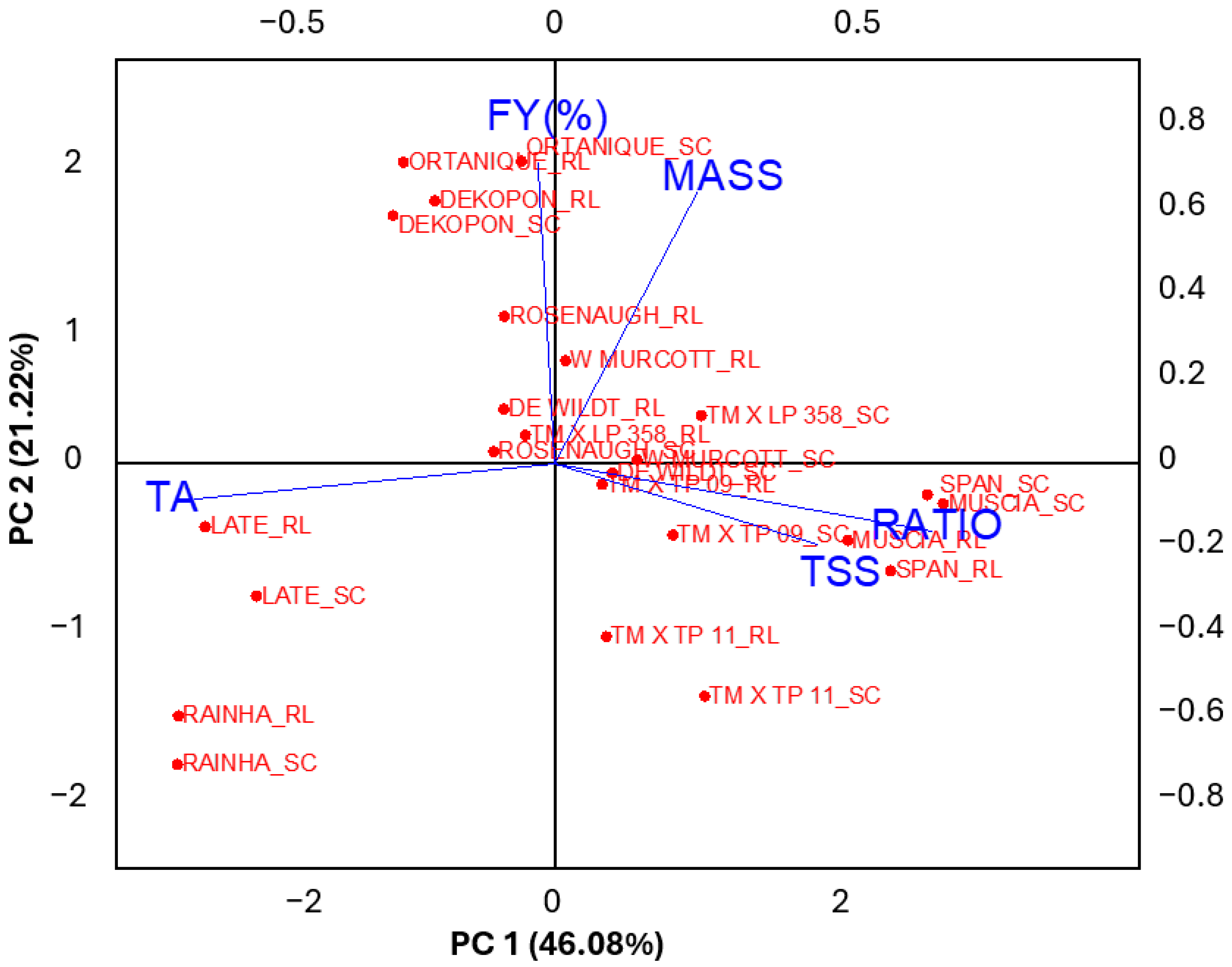
The first two principal components explained a substantial proportion of the total variance (
Figure 1). PC1 described a compositional gradient defined by an inverse relationship between TA and both TSS and the ratio, whereas PC2 was primarily associated with fruit mass and juice yield (FY%).
Clear clustering of scion–rootstock combinations was observed along PC1. Rainha and Late, grafted onto both RL and SC, were positioned on the negative side of PC1 and associated with higher TA values. In contrast, Span and Muscia, regardless of rootstock, clustered on the positive side of PC1, showing stronger associations with higher TSS and TSS/TA ratio.
Along PC2, Ortanique and Dekopon, independent of rootstock, were positioned closer to the vectors for fruit mass and juice yield, whereas TM × TP 11 was consistently located in the negative region of this axis. A tendency for separation by rootstock was also evident, with RL-grafted combinations positioned closer to fruit mass and juice yield vectors, while SC-grafted combinations were more closely associated with either TA or TSS, depending on the scion.
3.3. Evaluation of ABS Severity in Plants and Fruits
The mandarin varieties Late IAC 585, Rainha BRS, and Rosenaugh Nartjee IAC 555; the hybrids TM × TP 11 and TM × TP 09; and the tangors Dekopon IAC 2009, W Murcott, and Ortanique IAC 554 consistently exhibited zero severity scores in plants and no detectable lesion area on fruits in all years (
Table 2).
Among the evaluated cultivars, significant differences in ABS severity were observed at the plant level. Loose Jacket IAC 515 showed the highest and most consistent foliar severity across all years, with a mean score of 3, differing significantly from the other cultivars. Muscia IAC 607 exhibited intermediate foliar severity, with stable scores of 1 from 2015 to 2017, whereas De Wildt IAC 545 showed lower but persistent symptoms, with plant severity scores of 0.5 in all years. TM × LP 358 presented low but detectable foliar severity (score 0.2) throughout the evaluation period.
Fruit infection followed a similar pattern. Loose Jacket IAC 515 exhibited the highest fruit lesion area in all years, with 9.0% of the fruit surface affected, significantly exceeding all other cultivars. In contrast, De Wildt IAC 545, Muscia IAC 607, and Span IAC 595 showed low but measurable lesion areas on fruits, ranging from 0.1% to 0.2%, with minor variation among years. TM × LP 358 did not exhibit fruit symptoms in any evaluation year. Rootstock did not significantly affect ABS severity in either plants or fruits under field conditions, as indicated by the absence of consistent differences between RL and SC within cultivars. Therefore, mean values across rootstocks are presented.
3.4. Evaluation of HLB Incidence and Severity
No significant differences were observed between rootstocks for HLB incidence in either evaluation year (
p > 0.05;
Table 3). However, differences in disease severity between rootstocks were detected. In 2017, plants grafted onto RL exhibited higher mean HLB severity (60.0%) compared with those grafted onto SC (29.2%). In 2017, HLB severity increased in both rootstocks, with RL-grafted plants again showing significantly higher severity values (23.5) than SC-grafted plants (13.61).
Regarding cultivar response, Ortanique IAC 554 and the hybrid TM × TP 09 exhibited the lowest HLB incidence in 2017, with values of 20.0% and 30.0%, respectively. In 2017, HLB incidence increased across most cultivars, and only the hybrid TM × TP 11 maintained comparatively lower incidence levels (60.0%).
Significant differences among cultivars were also observed for HLB severity. Dekopon IAC 2009 showed the highest severity values in both years, reaching 15.50 in 2017 and 39.50 in 2018. Elevated severity levels were also recorded for Span IAC 595, W. Murcott, and the hybrid TM × LP 358. In contrast, Loose Jacket IAC 515 and Rainha BRS consistently exhibited lower HLB severity values, particularly in 2017.
3.5. Principal Component Analysis (ABS and HLB)
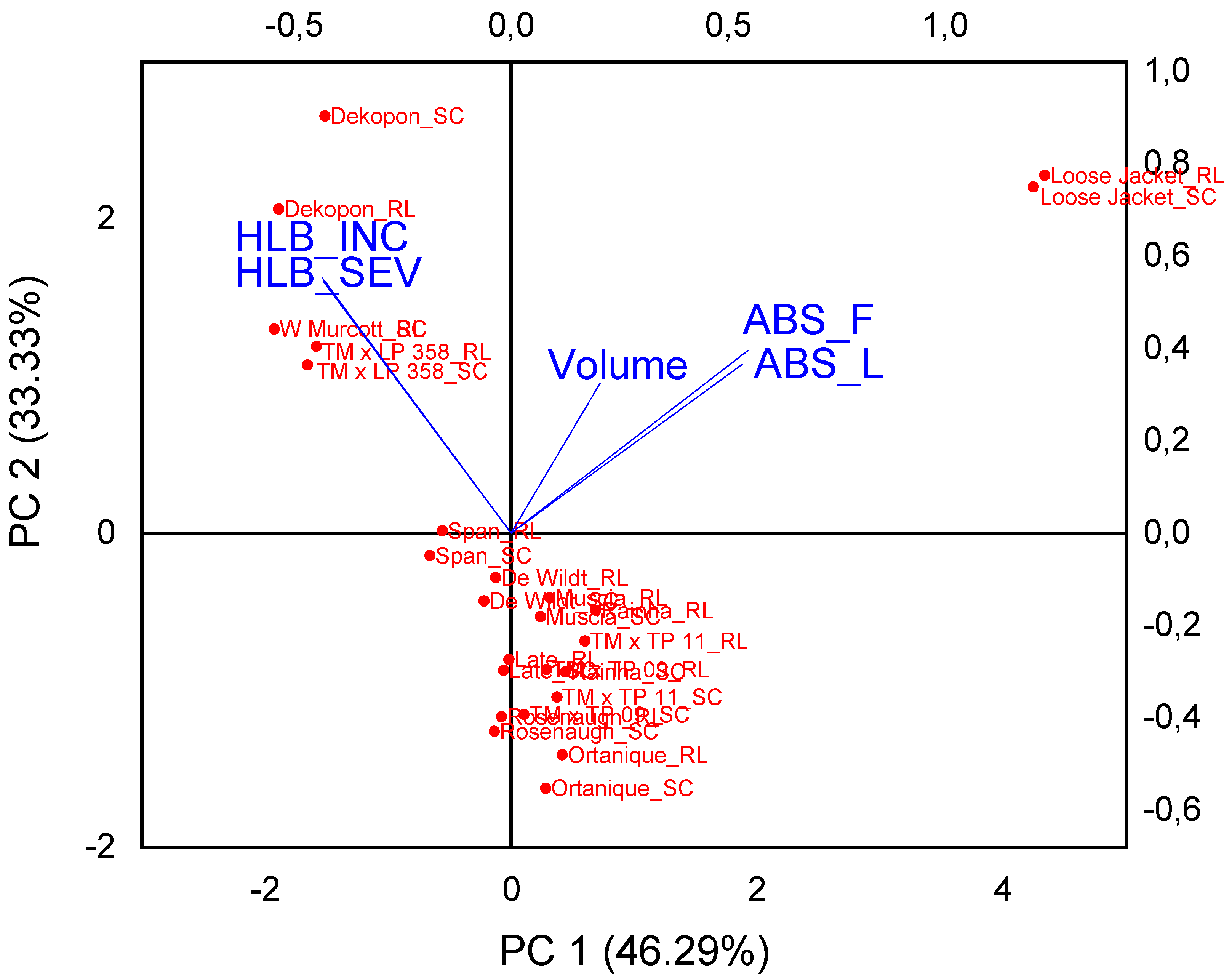
PCA was used to evaluate the combined variation in canopy volume, HLB incidence and severity, and ABS severity on leaves and fruits among the scion–rootstock combinations (
Figure 2). The PC1 accounted for the largest proportion of the total variance and was primarily associated with canopy volume, exhibiting an opposite orientation to ABS severity on fruits. This axis differentiated combinations with larger canopy volume from those with higher levels of fruit infection by ABS.
The PC2 explained an additional proportion of the variance and was mainly associated with HLB severity and ABS severity on leaves. Along this axis, combinations with higher values for both variables were positioned toward the positive side of PC2, whereas combinations with lower disease severity were located toward the negative side.
The ordination plot showed distinct grouping patterns among cultivars. Loose Jacket IAC 515 was positioned in the region associated with higher ABS severity on both leaves and fruits. Dekopon IAC 2009 was located toward the positive side of PC1, in proximity to the canopy volume vector and opposite to ABS severity on fruits. Ortanique IAC 554, Rainha BRS, and Rosenaugh Nartjee IAC 555 were grouped in the region characterized by lower values of ABS and HLB severity, regardless of rootstock.
4. Discussion
RL promoted greater canopy volume in several scion combinations, particularly in the later years of evaluation, although this response was not universal across all cultivars. In 2017, higher canopy volumes on RL were observed for cultivars such as Rainha BRS, TM × TP 11, TM × TP 09, Span IAC 595, and De Wildt IAC 545, whereas other cultivars showed no significant differences between rootstocks. These results indicate that, although rootstock choice influences vegetative growth, canopy development is largely modulated by the genetic and physiological characteristics of the scion, corroborating previous observations that vigor responses to rootstocks are cultivar-dependent [
20,
21].
Despite the greater vegetative development observed in several combinations grafted onto RL, plants on this rootstock consistently exhibited higher HLB severity compared to those grafted onto SC. While rootstock did not consistently affect HLB incidence across years, severity values were significantly higher on RL in both evaluation periods. This pattern supports previous field observations suggesting that more vigorous canopies tend to exhibit higher disease severity, possibly due to increased availability of young tissues, which are preferentially colonized by the Asian citrus psyllid [
22]. However, the present data support this relationship only as an association rather than a causal mechanism.
In contrast, SC generally resulted in lower canopy volumes and lower HLB severity. Although fruit quality variables were not discussed in detail in this section, the PCA of physicochemical traits indicated that several SC-grafted combinations were associated with higher titratable acidity and soluble solids, consistent with previous reports describing the positive influence of SC on internal fruit quality [
23,
24]. These characteristics are particularly relevant for fresh fruit markets and processing industries that prioritize internal quality over fruit size.
Regarding ABS, marked differences among cultivars were observed, whereas rootstock effects were negligible. Most evaluated cultivars, including Ortanique IAC 554, Rainha BRS, Dekopon IAC 2009, TM × TP 11, TM × TP 09, and W Murcott, showed no ABS symptoms on leaves or fruits throughout the evaluation period. In contrast, Loose Jacket IAC 515 exhibited consistently high ABS severity on both leaves and fruits, with lesion areas reaching approximately 9% of the fruit surface, and this cultivar failed to produce commercial fruits under field conditions. Intermediate responses were observed for De Wildt IAC 545, Muscia IAC 607, and Span IAC 595, which showed low to moderate symptom expression and limited fruit production. These findings are consistent with the known host-specific sensitivity of certain mandarin genotypes to the ACT toxin produced by
A. alternata [
25,
26].
The first principal component primarily reflected vegetative vigor and ABS severity on fruits, separating more vigorous cultivars from those exhibiting higher fruit damage by ABS. The second principal component was associated with disease intensity, particularly HLB severity and ABS severity on leaves. Cultivars with higher HLB severity tended to align with greater ABS expression on leaves, suggesting that trees under greater systemic disease pressure exhibited a higher expression of foliar symptoms. This association should be interpreted as a co-occurrence pattern rather than a direct causal relationship.
The ordination further distinguished cultivars with contrasting field behavior. Loose Jacket IAC 515 clustered with high ABS severity on both leaves and fruits, confirming its high susceptibility under field conditions. Dekopon IAC 2009 was positioned in association with greater canopy volume and low ABS severity on fruits, despite exhibiting high HLB severity. Ortanique IAC 554, Rainha BRS, and Rosehaugh Nartjee IAC 555 consistently grouped in regions associated with low ABS and HLB severity, regardless of rootstock, highlighting their stable performance under concurrent disease pressure.
Overall, the results demonstrate that rootstock selection strongly influences vegetative growth and HLB severity, while ABS expression is predominantly determined by scion genotype. RL favored greater vegetative development but was associated with higher HLB severity, whereas Swingle citrumelo resulted in reduced vigor and lower disease severity. Cultivars such as Ortanique IAC 554 and Rainha BRS, particularly when grafted onto SC, emerged as promising combinations for orchards under high disease pressure.
5. Conclusions
Rootstock affected vegetative growth, fruit quality, and HLB severity of the evaluated mandarin and hybrid cultivars. Rangpur lime generally induced greater canopy development, whereas Swingle citrumelo was associated with lower HLB severity and higher soluble solids and acidity values. ABS severity was mainly influenced by scion genotype, with little effect of rootstock. Loose Jacket IAC 515 showed high susceptibility to ABS, while Ortanique IAC 554 and Rainha BRS presented low severity for both ABS and HLB under field conditions. These results indicate that Ortanique IAC 554 and Rainha BRS grafted onto Swingle citrumelo are promising combinations for cultivation under high disease pressure conditions in Brazil.
Author Contributions
Conceptualization, F.T.D., F.A.d.A., M.B., M.C.-Y. and P.M.d.C.; Methodology, F.T.D., F.A.d.A., M.B., M.C.-Y. and P.M.d.C.; Formal Analysis, F.T.D., F.A.d.A., M.B., E.H.S., A.J.B.d.S., M.C.-Y. and P.M.d.C.; Investigation, F.T.D., F.A.d.A., M.B. and M.C.-Y.; Resources, F.A.d.A., M.B., M.C.-Y. and P.M.d.C.; Data Curation, F.T.D.; Writing—original draft preparation, F.T.D., F.A.d.A., M.B., E.H.S., A.J.B.d.S., M.C.-Y. and P.M.d.C.; Writing—review and editing, F.T.D., F.A.d.A., M.B., E.H.S., A.J.B.d.S., M.C.-Y. and P.M.d.C. All authors have read and agreed to the published version of the manuscript.
Funding
This research was supported by the São Paulo Research Foundation (FAPESP, Brazil) under grant numbers 2011/21559-0 and 2020/07045-3 (CCD_CROP project).
Data Availability Statement
The original contributions presented in this study are included in the article. Further inquiries can be directed to the corresponding author.
Acknowledgments
The authors would like to thank the owners of the Lagoa Bonita farm for providing the experimental area and maintaining the trial.
Conflicts of Interest
The authors declare no conflicts of interest.
References
- FAOSTAT. Database Results. 2025. Available online: http://www.fao.org/faostat/en/#search/mandarin (accessed on 12 May 2025).
- Instituto Brasileiro de Geografia e Estatística [IBGE]. Área Destinada à Colheita, Área Colhida, Quantidade Produzida, Rendimento Médio e Valor da Produção das Lavouras Permanentes. Rio de Janeiro, Brazil. 2025. Available online: https://www.ibge.gov.br/explica/producao-agropecuaria/tangerina/br (accessed on 24 November 2025).
- Fundecitrus. Inventário de Árvores e Estimativa da Safra de Laranja do Cinturão Citrícola de São Paulo e Triângulo/Sudoeste Mineiro 2023/2024; Fundo de Defesa da Citricultura (Fundecitrus): Araraquara, Brazil, 2023; Available online: https://www.fundecitrus.com.br/wp-content/uploads/2025/01/Inventario_e_Estimativa_do_Cinturao_Citricola_2023-2024.pdf (accessed on 11 April 2026).
- Azevedo, F.A.; Polydoro, D.A.; Bastianel, M.; Kupper, K.C.; Stuart, R.M.; Costa, F.P.; Pio, R.M. Resposta de diferentes genótipos de tangerinas e seus híbridos à inoculação in vitro e in vivo de Alternaria alternata. Rev. Bras. Frutic. 2010, 32, 1–10. [Google Scholar] [CrossRef]
- Bassanezi, R.B.; Silva, G.J.; Feichtenberger, E.; Belasque, J., Jr.; Behlau, F.; Wulff, N.A. Citrus Diseases. In Manual de Fitopatologia; Amorim, L., Rezende, J.A.M., Bergamin Filho, A., Eds.; Ceres: Ouro Fino, Brazil, 2016; pp. 292–293. [Google Scholar]
- Bastianel, M.; Martinelli, R.; Devite, F.T.; Cristofani-Yaly, M.; do Vale Ferreira, R.; Stuchi, E.S.; Azevedo, F.A.D. Reaction of mandarins to the Alternaria Brown spot and huanglongbing: Identification of potential varieties for these diseases to be managed in the field. Horticulturae 2023, 9, 641. [Google Scholar] [CrossRef]
- Devite, F.T.; Bastianel, M.; Cristofani-Yaly, M.; de Souza, A.J.B.; Gadanhoto, B.P.; Costa Arantes, A.C.; de Azevedo, F.A. Performance of Valencia sweet orange grafted onto dwarfing citrandarins. Front. Plant Sci. 2025, 16, 1530396. [Google Scholar] [CrossRef] [PubMed]
- Chitolina, G.M.; Silva-Junior, G.J.; Feichtenberger, E.; Pereira, R.G.; Amorim, L. Distribution of Alternaria alternata isolates with resistance to quinone outside inhibitor (QoI) fungicides in Brazilian orchards of tangerines and their hybrids. Crop Prot. 2020, 141, 105493. [Google Scholar] [CrossRef]
- Zhou, H.; Hu, J.; Li, B.; Liu, F.; Zhang, J.; Jiang, D.; Wang, X. Identification of Candidate Genes Related to Citrus Alternaria Brown Spot Resistance Through a Genome-Wide Association Study. Physiol. Mol. Plant Pathol. 2025, 136, 102526. [Google Scholar] [CrossRef]
- Castle, W.S.; Tucker, D.P.H.; Krezdorn, A.H.; Youtsey, C.O. Rootstocks for Florida Citrus; University of Florida: Gainesville, FL, USA, 1993. [Google Scholar]
- Aparicio-Durán, L.; Gmitter, F.G., Jr.; Arjona-López, J.M.; Grosser, J.W.; Calero-Velázquez, R.; Hervalejo, Á.; Arenas-Arenas, F.J. Evaluation of Three New Citrus Rootstocks under Boron Toxicity Conditions. Agronomy 2021, 11, 2490. [Google Scholar] [CrossRef]
- Boaretto, R.M.; Quaggio, J.A.; Mellis, E.V.; Cantarella, H.; Mattos, D., Jr.; Zambrosi, F.C.B. Citros. In Boletim 100: Recomendações de Adubação e Calagem para o Estado de São Paulo, 5th ed.; Cantarella, H., Quaggio, J.A., Mattos, D., Jr., Boaretto, R.M., Zambrosi, F.C.B., Eds.; Instituto Agronômico: Campinas, Brazil, 2022; pp. 187–198. [Google Scholar]
- Mendel, K. Rootstock-scion relationships in Shamouti trees on light soil. Katavim 1956, 6, 35–38. [Google Scholar]
- Di Giorgi, F.; Ide, B.Y.; Dib, K.; Marchi, R.J.; Triboni, H.R.; Wagner, R.L. Contribuição ao estudo do comportamento de algumas variedades de citros e suas implicações agroindustriais. Laranja 1990, 11, 567–612. [Google Scholar]
- Bastianel, M.; Simonetti, L.M.; Schinor, E.H.; Giorgi Neto, R.O.; de Negri, J.D.; Gomes, D.N.; Azevedo, F.A.D. Avaliação do banco de germoplasma de mexericas com relação às características físico-químicas e suscetibilidade à mancha marrom de alternária. Bragantia 2014, 73, 23–31. [Google Scholar] [CrossRef][Green Version]
- Renaud, M.S.A.; Amorim, L.; Lourenço, S.A.; Sposito, M.B. Escala diagramática para avaliação da mancha marrom de alternaria de citros. Summa Phytopathol. 2008, 34, 270–271. [Google Scholar] [CrossRef]
- Gottwald, T.R. Current epidemiological understanding of citrus Huanglongbing. Annu. Rev. Phytopathol. 2010, 48, 119–139. [Google Scholar] [CrossRef] [PubMed]
- Zuur, A.F.; Ieno, E.N.; Smith, G.M. Principal component analysis and redundancy analysis. In Analysing Ecological Data; Statistics for Biology and Health; Springer: New York, NY, USA, 2007; Volume 3, pp. 154–196. [Google Scholar] [CrossRef]
- Mendiburu, F. Agricolae: Statistical Procedures for Agricultural Research. R Package Version 1.3.5. 2021. Available online: https://CRAN.R-project.org/package=agricolae (accessed on 1 June 2025).
- Donato, S.L.R.; Pereira, C.S.; Barros, Z.J.; Siqueira, D.L.; Salomão, L.C.C. Respostas de combinações de variedades copa e porta-enxerto de citros à deficiência hídrica. Pesqui. Agropecuária Bras. 2007, 42, 1507–1510. [Google Scholar] [CrossRef][Green Version]
- Girardi, E.A.; Ayres, A.J.; Girotto, L.F.; Peña, L. Tree Growth and Production of Rainfed Valencia Sweet Orange Grafted onto Trifoliate Orange Hybrid Rootstocks under Aw Climate. Agronomy 2021, 11, 2533. [Google Scholar] [CrossRef]
- Rodrigues, J.D.B.; Moreira, A.S.; Stuchi, E.S.; Bassanezi, R.B.; Laranjeira, F.F.; Girardi, E.A. Huanglongbing incidence, canopy volume, and sprouting dynamics of ‘Valencia’ sweet orange grafted onto 16 rootstocks. Trop. Plant Pathol. 2020, 45, 611–619. [Google Scholar] [CrossRef]
- Espinoza Núñez, J.; Siqueira, D.L.D.; De Rezende, L.P. Desenvolvimento vegetativo, produção e qualidade de frutos da tangerina ‘Fremont’ sobre quatro porta-enxertos. Rev. Bras. Frutic. 2007, 29, 295–298. [Google Scholar] [CrossRef][Green Version]
- Stuchi, E.S.; Girardi, E.A.; Silva, S.R.D.; Cantuarias-Avilés, T.; Parolin, L.G.; Reiff, E.T.; Sempionato, O.R.; Marcuzzo, R. Satsuma mandarins grafted onto Swingle citrumelo for early season harvest in subtropical conditions in Brazil. Bragantia 2019, 78, 447–455. [Google Scholar] [CrossRef]
- Kohmoto, K.; Akimitsu, K.; Otani, H. Correlation of resistance and susceptibility of citrus to Alternaria alternata with sensitivity to host-specific toxins. Phytopathology 1991, 81, 719–722. [Google Scholar] [CrossRef]
- Akimitsu, K.; Peever, T.L.; Timmer, L.W. Molecular, ecological, and evolutionary approaches to understanding Alternaria diseases of citrus. Mol. Plant Pathol. 2003, 4, 435–436. [Google Scholar] [CrossRef] [PubMed]
Figure 1.
Biplot of Principal Component Analysis (PCA) for mandarins, tangors, willowleafs, and hybrids varieties grafted onto two rootstocks (Swingle citrumelo and Rangpur lime), showing variables such as fruit mass (MASS), titratable acidity (TA), total soluble solids (TSS), juice yield (FY%), and TSS/TA ratio (RATIO) (Mogi Mirim, São Paulo State, Brazil, 2016 to 2018).
Figure 1.
Biplot of Principal Component Analysis (PCA) for mandarins, tangors, willowleafs, and hybrids varieties grafted onto two rootstocks (Swingle citrumelo and Rangpur lime), showing variables such as fruit mass (MASS), titratable acidity (TA), total soluble solids (TSS), juice yield (FY%), and TSS/TA ratio (RATIO) (Mogi Mirim, São Paulo State, Brazil, 2016 to 2018).
Figure 2.
Biplot of Principal Component Analysis (PCA) based on the correlation matrix for ABS in plants and fruits, HLB incidence and severity, and canopy volume across each variety x rootstock combination. Volume: canopy volume; ABS_L: severity in plants; ABS_F: severity in fruits; HLB_INC: HLB incidence; HLB_SEV: HLB severity.
Figure 2.
Biplot of Principal Component Analysis (PCA) based on the correlation matrix for ABS in plants and fruits, HLB incidence and severity, and canopy volume across each variety x rootstock combination. Volume: canopy volume; ABS_L: severity in plants; ABS_F: severity in fruits; HLB_INC: HLB incidence; HLB_SEV: HLB severity.
Table 1.
Canopy Volume (m3) of mandarins, tangors, willowleafs, and hybrids grafted onto Rangpur lime (RL) and Swingle citrumelo (SC), collected in Mogi Mirim, São Paulo State, Brazil (2015 to 2017).
Table 1.
Canopy Volume (m3) of mandarins, tangors, willowleafs, and hybrids grafted onto Rangpur lime (RL) and Swingle citrumelo (SC), collected in Mogi Mirim, São Paulo State, Brazil (2015 to 2017).
| Varieties | Canopy Volume (m3) |
|---|
| 2015 | 2016 | 2017 |
|---|
| SC | RL | Average | SC | RL | Average | SC | RL | Average |
|---|
| Muscia IAC 607 | 0.12 eA * | 0.16 eA | 0.14 e | 0.73 dA | 0.51 eA | 0.62 f | 1.16 eB | 1.61 eA | 1.40 d |
| De Wildt IAC 545 | 0.12 eA | 0.20 eA | 0.16 e | 0.72 dA | 1.02 dA | 0.87 e | 1.44 dB | 2.00 dA | 1.70 c |
| Span IAC 595 | 0.15 dA | 0.29 cA | 0.22 d | 0.85 dB | 1.25 dA | 1.05 e | 2.16 cB | 2.75 dA | 2.50 b |
| TM × LP 358 | 0.21 cA | 0.23 dA | 0.22 d | 1.15 cB | 1.71 cA | 1.43 d | 1.57 dB | 2.01 dA | 1.80 c |
| W Murcott | 0.26 cA | 0.23 dA | 0.24 d | 1.42 cA | 1.16 dA | 1.29 d | 1.84 dA | 1.84 eA | 1.80 c |
| Ros. Nartjee | 0.20 cA | 0.32 cA | 0.26 d | 0.72 dA | 1.07 dA | 0.89 e | 1.53 dA | 1.58 eA | 1.55 c |
| Ortanique IAC 554 | 0.17 dA | 0.38 bA | 0.27 d | 1.74 bA | 1.73 cA | 1.73 c | 1.58 dB | 2.38 dA | 2.00 b |
| TM × TP 11 | 0.18 dA | 0.36 bA | 0.27 d | 1.59 cA | 1.79 cA | 1.69 c | 3.03 bB | 4.37 bA | 3.70 a |
| Loose Jacket IAC 515 | 0.32 bA | 0.41 bA | 0.36 c | 3.04 aA | 3.30 aA | 3.17 a | 4.00 bA | 4.05 bA | 4.00 a |
| Dekopon IAC 2009 | 0.40 aA | 0.35 bA | 0.37 c | 3.04 aA | 2.33 bB | 2.68 b | 5.75 aA | 3.53 cB | 4.60 a |
| TM × TP 09 | 0.30 bB | 0.59 aA | 0.44 b | 1.64 bB | 2.02 bA | 1.83 c | 2.10 cB | 3.17 cA | 2.60 b |
| Late IAC 585 | 0.36 aB | 0.61 aA | 0.48 b | 1.87 bA | 1.88 cA | 1.87 c | 2.24 cA | 2.50 dA | 2.40 b |
| Rainha BRS | 0.44 aA | 0.63 aA | 0.54 a | 1.98 bA | 3.10 aA | 2.54 b | 3.54 bB | 5.01 aA | 4.30 a |
Table 2.
The severity of Alternaria brown spot in plants (scores) and fruits (% affected area) of mandarin, tangor, willowleaf, and hybrid varieties grafted onto Rangpur lime and Swingle citrumelo rootstocks (Mogi Mirim, São Paulo State, Brazil, 2015 to 2017).
Table 2.
The severity of Alternaria brown spot in plants (scores) and fruits (% affected area) of mandarin, tangor, willowleaf, and hybrid varieties grafted onto Rangpur lime and Swingle citrumelo rootstocks (Mogi Mirim, São Paulo State, Brazil, 2015 to 2017).
| Varieties | ABS in the Field |
|---|
| 2015 | 2016 | 2017 |
|---|
| Plant (Score) | Fruit (Lesion Area %) | Plant (Score) | Fruit
(Lesion Area %) | Plant (Score) | Fruit (Lesion Area %) |
|---|
| Late IAC 585 | 0.0 aA * | 0.0 aA | 0.0 aA | 0.0 aA | 0.0 aA | 0.0 aA |
| Rainha BRS | 0.0 aA | 0.0 aA | 0.0 aA | 0.0 aA | 0.0 aA | 0.0 aA |
| TM x TP 11 | 0.0 aA | 0.0 aA | 0.0 aA | 0.0 aA | 0.0 aA | 0.0 aA |
| Dekopon | 0.0 aA | 0.0 aA | 0.0 aA | 0.0 aA | 0.0 aA | 0.0 aA |
| Ortanique IAC 554 | 0.0 aA | 0.0 aA | 0.0 aA | 0.0 aA | 0.0 aA | 0.0 aA |
| W Murcott | 0.0 aA | 0.0 aA | 0.0 aA | 0.0 aA | 0.0 aA | 0.0 aA |
| Rosehaugh Nartjee IAC 555 | 0.0 aA | 0.0 aA | 0.0 aA | 0.0 aA | 0.0 aA | 0.0 aA |
| TM x TP 09 | 0.0 aA | 0.0 aA | 0.0 aA | 0.0 aA | 0.0 aA | 0.0 aA |
| Span IAC 595 | 0.0 aA | 0.1 bA | 0.0 aA | 0.1 bA | 0.0 aA | 0.2 cB |
| De Wildt IAC 545 | 0.5 cA | 0.1 bA | 0.5 bA | 0.2 cB | 0.5 bA | 0.1 bA |
| TM × LP 358 | 0.2 bA | 0.0 aA | 0.2 b | 0.0 aA | 0.2 bB | 0.0 aA |
| Muscia IAC 607 | 1.0 dA | 0.0 aA | 1.0 cA | 0.1 bB | 1.0 cA | 0.1 bB |
| Loose Jacket IAC 515 | 3.0 eA | 9.0 cA | 3.0 dA | 9.0 cA | 3.0 dA | 9.0 cA |
Table 3.
Incidence and severity of HLB in mandarin, tangor, willowleaf, and hybrid plants grafted onto two rootstocks (Rangpur lime and Swingle citrumelo) (Mogi Mirim, São Paulo State, Brazil, 2016 to 2017).
Table 3.
Incidence and severity of HLB in mandarin, tangor, willowleaf, and hybrid plants grafted onto two rootstocks (Rangpur lime and Swingle citrumelo) (Mogi Mirim, São Paulo State, Brazil, 2016 to 2017).
| Varieties | Incidence (%) | Severity (%) |
|---|
| 2016 | 2017 | 2016 | 2017 |
|---|
| De Wildt IAC 545 | 50.0 ab * | 80.0 a | 3.0 b | 14.5 bc |
| Dekopon IAC 2009 | 90.0 a | 100.0 a | 15.5 a | 39.5 a |
| Late IAC 585 | 30.0 ab | 80.0 a | 2.0 b | 15.5 bc |
| Loose Jacket IAC 515 | 30.0 ab | 70.0 a | 2.50 b | 12.5 c |
| Muscia IAC 607 | 40.0 ab | 80.0 a | 3.0 b | 14.5 bc |
| Ortanique IAC 554 | 20.0 b | 80.0 a | 1.0 b | 8.5 c |
| Rainha BRS | 30.0 ab | 70.0 a | 2.5 b | 8.0 c |
| Rosehaugh Nartjee IAC 555 | 30.0 ab | 70.0 a | 2.0 b | 13.0 c |
| Span IAC 595 | 60.0 ab | 70.0 a | 8.5 ab | 16.0 abc |
| TM × LP 358 | 70.0 ab | 80.0 a | 9.5 ab | 38.0 ab |
| TM × TP 09 | 20.0 b | 90.0 a | 1.5 b | 15.5 bc |
| TM × TP 11 | 30.0 ab | 60.0 b | 2.0 b | 7.5 c |
| W Murcott | 80.0 ab | 100.0 a | 7.0 ab | 38.0 ab |
| CV (%) | 22.3 | 13.2 | 18.3 | 20.0 |
| Rootstock | Incidence (%) | Severity (%) |
| 2016 | 2017 | 2016 | 2017 |
| Swingle citrumelo | 29.2 b | 75.4 a | 2.7 b | 13.6 b |
| Rangpur lime | 60.0 a | 83.1 a | 6.5 a | 23.5 a |
| CV (%) | 25.1 | 12.1 | 19.4 | 20.8 |
| Disclaimer/Publisher’s Note: The statements, opinions and data contained in all publications are solely those of the individual author(s) and contributor(s) and not of MDPI and/or the editor(s). MDPI and/or the editor(s) disclaim responsibility for any injury to people or property resulting from any ideas, methods, instructions or products referred to in the content. |




 ,
,