Article

Foliar Application of Silicon and Zinc Improves Growth, Productivity, and Essential Oil Content of Sweet Basil (Ocimum basilicum L.) Experiencing Drought


by
Yassin M. Soliman
1,
Wagdi Saber Soliman
2,
Ahmed M. Abbas
3,* and
Stephen J. Novak
4,*
1
Department of Horticulture, Faculty of Agriculture, Sohag University, Sohag 82524, Egypt
2
Horticulture Department, Faculty of Agriculture and Natural Resources, Aswan University, Aswan 81528, Egypt
3
Department of Biology, College of Science, King Khalid University, Abha 61321, Saudi Arabia
4
Department of Biological Sciences, Boise State University, Boise, ID 83725, USA
*
Authors to whom correspondence should be addressed.
Agronomy 2026, 16(12), 1155; https://doi.org/10.3390/agronomy16121155 (registering DOI)
Submission received: 30 April 2026 / Revised: 3 June 2026 / Accepted: 10 June 2026 / Published: 12 June 2026

Abstract

Sweet basil (Ocimum basilicum L.) is a member of the Lamiaceae family, which includes a wide variety of medicinal and aromatic herbs cultivated for their essential oils and bioactive compounds. However, prolonged drought stress can significantly impair growth and essential oil content. In this study, a two-season pot experiment was conducted under open-field conditions. The study was carried out at the Floricultural Nursery, Faculty of Agriculture and Natural Resources, Aswan University, Egypt, during 2024 and 2025, with the aim of assessing how foliar applications of silicon (Si) and zinc (Zn) impact the morphological, physiological, and biochemical responses of sweet basil under different soil water capacity (SWC) levels (80%, 60%, and 40% SWC). Drought stress markedly reduced plant height, branch number, leaf area, biomass, photosynthetic pigments, macronutrient content, and essential oil content, while increasing levels of proline and secondary metabolites such as phenolics, flavonoids, and ascorbic acid. Growth and productivity were highest under 80% SWC, followed by 60%, and lowest under 40%. Under drought stress (40% SWC), Si200 increased plant dry biomass by approximately 12%, chlorophyll content by 53%, and essential oil content by 46% compared with untreated plants. Silicon application proved more effective at ameliorating the negative consequences of drought than Zn, with Si200 combined with 80% SWC yielding the best results in terms of plant performance and essential oil percentage and content. Meanwhile, Si200 under 40% SWC induced the highest accumulation of secondary metabolites. These results highlight the potential of silicon foliar application as a practical strategy to reduce drought stress in sweet basil, enhancing both yield and phytochemical quality, and offering valuable guidance for sustainable cultivation under water-limited conditions.

1. Introduction

Crop plants experience abiotic stress when exposed to unfavorable environmental conditions such as heavy metal contamination, air pollution, extreme soil pH, high salinity, flooding, excessive solar radiation, freezing temperatures, extreme heat, and severe drought [1,2,3,4,5]. Among these stressors, heat and drought are the two major factors influencing crop survival, physiology, biochemistry, morphology, yield, seed quality, and other important crop properties such as macronutrient content, disease resistance, and essential oil content [3,5,6,7,8,9,10]. With ongoing human-caused climate change, and the extreme climate events predicted to occur, drought stress is expected to increase in frequency and intensify [11,12,13], thus threatening future world food security [10,14].
Drought stress in crop plants can result in a range of complex responses from physiological, biochemical, and hormonal consequences to responses at the whole plant level (i.e., morphological changes) [3,5,6,7,8,9,10]. Drought is caused by a lack of precipitation, erratic precipitation patterns, inadequate irrigation, irrigation failure, soil characteristics, and high salinity [5,15], which all result in an insufficient amount of water available in the soil [16,17]. Additionally, the negative consequences of drought are exacerbated by periods of excessive heat [16].
With low soil moisture content, the water status of crop plants is affected by altered water absorption, translocation, and transportation patterns, resulting in a reduction in leaf and plant water potential, guard cell activation, and stomatal closure [3,5,6,7,8,9,10], which can lead to a cessation of CO2 assimilation (i.e., photosynthesis) (see Figure 1, Seleiman et al. [10]). Drought stress also produces excessive reactive oxygen species (ROS) in plant cells, causing osmotic stress [3,5,6,7,8,9,10], thus triggering lipid peroxidation, damage to proteins and nucleic acids, and activation of programmed cell death pathways [18,19]. Drought can also decrease chlorophyll content, lead to a decline in phytochemical efficiency, and increase oxidative stress and damage. Drought can also lead to an accumulation of proline, which acts as an osmo-protectant that aids cells in managing the stresses caused by drought and high salinity [10].
Taken together, many of the processes described above can lead to an increase in cell death, which has consequences at the whole plant level: a reduction in leaf number, leaf size, leaf area, and leaf longevity; a reduction in plant height; a reduction in plant biomass; a higher root-to-shoot ratio; reductions in yield and seed quality [5,6,7,8,9,10]; and a reduction in other crop properties such as essential oil content [20,21]. Drought is a major cause of seedling mortality [17,22], whereas mortality during other portions of the crop plant life cycle is influenced by the season, intensity, and duration of drought [6,9,10,23].
Amid low soil moisture content and ongoing climate change, enhancing crop resilience through nutrient supplementation offers a promising solution to the many problems caused by drought. Silicon (Si), though not essential, significantly improves plant tolerance to drought. It is reported to enhance water status, strengthen cell walls, boost antioxidant defenses, and modulate gene expression related to stress and secondary metabolism [24,25,26,27]. Silicon applications have also been shown to maintain pigment levels, ion balance, and essential oil content in sweet basil (Ocimum basilicum L., Lamiaceae) under drought and even under optimal watering conditions [28]). Zinc (Zn), a vital micronutrient, also is reported to play a key role in enhancing drought tolerance. It contributes to osmotic regulation, stomatal function, seed germination, and photosynthetic efficiency [29,30]. Zinc acts as a cofactor for antioxidant enzymes, scavenging ROS, which in turn helps mitigate oxidative damage under a variety of stresses [31,32]. Its application has been associated with increased volatile oil production and content [33] and improved growth traits under drought [34]. Previous studies have shown that Si primarily enhanced drought tolerance through improved nutrient uptake, water retention, and antioxidant defense, whereas Zn mainly supported enzymatic activity and osmotic regulation [24,27,35]. Both micronutrients have been reported to support crop growth, biomass accumulation, and secondary metabolite production under water-limited conditions. Although previous studies have investigated the application of Si or Zn individually in sweet basil and other crop plants experiencing drought stress, evaluation of both their effects on sweet basil physiological, biochemical, and essential oil content within the same experimental design remains limited.
Sweet basil, a widely cultivated herb, is valued for its medicinal, aromatic, and culinary properties [36]. Across diverse cultures, sweet basil has been used traditionally to treat various ailments: malaria by the Tetun people of Indonesia [37], rheumatism and hypertension by the Batak Karo community [38], and intestinal parasites by the Muna Tribe [39]. Beyond its ethnobotanical importance, sweet basil holds economic value in the food, pharmaceutical, and cosmetic industries, primarily due to its essential oils and flavorful leaves [40].
Recent years have witnessed growing interest in plant-derived bioactive compounds, particularly due to a rise in drug resistance and a reduction in the discovery of new synthetic drugs [41]. Ethnopharmacology has played a pivotal role in guiding this exploration, leveraging traditional knowledge to identify plants with therapeutic potential [42]. However, sweet basil’s growth and essential oil production and content are highly influenced by environmental conditions, genotypic variation, and cultivation practices [43].
Studies have shown that drought decreases growth and essential oil yield in several species such as Cymbopogon citratus, Artemisia annua, Matricaria recutita, and Ocimum [33,44,45]. In sweet basil, increased water deficit reduced fresh and dry biomass, chlorophyll fluorescence, and essential oil content [46,47]. These findings underscore the need for efficient water management and genotype-specific irrigation strategies to maintain yield and oil quality under drought, and other forms of stress [27].
In Egypt, increasing water scarcity and reduced Nile water availability pose major challenges for sustainable agriculture, particularly in the Upper Nile region of Egypt and other arid regions of the country. Sweet basil is an economically important medicinal and aromatic crop widely cultivated for its essential oils and pharmaceutical applications. Improving drought tolerance in sweet basil production systems can therefore contribute to sustainable agricultural productivity and water-use efficiency, in arid environments. Given current drought conditions, the increasing threat of drought with future climate change, and the importance of essential oil crops, this study aimed to evaluate the independent effects of foliar application of Si and Zn on the growth, physiological responses, biochemical traits, and essential oil content of sweet basil under different soil water capacities. We hypothesized that Si and Zn applications would alleviate drought-induced reductions in plant growth and productivity. We further hypothesized that Si would provide greater protective effects than Zn under drought stress.

2. Materials and Methods

2.1. Plant Materials and Growth Conditions

Our experiment was carried out during the 2024 and 2025 growing seasons at the Floriculture Nursery, Faculty of Agriculture and Natural Resources, Aswan University, Egypt (23°59′52″ N, 32°51′35″ E). Sweet basil seeds were sourced from the Medicinal and Aromatic Plants Research Department, Giza, Egypt, and sown on February 15 of each year into peat moss-filled seedling trays. On 1 April of each year, 15 cm tall seedlings were transplanted into 30 × 30 cm plastic pots filled with 6 kg of clay loam soil. The physical and chemical properties of the soil mix are provided in Table 1. During the growing seasons, mean daytime temperatures ranged from 32 to 35 °C, relative humidity averaged 15–20%, and total rainfall was negligible. The experiment was conducted under arid conditions typical of the Upper Nile region of Egypt: climatic conditions characterized by high evaporative demand.
Each pot, containing one seedling, received 2 g of phosphorus (P2O5 15%), potassium (K2SO4 50%), and sulfur (CaSO4 23.5%). Nitrogen was applied in three equal doses (1.5 g per pot, as ammonium sulfate 21%)—initially, a month after transplanting, followed by two applications at 30-day intervals. Plants were grown under the open-field conditions described above. Irrigation ensured seedling survival and establishment for the first 30 days post-transplantation, after which drought stress treatments and foliar applications of Si and Zn were initiated. Silicon was applied as potassium silicate (K2SiO3), whereas Zn was applied as zinc sulfate (ZnSO4·7H2O). Foliar solutions were prepared using distilled water, and no surfactants were added.

2.2. Experimental Design

The experiment followed a split-plot arrangement within a randomized complete block design with five replicates, each comprising five pots. Soil water capacity treatments were assigned to main plots, while micronutrient treatments were allocated to subplots within each replicate. Main plots were assigned to three irrigation levels based on soil water capacity (SWC): 80%, 60%, and 40%. Subplots received five foliar treatments: control (distilled water), 100 mg L−1 silicon (Si100), 200 mg L−1 silicon (Si200), 100 mg L−1 zinc (Zn100), and 200 mg L−1 zinc (Zn200). Foliar sprays were applied during the pre-flowering stage and repeated three times per year—on 1 May, 1 June, and 1 July. The applied Zn concentrations were selected based on previously published agronomic recommendations for foliar micronutrient application in horticultural crops [48].
Pot water-holding capacity was determined gravimetrically following soil saturation and free drainage for 24 h. The weight difference between saturated (Ww) and oven-dried (Wd) soil at 105 °C for 24 h was used to calculate maximum water-holding capacity. Soil water capacity was calculated using the following formula [49]:
S W C   ( % )   =   W w     W d W d × 100
The 100% reference baseline represented maximum pot water-holding capacity after drainage. Irrigation treatments corresponded to 80%, 60%, and 40% of pot water-holding capacity. Pots were weighed every two days, and water losses were replenished to maintain the target moisture levels throughout the experiment. Water deficit treatments were initiated 30 days after transplanting and maintained continuously until harvest. Soil moisture levels were monitored gravimetrically by periodic pot weighing, and irrigation volumes were adjusted accordingly to maintain constant stress intensity.

2.3. Plant Measurements

2.3.1. Morphological Characters

At full bloom (15 days after the final foliar micronutrient application), five plants were randomly sampled from each replicate, and each treatment consisted of five replicates, for morphological measurements. The following parameters were measured to provide an assessment of the growth and performance of the plants, in response to Si and Zn application: plant height (cm), number of branches per plant, leaf area (cm2), and fresh plant biomass (g plant−1). These measurements were made immediately after harvest. Dry plant biomass (g plant−1) was determined after oven-drying the samples at 65 °C for 48 h.

2.3.2. Photosynthetic Pigments and Macronutrient Determination

Photosynthetic pigments—including total chlorophyll and total carotenoids—were extracted from the third upper leaf using ice-cold methanol and measured spectrophotometrically according to the method described by Lichtenthaler and Wellburn [50], using a UV–visible spectrophotometer (SPECTROstar Nano, BMG LABTECH GmbH, Ortenberg, Germany). For macronutrient analyses, 0.1 g of dried herb sample was digested with a 1:1 (v/v) HClO3:H2SO4 mixture and was heated to 250 °C. Total nitrogen and potassium were determined by the micro-Kjeldahl method and flame photometry, respectively [51], while phosphorus content was quantified using the ascorbic acid–ammonium molybdate method [52].

2.3.3. Proline and Biochemical Content

Proline concentration was determined using acid-ninhydrin reagent following the method of Arbona et al. [53]. The absorbance was measured against a standard curve and is expressed as mg proline per gram of dry weight (mg g−1 DW). Total phenolic content was estimated using the Folin–Ciocalteu reagent according to Lister and Wilson [54]. The absorbance of the resulting blue color was read at 725 nm, and the results are expressed as mg gallic acid equivalents (mg GAE g−1 DW). Total flavonoid content was determined using the aluminum chloride colorimetric method as described by Sevket et al. [55] and is expressed as μg quercetin g−1 DW. Ascorbic acid content in shoot tips was quantified following the method of Sadasivam and Manickam [56] using 2,6-dichlorophenol-indophenol dye, and results are expressed as mg g−1 fresh weight (FW). Essential oils were extracted from air-dried plant tissues using hydro-distillation for 2 h with a Clevenger-type apparatus and volatile oil percentage (%) and volatile oil content (mL plant−1) were calculated [57].

2.4. Statistical Analysis

All data were subjected to statistical analysis using CoStat software (version 1085), following the method of Snedecor and Cochran [58]. Two-way ANOVAs were conducted, split-plot ANOVA was conducted with SWC treatments as main plot factors and micronutrient treatments as subplot factors, and F-values were used for determining the statistical significance of the treatments. Treatment means were separated using Tukey’s honestly significant difference (HSD) test at p ≤ 0.05. Pearson r values were used to examine the correlation coefficient between traits. Data normality and homogeneity of variance from both growing seasons were assessed using Shapiro–Wilk and Levene’s tests prior to ANOVA and then combined because treatment trends were consistent between seasons.

3. Results

3.1. Morphological Characters
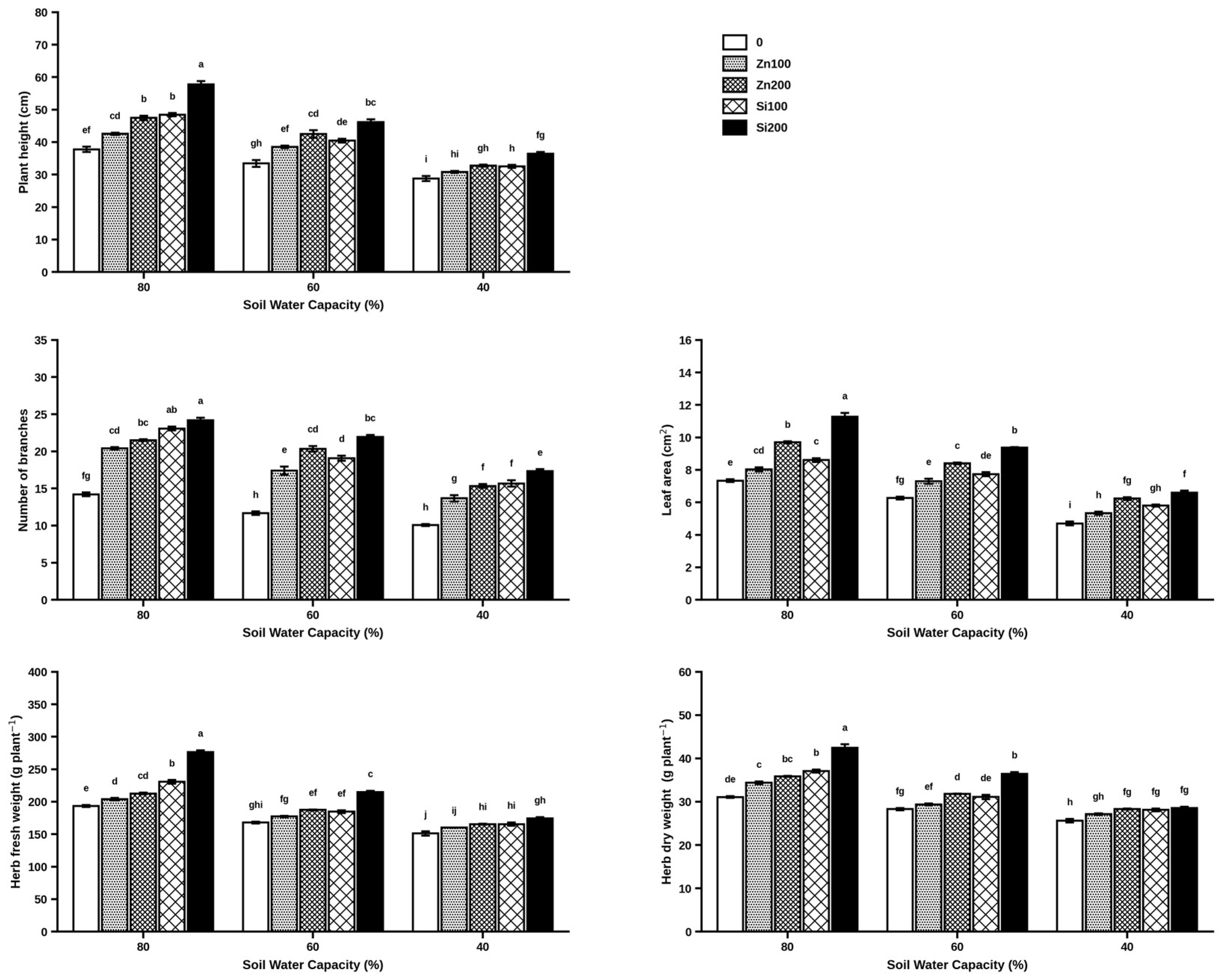
The five morphological traits we measured were significantly affected by SWC and foliar application of Si and Zn (Table 2). Plants grown at 40% SWC experienced drought stress and exhibited reduced plant height, number of branches per plant, leaf area (LA), and the two biomass traits (fresh plant biomass and dry plant biomass) compared to plants growing at 80% SWC (Figure 1). Optimal water levels (80% SWC) resulted in better plant growth, especially with the application of Si or Zn. The highest values for plant height (57.8 cm), number of branches per plant (24.2), LA (11.3 cm2), fresh plant biomass (276.3 g), and dry plant biomass (42.4 g) were recorded under the 80% SWC + Si200 treatment, while the lowest values occurred with the 40% SWC treatment, with no Si or Zn application.
Figure 1. Effect of silicon and zinc application on five morphological characters of sweet basil under well-watered and drought conditions. Values represent means ± SDs obtained from conducting these experiments over two growing seasons. Different letters indicate significant differences among treatments according to Tukey’s HSD test at p ≤ 0.05.
Agronomy 16 01155 g001

3.2. Photosynthetic Pigments and Macronutrient Determination

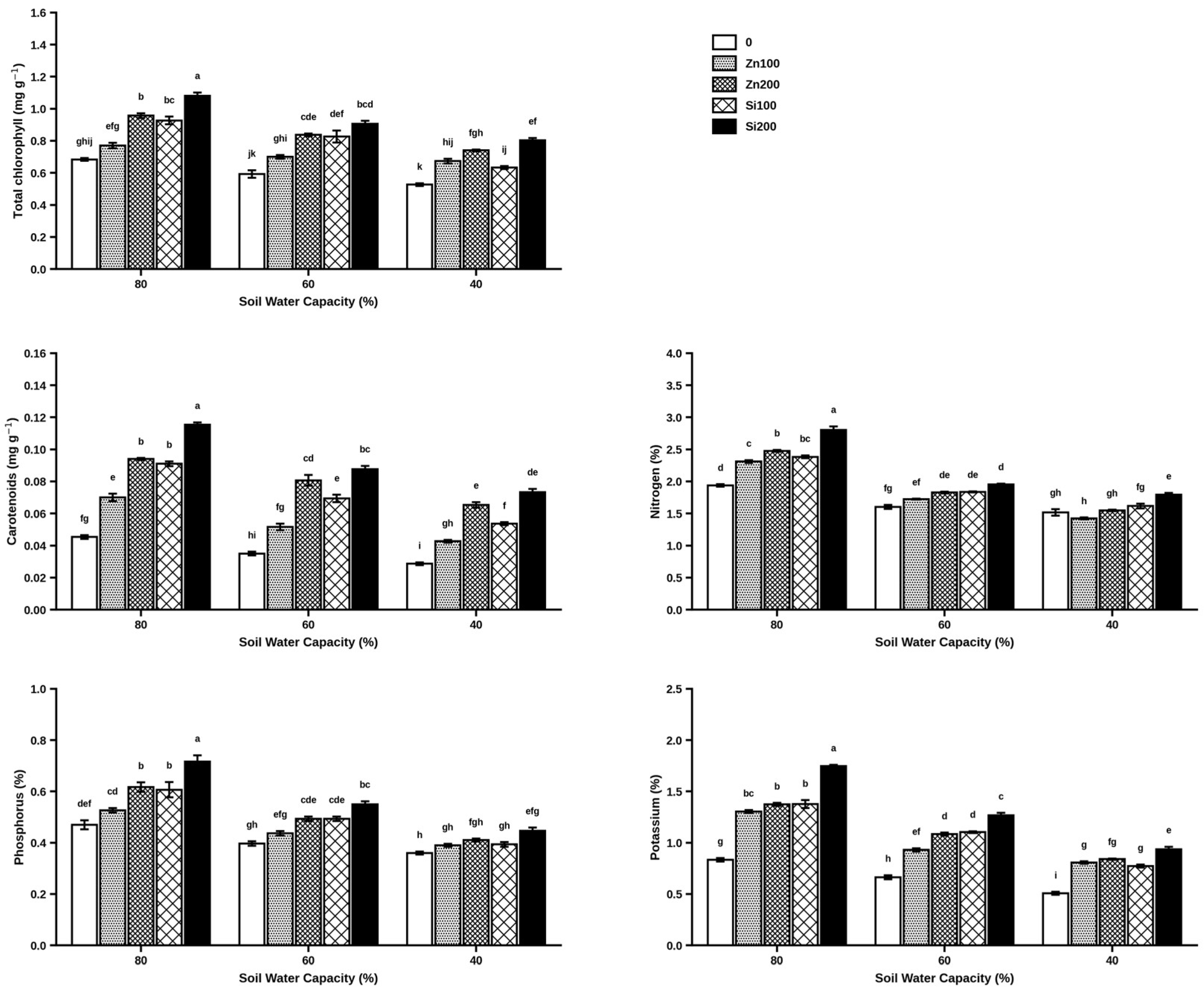
Two-way ANOVA revealed that SWC treatments, Si and Zn application, and their interaction significantly affected photosynthetic pigments (chlorophyll and carotenoids) and macronutrient content (nitrogen, phosphorous, and potassium) in sweet basil (Table 2, Figure 2). Drought stress (40% SWC) reduced total chlorophyll and carotenoid levels compared to the two higher SWC levels (60% and 80%). Foliar application of Si or Zn led to an increase in pigment levels, with the 80% SWC + Si200 treatment producing the highest values for chlorophyll (0.96 mg g−1 FW) and carotenoids (0.12 mg g−1 FW). The lowest photosynthetic pigment levels occurred for the 40% SWC treatment, with no application of Si and Zn. Drought also significantly reduced nitrogen, phosphorous, and potassium levels, with the 80% SWC + Si200 treatment having the highest values (2.80% N, 0.72% P, and 1.75% K) (Figure 2).

3.3. Proline and Biochemical Content

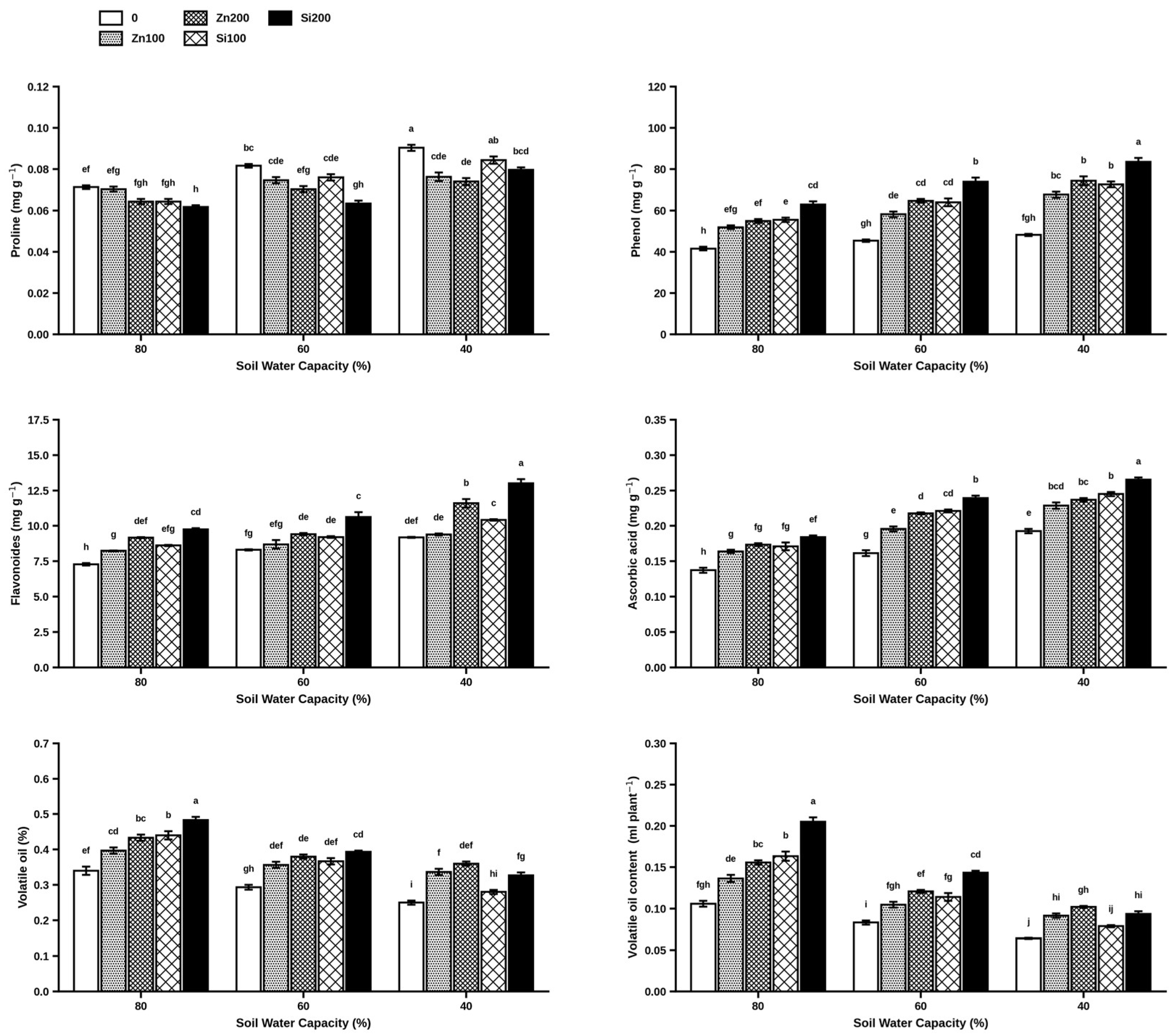
Two-way ANOVA revealed that both SWC and Si and Zn application significantly affected proline content (Table 2, Figure 3). The highest proline accumulation (0.09 mg g−1 DW) occurred under drought stress (40% SWC, with no Si or Zn application). Drought also significantly affected sweet basil’s antioxidant properties—boosting phenolic compounds, flavonoids, and ascorbic acid. For all SWC levels, the Si200 treatment produced the highest value for all three antioxidant molecules, with the highest values observed for the 40% SWC + Si200 treatment: phenol (83.6 mg GAE g−1 DW), flavonoids (13.0 µg QE g−1 DW), and ascorbic acid (0.27 mg g−1 FW). Across all treatment combinations, the interaction between SWC and Si and Zn application levels significantly influenced the concentration of these antioxidants (Figure 3). The expression of volatile oil and volatile oil content were also significantly influenced by the treatments imposed in these experiments. The highest values for volatile oil percentage (0.483%) and volatile oil content (0.21 mL plant−1) were obtained with the 80% SWC + Si200 treatment, significantly outperforming other treatments. In contrast, drought stress (40% SWC, with no Si and Zn application) significantly reduced volatile oil percentage and content (Figure 3).

3.4. Correlation of Morphological, Physiological, and Biochemical Traits with Dry Plant Biomass and Volatile Oil Parameters

Sweet basil’s morphological traits (plant height, number of branches per plant, leaf area, and fresh plant biomass) showed strong positive correlations with dry plant biomass, volatile oil percentage, and volatile oil content (Table 3). Plant height had the strongest correlation with dry plant biomass (r = 0.98 ***), volatile oil percentage (r = 0.93 ***), and volatile oil content (r = 0.98 ***). Similarly, leaf area strongly influenced dry plant biomass (r = 0.96 ***) and volatile oil content (r = 0.95 ***), supporting the relationship between sweet basil canopy size and yield components. Photosynthetic pigments (chlorophyll and carotenoids) were significant correlated with dry plant biomass and both volatile oil parameters. Phosphorus showed the strongest links to dry biomass (r = 0.98 ***), volatile oil percentage (r = 0.94 ***), and volatile oil content (r = 0.98 ***). Strong positive correlations among growth-related traits, photosynthetic pigments, and phosphorous levels with dry plant biomass, volatile oil percentage, and volatile oil content likely reflect their biological relationships under drought and Si and Zn application treatments. In contrast, stress-related compounds (proline, phenolics, flavonoids, ascorbic acid) showed weak or negative correlations with dry plant biomass, volatile oil percentage, and volatile oil content, suggesting they function in stress defense rather than enhancing yield components.

4. Discussion

Considering current drought conditions in Egypt, and the increased threat of even more extreme drought events in the future, this study was designed to evaluate the independent effects of foliar application of Si and Zn on the growth, physiological responses, biochemical traits, and essential oil content of sweet basil under different soil water capacities. Previous studies have reported the negative consequences of drought on sweet basil, including at the morphological or whole-plant level (reduced fresh and dry biomass accumulation), the physiological level (diminished chlorophyll fluorescence), and the biochemical level (decreased essential oil content) [25,33,34,35,46,47,59]. Foliar applications of Si and Zn have previously been shown to maintain pigment levels, ion balance, and essential oil content in sweet basil under drought conditions [26,27,28]. Thus, we hypothesized that Si and Zn applications would alleviate drought-induced reductions in plant growth and productivity. We further hypothesized that Si would provide greater protective effects than Zn, under imposed drought stress conditions.
The results of this study confirm that drought stress severely restricts sweet basil growth (plant height and number of branches per plant), leaf area, fresh plant biomass, and dry plant biomass. However, our results also reveal that Si and Zn foliar applications alleviated the negative effects of drought stress. Our results are therefore consistent with prior studies reporting drought-induced reductions in sweet basil growth [25,33,34,35,46,47,59]. The literature suggests that drought stress limits nutrient uptake and transport [60], while Si helps improve drought resilience by enhancing soil water uptake and nutrient uptake [61,62,63]. Zinc, as an enzymatic cofactor, has also been reported to support growth and mitigate oxidative stress by reducing reactive oxygen species [64].
Additionally, our results also indicate that drought reduces photosynthetic pigment and macronutrient levels, but foliar application of Si or Zn effectively mitigated drought-induced photosynthetic pigment loss. Application of Si has been shown to improve photosynthetic processes and reduce transpiration and membrane permeability under stress [65,66,67]. It may also contribute to enhanced antioxidant protection, thus reducing oxidative stress, as suggested in previous studies [68,69]. Zinc acts as a structural cofactor for many enzymes [64] and may be associated with improved membrane integrity under drought stress, thus improving photosynthesis and leaf pigment content [70,71,72]. Drought reduces the photosynthetic pigment content by disrupting chlorophyll biosynthesis and increasing chlorophyllase activity [27,73]. However, Si application is reported to more effectively enhance chlorophyll by supporting pigment biosynthesis and various chloroplast functions. Our results are consistent with this effect of Si application. Our results indicate that foliar application of Si or Zn effectively counteracted drought-induced photosynthetic pigment loss. Similarly, it is likely that Zn application improves membrane integrity and promotes phytochemical accumulation [70].
Drought stress has been shown to limit nutrient uptake by impairing root growth, transpiration, and photosynthesis, whereas Si and Zn application improves nutrient absorption and physiological performance under drought stress [74]. In addition, Si application increases water-use efficiency and photosynthesis [75], supporting biochemical function and enhancing antioxidant defenses [76]. We found that the highest percentages of nitrogen, phosphorous, and potassium occurred under 80% SWC, especially with the 80% SWC + Si200 treatment. Proline, a key osmo-protectant, enhances drought tolerance [77], and its accumulation across our three SWC (drought) treatments likely results from increased synthesis and reduced degradation with increased drought stress [45].
Our results are consistent with previous studies of other plants in the Lamiaceae family, Mentha arvensis and Salvia officinalis, which revealed that drought stress reduced essential oil content (i.e., percentage) and yield [34,78,79]. Water deficit is a major constraint on essential oil biosynthesis due to impaired phytochemical production [20,80]. We found that maximum volatile oil percentage and content were obtained under 80% SWC with Si200, significantly outperforming other treatments. Sweet basil holds economic value in the food, pharmaceutical, and cosmetic industries, primarily due to its essential oil content [40]; thus, our results are significant because they show that the negative consequences of drought can be alleviated by foliar application of Si and Zn (especially Si).
Although we did not measure these parameters, cell wall rigidity and silica deposition in epidermal tissues, which can increase drought tolerance by reducing transpiration water loss and improve stomatal regulation, may be enhanced by Si application. Silicon application has also been reported to stimulate antioxidant defense systems to enhance drought stress responses [24,27]. The elevated levels of phenolics, flavonoids, and ascorbic acid we detected in this study under drought conditions (all three molecules have antioxidant properties) are consistent with the theory of stress-induced secondary metabolism, whereby plants increase synthesis of protective secondary metabolites to counter oxidative stress and improve stress adaptation [20,30,45]. Elucidating the proximate mechanisms by which Si and Zn application confers drought tolerance to sweet basil will be the subject of future research.
A wealth of previous studies has demonstrated the beneficial effects of individually applying Si or Zn to sweet basil and other crop plants to mitigate the negative consequences of drought [24,25,26,27,28,29,30,31,32,33,34,35,60,61,62,63,64,65,66,67,68,69,70,71,72,73,74,75,76,81]. The goal of the research reported here was to perform a systematic assessment of the relative effectiveness of the separate application of Si and Zn to mitigate drought, within the same experimental design. While we are confident in the findings of this study, we understand this study also has some limitations. Because sweet basil is a widely cultivated herb that holds economic value in the food, pharmaceutical, and cosmetic industries [36,40], caution should be exercised when plants that receive exogenous treatments are used and consumed by people, due to human health (food safety) concerns. In this study, we applied Si in the form of potassium silicate, and we applied Zn in the form of zinc sulfate, but we did not assess whether the application of Si and Zn, at the concentrations used here, has negative consequences for human health and food safety. Such an assessment should be part of future research. However, according to the USA Environmental Protection Agency (EPA), Si comprises 32% of the Earth’s crust, and silicic acid salts (silicates) are the most common form of Si around the world. The EPA further states that “potassium silicate is a naturally occurring compound that is not expected to have adverse effects on humans and the environment” (https://www3.epa.gov/pesticides/chem_search/reg_actions/registration/fs_PC-072606_01-Sep-07.pdf (accessed on 28 May 2026)) [82]. According to the World Health Organization (WHO), the dietary reference value (i.e., the recommended daily intake) of Zn ranges from 6.7 to 15 mg/Day, with the recommendations of zinc intake for men and women in specific countries (China, Europe, India, and the USA) occurring within the WHO dietary reference value [83]. Excesses of the recommended daily intake of Zn may result in symptoms such as anemia, nausea, vomiting, diarrhea, abdominal pain, and impaired immune function. The concentration of Zn we applied to sweet basil leaves in this experiment was 100 mg L−1 (Zn200) and 200 mg L−1 (Zn200); thus, the human health concerns of the application of Zn at these concentrations should be assessed before we can recommend that such treatments be employed in commercial agricultural systems.
Additionally, although the present study quantified essential oil percentage and yield, future studies should investigate changes in essential oil composition and chemotype profiles using GC-MS analysis to better understand the influence of Si and Zn on sweet basil oil quality. This study was conducted under pot-based open-field conditions, which may not fully represent field-scale agricultural systems. Further field-scale studies are necessary before broad agronomic recommendations based on the application of Si and Zn can be reliably provided. Finally, future research should conduct molecular analyses to better understand the proximate mechanisms of drought tolerance associated with Si and Zn applications and perform an evaluation of field application techniques to optimize agricultural productivity and quality under drought conditions, which are expected to increase in frequency and intensity with future climate change.

5. Conclusions

With a lack of precipitation, erratic precipitation patterns, and ongoing climate change, enhancing crop resilience through application of micronutrients such as Si and Zn offers a promising solution to the negative consequences of drought stress. This study reveals how soil water capacity treatments and foliar application of different levels of Si and Zn affect sweet basil’s response to drought. Low water availability reduced macronutrients (N, P, K) and essential oil yield, harming plant health. However, silicon application (especially 200 mg L−1) enhanced drought tolerance in sweet basil through the maintenance of photosynthetic pigments and the stimulation of an osmo-protectant (proline) and antioxidant-related metabolites (phenolics, flavonoids, ascorbic acid). Compared with Zn, Si provided greater protection against the negative physiological and biochemical effects of drought and led to higher plant biomass and essential oil production. Although additional research is warranted, these findings support further exploration for using Si foliar application as a sustainable strategy for sweet basil cultivation under water-limited conditions.

Author Contributions

Conceptualization, Y.M.S., W.S.S., A.M.A. and S.J.N.; methodology, Y.M.S., W.S.S., A.M.A. and S.J.N.; investigation, Y.M.S. and W.S.S., data collection, curation, protectant analysis, and evaluation, Y.M.S., W.S.S., A.M.A. and S.J.N.; visualization, Y.M.S.; writing—original draft preparation, Y.M.S. and S.J.N.; writing—review and editing, W.S.S., A.M.A. and S.J.N.; supervision, W.S.S. and A.M.A.; funding acquisition and project management, A.M.A. All authors have read and agreed to the published version of the manuscript.

Funding

The authors received funding for this study from the Deanship of Research and Graduate Studies at King Khalid University through the Large Group Project under grant number (RGP.2/440/46).

Data Availability Statement

All data obtained during this project are contained within this article. Further inquiries for information can be directed at the corresponding authors.

Acknowledgments

The authors extend their appreciation to the Deanship of Research and Graduate Studies at King Khalid University for funding this work through the Large Group Project under grant number (RGP.2/440/46). S.J.N. acknowledges financial support from the Department of Biological Sciences at Boise State University to work on this project and prepare this manuscript. We confirm that ChatGPT (OpenAI, GPT-5.3) was used for language refinement, specifically to write portions of the Section 2 to reduce and hopefully eliminate the potential for plagiarism of the text in the papers cited in this section of the manuscript. For instance, ChatGPT was used to create (modify) the text in the “Experimental design and treatment” subsection, of the Section 2, in which we describe our Si and Zn treatments and how we determined soil water capacity (SWC), to minimize text similarity with citations 48 and 49. We did not use ChatGPT to generate scientific content or for study design, data generation, data analysis and interpretation, or the tables and figures presented in this manuscript.

Conflicts of Interest

The authors declare no conflicts of interest.

References

  1. Nilsen, E.T.; Orcutt, D.M. The Physiology of Plants Under Stress: Abiotic Factors; John Wiley & Sons: London, UK, 1996. [Google Scholar]
  2. Lerner, H.R. Plant Responses to Environmental Stresses; Marcel Dekker Inc.: New York, NY, USA, 1999. [Google Scholar]
  3. Alqudah, A.M.; Samarah, N.H.; Mullen, R.E. Drought stress effect on crop production, seed set, yield and quality. In Alternative Farming Systems, Biotechnology, Drought Stress and Ecological Fertilisation; Lichtfouse, E., Ed.; Springer: Dordrecht, The Netherlands, 2011; pp. 193–213. [Google Scholar]
  4. Soliman, W.S.; Abbas, A.M.; Novak, S.J.; Fujimori, M.; Tase, K.; Sugiyama, S. Inheritance of heat tolerance in perennial ryegrass (Lolium perenne, Poaceae): Evidence from progeny array analysis. PeerJ 2021, 9, e11782. [Google Scholar] [CrossRef]
  5. Begna, T. Effects of drought stress on crop production and productivity. Int. J. Res. Stud. Agric. Sci. 2020, 6, 34–43. [Google Scholar] [CrossRef]
  6. Farooq, M.; Wahid, A.; Kobayashi, N.; Fujita, D.; Basra, S.M.A. Plant drought stress: Effects, mechanisms and management. Agron. Sustain. Dev. 2009, 29, 185–212. [Google Scholar] [CrossRef]
  7. Stagnari, F.; Galieni, A.; Pisante, M. Drought stress effects on crop quality. In Water Stress and Crop Plants: A Sustainable Approach; Ahmad, P., Ed.; John Wiley & Sons: London, UK, 2016; Volume 2, pp. 375–392. [Google Scholar]
  8. Hussain, S.; Hussain, S.; Qadir, T.; Khaliq, A.; Ashraf, U.; Parveen, A.; Saqib, M.; Rafiq, M. Drought stress in plants: An overview on implications, tolerance mechanisms and agronomic mitigation strategies. Plant Sci. Today 2019, 6, 389–402. [Google Scholar] [CrossRef]
  9. Dietz, K.-J.; Zorb, C.; Geilfus, C.-M. Drought and crop yield. Plant Biol. 2021, 23, 881–893. [Google Scholar] [CrossRef]
  10. Seleiman, M.F.; Al-Suhaibani, N.; Ali, N.; Akmal, M.; Alotaibi, M.; Refay, Y.; Dindaroglu, T.; Abdul-Wajid, H.H.; Battaglia, M.L. Drought stress impacts on plants and different approaches to alleviate its adverse effects. Plants 2021, 10, 259. [Google Scholar] [CrossRef]
  11. Niu, S.; Luo, Y.; Li, D.; Cao, S.; Xia, J.; Li, J.; Smith, M.D. Plant growth and mortality under climate extremes: An overview. Environ. Exp. Bot. 2014, 98, 13–19. [Google Scholar] [CrossRef]
  12. Stott, P. How climate change affects extreme weather events. Science 2016, 352, 1517–1518. [Google Scholar] [CrossRef]
  13. IPCC. Climate change 2021: The physical basis. In Contribution of Working Group I to the Sixth Assessment Report of the Intergovernmental Panel on Climate Change; Masson-Delmotte, V.P., Zhai, A., Pirani, S.L., Connors, C., Pean, S., Berger, N., Caud, Y., Chen, L., Goldfarb, M.I., Eds.; Cambridge University Press: New York, NY, USA, 2021. [Google Scholar]
  14. Okorie, V.O.; Mphambukeli, T.N.; Amusan, S.O. Exploring the political economy of water and food security nexus in BRICS. Afr. Insights 2019, 48, 21–38. [Google Scholar]
  15. Begna, T. Impacts of drought stress on crop production and its management options. Int. J. Res. Stud. Agric. Sci. 2022, 8, 1–13. [Google Scholar] [CrossRef]
  16. Ault, T.R. On the essentials of drought in a changing climate. Science 2020, 368, 256–260. [Google Scholar] [CrossRef] [PubMed]
  17. Melton, A.E.; Moran, K.; Martinez, P.; Ellestad, P.; Milliken, E.; Morales, W.; Child, A.W.; Richardson, B.A.; Serpe, M.; Novak, S.J.; et al. A genotype x environment experiment reveals contrasting response strategies to drought between populations of a keystone species (Artemisia tridentata; Asteraceae). Plant-Environ. Interact. 2023, 4, 201–214. [Google Scholar] [CrossRef]
  18. Redza-Dutordoir, M.; Averill-Bates, D.A. Activation of Apoptosis Signaling Pathways by Reactive Oxygen Species. Biochem. Biophys. Acta Mol. Cell Res. 2016, 1863, 2977–2992. [Google Scholar] [CrossRef]
  19. Soliman, W.S.; Fujimori, M.; Tase, K.; Sugiyama, S. Oxidative stress and physiological damage under prolonged heat stress in C3 grass Lolium perenne. Grassl. Sci. 2011, 57, 101–106. [Google Scholar] [CrossRef]
  20. Mahmoud, N.; Abdou, M.A.H.; Salaheldin, S.; Soliman, W.S. Lemongrass growth, essential oil, and active substances as affected by water deficit. Horticulturae 2022, 8, 250. [Google Scholar] [CrossRef]
  21. Bistgani, Z.E.; Allen, V.; Barker, A.V.; Hashemi, M. Physiology of medicinal and aromatic plants under drought stress. Crop J. 2024, 12, 330–339. [Google Scholar] [CrossRef]
  22. Leck, M.A.; Parker, V.T.; Simpson, R.L. Seedling Ecology and Evolution; Cambridge University Press: New York, NY, USA, 2008. [Google Scholar]
  23. Konapala, G.; Mishra, A.K.; Wada, Y.; Mann, M.E. Climate change will affect global water availability through compounding changes in seasonal precipitation and evaporation. Nat. Commun. 2020, 11, 3044. [Google Scholar] [CrossRef]
  24. Wang, M.; Wang, R.; Mur, L.A.J.; Ruan, J.; Shen, Q.; Guo, S. Functions of Silicon in Plant Drought Stress Responses. Hortic. Res. 2021, 8, 254. [Google Scholar] [CrossRef]
  25. Al Murad, M.; Khan, A.; Muneer, S. Silicon in horticultural crops: Cross-talk, signaling, and tolerance mechanism under salinity stress. Plants 2020, 9, 460. [Google Scholar] [CrossRef]
  26. Abdelaal, K.A.A.; Mazrou, Y.S.A.; Hafez, Y.M. Silicon foliar application mitigates salt stress in sweet pepper plants by enhancing water status, photosynthesis, antioxidant enzyme activity and fruit yield. Plants 2020, 9, 733. [Google Scholar] [CrossRef] [PubMed]
  27. Souri, Z.; Khanna, K.; Karimi, N.; Ahmad, P. Silicon and plants: Current knowledge and future prospects. J. Plant Growth Regul. 2021, 40, 906–925. [Google Scholar] [CrossRef]
  28. Farouk, S.; Omar, M.M. Sweet basil growth, physiological and ultrastructural modification, and oxidative defense system under water deficit and silicon forms treatment. J. Plant Growth Regul. 2020, 39, 1307–1331. [Google Scholar] [CrossRef]
  29. Umair Hassan, M.; Aamer, M.; Umer Chattha, M.; Haiying, T.; Shahzad, B.; Barbanti, L.; Nawaz, M.; Rasheed, A.; Afzal, A.; Liu, Y.; et al. The critical role of zinc in plants facing drought stress. Agriculture 2020, 10, 396. [Google Scholar] [CrossRef]
  30. Soliman, W.S.; El-Soghayer, M.H.; Salaheldin, S.; Abbas, A.M.; Gahory, A.-A. Salinity stress in Calendula officinalis: Negative growth impacts offset by increased flowering yield and the mitigating role of zinc. Horticulturae 2024, 10, 1357. [Google Scholar] [CrossRef]
  31. Marreiro, D.D.N.; Cruz, K.J.C.; Morais, J.B.S.; Beserra, J.B.; Severo, J.S.; De Oliveira, A.R.S. Zinc and Oxidative stress: Current mechanisms. Antioxidants 2017, 6, 24. [Google Scholar] [CrossRef] [PubMed]
  32. Noman, A.; Aqeel, M.; Khalid, N.; Islam, W.; Sanaullah, T.; Anwar, M.; Khan, S.; Ye, W.; Lou, Y. Zinc finger protein transcription factors: Integrated line of action for plant antimicrobial activity. Microb. Pathol. 2019, 132, 141–149. [Google Scholar] [CrossRef] [PubMed]
  33. Jeshni, M.G.; Mousavinik, M.; Khammari, I.; Rahimi, M. The changes of yield and essential oil components of german chamomile (Matricaria recutita L.) under application of phosphorus and zinc fertilizers and drought stress conditions. J. Saudi Soc. Agric. Sci. 2017, 16, 60–65. [Google Scholar] [CrossRef]
  34. Ulusu, F. Zinc Fertilizer Applications to Ocimum basilicum L. under water stress: Changes in the total phenolic and flavonoid content, essential oil compounds and morphological properties. J. Agric. Prod. 2023, 4, 117–127. [Google Scholar] [CrossRef]
  35. Zargar, S.M.; Mahajan, R.; Bhat, J.A.; Nazir, M.; Deshmukh, R. Role of silicon in plant stress tolerance: Opportunities to achieve a sustainable cropping system. 3 Biotech 2019, 9, 73. [Google Scholar] [CrossRef]
  36. Karpiński, T.M. Essential oils of lamiaceae family plants as antifungals. Biomolecules 2020, 10, 103. [Google Scholar] [CrossRef]
  37. Taek, M.M.; Bambang, P.E.W.; Agil, M. Plants Used in traditional medicine for treatment of malaria by tetun ethnic people in West Timor, Indonesia. Asian Pac. J. Trop. Med. 2018, 11, 630–637. [Google Scholar] [CrossRef]
  38. Silalahi, M.; Nisyawati; Walujo, E.B.; Supriatna, J.; Mangunwardoyo, W. The Local knowledge of medicinal plants trader and diversity of medicinal plants in the kabanjahe traditional market, North Sumatra, Indonesia. J. Ethnopharmacol. 2015, 175, 432–443. [Google Scholar] [CrossRef]
  39. Kasmawati, H.; Ihsan, S.; Munasari, D.; Ode Elafita, W. Ethnomedicine Studies of traditional medicinal plants of the muna tribe in the village of Bungi, Southeast Sulawesi Province of Indonesia. Int. J. Sci. Res. 2019, 8, 1882–1887. [Google Scholar]
  40. Maia, S.S.S.; da Silva, R.C.P.; de Oliveira, F.A.; da Silva, O.M.P.; da Silva, A.C.; Candido, W.S. Responses of Basil cultivars to irrigation water salinity. Rev. Bras. Eng. Agrícola Ambient. 2017, 21, 44–49. [Google Scholar] [CrossRef]
  41. Ali, S.I.; Sheikh, W.M.; Rather, M.A.; Venkatesalu, V.; Muzamil Bashir, S.; Nabi, S.U. Medicinal plants: Treasure for antiviral drug discovery. Phytother. Res. 2021, 35, 3447–3483. [Google Scholar] [CrossRef] [PubMed]
  42. Süntar, I. Importance of ethnopharmacological studies in drug discovery: Role of medicinal plants. Phytochem. Rev. 2020, 19, 1199–1209. [Google Scholar] [CrossRef]
  43. El-Sonbaty, A.E.; Farouk, S.; Al-Yasi, H.M.; Ali, E.F.; Abdel-Kader, A.A.S.; El-Gamal, S.M. Enhancement of rose scented geranium plant growth, secondary metabolites, and essential oil components through foliar applications of iron (nano, sulfur and chelate) in alkaline soils. Agronomy 2022, 12, 2164. [Google Scholar] [CrossRef]
  44. Vilanova, C.M.; Pereira Coelho, K.P.; Luza, T.R.S.A.; Silveira, D.P.B.; Coutinho, D.F.; De Moura, F.G. Effect of different water application rates and nitrogen fertilisation on growth and essential oil of clove basil (Ocimum gratissimum L.). Ind. Crops Prod. 2018, 125, 186–197. [Google Scholar] [CrossRef]
  45. Mahmoud, N.; Abdou, M.A.H.; Salaheldin, S.; Soliman, W.S.; Abbas, A.M. The Impact of irrigation intervals and npk/yeast on the vegetative growth characteristics and essential oil content of lemongrass. Horticulturae 2023, 9, 365. [Google Scholar] [CrossRef]
  46. Kalamartzis, I.; Menexes, G.; Georgiou, P.; Dordas, C. Effect of water stress on the physiological characteristics of five basil (Ocimum basilicum L.) cultivars. Agronomy 2020, 10, 1029. [Google Scholar] [CrossRef]
  47. Radácsi, P.; Inotai, K.; Sárosi, S.; Czövek, P.; Bernáth, J.; Németh, É. Effect of water supply on the physiological characteristic and production of basil (Ocimum basilicum L.). Eur. J. Hortic. Sci. 2010, 75, 193–197. [Google Scholar] [CrossRef]
  48. Amer, H.; Hendawy, S.; Liu, J.; Soliman, W.S. Impact of zinc and manganese on oregano (Origanum vulgare L. subsp. hirtum) growth and essential oil composition. Egypt. J. Chem. 2024, 67, 139–149. [Google Scholar] [CrossRef]
  49. Reynolds, S.G. The Gravimetric Method of Soil Moisture Determination. Part I. A Study of equipment, and methodological problems. J. Hydrol. 1970, 11, 258–273. [Google Scholar] [CrossRef]
  50. Lichtenthaler, H.K.; Wellburn, A.R. Determination of total carotenoids and chlorophylls a and b of leaf in different solvents. Biochem. Soc. Trans. 1985, 11, 591–592. [Google Scholar] [CrossRef]
  51. Motsara, M.R.; Roy, R.N. Guide to Laboratory Establishment for Plant Nutrient Analysis; FAO Fertilizer and Plant Nutrition Bulletin: Rome, Italy, 2008. [Google Scholar]
  52. Cooper, T.G. The Tools of Biochemistry; John Wiley & Sons: New York, NY, USA, 1977. [Google Scholar]
  53. Arbona, V.; Flors, V.; Jacas, J.; García-Agustín, P.; Gómez-Cadenas, A. Enzymatic and non-enzymatic antioxidant responses of carrizo citrange, a salt sensitive citrus rootstock, to different levels of salinity. Plant Cell Physiol. 2003, 44, 388–394. [Google Scholar] [CrossRef] [PubMed]
  54. Lister, E.; Wilson, P. Measurement of Total Phenolics and ABTS Assay for Antioxidant Activity; Crop Research Institute: Lincoln, NB, USA, 2001. [Google Scholar]
  55. Sevket, A.L.P.; Ercisli, S.; Jurikova, T.; Cakir, O.; Gozlekci, S. Bioactive content of rose hips of different wildly grown Rosa dumalis genotypes. Not. Bot. Horti Agrobot. Cluj-Napoca 2016, 44, 472–476. [Google Scholar] [CrossRef]
  56. Sadasivam, S.; Manickam, A. Biochemical Methods, 3rd ed.; New Age International: Delhi, India, 2008. [Google Scholar]
  57. Egyptian Pharmacopoeia; General Organization for Governmental, Ministry of Health: Cairo, Egypt, 1984.
  58. Snedecor, G.W.; Cochran, W.G. Statistical Methods, 6th ed.; Iowa State University Press: Ames, IA, USA, 1980. [Google Scholar]
  59. Ozturk, M.; Turkyilmaz Unal, B.; García-Caparrós, P.; Khursheed, A.; Gul, A.; Hasanuzzaman, M. Osmoregulation and its actions during the drought stress in plants. Physiol. Plant. 2021, 172, 1321–1335. [Google Scholar] [CrossRef]
  60. Shoormij, F.; Mirlohi, A.; Saeidi, G.; Sabzalian, M.R.; Shirvani, M. Zinc Foliar application may alleviate drought stress in wheat species through physiological changes. Plant Stress 2024, 13, 100534. [Google Scholar] [CrossRef]
  61. Pascual, M.B.; Echevarria, V.; Gonzalo, M.J.; Hernández-Apaolaza, L. Silicon addition to soybean (Glycine max L.) plants alleviate zinc deficiency. Plant Physiol. Biochem. 2016, 108, 132–138. [Google Scholar] [CrossRef] [PubMed]
  62. Ozbahce, A.; Fuat Tari, A.; Gonulal, E.; Simsekli, N. Zeolite for enhancing yield and quality of potatoes cultivated under water-deficit conditions. Potato Res. 2018, 61, 247–259. [Google Scholar] [CrossRef]
  63. Verma, K.K.; Singh, P.; Song, X.P.; Malviya, M.K.; Singh, R.K.; Chen, G.L.; Solomon, S.; Li, Y.R. Mitigating climate change for sugarcane improvement: Role of silicon in alleviating abiotic stresses. Sugar Tech 2020, 22, 741–749. [Google Scholar] [CrossRef]
  64. Marschner, H. Mineral Nutrition of Higher Plants, 2nd ed.; Academic Press: New York, NY, USA, 1995. [Google Scholar]
  65. Putra, E.T.S.; Purwanto, B.H. Physiological responses of oil palm seedlings to the drought stress using boron and silicon applications. J. Agron. 2015, 14, 49. [Google Scholar] [CrossRef]
  66. Maghsoudi, K.; Emam, Y.; Ashraf, M. Foliar application of silicon at different growth stages alters growth and yield of selected wheat cultivars. J. Plant Nutr. 2016, 39, 1194–1203. [Google Scholar] [CrossRef]
  67. Asgharipour, M.R.; Mosapour, H. A Foliar application silicon enhances drought tolerance in fennel. J. Anim. Plant Sci. 2016, 26, 1056–1062. [Google Scholar]
  68. Tale Ahmad, S.; Haddad, R. Study of Silicon Effects on antioxidant enzyme activities and osmotic adjustment of wheat under drought stress. Czech J. Genet. Plant Breed. 2011, 47, 17–27. [Google Scholar] [CrossRef]
  69. Shi, Y.; Zhang, Y.; Yao, H.; Wu, J.; Sun, H.; Gong, H. Silicon improves seed germination and alleviates oxidative stress of bud seedlings in tomato under water deficit stress. Plant Physiol. Biochem. 2014, 78, 27–36. [Google Scholar] [CrossRef]
  70. Babaeian, M.; Heidari, M.; Ghanbari, A. Effect of water stress and foliar micronutrient application on physiological characteristics and nutrient uptake in sunflower (Helianthus annuus L.). Iran. J. Crop Sci. 2010, 12, 311–391. [Google Scholar]
  71. Karim, M.; Zhang, Y.Q.; Zhao, R.R.; Chen, X.P.; Zhang, F.S.; Zou, C.Q. Alleviation of drought stress in winter wheat by late foliar application of zinc, boron, and manganese. J. Plant Nutr. Soil Sci. 2012, 175, 142–151. [Google Scholar] [CrossRef]
  72. Ma, D.; Sun, D.; Wang, C.; Ding, H.; Qin, H.; Hou, J.; Huang, X.; Xie, Y.; Guo, T. Physiological responses and yield of wheat plants in zinc-mediated alleviation of drought stress. Front. Plant Sci. 2017, 8, 860. [Google Scholar] [CrossRef] [PubMed]
  73. Farouk, S.; Arafa, S.A.; Nassar, M.A. Improving drought tolerance in corn (Zea mays L.) by foliar application with salicylic acid. Int. J. Environ. 2018, 7, 104–123. [Google Scholar]
  74. Fahad, S.; Bajwa, A.A.; Nazir, U.; Anjum, S.A.; Farooq, A.; Zohaib, A.; Sadia, S.; Nasim, W.; Adkins, S.; Saud, S.; et al. Crop production under drought and heat stress: Plant responses and management options. Front. Plant Sci. 2017, 8, 1147. [Google Scholar] [CrossRef]
  75. Johnson, S.N.; Chen, Z.H.; Rowe, R.C.; Tissue, D.T. Field application of silicon alleviates drought stress and improves water use efficiency in wheat. Front. Plant Sci. 2022, 13, 1030620. [Google Scholar] [CrossRef]
  76. Rangwala, T.; Bafna, A.; Vyas, N.; Gupta, R. Role of soluble silica in alleviating oxidative stress in soybean Crop. Indian J. Agric. Res. 2018, 52, 9–15. [Google Scholar] [CrossRef]
  77. Arbona, V.; Manzi, M.; de Ollas, C.; Gómez-Cadenas, A. Metabolomics as a tool to investigate abiotic stress tolerance in plants. Int. J. Mol. Sci. 2013, 14, 4885–4911. [Google Scholar] [CrossRef] [PubMed]
  78. Misra, A.; Srivastava, N. Influence of water stress on japanese mint. J. Herbs Spices Med. Plants 2000, 7, 51–58. [Google Scholar] [CrossRef]
  79. Govahi, M.; Ghalavand, A.; Nadjafi, F.; Sorooshzadeh, A. Comparing different soil fertility systems in sage (Salvia officinalis) under water deficiency. Ind. Crops Prod. 2015, 74, 20–27. [Google Scholar] [CrossRef]
  80. García-Caparrós, P.; Romero, M.J.; Llanderal, A.; Cermeño, P.; Lao, M.T.; Segura, M.L. Effects of drought stress on biomass, essential oil content, nutritional parameters, and costs of production in six lamiaceae species. Water 2019, 11, 573. [Google Scholar] [CrossRef]
  81. Ay, E.B.; Açıkgöz, M.A.; Kocaman, B.; Mesci, S.; Kocaman, B.; Yıldırım, T. Zinc and phosphorus fertilization in Galanthus elwesii Hook: Changes in the total alkaloid, flavonoid, and phenolic content, and evaluation of anti-cancer, anti-microbial, and antioxidant activities. Sci. Hortic. 2023, 317, 112034. [Google Scholar] [CrossRef]
  82. EPA Potassium Silicate (072606) Fact Sheet. Available online: https://www3.epa.gov/pesticides/chem_search/reg_actions/registration/fs_PC-072606_01-Sep-07.pdf (accessed on 28 May 2026).
  83. Schofs, H.; Schmidt, J.; Rink, L. Zinc toxicity: Understanding the limits. Molecules 2024, 24, 3130. [Google Scholar] [CrossRef]
Figure 2. Effect of silicon and zinc application on photosynthetic pigments and macronutrient content of sweet basil under well-watered and drought conditions. Values represent means ± SDs obtained from conducting these experiments over two growing seasons. Different letters indicate significant differences among treatments according to Tukey’s HSD test at p ≤ 0.05.
Agronomy 16 01155 g002
Figure 3. Effect of silicon and zinc application on proline and other biochemical characters of sweet basil under well-watered and drought conditions, including volatile oil. Values represent means ± SDs obtained from conducting these experiments over two growing seasons. Different letters indicate significant differences among treatments according to Tukey’s HSD test at p ≤ 0.05.
Agronomy 16 01155 g003
Table 1. Physical and chemical characteristics of the soil used in this study.
CharacteristicsValueCharacteristicsValue
Particle size distribution
Sand %21.50OM %1.55
Silt %25.50CaCO3%2.50
Clay %53.00Total N %0.11
TextureClay loamAvailable P (mg kg−1)6.50
pH (1:2.5 extract)7.50Available K (mg kg−1)200
EC (1:2.5 extract) dSm−10.45Available S (mg kg−1)3.00
Available EDTA extractable micronutrients (mg kg−1)
Zn12.00Mn11.09
Fe9.25Cu1.10
Table 2. F value and significant probability of sweet basil morphological, physiological, and biochemical characters as affected by soil water capacity (SWC), micronutrient (Si/Zn) treatments, and their interaction.
CharactersSWCMicronutrient TreatmentInteraction
Plant height526.1 ***146.7 ***12.08 ***
Number of branches per plants485.4 ***362.8 ***7.25 ***
Leaf area1059.1 ***305.0 ***14.82 ***
Fresh plant biomass1171.1 ***283.4 ***42.58 ***
Dry plant biomass724.8 ***177.6 ***22.32 ***
Total chlorophyll3.60 *3.93 *0.67 ns
Total carotenoids369.3 ***451.4 ***8.44 ***
Nitrogen 1190.4 ***140.1 ***22.00 ***
Phosphorus226.8 ***57.2 ***5.37 ***
Potassium1156.5 ***496.5 ***26.70 ***
Proline136.2 ***39.9 ***7.65 ***
Total phenol167.7 ***172.5 ***4.22 **
Total flavonoid204.3 ***132.2 ***7.54 ***
Ascorbic acid551.1 ***171.4 ***4.77 **
Volatile oil (%)219.8 ***78.1 ***8.77 ***
Volatile oil content521.1 ***143.9 ***20.74 ***
*, **, *** indicates significance levels of 0.05, 0.01, and 0.001, respectively. ns indicates non-significant values.
Table 3. Correlation coefficients (Pearson r) of plant dry plant biomass as well as volatile oil percentage and content with other morphological, physiological, and biochemical characters of sweet basil.
CharactersDry Plant
Biomass
Volatile Oil (%)Volatile Oil Content
Plant height0.98 ***0.93 ***0.98 ***
Number of branches per plants0.89 ***0.91 ***0.90 ***
Leaf area0.96 ***0.91 ***0.95 ***
Fresh plant biomass0.98 ***0.89 ***0.97 ***
Total chlorophyll0.80 ***0.86 ***0.83 ***
Total carotenoids0.89 ***0.90 ***0.91 ***
Nitrogen 0.94 ***0.87 ***0.93 ***
Phosphorus0.98 ***0.94 ***0.98 ***
Potassium0.96 ***0.96 ***0.98 ***
Proline−0.33 ns−0.28 ns−0.31 ns
Total phenol−0.05 ns−0.05 ns−0.01 ns
Total flavonoid−0.14 ns−0.08 ns−0.11 ns
Ascorbic acid−0.32 ns−0.23 ns−0.29 ns
*** indicates a significance level of 0.001. ns indicates non-significant values.
Disclaimer/Publisher’s Note: The statements, opinions and data contained in all publications are solely those of the individual author(s) and contributor(s) and not of MDPI and/or the editor(s). MDPI and/or the editor(s) disclaim responsibility for any injury to people or property resulting from any ideas, methods, instructions or products referred to in the content.