Article

Optimal Nitrogen Application Rate and Planting Density Achieve High Yield and Nitrogen Use Efficiency via Synergistic Source–Sink Coordination in Winter Wheat


1
College of Resources and Environment, Henan Agricultural University, Zhengzhou 450046, China
2
College of Agronomy, National Engineering Research Center for Wheat, Henan Agricultural University, Zhengzhou 450046, China
3
State Key Laboratory of High-Efficiency Production of Wheat-Maize Double Cropping, Henan Agricultural University, Zhengzhou 450046, China
*
Authors to whom correspondence should be addressed.
Agronomy 2026, 16(12), 1151; https://doi.org/10.3390/agronomy16121151
Submission received: 7 May 2026 / Revised: 6 June 2026 / Accepted: 9 June 2026 / Published: 12 June 2026

Abstract

Optimizing the interaction between planting density and nitrogen (N) application rate is critical for simultaneously improving grain yield and nitrogen use efficiency (NUE) in winter wheat (Triticum aestivum L.). However, the underlying regulatory mechanism remains poorly understood in the fluvo-aquic soil region of the southern Huang–Huai–Hai Plain. This study aimed to elucidate the physiological mechanism by which planting density and nitrogen application interactively regulate source–sink coordination to achieve synergistic high grain yield and high NUE, and to screen the optimal local cultivation combination for winter wheat in southeastern Henan. A two-year consecutive field experiment was conducted from 2018 to 2020 in Shangshui, Henan, using a split-plot design. Three planting densities (D1: 225 × 104 plants ha−1; D2: 375 × 104 plants ha−1; D3: 525 × 104 plants ha−1) and five N rates (N0: 0; N1: 180; N2: 240; N3: 300; N4: 360 kg N ha−1) were established. Results demonstrated that planting density, N rate, and their interaction significantly regulated grain yield, NUE, and dry matter and N allocation, with consistent trends across both years. Increasing density enhanced total biomass and N accumulation, but dry matter and N partitioning to grains declined when density exceeded 375 × 104 plants ha−1. Grain yield exhibited a quadratic response to N rate; the optimal N rate for maximum yield decreased from 296.33 kg ha−1 at low density (D1) to 237.50–245.38 kg ha−1 at medium and high densities. The combination of 240 kg N ha−1 and 375 × 104 plants ha−1 (D2N2) produced the highest average grain yield (8875.35 kg ha−1), with simultaneous improvements in spike number and kernels per spike as well as superior dry matter and N partitioning to grains. This combination also maintained high nitrogen recovery efficiency (NRE) and nitrogen agronomic efficiency (NAE). Correlation analysis revealed that grain yield and NUE were significantly positively correlated with dry matter accumulation, N accumulation, and their partitioning proportions to grains. Overall, D2N2 achieved simultaneous high yield and high NUE by coordinately optimizing dry matter and N partitioning to grains. We therefore recommend reducing N fertilizer to approximately 240 kg ha−1 combined with a moderate planting density of 375 × 104 plants ha−1 as the preferred strategy for sustainable and intensive winter wheat production in the fluvo-aquic soil region of southeastern Henan and adjacent areas.

1. Introduction

Wheat (Triticum aestivum L.) is a staple crop in the global food supply. Improving grain yield and nitrogen use efficiency (NUE) is essential for ensuring food security and advancing green, sustainable agricultural development [1,2]. As China’s dominant winter wheat production region, the Huang–Huai–Hai Plain contributes approximately 80% of the national wheat yield. However, intensive production in this region has long been plagued by excessive nitrogen (N) fertilizer input, excessively high planting density, and uncoordinated N–density management [3,4,5]. These issues disrupt dry matter accumulation and partitioning, increase N losses via leaching and volatilization, and prevent simultaneous improvements in yield and NUE, creating a major bottleneck for green and efficient wheat production in the region [6,7,8].
Nitrogen regulates the entire process of wheat growth and development, dry matter accumulation and partitioning, N uptake and translocation, and yield formation [9,10,11]. Appropriate N application promotes dry matter production and optimizes assimilate translocation from vegetative organs to grains, thereby enhancing yield components. By contrast, excessive N application reduces dry matter translocation efficiency, severely suppresses nitrogen recovery efficiency (NRE) and nitrogen agronomic efficiency (NAE), and exacerbates environmental risks [12,13,14]. Previous studies indicate that total plant N accumulation increases continuously with rising N rate, while NRE and NAE decline significantly; grain N partitioning exhibits a quadratic pattern, increasing initially and then decreasing [7,9,15,16].
Planting density also strongly affects dry matter production, N uptake and utilization, and yield formation by shaping population structure and resource use efficiency [17,18]. Optimized density improves canopy structure, enhances population dry matter accumulation and spike number per unit area, and partially compensates for yield losses associated with reduced N input. Conversely, excessively high density intensifies intraspecific competition, restricts plant growth, and reduces kernels per spike, 1000-kernel weight, and N translocation capacity [19,20,21].
Notably, strong interactive effects exist between N rate and planting density. Rational combinations of these two factors can synergistically optimize population structure, dry matter partitioning, and N translocation, while strengthening source–sink coordination—representing a key strategy for simultaneous improvements in yield and NUE [22,23,24]. For example, in ridge-film furrow systems of northwest China, moderate increases in planting density combined with reduced N input significantly enhance leaf area index and dry matter accumulation, enabling high yield and efficient water and N use [25]. Additional studies confirm that under moderate N reduction, increased planting density promotes wheat uptake of deep soil N, reduces residual N, and improves N use efficiency while maintaining grain yield [2,5]. Thus, reducing N input while increasing planting density represents an effective cultivation strategy to synchronously improve yield and NUE.
Despite broad recognition of the importance of N–density interactions, most existing studies focus on single-factor regulation or short-term experiments. Systematic research based on long-term field experiments in the fluvo-aquic soil region of the southern Huang–Huai–Hai Plain remains limited. The mechanisms by which N–density interactions regulate wheat growth, dry matter, and N translocation to achieve simultaneous improvements in yield and NUE remain unclear, resulting in a lack of optimized, high-yielding, and high-efficiency N–density management schemes for this region [1,2,20]. Accordingly, this study tested three hypotheses: (1) an optimal N rate–planting density combination exists that simultaneously achieves high yield and high N efficiency in winter wheat; (2) increasing planting density can partially substitute N fertilizer to enable N reduction and efficiency improvement; and (3) the above interactive effects act mainly by regulating dry matter and N partitioning to grains.
To test these hypotheses, a two-year consecutive field experiment was conducted in the fluvo-aquic soil region of southeastern Henan from 2018 to 2020. This study elucidates how nitrogen–density interaction modulates yield formation and nitrogen use efficiency in winter wheat and identifies the locally optimal nitrogen and planting density combination for sustainable high-yield production.

2. Materials and Methods

2.1. Crop Material and Growth Conditions

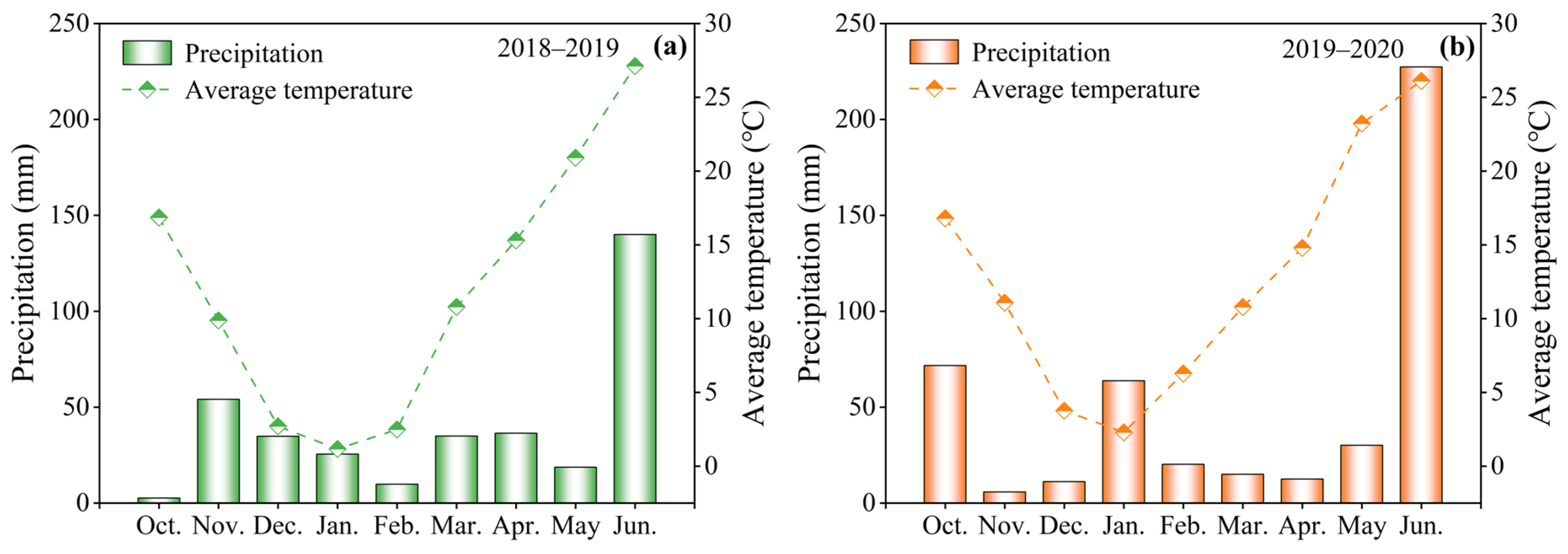
The experiment was conducted over two consecutive winter wheat growing seasons (2018–2019 and 2019–2020) at Yigang Family Farm in Shangshui County, Zhoukou City, Henan Province (114°42′ E, 33°31′ N). The region features a semi-humid continental monsoon climate transitioning from subtropical to warm temperate, with a mean annual temperature of 14.5 °C and mean annual precipitation of 785.1 mm, representing a typical location in the fluvo-aquic soil region of the southeastern Huang–Huai–Hai Plain. The experimental field followed a winter wheat–summer maize annual rotation system with total straw retention of preceding crops. The soil was classified as fluvo-aquic with a clay loam texture. Prior to sowing in 2018–2019, topsoil (0–20 cm) had 17.80 g kg−1 organic matter, 1.25 g kg−1 total N, 102.95 mg kg−1 available N, 263.64 mg kg−1 available K, 4.15 mg kg−1 available P, and a pH of 8.17. Before sowing in 2019–2020, topsoil contained 17.84 g kg−1 organic matter, 1.15 g kg−1 total N, 96.55 mg kg−1 available N, 211.92 mg kg−1 available K, 6.11 mg kg−1 available P, and a pH of 8.06. Soil nutrient concentrations were quantified using standard routine agrochemical analyses: soil organic matter via dichromate oxidation, total N by the Kjeldahl digestion procedure, available N with alkaline hydrolysis diffusion, available P following the Olsen extraction protocol, and available K via ammonium acetate extraction combined with flame photometry. Based on China’s official soil fertility classification criteria, the topsoil possessed medium-to-high levels of organic matter, total N and available K, while available P fell within the medium fertility category. Total precipitation during the two wheat seasons was 216.8 mm (2018–2019) and 230.3 mm (2019–2020), with average temperatures of 10.0 °C and 11.1 °C, respectively (Figure 1). In local commercial winter wheat production, farmers typically apply 240–300 kg N ha−1, with over-application of nitrogen fertilizer widely common across farm fields [4,7]. Unlike wheat cultivated on black soils or within rice–wheat double-cropping systems elsewhere, the region’s fluvo-aquic soils possess strong water and nutrient retention, alongside limited in-season precipitation for wheat, jointly shaping unique patterns of crop N uptake and yield formation. While abundant prior field work has examined standalone N management strategies on regional fluvo-aquic soils [1,16], comprehensive investigations into interactive effects between seeding density and N fertilization remain limited.

2.2. Experimental Design

A two-factor split-plot design was used. Planting density (D) was assigned to main plots and nitrogen application rate (N) to subplots. Three planting densities were established: 225 × 104 plants ha−1 (D1), 375 × 104 plants ha−1 (D2), and 525 × 104 plants ha−1 (D3). Five nitrogen rates were tested: 0 (N0), 180 (N1), 240 (N2), 300 (N3), and 360 kg N ha−1 (N4). In total, 15 treatment combinations were arranged in three replications, giving 45 plots. Each plot covered 40 m2 (10 m × 4 m), with buffer zones and guard rows between plots. The wheat cultivar used was Xinhua Mai 818. Seeds were sown mechanically at a row spacing of 20 cm and a sowing depth of 3–4 cm. Target planting densities were precisely realized by adjusting seeding rates with a plot precision planter, and no seedling thinning was performed after emergence. Sowing dates were 15 October 2018 and 20 October 2019; harvest dates were 4 June 2019 and 29 May 2020. Urea (46% N) was the nitrogen source; half was incorporated basally prior to sowing, and the remaining 50% was side-dressed at jointing. Phosphorus was supplied via concentrated superphosphate (44% P2O5), and potassium was supplied using potassium chloride (60% K2O). The total application rate was set at 120 kg P2O5 ha−1 and 90 kg K2O ha−1, with all P and K fertilizers broadcast and incorporated into the soil as a single basal dressing. Irrigation, pest, disease, and weed control followed local high-yield management practices to ensure uniformity across all treatments.

2.3. Measurements

2.3.1. Plant Height

At wheat maturity, 15 consecutive plants were randomly sampled from each plot, excluding abnormal, stunted, tall, diseased, or pest-infested individuals. Plant height was measured from the soil surface to the top of the plant (excluding awns) using a ruler with 1 mm precision. The mean height of the 15 plants was calculated and used for statistical analysis.

2.3.2. Dry Matter and Nitrogen Accumulation and Partitioning Among Organs

At wheat maturity, 20 plants were randomly sampled from each plot and separated into leaves, stems, rachis + glumes, and grains. Samples were oven-dried at 105 °C for 30 min to deactivate enzymes and then dried to constant weight at 80 °C to determine dry matter mass per organ. After grinding, total nitrogen (N) concentration in each organ was measured using a continuous flow analyzer (SEAL AutoAnalyzer 3, SEAL Analytical GmbH, Norderstedt,Germany). Dry matter and N accumulation and partitioning were calculated as follows:
Dry matter accumulation per organ (kg ha−1) = dry matter per plant (g plant−1) × plant density (plants ha−1)/1000
Total dry matter accumulation = leaf + stem + rachis + glume + grain dry matter
Dry matter partitioning (%) = (dry matter per organ/total dry matter) × 100
N accumulation per organ (kg ha−1) = N content per plant (g plant−1) × plant density (plants ha−1)/1000
Total N accumulation = leaf + stem + rachis + glume + grain N accumulation
N partitioning (%) = (N accumulation per organ/total N accumulation) × 100

2.3.3. Grain Yield and Yield Components

At maturity, the effective spike number was counted in 1 m of double rows within each plot. Twenty representative spikes were randomly sampled to determine kernels per spike. Thousand-kernel weight was measured using the standard 1000-grain method. Plants from a 4 m2 (2 m × 2 m) area in each plot were harvested, threshed, and weighed. Grain moisture content was measured, and yield was adjusted to a standard moisture content of 13%.

2.3.4. Nitrogen Recovery Efficiency and Nitrogen Agronomic Efficiency

Nitrogen recovery efficiency (NRE) and nitrogen agronomic efficiency (NAE) were calculated using maturity yield and total plant N accumulation data to evaluate N uptake and utilization efficiency under different N–density combinations. The formulas are as follows:
NRE   =   Total   N   accumulation   ( N   input ) total   N   accumulation   ( N 0 ) N   application   rate
NAE = Grain   yield   ( N   input ) grain   yield   ( N 0 ) N   application   rate

2.4. Statistical Analysis

All indices were analyzed by analysis of variance (ANOVA) using SPSS 26.0 software. Multiple comparisons among treatments were performed using Duncan’s new multiple range test at p < 0.05. Correlation analysis was conducted using the Pearson correlation method. Regression analysis was performed using quadratic polynomial regression models. All figures and regression visualizations were generated using OriginPro 2024.

3. Results

3.1. Grain Yield and Yield Components

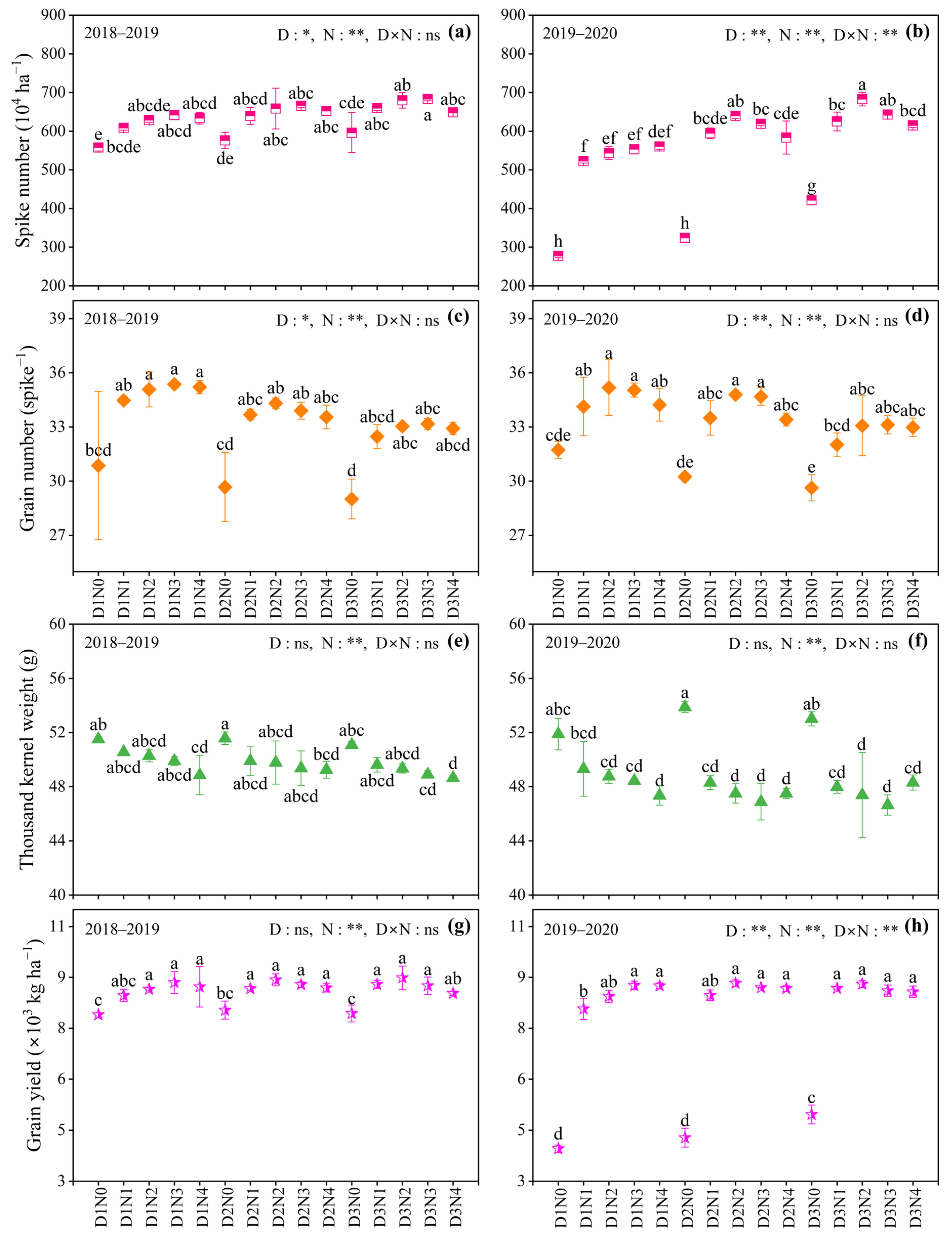
In both growing seasons, planting density significantly affected spike number and stabilized kernels per spike in 2018–2019, while it significantly influenced grain yield in 2019–2020 (Figure 2). With increasing planting density, spike number per unit area increased, kernels per spike decreased, and thousand-kernel weight remained stable across both years. In 2019–2020, D2 and D3 increased spike number by 12.35% and 21.55%, reduced kernels per spike by 2.17% and 5.58%, and increased grain yield by 2.55% and 4.32%, respectively, compared with D1.
Nitrogen rate significantly affected yield and its components in both seasons, with consistent trends across years. Spike number per unit area, kernels per spike, and grain yield all increased initially and then decreased with increasing N rate. Effective spike number and grain yield peaked at either N2 or N3, with no statistically significant difference between these two treatments. All nitrogen-fertilized treatments (N1–N4) produced significantly more kernels per spike relative to the zero-N control (N0), whereas kernel number per spike did not vary significantly across the four N application rates. In addition, the thousand-kernel weight was markedly reduced with nitrogen fertilization compared with N0. Compared with N0, N application increased average spike number by 44.09%, kernels per spike by 12.28%, thousand-kernel weight by 6.59%, and grain yield by 52.76%. Among all treatments, D2N2 produced the highest two-year average yield (8875.35 kg ha−1), 49.77% higher than D1N0, and statistically similar to D3N4. This was attributed to the highest spike number per unit area (648.64 × 10⁴ ha−1), the highest kernels per spike (34.55 kernels spike−1), and relatively high thousand-kernel weight (48.64 g).

3.2. Plant Height

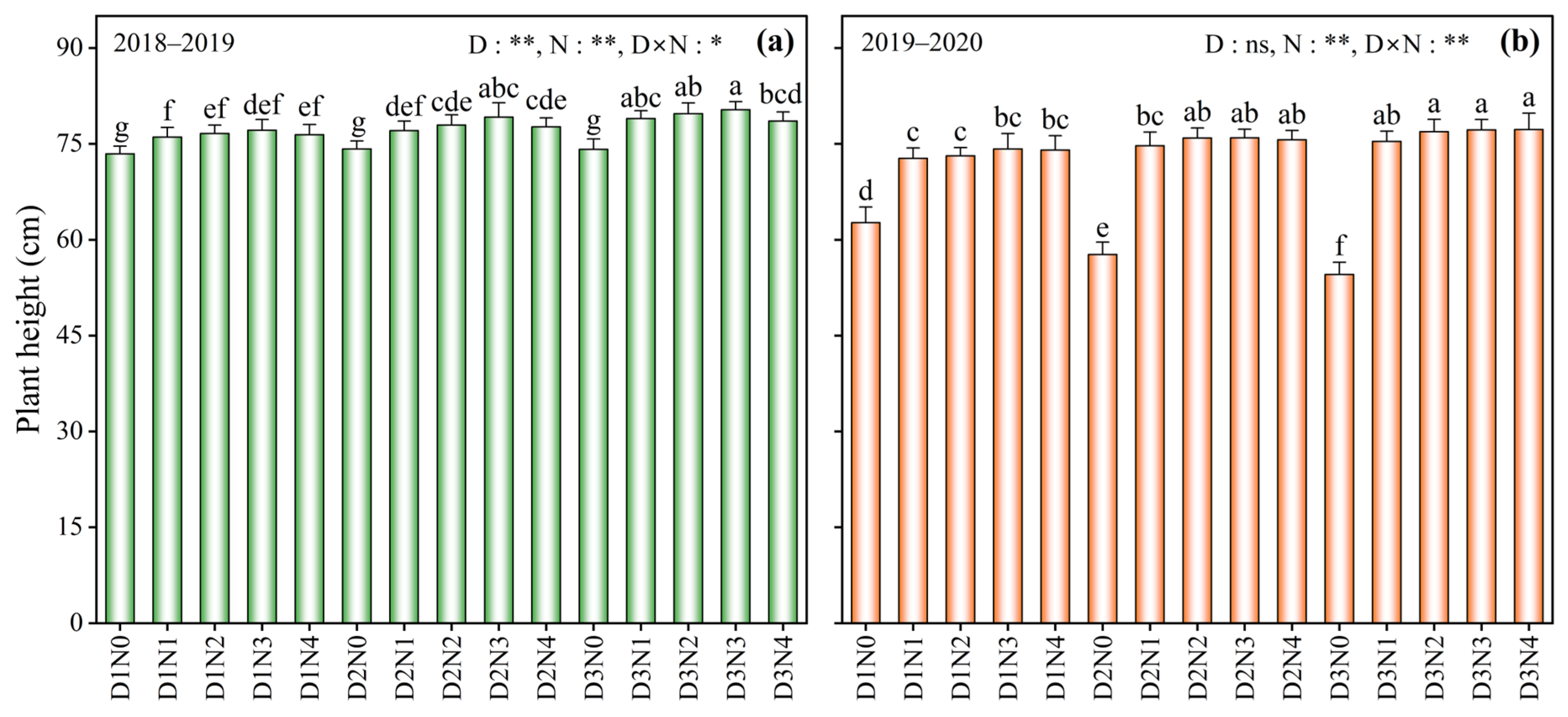
As shown in Figure 3, planting density, N rate, and their interaction significantly affected plant height in both growing seasons, except for planting density in 2019–2020. Increasing planting density significantly increased plant height in 2018–2019, with D2 and D3 increasing by 1.70% and 3.19% relative to D1, respectively. Plant height exhibited an initial increase followed by a decrease with increasing N rate, a pattern consistent across both years. Compared with N0, N application increased plant height by 4.64–6.71% in 2018–2019 and 27.36–29.93% in 2019–2020. Under the same density, N application increased plant height. The D3N3 treatment produced the tallest plants in both years, significantly taller than all D1 treatments. However, under medium (D2) and high (D3) densities, no significant differences were observed among treatments with N rates exceeding N2.

3.3. Dry Matter Accumulation and Partitioning Among Organs

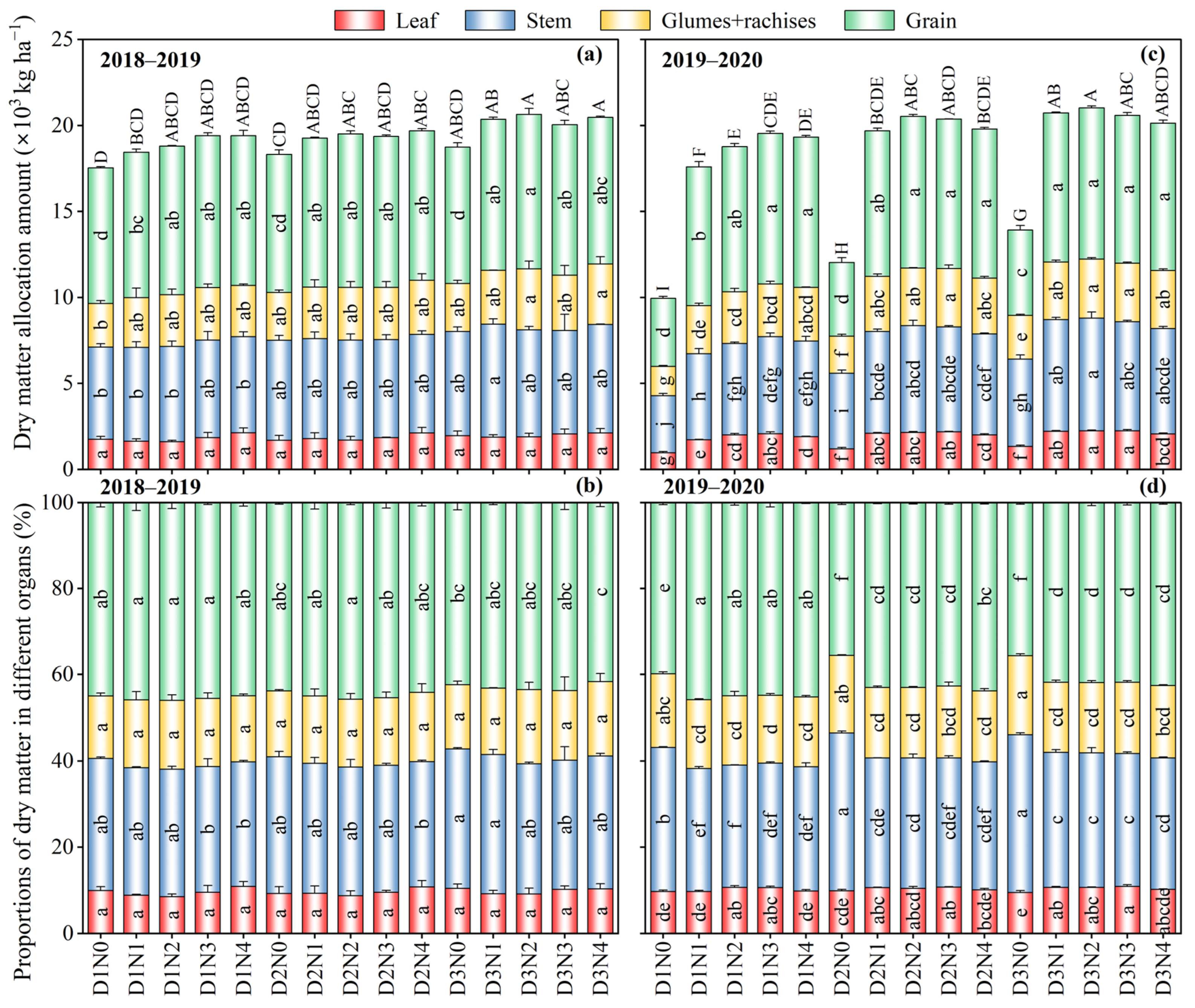
The effects of planting density, N rate, and their interaction on dry matter accumulation and partitioning varied between the two growing seasons (Table 1 and Figure 4).
In 2018–2019, planting density significantly influenced total dry matter accumulation (TDMA) mainly by altering dry matter accumulation in stems and rachis + glumes, and stabilized grain dry matter by regulating partitioning in stems and grains. Compared with D1, TDMA increased by 2.71% (D2) and 7.11% (D3). Although increasing density enhanced stem and rachis + glume dry matter and stem partitioning relative to D1, it reduced grain dry matter allocation proportion. D2 did not differ significantly from D1 in these traits, but showed reductions of 7.43%, 7.23%, and 3.41% compared with D3, respectively. By contrast, increasing density decreased grain dry matter partitioning: D2 and D1 were similar, but D2 increased grain partitioning by 4.52% relative to D3. As a result, TDMA was 4.11% lower in D2 than in D3, but grain dry matter did not differ significantly among treatments. Nitrogen rate significantly affected TDMA and grain dry matter by regulating dry matter accumulation in leaves and spikes, as well as partitioning in leaves, stems, and grains. With increasing N rate, dry matter accumulation in leaves, rachis + glumes, and grains increased initially and then decreased. Leaf and stem partitioning declined, while grain partitioning first increased and then decreased. Compared with N0, N application increased TDMA and yield by 7.74% and 9.97% on average, respectively, with no significant differences among N rates; N2 produced the highest yield. The N–density interaction significantly affected dry matter accumulation and partitioning in 2018–2019.
In 2019–2020, density, N rate, and their interaction all significantly affected TDMA, organ dry matter accumulation, and dry matter partitioning in leaves and grains. Compared with D1, D2 and D3 increased yield by 2.55% and 4.32%, and grain dry matter by 8.51% and 13.17%, respectively, but reduced grain dry matter partitioning by 5.75% and 7.72%. Compared with N0, N application (N1–N4) increased yield, TDMA, and grain dry matter partitioning by 94.26%, 65.13%, and 17.50% on average, respectively; no significant differences were observed among N2, N3, and N4. Among all treatments, D2N2 achieved the highest grain dry matter accumulation due to its greater total dry matter accumulation and optimal allocation ratio of dry matter to grain, and this value was not significantly different from D3N2, the treatment with the maximum grain dry matter accumulation.

3.4. Nitrogen Accumulation and Partitioning Among Organs

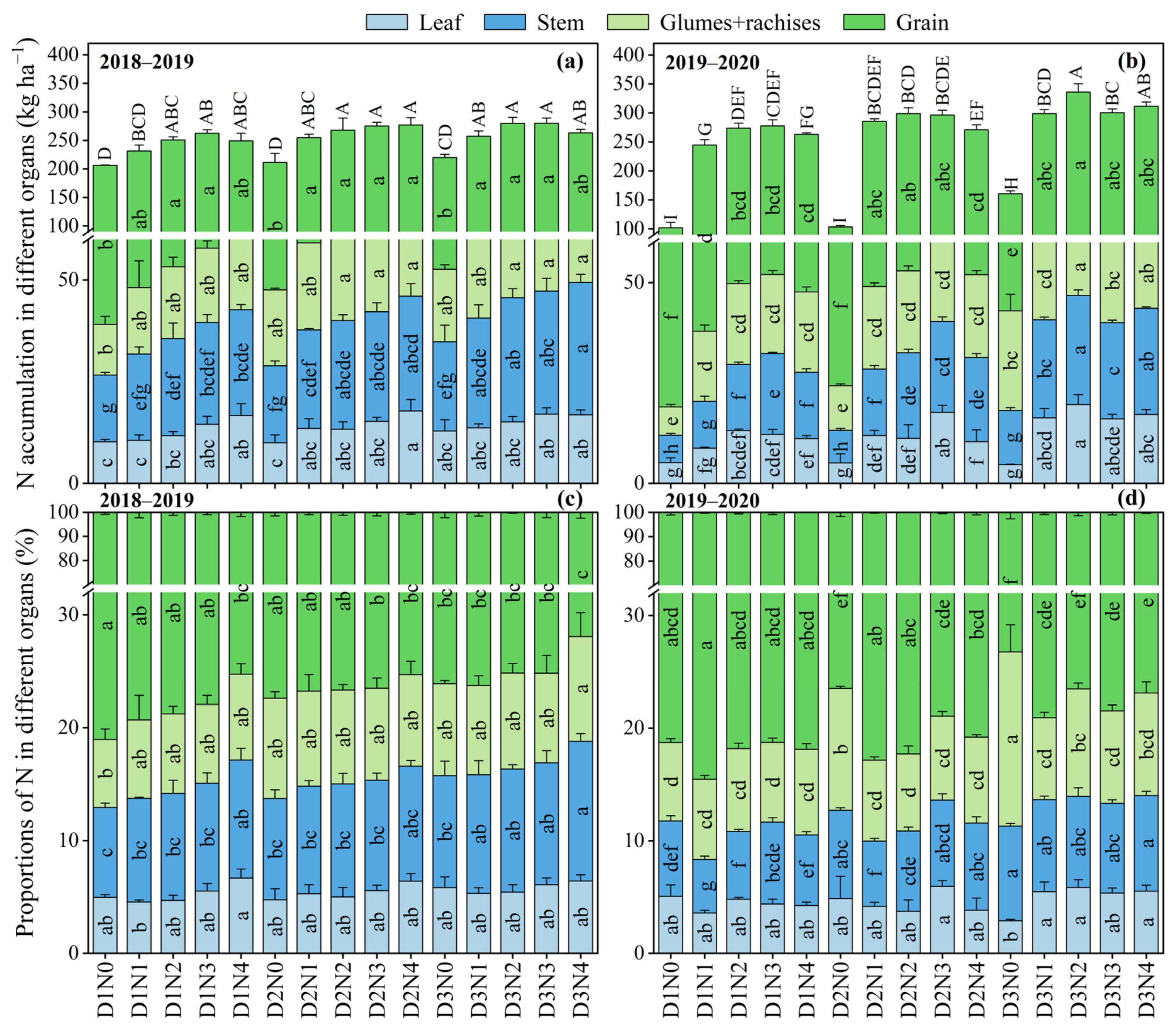
The effects of planting density, N rate, and their interaction on nitrogen (N) accumulation and partitioning among organs differed between the two growing seasons (Table 2 and Figure 5).
In 2018–2019, planting density significantly affected N accumulation only in stems and rachis + glumes. In 2019–2020, density significantly influenced N accumulation in all organs. In both years, density altered total N accumulation mainly by regulating N accumulation in stems and rachis + glumes. Stem N, rachis + glume N, and total N accumulation all increased with increasing planting density. Compared with D1, D2 and D3 increased average stem N by 18.06% and 43.80%, rachis + glume N by 20.25% and 42.65%, and total N accumulation by 7.65% and 14.79%, respectively.
For N partitioning, density significantly affected allocation to all organs except leaves in both seasons. Density regulated N partitioning to stems and spikes (rachis + glumes and grains), thus maintaining stable grain N accumulation in 2018–2019 and increasing it in 2019–2020, where D2 and D3 increased grain N by 6.29% and 13.84% relative to D1.
In both seasons, N rate significantly affected N accumulation in all organs and most parameters, except for rachis + glume N partitioning in 2018–2019 and leaf N partitioning in 2019–2020. N accumulation in all organs increased with increasing N rate. Compared with N0, N application increased average leaf N by 105.72%, stem N by 79.75%, rachis + glume N by 41.45%, and grain N by 84.45%, thereby increasing total N accumulation by 79.94%. Increased grain N accumulation mainly resulted from enhanced N partitioning to grains, which was increased by 4.46% under N application in 2019–2020.
The N–density interaction did not significantly affect total N accumulation or organ N accumulation and partitioning in 2018–2019, but had significant effects in 2019–2020. Among all treatments, D2N2 maintained the highest grain N accumulation, which was attributed to its superior N partitioning to grains despite not having the highest total N accumulation.

3.5. Nitrogen Recovery Efficiency (NRE) and Nitrogen Agronomic Efficiency (NAE)

To reflect the continuous effects of long-term fixed nitrogen management under local farming practices, all N treatments were maintained consistently across three consecutive phases: the first winter wheat season (2018–2019), the subsequent maize season, and the second winter wheat season (2019–2020). Nitrogen application rates and plot layout remained identical to those in the first wheat season. As a result, grain yield and total N accumulation in the zero-N control (N0) were substantially lower in the second wheat season than in the first, leading to large differences in NRE and NAE between the two growing seasons.
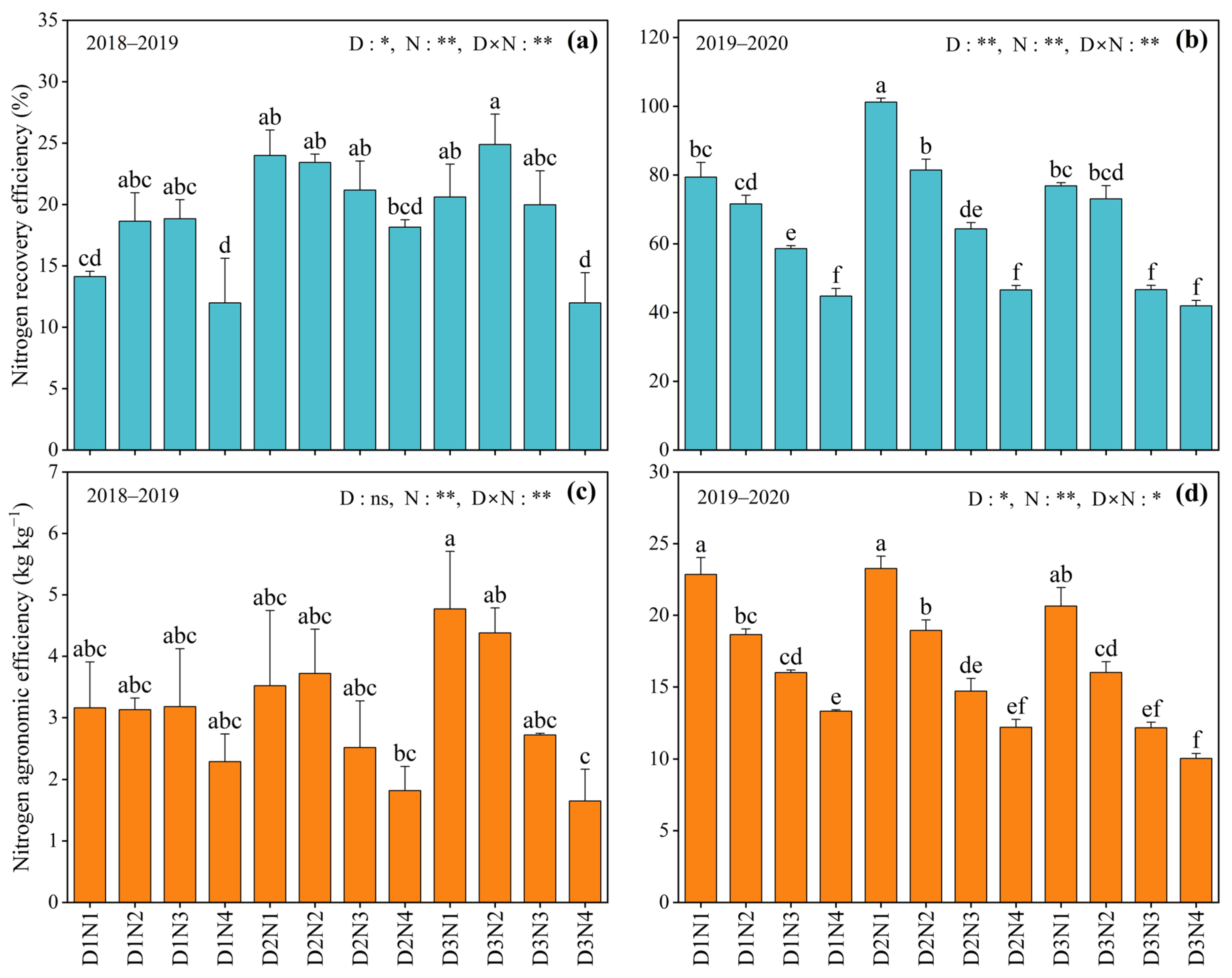
Planting density, N rate, and their interaction significantly affected NRE and NAE in both seasons, except for the effect of density on NAE in 2018–2019 (Figure 6). Trends were consistent across years, but NRE and NAE values differed considerably between seasons. Thus, effects were evaluated separately by year.
Across the two growing seasons, maximum values for nitrogen recovery efficiency (NRE) and nitrogen agronomic efficiency (NAE) were observed at the low-N treatments N1 or N2; both metrics declined progressively with increasing N application rate above N2 (i.e., N3 and N4). In 2018–2019, peak values of the two parameters consistently occurred at N2 across all planting densities, and N1 and N2 did not differ statistically for most comparisons. In 2019–2020, N1 yielded the highest NRE and NAE under every planting density. Planting density significantly affected NAE only in 2019–2020: increasing density reduced NAE, with no significant difference between D2 and D1, while D2 increased NAE by 17.40% relative to D3.
Both NRE and NAE declined gradually with increasing N rate in both seasons. In 2018–2019, NRE and NAE peaked under N2: NRE was 13.99% higher in N2 than in N1, with no significant difference in NAE between these treatments. Compared with N4, N2 increased NRE by 59.97% and NAE by 94.79%. In 2019–2020, NRE and NAE decreased sharply with increasing N rate. Relative to N4, N1, N2, and N3 increased NRE by 93.09%, 69.58%, and 27.21%, and NAE by 87.92%, 50.93%, and 20.69%, respectively.
Regarding the interactive effects of planting density and nitrogen rate, D2N2 showed no significant differences in nitrogen recovery efficiency (NRE) from D3N2 (the treatment with the maximum NRE) or from D3N1 (the optimal treatment for nitrogen uptake efficiency, NAE) in 2018–2019. In 2019–2020, D2N2 maintained relatively high values for both indices: its NRE was second only to D2N1, while its NAE was inferior only to D1N1, D2N1 and D3N1. Compared with high-density, high-N treatments, D2N2 increased NRE and NAE by 95.41% and 125.45% in 2018–2019, and by 94.16% and 88.65% in 2019–2020, respectively.

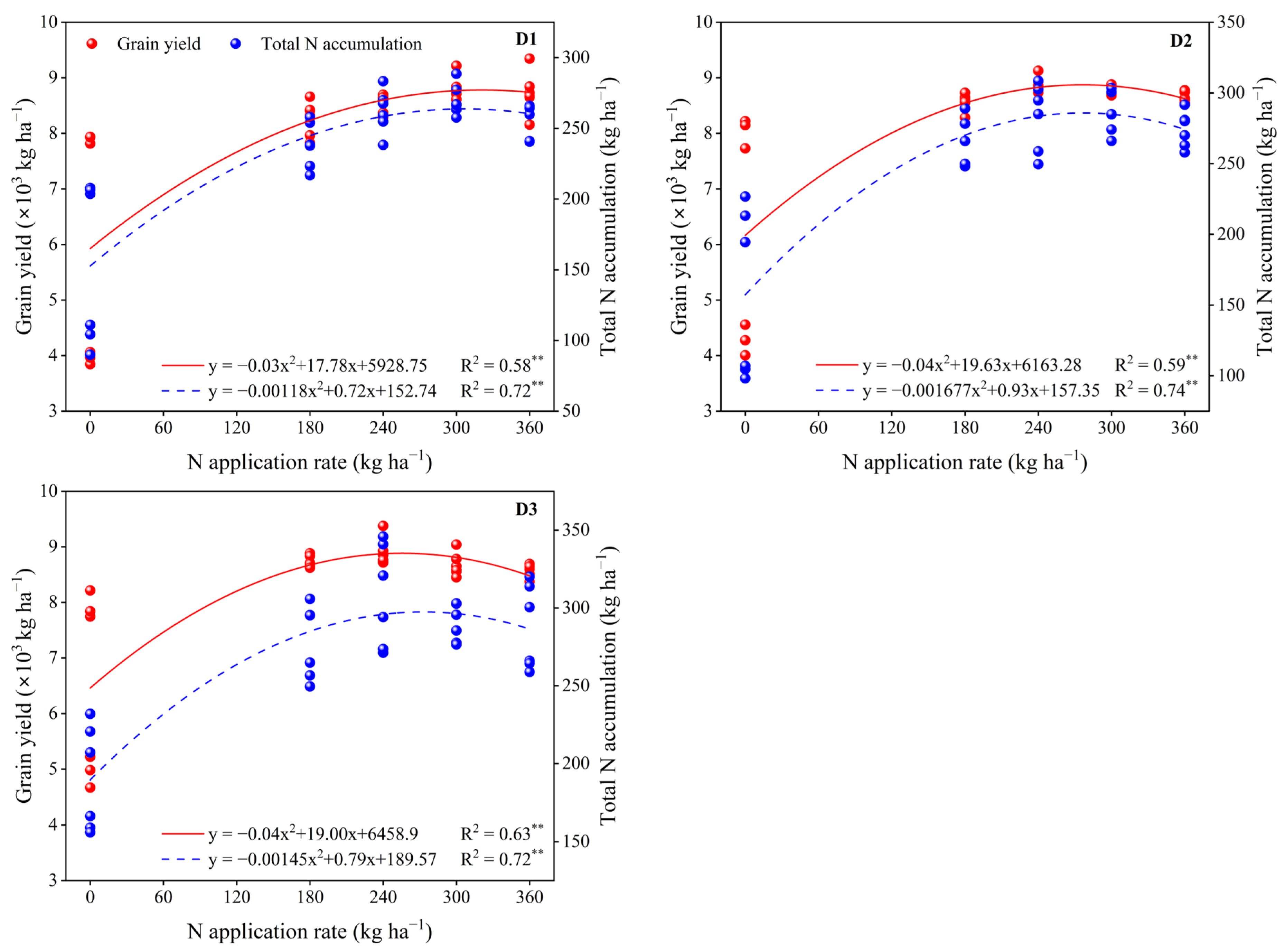
3.6. Quadratic Regression and Threshold Analysis of Grain Yield and N Accumulation in Response to N Application Rate Under Different Planting Densities

Regression analyses were performed for grain yield and total N accumulation against N rate under the three planting densities (Figure 7). Both grain yield and N accumulation exhibited a significant quadratic response to N rate, increasing initially and then decreasing, indicating optimal N rate thresholds for yield and N accumulation under each density. Based on the fitted equations, at D1, maximum yield (7685.02 kg ha−1) and maximum N accumulation (263.67 kg ha−1) occurred at 296.33 and 306.61 kg N ha−1, respectively; at D2, maximum yield (8571.64 kg ha−1) and maximum N accumulation (285.85 kg ha−1) occurred at 245.38 and 276.81 kg N ha−1, respectively; and at D3, maximum yield (8715.15 kg ha−1) and maximum N accumulation (297.46 kg ha−1) occurred at 237.50 and 272.77 kg N ha−1, respectively.
Compared with D1, increasing density to D2 or D3 increased theoretical maximum yield by 11.54–13.40% and reduced the optimal N rate by 17.19–19.85%. Meanwhile, theoretical maximum N accumulation increased by 8.41–12.82%, and the corresponding optimal N rate decreased by 9.72–11.04%. Thus, increasing planting density substantially enhanced theoretical maximum yield and N accumulation while reducing the required N rate.
Notably, increasing density from D2 to D3 did not markedly increase theoretical maximum yield, which plateaued, and the optimal N rate remained stable at approximately 240 kg ha−1. Theoretical maximum N accumulation was 3.90% lower at D2 than at D3, but the corresponding optimal N rates were similar.
In measured data, D2N2 yielded 8875.35 kg ha−1 with total N accumulation of 283.22 kg ha−1, nearly matching the theoretical maxima for D2. Therefore, a N rate of approximately 240 kg ha−1 combined with a planting density of 375 × 104 plants ha−1 achieves synchronous optimization of grain yield and N accumulation.

3.7. Correlation Analysis Between Plant Height, Dry Matter, and Nitrogen Accumulation and Partitioning, Yield Components, and Nitrogen Efficiency

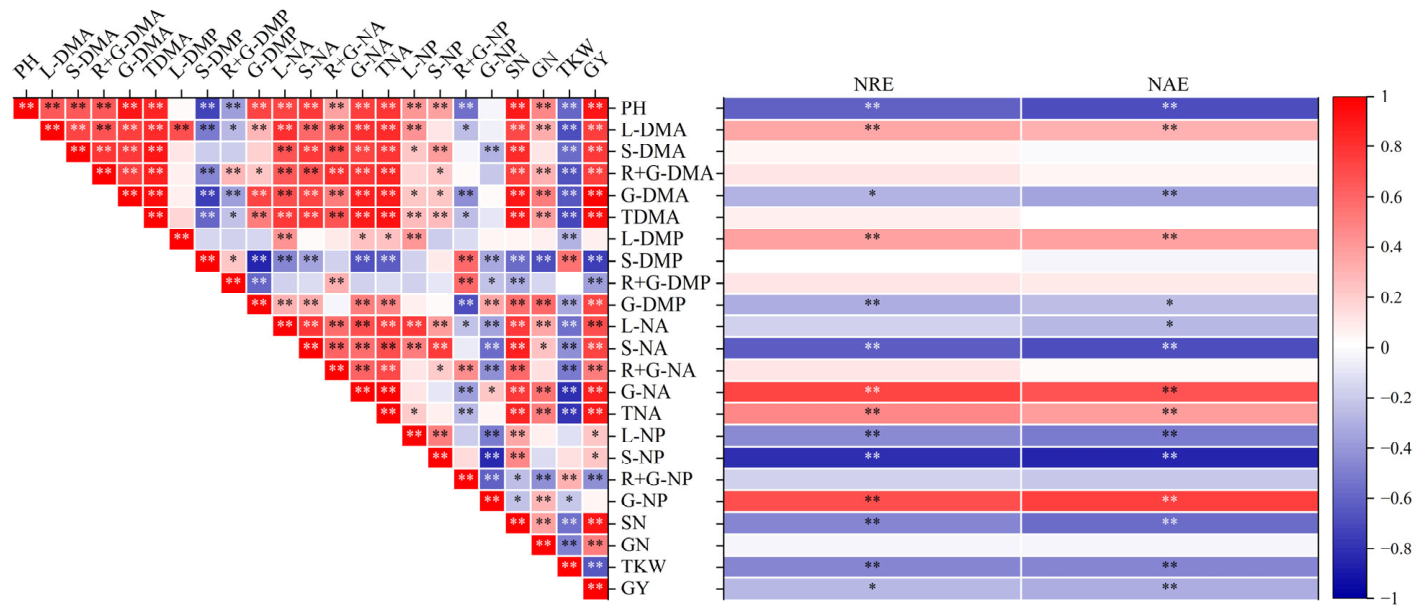
Correlations between plant height, dry matter, and N accumulation and partitioning, yield components, and N use efficiency are presented in Figure 8.
Total dry matter accumulation (TDMA) was positively correlated with dry matter accumulation in all organs (L-DMA, S-DMA, R+G-DMA, G-DMA; p < 0.01). Grain dry matter accumulation (G-DMA) was positively correlated with dry matter accumulation in vegetative organs (p < 0.01), whereas grain dry matter partitioning (G-DMP) was negatively correlated with dry matter partitioning in vegetative organs (R+G-DMP, S-DMP; p < 0.01).
Total N accumulation (TNA) was positively correlated with N accumulation in all organs (L-NA, S-NA, R+G-NA, G-NA; p < 0.01). Grain N accumulation (G-NA) was positively correlated with N accumulation in vegetative organs (p < 0.01), while grain N partitioning (G-NP) was negatively correlated with N partitioning in vegetative organs (L-NP, S-NP; p < 0.01).
Plant height (PH) was positively correlated with dry matter accumulation, N accumulation, and grain yield (GY; p < 0.01). TDMA, G-DMA, TNA, and G-NA were all positively correlated with GY (p < 0.01) and mostly correlated significantly or highly significantly with spike number (SN) and kernels per spike (GN).
TNA, and G-NP were all positively correlated with NRE and NAE (p < 0.01), whereas G-DMA, L-NP and S-NP were negatively correlated with NRE and NAE (p < 0.01). SN and thousand-kernel weight (TKW) were also negatively correlated with NRE and NAE (p < 0.01), while GN showed no significant correlation.

4. Discussion

4.1. Synergistic Effect of Optimal N–Planting Density Interaction on Source–Sink Coordination

The optimal N–density combination (D2N2) achieved simultaneously high yield and high N efficiency in winter wheat by synergistically optimizing source capacity and sink partitioning.
For dry matter production and allocation, D2N2 produced the highest grain dry matter accumulation (G-DMA) across both years (Figure 4). This improvement did not rely solely on greater total dry matter accumulation (TDMA) but mainly stemmed from the higher dry matter partitioning proportion to grains (G-DMP; Table 1 and Figure 4). Specifically, compared with the high-density treatment (D3), D2 maintained high TDMA while significantly reducing dry matter partitioning to vegetative organs such as stems, thereby enhancing assimilate translocation to grains. This result aligns with findings of Zhang et al. (2017) [17] and Ma et al. (2020) [19], who reported that suitable planting density improves canopy structure and reduces dry matter retention in stems and sheaths during late growth stages.
The present study further demonstrates that this favorable partitioning effect is maximized when paired with an optimal N rate (N2). Excessive N input (e.g., N4) may further increase TDMA but significantly reduce G-DMP (Table 1), consistent with observations by Zheng et al. (2021) [10] and Bai et al. (2022) [1] that surplus N promotes excessive vegetative growth and lowers the harvest index. Thus, D2N2 achieved the best balance between strong source capacity (high TDMA) and efficient sink utilization (high G-DMP).
For nitrogen uptake and partitioning, D2N2 also showed the strongest synergistic effect, with the highest grain N accumulation (G-NA), primarily due to the greatest N partitioning proportion to grains (G-NP; Table 2 and Figure 5). Notably, during the second year of continuous fixed N management (2019–2020), the N–density interaction significantly affected N partitioning (Table 2), suggesting that optimized N–density management is critical for sustaining efficient N translocation to grains under changing soil N status.
Compared with zero-N or high-N treatments, D2N2 maximized N remobilization from vegetative organs to grains while maintaining high total N accumulation (TNA). This mechanism supports the concept of N partitioning efficiency proposed by Ravier et al. (2017) [9] and the regulatory role of N management in N translocation reported by Fabbri et al. (2023) [2]. Our results indicate that moderate density provides a favorable population structure for efficient N partitioning to grains, while optimal N rate facilitates and enhances this translocation process. Their interaction therefore plays a key role in improving grain N harvest efficiency.

4.2. Density as a Strategy for Nitrogen Reduction: Quantitative Evidence from Threshold Analysis

Regression analysis in this study provides direct quantitative evidence supporting the “increasing density to reduce N” strategy. With increasing planting density from D1 to D2 and D3, the optimal N rate for achieving theoretical maximum yield decreased from 296.33 kg ha−1 to 245.38 kg ha−1 and 237.50 kg ha−1, representing a reduction of 17.19–19.85% (Figure 7).
This result indicates that increasing planting density from 225 × 104 to 375 × 104 plants ha−1 enables higher yield potential while reducing N input by approximately 50 kg ha−1. This finding strongly supports the hypothesis that increasing planting density can partially substitute for N fertilizer [25,26].
Previous studies by Zhang et al. (2017) [17] and Dai et al. (2022) [21] demonstrated that increasing density improves interception of light and use of soil nutrients, thereby compensating for potential yield losses caused by reduced N application. The present study accurately quantifies this compensatory relationship using quadratic regression models and defines site-specific thresholds for the fluvo-aquic soil region of southeastern Henan.
Our results agree with the conclusion of Sadras et al. (2019) [20] that optimizing planting density represents an effective approach to improve nitrogen partial factor productivity. Furthermore, this two-year field experiment confirms the stability of this density–N substitution effect.
Notably, increasing density from D2 to D3 did not significantly increase theoretical maximum yield or further reduce the optimal N rate (Figure 7). This suggests that raising density to 525 × 104 plants ha−1 provides no additional benefit for N reduction but may increase lodging risk and production instability due to excessive intraspecific competition. This is consistent with reports by Li et al. (2023) [14] and Mu et al. (2024) [27] that excessive density leads to diminishing marginal returns.
Therefore, for practical N reduction and efficiency improvement, D2 (375 × 104 plants ha−1) is a more favorable and reliable choice than D3.

4.3. Practical Implications for Winter Wheat Production in the Target Region

Based on the mechanistic analysis and threshold data presented above, this study proposes a clear high-yield, high-efficiency N–density management model for winter wheat production in the fluvo-aquic soil region of the southern Huang–Huai–Hai Plain: 375 × 104 plants ha−1 combined with 240 kg N ha−1 (D2N2). This model offers multiple advantages. First, it achieves excellent yield performance: the two-year average yield reached 8875.35 kg ha−1, significantly higher than low-density, low-N treatments and comparable to high-density, high-N treatments (Figure 2). Second, it maintains high N use efficiency: NRE and NAE remained at the highest or relatively high levels across both growing seasons (Figure 6), enabling synchronous improvements in yield and resource use efficiency. Third, it optimizes yield components: the high yield is attributed to the optimal balance of spike number per unit area, kernels per spike, and thousand-kernel weight, avoiding yield instability caused by excessive emphasis on a single component (Figure 2).
The recommended model shares both similarities and differences with findings from other sites in the Huang–Huai–Hai wheat region. For instance, Fu et al. (2023) [28] also emphasized the importance of N–density interactions in the northern Huang–Huai–Hai Plain, suggesting that 225 kg N ha−1 combined with 450–525 × 104 plants ha−1 is optimal for synchronously achieving high yield, good quality, and high N efficiency. In a N–density interaction trial conducted at the same site as the present study in the southern Huang–Huai–Hai Plain, Zhou et al. (2023) [29] identified an optimal combination of 239.8 kg N ha−1 and 228.7 kg ha−1 seeding rates via model fitting, which is consistent with the N rate and planting density recommended here.
These differences likely arise from regional climate (especially precipitation), soil fertility background (this study was a long-term continuous experiment with dynamic changes in soil N pools), and wheat variety [11,24,30]. Our results demonstrate that the potential for green yield increases through “moderately increasing density and precisely reducing N” under the specific ecological conditions of the fluvo-aquic soil region in southeastern Henan. This model not only reduces N input costs and environmental risks associated with excessive N application but also minimizes lodging and disease risks caused by overcrowded populations through moderate density, resulting in greater operability and stability in practical production.

4.4. Limitations and Future Prospects

This study has several limitations that warrant attention and improvement in future research. First, only one winter wheat variety was used in the experiment, and different genotypes may respond differently to N–density interactions [11]. Future studies should include more varieties with diverse plant types, stress tolerance, and yield potential to test the generalizability of the current conclusions and screen for more suitable cultivars [31].
Second, while the experiment was conducted over two consecutive years, this duration is insufficient to fully capture the long-term dynamics of soil fertility, microbial communities, and N cycling under fixed N–density management [32,33]. Longer-term field experiments are therefore recommended to evaluate the long-term agronomic and environmental impacts of the optimized N–density model.
Third, this study was conducted at a single location (the fluvo-aquic soil region of southeastern Henan), and the applicability of its conclusions to other soil types (e.g., lime concretion black soil and cinnamon soil) or ecological subregions within the Huang–Huai–Hai wheat region requires further validation [34]. Multi-site trials across different ecological zones should be established in future work to develop more region-specific N–density optimization strategies.
Based on the findings of this study, three directions merit in-depth exploration. First, isotope tracing techniques could be used to clarify the specific pathways and contribution rates of N and carbon assimilate translocation to grains after anthesis under the optimized D2N2 model. Second, UAV remote sensing or hyperspectral technology could be integrated to dynamically monitor canopy structure, chlorophyll content, and other key indicators under different N–density treatments, facilitating the development of precision N–density regulation technologies based on real-time monitoring. Third, from a soil microbial ecology perspective, future research should investigate the effects of optimized N–density management on rhizosphere N-transforming functional microorganisms, to elucidate the microbial mechanisms underlying efficient N utilization from the root–soil interaction perspective.

5. Conclusions

A two-year field experiment verified that the combination of 240 kg ha−1 N and a planting density of 375 × 104 plants ha−1 (D2N2) constitutes the optimum density–nitrogen configuration for synchronizing high grain yield and high nitrogen efficiency of winter wheat on fluvo-aquic soils in southeast Henan. This treatment produced an average grain yield of 8875.35 kg ha−1 and improved source–sink balance, as sustained high biomass and nitrogen accumulation boosted greater dry matter and nitrogen translocation to grains, raising nitrogen recovery and agronomic efficiencies. This study quantitatively validated the feasibility of the “higher density with reduced nitrogen” strategy: raising plant density to 375 × 104 plants ha−1 lowered the nitrogen input threshold for maximum theoretical yield by around 50 kg ha−1, while over-densification generated no further benefits. Our results deepen insights into yield regulation via density–nitrogen interaction by highlighting allocation efficiency rather than total nutrient accumulation, and deliver a practical high-yield and high-efficiency cultivation protocol for analogous regions across the Huang–Huai–Hai Plain to cut nitrogen application and mitigate environmental pollution risks.

Author Contributions

Z.W.: writing—original draft, methodology, investigation, data curation, and conceptualization. S.L.: methodology, conceptualization, and writing—review and editing. Y.Z.: investigation, writing—review and editing, and data curation. X.Z.: investigation, writing—review and editing, and data curation. L.Y.: data curation, investigation, and writing—review and editing. R.C.: investigation, data curation, and writing—review and editing. G.Z.: investigation, data curation, and writing—review and editing. J.D.: conceptualization, methodology, and writing—review and editing. W.F.: methodology and conceptualization. T.G.: methodology and conceptualization. T.W.: writing—review and editing, supervision, project administration, funding acquisition, and conceptualization. Y.W.: writing—review and editing, supervision, project administration, funding acquisition, and conceptualization. All authors have read and agreed to the published version of the manuscript.

Funding

This study was supported by the National Key Research and Development Program of China (2023YFD2300204) and the China Agriculture Research System of MOF and MARA (CARS-03).

Data Availability Statement

The raw data supporting the conclusions of this article will be made available by the authors on request due to the use of these datasets for our ongoing research projects.

Acknowledgments

This study was financially supported by the National Key Research and Development Program of China (No. 2023YFD2300204) and the Special Fund for Modern Agricultural Industrial Technology System of the Ministry of Finance and the Ministry of Agriculture and Rural Affairs of China (No. CARS-03). We sincerely thank the staff of Yigang Family Farm in Shangshui County, Zhoukou City, for their assistance in field management and sample collection. Grateful acknowledgements are also extended to the anonymous reviewers for their valuable comments and constructive suggestions.

Conflicts of Interest

The authors declare that they have no competing interests.

References

  1. Bai, N.; Mi, X.T.; Tao, Z.K.; Kang, J.Y.; He, G.; Wang, Z.H. China’s nitrogen management of wheat production needs more than high nitrogen use efficiency. Eur. J. Agron. 2022, 139, 126557. [Google Scholar] [CrossRef]
  2. Fabbri, C.; Basso, B.; Napoli, M.; Marta, A.D.; Orlandini, S.; Martinez-Feria, R.A. Developing a tactical nitrogen fertilizer management strategy for sustainable wheat production. Eur. J. Agron. 2023, 144, 126746. [Google Scholar] [CrossRef]
  3. Hu, S.Y.; Qiao, B.W.; Yang, Y.H.; Rees, R.M.; Huang, W.H.; Zou, J.; Zhang, L.; Zheng, H.Y.; Liu, S.Y.; Shen, S.J.; et al. Optimizing nitrogen rates for synergistically achieving high yield and high nitrogen use efficiency with low environmental risks in wheat production—Evidences from a long-term experiment in the North China Plain. Eur. J. Agron. 2023, 142, 126681. [Google Scholar] [CrossRef]
  4. Ma, J.Y.; Shang, C.; Zhang, X.C.; Yin, B.Z.; Zhen, W.C. Optimized agronomic management in North China Plain to maintain wheat (Triticum aestivum L.) yield while reducing water and fertilizer inputs. Agronomy 2025, 15, 1053. [Google Scholar] [CrossRef]
  5. Li, H.R.; Jia, B.; Wang, H.G.; Li, D.X.; Fang, Q.; He, J.N.; Lv, X.K.; Li, R.Q. Optimizing irrigation and nitrogen rates for sustainable wheat production: Balancing yield and nitrate leaching in a 7-year field study. Soil Tillage Res. 2026, 255, 106822. [Google Scholar] [CrossRef]
  6. Guo, X.Y.; Liu, P.Z.; Wang, R.; Wang, X.L.; Li, J. Response of winter wheat yield, nitrogen use efficiency and soil nitrogen balance to rainfall years and nitrogen application in dryland. Acta Agron. Sin. 2022, 48, 1262–1272. (In Chinese) [Google Scholar] [CrossRef]
  7. Du, Y.D.; Niu, W.Q.; Zhang, Q.; Cui, B.J.; Zhang, Z.H.; Wang, Z.; Sun, J. A synthetic analysis of the effect of water and nitrogen inputs on wheat yield and water- and nitrogen-use efficiencies in China. Field Crops Res. 2021, 265, 108105. [Google Scholar] [CrossRef]
  8. Zhang, L.C.; Ma, J.F.; Guo, C.L.; Tian, J.N.; Tian, Y.C.; Tang, L.; Liu, B.; Zhu, Y.; Cao, W.X.; Xiao, L.J.; et al. Balanced N–K fertilization in wheat: High-yield synergy with minimal soil-nitrate legacy. Field Crops Res. 2026, 336, 110220. [Google Scholar] [CrossRef]
  9. Ravier, C.; Meynard, J.M.; Cohan, J.P.; Gate, P.; Jeuffroy, M.H. Early nitrogen deficiencies favor high yield, grain protein content and N use efficiency in wheat. Eur. J. Agron. 2017, 89, 16–24. [Google Scholar] [CrossRef]
  10. Zheng, B.Q.; Zhang, X.Q.; Wang, Q.; Li, W.Y.; Huang, M.; Zhou, Q.; Cai, J.; Wang, X.; Cao, W.X.; Dai, T.B.; et al. Increasing plant density improves grain yield, protein quality and nitrogen agronomic efficiency of soft wheat cultivars with reduced nitrogen rate. Field Crops Res. 2021, 267, 108145. [Google Scholar] [CrossRef]
  11. Xi, Y.; Du, Y.L.; Wang, D.; Ren, J.Y.; Luo, W.Y.; Peng, Q.; Fang, W.Y.; Li, F.M. Wheat genetic progress in biomass allocation and yield components: A global perspective. Field Crops Res. 2024, 318, 109617. [Google Scholar] [CrossRef]
  12. Li, R.K.; Wang, Y.; An, Z.C.; Wu, Q.H.; Wang, G.G.; Tong, R.F.; Ye, Y.L. Characteristics of dry matter and nitrogen accumulation and translocation of wheat varieties with different yield types. J. Triticeae Crops 2018, 38, 1359–1364. (In Chinese) [Google Scholar] [CrossRef]
  13. Wan, X.J.; Wu, W.; Liao, Y.C. Mitigating ammonia volatilization and increasing nitrogen use efficiency through appropriate nitrogen management under supplemental irrigation and rain-fed condition in winter wheat. Agric. Water Manag. 2021, 255, 107050. [Google Scholar] [CrossRef]
  14. Li, H.R.; Wang, H.G.; Fang, Q.; Jia, B.; Li, D.X.; He, J.N.; Li, R.Q. Effects of irrigation and nitrogen application on NO3-N distribution in soil, nitrogen absorption, utilization and translocation by winter wheat. Agric. Water Manag. 2023, 276, 108058. [Google Scholar] [CrossRef]
  15. Zhang, F.Q.; Wang, X.Y.; Yu, Z.W.; Wang, X.Z.; Bai, H.L. Characteristics of nitrogen and dry matter accumulation and distribution in 10000 kg ha−1 yield wheat. Acta Agron. Sin. 2009, 35, 1086–1096. (In Chinese) [Google Scholar] [CrossRef]
  16. Xu, M.Z.; Zhang, Y.J.; Wang, Y.H.; Wang, L.; Bai, Y.L.; Lu, Y.L. Optimizing nitrogen input and nitrogen use efficiency through soil nitrogen balance in a long-term winter wheat-summer maize rotation system in North China. Eur. J. Agron. 2023, 149, 126908. [Google Scholar] [CrossRef]
  17. Zhang, X.T.; Huang, Y.F.; Ma, X.J.; Ye, Y.L. Effects of sowing rate and nitrogen application rate on dry matter accumulation, translocation and yield of different genotypes of winter wheat. Plant Physiol. J. 2017, 53, 1067–1076. (In Chinese) [Google Scholar] [CrossRef]
  18. Wang, X.W.; Ren, A.X.; Sun, M.; Lin, W.; Zhang, R.R.; Zhao, J.; Gao, Z.Q. Effects of sowing rate on population structure and dry matter accumulation and distribution of wide-range sowing winter wheat. J. Triticeae Crops 2021, 41, 1272–1280. (In Chinese) [Google Scholar] [CrossRef]
  19. Ma, S.Y.; Wang, Y.Y.; Liu, Y.N.; Yao, K.J.; Huang, Z.L.; Zhang, W.J.; Fan, Y.H.; Ma, Y.S. Effects of sowing date, sowing rate and nitrogen application rate on dry matter accumulation, translocation, distribution and yield of wheat. Chin. J. Eco-Agric. 2020, 28, 375–385. (In Chinese) [Google Scholar] [CrossRef]
  20. Sadras, V.O.; Thomas, D.; Cozzolino, D.; Cossani, C.M. Wheat yield response to nitrogen from the perspective of intraspecific competition. Field Crops Res. 2019, 243, 107632. [Google Scholar] [CrossRef]
  21. Dai, Y.; Fan, J.L.; Liao, Z.Q.; Zhang, C.; Yu, J.; Feng, H.L.; Zhang, F.C.; Li, Z.J. Supplemental irrigation and modified plant density improved photosynthesis, grain yield and water productivity of winter wheat under ridge-furrow mulching. Agric. Water Manag. 2022, 274, 107985. [Google Scholar] [CrossRef]
  22. Cao, Q.; He, M.R.; Dai, X.L.; Men, H.W.; Wang, C.Y. Effects of density and nitrogen interaction on wheat yield and nitrogen use efficiency. Plant Nutr. Fertil. Sci. 2011, 17, 815–822. (In Chinese) [Google Scholar]
  23. Xu, X.H.; Dai, D.X.; Chu, C.J.; Wang, W.Y.; Yin, Y.L.; Ma, X.; Dong, S.X.; He, H.M. Integrated management strategy for improving the grain yield and nitrogen-use efficiency of winter wheat. J. Integr. Agric. 2018, 17, 315–327. [Google Scholar] [CrossRef]
  24. Wang, P.R.; Zhong, R.; Sun, M.; Kong, W.L.; Zhang, J.J.; Noor, H.; Ren, A.X.; Lin, W.; Gao, Z.Q. Regulation of nitrogen application rate on water and nitrogen use efficiency of winter wheat in different rainfall years. Plant Nutr. Fertil. Sci. 2022, 28, 1430–1443. (In Chinese) [Google Scholar] [CrossRef]
  25. Chang, T.; Gu, X.B.; Cai, W.J.; Lu, S.Y.; Zheng, X.B.; Li, W.L.; Cui, K. Effects of suitable planting density and nitrogen application rate on improving winter wheat yield and water-nitrogen use efficiency. Trans. Chin. Soc. Agric. Eng. 2023, 39, 56–68. (In Chinese) [Google Scholar] [CrossRef]
  26. Li, Y.K.; Liu, J.L.; Tang, J.P.; Zuo, Y.M.; Gao, A.P.; Gu, X.Y.; Nangia, V.; Liu, Y. Under reduced nitrogen fertilizer conditions, increasing wheat planting density to enhance sink capacity for achieving high productivity. J. Integr. Agric. 2026; in press. [CrossRef]
  27. Mu, H.M.; Wang, Z.Z.; Sun, L.F.; Huang, Y.; Song, Y.F.; Zhang, R.; Wu, Z.J.; Fu, K.X.; Duan, J.Z.; Kang, G.Z.; et al. Optimizing nitrogen fertilization and planting density management enhances lodging resistance and wheat yield by promoting carbohydrate accumulation and single spike development. Crop Sci. 2024, 64, 3461–3479. [Google Scholar] [CrossRef]
  28. Fu, X.Y.; He, M.Q.; Zhao, Y.K.; Zhang, S.C.; Shan, Z.L.; Han, R.; Zhang, T.S.; Shi, Z.L. Effect of planting density on quality characteristics and nitrogen utilization of winter wheat Shi 4366 under long-term positioning nitrogen application. J. Triticeae Crops 2023, 43, 215–224. (In Chinese) [Google Scholar]
  29. Zhou, Q.; Li, L.T.; Zhang, L.L.; Miao, Y.H.; Wang, Y.L. Effects of nitrogen fertilizer and seeding rate interaction on yield, growth and ecological field characteristics of winter wheat. Acta Agron. Sin. 2023, 49, 3100–3109. (In Chinese) [Google Scholar] [CrossRef]
  30. Lopez, G.; Hadir, S.; Mouratidis, S.D.; Shuva, M.A.; Hüging, H.; Bauke, S.L.; Gaiser, T.; Schaaf, G.; Seidel, S.J. Winter wheat shoot and root phenotypic plasticity under fertilized and nutrient-deficient field conditions. Eur. J. Agron. 2025, 168, 127634. [Google Scholar] [CrossRef]
  31. Zhuang, H.M.; Zhang, Z.; Xu, J.L.; Han, J.C.; Cheng, F.; Tao, F.L. Overcoming wheat yield stagnation in China depends more on cultivar improvements than water and fertilizer management. Field Crops Res. 2025, 333, 110089. [Google Scholar] [CrossRef]
  32. Sun, X.D.; Cai, A.D.; Ren, C.J.; Zhang, S.H.; Li, Q.; Liu, S.T.; Zhang, S.Q.; Zhang, H.M.; Li, Y.; Liu, K.L.; et al. Long-term fertilization reshapes stoichiometric networks driving shifts in microbial life history strategies across China’s croplands. Eur. J. Agron. 2026, 174, 127928. [Google Scholar] [CrossRef]
  33. Zhang, X.Y.; Han, X.J.; Li, Q.C.; Chen, Q.W.; Wu, Z.Y.; Zhao, J.X.; Zhang, H.Y.; Zhang, Y.F.; Ma, D.Y.; Xie, Y.X.; et al. Long-term nitrogen fertilizer improves nitrogen use efficiency and wheat yield by regulating the interactions of rhizosphere soil-root-microbes. Agric. Ecosyst. Environ. 2026, 402, 110317. [Google Scholar] [CrossRef]
  34. Hua, K.K.; Zhang, R.; Wang, T.Y.; Guo, Z.B.; Wang, D.Z. Effects of long-term fertilization on dissolved carbon leaching in lime concretion black soils. Trans. Chin. Soc. Agric. Eng. 2022, 38, 80–88. (In Chinese) [Google Scholar] [CrossRef]
Figure 1. Seasonal patterns of precipitation and average temperature during the experimental wheat growing seasons in 2018–2019 (a) and 2019–2020 (b).
Agronomy 16 01151 g001
Figure 2. Effects of the interaction between nitrogen application rate (N) and planting density (D) on the grain yield and its components of winter wheat. (a,c,e,g) The spike number, grain number per spike, thousand-kernel weight, and grain yield in the 2018–2019 winter wheat growing season, respectively; (b,d,f,h) the spike number, grain number per spike, thousand-kernel weight, and grain yield in the 2019–2020 winter wheat growing season, respectively. D1, D2, and D3 indicate planting densities of 225 × 104, 375 × 104, and 525 × 104 plants ha−1, respectively; N0, N1, N2, N3, and N4 indicate nitrogen application rates of 0, 180, 240, 300, and 360 kg ha−1, respectively. Error bars represent standard deviation. Different lowercase letters indicate significant differences among treatments at p < 0.05. × indicates interaction; * and ** indicate significant differences at p < 0.05 and p < 0.01, respectively; ns indicates not significant.
Agronomy 16 01151 g002
Figure 3. Effects of the interaction between nitrogen application rate (N) and planting density (D) on the plant height of winter wheat during the 2018–2019 (a) and 2019–2020 (b) growing seasons. D1, D2, and D3 indicate planting densities of 225 × 104, 375 × 104, and 525 × 104 plants ha−1, respectively; N0, N1, N2, N3, and N4 indicate nitrogen application rates of 0, 180, 240, 300, and 360 kg ha−1, respectively. Error bars represent standard deviation. Different lowercase letters above the bars indicate significant differences among treatments at p < 0.05. * and ** indicate significant differences at p < 0.05 and p < 0.01, respectively; ns indicates not significant.
Agronomy 16 01151 g003
Figure 4. Effects of the interaction between nitrogen application rate (N) and planting density (D) on the dry matter allocation amount ((a), 2018–2019; (c), 2019–2020) and allocation ratio ((b), 2018–2019; (d), 2019–2020) in different organs of winter wheat. D1, D2, and D3 indicate planting densities of 225 × 104, 375 × 104, and 525 × 104 plants ha−1, respectively; N0, N1, N2, N3, and N4 indicate nitrogen application rates of 0, 180, 240, 300, and 360 kg ha−1, respectively. Error bars represent standard deviation. Different lowercase letters indicate significant differences among treatments at p < 0.05. Different uppercase letters indicate significant differences in the total dry matter accumulation among different treatments at p < 0.05.
Agronomy 16 01151 g004
Figure 5. Effects of the interaction between nitrogen application rate (N) and planting density (D) on the nitrogen allocation amount ((a), 2018–2019; (c), 2019–2020) and allocation ratio ((b), 2018–2019; (d), 2019–2020) in different organs of winter wheat. D1, D2, and D3 indicate planting densities of 225 × 104, 375 × 104, and 525 × 104 plants ha−1, respectively; N0, N1, N2, N3, and N4 indicate nitrogen application rates of 0, 180, 240, 300, and 360 kg ha−1, respectively. Error bars represent standard deviation. Different lowercase letters indicate significant differences among treatments at p < 0.05. Different uppercase letters indicate significant differences in the total nitrogen accumulation among different treatments at p < 0.05.
Agronomy 16 01151 g005
Figure 6. Effects of the interaction between nitrogen application rate (N) and planting density (D) on nitrogen recovery efficiency ((a), 2018–2019; (b), 2019–2020) and nitrogen agronomic efficiency ((c), 2018–2019; (d), 2019–2020) of winter wheat. D1, D2, and D3 indicate planting densities of 225 × 104, 375 × 104, and 525 × 104 plants ha−1, respectively; N0, N1, N2, N3, and N4 indicate nitrogen application rates of 0, 180, 240, 300, and 360 kg ha−1, respectively. Error bars represent standard deviation. Different lowercase letters indicate significant differences among treatments at p < 0.05. × indicates interaction; * and ** indicate significant differences at p < 0.05 and p < 0.01, respectively; ns indicates not significant.
Agronomy 16 01151 g006
Figure 7. Relationships between nitrogen application rate and grain yield as well as total nitrogen accumulation of winter wheat under different planting densities. D1, D2, and D3 indicate planting densities of 225 × 104, 375 × 104, and 525 × 104 plants ha−1, respectively; ** indicate significant difference at p < 0.01. Data presented in the figure come from three replicates per treatment per growing season, giving a total of six data points across the two experimental years.
Agronomy 16 01151 g007
Figure 8. Correlations between plant height, dry matter, nitrogen accumulation and allocation ratio, yield and its components, and nitrogen use efficiency. PH, plant height; L-DMA, leaf dry matter accumulation; S-DMA, stem dry matter accumulation; R+G-DMA, rachis + glume dry matter accumulation; G-DMA, grain dry matter accumulation; TDMA, total dry matter accumulation; L-DMP, proportion of leaf dry matter; S-DMP, proportion of stem dry matter; R+G-DMP, proportion of rachis + glume dry matter; G-DMP, proportion of grain dry matter; L-NA, leaf nitrogen accumulation; S-NA, stem nitrogen accumulation; R+G-NA, rachis + glume nitrogen accumulation; G-NA, grain nitrogen accumulation; TNA, total nitrogen accumulation; L-NP, proportion of leaf nitrogen; S-NP, proportion of stem nitrogen; R+G-NP, proportion of rachis + glume nitrogen; G-NP, proportion of grain nitrogen; SN, spike number; GN, grain number per spike; TKW, thousand-kernel weight; GY, grain yield; NRE, nitrogen recovery efficiency; NAE, nitrogen agronomic efficiency. * and ** indicate significant differences at p < 0.05 and p < 0.01, respectively.
Agronomy 16 01151 g008
Table 1. Analysis of variance (ANOVA) of the effects of planting density (D) and nitrogen application rate (N) on the dry matter allocation amount and allocation ratio in different organs of winter wheat.
Dry Matter Accumulation in Different OrgansProportions of Dry Matter in Different Organs
YearANOVALeafStemGlumes + RachisesGrainTDMALeafStemGlumes + RachisesGrain
2018–2019Dns***ns**ns*ns**
 N*ns********ns*
 D × Nnsnsnsnsnsnsnsnsns
2019–2020D**********ns*****
 N******************
 D × N**********nsns**
Note: TDMA, total dry matter accumulation; × indicates interaction; * and ** indicate significant differences at p < 0.05 and p < 0.01, respectively; ns indicates not significant.
Table 2. Analysis of variance (ANOVA) of the effects of planting density (D) and nitrogen application rate (N) on the nitrogen allocation amount and allocation ratio in different organs of winter wheat.
N Accumulation in Different OrgansProportions of N in Different Organs
YearANOVALeafStemGlumes + RachisesGrainTNALeafStemGlumes + RachisesGrain
2018–2019Dns***ns*ns*****
 N*************ns**
 D × Nnsnsnsnsnsnsnsnsns
2019–2020D**********ns******
 N**********ns******
 D × N******************
Note: TNA, total nitrogen accumulation. × indicates interaction; * and ** indicate significant differences at p < 0.05 and p < 0.01, respectively; ns indicates not significant.
Disclaimer/Publisher’s Note: The statements, opinions and data contained in all publications are solely those of the individual author(s) and contributor(s) and not of MDPI and/or the editor(s). MDPI and/or the editor(s) disclaim responsibility for any injury to people or property resulting from any ideas, methods, instructions or products referred to in the content.