Article

Melatonin Modulates Heat Stress Responses in Pepper Plants Under Variable Nitrogen Supply

by
Ginés Otálora
*,
Maria Carmen Piñero
,
Jacinta Collado-González
,
Josefa López-Marín
and
Francisco Moisés del Amor
*
Department of Crop Production and Agri-Technology, Murcia Institute of Agri-Food Research and Development (IMIDA), C/Mayor s/n, 30150 Murcia, Spain
*
Authors to whom correspondence should be addressed.
Agronomy 2026, 16(12), 1140; https://doi.org/10.3390/agronomy16121140
Submission received: 11 May 2026 / Revised: 29 May 2026 / Accepted: 5 June 2026 / Published: 10 June 2026

Abstract

Melatonin is a molecule in plants with antioxidant activity, which plays a role in increasing plant tolerance to biotic and abiotic stresses. We studied the effect of exogenous melatonin (100 µM) application on the physiological and biochemical processes in pepper plants (Capsicum annuum L. cv. Espinosa F1), in combination with three levels of nitrate concentration in the nutrient solution (5, 12 and 30 mM NO3), and under optimum (26 °C) and heat stress (43 °C) conditions. The results showed that heat stress reduced fresh biomass and photosynthesis in all treatments, especially at 30 mM NO3, indicating greater heat sensitivity under excess nitrogen. However, melatonin partially mitigated these effects, fully restoring fresh weight at 5 mM NO3 and increasing net CO2 assimilation rate (ACO2) by 15.18% compared with the corresponding heat-stressed group without melatonin. Heat stress increased glucose accumulation by 80.8%, 113.4%, and 74.9% at 5, 12, and 30 mM NO3, respectively, whereas melatonin reduced this accumulation by 13.25%, 27.29%, and 38.47%. Spermidine increased under heat stress by 106.29%, 476.26%, and 348.96% at 5, 12, and 30 mM NO3, respectively. Melatonin modulated heat stress responses depending on nitrogen supply, suggesting its potential use to improve pepper tolerance under high-temperature conditions.

1. Introduction

Sweet pepper (C. annuum L.) is one of the most economically important horticultural crops worldwide, particularly in Mediterranean regions, which are among the areas most affected by the climate crisis [1]. Southeastern Spain is one of the main pepper-producing areas in Europe, particularly the provinces of Almería, Murcia, and Alicante, where this crop is mainly grown under intensive greenhouse systems and is largely export-oriented [2]. In addition, pepper cultivation in the Mediterranean area is currently facing important environmental constraints, including water scarcity, salinity, and rising temperatures, all of which can compromise plant growth, yield, and fruit quality. In this context, the Region of Murcia represents a particularly relevant model for studying crop adaptation strategies under climate change, due to its semiarid conditions and the high specialization of its intensive agriculture [3].
Biotic and abiotic stress conditions negatively affect plant growth and development and, consequently, crop production. Among abiotic stresses, heat stress has emerged as a major limiting factor for crop productivity due to the increasing frequency and intensity of high temperature events associated with climate change [4]. Heat stress in pepper plants may occur not only during periods of maximum daytime temperature, but also during warm nights and across different phenological stages, reducing pepper yields [5]. This stress negatively affects vegetative growth, photosynthetic performance, flowering [6,7] and fruit set. In addition, high temperatures negatively affect plant growth by impairing photosynthetic efficiency, disrupting membrane stability, altering metabolic processes, and promoting the excessive production of reactive oxygen species (ROS), ultimately leading to oxidative damage and reduced yield [8]. Moreover, every plant or genotype has its own tolerances or mechanisms to manage heat stress conditions [9]. Some tolerant genotypes within several crop species, in contrast, obtain the highest yields under high temperature conditions [10]. To mitigate heat stress in agriculture, it is important to identify innovative adaptation strategies, such as the development of innovative and sustainable agricultural practices [11], the use of biostimulants [12,13], optimized irrigation management, shading systems and mulching [14,15,16], the application of precision agriculture technologies [17,18,19,20], and advanced breeding approaches, such as marker-assisted breeding and CRISPR-Cas technology, to develop heat-tolerant cultivars [21].
Plant responses to heat stress involve complex physiological and biochemical adjustments, including the modulation of gas exchange [22], osmolyte accumulation [23], antioxidant defense activation [24,25,26], and changes in carbon [27,28] and nitrogen metabolism. Nitrogen plays a central role in these processes, as it is essential for the synthesis of amino acids, proteins, nucleic acids, chlorophyll, and numerous secondary metabolites [29,30]. Burns et al. [31] showed that N manipulation could improve plant growth and development. However, both nitrogen deficiency and excess can exacerbate stress sensitivity. Low nitrogen availability limits photosynthetic capacity and growth [32,33], whereas excessive nitrogen may lead to metabolic imbalances, increased susceptibility to oxidative stress, and inefficient resource use [34,35]. Therefore, optimizing nitrogen supply is critical for improving plant performance under high-temperature conditions.
In recent years, melatonin (N-acetyl-5-methoxytryptamine) has gained attention as a multifunctional plant growth regulator involved in the mitigation of abiotic and biotic stress [36,37,38]. Melatonin acts as a powerful antioxidant and signaling molecule, directly scavenging ROS and enhancing the activity of enzymatic and non-enzymatic antioxidant systems [9,35,39]. Importantly, emerging evidence suggests a strong interaction between melatonin and nitrogen metabolism, including the regulation of nitrogen uptake, assimilation, and the accumulation of nitrogen-containing compounds such as amino acids, proline, and polyamines [40,41,42].
Melatonin actively participates in the regulation of nitrogen metabolism in plants [43] and its effects have been observed under both nitrogen-excess and nitrogen-deficiency conditions. Under nitrate excess, melatonin reduces the accumulation of nitrate and ammonium in plant tissues, thereby improving growth and decreasing the damage associated with excessive nitrogen. This effect is related to the activation of key enzymes such as NR, NiR, GS, GOGAT, and GDH [44,45,46]. Under normal nitrogen conditions, melatonin can increase nitrate and nitrite contents while reducing ammonium levels, positively regulating enzymatic activities [47]. Under nitrogen-deficiency conditions, it promotes nitrogen uptake, root and shoot growth, and yield [48]. In soybean, melatonin improved nodulation, nitrogen fixation, and the accumulation of amino acids, proteins, and chlorophylls [49,50,51]. Overall, melatonin helps maintain the carbon/nitrogen balance and improves plant tolerance to adverse conditions.
Therefore, given that nitrogen status determines plant sensitivity, and melatonin interacts with nitrogen metabolism, this study explored the effects of exogenous melatonin application on pepper plants grown under different nitrogen regimes and subjected to heat stress. We hypothesized that melatonin mitigates the adverse effects of high temperature by modulating nitrogen metabolism, enhancing antioxidant capacity, and improving physiological performance, with responses depending on nitrogen availability. Understanding these interactions is essential for developing sustainable strategies to improve crop productivity under changing environmental conditions.

2. Materials and Methods

2.1. Plant Material and Growth Conditions

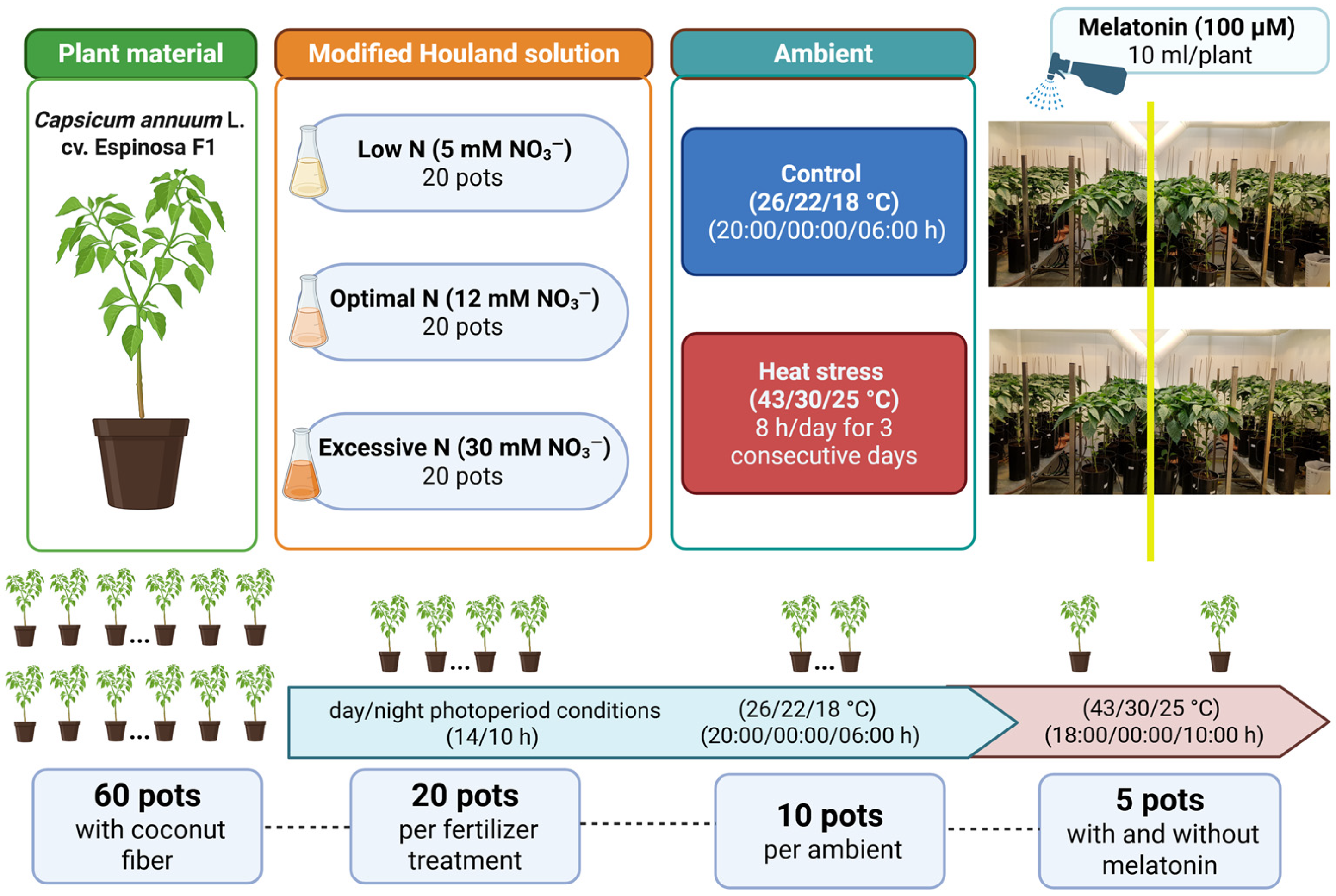
For this experiment, California-type sweet pepper plants (C. annuum L.) of the cultivar cv. Espinosa (California pepper type; Ramiro Arnedo Spain S.A.U., Calahorra, Spain) were used. Seeds were pre-germinated for 50 days in a commercial nursery (El Jimenado, Torre-Pacheco, Murcia). Pepper plants were transplanted into 60 pots (5 L) filled with coconut fiber and irrigated with three modified Hoagland nutrient solutions containing 5, 12, and 30 mM NO3 (low, optimal and excessive nitrogen supply, respectively), with each irrigation treatment applied to 20 pots. Initial day/night photoperiod conditions (14/10 h) in the growth chamber were 26/22/18 °C (20:00/00:00/06:00 h), with a relative humidity of 60%. Plants were maintained under these conditions for 20 days. After the acclimation period, half of the plants from each irrigation treatment were foliar sprayed with 100 µM melatonin, while the other half were sprayed with water twice a week. Following this period, half of the plants from each treatment were subjected to heat stress (43/30/25 °C) (18:00/00:00/10:00 h) daily for 8 h and for 3 consecutive days. Irrigation was increased to maintain a 35% drainage fraction. Melatonin (≥98% purity) solutions (100 µmol L−1) were prepared by dissolving melatonin in ethanol and then diluting it with double-deionized water, and the volume of foliar spray per plant was 10 mL. The experimental design is shown in Figure 1.

2.2. Growth Variables

Shoot fresh weight (FW) and dry weight (DW) were measured to evaluate growth attributes. For the dry weight measurement, plants were oven dried to 65 °C for 96 h, and dry matter was calculated to assess growth performance.

2.3. Measurement of Leaf Gas Exchange

The net photosynthesis (ACO2), transpiration rate (E), and stomatal conductance (gs) were assessed on the youngest fully expanded leaf from each plant using a portable photosynthesis system, CIRAS-2 (Compact Infrared Gas Analysis System; PP Systems, Amesbury, MA, USA). A photon flux density of 1300 μmol m2 s−1, and temperature and CO2 conditions for each experiment were set in the PLC6 (U) Automatic Universal Leaf Cuvette (PP Systems, Amesbury, MA, USA). The intrinsic water use efficiency (WUEi) was calculated from the gas exchange measurements as the ratio of ACO2/E, where ACO2 is the carbon absorbed through photosynthesis and E is the water lost via transpiration.

2.4. Measurement of Leaf Physiological Status and Malondialdehyde (MDA)

SPAD values of pepper leaf samples were measured using a Chlorophyll Meter SPAD-502 Plus (Konica Minolta Sensing, Webster Court, Westbrook, UK). The measurements were taken at four different points on each leaf, and the average SPAD value was recorded.
The total nitrogen contents were analyzed in freeze-dried pepper leaves using a combustion nitrogen/protein determinator (LECO FP-528, Leco Corporation, St. Joseph, MI, USA).
The dark-adapted maximum fluorescence (Fm), minimum fluorescence (Fo), steady-state light-adapted chlorophyll fluorescence (F), and maximum fluorescence under light-adaptation (Fm′), were determined in the leaf used in the gas exchange measurements using an OS-30P chlorophyll fluorometer (Opti-Science, Hudson, NH, USA). The ratio of variable fluorescence from the dark-adapted leaf (Fv) to the maximum fluorescence from the same dark-adapted, youngest fully expanded leaf (Fm), known as the maximum potential quantum efficiency of photosystem II (Fv/Fm), was calculated. A special leaf clip holder was used for each leaf to maintain dark conditions for at least 30 min before measurements.
Lipid peroxidation was measured at the end of the experiment as described by Heath and Packer [52]. First, 0.5 g frozen leaf samples were homogenized in a 3 mL 20% (w/v) trichloroacetic acid (TCA) solution and centrifuged at 4 °C for 20 min at 3500× g. From the supernatant, a 1.5 mL aliquot was added to 1.5 mL TCA containing 0.5% thiobarbituric acid (TBA) and 0.15 mL of 4% butylated hydroxytoluene (BHT); then, the sample was boiled at 95 °C for 30 min and kept on ice for cooling. Subsequently, the mixture was centrifuged at 3500× g for 15 min. Then, MDA content was measured at 532 nm and 600 nm by a UV-VIS spectrophotometer (UV-2700i, Shimadzu, Nakagyo-ku, Kyoto, Japan). Thiobarbituric acid reactive substances (TBARS) concentration was calculated using an extinction coefficient of 155 mM−1 cm−1 [53].

2.5. Carbohydrate Contents

Carbohydrates were extracted following the method from Balibrea et al. [54] with some slight variations. Freeze-dried leaves (50 mg) were homogenized in 1.5 mL of MeOH/H2O (80/20%) solution and shaken for 10 s every 10 min, three times. Then, samples were centrifuged at 4 °C for 15 min at 3500× g, and supernatants were filtered through a C18 Sep-Pak cartridge (Waters Associates, Milford, MA, USA). Afterwards, supernatants obtained from two incubations were mixed for identification and quantification. The contents of sugars (glucose, fructose, and sucrose) were determined in leaves by ion chromatography, using an 817 Bioscan (Metrohm, Herisau, Switzerland) system equipped with a pulsed amperometric detector (PAD) and a gold electrode. The column used was a Metrosep Carb 1-150 IC column (4.6 × 250 mm) (Metrohm, Herisau, Switzerland), which was heated to 32 °C. A 0.1M NaOH solution was used as the elution solvent at a flow rate of 1.0 mL min−1.

2.6. Polyamines

The concentration of polyamines was measured according to Otálora et al., 2022 [55]. For this, 2 g pepper leaves previously stored at −80 °C were combined with 5 mL of 5% perchloric acid, then homogenized for 2 min, kept for 1 h in the refrigerator with occasional agitation, and centrifuged at 5000× g for 8 min. The supernatant, which contained free polyamines, was transferred into plastic containers and stored in a freezer at −20 °C until needed. To benzoylate the free polyamines, 1 mL of the sample was mixed with 1 mL of 2 M NaOH and 20 µL of benzoyl chloride. The mixture was vortexed for 15 s and left to rest for 20 min at room temperature. Afterward, 4 mL of saturated sodium chloride solution was added, and the mixture was stirred while 2 mL of diethyl ether was added. The solution was allowed to settle for 30 min at −20 °C. Then, 1 mL of the diethyl ether phase was collected and evaporated. The resulting residue was re-dissolved in 0.5 mL of acetonitrile/water (56/44 v/v). The polyamines were analyzed using an ACQUITY UPLC system (Waters, Milford, MA, USA) with a UV detector (230 nm) and a reversed-phase column (ACQUITY UPLC HSS T3 1.8 µm, 2.1 × 100 mm), maintained at 40 °C. A mixture of acetonitrile/water (42/58 v/v) was used as the elution solvent at a flow rate of 0.55 mL/min.

2.7. Free Amino Acids

Free amino acids were extracted from leaves frozen at −80 °C. The pepper leaves were analyzed with the AccQ·Tag-ultraperformance liquid chromatography (UPLC) method (Waters, UPLC Amino Acid Analysis Solution. Waters Corporation, Milford, MA, USA (2006)) equipped with a fluorescence detector, as described in Piñero et al. [56]. The amino acids measured were (Arg) arginine; (Ala) alanine; (Asp) aspartic acid; (Ser) serine; (His) histidine; (Ile) isoleucine; (Leu) leucine; (Phe) phenylalanine; (Met) methionine; (Pro) proline; (Gly) glycine; (Thr) threonine; (Lys) lysine; glutamic acid (Glu) and (Val) valine.

2.8. Statistical Analysis

Individual pots were considered independent experimental units and data were analyzed using 5 biological replicates corresponding to individual plants, and results are presented as mean ± standard error. The data were first tested for homogeneity of variance and normality of distribution. Significance was determined by an analysis of variance (ANOVA), and the significance (p ≤ 0.05) of the differences between mean values was tested with Duncan’s New Multiple Range Test using the Statgraphics Centurion® XVI (StatPoint Technologies, Inc., Warrenton, VA, USA) software. Additionally, a Principal Component Analysis (PCA) was used to reduce the dimensionality of a set of 29 random variables. In addition, a heatmap representation of standardized values (Z-scores) was created using hierarchical clustering based on Ward’s method and Euclidean distance. Data visualization was performed using the R software version 4.5.0 [57], employing the FactoMineR [58], factoextra [59], dplyr [60], tidyverse [61] and pheatmap packages [62].

3. Results

3.1. Biomass

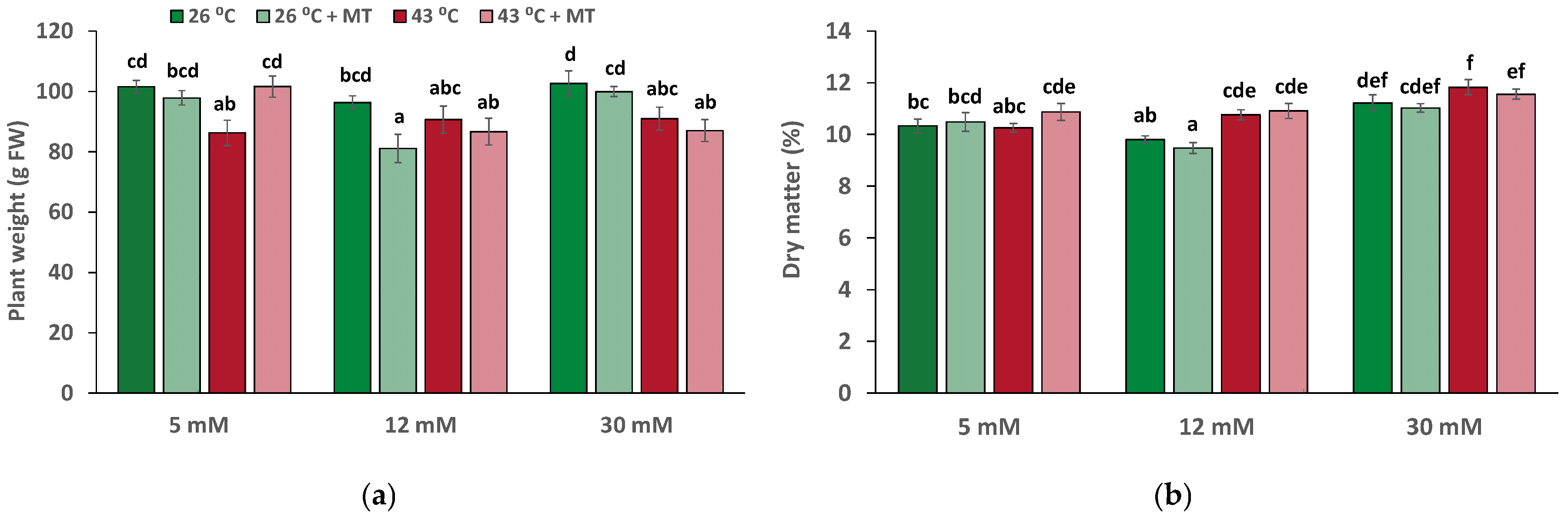
Under control conditions (26 °C), shoot fresh weight (Figure 2a) did not vary due to the nitrate concentration in the irrigation solution, whereas at 43 °C, fresh weight decreased to 5 from 12 mM nitrate. Similar results were reported by Tsouvaltzis et al. [63] and M. Carmen Piñero et al. [64], who found that lettuce irrigated with a nutrient solution containing a 40% reduction in nitrogen showed the same fresh weight as the control irrigated with 100% nitrogen. The use of melatonin partially mitigated biomass loss under heat stress in pepper plants irrigated with 5 mM nitrate.
The percentage of dry matter (Figure 2b) increased under excess nitrate conditions (30 mM) in the nutrient solution, indicating a greater accumulation of structural solids and/or reserve compounds. Heat stress increased the percentage of dry matter only in the control treatment (12 mM), and the effects of heat stress were not reversed by the use of melatonin.

3.2. Leaf Gas Exchange

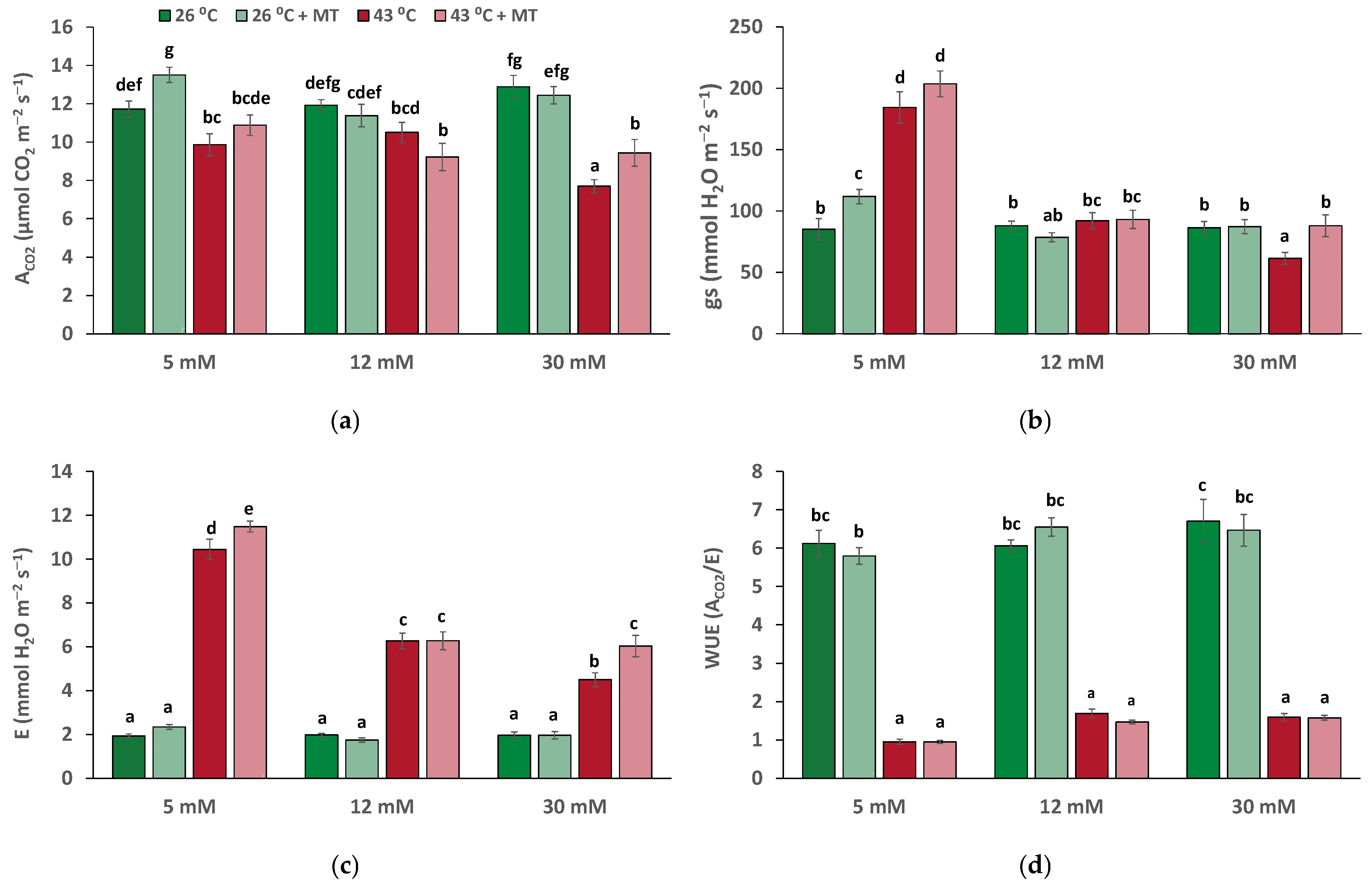
Under ambient temperature (26 °C), ACO2 increased progressively with the NO3 level, reaching the highest values at 30 mM, although no significant differences were found between fertilization treatments (Figure 3a). Therefore, this could indicate that photosynthesis in pepper cv. Espinosa was not limited by N under non-stress conditions. When plants were subjected to heat stress, ACO2 decreased significantly under both deficient and excessive NO3 treatments, with reductions of 15.87% and 40.21% at 5 and 30 mM, respectively, suggesting greater heat sensitivity when nitrogen metabolism is high. Melatonin increased ACO2 by 15.18% at 5 mM compared with the corresponding heat stress group without melatonin, indicating improved photosynthetic efficiency under N-limited conditions. Under heat stress, melatonin partially attenuated the decline in ACO2, although it did not restore control values in the 30 mM treatment.
Regarding stomatal conductance (Figure 3b), heat stress induced an increase of 116.4% in gs in the 5 mM treatment, reflecting an evaporative cooling strategy. In contrast, the 30 mM treatment showed a decrease in gs, suggesting partial stomatal closure. The use of melatonin increased gs at 5 mM, both at 26 °C and 43 °C, thereby favoring gas exchange. At 30 mM, melatonin allowed gs to recover control levels in plants subjected to high temperature.
Heat stress caused a very marked increase in transpiration rate (E) (Figure 3c), specifically of 440.93%, 217.63%, and 128.76% at 5, 12, and 30 mM, respectively. As the NO3 concentration in the nutrient solution increased, a more conservative water-use strategy was observed. Melatonin, however, did not reduce transpiration rate under heat stress, and even increased it slightly, indicating that its effect was not associated with reduced water loss through stomatal closure.
At 26 °C, the highest intrinsic water-use efficiency (WUE) was observed (Figure 3d), with the maximum value at 30 mM, reflecting greater photosynthetic efficiency. Heat stress caused a sharp decline in WUE in all treatments, due to the strong increase in ACO2 and reduction in E. Melatonin did not improve WUE under heat stress, suggesting that its beneficial effect was not linked to water-use efficiency.

3.3. Leaf Physiological Status and Oxidative Damage Indicators

The results presented in Table 1 showed that the SPAD index increased as the NO3 concentration in the nutrient solution increased, while temperature had no significant effects.
Likewise, the highest values of total leaf nitrogen were obtained in the 12 and 30 mM treatments, whereas the lowest values were observed in the 5 mM NO3 treatment at 26 °C, with total nitrogen increasing along with temperature (Table 1).
In turn, the treatments applied to pepper plants had no effect on the maximum quantum efficiency of PSII (Table 1).
Regarding oxidative membrane damage (Table 1), pepper plants showed lower TBARS levels under heat stress (43 °C), indicating the activation of antioxidant mechanisms or efficient thermal acclimation, a response consistent with heat-tolerant cultivars. The highest MDA concentration at ambient temperature was found in the 5 mM NO3 treatment, with a 24.24% reduction when melatonin was applied. In contrast, the use of melatonin in the 12 and 30 mM NO3 treatments resulted in an increase in MDA of 23.52% and 40.15%, respectively. Under heat stress, TBARS decreased significantly in all applied treatments, with reductions of 37.90%, 26.97%, and 21.74% at 5, 12, and 30 mM NO3, respectively. With melatonin application, the reduction was even greater (50.86%, 43.20%, and 47.25% at 5, 12, and 30 mM NO3, respectively), indicating improved antioxidant protection and membrane stabilization.

3.4. Carbohydrate Content

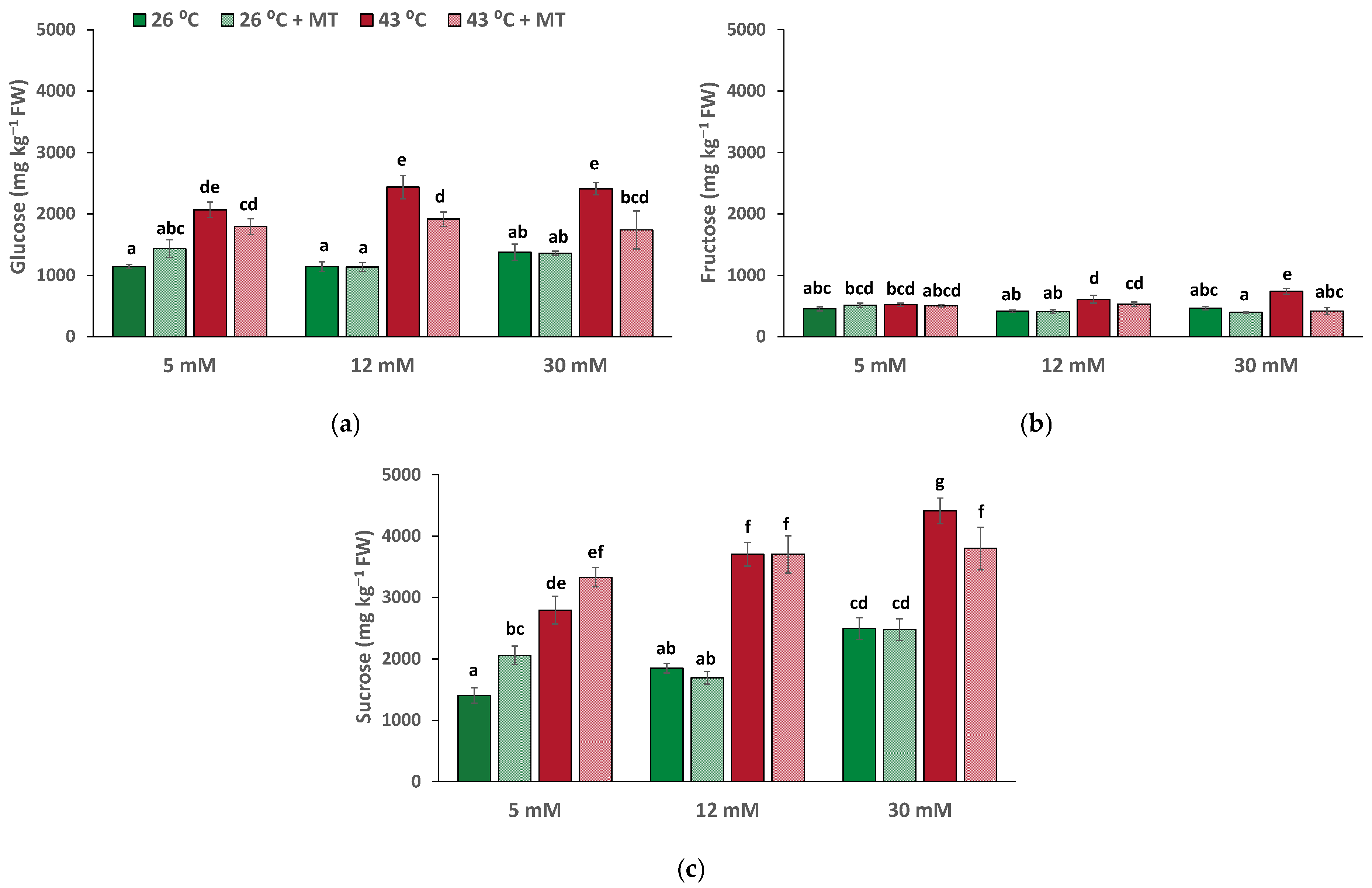
Glucose levels in pepper leaves (Figure 4a) did not vary among NO3 treatments at 26 °C. The increase in temperature caused a strong rise in glucose levels at all three N concentrations, specifically by 80.75%, 113.41%, and 74.92% at 5, 12 and 30 mM, respectively. Melatonin application reduced glucose accumulation under heat stress at all NO3 levels, and this reduction became greater as the NO3 dose increased (13.25%, 27.29%, and 38.47%, respectively).
Fructose showed lower values than glucose (Figure 4b). Under heat stress conditions, a significant increase was observed, reaching 46.95% and 58.52% at 12 and 30 mM, respectively. With melatonin application, fructose concentration returned to control levels at 30 mM and showed a 27.55% reduction at 12 mM.
As for sucrose (Figure 4c), it increased very markedly under heat stress at all NO3 levels, with the effect becoming more intense as the N level increased, reaching the maximum at 30 mM + 43 °C (98.69%, 100.26%, and 80.84% at 5, 12, and 30 mM, respectively). Melatonin only reduced sucrose accumulation in the 30 mM treatment.

3.5. Polyamine Contents

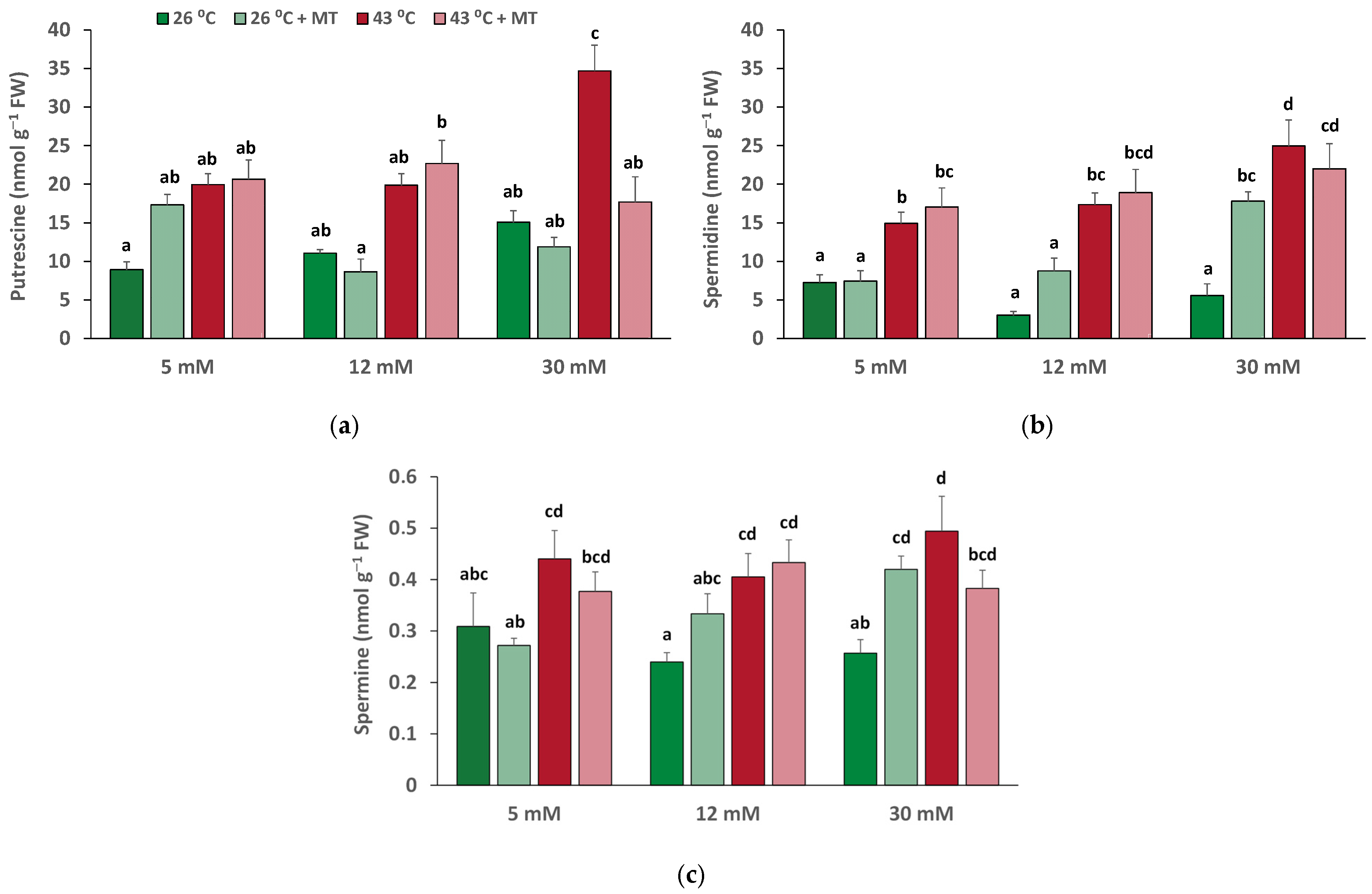
At ambient temperature, the concentration of putrescine in pepper leaves was the same regardless of the NO3 level applied in the irrigation solution (Figure 5a). In turn, heat stress induced a strong increase in putrescine under excess NO3 conditions (30 mM), reaching 130.28%, although this increase was reduced to initial values after melatonin application.
As for spermidine (Figure 5b), it showed a completely different pattern, increasing sharply under heat stress at all NO3 levels (106.29%, 476.26%, and 348.96% at 5, 12, and 30 mM NO3, respectively). In this case, melatonin did not reduce spermidine concentration; instead, in some cases it even increased it further, including at ambient temperature (12 and 30 mM).
Spermine (Figure 5c) behaved similarly to spermidine, although its accumulation in leaves was much lower (42.56%, 69.09%, and 92.33% at 5, 12, and 30 mM NO3, respectively).

3.6. Amino Acids

At 5 mM NO3, the amino acids Ser, Glu, Ala, Thr, Val, and Phe increased under heat stress by 35.29%, 109.87%, 102.82%, 136.85%, 128.88%, and 116.66%, respectively. Melatonin application did not increase amino acid levels in the treatments at ambient temperature. However, under high-temperature conditions, an increase relative to the control was observed in Ser, Arg, Asp, Ala, Thr, Lys, and Val, of 38.31%, 104.87%, 58.02%, 170.68%, 184.26%, 126.98%, and 163.89%, respectively (Table 2).
At 12 mM NO3, the increase in temperature led to higher contents of Ser, Arg, Glu, Ala, Thr, Lys, Val, and Phe in pepper leaves, of 75.13%, 74.27%, 65.43%, 212.75%, 221.53%, 66.02%, 193.27%, and 168.98%, respectively. This greater amino acid accumulation compared with the 5 mM NO3 treatment may have been due to higher nitrogen availability in the medium. The use of melatonin at 26 °C caused a reduction in Lys, Tyr, and Leu relative to the control, of 61.70%, 35.17%, and 46.01%, respectively, and an increase in Asp of 42.84%. At 43 °C, after melatonin application, some amino acids showed greater accumulation relative to the 43 °C treatment without melatonin, such as Arg, Asp, Ala, Tyr, and Phe, by 100.79%, 25.66%, 219.94%, 46.24%, and 241.11%, respectively; whereas others, such as Ser, Glu, Thr, Lys, and Val, showed lower accumulation, reaching 34.13%, 46.67%, 129.61%, 20.32%, and 145.26%, respectively (Table 2).
In the treatment with excess nitrogen (30 mM NO3), the increasing temperature led to the accumulation of Ser, Arg, Asp, Glu, Ala, Thr, Lys, Val, Ile, and Phe by 54.03%, 88.17%, 51.01%, 78.54%, 177.24%, 143.56%, 60.39%, 133.07%, 89.80%, and 137.53%, respectively. The use of melatonin at 26 °C did not cause any significant changes in the amino acids detected, but under heat stress, all of them increased to a lesser extent than in the corresponding treatment without melatonin, with increases of 46.43%, 62.90%, 35.03%, 56.17%, 129.75%, 103.53%, 42.83%, 112.07%, 68.78%, and 113.81%, respectively (Table 2).
At 26 °C, increasing NO3 concentration in the irrigation solution did not result in significant differences in leaf amino acid concentration. When melatonin was applied, Asp decreased by 42.39% from 12 to 5 mM. In contrast, from 12 to 30 mM, an increase in Arg (128.57%), Thr (124.36%), Pro (668.42%), Lys (233.33%), Tyr (96.77%), Val (128.85%), Leu (139.34%), and Phe (292.96%) was observed, while Asp decreased by 30.06%. When plants were subjected to heat stress, excess nitrogen in the irrigation solution (30 mM NO3), compared with the optimal nitrogen concentration (12 mM NO3), increased Asp by 68.32%, whereas nitrogen deficiency (5 mM NO3) caused a decrease in Arg, Thr, Lys, and Val by 42.40%, 23.44%, 51.78%, and 33.89%, respectively. Melatonin application led to a greater accumulation under excess nitrogen of Ser (37.91%), Thr (29.75%), and Pro (121.46%), and a decrease under nitrogen deficiency in Tyr (25.12%) (Table 2). The most abundant amino acids detected were Ser, Asp, Glu, and Ala. Specifically, Ser represented approximately 17.98–24.23%, Asp 13.72–42.16%, Glu 18.99–26.45%, and Ala 4.43–11.10% of the total free amino acid pool, depending on the treatment applied.
Table 3 shows the percentage of variance attributed to nitrate concentration in irrigation, temperature, melatonin, and all interactions between these three factors for the amino acid content in pepper leaves. Temperature was the most dominant factor for all amino acids except proline, for which nitrate concentration in the nutrient solution was the main factor.
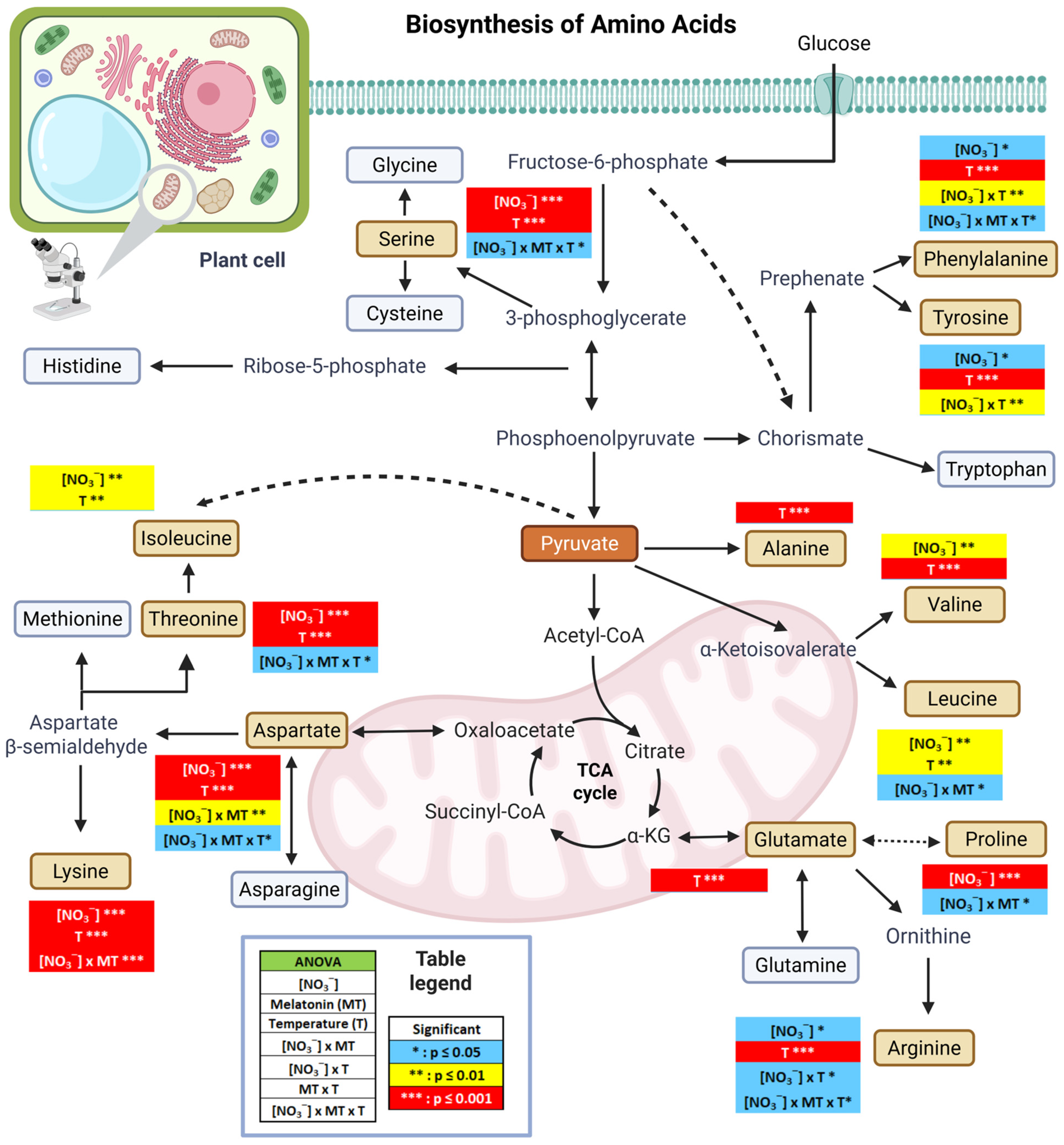
Figure 6 summarizes the amino acid biosynthesis pathway in pepper leaves and shows the experimental factors that significantly affected each metabolite according to the ANOVA: nitrate concentration [NO3], temperature (T), melatonin (MT), and their interactions. Overall, the figure indicates that temperature was the most influential factor, as it was associated with many amino acids, especially alanine, glutamate, valine, phenylalanine, tyrosine, and serine. This suggests that heat stress caused a strong reorganization of carbon and nitrogen metabolism. A prominent role of nitrate concentration was also observed, affecting amino acids such as lysine, aspartate, glutamate, leucine, isoleucine, and phenylalanine, confirming that N availability conditioned the accumulation of nitrogen-containing compounds.
The interactions were also relevant (Figure 6) (Table 3), and the [NO3] × T interaction appeared in several compounds, indicating that the response to heat depended on the level of available nitrogen. In contrast, melatonin showed a more selective effect, mainly appearing in interaction with nitrate or temperature rather than as a single factor. This supports the idea that melatonin acts as a fine modulator of metabolism, adjusting specific responses under stress.
From a metabolic point of view, pyruvate, aspartate, and glutamate stand out as central nodes, which are connected to the synthesis of numerous amino acids. Therefore, the figure suggests that heat stress and nitrogen status mainly altered the entry points of carbon into amino acid metabolism, while melatonin modulated this response.

3.7. Principal Component Analysis

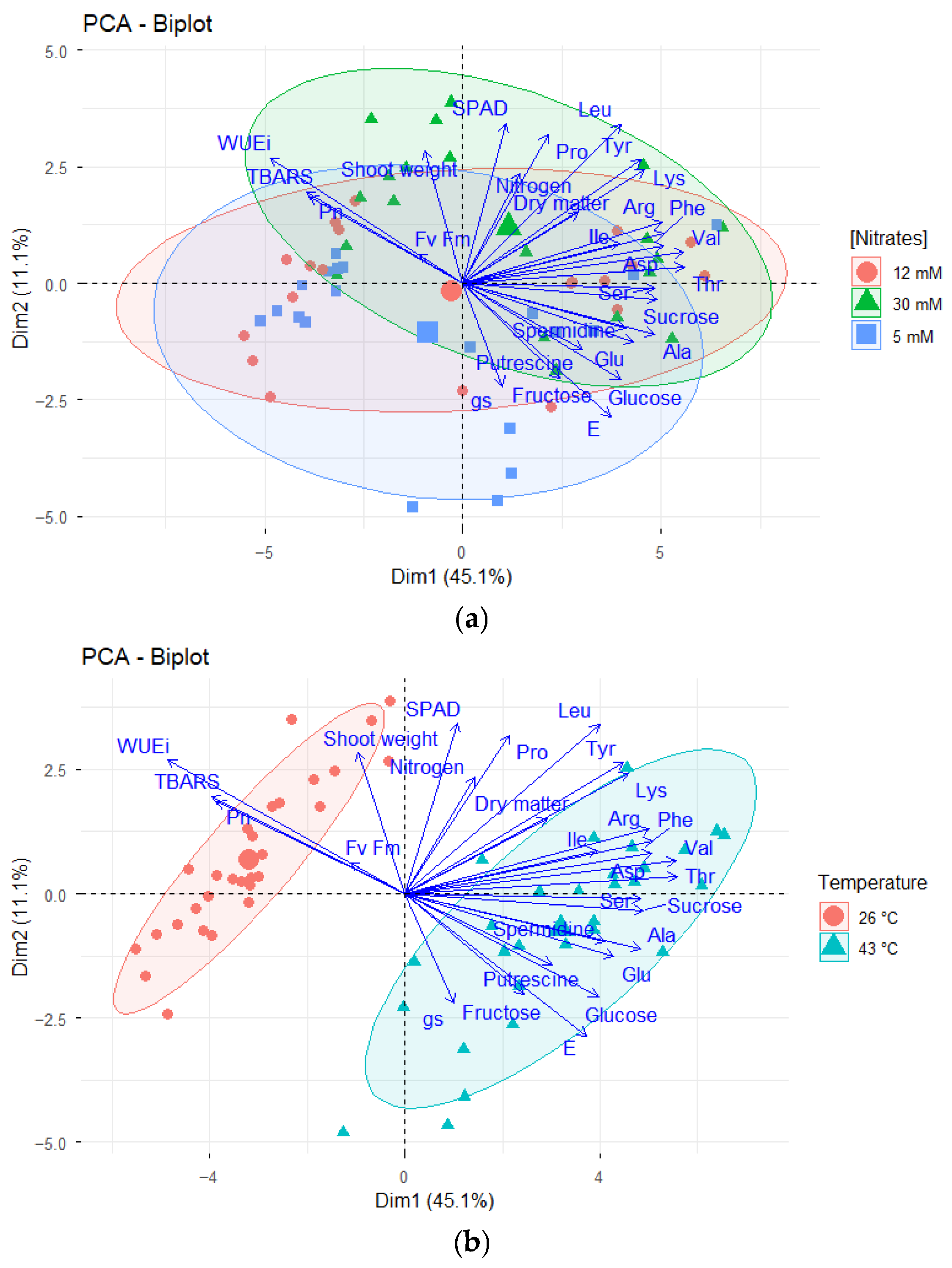
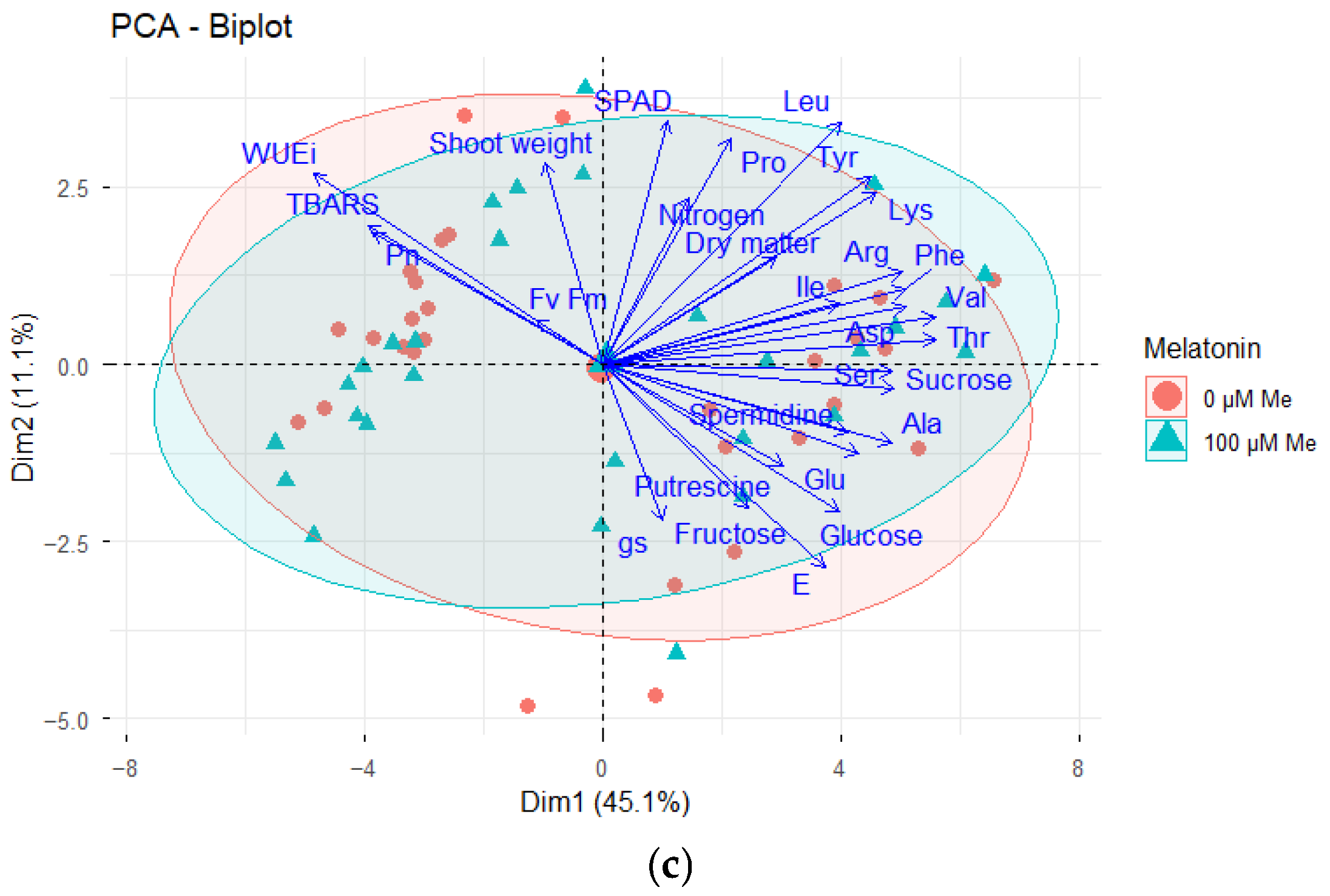
A principal component analysis (PCA) (Figure 7) was applied to our results to examine the relationship of the 29 variables studied with nitrogen fertilization rate, temperature, and melatonin application in pepper cultivars. The first two principal components (PC1 and PC2) explained 45.1% and 11.1% of the total variance, respectively. The vectors represent physiological and biochemical variables, while the dots correspond to individual biological replicates. Ellipses indicate the 85% confidence interval for each group. The horizontal axis (Dim1) mainly represents a temperature gradient, where the variables located on the left side of the axis were more affected by ambient temperature (26 °C), and those located on the right side were more affected by high temperature (43 °C) (Figure 7a–c). In turn, the vertical axis (Dim2) mainly represents the nitrogen fertilization rate (Figure 7a–c), where the variables located above the axis were more affected by excess nitrate concentration (30 mM NO3) than those located below the axis (5 mM NO3).
Figure 7a shows a well-defined separation of the three nitrate treatments in pepper. Excess nitrogen resulted in the highest SPAD index, the greatest biomass, and dry matter, together with the accumulation of nitrogen and amino acids such as Pro, Tyr, Leu, Lys, and Arg. Nitrogen-deficient treatments were associated with the accumulation of glucose and fructose, polyamines such as putrescine and spermidine, and higher stomatal conductance and evapotranspiration. Amino acids such as Phe, Ile, Val, Asp, Thr, and Ser, together with sucrose and spermine, accumulated in the optimal fertilization treatment.
The heat stress treatment (Figure 7b) led to the accumulation of carbohydrates, together with an increase in polyamine and amino acid contents. In contrast, ambient temperature was associated with higher shoot fresh weight, higher photosynthetic rate, and higher intrinsic water use efficiency (WUEi), as well as with MDA accumulation in pepper leaves.
Figure 7c shows that the PCA did not reveal a clear separation between melatonin-treated plants (100 µM) and untreated plants (0 µM), as both groups largely overlapped. This indicates that melatonin was not the main factor responsible for the variability observed in the data; rather, sample dispersion was more strongly influenced by nitrogen level and temperature.

3.8. Heatmap

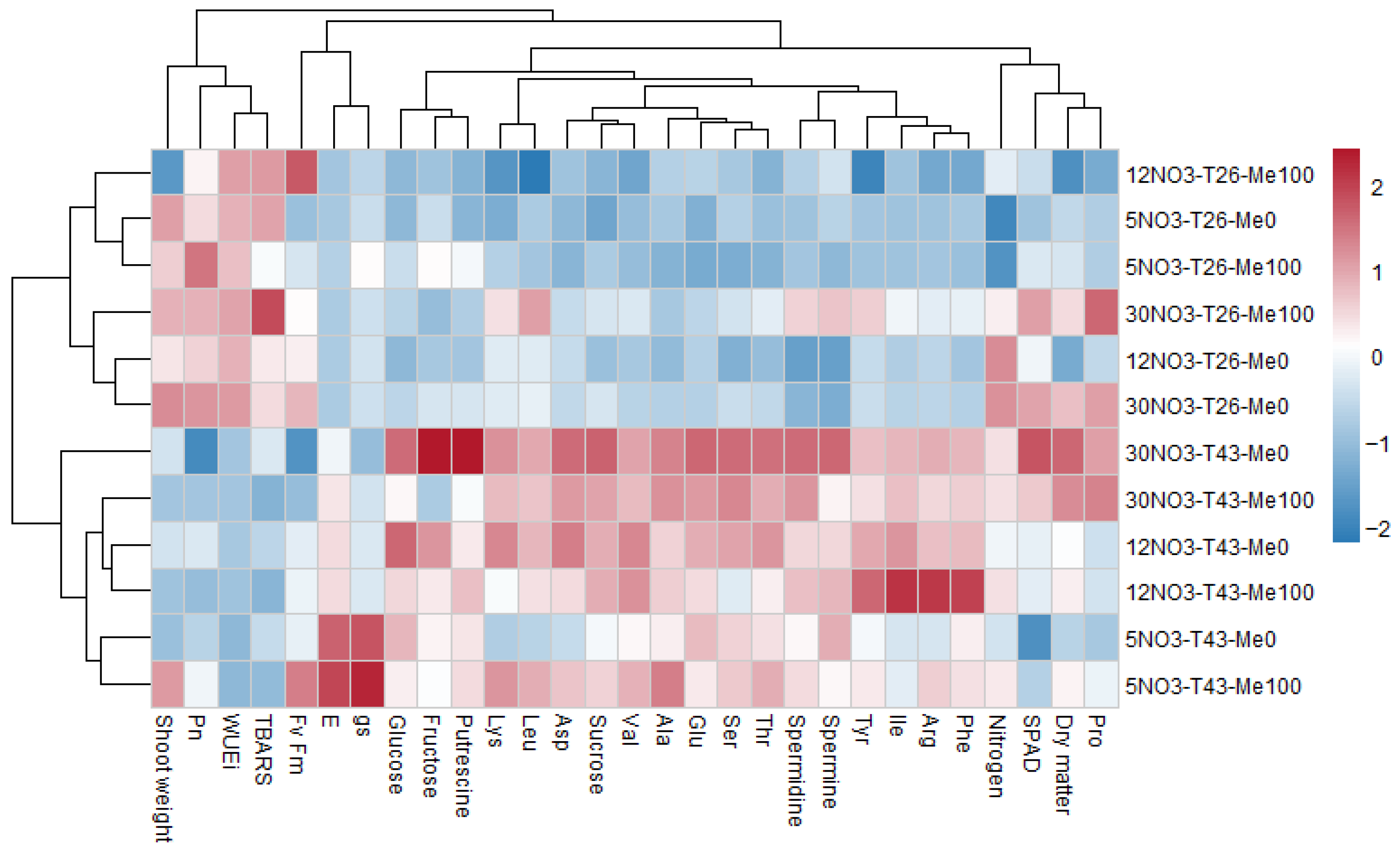
Figure 8 shows a heatmap of standardized values (Z-scores) for 29 physiological, biochemical, and stress-related variables, where the comparison of each variable is relative rather than absolute. In addition, the heatmap (Figure 8) provides additional support to the PCA (Figure 7), by organizing the measured variables into distinct physiological functions based on their similarity indices.
The hierarchical clustering analysis and the heatmap revealed that temperature was the main factor determining the variability in the evaluated parameters, clearly separating the treatments at 26 °C from those subjected to 43 °C. Under heat stress conditions (43 °C), a general increase was observed in the accumulation of soluble sugars, amino acids, and polyamines, indicating osmotic protection and stress tolerance. On the other hand, the treatments at 26 °C were more closely related to higher shoot fresh weight, photosynthetic rate (Pn), Fv/Fm, and lower oxidative stress.
Nitrogen level significantly modulated this response, as plants grown with 30 mM NO3 showed higher dry matter, nitrogen content, SPAD index, and proline levels, indicating a greater accumulation of nitrogenous compounds. In contrast, the 5 mM NO3 treatments under heat stress were more closely associated with glucose, fructose, stomatal conductance (gs), and transpiration rate (E).
The effect of melatonin was less evident than that of temperature and nitrogen, as melatonin-treated and untreated samples tended to closely cluster within the same thermal and nutritional conditions. However, consistent changes were detected within each condition, especially under heat stress, where melatonin application tended to enhance the accumulation of amino acids and polyamines and to reduce oxidative damage markers. These results suggest that melatonin acts as a fine modulator of the stress response, amplifying defense mechanisms rather than generating global metabolic changes.

4. Discussion

The present study investigated the physiological and biochemical changes induced by high temperatures in a pepper cultivar irrigated with three different nitrate concentrations and treated with exogenous melatonin, to understand the mechanisms of heat tolerance in pepper seedlings.

4.1. Biomass

The results obtained in this study indicate that plant fresh weight did not increase under a higher rate of nitrogen fertilization at ambient temperature, whereas under heat stress, it decreased to 5 from 30 mM NO3. These results are contrary to those reported by Abdullah Ulas et al. [65] and Tripathi [66], in which a higher nitrogen concentration in the nutrient solution increased biomass in pepper and radish plants, respectively. However, when melatonin was applied in the 5 mM nitrogen level treatment, fresh weight was fully restored to the control level. At the 30 mM nitrogen level, recovery with melatonin was not as strong as at 5 mM, supporting the idea that excess nitrogen creates such a high metabolic vulnerability under heat stress that, although melatonin helps the plant, it becomes more difficult to translate that protection into actual biomass. These findings are consistent with recent studies showing that exogenous melatonin improved heat stress tolerance in several plant species [35,36]. Kumar et al. [33] observed that pretreatment with melatonin at different concentrations reduced the adverse effects of heat stress in sweet potato plants, improving growth parameters, relative water content, and membrane stability index.
Regarding the dry matter percentage parameter, it indicates how much solid structure (proteins, sugars, fibers) the plant has managed to accumulate. Balliu et al. [67] and Magdalena et al. [68] reported that leaf dry matter increased as nitrogen dose increased. In our experiment, dry matter was significantly affected by temperature and nitrogen fertilization rate (Table 4). In other words, the highest dry matter content was obtained in the treatment with excess nitrogen fertilization (30 mM NO3) at 26 °C, largely because a greater nitrogen supply allows the plant to build more cellular structures and accumulate more reserves. Plants subjected to heat stress (43 °C) and supplied with 12 mM NO3 accumulated more dry matter than plants grown at 26 °C. In addition, at all three nitrogen levels, melatonin application at 43 °C resulted in dry matter values equal to or higher than those of plants not exposed to heat. At the 30 mM NO3 dose under high temperature, dry matter was maximal due to the massive accumulation of solutes (sucrose, glucose, and polyamines). That is, although the plant was under stress, it had such high nitrogen and sugar reserves that its dry weight remained high, even though total growth (fresh weight) was restricted. Previous studies also showed that melatonin application in celery plants under heat stress significantly reduced stress while increasing biomass and leaf area [35]. Likewise, another study conducted by Jia et al. [69] confirmed that melatonin effectively enhances heat stress tolerance in cherry radish seedlings by increasing biomass.

4.2. Leaf Gas Exchange

At all nitrogen levels, when temperature increased from 26 °C to 43 °C, photosynthesis was significantly reduced, with the most drastic decline occurring at the highest nitrogen level (30 mM). Heat stress damaged the photosynthetic machinery; that is, when temperature rose to 43 °C, the plant suffered direct damage to its metabolism. This was offset, on the one hand, by stomatal closure to avoid water loss, and on the other hand, heat affected the activity of the Rubisco enzyme, which is responsible for carbon fixation, thus explaining the decline in photosynthesis as temperature increased. Kim et al. [4] reported that when pepper plants are exposed to high temperatures (around 42 °C), photosynthetic rates decrease and plants show reduced growth, smaller fruit size, and lower yield. In addition, although nitrogen is essential for plant growth, the results showed that at 30 mM NO3, the heat-induced decline in photosynthesis was the most severe, suggesting that very high nitrogen fertilization, without protection, may make the plant more sensitive to heat stress. That is, excess nitrogen may increase plant sensitivity to heat stress not only through physiological changes, but also through molecular and metabolic mechanisms. High nitrate availability can enhance nitrate assimilation, metabolic activity, and photosynthetic electron transport demand. Under heat stress, this increased metabolic activity may favor the generation of reactive oxygen species (ROS) [26,70]. When ROS production exceeds the capacity of antioxidant and detoxification systems, cellular redox homeostasis may be disrupted, contributing to oxidative pressure, membrane damage, and impaired photosynthetic performance. Therefore, the role of ROS as toxic or signal molecules depends on the fine balance between their production and scavenging. However, since ROS levels and antioxidant enzyme activities were not directly measured, this interpretation should be considered with caution. In contrast, melatonin application tended to mitigate the negative impact of heat, especially in the 5 and 30 mM NO3 treatments, where plants showed higher net CO2 assimilation than those without treatment, helping the plant maintain its photosynthetic activity under stress. Melatonin acts as a protective hormone that improves plant resilience by reducing ROS and stabilizing membranes, helping chloroplasts avoid degradation under high temperatures and allowing photosynthesis to continue.
Stomatal conductance (gs) is vital because stomata control both CO2 entry for photosynthesis and water vapor loss for plant cooling [71,72]. Stomatal closure, a common response to heat stress, usually leads to reduced photosynthesis in mesophyll cells and decreased activity of key carbon assimilation enzymes [73,74]. In the present study, when nitrogen supply was low (5 mM NO3), the plant opened its stomata massively under heat shock. Melatonin enhanced this opening even further, helping the plant transpire more and stay cooler under heat. However, when nitrogen supply was high (30 mM NO3), heat caused the plant to close its stomata to avoid water loss, which would explain why photosynthesis declined so strongly at this NO3 concentration. Melatonin application prevented the plants from fully closing their stomata, allowing gas exchange and mitigating the limitation of carbon assimilation under heat stress. Kumar et al. [33] reported that exogenous melatonin application promoted stomatal opening in sweet potato leaves under heat stress, thereby maintaining a higher photosynthetic rate. These findings are in agreement with recent studies in tomato and carnation [74,75,76], which showed that melatonin-treated plants were able to preserve leaf chlorophyll content and minimize leaf damage caused by heat stress.
The transpiration rate (E) essentially measures the amount of water the plant is losing through its leaves to cool itself. In our experiment, plants under low nitrogen (5 mM) had the highest transpiration rate, meaning that these plants were investing large amounts of water to cope with heat. Excess nitrogen (30 mM) hindered the response to heat, with transpiration being much lower than in the 5 mM group (lower transpiration means that the leaf heats up more quickly). This explains why, in the first graph, photosynthesis declined so markedly in this group, since the plant was unable to cool itself sufficiently. Melatonin was able to significantly increase transpiration compared with the heat-stress control alone, allowing the plant to recover part of its cooling capacity. This is consistent with the increase in gs observed at 5 mM NO3.
Intrinsic water use efficiency (WUEi) measures how much carbon the plant gains for each unit of water it loses. The most drastic change occurred when the temperature increased from 26 to 43 °C, where WUEi declined at all nitrogen levels; that is, under heat stress, pepper plants needed to use large amounts of water. Melatonin did not cause the plant to save water under extreme heat; rather, it favored transpiration and cooling so that the plant could continue photosynthesizing, instead of simply closing stomata and stopping growth. Although in some cases melatonin partially improved ACO2 or modulated gs and E, in this case it did not restore WUEi under heat stress. The disproportionate increase in transpiration relative to CO2 fixation explains this strong reduction.

4.3. Leaf Physiological Status and Oxidative Damage Indicators

Oxidative stress, assessed by TBARS, was consistently reduced under high temperature despite the greater metabolic demand. The decrease in TBARS at 43 °C indicates that pepper plants were able to activate effective antioxidant mechanisms, thereby preventing oxidative membrane damage, possibly through increased enzymatic activity and greater accumulation of osmolytes such as proline [77,78]. Melatonin reduced MDA values at 43 °C, suggesting lower lipid peroxidation and improved membrane stability. In our case, the decrease in TBARS coincided with sugar accumulation at the three nitrogen levels studied.
On the other hand, the maximum efficiency of photosynthesis (Fv/Fm) was also measured, whose normal value is usually close to 0.80. In our case, the most critical value was recorded in the treatment at 43 °C with 30 mM NO3 and without MT, where the value dropped to 0.77. This confirms that excess nitrogen combined with heat damages photosynthetic machinery. When MT was added under the same condition, the value increased to 0.78, and this suggests a partial protective effect of melatonin on PSII efficiency. The Fv/Fm level decreased under heat stress at the 30 mM NO3 dose, which hindered energy transfer and reduced the quantum efficiency of PSII [79,80].

4.4. Carbohydrate Contents

The decline in photosynthesis is associated with alterations in carbohydrate metabolism, which leads to reduced growth under stress [81]. In addition, heat tolerance requires sugar accumulation in plants, and carbohydrate availability (glucose and sucrose) is considered an important physiological trait for resistance to heat stress [82]. These authors observed a decrease in carbohydrate content under heat stress, and this reduction was greater in the heat-sensitive genotype than in the tolerant one. Therefore, greater sugar accumulation is required for potential plant tolerance. In contrast, Noushina Iqbal et al. [81] observed that heat stress led to a decrease in starch content and total soluble sugar accumulation in wheat plants.
In plant physiology, glucose is not only a source of energy but also acts as a stress signaling molecule and an osmoprotectant. Under extreme heat, plants usually break down their starch reserves into simple sugars (such as glucose and fructose) to increase the concentration of solutes in their cells, which helps retain water and protect proteins from heat damage through an osmoprotective effect. In our experiment, at 43 °C, glucose levels increased sharply as compared with those at 26 °C, and melatonin-treated plants showed lower glucose levels than plants exposed to heat without protection. Rather than allowing glucose to accumulate as a by-product of stress or starch degradation, melatonin appears to promote the use of this sugar in cellular repair processes and the maintenance of photosynthesis; that is, melatonin is helping the plant use glucose more efficiently.
Just as with glucose, fructose is a soluble sugar that increases when the plant is under stress. Under 5 mM NO3 conditions, fructose levels remained stable, suggesting that under low nitrogen conditions, the plant maintains a basic balance even under heat. At 43 °C and under high nitrogen, fructose reached its highest level. The effect of melatonin at 43 °C under the 30 mM treatment caused a decrease in fructose levels similar to those of the control.
On the other hand, sucrose is the main transport of sugar in plants, that is, the form in which energy travels from leaves to roots or fruits. As nitrogen fertilization rates increased, heat also increased sucrose levels. In other words, under heat stress, the plant accumulates sucrose in the leaves, which may act as an osmoprotectant to prevent cell collapse; alternatively, under severe heat stress, plants may be unable to properly transport or process all that sucrose. At 30 mM NO3, melatonin reduced the level of accumulated sucrose, suggesting that melatonin may be facilitating the transport of these sugars to other organs. In this context, exogenous melatonin helps plants survive extreme conditions by preserving the expression of SUT and SWEET genes, ensuring sugar transport continues to feed root and fruit development even under severe abiotic stress [83]. Other studies have shown that sucrose transporters (SUTs) play an important role in the transmembrane transport and distribution of sucrose, source–sink partitioning, and abiotic stress responses, and their activity has an important impact on plant growth and crop yield [84].

4.5. Polyamine Contents

Regarding polyamines, these compounds have been described as key regulators of growth and cell division, and may also act as modulators of stress tolerance, capable of interacting with nucleic acids, membranes, and ROS, and regulating defense-related gene expression. Moreover, MT enhances the ascorbate-glutathione cycle and reprograms the polyamine metabolic pathways to scavenge excess ROS, maintain cellular membrane stability, and protect plants from heat-induced oxidative stress [85].
Putrescine (Put) helps stabilize membranes and protect DNA, but its excessive accumulation is usually a symptom that the plant is under severe metabolic stress. At 26 °C, putrescine levels were low because the plant was not under stress, but at 43 °C they increased sharply at the 30 mM NO3 level. When melatonin was applied, putrescine decreased significantly to control levels under this nitrogen dose (30 mM) and at 43 °C.
Unlike putrescine, which acts more as a distress signal, spermidine (Spd) plays a much more active role in protecting the photosynthetic apparatus and stabilizing membranes. At 43 °C, its levels increased significantly at all nitrogen doses, but at 5 mM and 12 mM, melatonin application increased spermidine levels even further as compared with heat stress alone. This may indicate that melatonin shifted polyamine metabolism toward a more protective profile. In the 30 mM NO3 group, spermidine levels were the highest observed in the entire study, and here melatonin maintained very high levels, although slightly lower than the maximum peak.
Spermine (Spm) is usually associated with the long-term stability of membranes and nucleic acids under extreme stress. As with the other polyamines, heat strongly increased its production. At the highest nitrogen level, spermine reached its maximum value, confirming that plants under excess nitrogen were under particularly severe stress. With MT application, spermine concentration did not decrease significantly at any nitrogen level. Jahan et al. [85] reported that the contents of Put, Spd, and Spm increased significantly in tomato plants subjected to heat stress, and that melatonin application caused an even greater increase in these polyamines. Moreover, high polyamine levels activate stress-response pathways together with antioxidants and hormonal regulators [86]. Alam et al. [87] concluded that seedlings exposed to prolonged heat stress and treated with melatonin adjusted through modulation of polyamine metabolism. Generally, tolerant genotypes accumulate greater amounts of PAs than sensitive genotypes [88]. In several studies, tolerant genotypes accumulated more Spd and Spm, while the sensitive genotypes from the same plants species accumulated more Put under the same types of stresses [89,90]. In our study, melatonin appears to shift the polyamine profile of pepper plants toward a more tolerant response, reducing putrescine, which is often associated with early stress signaling, while increasing spermidine and spermine, which are more closely related to protective functions.

4.6. Amino Acids

Nitrogen plays a crucial role in the synthesis of starch in leaves and production of amino acids. Increased free amino acid levels may reflect protein turnover, osmotic adjustment, or accumulation of stress-related metabolites. Moreover, amino acids are grouped into five distinct families [aspartate, branched-chain amino acids (BCAAs), aromatic, 3-phosphoglycerate, and α-ketoglutarate] according to their biosynthetic pathways and metabolic functions [91].
Table 2 shows that the concentration of free amino acids varied according to NO3 concentration, temperature, and melatonin application. In general, the treatments at 43 °C promoted greater amino acid accumulation than those at 26 °C, especially under the highest NO3 concentration, indicating the activation of stress metabolism and osmotic adjustment. This increase was particularly evident in Asp, Glu, Ala, Thr, Tyr, Val, Leu, and total amino acid content, whose maximum values were recorded, in most cases, under high-temperature treatments. Du et al. [92] reported that all four aspartate families of amino acids were high in heat-tolerant bermudagrass hybrids subjected to heat stress. Aspartic acid and threonine accumulated in hard fescue exposed to heat stress [93].
As NO3 concentration increased, a general trend toward higher amino acid levels was observed, both under control conditions and under heat stress. Overall, the 30 mM NO3 treatments showed the highest values of numerous amino acids and total amino acid concentrations, indicating greater nitrogen availability for incorporation into organic compounds. This is consistent with the central role of amino acids such as Glu and Asp, which act as metabolic hubs in nitrogen assimilation and redistribution. In addition, the strong increase in Ala, Val, Leu, and Ile under high temperature could reflect not only greater N availability, but also an adaptive response to stress related to osmotic adjustment and redox balance. Our results are consistent with those reported by Jacinta Collado-González et al. [94], in which increasing nitrogen supply in lamb’s lettuce led to a higher amino acid concentration. In addition, other authors have also reported that N deficiency was reflected in a decrease in most amino acids in other plant species [95,96].
Melatonin showed a differential effect depending on nitrate dose and temperature. Under 26 °C conditions, especially at 5 and 12 mM NO3, melatonin application tended to reduce the concentration of most amino acids (except Lys at 5 mM, and Ser, Asp, and Ala at 12 mM), as well as total amino acid content. In contrast, at 30 mM NO3, melatonin application increased the concentration of all amino acids except Ala. This pattern may be interpreted as a lower need to accumulate nitrogenous solutes under non-stress conditions, or alternatively, as a redistribution of nitrogen toward other metabolic or structural processes. However, under 43 °C, the response to melatonin was completely different. At 5 mM NO3, melatonin further increased total amino acid content as compared with the treatment without melatonin, whereas at 12 and 30 mM, it tended to reduce the heat-induced accumulation of amino acids, although values remained high. This suggests that melatonin does not simply act by increasing the concentration of all amino acids, but rather by modulating nitrogen metabolism according to the physiological state of the plant and nitrogen availability.
The behavior of proline did not follow a pattern that was exclusively dependent on temperature. Its highest values were mainly observed in the 30 mM NO3 treatments and with melatonin, even at 26 °C, indicating that its accumulation depended on nutritional status and on the regulation exerted by melatonin. Therefore, in this case, it does not appear to act as an indicator of temperature-induced oxidative damage. Other authors [97,98,99] reported that Pro synthesis is induced during drought, salt, and cold stress but not during heat stress. In addition, increased proline accumulation in response to excess nitrogen supply has been reported in several plant species, suggesting that proline may act as a nitrogen-related osmoprotective metabolite under stress conditions [100,101]. In contrast, Iqbal et al. (2015) [102] reported that excess N inhibited photosynthesis and caused higher ethylene evolution but lower proline production compared to sufficient N in mustard (Brassica juncea).
Total amino acid content also followed these trends. The lowest values were found in treatments at 26 °C with melatonin and low or intermediate NO3 concentration, whereas the highest values were reached at 43 °C, especially at 30 mM NO3 without melatonin. In summary, under excess nitrogen, heat promoted a strong accumulation of amino acids, whereas melatonin tended to reduce this response; in contrast, under nitrogen deficiency, melatonin promoted stress-induced accumulation. This suggests that melatonin may contribute to optimizing nitrogen use and metabolic homeostasis under heat stress, rather than simply inducing indiscriminate amino acid accumulation.

5. Conclusions

Temperature was the main factor determining the physiological and biochemical responses of pepper plants under heat stress. Exposure to high temperature reduced fresh biomass, photosynthetic performance, and water use efficiency, while inducing a marked reorganization of primary metabolism. This metabolic adjustment was reflected in the accumulation of carbohydrates, polyamines, and amino acids, suggesting the activation of osmotic adjustment, cellular protection, and acclimation mechanisms under high-temperature conditions.
Nitrogen supply strongly modulated the response of pepper plants to heat stress. Excess nitrate supply (30 mM NO3) promoted dry matter accumulation and the accumulation of nitrogenous compounds, including amino acids and proline, but was also associated with greater photosynthetic sensitivity to heat. In contrast, nitrogen deficiency (5 mM NO3) promoted a response more closely linked to stomatal opening, increased transpiration, and soluble sugar accumulation. These results indicate that nitrogen availability plays a key role in determining the physiological and metabolic strategies adopted by pepper plants under heat stress.
Exogenous melatonin application partially mitigated the negative effects of heat stress by supporting biomass maintenance, improving CO2 assimilation and gas exchange, and reducing lipid peroxidation, as indicated by TBARS/MDA levels. However, the effect of melatonin depended on the nitrogen nutritional status of the plants. Under nitrogen deficiency, melatonin enhanced protective responses, including the accumulation of certain amino acids and the maintenance of growth, whereas under excess nitrate supply, it contributed to limiting the excessive accumulation of some stress-related metabolites.
Overall, melatonin did not act as the dominant factor explaining the global variability observed in the dataset, which was mainly driven by temperature and nitrate supply. Rather, melatonin acted as a fine modulator of specific heat stress responses, helping to optimize carbon and nitrogen metabolism while reinforcing defense-related mechanisms and metabolic stability under specific nutritional conditions. These findings demonstrate that the interaction between nitrogen nutrition and melatonin application is crucial for improving heat stress tolerance in pepper plants and may have agronomic relevance for crop management under increasingly frequent high-temperature events.
However, this study was conducted under controlled growth chamber conditions and was not replicated across different growing seasons. Therefore, future studies under greenhouse and field conditions are needed to validate these responses and assess their impact on yield and fruit nutritional and functional quality.

Author Contributions

Conceptualization, G.O.; methodology, G.O., M.C.P., J.C.-G. and F.M.d.A.; software, G.O.; validation, M.C.P., J.C.-G., J.L.-M. and F.M.d.A.; formal analysis, G.O., M.C.P. and J.C.-G.; investigation, G.O.; resources, F.M.d.A.; data curation, J.L.-M. and F.M.d.A.; writing—original draft preparation, G.O.; writing—review and editing, G.O. and F.M.d.A.; visualization, M.C.P. and J.C.-G.; supervision, G.O. and F.M.d.A.; project administration, F.M.d.A.; funding acquisition, F.M.d.A. All authors have read and agreed to the published version of the manuscript.

Funding

This work was partially supported (60%) by the European Commission ERDF/FEDER Operational Programme of Murcia (2021–2027), Project No. 50463 Subproject: Research and innovation to improve the competitive sustainability of fruit and vegetable products in the Region of Murcia. Jacinta Collado-Gonzalez was hired by the Ramón y Cajal Program (RYC2021-032598-I).

Data Availability Statement

The original contributions presented in this study are included in the article. Further inquiries can be directed to the corresponding authors.

Acknowledgments

We want to thank Marta Durán Sánchez and Juan Pedro Martínez Buendía for their technical assistance, and Mario G. Fon for assistance with the correction of the English.

Conflicts of Interest

The authors declare no conflicts of interest.

References

  1. Woetzel, J.; Pinner, D.; Samandari, H.; Engel, H.; Krishnan, M.; Boland, B.; Powis, C. Climate Risk and Response: Physical Hazards and Socioeconomic Impacts; McKinsey Global Institute: New York, NY, USA, 2020. [Google Scholar]
  2. García, J.G.; García, B.G. Sustainability Assessment of Greenhouse Pepper Production Scenarios in Southeastern Spain. Agronomy 2022, 12, 1254. [Google Scholar] [CrossRef]
  3. Good Agricultural Practices for Greenhouse Vegetable Crops. Available online: https://openknowledge.fao.org/items/e12efcc8-19b8-43ee-8f85-978c41984d12 (accessed on 22 April 2026).
  4. Kim, M.K.; Jeong, H.B.; Yu, N.; Park, B.M.; Chae, W.B.; Lee, O.J.; Lee, H.E.; Kim, S. Comparative heat stress responses of three hot pepper (Capsicum annuum L.) genotypes differing in temperature sensitivity. Sci. Rep. 2023, 13, 14203. [Google Scholar] [CrossRef] [PubMed]
  5. Rosmaina; Zulfahmi; Jannah, M.; Sobir. Temperature critical threshold for yield in chili pepper (Capsicum annuum L.). Sabrao J. Breed. Genet. 2022, 54, 627–637. [Google Scholar] [CrossRef]
  6. Kaur, N.; Jindal, S.; Singh, P. Evaluation of Hot Pepper (Capsicum annuum L.) Genotypes for Heat Tolerance during Reproductive Phase. Int. J. Bio-Resour. Stress Manag. 2016, 7, 126–129. [Google Scholar] [CrossRef]
  7. Lin, S.; Lin, T.; Yee, C.K.M.; Chen, J.; Wang, Y.; Nalla, M.K.; Barchenger, D.W. Impedance Flow Cytometry for Selection of Pollen Traits Under High Temperature Stress in Pepper. HortScience 2022, 57, 181–190. [Google Scholar] [CrossRef]
  8. Grant, R.F.; Kimball, B.A.; Conley, M.M.; White, J.W.; Wall, G.W.; Ottman, M.J. Controlled warming effects on wheat growth and yield: Field measurements and modeling. Agron. J. 2011, 103, 1742–1754. [Google Scholar] [CrossRef]
  9. Ahmad, M.; Imtiaz, M.; Shoib Nawaz, M.; Mubeen, F.; Imran, A. What Did We Learn From Current Progress in Heat Stress Tolerance in Plants? Can Microbes Be a Solution? Front. Plant Sci. 2022, 13, 794782. [Google Scholar] [CrossRef]
  10. Mahan, J.R.; McMichael, B.L.; Wanjura, D.F. Methods for reducing the adverse effects of temperature stress on plants: A review. Environ. Exp. Bot. 1995, 35, 251–258. [Google Scholar] [CrossRef]
  11. Mittler, R.; Blumwald, E. Genetic engineering for modern agriculture: Challenges and perspectives. Annu. Rev. Plant Biol. 2010, 61, 443–462. [Google Scholar] [CrossRef] [PubMed]
  12. Mandal, S.; Anand, U.; López-Bucio, J.; Radha; Kumar, M.; Lal, M.K.; Tiwari, R.K.; Dey, A. Biostimulants and environmental stress mitigation in crops: A novel and emerging approach for agricultural sustainability under climate change. Environ. Res. 2023, 233, 116357. [Google Scholar] [CrossRef] [PubMed]
  13. Di Sario, L.; Boeri, P.; Matus, J.T.; Pizzio, G.A. Plant Biostimulants to Enhance Abiotic Stress Resilience in Crops. Int. J. Mol. Sci. 2025, 26, 1129. [Google Scholar] [CrossRef]
  14. De Lima, J.L.M.P.; Da Silva, J.R.L.; Montenegro, A.A.A.; Silva, V.P.; Abrantes, J.R.C.B. The effect of vegetal mulching on soil surface temperature in semiarid Brazil. Die Bodenkult. J. Land Manag. Food Environ. 2021, 71, 185–195. [Google Scholar] [CrossRef]
  15. Manni, M.; Di Giuseppe, A.; Nicolini, A.; Sciurpi, F.; Cotana, F. Influences of a Highly Reflective Mulching Membrane on Heat Propagation throughout the Soil. Sustainability 2021, 13, 9737. [Google Scholar] [CrossRef]
  16. Amare, G.; Desta, B. Coloured plastic mulches: Impact on soil properties and crop productivity. Chem. Biol. Technol. Agric. 2021, 8, 4. [Google Scholar] [CrossRef]
  17. Subahi, A.F.; Bouazza, K.E. An Intelligent IoT-Based System Design for Controlling and Monitoring Greenhouse Temperature. IEEE Access 2020, 8, 125488–125500. [Google Scholar] [CrossRef]
  18. Rezvani, S.M.E.; Abyaneh, H.Z.; Shamshiri, R.R.; Balasundram, S.K.; Dworak, V.; Goodarzi, M.; Sultan, M.; Mahns, B. IoT-Based Sensor Data Fusion for Determining Optimality Degrees of Microclimate Parameters in Commercial Greenhouse Production of Tomato. Sensors 2020, 20, 6474. [Google Scholar] [CrossRef]
  19. Lee, M.H.; Yao, M.H.; Kow, P.Y.; Kuo, B.J.; Chang, F.J. An Artificial Intelligence-Powered Environmental Control System for Resilient and Efficient Greenhouse Farming. Sustainability 2024, 16, 10958. [Google Scholar] [CrossRef]
  20. Hemming, S.; de Zwart, F.; Elings, A.; Petropoulou, A.; Righini, I. Cherry Tomato Production in Intelligent Greenhouses—Sensors and AI for Control of Climate, Irrigation, Crop Yield, and Quality. Sensors 2020, 20, 6430. [Google Scholar] [CrossRef] [PubMed]
  21. Sajal, F.; Saddique, M.A.B.; Ali, Z.; Hakeem, S.; Sher, M.A.; Ayub, N.; Ali, M. Modern Breeding Strategies for Heat Tolerance in Solanaceae Crops. In Climate-Resilient Crops—Challenges and Opportunities; CRC Press: Boca Raton, FL, USA, 2026; pp. 62–77. [Google Scholar] [CrossRef]
  22. Zhang, P.; Sharwood, R.E.; Carroll, A.; Estavillo, G.M.; von Caemmerer, S.; Furbank, R.T. Systems analysis of long-term heat stress responses in the C4 grass Setaria viridis. Plant Cell 2025, 37, koaf005. [Google Scholar] [CrossRef]
  23. Ru, C.; Hu, X.; Chen, D.; Wang, W.; Zhen, J.; Song, T. Individual and combined effects of heat and drought and subsequent recovery on winter wheat (Triticum aestivum L.) photosynthesis, nitrogen metabolism, cell osmoregulation, and yield formation. Plant Physiol. Biochem. 2023, 196, 222–235. [Google Scholar] [CrossRef]
  24. Almeselmani, M.; Deshmukh, P.S.; Sairam, R.K.; Kushwaha, S.R.; Singh, T.P. Protective role of antioxidant enzymes under high temperature stress. Plant Sci. 2006, 171, 382–388. [Google Scholar] [CrossRef]
  25. Nagesh Babu, R.; Rangaiah, D.V. High temperature and salt stress response in French bean (Phaseolus vulgaris). Aust. J. Crop Sci. 2008, 2, 40–48. [Google Scholar]
  26. Fortunato, S.; Lasorella, C.; Dipierro, N.; Vita, F.; de Pinto, M.C. Redox Signaling in Plant Heat Stress Response. Antioxidants 2023, 12, 605. [Google Scholar] [CrossRef] [PubMed]
  27. Khanna-Chopra, R. Leaf senescence and abiotic stresses share reactive oxygen species-mediated chloroplast degradation. Protoplasma 2012, 249, 469–481. [Google Scholar] [CrossRef]
  28. Rossi, S.; Burgess, P.; Jespersen, D.; Huang, B. Heat-induced leaf senescence associated with chlorophyll metabolism in bentgrass lines differing in heat tolerance. Crop Sci. 2017, 57, S-169–S-178. [Google Scholar] [CrossRef]
  29. Zayed, O.; Hewedy, O.A.; Abdelmoteleb, A.; Ali, M.; Youssef, M.S.; Roumia, A.F.; Seymour, D.; Yuan, Z.C. Nitrogen Journey in Plants: From Uptake to Metabolism, Stress Response, and Microbe Interaction. Biomolecules 2023, 13, 1443. [Google Scholar] [CrossRef]
  30. Wang, Q.; Li, S.; Li, J.; Huang, D. The Utilization and Roles of Nitrogen in Plants. Forests 2024, 15, 1191. [Google Scholar] [CrossRef]
  31. Burns, I.G.; Hammond, J.P.; White, P.J. Precision placement of fertiliser for optimising the early nutrition of vegetable crops—A review of the implications for the yield and quality of crops, and their nutrient use efficiency. Acta Hortic. 2010, 852, 177–188. [Google Scholar] [CrossRef]
  32. Chai, H.; Gao, L.; Zhao, C.; Liu, X.; Jiang, D.; Dai, T.; Tian, Z. Low nitrogen priming enhances Rubisco activation and allocation of nitrogen to the photosynthetic apparatus as an adaptation to nitrogen-deficit stress in wheat seedling. J. Plant Physiol. 2024, 303, 154337. [Google Scholar] [CrossRef]
  33. Kumar, S.; Yu, R.; Liu, Y.; Liu, Y.; Khan, M.N.; Liu, Y.; Wang, M.; Zhu, G. Exogenous melatonin enhances heat stress tolerance in sweetpotato by modulating antioxidant defense system, osmotic homeostasis and stomatal traits. Hortic. Plant J. 2025, 11, 431–445. [Google Scholar] [CrossRef]
  34. Nacry, P.; Bouguyon, E.; Gojon, A. Nitrogen acquisition by roots: Physiological and developmental mechanisms ensuring plant adaptation to a fluctuating resource. Plant Soil 2013, 370, 1–29. [Google Scholar] [CrossRef]
  35. Li, J.; Liu, Y.; Zhang, M.; Xu, H.; Ning, K.; Wang, B.; Chen, M. Melatonin increases growth and salt tolerance of Limonium bicolor by improving photosynthetic and antioxidant capacity. BMC Plant Biol. 2022, 22, 16. [Google Scholar] [CrossRef]
  36. Tiwari, R.K.; Lal, M.K.; Naga, K.C.; Kumar, R.; Chourasia, K.N.; Kumar, D.; Sharma, S. Emerging roles of melatonin in mitigating abiotic and biotic stresses of horticultural crops. Sci. Hortic. 2020, 272, 109592. [Google Scholar] [CrossRef]
  37. Xiang, M.; Wu, F.; Li, S.; Ma, Q.; Wang, Y.; Xiao, L.; Chen, J.; Chen, M. Exogenous melatonin regulates reactive oxygen metabolism to induce resistance of postharvest pear fruit to black spot. Acta Hortic. Sin. 2022, 49, 1102–1110. [Google Scholar] [CrossRef]
  38. Wang, X.; Cao, M.; Li, H.; Liu, Y.; Fan, S.; Zhang, N.; Guo, Y. Strategies and prospects for melatonin to alleviate abiotic stress in horticultural plants. Hortic. Plant J. 2024, 10, 601–614. [Google Scholar] [CrossRef]
  39. Muhammad, I.; Yang, L.; Ahmad, S.; Mosaad, I.S.M.; Al-Ghamdi, A.A.; Abbasi, A.M.; Zhou, X.B. Melatonin application alleviates stress-induced photosynthetic inhibition and oxidative damage by regulating antioxidant defense system of maize: A meta-analysis. Antioxidants 2022, 11, 512. [Google Scholar] [CrossRef] [PubMed]
  40. Haydari, M.; Maresca, V.; Rigano, D.; Taleei, A.; Shahnejat-Bushehri, A.A.; Hadian, J.; Sorbo, S.; Guida, M.; Manna, C.; Piscopo, M.; et al. Salicylic acid and melatonin alleviate the effects of heat stress on essential oil composition and antioxidant enzyme activity in Mentha × piperita and Mentha arvensis L. Antioxidants 2019, 8, 547. [Google Scholar] [CrossRef] [PubMed]
  41. Imran, M.; Aaqil Khan, M.; Shahzad, R.; Bilal, S.; Khan, M.; Yun, B.W.; Khan, A.L.; Lee, I.J. Melatonin Ameliorates Thermotolerance in Soybean Seedling through Balancing Redox Homeostasis and Modulating Antioxidant Defense, Phytohormones and Polyamines Biosynthesis. Molecules 2021, 26, 5116. [Google Scholar] [CrossRef] [PubMed]
  42. Xing, X.; Ding, Y.; Jin, J.; Song, A.; Chen, S.; Chen, F.; Fang, W.; Jiang, J. Physiological and transcripts analyses reveal the mechanism by which melatonin alleviates heat stress in chrysanthemum seedlings. Front. Plant Sci. 2021, 12, 673236. [Google Scholar] [CrossRef]
  43. Arnao, M.B.; Hernández-Ruiz, J.; Cano, A. Role of Melatonin and Nitrogen Metabolism in Plants: Implications under Nitrogen-Excess or Nitrogen-Low Conditions. Int. J. Mol. Sci. 2022, 23, 15217. [Google Scholar] [CrossRef]
  44. Zhang, R.; Sun, Y.; Liu, Z.; Jin, W.; Sun, Y. Effects of melatonin on seedling growth, mineral nutrition, and nitrogen metabolism in cucumber under nitrate stress. J. Pineal Res. 2017, 62, e12403. [Google Scholar] [CrossRef]
  45. Chen, Z.; Cao, X.; Niu, J. Effects of Melatonin on Morphological Characteristics, Mineral Nutrition, Nitrogen Metabolism, and Energy Status in Alfalfa Under High-Nitrate Stress. Front. Plant Sci. 2021, 12, 694179. [Google Scholar] [CrossRef] [PubMed]
  46. Wang, H.; Ren, C.; Cao, L.; Jin, X.; Wang, M.; Zhang, M.; Zhao, Q.; Li, H.; Zhang, Y.; Yu, G. The mechanisms underlying melatonin improved soybean seedling growth at different nitrogen levels. Funct. Plant Biol. 2021, 48, 1225–1240. [Google Scholar] [CrossRef]
  47. Erdal, S. Melatonin promotes plant growth by maintaining integration and coordination between carbon and nitrogen metabolisms. Plant Cell Rep. 2019, 38, 1001–1012. [Google Scholar] [CrossRef]
  48. Qiao, Y.; Yin, L.; Wang, B.; Ke, Q.; Deng, X.; Wang, S. Melatonin promotes plant growth by increasing nitrogen uptake and assimilation under nitrogen deficient condition in winter wheat. Plant Physiol. Biochem. 2019, 139, 342–349. [Google Scholar] [CrossRef]
  49. Wang, H.; Ren, C.; Cao, L.; Zhao, Q.; Jin, X.; Wang, M.; Zhang, M.; Yu, G.; Zhang, Y. Exogenous Melatonin Modulates Physiological Response to Nitrogen and Improves Yield in Nitrogen-Deficient Soybean (Glycine max L. Merr.). Front. Plant Sci. 2022, 13, 865758. [Google Scholar] [CrossRef]
  50. Ren, S.; Jiang, G.-L.; Rutto, L. Melatonin priming enhances symbiotic nitrogen fixation in soybean, Glycine max L. J. Biotech. Res. 2019, 10, 136–144. [Google Scholar]
  51. Wei, W.; Li, Q.T.; Chu, Y.N.; Reiter, R.J.; Yu, X.M.; Zhu, D.H.; Zhang, W.K.; Ma, B.; Lin, Q.; Zhang, J.S.; et al. Melatonin enhances plant growth and abiotic stress tolerance in soybean plants. J. Exp. Bot. 2015, 66, 695–707. [Google Scholar] [CrossRef]
  52. Heath, R.L.; Packer, L. Photoperoxidation in isolated chloroplasts: I. Kinetics and stoichiometry of fatty acid peroxidation. Arch. Biochem. Biophys. 1968, 125, 189–198. [Google Scholar] [CrossRef]
  53. Balestrasse, K.B.; Gallego, S.M.; Tomaro, M.L. Aluminium Stress Affects Nitrogen Fixation and Assimilation in Soybean (Glycine max L.). Plant Growth Regul. 2006, 48, 271–281. [Google Scholar] [CrossRef]
  54. Balibrea, M.E.; Cuartero, J.; Bolarín, M.C.; Pérez-Alfocea, F. Sucrolytic activities during fruit development of Lycopersicon genotypes differing in tolerance to salinity. Physiol. Plant. 2003, 118, 38–46. [Google Scholar] [CrossRef]
  55. Otálora, G.; Piñero, M.C.; Collado-González, J.; Gálvez, A.; López-Marín, J.; del Amor, F.M. Heat-shock and methyl-jasmonate: The cultivar-specific responses of pepper plants. Front. Plant Sci. 2022, 13, 1014230. [Google Scholar] [CrossRef]
  56. Pinero, M.C.; Otálora, G.; Porras, M.E.; Sánchez-Guerrero, M.C.; Lorenzo, P.; Medrano, E.; Del Amor, F.M. The form in which nitrogen is supplied affects the polyamines, amino acids, and mineral composition of sweet pepper fruit under an elevated CO2 concentration. J. Agric. Food Chem. 2017, 65, 711–717. [Google Scholar] [CrossRef]
  57. R: The R Project for Statistical Computing. Available online: https://www.r-project.org/ (accessed on 26 January 2026).
  58. Lê, S.; Josse, J.; Husson, F. FactoMineR: An R Package for Multivariate Analysis. J. Stat. Softw. 2008, 25, 1–18. [Google Scholar] [CrossRef]
  59. Factoextra: Extract and Visualize the Results of Multivariate Data Analyses. Available online: https://kassambara.r-universe.dev/factoextra (accessed on 26 January 2026).
  60. Wickham, H.; François, R.; Henry, L.; Müller, K.; Vaughan, D. Dplyr: A Grammar of Data Manipulation, version 1.2.1; CRAN Contrib. Packag.: Vienna, Austria, 2014. [Google Scholar] [CrossRef]
  61. Wickham, H. Easily Install and Load the “Tidyverse”, version 2.0.0; CRAN Contrib. Packag.: Vienna, Austria, 2023. [Google Scholar] [CrossRef]
  62. Kolde, R. Pretty Heatmaps, version 1.0.13; CRAN Contrib. Packag.: Vienna, Austria, 2025. [Google Scholar] [CrossRef]
  63. Tsouvaltzis, P.; Kasampali, D.S.; Aktsoglou, D.C.; Barbayiannis, N.; Siomos, A.S. Effect of Reduced Nitrogen and Supplemented Amino Acids Nutrient Solution on the Nutritional Quality of Baby Green and Red Lettuce Grown in a Floating System. Agronomy 2020, 10, 922. [Google Scholar] [CrossRef]
  64. Piñero, M.C.; García Delgado, C.; López Rayo, S.; Collado-González, J.; Otálora, G.; del Amor, F.M. Sustainable Management of Invasive Algal Waste (Caulerpa prolifera): Biomass Compost for Nitrogen Reduction in Vulnerable Coastal Area. Plants 2025, 14, 3778. [Google Scholar] [CrossRef]
  65. Ulas, A.; Yetisir, H.; Ulas, F. Genotypic Variation in Nitrogen Utilization Efficiency of Pepper (Capsicum annuum L.) Under Different Nitrogen Supply in Hydroponic Conditions. Gesunde Pflanz. 2022, 74, 629–638. [Google Scholar] [CrossRef]
  66. Tripathi, A.; Ayub, N. Effect of Nitrogen Levels and Spacing on Growth and Yield of Radish (Raphanus sativus L.) Cv. Kashi Sweta. Int. J. Pure Appl. Biosci. 2017, 5, 1951–1960. [Google Scholar] [CrossRef]
  67. Balliu, A.; Sallaku, G.; Kuçi, S. Nitrogen concentration in nutrient solution and module volume effects on the growth characters and yield potentials of eggplant seedlings. Acta Hortic. 2008, 801, 1373–1377. [Google Scholar] [CrossRef]
  68. Villa-Castorena, M.; Ulery, A.L.; Catalán-Valencia, E.A.; Remmenga, M.D. Salinity and Nitrogen Rate Effects on the Growth and Yield of Chile Pepper Plants. Soil Sci. Soc. Am. J. 2003, 67, 1781–1789. [Google Scholar] [CrossRef]
  69. Jia, C.; Yu, X.; Zhang, M.; Liu, Z.; Zou, P.; Ma, J.; Xu, Y. Application of Melatonin-Enhanced Tolerance to High-Temperature Stress in Cherry Radish (Raphanus sativus L. var. radculus pers). J. Plant Growth Regul. 2020, 39, 631–640. [Google Scholar] [CrossRef]
  70. Hasanuzzaman, M.; Bhuyan, M.H.M.B.; Zulfiqar, F.; Raza, A.; Mohsin, S.M.; Al Mahmud, J.; Fujita, M.; Fotopoulos, V. Reactive Oxygen Species and Antioxidant Defense in Plants under Abiotic Stress: Revisiting the Crucial Role of a Universal Defense Regulator. Antioxidants 2020, 9, 681. [Google Scholar] [CrossRef]
  71. Khan, M.N.; Zhang, J.; Luo, T.; Liu, J.; Rizwan, M.; Fahad, S.; Xu, Z.; Hu, L. Seed priming with melatonin coping drought stress in rapeseed by regulating reactive oxygen species detoxification: Antioxidant defense system, osmotic adjustment, stomatal traits and chloroplast ultrastructure preservation. Ind. Crops Prod. 2019, 140, 111597. [Google Scholar] [CrossRef]
  72. Muhammad, I.; Yang, L.; Ahmad, S.; Farooq, S.; Khan, A.; Muhammad, N.; Ullah, S.; Adnan, M.; Ali, S.; Liang, Q.P.; et al. Melatonin-priming enhances maize seedling drought tolerance by regulating the antioxidant defense system. Plant Physiol. 2023, 191, 2301–2315. [Google Scholar] [CrossRef]
  73. Ding, H.; He, J.; Wu, Y.; Wu, X.; Ge, C.; Wang, Y.; Zhong, S.; Peiter, E.; Liang, J.; Xu, W. The Tomato Mitogen-Activated Protein Kinase SlMPK1 Is a Negative Regulator of the High-Temperature Stress Response. Plant Physiol. 2018, 177, 633–651. [Google Scholar] [CrossRef]
  74. Sun, C.; Meng, S.; Wang, B.; Zhao, S.; Liu, Y.; Qi, M.; Wang, Z.; Yin, Z.; Li, T. Exogenous melatonin enhances tomato heat resistance by regulating photosynthetic electron flux and maintaining ROS homeostasis. Plant Physiol. Biochem. 2023, 196, 197–209. [Google Scholar] [CrossRef]
  75. Jahan, M.S.; Shu, S.; Wang, Y.; Hasan, M.M.; El-Yazied, A.A.; Alabdallah, N.M.; Hajjar, D.; Altaf, M.A.; Sun, J.; Guo, S. Melatonin Pretreatment Confers Heat Tolerance and Repression of Heat-Induced Senescence in Tomato Through the Modulation of ABA- and GA-Mediated Pathways. Front. Plant Sci. 2021, 12, 650955. [Google Scholar] [CrossRef]
  76. Hu, D.; Zhang, X.; Xue, P.; Nie, Y.; Liu, J.; Li, Y.; Wang, C.; Wan, X. Exogenous melatonin ameliorates heat damages by regulating growth, photosynthetic efficiency and leaf ultrastructure of carnation. Plant Physiol. Biochem. 2023, 198, 107698. [Google Scholar] [CrossRef]
  77. Claussen, W. Proline as a measure of stress in tomato plants. Plant Sci. 2005, 168, 241–248. [Google Scholar] [CrossRef]
  78. Rajametov, S.N.; Yang, E.Y.; Cho, M.C.; Chae, S.Y.; Jeong, H.B.; Chae, W.B. Heat-tolerant hot pepper exhibits constant photosynthesis via increased transpiration rate, high proline content and fast recovery in heat stress condition. Sci. Rep. 2021, 11, 14328. [Google Scholar] [CrossRef]
  79. Ji, C.Y.; Jin, R.; Xu, Z.; Kim, H.S.; Lee, C.J.; Kang, L.; Kim, S.E.; Lee, H.U.; Lee, J.S.; Kang, C.H.; et al. Overexpression of Arabidopsis P3B increases heat and low temperature stress tolerance in transgenic sweetpotato. BMC Plant Biol. 2017, 17, 139. [Google Scholar] [CrossRef]
  80. Poór, P.; Nawaz, K.; Gupta, R.; Ashfaque, F.; Khan, M.I.R. Ethylene involvement in the regulation of heat stress tolerance in plants. Plant Cell Rep. 2021, 41, 675–698. [Google Scholar] [CrossRef]
  81. Iqbal, N.; Fatma, M.; Gautam, H.; Umar, S.; Sofo, A.; D’ippolito, I.; Khan, N.A. The Crosstalk of Melatonin and Hydrogen Sulfide Determines Photosynthetic Performance by Regulation of Carbohydrate Metabolism in Wheat under Heat Stress. Plants 2021, 10, 1778. [Google Scholar] [CrossRef]
  82. Liu, X.; Huang, B. Carbohydrate accumulation in relation to heat stress tolerance in two creeping bentgrass cultivars. J. Am. Soc. Hortic. Sci. 2000, 125, 442–447. [Google Scholar] [CrossRef]
  83. Zhao, H.; Su, T.; Huo, L.; Wei, H.; Jiang, Y.; Xu, L.; Ma, F. Unveiling the mechanism of melatonin impacts on maize seedling growth: Sugar metabolism as a case. J. Pineal Res. 2015, 59, 255–266. [Google Scholar] [CrossRef]
  84. Sun, F.; Dong, X.; Li, S.; Sha, H.; Gao, W.; Bai, X.; Zhang, L.; Yang, H. Genome-wide identification and expression analysis of SUT gene family members in sugar beet (Beta vulgaris L.). Gene 2023, 870, 147422. [Google Scholar] [CrossRef]
  85. Jahan, M.S.; Shu, S.; Wang, Y.; Chen, Z.; He, M.; Tao, M.; Sun, J.; Guo, S. Melatonin alleviates heat-induced damage of tomato seedlings by balancing redox homeostasis and modulating polyamine and nitric oxide biosynthesis. BMC Plant Biol. 2019, 19, 414. [Google Scholar] [CrossRef]
  86. Marco, F.; Alcázar, R.; Tiburcio, A.F.; Carrasco, P. Interactions between polyamines and abiotic stress pathway responses unraveled by transcriptome analysis of polyamine overproducers. OMICS 2011, 15, 775–781. [Google Scholar] [CrossRef]
  87. Alam, M.N.; Zhang, L.; Yang, L.; Islam, M.R.; Liu, Y.; Luo, H.; Yang, P.; Wang, Q.; Chan, Z. Transcriptomic profiling of tall fescue in response to heat stress and improved thermotolerance by melatonin and 24-epibrassinolide. BMC Genom. 2018, 19, 224. [Google Scholar] [CrossRef]
  88. Hatmi, S.; Gruau, C.; Trotel-Aziz, P.; Villaume, S.; Rabenoelina, F.; Baillieul, F.; Eullaffroy, P.; Clément, C.; Ferchichi, A.; Aziz, A. Drought stress tolerance in grapevine involves activation of polyamine oxidation contributing to improved immune response and low susceptibility to Botrytis cinerea. J. Exp. Bot. 2015, 66, 775–787. [Google Scholar] [CrossRef]
  89. Santa-Cruz, A.; Perez-Alfocea, F.; Caro, M.; Acosta, M. Polyamines as short-term salt tolerance traits in tomato. Plant Sci. 1998, 138, 9–16. [Google Scholar] [CrossRef]
  90. Liu, H.P.; Dong, B.H.; Zhang, Y.Y.; Liu, Z.P.; Liu, Y.L. Relationship between osmotic stress and the levels of free, conjugated and bound polyamines in leaves of wheat seedlings. Plant Sci. 2004, 166, 1261–1267. [Google Scholar] [CrossRef]
  91. Rossi, S.; Huang, B. Regulatory mechanisms of amino acids for improving plant tolerance to drought and heat stress—A review. Grass Res. 2025, 5, e033. [Google Scholar] [CrossRef]
  92. Du, H.; Wang, Z.; Yu, W.; Liu, Y.; Huang, B. Differential metabolic responses of perennial grass Cynodon transvaalensis × Cynodon dactylon (C4) and Poa Pratensis (C3) to heat stress. Physiol. Plant. 2011, 141, 251–264. [Google Scholar] [CrossRef]
  93. Wang, J.; Yuan, B.; Xu, Y.; Huang, B. Differential responses of amino acids and soluble proteins to heat stress associated with genetic variations in heat tolerance for hard fescue. J. Am. Soc. Hortic. Sci. 2018, 143, 45–55. [Google Scholar] [CrossRef]
  94. Collado-González, J.; Piñero, M.C.; Otalora, G.; Lopez-Marín, J.; del Amor, F.M. Plant growth-promoting bacteria as affected by N availability as a suitable strategy to enhance the nutritional composition of lamb’s lettuce affected by global warming. Food Chem. 2023, 426, 136559. [Google Scholar] [CrossRef]
  95. Zhang, H.; Liu, X.; Song, B.; Nie, B.; Zhang, W.; Zhao, Z. Effect of excessive nitrogen on levels of amino acids and sugars, and differential response to post-harvest cold storage in potato (Solanum tuberosum L.) tubers. Plant Physiol. Biochem. 2020, 157, 38–46. [Google Scholar] [CrossRef]
  96. Ramírez-Estrada, C.A.; Sánchez, E.; Flores-Cordova, M.A.; Chávez-Mendoza, C.; Muñoz-Márquez, E.; Palacio-Márquez, A.; Hernández-Figueroa, K.I. Efficiency and assimilation of nitrogen in bean plants through foliar application of zinc and molybdenum nano fertilizer. Not. Bot. Horti Agrobot. Cluj-Napoca 2022, 50, 12719. [Google Scholar] [CrossRef]
  97. Hildebrandt, T.M. Synthesis versus degradation: Directions of amino acid metabolism during Arabidopsis abiotic stress response. Plant Mol. Biol. 2018, 98, 121–135. [Google Scholar] [CrossRef]
  98. Lv, W.T.; Lin, B.; Zhang, M.; Hua, X.J. Proline accumulation is inhibitory to Arabidopsis seedlings during heat stress. Plant Physiol. 2011, 156, 1921–1933. [Google Scholar] [CrossRef]
  99. Verslues, P.E.; Sharma, S. Proline metabolism and its implications for plant-environment interaction. Arab. Book 2010, 8, e0140. [Google Scholar] [CrossRef]
  100. Monreal, J.A.; Jiménez, E.T.; Remesal, E.; Morillo-Velarde, R.; García-Mauriño, S.; Echevarría, C. Proline content of sugar beet storage roots: Response to water deficit and nitrogen fertilization at field conditions. Environ. Exp. Bot. 2007, 60, 257–267. [Google Scholar] [CrossRef]
  101. Sánchez, E.; López-Lefebre, L.R.; García, P.C.; Rivero, R.M.; Ruiz, J.M.; Romero, L. Proline metabolism in response to highest nitrogen dosages in green bean plants (Phaseolus vulgaris L. cv. Strike). J. Plant Physiol. 2001, 158, 593–598. [Google Scholar] [CrossRef]
  102. Iqbal, N.; Umar, S.; Khan, N.A. Nitrogen availability regulates proline and ethylene production and alleviates salinity stress in mustard (Brassica juncea). J. Plant Physiol. 2015, 178, 84–91. [Google Scholar] [CrossRef]
Figure 1. Schematic representation of the experimental design. Pepper plants (C. annuum L. cv. Espinosa F1) were grown under three nitrate concentrations in the nutrient solution: 5, 12, and 30 mM NO3, representing low, optimal, and excessive nitrogen supply, respectively. After acclimation, plants were treated with either water or 100 µM melatonin as a foliar spray twice a week. Subsequently, plants were maintained under control temperature conditions or exposed to 43 °C for 8 h per day over three consecutive days. Created in BioRender. Otálora Alcón, G. (2026) https://BioRender.com/4yxerfa.
Agronomy 16 01140 g001
Figure 2. Shoot fresh weight (a) and dry matter (b) in leaves of a pepper crop irrigated with three different nitrate concentrations, subjected to a heat shock period, and treated with exogenous melatonin. Different letters indicate significant differences between treatments according to Duncan’s test (p ≤ 0.05).
Agronomy 16 01140 g002
Figure 3. Net CO2 assimilation rate (ACO2) (a), stomatal conductance (gs) (b), transpiration rate (E) (c) and WUEi (ACO2/E) (d) in leaves of a pepper crop irrigated with three different nitrate concentrations, subjected to a heat shock period, and treated with exogenous melatonin. Different letters indicate significant differences between treatments according to Duncan’s test (p ≤ 0.05).
Agronomy 16 01140 g003
Figure 4. Glucose (a), fructose (b) and sucrose (c) in leaves of a pepper crop irrigated with three different nitrate concentrations, subjected to a heat shock period, and treated with exogenous melatonin. Different letters indicate significant differences between treatments according to Duncan’s test (p ≤ 0.05).
Agronomy 16 01140 g004
Figure 5. Putrescine (a), spermidine (b) and spermine (c) in leaves of a pepper crop irrigated with three different nitrate concentrations, subjected to a heat shock period, and treated with exogenous melatonin. Different letters indicate significant differences between treatments according to Duncan’s test (p ≤ 0.05).
Agronomy 16 01140 g005
Figure 6. Biosynthesis of amino acids in leaves of a pepper crop irrigated with three different nitrate concentrations, subjected to a heat shock period, and treated with exogenous melatonin. The * refers to significant differences at the level of p ≤ 0.05, ** p ≤ 0.01 and *** p ≤ 0.001. Created in BioRender. Otálora Alcón, G. (2026) https://BioRender.com/4akse98.
Agronomy 16 01140 g006
Figure 7. Principal component analysis (PCA biplot) of the parameters analyzed in leaves of a pepper crop irrigated with three different nitrate concentrations, subjected to a heat shock period, and treated with exogenous melatonin. (a) Cases are grouped by the nitrate irrigation conditions, (b) temperature conditions and (c) melatonin conditions applied.
Agronomy 16 01140 g007aAgronomy 16 01140 g007b
Figure 8. Heatmap showing the relative variation in physiological and metabolic parameters in pepper plants subjected to different nitrogen levels (5, 12 and 30 mM NO3), temperatures (26 and 43 °C), and melatonin treatments (0 and 100 µM). Values are expressed as Z-scores calculated for each variable to allow comparison across treatments. Red colors indicate higher relative values, whereas blue colors represent lower values compared with the mean. Hierarchical clustering was applied to group treatments and variables based on similarity patterns. Pn = ACO2.
Agronomy 16 01140 g008
Table 1. Spad index, leaf nitrogen, maximum quantum efficiency of PSII (Fv/Fm) and lipid peroxidation (MDA) in leaves of a pepper crop irrigated with three different nitrate concentrations, subjected to heat shock period, and treated with exogenous melatonin. The * refers to significant differences at the level of p ≤ 0.05, ** p ≤ 0.01 and *** p ≤ 0.001; ns, not significant. Different letters indicate significant differences between treatments according to Duncan’s test (p ≤ 0.05).
TreatmentTMelatonineSPADNitrogen (%)Fv/Fmnmol MDA g−1 FW
5 mM26 °CWithout MT50.00 ± 0.52 ab5.53 ± 0.11 a0.78 ± 0.01 ab4.47 ± 0.16 e
With MT51.36 ± 0.69 abc5.55 ± 0.09 ab0.78 ± 0.01 abc3.39 ± 0.16 cd
43 °CWithout MT48.28 ± 1.28 a5.76 ± 0.10 bc0.78 ± 0.01 abc2.78 ± 0.16 b
With MT50.50 ± 1.05 ab5.85 ± 0.09 c0.79 ± 0.01 bc2.20 ± 0.08 a
12 mM26 °CWithout MT51.84 ± 0.97 abc5.99 ± 0.08 c0.78 ± 0.01 abc3.69 ± 0.22 d
With MT51.00 ± 0.90 abc5.79 ± 0.09 c0.79 ± 0.01 c4.56 ± 0.16 e
43 °CWithout MT51.66 ± 1.49 abc5.80 ± 0.07 c0.78 ± 0.01 abc2.70 ± 0.21 b
With MT51.54 ± 1.20 abc5.87 ± 0.01 c0.78 ± 0.01 abc2.10 ± 0.06 a
30 mM26 °CWithout MT54.08 ± 1.21 cd5.99 ± 0.06 c0.79 ± 0.01 bc3.87 ± 0.21 d
With MT54.14 ± 1.20 cd5.85 ± 0.07 c0.78 ± 0.01 abc5.42 ± 0.26 f
43 °CWithout MT55.70 ± 1.11 d5.87 ± 0.05 c0.77 ± 0.01 a3.02 ± 0.08 bc
With MT53.32 ± 1.07 bcd5.87 ± 0.02 c0.78 ± 0.01 ab2.04 ± 0.11 a
ANOVA
[NO3] ******ns**
Melatonin (MT) nsnsnsns
Temperature (T) nsnsns***
[NO3] × MT nsnsns***
[NO3] × T ns***
T × MT nsnsns***
[NO3] × MT × T nsnsns***
Table 2. Amino acid concentrations in leaves of a pepper crop irrigated with three different nitrate concentrations, subjected to a heat shock period, and treated with exogenous melatonin. Different letters indicate significant differences between treatments according to Duncan’s test (p ≤ 0.05).
µmol ml−1
TreatmentTMelatoninSerArgAspGluAlaThrPro
5 mM26 °CWithout MT34.11 ± 1.47 ab3.08 ± 0.27 ab33.67 ± 1.52 a26.73 ± 3.55 a9.21 ± 1.14 a5.02 ± 0.43 a3.63 ± 0.61 ab
With MT28.10 ± 2.57 a3.10 ± 0.35 ab33.19 ± 1.45 a25.37 ± 4.77 a5.80 ± 0.47 a4.07 ± 0.40 a3.61 ± 0.25 ab
43 °CWithout MT46.15 ± 4.36 cd4.36 ± 0.95 b40.15 ± 3.76 a56.10 ± 6.67 c18.68 ± 3.52 b11.89 ± 1.66 de3.33 ± 1.43 a
With MT47.18 ± 3.10 d6.31 ± 0.83 cd53.22 ± 3.47 b49.22 ± 6.06 bc24.93 ± 4.94 bc14.27 ± 1.46 ef5.72 ± 1.31 abc
12 mM26 °CWithout MT28.83 ± 2.37 a3.77 ± 0.14 ab40.32 ± 0.48 a35.01 ± 2.03 ab6.82 ± 0.65 a4.83 ± 0.49 a4.20 ± 0.57 abc
With MT32.54 ± 1.57 ab2.03 ± 0.38 a57.61 ± 1.85 b35.20 ± 1.54 ab10.08 ± 2.46 a3.94 ± 0.56 a1.52 ± 0.62 a
43 °CWithout MT50.49 ± 2.20 de6.57 ± 0.59 d35.39 ± 1.11 a57.92 ± 6.51 c21.33 ± 2.70 bc15.53 ± 0.94 f4.68 ± 0.81 abc
With MT38.67 ± 3.10 bc7.57 ± 0.96 d50.67 ± 5.14 b51.35 ± 4.13 c21.82 ± 2.55 bc11.09 ± 1.58 cd4.80 ± 1.53 abc
30 mM26 °CWithout MT36.42 ± 3.41 ab3.72 ± 0.31 ab39.45 ± 2.67 a34.96 ± 6.09 ab10.15 ± 1.45 a7.07 ± 1.03 ab7.75 ± 1.96 bcd
With MT37.38 ± 1.24 b4.64 ± 0.18 bc40.29 ± 1.03 a36.11 ± 2.30 ab9.18 ± 1.01 a8.84 ± 0.68 bc11.68 ± 1.58 d
43 °CWithout MT56.10 ± 3.29 e7.00 ± 0.59 d59.57 ± 2.88 b62.42 ± 9.68 c28.14 ± 2.48 c17.22 ± 1.22 f7.89 ± 2.01 cd
With MT53.33 ± 2.19 de6.06 ± 0.82 cd53.27 ± 4.97 b54.60 ± 3.50 c23.32 ± 2.57 bc14.39 ± 0.63 ef10.63 ± 1.88 d
µmol ml−1
TreatmentTMelatoninLysTyrValIleLeuPheTotal Amino Acids
5 mM26 °CWithout MT3.15 ± 0.45 ab8.74 ± 0.85 abc2.77 ± 0.31 ab1.21 ± 0.23 a9.34 ± 0.91 abc2.88 ± 0.52 ab140.77 ± 8.38 ab
With MT4.52 ± 0.45 abc8.60 ± 0.63 ab2.75 ± 0.34 ab1.21 ± 0.24 a9.13 ± 0.58 ab2.52 ± 0.40 ab129.22 ± 10.81 a
43 °CWithout MT4.45 ± 1.45 abc10.79 ± 2.04 bcde6.34 ± 1.14 cd2.02 ± 0.34 abc9.74 ± 2.93 abc6.24 ± 1.55 de212.06 ± 15.66 d
With MT7.15 ± 1.37 def10.49 ± 1.16 bcd7.31 ± 0.61 de1.23 ± 0.53 a11.45 ± 1.91 bc5.58 ± 0.64 cde224.57 ± 17.26 de
12 mM26 °CWithout MT5.56 ± 0.30 bcd9.58 ± 0.45 bcd3.27 ± 0.26 ab1.48 ± 0.10 ab10.78 ± 0.57 bc2.87 ± 0.39 ab154.04 ± 7.43 abc
With MT2.13 ± 0.72 a6.21 ± 1.11 a1.49 ± 0.59 a1.21 ± 0.63 a5.82 ± 1.42 a1.28 ± 0.61 a136.63 ± 5.95 ab
43 °CWithout MT9.23 ± 0.91 e13.08 ± 1.10 de9.59 ± 0.79 f2.62 ± 0.55 bc13.36 ± 1.29 bc7.72 ± 0.87 ef257.97 ± 9.42 ef
With MT6.69 ± 1.06 def14.01 ± 1.55 e8.02 ± 1.47 def2.57 ± 0.57 abc11.59 ± 1.93 bc9.79 ± 1.58 e215.06 ± 18.77 d
30 mM26 °CWithout MT5.58 ± 0.53 bcd9.76 ± 0.56 bcd3.81 ± 0.40 b1.57 ± 0.18 ab11.00 ± 0.67 bc3.33 ± 0.44 abc169.21 ± 15.55 bc
With MT7.10 ± 0.53 def12.22 ± 0.59 cde4.90 ± 0.39 bc2.38 ± 0.21 abc13.93 ± 0.75 c5.03 ± 0.50 bcd186.46 ± 6.59 cd
43 °CWithout MT8.95 ± 0.90 e12.53 ± 0.25 de8.88 ± 0.58 ef2.98 ± 0.77 c13.79 ± 0.99 c7.91 ± 0.28 ef273.83 ± 6.36 f
With MT7.97 ± 1.17 ef11.80 ± 1.58 bcde8.08 ± 0.89 def2.65 ± 0.70 bc13.02 ± 1.79 bc7.12 ± 1.49 de262.13 ± 12.57 f
Table 3. Percentage of variance attributable to nitrate concentration, temperature, melatonin and their interactions for each amino acid in leaves of a pepper crop irrigated with three different nitrate concentrations, subjected to a heat shock period, and treated with exogenous melatonin. The * refers to significant differences at the level of p ≤ 0.05, ** p ≤ 0.01 and *** p ≤ 0.001. NS, not significant.
%
Variable[NO3]TMT[NO3] × T[NO3] × MTT × MT[NO3] × T × MTResidual
Ser10.66 ***56.58 ***1.45 NS0.59 NS0.41 NS1.06 NS4.91 *24.35
Arg5.27 *47.25 ***1.00 NS7.75 **0.56 NS2.84 *7.66 **27.67
Asp10.46 ***52.10 ***0.33 NS1.00 NS5.34 *0.02 NS3.56 NS27.19
Glu6.51 *53.70 ***0.91 NS1.33 NS0.02 NS1.04 NS0.03 NS36.46
Thr7.19 ***71.17 ***0.74 NS0.27 NS1.90 NS0.68 NS3.04 *15.02
Ala1.98 NS63.73 ***0.41 NS1.01 NS0.66 NS0.69 NS3.06 NS28.46
Pro51.28 ***1.25 NS0.10 NS1.24 NS2.01 NS0.69 NS1.06 NS42.38
Lys8.12 *25.21 ***0.02 NS1.55 NS16.91 ***0.08 NS3.46 NS44.65
Tyr4.71 NS27.74 ***0.00 NS10.76 **1.62 NS0.58 NS7.11 *47.48
Val2.67 NS65.30 ***0.00 NS3.89 *1.54 NS0.19 NS1.74 NS24.65
Leu8.52 *13.05 **0.02 NS3.91 NS7.90 NS0.97 NS5.68 NS59.94
Phe3.34 NS53.77 ***0.48 NS8.05 **0.40 NS0.84 NS5.65 *27.47
Ile12.82 *22.72 ***1.11 NS5.80 NS0.44 NS0.04 NS1.63 NS55.44
Table 4. Significance of main effects and interactions based on analysis of variance between treatments according to Duncan’s test. * p ≤ 0.05, ** p ≤ 0.01 and *** p ≤ 0.001; ns, not significant.
ANOVAPlant WeightDry MatterACO2gsEWUEiGlucoseFructoseSucrosePutrescineSpermidineSpermine
[NO3]****ns********nsns***ns***ns
Melatonin (MT)nsnsns**ns****nsns*ns
Temperature (T)***********************************
[NO3] × MT* ns**nsnsns*****nsns
[NO3] × Tns********nsns*nsnsnsns
T × MT*nsnsns*ns*****nsns**
[NO3] × MT × Tnsnsnsnsnsnsnsnsnsns*ns
Disclaimer/Publisher’s Note: The statements, opinions and data contained in all publications are solely those of the individual author(s) and contributor(s) and not of MDPI and/or the editor(s). MDPI and/or the editor(s) disclaim responsibility for any injury to people or property resulting from any ideas, methods, instructions or products referred to in the content.