Article

Silencing of CYP4C61 Disrupts Dopamine Metabolism and Impairs Adaptation to Resistant Rice in the Virulent Brown Planthopper (Nilaparvata lugens)


1
State Key Laboratory of Green Pesticide, College of Plant Protection, South China Agricultural University, Guangzhou 510624, China
2
Yazhouwan National Laboratory, Sanya 572025, China
*
Author to whom correspondence should be addressed.
Agronomy 2026, 16(11), 1108; https://doi.org/10.3390/agronomy16111108
Submission received: 10 April 2026 / Revised: 22 May 2026 / Accepted: 29 May 2026 / Published: 3 June 2026

Abstract

The deployment of insect-resistant rice cultivars is a sustainable strategy for pest control, while the adaptation of pest insects to resistance limits the efficiency of resistant rice varieties. The cytochrome P450 gene CYP4C61 was previously identified as a key locus underlying brown planthopper (BPH, Nilaparvata lugens) adaptation to the resistant rice variety IR36, but its metabolic function remained unknown. Here, we integrated RNAi-mediated gene silencing, untargeted metabolomics, and transcriptomics to elucidate the metabolic role of CYP4C61 in the BPH population virulent to resistant rice IR36. CYP4C61 silencing significantly impaired BPH fitness, including reduced body weight, increased mortality, disrupted feeding behavior, and a progressive body darkening of BPH reared on IR36 rice, reflecting dopamine accumulation entering the melanization branch. Metabolomic analysis identified 240 differentially abundant metabolites in silenced BPH on IR36, revealing a pattern of precursor reduction and product accumulation in the dopamine pathway. Transcriptomic analysis also revealed that CYP4C61 knockdown altered gene expression in the dopamine pathway in a host-dependent manner. Enzyme-linked immunosorbent assay validated dopamine accumulation after CYP4C61 knockdown exclusively in the IR36 background. Our integrated multi-omics evidence indicates that CYP4C61 contributes to dopamine homeostasis in the virulent BPH, providing a mechanistic link between a P450 gene and dopamine-mediated insect adaptation to resistant host plants.

1. Introduction

The brown planthopper (BPH), Nilaparvata lugens (Stål), is one of the most destructive monophagous pests of rice (Oryza sativa L.) in Asia, causing direct damage through phloem sap feeding and indirect damage through the transmission of rice grassy stunt virus and rice ragged stunt virus [1,2,3,4]. Annual yield losses attributable to BPH infestation have been estimated at up to 60% in severely affected regions [5]. Chemical insecticides, particularly neonicotinoids such as imidacloprid, have been widely used for BPH management; however, prolonged application has led to severe resistance, with the resistance ratio of field BPH populations to imidacloprid in China increasing from ~135-fold in 2006 to >2000-fold in 2016 [6,7,8].
As an alternative, the deployment of insect-resistant rice cultivars carrying resistance genes (e.g., IR36 harboring Bph2, Rathu Heenati harboring Bph3, and R476 harboring Bph14) represents a more sustainable approach to BPH control [9,10]. Rice resistance genes confer host plant resistance against insect pests via antibiosis, antixenosis, and tolerance [11,12], and the plant defenses they activate include physical barriers, chemical defenses involving secondary metabolites and protease inhibitors, and phytohormone-mediated signaling pathways [13,14]. In response, BPH has evolved diverse counter-adaptation strategies, including the upregulation of detoxification enzymes such as cytochrome P450 monooxygenases (CYPs), carboxylesterases, and glutathione S-transferases, as well as the secretion of salivary effectors and behavioral adjustments in feeding patterns [15,16,17]. Under sustained selection pressure, BPH populations can acquire increased virulence, gaining the ability to damage previously resistant varieties [18]. Understanding the genetic and metabolic mechanisms underlying BPH virulence adaptation to resistant cultivars is essential for developing durable management strategies.
Cytochrome P450 enzymes (CYPs) constitute one of the largest enzyme superfamilies in insects and play versatile roles in the oxidative metabolism of both xenobiotics (plant allelochemicals, insecticides) and endogenous substrates (hormones, pheromones, signaling molecules) [19,20]. The cytochrome P450 (CYP) superfamily is organized hierarchically into clans, families, subfamilies, and individual P450 isoforms; the gene of interest in this study, CYP4C61, is one isoform within the CYP4 clan. P450-mediated detoxification of plant secondary metabolites determines insect host range and adaptation. For example, CYP6AE14 in Helicoverpa armigera metabolizes gossypol from cotton [21], and CYP6CS1 and CYP6CW1 in BPH are induced upon feeding on the resistant rice variety MH63 [22,23]. The CYP4 clan, in particular, has been associated with broad environmental adaptation, functioning in cuticular hydrocarbon biosynthesis, pheromone processing, and stress responses in addition to xenobiotic metabolism [24,25]. Despite extensive evidence for P450 roles in xenobiotic detoxification, the specific endogenous metabolic substrates through which individual CYP genes mediate host adaptation remain uncharacterized in BPH.
More recently, Pang et al. [26] found that CYP4C61 was identified as one of the key loci associated with BPH adaptation to the resistant rice variety IR36. Allelic variations in CYP4C61 were significantly correlated with virulence towards resistant rice, and RNA interference (RNAi) knockdown of CYP4C61 significantly decreased the adaptation of BPH to IR36 [26]. Furthermore, CYP4C61 had been previously shown to contribute to BPH feeding on the resistant rice variety YHY15 [27]. However, while the association between CYP4C61 and the adaptive phenotype has been established at the genetic level, the specific metabolic function of this gene and the downstream pathways through which it affects BPH fitness remain unknown.
In this study, we aimed to elucidate the metabolic role of CYP4C61 in BPH and its contribution to biological fitness. We employed RNAi to suppress CYP4C61 expression, systematically assessed multiple biological fitness parameters on both the susceptible rice variety TN1 and the resistant variety IR36. Then, untargeted metabolomics (LC-MS) was applied to characterize the global metabolic perturbations caused by CYP4C61 silencing, and RNA-seq was performed to investigate the underlying transcriptional changes. We hypothesized that CYP4C61 contributes to BPH virulence by modulating a specific endogenous metabolic pathway. To test this hypothesis, we combined RNAi, untargeted metabolomics, and transcriptomics to identify the metabolic pathway most responsive to CYP4C61 silencing in the IR36 background and to assess its phenotypic consequences.

2. Materials and Methods

2.1. Rice Varieties and Insects

Two rice varieties were used: the susceptible variety TN1 and the resistant variety IR36 (harboring the resistance gene Bph2). The virulent BPH population (P-IR36) used in this study had been continuously reared on IR36 rice for more than 10 years [26]. BPH were reared on rice seedlings under controlled conditions (26 ± 1 °C, 70 ± 5% relative humidity, 16:8 h light:dark photoperiod).

2.2. RNAi

Primers used for RNAi were listed in Table S1. Double-stranded RNA (dsRNA) targeting CYP4C61 was synthesized using T7 RiboMAXTM Express RNAi system (Promega, Madison, WI, USA) according to the user’s manual. dsGFP was used as a negative control. Newly emerged brachypterous female adults were anesthetized on ice and microinjected with dsRNA. The silencing efficiency was verified by quantitative real-time PCR (qRT-PCR) at 24 h and 48 h post-injection, using β-actin as the internal reference gene [28]. To evaluate the stability of β-actin under dsRNA treatment, raw Cq values of β-actin were compared between dsGFP- and dsCYP4C61-injected insects at each time point. β-actin Cq values did not differ significantly between treatments at either 24 h or 48 h post-injection (Table S2), supporting its use for normalization in this RNAi validation assay. Relative expression levels were calculated using the 2−ΔΔCt method.

2.3. Bioassays

Four treatment groups were established: dsGFP treatment and fed on TN1 rice (dsGFP-TN1), dsGFP-IR36, dsCYP4C61-TN1, and dsCYP4C61-IR36. After dsRNA injection, BPH from all four treatment groups were subjected to an identical schedule of feeding and host transfer: they were allowed to feed on TN1 for 24 h, then starved for 3 h, and subsequently transferred to either TN1 or IR36 for 24 h before measurement, equalizing any host-transfer and starvation stress across groups. Individual body weight was measured using an analytical balance. Honeydew secretion was quantified using a Parafilm sachet method as previously described, with minor modifications [29]. Briefly, newly emerged brachypterous female adults were individually introduced into pre-weighed Parafilm sachets attached to rice stems at comparable positions. After feeding, surviving insects were removed, and the sachets were weighed again. Honeydew secretion was calculated as the difference in sachet weight before and after feeding and expressed in mg. Twenty-five biological replicates were measured for each treatment. The number of dead individuals was recorded, and the mortality rate was calculated for each treatment group. Electrical penetration graph (EPG) analysis was performed over a 4 h recording per insect to characterize feeding waveform patterns, and the proportions of non-probing (NP), probing without sustained ingestion (PP), and phloem sap ingestion (N4) waveforms were calculated from the total recording time.
Body color changes were documented photographically at 0, 24, and 51 h post-injection. Furthermore, the perceived brightness (L, range 0–1) of each individual was calculated from digital photographs using a gamma-corrected RGB luminance formula: L = {[(R/255)ᵞ + (1.5G/255)ᵞ + (0.6B/255)ᵞ]/(1 + 1.5ᵞ + 0.6ᵞ)}(1/γ), where R, G, and B are the pixel values (0–255) of the red, green, and blue channels, γ = 2.2 is the standard gamma correction coefficient, and the weighting coefficients (1, 1.5, 0.6) reflect the differential contribution of each channel to perceived luminance. Lower L values indicate darker body coloration. Non-injected blank controls were included on each rice variety as a reference for body color comparison. The complete experimental workflow, including dsRNA injection, host-transfer protocol, starvation, EPG recording, and multi-omics sampling time points, is summarized in Figure 1.

2.4. Untargeted Metabolomic Analysis

Four groups of BPH samples were prepared for metabolomic analysis: CK1 (dsGFP-TN1), CK2 (dsGFP-IR36), Treat1 (dsCYP4C61-TN1), and Treat2 (dsCYP4C61-IR36). Samples for metabolomic analysis were collected at the same endpoint as the bioassay (24 h after transfer to TN1 or IR36, i.e., 51 h post dsRNA injection). Whole-body BPH tissue (50 mg per sample) was homogenized in 1200 μL of pre-cooled (−20 °C) 70% methanol aqueous solution. The mixture was vortexed and centrifuged, and the supernatant was collected for analysis. Each group contained three to six biological replicates (CK1, n = 6; CK2, n = 3; Treat1, n = 3; Treat2, n = 4).
Chromatographic separation was performed on a Waters ACQUITY UPLC HSS T3 column (Waters Corporation, Milford, MA, USA) (1.8 μm, 2.1 mm × 100 mm) at a flow rate of 0.40 mL/min and a column temperature of 40 °C. The injection volume was 4 μL. Mass spectrometric detection was performed on a Q Exactive HF-X instrument equipped with an electrospray ionization (ESI) source operating in both positive (5000 V) and negative (−4000 V) ion modes. The ion source temperature was set at 550 °C.
Raw data files were converted to mzML format using ProteoWizard (6.0.3). Peak alignment was performed using XCMS (Version 4) with parameters of 5 ppm mass tolerance and 0.2 min retention time window. Differentially abundant metabolites (DAMs) were identified using the criteria of variable importance in projection (VIP) > 1 and p < 0.05. Principal component analysis (PCA) and orthogonal partial least squares discriminant analysis (OPLS-DA) were performed for group separation assessment. A post hoc statistical power analysis was additionally performed to evaluate detection sensitivity at the realised sample sizes: per-metabolite Cohen’s d, observed power at α = 0.05 (two-sided Welch’s t-test), and prospective power curves for n = 3, 4, 5 and 8 were computed with the statsmodels.stats.power. TTestIndPower routine in Python 3.9.

2.5. RNA-Seq Transcriptomic Analysis

The same four experimental groups as above were used for transcriptomic analysis, with samples collected at the same endpoint as the metabolomic analysis (24 h after transfer to TN1 or IR36, i.e., 51 h post dsRNA injection). Total RNA was extracted from whole-body BPH samples. RNA purity was assessed using a NanoPhotometer spectrophotometer (OD260/280 and OD260/230, Implen, Westlake Village, CA, USA), concentration was determined using a Qubit 2.0 Fluorometer (Life Technologies, Carlsbad, CA, USA), and integrity was evaluated on an Agilent 2100 Bioanalyzer (Agilent Technologies, Santa Clara, CA, USA). Messenger RNA was enriched using oligo (dT) magnetic beads, and cDNA libraries were constructed with first-strand synthesis by M-MuLV reverse transcriptase and second-strand synthesis by DNA polymerase I. Fragment size selection (~200 bp) was performed with AMPure XP beads. Paired-end sequencing (PE150) was performed on a BGI-T7 platform. Raw reads were quality-filtered using fastp (v1) to remove adapter sequences, reads with >10% unknown bases (N), and low-quality reads (>50% bases with Q ≤ 20). An average of 57.9 ± 8.1 million clean reads was obtained per sample after quality control.
Ribosomal RNA reads were removed by alignment against the rRNA database using Bowtie2. Clean reads were then aligned to the N. lugens reference genome (GCF_014356525.2) using HISAT2 (2.2.1) with default parameters for spliced alignment. Transcripts were reconstructed using StringTie (2.1.7), and gene expression levels were quantified as fragments per kilobase of transcript per million mapped reads (FPKM) using RSEM (1.3.3).
Differentially expressed genes (DEGs) were identified across six pairwise comparisons using DESeq2, with read counts normalized by the DESeq normalization method. Statistical significance was assessed using the negative binomial distribution model, and p-values were adjusted for multiple comparisons using the Benjamini–Hochberg method. Genes with |log2 (fold change)| ≥ 1 and false discovery rate (FDR) < 0.05 were considered significantly differentially expressed.
Gene Set Enrichment Analysis (GSEA) was performed using Kyoto Encyclopedia of Genes and Genomes (KEGG) and Gene Ontology (GO) gene sets. All expressed genes were ranked by the signal-to-noise metric based on expression fold change between comparison groups. Gene sets with nominal p < 0.05 and FDR < 0.25 were considered significantly enriched. A total of 1000 gene set permutations were used to estimate statistical significance.

2.6. ELISA Validation

Dopamine content in BPH was quantified using a dopamine ELISA kit (Jiangsu Jingmei Biotechnology Ltd., Yancheng, China). Samples were diluted 5-fold, incubated at 37 °C for 60 min, washed 5 times, and developed for 15 min. Absorbance was measured at 450 nm. The standard curve regression equation was y = 841.02x − 18.013 (R2 = 0.999).

2.7. CYP4C61 Protein Modelling and Molecular Docking with Dopamine

The three-dimensional structure of the CYP4C61 protein was predicted with AlphaFold 3 [30], and the active-site pocket was identified using standard pocket-prediction tools. Molecular docking of dopamine into the CYP4C61 active-site pocket was performed with AutoDock 4 [31] using a semi-flexible docking protocol with a grid box of 80 × 80 × 80 points at 0.375 Å spacing centred on the predicted active-site centre; the Lamarckian genetic algorithm was used for conformational search. Polar hydrogens and Gasteiger charges were added to both protein and ligand, and the rotatable bonds and torsion centres of dopamine were defined to model conformational flexibility on binding. The lowest-energy docked pose was visualised in PyMOL v2.5.5, and the binding free energy, key interacting residues and inter-atomic distances were extracted from the docking output.

2.8. Statistical Analysis

Data were analyzed using one-way analysis of variance (ANOVA) followed by Duncan’s multiple range test (p < 0.05) for multi-group comparisons. For qPCR data, Student’s t-test was used (p ≤ 0.01). For transcriptomic analysis, Benjamini–Hochberg FDR correction was applied for multiple testing. For KEGG and GO enrichment analyses, Fisher’s exact test was used. All statistical analyses were performed using R software (4.4.2).

3. Results

3.1. CYP4C61 Knockdown Impairs Biological Fitness of the Brown Planthopper

To investigate the biological function of CYP4C61, we silenced this gene via RNA interference (RNAi) in newly emerged brachypterous female adults of the virulent BPH population P-IR36. qRT-PCR analysis confirmed that CYP4C61 mRNA expression was significantly reduced at both 24 h and 48 h post-injection compared with the dsGFP-injected control (p < 0.01 for both time points; Figure S1).
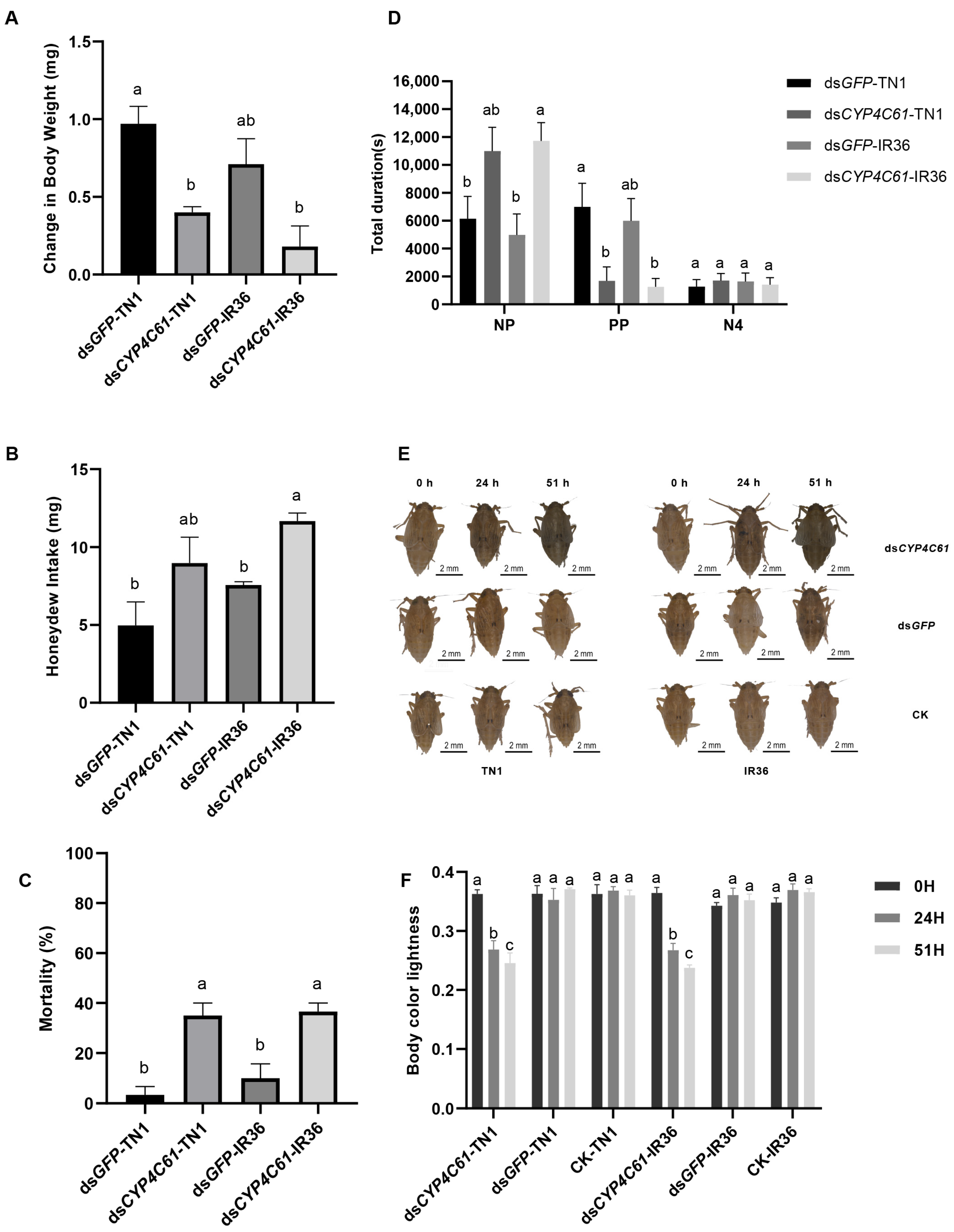
We then assessed multiple fitness parameters in CYP4C61-silenced BPH feeding on either the susceptible rice variety TN1 or the resistant variety IR36 (harboring Bph2). CYP4C61-silenced BPH showed a significant reduction in body weight on both rice varieties, with a more severe effect on IR36 (74.65% decrease) than on TN1 (58.76% decrease) relative to dsGFP controls (p < 0.05; Figure 2A). CYP4C61 knockdown also significantly increased mortality, reaching 35.00% and 36.70% on TN1 and IR36, respectively, compared with 3.33% and 10.00% in the corresponding controls (p < 0.05; Figure 2B).
CYP4C61 silencing led to a significant increase in honeydew excretion (44.65% on TN1 and 33.70% on IR36; p < 0.05; Figure 2C). Electrical penetration graph (EPG) analysis, performed over a longer recording period, showed that CYP4C61-silenced BPH spent significantly more time in non-probing behavior (NP: 76.35–81.45%) compared with controls (34.60–42.63%), while probing without sustained ingestion (PP) decreased correspondingly (Figure 2D, representative waveforms in Figure S2). The phloem sap ingestion waveform (N4) did not differ significantly among groups (range: 8.88–11.94%), suggesting that although CYP4C61 silencing impairs the initiation and maintenance of probing behavior, the efficiency of phloem sap intake during active feeding may be altered.
Furthermore, we observed progressive darkening of body color in CYP4C61-silenced BPH. At 0 h, 24 h, and 51 h after dsRNA injection, dsCYP4C61-treated individuals showed a clear time-dependent increase in melanization on both TN1 and IR36, whereas controls showed no visible change (Figure 2E). Quantitative brightness analysis confirmed the progressive darkening: the perceived luminance (L) of dsCYP4C61-treated BPH decreased significantly over time compared with both dsGFP and non-injected blank controls on both rice varieties (Figure 2F).

3.2. Metabolomic Profiling Reveals Disrupted Dopamine Metabolism upon CYP4C61 Silencing

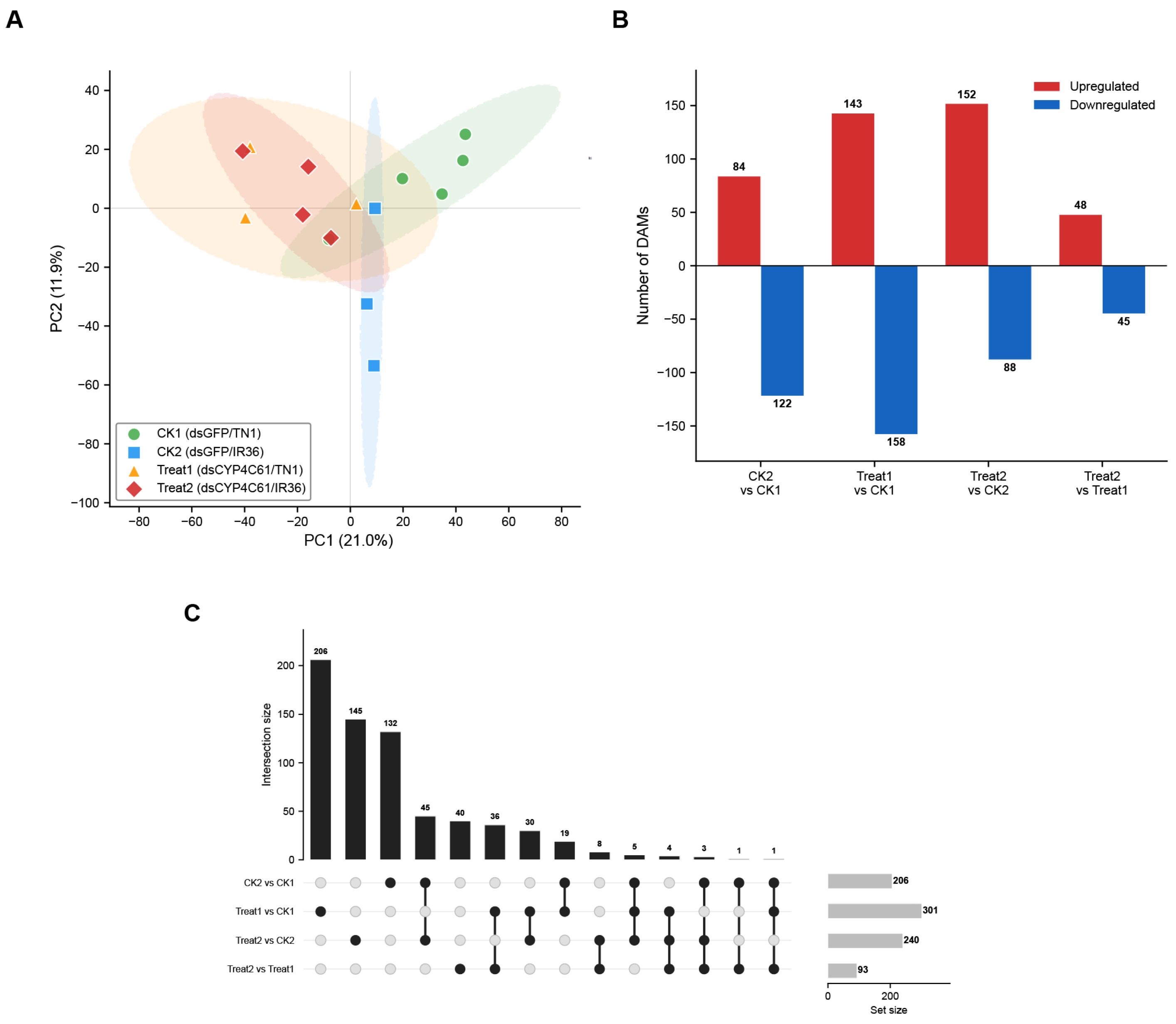
To explore the metabolic basis of CYP4C61 function, untargeted metabolomic analysis (LC-MS) was performed on four treatment groups: CK1 (dsGFP on TN1), CK2 (dsGFP on IR36), Treat1 (dsCYP4C61 on TN1), and Treat2 (dsCYP4C61 on IR36). A total of 3670 metabolites were detected across 24 Class I categories, with amino acids and their metabolites (673, 18.3%), benzene derivatives (562, 15.3%), and organic acids (470, 12.8%) being the most abundant. PCA revealed separation among the CK and treatment groups, confirming that CYP4C61 silencing may significantly affect BPH metabolism (Figure 3A).
We then identified 93–338 differentially abundant metabolites (DAMs) across six pairwise comparisons (Table S3). The two most relevant comparisons were Treat2 vs. CK2 (silencing effect on IR36,152 up and 88 down DAMs) and Treat2 vs. Treat1 (host effect under silencing, 48 up and 45 down DAMs) (Figure 3B). The larger number and magnitude of changes in Treat2 vs. CK2 indicated that CYP4C61 exerts a greater metabolic impact when BPH encounters host plant resistance. A post hoc power analysis confirmed that the DAMs identified here corresponded to large effect sizes (median Cohen’s d = 1.91–2.83 across the four pairwise comparisons) detected with median observed power of 0.64–0.84; for the primary comparison, Treat2 vs. CK2, 56% of DAMs were detected at power ≥ 0.8 (Figures S3 and S4; Table S4). The realised sample sizes therefore provide adequate statistical sensitivity to identify reliable DAMs for the downstream pathway and integrative analyses.
To distinguish CYP4C61-specific metabolic changes from those driven by rice variety, we compared the DAMs in Treat2 vs. CK2 (240 metabolites) with those in CK2 vs. CK1 (206 metabolites, reflecting the host plant effect in wild-type BPH). The analysis identified 53 metabolites at the intersection (Figure 3C), 94.3% of which (50/53) showed opposite trends between the two comparisons, indicating that CYP4C61 silencing reversed the metabolic changes imposed by the resistant rice variety. An additional 187 metabolites were unique to Treat2 vs. CK2, representing CYP4C61-specific effects.
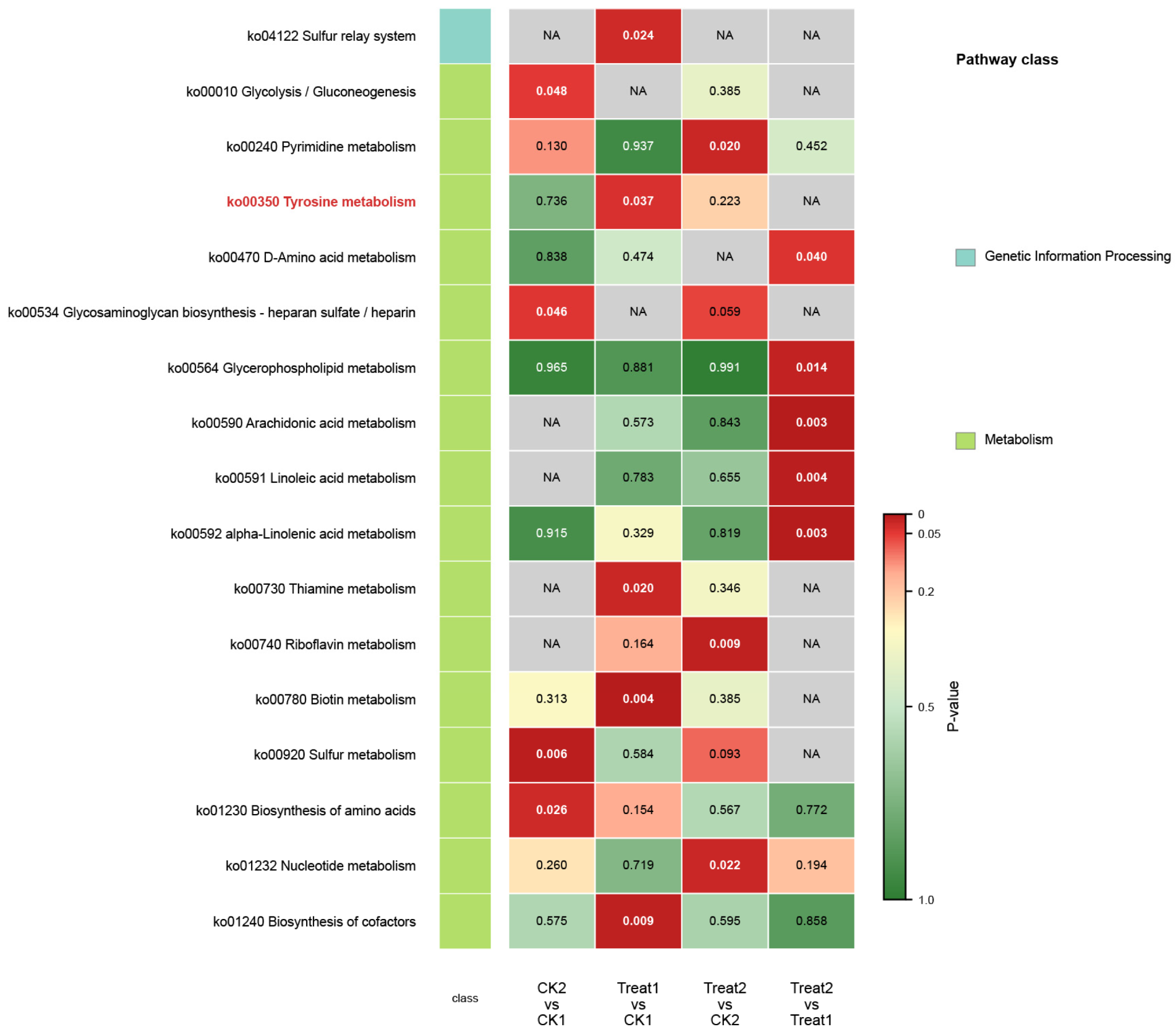
KEGG pathway enrichment of the 240 DAMs in Treat2 vs. CK2 identified 47 significantly enriched pathways (Figure 4). Amino acid metabolism pathways were prominently represented, including tyrosine metabolism (ko00350, 3/28), tryptophan metabolism (ko00380, 2/31), phenylalanine metabolism (ko00360, 1/20), and phenylalanine–tyrosine–tryptophan biosynthesis (ko00400, 2/16). The tyrosine metabolism pathway was enriched only in Treat2 vs. CK2 and was absent from the 23 pathways enriched in Treat2 vs. Treat1, indicating that tyrosine metabolism disruption is a CYP4C61-specific effect under resistant rice conditions. Remarkably, dopamine was found within the DAMs in this pathway and also among the above 50 overlapping metabolites exhibiting completely opposite trends. It was downregulated in CK2 vs. CK1 (log2FC = −1.10, p = 0.002) but significantly upregulated in Treat2 vs. CK2 (log2FC = 0.93, p = 0.005).

3.3. Transcriptome Analysis Reveals CYP4C61 Silencing Alters Dopamine Pathway Gene Expression in a Host-Dependent Manner

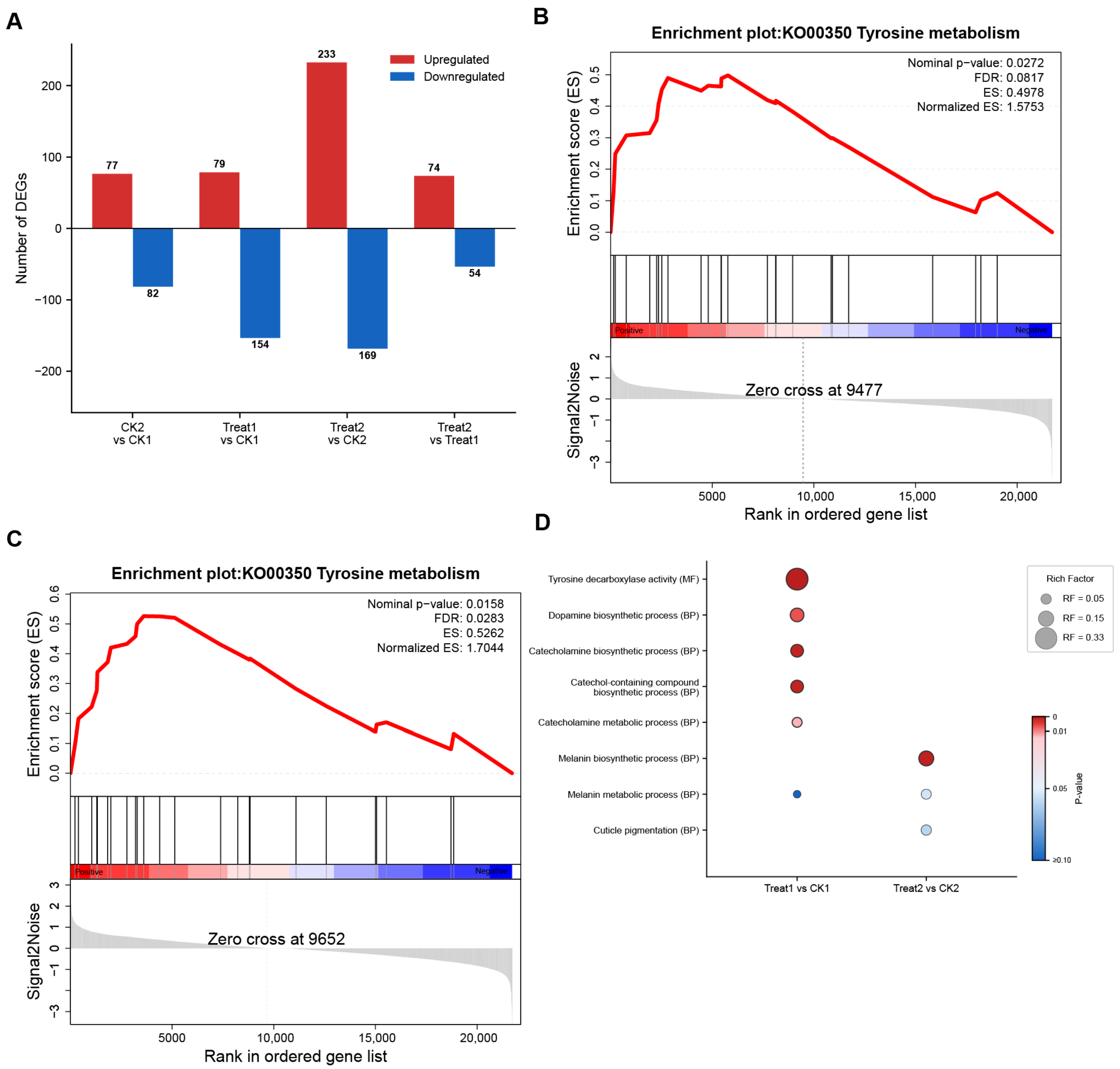
To complement the metabolomic findings, we performed RNA-seq analysis on the same four experimental groups. The overall mapping rate of all clean reads ranged from 82.95% to 85.07%, with uniquely mapped reads accounting for 72.97–75.12% of total reads. A total of six pairwise comparisons were performed, identifying 59–402 differentially expressed genes (DEGs) per comparison (Figure 5A; Table S5). The CYP4C61 silencing effect was more pronounced on IR36 (402 DEGs) than on TN1 (233 DEGs), consistent with the metabolomic observation that CYP4C61 exerts a greater functional impact when BPH encounters host plant resistance.
GSEA was performed using KEGG pathway annotations to detect coordinated expression changes across all genes, regardless of individual significance thresholds. The tyrosine metabolism pathway (ko00350), which encompasses dopamine biosynthesis, was examined across key comparisons. The tyrosine metabolism pathway was significantly enriched in Treat1 vs. CK1 (Figure 5B, NES = 1.58, p = 0.027, FDR = 0.08) and CK2 vs. CK1 (Figure 5C, NES = 1.70, p = 0.016, FDR = 0.028). Leading-edge analysis revealed that multiple dopamine biosynthetic genes contributed to pathway enrichment.
GO enrichment analysis of DEGs further highlighted the host-dependent nature of CYP4C61’s transcriptional effects (Table S6; Figure 5D). On susceptible rice TN1, CYP4C61 silencing led to the enrichment of GO terms directly related to dopamine and catecholamine biosynthesis, driven primarily by the upregulation of tdc-1. On resistant rice IR36, by contrast, the most significantly enriched GO term was melanin biosynthetic process (p = 0.0011).

3.4. Integrated Transcriptomic–Metabolomic Analysis Identifies Dopamine Metabolism as a Multi-Omics Hub

We integrated the transcriptomic and metabolomic datasets by mapping DEGs and DAMs onto the KEGG tyrosine metabolism pathway (ko00350). This analysis revealed convergent changes at multiple nodes of the dopamine biosynthetic pathway.
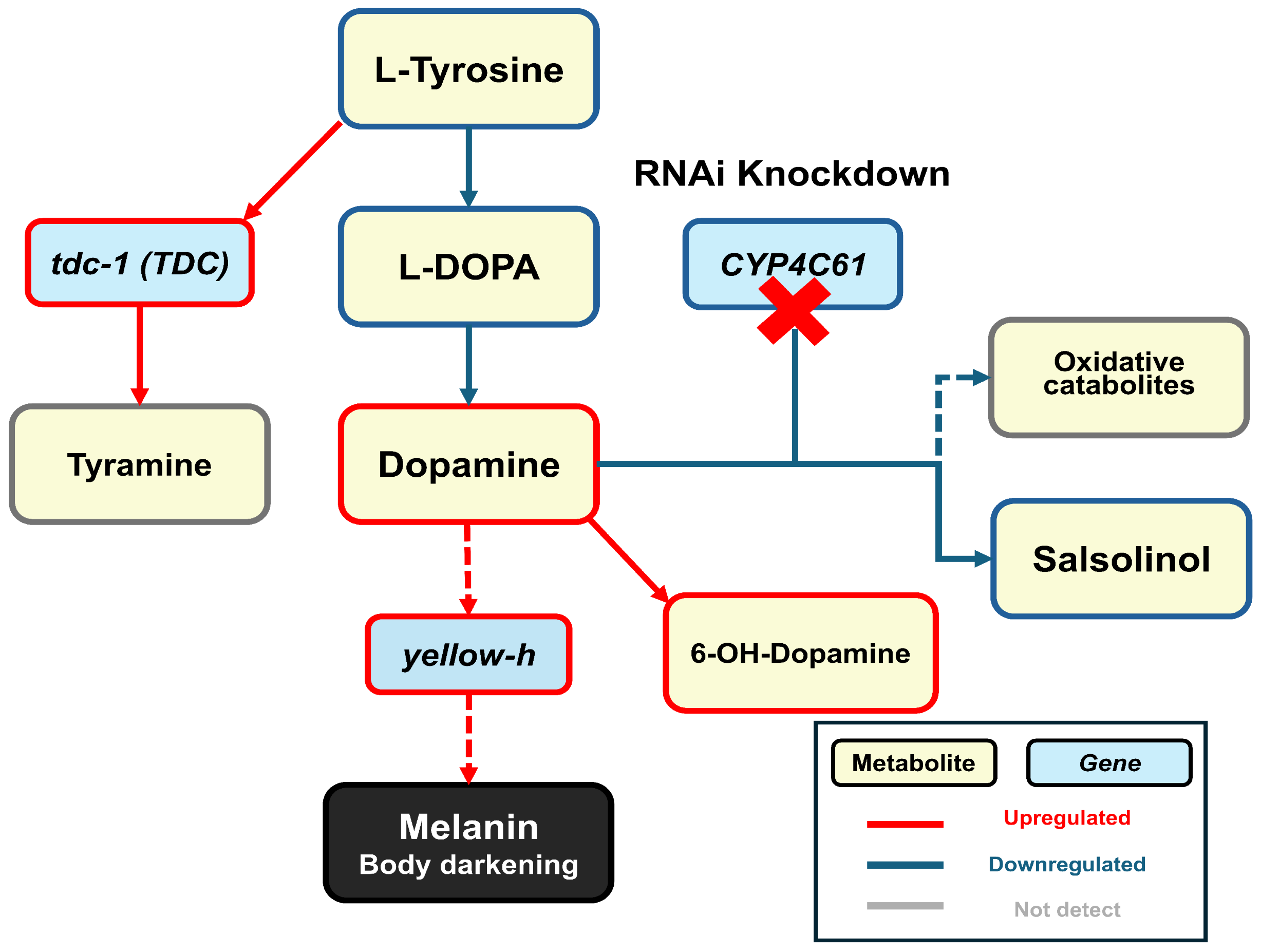
The metabolome showed depletion of dopamine precursors (L-tyrosine, 4.5-fold decrease; L-DOPA, 6.3-fold decrease) coupled with dopamine accumulation (1.9-fold increase). The transcriptome showed 2.9-fold up-regulation of tdc-1, which diverts tyrosine toward the tyramine branch, and 4.7-fold up-regulation of yellow-h on IR36, encoding a dopamine-derived melanin synthase. N-acetyldopamine, the substrate for cuticle sclerotization, did not change, indicating that excess dopamine was channeled into melanization rather than sclerotization.
The transcriptional response was host-dependent: on TN1, CYP4C61 silencing affected dopamine/catecholamine biosynthetic genes (tdc-1, Hdc), whereas on IR36, melanization genes (yellow-h) dominated. The metabolomic changes (3- to 6-fold) were larger than the transcriptomic changes (mostly less than 2-fold), consistent with a primary effect at the enzymatic level and secondary transcriptional compensation.
Based on this integrated evidence, we propose the following working model (Figure 6): CYP4C61 catalyzes the oxidative metabolism of dopamine or a related catecholamine intermediate. Upon silencing, (i) dopamine accumulates due to blocked catabolism; (ii) excess dopamine enters the melanization branch, a route hypothesised to contribute to body darkening; (iii) tdc-1 up-regulation diverts tyrosine toward tyramine as a compensatory response; and (iv) L-DOPA and L-tyrosine are depleted. The resulting dopamine imbalance may perturb neural signaling, contribute to aberrant melanization, and reduce fitness, with more severe consequences on IR36, where BPH faces additional metabolic stress from host plant defenses.

3.5. ELISA Validation Confirms Dopamine Accumulation upon CYP4C61 Silencing

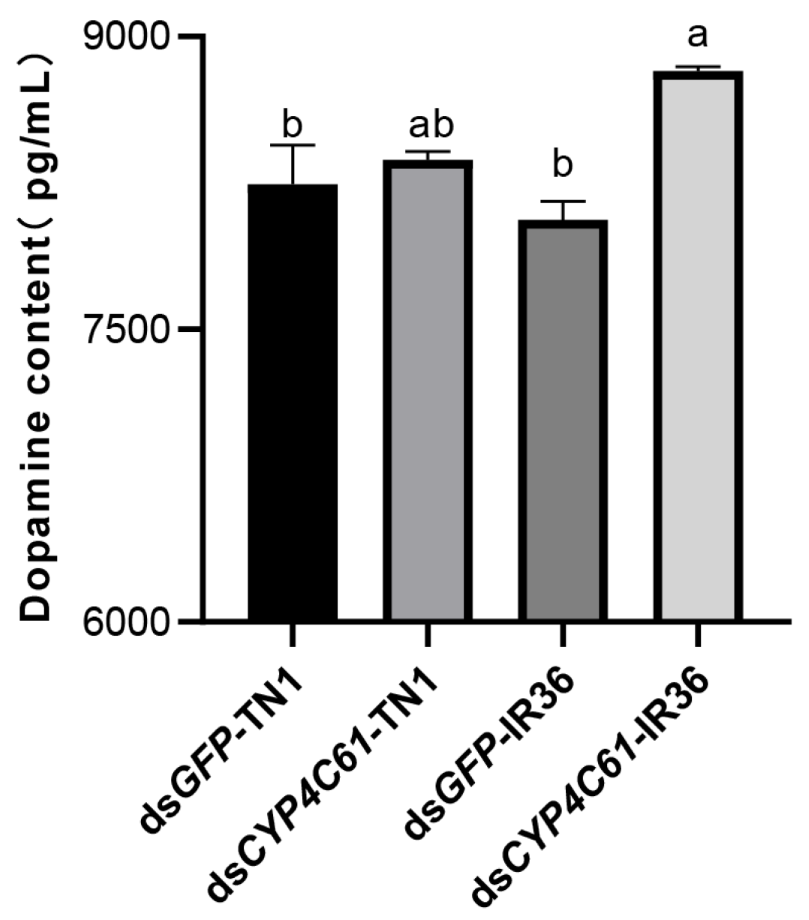
To independently validate the metabolomic finding that dopamine levels increased after CYP4C61 silencing, we performed ELISA-based quantification of dopamine in BPH. ELISA confirmed that dopamine content in CYP4C61-silenced BPH feeding on IR36 was significantly higher than in dsGFP controls on IR36 (p = 0.006), with an increase of 9.46% (Figure 7). On TN1, dsCYP4C61-treated BPH showed a trend of increased dopamine that did not reach statistical significance. The direction of change was consistent with the metabolomic data, where the most prominent dopamine pathway changes were observed in Treat2 vs. CK2 (IR36 background), further supporting the conclusion that CYP4C61 silencing disrupts dopamine metabolism specifically in the context of feeding on resistant rice.

3.6. Molecular Docking Supports Dopamine as a Candidate Substrate of CYP4C61

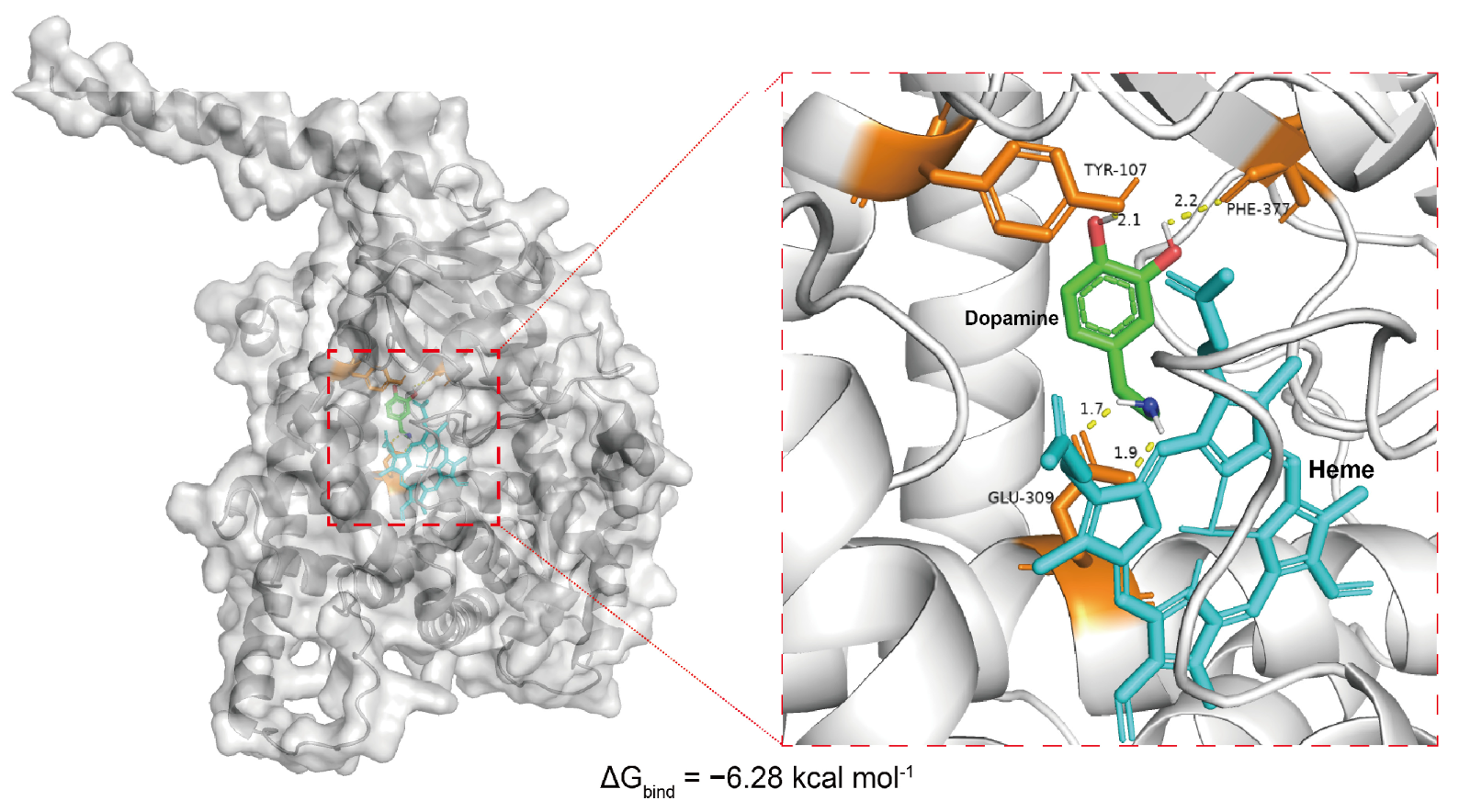
To examine whether dopamine could act as a direct substrate of CYP4C61, the protein structure of CYP4C61 was predicted with AlphaFold 3 and dopamine was docked into the predicted active-site pocket using AutoDock 4 (Methods 2.7). Dopamine docked stably into the active-site pocket of CYP4C61 with a favourable binding free energy of ΔG = −6.28 kcal mol−1, indicating that the binding is thermodynamically spontaneous (Figure 8). In the predicted complex, dopamine forms a 2.1 Å contact with TYR-107 and a 2.2 Å hydrophobic contact with PHE-37, while the haem cofactor is anchored by GLU-309 (1.7 Å) and TYR-107 (1.9 Å). These in silico interactions are consistent with dopamine being a candidate direct substrate of CYP4C61, complementing the multi-omics and ELISA evidence above and providing a structural rationale for the metabolomic accumulation of dopamine observed upon CYP4C61 silencing.

4. Discussion

Pang et al. [26] identified CYP4C61 as a candidate gene mediating BPH adaptation to resistant rice IR36, but the metabolic function of this gene remained unknown. By integrating metabolomic and transcriptomic approaches, we provide the first direct evidence linking CYP4C61 to dopamine metabolism. At the metabolomic level, CYP4C61 silencing produced a “precursor depletion, product accumulation” pattern: L-tyrosine and L-DOPA decreased while dopamine accumulated. At the transcriptomic level, GSEA revealed significant enrichment of the tyrosine metabolism pathway (ko00350) on TN1, with tdc-1 as the most upregulated gene, indicating compensatory diversion of tyrosine toward the tyramine branch. This convergent evidence supports the hypothesis that CYP4C61 catalyzes dopamine oxidative catabolism. Cytochrome P450 involvement in biogenic amine metabolism has precedent: mammalian CYP2D6 hydroxylates tyramine and other biogenic amines [19]. To our knowledge, CYP4C61 is the first CYP4 family member associated with dopamine homeostasis in a hemipteran insect, although direct enzymatic characterization remains to be performed.
The behavior of salsolinol provides additional insight into the enzymatic mechanism. Salsolinol is a tetrahydroisoquinoline alkaloid formed by Pictet-Spengler condensation of dopamine with an aldehyde (typically acetaldehyde or 3,4-dihydroxyphenylacetaldehyde, DOPAL) [32]. In CYP4C61-silenced BPH, salsolinol decreased 1.6-fold despite dopamine accumulation. This pattern is paradoxical if CYP4C61 were a simple dopamine degradation enzyme: higher dopamine should yield more, not less, salsolinol. One explanation is that CYP4C61 catalyzes the oxidative generation of the aldehyde co-substrate required for Pictet-Spengler condensation. In mammals, dopamine is converted to DOPAL by monoamine oxidase [33]; a cytochrome P450-mediated oxidative deamination could serve an analogous function in BPH. Under this model, CYP4C61 silencing simultaneously blocks aldehyde generation (reducing salsolinol) and dopamine consumption (causing accumulation), producing the observed metabolomic pattern. An alternative explanation is that excess dopamine is preferentially channeled toward melanization (supported by yellow-h up-regulation), depleting the free dopamine pool available for salsolinol condensation. Future in vitro assays should determine whether CYP4C61 acts directly on dopamine or on a downstream intermediate, and whether DOPAL or related aldehydes are among its products.
The progressive body darkening observed after CYP4C61 silencing (Section 3.1) is explained by the following evidence converging on the dopamine-melanin axis. Metabolomic data showed 1.9-fold dopamine accumulation with no change in N-acetyldopamine, indicating that excess dopamine was channeled into melanization rather than cuticle sclerotization. Transcriptomic data identified melanin biosynthetic process (GO:0042438) as the most enriched GO term on IR36, driven by 4.7-fold up-regulation of yellow-h [34,35]. The time-dependent progression of darkening (0 h, 24 h, 51 h) matched the expected kinetics of dopamine-derived melanin deposition [36]. This multi-level convergence on a single phenotype is consistent with a role for CYP4C61 in regulating dopamine homeostasis.
Dopamine also regulates locomotion and feeding motivation in insects [37]. CYP4C61-silenced BPH spent 76–81% of EPG recording time in non-probing behavior, compared with 35–43% in controls, while phloem sap ingestion remained unaffected. This pattern suggests impaired feeding initiation rather than feeding ability, consistent with dopaminergic signaling disruption observed in Drosophila dopamine receptor mutants [38]. The concurrent increase in gravimetrically measured honeydew secretion despite decreased body weight and prolonged non-probing time may reflect altered nutrient assimilation, metabolic inefficiency, or osmoregulatory/osmotic stress under dopamine imbalance, rather than increased feeding per se. Venn analysis showed that 94.3% of overlapping metabolites between the silencing effect and the host plant effect had opposite trends, indicating that CYP4C61 counteracts the metabolic stress imposed by resistant rice. The host-dependent transcriptional response, with dopamine biosynthetic genes affected on TN1 and melanization genes on IR36, further indicates that the downstream consequences of dopamine imbalance depend on host plant context. Together, these results support a model in which CYP4C61 contributes to dopamine homeostasis in resistant rice, supporting normal probing behavior, body weight gain, and cuticle integrity; direct enzymatic validation is needed to confirm the mechanistic role.
Beyond dopamine, CYP4C61 silencing also affected tryptophan metabolism (ko00380) and purine/pyrimidine metabolism, suggesting possible multi-substrate activity [19]. However, tyrosine metabolism was the only pathway consistently identified by both metabolomic and transcriptomic analyses, supporting dopamine as the primary target. The proposed catabolic role of CYP4C61 rests on correlative multi-omics evidence rather than direct enzymatic proof. Future work should verify the enzymatic mechanism through in vitro assays with recombinant CYP4C61, determine its substrate specificity (dopamine itself or a downstream intermediate), and examine the relationship between CYP4C61 allelic variants and dopamine pathway flux in natural BPH populations.
Several limitations should be acknowledged. First, although the host-transfer protocol was applied identically to all four treatment groups and the P-IR36 population has been maintained on IR36 for over a decade, a residual interaction between transfer stress and gene silencing cannot be formally excluded without an acclimatised cohort. Second, whole-body sampling captured the global metabolic perturbation but cannot resolve in which tissues the dopamine accumulation occurs or whether it modulates salivary effector composition at the feeding interface; tissue-dissected metabolomics of salivary glands and midgut, coupled with proteomic profiling of salivary effectors in CYP4C61-silenced BPH, will be required to answer this question. Third, the present data establish co-occurrence rather than direct causation among dopamine accumulation, melanisation, mortality and impaired feeding; rescue experiments such as chemical inhibition of dopamine biosynthesis (e.g., 3-iodo-L-tyrosine) or simultaneous knockdown of yellow-h will be needed to dissect the causal architecture. Fourth, although in silico molecular docking supports dopamine as a candidate direct substrate of CYP4C61 (Figure 8), direct enzymatic confirmation by heterologous expression of recombinant CYP4C61 followed by in vitro substrate screening with dopamine, L-DOPA and tyramine remains to be performed.

5. Conclusions

Our results indicate that CYP4C61 is required for dopamine homeostasis in the brown planthopper. CYP4C61 silencing disrupts dopamine homeostasis, depleting upstream precursors while causing dopamine accumulation, and impairs multiple fitness parameters with more severe effects on resistant rice IR36 than on susceptible rice TN1. Metabolomic, transcriptomic, and phenotypic evidence converge on the dopamine-melanin axis, consistent with a role for CYP4C61 in dopamine catabolism, although direct enzymatic validation remains to be performed. Given that CYP4C61 silencing simultaneously disrupts feeding, melanization, and survival, the dopamine pathway represents a candidate target for sustainable BPH management, and CYP4C61 itself may link insecticide resistance and host plant adaptation through a shared metabolic hub.

Supplementary Materials

The following supporting information can be downloaded at: https://www.mdpi.com/article/10.3390/agronomy16111108/s1, Figure S1: RNAi silencing efficiency of CYP4C61. qRT-PCR quantification of CYP4C61 mRNA expression at 24 h and 48 h post-injection, normalised to β-actin and expressed relative to dsGFP control using the 2−ΔΔCt method (**, p < 0.01, Student’s t-test); Figure S2: Representative electrical penetration graph (EPG) waveforms of CYP4C61-silenced brown planthopper feeding on TN1 and IR36 (A: dsGFP on TN1; B: dsCYP4C61 on TN1; C: dsGFP on IR36; D: dsCYP4C61 on IR36; NP, non-probing; PP, pathway phase; N4, phloem sap ingestion; total recording 4 h per insect); Figure S3: Distribution of observed statistical power for differentially abundant metabolites across the four pairwise comparisons (CK2 vs. CK1, Treat1 vs. CK1, Treat2 vs. CK2, Treat2 vs. Treat1) at the realised sample sizes, computed at α = 0.05 (two-sided Welch’s t-test); Figure S4: Prospective statistical power curves for n = 3, 4, 5 and 8 per group across Cohen’s d = 0.1–5.0, computed with the statsmodels TTestIndPower routine in Python 3.9; Figure S5: Dopamine ELISA standard curve (y = 841.02x − 18.013, R2 = 0.999) used for the dopamine quantification reported in Figure 7; Table S1: Primers used in this study; Table S2: Values are presented as mean ± SD based on biological replicate means (n = 3). Each biological replicate mean was calculated from three technical replicates. p values were calculated using Student’s t-test between dsGFP and dsCYP4C61 at each time point; Table S3: Differentially abundant metabolites (DAMs) across six pairwise comparisons (VIP > 1, p < 0.05); Table S4: Per-comparison summary of the post hoc power analysis: number of DAMs, median Cohen’s d of DAMs, median observed power, and fraction of DAMs detected at power ≥ 0.8 for the four manuscript-relevant comparisons; Table S5: Differentially expressed genes (DEGs) across six pairwise comparisons (|log2FC| ≥ 1, FDR < 0.05); Table S6: Selected GO terms enriched in CYP4C61-silencing transcriptomic comparisons (p < 0.05), covering dopamine biosynthesis, catecholamine metabolism, melanin biosynthesis, and cuticle-related biological processes.

Author Contributions

Conceptualization, W.L. and S.W. (Suhang Wang); methodology, W.L.; software, H.W.; validation, S.W. (Suhang Wang) and L.H.; formal analysis, Y.H.; investigation, S.W. (Shiqi Wang); resources, R.P.; data curation, W.L.; writing—original draft preparation, W.L.; writing—review and editing, R.P.; visualization, Z.Z.; supervision, X.X.; project administration, R.P.; funding acquisition, F.J. All authors have read and agreed to the published version of the manuscript.

Funding

This study was supported by the Earmarked Fund for Modern Agro-industry Technology Research System (nycytx-001) and Specific university discipline construction project (2023B10564004).

Data Availability Statement

The metabolomics data presented in this study are available upon request from the corresponding author. The RNA-seq raw data have been deposited in the NCBI Sequence Read Archive (SRA) under accession number PRJNA1450869.

Acknowledgments

We thank Longyu Yuan from Guangdong Academy of Agricultural Sciences for providing the relevant insect populations used in this study.

Conflicts of Interest

The authors declare no conflicts of interest.

References

  1. Sogawa, K. The Rice Brown Planthopper: Feeding Physiology and Host Plant Interactions. Annu. Rev. Entomol. 1982, 27, 49–73. [Google Scholar] [CrossRef]
  2. Bottrell, D.G.; Schoenly, K.G. Resurrecting the Ghost of Green Revolutions Past: The Brown Planthopper as a Recurring Threat to High-Yielding Rice Production in Tropical Asia. J. Asia-Pac. Entomol. 2012, 15, 122–140. [Google Scholar] [CrossRef]
  3. Cheng, X.; Zhu, L.; He, G. Towards Understanding of Molecular Interactions between Rice and the Brown Planthopper. Mol. Plant 2013, 6, 621–634. [Google Scholar] [CrossRef] [PubMed]
  4. Cabauatan, P.Q.; Cabunagan, R.C.; Choi, I.R. Rice Viruses Transmitted by the Brown Planthopper Nilaparvata lugens Stål. In Planthoppers: New Threats to the Sustainability of Intensive Rice Production Systems in Asia; Heong, K.L., Hardy, B., Eds.; International Rice Research Institute: Los Baños, Philippines, 2009; pp. 357–368. [Google Scholar]
  5. Horgan, F.G. Integrating Gene Deployment and Crop Management for Improved Rice Resistance to Asian Planthoppers. Crop Prot. 2018, 110, 21–33. [Google Scholar] [CrossRef]
  6. Sparks, T.C.; Nauen, R. IRAC: Mode of Action Classification and Insecticide Resistance Management. Pestic. Biochem. Physiol. 2015, 121, 122–128. [Google Scholar] [CrossRef]
  7. Wang, Y.; Chen, J.; Zhu, Y.C.; Ma, C.; Huang, Y.; Shen, J. Susceptibility to Neonicotinoids and Risk of Resistance Development in the Brown Planthopper, Nilaparvata lugens (Stål) (Homoptera: Delphacidae). Pest Manag. Sci. 2008, 64, 1278–1284. [Google Scholar] [CrossRef]
  8. Wu, S.-F.; Zeng, B.; Zheng, C.; Mu, X.-C.; Zhang, Y.; Hu, J.; Zhang, S.; Gao, C.-F.; Shen, J.-L. The Evolution of Insecticide Resistance in the Brown Planthopper (Nilaparvata lugens Stål) of China in the Period 2012–2016. Sci. Rep. 2018, 8, 4586. [Google Scholar] [CrossRef]
  9. Du, B.; Zhang, W.; Liu, B.; Hu, J.; Wei, Z.; Shi, Z.; He, R.; Zhu, L.; Chen, R.; Han, B.; et al. Identification and Characterization of Bph14, a Gene Conferring Resistance to Brown Planthopper in Rice. Proc. Natl. Acad. Sci. USA 2009, 106, 22163–22168. [Google Scholar] [CrossRef]
  10. Hu, J.; Xiao, C.; He, Y. Recent Progress on the Genetics and Molecular Breeding of Brown Planthopper Resistance in Rice. Rice 2016, 9, 30. [Google Scholar] [CrossRef]
  11. Jena, K.K.; Kim, S.M. Current Status of Brown Planthopper (BPH) Resistance and Genetics. Rice 2010, 3, 161–171. [Google Scholar] [CrossRef]
  12. Qiu, Y.; Guo, J.; Jing, S.; Zhu, L.; He, G. High-Resolution Mapping of the Brown Planthopper Resistance Gene Bph6 in Rice and Characterizing Its Resistance in the 9311 and Nipponbare Near Isogenic Backgrounds. Theor. Appl. Genet. 2010, 121, 1601–1611. [Google Scholar] [CrossRef]
  13. Shangguan, X.; Zhang, J.; Liu, B.; Zhao, Y.; Wang, H.; Wang, Z.; Guo, J.; Rao, W.; Jing, S.; Guan, W.; et al. A Mucin-Like Protein of Planthopper Is Required for Feeding and Induces Immunity Response in Plants. Plant Physiol. 2018, 176, 552–565. [Google Scholar] [CrossRef]
  14. Jing, S.; Zhang, L.; Ma, Y.; Liu, B.; Zhao, Y.; Yu, H.; Zhou, X.; Qin, R.; Zhu, L.; He, G. Genome-Wide Mapping of Virulence in Brown Planthopper Identifies Loci That Break Down Host Plant Resistance. PLoS ONE 2014, 9, e98911. [Google Scholar] [CrossRef] [PubMed]
  15. Wan, P.-J.; Zhou, R.-N.; Nanda, S.; He, J.-C.; Yuan, S.-Y.; Wang, W.-X.; Lai, F.-X.; Fu, Q. Phenotypic and Transcriptomic Responses of Two Nilaparvata lugens Populations to the Mudgo Rice Containing Bph1. Sci. Rep. 2019, 9, 14049. [Google Scholar] [CrossRef]
  16. Rao, W.; Zheng, X.; Liu, B.; Guo, Q.; Guo, J.; Wu, Y.; Shangguan, X.; Wang, H.; Wu, D.; Wang, Z.; et al. Secretome Analysis and In Planta Expression of Salivary Proteins Identify Candidate Effectors from the Brown Planthopper Nilaparvata lugens. Mol. Plant-Microbe Interact. 2019, 32, 227–239. [Google Scholar] [CrossRef]
  17. Jing, S.; Zhao, Y.; Du, B.; Chen, R.; Zhu, L.; He, G. Genomics of Interaction between the Brown Planthopper and Rice. Curr. Opin. Insect Sci. 2017, 19, 82–87. [Google Scholar] [CrossRef] [PubMed]
  18. Claridge, M.F.; Den Hollander, J. Virulence to Rice Cultivars and Selection for Virulence in Populations of the Brown Planthopper Nilaparvata lugens. Entomol. Exp. Appl. 1982, 32, 213–221. [Google Scholar] [CrossRef]
  19. Feyereisen, R. Insect P450 Enzymes. Annu. Rev. Entomol. 1999, 44, 507–533. [Google Scholar] [CrossRef]
  20. Feyereisen, R. Insect CYP Genes and P450 Enzymes. In Insect Molecular Biology and Biochemistry; Gilbert, L.I., Ed.; Academic Press: London, UK, 2012; pp. 236–316. [Google Scholar]
  21. Mao, Y.-B.; Cai, W.-J.; Wang, J.-W.; Hong, G.-J.; Tao, X.-Y.; Wang, L.-J.; Huang, Y.-P.; Chen, X.-Y. Silencing a Cotton Bollworm P450 Monooxygenase Gene by Plant-Mediated RNAi Impairs Larval Tolerance of Gossypol. Nat. Biotechnol. 2007, 25, 1307–1313. [Google Scholar] [CrossRef]
  22. Yang, Z.; Zhang, Y.; Liu, X.; Wang, X. Two Novel Cytochrome P450 Genes CYP6CS1 and CYP6CW1 from Nilaparvata lugens (Hemiptera: Delphacidae): cDNA Cloning and Induction by Host Resistant Rice. Bull. Entomol. Res. 2011, 101, 73–80. [Google Scholar] [CrossRef]
  23. Lao, S.-H.; Huang, X.-H.; Huang, H.-J.; Liu, C.-W.; Zhang, C.-X.; Lu, Y.-J. Genomic and Transcriptomic Insights into the Cytochrome P450 Monooxygenase Gene Repertoire in the Rice Pest Brown Planthopper, Nilaparvata lugens. Genomics 2015, 106, 301–309. [Google Scholar] [CrossRef] [PubMed]
  24. Qiu, Y.; Tittiger, C.; Wicker-Thomas, C.; Le Goff, G.; Young, S.; Wajnberg, E.; Fricaux, T.; Taquet, N.; Blomquist, G.J.; Feyereisen, R. An Insect-Specific P450 Oxidative Decarbonylase for Cuticular Hydrocarbon Biosynthesis. Proc. Natl. Acad. Sci. USA 2012, 109, 14858–14863. [Google Scholar] [CrossRef]
  25. Feyereisen, R. Origin and Evolution of the CYP4G Subfamily in Insects, Cytochrome P450 Enzymes Involved in Cuticular Hydrocarbon Synthesis. Mol. Phylogenet. Evol. 2020, 143, 106695. [Google Scholar] [CrossRef] [PubMed]
  26. Pang, R.; Li, S.; Chen, W.; Yuan, L.; Xiao, H.; Xing, K.; Li, Y.; Zhang, Z.; He, X.; Zhang, W. Insecticide Resistance Reduces the Profitability of Insect-Resistant Rice Cultivars. J. Adv. Res. 2024, 60, 1–12. [Google Scholar] [CrossRef] [PubMed]
  27. Peng, L.; Zhao, Y.; Wang, H.; Song, C.; Shangguan, X.; Ma, Y.; Zhu, L.; He, G. Functional Study of Cytochrome P450 Enzymes from the Brown Planthopper (Nilaparvata lugens Stål) to Analyze Its Adaptation to BPH-Resistant Rice. Front. Physiol. 2017, 8, 972. [Google Scholar] [CrossRef]
  28. Chen, J.; Liang, Z.; Liang, Y.; Pang, R.; Zhang, W. Conserved microRNAs miR-8-5p and miR-2a-3p Modulate Chitin Biosynthesis in Response to 20-Hydroxyecdysone Signaling in the Brown Planthopper, Nilaparvata lugens. Insect Biochem. Mol. Biol. 2013, 43, 839–848. [Google Scholar] [CrossRef]
  29. Lin, K.; Yue, L.; Yuan, L.; Kang, K.; Zhang, Y.; Pang, R.; Zhang, W. Alanine metabolism mediates energy allocation of the brown planthopper to adapt to resistant rice. J. Adv. Res. 2025, 67, 25–41. [Google Scholar] [CrossRef]
  30. Abramson, J.; Adler, J.; Dunger, J.; Evans, R.; Green, T.; Pritzel, A.; Ronneberger, O.; Willmore, L.; Ballard, A.J.; Bambrick, J.; et al. Accurate Structure Prediction of Biomolecular Interactions with AlphaFold 3. Nature 2024, 630, 493–500. [Google Scholar] [CrossRef]
  31. Morris, G.M.; Huey, R.; Lindstrom, W.; Sanner, M.F.; Belew, R.K.; Goodsell, D.S.; Olson, A.J. AutoDock4 and AutoDockTools4: Automated Docking with Selective Receptor Flexibility. J. Comput. Chem. 2009, 30, 2785–2791. [Google Scholar] [CrossRef]
  32. Hipólito, L.; Sánchez-Catalán, M.J.; Martí-Prats, L.; Granero, L.; Polache, A. Revisiting the Controversial Role of Salsolinol in the Neurobiological Effects of Ethanol: Old and New Vistas. Neurosci. Biobehav. Rev. 2012, 36, 362–378. [Google Scholar] [CrossRef]
  33. Goldstein, D.S.; Kopin, I.J.; Sharabi, Y. Catecholamine Autotoxicity. Implications for Pharmacology and Therapeutics of Parkinson Disease and Related Disorders. Pharmacol. Ther. 2014, 144, 268–282. [Google Scholar] [CrossRef]
  34. Han, Q.; Fang, J.; Ding, H.; Johnson, J.K.; Christensen, B.M.; Li, J. Identification of Drosophila melanogaster Yellow-f and Yellow-f2 Proteins as Dopachrome-Conversion Enzymes. Biochem. J. 2002, 368, 333–340. [Google Scholar] [CrossRef]
  35. Ferguson, L.C.; Green, J.; Surridge, A.; Jiggins, C.D. Evolution of the Insect Yellow Gene Family. Mol. Biol. Evol. 2011, 28, 257–272. [Google Scholar] [CrossRef] [PubMed]
  36. Sugumaran, M. Comparative Biochemistry of Eumelanogenesis and the Protective Roles of Phenoloxidase and Melanin in Insects. Pigment Cell Res. 2002, 15, 2–9. [Google Scholar] [CrossRef]
  37. Verlinden, H. Dopamine Signalling in Locusts and Other Insects. Insect Biochem. Mol. Biol. 2018, 97, 40–52. [Google Scholar] [CrossRef]
  38. Riemensperger, T.; Isabel, G.; Coulom, H.; Neuser, K.; Seugnet, L.; Kume, K.; Iché-Torres, M.; Cassar, M.; Strauss, R.; Preat, T.; et al. Behavioral Consequences of Dopamine Deficiency in the Drosophila Central Nervous System. Proc. Natl. Acad. Sci. USA 2011, 108, 834–839. [Google Scholar] [CrossRef]
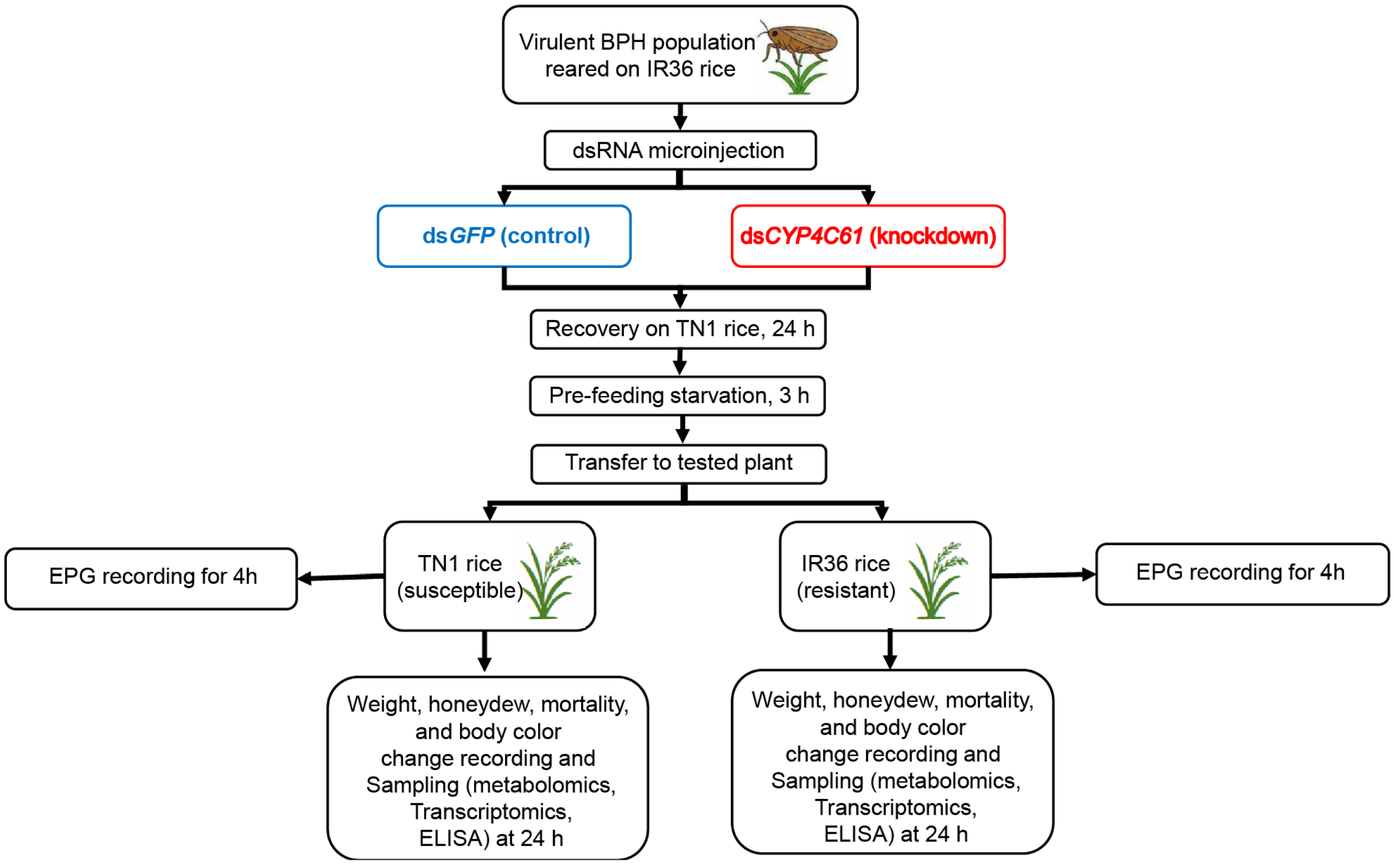
Figure 1. Experimental workflow for assessing the effects of CYP4C61 silencing on the virulent brown planthopper population (P-IR36) feeding on susceptible (TN1) or resistant (IR36) rice. Newly emerged brachypterous female adults were microinjected with double-stranded RNA targeting GFP (control) or CYP4C61 (knockdown), allowed to recover on TN1 rice for 24 h, then starved for 3 h before transfer to either TN1 or IR36 seedlings. After transfer, electrical penetration graph (EPG) recordings were performed for 4 h on one cohort, while a parallel cohort was sampled at 24 h post-transfer (51 h post-injection) for body weight, mortality, honeydew, body colour, untargeted metabolomics, transcriptomics, and ELISA-based dopamine quantification.
Agronomy 16 01108 g001
Figure 2. Biological fitness of CYP4C61-silenced brown planthopper (BPH) on susceptible (TN1) and resistant (IR36) rice varieties. (A) Body weight of dsGFP- and dsCYP4C61-injected BPH after 24 h feeding on TN1 or IR36. (B) Honeydew excretion area as a proxy for phloem sap ingestion. (C) Mortality rate (%). (D) Total duration of electrical penetration graph (EPG) waveforms: non-probing (NP), pathway phase (PP), and phloem sap ingestion (N4) during 4 h recording (n = 15; representative EPG traces are shown in Figure S2). (E) Progressive body color darkening at 0, 24, and 51 h post-injection. (F) Perceived brightness of BPH body at 0, 24, and 51 h post-injection across six groups: non-injected blank control, dsGFP control, and dsCYP4C61 on TN1 and IR36. L was calculated from RGB pixel values using a gamma-corrected luminance formula. Error bars represent SEM (n = 3). Different lowercase letters above bars indicate significant differences at p < 0.05 (One-way ANOVA and Duncan’s multiple range test).
Agronomy 16 01108 g002
Figure 3. Overview of untargeted metabolomic profiling of CYP4C61-silenced BPH. (A) Principal component analysis (PCA) score plot of all four treatment groups (CK1, CK2, Treat1, Treat2). (B) Summary bar chart of differentially abundant metabolites (DAMs; upregulated and downregulated) across four pairwise comparisons (|log2FC| ≥ 1, VIP ≥ 1, p < 0.05). (C) UpSet plot showing the intersection of DAMs across four pairwise comparisons.
Agronomy 16 01108 g003
Figure 4. KEGG pathway enrichment heatmap of differentially abundant metabolites. Enrichment p-values for 17 representative pathways across four pairwise comparisons are displayed. The tyrosine metabolism pathway (ko00350) is highlighted in red. Color gradient indicates p-value significance (red = significant, green = non-significant); NA indicates pathway not detected in that comparison.
Agronomy 16 01108 g004
Figure 5. Transcriptomic analysis of CYP4C61-silenced BPH. (A) Summary bar chart of differentially expressed genes (DEGs; |log2FC| ≥ 1, FDR < 0.05) across four pairwise comparisons. (B,C) GSEA enrichment plots for the tyrosine metabolism pathway (ko00350); (B) Treat1 vs. CK1 (NES = 1.58, p = 0.027, significantly enriched), Red indicates genes upregulated and blue indicates genes downregulated in the experimental group; (C) CK2 vs. CK1 (NES = 1.70, p = 0.016, significantly enriched), Red indicates genes upregulated and blue indicates genes downregulated in the experimental group; (D) Comparison of selected GO terms enriched in CYP4C61-silencing comparisons (Treat1 vs. CK1 and Treat2 vs. CK2), highlighting host-dependent functional divergence: dopamine/catecholamine biosynthesis terms enriched on TN1 versus melanin biosynthesis terms enriched on IR36.
Agronomy 16 01108 g005
Figure 6. Hypothetical working model (steps not directly validated are shown as dashed arrows in the figure) of CYP4C61 function in dopamine metabolism and BPH adaptation to resistant rice.
Agronomy 16 01108 g006
Figure 7. ELISA validation of dopamine content in CYP4C61-silenced BPH. Dopamine content (ng/mL) across four treatment groups (dsGFP/TN1, dsCYP4C61/TN1, dsGFP/IR36, dsCYP4C61/IR36). Different lowercase letters above bars indicate significant differences at p < 0.05 (One-way ANOVA and Duncan’s multiple range test).
Agronomy 16 01108 g007
Figure 8. Molecular docking of dopamine into the active-site pocket of CYP4C61. Left: overall AlphaFold 3-predicted structure of the CYP4C61 protein (semi-transparent surface), with the active-site pocket highlighted (dashed red box). Right: close-up of the active-site pocket showing dopamine (green) and the haem cofactor (cyan) in stick representation; orange sticks indicate interacting residues, yellow dashed lines indicate hydrogen-bond/non-covalent contacts with the inter-atomic distances annotated. The binding free energy of dopamine into the pocket is ΔG = −6.28 kcal mol−1.
Agronomy 16 01108 g008
Disclaimer/Publisher’s Note: The statements, opinions and data contained in all publications are solely those of the individual author(s) and contributor(s) and not of MDPI and/or the editor(s). MDPI and/or the editor(s) disclaim responsibility for any injury to people or property resulting from any ideas, methods, instructions or products referred to in the content.