Article

Optimized Nitrogen Application Enhances Grain-Filling and Yield Formation of Spring Maize Through Improved Source-Sink Coordination in a Black Soil Region


1
National Key Laboratory of Wheat Breeding, Key Laboratory of Crop Physiology, Ecology and Tillage, Ministry of Agriculture and Rural Affairs, Agricultural College, Shandong Agricultural University, Tai’an 271018, China
2
Institute of Agricultural Resources and Environment, Jilin Academy of Agricultural Sciences, Changchun 130033, China
*
Author to whom correspondence should be addressed.
Agronomy 2026, 16(11), 1073; https://doi.org/10.3390/agronomy16111073
Submission received: 26 April 2026 / Revised: 20 May 2026 / Accepted: 27 May 2026 / Published: 29 May 2026

Abstract

Nitrogen application rate (N rate) is a key factor affecting maize yield, but the physiological mechanisms by which it improves yield through the coordination of the source-sink relationship remain unclear. In this study, field experiments were conducted in the black soil region of Northeast China for three consecutive years (2022–2024). Five N rates were tested: 0 kg ha−1 (N0), 90 kg ha−1 (N90), 135 kg ha−1 (N135), 180 kg ha−1 (N180), and 225 kg ha−1 (N225). The results showed that the N180 treatment achieved the highest yield across the three growing seasons, with yields 7.23–51.40% higher than those of the other treatments. This was mainly attributable to the synergistic improvement in grain number per ear and 100-grain weight. After anthesis, the N180 and N225 treatments significantly increased chlorophyll content (SPAD), PSII photochemical efficiency-related parameters (Fv/Fm, ΦPSII, and qP), and the activities of carbon assimilation-related enzymes (RuBPCase and PEPCase) in the ear leaf, indicating improved photosynthesis-related physiological status. Meanwhile, N180 significantly promoted the translocation of stored dry matter from pre-anthesis vegetative organs to the grains, resulting in a 5.21–51.41% increase in the proportion of dry matter allocated to the grains at maturity compared with the other treatments. Logistic equation fitting showed that an increased grain-filling rate and an extended grain-filling period were the main reasons for the higher grain weight under N180. Although N225 maintained high post-anthesis dry matter accumulation, more assimilates were retained in vegetative organs, which limited further improvement in grain-filling and grain weight. These findings provide a theoretical basis and practical guidance for the rational application of nitrogen fertilizer in this region.

1. Introduction

Maize is the cornerstone of global food security and a primary source of food, feed, and industrial raw materials [1]. As a major maize-producing region, the black soil area in Northeast China accounts for approximately one-third of the country’s total maize output. Therefore, ensuring consistent and robust maize yields in this area is vital for national kernel security [2]. The application of nitrogen fertilizer is an effective means of increasing maize yields; however, in local agricultural practices, there is still a widespread tendency to rely on excessive nitrogen application in the pursuit of high yields [3]. Research indicates that excessive nitrogen fertilizer application does not lead to sustained yield increases; instead, long-term over-application may exacerbate soil acidification and reduce soil organic matter content, thereby threatening the sustainable productivity of black soil [3,4]. Therefore, optimizing nitrogen fertilizer application rates in the Northeast black soil region to achieve both increased maize yields and the sustainable use of black soil resources has become an urgent issue in agricultural production.
Leaves serve as the primary “source” of photosynthetic products after anthesis, and their photosynthetic activity directly determines the plant’s dry matter production capacity and ultimately influences grain-filling and yield formation [5]. Nitrogen is an essential component of chlorophyll and photosynthetic proteins, and nitrogen supply regulates leaf photosynthetic characteristics by modulating post-anthesis plant nitrogen metabolism [6]. Insufficient nitrogen supply impedes chlorophyll synthesis, reduces the light energy capture and electron transport efficiency of Photosystem II (PSII), and consequently accelerates leaf senescence [7]. Chlorophyll (SPAD) content and chlorophyll fluorescence parameters (such as Fv/Fm, ΦPSII, and qP) are important indicators of PSII light absorption and energy distribution capacity and are closely related to the plant’s photosynthetic rate and grain yield [8]. Studies have shown that fluorescence parameters such as Fv/Fm are significantly and positively correlated with net photosynthetic rate. Within a certain range, as nitrogen application rates (N rates) increased, the Fv/Fm, ΦPSII, and qP values of the ear leaf during the grain-filling stage of maize significantly increased and reached a maximum at a nitrogen application rate (N rate) of 180 kg ha−1; however, further increasing nitrogen application to 270 kg ha−1 did not further enhance these parameters and even caused them to decline [9]. Furthermore, nitrogen influences the photosynthetic carbon fixation process by regulating the activity of key carbon assimilation enzymes such as ribulose-1,5-bisphosphate carboxylase (RuBPCase) and phosphoenolpyruvate carboxylase (PEPCase) [10]. Studies have shown that an optimal N rate can significantly increase the activity of RuBPCase and PEPCase in leaves, alleviate the inhibitory effects of environmental stress on photosynthesis, and promote post-anthesis dry matter accumulation and yield increase [11]. Therefore, optimizing nitrogen application is crucial for sustaining the photosynthetic apparatus and the activity of key carbon assimilation enzymes, as well as ensuring the supply of assimilates for grain-filling.
Crop yield formation is the result of the synergistic interaction among “sources” (dry matter production), “sinks” (grain accumulation), and “fluxes” (dry matter transport) [12,13]. Dry matter accumulation in maize grains primarily stems from post-anthesis dry matter accumulation and from the transport of stored dry matter from pre-anthesis vegetative organs to the grains [14]. Studies have shown that increased nitrogen fertilization can significantly enhance total dry matter accumulation in maize plants after anthesis; however, the contribution of the transport of pre-anthesis stored dry matter during grain-filling remains significant, particularly under low-nitrogen conditions, where grain-filling relies more heavily on the transport and redistribution of stored dry matter from vegetative organs [15]. Studies on wheat indicate that a N rate of 225 kg ha−1 significantly increases the post-anthesis transport of assimilates to the grain and the contribution of this process to yield, while simultaneously enhancing the initial grain-filling potential and average grain-filling rate, shortening the duration of the maximum filling rate, and thereby increasing yield. However, when nitrogen application was increased to 300 kg ha−1, although aboveground dry matter accumulation was significantly higher than at 225 kg ha−1, the grain-filling rate actually decreased, leading to lower grain yield [16]. A growing body of research indicates that increases in grain weight are always constrained by “sinks” rather than limited by “sources.” Therefore, coordinating dry matter production from “sources” with the transport capacity of “fluxes” to meet the demands of “sinks” is key to optimizing nitrogen application for increased maize yield.
Although previous studies have investigated the effects of N rates on maize leaf photosynthetic activity, dry matter accumulation, and yield formation, most have focused on individual processes of the source, sink, or flux. The comprehensive mechanism by which N rate regulates source-sink-flux coordination to improve spring maize yield has not been fully elucidated, and multi-year systematic studies under the black soil conditions of Northeast China remain particularly lacking. We hypothesized that an appropriate N rate could maintain a relatively high photosynthetic activity in the ear leaf after anthesis, while promoting the translocation of pre-anthesis stored dry matter from vegetative organs to the grains and enhancing grain-filling intensity, thereby achieving a synergistic improvement in source-sink-flux coordination and ultimately increasing grain yield and nitrogen use efficiency. To address this, we conducted a three-year field experiment in the major maize-producing region of Northeast China. The objectives of this study were: (1) to clarify the dynamic changes in leaf chlorophyll content, photochemical efficiency, and activities of key carbon assimilation enzymes after anthesis under different N rates; (2) to elucidate the effects of N rate on grain-filling characteristics and dry matter accumulation and allocation patterns; and (3) to reveal the physiological mechanisms by which optimized nitrogen application coordinates source-sink relationships to increase spring maize yield. This study aimed to provide a theoretical basis for the efficient use of nitrogen fertilizer and sustainable yield increases in spring maize production in the black soil region.

2. Materials and Methods

2.1. Test Materials and Design

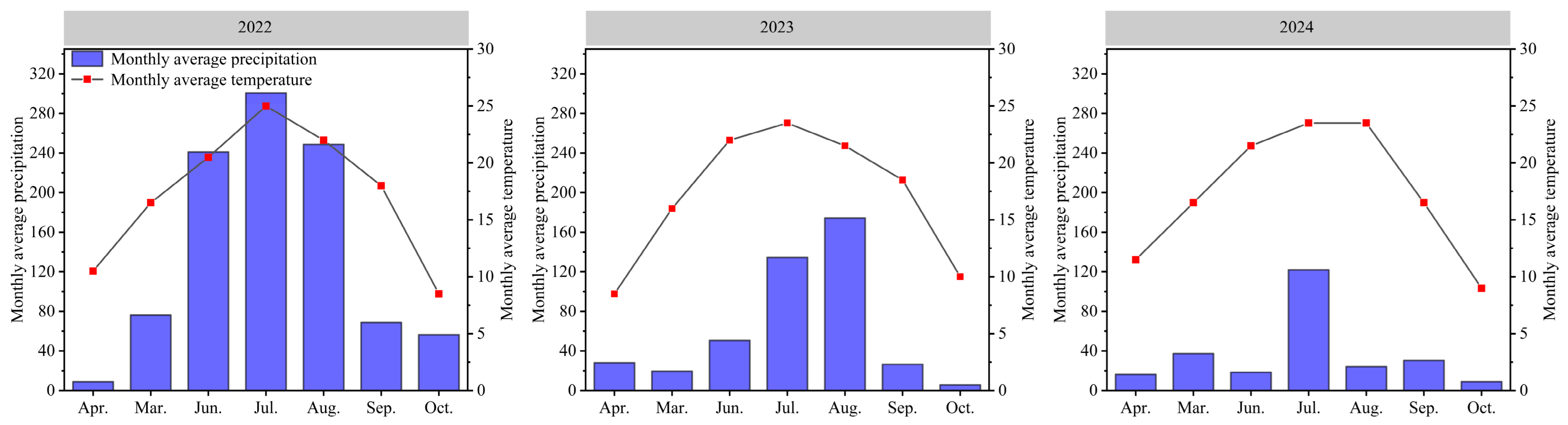
The experiment was conducted during the spring maize-growing seasons of 2022, 2023, and 2024 at the experimental field of Jilin Academy of Agricultural Sciences (43°29′55″ N, 124°48′43″ E), located in Gongzhuling City, Jilin Province. The region has a temperate continental monsoon climate, with an average annual temperature of 5.6 °C and an average annual precipitation of 594.8 mm. It is a typical rain-fed agricultural region. The cropping system in the experimental area is a single maize monoculture per year. Mean temperatures and precipitation during the maize-growing season are shown in Figure 1. The soil at the experimental site is black soil, characterized by a clay loam texture. The average soil nutrient contents in the 0–20 cm tillage layer before sowing in 2022, 2023, and 2024 were as follows: organic matter 27.8 g kg−1; total nitrogen 1.56 g kg−1; inorganic N (NO3-N + NH4+-N) 20.97 mg kg−1; available phosphorus 99.9 mg kg−1; and available potassium 166.1 mg kg−1. The experiment was conducted on the same field in all three years. The maize variety used was ‘Fumin 985’. Five N rates were established: 0 (N0), 90 (N90), 135 (N135), 180 (N180), and 225 (N225) kg ha−1. Nitrogen fertilizer was split-applied, with 40% as basal fertilizer before sowing and 60% at the jointing stage. Phosphorus (P2O5 at 75 kg ha−1) and potassium (K2O at 90 kg ha−1) fertilizers were both applied basally before sowing. The N, P, and K fertilizers were applied in the form of urea, calcium superphosphate, and potassium chloride, respectively. All fertilizers were placed in furrows at a depth of 8–10 cm and then covered with soil. A randomized complete block design with three replications was adopted. Each plot area was 200 m2 (20 × 10 m), with a planting density of 60,000 plants ha−1. In addition, to minimize plot margin effects on maize growth and development, two extra rows of maize were planted on either side of each plot, and the ends of the planted rows were extended. The distance between all neighboring plots was sufficient to ensure the independence of each plot. Sowing dates were 12 May 2022, 1 May 2023, and 27 April 2024, with corresponding harvest dates on 6 October 2022, 26 September 2023, and 25 September 2024. After harvest, straw was returned to the field, followed by deep loosening and deep plowing. The field management practices for diseases, pests, and weeds were the same as those used in local production.

2.2. Determination Items and Methods

2.2.1. Grain Yield and Nitrogen Agronomic Efficiency

At the maize maturity stage, three central rows were harvested from each plot across three replicates, and the number of ears collected per plot was tallied. From each replicate, 30 representative ears were randomly sampled, air-dried, and then assessed for yield components (ear number, grain number per ear, and 100-grain weight). Grain yield was adjusted to 14% moisture content. Nitrogen agronomic efficiency was calculated as follows (Equation (1)):
Nitrogen agronomic efficiency = (yield under nitrogen-fertilized treatment − yield under non-fertilized treatment)/nitrogen application rate

2.2.2. Grain-Filling Characteristics

Plants with consistent growth at the anthesis stage were selected and tagged with the date. At 12, 24, 36, 48, and 60 days after anthesis, three representative ears were selected from the tagged plants. One hundred grains were taken from the middle section of each ear, blanched at 105 °C for 30 min, then dried at 75 °C to constant weight and weighed. The grain-filling rate was then calculated (Equation (2)).
Grain-filling rate (g d−1) = [100-grain dry weight at current measurement (g) – 100-grain dry weight at previous measurement (g)]/interval between two measurements (d)
The grain-filling parameters were calculated through simulation with the logistic equation, following the method of Fang et al., [17]. The model form is as follows (Equation (3)):
y = a/(1 + becx)
where a, b, and c are fitted characteristic parameters of grain-filling. The grain-filling parameters were calculated using the following formulas (Equations (4)–(8)):
Grain weight at the maximum grain-filling rate Wmax (g 100 grains−1) = 0.5a
Times needed for reaching the maximum grain-filling rate Tmax (d) = lnb/c
Maximum grain-filling rate Gmax (g 100 grains−1 d−1) = [c × Wmax (g 100 grains−1)] × [1 − (Wmax (g 100 grains−1)/a)]
Mean grain-filling rate Gmean (g 100 grains−1 d−1) = ac/6
Active grain-filling stage D (d) = 6/c

2.2.3. Dry Matter Accumulation and Translocation

At anthesis, 12, 24, 36, 48 days after anthesis, and maturity, three representative maize plants with consistent growth were selected from each plot for sampling. At anthesis and 12, 24, 36, 48 days after anthesis, the aboveground parts of the plants were separated into stems, leaves, and grains. At maturity, they were separated into stems, leaves and grains, and cob, bract and tassel. Samples were blanched at 105 °C for 30 min, then dried at 75 °C to constant weight and weighed. Pre-anthesis dry matter translocation and post-anthesis dry matter accumulation were calculated using the following formulas [18] (Equations (9) and (10)):
Pre-anthesis dry matter translocation (kg ha−1) = Dry matter accumulation in vegetative organs at anthesis − Dry matter accumulation in vegetative organs at maturity
Post-anthesis dry matter accumulation (kg ha−1) = Dry matter accumulation in grains at maturity − Pre-anthesis dry matter translocation from vegetative organs

2.2.4. SPAD and Chlorophyll Fluorescence

At anthesis and 12, 24, 36, 48 days after anthesis, between 9:00 and 11:00 a.m., five representative maize plants were selected from each plot. The SPAD value of the ear leaf was measured using a portable CCM-200 Plus Chlorophyll Content Meter (Opti-Sciences Inc., Hudson, NH, USA). A portable chlorophyll fluorometer (FMS-2, Hansatech, King’s Lynn, UK) was used to measure the initial fluorescence (F0), maximum fluorescence (Fm), minimum fluorescence (F0′), maximum fluorescence under light (Fm′), and steady-state fluorescence (Fs) of the ear leaf. Based on the above parameters, the following indices were calculated [19] (Equations (11)–(13)):
Fᵥ/Fm = (FmF0)/Fm
ΦPSII = (Fm′ − Fs)/Fm
qP = (Fm′ − Fs)/(Fm′ − F0′)

2.2.5. Photosynthetic Enzyme Activities

At anthesis and 12, 24, 36, and 48 days after anthesis, between 9:00 and 11:00 a.m., five representative maize plants were selected from each plot. A 0.5 g sample was cut from the middle part of the ear leaf. The leaf sample was homogenized in a pre-chilled mortar with 10 mM Tris-HCl buffer (pH 8.4, containing 10 mM MgCl2, 1 mM EDTA, 7 mM β–mercaptoethanol, 5% glycerol, and 1% PVP). The homogenate was centrifuged at 15,000× g for 10 min at 4 °C, and the resulting supernatant was used for enzyme activity assays [20].
RuBPCase activity was determined as follows: the reaction mixture (total volume 3 mL) contained 0.3 mL of 1 mM Tris-HCl buffer, 0.3 mL of 0.1 mM MgCl2, 0.3 mL of 50 mM ATP, 0.3 mL of 50 mM DTT, 0.3 mL of 2 mM NADH, 0.3 mL of 1 mM EDTA, 0.1 mL of 200 μM NaHCO3, 0.1 mL of 3-phosphoglycerate kinase/3-phosphoglyceraldehyde dehydrogenase (15 U/15 U), and 0.8 mL of H2O; the final pH was 8.0. The mixture was pre-incubated at 30 °C for 30 min, and the reaction was started by adding 0.1 mL of enzyme extract and 0.1 mL of 9 mM RuBP. The absorbance was recorded at 340 nm.
PEPCase activity was determined as follows: the reaction mixture (total volume 3 mL) contained 1 mL of 100 mM Tris-HCl buffer, 0.1 mL of 10 mM MgCl2, 0.1 mL of 10 mM NaHCO3, 0.3 mL of 1 g L−1 NADH, 0.3 mL of 50 U mL−1 malate dehydrogenase, 0.5 mL of H2O, and 0.5 mL of enzyme extract; the final pH was 9.2. The mixture was pre-incubated at 28 °C for 10 min, and the reaction was initiated by adding 200 μL of 40 mM PEP. The absorbance was measured at 340 nm.

2.3. Statistical Analysis

Microsoft Excel 2022 was used for data summarization. All data were first tested for normality and homogeneity of variances. Considering the three-year experimental design, a linear mixed model was fitted using the MIXED procedure in SPSS 26.0 (SPSS Inc., Chicago, IL, USA). The model included year, nitrogen rate, and their interaction as fixed factors, while the replicate (or block) nested within year was treated as a random effect. When the year × nitrogen rate interaction was significant, simple effects were examined. Multiple comparisons among nitrogen rate treatments within each year were performed on the estimated marginal means using Tukey’s HSD test, with a significance level of α = 0.05. Equation fitting for the grain-filling process and determination of parameters A, B, and C were carried out using Curve Expert 1.3 software. All plots were generated using Origin 2024.

3. Results

3.1. Grain Yield and Its Components, and Nitrogen Agronomic Efficiency

Nitrogen fertilization rates (N) significantly affected grain number per ear, 100-grain weight, yield, and nitrogen agronomic efficiency. Year (Y) significantly affected 100-grain weight, yield, and nitrogen agronomic efficiency, and a significant interaction was observed between nitrogen fertilization rate (N) and year (Y). In all three growing seasons, the highest yield and nitrogen agronomic efficiency were obtained in the N180 treatment (Table 1). The yield in N180 increased by 51.40%, 22.60%, 13.48%, and 7.23% compared with N0, N90, N135, and N225, respectively, and the nitrogen agronomic efficiency increased by 19.21%, 23.74%, and 47.54% compared with N90, N135, and N225, respectively. With the increase in N rate, the number of grains per ear gradually increased, with the highest values in the N180 and N225 treatments. The 100-grain weight showed a trend of first increasing and then decreasing, with the highest value in the N180 treatment. Compared to the N0, N90, N135, and N225 treatments, the 100-grain weight increased by 33.74%, 13.93%, 9.31%, and 4.14%, respectively. There were no significant differences in the number of ears per hectare among the treatments, indicating that the N180 treatment achieved the highest grain yield by increasing the number of grains per ear and the 100-grain weight.

3.2. Grain Dry Weight and Grain-Filling Rate

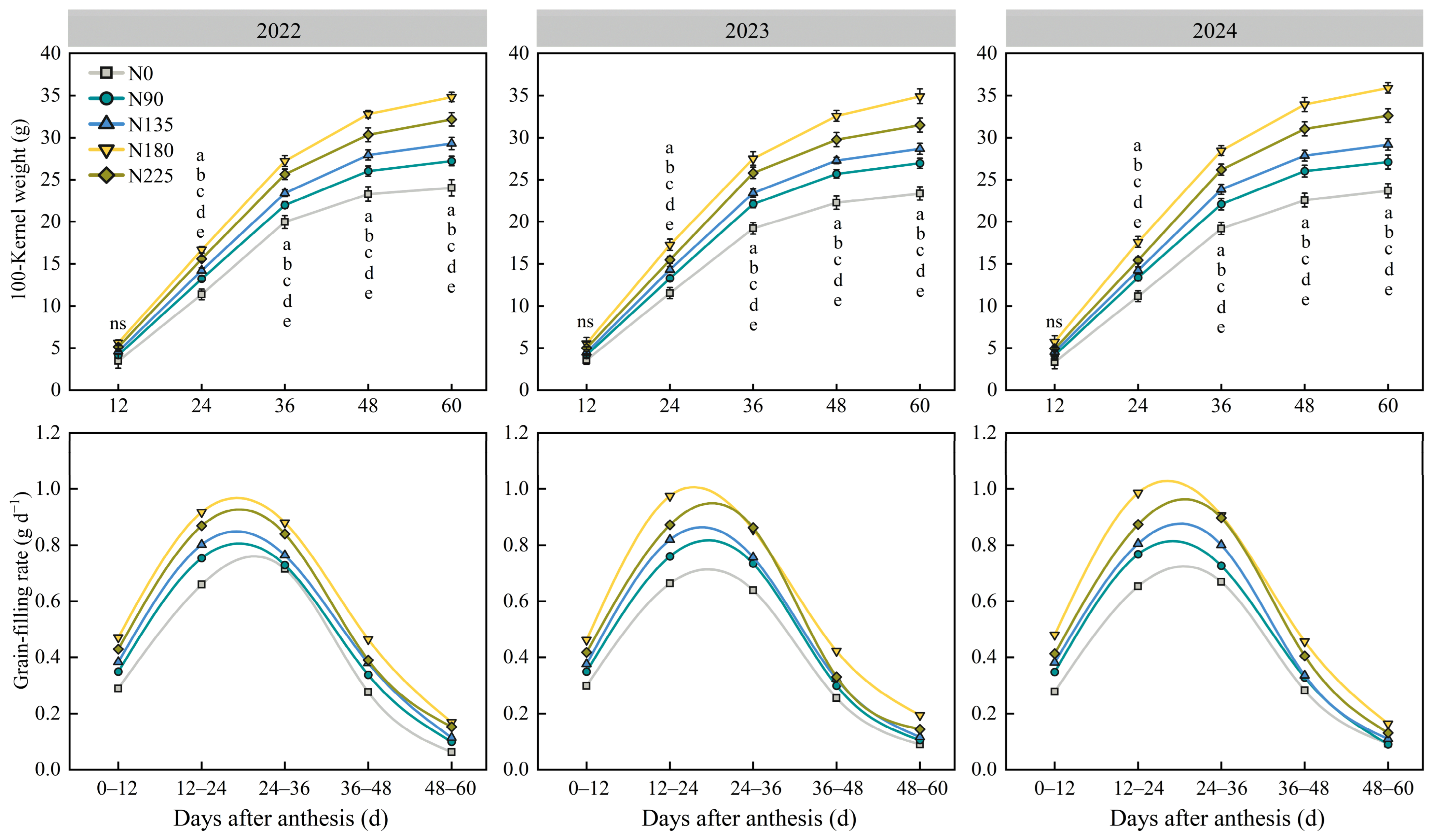
Across three growing seasons, there were no significant differences in 100-grain weight among the treatments 12 days after anthesis (Figure 2). At 24, 36, 48, and 60 days after anthesis, the 100-grain weight of each treatment showed a trend of first increasing and then decreasing with the increase in N rate, specifically in the order of N180 > N225 > N135 > N90 > N0. At 60 days after anthesis, the 100-grain weight of the N180 treatment was 47.42%, 27.66%, 20.01%, and 9.27% higher than that of the N0, N90, N135, and N225 treatments, respectively. The grain-filling rate of each treatment followed a single-peak curve, with the N180 treatment exhibiting the fastest starch accumulation rate, followed by N225, N135, N90, and N0 treatments. This indicates that the N180 treatment significantly improved the grain-filling rate and increased the dry weight of the grains.

3.3. Grain-Filling Parameters

Across three growing seasons, the times needed to reach the maximum grain-filling rate did not significantly change with the increase in N rate (Table 2). The maximum grain-filling rate, mean grain-filling rate, and active grain-filling stage all exhibited a trend of first increasing and then decreasing with the increase in N rate, with the N180 treatment being the best. Compared to the N0, N90, N135, and N225 treatments, the mean grain-filling rate of the N180 treatment increased by 37.95%, 20.49%, 14.41%, and 4.42%, respectively, and the active grain-filling stage increased by 7.94%, 6.97%, 6.07%, and 5.91%, respectively. The grain weight at the maximum grain-filling rate over the three years was 17.54 g. This indicates that the N180 treatment is most conducive to the grain-filling process, significantly increasing grain weight.

3.4. Aboveground Dry Matter Accumulation

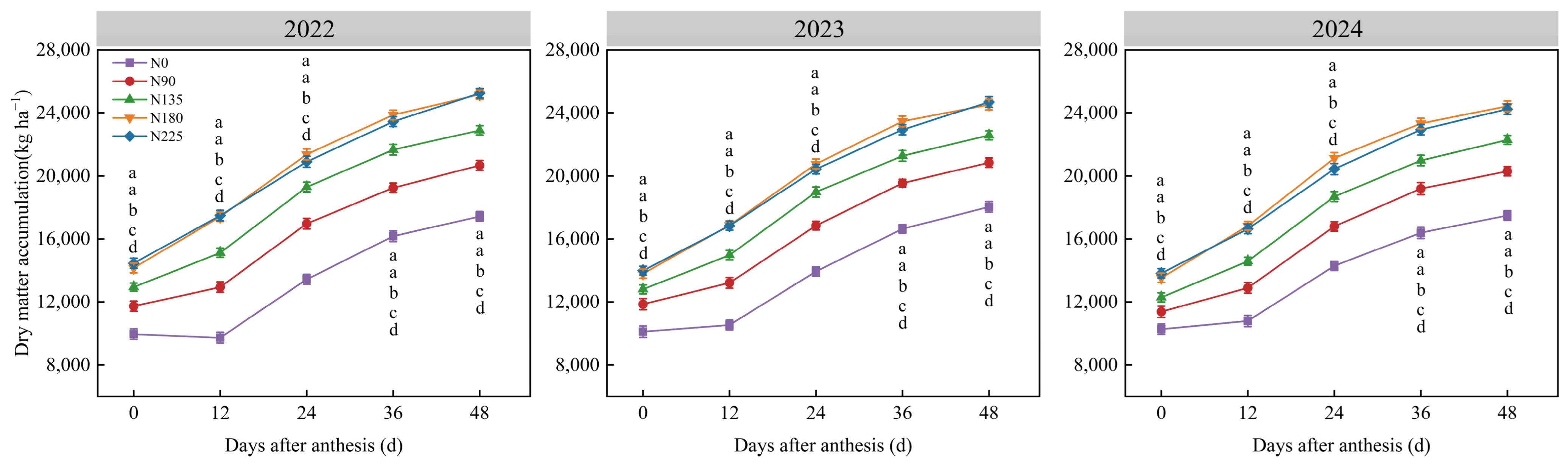
The N rate had a significant impact on the dynamics of dry matter accumulation in the aboveground parts of maize after anthesis (Figure 3). Across three growing seasons, the dry matter accumulation in the aboveground parts of each treatment followed a sigmoid growth curve after anthesis. At 0, 12, 24, 36, and 48 days after anthesis, the dry matter accumulation in the aboveground parts of the N180 treatment was significantly higher than that of the N0, N90, and N135 treatments, but there was no significant difference compared to the N225 treatment. At 48 days after anthesis, the dry matter accumulation in the N180 treatment increased by 35.95%, 17.65%, and 8.64% compared to the N0, N90, and N135 treatments, respectively. This indicates that increasing nitrogen fertilizer application can promote the continuous accumulation of dry matter after anthesis, providing a sufficient material basis for grain-filling.

3.5. Post-Anthesis Dry Matter Translocation from Various Organs

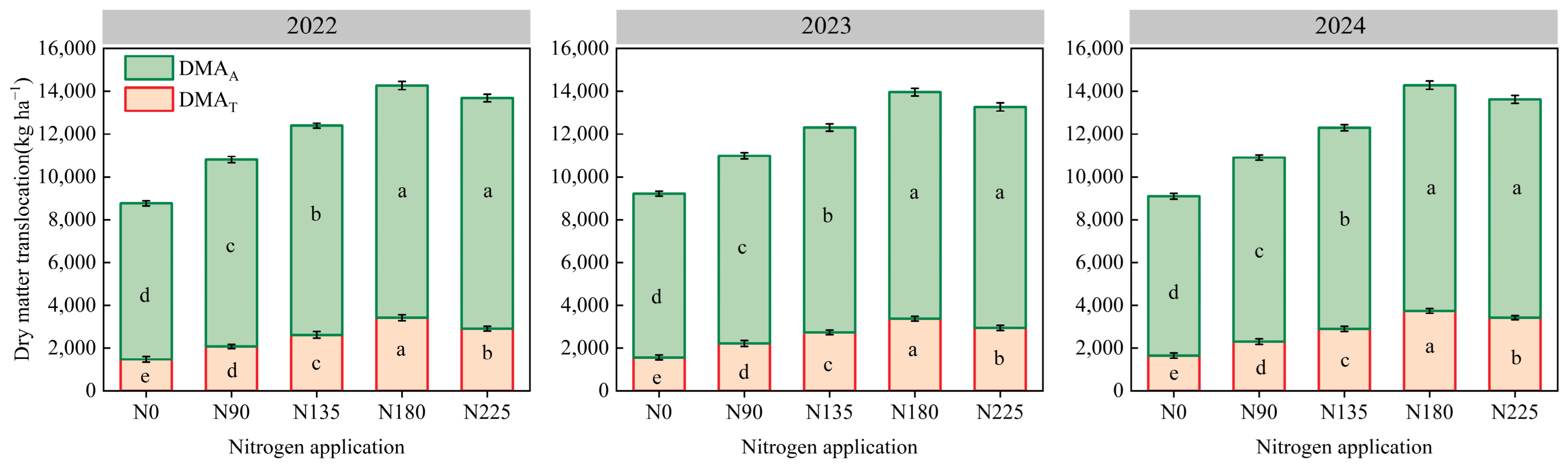
The N rate had a significant impact on dry matter translocation and post-anthesis dry matter accumulation (Figure 4). Across the three growing seasons, the post-anthesis dry matter accumulation in maize gradually increased with the increase in N rate, with the N180 and N225 treatments showing the highest accumulation. The dry matter translocation amount showed a trend of first increasing and then decreasing with the increase in N rate, with the N180 treatment having the highest amount. Compared to the N0, N90, N135, and N225 treatments, the dry matter translocation in the N180 treatment increased by 115.34%, 52.00%, 23.03%, and 14.40%, respectively. The results indicated that the N180 treatment significantly increased the dry matter translocation amount and post-anthesis dry matter accumulation, laying a foundation for improving maize yield.

3.6. Dry Matter Distribution in Various Organs at Maturity

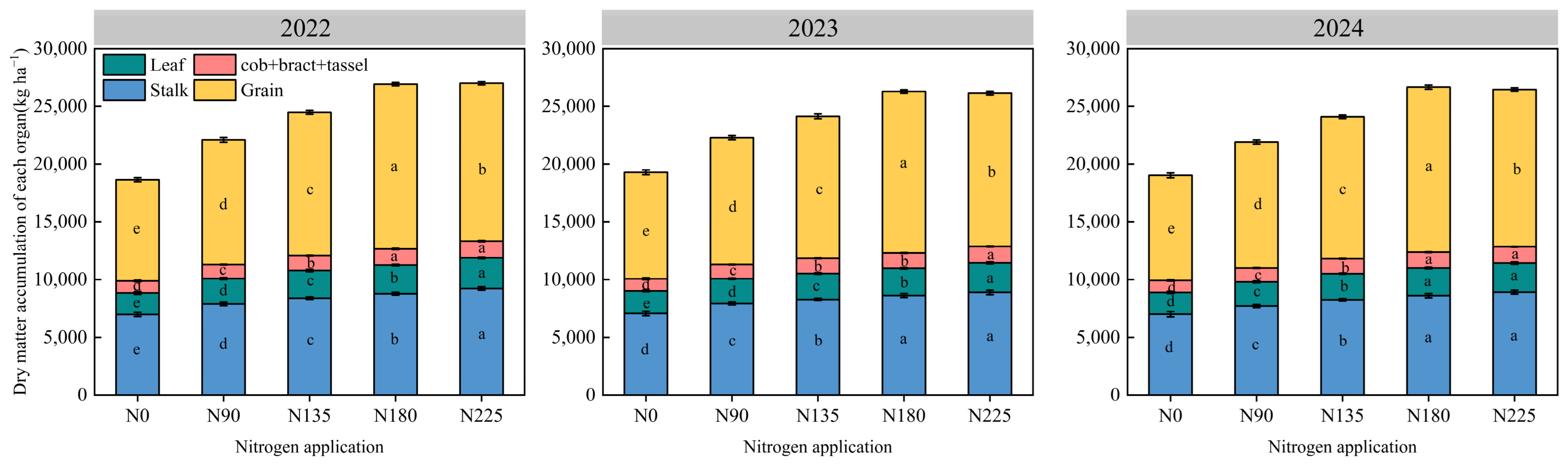
The N rate significantly affects the dry matter partitioning at the maturity stage of spring maize (Figure 5). Across three growing seasons, the distribution ratio of dry matter among various organs at maturity follows the order: grain > stalk > leaf > cob, bract, and tassel. At maturity, the accumulation of dry matter in grains initially increases and then decreases with the increase in N rate, with the N180 treatment showing the highest accumulation. Compared to the N0, N90, N135, and N225 treatments, the grain dry matter of the N180 treatment increased by 51.41%, 27.07%, 13.48%, and 5.21%, respectively. The dry matter in stems, leaves, cob, bract, and tassel gradually increased with the increase in N rate for all treatments. This indicates that the N180 treatment effectively enhances the partitioning of dry matter to grains at the maturity stage of maize.

3.7. Spad Value of Ear Leaf

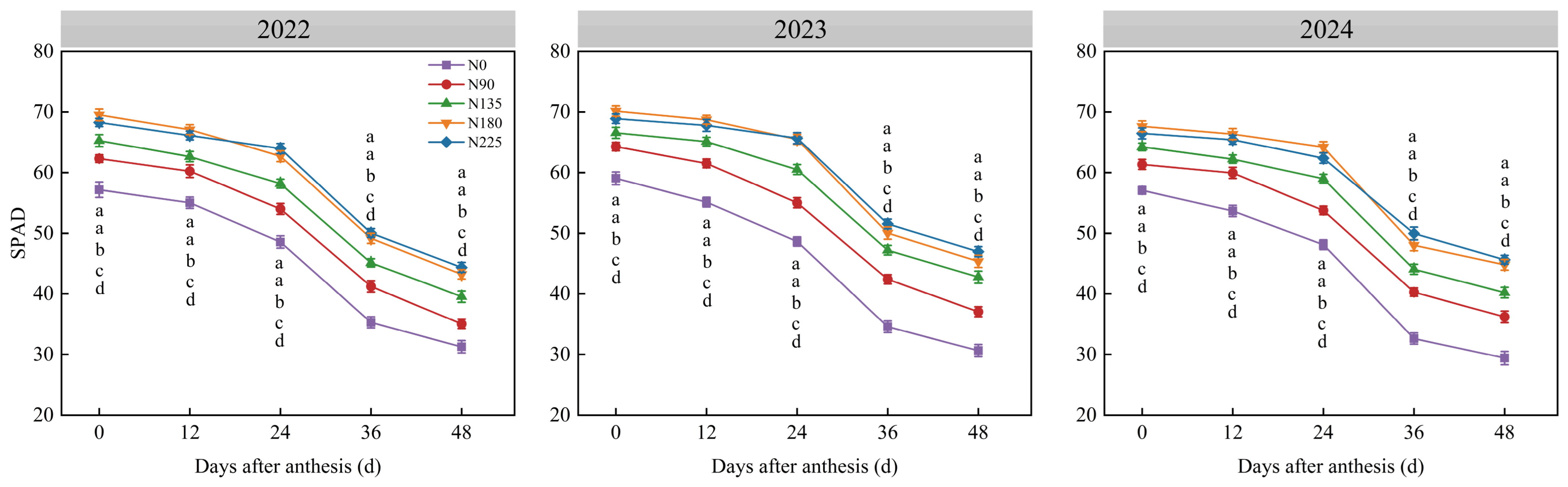
The N rate significantly affected the SPAD values of maize after anthesis (Figure 6). Over the three growing seasons, as the growth process progressed after anthesis, the SPAD values of each treatment gradually decreased. At 0, 12, 24, 36, and 48 days after anthesis, the SPAD values were in the order of N180, N225 > N135 > N90 > N0, with no significant difference between the N180 and N225 treatments.

3.8. Chlorophyll Fluorescence Parameters

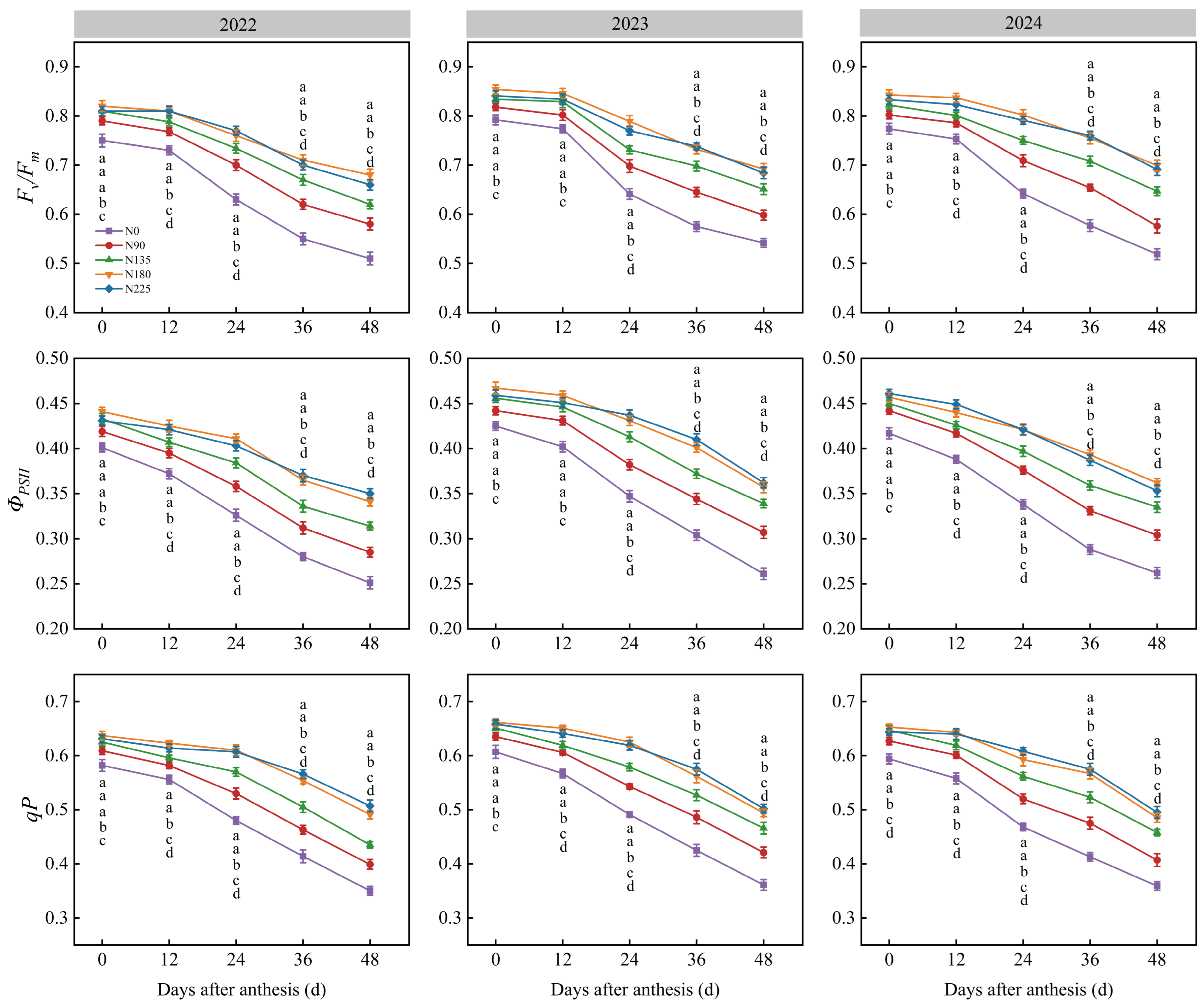
Over three growing seasons, with the increase in days after anthesis, Fv/Fm, ΦPSII, and qP of the ear leaf exhibited a continuous downward trend (Figure 7). As the N rate increased, Fv/Fm, ΦPSII, and qP gradually increased, and remained at higher levels in the N180 and N225 treatments. Compared with the N0, N90, and N135 treatments, Fv/Fm increased by 5.51–20.35%, ΦPSII increased by 6.86–23.69%, and qP increased by 6.72–22.14% in the N180 treatment. This indicates that the N180 treatment is beneficial for delaying the decline of PSII function in the ear leaf, maintaining higher photochemical efficiency and electron transfer capacity, and thus providing a more durable photosynthetic physiological basis for grain-filling. However, further increasing nitrogen application to N225 did not further enhance this effect.

3.9. Activities of Rubpcase and Pepcase

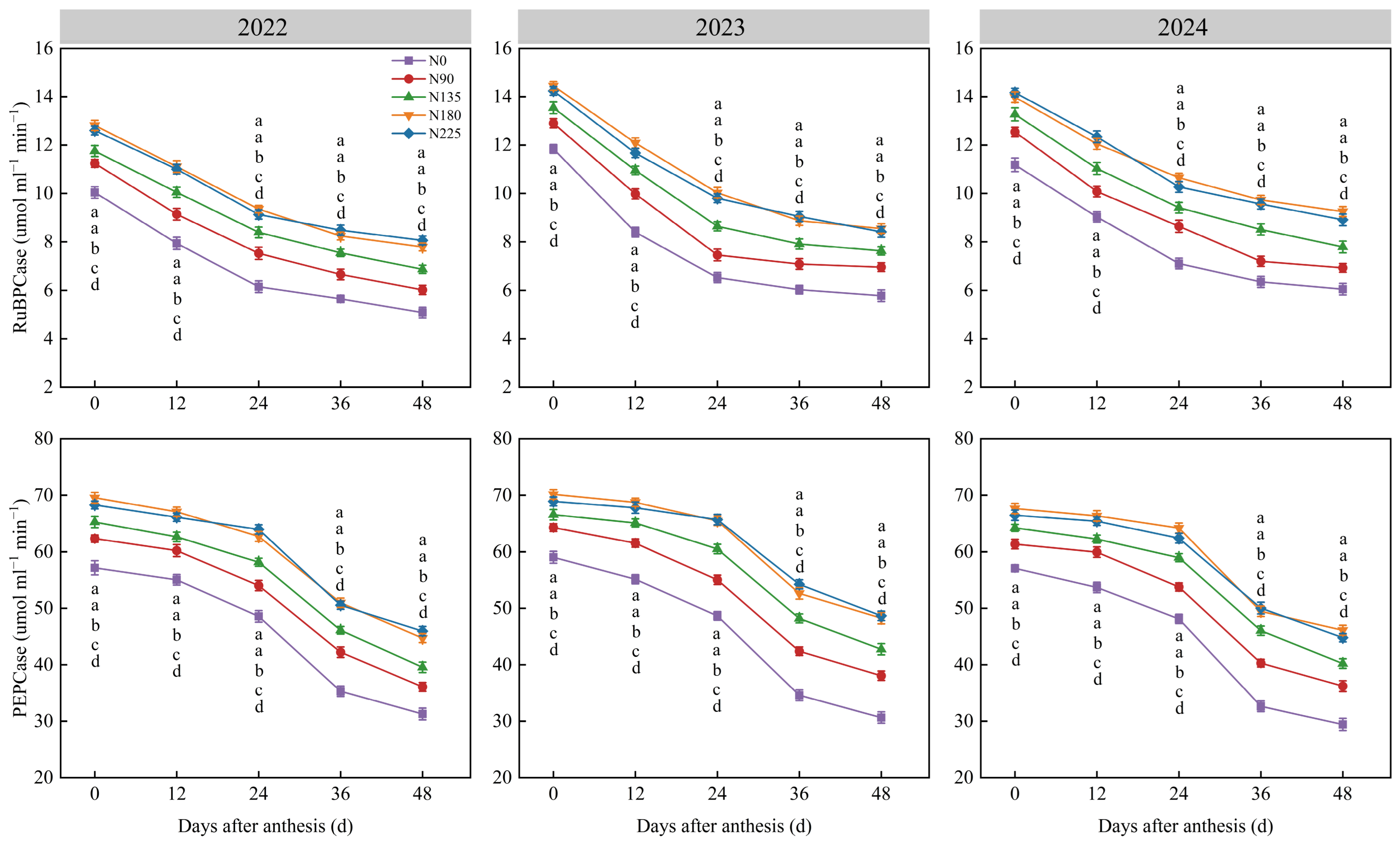
Over the three growing seasons, the activities of RuBPCase and PEPCase gradually decreased as the number of days after anthesis increased (Figure 8). At 0, 12, 24, 36, and 48 days after anthesis, the activities of RuBPCase and PEPCase were highest in the N180 treatment. Compared to the N0, N90, and N135 treatments, the activities of RuBPCase and PEPCase in the N180 treatment increased by 40.46%, 21.92%, 10.93%, and 32.18%, 16.46%, 8.17%, respectively. There was no significant difference between the N180 and N225 treatments.

4. Discussion

4.1. Effects of N Rates on Photosynthetic Activity of Spring Maize

Photosynthesis is the basis of maize yield formation and dry matter production [21]. Relative chlorophyll content (SPAD) reflects leaf chlorophyll status and is widely used as an indicator of the physiological status of photosynthetic tissues [22]. In the present study, the SPAD value of the ear leaf increased with increasingN rate after anthesis. SPAD values under N180 and N225 were significantly higher than those under the low-nitrogen treatments (N0, N90, and N135), which is consistent with previous findings [23]. Nitrogen is an essential component of chlorophyll and photosynthetic proteins, and its supply therefore affects the physiological activity of PSII and related physiological characteristics [6]. Liu et al. (2018) [24] reported that, under a N rate of 185 kg ha−1, Fv/Fm was 4–13%, 3–7%, and 4% higher, and ΦPSII was 7–21%, 10–15%, and 5–7% higher, respectively, than underN rates of 0, 129, and 300 kg ha−1. In this study, the trends in Fv/Fm, ΦPSII, and qP of the ear leaf after anthesis were generally consistent with the trend observed for SPAD as N rate varied; N180 and N225 maintained relatively high levels with no significant difference between them. This indicates that N180 can fully meet the nitrogen requirements for chlorophyll synthesis and photosynthetic protein assembly, likely promoting the allocation of nitrogen in the ear leaf to thylakoids and components related to electron transport, which helps maintain the ear leaf’s light energy capture and electron transport capabilities [25]. However, although N225 also maintained relatively high SPAD and chlorophyll fluorescence values, it did not further improve these parameters compared with N180. This suggests that the promoting effect of nitrogen on photosynthesis-related traits may reach a plateau once the nitrogen supply is sufficient to meet the demands of chlorophyll synthesis and photosynthetic protein assembly. In addition, it has been suggested that excessive nitrogen may promote the accumulation of reactive oxygen species and aggravate membrane lipid peroxidation, thereby restricting further improvements in PSII activity and electron transport efficiency [26]. Previous studies have shown that nitrogen supply levels have a dual effect on photosynthetic carbon fixation. On the one hand, sufficient nitrogen provides the raw materials for the synthesis of RuBPCase and PEPCase; on the other hand, excessive nitrogen disrupts the carbon-nitrogen metabolic balance, reducing the proportion of nitrogen allocated to photosynthetic enzyme components and thereby limiting further increases in their activity. Therefore, an appropriate N rate can ensure an adequate nitrogen supply while avoiding negative effects, thereby facilitating the full expression of photosynthetic enzyme activity [27]. This study confirmed that as the N rate increased, the RuBPCase and PEPCase activities in the ear leaf significantly increased; however, no further significant increase was observed beyond N180, indicating that the carbon fixation process had reached equilibrium with nitrogen supply at this application rate. In summary, under the conditions of this study, the N180 treatment maintained post-anthesis chlorophyll status and supported higher PSII photochemical efficiency and key carboxylase activities in the ear leaf, which was conducive to sustaining assimilate supply capacity during grain-filling [28].

4.2. Dry Matter Accumulation and Transport in Spring Maize in Response to N Rates

N rate significantly affects plant dry matter accumulation and translocation. Coordinating post-anthesis dry matter accumulation with pre-anthesis dry matter translocation is a fundamental approach to achieving high yield [29]. Maintaining a high level of post-anthesis dry matter accumulation is a prerequisite for grain-filling [30]. Lu et al. (2024) [31] noted that the accumulation of dry matter in the aboveground parts of maize first increased and then decreased as the N rate increased, reaching a maximum at a N rate of 180 kg ha−1, which was 28.4% and 14.2% higher than that under N rates of 0 and 270 kg ha−1, respectively. Zhai et al. (2022) [32] found that, within the N rate range of 0–360 kg ha−1, post-anthesis dry matter accumulation increased as the N rate increased, but tended to stabilize beyond this range. In this study, post-anthesis dry matter accumulation gradually increased as the N rate increased, but no significant difference was observed between the N180 and N225 treatments. This indicates that a N rate of 180 kg ha−1 can meet the requirement for post-anthesis dry matter production while avoiding excessive nitrogen input. Although the contribution of dry matter translocation to grain yield is only 16–22%, it is preferentially mobilized and utilized during grain-filling, playing a crucial role in enhancing grain sink activity and promoting grain-filling [30]. Studies have shown that total dry matter translocation was highest under a N rate of 180 kg ha−1, increasing by 23.2–105.2% compared with treatments with N rates of 0, 120, 300, and 360 kg ha−1, but there was no significant difference compared with the treatment at a N rate of 240 kg ha−1 [33]. This study found that the amount of dry matter translocated first increased and then decreased as the N rate increased, reaching a maximum at N180. This may be because an appropriate N rate synergistically enhances source growth and sink capacity, enabling strong grain sink demand in the late stage of grain-filling to drive the efficient translocation of stored substances from stems and leaves to the grains [34]. Although the post-anthesis dry matter accumulation at N225 was comparable to that at N180, the amount of dry matter translocated significantly decreased, indicating that more dry matter was retained in vegetative organs such as stems and leaves (Figure 4), thereby limiting the reutilization of stored dry matter from these organs. This may be because excessive nitrogen application promotes the vegetative growth of maize and delays leaf senescence, leading to an imbalance in the source-sink relationship, where more assimilates are used to maintain the growth of vegetative organs rather than being allocated to the grains [35]. In addition, it has been reported that excessive nitrogen application can significantly enrich specific soil microbial taxa (such as Lechevalieria and Botryotrichum), which may indirectly promote excessive vegetative growth and thereby inhibit dry matter redistribution to the grains [33].

4.3. Grain-Filling Characteristics and Yield Formation of Spring Maize as Affected by N Rate

N rate directly affects maize grain yield by influencing the number of grains per ear and the 100-grain weight. Therefore, coordinating the relationship between these two components is crucial for realizing the yield potential of maize. Previous studies have shown that the relationship between maize yield and N rate is not simply linear [24]. Under suitable irrigation conditions, when the N rate is within the range of 0–186 kg ha−1, maize yield increases as the N rate increases; however, beyond this range, yield no longer increases and may even decrease [36]. In this study, the N180 treatment had the highest yield. In terms of yield components, the number of grains per ear increased as the N rate increased. However, when the N rate increased from 180 kg ha−1 to 225 kg ha−1, the increase in the number of grains per ear became negligible. However, the 100grain weight reached its peak at a N rate of 180 kg ha−1 and decreased when the N rate increased to 225 kg ha−1. This indicates that at higher nitrogen application levels, grain weight becomes a key factor restricting further yield improvement [37]. The difference in grain weight is closely related to the grain-filling process. Adequate nitrogen fertilizer supply is beneficial for improving the grain-filling rate, prolonging the active grain-filling period, and thereby increasing grain weight [16]. Studies have shown that when the N rate is 300 kg ha−1, the average grain-filling rate increases by 13.15–13.88% compared with 150 kg ha−1, and the active grain-filling period increases by 6.44–13.82% [38]. This study found, through logistic equation fitting, that the N180 treatment had higher maximum and average grain-filling rates and a prolonged active grain-filling period, indicating that this treatment is beneficial for the formation of a high-intensity and long-lasting grain-filling process, thereby supporting higher grain weight. In contrast, the grain-filling rate and active grain-filling period under the N225 treatment decreased compared with those under N180, indicating that continued nitrogen fertilizer application not only failed to maintain the grain-filling advantage but also inhibited dry matter accumulation in the grains. This may be related to the coordination mechanism between leaf senescence and grain-filling. Studies have shown that increasing nitrogen fertilizer application can delay senescence of the ear leaf. However, when the N rate (274.5 or 343.5 kg ha−1) exceeds the optimal N rate (205.5 kg ha−1), the grain-filling rate and maximum grain weight do not increase, but instead decrease. This is because moderate nitrogen application can better match the onset of leaf senescence with the peak period of grain-filling, thereby optimizing the supply of assimilates. In contrast, excessive nitrogen application may delay senescence of the ear leaf too much, leading to a mismatch between the functional period of the ear leaf and the peak period of grain-filling, thereby reducing grain-filling efficiency [39]. In addition, the higher grain-filling rate and yield are closely associated with plant dry matter accumulation and assimilate transport after anthesis [40]. In this study, the appropriate N rate (N180) significantly improved the photosynthetic performance of leaves after anthesis, ensuring the accumulation of “source” photosynthetic products and their transport to the grains, and thereby providing a sufficient assimilate supply for grain-filling. Our previous research also showed that appropriate nitrogen application can optimize the balance of endogenous hormones in grains and increase the activity of key enzymes involved in starch synthesis, thereby enhancing grain storage capacity and transformation ability [41]. This is beneficial for maintaining a higher grain-filling rate and prolonging grain-filling duration, which further explains why the N180 treatment showed greater grain-filling advantages and higher grain weight. Excessive nitrogen application (N225) can lead to the retention of assimilates in vegetative organs, reducing their redistribution to the grains. On the other hand, excessive nitrogen fertilizer application may cause soil mineral nitrogen accumulation, inhibit root growth and physiological activity, and reduce post-anthesis nitrogen absorption and transport capacity [42], ultimately weakening grain-filling strength, shortening the effective grain-filling period, and leading to decreases in grain weight and yield.

5. Conclusions

In this study, conducted in the black soil region of Northeast China using the maize cultivar ‘Fumin 985’ at a planting density of 60,000 plants ha−1, the N180 treatment significantly enhanced the chlorophyll content, photochemical efficiency, and activities of key carboxylases (RuBPCase and PEPCase) in the ear leaf after anthesis, thereby strengthening the photosynthetic physiological activity of the “source”. While maintaining a high level of post-anthesis dry matter accumulation, this treatment significantly promoted the translocation of pre-anthesis stored dry matter from vegetative organs to the grains, increasing the proportion of dry matter allocated to the grains at maturity. Furthermore, N180 significantly improved the 100-grain weight by increasing the grain-filling rate and extending the grain-filling period while stabilizing the number of grains per ear, ultimately achieving the highest yield. In summary, under the conditions of this experiment, N180 coordinately optimized the carbon assimilation activity of the “source”, the transport efficiency of the “flux”, and the grain-filling intensity of the “sink”, thereby achieving a balance among source, sink, and flux. This provides a physiological basis for high-yield cultivation and rational nitrogen fertilizer application in spring maize in this region. Under the specific soil and climatic conditions of this study, the regulatory effect of optimized N rate on source-sink-flux coordination in maize and its mechanism for high yield and high efficiency were clarified; further studies are still needed across different ecological conditions and cultivar types.

Author Contributions

W.C.: Conceptualization, Formal analysis, Investigation, Writing—original draft. Z.Y.: Supervision, Writing—review and editing. Y.S.: Funding acquisition, Project administration, Writing—review and editing. Y.W.: Supervision, Resources. All authors have read and agreed to the published version of the manuscript.

Funding

The National Key R&D Program of China (2023YFD1501105) provided financial support for this study.

Data Availability Statement

The datasets used in the current study are available from the corresponding author on reasonable request.

Conflicts of Interest

The authors confirm that they have no known financial conflicts of interest or personal relationships that could conceivably have influenced the work reported in this paper.; Declaration of Generative AI and LLM Use; The authors confirm that this manuscript was not created with the assistance of any Generative AI or large language models (LLMs).

References

  1. Liu, S.; Xiao, L.; Sun, J.; Yang, P.; Yang, X.; Wu, W. Probability of Maize Yield Failure Increases with Drought Occurrence but Partially Depends on Local Conditions in China. Eur. J. Agron. 2022, 139, 126552. [Google Scholar] [CrossRef]
  2. Wang, Y.; Zhang, Y.; Liu, Y.; Wang, L.; Dong, Y. Effects of Different Tillage Methods on Soil Properties and Maize Seedling Growth in Alternating Wide and Narrow Rows Rotation Mode in the Songliao Plain of China. Geoderma 2024, 452, 117120. [Google Scholar] [CrossRef]
  3. Fang, L.; Zhang, G.; Ming, B.; Shen, D.; Wang, Z.; Zhou, L.; Zhang, T.; Liang, Z.; Xue, J.; Xie, R.; et al. Dense Planting and Nitrogen Fertilizer Management Improve Drip–Irrigated Spring Maize Yield and Nitrogen Use Efficiency in Northeast China. J. Integr. Agric. 2026, 25, 1443–1450. [Google Scholar] [CrossRef]
  4. Ji, Y.; Zhao, Y.; Han, X.; Chen, X.; Yan, J.; Lu, X.; Zhu, Y.; Zou, W. Effect of Long–Term Fertilization Practices on the Stability of Soil Organic Matter in the Northeast Black Soil Region in China. Agronomy 2024, 14, 2272. [Google Scholar] [CrossRef]
  5. Li, C.; Wang, J.; Zhang, Y.; Feng, H.; Zhang, W.; Siddique, K.H.M. Response of Plastic Film Mulched Maize to Soil and Atmospheric Water Stresses in an Arid Irrigation Area. Eur. J. Agron. 2024, 154, 127080. [Google Scholar] [CrossRef]
  6. Liu, Q.; Guo, Y.; Yin, P.; Lan, T.; Wei, G.; Liu, F.; Lyu, C.; Kong, F.; Yuan, J. Low-Nitrogen-Tolerant Maize Cultivar Improves Photosynthesis and Yield by Optimizing Nitrogen Allocation to Increase Electron Transport under Low–Nitrogen and Low–Light Stress. Crop J. 2025, 13, 1607–1618. [Google Scholar] [CrossRef]
  7. Fan, Y.; Zhang, Y.; Wang, Z.; Li, Y.; Wang, Y.; Tang, H.; Liu, Z.; Wang, X. Optimized Water and Nitrogen Management Improves Photosynthesis, Yield, and Resource Use Efficiency of Maize under Mulched Drip Irrigation. Agric. Water Manag. 2026, 326, 110219. [Google Scholar] [CrossRef]
  8. Jiao, Q.; Hu, X. Recent Advances and Emerging Trends in Chlorophyll Fluorescence Parameter Fv/Fm. Phyton 2025, 94, 2615–2630. [Google Scholar] [CrossRef]
  9. Li, Y.; Gu, X.; Li, Y.; Fang, H.; Chen, P. Ridge–Furrow Mulching Combined with Appropriate Nitrogen Rate for Enhancing Photosynthetic Efficiency, Yield and Water Use Efficiency of Summer Maize in a Semi–Arid Region of China. Agric. Water Manag. 2023, 287, 108450. [Google Scholar] [CrossRef]
  10. Yang, H.; Gu, X.; Ding, M.; Lu, W.; Lu, D. Weakened Carbon and Nitrogen Metabolisms under Post–Silking Heat Stress Reduce the Yield and Dry Matter Accumulation in Waxy Maize. J. Integr. Agric. 2020, 19, 78–88. [Google Scholar] [CrossRef]
  11. Xie, J.; Liu, Y.; Liu, Y.; Xie, C.; Hu, X.; Ru, C. Nitrogen and Melatonin Synergistically Alleviate Drought Stress in Wheat by Enhancing Photosynthesis, Nitrogen Metabolism, and Antioxidant Defense. Plant Stress 2026, 19, 101175. [Google Scholar] [CrossRef]
  12. Ma, Y.; Yang, S.; Ding, R.; Du, T.; Kang, S.; Tong, L. Mild Water Deficit under Reasonable Dense Planting Ensures Maize Yield and Improves Water Use Efficiency by Coordinating Source–Sink Relationship. Field Crops Res. 2025, 327, 109888. [Google Scholar] [CrossRef]
  13. Zhao, B.; Ata–Ul–Karim, S.T.; Lemaire, G.; Duan, A.; Liu, Z.; Guo, Y.; Qin, A.; Ning, D.; Liu, Z. Exploring the Nitrogen Source–Sink Ratio to Quantify Ear Nitrogen Accumulation in Maize and Wheat Using Critical Nitrogen Dilution Curve. Field Crops Res. 2021, 274, 108332. [Google Scholar] [CrossRef]
  14. Wu, B.; Cui, Z.; Zechariah, E.; Guo, L.; Gao, Y.; Yan, B.; Liu, H.; Wang, Y.; Wang, H.; Li, L. Post–Anthesis Dry Matter and Nitrogen Accumulation, Partitioning, and Translocation in Maize under Different Nitrate–Ammonium Ratios in Northwestern China. Front. Plant Sci. 2024, 15, 1257882. [Google Scholar] [CrossRef]
  15. Martínez–Peña, R.; Schlereth, A.; Höhne, M.; Encke, B.; Morcuende, R.; Nieto–Taladriz, M.T.; Araus, J.L.; Aparicio, N.; Vicente, R. Source–Sink Dynamics in Field–Grown Durum Wheat Under Contrasting Nitrogen Supplies: Key Role of Non–Foliar Organs During Grain Filling. Front. Plant Sci. 2022, 13, 869680. [Google Scholar] [CrossRef]
  16. Wang, J.; Sun, X.; Hussain, S.; Yang, L.; Gao, S.; Zhang, P.; Chen, X.; Ren, X. Reduced Nitrogen Rate Improves Post–Anthesis Assimilates to Grain and Ameliorates Grain–Filling Characteristics of Winter Wheat in Dry Land. Plant Soil 2024, 499, 91–112. [Google Scholar] [CrossRef]
  17. Fang, H.; Gu, X.; Jiang, T.; Yang, J.; Li, Y.; Huang, P.; Chen, P.; Yang, J. An Optimized Model for Simulating Grain–Filling of Maize and Regulating Nitrogen Application Rates under Different Film Mulching and Nitrogen Fertilizer Regimes on the Loess Plateau, China. Soil Tillage Res. 2020, 199, 104546. [Google Scholar] [CrossRef]
  18. Wang, F.; Xie, R.; Ming, B.; Wang, K.; Hou, P.; Chen, J.; Liu, G.; Zhang, G.; Xue, J.; Li, S. Dry Matter Accumulation after Silking and Kernel Weight Are the Key Factors for Increasing Maize Yield and Water Use Efficiency. Agric. Water Manag. 2021, 254, 106938. [Google Scholar] [CrossRef]
  19. Xu, Z.; Zhou, G. Photosynthetic Recovery of a Perennial Grass Leymus Chinensis after Different Periods of Soil Drought. Plant Prod. Sci. 2007, 10, 277–285. [Google Scholar] [CrossRef]
  20. Ren, B.; Zhang, J.; Dong, S.; Liu, P.; Zhao, B. Exogenous 6-benzyladenine Improves Antioxidative System and Carbon Metabolism of Summer Maize Waterlogged in the Field. J. Agron. Crop Sci. 2018, 204, 175–184. [Google Scholar] [CrossRef]
  21. Zhang, P.; Wang, X.; Huang, J.; Zhang, Y.; Zhang, Z.; Yu, Y.; Reffye, P.D.; Kang, M.; Song, Y. Extension of the GreenLab in Modelling Maize Canopy Photosynthesis under High Plant Densities for Trait Discovery. Field Crops Res. 2025, 334, 110155. [Google Scholar] [CrossRef]
  22. Wang, Y.; Yu, A.; Wang, P.; Shang, Y.; Wang, F.; Lü, H.; Pang, X.; Li, Y.; Liu, Y.; Yin, B.; et al. No–Tillage with Total Green Manure Mulching Increases Maize Yield through Improved Soil Moisture and Temperature Environment and Enhanced Maize Root Structure and Photosynthetic Capacity. J. Integr. Agric. 2025, 24, 4211–4224. [Google Scholar] [CrossRef]
  23. Gu, X.; Xu, Y.; Zhao, T.; Du, Y.; Zhang, Y.; Tian, Y.; Cheng, Z.; Cai, H.; Liu, Z. Nitrogen Reduction with Supplemental Irrigation Enhances Yield by Delaying Leaf Senescence and Optimizing Grain–Filling Process for Ridge–Furrow Film Mulching Winter Wheat. Agric. Water Manag. 2025, 318, 109705. [Google Scholar] [CrossRef]
  24. Liu, Z.; Gao, J.; Gao, F.; Liu, P.; Zhao, B.; Zhang, J. Photosynthetic Characteristics and Chloroplast Ultrastructure of Summer Maize Response to Different Nitrogen Supplies. Front. Plant Sci. 2018, 9, 576. [Google Scholar] [CrossRef]
  25. Gao, Z.; Li, J.; Liu, S.; Chen, Y. Within–Leaf Chloroplasts and Nitrogen Allocation to Thylakoids in Relation to Photosynthesis during Grain Filling in Maize. Plant Physiol. Biochem. 2023, 196, 830–840. [Google Scholar] [CrossRef] [PubMed]
  26. Cheng, Y.; Chen, X.; Ren, H.; Zhang, J.; Zhao, B.; Ren, B.; Liu, P. Deep Nitrogen Fertilizer Placement Improves the Yield of Summer Maize (Zea mays L.) by Enhancing Its Photosynthetic Performance after Silking. BMC Plant Biol. 2025, 25, 172. [Google Scholar] [CrossRef]
  27. Wei, S.; Wang, X.; Li, G.; Jiang, D.; Dong, S. Maize Canopy Apparent Photosynthesis and 13C–Photosynthate Reallocation in Response to Different Density and N Rate Combinations. Front. Plant Sci. 2019, 10, 1113. [Google Scholar] [CrossRef] [PubMed]
  28. Chen, G.; Wu, P.; Wang, J.; Zhou, Y.; Ren, L.; Cai, T.; Zhang, P.; Jia, Z. How Do Different Fertilization Depths Affect the Growth, Yield, and Nitrogen Use Efficiency in Rain–Fed Summer Maize? Field Crops Res. 2023, 290, 108759. [Google Scholar] [CrossRef]
  29. Li, Z.; Wang, G.; Khan, K.; Yang, L.; Chi, Y.; Wang, Y.; Zhou, X. Irrigation Combines with Nitrogen Application to Optimize Soil Carbon and Nitrogen, Increase Maize Yield, and Nitrogen Use Efficiency. Plant Soil 2024, 499, 605–620. [Google Scholar] [CrossRef]
  30. Li, L.; Cheng, X.; Zhang, Y.; Kohtz, D.; Wang, X.; Zhang, X.; Kong, X.; Xue, H.; Jia, P.; Bai, N.; et al. Exogenous Melatonin Improves Peanut Field Productivity and Quality at Reduced Nitrogen Application. Field Crops Res. 2024, 319, 109650. [Google Scholar] [CrossRef]
  31. Lu, Y.; Ma, R.; Gao, W.; You, Y.; Jiang, C.; Zhang, Z.; Kamran, M.; Yang, X. Optimizing the Nitrogen Application Rate and Planting Density to Improve Dry Matter Yield, Water Productivity and N–Use Efficiency of Forage Maize in a Rainfed Region. Agric. Water Manag. 2024, 305, 109125. [Google Scholar] [CrossRef]
  32. Zhai, J.; Zhang, Y.; Zhang, G.; Xu, W.; Xie, R.; Ming, B.; Hou, P.; Wang, K.; Xue, J.; Li, S. Nitrogen Application and Dense Planting to Obtain High Yields from Maize. Agronomy 2022, 12, 1308. [Google Scholar] [CrossRef]
  33. Meng, T.; Liu, Y.; Zhang, X.; Shi, J.; Zhao, X.; Chen, X.; Rong, M.; Guo, X.; Wei, S.; Liu, J.; et al. Nitrogen Application Regulates Ecosystem Multifunctionality through Soil Microbial Diversity: A Quantitative Assessment. Plant Soil 2026, 521, 1573–1592. [Google Scholar] [CrossRef]
  34. Liao, Z.; Zhang, C.; Zhang, Y.; Yu, S.; Yan, S.; Zhang, S.; Li, Z.; Fan, J. Nitrogen Application and Soil Mulching Improve Grain Yield of Rainfed Maize by Optimizing Source–Sink Relationship and Grain Filling Process on the Loess Plateau of China. Eur. J. Agron. 2024, 153, 127060. [Google Scholar] [CrossRef]
  35. Wang, W.; Li, M.; Zhou, R.; Mo, F.; Khan, A.; Batool, A.; Zhang, W.; Lu, J.; Zhu, Y.; Wang, B.; et al. Leaf Senescence, Nitrogen Remobilization, and Productivity of Maize in Two Semiarid Intercropping Systems. Eur. J. Agron. 2023, 150, 126943. [Google Scholar] [CrossRef]
  36. Yang, T.; Zhao, J.; Hong, M.; Ma, M. Appropriate Water and Nitrogen Supply Regulates the Dynamics of Nitrogen Translocation and Thereby Enhancing the Accumulation of Nitrogen in Maize Grains. Agric. Water Manag. 2024, 306, 109160. [Google Scholar] [CrossRef]
  37. Olmedo Pico, L.; Savin, R.; Schussler, J.; Vyn, T. Late–Vegetative and Reproductive–Stage Nitrogen Determinants of Kernel Weight in Maize. Eur. J. Agron. 2023, 148, 126872. [Google Scholar] [CrossRef]
  38. Ren, H.; Jiang, Y.; Zhao, M.; Qi, H.; Li, C. Nitrogen Supply Regulates Vascular Bundle Structure and Matter Transport Characteristics of Spring Maize Under High Plant Density. Front. Plant Sci. 2021, 11, 602739. [Google Scholar] [CrossRef]
  39. Du, K.; Zhao, W.; Lv, Z.; Xu, B.; Hu, W.; Zhou, Z.; Wang, Y. Optimal Rate of Nitrogen Fertilizer Improves Maize Grain Yield by Delaying the Senescence of Ear Leaves and Thereby Altering Their Nitrogen Remobilization. Field Crops Res. 2024, 310, 109359. [Google Scholar] [CrossRef]
  40. Shen, L.; Huang, Y.; Li, T. Top–Grain Filling Characteristics at an Early Stage of Maize (Zea mays L.) with Different Nitrogen Use Efficiencies. J. Integr. Agric. 2017, 16, 626–639. [Google Scholar] [CrossRef]
  41. Cao, W.; Yu, Z.; Shi, Y.; Zhang, Z.; Zhang, Y. Photosynthetic Performance of Spring Maize Leaves and the Development and Formation of Superior and Inferior Grains. Front. Plant Sci. 2026, 16, 1732666. [Google Scholar] [CrossRef] [PubMed]
  42. Shen, S.; Feng, B.; Zhang, D.; Zou, J.; Yang, Y.; Rees, R.; Topp, C.; Hu, S.; Qiao, B.; Huang, W.; et al. Optimizing N Applications Increases Maize Yield and Reduces Environmental Costs in a 12–Year Wheat–Maize System. Field Crops Res. 2025, 322, 109741. [Google Scholar] [CrossRef]
Figure 1. Average precipitation and average temperature during the spring maize growing season from 2022 to 2024.
Agronomy 16 01073 g001
Figure 2. Effect of nitrogen application rate (N rate) on grain dry weight and grain-filling rate of spring maize. Note: Different lowercase letters indicate that the differences between the various N rates are statistically significant at the 0.05 level. ns indicates no significant difference.
Agronomy 16 01073 g002
Figure 3. Effect of N rate on post-anthesis aboveground total dry matter accumulation of spring maize. Note: Different lowercase letters indicate that the differences between the various N rates are sta-tistically significant at the 0.05 level.
Agronomy 16 01073 g003
Figure 4. Effect of N rate on post-anthesis dry matter translocation amount from various organs of spring maize. Note: Different lowercase letters indicate that the differences between the various N rates are statistically significant at the 0.05 level.
Agronomy 16 01073 g004
Figure 5. Effect of N rate on dry matter distribution in various organs at maturity of spring maize. Note: Different lowercase letters indicate that the differences between the various N rates are statistically significant at the 0.05 level.
Agronomy 16 01073 g005
Figure 6. Effect of N rate on post-anthesis SPAD value of ear leaf. Note: Different lowercase letters indicate that the differences between the various N rates are statistically significant at the 0.05 level.
Agronomy 16 01073 g006
Figure 7. Effect of N rate on post-anthesis chlorophyll fluorescence parameters of ear leaf Note: Different lowercase letters indicate that the differences between the various N rates are statistically significant at the 0.05 level.
Agronomy 16 01073 g007
Figure 8. Effect of N rate on post-anthesis activities of RuBPCase and PEPCase in ear leaf. Note: Different lowercase letters indicate that the differences between the various N rates are statistically significant at the 0.05 level.
Agronomy 16 01073 g008
Table 1. Effect of nitrogen application rate (N rate) on grain yield and nitrogen agronomic efficiency.
YearTreatmentEar Number
(No./hm2)
Grain Number
Per Ear
100-Grain
Weight (g)
Yield
(kg ha−1)
Nitrogen Agronomic Efficiency (kg kg−1)
2022N059,702 a549 d26.74 e8765.02 e
N9059,835 a573 c32.12 d11,012.01 d24.97 b
N13559,783 a597 b33.49 c11,951.47 c23.60 c
N18059,187 a639 a37.39 a14,138.56 a29.85 a
N22559,571 a628 a35.84 b13,407.19 b20.63 d
2023N059,692 a555 d27.83 e9220.77 e
N9059,782 a583 c32.67 d11,386.93 d24.07 b
N13559,521 a607 b34.05 c12,302.08 c22.82 c
N18058,245 a644 a37.22 a13,960.28 a26.33 a
N22557,548 a633 a35.74 b13,019.22 b16.88 d
2024N061,102 a558 d26.97 e9195.46 e
N9059,494 a581 c32.21 d11,133.67 d21.54 b
N13559,419 a606 b33.62 c12,105.82 c21.56 b
N18058,894 a638 a37.86 a14,225.58 a27.95 a
N22559,056 a637 a36.11 b13,584.12 b19.51 c
Nns********
Ynsns***
N × Ynsnsns**ns
Note: Different lowercase letters indicate that the differences between the various nitrogen application rates (N rates) are statistically significant at the 0.05 level. * Significance at the 0.05 probability level. ** Significance at the 0.01 probability level. ns, not significant.
Table 2. Effect of N rate on grain-filling parameters of spring maize.
YearTreatmentEquation ParameterCorrelation
Coefficient
Tmax
(d)
Wmax
(g)
Gmax
(g d−1)
Gmean
(g d−1)
D
(d)
ABC
2022N024.1135.470.140.999524.8312.060.870.5841.75
N9027.2228.410.140.998924.7313.610.920.6144.34
N13529.3226.610.140.998724.8514.660.970.6545.45
N18034.8324.060.130.998425.1717.411.100.7347.48
N22532.0625.810.130.998624.8016.031.050.7045.78
2023N023.2430.180.140.999224.3411.620.810.5442.86
N9026.8529.420.140.999224.3813.430.930.6243.25
N13528.5228.120.140.999124.2514.260.980.6543.62
N18034.6124.440.130.998624.6517.301.120.7546.27
N22531.3028.360.140.999124.3615.651.070.7243.68
2024N023.6432.790.140.999425.0611.820.820.5543.08
N9027.0929.050.140.999224.5013.550.930.6243.63
N13529.1428.960.140.999224.5514.570.990.6743.77
N18035.8125.020.130.998724.7617.911.160.7846.15
N22532.6328.890.130.999225.0716.321.090.7344.71
Note: A, B, and C are model parameters; Tmax: times needed for reaching the maximum grain-filling rate; Wmax: grain weight at the maximum grain-filling rate; Gmax: maximum grain-filling rate; Gmean: mean grain-filling rate; D: active grain-filling stage.
Disclaimer/Publisher’s Note: The statements, opinions and data contained in all publications are solely those of the individual author(s) and contributor(s) and not of MDPI and/or the editor(s). MDPI and/or the editor(s) disclaim responsibility for any injury to people or property resulting from any ideas, methods, instructions or products referred to in the content.